Cambridge IGCSE Food and Nutrition 0648 — 2017 May/June Paper 1 · Variant 3
0648/13/M/J/17 · 100 marks · ≈113 min
The question paper and its mark scheme, free to read here and free to download. This is Cambridge’s own paper, exactly as it was sat.
Question paper16 pages


Mark scheme13 pages
Answers below. Sit the paper first if you are practising.
Paper as text
Question paper, page 1
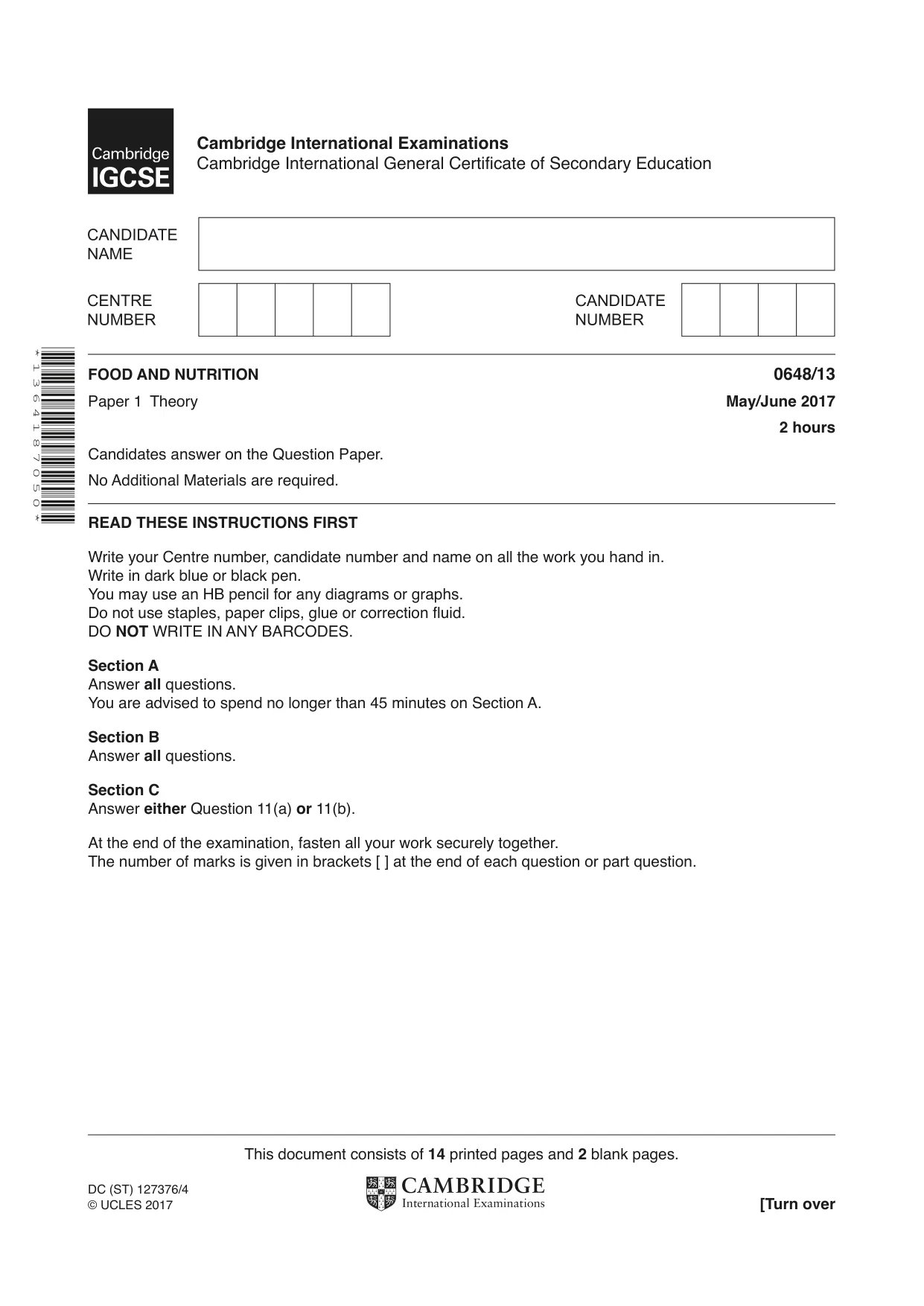
This document consists of 14 printed pages and 2 blank pages. DC (ST) 127376/4 © UCLES 2017 [Turn over Cambridge International Examinations Cambridge International General Certificate of Secondary Education * 1 3 6 4 1 8 7 0 5 0 * FOOD AND NUTRITION 0648/13 Paper 1 Theory May/June 2017 2 hours Candidates answer on the Question Paper. No Additional Materials are required. READ THESE INSTRUCTIONS FIRST Write your Centre number, candidate number and name on all the work you hand in. Write in dark blue or black pen. You may use an HB pencil for any diagrams or graphs. Do not use staples, paper clips, glue or correction fluid. DO NOT WRITE IN ANY BARCODES. Section A Answer all questions. You are advised to spend no longer than 45 minutes on Section A. Section B Answer all questions. Section C Answer either Question 11(a) or 11(b). At the end of the examination, fasten all your work securely together. The number of marks is given in brackets [ ] at the end of each question or part question.
Question paper, page 2
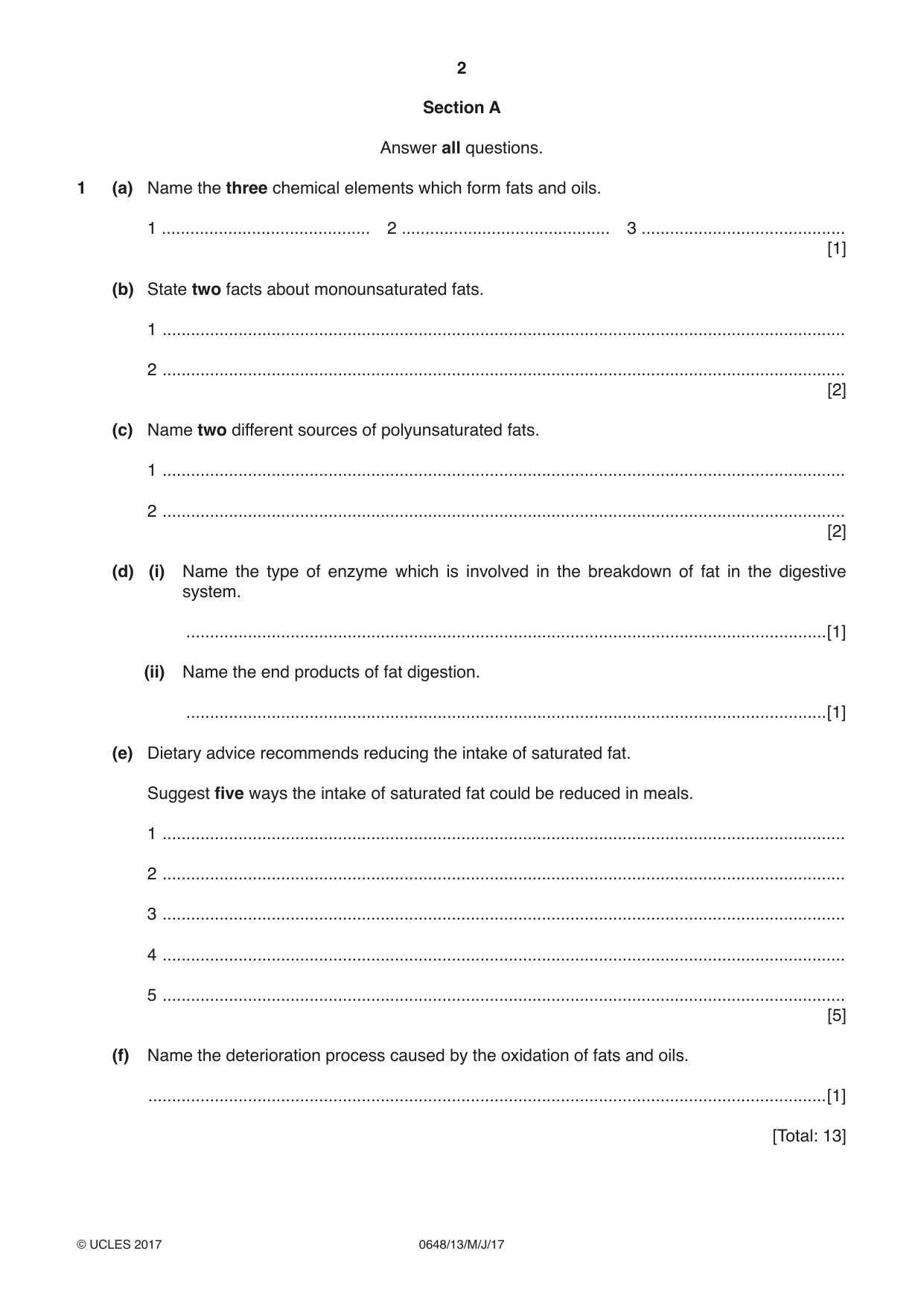
2 0648/13/M/J/17 © UCLES 2017 Section A Answer all questions. 1 (a) Name the three chemical elements which form fats and oils. 1 … 2 … 3 … [1] (b) State two facts about monounsaturated fats. 1 … 2 … [2] (c) Name two different sources of polyunsaturated fats. 1 … 2 … [2] (d) (i) Name the type of enzyme which is involved in the breakdown of fat in the digestive system. …[1] (ii) Name the end products of fat digestion. …[1] (e) Dietary advice recommends reducing the intake of saturated fat. Suggest five ways the intake of saturated fat could be reduced in meals. 1 … 2 … 3 … 4 … 5 … [5] (f) Name the deterioration process caused by the oxidation of fats and oils. …[1] [Total: 13]
Question paper, page 3
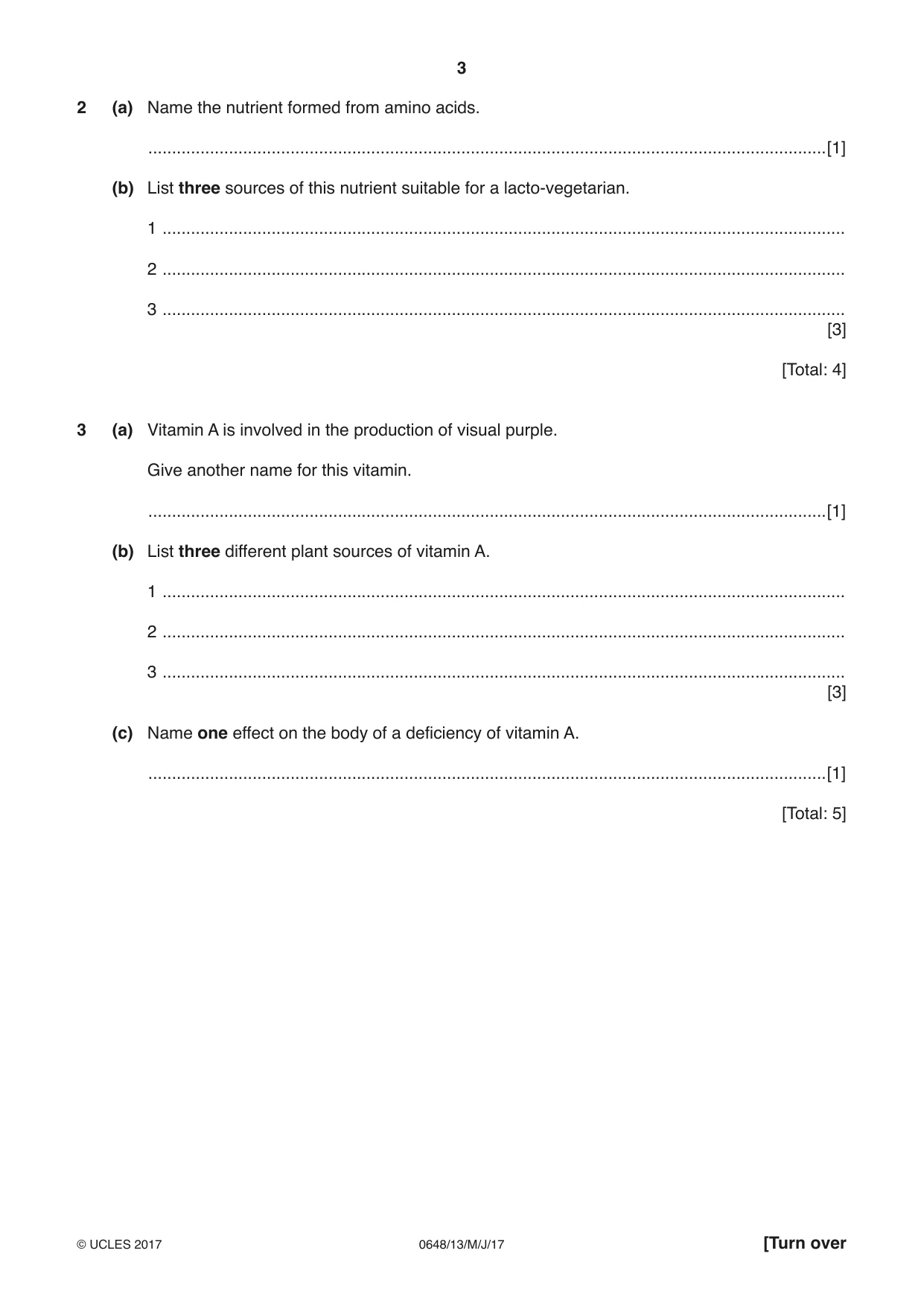
3 0648/13/M/J/17 © UCLES 2017 [Turn over 2 (a) Name the nutrient formed from amino acids. …[1] (b) List three sources of this nutrient suitable for a lacto-vegetarian. 1 … 2 … 3 … [3] [Total: 4] 3 (a) Vitamin A is involved in the production of visual purple. Give another name for this vitamin. …[1] (b) List three different plant sources of vitamin A. 1 … 2 … 3 … [3] (c) Name one effect on the body of a deficiency of vitamin A. …[1] [Total: 5]
Question paper, page 4
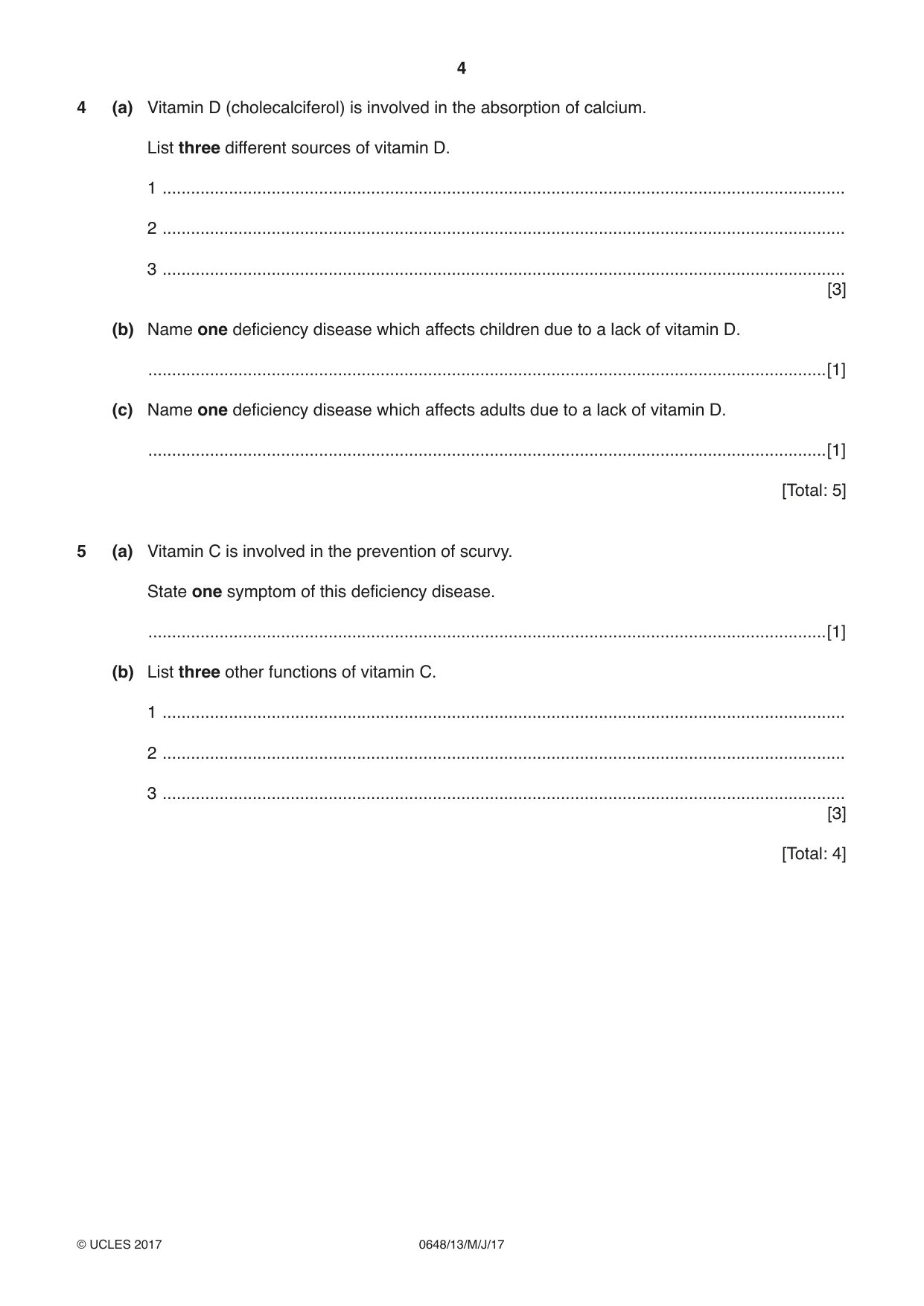
4 0648/13/M/J/17 © UCLES 2017 4 (a) Vitamin D (cholecalciferol) is involved in the absorption of calcium. List three different sources of vitamin D. 1 … 2 … 3 … [3] (b) Name one deficiency disease which affects children due to a lack of vitamin D. …[1] (c) Name one deficiency disease which affects adults due to a lack of vitamin D. …[1] [Total: 5] 5 (a) Vitamin C is involved in the prevention of scurvy. State one symptom of this deficiency disease. …[1] (b) List three other functions of vitamin C. 1 … 2 … 3 … [3] [Total: 4]
Question paper, page 5
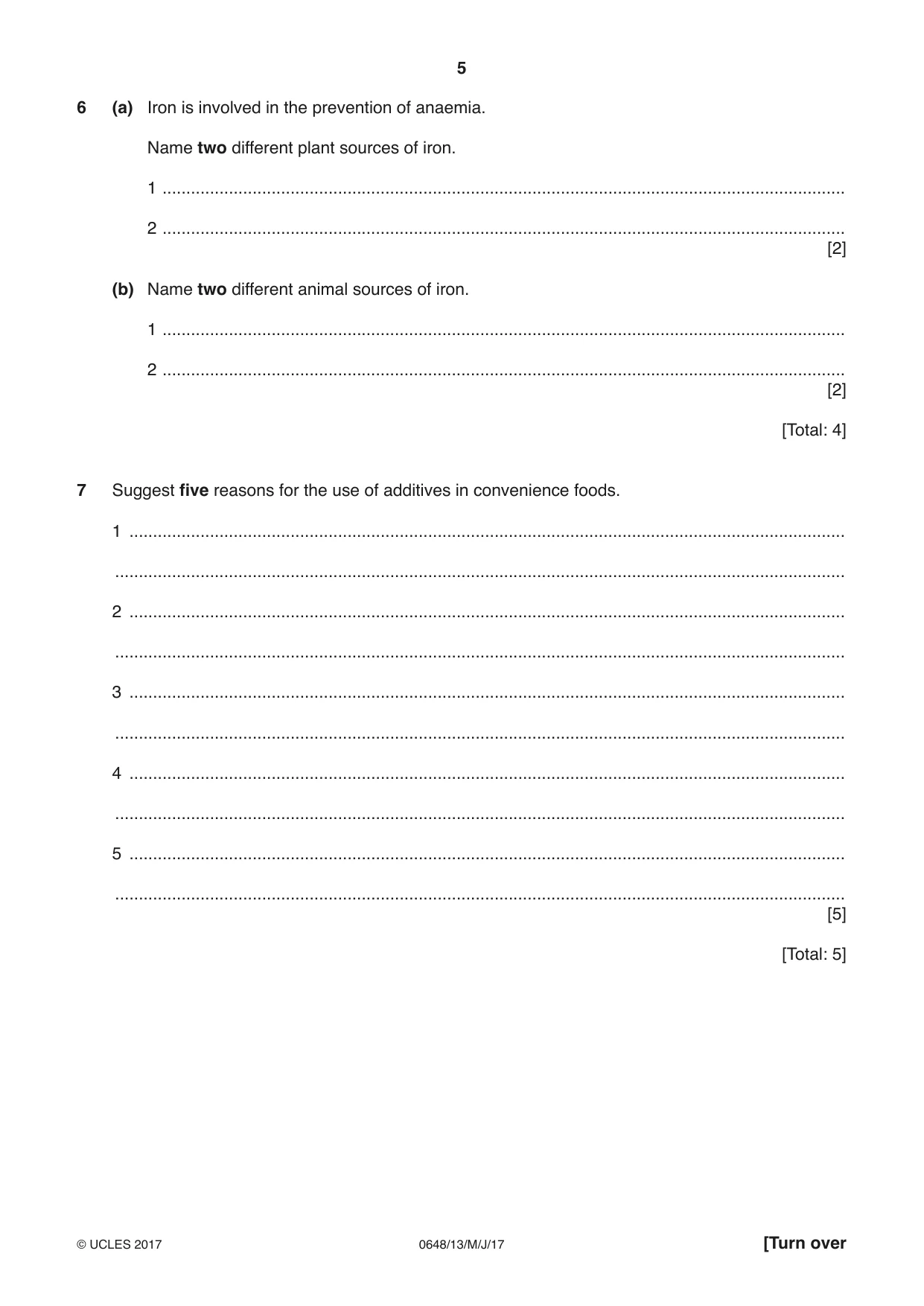
5 0648/13/M/J/17 © UCLES 2017 [Turn over 6 (a) Iron is involved in the prevention of anaemia. Name two different plant sources of iron. 1 … 2 … [2] (b) Name two different animal sources of iron. 1 … 2 … [2] [Total: 4] 7 Suggest five reasons for the use of additives in convenience foods. 1 … … 2 … … 3 … … 4 … … 5 … … [5] [Total: 5]
Question paper, page 6
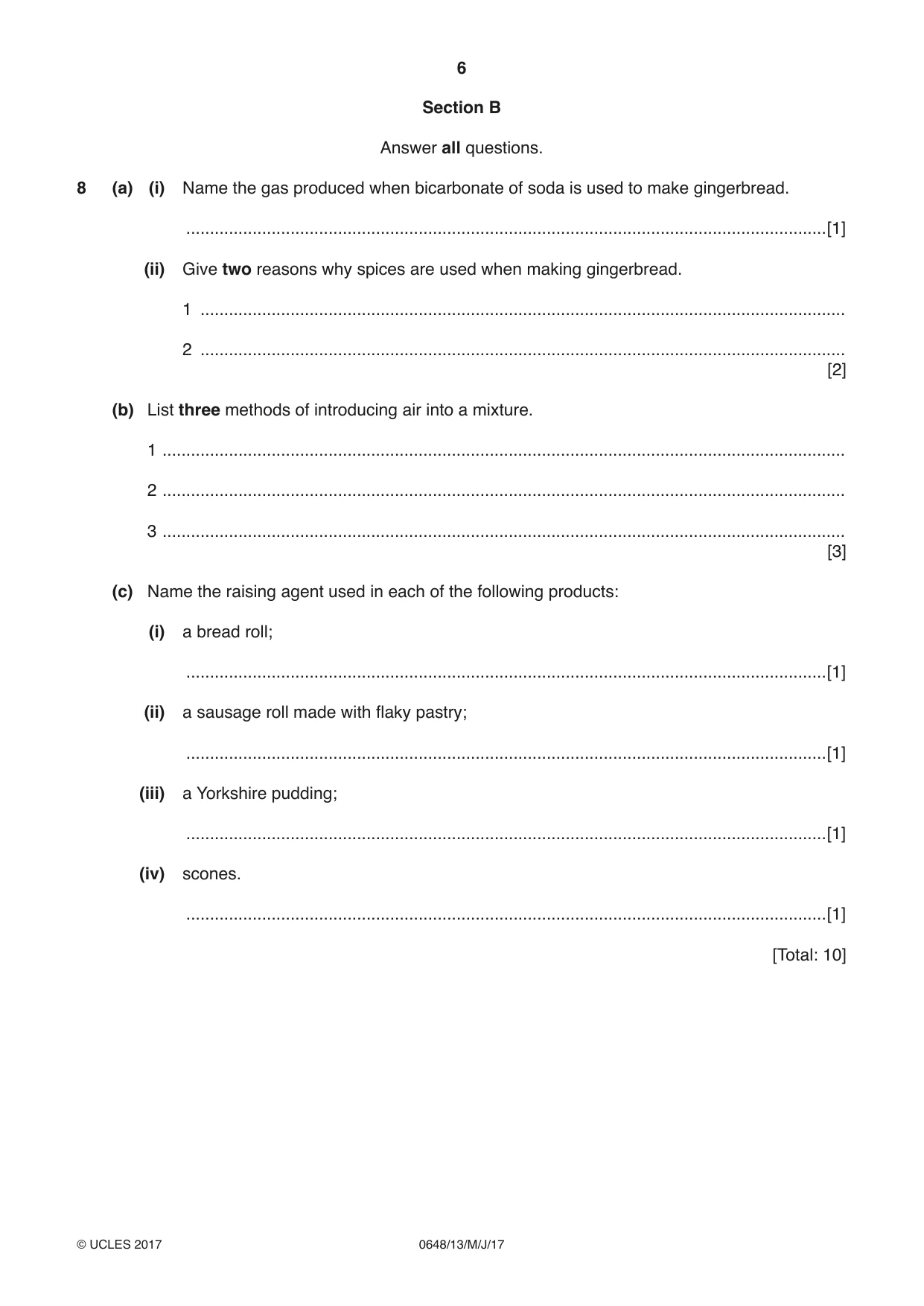
6 0648/13/M/J/17 © UCLES 2017 Section B Answer all questions. 8 (a) (i) Name the gas produced when bicarbonate of soda is used to make gingerbread. …[1] (ii) Give two reasons why spices are used when making gingerbread. 1 … 2 … [2] (b) List three methods of introducing air into a mixture. 1 … 2 … 3 … [3] (c) Name the raising agent used in each of the following products: (i) a bread roll; …[1] (ii) a sausage roll made with flaky pastry; …[1] (iii) a Yorkshire pudding; …[1] (iv) scones. …[1] [Total: 10]
Question paper, page 7
7 0648/13/M/J/17 © UCLES 2017 [Turn over Question 9 starts on the next page.
Question paper, page 8
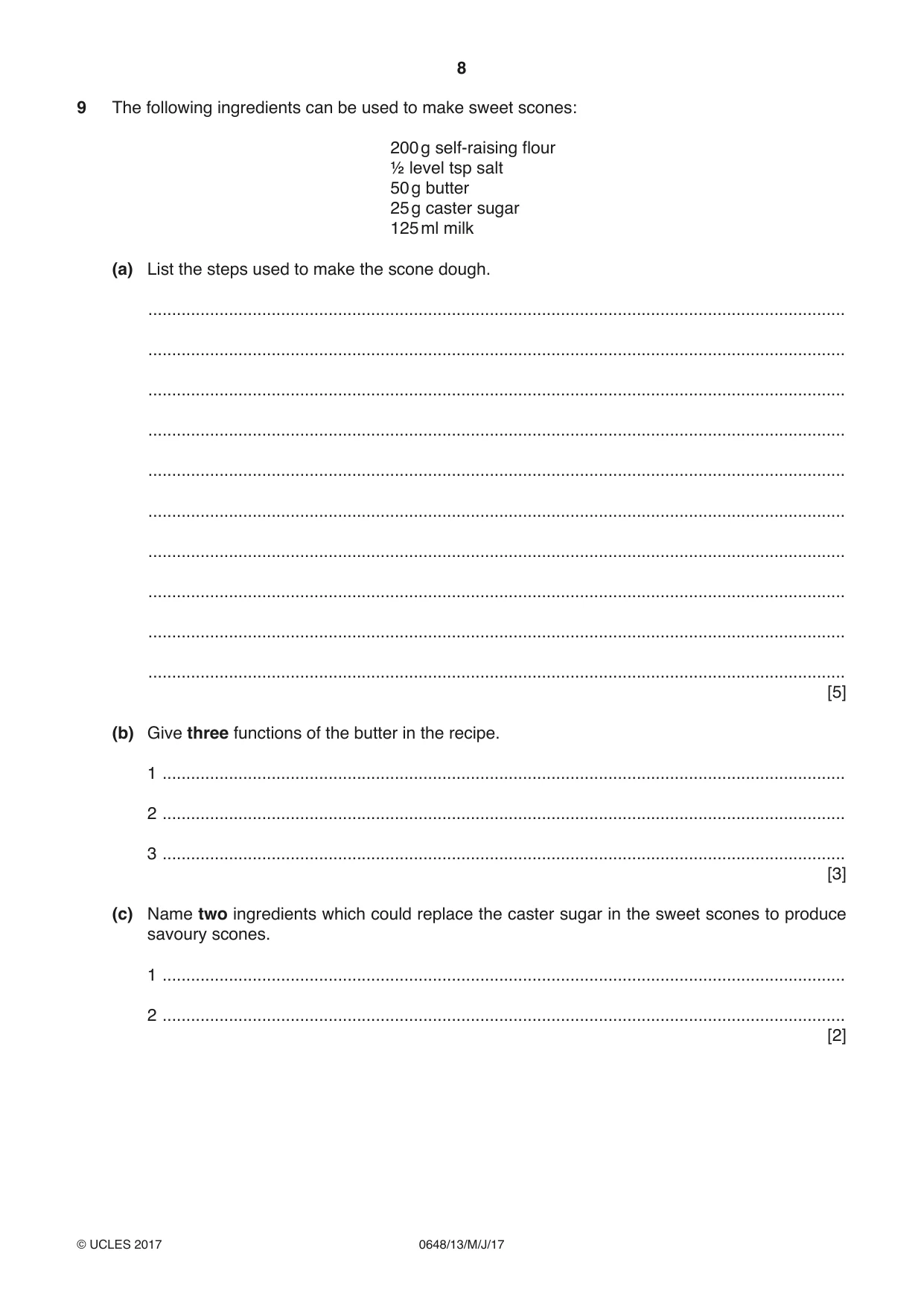
8 0648/13/M/J/17 © UCLES 2017 9 The following ingredients can be used to make sweet scones: 200 g self-raising flour ½ level tsp salt 50 g butter 25 g caster sugar 125 ml milk (a) List the steps used to make the scone dough. … … … … … … … … … … [5] (b) Give three functions of the butter in the recipe. 1 … 2 … 3 … [3] (c) Name two ingredients which could replace the caster sugar in the sweet scones to produce savoury scones. 1 … 2 … [2]
Question paper, page 9
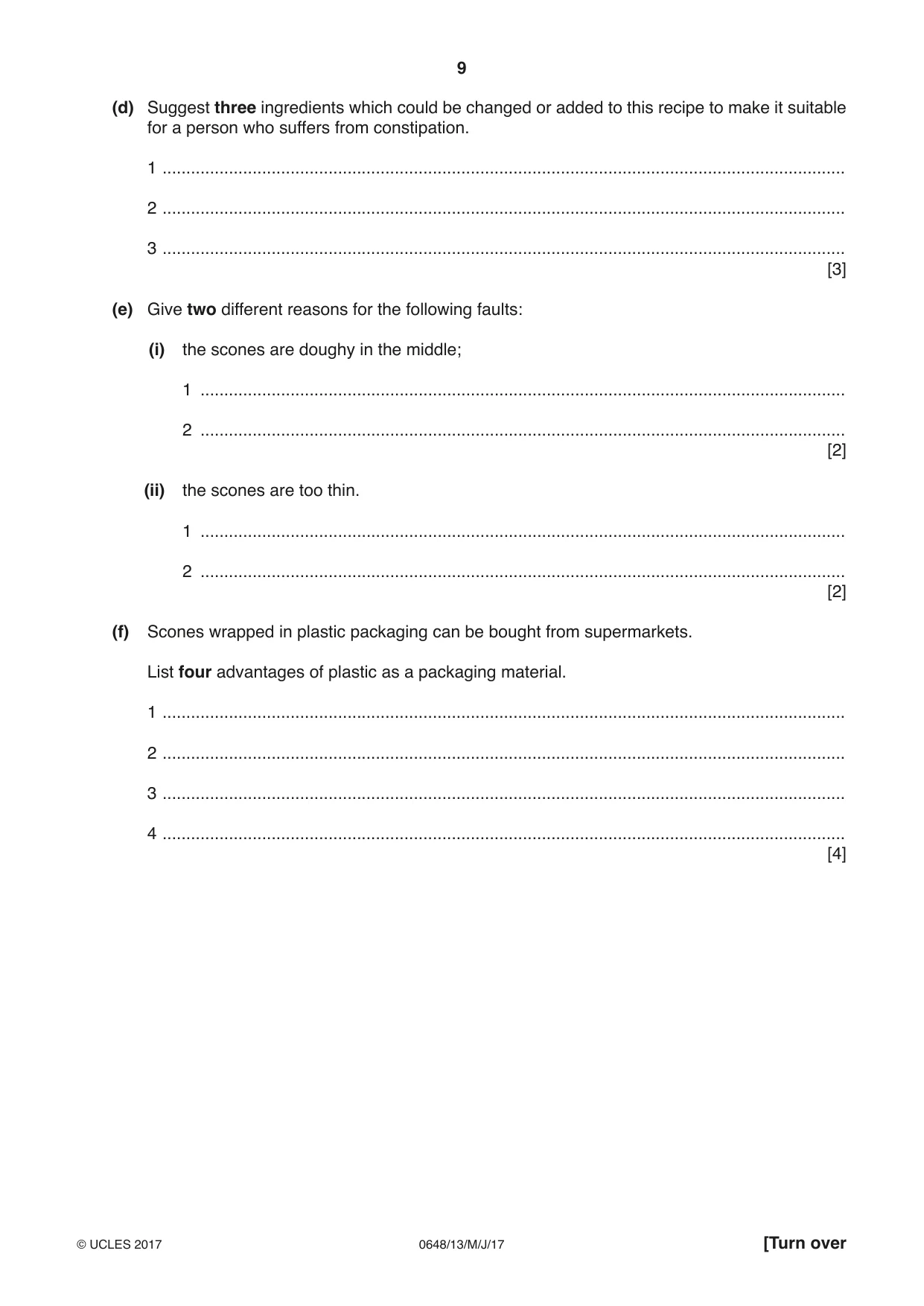
9 0648/13/M/J/17 © UCLES 2017 [Turn over (d) Suggest three ingredients which could be changed or added to this recipe to make it suitable for a person who suffers from constipation. 1 … 2 … 3 … [3] (e) Give two different reasons for the following faults: (i) the scones are doughy in the middle; 1 … 2 … [2] (ii) the scones are too thin. 1 … 2 … [2] (f) Scones wrapped in plastic packaging can be bought from supermarkets. List four advantages of plastic as a packaging material. 1 … 2 … 3 … 4 … [4]
Question paper, page 10
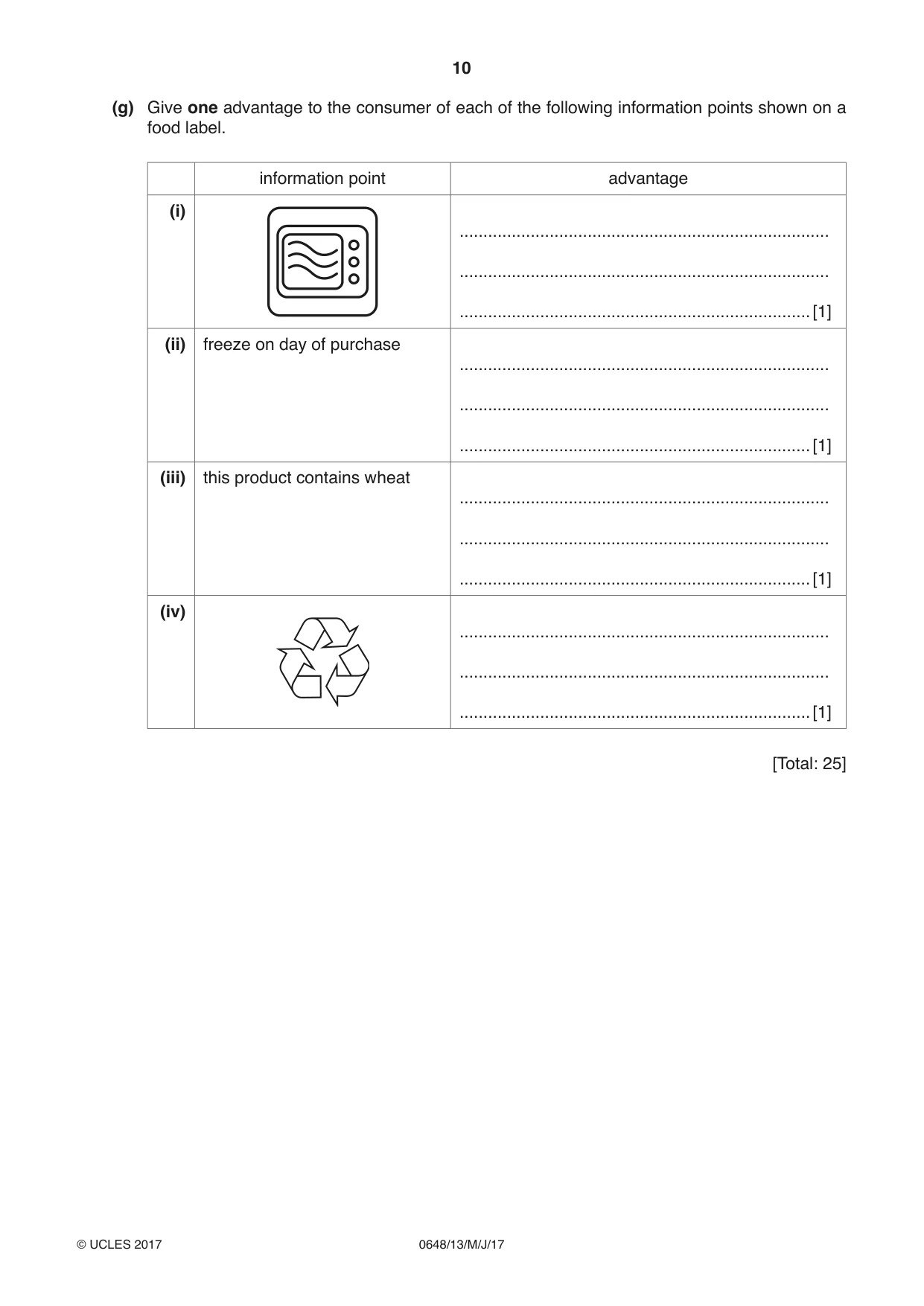
10 0648/13/M/J/17 © UCLES 2017 (g) Give one advantage to the consumer of each of the following information points shown on a food label. information point advantage (i) … … …[1] (ii) freeze on day of purchase … … …[1] (iii) this product contains wheat … … …[1] (iv) … … …[1] [Total: 25]
Question paper, page 11
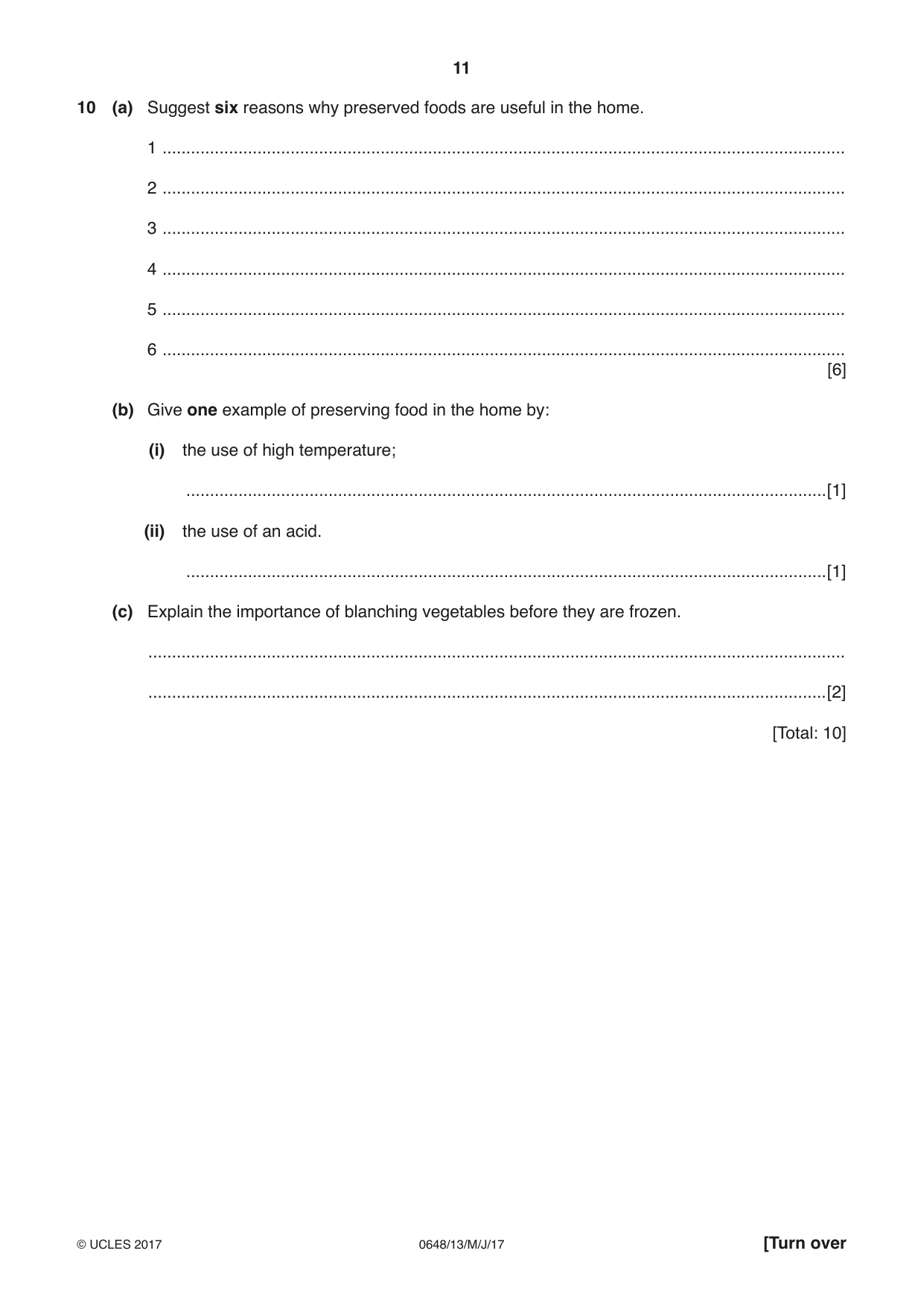
11 0648/13/M/J/17 © UCLES 2017 [Turn over 10 (a) Suggest six reasons why preserved foods are useful in the home. 1 … 2 … 3 … 4 … 5 … 6 … [6] (b) Give one example of preserving food in the home by: (i) the use of high temperature; …[1] (ii) the use of an acid. …[1] (c) Explain the importance of blanching vegetables before they are frozen. … …[2] [Total: 10]
Question paper, page 12
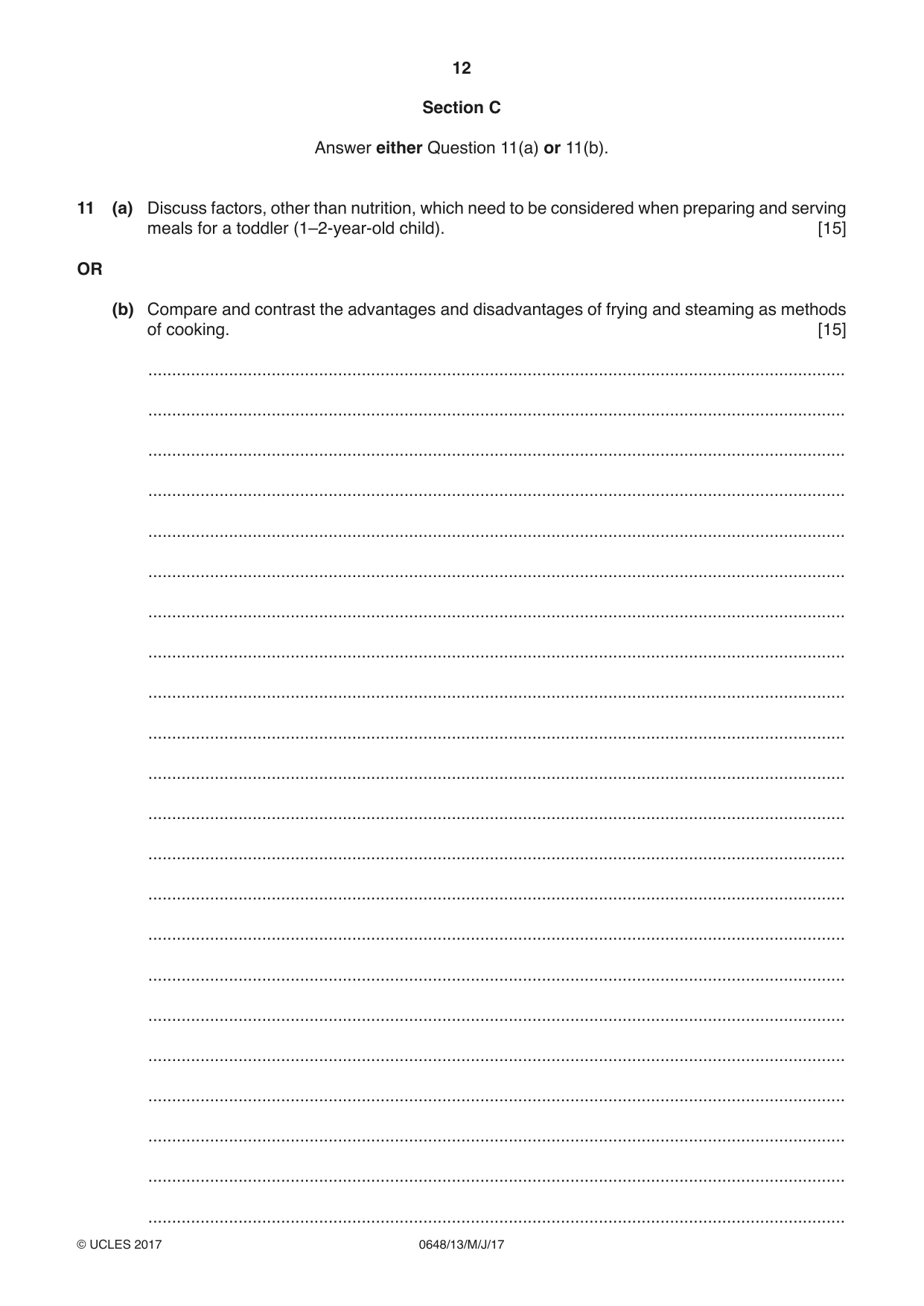
12 0648/13/M/J/17 © UCLES 2017 Section C Answer either Question 11(a) or 11(b). 11 (a) Discuss factors, other than nutrition, which need to be considered when preparing and serving meals for a toddler (1–2-year-old child). [15] OR (b) Compare and contrast the advantages and disadvantages of frying and steaming as methods of cooking. [15] … … … … … … … … … … … … … … … … … … … … … …
Question paper, page 13
13 0648/13/M/J/17 © UCLES 2017 [Turn over … … … … … … … … … … … … … … … … … … … … … … … … … … … …
Question paper, page 14
14 0648/13/M/J/17 © UCLES 2017 … … … … … … … … … … … … … … … … … … … … … … … … … … [Total: 15]
Question paper, page 15
15 0648/13/M/J/17 © UCLES 2017 BLANK PAGE
Question paper, page 16
16 0648/13/M/J/17 © UCLES 2017 Permission to reproduce items where third-party owned material protected by copyright is included has been sought and cleared where possible. Every reasonable effort has been made by the publisher (UCLES) to trace copyright holders, but if any items requiring clearance have unwittingly been included, the publisher will be pleased to make amends at the earliest possible opportunity. To avoid the issue of disclosure of answer-related information to candidates, all copyright acknowledgements are reproduced online in the Cambridge International Examinations Copyright Acknowledgements Booklet. This is produced for each series of examinations and is freely available to download at www.cie.org.uk after the live examination series. Cambridge International Examinations is part of the Cambridge Assessment Group. Cambridge Assessment is the brand name of University of Cambridge Local Examinations Syndicate (UCLES), which is itself a department of the University of Cambridge. BLANK PAGE
Mark scheme, page 1
® IGCSE is a registered trademark. This document consists of 13 printed pages. © UCLES 2017 [Turn over Cambridge International Examinations Cambridge International General Certificate of Secondary Education FOOD AND NUTRITION 0648/13 Paper 1 Theory May/June 2017 MARK SCHEME Maximum Mark: 100 Published This mark scheme is published as an aid to teachers and candidates, to indicate the requirements of the examination. It shows the basis on which Examiners were instructed to award marks. It does not indicate the details of the discussions that took place at an Examiners’ meeting before marking began, which would have considered the acceptability of alternative answers. Mark schemes should be read in conjunction with the question paper and the Principal Examiner Report for Teachers. Cambridge will not enter into discussions about these mark schemes. Cambridge is publishing the mark schemes for the May/June 2017 series for most Cambridge IGCSE®, Cambridge International A and AS Level and Cambridge Pre-U components, and some Cambridge O Level components.
Mark scheme, page 2
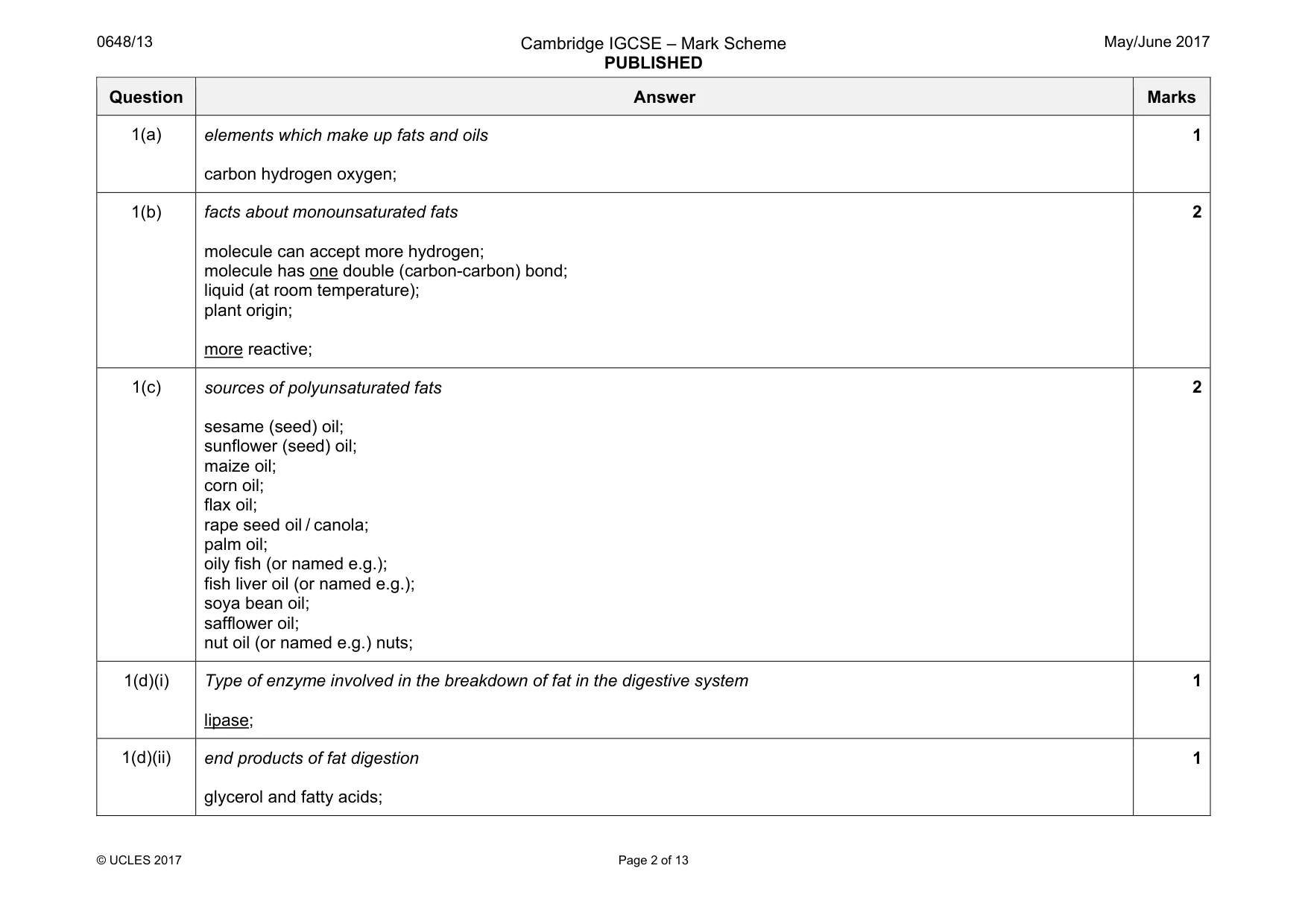
0648/13 Cambridge IGCSE – Mark Scheme PUBLISHED May/June 2017 © UCLES 2017 Page 2 of 13 Question Answer Marks 1(a) elements which make up fats and oils carbon hydrogen oxygen; 1 1(b) facts about monounsaturated fats molecule can accept more hydrogen; molecule has one double (carbon-carbon) bond; liquid (at room temperature); plant origin; more reactive; 2 1(c) sources of polyunsaturated fats sesame (seed) oil; sunflower (seed) oil; maize oil; corn oil; flax oil; rape seed oil / canola; palm oil; oily fish (or named e.g.); fish liver oil (or named e.g.); soya bean oil; safflower oil; nut oil (or named e.g.) nuts; 2 1(d)(i) Type of enzyme involved in the breakdown of fat in the digestive system lipase; 1 1(d)(ii) end products of fat digestion glycerol and fatty acids; 1
Mark scheme, page 3
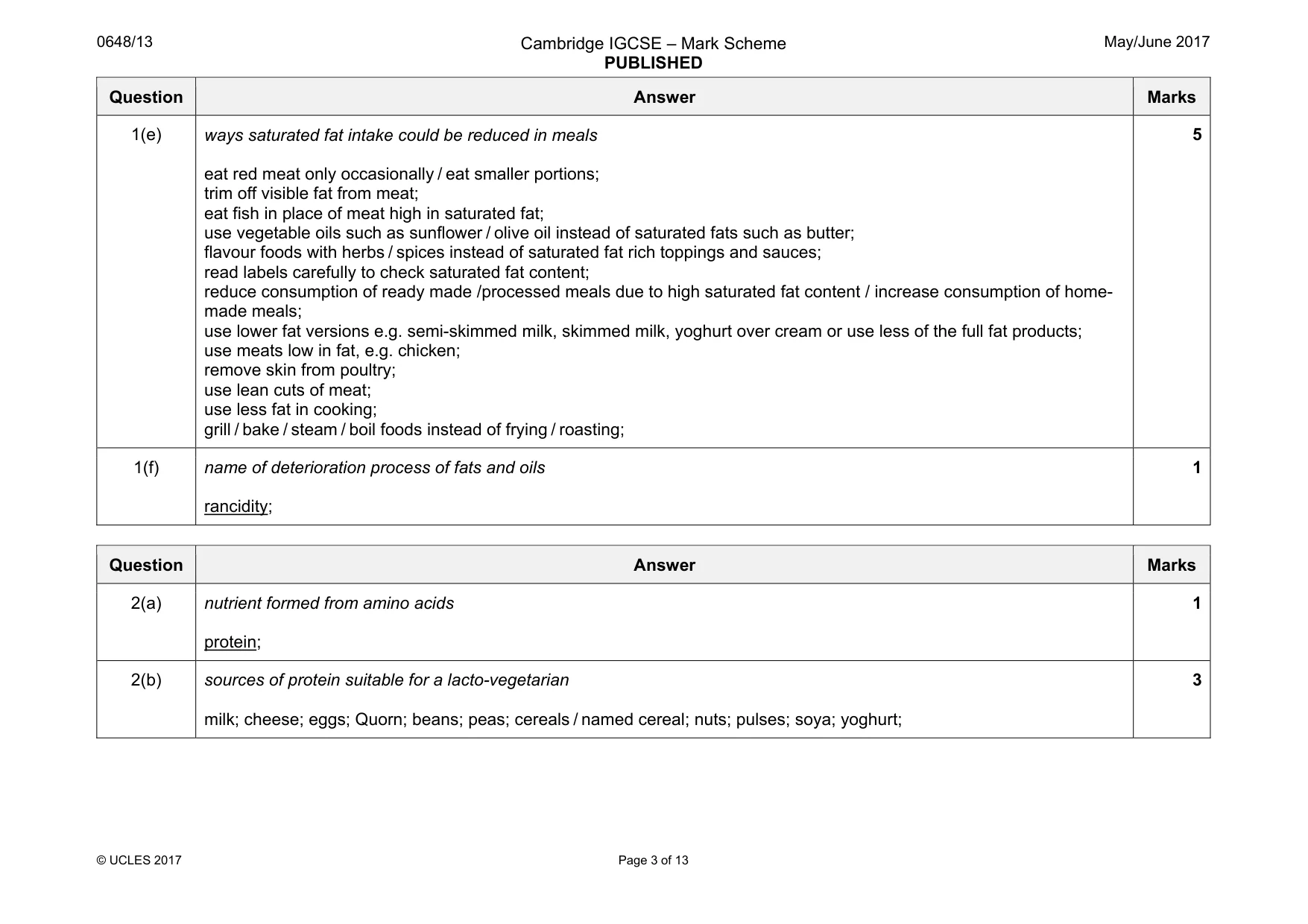
0648/13 Cambridge IGCSE – Mark Scheme PUBLISHED May/June 2017 © UCLES 2017 Page 3 of 13 Question Answer Marks 1(e) ways saturated fat intake could be reduced in meals eat red meat only occasionally / eat smaller portions; trim off visible fat from meat; eat fish in place of meat high in saturated fat; use vegetable oils such as sunflower / olive oil instead of saturated fats such as butter; flavour foods with herbs / spices instead of saturated fat rich toppings and sauces; read labels carefully to check saturated fat content; reduce consumption of ready made /processed meals due to high saturated fat content / increase consumption of home- made meals; use lower fat versions e.g. semi-skimmed milk, skimmed milk, yoghurt over cream or use less of the full fat products; use meats low in fat, e.g. chicken; remove skin from poultry; use lean cuts of meat; use less fat in cooking; grill / bake / steam / boil foods instead of frying / roasting; 5 1(f) name of deterioration process of fats and oils rancidity; 1 Question Answer Marks 2(a) nutrient formed from amino acids protein; 1 2(b) sources of protein suitable for a lacto-vegetarian milk; cheese; eggs; Quorn; beans; peas; cereals / named cereal; nuts; pulses; soya; yoghurt; 3
Mark scheme, page 4
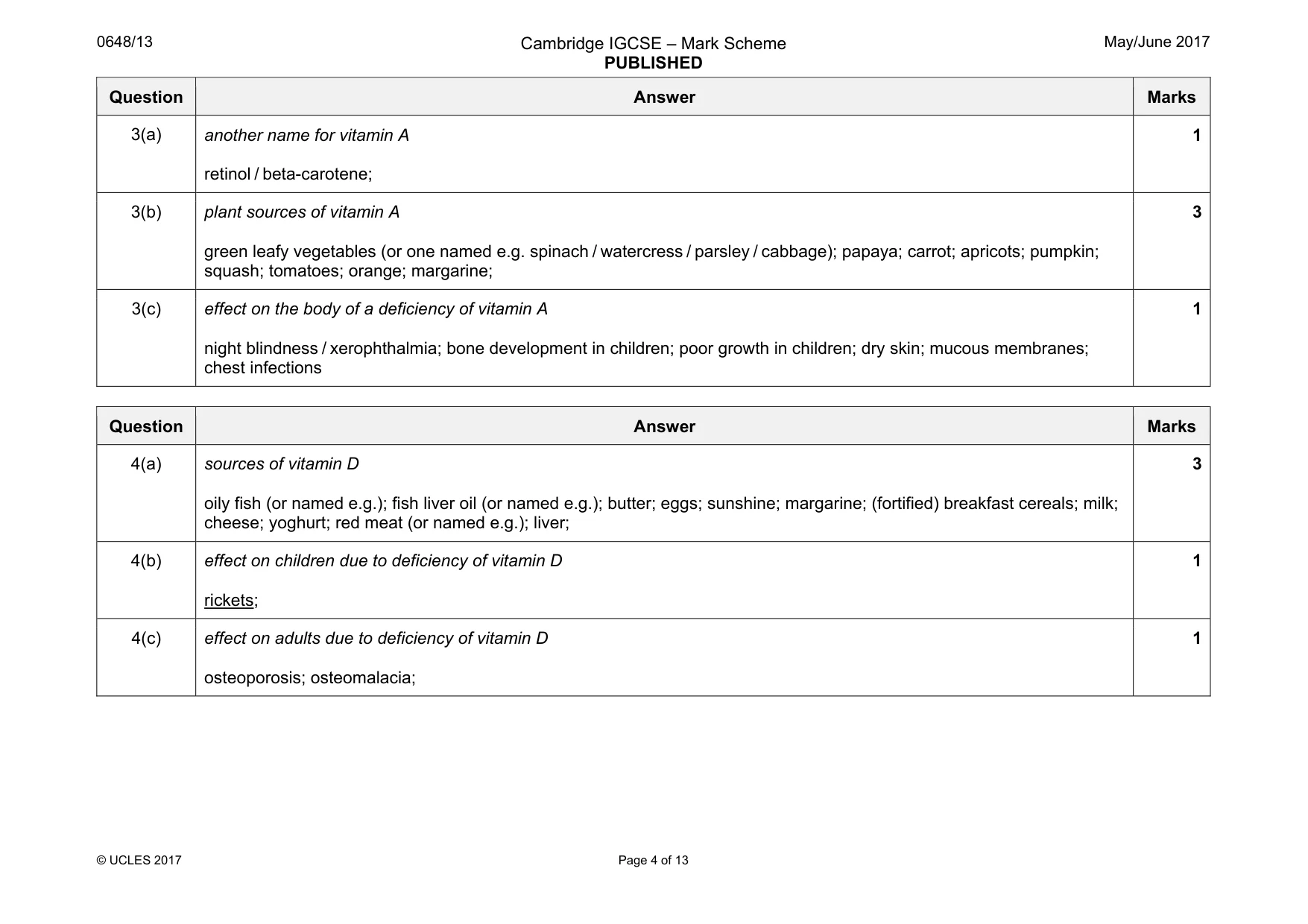
0648/13 Cambridge IGCSE – Mark Scheme PUBLISHED May/June 2017 © UCLES 2017 Page 4 of 13 Question Answer Marks 3(a) another name for vitamin A retinol / beta-carotene; 1 3(b) plant sources of vitamin A green leafy vegetables (or one named e.g. spinach / watercress / parsley / cabbage); papaya; carrot; apricots; pumpkin; squash; tomatoes; orange; margarine; 3 3(c) effect on the body of a deficiency of vitamin A night blindness / xerophthalmia; bone development in children; poor growth in children; dry skin; mucous membranes; chest infections 1 Question Answer Marks 4(a) sources of vitamin D oily fish (or named e.g.); fish liver oil (or named e.g.); butter; eggs; sunshine; margarine; (fortified) breakfast cereals; milk; cheese; yoghurt; red meat (or named e.g.); liver; 3 4(b) effect on children due to deficiency of vitamin D rickets; 1 4(c) effect on adults due to deficiency of vitamin D osteoporosis; osteomalacia; 1
Mark scheme, page 5
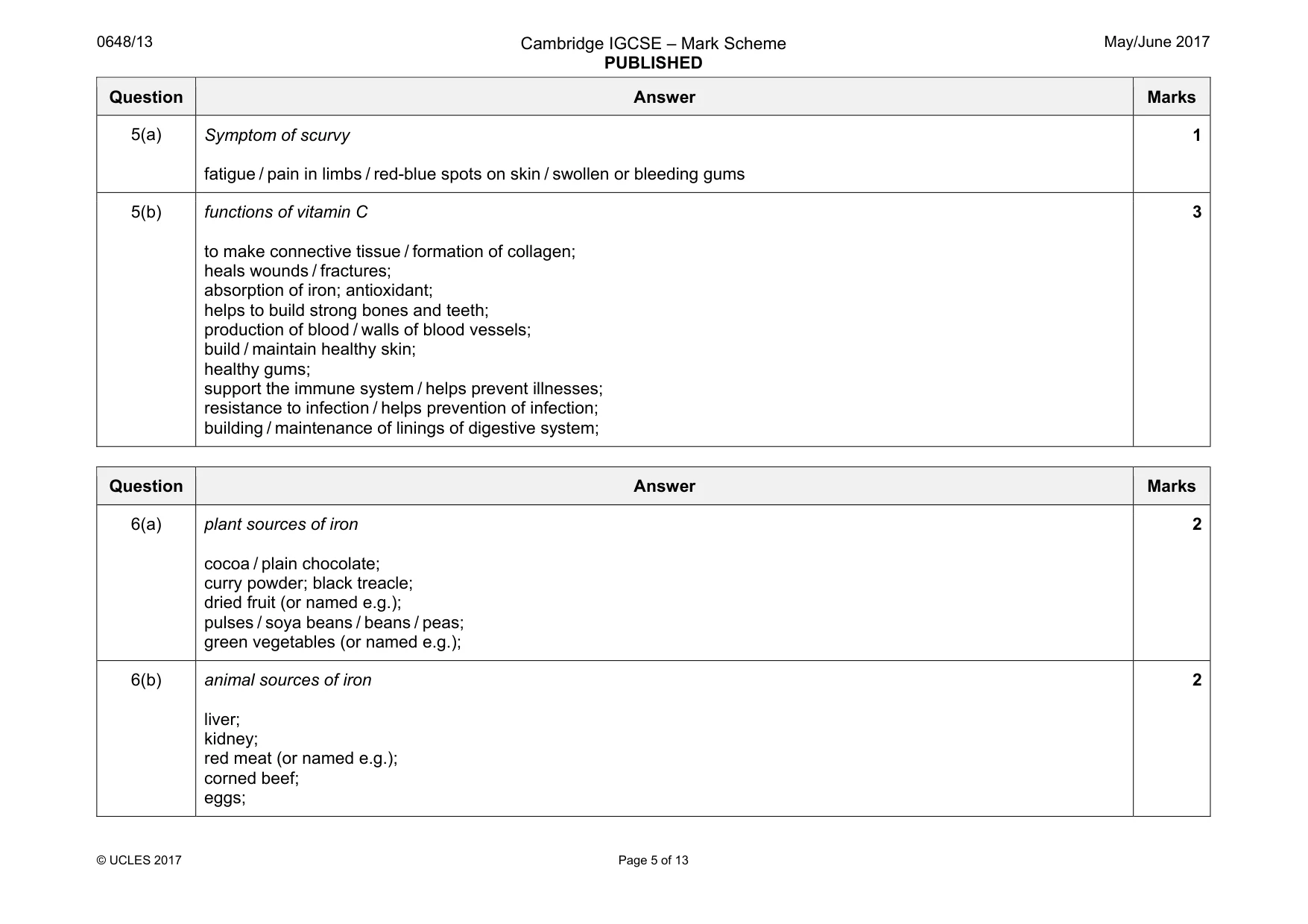
0648/13 Cambridge IGCSE – Mark Scheme PUBLISHED May/June 2017 © UCLES 2017 Page 5 of 13 Question Answer Marks 5(a) Symptom of scurvy fatigue / pain in limbs / red-blue spots on skin / swollen or bleeding gums 1 5(b) functions of vitamin C to make connective tissue / formation of collagen; heals wounds / fractures; absorption of iron; antioxidant; helps to build strong bones and teeth; production of blood / walls of blood vessels; build / maintain healthy skin; healthy gums; support the immune system / helps prevent illnesses; resistance to infection / helps prevention of infection; building / maintenance of linings of digestive system; 3 Question Answer Marks 6(a) plant sources of iron cocoa / plain chocolate; curry powder; black treacle; dried fruit (or named e.g.); pulses / soya beans / beans / peas; green vegetables (or named e.g.); 2 6(b) animal sources of iron liver; kidney; red meat (or named e.g.); corned beef; eggs; 2
Mark scheme, page 6
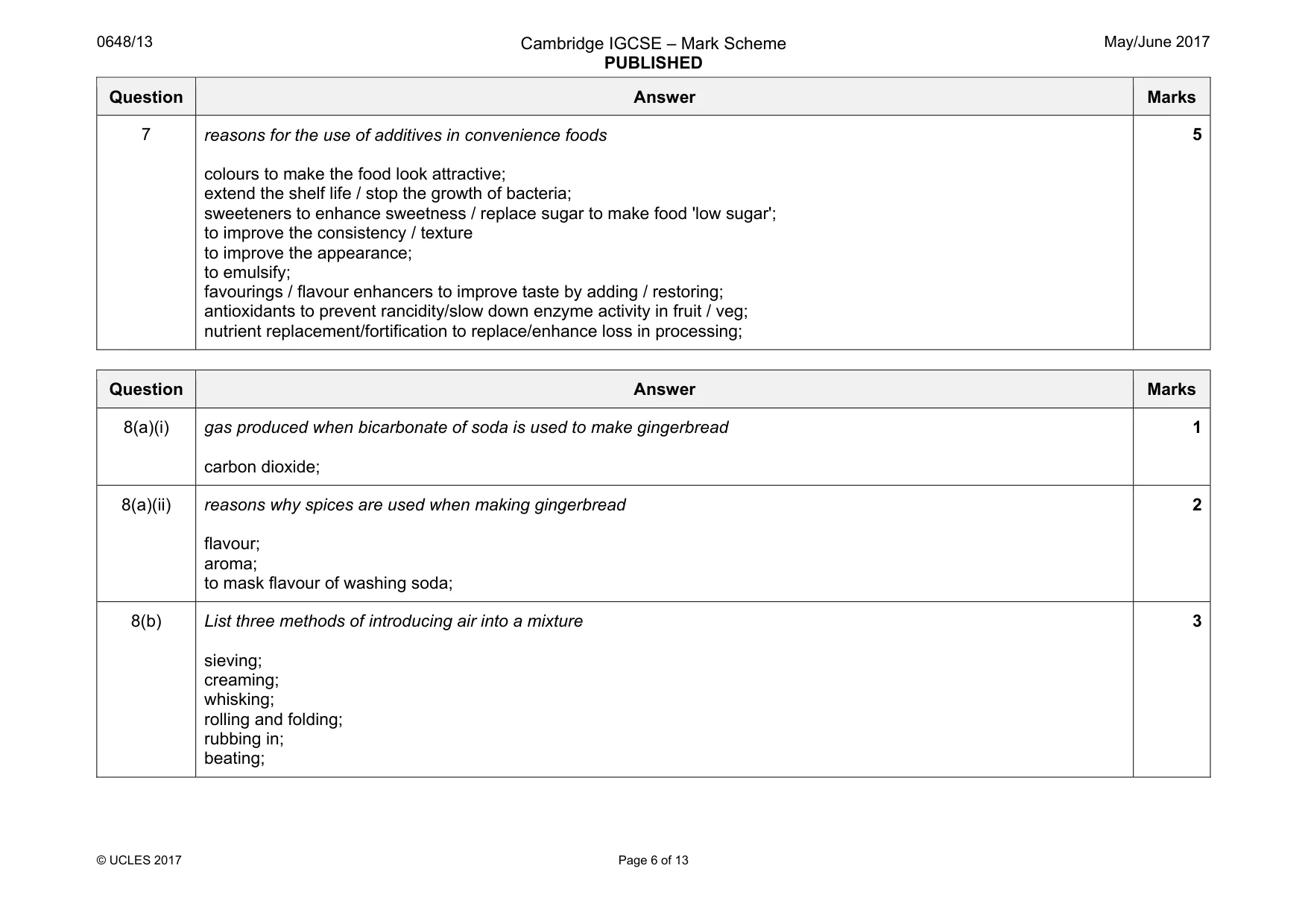
0648/13 Cambridge IGCSE – Mark Scheme PUBLISHED May/June 2017 © UCLES 2017 Page 6 of 13 Question Answer Marks 7 reasons for the use of additives in convenience foods colours to make the food look attractive; extend the shelf life / stop the growth of bacteria; sweeteners to enhance sweetness / replace sugar to make food 'low sugar'; to improve the consistency / texture to improve the appearance; to emulsify; favourings / flavour enhancers to improve taste by adding / restoring; antioxidants to prevent rancidity/slow down enzyme activity in fruit / veg; nutrient replacement/fortification to replace/enhance loss in processing; 5 Question Answer Marks 8(a)(i) gas produced when bicarbonate of soda is used to make gingerbread carbon dioxide; 1 8(a)(ii) reasons why spices are used when making gingerbread flavour; aroma; to mask flavour of washing soda; 2 8(b) List three methods of introducing air into a mixture sieving; creaming; whisking; rolling and folding; rubbing in; beating; 3
Mark scheme, page 7
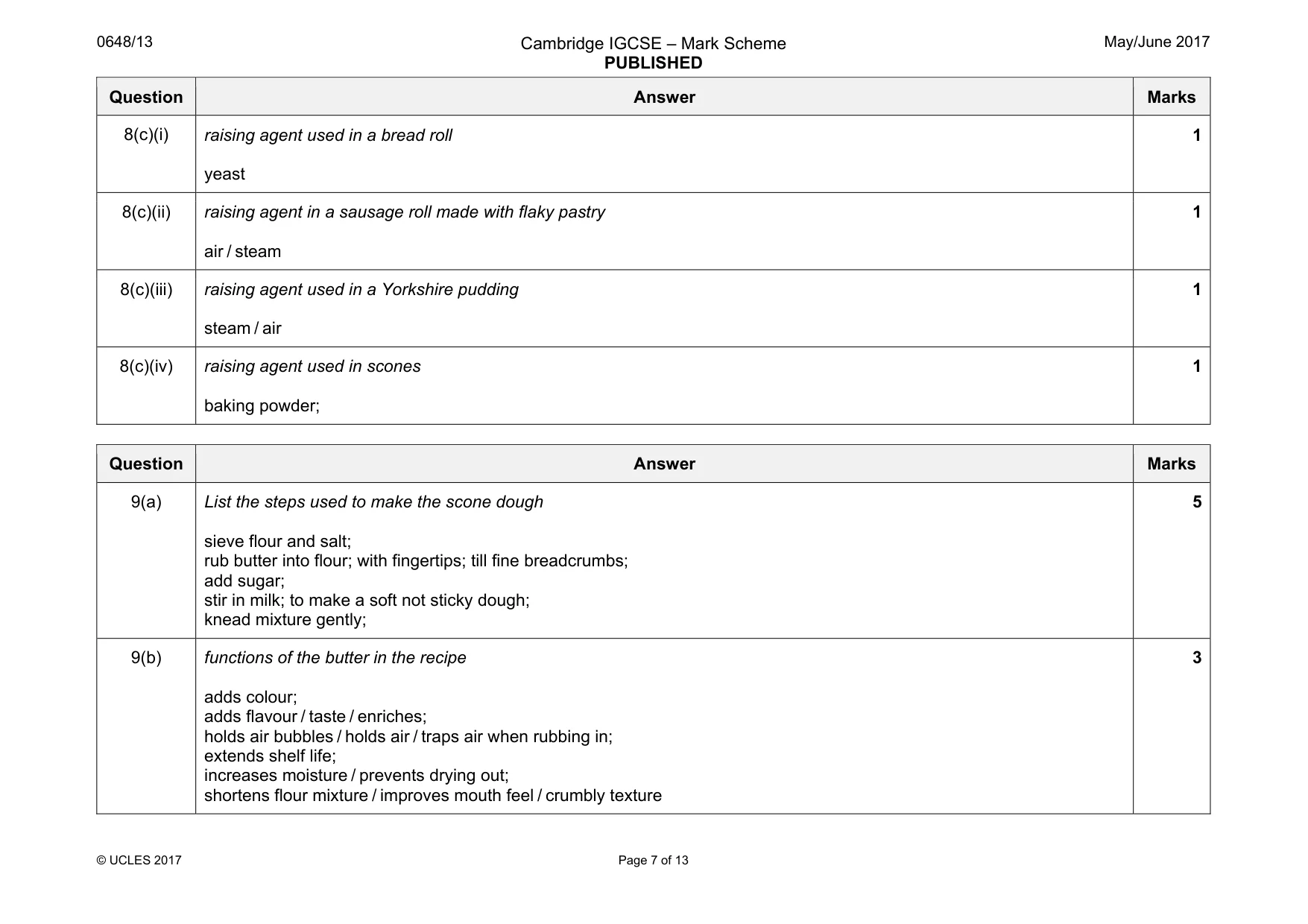
0648/13 Cambridge IGCSE – Mark Scheme PUBLISHED May/June 2017 © UCLES 2017 Page 7 of 13 Question Answer Marks 8(c)(i) raising agent used in a bread roll yeast 1 8(c)(ii) raising agent in a sausage roll made with flaky pastry air / steam 1 8(c)(iii) raising agent used in a Yorkshire pudding steam / air 1 8(c)(iv) raising agent used in scones baking powder; 1 Question Answer Marks 9(a) List the steps used to make the scone dough sieve flour and salt; rub butter into flour; with fingertips; till fine breadcrumbs; add sugar; stir in milk; to make a soft not sticky dough; knead mixture gently; 5 9(b) functions of the butter in the recipe adds colour; adds flavour / taste / enriches; holds air bubbles / holds air / traps air when rubbing in; extends shelf life; increases moisture / prevents drying out; shortens flour mixture / improves mouth feel / crumbly texture 3
Mark scheme, page 8
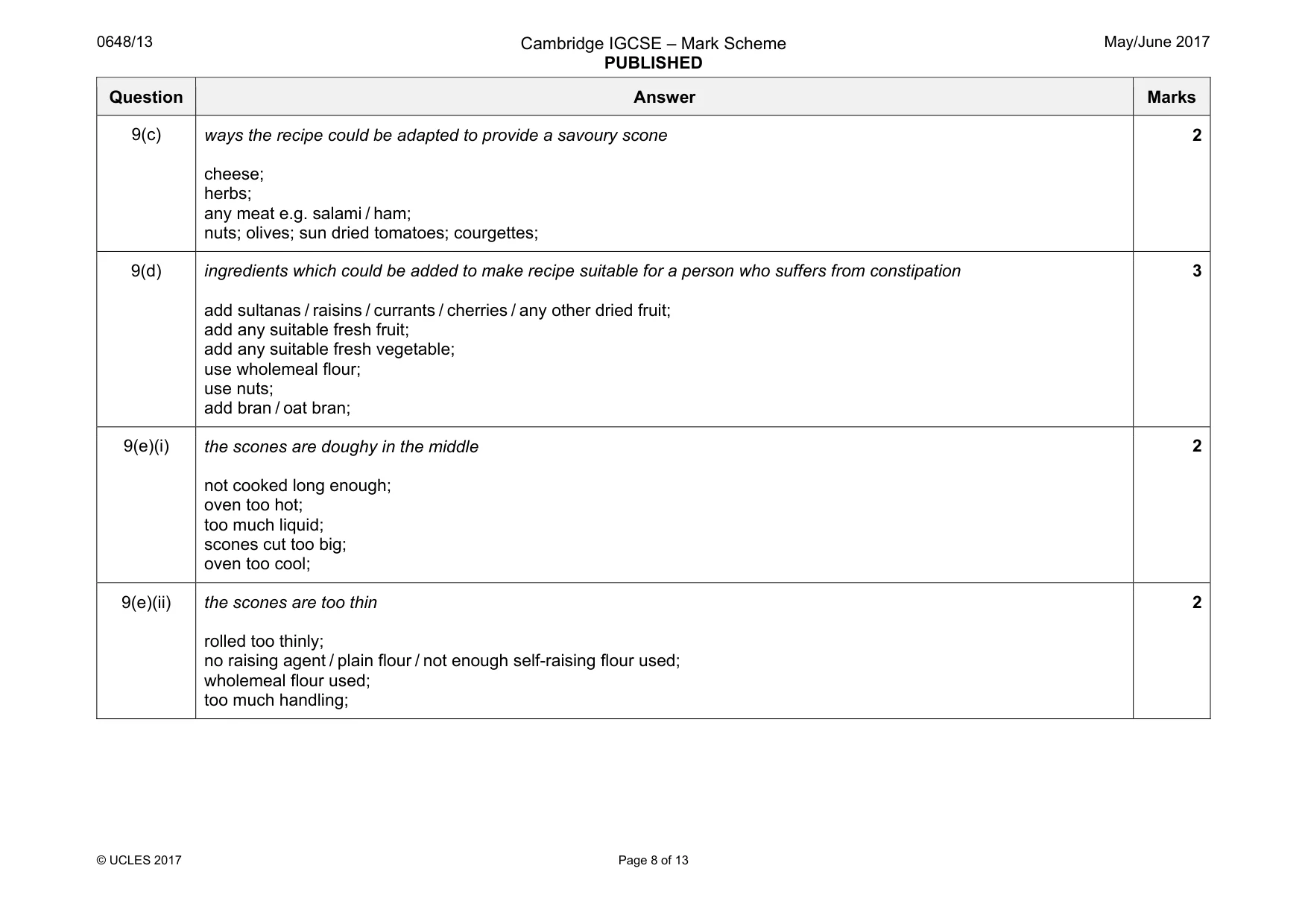
0648/13 Cambridge IGCSE – Mark Scheme PUBLISHED May/June 2017 © UCLES 2017 Page 8 of 13 Question Answer Marks 9(c) ways the recipe could be adapted to provide a savoury scone cheese; herbs; any meat e.g. salami / ham; nuts; olives; sun dried tomatoes; courgettes; 2 9(d) ingredients which could be added to make recipe suitable for a person who suffers from constipation add sultanas / raisins / currants / cherries / any other dried fruit; add any suitable fresh fruit; add any suitable fresh vegetable; use wholemeal flour; use nuts; add bran / oat bran; 3 9(e)(i) the scones are doughy in the middle not cooked long enough; oven too hot; too much liquid; scones cut too big; oven too cool; 2 9(e)(ii) the scones are too thin rolled too thinly; no raising agent / plain flour / not enough self-raising flour used; wholemeal flour used; too much handling; 2
Mark scheme, page 9
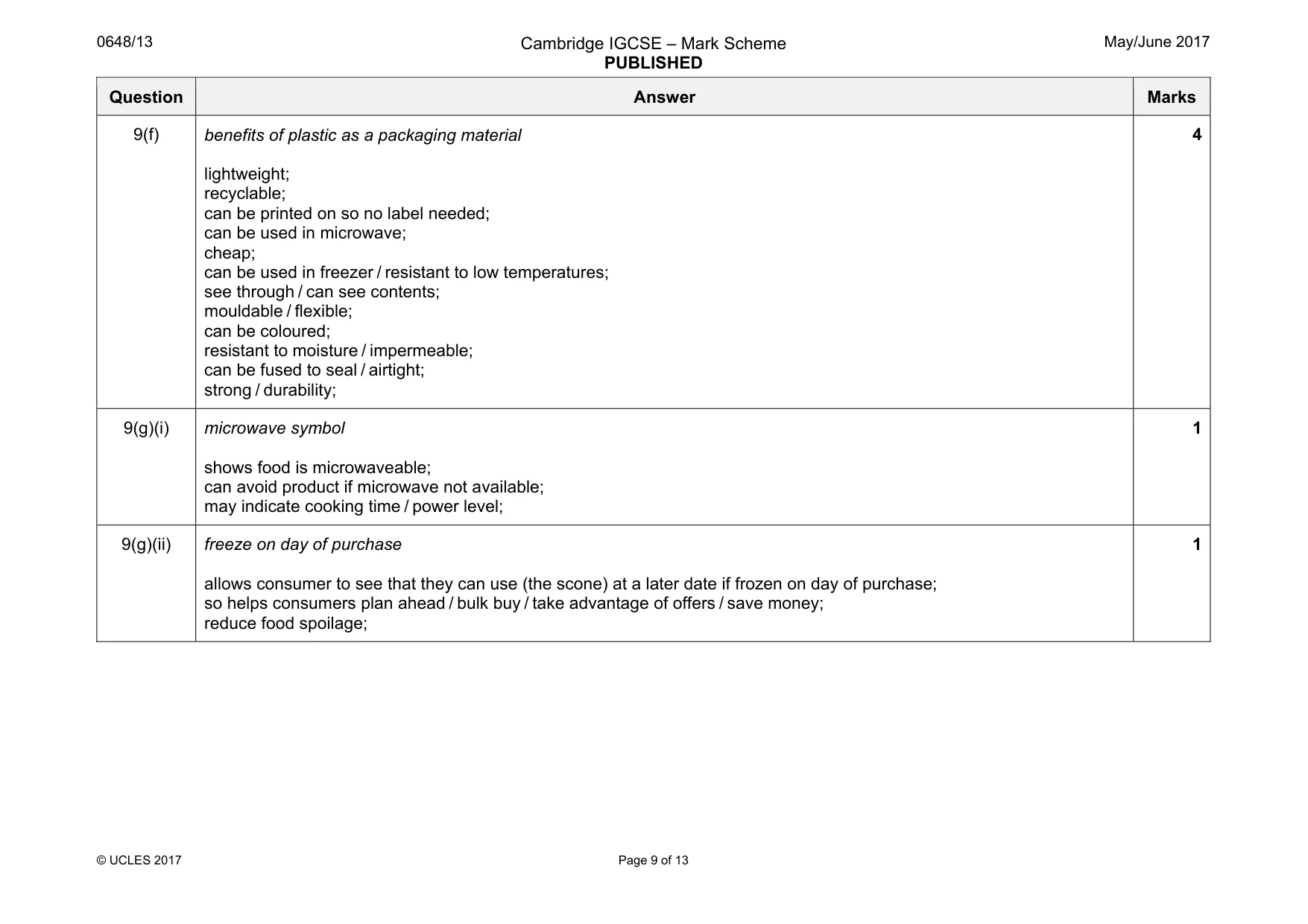
0648/13 Cambridge IGCSE – Mark Scheme PUBLISHED May/June 2017 © UCLES 2017 Page 9 of 13 Question Answer Marks 9(f) benefits of plastic as a packaging material lightweight; recyclable; can be printed on so no label needed; can be used in microwave; cheap; can be used in freezer / resistant to low temperatures; see through / can see contents; mouldable / flexible; can be coloured; resistant to moisture / impermeable; can be fused to seal / airtight; strong / durability; 4 9(g)(i) microwave symbol shows food is microwaveable; can avoid product if microwave not available; may indicate cooking time / power level; 1 9(g)(ii) freeze on day of purchase allows consumer to see that they can use (the scone) at a later date if frozen on day of purchase; so helps consumers plan ahead / bulk buy / take advantage of offers / save money; reduce food spoilage; 1
Mark scheme, page 10
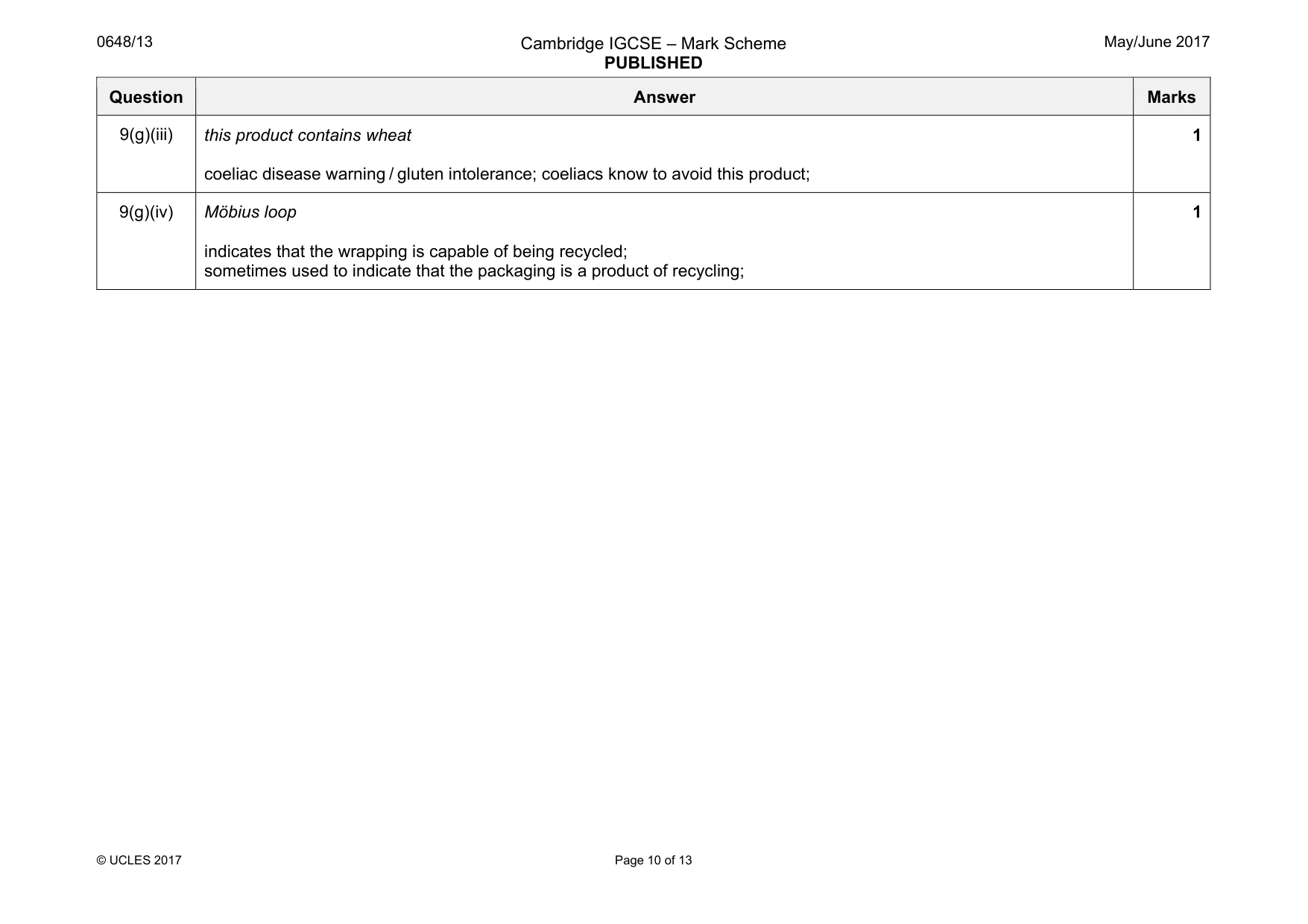
0648/13 Cambridge IGCSE – Mark Scheme PUBLISHED May/June 2017 © UCLES 2017 Page 10 of 13 Question Answer Marks 9(g)(iii) this product contains wheat coeliac disease warning / gluten intolerance; coeliacs know to avoid this product; 1 9(g)(iv) Möbius loop indicates that the wrapping is capable of being recycled; sometimes used to indicate that the packaging is a product of recycling; 1
Mark scheme, page 11
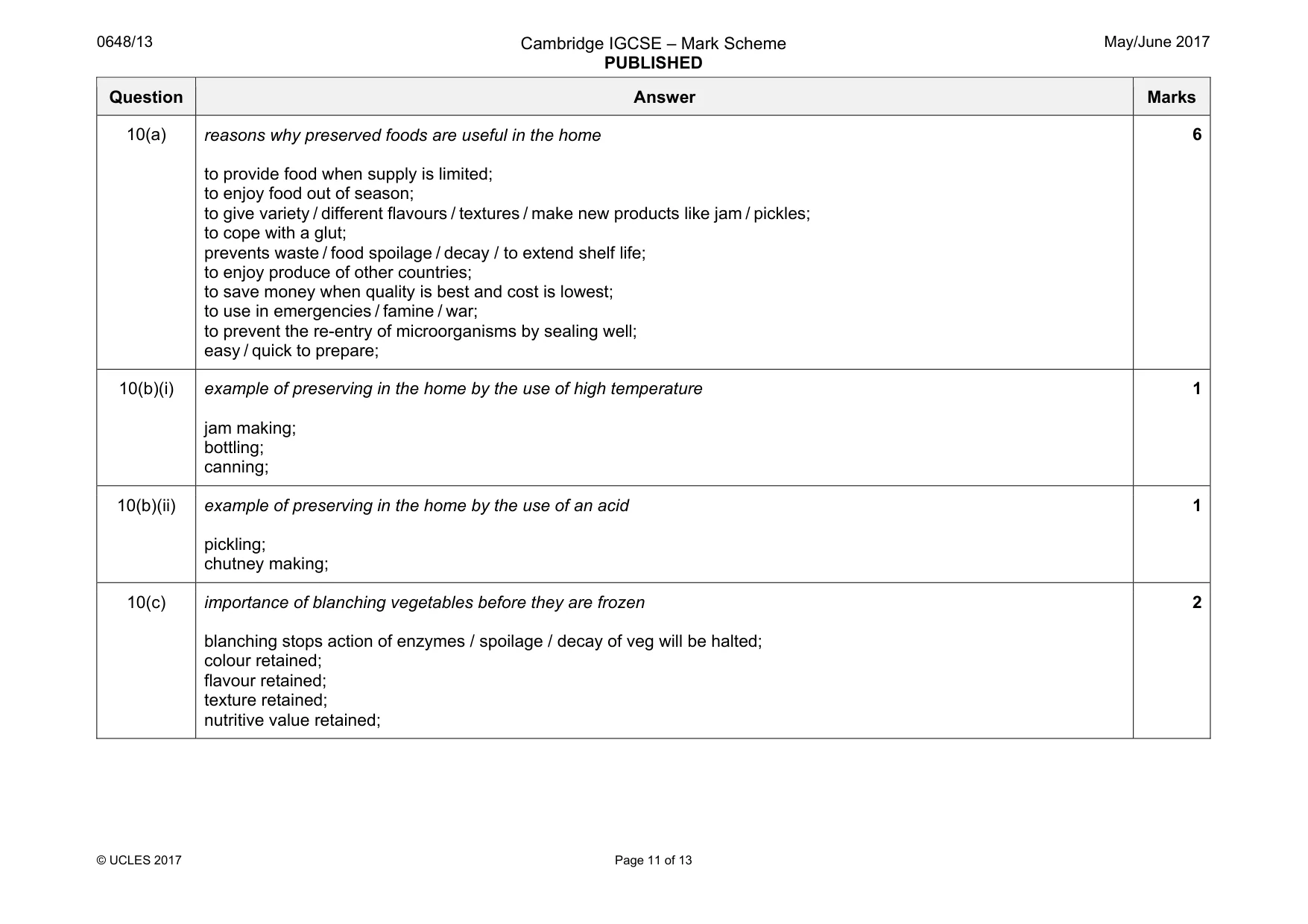
0648/13 Cambridge IGCSE – Mark Scheme PUBLISHED May/June 2017 © UCLES 2017 Page 11 of 13 Question Answer Marks 10(a) reasons why preserved foods are useful in the home to provide food when supply is limited; to enjoy food out of season; to give variety / different flavours / textures / make new products like jam / pickles; to cope with a glut; prevents waste / food spoilage / decay / to extend shelf life; to enjoy produce of other countries; to save money when quality is best and cost is lowest; to use in emergencies / famine / war; to prevent the re-entry of microorganisms by sealing well; easy / quick to prepare; 6 10(b)(i) example of preserving in the home by the use of high temperature jam making; bottling; canning; 1 10(b)(ii) example of preserving in the home by the use of an acid pickling; chutney making; 1 10(c) importance of blanching vegetables before they are frozen blanching stops action of enzymes / spoilage / decay of veg will be halted; colour retained; flavour retained; texture retained; nutritive value retained; 2
Mark scheme, page 12
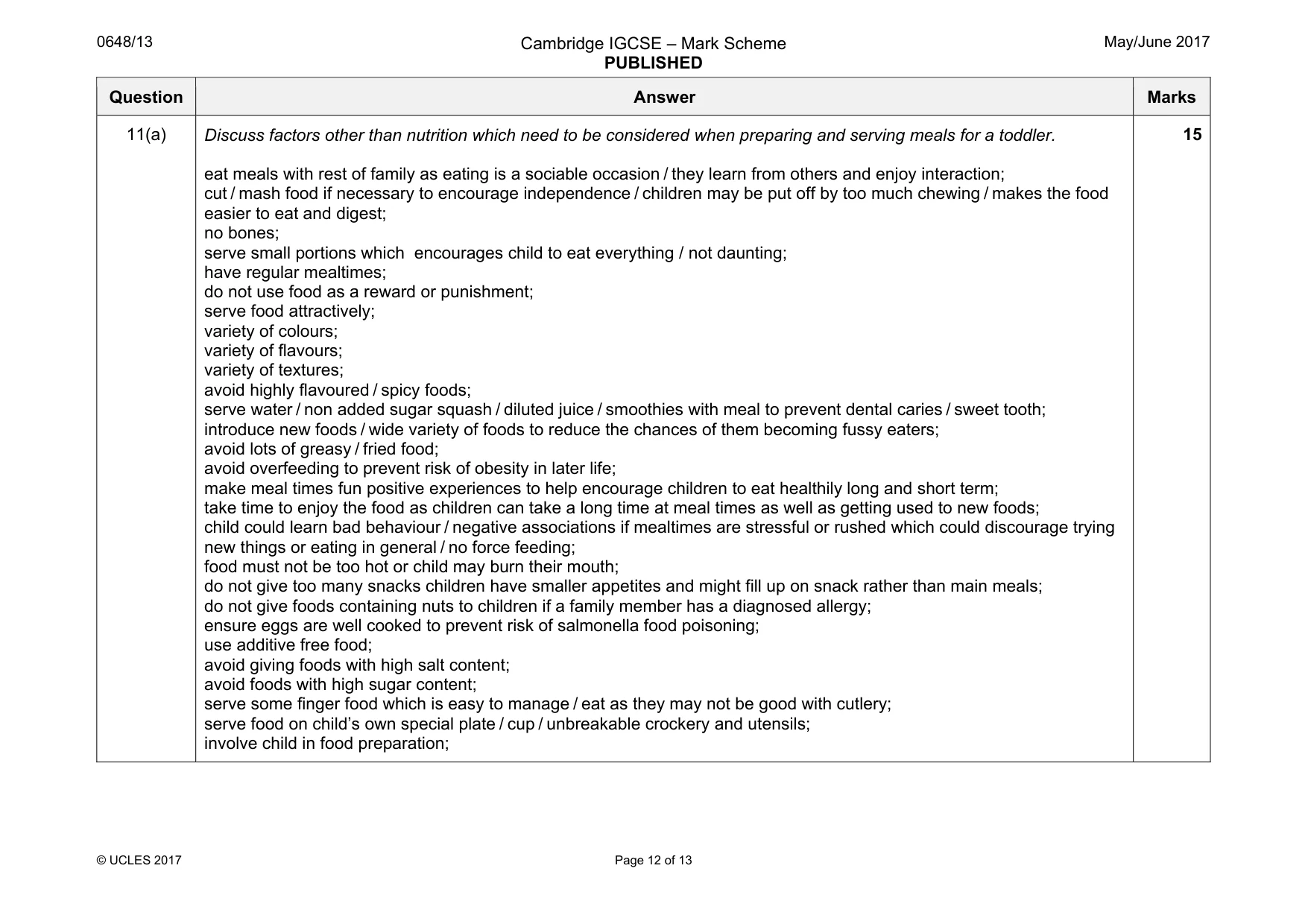
0648/13 Cambridge IGCSE – Mark Scheme PUBLISHED May/June 2017 © UCLES 2017 Page 12 of 13 Question Answer Marks 11(a) Discuss factors other than nutrition which need to be considered when preparing and serving meals for a toddler. eat meals with rest of family as eating is a sociable occasion / they learn from others and enjoy interaction; cut / mash food if necessary to encourage independence / children may be put off by too much chewing / makes the food easier to eat and digest; no bones; serve small portions which encourages child to eat everything / not daunting; have regular mealtimes; do not use food as a reward or punishment; serve food attractively; variety of colours; variety of flavours; variety of textures; avoid highly flavoured / spicy foods; serve water / non added sugar squash / diluted juice / smoothies with meal to prevent dental caries / sweet tooth; introduce new foods / wide variety of foods to reduce the chances of them becoming fussy eaters; avoid lots of greasy / fried food; avoid overfeeding to prevent risk of obesity in later life; make meal times fun positive experiences to help encourage children to eat healthily long and short term; take time to enjoy the food as children can take a long time at meal times as well as getting used to new foods; child could learn bad behaviour / negative associations if mealtimes are stressful or rushed which could discourage trying new things or eating in general / no force feeding; food must not be too hot or child may burn their mouth; do not give too many snacks children have smaller appetites and might fill up on snack rather than main meals; do not give foods containing nuts to children if a family member has a diagnosed allergy; ensure eggs are well cooked to prevent risk of salmonella food poisoning; use additive free food; avoid giving foods with high salt content; avoid foods with high sugar content; serve some finger food which is easy to manage / eat as they may not be good with cutlery; serve food on child’s own special plate / cup / unbreakable crockery and utensils; involve child in food preparation; 15
Mark scheme, page 13
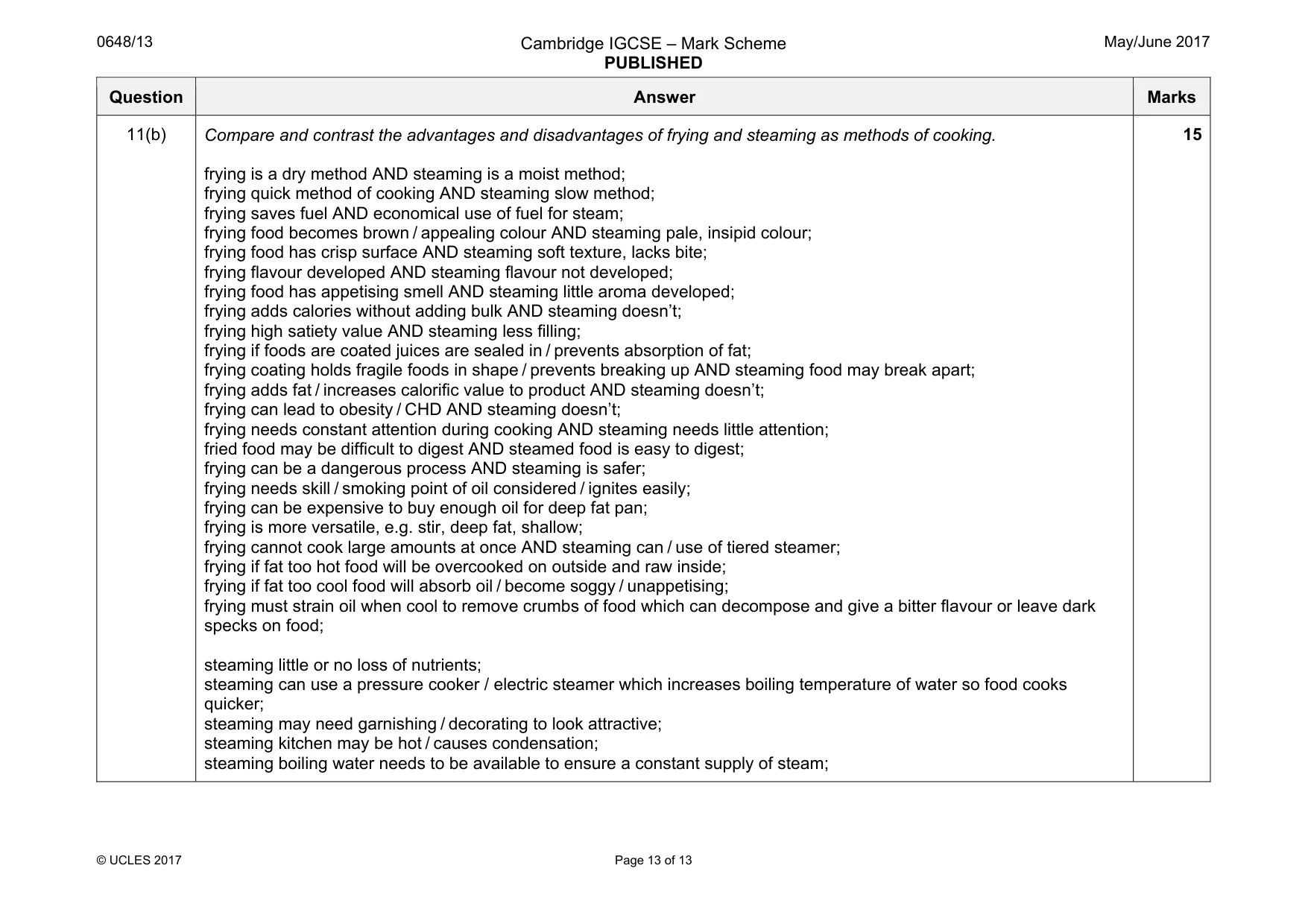
0648/13 Cambridge IGCSE – Mark Scheme PUBLISHED May/June 2017 © UCLES 2017 Page 13 of 13 Question Answer Marks 11(b) Compare and contrast the advantages and disadvantages of frying and steaming as methods of cooking. frying is a dry method AND steaming is a moist method; frying quick method of cooking AND steaming slow method; frying saves fuel AND economical use of fuel for steam; frying food becomes brown / appealing colour AND steaming pale, insipid colour; frying food has crisp surface AND steaming soft texture, lacks bite; frying flavour developed AND steaming flavour not developed; frying food has appetising smell AND steaming little aroma developed; frying adds calories without adding bulk AND steaming doesn’t; frying high satiety value AND steaming less filling; frying if foods are coated juices are sealed in / prevents absorption of fat; frying coating holds fragile foods in shape / prevents breaking up AND steaming food may break apart; frying adds fat / increases calorific value to product AND steaming doesn’t; frying can lead to obesity / CHD AND steaming doesn’t; frying needs constant attention during cooking AND steaming needs little attention; fried food may be difficult to digest AND steamed food is easy to digest; frying can be a dangerous process AND steaming is safer; frying needs skill / smoking point of oil considered / ignites easily; frying can be expensive to buy enough oil for deep fat pan; frying is more versatile, e.g. stir, deep fat, shallow; frying cannot cook large amounts at once AND steaming can / use of tiered steamer; frying if fat too hot food will be overcooked on outside and raw inside; frying if fat too cool food will absorb oil / become soggy / unappetising; frying must strain oil when cool to remove crumbs of food which can decompose and give a bitter flavour or leave dark specks on food; steaming little or no loss of nutrients; steaming can use a pressure cooker / electric steamer which increases boiling temperature of water so food cooks quicker; steaming may need garnishing / decorating to look attractive; steaming kitchen may be hot / causes condensation; steaming boiling water needs to be available to ensure a constant supply of steam; 15
What you needed in this session
Cambridge’s own grade thresholds for 2017 May/June, Paper 1 · Variant 3. A higher threshold means an easier paper — the bar moves with how the cohort did.