Cambridge IGCSE Food and Nutrition 0648 — 2015 Oct/Nov Paper 1 · Variant 2
0648/12/O/N/15 · 100 marks · ≈113 min
The question paper and its mark scheme, free to read here and free to download. This is Cambridge’s own paper, exactly as it was sat.
Question paper12 pages

Mark scheme13 pages
Answers below. Sit the paper first if you are practising.
Paper as text
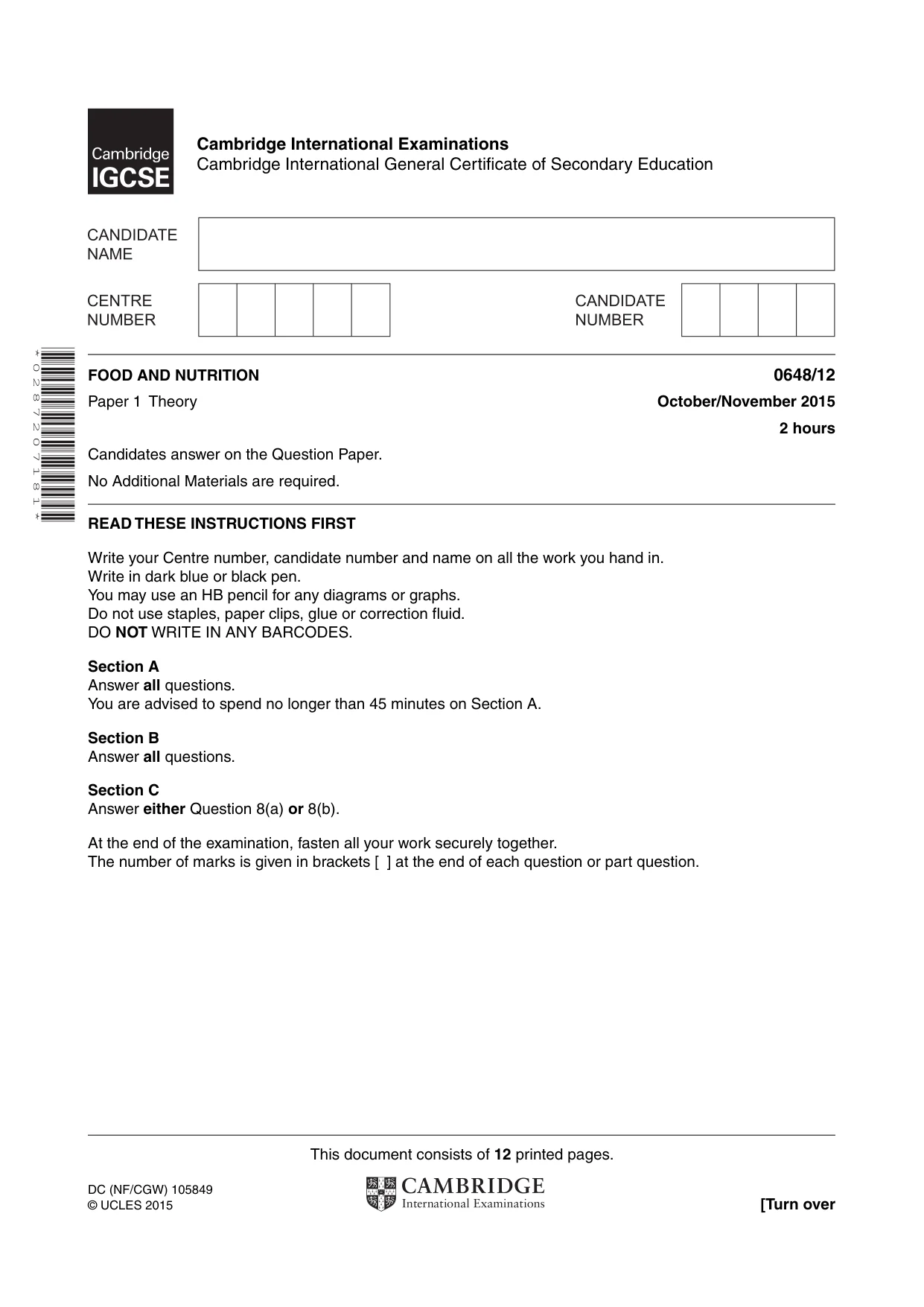
Question paper, page 1
This document consists of 12 printed pages. DC (NF/CGW) 105849 © UCLES 2015 [Turn over Cambridge International Examinations Cambridge International General Certificate of Secondary Education * 0 2 8 7 2 0 7 1 8 1 * FOOD AND NUTRITION 0648/12 Paper 1 Theory October/November 2015 2 hours Candidates answer on the Question Paper. No Additional Materials are required. READ THESE INSTRUCTIONS FIRST Write your Centre number, candidate number and name on all the work you hand in. Write in dark blue or black pen. You may use an HB pencil for any diagrams or graphs. Do not use staples, paper clips, glue or correction fluid. DO NOT WRITE IN ANY BARCODES. Section A Answer all questions. You are advised to spend no longer than 45 minutes on Section A. Section B Answer all questions. Section C Answer either Question 8(a) or 8(b). At the end of the examination, fasten all your work securely together. The number of marks is given in brackets [ ] at the end of each question or part question.
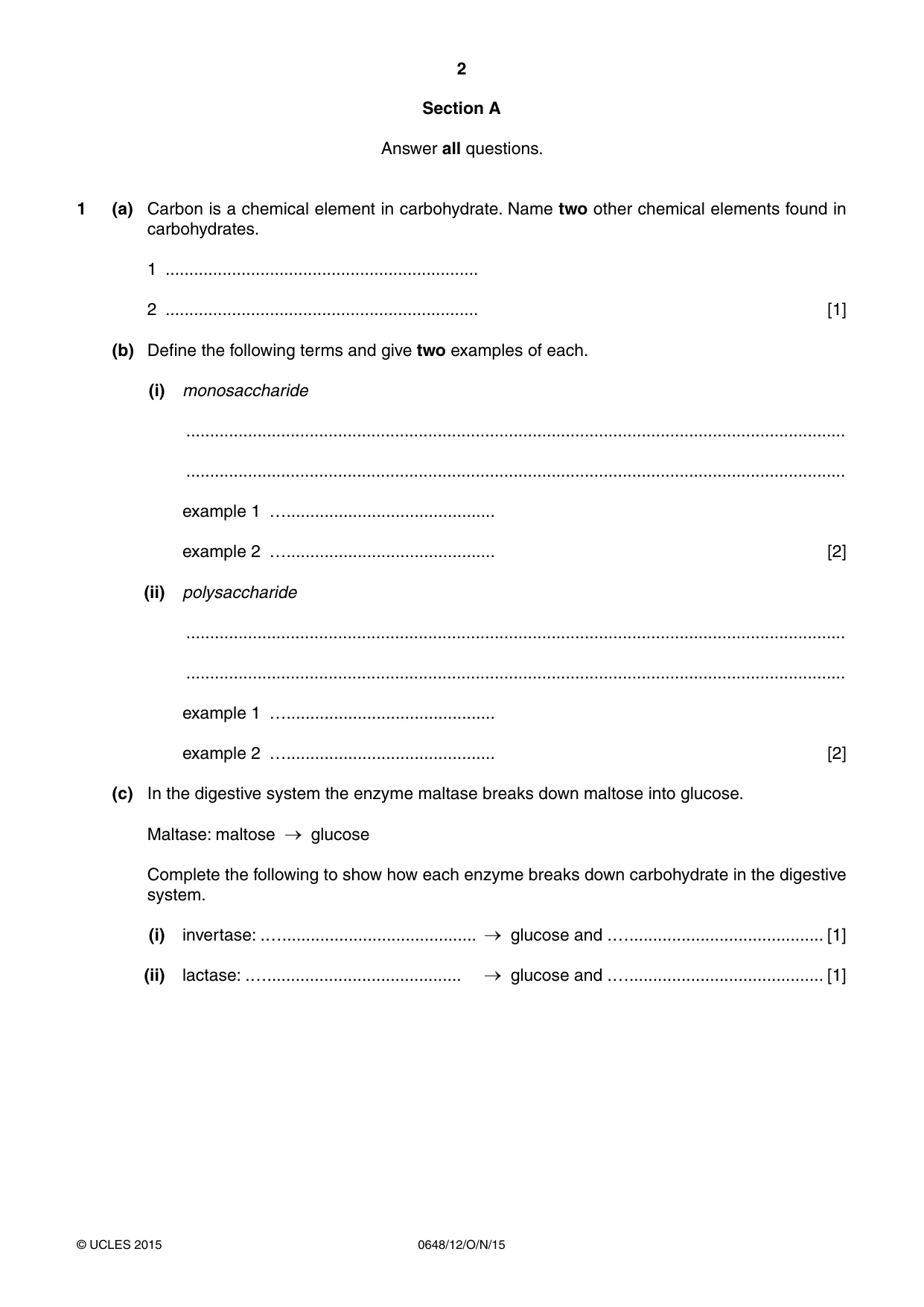
Question paper, page 2
2 0648/12/O/N/15 © UCLES 2015 Section A Answer all questions. 1 (a) Carbon is a chemical element in carbohydrate. Name two other chemical elements found in carbohydrates. 1 … 2 … [1] (b) Define the following terms and give two examples of each. (i) monosaccharide … … example 1 …… example 2 …… [2] (ii) polysaccharide … … example 1 …… example 2 …… [2] (c) In the digestive system the enzyme maltase breaks down maltose into glucose. Maltase: maltose glucose Complete the following to show how each enzyme breaks down carbohydrate in the digestive system. (i) invertase: .…… glucose and .…… [1] (ii) lactase: .…… glucose and .…… [1]
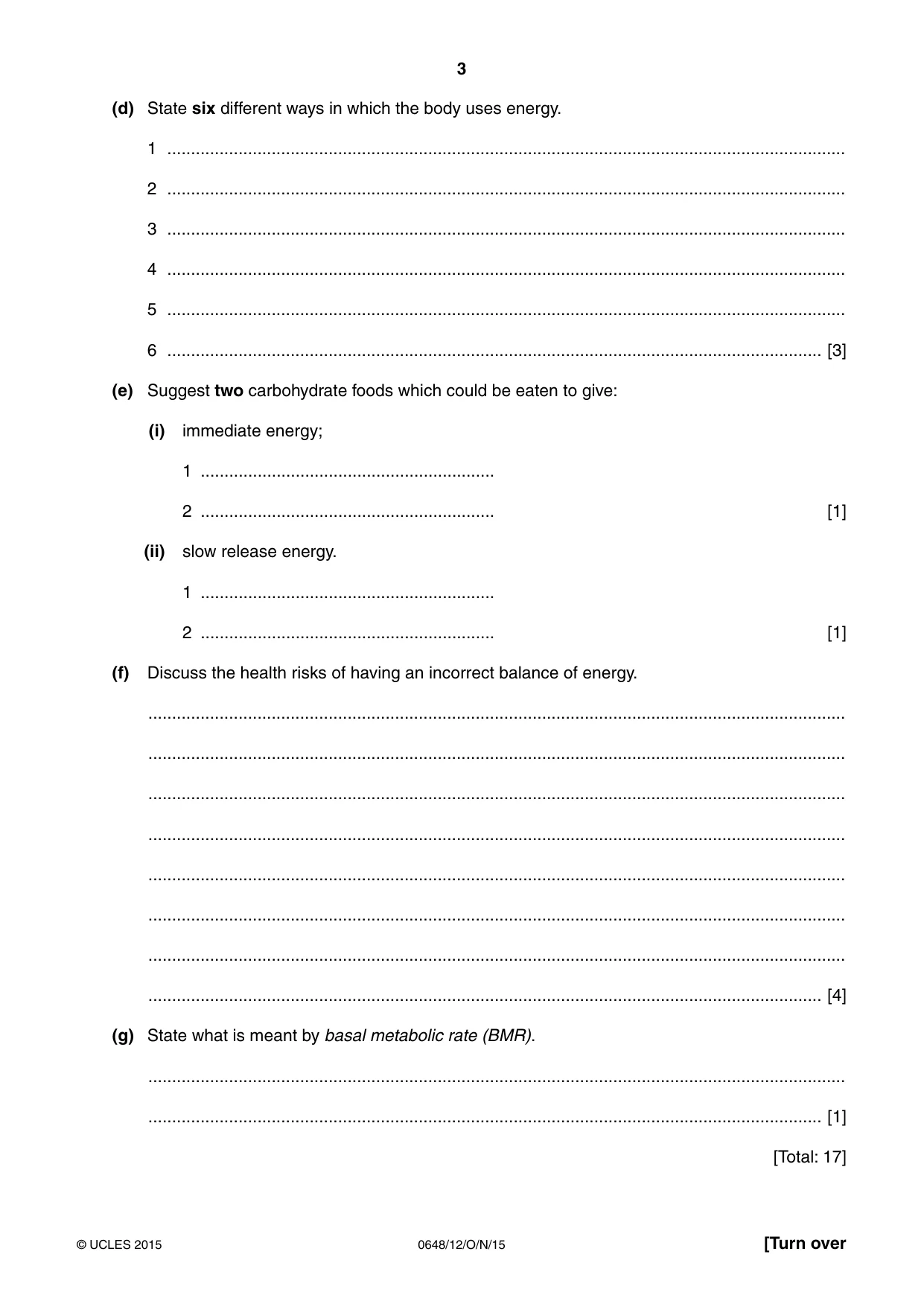
Question paper, page 3
3 0648/12/O/N/15 © UCLES 2015 [Turn over (d) State six different ways in which the body uses energy. 1 … 2 … 3 … 4 … 5 … 6 … [3] (e) Suggest two carbohydrate foods which could be eaten to give: (i) immediate energy; 1 … 2 … [1] (ii) slow release energy. 1 … 2 … [1] (f) Discuss the health risks of having an incorrect balance of energy. … … … … … … … … [4] (g) State what is meant by basal metabolic rate (BMR). … … [1] [Total: 17]
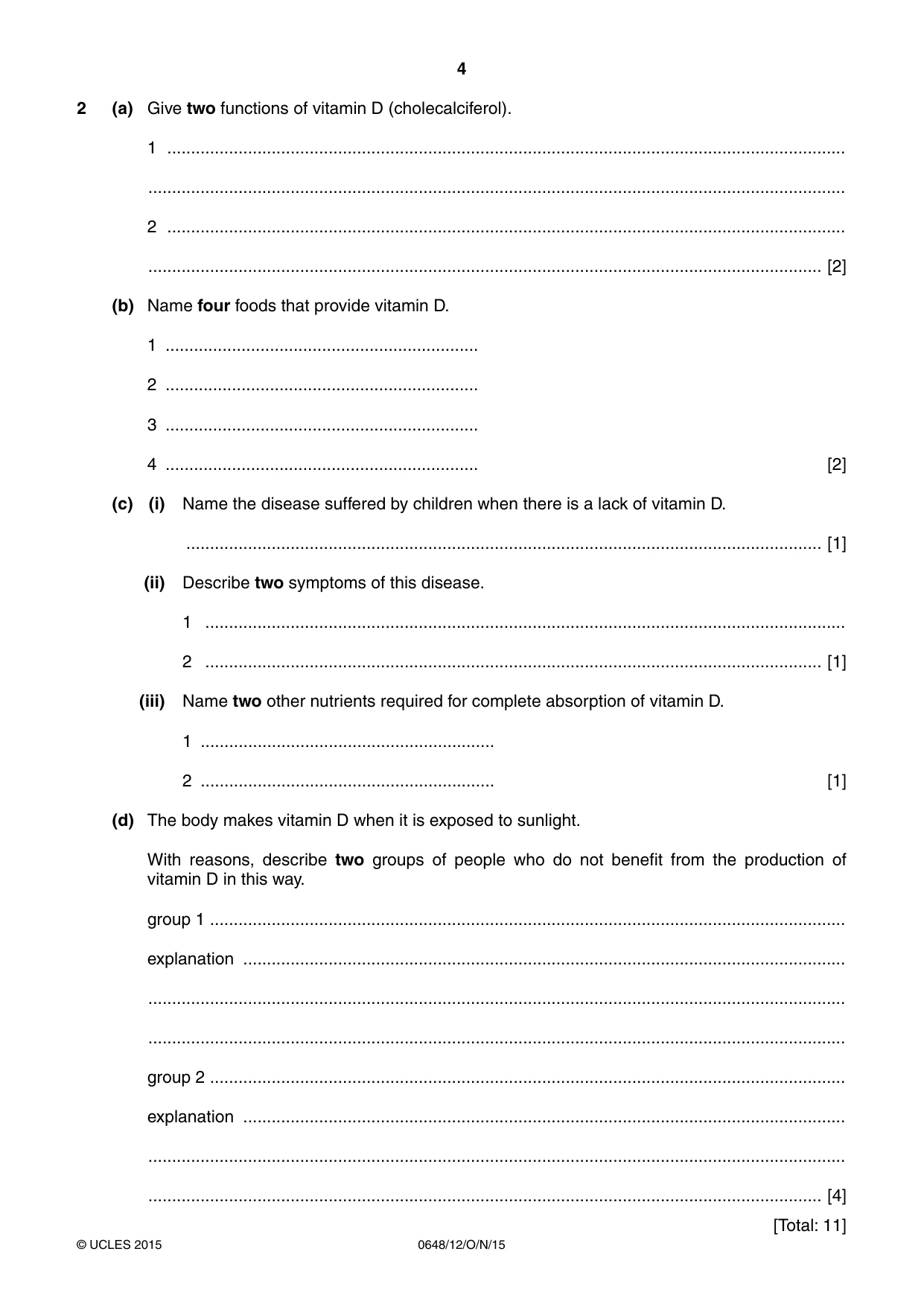
Question paper, page 4
4 0648/12/O/N/15 © UCLES 2015 2 (a) Give two functions of vitamin D (cholecalciferol). 1 … … 2 … … [2] (b) Name four foods that provide vitamin D. 1 … 2 … 3 … 4 … [2] (c) (i) Name the disease suffered by children when there is a lack of vitamin D. … [1] (ii) Describe two symptoms of this disease. 1 … 2 … [1] (iii) Name two other nutrients required for complete absorption of vitamin D. 1 … 2 … [1] (d) The body makes vitamin D when it is exposed to sunlight. With reasons, describe two groups of people who do not benefit from the production of vitamin D in this way. group 1 … explanation … … … group 2 … explanation … … … [4] [Total: 11]
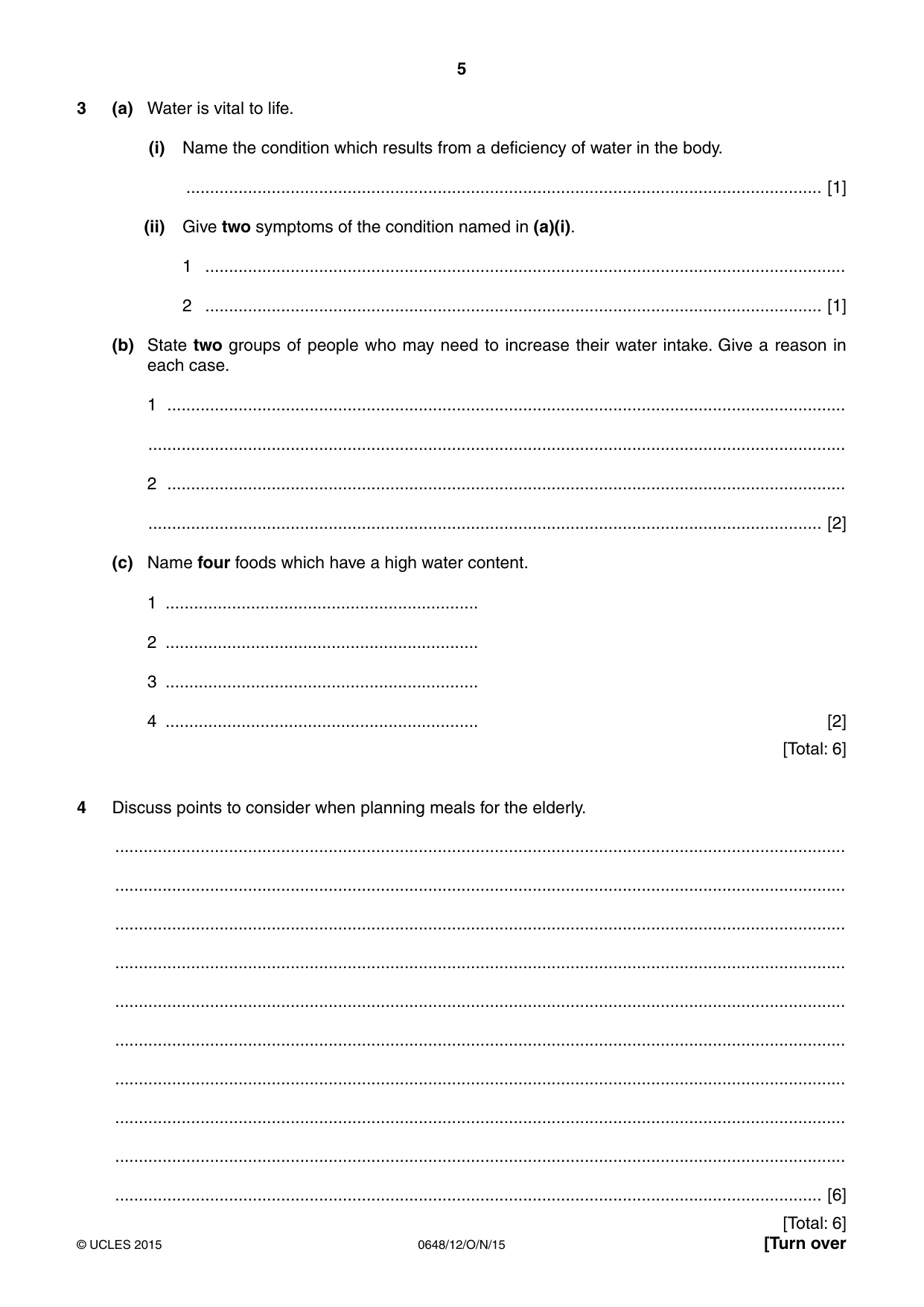
Question paper, page 5
5 0648/12/O/N/15 © UCLES 2015 [Turn over 3 (a) Water is vital to life. (i) Name the condition which results from a deficiency of water in the body. … [1] (ii) Give two symptoms of the condition named in (a)(i). 1 … 2 … [1] (b) State two groups of people who may need to increase their water intake. Give a reason in each case. 1 … … 2 … … [2] (c) Name four foods which have a high water content. 1 … 2 … 3 … 4 … [2] [Total: 6] 4 Discuss points to consider when planning meals for the elderly. … … … … … … … … … … [6] [Total: 6]
Question paper, page 6
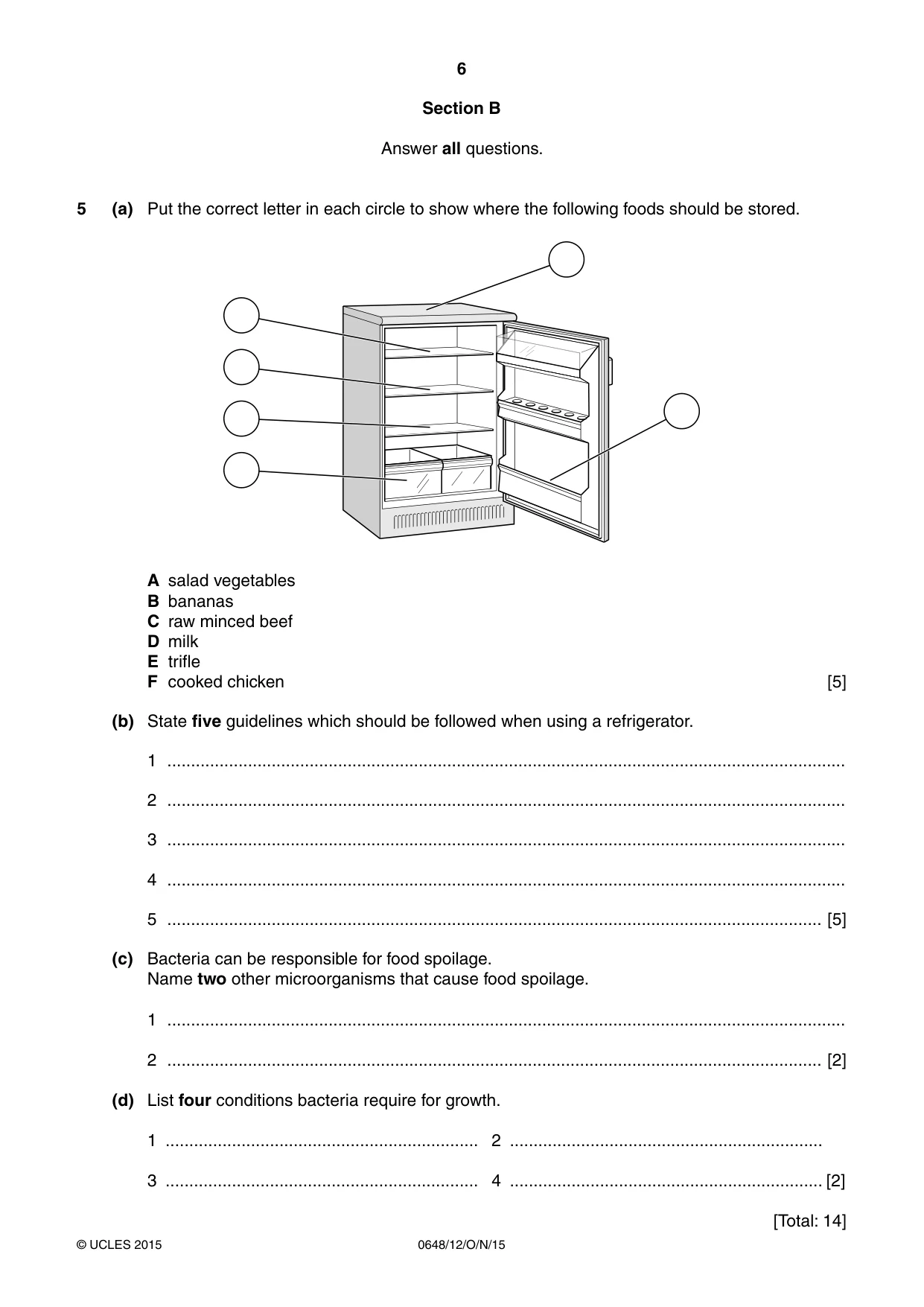
6 0648/12/O/N/15 © UCLES 2015 Section B Answer all questions. 5 (a) Put the correct letter in each circle to show where the following foods should be stored. A salad vegetables B bananas C raw minced beef D milk E trifle F cooked chicken [5] (b) State five guidelines which should be followed when using a refrigerator. 1 … 2 … 3 … 4 … 5 … [5] (c) Bacteria can be responsible for food spoilage. Name two other microorganisms that cause food spoilage. 1 … 2 … [2] (d) List four conditions bacteria require for growth. 1 … 2 … 3 … 4 … [2] [Total: 14]
Question paper, page 7
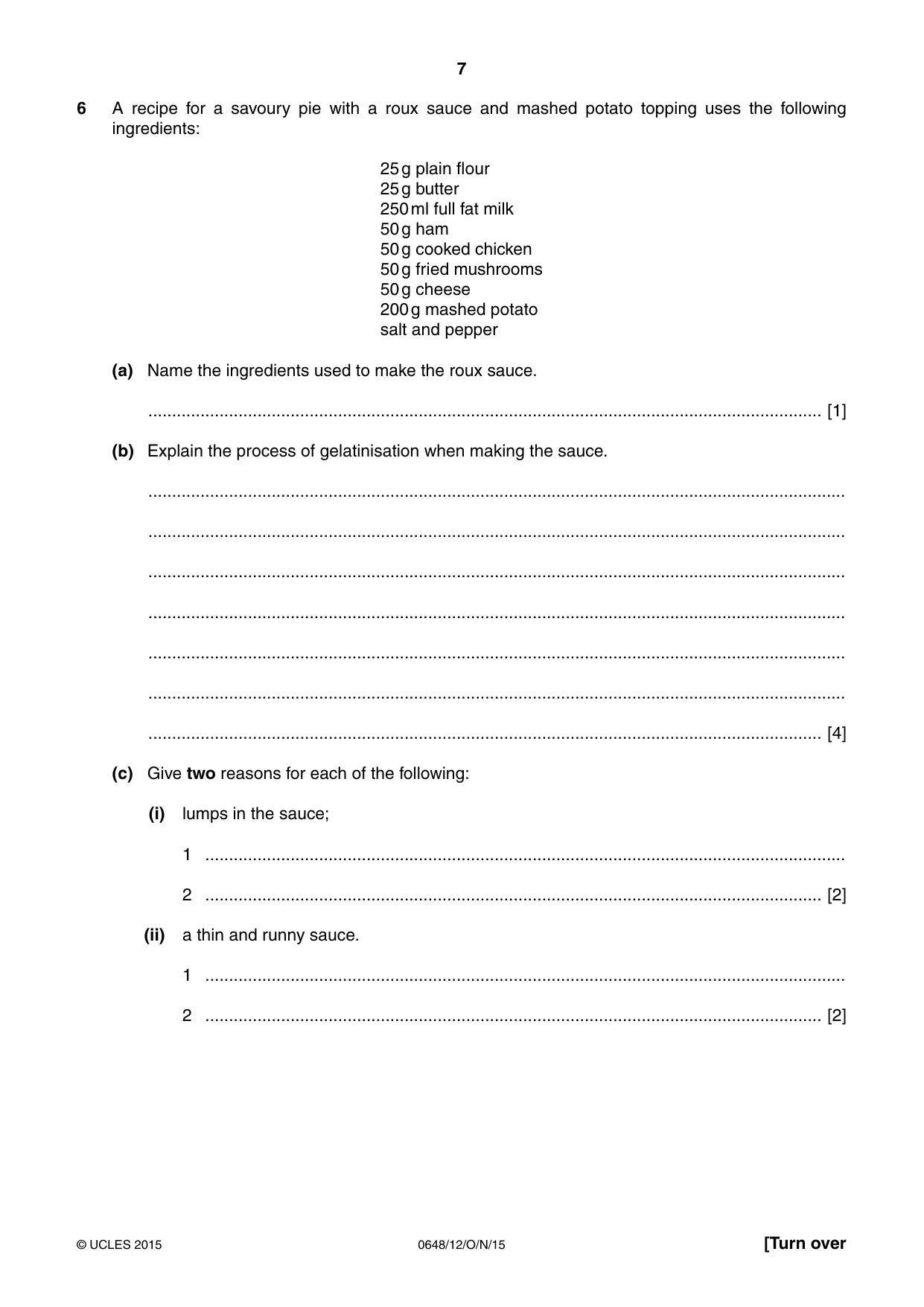
7 0648/12/O/N/15 © UCLES 2015 [Turn over 6 A recipe for a savoury pie with a roux sauce and mashed potato topping uses the following ingredients: 25 g plain flour 25 g butter 250 ml full fat milk 50 g ham 50 g cooked chicken 50 g fried mushrooms 50 g cheese 200 g mashed potato salt and pepper (a) Name the ingredients used to make the roux sauce. … [1] (b) Explain the process of gelatinisation when making the sauce. … … … … … … … [4] (c) Give two reasons for each of the following: (i) lumps in the sauce; 1 … 2 … [2] (ii) a thin and runny sauce. 1 … 2 … [2]
Question paper, page 8
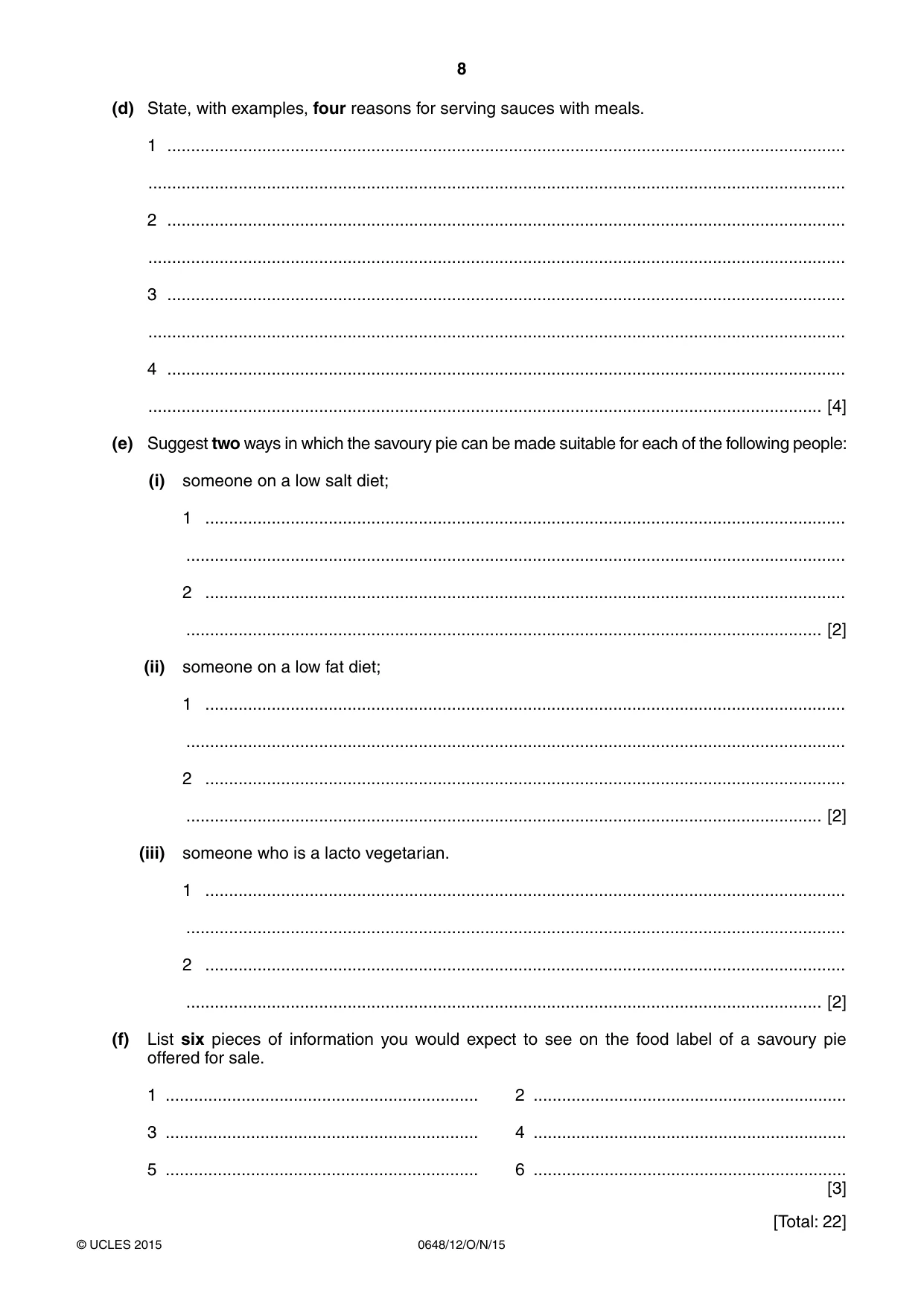
8 0648/12/O/N/15 © UCLES 2015 (d) State, with examples, four reasons for serving sauces with meals. 1 … … 2 … … 3 … … 4 … … [4] (e) Suggest two ways in which the savoury pie can be made suitable for each of the following people: (i) someone on a low salt diet; 1 … … 2 … … [2] (ii) someone on a low fat diet; 1 … … 2 … … [2] (iii) someone who is a lacto vegetarian. 1 … … 2 … … [2] (f) List six pieces of information you would expect to see on the food label of a savoury pie offered for sale. 1 … 2 … 3 … 4 … 5 … 6 … [3] [Total: 22]
Question paper, page 9
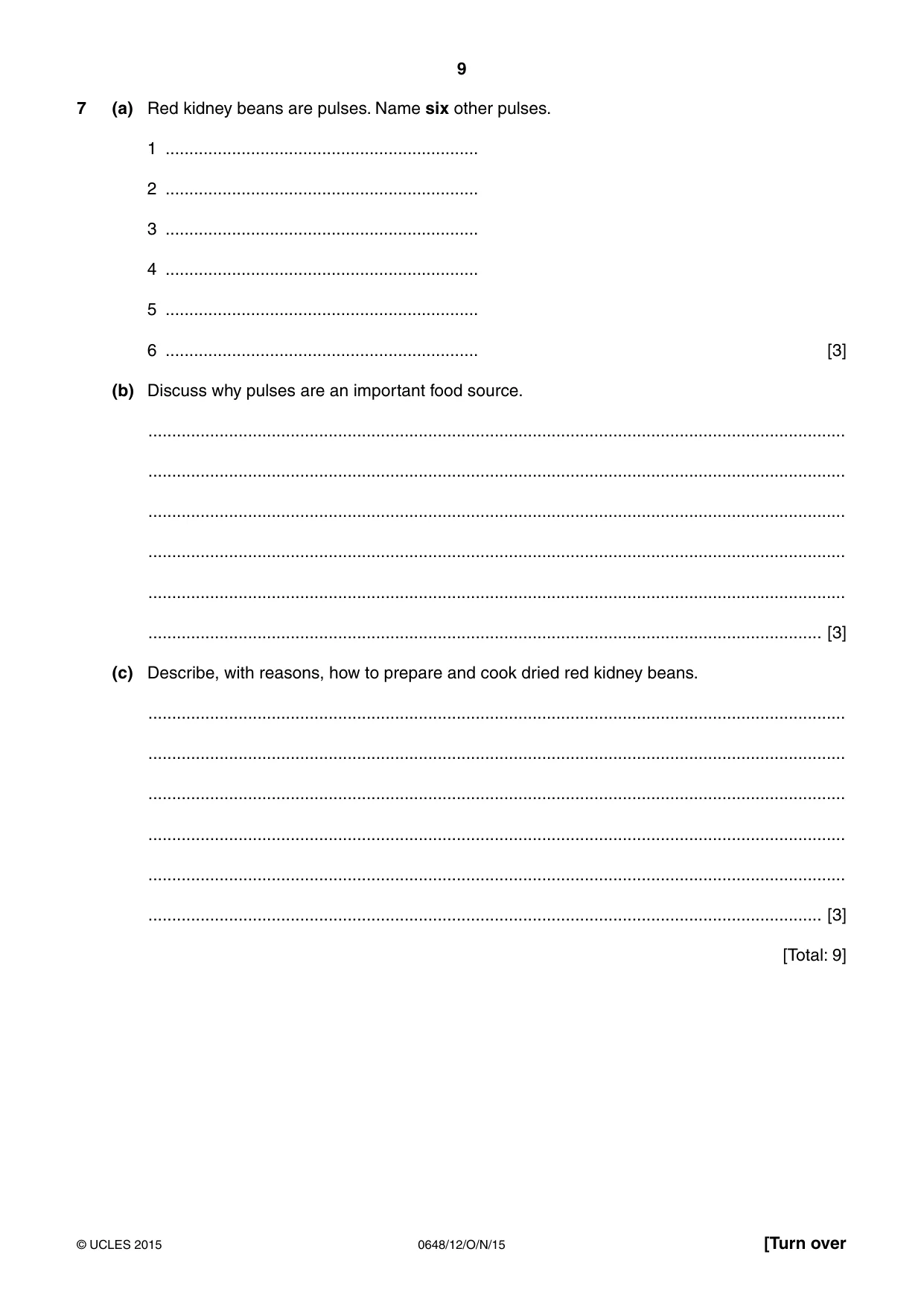
9 0648/12/O/N/15 © UCLES 2015 [Turn over 7 (a) Red kidney beans are pulses. Name six other pulses. 1 … 2 … 3 … 4 … 5 … 6 … [3] (b) Discuss why pulses are an important food source. … … … … … … [3] (c) Describe, with reasons, how to prepare and cook dried red kidney beans. … … … … … … [3] [Total: 9]
Question paper, page 10
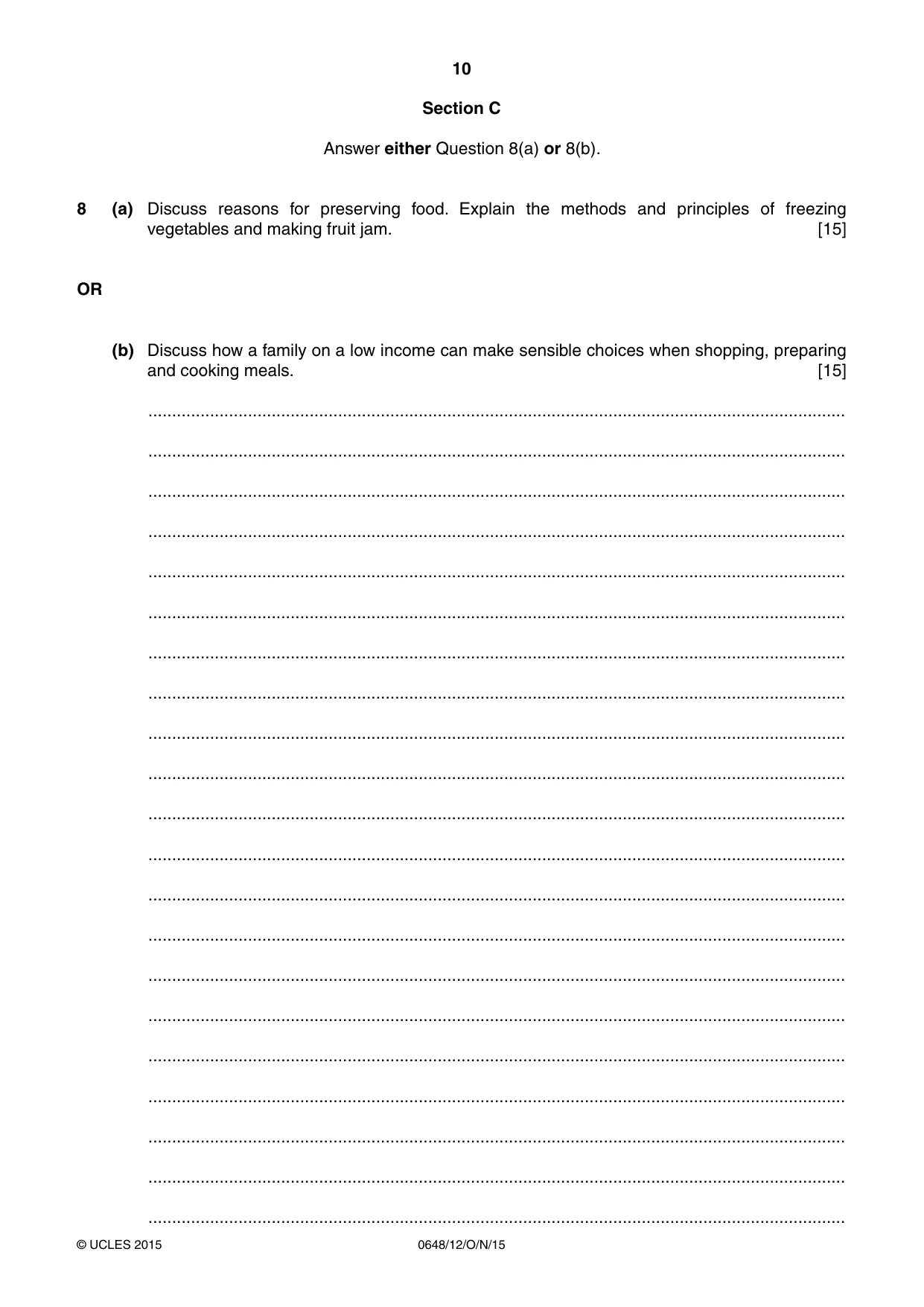
10 0648/12/O/N/15 © UCLES 2015 Section C Answer either Question 8(a) or 8(b). 8 (a) Discuss reasons for preserving food. Explain the methods and principles of freezing vegetables and making fruit jam. [15] OR (b) Discuss how a family on a low income can make sensible choices when shopping, preparing and cooking meals. [15] … … … … … … … … … … … … … … … … … … … … …
Question paper, page 11
11 0648/12/O/N/15 © UCLES 2015 [Turn over … … … … … … … … … … … … … … … … … … … … … … … … … … … …
Question paper, page 12
12 0648/12/O/N/15 © UCLES 2015 Permission to reproduce items where third-party owned material protected by copyright is included has been sought and cleared where possible. Every reasonable effort has been made by the publisher (UCLES) to trace copyright holders, but if any items requiring clearance have unwittingly been included, the publisher will be pleased to make amends at the earliest possible opportunity. To avoid the issue of disclosure of answer-related information to candidates, all copyright acknowledgements are reproduced online in the Cambridge International Examinations Copyright Acknowledgements Booklet. This is produced for each series of examinations and is freely available to download at www.cie.org.uk after the live examination series. Cambridge International Examinations is part of the Cambridge Assessment Group. Cambridge Assessment is the brand name of University of Cambridge Local Examinations Syndicate (UCLES), which is itself a department of the University of Cambridge. … … … … … … … … … … … … … … … … … … … … … [Total: 15]
Mark scheme, page 1
® IGCSE is the registered trademark of Cambridge International Examinations. CAMBRIDGE INTERNATIONAL EXAMINATIONS Cambridge International General Certificate of Secondary Education MARK SCHEME for the October/November 2015 series 0648 FOOD AND NUTRITION 0648/12 Paper 1 (Theory), maximum raw mark 100 This mark scheme is published as an aid to teachers and candidates, to indicate the requirements of the examination. It shows the basis on which Examiners were instructed to award marks. It does not indicate the details of the discussions that took place at an Examiners’ meeting before marking began, which would have considered the acceptability of alternative answers. Mark schemes should be read in conjunction with the question paper and the Principal Examiner Report for Teachers. Cambridge will not enter into discussions about these mark schemes. Cambridge is publishing the mark schemes for the October/November 2015 series for most Cambridge IGCSE®, Cambridge International A and AS Level components and some Cambridge O Level components.
Mark scheme, page 2
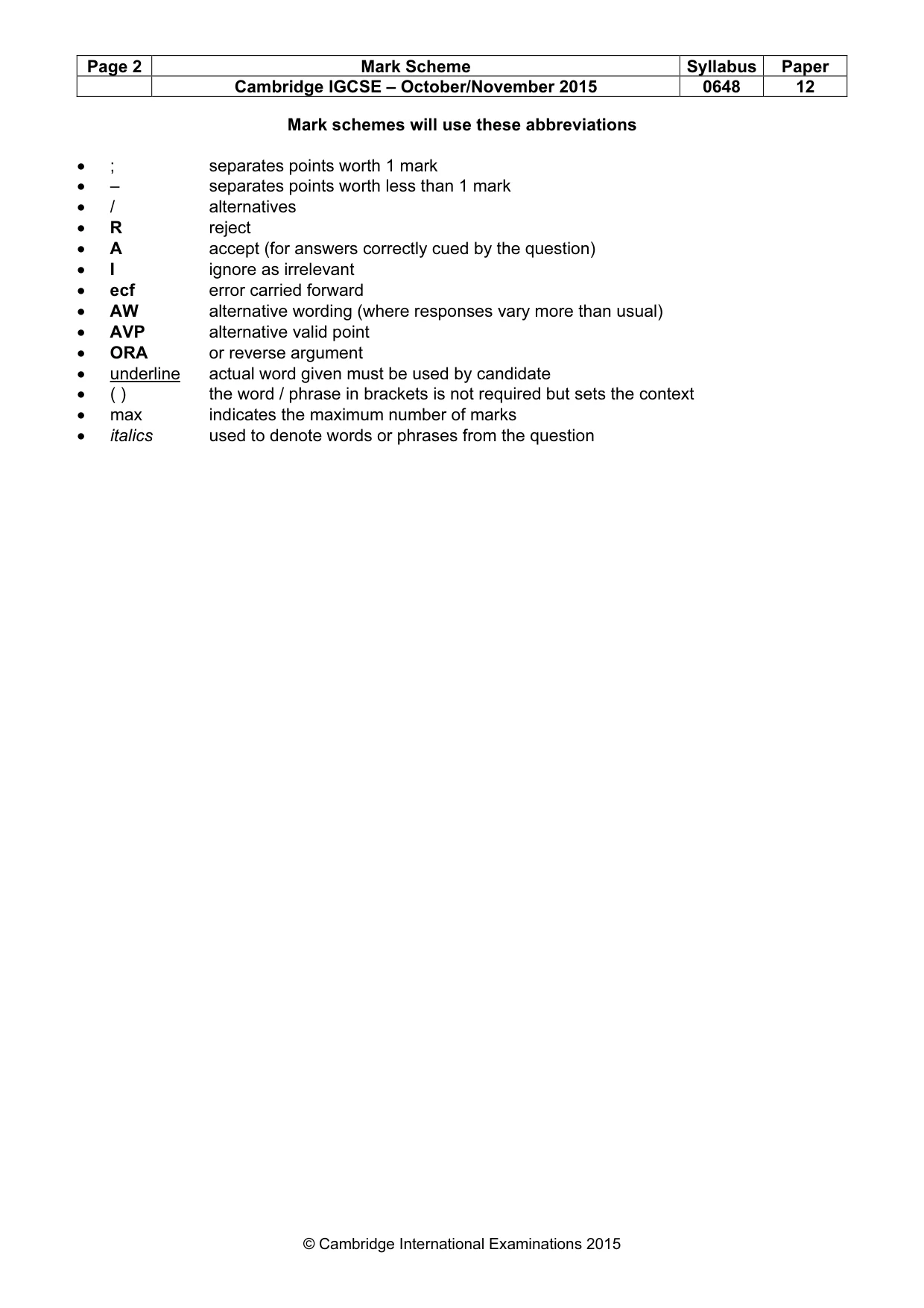
Page 2 Mark Scheme Syllabus Paper Cambridge IGCSE – October/November 2015 0648 12 © Cambridge International Examinations 2015 Mark schemes will use these abbreviations • ; separates points worth 1 mark • – separates points worth less than 1 mark • / alternatives • R reject • A accept (for answers correctly cued by the question) • I ignore as irrelevant • ecf error carried forward • AW alternative wording (where responses vary more than usual) • AVP alternative valid point • ORA or reverse argument • underline actual word given must be used by candidate • ( ) the word / phrase in brackets is not required but sets the context • max indicates the maximum number of marks • italics used to denote words or phrases from the question
Mark scheme, page 3
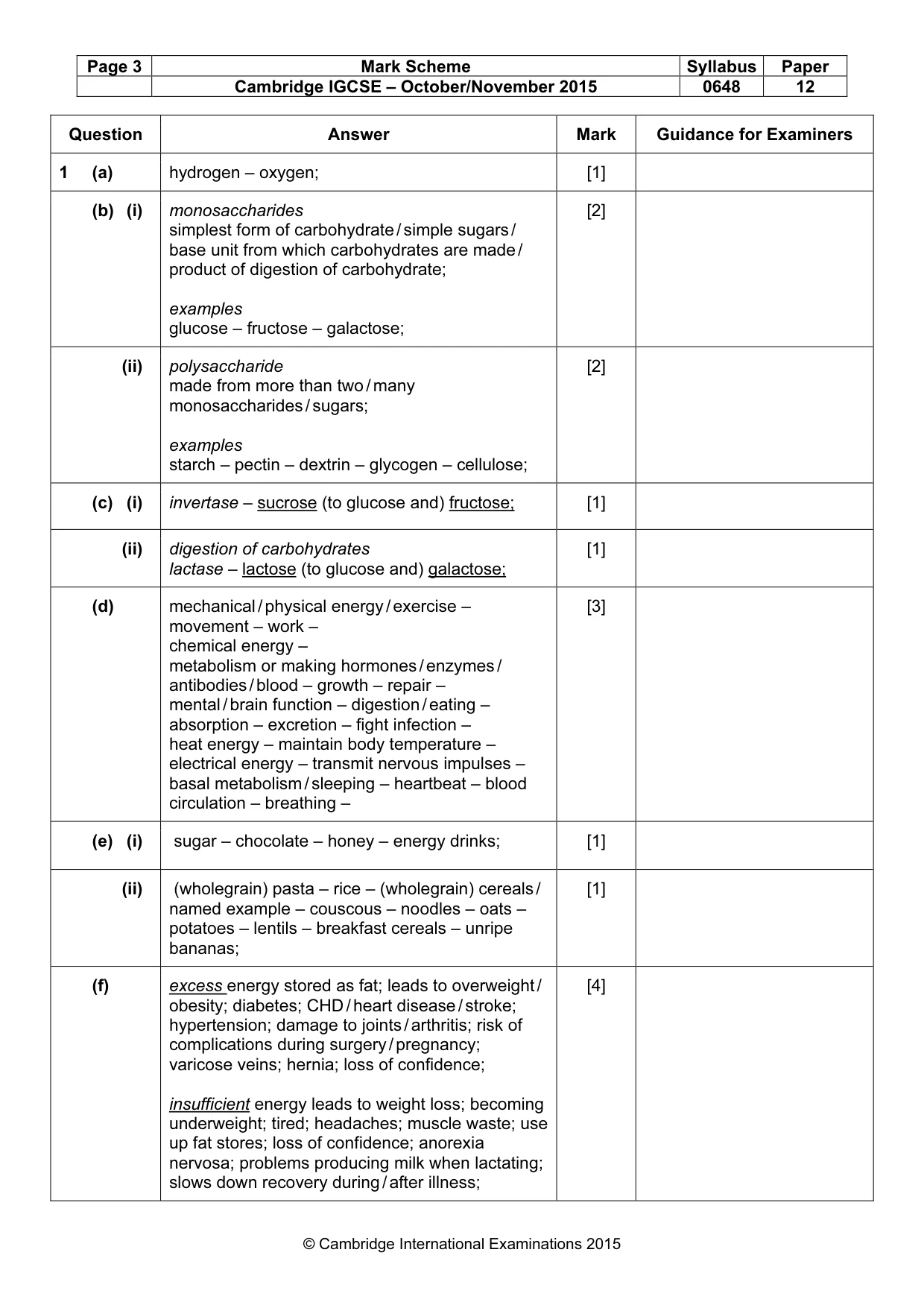
Page 3 Mark Scheme Syllabus Paper Cambridge IGCSE – October/November 2015 0648 12 © Cambridge International Examinations 2015 Question Answer Mark Guidance for Examiners 1 (a) hydrogen – oxygen; [1] (b) (i) monosaccharides simplest form of carbohydrate / simple sugars / base unit from which carbohydrates are made / product of digestion of carbohydrate; examples glucose – fructose – galactose; [2] (ii) polysaccharide made from more than two / many monosaccharides / sugars; examples starch – pectin – dextrin – glycogen – cellulose; [2] (c) (i) invertase – sucrose (to glucose and) fructose; [1] (ii) digestion of carbohydrates lactase – lactose (to glucose and) galactose; [1] (d) mechanical / physical energy / exercise – movement – work – chemical energy – metabolism or making hormones / enzymes / antibodies / blood – growth – repair – mental / brain function – digestion / eating – absorption – excretion – fight infection – heat energy – maintain body temperature – electrical energy – transmit nervous impulses – basal metabolism / sleeping – heartbeat – blood circulation – breathing – [3] (e) (i) sugar – chocolate – honey – energy drinks; [1] (ii) (wholegrain) pasta – rice – (wholegrain) cereals / named example – couscous – noodles – oats – potatoes – lentils – breakfast cereals – unripe bananas; [1] (f) excess energy stored as fat; leads to overweight / obesity; diabetes; CHD / heart disease / stroke; hypertension; damage to joints / arthritis; risk of complications during surgery / pregnancy; varicose veins; hernia; loss of confidence; insufficient energy leads to weight loss; becoming underweight; tired; headaches; muscle waste; use up fat stores; loss of confidence; anorexia nervosa; problems producing milk when lactating; slows down recovery during / after illness; [4]
Mark scheme, page 4
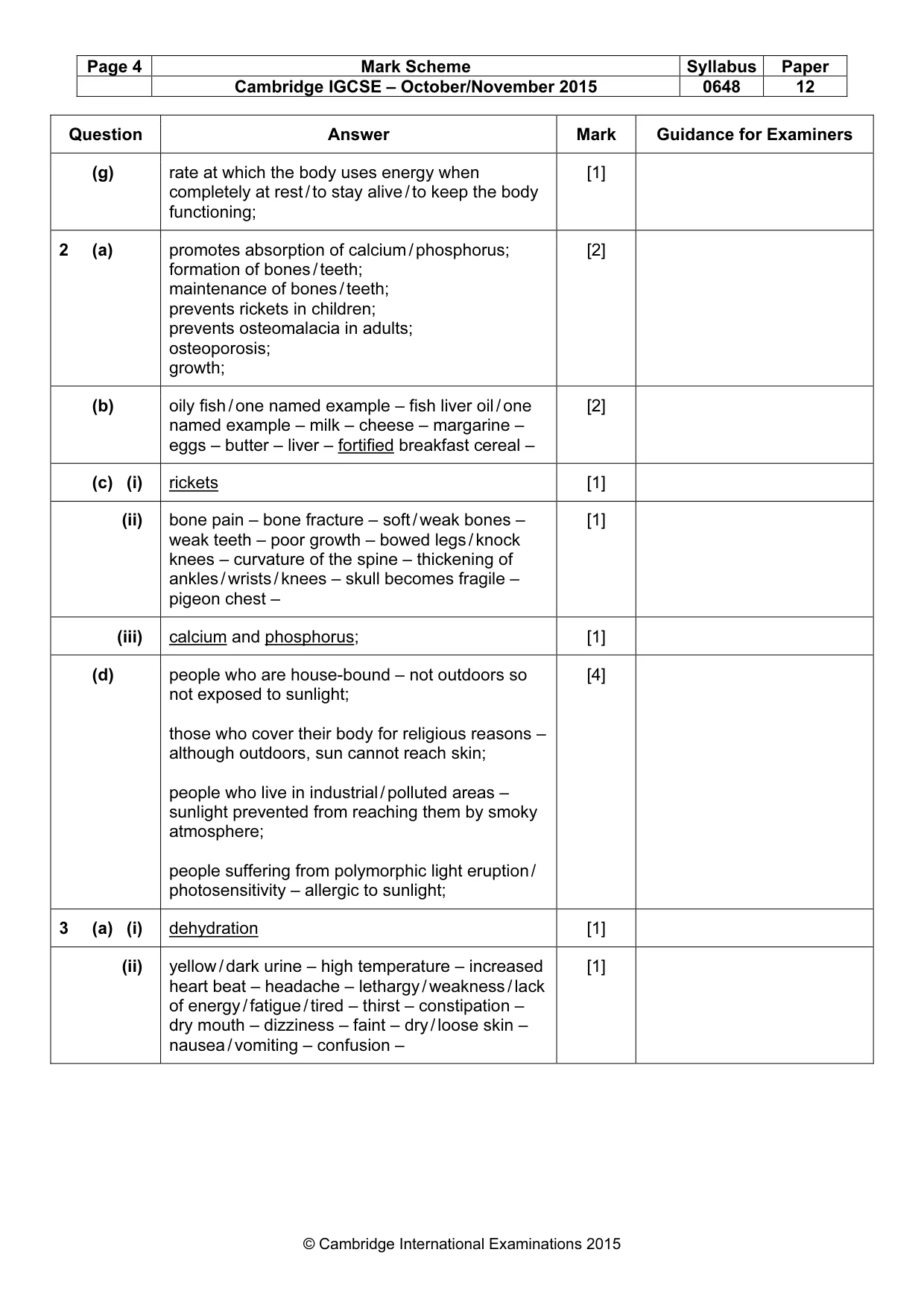
Page 4 Mark Scheme Syllabus Paper Cambridge IGCSE – October/November 2015 0648 12 © Cambridge International Examinations 2015 Question Answer Mark Guidance for Examiners (g) rate at which the body uses energy when completely at rest / to stay alive / to keep the body functioning; [1] 2 (a) promotes absorption of calcium / phosphorus; formation of bones / teeth; maintenance of bones / teeth; prevents rickets in children; prevents osteomalacia in adults; osteoporosis; growth; [2] (b) oily fish / one named example – fish liver oil / one named example – milk – cheese – margarine – eggs – butter – liver – fortified breakfast cereal – [2] (c) (i) rickets [1] (ii) bone pain – bone fracture – soft / weak bones – weak teeth – poor growth – bowed legs / knock knees – curvature of the spine – thickening of ankles / wrists / knees – skull becomes fragile – pigeon chest – [1] (iii) calcium and phosphorus; [1] (d) people who are house-bound – not outdoors so not exposed to sunlight; those who cover their body for religious reasons – although outdoors, sun cannot reach skin; people who live in industrial / polluted areas – sunlight prevented from reaching them by smoky atmosphere; people suffering from polymorphic light eruption / photosensitivity – allergic to sunlight; [4] 3 (a) (i) dehydration [1] (ii) yellow / dark urine – high temperature – increased heart beat – headache – lethargy / weakness / lack of energy / fatigue / tired – thirst – constipation – dry mouth – dizziness – faint – dry / loose skin – nausea / vomiting – confusion – [1]
Mark scheme, page 5
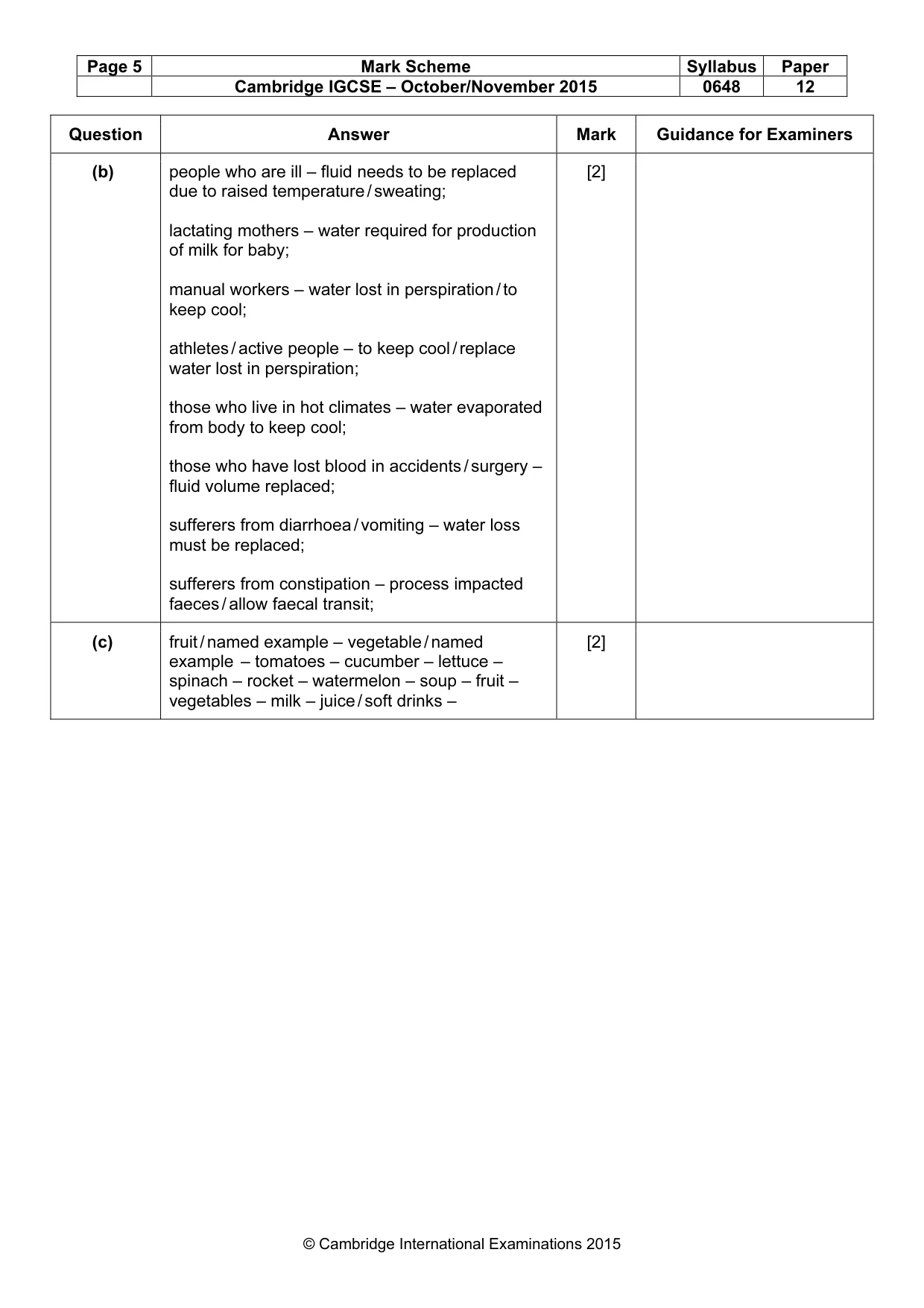
Page 5 Mark Scheme Syllabus Paper Cambridge IGCSE – October/November 2015 0648 12 © Cambridge International Examinations 2015 Question Answer Mark Guidance for Examiners (b) people who are ill – fluid needs to be replaced due to raised temperature / sweating; lactating mothers – water required for production of milk for baby; manual workers – water lost in perspiration / to keep cool; athletes / active people – to keep cool / replace water lost in perspiration; those who live in hot climates – water evaporated from body to keep cool; those who have lost blood in accidents / surgery – fluid volume replaced; sufferers from diarrhoea / vomiting – water loss must be replaced; sufferers from constipation – process impacted faeces / allow faecal transit; [2] (c) fruit / named example – vegetable / named example – tomatoes – cucumber – lettuce – spinach – rocket – watermelon – soup – fruit – vegetables – milk – juice / soft drinks – [2]
Mark scheme, page 6
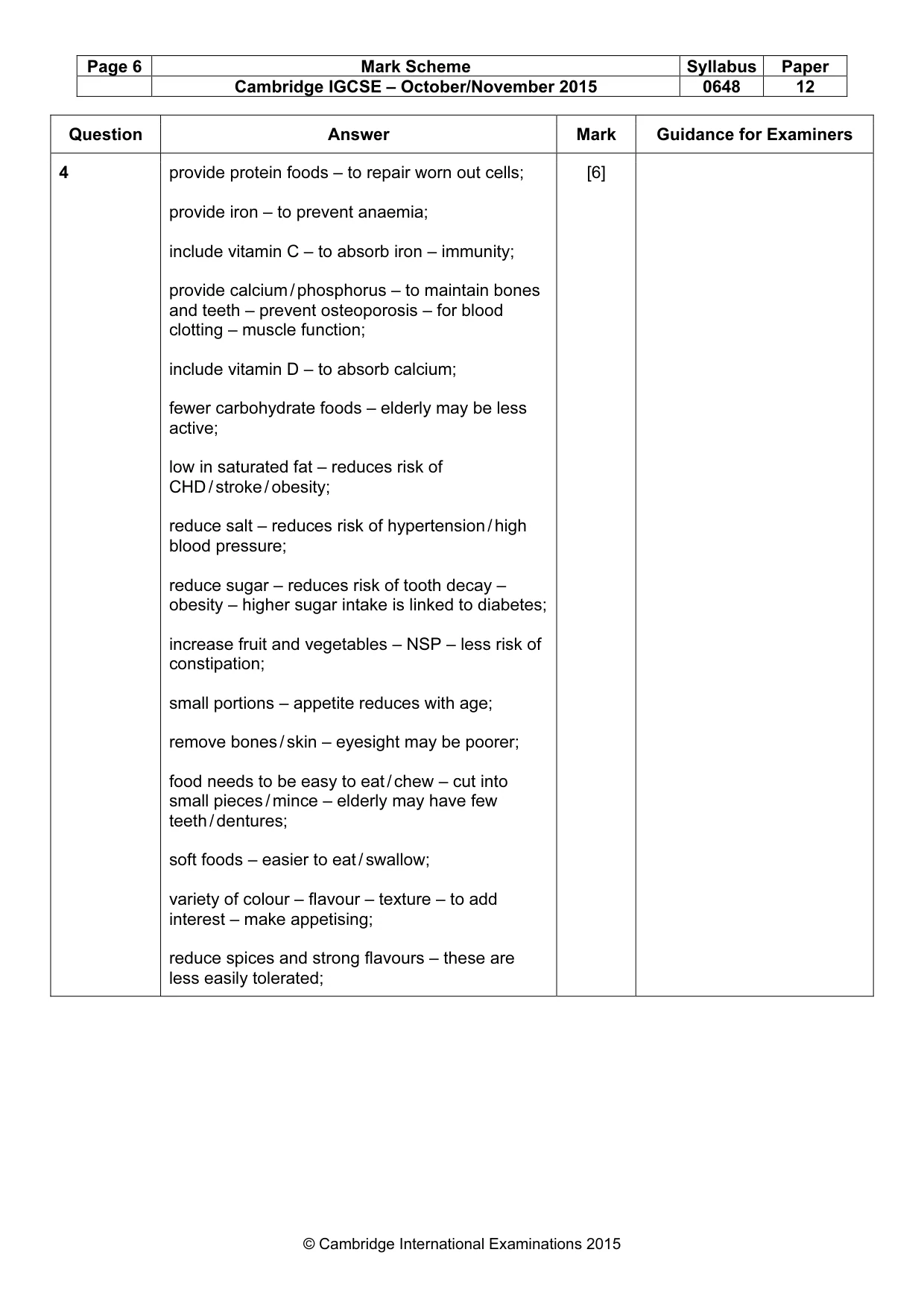
Page 6 Mark Scheme Syllabus Paper Cambridge IGCSE – October/November 2015 0648 12 © Cambridge International Examinations 2015 Question Answer Mark Guidance for Examiners 4 provide protein foods – to repair worn out cells; provide iron – to prevent anaemia; include vitamin C – to absorb iron – immunity; provide calcium / phosphorus – to maintain bones and teeth – prevent osteoporosis – for blood clotting – muscle function; include vitamin D – to absorb calcium; fewer carbohydrate foods – elderly may be less active; low in saturated fat – reduces risk of CHD / stroke / obesity; reduce salt – reduces risk of hypertension / high blood pressure; reduce sugar – reduces risk of tooth decay – obesity – higher sugar intake is linked to diabetes; increase fruit and vegetables – NSP – less risk of constipation; small portions – appetite reduces with age; remove bones / skin – eyesight may be poorer; food needs to be easy to eat / chew – cut into small pieces / mince – elderly may have few teeth / dentures; soft foods – easier to eat / swallow; variety of colour – flavour – texture – to add interest – make appetising; reduce spices and strong flavours – these are less easily tolerated; [6]
Mark scheme, page 7
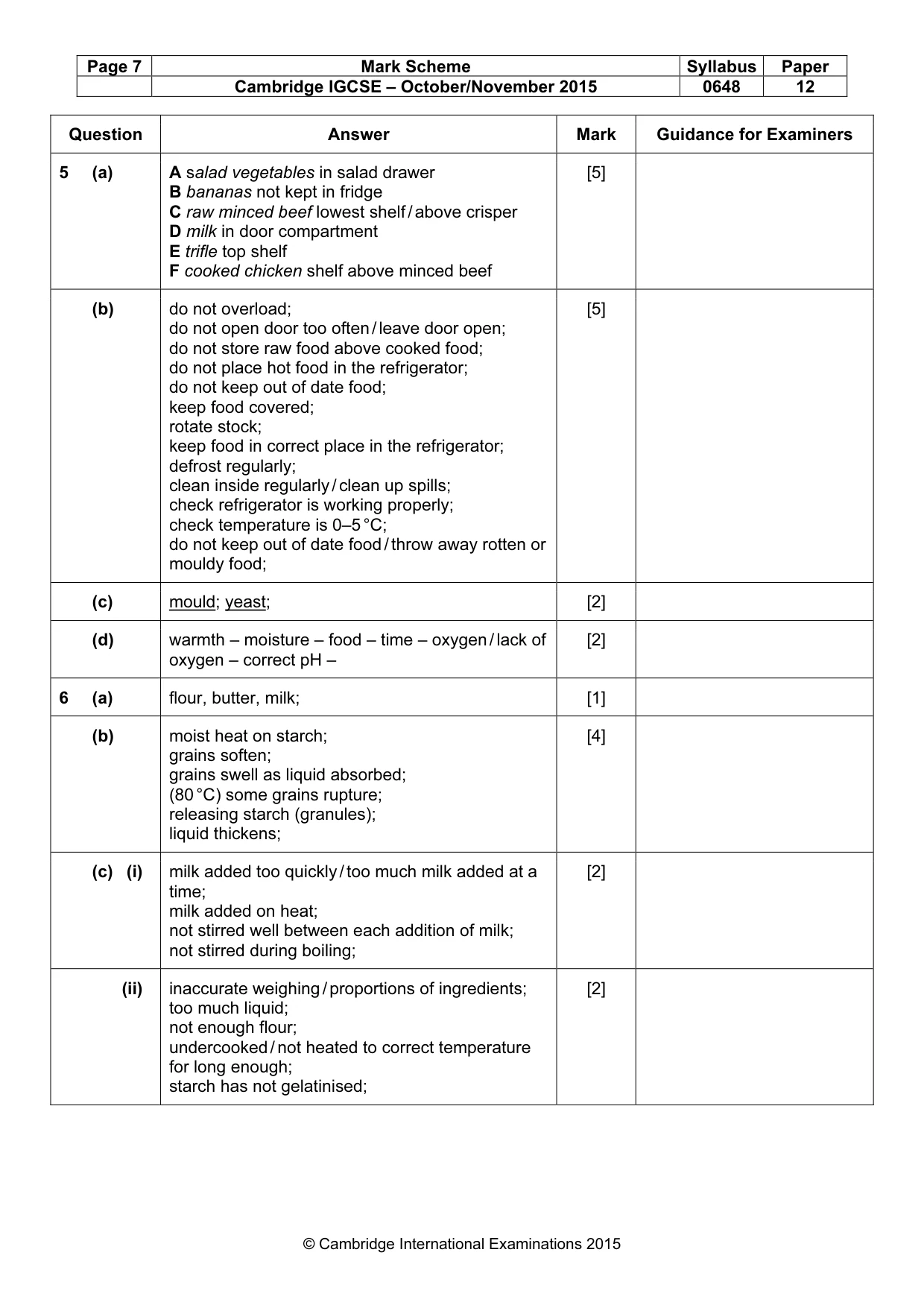
Page 7 Mark Scheme Syllabus Paper Cambridge IGCSE – October/November 2015 0648 12 © Cambridge International Examinations 2015 Question Answer Mark Guidance for Examiners 5 (a) A salad vegetables in salad drawer B bananas not kept in fridge C raw minced beef lowest shelf / above crisper D milk in door compartment E trifle top shelf F cooked chicken shelf above minced beef [5] (b) do not overload; do not open door too often / leave door open; do not store raw food above cooked food; do not place hot food in the refrigerator; do not keep out of date food; keep food covered; rotate stock; keep food in correct place in the refrigerator; defrost regularly; clean inside regularly / clean up spills; check refrigerator is working properly; check temperature is 0–5 °C; do not keep out of date food / throw away rotten or mouldy food; [5] (c) mould; yeast; [2] (d) warmth – moisture – food – time – oxygen / lack of oxygen – correct pH – [2] 6 (a) flour, butter, milk; [1] (b) moist heat on starch; grains soften; grains swell as liquid absorbed; (80 °C) some grains rupture; releasing starch (granules); liquid thickens; [4] (c) (i) milk added too quickly / too much milk added at a time; milk added on heat; not stirred well between each addition of milk; not stirred during boiling; [2] (ii) inaccurate weighing / proportions of ingredients; too much liquid; not enough flour; undercooked / not heated to correct temperature for long enough; starch has not gelatinised; [2]
Mark scheme, page 8
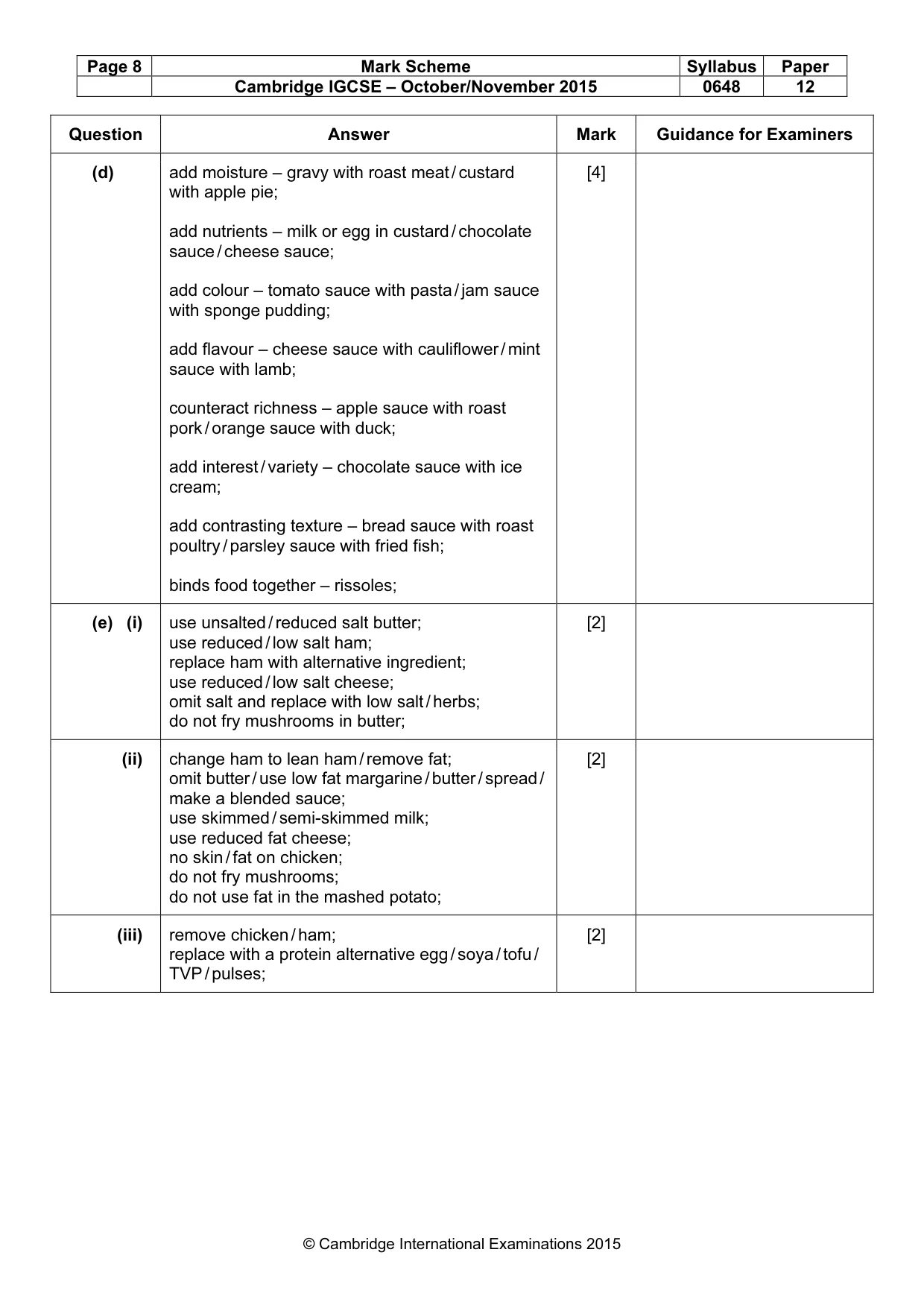
Page 8 Mark Scheme Syllabus Paper Cambridge IGCSE – October/November 2015 0648 12 © Cambridge International Examinations 2015 Question Answer Mark Guidance for Examiners (d) add moisture – gravy with roast meat / custard with apple pie; add nutrients – milk or egg in custard / chocolate sauce / cheese sauce; add colour – tomato sauce with pasta / jam sauce with sponge pudding; add flavour – cheese sauce with cauliflower / mint sauce with lamb; counteract richness – apple sauce with roast pork / orange sauce with duck; add interest / variety – chocolate sauce with ice cream; add contrasting texture – bread sauce with roast poultry / parsley sauce with fried fish; binds food together – rissoles; [4] (e) (i) use unsalted / reduced salt butter; use reduced / low salt ham; replace ham with alternative ingredient; use reduced / low salt cheese; omit salt and replace with low salt / herbs; do not fry mushrooms in butter; [2] (ii) change ham to lean ham / remove fat; omit butter / use low fat margarine / butter / spread / make a blended sauce; use skimmed / semi-skimmed milk; use reduced fat cheese; no skin / fat on chicken; do not fry mushrooms; do not use fat in the mashed potato; [2] (iii) remove chicken / ham; replace with a protein alternative egg / soya / tofu / TVP / pulses; [2]
Mark scheme, page 9
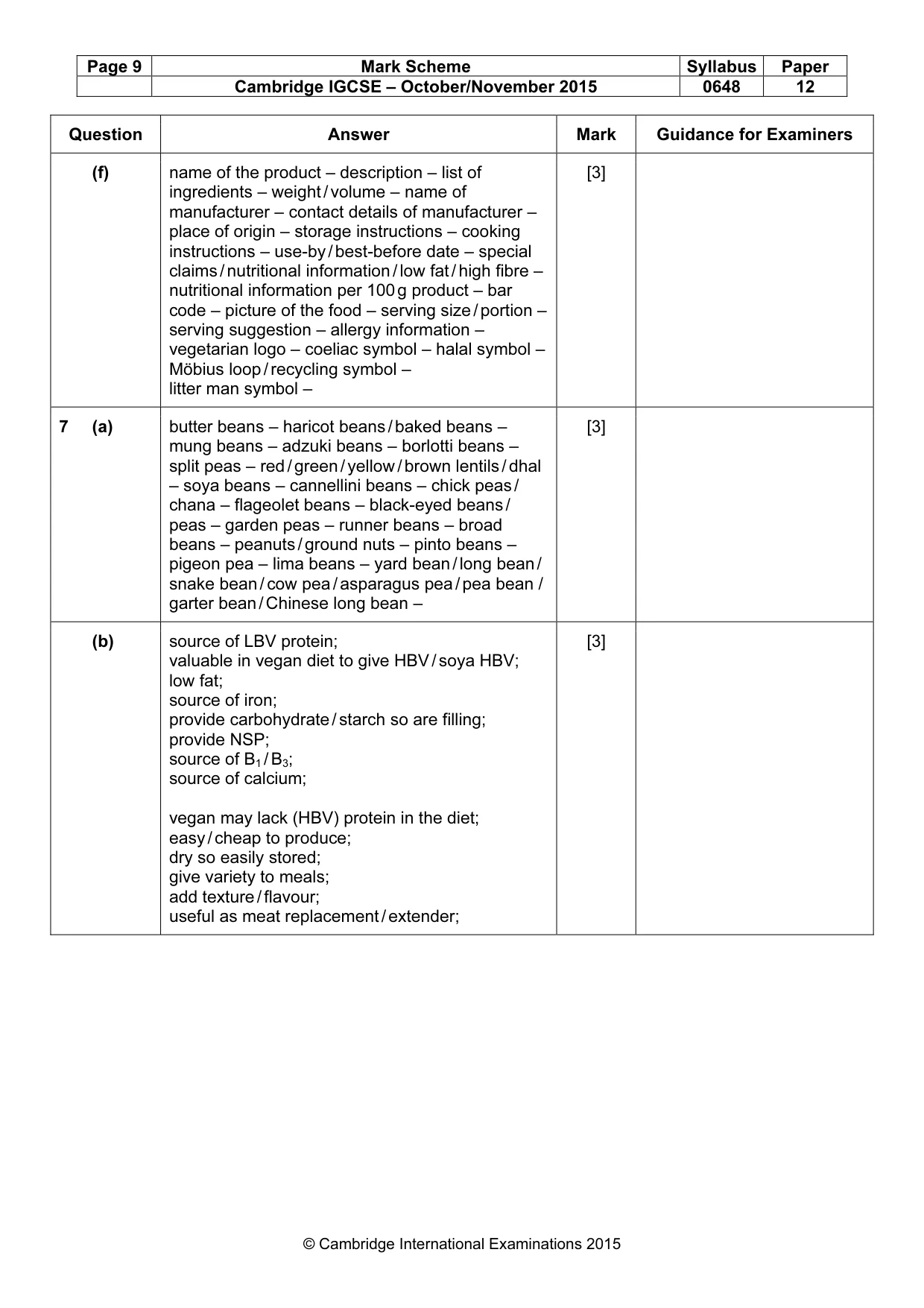
Page 9 Mark Scheme Syllabus Paper Cambridge IGCSE – October/November 2015 0648 12 © Cambridge International Examinations 2015 Question Answer Mark Guidance for Examiners (f) name of the product – description – list of ingredients – weight / volume – name of manufacturer – contact details of manufacturer – place of origin – storage instructions – cooking instructions – use-by / best-before date – special claims / nutritional information / low fat / high fibre – nutritional information per 100 g product – bar code – picture of the food – serving size / portion – serving suggestion – allergy information – vegetarian logo – coeliac symbol – halal symbol – Möbius loop / recycling symbol – litter man symbol – [3] 7 (a) butter beans – haricot beans / baked beans – mung beans – adzuki beans – borlotti beans – split peas – red / green / yellow / brown lentils / dhal – soya beans – cannellini beans – chick peas / chana – flageolet beans – black-eyed beans / peas – garden peas – runner beans – broad beans – peanuts / ground nuts – pinto beans – pigeon pea – lima beans – yard bean / long bean / snake bean / cow pea / asparagus pea / pea bean / garter bean / Chinese long bean – [3] (b) source of LBV protein; valuable in vegan diet to give HBV / soya HBV; low fat; source of iron; provide carbohydrate / starch so are filling; provide NSP; source of B1 / B3; source of calcium; vegan may lack (HBV) protein in the diet; easy / cheap to produce; dry so easily stored; give variety to meals; add texture / flavour; useful as meat replacement / extender; [3]
Mark scheme, page 10
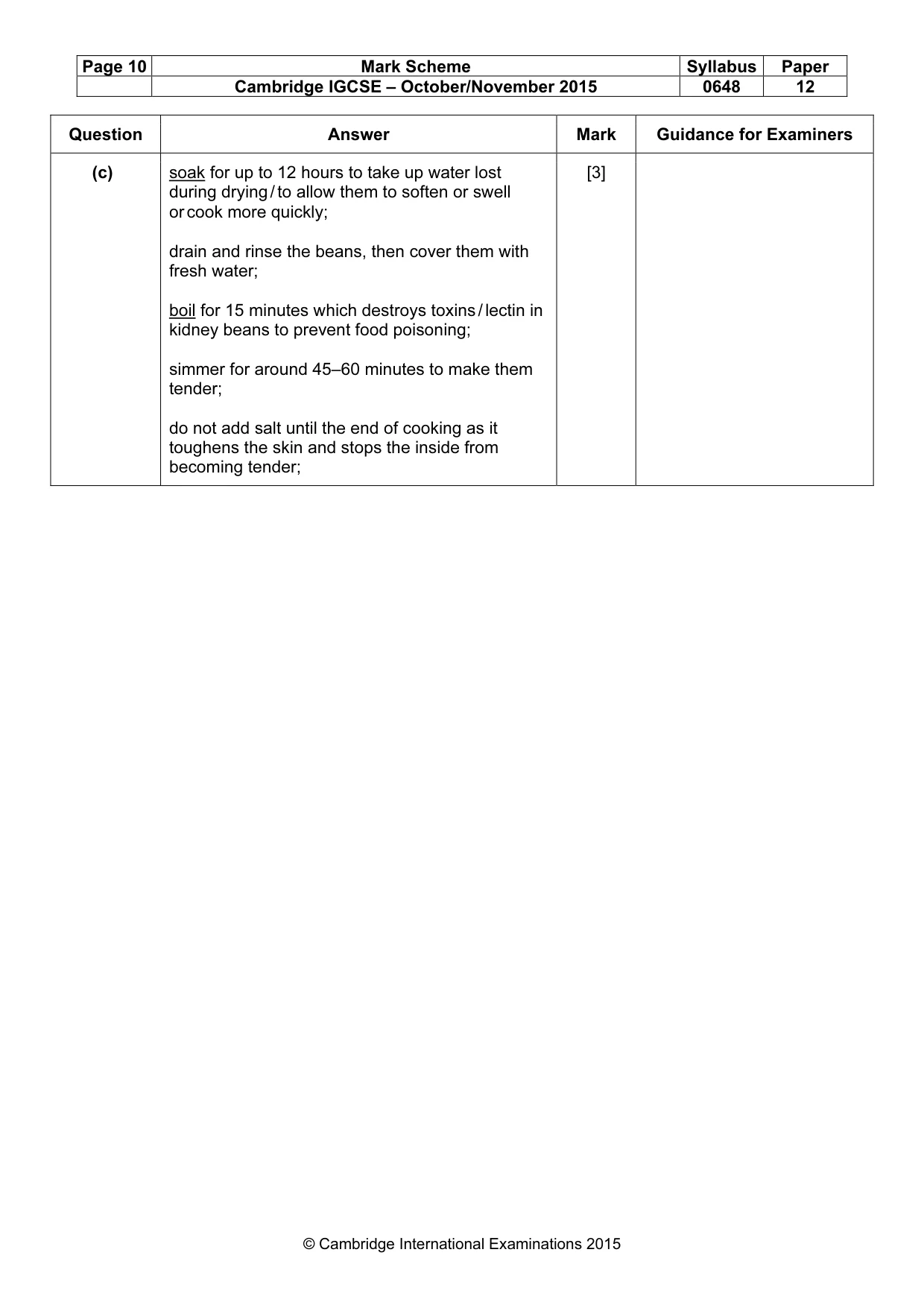
Page 10 Mark Scheme Syllabus Paper Cambridge IGCSE – October/November 2015 0648 12 © Cambridge International Examinations 2015 Question Answer Mark Guidance for Examiners (c) soak for up to 12 hours to take up water lost during drying / to allow them to soften or swell or cook more quickly; drain and rinse the beans, then cover them with fresh water; boil for 15 minutes which destroys toxins / lectin in kidney beans to prevent food poisoning; simmer for around 45–60 minutes to make them tender; do not add salt until the end of cooking as it toughens the skin and stops the inside from becoming tender; [3]
Mark scheme, page 11
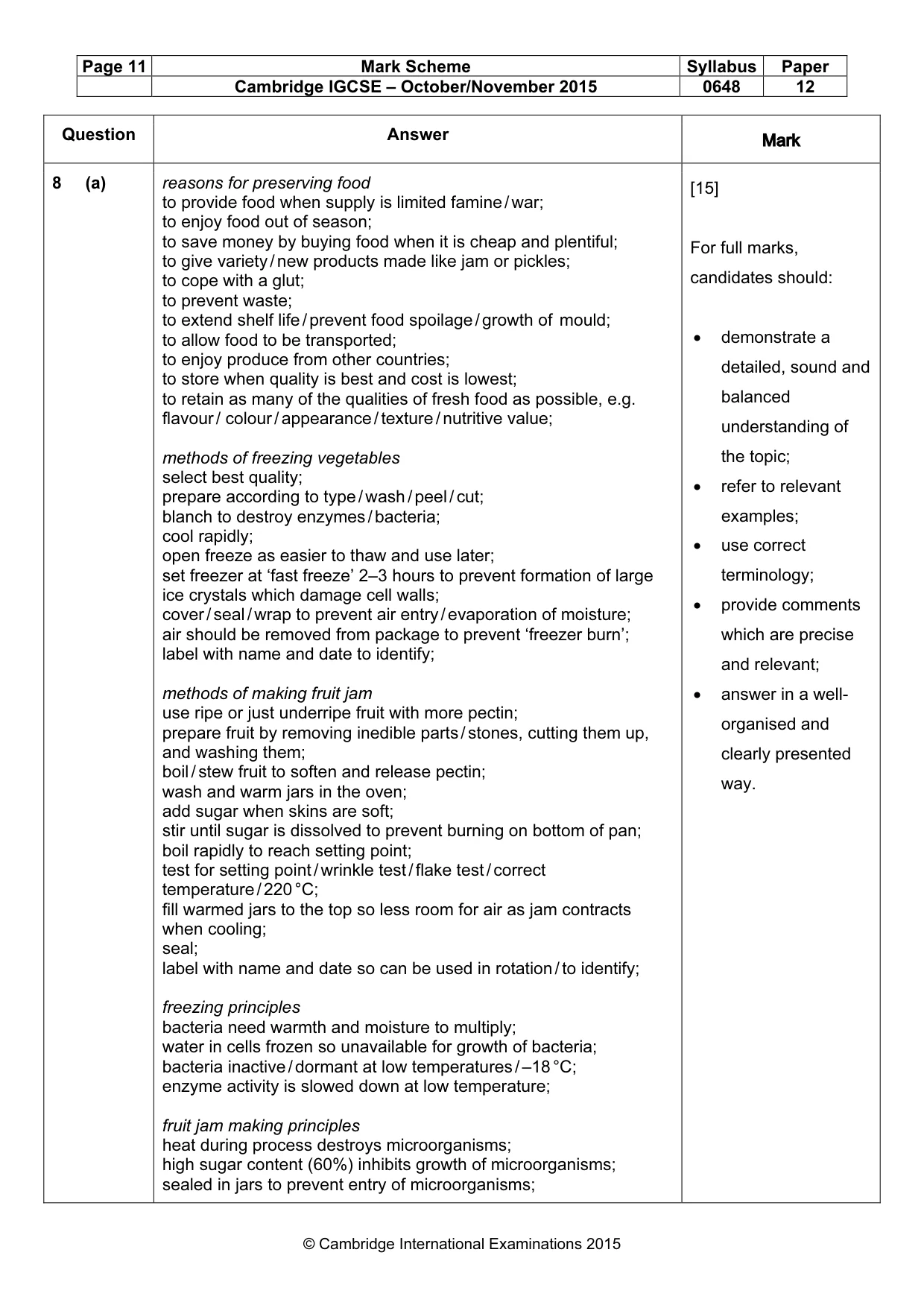
Page 11 Mark Scheme Syllabus Paper Cambridge IGCSE – October/November 2015 0648 12 © Cambridge International Examinations 2015 Question Answer Mark 8 (a) reasons for preserving food to provide food when supply is limited famine / war; to enjoy food out of season; to save money by buying food when it is cheap and plentiful; to give variety / new products made like jam or pickles; to cope with a glut; to prevent waste; to extend shelf life / prevent food spoilage / growth of mould; to allow food to be transported; to enjoy produce from other countries; to store when quality is best and cost is lowest; to retain as many of the qualities of fresh food as possible, e.g. flavour / colour / appearance / texture / nutritive value; methods of freezing vegetables select best quality; prepare according to type / wash / peel / cut; blanch to destroy enzymes / bacteria; cool rapidly; open freeze as easier to thaw and use later; set freezer at ‘fast freeze’ 2–3 hours to prevent formation of large ice crystals which damage cell walls; cover / seal / wrap to prevent air entry / evaporation of moisture; air should be removed from package to prevent ‘freezer burn’; label with name and date to identify; methods of making fruit jam use ripe or just underripe fruit with more pectin; prepare fruit by removing inedible parts / stones, cutting them up, and washing them; boil / stew fruit to soften and release pectin; wash and warm jars in the oven; add sugar when skins are soft; stir until sugar is dissolved to prevent burning on bottom of pan; boil rapidly to reach setting point; test for setting point / wrinkle test / flake test / correct temperature / 220 °C; fill warmed jars to the top so less room for air as jam contracts when cooling; seal; label with name and date so can be used in rotation / to identify; freezing principles bacteria need warmth and moisture to multiply; water in cells frozen so unavailable for growth of bacteria; bacteria inactive / dormant at low temperatures / –18 °C; enzyme activity is slowed down at low temperature; fruit jam making principles heat during process destroys microorganisms; high sugar content (60%) inhibits growth of microorganisms; sealed in jars to prevent entry of microorganisms; [15] For full marks, candidates should: • demonstrate a detailed, sound and balanced understanding of the topic; • refer to relevant examples; • use correct terminology; • provide comments which are precise and relevant; • answer in a well- organised and clearly presented way.
Mark scheme, page 12
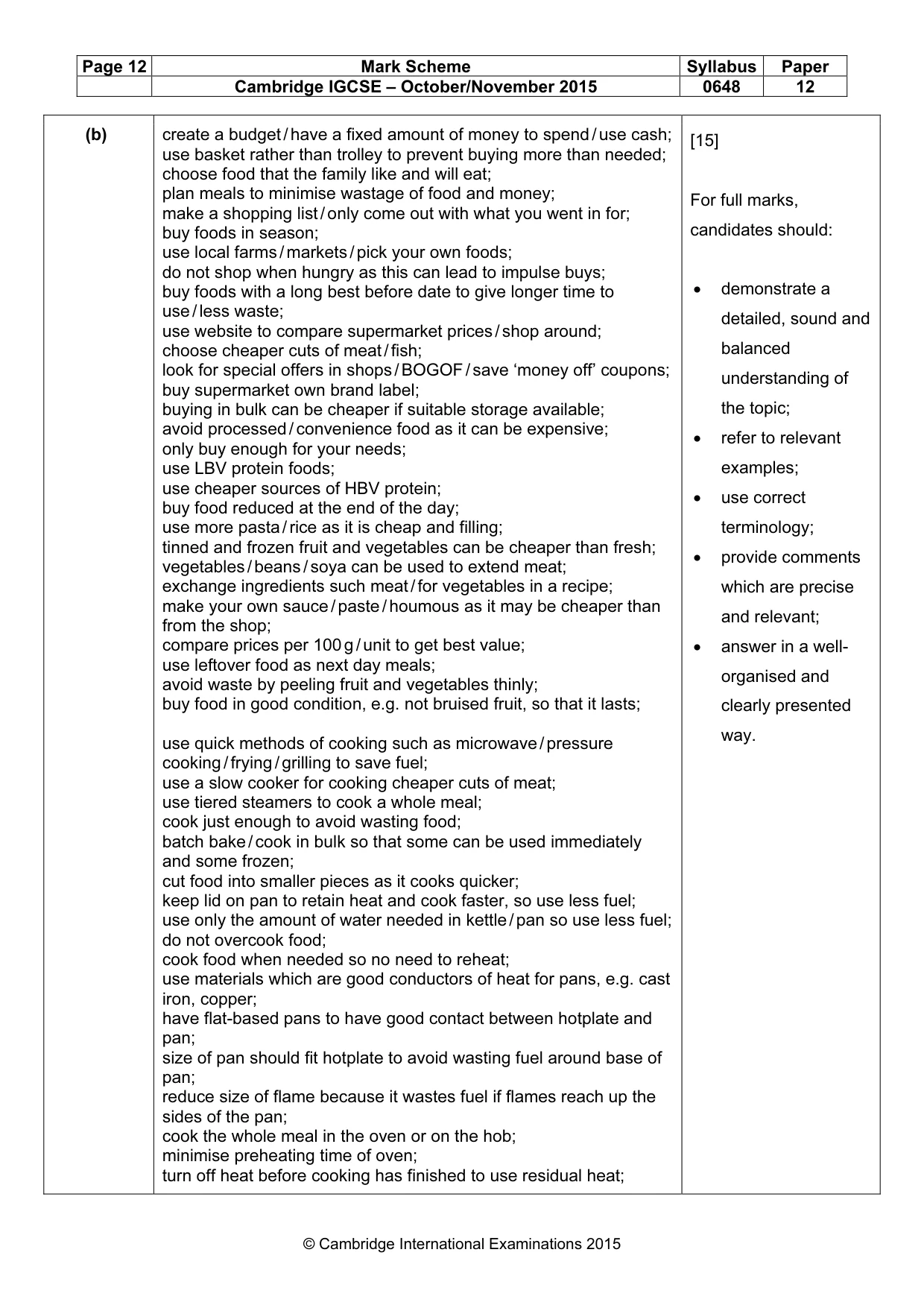
Page 12 Mark Scheme Syllabus Paper Cambridge IGCSE – October/November 2015 0648 12 © Cambridge International Examinations 2015 (b) create a budget / have a fixed amount of money to spend / use cash; use basket rather than trolley to prevent buying more than needed; choose food that the family like and will eat; plan meals to minimise wastage of food and money; make a shopping list / only come out with what you went in for; buy foods in season; use local farms / markets / pick your own foods; do not shop when hungry as this can lead to impulse buys; buy foods with a long best before date to give longer time to use / less waste; use website to compare supermarket prices / shop around; choose cheaper cuts of meat / fish; look for special offers in shops / BOGOF / save ‘money off’ coupons; buy supermarket own brand label; buying in bulk can be cheaper if suitable storage available; avoid processed / convenience food as it can be expensive; only buy enough for your needs; use LBV protein foods; use cheaper sources of HBV protein; buy food reduced at the end of the day; use more pasta / rice as it is cheap and filling; tinned and frozen fruit and vegetables can be cheaper than fresh; vegetables / beans / soya can be used to extend meat; exchange ingredients such meat / for vegetables in a recipe; make your own sauce / paste / houmous as it may be cheaper than from the shop; compare prices per 100 g / unit to get best value; use leftover food as next day meals; avoid waste by peeling fruit and vegetables thinly; buy food in good condition, e.g. not bruised fruit, so that it lasts; use quick methods of cooking such as microwave / pressure cooking / frying / grilling to save fuel; use a slow cooker for cooking cheaper cuts of meat; use tiered steamers to cook a whole meal; cook just enough to avoid wasting food; batch bake / cook in bulk so that some can be used immediately and some frozen; cut food into smaller pieces as it cooks quicker; keep lid on pan to retain heat and cook faster, so use less fuel; use only the amount of water needed in kettle / pan so use less fuel; do not overcook food; cook food when needed so no need to reheat; use materials which are good conductors of heat for pans, e.g. cast iron, copper; have flat-based pans to have good contact between hotplate and pan; size of pan should fit hotplate to avoid wasting fuel around base of pan; reduce size of flame because it wastes fuel if flames reach up the sides of the pan; cook the whole meal in the oven or on the hob; minimise preheating time of oven; turn off heat before cooking has finished to use residual heat; [15] For full marks, candidates should: • demonstrate a detailed, sound and balanced understanding of the topic; • refer to relevant examples; • use correct terminology; • provide comments which are precise and relevant; • answer in a well- organised and clearly presented way.
Mark scheme, page 13
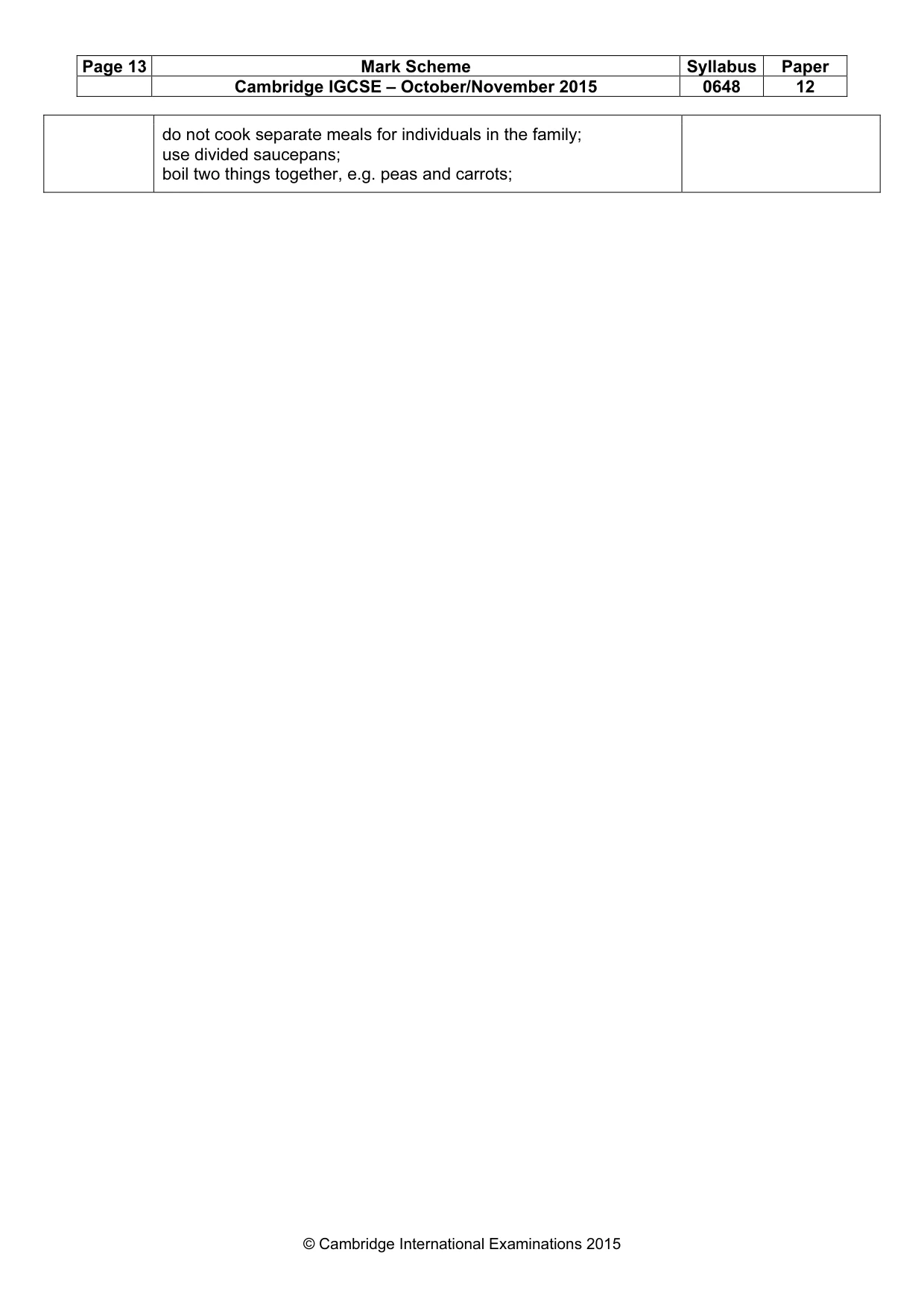
Page 13 Mark Scheme Syllabus Paper Cambridge IGCSE – October/November 2015 0648 12 © Cambridge International Examinations 2015 do not cook separate meals for individuals in the family; use divided saucepans; boil two things together, e.g. peas and carrots;
What you needed in this session
Cambridge’s own grade thresholds for 2015 Oct/Nov, Paper 1 · Variant 2. A higher threshold means an easier paper — the bar moves with how the cohort did.