Cambridge IGCSE Food and Nutrition 0648 — 2015 Oct/Nov Paper 1 · Variant 1
0648/11/O/N/15 · 100 marks · ≈113 min
The question paper and its mark scheme, free to read here and free to download. This is Cambridge’s own paper, exactly as it was sat.
Question paper16 pages




Mark scheme9 pages
Answers below. Sit the paper first if you are practising.
Paper as text
Question paper, page 1
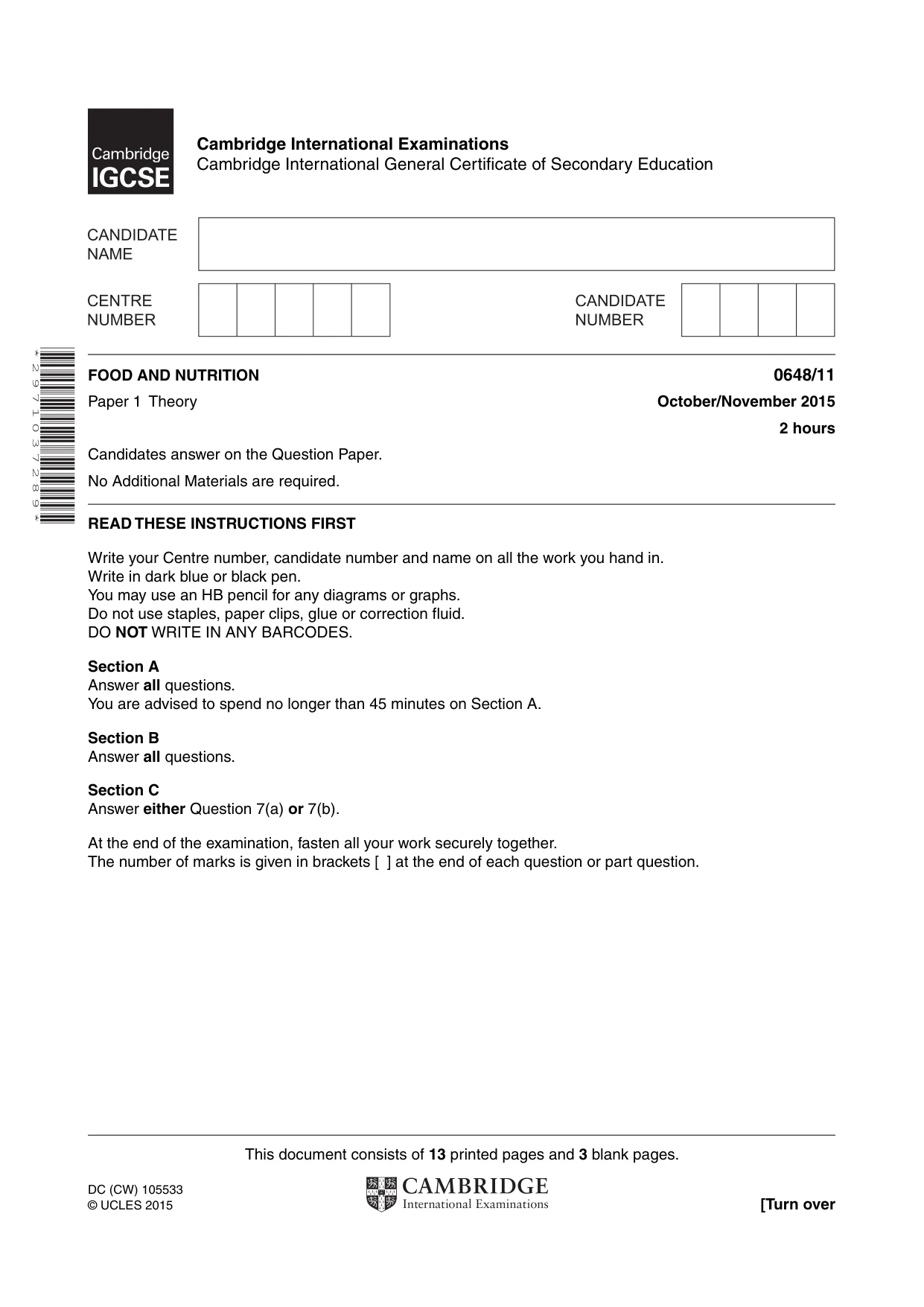
This document consists of 13 printed pages and 3 blank pages. DC (CW) 105533 © UCLES 2015 [Turn over Cambridge International Examinations Cambridge International General Certificate of Secondary Education * 2 9 7 1 0 3 7 2 8 9 * FOOD AND NUTRITION 0648/11 Paper 1 Theory October/November 2015 2 hours Candidates answer on the Question Paper. No Additional Materials are required. READ THESE INSTRUCTIONS FIRST Write your Centre number, candidate number and name on all the work you hand in. Write in dark blue or black pen. You may use an HB pencil for any diagrams or graphs. Do not use staples, paper clips, glue or correction fluid. DO NOT WRITE IN ANY BARCODES. Section A Answer all questions. You are advised to spend no longer than 45 minutes on Section A. Section B Answer all questions. Section C Answer either Question 7(a) or 7(b). At the end of the examination, fasten all your work securely together. The number of marks is given in brackets [ ] at the end of each question or part question.
Question paper, page 2
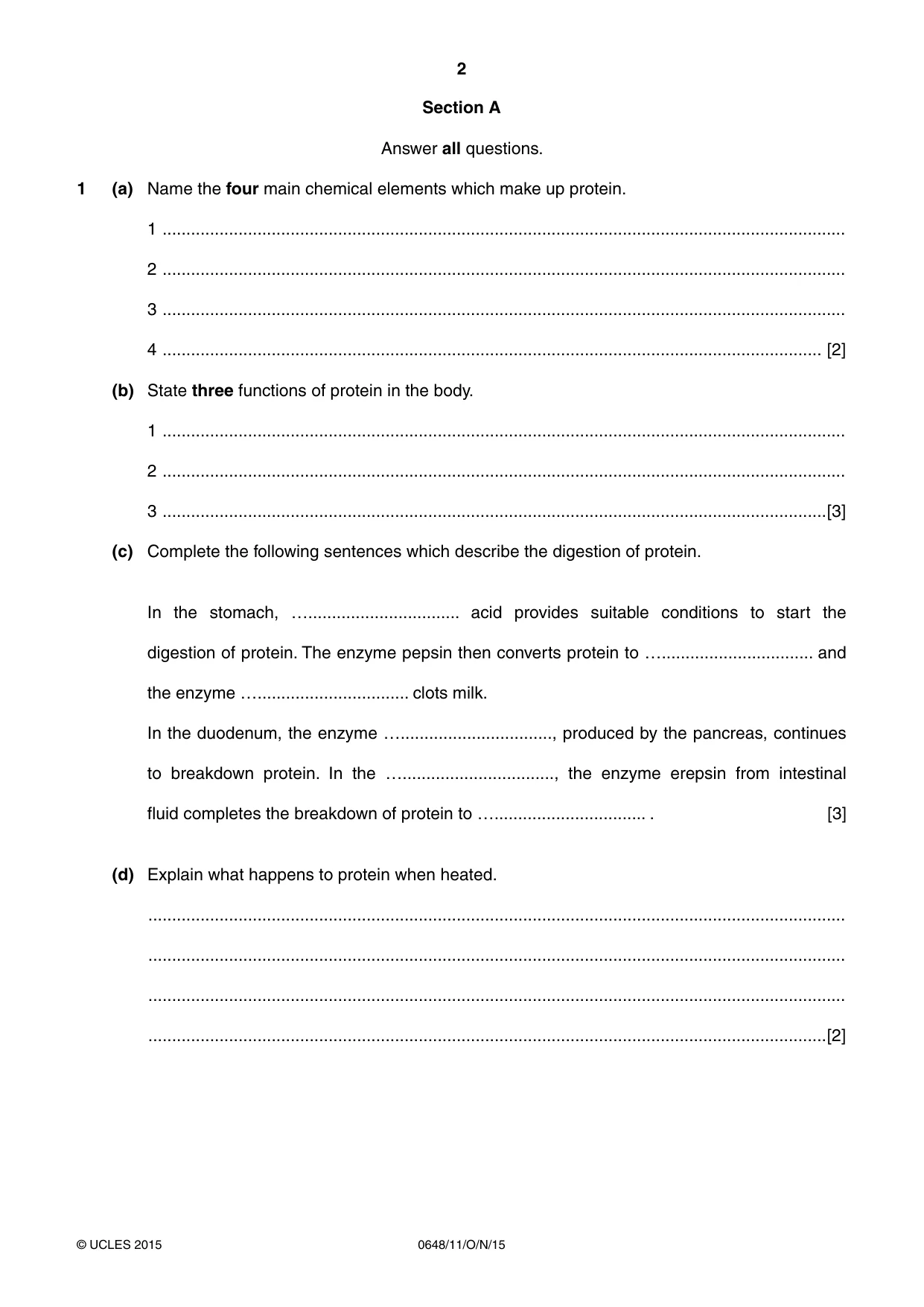
2 0648/11/O/N/15 © UCLES 2015 Section A Answer all questions. 1 (a) Name the four main chemical elements which make up protein. 1 … 2 … 3 … 4 … [2] (b) State three functions of protein in the body. 1 … 2 … 3 …[3] (c) Complete the following sentences which describe the digestion of protein. In the stomach, …… acid provides suitable conditions to start the digestion of protein. The enzyme pepsin then converts protein to …… and the enzyme …… clots milk. In the duodenum, the enzyme ……, produced by the pancreas, continues to breakdown protein. In the ……, the enzyme erepsin from intestinal fluid completes the breakdown of protein to …… . [3] (d) Explain what happens to protein when heated. … … … …[2]
Question paper, page 3
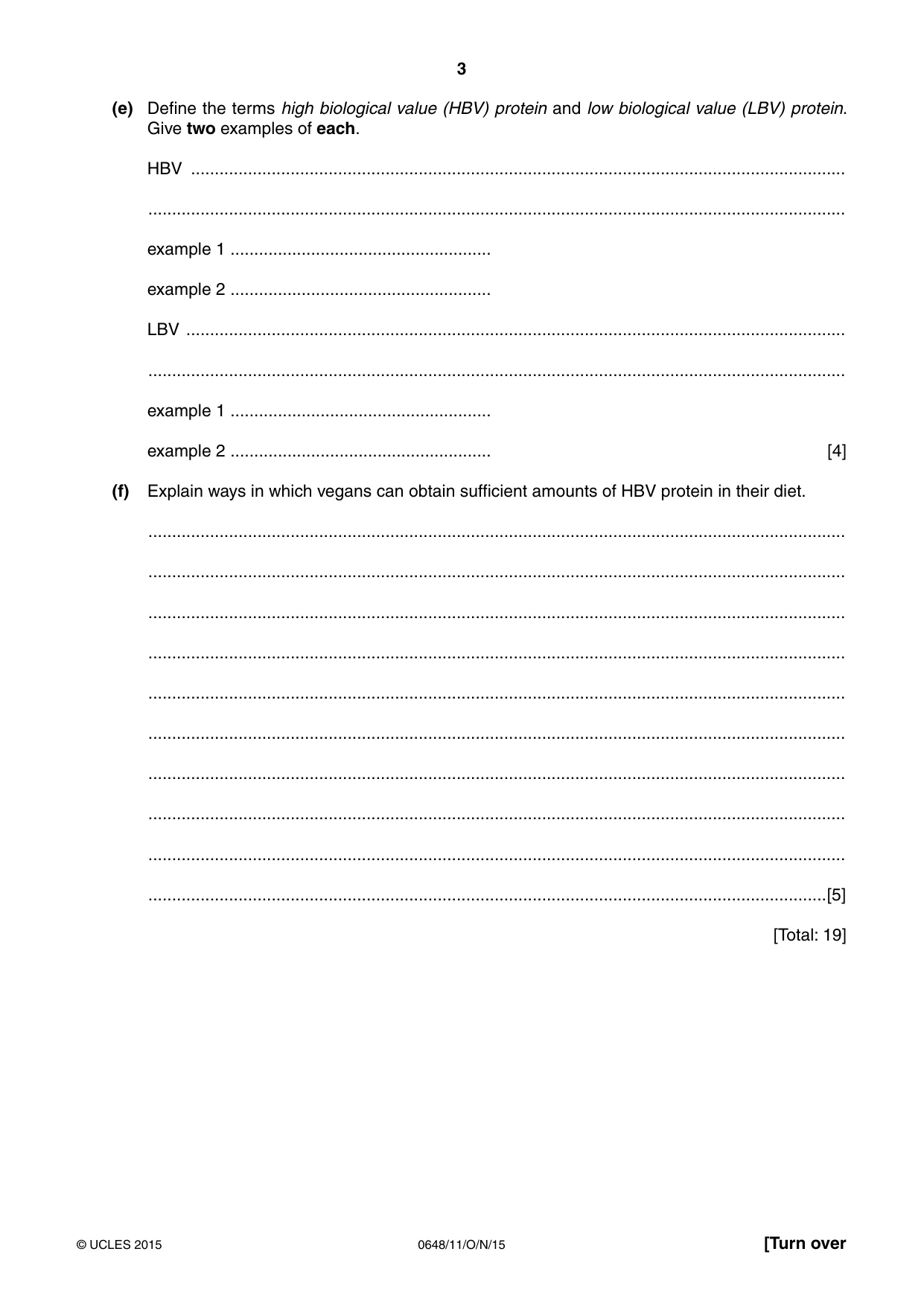
3 0648/11/O/N/15 © UCLES 2015 [Turn over (e) Define the terms high biological value (HBV) protein and low biological value (LBV) protein. Give two examples of each. HBV … … example 1 … example 2 … LBV … … example 1 … example 2 … [4] (f) Explain ways in which vegans can obtain sufficient amounts of HBV protein in their diet. … … … … … … … … … …[5] [Total: 19]
Question paper, page 4
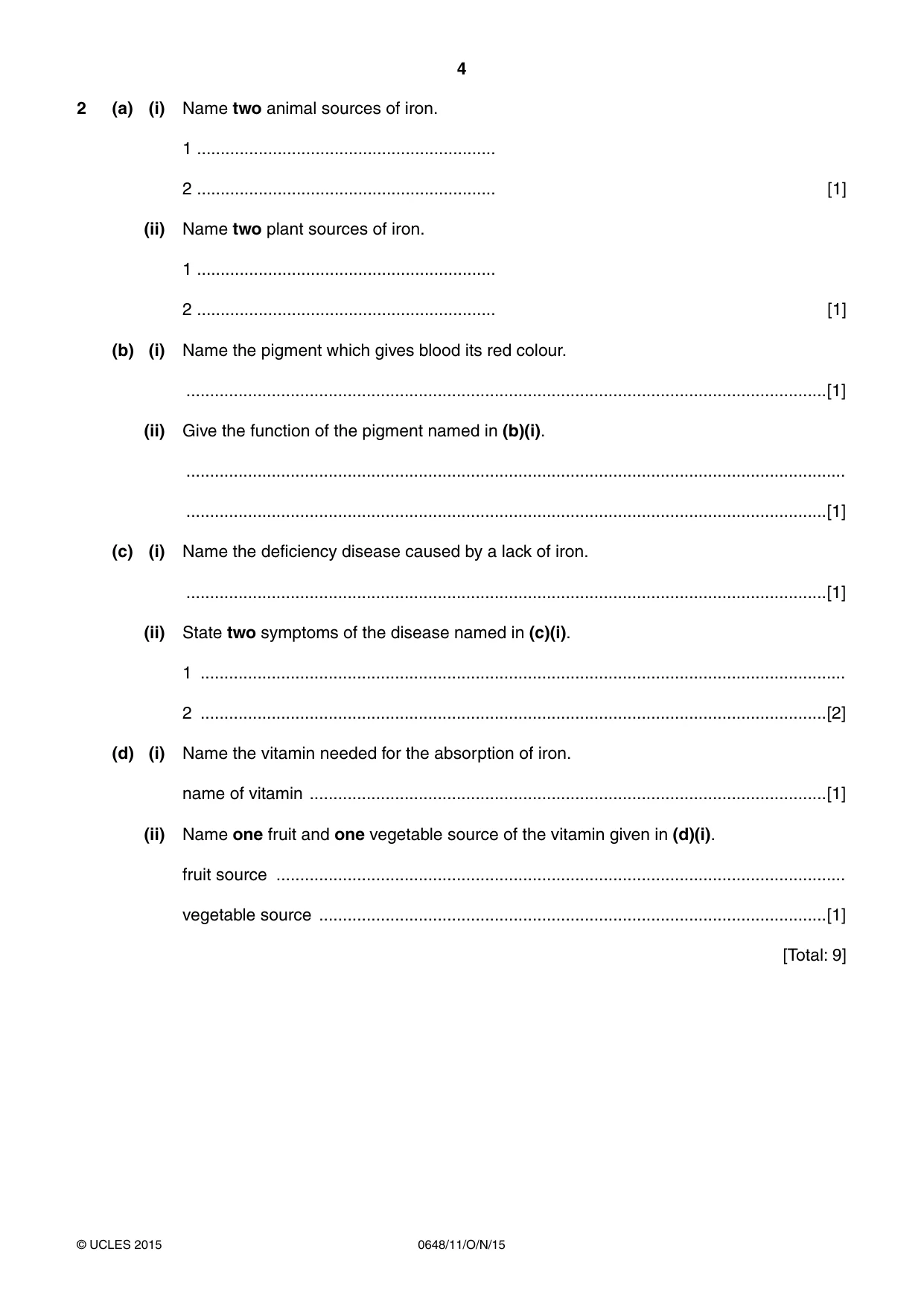
4 0648/11/O/N/15 © UCLES 2015 2 (a) (i) Name two animal sources of iron. 1 … 2 … [1] (ii) Name two plant sources of iron. 1 … 2 … [1] (b) (i) Name the pigment which gives blood its red colour. …[1] (ii) Give the function of the pigment named in (b)(i). … …[1] (c) (i) Name the deficiency disease caused by a lack of iron. …[1] (ii) State two symptoms of the disease named in (c)(i). 1 … 2 …[2] (d) (i) Name the vitamin needed for the absorption of iron. name of vitamin …[1] (ii) Name one fruit and one vegetable source of the vitamin given in (d)(i). fruit source … vegetable source …[1] [Total: 9]
Question paper, page 5
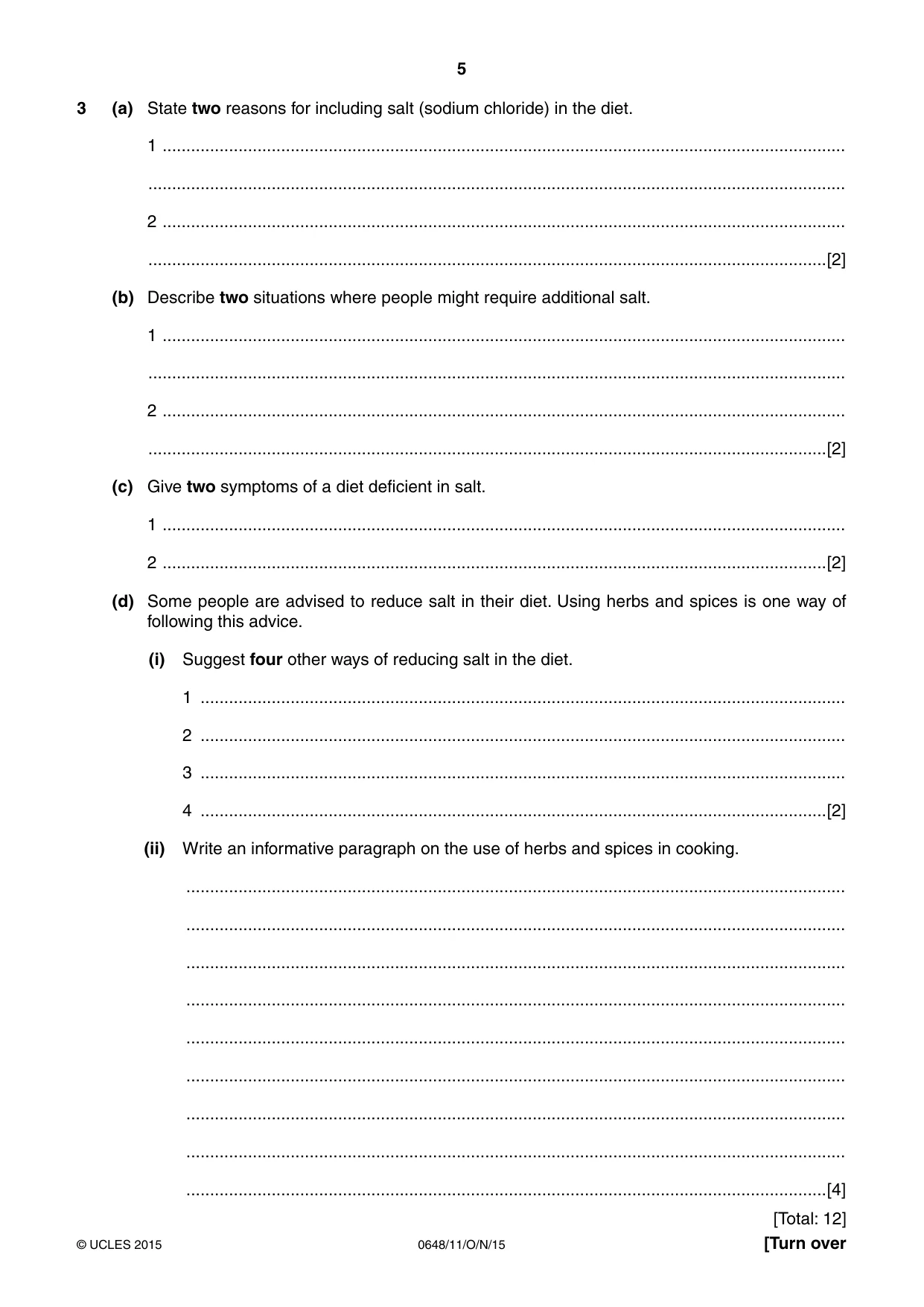
5 0648/11/O/N/15 © UCLES 2015 [Turn over 3 (a) State two reasons for including salt (sodium chloride) in the diet. 1 … … 2 … …[2] (b) Describe two situations where people might require additional salt. 1 … … 2 … …[2] (c) Give two symptoms of a diet deficient in salt. 1 … 2 …[2] (d) Some people are advised to reduce salt in their diet. Using herbs and spices is one way of following this advice. (i) Suggest four other ways of reducing salt in the diet. 1 … 2 … 3 … 4 …[2] (ii) Write an informative paragraph on the use of herbs and spices in cooking. … … … … … … … … …[4] [Total: 12]
Question paper, page 6
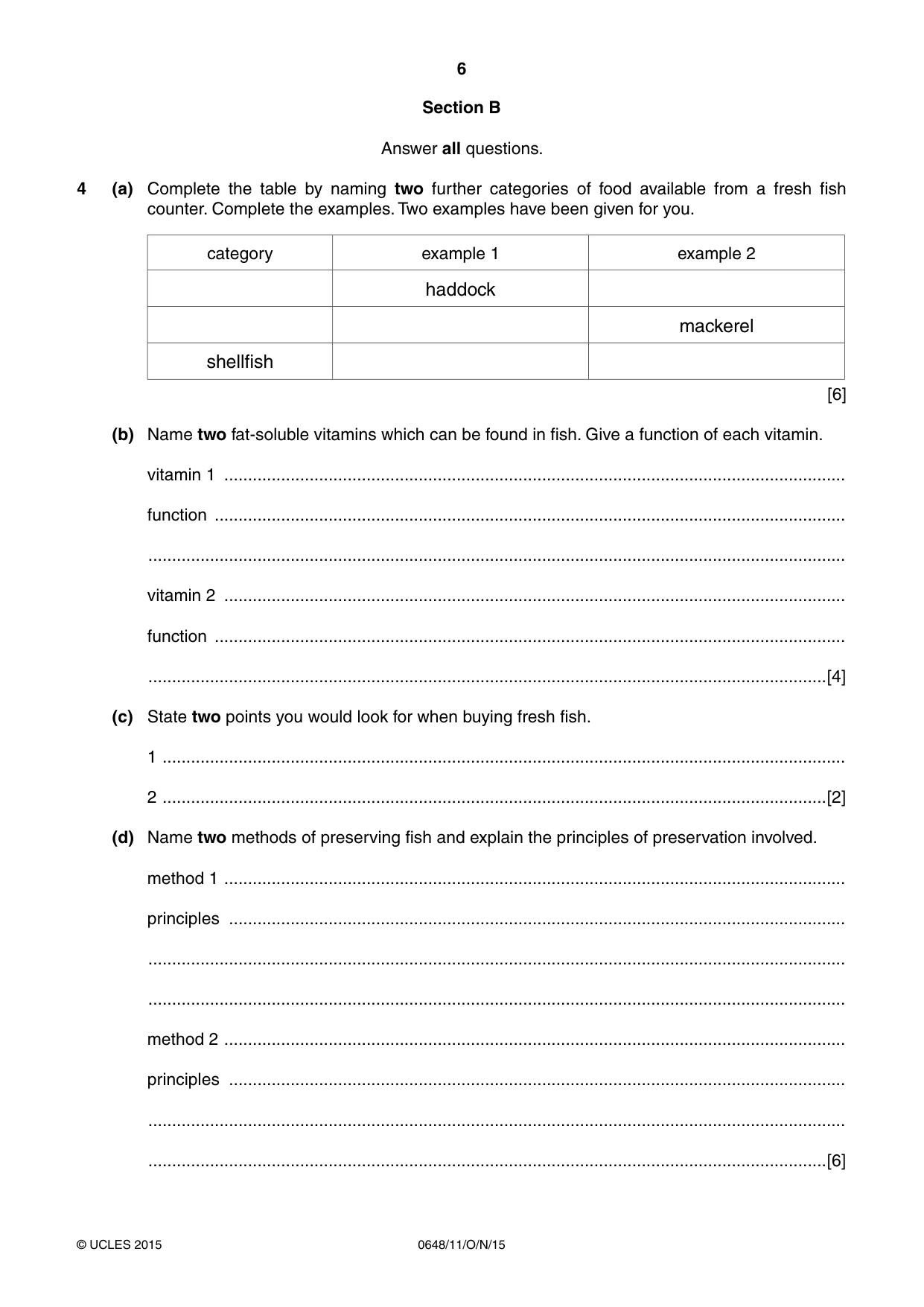
6 0648/11/O/N/15 © UCLES 2015 Section B Answer all questions. 4 (a) Complete the table by naming two further categories of food available from a fresh fish counter. Complete the examples. Two examples have been given for you. category example 1 example 2 haddock mackerel shellfi sh [6] (b) Name two fat-soluble vitamins which can be found in fish. Give a function of each vitamin. vitamin 1 … function … … vitamin 2 … function … …[4] (c) State two points you would look for when buying fresh fish. 1 … 2 …[2] (d) Name two methods of preserving fish and explain the principles of preservation involved. method 1 … principles … … … method 2 … principles … … …[6]
Question paper, page 7
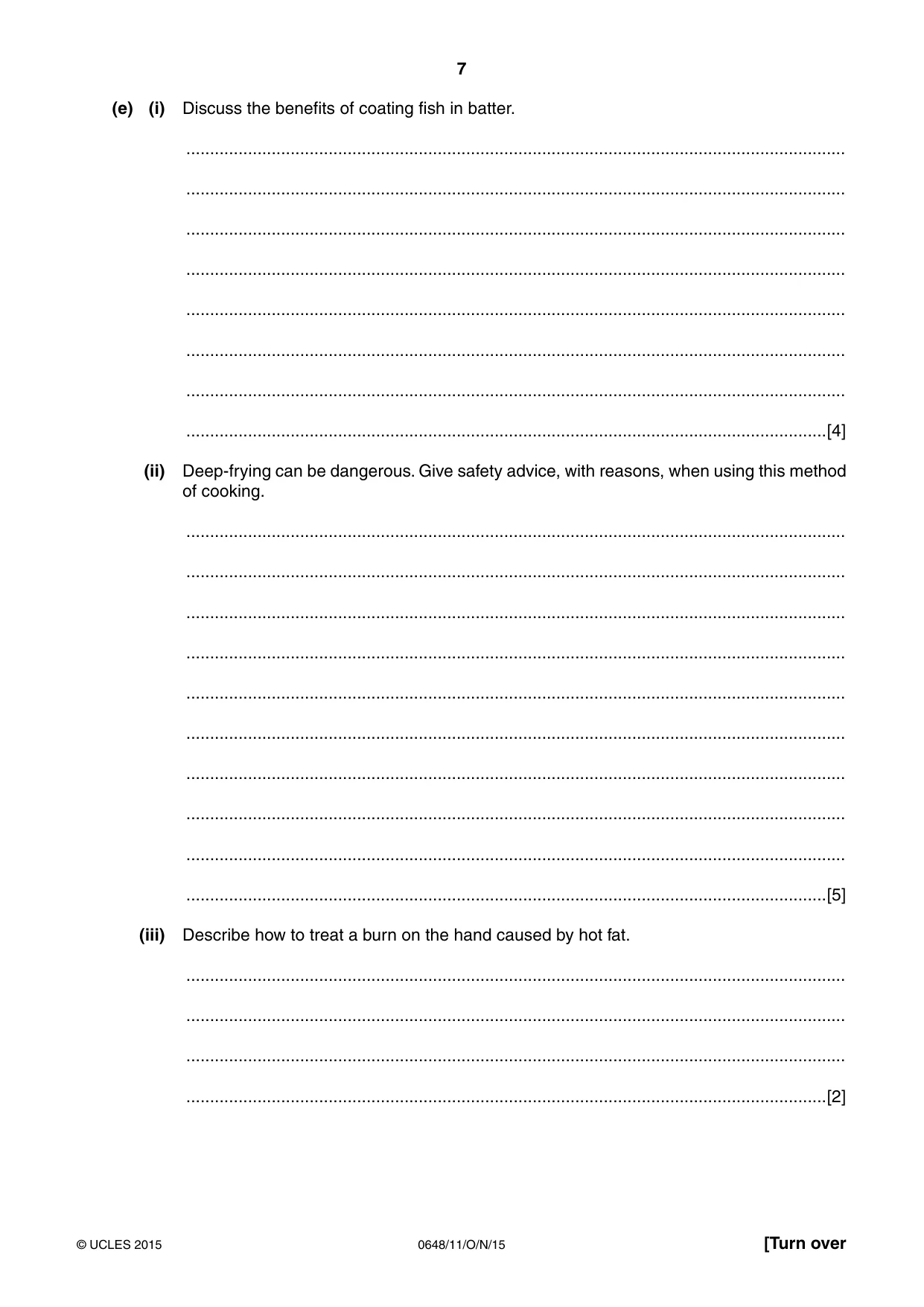
7 0648/11/O/N/15 © UCLES 2015 [Turn over (e) (i) Discuss the benefits of coating fish in batter. … … … … … … … …[4] (ii) Deep-frying can be dangerous. Give safety advice, with reasons, when using this method of cooking. … … … … … … … … … …[5] (iii) Describe how to treat a burn on the hand caused by hot fat. … … … …[2]
Question paper, page 8
8 0648/11/O/N/15 © UCLES 2015 (iv) Describe how to deal with a deep-fat fryer which has caught fire. … … … … …[2] [Total: 31]
Question paper, page 9
9 0648/11/O/N/15 © UCLES 2015 [Turn over 5 The following ingredients can be used to make a Swiss roll: 3 eggs 75 g plain flour 75 g caster sugar (a) Describe, with reasons, the method of making the Swiss roll mixture. … … … … … … … … … …[4] (b) The Swiss roll mixture is heated by convection and conduction when baking. Explain how each of these methods transfers heat to the Swiss roll. convection … … … … … conduction … … … … …[4] [Total: 8]
Question paper, page 10
10 0648/11/O/N/15 © UCLES 2015 6 Suggest points to consider when: (a) choosing a new cooker; … … … … … …[3] (b) disposing of kitchen waste. … … … … … …[3] [Total: 6]
Question paper, page 11
11 0648/11/O/N/15 © UCLES 2015 [Turn over Section C Answer either Question 7(a) or 7(b). 7 (a) Discuss the roles that lifestyle and religion play in affecting food choices. [15] OR (b) Discuss the reasons why it is important to package and label food products. [15] … … … … … … … … … … … … … … … … … … … … … … …
Question paper, page 12
12 0648/11/O/N/15 © UCLES 2015 … … … … … … … … … … … … … … … … … … … … … … … … … … … …
Question paper, page 13
13 0648/11/O/N/15 © UCLES 2015 … … … … … … … … … … … … … … … … … … … … … … … … … … [Total: 15]
Question paper, page 14
14 0648/11/O/N/15 © UCLES 2015 BLANK PAGE
Question paper, page 15
15 0648/11/O/N/15 © UCLES 2015 BLANK PAGE
Question paper, page 16
16 0648/11/O/N/15 © UCLES 2015 BLANK PAGE Permission to reproduce items where third-party owned material protected by copyright is included has been sought and cleared where possible. Every reasonable effort has been made by the publisher (UCLES) to trace copyright holders, but if any items requiring clearance have unwittingly been included, the publisher will be pleased to make amends at the earliest possible opportunity. To avoid the issue of disclosure of answer-related information to candidates, all copyright acknowledgements are reproduced online in the Cambridge International Examinations Copyright Acknowledgements Booklet. This is produced for each series of examinations and is freely available to download at www.cie.org.uk after the live examination series. Cambridge International Examinations is part of the Cambridge Assessment Group. Cambridge Assessment is the brand name of University of Cambridge Local Examinations Syndicate (UCLES), which is itself a department of the University of Cambridge.
Mark scheme, page 1
® IGCSE is the registered trademark of Cambridge International Examinations. CAMBRIDGE INTERNATIONAL EXAMINATIONS Cambridge International General Certificate of Secondary Education MARK SCHEME for the October/November 2015 series 0648 FOOD AND NUTRITION 0648/11 Paper 1 (Theory), maximum raw mark 100 This mark scheme is published as an aid to teachers and candidates, to indicate the requirements of the examination. It shows the basis on which Examiners were instructed to award marks. It does not indicate the details of the discussions that took place at an Examiners’ meeting before marking began, which would have considered the acceptability of alternative answers. Mark schemes should be read in conjunction with the question paper and the Principal Examiner Report for Teachers. Cambridge will not enter into discussions about these mark schemes. Cambridge is publishing the mark schemes for the October/November 2015 series for most Cambridge IGCSE®, Cambridge International A and AS Level components and some Cambridge O Level components.
Mark scheme, page 2
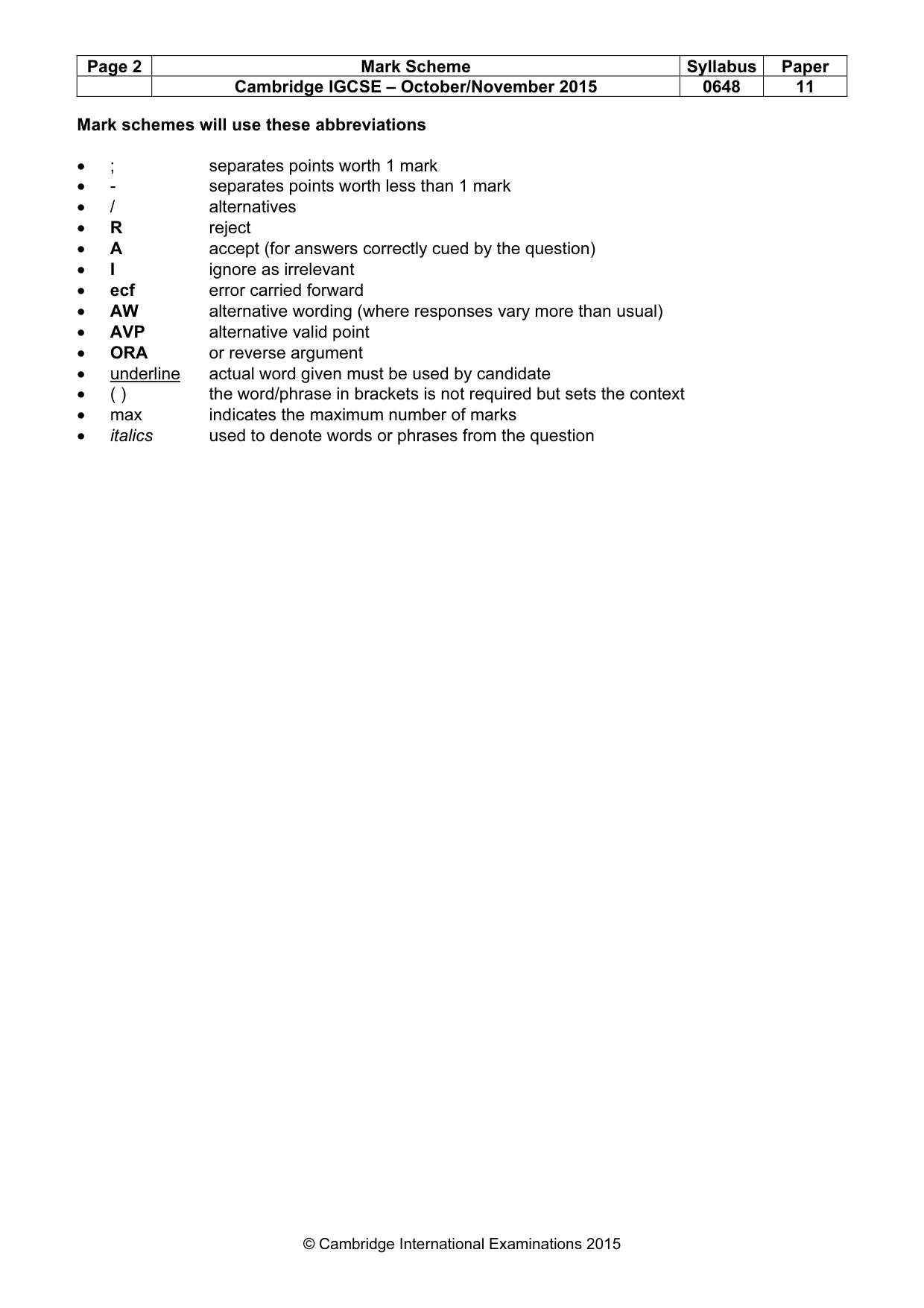
Page 2 Mark Scheme Syllabus Paper Cambridge IGCSE – October/November 2015 0648 11 © Cambridge International Examinations 2015 Mark schemes will use these abbreviations • ; separates points worth 1 mark • - separates points worth less than 1 mark • / alternatives • R reject • A accept (for answers correctly cued by the question) • I ignore as irrelevant • ecf error carried forward • AW alternative wording (where responses vary more than usual) • AVP alternative valid point • ORA or reverse argument • underline actual word given must be used by candidate • ( ) the word/phrase in brackets is not required but sets the context • max indicates the maximum number of marks • italics used to denote words or phrases from the question
Mark scheme, page 3
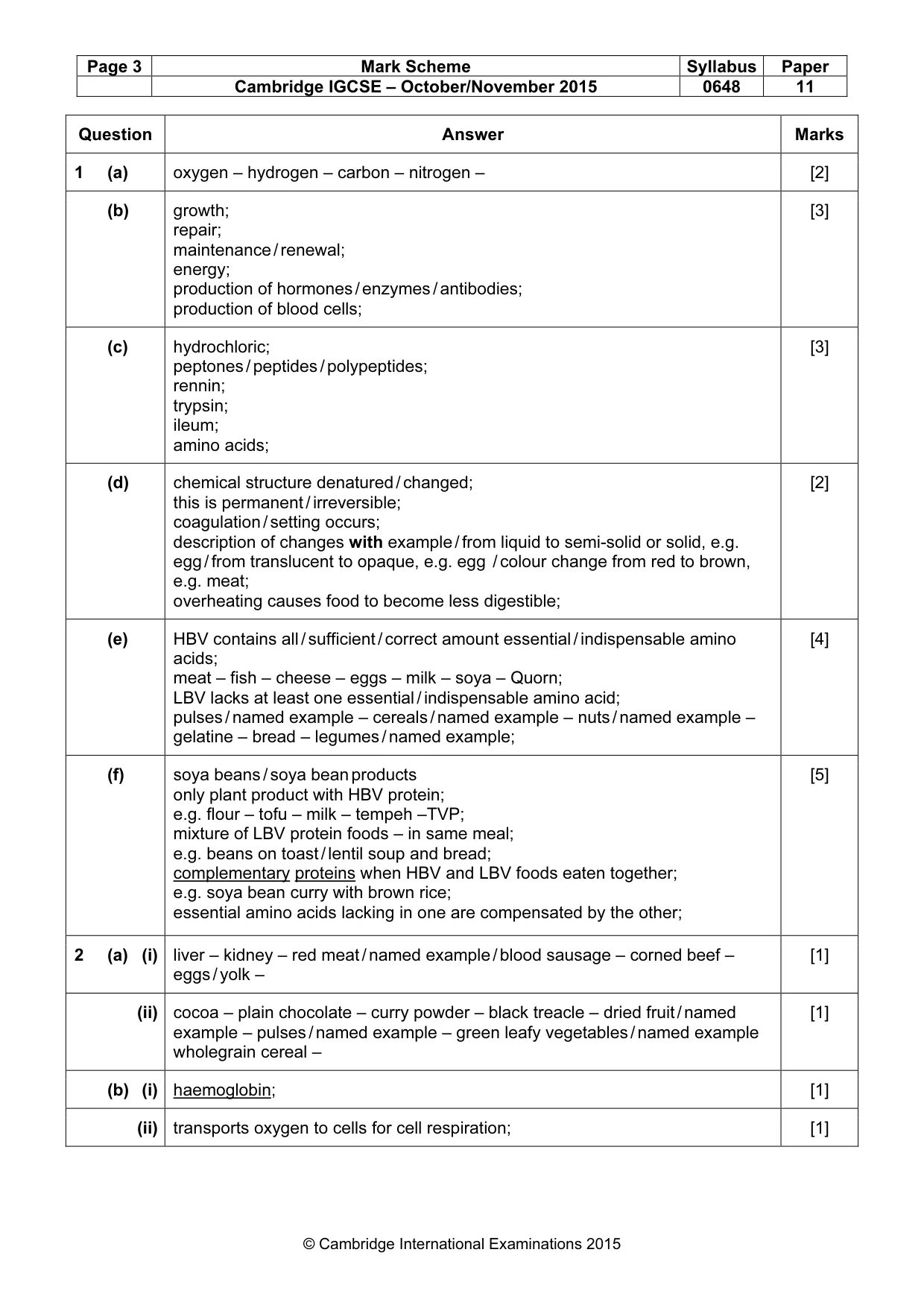
Page 3 Mark Scheme Syllabus Paper Cambridge IGCSE – October/November 2015 0648 11 © Cambridge International Examinations 2015 Question Answer Marks 1 (a) oxygen – hydrogen – carbon – nitrogen – [2] (b) growth; repair; maintenance / renewal; energy; production of hormones / enzymes / antibodies; production of blood cells; [3] (c) hydrochloric; peptones / peptides / polypeptides; rennin; trypsin; ileum; amino acids; [3] (d) chemical structure denatured / changed; this is permanent / irreversible; coagulation / setting occurs; description of changes with example / from liquid to semi-solid or solid, e.g. egg / from translucent to opaque, e.g. egg / colour change from red to brown, e.g. meat; overheating causes food to become less digestible; [2] (e) HBV contains all / sufficient / correct amount essential / indispensable amino acids; meat – fish – cheese – eggs – milk – soya – Quorn; LBV lacks at least one essential / indispensable amino acid; pulses / named example – cereals / named example – nuts / named example – gelatine – bread – legumes / named example; [4] (f) soya beans / soya bean products only plant product with HBV protein; e.g. flour – tofu – milk – tempeh –TVP; mixture of LBV protein foods – in same meal; e.g. beans on toast / lentil soup and bread; complementary proteins when HBV and LBV foods eaten together; e.g. soya bean curry with brown rice; essential amino acids lacking in one are compensated by the other; [5] 2 (a) (i) liver – kidney – red meat / named example / blood sausage – corned beef – eggs / yolk – [1] (ii) cocoa – plain chocolate – curry powder – black treacle – dried fruit / named example – pulses / named example – green leafy vegetables / named example wholegrain cereal – [1] (b) (i) haemoglobin; [1] (ii) transports oxygen to cells for cell respiration; [1]
Mark scheme, page 4
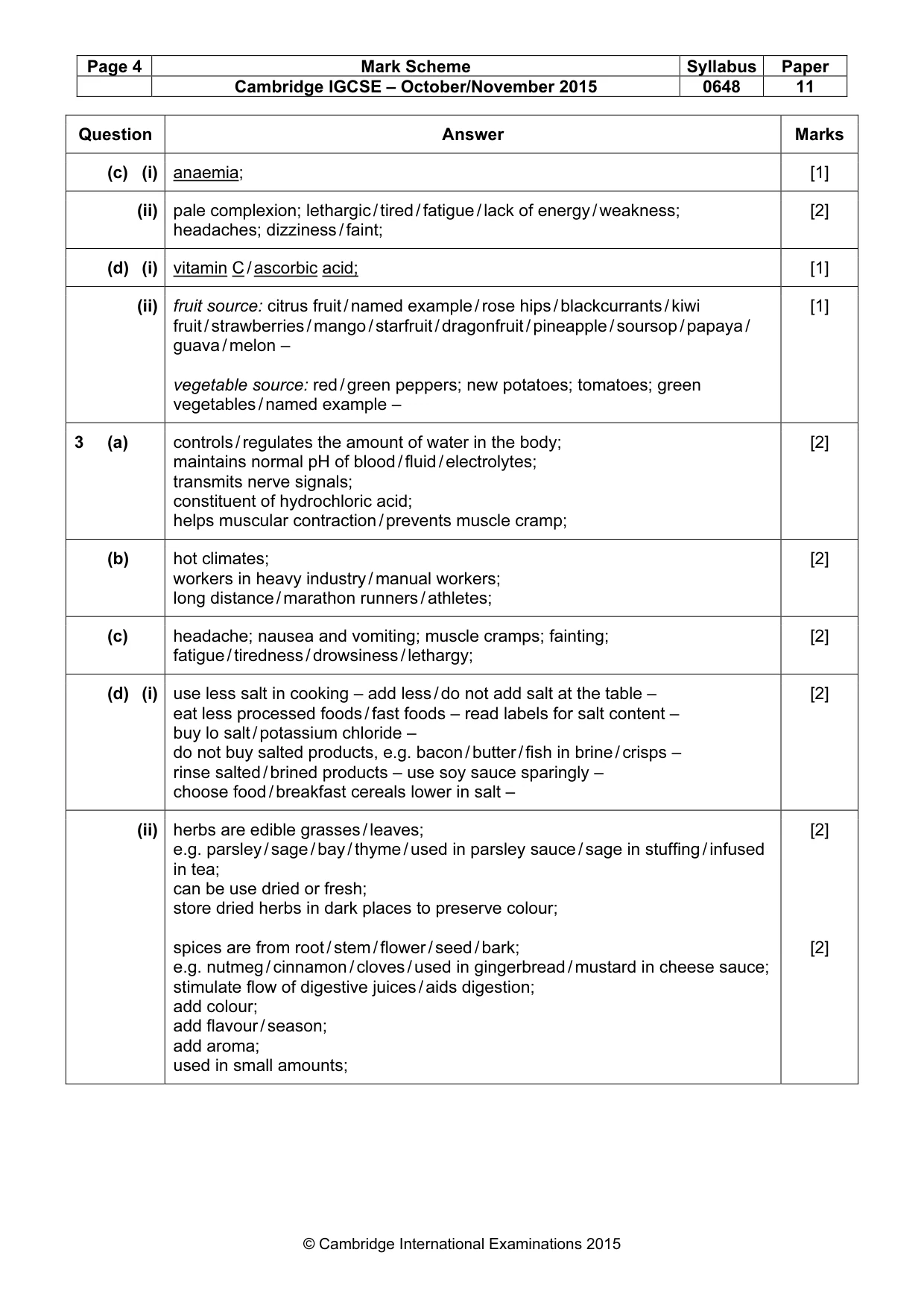
Page 4 Mark Scheme Syllabus Paper Cambridge IGCSE – October/November 2015 0648 11 © Cambridge International Examinations 2015 Question Answer Marks (c) (i) anaemia; [1] (ii) pale complexion; lethargic / tired / fatigue / lack of energy / weakness; headaches; dizziness / faint; [2] (d) (i) vitamin C / ascorbic acid; [1] (ii) fruit source: citrus fruit / named example / rose hips / blackcurrants / kiwi fruit / strawberries / mango / starfruit / dragonfruit / pineapple / soursop / papaya / guava / melon – vegetable source: red / green peppers; new potatoes; tomatoes; green vegetables / named example – [1] 3 (a) controls / regulates the amount of water in the body; maintains normal pH of blood / fluid / electrolytes; transmits nerve signals; constituent of hydrochloric acid; helps muscular contraction / prevents muscle cramp; [2] (b) hot climates; workers in heavy industry / manual workers; long distance / marathon runners / athletes; [2] (c) headache; nausea and vomiting; muscle cramps; fainting; fatigue / tiredness / drowsiness / lethargy; [2] (d) (i) use less salt in cooking – add less / do not add salt at the table – eat less processed foods / fast foods – read labels for salt content – buy lo salt / potassium chloride – do not buy salted products, e.g. bacon / butter / fish in brine / crisps – rinse salted / brined products – use soy sauce sparingly – choose food / breakfast cereals lower in salt – [2] (ii) herbs are edible grasses / leaves; e.g. parsley / sage / bay / thyme / used in parsley sauce / sage in stuffing / infused in tea; can be use dried or fresh; store dried herbs in dark places to preserve colour; spices are from root / stem / flower / seed / bark; e.g. nutmeg / cinnamon / cloves / used in gingerbread / mustard in cheese sauce; stimulate flow of digestive juices / aids digestion; add colour; add flavour / season; add aroma; used in small amounts; [2] [2]
Mark scheme, page 5
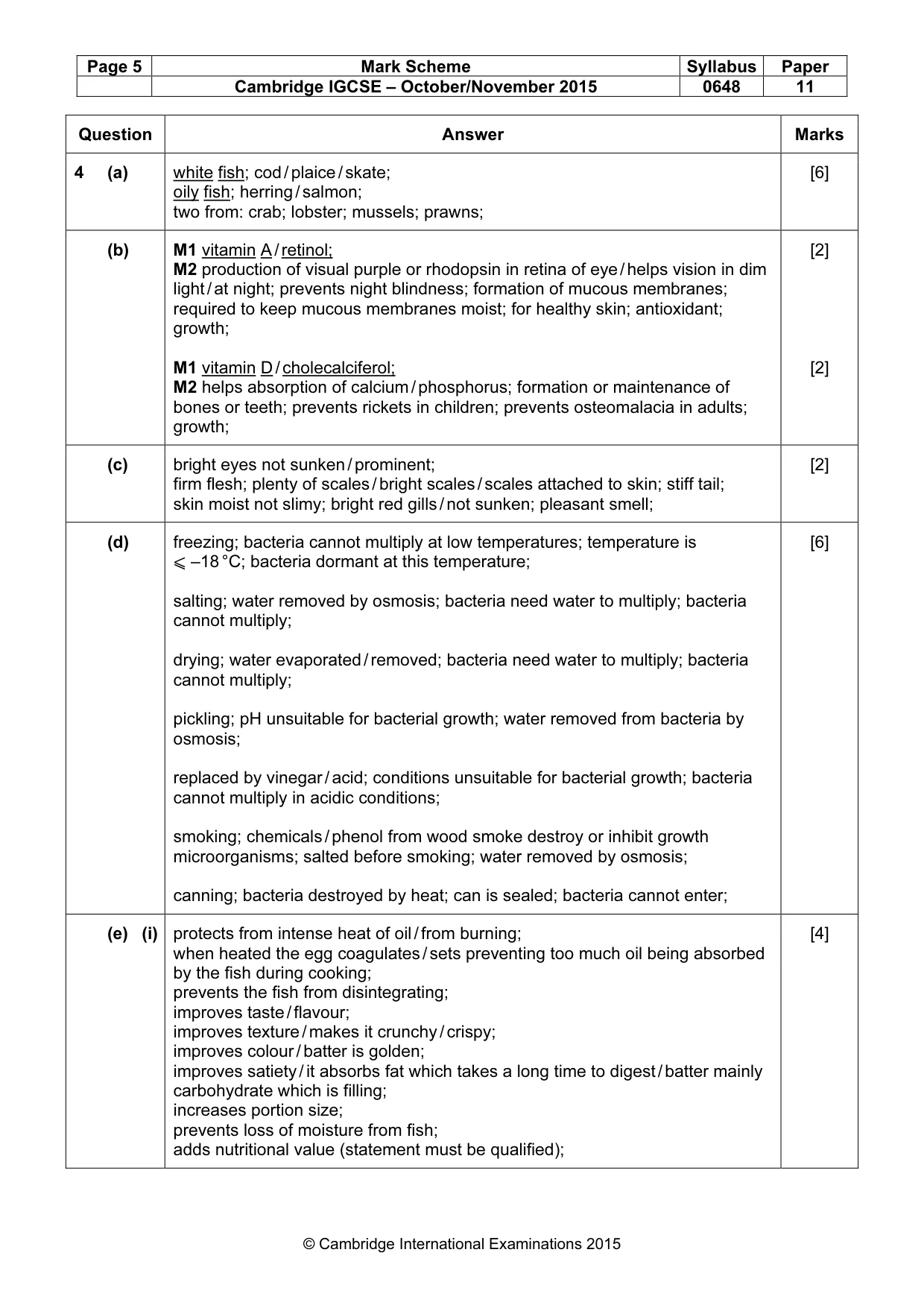
Page 5 Mark Scheme Syllabus Paper Cambridge IGCSE – October/November 2015 0648 11 © Cambridge International Examinations 2015 Question Answer Marks 4 (a) white fish; cod / plaice / skate; oily fish; herring / salmon; two from: crab; lobster; mussels; prawns; [6] (b) M1 vitamin A / retinol; M2 production of visual purple or rhodopsin in retina of eye / helps vision in dim light / at night; prevents night blindness; formation of mucous membranes; required to keep mucous membranes moist; for healthy skin; antioxidant; growth; M1 vitamin D / cholecalciferol; M2 helps absorption of calcium / phosphorus; formation or maintenance of bones or teeth; prevents rickets in children; prevents osteomalacia in adults; growth; [2] [2] (c) bright eyes not sunken / prominent; firm flesh; plenty of scales / bright scales / scales attached to skin; stiff tail; skin moist not slimy; bright red gills / not sunken; pleasant smell; [2] (d) freezing; bacteria cannot multiply at low temperatures; temperature is ⩽ –18 °C; bacteria dormant at this temperature; salting; water removed by osmosis; bacteria need water to multiply; bacteria cannot multiply; drying; water evaporated / removed; bacteria need water to multiply; bacteria cannot multiply; pickling; pH unsuitable for bacterial growth; water removed from bacteria by osmosis; replaced by vinegar / acid; conditions unsuitable for bacterial growth; bacteria cannot multiply in acidic conditions; smoking; chemicals / phenol from wood smoke destroy or inhibit growth microorganisms; salted before smoking; water removed by osmosis; canning; bacteria destroyed by heat; can is sealed; bacteria cannot enter; [6] (e) (i) protects from intense heat of oil / from burning; when heated the egg coagulates / sets preventing too much oil being absorbed by the fish during cooking; prevents the fish from disintegrating; improves taste / flavour; improves texture / makes it crunchy / crispy; improves colour / batter is golden; improves satiety / it absorbs fat which takes a long time to digest / batter mainly carbohydrate which is filling; increases portion size; prevents loss of moisture from fish; adds nutritional value (statement must be qualified); [4]
Mark scheme, page 6
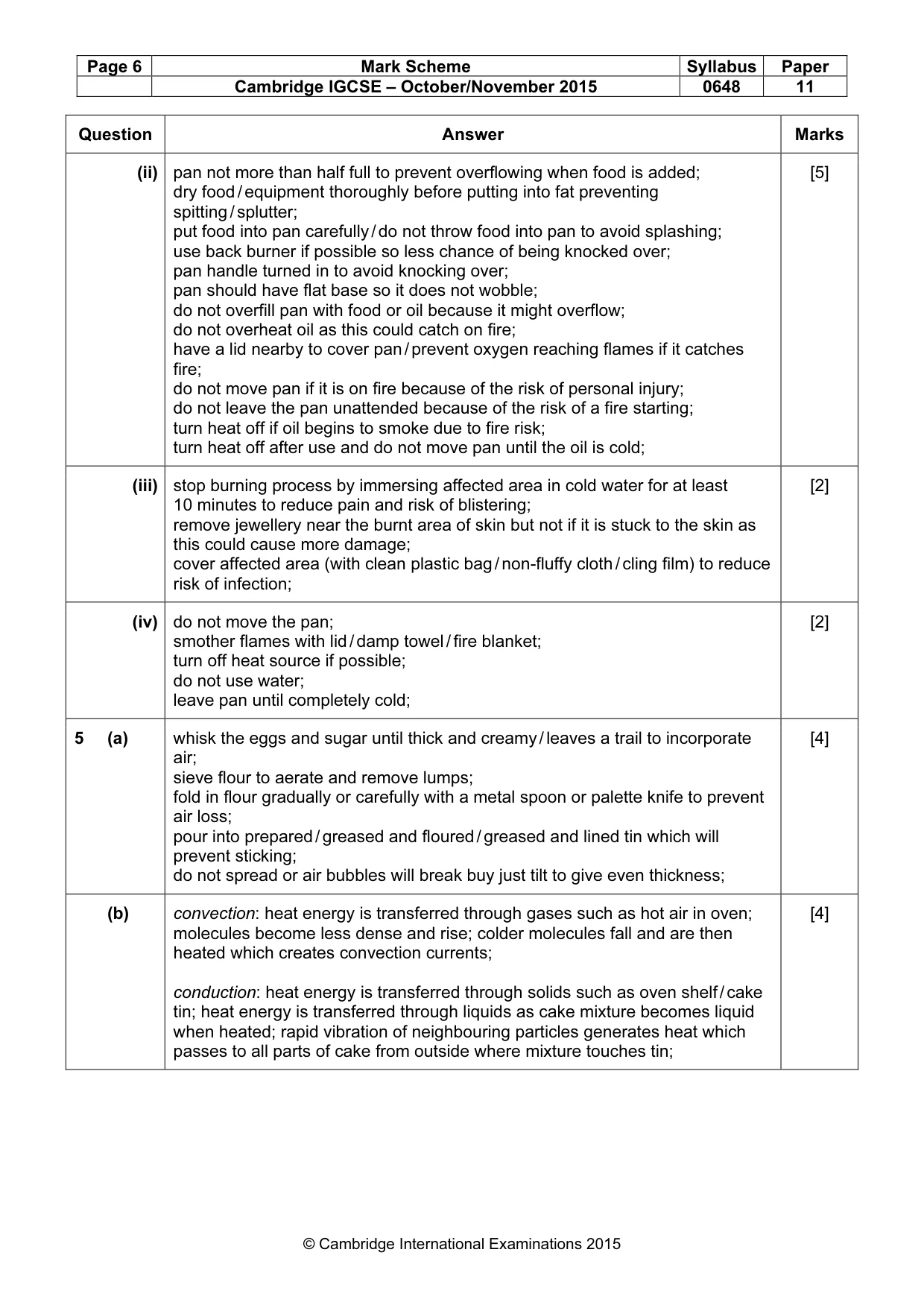
Page 6 Mark Scheme Syllabus Paper Cambridge IGCSE – October/November 2015 0648 11 © Cambridge International Examinations 2015 Question Answer Marks (ii) pan not more than half full to prevent overflowing when food is added; dry food / equipment thoroughly before putting into fat preventing spitting / splutter; put food into pan carefully / do not throw food into pan to avoid splashing; use back burner if possible so less chance of being knocked over; pan handle turned in to avoid knocking over; pan should have flat base so it does not wobble; do not overfill pan with food or oil because it might overflow; do not overheat oil as this could catch on fire; have a lid nearby to cover pan / prevent oxygen reaching flames if it catches fire; do not move pan if it is on fire because of the risk of personal injury; do not leave the pan unattended because of the risk of a fire starting; turn heat off if oil begins to smoke due to fire risk; turn heat off after use and do not move pan until the oil is cold; [5] (iii) stop burning process by immersing affected area in cold water for at least 10 minutes to reduce pain and risk of blistering; remove jewellery near the burnt area of skin but not if it is stuck to the skin as this could cause more damage; cover affected area (with clean plastic bag / non-fluffy cloth / cling film) to reduce risk of infection; [2] (iv) do not move the pan; smother flames with lid / damp towel / fire blanket; turn off heat source if possible; do not use water; leave pan until completely cold; [2] 5 (a) whisk the eggs and sugar until thick and creamy / leaves a trail to incorporate air; sieve flour to aerate and remove lumps; fold in flour gradually or carefully with a metal spoon or palette knife to prevent air loss; pour into prepared / greased and floured / greased and lined tin which will prevent sticking; do not spread or air bubbles will break buy just tilt to give even thickness; [4] (b) convection: heat energy is transferred through gases such as hot air in oven; molecules become less dense and rise; colder molecules fall and are then heated which creates convection currents; conduction: heat energy is transferred through solids such as oven shelf / cake tin; heat energy is transferred through liquids as cake mixture becomes liquid when heated; rapid vibration of neighbouring particles generates heat which passes to all parts of cake from outside where mixture touches tin; [4]
Mark scheme, page 7
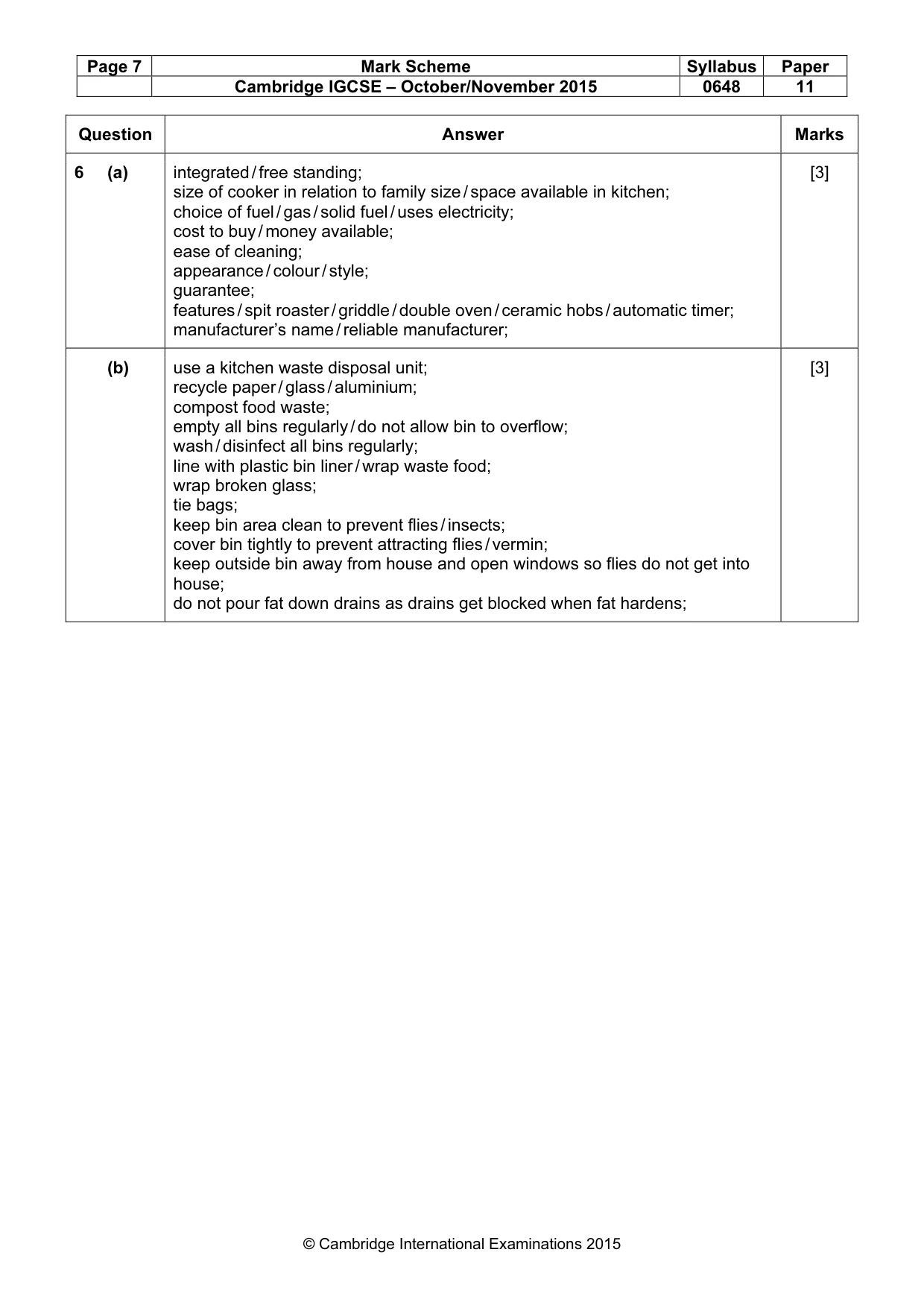
Page 7 Mark Scheme Syllabus Paper Cambridge IGCSE – October/November 2015 0648 11 © Cambridge International Examinations 2015 Question Answer Marks 6 (a) integrated / free standing; size of cooker in relation to family size / space available in kitchen; choice of fuel / gas / solid fuel / uses electricity; cost to buy / money available; ease of cleaning; appearance / colour / style; guarantee; features / spit roaster / griddle / double oven / ceramic hobs / automatic timer; manufacturer’s name / reliable manufacturer; [3] (b) use a kitchen waste disposal unit; recycle paper / glass / aluminium; compost food waste; empty all bins regularly / do not allow bin to overflow; wash / disinfect all bins regularly; line with plastic bin liner / wrap waste food; wrap broken glass; tie bags; keep bin area clean to prevent flies / insects; cover bin tightly to prevent attracting flies / vermin; keep outside bin away from house and open windows so flies do not get into house; do not pour fat down drains as drains get blocked when fat hardens; [3]
Mark scheme, page 8
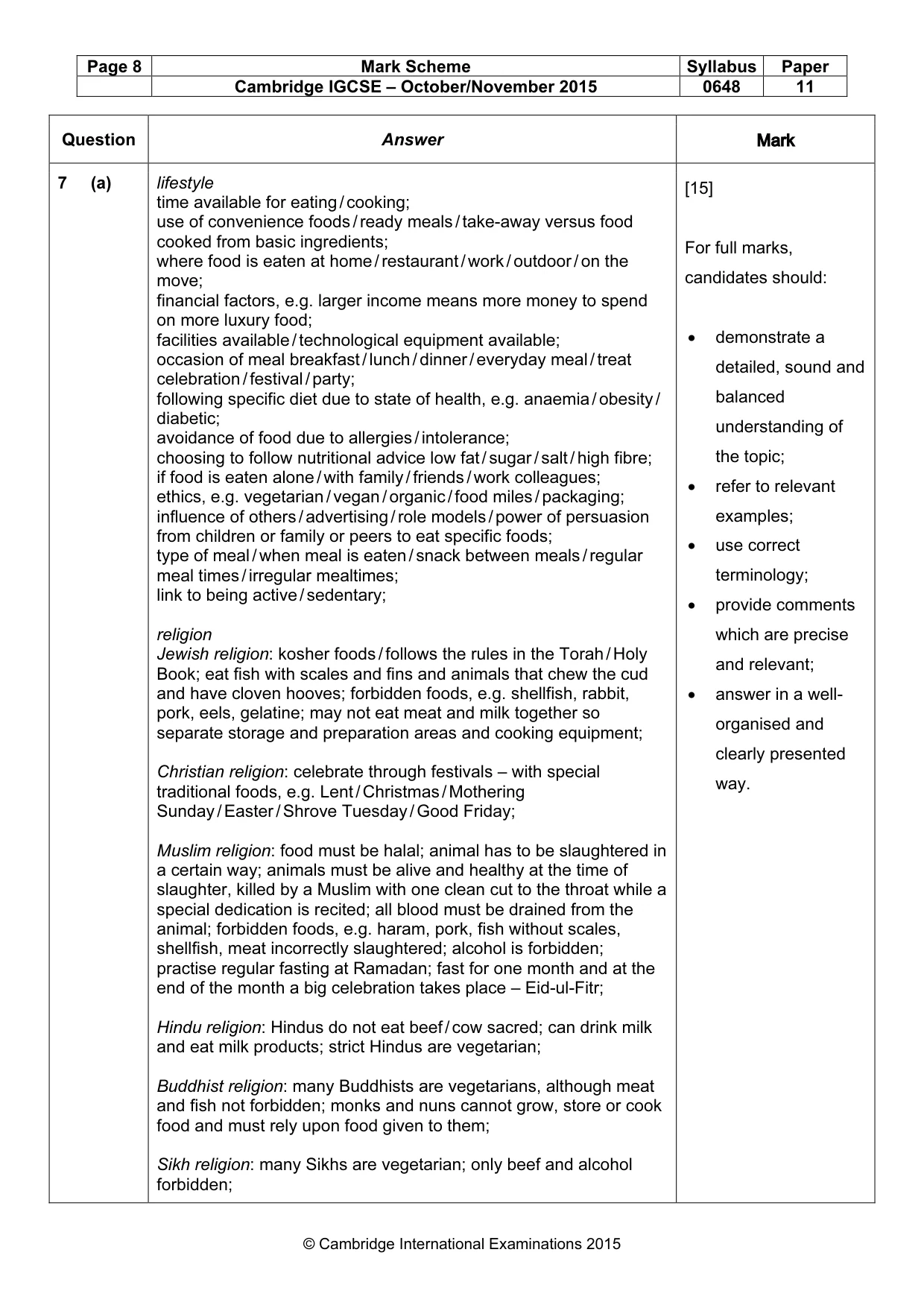
Page 8 Mark Scheme Syllabus Paper Cambridge IGCSE – October/November 2015 0648 11 © Cambridge International Examinations 2015 Question Answer Mark 7 (a) lifestyle time available for eating / cooking; use of convenience foods / ready meals / take-away versus food cooked from basic ingredients; where food is eaten at home / restaurant / work / outdoor / on the move; financial factors, e.g. larger income means more money to spend on more luxury food; facilities available / technological equipment available; occasion of meal breakfast / lunch / dinner / everyday meal / treat celebration / festival / party; following specific diet due to state of health, e.g. anaemia / obesity / diabetic; avoidance of food due to allergies / intolerance; choosing to follow nutritional advice low fat / sugar / salt / high fibre; if food is eaten alone / with family / friends / work colleagues; ethics, e.g. vegetarian / vegan / organic / food miles / packaging; influence of others / advertising / role models / power of persuasion from children or family or peers to eat specific foods; type of meal / when meal is eaten / snack between meals / regular meal times / irregular mealtimes; link to being active / sedentary; religion Jewish religion: kosher foods / follows the rules in the Torah / Holy Book; eat fish with scales and fins and animals that chew the cud and have cloven hooves; forbidden foods, e.g. shellfish, rabbit, pork, eels, gelatine; may not eat meat and milk together so separate storage and preparation areas and cooking equipment; Christian religion: celebrate through festivals – with special traditional foods, e.g. Lent / Christmas / Mothering Sunday / Easter / Shrove Tuesday / Good Friday; Muslim religion: food must be halal; animal has to be slaughtered in a certain way; animals must be alive and healthy at the time of slaughter, killed by a Muslim with one clean cut to the throat while a special dedication is recited; all blood must be drained from the animal; forbidden foods, e.g. haram, pork, fish without scales, shellfish, meat incorrectly slaughtered; alcohol is forbidden; practise regular fasting at Ramadan; fast for one month and at the end of the month a big celebration takes place – Eid-ul-Fitr; Hindu religion: Hindus do not eat beef / cow sacred; can drink milk and eat milk products; strict Hindus are vegetarian; Buddhist religion: many Buddhists are vegetarians, although meat and fish not forbidden; monks and nuns cannot grow, store or cook food and must rely upon food given to them; Sikh religion: many Sikhs are vegetarian; only beef and alcohol forbidden; [15] For full marks, candidates should: • demonstrate a detailed, sound and balanced understanding of the topic; • refer to relevant examples; • use correct terminology; • provide comments which are precise and relevant; • answer in a well- organised and clearly presented way.
Mark scheme, page 9
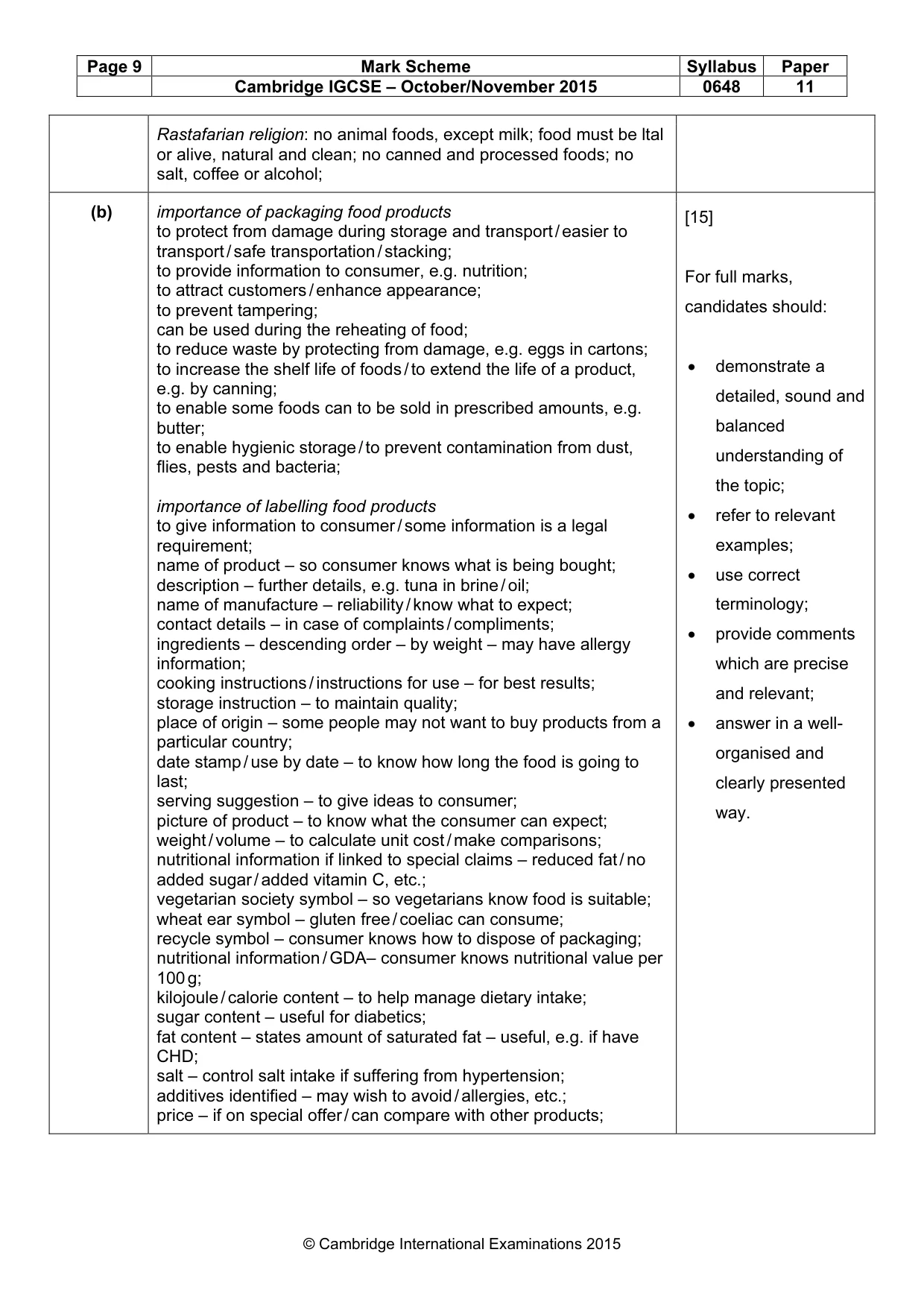
Page 9 Mark Scheme Syllabus Paper Cambridge IGCSE – October/November 2015 0648 11 © Cambridge International Examinations 2015 Rastafarian religion: no animal foods, except milk; food must be ltal or alive, natural and clean; no canned and processed foods; no salt, coffee or alcohol; (b) importance of packaging food products to protect from damage during storage and transport / easier to transport / safe transportation / stacking; to provide information to consumer, e.g. nutrition; to attract customers / enhance appearance; to prevent tampering; can be used during the reheating of food; to reduce waste by protecting from damage, e.g. eggs in cartons; to increase the shelf life of foods / to extend the life of a product, e.g. by canning; to enable some foods can to be sold in prescribed amounts, e.g. butter; to enable hygienic storage / to prevent contamination from dust, flies, pests and bacteria; importance of labelling food products to give information to consumer / some information is a legal requirement; name of product – so consumer knows what is being bought; description – further details, e.g. tuna in brine / oil; name of manufacture – reliability / know what to expect; contact details – in case of complaints / compliments; ingredients – descending order – by weight – may have allergy information; cooking instructions / instructions for use – for best results; storage instruction – to maintain quality; place of origin – some people may not want to buy products from a particular country; date stamp / use by date – to know how long the food is going to last; serving suggestion – to give ideas to consumer; picture of product – to know what the consumer can expect; weight / volume – to calculate unit cost / make comparisons; nutritional information if linked to special claims – reduced fat / no added sugar / added vitamin C, etc.; vegetarian society symbol – so vegetarians know food is suitable; wheat ear symbol – gluten free / coeliac can consume; recycle symbol – consumer knows how to dispose of packaging; nutritional information / GDA– consumer knows nutritional value per 100 g; kilojoule / calorie content – to help manage dietary intake; sugar content – useful for diabetics; fat content – states amount of saturated fat – useful, e.g. if have CHD; salt – control salt intake if suffering from hypertension; additives identified – may wish to avoid / allergies, etc.; price – if on special offer / can compare with other products; [15] For full marks, candidates should: • demonstrate a detailed, sound and balanced understanding of the topic; • refer to relevant examples; • use correct terminology; • provide comments which are precise and relevant; • answer in a well- organised and clearly presented way.
What you needed in this session
Cambridge’s own grade thresholds for 2015 Oct/Nov, Paper 1 · Variant 1. A higher threshold means an easier paper — the bar moves with how the cohort did.