Cambridge IGCSE Food and Nutrition 0648 — 2014 Oct/Nov Paper 1 · Variant 2
0648/12/O/N/14 · 100 marks · ≈113 min
The question paper and its mark scheme, free to read here and free to download. This is Cambridge’s own paper, exactly as it was sat.
Question paper12 pages


Mark scheme12 pages
Answers below. Sit the paper first if you are practising.
Paper as text
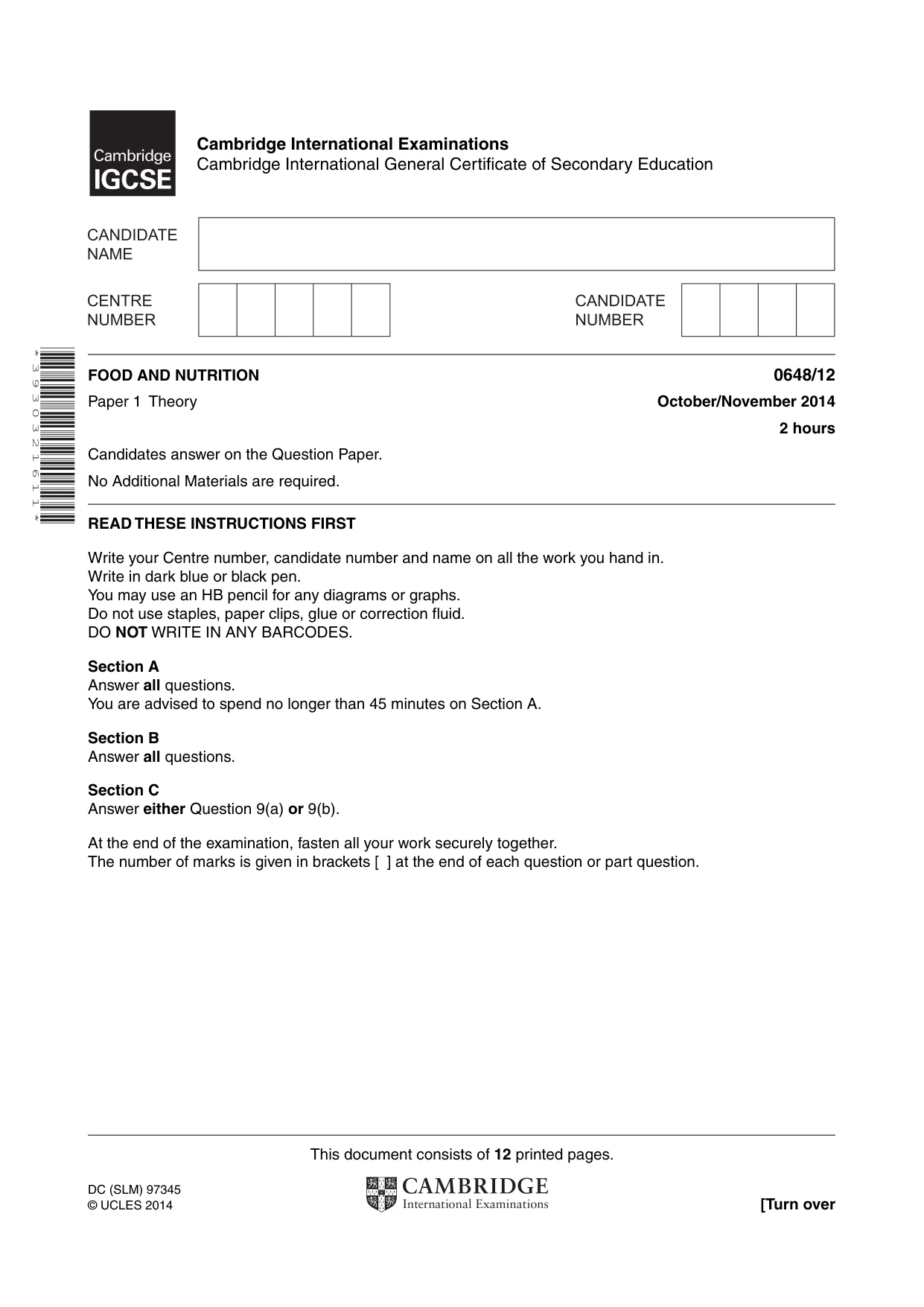
Question paper, page 1
This document consists of 12 printed pages. DC (SLM) 97345 © UCLES 2014 [Turn over Cambridge International Examinations Cambridge International General Certificate of Secondary Education * 3 9 3 0 3 2 1 6 1 1 * FOOD AND NUTRITION 0648/12 Paper 1 Theory October/November 2014 2 hours Candidates answer on the Question Paper. No Additional Materials are required. READ THESE INSTRUCTIONS FIRST Write your Centre number, candidate number and name on all the work you hand in. Write in dark blue or black pen. You may use an HB pencil for any diagrams or graphs. Do not use staples, paper clips, glue or correction fluid. DO NOT WRITE IN ANY BARCODES. Section A Answer all questions. You are advised to spend no longer than 45 minutes on Section A. Section B Answer all questions. Section C Answer either Question 9(a) or 9(b). At the end of the examination, fasten all your work securely together. The number of marks is given in brackets [ ] at the end of each question or part question.
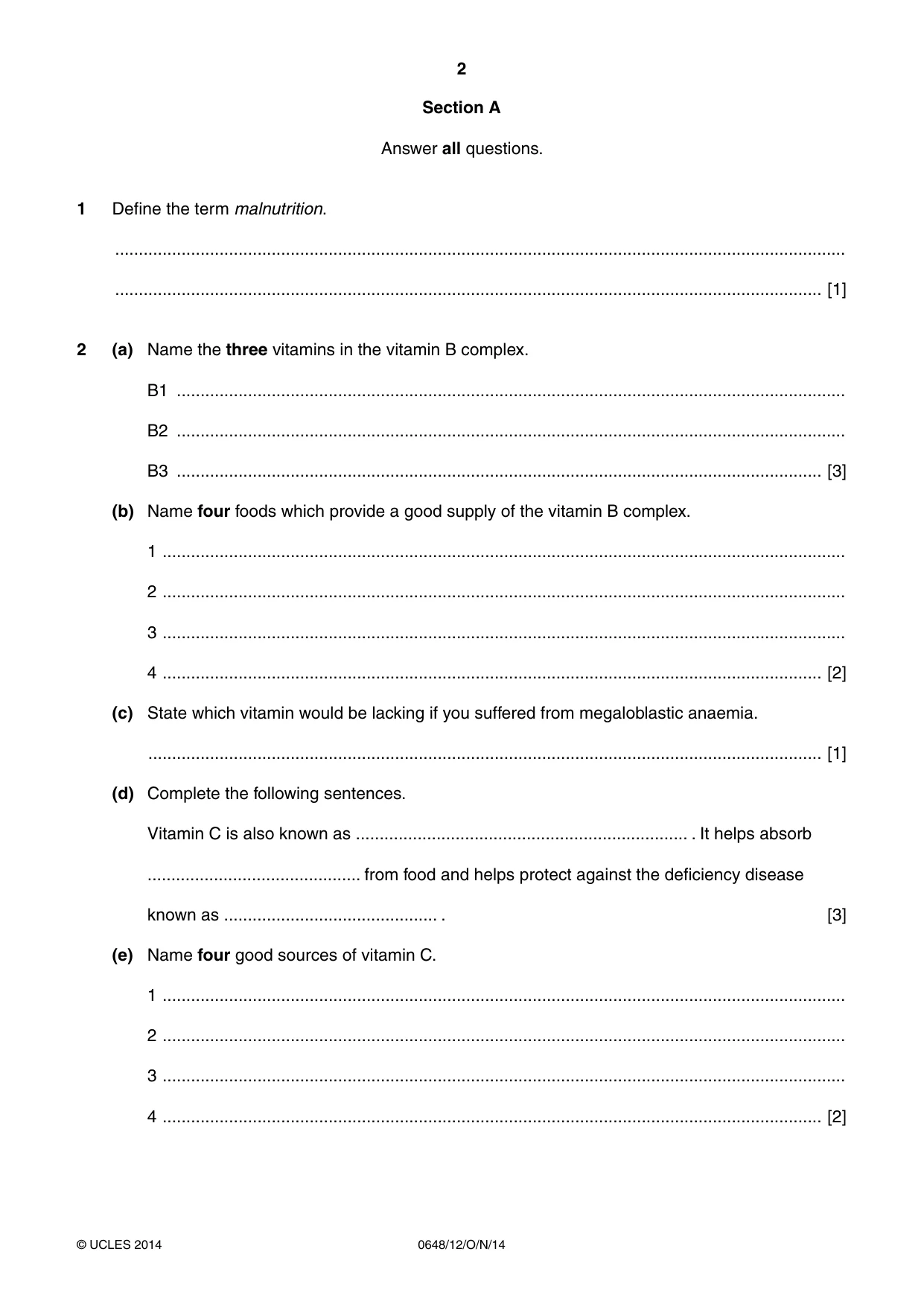
Question paper, page 2
2 0648/12/O/N/14 © UCLES 2014 Section A Answer all questions. 1 Define the term malnutrition. … … [1] 2 (a) Name the three vitamins in the vitamin B complex. B1 … B2 … B3 … [3] (b) Name four foods which provide a good supply of the vitamin B complex. 1 … 2 … 3 … 4 … [2] (c) State which vitamin would be lacking if you suffered from megaloblastic anaemia. … [1] (d) Complete the following sentences. Vitamin C is also known as … . It helps absorb … from food and helps protect against the deficiency disease known as … . [3] (e) Name four good sources of vitamin C. 1 … 2 … 3 … 4 … [2]
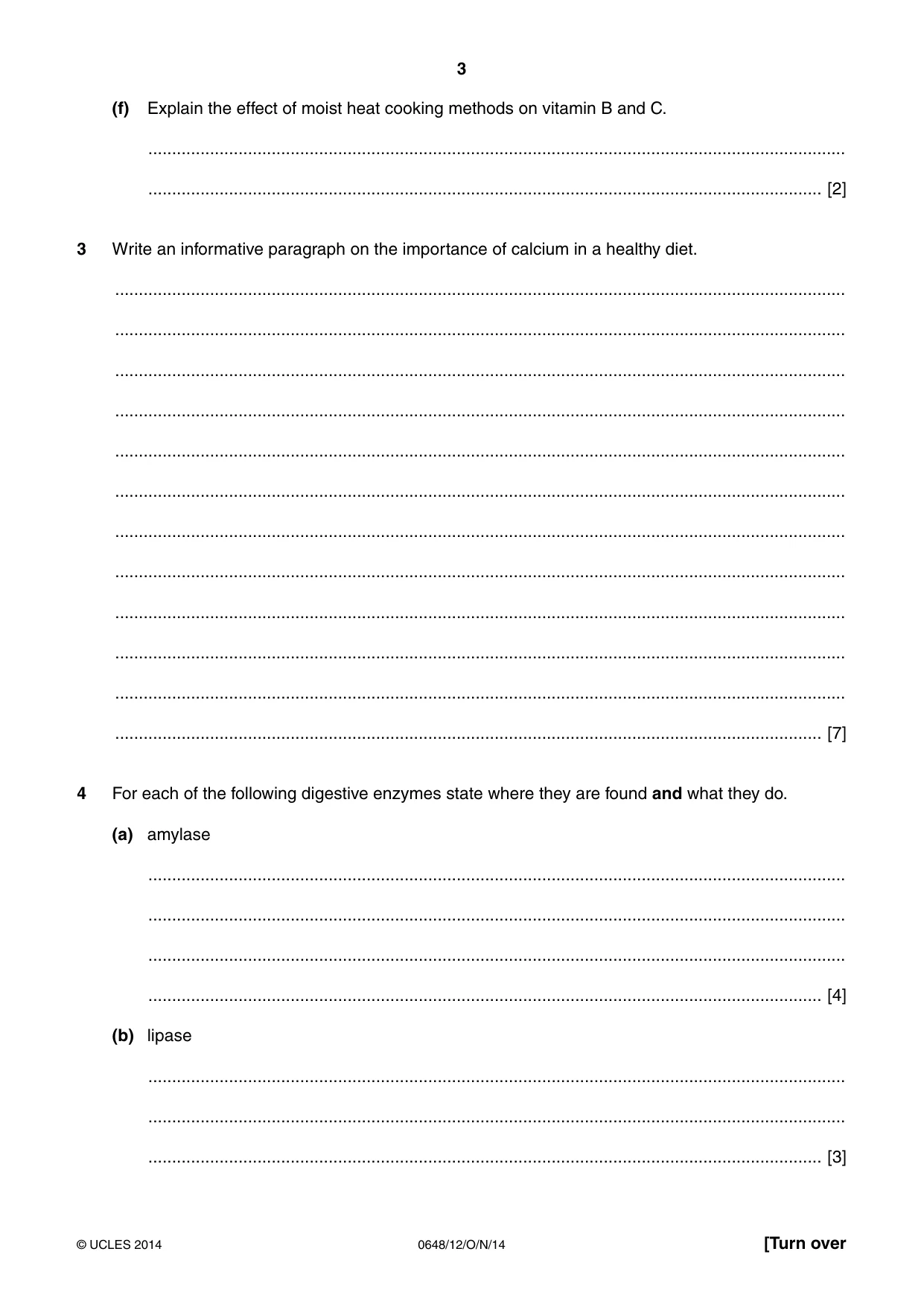
Question paper, page 3
3 0648/12/O/N/14 © UCLES 2014 [Turn over (f) Explain the effect of moist heat cooking methods on vitamin B and C. … … [2] 3 Write an informative paragraph on the importance of calcium in a healthy diet. … … … … … … … … … … … … [7] 4 For each of the following digestive enzymes state where they are found and what they do. (a) amylase … … … … [4] (b) lipase … … … [3]
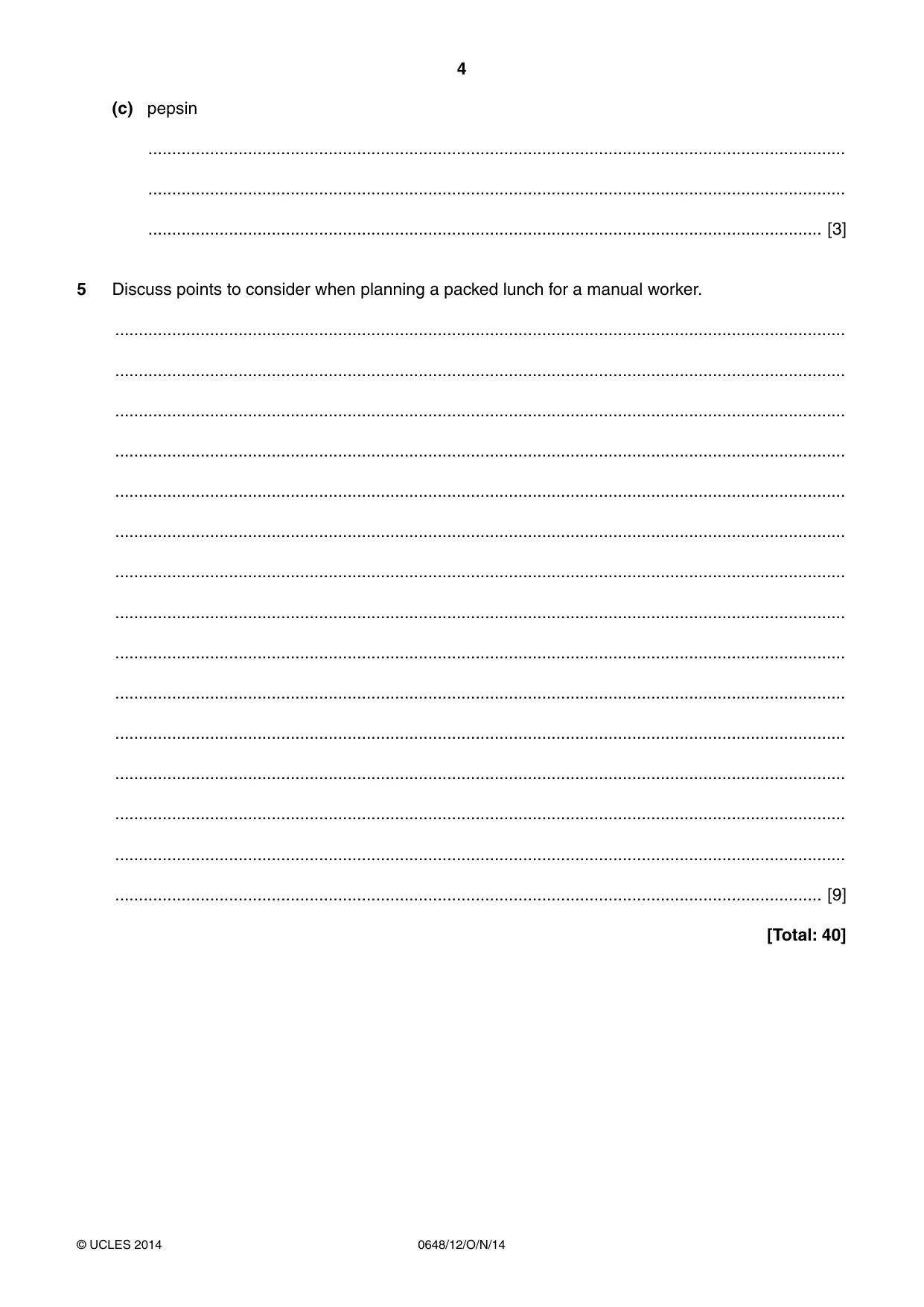
Question paper, page 4
4 0648/12/O/N/14 © UCLES 2014 (c) pepsin … … … [3] 5 Discuss points to consider when planning a packed lunch for a manual worker. … … … … … … … … … … … … … … … [9] [Total: 40]
Question paper, page 5
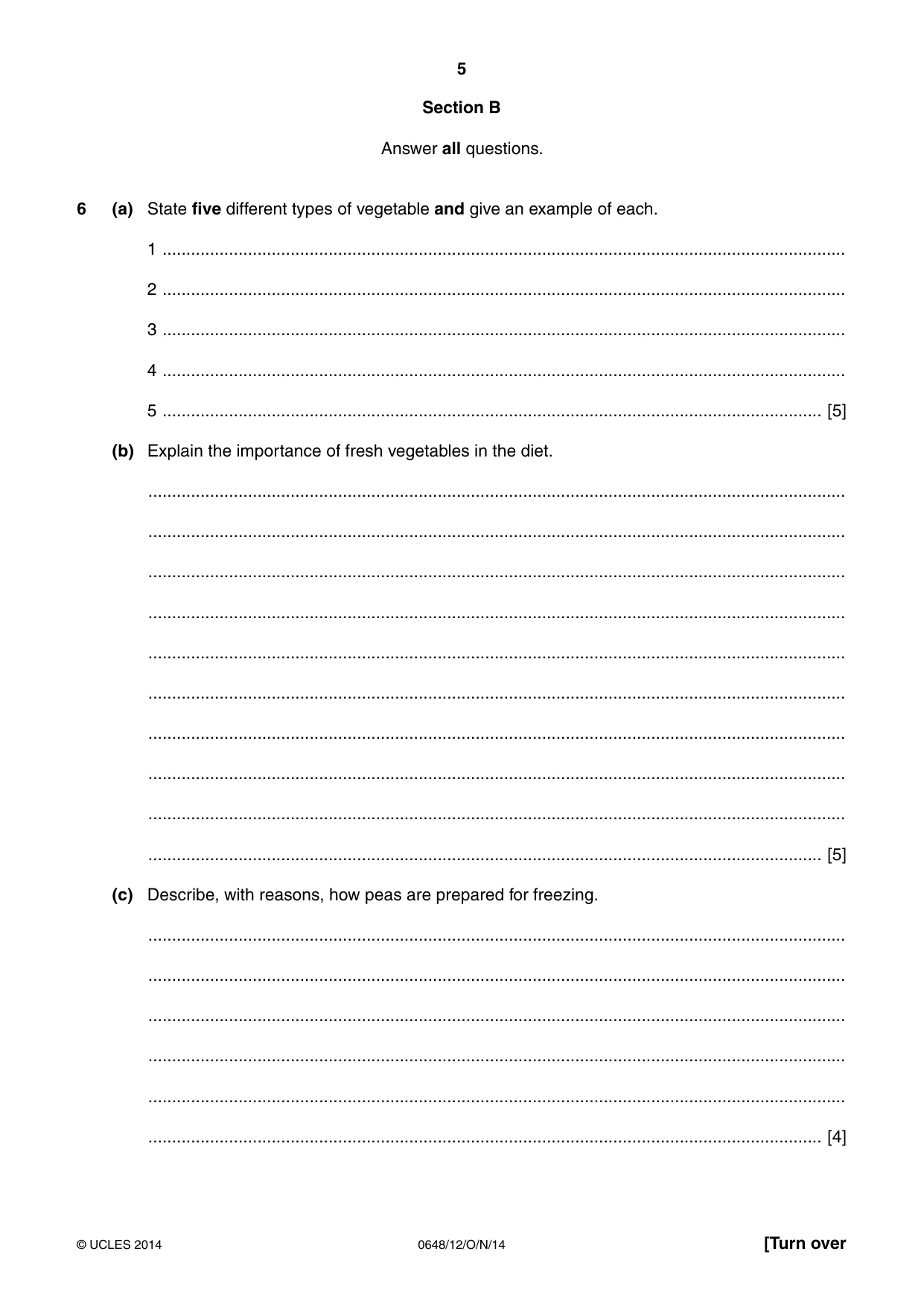
5 0648/12/O/N/14 © UCLES 2014 [Turn over Section B Answer all questions. 6 (a) State five different types of vegetable and give an example of each. 1 … 2 … 3 … 4 … 5 … [5] (b) Explain the importance of fresh vegetables in the diet. … … … … … … … … … … [5] (c) Describe, with reasons, how peas are prepared for freezing. … … … … … … [4]
Question paper, page 6
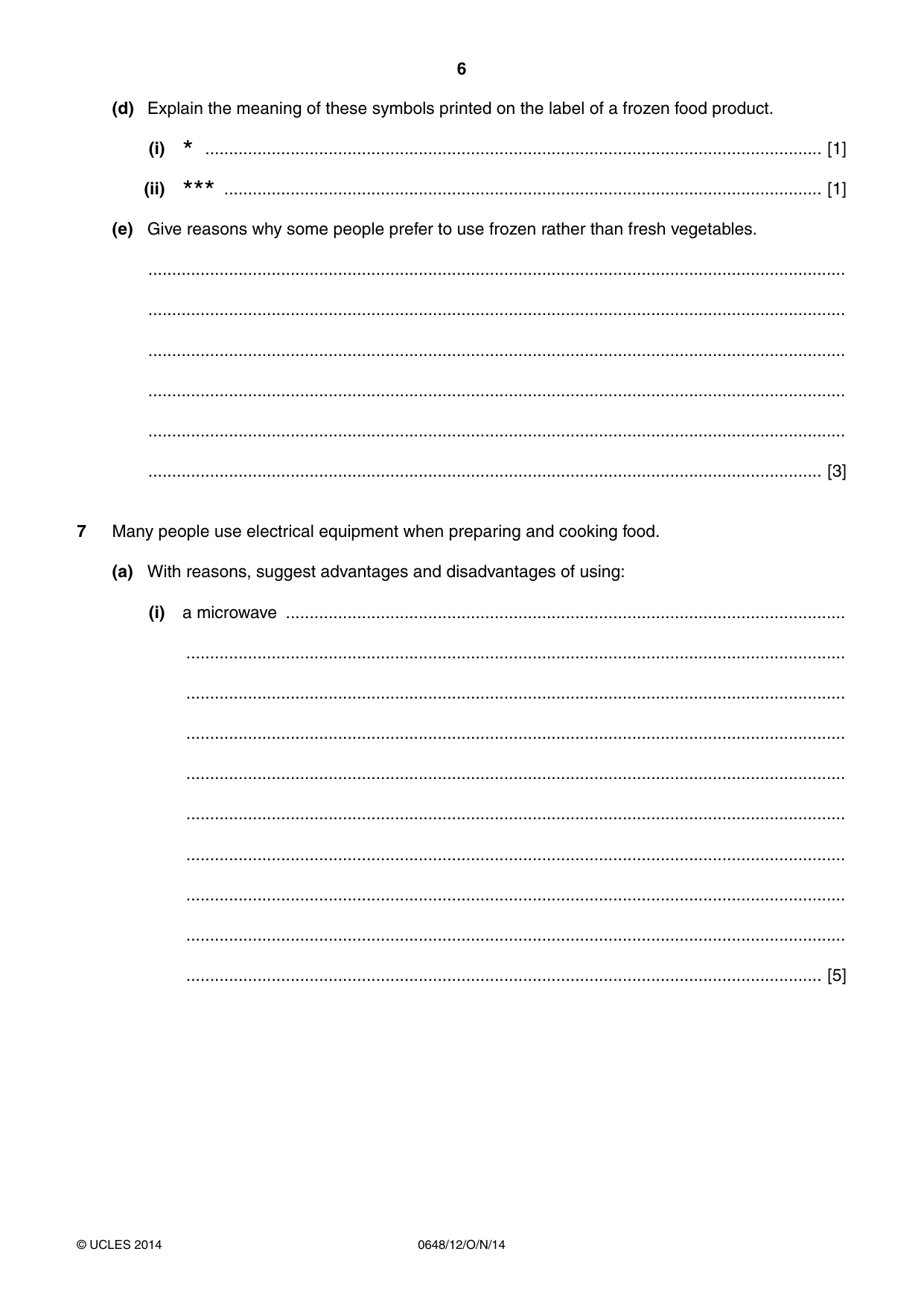
6 0648/12/O/N/14 © UCLES 2014 (d) Explain the meaning of these symbols printed on the label of a frozen food product. (i) * … [1] (ii) *** … [1] (e) Give reasons why some people prefer to use frozen rather than fresh vegetables. … … … … … … [3] 7 Many people use electrical equipment when preparing and cooking food. (a) With reasons, suggest advantages and disadvantages of using: (i) a microwave … … … … … … … … … … [5]
Question paper, page 7
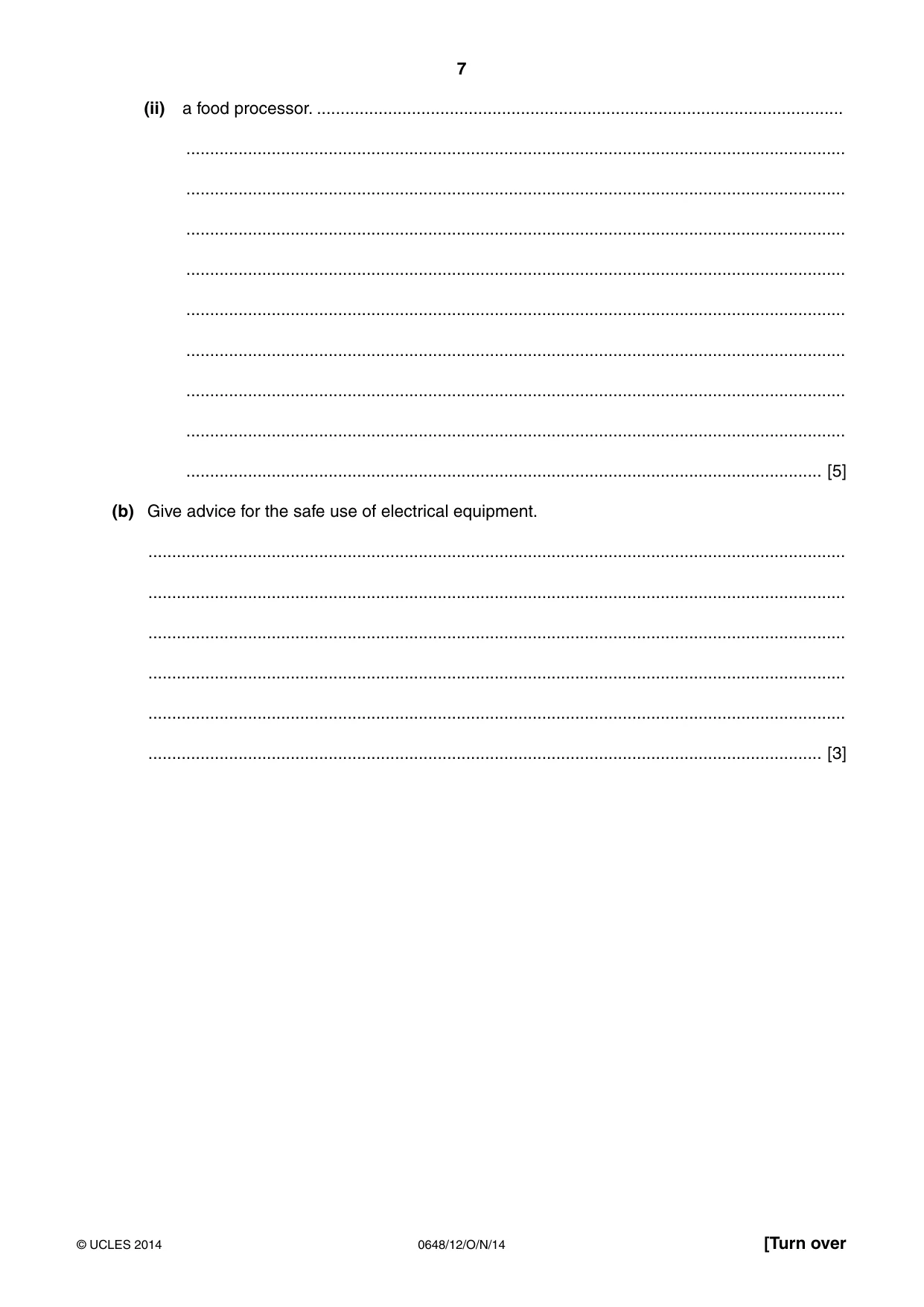
7 0648/12/O/N/14 © UCLES 2014 [Turn over (ii) a food processor. … … … … … … … … … … [5] (b) Give advice for the safe use of electrical equipment. … … … … … … [3]
Question paper, page 8
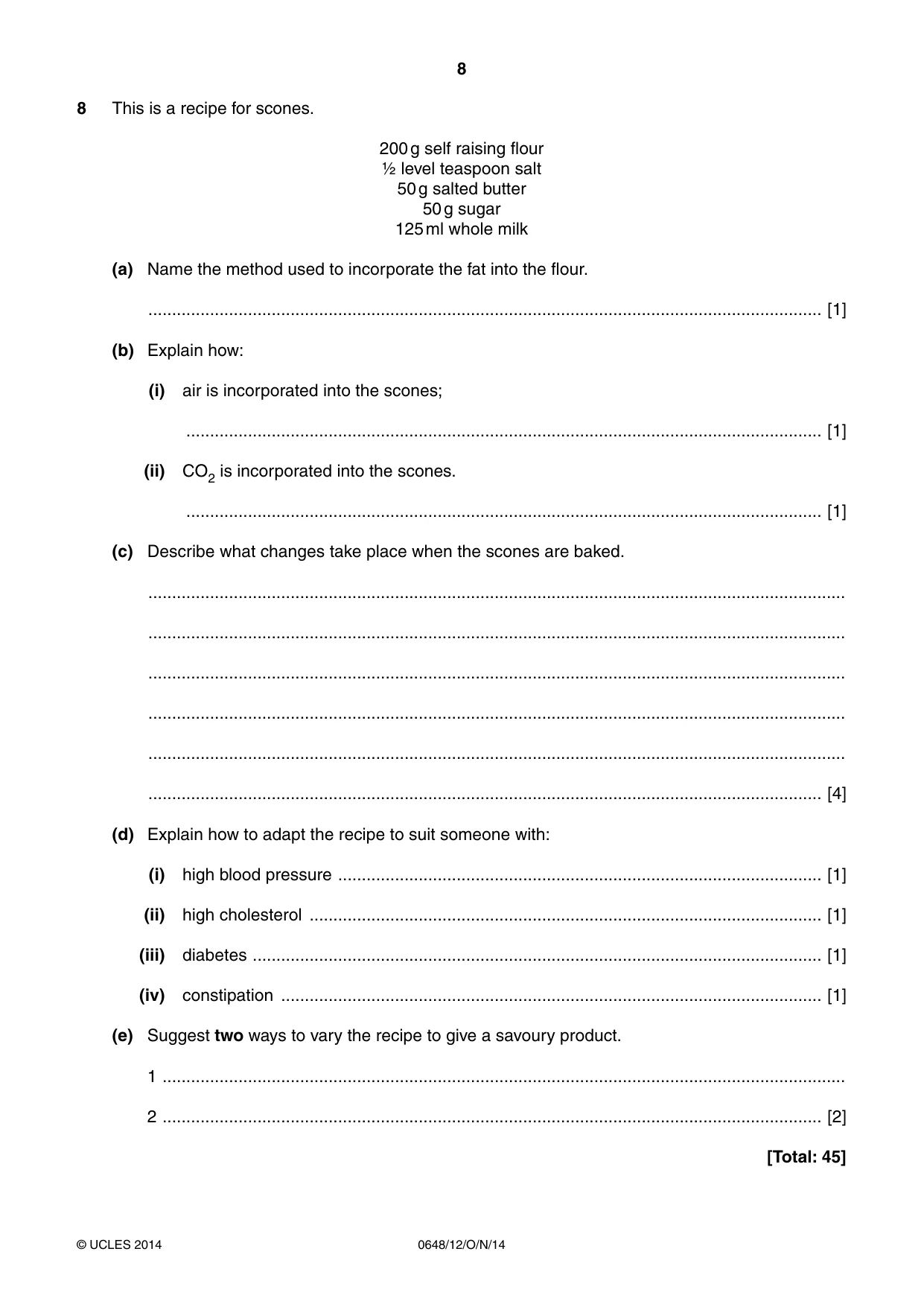
8 0648/12/O/N/14 © UCLES 2014 8 This is a recipe for scones. 200 g self raising flour ½ level teaspoon salt 50 g salted butter 50 g sugar 125 ml whole milk (a) Name the method used to incorporate the fat into the flour. … [1] (b) Explain how: (i) air is incorporated into the scones; … [1] (ii) CO2 is incorporated into the scones. … [1] (c) Describe what changes take place when the scones are baked. … … … … … … [4] (d) Explain how to adapt the recipe to suit someone with: (i) high blood pressure … [1] (ii) high cholesterol … [1] (iii) diabetes … [1] (iv) constipation … [1] (e) Suggest two ways to vary the recipe to give a savoury product. 1 … 2 … [2] [Total: 45]
Question paper, page 9
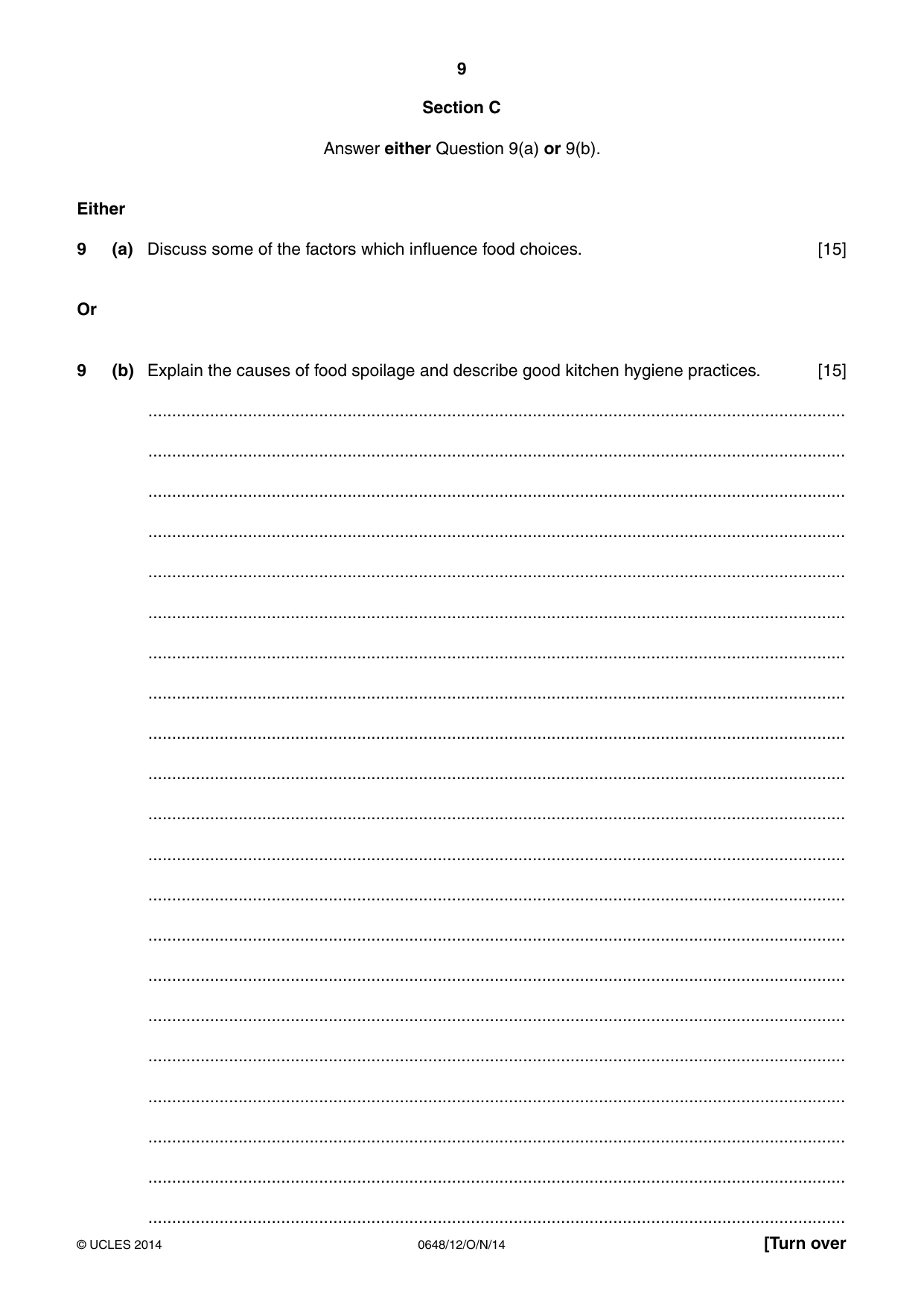
9 0648/12/O/N/14 © UCLES 2014 [Turn over Section C Answer either Question 9(a) or 9(b). Either 9 (a) Discuss some of the factors which influence food choices. [15] Or 9 (b) Explain the causes of food spoilage and describe good kitchen hygiene practices. [15] … … … … … … … … … … … … … … … … … … … … …
Question paper, page 10
10 0648/12/O/N/14 © UCLES 2014 … … … … … … … … … … … … … … … … … … … … … … … … … … … …
Question paper, page 11
11 0648/12/O/N/14 © UCLES 2014 [Turn over … … … … … … … … … … … … … … … … … … … … … … … … … … … …
Question paper, page 12
12 0648/12/O/N/14 © UCLES 2014 Permission to reproduce items where third-party owned material protected by copyright is included has been sought and cleared where possible. Every reasonable effort has been made by the publisher (UCLES) to trace copyright holders, but if any items requiring clearance have unwittingly been included, the publisher will be pleased to make amends at the earliest possible opportunity. Cambridge International Examinations is part of the Cambridge Assessment Group. Cambridge Assessment is the brand name of University of Cambridge Local Examinations Syndicate (UCLES), which is itself a department of the University of Cambridge. … … … … … … … … … … … … … … … … … … … … … … … [Total: 15]
Mark scheme, page 1
® IGCSE is the registered trademark of Cambridge International Examinations. CAMBRIDGE INTERNATIONAL EXAMINATIONS Cambridge International General Certificate of Secondary Education MARK SCHEME for the October/November 2014 series 0648 FOOD AND NUTRITION 0648/12 Paper 1 (Theory), maximum raw mark 100 This mark scheme is published as an aid to teachers and candidates, to indicate the requirements of the examination. It shows the basis on which Examiners were instructed to award marks. It does not indicate the details of the discussions that took place at an Examiners’ meeting before marking began, which would have considered the acceptability of alternative answers. Mark schemes should be read in conjunction with the question paper and the Principal Examiner Report for Teachers. Cambridge will not enter into discussions about these mark schemes. Cambridge is publishing the mark schemes for the October/November 2014 series for most Cambridge IGCSE®, Cambridge International A and AS Level components and some Cambridge O Level components.
Mark scheme, page 2
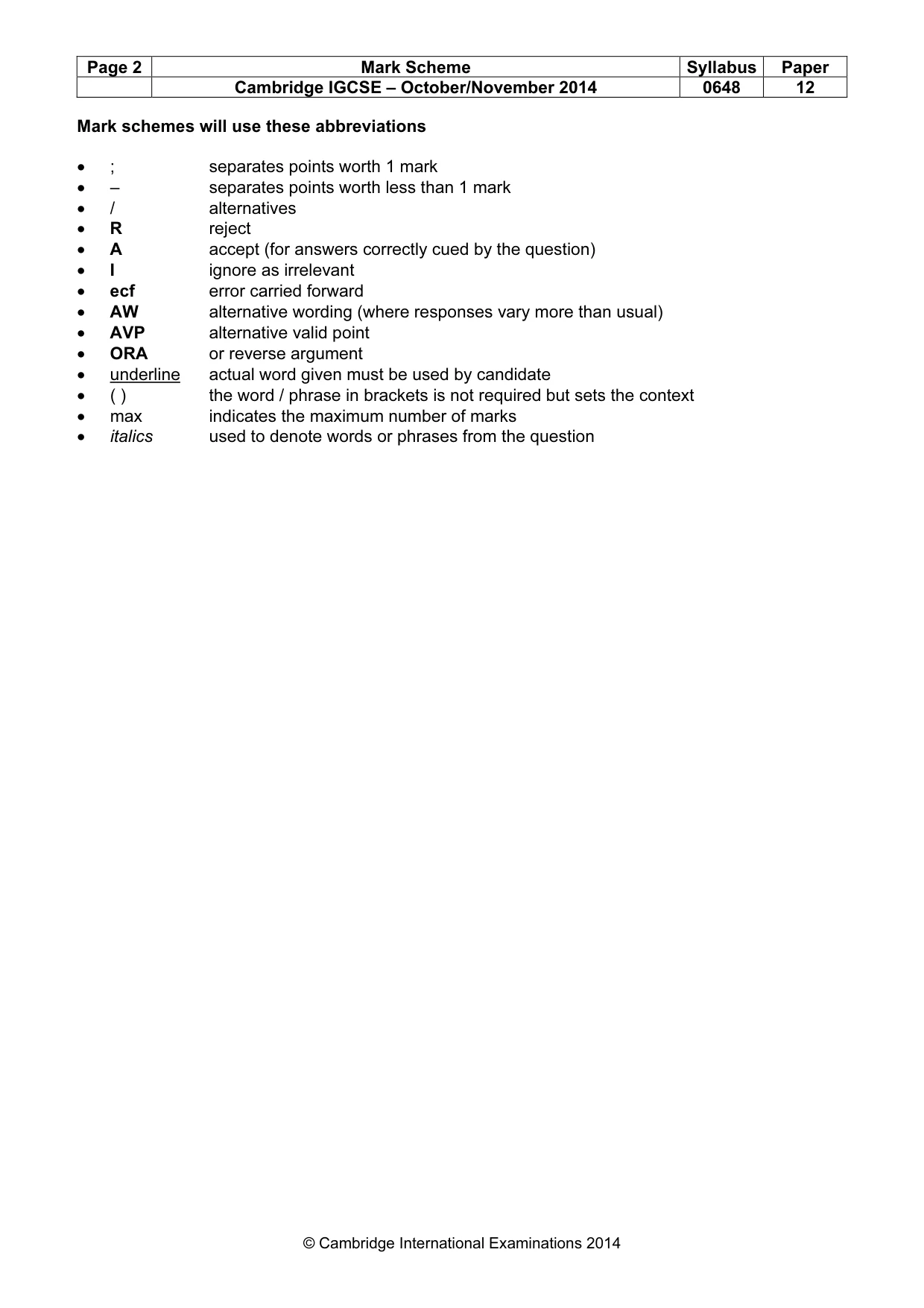
Page 2 Mark Scheme Syllabus Paper Cambridge IGCSE – October/November 2014 0648 12 © Cambridge International Examinations 2014 Mark schemes will use these abbreviations • ; separates points worth 1 mark • – separates points worth less than 1 mark • / alternatives • R reject • A accept (for answers correctly cued by the question) • I ignore as irrelevant • ecf error carried forward • AW alternative wording (where responses vary more than usual) • AVP alternative valid point • ORA or reverse argument • underline actual word given must be used by candidate • ( ) the word / phrase in brackets is not required but sets the context • max indicates the maximum number of marks • italics used to denote words or phrases from the question
Mark scheme, page 3
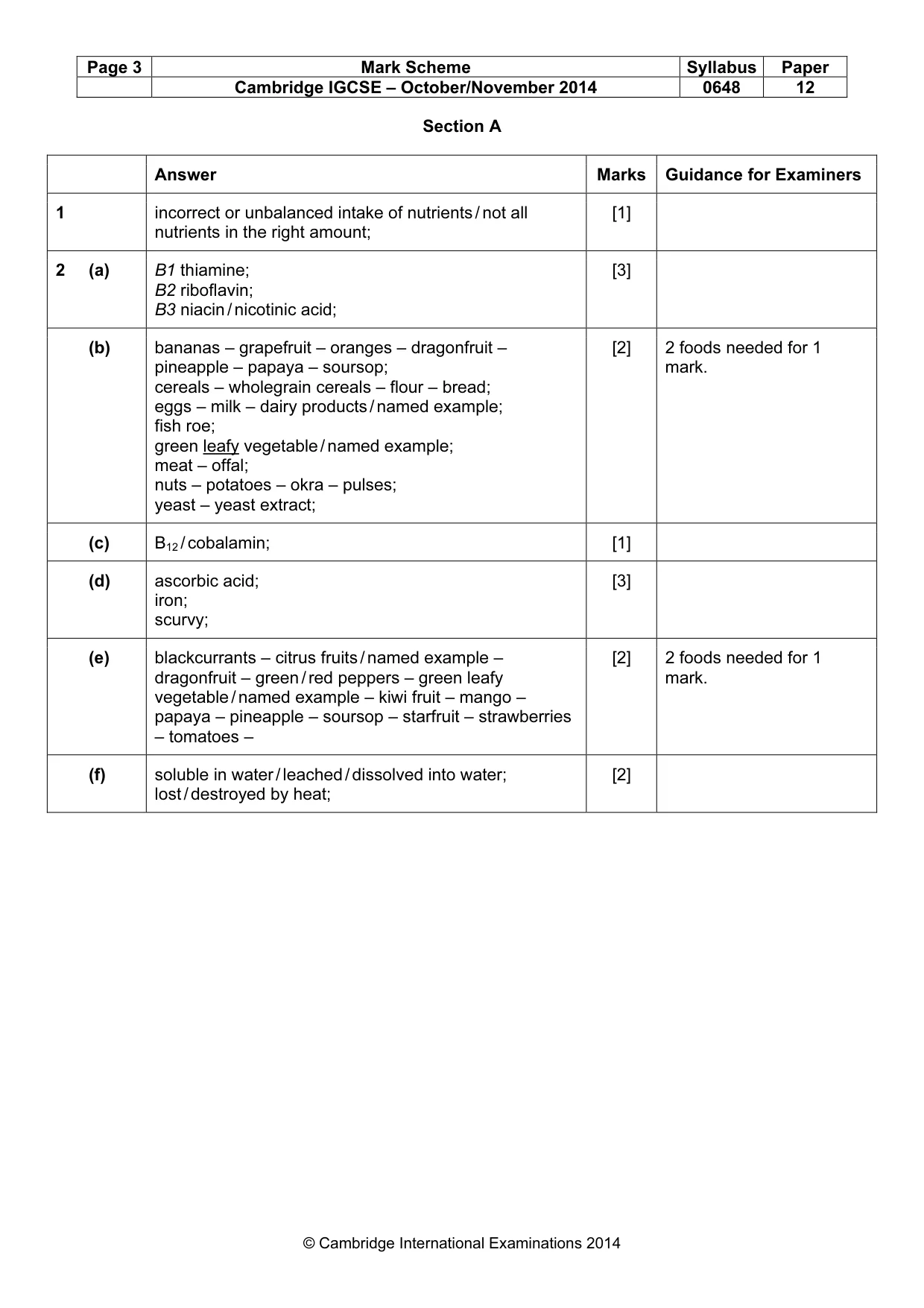
Page 3 Mark Scheme Syllabus Paper Cambridge IGCSE – October/November 2014 0648 12 © Cambridge International Examinations 2014 Section A Answer Marks Guidance for Examiners 1 incorrect or unbalanced intake of nutrients / not all nutrients in the right amount; [1] 2 (a) B1 thiamine; B2 riboflavin; B3 niacin / nicotinic acid; [3] (b) bananas – grapefruit – oranges – dragonfruit – pineapple – papaya – soursop; cereals – wholegrain cereals – flour – bread; eggs – milk – dairy products / named example; fish roe; green leafy vegetable / named example; meat – offal; nuts – potatoes – okra – pulses; yeast – yeast extract; [2] 2 foods needed for 1 mark. (c) B12 / cobalamin; [1] (d) ascorbic acid; iron; scurvy; [3] (e) blackcurrants – citrus fruits / named example – dragonfruit – green / red peppers – green leafy vegetable / named example – kiwi fruit – mango – papaya – pineapple – soursop – starfruit – strawberries – tomatoes – [2] 2 foods needed for 1 mark. (f) soluble in water / leached / dissolved into water; lost / destroyed by heat; [2]
Mark scheme, page 4
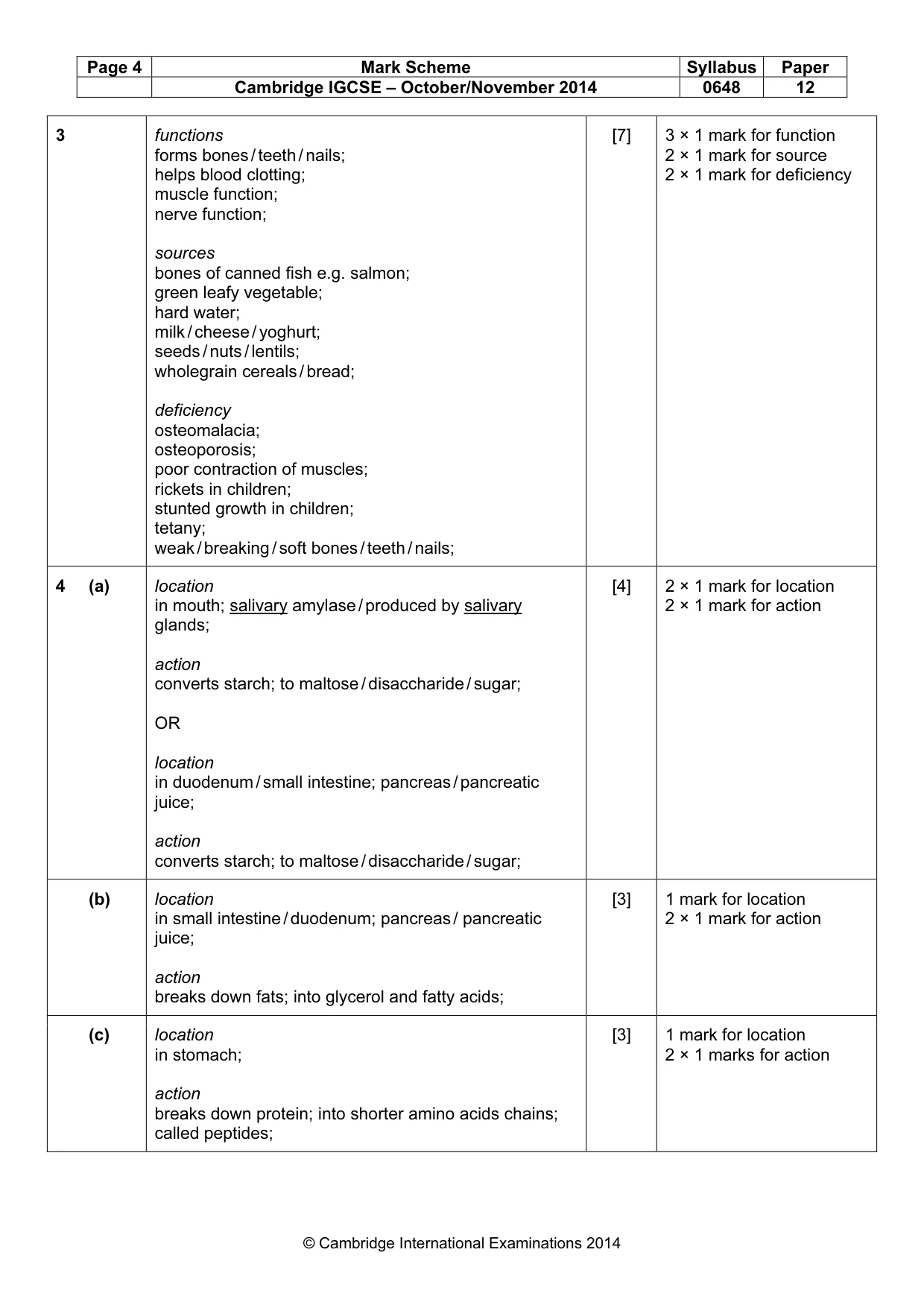
Page 4 Mark Scheme Syllabus Paper Cambridge IGCSE – October/November 2014 0648 12 © Cambridge International Examinations 2014 3 functions forms bones / teeth / nails; helps blood clotting; muscle function; nerve function; sources bones of canned fish e.g. salmon; green leafy vegetable; hard water; milk / cheese / yoghurt; seeds / nuts / lentils; wholegrain cereals / bread; deficiency osteomalacia; osteoporosis; poor contraction of muscles; rickets in children; stunted growth in children; tetany; weak / breaking / soft bones / teeth / nails; [7] 3 × 1 mark for function 2 × 1 mark for source 2 × 1 mark for deficiency 4 (a) location in mouth; salivary amylase / produced by salivary glands; action converts starch; to maltose / disaccharide / sugar; OR location in duodenum / small intestine; pancreas / pancreatic juice; action converts starch; to maltose / disaccharide / sugar; [4] 2 × 1 mark for location 2 × 1 mark for action (b) location in small intestine / duodenum; pancreas / pancreatic juice; action breaks down fats; into glycerol and fatty acids; [3] 1 mark for location 2 × 1 mark for action (c) location in stomach; action breaks down protein; into shorter amino acids chains; called peptides; [3] 1 mark for location 2 × 1 marks for action
Mark scheme, page 5
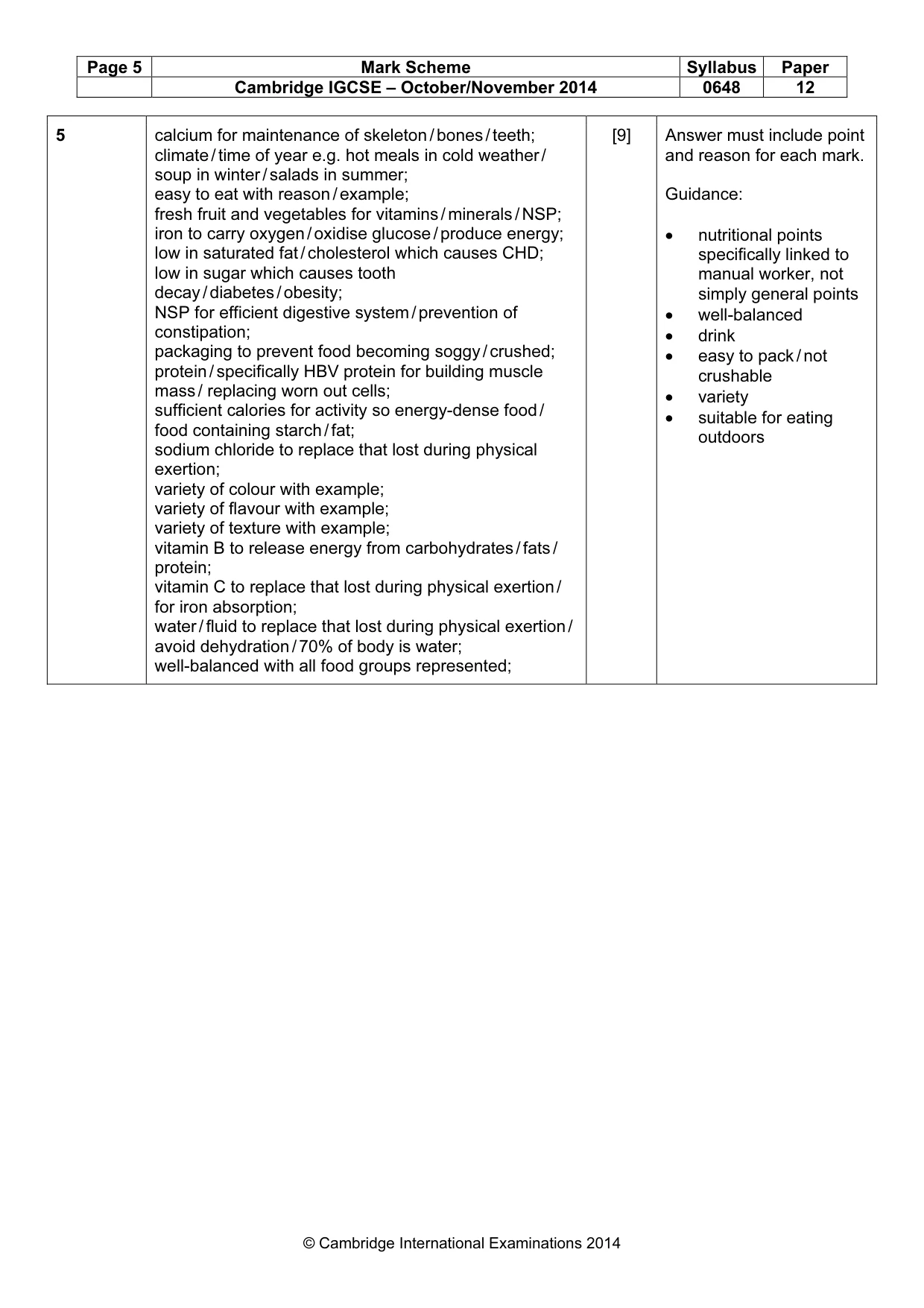
Page 5 Mark Scheme Syllabus Paper Cambridge IGCSE – October/November 2014 0648 12 © Cambridge International Examinations 2014 5 calcium for maintenance of skeleton / bones / teeth; climate / time of year e.g. hot meals in cold weather / soup in winter / salads in summer; easy to eat with reason / example; fresh fruit and vegetables for vitamins / minerals / NSP; iron to carry oxygen / oxidise glucose / produce energy; low in saturated fat / cholesterol which causes CHD; low in sugar which causes tooth decay / diabetes / obesity; NSP for efficient digestive system / prevention of constipation; packaging to prevent food becoming soggy / crushed; protein / specifically HBV protein for building muscle mass / replacing worn out cells; sufficient calories for activity so energy-dense food / food containing starch / fat; sodium chloride to replace that lost during physical exertion; variety of colour with example; variety of flavour with example; variety of texture with example; vitamin B to release energy from carbohydrates / fats / protein; vitamin C to replace that lost during physical exertion / for iron absorption; water / fluid to replace that lost during physical exertion / avoid dehydration / 70% of body is water; well-balanced with all food groups represented; [9] Answer must include point and reason for each mark. Guidance: • nutritional points specifically linked to manual worker, not simply general points • well-balanced • drink • easy to pack / not crushable • variety • suitable for eating outdoors
Mark scheme, page 6
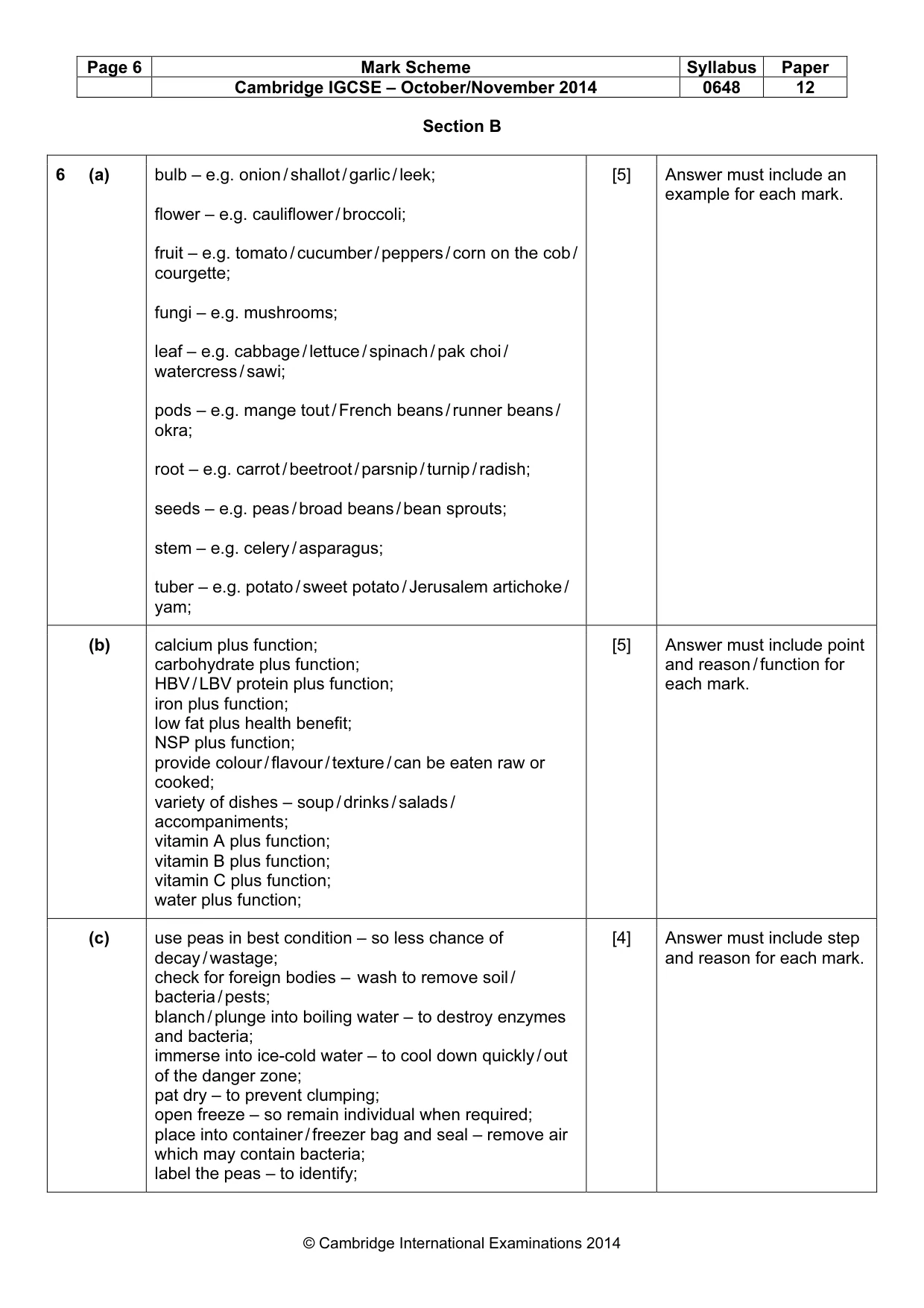
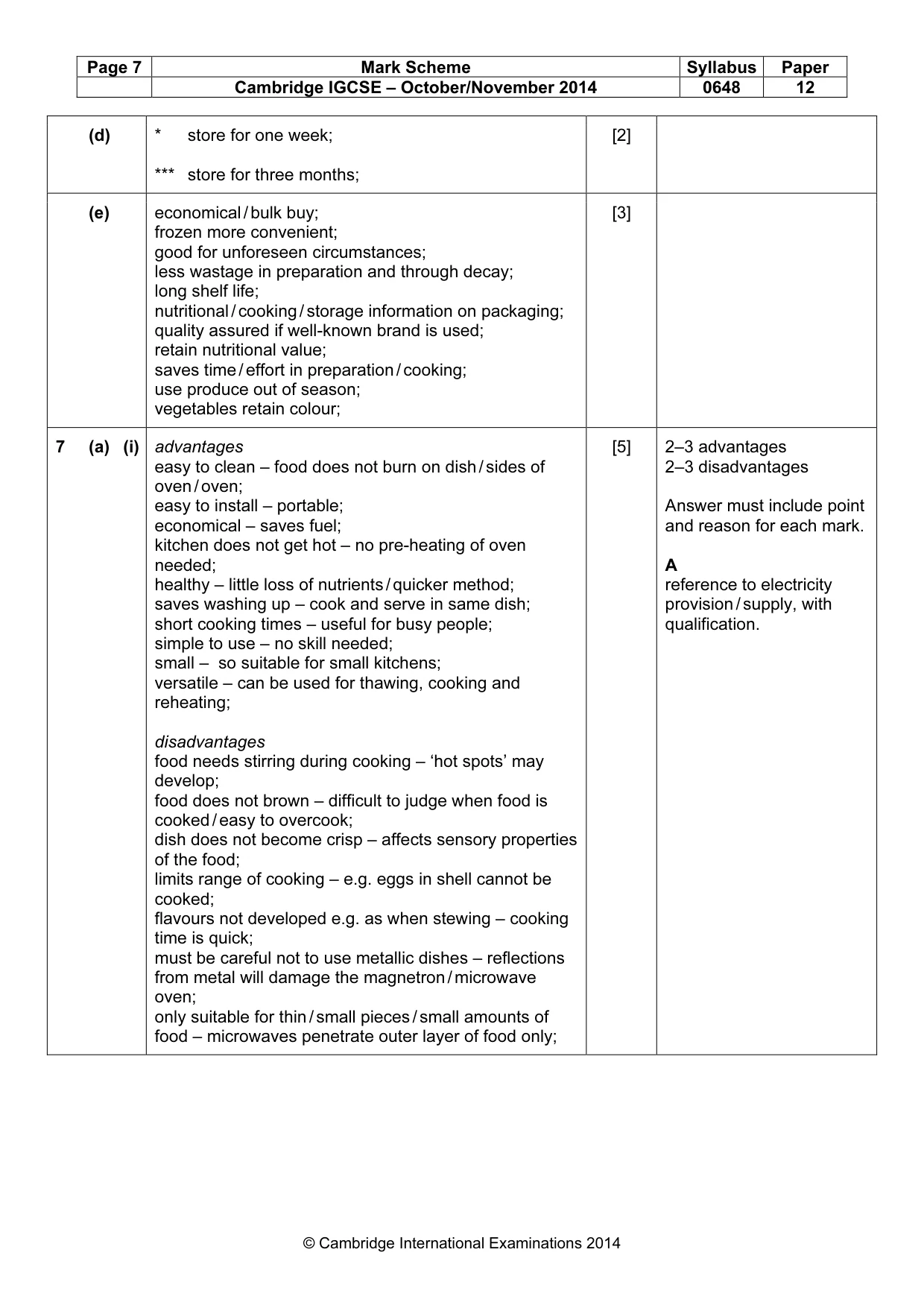
Page 6 Mark Scheme Syllabus Paper Cambridge IGCSE – October/November 2014 0648 12 © Cambridge International Examinations 2014 Section B 6 (a) bulb – e.g. onion / shallot / garlic / leek; flower – e.g. cauliflower / broccoli; fruit – e.g. tomato / cucumber / peppers / corn on the cob / courgette; fungi – e.g. mushrooms; leaf – e.g. cabbage / lettuce / spinach / pak choi / watercress / sawi; pods – e.g. mange tout / French beans / runner beans / okra; root – e.g. carrot / beetroot / parsnip / turnip / radish; seeds – e.g. peas / broad beans / bean sprouts; stem – e.g. celery / asparagus; tuber – e.g. potato / sweet potato / Jerusalem artichoke / yam; [5] Answer must include an example for each mark. (b) calcium plus function; carbohydrate plus function; HBV / LBV protein plus function; iron plus function; low fat plus health benefit; NSP plus function; provide colour / flavour / texture / can be eaten raw or cooked; variety of dishes – soup / drinks / salads / accompaniments; vitamin A plus function; vitamin B plus function; vitamin C plus function; water plus function; [5] Answer must include point and reason / function for each mark. (c) use peas in best condition – so less chance of decay / wastage; check for foreign bodies – wash to remove soil / bacteria / pests; blanch / plunge into boiling water – to destroy enzymes and bacteria; immerse into ice-cold water – to cool down quickly / out of the danger zone; pat dry – to prevent clumping; open freeze – so remain individual when required; place into container / freezer bag and seal – remove air which may contain bacteria; label the peas – to identify; [4] Answer must include step and reason for each mark.
Mark scheme, page 7
Page 7 Mark Scheme Syllabus Paper Cambridge IGCSE – October/November 2014 0648 12 © Cambridge International Examinations 2014 (d) * store for one week; *** store for three months; [2] (e) economical / bulk buy; frozen more convenient; good for unforeseen circumstances; less wastage in preparation and through decay; long shelf life; nutritional / cooking / storage information on packaging; quality assured if well-known brand is used; retain nutritional value; saves time / effort in preparation / cooking; use produce out of season; vegetables retain colour; [3] 7 (a) (i) advantages easy to clean – food does not burn on dish / sides of oven / oven; easy to install – portable; economical – saves fuel; kitchen does not get hot – no pre-heating of oven needed; healthy – little loss of nutrients / quicker method; saves washing up – cook and serve in same dish; short cooking times – useful for busy people; simple to use – no skill needed; small – so suitable for small kitchens; versatile – can be used for thawing, cooking and reheating; disadvantages food needs stirring during cooking – ‘hot spots’ may develop; food does not brown – difficult to judge when food is cooked / easy to overcook; dish does not become crisp – affects sensory properties of the food; limits range of cooking – e.g. eggs in shell cannot be cooked; flavours not developed e.g. as when stewing – cooking time is quick; must be careful not to use metallic dishes – reflections from metal will damage the magnetron / microwave oven; only suitable for thin / small pieces / small amounts of food – microwaves penetrate outer layer of food only; [5] 2–3 advantages 2–3 disadvantages Answer must include point and reason for each mark. A reference to electricity provision / supply, with qualification.
Mark scheme, page 8
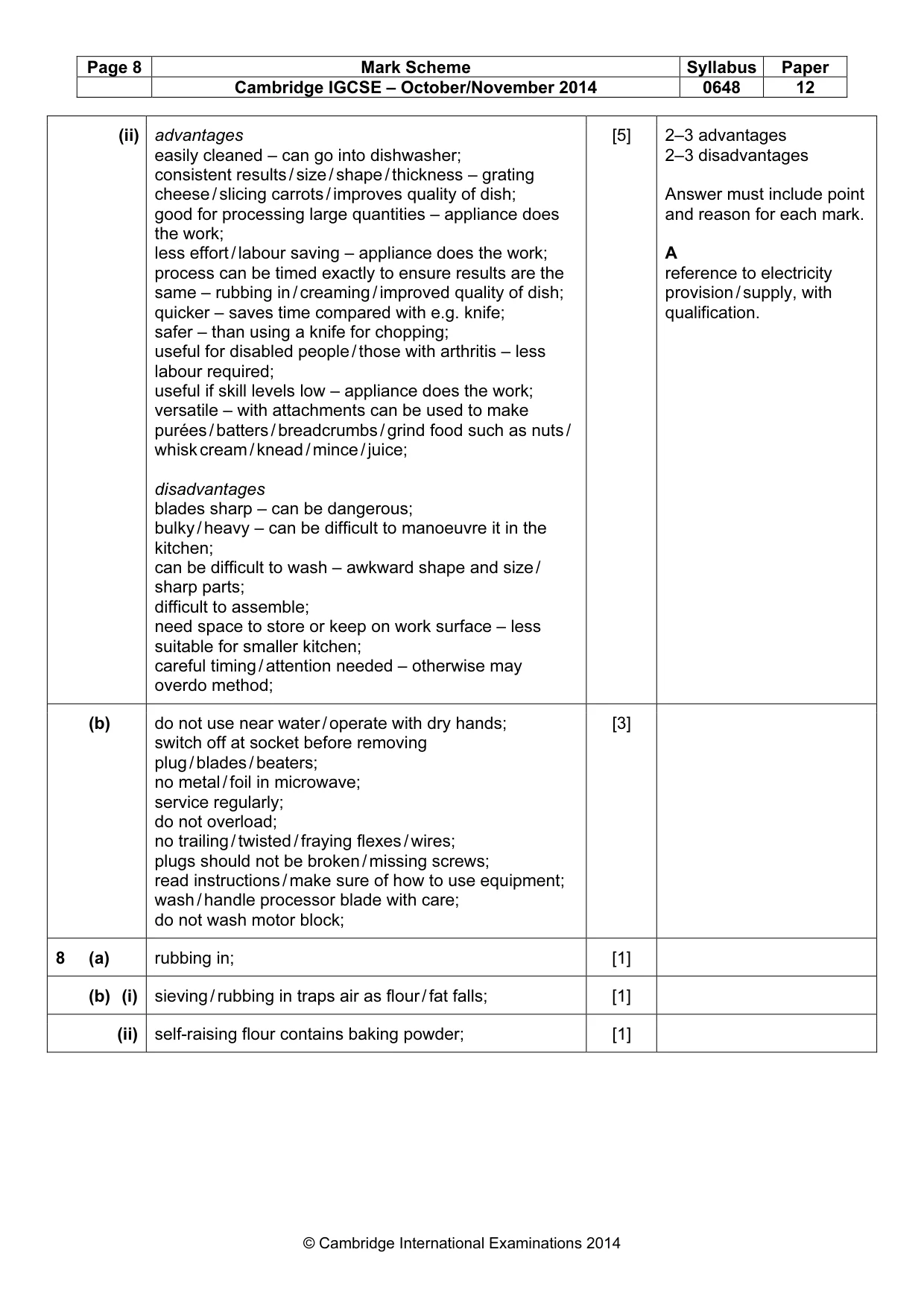
Page 8 Mark Scheme Syllabus Paper Cambridge IGCSE – October/November 2014 0648 12 © Cambridge International Examinations 2014 (ii) advantages easily cleaned – can go into dishwasher; consistent results / size / shape / thickness – grating cheese / slicing carrots / improves quality of dish; good for processing large quantities – appliance does the work; less effort / labour saving – appliance does the work; process can be timed exactly to ensure results are the same – rubbing in / creaming / improved quality of dish; quicker – saves time compared with e.g. knife; safer – than using a knife for chopping; useful for disabled people / those with arthritis – less labour required; useful if skill levels low – appliance does the work; versatile – with attachments can be used to make purées / batters / breadcrumbs / grind food such as nuts / whisk cream / knead / mince / juice; disadvantages blades sharp – can be dangerous; bulky / heavy – can be difficult to manoeuvre it in the kitchen; can be difficult to wash – awkward shape and size / sharp parts; difficult to assemble; need space to store or keep on work surface – less suitable for smaller kitchen; careful timing / attention needed – otherwise may overdo method; [5] 2–3 advantages 2–3 disadvantages Answer must include point and reason for each mark. A reference to electricity provision / supply, with qualification. (b) do not use near water / operate with dry hands; switch off at socket before removing plug / blades / beaters; no metal / foil in microwave; service regularly; do not overload; no trailing / twisted / fraying flexes / wires; plugs should not be broken / missing screws; read instructions / make sure of how to use equipment; wash / handle processor blade with care; do not wash motor block; [3] 8 (a) rubbing in; [1] (b) (i) sieving / rubbing in traps air as flour / fat falls; [1] (ii) self-raising flour contains baking powder; [1]
Mark scheme, page 9
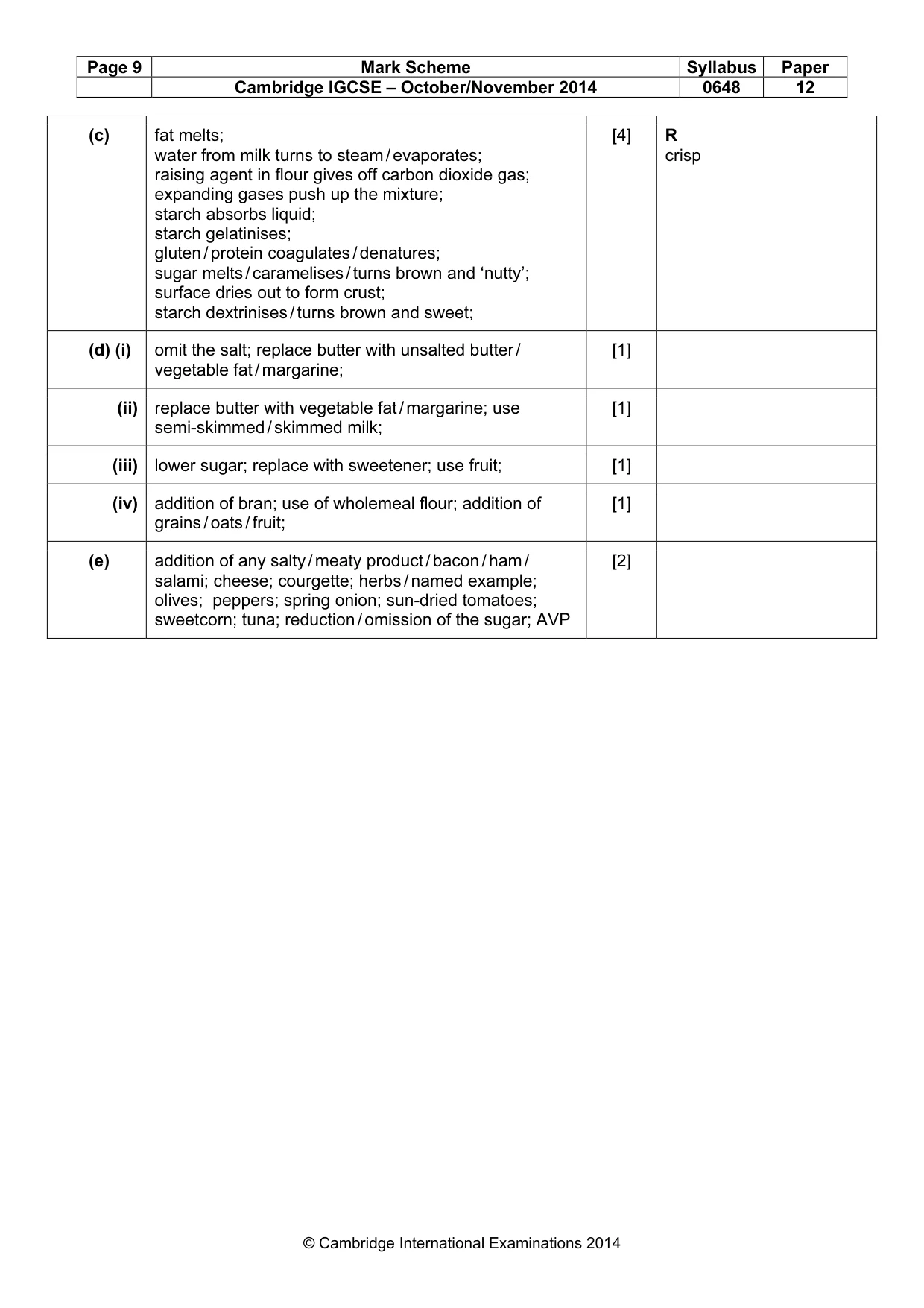
Page 9 Mark Scheme Syllabus Paper Cambridge IGCSE – October/November 2014 0648 12 © Cambridge International Examinations 2014 (c) fat melts; water from milk turns to steam / evaporates; raising agent in flour gives off carbon dioxide gas; expanding gases push up the mixture; starch absorbs liquid; starch gelatinises; gluten / protein coagulates / denatures; sugar melts / caramelises / turns brown and ‘nutty’; surface dries out to form crust; starch dextrinises / turns brown and sweet; [4] R crisp (d) (i) omit the salt; replace butter with unsalted butter / vegetable fat / margarine; [1] (ii) replace butter with vegetable fat / margarine; use semi-skimmed / skimmed milk; [1] (iii) lower sugar; replace with sweetener; use fruit; [1] (iv) addition of bran; use of wholemeal flour; addition of grains / oats / fruit; [1] (e) addition of any salty / meaty product / bacon / ham / salami; cheese; courgette; herbs / named example; olives; peppers; spring onion; sun-dried tomatoes; sweetcorn; tuna; reduction / omission of the sugar; AVP [2]
Mark scheme, page 10
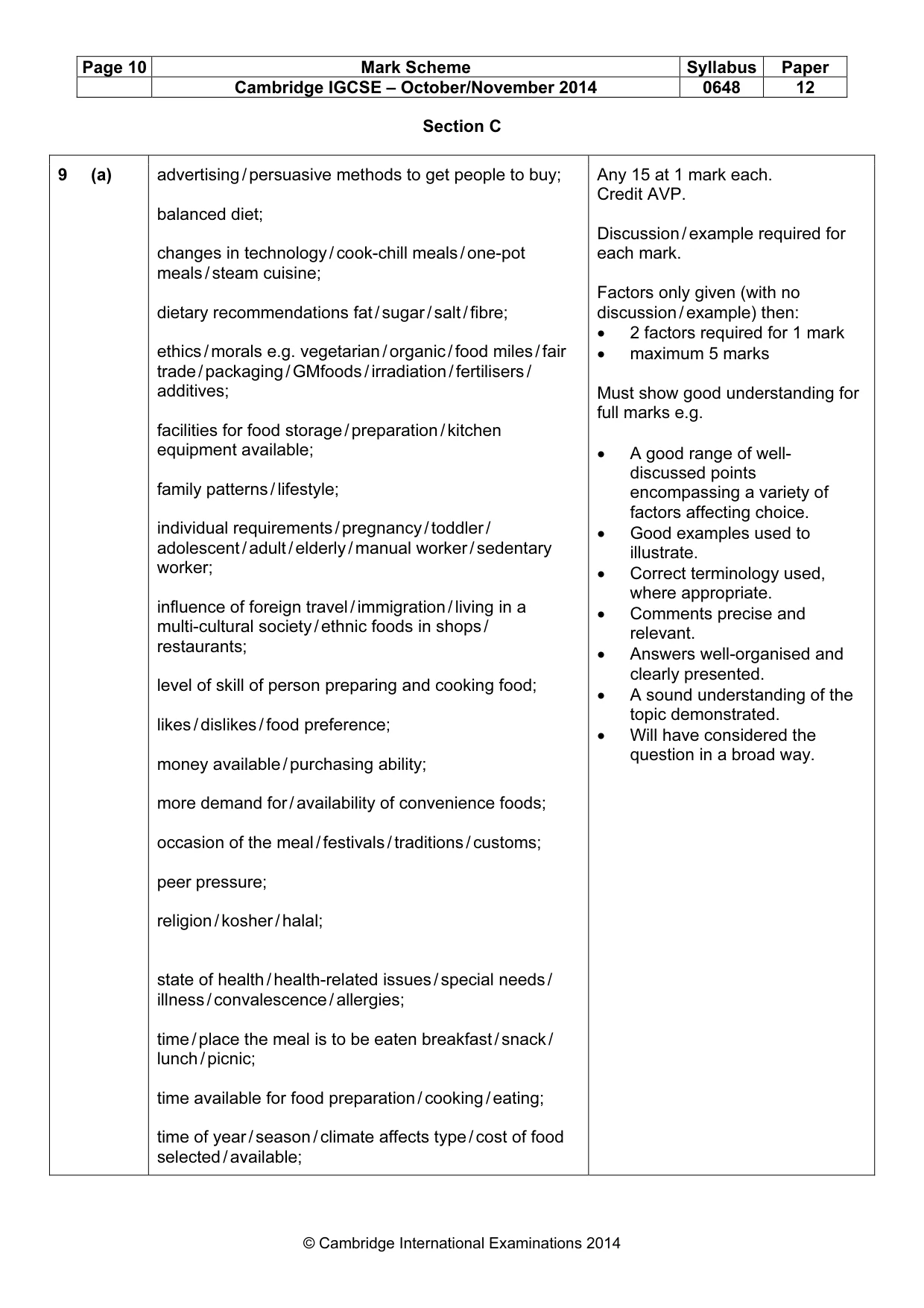
Page 10 Mark Scheme Syllabus Paper Cambridge IGCSE – October/November 2014 0648 12 © Cambridge International Examinations 2014 Section C 9 (a) advertising / persuasive methods to get people to buy; balanced diet; changes in technology / cook-chill meals / one-pot meals / steam cuisine; dietary recommendations fat / sugar / salt / fibre; ethics / morals e.g. vegetarian / organic / food miles / fair trade / packaging / GMfoods / irradiation / fertilisers / additives; facilities for food storage / preparation / kitchen equipment available; family patterns / lifestyle; individual requirements / pregnancy / toddler / adolescent / adult / elderly / manual worker / sedentary worker; influence of foreign travel / immigration / living in a multi-cultural society / ethnic foods in shops / restaurants; level of skill of person preparing and cooking food; likes / dislikes / food preference; money available / purchasing ability; more demand for / availability of convenience foods; occasion of the meal / festivals / traditions / customs; peer pressure; religion / kosher / halal; state of health / health-related issues / special needs / illness / convalescence / allergies; time / place the meal is to be eaten breakfast / snack / lunch / picnic; time available for food preparation / cooking / eating; time of year / season / climate affects type / cost of food selected / available; Any 15 at 1 mark each. Credit AVP. Discussion / example required for each mark. Factors only given (with no discussion / example) then: • 2 factors required for 1 mark • maximum 5 marks Must show good understanding for full marks e.g. • A good range of well- discussed points encompassing a variety of factors affecting choice. • Good examples used to illustrate. • Correct terminology used, where appropriate. • Comments precise and relevant. • Answers well-organised and clearly presented. • A sound understanding of the topic demonstrated. • Will have considered the question in a broad way.
Mark scheme, page 11
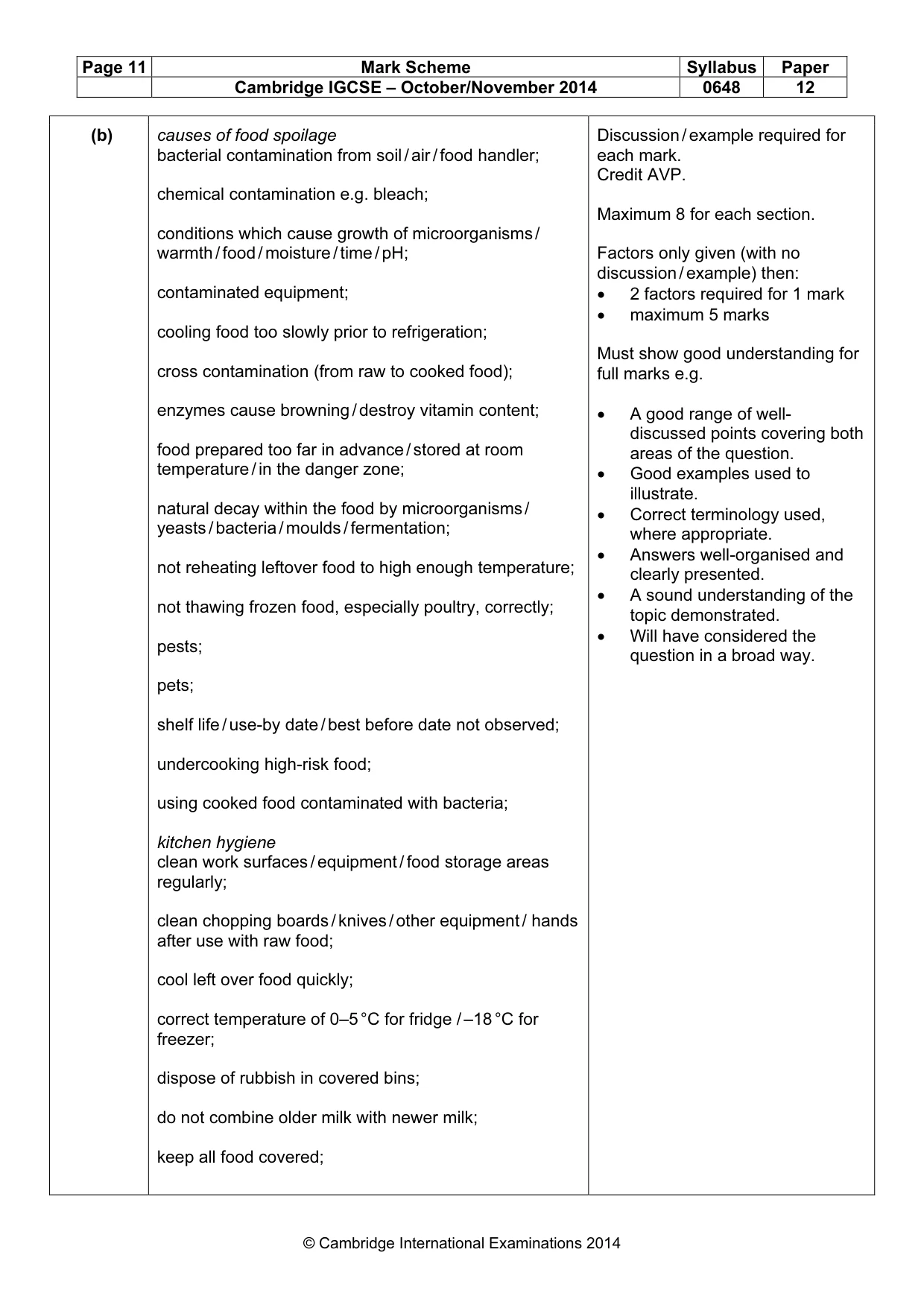
Page 11 Mark Scheme Syllabus Paper Cambridge IGCSE – October/November 2014 0648 12 © Cambridge International Examinations 2014 (b) causes of food spoilage bacterial contamination from soil / air / food handler; chemical contamination e.g. bleach; conditions which cause growth of microorganisms / warmth / food / moisture / time / pH; contaminated equipment; cooling food too slowly prior to refrigeration; cross contamination (from raw to cooked food); enzymes cause browning / destroy vitamin content; food prepared too far in advance / stored at room temperature / in the danger zone; natural decay within the food by microorganisms / yeasts / bacteria / moulds / fermentation; not reheating leftover food to high enough temperature; not thawing frozen food, especially poultry, correctly; pests; pets; shelf life / use-by date / best before date not observed; undercooking high-risk food; using cooked food contaminated with bacteria; kitchen hygiene clean work surfaces / equipment / food storage areas regularly; clean chopping boards / knives / other equipment / hands after use with raw food; cool left over food quickly; correct temperature of 0–5 °C for fridge / –18 °C for freezer; dispose of rubbish in covered bins; do not combine older milk with newer milk; keep all food covered; Discussion / example required for each mark. Credit AVP. Maximum 8 for each section. Factors only given (with no discussion / example) then: • 2 factors required for 1 mark • maximum 5 marks Must show good understanding for full marks e.g. • A good range of well- discussed points covering both areas of the question. • Good examples used to illustrate. • Correct terminology used, where appropriate. • Answers well-organised and clearly presented. • A sound understanding of the topic demonstrated. • Will have considered the question in a broad way.
Mark scheme, page 12
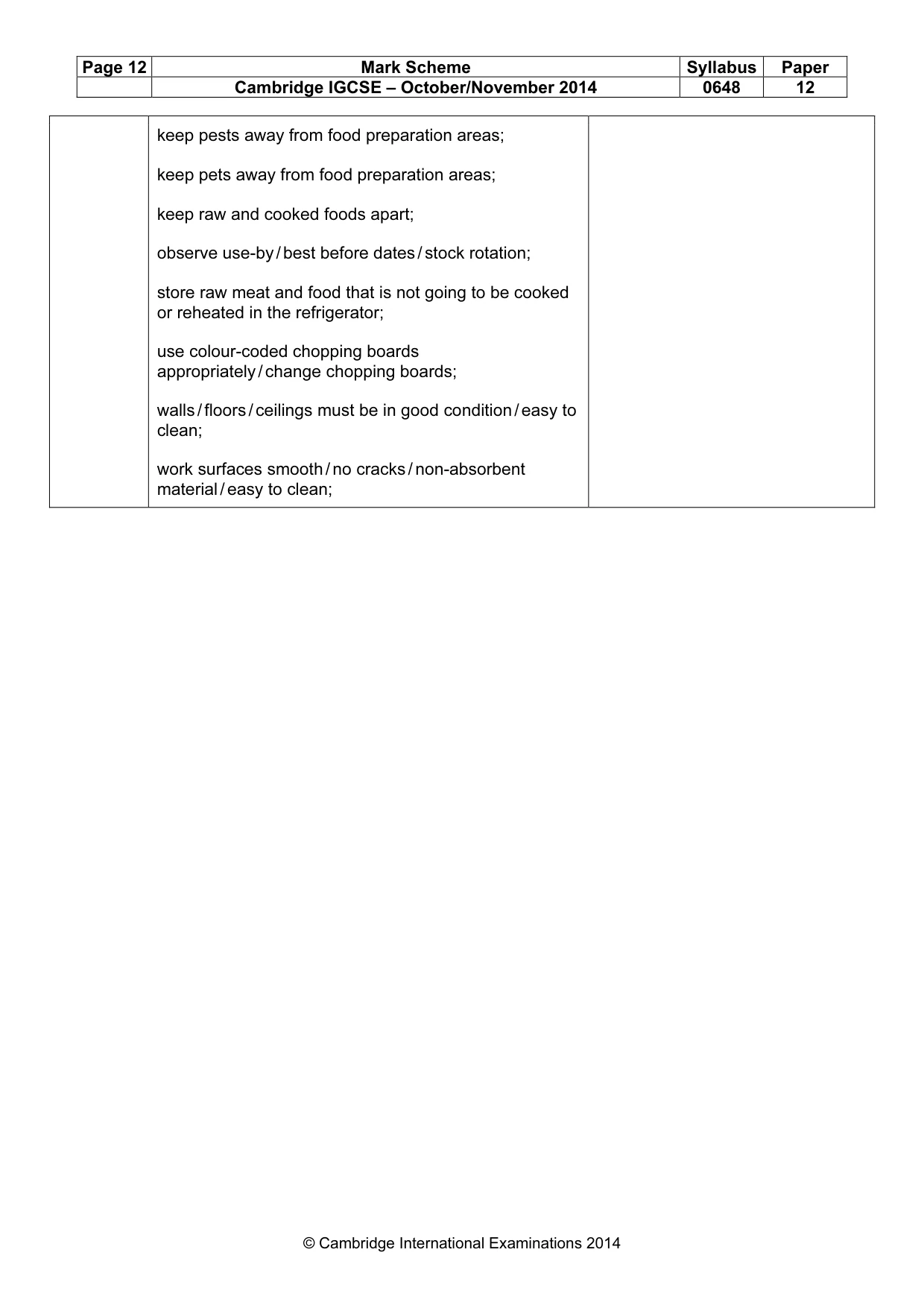
Page 12 Mark Scheme Syllabus Paper Cambridge IGCSE – October/November 2014 0648 12 © Cambridge International Examinations 2014 keep pests away from food preparation areas; keep pets away from food preparation areas; keep raw and cooked foods apart; observe use-by / best before dates / stock rotation; store raw meat and food that is not going to be cooked or reheated in the refrigerator; use colour-coded chopping boards appropriately / change chopping boards; walls / floors / ceilings must be in good condition / easy to clean; work surfaces smooth / no cracks / non-absorbent material / easy to clean;
What you needed in this session
Cambridge’s own grade thresholds for 2014 Oct/Nov, Paper 1 · Variant 2. A higher threshold means an easier paper — the bar moves with how the cohort did.