Cambridge IGCSE Food and Nutrition 0648 — 2013 Oct/Nov Paper 1 · Variant 2
0648/12/O/N/13 · 100 marks · ≈113 min
The question paper and its mark scheme, free to read here and free to download. This is Cambridge’s own paper, exactly as it was sat.
Question paper16 pages

Mark scheme12 pages
Answers below. Sit the paper first if you are practising.
Paper as text
Question paper, page 1
This document consists of 15 printed pages and 1 blank page. DC (SJW) 80962 © UCLES 2013 [Turn over * 2 1 7 6 9 0 3 0 9 5 * UNIVERSITY OF CAMBRIDGE INTERNATIONAL EXAMINATIONS International General Certificate of Secondary Education FOOD AND NUTRITION 0648/12 Paper 1 Theory October/November 2013 2 hours Candidates answer on the Question Paper. No Additional Materials are required. READ THESE INSTRUCTIONS FIRST Write your Centre number, candidate number and name on all the work you hand in. Write in dark blue or black ink. You may use a soft pencil for any diagrams or graphs. Do not use staples, paper clips, highlighters, glue or correction fluid. DO NOT WRITE IN ANY BARCODES. Section A Answer all questions. You are advised to spend no longer than 45 minutes on Section A. Section B Answer all questions. Section C Answer either Question 10(a) or 10(b). At the end of the examination, fasten all your work securely together. The number of marks is given in brackets [ ] at the end of each question or part question. www.XtremePapers.com
Question paper, page 2
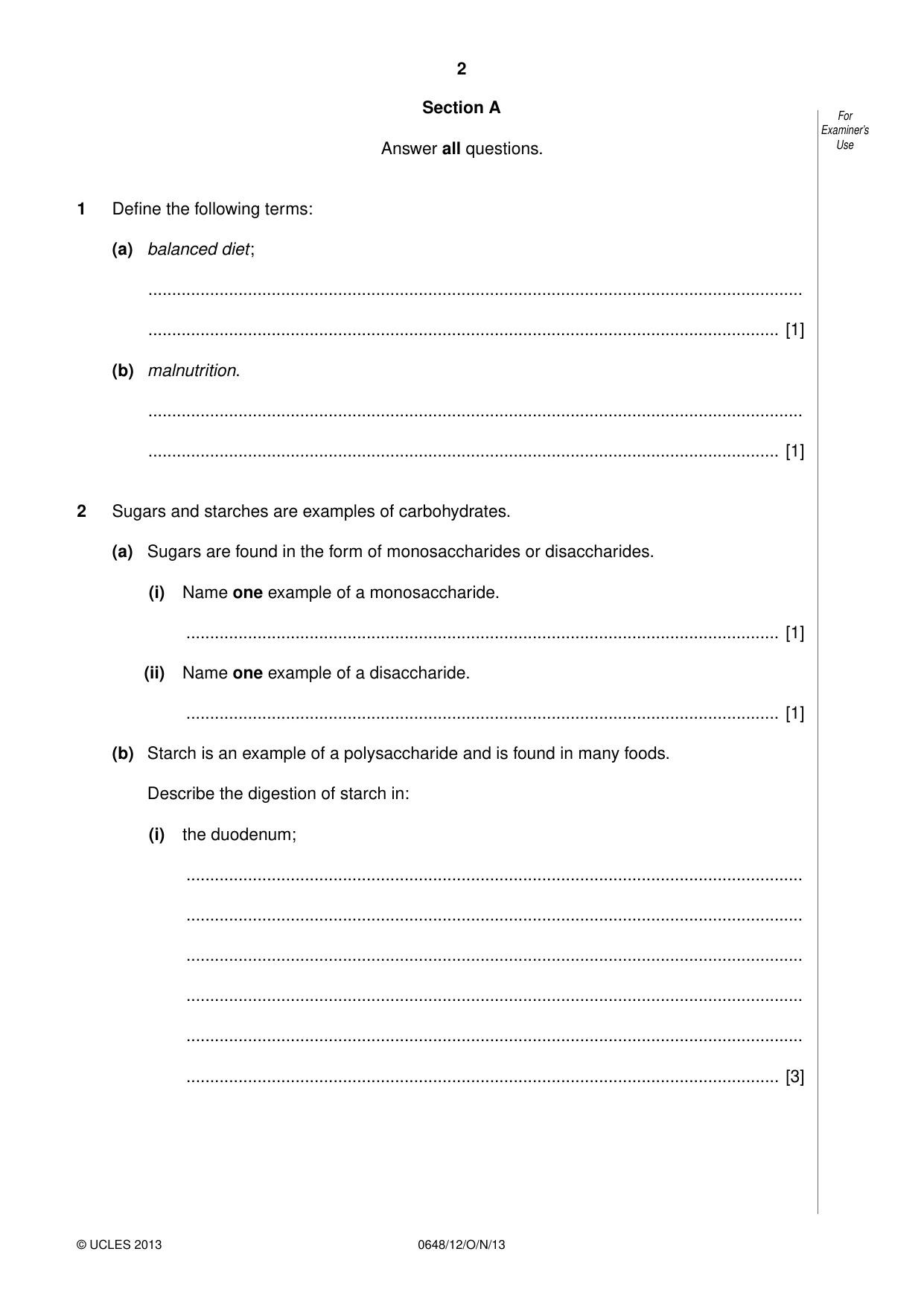
2 0648/12/O/N/13 © UCLES 2013 For Examiner’s Use Section A Answer all questions. 1 Define the following terms: (a) balanced diet; … … [1] (b) malnutrition. … … [1] 2 Sugars and starches are examples of carbohydrates. (a) Sugars are found in the form of monosaccharides or disaccharides. (i) Name one example of a monosaccharide. … [1] (ii) Name one example of a disaccharide. … [1] (b) Starch is an example of a polysaccharide and is found in many foods. Describe the digestion of starch in: (i) the duodenum; … … … … … … [3]
Question paper, page 3
3 0648/12/O/N/13 © UCLES 2013 [Turn over For Examiner’s Use (ii) the ileum. … … … … … … [3] (c) Explain how the end products of the digestion of starch are used to release energy. … … … … … … [3]
Question paper, page 4
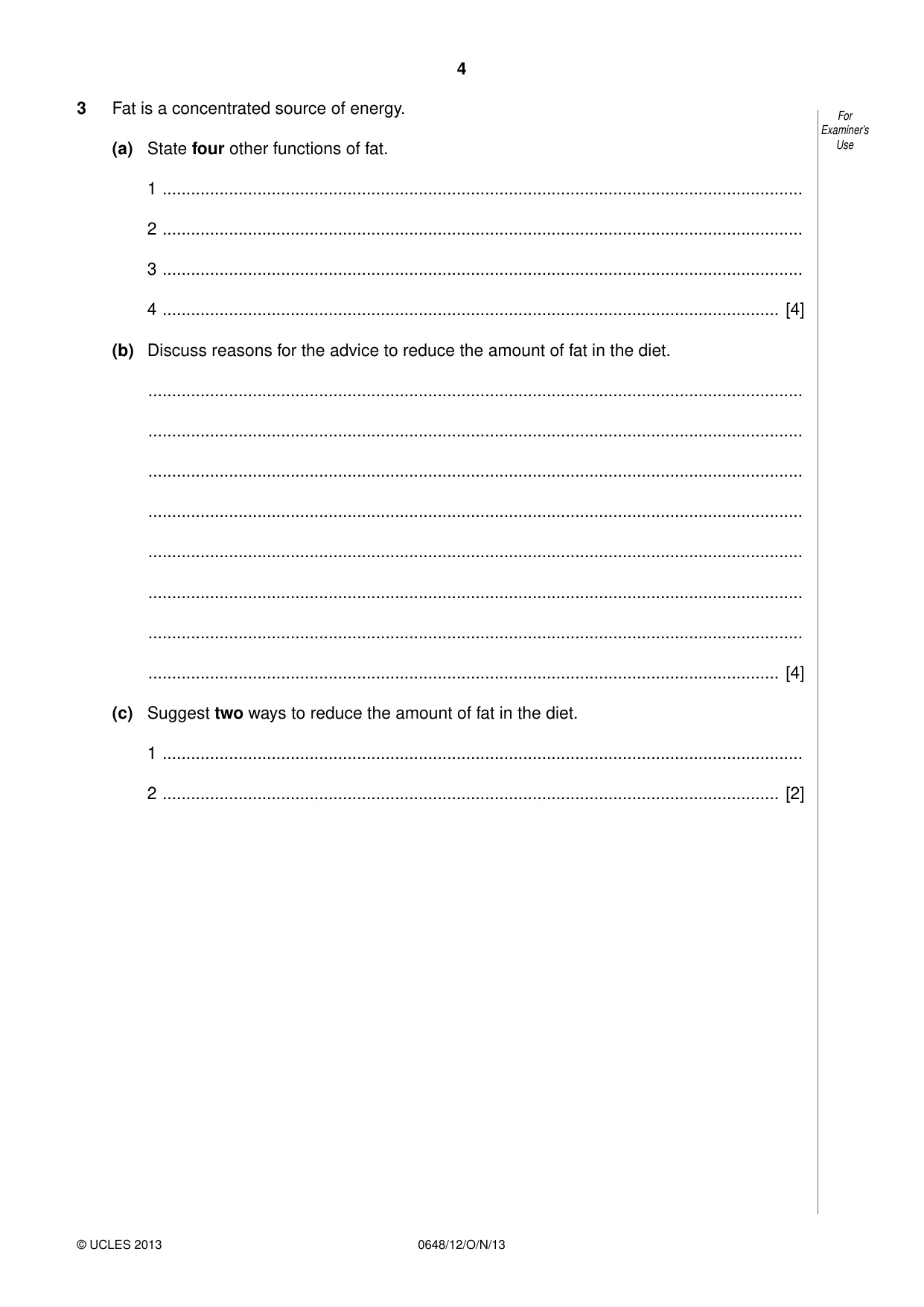
4 0648/12/O/N/13 © UCLES 2013 For Examiner’s Use 3 Fat is a concentrated source of energy. (a) State four other functions of fat. 1 … 2 … 3 … 4 … [4] (b) Discuss reasons for the advice to reduce the amount of fat in the diet. … … … … … … … … [4] (c) Suggest two ways to reduce the amount of fat in the diet. 1 … 2 … [2]
Question paper, page 5
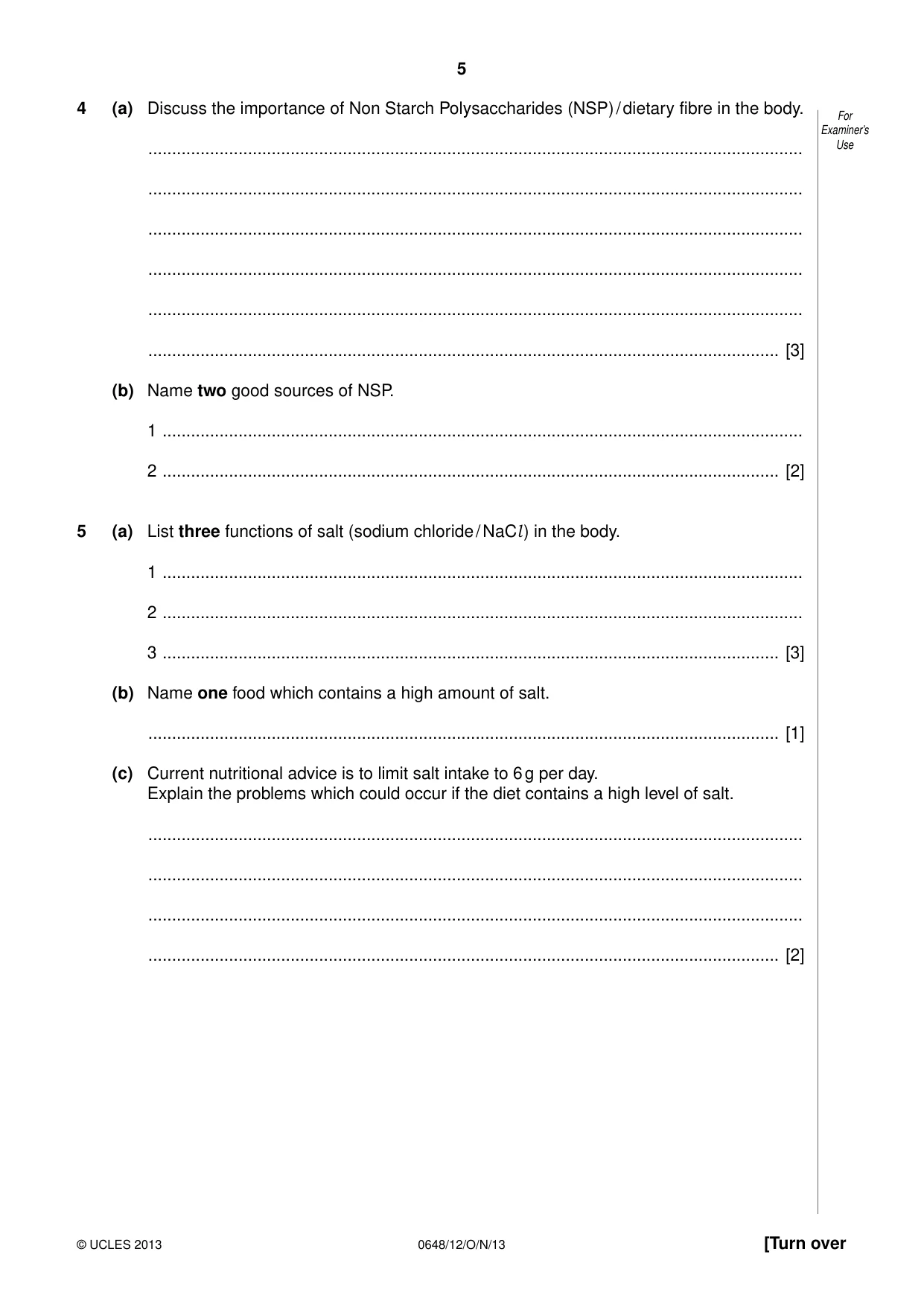
5 0648/12/O/N/13 © UCLES 2013 [Turn over For Examiner’s Use 4 (a) Discuss the importance of Non Starch Polysaccharides (NSP) / dietary fibre in the body. … … … … … … [3] (b) Name two good sources of NSP. 1 … 2 … [2] 5 (a) List three functions of salt (sodium chloride / NaCl) in the body. 1 … 2 … 3 … [3] (b) Name one food which contains a high amount of salt. … [1] (c) Current nutritional advice is to limit salt intake to 6 g per day. Explain the problems which could occur if the diet contains a high level of salt. … … … … [2]
Question paper, page 6
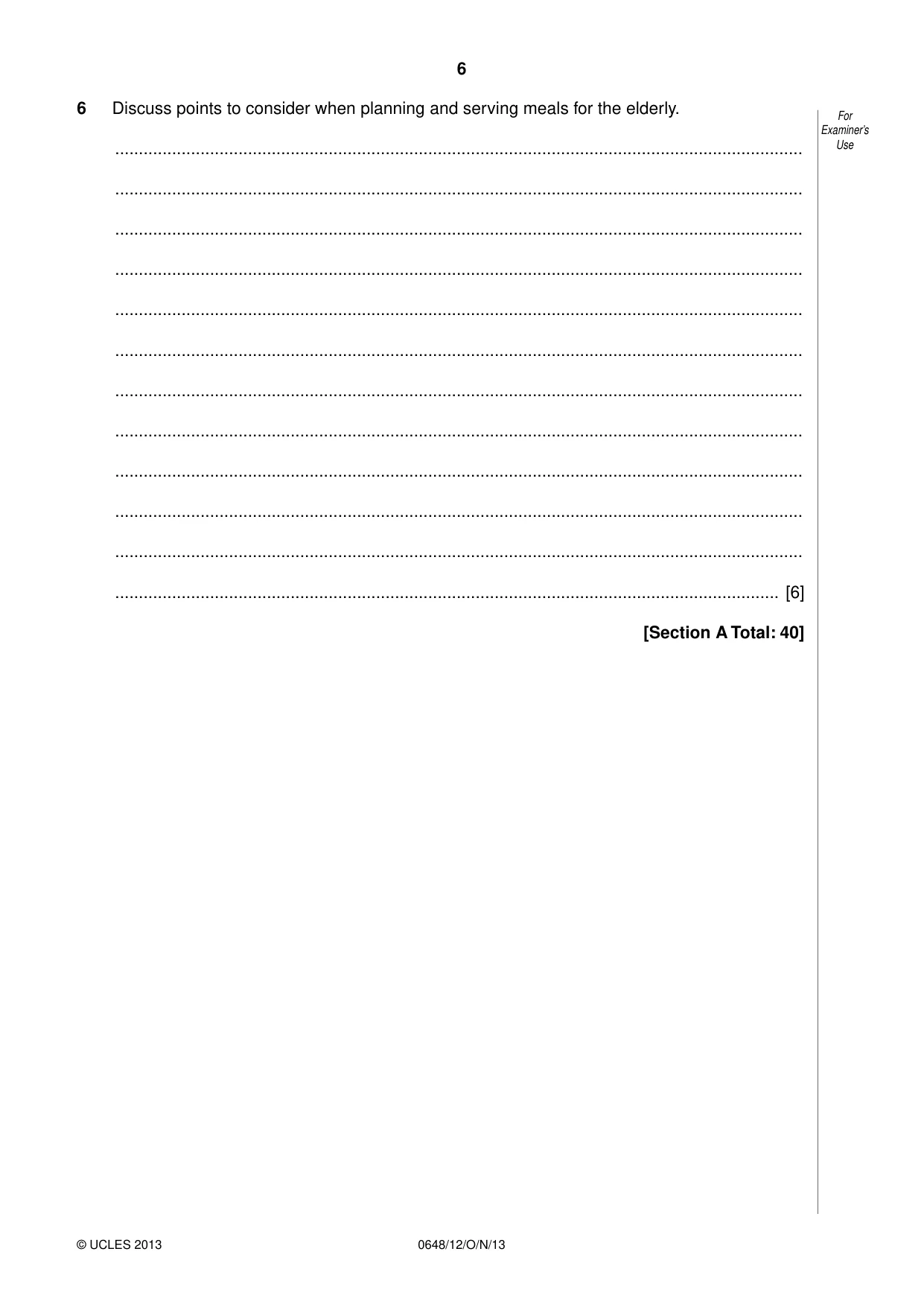
6 0648/12/O/N/13 © UCLES 2013 For Examiner’s Use 6 Discuss points to consider when planning and serving meals for the elderly. … … … … … … … … … … … … [6] [Section A Total: 40]
Question paper, page 7
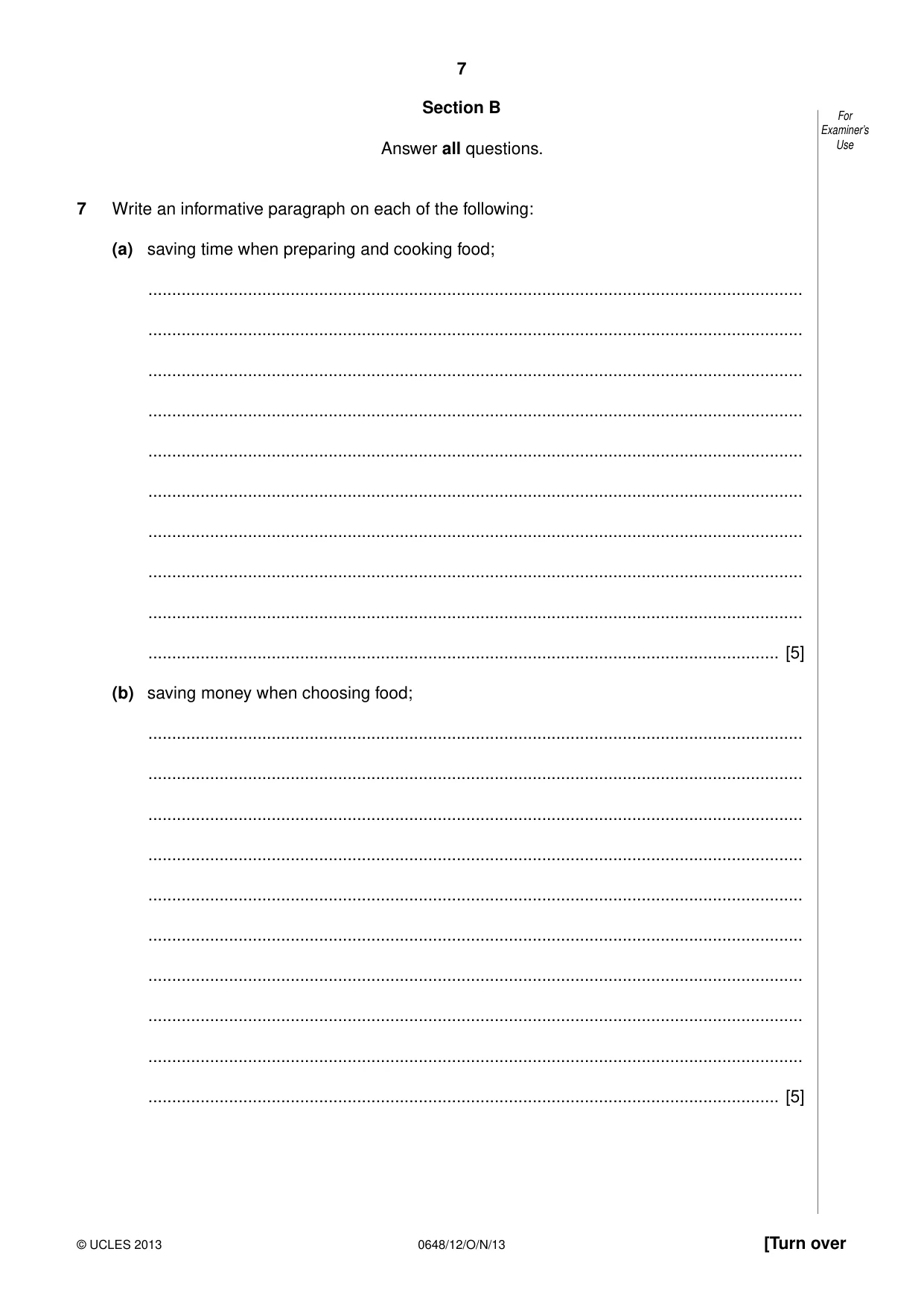
7 0648/12/O/N/13 © UCLES 2013 [Turn over For Examiner’s Use Section B Answer all questions. 7 Write an informative paragraph on each of the following: (a) saving time when preparing and cooking food; … … … … … … … … … … [5] (b) saving money when choosing food; … … … … … … … … … … [5]
Question paper, page 8
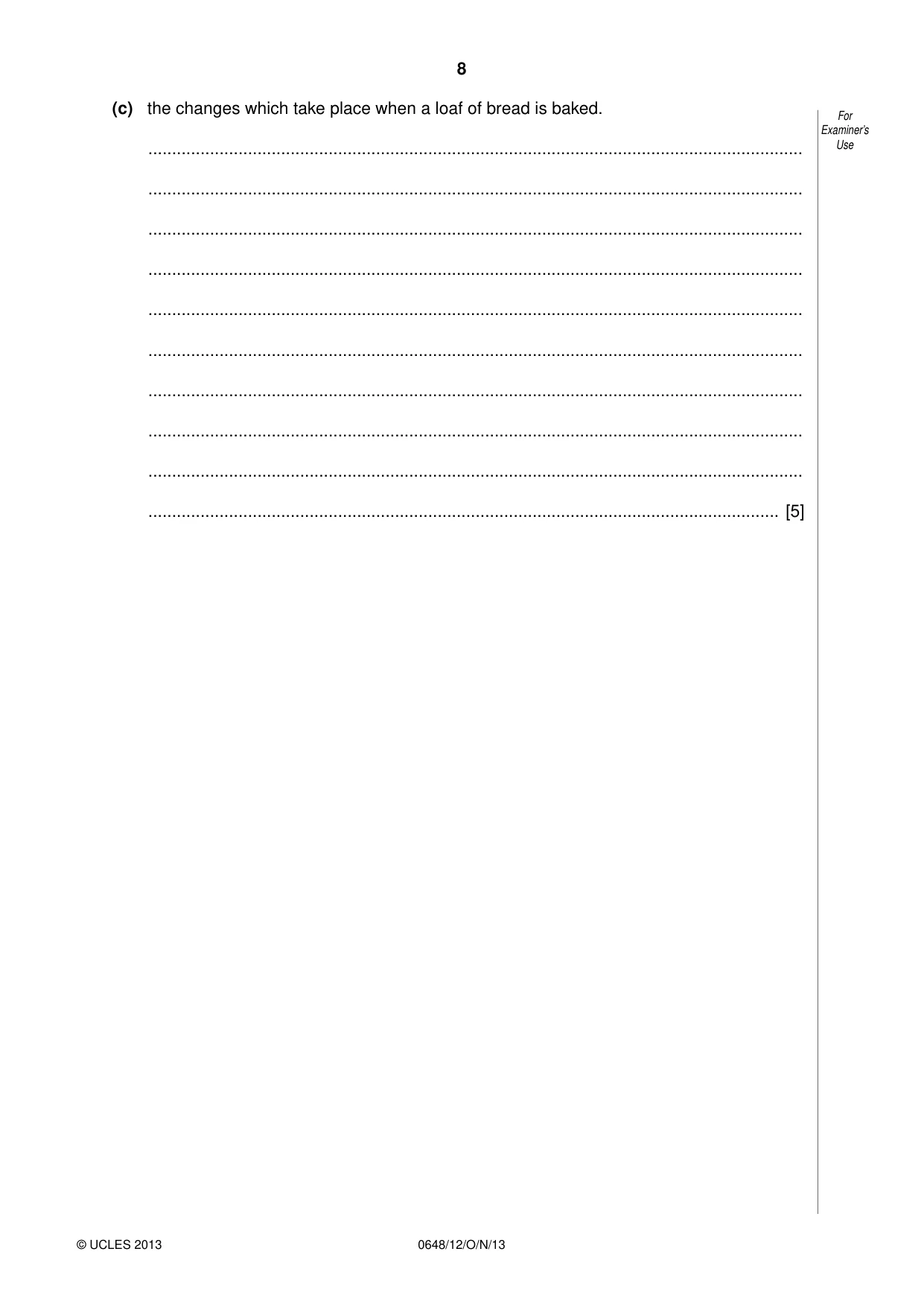
8 0648/12/O/N/13 © UCLES 2013 For Examiner’s Use (c) the changes which take place when a loaf of bread is baked. … … … … … … … … … … [5]
Question paper, page 9
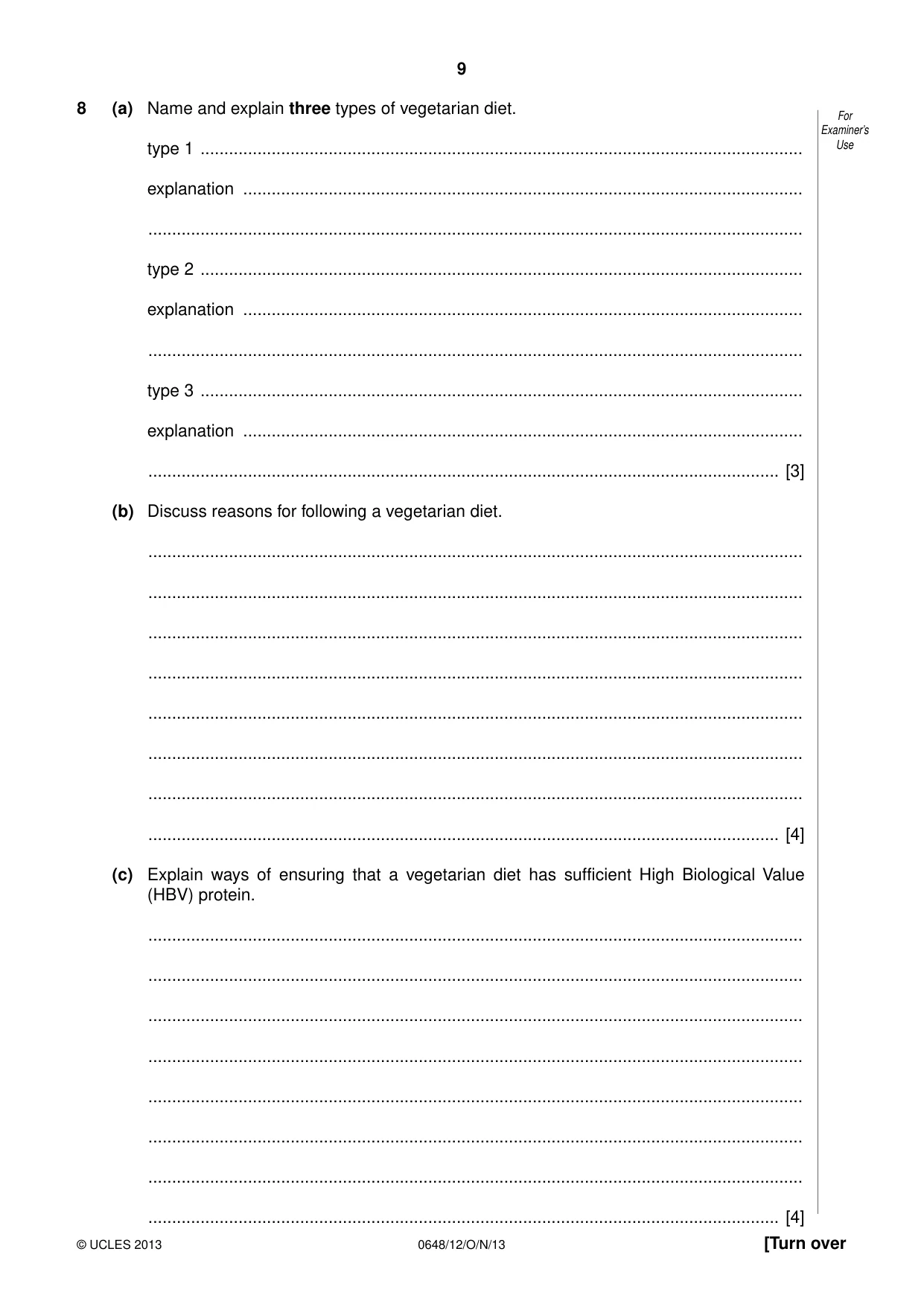
9 0648/12/O/N/13 © UCLES 2013 [Turn over For Examiner’s Use 8 (a) Name and explain three types of vegetarian diet. type 1 … explanation … … type 2 … explanation … … type 3 … explanation … … [3] (b) Discuss reasons for following a vegetarian diet. … … … … … … … … [4] (c) Explain ways of ensuring that a vegetarian diet has sufficient High Biological Value (HBV) protein. … … … … … … … … [4]
Question paper, page 10
10 0648/12/O/N/13 © UCLES 2013 For Examiner’s Use (d) Discuss problems, other than insufficient HBV protein, which may occur for those following a vegetarian diet. … … … … … … … … [4]
Question paper, page 11
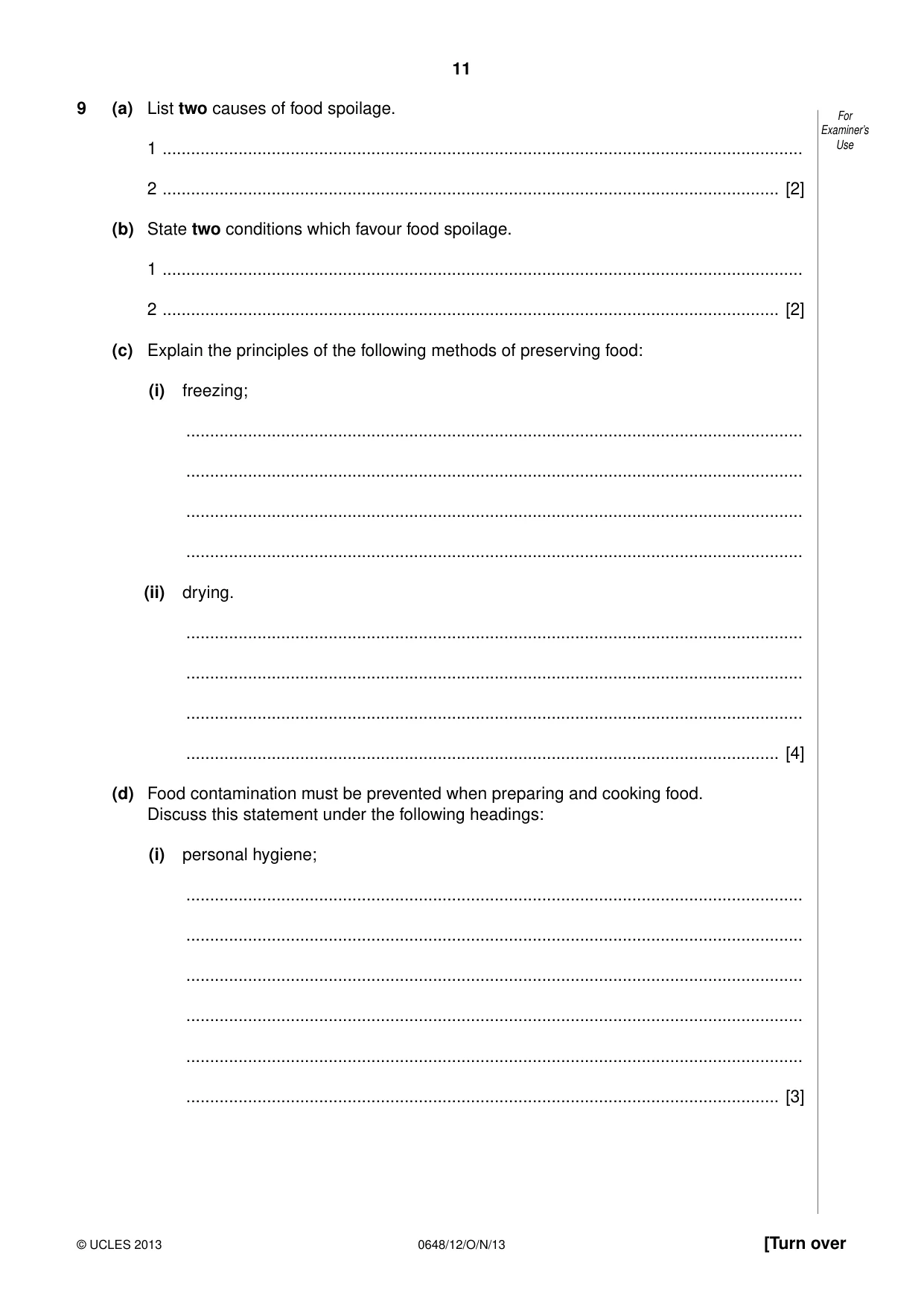
11 0648/12/O/N/13 © UCLES 2013 [Turn over For Examiner’s Use 9 (a) List two causes of food spoilage. 1 … 2 … [2] (b) State two conditions which favour food spoilage. 1 … 2 … [2] (c) Explain the principles of the following methods of preserving food: (i) freezing; … … … … (ii) drying. … … … … [4] (d) Food contamination must be prevented when preparing and cooking food. Discuss this statement under the following headings: (i) personal hygiene; … … … … … … [3]
Question paper, page 12
12 0648/12/O/N/13 © UCLES 2013 For Examiner’s Use (ii) kitchen hygiene. … … … … … … … … [4] [Section B Total: 45]
Question paper, page 13
13 0648/12/O/N/13 © UCLES 2013 [Turn over For Examiner’s Use Section C Answer either 10(a) or 10(b). Either 10 (a) Discuss the importance of vegetables in the diet and suggest ways in which they could be used in the preparation of family meals. [15] Or 10 (b) Discuss the information which could be found on a food label and state why the information is important. [15] … … … … … … … … … … … … … … … … … … … … …
Question paper, page 14
14 0648/12/O/N/13 © UCLES 2013 For Examiner’s Use … … … … … … … … … … … … … … … … … … … … … … … … … … … …
Question paper, page 15
15 0648/12/O/N/13 © UCLES 2013 For Examiner’s Use … … … … … … … … … … … … … … … … … … … … … … … … … … [Section C Total: 15] [Total for Paper: 100]
Question paper, page 16
16 0648/12/O/N/13 © UCLES 2013 Permission to reproduce items where third-party owned material protected by copyright is included has been sought and cleared where possible. Every reasonable effort has been made by the publisher (UCLES) to trace copyright holders, but if any items requiring clearance have unwittingly been included, the publisher will be pleased to make amends at the earliest possible opportunity. University of Cambridge International Examinations is part of the Cambridge Assessment Group. Cambridge Assessment is the brand name of University of Cambridge Local Examinations Syndicate (UCLES), which is itself a department of the University of Cambridge. BLANK PAGE
Mark scheme, page 1
CAMBRIDGE INTERNATIONAL EXAMINATIONS International General Certificate of Secondary Education MARK SCHEME for the October/November 2013 series 0648 FOOD AND NUTRITION 0648/12 Paper 1 (Theory), maximum raw mark 100 This mark scheme is published as an aid to teachers and candidates, to indicate the requirements of the examination. It shows the basis on which Examiners were instructed to award marks. It does not indicate the details of the discussions that took place at an Examiners’ meeting before marking began, which would have considered the acceptability of alternative answers. Mark schemes should be read in conjunction with the question paper and the Principal Examiner Report for Teachers. Cambridge will not enter into discussions about these mark schemes. Cambridge is publishing the mark schemes for the October/November 2013 series for most IGCSE, GCE Advanced Level and Advanced Subsidiary Level components and some Ordinary Level components. www.XtremePapers.com
Mark scheme, page 2
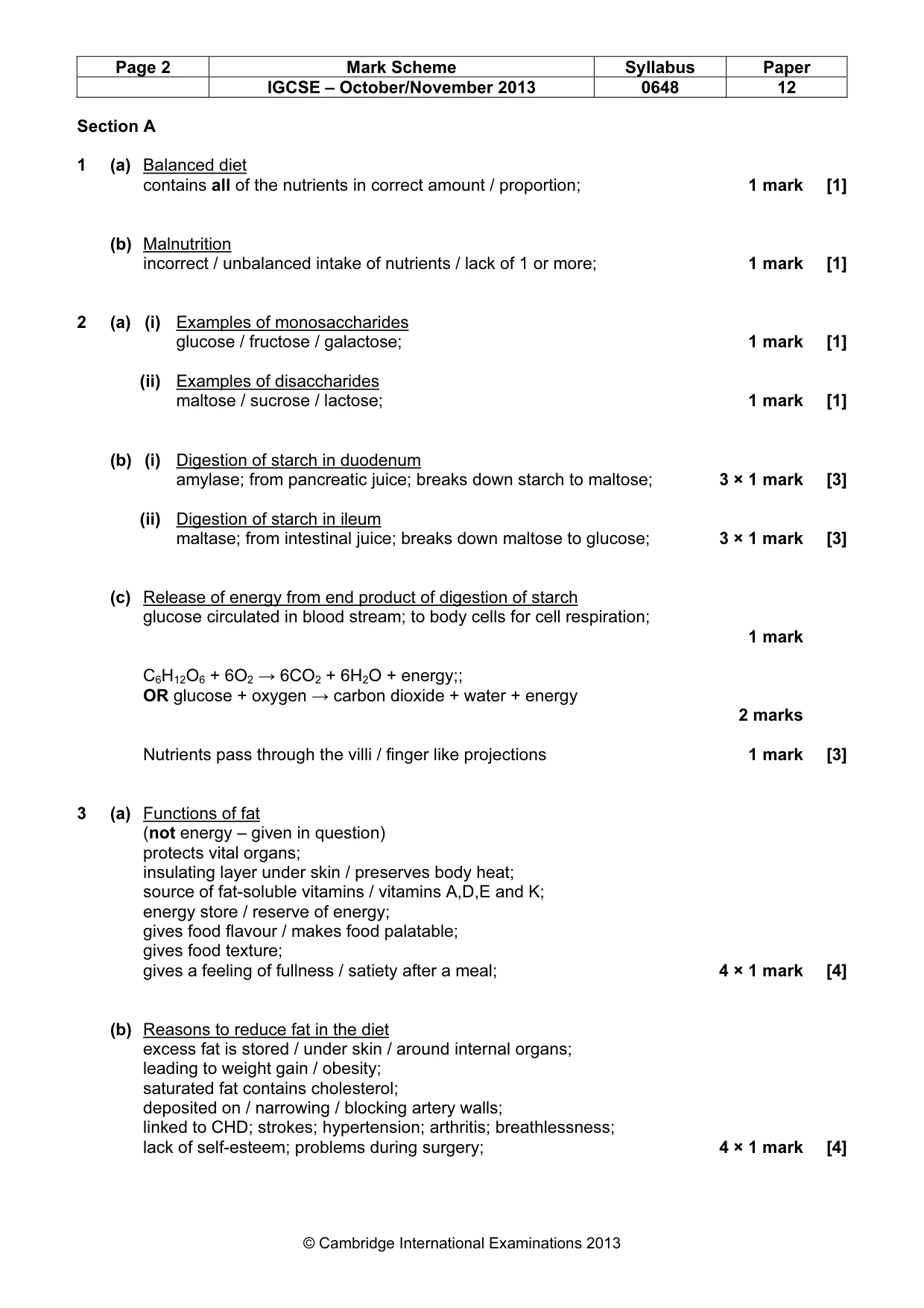
Page 2 Mark Scheme Syllabus Paper IGCSE – October/November 2013 0648 12 © Cambridge International Examinations 2013 Section A 1 (a) Balanced diet contains all of the nutrients in correct amount / proportion; 1 mark [1] (b) Malnutrition incorrect / unbalanced intake of nutrients / lack of 1 or more; 1 mark [1] 2 (a) (i) Examples of monosaccharides glucose / fructose / galactose; 1 mark [1] (ii) Examples of disaccharides maltose / sucrose / lactose; 1 mark [1] (b) (i) Digestion of starch in duodenum amylase; from pancreatic juice; breaks down starch to maltose; 3 × 1 mark [3] (ii) Digestion of starch in ileum maltase; from intestinal juice; breaks down maltose to glucose; 3 × 1 mark [3] (c) Release of energy from end product of digestion of starch glucose circulated in blood stream; to body cells for cell respiration; 1 mark C6H12O6 + 6O2 → 6CO2 + 6H2O + energy;; OR glucose + oxygen → carbon dioxide + water + energy 2 marks Nutrients pass through the villi / finger like projections 1 mark [3] 3 (a) Functions of fat (not energy – given in question) protects vital organs; insulating layer under skin / preserves body heat; source of fat-soluble vitamins / vitamins A,D,E and K; energy store / reserve of energy; gives food flavour / makes food palatable; gives food texture; gives a feeling of fullness / satiety after a meal; 4 × 1 mark [4] (b) Reasons to reduce fat in the diet excess fat is stored / under skin / around internal organs; leading to weight gain / obesity; saturated fat contains cholesterol; deposited on / narrowing / blocking artery walls; linked to CHD; strokes; hypertension; arthritis; breathlessness; lack of self-esteem; problems during surgery; 4 × 1 mark [4]
Mark scheme, page 3
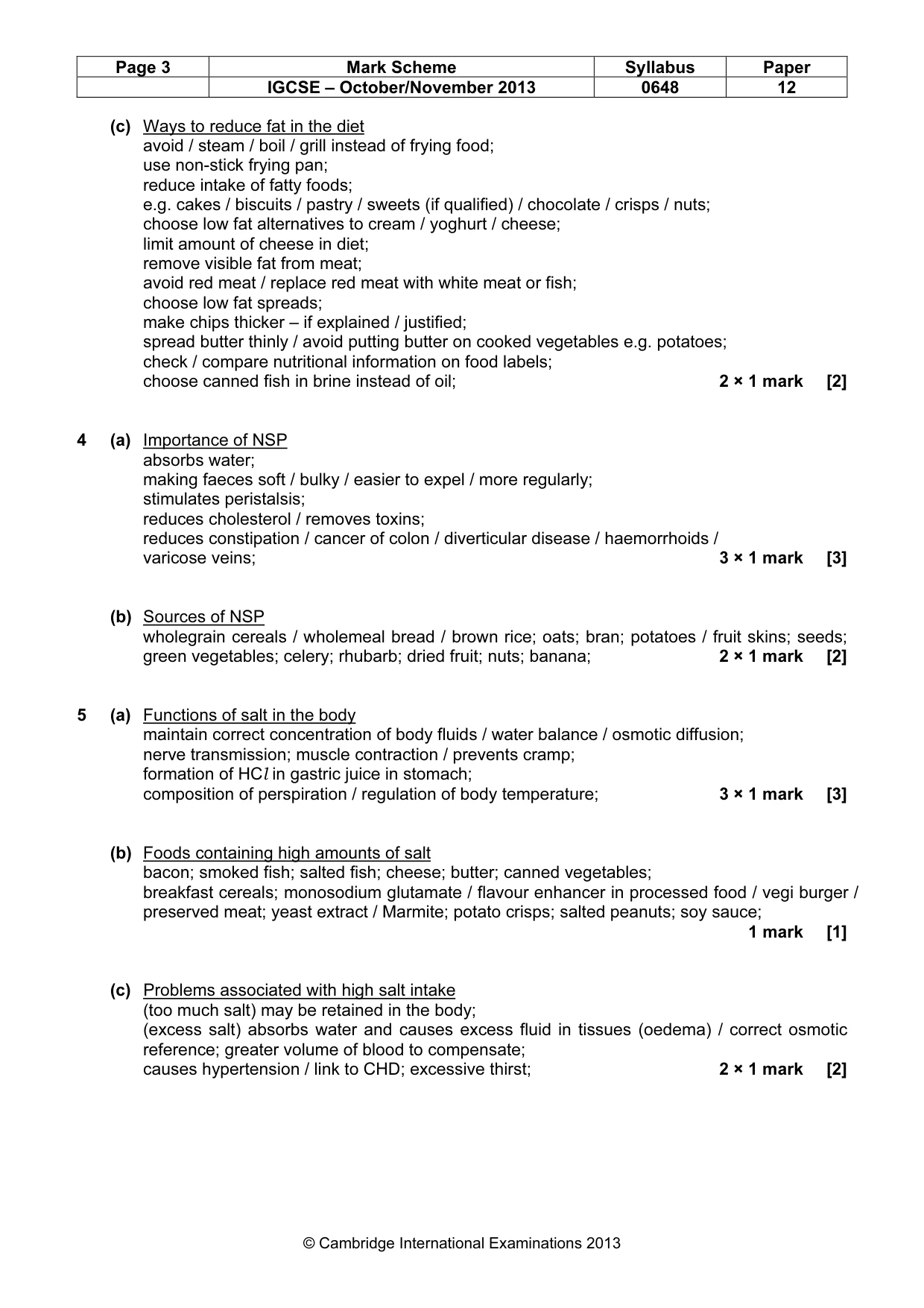
Page 3 Mark Scheme Syllabus Paper IGCSE – October/November 2013 0648 12 © Cambridge International Examinations 2013 (c) Ways to reduce fat in the diet avoid / steam / boil / grill instead of frying food; use non-stick frying pan; reduce intake of fatty foods; e.g. cakes / biscuits / pastry / sweets (if qualified) / chocolate / crisps / nuts; choose low fat alternatives to cream / yoghurt / cheese; limit amount of cheese in diet; remove visible fat from meat; avoid red meat / replace red meat with white meat or fish; choose low fat spreads; make chips thicker – if explained / justified; spread butter thinly / avoid putting butter on cooked vegetables e.g. potatoes; check / compare nutritional information on food labels; choose canned fish in brine instead of oil; 2 × 1 mark [2] 4 (a) Importance of NSP absorbs water; making faeces soft / bulky / easier to expel / more regularly; stimulates peristalsis; reduces cholesterol / removes toxins; reduces constipation / cancer of colon / diverticular disease / haemorrhoids / varicose veins; 3 × 1 mark [3] (b) Sources of NSP wholegrain cereals / wholemeal bread / brown rice; oats; bran; potatoes / fruit skins; seeds; green vegetables; celery; rhubarb; dried fruit; nuts; banana; 2 × 1 mark [2] 5 (a) Functions of salt in the body maintain correct concentration of body fluids / water balance / osmotic diffusion; nerve transmission; muscle contraction / prevents cramp; formation of HCl in gastric juice in stomach; composition of perspiration / regulation of body temperature; 3 × 1 mark [3] (b) Foods containing high amounts of salt bacon; smoked fish; salted fish; cheese; butter; canned vegetables; breakfast cereals; monosodium glutamate / flavour enhancer in processed food / vegi burger / preserved meat; yeast extract / Marmite; potato crisps; salted peanuts; soy sauce; 1 mark [1] (c) Problems associated with high salt intake (too much salt) may be retained in the body; (excess salt) absorbs water and causes excess fluid in tissues (oedema) / correct osmotic reference; greater volume of blood to compensate; causes hypertension / link to CHD; excessive thirst; 2 × 1 mark [2]
Mark scheme, page 4
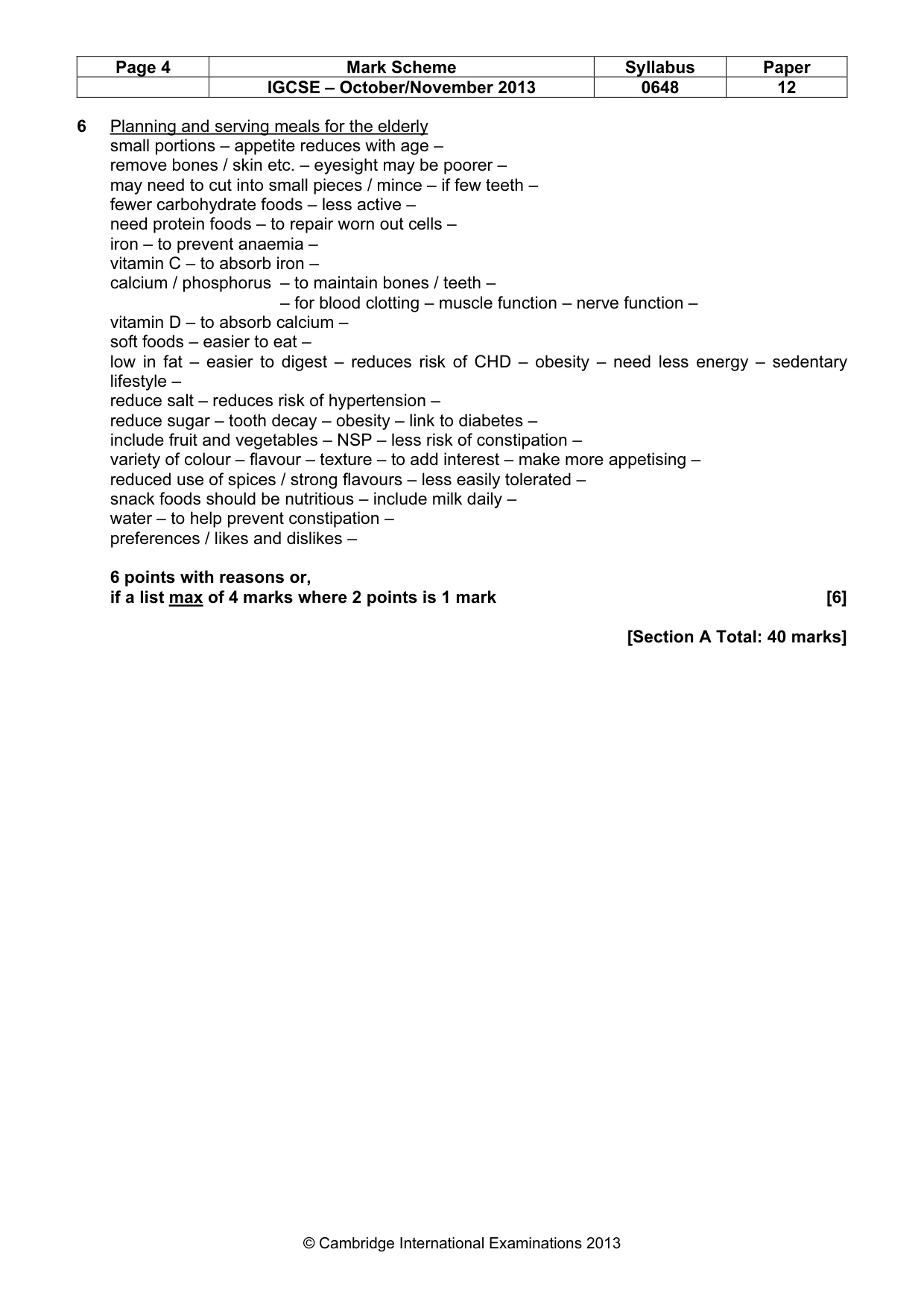
Page 4 Mark Scheme Syllabus Paper IGCSE – October/November 2013 0648 12 © Cambridge International Examinations 2013 6 Planning and serving meals for the elderly small portions – appetite reduces with age – remove bones / skin etc. – eyesight may be poorer – may need to cut into small pieces / mince – if few teeth – fewer carbohydrate foods – less active – need protein foods – to repair worn out cells – iron – to prevent anaemia – vitamin C – to absorb iron – calcium / phosphorus – to maintain bones / teeth – – for blood clotting – muscle function – nerve function – vitamin D – to absorb calcium – soft foods – easier to eat – low in fat – easier to digest – reduces risk of CHD – obesity – need less energy – sedentary lifestyle – reduce salt – reduces risk of hypertension – reduce sugar – tooth decay – obesity – link to diabetes – include fruit and vegetables – NSP – less risk of constipation – variety of colour – flavour – texture – to add interest – make more appetising – reduced use of spices / strong flavours – less easily tolerated – snack foods should be nutritious – include milk daily – water – to help prevent constipation – preferences / likes and dislikes – 6 points with reasons or, if a list max of 4 marks where 2 points is 1 mark [6] [Section A Total: 40 marks]
Mark scheme, page 5
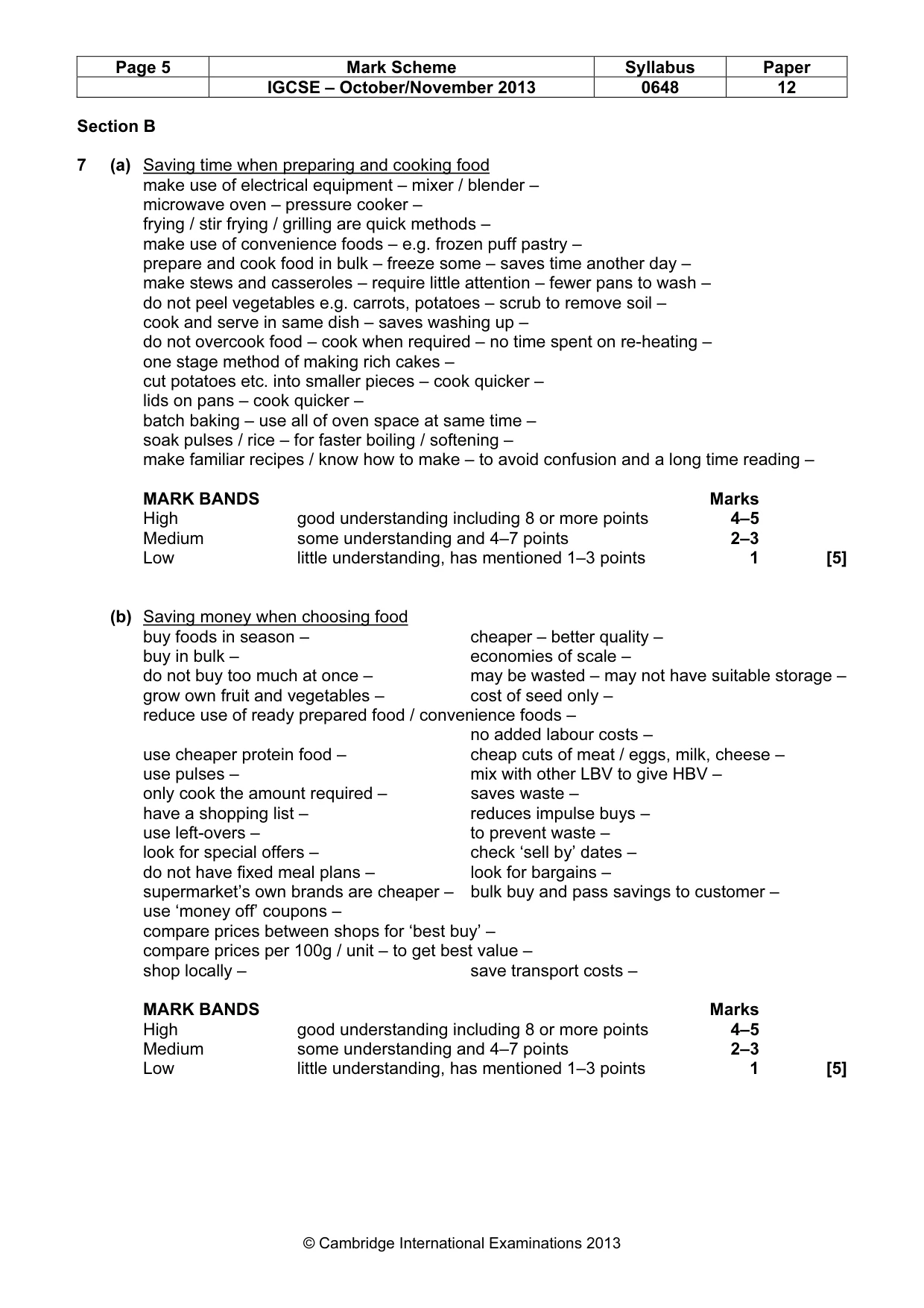
Page 5 Mark Scheme Syllabus Paper IGCSE – October/November 2013 0648 12 © Cambridge International Examinations 2013 Section B 7 (a) Saving time when preparing and cooking food make use of electrical equipment – mixer / blender – microwave oven – pressure cooker – frying / stir frying / grilling are quick methods – make use of convenience foods – e.g. frozen puff pastry – prepare and cook food in bulk – freeze some – saves time another day – make stews and casseroles – require little attention – fewer pans to wash – do not peel vegetables e.g. carrots, potatoes – scrub to remove soil – cook and serve in same dish – saves washing up – do not overcook food – cook when required – no time spent on re-heating – one stage method of making rich cakes – cut potatoes etc. into smaller pieces – cook quicker – lids on pans – cook quicker – batch baking – use all of oven space at same time – soak pulses / rice – for faster boiling / softening – make familiar recipes / know how to make – to avoid confusion and a long time reading – MARK BANDS Marks High good understanding including 8 or more points 4–5 Medium some understanding and 4–7 points 2–3 Low little understanding, has mentioned 1–3 points 1 [5] (b) Saving money when choosing food buy foods in season – cheaper – better quality – buy in bulk – economies of scale – do not buy too much at once – may be wasted – may not have suitable storage – grow own fruit and vegetables – cost of seed only – reduce use of ready prepared food / convenience foods – no added labour costs – use cheaper protein food – cheap cuts of meat / eggs, milk, cheese – use pulses – mix with other LBV to give HBV – only cook the amount required – saves waste – have a shopping list – reduces impulse buys – use left-overs – to prevent waste – look for special offers – check ‘sell by’ dates – do not have fixed meal plans – look for bargains – supermarket’s own brands are cheaper – bulk buy and pass savings to customer – use ‘money off’ coupons – compare prices between shops for ‘best buy’ – compare prices per 100g / unit – to get best value – shop locally – save transport costs – MARK BANDS Marks High good understanding including 8 or more points 4–5 Medium some understanding and 4–7 points 2–3 Low little understanding, has mentioned 1–3 points 1 [5]
Mark scheme, page 6
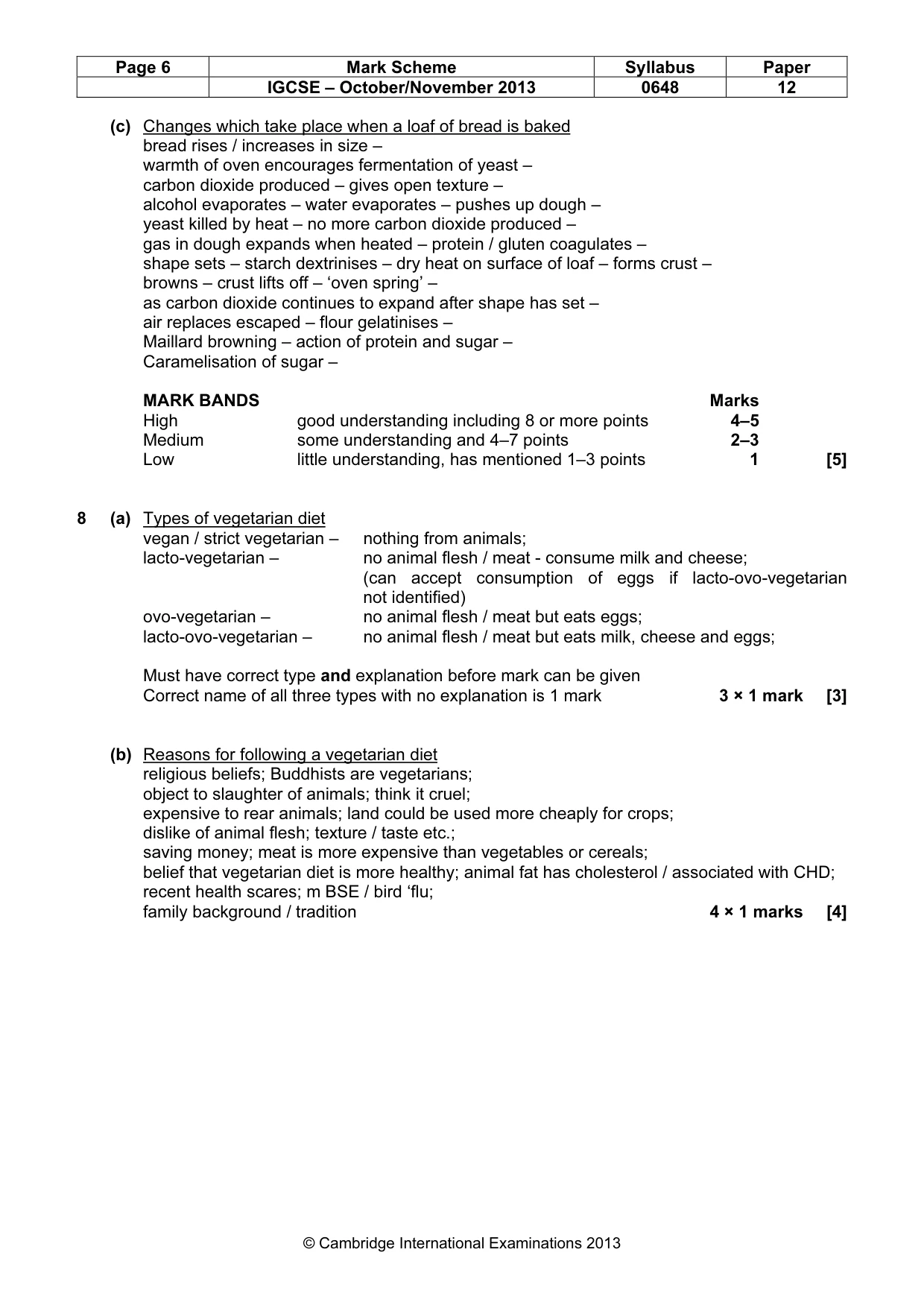
Page 6 Mark Scheme Syllabus Paper IGCSE – October/November 2013 0648 12 © Cambridge International Examinations 2013 (c) Changes which take place when a loaf of bread is baked bread rises / increases in size – warmth of oven encourages fermentation of yeast – carbon dioxide produced – gives open texture – alcohol evaporates – water evaporates – pushes up dough – yeast killed by heat – no more carbon dioxide produced – gas in dough expands when heated – protein / gluten coagulates – shape sets – starch dextrinises – dry heat on surface of loaf – forms crust – browns – crust lifts off – ‘oven spring’ – as carbon dioxide continues to expand after shape has set – air replaces escaped – flour gelatinises – Maillard browning – action of protein and sugar – Caramelisation of sugar – MARK BANDS Marks High good understanding including 8 or more points 4–5 Medium some understanding and 4–7 points 2–3 Low little understanding, has mentioned 1–3 points 1 [5] 8 (a) Types of vegetarian diet vegan / strict vegetarian – nothing from animals; lacto-vegetarian – no animal flesh / meat - consume milk and cheese; (can accept consumption of eggs if lacto-ovo-vegetarian not identified) ovo-vegetarian – no animal flesh / meat but eats eggs; lacto-ovo-vegetarian – no animal flesh / meat but eats milk, cheese and eggs; Must have correct type and explanation before mark can be given Correct name of all three types with no explanation is 1 mark 3 × 1 mark [3] (b) Reasons for following a vegetarian diet religious beliefs; Buddhists are vegetarians; object to slaughter of animals; think it cruel; expensive to rear animals; land could be used more cheaply for crops; dislike of animal flesh; texture / taste etc.; saving money; meat is more expensive than vegetables or cereals; belief that vegetarian diet is more healthy; animal fat has cholesterol / associated with CHD; recent health scares; m BSE / bird ‘flu; family background / tradition 4 × 1 marks [4]
Mark scheme, page 7
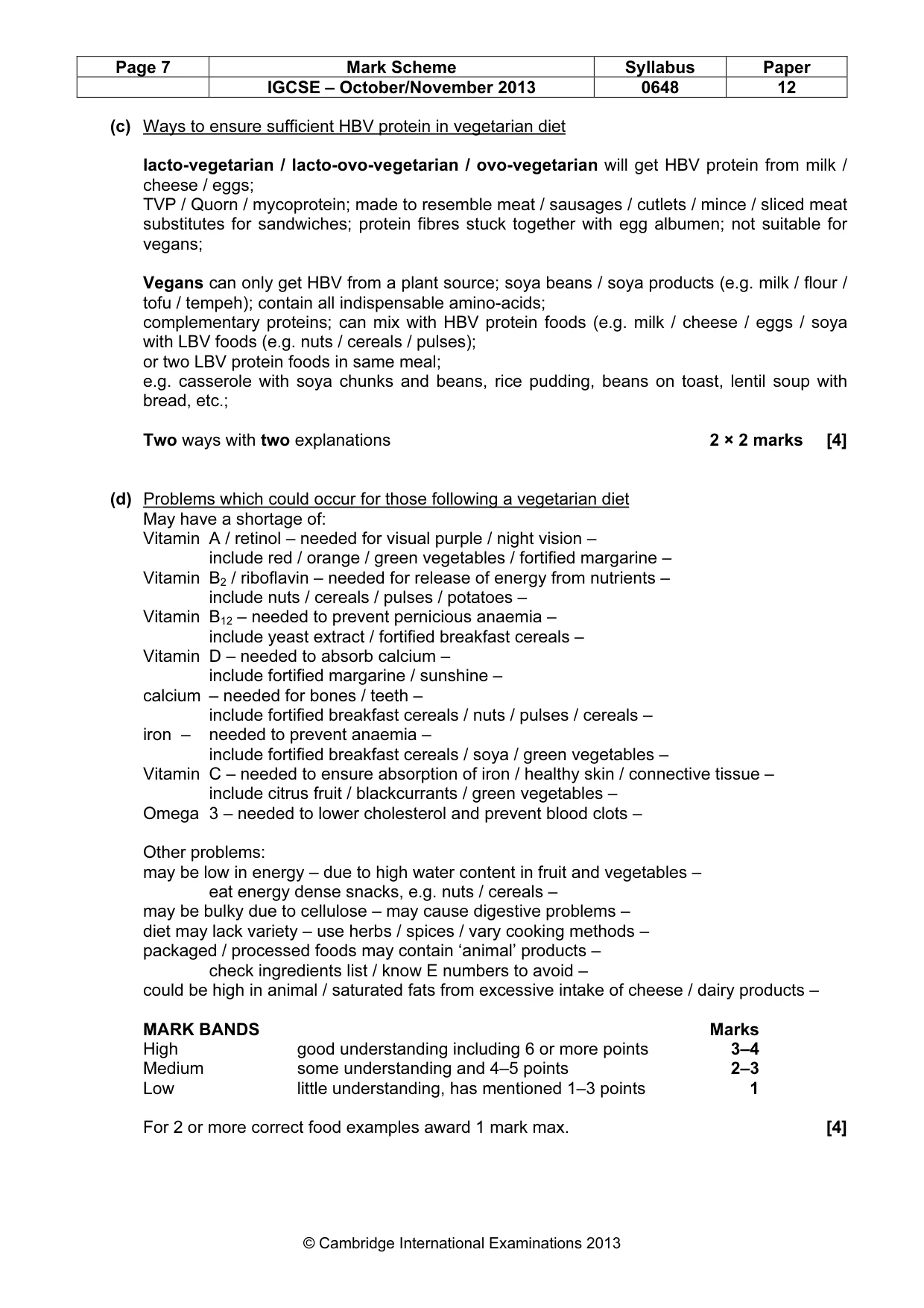
Page 7 Mark Scheme Syllabus Paper IGCSE – October/November 2013 0648 12 © Cambridge International Examinations 2013 (c) Ways to ensure sufficient HBV protein in vegetarian diet lacto-vegetarian / lacto-ovo-vegetarian / ovo-vegetarian will get HBV protein from milk / cheese / eggs; TVP / Quorn / mycoprotein; made to resemble meat / sausages / cutlets / mince / sliced meat substitutes for sandwiches; protein fibres stuck together with egg albumen; not suitable for vegans; Vegans can only get HBV from a plant source; soya beans / soya products (e.g. milk / flour / tofu / tempeh); contain all indispensable amino-acids; complementary proteins; can mix with HBV protein foods (e.g. milk / cheese / eggs / soya with LBV foods (e.g. nuts / cereals / pulses); or two LBV protein foods in same meal; e.g. casserole with soya chunks and beans, rice pudding, beans on toast, lentil soup with bread, etc.; Two ways with two explanations 2 × 2 marks [4] (d) Problems which could occur for those following a vegetarian diet May have a shortage of: Vitamin A / retinol – needed for visual purple / night vision – include red / orange / green vegetables / fortified margarine – Vitamin B2 / riboflavin – needed for release of energy from nutrients – include nuts / cereals / pulses / potatoes – Vitamin B12 – needed to prevent pernicious anaemia – include yeast extract / fortified breakfast cereals – Vitamin D – needed to absorb calcium – include fortified margarine / sunshine – calcium – needed for bones / teeth – include fortified breakfast cereals / nuts / pulses / cereals – iron – needed to prevent anaemia – include fortified breakfast cereals / soya / green vegetables – Vitamin C – needed to ensure absorption of iron / healthy skin / connective tissue – include citrus fruit / blackcurrants / green vegetables – Omega 3 – needed to lower cholesterol and prevent blood clots – Other problems: may be low in energy – due to high water content in fruit and vegetables – eat energy dense snacks, e.g. nuts / cereals – may be bulky due to cellulose – may cause digestive problems – diet may lack variety – use herbs / spices / vary cooking methods – packaged / processed foods may contain ‘animal’ products – check ingredients list / know E numbers to avoid – could be high in animal / saturated fats from excessive intake of cheese / dairy products – MARK BANDS Marks High good understanding including 6 or more points 3–4 Medium some understanding and 4–5 points 2–3 Low little understanding, has mentioned 1–3 points 1 For 2 or more correct food examples award 1 mark max. [4]
Mark scheme, page 8
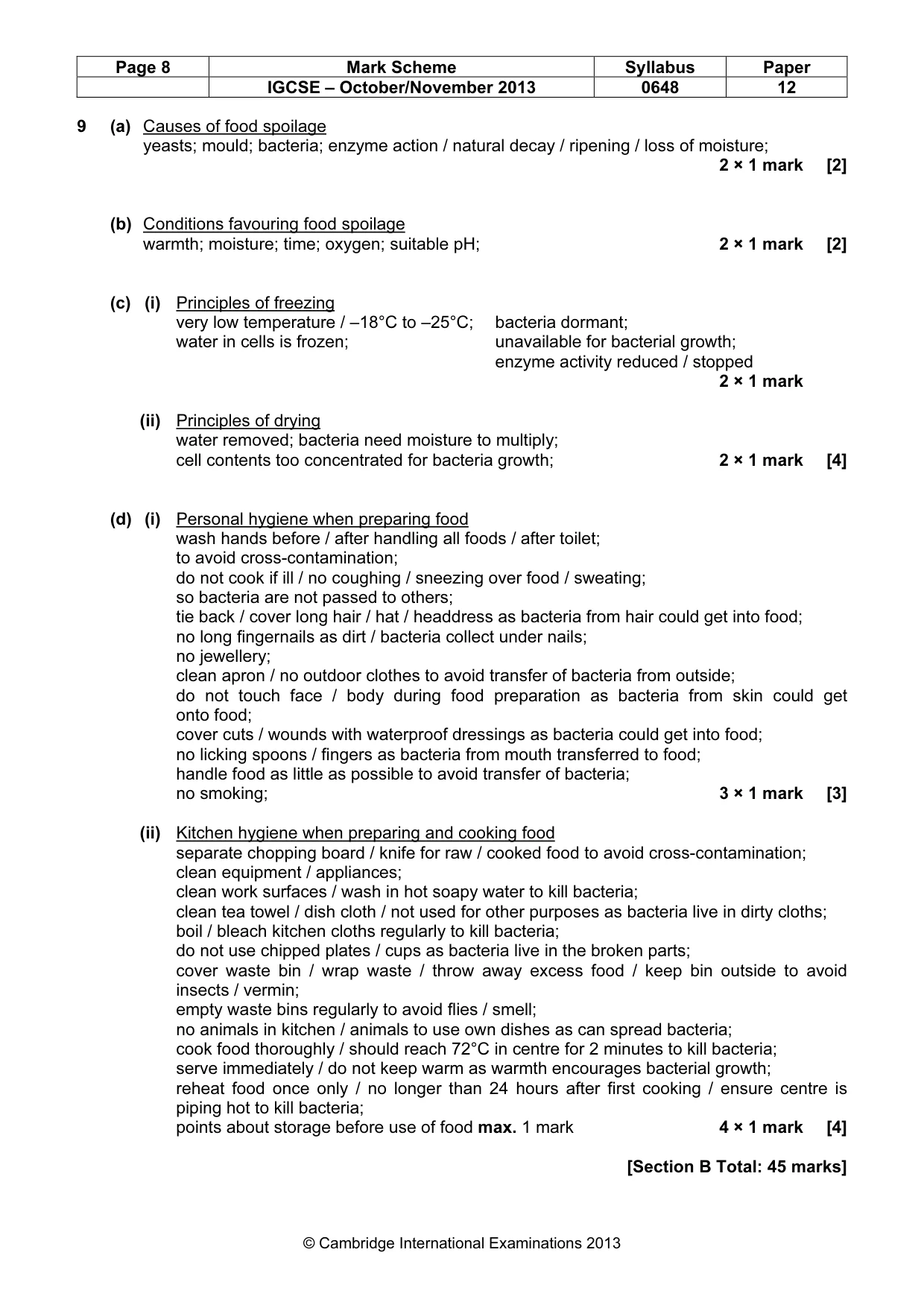
Page 8 Mark Scheme Syllabus Paper IGCSE – October/November 2013 0648 12 © Cambridge International Examinations 2013 9 (a) Causes of food spoilage yeasts; mould; bacteria; enzyme action / natural decay / ripening / loss of moisture; 2 × 1 mark [2] (b) Conditions favouring food spoilage warmth; moisture; time; oxygen; suitable pH; 2 × 1 mark [2] (c) (i) Principles of freezing very low temperature / –18°C to –25°C; bacteria dormant; water in cells is frozen; unavailable for bacterial growth; enzyme activity reduced / stopped 2 × 1 mark (ii) Principles of drying water removed; bacteria need moisture to multiply; cell contents too concentrated for bacteria growth; 2 × 1 mark [4] (d) (i) Personal hygiene when preparing food wash hands before / after handling all foods / after toilet; to avoid cross-contamination; do not cook if ill / no coughing / sneezing over food / sweating; so bacteria are not passed to others; tie back / cover long hair / hat / headdress as bacteria from hair could get into food; no long fingernails as dirt / bacteria collect under nails; no jewellery; clean apron / no outdoor clothes to avoid transfer of bacteria from outside; do not touch face / body during food preparation as bacteria from skin could get onto food; cover cuts / wounds with waterproof dressings as bacteria could get into food; no licking spoons / fingers as bacteria from mouth transferred to food; handle food as little as possible to avoid transfer of bacteria; no smoking; 3 × 1 mark [3] (ii) Kitchen hygiene when preparing and cooking food separate chopping board / knife for raw / cooked food to avoid cross-contamination; clean equipment / appliances; clean work surfaces / wash in hot soapy water to kill bacteria; clean tea towel / dish cloth / not used for other purposes as bacteria live in dirty cloths; boil / bleach kitchen cloths regularly to kill bacteria; do not use chipped plates / cups as bacteria live in the broken parts; cover waste bin / wrap waste / throw away excess food / keep bin outside to avoid insects / vermin; empty waste bins regularly to avoid flies / smell; no animals in kitchen / animals to use own dishes as can spread bacteria; cook food thoroughly / should reach 72°C in centre for 2 minutes to kill bacteria; serve immediately / do not keep warm as warmth encourages bacterial growth; reheat food once only / no longer than 24 hours after first cooking / ensure centre is piping hot to kill bacteria; points about storage before use of food max. 1 mark 4 × 1 mark [4] [Section B Total: 45 marks]
Mark scheme, page 9
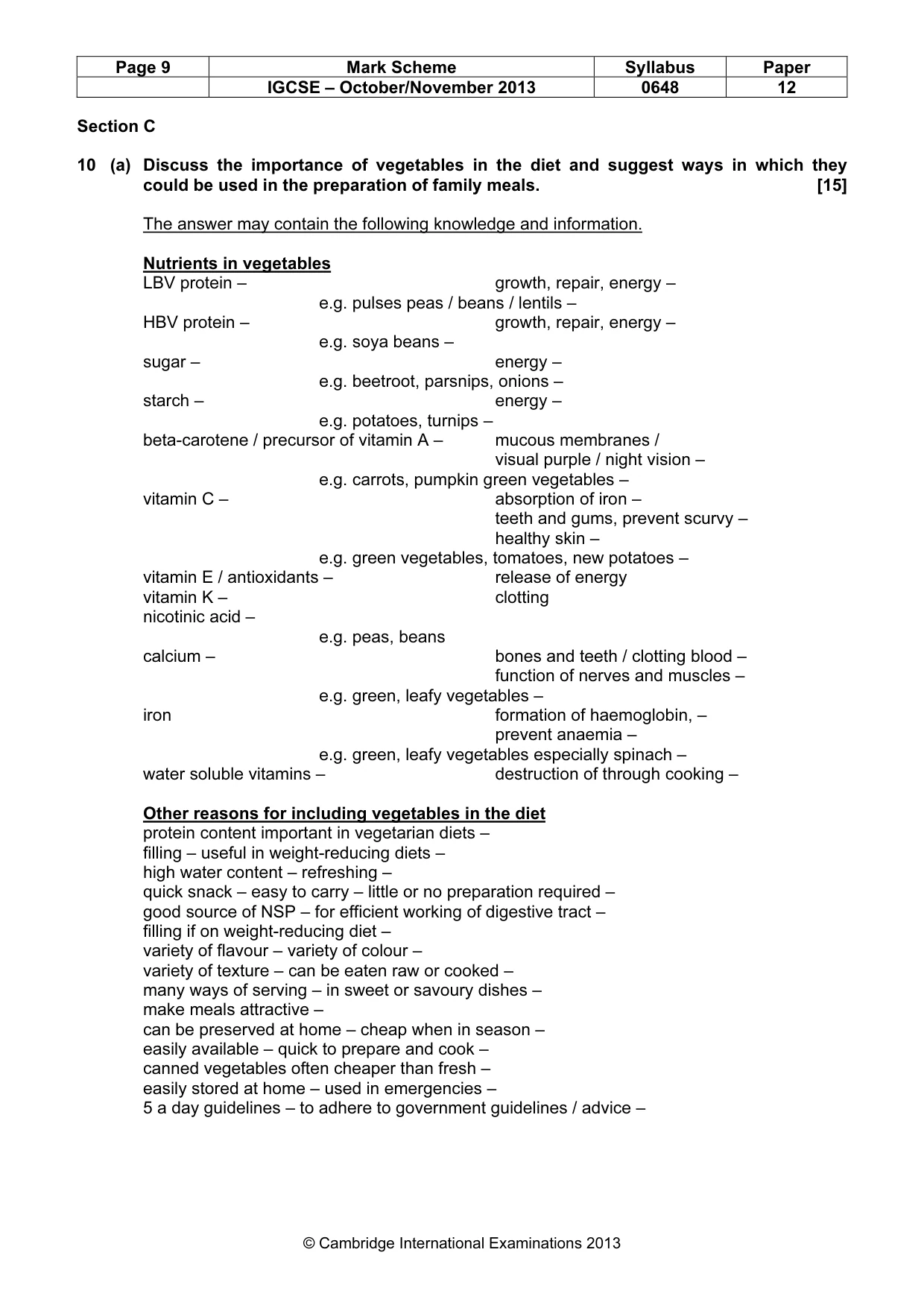
Page 9 Mark Scheme Syllabus Paper IGCSE – October/November 2013 0648 12 © Cambridge International Examinations 2013 Section C 10 (a) Discuss the importance of vegetables in the diet and suggest ways in which they could be used in the preparation of family meals. [15] The answer may contain the following knowledge and information. Nutrients in vegetables LBV protein – growth, repair, energy – e.g. pulses peas / beans / lentils – HBV protein – growth, repair, energy – e.g. soya beans – sugar – energy – e.g. beetroot, parsnips, onions – starch – energy – e.g. potatoes, turnips – beta-carotene / precursor of vitamin A – mucous membranes / visual purple / night vision – e.g. carrots, pumpkin green vegetables – vitamin C – absorption of iron – teeth and gums, prevent scurvy – healthy skin – e.g. green vegetables, tomatoes, new potatoes – vitamin E / antioxidants – release of energy vitamin K – clotting nicotinic acid – e.g. peas, beans calcium – bones and teeth / clotting blood – function of nerves and muscles – e.g. green, leafy vegetables – iron formation of haemoglobin, – prevent anaemia – e.g. green, leafy vegetables especially spinach – water soluble vitamins – destruction of through cooking – Other reasons for including vegetables in the diet protein content important in vegetarian diets – filling – useful in weight-reducing diets – high water content – refreshing – quick snack – easy to carry – little or no preparation required – good source of NSP – for efficient working of digestive tract – filling if on weight-reducing diet – variety of flavour – variety of colour – variety of texture – can be eaten raw or cooked – many ways of serving – in sweet or savoury dishes – make meals attractive – can be preserved at home – cheap when in season – easily available – quick to prepare and cook – canned vegetables often cheaper than fresh – easily stored at home – used in emergencies – 5 a day guidelines – to adhere to government guidelines / advice –
Mark scheme, page 10
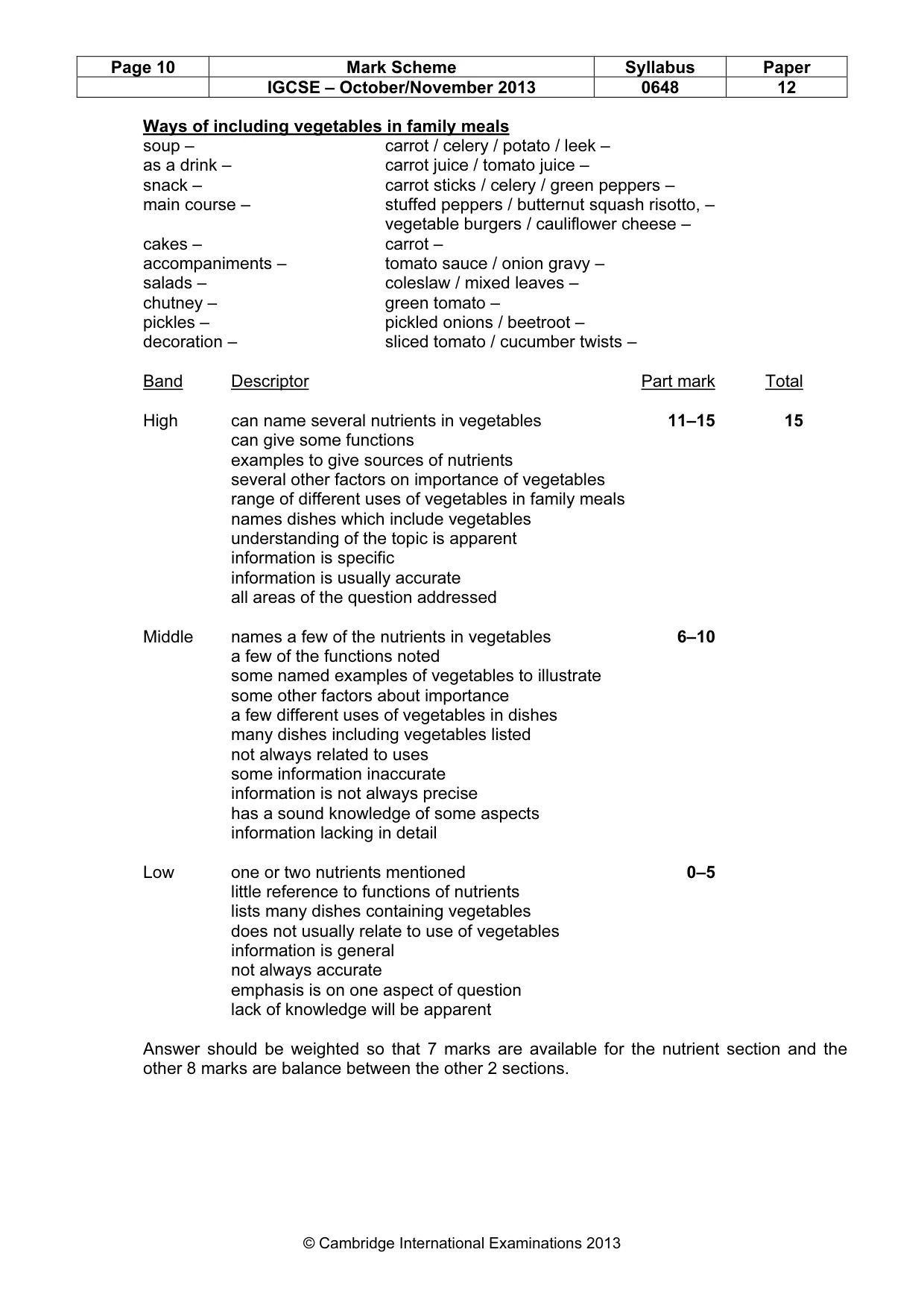
Page 10 Mark Scheme Syllabus Paper IGCSE – October/November 2013 0648 12 © Cambridge International Examinations 2013 Ways of including vegetables in family meals soup – carrot / celery / potato / leek – as a drink – carrot juice / tomato juice – snack – carrot sticks / celery / green peppers – main course – stuffed peppers / butternut squash risotto, – vegetable burgers / cauliflower cheese – cakes – carrot – accompaniments – tomato sauce / onion gravy – salads – coleslaw / mixed leaves – chutney – green tomato – pickles – pickled onions / beetroot – decoration – sliced tomato / cucumber twists – Band Descriptor Part mark Total High can name several nutrients in vegetables 11–15 15 can give some functions examples to give sources of nutrients several other factors on importance of vegetables range of different uses of vegetables in family meals names dishes which include vegetables understanding of the topic is apparent information is specific information is usually accurate all areas of the question addressed Middle names a few of the nutrients in vegetables 6–10 a few of the functions noted some named examples of vegetables to illustrate some other factors about importance a few different uses of vegetables in dishes many dishes including vegetables listed not always related to uses some information inaccurate information is not always precise has a sound knowledge of some aspects information lacking in detail Low one or two nutrients mentioned 0–5 little reference to functions of nutrients lists many dishes containing vegetables does not usually relate to use of vegetables information is general not always accurate emphasis is on one aspect of question lack of knowledge will be apparent Answer should be weighted so that 7 marks are available for the nutrient section and the other 8 marks are balance between the other 2 sections.
Mark scheme, page 11
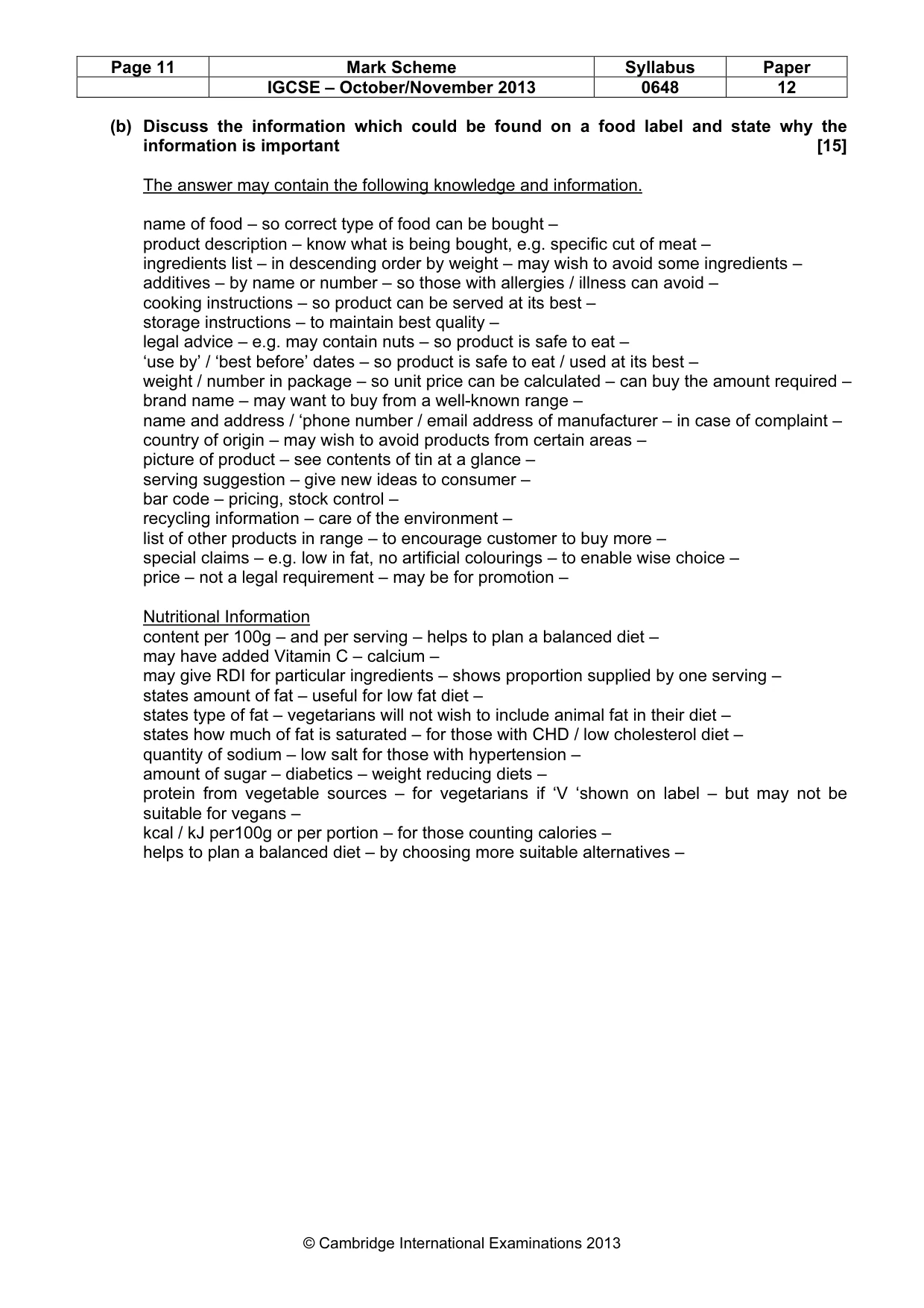
Page 11 Mark Scheme Syllabus Paper IGCSE – October/November 2013 0648 12 © Cambridge International Examinations 2013 (b) Discuss the information which could be found on a food label and state why the information is important [15] The answer may contain the following knowledge and information. name of food – so correct type of food can be bought – product description – know what is being bought, e.g. specific cut of meat – ingredients list – in descending order by weight – may wish to avoid some ingredients – additives – by name or number – so those with allergies / illness can avoid – cooking instructions – so product can be served at its best – storage instructions – to maintain best quality – legal advice – e.g. may contain nuts – so product is safe to eat – ‘use by’ / ‘best before’ dates – so product is safe to eat / used at its best – weight / number in package – so unit price can be calculated – can buy the amount required – brand name – may want to buy from a well-known range – name and address / ‘phone number / email address of manufacturer – in case of complaint – country of origin – may wish to avoid products from certain areas – picture of product – see contents of tin at a glance – serving suggestion – give new ideas to consumer – bar code – pricing, stock control – recycling information – care of the environment – list of other products in range – to encourage customer to buy more – special claims – e.g. low in fat, no artificial colourings – to enable wise choice – price – not a legal requirement – may be for promotion – Nutritional Information content per 100g – and per serving – helps to plan a balanced diet – may have added Vitamin C – calcium – may give RDI for particular ingredients – shows proportion supplied by one serving – states amount of fat – useful for low fat diet – states type of fat – vegetarians will not wish to include animal fat in their diet – states how much of fat is saturated – for those with CHD / low cholesterol diet – quantity of sodium – low salt for those with hypertension – amount of sugar – diabetics – weight reducing diets – protein from vegetable sources – for vegetarians if ‘V ‘shown on label – but may not be suitable for vegans – kcal / kJ per100g or per portion – for those counting calories – helps to plan a balanced diet – by choosing more suitable alternatives –
Mark scheme, page 12
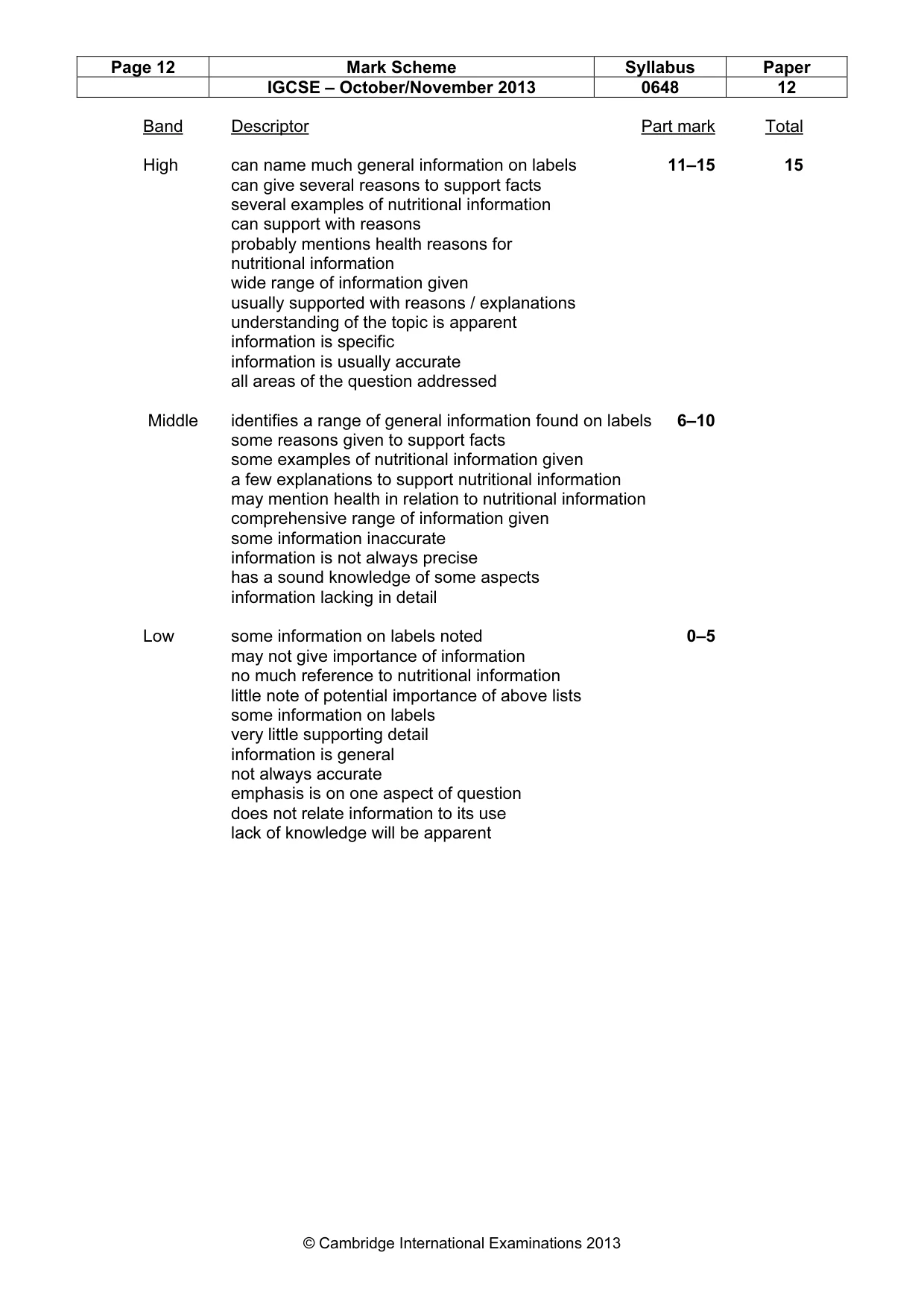
Page 12 Mark Scheme Syllabus Paper IGCSE – October/November 2013 0648 12 © Cambridge International Examinations 2013 Band Descriptor Part mark Total High can name much general information on labels 11–15 15 can give several reasons to support facts several examples of nutritional information can support with reasons probably mentions health reasons for nutritional information wide range of information given usually supported with reasons / explanations understanding of the topic is apparent information is specific information is usually accurate all areas of the question addressed Middle identifies a range of general information found on labels 6–10 some reasons given to support facts some examples of nutritional information given a few explanations to support nutritional information may mention health in relation to nutritional information comprehensive range of information given some information inaccurate information is not always precise has a sound knowledge of some aspects information lacking in detail Low some information on labels noted 0–5 may not give importance of information no much reference to nutritional information little note of potential importance of above lists some information on labels very little supporting detail information is general not always accurate emphasis is on one aspect of question does not relate information to its use lack of knowledge will be apparent
What you needed in this session
Cambridge’s own grade thresholds for 2013 Oct/Nov, Paper 1 · Variant 2. A higher threshold means an easier paper — the bar moves with how the cohort did.