Cambridge IGCSE Food and Nutrition 0648 — 2013 Oct/Nov Paper 1 · Variant 3
0648/13/O/N/13 · 100 marks · ≈113 min
The question paper and its mark scheme, free to read here and free to download. This is Cambridge’s own paper, exactly as it was sat.
Question paper12 pages
Mark scheme13 pages
Answers below. Sit the paper first if you are practising.
Paper as text
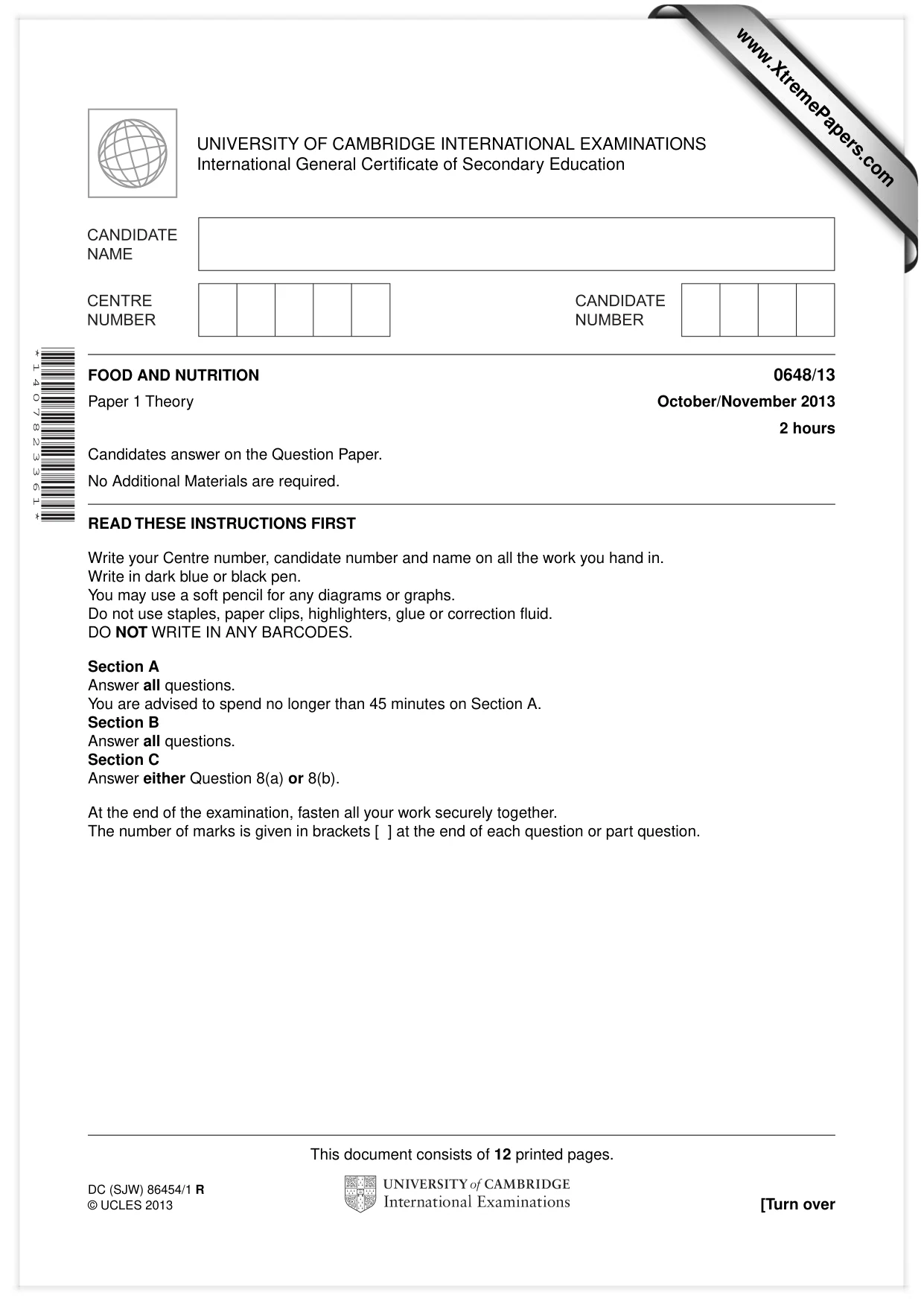
Question paper, page 1
This document consists of 12 printed pages. DC (SJW) 86454/1 R © UCLES 2013 [Turn over * 1 4 0 7 8 2 3 3 6 1 * UNIVERSITY OF CAMBRIDGE INTERNATIONAL EXAMINATIONS International General Certificate of Secondary Education FOOD AND NUTRITION 0648/13 Paper 1 Theory October/November 2013 2 hours Candidates answer on the Question Paper. No Additional Materials are required. READ THESE INSTRUCTIONS FIRST Write your Centre number, candidate number and name on all the work you hand in. Write in dark blue or black pen. You may use a soft pencil for any diagrams or graphs. Do not use staples, paper clips, highlighters, glue or correction fluid. DO NOT WRITE IN ANY BARCODES. Section A Answer all questions. You are advised to spend no longer than 45 minutes on Section A. Section B Answer all questions. Section C Answer either Question 8(a) or 8(b). At the end of the examination, fasten all your work securely together. The number of marks is given in brackets [ ] at the end of each question or part question. www.XtremePapers.com
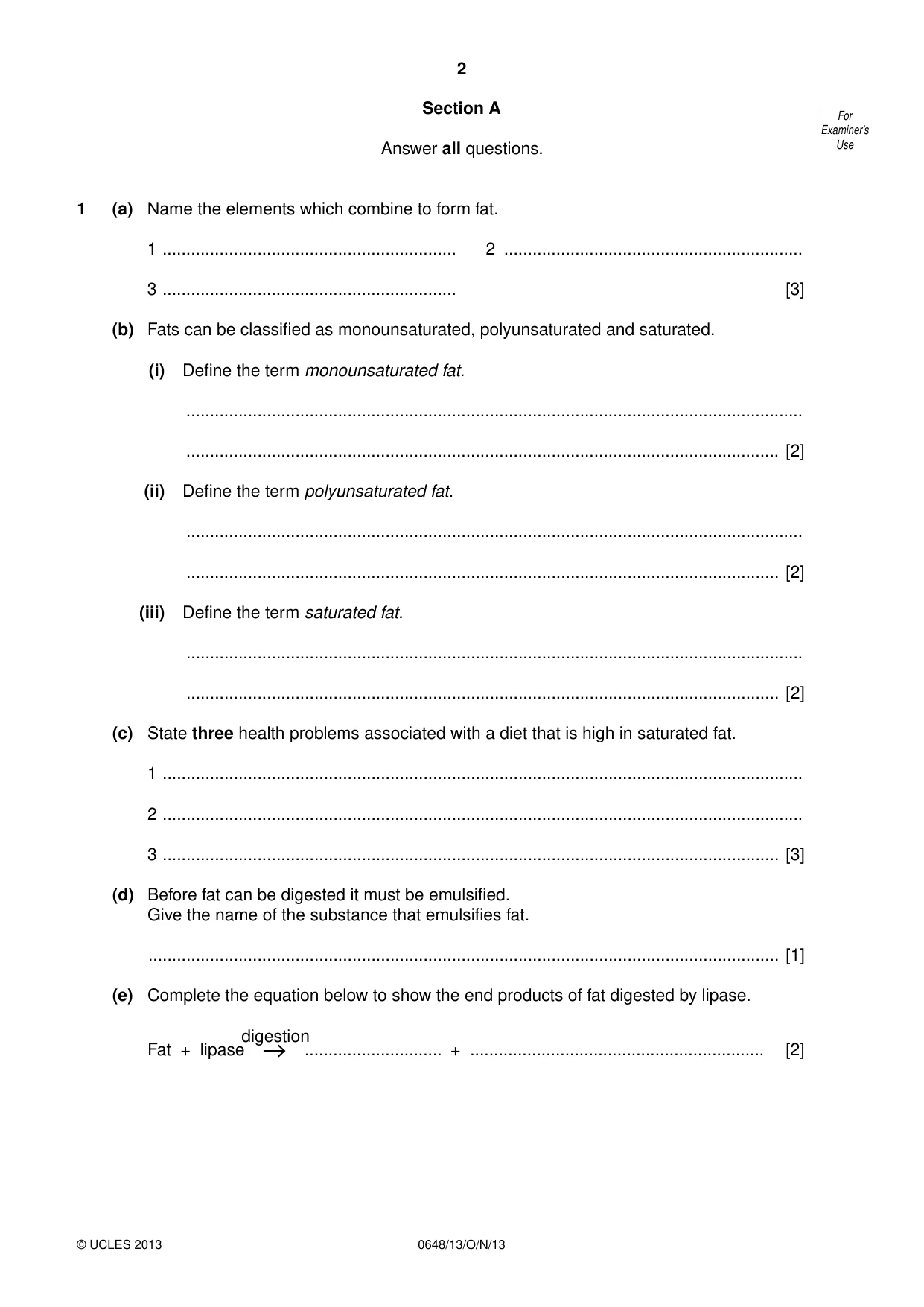
Question paper, page 2
2 0648/13/O/N/13 © UCLES 2013 For Examiner’s Use Section A Answer all questions. 1 (a) Name the elements which combine to form fat. 1 … 2 … 3 … [3] (b) Fats can be classified as monounsaturated, polyunsaturated and saturated. (i) Define the term monounsaturated fat. … … [2] (ii) Define the term polyunsaturated fat. … … [2] (iii) Define the term saturated fat. … … [2] (c) State three health problems associated with a diet that is high in saturated fat. 1 … 2 … 3 … [3] (d) Before fat can be digested it must be emulsified. Give the name of the substance that emulsifies fat. … [1] (e) Complete the equation below to show the end products of fat digested by lipase. digestion Fat + lipase … + … [2]
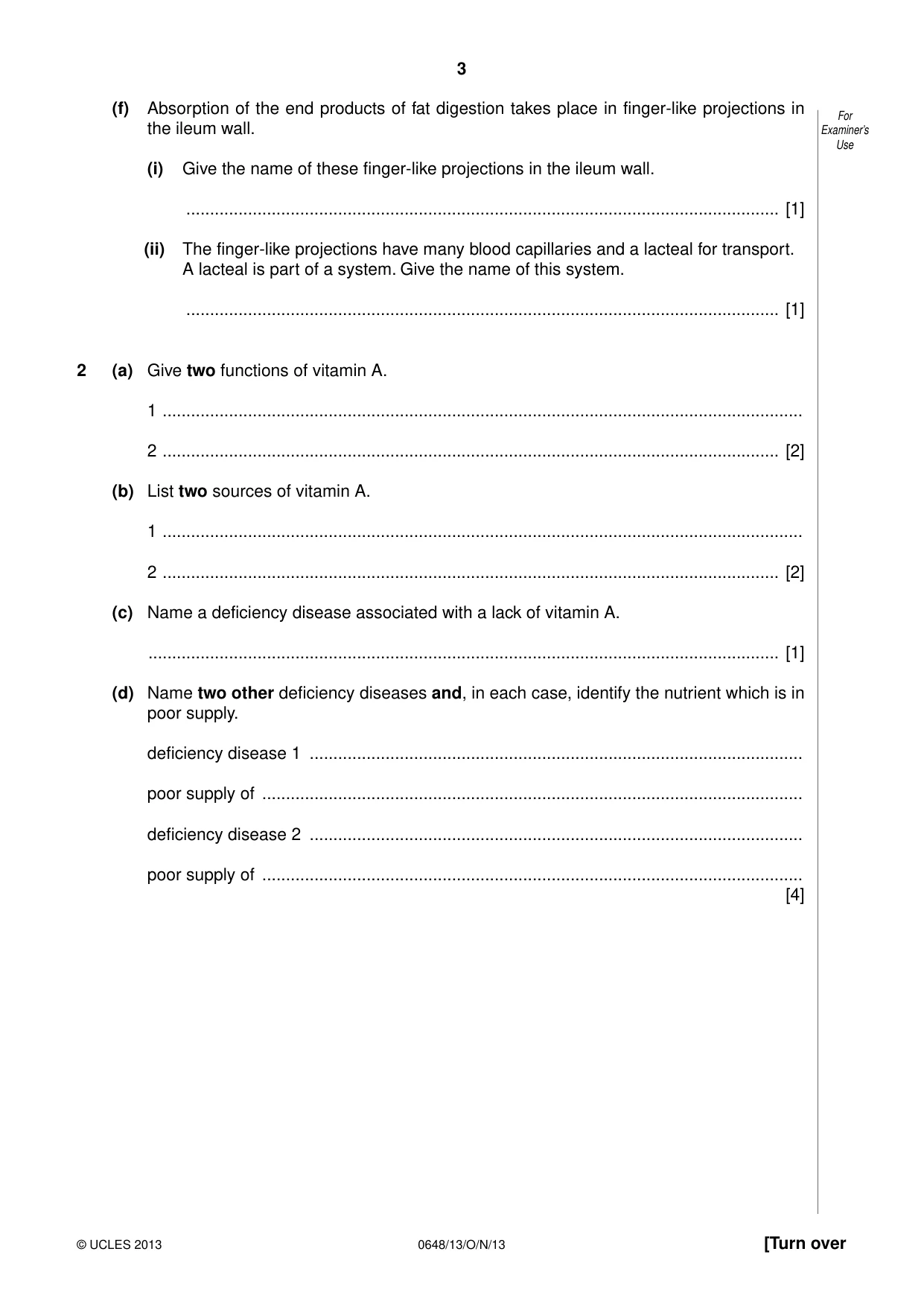
Question paper, page 3
3 0648/13/O/N/13 © UCLES 2013 [Turn over For Examiner’s Use (f) Absorption of the end products of fat digestion takes place in finger-like projections in the ileum wall. (i) Give the name of these finger-like projections in the ileum wall. … [1] (ii) The finger-like projections have many blood capillaries and a lacteal for transport. A lacteal is part of a system. Give the name of this system. … [1] 2 (a) Give two functions of vitamin A. 1 … 2 … [2] (b) List two sources of vitamin A. 1 … 2 … [2] (c) Name a deficiency disease associated with a lack of vitamin A. … [1] (d) Name two other deficiency diseases and, in each case, identify the nutrient which is in poor supply. deficiency disease 1 … poor supply of … deficiency disease 2 … poor supply of … [4]
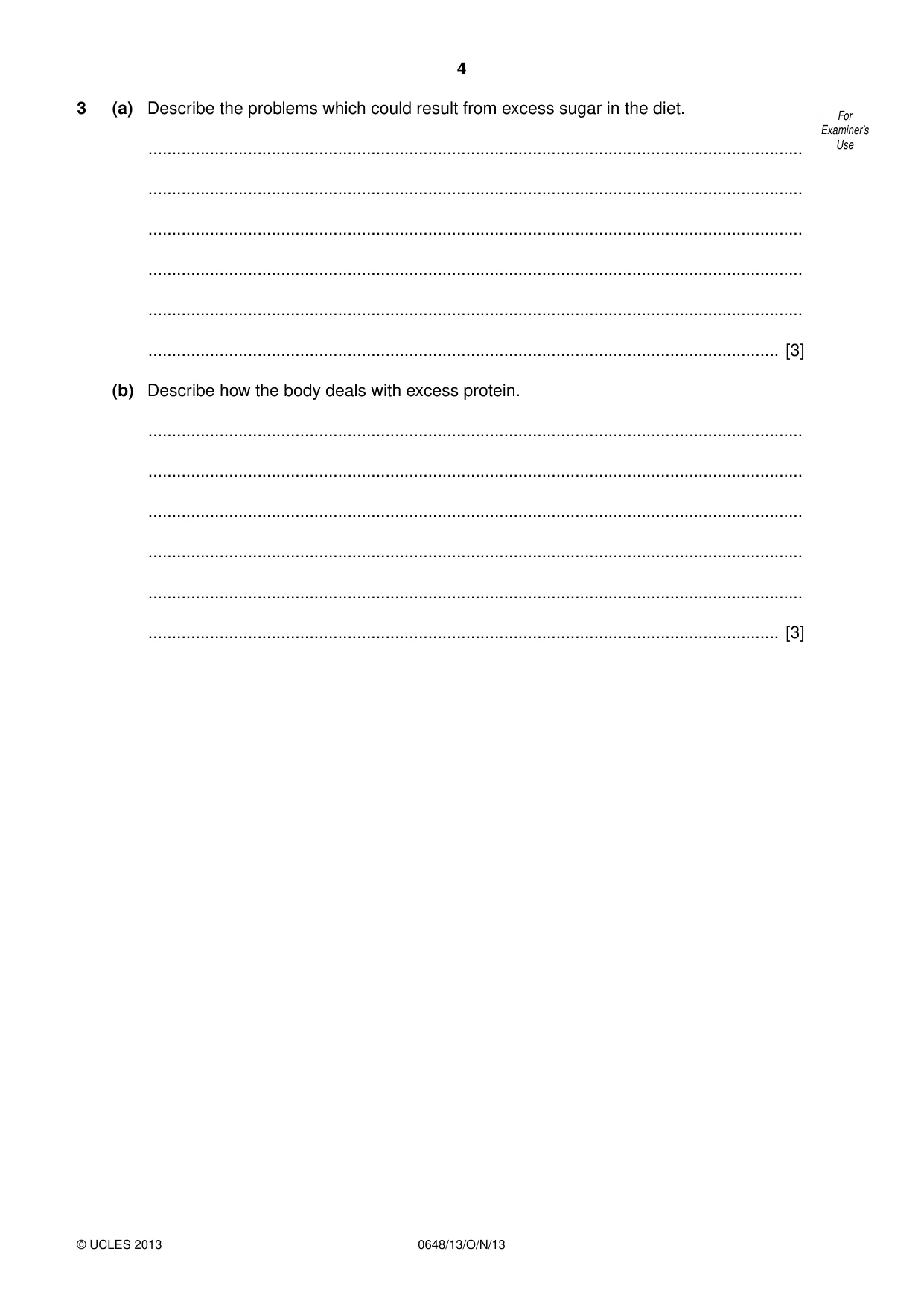
Question paper, page 4
4 0648/13/O/N/13 © UCLES 2013 For Examiner’s Use 3 (a) Describe the problems which could result from excess sugar in the diet. … … … … … … [3] (b) Describe how the body deals with excess protein. … … … … … … [3]
Question paper, page 5
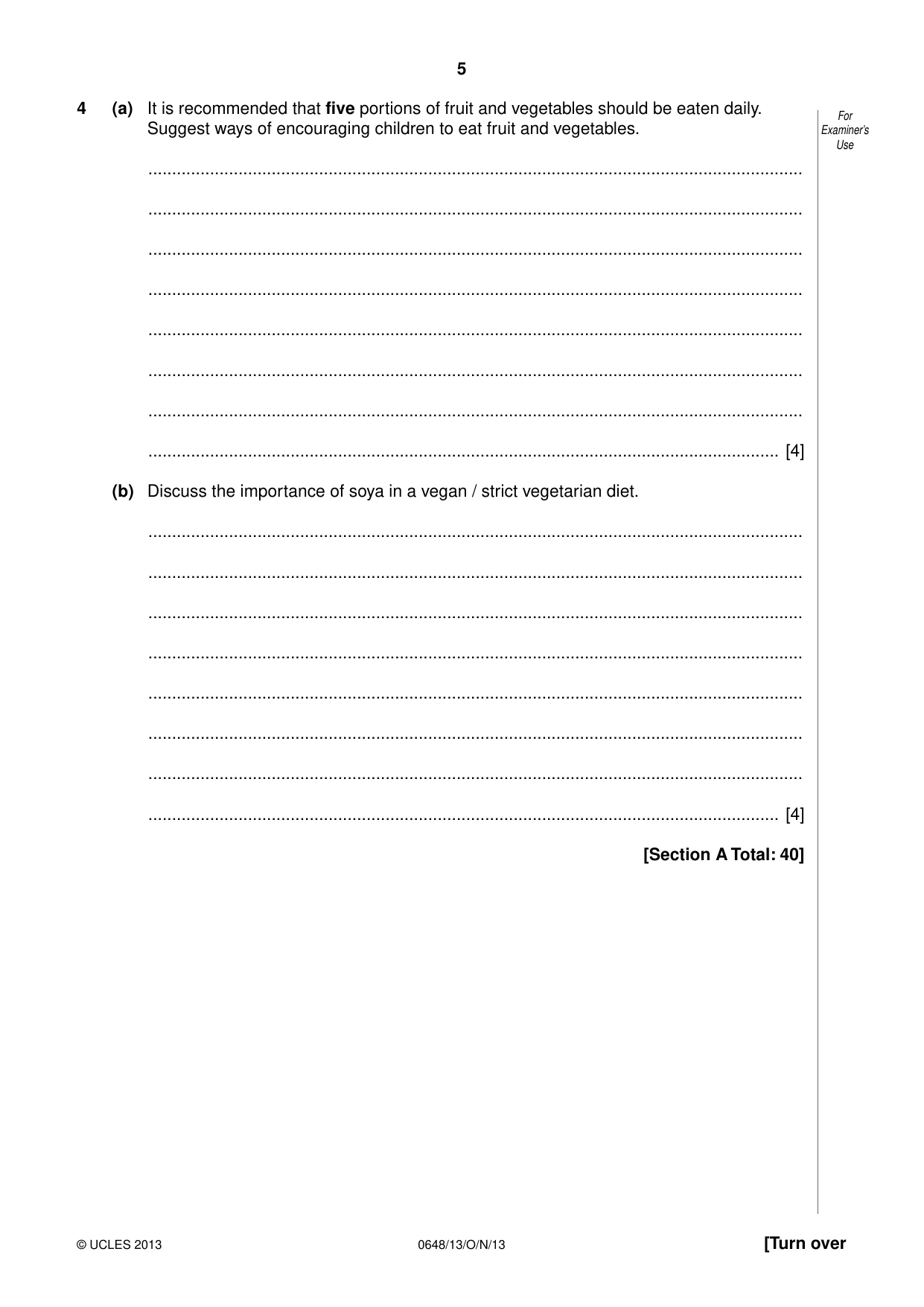
5 0648/13/O/N/13 © UCLES 2013 [Turn over For Examiner’s Use 4 (a) It is recommended that five portions of fruit and vegetables should be eaten daily. Suggest ways of encouraging children to eat fruit and vegetables. … … … … … … … … [4] (b) Discuss the importance of soya in a vegan / strict vegetarian diet. … … … … … … … … [4] [Section A Total: 40]
Question paper, page 6
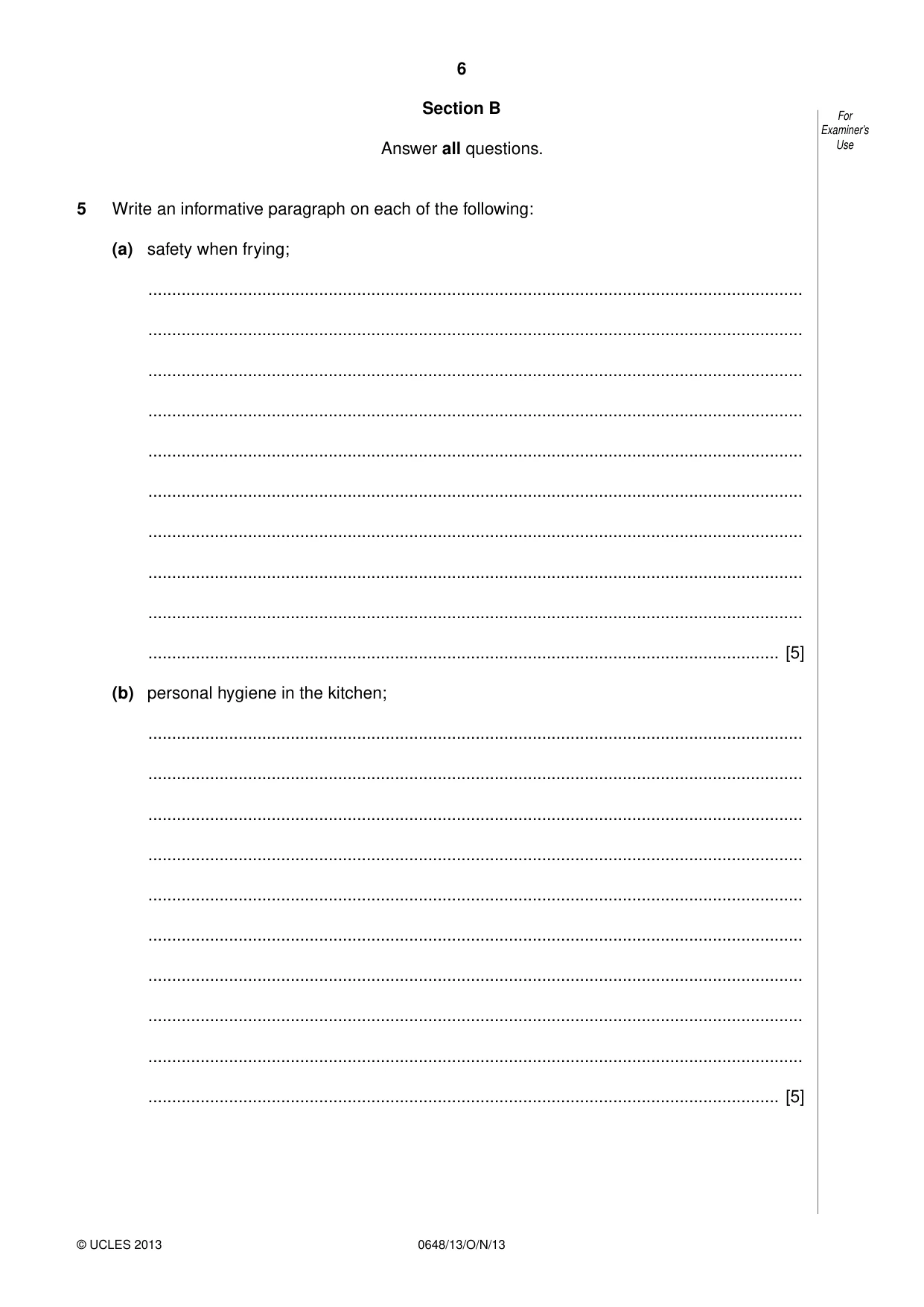
6 0648/13/O/N/13 © UCLES 2013 For Examiner’s Use Section B Answer all questions. 5 Write an informative paragraph on each of the following: (a) safety when frying; … … … … … … … … … … [5] (b) personal hygiene in the kitchen; … … … … … … … … … … [5]
Question paper, page 7
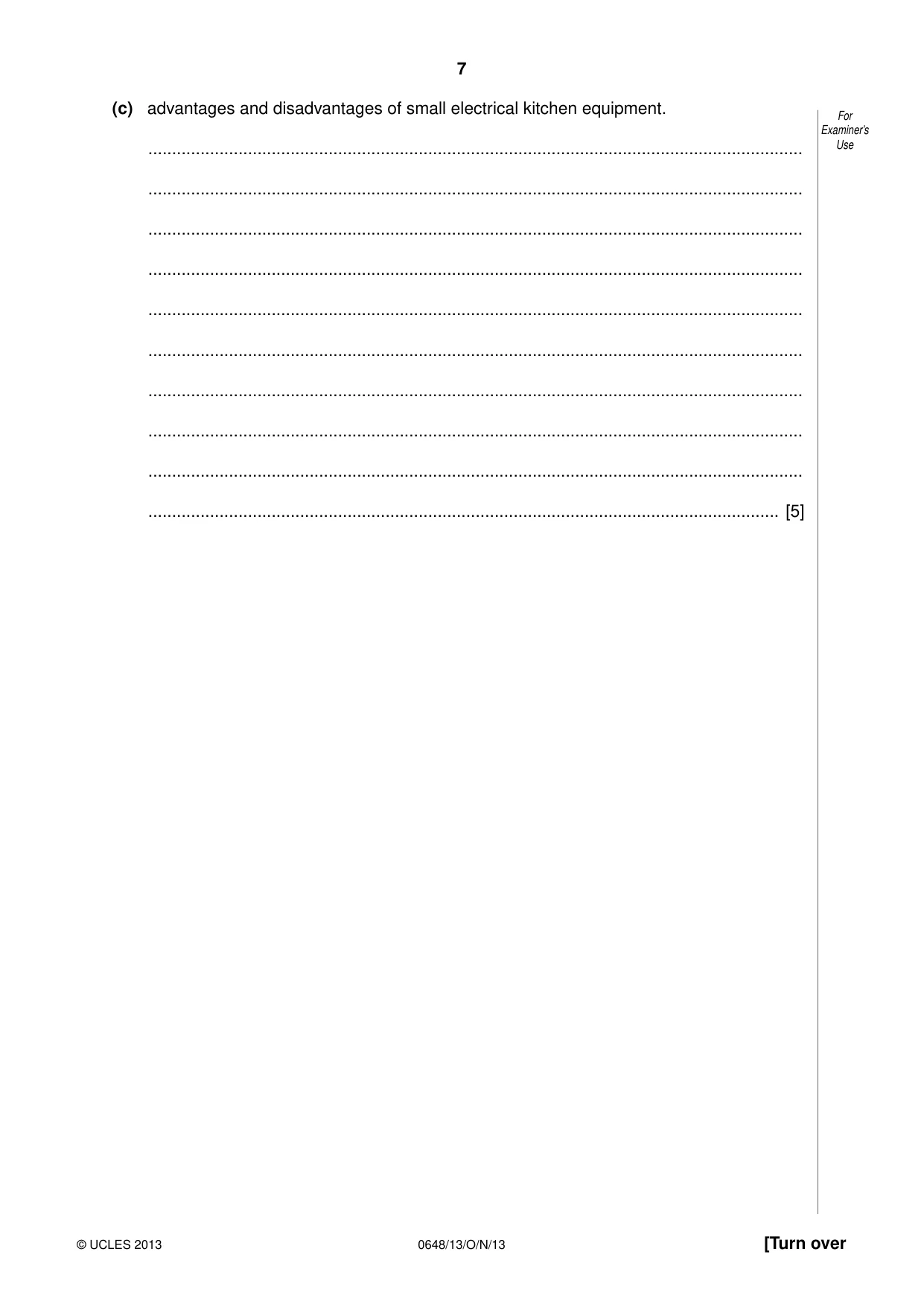
7 0648/13/O/N/13 © UCLES 2013 [Turn over For Examiner’s Use (c) advantages and disadvantages of small electrical kitchen equipment. … … … … … … … … … … [5]
Question paper, page 8
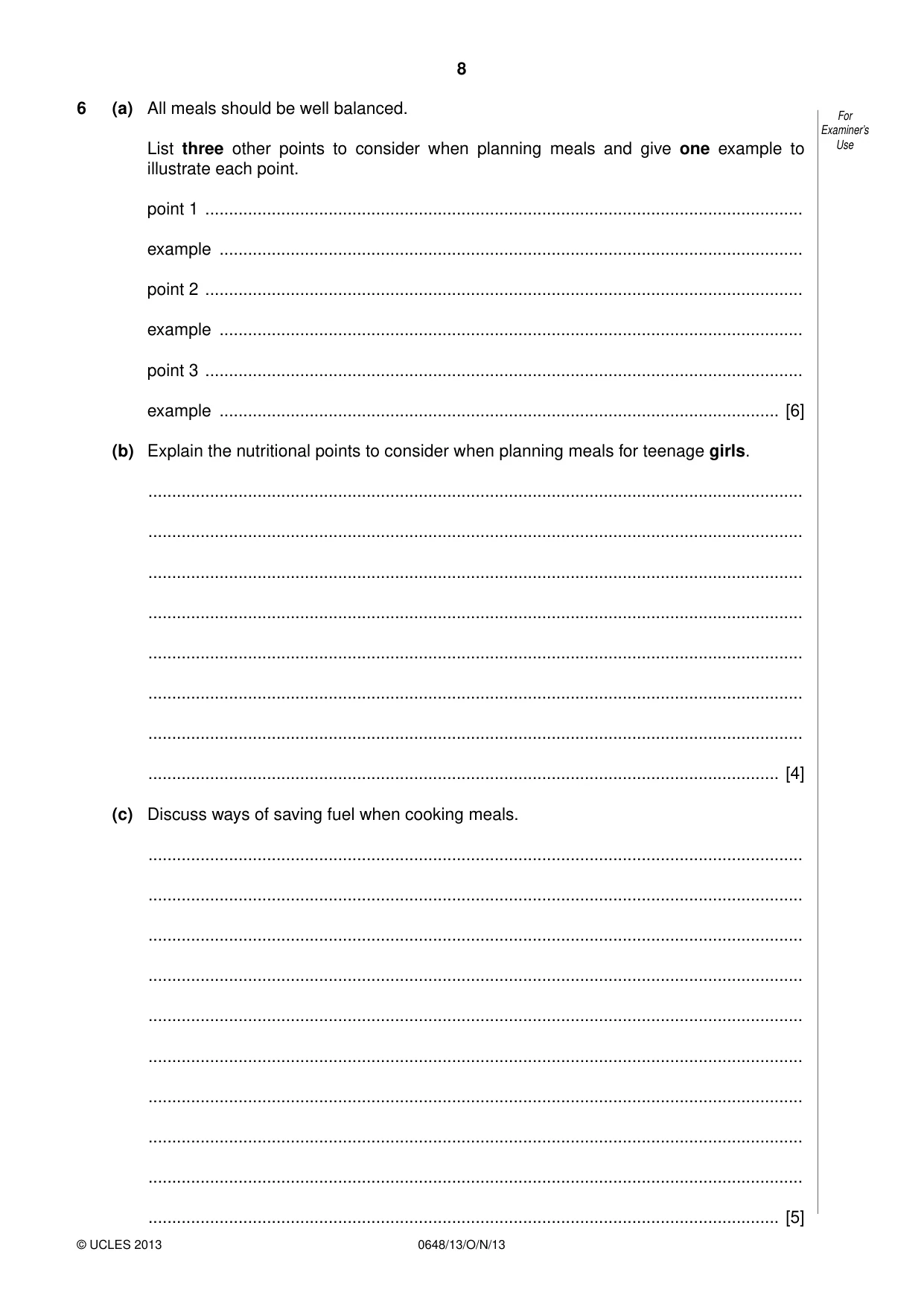
8 0648/13/O/N/13 © UCLES 2013 For Examiner’s Use 6 (a) All meals should be well balanced. List three other points to consider when planning meals and give one example to illustrate each point. point 1 … example … point 2 … example … point 3 … example … [6] (b) Explain the nutritional points to consider when planning meals for teenage girls. … … … … … … … … [4] (c) Discuss ways of saving fuel when cooking meals. … … … … … … … … … … [5]
Question paper, page 9
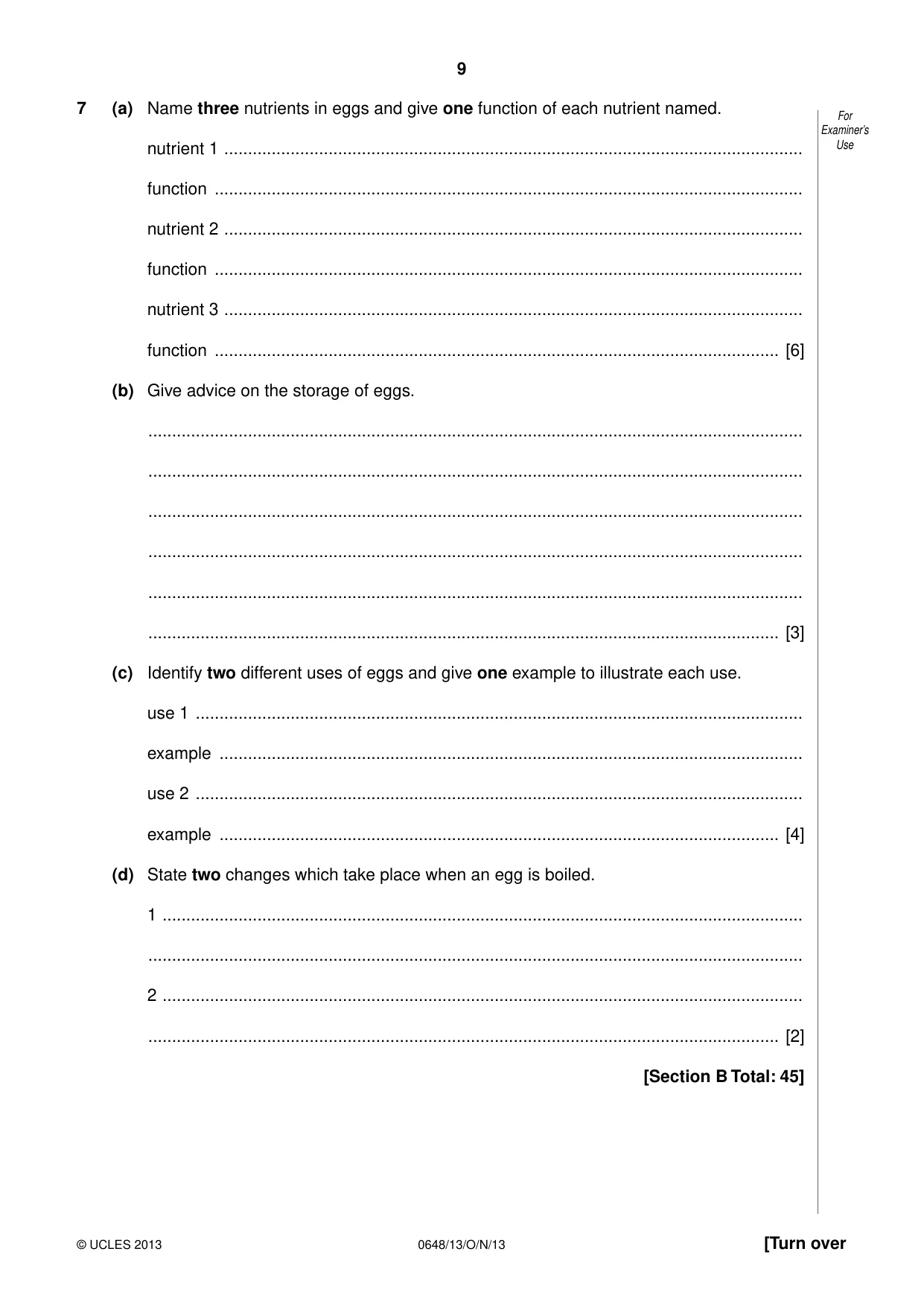
9 0648/13/O/N/13 © UCLES 2013 [Turn over For Examiner’s Use 7 (a) Name three nutrients in eggs and give one function of each nutrient named. nutrient 1 … function … nutrient 2 … function … nutrient 3 … function … [6] (b) Give advice on the storage of eggs. … … … … … … [3] (c) Identify two different uses of eggs and give one example to illustrate each use. use 1 … example … use 2 … example … [4] (d) State two changes which take place when an egg is boiled. 1 … … 2 … … [2] [Section B Total: 45]
Question paper, page 10
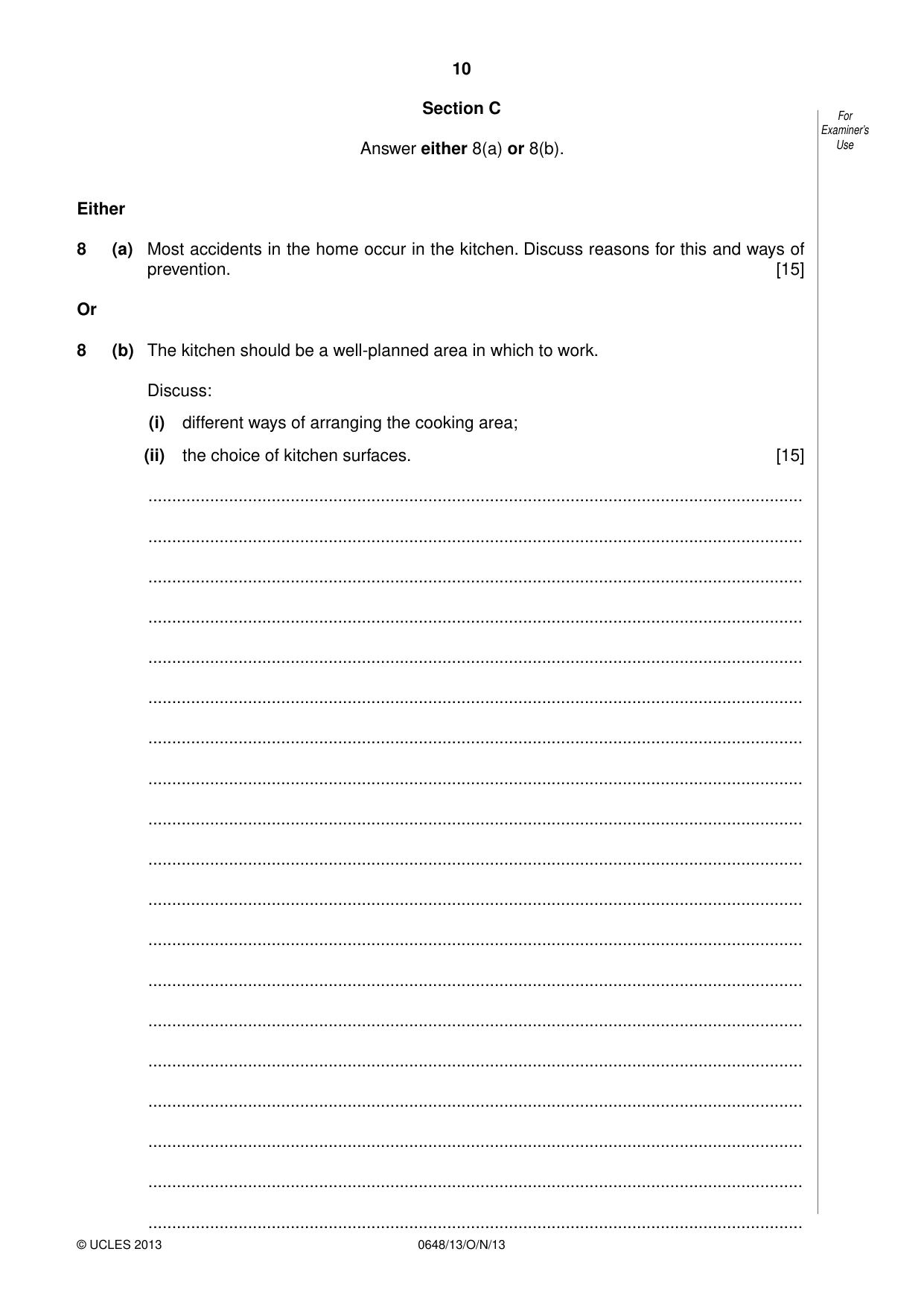
10 0648/13/O/N/13 © UCLES 2013 For Examiner’s Use Section C Answer either 8(a) or 8(b). Either 8 (a) Most accidents in the home occur in the kitchen. Discuss reasons for this and ways of prevention. [15] Or 8 (b) The kitchen should be a well-planned area in which to work. Discuss: (i) different ways of arranging the cooking area; (ii) the choice of kitchen surfaces. [15] … … … … … … … … … … … … … … … … … … …
Question paper, page 11
11 0648/13/O/N/13 © UCLES 2013 [Turn over For Examiner’s Use … … … … … … … … … … … … … … … … … … … … … … … … … … … …
Question paper, page 12
12 0648/13/O/N/13 © UCLES 2013 For Examiner’s Use Permission to reproduce items where third-party owned material protected by copyright is included has been sought and cleared where possible. Every reasonable effort has been made by the publisher (UCLES) to trace copyright holders, but if any items requiring clearance have unwittingly been included, the publisher will be pleased to make amends at the earliest possible opportunity. University of Cambridge International Examinations is part of the Cambridge Assessment Group. Cambridge Assessment is the brand name of University of Cambridge Local Examinations Syndicate (UCLES), which is itself a department of the University of Cambridge. … … … … … … … … … … … … … … … … … … … … … … … [Section C Total: 15] [Total for Paper: 100]
Mark scheme, page 1
CAMBRIDGE INTERNATIONAL EXAMINATIONS International General Certificate of Secondary Education MARK SCHEME for the October/November 2013 series 0648 FOOD AND NUTRITION 0648/13 (Written) maximum raw mark 100 This mark scheme is published as an aid to teachers and candidates, to indicate the requirements of the examination. It shows the basis on which Examiners were instructed to award marks. It does not indicate the details of the discussions that took place at an Examiners’ meeting before marking began, which would have considered the acceptability of alternative answers. Mark schemes should be read in conjunction with the question paper and the Principal Examiner Report for Teachers. Cambridge will not enter into discussions about these mark schemes. Cambridge is publishing the mark schemes for the October/November 2013 series for most IGCSE, GCE Advanced Level and Advanced Subsidiary Level components and some Ordinary Level components. www.XtremePapers.com
Mark scheme, page 2
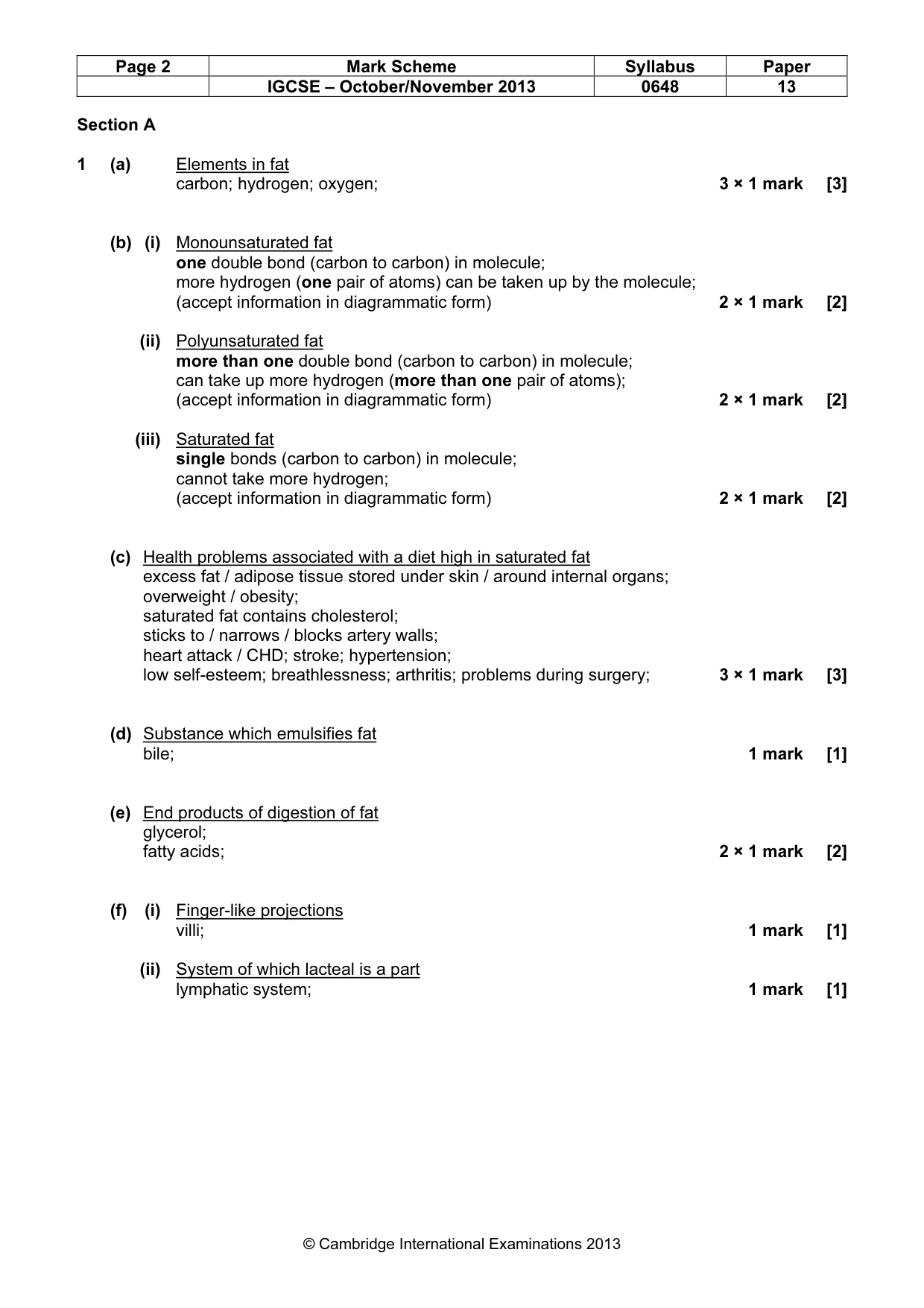
Page 2 Mark Scheme Syllabus Paper IGCSE – October/November 2013 0648 13 © Cambridge International Examinations 2013 Section A 1 (a) Elements in fat carbon; hydrogen; oxygen; 3 × 1 mark [3] (b) (i) Monounsaturated fat one double bond (carbon to carbon) in molecule; more hydrogen (one pair of atoms) can be taken up by the molecule; (accept information in diagrammatic form) 2 × 1 mark [2] (ii) Polyunsaturated fat more than one double bond (carbon to carbon) in molecule; can take up more hydrogen (more than one pair of atoms); (accept information in diagrammatic form) 2 × 1 mark [2] (iii) Saturated fat single bonds (carbon to carbon) in molecule; cannot take more hydrogen; (accept information in diagrammatic form) 2 × 1 mark [2] (c) Health problems associated with a diet high in saturated fat excess fat / adipose tissue stored under skin / around internal organs; overweight / obesity; saturated fat contains cholesterol; sticks to / narrows / blocks artery walls; heart attack / CHD; stroke; hypertension; low self-esteem; breathlessness; arthritis; problems during surgery; 3 × 1 mark [3] (d) Substance which emulsifies fat bile; 1 mark [1] (e) End products of digestion of fat glycerol; fatty acids; 2 × 1 mark [2] (f) (i) Finger-like projections villi; 1 mark [1] (ii) System of which lacteal is a part lymphatic system; 1 mark [1]
Mark scheme, page 3
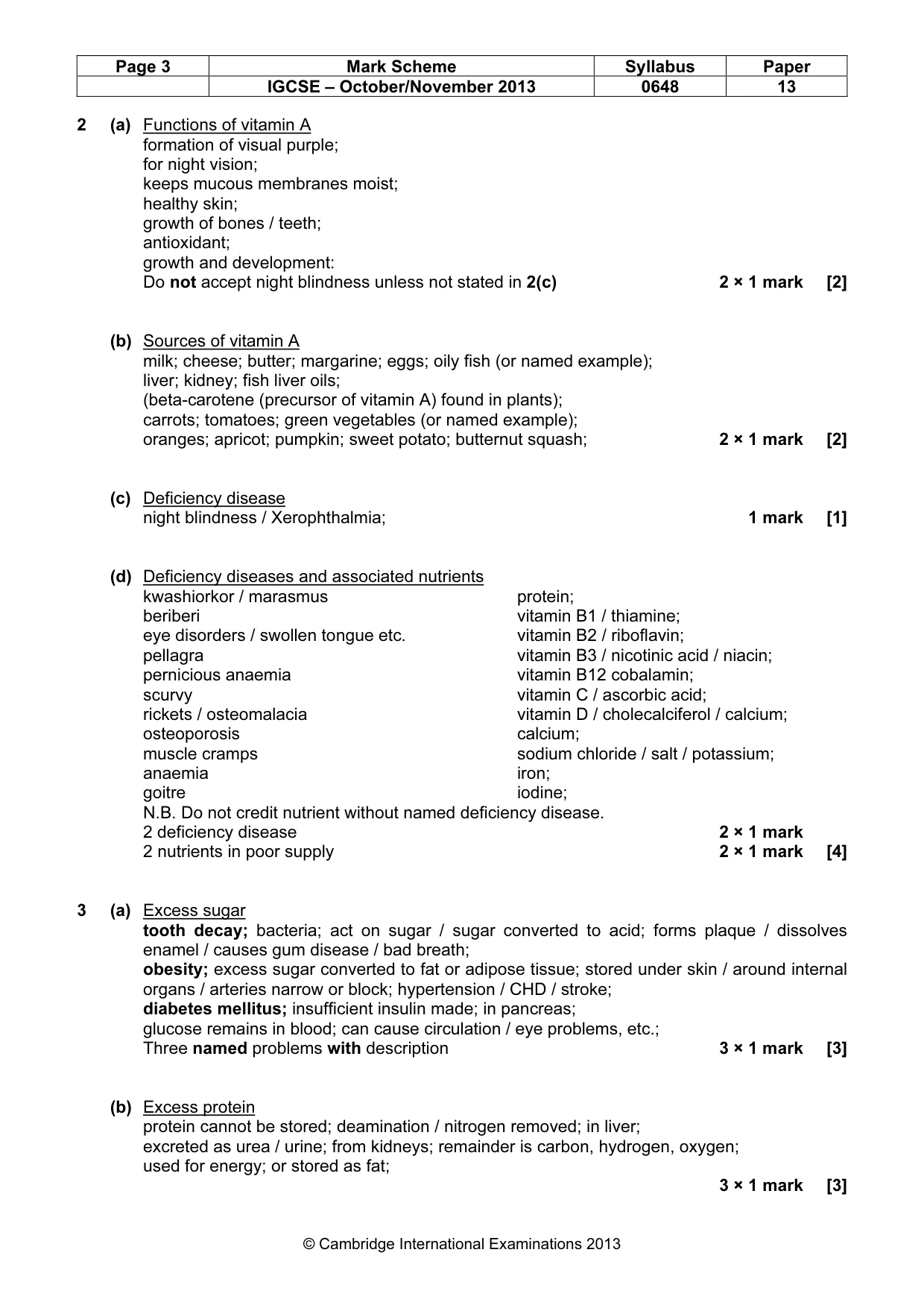
Page 3 Mark Scheme Syllabus Paper IGCSE – October/November 2013 0648 13 © Cambridge International Examinations 2013 2 (a) Functions of vitamin A formation of visual purple; for night vision; keeps mucous membranes moist; healthy skin; growth of bones / teeth; antioxidant; growth and development: Do not accept night blindness unless not stated in 2(c) 2 × 1 mark [2] (b) Sources of vitamin A milk; cheese; butter; margarine; eggs; oily fish (or named example); liver; kidney; fish liver oils; (beta-carotene (precursor of vitamin A) found in plants); carrots; tomatoes; green vegetables (or named example); oranges; apricot; pumpkin; sweet potato; butternut squash; 2 × 1 mark [2] (c) Deficiency disease night blindness / Xerophthalmia; 1 mark [1] (d) Deficiency diseases and associated nutrients kwashiorkor / marasmus protein; beriberi vitamin B1 / thiamine; eye disorders / swollen tongue etc. vitamin B2 / riboflavin; pellagra vitamin B3 / nicotinic acid / niacin; pernicious anaemia vitamin B12 cobalamin; scurvy vitamin C / ascorbic acid; rickets / osteomalacia vitamin D / cholecalciferol / calcium; osteoporosis calcium; muscle cramps sodium chloride / salt / potassium; anaemia iron; goitre iodine; N.B. Do not credit nutrient without named deficiency disease. 2 deficiency disease 2 × 1 mark 2 nutrients in poor supply 2 × 1 mark [4] 3 (a) Excess sugar tooth decay; bacteria; act on sugar / sugar converted to acid; forms plaque / dissolves enamel / causes gum disease / bad breath; obesity; excess sugar converted to fat or adipose tissue; stored under skin / around internal organs / arteries narrow or block; hypertension / CHD / stroke; diabetes mellitus; insufficient insulin made; in pancreas; glucose remains in blood; can cause circulation / eye problems, etc.; Three named problems with description 3 × 1 mark [3] (b) Excess protein protein cannot be stored; deamination / nitrogen removed; in liver; excreted as urea / urine; from kidneys; remainder is carbon, hydrogen, oxygen; used for energy; or stored as fat; 3 × 1 mark [3]
Mark scheme, page 4
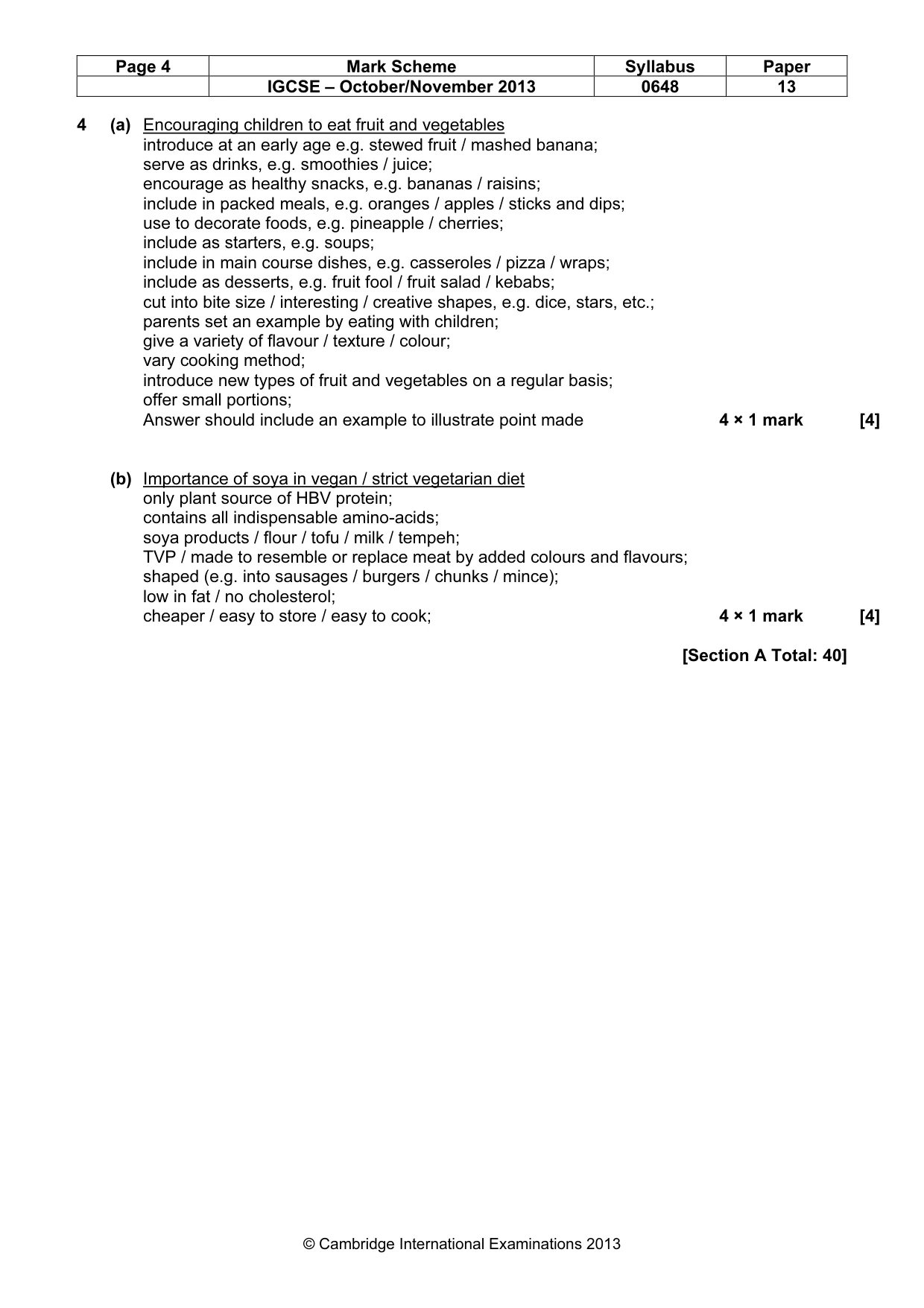
Page 4 Mark Scheme Syllabus Paper IGCSE – October/November 2013 0648 13 © Cambridge International Examinations 2013 4 (a) Encouraging children to eat fruit and vegetables introduce at an early age e.g. stewed fruit / mashed banana; serve as drinks, e.g. smoothies / juice; encourage as healthy snacks, e.g. bananas / raisins; include in packed meals, e.g. oranges / apples / sticks and dips; use to decorate foods, e.g. pineapple / cherries; include as starters, e.g. soups; include in main course dishes, e.g. casseroles / pizza / wraps; include as desserts, e.g. fruit fool / fruit salad / kebabs; cut into bite size / interesting / creative shapes, e.g. dice, stars, etc.; parents set an example by eating with children; give a variety of flavour / texture / colour; vary cooking method; introduce new types of fruit and vegetables on a regular basis; offer small portions; Answer should include an example to illustrate point made 4 × 1 mark [4] (b) Importance of soya in vegan / strict vegetarian diet only plant source of HBV protein; contains all indispensable amino-acids; soya products / flour / tofu / milk / tempeh; TVP / made to resemble or replace meat by added colours and flavours; shaped (e.g. into sausages / burgers / chunks / mince); low in fat / no cholesterol; cheaper / easy to store / easy to cook; 4 × 1 mark [4] [Section A Total: 40]
Mark scheme, page 5
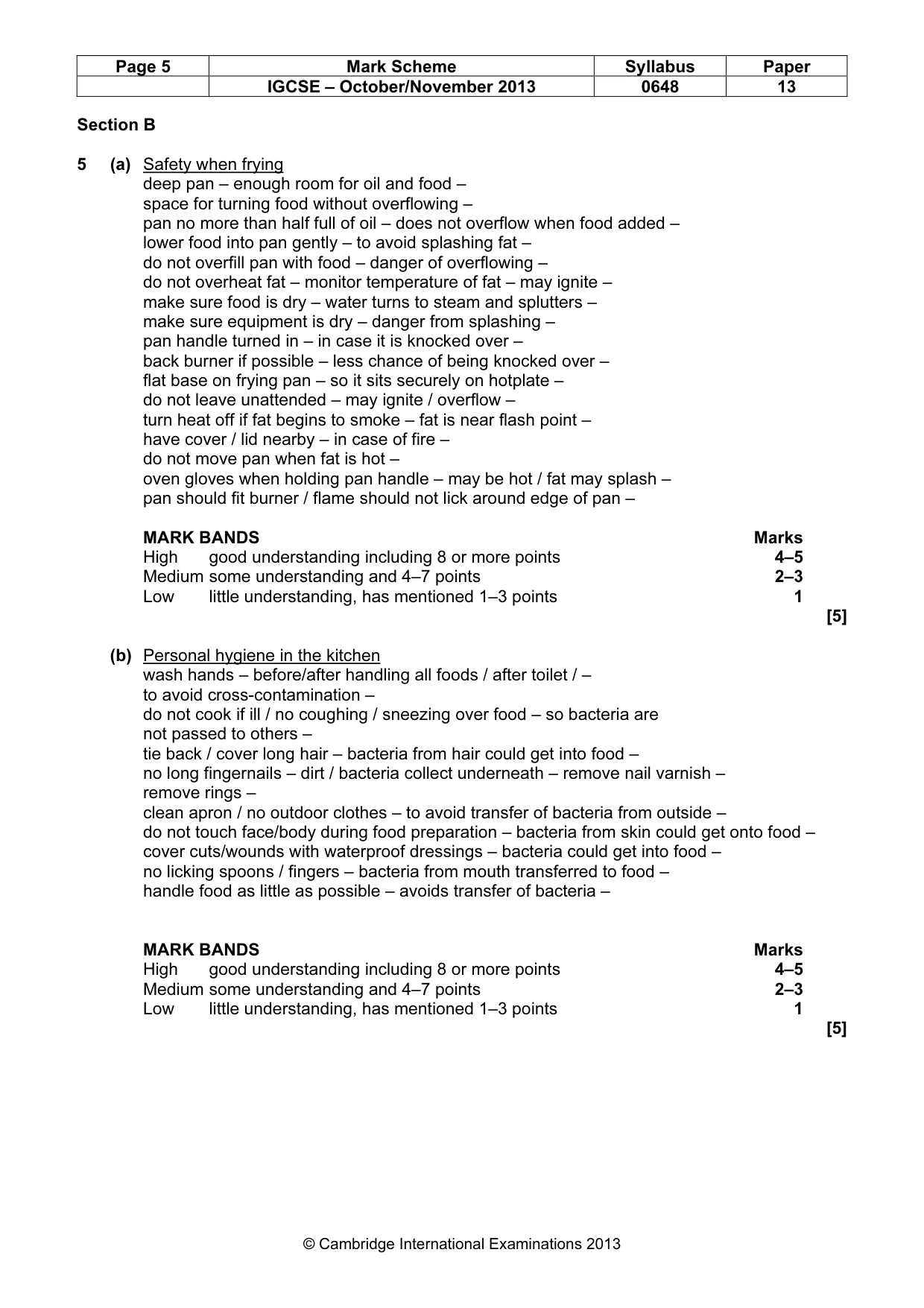
Page 5 Mark Scheme Syllabus Paper IGCSE – October/November 2013 0648 13 © Cambridge International Examinations 2013 Section B 5 (a) Safety when frying deep pan – enough room for oil and food – space for turning food without overflowing – pan no more than half full of oil – does not overflow when food added – lower food into pan gently – to avoid splashing fat – do not overfill pan with food – danger of overflowing – do not overheat fat – monitor temperature of fat – may ignite – make sure food is dry – water turns to steam and splutters – make sure equipment is dry – danger from splashing – pan handle turned in – in case it is knocked over – back burner if possible – less chance of being knocked over – flat base on frying pan – so it sits securely on hotplate – do not leave unattended – may ignite / overflow – turn heat off if fat begins to smoke – fat is near flash point – have cover / lid nearby – in case of fire – do not move pan when fat is hot – oven gloves when holding pan handle – may be hot / fat may splash – pan should fit burner / flame should not lick around edge of pan – MARK BANDS Marks High good understanding including 8 or more points 4–5 Medium some understanding and 4–7 points 2–3 Low little understanding, has mentioned 1–3 points 1 [5] (b) Personal hygiene in the kitchen wash hands – before/after handling all foods / after toilet / – to avoid cross-contamination – do not cook if ill / no coughing / sneezing over food – so bacteria are not passed to others – tie back / cover long hair – bacteria from hair could get into food – no long fingernails – dirt / bacteria collect underneath – remove nail varnish – remove rings – clean apron / no outdoor clothes – to avoid transfer of bacteria from outside – do not touch face/body during food preparation – bacteria from skin could get onto food – cover cuts/wounds with waterproof dressings – bacteria could get into food – no licking spoons / fingers – bacteria from mouth transferred to food – handle food as little as possible – avoids transfer of bacteria – MARK BANDS Marks High good understanding including 8 or more points 4–5 Medium some understanding and 4–7 points 2–3 Low little understanding, has mentioned 1–3 points 1 [5]
Mark scheme, page 6
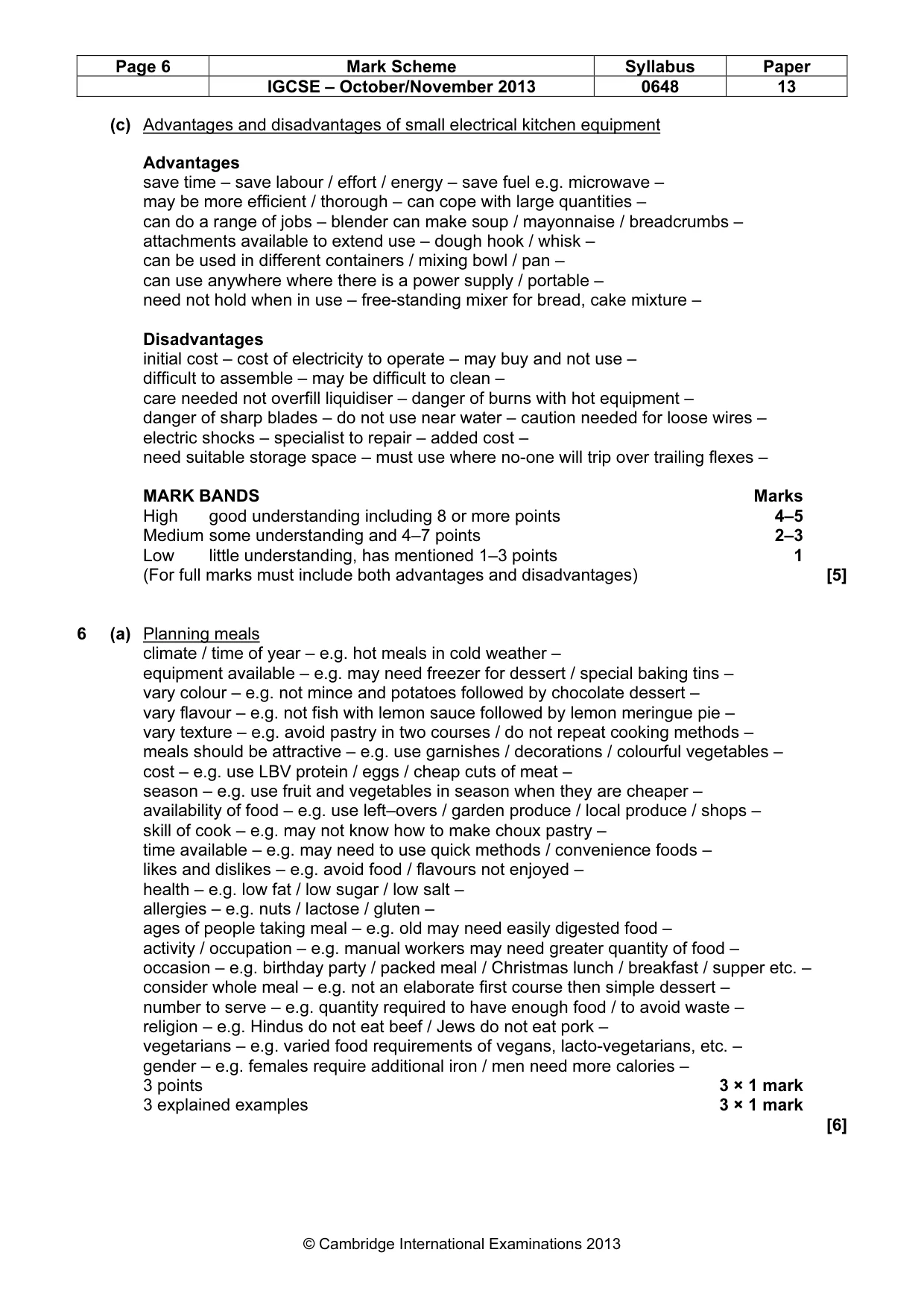
Page 6 Mark Scheme Syllabus Paper IGCSE – October/November 2013 0648 13 © Cambridge International Examinations 2013 (c) Advantages and disadvantages of small electrical kitchen equipment Advantages save time – save labour / effort / energy – save fuel e.g. microwave – may be more efficient / thorough – can cope with large quantities – can do a range of jobs – blender can make soup / mayonnaise / breadcrumbs – attachments available to extend use – dough hook / whisk – can be used in different containers / mixing bowl / pan – can use anywhere where there is a power supply / portable – need not hold when in use – free-standing mixer for bread, cake mixture – Disadvantages initial cost – cost of electricity to operate – may buy and not use – difficult to assemble – may be difficult to clean – care needed not overfill liquidiser – danger of burns with hot equipment – danger of sharp blades – do not use near water – caution needed for loose wires – electric shocks – specialist to repair – added cost – need suitable storage space – must use where no-one will trip over trailing flexes – MARK BANDS Marks High good understanding including 8 or more points 4–5 Medium some understanding and 4–7 points 2–3 Low little understanding, has mentioned 1–3 points 1 (For full marks must include both advantages and disadvantages) [5] 6 (a) Planning meals climate / time of year – e.g. hot meals in cold weather – equipment available – e.g. may need freezer for dessert / special baking tins – vary colour – e.g. not mince and potatoes followed by chocolate dessert – vary flavour – e.g. not fish with lemon sauce followed by lemon meringue pie – vary texture – e.g. avoid pastry in two courses / do not repeat cooking methods – meals should be attractive – e.g. use garnishes / decorations / colourful vegetables – cost – e.g. use LBV protein / eggs / cheap cuts of meat – season – e.g. use fruit and vegetables in season when they are cheaper – availability of food – e.g. use left–overs / garden produce / local produce / shops – skill of cook – e.g. may not know how to make choux pastry – time available – e.g. may need to use quick methods / convenience foods – likes and dislikes – e.g. avoid food / flavours not enjoyed – health – e.g. low fat / low sugar / low salt – allergies – e.g. nuts / lactose / gluten – ages of people taking meal – e.g. old may need easily digested food – activity / occupation – e.g. manual workers may need greater quantity of food – occasion – e.g. birthday party / packed meal / Christmas lunch / breakfast / supper etc. – consider whole meal – e.g. not an elaborate first course then simple dessert – number to serve – e.g. quantity required to have enough food / to avoid waste – religion – e.g. Hindus do not eat beef / Jews do not eat pork – vegetarians – e.g. varied food requirements of vegans, lacto-vegetarians, etc. – gender – e.g. females require additional iron / men need more calories – 3 points 3 × 1 mark 3 explained examples 3 × 1 mark [6]
Mark scheme, page 7
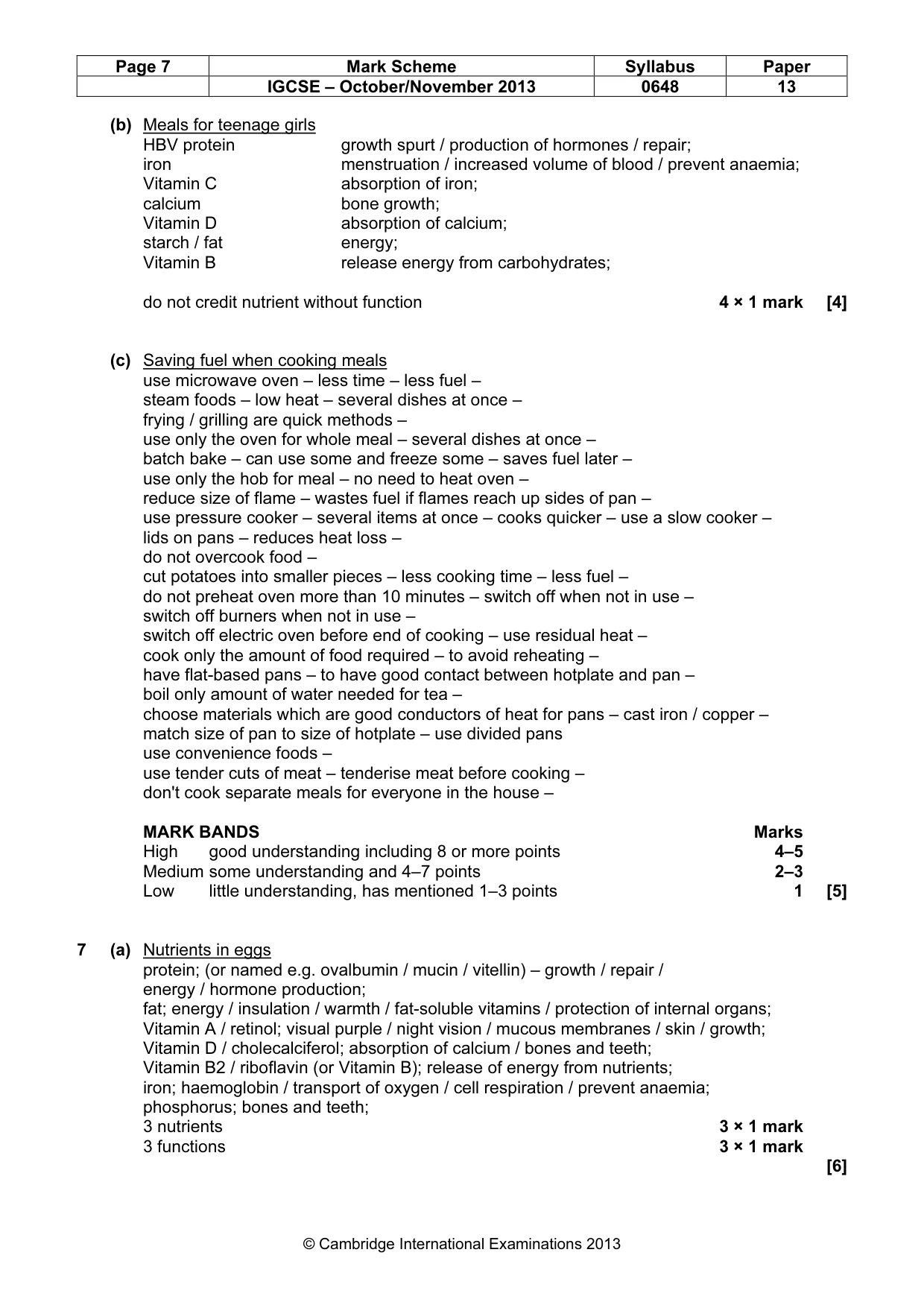
Page 7 Mark Scheme Syllabus Paper IGCSE – October/November 2013 0648 13 © Cambridge International Examinations 2013 (b) Meals for teenage girls HBV protein growth spurt / production of hormones / repair; iron menstruation / increased volume of blood / prevent anaemia; Vitamin C absorption of iron; calcium bone growth; Vitamin D absorption of calcium; starch / fat energy; Vitamin B release energy from carbohydrates; do not credit nutrient without function 4 × 1 mark [4] (c) Saving fuel when cooking meals use microwave oven – less time – less fuel – steam foods – low heat – several dishes at once – frying / grilling are quick methods – use only the oven for whole meal – several dishes at once – batch bake – can use some and freeze some – saves fuel later – use only the hob for meal – no need to heat oven – reduce size of flame – wastes fuel if flames reach up sides of pan – use pressure cooker – several items at once – cooks quicker – use a slow cooker – lids on pans – reduces heat loss – do not overcook food – cut potatoes into smaller pieces – less cooking time – less fuel – do not preheat oven more than 10 minutes – switch off when not in use – switch off burners when not in use – switch off electric oven before end of cooking – use residual heat – cook only the amount of food required – to avoid reheating – have flat-based pans – to have good contact between hotplate and pan – boil only amount of water needed for tea – choose materials which are good conductors of heat for pans – cast iron / copper – match size of pan to size of hotplate – use divided pans use convenience foods – use tender cuts of meat – tenderise meat before cooking – don't cook separate meals for everyone in the house – MARK BANDS Marks High good understanding including 8 or more points 4–5 Medium some understanding and 4–7 points 2–3 Low little understanding, has mentioned 1–3 points 1 [5] 7 (a) Nutrients in eggs protein; (or named e.g. ovalbumin / mucin / vitellin) – growth / repair / energy / hormone production; fat; energy / insulation / warmth / fat-soluble vitamins / protection of internal organs; Vitamin A / retinol; visual purple / night vision / mucous membranes / skin / growth; Vitamin D / cholecalciferol; absorption of calcium / bones and teeth; Vitamin B2 / riboflavin (or Vitamin B); release of energy from nutrients; iron; haemoglobin / transport of oxygen / cell respiration / prevent anaemia; phosphorus; bones and teeth; 3 nutrients 3 × 1 mark 3 functions 3 × 1 mark [6]
Mark scheme, page 8
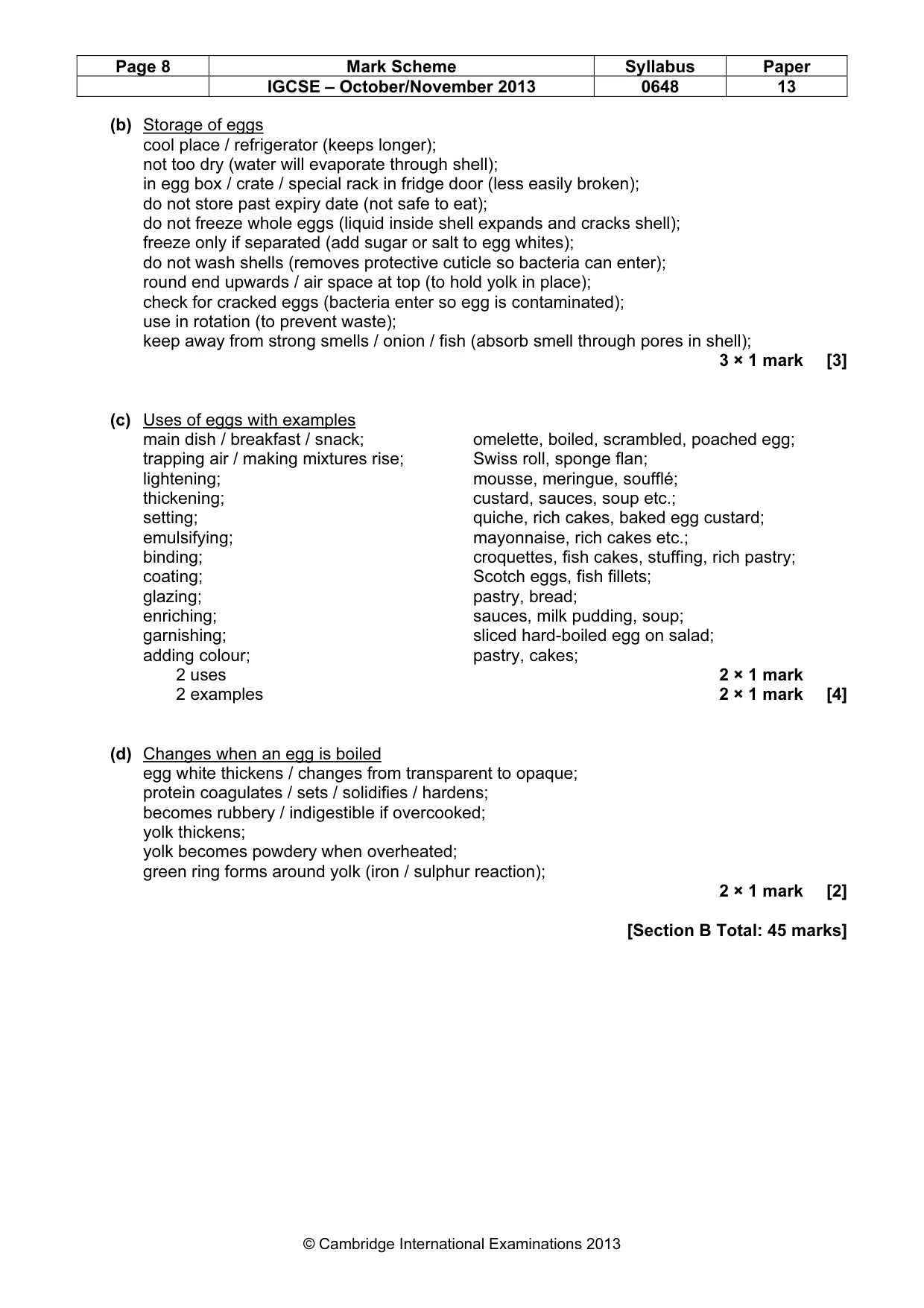
Page 8 Mark Scheme Syllabus Paper IGCSE – October/November 2013 0648 13 © Cambridge International Examinations 2013 (b) Storage of eggs cool place / refrigerator (keeps longer); not too dry (water will evaporate through shell); in egg box / crate / special rack in fridge door (less easily broken); do not store past expiry date (not safe to eat); do not freeze whole eggs (liquid inside shell expands and cracks shell); freeze only if separated (add sugar or salt to egg whites); do not wash shells (removes protective cuticle so bacteria can enter); round end upwards / air space at top (to hold yolk in place); check for cracked eggs (bacteria enter so egg is contaminated); use in rotation (to prevent waste); keep away from strong smells / onion / fish (absorb smell through pores in shell); 3 × 1 mark [3] (c) Uses of eggs with examples main dish / breakfast / snack; omelette, boiled, scrambled, poached egg; trapping air / making mixtures rise; Swiss roll, sponge flan; lightening; mousse, meringue, soufflé; thickening; custard, sauces, soup etc.; setting; quiche, rich cakes, baked egg custard; emulsifying; mayonnaise, rich cakes etc.; binding; croquettes, fish cakes, stuffing, rich pastry; coating; Scotch eggs, fish fillets; glazing; pastry, bread; enriching; sauces, milk pudding, soup; garnishing; sliced hard-boiled egg on salad; adding colour; pastry, cakes; 2 uses 2 × 1 mark 2 examples 2 × 1 mark [4] (d) Changes when an egg is boiled egg white thickens / changes from transparent to opaque; protein coagulates / sets / solidifies / hardens; becomes rubbery / indigestible if overcooked; yolk thickens; yolk becomes powdery when overheated; green ring forms around yolk (iron / sulphur reaction); 2 × 1 mark [2] [Section B Total: 45 marks]
Mark scheme, page 9
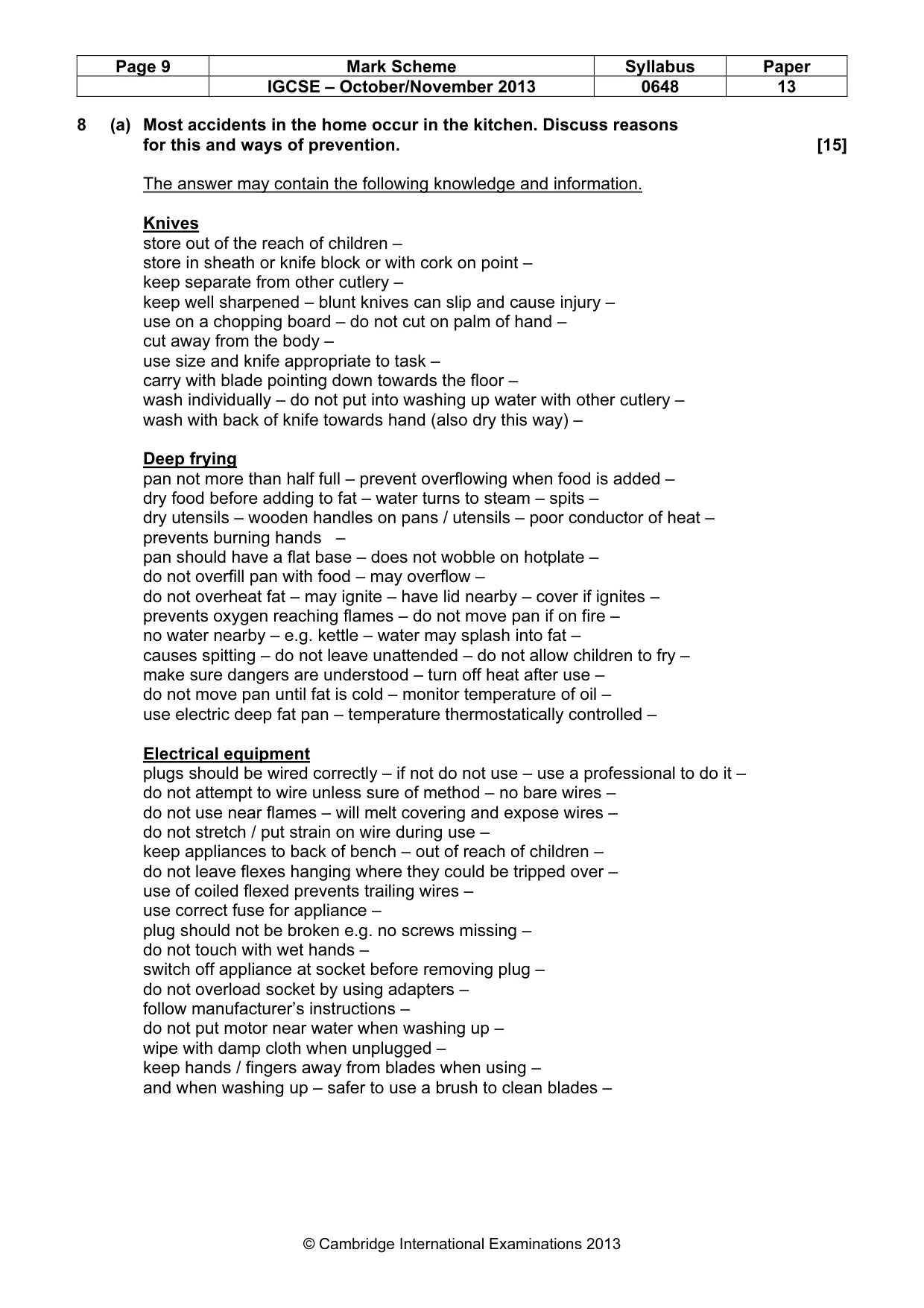
Page 9 Mark Scheme Syllabus Paper IGCSE – October/November 2013 0648 13 © Cambridge International Examinations 2013 8 (a) Most accidents in the home occur in the kitchen. Discuss reasons for this and ways of prevention. [15] The answer may contain the following knowledge and information. Knives store out of the reach of children – store in sheath or knife block or with cork on point – keep separate from other cutlery – keep well sharpened – blunt knives can slip and cause injury – use on a chopping board – do not cut on palm of hand – cut away from the body – use size and knife appropriate to task – carry with blade pointing down towards the floor – wash individually – do not put into washing up water with other cutlery – wash with back of knife towards hand (also dry this way) – Deep frying pan not more than half full – prevent overflowing when food is added – dry food before adding to fat – water turns to steam – spits – dry utensils – wooden handles on pans / utensils – poor conductor of heat – prevents burning hands – pan should have a flat base – does not wobble on hotplate – do not overfill pan with food – may overflow – do not overheat fat – may ignite – have lid nearby – cover if ignites – prevents oxygen reaching flames – do not move pan if on fire – no water nearby – e.g. kettle – water may splash into fat – causes spitting – do not leave unattended – do not allow children to fry – make sure dangers are understood – turn off heat after use – do not move pan until fat is cold – monitor temperature of oil – use electric deep fat pan – temperature thermostatically controlled – Electrical equipment plugs should be wired correctly – if not do not use – use a professional to do it – do not attempt to wire unless sure of method – no bare wires – do not use near flames – will melt covering and expose wires – do not stretch / put strain on wire during use – keep appliances to back of bench – out of reach of children – do not leave flexes hanging where they could be tripped over – use of coiled flexed prevents trailing wires – use correct fuse for appliance – plug should not be broken e.g. no screws missing – do not touch with wet hands – switch off appliance at socket before removing plug – do not overload socket by using adapters – follow manufacturer’s instructions – do not put motor near water when washing up – wipe with damp cloth when unplugged – keep hands / fingers away from blades when using – and when washing up – safer to use a brush to clean blades –
Mark scheme, page 10
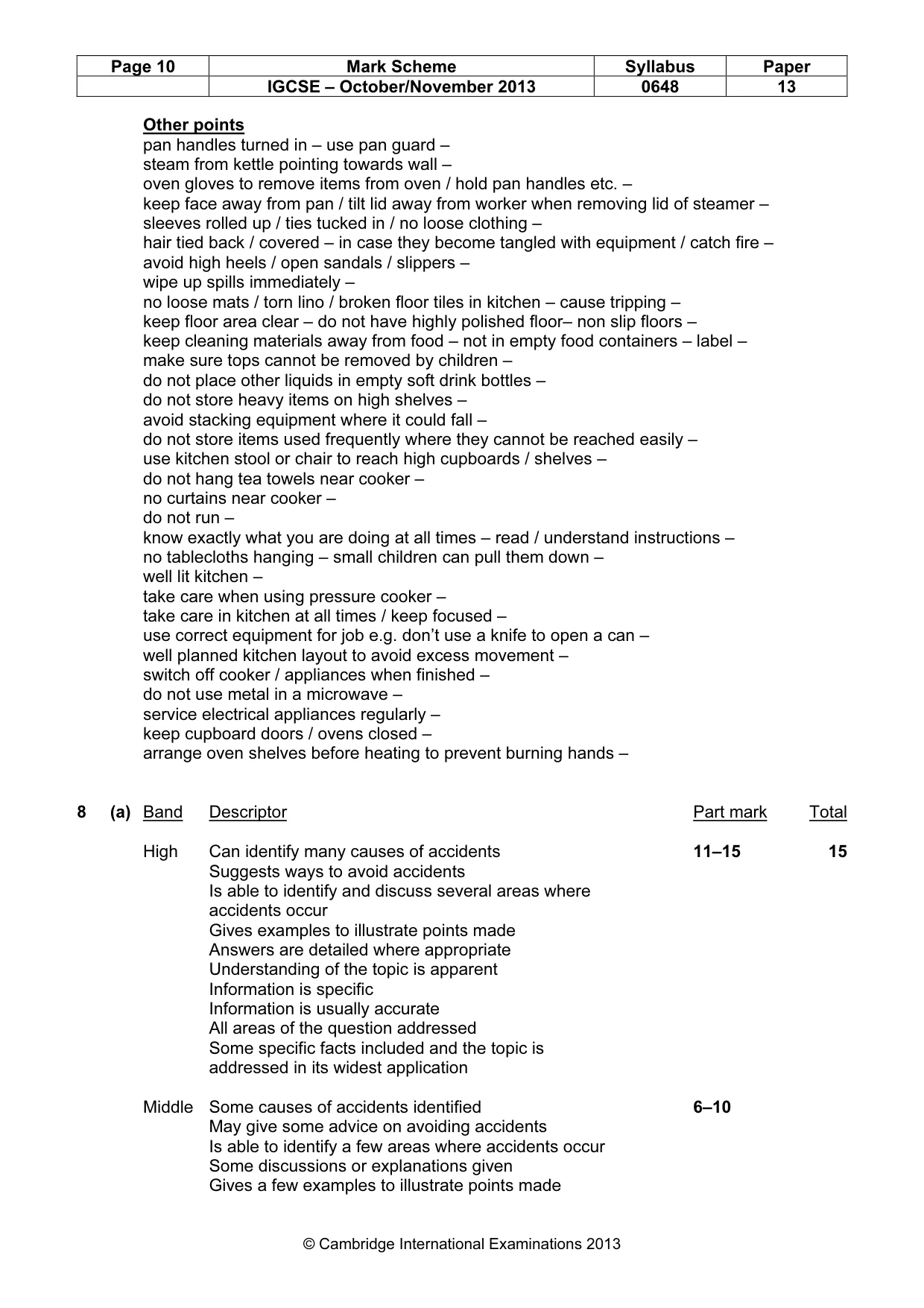
Page 10 Mark Scheme Syllabus Paper IGCSE – October/November 2013 0648 13 © Cambridge International Examinations 2013 Other points pan handles turned in – use pan guard – steam from kettle pointing towards wall – oven gloves to remove items from oven / hold pan handles etc. – keep face away from pan / tilt lid away from worker when removing lid of steamer – sleeves rolled up / ties tucked in / no loose clothing – hair tied back / covered – in case they become tangled with equipment / catch fire – avoid high heels / open sandals / slippers – wipe up spills immediately – no loose mats / torn lino / broken floor tiles in kitchen – cause tripping – keep floor area clear – do not have highly polished floor– non slip floors – keep cleaning materials away from food – not in empty food containers – label – make sure tops cannot be removed by children – do not place other liquids in empty soft drink bottles – do not store heavy items on high shelves – avoid stacking equipment where it could fall – do not store items used frequently where they cannot be reached easily – use kitchen stool or chair to reach high cupboards / shelves – do not hang tea towels near cooker – no curtains near cooker – do not run – know exactly what you are doing at all times – read / understand instructions – no tablecloths hanging – small children can pull them down – well lit kitchen – take care when using pressure cooker – take care in kitchen at all times / keep focused – use correct equipment for job e.g. don’t use a knife to open a can – well planned kitchen layout to avoid excess movement – switch off cooker / appliances when finished – do not use metal in a microwave – service electrical appliances regularly – keep cupboard doors / ovens closed – arrange oven shelves before heating to prevent burning hands – 8 (a) Band Descriptor Part mark Total High Can identify many causes of accidents 11–15 15 Suggests ways to avoid accidents Is able to identify and discuss several areas where accidents occur Gives examples to illustrate points made Answers are detailed where appropriate Understanding of the topic is apparent Information is specific Information is usually accurate All areas of the question addressed Some specific facts included and the topic is addressed in its widest application Middle Some causes of accidents identified 6–10 May give some advice on avoiding accidents Is able to identify a few areas where accidents occur Some discussions or explanations given Gives a few examples to illustrate points made
Mark scheme, page 11
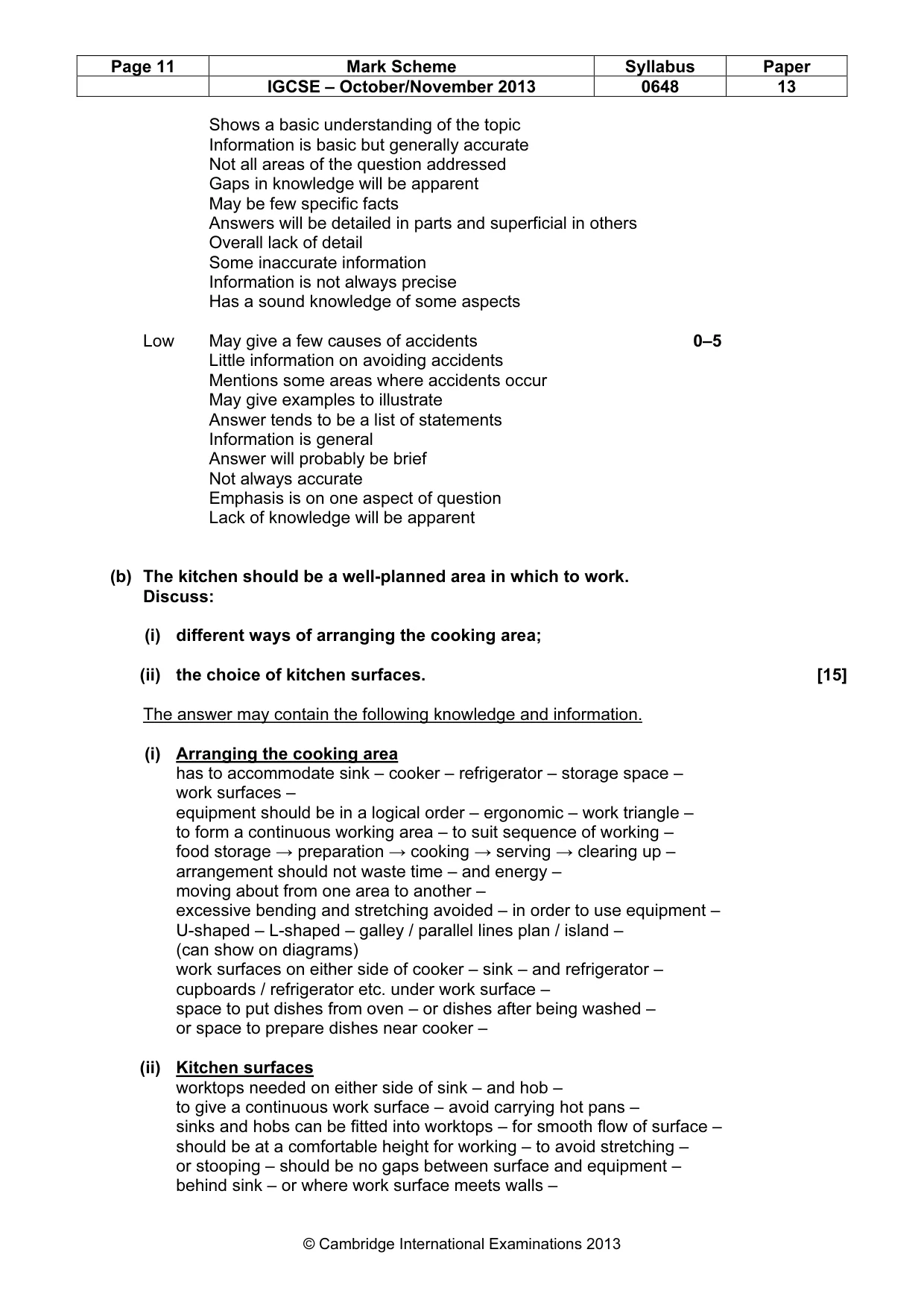
Page 11 Mark Scheme Syllabus Paper IGCSE – October/November 2013 0648 13 © Cambridge International Examinations 2013 Shows a basic understanding of the topic Information is basic but generally accurate Not all areas of the question addressed Gaps in knowledge will be apparent May be few specific facts Answers will be detailed in parts and superficial in others Overall lack of detail Some inaccurate information Information is not always precise Has a sound knowledge of some aspects Low May give a few causes of accidents 0–5 Little information on avoiding accidents Mentions some areas where accidents occur May give examples to illustrate Answer tends to be a list of statements Information is general Answer will probably be brief Not always accurate Emphasis is on one aspect of question Lack of knowledge will be apparent (b) The kitchen should be a well-planned area in which to work. Discuss: (i) different ways of arranging the cooking area; (ii) the choice of kitchen surfaces. [15] The answer may contain the following knowledge and information. (i) Arranging the cooking area has to accommodate sink – cooker – refrigerator – storage space – work surfaces – equipment should be in a logical order – ergonomic – work triangle – to form a continuous working area – to suit sequence of working – food storage → preparation → cooking → serving → clearing up – arrangement should not waste time – and energy – moving about from one area to another – excessive bending and stretching avoided – in order to use equipment – U-shaped – L-shaped – galley / parallel lines plan / island – (can show on diagrams) work surfaces on either side of cooker – sink – and refrigerator – cupboards / refrigerator etc. under work surface – space to put dishes from oven – or dishes after being washed – or space to prepare dishes near cooker – (ii) Kitchen surfaces worktops needed on either side of sink – and hob – to give a continuous work surface – avoid carrying hot pans – sinks and hobs can be fitted into worktops – for smooth flow of surface – should be at a comfortable height for working – to avoid stretching – or stooping – should be no gaps between surface and equipment – behind sink – or where work surface meets walls –
Mark scheme, page 12
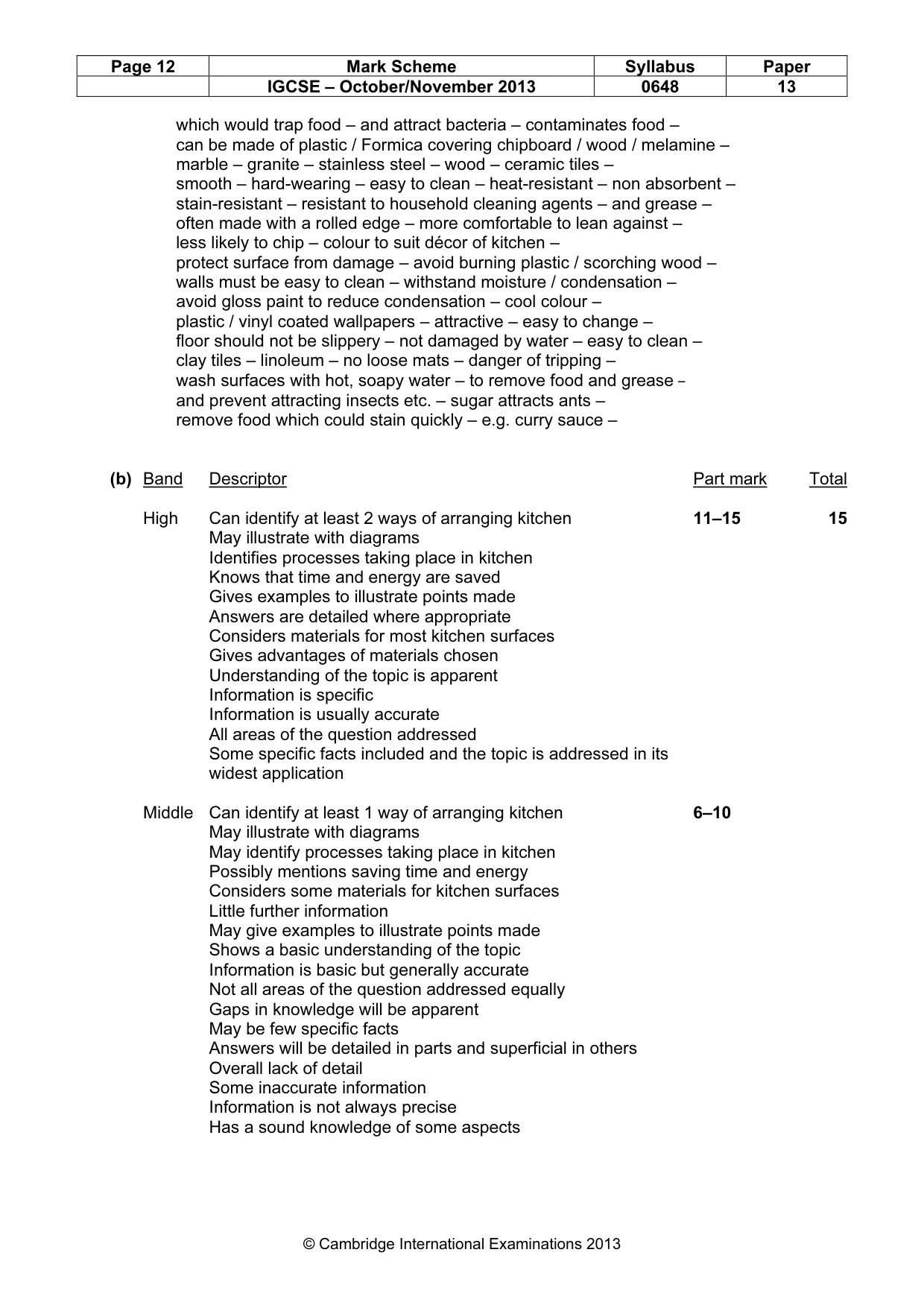
Page 12 Mark Scheme Syllabus Paper IGCSE – October/November 2013 0648 13 © Cambridge International Examinations 2013 which would trap food – and attract bacteria – contaminates food – can be made of plastic / Formica covering chipboard / wood / melamine – marble – granite – stainless steel – wood – ceramic tiles – smooth – hard-wearing – easy to clean – heat-resistant – non absorbent – stain-resistant – resistant to household cleaning agents – and grease – often made with a rolled edge – more comfortable to lean against – less likely to chip – colour to suit décor of kitchen – protect surface from damage – avoid burning plastic / scorching wood – walls must be easy to clean – withstand moisture / condensation – avoid gloss paint to reduce condensation – cool colour – plastic / vinyl coated wallpapers – attractive – easy to change – floor should not be slippery – not damaged by water – easy to clean – clay tiles – linoleum – no loose mats – danger of tripping – wash surfaces with hot, soapy water – to remove food and grease – and prevent attracting insects etc. – sugar attracts ants – remove food which could stain quickly – e.g. curry sauce – (b) Band Descriptor Part mark Total High Can identify at least 2 ways of arranging kitchen 11–15 15 May illustrate with diagrams Identifies processes taking place in kitchen Knows that time and energy are saved Gives examples to illustrate points made Answers are detailed where appropriate Considers materials for most kitchen surfaces Gives advantages of materials chosen Understanding of the topic is apparent Information is specific Information is usually accurate All areas of the question addressed Some specific facts included and the topic is addressed in its widest application Middle Can identify at least 1 way of arranging kitchen 6–10 May illustrate with diagrams May identify processes taking place in kitchen Possibly mentions saving time and energy Considers some materials for kitchen surfaces Little further information May give examples to illustrate points made Shows a basic understanding of the topic Information is basic but generally accurate Not all areas of the question addressed equally Gaps in knowledge will be apparent May be few specific facts Answers will be detailed in parts and superficial in others Overall lack of detail Some inaccurate information Information is not always precise Has a sound knowledge of some aspects
Mark scheme, page 13
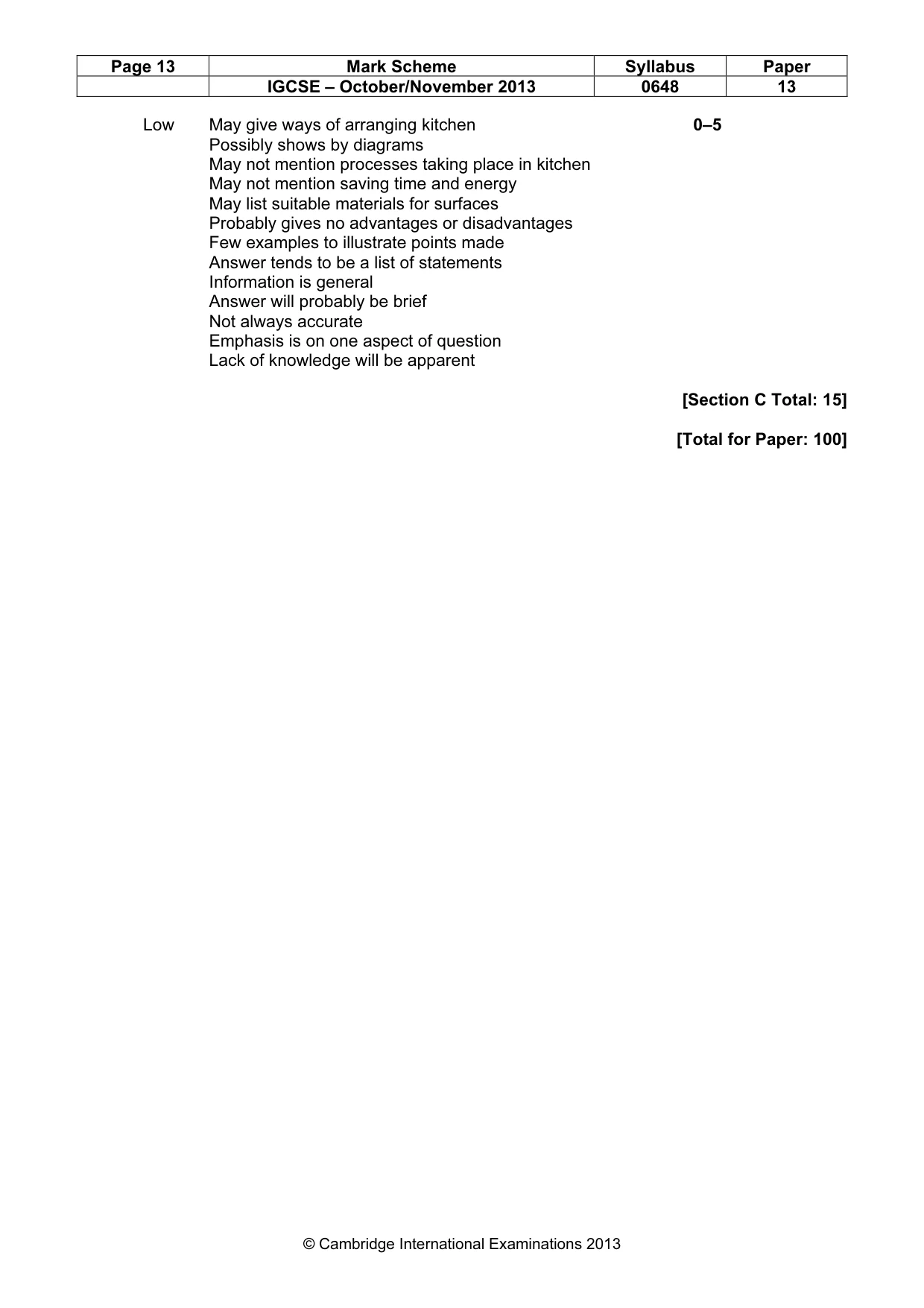
Page 13 Mark Scheme Syllabus Paper IGCSE – October/November 2013 0648 13 © Cambridge International Examinations 2013 Low May give ways of arranging kitchen 0–5 Possibly shows by diagrams May not mention processes taking place in kitchen May not mention saving time and energy May list suitable materials for surfaces Probably gives no advantages or disadvantages Few examples to illustrate points made Answer tends to be a list of statements Information is general Answer will probably be brief Not always accurate Emphasis is on one aspect of question Lack of knowledge will be apparent [Section C Total: 15] [Total for Paper: 100]
What you needed in this session
Cambridge’s own grade thresholds for 2013 Oct/Nov, Paper 1 · Variant 3. A higher threshold means an easier paper — the bar moves with how the cohort did.