Cambridge IGCSE Environmental Management 0680 — 2023 May/June Paper 1 · Variant 2
0680/12/M/J/23 · 80 marks · ≈90 min
The question paper and its mark scheme, free to read here and free to download. This is Cambridge’s own paper, exactly as it was sat.
Question paper20 pages

Mark scheme13 pages
Answers below. Sit the paper first if you are practising.
Paper as text
Question paper, page 1
This document has 20 pages. Any blank pages are indicated. [Turn over Cambridge IGCSE™ * 3 8 9 4 1 8 3 0 7 7 * ENVIRONMENTAL MANAGEMENT 0680/12 Paper 1 Theory May/June 2023 1 hour 45 minutes You must answer on the question paper. No additional materials are needed. INSTRUCTIONS ● Answer all questions. ● Use a black or dark blue pen. You may use an HB pencil for any diagrams or graphs. ● Write your name, centre number and candidate number in the boxes at the top of the page. ● Write your answer to each question in the space provided. ● Do not use an erasable pen or correction fluid. ● Do not write on any bar codes. ● You may use a calculator. ● You should show all your working and use appropriate units. INFORMATION ● The total mark for this paper is 80. ● The number of marks for each question or part question is shown in brackets [ ]. DC (RW/JG) 315330/1 © UCLES 2023
Question paper, page 2
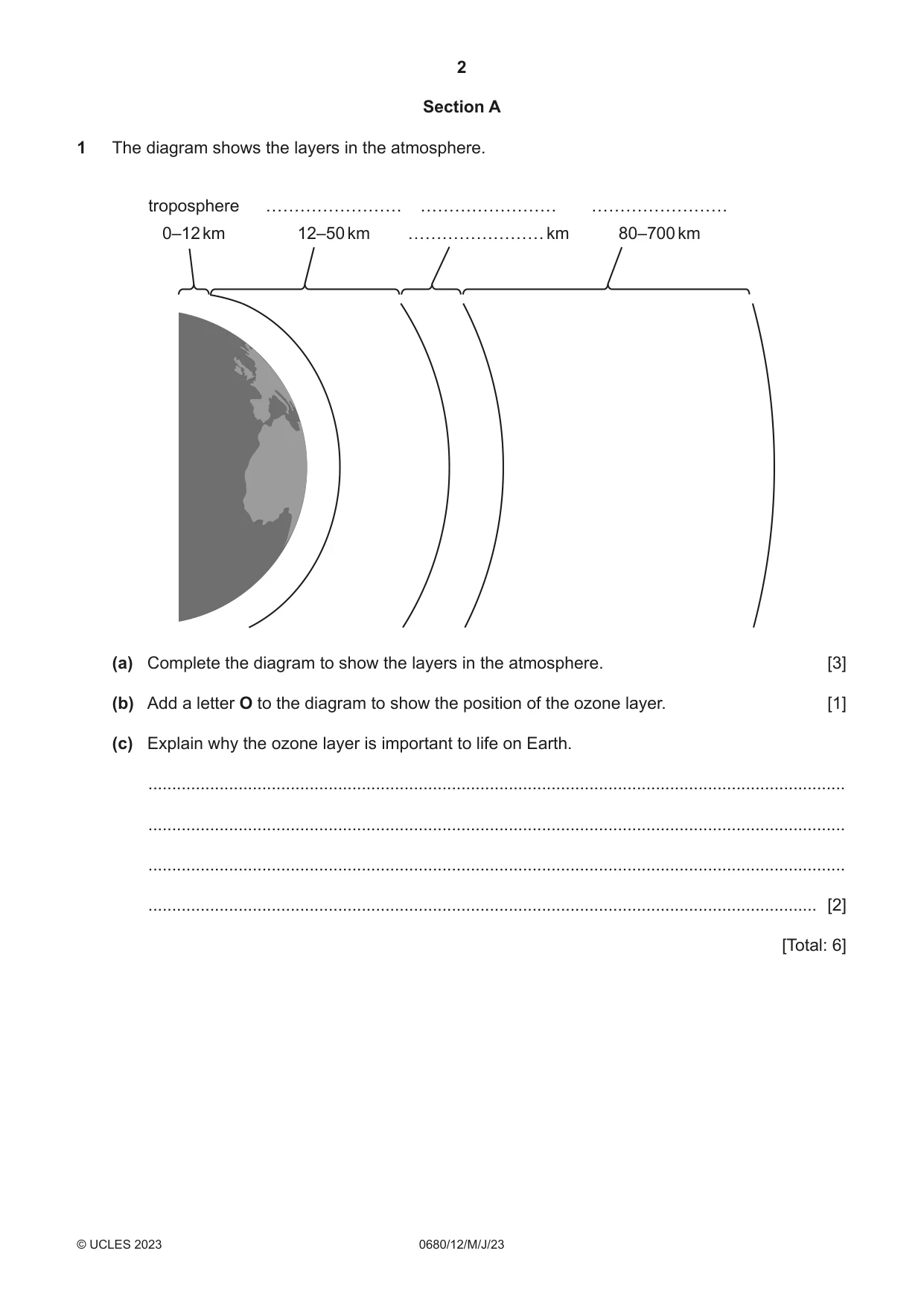
2 0680/12/M/J/23 © UCLES 2023 Section A 1 The diagram shows the layers in the atmosphere. troposphere 0–12 km …………………… 12–50 km …………………… …………………… km …………………… 80–700 km (a) Complete the diagram to show the layers in the atmosphere. [3] (b) Add a letter O to the diagram to show the position of the ozone layer. [1] (c) Explain why the ozone layer is important to life on Earth. … … … … [2] [Total: 6]
Question paper, page 3
3 0680/12/M/J/23 © UCLES 2023 [Turn over BLANK PAGE
Question paper, page 4
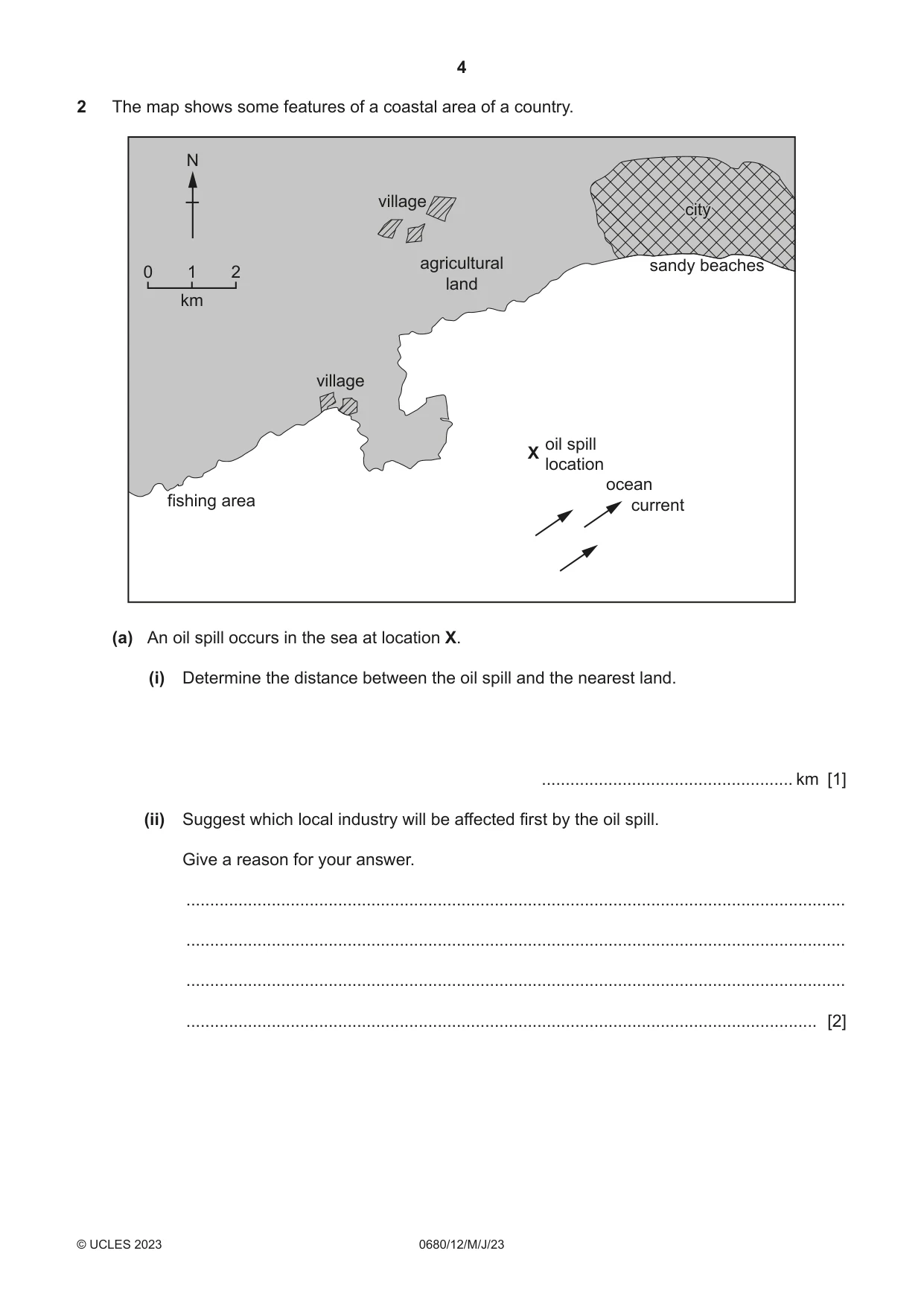
4 0680/12/M/J/23 © UCLES 2023 2 The map shows some features of a coastal area of a country. 0 1 2 km N fishing area ocean current X sandy beaches agricultural land village village oil spill location city city (a) An oil spill occurs in the sea at location X. (i) Determine the distance between the oil spill and the nearest land. … km [1] (ii) Suggest which local industry will be affected first by the oil spill. Give a reason for your answer. … … … … [2]
Question paper, page 5
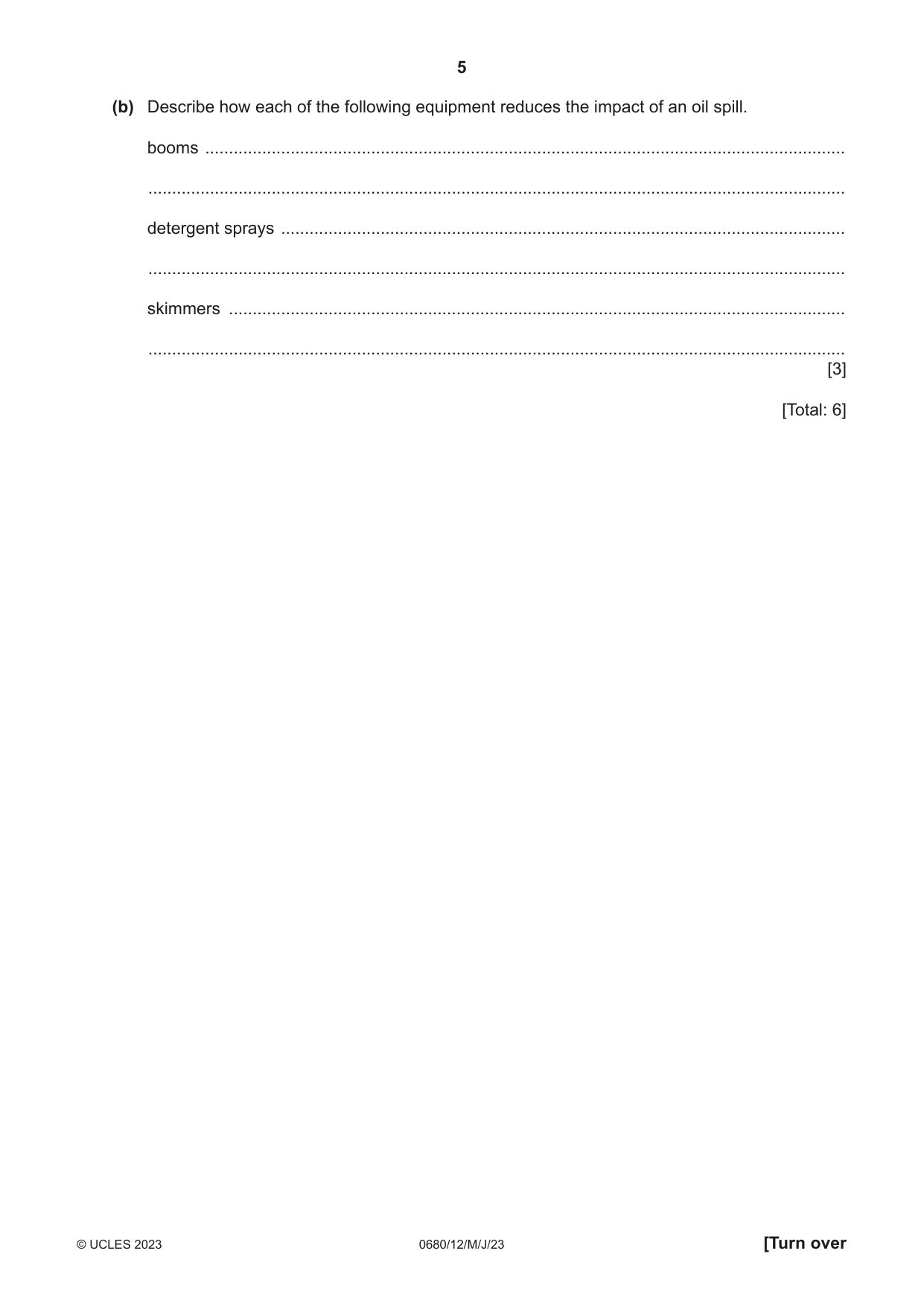
5 0680/12/M/J/23 © UCLES 2023 [Turn over (b) Describe how each of the following equipment reduces the impact of an oil spill. booms … … detergent sprays … … skimmers … … [3] [Total: 6]
Question paper, page 6
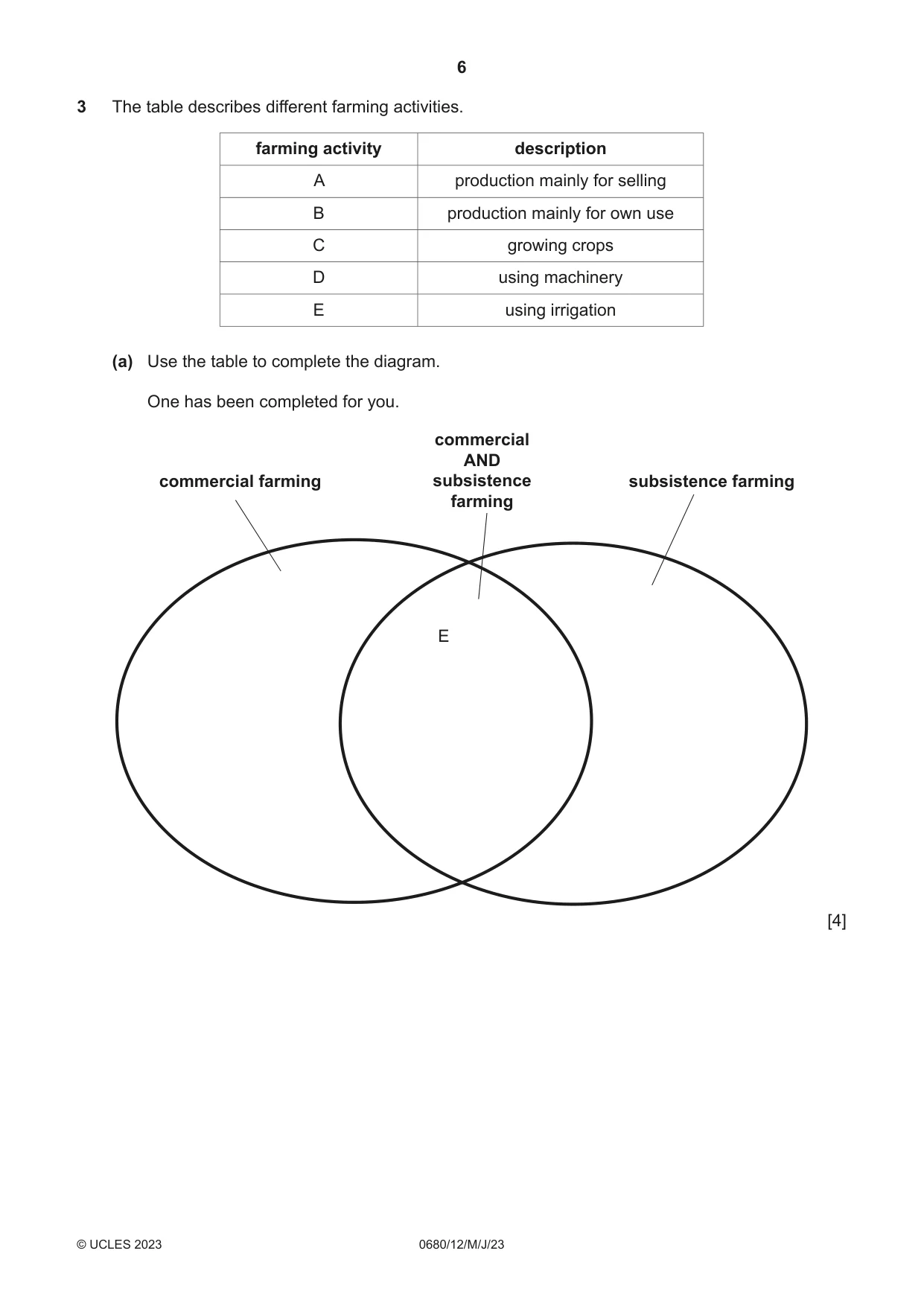
6 0680/12/M/J/23 © UCLES 2023 3 The table describes different farming activities. farming activity description A production mainly for selling B production mainly for own use C growing crops D using machinery E using irrigation (a) Use the table to complete the diagram. One has been completed for you. commercial farming subsistence farming E commercial AND subsistence farming [4]
Question paper, page 7
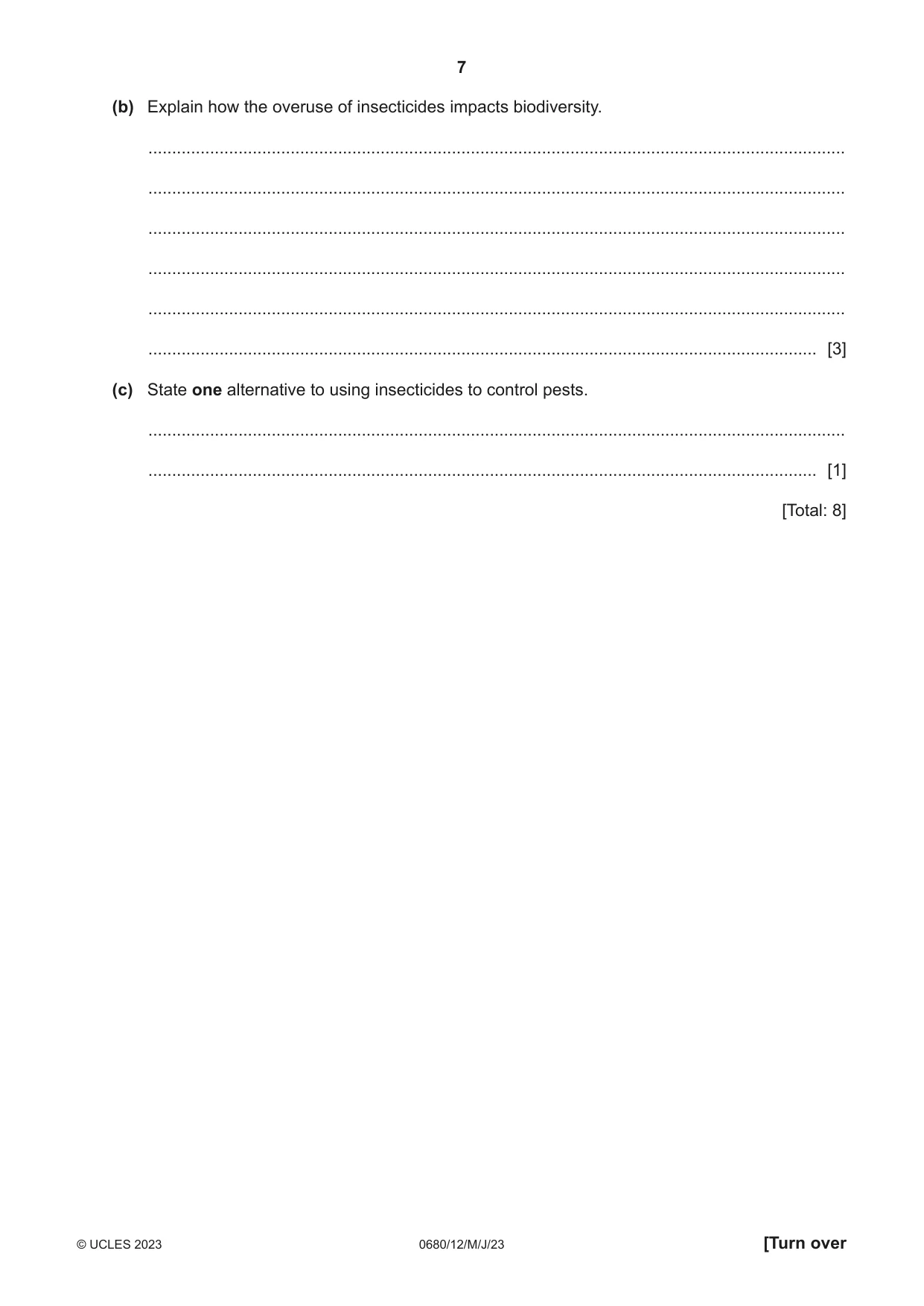
7 0680/12/M/J/23 © UCLES 2023 [Turn over (b) Explain how the overuse of insecticides impacts biodiversity. … … … … … … [3] (c) State one alternative to using insecticides to control pests. … … [1] [Total: 8]
Question paper, page 8
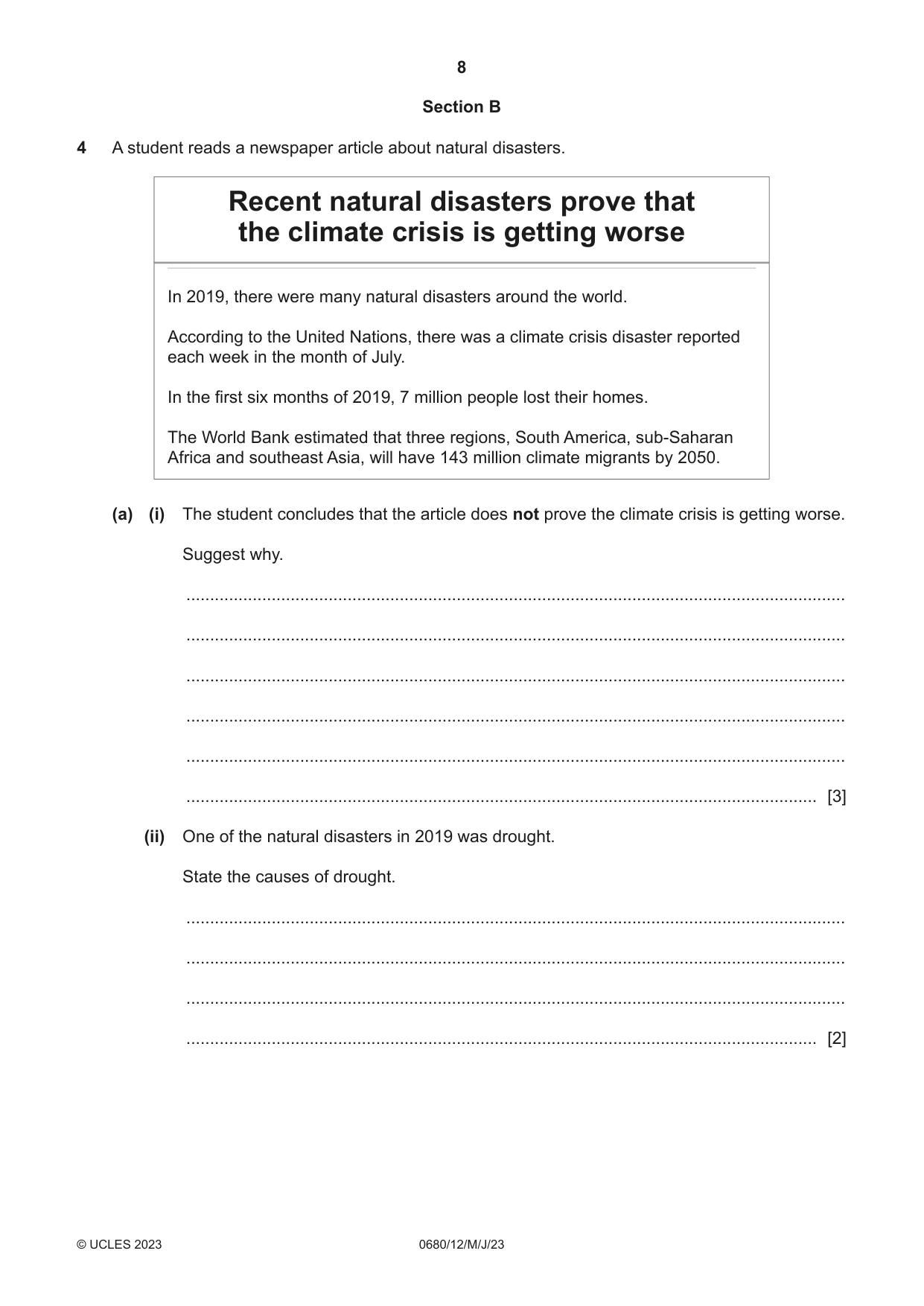
8 0680/12/M/J/23 © UCLES 2023 Section B 4 A student reads a newspaper article about natural disasters. Recent natural disasters prove that the climate crisis is getting worse In 2019, there were many natural disasters around the world. According to the United Nations, there was a climate crisis disaster reported each week in the month of July. In the first six months of 2019, 7 million people lost their homes. The World Bank estimated that three regions, South America, sub‑Saharan Africa and southeast Asia, will have 143 million climate migrants by 2050. (a) (i) The student concludes that the article does not prove the climate crisis is getting worse. Suggest why. … … … … … … [3] (ii) One of the natural disasters in 2019 was drought. State the causes of drought. … … … … [2]
Question paper, page 9
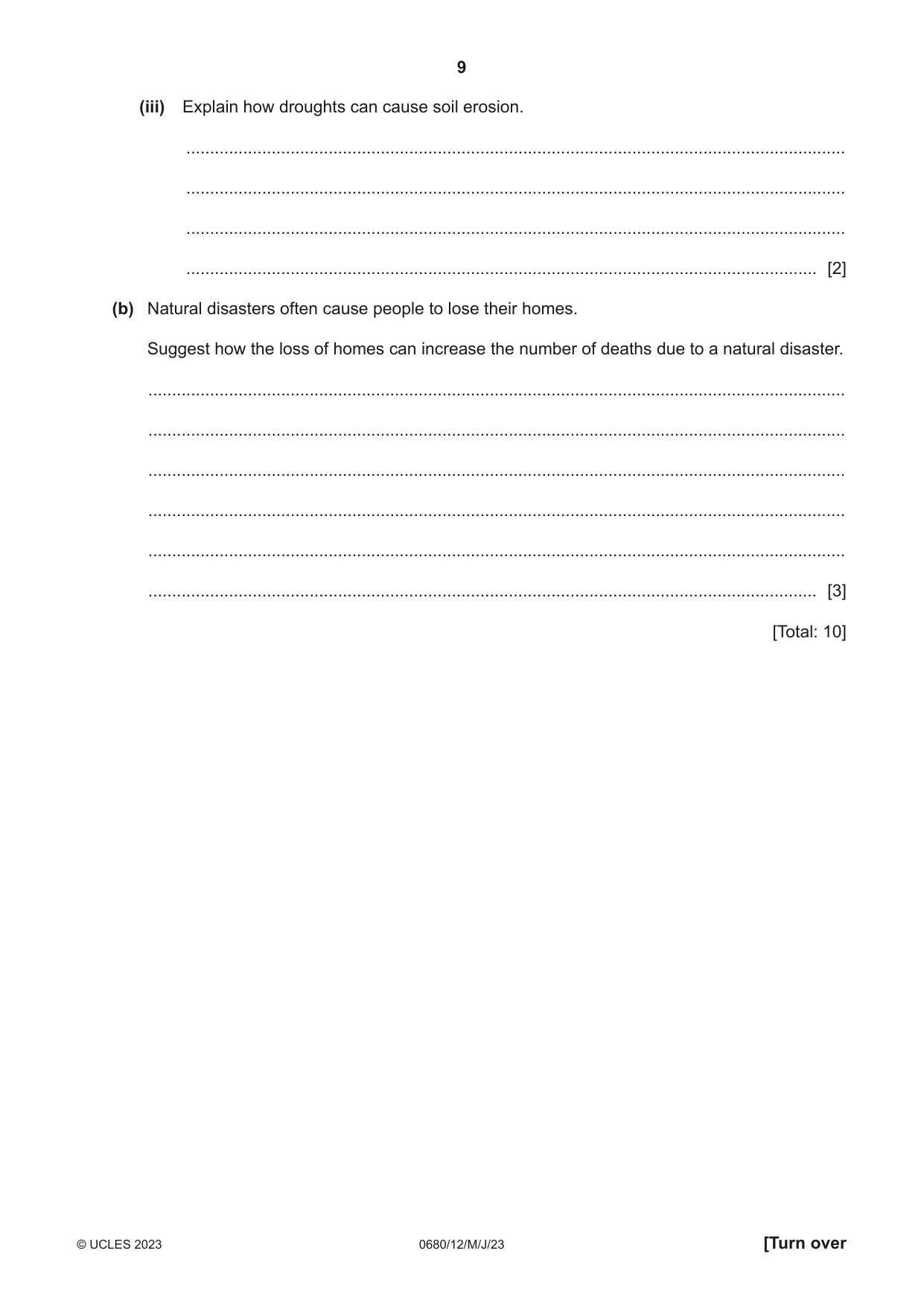
9 0680/12/M/J/23 © UCLES 2023 [Turn over (iii) Explain how droughts can cause soil erosion. … … … … [2] (b) Natural disasters often cause people to lose their homes. Suggest how the loss of homes can increase the number of deaths due to a natural disaster. … … … … … … [3] [Total: 10]
Question paper, page 10
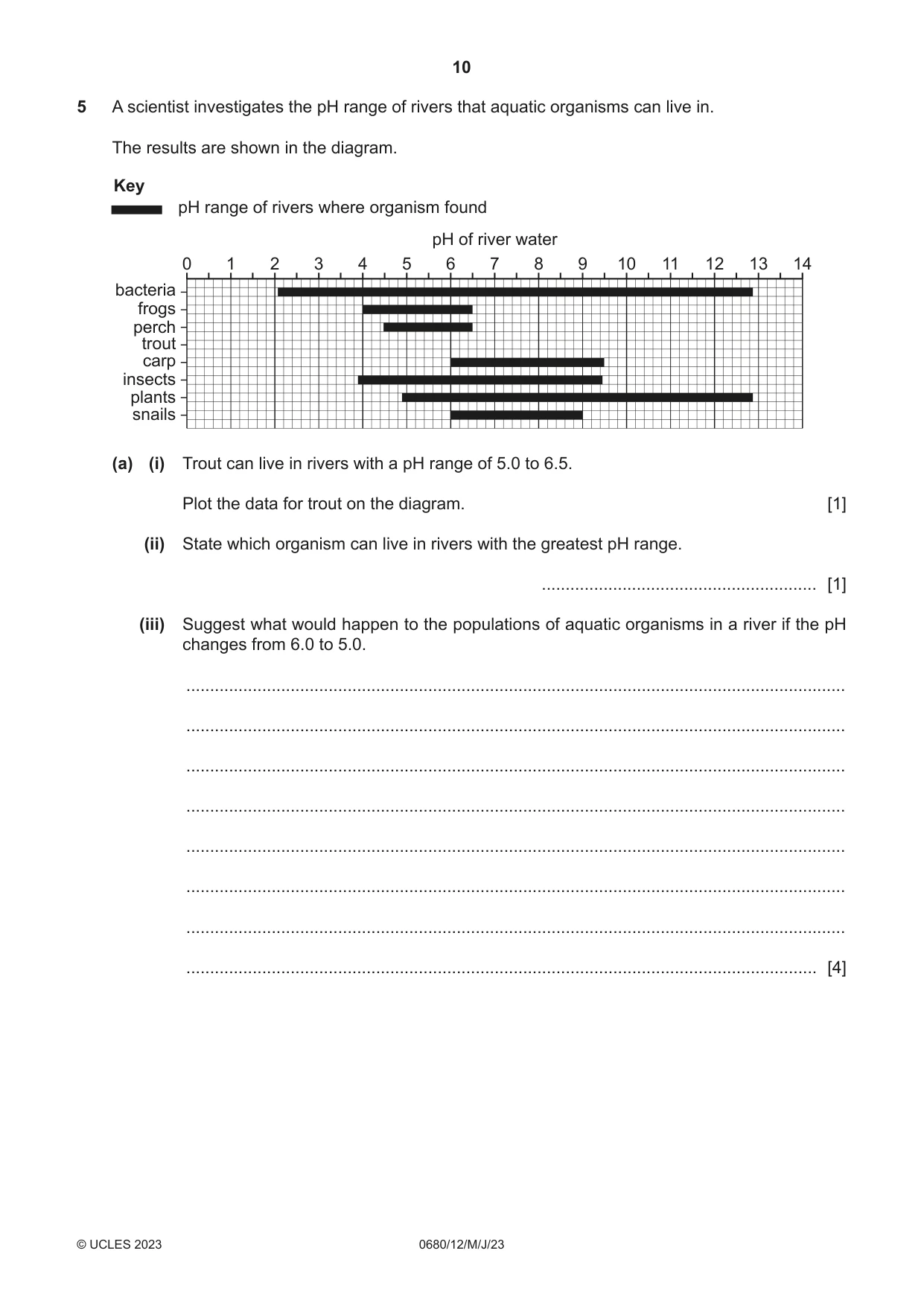
10 0680/12/M/J/23 © UCLES 2023 5 A scientist investigates the pH range of rivers that aquatic organisms can live in. The results are shown in the diagram. bacteria frogs perch trout carp insects plants snails 0 1 2 3 4 5 6 7 8 9 10 11 12 13 14 pH of river water pH range of rivers where organism found Key (a) (i) Trout can live in rivers with a pH range of 5.0 to 6.5. Plot the data for trout on the diagram. [1] (ii) State which organism can live in rivers with the greatest pH range. … [1] (iii) Suggest what would happen to the populations of aquatic organisms in a river if the pH changes from 6.0 to 5.0. … … … … … … … … [4]
Question paper, page 11
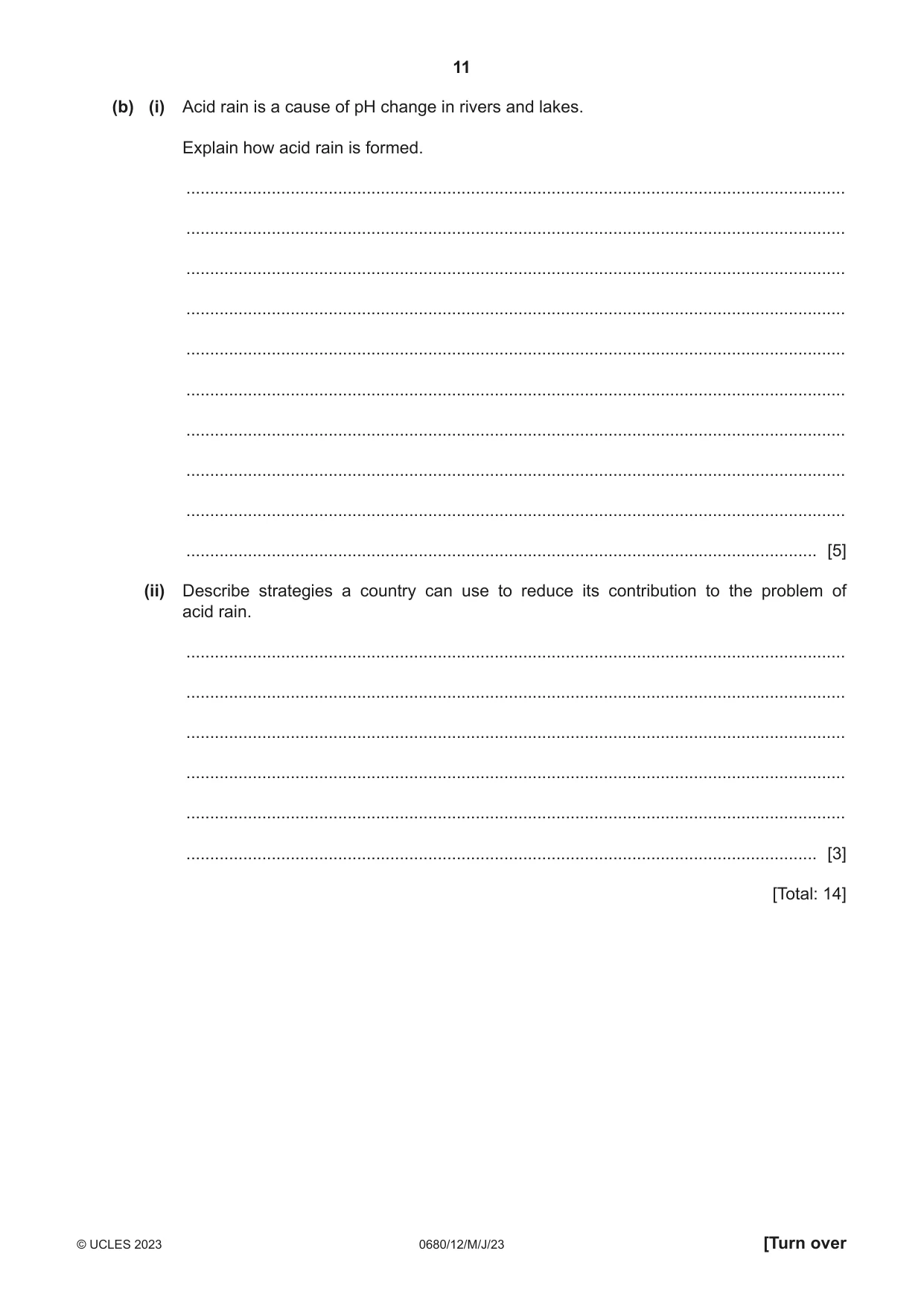
11 0680/12/M/J/23 © UCLES 2023 [Turn over (b) (i) Acid rain is a cause of pH change in rivers and lakes. Explain how acid rain is formed. … … … … … … … … … … [5] (ii) Describe strategies a country can use to reduce its contribution to the problem of acid rain. … … … … … … [3] [Total: 14]
Question paper, page 12
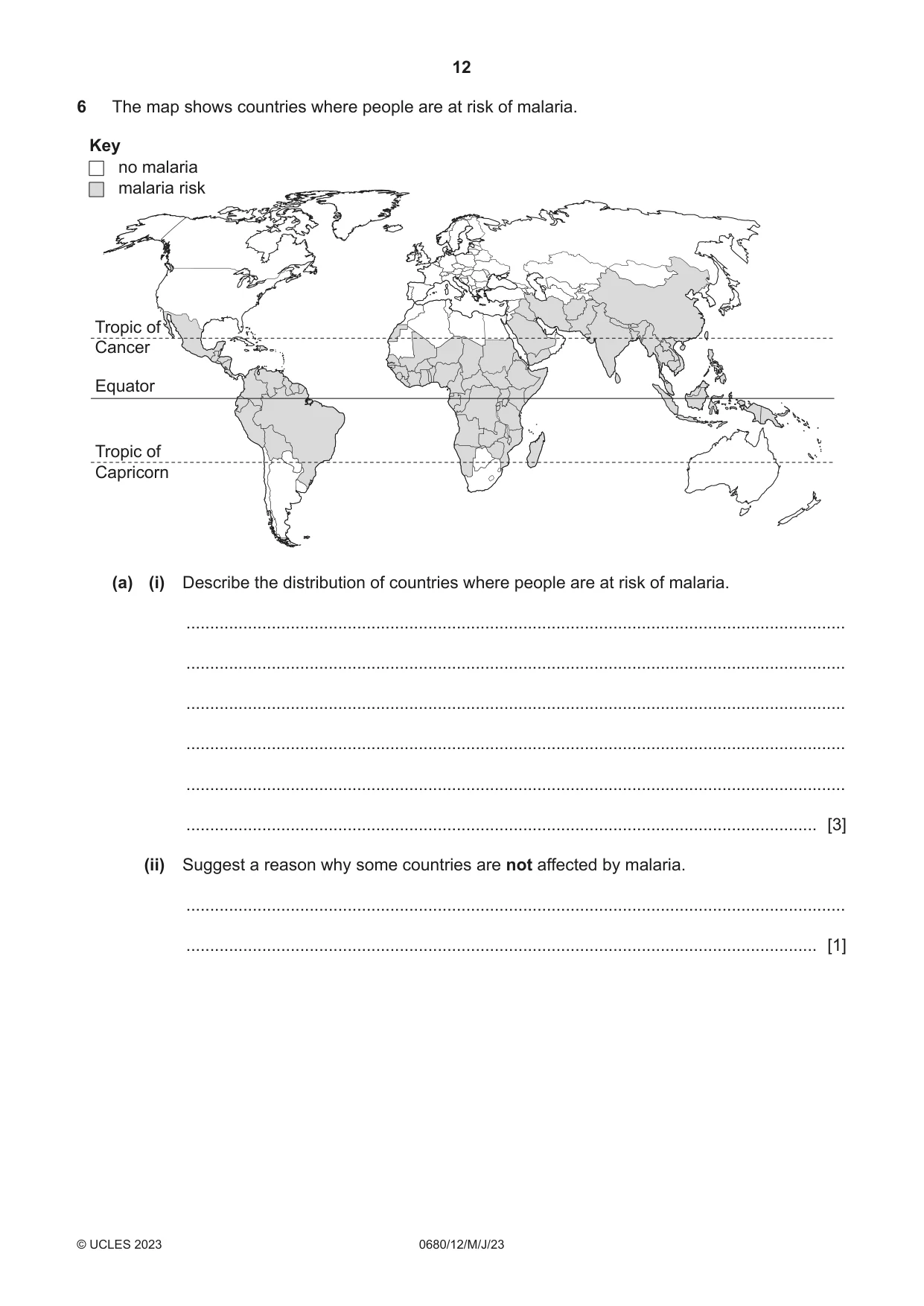
12 0680/12/M/J/23 © UCLES 2023 6 The map shows countries where people are at risk of malaria. Key Equator no malaria malaria risk Tropic of Capricorn Tropic of Cancer (a) (i) Describe the distribution of countries where people are at risk of malaria. … … … … … … [3] (ii) Suggest a reason why some countries are not affected by malaria. … … [1]
Question paper, page 13
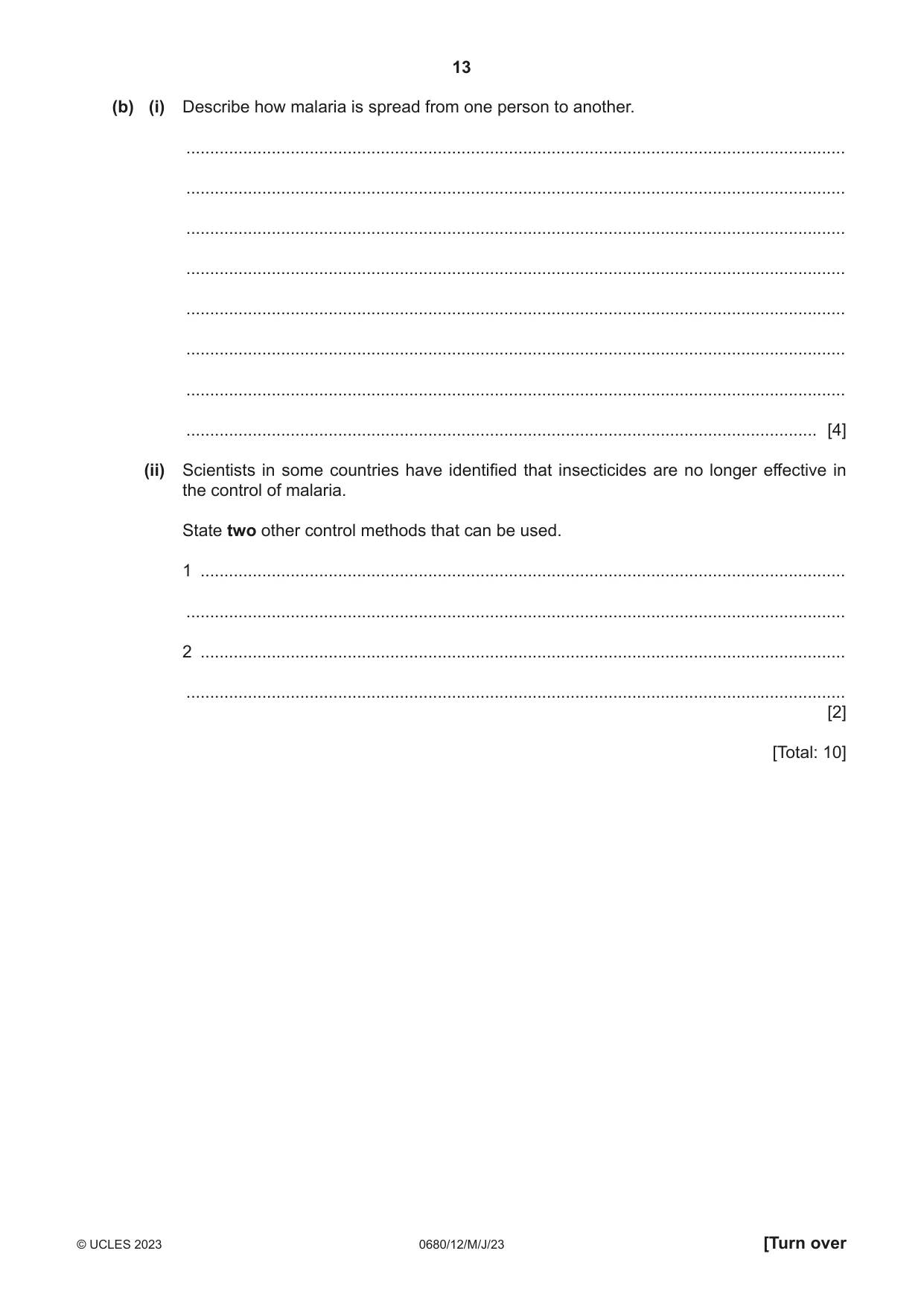
13 0680/12/M/J/23 © UCLES 2023 [Turn over (b) (i) Describe how malaria is spread from one person to another. … … … … … … … … [4] (ii) Scientists in some countries have identified that insecticides are no longer effective in the control of malaria. State two other control methods that can be used. 1 … … 2 … … [2] [Total: 10]
Question paper, page 14
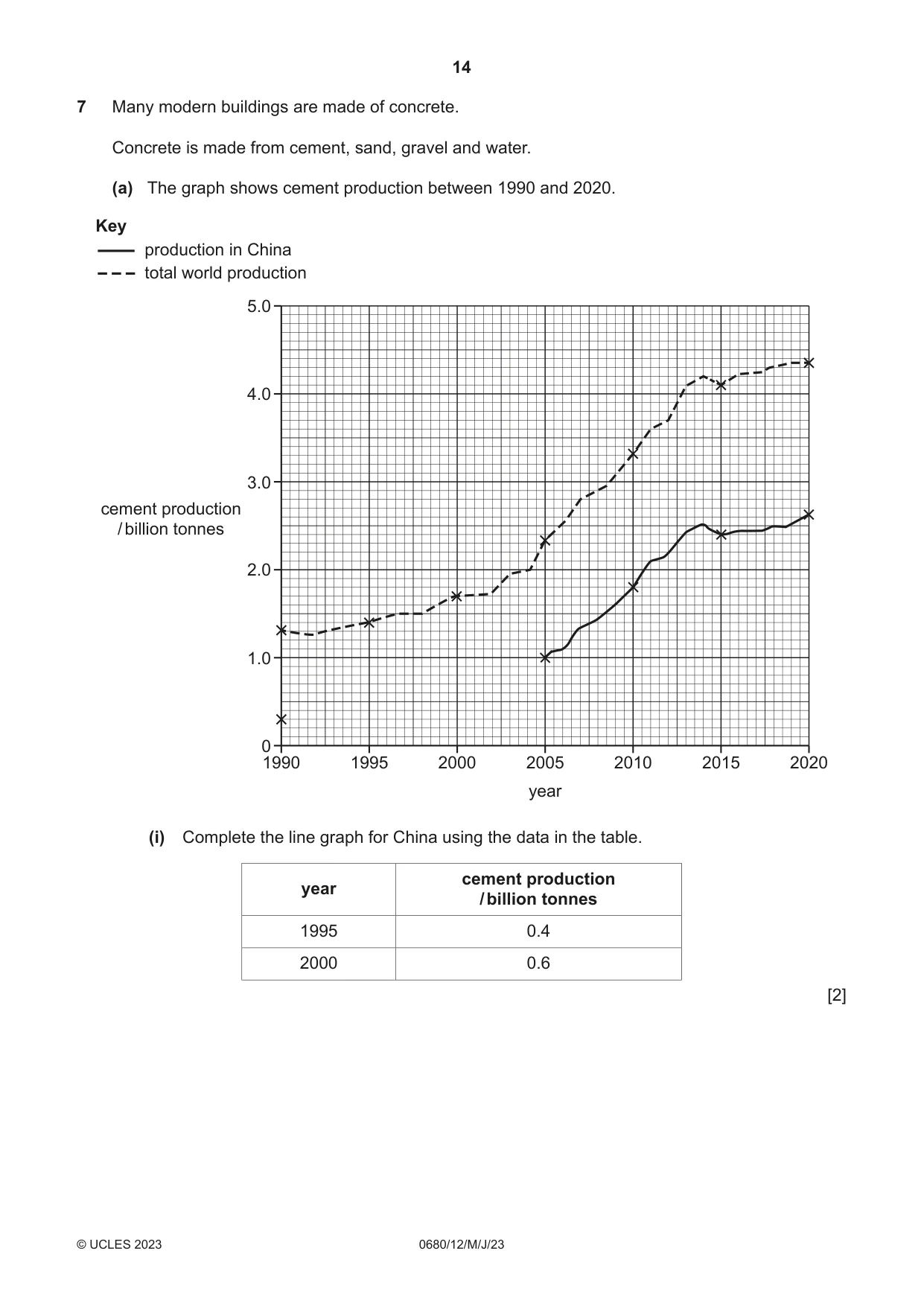
14 0680/12/M/J/23 © UCLES 2023 7 Many modern buildings are made of concrete. Concrete is made from cement, sand, gravel and water. (a) The graph shows cement production between 1990 and 2020. 1990 0 1.0 2.0 3.0 4.0 5.0 1995 2000 2005 2010 2015 2020 cement production / billion tonnes year Key production in China total world production (i) Complete the line graph for China using the data in the table. year cement production / billion tonnes 1995 0.4 2000 0.6 [2]
Question paper, page 15
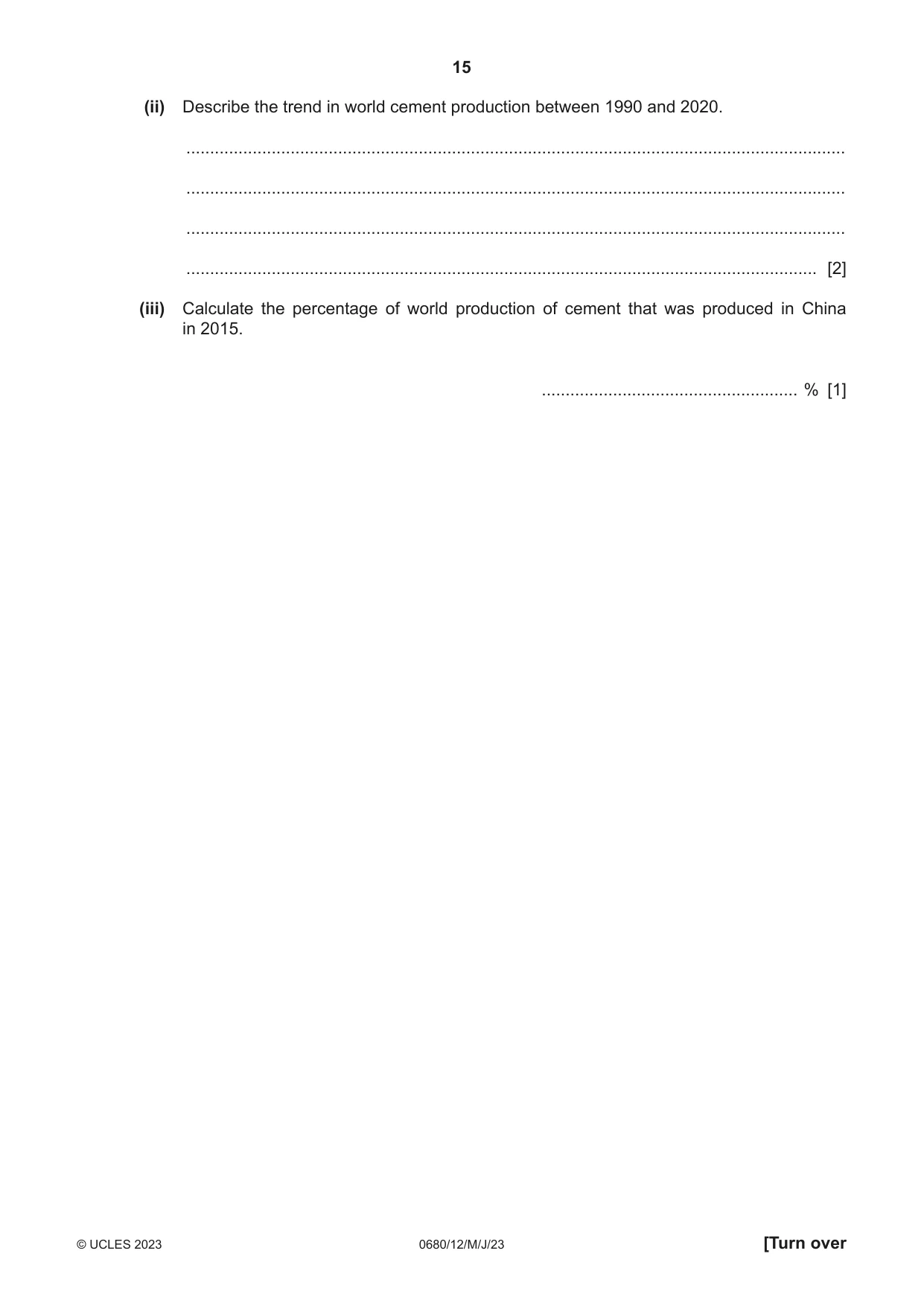
15 0680/12/M/J/23 © UCLES 2023 [Turn over (ii) Describe the trend in world cement production between 1990 and 2020. … … … … [2] (iii) Calculate the percentage of world production of cement that was produced in China in 2015. … % [1]
Question paper, page 16
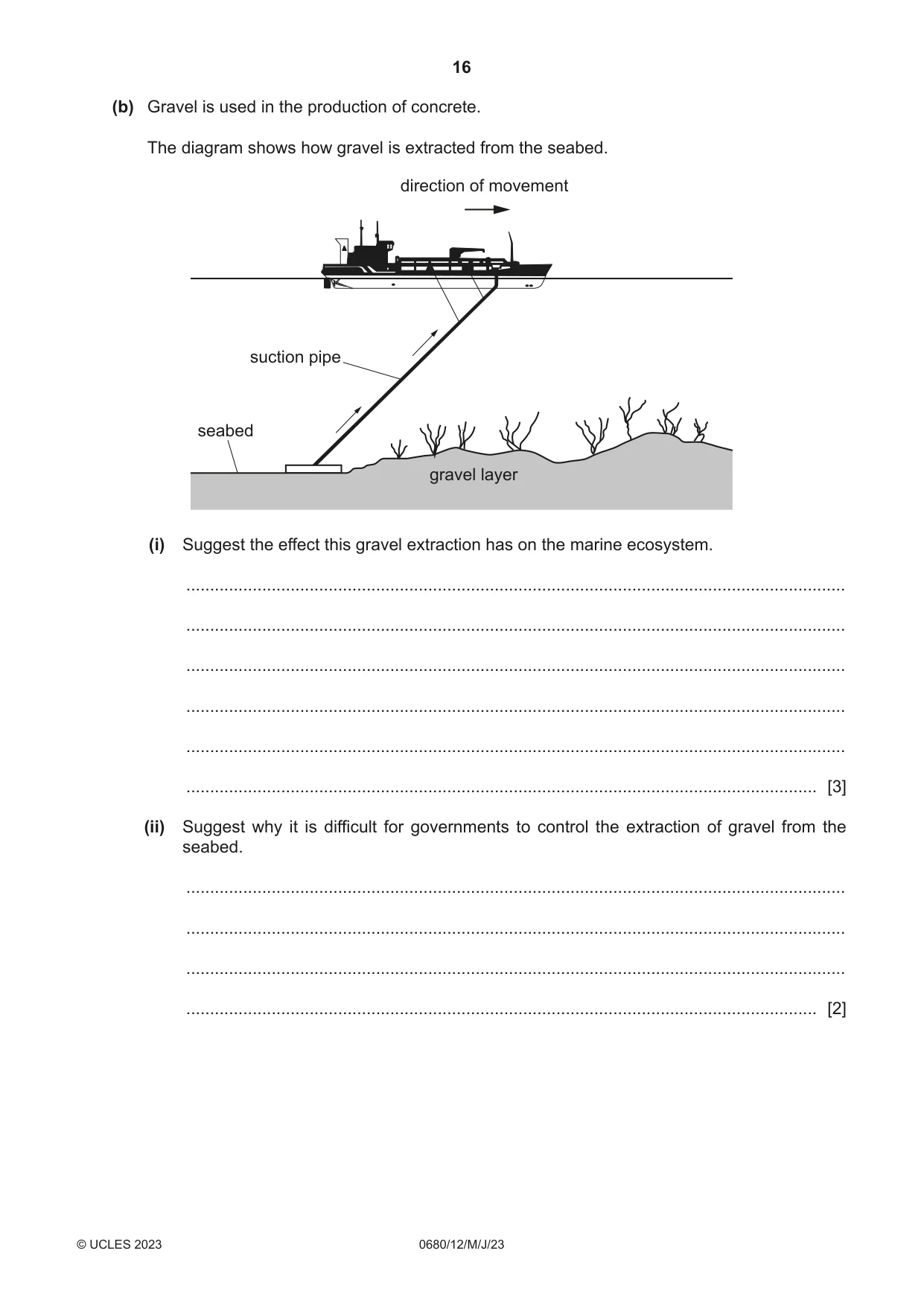
16 0680/12/M/J/23 © UCLES 2023 (b) Gravel is used in the production of concrete. The diagram shows how gravel is extracted from the seabed. seabed suction pipe direction of movement gravel layer (i) Suggest the effect this gravel extraction has on the marine ecosystem. … … … … … … [3] (ii) Suggest why it is difficult for governments to control the extraction of gravel from the seabed. … … … … [2]
Question paper, page 17
17 0680/12/M/J/23 © UCLES 2023 [Turn over (c) State three strategies to make mineral extraction more sustainable. 1 … … 2 … … 3 … … [3] [Total: 13]
Question paper, page 18
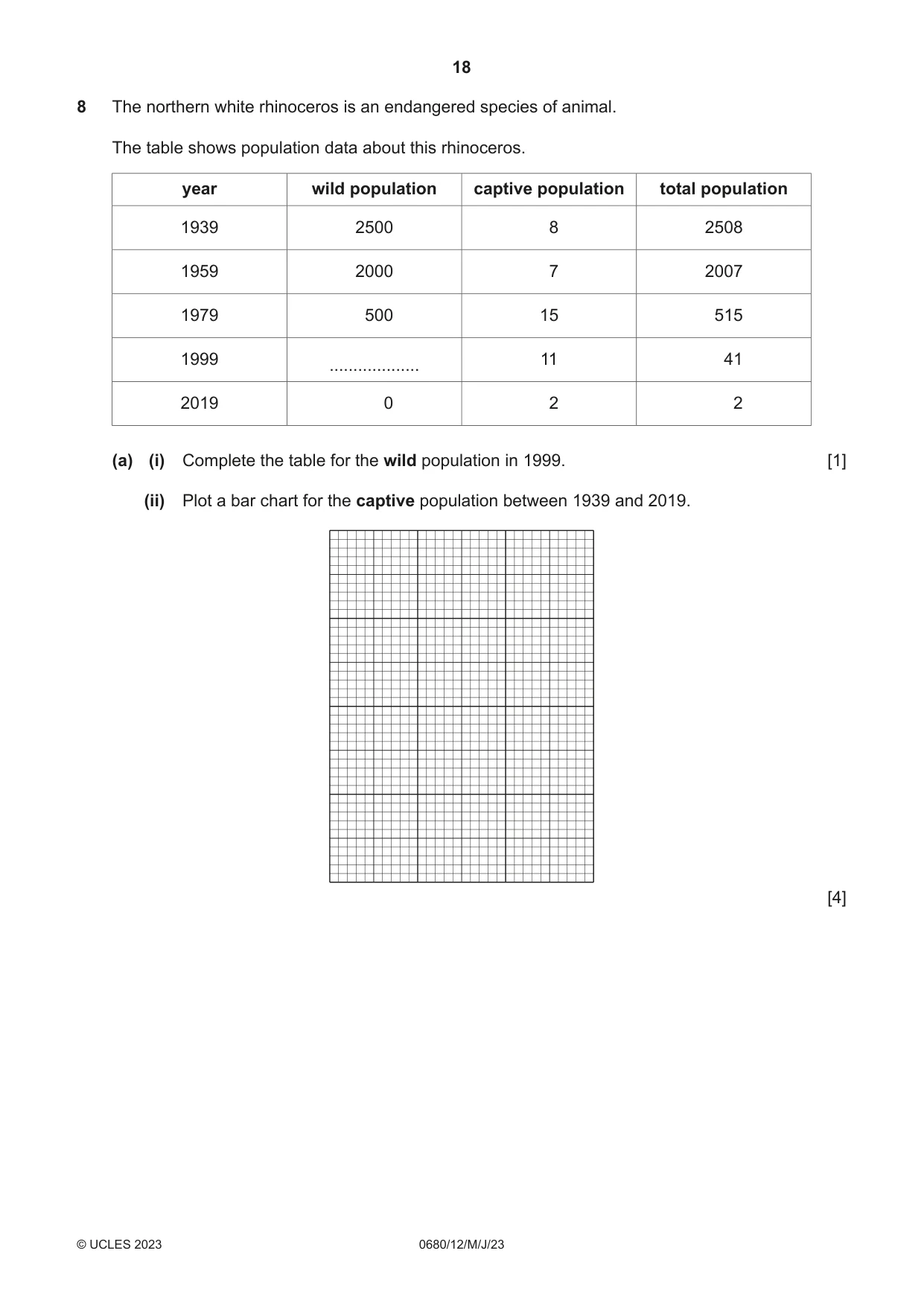
18 0680/12/M/J/23 © UCLES 2023 8 The northern white rhinoceros is an endangered species of animal. The table shows population data about this rhinoceros. year wild population captive population total population 1939 2500 8 2508 1959 2000 7 2007 1979 500 15 515 1999 … 11 41 2019 0 2 2 (a) (i) Complete the table for the wild population in 1999. [1] (ii) Plot a bar chart for the captive population between 1939 and 2019. [4]
Question paper, page 19
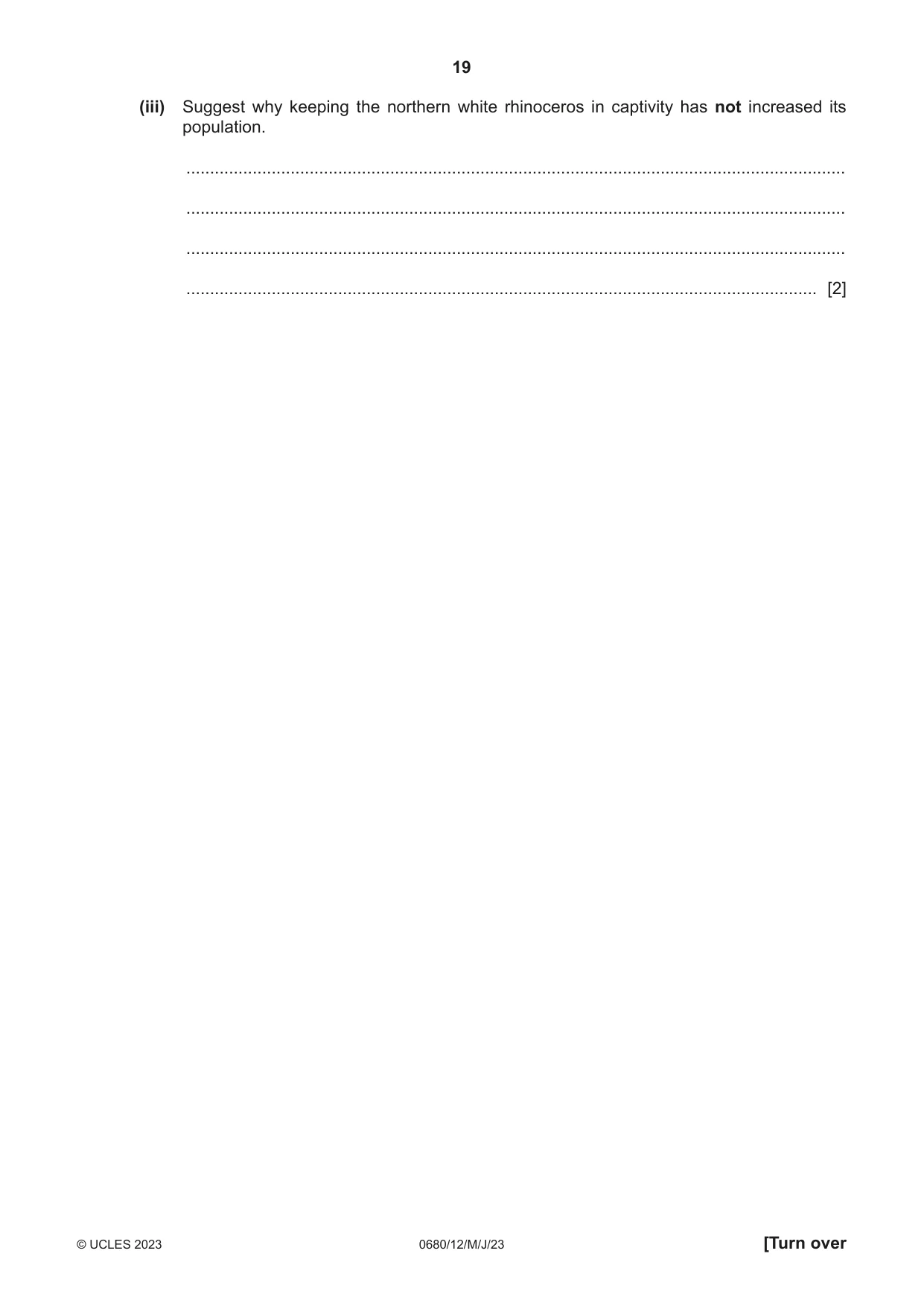
19 0680/12/M/J/23 © UCLES 2023 [Turn over (iii) Suggest why keeping the northern white rhinoceros in captivity has not increased its population. … … … … [2]
Question paper, page 20
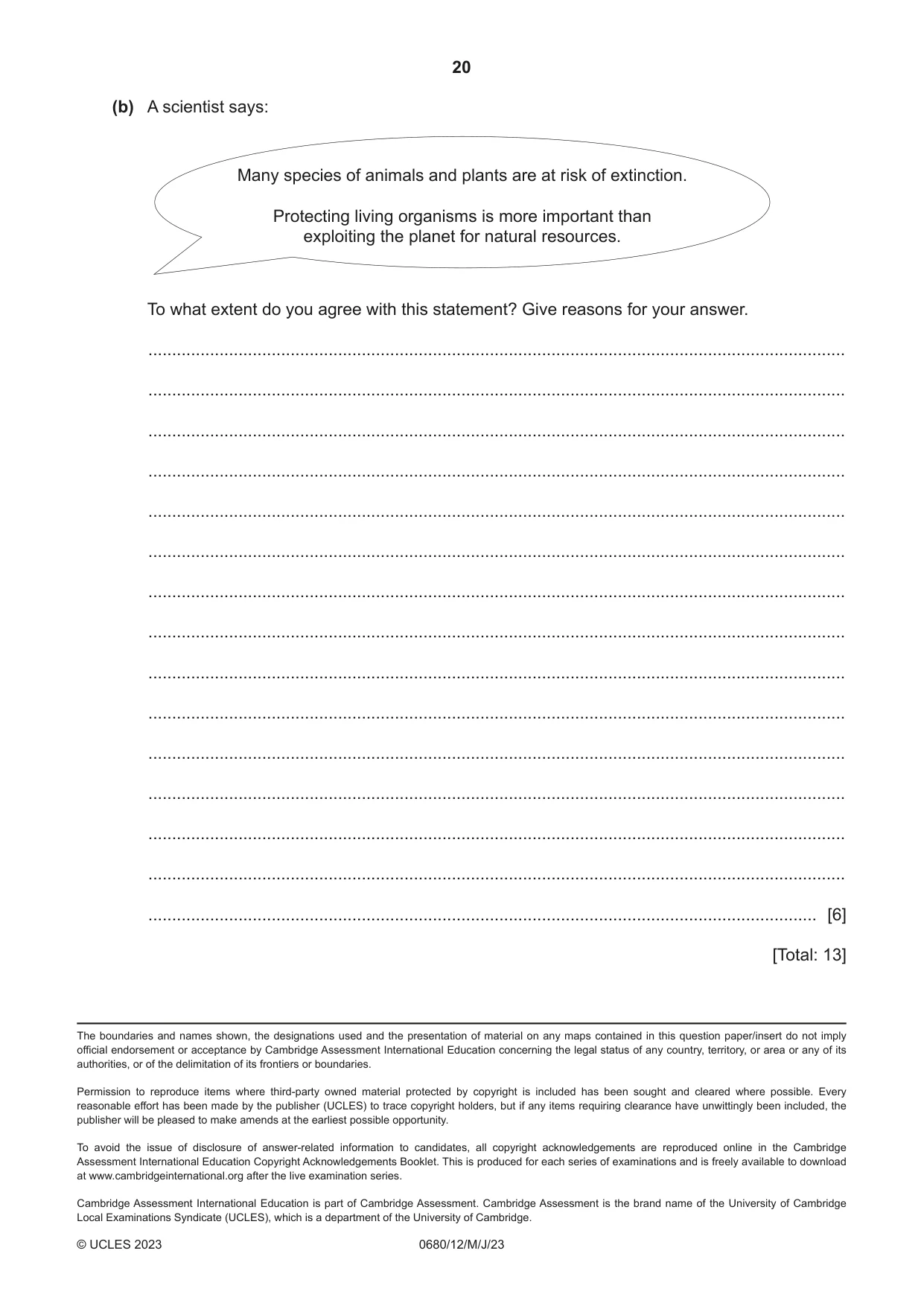
20 0680/12/M/J/23 © UCLES 2023 The boundaries and names shown, the designations used and the presentation of material on any maps contained in this question paper/insert do not imply official endorsement or acceptance by Cambridge Assessment International Education concerning the legal status of any country, territory, or area or any of its authorities, or of the delimitation of its frontiers or boundaries. Permission to reproduce items where third‑party owned material protected by copyright is included has been sought and cleared where possible. Every reasonable effort has been made by the publisher (UCLES) to trace copyright holders, but if any items requiring clearance have unwittingly been included, the publisher will be pleased to make amends at the earliest possible opportunity. To avoid the issue of disclosure of answer‑related information to candidates, all copyright acknowledgements are reproduced online in the Cambridge Assessment International Education Copyright Acknowledgements Booklet. This is produced for each series of examinations and is freely available to download at www.cambridgeinternational.org after the live examination series. Cambridge Assessment International Education is part of Cambridge Assessment. Cambridge Assessment is the brand name of the University of Cambridge Local Examinations Syndicate (UCLES), which is a department of the University of Cambridge. (b) A scientist says: Many species of animals and plants are at risk of extinction. Protecting living organisms is more important than exploiting the planet for natural resources. To what extent do you agree with this statement? Give reasons for your answer. … … … … … … … … … … … … … … … [6] [Total: 13]
Mark scheme, page 1
This document consists of 13 printed pages. © UCLES 2023 [Turn over Cambridge IGCSE™ ENVIRONMENTAL MANAGEMENT 0680/12 Paper 1 Theory May/June 2023 MARK SCHEME Maximum Mark: 80 Published This mark scheme is published as an aid to teachers and candidates, to indicate the requirements of the examination. It shows the basis on which Examiners were instructed to award marks. It does not indicate the details of the discussions that took place at an Examiners’ meeting before marking began, which would have considered the acceptability of alternative answers. Mark schemes should be read in conjunction with the question paper and the Principal Examiner Report for Teachers. Cambridge International will not enter into discussions about these mark schemes. Cambridge International is publishing the mark schemes for the May/June 2023 series for most Cambridge IGCSE, Cambridge International A and AS Level and Cambridge Pre-U components, and some Cambridge O Level components.
Mark scheme, page 2
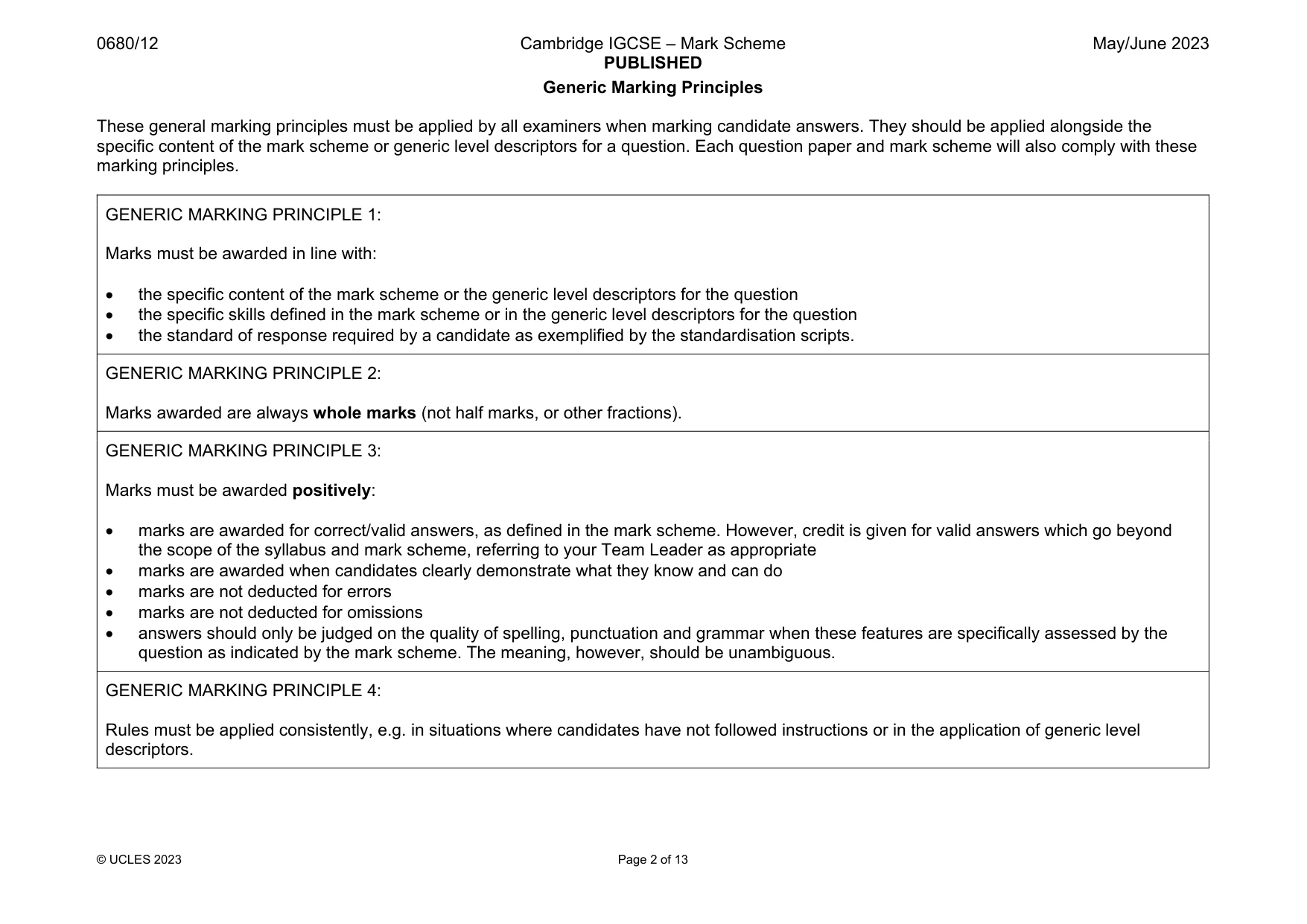
0680/12 Cambridge IGCSE – Mark Scheme PUBLISHED May/June 2023 © UCLES 2023 Page 2 of 13 Generic Marking Principles These general marking principles must be applied by all examiners when marking candidate answers. They should be applied alongside the specific content of the mark scheme or generic level descriptors for a question. Each question paper and mark scheme will also comply with these marking principles. GENERIC MARKING PRINCIPLE 1: Marks must be awarded in line with: the specific content of the mark scheme or the generic level descriptors for the question the specific skills defined in the mark scheme or in the generic level descriptors for the question the standard of response required by a candidate as exemplified by the standardisation scripts. GENERIC MARKING PRINCIPLE 2: Marks awarded are always whole marks (not half marks, or other fractions). GENERIC MARKING PRINCIPLE 3: Marks must be awarded positively: marks are awarded for correct/valid answers, as defined in the mark scheme. However, credit is given for valid answers which go beyond the scope of the syllabus and mark scheme, referring to your Team Leader as appropriate marks are awarded when candidates clearly demonstrate what they know and can do marks are not deducted for errors marks are not deducted for omissions answers should only be judged on the quality of spelling, punctuation and grammar when these features are specifically assessed by the question as indicated by the mark scheme. The meaning, however, should be unambiguous. GENERIC MARKING PRINCIPLE 4: Rules must be applied consistently, e.g. in situations where candidates have not followed instructions or in the application of generic level descriptors.
Mark scheme, page 3
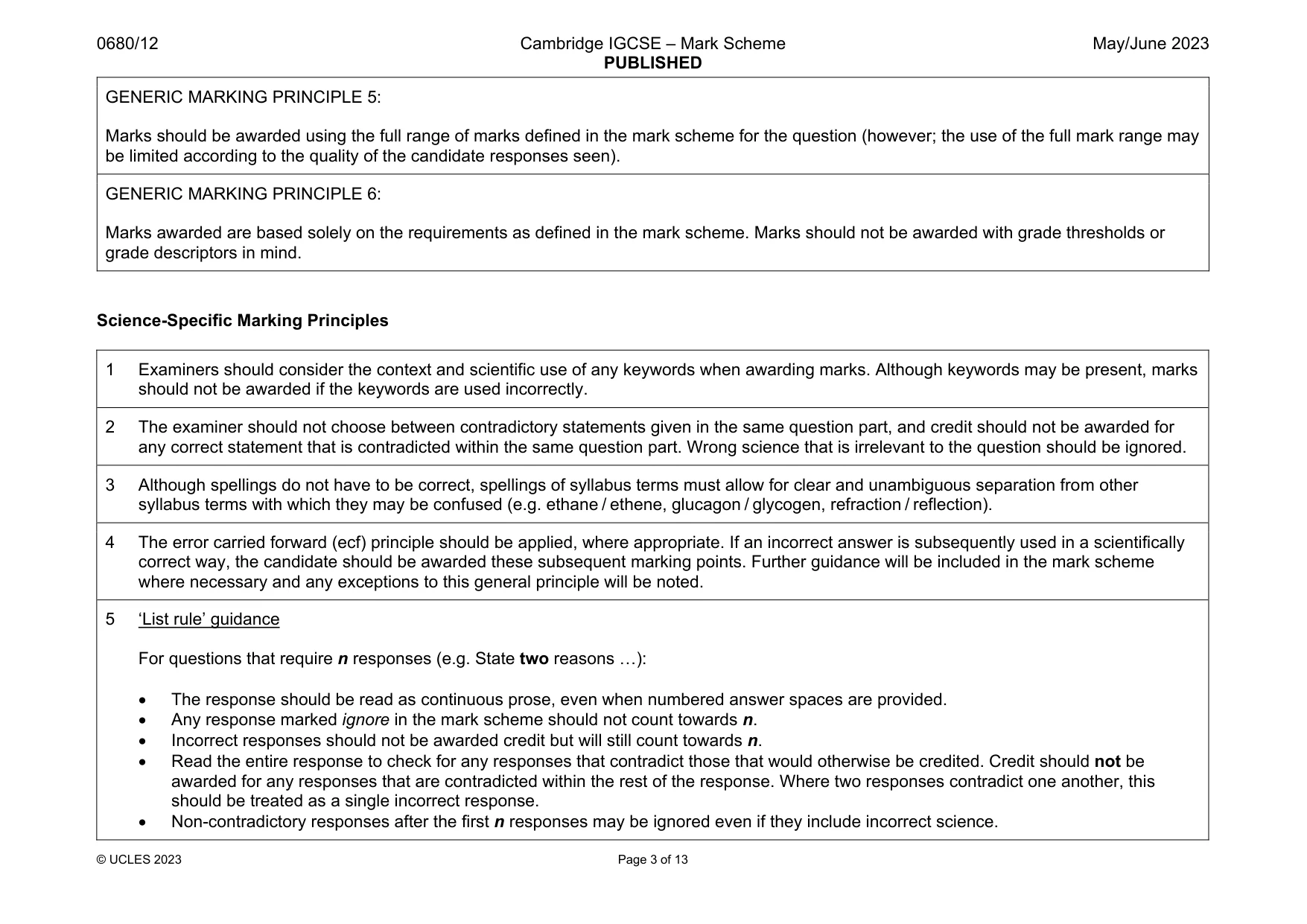
0680/12 Cambridge IGCSE – Mark Scheme PUBLISHED May/June 2023 © UCLES 2023 Page 3 of 13 GENERIC MARKING PRINCIPLE 5: Marks should be awarded using the full range of marks defined in the mark scheme for the question (however; the use of the full mark range may be limited according to the quality of the candidate responses seen). GENERIC MARKING PRINCIPLE 6: Marks awarded are based solely on the requirements as defined in the mark scheme. Marks should not be awarded with grade thresholds or grade descriptors in mind. Science-Specific Marking Principles 1 Examiners should consider the context and scientific use of any keywords when awarding marks. Although keywords may be present, marks should not be awarded if the keywords are used incorrectly. 2 The examiner should not choose between contradictory statements given in the same question part, and credit should not be awarded for any correct statement that is contradicted within the same question part. Wrong science that is irrelevant to the question should be ignored. 3 Although spellings do not have to be correct, spellings of syllabus terms must allow for clear and unambiguous separation from other syllabus terms with which they may be confused (e.g. ethane / ethene, glucagon / glycogen, refraction / reflection). 4 The error carried forward (ecf) principle should be applied, where appropriate. If an incorrect answer is subsequently used in a scientifically correct way, the candidate should be awarded these subsequent marking points. Further guidance will be included in the mark scheme where necessary and any exceptions to this general principle will be noted. 5 ‘List rule’ guidance For questions that require n responses (e.g. State two reasons …): The response should be read as continuous prose, even when numbered answer spaces are provided. Any response marked ignore in the mark scheme should not count towards n. Incorrect responses should not be awarded credit but will still count towards n. Read the entire response to check for any responses that contradict those that would otherwise be credited. Credit should not be awarded for any responses that are contradicted within the rest of the response. Where two responses contradict one another, this should be treated as a single incorrect response. Non-contradictory responses after the first n responses may be ignored even if they include incorrect science.
Mark scheme, page 4
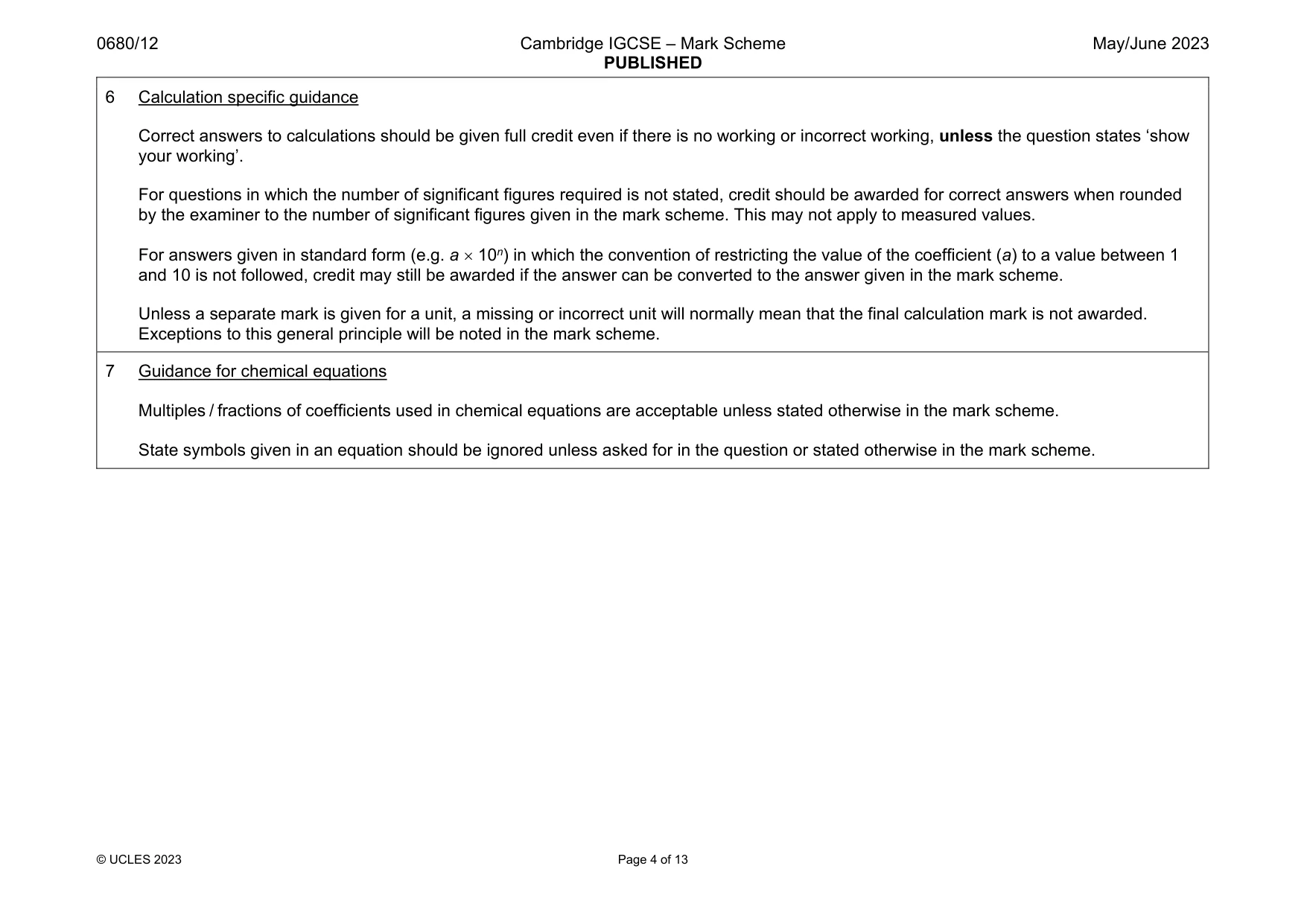
0680/12 Cambridge IGCSE – Mark Scheme PUBLISHED May/June 2023 © UCLES 2023 Page 4 of 13 6 Calculation specific guidance Correct answers to calculations should be given full credit even if there is no working or incorrect working, unless the question states ‘show your working’. For questions in which the number of significant figures required is not stated, credit should be awarded for correct answers when rounded by the examiner to the number of significant figures given in the mark scheme. This may not apply to measured values. For answers given in standard form (e.g. a 10n) in which the convention of restricting the value of the coefficient (a) to a value between 1 and 10 is not followed, credit may still be awarded if the answer can be converted to the answer given in the mark scheme. Unless a separate mark is given for a unit, a missing or incorrect unit will normally mean that the final calculation mark is not awarded. Exceptions to this general principle will be noted in the mark scheme. 7 Guidance for chemical equations Multiples / fractions of coefficients used in chemical equations are acceptable unless stated otherwise in the mark scheme. State symbols given in an equation should be ignored unless asked for in the question or stated otherwise in the mark scheme.
Mark scheme, page 5
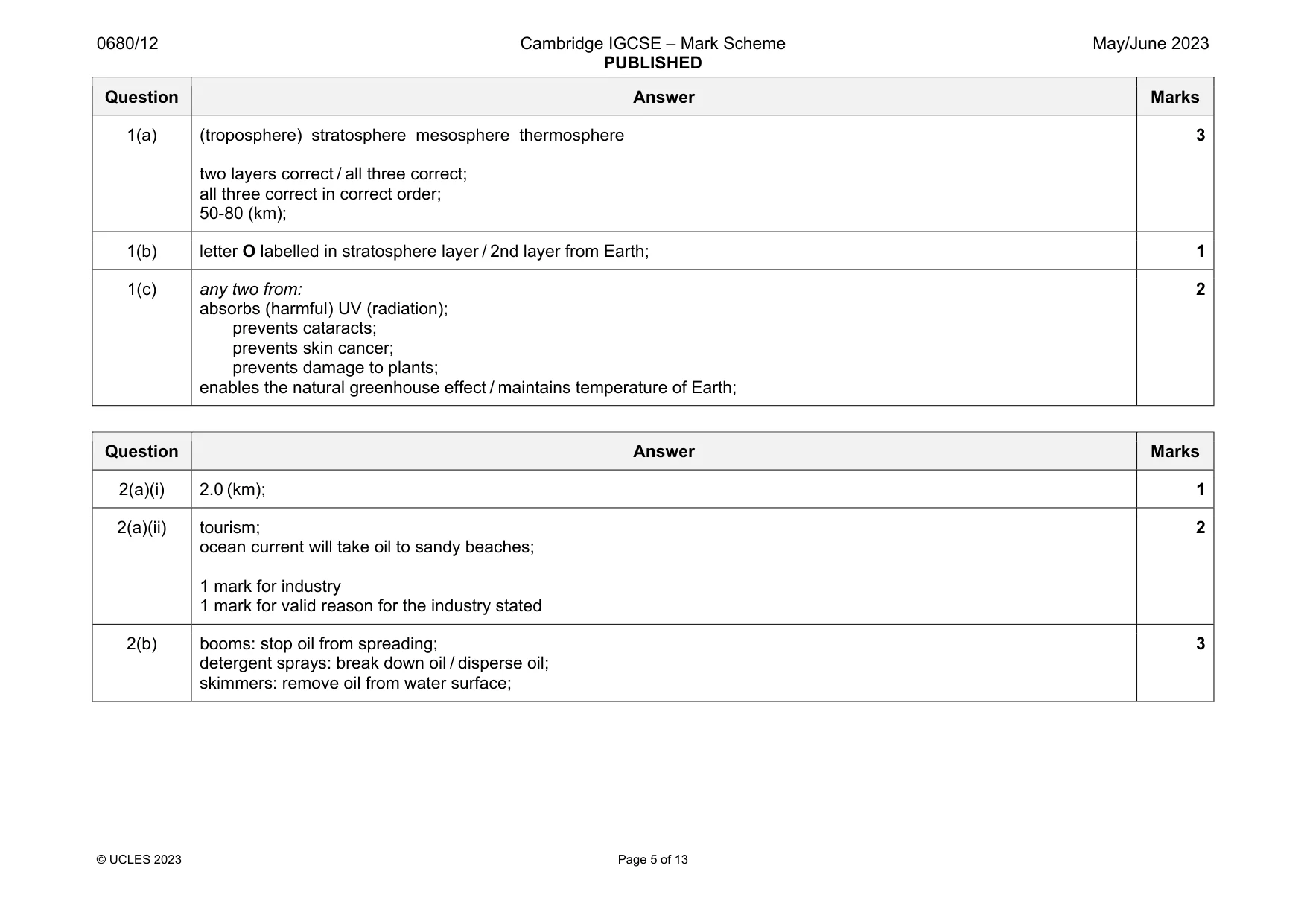
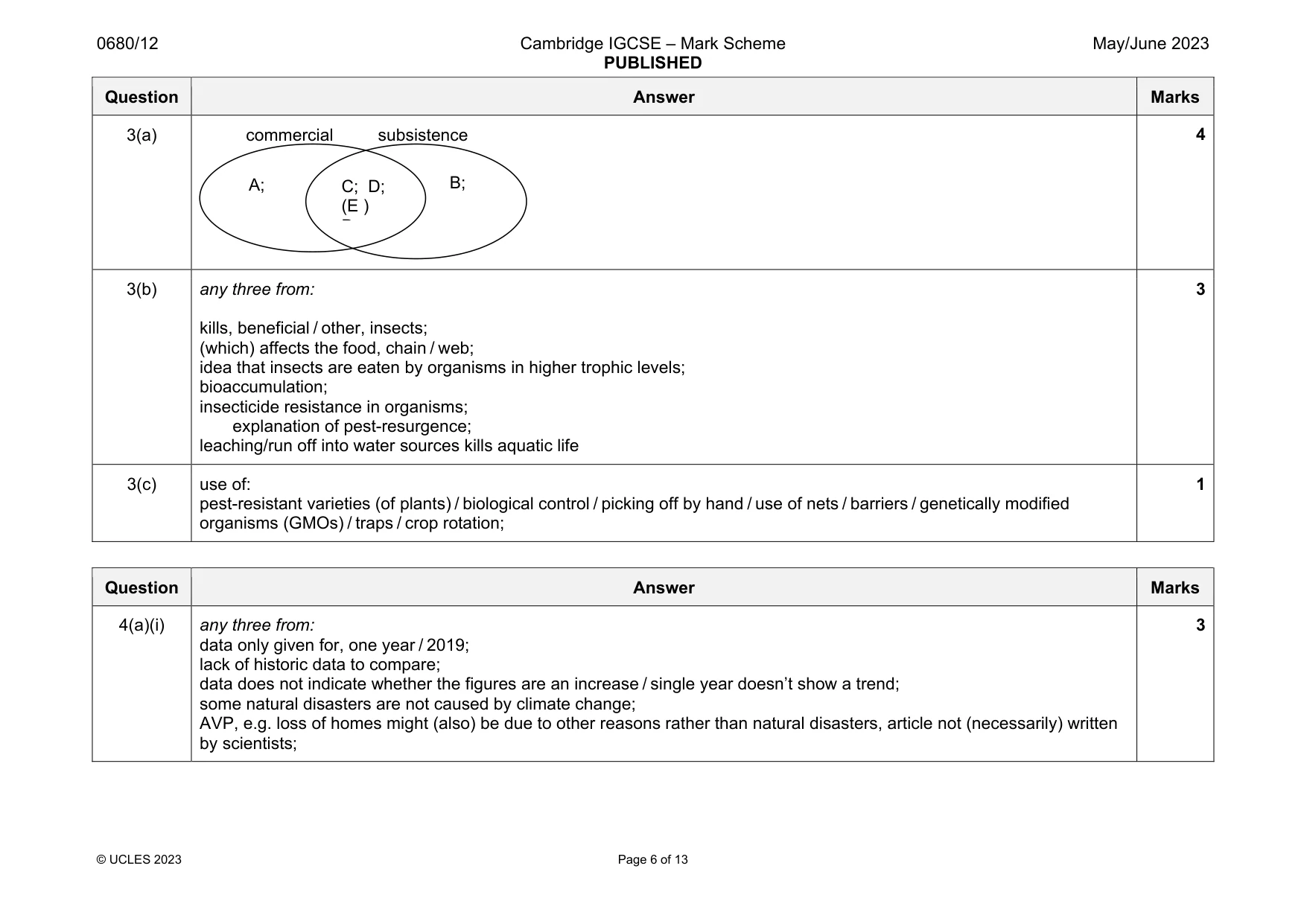
0680/12 Cambridge IGCSE – Mark Scheme PUBLISHED May/June 2023 © UCLES 2023 Page 5 of 13 Question Answer Marks 1(a) (troposphere) stratosphere mesosphere thermosphere two layers correct / all three correct; all three correct in correct order; 50-80 (km); 3 1(b) letter O labelled in stratosphere layer / 2nd layer from Earth; 1 1(c) any two from: absorbs (harmful) UV (radiation); prevents cataracts; prevents skin cancer; prevents damage to plants; enables the natural greenhouse effect / maintains temperature of Earth; 2 Question Answer Marks 2(a)(i) 2.0 (km); 1 2(a)(ii) tourism; ocean current will take oil to sandy beaches; 1 mark for industry 1 mark for valid reason for the industry stated 2 2(b) booms: stop oil from spreading; detergent sprays: break down oil / disperse oil; skimmers: remove oil from water surface; 3
Mark scheme, page 6
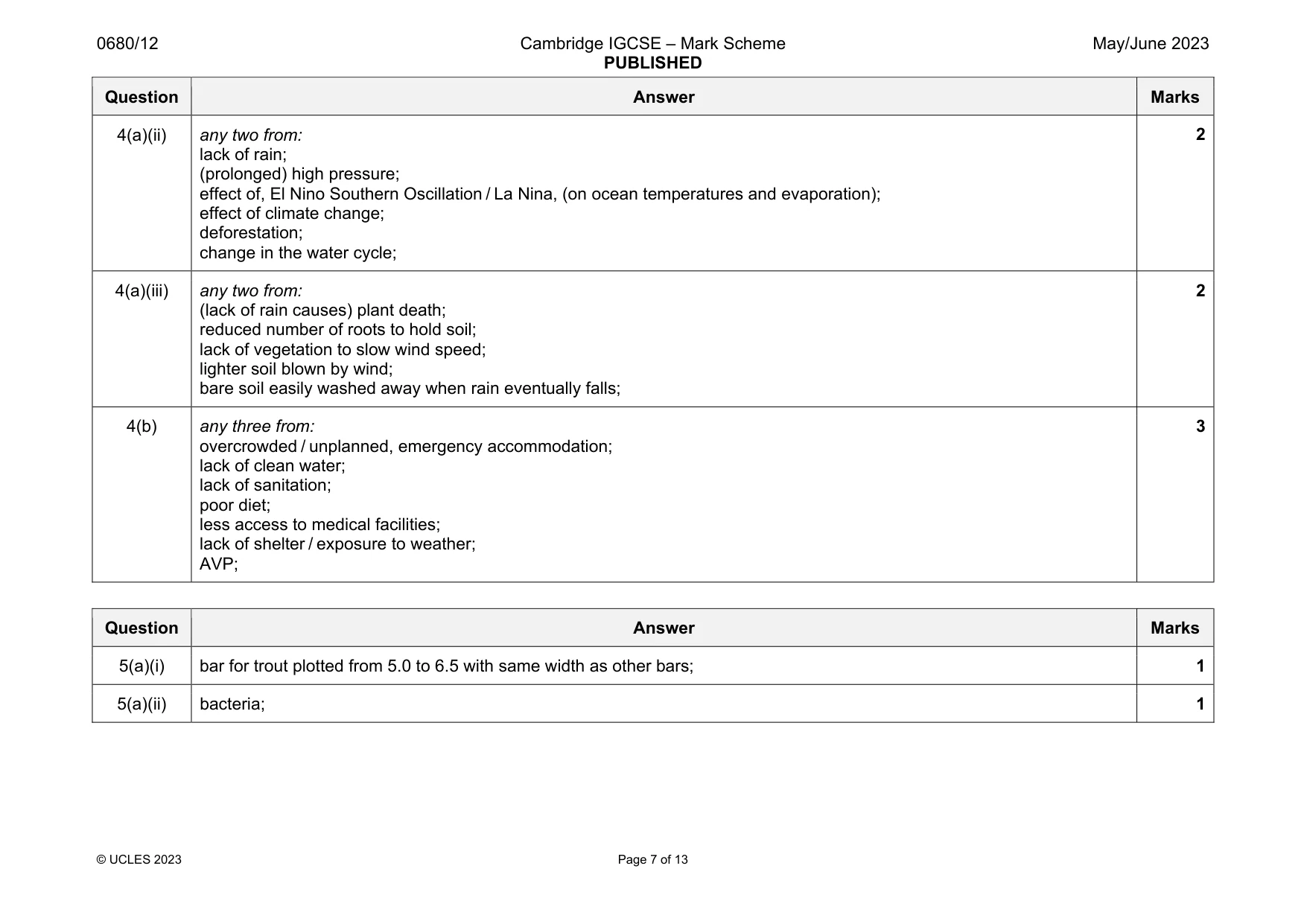
0680/12 Cambridge IGCSE – Mark Scheme PUBLISHED May/June 2023 © UCLES 2023 Page 6 of 13 Question Answer Marks 3(a) commercial subsistence 4 3(b) any three from: kills, beneficial / other, insects; (which) affects the food, chain / web; idea that insects are eaten by organisms in higher trophic levels; bioaccumulation; insecticide resistance in organisms; explanation of pest-resurgence; leaching/run off into water sources kills aquatic life 3 3(c) use of: pest-resistant varieties (of plants) / biological control / picking off by hand / use of nets / barriers / genetically modified organisms (GMOs) / traps / crop rotation; 1 Question Answer Marks 4(a)(i) any three from: data only given for, one year / 2019; lack of historic data to compare; data does not indicate whether the figures are an increase / single year doesn’t show a trend; some natural disasters are not caused by climate change; AVP, e.g. loss of homes might (also) be due to other reasons rather than natural disasters, article not (necessarily) written by scientists; 3 C; D; (E ) D A; B;
Mark scheme, page 7
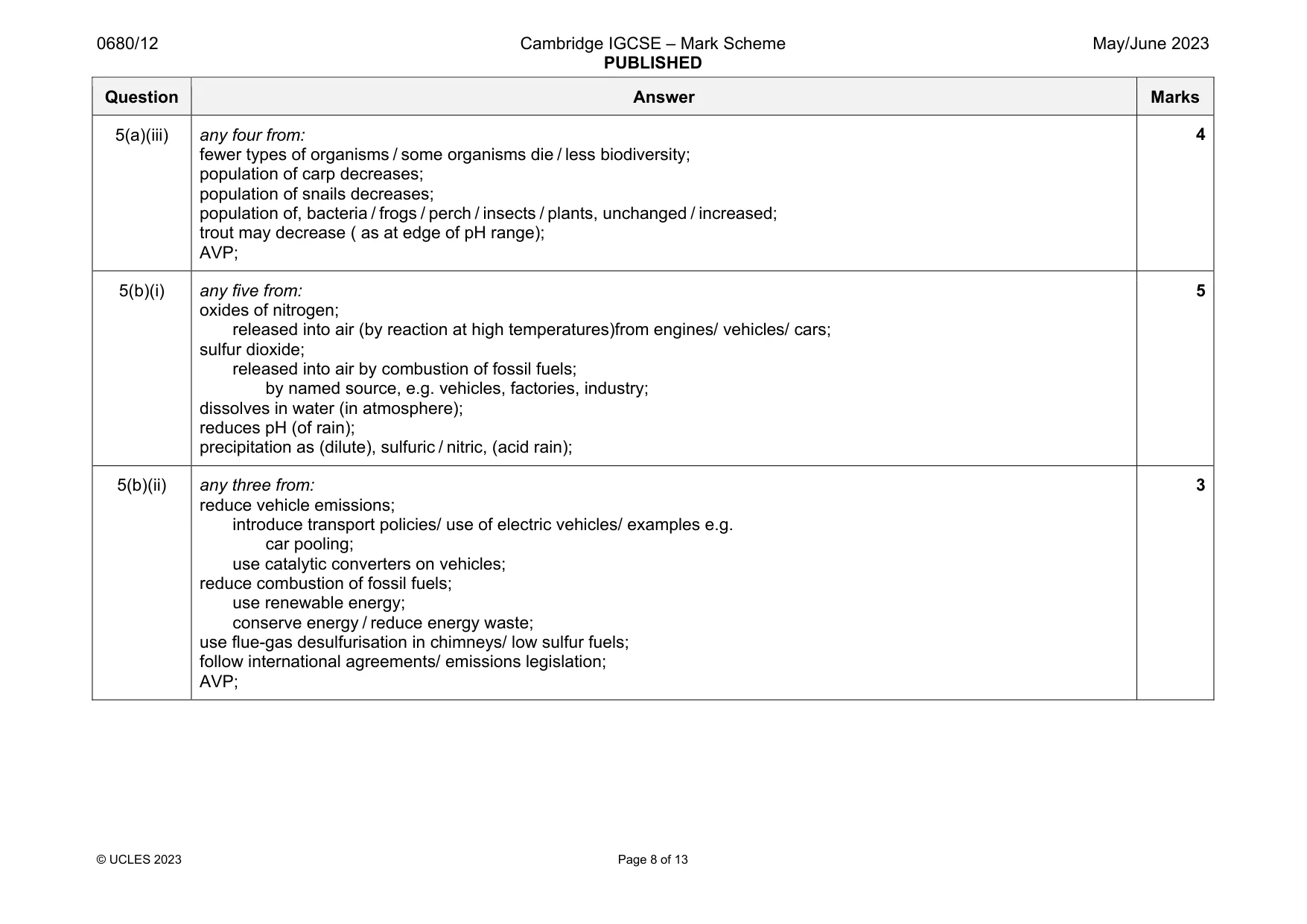
0680/12 Cambridge IGCSE – Mark Scheme PUBLISHED May/June 2023 © UCLES 2023 Page 7 of 13 Question Answer Marks 4(a)(ii) any two from: lack of rain; (prolonged) high pressure; effect of, El Nino Southern Oscillation / La Nina, (on ocean temperatures and evaporation); effect of climate change; deforestation; change in the water cycle; 2 4(a)(iii) any two from: (lack of rain causes) plant death; reduced number of roots to hold soil; lack of vegetation to slow wind speed; lighter soil blown by wind; bare soil easily washed away when rain eventually falls; 2 4(b) any three from: overcrowded / unplanned, emergency accommodation; lack of clean water; lack of sanitation; poor diet; less access to medical facilities; lack of shelter / exposure to weather; AVP; 3 Question Answer Marks 5(a)(i) bar for trout plotted from 5.0 to 6.5 with same width as other bars; 1 5(a)(ii) bacteria; 1
Mark scheme, page 8
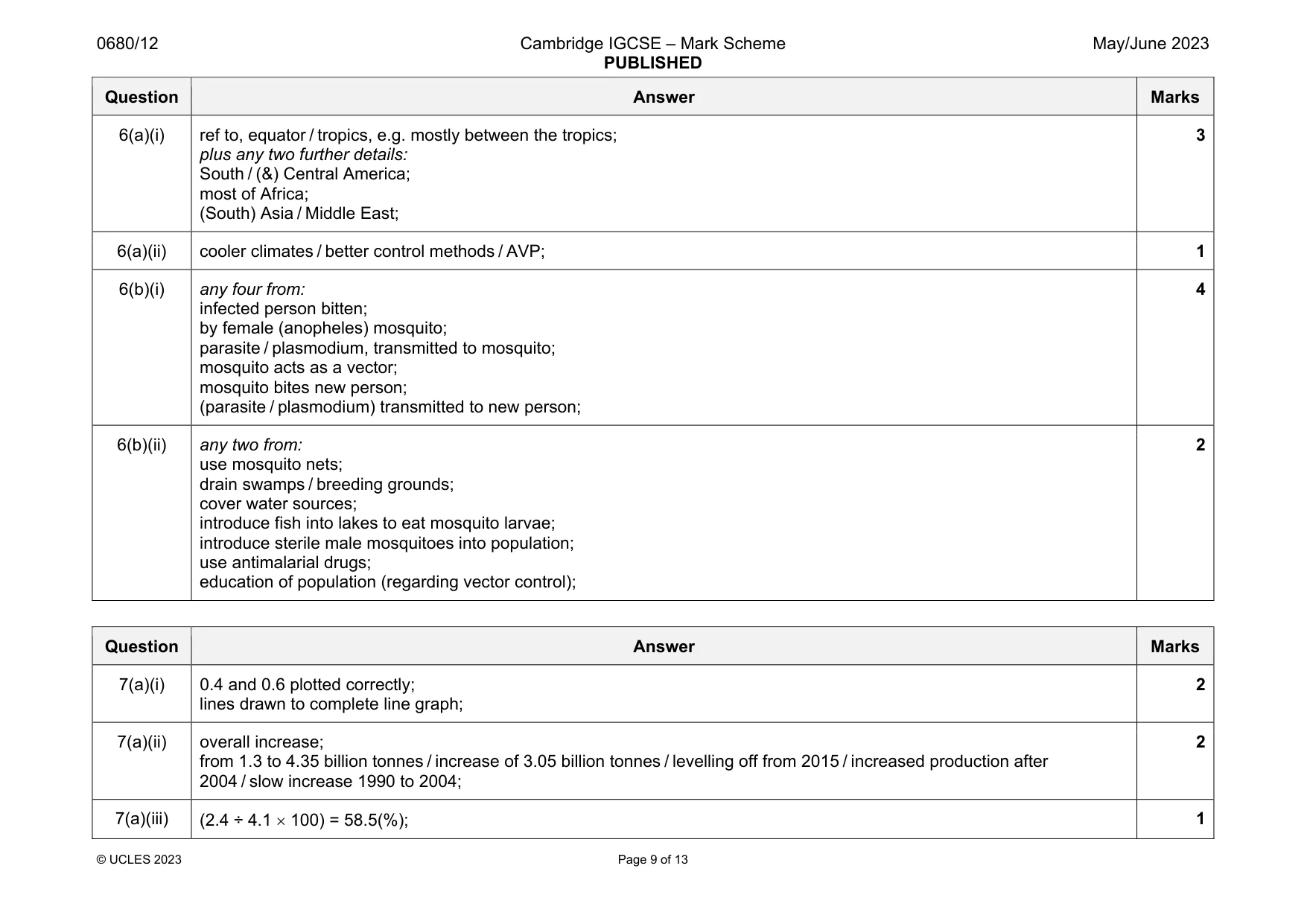
0680/12 Cambridge IGCSE – Mark Scheme PUBLISHED May/June 2023 © UCLES 2023 Page 8 of 13 Question Answer Marks 5(a)(iii) any four from: fewer types of organisms / some organisms die / less biodiversity; population of carp decreases; population of snails decreases; population of, bacteria / frogs / perch / insects / plants, unchanged / increased; trout may decrease ( as at edge of pH range); AVP; 4 5(b)(i) any five from: oxides of nitrogen; released into air (by reaction at high temperatures)from engines/ vehicles/ cars; sulfur dioxide; released into air by combustion of fossil fuels; by named source, e.g. vehicles, factories, industry; dissolves in water (in atmosphere); reduces pH (of rain); precipitation as (dilute), sulfuric / nitric, (acid rain); 5 5(b)(ii) any three from: reduce vehicle emissions; introduce transport policies/ use of electric vehicles/ examples e.g. car pooling; use catalytic converters on vehicles; reduce combustion of fossil fuels; use renewable energy; conserve energy / reduce energy waste; use flue-gas desulfurisation in chimneys/ low sulfur fuels; follow international agreements/ emissions legislation; AVP; 3
Mark scheme, page 9
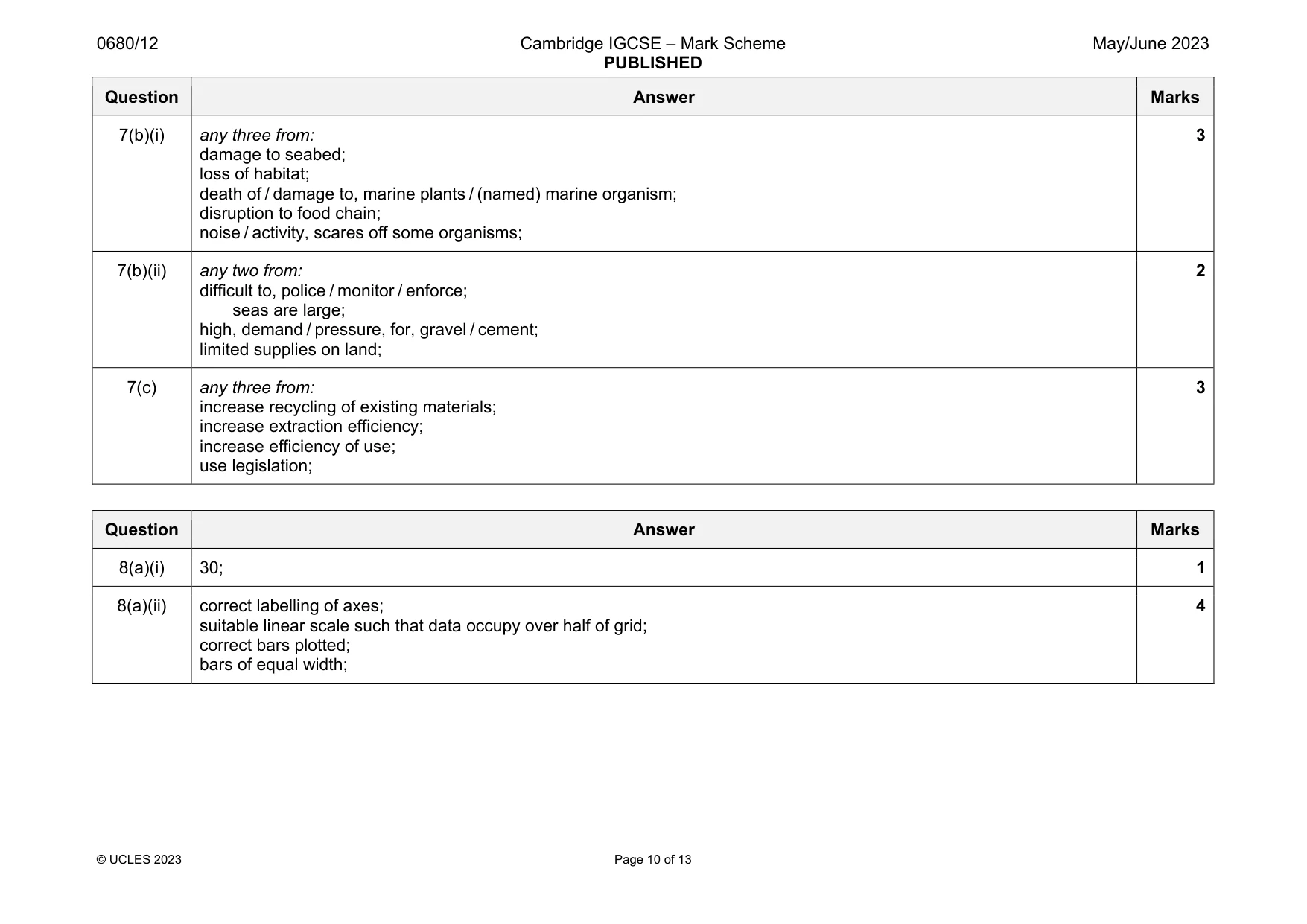
0680/12 Cambridge IGCSE – Mark Scheme PUBLISHED May/June 2023 © UCLES 2023 Page 9 of 13 Question Answer Marks 6(a)(i) ref to, equator / tropics, e.g. mostly between the tropics; plus any two further details: South / (&) Central America; most of Africa; (South) Asia / Middle East; 3 6(a)(ii) cooler climates / better control methods / AVP; 1 6(b)(i) any four from: infected person bitten; by female (anopheles) mosquito; parasite / plasmodium, transmitted to mosquito; mosquito acts as a vector; mosquito bites new person; (parasite / plasmodium) transmitted to new person; 4 6(b)(ii) any two from: use mosquito nets; drain swamps / breeding grounds; cover water sources; introduce fish into lakes to eat mosquito larvae; introduce sterile male mosquitoes into population; use antimalarial drugs; education of population (regarding vector control); 2 Question Answer Marks 7(a)(i) 0.4 and 0.6 plotted correctly; lines drawn to complete line graph; 2 7(a)(ii) overall increase; from 1.3 to 4.35 billion tonnes / increase of 3.05 billion tonnes / levelling off from 2015 / increased production after 2004 / slow increase 1990 to 2004; 2 7(a)(iii) (2.4 ÷ 4.1 100) = 58.5(%); 1
Mark scheme, page 10
0680/12 Cambridge IGCSE – Mark Scheme PUBLISHED May/June 2023 © UCLES 2023 Page 10 of 13 Question Answer Marks 7(b)(i) any three from: damage to seabed; loss of habitat; death of / damage to, marine plants / (named) marine organism; disruption to food chain; noise / activity, scares off some organisms; 3 7(b)(ii) any two from: difficult to, police / monitor / enforce; seas are large; high, demand / pressure, for, gravel / cement; limited supplies on land; 2 7(c) any three from: increase recycling of existing materials; increase extraction efficiency; increase efficiency of use; use legislation; 3 Question Answer Marks 8(a)(i) 30; 1 8(a)(ii) correct labelling of axes; suitable linear scale such that data occupy over half of grid; correct bars plotted; bars of equal width; 4
Mark scheme, page 11
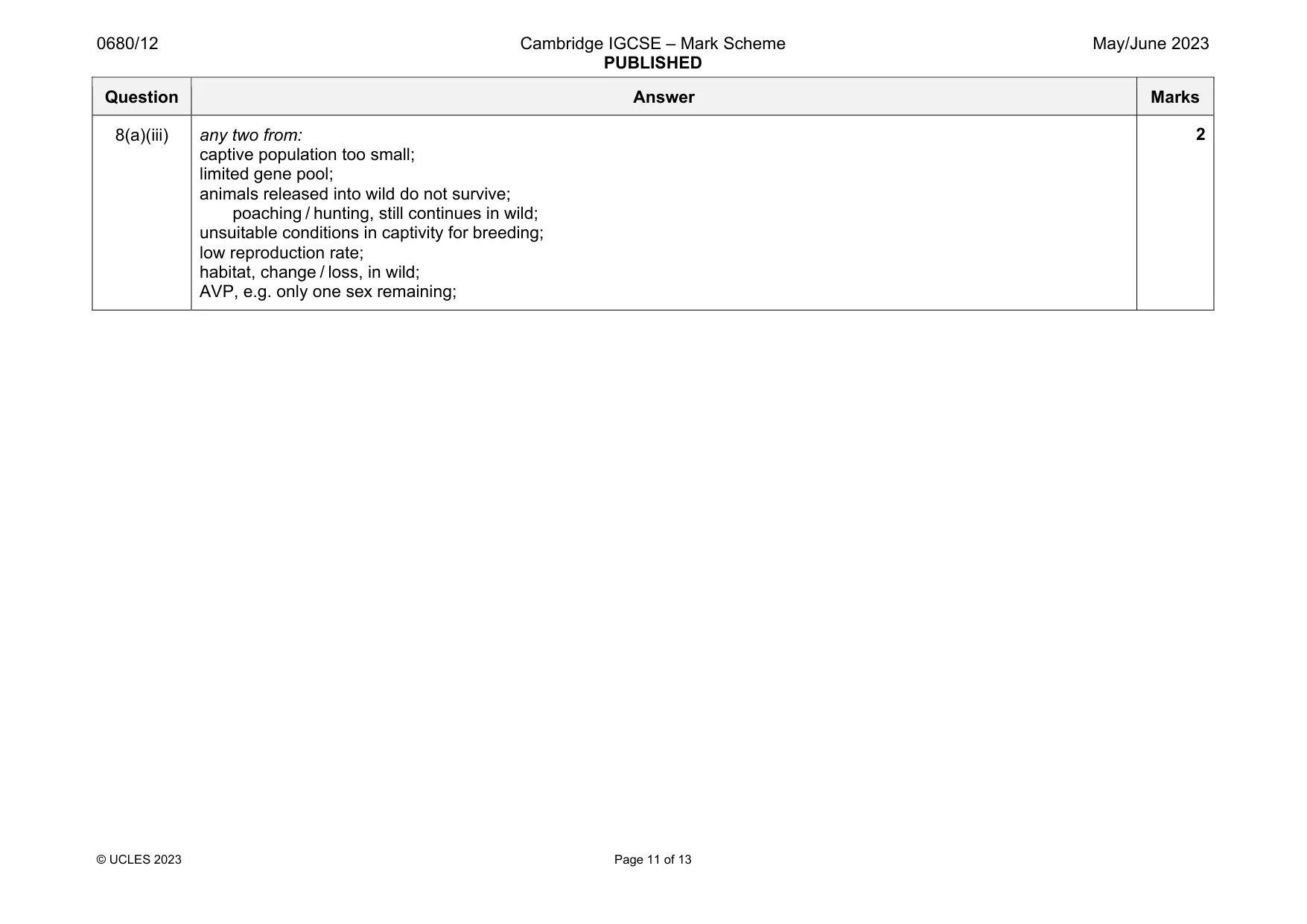
0680/12 Cambridge IGCSE – Mark Scheme PUBLISHED May/June 2023 © UCLES 2023 Page 11 of 13 Question Answer Marks 8(a)(iii) any two from: captive population too small; limited gene pool; animals released into wild do not survive; poaching / hunting, still continues in wild; unsuitable conditions in captivity for breeding; low reproduction rate; habitat, change / loss, in wild; AVP, e.g. only one sex remaining; 2
Mark scheme, page 12
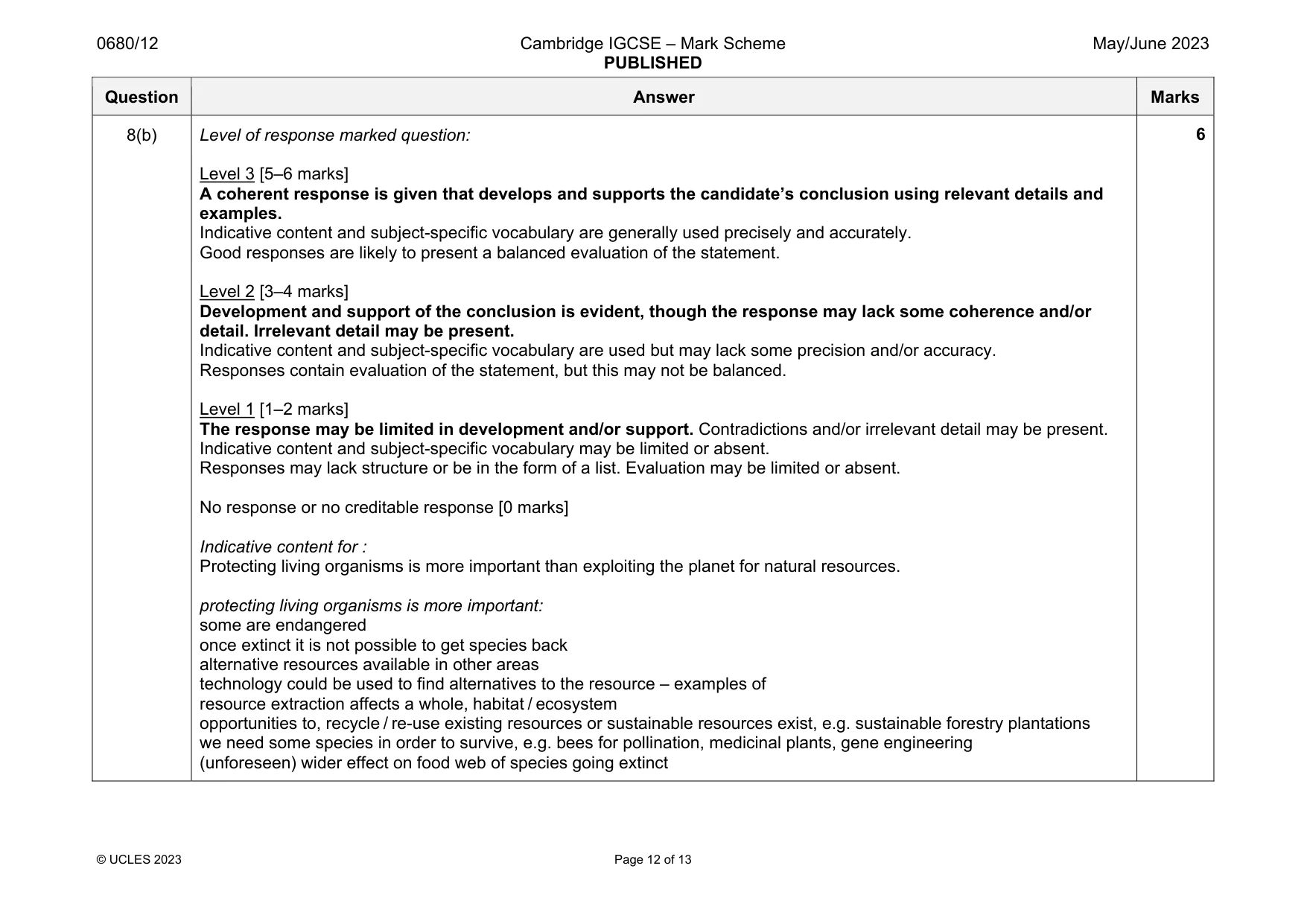
0680/12 Cambridge IGCSE – Mark Scheme PUBLISHED May/June 2023 © UCLES 2023 Page 12 of 13 Question Answer Marks 8(b) Level of response marked question: Level 3 [5–6 marks] A coherent response is given that develops and supports the candidate’s conclusion using relevant details and examples. Indicative content and subject-specific vocabulary are generally used precisely and accurately. Good responses are likely to present a balanced evaluation of the statement. Level 2 [3–4 marks] Development and support of the conclusion is evident, though the response may lack some coherence and/or detail. Irrelevant detail may be present. Indicative content and subject-specific vocabulary are used but may lack some precision and/or accuracy. Responses contain evaluation of the statement, but this may not be balanced. Level 1 [1–2 marks] The response may be limited in development and/or support. Contradictions and/or irrelevant detail may be present. Indicative content and subject-specific vocabulary may be limited or absent. Responses may lack structure or be in the form of a list. Evaluation may be limited or absent. No response or no creditable response [0 marks] Indicative content for : Protecting living organisms is more important than exploiting the planet for natural resources. protecting living organisms is more important: some are endangered once extinct it is not possible to get species back alternative resources available in other areas technology could be used to find alternatives to the resource – examples of resource extraction affects a whole, habitat / ecosystem opportunities to, recycle / re-use existing resources or sustainable resources exist, e.g. sustainable forestry plantations we need some species in order to survive, e.g. bees for pollination, medicinal plants, gene engineering (unforeseen) wider effect on food web of species going extinct 6
Mark scheme, page 13
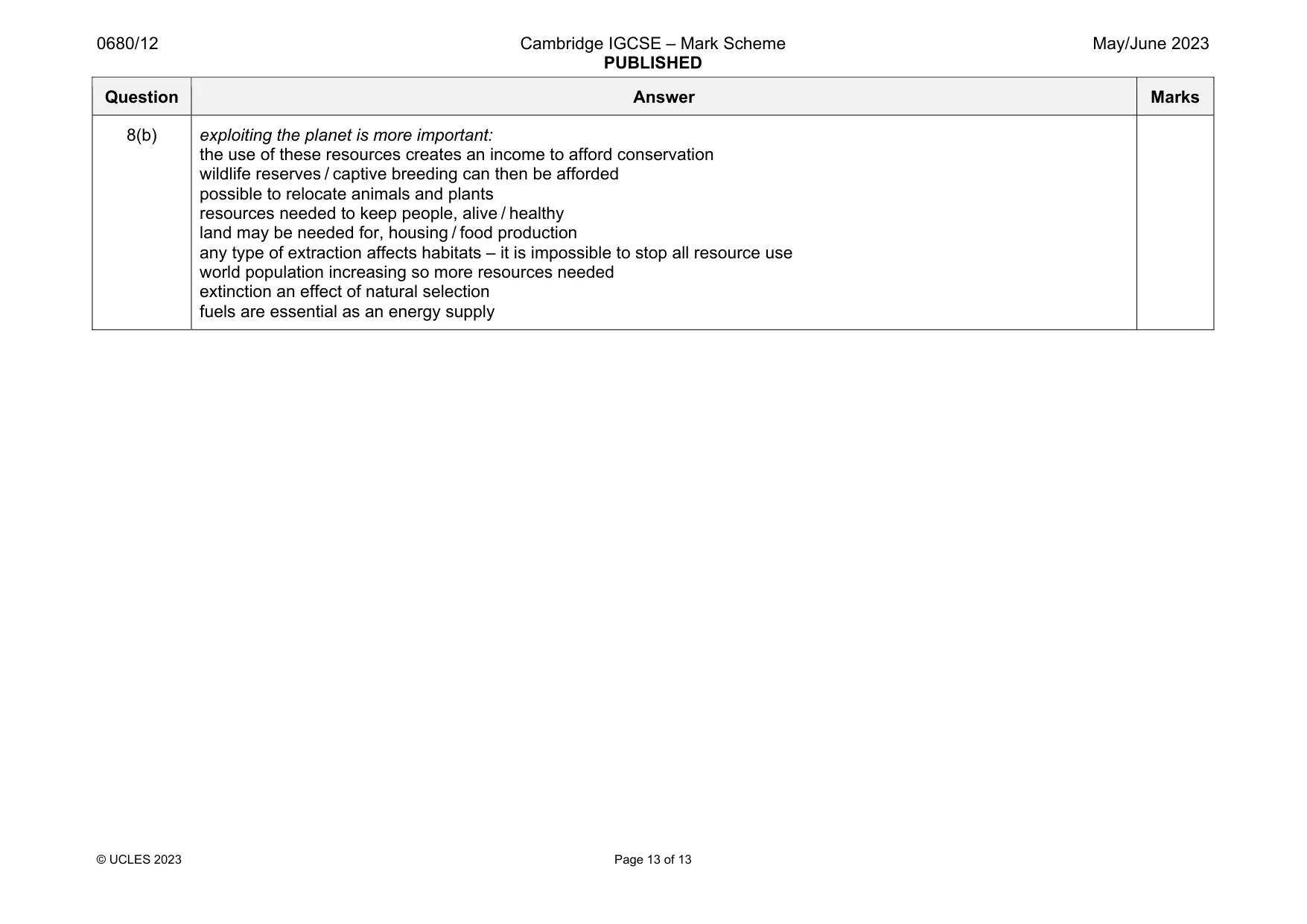
0680/12 Cambridge IGCSE – Mark Scheme PUBLISHED May/June 2023 © UCLES 2023 Page 13 of 13 Question Answer Marks 8(b) exploiting the planet is more important: the use of these resources creates an income to afford conservation wildlife reserves / captive breeding can then be afforded possible to relocate animals and plants resources needed to keep people, alive / healthy land may be needed for, housing / food production any type of extraction affects habitats – it is impossible to stop all resource use world population increasing so more resources needed extinction an effect of natural selection fuels are essential as an energy supply
What you needed in this session
Cambridge’s own grade thresholds for 2023 May/June, Paper 1 · Variant 2. A higher threshold means an easier paper — the bar moves with how the cohort did.