Cambridge IGCSE Environmental Management 0680 — 2022 May/June Paper 1 · Variant 2
0680/12/M/J/22 · 80 marks · ≈90 min
The question paper and its mark scheme, free to read here and free to download. This is Cambridge’s own paper, exactly as it was sat.
Question paper20 pages





Mark scheme14 pages
Answers below. Sit the paper first if you are practising.




Paper as text
Question paper, page 1
This document has 20 pages. Any blank pages are indicated. [Turn over Cambridge IGCSE™ DC (CE/CB) 301739/2 © UCLES 2022 ENVIRONMENTAL MANAGEMENT 0680/12 Paper 1 Theory May/June 2022 1 hour 45 minutes You must answer on the question paper. No additional materials are needed. INSTRUCTIONS ● Answer all questions. ● Use a black or dark blue pen. You may use an HB pencil for any diagrams or graphs. ● Write your name, centre number and candidate number in the boxes at the top of the page. ● Write your answer to each question in the space provided. ● Do not use an erasable pen or correction fluid. ● Do not write on any bar codes. ● You may use a calculator. ● You should show all your working and use appropriate units. INFORMATION ● The total mark for this paper is 80. ● The number of marks for each question or part question is shown in brackets [ ]. * 7 2 7 4 5 4 4 3 0 2 *
Question paper, page 2
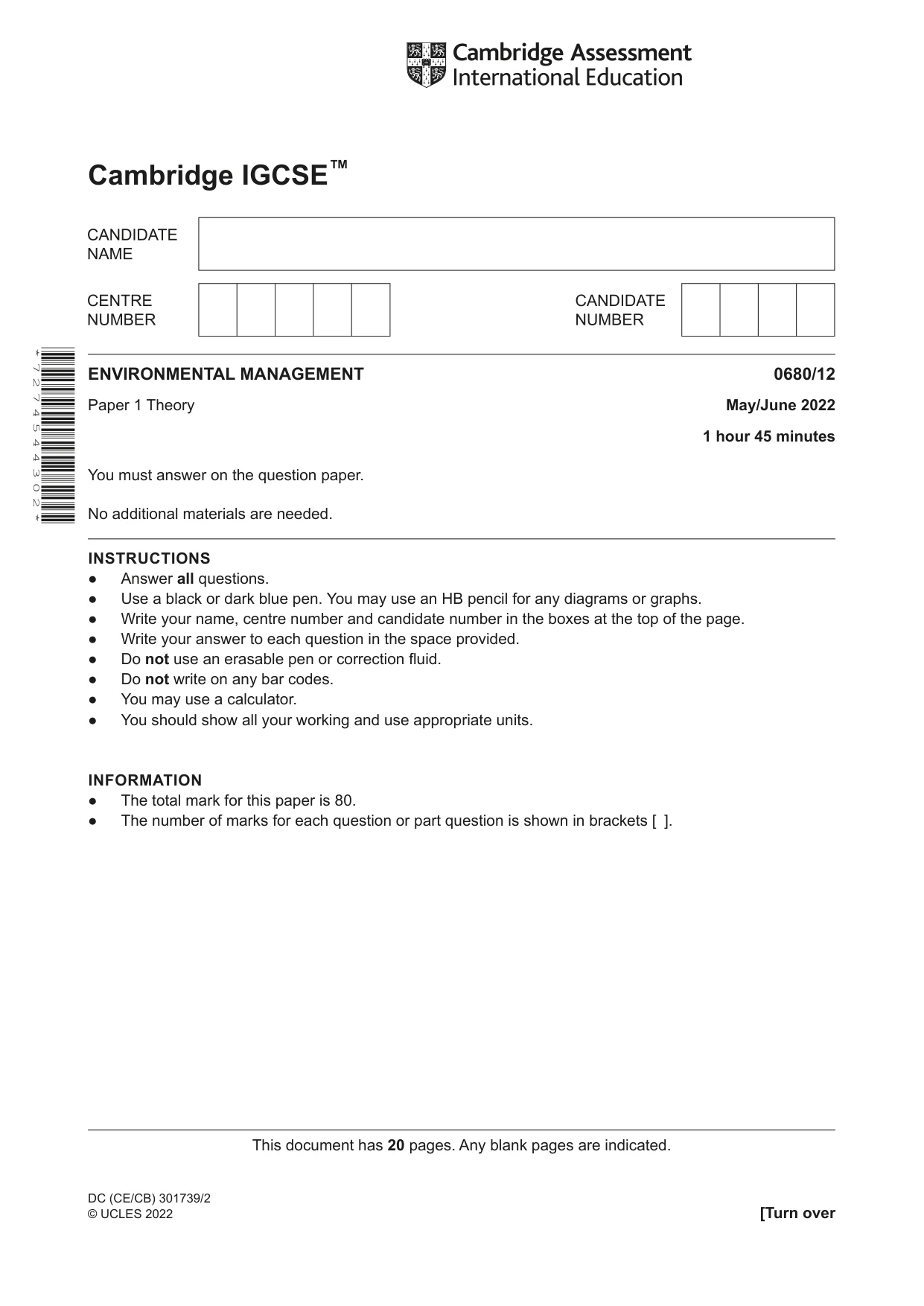
2 0680/12/M/J/22 © UCLES 2022 Section A 1 Rocks and minerals needed for building can be extracted from the ground by open-pit mining. (a) State one environmental impact of open-pit mining. … [1] (b) Describe how rock and mineral extraction can benefit the local community. … … … … [2] (c) The photograph shows an area of land that was used for open-pit mining. The land has been restored. Use the photograph to describe how this land has been restored. … … … … [2] [Total: 5]
Question paper, page 3
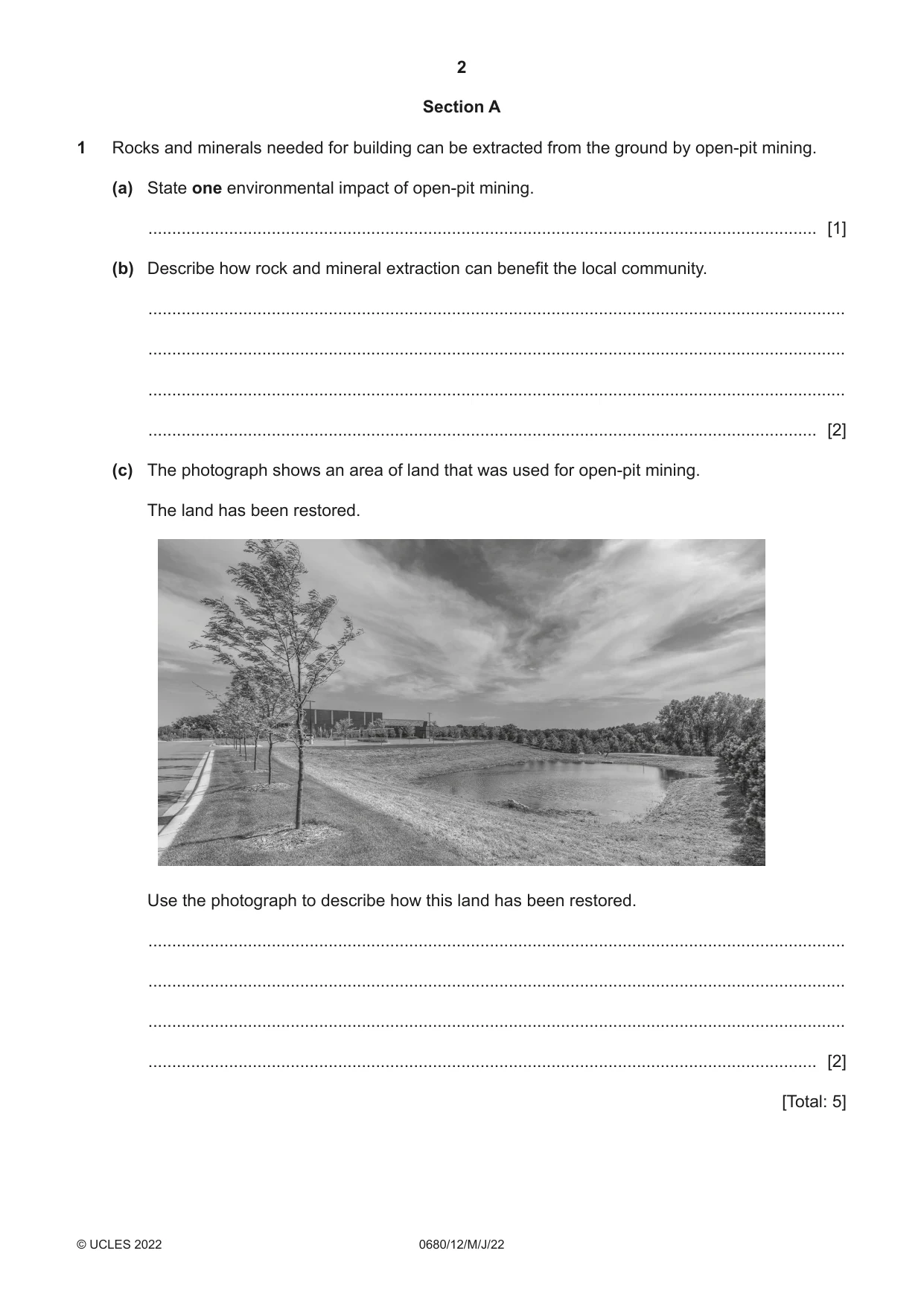
3 0680/12/M/J/22 © UCLES 2022 [Turn over 2 (a) The photograph shows bycatch on a prawn-fishing boat. basket of prawns Explain what the fisherman is doing with the bycatch in the photograph. … … … … [2] (b) (i) Describe the environmental impacts of overfishing. … … … … [2] (ii) State two strategies that can be used to reduce overfishing. 1 … 2 … [2] [Total: 6]
Question paper, page 4
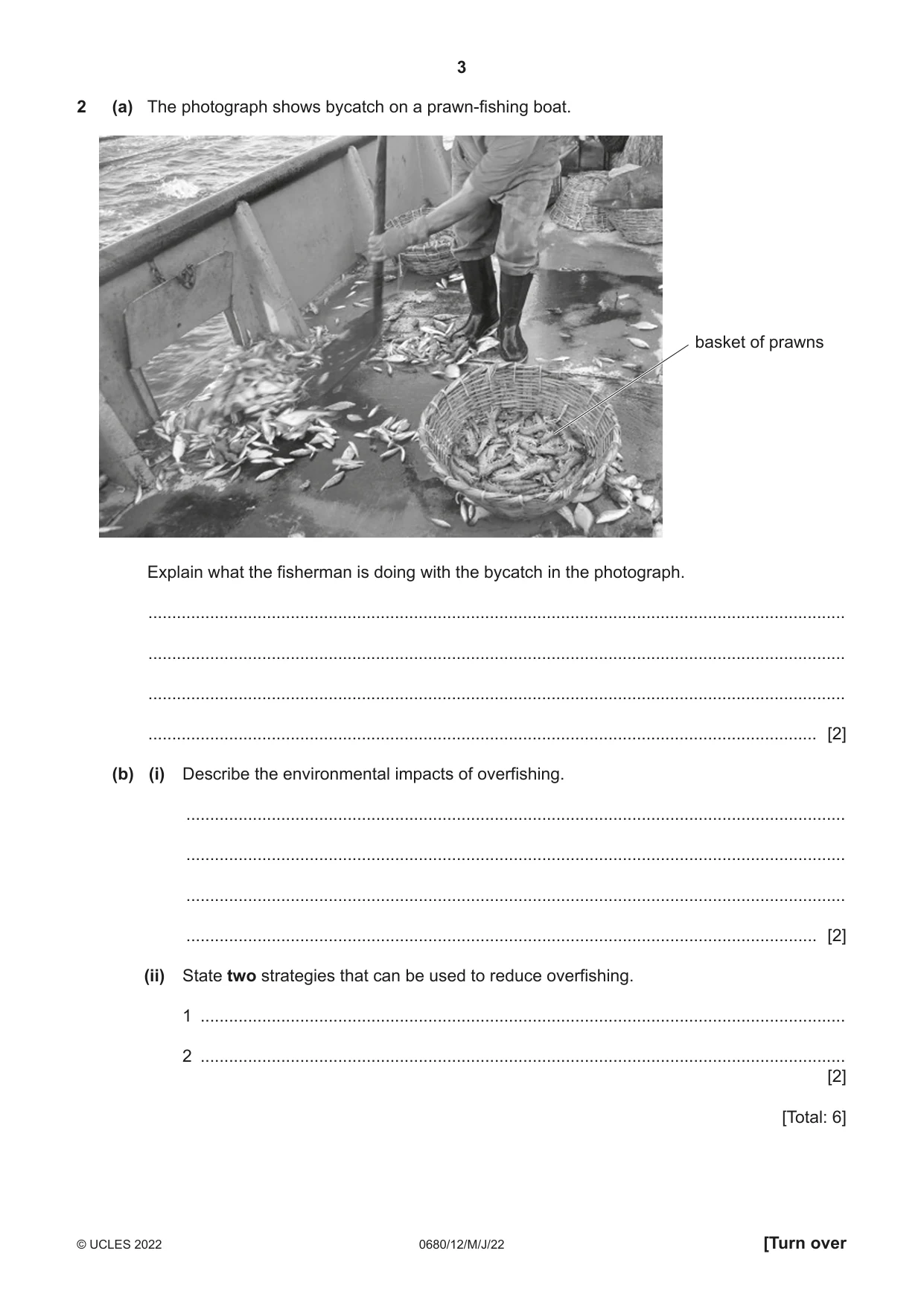
4 0680/12/M/J/22 © UCLES 2022 3 (a) The pie chart shows the annual carbon footprint for the average U.S. citizen by sector. other 1.8 tonnes goods and services 4.6 tonnes food 3 tonnes heating and cooking 2.2 tonnes electricity 2.8 tonnes transport and travel 5.6 tonnes Key food goods and services electricity heating and cooking transport and travel other (i) State which sector makes the largest contribution to the annual carbon footprint. … [1] (ii) Calculate the total annual carbon footprint in tonnes for the average U.S. citizen. … tonnes [1] (iii) Calculate the percentage contribution of the electricity sector. … % [1] (b) Suggest strategies that individuals can use to reduce their carbon footprints. … … … … [2] [Total: 5]
Question paper, page 5
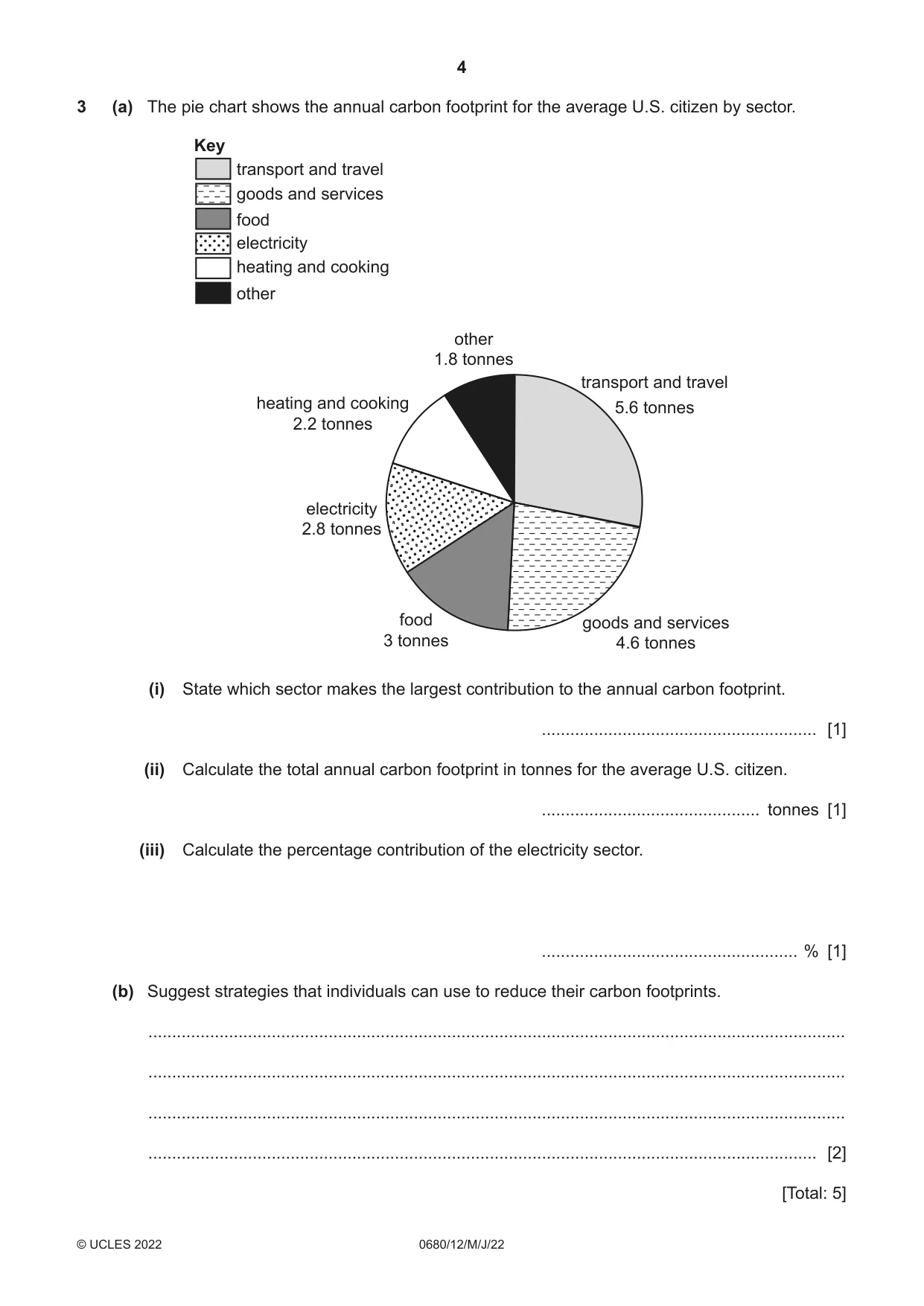
5 0680/12/M/J/22 © UCLES 2022 [Turn over 4 The map of Africa shows average life expectancy by country. Tropic of Cancer Tropic of Capricorn Equator Key 70+ years 60–70 years 50–60 years N (a) Describe the distribution of average life expectancy in Africa. … … … … [2] (b) Suggest why average life expectancy might change in the future. … … … … [2] [Total: 4]
Question paper, page 6
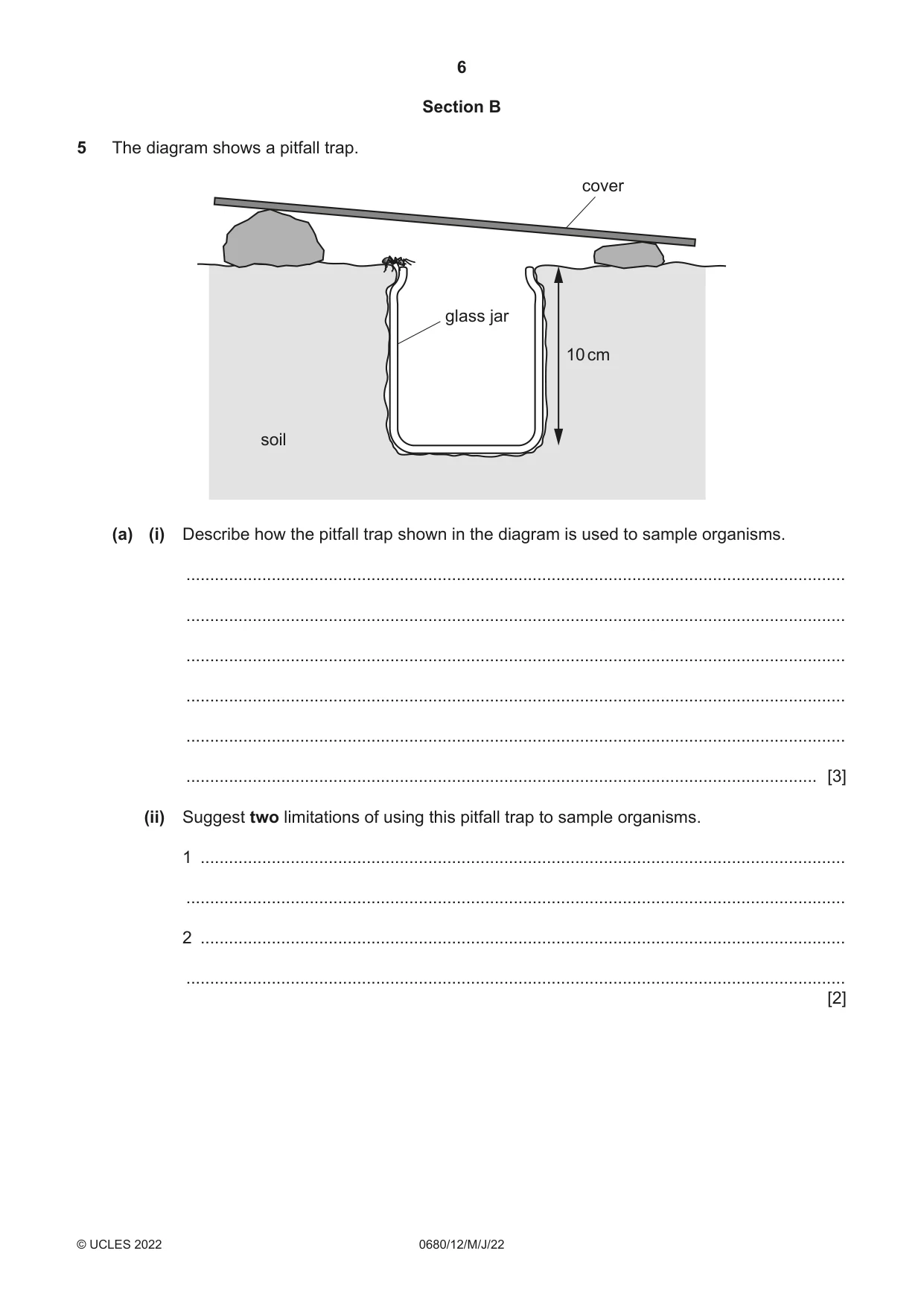
6 0680/12/M/J/22 © UCLES 2022 Section B 5 The diagram shows a pitfall trap. 10 cm soil glass jar cover (a) (i) Describe how the pitfall trap shown in the diagram is used to sample organisms. … … … … … … [3] (ii) Suggest two limitations of using this pitfall trap to sample organisms. 1 … … 2 … … [2]
Question paper, page 7
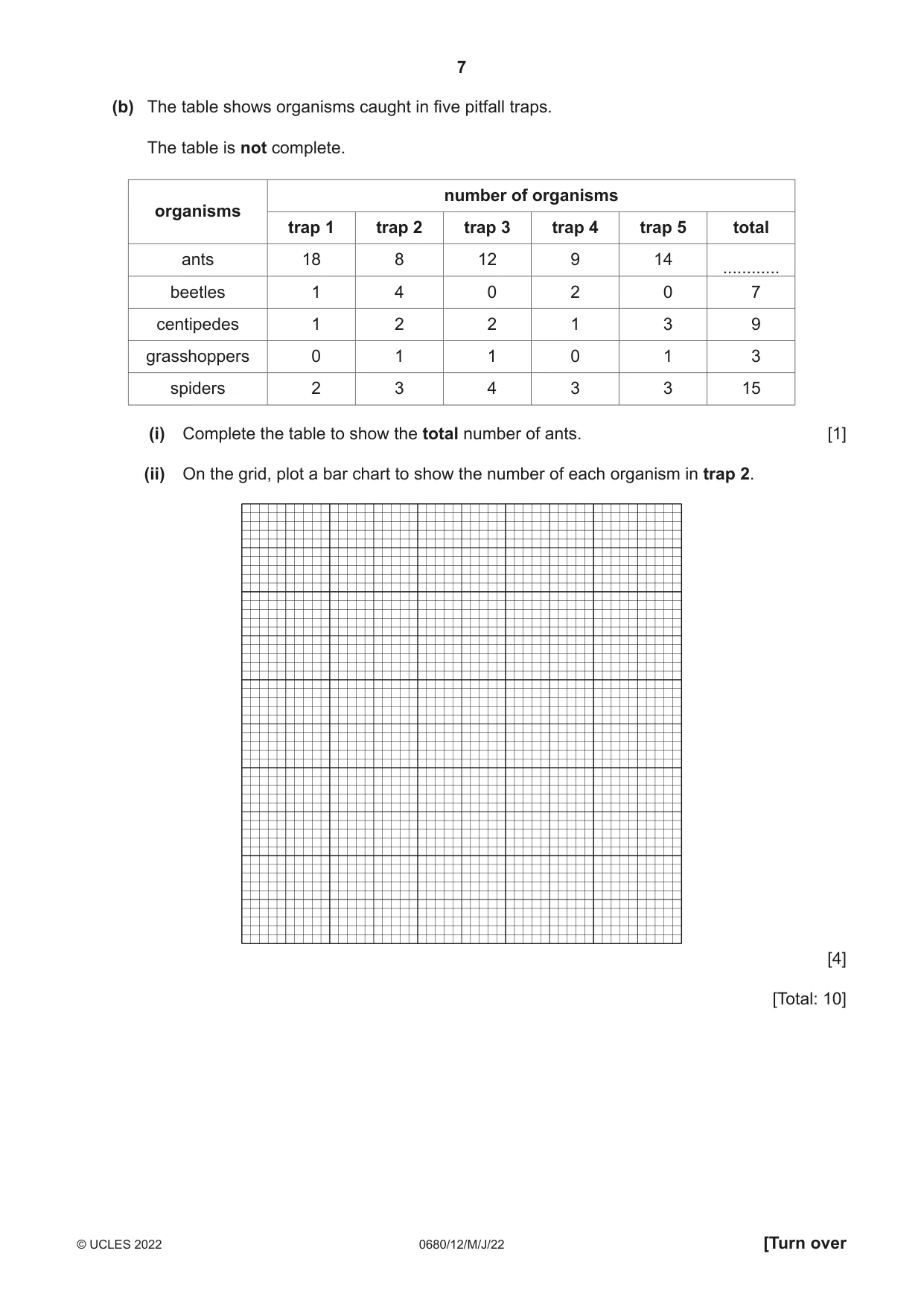
7 0680/12/M/J/22 © UCLES 2022 [Turn over (b) The table shows organisms caught in five pitfall traps. The table is not complete. organisms number of organisms trap 1 trap 2 trap 3 trap 4 trap 5 total ants 18 8 12 9 14 … beetles 1 4 0 2 0 7 centipedes 1 2 2 1 3 9 grasshoppers 0 1 1 0 1 3 spiders 2 3 4 3 3 15 (i) Complete the table to show the total number of ants. [1] (ii) On the grid, plot a bar chart to show the number of each organism in trap 2. [4] [Total: 10]
Question paper, page 8
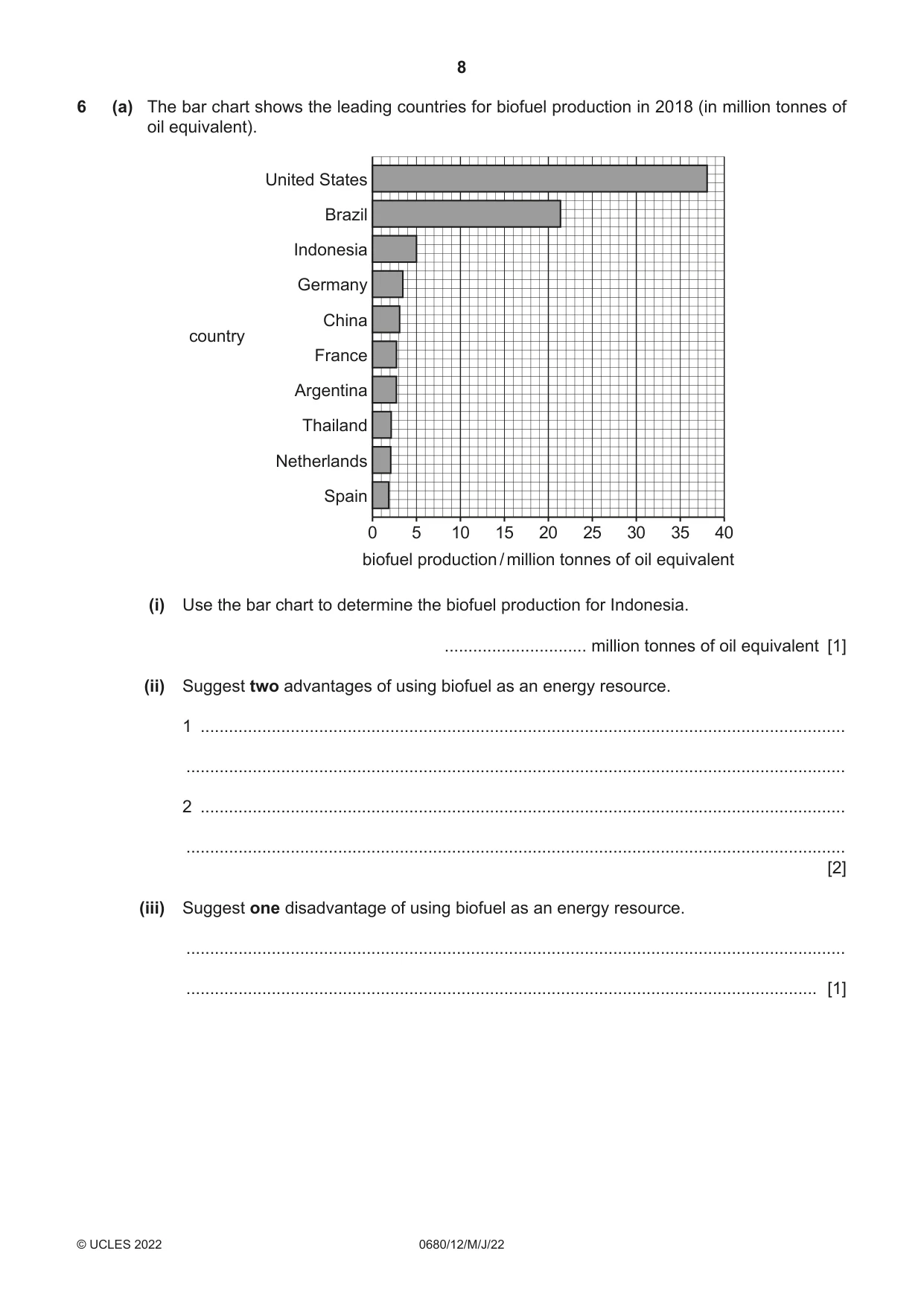
8 0680/12/M/J/22 © UCLES 2022 6 (a) The bar chart shows the leading countries for biofuel production in 2018 (in million tonnes of oil equivalent). 0 Spain biofuel production / million tonnes of oil equivalent country Netherlands Thailand Argentina France China Germany Indonesia Brazil United States 5 10 15 20 25 30 35 40 (i) Use the bar chart to determine the biofuel production for Indonesia. … million tonnes of oil equivalent [1] (ii) Suggest two advantages of using biofuel as an energy resource. 1 … … 2 … … [2] (iii) Suggest one disadvantage of using biofuel as an energy resource. … … [1]
Question paper, page 9
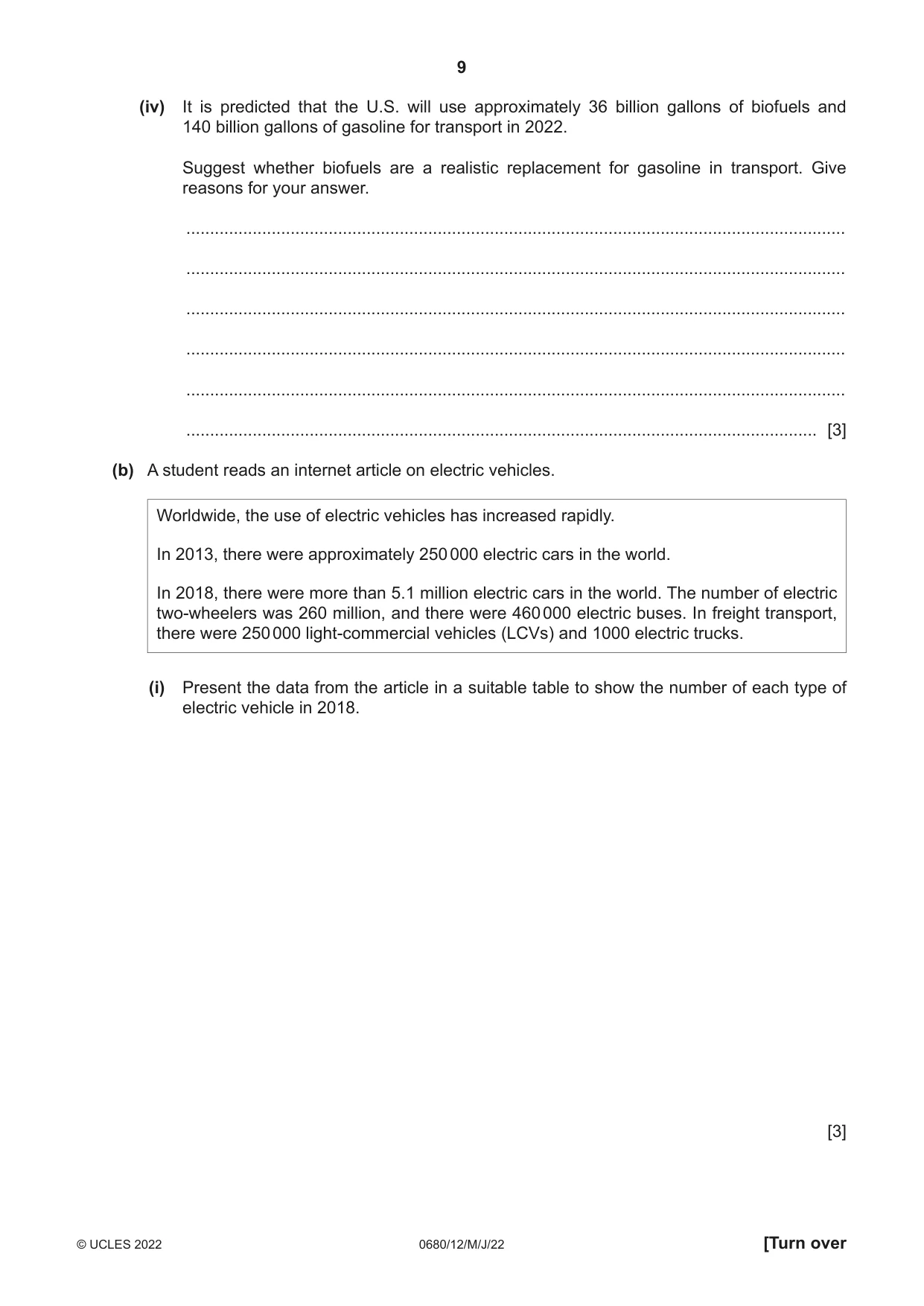
9 0680/12/M/J/22 © UCLES 2022 [Turn over (iv) It is predicted that the U.S. will use approximately 36 billion gallons of biofuels and 140 billion gallons of gasoline for transport in 2022. Suggest whether biofuels are a realistic replacement for gasoline in transport. Give reasons for your answer. … … … … … … [3] (b) A student reads an internet article on electric vehicles. Worldwide, the use of electric vehicles has increased rapidly. In 2013, there were approximately 250 000 electric cars in the world. In 2018, there were more than 5.1 million electric cars in the world. The number of electric two-wheelers was 260 million, and there were 460 000 electric buses. In freight transport, there were 250 000 light-commercial vehicles (LCVs) and 1000 electric trucks. (i) Present the data from the article in a suitable table to show the number of each type of electric vehicle in 2018. [3]
Question paper, page 10
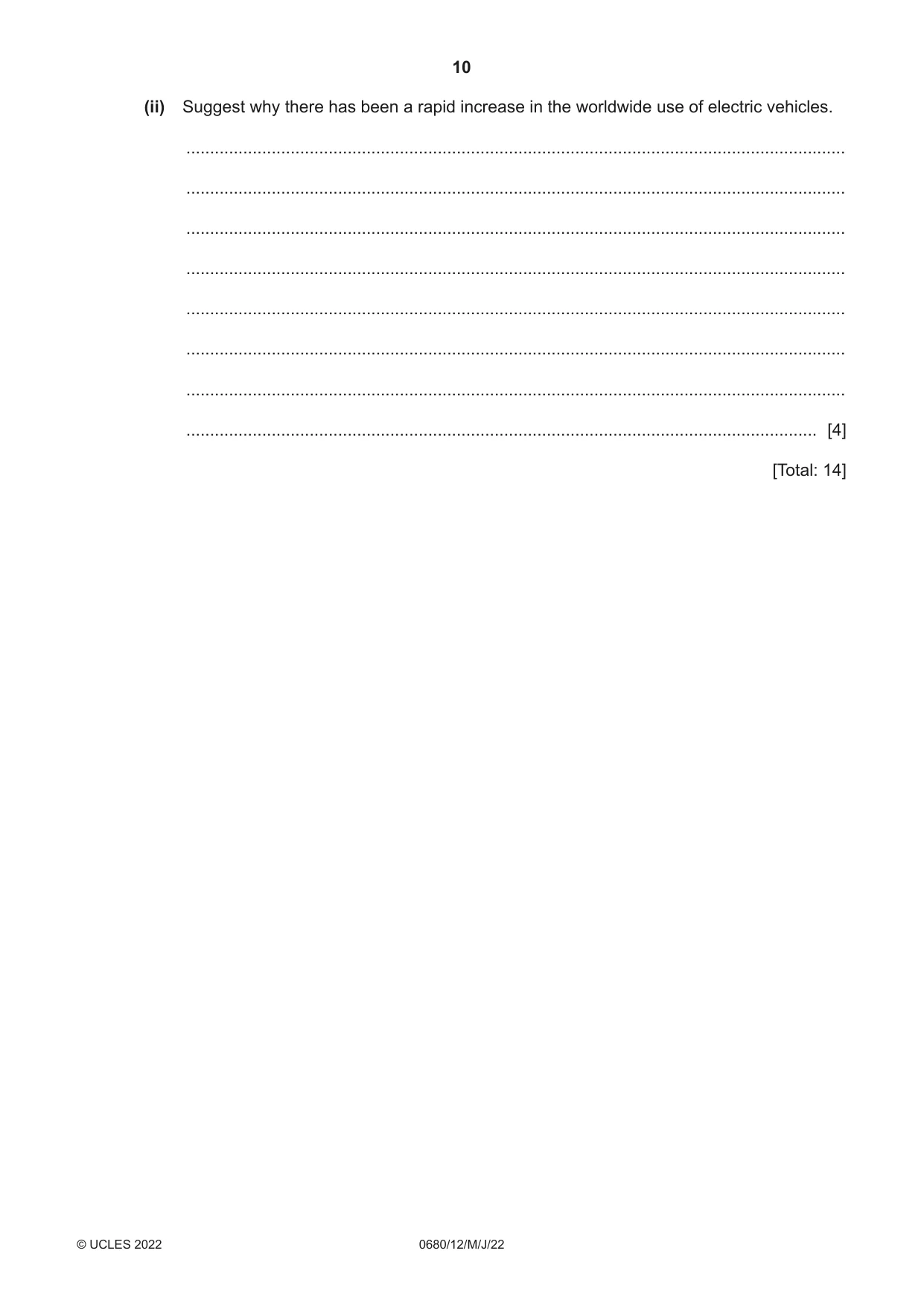
10 0680/12/M/J/22 © UCLES 2022 (ii) Suggest why there has been a rapid increase in the worldwide use of electric vehicles. … … … … … … … … [4] [Total: 14]
Question paper, page 11
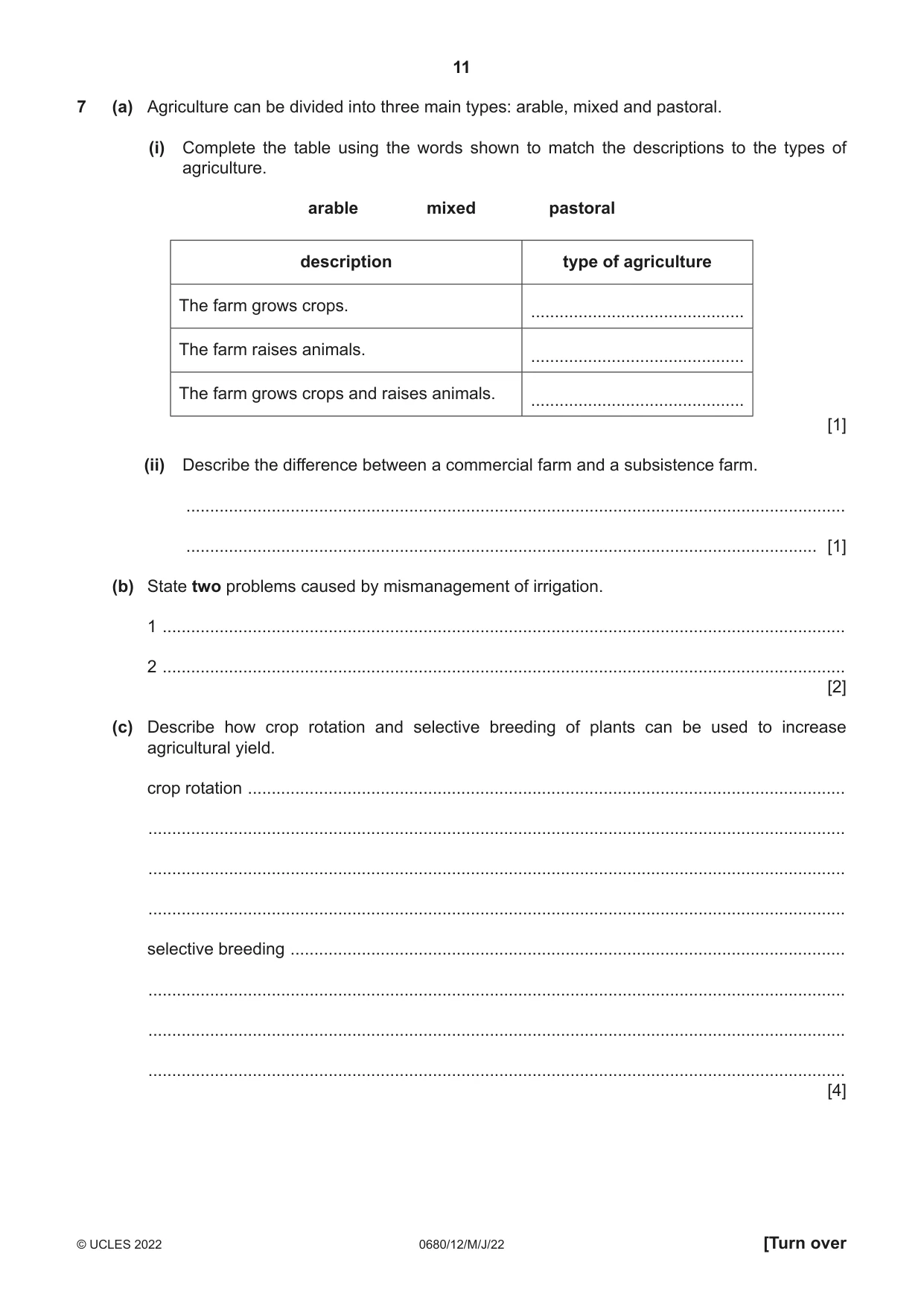
11 0680/12/M/J/22 © UCLES 2022 [Turn over 7 (a) Agriculture can be divided into three main types: arable, mixed and pastoral. (i) Complete the table using the words shown to match the descriptions to the types of agriculture. arable mixed pastoral description type of agriculture The farm grows crops. … The farm raises animals. … The farm grows crops and raises animals. … [1] (ii) Describe the difference between a commercial farm and a subsistence farm. … … [1] (b) State two problems caused by mismanagement of irrigation. 1 … 2 … [2] (c) Describe how crop rotation and selective breeding of plants can be used to increase agricultural yield. crop rotation … … … … selective breeding … … … … [4]
Question paper, page 12
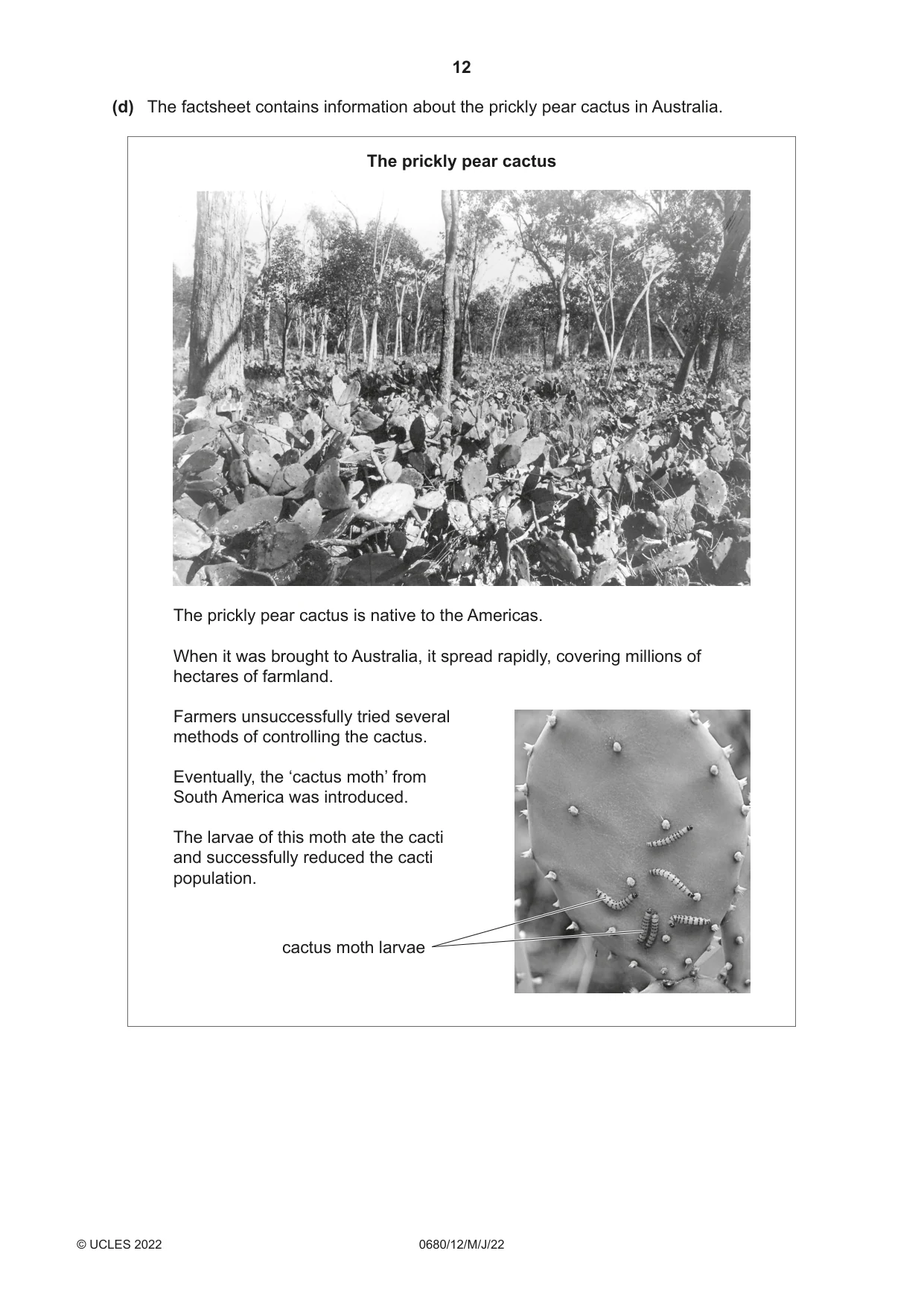
12 0680/12/M/J/22 © UCLES 2022 (d) The factsheet contains information about the prickly pear cactus in Australia. The prickly pear cactus The prickly pear cactus is native to the Americas. When it was brought to Australia, it spread rapidly, covering millions of hectares of farmland. Farmers unsuccessfully tried several methods of controlling the cactus. Eventually, the ‘cactus moth’ from South America was introduced. The larvae of this moth ate the cacti and successfully reduced the cacti population. cactus moth larvae
Question paper, page 13
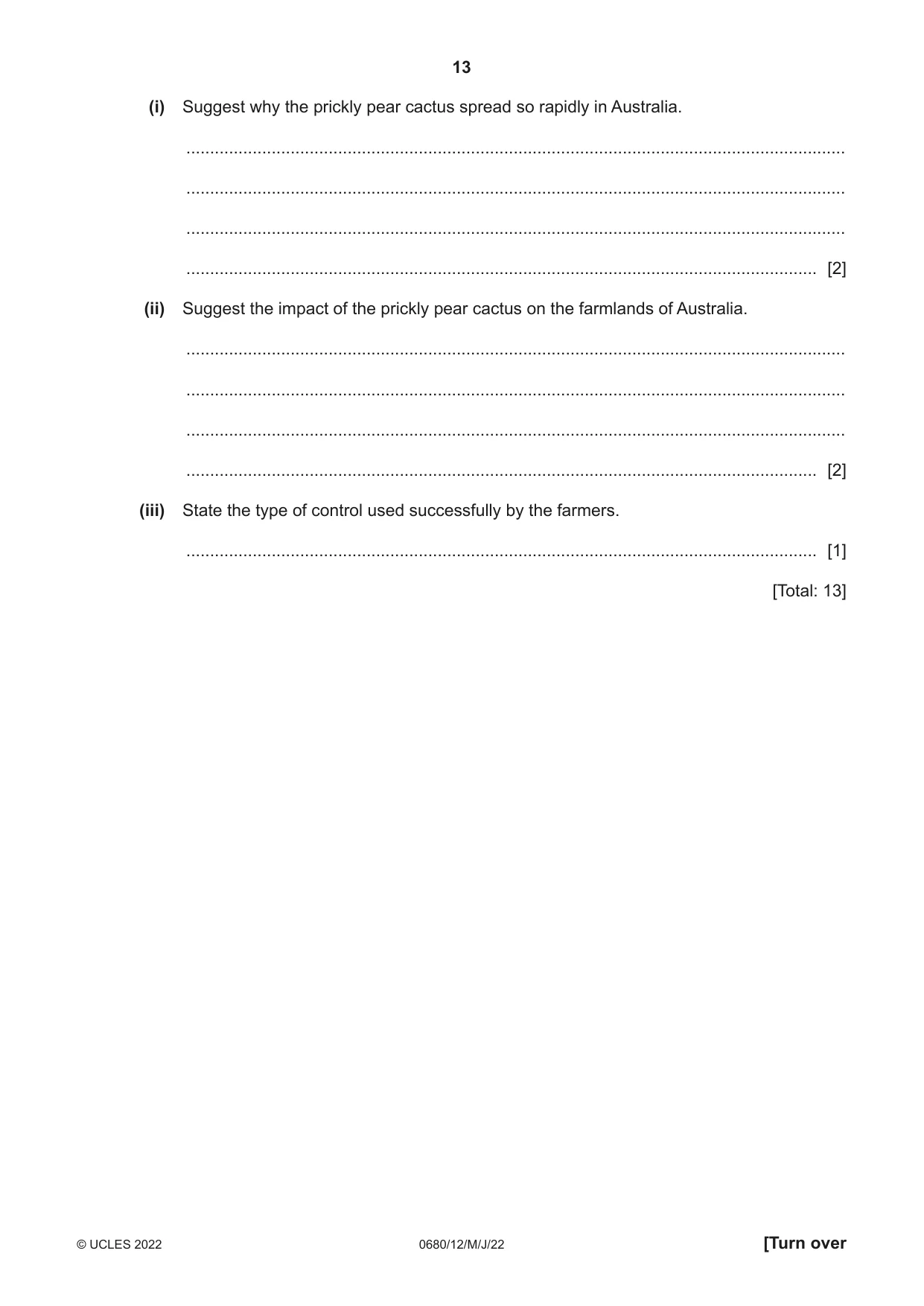
13 0680/12/M/J/22 © UCLES 2022 [Turn over (i) Suggest why the prickly pear cactus spread so rapidly in Australia. … … … … [2] (ii) Suggest the impact of the prickly pear cactus on the farmlands of Australia. … … … … [2] (iii) State the type of control used successfully by the farmers. … [1] [Total: 13]
Question paper, page 14
14 0680/12/M/J/22 © UCLES 2022 8 The photograph shows a location after a storm surge. (a) Flooding is one impact of the storm surge. (i) Describe one other impact of the storm surge that can be seen in the photograph. … … [1] (ii) Suggest strategies to reduce the impacts of the flooding at this location. … … … … … … [3]
Question paper, page 15
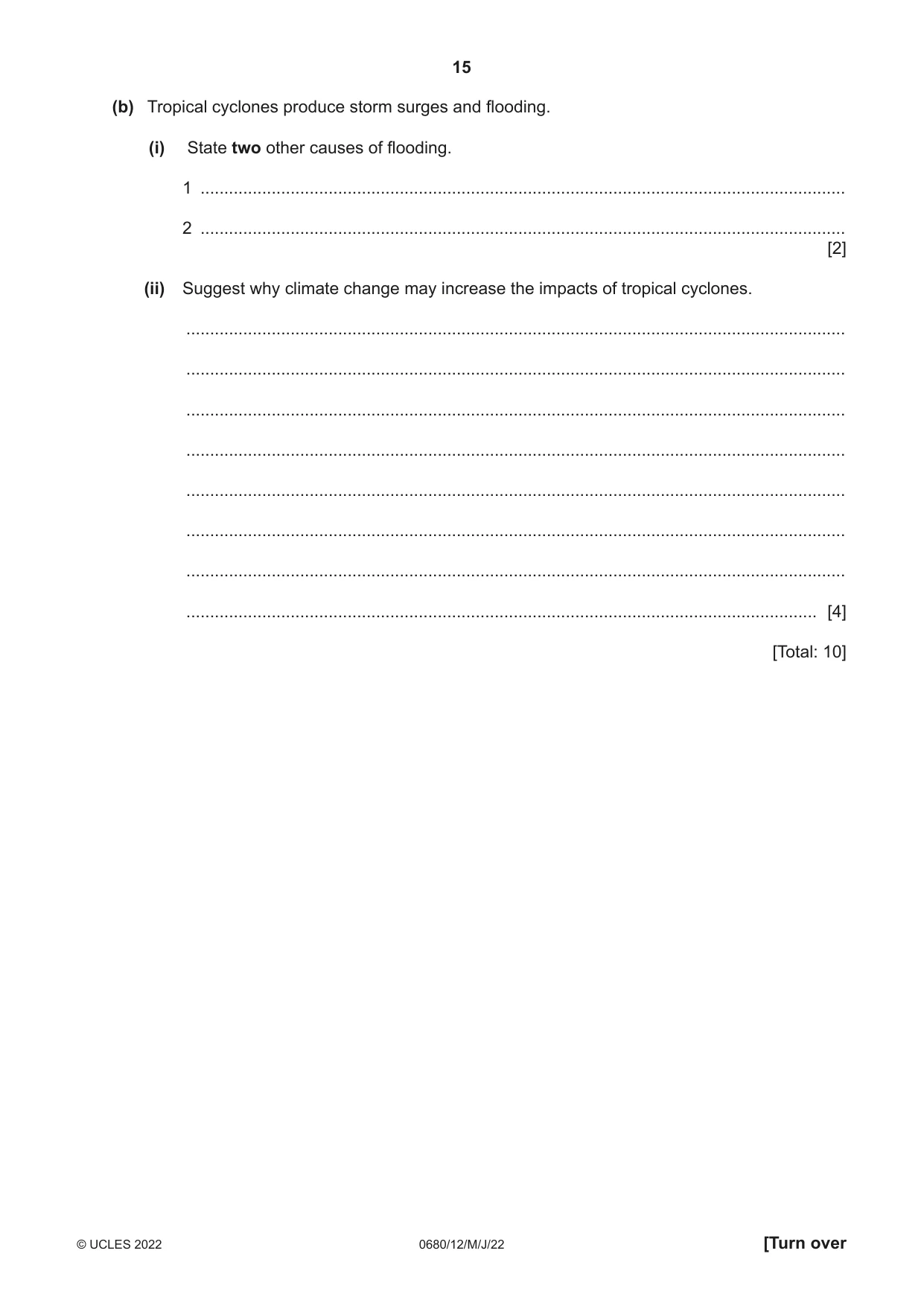
15 0680/12/M/J/22 © UCLES 2022 [Turn over (b) Tropical cyclones produce storm surges and flooding. (i) State two other causes of flooding. 1 … 2 … [2] (ii) Suggest why climate change may increase the impacts of tropical cyclones. … … … … … … … … [4] [Total: 10]
Question paper, page 16
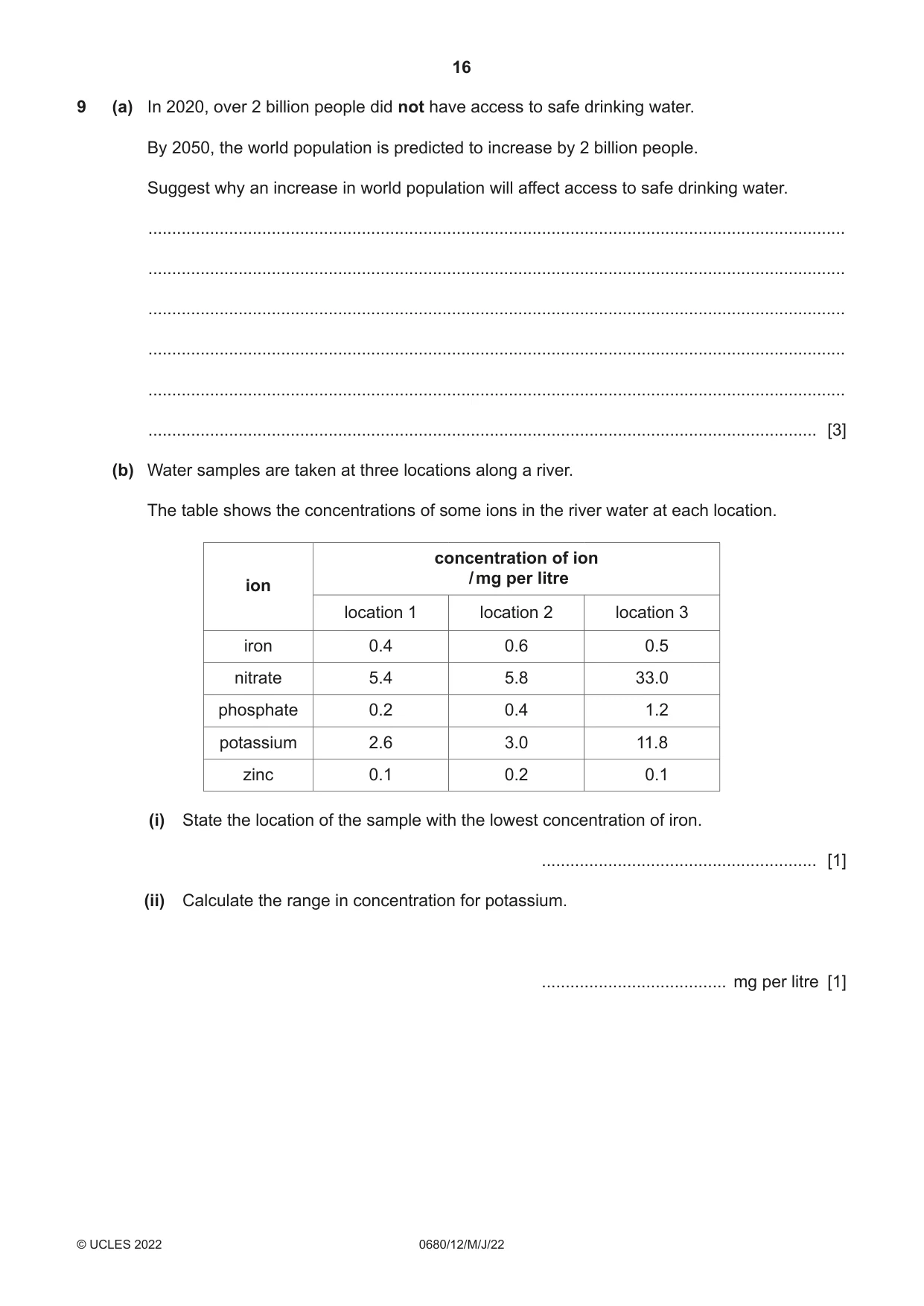
16 0680/12/M/J/22 © UCLES 2022 9 (a) In 2020, over 2 billion people did not have access to safe drinking water. By 2050, the world population is predicted to increase by 2 billion people. Suggest why an increase in world population will affect access to safe drinking water. … … … … … … [3] (b) Water samples are taken at three locations along a river. The table shows the concentrations of some ions in the river water at each location. ion concentration of ion / mg per litre location 1 location 2 location 3 iron 0.4 0.6 0.5 nitrate 5.4 5.8 33.0 phosphate 0.2 0.4 1.2 potassium 2.6 3.0 11.8 zinc 0.1 0.2 0.1 (i) State the location of the sample with the lowest concentration of iron. … [1] (ii) Calculate the range in concentration for potassium. … mg per litre [1]
Question paper, page 17
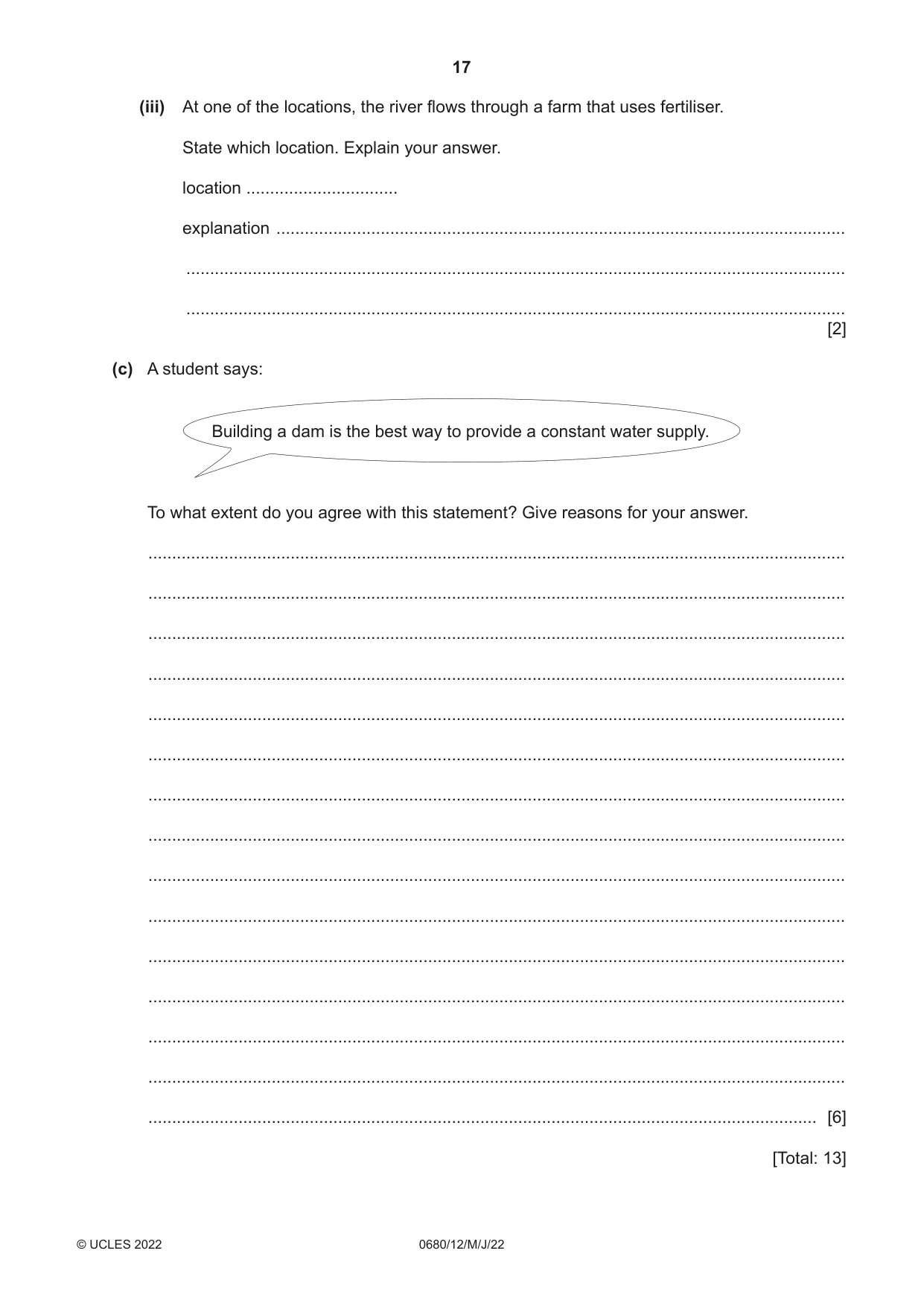
17 0680/12/M/J/22 © UCLES 2022 (iii) At one of the locations, the river flows through a farm that uses fertiliser. State which location. Explain your answer. location … explanation … … … [2] (c) A student says: Building a dam is the best way to provide a constant water supply. To what extent do you agree with this statement? Give reasons for your answer. … … … … … … … … … … … … … … … [6] [Total: 13]
Question paper, page 18
18 0680/12/M/J/22 © UCLES 2022 BLANK PAGE
Question paper, page 19
19 0680/12/M/J/22 © UCLES 2022 BLANK PAGE
Question paper, page 20
20 0680/12/M/J/22 © UCLES 2022 The boundaries and names shown, the designations used and the presentation of material on any maps contained in this question paper/insert do not imply official endorsement or acceptance by Cambridge Assessment International Education concerning the legal status of any country, territory, or area or any of its authorities, or of the delimitation of its frontiers or boundaries. Permission to reproduce items where third-party owned material protected by copyright is included has been sought and cleared where possible. Every reasonable effort has been made by the publisher (UCLES) to trace copyright holders, but if any items requiring clearance have unwittingly been included, the publisher will be pleased to make amends at the earliest possible opportunity. To avoid the issue of disclosure of answer-related information to candidates, all copyright acknowledgements are reproduced online in the Cambridge Assessment International Education Copyright Acknowledgements Booklet. This is produced for each series of examinations and is freely available to download at www.cambridgeinternational.org after the live examination series. Cambridge Assessment International Education is part of Cambridge Assessment. Cambridge Assessment is the brand name of the University of Cambridge Local Examinations Syndicate (UCLES), which is a department of the University of Cambridge. BLANK PAGE
Mark scheme, page 1
This document consists of 14 printed pages. © UCLES 2022 [Turn over Cambridge IGCSE™ EMVIRONMENTAL MANAGEMENT 0680/12 Paper 1 Theory May/June 2022 MARK SCHEME Maximum Mark: 80 Published This mark scheme is published as an aid to teachers and candidates, to indicate the requirements of the examination. It shows the basis on which Examiners were instructed to award marks. It does not indicate the details of the discussions that took place at an Examiners’ meeting before marking began, which would have considered the acceptability of alternative answers. Mark schemes should be read in conjunction with the question paper and the Principal Examiner Report for Teachers. Cambridge International will not enter into discussions about these mark schemes. Cambridge International is publishing the mark schemes for the May/June 2022 series for most Cambridge IGCSE, Cambridge International A and AS Level and Cambridge Pre-U components, and some Cambridge O Level components.
Mark scheme, page 2
0680/12 Cambridge IGCSE – Mark Scheme PUBLISHED May/June 2022 © UCLES 2022 Page 2 of 14 Generic Marking Principles These general marking principles must be applied by all examiners when marking candidate answers. They should be applied alongside the specific content of the mark scheme or generic level descriptors for a question. Each question paper and mark scheme will also comply with these marking principles. GENERIC MARKING PRINCIPLE 1: Marks must be awarded in line with: the specific content of the mark scheme or the generic level descriptors for the question the specific skills defined in the mark scheme or in the generic level descriptors for the question the standard of response required by a candidate as exemplified by the standardisation scripts. GENERIC MARKING PRINCIPLE 2: Marks awarded are always whole marks (not half marks, or other fractions). GENERIC MARKING PRINCIPLE 3: Marks must be awarded positively: marks are awarded for correct/valid answers, as defined in the mark scheme. However, credit is given for valid answers which go beyond the scope of the syllabus and mark scheme, referring to your Team Leader as appropriate marks are awarded when candidates clearly demonstrate what they know and can do marks are not deducted for errors marks are not deducted for omissions answers should only be judged on the quality of spelling, punctuation and grammar when these features are specifically assessed by the question as indicated by the mark scheme. The meaning, however, should be unambiguous. GENERIC MARKING PRINCIPLE 4: Rules must be applied consistently, e.g. in situations where candidates have not followed instructions or in the application of generic level descriptors.
Mark scheme, page 3
0680/12 Cambridge IGCSE – Mark Scheme PUBLISHED May/June 2022 © UCLES 2022 Page 3 of 14 GENERIC MARKING PRINCIPLE 5: Marks should be awarded using the full range of marks defined in the mark scheme for the question (however; the use of the full mark range may be limited according to the quality of the candidate responses seen). GENERIC MARKING PRINCIPLE 6: Marks awarded are based solely on the requirements as defined in the mark scheme. Marks should not be awarded with grade thresholds or grade descriptors in mind. Science-Specific Marking Principles 1 Examiners should consider the context and scientific use of any keywords when awarding marks. Although keywords may be present, marks should not be awarded if the keywords are used incorrectly. 2 The examiner should not choose between contradictory statements given in the same question part, and credit should not be awarded for any correct statement that is contradicted within the same question part. Wrong science that is irrelevant to the question should be ignored. 3 Although spellings do not have to be correct, spellings of syllabus terms must allow for clear and unambiguous separation from other syllabus terms with which they may be confused (e.g. ethane / ethene, glucagon / glycogen, refraction / reflection). 4 The error carried forward (ecf) principle should be applied, where appropriate. If an incorrect answer is subsequently used in a scientifically correct way, the candidate should be awarded these subsequent marking points. Further guidance will be included in the mark scheme where necessary and any exceptions to this general principle will be noted. 5 ‘List rule’ guidance For questions that require n responses (e.g. State two reasons …): The response should be read as continuous prose, even when numbered answer spaces are provided. Any response marked ignore in the mark scheme should not count towards n. Incorrect responses should not be awarded credit but will still count towards n. Read the entire response to check for any responses that contradict those that would otherwise be credited. Credit should not be awarded for any responses that are contradicted within the rest of the response. Where two responses contradict one another, this should be treated as a single incorrect response. Non-contradictory responses after the first n responses may be ignored even if they include incorrect science.
Mark scheme, page 4
0680/12 Cambridge IGCSE – Mark Scheme PUBLISHED May/June 2022 © UCLES 2022 Page 4 of 14 6 Calculation specific guidance Correct answers to calculations should be given full credit even if there is no working or incorrect working, unless the question states ‘show your working’. For questions in which the number of significant figures required is not stated, credit should be awarded for correct answers when rounded by the examiner to the number of significant figures given in the mark scheme. This may not apply to measured values. For answers given in standard form (e.g. a 10n) in which the convention of restricting the value of the coefficient (a) to a value between 1 and 10 is not followed, credit may still be awarded if the answer can be converted to the answer given in the mark scheme. Unless a separate mark is given for a unit, a missing or incorrect unit will normally mean that the final calculation mark is not awarded. Exceptions to this general principle will be noted in the mark scheme. 7 Guidance for chemical equations Multiples / fractions of coefficients used in chemical equations are acceptable unless stated otherwise in the mark scheme. State symbols given in an equation should be ignored unless asked for in the question or stated otherwise in the mark scheme.
Mark scheme, page 5
0680/12 Cambridge IGCSE – Mark Scheme PUBLISHED May/June 2022 © UCLES 2022 Page 5 of 14 Question Answer Marks 1(a) any one from: loss of habitat; water pollution; air pollution / dust; loss of (agricultural) land; erosion; noise pollution; visual pollution; loss of vegetation; 1 1(b) any two from: employment / jobs, in mine; employment / jobs, in associated service industry; improves economy (by bringing in business); improved, infrastructure / roads / rail; use / availability of materials used locally; 2 1(c) any two from: land has been filled; lake / pond, has been made; car park / new road has been built; (top)soil added: trees / vegetation has been planted; area has been landscaped; park created; 2
Mark scheme, page 6
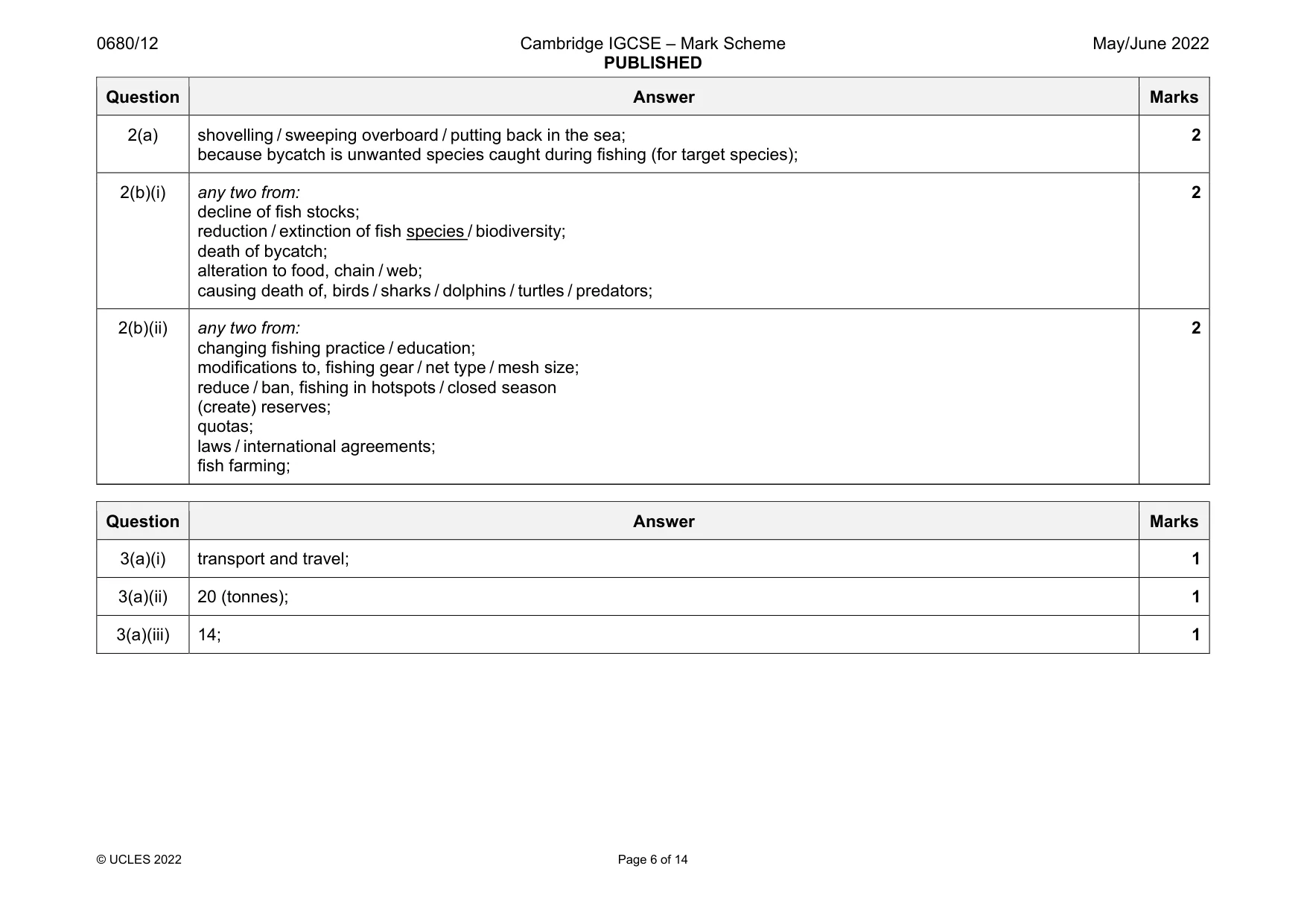
0680/12 Cambridge IGCSE – Mark Scheme PUBLISHED May/June 2022 © UCLES 2022 Page 6 of 14 Question Answer Marks 2(a) shovelling / sweeping overboard / putting back in the sea; because bycatch is unwanted species caught during fishing (for target species); 2 2(b)(i) any two from: decline of fish stocks; reduction / extinction of fish species / biodiversity; death of bycatch; alteration to food, chain / web; causing death of, birds / sharks / dolphins / turtles / predators; 2 2(b)(ii) any two from: changing fishing practice / education; modifications to, fishing gear / net type / mesh size; reduce / ban, fishing in hotspots / closed season (create) reserves; quotas; laws / international agreements; fish farming; 2 Question Answer Marks 3(a)(i) transport and travel; 1 3(a)(ii) 20 (tonnes); 1 3(a)(iii) 14; 1
Mark scheme, page 7
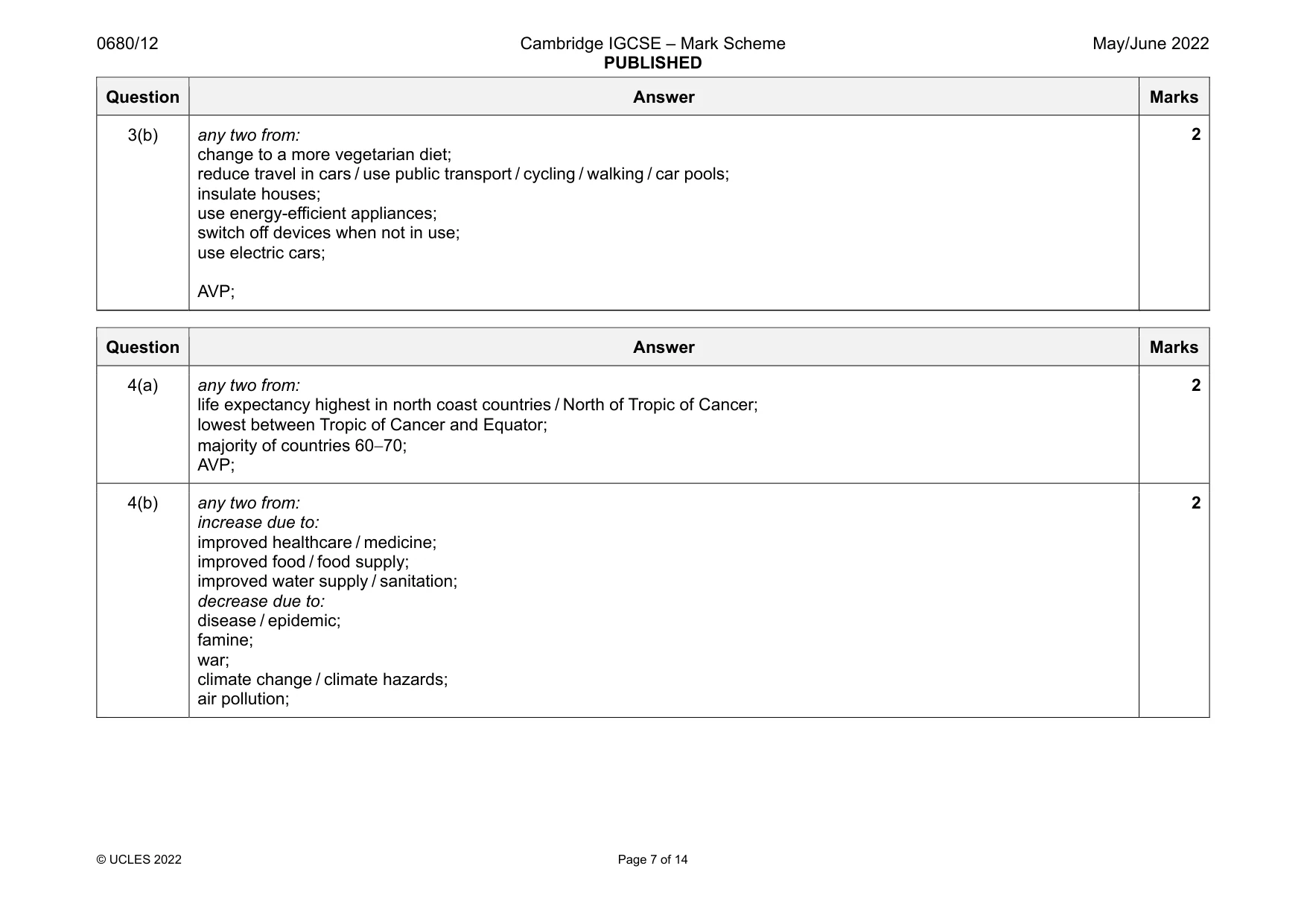
0680/12 Cambridge IGCSE – Mark Scheme PUBLISHED May/June 2022 © UCLES 2022 Page 7 of 14 Question Answer Marks 3(b) any two from: change to a more vegetarian diet; reduce travel in cars / use public transport / cycling / walking / car pools; insulate houses; use energy-efficient appliances; switch off devices when not in use; use electric cars; AVP; 2 Question Answer Marks 4(a) any two from: life expectancy highest in north coast countries / North of Tropic of Cancer; lowest between Tropic of Cancer and Equator; majority of countries 6070; AVP; 2 4(b) any two from: increase due to: improved healthcare / medicine; improved food / food supply; improved water supply / sanitation; decrease due to: disease / epidemic; famine; war; climate change / climate hazards; air pollution; 2
Mark scheme, page 8
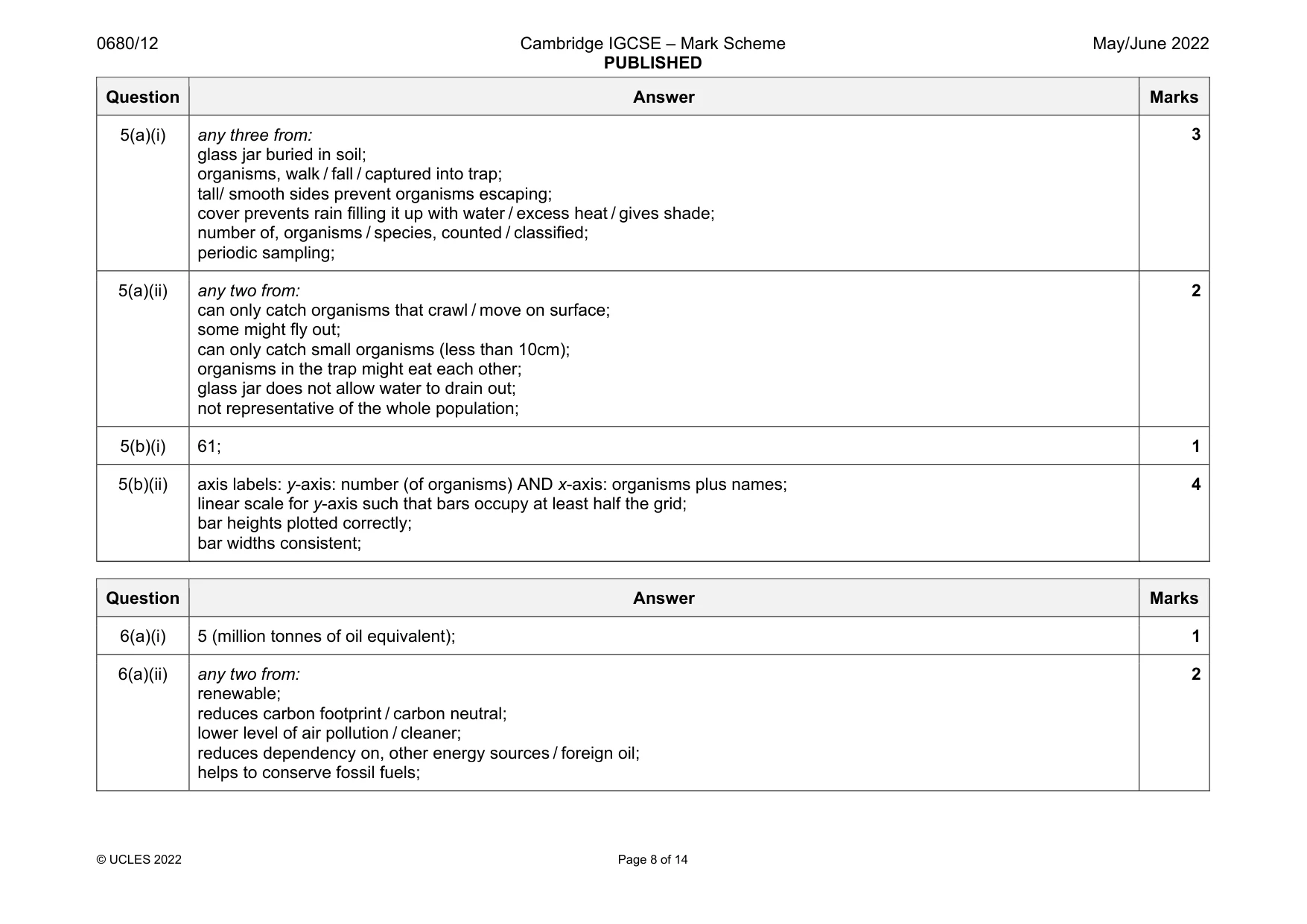
0680/12 Cambridge IGCSE – Mark Scheme PUBLISHED May/June 2022 © UCLES 2022 Page 8 of 14 Question Answer Marks 5(a)(i) any three from: glass jar buried in soil; organisms, walk / fall / captured into trap; tall/ smooth sides prevent organisms escaping; cover prevents rain filling it up with water / excess heat / gives shade; number of, organisms / species, counted / classified; periodic sampling; 3 5(a)(ii) any two from: can only catch organisms that crawl / move on surface; some might fly out; can only catch small organisms (less than 10cm); organisms in the trap might eat each other; glass jar does not allow water to drain out; not representative of the whole population; 2 5(b)(i) 61; 1 5(b)(ii) axis labels: y-axis: number (of organisms) AND x-axis: organisms plus names; linear scale for y-axis such that bars occupy at least half the grid; bar heights plotted correctly; bar widths consistent; 4 Question Answer Marks 6(a)(i) 5 (million tonnes of oil equivalent); 1 6(a)(ii) any two from: renewable; reduces carbon footprint / carbon neutral; lower level of air pollution / cleaner; reduces dependency on, other energy sources / foreign oil; helps to conserve fossil fuels; 2
Mark scheme, page 9
0680/12 Cambridge IGCSE – Mark Scheme PUBLISHED May/June 2022 © UCLES 2022 Page 9 of 14 Question Answer Marks 6(a)(iii) any one from: production of biofuels replaces food crops; deforestation due to clearing land for biofuel crops; loss of biodiversity / monoculture; may lead to soil degradation; named pollution from processing/ production; 1 6(a)(iv) observation that gasoline production / consumption is much higher than biofuels; plus any two marks for supported conclusion: no: very large increase in production required; fuel (oil) is cheap in US; familiar with use of gasolene and unlikely to swap; still produces CO2 ( when combusted); agreement needed (from all suppliers ) for change to happen; yes: gasoline is finite resource and will, run out / become expensive; can be done with government incentive; Can be used in existing technology / vehicles; 3 6(b)(i) column or row headings: (type of) vehicle, number (of vehicles); 5 categories listed correctly; 5 sets of numbers recorded correctly; 3 6(b)(ii) any four from: people’s environmental concerns / no CO2 emissions; consumer demand; competitive purchase prices / low maintenance; improvements in, range / battery technology / performance; availability of charging infrastructure; rising cost of traditional fuel sources / cheaper to run; government incentives, e.g. emissions charges, reduced road tax, scrappage schemes, free parking/ subsidies; 4
Mark scheme, page 10
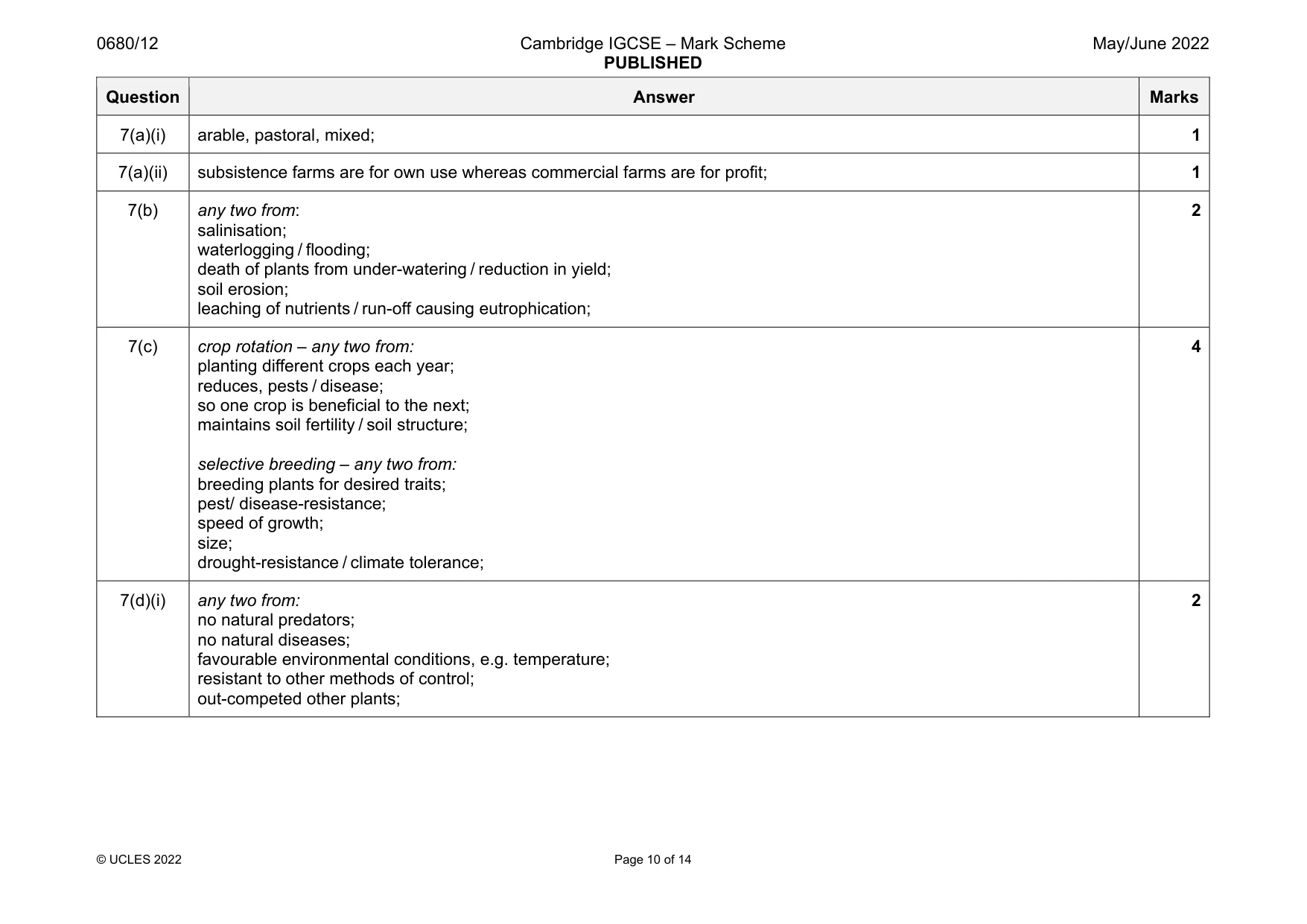
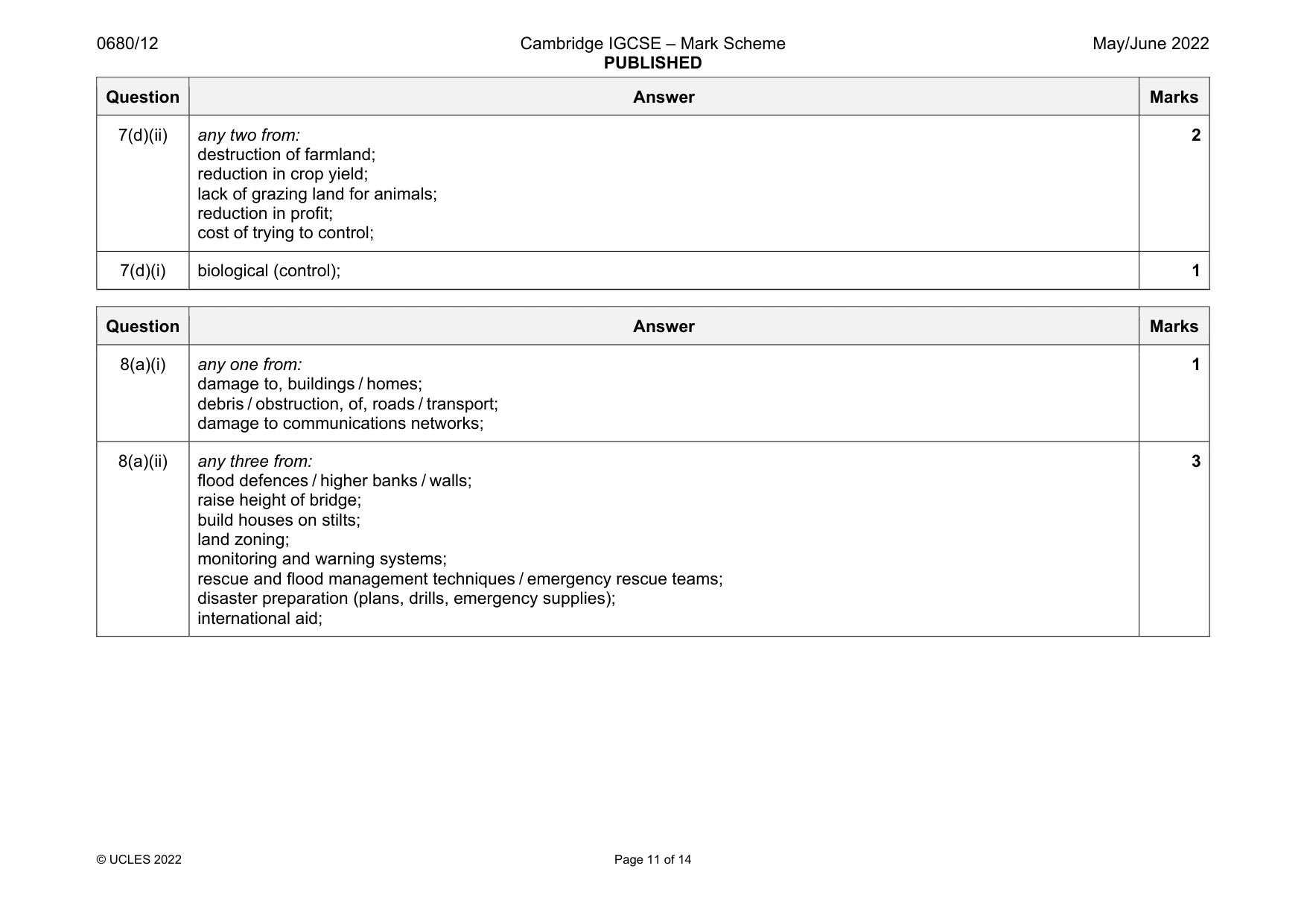
0680/12 Cambridge IGCSE – Mark Scheme PUBLISHED May/June 2022 © UCLES 2022 Page 10 of 14 Question Answer Marks 7(a)(i) arable, pastoral, mixed; 1 7(a)(ii) subsistence farms are for own use whereas commercial farms are for profit; 1 7(b) any two from: salinisation; waterlogging / flooding; death of plants from under-watering / reduction in yield; soil erosion; leaching of nutrients / run-off causing eutrophication; 2 7(c) crop rotation – any two from: planting different crops each year; reduces, pests / disease; so one crop is beneficial to the next; maintains soil fertility / soil structure; selective breeding – any two from: breeding plants for desired traits; pest/ disease-resistance; speed of growth; size; drought-resistance / climate tolerance; 4 7(d)(i) any two from: no natural predators; no natural diseases; favourable environmental conditions, e.g. temperature; resistant to other methods of control; out-competed other plants; 2
Mark scheme, page 11
0680/12 Cambridge IGCSE – Mark Scheme PUBLISHED May/June 2022 © UCLES 2022 Page 11 of 14 Question Answer Marks 7(d)(ii) any two from: destruction of farmland; reduction in crop yield; lack of grazing land for animals; reduction in profit; cost of trying to control; 2 7(d)(i) biological (control); 1 Question Answer Marks 8(a)(i) any one from: damage to, buildings / homes; debris / obstruction, of, roads / transport; damage to communications networks; 1 8(a)(ii) any three from: flood defences / higher banks / walls; raise height of bridge; build houses on stilts; land zoning; monitoring and warning systems; rescue and flood management techniques / emergency rescue teams; disaster preparation (plans, drills, emergency supplies); international aid; 3
Mark scheme, page 12
0680/12 Cambridge IGCSE – Mark Scheme PUBLISHED May/June 2022 © UCLES 2022 Page 12 of 14 Question Answer Marks 8(b)(i) any two from: heavy rainfall; snowmelt; land relief; saturated soil; compacted soil; deforestation; cultivation; urbanisation; tsunamis; sea level rise; 2 8(b)(ii) any four from: warmer, seas / oceans: increases areas where cyclones can form; increases, frequency of cyclones; longer cyclone season; higher sea levels (mean bigger, storm surges / waves); stronger wind speeds / more extreme cyclones; increased rainfall; current defences not designed for stronger storms; low lying coastal communities have high population density; more people living in high-risk areas; 4
Mark scheme, page 13
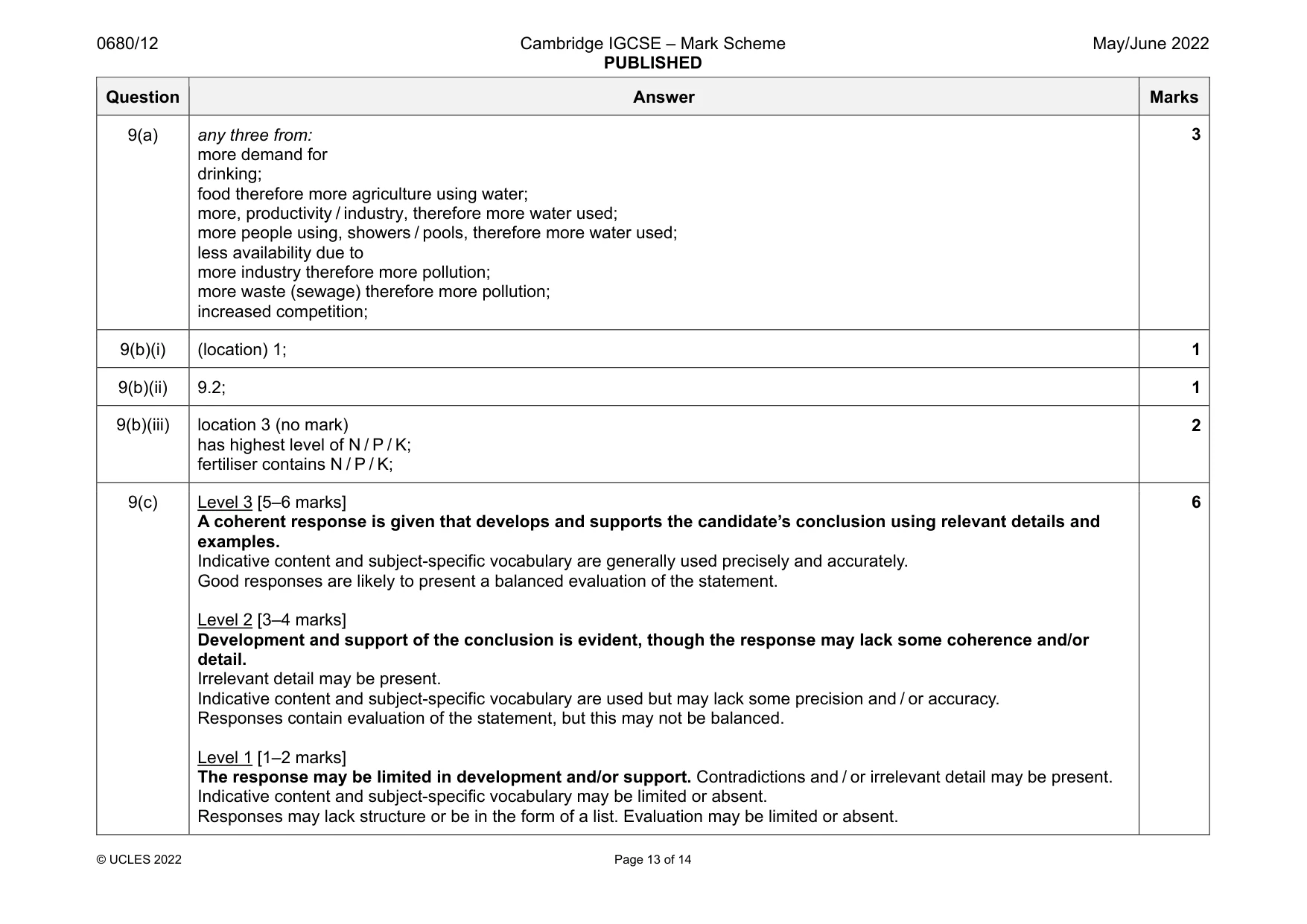
0680/12 Cambridge IGCSE – Mark Scheme PUBLISHED May/June 2022 © UCLES 2022 Page 13 of 14 Question Answer Marks 9(a) any three from: more demand for drinking; food therefore more agriculture using water; more, productivity / industry, therefore more water used; more people using, showers / pools, therefore more water used; less availability due to more industry therefore more pollution; more waste (sewage) therefore more pollution; increased competition; 3 9(b)(i) (location) 1; 1 9(b)(ii) 9.2; 1 9(b)(iii) location 3 (no mark) has highest level of N / P / K; fertiliser contains N / P / K; 2 9(c) Level 3 [5–6 marks] A coherent response is given that develops and supports the candidate’s conclusion using relevant details and examples. Indicative content and subject-specific vocabulary are generally used precisely and accurately. Good responses are likely to present a balanced evaluation of the statement. Level 2 [3–4 marks] Development and support of the conclusion is evident, though the response may lack some coherence and/or detail. Irrelevant detail may be present. Indicative content and subject-specific vocabulary are used but may lack some precision and / or accuracy. Responses contain evaluation of the statement, but this may not be balanced. Level 1 [1–2 marks] The response may be limited in development and/or support. Contradictions and / or irrelevant detail may be present. Indicative content and subject-specific vocabulary may be limited or absent. Responses may lack structure or be in the form of a list. Evaluation may be limited or absent. 6
Mark scheme, page 14
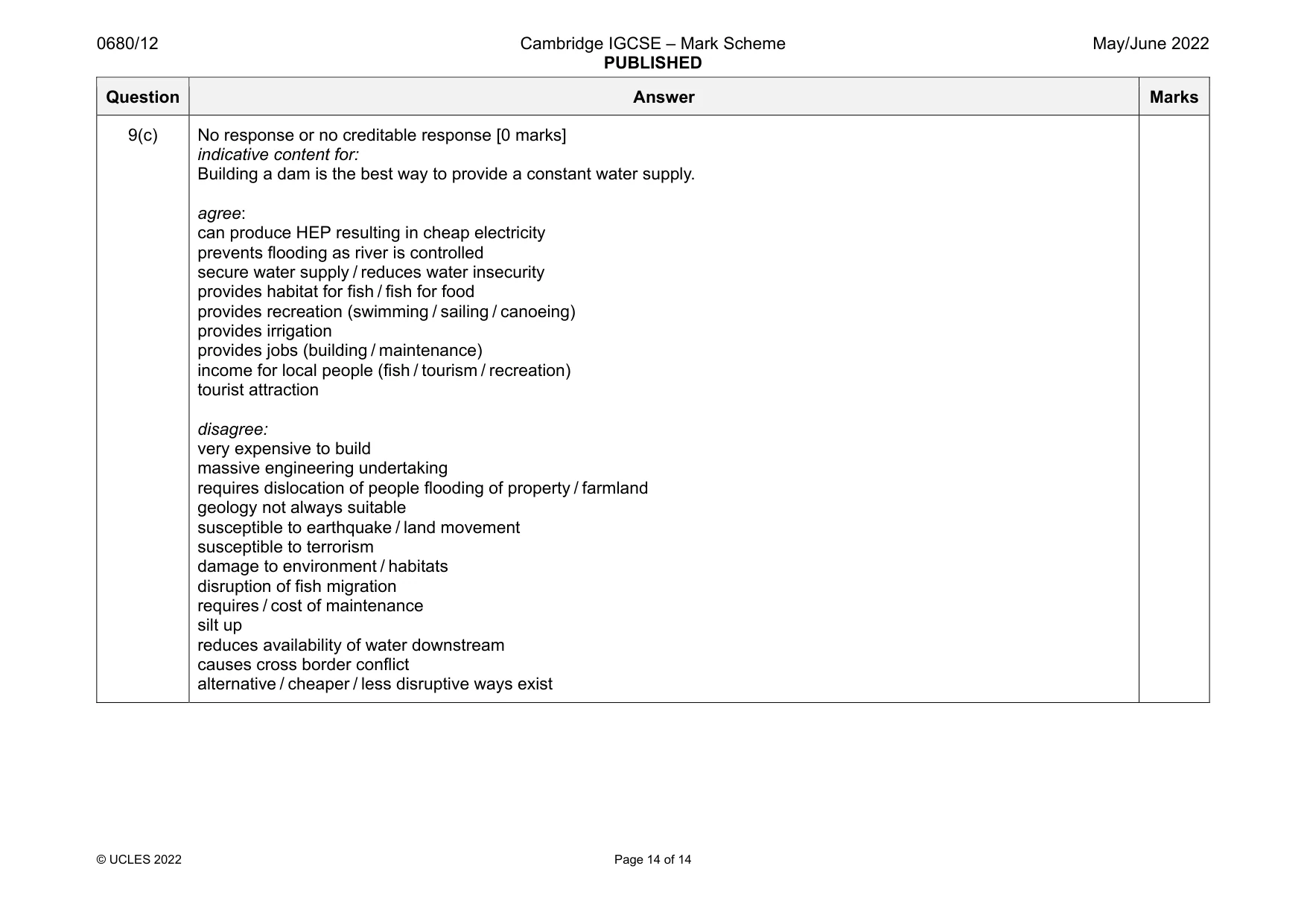
0680/12 Cambridge IGCSE – Mark Scheme PUBLISHED May/June 2022 © UCLES 2022 Page 14 of 14 Question Answer Marks 9(c) No response or no creditable response [0 marks] indicative content for: Building a dam is the best way to provide a constant water supply. agree: can produce HEP resulting in cheap electricity prevents flooding as river is controlled secure water supply / reduces water insecurity provides habitat for fish / fish for food provides recreation (swimming / sailing / canoeing) provides irrigation provides jobs (building / maintenance) income for local people (fish / tourism / recreation) tourist attraction disagree: very expensive to build massive engineering undertaking requires dislocation of people flooding of property / farmland geology not always suitable susceptible to earthquake / land movement susceptible to terrorism damage to environment / habitats disruption of fish migration requires / cost of maintenance silt up reduces availability of water downstream causes cross border conflict alternative / cheaper / less disruptive ways exist
What you needed in this session
Cambridge’s own grade thresholds for 2022 May/June, Paper 1 · Variant 2. A higher threshold means an easier paper — the bar moves with how the cohort did.