Cambridge IGCSE Environmental Management 0680 — 2022 May/June Paper 1 · Variant 3
0680/13/M/J/22 · 80 marks · ≈90 min
The question paper and its mark scheme, free to read here and free to download. This is Cambridge’s own paper, exactly as it was sat.
Question paper20 pages




Mark scheme15 pages
Answers below. Sit the paper first if you are practising.
Paper as text
Question paper, page 1
This document has 20 pages. Any blank pages are indicated. [Turn over Cambridge IGCSE™ DC (PQ) 312945 © UCLES 2022 * 7 7 5 3 7 6 6 4 7 4 * ENVIRONMENTAL MANAGEMENT 0680/13 Paper 1 Theory May/June 2022 1 hour 45 minutes You must answer on the question paper. No additional materials are needed. INSTRUCTIONS ● Answer all questions. ● Use a black or dark blue pen. You may use an HB pencil for any diagrams or graphs. ● Write your name, centre number and candidate number in the boxes at the top of the page. ● Write your answer to each question in the space provided. ● Do not use an erasable pen or correction fluid. ● Do not write on any bar codes. ● You may use a calculator. ● You should show all your working and use appropriate units. INFORMATION ● The total mark for this paper is 80. ● The number of marks for each question or part question is shown in brackets [ ].
Question paper, page 2
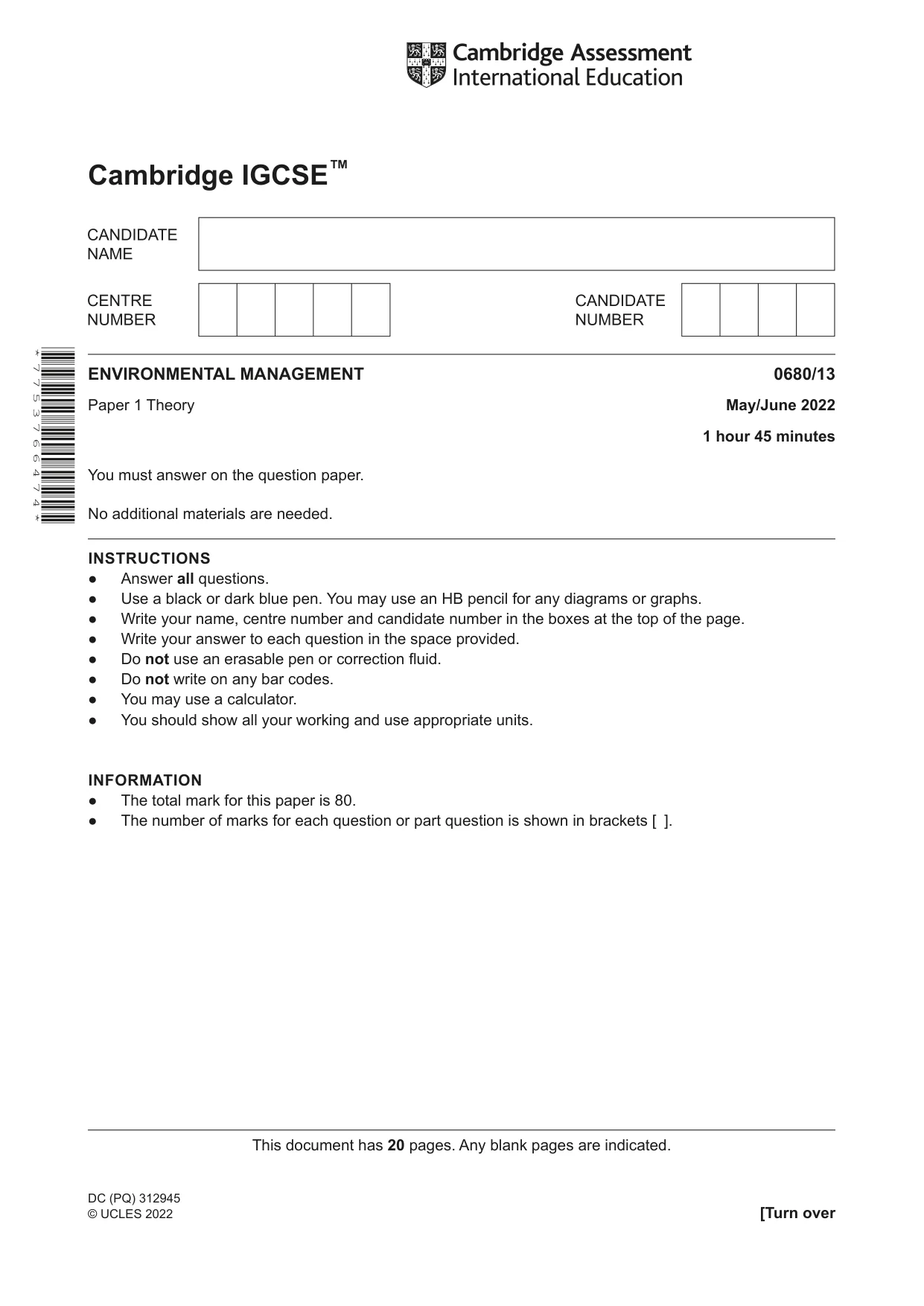
2 0680/13/M/J/22 © UCLES 2022 Section A 1 The photograph shows a bund. (a) Use the photograph to explain why some farmers use bunds. … … … … [2] (b) Describe how the bund in the photograph is constructed. … … [1] (c) Suggest one disadvantage of bunds. … … [1] [Total: 4]
Question paper, page 3
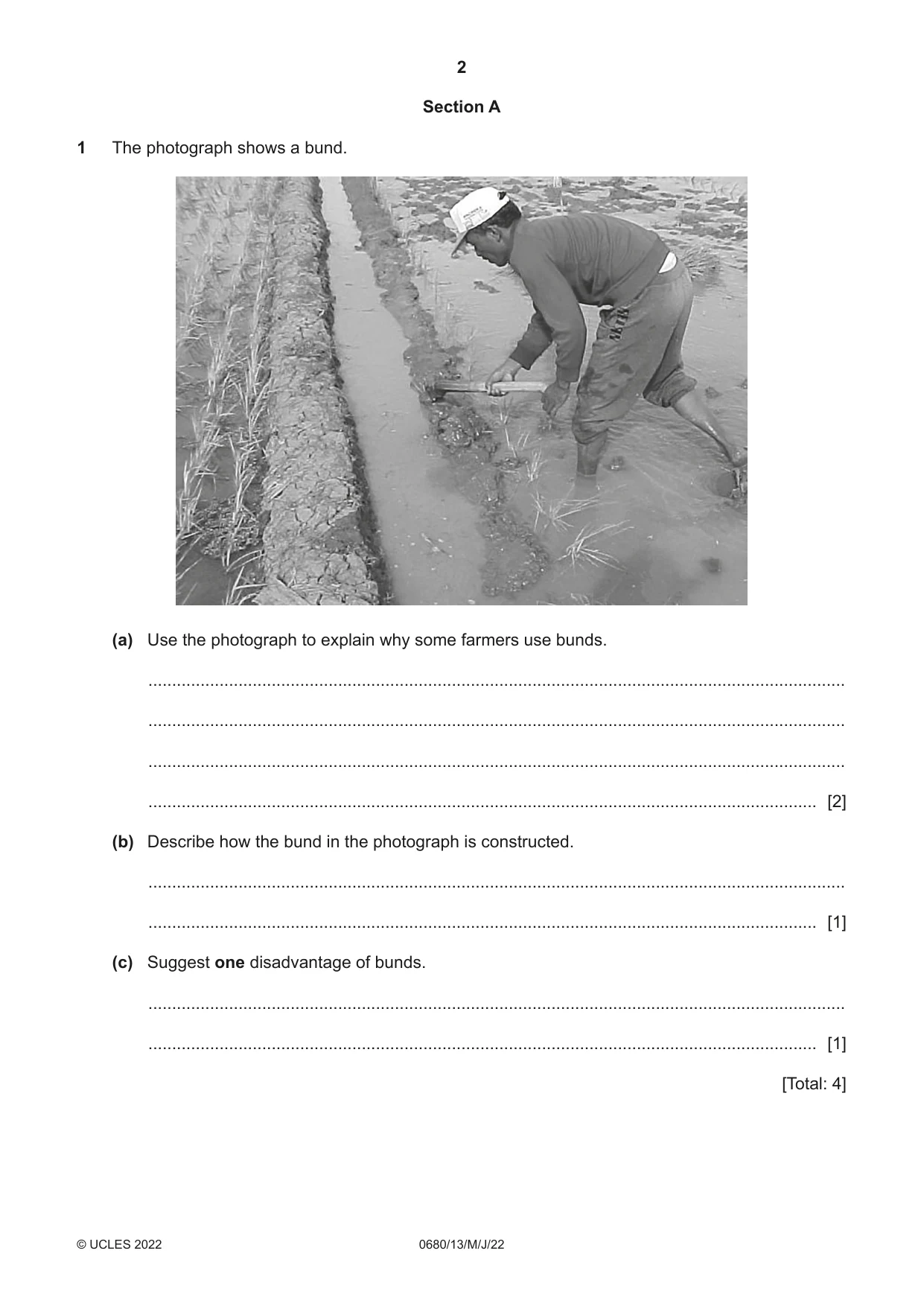
3 0680/13/M/J/22 © UCLES 2022 [Turn over 2 The pie chart represents all the water on Earth. sea water (97%) frozen fresh water (2.5%) available fresh water (0.5%) (a) Use the pie chart to calculate the total percentage of fresh water on Earth. … % [1] (b) State two sources of fresh water. 1 … 2 … [2] (c) Suggest how the availability of fresh water may change as the population of the world increases. … … … … … … [3] [Total: 6]
Question paper, page 4
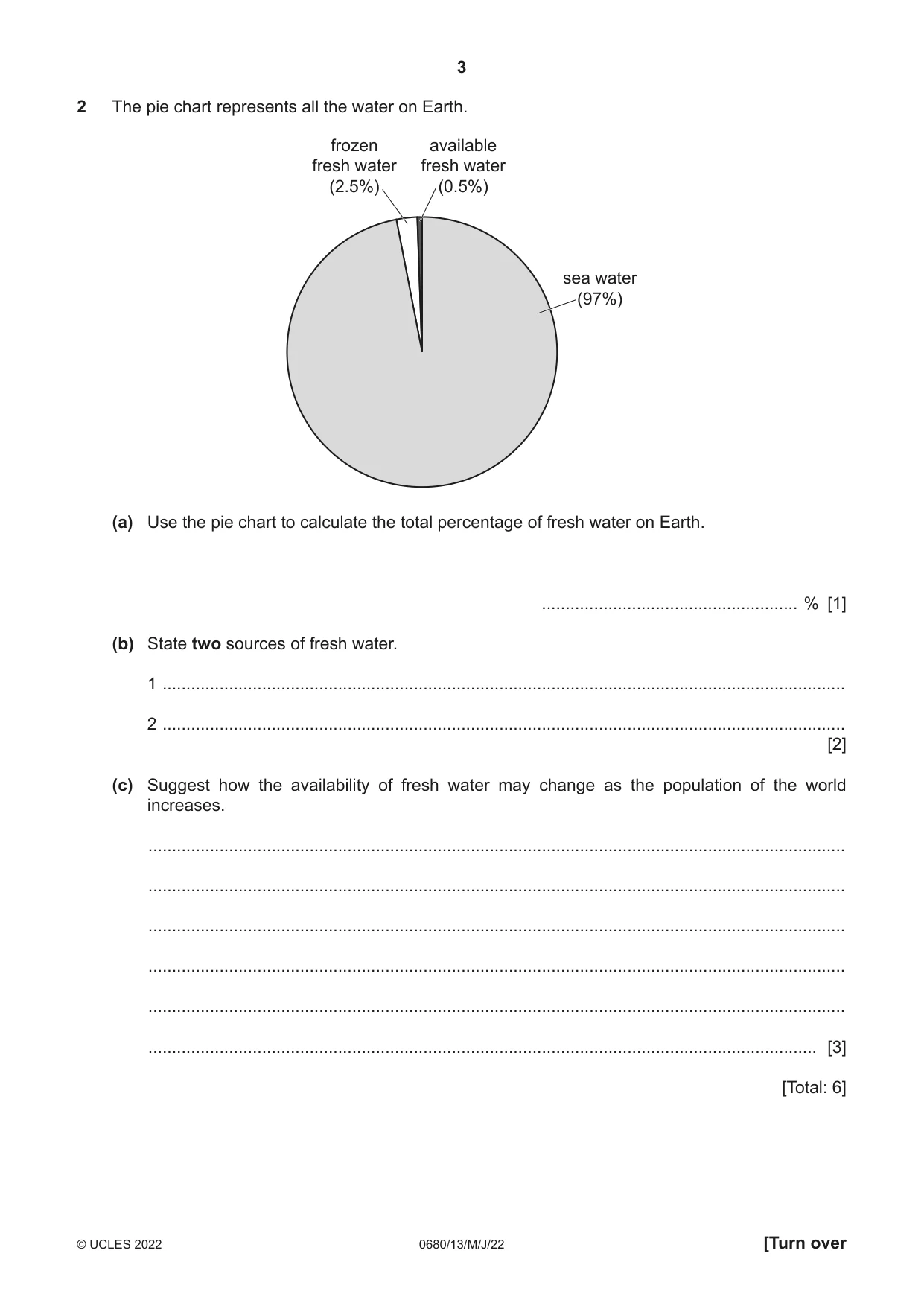
4 0680/13/M/J/22 © UCLES 2022 3 The photograph shows a boom being used to deal with an oil spill. (a) Use the photograph to describe how the boom is used to deal with the oil spill. … … … … [2] (b) State two other methods of dealing with oil spills. 1 … 2 … [2] (c) State one impact of oil spills on birds. … [1] [Total: 5]
Question paper, page 5
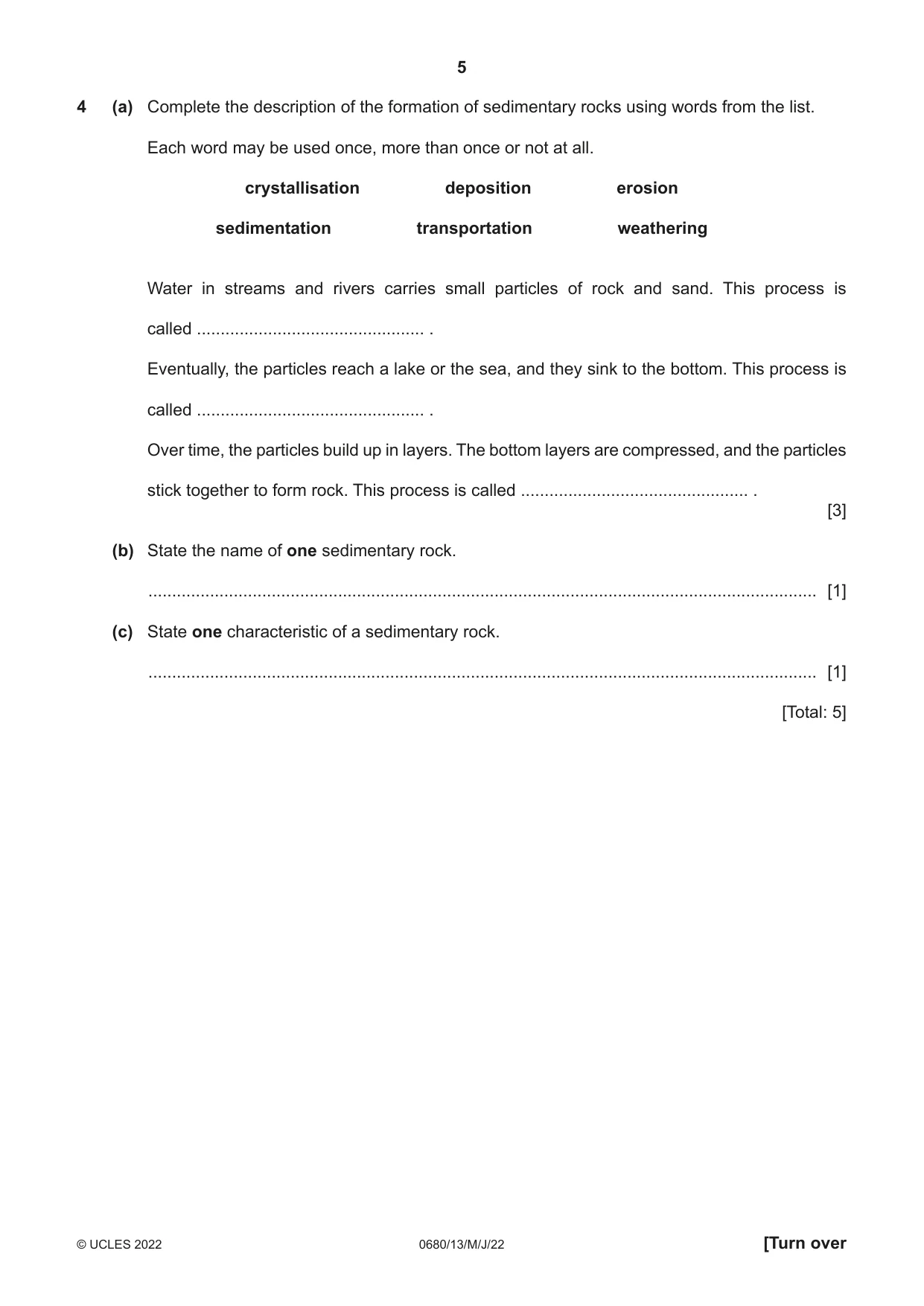
5 0680/13/M/J/22 © UCLES 2022 [Turn over 4 (a) Complete the description of the formation of sedimentary rocks using words from the list. Each word may be used once, more than once or not at all. crystallisation deposition erosion sedimentation transportation weathering Water in streams and rivers carries small particles of rock and sand. This process is called … . Eventually, the particles reach a lake or the sea, and they sink to the bottom. This process is called … . Over time, the particles build up in layers. The bottom layers are compressed, and the particles stick together to form rock. This process is called … . [3] (b) State the name of one sedimentary rock. … [1] (c) State one characteristic of a sedimentary rock. … [1] [Total: 5]
Question paper, page 6
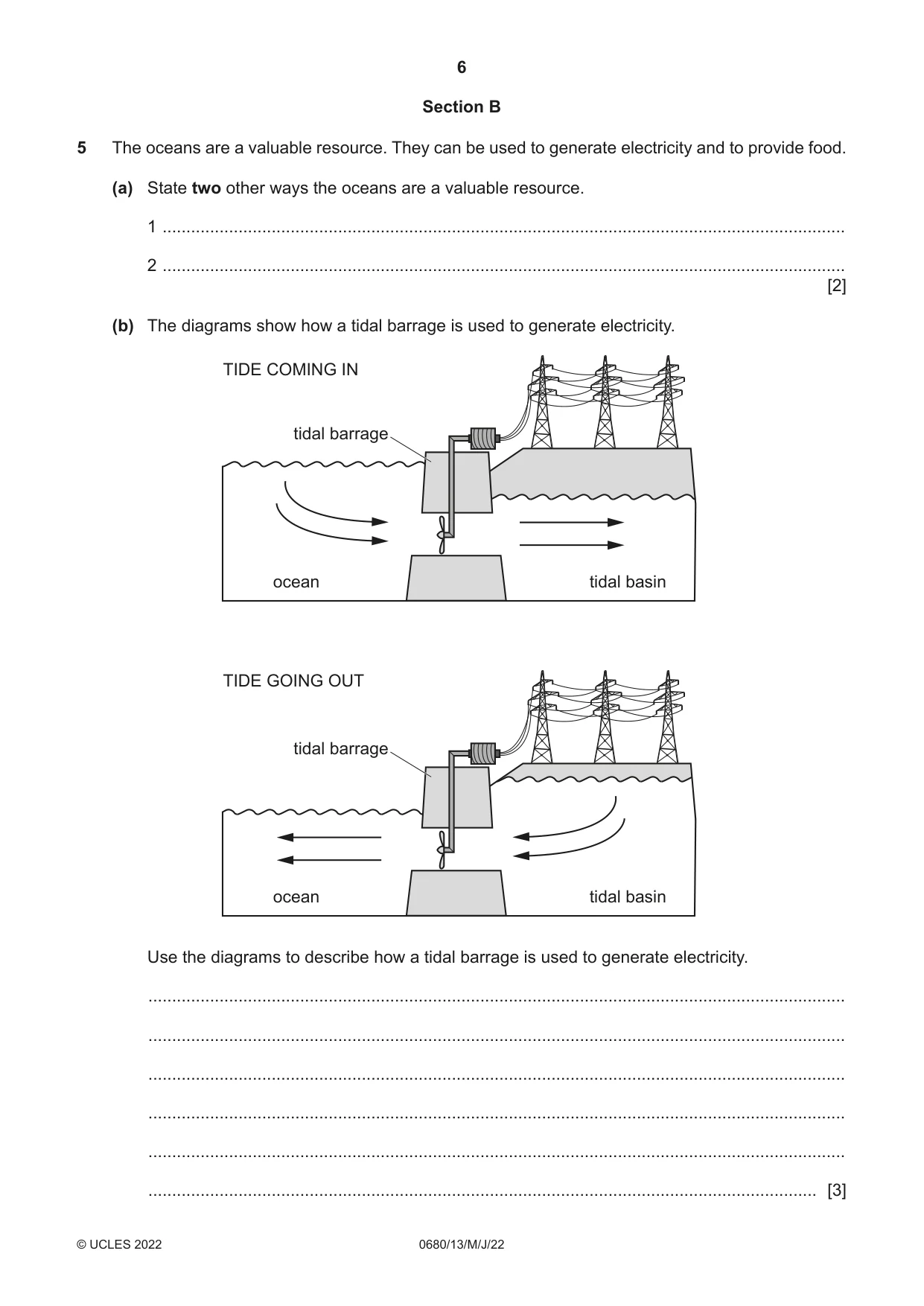
6 0680/13/M/J/22 © UCLES 2022 Section B 5 The oceans are a valuable resource. They can be used to generate electricity and to provide food. (a) State two other ways the oceans are a valuable resource. 1 … 2 … [2] (b) The diagrams show how a tidal barrage is used to generate electricity. TIDE GOING OUT tidal barrage TIDE COMING IN ocean tidal basin tidal barrage ocean tidal basin Use the diagrams to describe how a tidal barrage is used to generate electricity. … … … … … … [3]
Question paper, page 7
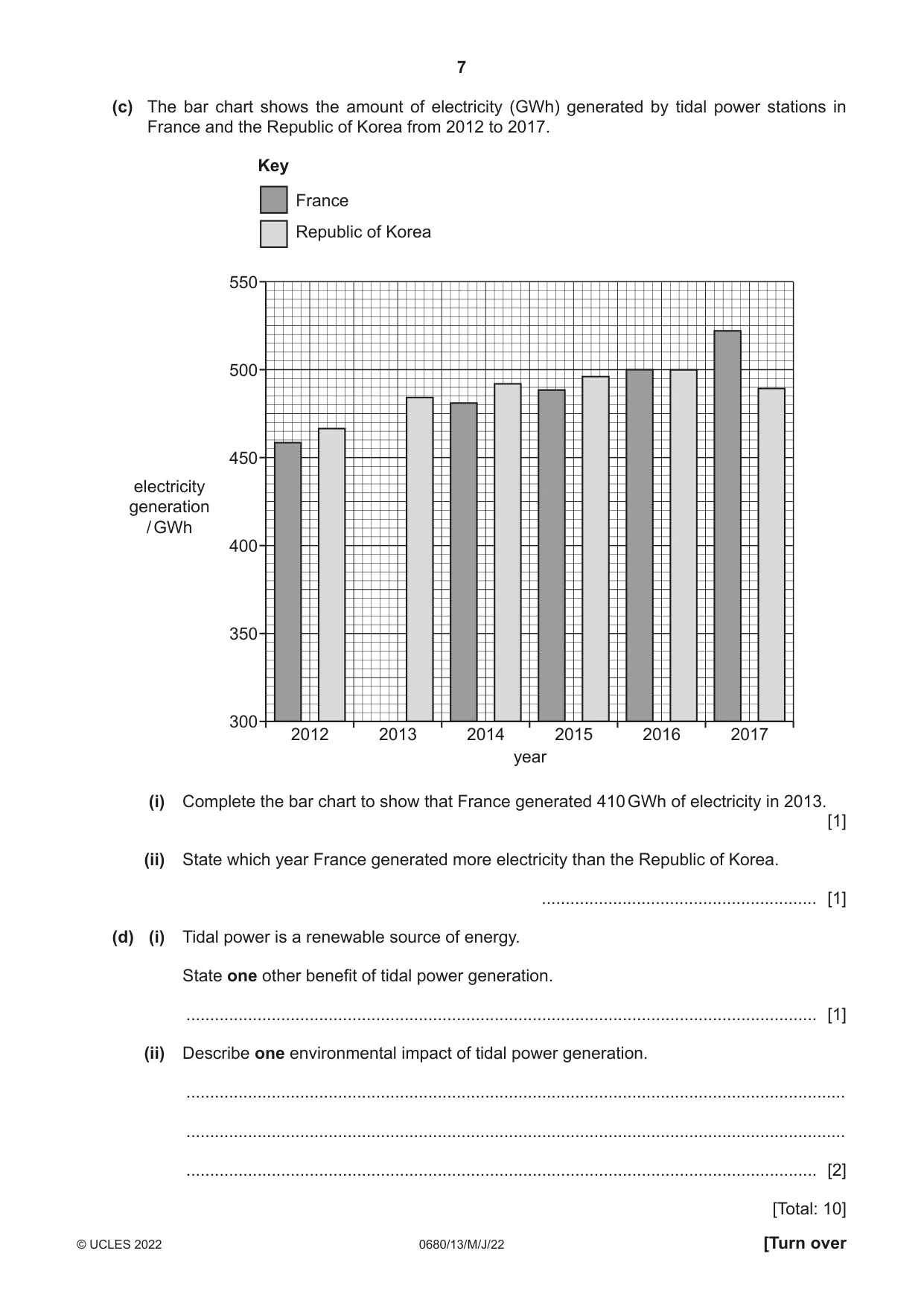
7 0680/13/M/J/22 © UCLES 2022 [Turn over (c) The bar chart shows the amount of electricity (GWh) generated by tidal power stations in France and the Republic of Korea from 2012 to 2017. 300 400 electricity generation / GWh 500 550 450 350 Key France Republic of Korea 2012 2013 2014 year 2015 2016 2017 (i) Complete the bar chart to show that France generated 410 GWh of electricity in 2013. [1] (ii) State which year France generated more electricity than the Republic of Korea. … [1] (d) (i) Tidal power is a renewable source of energy. State one other benefit of tidal power generation. … [1] (ii) Describe one environmental impact of tidal power generation. … … … [2] [Total: 10]
Question paper, page 8
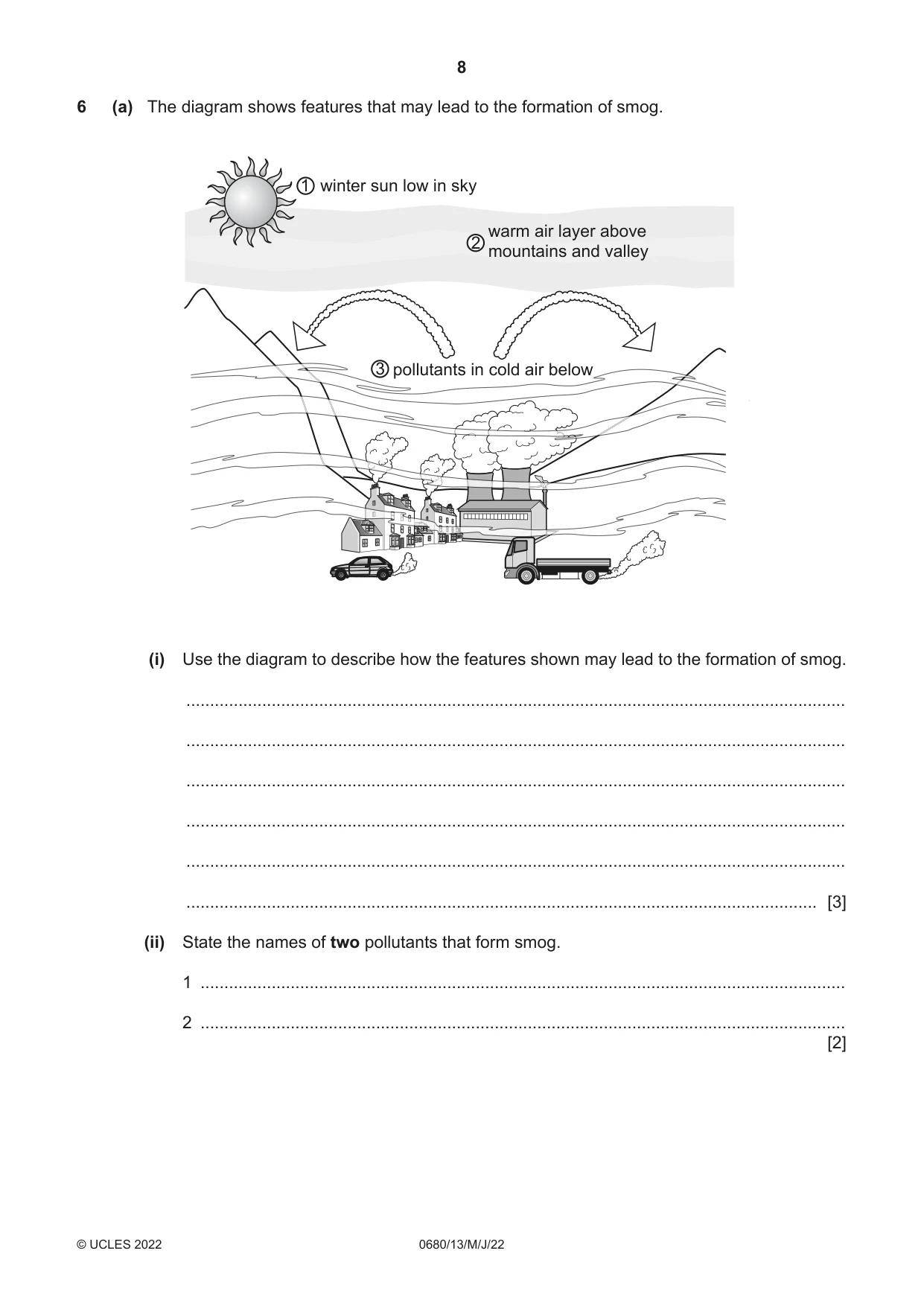
8 0680/13/ M / J /22 © UCLES 2022 6 (a) The diagram shows features that may lead to the formation of smog. 1 2 winter sun low in sky warm air layer above mountains and valley 3 pollutants in cold air below (i) Use the diagram to describe how the features shown may lead to the formation of smog. … … … … … … [3] (ii) State the names of two pollutants that form smog. 1 … 2 … [2]
Question paper, page 9
9 0680/13/M/J/22 © UCLES 2022 [Turn over (b) Describe transport policies that governments can use to reduce atmospheric pollution in cities. … … … … … … [3]
Question paper, page 10
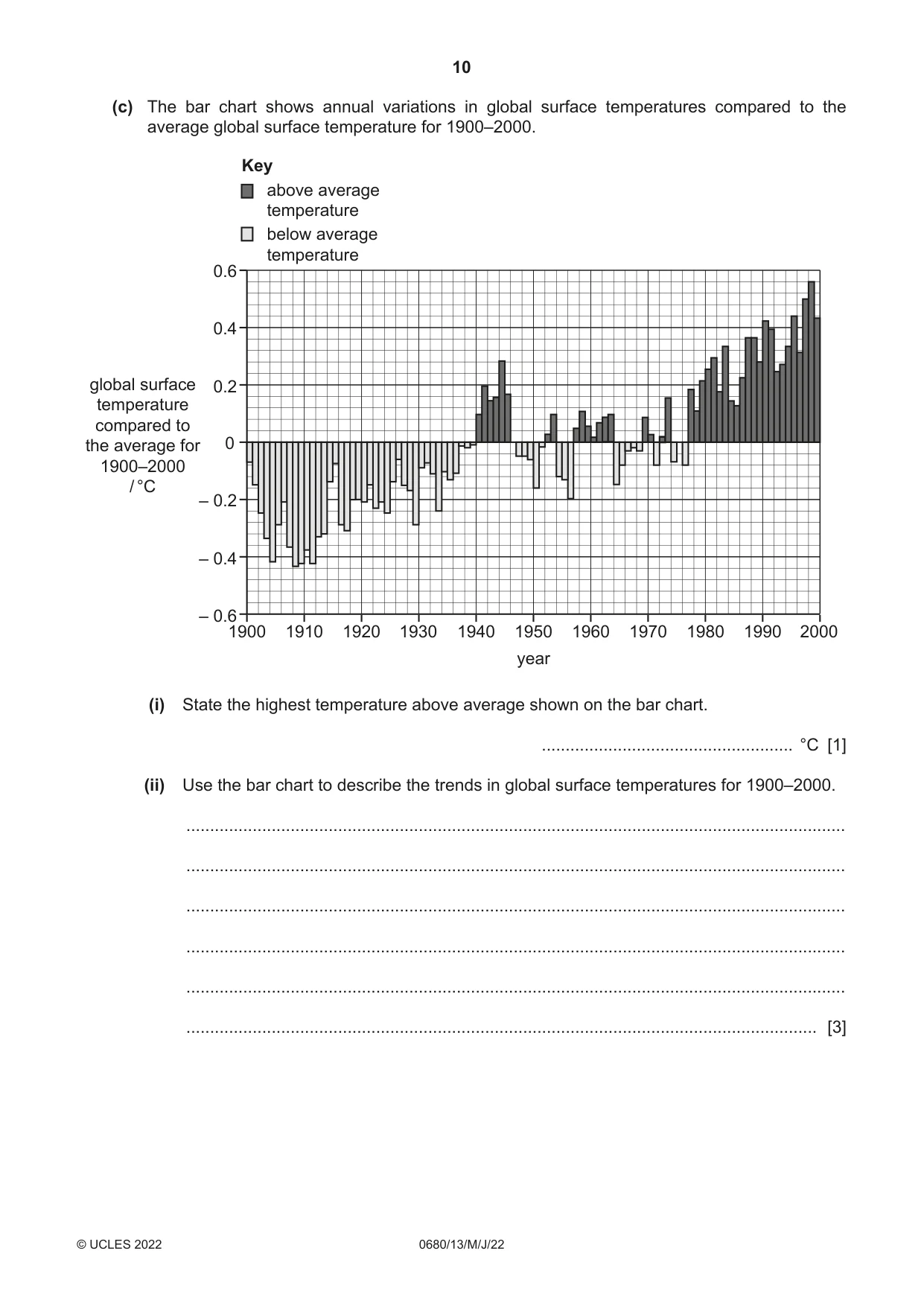
10 0680/13/M/J/22 © UCLES 2022 (c) The bar chart shows annual variations in global surface temperatures compared to the average global surface temperature for 1900–2000. 1900 1910 1920 1930 1940 1950 year 1960 1970 1980 1990 2000 global surface temperature compared to the average for 1900–2000 / °C – 0.4 – 0.2 0.2 0.4 0.6 0 – 0.6 above average temperature below average temperature Key (i) State the highest temperature above average shown on the bar chart. … °C [1] (ii) Use the bar chart to describe the trends in global surface temperatures for 1900–2000. … … … … … … [3]
Question paper, page 11
11 0680/13/M/J/22 © UCLES 2022 [Turn over (iii) Between 2000 and 2020, global surface temperatures increased. Suggest the future impact on agriculture if global surface temperatures continue to increase. … … … … … … … … [4] [Total: 16]
Question paper, page 12
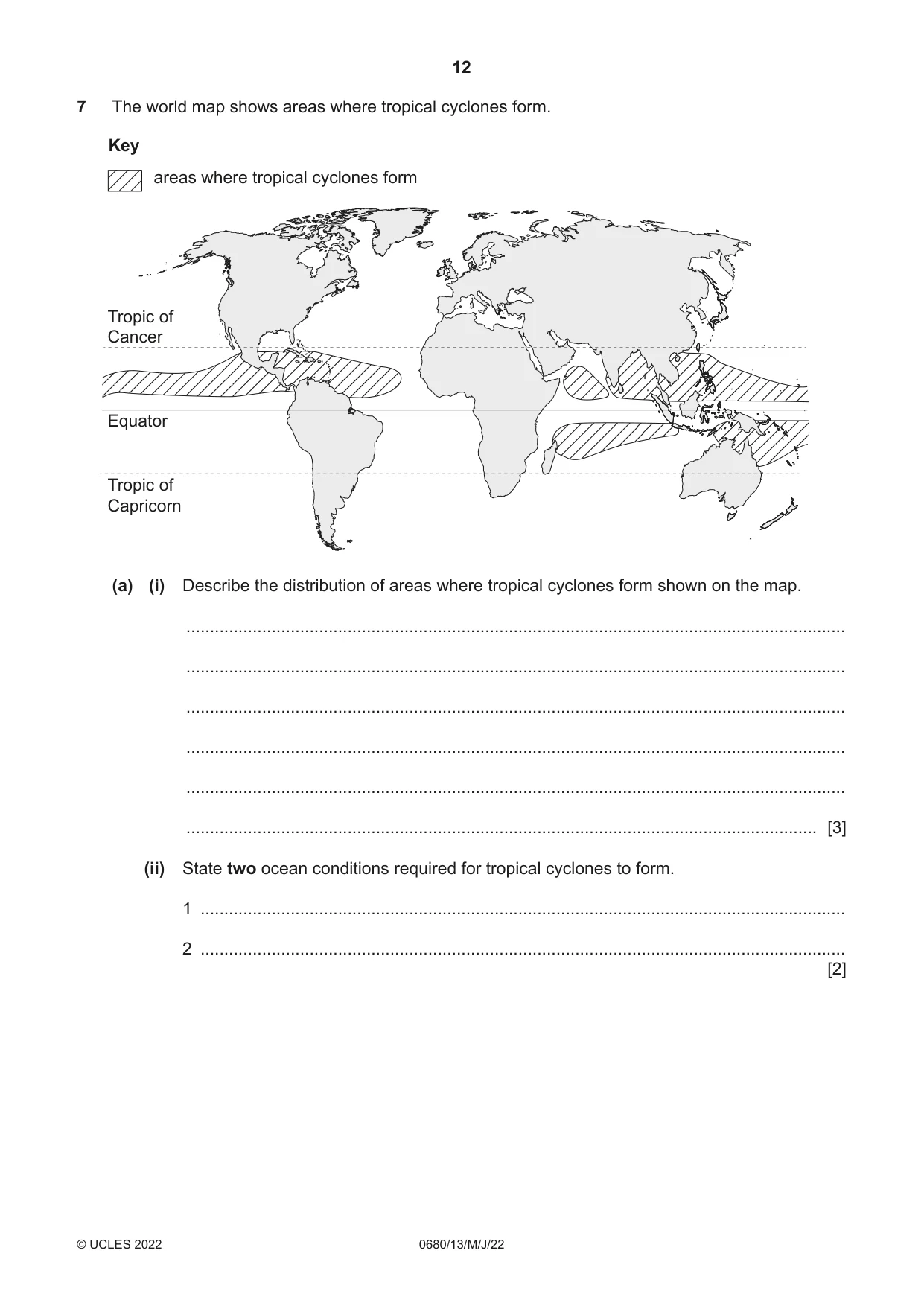
12 0680/13/M/J/22 © UCLES 2022 7 The world map shows areas where tropical cyclones form. Equator Tropic of Cancer Tropic of Capricorn Key areas where tropical cyclones form (a) (i) Describe the distribution of areas where tropical cyclones form shown on the map. … … … … … … [3] (ii) State two ocean conditions required for tropical cyclones to form. 1 … 2 … [2]
Question paper, page 13
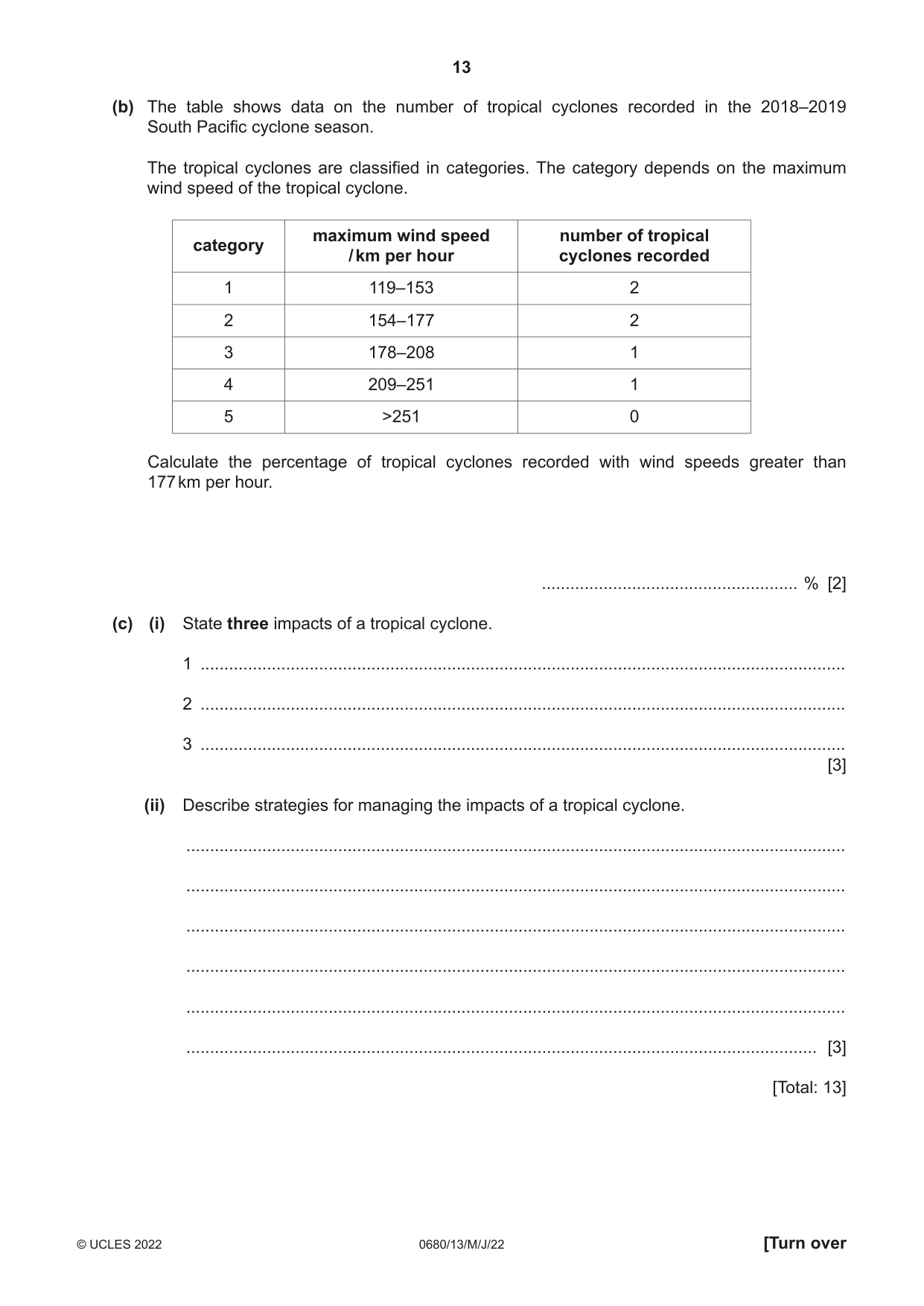
13 0680/13/M/J/22 © UCLES 2022 [Turn over (b) The table shows data on the number of tropical cyclones recorded in the 2018–2019 South Pacific cyclone season. The tropical cyclones are classified in categories. The category depends on the maximum wind speed of the tropical cyclone. category maximum wind speed / km per hour number of tropical cyclones recorded 1 119–153 2 2 154–177 2 3 178–208 1 4 209–251 1 5 >251 0 Calculate the percentage of tropical cyclones recorded with wind speeds greater than 177 km per hour. … % [2] (c) (i) State three impacts of a tropical cyclone. 1 … 2 … 3 … [3] (ii) Describe strategies for managing the impacts of a tropical cyclone. … … … … … … [3] [Total: 13]
Question paper, page 14
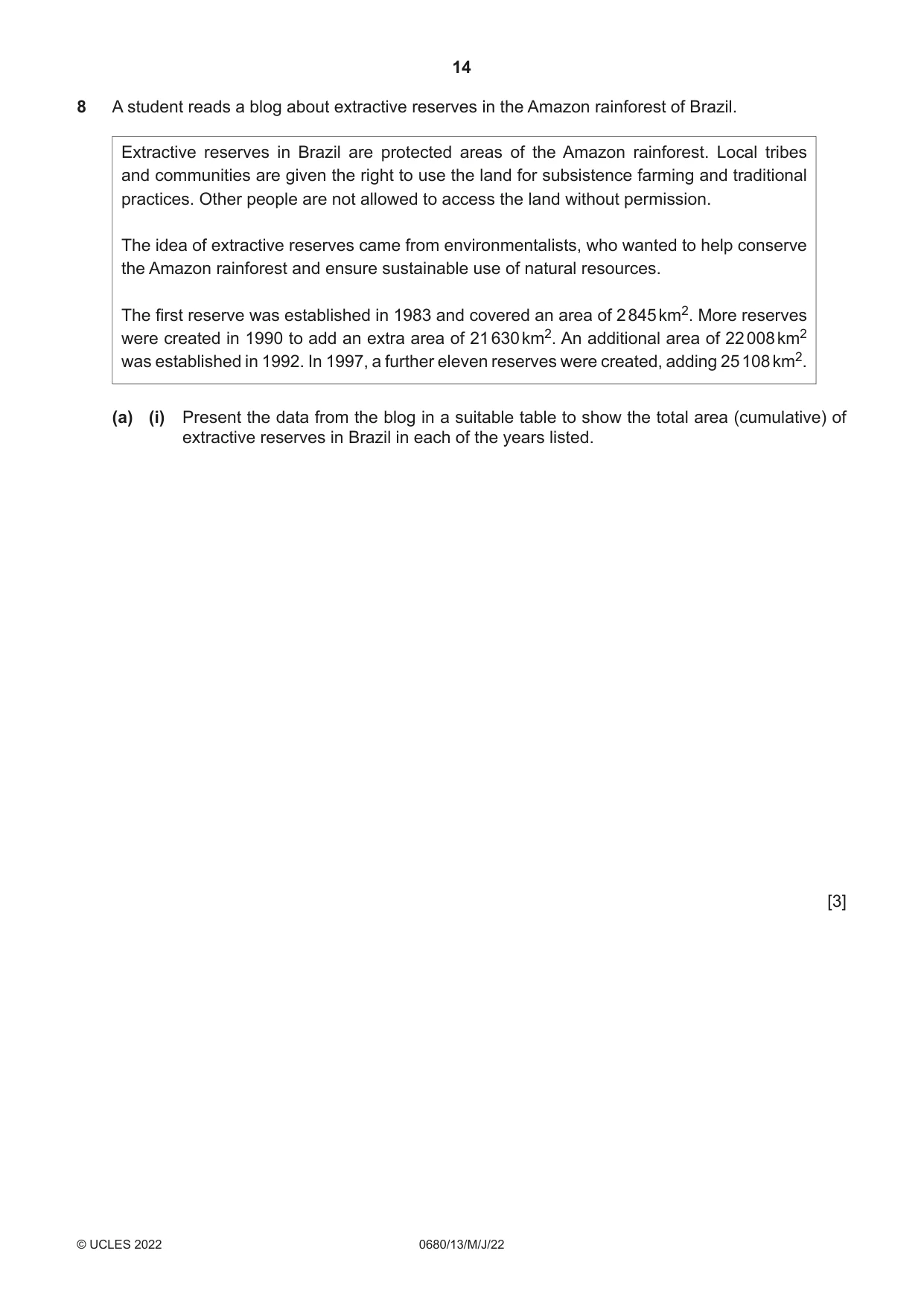
14 0680/13/M/J/22 © UCLES 2022 8 A student reads a blog about extractive reserves in the Amazon rainforest of Brazil. Extractive reserves in Brazil are protected areas of the Amazon rainforest. Local tribes and communities are given the right to use the land for subsistence farming and traditional practices. Other people are not allowed to access the land without permission. The idea of extractive reserves came from environmentalists, who wanted to help conserve the Amazon rainforest and ensure sustainable use of natural resources. The first reserve was established in 1983 and covered an area of 2 845 km2. More reserves were created in 1990 to add an extra area of 21 630 km2. An additional area of 22 008 km2 was established in 1992. In 1997, a further eleven reserves were created, adding 25 108 km2. (a) (i) Present the data from the blog in a suitable table to show the total area (cumulative) of extractive reserves in Brazil in each of the years listed. [3]
Question paper, page 15
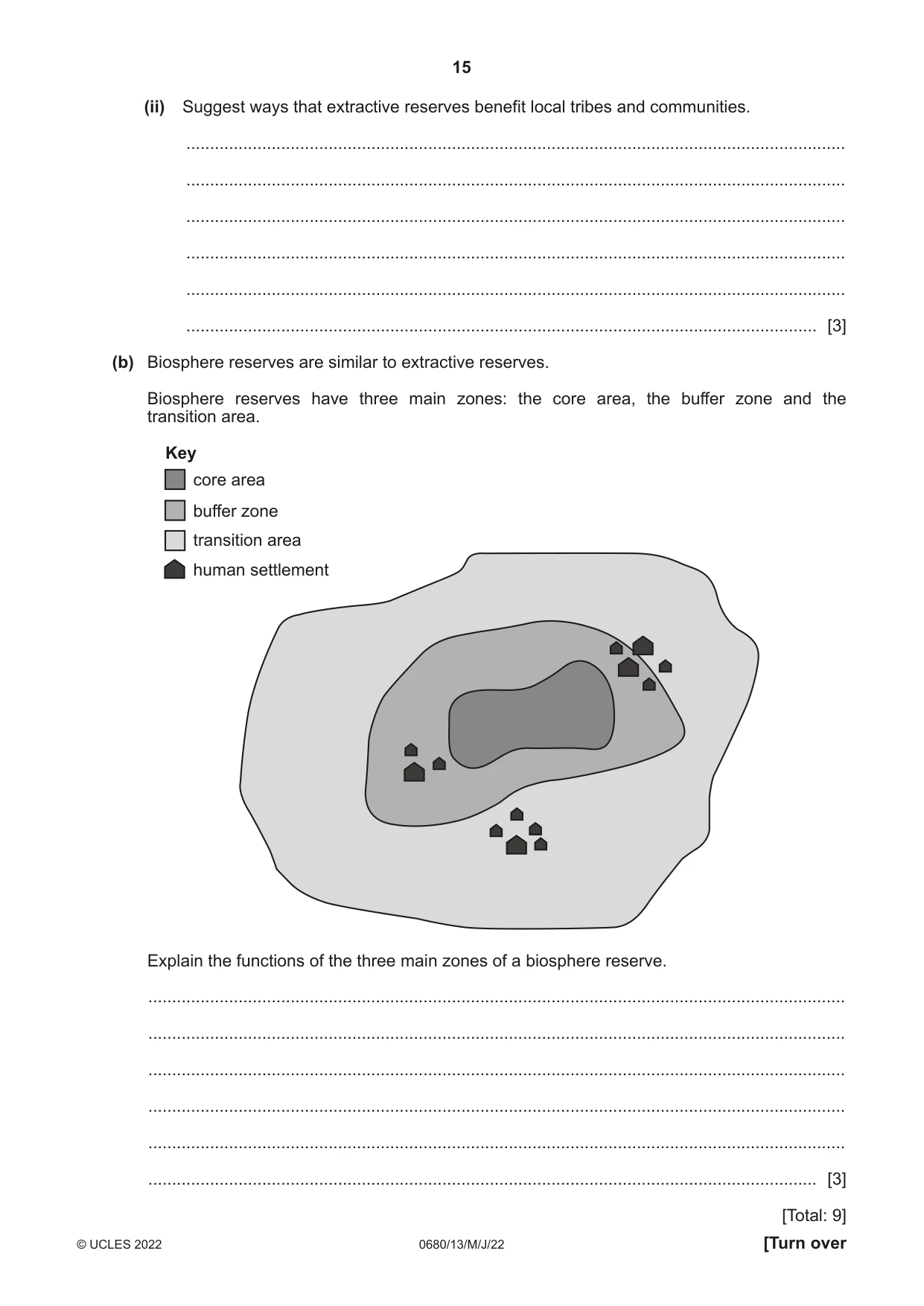
15 0680/13/M/J/22 © UCLES 2022 [Turn over (ii) Suggest ways that extractive reserves benefit local tribes and communities. … … … … … … [3] (b) Biosphere reserves are similar to extractive reserves. Biosphere reserves have three main zones: the core area, the buffer zone and the transition area. core area buffer zone transition area human settlement Key Explain the functions of the three main zones of a biosphere reserve. … … … … … … [3] [Total: 9]
Question paper, page 16
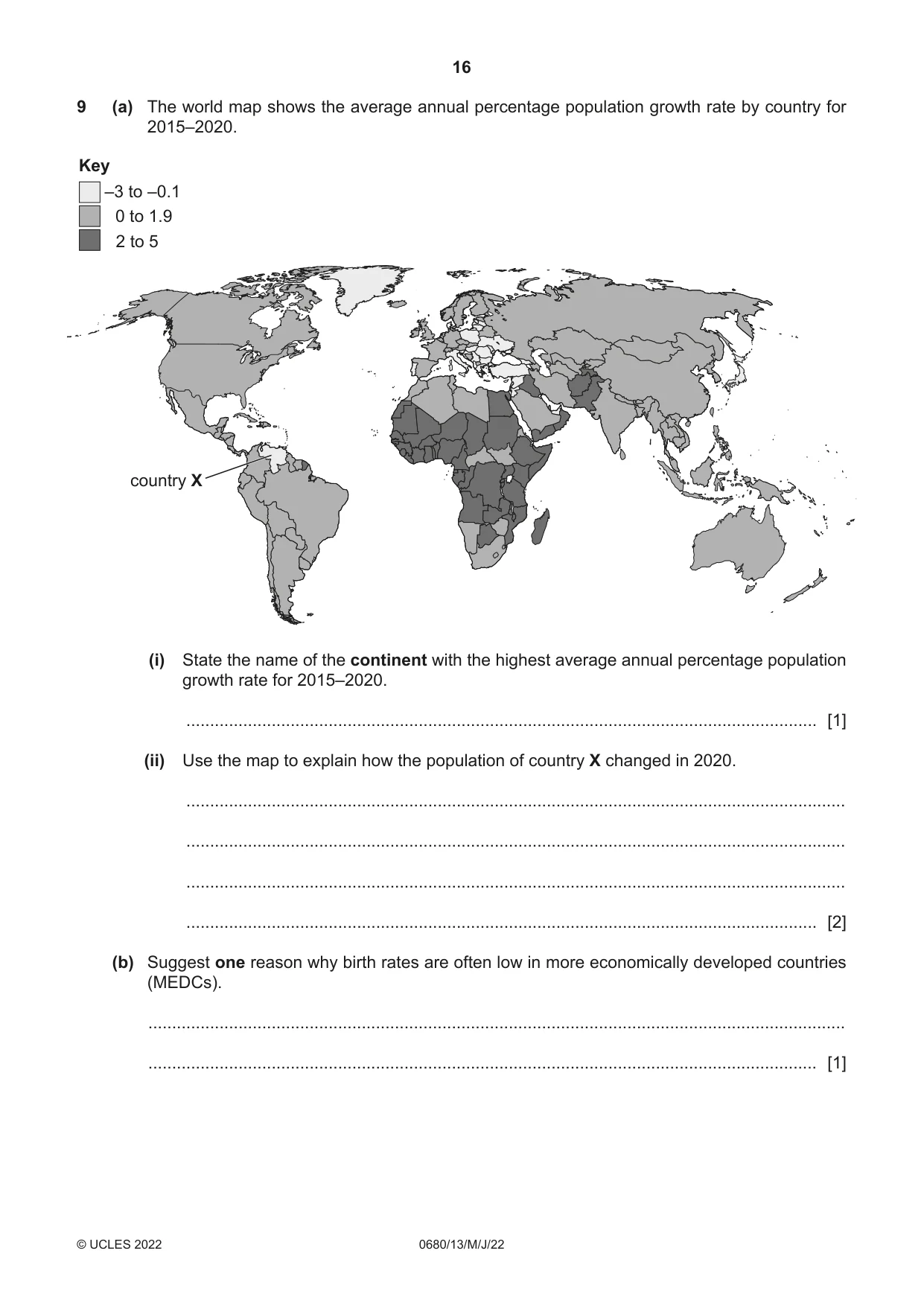
16 0680/13/M/J/22 © UCLES 2022 9 (a) The world map shows the average annual percentage population growth rate by country for 2015–2020. Key –3 to –0.1 0 to 1.9 2 to 5 country X (i) State the name of the continent with the highest average annual percentage population growth rate for 2015–2020. … [1] (ii) Use the map to explain how the population of country X changed in 2020. … … … … [2] (b) Suggest one reason why birth rates are often low in more economically developed countries (MEDCs). … … [1]
Question paper, page 17
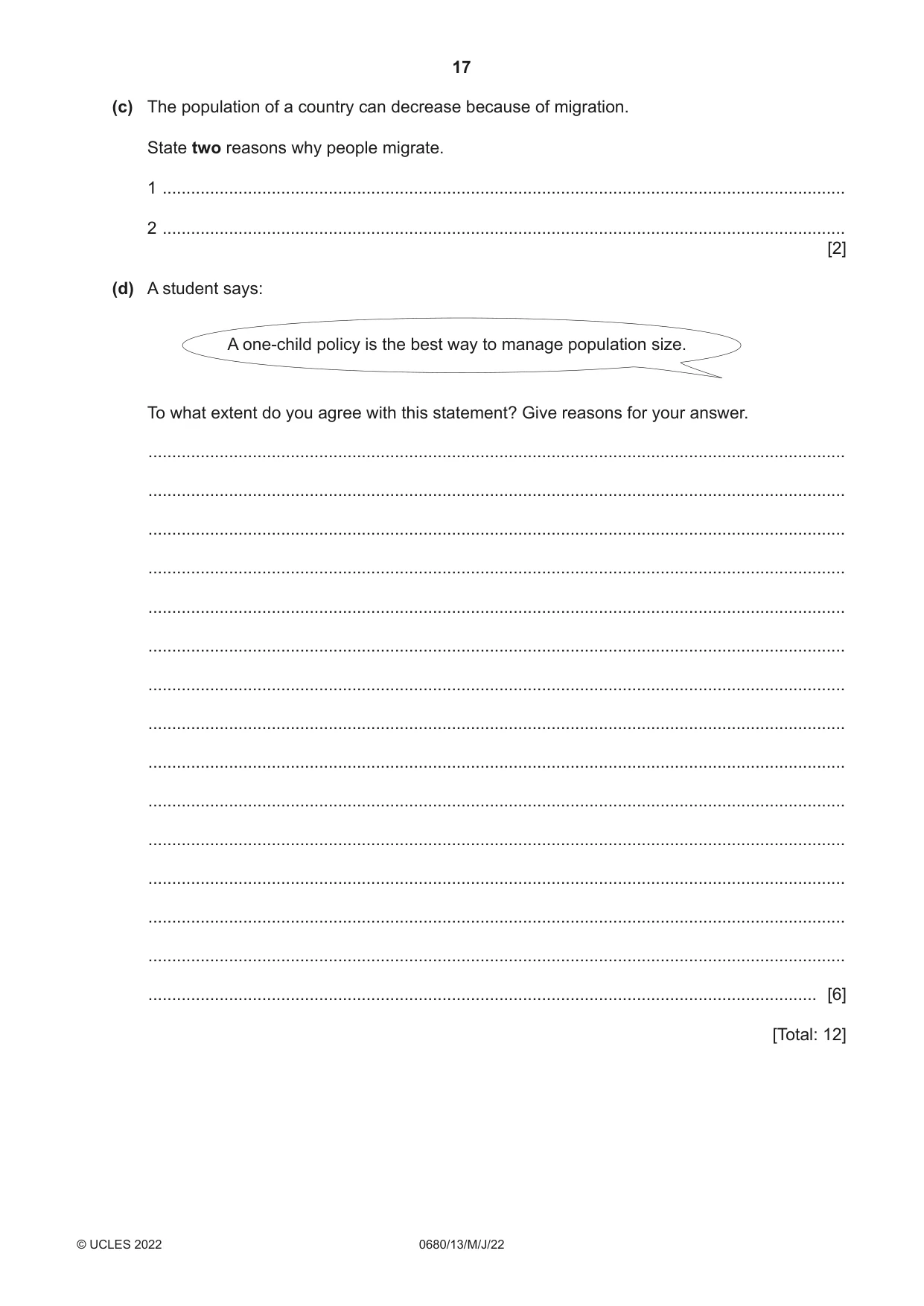
17 0680/13/M/J/22 © UCLES 2022 (c) The population of a country can decrease because of migration. State two reasons why people migrate. 1 … 2 … [2] (d) A student says: A one-child policy is the best way to manage population size. To what extent do you agree with this statement? Give reasons for your answer. … … … … … … … … … … … … … … … [6] [Total: 12]
Question paper, page 18
18 0680/13/M/J/22 © UCLES 2022 BLANK PAGE
Question paper, page 19
19 0680/13/M/J/22 © UCLES 2022 BLANK PAGE
Question paper, page 20
20 0680/13/M/J/22 © UCLES 2022 The boundaries and names shown, the designations used and the presentation of material on any maps contained in this question paper/insert do not imply official endorsement or acceptance by Cambridge Assessment International Education concerning the legal status of any country, territory, or area or any of its authorities, or of the delimitation of its frontiers or boundaries. Permission to reproduce items where third-party owned material protected by copyright is included has been sought and cleared where possible. Every reasonable effort has been made by the publisher (UCLES) to trace copyright holders, but if any items requiring clearance have unwittingly been included, the publisher will be pleased to make amends at the earliest possible opportunity. To avoid the issue of disclosure of answer-related information to candidates, all copyright acknowledgements are reproduced online in the Cambridge Assessment International Education Copyright Acknowledgements Booklet. This is produced for each series of examinations and is freely available to download at www.cambridgeinternational.org after the live examination series. Cambridge Assessment International Education is part of Cambridge Assessment. Cambridge Assessment is the brand name of the University of Cambridge Local Examinations Syndicate (UCLES), which is a department of the University of Cambridge. BLANK PAGE
Mark scheme, page 1
This document consists of 15 printed pages. © UCLES 2022 [Turn over Cambridge IGCSE™ ENVIRONMENTAL MANAGEMENT 0680/13 Paper 1 Theory May/June 2022 MARK SCHEME Maximum Mark: 80 Published This mark scheme is published as an aid to teachers and candidates, to indicate the requirements of the examination. It shows the basis on which Examiners were instructed to award marks. It does not indicate the details of the discussions that took place at an Examiners’ meeting before marking began, which would have considered the acceptability of alternative answers. Mark schemes should be read in conjunction with the question paper and the Principal Examiner Report for Teachers. Cambridge International will not enter into discussions about these mark schemes. Cambridge International is publishing the mark schemes for the May/June 2022 series for most Cambridge IGCSE, Cambridge International A and AS Level and Cambridge Pre-U components, and some Cambridge O Level components.
Mark scheme, page 2
0680/13 Cambridge IGCSE – Mark Scheme PUBLISHED May/June 2022 © UCLES 2022 Page 2 of 15 Generic Marking Principles These general marking principles must be applied by all examiners when marking candidate answers. They should be applied alongside the specific content of the mark scheme or generic level descriptors for a question. Each question paper and mark scheme will also comply with these marking principles. GENERIC MARKING PRINCIPLE 1: Marks must be awarded in line with: the specific content of the mark scheme or the generic level descriptors for the question the specific skills defined in the mark scheme or in the generic level descriptors for the question the standard of response required by a candidate as exemplified by the standardisation scripts. GENERIC MARKING PRINCIPLE 2: Marks awarded are always whole marks (not half marks, or other fractions). GENERIC MARKING PRINCIPLE 3: Marks must be awarded positively: marks are awarded for correct/valid answers, as defined in the mark scheme. However, credit is given for valid answers which go beyond the scope of the syllabus and mark scheme, referring to your Team Leader as appropriate marks are awarded when candidates clearly demonstrate what they know and can do marks are not deducted for errors marks are not deducted for omissions answers should only be judged on the quality of spelling, punctuation and grammar when these features are specifically assessed by the question as indicated by the mark scheme. The meaning, however, should be unambiguous. GENERIC MARKING PRINCIPLE 4: Rules must be applied consistently, e.g. in situations where candidates have not followed instructions or in the application of generic level descriptors.
Mark scheme, page 3
0680/13 Cambridge IGCSE – Mark Scheme PUBLISHED May/June 2022 © UCLES 2022 Page 3 of 15 GENERIC MARKING PRINCIPLE 5: Marks should be awarded using the full range of marks defined in the mark scheme for the question (however; the use of the full mark range may be limited according to the quality of the candidate responses seen). GENERIC MARKING PRINCIPLE 6: Marks awarded are based solely on the requirements as defined in the mark scheme. Marks should not be awarded with grade thresholds or grade descriptors in mind. Science-Specific Marking Principles 1 Examiners should consider the context and scientific use of any keywords when awarding marks. Although keywords may be present, marks should not be awarded if the keywords are used incorrectly. 2 The examiner should not choose between contradictory statements given in the same question part, and credit should not be awarded for any correct statement that is contradicted within the same question part. Wrong science that is irrelevant to the question should be ignored. 3 Although spellings do not have to be correct, spellings of syllabus terms must allow for clear and unambiguous separation from other syllabus terms with which they may be confused (e.g. ethane / ethene, glucagon / glycogen, refraction / reflection). 4 The error carried forward (ecf) principle should be applied, where appropriate. If an incorrect answer is subsequently used in a scientifically correct way, the candidate should be awarded these subsequent marking points. Further guidance will be included in the mark scheme where necessary and any exceptions to this general principle will be noted. 5 ‘List rule’ guidance For questions that require n responses (e.g. State two reasons …): The response should be read as continuous prose, even when numbered answer spaces are provided. Any response marked ignore in the mark scheme should not count towards n. Incorrect responses should not be awarded credit but will still count towards n. Read the entire response to check for any responses that contradict those that would otherwise be credited. Credit should not be awarded for any responses that are contradicted within the rest of the response. Where two responses contradict one another, this should be treated as a single incorrect response. Non-contradictory responses after the first n responses may be ignored even if they include incorrect science.
Mark scheme, page 4
0680/13 Cambridge IGCSE – Mark Scheme PUBLISHED May/June 2022 © UCLES 2022 Page 4 of 15 6 Calculation specific guidance Correct answers to calculations should be given full credit even if there is no working or incorrect working, unless the question states ‘show your working’. For questions in which the number of significant figures required is not stated, credit should be awarded for correct answers when rounded by the examiner to the number of significant figures given in the mark scheme. This may not apply to measured values. For answers given in standard form (e.g. a 10n) in which the convention of restricting the value of the coefficient (a) to a value between 1 and 10 is not followed, credit may still be awarded if the answer can be converted to the answer given in the mark scheme. Unless a separate mark is given for a unit, a missing or incorrect unit will normally mean that the final calculation mark is not awarded. Exceptions to this general principle will be noted in the mark scheme. 7 Guidance for chemical equations Multiples / fractions of coefficients used in chemical equations are acceptable unless stated otherwise in the mark scheme. State symbols given in an equation should be ignored unless asked for in the question or stated otherwise in the mark scheme.
Mark scheme, page 5
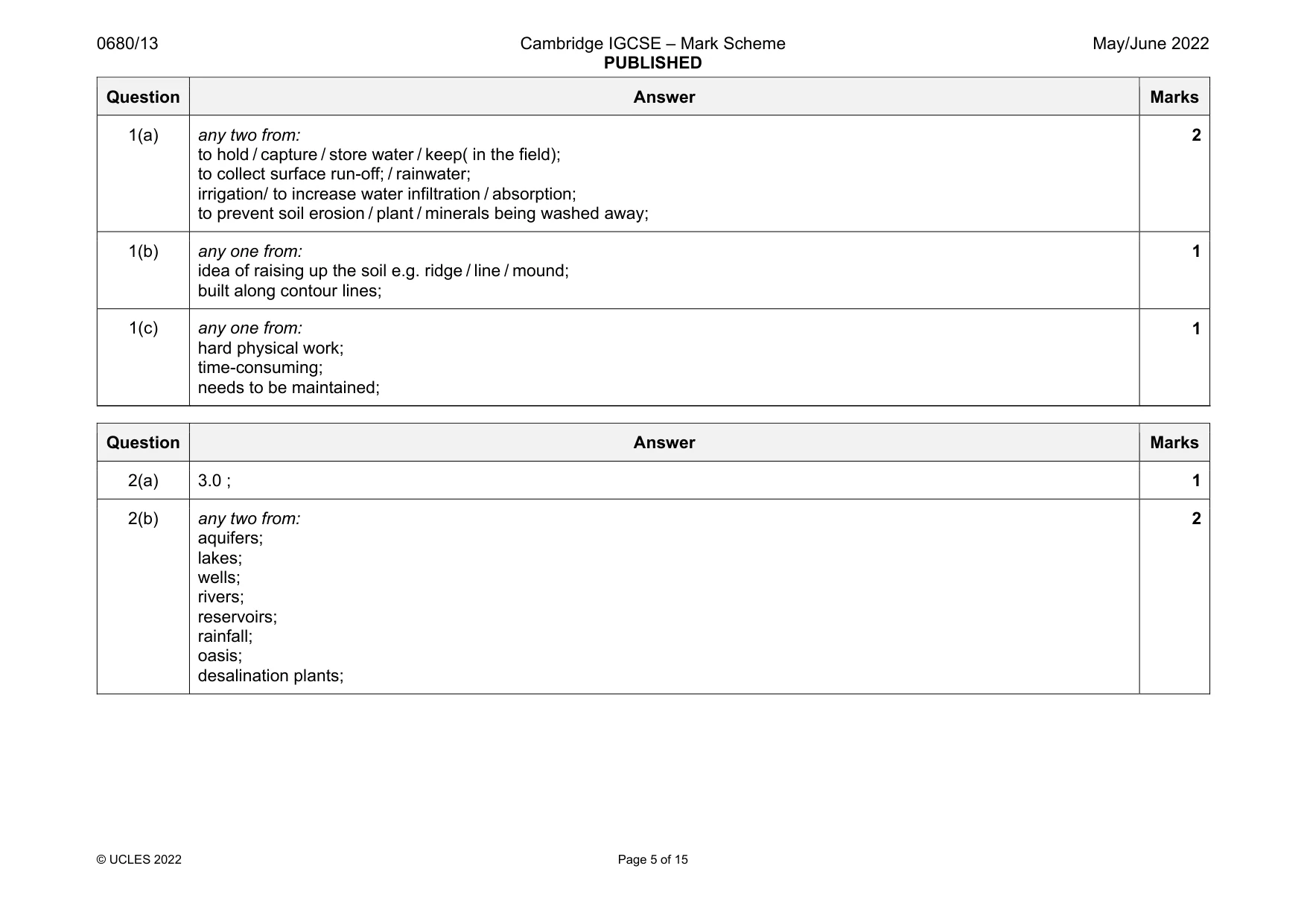
0680/13 Cambridge IGCSE – Mark Scheme PUBLISHED May/June 2022 © UCLES 2022 Page 5 of 15 Question Answer Marks 1(a) any two from: to hold / capture / store water / keep( in the field); to collect surface run-off; / rainwater; irrigation/ to increase water infiltration / absorption; to prevent soil erosion / plant / minerals being washed away; 2 1(b) any one from: idea of raising up the soil e.g. ridge / line / mound; built along contour lines; 1 1(c) any one from: hard physical work; time-consuming; needs to be maintained; 1 Question Answer Marks 2(a) 3.0 ; 1 2(b) any two from: aquifers; lakes; wells; rivers; reservoirs; rainfall; oasis; desalination plants; 2
Mark scheme, page 6
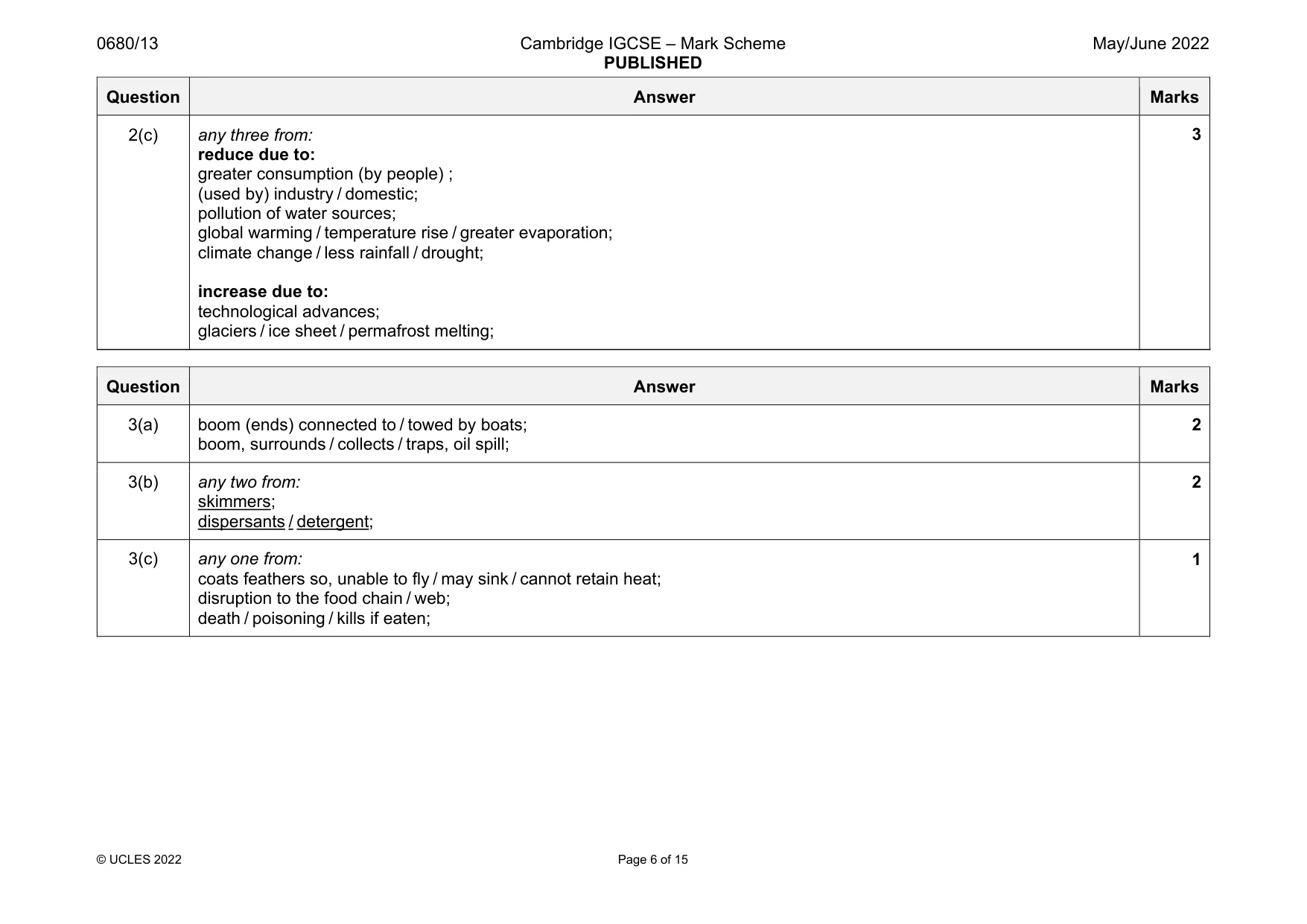
0680/13 Cambridge IGCSE – Mark Scheme PUBLISHED May/June 2022 © UCLES 2022 Page 6 of 15 Question Answer Marks 2(c) any three from: reduce due to: greater consumption (by people) ; (used by) industry / domestic; pollution of water sources; global warming / temperature rise / greater evaporation; climate change / less rainfall / drought; increase due to: technological advances; glaciers / ice sheet / permafrost melting; 3 Question Answer Marks 3(a) boom (ends) connected to / towed by boats; boom, surrounds / collects / traps, oil spill; 2 3(b) any two from: skimmers; dispersants / detergent; 2 3(c) any one from: coats feathers so, unable to fly / may sink / cannot retain heat; disruption to the food chain / web; death / poisoning / kills if eaten; 1
Mark scheme, page 7
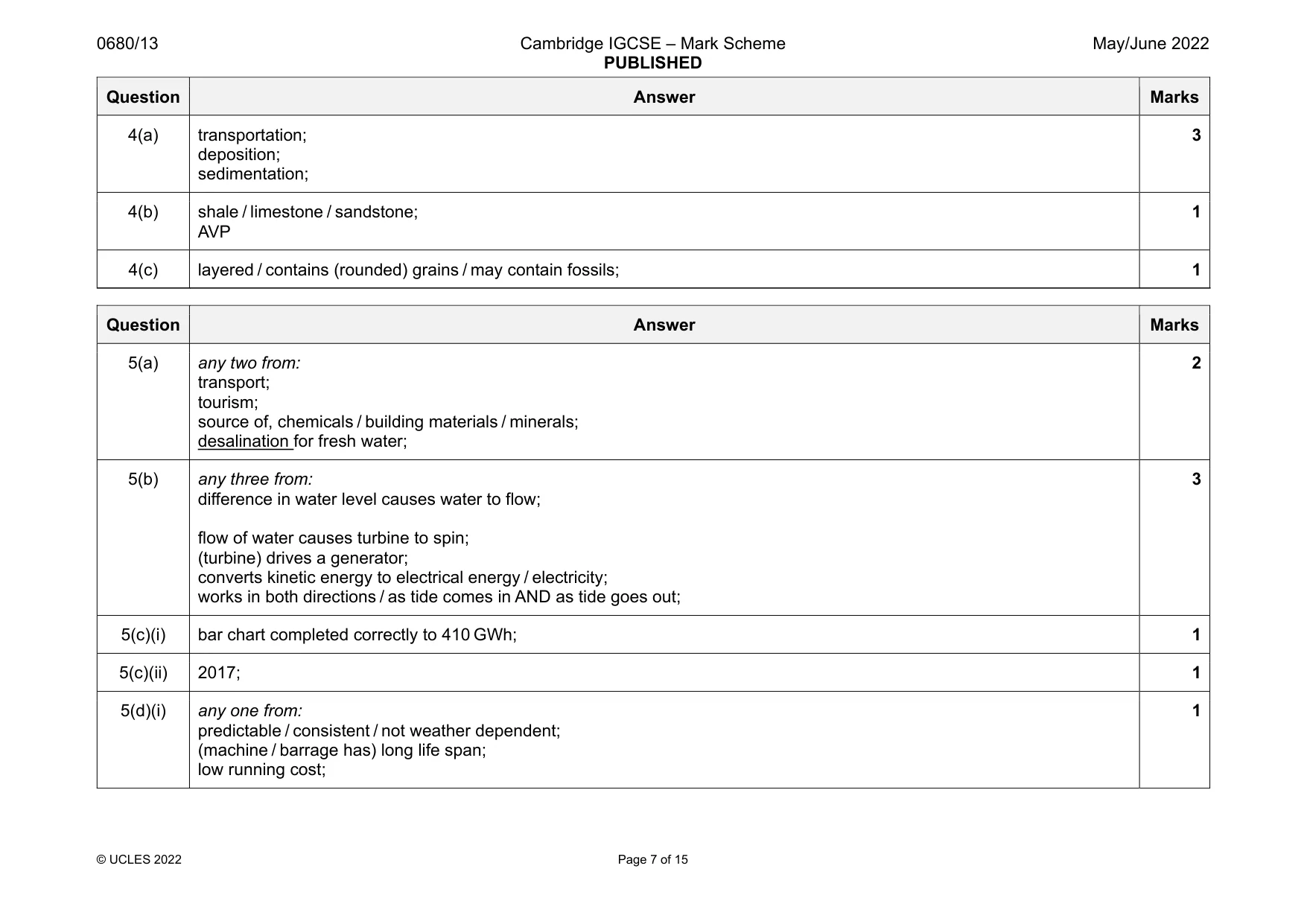
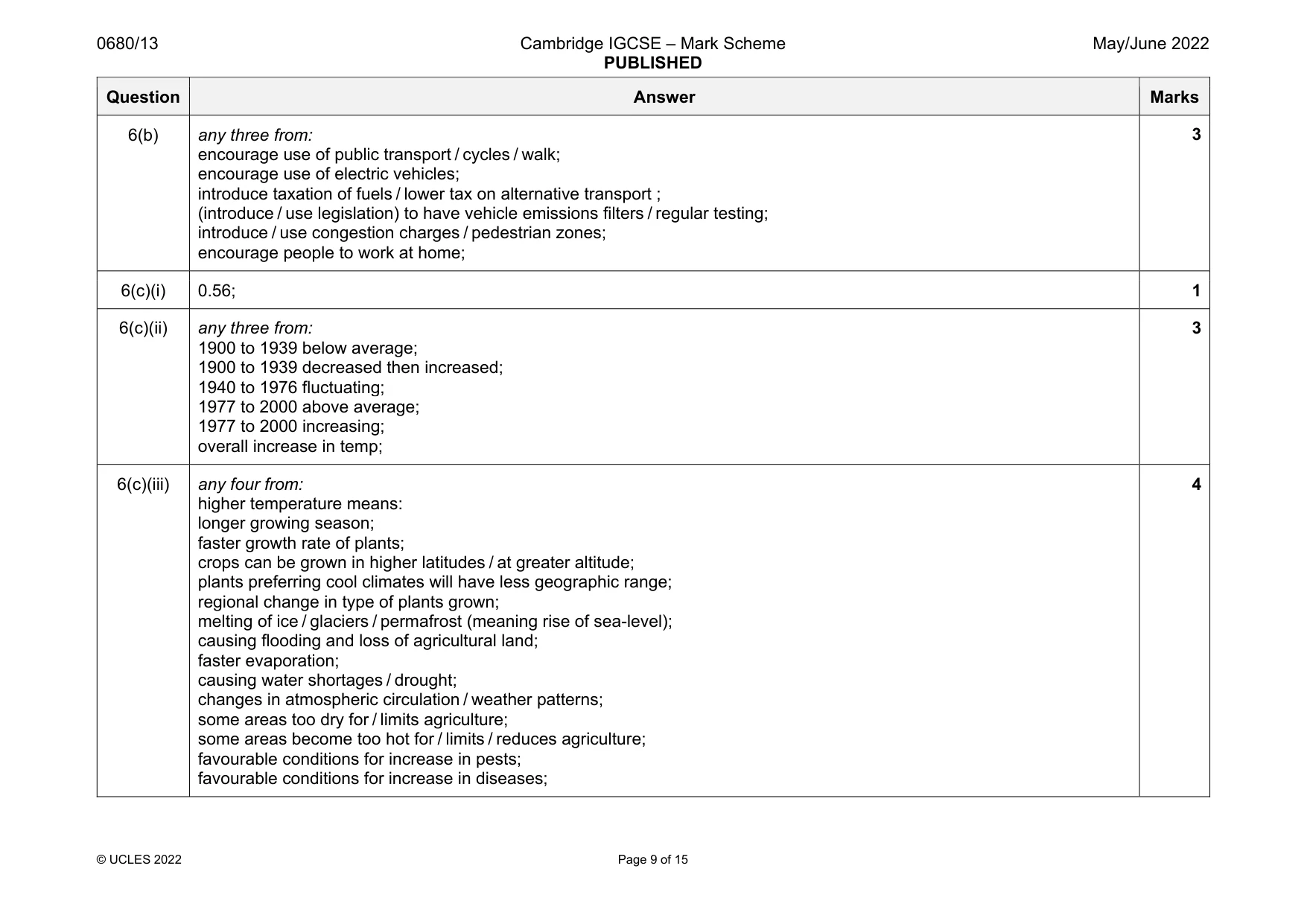
0680/13 Cambridge IGCSE – Mark Scheme PUBLISHED May/June 2022 © UCLES 2022 Page 7 of 15 Question Answer Marks 4(a) transportation; deposition; sedimentation; 3 4(b) shale / limestone / sandstone; AVP 1 4(c) layered / contains (rounded) grains / may contain fossils; 1 Question Answer Marks 5(a) any two from: transport; tourism; source of, chemicals / building materials / minerals; desalination for fresh water; 2 5(b) any three from: difference in water level causes water to flow; flow of water causes turbine to spin; (turbine) drives a generator; converts kinetic energy to electrical energy / electricity; works in both directions / as tide comes in AND as tide goes out; 3 5(c)(i) bar chart completed correctly to 410 GWh; 1 5(c)(ii) 2017; 1 5(d)(i) any one from: predictable / consistent / not weather dependent; (machine / barrage has) long life span; low running cost; 1
Mark scheme, page 8
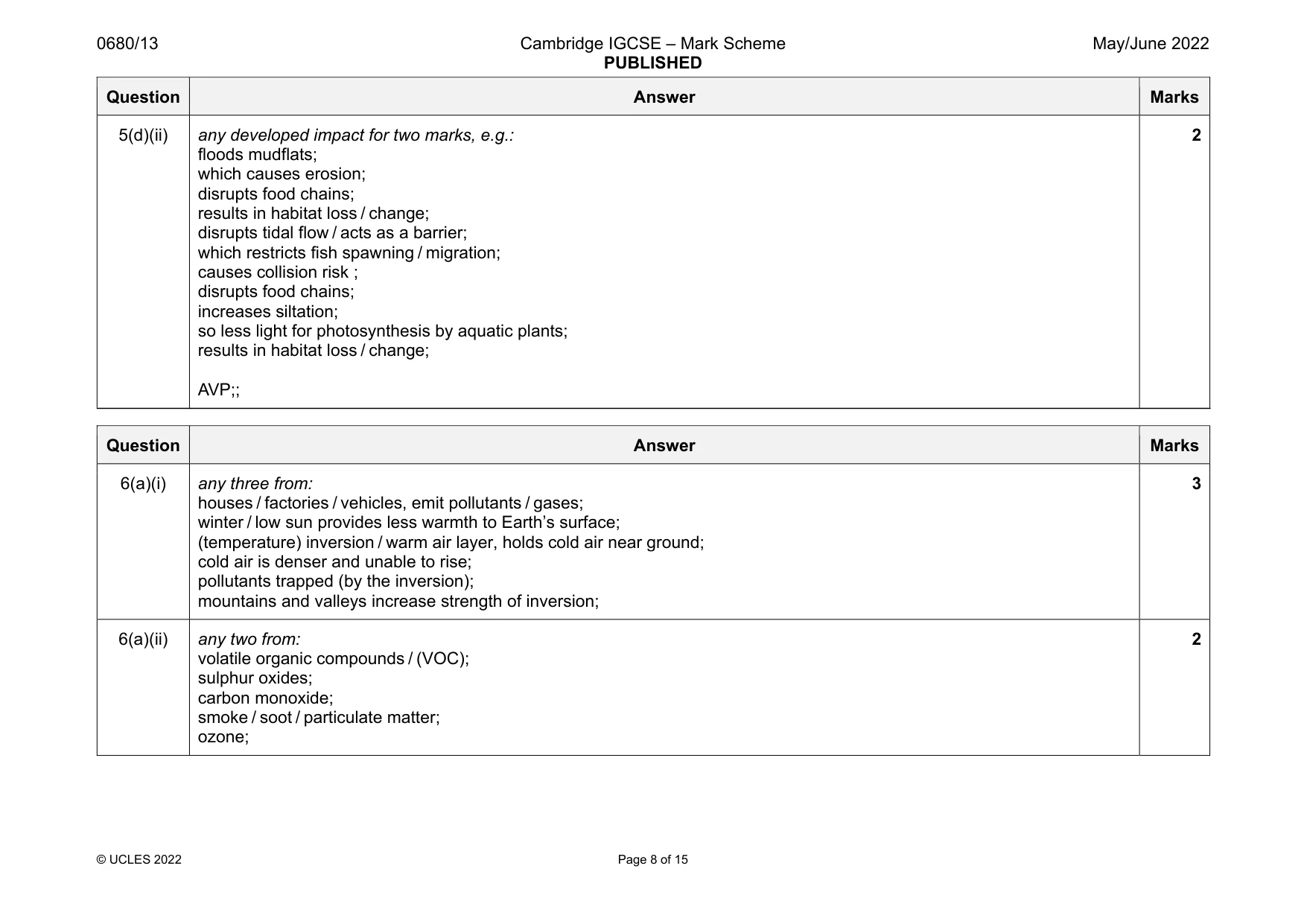
0680/13 Cambridge IGCSE – Mark Scheme PUBLISHED May/June 2022 © UCLES 2022 Page 8 of 15 Question Answer Marks 5(d)(ii) any developed impact for two marks, e.g.: floods mudflats; which causes erosion; disrupts food chains; results in habitat loss / change; disrupts tidal flow / acts as a barrier; which restricts fish spawning / migration; causes collision risk ; disrupts food chains; increases siltation; so less light for photosynthesis by aquatic plants; results in habitat loss / change; AVP;; 2 Question Answer Marks 6(a)(i) any three from: houses / factories / vehicles, emit pollutants / gases; winter / low sun provides less warmth to Earth’s surface; (temperature) inversion / warm air layer, holds cold air near ground; cold air is denser and unable to rise; pollutants trapped (by the inversion); mountains and valleys increase strength of inversion; 3 6(a)(ii) any two from: volatile organic compounds / (VOC); sulphur oxides; carbon monoxide; smoke / soot / particulate matter; ozone; 2
Mark scheme, page 9
0680/13 Cambridge IGCSE – Mark Scheme PUBLISHED May/June 2022 © UCLES 2022 Page 9 of 15 Question Answer Marks 6(b) any three from: encourage use of public transport / cycles / walk; encourage use of electric vehicles; introduce taxation of fuels / lower tax on alternative transport ; (introduce / use legislation) to have vehicle emissions filters / regular testing; introduce / use congestion charges / pedestrian zones; encourage people to work at home; 3 6(c)(i) 0.56; 1 6(c)(ii) any three from: 1900 to 1939 below average; 1900 to 1939 decreased then increased; 1940 to 1976 fluctuating; 1977 to 2000 above average; 1977 to 2000 increasing; overall increase in temp; 3 6(c)(iii) any four from: higher temperature means: longer growing season; faster growth rate of plants; crops can be grown in higher latitudes / at greater altitude; plants preferring cool climates will have less geographic range; regional change in type of plants grown; melting of ice / glaciers / permafrost (meaning rise of sea-level); causing flooding and loss of agricultural land; faster evaporation; causing water shortages / drought; changes in atmospheric circulation / weather patterns; some areas too dry for / limits agriculture; some areas become too hot for / limits / reduces agriculture; favourable conditions for increase in pests; favourable conditions for increase in diseases; 4
Mark scheme, page 10
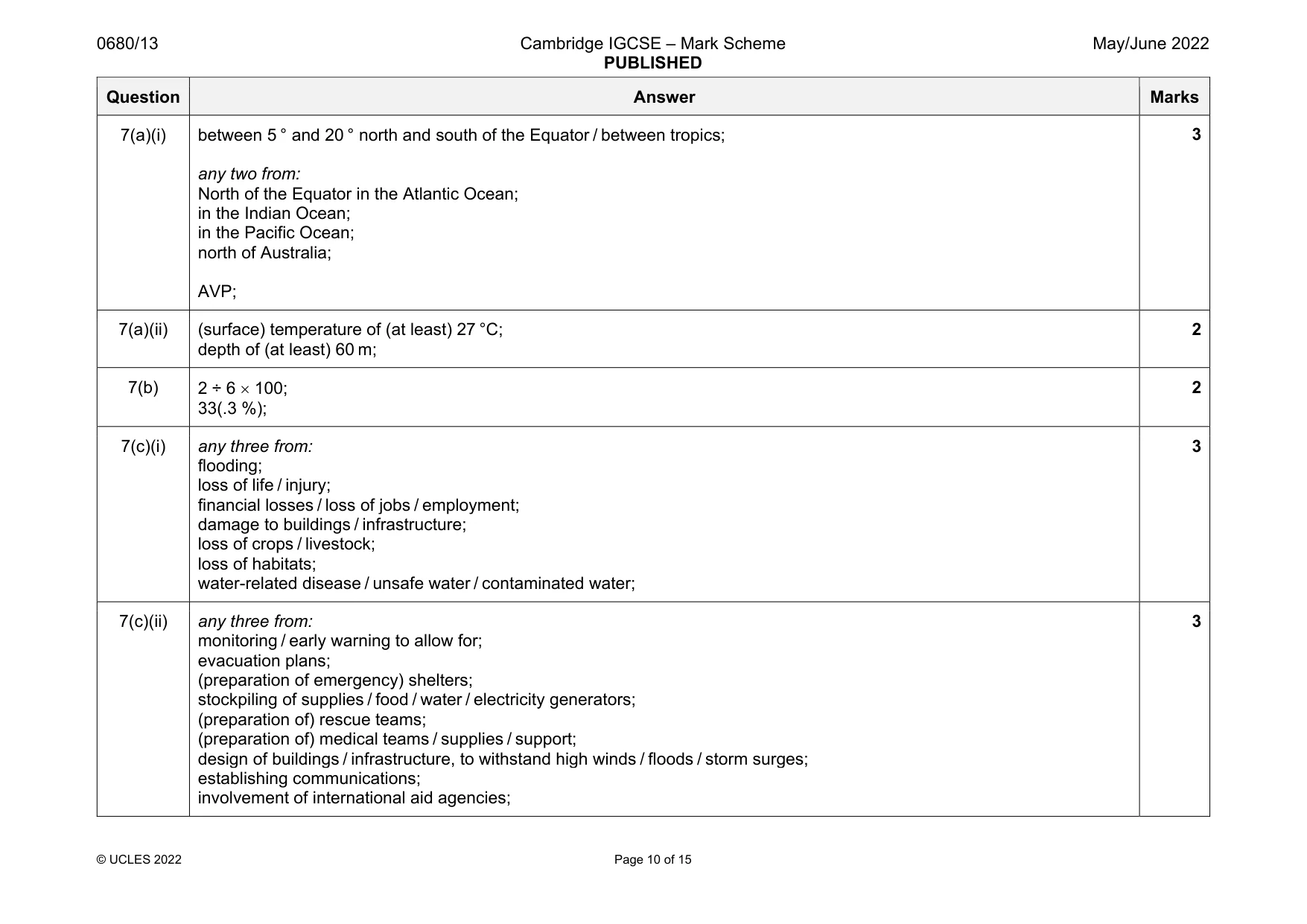
0680/13 Cambridge IGCSE – Mark Scheme PUBLISHED May/June 2022 © UCLES 2022 Page 10 of 15 Question Answer Marks 7(a)(i) between 5 ° and 20 ° north and south of the Equator / between tropics; any two from: North of the Equator in the Atlantic Ocean; in the Indian Ocean; in the Pacific Ocean; north of Australia; AVP; 3 7(a)(ii) (surface) temperature of (at least) 27 °C; depth of (at least) 60 m; 2 7(b) 2 ÷ 6 100; 33(.3 %); 2 7(c)(i) any three from: flooding; loss of life / injury; financial losses / loss of jobs / employment; damage to buildings / infrastructure; loss of crops / livestock; loss of habitats; water-related disease / unsafe water / contaminated water; 3 7(c)(ii) any three from: monitoring / early warning to allow for; evacuation plans; (preparation of emergency) shelters; stockpiling of supplies / food / water / electricity generators; (preparation of) rescue teams; (preparation of) medical teams / supplies / support; design of buildings / infrastructure, to withstand high winds / floods / storm surges; establishing communications; involvement of international aid agencies; 3
Mark scheme, page 11
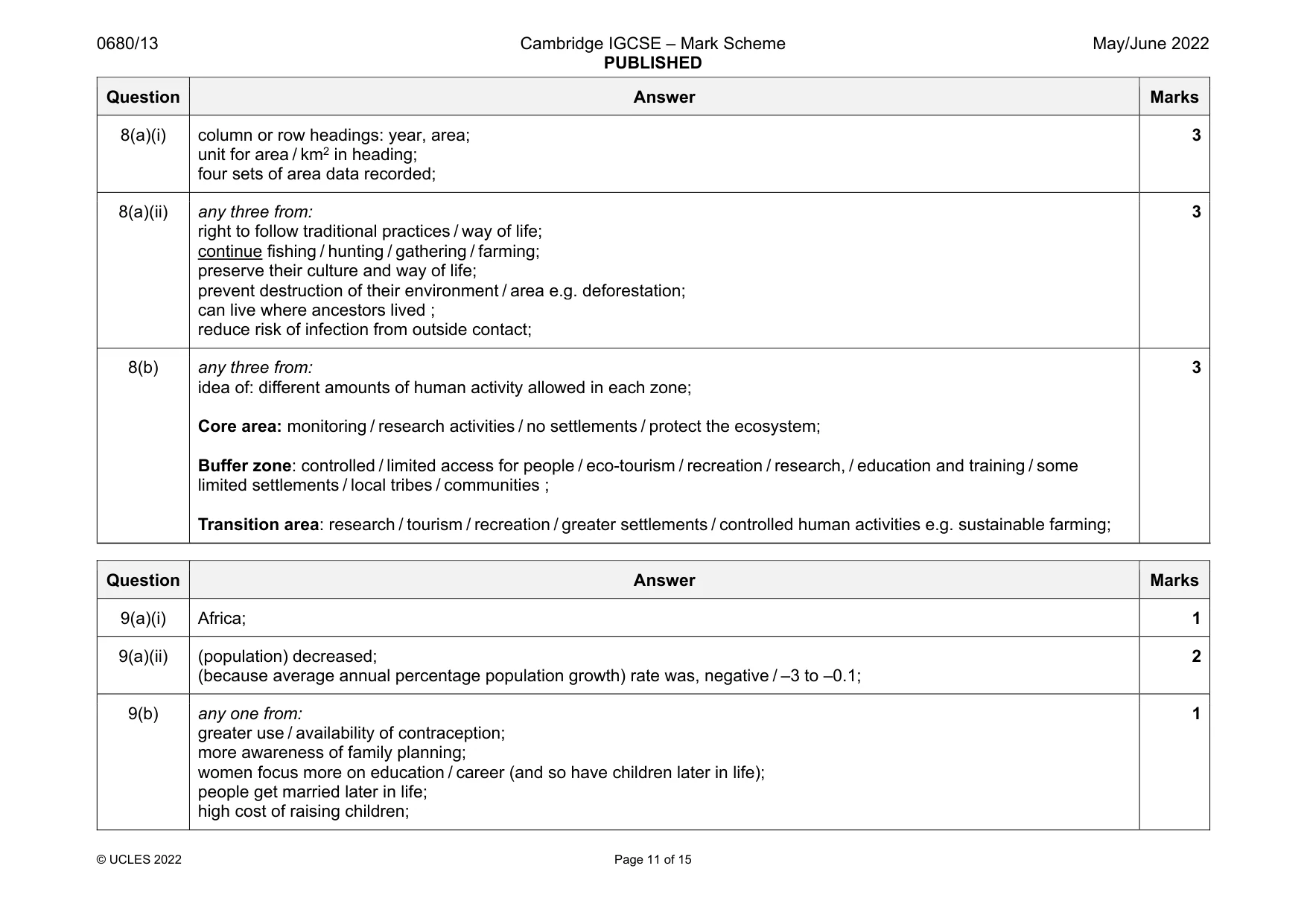
0680/13 Cambridge IGCSE – Mark Scheme PUBLISHED May/June 2022 © UCLES 2022 Page 11 of 15 Question Answer Marks 8(a)(i) column or row headings: year, area; unit for area / km2 in heading; four sets of area data recorded; 3 8(a)(ii) any three from: right to follow traditional practices / way of life; continue fishing / hunting / gathering / farming; preserve their culture and way of life; prevent destruction of their environment / area e.g. deforestation; can live where ancestors lived ; reduce risk of infection from outside contact; 3 8(b) any three from: idea of: different amounts of human activity allowed in each zone; Core area: monitoring / research activities / no settlements / protect the ecosystem; Buffer zone: controlled / limited access for people / eco-tourism / recreation / research, / education and training / some limited settlements / local tribes / communities ; Transition area: research / tourism / recreation / greater settlements / controlled human activities e.g. sustainable farming; 3 Question Answer Marks 9(a)(i) Africa; 1 9(a)(ii) (population) decreased; (because average annual percentage population growth) rate was, negative / –3 to –0.1; 2 9(b) any one from: greater use / availability of contraception; more awareness of family planning; women focus more on education / career (and so have children later in life); people get married later in life; high cost of raising children; 1
Mark scheme, page 12
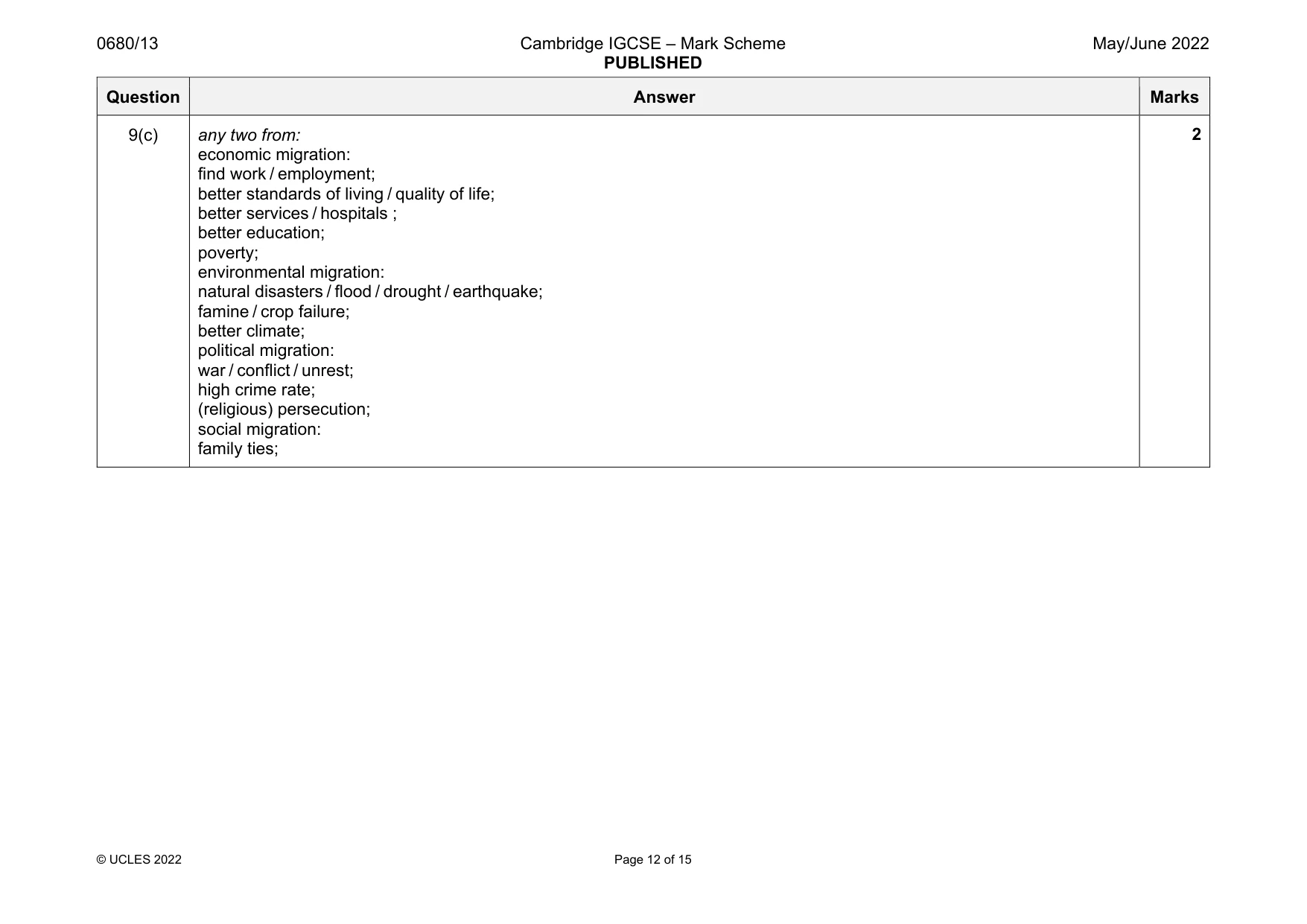
0680/13 Cambridge IGCSE – Mark Scheme PUBLISHED May/June 2022 © UCLES 2022 Page 12 of 15 Question Answer Marks 9(c) any two from: economic migration: find work / employment; better standards of living / quality of life; better services / hospitals ; better education; poverty; environmental migration: natural disasters / flood / drought / earthquake; famine / crop failure; better climate; political migration: war / conflict / unrest; high crime rate; (religious) persecution; social migration: family ties; 2
Mark scheme, page 13
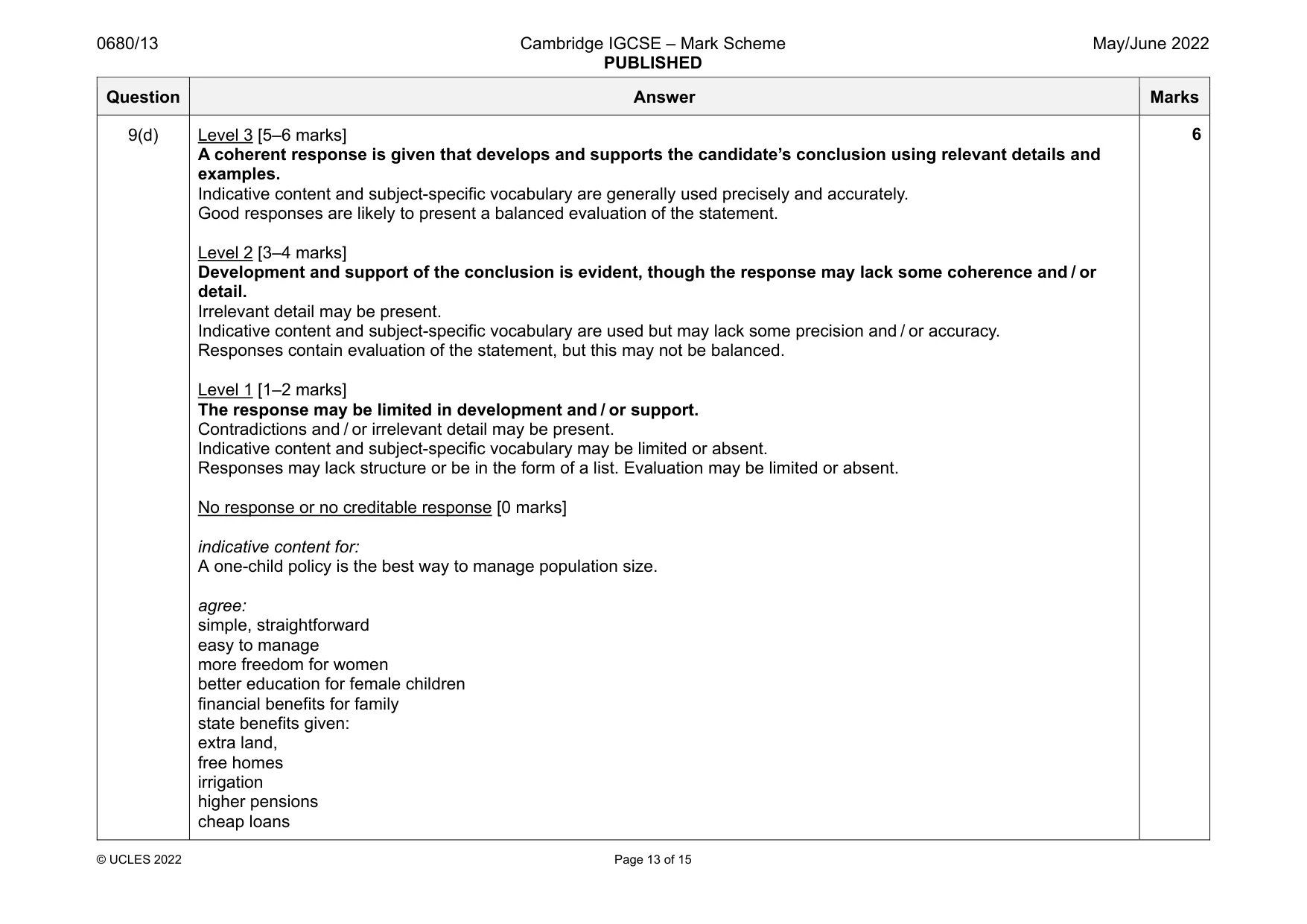
0680/13 Cambridge IGCSE – Mark Scheme PUBLISHED May/June 2022 © UCLES 2022 Page 13 of 15 Question Answer Marks 9(d) Level 3 [5–6 marks] A coherent response is given that develops and supports the candidate’s conclusion using relevant details and examples. Indicative content and subject-specific vocabulary are generally used precisely and accurately. Good responses are likely to present a balanced evaluation of the statement. Level 2 [3–4 marks] Development and support of the conclusion is evident, though the response may lack some coherence and / or detail. Irrelevant detail may be present. Indicative content and subject-specific vocabulary are used but may lack some precision and / or accuracy. Responses contain evaluation of the statement, but this may not be balanced. Level 1 [1–2 marks] The response may be limited in development and / or support. Contradictions and / or irrelevant detail may be present. Indicative content and subject-specific vocabulary may be limited or absent. Responses may lack structure or be in the form of a list. Evaluation may be limited or absent. No response or no creditable response [0 marks] indicative content for: A one-child policy is the best way to manage population size. agree: simple, straightforward easy to manage more freedom for women better education for female children financial benefits for family state benefits given: extra land, free homes irrigation higher pensions cheap loans 6
Mark scheme, page 14
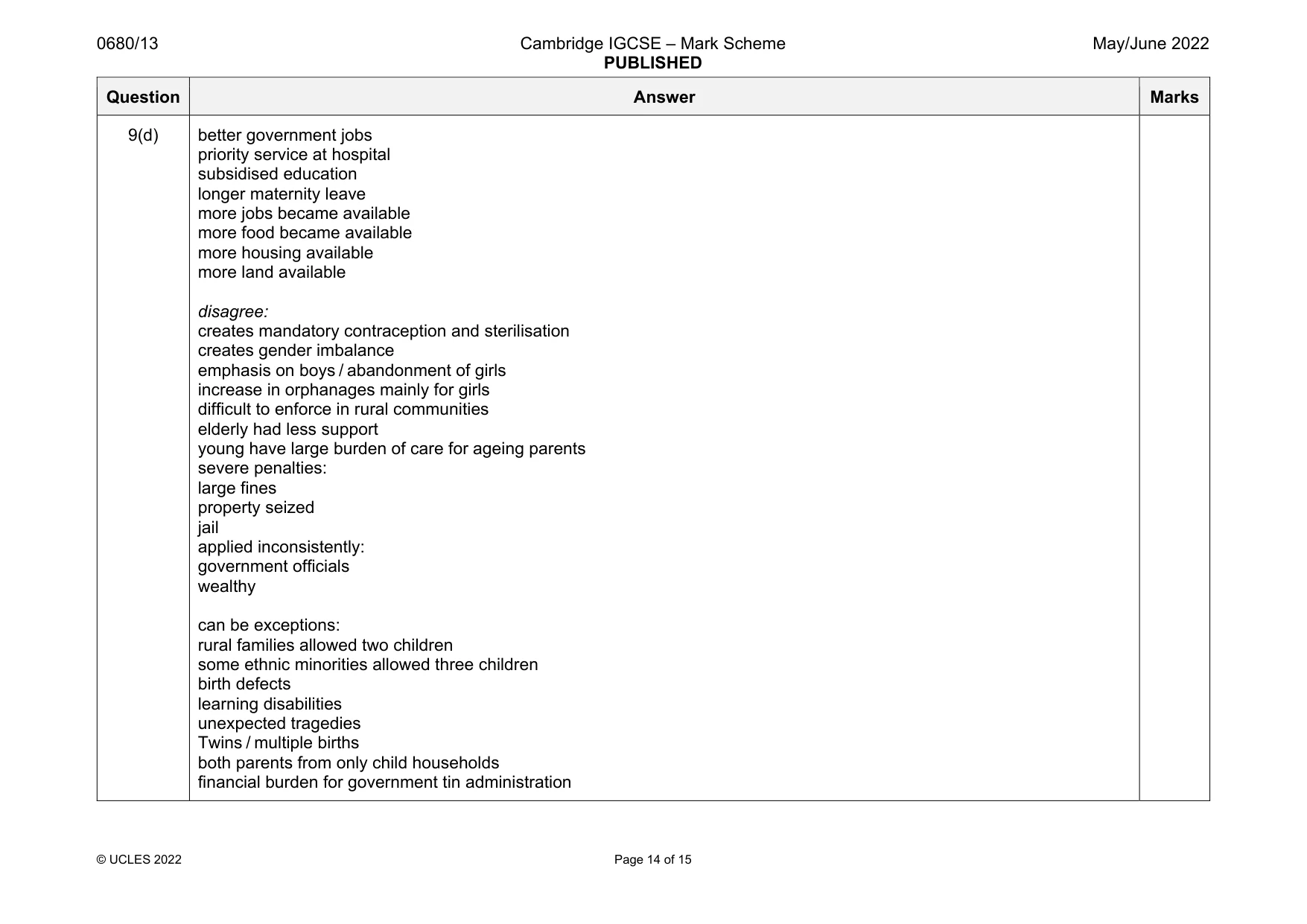
0680/13 Cambridge IGCSE – Mark Scheme PUBLISHED May/June 2022 © UCLES 2022 Page 14 of 15 Question Answer Marks 9(d) better government jobs priority service at hospital subsidised education longer maternity leave more jobs became available more food became available more housing available more land available disagree: creates mandatory contraception and sterilisation creates gender imbalance emphasis on boys / abandonment of girls increase in orphanages mainly for girls difficult to enforce in rural communities elderly had less support young have large burden of care for ageing parents severe penalties: large fines property seized jail applied inconsistently: government officials wealthy can be exceptions: rural families allowed two children some ethnic minorities allowed three children birth defects learning disabilities unexpected tragedies Twins / multiple births both parents from only child households financial burden for government tin administration
Mark scheme, page 15
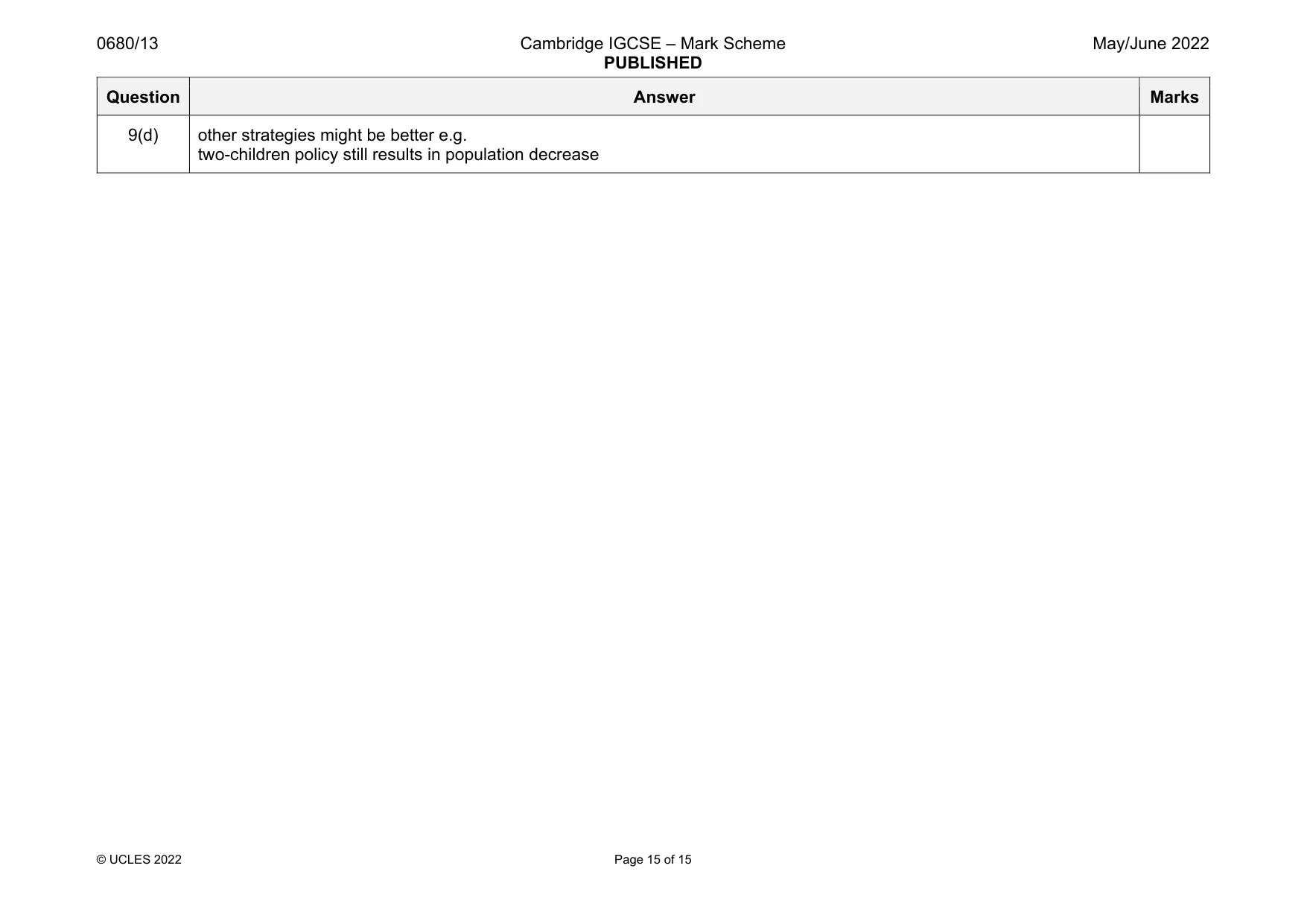
0680/13 Cambridge IGCSE – Mark Scheme PUBLISHED May/June 2022 © UCLES 2022 Page 15 of 15 Question Answer Marks 9(d) other strategies might be better e.g. two-children policy still results in population decrease
What you needed in this session
Cambridge’s own grade thresholds for 2022 May/June, Paper 1 · Variant 3. A higher threshold means an easier paper — the bar moves with how the cohort did.