Cambridge IGCSE Environmental Management 0680 — 2021 May/June Paper 1 · Variant 2
0680/12/M/J/21 · 80 marks · ≈90 min
The question paper and its mark scheme, free to read here and free to download. This is Cambridge’s own paper, exactly as it was sat.
Question paper20 pages



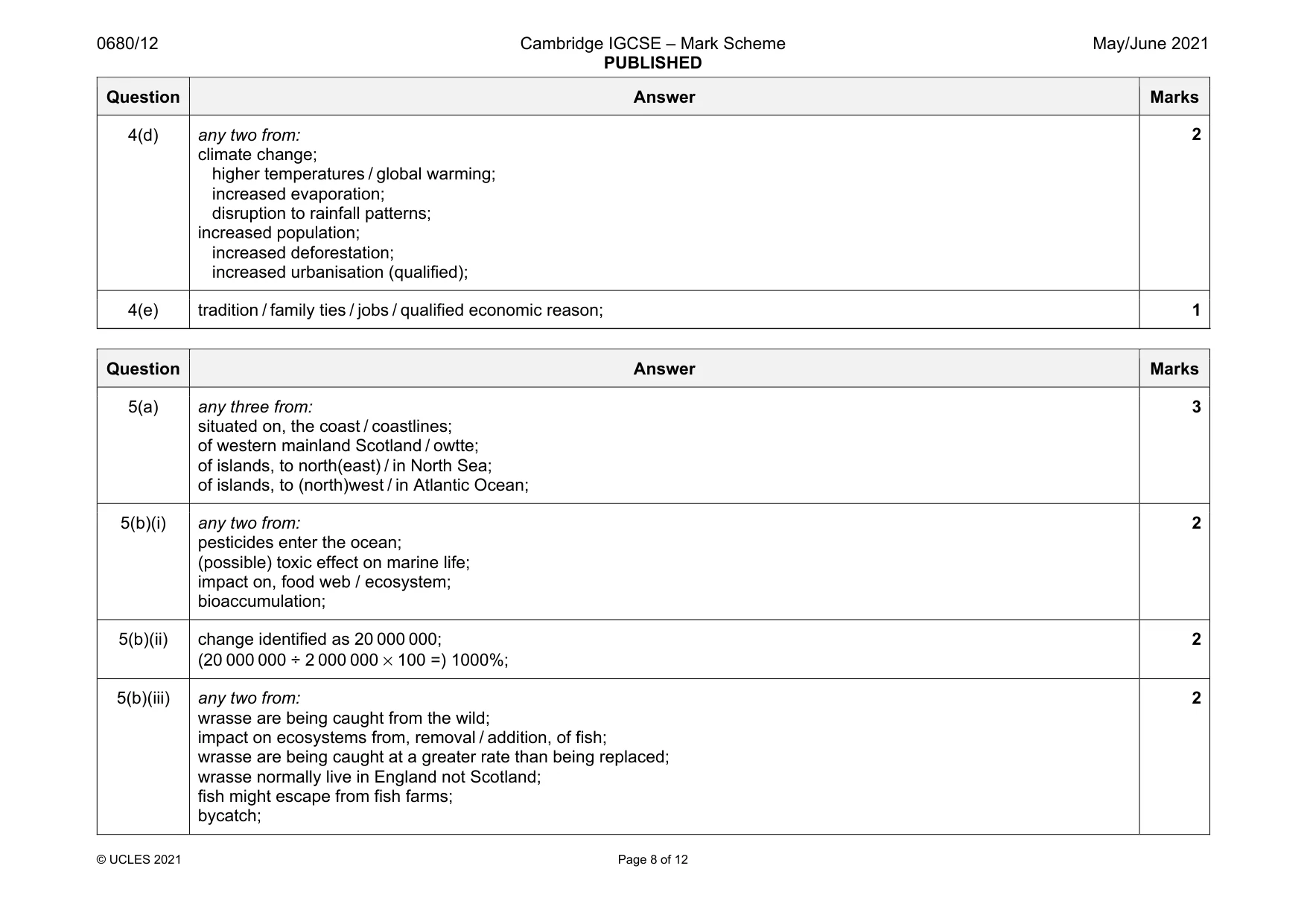
Mark scheme12 pages
Answers below. Sit the paper first if you are practising.
Paper as text
Question paper, page 1
This document has 20 pages. Any blank pages are indicated. Cambridge IGCSE™ DC (PQ/SW) 208405/4 © UCLES 2021 [Turn over * 5 6 3 0 9 8 3 4 4 1 * ENVIRONMENTAL MANAGEMENT 0680/12 Paper 1 Theory May/June 2021 1 hour 45 minutes You must answer on the question paper. No additional materials are needed. INSTRUCTIONS ● Answer all questions. ● Use a black or dark blue pen. You may use an HB pencil for any diagrams or graphs. ● Write your name, centre number and candidate number in the boxes at the top of the page. ● Write your answer to each question in the space provided. ● Do not use an erasable pen or correction fluid. ● Do not write on any bar codes. ● You may use a calculator. ● You should show all your working and use appropriate units. INFORMATION ● The total mark for this paper is 80. ● The number of marks for each question or part question is shown in brackets [ ].
Question paper, page 2
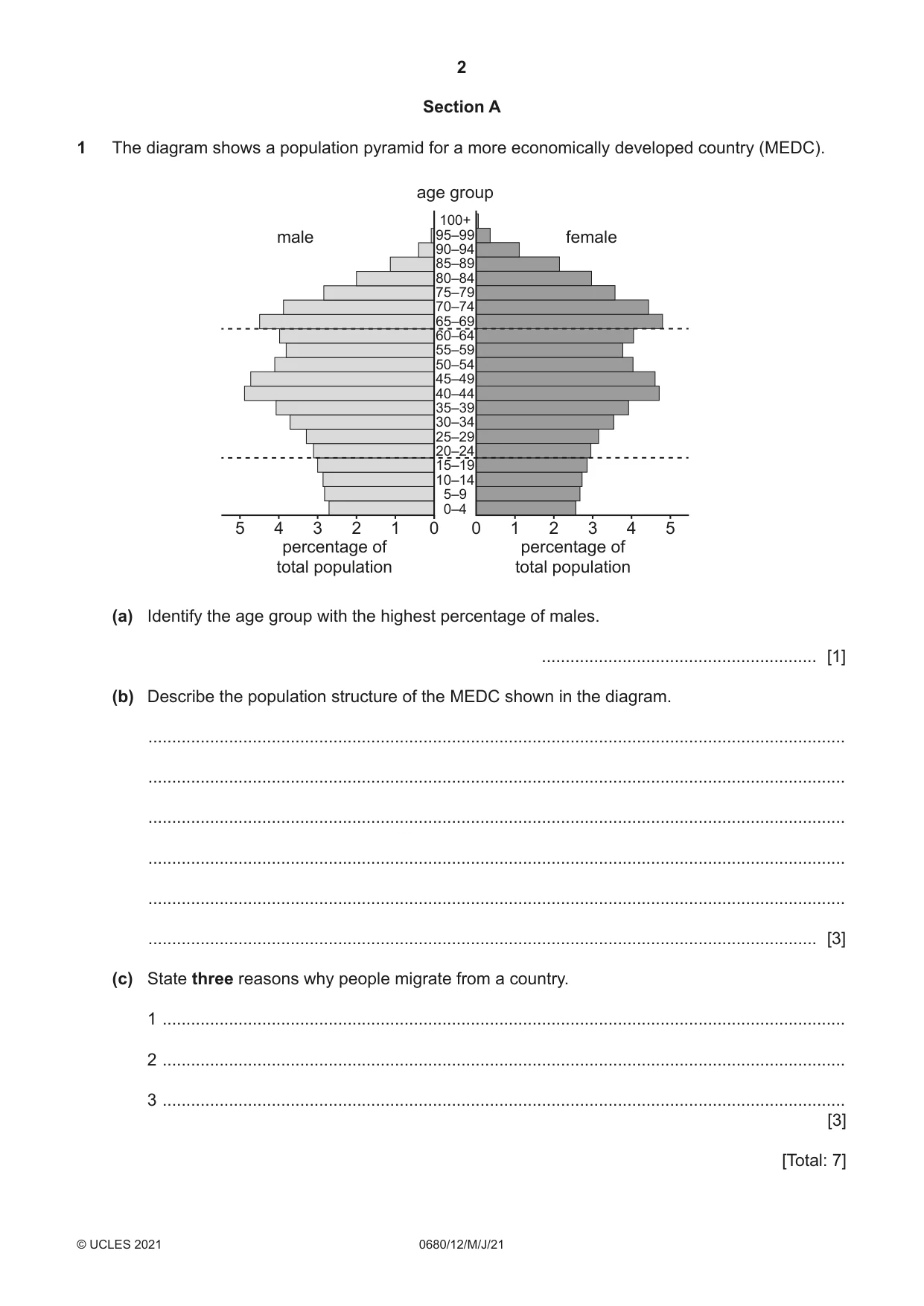
2 0680/12/M/J/21 © UCLES 2021 Section A 1 The diagram shows a population pyramid for a more economically developed country (MEDC). 100+ 95–99 90–94 85–89 80–84 75–79 70–74 65–69 60–64 55–59 50–54 45–49 40–44 35–39 30–34 25–29 20–24 15–19 10–14 5–9 0–4 0 0 1 1 2 2 3 percentage of total population percentage of total population age group 3 4 4 5 5 male female (a) Identify the age group with the highest percentage of males. … [1] (b) Describe the population structure of the MEDC shown in the diagram. … … … … … … [3] (c) State three reasons why people migrate from a country. 1 … 2 … 3 … [3] [Total: 7]
Question paper, page 3
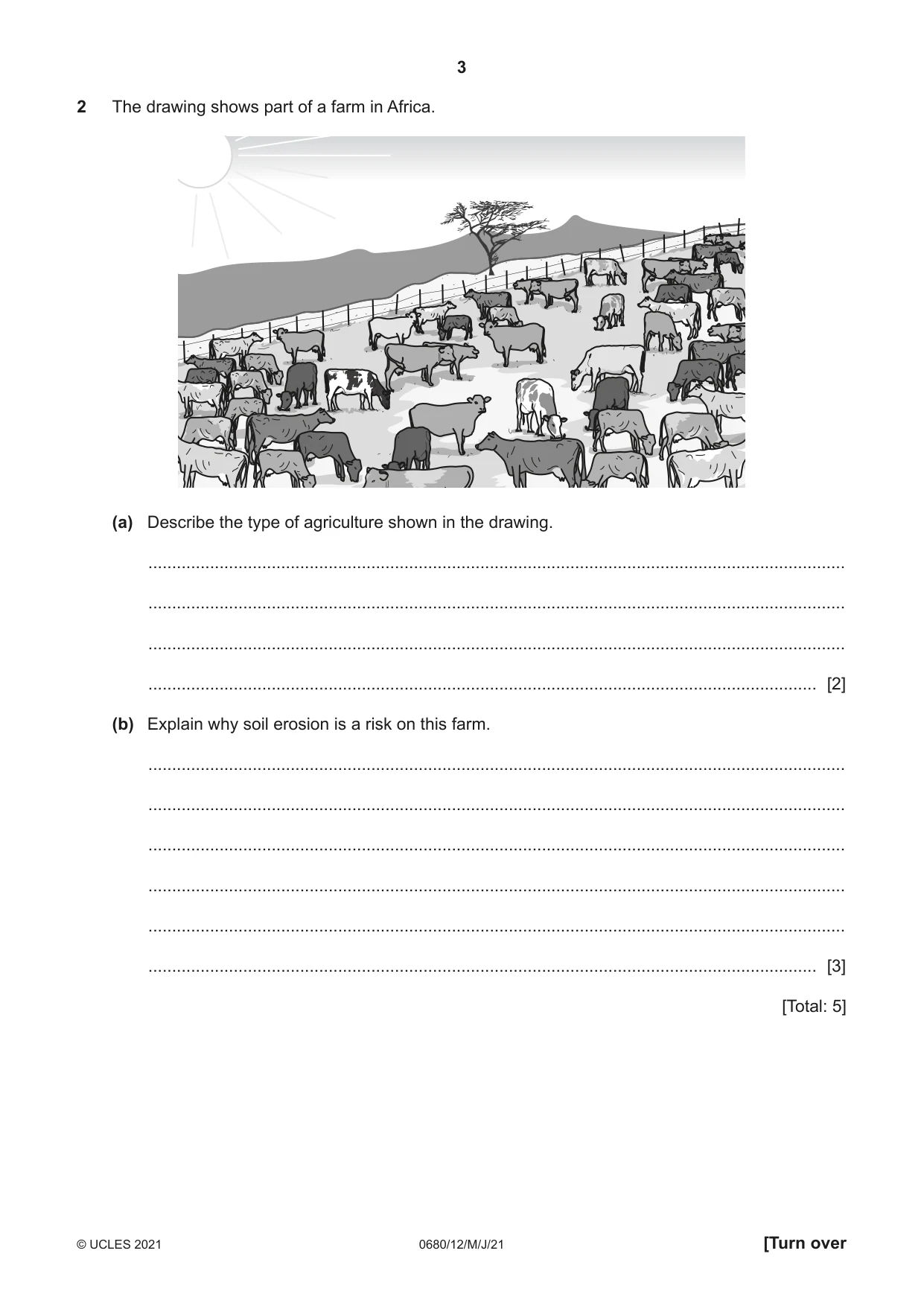
3 0680/12/ M / J /21 © UCLES 2021 [Turn over 2 The drawing shows part of a farm in Africa. (a) Describe the type of agriculture shown in the drawing. … … … … [2] (b) Explain why soil erosion is a risk on this farm. … … … … … … [3] [Total: 5]
Question paper, page 4
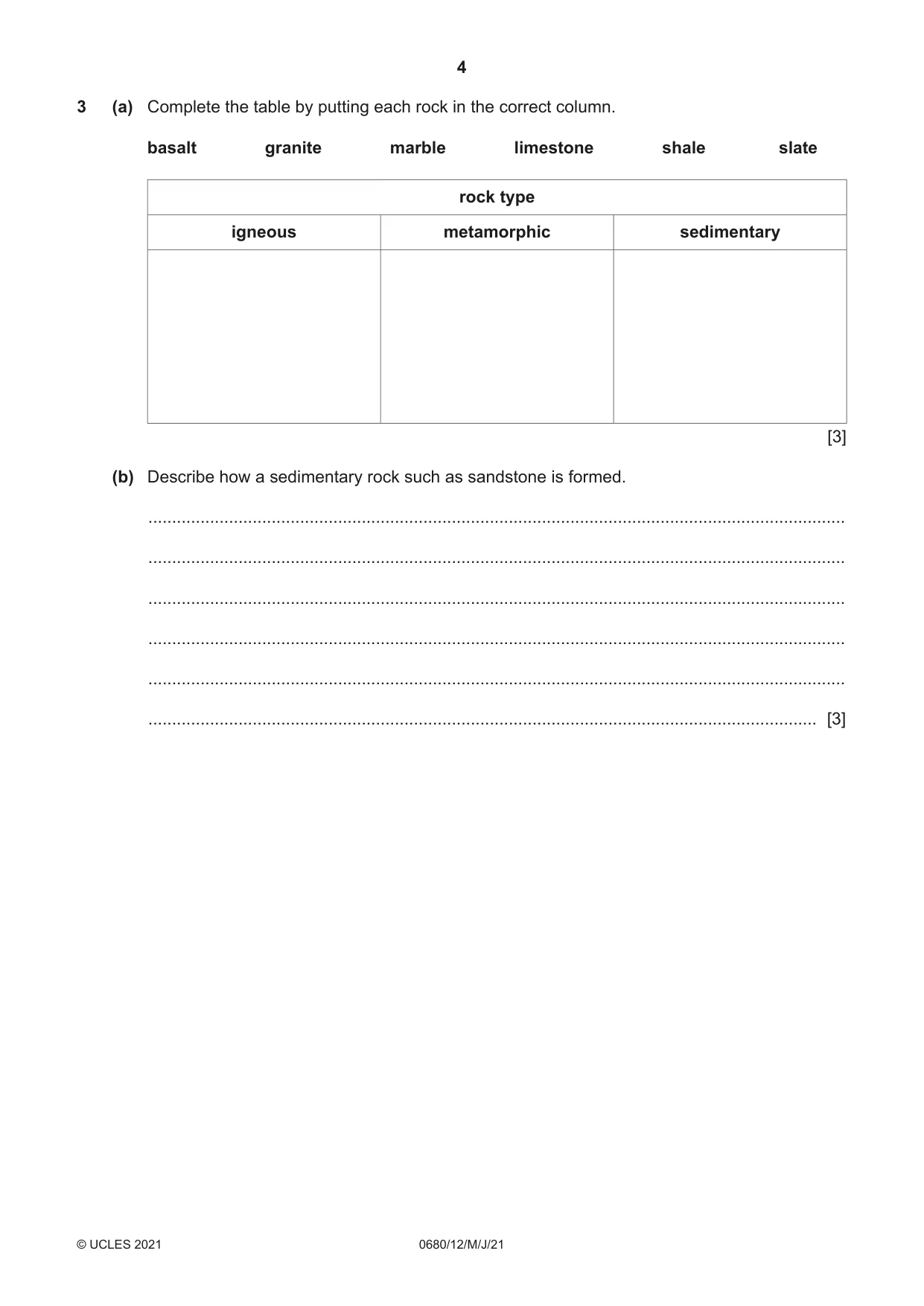
4 0680/12/M/J/21 © UCLES 2021 3 (a) Complete the table by putting each rock in the correct column. basalt granite marble limestone shale slate rock type igneous metamorphic sedimentary [3] (b) Describe how a sedimentary rock such as sandstone is formed. … … … … … … [3]
Question paper, page 5
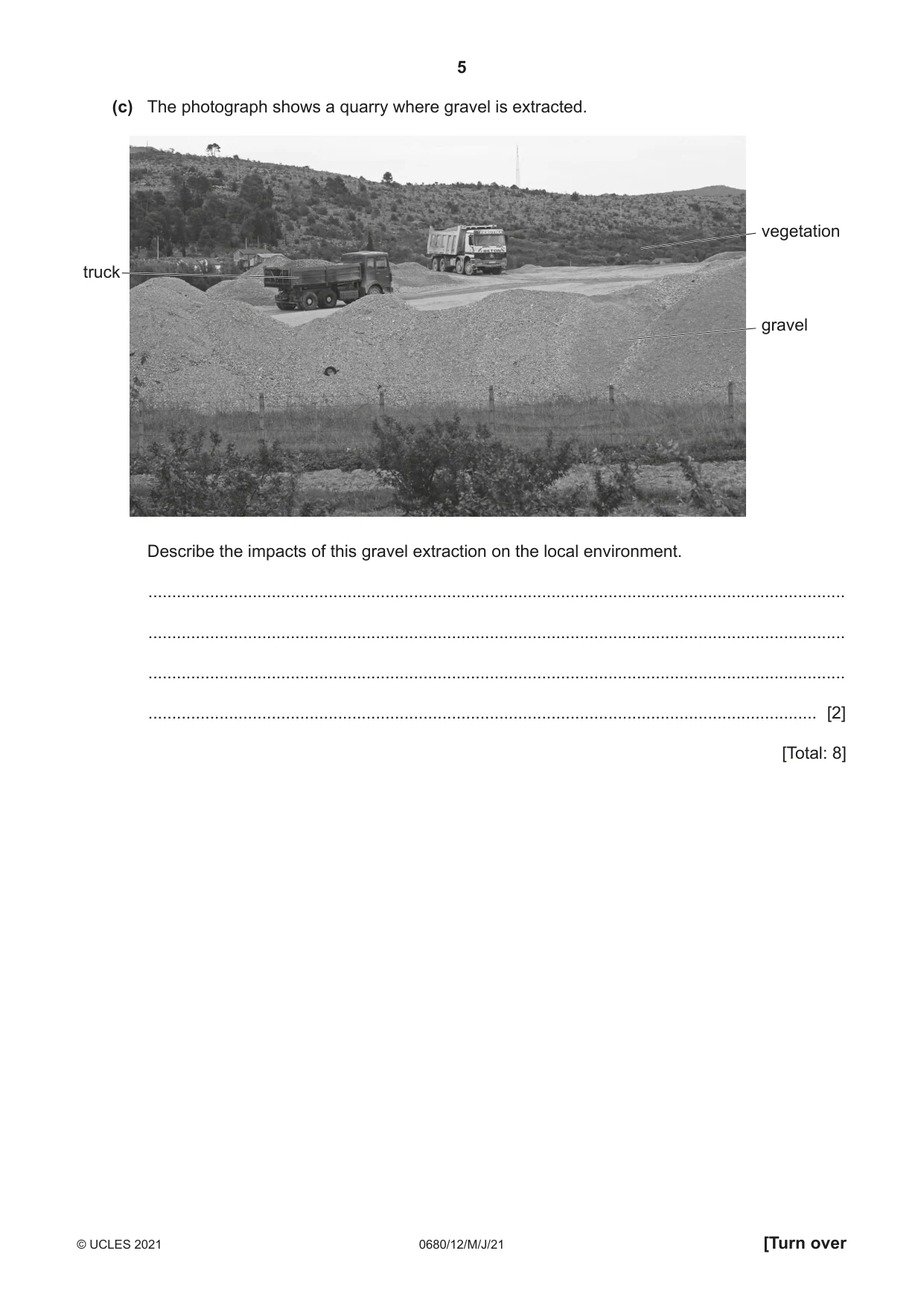
5 0680/12/M/J/21 © UCLES 2021 [Turn over (c) The photograph shows a quarry where gravel is extracted. truck vegetation gravel Describe the impacts of this gravel extraction on the local environment. … … … … [2] [Total: 8]
Question paper, page 6
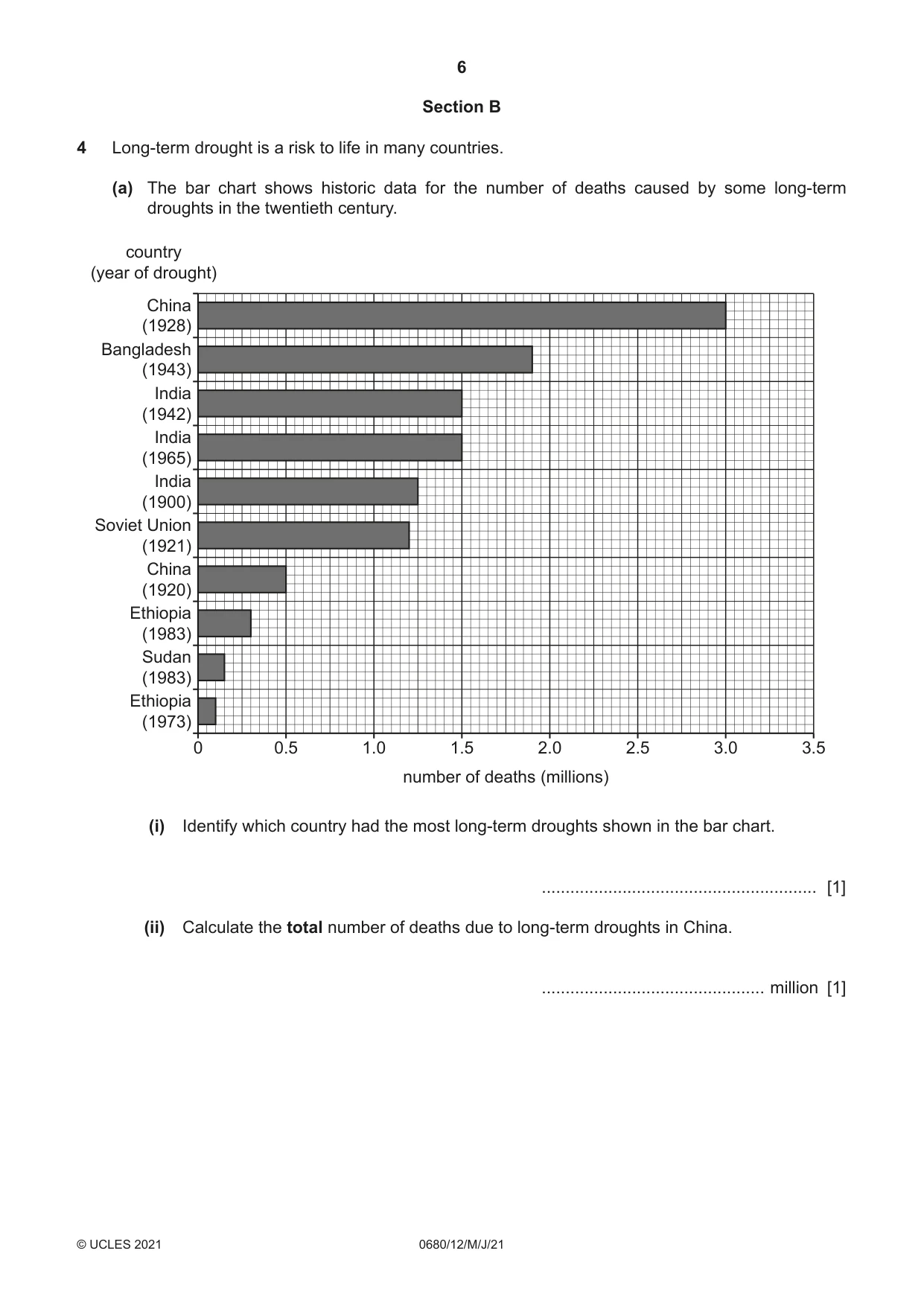
6 0680/12/M/J/21 © UCLES 2021 Section B 4 Long-term drought is a risk to life in many countries. (a) The bar chart shows historic data for the number of deaths caused by some long-term droughts in the twentieth century. 0 0.5 1.0 1.5 2.0 number of deaths (millions) 2.5 3.0 3.5 China (1928) country (year of drought) Bangladesh (1943) India (1942) India (1965) India (1900) Soviet Union (1921) China (1920) Ethiopia (1983) Sudan (1983) Ethiopia (1973) (i) Identify which country had the most long-term droughts shown in the bar chart. … [1] (ii) Calculate the total number of deaths due to long-term droughts in China. … million [1]
Question paper, page 7
7 0680/12/M/J/21 © UCLES 2021 [Turn over (b) Death is one impact of long-term drought on people. Describe other impacts of long-term drought. … … … … … … … … [4] (c) Long-term droughts in MEDCs are less likely to result in large numbers of deaths than long-term droughts in LEDCs. Suggest why. … … … … … … … … [4] (d) A scientist said, ‘Long-term droughts are expected to occur more frequently in the next 50 years.’ Suggest reasons why long-term droughts are expected to occur more frequently. … … … … [2]
Question paper, page 8
8 0680/12/M/J/21 © UCLES 2021 (e) Suggest why people continue to live in areas where long-term droughts occur. … … [1] [Total: 13]
Question paper, page 9
9 0680/12/M/J/21 © UCLES 2021 [Turn over BLANK PAGE
Question paper, page 10
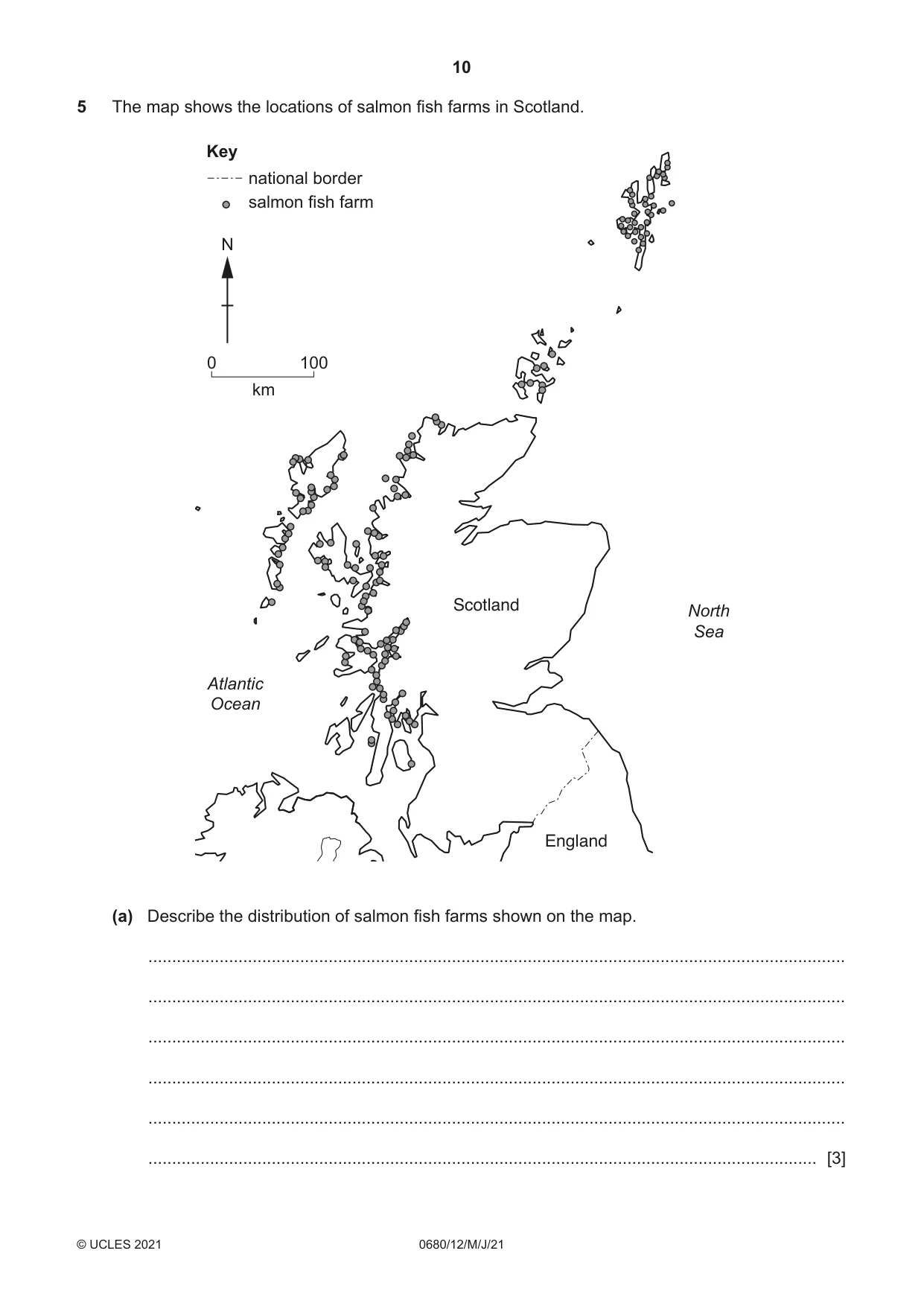
10 0680/12/M/J/21 © UCLES 2021 5 The map shows the locations of salmon fish farms in Scotland. 0 100 km Atlantic Ocean North Sea N Key salmon fish farm national border Scotland England (a) Describe the distribution of salmon fish farms shown on the map. … … … … … … [3]
Question paper, page 11
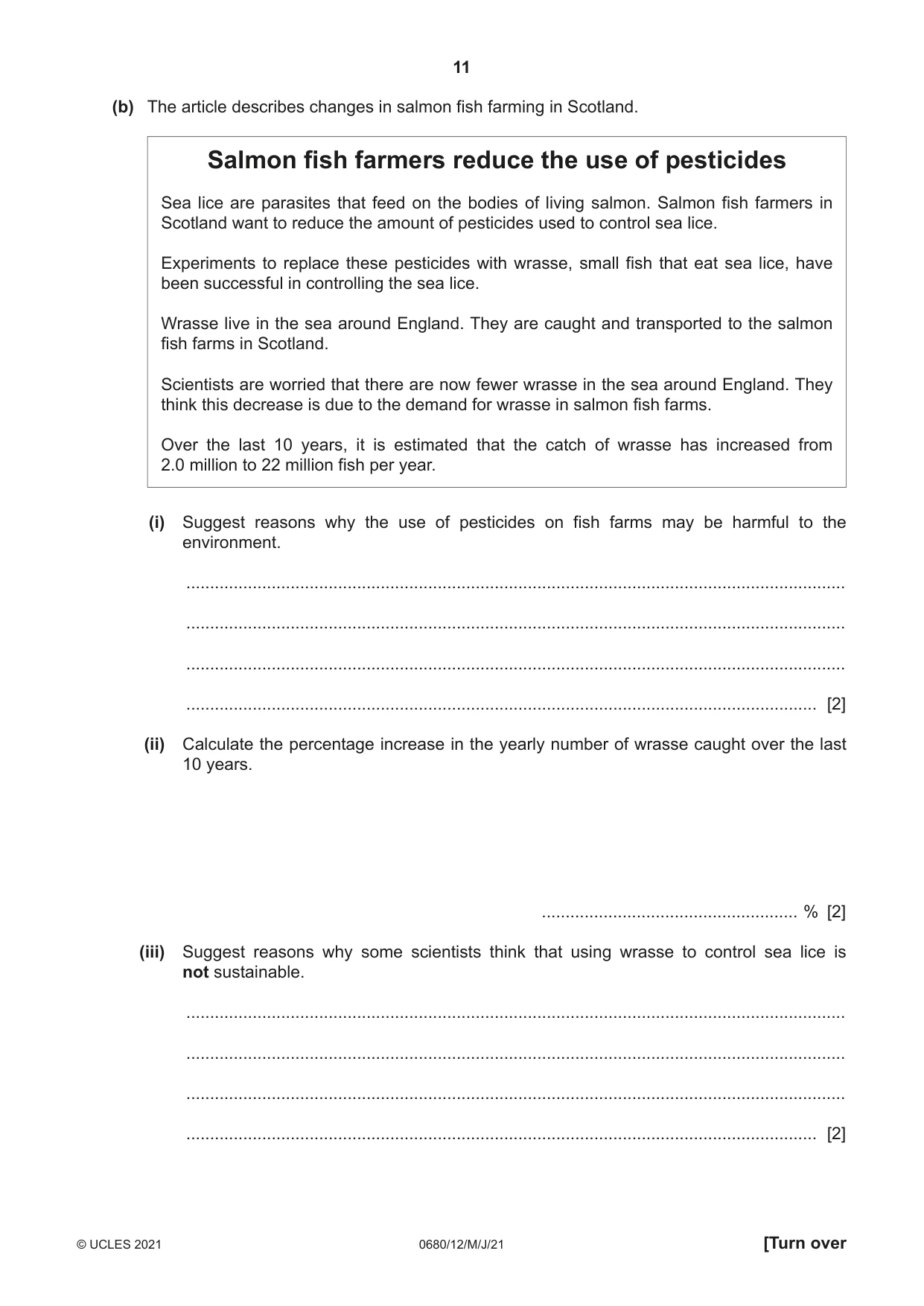
11 0680/12/M/J/21 © UCLES 2021 [Turn over (b) The article describes changes in salmon fish farming in Scotland. Salmon fish farmers reduce the use of pesticides Sea lice are parasites that feed on the bodies of living salmon. Salmon fish farmers in Scotland want to reduce the amount of pesticides used to control sea lice. Experiments to replace these pesticides with wrasse, small fish that eat sea lice, have been successful in controlling the sea lice. Wrasse live in the sea around England. They are caught and transported to the salmon fish farms in Scotland. Scientists are worried that there are now fewer wrasse in the sea around England. They think this decrease is due to the demand for wrasse in salmon fish farms. Over the last 10 years, it is estimated that the catch of wrasse has increased from 2.0 million to 22 million fish per year. (i) Suggest reasons why the use of pesticides on fish farms may be harmful to the environment. … … … … [2] (ii) Calculate the percentage increase in the yearly number of wrasse caught over the last 10 years. … % [2] (iii) Suggest reasons why some scientists think that using wrasse to control sea lice is not sustainable. … … … … [2]
Question paper, page 12
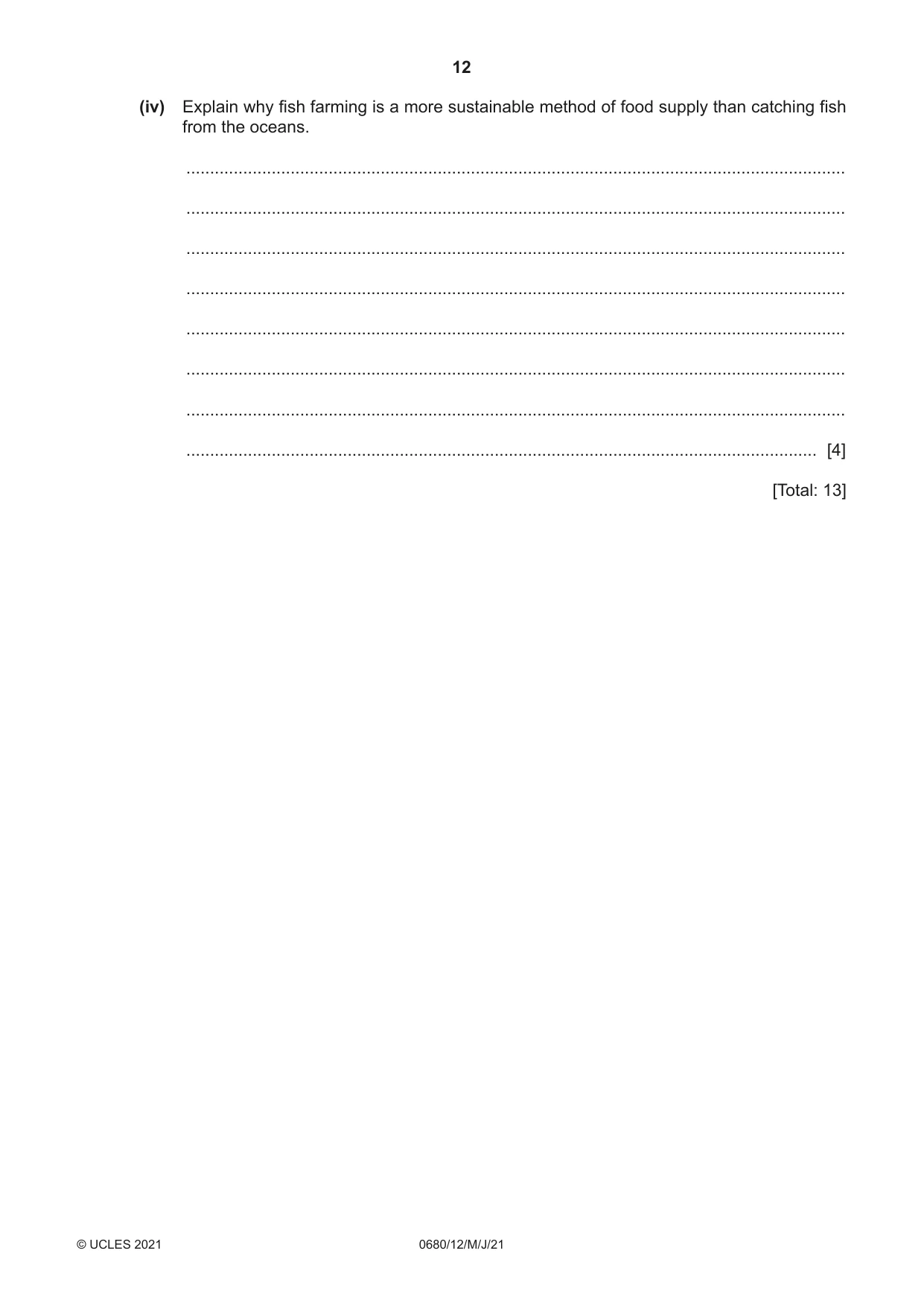
12 0680/12/M/J/21 © UCLES 2021 (iv) Explain why fish farming is a more sustainable method of food supply than catching fish from the oceans. … … … … … … … … [4] [Total: 13]
Question paper, page 13
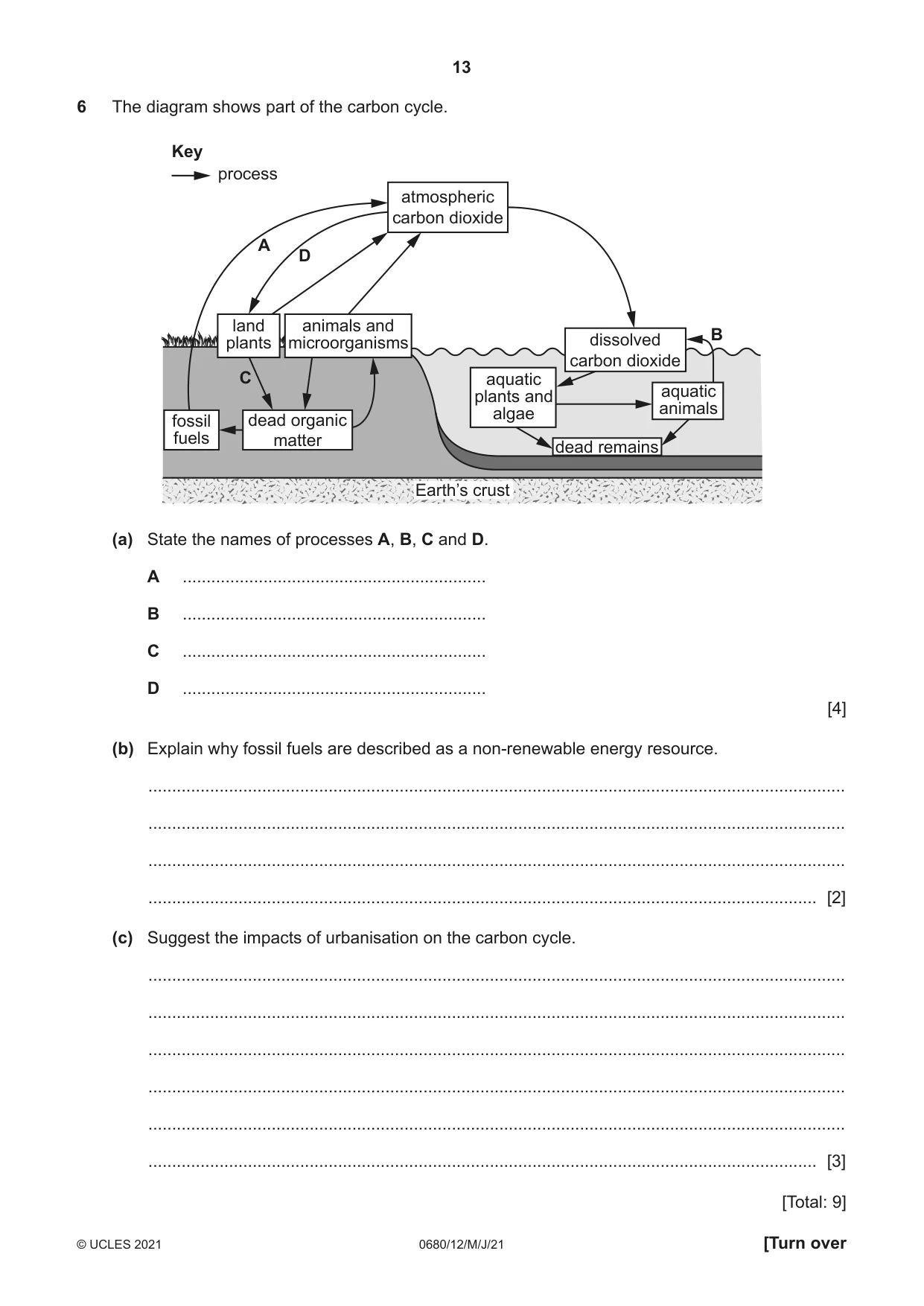
13 0680/12/M/J/21 © UCLES 2021 [Turn over 6 The diagram shows part of the carbon cycle. atmospheric carbon dioxide dissolved carbon dioxide aquatic animals B animals and microorganisms Earth’s crust land plants fossil fuels aquatic plants and algae dead remains dead organic matter process Key A D C (a) State the names of processes A, B, C and D. A … B … C … D … [4] (b) Explain why fossil fuels are described as a non-renewable energy resource. … … … … [2] (c) Suggest the impacts of urbanisation on the carbon cycle. … … … … … … [3] [Total: 9]
Question paper, page 14
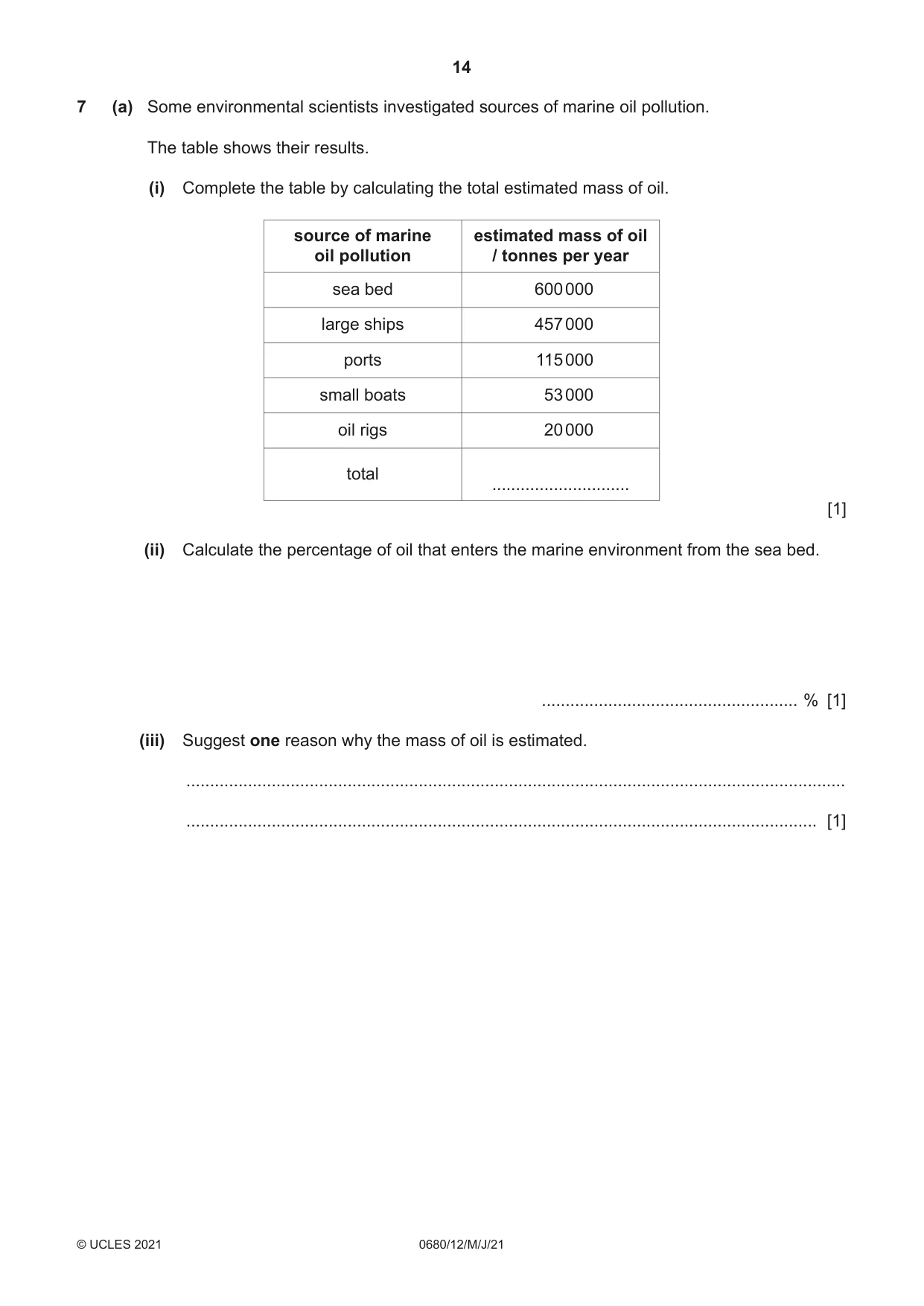
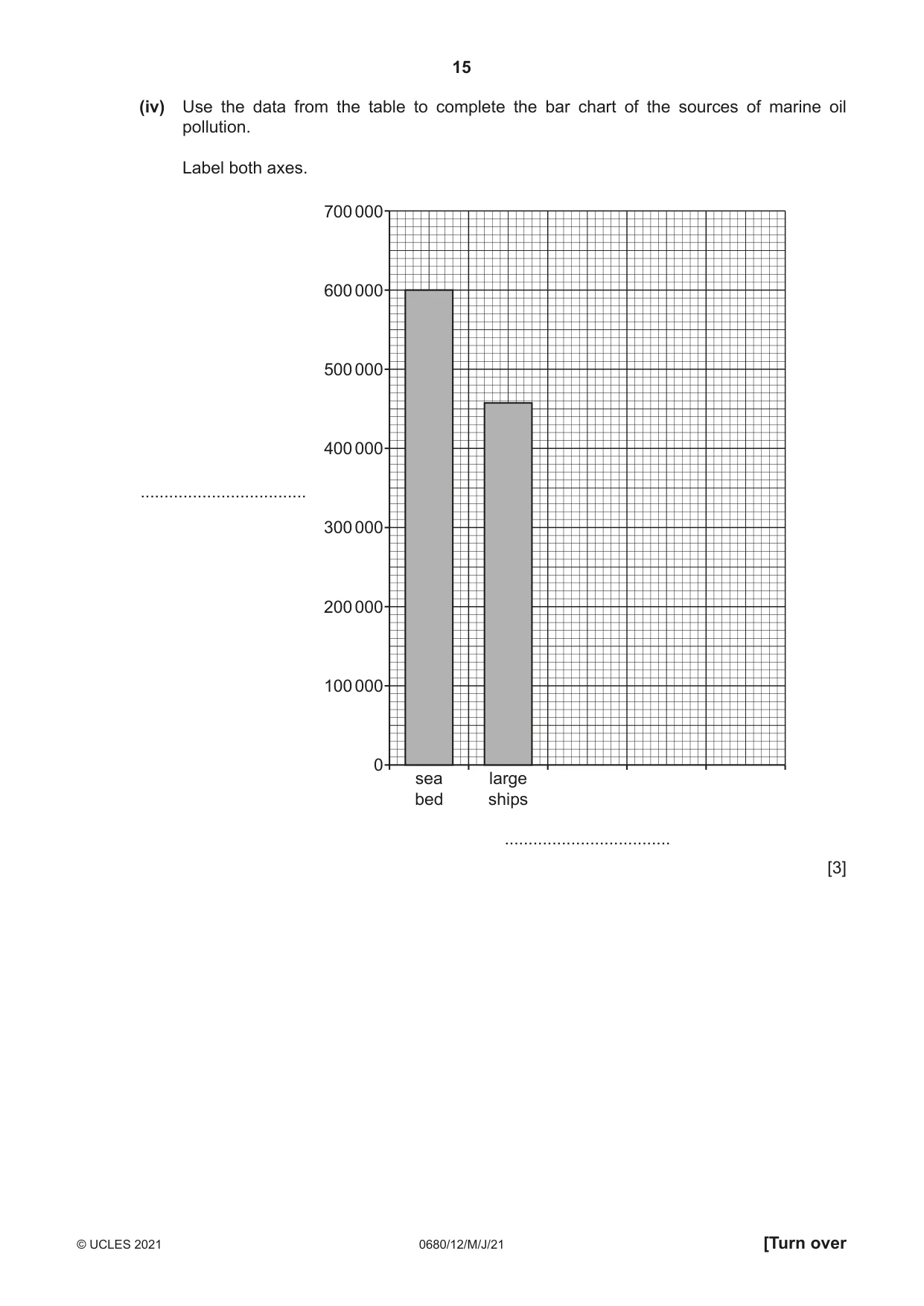
14 0680/12/M/J/21 © UCLES 2021 7 (a) Some environmental scientists investigated sources of marine oil pollution. The table shows their results. (i) Complete the table by calculating the total estimated mass of oil. source of marine oil pollution estimated mass of oil / tonnes per year sea bed 600 000 large ships 457 000 ports 115 000 small boats 53 000 oil rigs 20 000 total … [1] (ii) Calculate the percentage of oil that enters the marine environment from the sea bed. … % [1] (iii) Suggest one reason why the mass of oil is estimated. … … [1]
Question paper, page 15
15 0680/12/M/J/21 © UCLES 2021 (iv) Use the data from the table to complete the bar chart of the sources of marine oil pollution. Label both axes. 0 100 000 200 000 300 000 … … 400 000 500 000 600 000 700 000 large ships sea bed [3] [Turn over
Question paper, page 16
16 0680/12/M/J/21 © UCLES 2021 (b) Describe the impacts of an oil spill on a marine ecosystem. … … … … … … … … [4] (c) Oil tankers are a major source of marine oil pollution. Describe strategies to reduce the risk of oil spills. … … … … … … [3] [Total: 13]
Question paper, page 17
17 0680/12/M/J/21 © UCLES 2021 [Turn over BLANK PAGE
Question paper, page 18
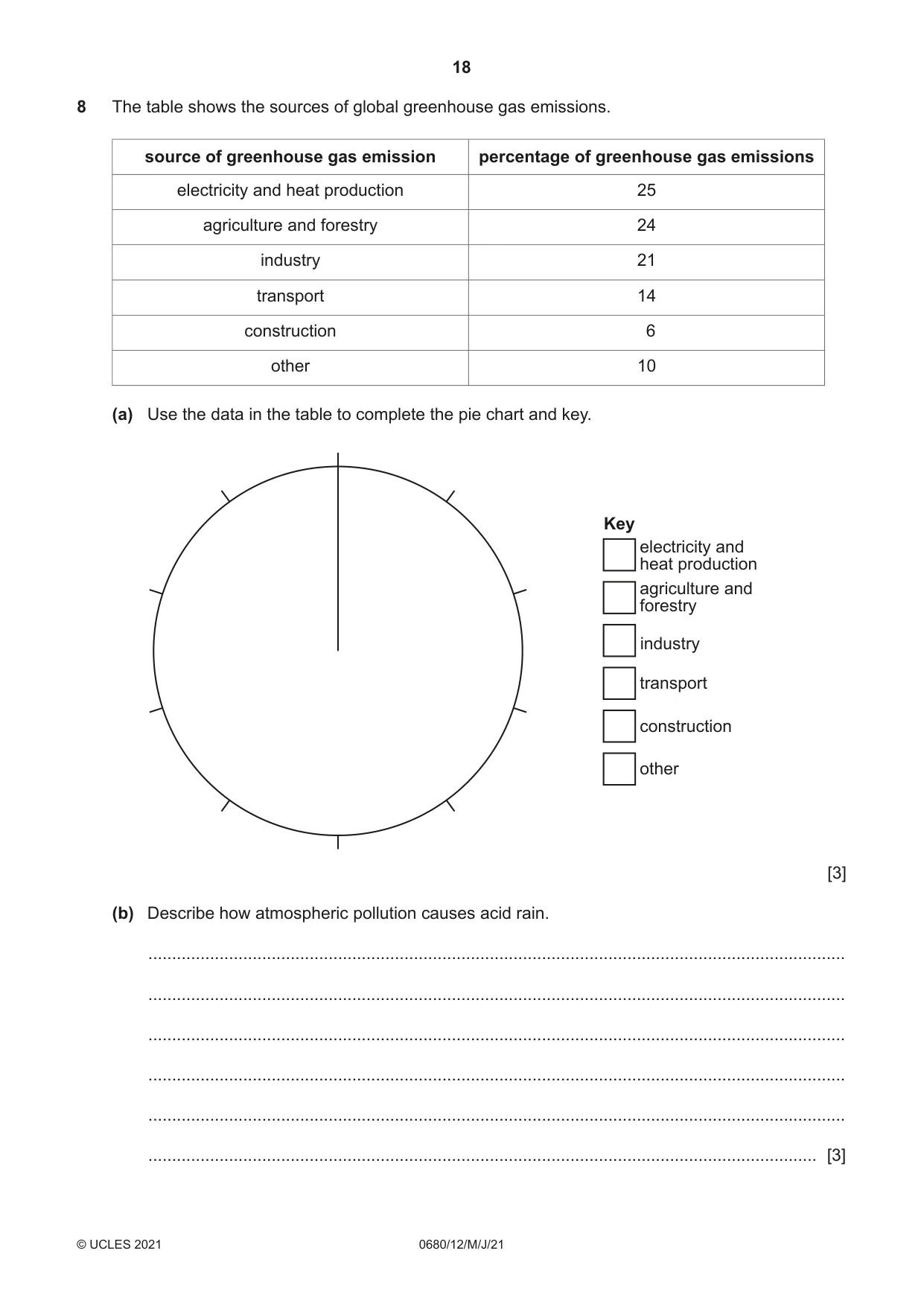
18 0680/12/M/J/21 © UCLES 2021 8 The table shows the sources of global greenhouse gas emissions. source of greenhouse gas emission percentage of greenhouse gas emissions electricity and heat production 25 agriculture and forestry 24 industry 21 transport 14 construction 6 other 10 (a) Use the data in the table to complete the pie chart and key. electricity and heat production Key agriculture and forestry industry transport construction other [3] (b) Describe how atmospheric pollution causes acid rain. … … … … … … [3]
Question paper, page 19
19 0680/12/M/J/21 © UCLES 2021 (c) A student says: We cannot allow the level of atmospheric pollution to continue increasing. International laws are needed to force countries to reduce their atmospheric pollution by at least 20% over the next 10 years. To what extent do you agree with this statement? Give reasons for your answer. … … … … … … … … … … … … … … … [6] [Total: 12]
Question paper, page 20
20 0680/12/M/J/21 © UCLES 2021 BLANK PAGE The boundaries and names shown, the designations used and the presentation of material on any maps contained in this question paper/insert do not imply official endorsement or acceptance by Cambridge Assessment International Education concerning the legal status of any country, territory, or area or any of its authorities, or of the delimitation of its frontiers or boundaries. Permission to reproduce items where third-party owned material protected by copyright is included has been sought and cleared where possible. Every reasonable effort has been made by the publisher (UCLES) to trace copyright holders, but if any items requiring clearance have unwittingly been included, the publisher will be pleased to make amends at the earliest possible opportunity. To avoid the issue of disclosure of answer-related information to candidates, all copyright acknowledgements are reproduced online in the Cambridge Assessment International Education Copyright Acknowledgements Booklet. This is produced for each series of examinations and is freely available to download at www.cambridgeinternational.org after the live examination series. Cambridge Assessment International Education is part of the Cambridge Assessment Group. Cambridge Assessment is the brand name of the University of Cambridge Local Examinations Syndicate (UCLES), which itself is a department of the University of Cambridge.
Mark scheme, page 1
This document consists of 12 printed pages. © UCLES 2021 [Turn over Cambridge IGCSE™ ENVIRONMENTAL MANAGEMENT 0680/12 Paper 1 Theory May/June 2021 MARK SCHEME Maximum Mark: 80 Published This mark scheme is published as an aid to teachers and candidates, to indicate the requirements of the examination. It shows the basis on which Examiners were instructed to award marks. It does not indicate the details of the discussions that took place at an Examiners’ meeting before marking began, which would have considered the acceptability of alternative answers. Mark schemes should be read in conjunction with the question paper and the Principal Examiner Report for Teachers. Cambridge International will not enter into discussions about these mark schemes. Cambridge International is publishing the mark schemes for the May/June 2021 series for most Cambridge IGCSE™, Cambridge International A and AS Level components and some Cambridge O Level components.
Mark scheme, page 2
0680/12 Cambridge IGCSE – Mark Scheme PUBLISHED May/June 2021 © UCLES 2021 Page 2 of 12 Generic Marking Principles These general marking principles must be applied by all examiners when marking candidate answers. They should be applied alongside the specific content of the mark scheme or generic level descriptors for a question. Each question paper and mark scheme will also comply with these marking principles. GENERIC MARKING PRINCIPLE 1: Marks must be awarded in line with: • the specific content of the mark scheme or the generic level descriptors for the question • the specific skills defined in the mark scheme or in the generic level descriptors for the question • the standard of response required by a candidate as exemplified by the standardisation scripts. GENERIC MARKING PRINCIPLE 2: Marks awarded are always whole marks (not half marks, or other fractions). GENERIC MARKING PRINCIPLE 3: Marks must be awarded positively: • marks are awarded for correct/valid answers, as defined in the mark scheme. However, credit is given for valid answers which go beyond the scope of the syllabus and mark scheme, referring to your Team Leader as appropriate • marks are awarded when candidates clearly demonstrate what they know and can do • marks are not deducted for errors • marks are not deducted for omissions • answers should only be judged on the quality of spelling, punctuation and grammar when these features are specifically assessed by the question as indicated by the mark scheme. The meaning, however, should be unambiguous. GENERIC MARKING PRINCIPLE 4: Rules must be applied consistently, e.g. in situations where candidates have not followed instructions or in the application of generic level descriptors.
Mark scheme, page 3
0680/12 Cambridge IGCSE – Mark Scheme PUBLISHED May/June 2021 © UCLES 2021 Page 3 of 12 GENERIC MARKING PRINCIPLE 5: Marks should be awarded using the full range of marks defined in the mark scheme for the question (however; the use of the full mark range may be limited according to the quality of the candidate responses seen). GENERIC MARKING PRINCIPLE 6: Marks awarded are based solely on the requirements as defined in the mark scheme. Marks should not be awarded with grade thresholds or grade descriptors in mind. Science-Specific Marking Principles 1 Examiners should consider the context and scientific use of any keywords when awarding marks. Although keywords may be present, marks should not be awarded if the keywords are used incorrectly. 2 The examiner should not choose between contradictory statements given in the same question part, and credit should not be awarded for any correct statement that is contradicted within the same question part. Wrong science that is irrelevant to the question should be ignored. 3 Although spellings do not have to be correct, spellings of syllabus terms must allow for clear and unambiguous separation from other syllabus terms with which they may be confused (e.g. ethane / ethene, glucagon / glycogen, refraction / reflection). 4 The error carried forward (ecf) principle should be applied, where appropriate. If an incorrect answer is subsequently used in a scientifically correct way, the candidate should be awarded these subsequent marking points. Further guidance will be included in the mark scheme where necessary and any exceptions to this general principle will be noted. 5 ‘List rule’ guidance For questions that require n responses (e.g. State two reasons …): • The response should be read as continuous prose, even when numbered answer spaces are provided. • Any response marked ignore in the mark scheme should not count towards n. • Incorrect responses should not be awarded credit but will still count towards n. • Read the entire response to check for any responses that contradict those that would otherwise be credited. Credit should not be awarded for any responses that are contradicted within the rest of the response. Where two responses contradict one another, this should be treated as a single incorrect response. • Non-contradictory responses after the first n responses may be ignored even if they include incorrect science.
Mark scheme, page 4
0680/12 Cambridge IGCSE – Mark Scheme PUBLISHED May/June 2021 © UCLES 2021 Page 4 of 12 6 Calculation specific guidance Correct answers to calculations should be given full credit even if there is no working or incorrect working, unless the question states ‘show your working’. For questions in which the number of significant figures required is not stated, credit should be awarded for correct answers when rounded by the examiner to the number of significant figures given in the mark scheme. This may not apply to measured values. For answers given in standard form (e.g. a × 10n) in which the convention of restricting the value of the coefficient (a) to a value between 1 and 10 is not followed, credit may still be awarded if the answer can be converted to the answer given in the mark scheme. Unless a separate mark is given for a unit, a missing or incorrect unit will normally mean that the final calculation mark is not awarded. Exceptions to this general principle will be noted in the mark scheme. 7 Guidance for chemical equations Multiples / fractions of coefficients used in chemical equations are acceptable unless stated otherwise in the mark scheme. State symbols given in an equation should be ignored unless asked for in the question or stated otherwise in the mark scheme.
Mark scheme, page 5
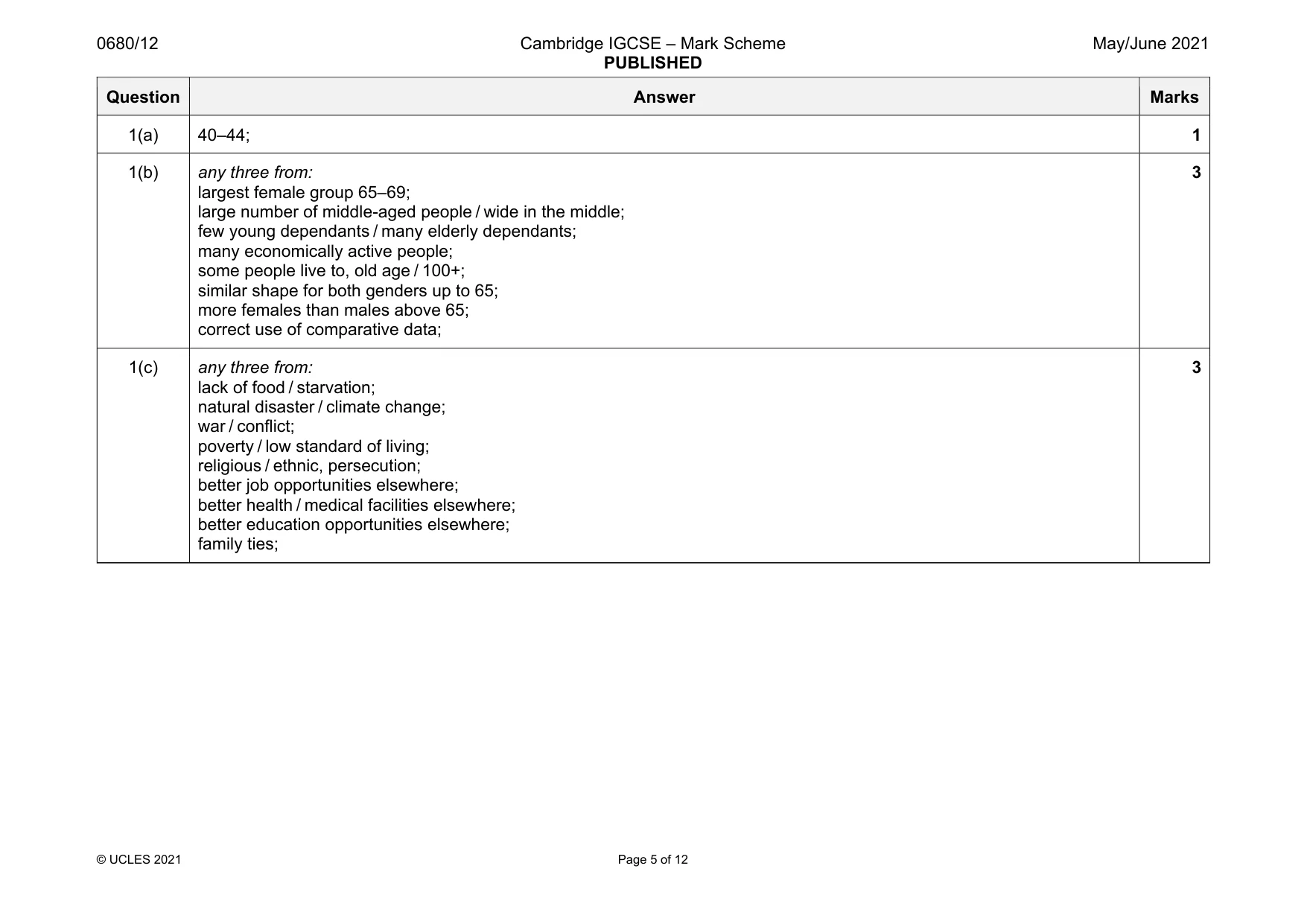
0680/12 Cambridge IGCSE – Mark Scheme PUBLISHED May/June 2021 © UCLES 2021 Page 5 of 12 Question Answer Marks 1(a) 40–44; 1 1(b) any three from: largest female group 65–69; large number of middle-aged people / wide in the middle; few young dependants / many elderly dependants; many economically active people; some people live to, old age / 100+; similar shape for both genders up to 65; more females than males above 65; correct use of comparative data; 3 1(c) any three from: lack of food / starvation; natural disaster / climate change; war / conflict; poverty / low standard of living; religious / ethnic, persecution; better job opportunities elsewhere; better health / medical facilities elsewhere; better education opportunities elsewhere; family ties; 3
Mark scheme, page 6
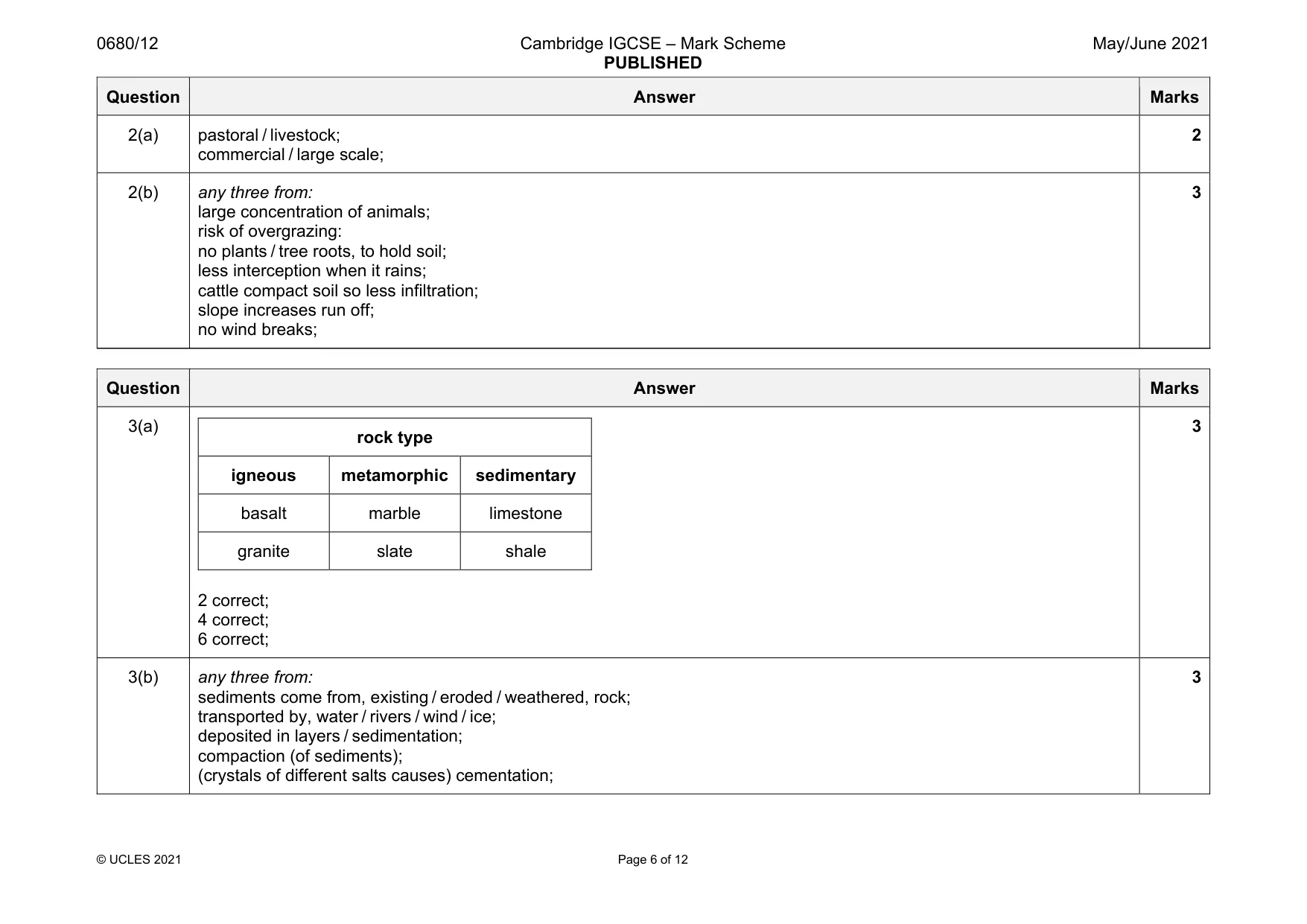
0680/12 Cambridge IGCSE – Mark Scheme PUBLISHED May/June 2021 © UCLES 2021 Page 6 of 12 Question Answer Marks 2(a) pastoral / livestock; commercial / large scale; 2 2(b) any three from: large concentration of animals; risk of overgrazing: no plants / tree roots, to hold soil; less interception when it rains; cattle compact soil so less infiltration; slope increases run off; no wind breaks; 3 Question Answer Marks 3(a) rock type igneous metamorphic sedimentary basalt marble limestone granite slate shale 2 correct; 4 correct; 6 correct; 3 3(b) any three from: sediments come from, existing / eroded / weathered, rock; transported by, water / rivers / wind / ice; deposited in layers / sedimentation; compaction (of sediments); (crystals of different salts causes) cementation; 3
Mark scheme, page 7
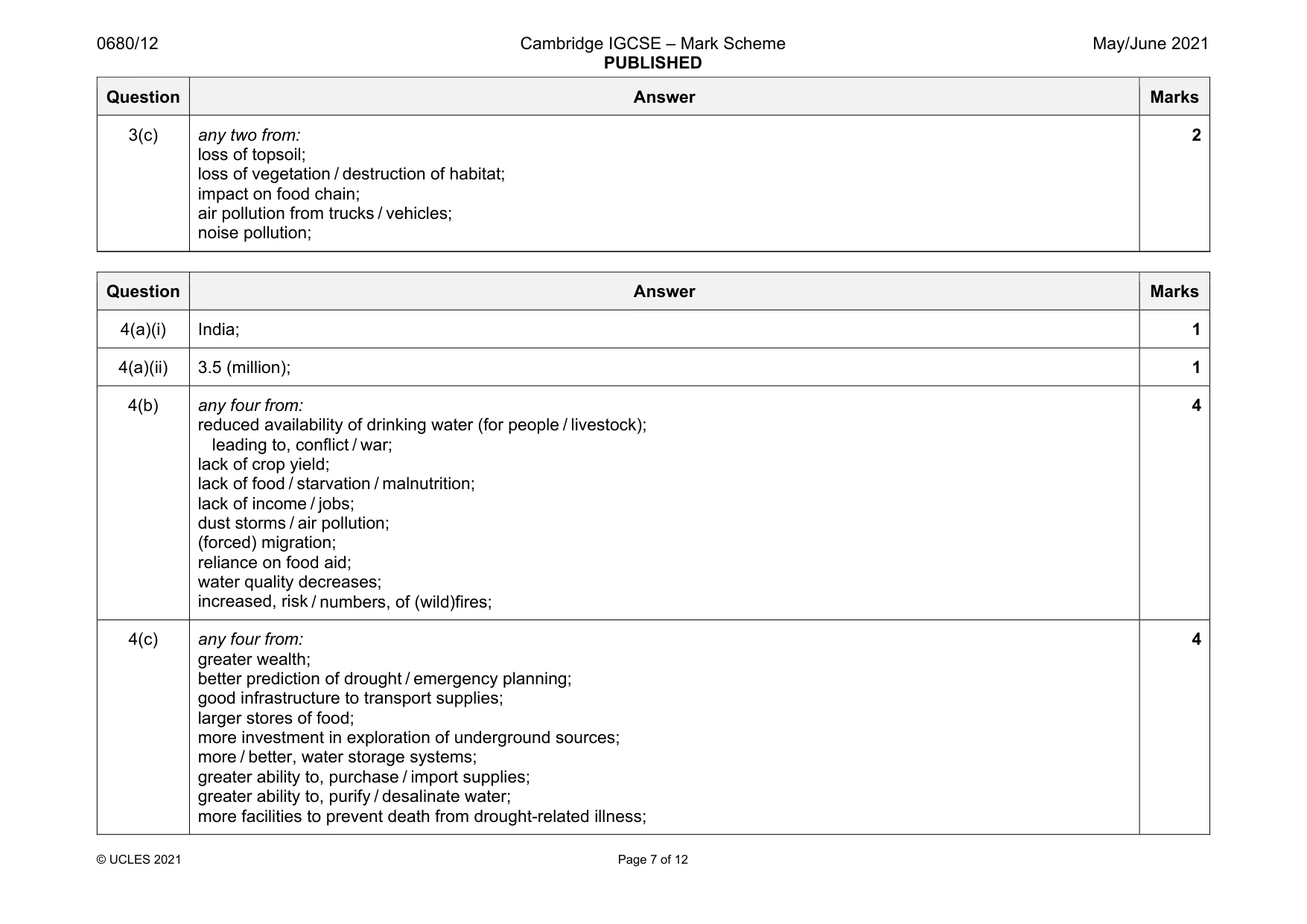
0680/12 Cambridge IGCSE – Mark Scheme PUBLISHED May/June 2021 © UCLES 2021 Page 7 of 12 Question Answer Marks 3(c) any two from: loss of topsoil; loss of vegetation / destruction of habitat; impact on food chain; air pollution from trucks / vehicles; noise pollution; 2 Question Answer Marks 4(a)(i) India; 1 4(a)(ii) 3.5 (million); 1 4(b) any four from: reduced availability of drinking water (for people / livestock); leading to, conflict / war; lack of crop yield; lack of food / starvation / malnutrition; lack of income / jobs; dust storms / air pollution; (forced) migration; reliance on food aid; water quality decreases; increased, risk / numbers, of (wild)fires; 4 4(c) any four from: greater wealth; better prediction of drought / emergency planning; good infrastructure to transport supplies; larger stores of food; more investment in exploration of underground sources; more / better, water storage systems; greater ability to, purchase / import supplies; greater ability to, purify / desalinate water; more facilities to prevent death from drought-related illness; 4
Mark scheme, page 8
0680/12 Cambridge IGCSE – Mark Scheme PUBLISHED May/June 2021 © UCLES 2021 Page 8 of 12 Question Answer Marks 4(d) any two from: climate change; higher temperatures / global warming; increased evaporation; disruption to rainfall patterns; increased population; increased deforestation; increased urbanisation (qualified); 2 4(e) tradition / family ties / jobs / qualified economic reason; 1 Question Answer Marks 5(a) any three from: situated on, the coast / coastlines; of western mainland Scotland / owtte; of islands, to north(east) / in North Sea; of islands, to (north)west / in Atlantic Ocean; 3 5(b)(i) any two from: pesticides enter the ocean; (possible) toxic effect on marine life; impact on, food web / ecosystem; bioaccumulation; 2 5(b)(ii) change identified as 20 000 000; (20 000 000 ÷ 2 000 000 × 100 =) 1000%; 2 5(b)(iii) any two from: wrasse are being caught from the wild; impact on ecosystems from, removal / addition, of fish; wrasse are being caught at a greater rate than being replaced; wrasse normally live in England not Scotland; fish might escape from fish farms; bycatch; 2
Mark scheme, page 9
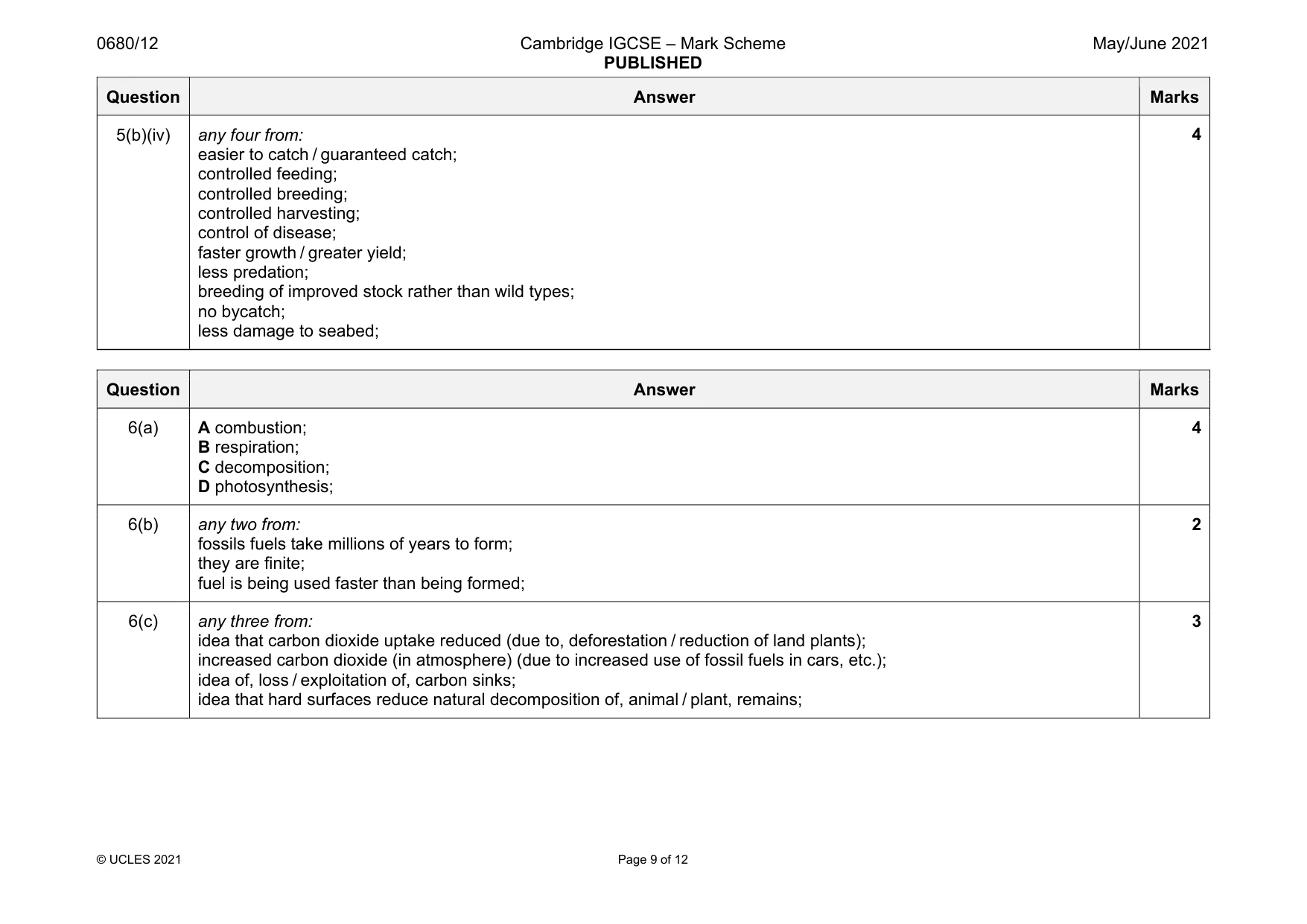
0680/12 Cambridge IGCSE – Mark Scheme PUBLISHED May/June 2021 © UCLES 2021 Page 9 of 12 Question Answer Marks 5(b)(iv) any four from: easier to catch / guaranteed catch; controlled feeding; controlled breeding; controlled harvesting; control of disease; faster growth / greater yield; less predation; breeding of improved stock rather than wild types; no bycatch; less damage to seabed; 4 Question Answer Marks 6(a) A combustion; B respiration; C decomposition; D photosynthesis; 4 6(b) any two from: fossils fuels take millions of years to form; they are finite; fuel is being used faster than being formed; 2 6(c) any three from: idea that carbon dioxide uptake reduced (due to, deforestation / reduction of land plants); increased carbon dioxide (in atmosphere) (due to increased use of fossil fuels in cars, etc.); idea of, loss / exploitation of, carbon sinks; idea that hard surfaces reduce natural decomposition of, animal / plant, remains; 3
Mark scheme, page 10
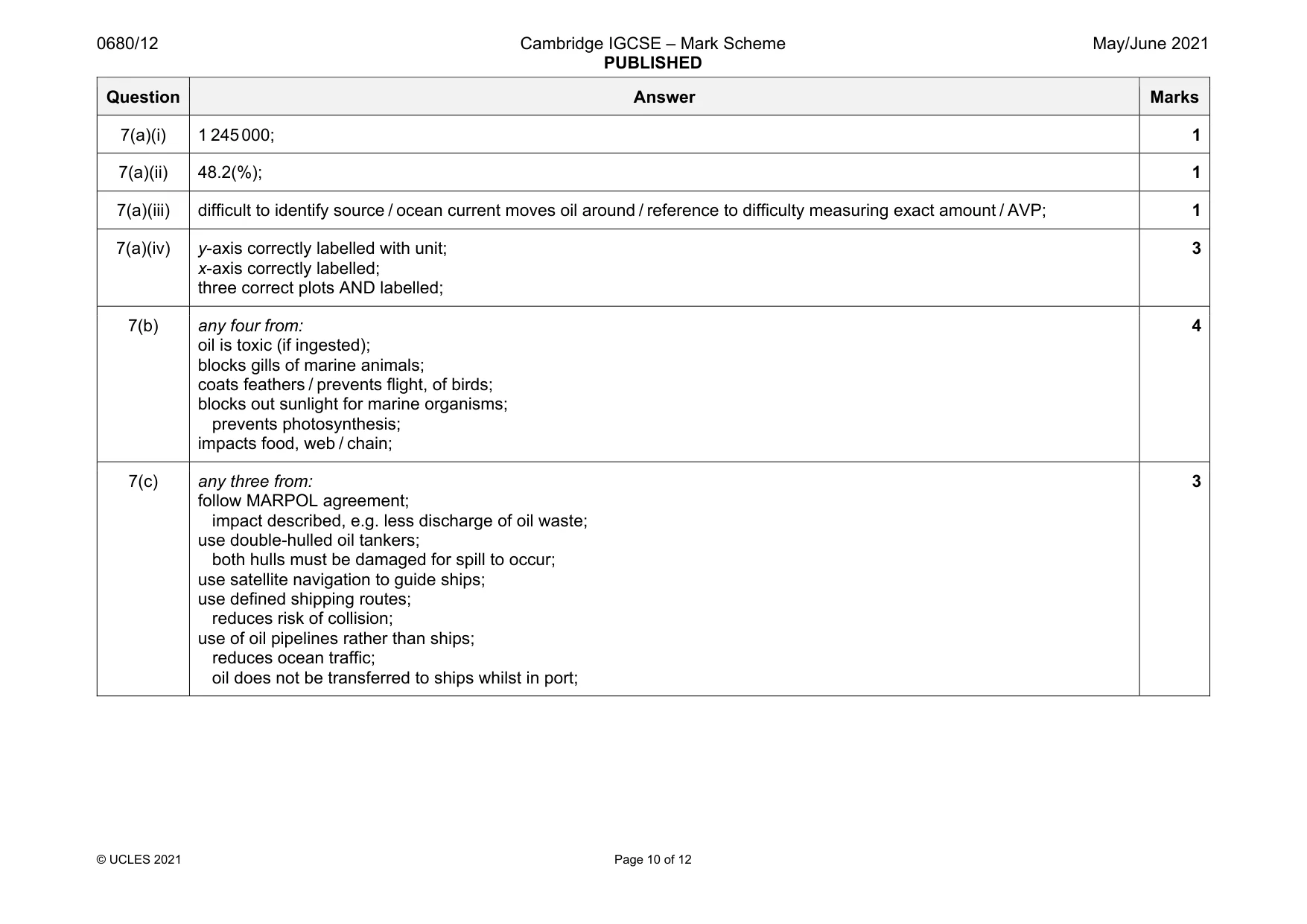
0680/12 Cambridge IGCSE – Mark Scheme PUBLISHED May/June 2021 © UCLES 2021 Page 10 of 12 Question Answer Marks 7(a)(i) 1 245000; 1 7(a)(ii) 48.2(%); 1 7(a)(iii) difficult to identify source / ocean current moves oil around / reference to difficulty measuring exact amount / AVP; 1 7(a)(iv) y-axis correctly labelled with unit; x-axis correctly labelled; three correct plots AND labelled; 3 7(b) any four from: oil is toxic (if ingested); blocks gills of marine animals; coats feathers / prevents flight, of birds; blocks out sunlight for marine organisms; prevents photosynthesis; impacts food, web / chain; 4 7(c) any three from: follow MARPOL agreement; impact described, e.g. less discharge of oil waste; use double-hulled oil tankers; both hulls must be damaged for spill to occur; use satellite navigation to guide ships; use defined shipping routes; reduces risk of collision; use of oil pipelines rather than ships; reduces ocean traffic; oil does not be transferred to ships whilst in port; 3
Mark scheme, page 11
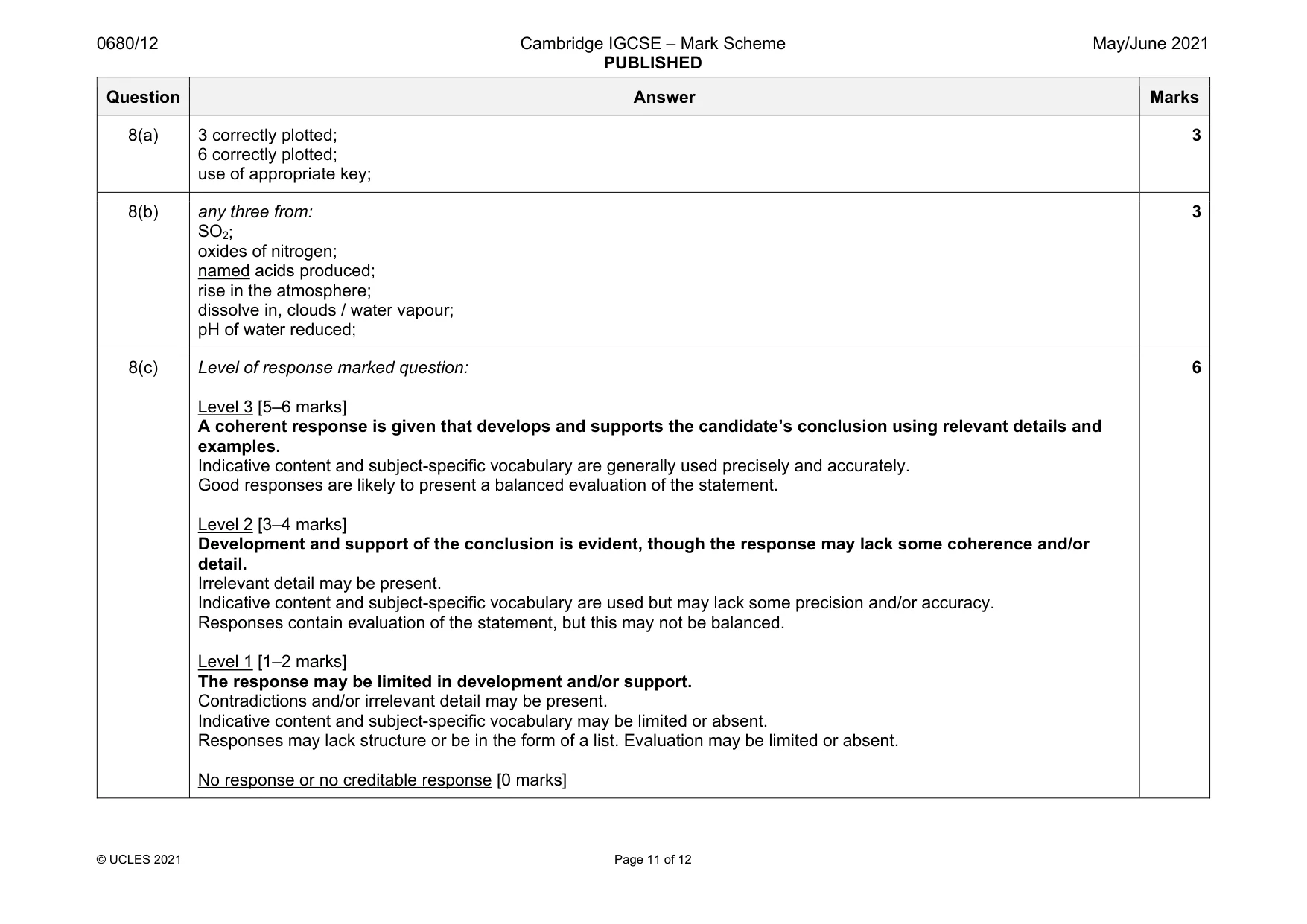
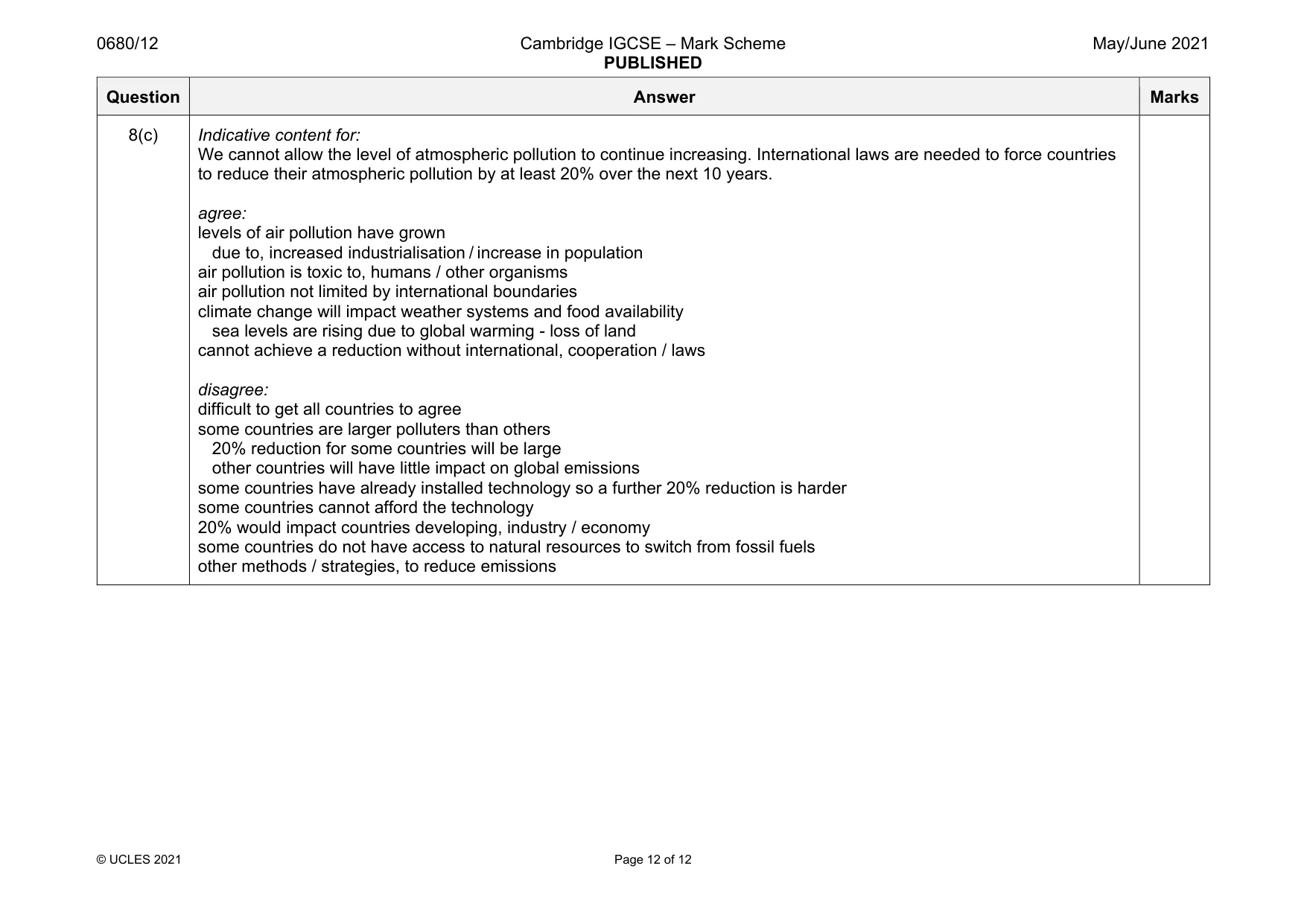
0680/12 Cambridge IGCSE – Mark Scheme PUBLISHED May/June 2021 © UCLES 2021 Page 11 of 12 Question Answer Marks 8(a) 3 correctly plotted; 6 correctly plotted; use of appropriate key; 3 8(b) any three from: SO2; oxides of nitrogen; named acids produced; rise in the atmosphere; dissolve in, clouds / water vapour; pH of water reduced; 3 8(c) Level of response marked question: Level 3 [5–6 marks] A coherent response is given that develops and supports the candidate’s conclusion using relevant details and examples. Indicative content and subject-specific vocabulary are generally used precisely and accurately. Good responses are likely to present a balanced evaluation of the statement. Level 2 [3–4 marks] Development and support of the conclusion is evident, though the response may lack some coherence and/or detail. Irrelevant detail may be present. Indicative content and subject-specific vocabulary are used but may lack some precision and/or accuracy. Responses contain evaluation of the statement, but this may not be balanced. Level 1 [1–2 marks] The response may be limited in development and/or support. Contradictions and/or irrelevant detail may be present. Indicative content and subject-specific vocabulary may be limited or absent. Responses may lack structure or be in the form of a list. Evaluation may be limited or absent. No response or no creditable response [0 marks] 6
Mark scheme, page 12
0680/12 Cambridge IGCSE – Mark Scheme PUBLISHED May/June 2021 © UCLES 2021 Page 12 of 12 Question Answer Marks 8(c) Indicative content for: We cannot allow the level of atmospheric pollution to continue increasing. International laws are needed to force countries to reduce their atmospheric pollution by at least 20% over the next 10 years. agree: levels of air pollution have grown due to, increased industrialisation / increase in population air pollution is toxic to, humans / other organisms air pollution not limited by international boundaries climate change will impact weather systems and food availability sea levels are rising due to global warming - loss of land cannot achieve a reduction without international, cooperation / laws disagree: difficult to get all countries to agree some countries are larger polluters than others 20% reduction for some countries will be large other countries will have little impact on global emissions some countries have already installed technology so a further 20% reduction is harder some countries cannot afford the technology 20% would impact countries developing, industry / economy some countries do not have access to natural resources to switch from fossil fuels other methods / strategies, to reduce emissions
What you needed in this session
Cambridge’s own grade thresholds for 2021 May/June, Paper 1 · Variant 2. A higher threshold means an easier paper — the bar moves with how the cohort did.