Cambridge IGCSE Environmental Management 0680 — 2021 May/June Paper 1 · Variant 1
0680/11/M/J/21 · 80 marks · ≈90 min
The question paper and its mark scheme, free to read here and free to download. This is Cambridge’s own paper, exactly as it was sat.
Question paper20 pages



Mark scheme13 pages
Answers below. Sit the paper first if you are practising.
Paper as text
Question paper, page 1
This document has 20 pages. Any blank pages are indicated. Cambridge IGCSE™ ENVIRONMENTAL MANAGEMENT 0680/11 Paper 1 Theory May/June 2021 1 hour 45 minutes You must answer on the question paper. No additional materials are needed. INSTRUCTIONS ● Answer all questions. ● Use a black or dark blue pen. You may use an HB pencil for any diagrams or graphs. ● Write your name, centre number and candidate number in the boxes at the top of the page. ● Write your answer to each question in the space provided. ● Do not use an erasable pen or correction fluid. ● Do not write on any bar codes. ● You may use a calculator. ● You should show all your working and use appropriate units. INFORMATION ● The total mark for this paper is 80. ● The number of marks for each question or part question is shown in brackets [ ]. * 9 5 8 7 9 3 6 7 6 1 * DC (CJ/CT) 208404/4 © UCLES 2021 [Turn over
Question paper, page 2
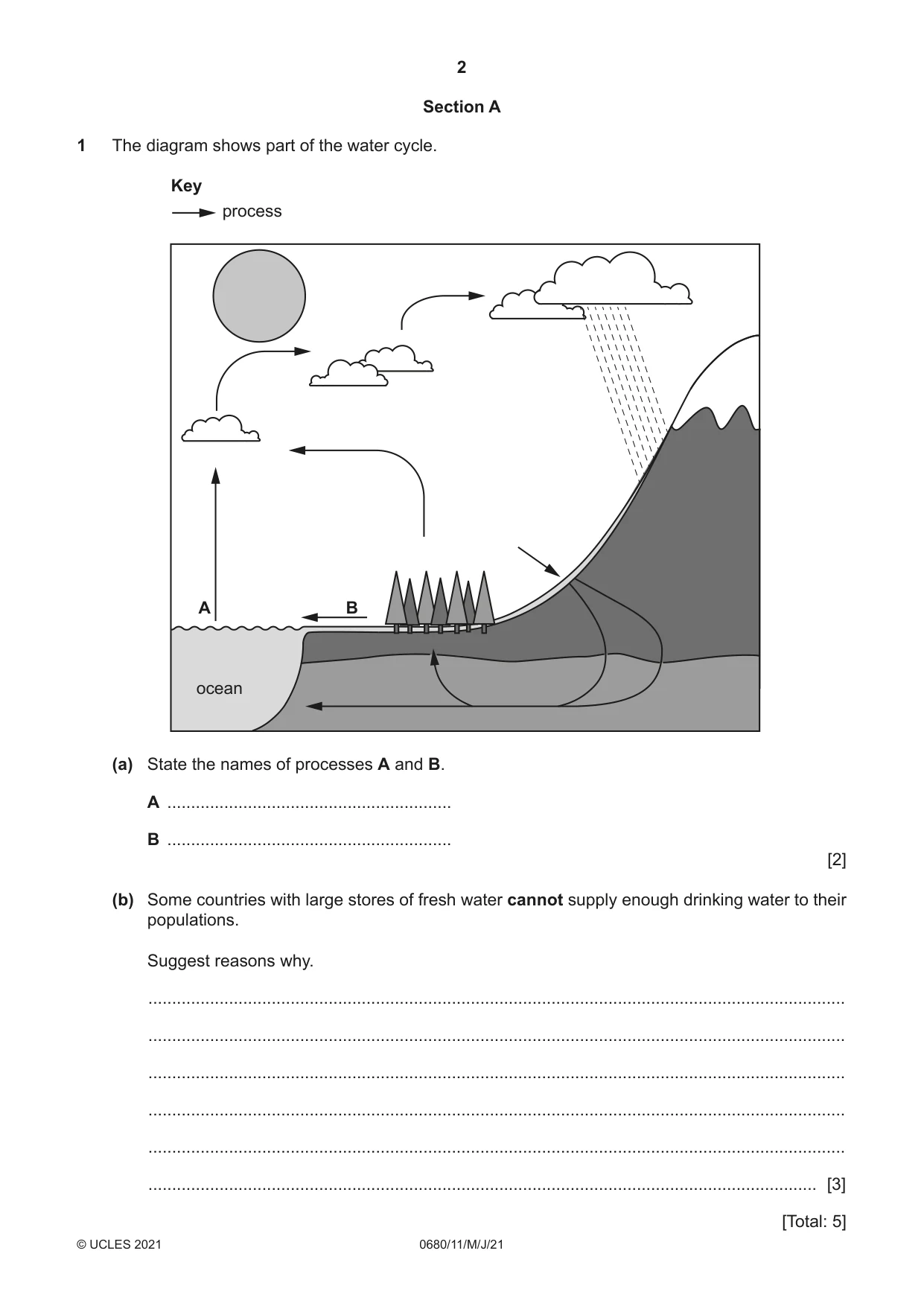
2 0680/11/M/J/21 © UCLES 2021 Section A 1 The diagram shows part of the water cycle. process Key A ocean B (a) State the names of processes A and B. A … B … [2] (b) Some countries with large stores of fresh water cannot supply enough drinking water to their populations. Suggest reasons why. … … … … … … [3] [Total: 5]
Question paper, page 3
3 0680/11/M/J/21 © UCLES 2021 [Turn over BLANK PAGE
Question paper, page 4
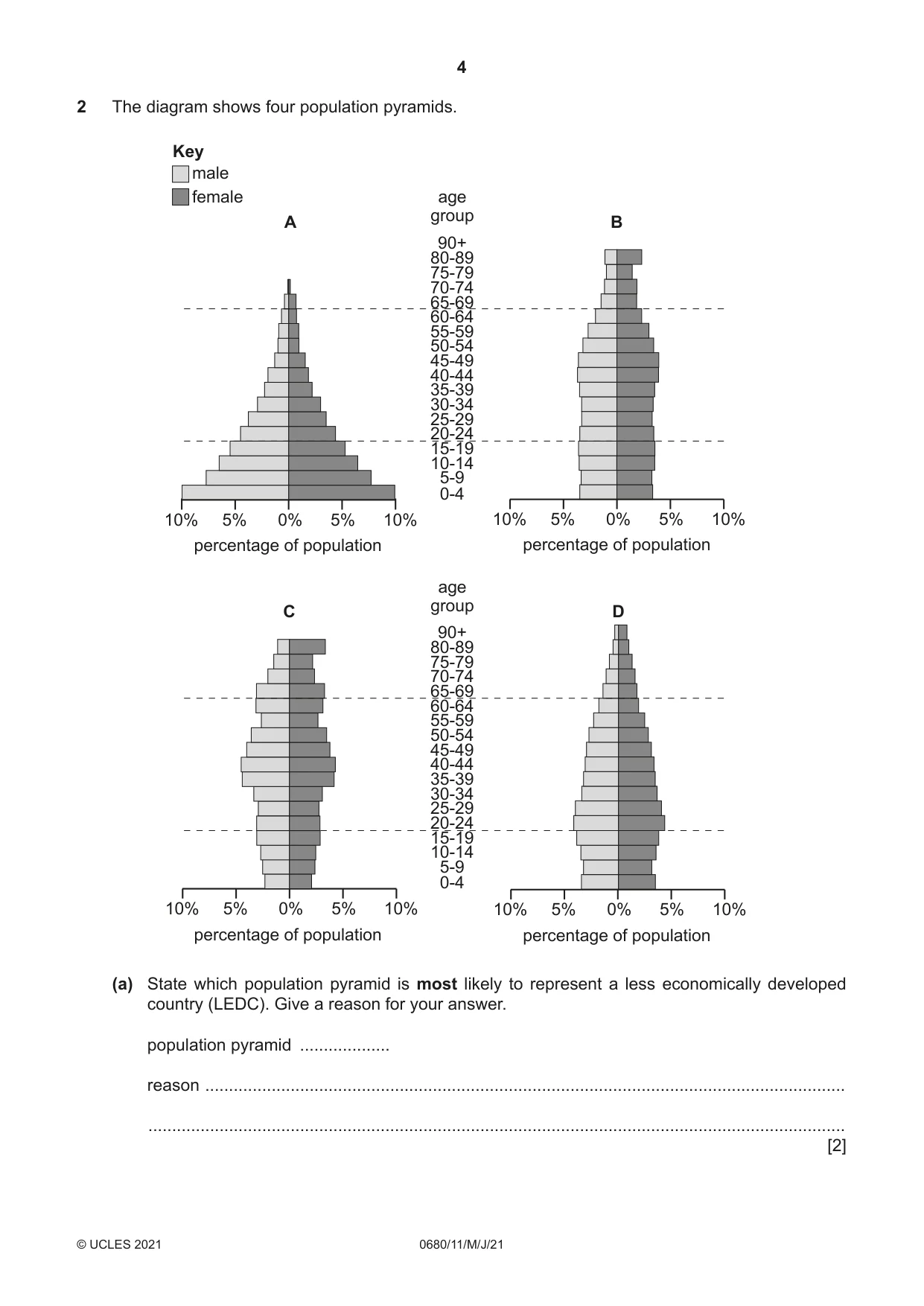
4 0680/11/M/J/21 © UCLES 2021 2 The diagram shows four population pyramids. 10% 5% 0% A 5% 10% B 10% 5% 0% 5% 10% 10% 5% 0% 5% 10% C 0-4 5-9 10-14 15-19 20-24 25-29 30-34 35-39 40-44 45-49 50-54 55-59 60-64 65-69 70-74 75-79 80-89 90+ 0-4 5-9 10-14 15-19 20-24 25-29 30-34 35-39 40-44 45-49 50-54 55-59 60-64 65-69 70-74 75-79 80-89 90+ age group age group percentage of population percentage of population percentage of population percentage of population Key female male 10% 5% 0% 5% 10% D (a) State which population pyramid is most likely to represent a less economically developed country (LEDC). Give a reason for your answer. population pyramid … reason … … [2]
Question paper, page 5
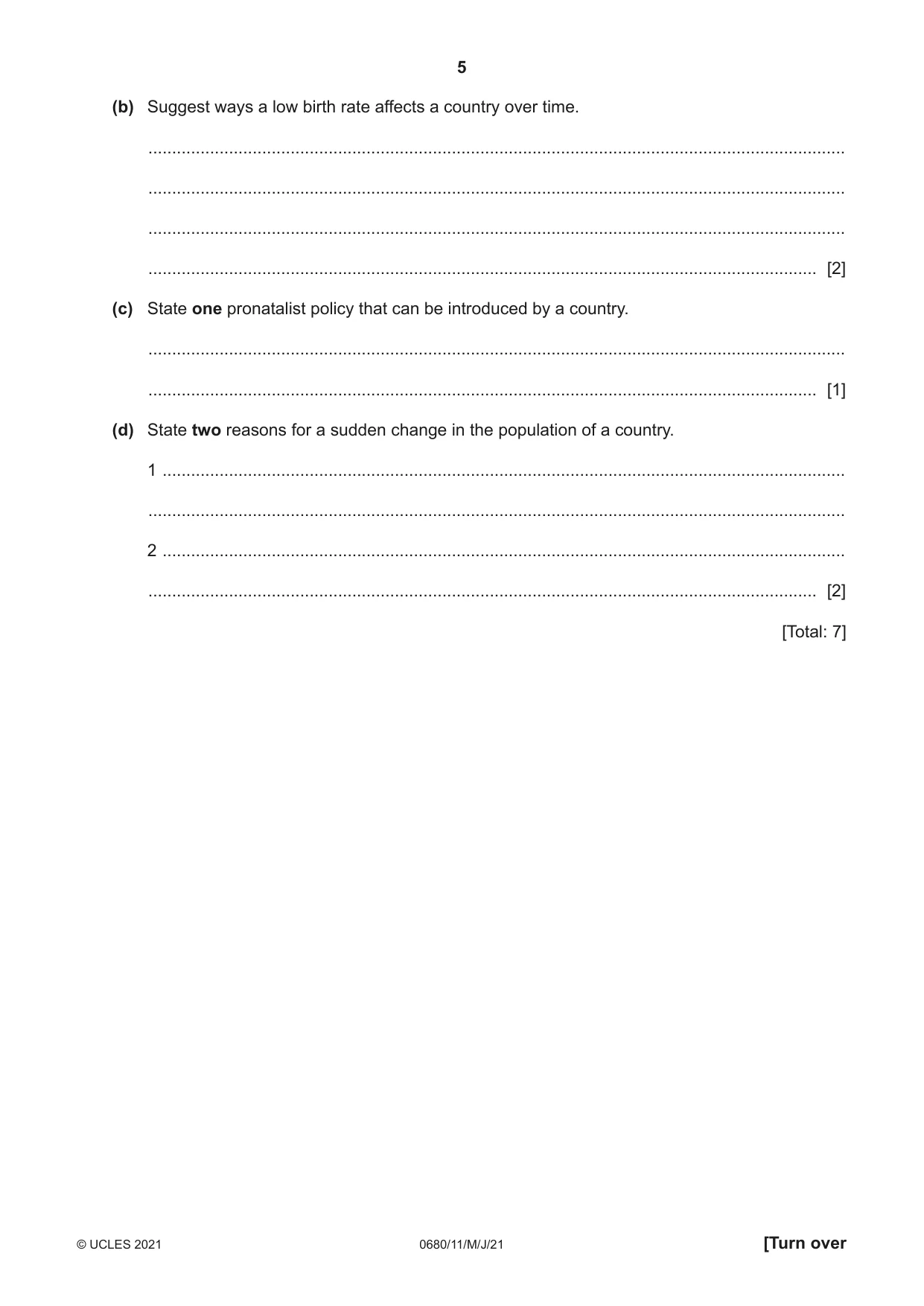
5 0680/11/M/J/21 © UCLES 2021 [Turn over (b) Suggest ways a low birth rate affects a country over time. … … … … [2] (c) State one pronatalist policy that can be introduced by a country. … … [1] (d) State two reasons for a sudden change in the population of a country. 1 … … 2 … … [2] [Total: 7]
Question paper, page 6
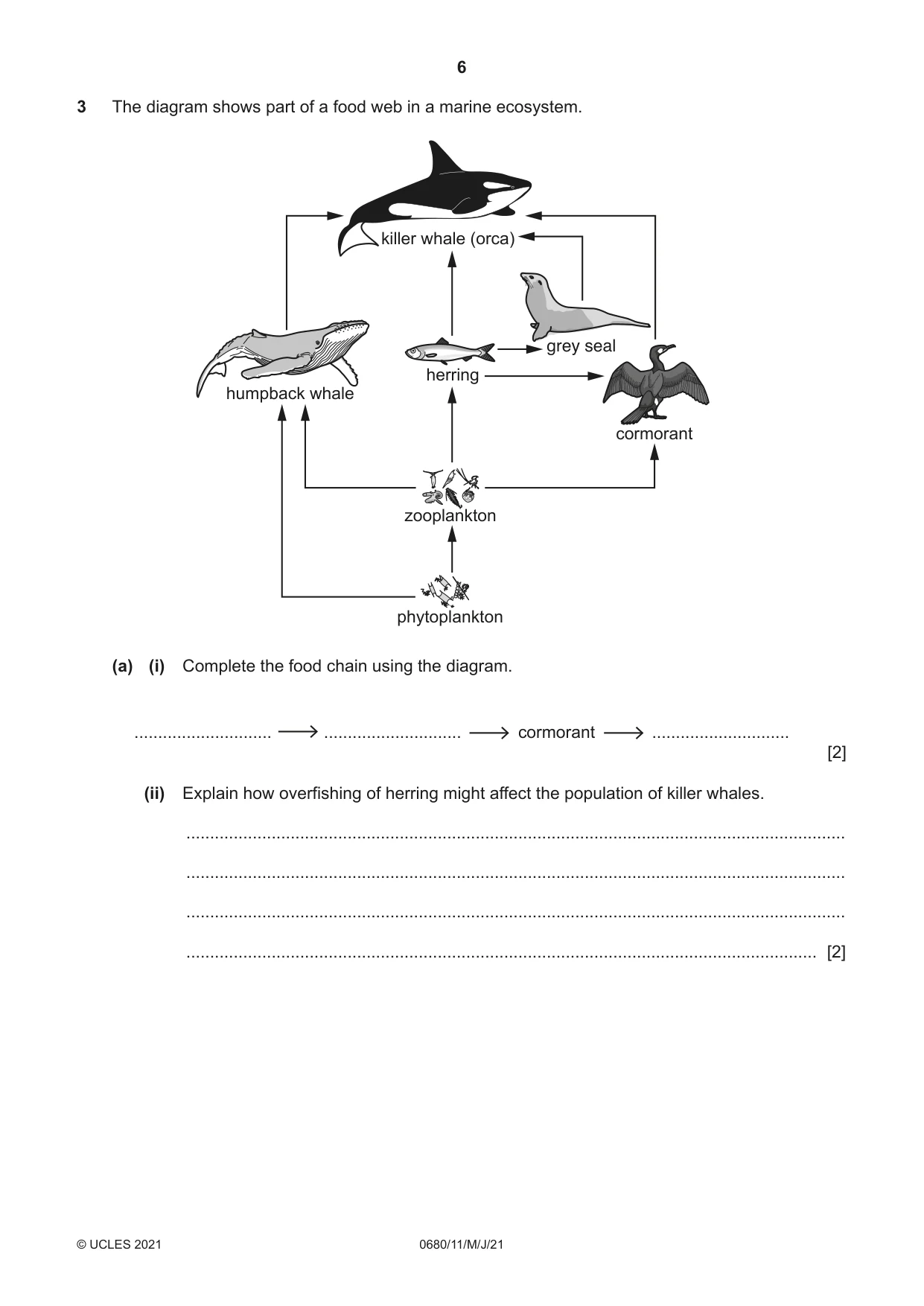
6 0680/11/M/J/21 © UCLES 2021 3 The diagram shows part of a food web in a marine ecosystem. herring zooplankton phytoplankton grey seal killer whale (orca) humpback whale cormorant (a) (i) Complete the food chain using the diagram. … … cormorant … [2] (ii) Explain how overfishing of herring might affect the population of killer whales. … … … … [2]
Question paper, page 7
7 0680/11/M/J/21 © UCLES 2021 [Turn over (b) Explain two strategies to prevent overfishing. strategy 1 … explanation … … strategy 2 … explanation … … [4] [Total: 8]
Question paper, page 8
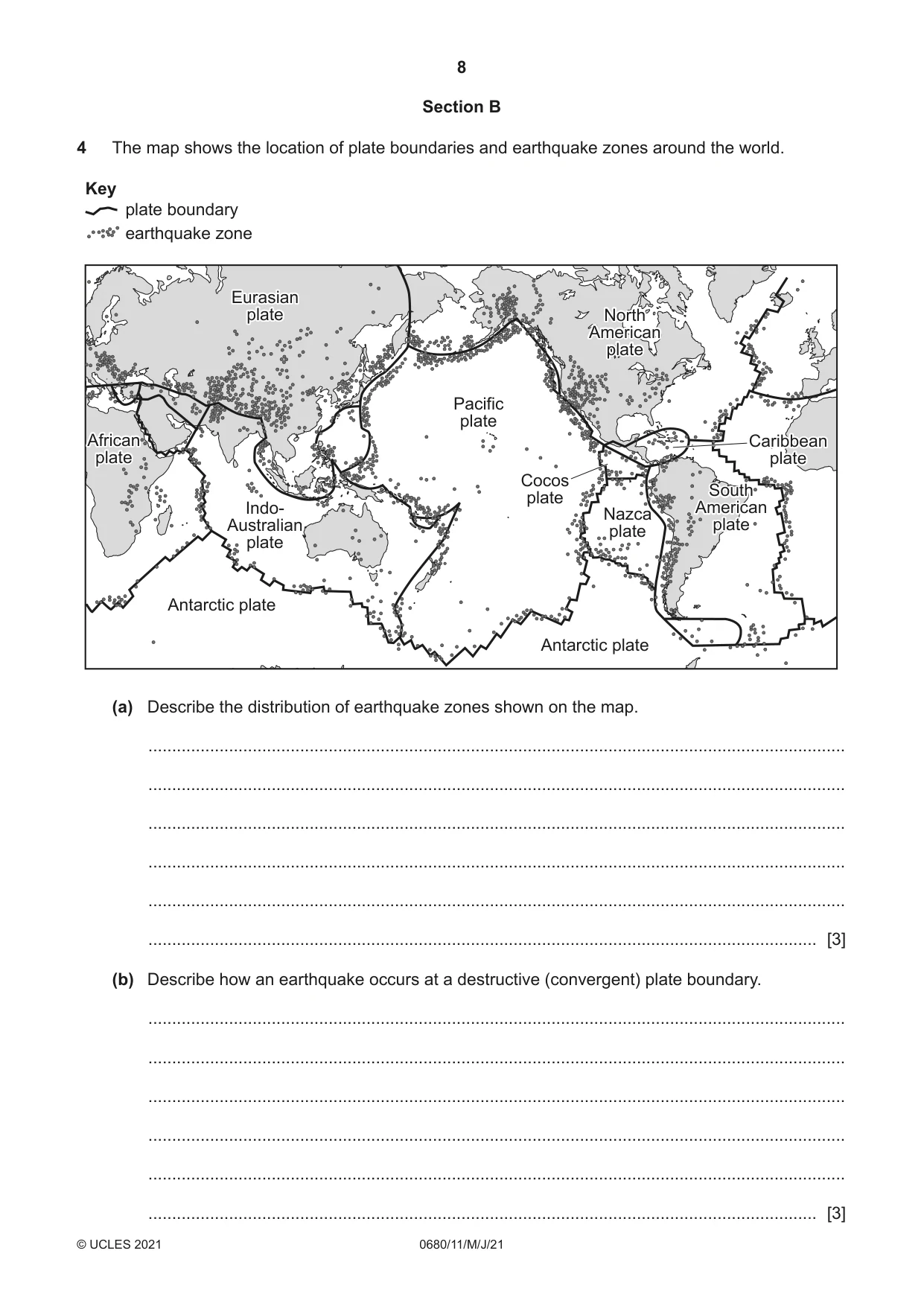
8 0680/11/M/J/21 © UCLES 2021 Section B 4 The map shows the location of plate boundaries and earthquake zones around the world. Eurasian plate Caribbean plate African plate North American plate South American plate Indo- Australian Plate Eurasian plate Nazca plate Cocos plate Caribbean plate African plate North American plate South American plate Pacific plate Indo- Australian plate Antarctic plate Antarctic plate Key plate boundary earthquake zone (a) Describe the distribution of earthquake zones shown on the map. … … … … … … [3] (b) Describe how an earthquake occurs at a destructive (convergent) plate boundary. … … … … … … [3]
Question paper, page 9
9 0680/11/M/J/21 © UCLES 2021 [Turn over (c) (i) Describe how the structure of modern buildings can reduce the risk of death from earthquakes. … … … … … … [3] (ii) Often, more people die in the weeks following an earthquake than during the earthquake itself. Suggest reasons why. … … … … … … … … [4] [Total: 13]
Question paper, page 10
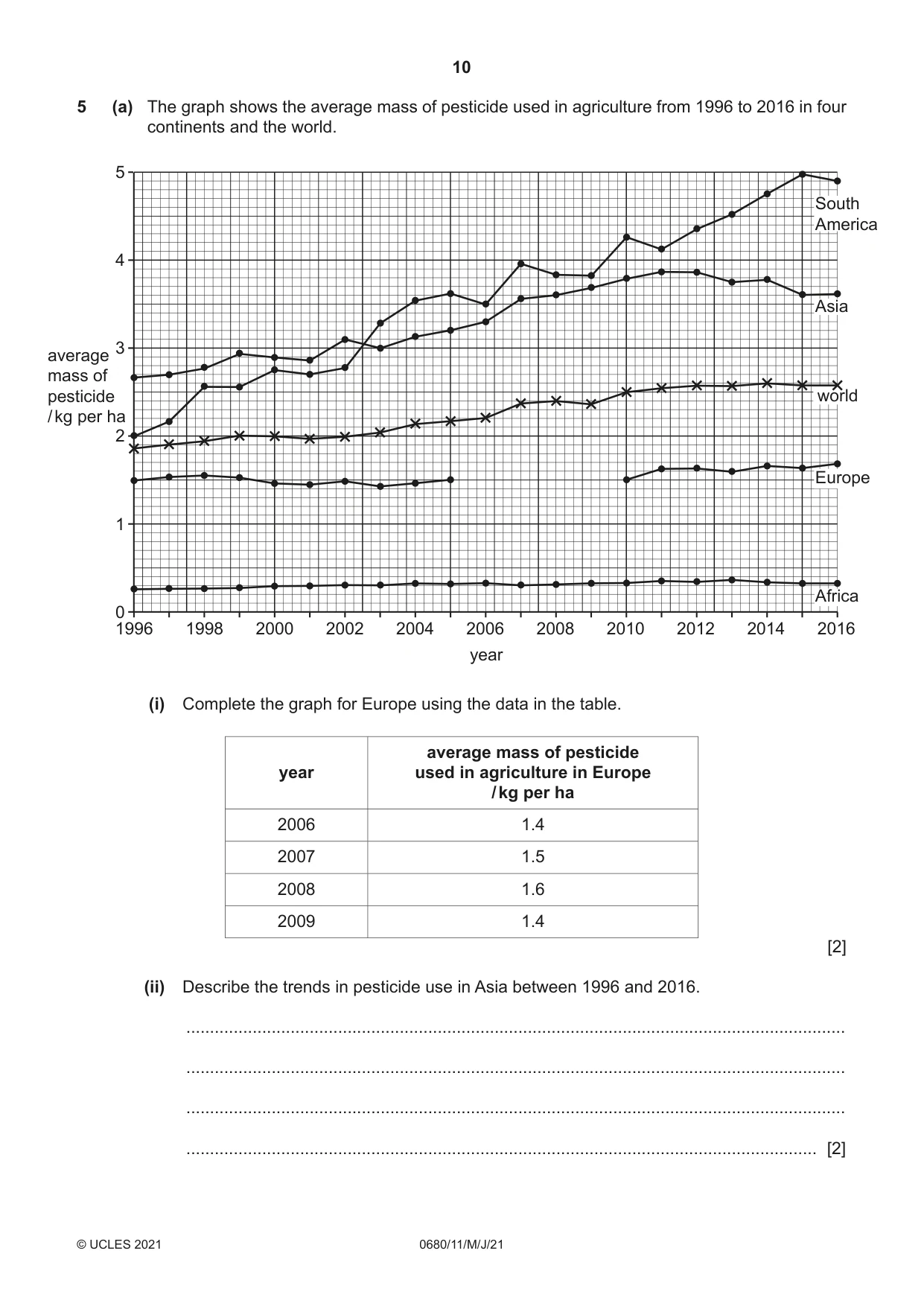
10 0680/11/M/J/21 © UCLES 2021 5 (a) The graph shows the average mass of pesticide used in agriculture from 1996 to 2016 in four continents and the world. 1996 1998 2000 2002 2004 2006 2008 2010 2012 2014 2016 year average mass of pesticide / kg per ha 0 1 2 3 4 5 South America Asia world Europe Africa (i) Complete the graph for Europe using the data in the table. year average mass of pesticide used in agriculture in Europe / kg per ha 2006 1.4 2007 1.5 2008 1.6 2009 1.4 [2] (ii) Describe the trends in pesticide use in Asia between 1996 and 2016. … … … … [2]
Question paper, page 11
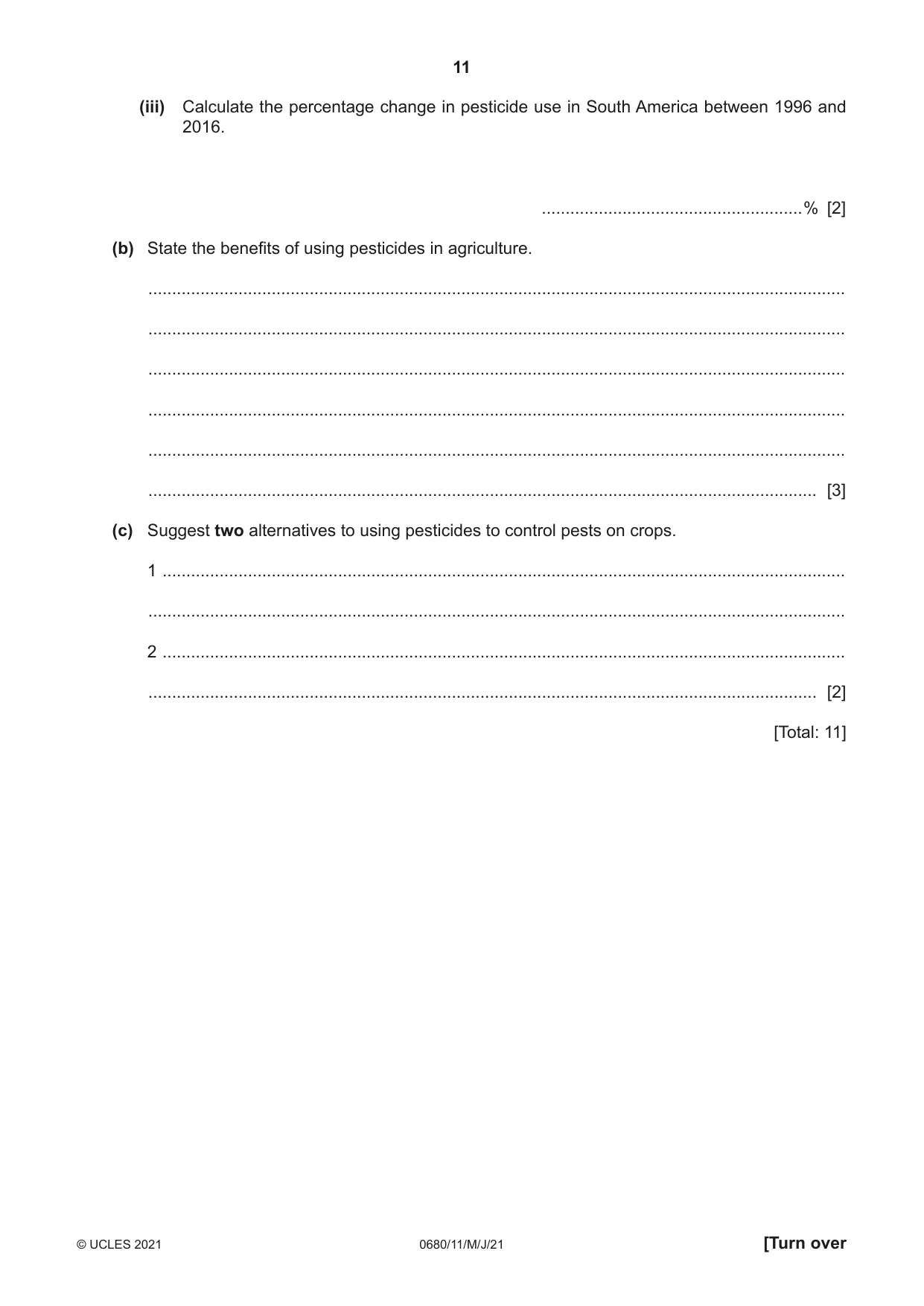
11 0680/11/M/J/21 © UCLES 2021 [Turn over (iii) Calculate the percentage change in pesticide use in South America between 1996 and 2016. …% [2] (b) State the benefits of using pesticides in agriculture. … … … … … … [3] (c) Suggest two alternatives to using pesticides to control pests on crops. 1 … … 2 … … [2] [Total: 11]
Question paper, page 12
12 0680/11/M/J/21 © UCLES 2021 BLANK PAGE
Question paper, page 13
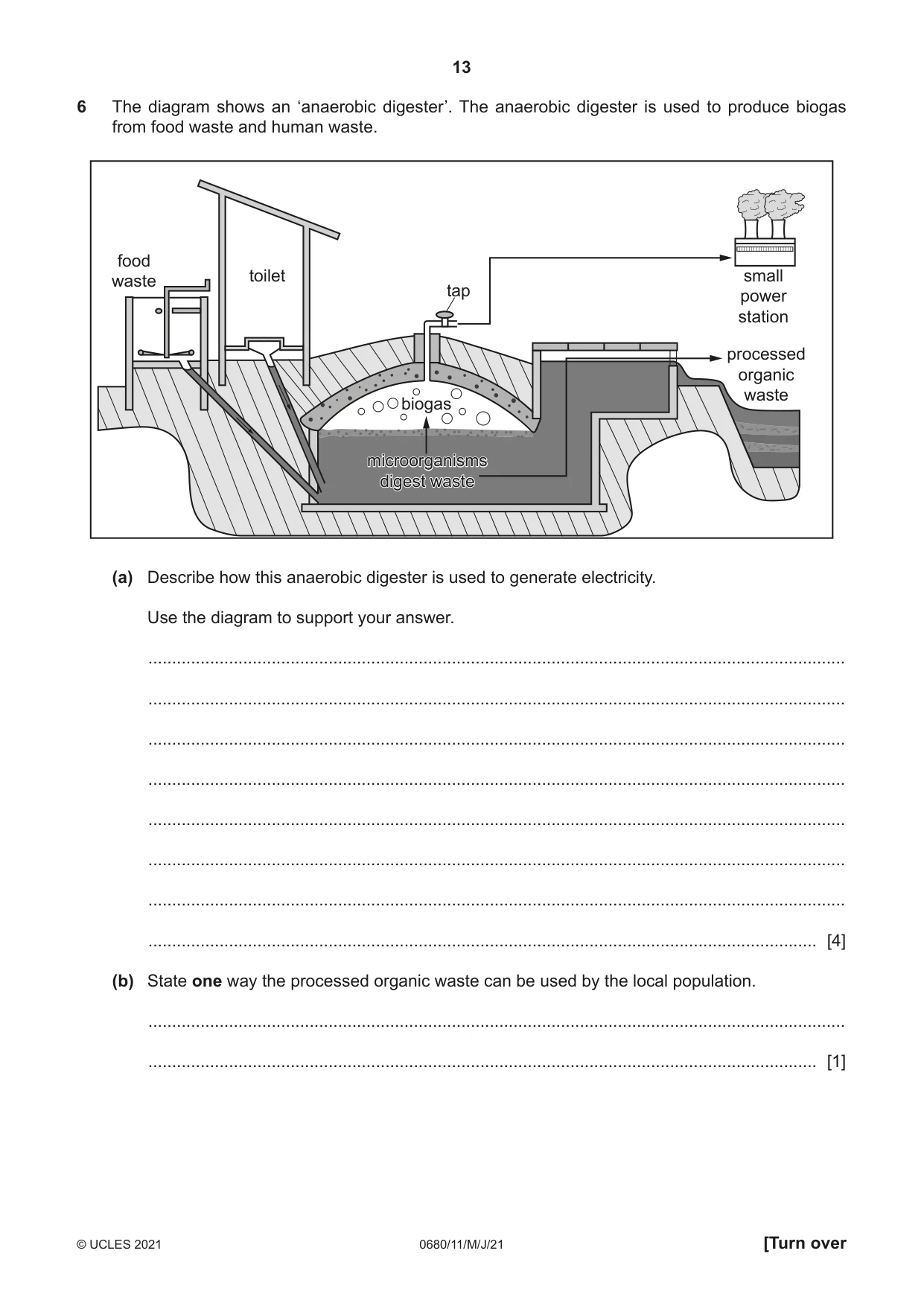
13 0680/11/M/J/21 © UCLES 2021 [Turn over 6 The diagram shows an ‘anaerobic digester’. The anaerobic digester is used to produce biogas from food waste and human waste. toilet tap biogas processed organic waste microorganisms digest waste microorganisms digest waste food waste small power station (a) Describe how this anaerobic digester is used to generate electricity. Use the diagram to support your answer. … … … … … … … … [4] (b) State one way the processed organic waste can be used by the local population. … … [1]
Question paper, page 14
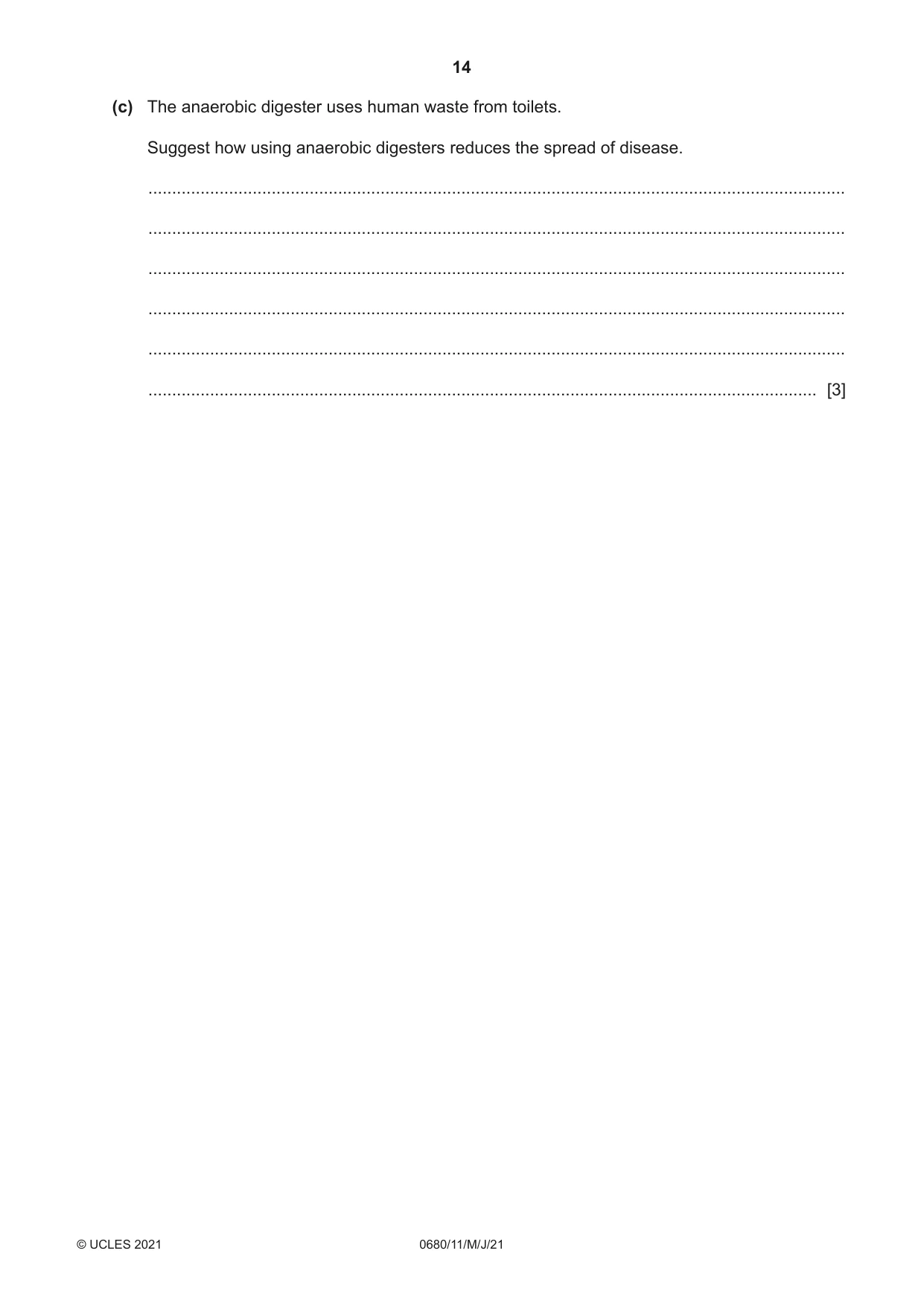
14 0680/11/M/J/21 © UCLES 2021 (c) The anaerobic digester uses human waste from toilets. Suggest how using anaerobic digesters reduces the spread of disease. … … … … … … [3]
Question paper, page 15
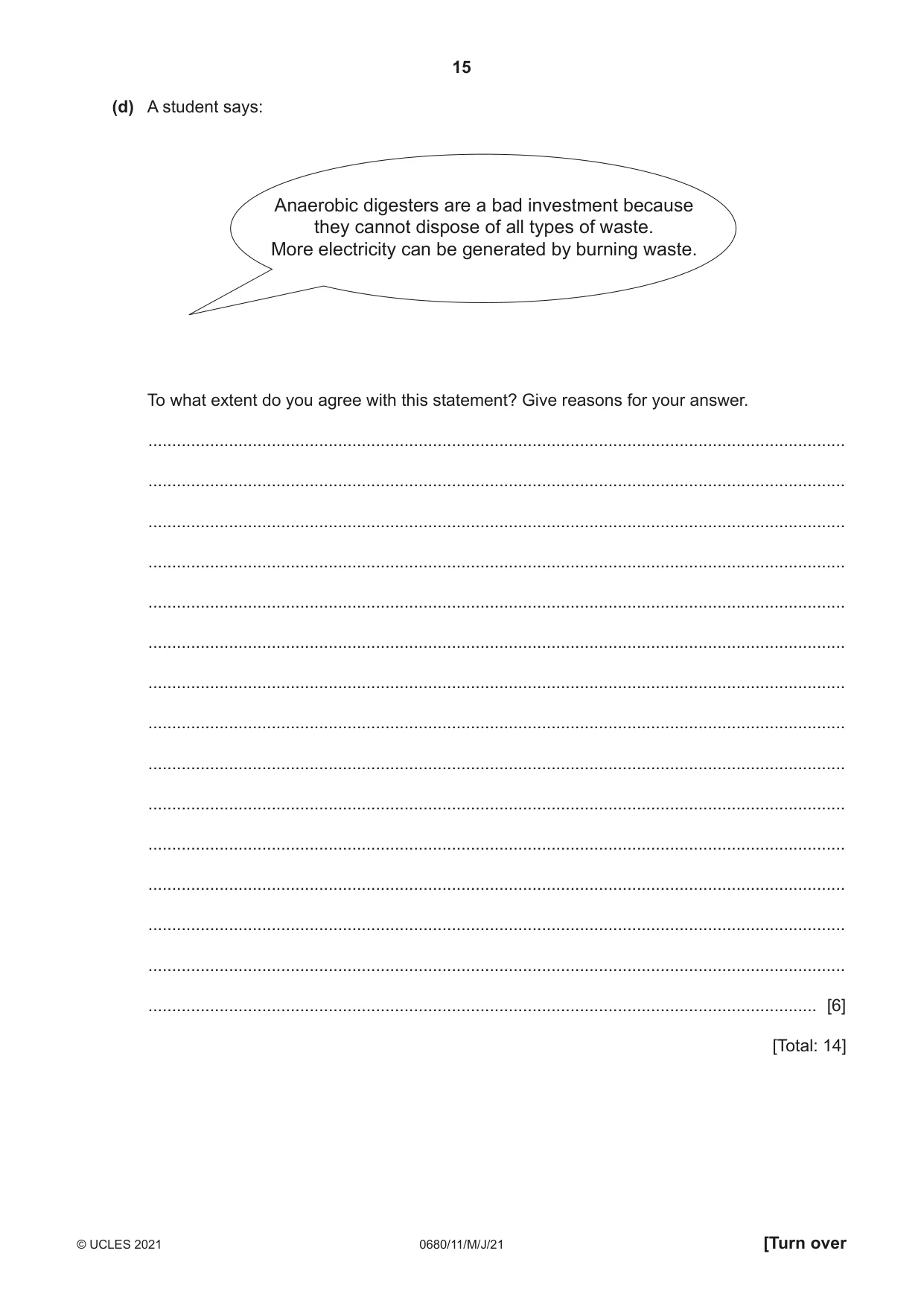
15 0680/11/M/J/21 © UCLES 2021 [Turn over (d) A student says: To what extent do you agree with this statement? Give reasons for your answer. … … … … … … … … … … … … … … … [6] [Total: 14] Anaerobic digesters are a bad investment because they cannot dispose of all types of waste. More electricity can be generated by burning waste.
Question paper, page 16
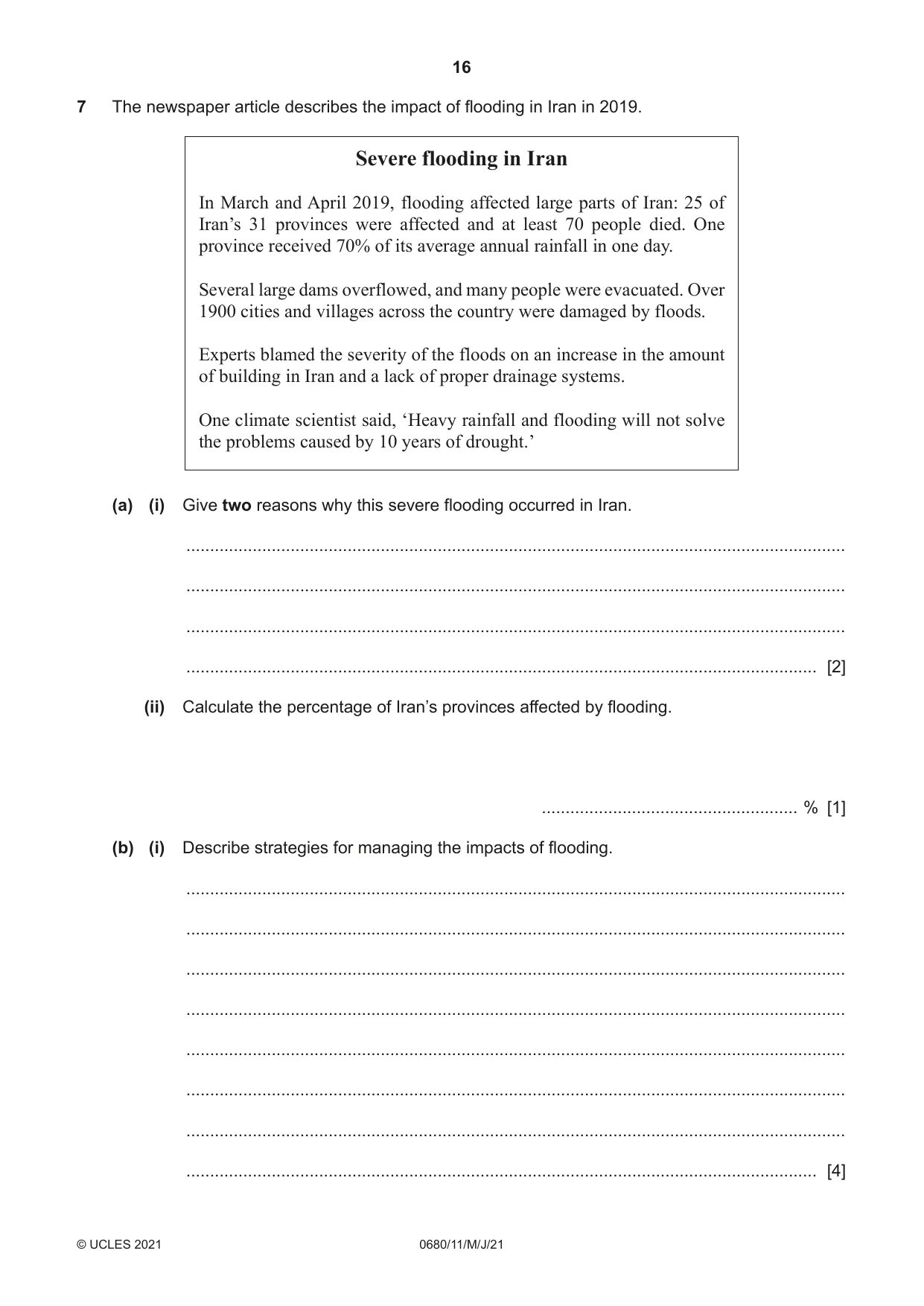
16 0680/11/M/J/21 © UCLES 2021 7 The newspaper article describes the impact of flooding in Iran in 2019. Severe flooding in Iran In March and April 2019, flooding affected large parts of Iran: 25 of Iran’s 31 provinces were affected and at least 70 people died. One province received 70% of its average annual rainfall in one day. Several large dams overflowed, and many people were evacuated. Over 1900 cities and villages across the country were damaged by floods. Experts blamed the severity of the floods on an increase in the amount of building in Iran and a lack of proper drainage systems. One climate scientist said, ‘Heavy rainfall and flooding will not solve the problems caused by 10 years of drought.’ (a) (i) Give two reasons why this severe flooding occurred in Iran. … … … … [2] (ii) Calculate the percentage of Iran’s provinces affected by flooding. … % [1] (b) (i) Describe strategies for managing the impacts of flooding. … … … … … … … … [4]
Question paper, page 17
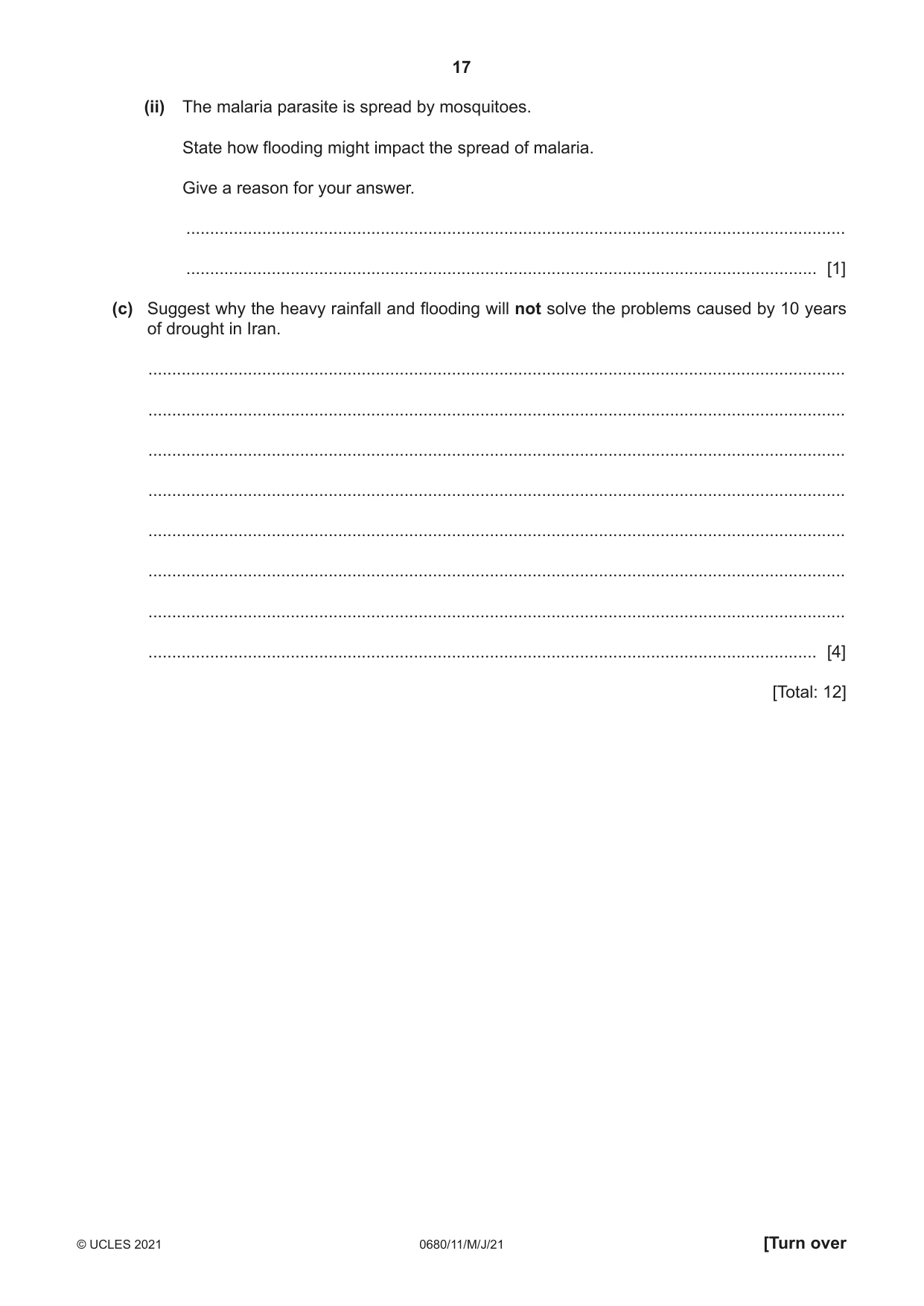
17 0680/11/M/J/21 © UCLES 2021 [Turn over (ii) The malaria parasite is spread by mosquitoes. State how flooding might impact the spread of malaria. Give a reason for your answer. … … [1] (c) Suggest why the heavy rainfall and flooding will not solve the problems caused by 10 years of drought in Iran. … … … … … … … … [4] [Total: 12]
Question paper, page 18
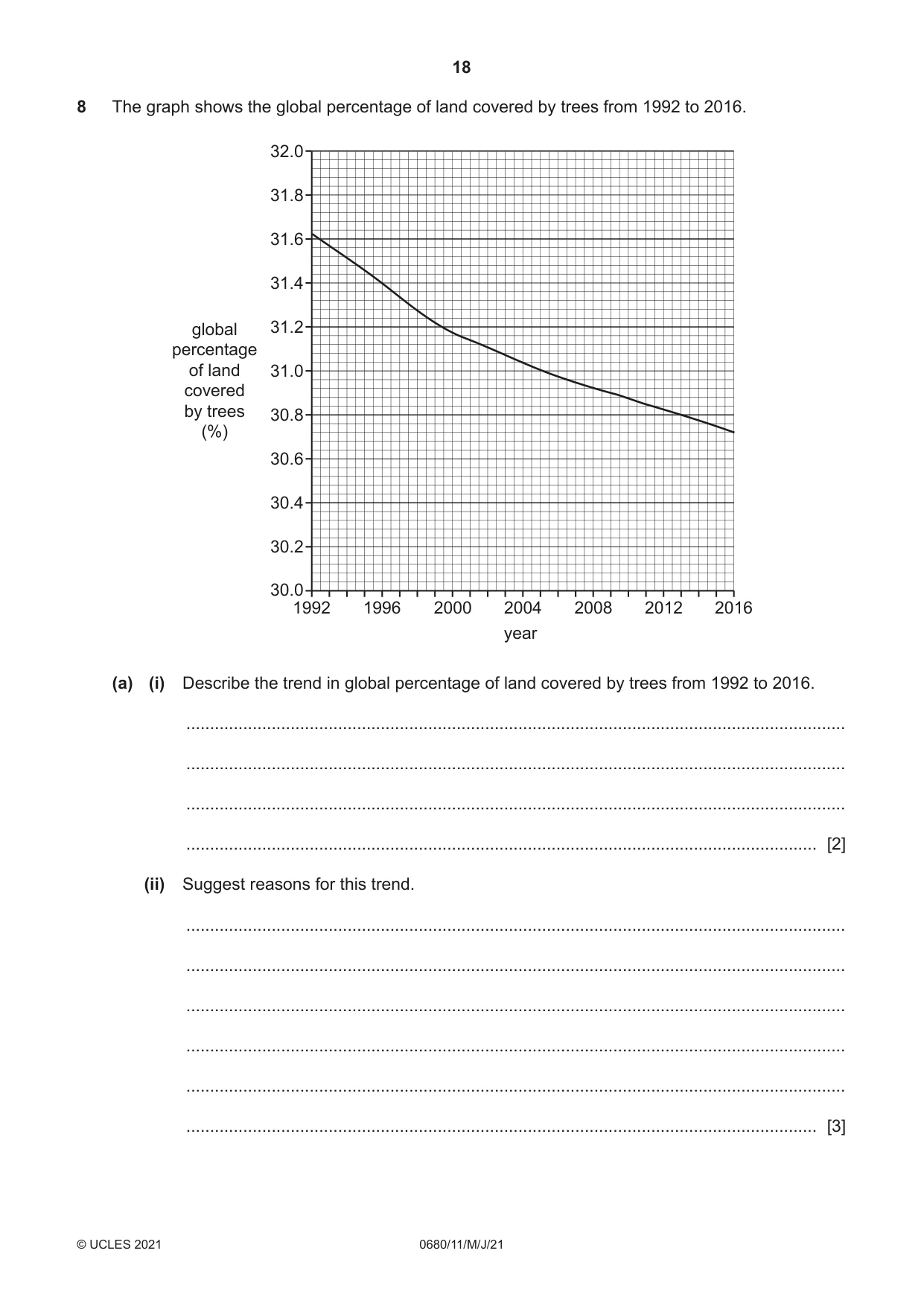
18 0680/11/M/J/21 © UCLES 2021 8 The graph shows the global percentage of land covered by trees from 1992 to 2016. 32.0 31.8 31.6 31.4 31.2 31.0 30.8 30.6 30.4 30.2 30.0 1996 1992 2000 2004 2008 2012 2016 global percentage of land covered by trees (%) year (a) (i) Describe the trend in global percentage of land covered by trees from 1992 to 2016. … … … … [2] (ii) Suggest reasons for this trend. … … … … … … [3]
Question paper, page 19
19 0680/11/M/J/21 © UCLES 2021 (b) Describe strategies a country can use to preserve its forests. … … … … … … … … … … [5] [Total: 10]
Question paper, page 20
20 0680/11/M/J/21 © UCLES 2021 BLANK PAGE The boundaries and names shown, the designations used and the presentation of material on any maps contained in this question paper/insert do not imply official endorsement or acceptance by Cambridge Assessment International Education concerning the legal status of any country, territory, or area or any of its authorities, or of the delimitation of its frontiers or boundaries. Permission to reproduce items where third-party owned material protected by copyright is included has been sought and cleared where possible. Every reasonable effort has been made by the publisher (UCLES) to trace copyright holders, but if any items requiring clearance have unwittingly been included, the publisher will be pleased to make amends at the earliest possible opportunity. To avoid the issue of disclosure of answer-related information to candidates, all copyright acknowledgements are reproduced online in the Cambridge Assessment International Education Copyright Acknowledgements Booklet. This is produced for each series of examinations and is freely available to download at www.cambridgeinternational.org after the live examination series. Cambridge Assessment International Education is part of the Cambridge Assessment Group. Cambridge Assessment is the brand name of the University of Cambridge Local Examinations Syndicate (UCLES), which itself is a department of the University of Cambridge.
Mark scheme, page 1
This document consists of 13 printed pages. © UCLES 2021 [Turn over Cambridge IGCSE™ ENVIRONMENTAL MANAGEMENT 0680/11 Paper 1 Theory May/June 2021 MARK SCHEME Maximum Mark: 80 Published This mark scheme is published as an aid to teachers and candidates, to indicate the requirements of the examination. It shows the basis on which Examiners were instructed to award marks. It does not indicate the details of the discussions that took place at an Examiners’ meeting before marking began, which would have considered the acceptability of alternative answers. Mark schemes should be read in conjunction with the question paper and the Principal Examiner Report for Teachers. Cambridge International will not enter into discussions about these mark schemes. Cambridge International is publishing the mark schemes for the May/June 2021 series for most Cambridge IGCSE™, Cambridge International A and AS Level components and some Cambridge O Level components.
Mark scheme, page 2
0680/11 Cambridge IGCSE – Mark Scheme PUBLISHED May/June 2021 © UCLES 2021 Page 2 of 13 Generic Marking Principles These general marking principles must be applied by all examiners when marking candidate answers. They should be applied alongside the specific content of the mark scheme or generic level descriptors for a question. Each question paper and mark scheme will also comply with these marking principles. GENERIC MARKING PRINCIPLE 1: Marks must be awarded in line with: • the specific content of the mark scheme or the generic level descriptors for the question • the specific skills defined in the mark scheme or in the generic level descriptors for the question • the standard of response required by a candidate as exemplified by the standardisation scripts. GENERIC MARKING PRINCIPLE 2: Marks awarded are always whole marks (not half marks, or other fractions). GENERIC MARKING PRINCIPLE 3: Marks must be awarded positively: • marks are awarded for correct/valid answers, as defined in the mark scheme. However, credit is given for valid answers which go beyond the scope of the syllabus and mark scheme, referring to your Team Leader as appropriate • marks are awarded when candidates clearly demonstrate what they know and can do • marks are not deducted for errors • marks are not deducted for omissions • answers should only be judged on the quality of spelling, punctuation and grammar when these features are specifically assessed by the question as indicated by the mark scheme. The meaning, however, should be unambiguous. GENERIC MARKING PRINCIPLE 4: Rules must be applied consistently, e.g. in situations where candidates have not followed instructions or in the application of generic level descriptors.
Mark scheme, page 3
0680/11 Cambridge IGCSE – Mark Scheme PUBLISHED May/June 2021 © UCLES 2021 Page 3 of 13 GENERIC MARKING PRINCIPLE 5: Marks should be awarded using the full range of marks defined in the mark scheme for the question (however; the use of the full mark range may be limited according to the quality of the candidate responses seen). GENERIC MARKING PRINCIPLE 6: Marks awarded are based solely on the requirements as defined in the mark scheme. Marks should not be awarded with grade thresholds or grade descriptors in mind. Science-Specific Marking Principles 1 Examiners should consider the context and scientific use of any keywords when awarding marks. Although keywords may be present, marks should not be awarded if the keywords are used incorrectly. 2 The examiner should not choose between contradictory statements given in the same question part, and credit should not be awarded for any correct statement that is contradicted within the same question part. Wrong science that is irrelevant to the question should be ignored. 3 Although spellings do not have to be correct, spellings of syllabus terms must allow for clear and unambiguous separation from other syllabus terms with which they may be confused (e.g. ethane / ethene, glucagon / glycogen, refraction / reflection). 4 The error carried forward (ecf) principle should be applied, where appropriate. If an incorrect answer is subsequently used in a scientifically correct way, the candidate should be awarded these subsequent marking points. Further guidance will be included in the mark scheme where necessary and any exceptions to this general principle will be noted. 5 ‘List rule’ guidance For questions that require n responses (e.g. State two reasons …): • The response should be read as continuous prose, even when numbered answer spaces are provided. • Any response marked ignore in the mark scheme should not count towards n. • Incorrect responses should not be awarded credit but will still count towards n. • Read the entire response to check for any responses that contradict those that would otherwise be credited. Credit should not be awarded for any responses that are contradicted within the rest of the response. Where two responses contradict one another, this should be treated as a single incorrect response. • Non-contradictory responses after the first n responses may be ignored even if they include incorrect science.
Mark scheme, page 4
0680/11 Cambridge IGCSE – Mark Scheme PUBLISHED May/June 2021 © UCLES 2021 Page 4 of 13 6 Calculation specific guidance Correct answers to calculations should be given full credit even if there is no working or incorrect working, unless the question states ‘show your working’. For questions in which the number of significant figures required is not stated, credit should be awarded for correct answers when rounded by the examiner to the number of significant figures given in the mark scheme. This may not apply to measured values. For answers given in standard form (e.g. a × 10n) in which the convention of restricting the value of the coefficient (a) to a value between 1 and 10 is not followed, credit may still be awarded if the answer can be converted to the answer given in the mark scheme. Unless a separate mark is given for a unit, a missing or incorrect unit will normally mean that the final calculation mark is not awarded. Exceptions to this general principle will be noted in the mark scheme. 7 Guidance for chemical equations Multiples / fractions of coefficients used in chemical equations are acceptable unless stated otherwise in the mark scheme. State symbols given in an equation should be ignored unless asked for in the question or stated otherwise in the mark scheme.
Mark scheme, page 5
0680/11 Cambridge IGCSE – Mark Scheme PUBLISHED May/June 2021 © UCLES 2021 Page 5 of 13 Question Answer Marks 1(a) A evaporation; B (surface) run-off; 2 1(b) any three from: stores (geographically) inaccessible, e.g. underground, in mountains; population geographically inaccessible, e.g. widely-scattered; water may be frozen; inefficiency / expense, of distribution system; some (fresh) water sources, contaminated / polluted / unsafe to drink; reference to lack of treatment, facilities / infrastructure; 3 Question Answer Marks 2(a) A; large base to pyramid / high birth rate / lower life expectancy; 2 2(b) any two from: working age population decreases / people need to work to an older age / not enough people to fill jobs; need for migrant labour; increases, (relative) number of older dependants / need for carers; increases burden on medical system; increases, pension costs / need for taxes; 2 2(c) any one from: tax relief for larger families; free schooling; better / subsidised medical provision, e.g. antenatal services, family healthcare; free / subsidised, housing for larger families; child benefit; 1 2(d) any two from: war / conflict; famine / natural disaster / named disaster; (influx of) refugees / mass migration; disease, e.g. pandemic; 2
Mark scheme, page 6
0680/11 Cambridge IGCSE – Mark Scheme PUBLISHED May/June 2021 © UCLES 2021 Page 6 of 13 Question Answer Marks 3(a)(i) phytoplankton zooplankton (cormorant) killer whale (orca) 1 correct; 3 correct; 2 3(a)(ii) either: killer whale numbers will decrease; as fewer herring to eat; or: killer whale numbers will remain the same; as other food sources available / will eat more humpback whales; 2 3(b) any two named strategies with associated explanations, e.g.: reduce the season for fishing; prevents fish being caught in breeding season; (introduce / decrease) quotas: limits the number of fish caught; increase size of mesh in nets; allows smaller / immature, fish to escape to breed; (introduce / increase) limits to net, sizes / types; prevents all the fish from being caught in the area; (introduce / increase) licensing (of boats); restricts number of vessels / time at sea; (introduce / increase) enforcement of laws: allows monitoring of catch / stops illegal fishing; (introduce / increase) marine reserves / no-fishing areas; provides undisturbed habitat for fish; (introduce / increase) fish-farming; reduce amount of wild fish caught; 4
Mark scheme, page 7
0680/11 Cambridge IGCSE – Mark Scheme PUBLISHED May/June 2021 © UCLES 2021 Page 7 of 13 Question Answer Marks 4(a) most / many, at plate boundaries / edges of plates; plus any two further details, e.g.: high concentration around northern edge of Pacific plate; high activity along west coast of America; relatively few in middle of Pacific plate; comparatively few on Antarctic plate; spread across whole world; 3 4(b) any three from: plates move towards each other; subduction occurs / description of subduction; pressure / friction, occurs / builds up; idea of sudden, release / movement (causing quake); 3 4(c)(i) any three from: use fewer floors / build lower buildings; use pyramidal shape; use reinforced, structure / materials; idea of using flexible building materials; idea of using rubber shock absorbers in foundations; idea of using counterweights on top of building; 3 4(c)(ii) any four from: lack of medical help / death through injury; lack of clean water / poor sanitation; outbreak of, water-borne disease / cholera ; lack of food / starvation / malnutrition; risk of aftershocks / falling structures; crime; lack of shelter / exposure to weather; 4
Mark scheme, page 8
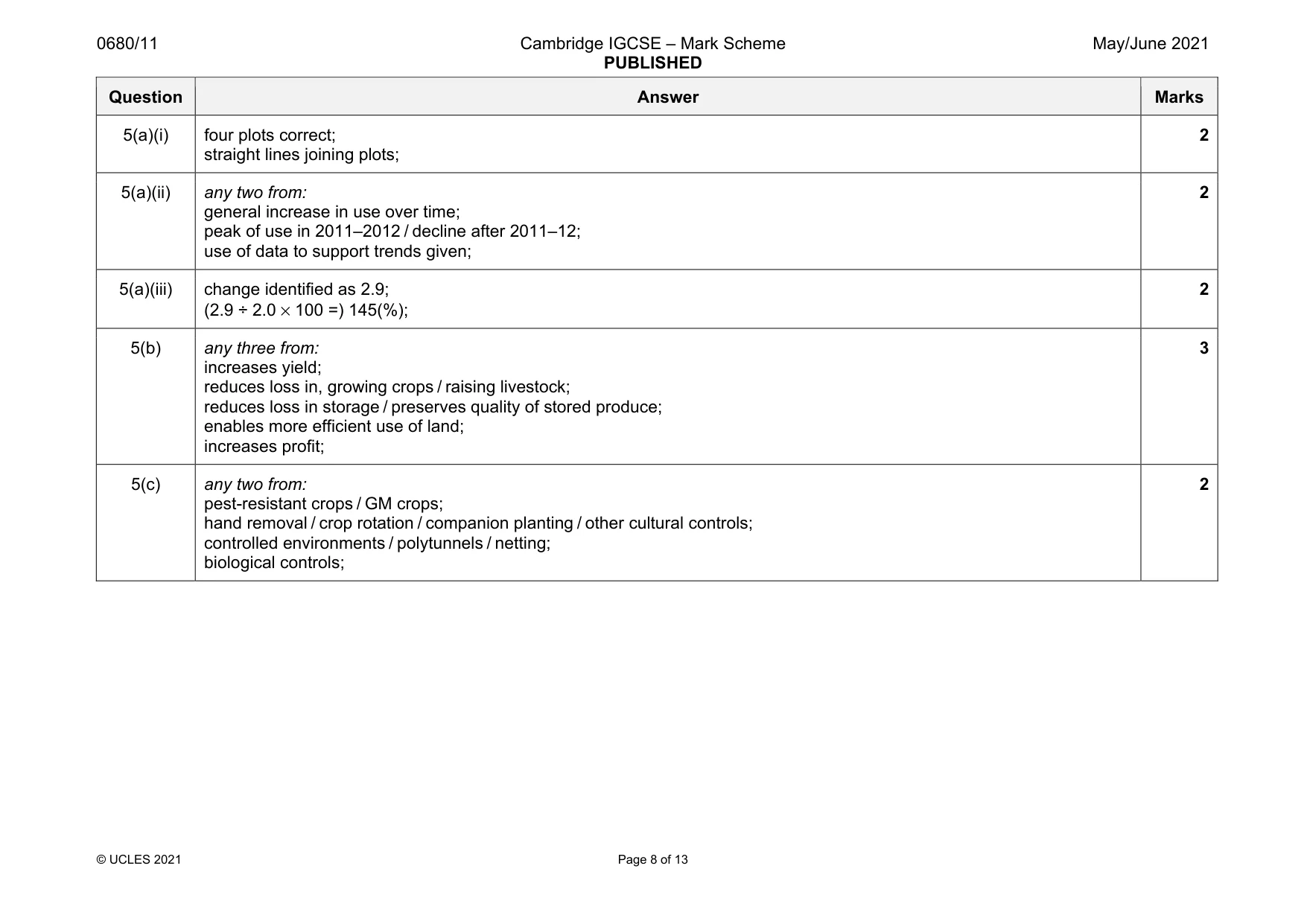
0680/11 Cambridge IGCSE – Mark Scheme PUBLISHED May/June 2021 © UCLES 2021 Page 8 of 13 Question Answer Marks 5(a)(i) four plots correct; straight lines joining plots; 2 5(a)(ii) any two from: general increase in use over time; peak of use in 2011–2012 / decline after 2011–12; use of data to support trends given; 2 5(a)(iii) change identified as 2.9; (2.9 ÷ 2.0 × 100 =) 145(%); 2 5(b) any three from: increases yield; reduces loss in, growing crops / raising livestock; reduces loss in storage / preserves quality of stored produce; enables more efficient use of land; increases profit; 3 5(c) any two from: pest-resistant crops / GM crops; hand removal / crop rotation / companion planting / other cultural controls; controlled environments / polytunnels / netting; biological controls; 2
Mark scheme, page 9
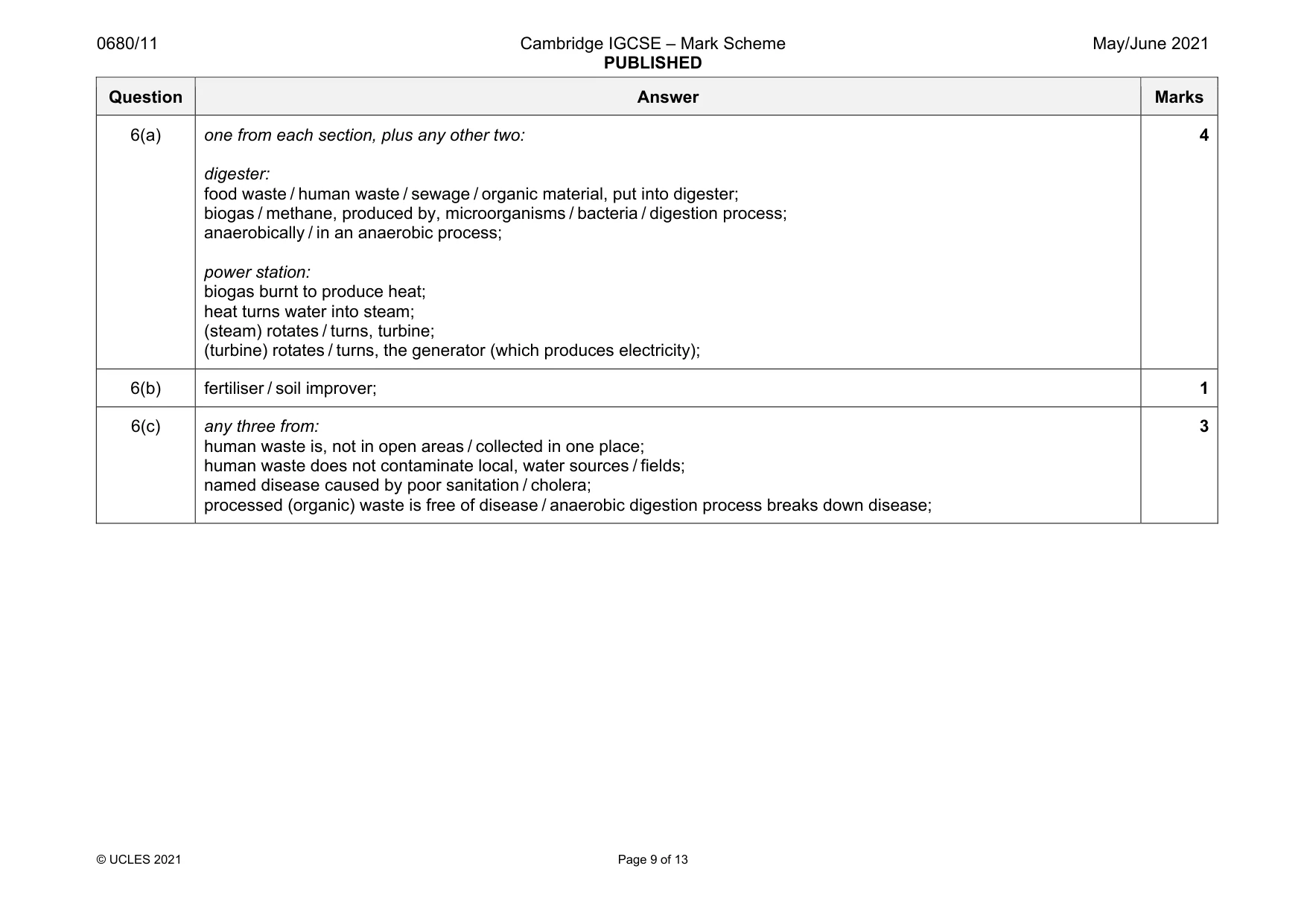
0680/11 Cambridge IGCSE – Mark Scheme PUBLISHED May/June 2021 © UCLES 2021 Page 9 of 13 Question Answer Marks 6(a) one from each section, plus any other two: digester: food waste / human waste / sewage / organic material, put into digester; biogas / methane, produced by, microorganisms / bacteria / digestion process; anaerobically / in an anaerobic process; power station: biogas burnt to produce heat; heat turns water into steam; (steam) rotates / turns, turbine; (turbine) rotates / turns, the generator (which produces electricity); 4 6(b) fertiliser / soil improver; 1 6(c) any three from: human waste is, not in open areas / collected in one place; human waste does not contaminate local, water sources / fields; named disease caused by poor sanitation / cholera; processed (organic) waste is free of disease / anaerobic digestion process breaks down disease; 3
Mark scheme, page 10
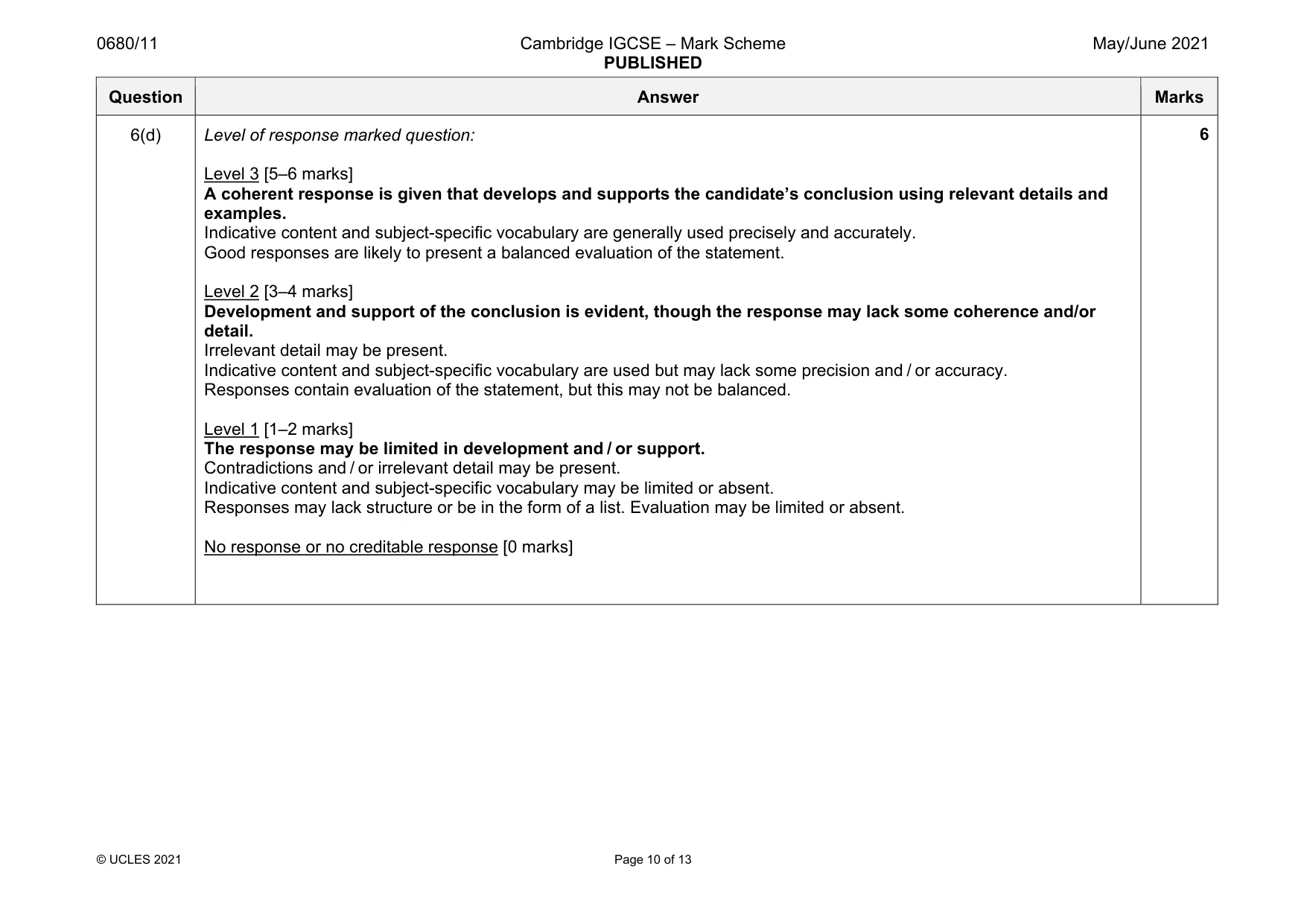
0680/11 Cambridge IGCSE – Mark Scheme PUBLISHED May/June 2021 © UCLES 2021 Page 10 of 13 Question Answer Marks 6(d) Level of response marked question: Level 3 [5–6 marks] A coherent response is given that develops and supports the candidate’s conclusion using relevant details and examples. Indicative content and subject-specific vocabulary are generally used precisely and accurately. Good responses are likely to present a balanced evaluation of the statement. Level 2 [3–4 marks] Development and support of the conclusion is evident, though the response may lack some coherence and/or detail. Irrelevant detail may be present. Indicative content and subject-specific vocabulary are used but may lack some precision and / or accuracy. Responses contain evaluation of the statement, but this may not be balanced. Level 1 [1–2 marks] The response may be limited in development and / or support. Contradictions and / or irrelevant detail may be present. Indicative content and subject-specific vocabulary may be limited or absent. Responses may lack structure or be in the form of a list. Evaluation may be limited or absent. No response or no creditable response [0 marks] 6
Mark scheme, page 11
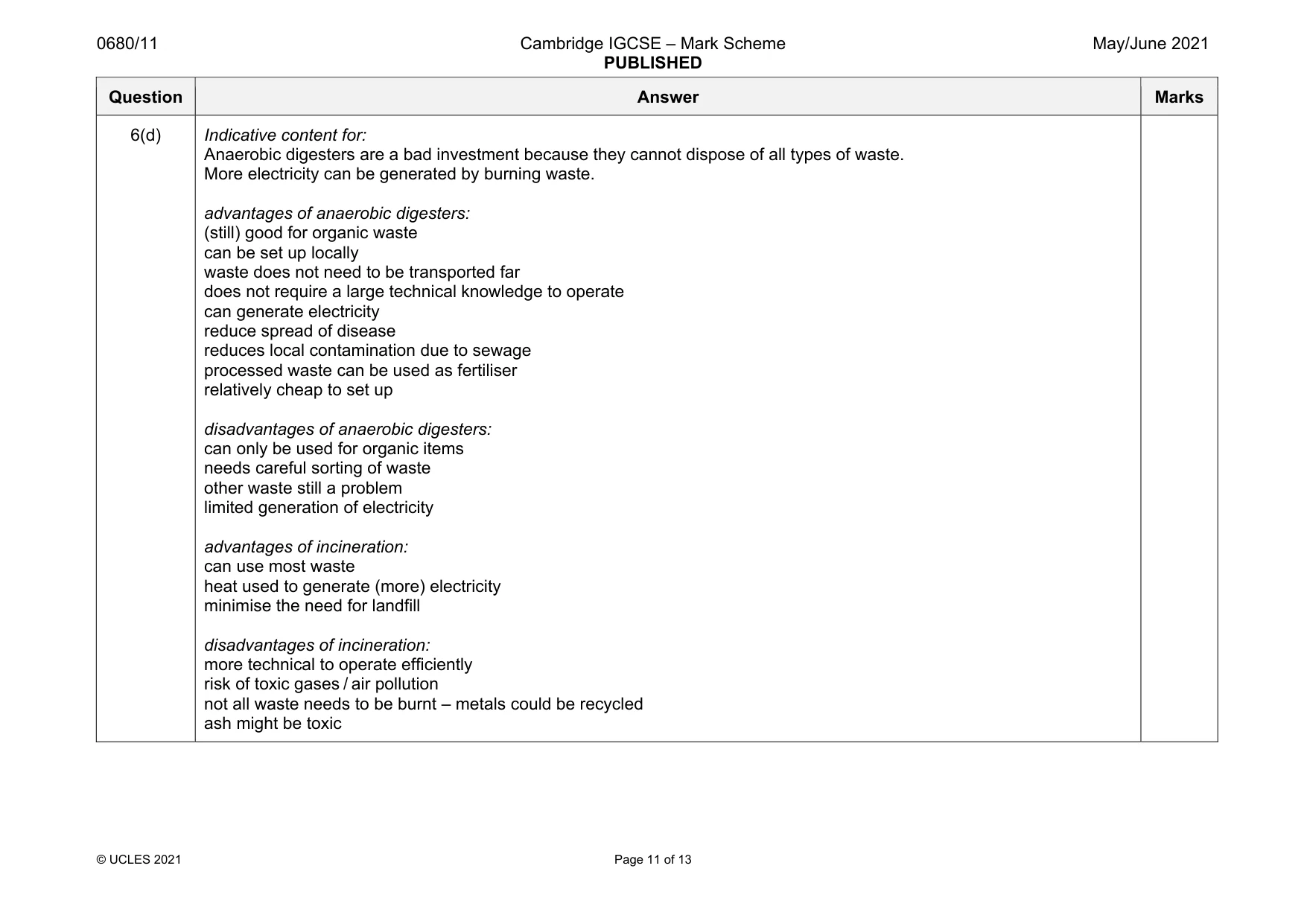
0680/11 Cambridge IGCSE – Mark Scheme PUBLISHED May/June 2021 © UCLES 2021 Page 11 of 13 Question Answer Marks 6(d) Indicative content for: Anaerobic digesters are a bad investment because they cannot dispose of all types of waste. More electricity can be generated by burning waste. advantages of anaerobic digesters: (still) good for organic waste can be set up locally waste does not need to be transported far does not require a large technical knowledge to operate can generate electricity reduce spread of disease reduces local contamination due to sewage processed waste can be used as fertiliser relatively cheap to set up disadvantages of anaerobic digesters: can only be used for organic items needs careful sorting of waste other waste still a problem limited generation of electricity advantages of incineration: can use most waste heat used to generate (more) electricity minimise the need for landfill disadvantages of incineration: more technical to operate efficiently risk of toxic gases / air pollution not all waste needs to be burnt – metals could be recycled ash might be toxic
Mark scheme, page 12
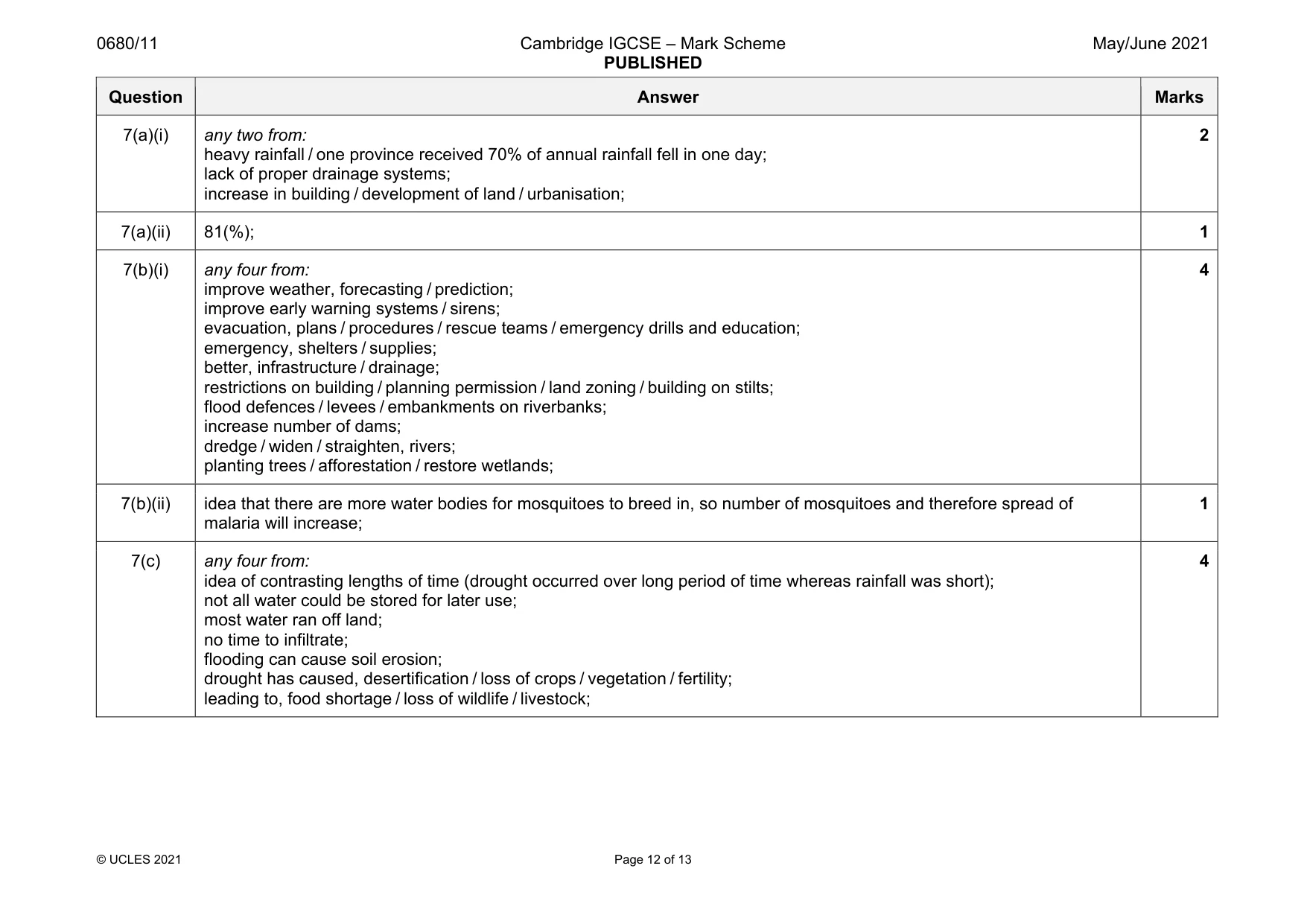
0680/11 Cambridge IGCSE – Mark Scheme PUBLISHED May/June 2021 © UCLES 2021 Page 12 of 13 Question Answer Marks 7(a)(i) any two from: heavy rainfall / one province received 70% of annual rainfall fell in one day; lack of proper drainage systems; increase in building / development of land / urbanisation; 2 7(a)(ii) 81(%); 1 7(b)(i) any four from: improve weather, forecasting / prediction; improve early warning systems / sirens; evacuation, plans / procedures / rescue teams / emergency drills and education; emergency, shelters / supplies; better, infrastructure / drainage; restrictions on building / planning permission / land zoning / building on stilts; flood defences / levees / embankments on riverbanks; increase number of dams; dredge / widen / straighten, rivers; planting trees / afforestation / restore wetlands; 4 7(b)(ii) idea that there are more water bodies for mosquitoes to breed in, so number of mosquitoes and therefore spread of malaria will increase; 1 7(c) any four from: idea of contrasting lengths of time (drought occurred over long period of time whereas rainfall was short); not all water could be stored for later use; most water ran off land; no time to infiltrate; flooding can cause soil erosion; drought has caused, desertification / loss of crops / vegetation / fertility; leading to, food shortage / loss of wildlife / livestock; 4
Mark scheme, page 13
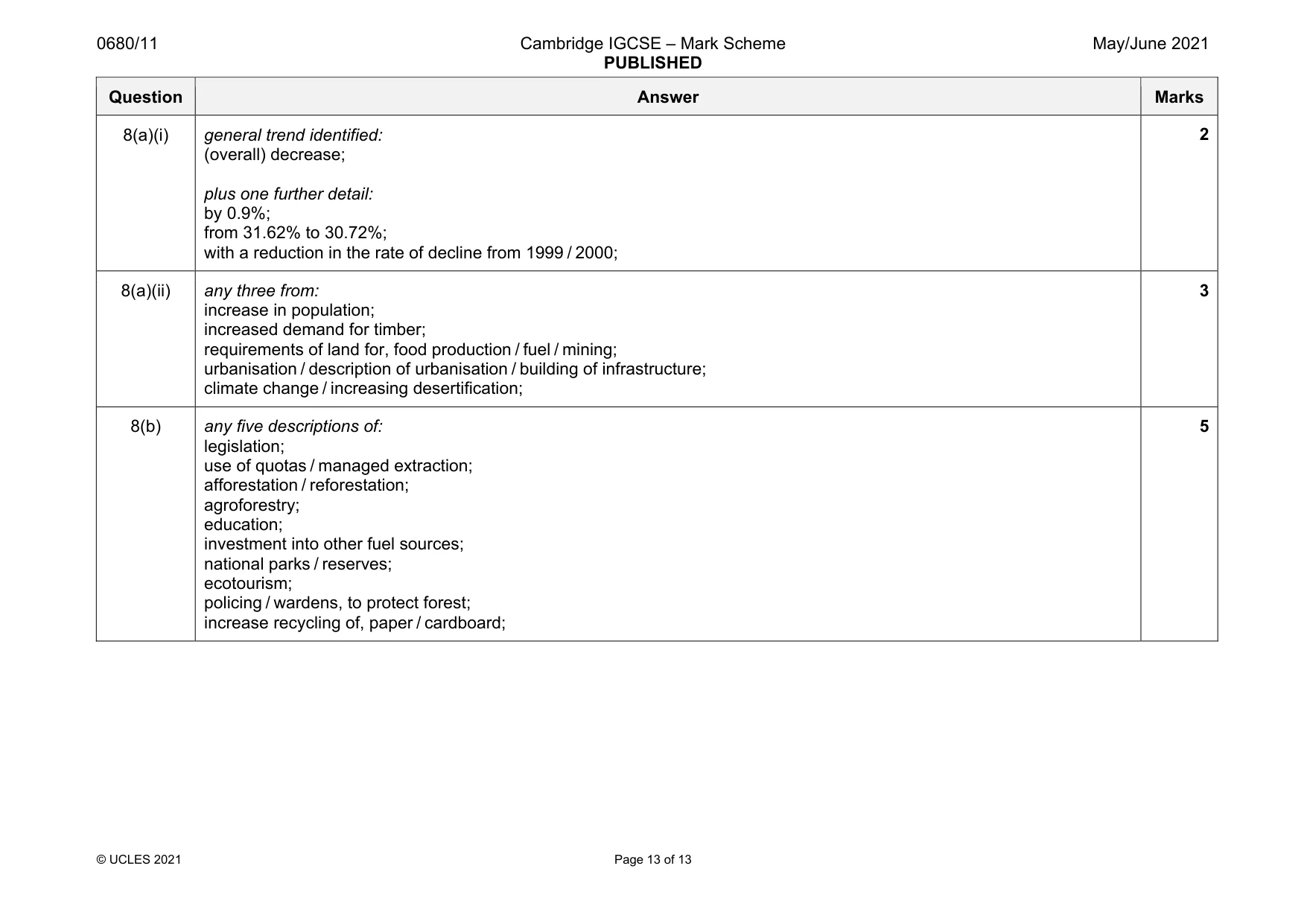
0680/11 Cambridge IGCSE – Mark Scheme PUBLISHED May/June 2021 © UCLES 2021 Page 13 of 13 Question Answer Marks 8(a)(i) general trend identified: (overall) decrease; plus one further detail: by 0.9%; from 31.62% to 30.72%; with a reduction in the rate of decline from 1999 / 2000; 2 8(a)(ii) any three from: increase in population; increased demand for timber; requirements of land for, food production / fuel / mining; urbanisation / description of urbanisation / building of infrastructure; climate change / increasing desertification; 3 8(b) any five descriptions of: legislation; use of quotas / managed extraction; afforestation / reforestation; agroforestry; education; investment into other fuel sources; national parks / reserves; ecotourism; policing / wardens, to protect forest; increase recycling of, paper / cardboard; 5
What you needed in this session
Cambridge’s own grade thresholds for 2021 May/June, Paper 1 · Variant 1. A higher threshold means an easier paper — the bar moves with how the cohort did.