Cambridge IGCSE Environmental Management 0680 — 2020 Oct/Nov Paper 1 · Variant 1
0680/11/O/N/20 · 80 marks · ≈90 min
The question paper and its mark scheme, free to read here and free to download. This is Cambridge’s own paper, exactly as it was sat.
Question paper20 pages

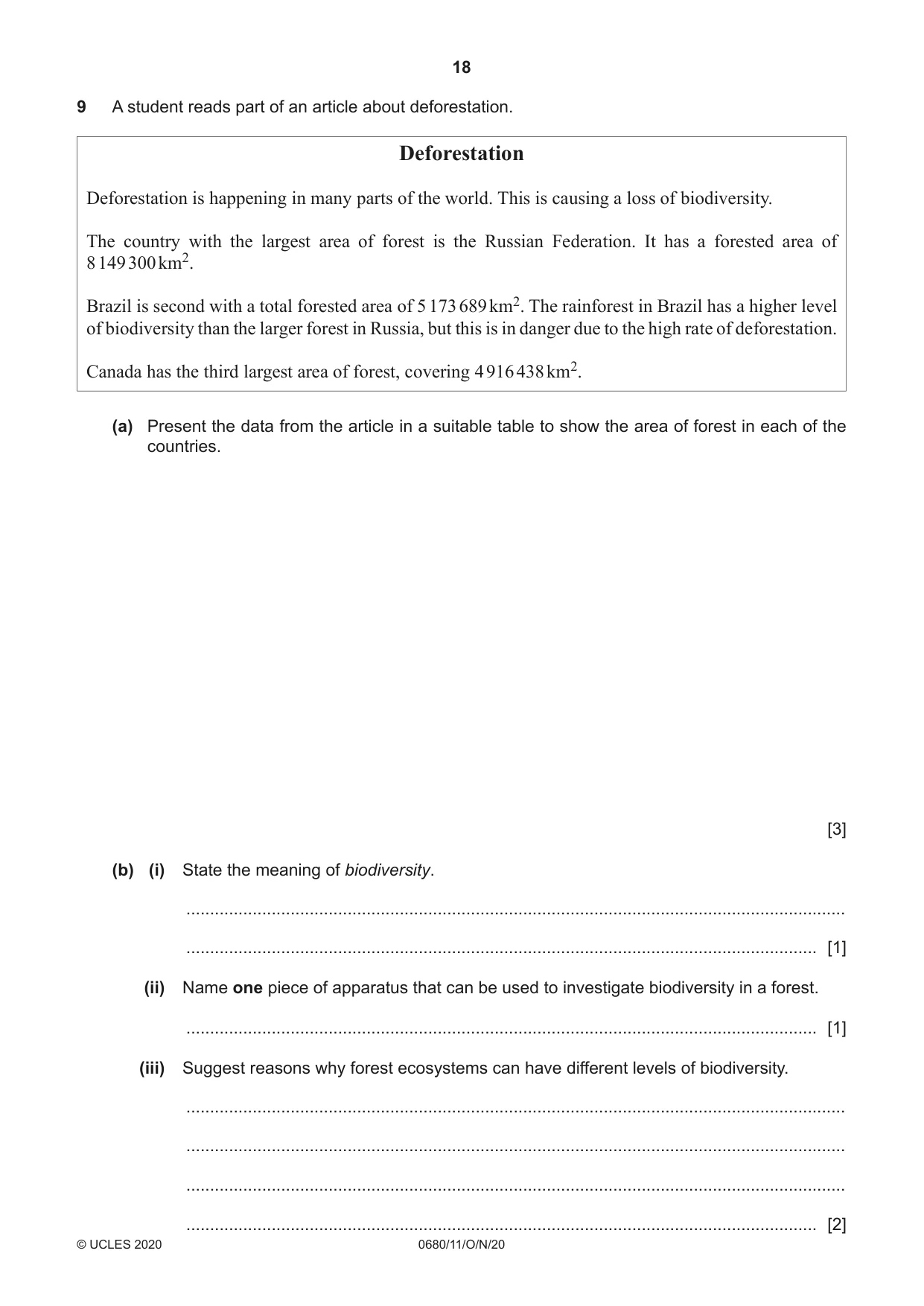

Mark scheme14 pages
Answers below. Sit the paper first if you are practising.
Paper as text
Question paper, page 1
Cambridge IGCSE™ This document has 20 pages. Blank pages are indicated. DC (DH/FC) 192725/4 © UCLES 2020 [Turn over * 0 8 7 8 5 5 9 2 4 5 * ENVIRONMENTAL MANAGEMENT 0680/11 Paper 1 Theory October/November 2020 1 hour 45 minutes You must answer on the question paper. No additional materials are needed. INSTRUCTIONS ● Answer all questions. ● Use a black or dark blue pen. You may use an HB pencil for any diagrams or graphs. ● Write your name, centre number and candidate number in the boxes at the top of the page. ● Write your answer to each question in the space provided. ● Do not use an erasable pen or correction fluid. ● Do not write on any bar codes. ● You may use a calculator. ● You should show all your working and use appropriate units. INFORMATION ● The total mark for this paper is 80. ● The number of marks for each question or part question is shown in brackets [ ].
Question paper, page 2
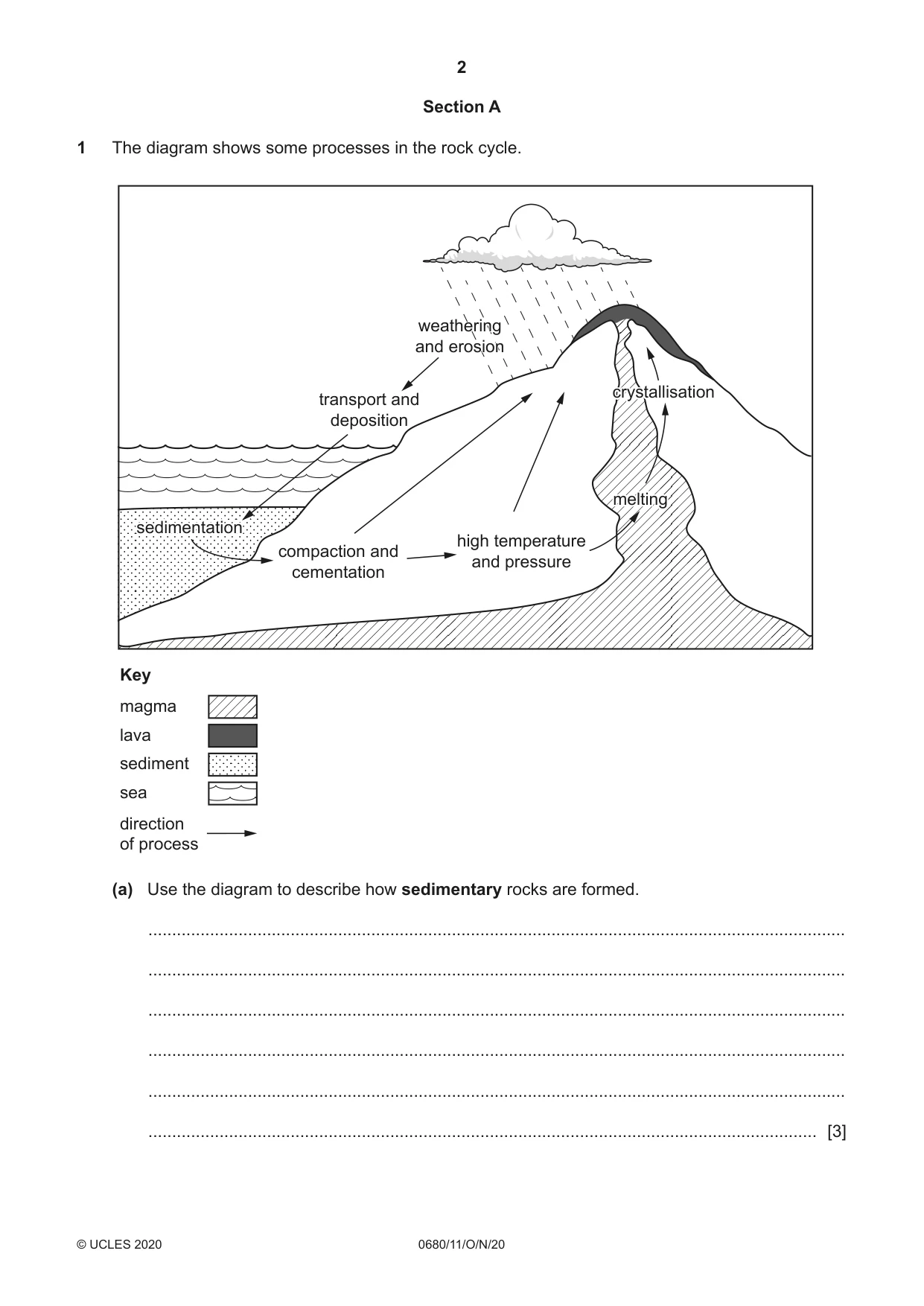
2 0680/11/O/N/20 © UCLES 2020 Section A 1 The diagram shows some processes in the rock cycle. Key magma lava sediment sea direction of process weathering and erosion weathering and erosion transport and deposition sedimentation sedimentation compaction and cementation high temperature and pressure melting melting crystallisation crystallisation (a) Use the diagram to describe how sedimentary rocks are formed. … … … … … … [3]
Question paper, page 3
3 0680/11/O/N/20 © UCLES 2020 [Turn over (b) A new mine is proposed near a town. Suggest reasons why some people do not want a mine near to where they live. … … … … … … [3] [Total: 6]
Question paper, page 4
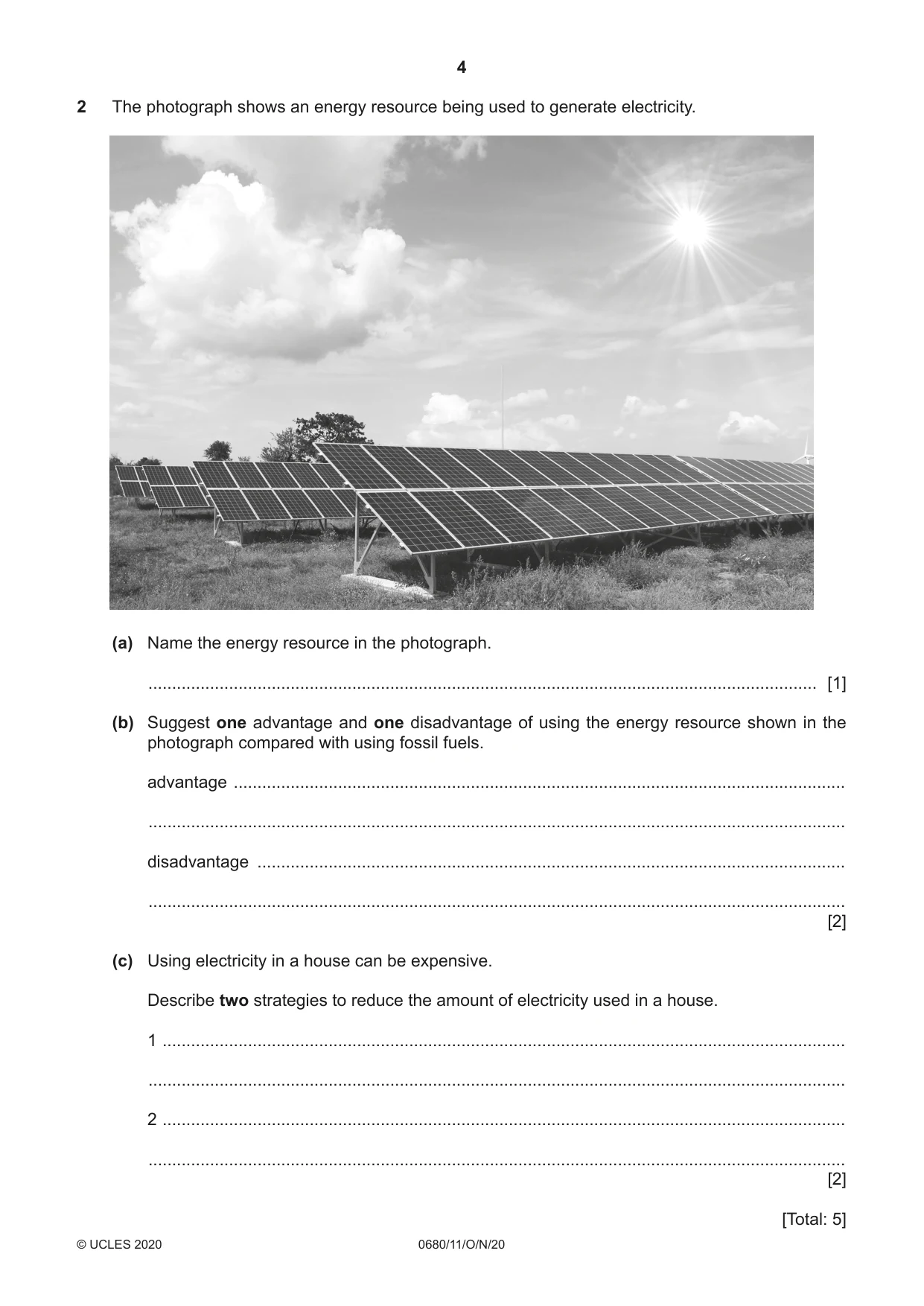
4 0680/11/O/N/20 © UCLES 2020 2 The photograph shows an energy resource being used to generate electricity. (a) Name the energy resource in the photograph. … [1] (b) Suggest one advantage and one disadvantage of using the energy resource shown in the photograph compared with using fossil fuels. advantage … … disadvantage … … [2] (c) Using electricity in a house can be expensive. Describe two strategies to reduce the amount of electricity used in a house. 1 … … 2 … … [2] [Total: 5]
Question paper, page 5
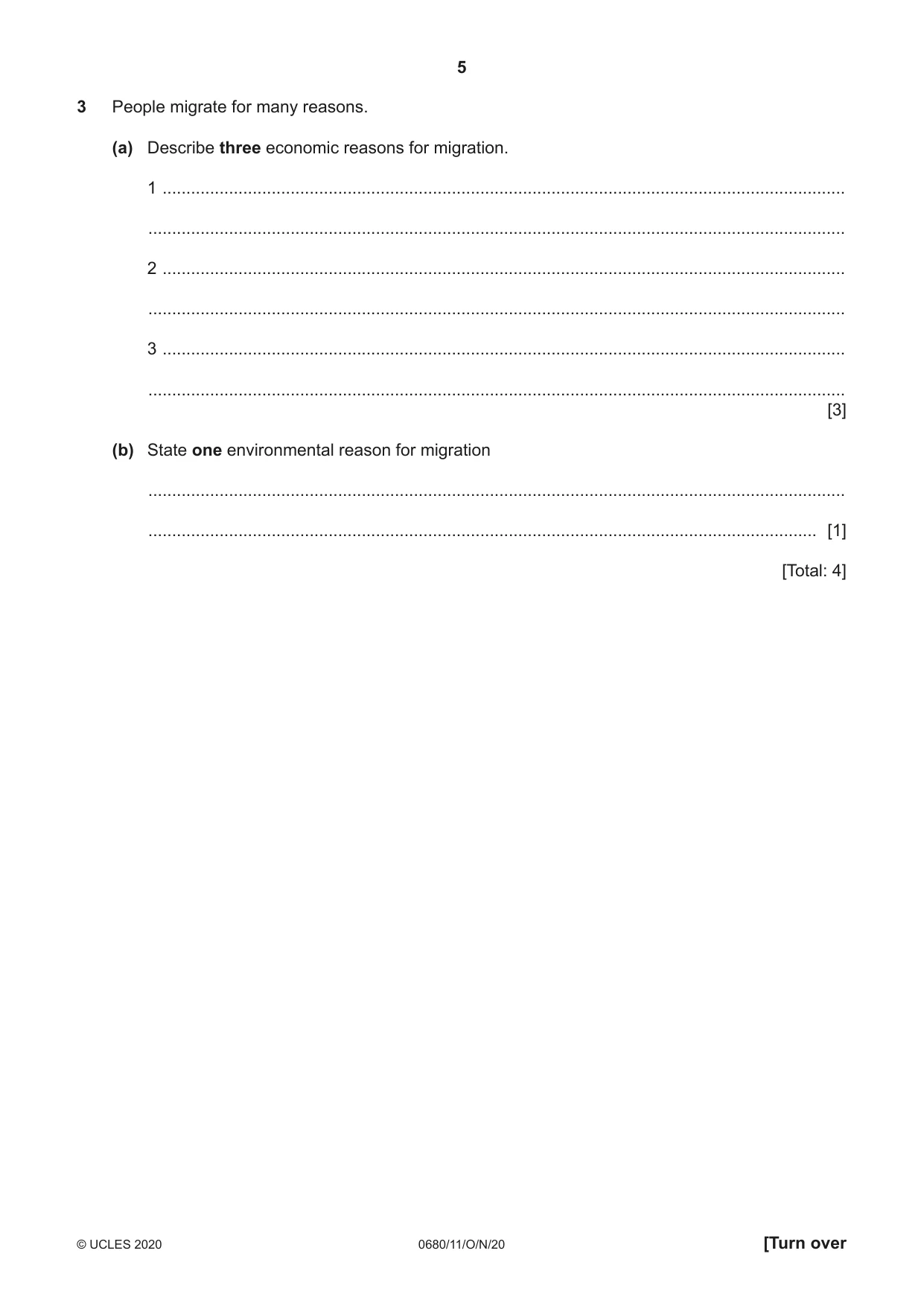
5 0680/11/O/N/20 © UCLES 2020 [Turn over 3 People migrate for many reasons. (a) Describe three economic reasons for migration. 1 … … 2 … … 3 … … [3] (b) State one environmental reason for migration … … [1] [Total: 4]
Question paper, page 6
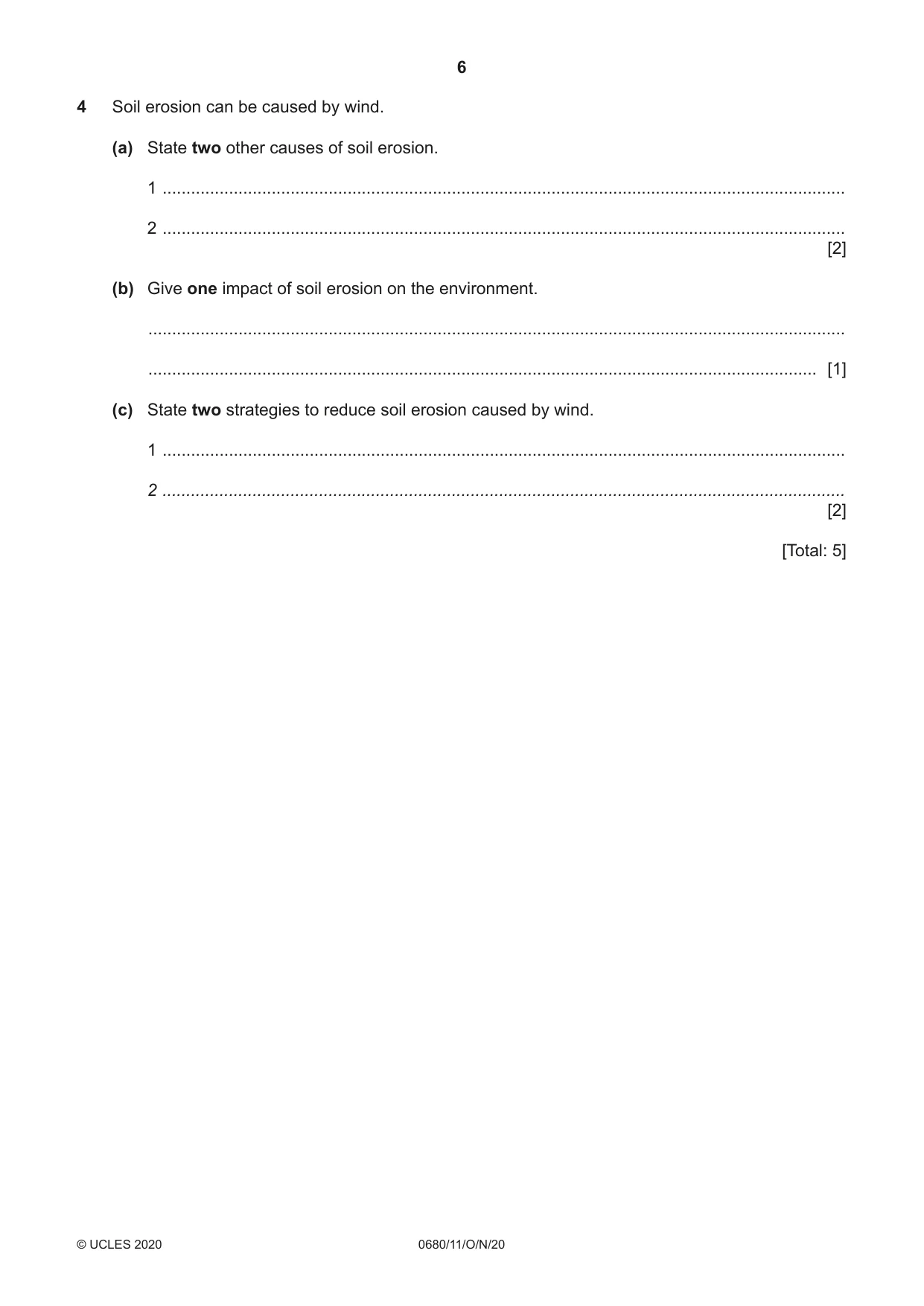
6 0680/11/O/N/20 © UCLES 2020 4 Soil erosion can be caused by wind. (a) State two other causes of soil erosion. 1 … 2 … [2] (b) Give one impact of soil erosion on the environment. … … [1] (c) State two strategies to reduce soil erosion caused by wind. 1 … 2 … [2] [Total: 5]
Question paper, page 7
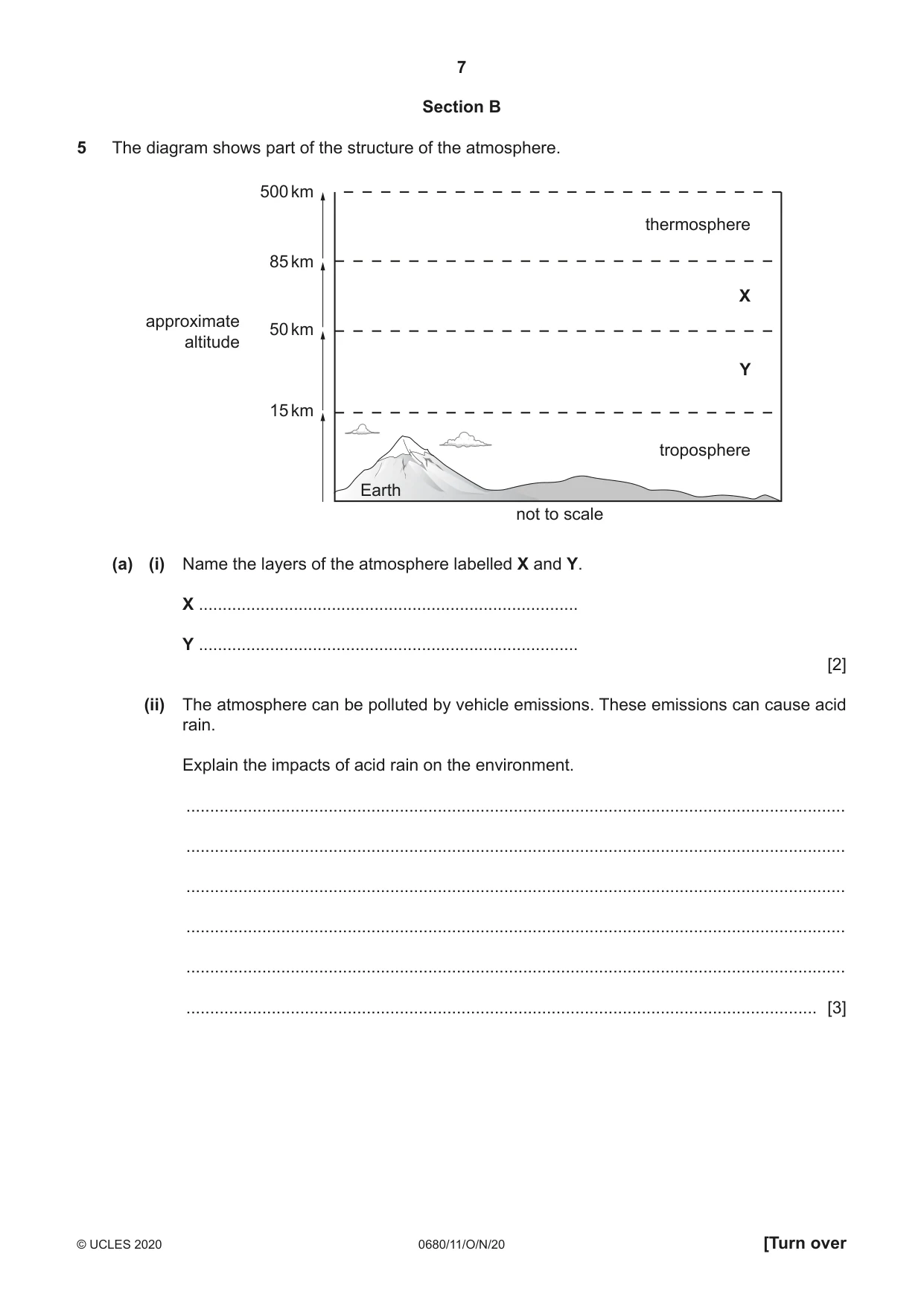
7 0680/11/O/N/20 © UCLES 2020 [Turn over Section B 5 The diagram shows part of the structure of the atmosphere. 500 km 85 km 50 km approximate altitude 15 km troposphere Earth not to scale Y X thermosphere (a) (i) Name the layers of the atmosphere labelled X and Y. X … Y … [2] (ii) The atmosphere can be polluted by vehicle emissions. These emissions can cause acid rain. Explain the impacts of acid rain on the environment. … … … … … … [3]
Question paper, page 8
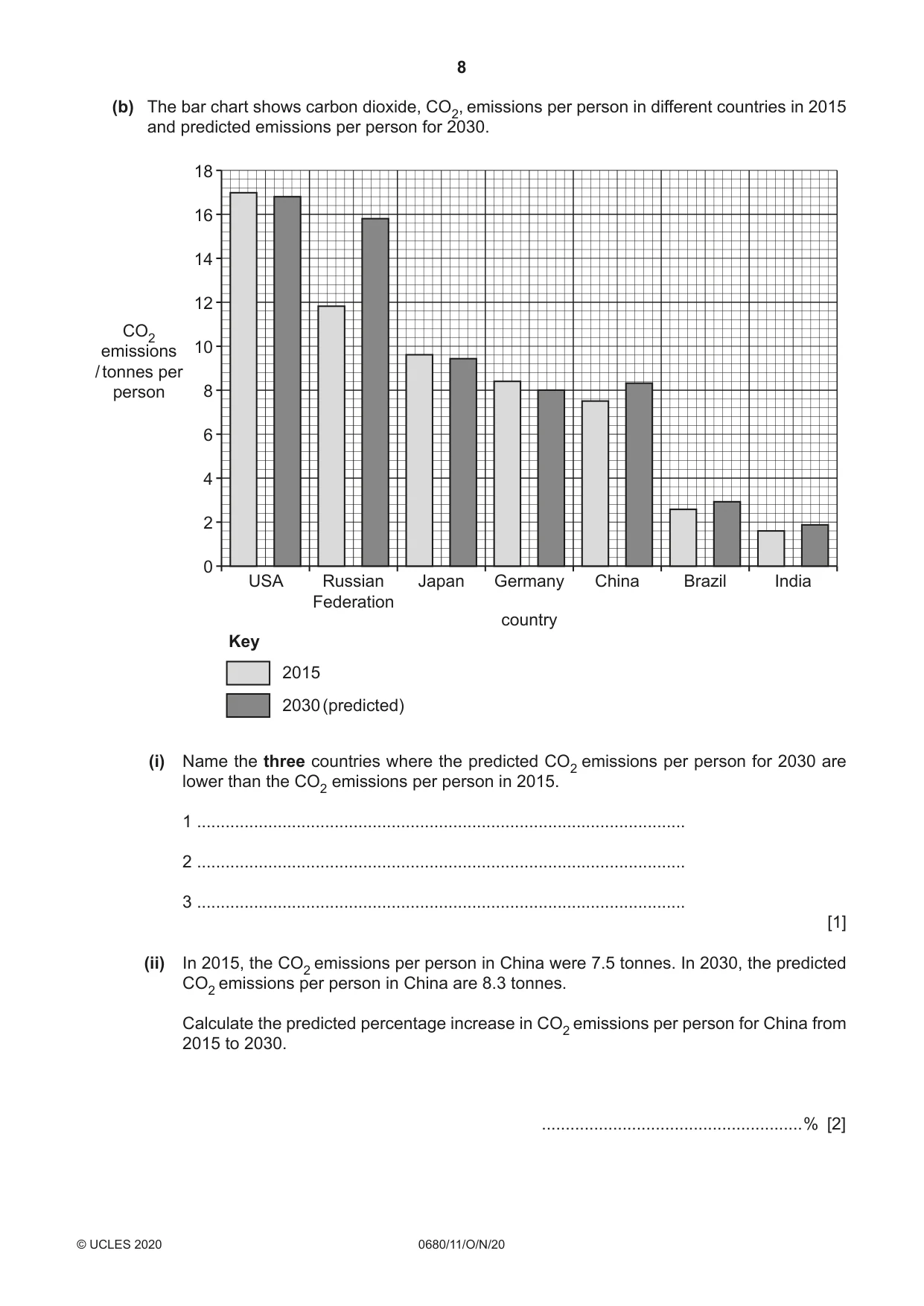
8 0680/11/O/N/20 © UCLES 2020 (b) The bar chart shows carbon dioxide, CO2, emissions per person in different countries in 2015 and predicted emissions per person for 2030. USA Key 2015 0 2 4 6 8 10 CO2 emissions / tonnes per person 12 14 16 18 Russian Federation Japan Germany country China Brazil India 2030 (predicted) (i) Name the three countries where the predicted CO2 emissions per person for 2030 are lower than the CO2 emissions per person in 2015. 1 … 2 … 3 … [1] (ii) In 2015, the CO2 emissions per person in China were 7.5 tonnes. In 2030, the predicted CO2 emissions per person in China are 8.3 tonnes. Calculate the predicted percentage increase in CO2 emissions per person for China from 2015 to 2030. …% [2]
Question paper, page 9
9 0680/11/O/N/20 © UCLES 2020 [Turn over (iii) Suggest reasons why this graph cannot be used to predict the future global concentration of CO2 in the atmosphere. … … … … [2] (c) Suggest reasons why atmospheric pollution is a global problem. … … … … … … [3] [Total: 13]
Question paper, page 10
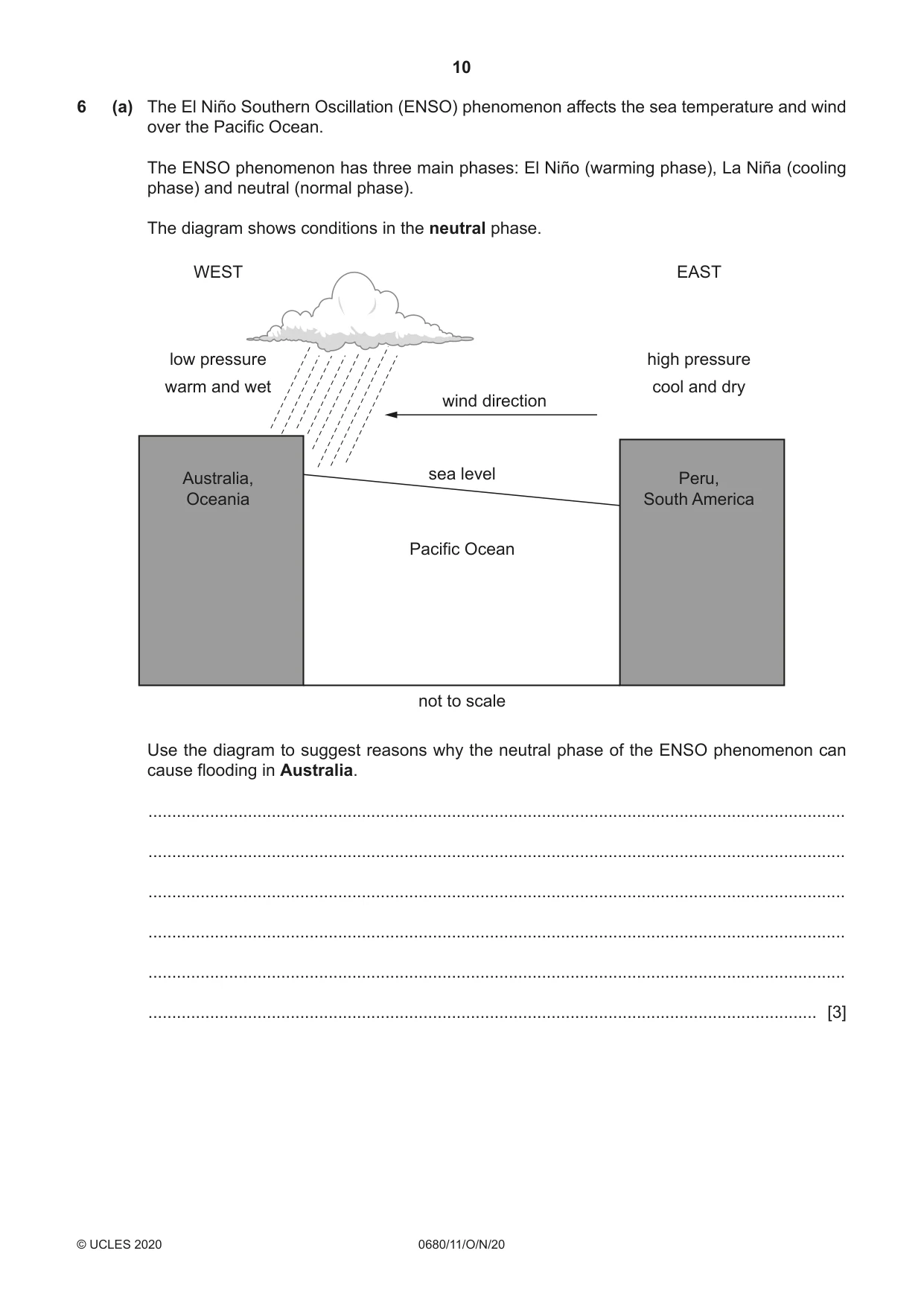
10 0680/11/O/N/20 © UCLES 2020 6 (a) The El Niño Southern Oscillation (ENSO) phenomenon affects the sea temperature and wind over the Pacific Ocean. The ENSO phenomenon has three main phases: El Niño (warming phase), La Niña (cooling phase) and neutral (normal phase). The diagram shows conditions in the neutral phase. Australia, Oceania Peru, South America WEST EAST low pressure high pressure warm and wet cool and dry Pacific Ocean not to scale sea level wind direction Use the diagram to suggest reasons why the neutral phase of the ENSO phenomenon can cause flooding in Australia. … … … … … … [3]
Question paper, page 11
11 0680/11/O/N/20 © UCLES 2020 [Turn over (b) In 2017, Cyclone Debbie caused damage and flooding in Australia. Many people were injured and 14 people died. (i) Describe the causes of a tropical cyclone. … … … … … … [3] (ii) Describe ways to reduce the impacts of a tropical cyclone. … … … … … … [3] [Total: 9]
Question paper, page 12
12 0680/11/O/N/20 © UCLES 2020 7 (a) The bar chart shows the percentage of the population without access to safe drinking water in nine countries in 2016. 0 Papua New Guinea Mozambique Madagascar Ethiopia Zambia country Ghana Cambodia Burkina Faso India 10 20 30 percentage of population 40 50 60 70 (i) Complete the bar chart to show that the percentage of the population of Cambodia without access to safe drinking water in 2016 was 24.5%. [1] (ii) The percentage of the population of Japan without access to safe drinking water is 0%. Suggest one reason why everybody in Japan has access to safe drinking water. … … [1] (b) The table shows the percentage of the population of Ethiopia with access to safe drinking water from 2008 to 2015 and the change in percentage points from the previous year. year 2008 2009 2010 2011 2012 2013 2014 2015 percentage of the population with access to safe drinking water 28.5 30.0 31.6 33.1 34.6 36.0 37.6 39.1 change in percentage points from previous year 1.5 1.6 … … 1.4 … 1.5 Complete the table to show the change in percentage points from the previous year in 2011, 2012 and 2014. [1]
Question paper, page 13
13 0680/11/O/N/20 © UCLES 2020 [Turn over (c) Dam projects can provide access to drinking water. Describe other ways dam projects can affect local people. … … … … … … … … [4] (d) Insecticides used on agricultural land can be washed into rivers. Describe the effects of insecticides on aquatic life in rivers. … … … … [2]
Question paper, page 14
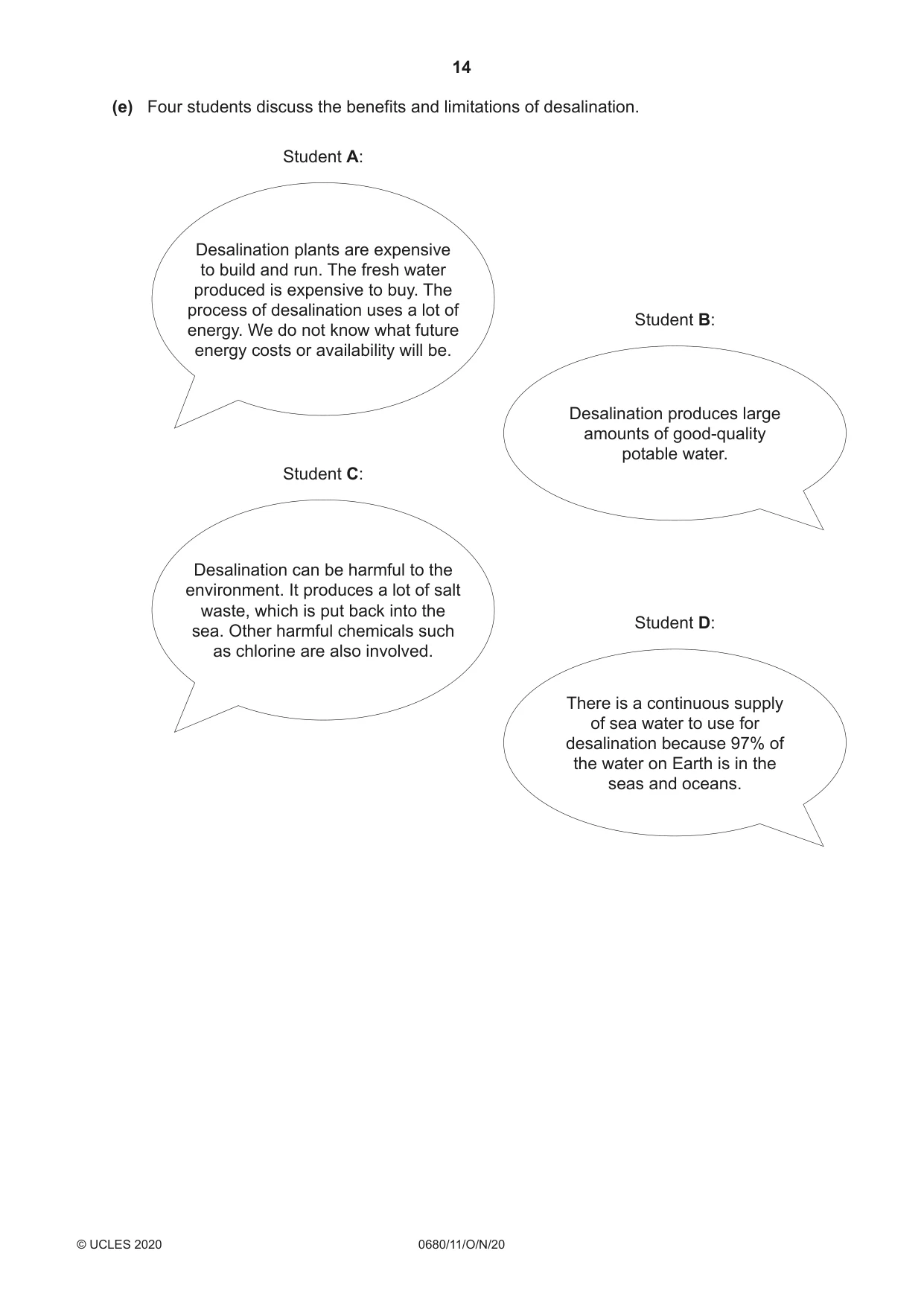
14 0680/11/O/N/20 © UCLES 2020 (e) Four students discuss the benefits and limitations of desalination. Desalination plants are expensive to build and run. The fresh water produced is expensive to buy. The process of desalination uses a lot of energy. We do not know what future energy costs or availability will be. Student A: Desalination produces large amounts of good-quality potable water. Student B: Desalination can be harmful to the environment. It produces a lot of salt waste, which is put back into the sea. Other harmful chemicals such as chlorine are also involved. Student C: There is a continuous supply of sea water to use for desalination because 97% of the water on Earth is in the seas and oceans. Student D:
Question paper, page 15
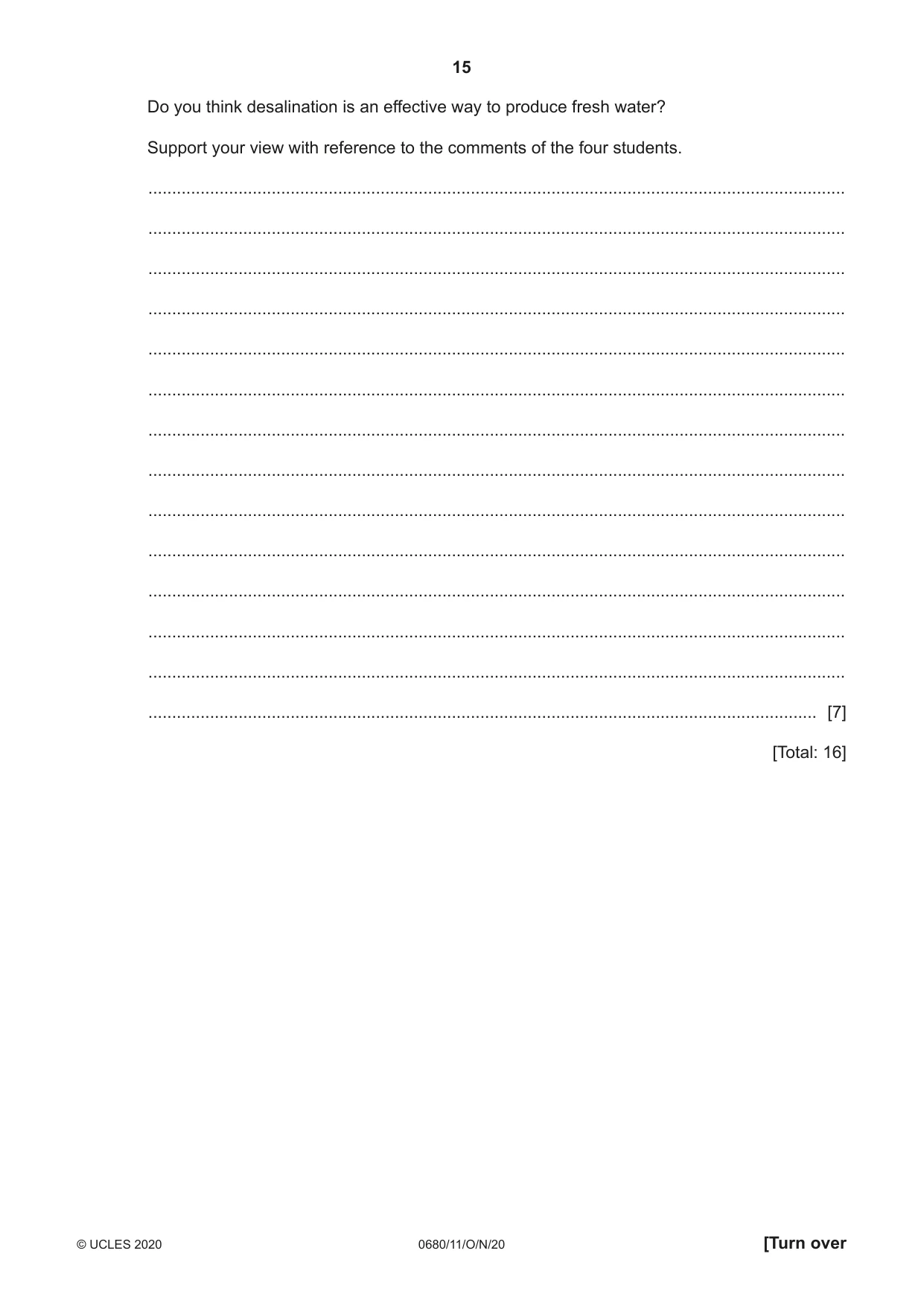
15 0680/11/O/N/20 © UCLES 2020 [Turn over Do you think desalination is an effective way to produce fresh water? Support your view with reference to the comments of the four students. … … … … … … … … … … … … … … [7] [Total: 16]
Question paper, page 16
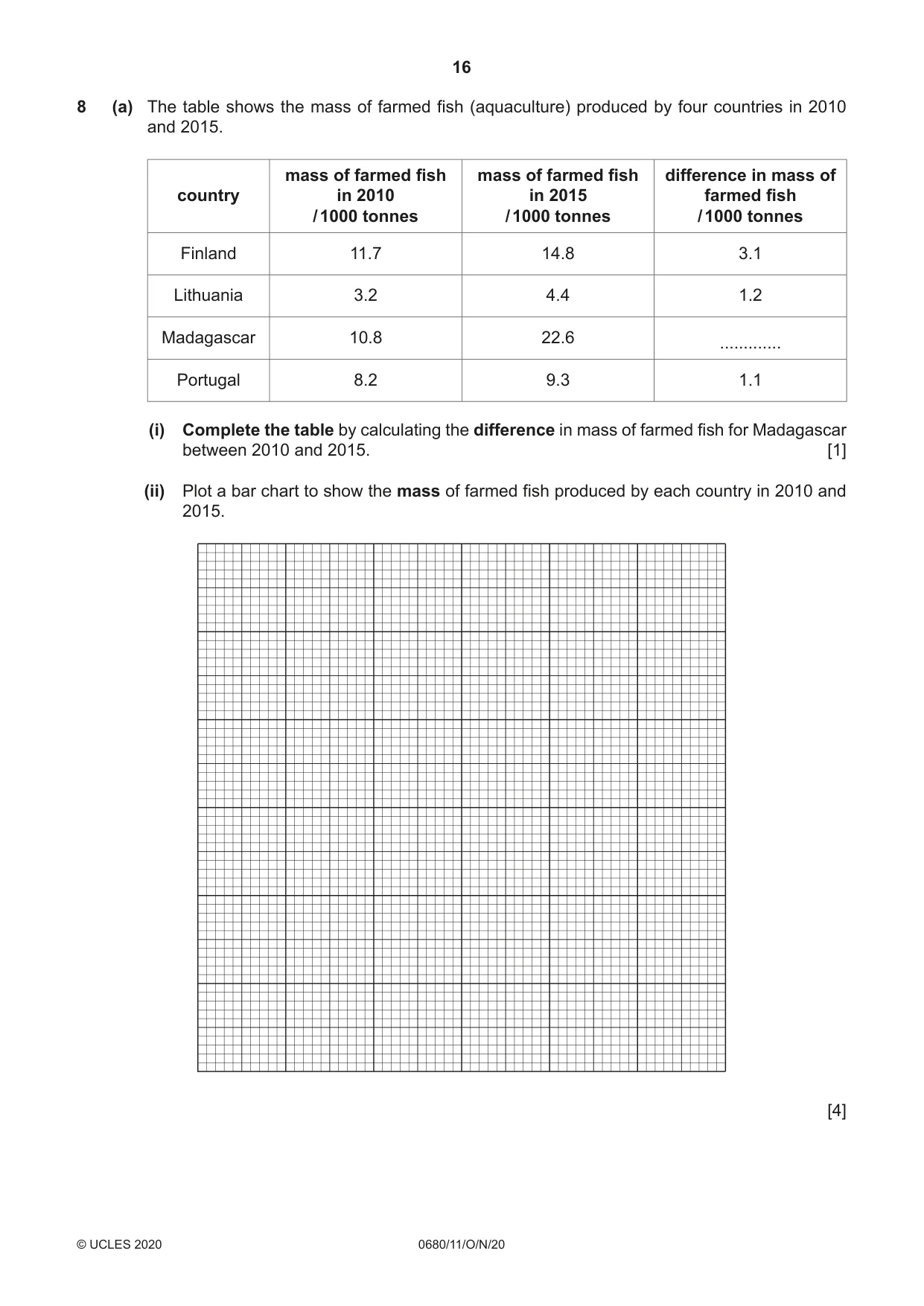
16 0680/11/O/N/20 © UCLES 2020 8 (a) The table shows the mass of farmed fish (aquaculture) produced by four countries in 2010 and 2015. country mass of farmed fish in 2010 / 1000 tonnes mass of farmed fish in 2015 / 1000 tonnes difference in mass of farmed fish / 1000 tonnes Finland 11.7 14.8 3.1 Lithuania 3.2 4.4 1.2 Madagascar 10.8 22.6 … Portugal 8.2 9.3 1.1 (i) Complete the table by calculating the difference in mass of farmed fish for Madagascar between 2010 and 2015. [1] (ii) Plot a bar chart to show the mass of farmed fish produced by each country in 2010 and 2015. [4]
Question paper, page 17
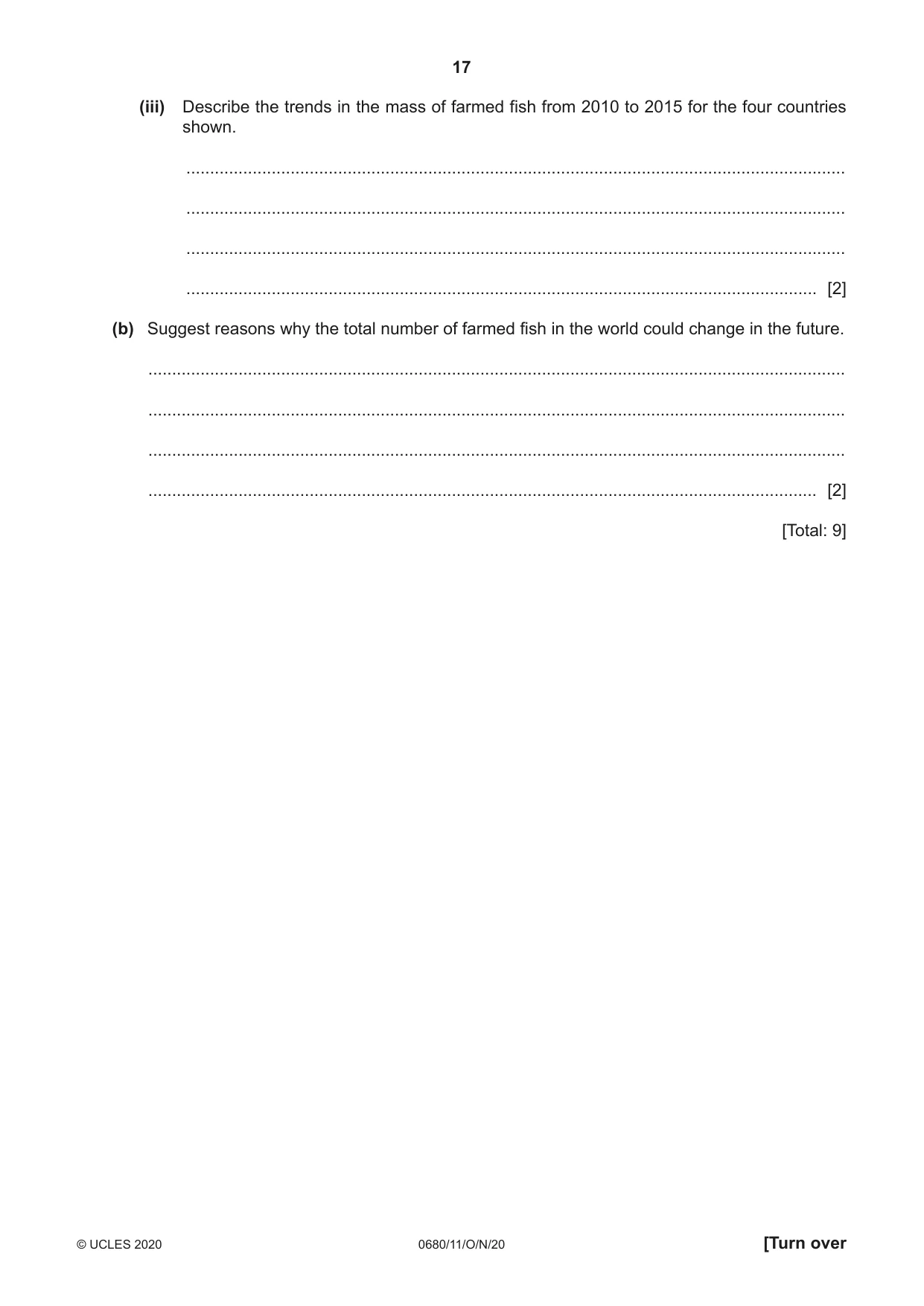
17 0680/11/O/N/20 © UCLES 2020 [Turn over (iii) Describe the trends in the mass of farmed fish from 2010 to 2015 for the four countries shown. … … … … [2] (b) Suggest reasons why the total number of farmed fish in the world could change in the future. … … … … [2] [Total: 9]
Question paper, page 18
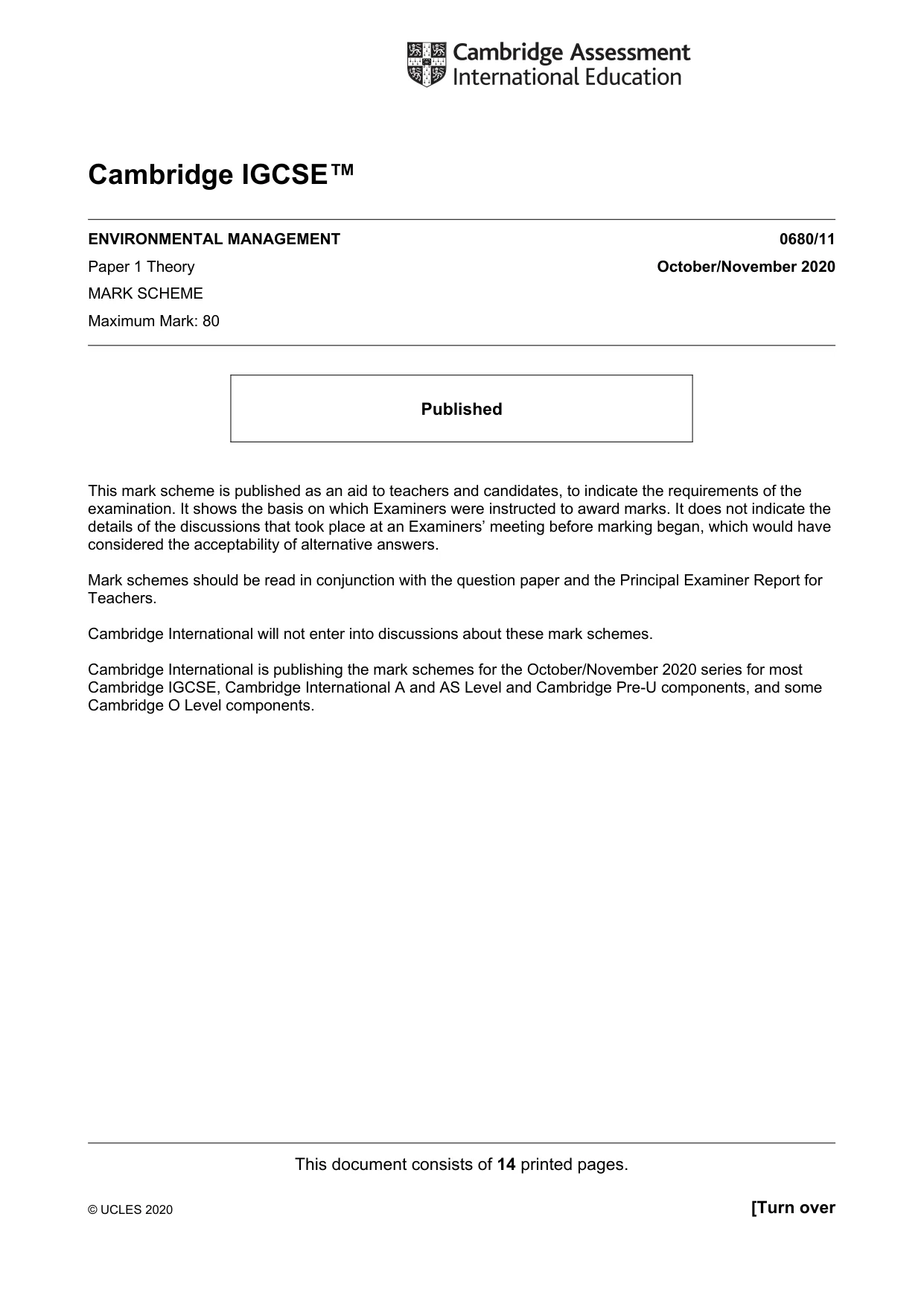
18 0680/11/O/N/20 © UCLES 2020 9 A student reads part of an article about deforestation. Deforestation Deforestation is happening in many parts of the world. This is causing a loss of biodiversity. The country with the largest area of forest is the Russian Federation. It has a forested area of 8 149 300 km2. Brazil is second with a total forested area of 5 173 689 km2. The rainforest in Brazil has a higher level of biodiversity than the larger forest in Russia, but this is in danger due to the high rate of deforestation. Canada has the third largest area of forest, covering 4 916 438 km2. (a) Present the data from the article in a suitable table to show the area of forest in each of the countries. [3] (b) (i) State the meaning of biodiversity. … … [1] (ii) Name one piece of apparatus that can be used to investigate biodiversity in a forest. … [1] (iii) Suggest reasons why forest ecosystems can have different levels of biodiversity. … … … … [2]
Question paper, page 19
19 0680/11/O/N/20 © UCLES 2020 (c) The student says, To what extent do you agree with this statement? Give reasons for your answer. … … … … … … … … … … … … … … … [6] [Total: 13] The reasons for cutting down trees are more important than the problems caused by deforestation.
Question paper, page 20
20 0680/11/O/N/20 © UCLES 2020 The boundaries and names shown, the designations used and the presentation of material on the maps contained in this question paper/insert do not imply official endorsement or acceptance by Cambridge Assessment International Education concerning the legal status of any country, territory, or area or any of its authorities, or of the delimitation of its frontiers or boundaries. Permission to reproduce items where third-party owned material protected by copyright is included has been sought and cleared where possible. Every reasonable effort has been made by the publisher (UCLES) to trace copyright holders, but if any items requiring clearance have unwittingly been included, the publisher will be pleased to make amends at the earliest possible opportunity. To avoid the issue of disclosure of answer-related information to candidates, all copyright acknowledgements are reproduced online in the Cambridge Assessment International Education Copyright Acknowledgements Booklet. This is produced for each series of examinations and is freely available to download at www.cambridgeinternational.org after the live examination series. Cambridge Assessment International Education is part of the Cambridge Assessment Group. Cambridge Assessment is the brand name of the University of Cambridge Local Examinations Syndicate (UCLES), which itself is a department of the University of Cambridge. BLANK PAGE
Mark scheme, page 1
This document consists of 14 printed pages. © UCLES 2020 [Turn over Cambridge IGCSE™ ENVIRONMENTAL MANAGEMENT 0680/11 Paper 1 Theory October/November 2020 MARK SCHEME Maximum Mark: 80 Published This mark scheme is published as an aid to teachers and candidates, to indicate the requirements of the examination. It shows the basis on which Examiners were instructed to award marks. It does not indicate the details of the discussions that took place at an Examiners’ meeting before marking began, which would have considered the acceptability of alternative answers. Mark schemes should be read in conjunction with the question paper and the Principal Examiner Report for Teachers. Cambridge International will not enter into discussions about these mark schemes. Cambridge International is publishing the mark schemes for the October/November 2020 series for most Cambridge IGCSE, Cambridge International A and AS Level and Cambridge Pre-U components, and some Cambridge O Level components.
Mark scheme, page 2
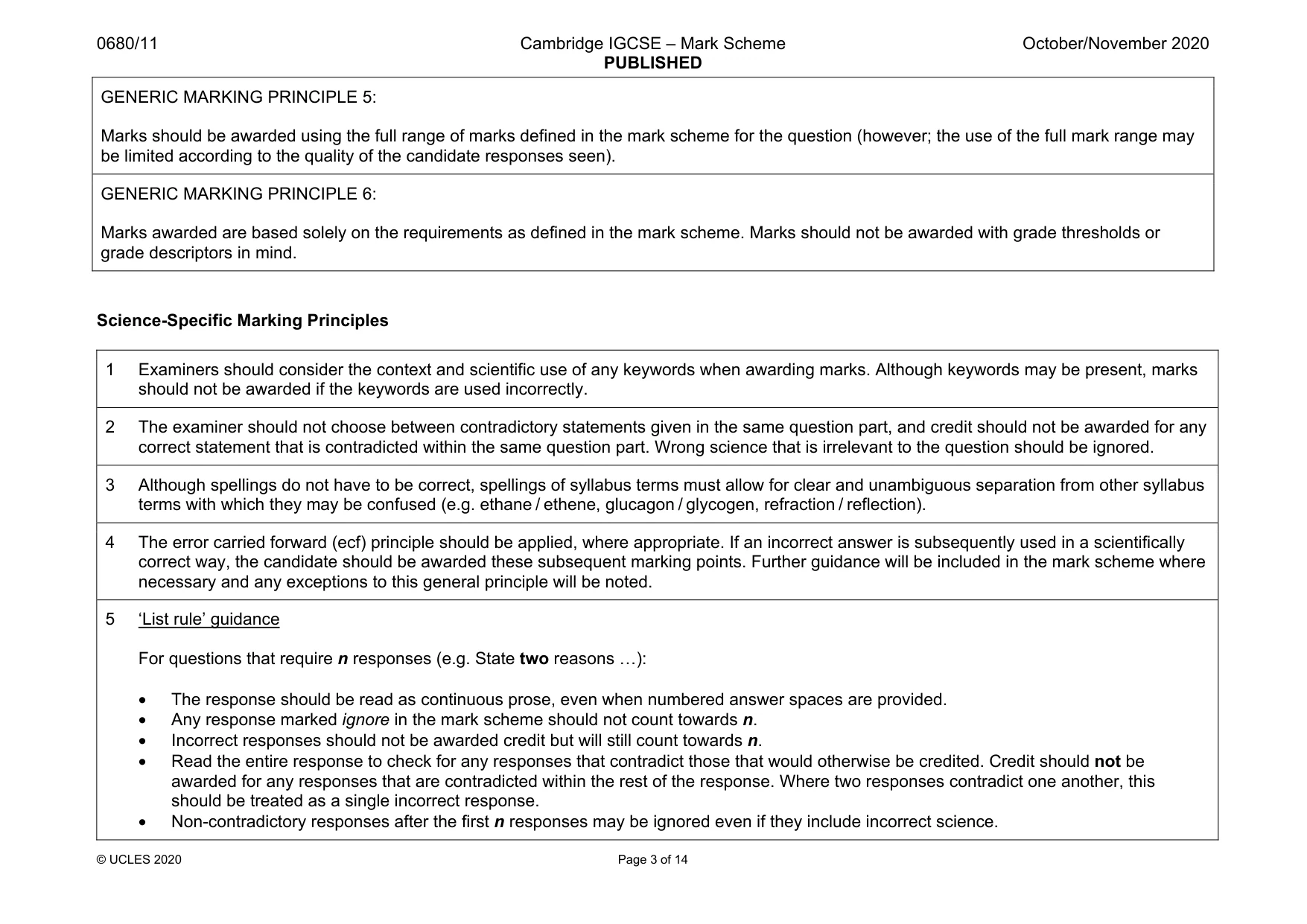
0680/11 Cambridge IGCSE – Mark Scheme PUBLISHED October/November 2020 © UCLES 2020 Page 2 of 14 Generic Marking Principles These general marking principles must be applied by all examiners when marking candidate answers. They should be applied alongside the specific content of the mark scheme or generic level descriptors for a question. Each question paper and mark scheme will also comply with these marking principles. GENERIC MARKING PRINCIPLE 1: Marks must be awarded in line with: • the specific content of the mark scheme or the generic level descriptors for the question • the specific skills defined in the mark scheme or in the generic level descriptors for the question • the standard of response required by a candidate as exemplified by the standardisation scripts. GENERIC MARKING PRINCIPLE 2: Marks awarded are always whole marks (not half marks, or other fractions). GENERIC MARKING PRINCIPLE 3: Marks must be awarded positively: • marks are awarded for correct/valid answers, as defined in the mark scheme. However, credit is given for valid answers which go beyond the scope of the syllabus and mark scheme, referring to your Team Leader as appropriate • marks are awarded when candidates clearly demonstrate what they know and can do • marks are not deducted for errors • marks are not deducted for omissions • answers should only be judged on the quality of spelling, punctuation and grammar when these features are specifically assessed by the question as indicated by the mark scheme. The meaning, however, should be unambiguous. GENERIC MARKING PRINCIPLE 4: Rules must be applied consistently, e.g. in situations where candidates have not followed instructions or in the application of generic level descriptors.
Mark scheme, page 3
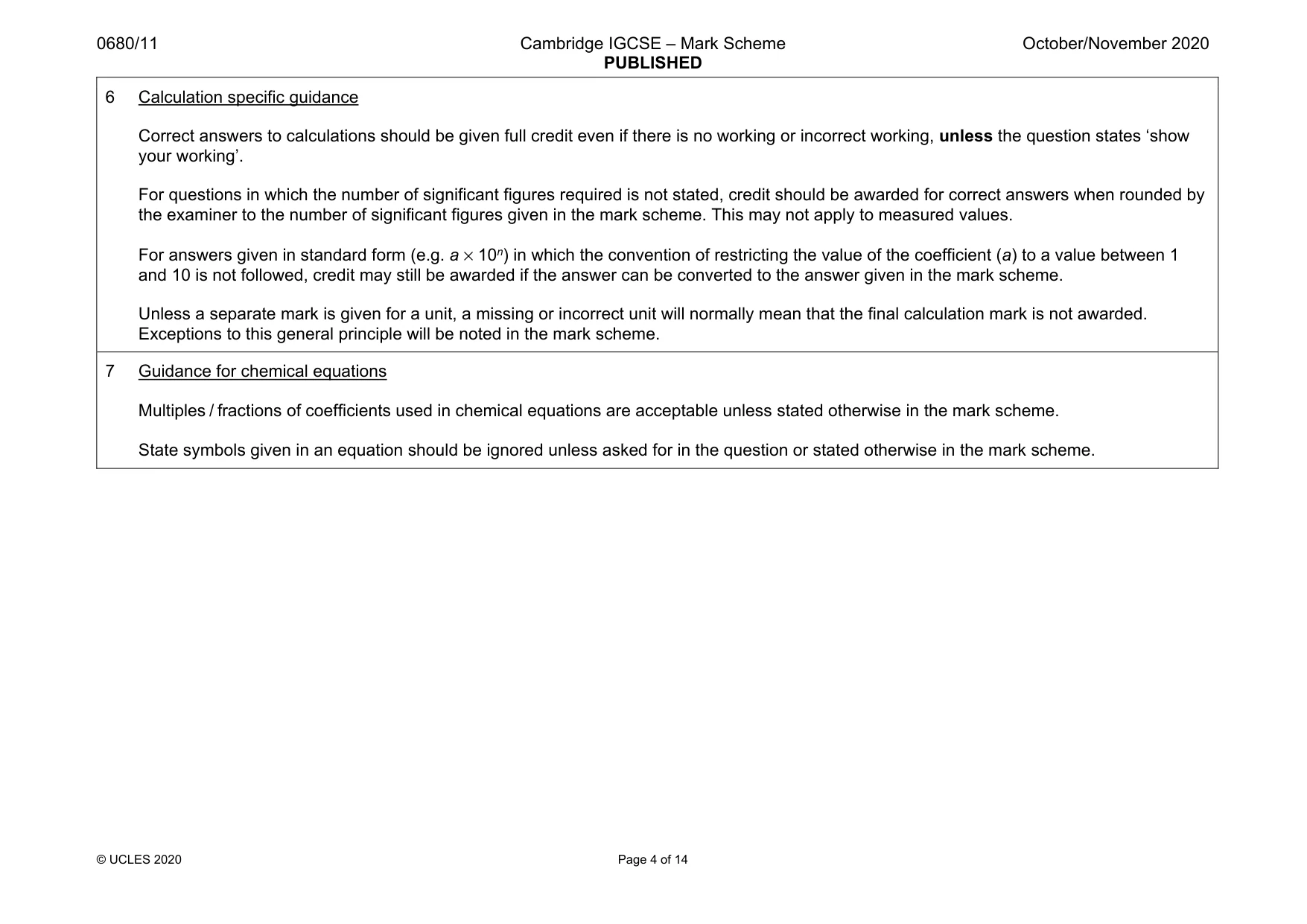
0680/11 Cambridge IGCSE – Mark Scheme PUBLISHED October/November 2020 © UCLES 2020 Page 3 of 14 GENERIC MARKING PRINCIPLE 5: Marks should be awarded using the full range of marks defined in the mark scheme for the question (however; the use of the full mark range may be limited according to the quality of the candidate responses seen). GENERIC MARKING PRINCIPLE 6: Marks awarded are based solely on the requirements as defined in the mark scheme. Marks should not be awarded with grade thresholds or grade descriptors in mind. Science-Specific Marking Principles 1 Examiners should consider the context and scientific use of any keywords when awarding marks. Although keywords may be present, marks should not be awarded if the keywords are used incorrectly. 2 The examiner should not choose between contradictory statements given in the same question part, and credit should not be awarded for any correct statement that is contradicted within the same question part. Wrong science that is irrelevant to the question should be ignored. 3 Although spellings do not have to be correct, spellings of syllabus terms must allow for clear and unambiguous separation from other syllabus terms with which they may be confused (e.g. ethane / ethene, glucagon / glycogen, refraction / reflection). 4 The error carried forward (ecf) principle should be applied, where appropriate. If an incorrect answer is subsequently used in a scientifically correct way, the candidate should be awarded these subsequent marking points. Further guidance will be included in the mark scheme where necessary and any exceptions to this general principle will be noted. 5 ‘List rule’ guidance For questions that require n responses (e.g. State two reasons …): • The response should be read as continuous prose, even when numbered answer spaces are provided. • Any response marked ignore in the mark scheme should not count towards n. • Incorrect responses should not be awarded credit but will still count towards n. • Read the entire response to check for any responses that contradict those that would otherwise be credited. Credit should not be awarded for any responses that are contradicted within the rest of the response. Where two responses contradict one another, this should be treated as a single incorrect response. • Non-contradictory responses after the first n responses may be ignored even if they include incorrect science.
Mark scheme, page 4
0680/11 Cambridge IGCSE – Mark Scheme PUBLISHED October/November 2020 © UCLES 2020 Page 4 of 14 6 Calculation specific guidance Correct answers to calculations should be given full credit even if there is no working or incorrect working, unless the question states ‘show your working’. For questions in which the number of significant figures required is not stated, credit should be awarded for correct answers when rounded by the examiner to the number of significant figures given in the mark scheme. This may not apply to measured values. For answers given in standard form (e.g. a × 10n) in which the convention of restricting the value of the coefficient (a) to a value between 1 and 10 is not followed, credit may still be awarded if the answer can be converted to the answer given in the mark scheme. Unless a separate mark is given for a unit, a missing or incorrect unit will normally mean that the final calculation mark is not awarded. Exceptions to this general principle will be noted in the mark scheme. 7 Guidance for chemical equations Multiples / fractions of coefficients used in chemical equations are acceptable unless stated otherwise in the mark scheme. State symbols given in an equation should be ignored unless asked for in the question or stated otherwise in the mark scheme.
Mark scheme, page 5
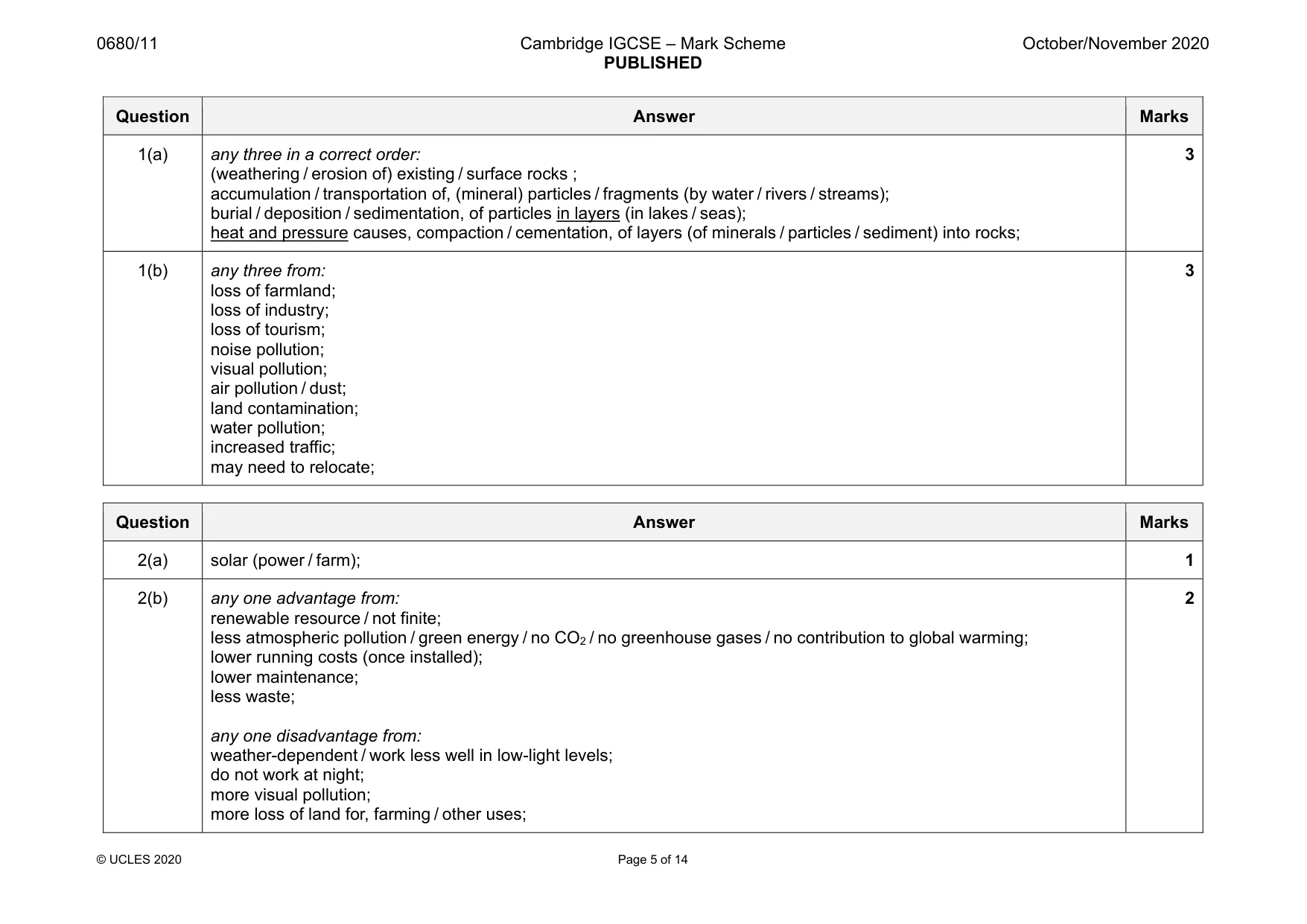
0680/11 Cambridge IGCSE – Mark Scheme PUBLISHED October/November 2020 © UCLES 2020 Page 5 of 14 Question Answer Marks 1(a) any three in a correct order: (weathering / erosion of) existing / surface rocks ; accumulation / transportation of, (mineral) particles / fragments (by water / rivers / streams); burial / deposition / sedimentation, of particles in layers (in lakes / seas); heat and pressure causes, compaction / cementation, of layers (of minerals / particles / sediment) into rocks; 3 1(b) any three from: loss of farmland; loss of industry; loss of tourism; noise pollution; visual pollution; air pollution / dust; land contamination; water pollution; increased traffic; may need to relocate; 3 Question Answer Marks 2(a) solar (power / farm); 1 2(b) any one advantage from: renewable resource / not finite; less atmospheric pollution / green energy / no CO2 / no greenhouse gases / no contribution to global warming; lower running costs (once installed); lower maintenance; less waste; any one disadvantage from: weather-dependent / work less well in low-light levels; do not work at night; more visual pollution; more loss of land for, farming / other uses; 2
Mark scheme, page 6
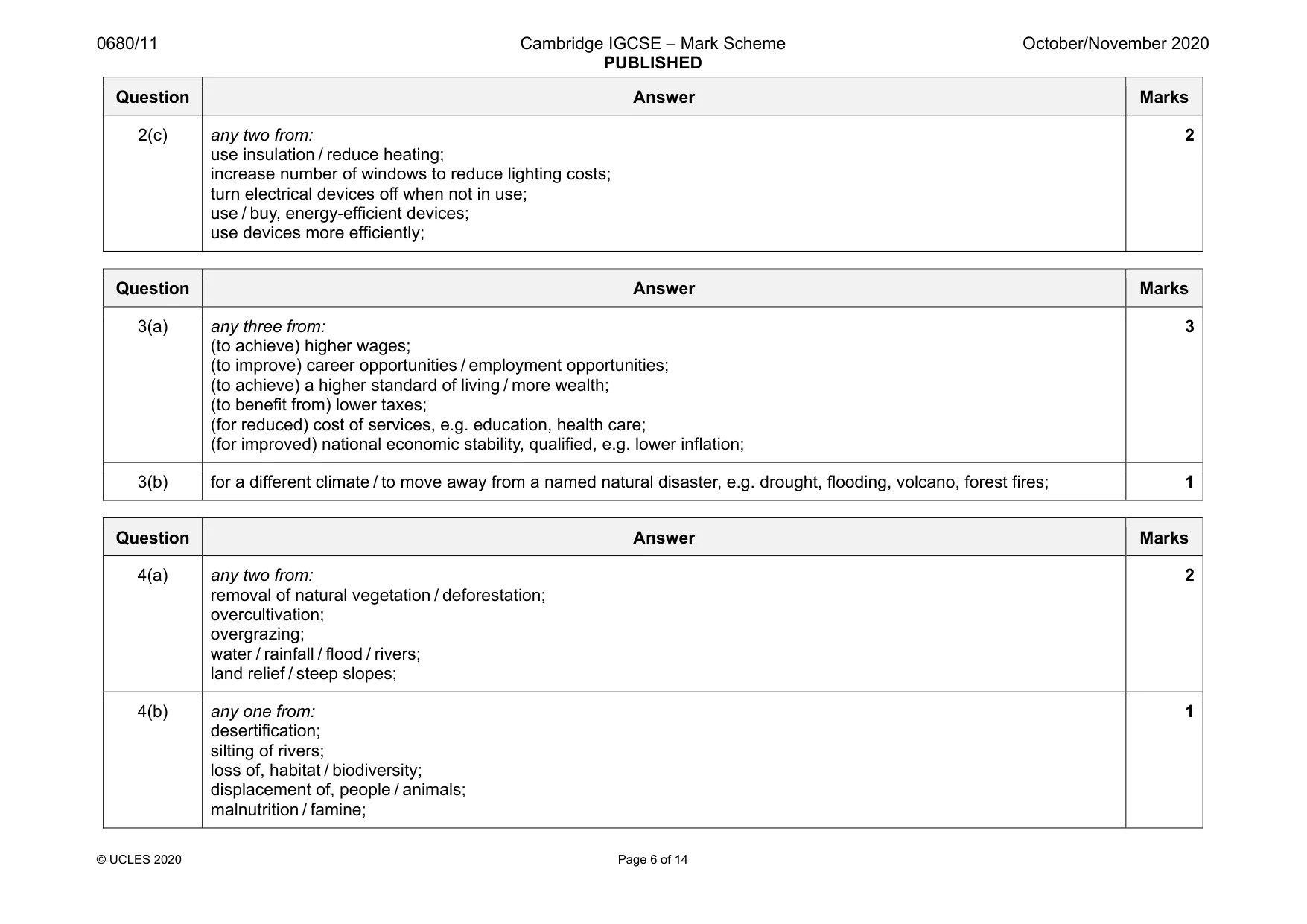
0680/11 Cambridge IGCSE – Mark Scheme PUBLISHED October/November 2020 © UCLES 2020 Page 6 of 14 Question Answer Marks 2(c) any two from: use insulation / reduce heating; increase number of windows to reduce lighting costs; turn electrical devices off when not in use; use / buy, energy-efficient devices; use devices more efficiently; 2 Question Answer Marks 3(a) any three from: (to achieve) higher wages; (to improve) career opportunities / employment opportunities; (to achieve) a higher standard of living / more wealth; (to benefit from) lower taxes; (for reduced) cost of services, e.g. education, health care; (for improved) national economic stability, qualified, e.g. lower inflation; 3 3(b) for a different climate / to move away from a named natural disaster, e.g. drought, flooding, volcano, forest fires; 1 Question Answer Marks 4(a) any two from: removal of natural vegetation / deforestation; overcultivation; overgrazing; water / rainfall / flood / rivers; land relief / steep slopes; 2 4(b) any one from: desertification; silting of rivers; loss of, habitat / biodiversity; displacement of, people / animals; malnutrition / famine; 1
Mark scheme, page 7
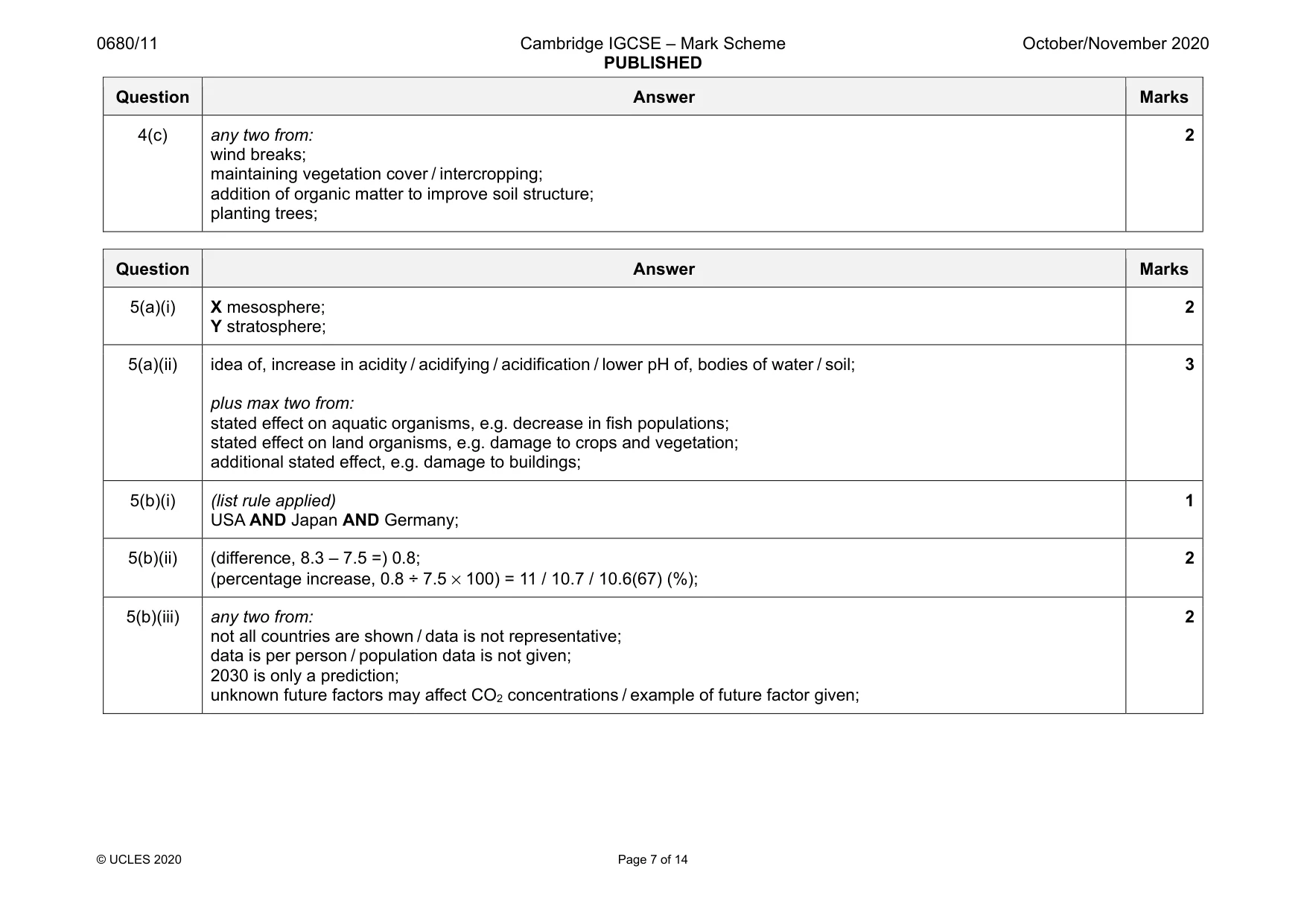
0680/11 Cambridge IGCSE – Mark Scheme PUBLISHED October/November 2020 © UCLES 2020 Page 7 of 14 Question Answer Marks 4(c) any two from: wind breaks; maintaining vegetation cover / intercropping; addition of organic matter to improve soil structure; planting trees; 2 Question Answer Marks 5(a)(i) X mesosphere; Y stratosphere; 2 5(a)(ii) idea of, increase in acidity / acidifying / acidification / lower pH of, bodies of water / soil; plus max two from: stated effect on aquatic organisms, e.g. decrease in fish populations; stated effect on land organisms, e.g. damage to crops and vegetation; additional stated effect, e.g. damage to buildings; 3 5(b)(i) (list rule applied) USA AND Japan AND Germany; 1 5(b)(ii) (difference, 8.3 – 7.5 =) 0.8; (percentage increase, 0.8 ÷ 7.5 × 100) = 11 / 10.7 / 10.6(67) (%); 2 5(b)(iii) any two from: not all countries are shown / data is not representative; data is per person / population data is not given; 2030 is only a prediction; unknown future factors may affect CO2 concentrations / example of future factor given; 2
Mark scheme, page 8
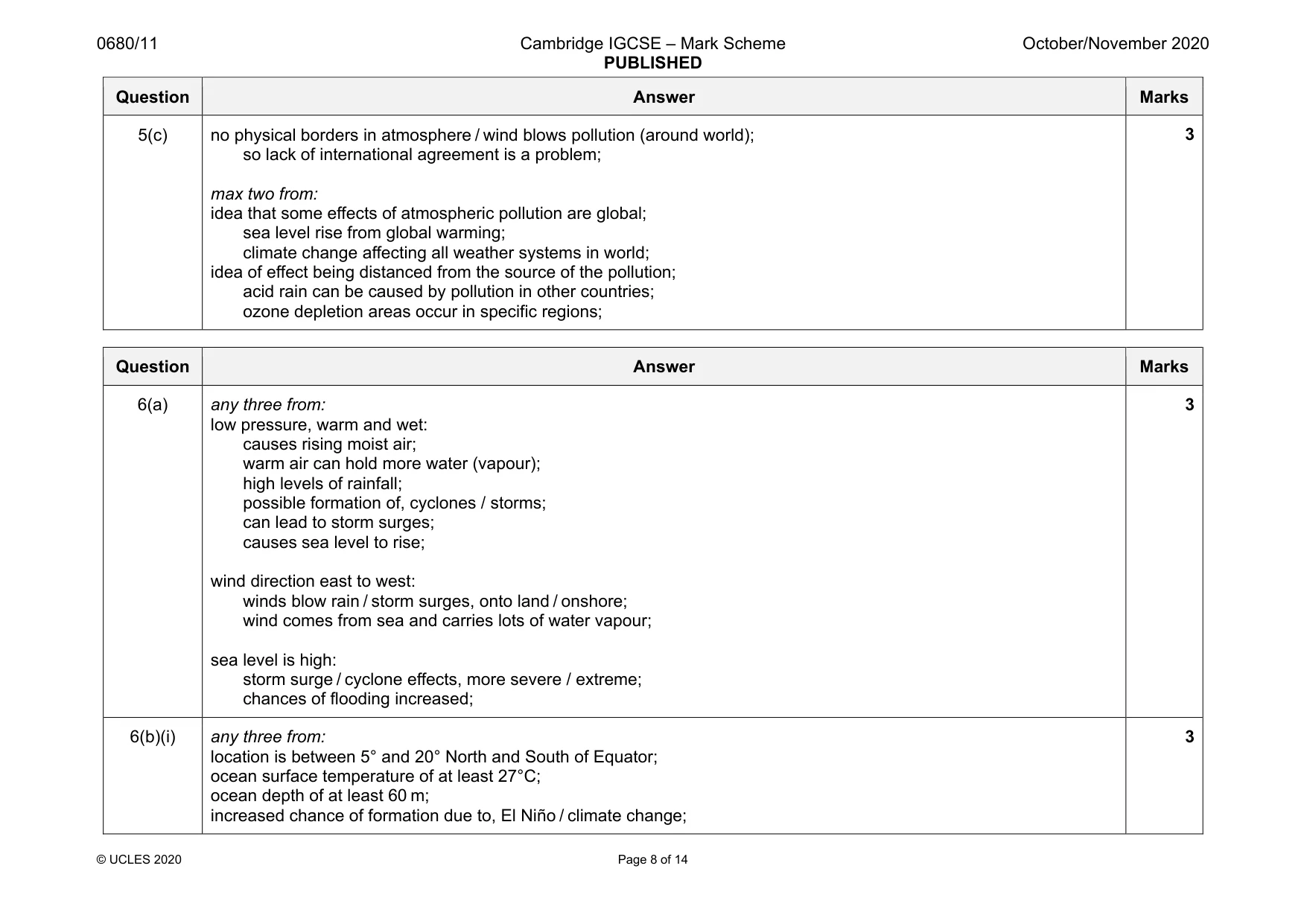
0680/11 Cambridge IGCSE – Mark Scheme PUBLISHED October/November 2020 © UCLES 2020 Page 8 of 14 Question Answer Marks 5(c) no physical borders in atmosphere / wind blows pollution (around world); so lack of international agreement is a problem; max two from: idea that some effects of atmospheric pollution are global; sea level rise from global warming; climate change affecting all weather systems in world; idea of effect being distanced from the source of the pollution; acid rain can be caused by pollution in other countries; ozone depletion areas occur in specific regions; 3 Question Answer Marks 6(a) any three from: low pressure, warm and wet: causes rising moist air; warm air can hold more water (vapour); high levels of rainfall; possible formation of, cyclones / storms; can lead to storm surges; causes sea level to rise; wind direction east to west: winds blow rain / storm surges, onto land / onshore; wind comes from sea and carries lots of water vapour; sea level is high: storm surge / cyclone effects, more severe / extreme; chances of flooding increased; 3 6(b)(i) any three from: location is between 5° and 20° North and South of Equator; ocean surface temperature of at least 27°C; ocean depth of at least 60 m; increased chance of formation due to, El Niño / climate change; 3
Mark scheme, page 9
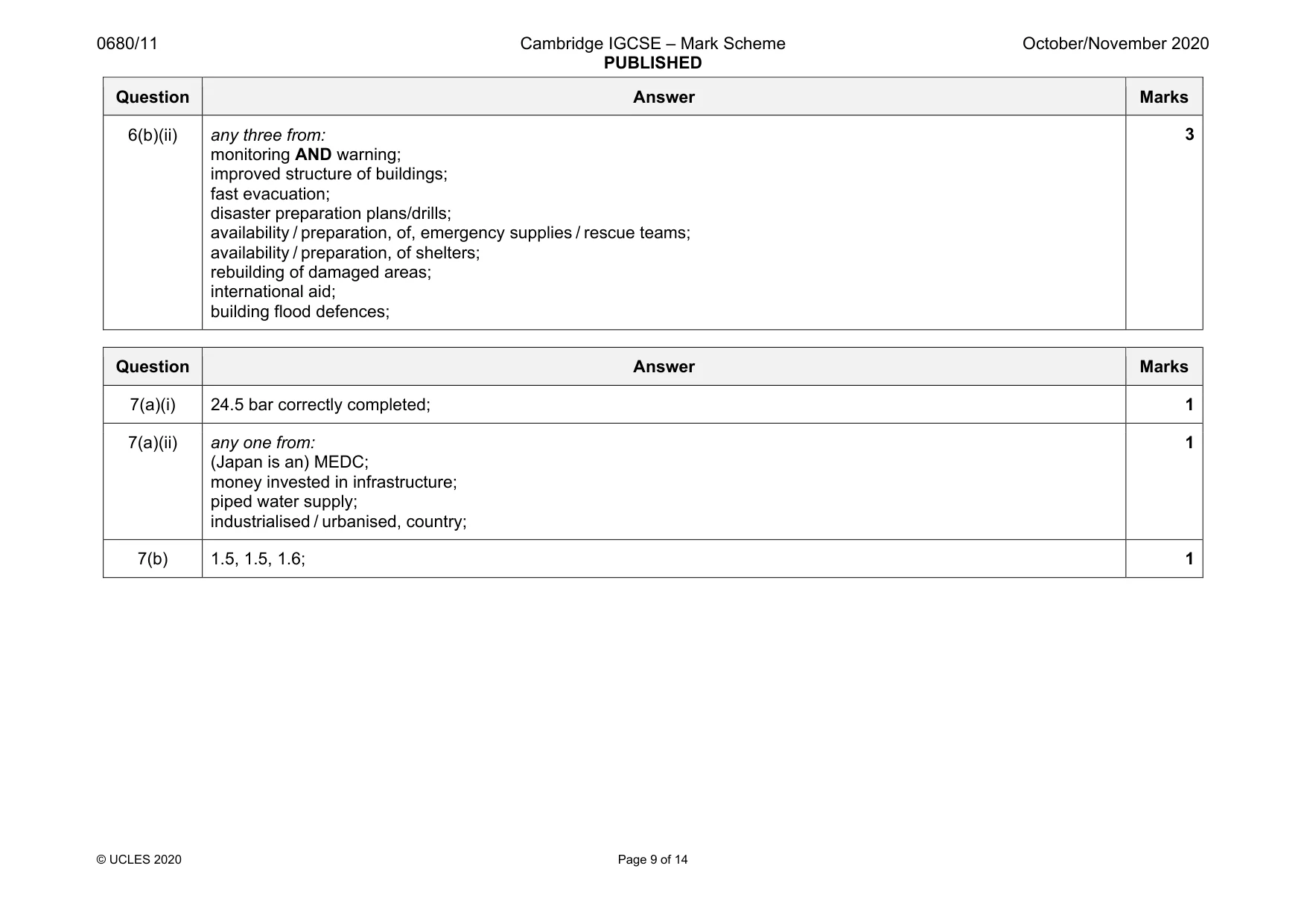
0680/11 Cambridge IGCSE – Mark Scheme PUBLISHED October/November 2020 © UCLES 2020 Page 9 of 14 Question Answer Marks 6(b)(ii) any three from: monitoring AND warning; improved structure of buildings; fast evacuation; disaster preparation plans/drills; availability / preparation, of, emergency supplies / rescue teams; availability / preparation, of shelters; rebuilding of damaged areas; international aid; building flood defences; 3 Question Answer Marks 7(a)(i) 24.5 bar correctly completed; 1 7(a)(ii) any one from: (Japan is an) MEDC; money invested in infrastructure; piped water supply; industrialised / urbanised, country; 1 7(b) 1.5, 1.5, 1.6; 1
Mark scheme, page 10
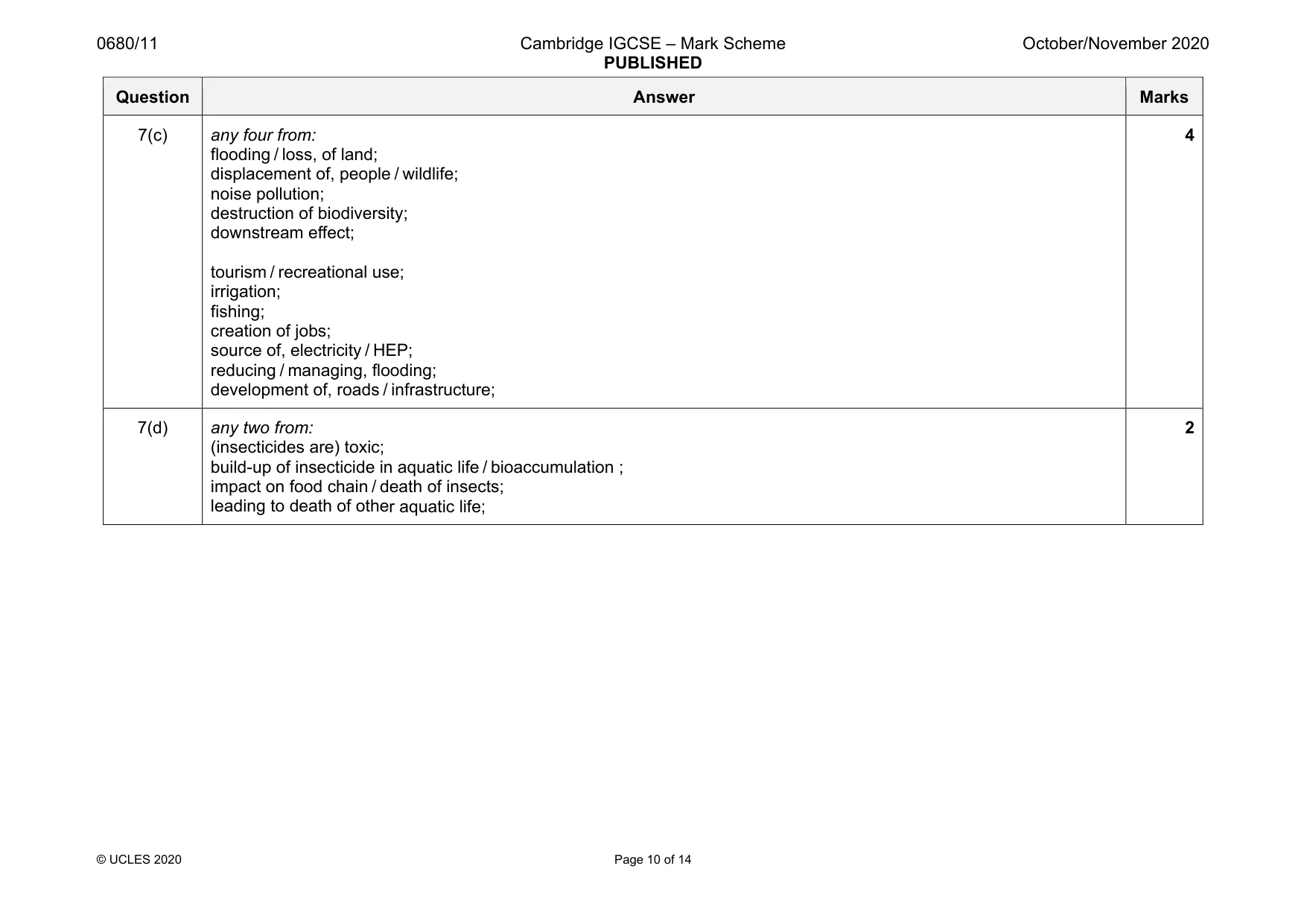
0680/11 Cambridge IGCSE – Mark Scheme PUBLISHED October/November 2020 © UCLES 2020 Page 10 of 14 Question Answer Marks 7(c) any four from: flooding / loss, of land; displacement of, people / wildlife; noise pollution; destruction of biodiversity; downstream effect; tourism / recreational use; irrigation; fishing; creation of jobs; source of, electricity / HEP; reducing / managing, flooding; development of, roads / infrastructure; 4 7(d) any two from: (insecticides are) toxic; build-up of insecticide in aquatic life / bioaccumulation ; impact on food chain / death of insects; leading to death of other aquatic life; 2
Mark scheme, page 11
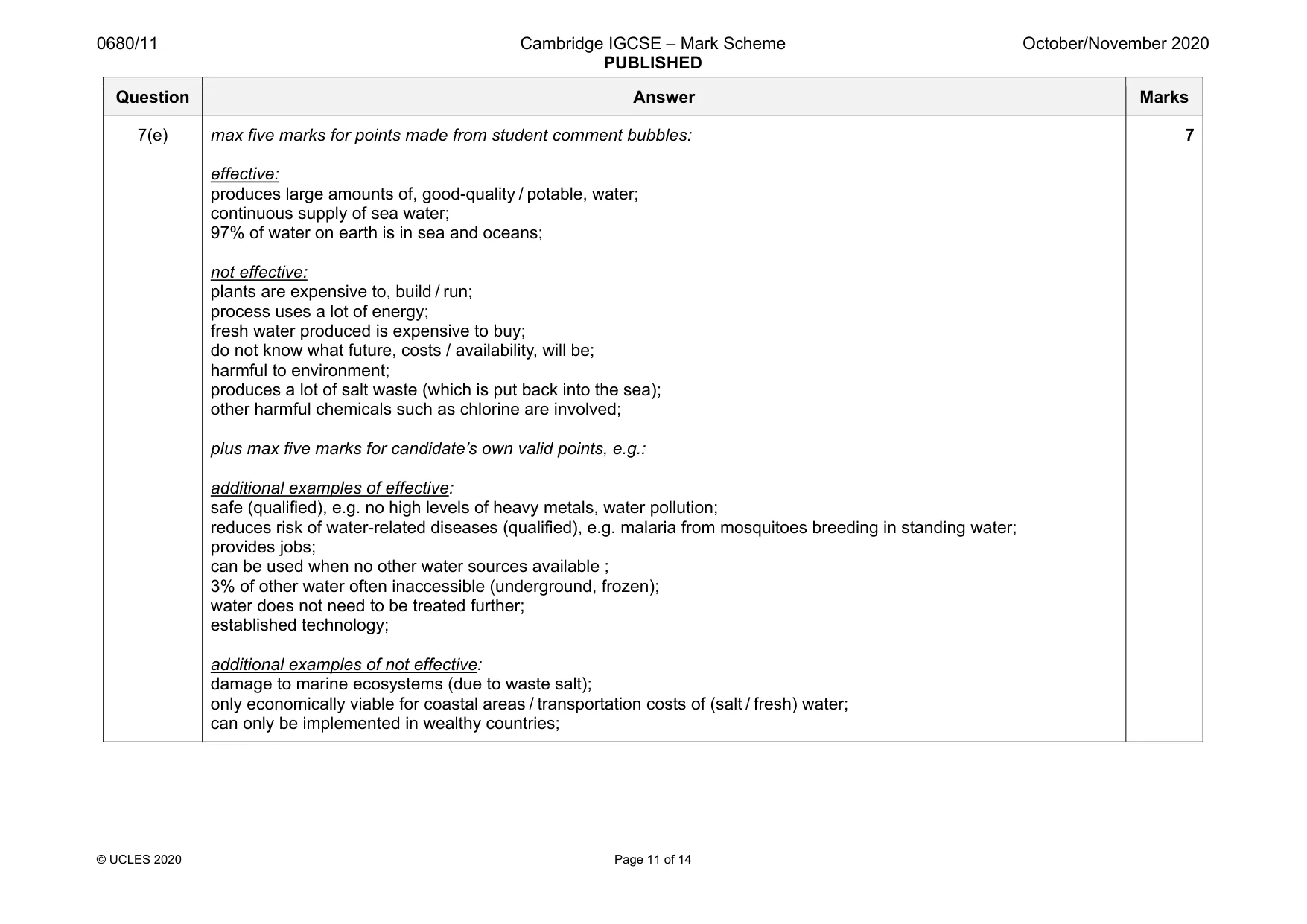
0680/11 Cambridge IGCSE – Mark Scheme PUBLISHED October/November 2020 © UCLES 2020 Page 11 of 14 Question Answer Marks 7(e) max five marks for points made from student comment bubbles: effective: produces large amounts of, good-quality / potable, water; continuous supply of sea water; 97% of water on earth is in sea and oceans; not effective: plants are expensive to, build / run; process uses a lot of energy; fresh water produced is expensive to buy; do not know what future, costs / availability, will be; harmful to environment; produces a lot of salt waste (which is put back into the sea); other harmful chemicals such as chlorine are involved; plus max five marks for candidate’s own valid points, e.g.: additional examples of effective: safe (qualified), e.g. no high levels of heavy metals, water pollution; reduces risk of water-related diseases (qualified), e.g. malaria from mosquitoes breeding in standing water; provides jobs; can be used when no other water sources available ; 3% of other water often inaccessible (underground, frozen); water does not need to be treated further; established technology; additional examples of not effective: damage to marine ecosystems (due to waste salt); only economically viable for coastal areas / transportation costs of (salt / fresh) water; can only be implemented in wealthy countries; 7
Mark scheme, page 12
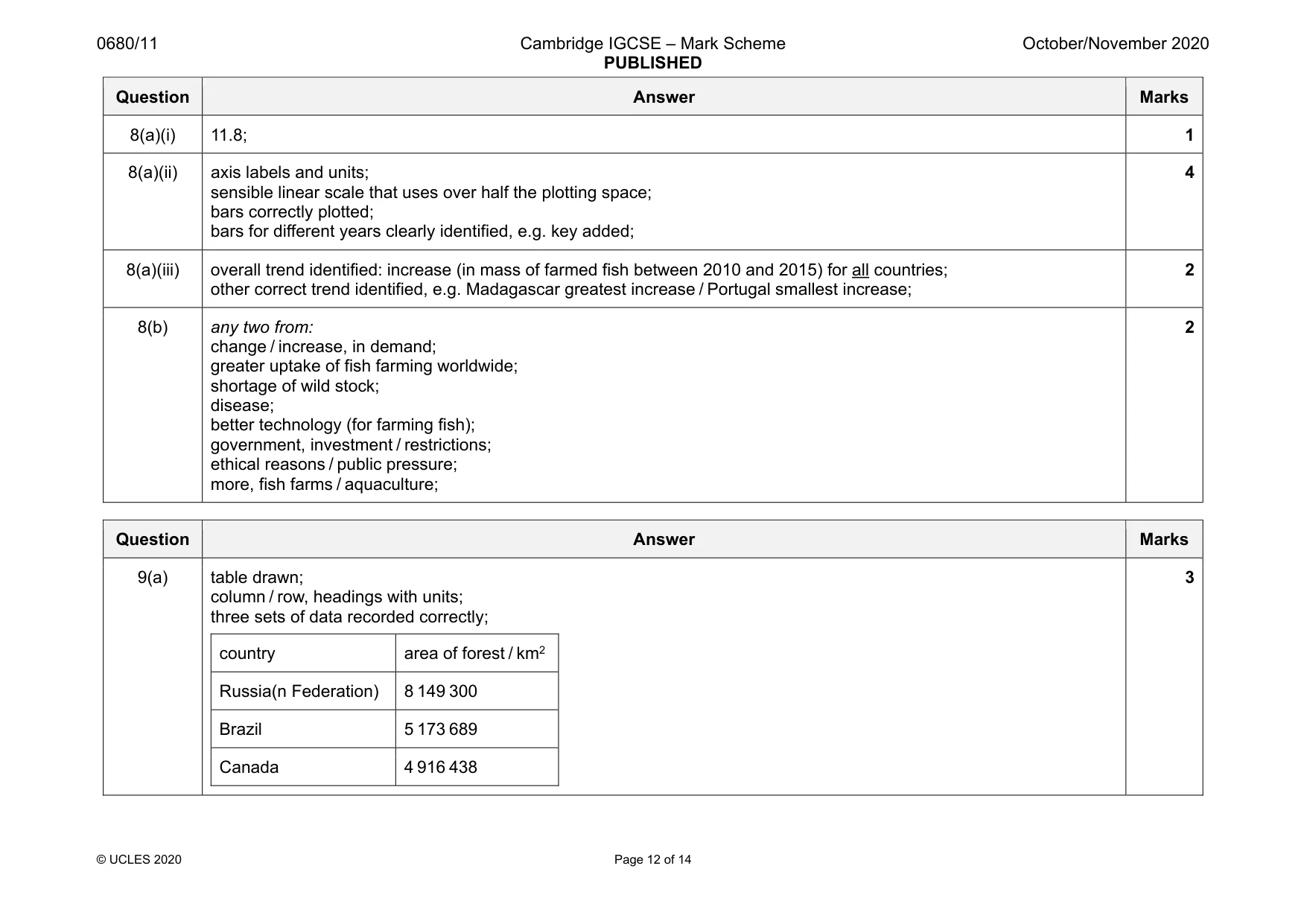
0680/11 Cambridge IGCSE – Mark Scheme PUBLISHED October/November 2020 © UCLES 2020 Page 12 of 14 Question Answer Marks 8(a)(i) 11.8; 1 8(a)(ii) axis labels and units; sensible linear scale that uses over half the plotting space; bars correctly plotted; bars for different years clearly identified, e.g. key added; 4 8(a)(iii) overall trend identified: increase (in mass of farmed fish between 2010 and 2015) for all countries; other correct trend identified, e.g. Madagascar greatest increase / Portugal smallest increase; 2 8(b) any two from: change / increase, in demand; greater uptake of fish farming worldwide; shortage of wild stock; disease; better technology (for farming fish); government, investment / restrictions; ethical reasons / public pressure; more, fish farms / aquaculture; 2 Question Answer Marks 9(a) table drawn; column / row, headings with units; three sets of data recorded correctly; country area of forest / km2 Russia(n Federation) 8 149 300 Brazil 5 173 689 Canada 4 916 438 3
Mark scheme, page 13
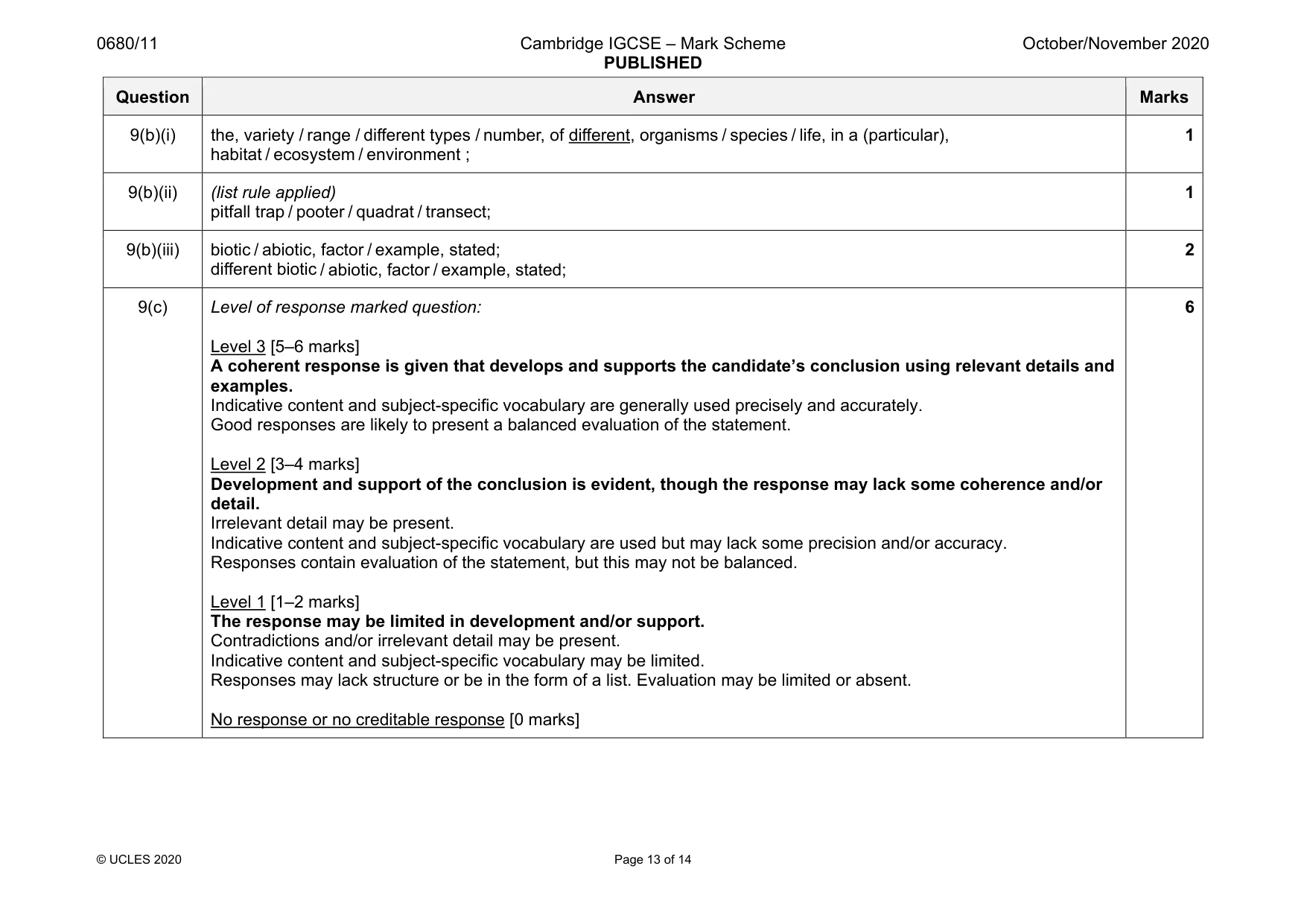
0680/11 Cambridge IGCSE – Mark Scheme PUBLISHED October/November 2020 © UCLES 2020 Page 13 of 14 Question Answer Marks 9(b)(i) the, variety / range / different types / number, of different, organisms / species / life, in a (particular), habitat / ecosystem / environment ; 1 9(b)(ii) (list rule applied) pitfall trap / pooter / quadrat / transect; 1 9(b)(iii) biotic / abiotic, factor / example, stated; different biotic / abiotic, factor / example, stated; 2 9(c) Level of response marked question: Level 3 [5–6 marks] A coherent response is given that develops and supports the candidate’s conclusion using relevant details and examples. Indicative content and subject-specific vocabulary are generally used precisely and accurately. Good responses are likely to present a balanced evaluation of the statement. Level 2 [3–4 marks] Development and support of the conclusion is evident, though the response may lack some coherence and/or detail. Irrelevant detail may be present. Indicative content and subject-specific vocabulary are used but may lack some precision and/or accuracy. Responses contain evaluation of the statement, but this may not be balanced. Level 1 [1–2 marks] The response may be limited in development and/or support. Contradictions and/or irrelevant detail may be present. Indicative content and subject-specific vocabulary may be limited. Responses may lack structure or be in the form of a list. Evaluation may be limited or absent. No response or no creditable response [0 marks] 6
Mark scheme, page 14
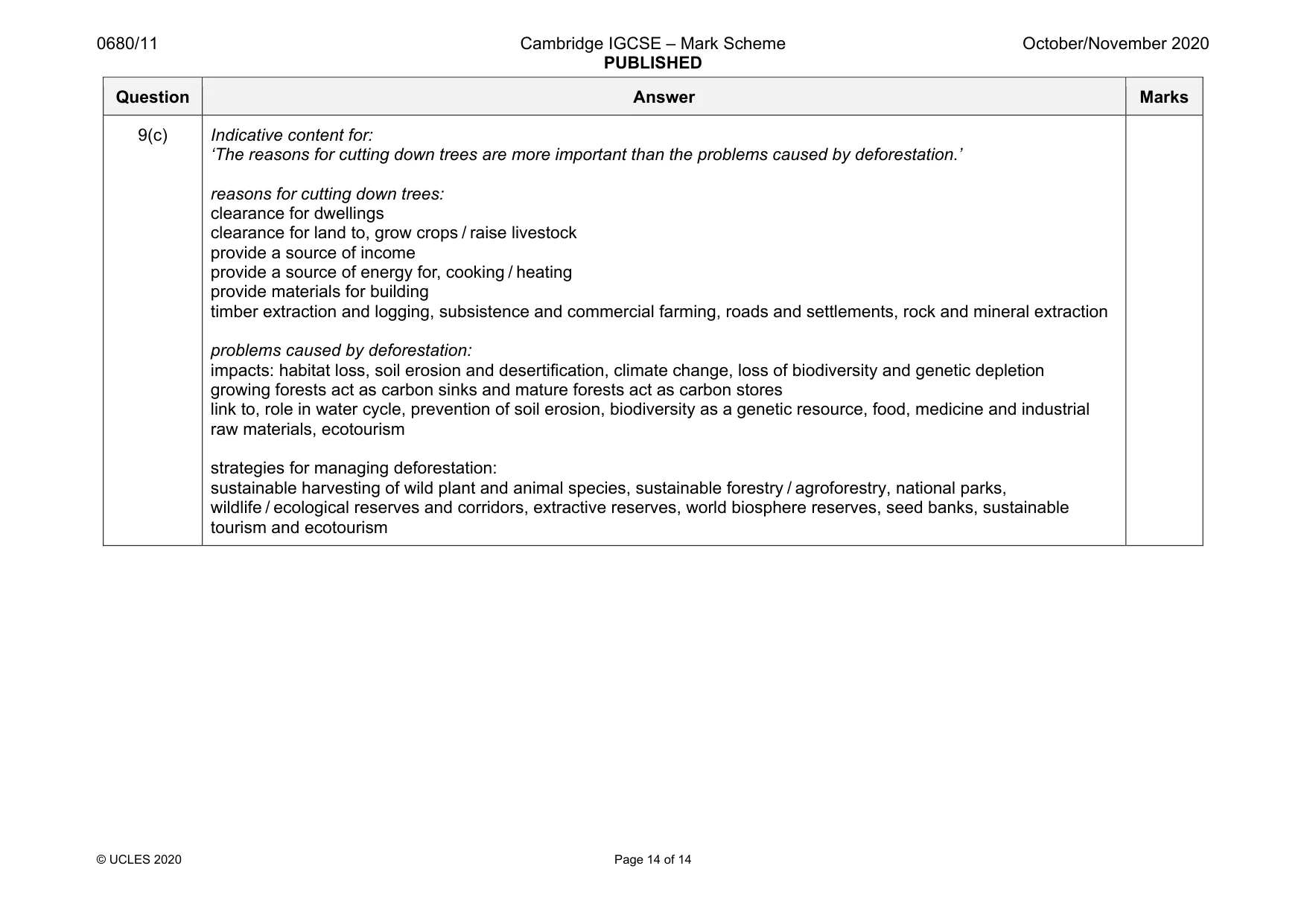
0680/11 Cambridge IGCSE – Mark Scheme PUBLISHED October/November 2020 © UCLES 2020 Page 14 of 14 Question Answer Marks 9(c) Indicative content for: ‘The reasons for cutting down trees are more important than the problems caused by deforestation.’ reasons for cutting down trees: clearance for dwellings clearance for land to, grow crops / raise livestock provide a source of income provide a source of energy for, cooking / heating provide materials for building timber extraction and logging, subsistence and commercial farming, roads and settlements, rock and mineral extraction problems caused by deforestation: impacts: habitat loss, soil erosion and desertification, climate change, loss of biodiversity and genetic depletion growing forests act as carbon sinks and mature forests act as carbon stores link to, role in water cycle, prevention of soil erosion, biodiversity as a genetic resource, food, medicine and industrial raw materials, ecotourism strategies for managing deforestation: sustainable harvesting of wild plant and animal species, sustainable forestry / agroforestry, national parks, wildlife / ecological reserves and corridors, extractive reserves, world biosphere reserves, seed banks, sustainable tourism and ecotourism
What you needed in this session
Cambridge’s own grade thresholds for 2020 Oct/Nov, Paper 1 · Variant 1. A higher threshold means an easier paper — the bar moves with how the cohort did.