Cambridge IGCSE Environmental Management 0680 — 2020 May/June Paper 1 · Variant 2
0680/12/M/J/20
The question paper and its mark scheme, free to read here and free to download. This is Cambridge’s own paper, exactly as it was sat.
Question paper20 pages

Mark scheme11 pages
Answers below. Sit the paper first if you are practising.
Paper as text
Question paper, page 1
Cambridge IGCSE™ DC (JC/JG) 185352/3 © UCLES 2020 [Turn over This document has 20 pages. Blank pages are indicated. * 7 3 4 7 5 9 0 1 6 0 * ENVIRONMENTAL MANAGEMENT 0680/12 Paper 1 Theory May/June 2020 1 hour 45 minutes You must answer on the question paper. No additional materials are needed. INSTRUCTIONS ● Answer all questions. ● Use a black or dark blue pen. You may use an HB pencil for any diagrams or graphs. ● Write your name, centre number and candidate number in the boxes at the top of the page. ● Write your answer to each question in the space provided. ● Do not use an erasable pen or correction fluid. ● Do not write on any bar codes. ● You may use a calculator. ● You should show all your working and use appropriate units. INFORMATION ● The total mark for this paper is 80. ● The number of marks for each question or part question is shown in brackets [ ].
Question paper, page 2
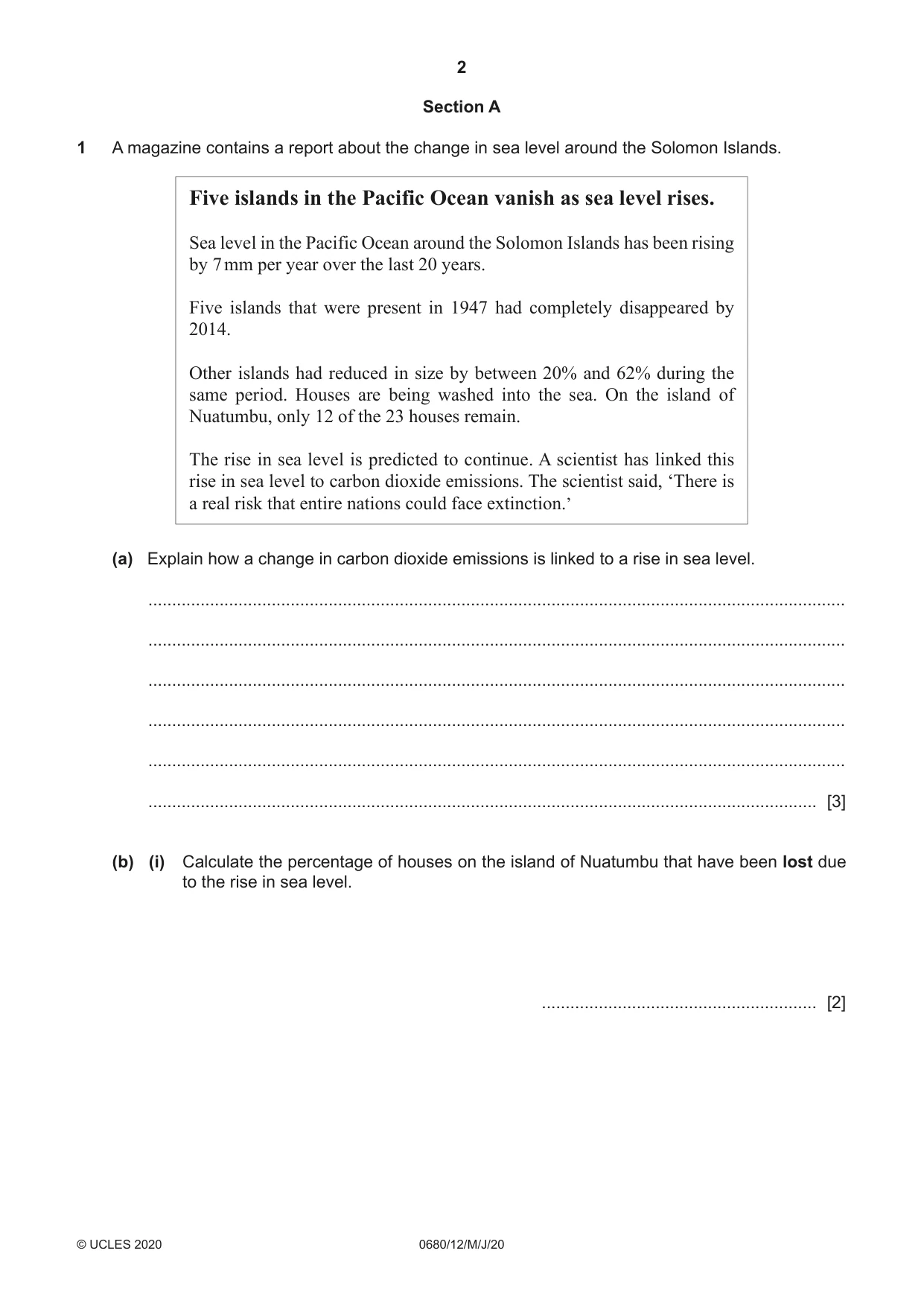
2 0680/12/M/J/20 © UCLES 2020 Section A 1 A magazine contains a report about the change in sea level around the Solomon Islands. Five islands in the Pacific Ocean vanish as sea level rises. Sea level in the Pacific Ocean around the Solomon Islands has been rising by 7 mm per year over the last 20 years. Five islands that were present in 1947 had completely disappeared by 2014. Other islands had reduced in size by between 20% and 62% during the same period. Houses are being washed into the sea. On the island of Nuatumbu, only 12 of the 23 houses remain. The rise in sea level is predicted to continue. A scientist has linked this rise in sea level to carbon dioxide emissions. The scientist said, ‘There is a real risk that entire nations could face extinction.’ (a) Explain how a change in carbon dioxide emissions is linked to a rise in sea level. … … … … … … [3] (b) (i) Calculate the percentage of houses on the island of Nuatumbu that have been lost due to the rise in sea level. … [2]
Question paper, page 3
3 0680/12/M/J/20 © UCLES 2020 [Turn over (ii) Loss of houses is one problem caused by the rise in sea level. Suggest other impacts the rise in sea level will have on people living in the Solomon Islands. … … … … … … [3] [Total: 8]
Question paper, page 4
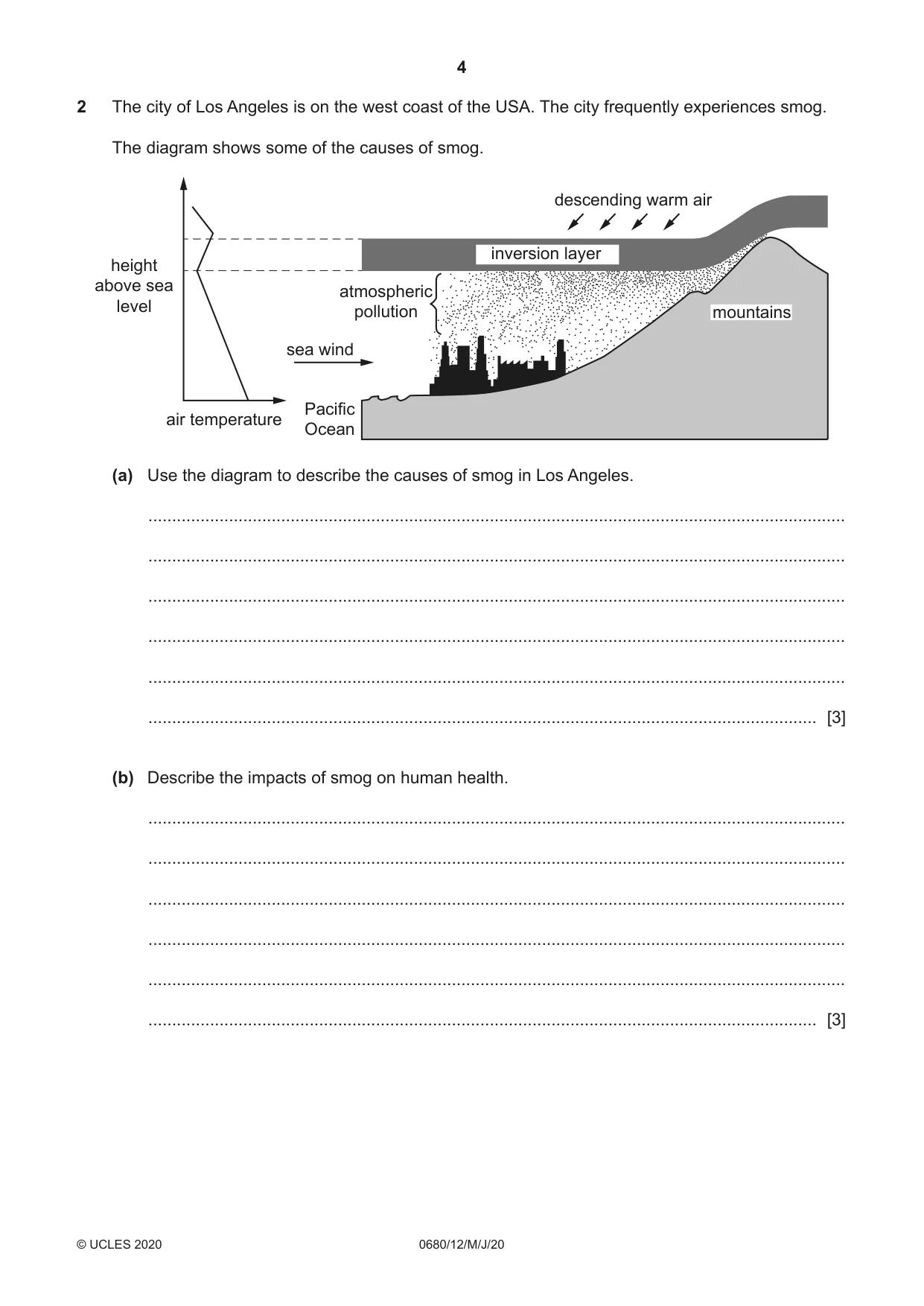
4 0680/12/M/J/20 © UCLES 2020 2 The city of Los Angeles is on the west coast of the USA. The city frequently experiences smog. The diagram shows some of the causes of smog. height above sea level air temperature mountains atmospheric pollution sea wind inversion layer descending warm air Pacific Ocean (a) Use the diagram to describe the causes of smog in Los Angeles. … … … … … … [3] (b) Describe the impacts of smog on human health. … … … … … … [3]
Question paper, page 5
5 0680/12/M/J/20 © UCLES 2020 [Turn over (c) Vehicle emissions are a major cause of smog. Describe ways the government could reduce emissions from vehicles in Los Angeles. … … … … [2] [Total: 8]
Question paper, page 6
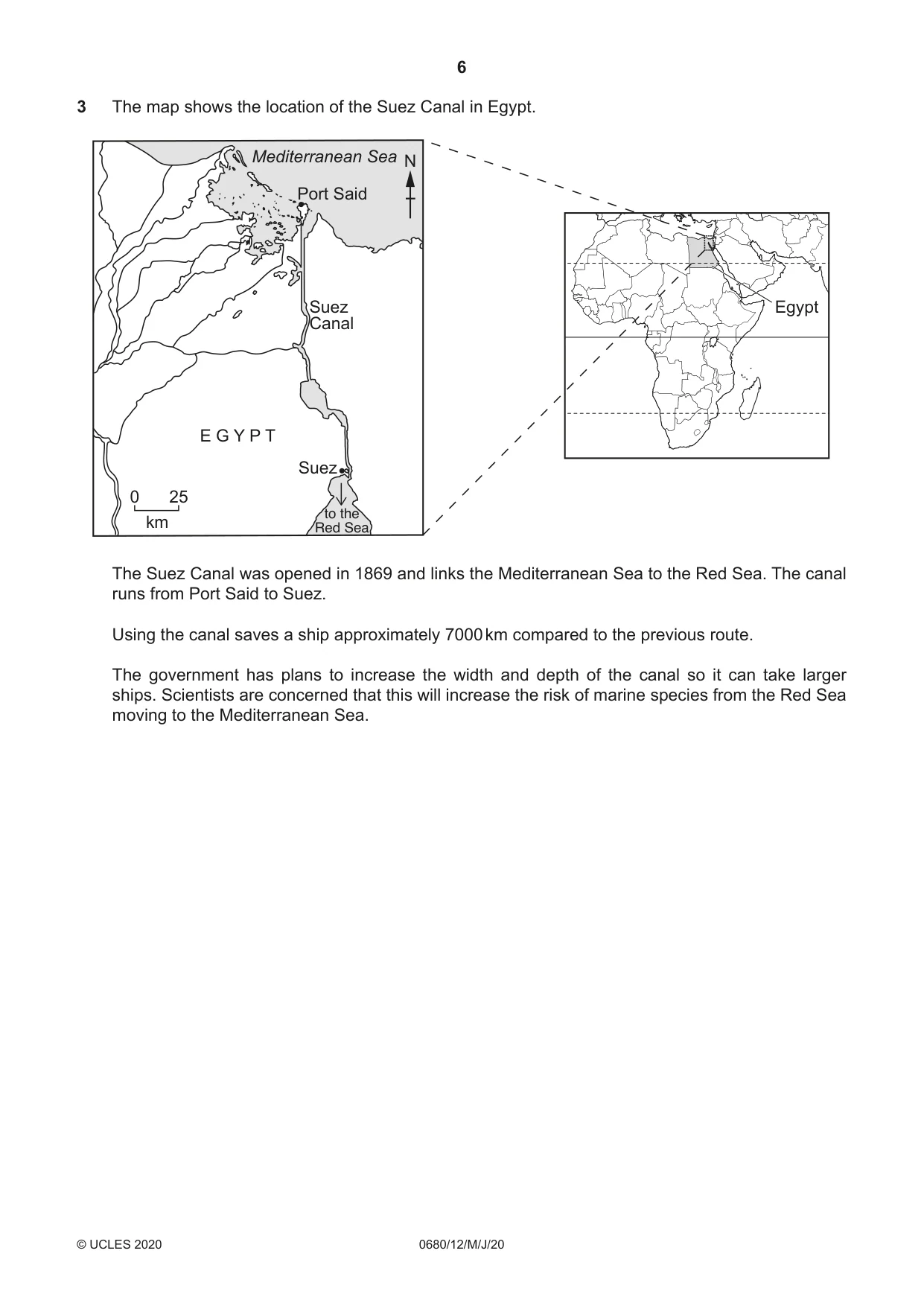
6 0680/12/M/J/20 © UCLES 2020 3 The map shows the location of the Suez Canal in Egypt. km 0 25 N Port Said Mediterranean Sea Suez Canal Suez E G Y P T to the Red Sea Egypt Egypt The Suez Canal was opened in 1869 and links the Mediterranean Sea to the Red Sea. The canal runs from Port Said to Suez. Using the canal saves a ship approximately 7000 km compared to the previous route. The government has plans to increase the width and depth of the canal so it can take larger ships. Scientists are concerned that this will increase the risk of marine species from the Red Sea moving to the Mediterranean Sea.
Question paper, page 7
7 0680/12/M/J/20 © UCLES 2020 [Turn over (a) Use the map to estimate the approximate length of the Suez Canal from Port Said to Suez. Circle the correct answer. 125 km 175 km 225 km 275 km [1] (b) Suggest reasons why scientists are concerned about marine species from the Red Sea moving to the Mediterranean Sea. … … … … [2] (c) In recent years, the water in the middle of the Suez Canal has become more saline. Suggest one reason for this increased salinity. … … [1] [Total: 4]
Question paper, page 8
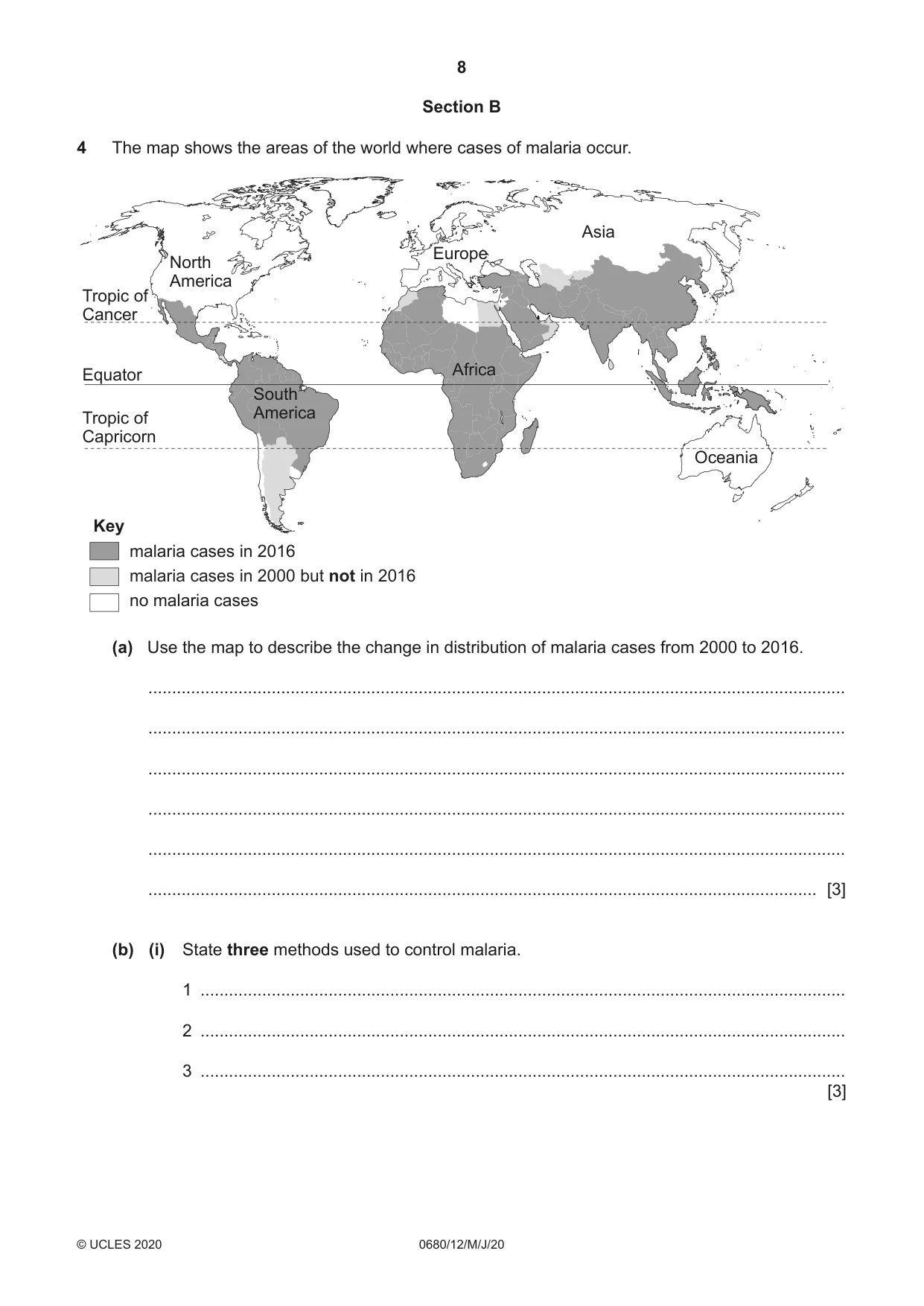
8 0680/12/M/J/20 © UCLES 2020 Section B 4 The map shows the areas of the world where cases of malaria occur. Key malaria cases in 2016 malaria cases in 2000 but not in 2016 no malaria cases Equator Tropic of Capricorn Tropic of Cancer North America South America Africa Europe Asia Oceania (a) Use the map to describe the change in distribution of malaria cases from 2000 to 2016. … … … … … … [3] (b) (i) State three methods used to control malaria. 1 … 2 … 3 … [3]
Question paper, page 9
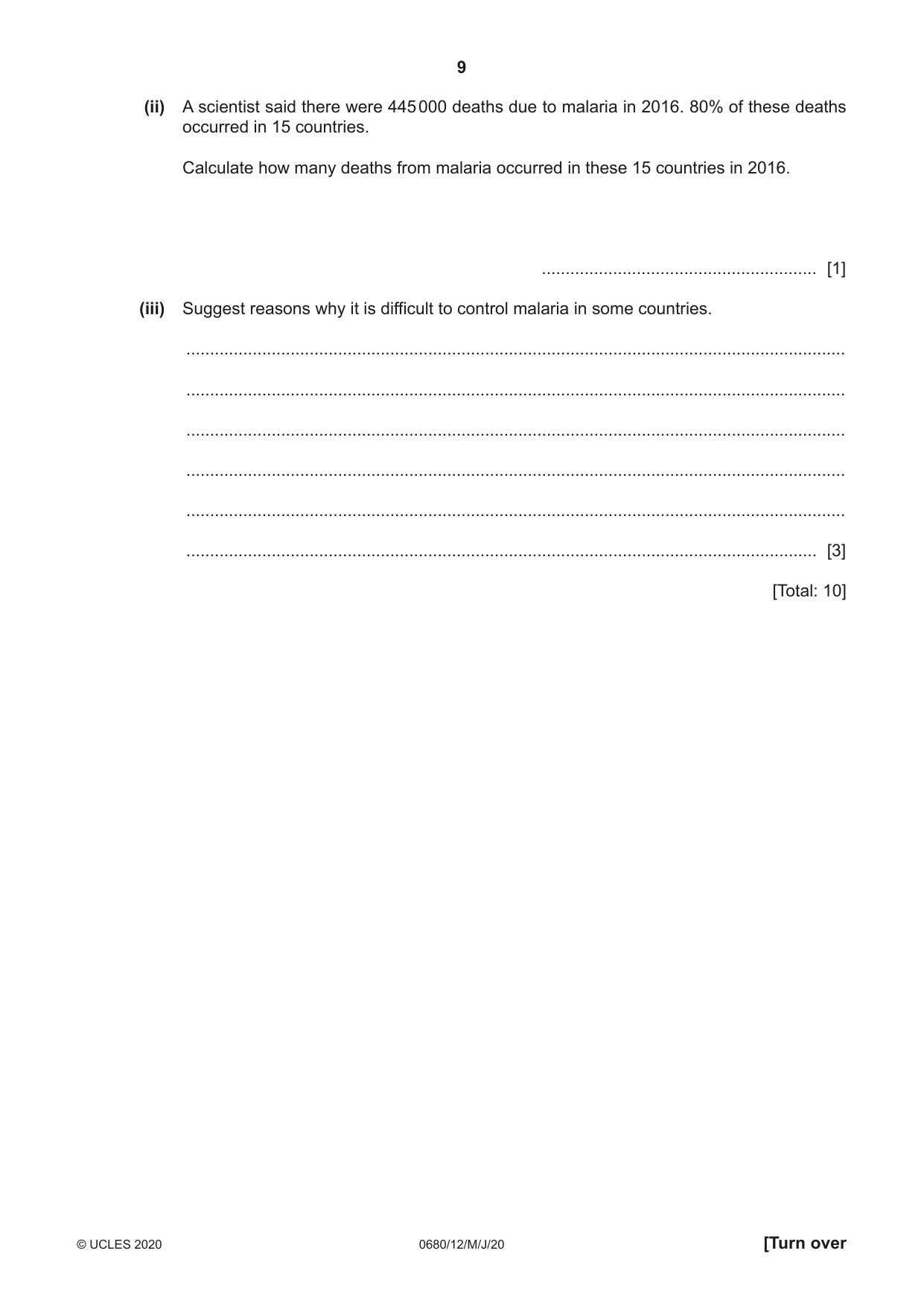
9 0680/12/M/J/20 © UCLES 2020 [Turn over (ii) A scientist said there were 445 000 deaths due to malaria in 2016. 80% of these deaths occurred in 15 countries. Calculate how many deaths from malaria occurred in these 15 countries in 2016. … [1] (iii) Suggest reasons why it is difficult to control malaria in some countries. … … … … … … [3] [Total: 10]
Question paper, page 10
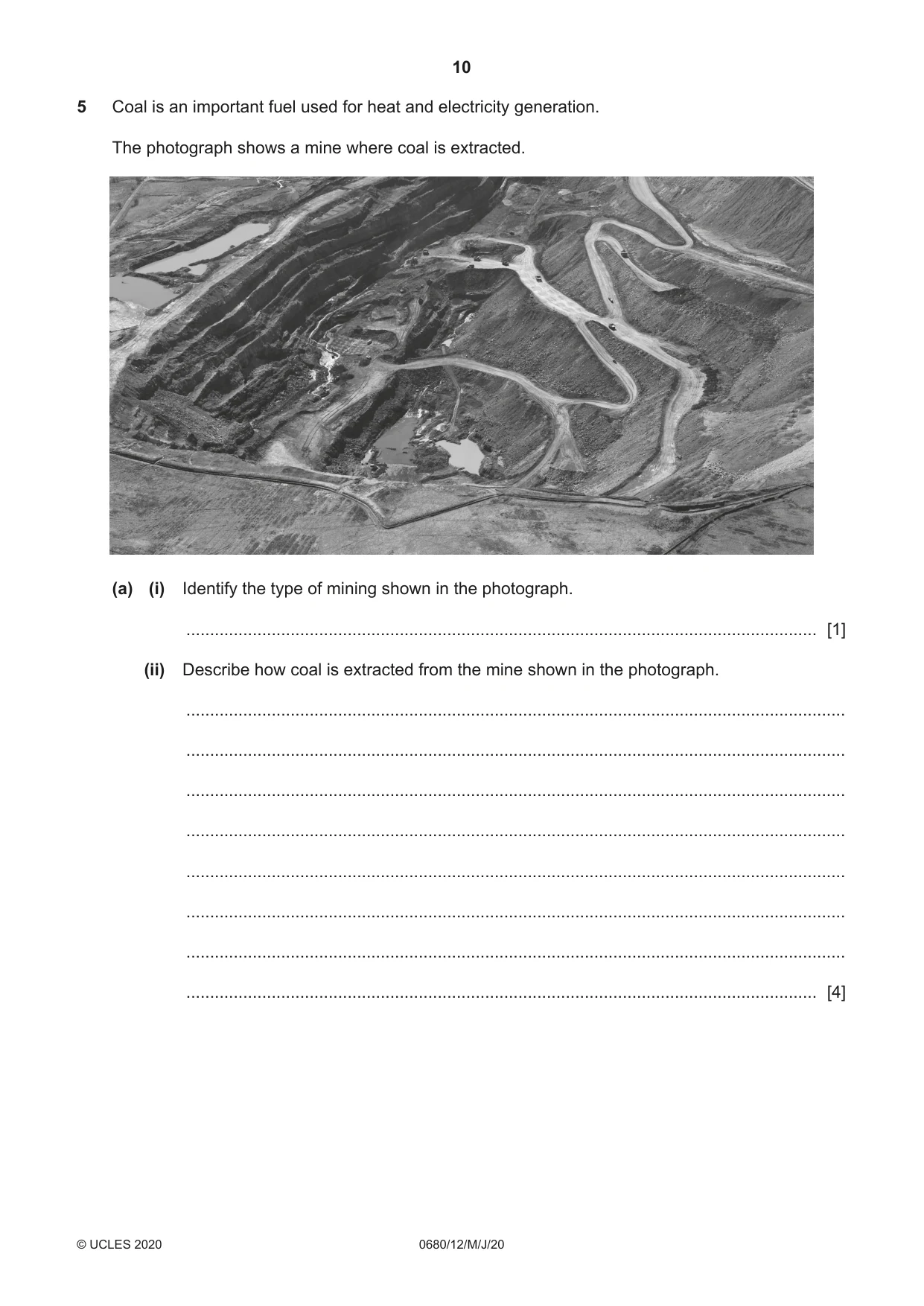
10 0680/12/M/J/20 © UCLES 2020 5 Coal is an important fuel used for heat and electricity generation. The photograph shows a mine where coal is extracted. (a) (i) Identify the type of mining shown in the photograph. … [1] (ii) Describe how coal is extracted from the mine shown in the photograph. … … … … … … … … [4]
Question paper, page 11
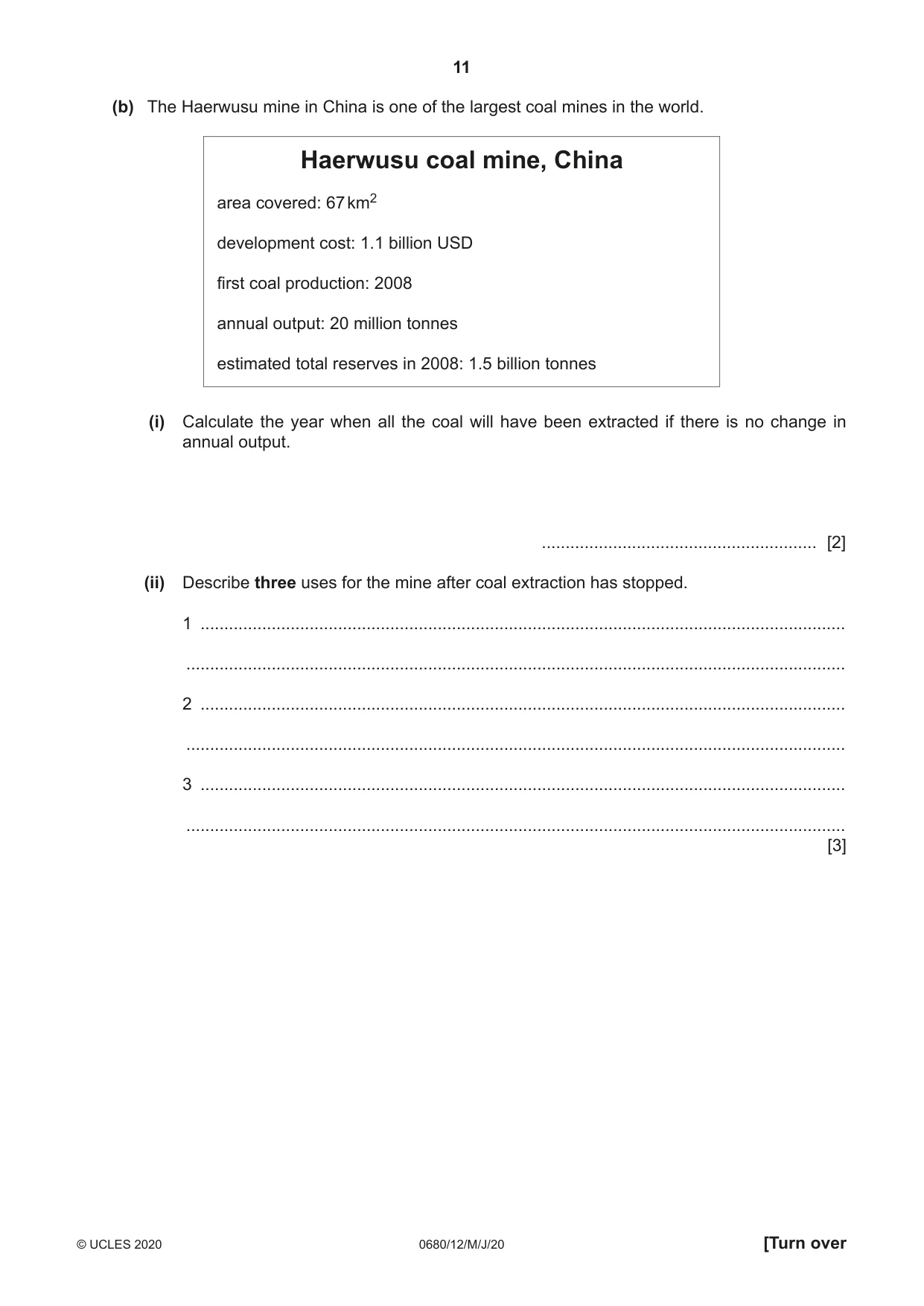
11 0680/12/M/J/20 © UCLES 2020 [Turn over (b) The Haerwusu mine in China is one of the largest coal mines in the world. Haerwusu coal mine, China area covered: 67 km2 development cost: 1.1 billion USD first coal production: 2008 annual output: 20 million tonnes estimated total reserves in 2008: 1.5 billion tonnes (i) Calculate the year when all the coal will have been extracted if there is no change in annual output. … [2] (ii) Describe three uses for the mine after coal extraction has stopped. 1 … … 2 … … 3 … … [3]
Question paper, page 12
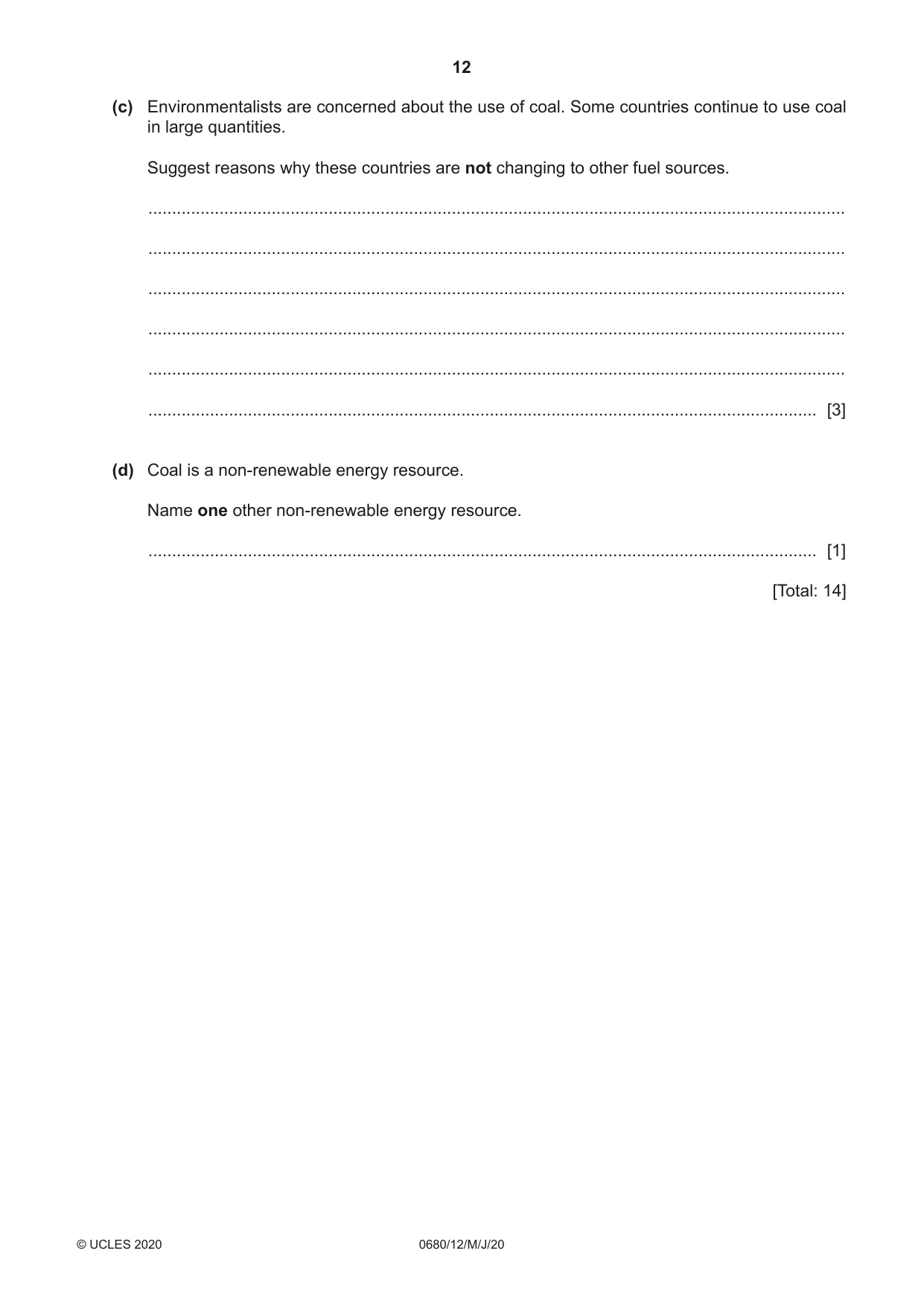
12 0680/12/M/J/20 © UCLES 2020 (c) Environmentalists are concerned about the use of coal. Some countries continue to use coal in large quantities. Suggest reasons why these countries are not changing to other fuel sources. … … … … … … [3] (d) Coal is a non-renewable energy resource. Name one other non-renewable energy resource. … [1] [Total: 14]
Question paper, page 13
13 0680/12/M/J/20 © UCLES 2020 [Turn over BLANK PAGE
Question paper, page 14
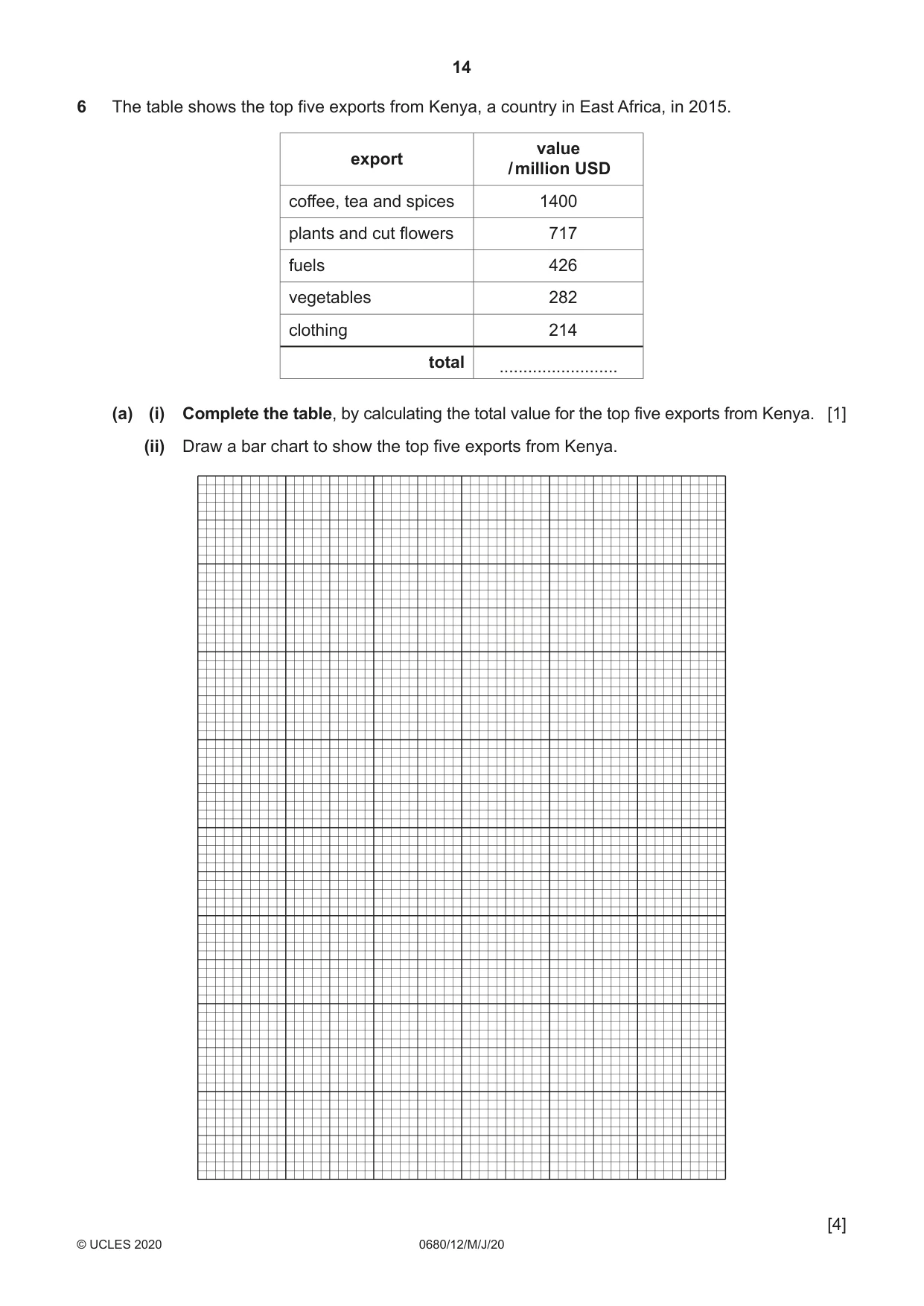
14 0680/12/M/J/20 © UCLES 2020 6 The table shows the top five exports from Kenya, a country in East Africa, in 2015. export value / million USD coffee, tea and spices 1400 plants and cut flowers 717 fuels 426 vegetables 282 clothing 214 total … (a) (i) Complete the table, by calculating the total value for the top five exports from Kenya. [1] (ii) Draw a bar chart to show the top five exports from Kenya. [4]
Question paper, page 15
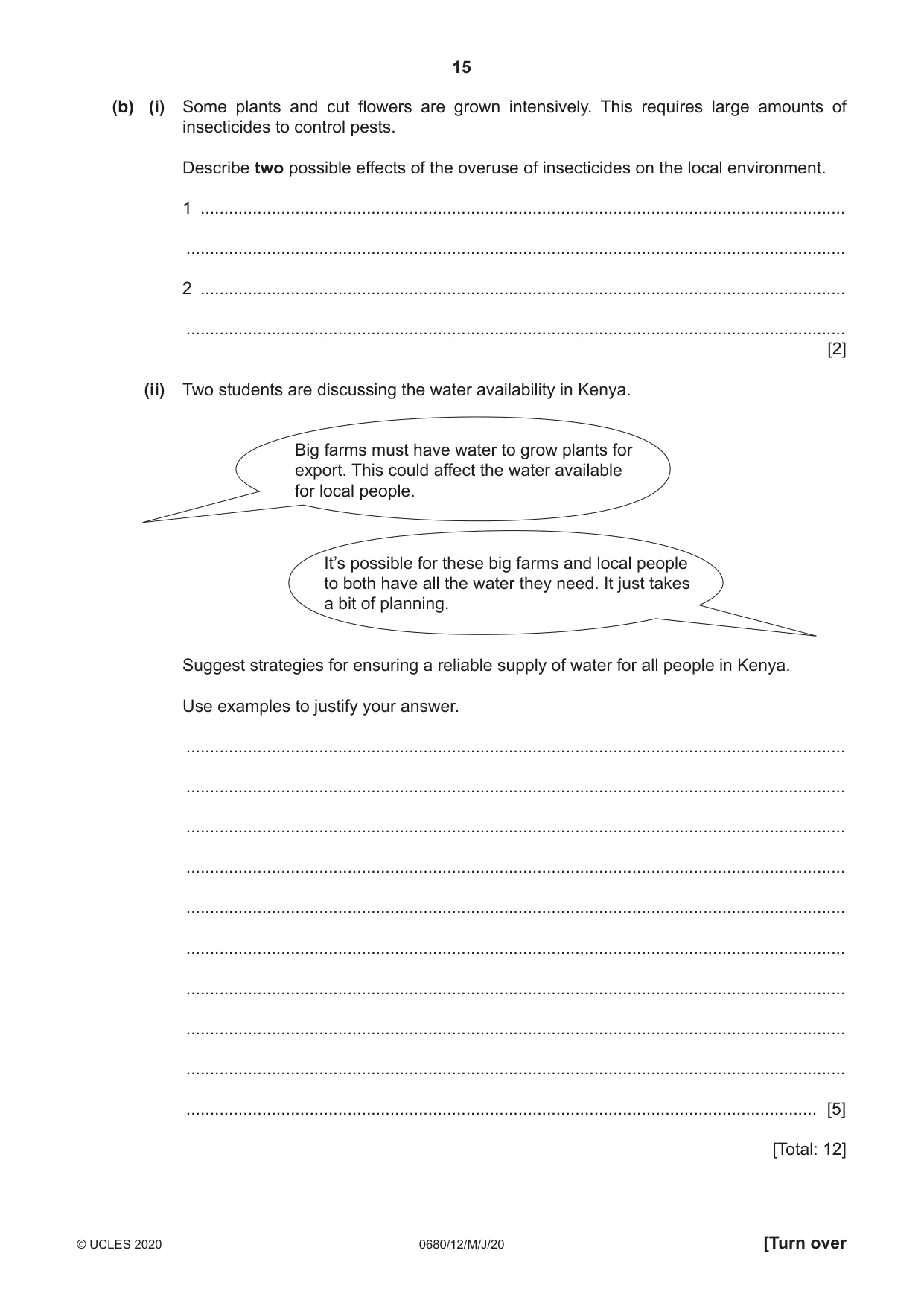
15 0680/12/M/J/20 © UCLES 2020 [Turn over (b) (i) Some plants and cut flowers are grown intensively. This requires large amounts of insecticides to control pests. Describe two possible effects of the overuse of insecticides on the local environment. 1 … … 2 … … [2] (ii) Two students are discussing the water availability in Kenya. Suggest strategies for ensuring a reliable supply of water for all people in Kenya. Use examples to justify your answer. … … … … … … … … … … [5] [Total: 12] Big farms must have water to grow plants for export. This could affect the water available for local people. It’s possible for these big farms and local people to both have all the water they need. It just takes a bit of planning.
Question paper, page 16
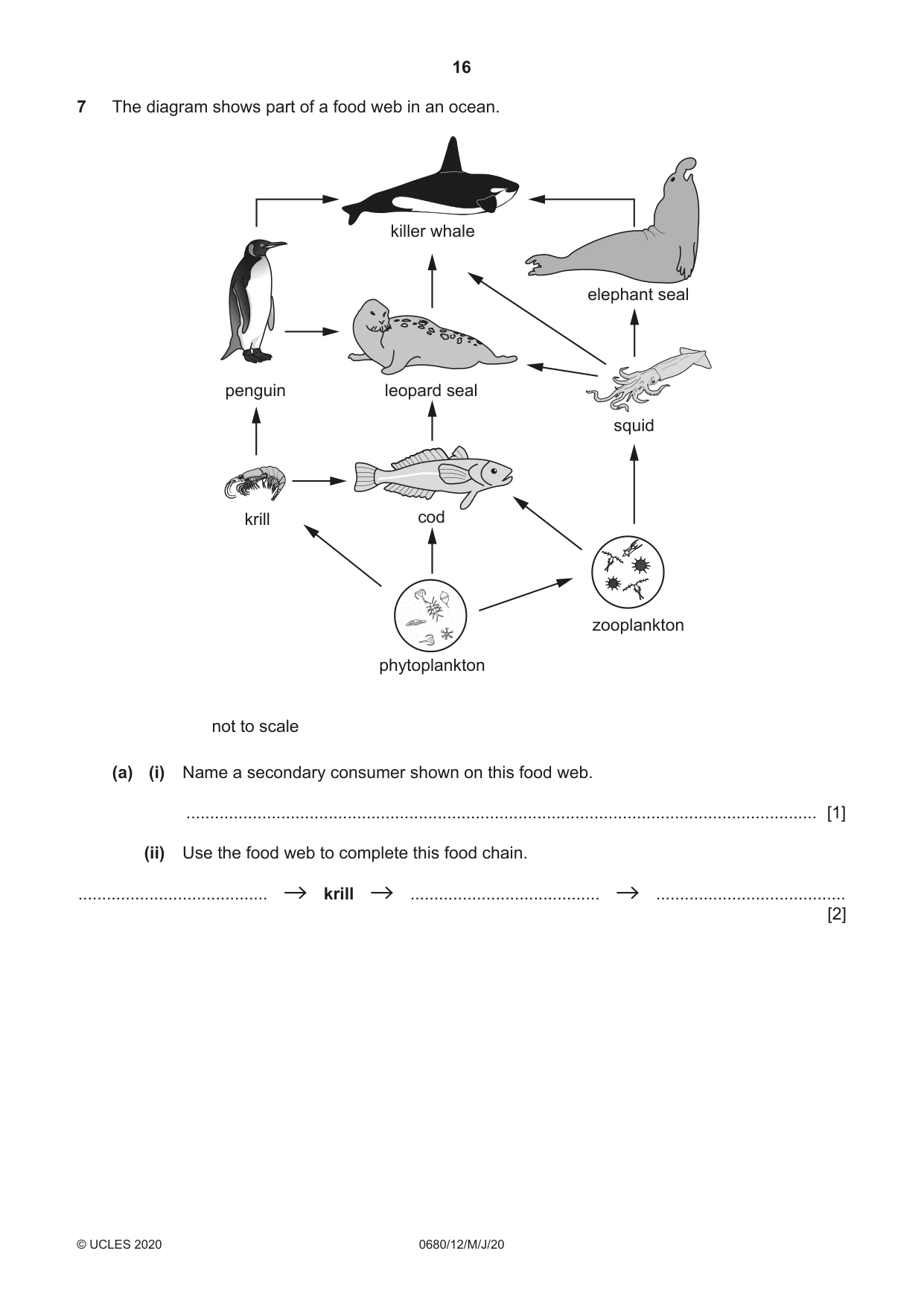
16 0680/12/M/J/20 © UCLES 2020 7 The diagram shows part of a food web in an ocean. killer whale elephant seal squid zooplankton phytoplankton cod krill leopard seal penguin not to scale (a) (i) Name a secondary consumer shown on this food web. … [1] (ii) Use the food web to complete this food chain. … krill … … [2]
Question paper, page 17
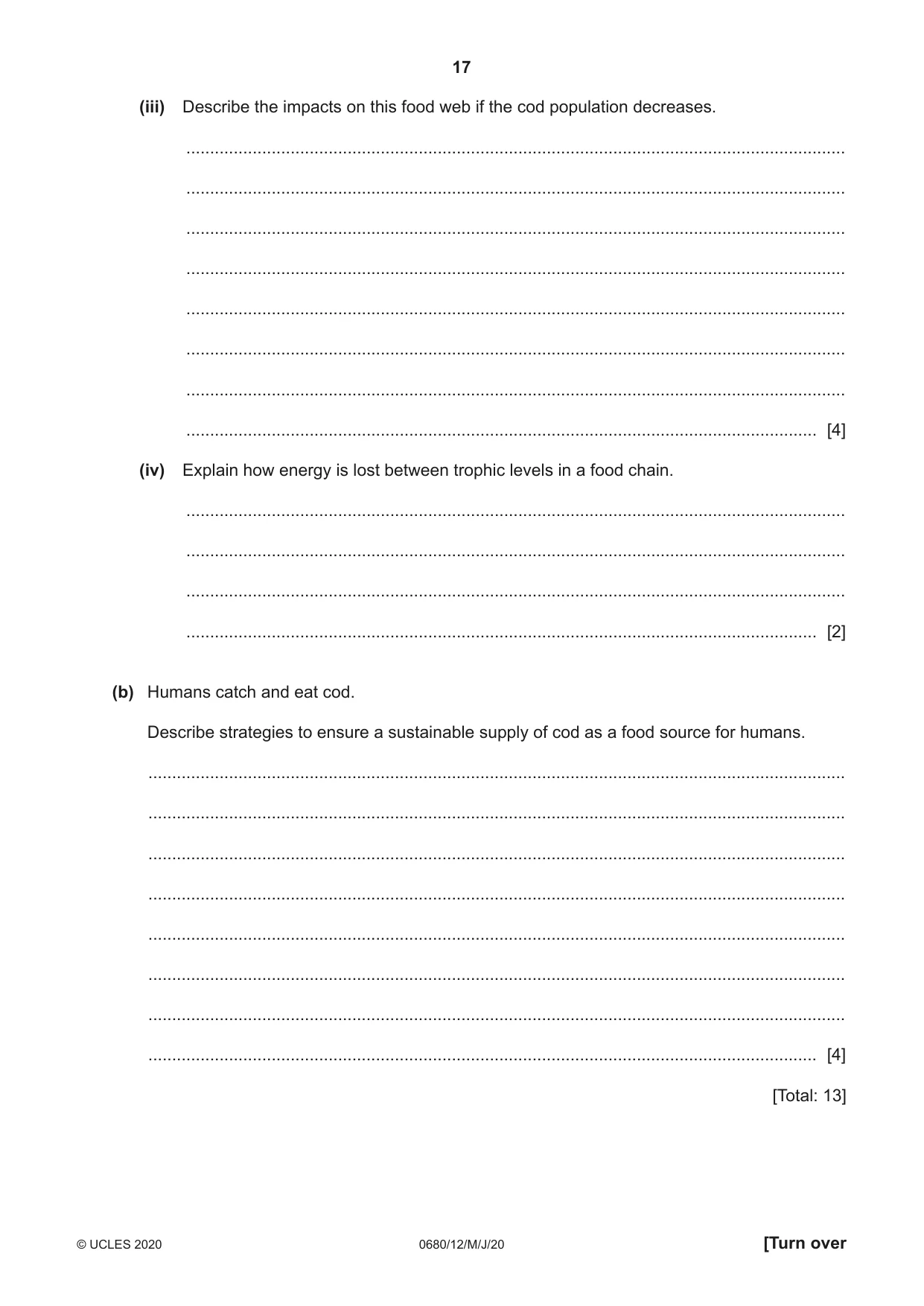
17 0680/12/M/J/20 © UCLES 2020 [Turn over (iii) Describe the impacts on this food web if the cod population decreases. … … … … … … … … [4] (iv) Explain how energy is lost between trophic levels in a food chain. … … … … [2] (b) Humans catch and eat cod. Describe strategies to ensure a sustainable supply of cod as a food source for humans. … … … … … … … … [4] [Total: 13]
Question paper, page 18
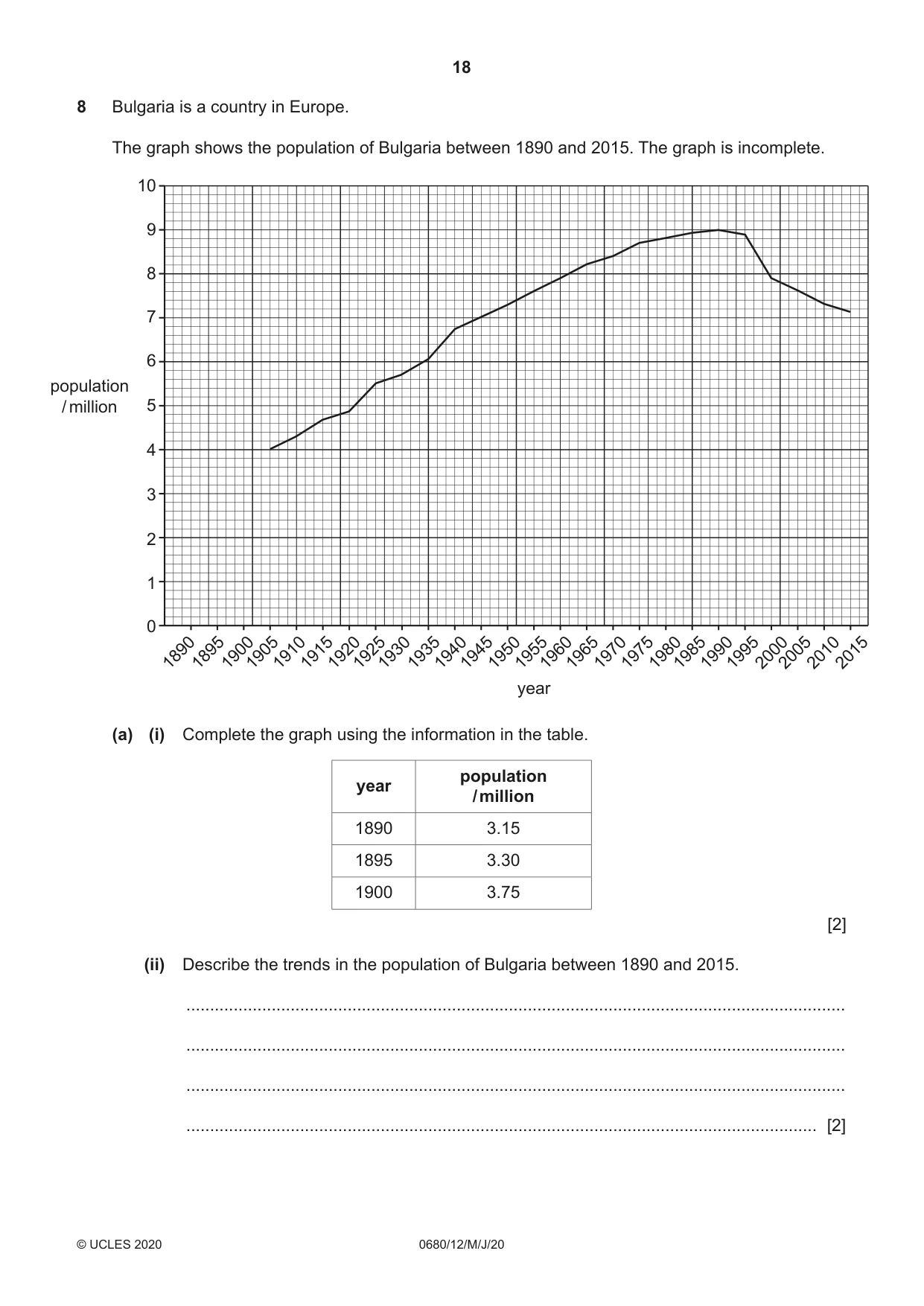
18 0680/12/M/J/20 © UCLES 2020 8 Bulgaria is a country in Europe. The graph shows the population of Bulgaria between 1890 and 2015. The graph is incomplete. 0 1 2 3 4 5 6 7 8 9 10 1890 1895 1900 1905 1910 1915 1920 1925 1930 1935 1940 1945 1950 1955 1960 1965 1970 1975 1980 1985 1990 1995 2000 2005 2010 2015 year population / million (a) (i) Complete the graph using the information in the table. year population / million 1890 3.15 1895 3.30 1900 3.75 [2] (ii) Describe the trends in the population of Bulgaria between 1890 and 2015. … … … … [2]
Question paper, page 19
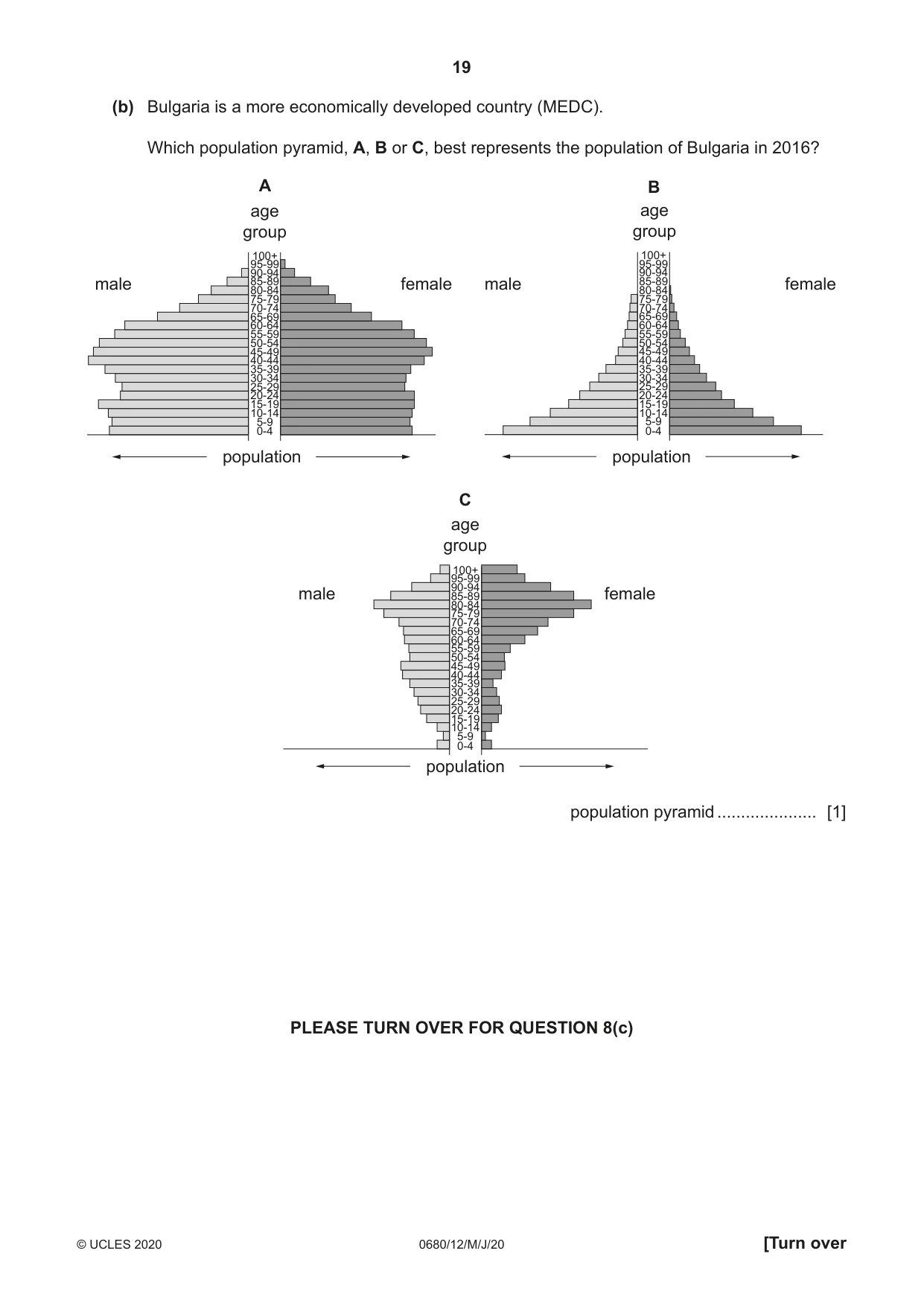
19 0680/12/M/J/20 © UCLES 2020 [Turn over (b) Bulgaria is a more economically developed country (MEDC). Which population pyramid, A, B or C, best represents the population of Bulgaria in 2016? 0-4 5-9 10-14 15-19 20-24 25-29 30-34 35-39 40-44 45-49 50-54 55-59 60-64 65-69 70-74 75-79 80-84 85-89 90-94 95-99 100+ 0-4 5-9 10-14 15-19 20-24 25-29 30-34 35-39 40-44 45-49 50-54 55-59 60-64 65-69 70-74 75-79 80-84 85-89 90-94 95-99 100+ 0-4 5-9 10-14 15-19 20-24 25-29 30-34 35-39 40-44 45-49 50-54 55-59 60-64 65-69 70-74 75-79 80-84 85-89 90-94 95-99 100+ population male female age group population male female age group population male female age group A B C population pyramid … [1] PLEASE TURN OVER FOR QUESTION 8(c)
Question paper, page 20
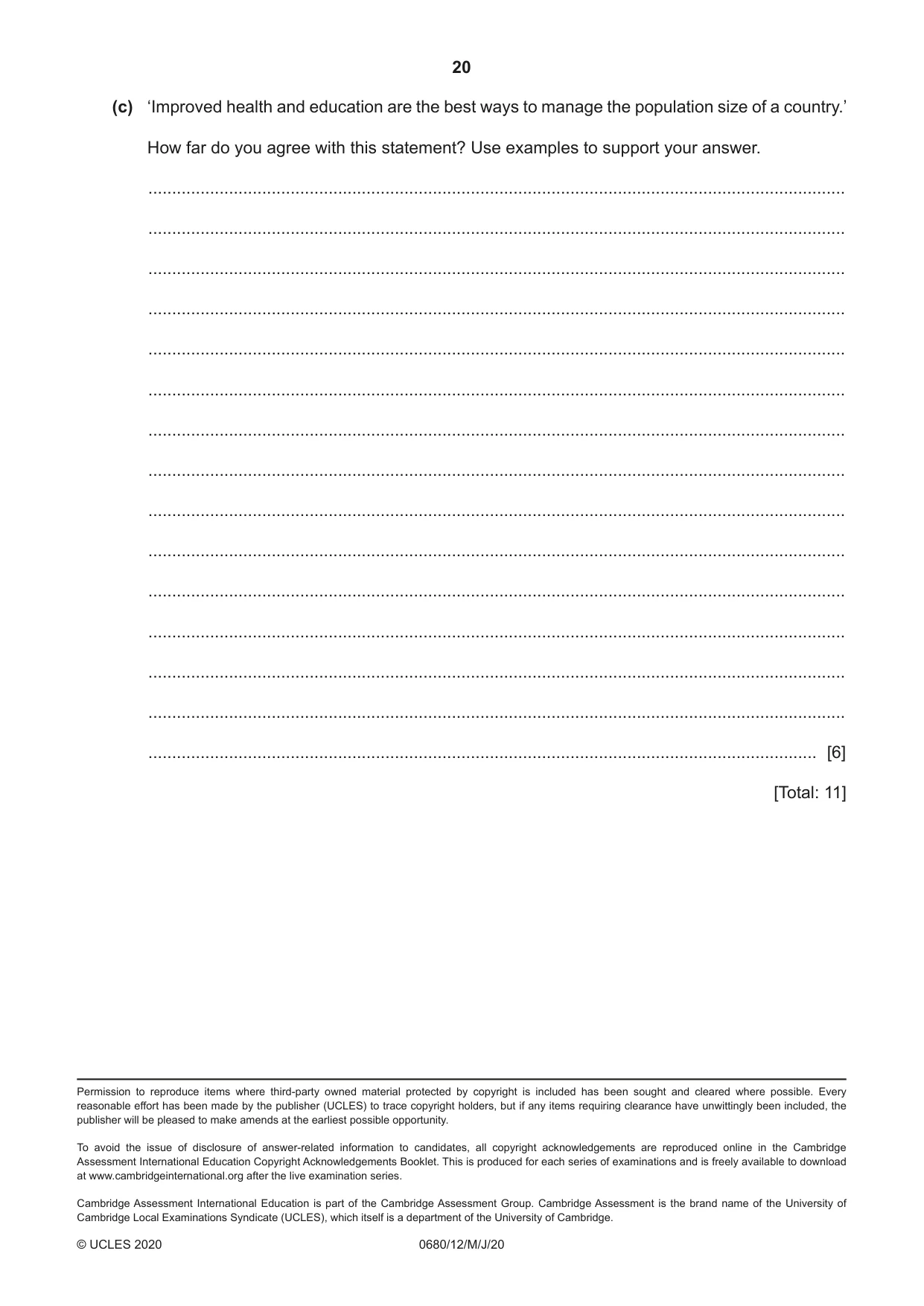
20 0680/12/M/J/20 © UCLES 2020 Permission to reproduce items where third-party owned material protected by copyright is included has been sought and cleared where possible. Every reasonable effort has been made by the publisher (UCLES) to trace copyright holders, but if any items requiring clearance have unwittingly been included, the publisher will be pleased to make amends at the earliest possible opportunity. To avoid the issue of disclosure of answer-related information to candidates, all copyright acknowledgements are reproduced online in the Cambridge Assessment International Education Copyright Acknowledgements Booklet. This is produced for each series of examinations and is freely available to download at www.cambridgeinternational.org after the live examination series. Cambridge Assessment International Education is part of the Cambridge Assessment Group. Cambridge Assessment is the brand name of the University of Cambridge Local Examinations Syndicate (UCLES), which itself is a department of the University of Cambridge. (c) ‘Improved health and education are the best ways to manage the population size of a country.’ How far do you agree with this statement? Use examples to support your answer. … … … … … … … … … … … … … … … [6] [Total: 11]
Mark scheme, page 1
This document consists of 11 printed pages. © UCLES 2020 [Turn over Cambridge IGCSE™ ENVIRONMENTAL MANAGEMENT 0680/12 Paper 1 Theory May/June 2020 MARK SCHEME Maximum Mark: 80 Published Students did not sit exam papers in the June 2020 series due to the Covid-19 global pandemic. This mark scheme is published to support teachers and students and should be read together with the question paper. It shows the requirements of the exam. The answer column of the mark scheme shows the proposed basis on which Examiners would award marks for this exam. Where appropriate, this column also provides the most likely acceptable alternative responses expected from students. Examiners usually review the mark scheme after they have seen student responses and update the mark scheme if appropriate. In the June series, Examiners were unable to consider the acceptability of alternative responses, as there were no student responses to consider. Mark schemes should usually be read together with the Principal Examiner Report for Teachers. However, because students did not sit exam papers, there is no Principal Examiner Report for Teachers for the June 2020 series. Cambridge International will not enter into discussions about these mark schemes. Cambridge International is publishing the mark schemes for the June 2020 series for most Cambridge IGCSE™ and Cambridge International A & AS Level components, and some Cambridge O Level components.
Mark scheme, page 2
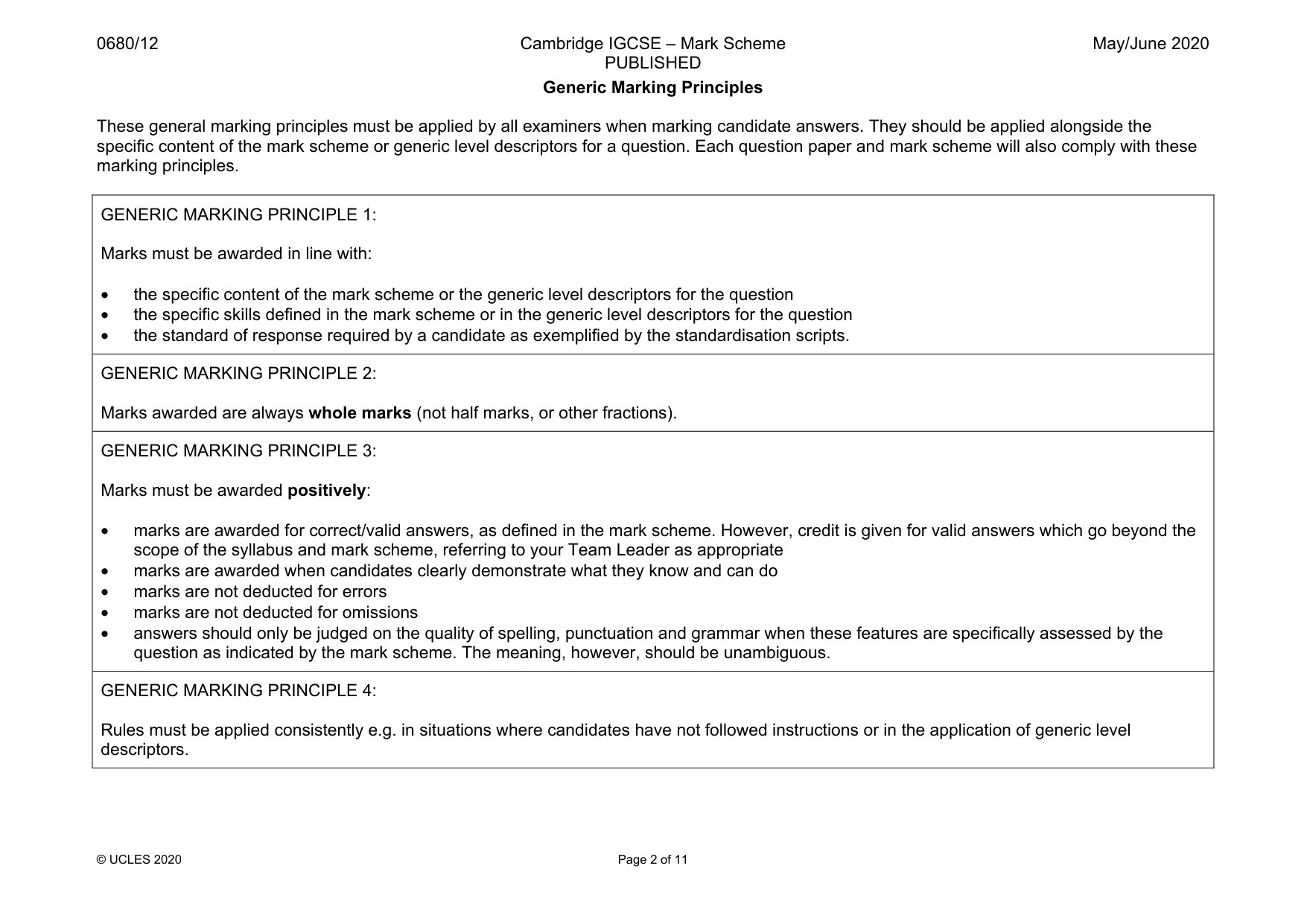
0680/12 Cambridge IGCSE – Mark Scheme PUBLISHED May/June 2020 © UCLES 2020 Page 2 of 11 Generic Marking Principles These general marking principles must be applied by all examiners when marking candidate answers. They should be applied alongside the specific content of the mark scheme or generic level descriptors for a question. Each question paper and mark scheme will also comply with these marking principles. GENERIC MARKING PRINCIPLE 1: Marks must be awarded in line with: • the specific content of the mark scheme or the generic level descriptors for the question • the specific skills defined in the mark scheme or in the generic level descriptors for the question • the standard of response required by a candidate as exemplified by the standardisation scripts. GENERIC MARKING PRINCIPLE 2: Marks awarded are always whole marks (not half marks, or other fractions). GENERIC MARKING PRINCIPLE 3: Marks must be awarded positively: • marks are awarded for correct/valid answers, as defined in the mark scheme. However, credit is given for valid answers which go beyond the scope of the syllabus and mark scheme, referring to your Team Leader as appropriate • marks are awarded when candidates clearly demonstrate what they know and can do • marks are not deducted for errors • marks are not deducted for omissions • answers should only be judged on the quality of spelling, punctuation and grammar when these features are specifically assessed by the question as indicated by the mark scheme. The meaning, however, should be unambiguous. GENERIC MARKING PRINCIPLE 4: Rules must be applied consistently e.g. in situations where candidates have not followed instructions or in the application of generic level descriptors.
Mark scheme, page 3
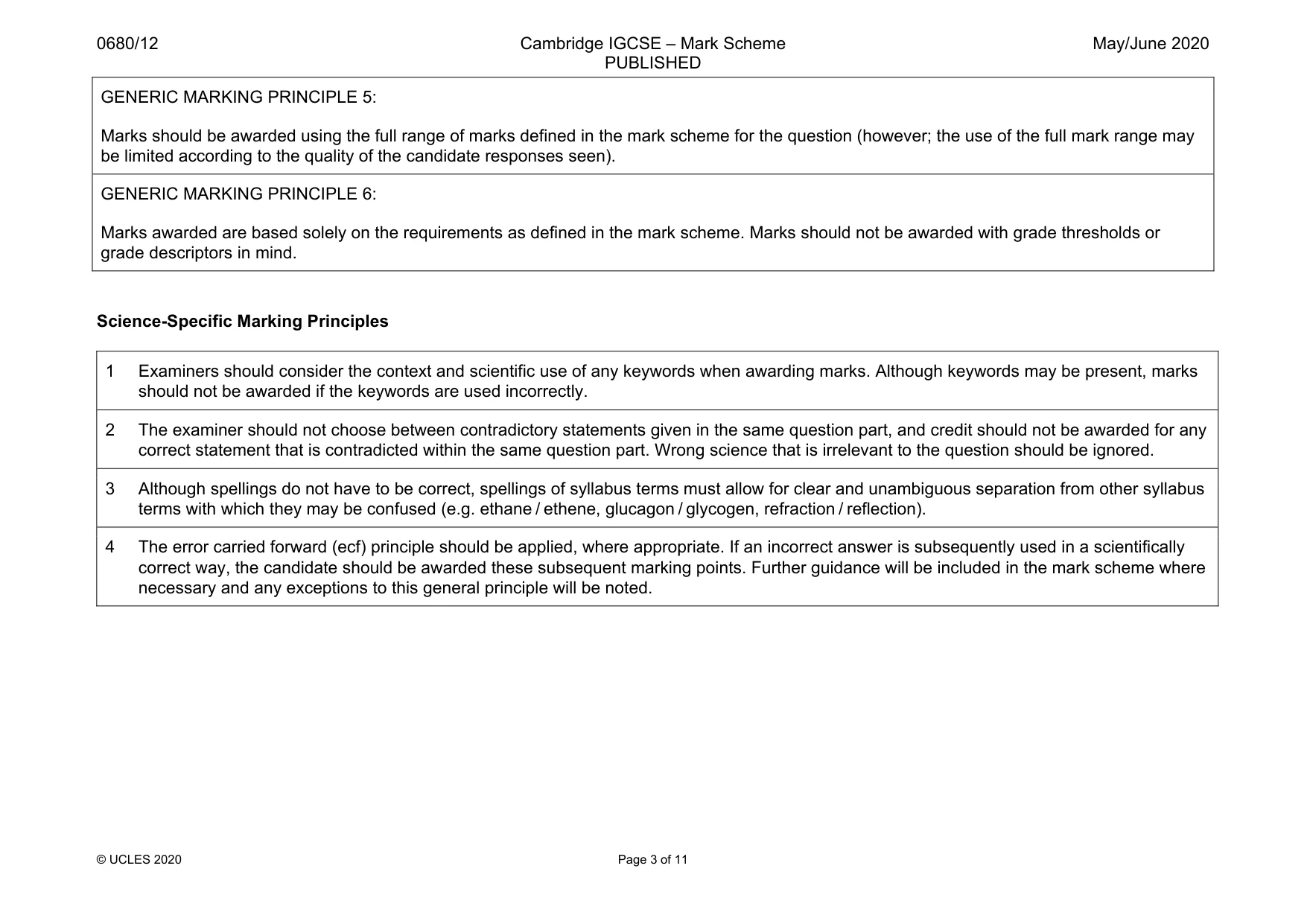
0680/12 Cambridge IGCSE – Mark Scheme PUBLISHED May/June 2020 © UCLES 2020 Page 3 of 11 GENERIC MARKING PRINCIPLE 5: Marks should be awarded using the full range of marks defined in the mark scheme for the question (however; the use of the full mark range may be limited according to the quality of the candidate responses seen). GENERIC MARKING PRINCIPLE 6: Marks awarded are based solely on the requirements as defined in the mark scheme. Marks should not be awarded with grade thresholds or grade descriptors in mind. Science-Specific Marking Principles 1 Examiners should consider the context and scientific use of any keywords when awarding marks. Although keywords may be present, marks should not be awarded if the keywords are used incorrectly. 2 The examiner should not choose between contradictory statements given in the same question part, and credit should not be awarded for any correct statement that is contradicted within the same question part. Wrong science that is irrelevant to the question should be ignored. 3 Although spellings do not have to be correct, spellings of syllabus terms must allow for clear and unambiguous separation from other syllabus terms with which they may be confused (e.g. ethane / ethene, glucagon / glycogen, refraction / reflection). 4 The error carried forward (ecf) principle should be applied, where appropriate. If an incorrect answer is subsequently used in a scientifically correct way, the candidate should be awarded these subsequent marking points. Further guidance will be included in the mark scheme where necessary and any exceptions to this general principle will be noted.
Mark scheme, page 4
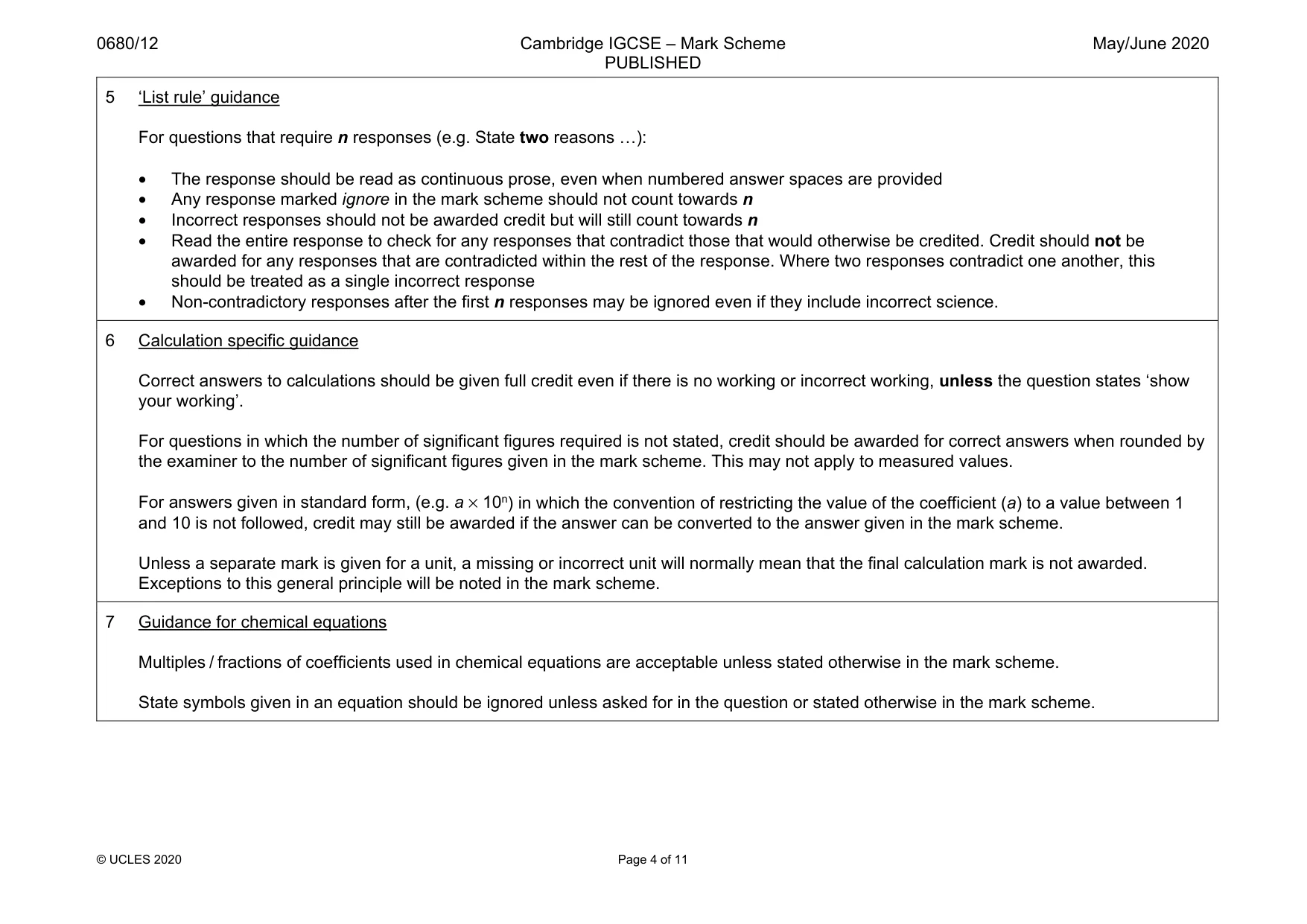
0680/12 Cambridge IGCSE – Mark Scheme PUBLISHED May/June 2020 © UCLES 2020 Page 4 of 11 5 ‘List rule’ guidance For questions that require n responses (e.g. State two reasons …): • The response should be read as continuous prose, even when numbered answer spaces are provided • Any response marked ignore in the mark scheme should not count towards n • Incorrect responses should not be awarded credit but will still count towards n • Read the entire response to check for any responses that contradict those that would otherwise be credited. Credit should not be awarded for any responses that are contradicted within the rest of the response. Where two responses contradict one another, this should be treated as a single incorrect response • Non-contradictory responses after the first n responses may be ignored even if they include incorrect science. 6 Calculation specific guidance Correct answers to calculations should be given full credit even if there is no working or incorrect working, unless the question states ‘show your working’. For questions in which the number of significant figures required is not stated, credit should be awarded for correct answers when rounded by the examiner to the number of significant figures given in the mark scheme. This may not apply to measured values. For answers given in standard form, (e.g. a × 10n) in which the convention of restricting the value of the coefficient (a) to a value between 1 and 10 is not followed, credit may still be awarded if the answer can be converted to the answer given in the mark scheme. Unless a separate mark is given for a unit, a missing or incorrect unit will normally mean that the final calculation mark is not awarded. Exceptions to this general principle will be noted in the mark scheme. 7 Guidance for chemical equations Multiples / fractions of coefficients used in chemical equations are acceptable unless stated otherwise in the mark scheme. State symbols given in an equation should be ignored unless asked for in the question or stated otherwise in the mark scheme.
Mark scheme, page 5
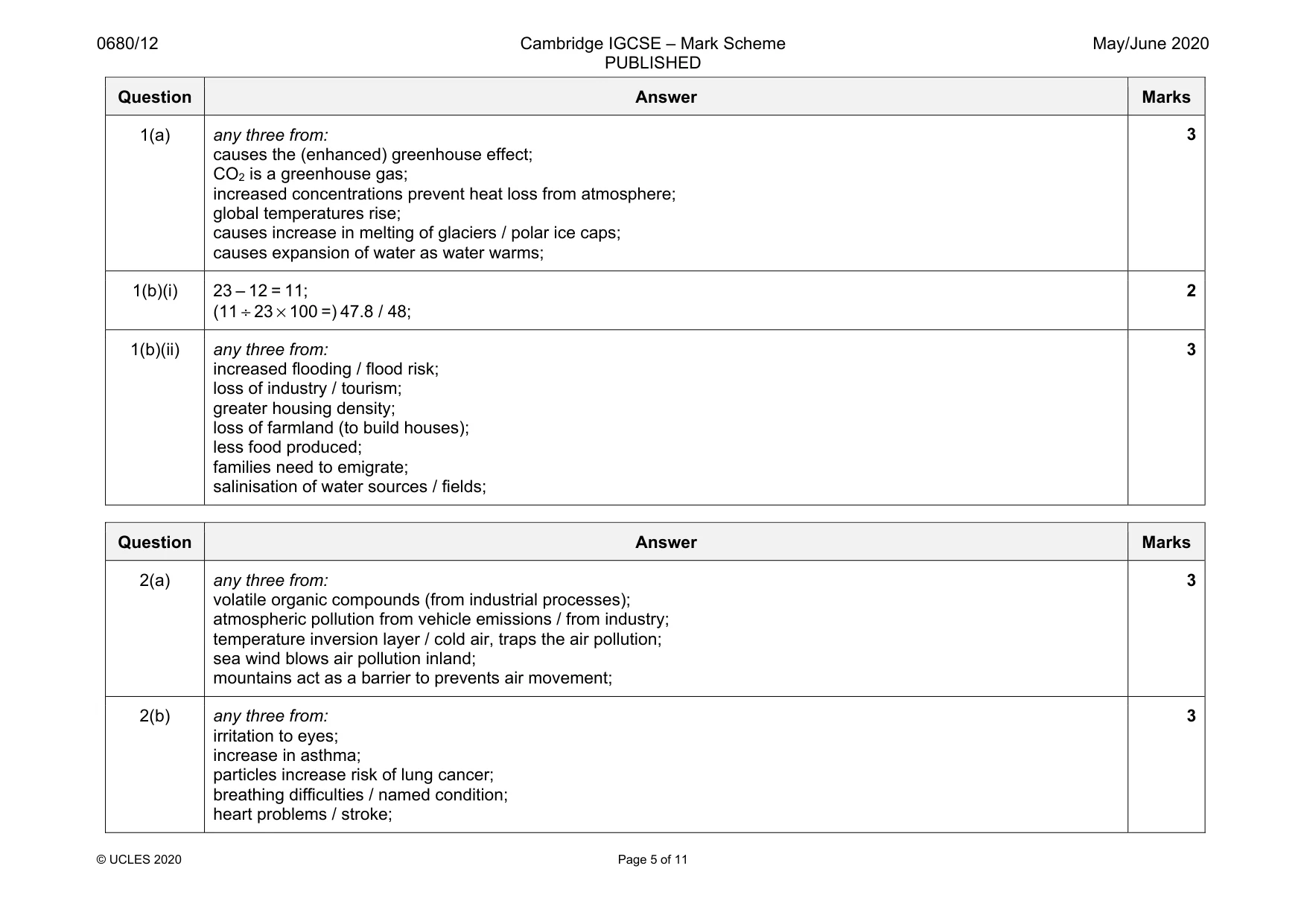
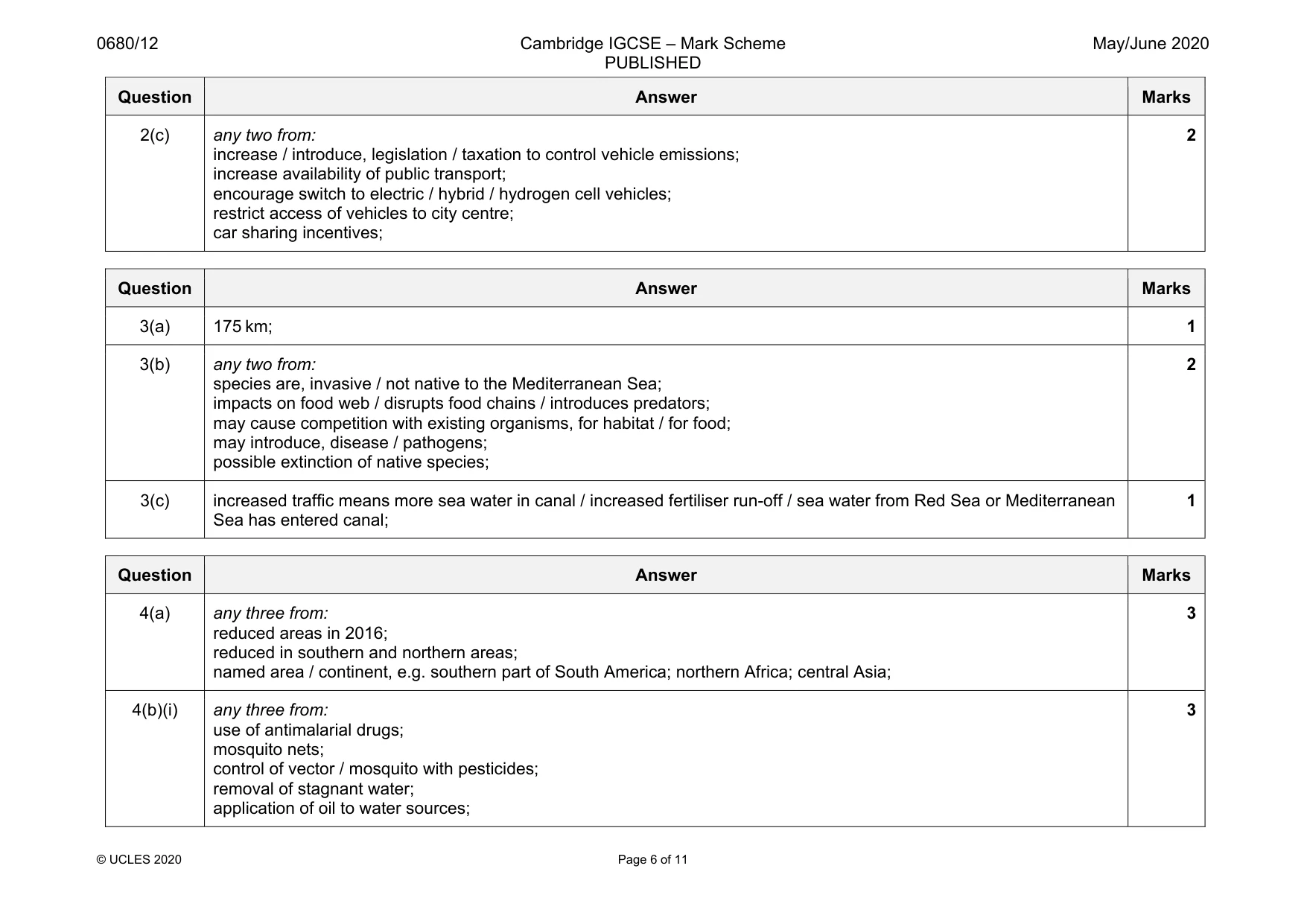
0680/12 Cambridge IGCSE – Mark Scheme PUBLISHED May/June 2020 © UCLES 2020 Page 5 of 11 Question Answer Marks 1(a) any three from: causes the (enhanced) greenhouse effect; CO2 is a greenhouse gas; increased concentrations prevent heat loss from atmosphere; global temperatures rise; causes increase in melting of glaciers / polar ice caps; causes expansion of water as water warms; 3 1(b)(i) 23 – 12 = 11; (11 ÷ 23 × 100 =) 47.8 / 48; 2 1(b)(ii) any three from: increased flooding / flood risk; loss of industry / tourism; greater housing density; loss of farmland (to build houses); less food produced; families need to emigrate; salinisation of water sources / fields; 3 Question Answer Marks 2(a) any three from: volatile organic compounds (from industrial processes); atmospheric pollution from vehicle emissions / from industry; temperature inversion layer / cold air, traps the air pollution; sea wind blows air pollution inland; mountains act as a barrier to prevents air movement; 3 2(b) any three from: irritation to eyes; increase in asthma; particles increase risk of lung cancer; breathing difficulties / named condition; heart problems / stroke; 3
Mark scheme, page 6
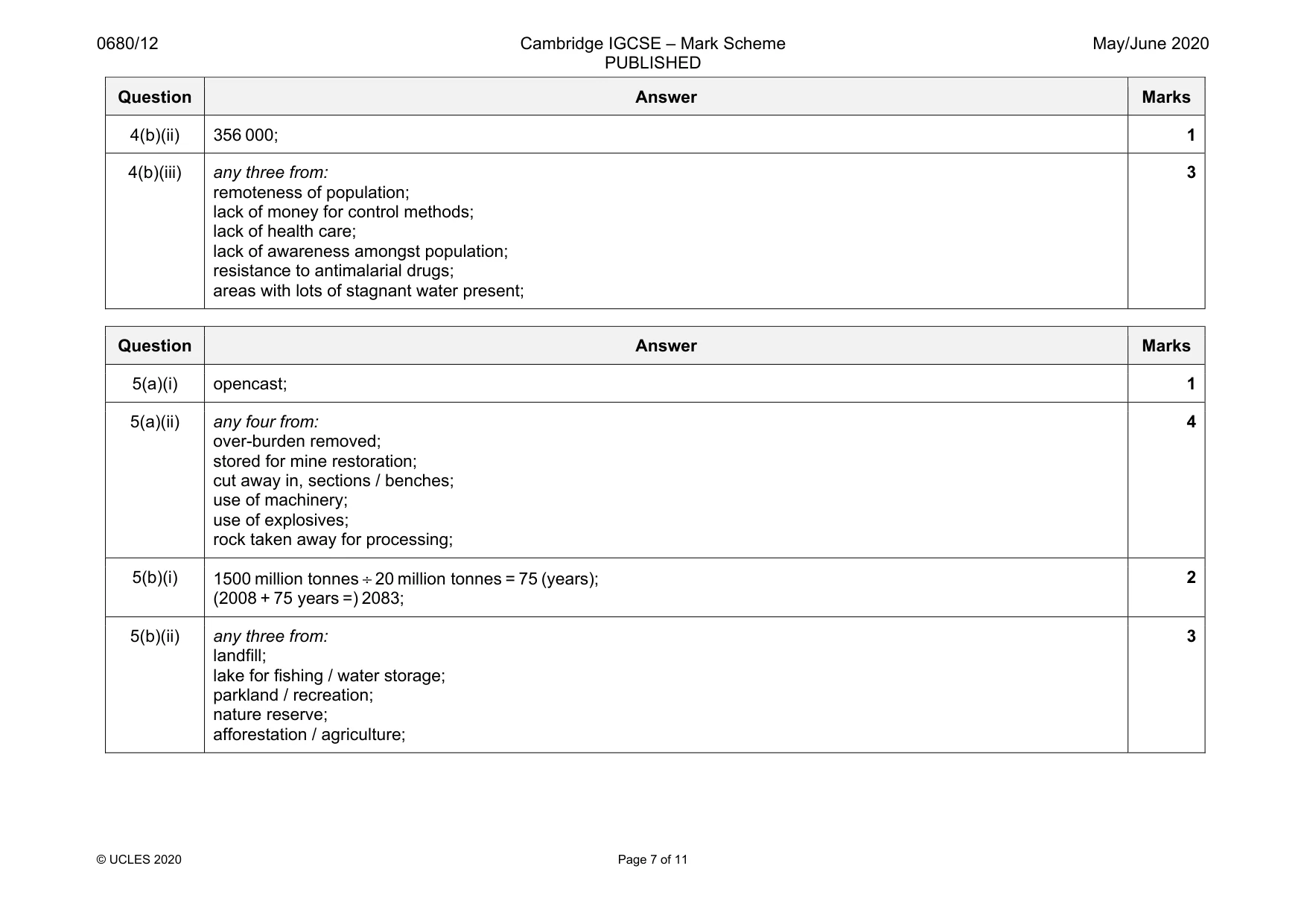
0680/12 Cambridge IGCSE – Mark Scheme PUBLISHED May/June 2020 © UCLES 2020 Page 6 of 11 Question Answer Marks 2(c) any two from: increase / introduce, legislation / taxation to control vehicle emissions; increase availability of public transport; encourage switch to electric / hybrid / hydrogen cell vehicles; restrict access of vehicles to city centre; car sharing incentives; 2 Question Answer Marks 3(a) 175 km; 1 3(b) any two from: species are, invasive / not native to the Mediterranean Sea; impacts on food web / disrupts food chains / introduces predators; may cause competition with existing organisms, for habitat / for food; may introduce, disease / pathogens; possible extinction of native species; 2 3(c) increased traffic means more sea water in canal / increased fertiliser run-off / sea water from Red Sea or Mediterranean Sea has entered canal; 1 Question Answer Marks 4(a) any three from: reduced areas in 2016; reduced in southern and northern areas; named area / continent, e.g. southern part of South America; northern Africa; central Asia; 3 4(b)(i) any three from: use of antimalarial drugs; mosquito nets; control of vector / mosquito with pesticides; removal of stagnant water; application of oil to water sources; 3
Mark scheme, page 7
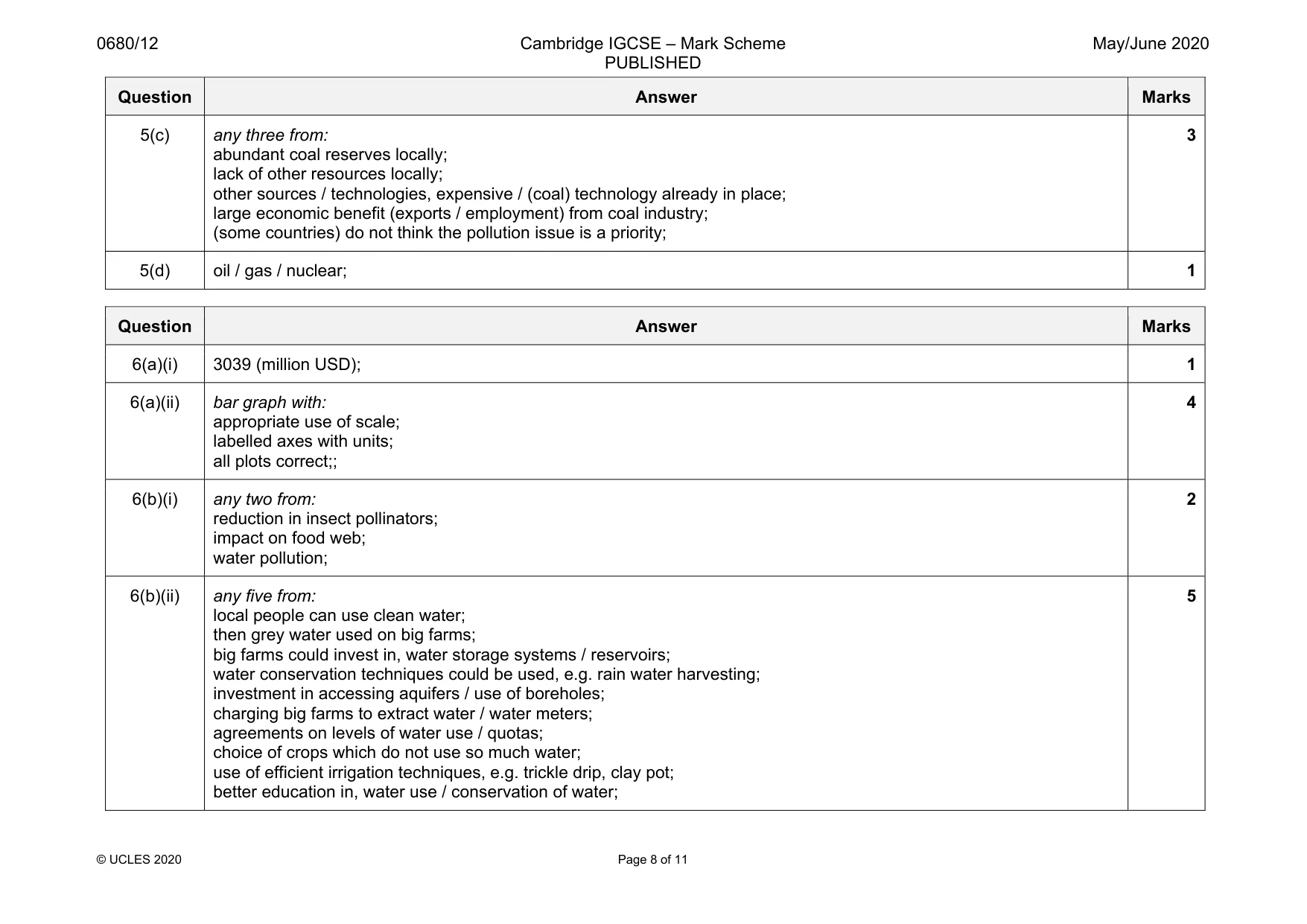
0680/12 Cambridge IGCSE – Mark Scheme PUBLISHED May/June 2020 © UCLES 2020 Page 7 of 11 Question Answer Marks 4(b)(ii) 356 000; 1 4(b)(iii) any three from: remoteness of population; lack of money for control methods; lack of health care; lack of awareness amongst population; resistance to antimalarial drugs; areas with lots of stagnant water present; 3 Question Answer Marks 5(a)(i) opencast; 1 5(a)(ii) any four from: over-burden removed; stored for mine restoration; cut away in, sections / benches; use of machinery; use of explosives; rock taken away for processing; 4 5(b)(i) 1500 million tonnes ÷ 20 million tonnes = 75 (years); (2008 + 75 years =) 2083; 2 5(b)(ii) any three from: landfill; lake for fishing / water storage; parkland / recreation; nature reserve; afforestation / agriculture; 3
Mark scheme, page 8
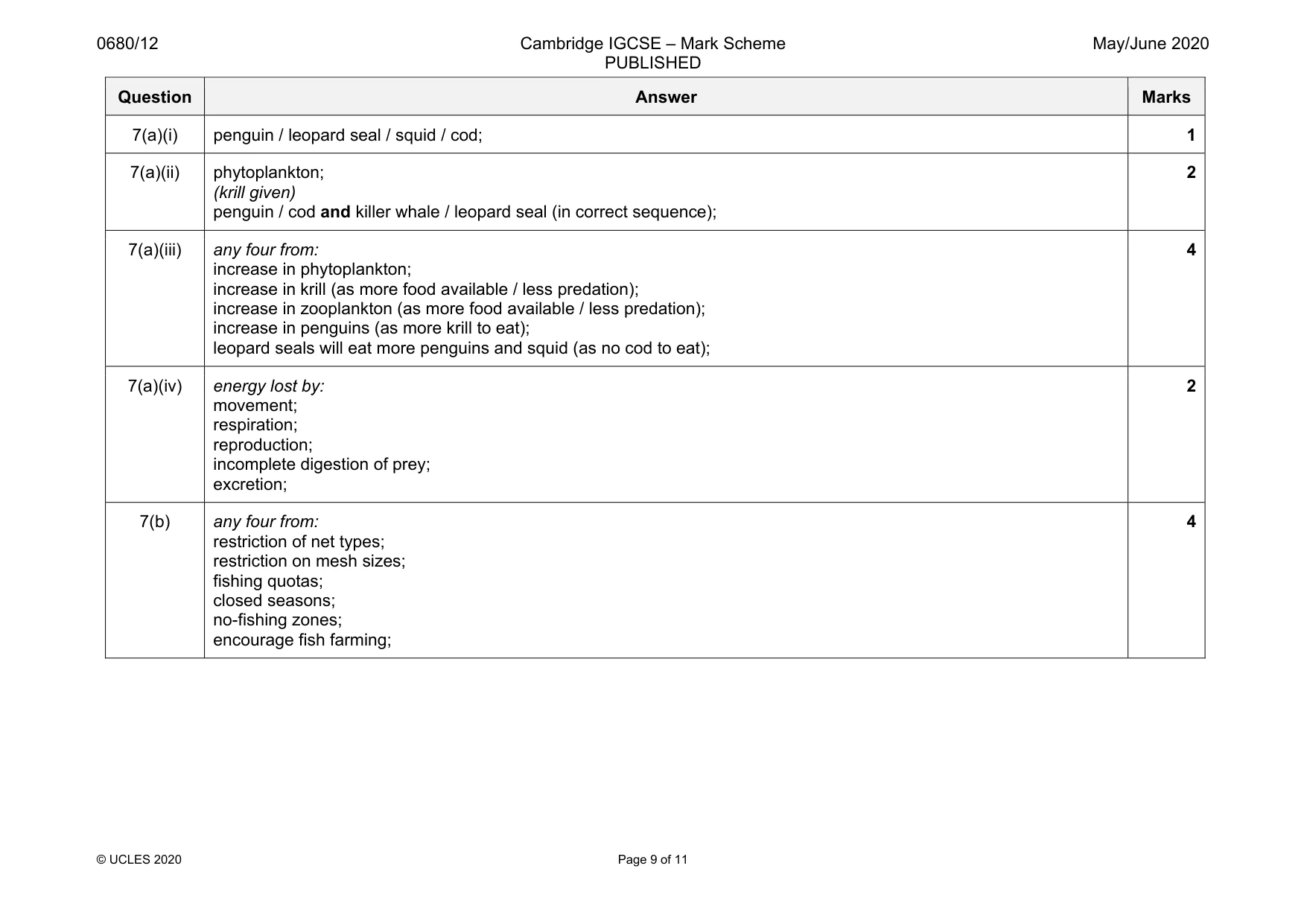
0680/12 Cambridge IGCSE – Mark Scheme PUBLISHED May/June 2020 © UCLES 2020 Page 8 of 11 Question Answer Marks 5(c) any three from: abundant coal reserves locally; lack of other resources locally; other sources / technologies, expensive / (coal) technology already in place; large economic benefit (exports / employment) from coal industry; (some countries) do not think the pollution issue is a priority; 3 5(d) oil / gas / nuclear; 1 Question Answer Marks 6(a)(i) 3039 (million USD); 1 6(a)(ii) bar graph with: appropriate use of scale; labelled axes with units; all plots correct;; 4 6(b)(i) any two from: reduction in insect pollinators; impact on food web; water pollution; 2 6(b)(ii) any five from: local people can use clean water; then grey water used on big farms; big farms could invest in, water storage systems / reservoirs; water conservation techniques could be used, e.g. rain water harvesting; investment in accessing aquifers / use of boreholes; charging big farms to extract water / water meters; agreements on levels of water use / quotas; choice of crops which do not use so much water; use of efficient irrigation techniques, e.g. trickle drip, clay pot; better education in, water use / conservation of water; 5
Mark scheme, page 9
0680/12 Cambridge IGCSE – Mark Scheme PUBLISHED May/June 2020 © UCLES 2020 Page 9 of 11 Question Answer Marks 7(a)(i) penguin / leopard seal / squid / cod; 1 7(a)(ii) phytoplankton; (krill given) penguin / cod and killer whale / leopard seal (in correct sequence); 2 7(a)(iii) any four from: increase in phytoplankton; increase in krill (as more food available / less predation); increase in zooplankton (as more food available / less predation); increase in penguins (as more krill to eat); leopard seals will eat more penguins and squid (as no cod to eat); 4 7(a)(iv) energy lost by: movement; respiration; reproduction; incomplete digestion of prey; excretion; 2 7(b) any four from: restriction of net types; restriction on mesh sizes; fishing quotas; closed seasons; no-fishing zones; encourage fish farming; 4
Mark scheme, page 10
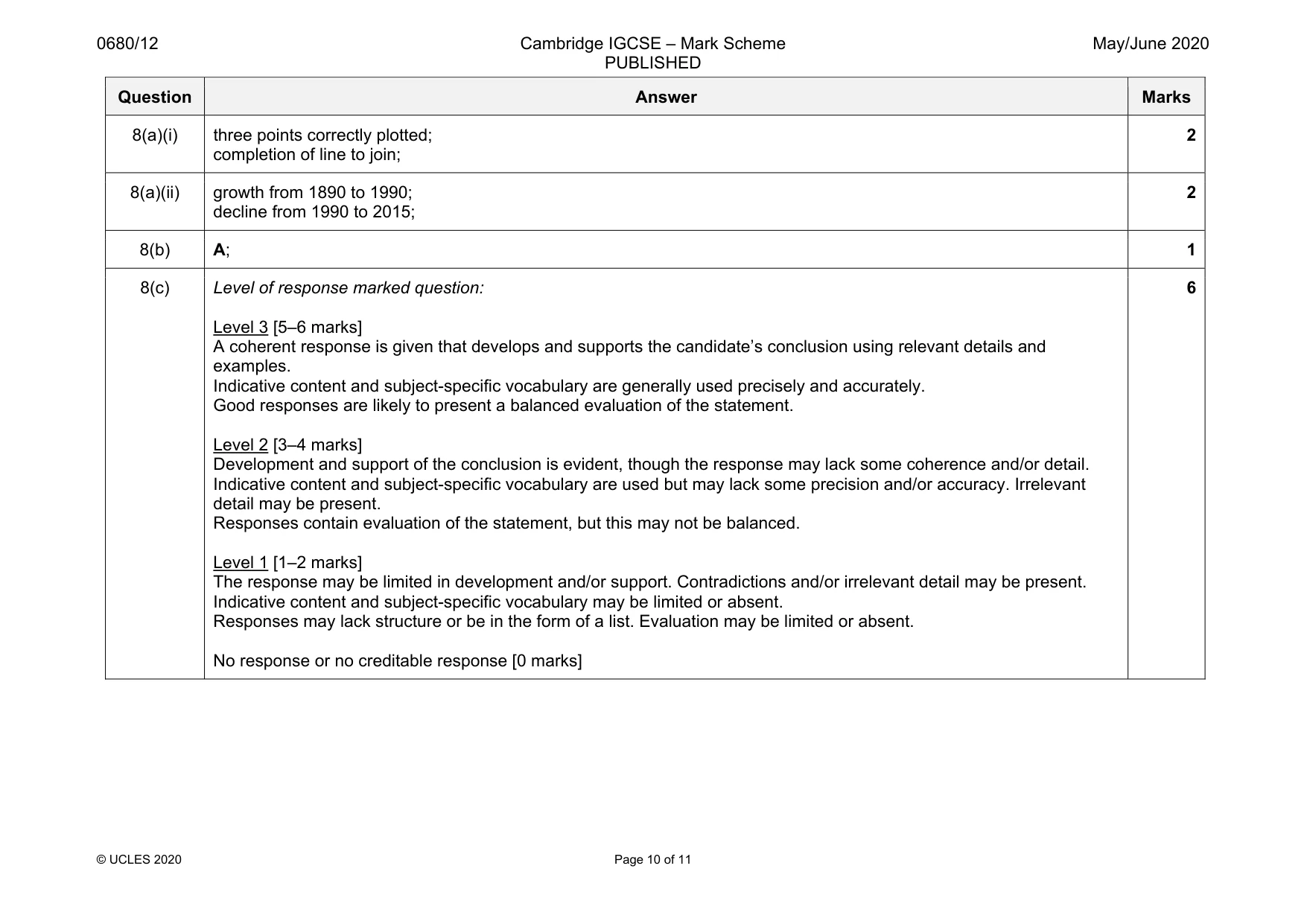
0680/12 Cambridge IGCSE – Mark Scheme PUBLISHED May/June 2020 © UCLES 2020 Page 10 of 11 Question Answer Marks 8(a)(i) three points correctly plotted; completion of line to join; 2 8(a)(ii) growth from 1890 to 1990; decline from 1990 to 2015; 2 8(b) A; 1 8(c) Level of response marked question: Level 3 [5–6 marks] A coherent response is given that develops and supports the candidate’s conclusion using relevant details and examples. Indicative content and subject-specific vocabulary are generally used precisely and accurately. Good responses are likely to present a balanced evaluation of the statement. Level 2 [3–4 marks] Development and support of the conclusion is evident, though the response may lack some coherence and/or detail. Indicative content and subject-specific vocabulary are used but may lack some precision and/or accuracy. Irrelevant detail may be present. Responses contain evaluation of the statement, but this may not be balanced. Level 1 [1–2 marks] The response may be limited in development and/or support. Contradictions and/or irrelevant detail may be present. Indicative content and subject-specific vocabulary may be limited or absent. Responses may lack structure or be in the form of a list. Evaluation may be limited or absent. No response or no creditable response [0 marks] 6
Mark scheme, page 11
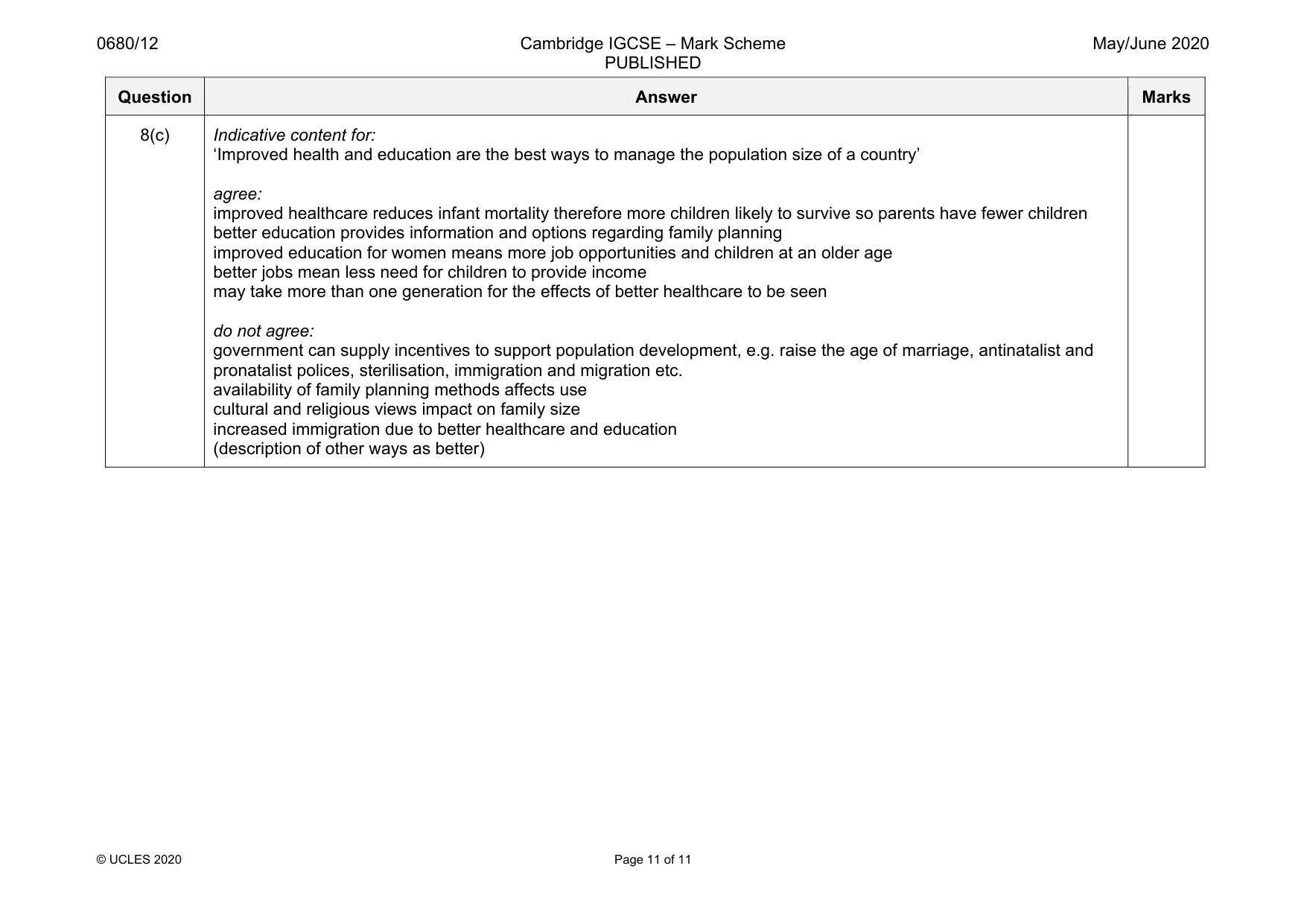
0680/12 Cambridge IGCSE – Mark Scheme PUBLISHED May/June 2020 © UCLES 2020 Page 11 of 11 Question Answer Marks 8(c) Indicative content for: ‘Improved health and education are the best ways to manage the population size of a country’ agree: improved healthcare reduces infant mortality therefore more children likely to survive so parents have fewer children better education provides information and options regarding family planning improved education for women means more job opportunities and children at an older age better jobs mean less need for children to provide income may take more than one generation for the effects of better healthcare to be seen do not agree: government can supply incentives to support population development, e.g. raise the age of marriage, antinatalist and pronatalist polices, sterilisation, immigration and migration etc. availability of family planning methods affects use cultural and religious views impact on family size increased immigration due to better healthcare and education (description of other ways as better)