Cambridge IGCSE Environmental Management 0680 — 2020 May/June Paper 1 · Variant 1
0680/11/M/J/20
The question paper and its mark scheme, free to read here and free to download. This is Cambridge’s own paper, exactly as it was sat.
Question paper20 pages







Mark scheme12 pages
Answers below. Sit the paper first if you are practising.
Paper as text
Question paper, page 1
Cambridge IGCSE™ This document has 20 pages. Blank pages are indicated. DC (ST/CT) 185351/3 © UCLES 2020 [Turn over * 3 1 1 9 9 5 8 8 4 1 * ENVIRONMENTAL MANAGEMENT 0680/11 Paper 1 Theory May/June 2020 1 hour 45 minutes You must answer on the question paper. No additional materials are needed. INSTRUCTIONS ● Answer all questions. ● Use a black or dark blue pen. You may use an HB pencil for any diagrams or graphs. ● Write your name, centre number and candidate number in the boxes at the top of the page. ● Write your answer to each question in the space provided. ● Do not use an erasable pen or correction fluid. ● Do not write on any bar codes. ● You may use a calculator. ● You should show all your working and use appropriate units. INFORMATION ● The total mark for this paper is 80. ● The number of marks for each question or part question is shown in brackets [ ].
Question paper, page 2
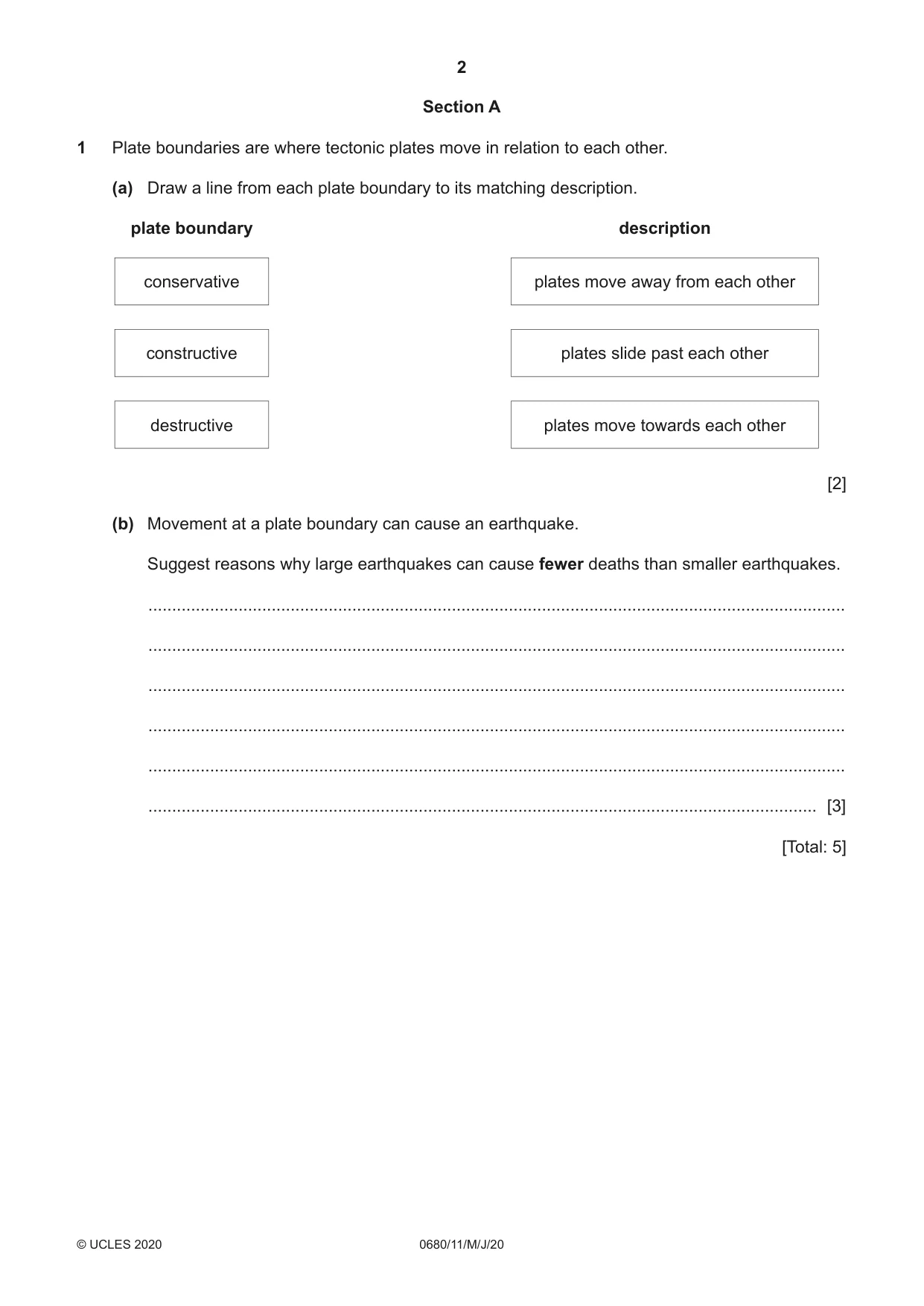
2 0680/11/M/J/20 © UCLES 2020 Section A 1 Plate boundaries are where tectonic plates move in relation to each other. (a) Draw a line from each plate boundary to its matching description. plate boundary description conservative plates move away from each other constructive plates slide past each other destructive plates move towards each other [2] (b) Movement at a plate boundary can cause an earthquake. Suggest reasons why large earthquakes can cause fewer deaths than smaller earthquakes. … … … … … … [3] [Total: 5]
Question paper, page 3
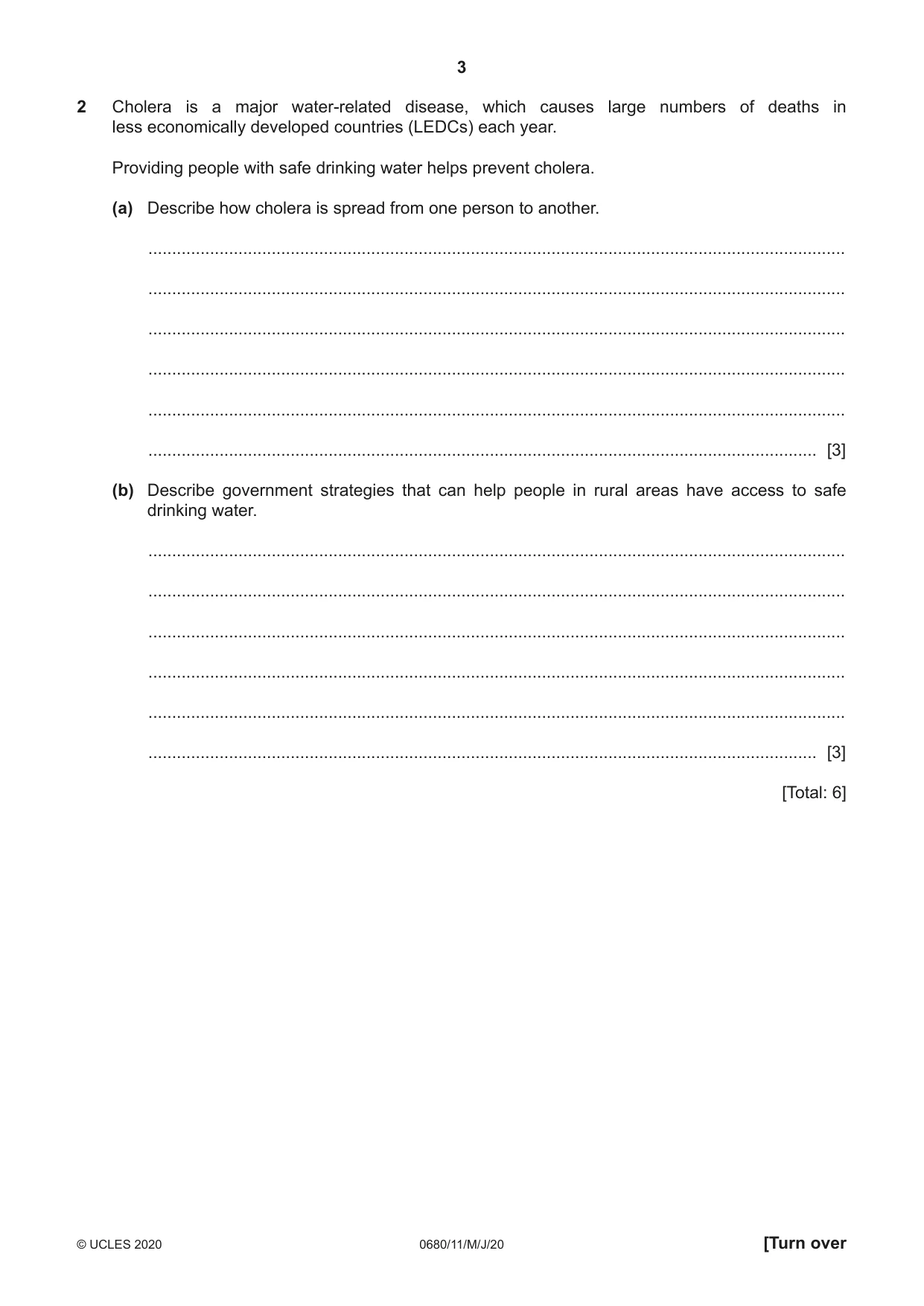
3 0680/11/M/J/20 © UCLES 2020 [Turn over 2 Cholera is a major water-related disease, which causes large numbers of deaths in less economically developed countries (LEDCs) each year. Providing people with safe drinking water helps prevent cholera. (a) Describe how cholera is spread from one person to another. … … … … … … [3] (b) Describe government strategies that can help people in rural areas have access to safe drinking water. … … … … … … [3] [Total: 6]
Question paper, page 4
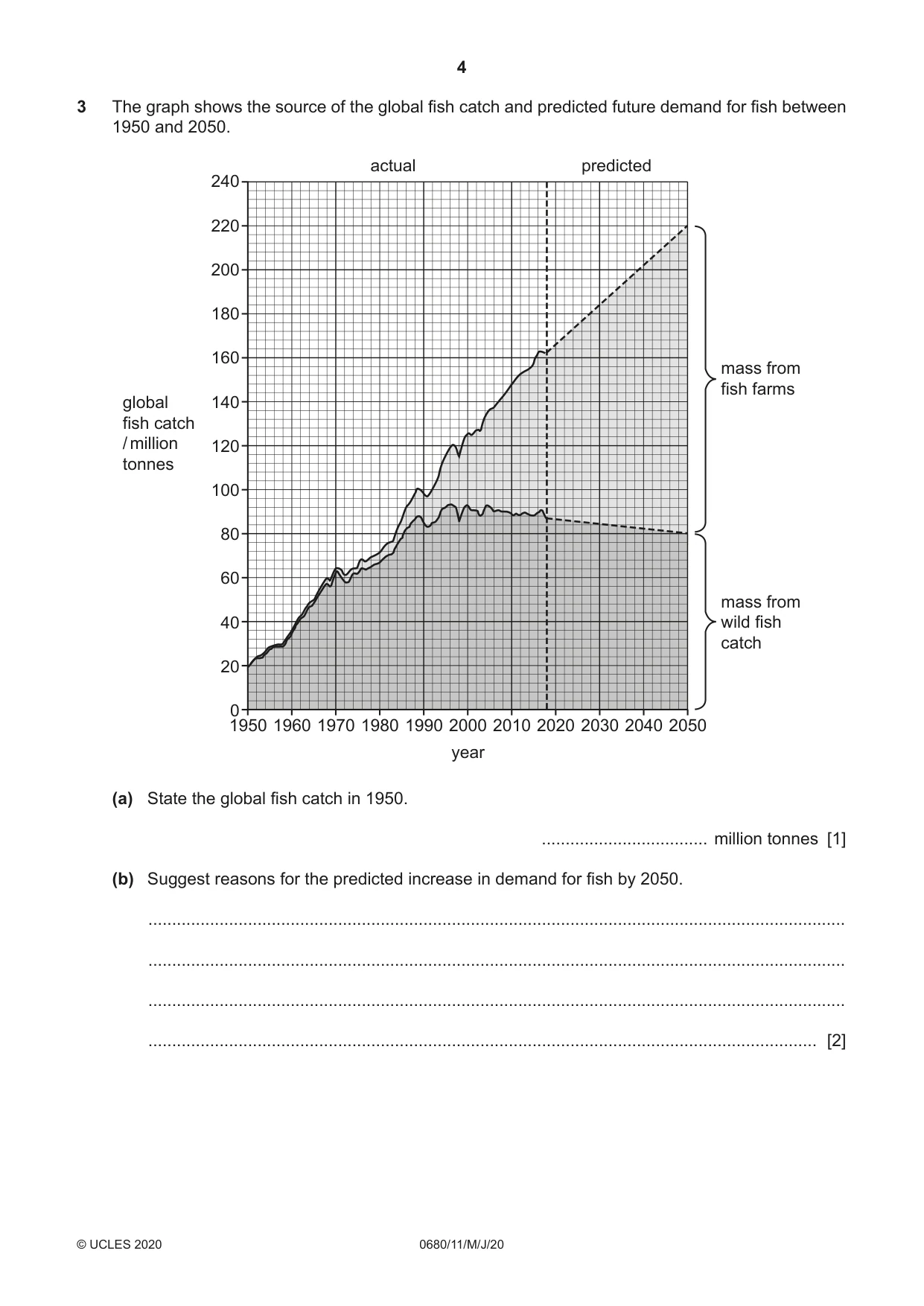
4 0680/11/M/J/20 © UCLES 2020 3 The graph shows the source of the global fish catch and predicted future demand for fish between 1950 and 2050. 0 20 40 60 80 100 120 140 160 180 200 220 240 actual predicted global fish catch / million tonnes 1950 1960 1970 1980 1990 2000 year 2010 2020 2030 2040 2050 mass from fish farms mass from wild fish catch (a) State the global fish catch in 1950. … million tonnes [1] (b) Suggest reasons for the predicted increase in demand for fish by 2050. … … … … [2]
Question paper, page 5
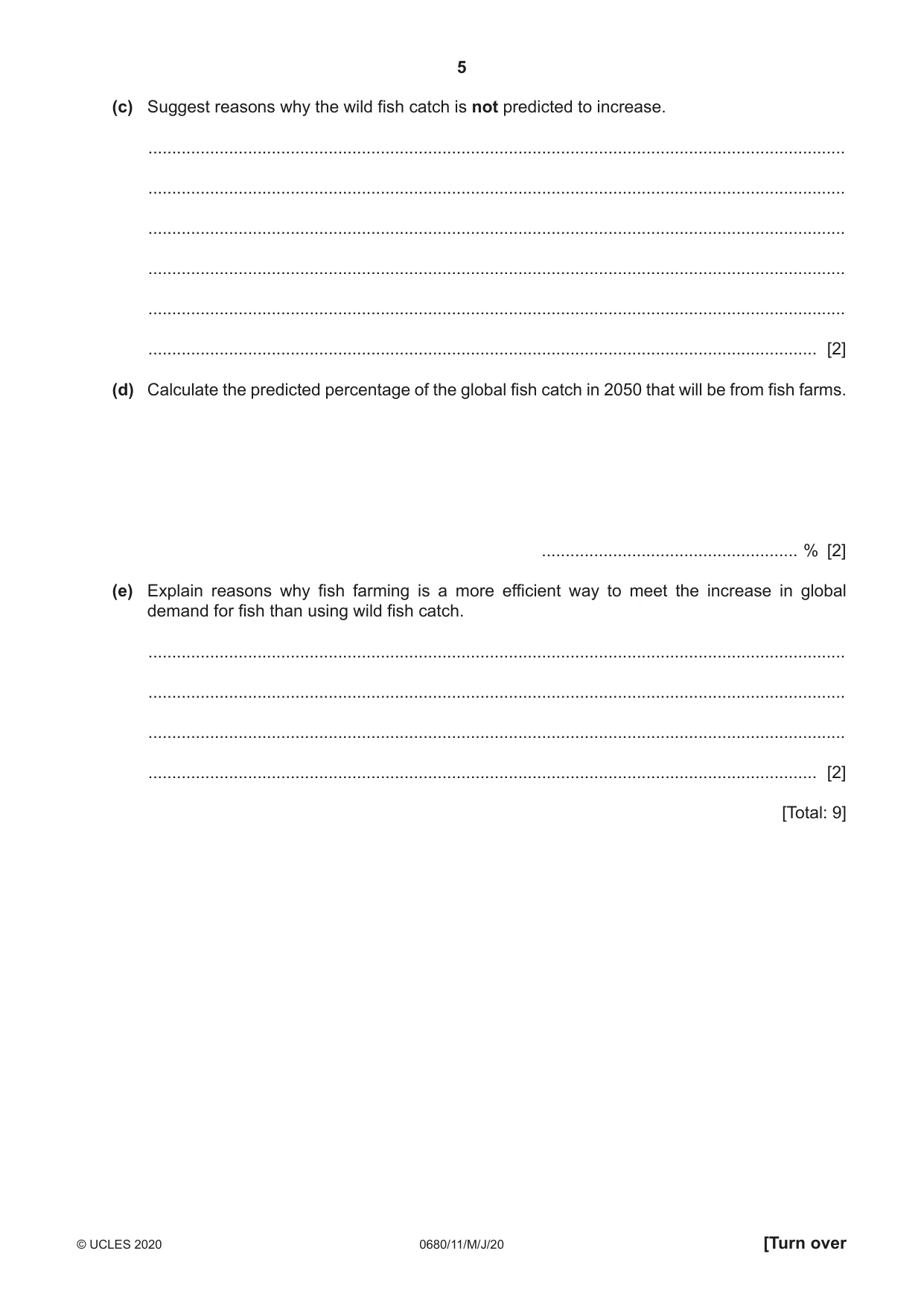
5 0680/11/M/J/20 © UCLES 2020 [Turn over (c) Suggest reasons why the wild fish catch is not predicted to increase. … … … … … … [2] (d) Calculate the predicted percentage of the global fish catch in 2050 that will be from fish farms. … % [2] (e) Explain reasons why fish farming is a more efficient way to meet the increase in global demand for fish than using wild fish catch. … … … … [2] [Total: 9]
Question paper, page 6
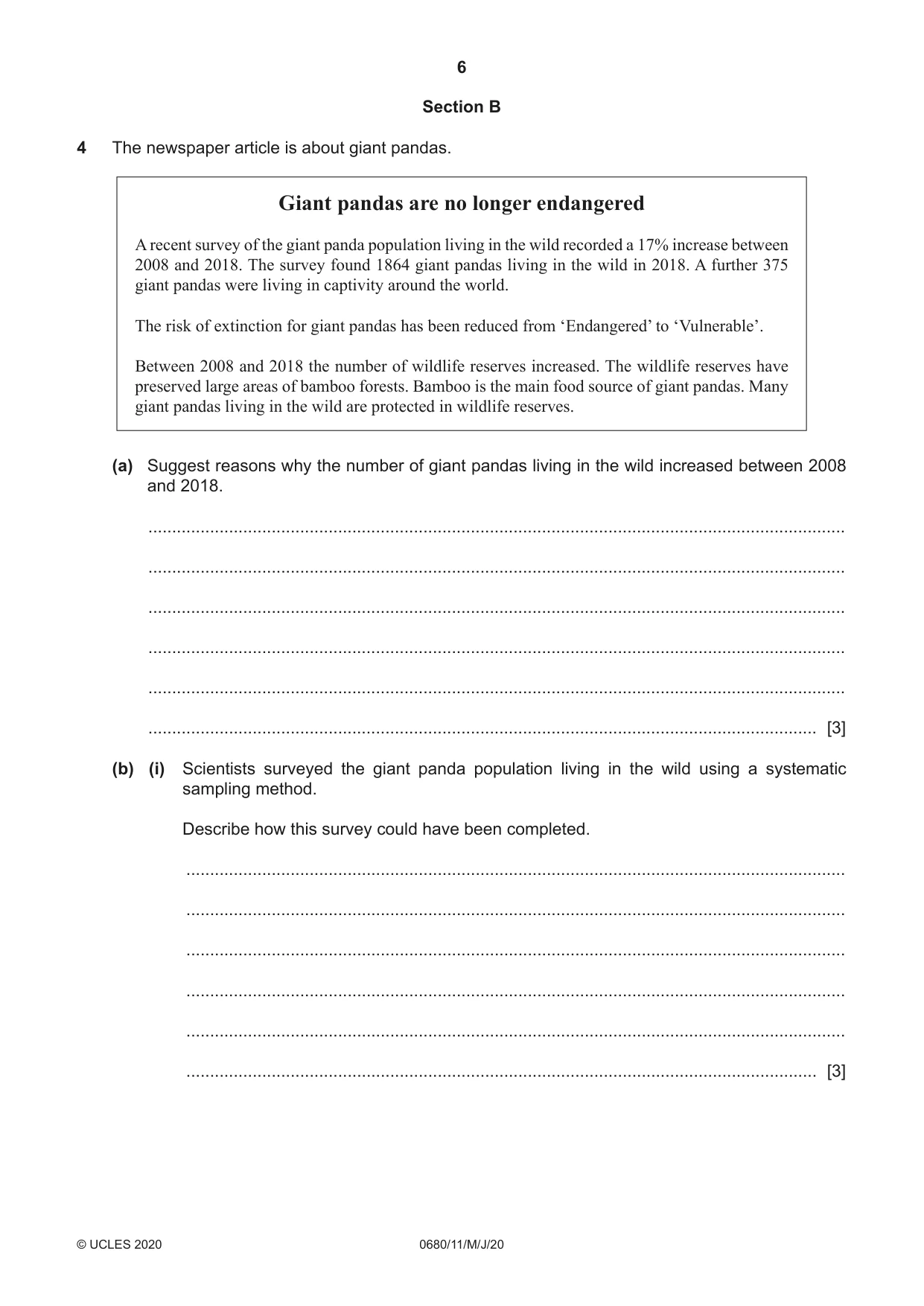
6 0680/11/M/J/20 © UCLES 2020 Section B 4 The newspaper article is about giant pandas. Giant pandas are no longer endangered A recent survey of the giant panda population living in the wild recorded a 17% increase between 2008 and 2018. The survey found 1864 giant pandas living in the wild in 2018. A further 375 giant pandas were living in captivity around the world. The risk of extinction for giant pandas has been reduced from ‘Endangered’ to ‘Vulnerable’. Between 2008 and 2018 the number of wildlife reserves increased. The wildlife reserves have preserved large areas of bamboo forests. Bamboo is the main food source of giant pandas. Many giant pandas living in the wild are protected in wildlife reserves. (a) Suggest reasons why the number of giant pandas living in the wild increased between 2008 and 2018. … … … … … … [3] (b) (i) Scientists surveyed the giant panda population living in the wild using a systematic sampling method. Describe how this survey could have been completed. … … … … … … [3]
Question paper, page 7
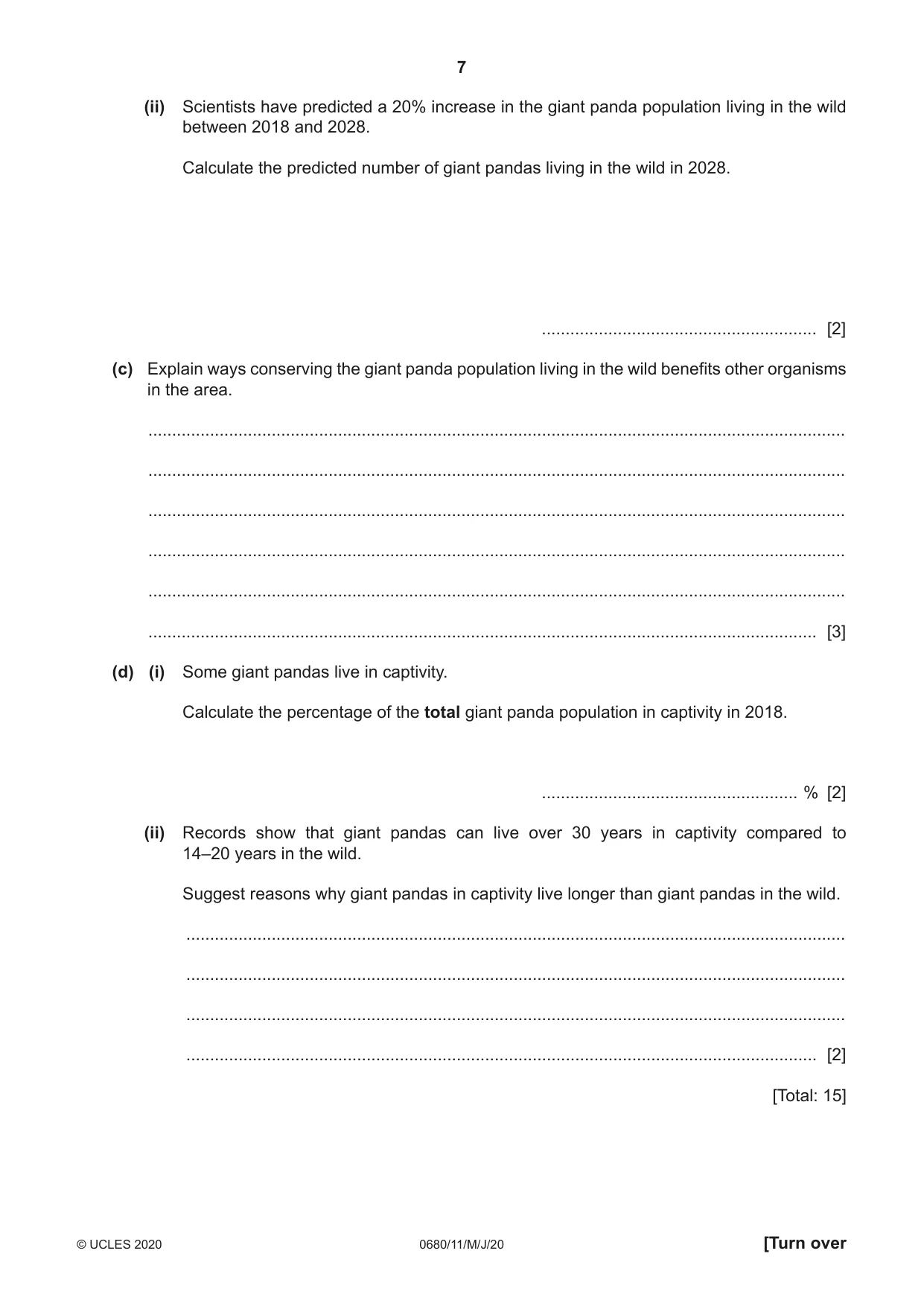
7 0680/11/M/J/20 © UCLES 2020 [Turn over (ii) Scientists have predicted a 20% increase in the giant panda population living in the wild between 2018 and 2028. Calculate the predicted number of giant pandas living in the wild in 2028. … [2] (c) Explain ways conserving the giant panda population living in the wild benefits other organisms in the area. … … … … … … [3] (d) (i) Some giant pandas live in captivity. Calculate the percentage of the total giant panda population in captivity in 2018. … % [2] (ii) Records show that giant pandas can live over 30 years in captivity compared to 14–20 years in the wild. Suggest reasons why giant pandas in captivity live longer than giant pandas in the wild. … … … … [2] [Total: 15]
Question paper, page 8
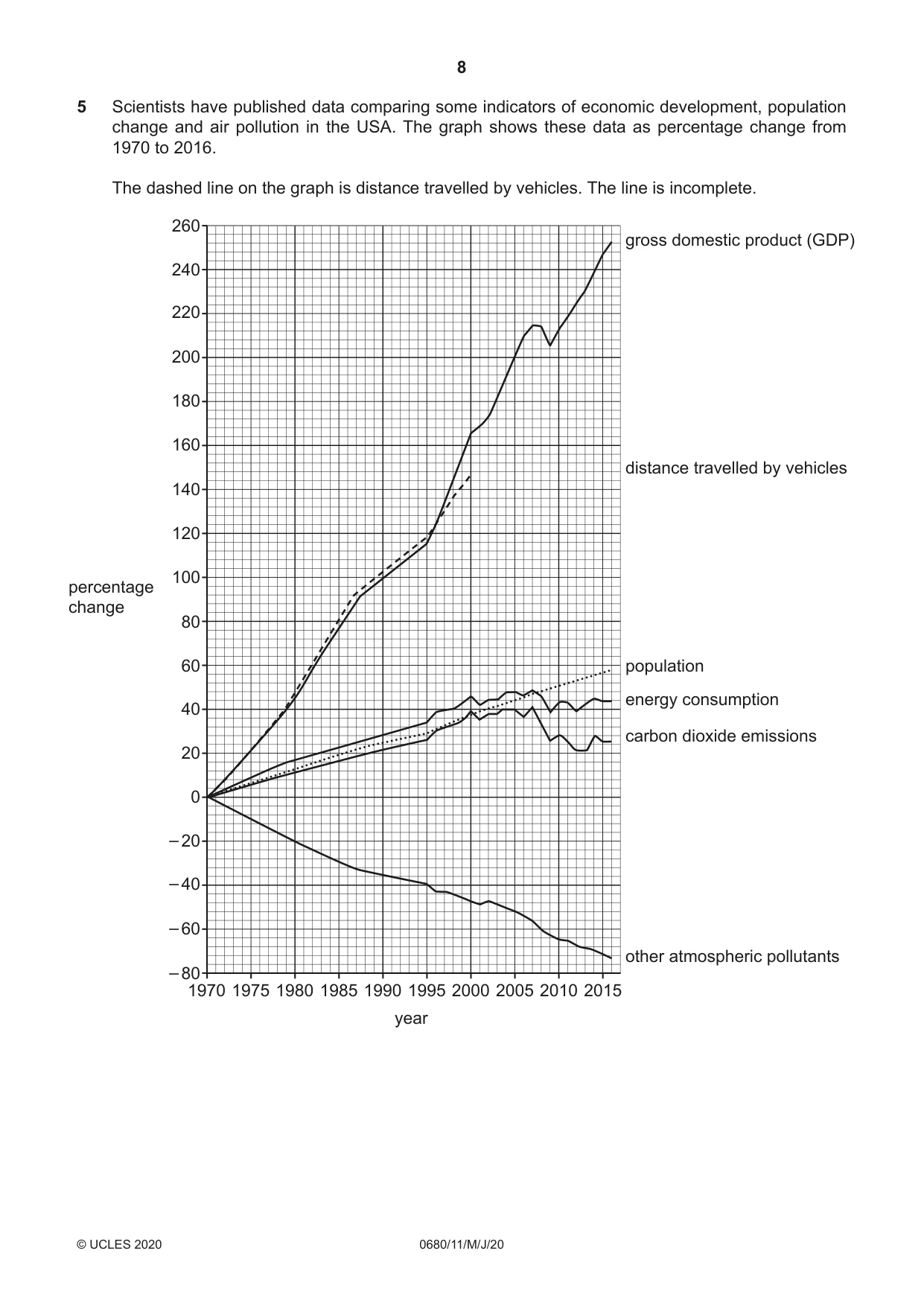
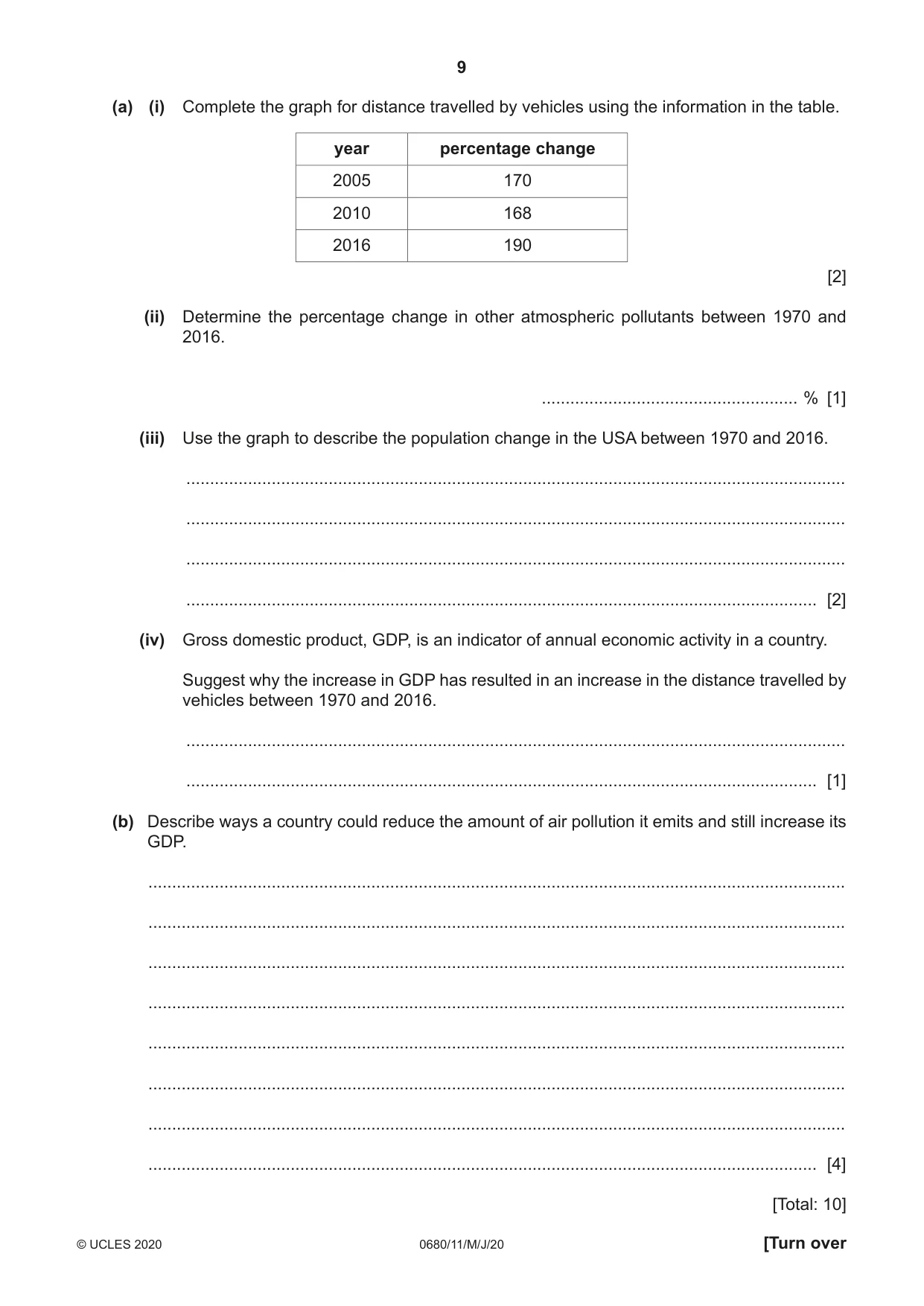
8 0680/11/M/J/20 © UCLES 2020 5 Scientists have published data comparing some indicators of economic development, population change and air pollution in the USA. The graph shows these data as percentage change from 1970 to 2016. The dashed line on the graph is distance travelled by vehicles. The line is incomplete. 20 40 60 80 100 percentage change 120 140 160 180 200 220 240 260 0 1970 1975 1980 1985 1990 1995 year 2000 2005 2010 2015 – 20 – 40 – 60 – 80 gross domestic product (GDP) population energy consumption carbon dioxide emissions other atmospheric pollutants distance travelled by vehicles
Question paper, page 9
9 0680/11/M/J/20 © UCLES 2020 [Turn over (a) (i) Complete the graph for distance travelled by vehicles using the information in the table. year percentage change 2005 170 2010 168 2016 190 [2] (ii) Determine the percentage change in other atmospheric pollutants between 1970 and 2016. … % [1] (iii) Use the graph to describe the population change in the USA between 1970 and 2016. … … … … [2] (iv) Gross domestic product, GDP, is an indicator of annual economic activity in a country. Suggest why the increase in GDP has resulted in an increase in the distance travelled by vehicles between 1970 and 2016. … … [1] (b) Describe ways a country could reduce the amount of air pollution it emits and still increase its GDP. … … … … … … … … [4] [Total: 10]
Question paper, page 10
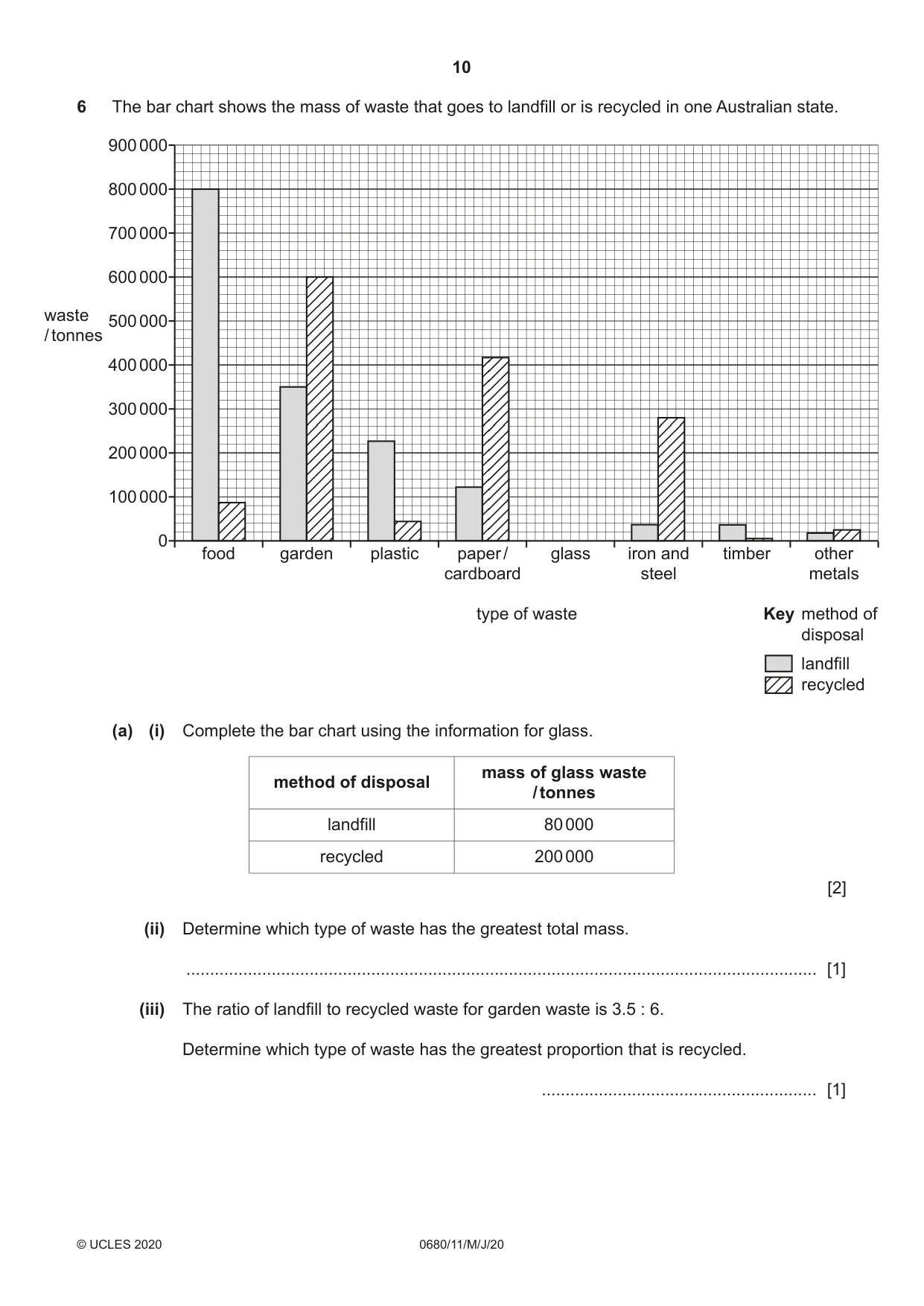
10 0680/11/M/J/20 © UCLES 2020 6 The bar chart shows the mass of waste that goes to landfill or is recycled in one Australian state. 0 100 000 200 000 300 000 400 000 500 000 600 000 waste / tonnes 700 000 800 000 900 000 food garden plastic paper / cardboard type of waste glass iron and steel timber other metals Key landfill method of disposal recycled (a) (i) Complete the bar chart using the information for glass. method of disposal mass of glass waste / tonnes landfill 80 000 recycled 200 000 [2] (ii) Determine which type of waste has the greatest total mass. … [1] (iii) The ratio of landfill to recycled waste for garden waste is 3.5 : 6. Determine which type of waste has the greatest proportion that is recycled. … [1]
Question paper, page 11
11 0680/11/M/J/20 © UCLES 2020 [Turn over (b) The government are concerned about the mass of food waste that goes to landfill. Suggest two environmental impacts of the large mass of food waste. 1 … … 2 … … [2] (c) Suggest two ways the government could generate income from recycled food waste. 1 … … 2 … … [2] (d) Describe strategies to increase recycling of waste. … … … … … … [3] [Total: 11]
Question paper, page 12
12 0680/11/M/J/20 © UCLES 2020 7 The photograph shows part of a large field. (a) (i) Circle the two words that best describe the type of agriculture shown in the photograph. arable commercial mixed pastoral subsistence [2] (ii) Explain why this field is at risk of soil erosion. … … … … [2]
Question paper, page 13
13 0680/11/M/J/20 © UCLES 2020 [Turn over (b) A farmer stated that crop rotation is a good method of ensuring sustainable agriculture. Describe other management strategies for sustainable agriculture. … … … … … … … … … … [5] [Total: 9]
Question paper, page 14
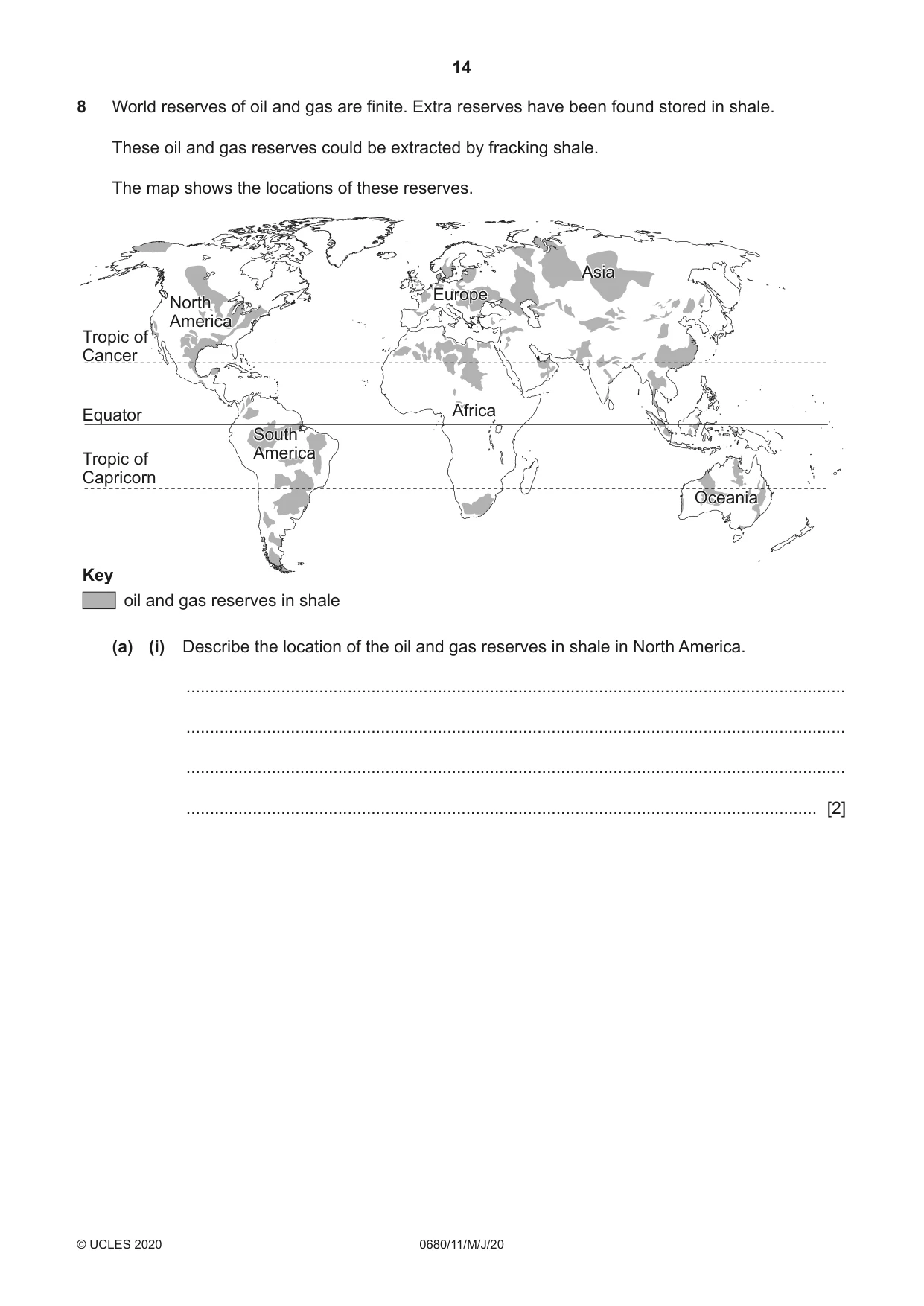
14 0680/11/M/J/20 © UCLES 2020 8 World reserves of oil and gas are finite. Extra reserves have been found stored in shale. These oil and gas reserves could be extracted by fracking shale. The map shows the locations of these reserves. Equator Tropic of Capricorn Key oil and gas reserves in shale Tropic of Cancer North America South America Africa Europe Asia Oceania North America South America Africa Europe Asia Oceania (a) (i) Describe the location of the oil and gas reserves in shale in North America. … … … … [2]
Question paper, page 15
15 0680/11/M/J/20 © UCLES 2020 [Turn over (ii) Explain how gas or oil is extracted by fracking shale. … … … … … … … … [4] (iii) Suggest reasons why some people are opposed to fracking. … … … … … … [3] PLEASE TURN OVER FOR QUESTION 8(b)
Question paper, page 16
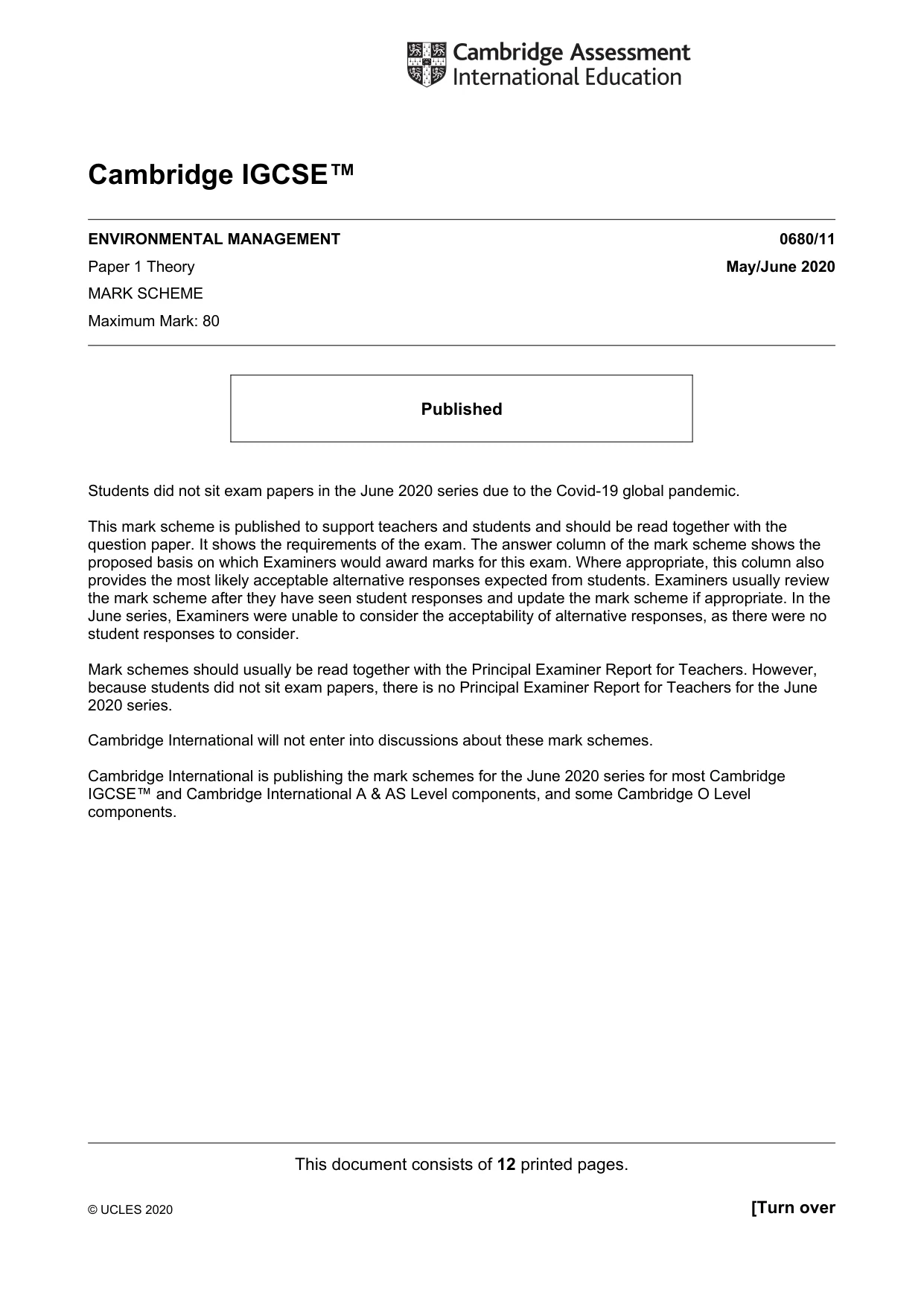
16 0680/11/M/J/20 © UCLES 2020 (b) Two students are debating the future of energy production. Student A Student B To what extent do you agree with these views about the future of energy production? Give reasons for your answer. … … … … … … … … … … … … … … … [6] [Total: 15] Modern technology will allow the world to produce all the energy it will need without using fossil fuels and other non-renewable resources. Impossible! There will always be a need for non-renewable energy resources.
Question paper, page 17
17 0680/11/M/J/20 © UCLES 2020 BLANK PAGE
Question paper, page 18
18 0680/11/M/J/20 © UCLES 2020 BLANK PAGE
Question paper, page 19
19 0680/11/M/J/20 © UCLES 2020 BLANK PAGE
Question paper, page 20
20 0680/11/M/J/20 © UCLES 2020 BLANK PAGE Permission to reproduce items where third-party owned material protected by copyright is included has been sought and cleared where possible. Every reasonable effort has been made by the publisher (UCLES) to trace copyright holders, but if any items requiring clearance have unwittingly been included, the publisher will be pleased to make amends at the earliest possible opportunity. To avoid the issue of disclosure of answer-related information to candidates, all copyright acknowledgements are reproduced online in the Cambridge Assessment International Education Copyright Acknowledgements Booklet. This is produced for each series of examinations and is freely available to download at www.cambridgeinternational.org after the live examination series. Cambridge Assessment International Education is part of the Cambridge Assessment Group. Cambridge Assessment is the brand name of the University of Cambridge Local Examinations Syndicate (UCLES), which itself is a department of the University of Cambridge.
Mark scheme, page 1
This document consists of 12 printed pages. © UCLES 2020 [Turn over Cambridge IGCSE™ ENVIRONMENTAL MANAGEMENT 0680/11 Paper 1 Theory May/June 2020 MARK SCHEME Maximum Mark: 80 Published Students did not sit exam papers in the June 2020 series due to the Covid-19 global pandemic. This mark scheme is published to support teachers and students and should be read together with the question paper. It shows the requirements of the exam. The answer column of the mark scheme shows the proposed basis on which Examiners would award marks for this exam. Where appropriate, this column also provides the most likely acceptable alternative responses expected from students. Examiners usually review the mark scheme after they have seen student responses and update the mark scheme if appropriate. In the June series, Examiners were unable to consider the acceptability of alternative responses, as there were no student responses to consider. Mark schemes should usually be read together with the Principal Examiner Report for Teachers. However, because students did not sit exam papers, there is no Principal Examiner Report for Teachers for the June 2020 series. Cambridge International will not enter into discussions about these mark schemes. Cambridge International is publishing the mark schemes for the June 2020 series for most Cambridge IGCSE™ and Cambridge International A & AS Level components, and some Cambridge O Level components.
Mark scheme, page 2
0680/11 Cambridge IGCSE – Mark Scheme PUBLISHED May/June 2020 © UCLES 2020 Page 2 of 12 Generic Marking Principles These general marking principles must be applied by all examiners when marking candidate answers. They should be applied alongside the specific content of the mark scheme or generic level descriptors for a question. Each question paper and mark scheme will also comply with these marking principles. GENERIC MARKING PRINCIPLE 1: Marks must be awarded in line with: • the specific content of the mark scheme or the generic level descriptors for the question • the specific skills defined in the mark scheme or in the generic level descriptors for the question • the standard of response required by a candidate as exemplified by the standardisation scripts. GENERIC MARKING PRINCIPLE 2: Marks awarded are always whole marks (not half marks, or other fractions). GENERIC MARKING PRINCIPLE 3: Marks must be awarded positively: • marks are awarded for correct/valid answers, as defined in the mark scheme. However, credit is given for valid answers which go beyond the scope of the syllabus and mark scheme, referring to your Team Leader as appropriate • marks are awarded when candidates clearly demonstrate what they know and can do • marks are not deducted for errors • marks are not deducted for omissions • answers should only be judged on the quality of spelling, punctuation and grammar when these features are specifically assessed by the question as indicated by the mark scheme. The meaning, however, should be unambiguous. GENERIC MARKING PRINCIPLE 4: Rules must be applied consistently e.g. in situations where candidates have not followed instructions or in the application of generic level descriptors.
Mark scheme, page 3
0680/11 Cambridge IGCSE – Mark Scheme PUBLISHED May/June 2020 © UCLES 2020 Page 3 of 12 GENERIC MARKING PRINCIPLE 5: Marks should be awarded using the full range of marks defined in the mark scheme for the question (however; the use of the full mark range may be limited according to the quality of the candidate responses seen). GENERIC MARKING PRINCIPLE 6: Marks awarded are based solely on the requirements as defined in the mark scheme. Marks should not be awarded with grade thresholds or grade descriptors in mind. Science-Specific Marking Principles 1 Examiners should consider the context and scientific use of any keywords when awarding marks. Although keywords may be present, marks should not be awarded if the keywords are used incorrectly. 2 The examiner should not choose between contradictory statements given in the same question part, and credit should not be awarded for any correct statement that is contradicted within the same question part. Wrong science that is irrelevant to the question should be ignored. 3 Although spellings do not have to be correct, spellings of syllabus terms must allow for clear and unambiguous separation from other syllabus terms with which they may be confused (e.g. ethane / ethene, glucagon / glycogen, refraction / reflection). 4 The error carried forward (ecf) principle should be applied, where appropriate. If an incorrect answer is subsequently used in a scientifically correct way, the candidate should be awarded these subsequent marking points. Further guidance will be included in the mark scheme where necessary and any exceptions to this general principle will be noted.
Mark scheme, page 4
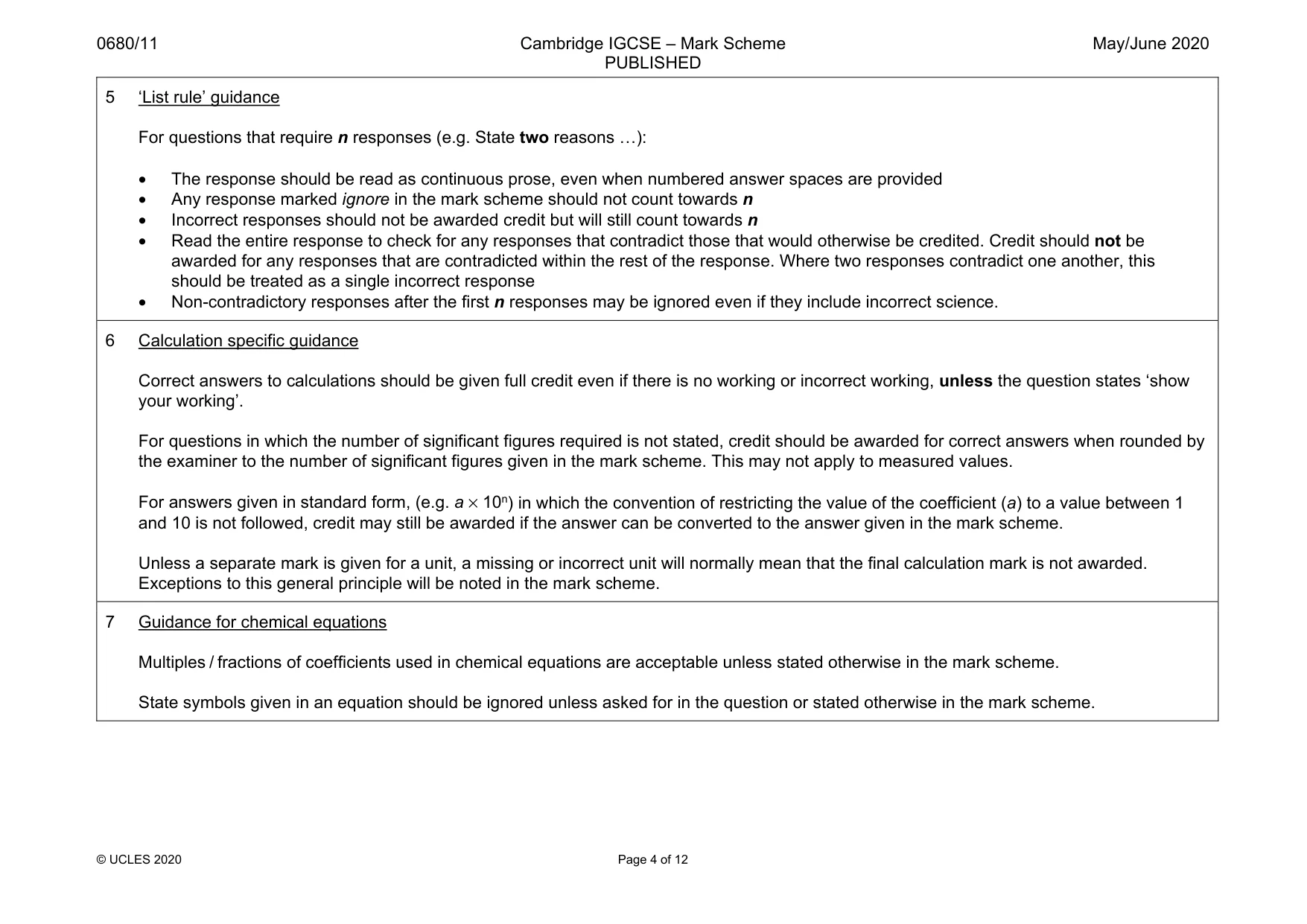
0680/11 Cambridge IGCSE – Mark Scheme PUBLISHED May/June 2020 © UCLES 2020 Page 4 of 12 5 ‘List rule’ guidance For questions that require n responses (e.g. State two reasons …): • The response should be read as continuous prose, even when numbered answer spaces are provided • Any response marked ignore in the mark scheme should not count towards n • Incorrect responses should not be awarded credit but will still count towards n • Read the entire response to check for any responses that contradict those that would otherwise be credited. Credit should not be awarded for any responses that are contradicted within the rest of the response. Where two responses contradict one another, this should be treated as a single incorrect response • Non-contradictory responses after the first n responses may be ignored even if they include incorrect science. 6 Calculation specific guidance Correct answers to calculations should be given full credit even if there is no working or incorrect working, unless the question states ‘show your working’. For questions in which the number of significant figures required is not stated, credit should be awarded for correct answers when rounded by the examiner to the number of significant figures given in the mark scheme. This may not apply to measured values. For answers given in standard form, (e.g. a × 10n) in which the convention of restricting the value of the coefficient (a) to a value between 1 and 10 is not followed, credit may still be awarded if the answer can be converted to the answer given in the mark scheme. Unless a separate mark is given for a unit, a missing or incorrect unit will normally mean that the final calculation mark is not awarded. Exceptions to this general principle will be noted in the mark scheme. 7 Guidance for chemical equations Multiples / fractions of coefficients used in chemical equations are acceptable unless stated otherwise in the mark scheme. State symbols given in an equation should be ignored unless asked for in the question or stated otherwise in the mark scheme.
Mark scheme, page 5
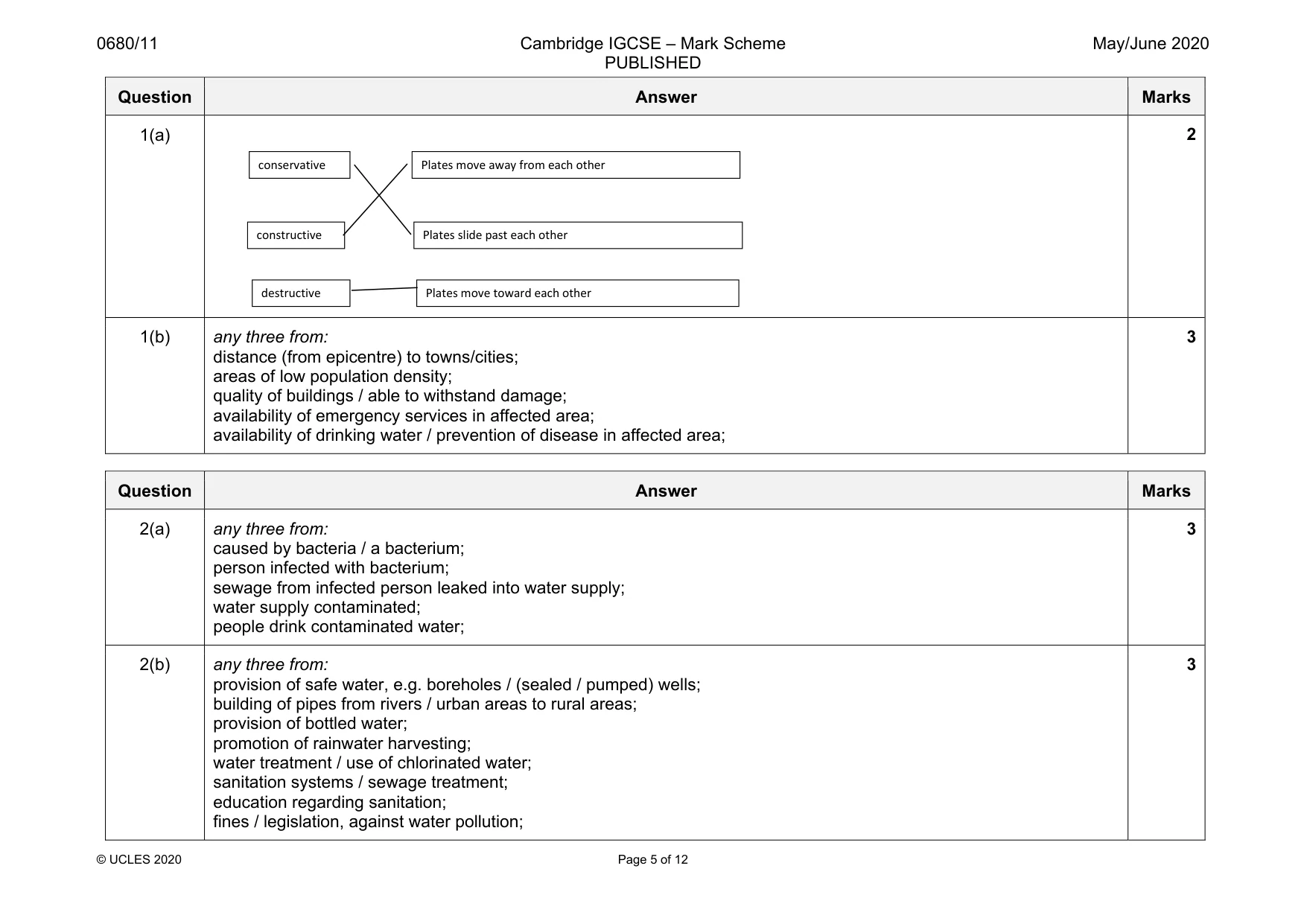
0680/11 Cambridge IGCSE – Mark Scheme PUBLISHED May/June 2020 © UCLES 2020 Page 5 of 12 Question Answer Marks 1(a) 2 1(b) any three from: distance (from epicentre) to towns/cities; areas of low population density; quality of buildings / able to withstand damage; availability of emergency services in affected area; availability of drinking water / prevention of disease in affected area; 3 Question Answer Marks 2(a) any three from: caused by bacteria / a bacterium; person infected with bacterium; sewage from infected person leaked into water supply; water supply contaminated; people drink contaminated water; 3 2(b) any three from: provision of safe water, e.g. boreholes / (sealed / pumped) wells; building of pipes from rivers / urban areas to rural areas; provision of bottled water; promotion of rainwater harvesting; water treatment / use of chlorinated water; sanitation systems / sewage treatment; education regarding sanitation; fines / legislation, against water pollution; 3 conservative constructive destructive Plates move away from each other Plates slide past each other Plates move toward each other
Mark scheme, page 6
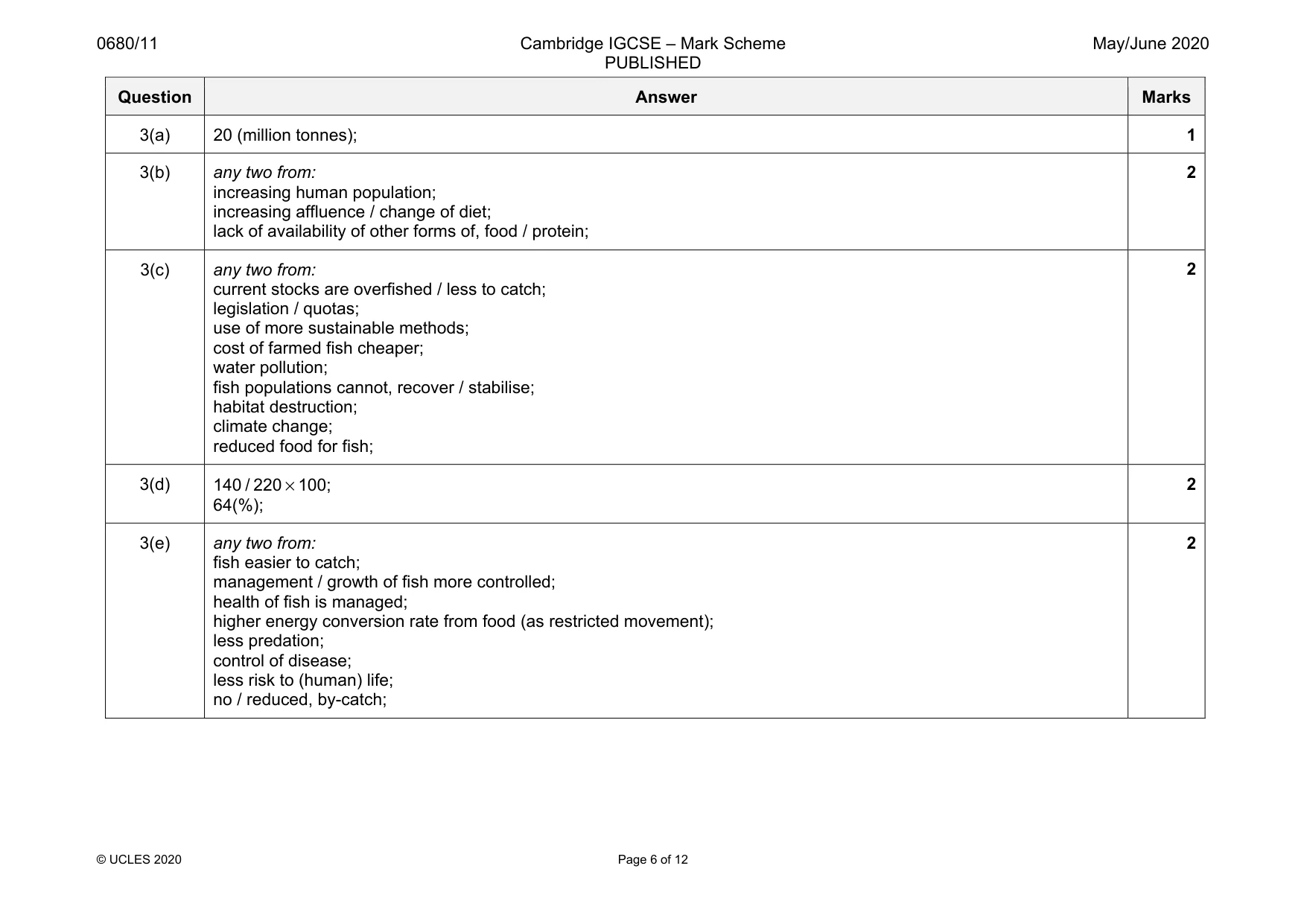
0680/11 Cambridge IGCSE – Mark Scheme PUBLISHED May/June 2020 © UCLES 2020 Page 6 of 12 Question Answer Marks 3(a) 20 (million tonnes); 1 3(b) any two from: increasing human population; increasing affluence / change of diet; lack of availability of other forms of, food / protein; 2 3(c) any two from: current stocks are overfished / less to catch; legislation / quotas; use of more sustainable methods; cost of farmed fish cheaper; water pollution; fish populations cannot, recover / stabilise; habitat destruction; climate change; reduced food for fish; 2 3(d) 140 / 220 × 100; 64(%); 2 3(e) any two from: fish easier to catch; management / growth of fish more controlled; health of fish is managed; higher energy conversion rate from food (as restricted movement); less predation; control of disease; less risk to (human) life; no / reduced, by-catch; 2
Mark scheme, page 7
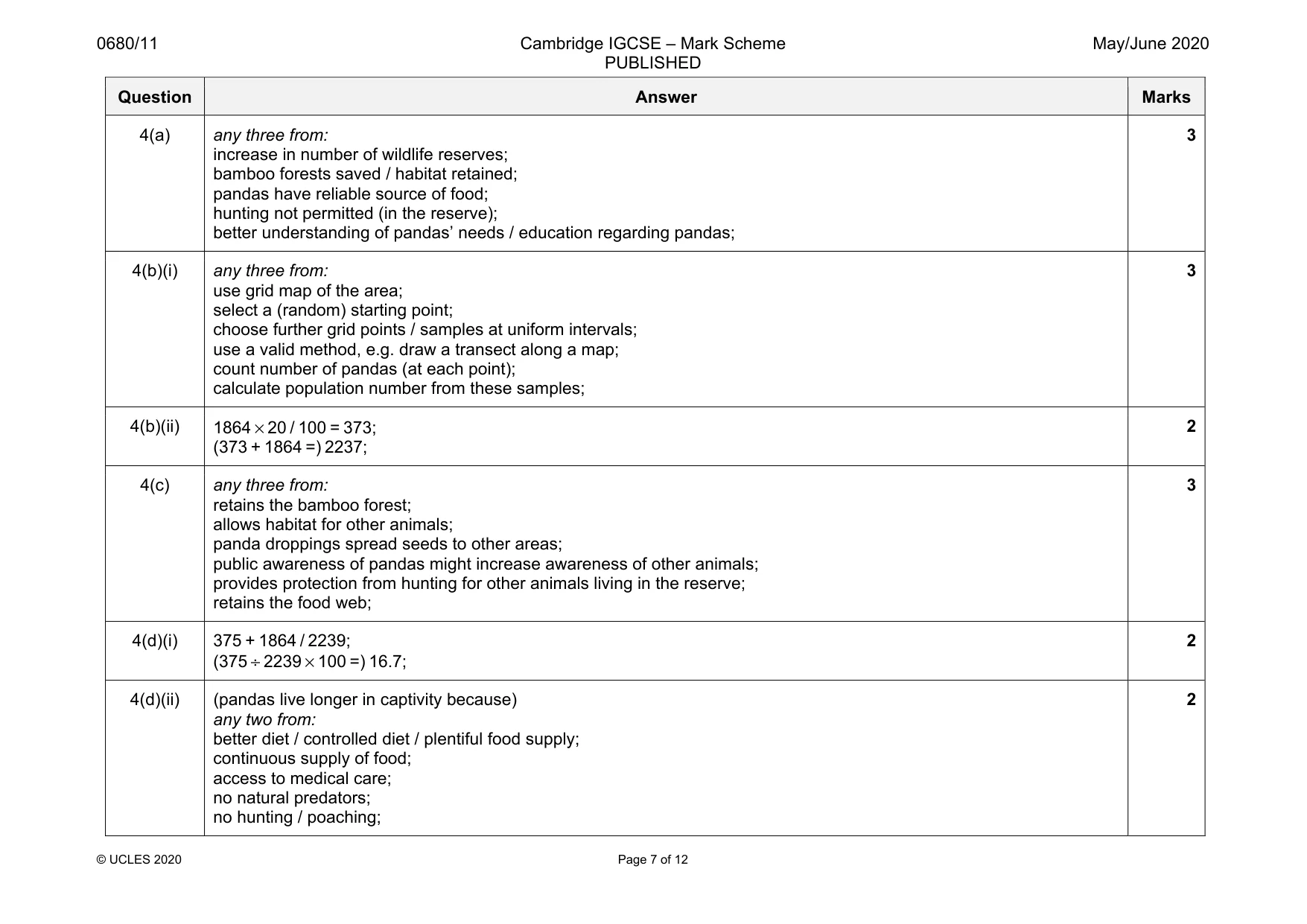
0680/11 Cambridge IGCSE – Mark Scheme PUBLISHED May/June 2020 © UCLES 2020 Page 7 of 12 Question Answer Marks 4(a) any three from: increase in number of wildlife reserves; bamboo forests saved / habitat retained; pandas have reliable source of food; hunting not permitted (in the reserve); better understanding of pandas’ needs / education regarding pandas; 3 4(b)(i) any three from: use grid map of the area; select a (random) starting point; choose further grid points / samples at uniform intervals; use a valid method, e.g. draw a transect along a map; count number of pandas (at each point); calculate population number from these samples; 3 4(b)(ii) 1864 × 20 / 100 = 373; (373 + 1864 =) 2237; 2 4(c) any three from: retains the bamboo forest; allows habitat for other animals; panda droppings spread seeds to other areas; public awareness of pandas might increase awareness of other animals; provides protection from hunting for other animals living in the reserve; retains the food web; 3 4(d)(i) 375 + 1864 / 2239; (375 ÷ 2239 × 100 =) 16.7; 2 4(d)(ii) (pandas live longer in captivity because) any two from: better diet / controlled diet / plentiful food supply; continuous supply of food; access to medical care; no natural predators; no hunting / poaching; 2
Mark scheme, page 8
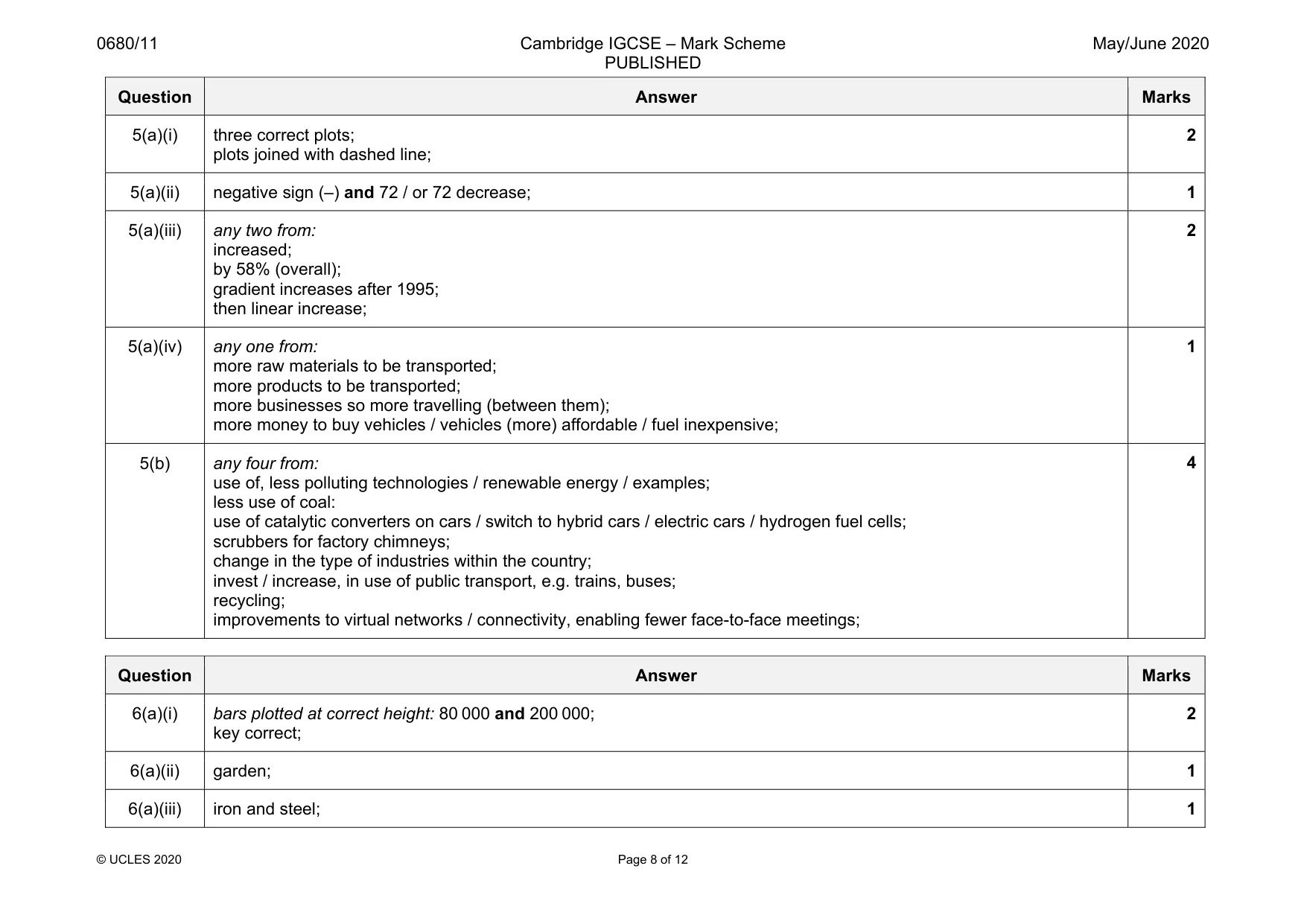
0680/11 Cambridge IGCSE – Mark Scheme PUBLISHED May/June 2020 © UCLES 2020 Page 8 of 12 Question Answer Marks 5(a)(i) three correct plots; plots joined with dashed line; 2 5(a)(ii) negative sign (–) and 72 / or 72 decrease; 1 5(a)(iii) any two from: increased; by 58% (overall); gradient increases after 1995; then linear increase; 2 5(a)(iv) any one from: more raw materials to be transported; more products to be transported; more businesses so more travelling (between them); more money to buy vehicles / vehicles (more) affordable / fuel inexpensive; 1 5(b) any four from: use of, less polluting technologies / renewable energy / examples; less use of coal: use of catalytic converters on cars / switch to hybrid cars / electric cars / hydrogen fuel cells; scrubbers for factory chimneys; change in the type of industries within the country; invest / increase, in use of public transport, e.g. trains, buses; recycling; improvements to virtual networks / connectivity, enabling fewer face-to-face meetings; 4 Question Answer Marks 6(a)(i) bars plotted at correct height: 80 000 and 200 000; key correct; 2 6(a)(ii) garden; 1 6(a)(iii) iron and steel; 1
Mark scheme, page 9
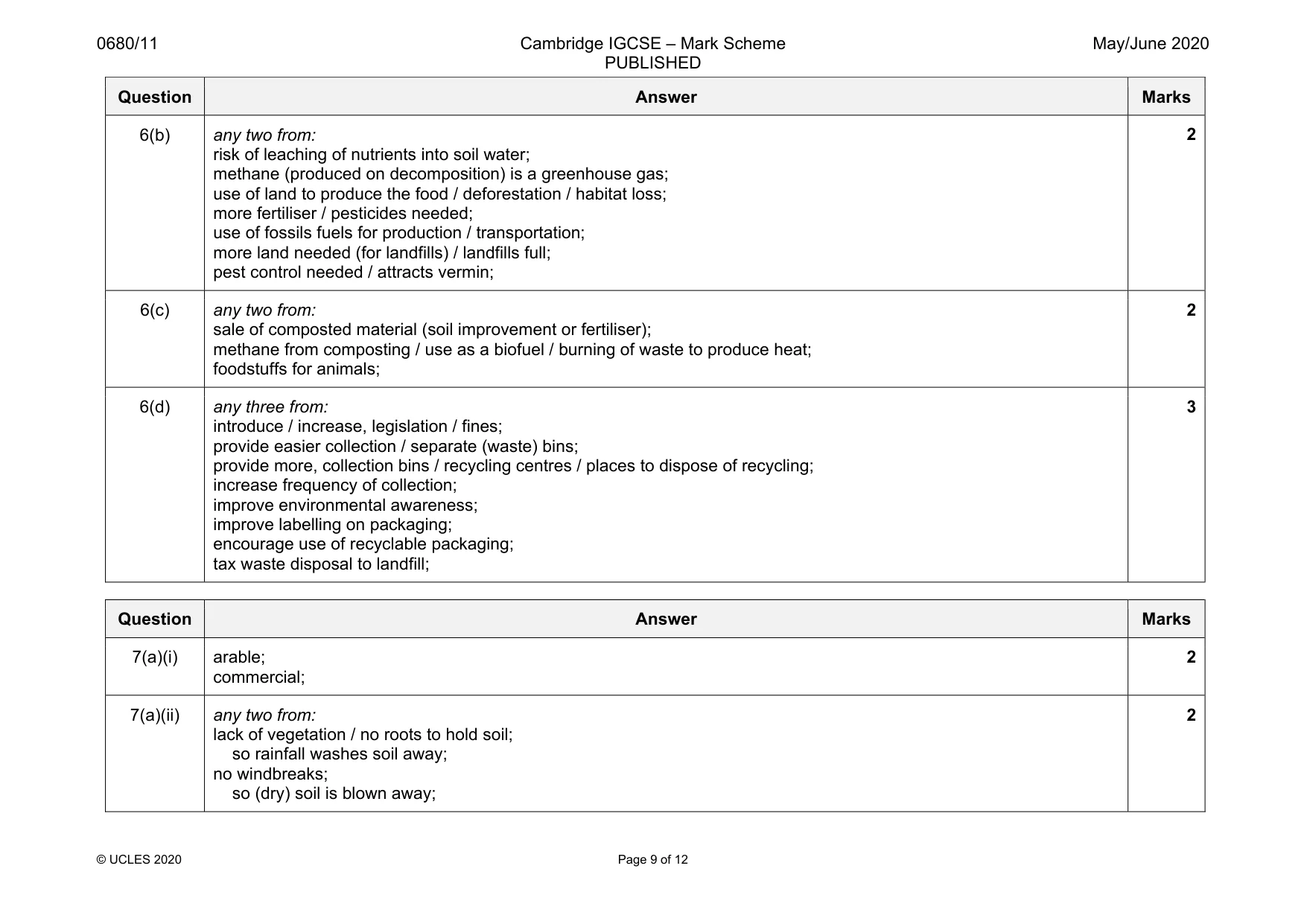
0680/11 Cambridge IGCSE – Mark Scheme PUBLISHED May/June 2020 © UCLES 2020 Page 9 of 12 Question Answer Marks 6(b) any two from: risk of leaching of nutrients into soil water; methane (produced on decomposition) is a greenhouse gas; use of land to produce the food / deforestation / habitat loss; more fertiliser / pesticides needed; use of fossils fuels for production / transportation; more land needed (for landfills) / landfills full; pest control needed / attracts vermin; 2 6(c) any two from: sale of composted material (soil improvement or fertiliser); methane from composting / use as a biofuel / burning of waste to produce heat; foodstuffs for animals; 2 6(d) any three from: introduce / increase, legislation / fines; provide easier collection / separate (waste) bins; provide more, collection bins / recycling centres / places to dispose of recycling; increase frequency of collection; improve environmental awareness; improve labelling on packaging; encourage use of recyclable packaging; tax waste disposal to landfill; 3 Question Answer Marks 7(a)(i) arable; commercial; 2 7(a)(ii) any two from: lack of vegetation / no roots to hold soil; so rainfall washes soil away; no windbreaks; so (dry) soil is blown away; 2
Mark scheme, page 10
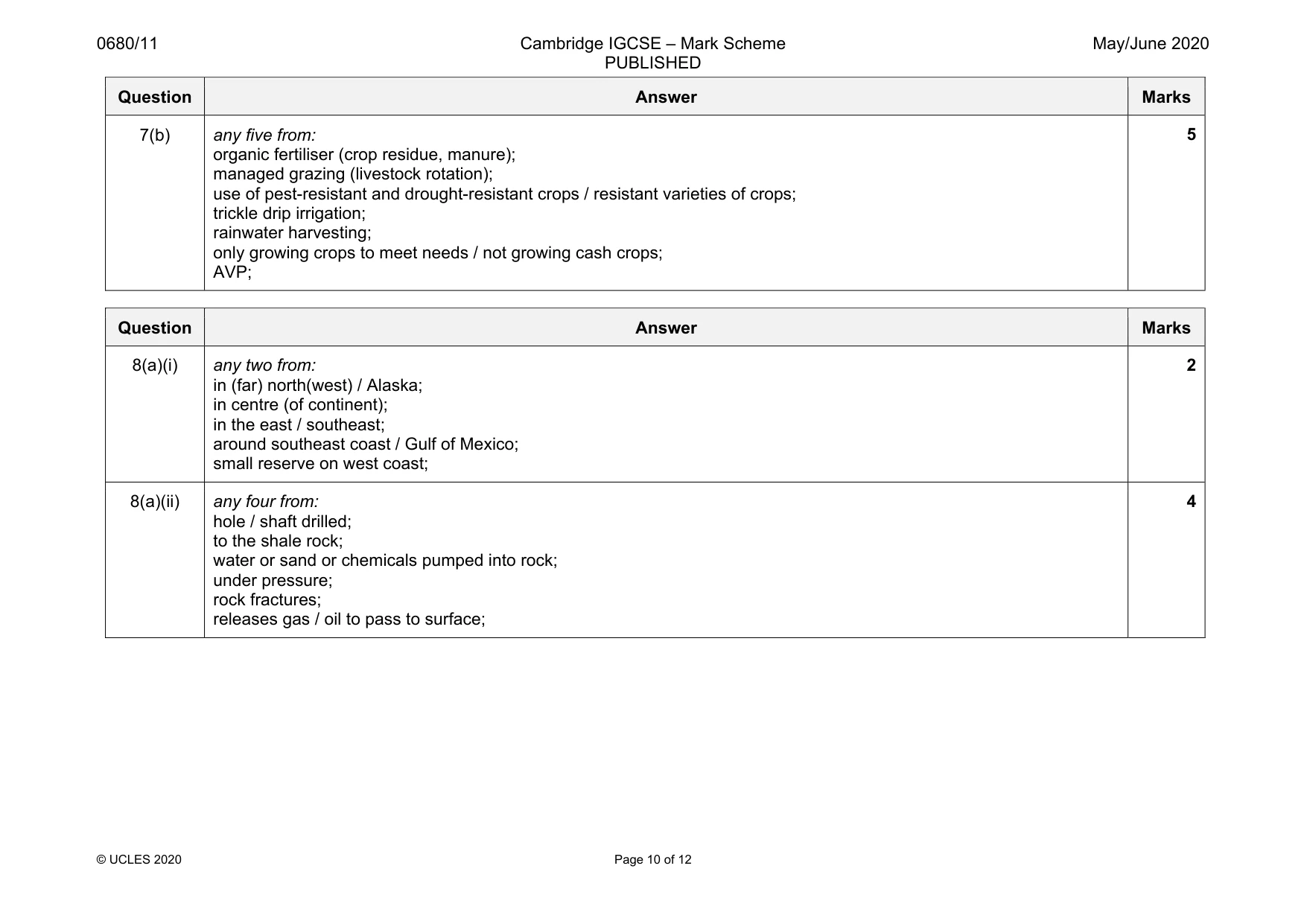
0680/11 Cambridge IGCSE – Mark Scheme PUBLISHED May/June 2020 © UCLES 2020 Page 10 of 12 Question Answer Marks 7(b) any five from: organic fertiliser (crop residue, manure); managed grazing (livestock rotation); use of pest-resistant and drought-resistant crops / resistant varieties of crops; trickle drip irrigation; rainwater harvesting; only growing crops to meet needs / not growing cash crops; AVP; 5 Question Answer Marks 8(a)(i) any two from: in (far) north(west) / Alaska; in centre (of continent); in the east / southeast; around southeast coast / Gulf of Mexico; small reserve on west coast; 2 8(a)(ii) any four from: hole / shaft drilled; to the shale rock; water or sand or chemicals pumped into rock; under pressure; rock fractures; releases gas / oil to pass to surface; 4
Mark scheme, page 11
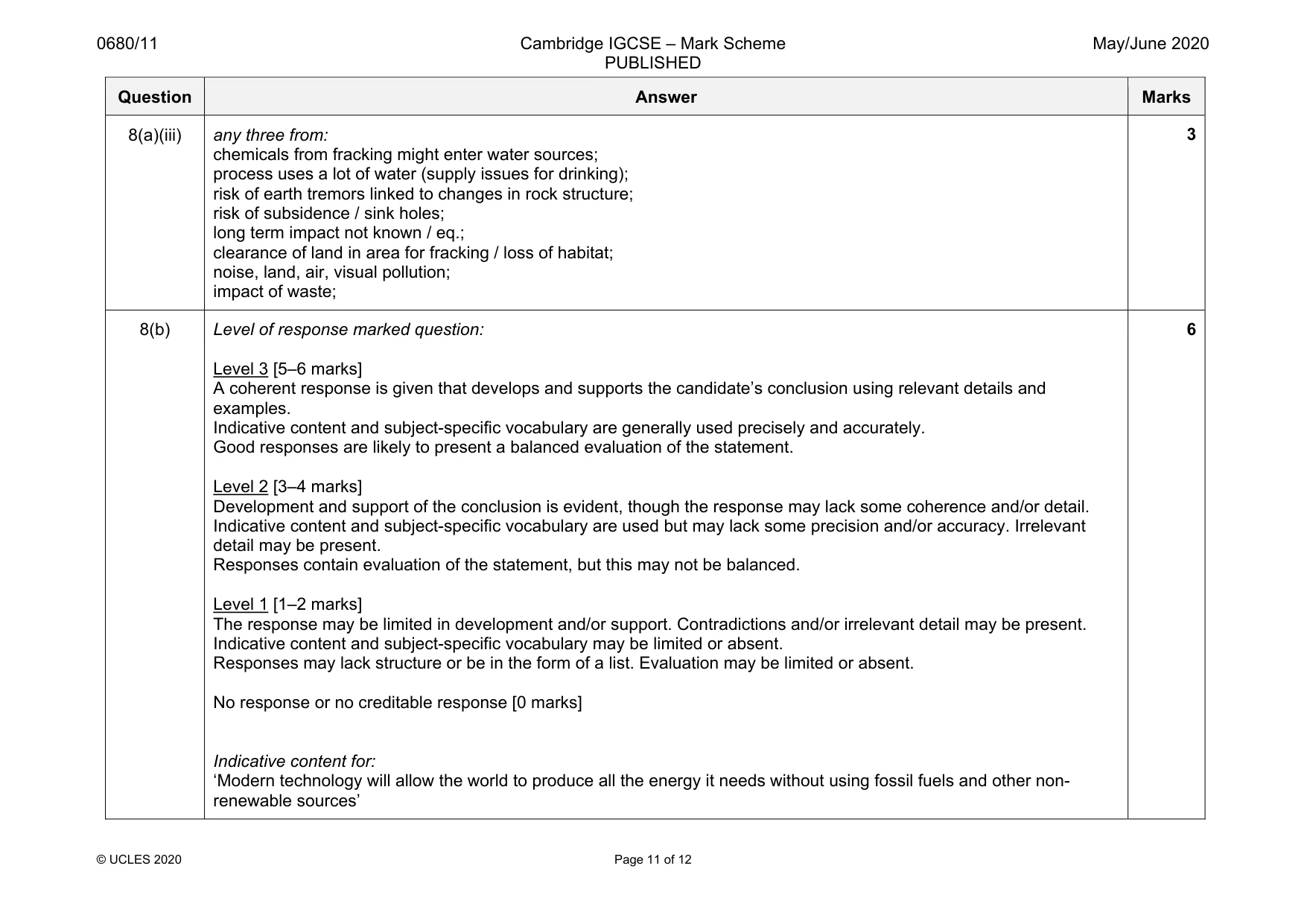
0680/11 Cambridge IGCSE – Mark Scheme PUBLISHED May/June 2020 © UCLES 2020 Page 11 of 12 Question Answer Marks 8(a)(iii) any three from: chemicals from fracking might enter water sources; process uses a lot of water (supply issues for drinking); risk of earth tremors linked to changes in rock structure; risk of subsidence / sink holes; long term impact not known / eq.; clearance of land in area for fracking / loss of habitat; noise, land, air, visual pollution; impact of waste; 3 8(b) Level of response marked question: Level 3 [5–6 marks] A coherent response is given that develops and supports the candidate’s conclusion using relevant details and examples. Indicative content and subject-specific vocabulary are generally used precisely and accurately. Good responses are likely to present a balanced evaluation of the statement. Level 2 [3–4 marks] Development and support of the conclusion is evident, though the response may lack some coherence and/or detail. Indicative content and subject-specific vocabulary are used but may lack some precision and/or accuracy. Irrelevant detail may be present. Responses contain evaluation of the statement, but this may not be balanced. Level 1 [1–2 marks] The response may be limited in development and/or support. Contradictions and/or irrelevant detail may be present. Indicative content and subject-specific vocabulary may be limited or absent. Responses may lack structure or be in the form of a list. Evaluation may be limited or absent. No response or no creditable response [0 marks] Indicative content for: ‘Modern technology will allow the world to produce all the energy it needs without using fossil fuels and other non- renewable sources’ 6
Mark scheme, page 12
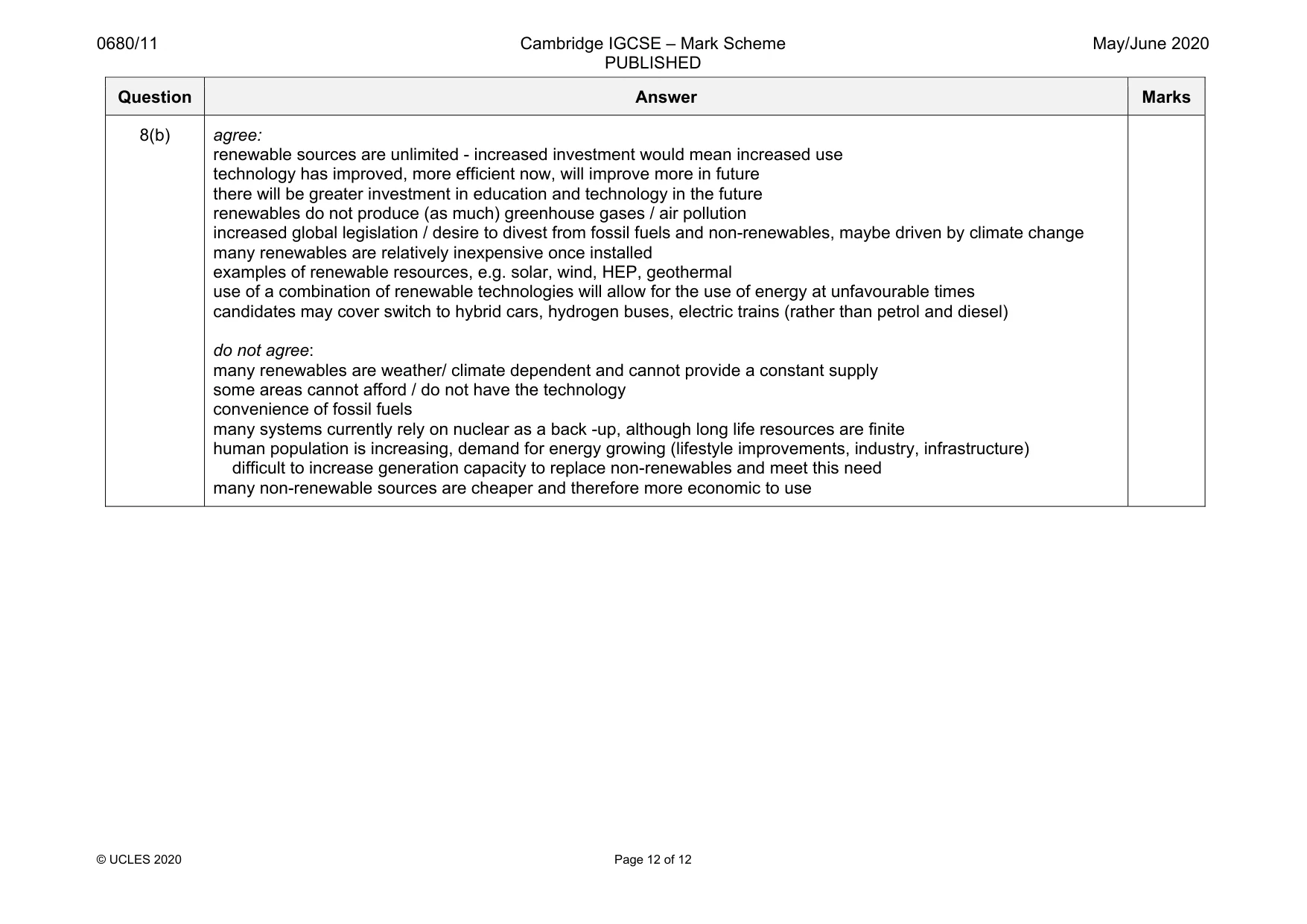
0680/11 Cambridge IGCSE – Mark Scheme PUBLISHED May/June 2020 © UCLES 2020 Page 12 of 12 Question Answer Marks 8(b) agree: renewable sources are unlimited - increased investment would mean increased use technology has improved, more efficient now, will improve more in future there will be greater investment in education and technology in the future renewables do not produce (as much) greenhouse gases / air pollution increased global legislation / desire to divest from fossil fuels and non-renewables, maybe driven by climate change many renewables are relatively inexpensive once installed examples of renewable resources, e.g. solar, wind, HEP, geothermal use of a combination of renewable technologies will allow for the use of energy at unfavourable times candidates may cover switch to hybrid cars, hydrogen buses, electric trains (rather than petrol and diesel) do not agree: many renewables are weather/ climate dependent and cannot provide a constant supply some areas cannot afford / do not have the technology convenience of fossil fuels many systems currently rely on nuclear as a back -up, although long life resources are finite human population is increasing, demand for energy growing (lifestyle improvements, industry, infrastructure) difficult to increase generation capacity to replace non-renewables and meet this need many non-renewable sources are cheaper and therefore more economic to use