Cambridge IGCSE Environmental Management 0680 — 2017 May/June Paper 1 · Variant 2
0680/12/M/J/17 · 60 marks · ≈68 min
The question paper and its mark scheme, free to read here and free to download. This is Cambridge’s own paper, exactly as it was sat.
Question paper16 pages



Mark scheme9 pages
Answers below. Sit the paper first if you are practising.
Paper as text
Question paper, page 1
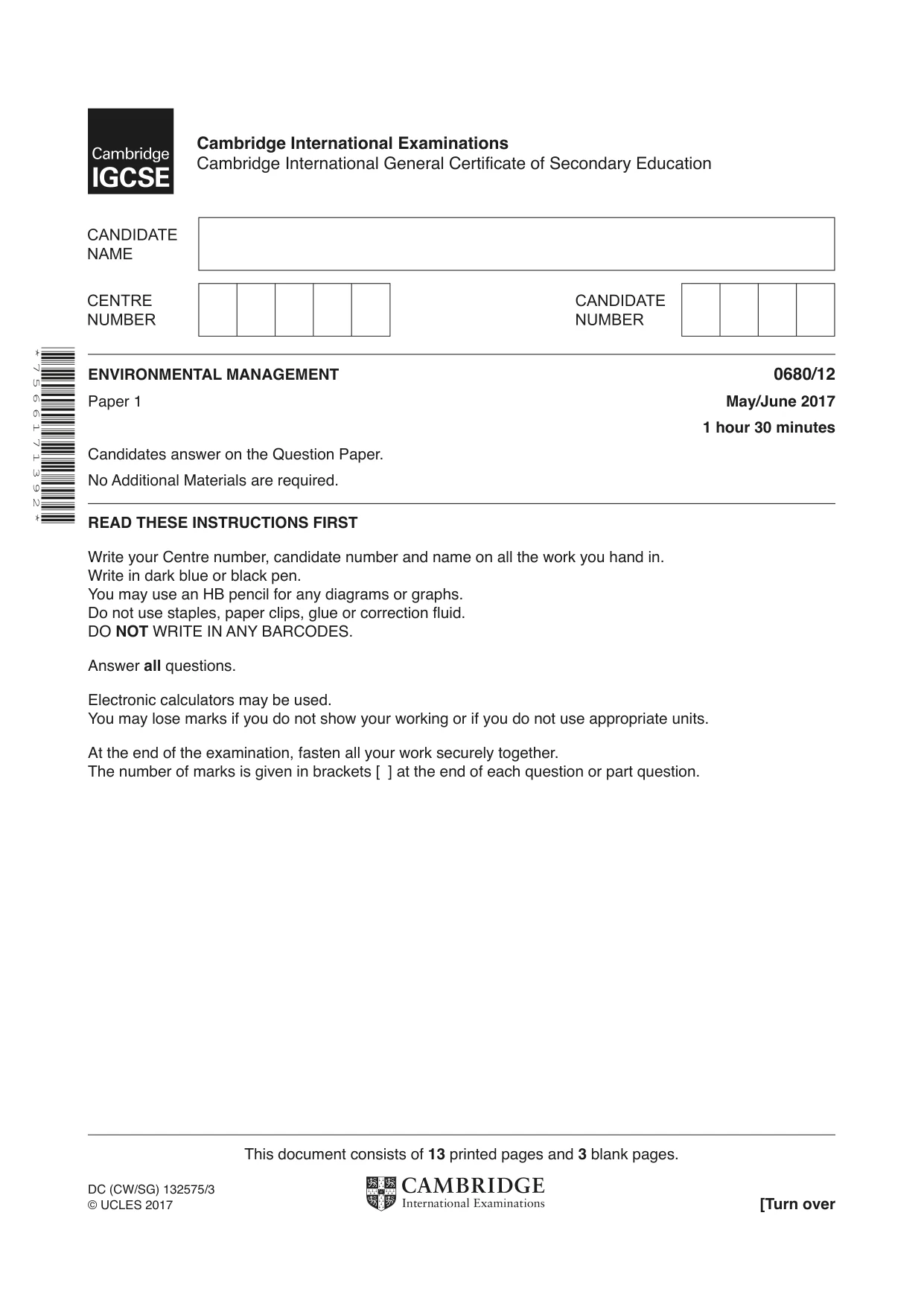
* 7 5 6 6 1 7 1 3 9 2 * This document consists of 13 printed pages and 3 blank pages. DC (CW/SG) 132575/3 © UCLES 2017 [Turn over Cambridge International Examinations Cambridge International General Certificate of Secondary Education ENVIRONMENTAL MANAGEMENT 0680/12 Paper 1 May/June 2017 1 hour 30 minutes Candidates answer on the Question Paper. No Additional Materials are required. READ THESE INSTRUCTIONS FIRST Write your Centre number, candidate number and name on all the work you hand in. Write in dark blue or black pen. You may use an HB pencil for any diagrams or graphs. Do not use staples, paper clips, glue or correction fluid. DO NOT WRITE IN ANY BARCODES. Answer all questions. Electronic calculators may be used. You may lose marks if you do not show your working or if you do not use appropriate units. At the end of the examination, fasten all your work securely together. The number of marks is given in brackets [ ] at the end of each question or part question.
Question paper, page 2
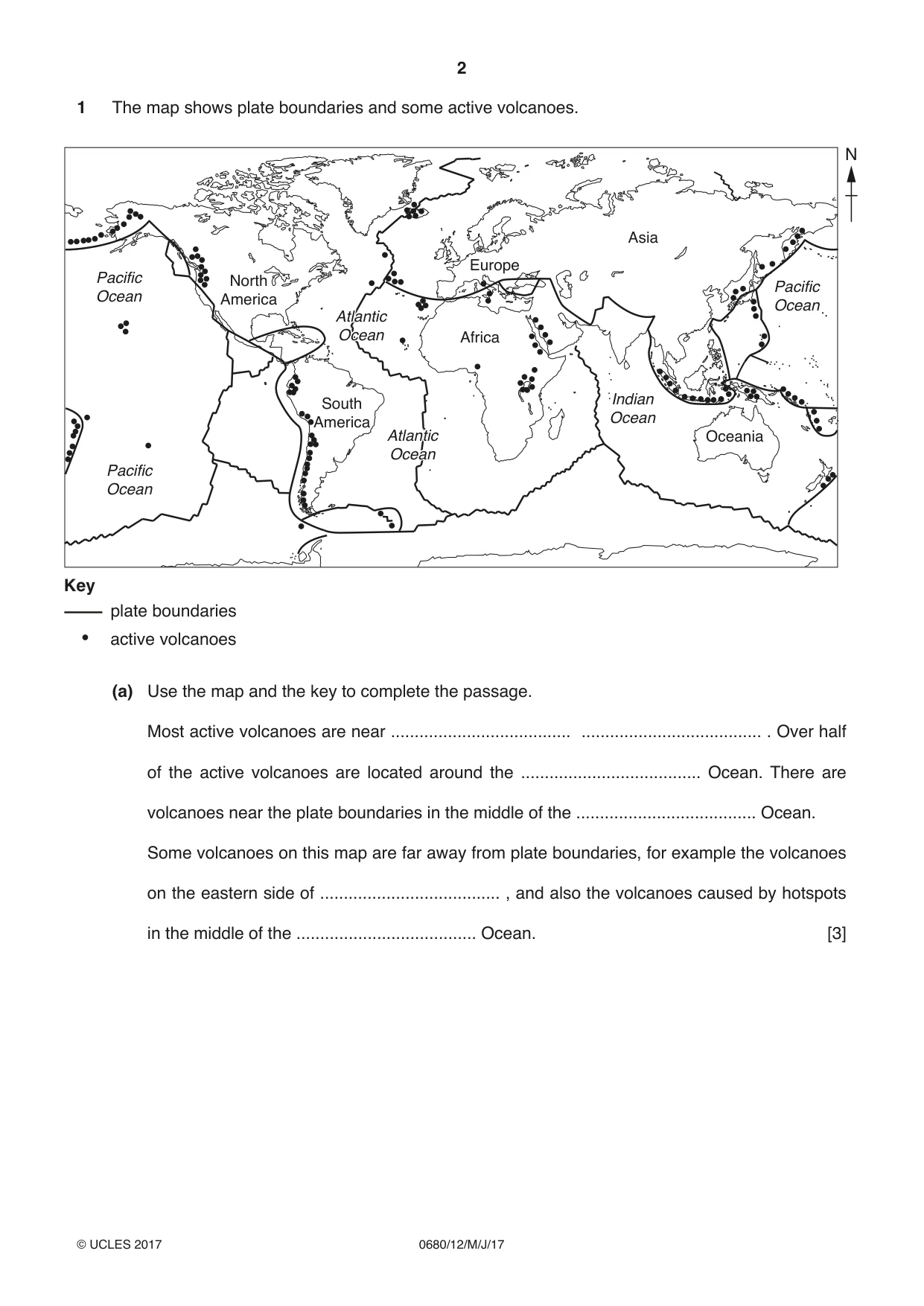
2 0680/12/M/J/17 © UCLES 2017 1 The map shows plate boundaries and some active volcanoes. plate boundaries Key active volcanoes N Pacific Ocean Pacific Ocean Atlantic Ocean Atlantic Ocean Pacific Ocean Indian Ocean Atlantic Ocean Atlantic Ocean North America South America Africa Europe Asia Oceania (a) Use the map and the key to complete the passage. Most active volcanoes are near … … . Over half of the active volcanoes are located around the … Ocean. There are volcanoes near the plate boundaries in the middle of the … Ocean. Some volcanoes on this map are far away from plate boundaries, for example the volcanoes on the eastern side of … , and also the volcanoes caused by hotspots in the middle of the … Ocean. [3]
Question paper, page 3
3 0680/12/M/J/17 © UCLES 2017 [Turn over (b) Describe how volcanoes are formed at destructive plate boundaries. … … … … … … … …[4] (c) Suggest three strategies that can be used to manage the impact of a volcanic eruption. … … … … … …[3]
Question paper, page 4
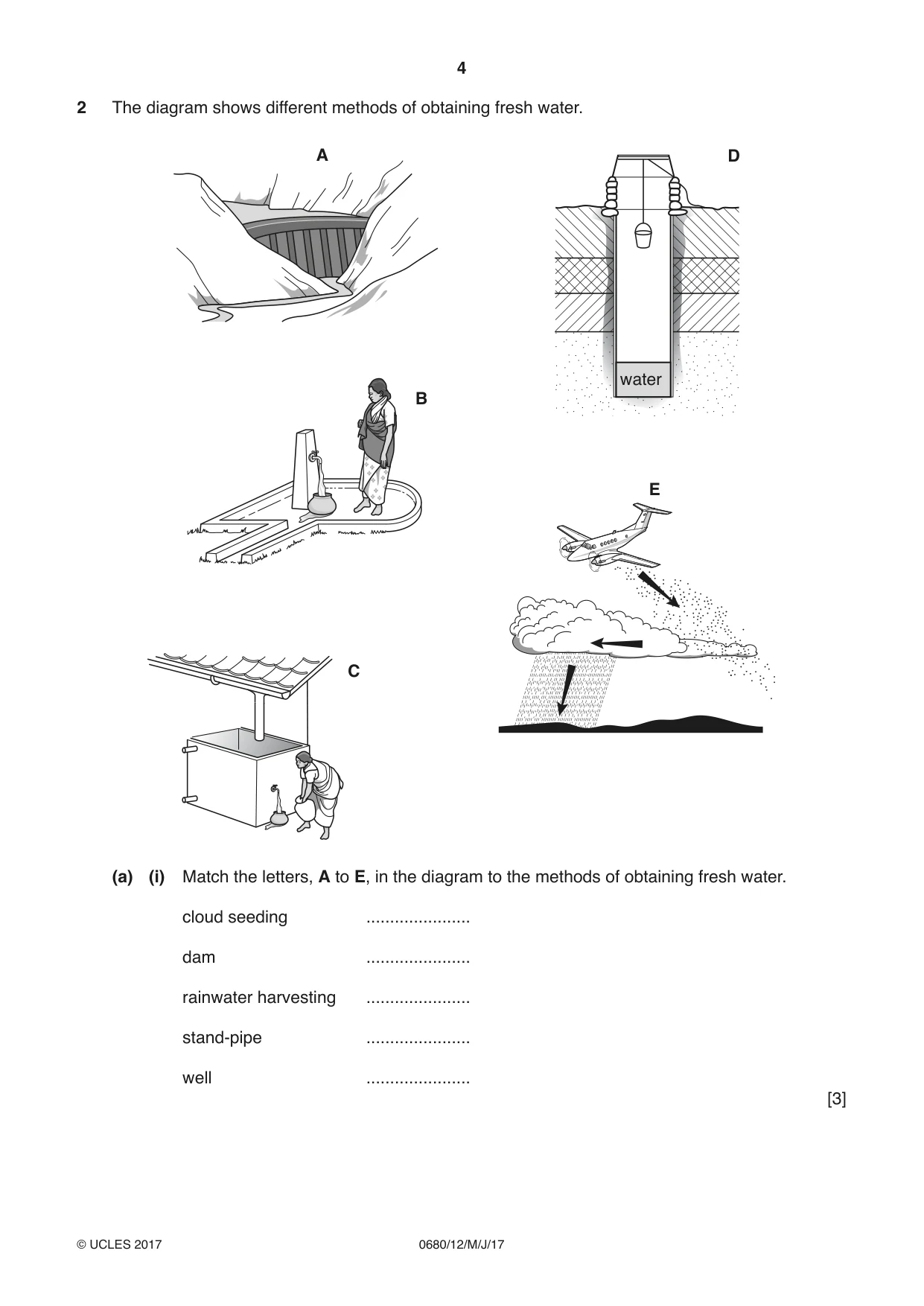
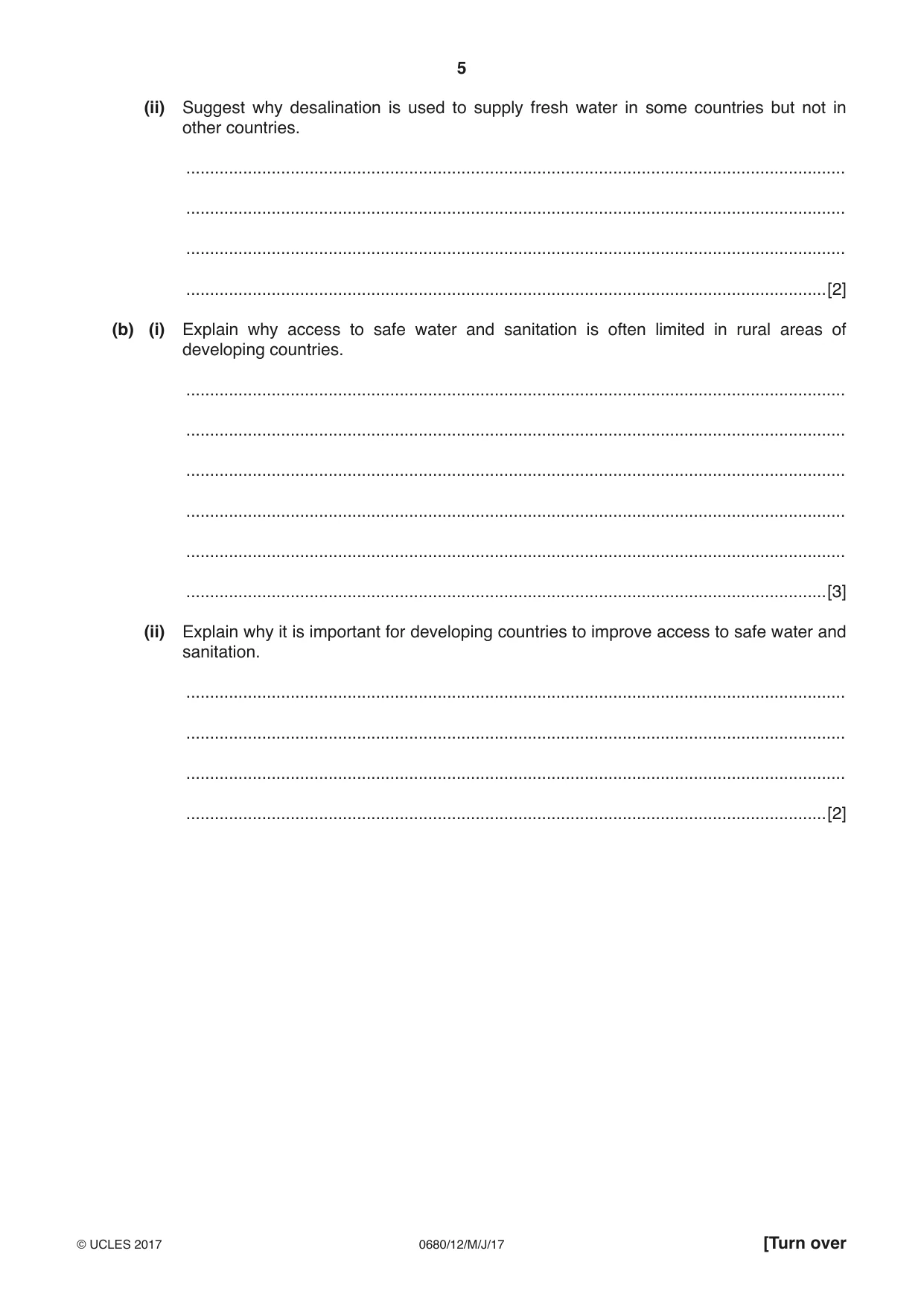
4 0680/12/M/J/17 © UCLES 2017 2 The diagram shows different methods of obtaining fresh water. D E A B water C (a) (i) Match the letters, A to E, in the diagram to the methods of obtaining fresh water. cloud seeding … dam … rainwater harvesting … stand-pipe … well … [3]
Question paper, page 5
5 0680/12/M/J/17 © UCLES 2017 [Turn over (ii) Suggest why desalination is used to supply fresh water in some countries but not in other countries. … … … …[2] (b) (i) Explain why access to safe water and sanitation is often limited in rural areas of developing countries. … … … … … …[3] (ii) Explain why it is important for developing countries to improve access to safe water and sanitation. … … … …[2]
Question paper, page 6
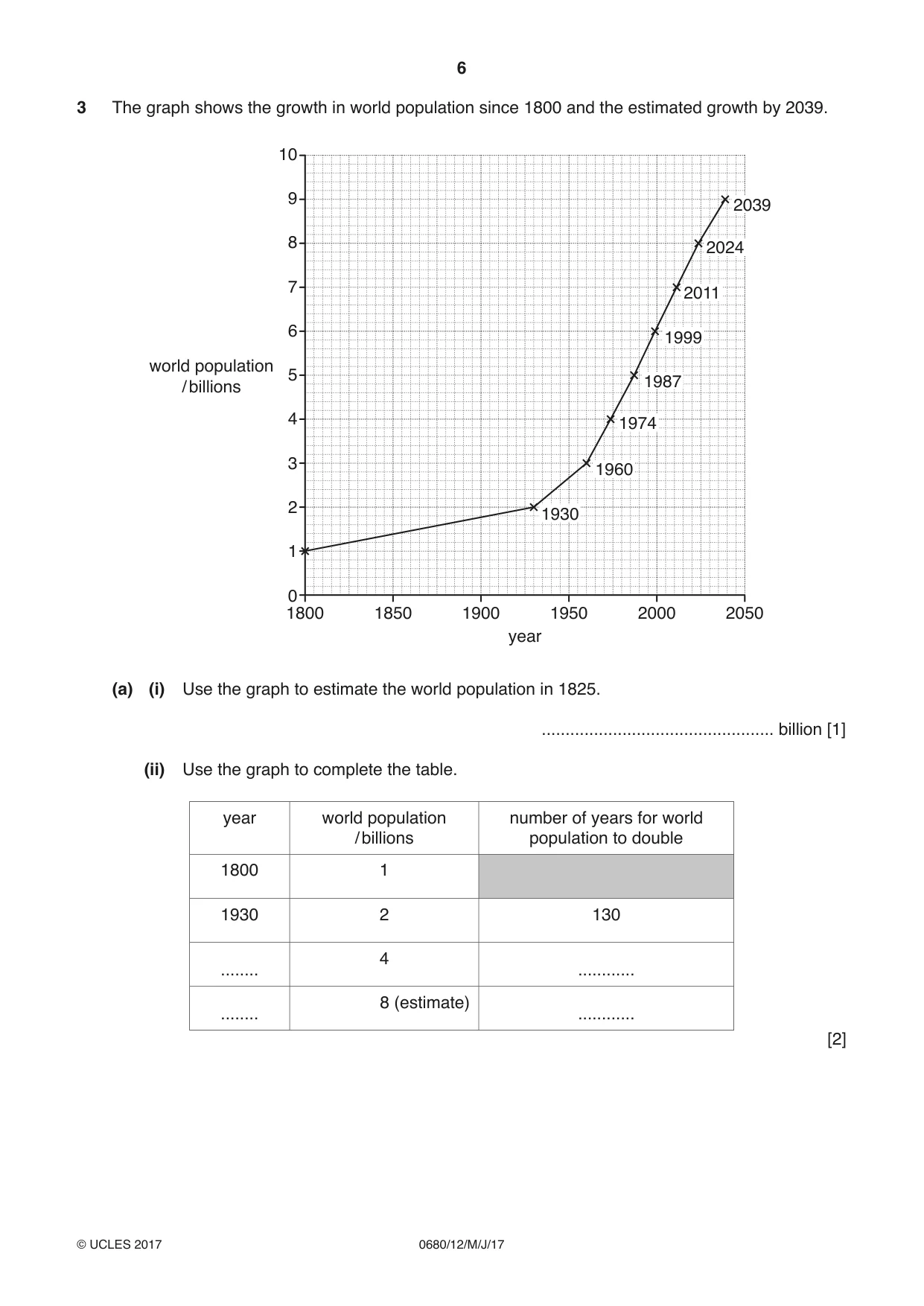
6 0680/12/M/J/17 © UCLES 2017 3 The graph shows the growth in world population since 1800 and the estimated growth by 2039. 10 9 8 7 6 5 4 3 2 1 0 1800 1850 1900 1950 2000 2050 year 1930 1960 1974 1987 1999 2011 2024 2039 world population / billions (a) (i) Use the graph to estimate the world population in 1825. … billion [1] (ii) Use the graph to complete the table. year world population / billions number of years for world population to double 1800 1 1930 2 130 … 4 … … 8 (estimate) … [2]
Question paper, page 7
7 0680/12/M/J/17 © UCLES 2017 [Turn over (iii) Explain why the world population has grown rapidly since 1950. … … … … … … … …[4] (b) Suggest why the education of girls is an important strategy for managing population growth. … … … … … … [3]
Question paper, page 8
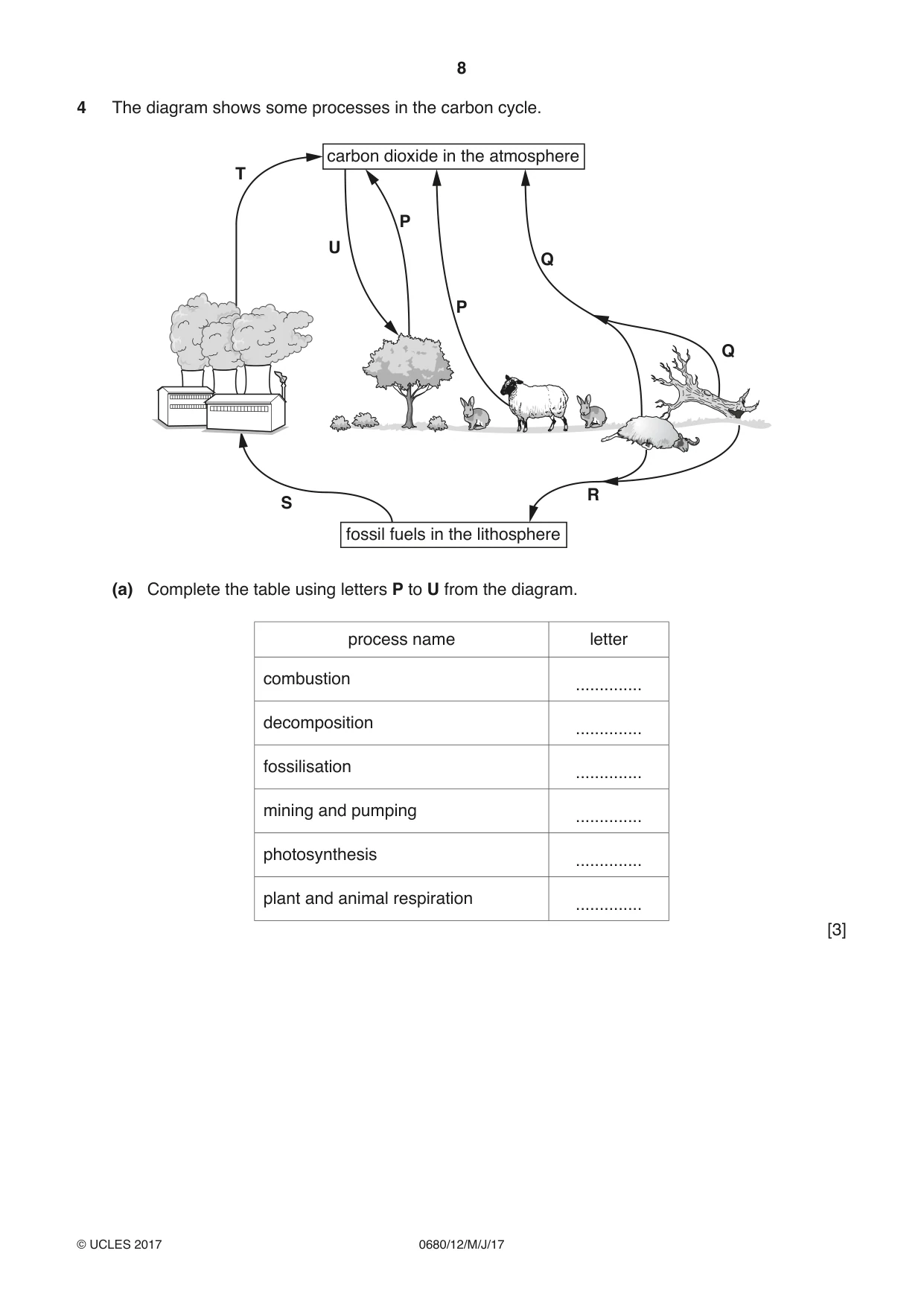
8 0680/12/M/J/17 © UCLES 2017 4 The diagram shows some processes in the carbon cycle. R Q Q P P U S T fossil fuels in the lithosphere carbon dioxide in the atmosphere (a) Complete the table using letters P to U from the diagram. process name letter combustion … decomposition … fossilisation … mining and pumping … photosynthesis … plant and animal respiration … [3]
Question paper, page 9
9 0680/12/M/J/17 © UCLES 2017 [Turn over (b) Describe how coal is formed. … … … … … …[3] (c) Suggest four ways that supplies of fossil fuels could be conserved. … … … … … … … …[4]
Question paper, page 10
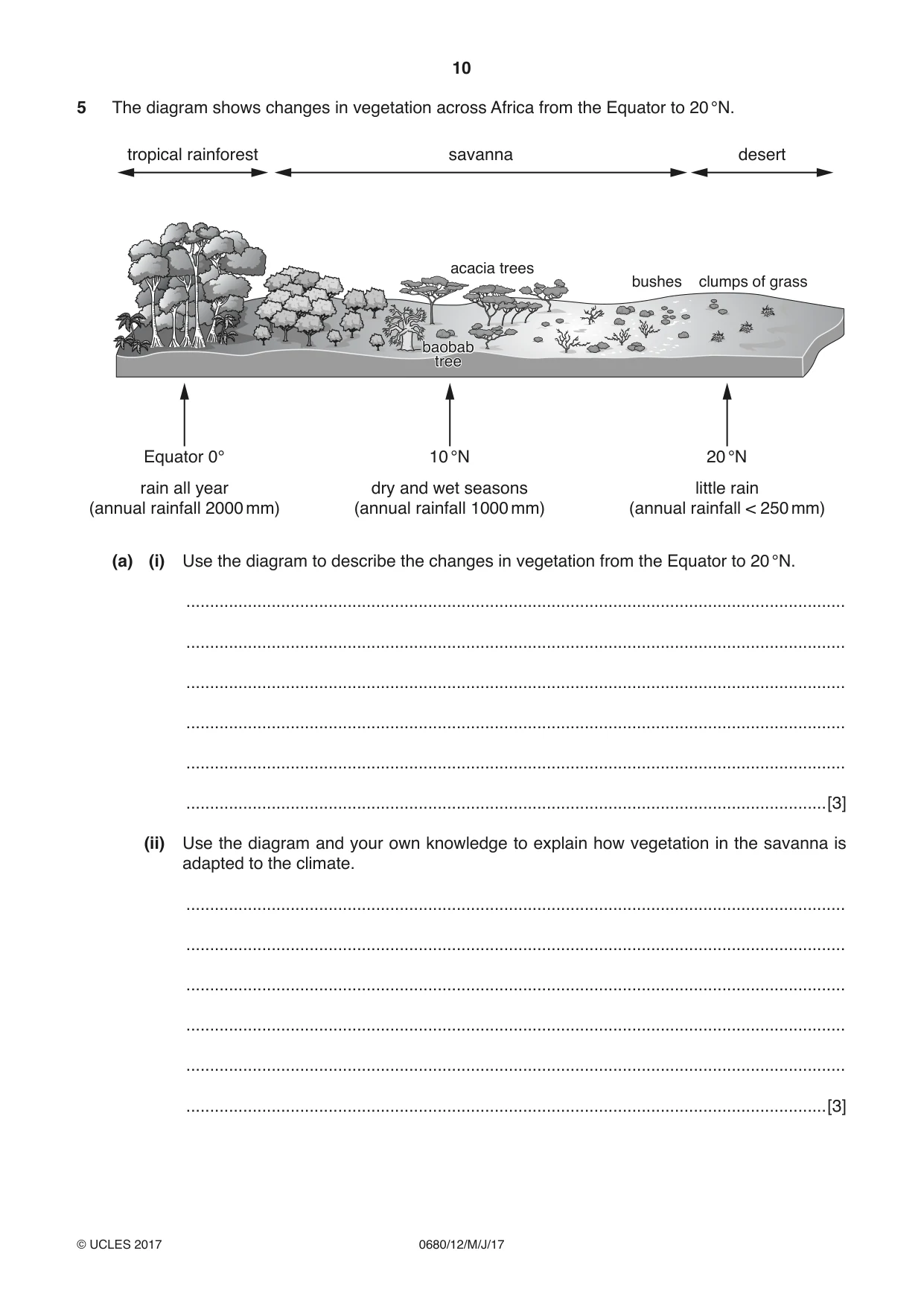
10 0680/12/M/J/17 © UCLES 2017 5 The diagram shows changes in vegetation across Africa from the Equator to 20 °N. rain all year (annual rainfall 2000 mm) dry and wet seasons (annual rainfall 1000 mm) little rain (annual rainfall < 250 mm) Equator 0° 10 °N 20 °N clumps of grass bushes acacia trees tropical rainforest savanna desert baobab tree baobab tree (a) (i) Use the diagram to describe the changes in vegetation from the Equator to 20 °N. … … … … … …[3] (ii) Use the diagram and your own knowledge to explain how vegetation in the savanna is adapted to the climate. … … … … … …[3]
Question paper, page 11
11 0680/12/M/J/17 © UCLES 2017 [Turn over (b) Desertification is a problem in some parts of the world. Suggest four causes of desertification. … … … … … … … …[4]
Question paper, page 12
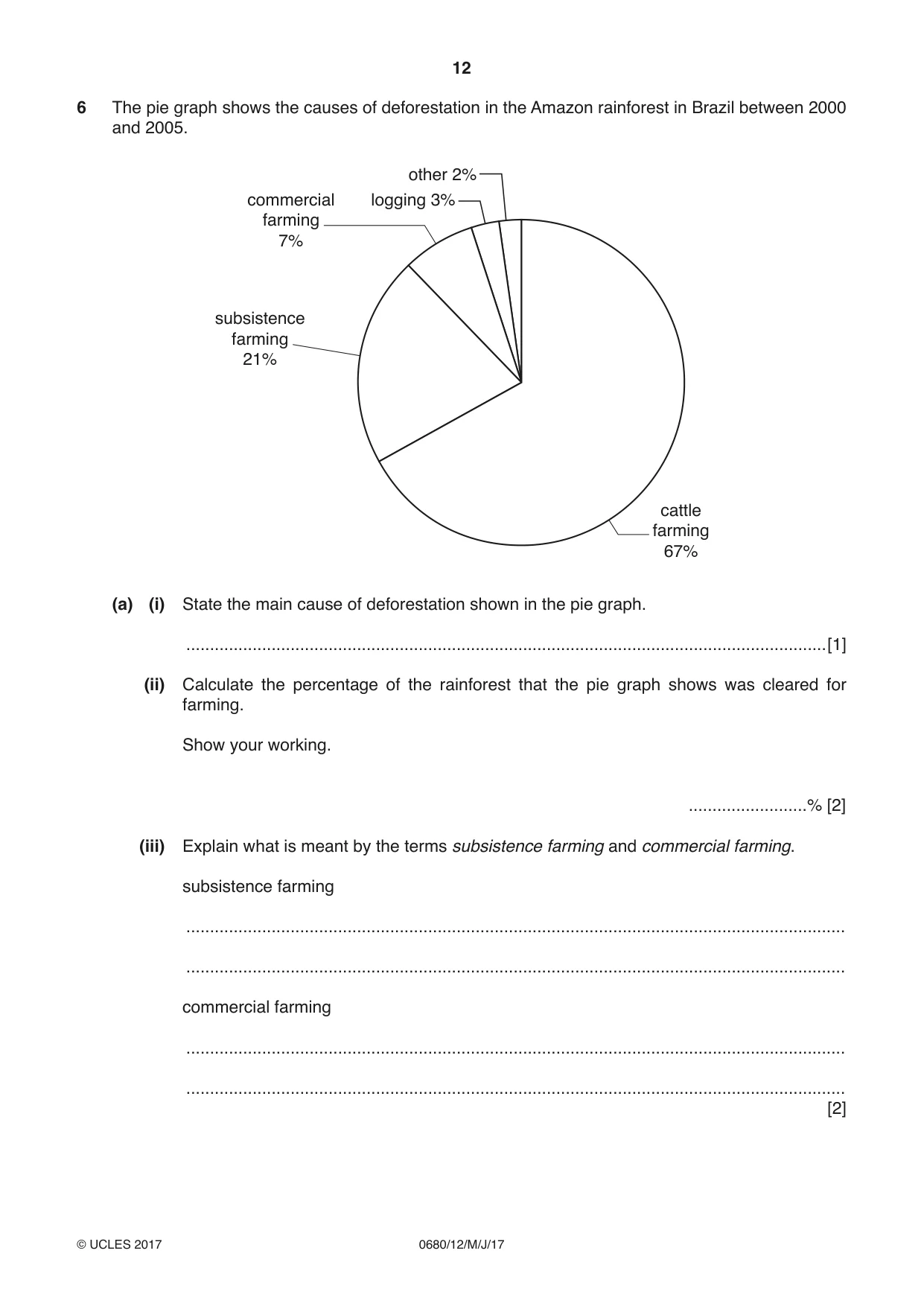
12 0680/12/M/J/17 © UCLES 2017 6 The pie graph shows the causes of deforestation in the Amazon rainforest in Brazil between 2000 and 2005. cattle farming 67% other 2% subsistence farming 21% commercial farming 7% logging 3% (a) (i) State the main cause of deforestation shown in the pie graph. …[1] (ii) Calculate the percentage of the rainforest that the pie graph shows was cleared for farming. Show your working. …% [2] (iii) Explain what is meant by the terms subsistence farming and commercial farming. subsistence farming … … commercial farming … … [2]
Question paper, page 13
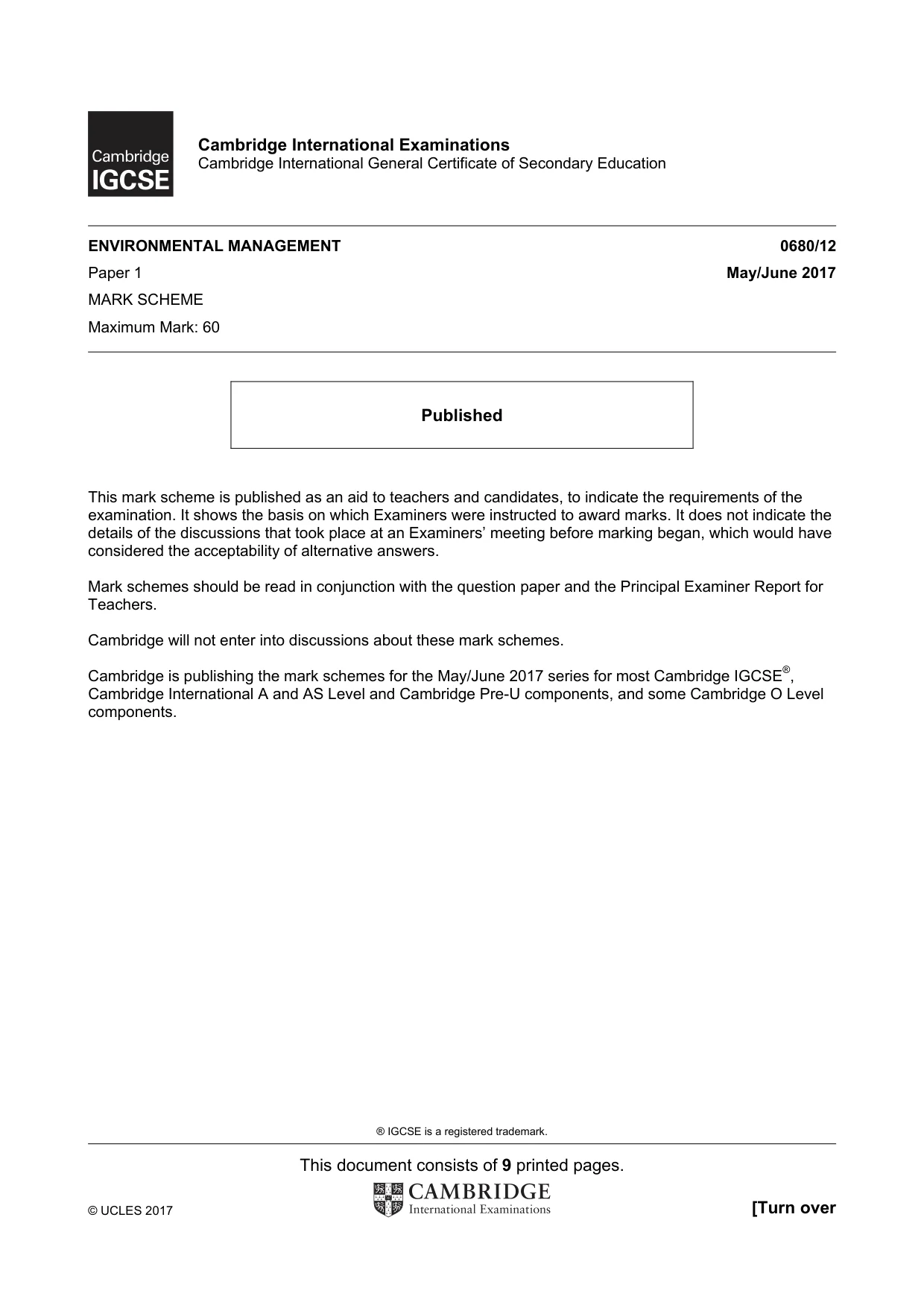
13 0680/12/M/J/17 © UCLES 2017 (iv) The pie graph shows that 2% of the Amazon rainforest was cleared for ‘other’ causes. Suggest the causes of this deforestation. … … … … … …[3] (b) Describe one strategy for the sustainable management of rainforests. … … … …[2]
Question paper, page 14
14 0680/12/M/J/17 © UCLES 2017 BLANK PAGE
Question paper, page 15
15 0680/12/M/J/17 © UCLES 2017 BLANK PAGE
Question paper, page 16
16 0680/12/M/J/17 © UCLES 2017 Permission to reproduce items where third-party owned material protected by copyright is included has been sought and cleared where possible. Every reasonable effort has been made by the publisher (UCLES) to trace copyright holders, but if any items requiring clearance have unwittingly been included, the publisher will be pleased to make amends at the earliest possible opportunity. To avoid the issue of disclosure of answer-related information to candidates, all copyright acknowledgements are reproduced online in the Cambridge International Examinations Copyright Acknowledgements Booklet. This is produced for each series of examinations and is freely available to download at www.cie.org.uk after the live examination series. Cambridge International Examinations is part of the Cambridge Assessment Group. Cambridge Assessment is the brand name of University of Cambridge Local Examinations Syndicate (UCLES), which is itself a department of the University of Cambridge. BLANK PAGE
Mark scheme, page 1
® IGCSE is a registered trademark. This document consists of 9 printed pages. © UCLES 2017 [Turn over Cambridge International Examinations Cambridge International General Certificate of Secondary Education ENVIRONMENTAL MANAGEMENT 0680/12 Paper 1 May/June 2017 MARK SCHEME Maximum Mark: 60 Published This mark scheme is published as an aid to teachers and candidates, to indicate the requirements of the examination. It shows the basis on which Examiners were instructed to award marks. It does not indicate the details of the discussions that took place at an Examiners’ meeting before marking began, which would have considered the acceptability of alternative answers. Mark schemes should be read in conjunction with the question paper and the Principal Examiner Report for Teachers. Cambridge will not enter into discussions about these mark schemes. Cambridge is publishing the mark schemes for the May/June 2017 series for most Cambridge IGCSE®, Cambridge International A and AS Level and Cambridge Pre-U components, and some Cambridge O Level components.
Mark scheme, page 2
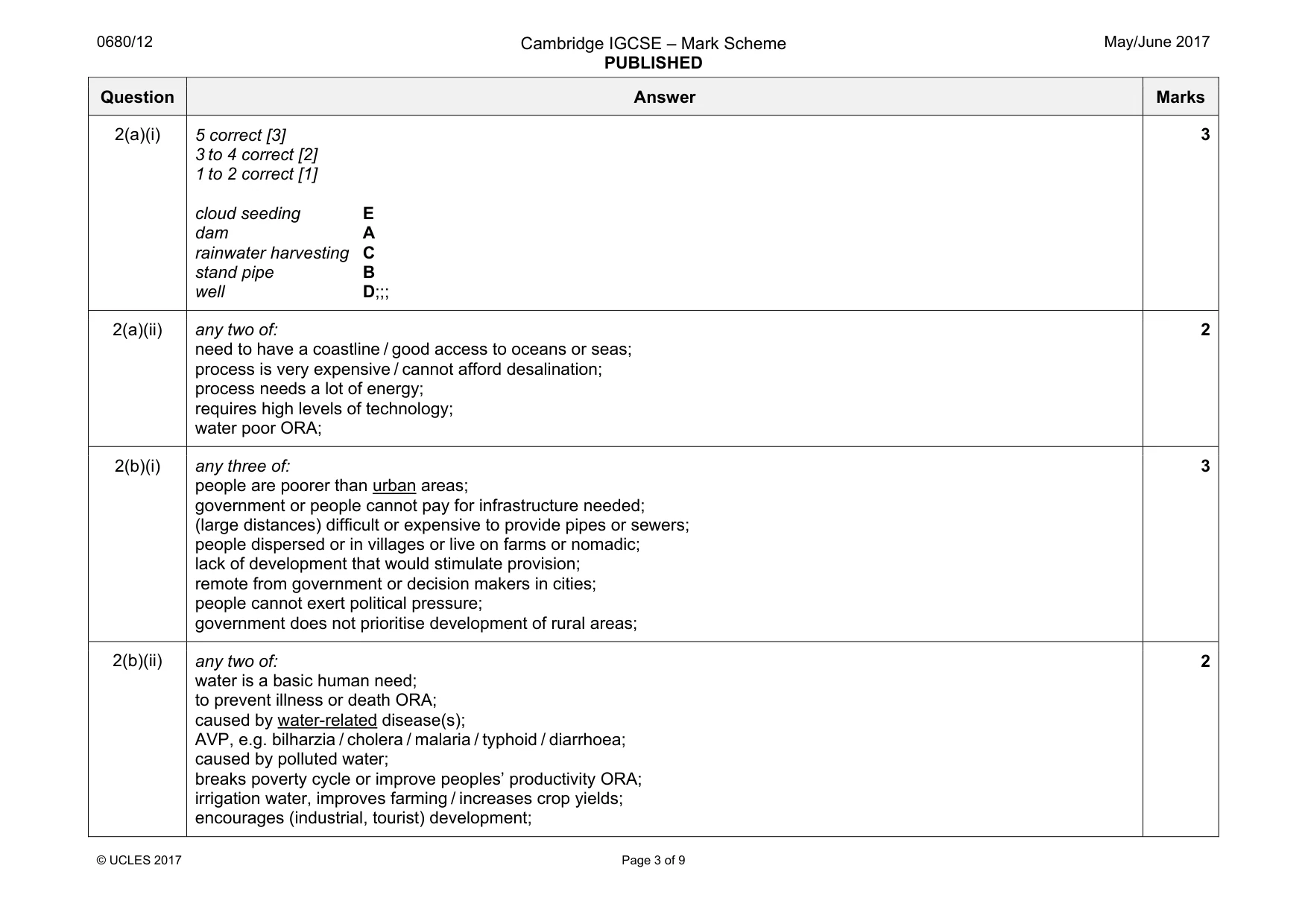
0680/12 Cambridge IGCSE – Mark Scheme PUBLISHED May/June 2017 © UCLES 2017 Page 2 of 9 Question Answer Marks 1(a) 5 correct [3] 3 to 4 correct [2] 1 to 2 correct [1] Most active volcanoes are near plate boundaries. Over half of the active volcanoes are located around the Pacific Ocean. There are volcanoes near the plate boundaries in the middle of the Atlantic Ocean. Some volcanoes on this map are far away from plate boundaries, for example the volcanoes on the eastern side of Africa, and also volcanoes caused by hotspots in the middle of the Pacific Ocean.;;; 3 1(b) any four of: two plates move towards each other or converge; oceanic or heavier plate, sinks below, continental or lighter plate; into the subduction zone; oceanic plate is destroyed or melts or forms magma (in the subduction zone); magma forced upwards through rocks or crack or vent; pressure is released; magma or lava erupts onto the Earth’s surface OWTTE; (over time) lava cools to form a volcano OWTTE; 4 1(c) any three of: monitoring; prediction / forecasting; education / drills / training / sirens; evacuation (plans) or centres or routes or logistics; warnings or communications, by TV or radio or personal contact; co-ordinate or mobilise, emergency services or medical teams; establish, safe or dangerous or exclusion zones during the eruption; stock piles of food or water; prepare hazard maps or risk maps; divert lava using earth barriers or explosives or H20 bombs; 3
Mark scheme, page 3
0680/12 Cambridge IGCSE – Mark Scheme PUBLISHED May/June 2017 © UCLES 2017 Page 3 of 9 Question Answer Marks 2(a)(i) 5 correct [3] 3 to 4 correct [2] 1 to 2 correct [1] cloud seeding E dam A rainwater harvesting C stand pipe B well D;;; 3 2(a)(ii) any two of: need to have a coastline / good access to oceans or seas; process is very expensive / cannot afford desalination; process needs a lot of energy; requires high levels of technology; water poor ORA; 2 2(b)(i) any three of: people are poorer than urban areas; government or people cannot pay for infrastructure needed; (large distances) difficult or expensive to provide pipes or sewers; people dispersed or in villages or live on farms or nomadic; lack of development that would stimulate provision; remote from government or decision makers in cities; people cannot exert political pressure; government does not prioritise development of rural areas; 3 2(b)(ii) any two of: water is a basic human need; to prevent illness or death ORA; caused by water-related disease(s); AVP, e.g. bilharzia / cholera / malaria / typhoid / diarrhoea; caused by polluted water; breaks poverty cycle or improve peoples’ productivity ORA; irrigation water, improves farming / increases crop yields; encourages (industrial, tourist) development; 2
Mark scheme, page 4
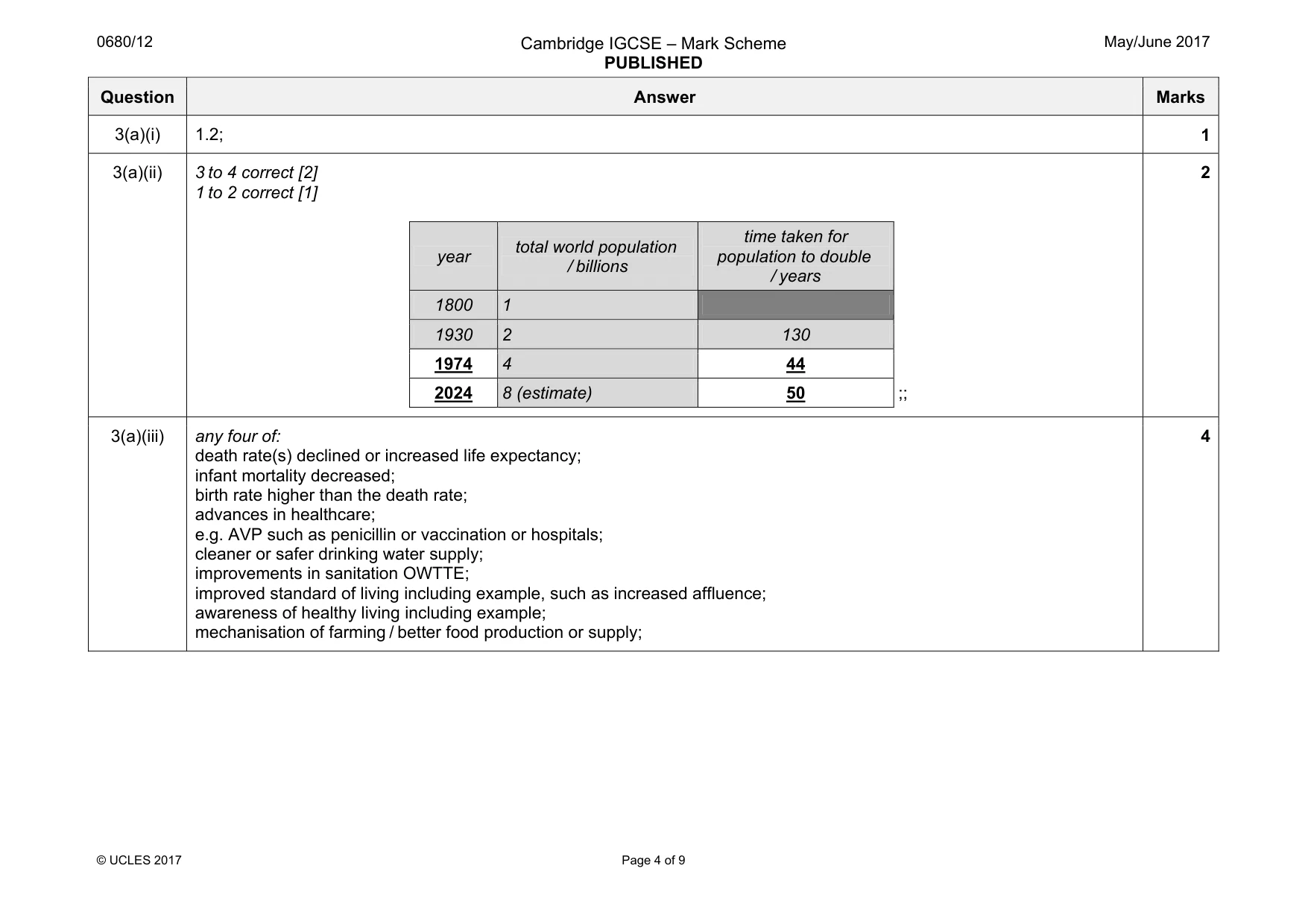
0680/12 Cambridge IGCSE – Mark Scheme PUBLISHED May/June 2017 © UCLES 2017 Page 4 of 9 Question Answer Marks 3(a)(i) 1.2; 1 3(a)(ii) 3 to 4 correct [2] 1 to 2 correct [1] year total world population / billions time taken for population to double / years 1800 1 1930 2 130 1974 4 44 2024 8 (estimate) 50 ;; 2 3(a)(iii) any four of: death rate(s) declined or increased life expectancy; infant mortality decreased; birth rate higher than the death rate; advances in healthcare; e.g. AVP such as penicillin or vaccination or hospitals; cleaner or safer drinking water supply; improvements in sanitation OWTTE; improved standard of living including example, such as increased affluence; awareness of healthy living including example; mechanisation of farming / better food production or supply; 4
Mark scheme, page 5
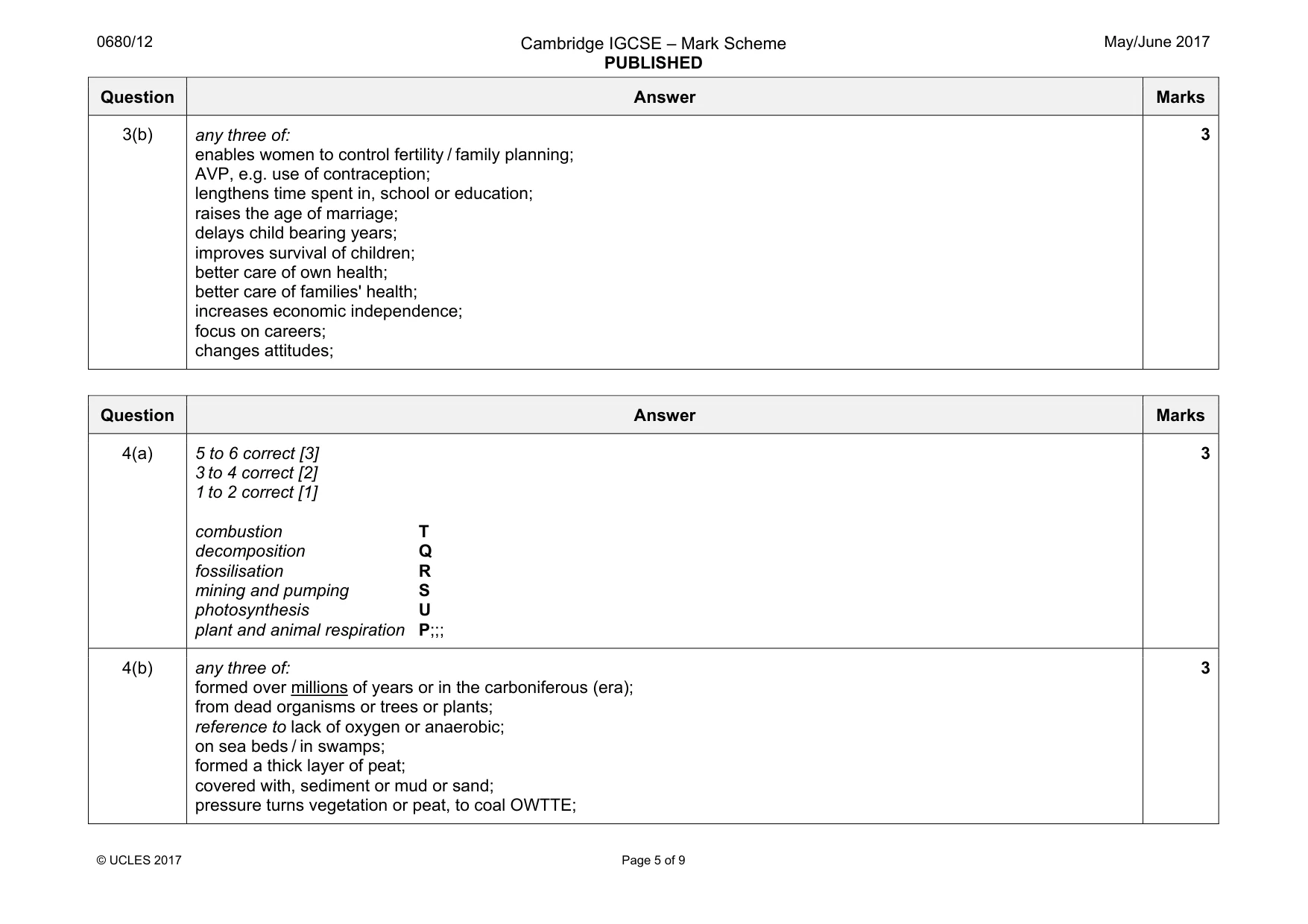
0680/12 Cambridge IGCSE – Mark Scheme PUBLISHED May/June 2017 © UCLES 2017 Page 5 of 9 Question Answer Marks 3(b) any three of: enables women to control fertility / family planning; AVP, e.g. use of contraception; lengthens time spent in, school or education; raises the age of marriage; delays child bearing years; improves survival of children; better care of own health; better care of families' health; increases economic independence; focus on careers; changes attitudes; 3 Question Answer Marks 4(a) 5 to 6 correct [3] 3 to 4 correct [2] 1 to 2 correct [1] combustion T decomposition Q fossilisation R mining and pumping S photosynthesis U plant and animal respiration P;;; 3 4(b) any three of: formed over millions of years or in the carboniferous (era); from dead organisms or trees or plants; reference to lack of oxygen or anaerobic; on sea beds / in swamps; formed a thick layer of peat; covered with, sediment or mud or sand; pressure turns vegetation or peat, to coal OWTTE; 3
Mark scheme, page 6
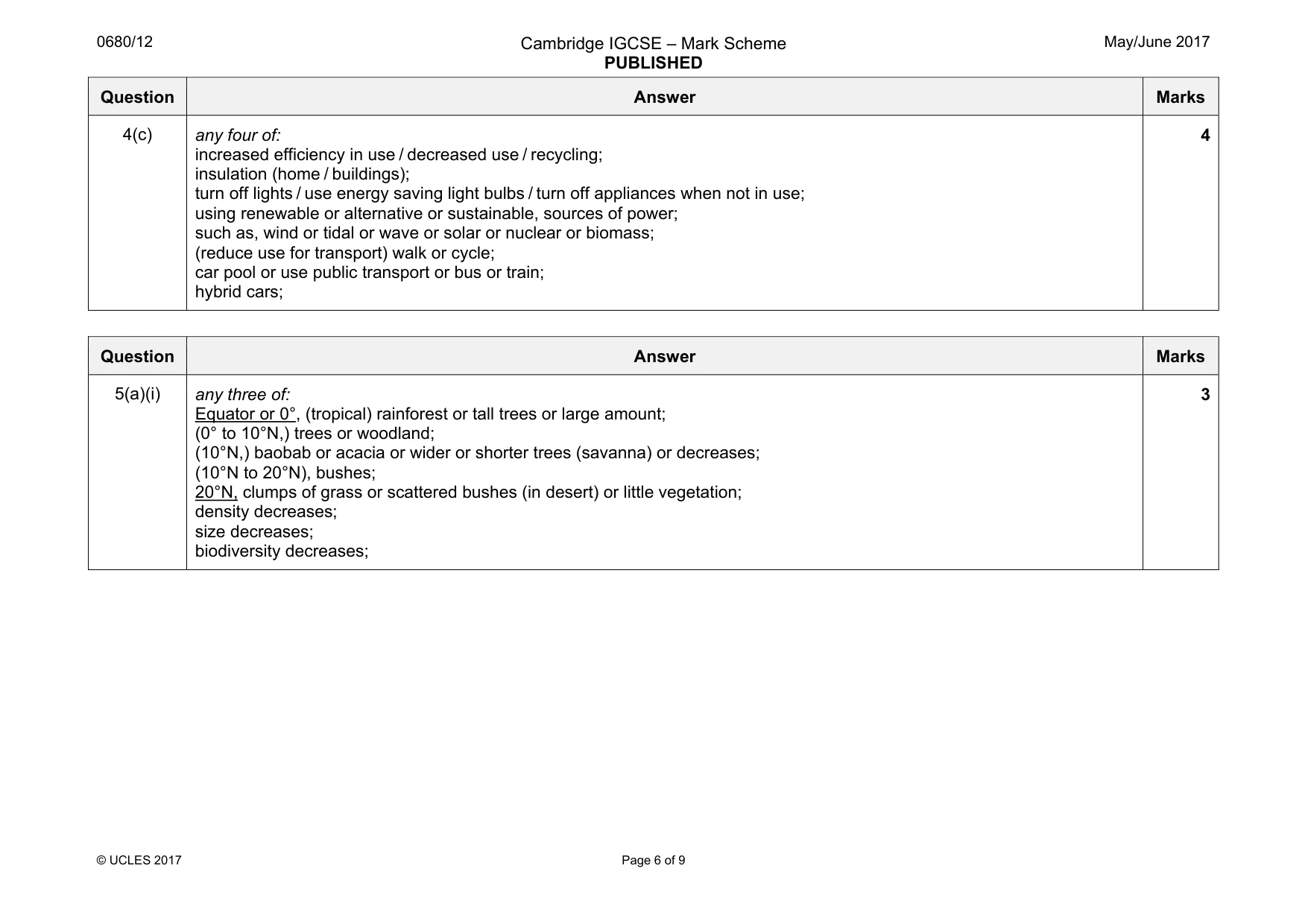
0680/12 Cambridge IGCSE – Mark Scheme PUBLISHED May/June 2017 © UCLES 2017 Page 6 of 9 Question Answer Marks 4(c) any four of: increased efficiency in use / decreased use / recycling; insulation (home / buildings); turn off lights / use energy saving light bulbs / turn off appliances when not in use; using renewable or alternative or sustainable, sources of power; such as, wind or tidal or wave or solar or nuclear or biomass; (reduce use for transport) walk or cycle; car pool or use public transport or bus or train; hybrid cars; 4 Question Answer Marks 5(a)(i) any three of: Equator or 0°, (tropical) rainforest or tall trees or large amount; (0° to 10°N,) trees or woodland; (10°N,) baobab or acacia or wider or shorter trees (savanna) or decreases; (10°N to 20°N), bushes; 20°N, clumps of grass or scattered bushes (in desert) or little vegetation; density decreases; size decreases; biodiversity decreases; 3
Mark scheme, page 7
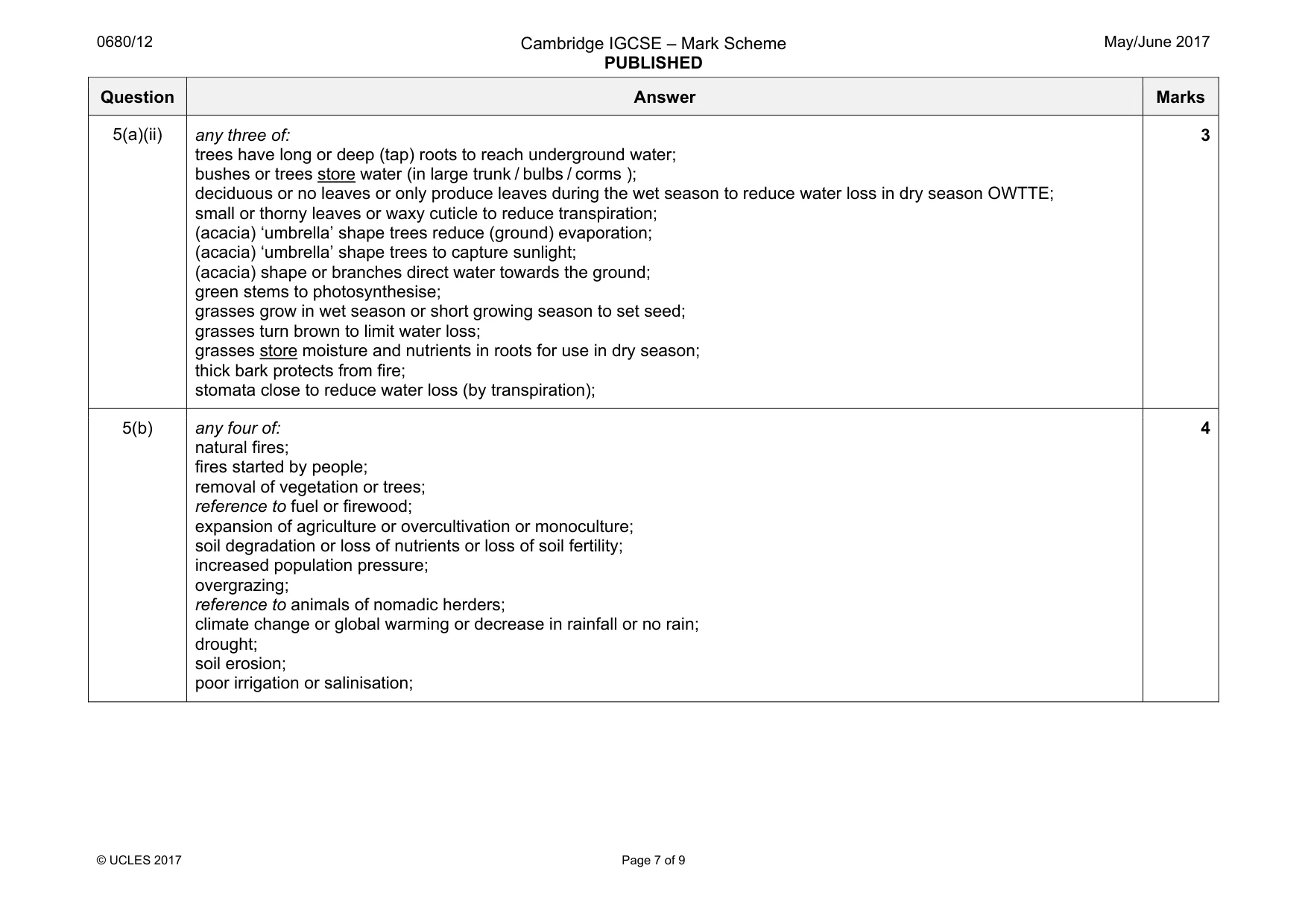
0680/12 Cambridge IGCSE – Mark Scheme PUBLISHED May/June 2017 © UCLES 2017 Page 7 of 9 Question Answer Marks 5(a)(ii) any three of: trees have long or deep (tap) roots to reach underground water; bushes or trees store water (in large trunk / bulbs / corms ); deciduous or no leaves or only produce leaves during the wet season to reduce water loss in dry season OWTTE; small or thorny leaves or waxy cuticle to reduce transpiration; (acacia) ‘umbrella’ shape trees reduce (ground) evaporation; (acacia) ‘umbrella’ shape trees to capture sunlight; (acacia) shape or branches direct water towards the ground; green stems to photosynthesise; grasses grow in wet season or short growing season to set seed; grasses turn brown to limit water loss; grasses store moisture and nutrients in roots for use in dry season; thick bark protects from fire; stomata close to reduce water loss (by transpiration); 3 5(b) any four of: natural fires; fires started by people; removal of vegetation or trees; reference to fuel or firewood; expansion of agriculture or overcultivation or monoculture; soil degradation or loss of nutrients or loss of soil fertility; increased population pressure; overgrazing; reference to animals of nomadic herders; climate change or global warming or decrease in rainfall or no rain; drought; soil erosion; poor irrigation or salinisation; 4
Mark scheme, page 8
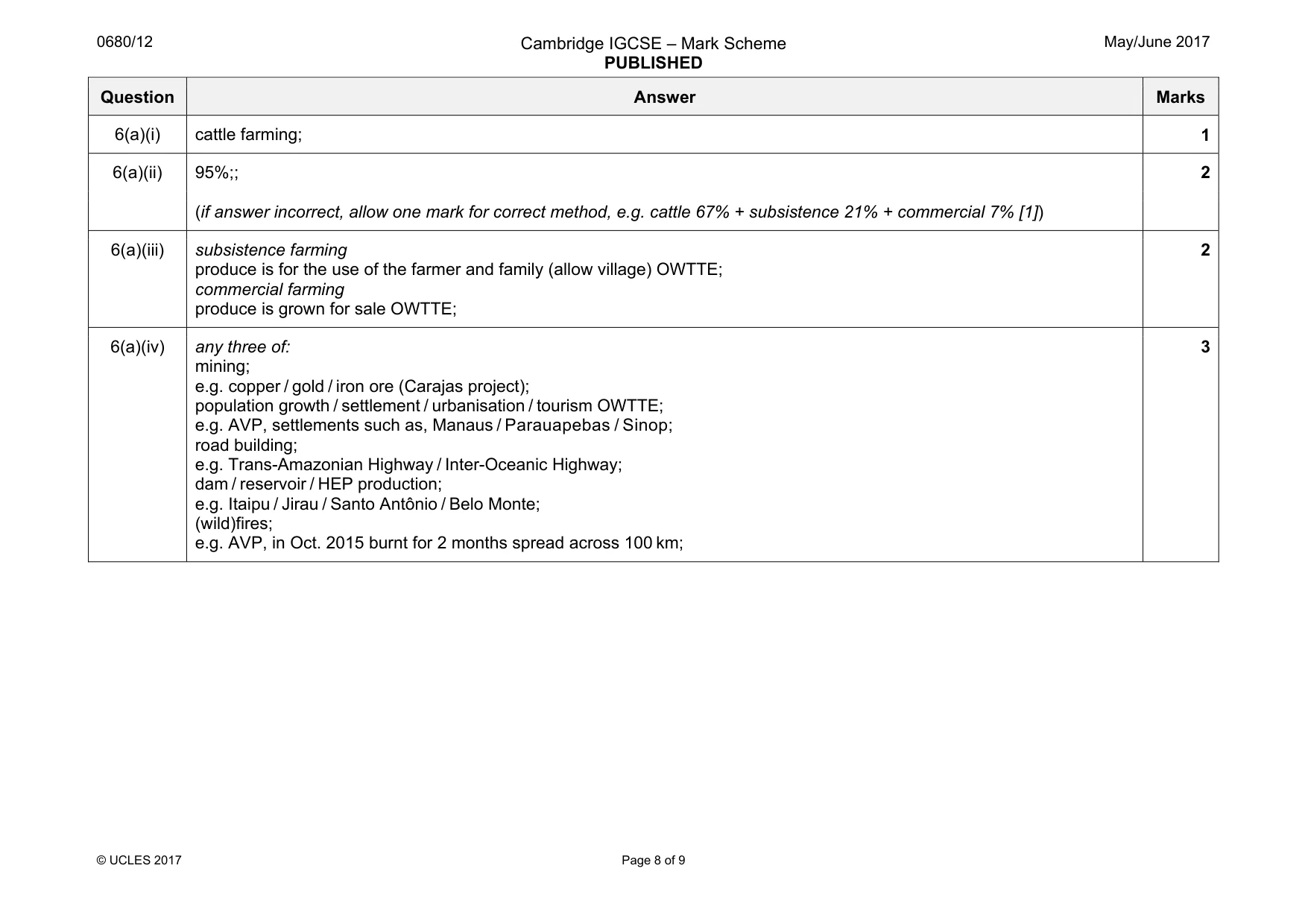
0680/12 Cambridge IGCSE – Mark Scheme PUBLISHED May/June 2017 © UCLES 2017 Page 8 of 9 Question Answer Marks 6(a)(i) cattle farming; 1 6(a)(ii) 95%;; (if answer incorrect, allow one mark for correct method, e.g. cattle 67% + subsistence 21% + commercial 7% [1]) 2 6(a)(iii) subsistence farming produce is for the use of the farmer and family (allow village) OWTTE; commercial farming produce is grown for sale OWTTE; 2 6(a)(iv) any three of: mining; e.g. copper / gold / iron ore (Carajas project); population growth / settlement / urbanisation / tourism OWTTE; e.g. AVP, settlements such as, Manaus / Parauapebas / Sinop; road building; e.g. Trans-Amazonian Highway / Inter-Oceanic Highway; dam / reservoir / HEP production; e.g. Itaipu / Jirau / Santo Antônio / Belo Monte; (wild)fires; e.g. AVP, in Oct. 2015 burnt for 2 months spread across 100 km; 3
Mark scheme, page 9
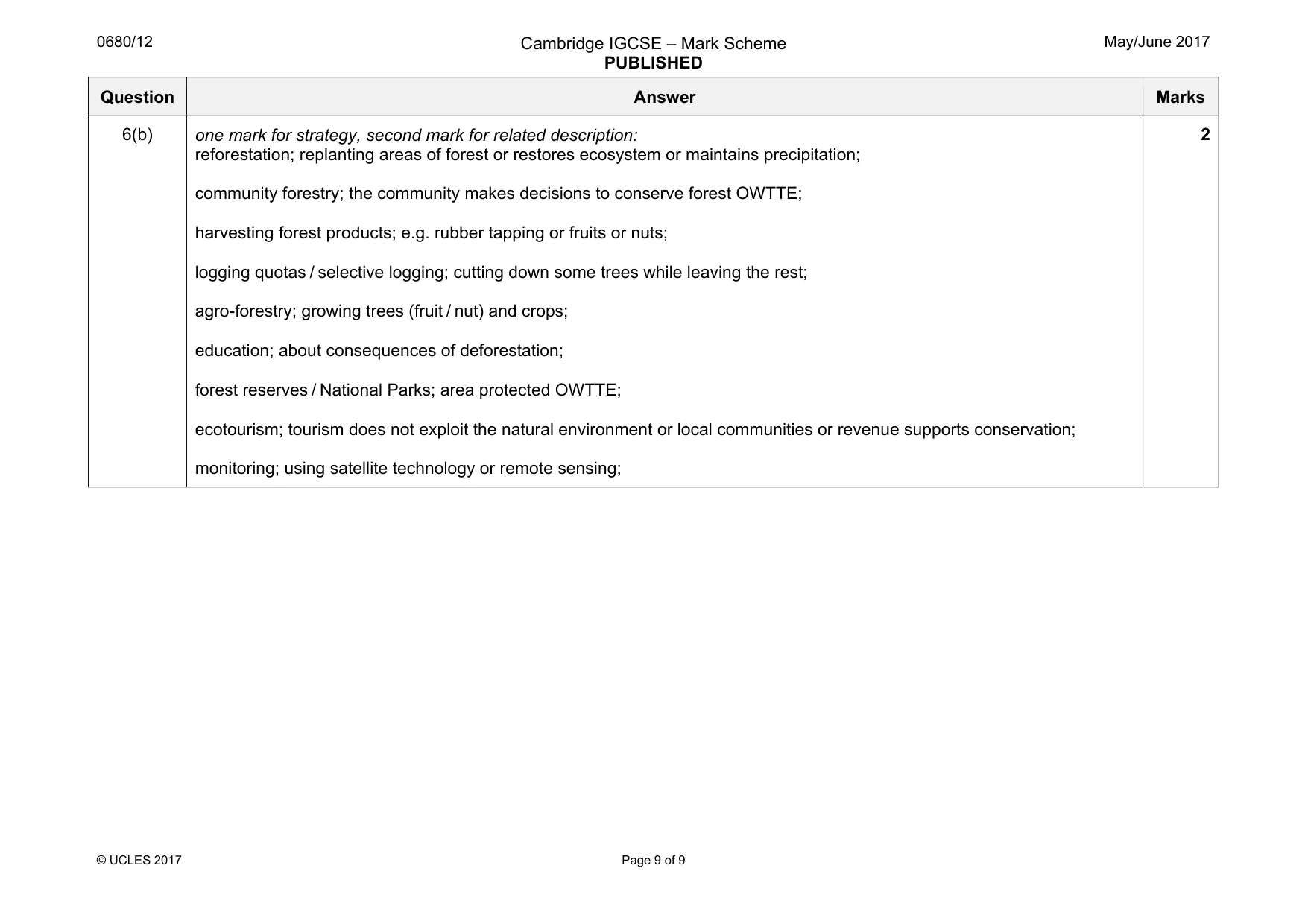
0680/12 Cambridge IGCSE – Mark Scheme PUBLISHED May/June 2017 © UCLES 2017 Page 9 of 9 Question Answer Marks 6(b) one mark for strategy, second mark for related description: reforestation; replanting areas of forest or restores ecosystem or maintains precipitation; community forestry; the community makes decisions to conserve forest OWTTE; harvesting forest products; e.g. rubber tapping or fruits or nuts; logging quotas / selective logging; cutting down some trees while leaving the rest; agro-forestry; growing trees (fruit / nut) and crops; education; about consequences of deforestation; forest reserves / National Parks; area protected OWTTE; ecotourism; tourism does not exploit the natural environment or local communities or revenue supports conservation; monitoring; using satellite technology or remote sensing; 2
What you needed in this session
Cambridge’s own grade thresholds for 2017 May/June, Paper 1 · Variant 2. A higher threshold means an easier paper — the bar moves with how the cohort did.