Cambridge IGCSE Environmental Management 0680 — 2017 May/June Paper 1 · Variant 1
0680/11/M/J/17 · 60 marks · ≈68 min
The question paper and its mark scheme, free to read here and free to download. This is Cambridge’s own paper, exactly as it was sat.
Question paper16 pages

Mark scheme7 pages
Answers below. Sit the paper first if you are practising.
Paper as text
Question paper, page 1
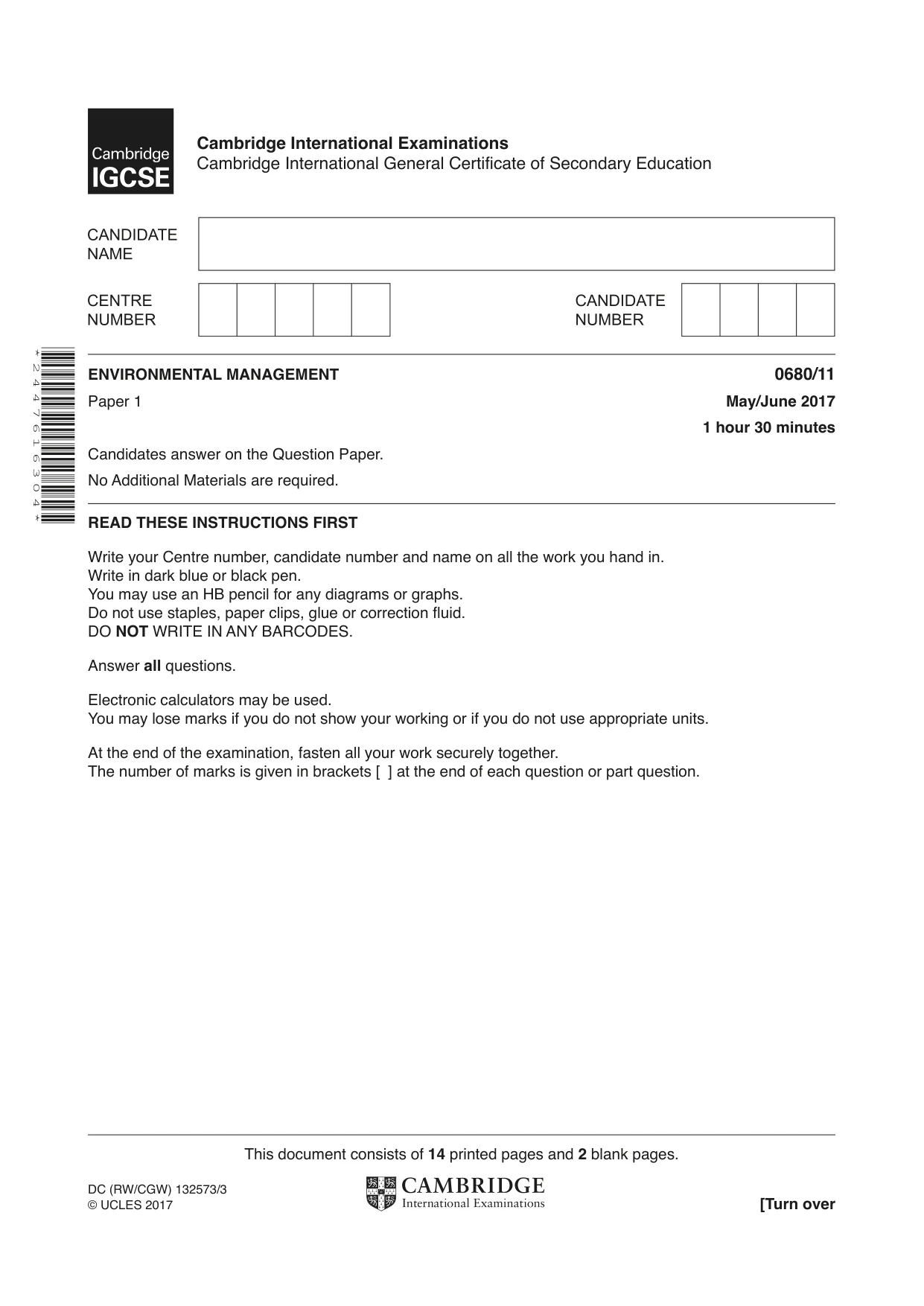
This document consists of 14 printed pages and 2 blank pages. DC (RW/CGW) 132573/3 © UCLES 2017 [Turn over Cambridge International Examinations Cambridge International General Certificate of Secondary Education * 2 4 4 7 6 1 6 3 0 4 * ENVIRONMENTAL MANAGEMENT 0680/11 Paper 1 May/June 2017 1 hour 30 minutes Candidates answer on the Question Paper. No Additional Materials are required. READ THESE INSTRUCTIONS FIRST Write your Centre number, candidate number and name on all the work you hand in. Write in dark blue or black pen. You may use an HB pencil for any diagrams or graphs. Do not use staples, paper clips, glue or correction fluid. DO NOT WRITE IN ANY BARCODES. Answer all questions. Electronic calculators may be used. You may lose marks if you do not show your working or if you do not use appropriate units. At the end of the examination, fasten all your work securely together. The number of marks is given in brackets [ ] at the end of each question or part question.
Question paper, page 2
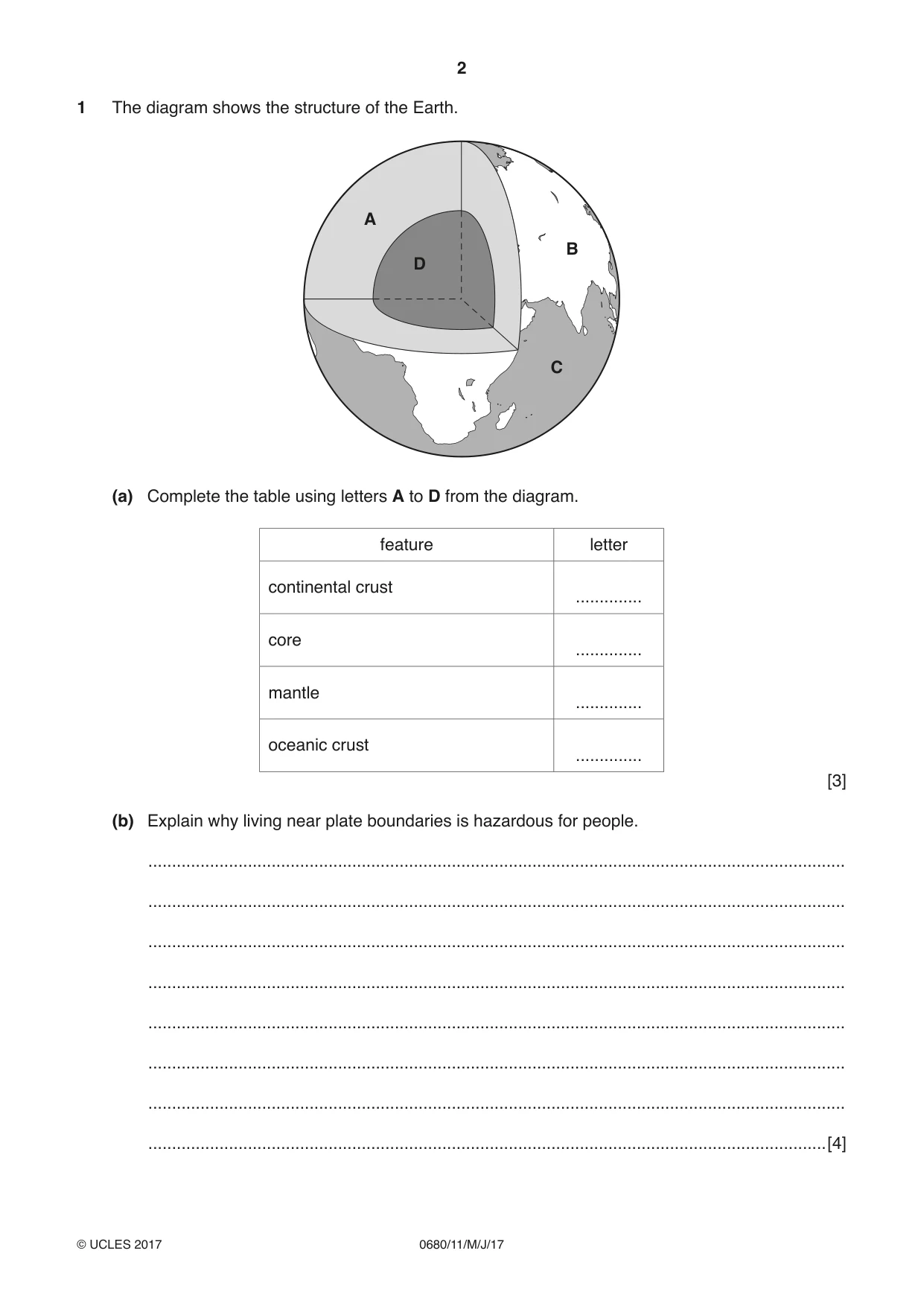
2 0680/11/M/J/17 © UCLES 2017 1 The diagram shows the structure of the Earth. C B D A (a) Complete the table using letters A to D from the diagram. feature letter continental crust … core … mantle … oceanic crust … [3] (b) Explain why living near plate boundaries is hazardous for people. … … … … … … … …[4]
Question paper, page 3
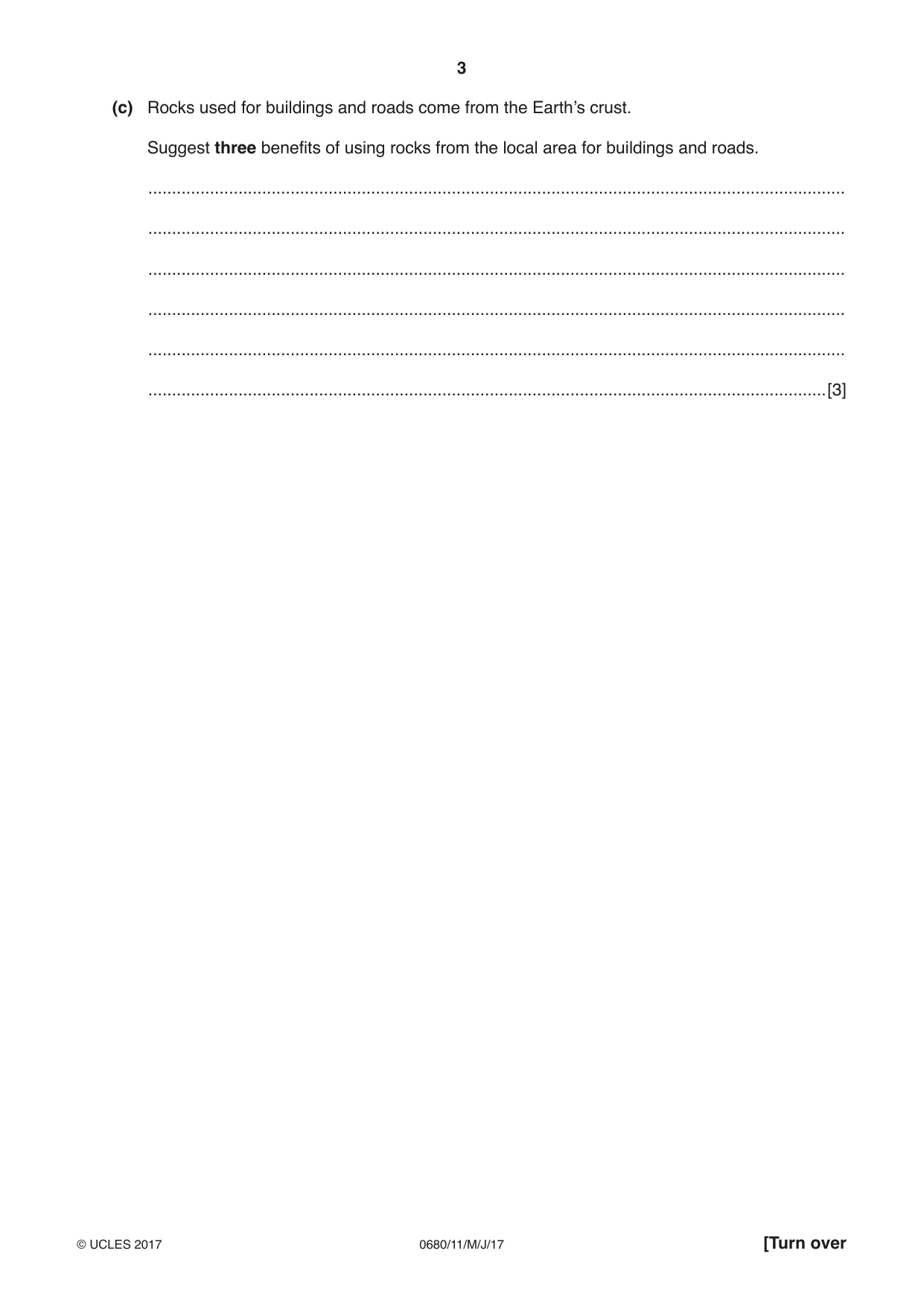
3 0680/11/M/J/17 © UCLES 2017 [Turn over (c) Rocks used for buildings and roads come from the Earth’s crust. Suggest three benefits of using rocks from the local area for buildings and roads. … … … … … …[3]
Question paper, page 4
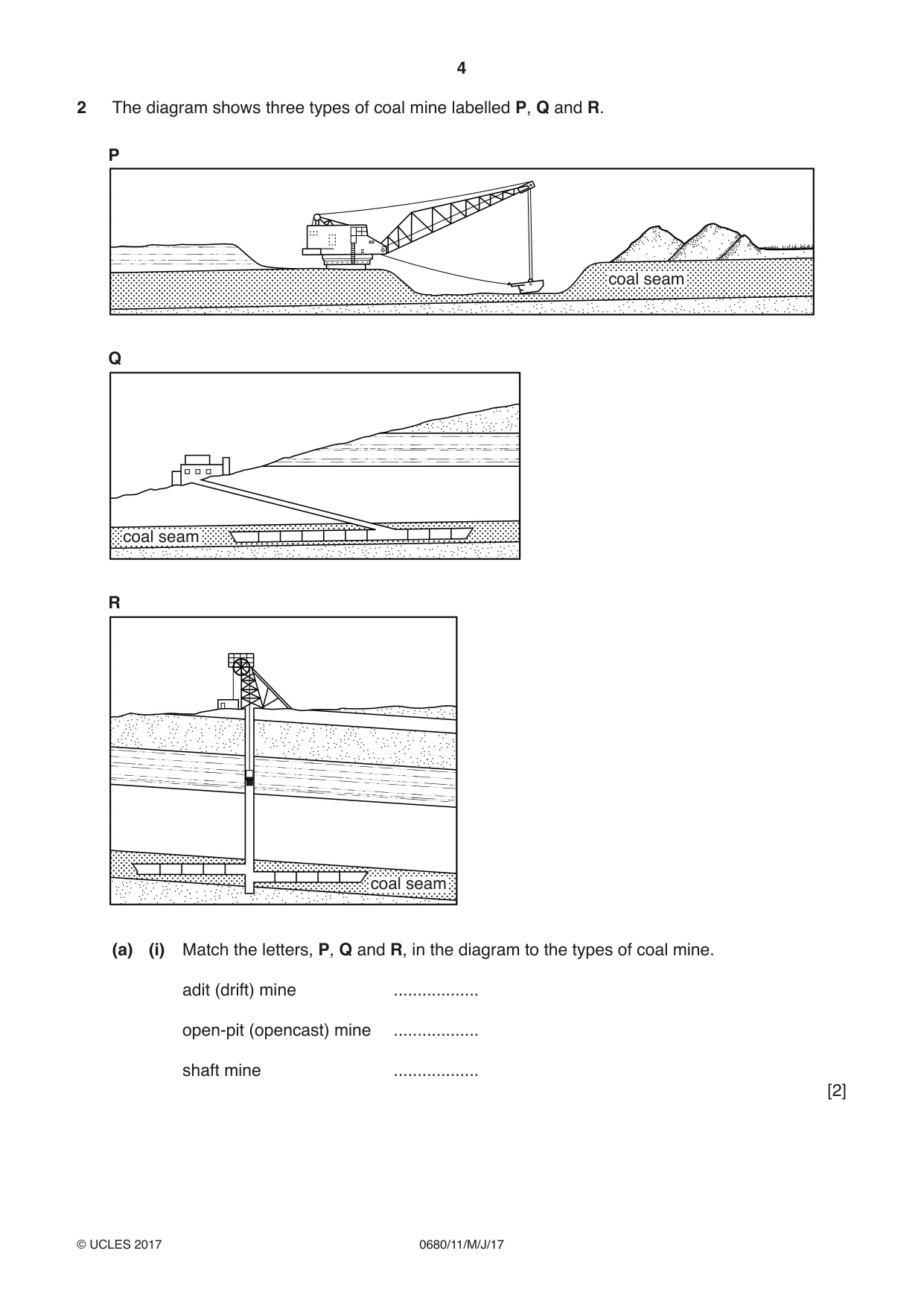
4 0680/11/M/J/17 © UCLES 2017 2 The diagram shows three types of coal mine labelled P, Q and R. P Q R coal seam coal seam coal seam (a) (i) Match the letters, P, Q and R, in the diagram to the types of coal mine. adit (drift) mine … open-pit (opencast) mine … shaft mine … [2]
Question paper, page 5
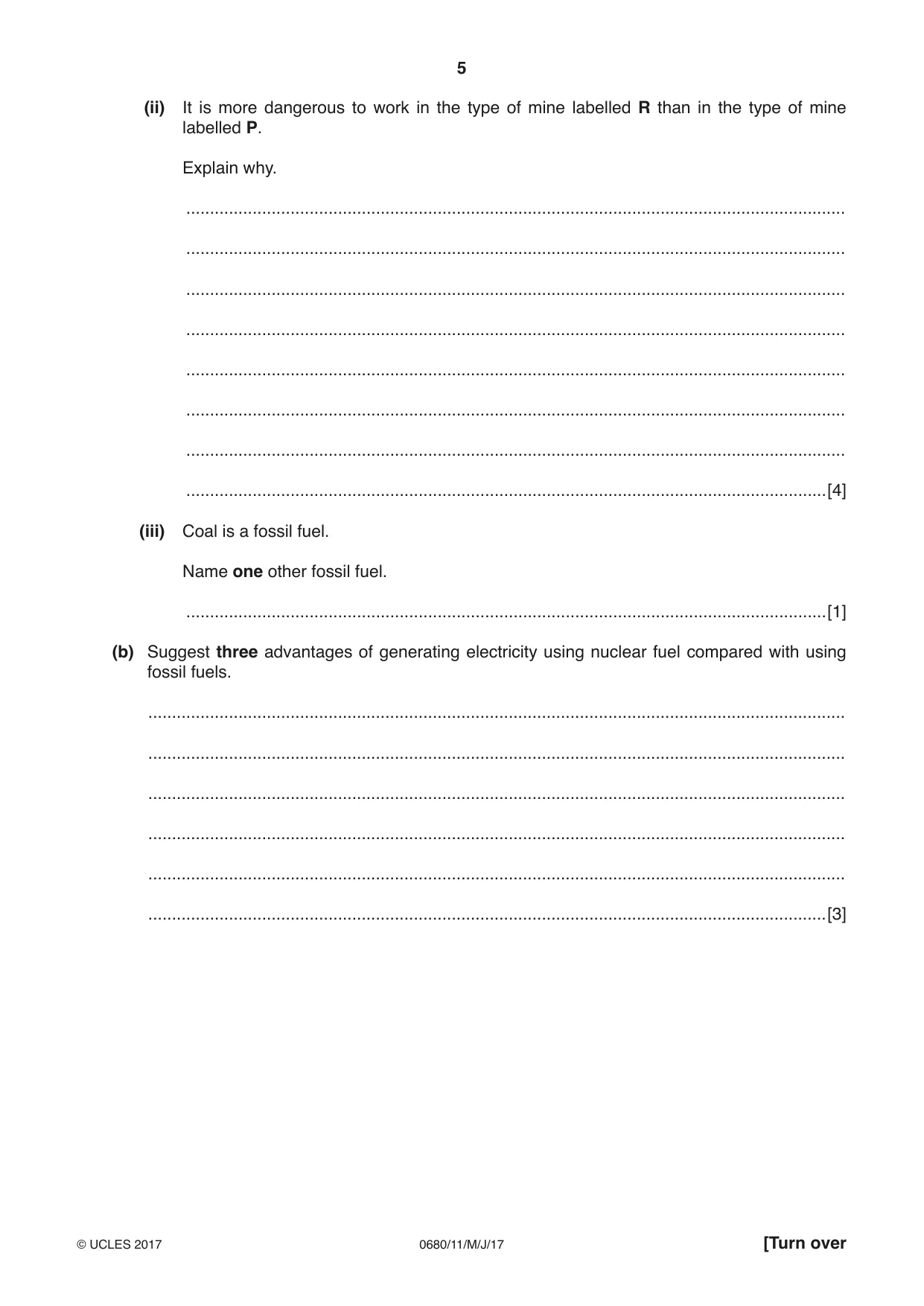
5 0680/11/M/J/17 © UCLES 2017 [Turn over (ii) It is more dangerous to work in the type of mine labelled R than in the type of mine labelled P. Explain why. … … … … … … … …[4] (iii) Coal is a fossil fuel. Name one other fossil fuel. …[1] (b) Suggest three advantages of generating electricity using nuclear fuel compared with using fossil fuels. … … … … … …[3]
Question paper, page 6
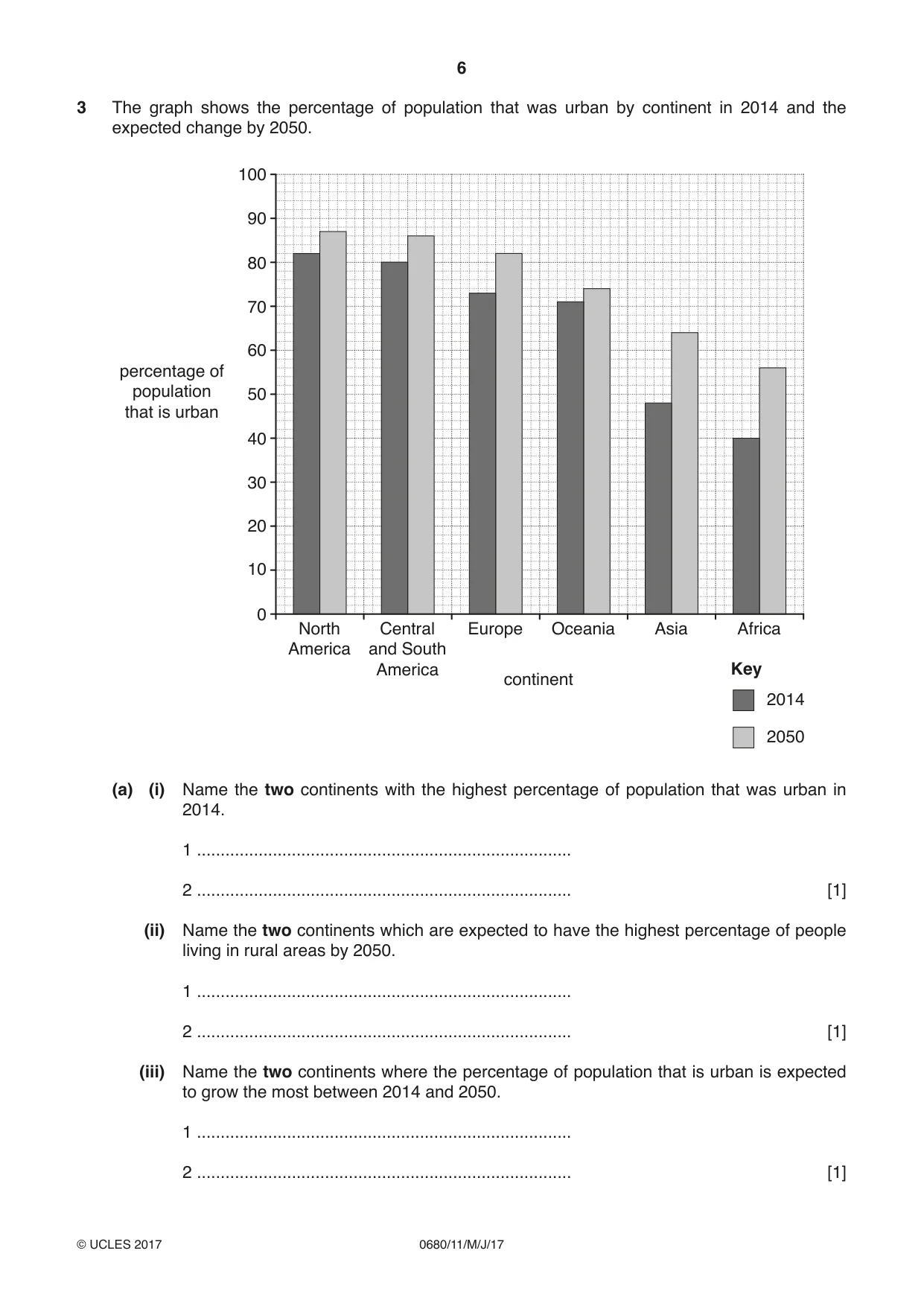
6 0680/11/M/J/17 © UCLES 2017 3 The graph shows the percentage of population that was urban by continent in 2014 and the expected change by 2050. 100 90 80 70 60 50 40 30 20 10 North America Central and South America Europe Oceania continent 2014 percentage of population that is urban Asia Africa Key 0 2050 (a) (i) Name the two continents with the highest percentage of population that was urban in 2014. 1 … 2 … [1] (ii) Name the two continents which are expected to have the highest percentage of people living in rural areas by 2050. 1 … 2 … [1] (iii) Name the two continents where the percentage of population that is urban is expected to grow the most between 2014 and 2050. 1 … 2 … [1]
Question paper, page 7
7 0680/11/M/J/17 © UCLES 2017 [Turn over (b) (i) State the word used to describe the increasing number of people living in urban areas. …[1] (ii) Suggest three reasons why people leave rural areas in developing countries. … … … … … …[3] (iii) Describe three environmental problems caused by the rapid growth of cities in developing countries. … … … … … …[3]
Question paper, page 8
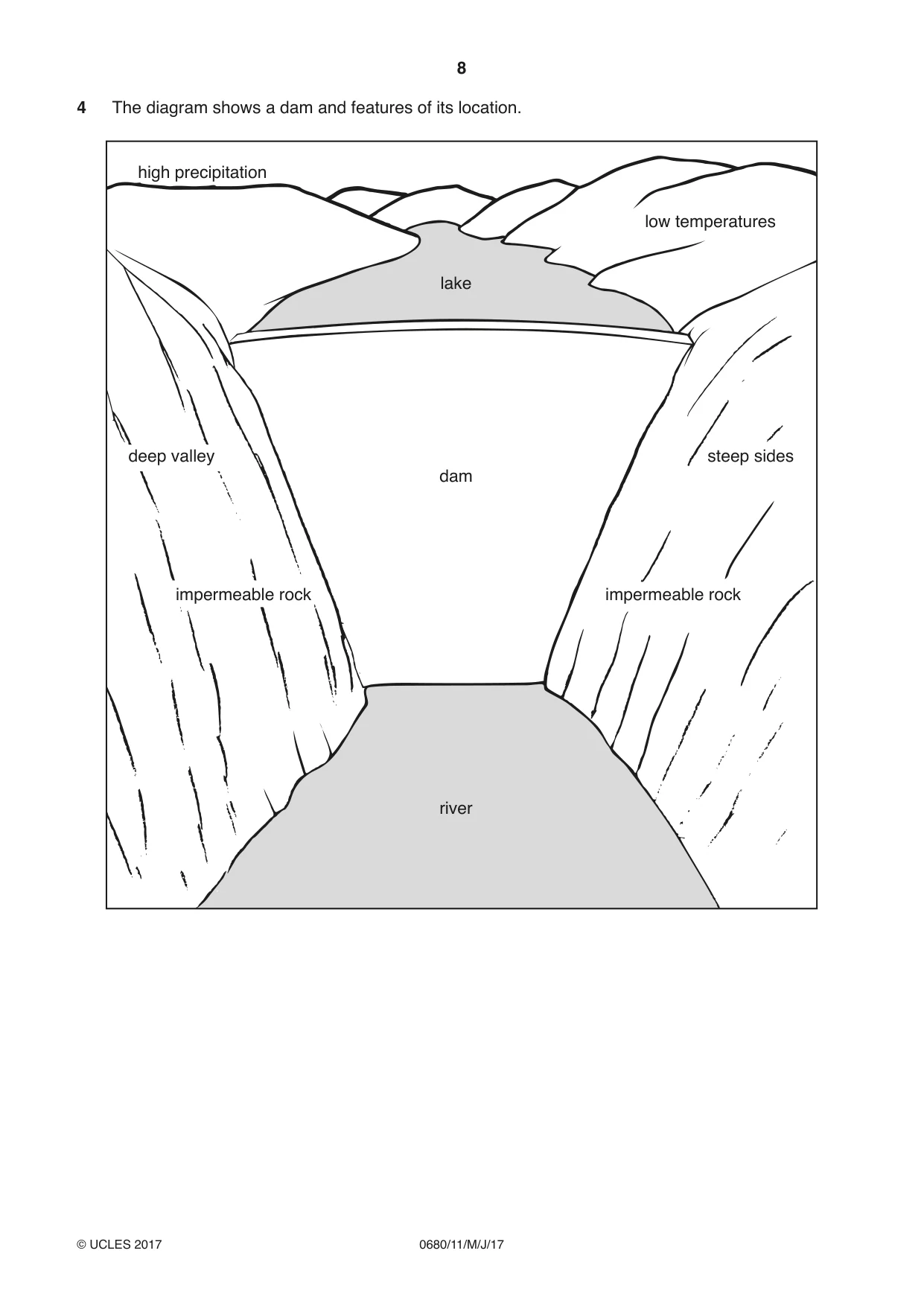
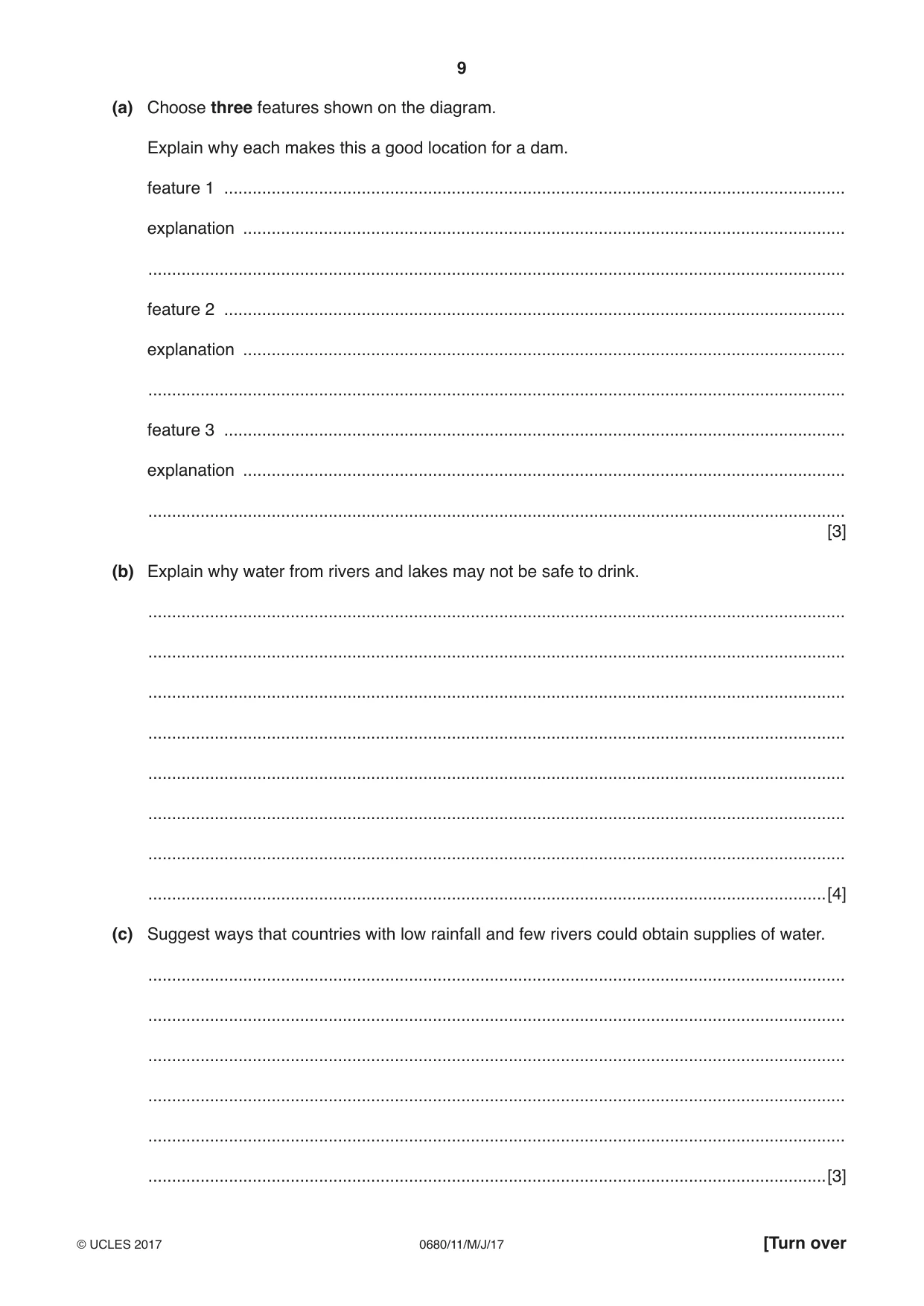
8 0680/11/M/J/17 © UCLES 2017 4 The diagram shows a dam and features of its location. dam lake river impermeable rock steep sides deep valley impermeable rock high precipitation low temperatures
Question paper, page 9
9 0680/11/M/J/17 © UCLES 2017 [Turn over (a) Choose three features shown on the diagram. Explain why each makes this a good location for a dam. feature 1 … explanation … … feature 2 … explanation … … feature 3 … explanation … … [3] (b) Explain why water from rivers and lakes may not be safe to drink. … … … … … … … …[4] (c) Suggest ways that countries with low rainfall and few rivers could obtain supplies of water. … … … … … …[3]
Question paper, page 10
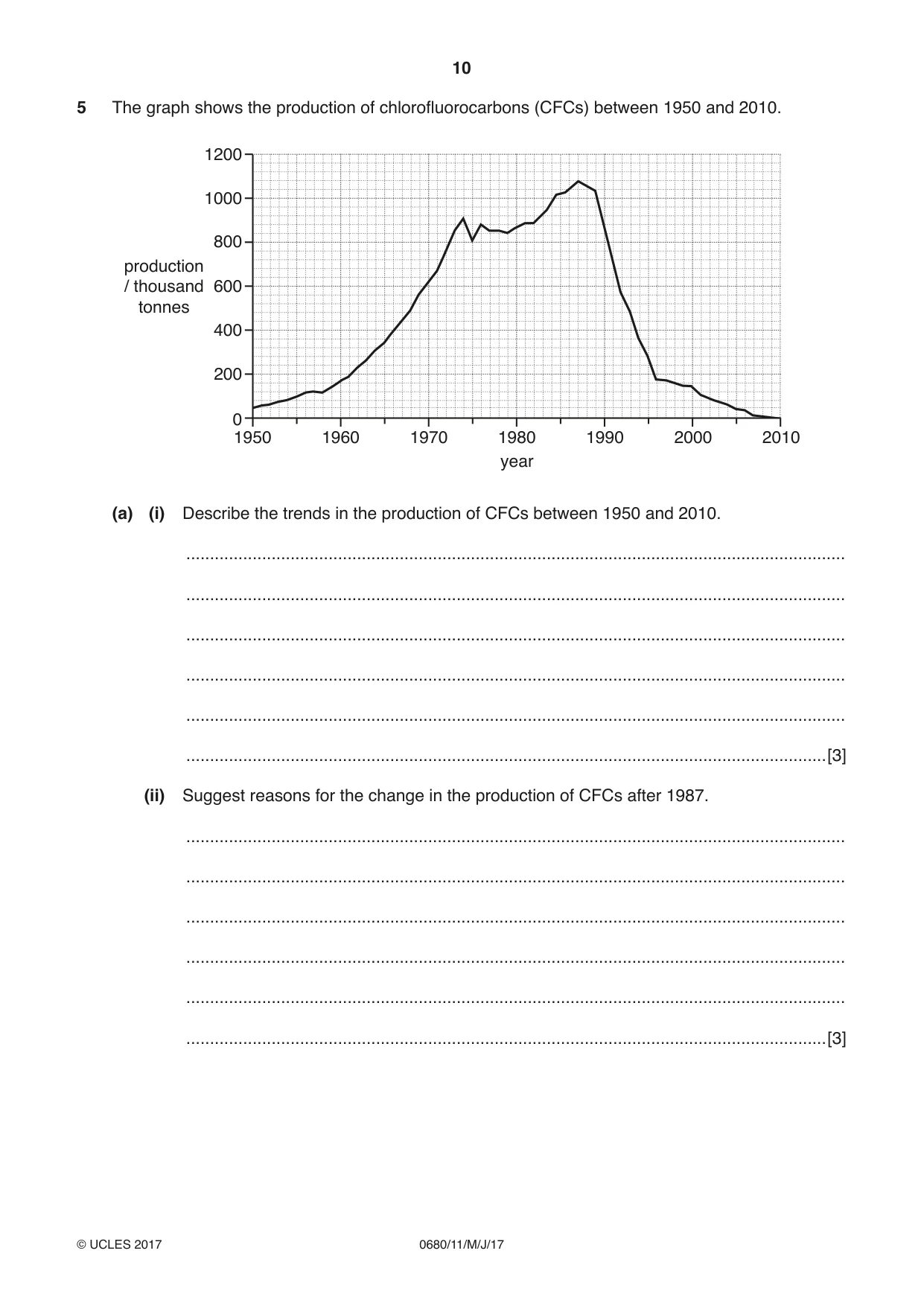
10 0680/11/M/J/17 © UCLES 2017 5 The graph shows the production of chlorofluorocarbons (CFCs) between 1950 and 2010. 0 200 1950 1960 1970 1980 year 1990 2000 2010 400 600 production / thousand tonnes 800 1000 1200 (a) (i) Describe the trends in the production of CFCs between 1950 and 2010. … … … … … …[3] (ii) Suggest reasons for the change in the production of CFCs after 1987. … … … … … …[3]
Question paper, page 11
11 0680/11/M/J/17 © UCLES 2017 [Turn over (b) (i) CFCs are greenhouse gases. Name two other greenhouse gases. … …[1] (ii) Explain how greenhouse gases cause the greenhouse effect. … … … … … …[3]
Question paper, page 12
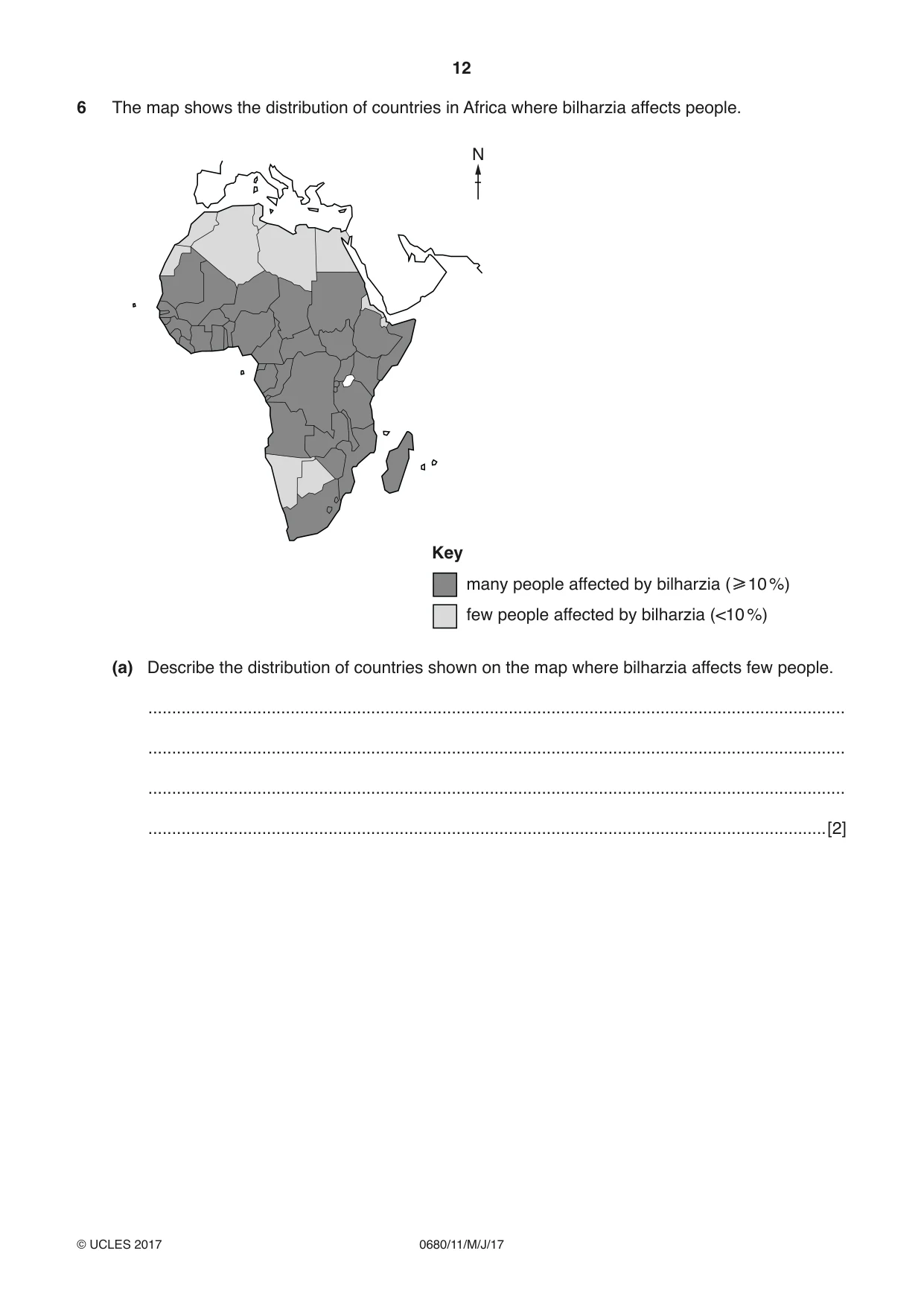
12 0680/11/M/J/17 © UCLES 2017 6 The map shows the distribution of countries in Africa where bilharzia affects people. N Key many people affected by bilharzia (H10 %) few people affected by bilharzia (<10 %) (a) Describe the distribution of countries shown on the map where bilharzia affects few people. … … … …[2]
Question paper, page 13
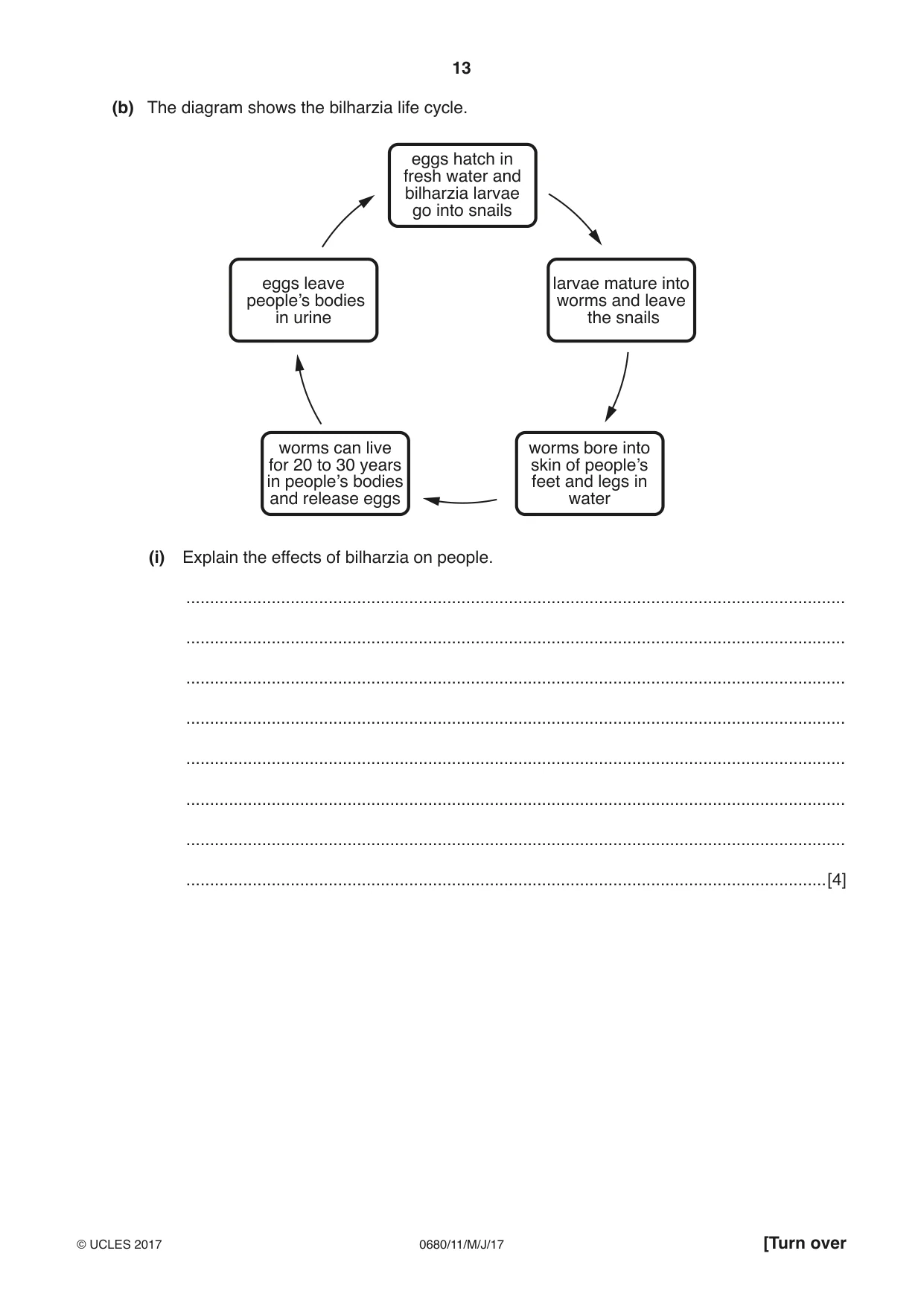
13 0680/11/M/J/17 © UCLES 2017 [Turn over (b) The diagram shows the bilharzia life cycle. eggs hatch in fresh water and bilharzia larvae go into snails larvae mature into worms and leave the snails eggs leave people’s bodies in urine worms can live for 20 to 30 years in people’s bodies and release eggs worms bore into skin of people’s feet and legs in water (i) Explain the effects of bilharzia on people. … … … … … … … …[4]
Question paper, page 14
14 0680/11/M/J/17 © UCLES 2017 (ii) Suggest ways of preventing and controlling the spread of bilharzia. … … … … … … … …[4]
Question paper, page 15
15 0680/11/M/J/17 © UCLES 2017 BLANK PAGE
Question paper, page 16
16 0680/11/M/J/17 © UCLES 2017 Permission to reproduce items where third-party owned material protected by copyright is included has been sought and cleared where possible. Every reasonable effort has been made by the publisher (UCLES) to trace copyright holders, but if any items requiring clearance have unwittingly been included, the publisher will be pleased to make amends at the earliest possible opportunity. To avoid the issue of disclosure of answer-related information to candidates, all copyright acknowledgements are reproduced online in the Cambridge International Examinations Copyright Acknowledgements Booklet. This is produced for each series of examinations and is freely available to download at www.cie.org.uk after the live examination series. Cambridge International Examinations is part of the Cambridge Assessment Group. Cambridge Assessment is the brand name of University of Cambridge Local Examinations Syndicate (UCLES), which is itself a department of the University of Cambridge. BLANK PAGE
Mark scheme, page 1
® IGCSE is a registered trademark. This document consists of 7 printed pages. © UCLES 2017 [Turn over Cambridge International Examinations Cambridge International General Certificate of Secondary Education ENVIRONMENTAL MANAGEMENT 0680/11 Paper 1 May/June 2017 MARK SCHEME Maximum Mark: 60 Published This mark scheme is published as an aid to teachers and candidates, to indicate the requirements of the examination. It shows the basis on which Examiners were instructed to award marks. It does not indicate the details of the discussions that took place at an Examiners’ meeting before marking began, which would have considered the acceptability of alternative answers. Mark schemes should be read in conjunction with the question paper and the Principal Examiner Report for Teachers. Cambridge will not enter into discussions about these mark schemes. Cambridge is publishing the mark schemes for the May/June 2017 series for most Cambridge IGCSE®, Cambridge International A and AS Level and Cambridge Pre-U components, and some Cambridge O Level components.
Mark scheme, page 2
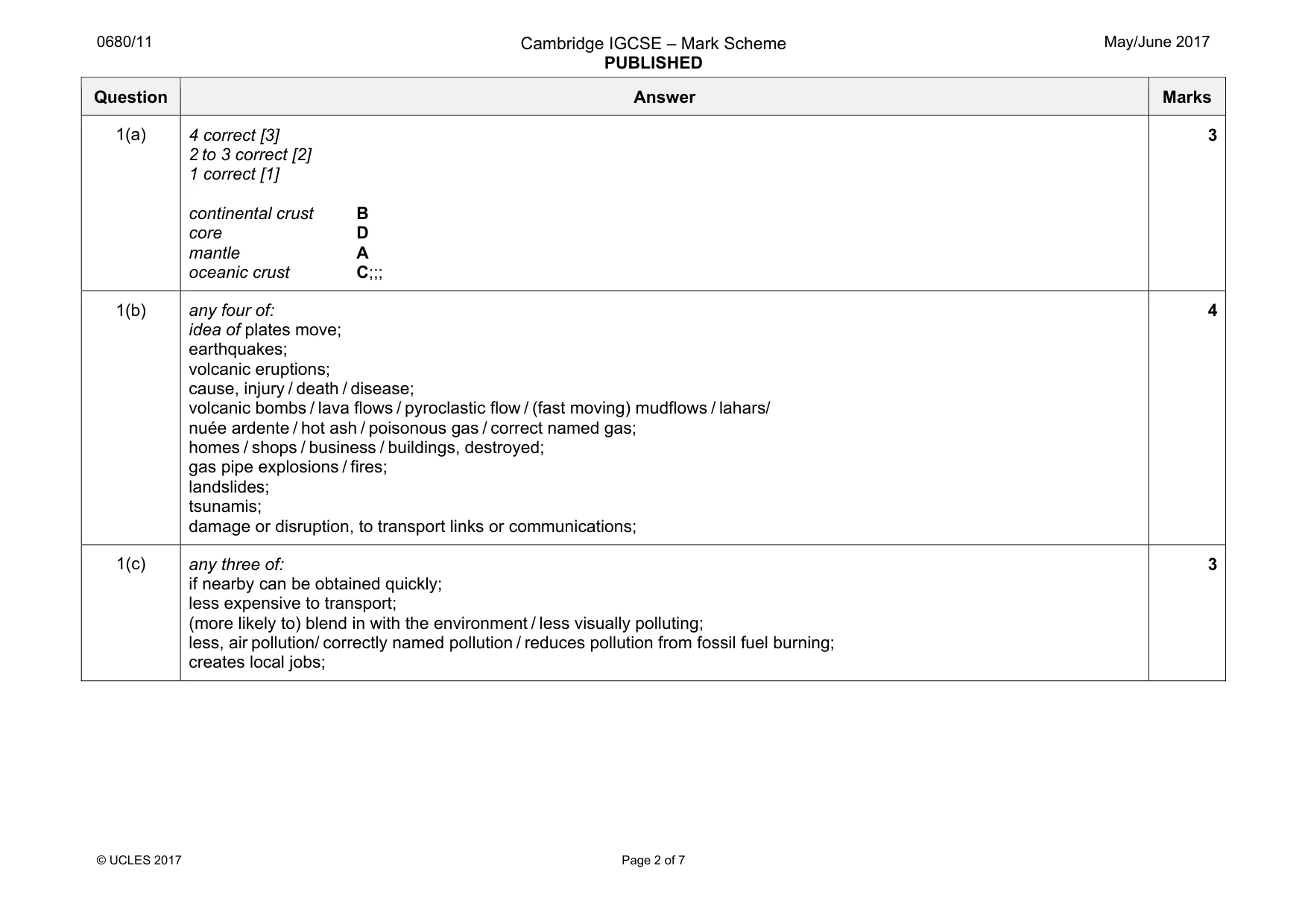
0680/11 Cambridge IGCSE – Mark Scheme PUBLISHED May/June 2017 © UCLES 2017 Page 2 of 7 Question Answer Marks 1(a) 4 correct [3] 2 to 3 correct [2] 1 correct [1] continental crust B core D mantle A oceanic crust C;;; 3 1(b) any four of: idea of plates move; earthquakes; volcanic eruptions; cause, injury / death / disease; volcanic bombs / lava flows / pyroclastic flow / (fast moving) mudflows / lahars/ nuée ardente / hot ash / poisonous gas / correct named gas; homes / shops / business / buildings, destroyed; gas pipe explosions / fires; landslides; tsunamis; damage or disruption, to transport links or communications; 4 1(c) any three of: if nearby can be obtained quickly; less expensive to transport; (more likely to) blend in with the environment / less visually polluting; less, air pollution/ correctly named pollution / reduces pollution from fossil fuel burning; creates local jobs; 3
Mark scheme, page 3
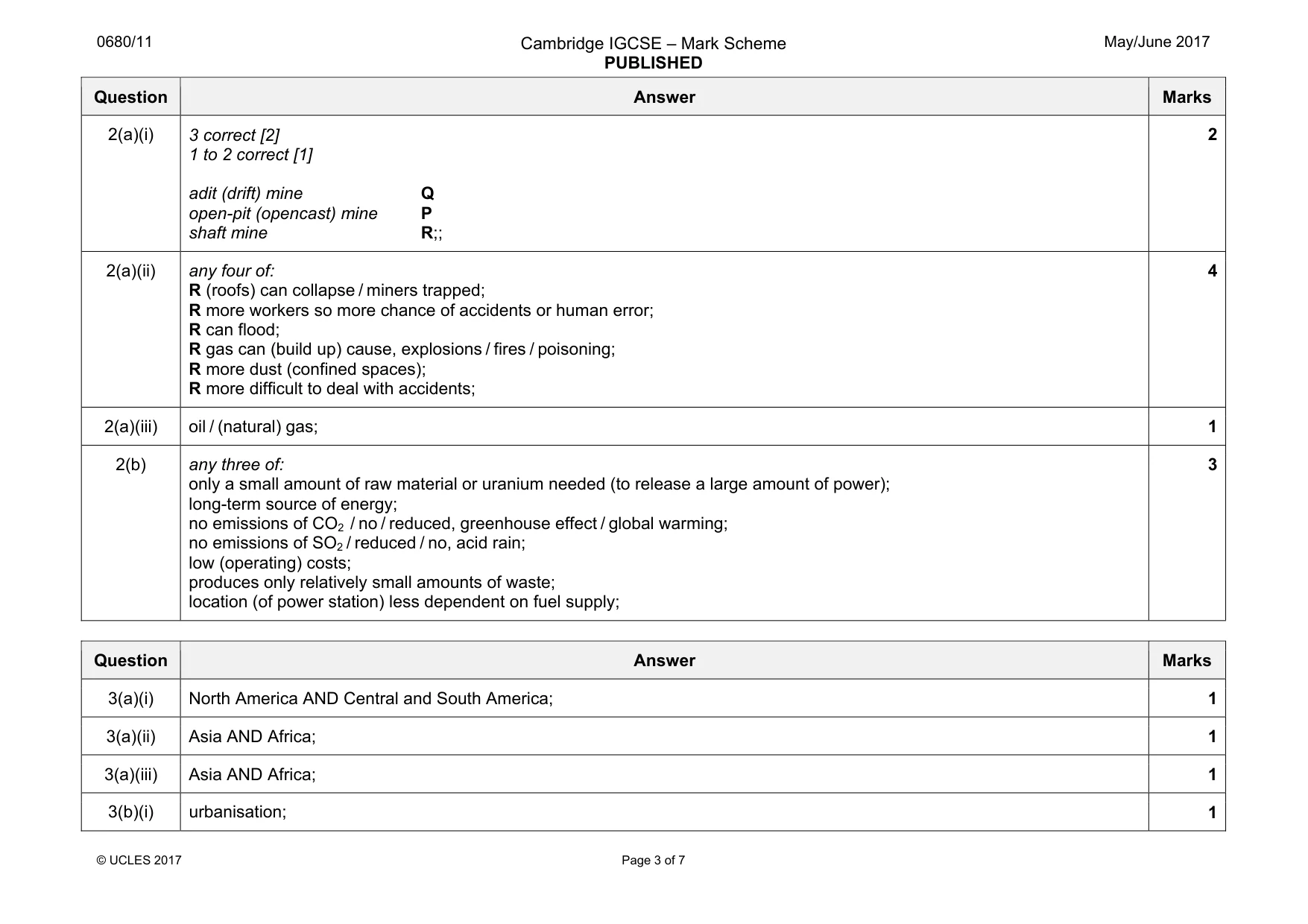
0680/11 Cambridge IGCSE – Mark Scheme PUBLISHED May/June 2017 © UCLES 2017 Page 3 of 7 Question Answer Marks 2(a)(i) 3 correct [2] 1 to 2 correct [1] adit (drift) mine Q open-pit (opencast) mine P shaft mine R;; 2 2(a)(ii) any four of: R (roofs) can collapse / miners trapped; R more workers so more chance of accidents or human error; R can flood; R gas can (build up) cause, explosions / fires / poisoning; R more dust (confined spaces); R more difficult to deal with accidents; 4 2(a)(iii) oil / (natural) gas; 1 2(b) any three of: only a small amount of raw material or uranium needed (to release a large amount of power); long-term source of energy; no emissions of CO2 / no / reduced, greenhouse effect / global warming; no emissions of SO2 / reduced / no, acid rain; low (operating) costs; produces only relatively small amounts of waste; location (of power station) less dependent on fuel supply; 3 Question Answer Marks 3(a)(i) North America AND Central and South America; 1 3(a)(ii) Asia AND Africa; 1 3(a)(iii) Asia AND Africa; 1 3(b)(i) urbanisation; 1
Mark scheme, page 4
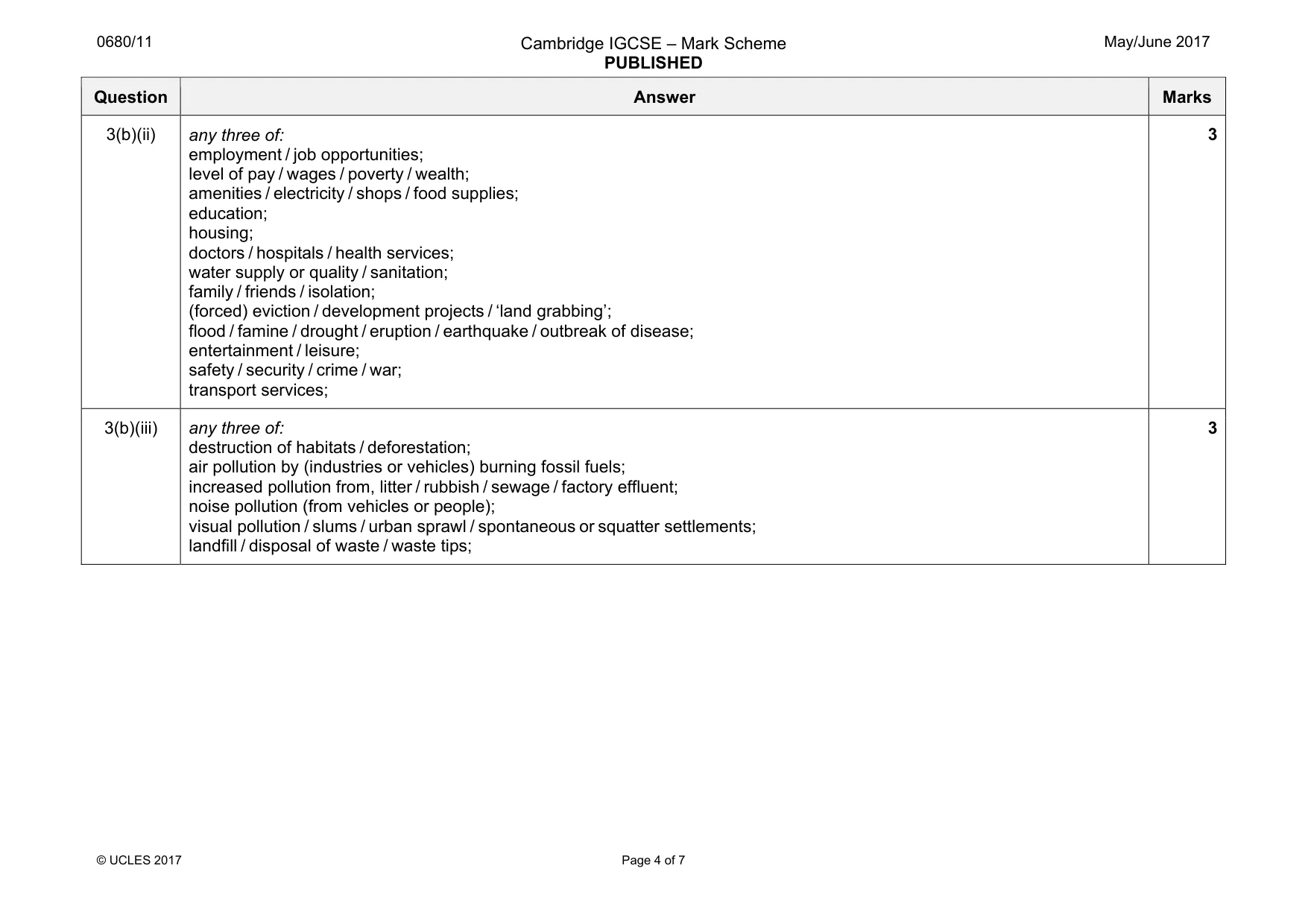
0680/11 Cambridge IGCSE – Mark Scheme PUBLISHED May/June 2017 © UCLES 2017 Page 4 of 7 Question Answer Marks 3(b)(ii) any three of: employment / job opportunities; level of pay / wages / poverty / wealth; amenities / electricity / shops / food supplies; education; housing; doctors / hospitals / health services; water supply or quality / sanitation; family / friends / isolation; (forced) eviction / development projects / ‘land grabbing’; flood / famine / drought / eruption / earthquake / outbreak of disease; entertainment / leisure; safety / security / crime / war; transport services; 3 3(b)(iii) any three of: destruction of habitats / deforestation; air pollution by (industries or vehicles) burning fossil fuels; increased pollution from, litter / rubbish / sewage / factory effluent; noise pollution (from vehicles or people); visual pollution / slums / urban sprawl / spontaneous or squatter settlements; landfill / disposal of waste / waste tips; 3
Mark scheme, page 5
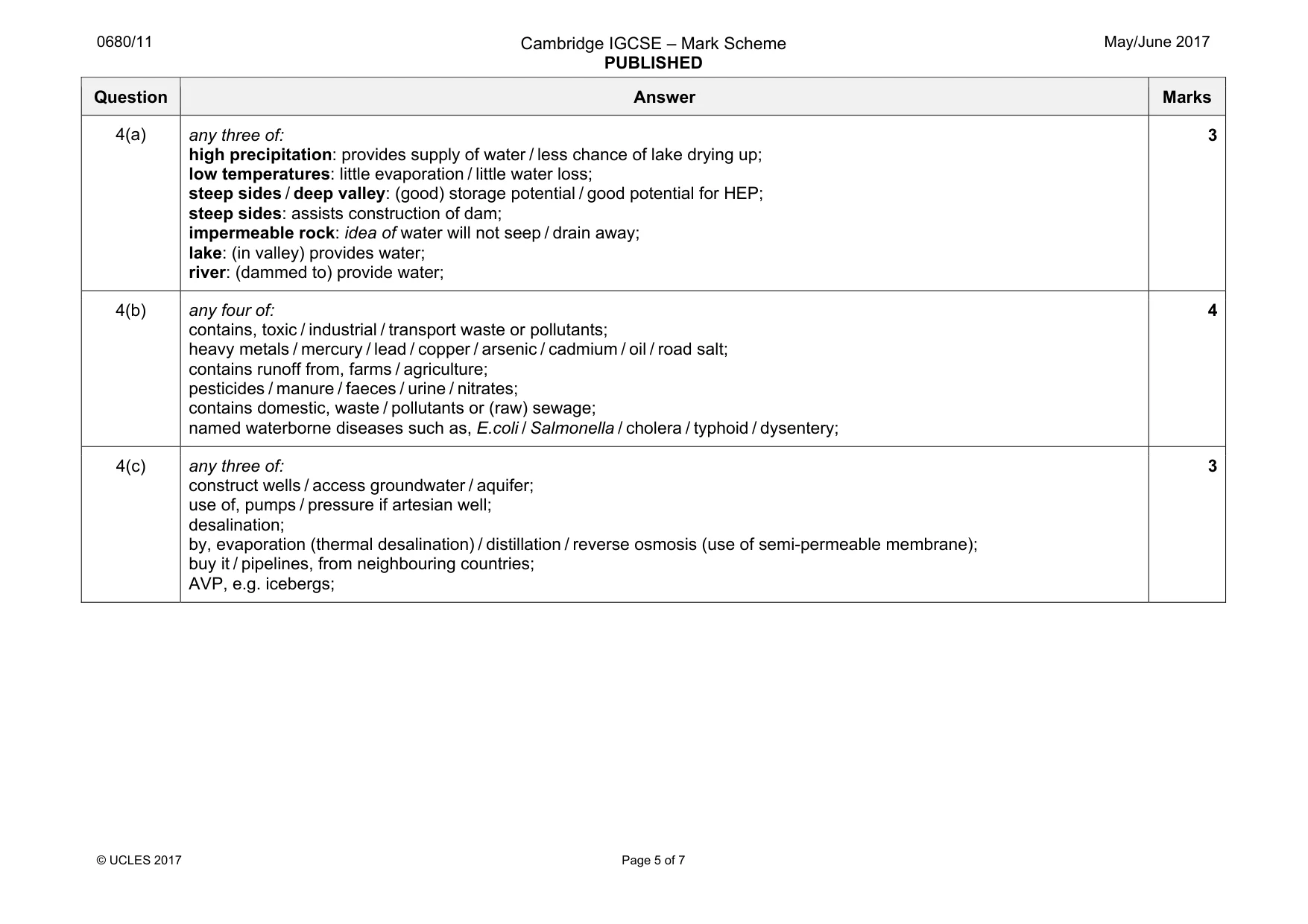
0680/11 Cambridge IGCSE – Mark Scheme PUBLISHED May/June 2017 © UCLES 2017 Page 5 of 7 Question Answer Marks 4(a) any three of: high precipitation: provides supply of water / less chance of lake drying up; low temperatures: little evaporation / little water loss; steep sides / deep valley: (good) storage potential / good potential for HEP; steep sides: assists construction of dam; impermeable rock: idea of water will not seep / drain away; lake: (in valley) provides water; river: (dammed to) provide water; 3 4(b) any four of: contains, toxic / industrial / transport waste or pollutants; heavy metals / mercury / lead / copper / arsenic / cadmium / oil / road salt; contains runoff from, farms / agriculture; pesticides / manure / faeces / urine / nitrates; contains domestic, waste / pollutants or (raw) sewage; named waterborne diseases such as, E.coli / Salmonella / cholera / typhoid / dysentery; 4 4(c) any three of: construct wells / access groundwater / aquifer; use of, pumps / pressure if artesian well; desalination; by, evaporation (thermal desalination) / distillation / reverse osmosis (use of semi-permeable membrane); buy it / pipelines, from neighbouring countries; AVP, e.g. icebergs; 3
Mark scheme, page 6
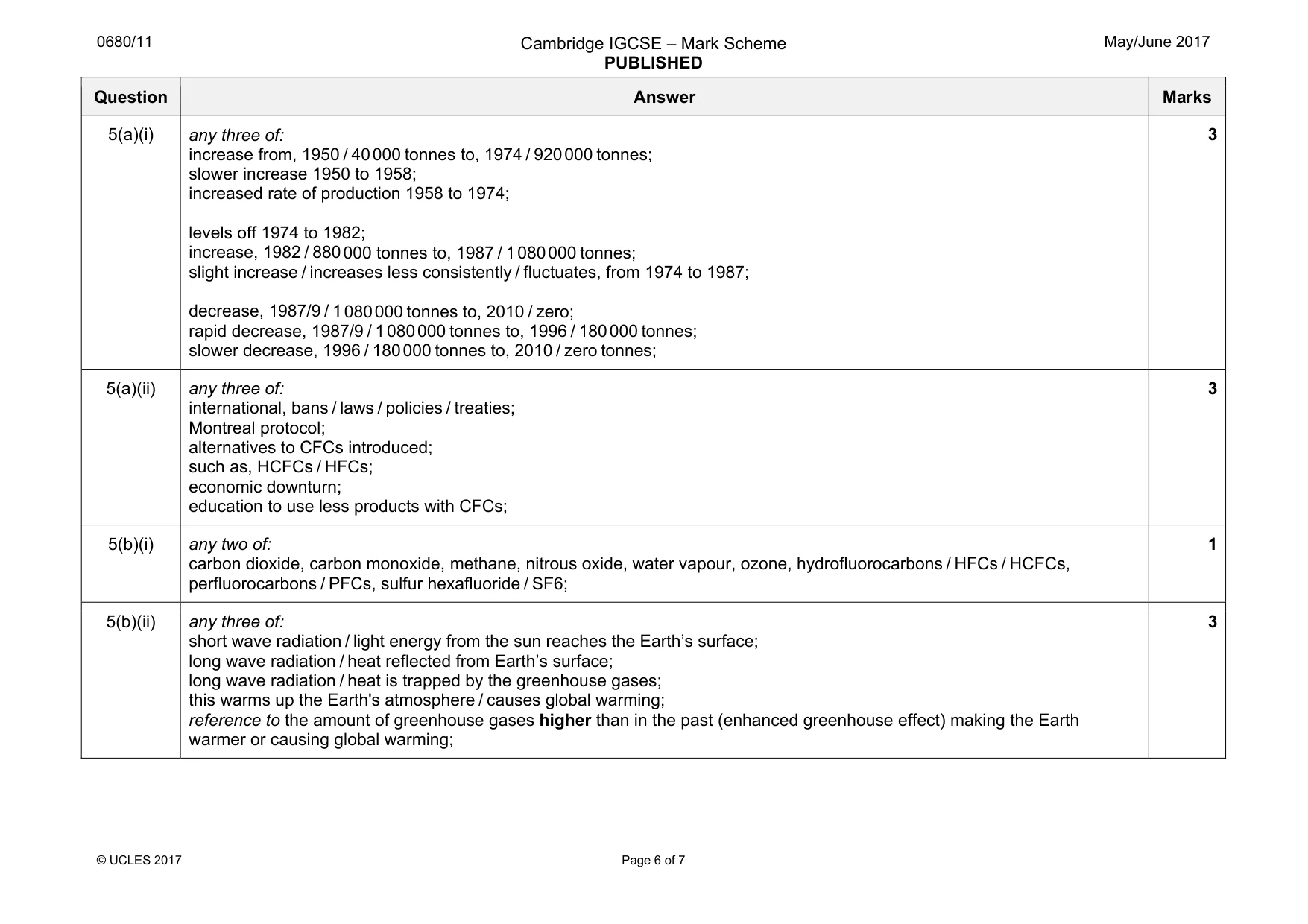
0680/11 Cambridge IGCSE – Mark Scheme PUBLISHED May/June 2017 © UCLES 2017 Page 6 of 7 Question Answer Marks 5(a)(i) any three of: increase from, 1950 / 40 000 tonnes to, 1974 / 920 000 tonnes; slower increase 1950 to 1958; increased rate of production 1958 to 1974; levels off 1974 to 1982; increase, 1982 / 880 000 tonnes to, 1987 / 1 080 000 tonnes; slight increase / increases less consistently / fluctuates, from 1974 to 1987; decrease, 1987/9 / 1 080 000 tonnes to, 2010 / zero; rapid decrease, 1987/9 / 1 080 000 tonnes to, 1996 / 180 000 tonnes; slower decrease, 1996 / 180000 tonnes to, 2010 / zero tonnes; 3 5(a)(ii) any three of: international, bans / laws / policies / treaties; Montreal protocol; alternatives to CFCs introduced; such as, HCFCs / HFCs; economic downturn; education to use less products with CFCs; 3 5(b)(i) any two of: carbon dioxide, carbon monoxide, methane, nitrous oxide, water vapour, ozone, hydrofluorocarbons / HFCs / HCFCs, perfluorocarbons / PFCs, sulfur hexafluoride / SF6; 1 5(b)(ii) any three of: short wave radiation / light energy from the sun reaches the Earth’s surface; long wave radiation / heat reflected from Earth’s surface; long wave radiation / heat is trapped by the greenhouse gases; this warms up the Earth's atmosphere / causes global warming; reference to the amount of greenhouse gases higher than in the past (enhanced greenhouse effect) making the Earth warmer or causing global warming; 3
Mark scheme, page 7
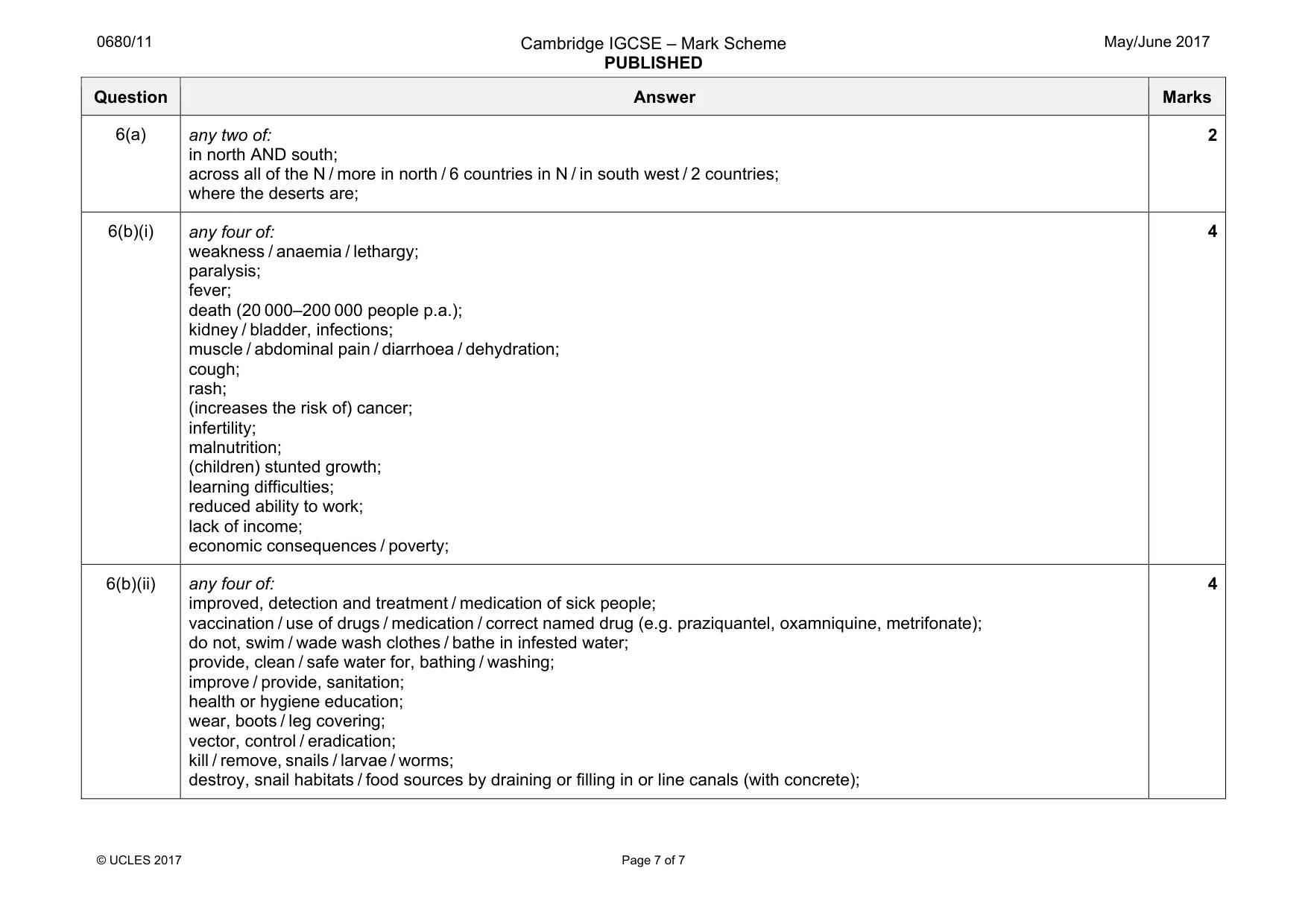
0680/11 Cambridge IGCSE – Mark Scheme PUBLISHED May/June 2017 © UCLES 2017 Page 7 of 7 Question Answer Marks 6(a) any two of: in north AND south; across all of the N / more in north / 6 countries in N / in south west / 2 countries; where the deserts are; 2 6(b)(i) any four of: weakness / anaemia / lethargy; paralysis; fever; death (20 000–200 000 people p.a.); kidney / bladder, infections; muscle / abdominal pain / diarrhoea / dehydration; cough; rash; (increases the risk of) cancer; infertility; malnutrition; (children) stunted growth; learning difficulties; reduced ability to work; lack of income; economic consequences / poverty; 4 6(b)(ii) any four of: improved, detection and treatment / medication of sick people; vaccination / use of drugs / medication / correct named drug (e.g. praziquantel, oxamniquine, metrifonate); do not, swim / wade wash clothes / bathe in infested water; provide, clean / safe water for, bathing / washing; improve / provide, sanitation; health or hygiene education; wear, boots / leg covering; vector, control / eradication; kill / remove, snails / larvae / worms; destroy, snail habitats / food sources by draining or filling in or line canals (with concrete); 4
What you needed in this session
Cambridge’s own grade thresholds for 2017 May/June, Paper 1 · Variant 1. A higher threshold means an easier paper — the bar moves with how the cohort did.