Cambridge IGCSE Environmental Management 0680 — 2016 Oct/Nov Paper 1 · Variant 2
0680/12/O/N/16 · 60 marks · ≈68 min
The question paper and its mark scheme, free to read here and free to download. This is Cambridge’s own paper, exactly as it was sat.
Question paper16 pages


Mark scheme8 pages
Answers below. Sit the paper first if you are practising.
Paper as text
Question paper, page 1
This document consists of 13 printed pages and 3 blank pages. DC (NH/JG) 114895/5 © UCLES 2016 [Turn over * 7 2 7 6 6 9 4 0 0 4 * ENVIRONMENTAL MANAGEMENT 0680/12 Paper 1 October/November 2016 1 hour 30 minutes Candidates answer on the Question Paper. No Additional Materials are required. READ THESE INSTRUCTIONS FIRST Write your Centre number, candidate number and name on all the work you hand in. Write in dark blue or black pen. You may use an HB pencil for any diagrams or graphs. Do not use staples, paper clips, glue or correction fluid. DO NOT WRITE IN ANY BARCODES. Answer all questions. Electronic calculators may be used. You may lose marks if you do not show your working or if you do not use appropriate units. At the end of the examination, fasten all your work securely together. The number of marks is given in brackets [ ] at the end of each question or part question. Cambridge International Examinations Cambridge International General Certificate of Secondary Education
Question paper, page 2
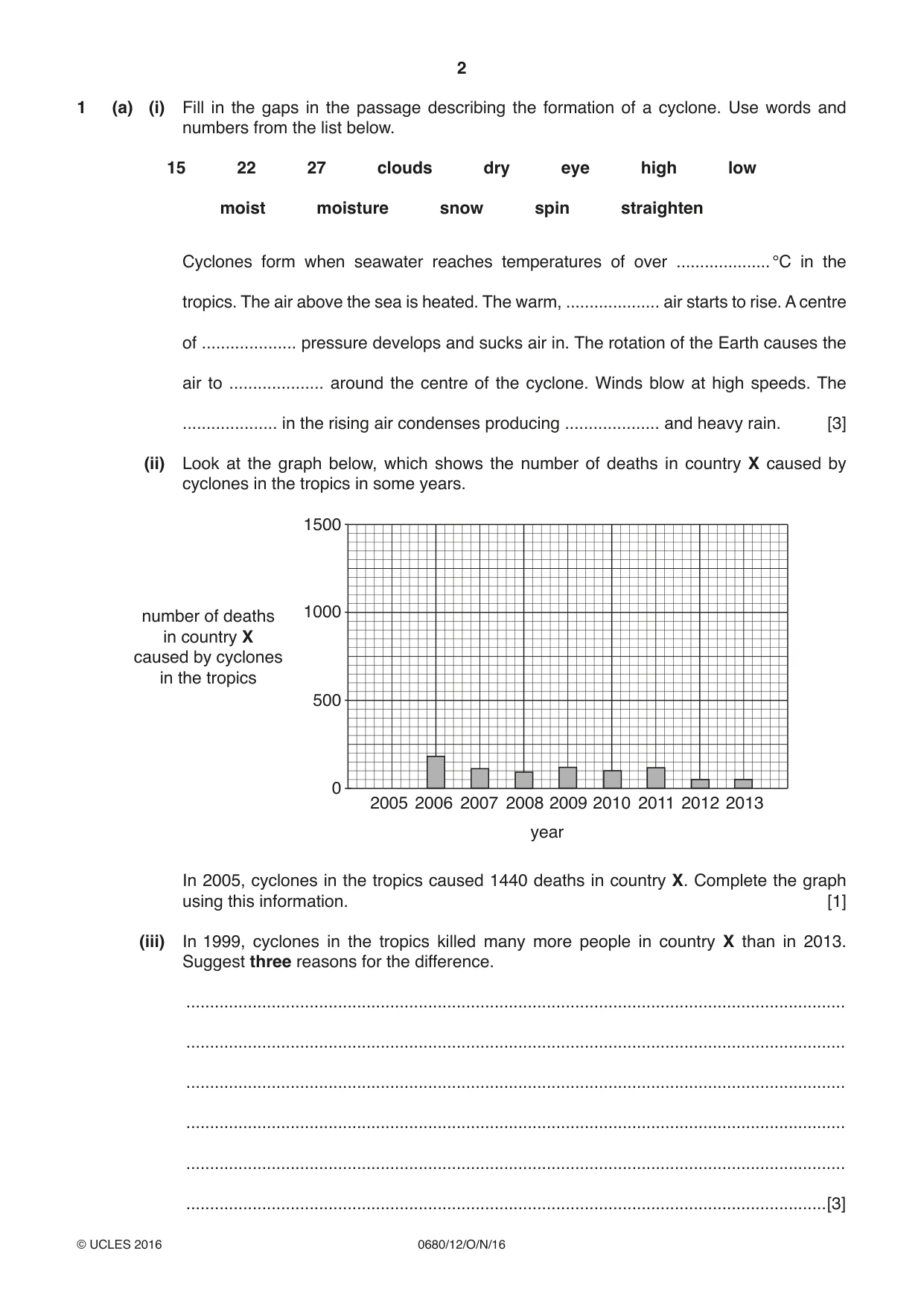
2 0680/12/O/N/16 © UCLES 2016 1 (a) (i) Fill in the gaps in the passage describing the formation of a cyclone. Use words and numbers from the list below. 15 22 27 clouds dry eye high low moist moisture snow spin straighten Cyclones form when seawater reaches temperatures of over … °C in the tropics. The air above the sea is heated. The warm, … air starts to rise. A centre of … pressure develops and sucks air in. The rotation of the Earth causes the air to … around the centre of the cyclone. Winds blow at high speeds. The … in the rising air condenses producing … and heavy rain. [3] (ii) Look at the graph below, which shows the number of deaths in country X caused by cyclones in the tropics in some years. 2005 0 500 1000 1500 2006 2007 2008 2009 2010 2011 2012 2013 number of deaths in country X caused by cyclones in the tropics year In 2005, cyclones in the tropics caused 1440 deaths in country X. Complete the graph using this information. [1] (iii) In 1999, cyclones in the tropics killed many more people in country X than in 2013. Suggest three reasons for the difference. … … … … … …[3]
Question paper, page 3
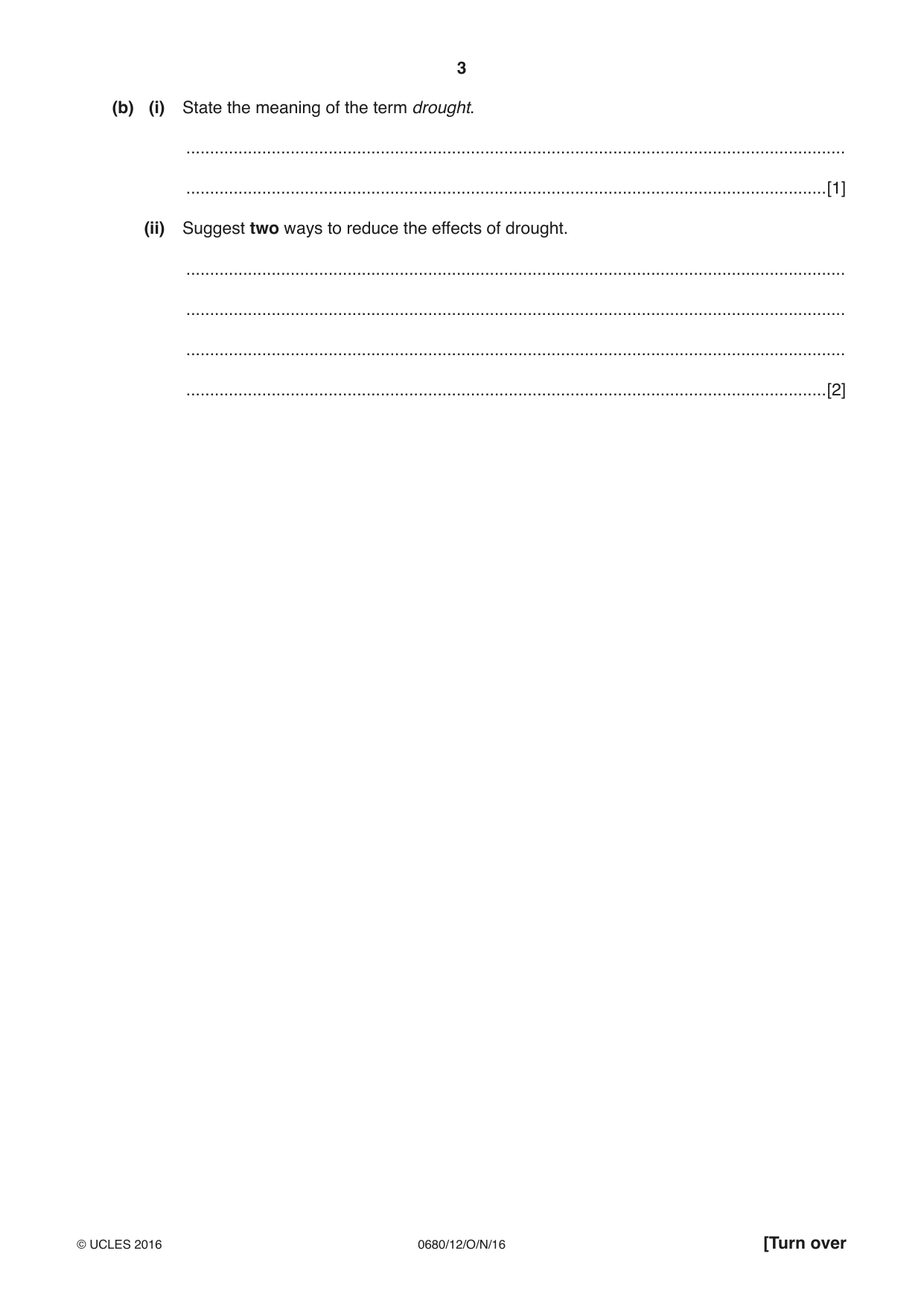
3 0680/12/O/N/16 © UCLES 2016 [Turn over (b) (i) State the meaning of the term drought. … …[1] (ii) Suggest two ways to reduce the effects of drought. … … … …[2]
Question paper, page 4
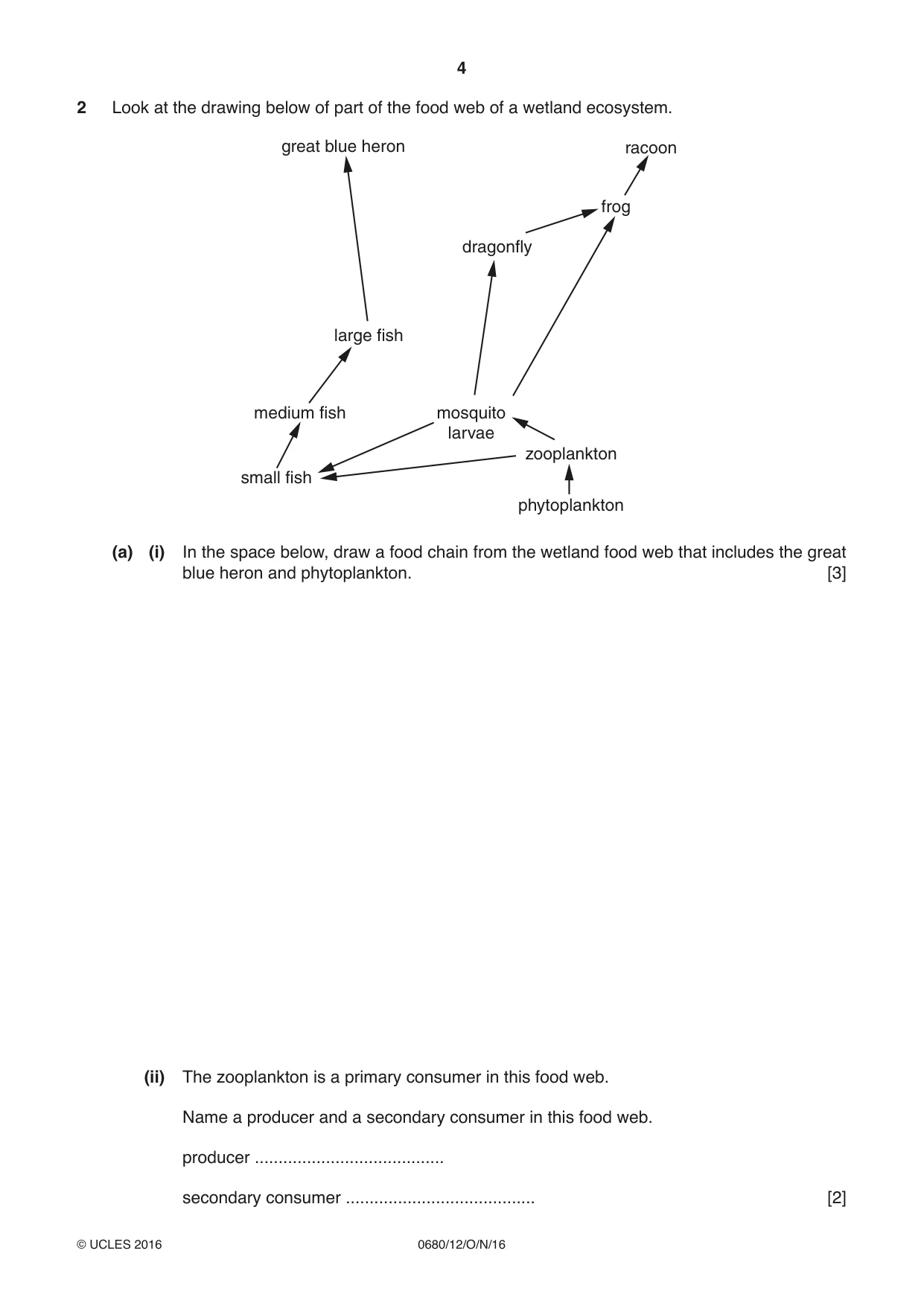
4 0680/12/O/N/16 © UCLES 2016 2 Look at the drawing below of part of the food web of a wetland ecosystem. great blue heron large fish medium fish small fish zooplankton phytoplankton mosquito larvae racoon dragonfly frog (a) (i) In the space below, draw a food chain from the wetland food web that includes the great blue heron and phytoplankton. [3] [3] (ii) The zooplankton is a primary consumer in this food web. Name a producer and a secondary consumer in this food web. producer … secondary consumer … [2]
Question paper, page 5
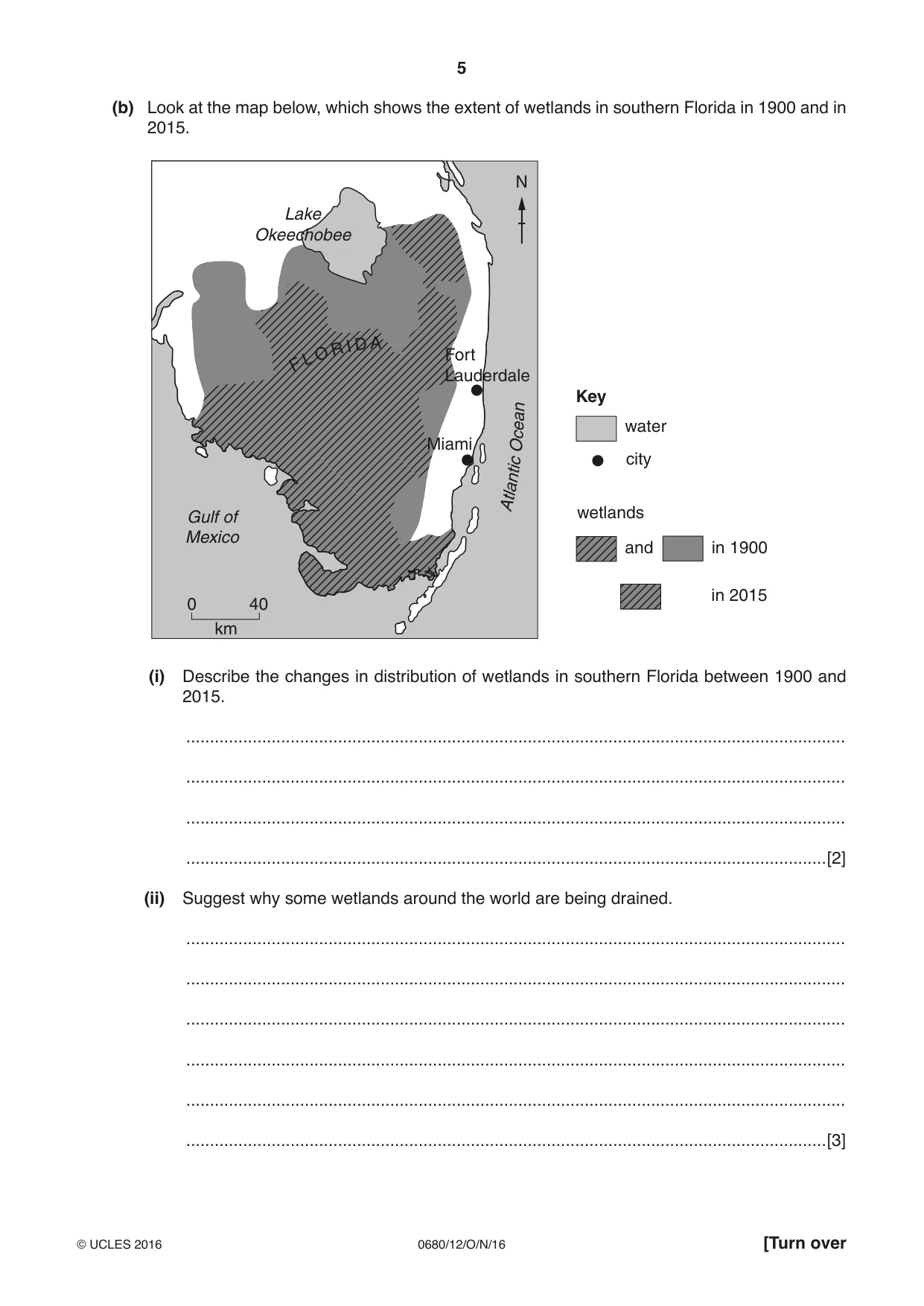
5 0680/12/O/N/16 © UCLES 2016 [Turn over (b) Look at the map below, which shows the extent of wetlands in southern Florida in 1900 and in 2015. wetlands in 1900 and water city in 2015 Key Gulf of Mexico Atl ant ic O cea n Lake Okeechobee F L O R I D A 0 40 km Fort Lauderdale Miami N (i) Describe the changes in distribution of wetlands in southern Florida between 1900 and 2015. … … … …[2] (ii) Suggest why some wetlands around the world are being drained. … … … … … …[3]
Question paper, page 6
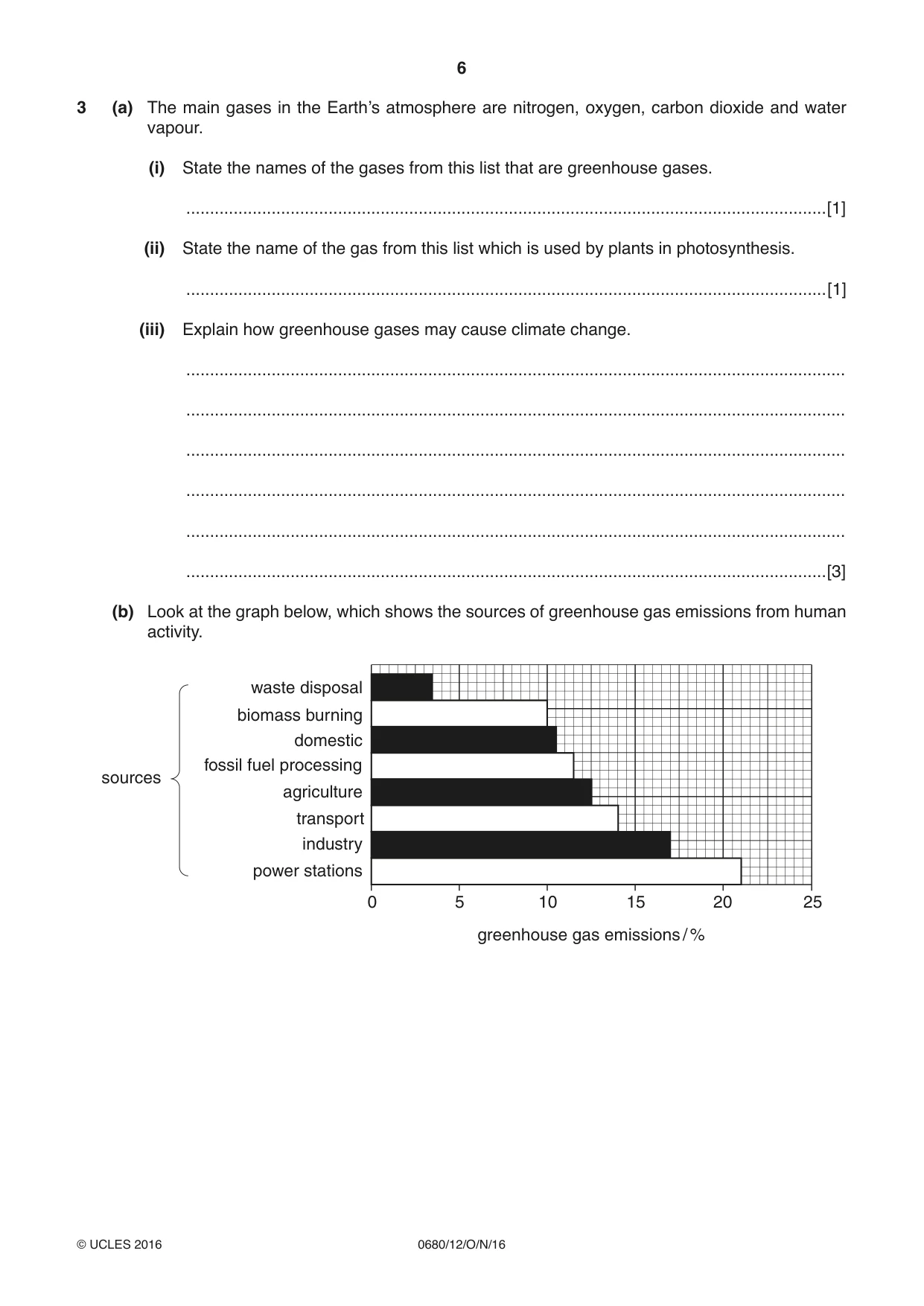
6 0680/12/O/N/16 © UCLES 2016 3 (a) The main gases in the Earth’s atmosphere are nitrogen, oxygen, carbon dioxide and water vapour. (i) State the names of the gases from this list that are greenhouse gases. …[1] (ii) State the name of the gas from this list which is used by plants in photosynthesis. …[1] (iii) Explain how greenhouse gases may cause climate change. … … … … … …[3] (b) Look at the graph below, which shows the sources of greenhouse gas emissions from human activity. 0 5 10 15 20 25 transport waste disposal biomass burning domestic fossil fuel processing agriculture industry power stations sources greenhouse gas emissions / %
Question paper, page 7
7 0680/12/O/N/16 © UCLES 2016 [Turn over (i) A textbook states, ‘Over 50% of greenhouse gas emissions come from transport, industry and power stations.’ Use the information in the graph to decide if the textbook statement is true or false. Explain your answer. … … … …[2] (ii) Suggest three ways in which the emission of greenhouse gases from transport could be reduced. … … … … … …[3]
Question paper, page 8
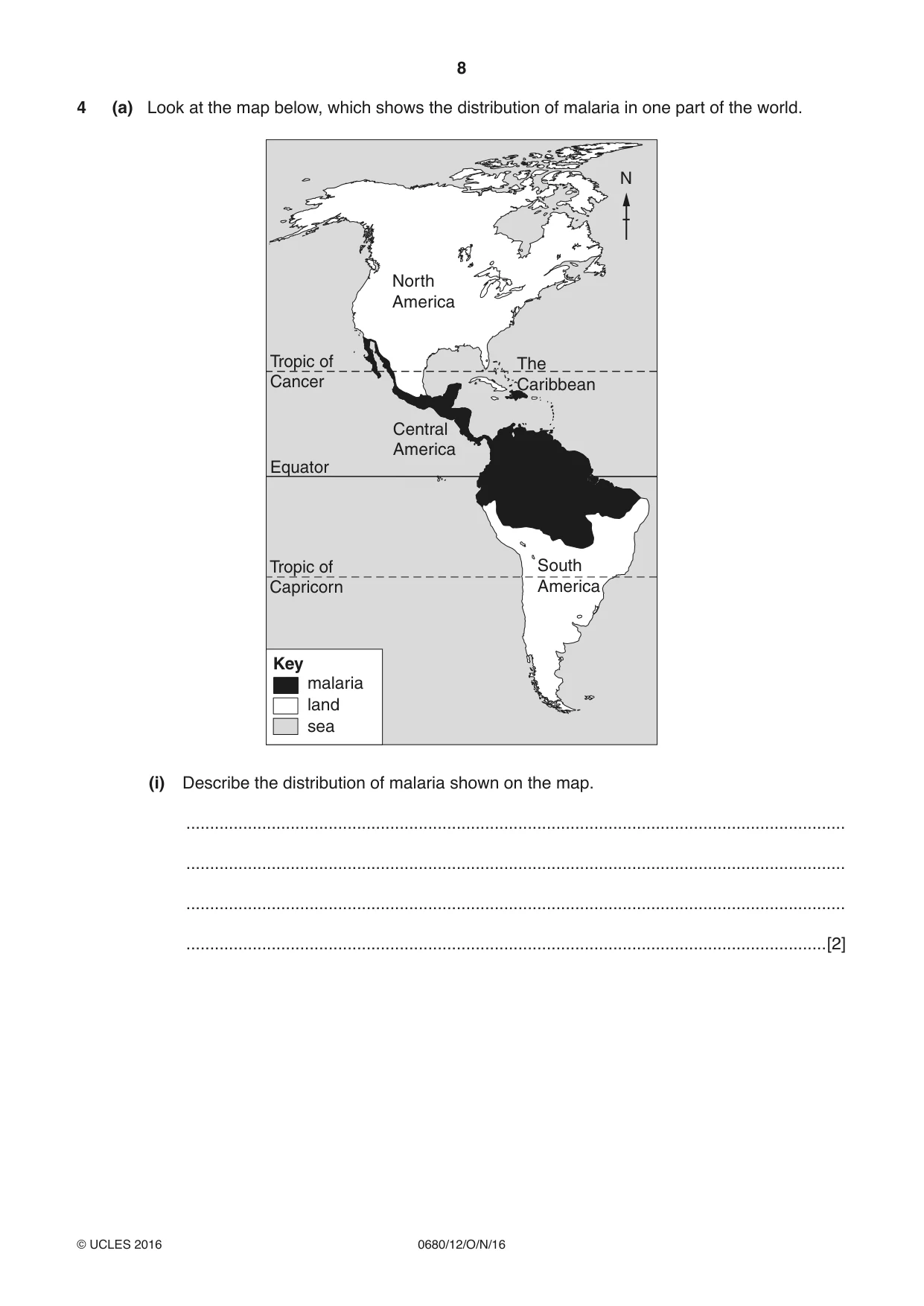
8 0680/12/O/N/16 © UCLES 2016 4 (a) Look at the map below, which shows the distribution of malaria in one part of the world. Equator Tropic of Capricorn Tropic of Cancer N South America North America Central America The Caribbean Key malaria land sea (i) Describe the distribution of malaria shown on the map. … … … …[2]
Question paper, page 9
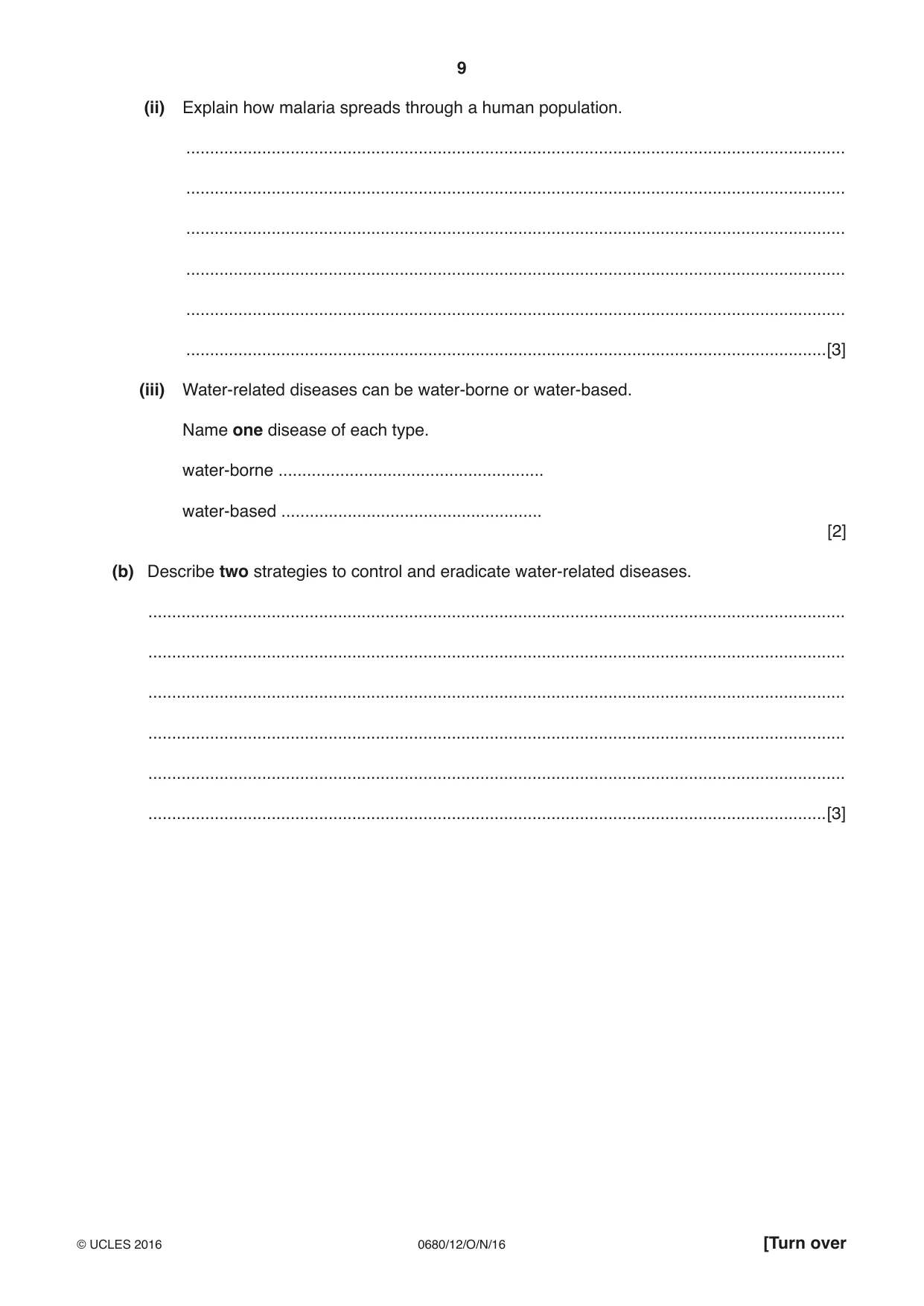
9 0680/12/O/N/16 © UCLES 2016 [Turn over (ii) Explain how malaria spreads through a human population. … … … … … …[3] (iii) Water-related diseases can be water-borne or water-based. Name one disease of each type. water-borne … water-based … [2] (b) Describe two strategies to control and eradicate water-related diseases. … … … … … …[3]
Question paper, page 10
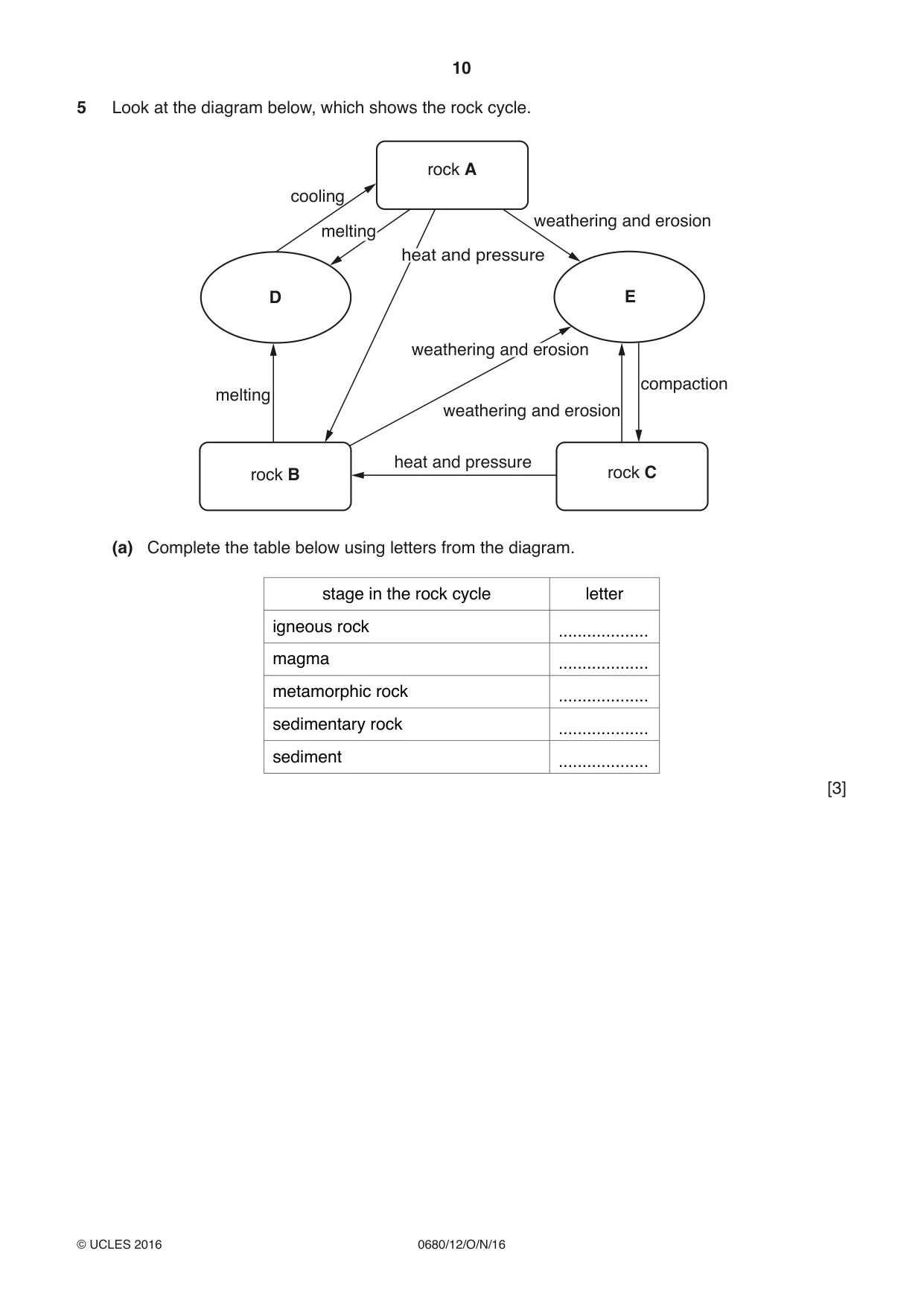
10 0680/12/O/N/16 © UCLES 2016 5 Look at the diagram below, which shows the rock cycle. rock A rock B rock C E D heat and pressure weathering and erosion weathering and erosion melting cooling compaction weathering and erosion heat and pressure melting (a) Complete the table below using letters from the diagram. stage in the rock cycle letter igneous rock … magma … metamorphic rock … sedimentary rock … sediment … [3]
Question paper, page 11
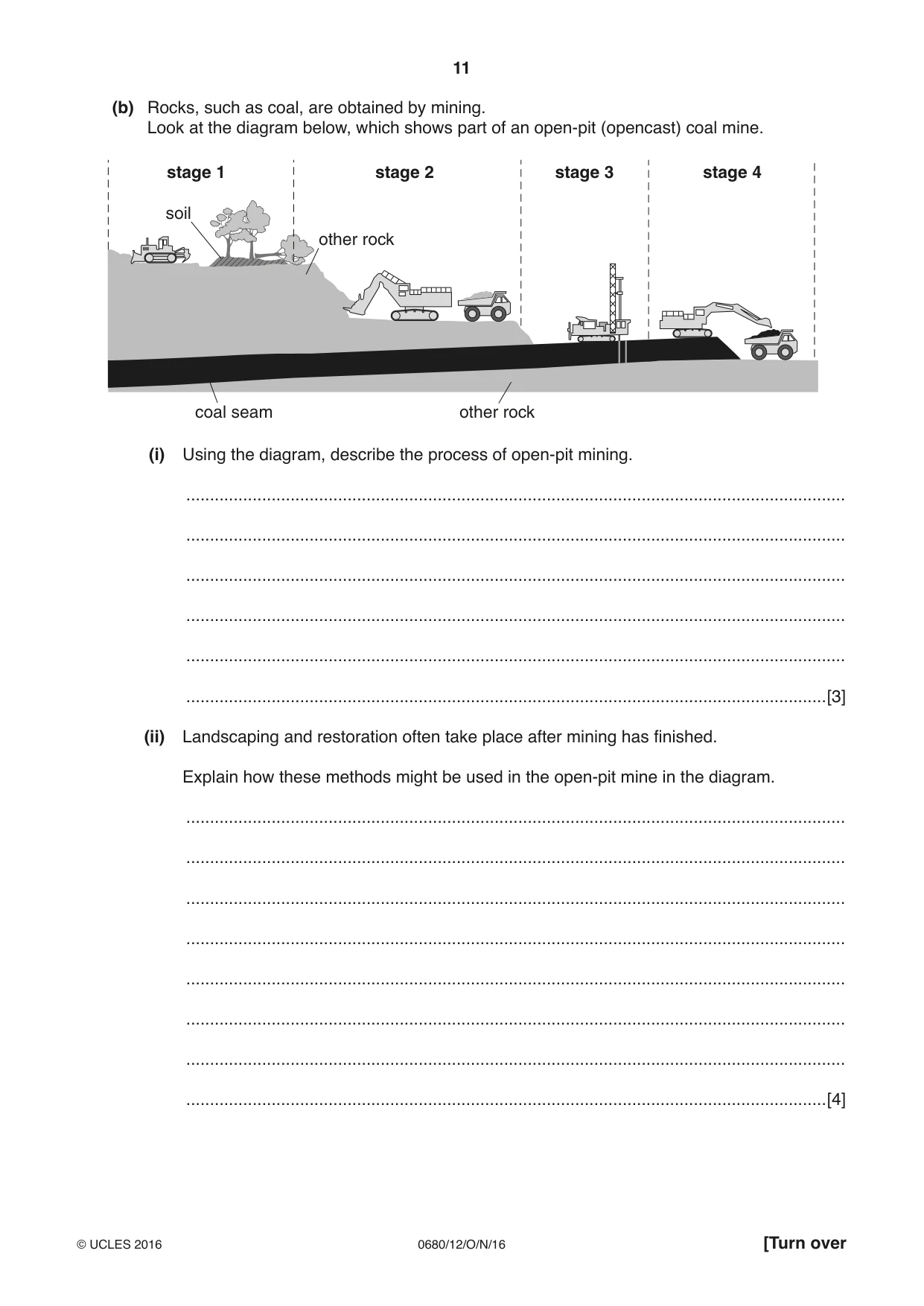
11 0680/12/O/N/16 © UCLES 2016 [Turn over (b) Rocks, such as coal, are obtained by mining. Look at the diagram below, which shows part of an open-pit (opencast) coal mine. stage 1 stage 2 stage 3 stage 4 coal seam other rock soil other rock (i) Using the diagram, describe the process of open-pit mining. … … … … … …[3] (ii) Landscaping and restoration often take place after mining has finished. Explain how these methods might be used in the open-pit mine in the diagram. … … … … … … … …[4]
Question paper, page 12
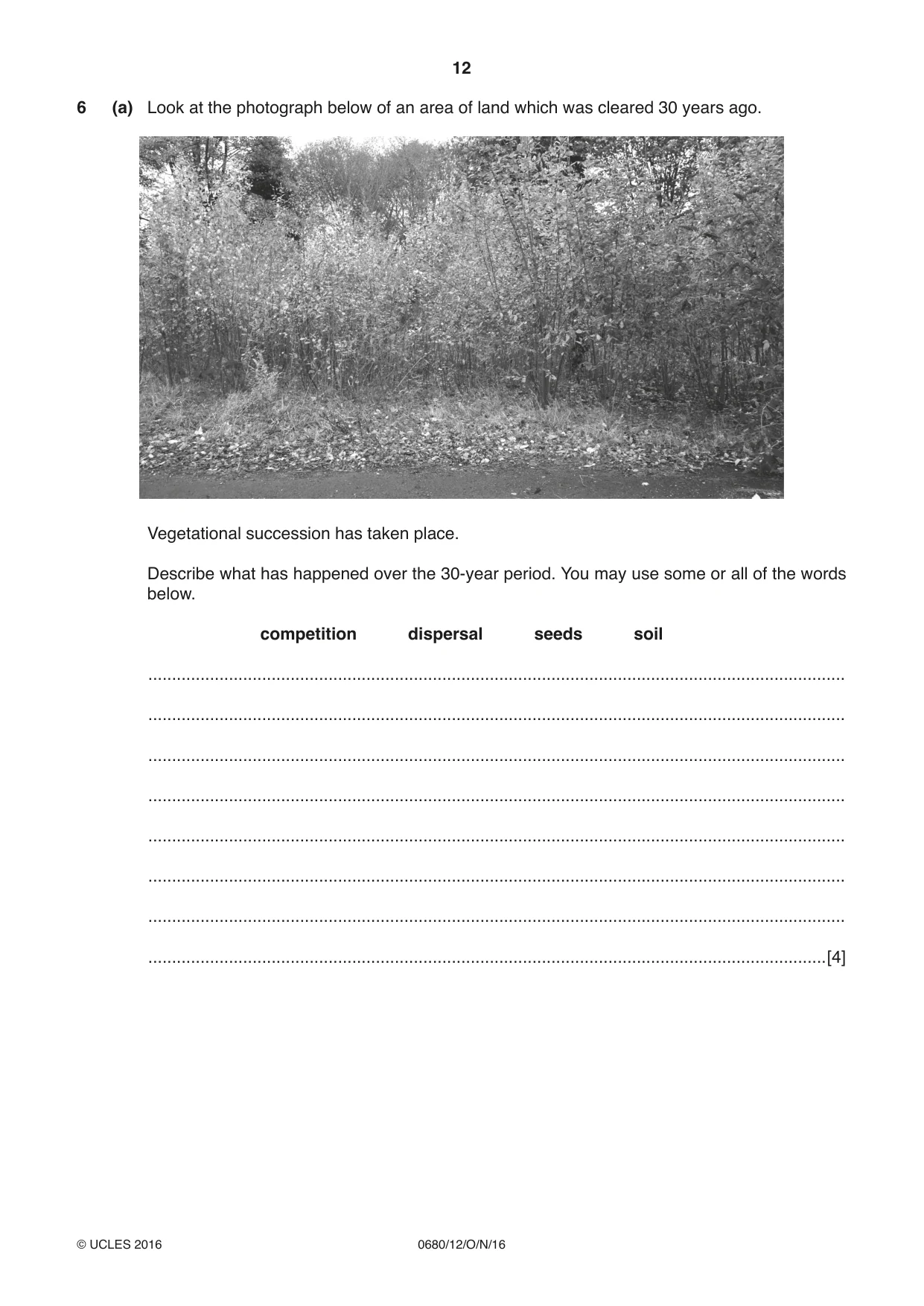
12 0680/12/O/N/16 © UCLES 2016 6 (a) Look at the photograph below of an area of land which was cleared 30 years ago. Vegetational succession has taken place. Describe what has happened over the 30-year period. You may use some or all of the words below. competition dispersal seeds soil … … … … … … … …[4]
Question paper, page 13
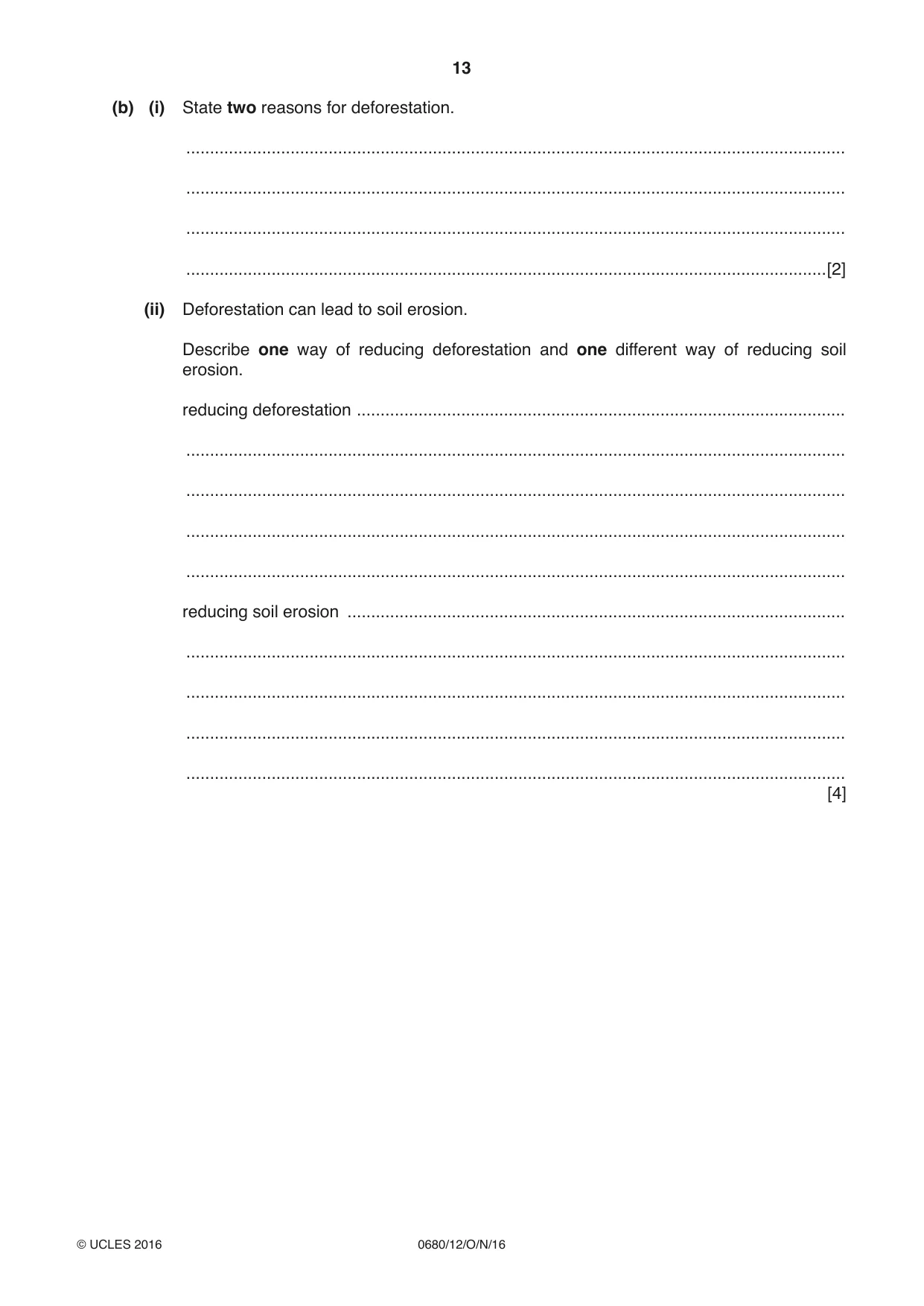
13 0680/12/O/N/16 © UCLES 2016 (b) (i) State two reasons for deforestation. … … … …[2] (ii) Deforestation can lead to soil erosion. Describe one way of reducing deforestation and one different way of reducing soil erosion. reducing deforestation … … … … … reducing soil erosion … … … … … [4]
Question paper, page 14
14 0680/12/O/N/16 © UCLES 2016 BLANK PAGE
Question paper, page 15
15 0680/12/O/N/16 © UCLES 2016 BLANK PAGE
Question paper, page 16
16 0680/12/O/N/16 © UCLES 2016 Permission to reproduce items where third-party owned material protected by copyright is included has been sought and cleared where possible. Every reasonable effort has been made by the publisher (UCLES) to trace copyright holders, but if any items requiring clearance have unwittingly been included, the publisher will be pleased to make amends at the earliest possible opportunity. To avoid the issue of disclosure of answer-related information to candidates, all copyright acknowledgements are reproduced online in the Cambridge International Examinations Copyright Acknowledgements Booklet. This is produced for each series of examinations and is freely available to download at www.cie.org.uk after the live examination series. Cambridge International Examinations is part of the Cambridge Assessment Group. Cambridge Assessment is the brand name of University of Cambridge Local Examinations Syndicate (UCLES), which is itself a department of the University of Cambridge. BLANK PAGE
Mark scheme, page 1
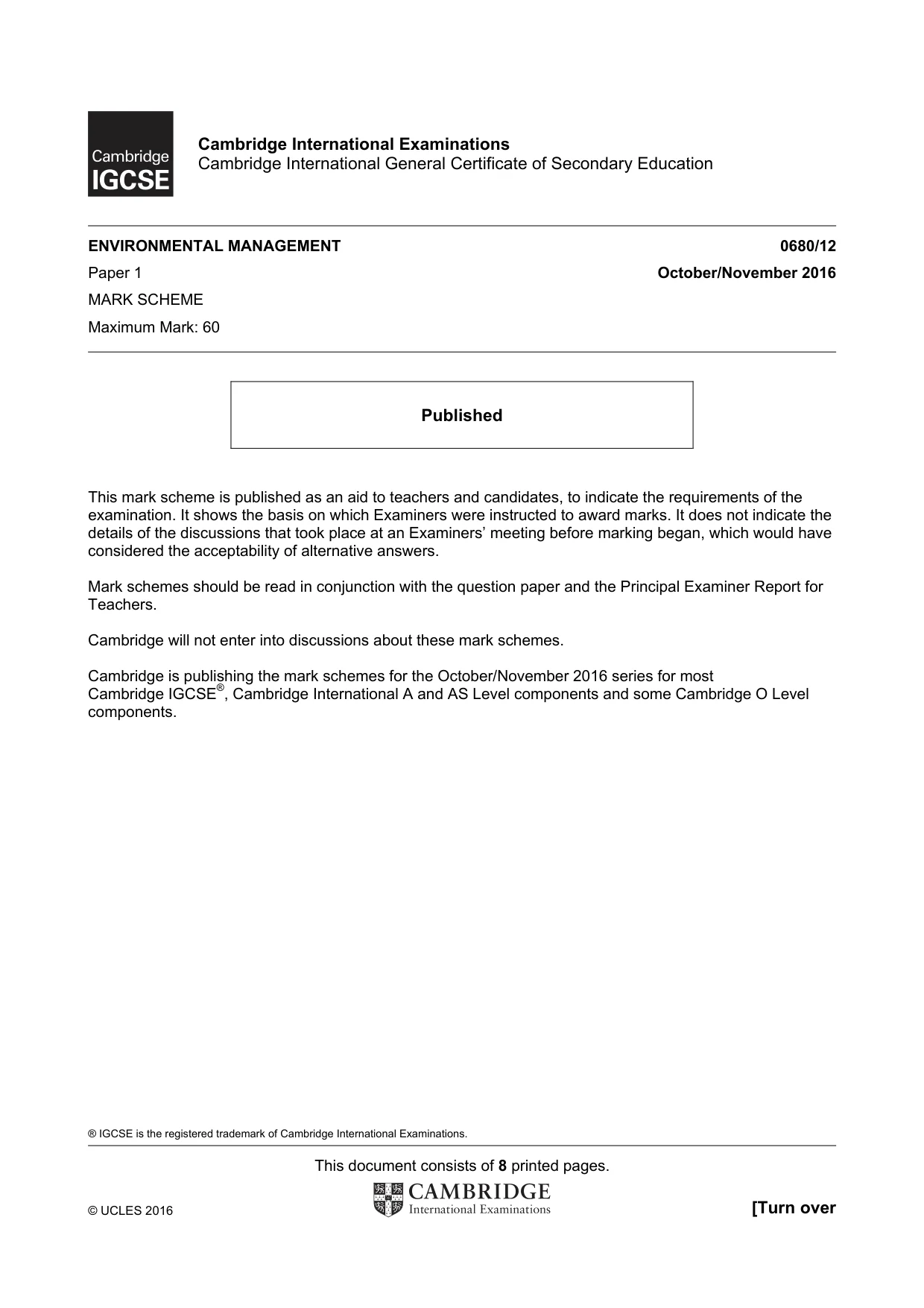
® IGCSE is the registered trademark of Cambridge International Examinations. This document consists of 8 printed pages. © UCLES 2016 [Turn over Cambridge International Examinations Cambridge International General Certificate of Secondary Education ENVIRONMENTAL MANAGEMENT 0680/12 Paper 1 October/November 2016 MARK SCHEME Maximum Mark: 60 Published This mark scheme is published as an aid to teachers and candidates, to indicate the requirements of the examination. It shows the basis on which Examiners were instructed to award marks. It does not indicate the details of the discussions that took place at an Examiners’ meeting before marking began, which would have considered the acceptability of alternative answers. Mark schemes should be read in conjunction with the question paper and the Principal Examiner Report for Teachers. Cambridge will not enter into discussions about these mark schemes. Cambridge is publishing the mark schemes for the October/November 2016 series for most Cambridge IGCSE®, Cambridge International A and AS Level components and some Cambridge O Level components.
Mark scheme, page 2
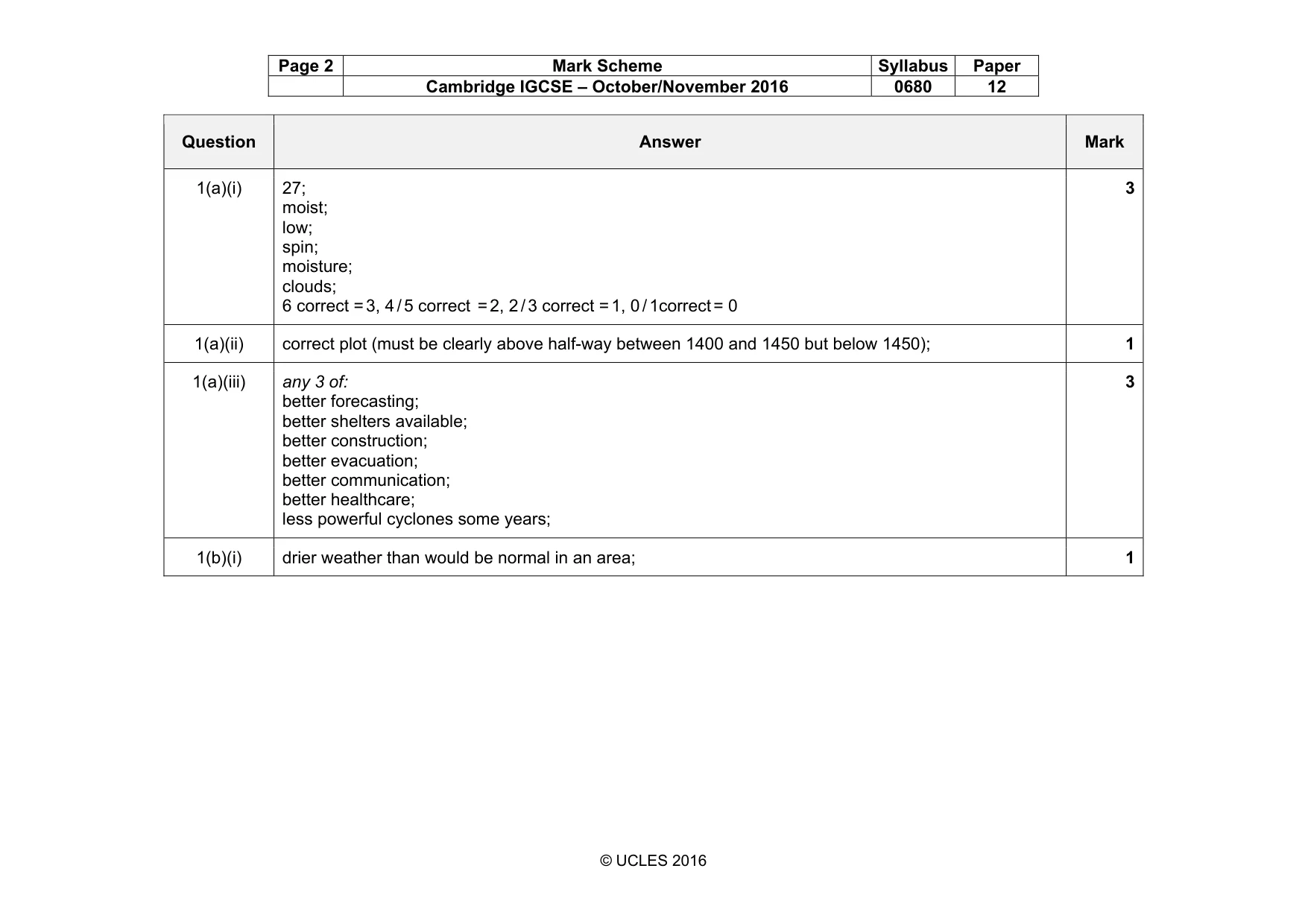
Page 2 Mark Scheme Syllabus Paper Cambridge IGCSE – October/November 2016 0680 12 © UCLES 2016 Question Answer Mark 1(a)(i) 27; moist; low; spin; moisture; clouds; 6 correct = 3, 4 / 5 correct = 2, 2 / 3 correct = 1, 0 / 1correct = 0 3 1(a)(ii) correct plot (must be clearly above half-way between 1400 and 1450 but below 1450); 1 1(a)(iii) any 3 of: better forecasting; better shelters available; better construction; better evacuation; better communication; better healthcare; less powerful cyclones some years; 3 1(b)(i) drier weather than would be normal in an area; 1
Mark scheme, page 3
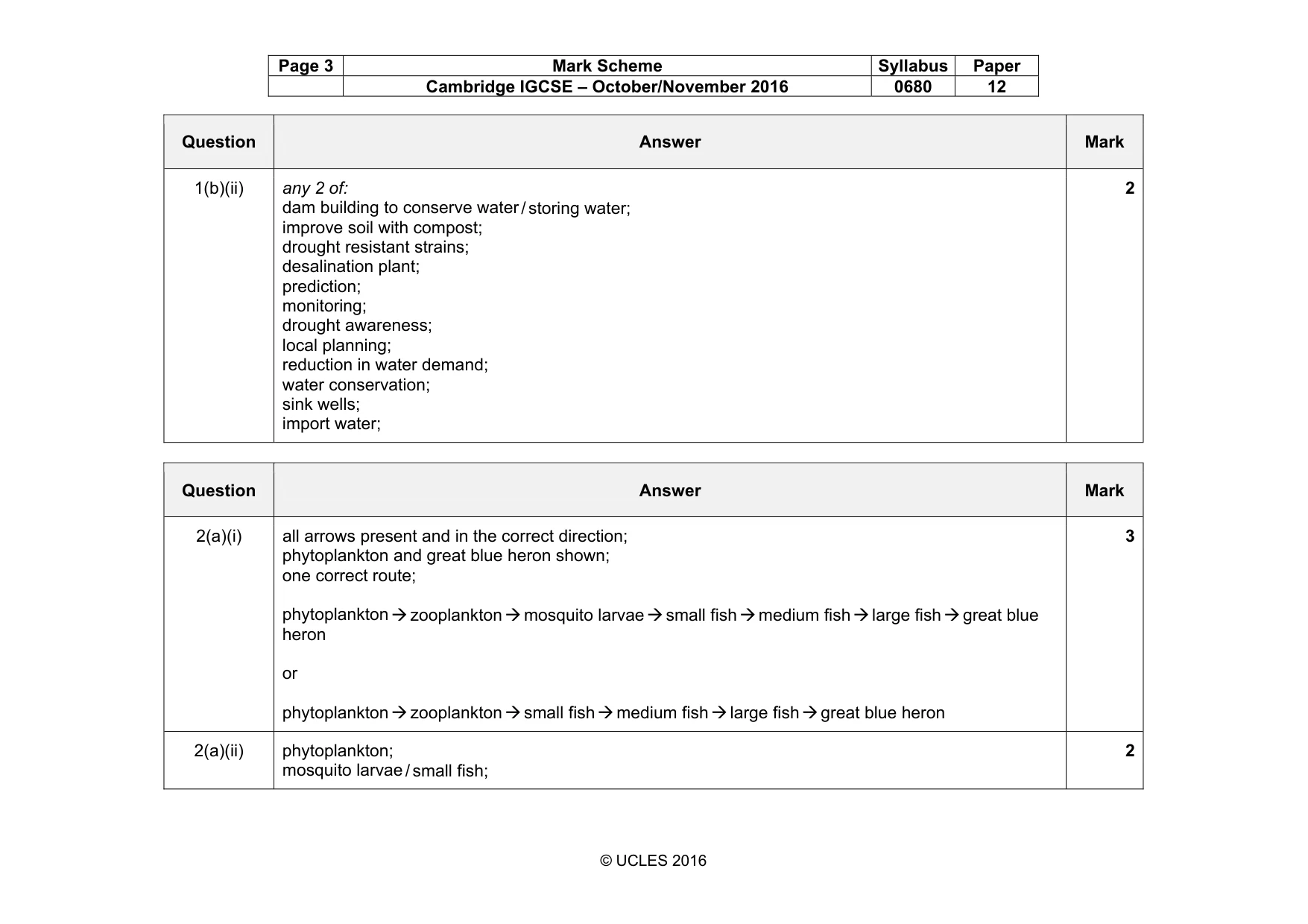
Page 3 Mark Scheme Syllabus Paper Cambridge IGCSE – October/November 2016 0680 12 © UCLES 2016 Question Answer Mark 1(b)(ii) any 2 of: dam building to conserve water / storing water; improve soil with compost; drought resistant strains; desalination plant; prediction; monitoring; drought awareness; local planning; reduction in water demand; water conservation; sink wells; import water; 2 Question Answer Mark 2(a)(i) all arrows present and in the correct direction; phytoplankton and great blue heron shown; one correct route; phytoplankton Æ zooplankton Æ mosquito larvae Æ small fish Æ medium fish Æ large fish Æ great blue heron or phytoplankton Æ zooplankton Æ small fish Æ medium fish Æ large fish Æ great blue heron 3 2(a)(ii) phytoplankton; mosquito larvae / small fish; 2
Mark scheme, page 4
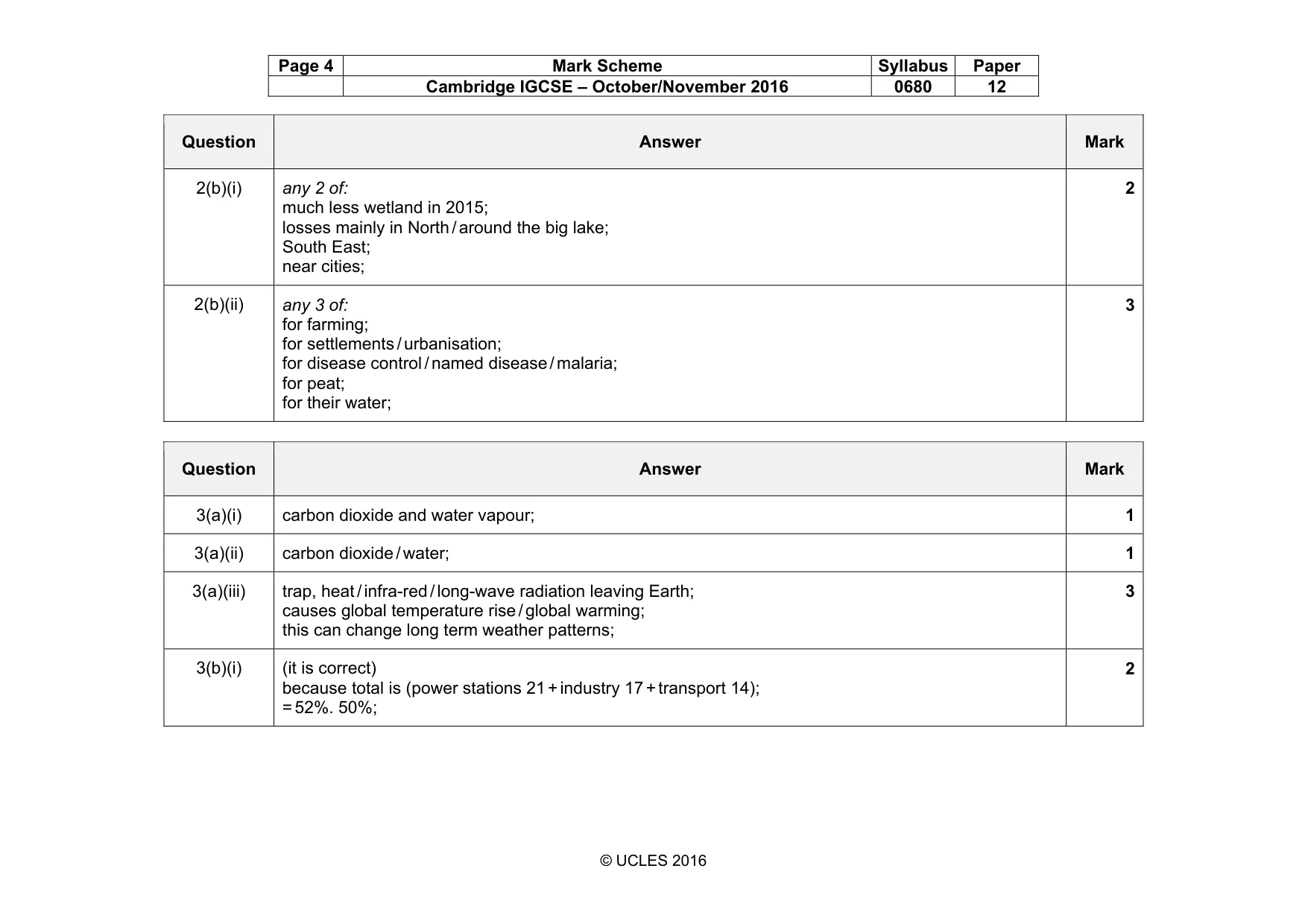
Page 4 Mark Scheme Syllabus Paper Cambridge IGCSE – October/November 2016 0680 12 © UCLES 2016 Question Answer Mark 2(b)(i) any 2 of: much less wetland in 2015; losses mainly in North / around the big lake; South East; near cities; 2 2(b)(ii) any 3 of: for farming; for settlements / urbanisation; for disease control / named disease / malaria; for peat; for their water; 3 Question Answer Mark 3(a)(i) carbon dioxide and water vapour; 1 3(a)(ii) carbon dioxide / water; 1 3(a)(iii) trap, heat / infra-red / long-wave radiation leaving Earth; causes global temperature rise / global warming; this can change long term weather patterns; 3 3(b)(i) (it is correct) because total is (power stations 21 + industry 17 + transport 14); = 52%. 50%; 2
Mark scheme, page 5
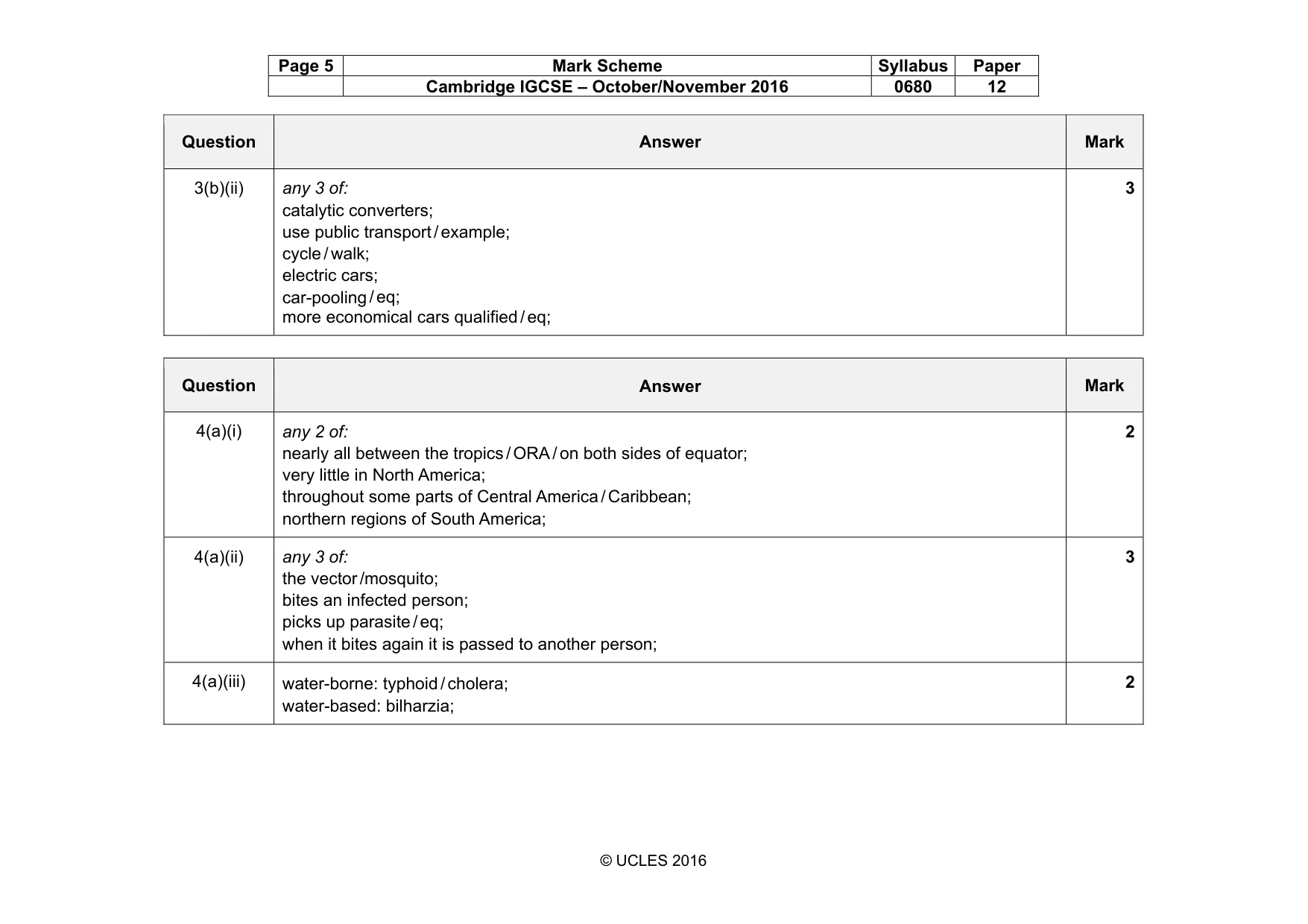
Page 5 Mark Scheme Syllabus Paper Cambridge IGCSE – October/November 2016 0680 12 © UCLES 2016 Question Answer Mark 3(b)(ii) any 3 of: catalytic converters; use public transport / example; cycle / walk; electric cars; car-pooling / eq; more economical cars qualified / eq; 3 Question Answer Mark 4(a)(i) any 2 of: nearly all between the tropics / ORA / on both sides of equator; very little in North America; throughout some parts of Central America / Caribbean; northern regions of South America; 2 4(a)(ii) any 3 of: the vector /mosquito; bites an infected person; picks up parasite / eq; when it bites again it is passed to another person; 3 4(a)(iii) water-borne: typhoid / cholera; water-based: bilharzia; 2
Mark scheme, page 6
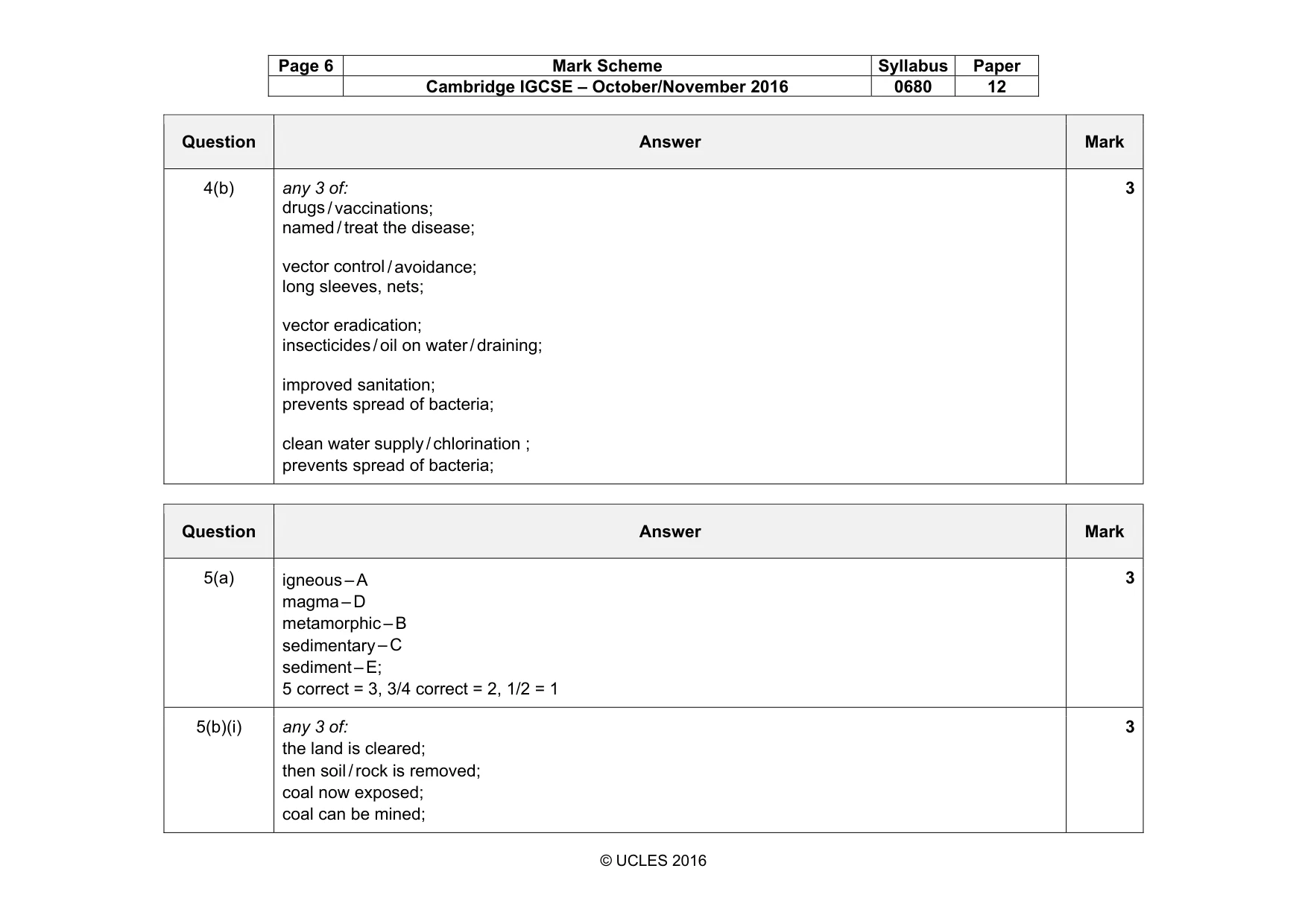
Page 6 Mark Scheme Syllabus Paper Cambridge IGCSE – October/November 2016 0680 12 © UCLES 2016 Question Answer Mark 4(b) any 3 of: drugs / vaccinations; named / treat the disease; vector control / avoidance; long sleeves, nets; vector eradication; insecticides / oil on water / draining; improved sanitation; prevents spread of bacteria; clean water supply / chlorination ; prevents spread of bacteria; 3 Question Answer Mark 5(a) igneous – A magma – D metamorphic – B sedimentary – C sediment – E; 5 correct = 3, 3/4 correct = 2, 1/2 = 1 3 5(b)(i) any 3 of: the land is cleared; then soil / rock is removed; coal now exposed; coal can be mined; 3
Mark scheme, page 7
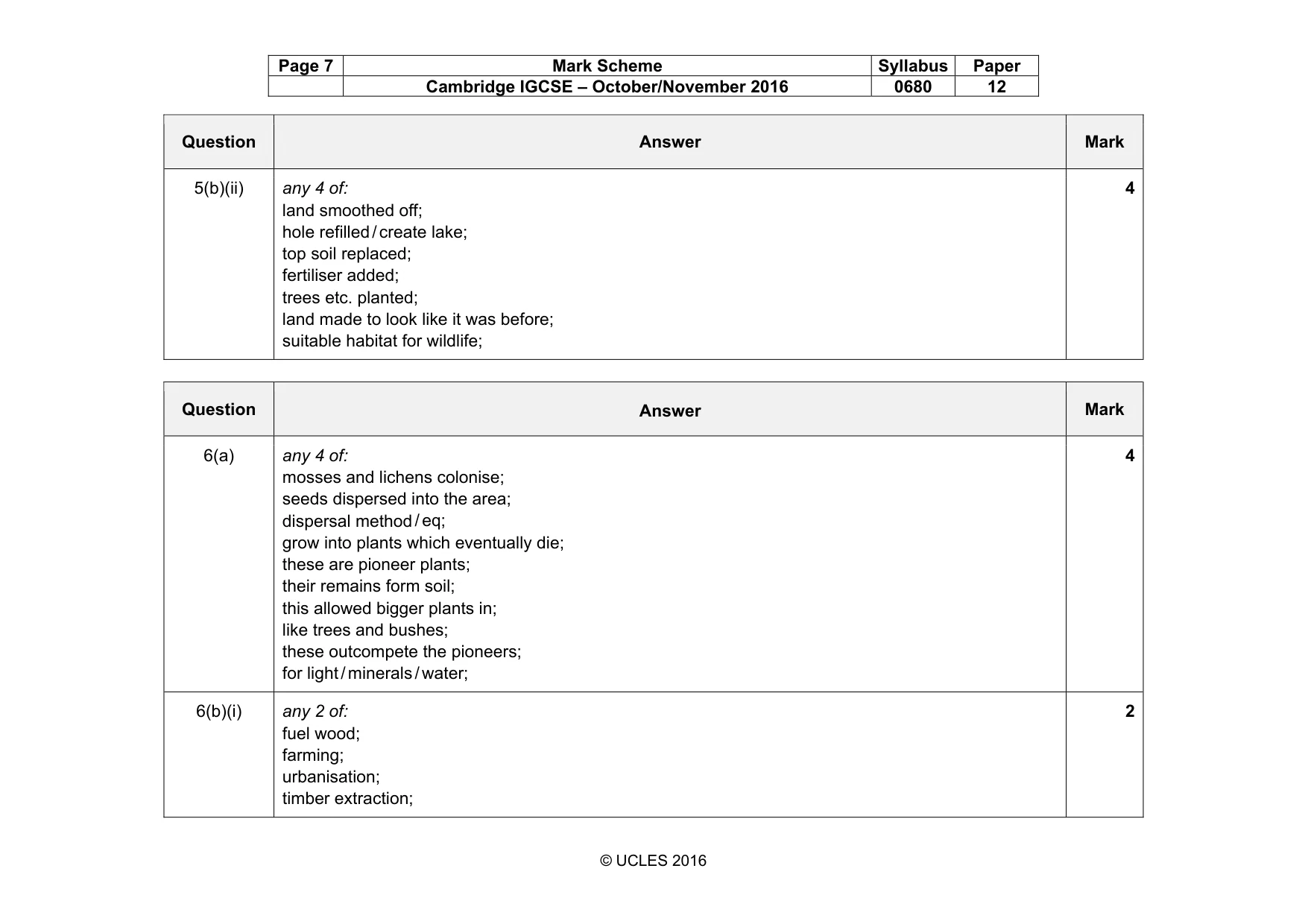
Page 7 Mark Scheme Syllabus Paper Cambridge IGCSE – October/November 2016 0680 12 © UCLES 2016 Question Answer Mark 5(b)(ii) any 4 of: land smoothed off; hole refilled / create lake; top soil replaced; fertiliser added; trees etc. planted; land made to look like it was before; suitable habitat for wildlife; 4 Question Answer Mark 6(a) any 4 of: mosses and lichens colonise; seeds dispersed into the area; dispersal method / eq; grow into plants which eventually die; these are pioneer plants; their remains form soil; this allowed bigger plants in; like trees and bushes; these outcompete the pioneers; for light / minerals / water; 4 6(b)(i) any 2 of: fuel wood; farming; urbanisation; timber extraction; 2
Mark scheme, page 8
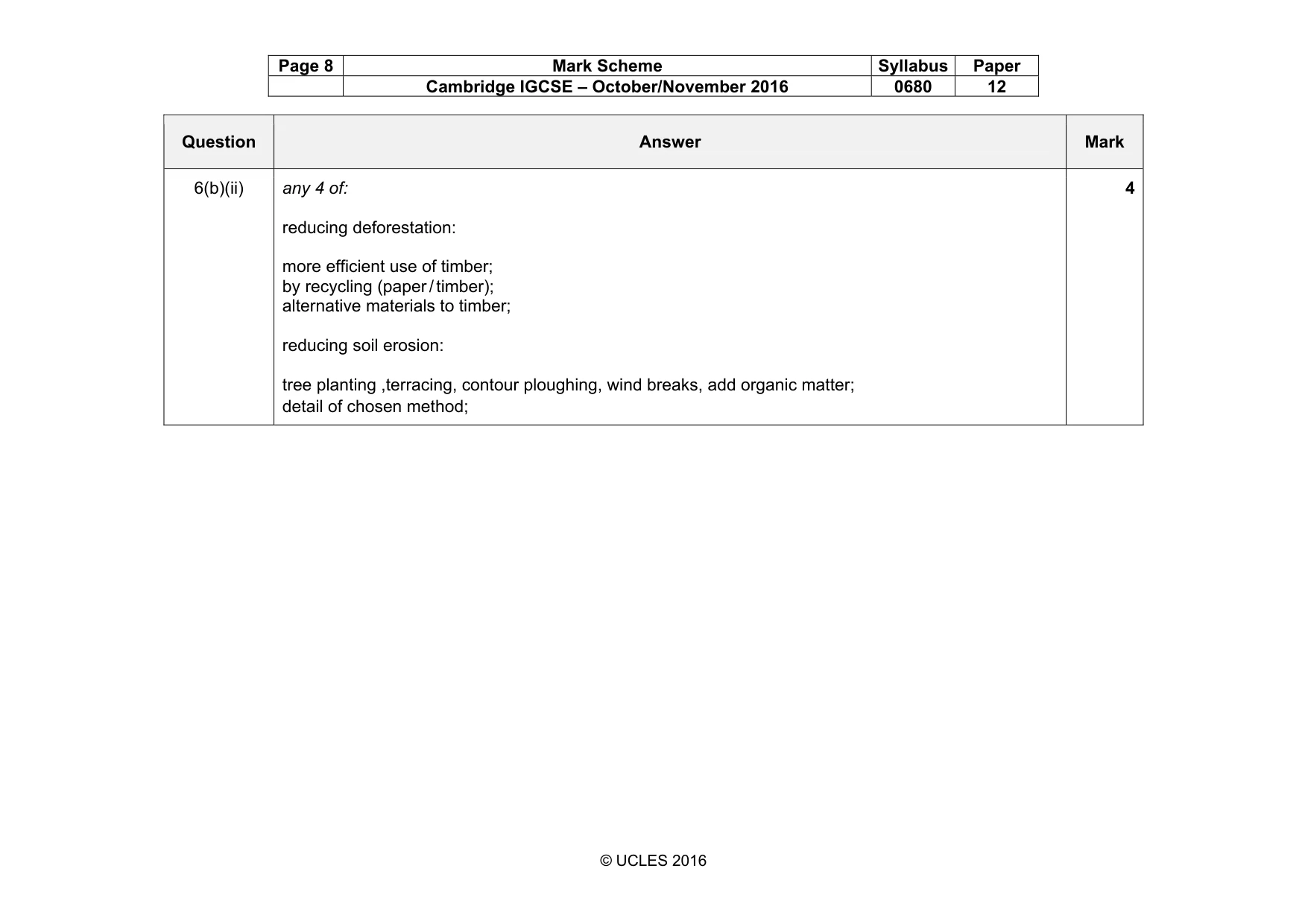
Page 8 Mark Scheme Syllabus Paper Cambridge IGCSE – October/November 2016 0680 12 © UCLES 2016 Question Answer Mark 6(b)(ii) any 4 of: reducing deforestation: more efficient use of timber; by recycling (paper / timber); alternative materials to timber; reducing soil erosion: tree planting ,terracing, contour ploughing, wind breaks, add organic matter; detail of chosen method; 4
What you needed in this session
Cambridge’s own grade thresholds for 2016 Oct/Nov, Paper 1 · Variant 2. A higher threshold means an easier paper — the bar moves with how the cohort did.