Cambridge IGCSE Environmental Management 0680 — 2011 Oct/Nov Paper 1 · Variant 2
0680/12/O/N/11 · 60 marks · ≈68 min
The question paper and its mark scheme, free to read here and free to download. This is Cambridge’s own paper, exactly as it was sat.
Question paper12 pages

Mark scheme4 pages
Answers below. Sit the paper first if you are practising.
Paper as text
Question paper, page 1
This document consists of 10 printed pages and 2 blank pages. DC (SM/DJ) 33726/3 © UCLES 2011 [Turn over UNIVERSITY OF CAMBRIDGE INTERNATIONAL EXAMINATIONS International General Certificate of Secondary Education * 1 4 3 8 1 7 2 0 9 0 * ENVIRONMENTAL MANAGEMENT 0680/12 Paper 1 October/November 2011 1 hour 30 minutes Candidates answer on the Question Paper. Additional Materials: Ruler READ THESE INSTRUCTIONS FIRST Write your Centre number, candidate number and name on all the work you hand in. Write in dark blue or black pen. You may use a soft pencil for any diagrams, graphs or rough working. Do not use staples, paper clips, highlighters, glue or correction fluid. DO NOT WRITE IN ANY BARCODES. Answer all questions. At the end of the examination, fasten all your work securely together. The number of marks is given in brackets [ ] at the end of each question or part question. For Examiner’s Use 1 2 3 4 5 6 Total www.XtremePapers.com
Question paper, page 2
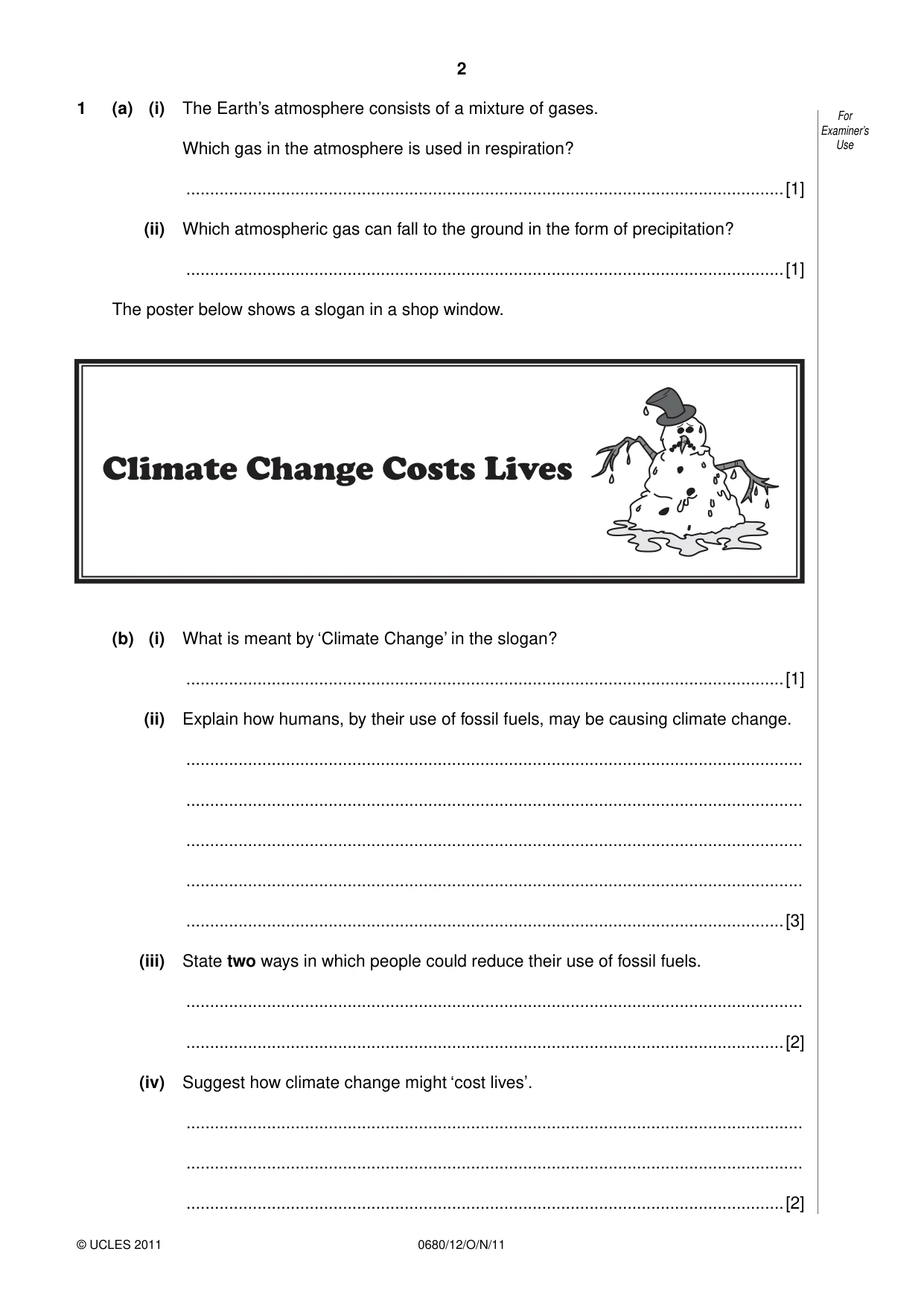
2 0680/12/O/N/11 © UCLES 2011 For Examiner’s Use 1 (a) (i) The Earth’s atmosphere consists of a mixture of gases. Which gas in the atmosphere is used in respiration? …[1] (ii) Which atmospheric gas can fall to the ground in the form of precipitation? …[1] The poster below shows a slogan in a shop window. (b) (i) What is meant by ‘Climate Change’ in the slogan? …[1] (ii) Explain how humans, by their use of fossil fuels, may be causing climate change. … … … … …[3] (iii) State two ways in which people could reduce their use of fossil fuels. … …[2] (iv) Suggest how climate change might ‘cost lives’. … … …[2]
Question paper, page 3
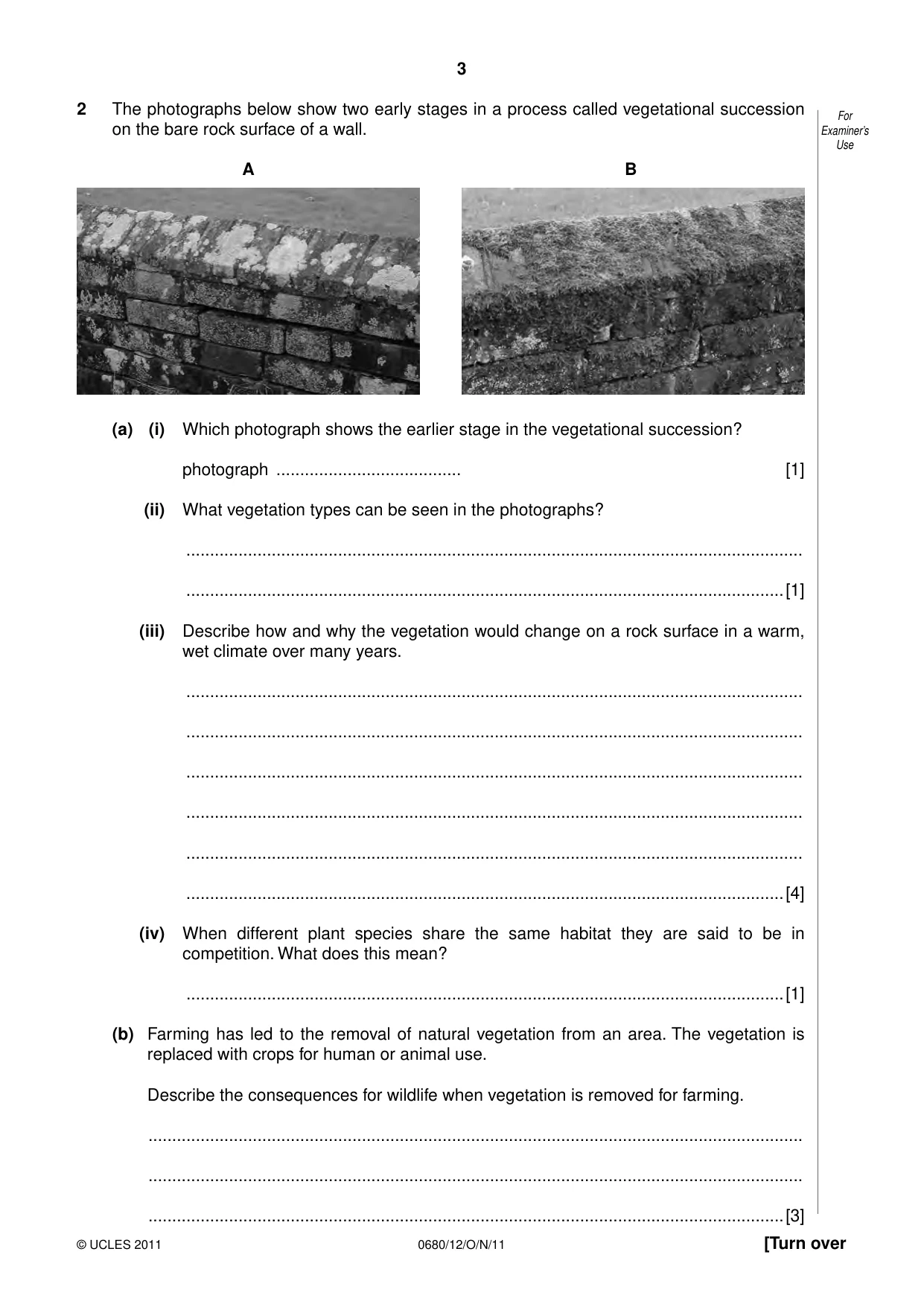
3 0680/12/O/N/11 © UCLES 2011 [Turn over For Examiner’s Use 2 The photographs below show two early stages in a process called vegetational succession on the bare rock surface of a wall. A B (a) (i) Which photograph shows the earlier stage in the vegetational succession? photograph … [1] (ii) What vegetation types can be seen in the photographs? … …[1] (iii) Describe how and why the vegetation would change on a rock surface in a warm, wet climate over many years. … … … … … …[4] (iv) When different plant species share the same habitat they are said to be in competition. What does this mean? …[1] (b) Farming has led to the removal of natural vegetation from an area. The vegetation is replaced with crops for human or animal use. Describe the consequences for wildlife when vegetation is removed for farming. … … …[3]
Question paper, page 4
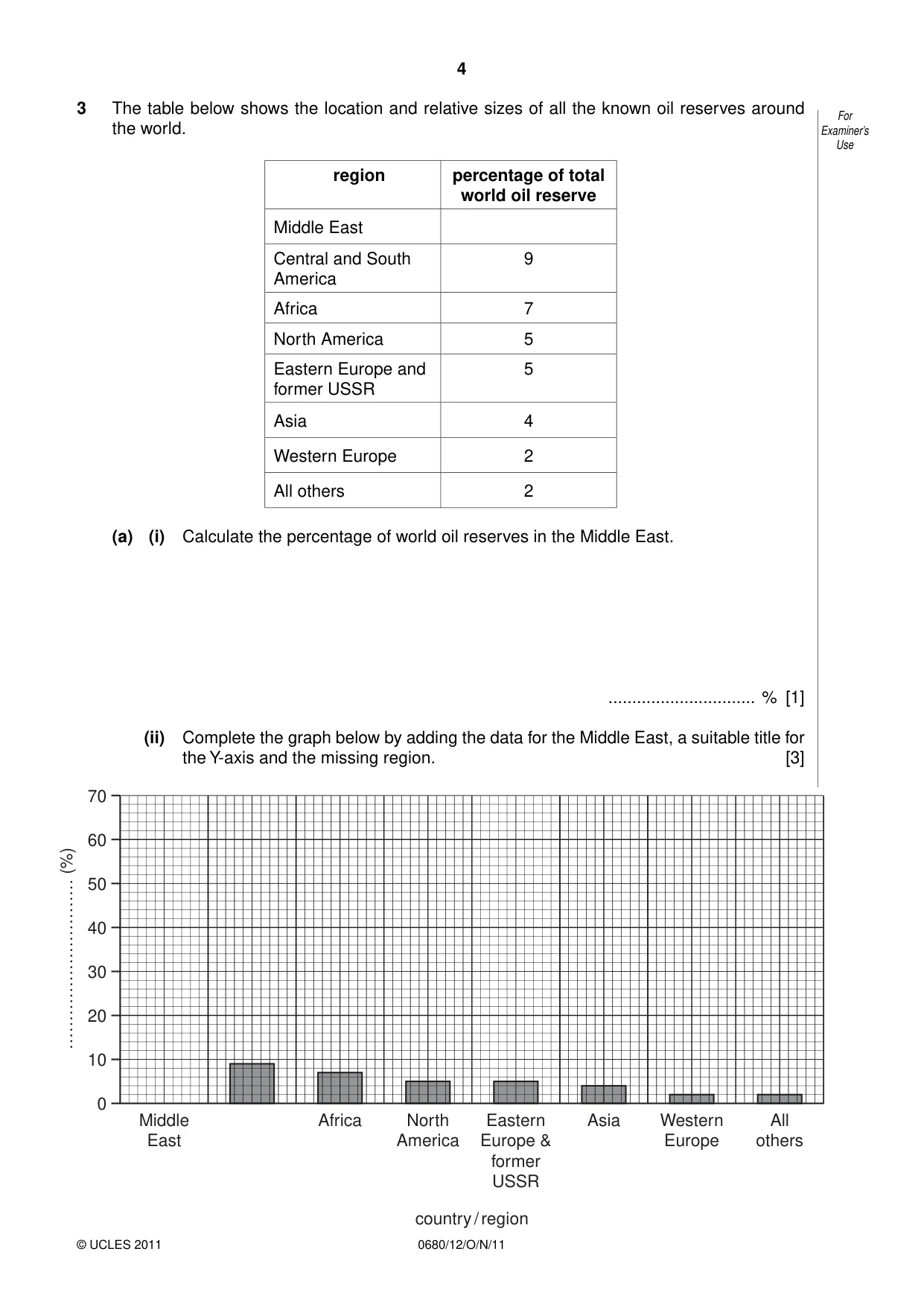
4 0680/12/O/N/11 © UCLES 2011 For Examiner’s Use 3 The table below shows the location and relative sizes of all the known oil reserves around the world. region percentage of total world oil reserve Middle East Central and South America 9 Africa 7 North America 5 Eastern Europe and former USSR 5 Asia 4 Western Europe 2 All others 2 (a) (i) Calculate the percentage of world oil reserves in the Middle East. … % [1] (ii) Complete the graph below by adding the data for the Middle East, a suitable title for the Y-axis and the missing region. [3] Africa North America country / region Eastern Europe & former USSR Asia Western Europe All others 0 Middle East 20 ………………………… (%) 40 60 10 30 50 70
Question paper, page 5
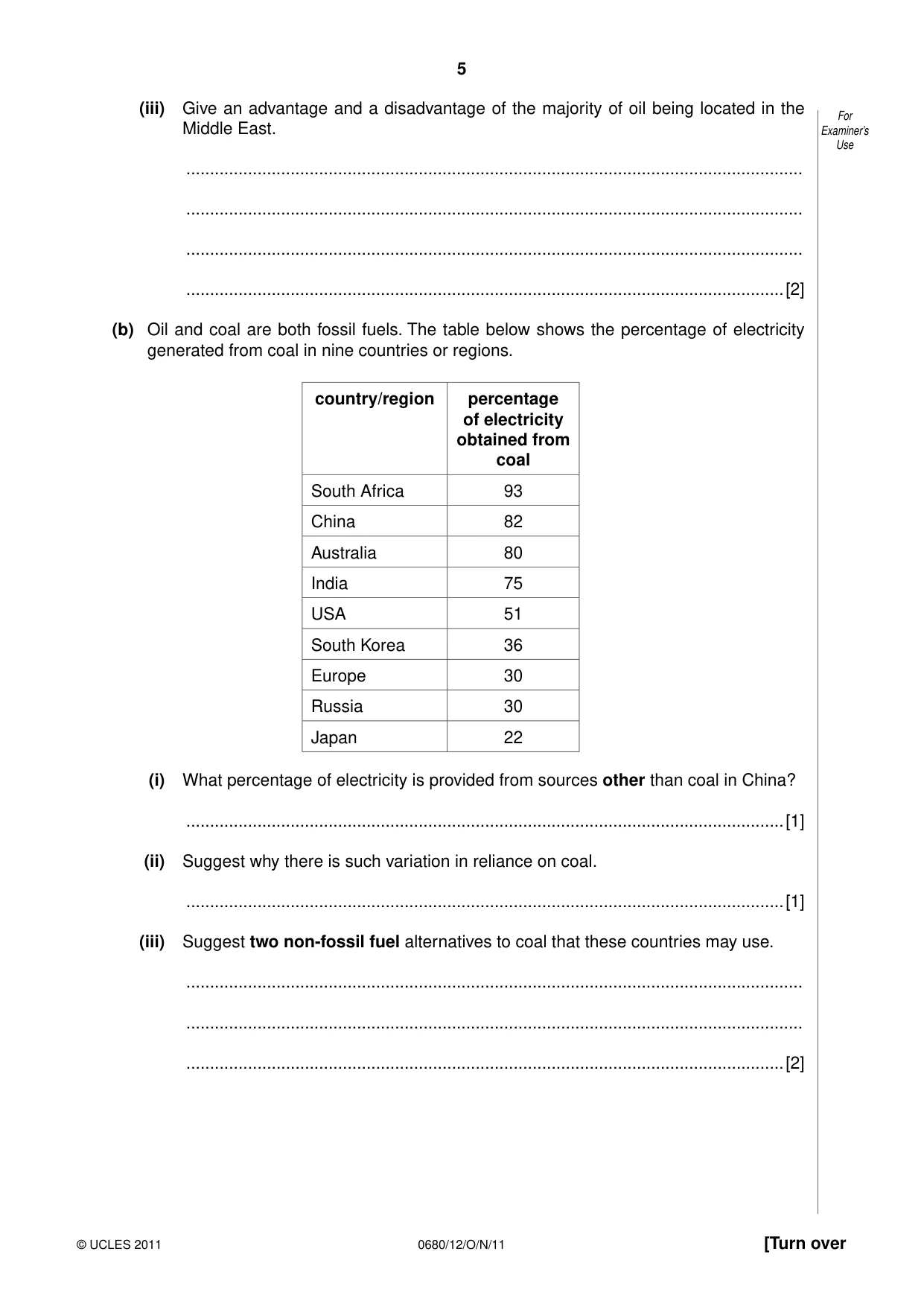
5 0680/12/O/N/11 © UCLES 2011 [Turn over For Examiner’s Use (iii) Give an advantage and a disadvantage of the majority of oil being located in the Middle East. … … … …[2] (b) Oil and coal are both fossil fuels. The table below shows the percentage of electricity generated from coal in nine countries or regions. country/region percentage of electricity obtained from coal South Africa 93 China 82 Australia 80 India 75 USA 51 South Korea 36 Europe 30 Russia 30 Japan 22 (i) What percentage of electricity is provided from sources other than coal in China? …[1] (ii) Suggest why there is such variation in reliance on coal. …[1] (iii) Suggest two non-fossil fuel alternatives to coal that these countries may use. … … …[2]
Question paper, page 6
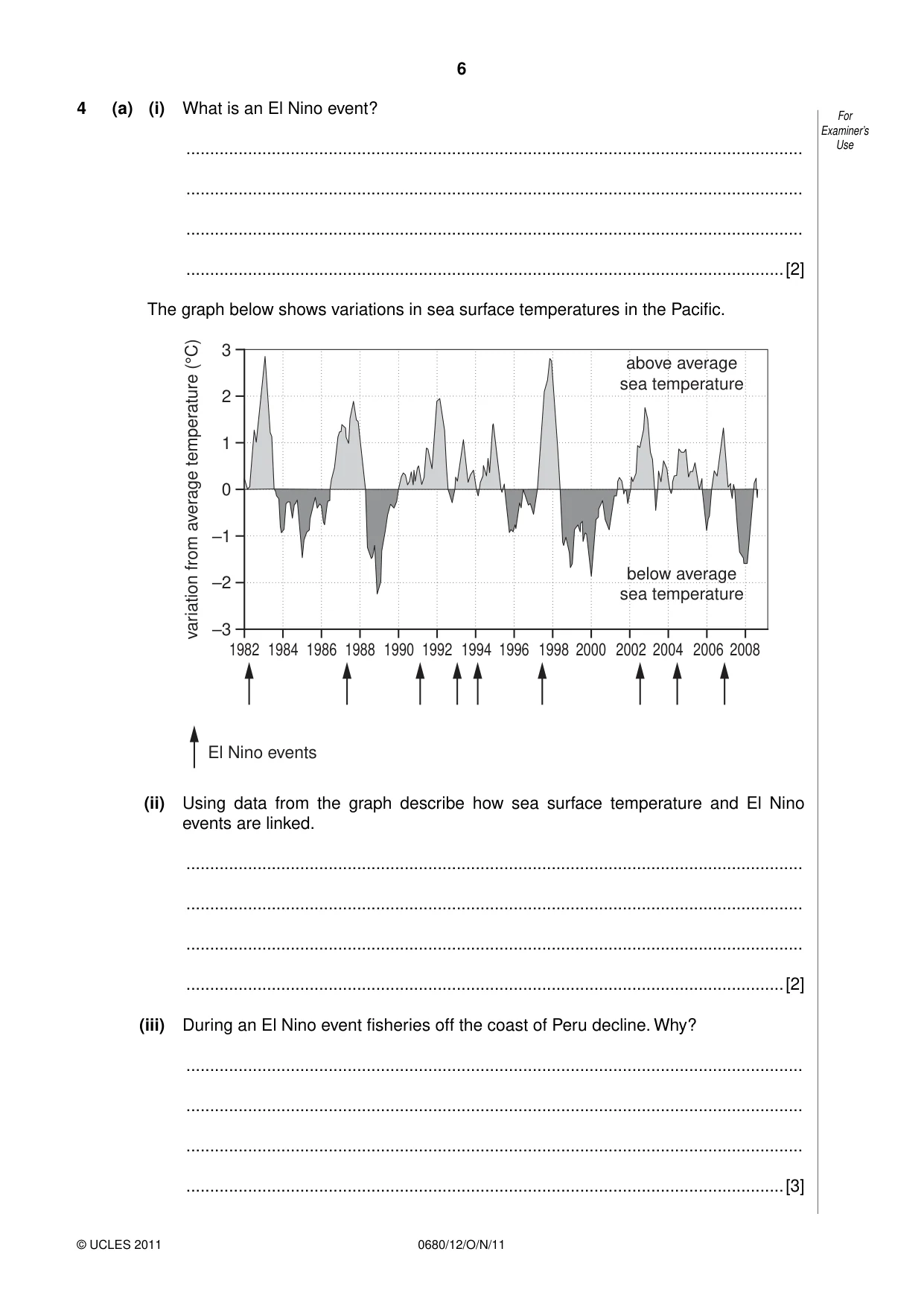
6 0680/12/O/N/11 © UCLES 2011 For Examiner’s Use 4 (a) (i) What is an El Nino event? … … … …[2] The graph below shows variations in sea surface temperatures in the Pacific. 3 2 1 0 above average sea temperature below average sea temperature El Nino events variation from average temperature (°C) –1 –2 –3 1982 1986 1990 1994 1998 2002 2006 1984 1988 1992 1996 2000 2004 2008 (ii) Using data from the graph describe how sea surface temperature and El Nino events are linked. … … … …[2] (iii) During an El Nino event fisheries off the coast of Peru decline. Why? … … … …[3]
Question paper, page 7
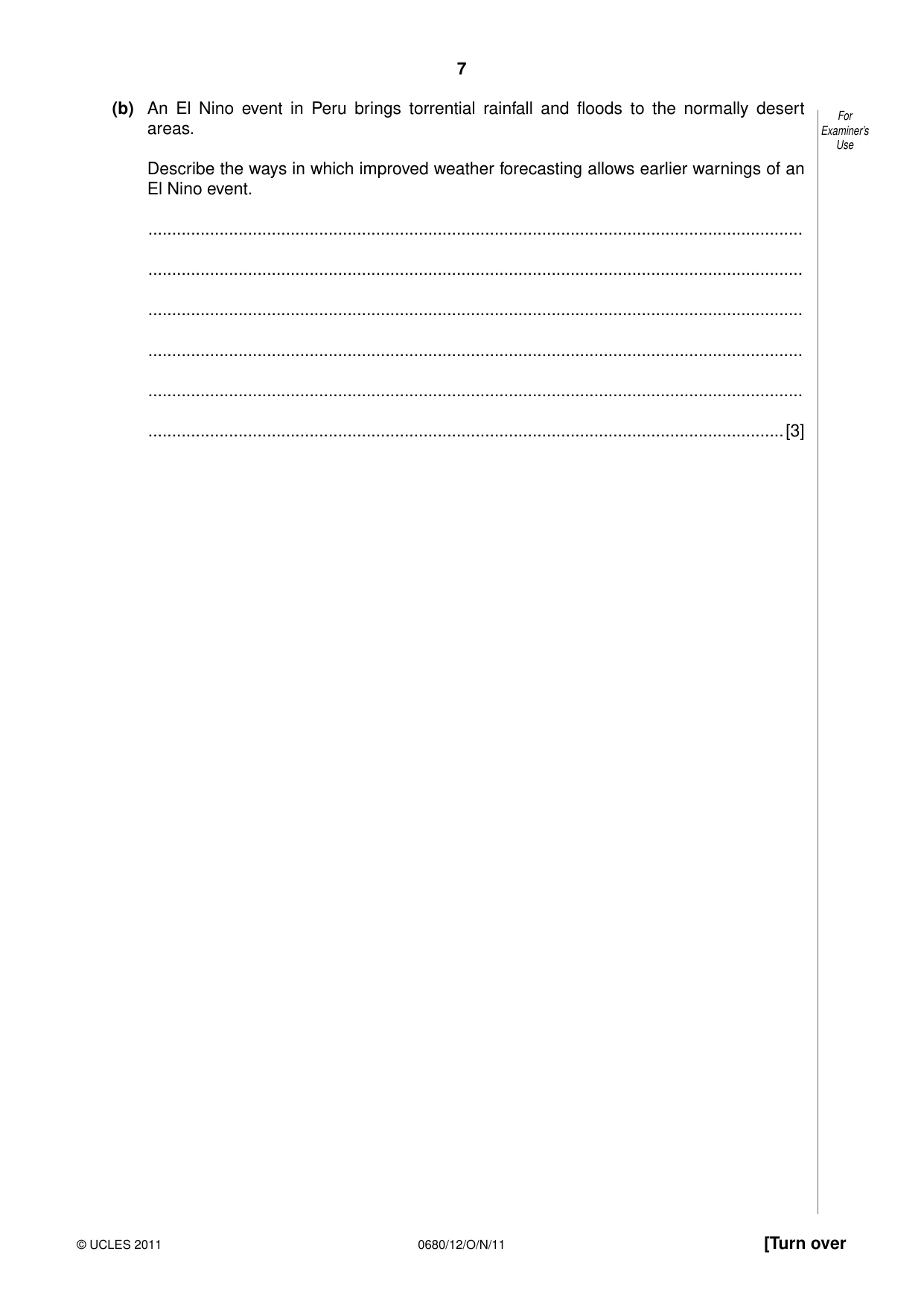
7 0680/12/O/N/11 © UCLES 2011 [Turn over For Examiner’s Use (b) An El Nino event in Peru brings torrential rainfall and floods to the normally desert areas. Describe the ways in which improved weather forecasting allows earlier warnings of an El Nino event. … … … … … …[3]
Question paper, page 8
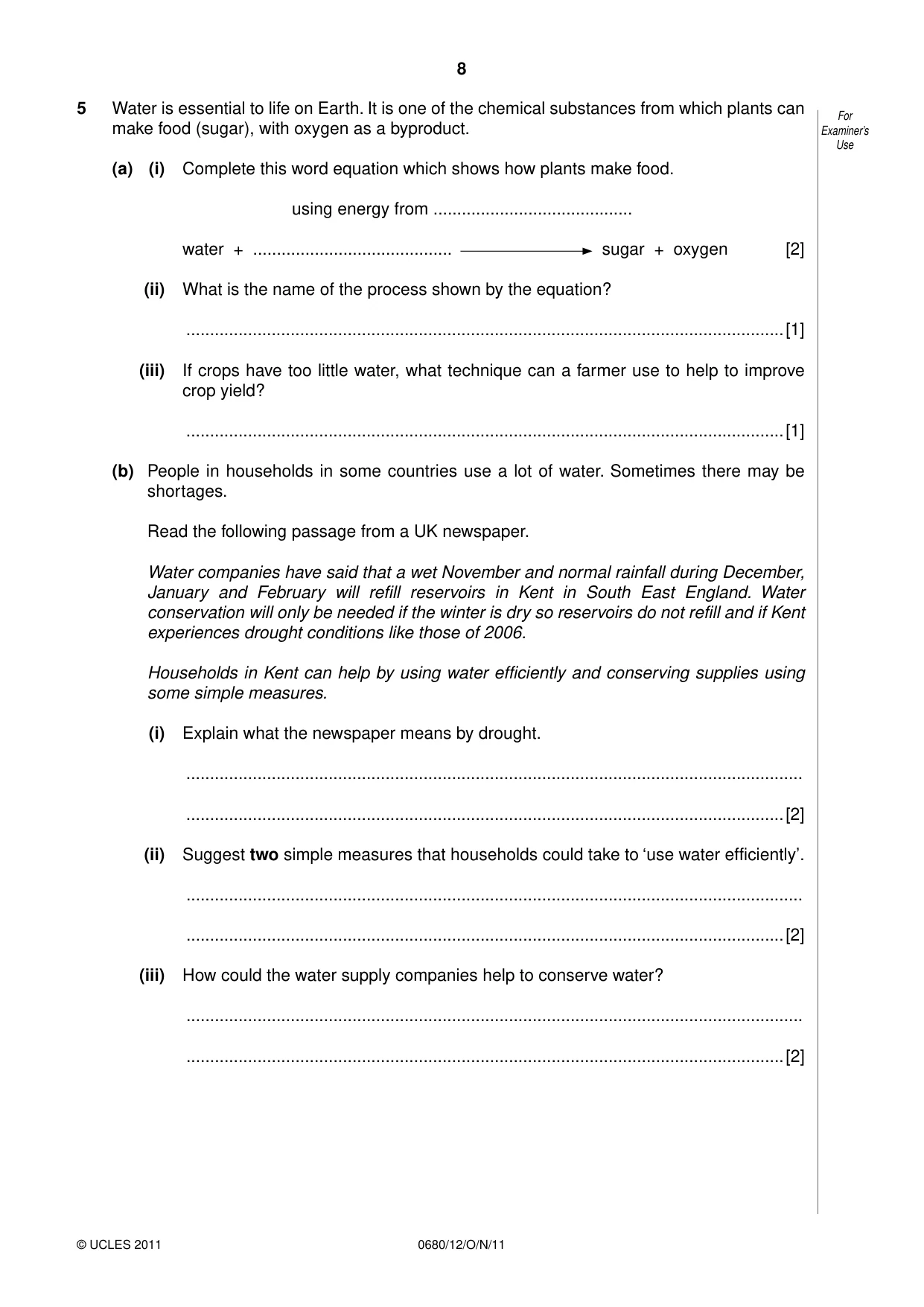
8 0680/12/O/N/11 © UCLES 2011 For Examiner’s Use 5 Water is essential to life on Earth. It is one of the chemical substances from which plants can make food (sugar), with oxygen as a byproduct. (a) (i) Complete this word equation which shows how plants make food. using energy from … water + … sugar + oxygen [2] (ii) What is the name of the process shown by the equation? …[1] (iii) If crops have too little water, what technique can a farmer use to help to improve crop yield? …[1] (b) People in households in some countries use a lot of water. Sometimes there may be shortages. Read the following passage from a UK newspaper. Water companies have said that a wet November and normal rainfall during December, January and February will refill reservoirs in Kent in South East England. Water conservation will only be needed if the winter is dry so reservoirs do not refill and if Kent experiences drought conditions like those of 2006. Households in Kent can help by using water efficiently and conserving supplies using some simple measures. (i) Explain what the newspaper means by drought. … …[2] (ii) Suggest two simple measures that households could take to ‘use water efficiently’. … …[2] (iii) How could the water supply companies help to conserve water? … …[2]
Question paper, page 9
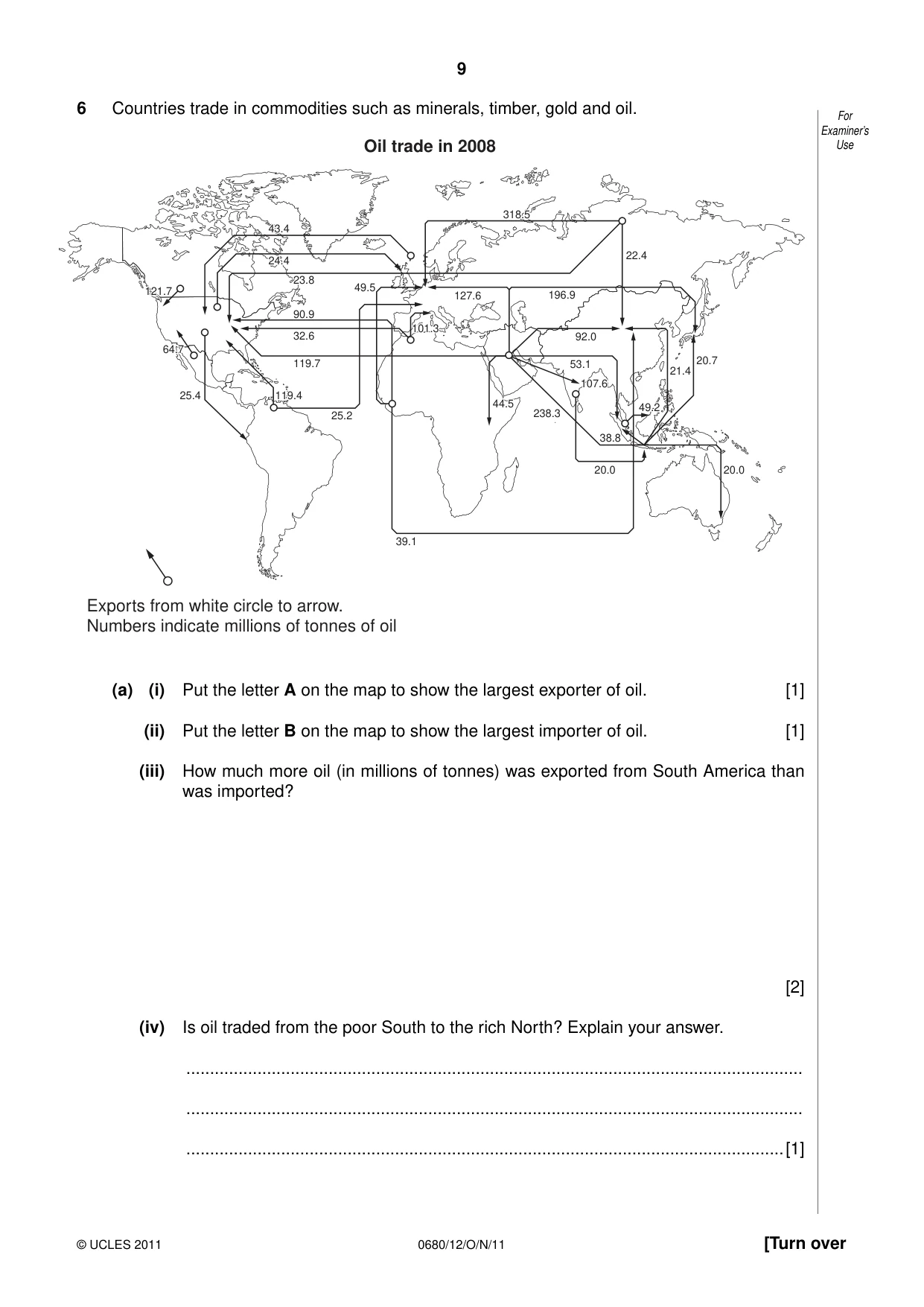
9 0680/12/O/N/11 © UCLES 2011 [Turn over For Examiner’s Use 6 Countries trade in commodities such as minerals, timber, gold and oil. 121.7 121.7 64.7 64.7 25.4 25.4 119.4 119.4 25.2 25.2 39.1 39.1 20.0 20.0 38.8 38.8 44.5 44.5 101.3 101.3 127.6 127.6 318.5 318.5 22.4 22.4 196.9 196.9 92.0 92.0 53.1 53.1 107.6 107.6 238.3 238.3 49.2 49.2 21.4 21.4 20.7 20.7 20.0 20.0 49.5 49.5 119.7 119.7 32.6 32.6 90.9 90.9 23.8 23.8 24.4 24.4 43.4 43.4 121.7 64.7 Exports from white circle to arrow. Numbers indicate millions of tonnes of oil Oil trade in 2008 25.4 119.4 25.2 39.1 20.0 38.8 44.5 101.3 127.6 318.5 22.4 196.9 92.0 53.1 107.6 238.3 49.2 21.4 20.7 20.0 49.5 119.7 32.6 90.9 23.8 24.4 43.4 (a) (i) Put the letter A on the map to show the largest exporter of oil. [1] (ii) Put the letter B on the map to show the largest importer of oil. [1] (iii) How much more oil (in millions of tonnes) was exported from South America than was imported? [2] (iv) Is oil traded from the poor South to the rich North? Explain your answer. … … …[1]
Question paper, page 10
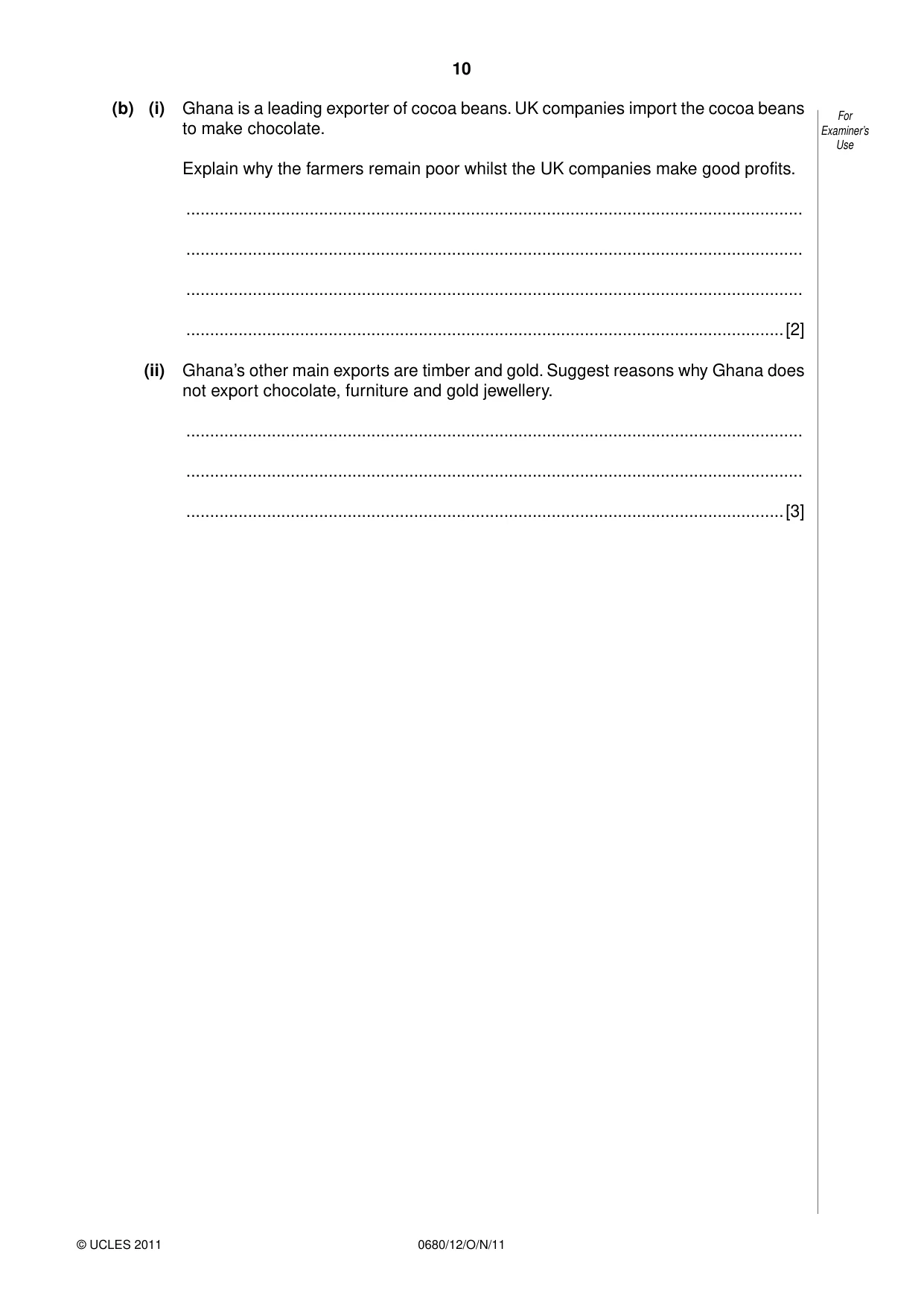
10 0680/12/O/N/11 © UCLES 2011 For Examiner’s Use (b) (i) Ghana is a leading exporter of cocoa beans. UK companies import the cocoa beans to make chocolate. Explain why the farmers remain poor whilst the UK companies make good profits. … … … …[2] (ii) Ghana’s other main exports are timber and gold. Suggest reasons why Ghana does not export chocolate, furniture and gold jewellery. … … …[3]
Question paper, page 11
11 0680/12/O/N/11 © UCLES 2011 BLANK PAGE
Question paper, page 12
12 0680/12/O/N/11 © UCLES 2011 Permission to reproduce items where third-party owned material protected by copyright is included has been sought and cleared where possible. Every reasonable effort has been made by the publisher (UCLES) to trace copyright holders, but if any items requiring clearance have unwittingly been included, the publisher will be pleased to make amends at the earliest possible opportunity. University of Cambridge International Examinations is part of the Cambridge Assessment Group. Cambridge Assessment is the brand name of University of Cambridge Local Examinations Syndicate (UCLES), which is itself a department of the University of Cambridge. BLANK PAGE
Mark scheme, page 1
UNIVERSITY OF CAMBRIDGE INTERNATIONAL EXAMINATIONS International General Certificate of Secondary Education MARK SCHEME for the October/November 2011 question paper for the guidance of teachers 0680 ENVIRONMENTAL MANAGEMENT 0680/12 Paper 1, maximum raw mark 60 This mark scheme is published as an aid to teachers and candidates, to indicate the requirements of the examination. It shows the basis on which Examiners were instructed to award marks. It does not indicate the details of the discussions that took place at an Examiners’ meeting before marking began, which would have considered the acceptability of alternative answers. Mark schemes must be read in conjunction with the question papers and the report on the examination. • Cambridge will not enter into discussions or correspondence in connection with these mark schemes. Cambridge is publishing the mark schemes for the October/November 2011 question papers for most IGCSE, GCE Advanced Level and Advanced Subsidiary Level syllabuses and some Ordinary Level syllabuses. www.XtremePapers.com
Mark scheme, page 2
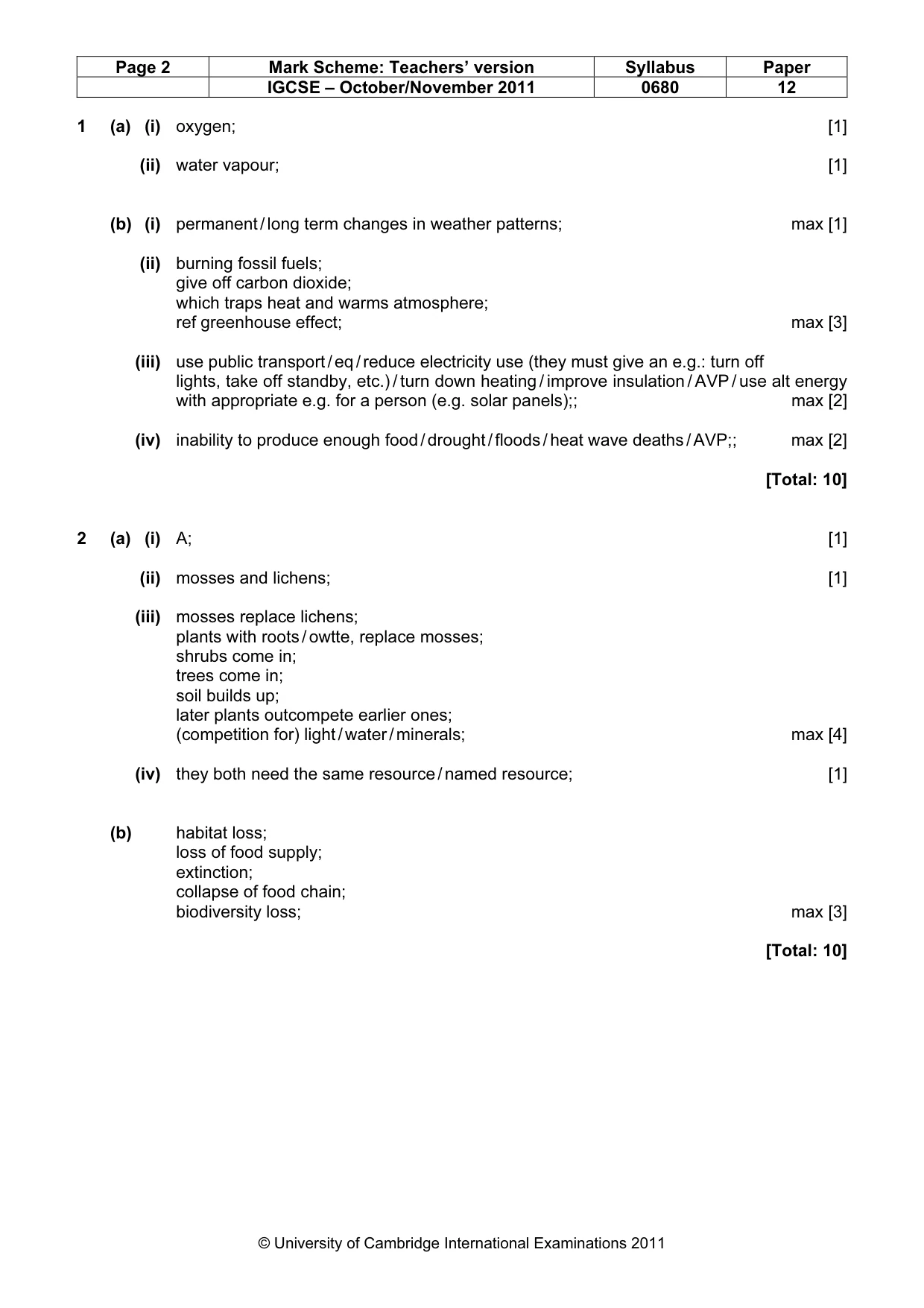
Page 2 Mark Scheme: Teachers’ version Syllabus Paper IGCSE – October/November 2011 0680 12 © University of Cambridge International Examinations 2011 1 (a) (i) oxygen; [1] (ii) water vapour; [1] (b) (i) permanent / long term changes in weather patterns; max [1] (ii) burning fossil fuels; give off carbon dioxide; which traps heat and warms atmosphere; ref greenhouse effect; max [3] (iii) use public transport / eq / reduce electricity use (they must give an e.g.: turn off lights, take off standby, etc.) / turn down heating / improve insulation / AVP / use alt energy with appropriate e.g. for a person (e.g. solar panels);; max [2] (iv) inability to produce enough food / drought / floods / heat wave deaths / AVP;; max [2] [Total: 10] 2 (a) (i) A; [1] (ii) mosses and lichens; [1] (iii) mosses replace lichens; plants with roots / owtte, replace mosses; shrubs come in; trees come in; soil builds up; later plants outcompete earlier ones; (competition for) light / water / minerals; max [4] (iv) they both need the same resource / named resource; [1] (b) habitat loss; loss of food supply; extinction; collapse of food chain; biodiversity loss; max [3] [Total: 10]
Mark scheme, page 3
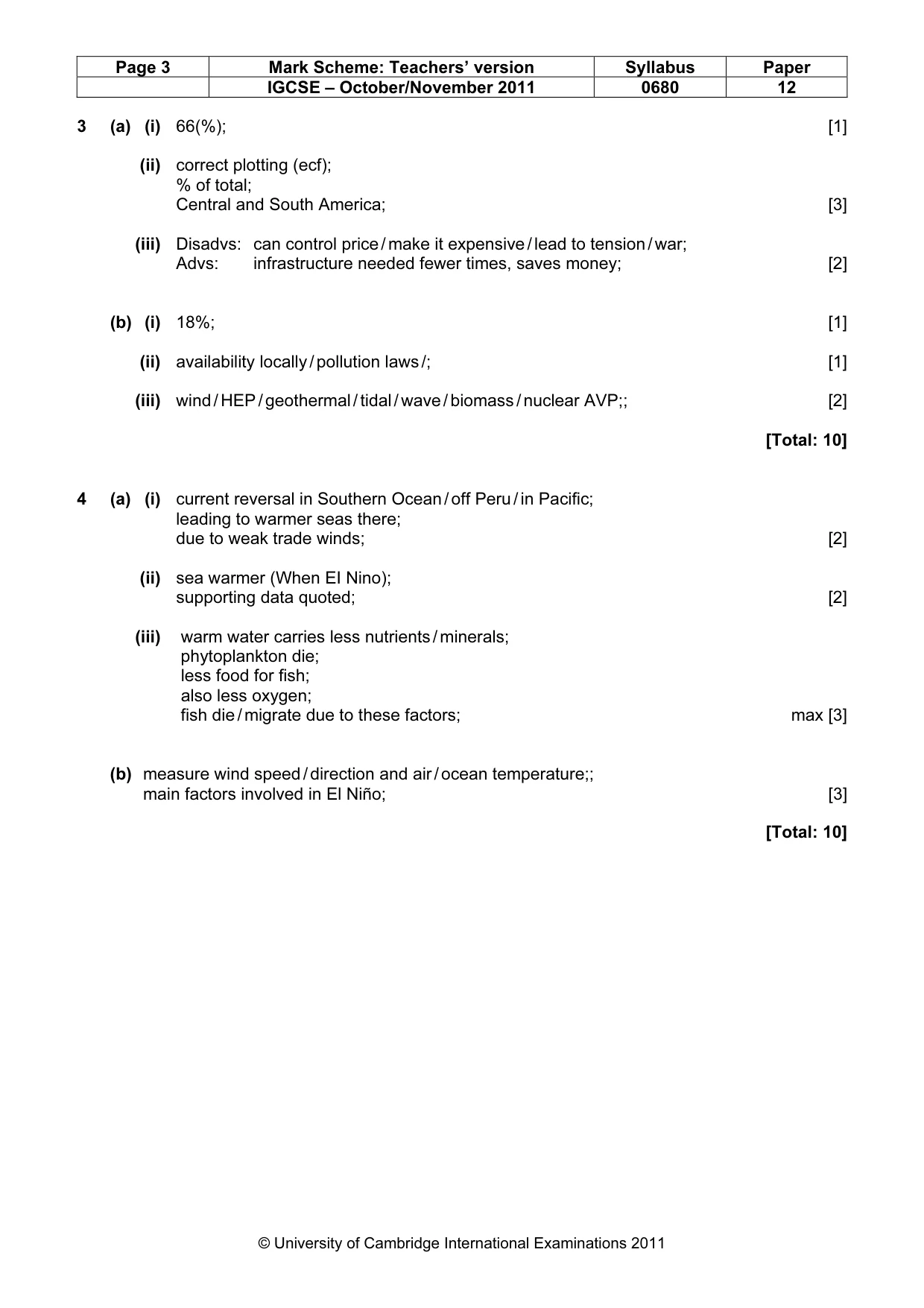
Page 3 Mark Scheme: Teachers’ version Syllabus Paper IGCSE – October/November 2011 0680 12 © University of Cambridge International Examinations 2011 3 (a) (i) 66(%); [1] (ii) correct plotting (ecf); % of total; Central and South America; [3] (iii) Disadvs: can control price / make it expensive / lead to tension / war; Advs: infrastructure needed fewer times, saves money; [2] (b) (i) 18%; [1] (ii) availability locally / pollution laws /; [1] (iii) wind / HEP / geothermal / tidal / wave / biomass / nuclear AVP;; [2] [Total: 10] 4 (a) (i) current reversal in Southern Ocean / off Peru / in Pacific; leading to warmer seas there; due to weak trade winds; [2] (ii) sea warmer (When EI Nino); supporting data quoted; [2] (iii) warm water carries less nutrients / minerals; phytoplankton die; less food for fish; also less oxygen; fish die / migrate due to these factors; max [3] (b) measure wind speed / direction and air / ocean temperature;; main factors involved in El Niño; [3] [Total: 10]
Mark scheme, page 4
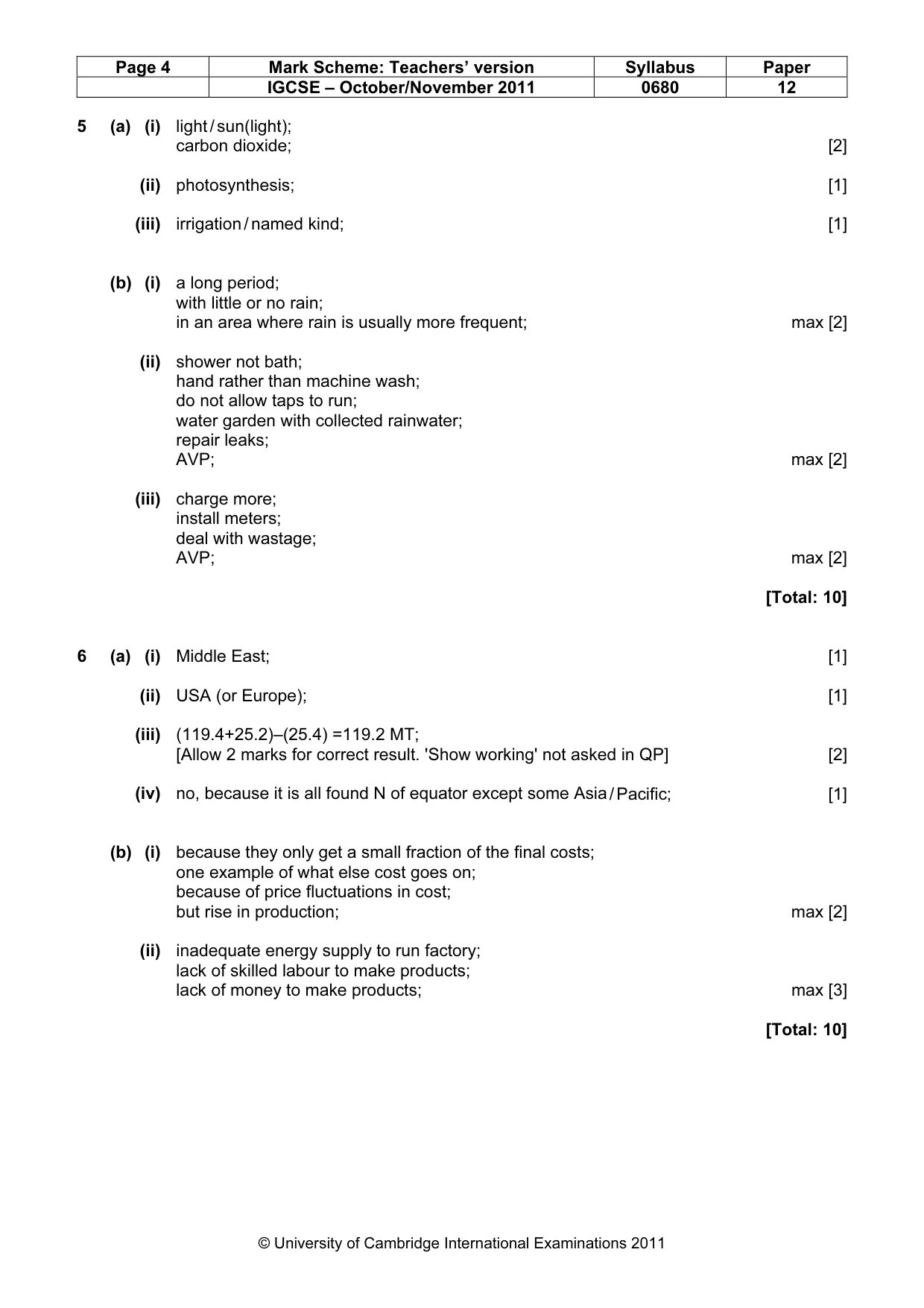
Page 4 Mark Scheme: Teachers’ version Syllabus Paper IGCSE – October/November 2011 0680 12 © University of Cambridge International Examinations 2011 5 (a) (i) light / sun(light); carbon dioxide; [2] (ii) photosynthesis; [1] (iii) irrigation / named kind; [1] (b) (i) a long period; with little or no rain; in an area where rain is usually more frequent; max [2] (ii) shower not bath; hand rather than machine wash; do not allow taps to run; water garden with collected rainwater; repair leaks; AVP; max [2] (iii) charge more; install meters; deal with wastage; AVP; max [2] [Total: 10] 6 (a) (i) Middle East; [1] (ii) USA (or Europe); [1] (iii) (119.4+25.2)–(25.4) =119.2 MT; [Allow 2 marks for correct result. 'Show working' not asked in QP] [2] (iv) no, because it is all found N of equator except some Asia / Pacific; [1] (b) (i) because they only get a small fraction of the final costs; one example of what else cost goes on; because of price fluctuations in cost; but rise in production; max [2] (ii) inadequate energy supply to run factory; lack of skilled labour to make products; lack of money to make products; max [3] [Total: 10]
What you needed in this session
Cambridge’s own grade thresholds for 2011 Oct/Nov, Paper 1 · Variant 2. A higher threshold means an easier paper — the bar moves with how the cohort did.