Cambridge IGCSE Environmental Management 0680 — 2011 May/June Paper 1 · Variant 2
0680/12/M/J/11 · 60 marks · ≈68 min
The question paper and its mark scheme, free to read here and free to download. This is Cambridge’s own paper, exactly as it was sat.
Question paper12 pages
Mark scheme5 pages
Answers below. Sit the paper first if you are practising.
Paper as text
Question paper, page 1
This document consists of 12 printed pages. DC (NH/JG) 33719/4 © UCLES 2011 [Turn over UNIVERSITY OF CAMBRIDGE INTERNATIONAL EXAMINATIONS International General Certificate of Secondary Education READ THESE INSTRUCTIONS FIRST Write your Centre number, candidate number and name on all the work you hand in. Write in dark blue or black pen. You may use a soft pencil for any diagrams, graphs or rough working. Do not use staples, paper clips, highlighters, glue or correction fluid. DO NOT WRITE IN ANY BARCODES. Answer all questions. At the end of the examination, fasten all your work securely together. The number of marks is given in brackets [ ] at the end of each question or part question. * 6 1 1 6 2 8 5 8 6 7 * ENVIRONMENTAL MANAGEMENT 0680/12 Paper 1 May/June 2011 1 hour 30 minutes Candidates answer on the Question Paper. Additional Materials: Ruler For Examiner’s Use 1 2 3 4 5 6 Total www.XtremePapers.com
Question paper, page 2
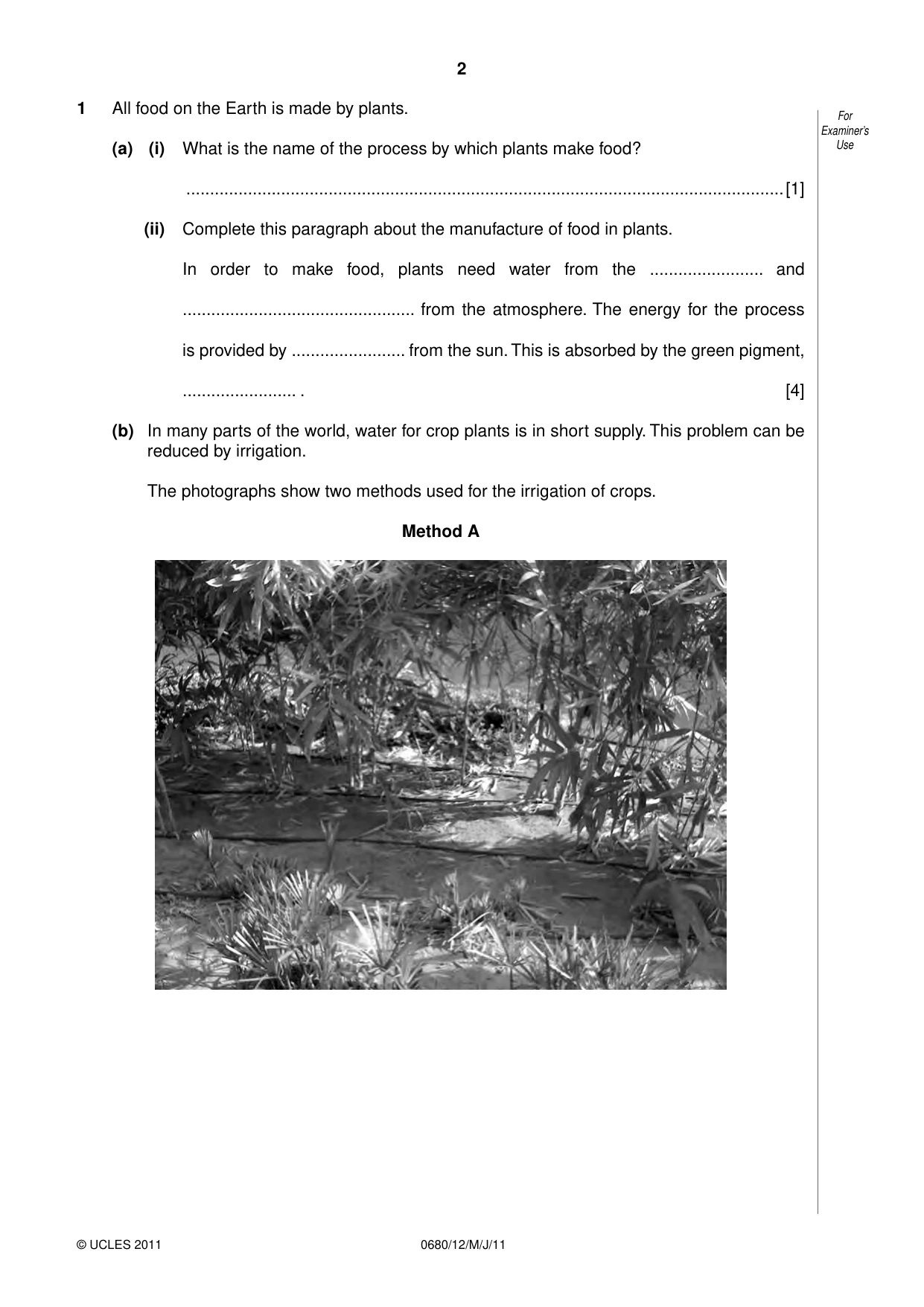
2 © UCLES 2011 For Examiner’s Use 0680/12/M/J/11 1 All food on the Earth is made by plants. (a) (i) What is the name of the process by which plants make food? …[1] (ii) Complete this paragraph about the manufacture of food in plants. In order to make food, plants need water from the … and … from the atmosphere. The energy for the process is provided by … from the sun. This is absorbed by the green pigment, … . [4] (b) In many parts of the world, water for crop plants is in short supply. This problem can be reduced by irrigation. The photographs show two methods used for the irrigation of crops. Method A
Question paper, page 3
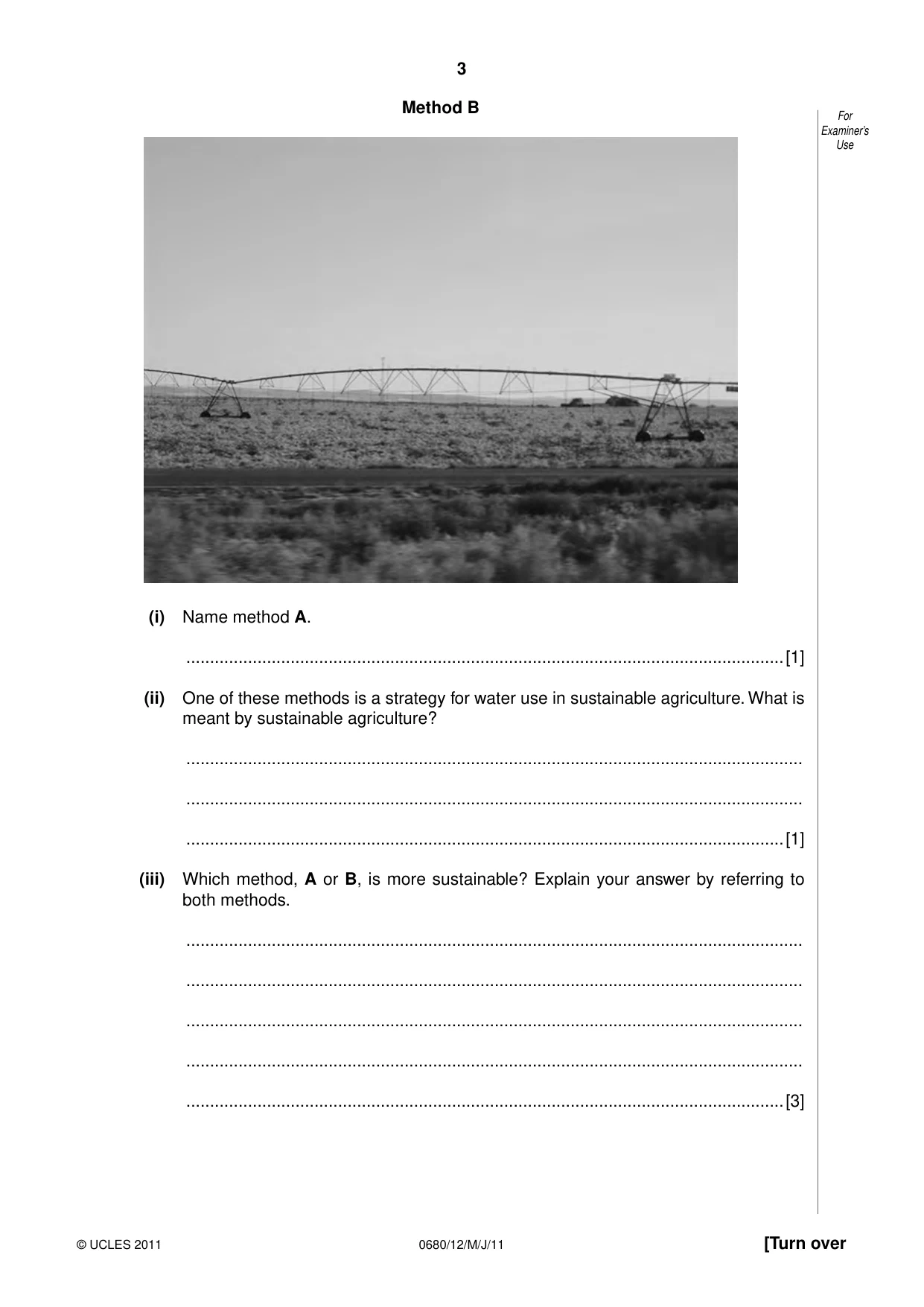
3 © UCLES 2011 [Turn over For Examiner’s Use 0680/12/M/J/11 Method B (i) Name method A. …[1] (ii) One of these methods is a strategy for water use in sustainable agriculture. What is meant by sustainable agriculture? … … …[1] (iii) Which method, A or B, is more sustainable? Explain your answer by referring to both methods. … … … … …[3]
Question paper, page 4
4 © UCLES 2011 For Examiner’s Use 0680/12/M/J/11 2 Land is used in different ways by nomadic pastoralists, hunter-gatherers and crop farmers. (a) (i) Which of these has been in existence for longest? … [1] (ii) What is a nomadic pastoralist? … … … … [2] (b) Land is also used for tourism. This can damage the land so strategies are needed to reduce this problem. (i) Ecotourism is one way to manage this. What is ecotourism? … … … … [2] (ii) Another way to manage tourism is to set up National Parks for the big game animals. In Kenya, however, this leads to conflict between nomadic pastoralists and conservationists. Explain the conflict. … … … …[3] (iii) A third use of land is mining which also causes damage. After mining has finished explain how this damage might be reversed. … … … … [2]
Question paper, page 5
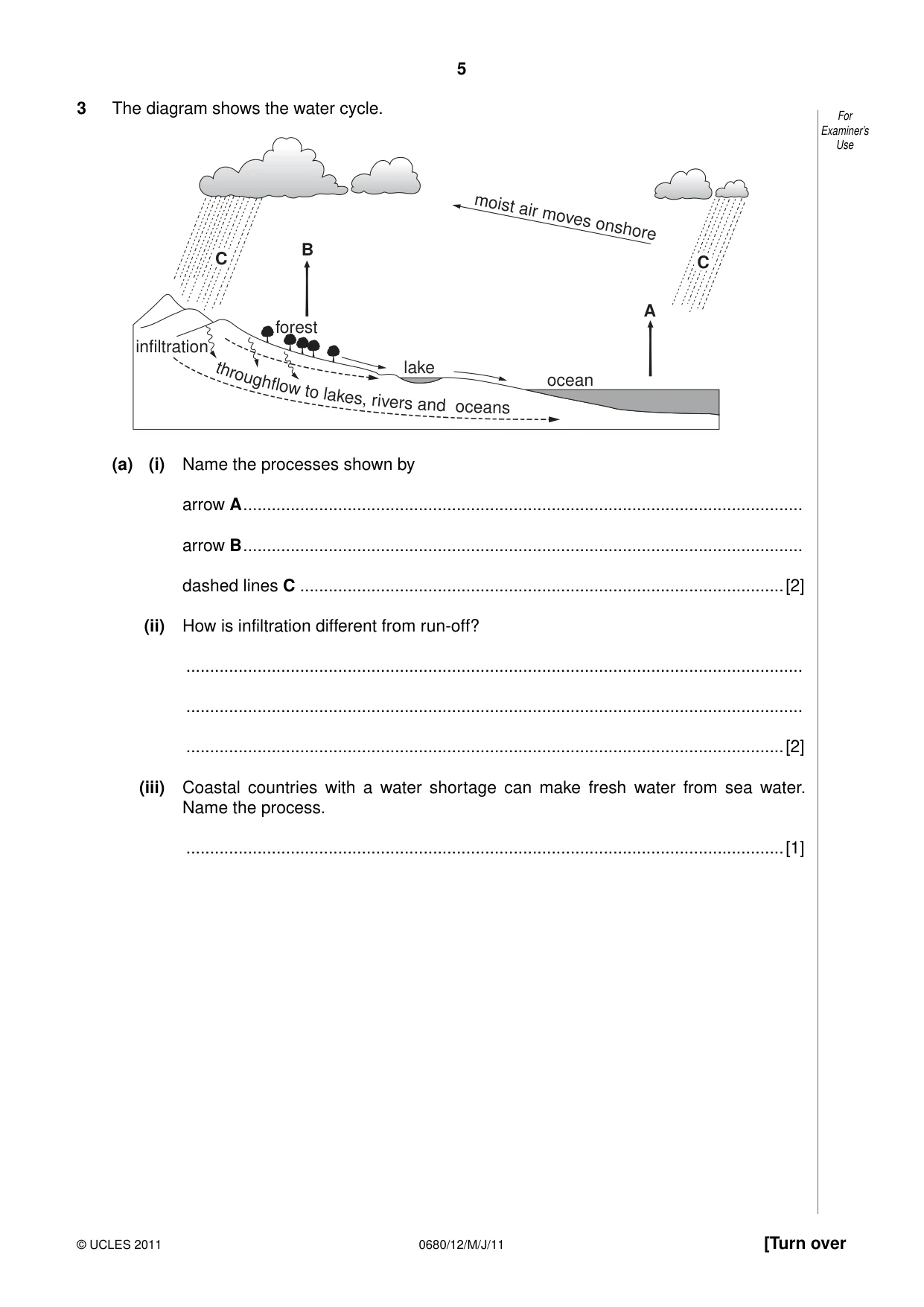
5 © UCLES 2011 [Turn over For Examiner’s Use 0680/12/M/J/11 3 The diagram shows the water cycle. C B C infiltration th rou ghfl ow to lakes , rivers and ocea ns forest lake ocean A moist air moves onshore (a) (i) Name the processes shown by arrow A … arrow B … dashed lines C …[2] (ii) How is infiltration different from run-off? … … …[2] (iii) Coastal countries with a water shortage can make fresh water from sea water. Name the process. …[1]
Question paper, page 6
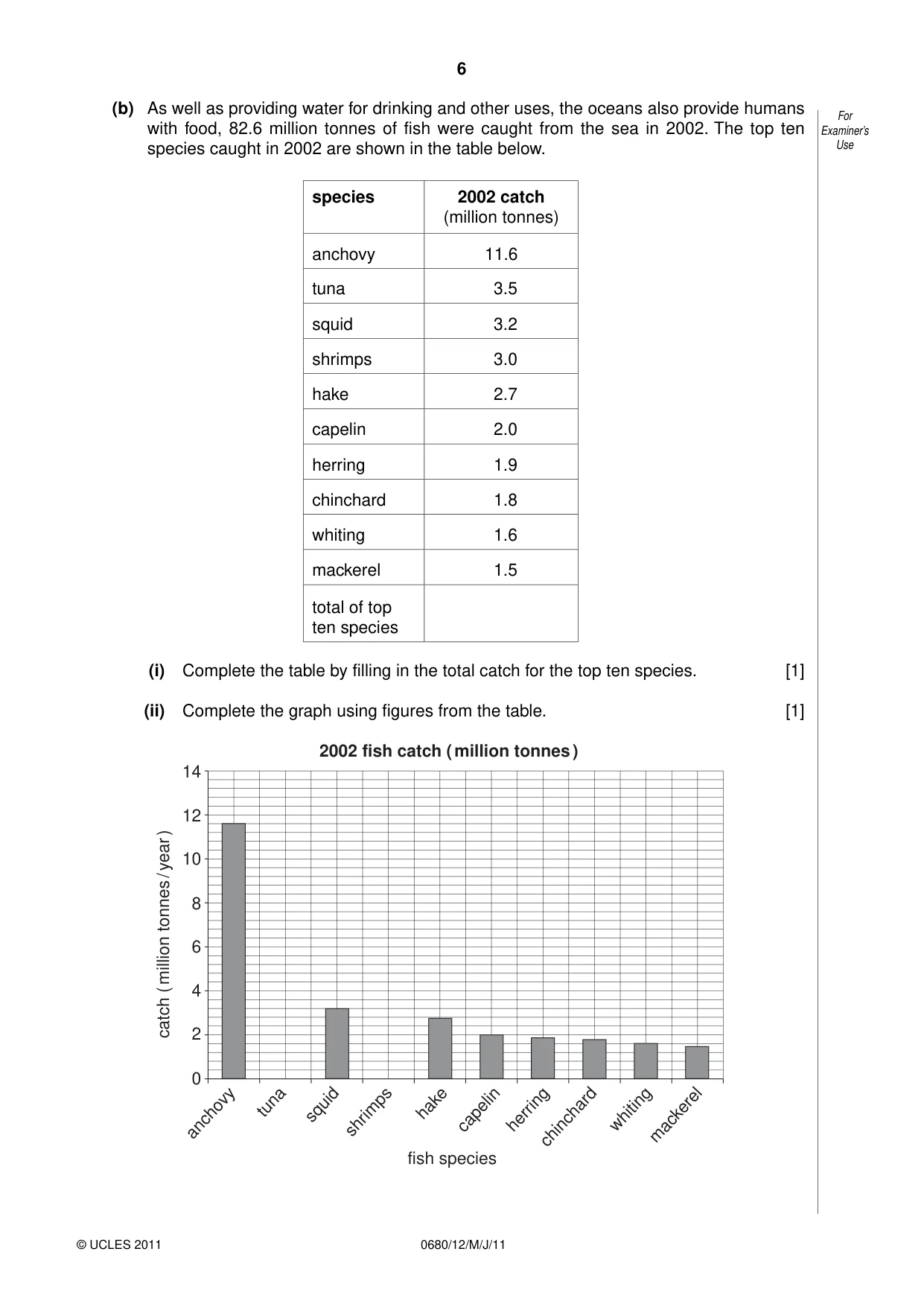
6 © UCLES 2011 For Examiner’s Use 0680/12/M/J/11 (b) As well as providing water for drinking and other uses, the oceans also provide humans with food, 82.6 million tonnes of fish were caught from the sea in 2002. The top ten species caught in 2002 are shown in the table below. species 2002 catch (million tonnes) anchovy 11.6 tuna 3.5 squid 3.2 shrimps 3.0 hake 2.7 capelin 2.0 herring 1.9 chinchard 1.8 whiting 1.6 mackerel 1.5 total of top ten species (i) Complete the table by filling in the total catch for the top ten species. [1] (ii) Complete the graph using figures from the table. [1] 14 12 10 8 6 4 2 0 anchovy tuna squid shrimps hake capelin herring chinchard whiting mackerel fish species catch ( million tonnes / year ) 2002 fish catch ( million tonnes )
Question paper, page 7
7 © UCLES 2011 [Turn over For Examiner’s Use 0680/12/M/J/11 (iii) Most of the anchovy catch in 2002 came from Peruvian waters (nearly 10 million tonnes). However, in 1990 the catch off Peru’s coast was only about 3 million tonnes. What factors may account for this difference? … … … …[3]
Question paper, page 8
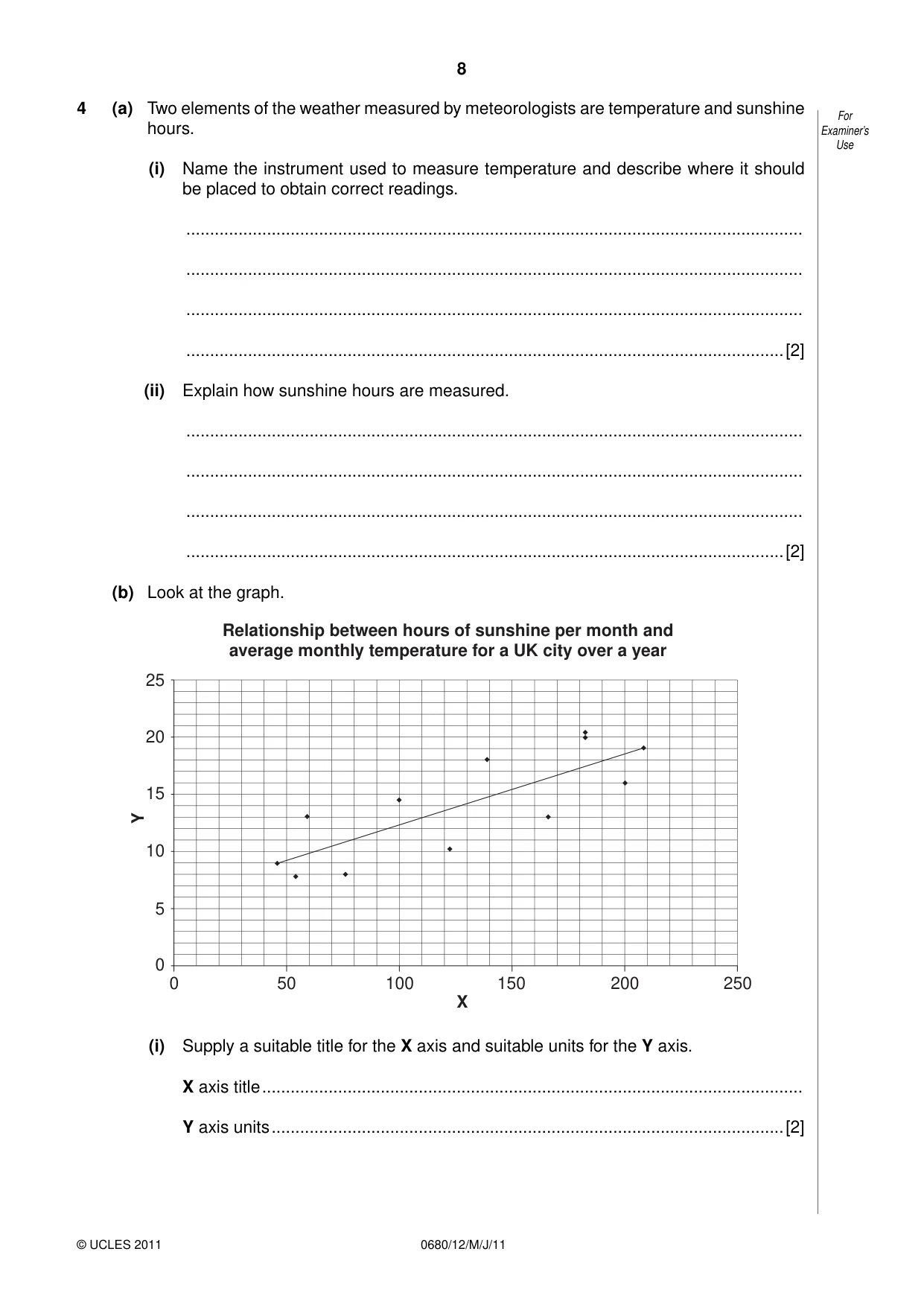
8 © UCLES 2011 For Examiner’s Use 0680/12/M/J/11 4 (a) Two elements of the weather measured by meteorologists are temperature and sunshine hours. (i) Name the instrument used to measure temperature and describe where it should be placed to obtain correct readings. … … … …[2] (ii) Explain how sunshine hours are measured. … … … …[2] (b) Look at the graph. 0 0 5 10 15 20 25 50 100 150 200 250 Y X Relationship between hours of sunshine per month and average monthly temperature for a UK city over a year (i) Supply a suitable title for the X axis and suitable units for the Y axis. X axis title … Y axis units …[2]
Question paper, page 9
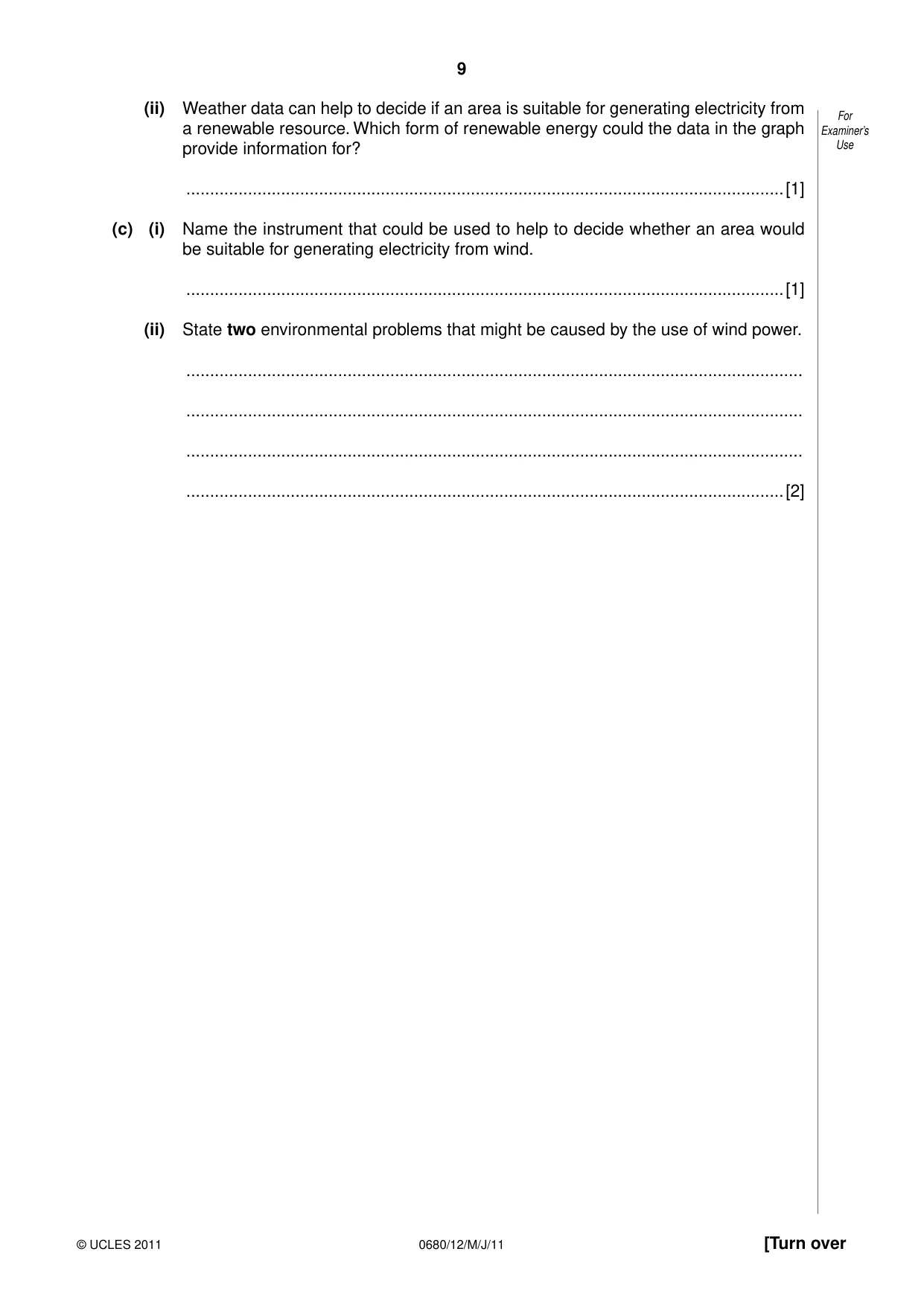
9 © UCLES 2011 [Turn over For Examiner’s Use 0680/12/M/J/11 (ii) Weather data can help to decide if an area is suitable for generating electricity from a renewable resource. Which form of renewable energy could the data in the graph provide information for? …[1] (c) (i) Name the instrument that could be used to help to decide whether an area would be suitable for generating electricity from wind. …[1] (ii) State two environmental problems that might be caused by the use of wind power. … … … …[2]
Question paper, page 10
10 © UCLES 2011 For Examiner’s Use 0680/12/M/J/11 5 The oceans cover 70 percent of the Earth’s surface and contain 97 percent of its water. They have an important resource potential for humans. (a) State two ways in which humans can use the ocean’s resources. … … … …[2] (b) (i) How might the extraction of oil from under the sea lead to pollution and what are the effects of the pollution? … … … …[3] (ii) How might this pollution be controlled? … …[1] (c) Sewage also causes marine pollution. (i) How does sewage get into the sea from towns inland? … …[1] (ii) Describe the effects of sewage in the sea. … … … …[3]
Question paper, page 11
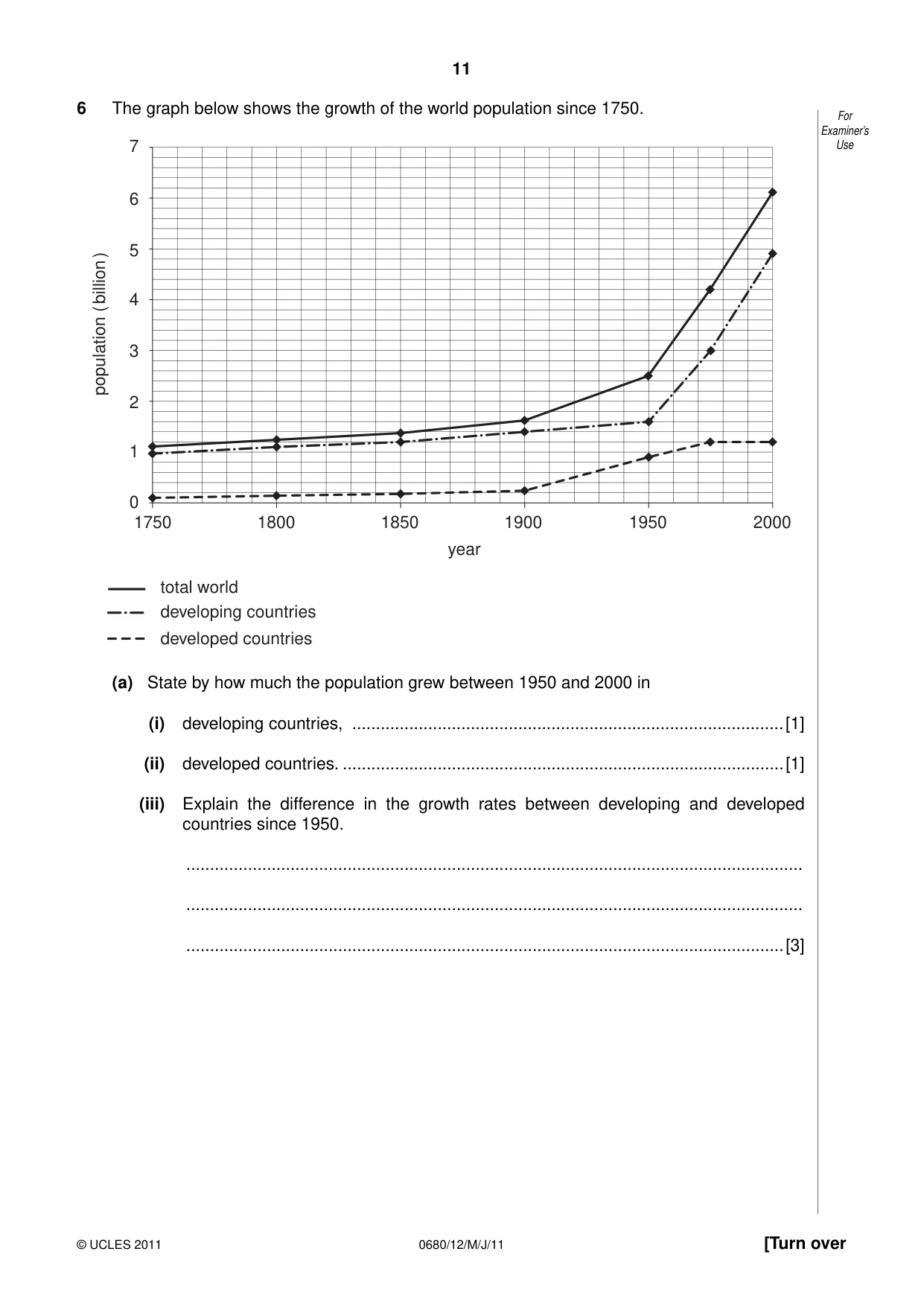
11 © UCLES 2011 [Turn over For Examiner’s Use 0680/12/M/J/11 6 The graph below shows the growth of the world population since 1750. 1750 1800 1850 1900 1950 2000 year population ( billion ) 0 1 2 3 4 5 6 7 total world developing countries developed countries (a) State by how much the population grew between 1950 and 2000 in (i) developing countries, …[1] (ii) developed countries. …[1] (iii) Explain the difference in the growth rates between developing and developed countries since 1950. … … …[3]
Question paper, page 12
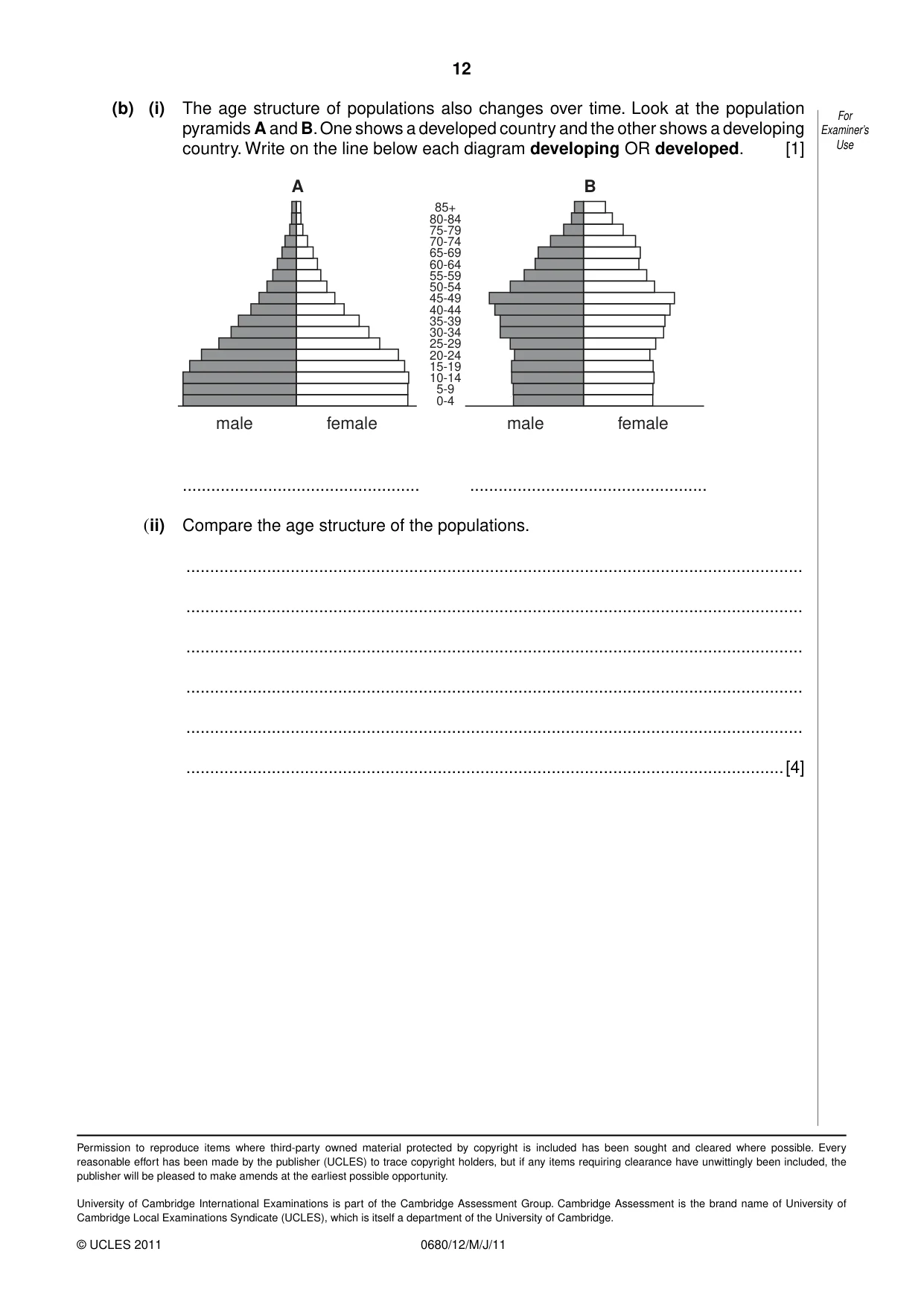
12 © UCLES 2011 0680/12/M/J/11 For Examiner’s Use (b) (i) The age structure of populations also changes over time. Look at the population pyramids A and B. One shows a developed country and the other shows a developing country. Write on the line below each diagram developing OR developed. [1] 85+ 80-84 75-79 70-74 65-69 60-64 55-59 50-54 45-49 40-44 35-39 30-34 25-29 20-24 15-19 10-14 5-9 0-4 A B male female male female … … (ii) Compare the age structure of the populations. … … … … … …[4] Permission to reproduce items where third-party owned material protected by copyright is included has been sought and cleared where possible. Every reasonable effort has been made by the publisher (UCLES) to trace copyright holders, but if any items requiring clearance have unwittingly been included, the publisher will be pleased to make amends at the earliest possible opportunity. University of Cambridge International Examinations is part of the Cambridge Assessment Group. Cambridge Assessment is the brand name of University of Cambridge Local Examinations Syndicate (UCLES), which is itself a department of the University of Cambridge.
Mark scheme, page 1
UNIVERSITY OF CAMBRIDGE INTERNATIONAL EXAMINATIONS International General Certificate of Secondary Education MARK SCHEME for the May/June 2011 question paper for the guidance of teachers 0680 ENVIRONMENTAL MANAGEMENT 0680/12 Paper 1, maximum raw mark 60 This mark scheme is published as an aid to teachers and candidates, to indicate the requirements of the examination. It shows the basis on which Examiners were instructed to award marks. It does not indicate the details of the discussions that took place at an Examiners’ meeting before marking began, which would have considered the acceptability of alternative answers. Mark schemes must be read in conjunction with the question papers and the report on the examination. • Cambridge will not enter into discussions or correspondence in connection with these mark schemes. Cambridge is publishing the mark schemes for the May/June 2011 question papers for most IGCSE, GCE Advanced Level and Advanced Subsidiary Level syllabuses and some Ordinary Level syllabuses. www.XtremePapers.com
Mark scheme, page 2
Page 2 Mark Scheme: Teachers’ version Syllabus Paper IGCSE – May/June 2011 0680 12 © University of Cambridge International Examinations 2011 1 (a) (i) photosynthesis; [1] (ii) soil/eq; ® ground carbon dioxide; light/radiation; (R) rays chlorophyll; [4] (b) (i) trickle drip; [1] (ii) agriculture which ensures that conditions are still as good for the practice for future generations; [1] (Reject use of word sustainable or its derivatives as key part of answer) (iii) A; For A: water directed at roots; less lost (in evaporation); B: water broadcast/eq ; so can evaporate ; doesn’t get to plant; For Either: ref. salinisation (i.e. less with A, or more with B. Or can say more with A as long as discuss low leaching with A.); [3] [Total: 10] 2 (a) (i) hunter-gatherer; [1] (ii) a keeper of stock/cattle/AVP; who moves his animals to fresh pasture when necessary; does not stay in one place (stand alone mark); [2] (b) (i) tourism which caters to those interested in natural environments/eq; uses tourist money to protect environment; env must be protected to keep money coming in; [2] (ii) conservationists want to protect animals that might affect nomadic pastoralists – latter might kill animals etc. that conservationists want to keep ; and then egs such as: wildebeest/herbivores, compete with cattle; lions/other predators predate/eat cattle; restricts movement of nps/reluctance of nps to share home/land [3] (iii) any 2 of: reclamation/restoration; replace overburden/add soil; ® just filling hole add fertiliser/eq/; plant (trees etc.); allowing water to infill depressions – lakes; levelling spoil heaps; [2] [Total: 10]
Mark scheme, page 3
Page 3 Mark Scheme: Teachers’ version Syllabus Paper IGCSE – May/June 2011 0680 12 © University of Cambridge International Examinations 2011 3 (a) (i) A evaporation; B transpiration/evapotranspiration; C precipitation/rainfall/eq; all 3 for 2; any 2 or 1 for 1 [2] (ii) infiltration water enters soil/ground (and then drains away); runoff does not enter soil/flows along ground (before draining to rivers sea); [2] (iii) desalination; [1] (b) (i) 32.8; [1] (ii) correct bars drawn; [1] (tuna must just be below 9th line, shrimps must be in middle of 7th and 8th lines) (iii) El Nino; reversal of current/current changes direction; (too) warm/eq; fish not adapted to warm; upwelling stops; low nutrients; so less food/eq; fish migrate/eq; [3] [Total: 10] 4 (a) (i) thermometer; in the shade/not in direct sunlight/S screen; [2] (ii) Campbell-Stokes; clear glass sphere; concentrates light on recording sheet which is burnt; OR Jordan’s; can with pinhole; Sun darkens photosensitive paper inside when shines through hole; [2] (NOTE. Can give one for correct name of device as above. General idea: give one for idea of paper burning or being affected in some way by light, second mark for a feasible way of doing this) (b) (i) hours/duration/amount of sunshine, per (or /) month; °C/F; [2] (ii) solar; [1] (c) (i) anemometer; [1] (ii) birds killed; aesthetic; noise; uses land, qualified (e.g., agricultural, beautiful); [2] [Total: 10]
Mark scheme, page 4
Page 4 Mark Scheme: Teachers’ version Syllabus Paper IGCSE – May/June 2011 0680 12 © University of Cambridge International Examinations 2011 5 (a) fishing for food/eq; (Must say or imply food) wave/tidal energy; tourism/recreation; bulk/large/heavy/eq transport; drinking water/irrigation/domestic water use; (but only if some suggestion of ‘must be treated first’) oil/gas/eq; [2] (b) (i) spills/leaks; destroys marine life; poison fish/kill birds; (not just fish killed or die) oiling of birds; ref. to O2 falls/eq; oiling/coastal pollution, beaches; ref. economic effects (qualified); [3] (ii) booms/double hulls/detergent/burning/sucking up [1] (c) (i) along rivers; [1] (ii) increased levels of nutrients or named; increased algal growth; algae die; increased organic matter; decomposes; lowering oxygen; eutrophication; ‘fish die’ (qualified, e.g. lack of oxygen, food)/eq (e.g. aerobes/eq); ® death of organisms/eq [3] [Total: 10]
Mark scheme, page 5
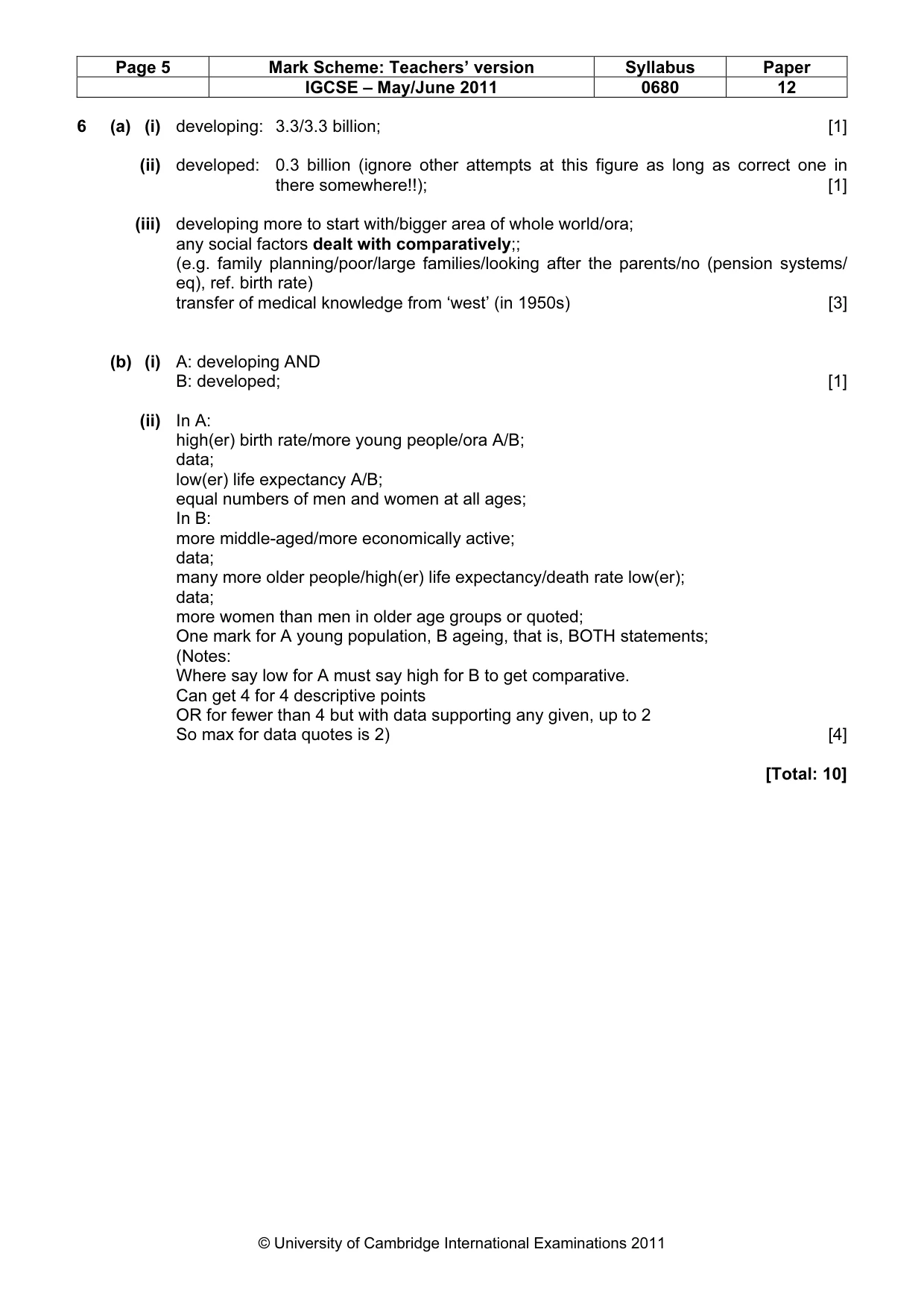
Page 5 Mark Scheme: Teachers’ version Syllabus Paper IGCSE – May/June 2011 0680 12 © University of Cambridge International Examinations 2011 6 (a) (i) developing: 3.3/3.3 billion; [1] (ii) developed: 0.3 billion (ignore other attempts at this figure as long as correct one in there somewhere!!); [1] (iii) developing more to start with/bigger area of whole world/ora; any social factors dealt with comparatively;; (e.g. family planning/poor/large families/looking after the parents/no (pension systems/ eq), ref. birth rate) transfer of medical knowledge from ‘west’ (in 1950s) [3] (b) (i) A: developing AND B: developed; [1] (ii) In A: high(er) birth rate/more young people/ora A/B; data; low(er) life expectancy A/B; equal numbers of men and women at all ages; In B: more middle-aged/more economically active; data; many more older people/high(er) life expectancy/death rate low(er); data; more women than men in older age groups or quoted; One mark for A young population, B ageing, that is, BOTH statements; (Notes: Where say low for A must say high for B to get comparative. Can get 4 for 4 descriptive points OR for fewer than 4 but with data supporting any given, up to 2 So max for data quotes is 2) [4] [Total: 10]
What you needed in this session
Cambridge’s own grade thresholds for 2011 May/June, Paper 1 · Variant 2. A higher threshold means an easier paper — the bar moves with how the cohort did.