Cambridge IGCSE Environmental Management 0680 — 2008 Oct/Nov Paper 2 · Variant 1
0680/21/O/N/08 · 80 marks · ≈90 min
The question paper and its mark scheme, free to read here and free to download. This is Cambridge’s own paper, exactly as it was sat.
Question paper16 pages
Mark scheme8 pages
Answers below. Sit the paper first if you are practising.
Paper as text
Question paper, page 1
READ THESE INSTRUCTIONS FIRST Write your Centre number, candidate number and name on all the work you hand in. Write in dark blue or black pen. You may use a soft pencil for any diagrams, graphs or rough working. Do not use staples, paper clips, highlighters, glue or correction fluid. DO NOT WRITE IN ANY BARCODES. Answer both questions. At the end of the examination, fasten all your work securely together. The number of marks is given in brackets [ ] at the end of each question or part question. For Examiner’s Use 1 2 Total This document consists of 16 printed pages. SP (KN) T48943/2 © UCLES 2008 [Turn over UNIVERSITY OF CAMBRIDGE INTERNATIONAL EXAMINATIONS International General Certificate of Secondary Education * 8 0 4 0 7 1 9 4 7 6 * ENVIRONMENTAL MANAGEMENT 0680/02 Paper 2 October/November 2008 1 hour 45 minutes Candidates answer on the Question Paper. Additional Materials: Ruler www.XtremePapers.com
Question paper, page 2
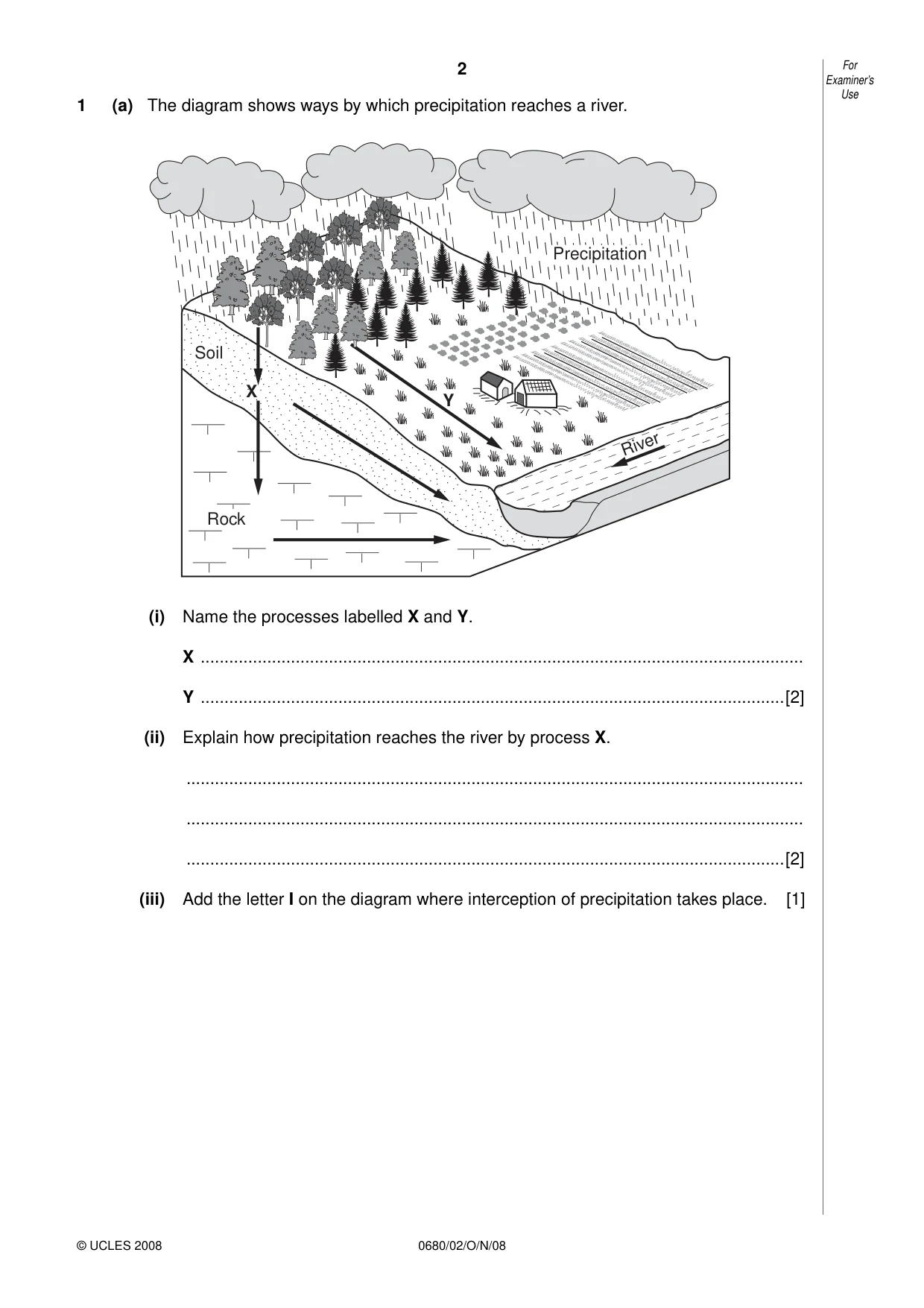
2 0680/02/O/N/08 For Examiner’s Use © UCLES 2008 1 (a) The diagram shows ways by which precipitation reaches a river. Precipitation Rock Soil X Y River (i) Name the processes labelled X and Y. X … Y …[2] (ii) Explain how precipitation reaches the river by process X. … … …[2] (iii) Add the letter I on the diagram where interception of precipitation takes place. [1]
Question paper, page 3
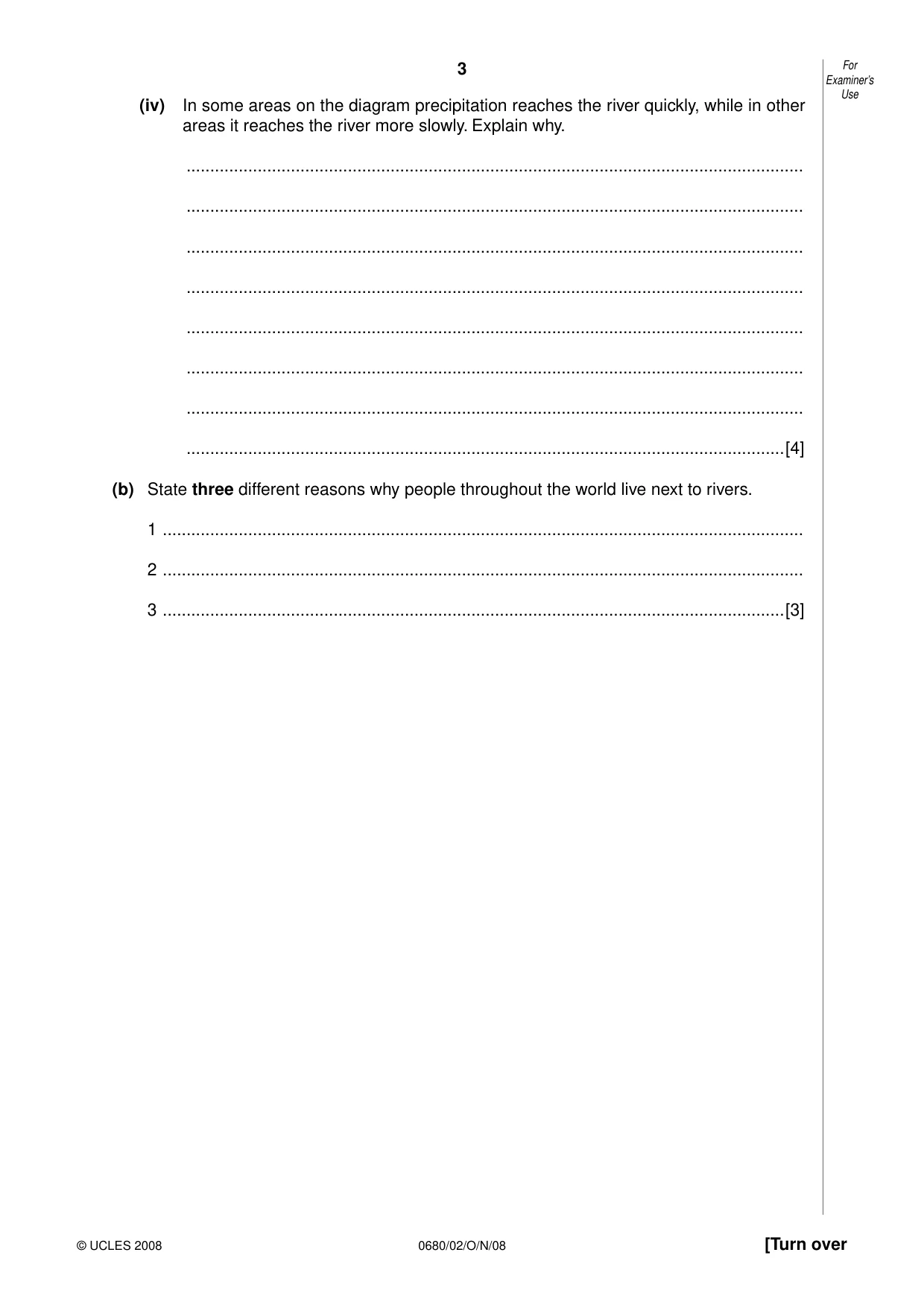
3 0680/02/O/N/08 [Turn over For Examiner’s Use © UCLES 2008 (iv) In some areas on the diagram precipitation reaches the river quickly, while in other areas it reaches the river more slowly. Explain why. … … … … … … … …[4] (b) State three different reasons why people throughout the world live next to rivers. 1 … 2 … 3 …[3]
Question paper, page 4
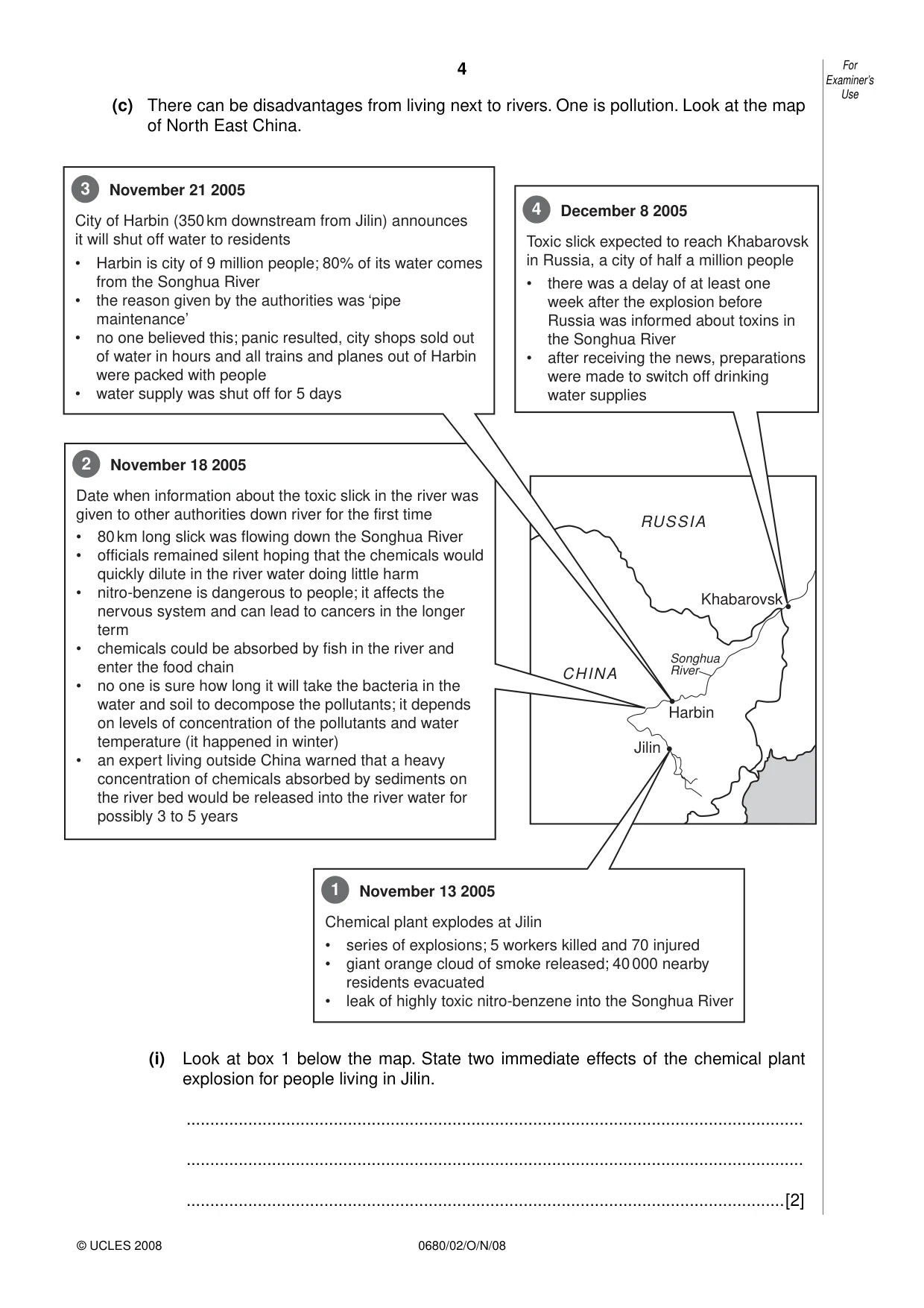
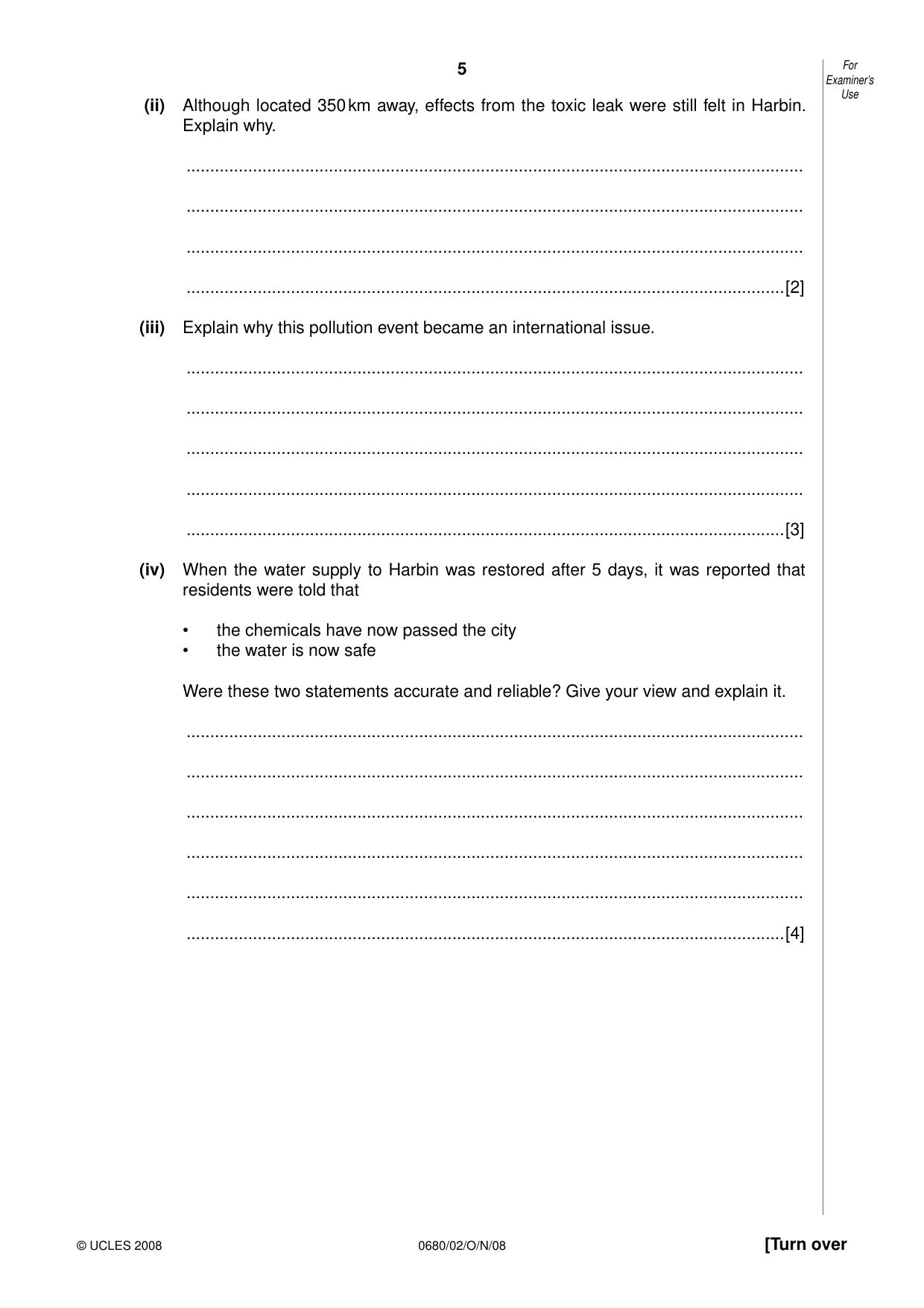
4 0680/02/O/N/08 For Examiner’s Use © UCLES 2008 (c) There can be disadvantages from living next to rivers. One is pollution. Look at the map of North East China. Harbin Khabarovsk Jilin Songhua River RUSSIA CHINA November 13 2005 Chemical plant explodes at Jilin • • • series of explosions; 5 workers killed and 70 injured giant orange cloud of smoke released; 40 000 nearby residents evacuated leak of highly toxic nitro-benzene into the Songhua River December 8 2005 Toxic slick expected to reach Khabarovsk in Russia, a city of half a million people • • there was a delay of at least one week after the explosion before Russia was informed about toxins in the Songhua River after receiving the news, preparations were made to switch off drinking water supplies November 18 2005 Date when information about the toxic slick in the river was given to other authorities down river for the first time • • • • • • 80 km long slick was flowing down the Songhua River officials remained silent hoping that the chemicals would quickly dilute in the river water doing little harm nitro-benzene is dangerous to people; it affects the nervous system and can lead to cancers in the longer term chemicals could be absorbed by fish in the river and enter the food chain no one is sure how long it will take the bacteria in the water and soil to decompose the pollutants; it depends on levels of concentration of the pollutants and water temperature (it happened in winter) an expert living outside China warned that a heavy concentration of chemicals absorbed by sediments on the river bed would be released into the river water for possibly 3 to 5 years 4 2 1 November 21 2005 City of Harbin (350 km downstream from Jilin) announces it will shut off water to residents • • • • Harbin is city of 9 million people; 80% of its water comes from the Songhua River the reason given by the authorities was ‘pipe maintenance’ no one believed this; panic resulted, city shops sold out of water in hours and all trains and planes out of Harbin were packed with people water supply was shut off for 5 days 3 (i) Look at box 1 below the map. State two immediate effects of the chemical plant explosion for people living in Jilin. … … …[2]
Question paper, page 5
5 0680/02/O/N/08 [Turn over For Examiner’s Use © UCLES 2008 (ii) Although located 350 km away, effects from the toxic leak were still felt in Harbin. Explain why. … … … …[2] (iii) Explain why this pollution event became an international issue. … … … … …[3] (iv) When the water supply to Harbin was restored after 5 days, it was reported that residents were told that • the chemicals have now passed the city • the water is now safe Were these two statements accurate and reliable? Give your view and explain it. … … … … … …[4]
Question paper, page 6
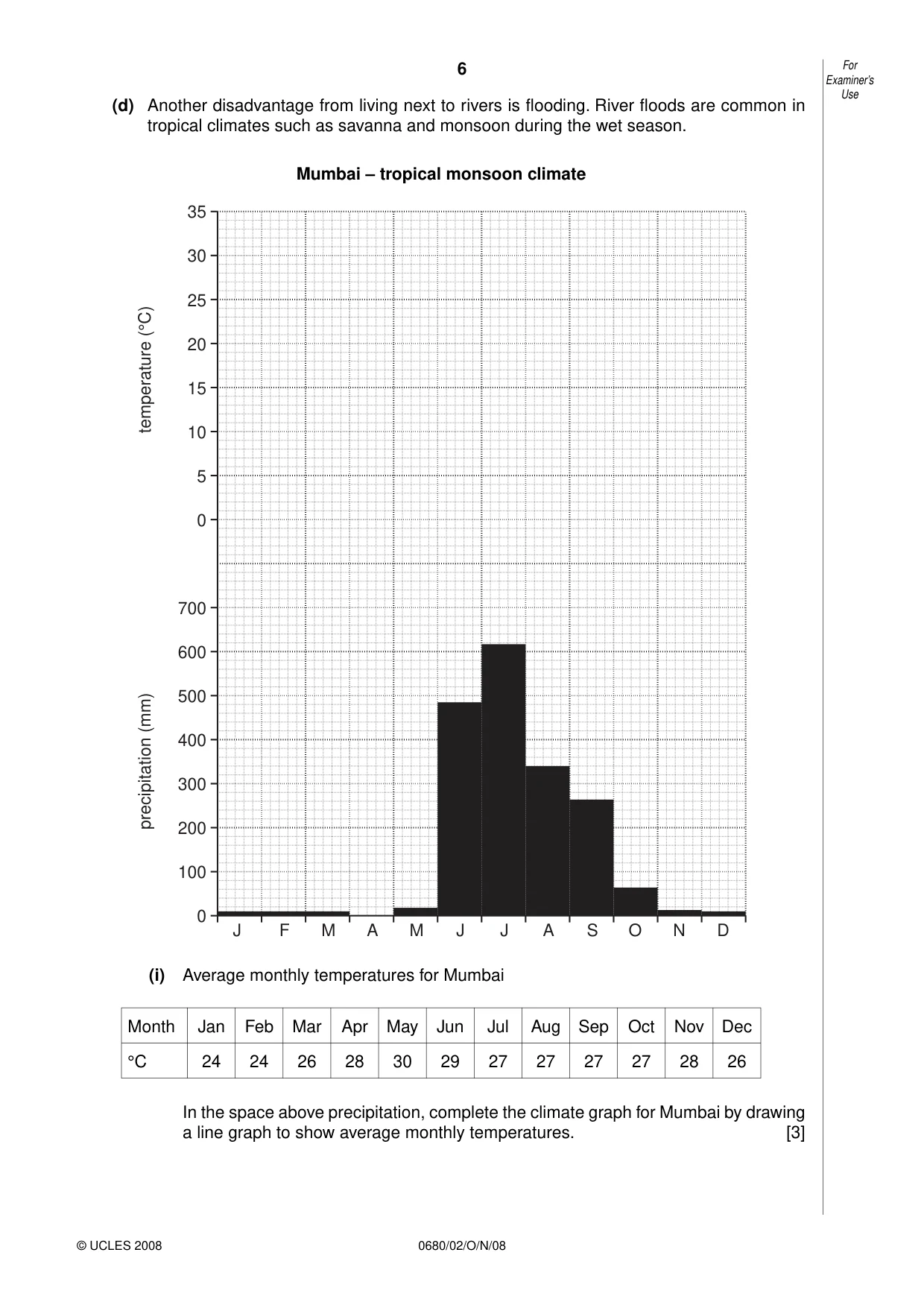
6 0680/02/O/N/08 For Examiner’s Use © UCLES 2008 (d) Another disadvantage from living next to rivers is flooding. River floods are common in tropical climates such as savanna and monsoon during the wet season. Mumbai – tropical monsoon climate 0 100 200 300 400 500 600 700 0 10 20 30 5 15 25 35 precipitation (mm) temperature (°C) J F M A M J J A S O N D (i) Average monthly temperatures for Mumbai Month Jan Feb Mar Apr May Jun Jul Aug Sep Oct Nov Dec °C 24 24 26 28 30 29 27 27 27 27 28 26 In the space above precipitation, complete the climate graph for Mumbai by drawing a line graph to show average monthly temperatures. [3]
Question paper, page 7
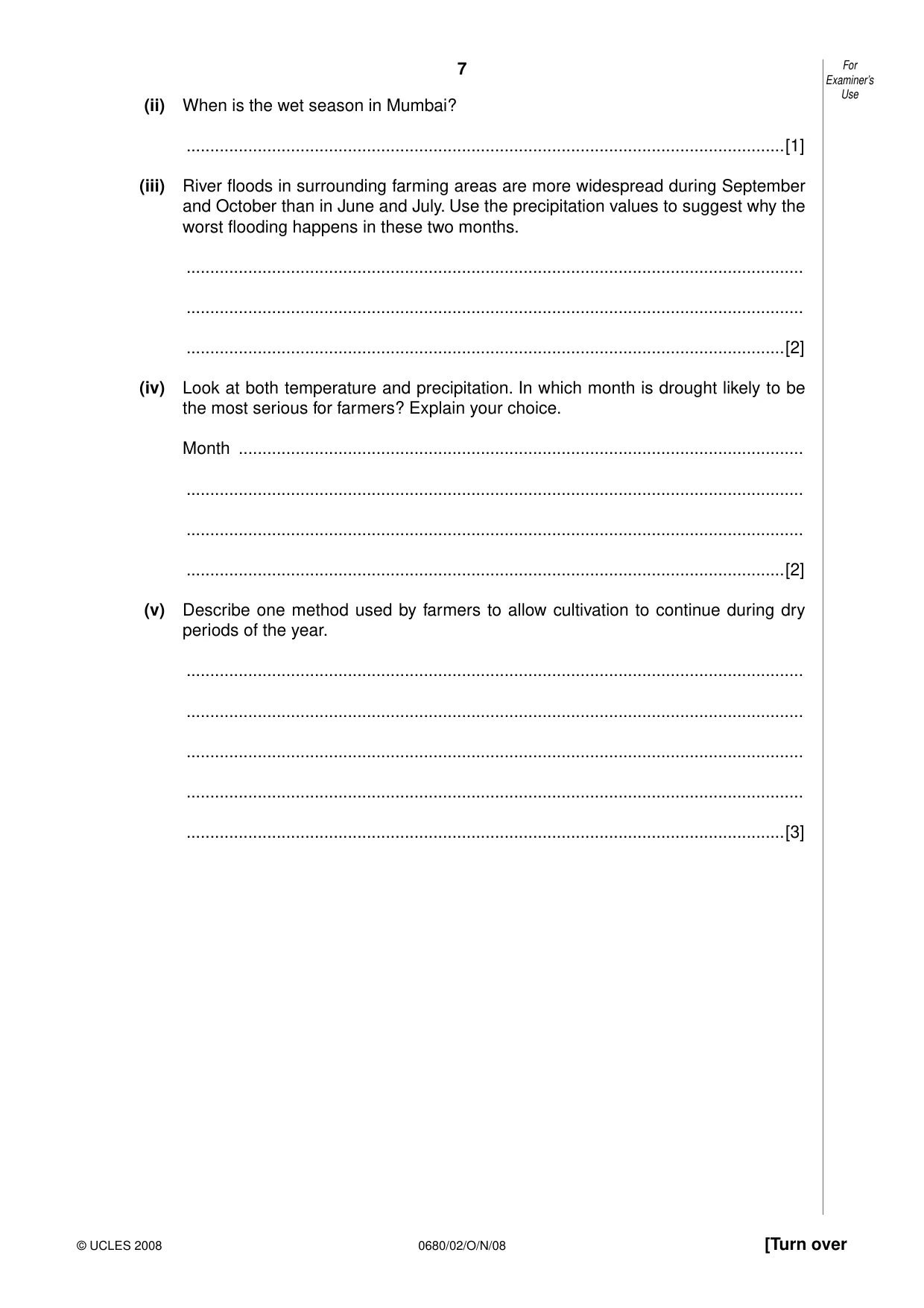
7 0680/02/O/N/08 [Turn over For Examiner’s Use © UCLES 2008 (ii) When is the wet season in Mumbai? …[1] (iii) River floods in surrounding farming areas are more widespread during September and October than in June and July. Use the precipitation values to suggest why the worst flooding happens in these two months. … … …[2] (iv) Look at both temperature and precipitation. In which month is drought likely to be the most serious for farmers? Explain your choice. Month … … … …[2] (v) Describe one method used by farmers to allow cultivation to continue during dry periods of the year. … … … … …[3]
Question paper, page 8
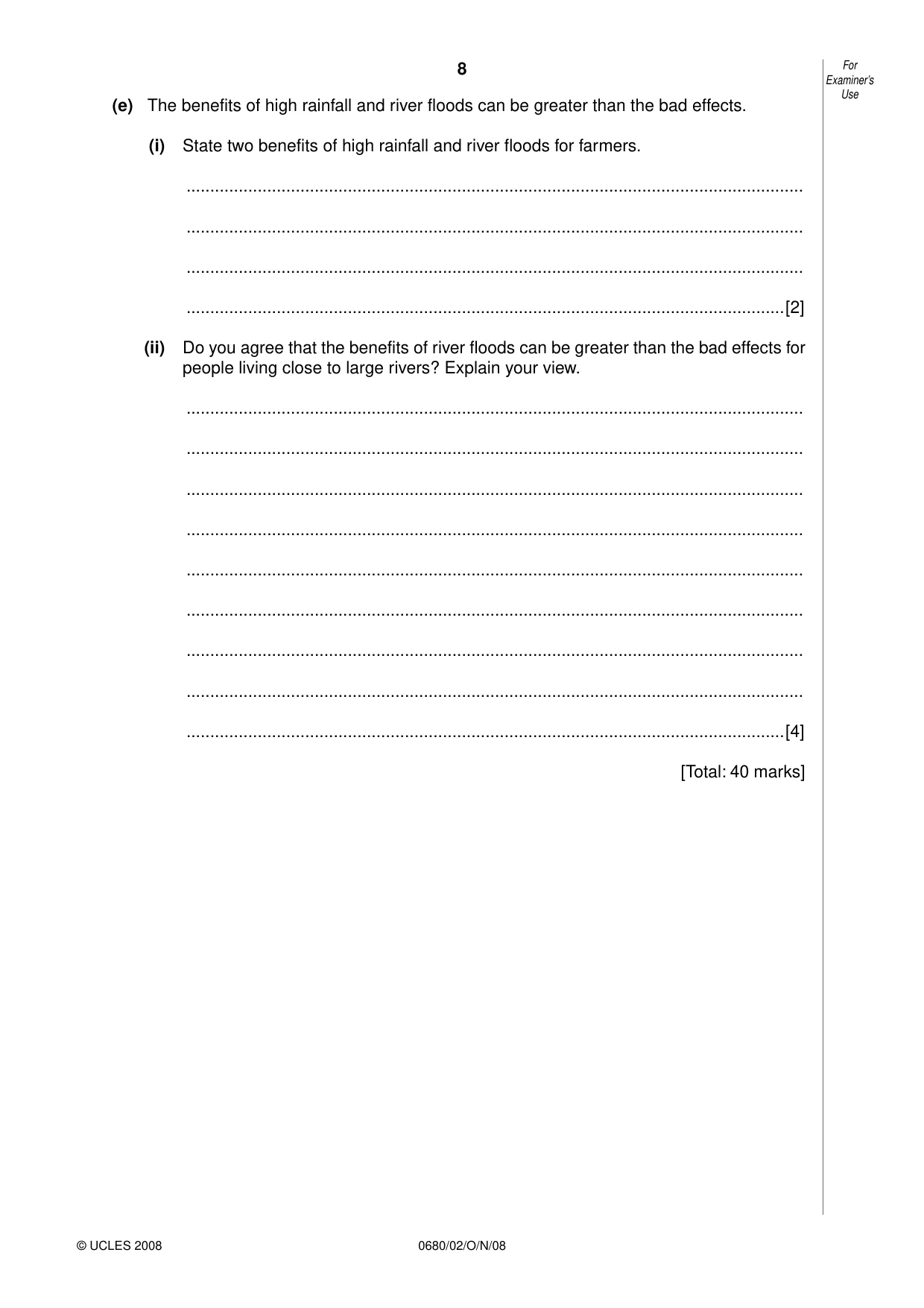
8 0680/02/O/N/08 For Examiner’s Use © UCLES 2008 (e) The benefits of high rainfall and river floods can be greater than the bad effects. (i) State two benefits of high rainfall and river floods for farmers. … … … …[2] (ii) Do you agree that the benefits of river floods can be greater than the bad effects for people living close to large rivers? Explain your view. … … … … … … … … …[4] [Total: 40 marks]
Question paper, page 9
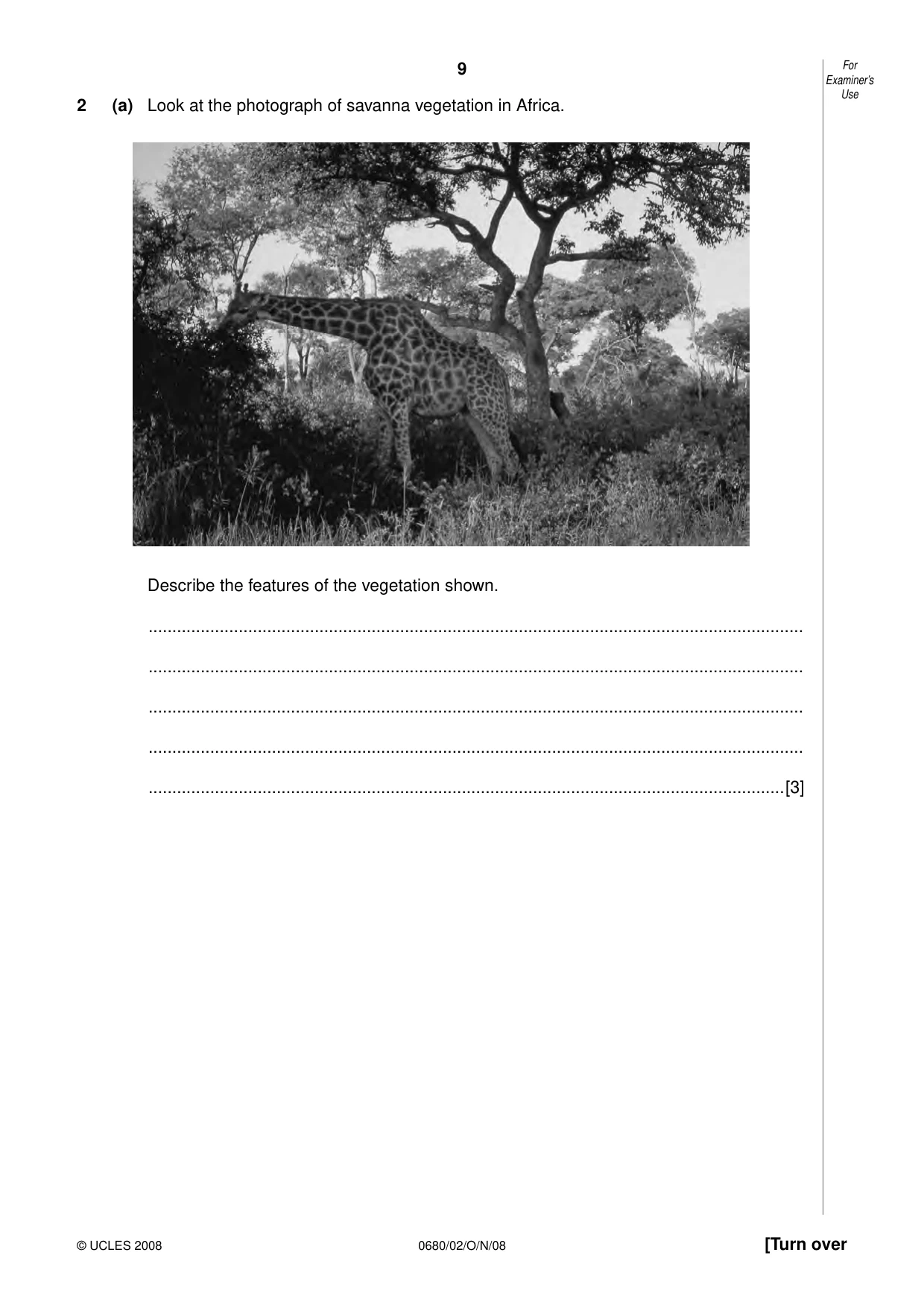
9 0680/02/O/N/08 [Turn over For Examiner’s Use © UCLES 2008 2 (a) Look at the photograph of savanna vegetation in Africa. Describe the features of the vegetation shown. … … … … …[3]
Question paper, page 10
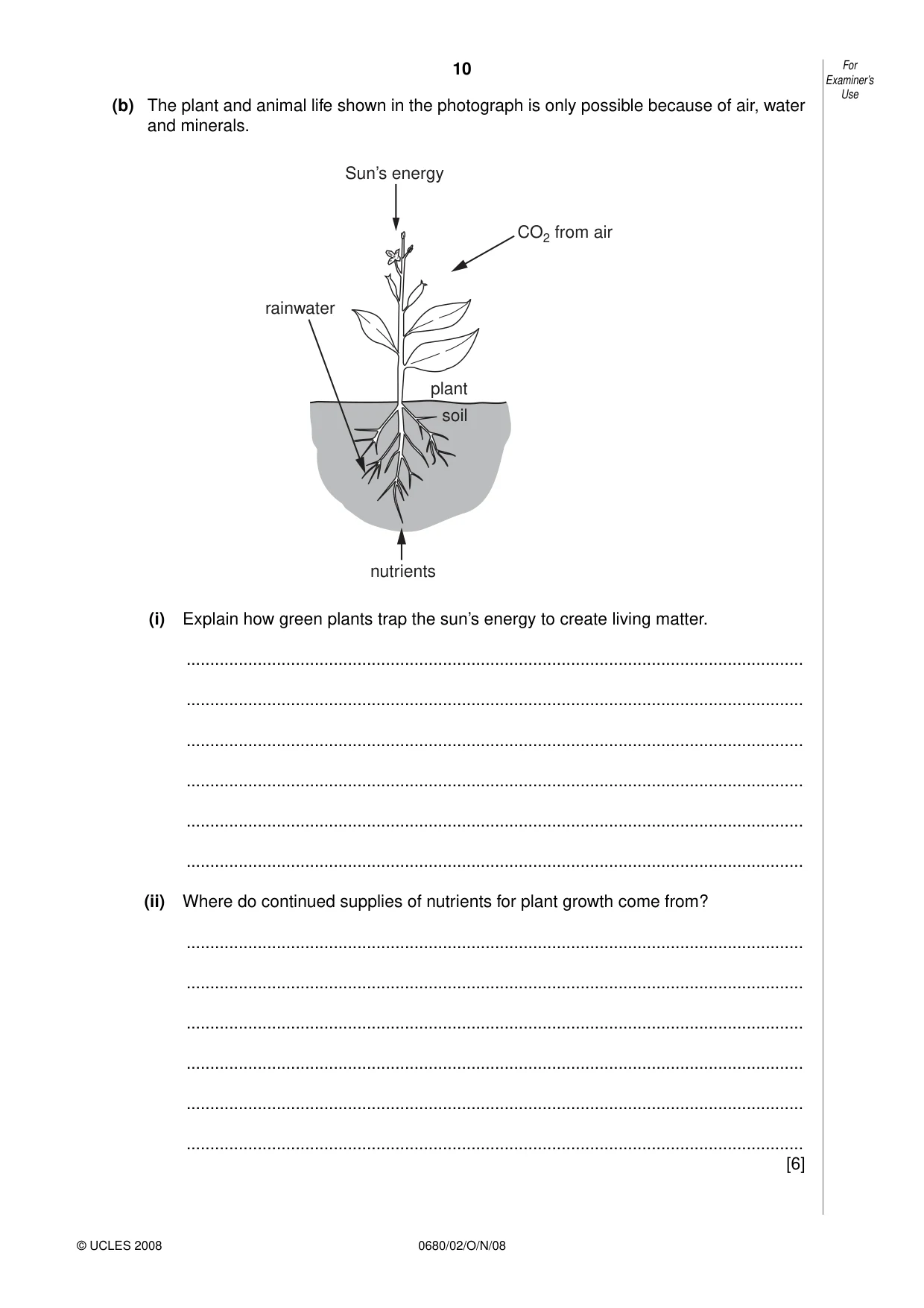
10 0680/02/O/N/08 For Examiner’s Use © UCLES 2008 (b) The plant and animal life shown in the photograph is only possible because of air, water and minerals. plant soil Sun’s energy CO2 from air nutrients rainwater (i) Explain how green plants trap the sun’s energy to create living matter. … … … … … … (ii) Where do continued supplies of nutrients for plant growth come from? … … … … … … [6]
Question paper, page 11
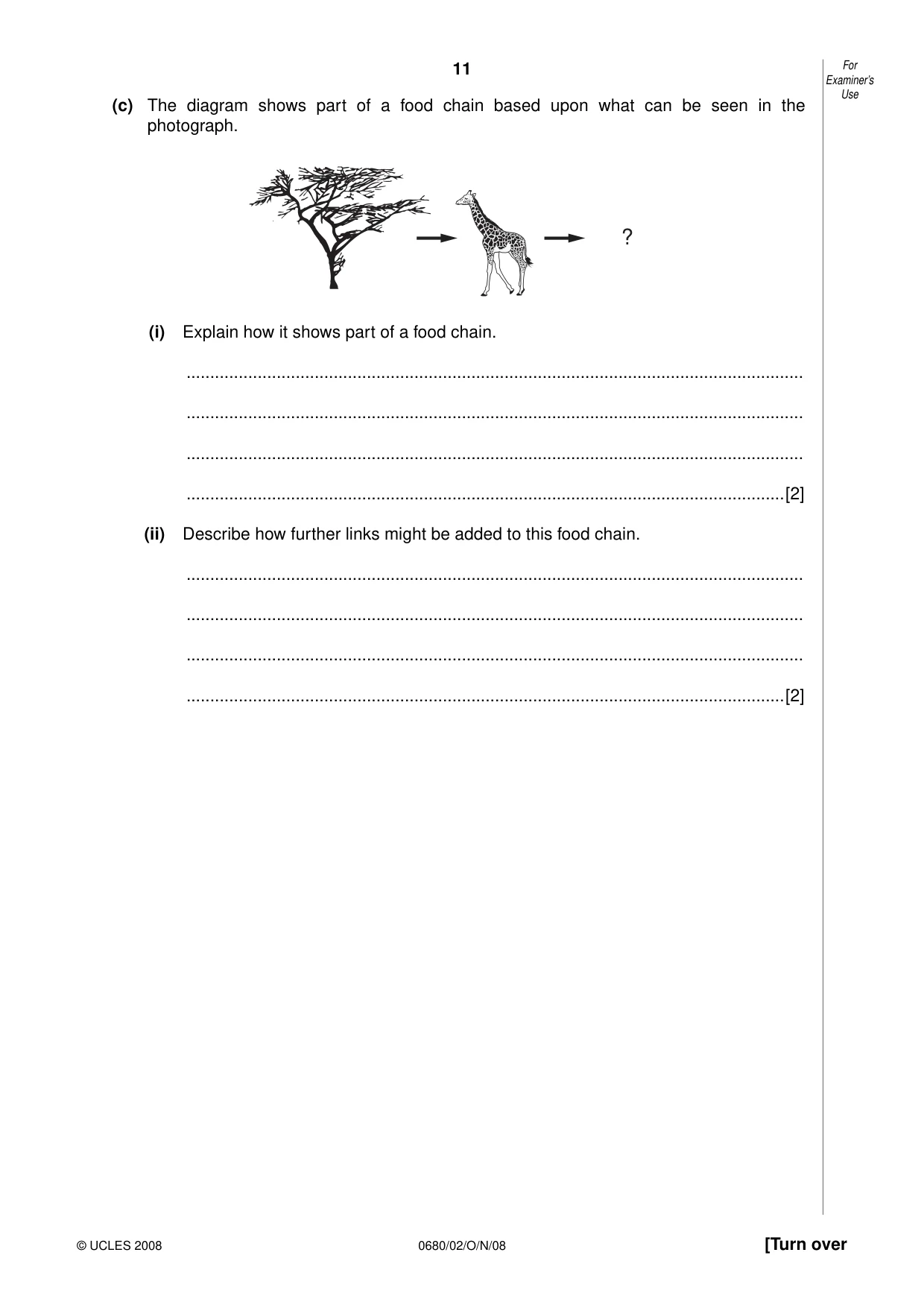
11 0680/02/O/N/08 [Turn over For Examiner’s Use © UCLES 2008 (c) The diagram shows part of a food chain based upon what can be seen in the photograph. ? (i) Explain how it shows part of a food chain. … … … …[2] (ii) Describe how further links might be added to this food chain. … … … …[2]
Question paper, page 12
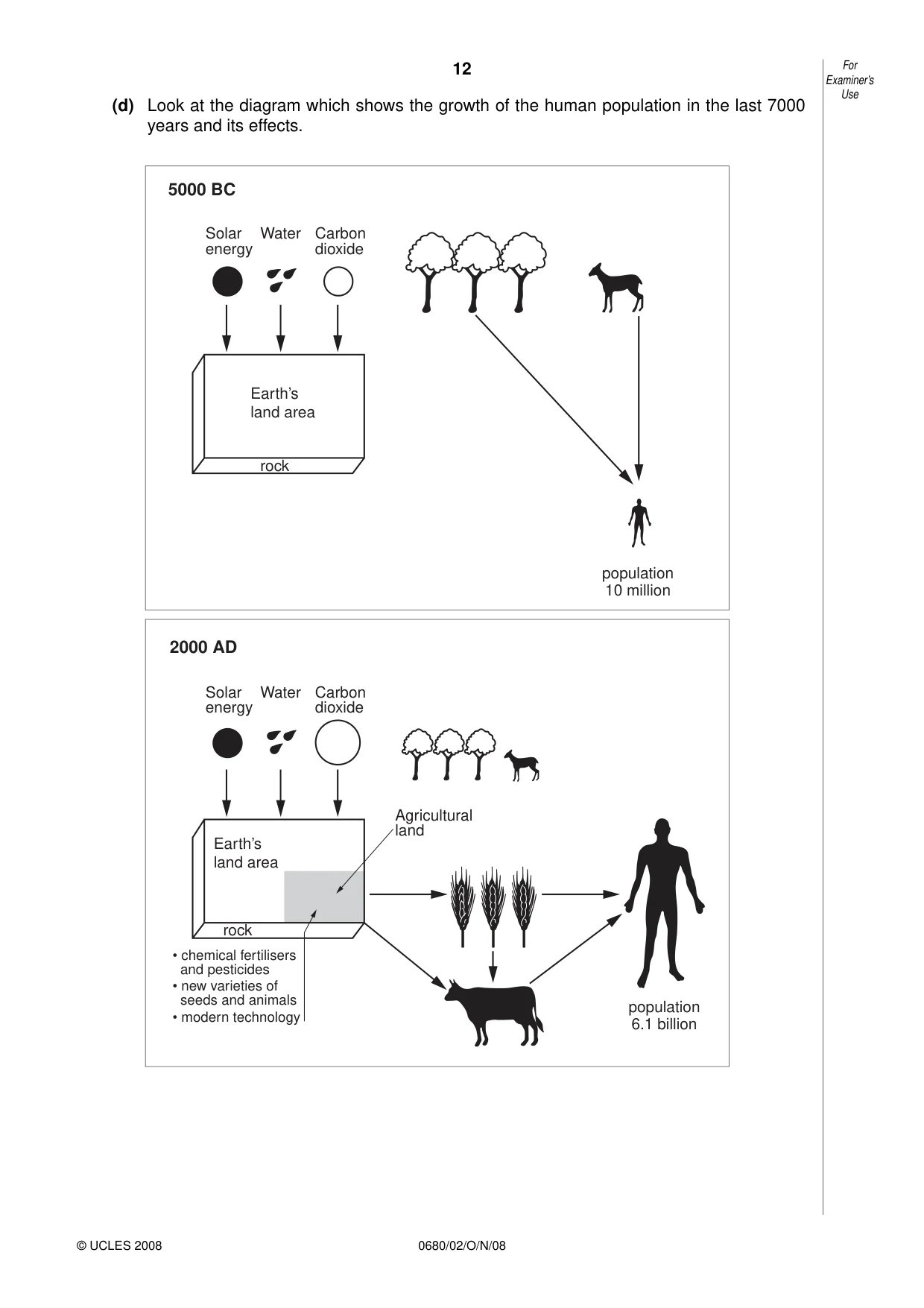
12 0680/02/O/N/08 For Examiner’s Use © UCLES 2008 (d) Look at the diagram which shows the growth of the human population in the last 7000 years and its effects. Earth’s land area Solar energy 5000 BC 2000 AD Carbon dioxide Water rock population 10 million population 6.1 billion Earth’s land area Solar energy Carbon dioxide Water rock Agricultural land • chemical fertilisers and pesticides • new varieties of seeds and animals • modern technology
Question paper, page 13
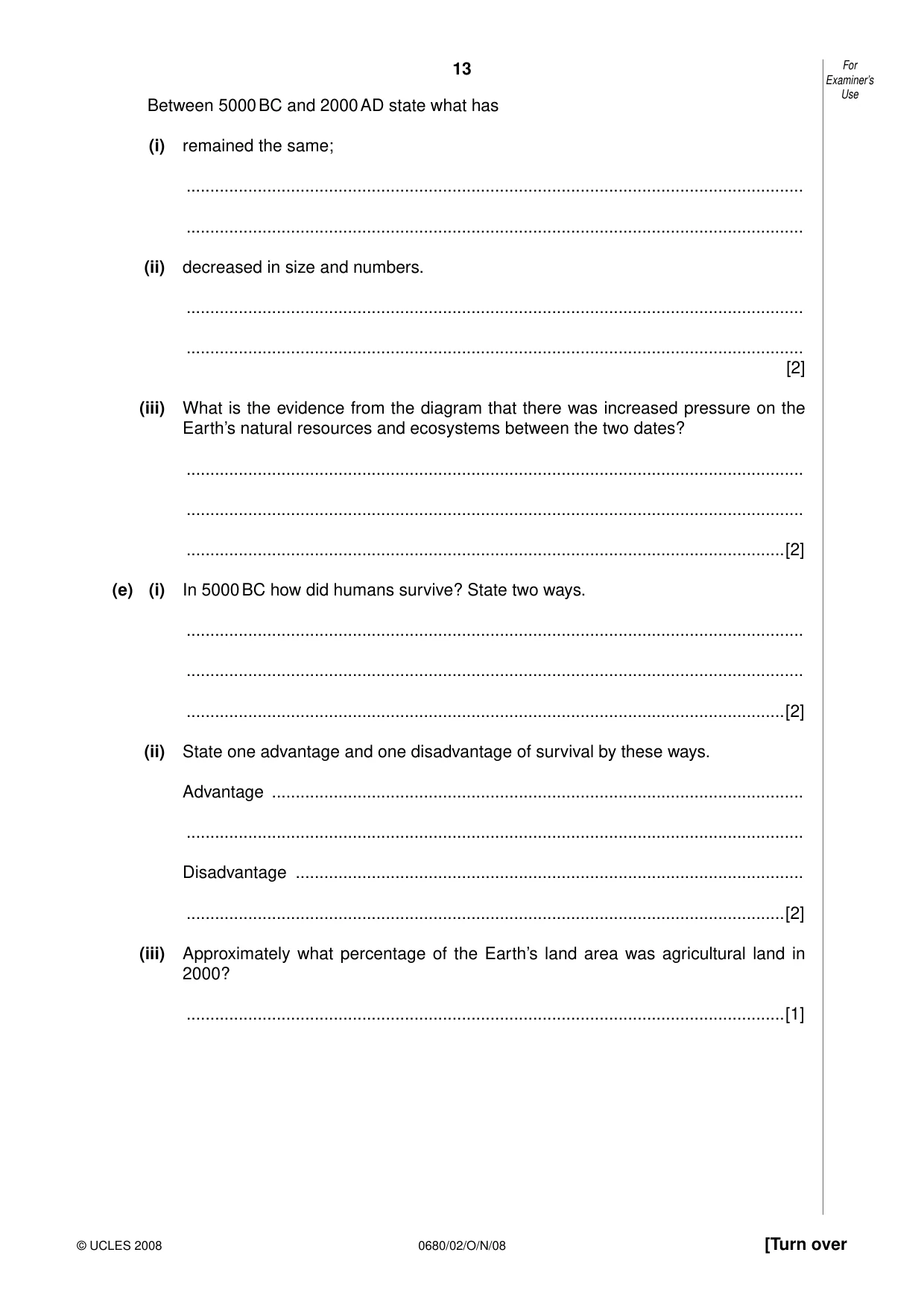
13 0680/02/O/N/08 [Turn over For Examiner’s Use © UCLES 2008 Between 5000 BC and 2000 AD state what has (i) remained the same; … … (ii) decreased in size and numbers. … … [2] (iii) What is the evidence from the diagram that there was increased pressure on the Earth’s natural resources and ecosystems between the two dates? … … …[2] (e) (i) In 5000 BC how did humans survive? State two ways. … … …[2] (ii) State one advantage and one disadvantage of survival by these ways. Advantage … … Disadvantage … …[2] (iii) Approximately what percentage of the Earth’s land area was agricultural land in 2000? …[1]
Question paper, page 14
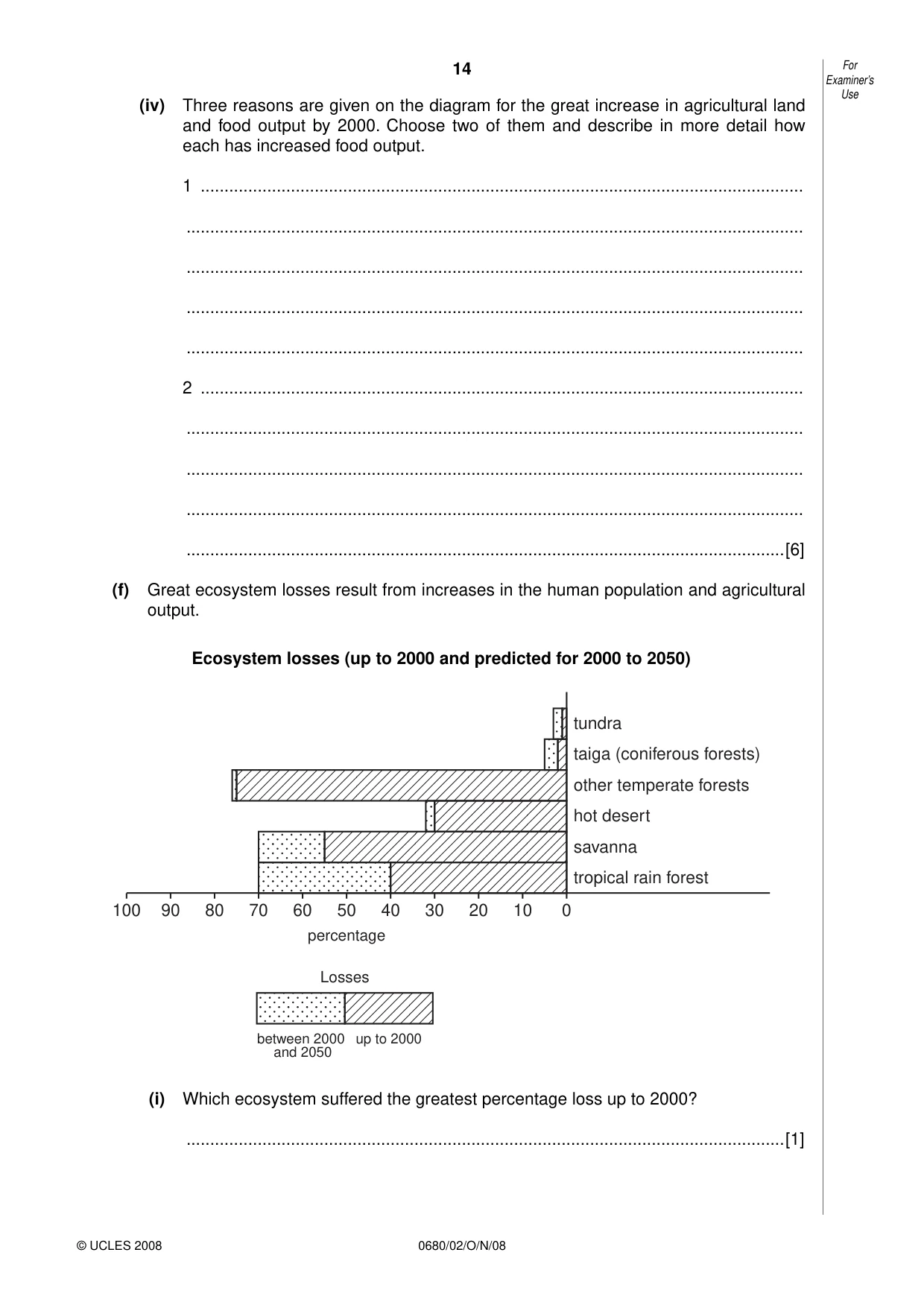
14 0680/02/O/N/08 For Examiner’s Use © UCLES 2008 (iv) Three reasons are given on the diagram for the great increase in agricultural land and food output by 2000. Choose two of them and describe in more detail how each has increased food output. 1 … … … … … 2 … … … … …[6] (f) Great ecosystem losses result from increases in the human population and agricultural output. Ecosystem losses (up to 2000 and predicted for 2000 to 2050) 0 10 20 30 40 50 60 70 80 90 100 tundra taiga (coniferous forests) other temperate forests hot desert savanna tropical rain forest Losses percentage between 2000 and 2050 up to 2000 (i) Which ecosystem suffered the greatest percentage loss up to 2000? …[1]
Question paper, page 15
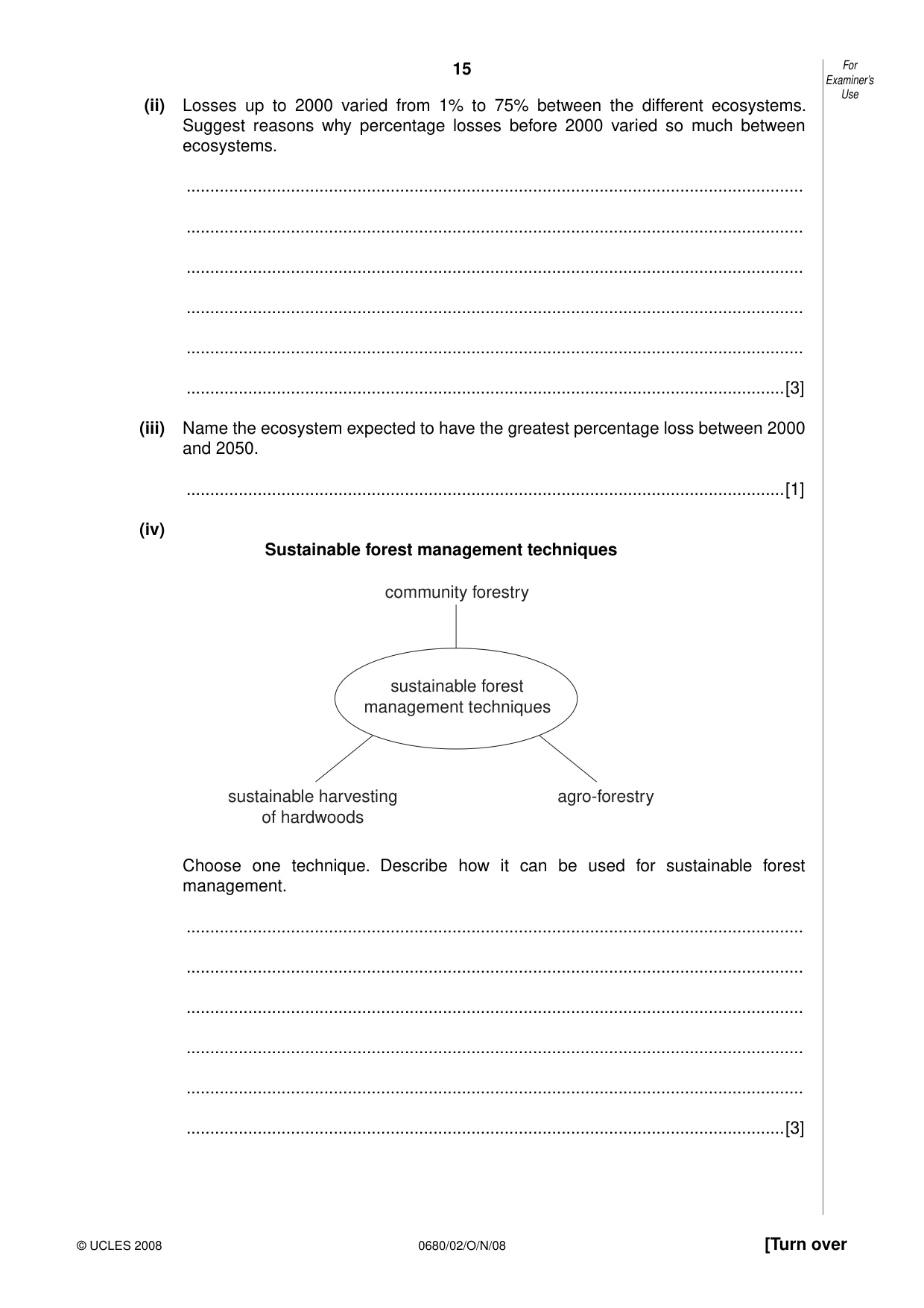
15 0680/02/O/N/08 [Turn over For Examiner’s Use © UCLES 2008 (ii) Losses up to 2000 varied from 1% to 75% between the different ecosystems. Suggest reasons why percentage losses before 2000 varied so much between ecosystems. … … … … … …[3] (iii) Name the ecosystem expected to have the greatest percentage loss between 2000 and 2050. …[1] (iv) Sustainable forest management techniques sustainable forest management techniques agro-forestry sustainable harvesting of hardwoods community forestry Choose one technique. Describe how it can be used for sustainable forest management. … … … … … …[3]
Question paper, page 16
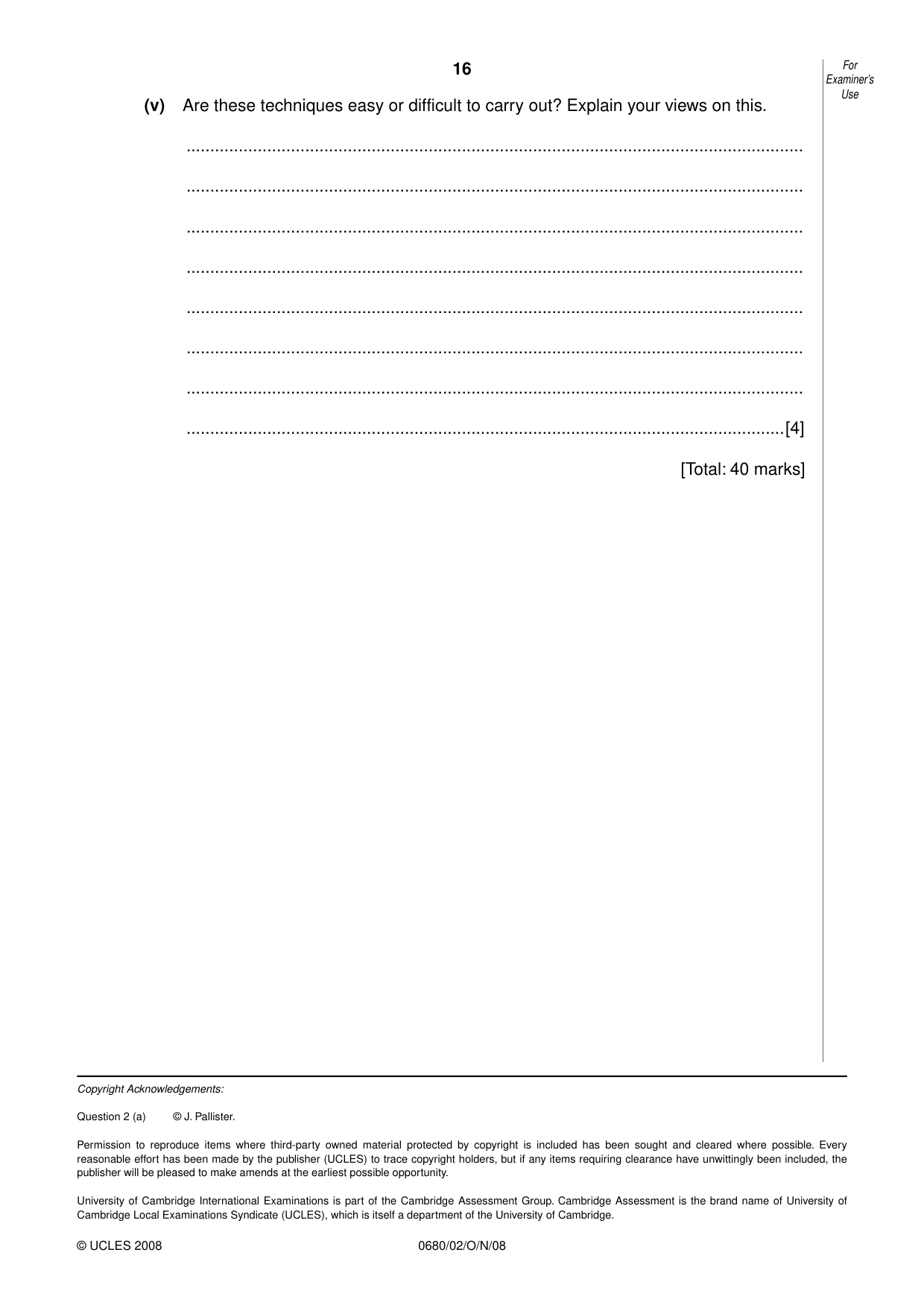
16 0680/02/O/N/08 © UCLES 2008 (v) Are these techniques easy or difficult to carry out? Explain your views on this. … … … … … … … …[4] [Total: 40 marks] For Examiner’s Use Copyright Acknowledgements: Question 2 (a) © J. Pallister. Permission to reproduce items where third-party owned material protected by copyright is included has been sought and cleared where possible. Every reasonable effort has been made by the publisher (UCLES) to trace copyright holders, but if any items requiring clearance have unwittingly been included, the publisher will be pleased to make amends at the earliest possible opportunity. University of Cambridge International Examinations is part of the Cambridge Assessment Group. Cambridge Assessment is the brand name of University of Cambridge Local Examinations Syndicate (UCLES), which is itself a department of the University of Cambridge.
Mark scheme, page 1
UNIVERSITY OF CAMBRIDGE INTERNATIONAL EXAMINATIONS International General Certificate of Secondary Education MARK SCHEME for the October/November 2008 question paper 0680 ENVIRONMENTAL MANAGEMENT 0680/02 Paper 2, maximum raw mark 80 This mark scheme is published as an aid to teachers and candidates, to indicate the requirements of the examination. It shows the basis on which Examiners were instructed to award marks. It does not indicate the details of the discussions that took place at an Examiners’ meeting before marking began. All Examiners are instructed that alternative correct answers and unexpected approaches in candidates’ scripts must be given marks that fairly reflect the relevant knowledge and skills demonstrated. Mark schemes must be read in conjunction with the question papers and the report on the examination. • CIE will not enter into discussions or correspondence in connection with these mark schemes. CIE is publishing the mark schemes for the October/November 2008 question papers for most IGCSE, GCE Advanced Level and Advanced Subsidiary Level syllabuses and some Ordinary Level syllabuses. www.XtremePapers.com
Mark scheme, page 2
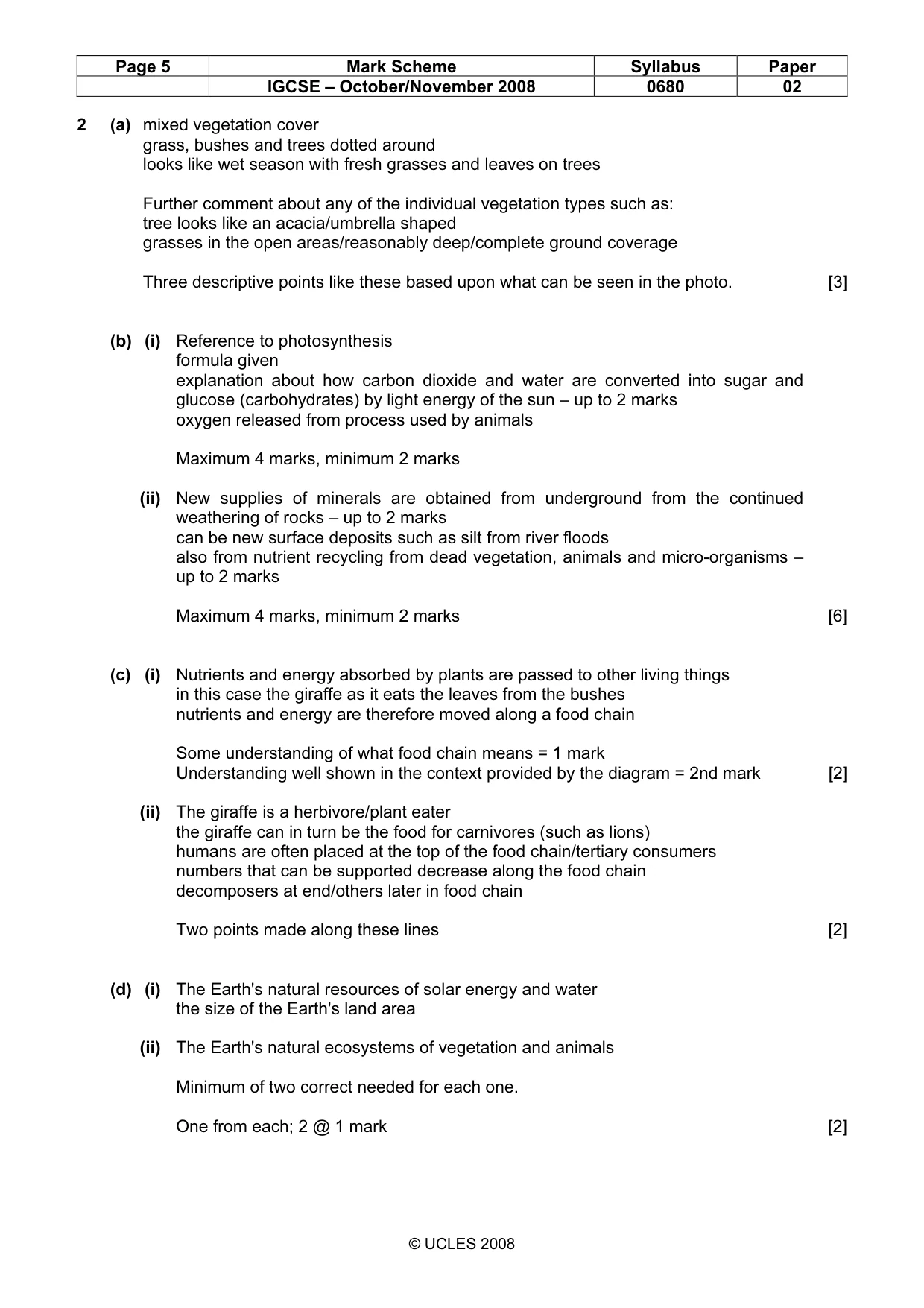
Page 2 Mark Scheme Syllabus Paper IGCSE – October/November 2008 0680 02 © UCLES 2008 1 (a) (i) X infiltration Y runoff [2] (ii) seeps down through spaces in the soil reaches permeable rock flows/passes through gaps/pores within the rock Any two [2] (iii) Letter I placed anywhere within the wooded area [1] (iv) More quickly down valley side slope speeding up surface runoff less surface resistance of flow over the agricultural land especially where the field is ploughed down the slope More slowly large area of woodland at top of slope to intercept rain comment about how interception reduces runoff permeable rock under the soil so that some can penetrate underground Max 3 marks for an answer referring only to more quickly or slowly. Also credit a clear reference to the different areas and their rates of runoff 4 points made along the lines suggested. [4] (b) Possible reasons: water supply (or drinking) water supply for other uses e.g. washing, industrial use, power supply easy waste disposal fishing/food supply easy access/transport often fertile silt soils for farming in surrounding areas flat land areas are on sides of rivers Any three valid reasons provided that they are obviously different or made to be different, like the water supply examples above [3] (c) (i) workers killed and injured residents affected by orange cloud of smoke/air pollution 40,000 residents evacuated from their homes toxic leak into river Any two [2] (ii) Harbin was lower down/downstream from the leak into the river slick was too big (80km long) to be diluted/dispersed before reaching Harbin officials made no attempts to control or stop the slick/slow in topping water use Maximum 1 mark for merely quoting relevant information from the source Two mark answers include comment/context [2]
Mark scheme, page 3
Page 3 Mark Scheme Syllabus Paper IGCSE – October/November 2008 0680 02 © UCLES 2008 (iii) Songhua River flows across the border into Russia towns along the river in Russia like Khabarovsk use river water for drinking China waited at least a week before informing Russia of the toxic leak China did nothing to clean up a large slick like this comment about likely Russian views on this. Points made along these lines 3 @ 1 mark [3] (iv) Only real fact was that the main slick had moved downstream of the city Perhaps half accurate was the statement that the water flowing in the river was now clean/safe water However, water was not safe/chemicals still likely to be present according to what the expert living outside China said; nitro-benzine is a highly dangerous substance for humans Possible that will affect people for a long time – especially since the leak was enormous (80km long slick) causing likely high concentrations; breakdown likely to be slow in cold water in winter Possible that humans would be affected not only by drinking the water but also by eating fish from the river Mark explanation which supports the view or views expressed. [4] (d) (i) Plots – 10 or more correct = 2 marks – at least 4 correct = 1 mark Line used to link the candidate's plots = 1 mark [3] (ii) Summer/June to September (or October) [1] (iii) Although June & July were the wettest months, there had been 6 or 7 dry months before rivers and ground could take more rainfall without flooding than after 3 months of high rainfall between 1400 & 1500mm of rain fell in the three months before September, it takes time for rivers to fill up from all the tributaries and start flooding Some idea of the reasons why = 1 mark Understood, particularly if supported by a specific reference to precipitation values = 2 marks [2] (iv) One answer is April = 1 mark Explanation – either zero precipitation, or better still it is preceded by at least 4 very dry months (each with only a trace of rainfall); also allow high temperatures leading to high rates of evaporation Choice of May = 1 mark also; similar explanation based on length of preceding dry months; higher temperatures and high evaporation are even more valid When another month is chosen, no mark for choice, but one mark is possible for valid explanation (easier to achieve the closer the month is to April/May) [2]
Mark scheme, page 4
Page 4 Mark Scheme Syllabus Paper IGCSE – October/November 2008 0680 02 © UCLES 2008 (v) Description of a method of irrigation – any acceptable (canal, sprinkler, large or small schemes etc.) although trickle drip is the only method of irrigation actually named in the syllabus. water storage (from dam, reservoir, river etc) method of transfer (if different from above) pipes with small holes in them water trickles out around the plants only where they are growing reduces amount of water used/chances of salinisation Three points made along these lines for this or for another method of irrigation Also, credit answers about dry farming techniques and development of new drought resistant varieties of seeds, provided the context is made relevant. [3] (e) (i) Benefits of high rainfall and river floods for farmers include: deposits of fertile (silt) soils after floods filling up reservoirs/ponds/rivers used for irrigation water supply water seeping into ground and raising level of water table renews the grass/vegetation in areas of livestock grazing standing water essential for some crops such as wet padi Any two – accept other points provided that they relate to farming. [2] (ii) Agree – some of world's most productive farming areas, with highest densities of population are found on flood plains and deltas, especially in Asia – without annual floods and wet summers none of this would be possible. Reward references to examples. In these areas flooding on a larger scale than normal may cause loss and damage, but not as great as would be caused by non-arrival of the rains Disagree – flooding is a major natural hazard which kills people and animals, ruins crops, destroys property, spreads water related diseases, keeps people stuck in the poverty trap, holds back economic development etc. Examples of bad floods could be used to support answers. No mark for view held – all views from total agreement to total disagreement are equally acceptable. Instead reward the explanation. Strong explanation which supports the view expressed = 3 or 4 marks Some explanation, but less well developed; view not always clear = 1 or 2 marks [4] [Total: 40]
Mark scheme, page 5
Page 5 Mark Scheme Syllabus Paper IGCSE – October/November 2008 0680 02 © UCLES 2008 2 (a) mixed vegetation cover grass, bushes and trees dotted around looks like wet season with fresh grasses and leaves on trees Further comment about any of the individual vegetation types such as: tree looks like an acacia/umbrella shaped grasses in the open areas/reasonably deep/complete ground coverage Three descriptive points like these based upon what can be seen in the photo. [3] (b) (i) Reference to photosynthesis formula given explanation about how carbon dioxide and water are converted into sugar and glucose (carbohydrates) by light energy of the sun – up to 2 marks oxygen released from process used by animals Maximum 4 marks, minimum 2 marks (ii) New supplies of minerals are obtained from underground from the continued weathering of rocks – up to 2 marks can be new surface deposits such as silt from river floods also from nutrient recycling from dead vegetation, animals and micro-organisms – up to 2 marks Maximum 4 marks, minimum 2 marks [6] (c) (i) Nutrients and energy absorbed by plants are passed to other living things in this case the giraffe as it eats the leaves from the bushes nutrients and energy are therefore moved along a food chain Some understanding of what food chain means = 1 mark Understanding well shown in the context provided by the diagram = 2nd mark [2] (ii) The giraffe is a herbivore/plant eater the giraffe can in turn be the food for carnivores (such as lions) humans are often placed at the top of the food chain/tertiary consumers numbers that can be supported decrease along the food chain decomposers at end/others later in food chain Two points made along these lines [2] (d) (i) The Earth's natural resources of solar energy and water the size of the Earth's land area (ii) The Earth's natural ecosystems of vegetation and animals Minimum of two correct needed for each one. One from each; 2 @ 1 mark [2]
Mark scheme, page 6
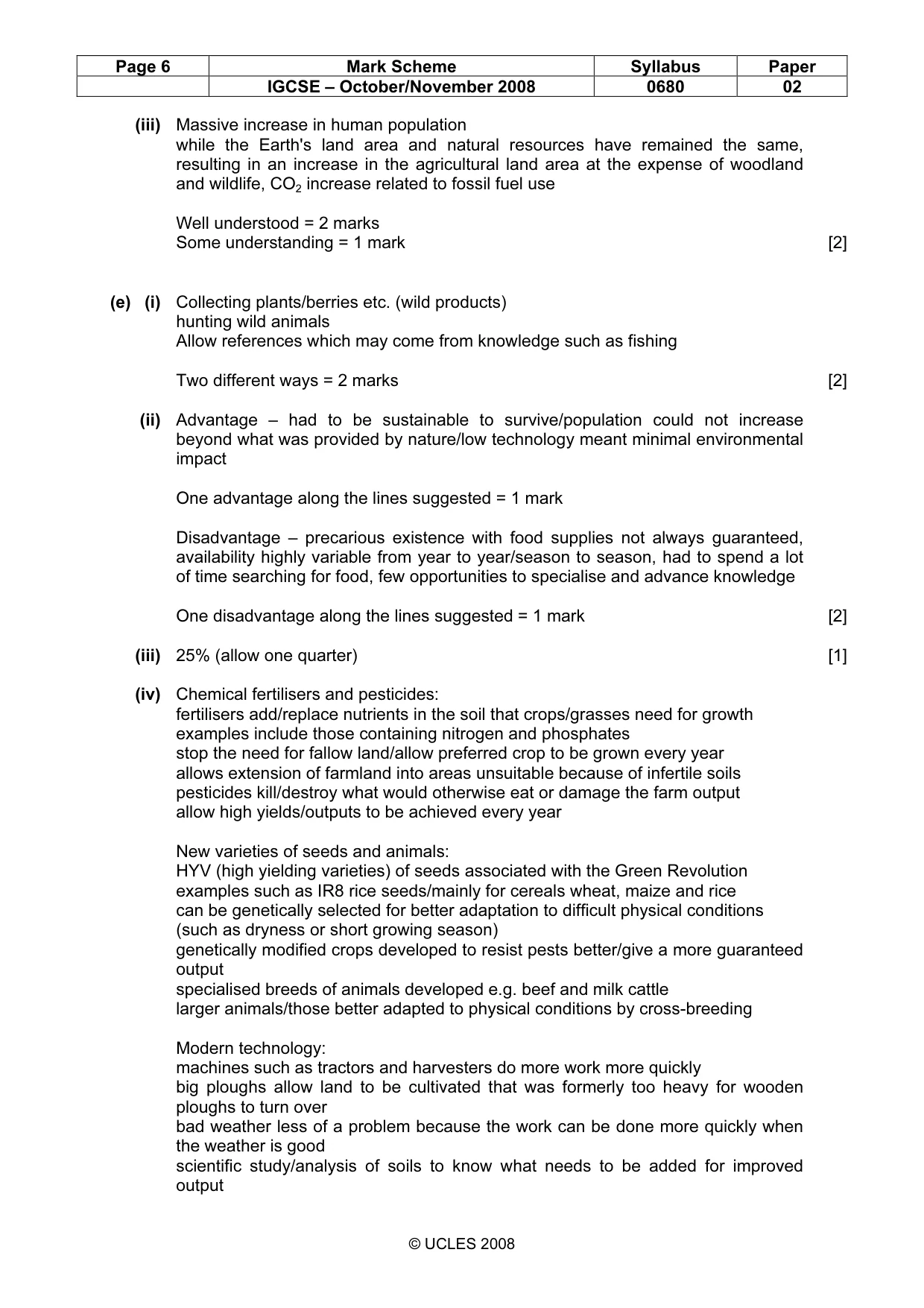
Page 6 Mark Scheme Syllabus Paper IGCSE – October/November 2008 0680 02 © UCLES 2008 (iii) Massive increase in human population while the Earth's land area and natural resources have remained the same, resulting in an increase in the agricultural land area at the expense of woodland and wildlife, CO2 increase related to fossil fuel use Well understood = 2 marks Some understanding = 1 mark [2] (e) (i) Collecting plants/berries etc. (wild products) hunting wild animals Allow references which may come from knowledge such as fishing Two different ways = 2 marks [2] (ii) Advantage – had to be sustainable to survive/population could not increase beyond what was provided by nature/low technology meant minimal environmental impact One advantage along the lines suggested = 1 mark Disadvantage – precarious existence with food supplies not always guaranteed, availability highly variable from year to year/season to season, had to spend a lot of time searching for food, few opportunities to specialise and advance knowledge One disadvantage along the lines suggested = 1 mark [2] (iii) 25% (allow one quarter) [1] (iv) Chemical fertilisers and pesticides: fertilisers add/replace nutrients in the soil that crops/grasses need for growth examples include those containing nitrogen and phosphates stop the need for fallow land/allow preferred crop to be grown every year allows extension of farmland into areas unsuitable because of infertile soils pesticides kill/destroy what would otherwise eat or damage the farm output allow high yields/outputs to be achieved every year New varieties of seeds and animals: HYV (high yielding varieties) of seeds associated with the Green Revolution examples such as IR8 rice seeds/mainly for cereals wheat, maize and rice can be genetically selected for better adaptation to difficult physical conditions (such as dryness or short growing season) genetically modified crops developed to resist pests better/give a more guaranteed output specialised breeds of animals developed e.g. beef and milk cattle larger animals/those better adapted to physical conditions by cross-breeding Modern technology: machines such as tractors and harvesters do more work more quickly big ploughs allow land to be cultivated that was formerly too heavy for wooden ploughs to turn over bad weather less of a problem because the work can be done more quickly when the weather is good scientific study/analysis of soils to know what needs to be added for improved output
Mark scheme, page 7
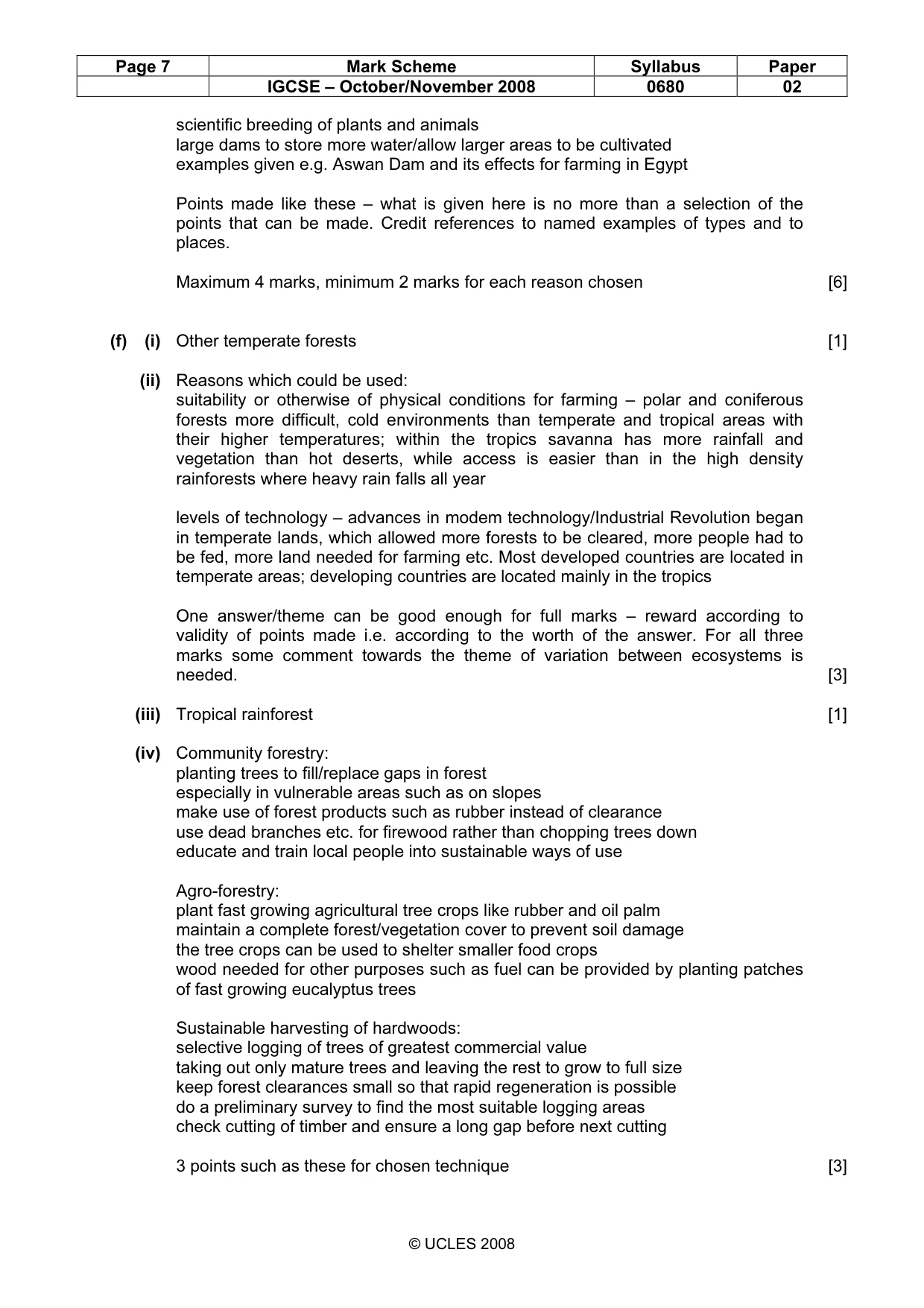
Page 7 Mark Scheme Syllabus Paper IGCSE – October/November 2008 0680 02 © UCLES 2008 scientific breeding of plants and animals large dams to store more water/allow larger areas to be cultivated examples given e.g. Aswan Dam and its effects for farming in Egypt Points made like these – what is given here is no more than a selection of the points that can be made. Credit references to named examples of types and to places. Maximum 4 marks, minimum 2 marks for each reason chosen [6] (f) (i) Other temperate forests [1] (ii) Reasons which could be used: suitability or otherwise of physical conditions for farming – polar and coniferous forests more difficult, cold environments than temperate and tropical areas with their higher temperatures; within the tropics savanna has more rainfall and vegetation than hot deserts, while access is easier than in the high density rainforests where heavy rain falls all year levels of technology – advances in modem technology/Industrial Revolution began in temperate lands, which allowed more forests to be cleared, more people had to be fed, more land needed for farming etc. Most developed countries are located in temperate areas; developing countries are located mainly in the tropics One answer/theme can be good enough for full marks – reward according to validity of points made i.e. according to the worth of the answer. For all three marks some comment towards the theme of variation between ecosystems is needed. [3] (iii) Tropical rainforest [1] (iv) Community forestry: planting trees to fill/replace gaps in forest especially in vulnerable areas such as on slopes make use of forest products such as rubber instead of clearance use dead branches etc. for firewood rather than chopping trees down educate and train local people into sustainable ways of use Agro-forestry: plant fast growing agricultural tree crops like rubber and oil palm maintain a complete forest/vegetation cover to prevent soil damage the tree crops can be used to shelter smaller food crops wood needed for other purposes such as fuel can be provided by planting patches of fast growing eucalyptus trees Sustainable harvesting of hardwoods: selective logging of trees of greatest commercial value taking out only mature trees and leaving the rest to grow to full size keep forest clearances small so that rapid regeneration is possible do a preliminary survey to find the most suitable logging areas check cutting of timber and ensure a long gap before next cutting 3 points such as these for chosen technique [3]
Mark scheme, page 8
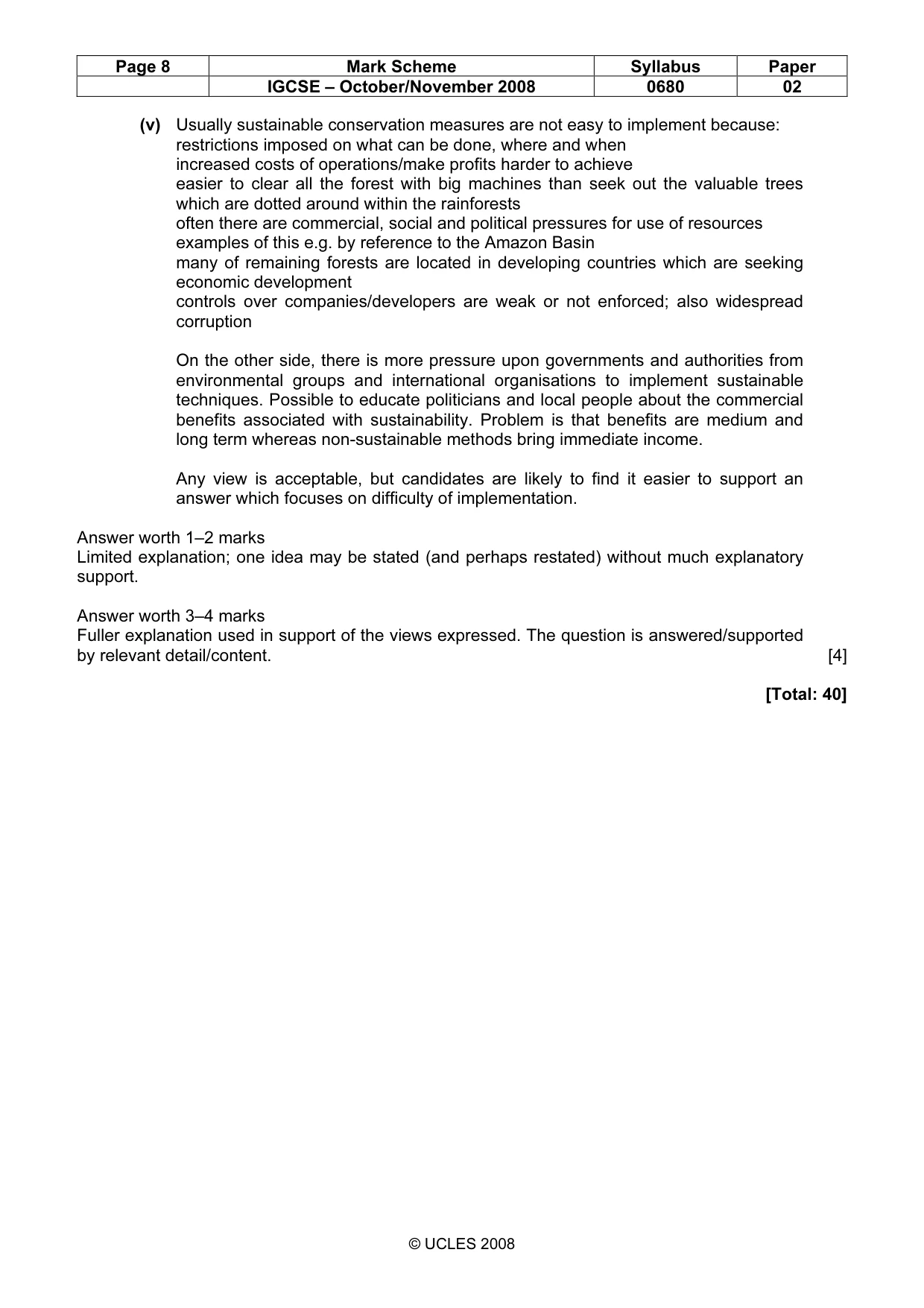
Page 8 Mark Scheme Syllabus Paper IGCSE – October/November 2008 0680 02 © UCLES 2008 (v) Usually sustainable conservation measures are not easy to implement because: restrictions imposed on what can be done, where and when increased costs of operations/make profits harder to achieve easier to clear all the forest with big machines than seek out the valuable trees which are dotted around within the rainforests often there are commercial, social and political pressures for use of resources examples of this e.g. by reference to the Amazon Basin many of remaining forests are located in developing countries which are seeking economic development controls over companies/developers are weak or not enforced; also widespread corruption On the other side, there is more pressure upon governments and authorities from environmental groups and international organisations to implement sustainable techniques. Possible to educate politicians and local people about the commercial benefits associated with sustainability. Problem is that benefits are medium and long term whereas non-sustainable methods bring immediate income. Any view is acceptable, but candidates are likely to find it easier to support an answer which focuses on difficulty of implementation. Answer worth 1–2 marks Limited explanation; one idea may be stated (and perhaps restated) without much explanatory support. Answer worth 3–4 marks Fuller explanation used in support of the views expressed. The question is answered/supported by relevant detail/content. [4] [Total: 40]
What you needed in this session
Cambridge’s own grade thresholds for 2008 Oct/Nov, Paper 2 · Variant 1. A higher threshold means an easier paper — the bar moves with how the cohort did.