Cambridge IGCSE English - Second Language (oral endorsement) 0510 — 2020 Oct/Nov Paper 4 · Variant 2
0510/42/O/N/20 · 40 marks · ≈45 min
The question paper and its mark scheme, free to read here and free to download. This is Cambridge’s own paper, exactly as it was sat.
Question paper12 pages




Mark scheme7 pages
Answers below. Sit the paper first if you are practising.
Paper as text
Question paper, page 1
Cambridge IGCSE™ * 5 4 9 9 6 9 9 0 6 8 * DC (PQ/SW) 186081/3 © UCLES 2020 [Turn over This document has 12 pages. Blank pages are indicated. ENGLISH AS A SECOND LANGUAGE 0510/42 Paper 4 Listening (Extended) October/November 2020 Approximately 50 minutes You must answer on the question paper. No additional materials are needed. INSTRUCTIONS ● Answer all questions. ● Use a black or dark blue pen. ● Write your name, centre number and candidate number in the boxes at the top of the page. ● Write your answer to each question in the space provided. ● Do not use an erasable pen or correction fluid. ● Do not write on any bar codes. ● Dictionaries are not allowed. INFORMATION ● The total mark for this paper is 40. ● The number of marks for each question or part question is shown in brackets [ ].
Question paper, page 2
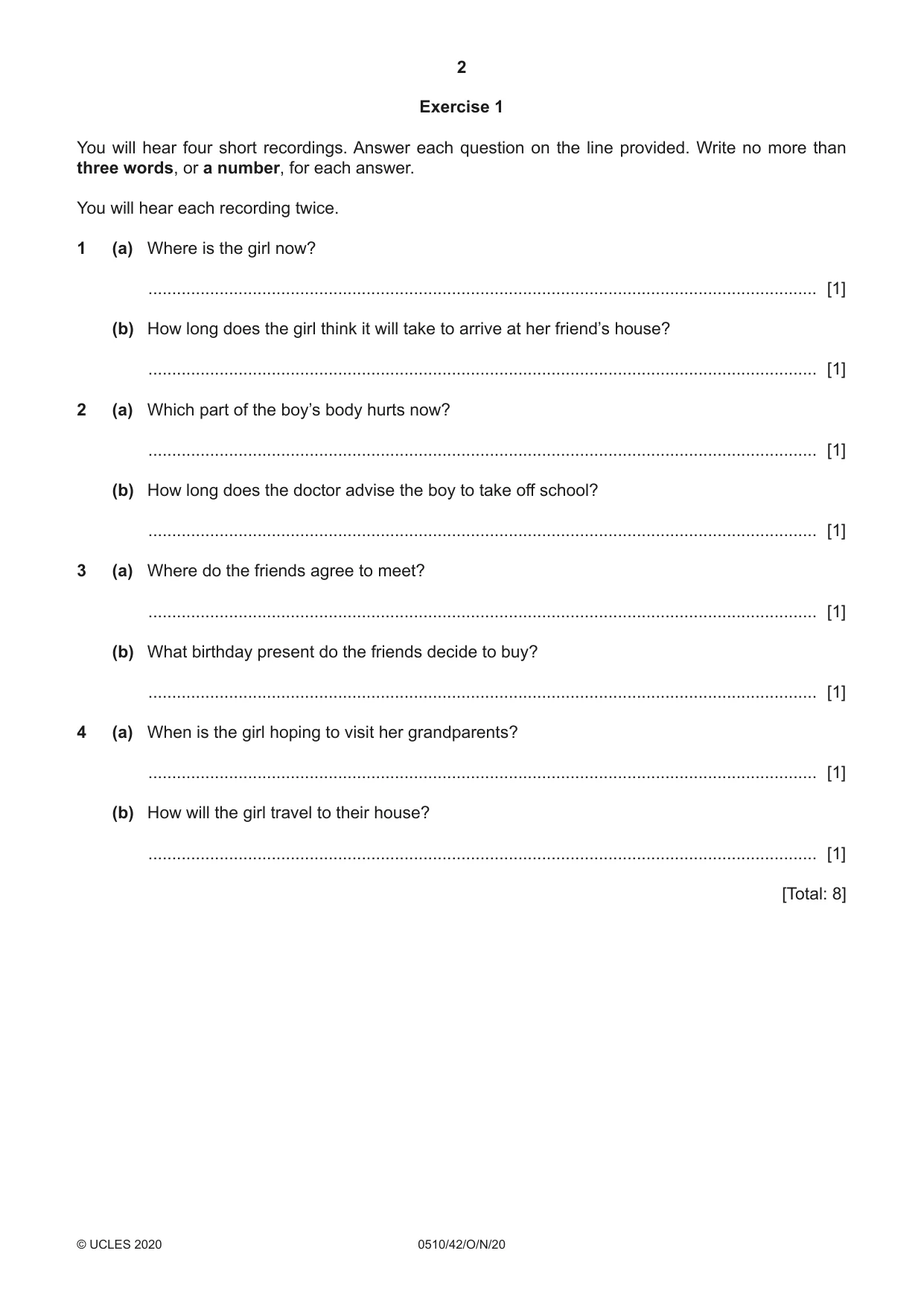
2 0510/42/O/N/20 © UCLES 2020 Exercise 1 You will hear four short recordings. Answer each question on the line provided. Write no more than three words, or a number, for each answer. You will hear each recording twice. 1 (a) Where is the girl now? … [1] (b) How long does the girl think it will take to arrive at her friend’s house? … [1] 2 (a) Which part of the boy’s body hurts now? … [1] (b) How long does the doctor advise the boy to take off school? … [1] 3 (a) Where do the friends agree to meet? … [1] (b) What birthday present do the friends decide to buy? … [1] 4 (a) When is the girl hoping to visit her grandparents? … [1] (b) How will the girl travel to their house? … [1] [Total: 8]
Question paper, page 3
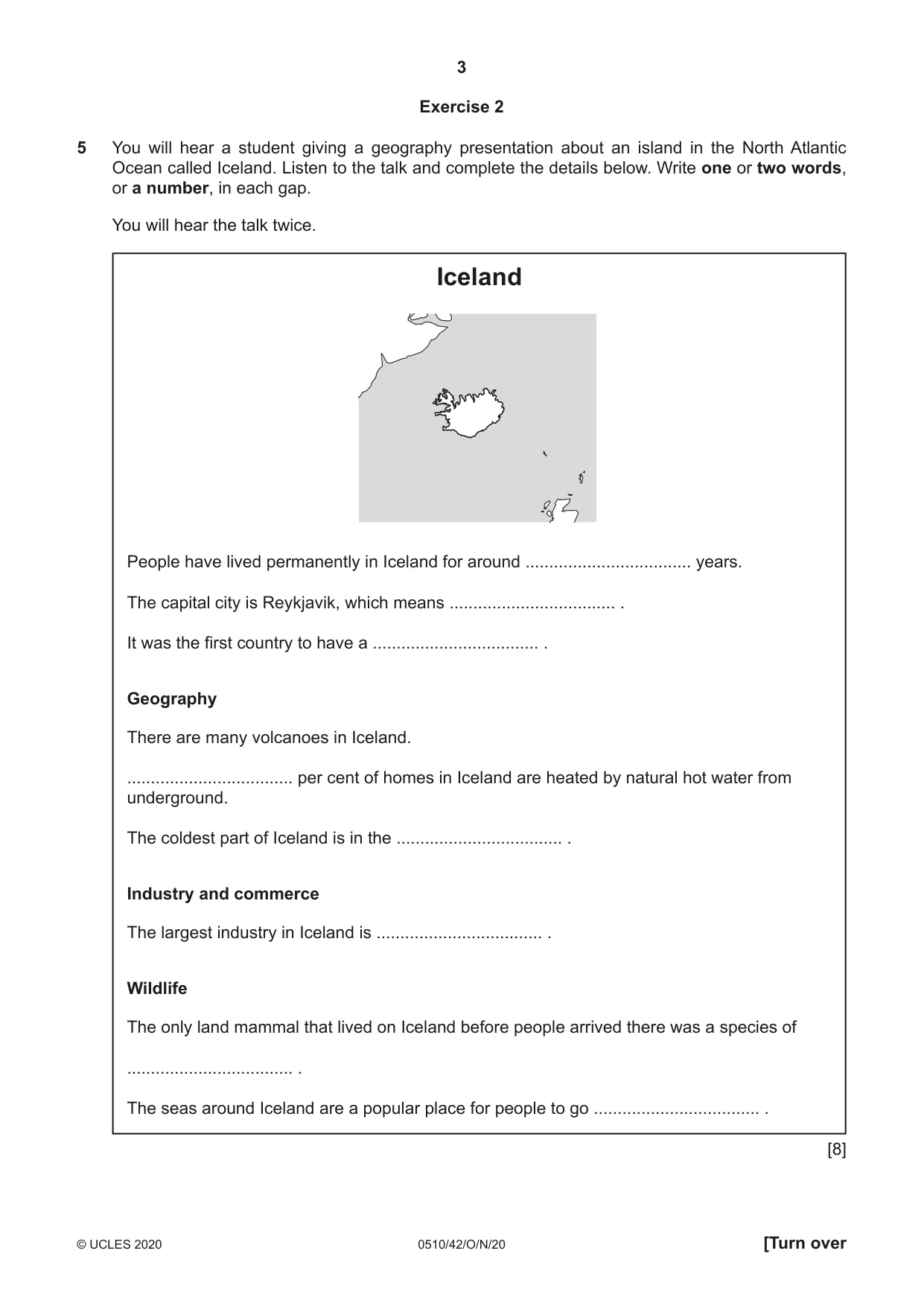
3 0510/42/O/N/20 © UCLES 2020 [Turn over Exercise 2 5 You will hear a student giving a geography presentation about an island in the North Atlantic Ocean called Iceland. Listen to the talk and complete the details below. Write one or two words, or a number, in each gap. You will hear the talk twice. Iceland People have lived permanently in Iceland for around … years. The capital city is Reykjavik, which means … . It was the first country to have a … . Geography There are many volcanoes in Iceland. … per cent of homes in Iceland are heated by natural hot water from underground. The coldest part of Iceland is in the … . Industry and commerce The largest industry in Iceland is … . Wildlife The only land mammal that lived on Iceland before people arrived there was a species of … . The seas around Iceland are a popular place for people to go … . [8]
Question paper, page 4
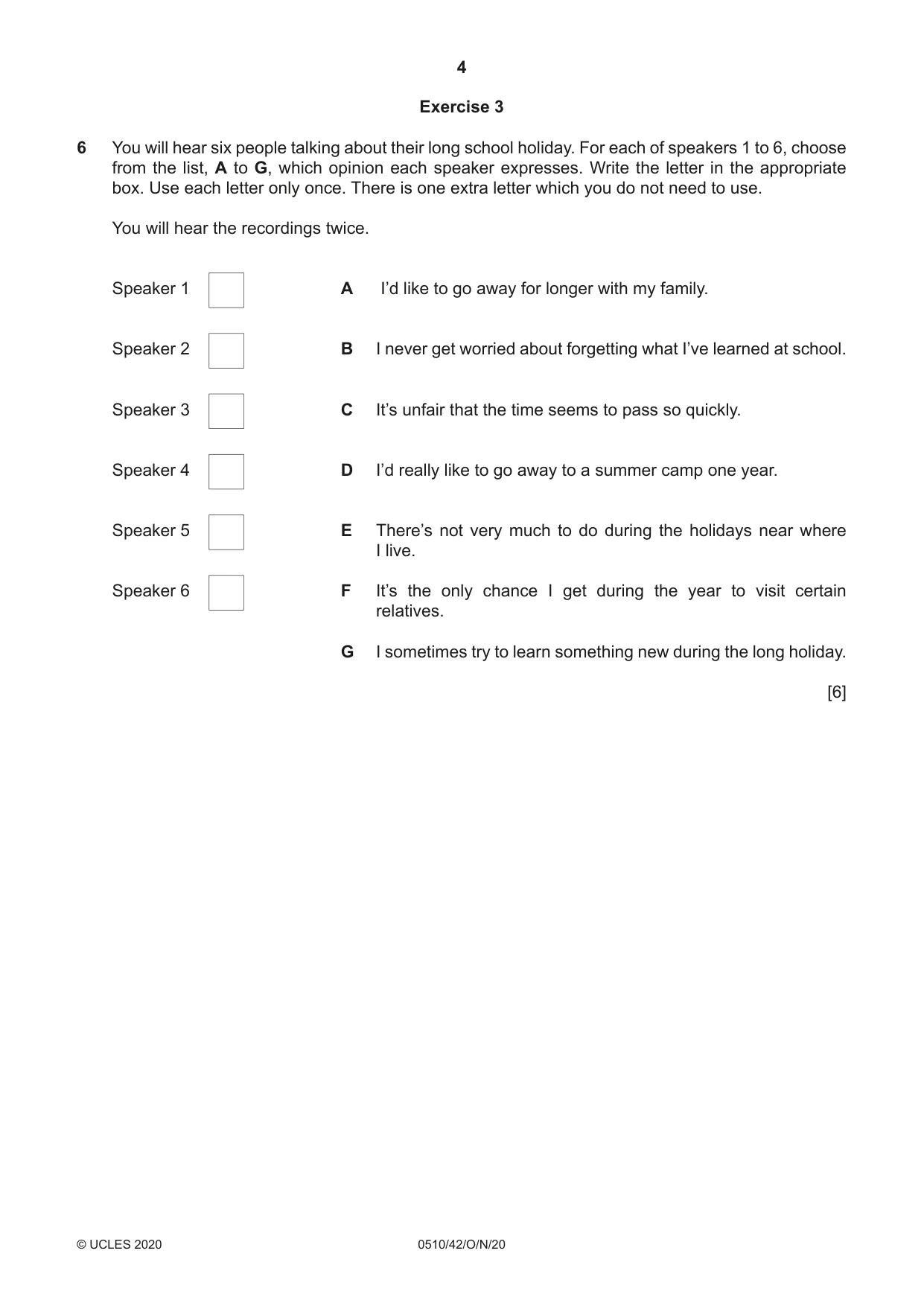
4 0510/42/O/N/20 © UCLES 2020 Exercise 3 6 You will hear six people talking about their long school holiday. For each of speakers 1 to 6, choose from the list, A to G, which opinion each speaker expresses. Write the letter in the appropriate box. Use each letter only once. There is one extra letter which you do not need to use. You will hear the recordings twice. Speaker 1 A I’d like to go away for longer with my family. Speaker 2 B I never get worried about forgetting what I’ve learned at school. Speaker 3 C It’s unfair that the time seems to pass so quickly. Speaker 4 D I’d really like to go away to a summer camp one year. Speaker 5 E There’s not very much to do during the holidays near where I live. Speaker 6 F It’s the only chance I get during the year to visit certain relatives. G I sometimes try to learn something new during the long holiday. [6]
Question paper, page 5
5 0510/42/O/N/20 © UCLES 2020 [Turn over Please turn over for Exercise 4.
Question paper, page 6
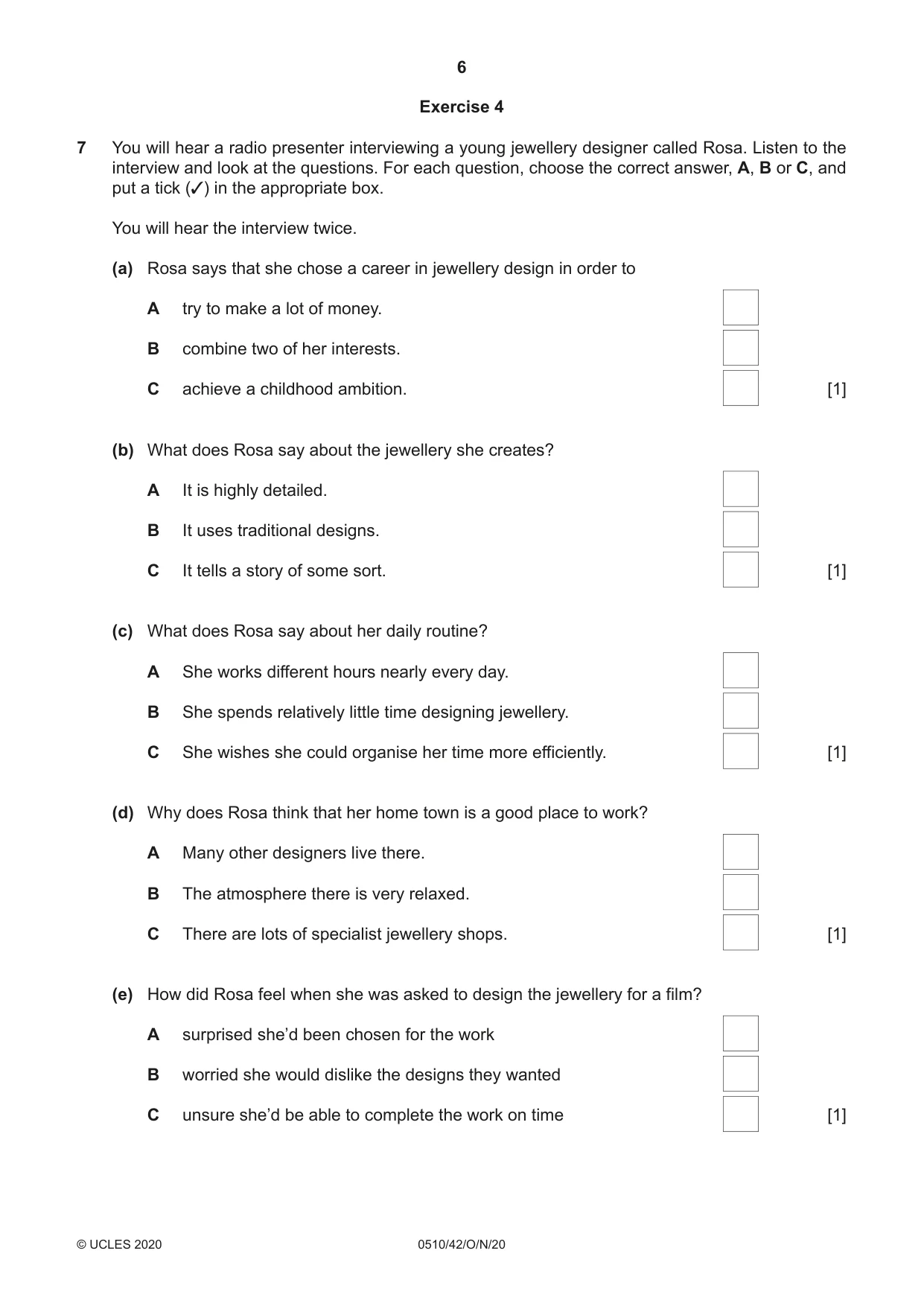
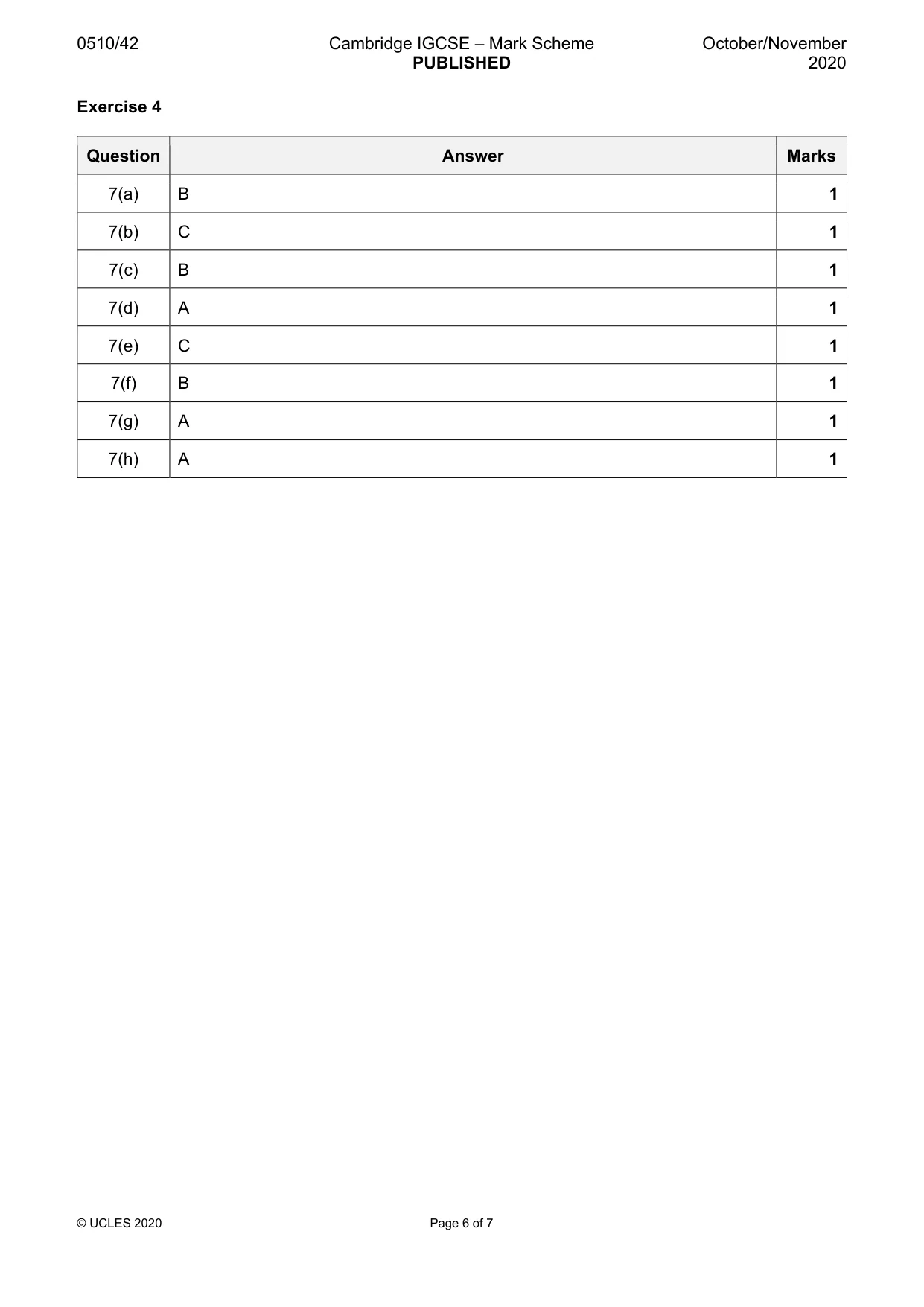
6 0510/42/O/N/20 © UCLES 2020 Exercise 4 7 You will hear a radio presenter interviewing a young jewellery designer called Rosa. Listen to the interview and look at the questions. For each question, choose the correct answer, A, B or C, and put a tick (3) in the appropriate box. You will hear the interview twice. (a) Rosa says that she chose a career in jewellery design in order to A try to make a lot of money. B combine two of her interests. C achieve a childhood ambition. [1] (b) What does Rosa say about the jewellery she creates? A It is highly detailed. B It uses traditional designs. C It tells a story of some sort. [1] (c) What does Rosa say about her daily routine? A She works different hours nearly every day. B She spends relatively little time designing jewellery. C She wishes she could organise her time more efficiently. [1] (d) Why does Rosa think that her home town is a good place to work? A Many other designers live there. B The atmosphere there is very relaxed. C There are lots of specialist jewellery shops. [1] (e) How did Rosa feel when she was asked to design the jewellery for a film? A surprised she’d been chosen for the work B worried she would dislike the designs they wanted C unsure she’d be able to complete the work on time [1]
Question paper, page 7
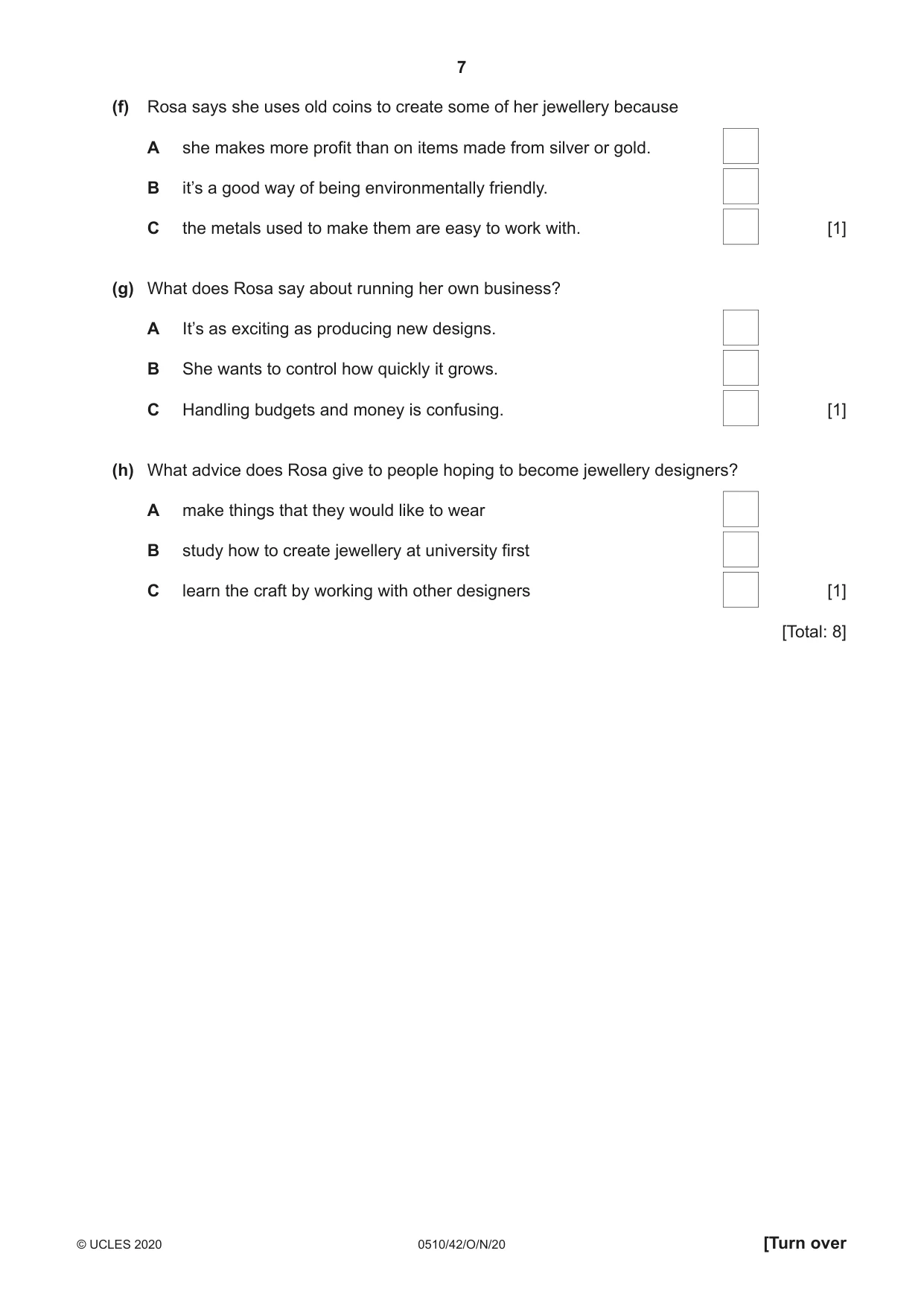
7 0510/42/O/N/20 © UCLES 2020 [Turn over (f) Rosa says she uses old coins to create some of her jewellery because A she makes more profit than on items made from silver or gold. B it’s a good way of being environmentally friendly. C the metals used to make them are easy to work with. [1] (g) What does Rosa say about running her own business? A It’s as exciting as producing new designs. B She wants to control how quickly it grows. C Handling budgets and money is confusing. [1] (h) What advice does Rosa give to people hoping to become jewellery designers? A make things that they would like to wear B study how to create jewellery at university first C learn the craft by working with other designers [1] [Total: 8]
Question paper, page 8
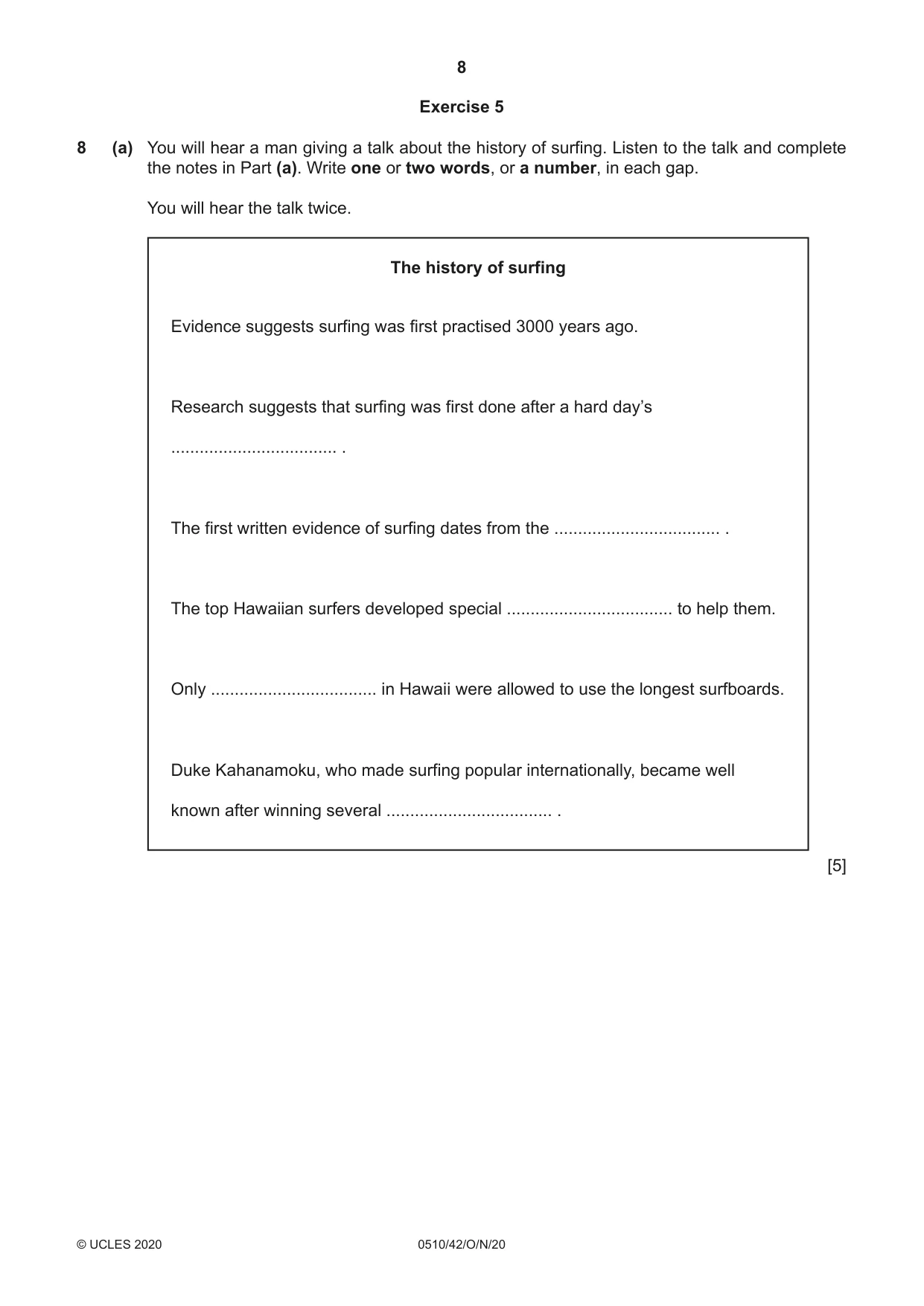
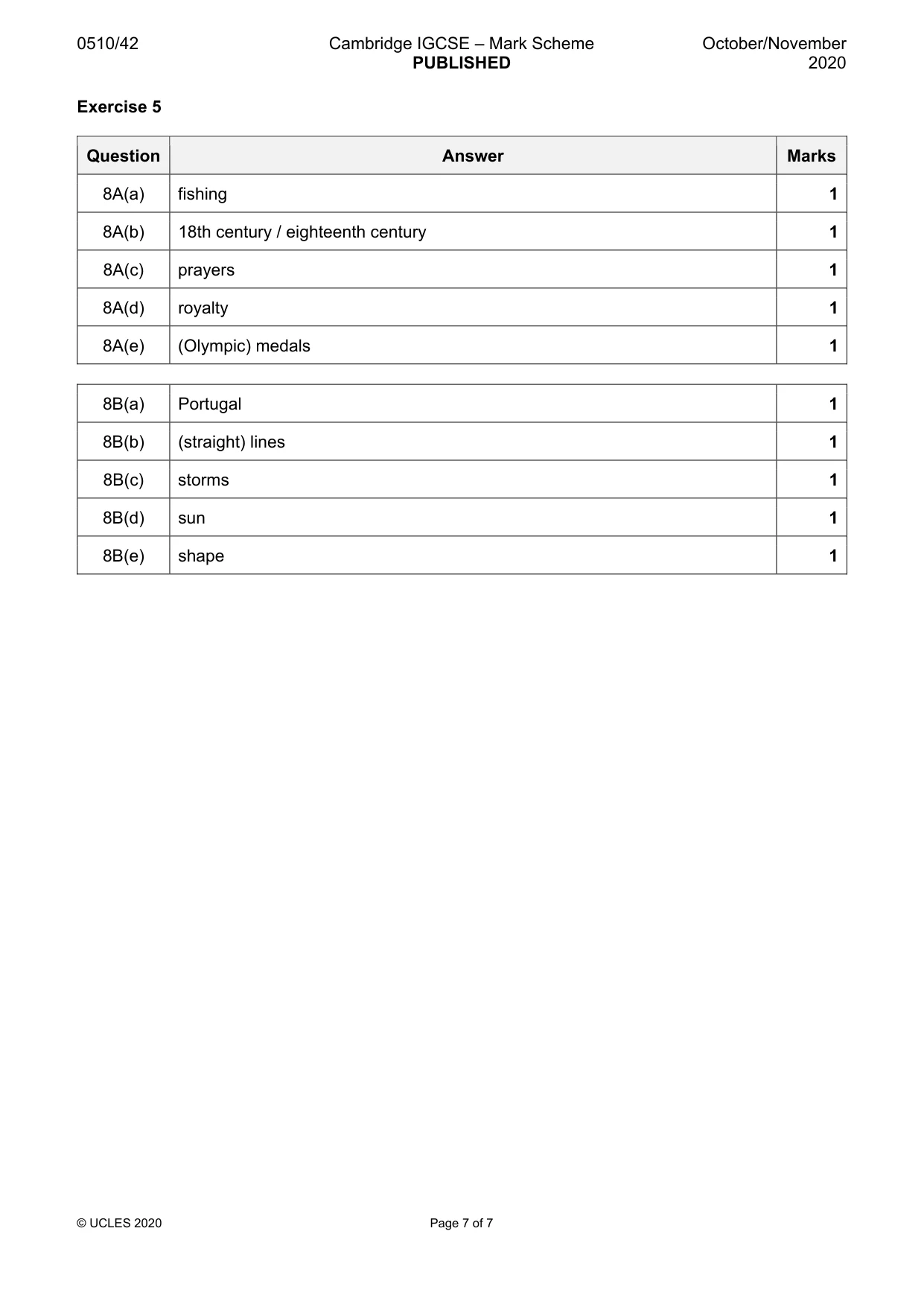
8 0510/42/O/N/20 © UCLES 2020 Exercise 5 8 (a) You will hear a man giving a talk about the history of surfing. Listen to the talk and complete the notes in Part (a). Write one or two words, or a number, in each gap. You will hear the talk twice. The history of surfing Evidence suggests surfing was first practised 3000 years ago. Research suggests that surfing was first done after a hard day’s … . The first written evidence of surfing dates from the … . The top Hawaiian surfers developed special … to help them. Only … in Hawaii were allowed to use the longest surfboards. Duke Kahanamoku, who made surfing popular internationally, became well known after winning several … . [5]
Question paper, page 9
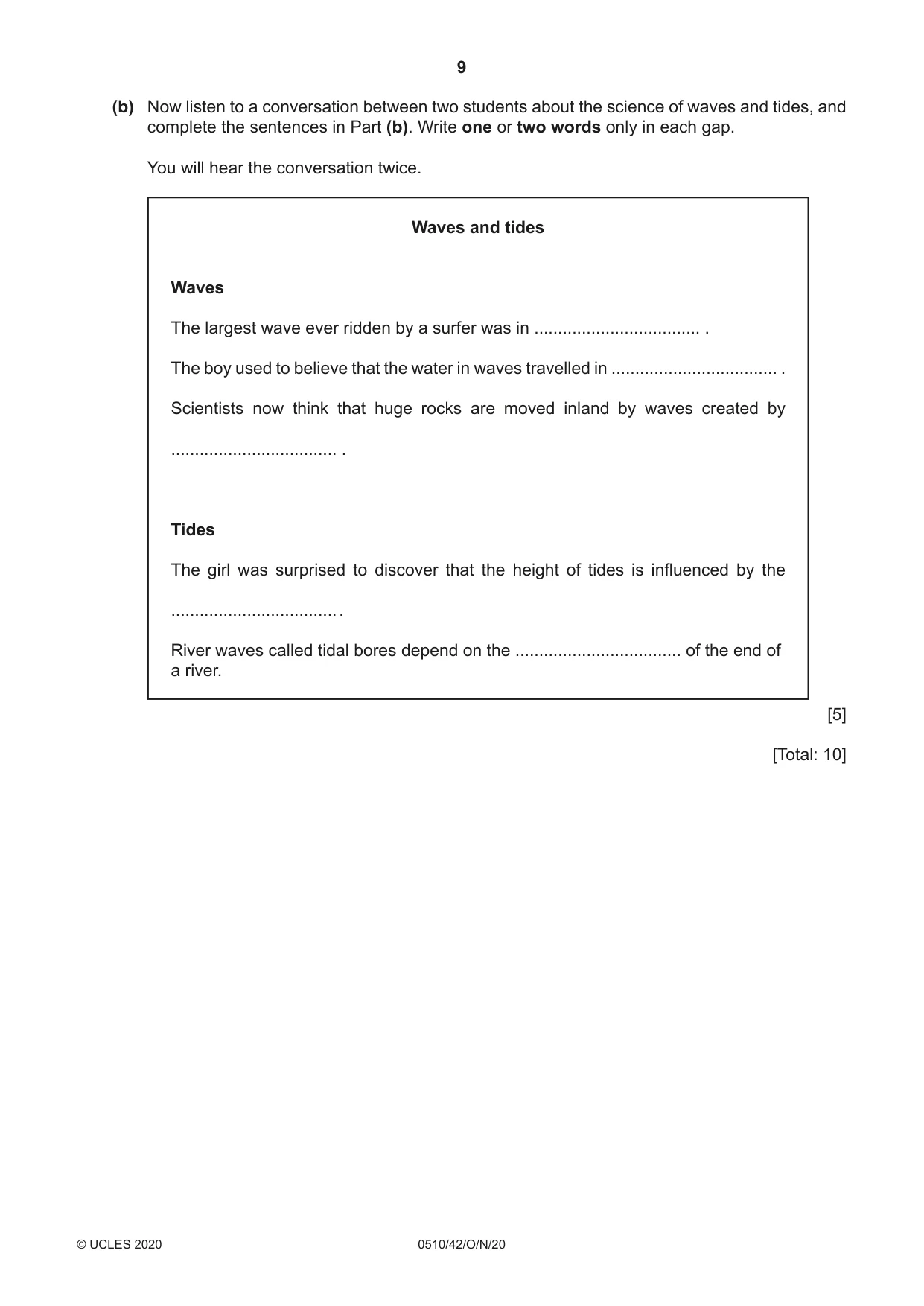
9 0510/42/O/N/20 © UCLES 2020 (b) Now listen to a conversation between two students about the science of waves and tides, and complete the sentences in Part (b). Write one or two words only in each gap. You will hear the conversation twice. Waves and tides Waves The largest wave ever ridden by a surfer was in … . The boy used to believe that the water in waves travelled in … . Scientists now think that huge rocks are moved inland by waves created by … . Tides The girl was surprised to discover that the height of tides is influenced by the … . River waves called tidal bores depend on the … of the end of a river. [5] [Total: 10]
Question paper, page 10
10 0510/42/O/N/20 © UCLES 2020 BLANK PAGE
Question paper, page 11
11 0510/42/O/N/20 © UCLES 2020 BLANK PAGE
Question paper, page 12
12 0510/42/O/N/20 © UCLES 2020 Permission to reproduce items where third-party owned material protected by copyright is included has been sought and cleared where possible. Every reasonable effort has been made by the publisher (UCLES) to trace copyright holders, but if any items requiring clearance have unwittingly been included, the publisher will be pleased to make amends at the earliest possible opportunity. To avoid the issue of disclosure of answer-related information to candidates, all copyright acknowledgements are reproduced online in the Cambridge Assessment International Education Copyright Acknowledgements Booklet. This is produced for each series of examinations and is freely available to download at www.cambridgeinternational.org after the live examination series. Cambridge Assessment International Education is part of the Cambridge Assessment Group. Cambridge Assessment is the brand name of the University of Cambridge Local Examinations Syndicate (UCLES), which itself is a department of the University of Cambridge. BLANK PAGE
Mark scheme, page 1
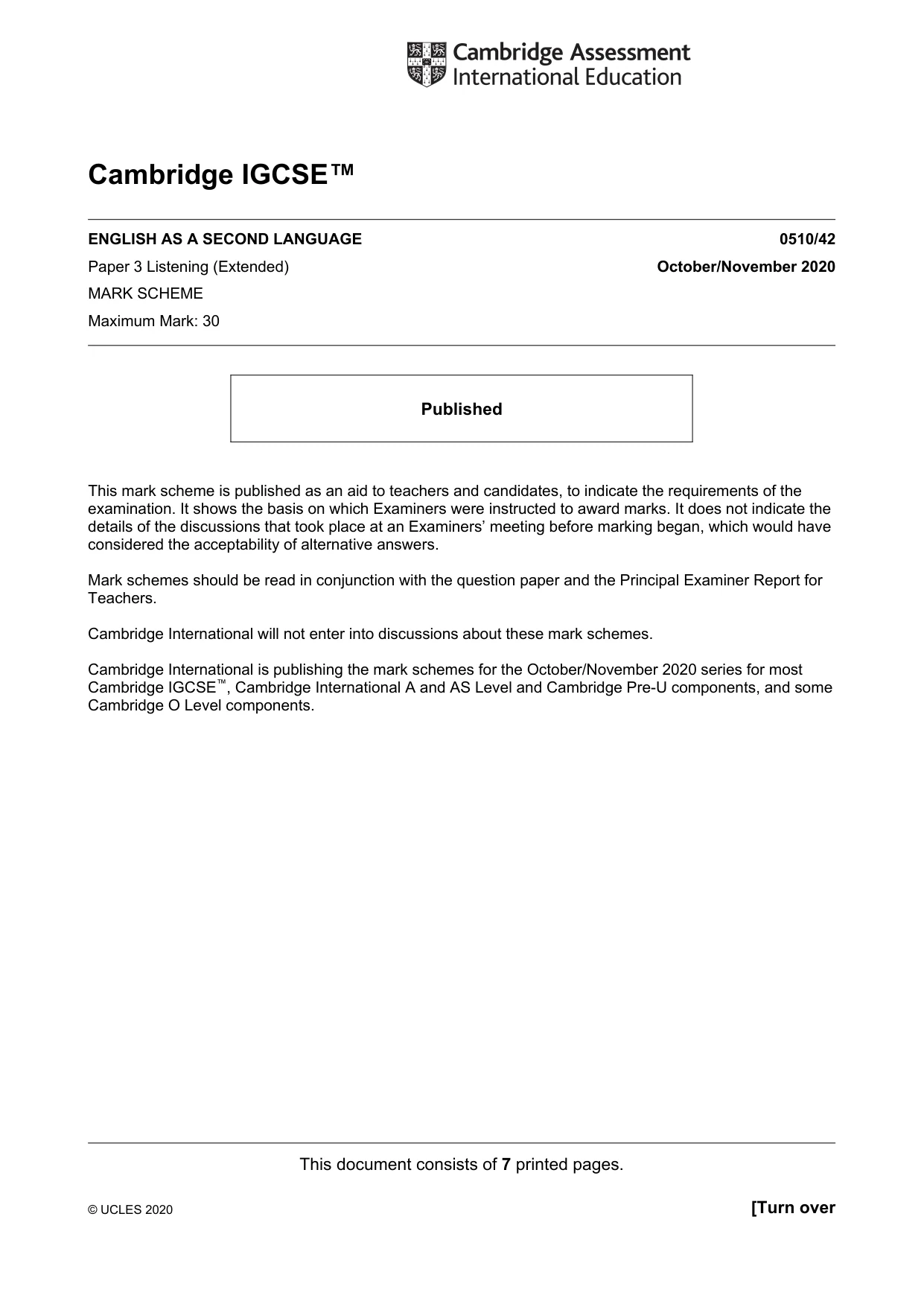
This document consists of 7 printed pages. © UCLES 2020 [Turn over Cambridge IGCSE™ ENGLISH AS A SECOND LANGUAGE 0510/42 Paper 3 Listening (Extended) October/November 2020 MARK SCHEME Maximum Mark: 30 Published This mark scheme is published as an aid to teachers and candidates, to indicate the requirements of the examination. It shows the basis on which Examiners were instructed to award marks. It does not indicate the details of the discussions that took place at an Examiners’ meeting before marking began, which would have considered the acceptability of alternative answers. Mark schemes should be read in conjunction with the question paper and the Principal Examiner Report for Teachers. Cambridge International will not enter into discussions about these mark schemes. Cambridge International is publishing the mark schemes for the October/November 2020 series for most Cambridge IGCSE™, Cambridge International A and AS Level and Cambridge Pre-U components, and some Cambridge O Level components.
Mark scheme, page 2
0510/42 Cambridge IGCSE – Mark Scheme PUBLISHED October/November 2020 © UCLES 2020 Page 2 of 7 Generic Marking Principles These general marking principles must be applied by all examiners when marking candidate answers. They should be applied alongside the specific content of the mark scheme or generic level descriptors for a question. Each question paper and mark scheme will also comply with these marking principles. GENERIC MARKING PRINCIPLE 1: Marks must be awarded in line with: • the specific content of the mark scheme or the generic level descriptors for the question • the specific skills defined in the mark scheme or in the generic level descriptors for the question • the standard of response required by a candidate as exemplified by the standardisation scripts. GENERIC MARKING PRINCIPLE 2: Marks awarded are always whole marks (not half marks, or other fractions). GENERIC MARKING PRINCIPLE 3: Marks must be awarded positively: • marks are awarded for correct/valid answers, as defined in the mark scheme. However, credit is given for valid answers which go beyond the scope of the syllabus and mark scheme, referring to your Team Leader as appropriate • marks are awarded when candidates clearly demonstrate what they know and can do • marks are not deducted for errors • marks are not deducted for omissions • answers should only be judged on the quality of spelling, punctuation and grammar when these features are specifically assessed by the question as indicated by the mark scheme. The meaning, however, should be unambiguous. GENERIC MARKING PRINCIPLE 4: Rules must be applied consistently, e.g. in situations where candidates have not followed instructions or in the application of generic level descriptors. GENERIC MARKING PRINCIPLE 5: Marks should be awarded using the full range of marks defined in the mark scheme for the question (however; the use of the full mark range may be limited according to the quality of the candidate responses seen). GENERIC MARKING PRINCIPLE 6: Marks awarded are based solely on the requirements as defined in the mark scheme. Marks should not be awarded with grade thresholds or grade descriptors in mind.
Mark scheme, page 3
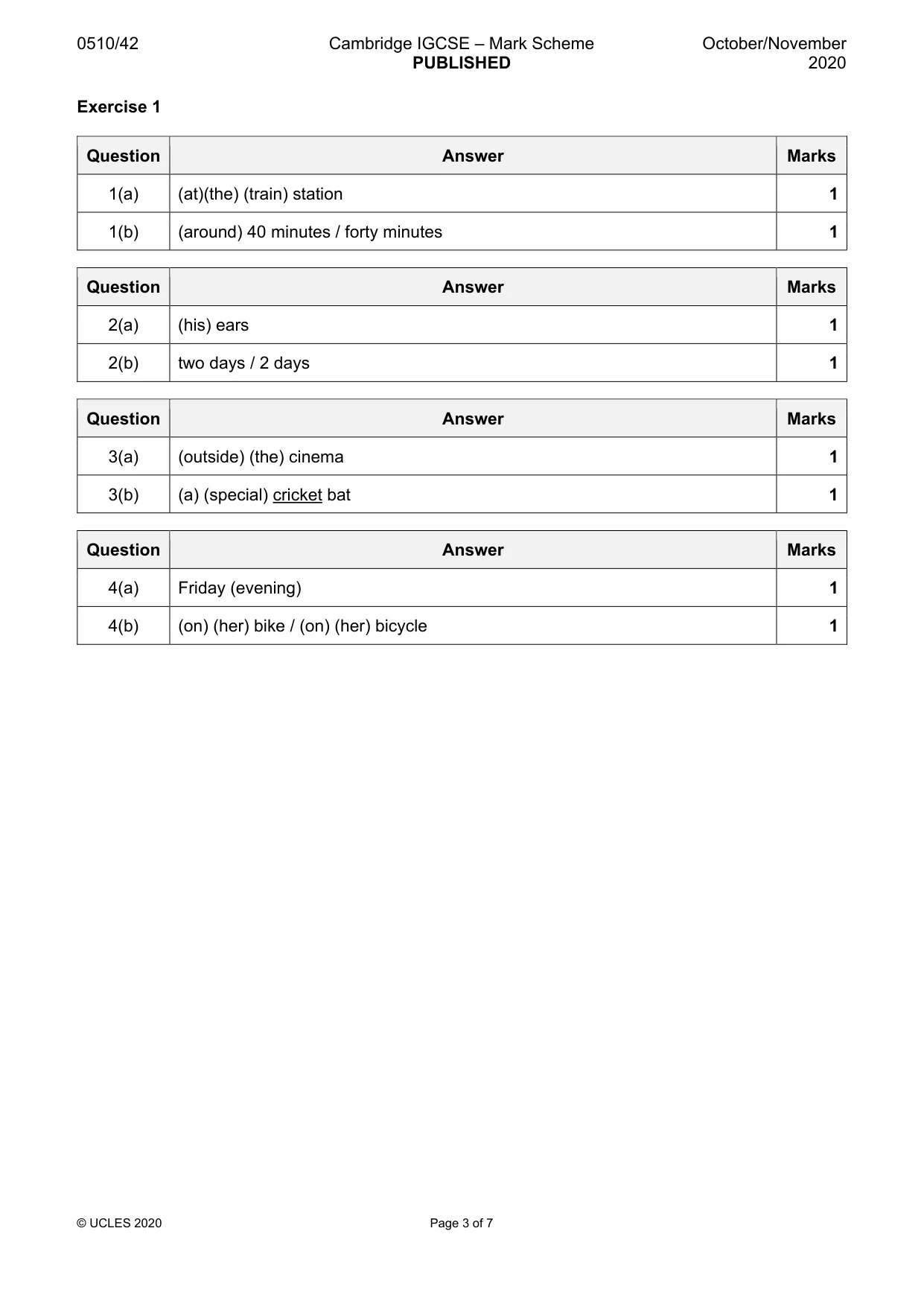
0510/42 Cambridge IGCSE – Mark Scheme PUBLISHED October/November 2020 © UCLES 2020 Page 3 of 7 Exercise 1 Question Answer Marks 1(a) (at)(the) (train) station 1 1(b) (around) 40 minutes / forty minutes 1 Question Answer Marks 2(a) (his) ears 1 2(b) two days / 2 days 1 Question Answer Marks 3(a) (outside) (the) cinema 1 3(b) (a) (special) cricket bat 1 Question Answer Marks 4(a) Friday (evening) 1 4(b) (on) (her) bike / (on) (her) bicycle 1
Mark scheme, page 4
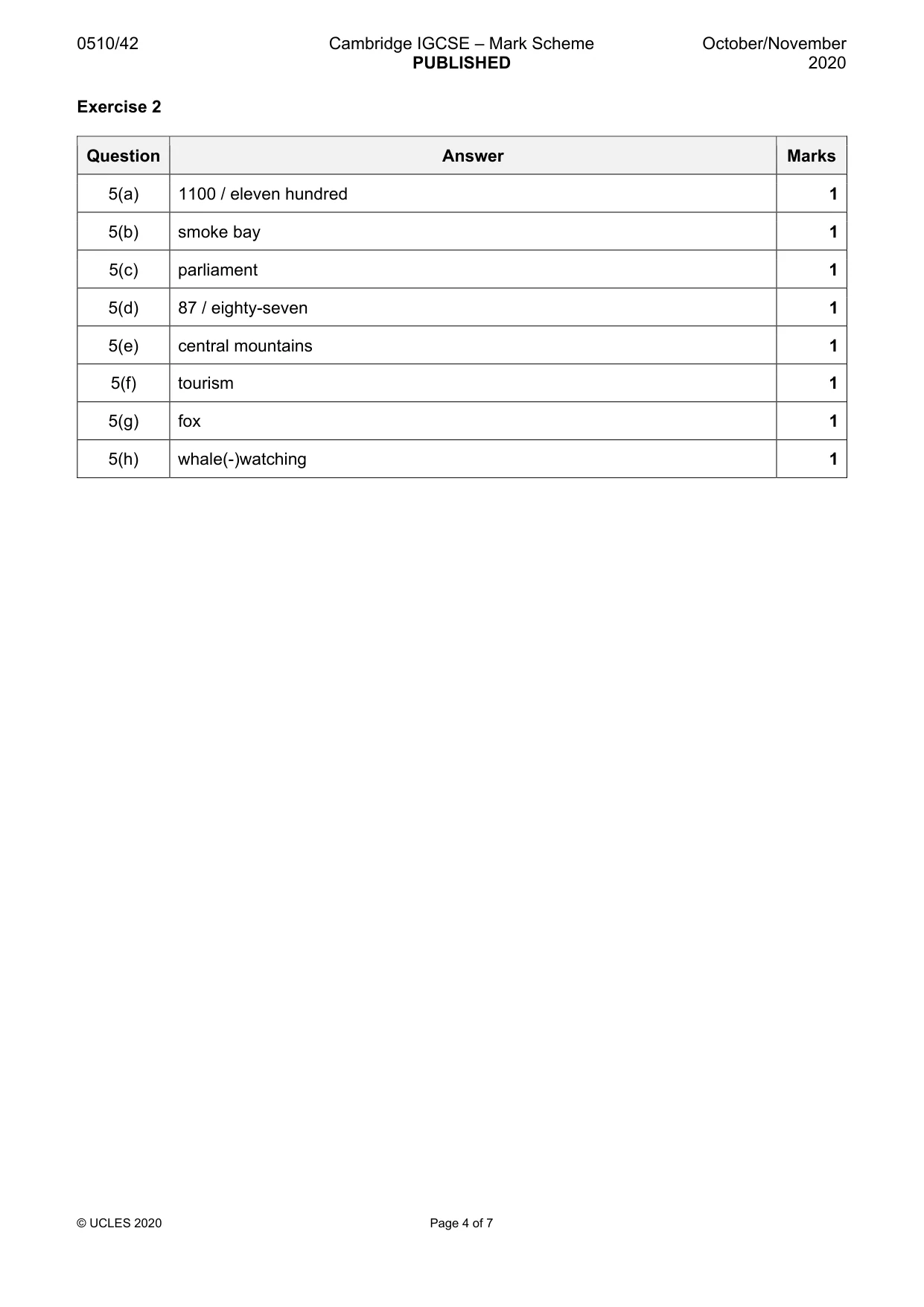
0510/42 Cambridge IGCSE – Mark Scheme PUBLISHED October/November 2020 © UCLES 2020 Page 4 of 7 Exercise 2 Question Answer Marks 5(a) 1100 / eleven hundred 1 5(b) smoke bay 1 5(c) parliament 1 5(d) 87 / eighty-seven 1 5(e) central mountains 1 5(f) tourism 1 5(g) fox 1 5(h) whale(-)watching 1
Mark scheme, page 5
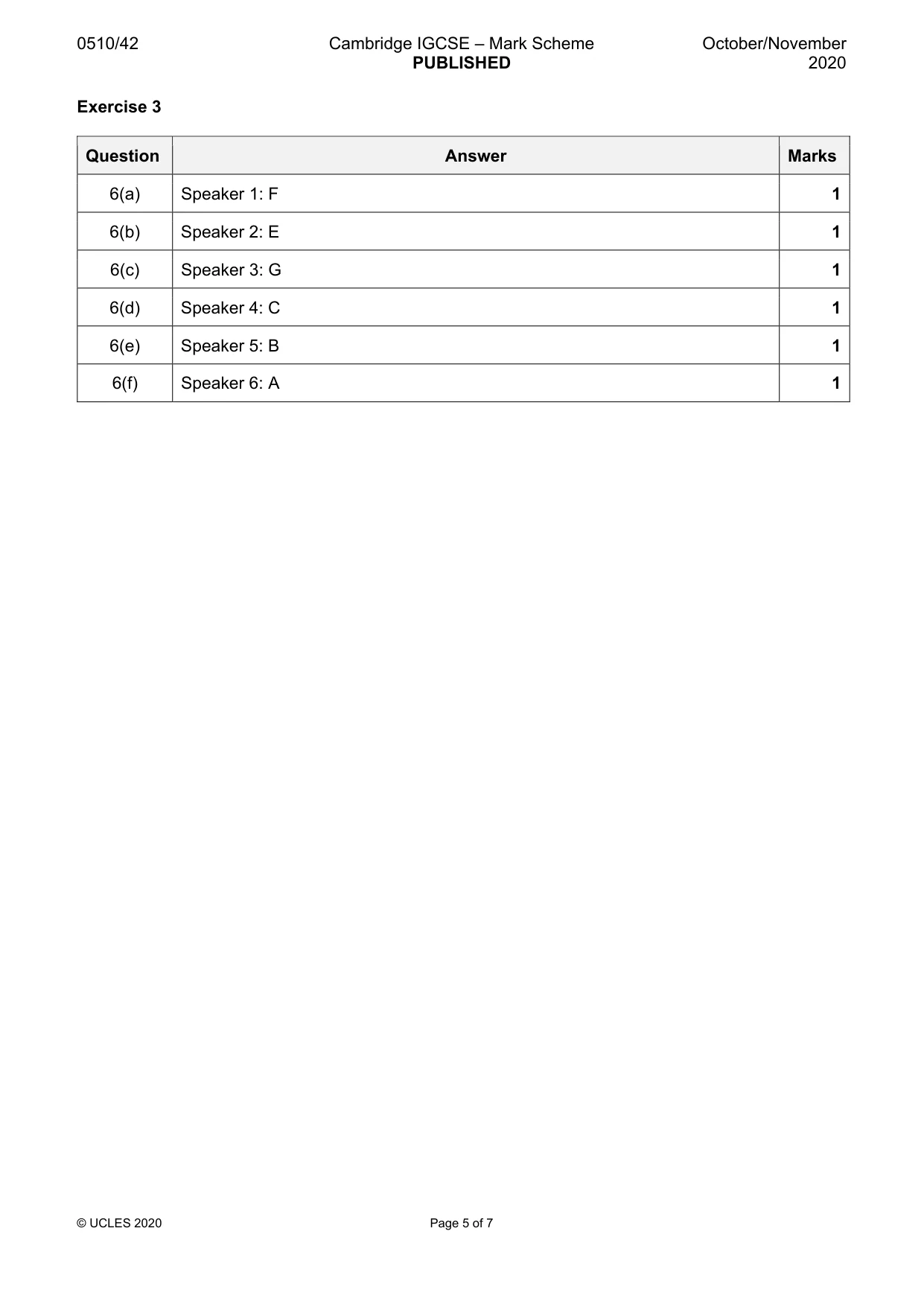
0510/42 Cambridge IGCSE – Mark Scheme PUBLISHED October/November 2020 © UCLES 2020 Page 5 of 7 Exercise 3 Question Answer Marks 6(a) Speaker 1: F 1 6(b) Speaker 2: E 1 6(c) Speaker 3: G 1 6(d) Speaker 4: C 1 6(e) Speaker 5: B 1 6(f) Speaker 6: A 1
Mark scheme, page 6
0510/42 Cambridge IGCSE – Mark Scheme PUBLISHED October/November 2020 © UCLES 2020 Page 6 of 7 Exercise 4 Question Answer Marks 7(a) B 1 7(b) C 1 7(c) B 1 7(d) A 1 7(e) C 1 7(f) B 1 7(g) A 1 7(h) A 1
Mark scheme, page 7
0510/42 Cambridge IGCSE – Mark Scheme PUBLISHED October/November 2020 © UCLES 2020 Page 7 of 7 Exercise 5 Question Answer Marks 8A(a) fishing 1 8A(b) 18th century / eighteenth century 1 8A(c) prayers 1 8A(d) royalty 1 8A(e) (Olympic) medals 1 8B(a) Portugal 1 8B(b) (straight) lines 1 8B(c) storms 1 8B(d) sun 1 8B(e) shape 1
What you needed in this session
Cambridge’s own grade thresholds for 2020 Oct/Nov, Paper 4 · Variant 2. A higher threshold means an easier paper — the bar moves with how the cohort did.