Cambridge IGCSE English - Second Language (oral endorsement) 0510 — 2020 Oct/Nov Paper 4 · Variant 1
0510/41/O/N/20 · 40 marks · ≈45 min
The question paper and its mark scheme, free to read here and free to download. This is Cambridge’s own paper, exactly as it was sat.
Question paper12 pages




Mark scheme7 pages
Answers below. Sit the paper first if you are practising.
Paper as text
Question paper, page 1
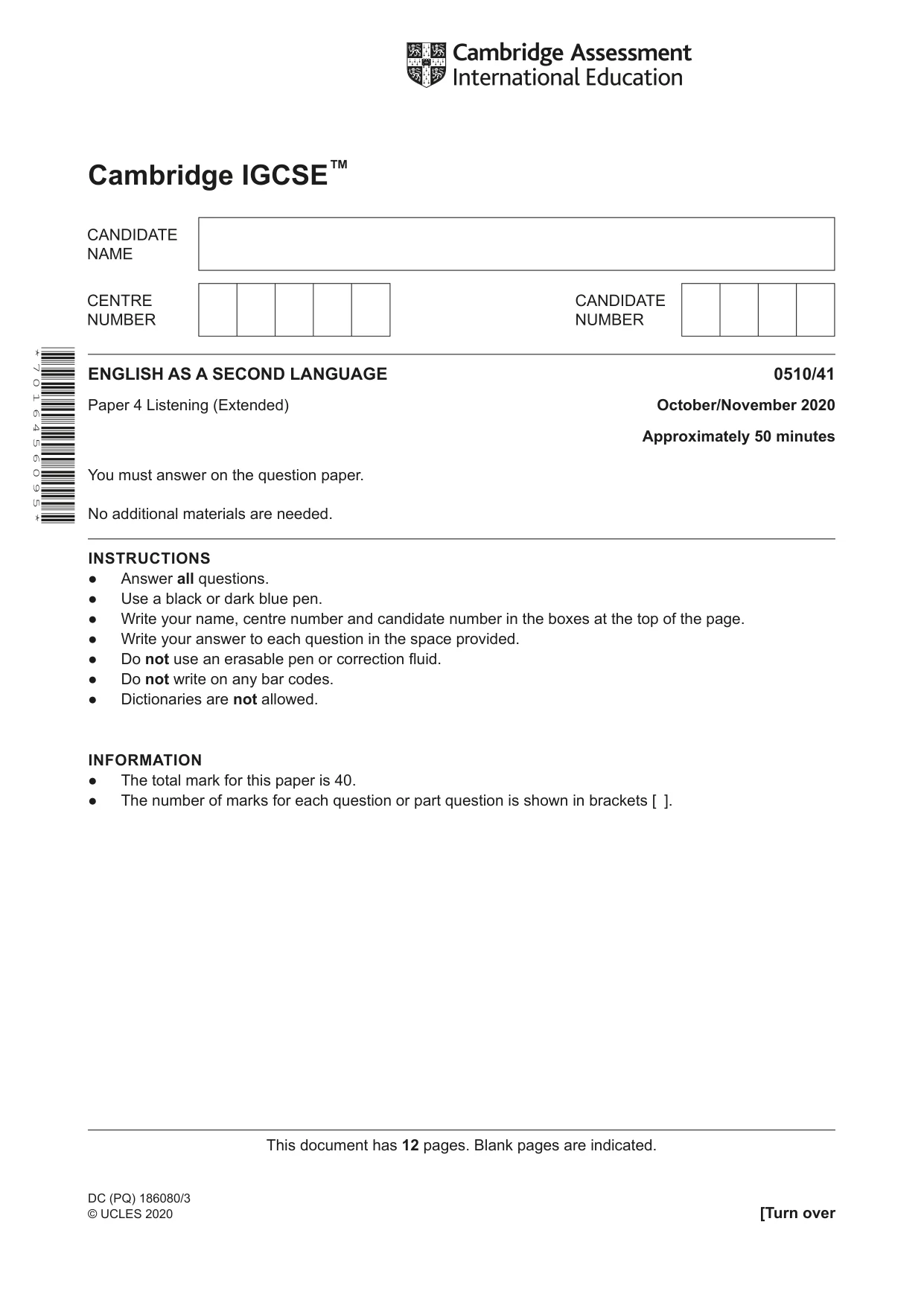
Cambridge IGCSE™ DC (PQ) 186080/3 © UCLES 2020 [Turn over This document has 12 pages. Blank pages are indicated. * 7 0 1 6 4 5 6 0 9 5 * ENGLISH AS A SECOND LANGUAGE 0510/41 Paper 4 Listening (Extended) October/November 2020 Approximately 50 minutes You must answer on the question paper. No additional materials are needed. INSTRUCTIONS ● Answer all questions. ● Use a black or dark blue pen. ● Write your name, centre number and candidate number in the boxes at the top of the page. ● Write your answer to each question in the space provided. ● Do not use an erasable pen or correction fluid. ● Do not write on any bar codes. ● Dictionaries are not allowed. INFORMATION ● The total mark for this paper is 40. ● The number of marks for each question or part question is shown in brackets [ ].
Question paper, page 2
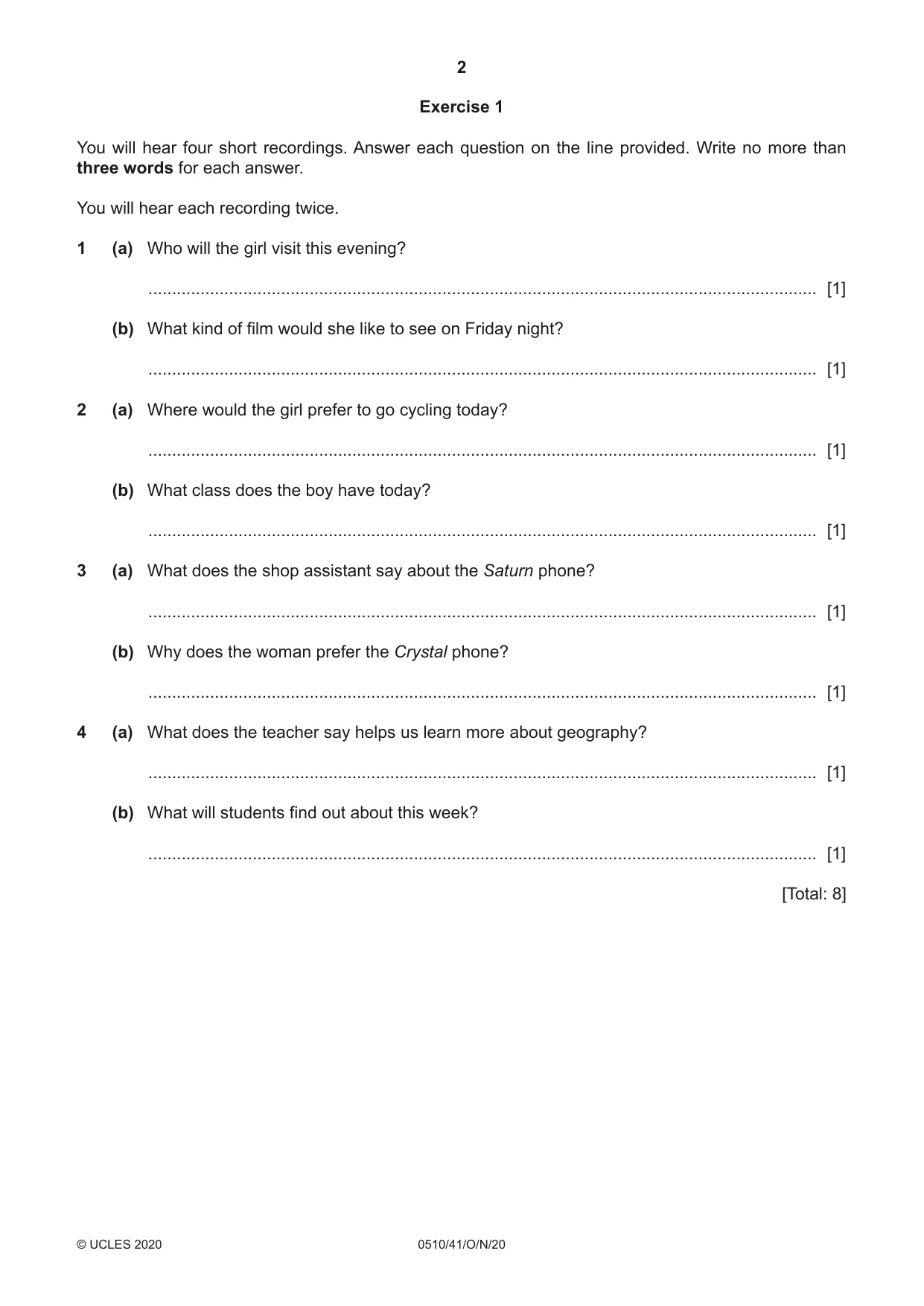
2 0510/41/O/N/20 © UCLES 2020 Exercise 1 You will hear four short recordings. Answer each question on the line provided. Write no more than three words for each answer. You will hear each recording twice. 1 (a) Who will the girl visit this evening? … [1] (b) What kind of film would she like to see on Friday night? … [1] 2 (a) Where would the girl prefer to go cycling today? … [1] (b) What class does the boy have today? … [1] 3 (a) What does the shop assistant say about the Saturn phone? … [1] (b) Why does the woman prefer the Crystal phone? … [1] 4 (a) What does the teacher say helps us learn more about geography? … [1] (b) What will students find out about this week? … [1] [Total: 8]
Question paper, page 3
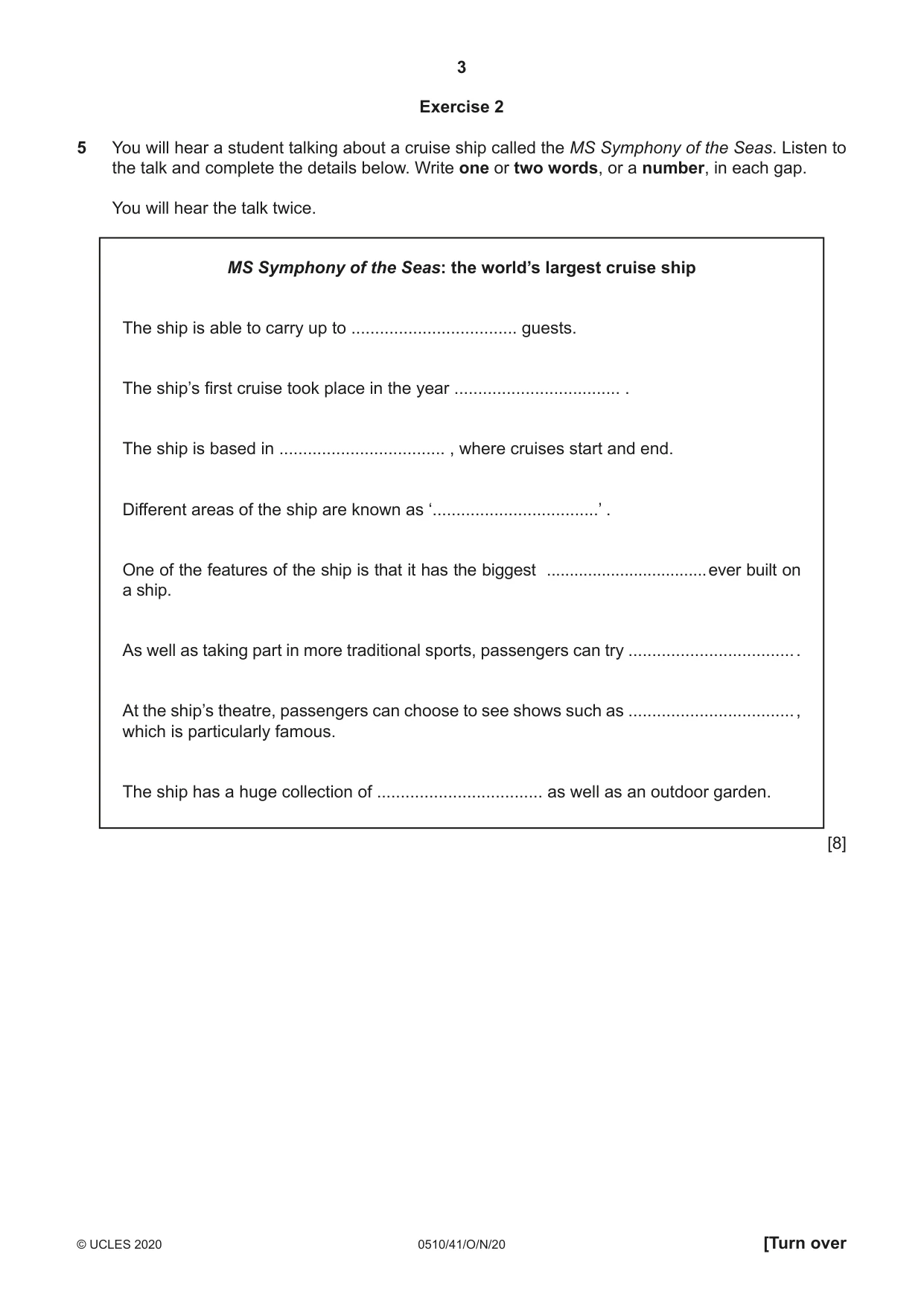
3 0510/41/O/N/20 © UCLES 2020 [Turn over Exercise 2 5 You will hear a student talking about a cruise ship called the MS Symphony of the Seas. Listen to the talk and complete the details below. Write one or two words, or a number, in each gap. You will hear the talk twice. MS Symphony of the Seas: the world’s largest cruise ship The ship is able to carry up to … guests. The ship’s first cruise took place in the year … . The ship is based in … , where cruises start and end. Different areas of the ship are known as ‘…’ . One of the features of the ship is that it has the biggest … ever built on a ship. As well as taking part in more traditional sports, passengers can try … . At the ship’s theatre, passengers can choose to see shows such as … , which is particularly famous. The ship has a huge collection of … as well as an outdoor garden. [8]
Question paper, page 4
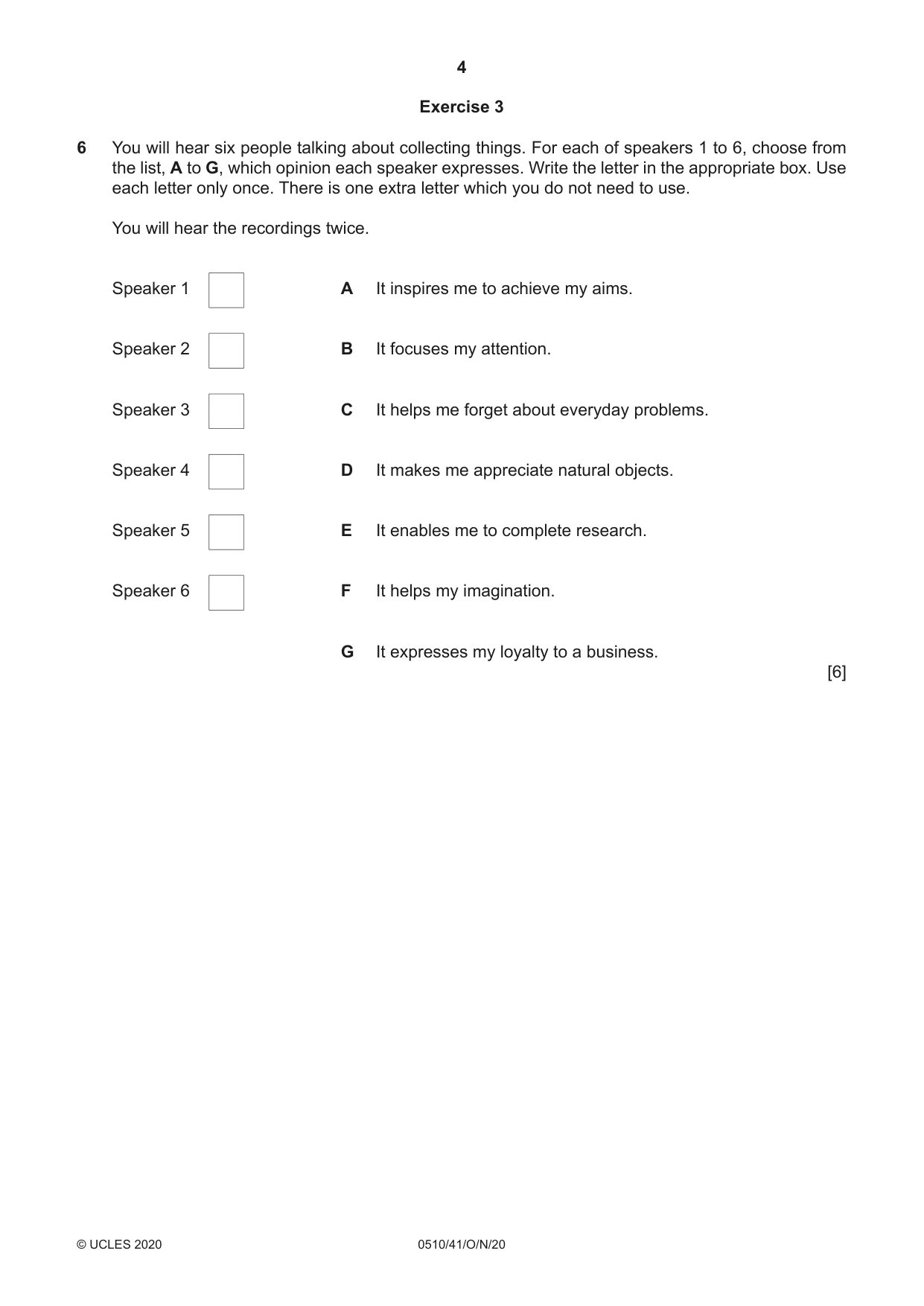
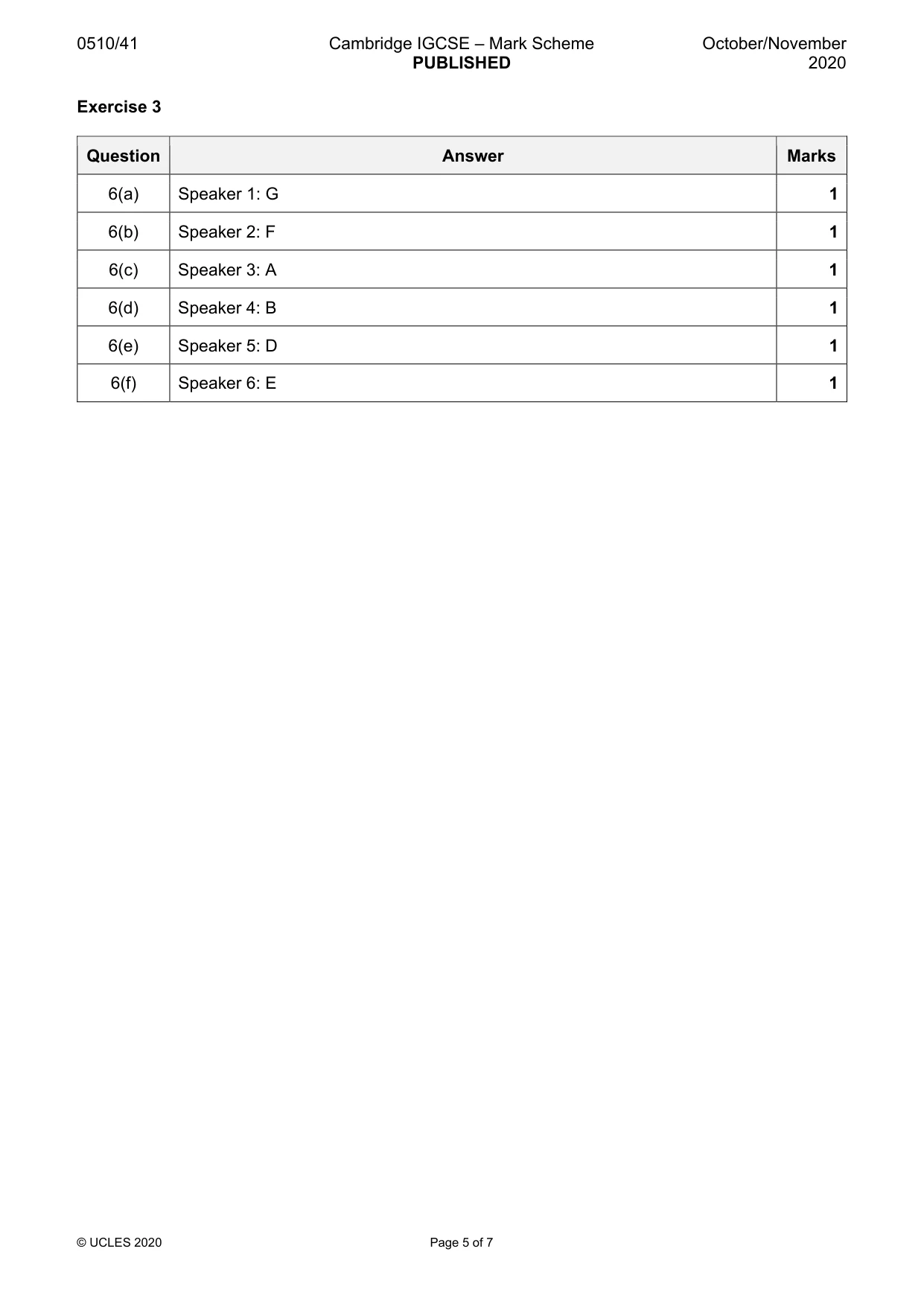
4 0510/41/O/N/20 © UCLES 2020 Exercise 3 6 You will hear six people talking about collecting things. For each of speakers 1 to 6, choose from the list, A to G, which opinion each speaker expresses. Write the letter in the appropriate box. Use each letter only once. There is one extra letter which you do not need to use. You will hear the recordings twice. Speaker 1 A It inspires me to achieve my aims. Speaker 2 B It focuses my attention. Speaker 3 C It helps me forget about everyday problems. Speaker 4 D It makes me appreciate natural objects. Speaker 5 E It enables me to complete research. Speaker 6 F It helps my imagination. G It expresses my loyalty to a business. [6]
Question paper, page 5
5 0510/41/O/N/20 © UCLES 2020 [Turn over Please turn over for Exercise 4.
Question paper, page 6
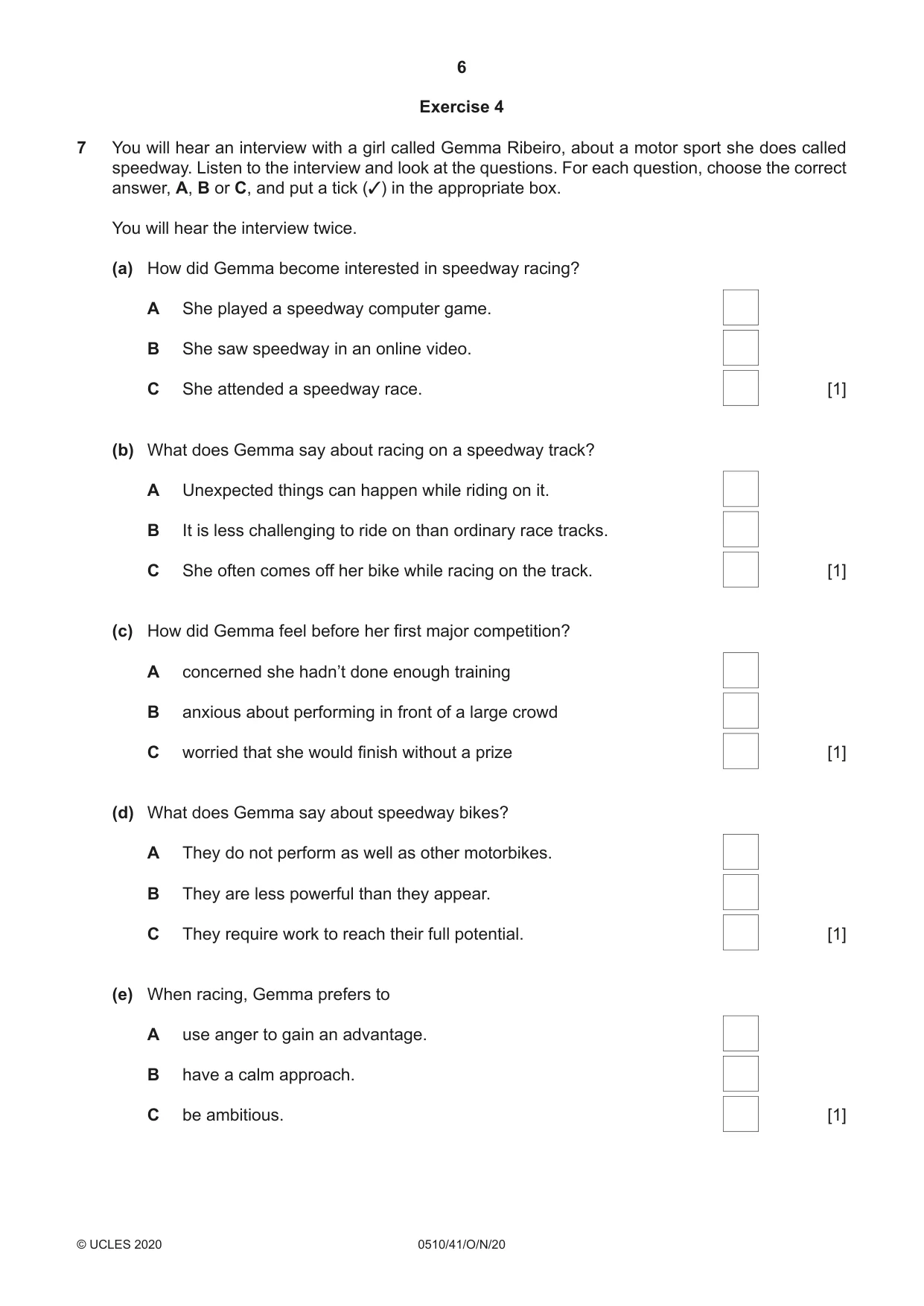
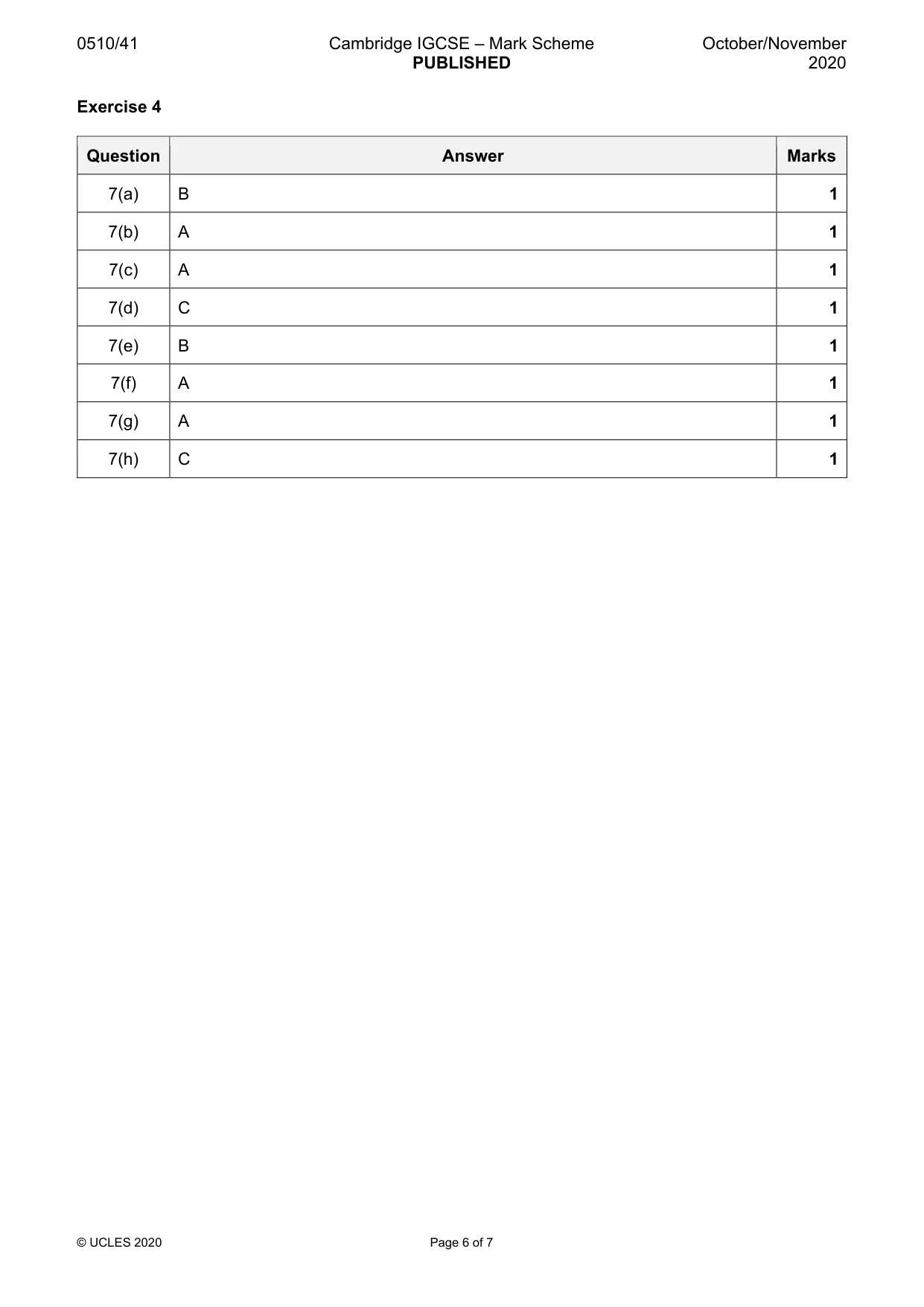
6 0510/41/O/N/20 © UCLES 2020 Exercise 4 7 You will hear an interview with a girl called Gemma Ribeiro, about a motor sport she does called speedway. Listen to the interview and look at the questions. For each question, choose the correct answer, A, B or C, and put a tick (3) in the appropriate box. You will hear the interview twice. (a) How did Gemma become interested in speedway racing? A She played a speedway computer game. B She saw speedway in an online video. C She attended a speedway race. [1] (b) What does Gemma say about racing on a speedway track? A Unexpected things can happen while riding on it. B It is less challenging to ride on than ordinary race tracks. C She often comes off her bike while racing on the track. [1] (c) How did Gemma feel before her first major competition? A concerned she hadn’t done enough training B anxious about performing in front of a large crowd C worried that she would finish without a prize [1] (d) What does Gemma say about speedway bikes? A They do not perform as well as other motorbikes. B They are less powerful than they appear. C They require work to reach their full potential. [1] (e) When racing, Gemma prefers to A use anger to gain an advantage. B have a calm approach. C be ambitious. [1]
Question paper, page 7
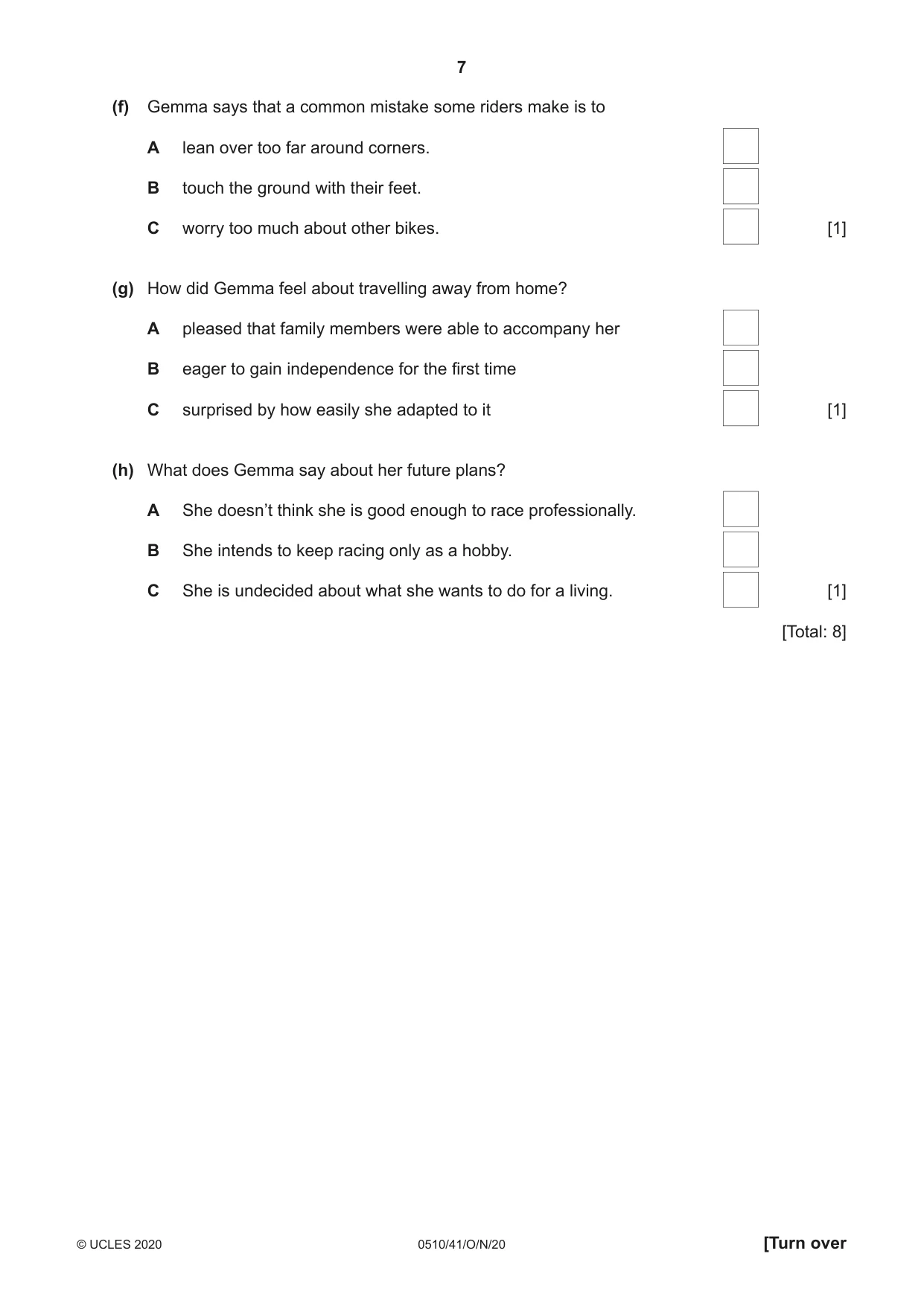
7 0510/41/O/N/20 © UCLES 2020 [Turn over (f) Gemma says that a common mistake some riders make is to A lean over too far around corners. B touch the ground with their feet. C worry too much about other bikes. [1] (g) How did Gemma feel about travelling away from home? A pleased that family members were able to accompany her B eager to gain independence for the first time C surprised by how easily she adapted to it [1] (h) What does Gemma say about her future plans? A She doesn’t think she is good enough to race professionally. B She intends to keep racing only as a hobby. C She is undecided about what she wants to do for a living. [1] [Total: 8]
Question paper, page 8
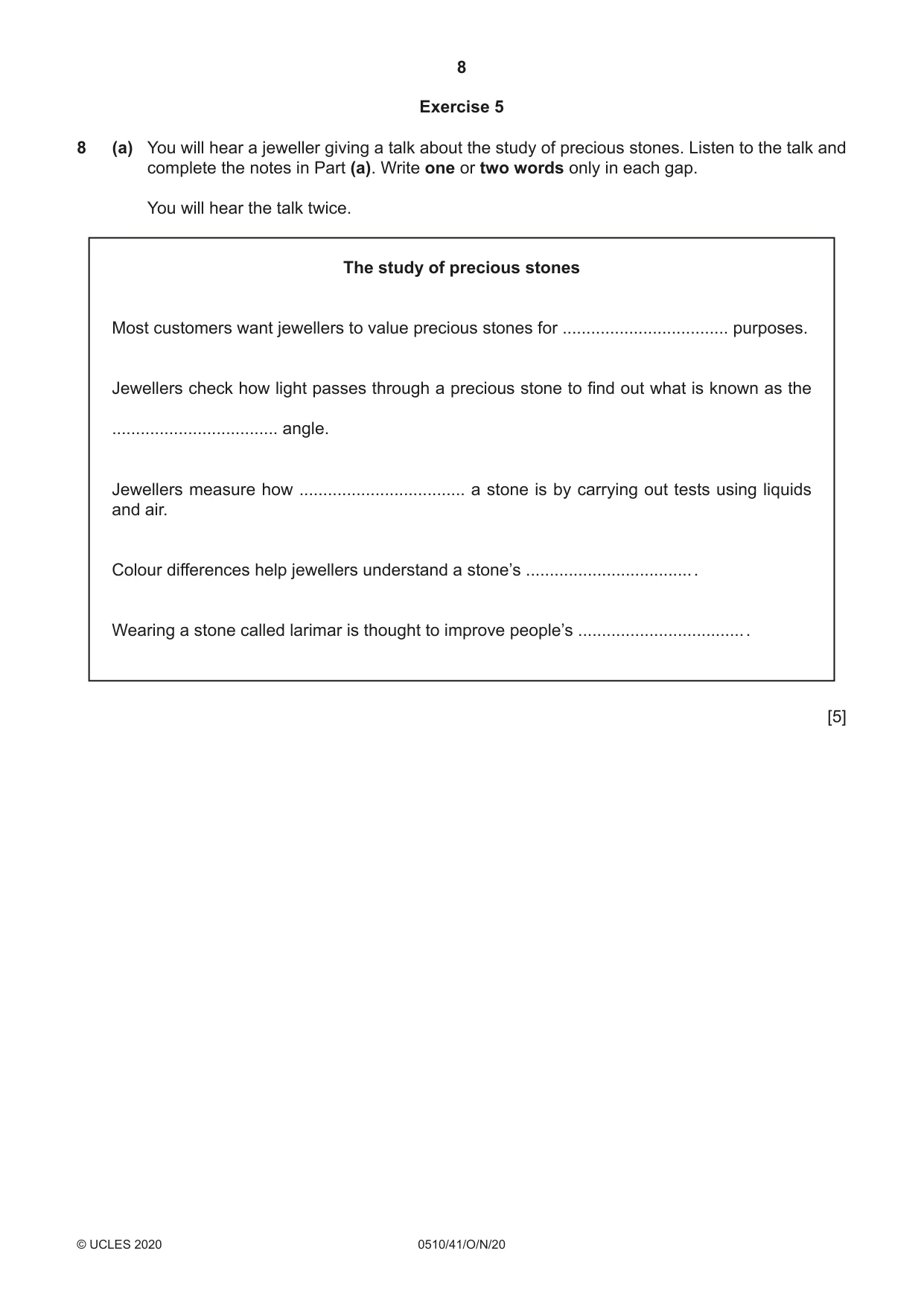
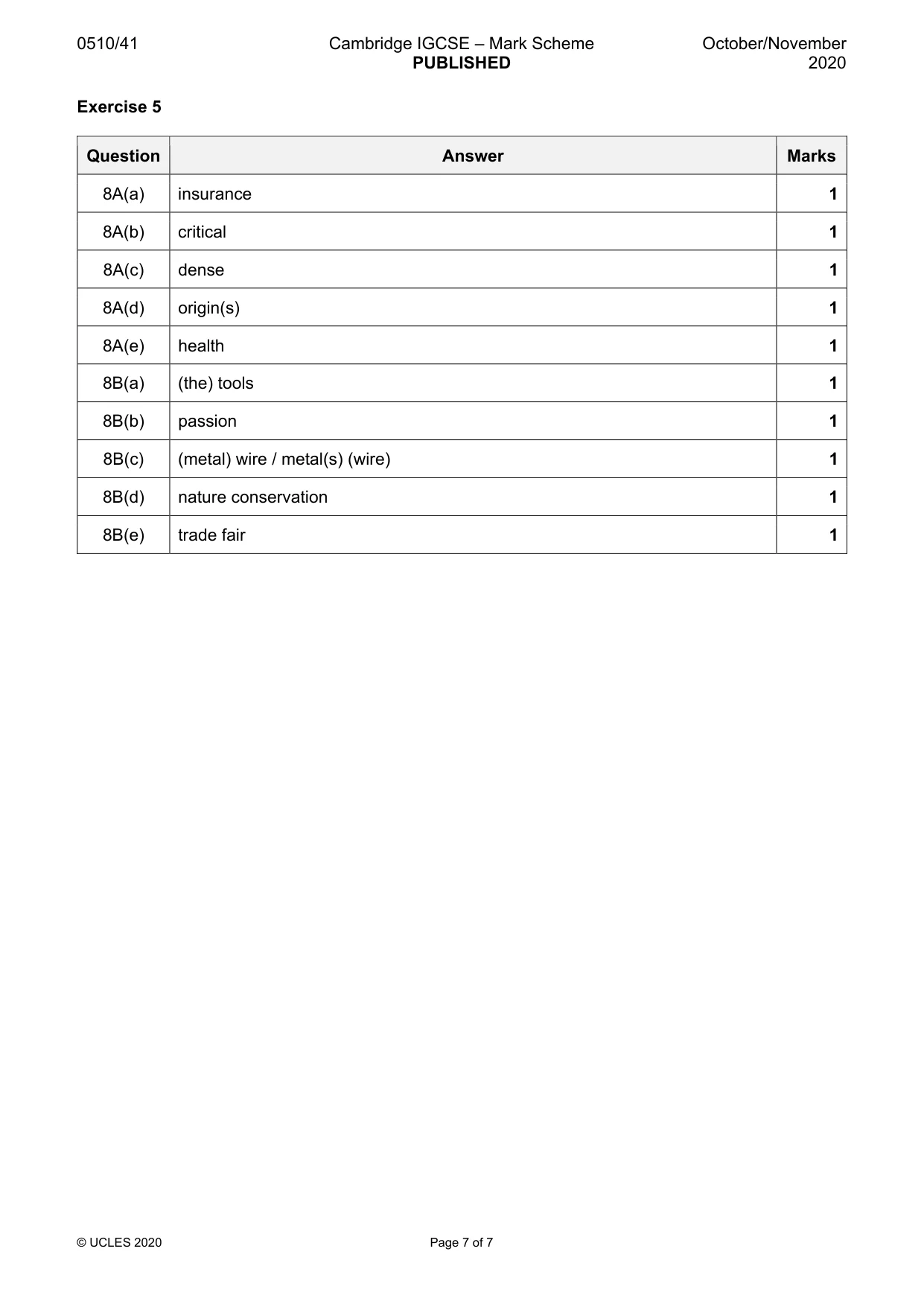
8 0510/41/O/N/20 © UCLES 2020 Exercise 5 8 (a) You will hear a jeweller giving a talk about the study of precious stones. Listen to the talk and complete the notes in Part (a). Write one or two words only in each gap. You will hear the talk twice. The study of precious stones Most customers want jewellers to value precious stones for … purposes. Jewellers check how light passes through a precious stone to find out what is known as the … angle. Jewellers measure how … a stone is by carrying out tests using liquids and air. Colour differences help jewellers understand a stone’s … . Wearing a stone called larimar is thought to improve people’s … . [5]
Question paper, page 9
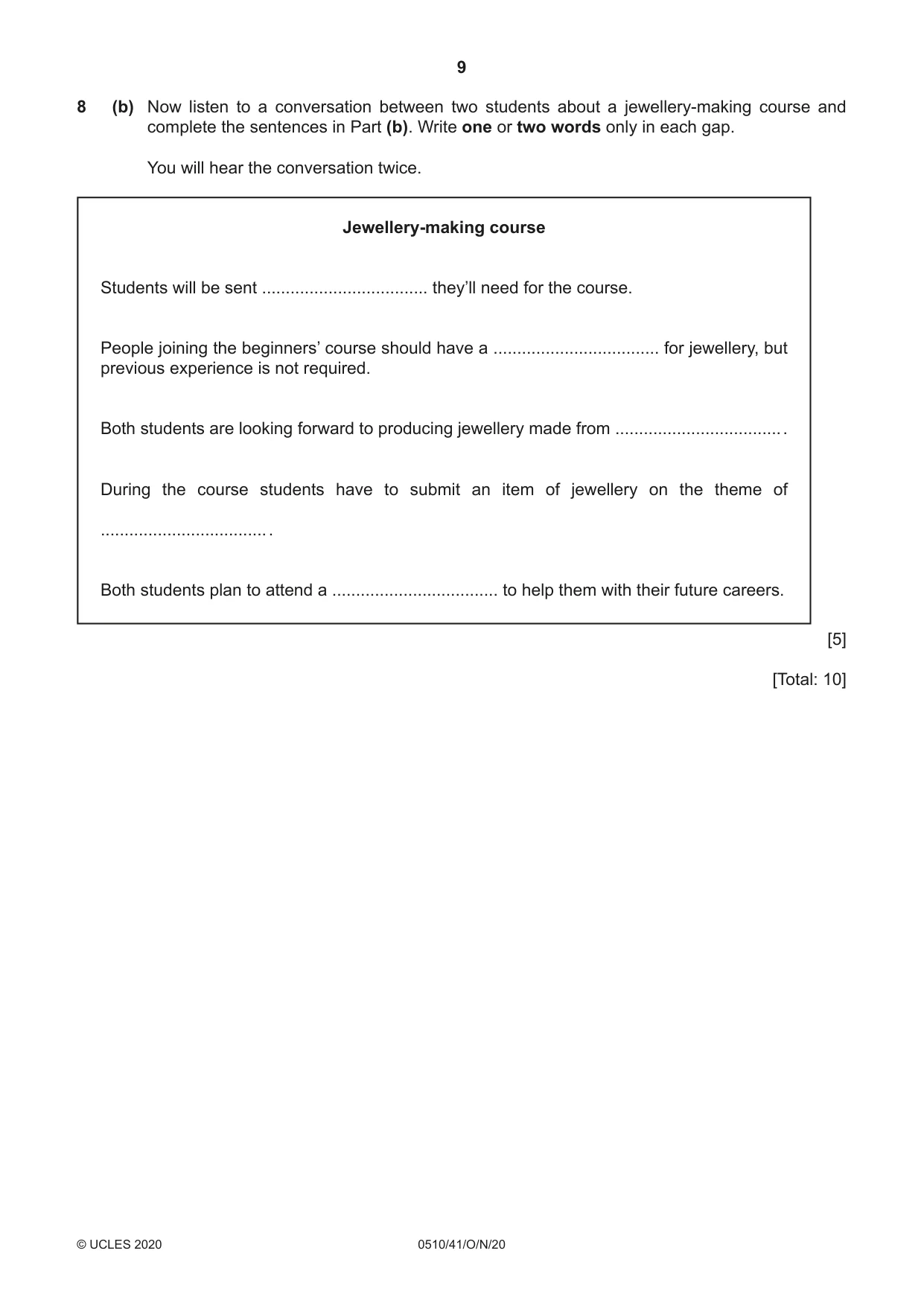
9 0510/41/O/N/20 © UCLES 2020 8 (b) Now listen to a conversation between two students about a jewellery-making course and complete the sentences in Part (b). Write one or two words only in each gap. You will hear the conversation twice. Jewellery-making course Students will be sent … they’ll need for the course. People joining the beginners’ course should have a … for jewellery, but previous experience is not required. Both students are looking forward to producing jewellery made from … . During the course students have to submit an item of jewellery on the theme of … . Both students plan to attend a … to help them with their future careers. [5] [Total: 10]
Question paper, page 10
10 0510/41/O/N/20 © UCLES 2020 BLANK PAGE
Question paper, page 11
11 0510/41/O/N/20 © UCLES 2020 BLANK PAGE
Question paper, page 12
12 0510/41/O/N/20 © UCLES 2020 Permission to reproduce items where third-party owned material protected by copyright is included has been sought and cleared where possible. Every reasonable effort has been made by the publisher (UCLES) to trace copyright holders, but if any items requiring clearance have unwittingly been included, the publisher will be pleased to make amends at the earliest possible opportunity. To avoid the issue of disclosure of answer-related information to candidates, all copyright acknowledgements are reproduced online in the Cambridge Assessment International Education Copyright Acknowledgements Booklet. This is produced for each series of examinations and is freely available to download at www.cambridgeinternational.org after the live examination series. Cambridge Assessment International Education is part of the Cambridge Assessment Group. Cambridge Assessment is the brand name of the University of Cambridge Local Examinations Syndicate (UCLES), which itself is a department of the University of Cambridge. BLANK PAGE
Mark scheme, page 1
This document consists of 7 printed pages. © UCLES 2020 [Turn over Cambridge IGCSE™ ENGLISH AS A SECOND LANGUAGE 0510/41 Paper 4 Listening (Extended) October/November 2020 MARK SCHEME Maximum Mark: 40 Published This mark scheme is published as an aid to teachers and candidates, to indicate the requirements of the examination. It shows the basis on which Examiners were instructed to award marks. It does not indicate the details of the discussions that took place at an Examiners’ meeting before marking began, which would have considered the acceptability of alternative answers. Mark schemes should be read in conjunction with the question paper and the Principal Examiner Report for Teachers. Cambridge International will not enter into discussions about these mark schemes. Cambridge International is publishing the mark schemes for the October/November 2020 series for most Cambridge IGCSE, Cambridge International A and AS Level and Cambridge Pre-U components, and some Cambridge O Level components.
Mark scheme, page 2
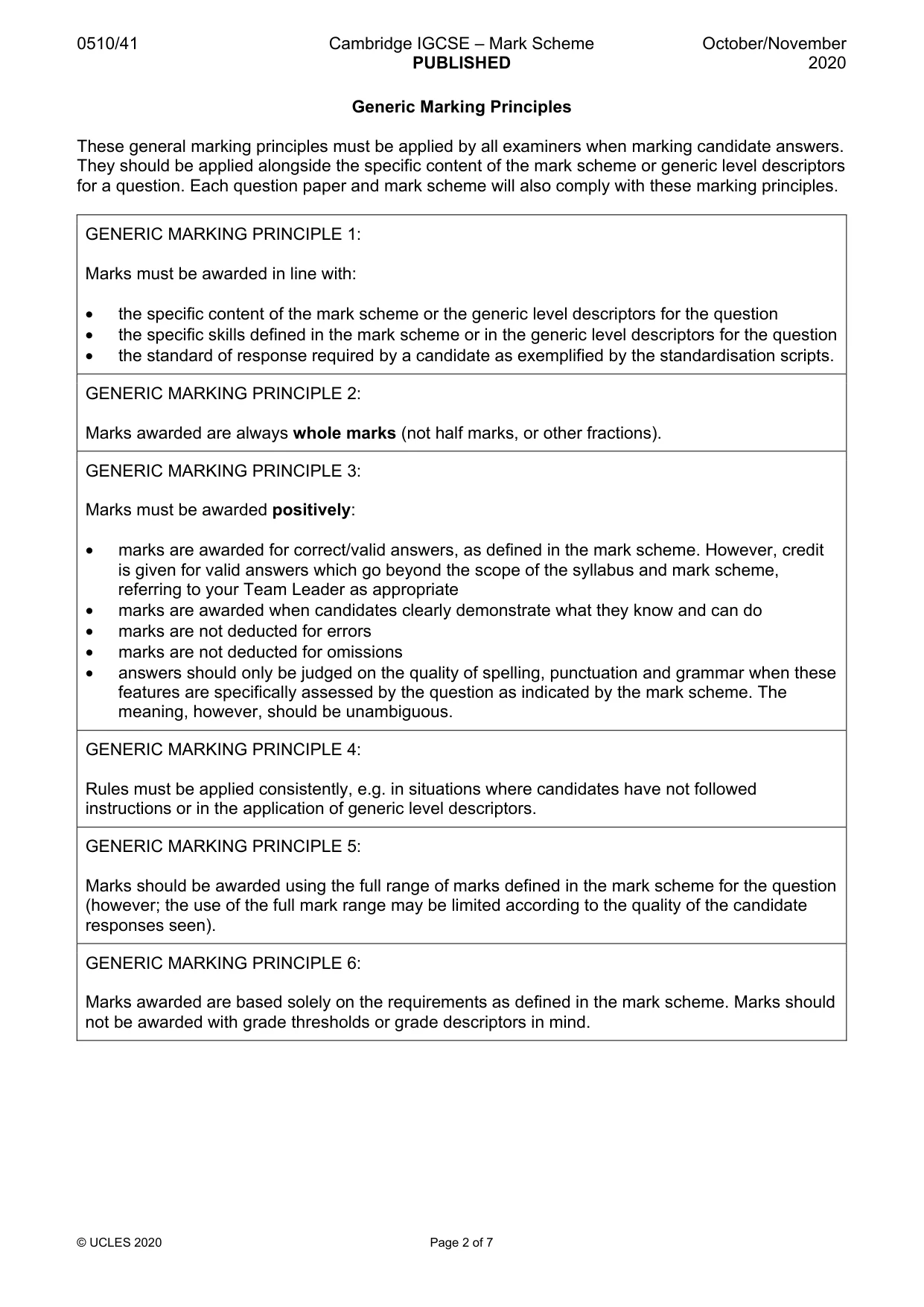
0510/41 Cambridge IGCSE – Mark Scheme PUBLISHED October/November 2020 © UCLES 2020 Page 2 of 7 Generic Marking Principles These general marking principles must be applied by all examiners when marking candidate answers. They should be applied alongside the specific content of the mark scheme or generic level descriptors for a question. Each question paper and mark scheme will also comply with these marking principles. GENERIC MARKING PRINCIPLE 1: Marks must be awarded in line with: • the specific content of the mark scheme or the generic level descriptors for the question • the specific skills defined in the mark scheme or in the generic level descriptors for the question • the standard of response required by a candidate as exemplified by the standardisation scripts. GENERIC MARKING PRINCIPLE 2: Marks awarded are always whole marks (not half marks, or other fractions). GENERIC MARKING PRINCIPLE 3: Marks must be awarded positively: • marks are awarded for correct/valid answers, as defined in the mark scheme. However, credit is given for valid answers which go beyond the scope of the syllabus and mark scheme, referring to your Team Leader as appropriate • marks are awarded when candidates clearly demonstrate what they know and can do • marks are not deducted for errors • marks are not deducted for omissions • answers should only be judged on the quality of spelling, punctuation and grammar when these features are specifically assessed by the question as indicated by the mark scheme. The meaning, however, should be unambiguous. GENERIC MARKING PRINCIPLE 4: Rules must be applied consistently, e.g. in situations where candidates have not followed instructions or in the application of generic level descriptors. GENERIC MARKING PRINCIPLE 5: Marks should be awarded using the full range of marks defined in the mark scheme for the question (however; the use of the full mark range may be limited according to the quality of the candidate responses seen). GENERIC MARKING PRINCIPLE 6: Marks awarded are based solely on the requirements as defined in the mark scheme. Marks should not be awarded with grade thresholds or grade descriptors in mind.
Mark scheme, page 3
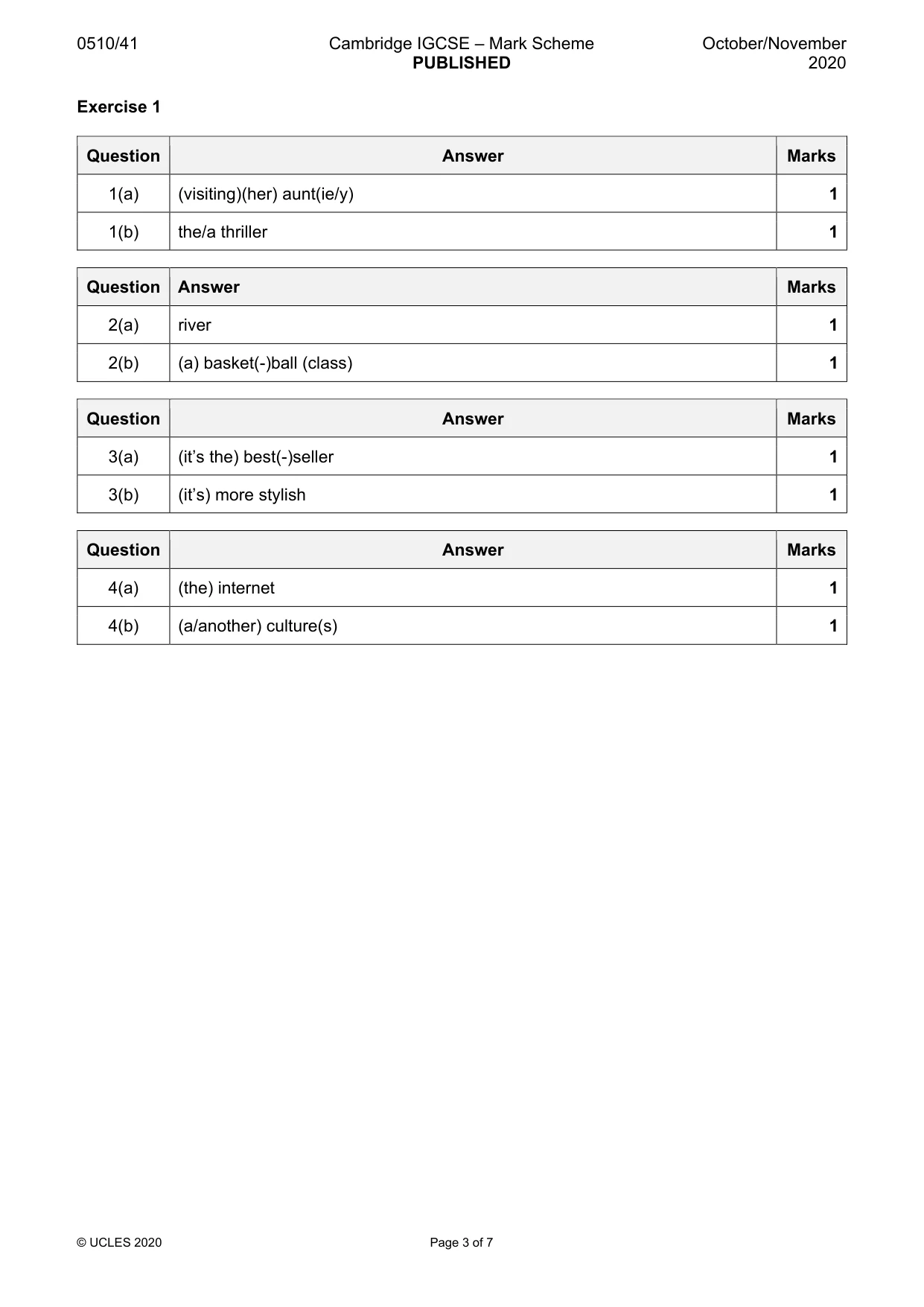
0510/41 Cambridge IGCSE – Mark Scheme PUBLISHED October/November 2020 © UCLES 2020 Page 3 of 7 Exercise 1 Question Answer Marks 1(a) (visiting)(her) aunt(ie/y) 1 1(b) the/a thriller 1 Question Answer Marks 2(a) river 1 2(b) (a) basket(-)ball (class) 1 Question Answer Marks 3(a) (it’s the) best(-)seller 1 3(b) (it’s) more stylish 1 Question Answer Marks 4(a) (the) internet 1 4(b) (a/another) culture(s) 1
Mark scheme, page 4
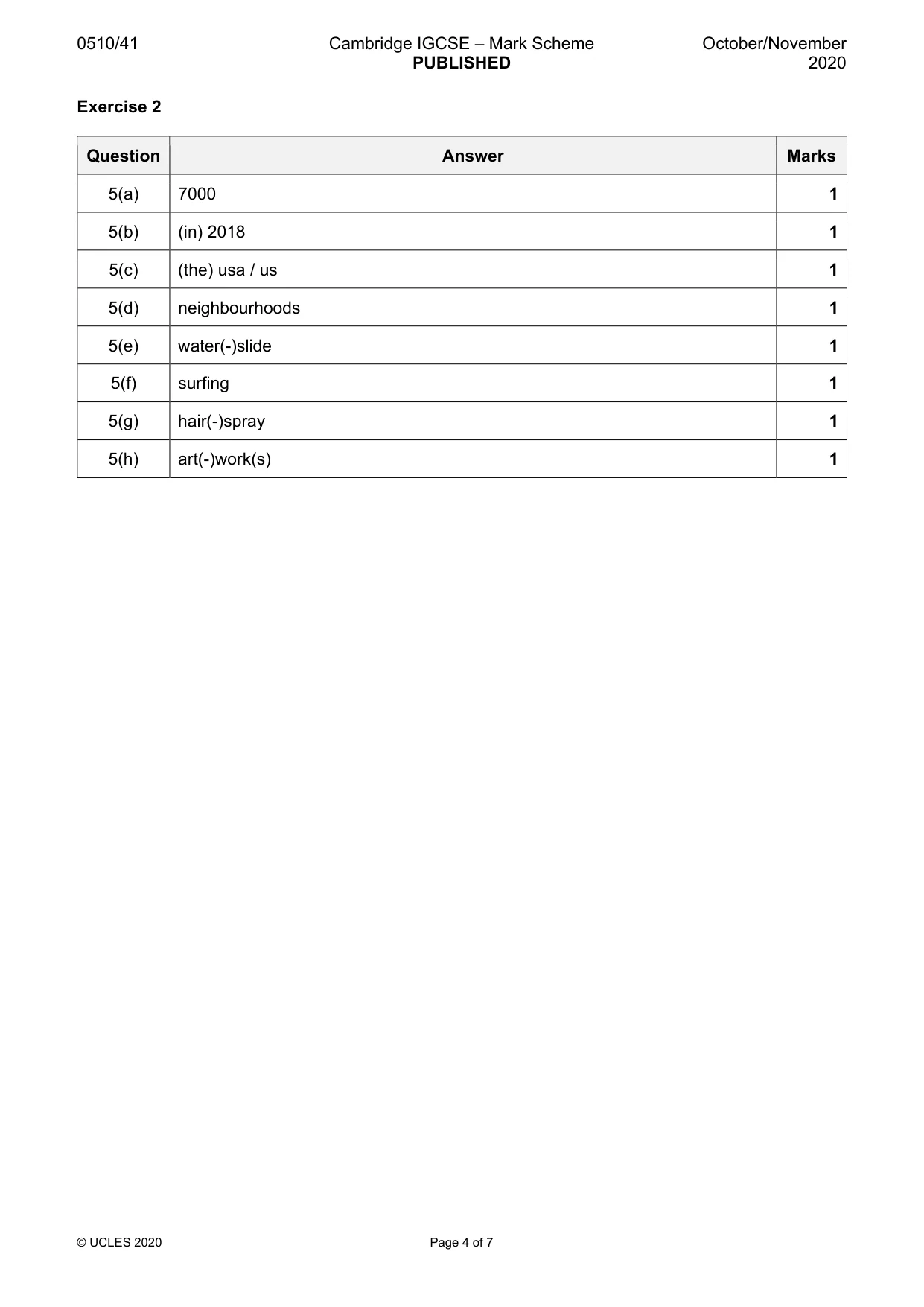
0510/41 Cambridge IGCSE – Mark Scheme PUBLISHED October/November 2020 © UCLES 2020 Page 4 of 7 Exercise 2 Question Answer Marks 5(a) 7000 1 5(b) (in) 2018 1 5(c) (the) usa / us 1 5(d) neighbourhoods 1 5(e) water(-)slide 1 5(f) surfing 1 5(g) hair(-)spray 1 5(h) art(-)work(s) 1
Mark scheme, page 5
0510/41 Cambridge IGCSE – Mark Scheme PUBLISHED October/November 2020 © UCLES 2020 Page 5 of 7 Exercise 3 Question Answer Marks 6(a) Speaker 1: G 1 6(b) Speaker 2: F 1 6(c) Speaker 3: A 1 6(d) Speaker 4: B 1 6(e) Speaker 5: D 1 6(f) Speaker 6: E 1
Mark scheme, page 6
0510/41 Cambridge IGCSE – Mark Scheme PUBLISHED October/November 2020 © UCLES 2020 Page 6 of 7 Exercise 4 Question Answer Marks 7(a) B 1 7(b) A 1 7(c) A 1 7(d) C 1 7(e) B 1 7(f) A 1 7(g) A 1 7(h) C 1
Mark scheme, page 7
0510/41 Cambridge IGCSE – Mark Scheme PUBLISHED October/November 2020 © UCLES 2020 Page 7 of 7 Exercise 5 Question Answer Marks 8A(a) insurance 1 8A(b) critical 1 8A(c) dense 1 8A(d) origin(s) 1 8A(e) health 1 8B(a) (the) tools 1 8B(b) passion 1 8B(c) (metal) wire / metal(s) (wire) 1 8B(d) nature conservation 1 8B(e) trade fair 1
What you needed in this session
Cambridge’s own grade thresholds for 2020 Oct/Nov, Paper 4 · Variant 1. A higher threshold means an easier paper — the bar moves with how the cohort did.