Cambridge IGCSE English - Second Language (oral endorsement) 0510 — 2023 May/June Paper 4 · Variant 3
0510/43/M/J/23 · 40 marks · ≈45 min
The question paper and its mark scheme, free to read here and free to download. This is Cambridge’s own paper, exactly as it was sat.
Question paper12 pages




Mark scheme9 pages
Answers below. Sit the paper first if you are practising.
Paper as text
Question paper, page 1
This document has 12 pages. Any blank pages are indicated. [Turn over Cambridge IGCSE™ ENGLISH AS A SECOND LANGUAGE 0510/43 Paper 4 Listening (Extended) May/June 2023 Approximately 50 minutes You must answer on the question paper. No additional materials are needed. INSTRUCTIONS ● Answer all questions. ● Use a black or dark blue pen. ● Write your name, centre number and candidate number in the boxes at the top of the page. ● Write your answer to each question in the space provided. ● Do not use an erasable pen or correction fluid. ● Do not write on any bar codes. ● Dictionaries are not allowed. INFORMATION ● The total mark for this paper is 40. ● The number of marks for each question or part question is shown in brackets [ ]. * 5 8 4 8 4 6 8 3 5 3 * DC (CJ) 314817/2 © UCLES 2023
Question paper, page 2
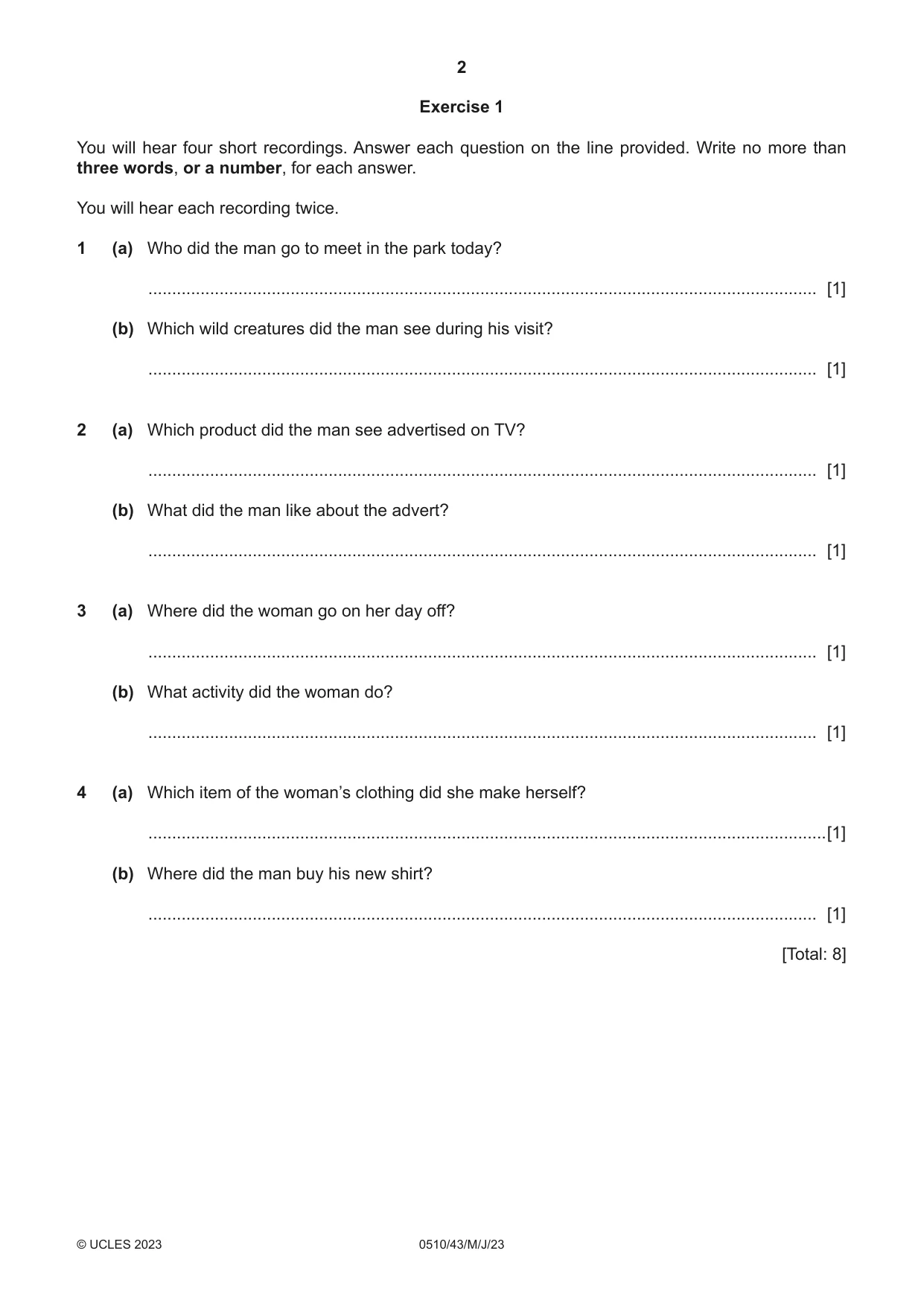
2 0510/43/M/J/23 © UCLES 2023 Exercise 1 You will hear four short recordings. Answer each question on the line provided. Write no more than three words, or a number, for each answer. You will hear each recording twice. 1 (a) Who did the man go to meet in the park today? … [1] (b) Which wild creatures did the man see during his visit? … [1] 2 (a) Which product did the man see advertised on TV? … [1] (b) What did the man like about the advert? … [1] 3 (a) Where did the woman go on her day off? … [1] (b) What activity did the woman do? … [1] 4 (a) Which item of the woman’s clothing did she make herself? …[1] (b) Where did the man buy his new shirt? … [1] [Total: 8]
Question paper, page 3
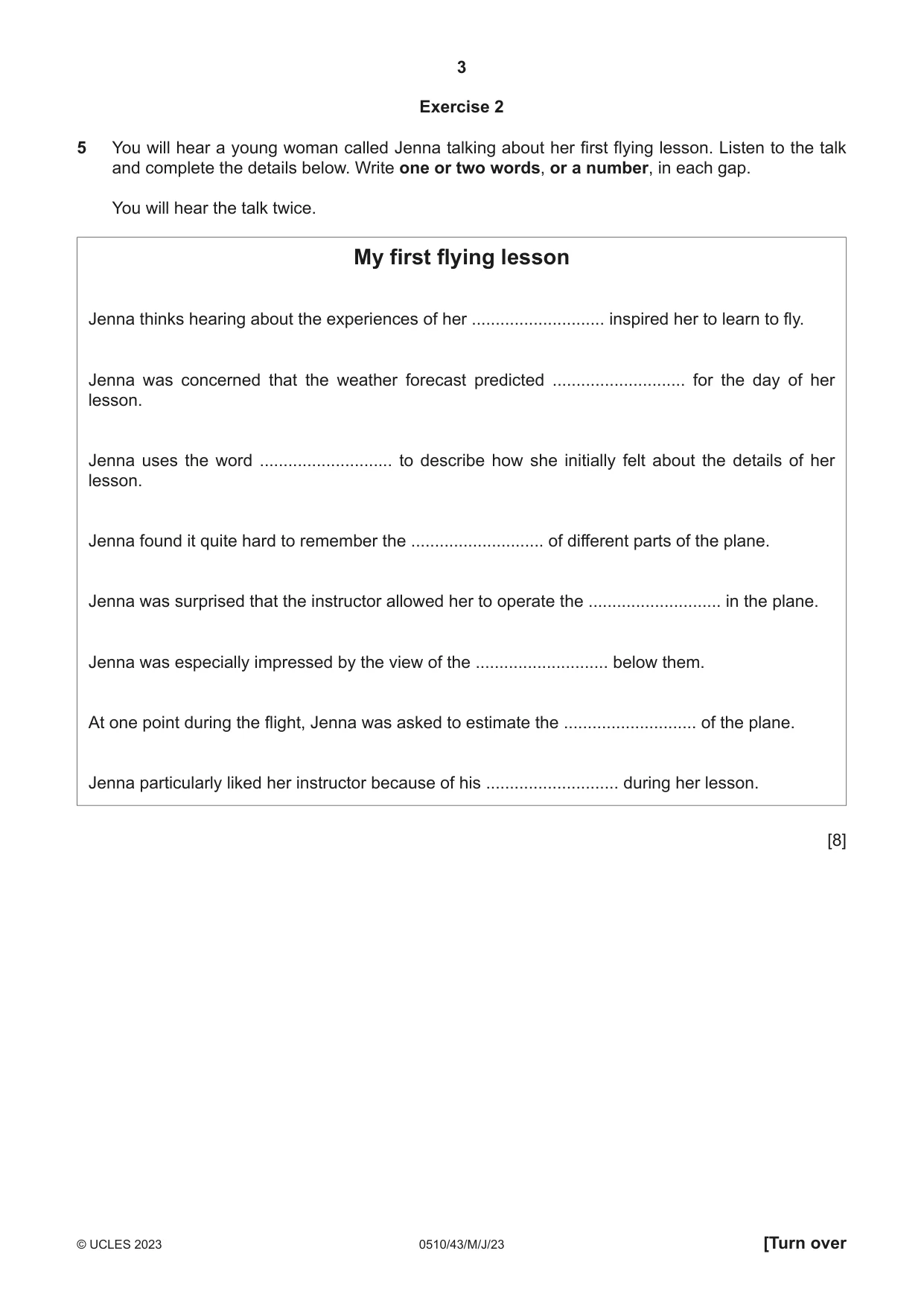
3 0510/43/M/J/23 © UCLES 2023 [Turn over Exercise 2 5 You will hear a young woman called Jenna talking about her first flying lesson. Listen to the talk and complete the details below. Write one or two words, or a number, in each gap. You will hear the talk twice. My first flying lesson Jenna thinks hearing about the experiences of her … inspired her to learn to fly. Jenna was concerned that the weather forecast predicted … for the day of her lesson. Jenna uses the word … to describe how she initially felt about the details of her lesson. Jenna found it quite hard to remember the … of different parts of the plane. Jenna was surprised that the instructor allowed her to operate the … in the plane. Jenna was especially impressed by the view of the … below them. At one point during the flight, Jenna was asked to estimate the … of the plane. Jenna particularly liked her instructor because of his … during her lesson. [8]
Question paper, page 4
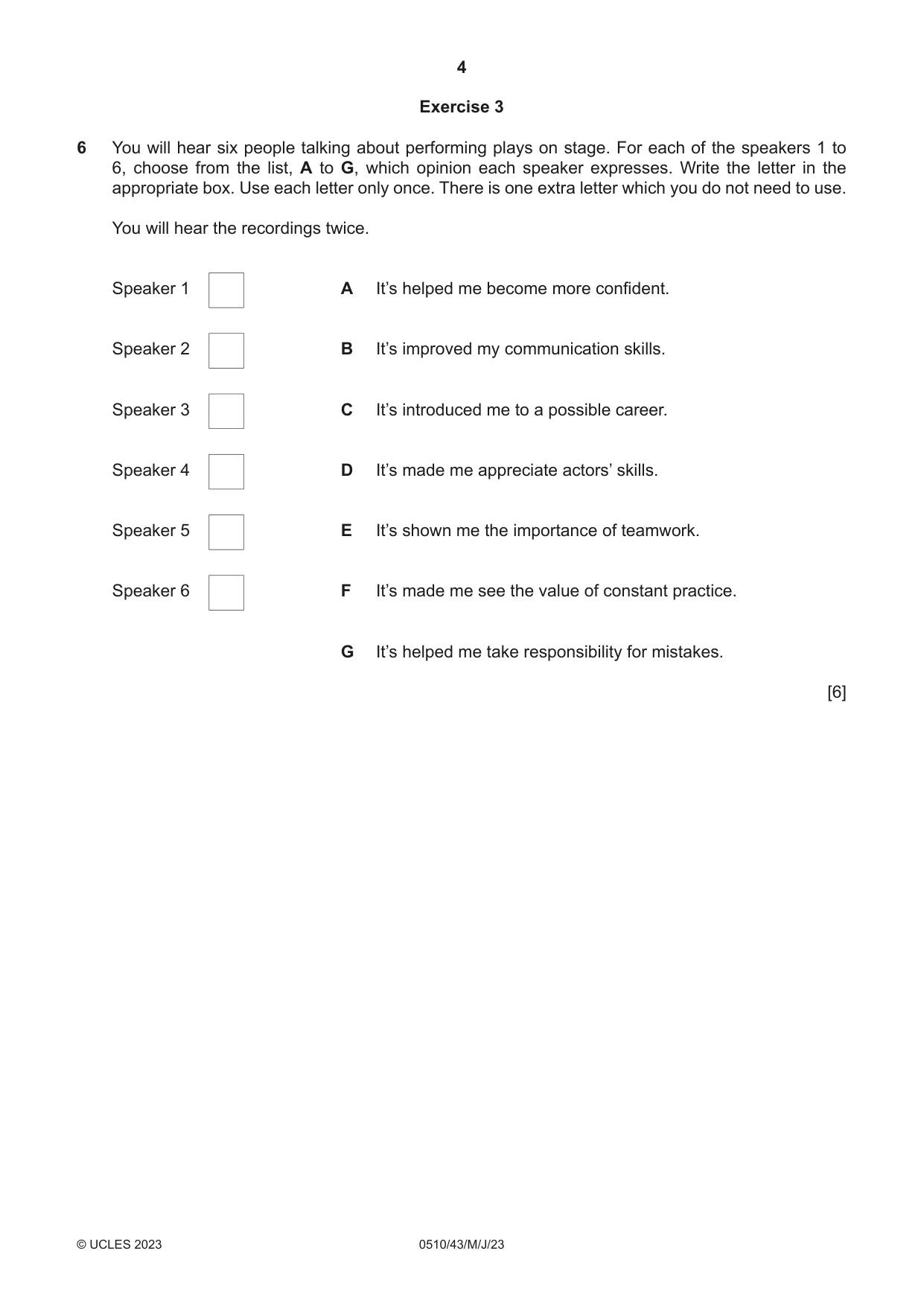
4 0510/43/M/J/23 © UCLES 2023 Exercise 3 6 You will hear six people talking about performing plays on stage. For each of the speakers 1 to 6, choose from the list, A to G, which opinion each speaker expresses. Write the letter in the appropriate box. Use each letter only once. There is one extra letter which you do not need to use. You will hear the recordings twice. Speaker 1 A It’s helped me become more confident. Speaker 2 B It’s improved my communication skills. Speaker 3 C It’s introduced me to a possible career. Speaker 4 D It’s made me appreciate actors’ skills. Speaker 5 E It’s shown me the importance of teamwork. Speaker 6 F It’s made me see the value of constant practice. G It’s helped me take responsibility for mistakes. [6]
Question paper, page 5
5 0510/43/M/J/23 © UCLES 2023 [Turn over Please turn over for Exercise 4.
Question paper, page 6
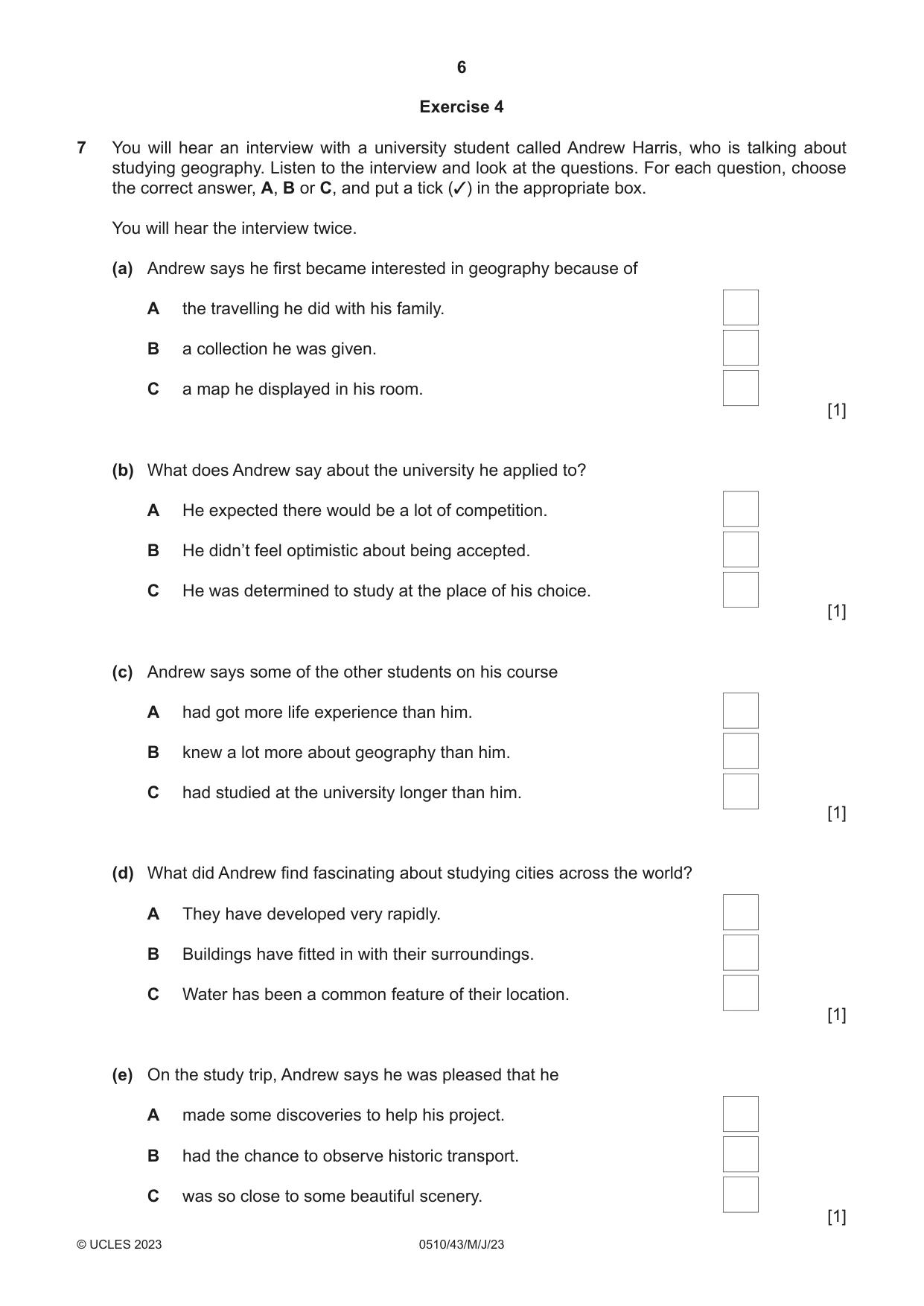
6 0510/43/M/J/23 © UCLES 2023 Exercise 4 7 You will hear an interview with a university student called Andrew Harris, who is talking about studying geography. Listen to the interview and look at the questions. For each question, choose the correct answer, A, B or C, and put a tick (3) in the appropriate box. You will hear the interview twice. (a) Andrew says he first became interested in geography because of A the travelling he did with his family. B a collection he was given. C a map he displayed in his room. [1] (b) What does Andrew say about the university he applied to? A He expected there would be a lot of competition. B He didn’t feel optimistic about being accepted. C He was determined to study at the place of his choice. [1] (c) Andrew says some of the other students on his course A had got more life experience than him. B knew a lot more about geography than him. C had studied at the university longer than him. [1] (d) What did Andrew find fascinating about studying cities across the world? A They have developed very rapidly. B Buildings have fitted in with their surroundings. C Water has been a common feature of their location. [1] (e) On the study trip, Andrew says he was pleased that he A made some discoveries to help his project. B had the chance to observe historic transport. C was so close to some beautiful scenery. [1]
Question paper, page 7
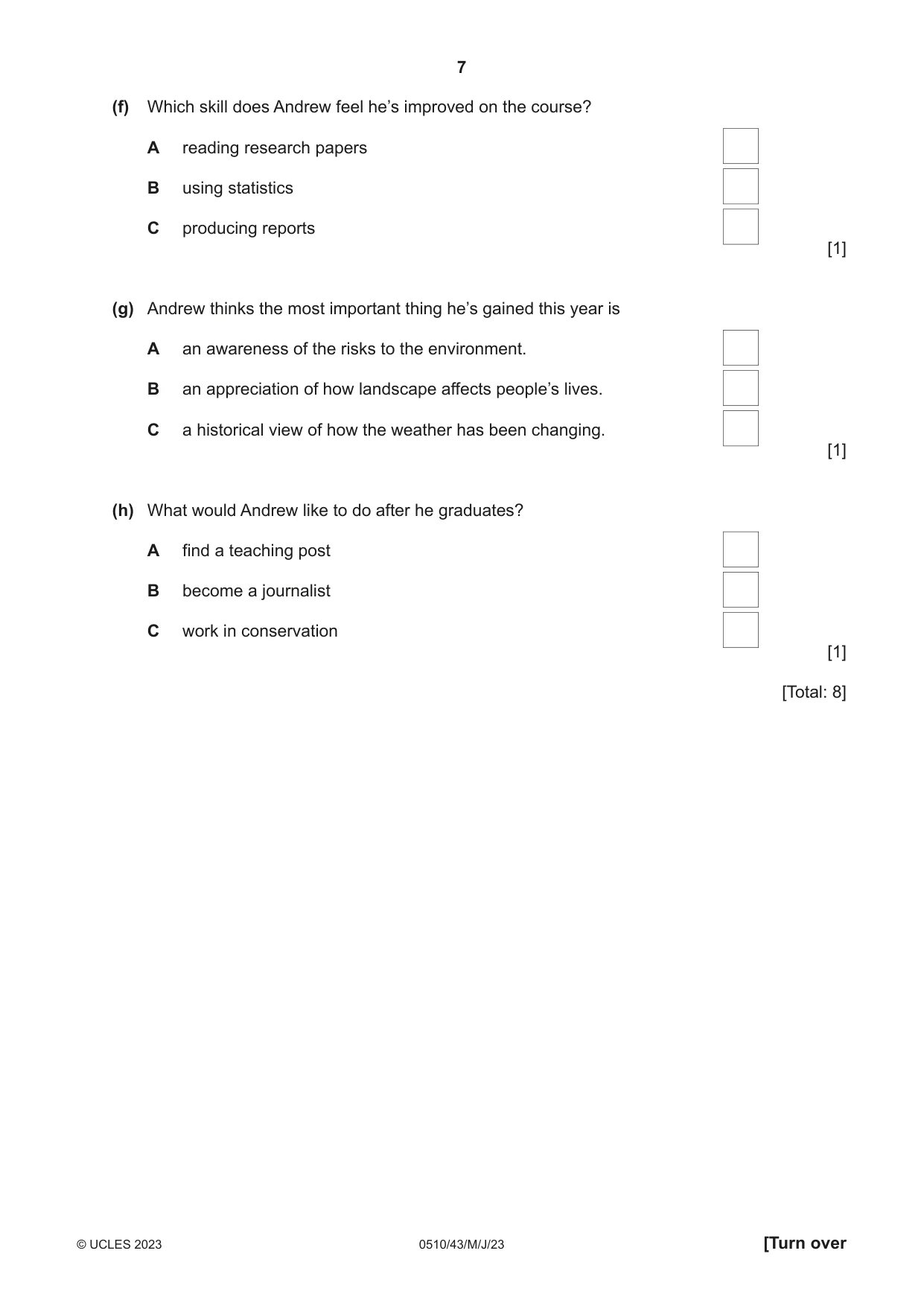
7 0510/43/M/J/23 © UCLES 2023 [Turn over (f) Which skill does Andrew feel he’s improved on the course? A reading research papers B using statistics C producing reports [1] (g) Andrew thinks the most important thing he’s gained this year is A an awareness of the risks to the environment. B an appreciation of how landscape affects people’s lives. C a historical view of how the weather has been changing. [1] (h) What would Andrew like to do after he graduates? A find a teaching post B become a journalist C work in conservation [1] [Total: 8]
Question paper, page 8
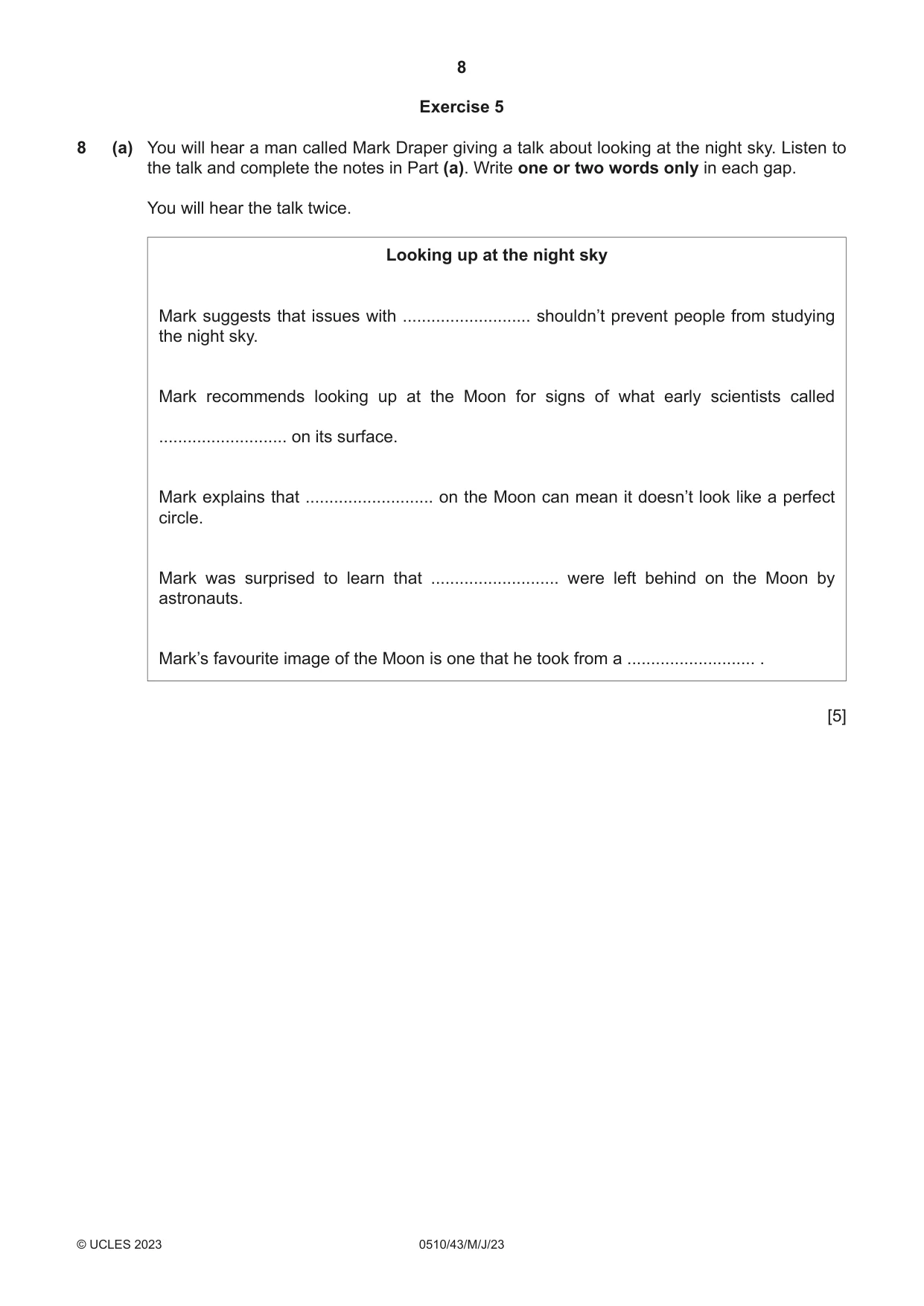
8 0510/43/M/J/23 © UCLES 2023 Exercise 5 8 (a) You will hear a man called Mark Draper giving a talk about looking at the night sky. Listen to the talk and complete the notes in Part (a). Write one or two words only in each gap. You will hear the talk twice. Looking up at the night sky Mark suggests that issues with … shouldn’t prevent people from studying the night sky. Mark recommends looking up at the Moon for signs of what early scientists called … on its surface. Mark explains that … on the Moon can mean it doesn’t look like a perfect circle. Mark was surprised to learn that … were left behind on the Moon by astronauts. Mark’s favourite image of the Moon is one that he took from a … . [5]
Question paper, page 9
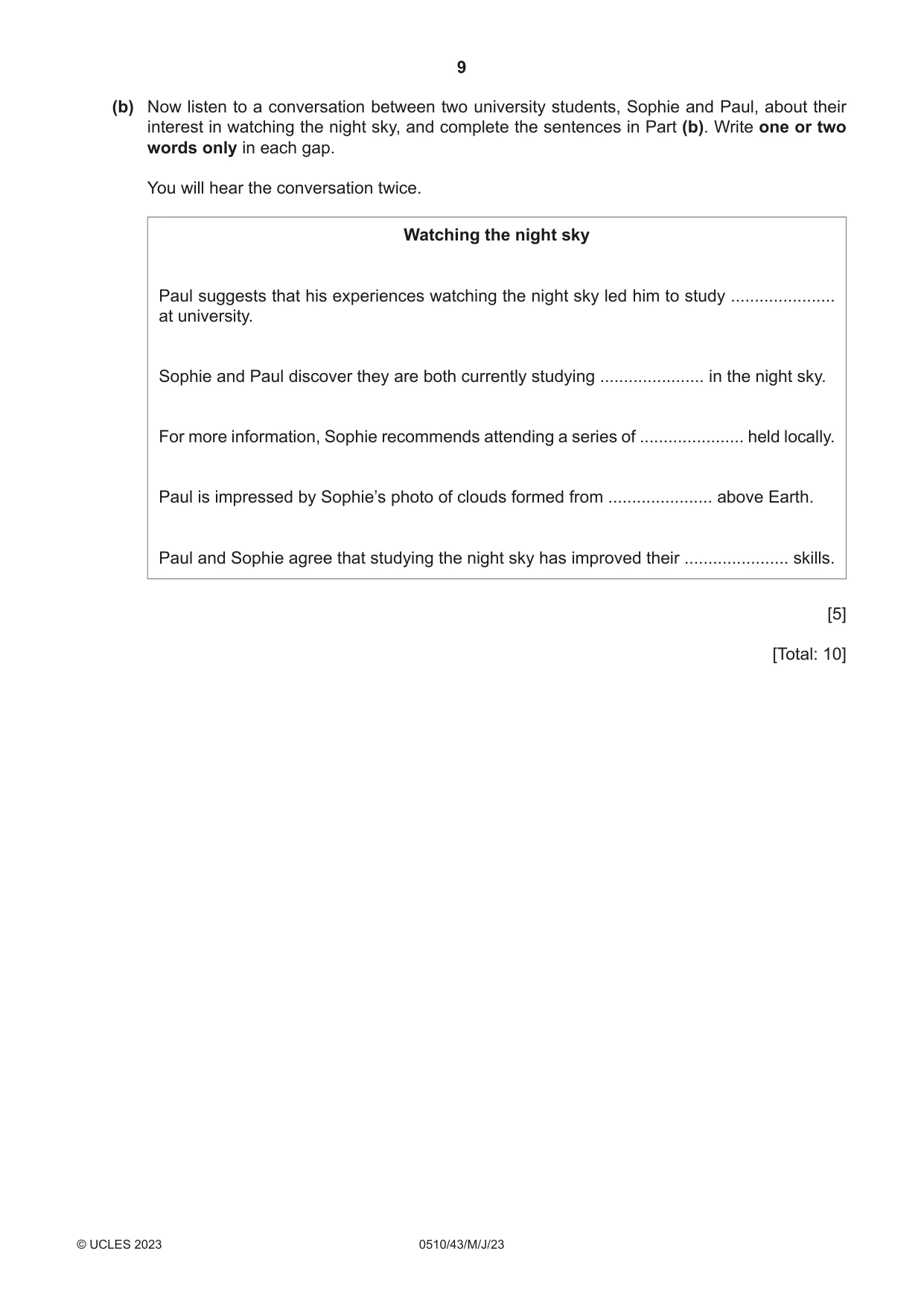
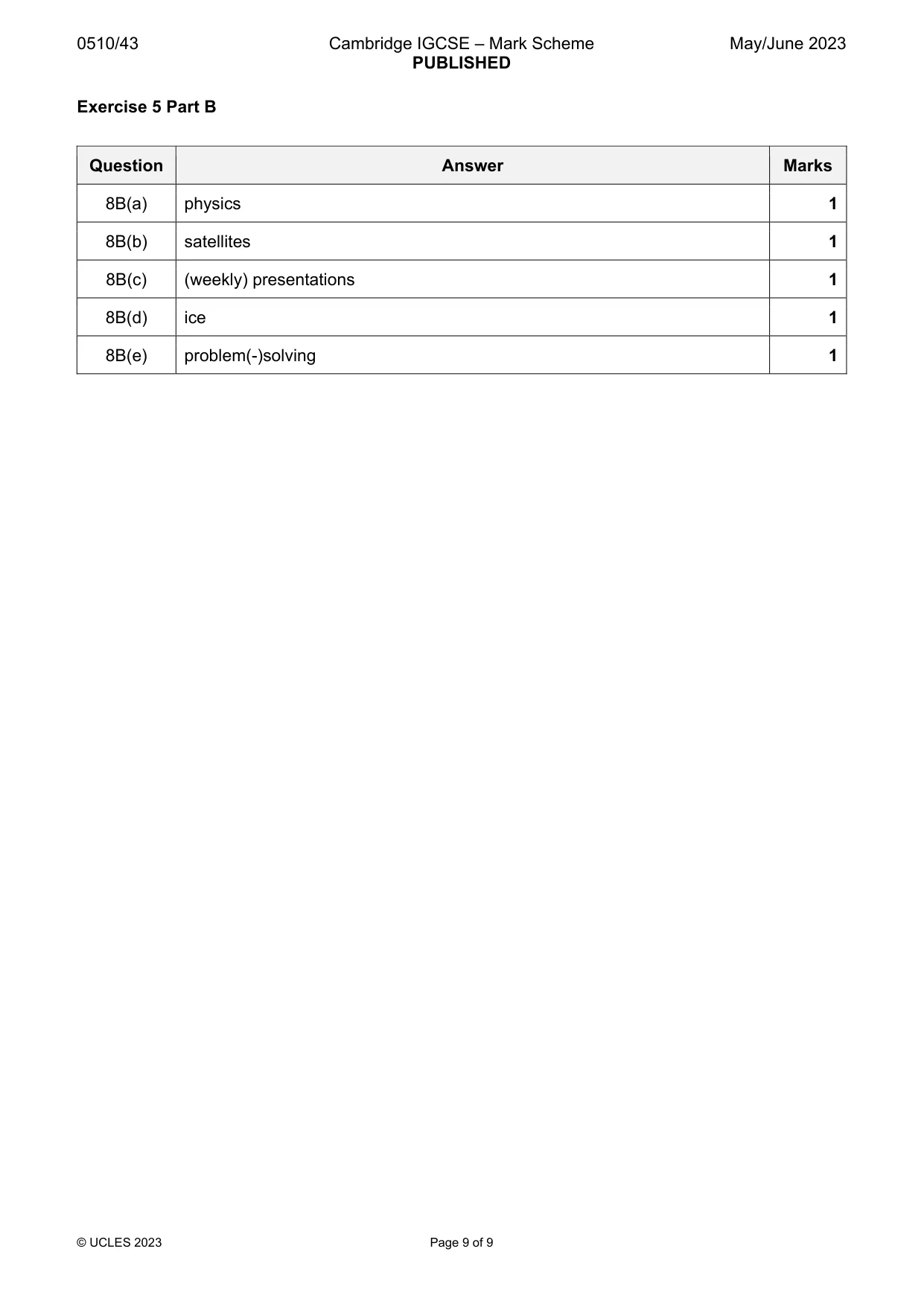
9 0510/43/M/J/23 © UCLES 2023 (b) Now listen to a conversation between two university students, Sophie and Paul, about their interest in watching the night sky, and complete the sentences in Part (b). Write one or two words only in each gap. You will hear the conversation twice. Watching the night sky Paul suggests that his experiences watching the night sky led him to study … at university. Sophie and Paul discover they are both currently studying … in the night sky. For more information, Sophie recommends attending a series of … held locally. Paul is impressed by Sophie’s photo of clouds formed from … above Earth. Paul and Sophie agree that studying the night sky has improved their … skills. [5] [Total: 10]
Question paper, page 10
10 0510/43/M/J/23 © UCLES 2023 BLANK PAGE
Question paper, page 11
11 0510/43/M/J/23 © UCLES 2023 BLANK PAGE
Question paper, page 12
12 0510/43/M/J/23 © UCLES 2023 Permission to reproduce items where third-party owned material protected by copyright is included has been sought and cleared where possible. Every reasonable effort has been made by the publisher (UCLES) to trace copyright holders, but if any items requiring clearance have unwittingly been included, the publisher will be pleased to make amends at the earliest possible opportunity. To avoid the issue of disclosure of answer-related information to candidates, all copyright acknowledgements are reproduced online in the Cambridge Assessment International Education Copyright Acknowledgements Booklet. This is produced for each series of examinations and is freely available to download at www.cambridgeinternational.org after the live examination series. Cambridge Assessment International Education is part of Cambridge Assessment. Cambridge Assessment is the brand name of the University of Cambridge Local Examinations Syndicate (UCLES), which is a department of the University of Cambridge. BLANK PAGE
Mark scheme, page 1
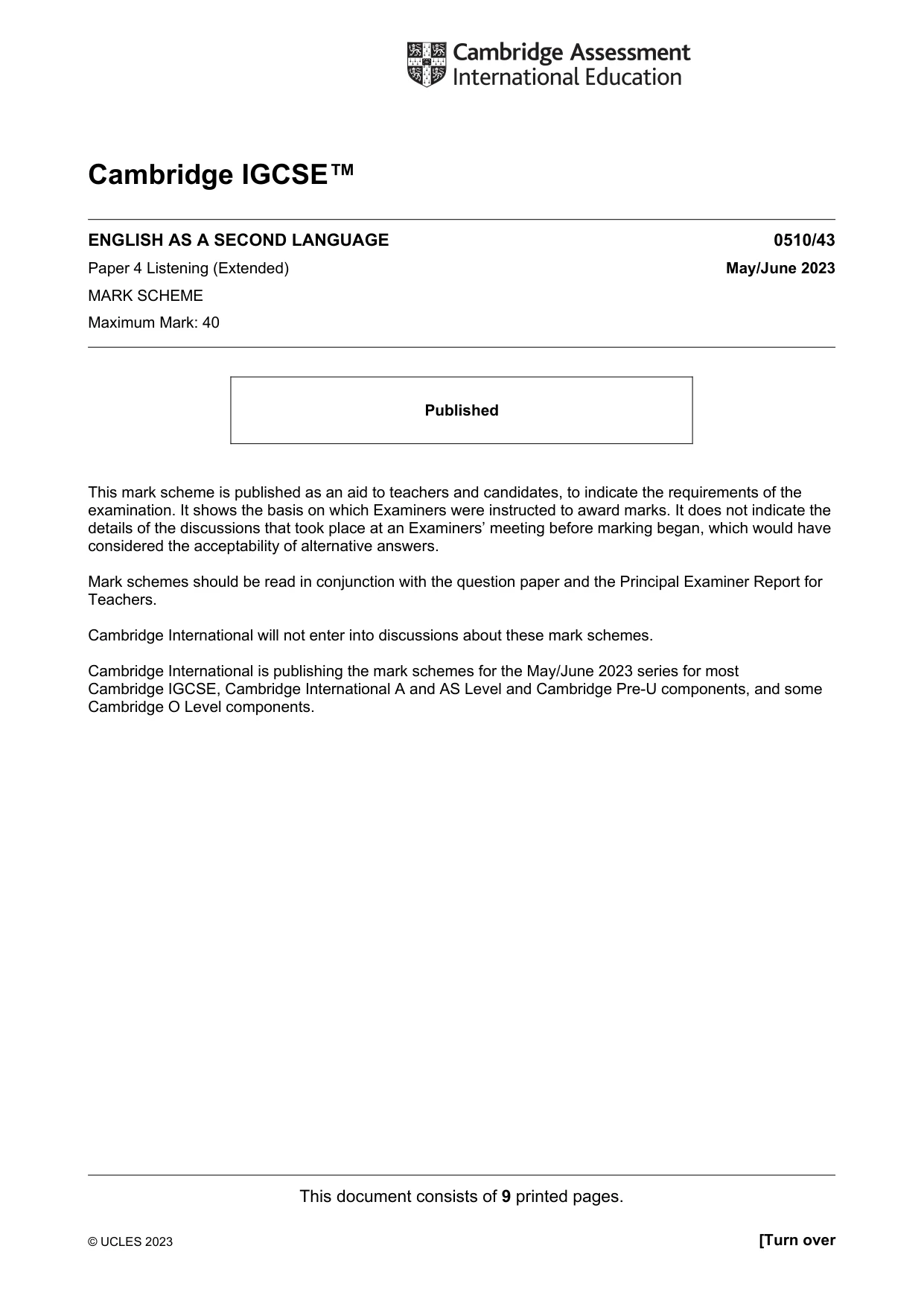
This document consists of 9 printed pages. © UCLES 2023 [Turn over Cambridge IGCSE™ ENGLISH AS A SECOND LANGUAGE 0510/43 Paper 4 Listening (Extended) May/June 2023 MARK SCHEME Maximum Mark: 40 Published This mark scheme is published as an aid to teachers and candidates, to indicate the requirements of the examination. It shows the basis on which Examiners were instructed to award marks. It does not indicate the details of the discussions that took place at an Examiners’ meeting before marking began, which would have considered the acceptability of alternative answers. Mark schemes should be read in conjunction with the question paper and the Principal Examiner Report for Teachers. Cambridge International will not enter into discussions about these mark schemes. Cambridge International is publishing the mark schemes for the May/June 2023 series for most Cambridge IGCSE, Cambridge International A and AS Level and Cambridge Pre-U components, and some Cambridge O Level components.
Mark scheme, page 2
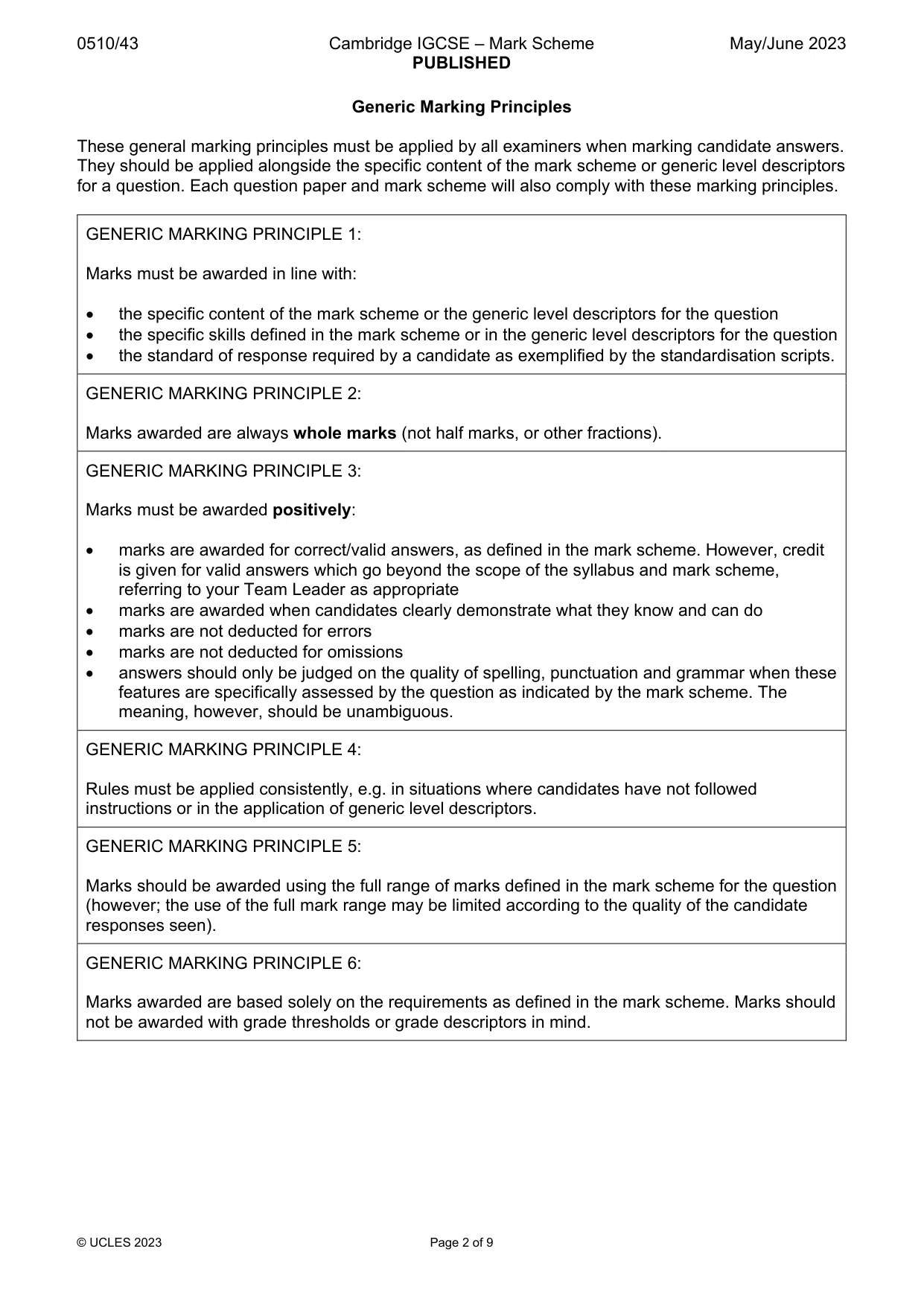
0510/43 Cambridge IGCSE – Mark Scheme PUBLISHED May/June 2023 © UCLES 2023 Page 2 of 9 Generic Marking Principles These general marking principles must be applied by all examiners when marking candidate answers. They should be applied alongside the specific content of the mark scheme or generic level descriptors for a question. Each question paper and mark scheme will also comply with these marking principles. GENERIC MARKING PRINCIPLE 1: Marks must be awarded in line with: the specific content of the mark scheme or the generic level descriptors for the question the specific skills defined in the mark scheme or in the generic level descriptors for the question the standard of response required by a candidate as exemplified by the standardisation scripts. GENERIC MARKING PRINCIPLE 2: Marks awarded are always whole marks (not half marks, or other fractions). GENERIC MARKING PRINCIPLE 3: Marks must be awarded positively: marks are awarded for correct/valid answers, as defined in the mark scheme. However, credit is given for valid answers which go beyond the scope of the syllabus and mark scheme, referring to your Team Leader as appropriate marks are awarded when candidates clearly demonstrate what they know and can do marks are not deducted for errors marks are not deducted for omissions answers should only be judged on the quality of spelling, punctuation and grammar when these features are specifically assessed by the question as indicated by the mark scheme. The meaning, however, should be unambiguous. GENERIC MARKING PRINCIPLE 4: Rules must be applied consistently, e.g. in situations where candidates have not followed instructions or in the application of generic level descriptors. GENERIC MARKING PRINCIPLE 5: Marks should be awarded using the full range of marks defined in the mark scheme for the question (however; the use of the full mark range may be limited according to the quality of the candidate responses seen). GENERIC MARKING PRINCIPLE 6: Marks awarded are based solely on the requirements as defined in the mark scheme. Marks should not be awarded with grade thresholds or grade descriptors in mind.
Mark scheme, page 3
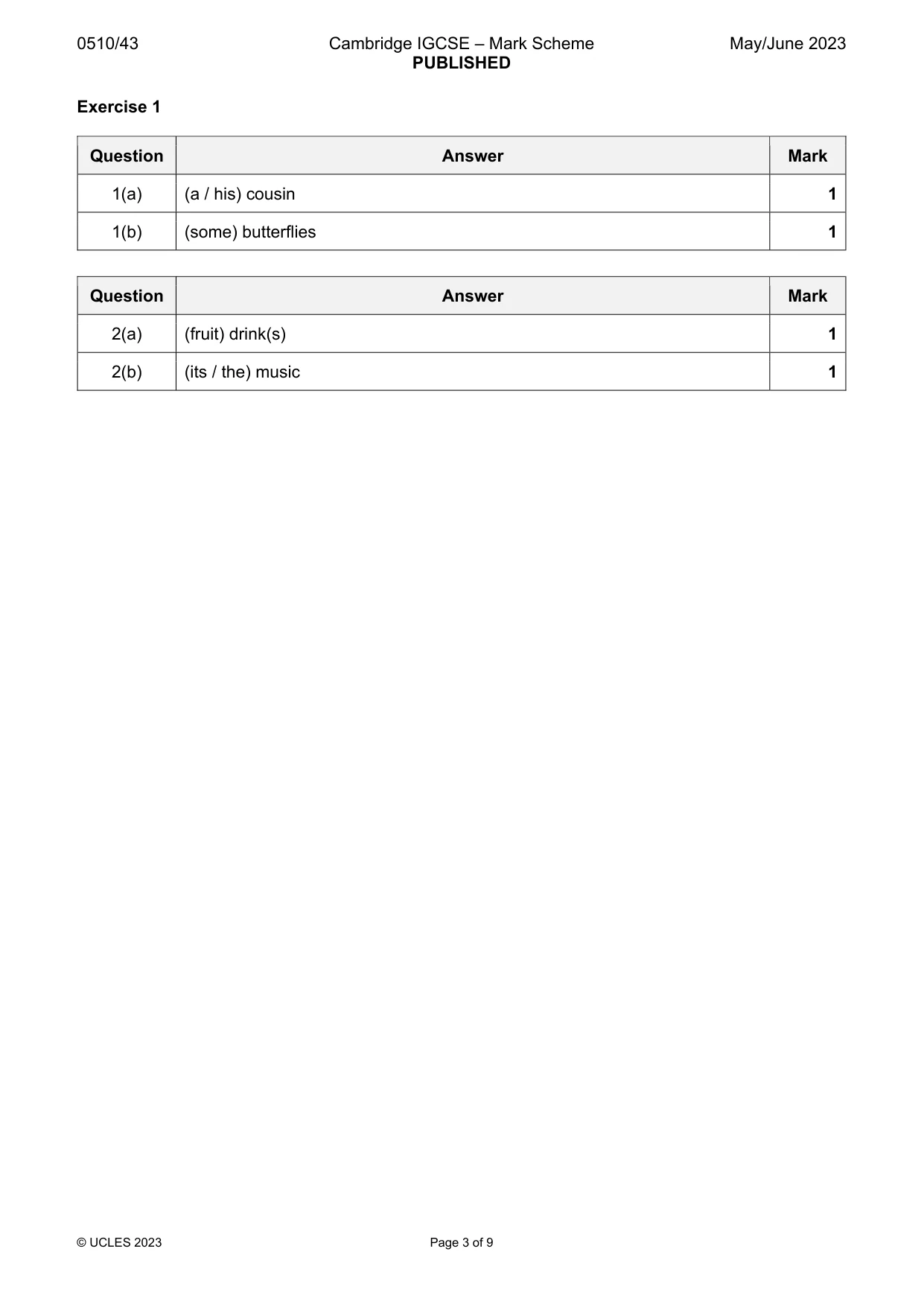
0510/43 Cambridge IGCSE – Mark Scheme PUBLISHED May/June 2023 © UCLES 2023 Page 3 of 9 Exercise 1 Question Answer Mark 1(a) (a / his) cousin 1 1(b) (some) butterflies 1 Question Answer Mark 2(a) (fruit) drink(s) 1 2(b) (its / the) music 1
Mark scheme, page 4
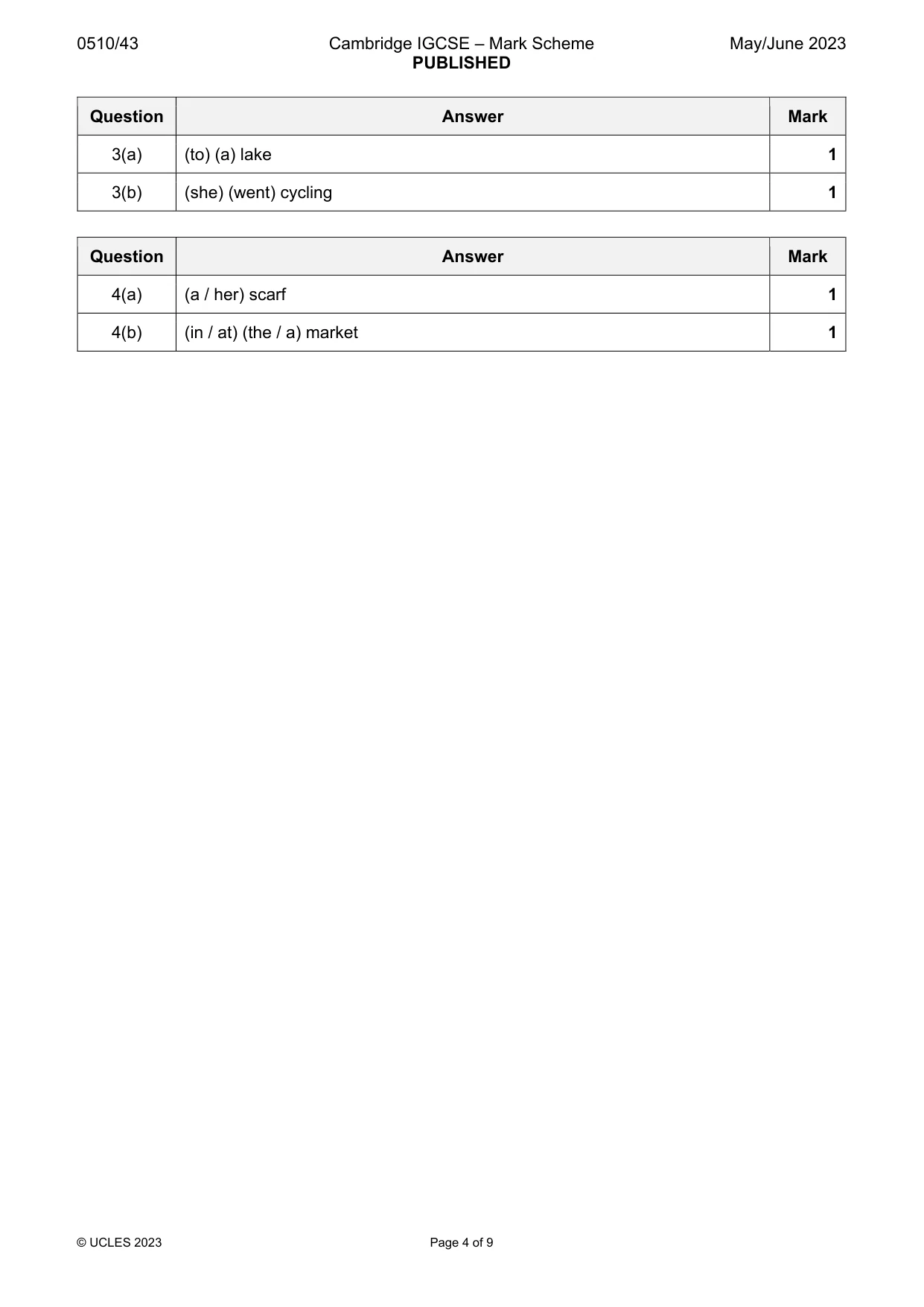
0510/43 Cambridge IGCSE – Mark Scheme PUBLISHED May/June 2023 © UCLES 2023 Page 4 of 9 Question Answer Mark 3(a) (to) (a) lake 1 3(b) (she) (went) cycling 1 Question Answer Mark 4(a) (a / her) scarf 1 4(b) (in / at) (the / a) market 1
Mark scheme, page 5
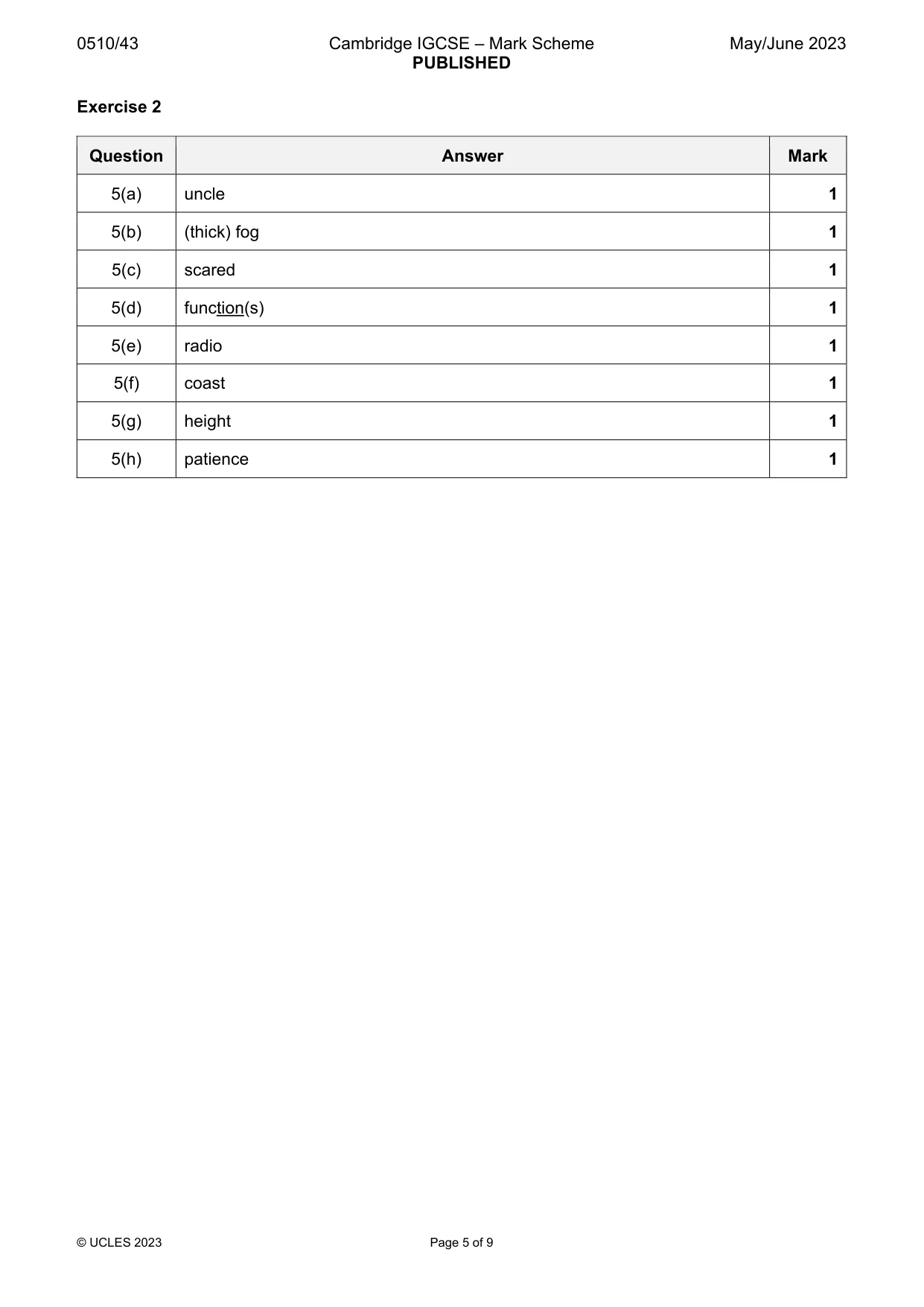
0510/43 Cambridge IGCSE – Mark Scheme PUBLISHED May/June 2023 © UCLES 2023 Page 5 of 9 Exercise 2 Question Answer Mark 5(a) uncle 1 5(b) (thick) fog 1 5(c) scared 1 5(d) function(s) 1 5(e) radio 1 5(f) coast 1 5(g) height 1 5(h) patience 1
Mark scheme, page 6
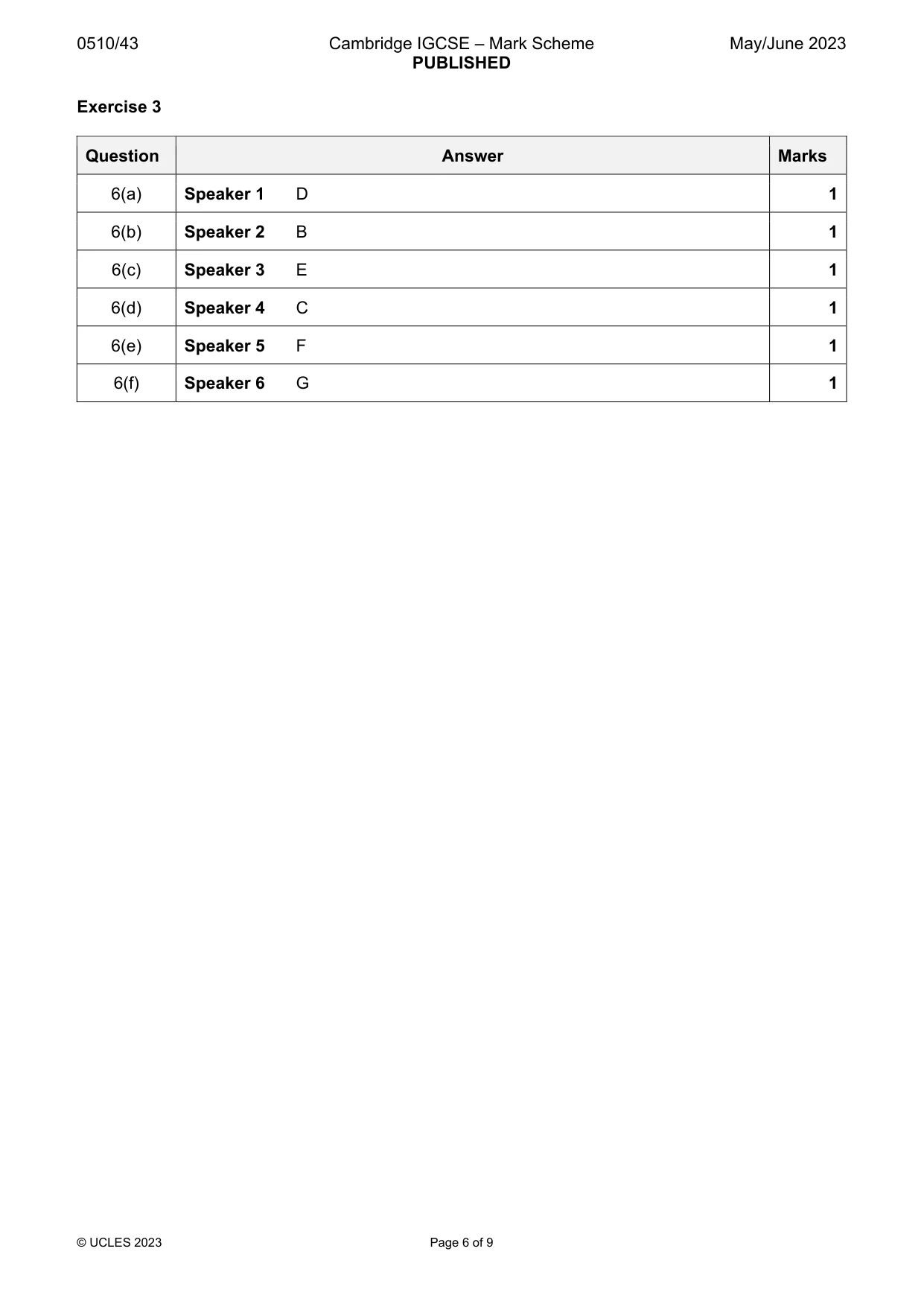
0510/43 Cambridge IGCSE – Mark Scheme PUBLISHED May/June 2023 © UCLES 2023 Page 6 of 9 Exercise 3 Question Answer Marks 6(a) Speaker 1 D 1 6(b) Speaker 2 B 1 6(c) Speaker 3 E 1 6(d) Speaker 4 C 1 6(e) Speaker 5 F 1 6(f) Speaker 6 G 1
Mark scheme, page 7
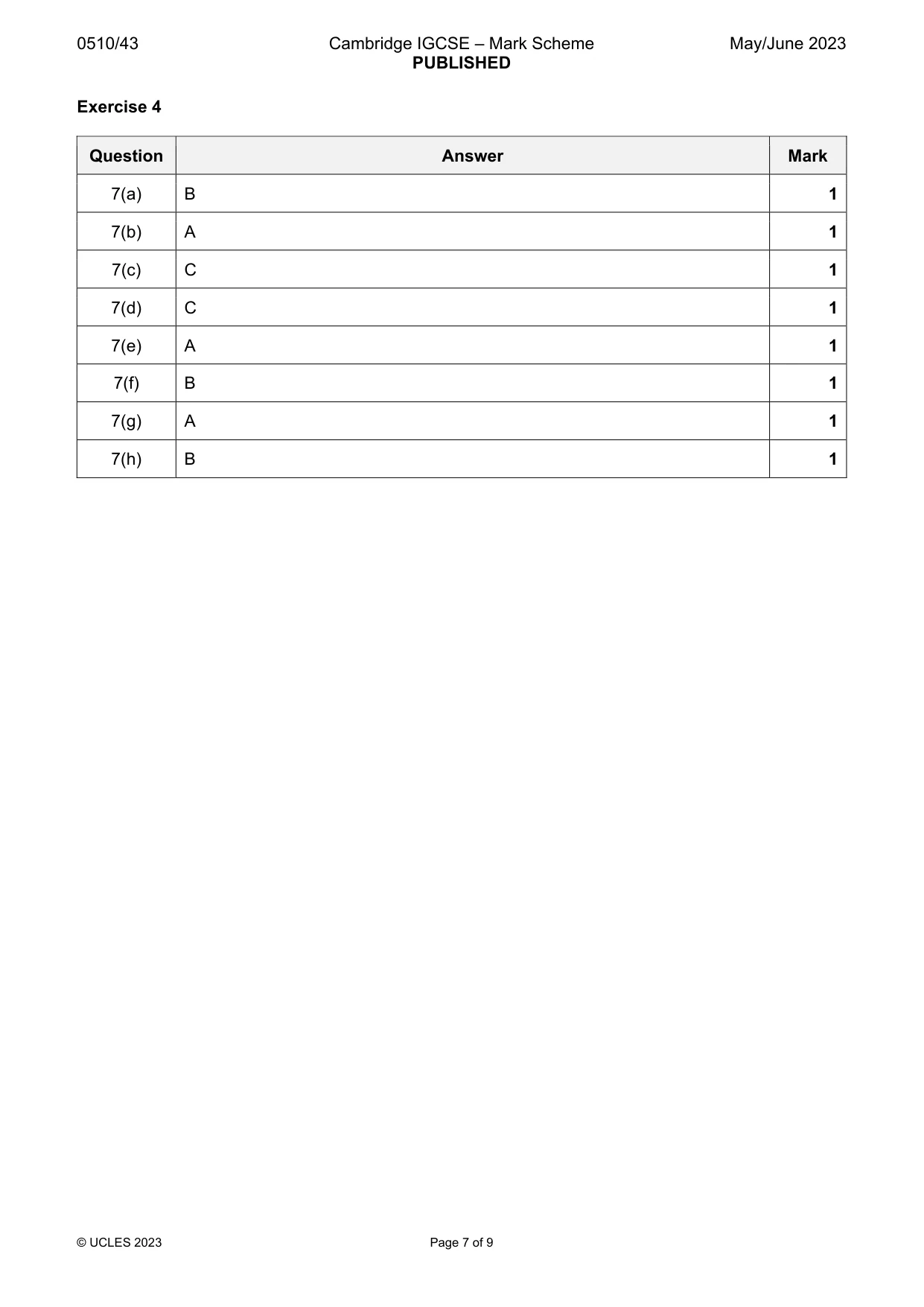
0510/43 Cambridge IGCSE – Mark Scheme PUBLISHED May/June 2023 © UCLES 2023 Page 7 of 9 Exercise 4 Question Answer Mark 7(a) B 1 7(b) A 1 7(c) C 1 7(d) C 1 7(e) A 1 7(f) B 1 7(g) A 1 7(h) B 1
Mark scheme, page 8
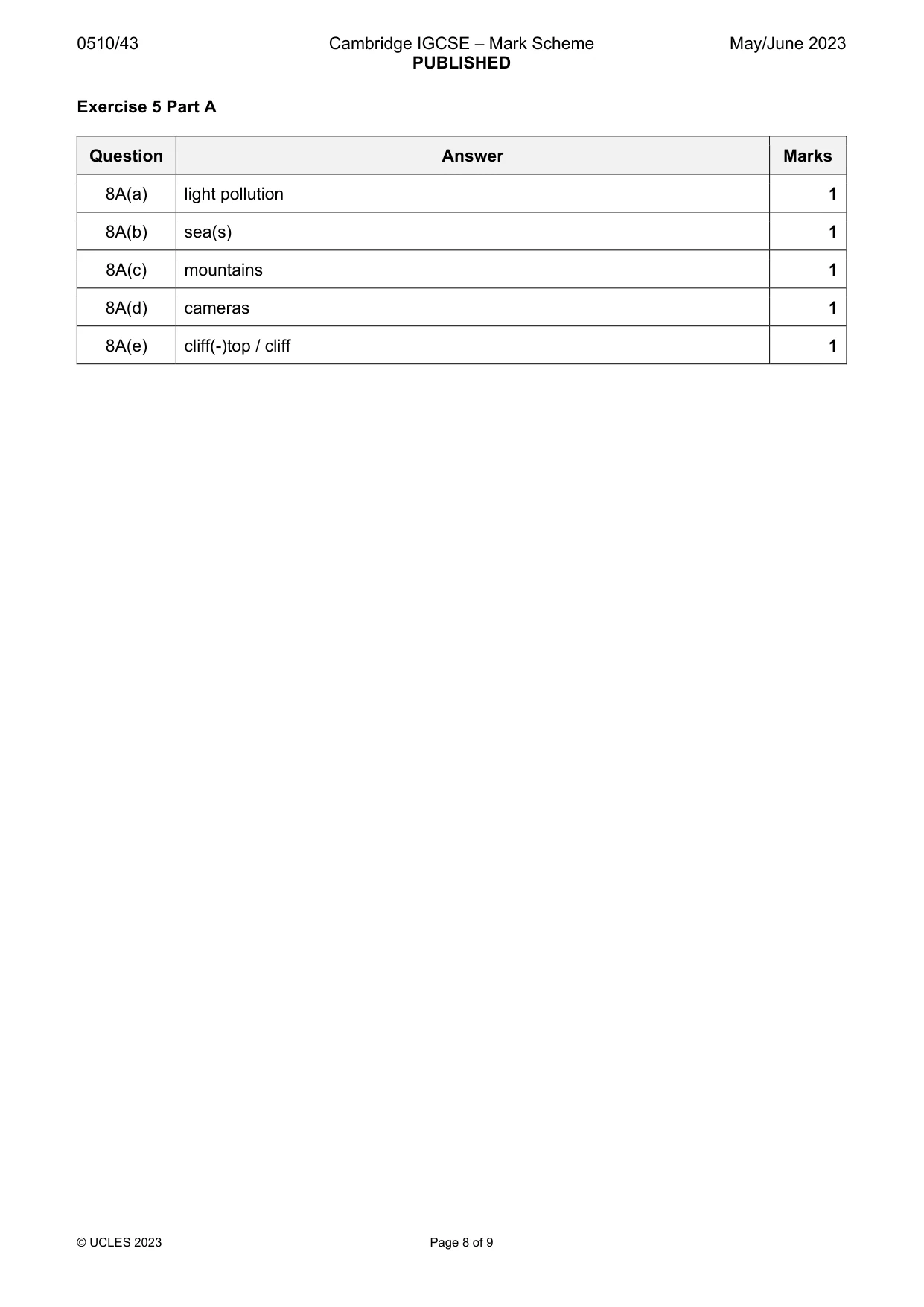
0510/43 Cambridge IGCSE – Mark Scheme PUBLISHED May/June 2023 © UCLES 2023 Page 8 of 9 Exercise 5 Part A Question Answer Marks 8A(a) light pollution 1 8A(b) sea(s) 1 8A(c) mountains 1 8A(d) cameras 1 8A(e) cliff(-)top / cliff 1
Mark scheme, page 9
0510/43 Cambridge IGCSE – Mark Scheme PUBLISHED May/June 2023 © UCLES 2023 Page 9 of 9 Exercise 5 Part B Question Answer Marks 8B(a) physics 1 8B(b) satellites 1 8B(c) (weekly) presentations 1 8B(d) ice 1 8B(e) problem(-)solving 1
What you needed in this session
Cambridge’s own grade thresholds for 2023 May/June, Paper 4 · Variant 3. A higher threshold means an easier paper — the bar moves with how the cohort did.