Cambridge IGCSE English - Second Language (oral endorsement) 0510 — 2021 May/June Paper 4 · Variant 3
0510/43/M/J/21
The question paper and its mark scheme, free to read here and free to download. This is Cambridge’s own paper, exactly as it was sat.
Question paper12 pages




Mark scheme7 pages
Answers below. Sit the paper first if you are practising.
Paper as text
Question paper, page 1
This document has 12 pages. Any blank pages are indicated. Cambridge IGCSE™ ENGLISH AS A SECOND LANGUAGE 0510/43 Paper 4 Listening (Extended) May/June 2021 Approximately 50 minutes You must answer on the question paper. No additional materials are needed. INSTRUCTIONS ● Answer all questions. ● Use a black or dark blue pen. ● Write your name, centre number and candidate number in the boxes at the top of the page. ● Write your answer to each question in the space provided. ● Do not use an erasable pen or correction fluid. ● Do not write on any bar codes. ● Dictionaries are not allowed. INFORMATION ● The total mark for this paper is 40. ● The number of marks for each question or part question is shown in brackets [ ]. DC (LK/SG) 197758/3 © UCLES 2021 [Turn over * 7 9 4 7 9 5 2 3 2 6 *
Question paper, page 2
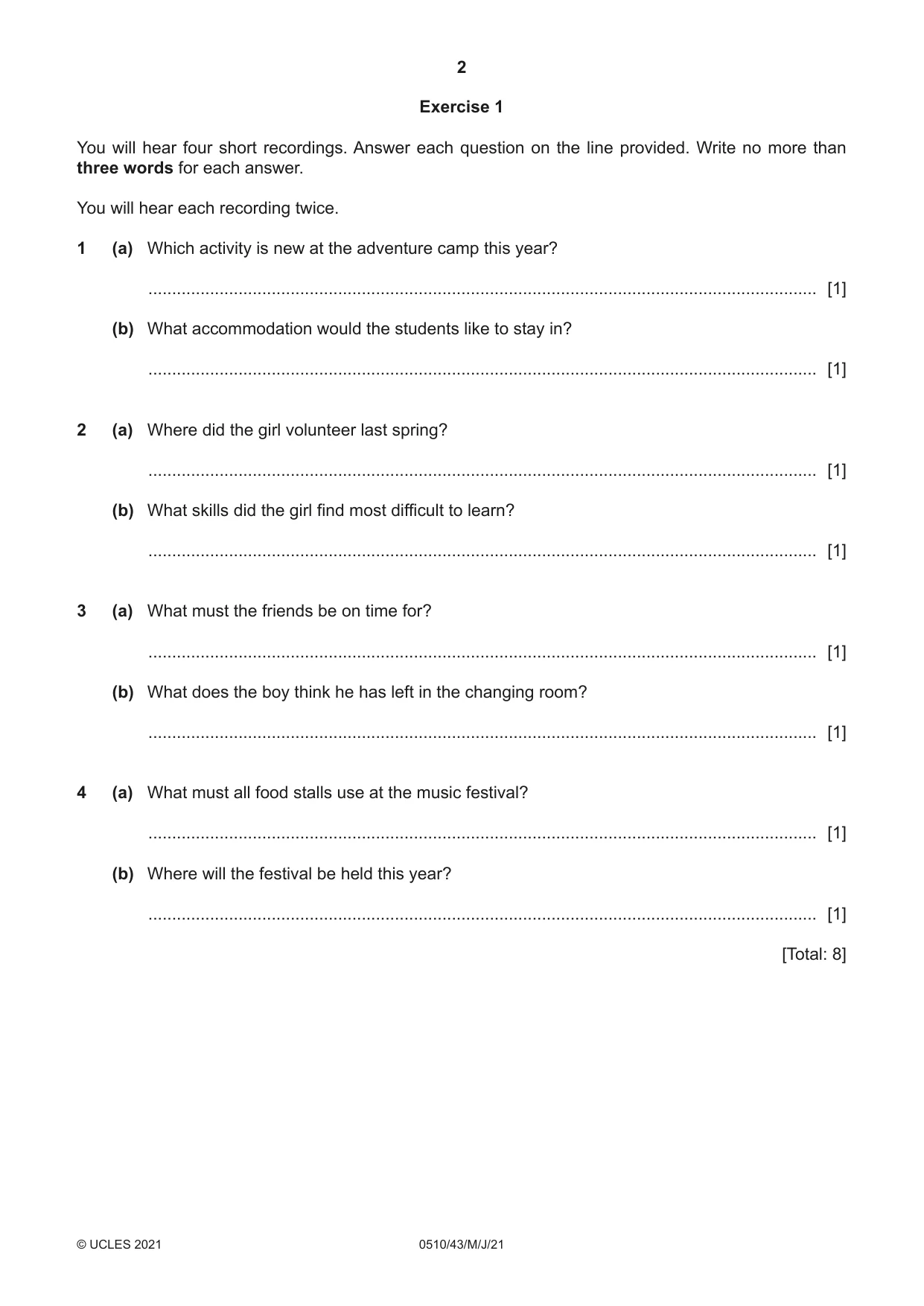
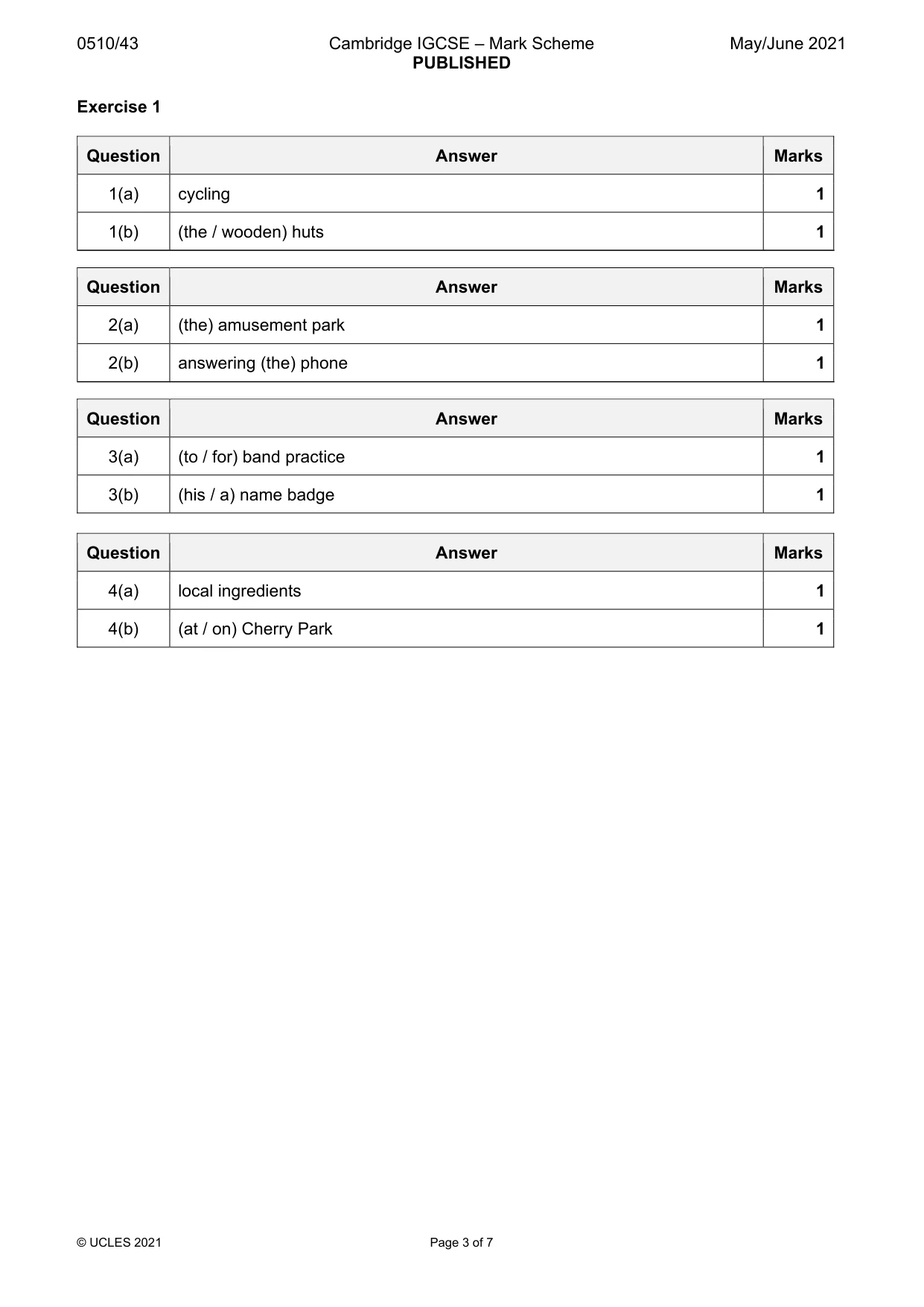
2 0510/43/M/J/21 © UCLES 2021 Exercise 1 You will hear four short recordings. Answer each question on the line provided. Write no more than three words for each answer. You will hear each recording twice. 1 (a) Which activity is new at the adventure camp this year? … [1] (b) What accommodation would the students like to stay in? … [1] 2 (a) Where did the girl volunteer last spring? … [1] (b) What skills did the girl find most difficult to learn? … [1] 3 (a) What must the friends be on time for? … [1] (b) What does the boy think he has left in the changing room? … [1] 4 (a) What must all food stalls use at the music festival? … [1] (b) Where will the festival be held this year? … [1] [Total: 8]
Question paper, page 3
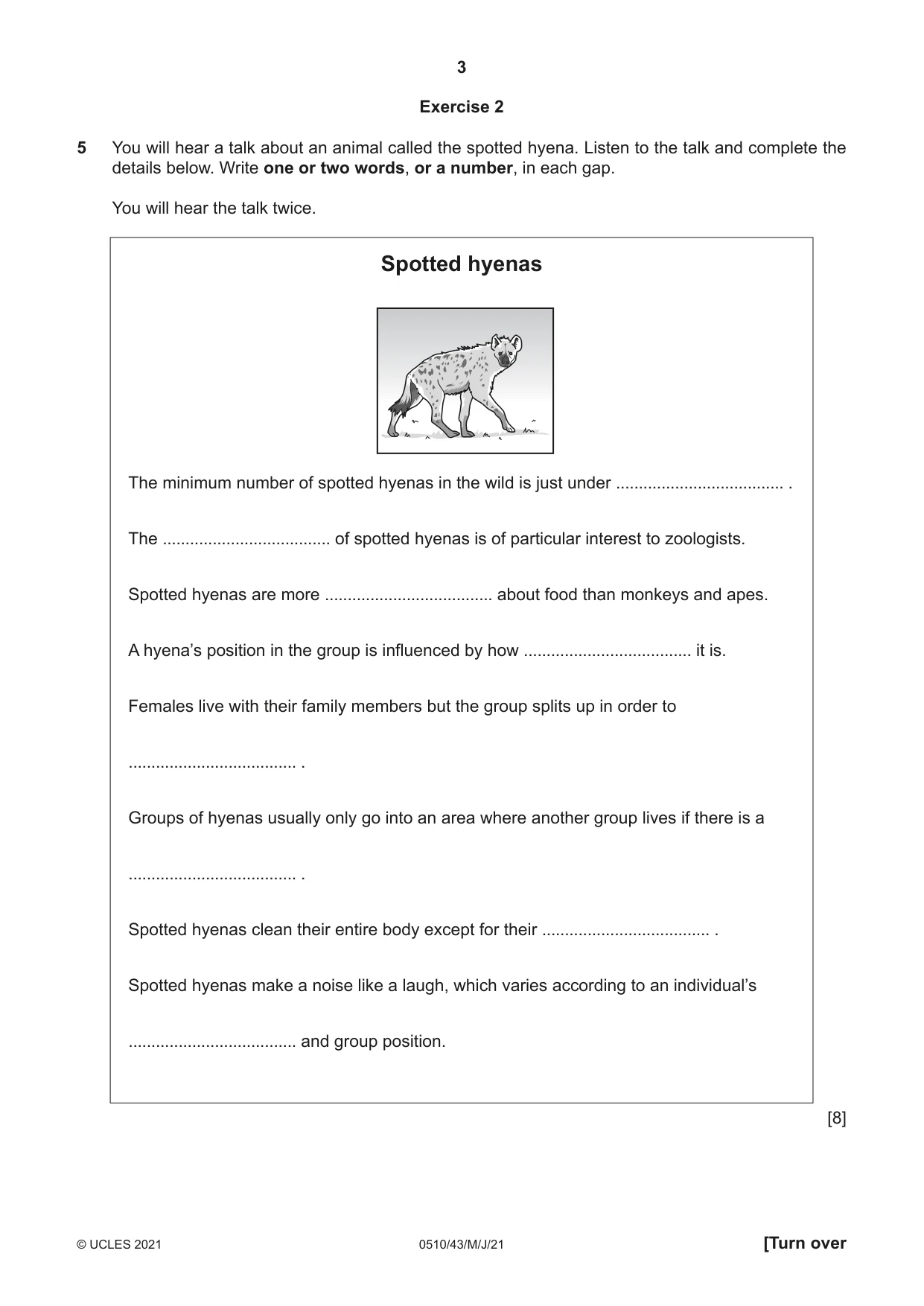
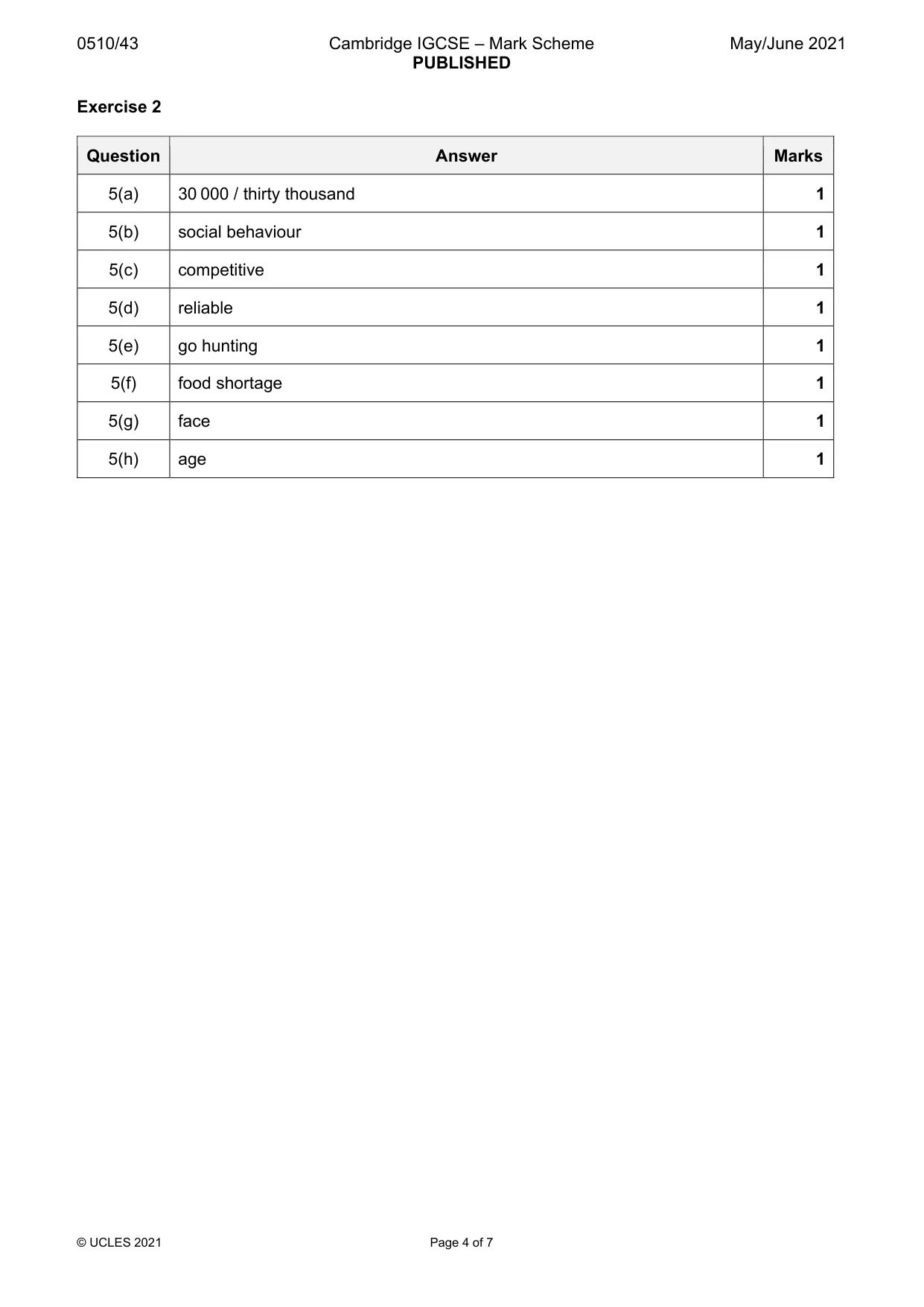
3 0510/43/M/J/21 © UCLES 2021 [Turn over Exercise 2 5 You will hear a talk about an animal called the spotted hyena. Listen to the talk and complete the details below. Write one or two words, or a number, in each gap. You will hear the talk twice. Spotted hyenas The minimum number of spotted hyenas in the wild is just under … . The … of spotted hyenas is of particular interest to zoologists. Spotted hyenas are more … about food than monkeys and apes. A hyena’s position in the group is influenced by how … it is. Females live with their family members but the group splits up in order to … . Groups of hyenas usually only go into an area where another group lives if there is a … . Spotted hyenas clean their entire body except for their … . Spotted hyenas make a noise like a laugh, which varies according to an individual’s … and group position. [8]
Question paper, page 4
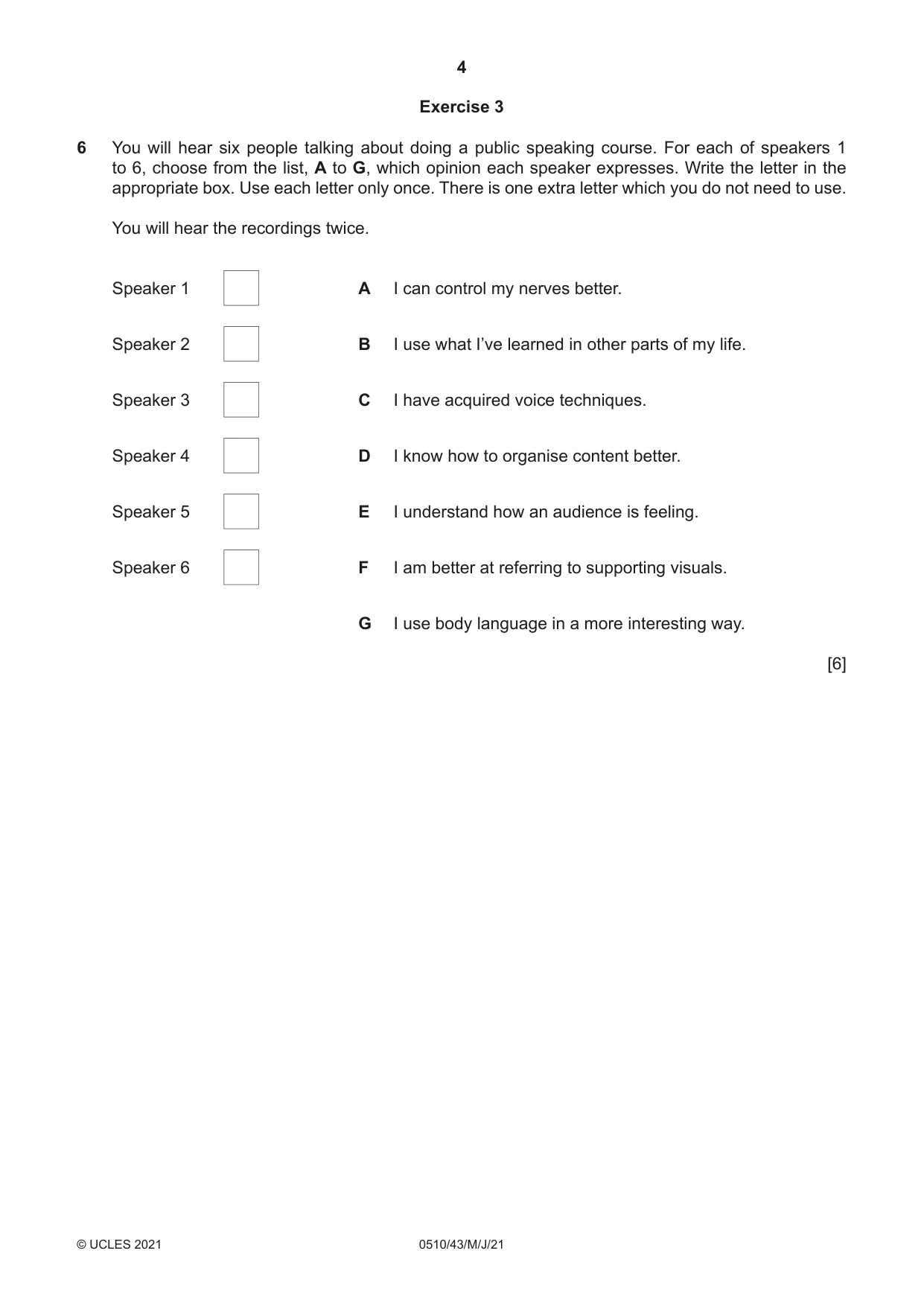
4 0510/43/M/J/21 © UCLES 2021 Exercise 3 6 You will hear six people talking about doing a public speaking course. For each of speakers 1 to 6, choose from the list, A to G, which opinion each speaker expresses. Write the letter in the appropriate box. Use each letter only once. There is one extra letter which you do not need to use. You will hear the recordings twice. Speaker 1 A I can control my nerves better. Speaker 2 B I use what I’ve learned in other parts of my life. Speaker 3 C I have acquired voice techniques. Speaker 4 D I know how to organise content better. Speaker 5 E I understand how an audience is feeling. Speaker 6 F I am better at referring to supporting visuals. G I use body language in a more interesting way. [6]
Question paper, page 5
5 0510/43/M/J/21 © UCLES 2021 [Turn over Please turn over for Exercise 4.
Question paper, page 6
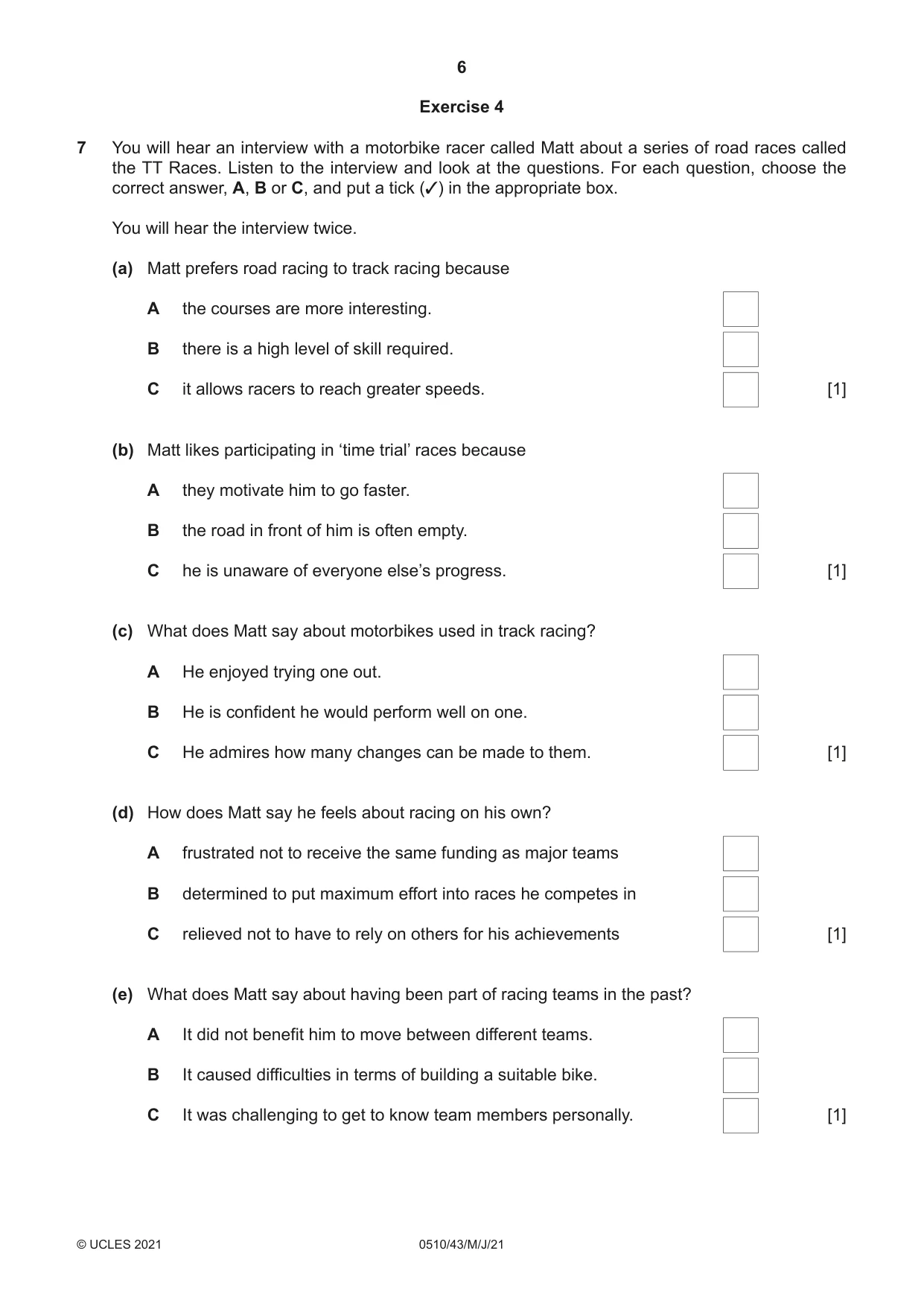
6 0510/43/M/J/21 © UCLES 2021 Exercise 4 7 You will hear an interview with a motorbike racer called Matt about a series of road races called the TT Races. Listen to the interview and look at the questions. For each question, choose the correct answer, A, B or C, and put a tick (3) in the appropriate box. You will hear the interview twice. (a) Matt prefers road racing to track racing because A the courses are more interesting. B there is a high level of skill required. C it allows racers to reach greater speeds. [1] (b) Matt likes participating in ‘time trial’ races because A they motivate him to go faster. B the road in front of him is often empty. C he is unaware of everyone else’s progress. [1] (c) What does Matt say about motorbikes used in track racing? A He enjoyed trying one out. B He is confident he would perform well on one. C He admires how many changes can be made to them. [1] (d) How does Matt say he feels about racing on his own? A frustrated not to receive the same funding as major teams B determined to put maximum effort into races he competes in C relieved not to have to rely on others for his achievements [1] (e) What does Matt say about having been part of racing teams in the past? A It did not benefit him to move between different teams. B It caused difficulties in terms of building a suitable bike. C It was challenging to get to know team members personally. [1]
Question paper, page 7
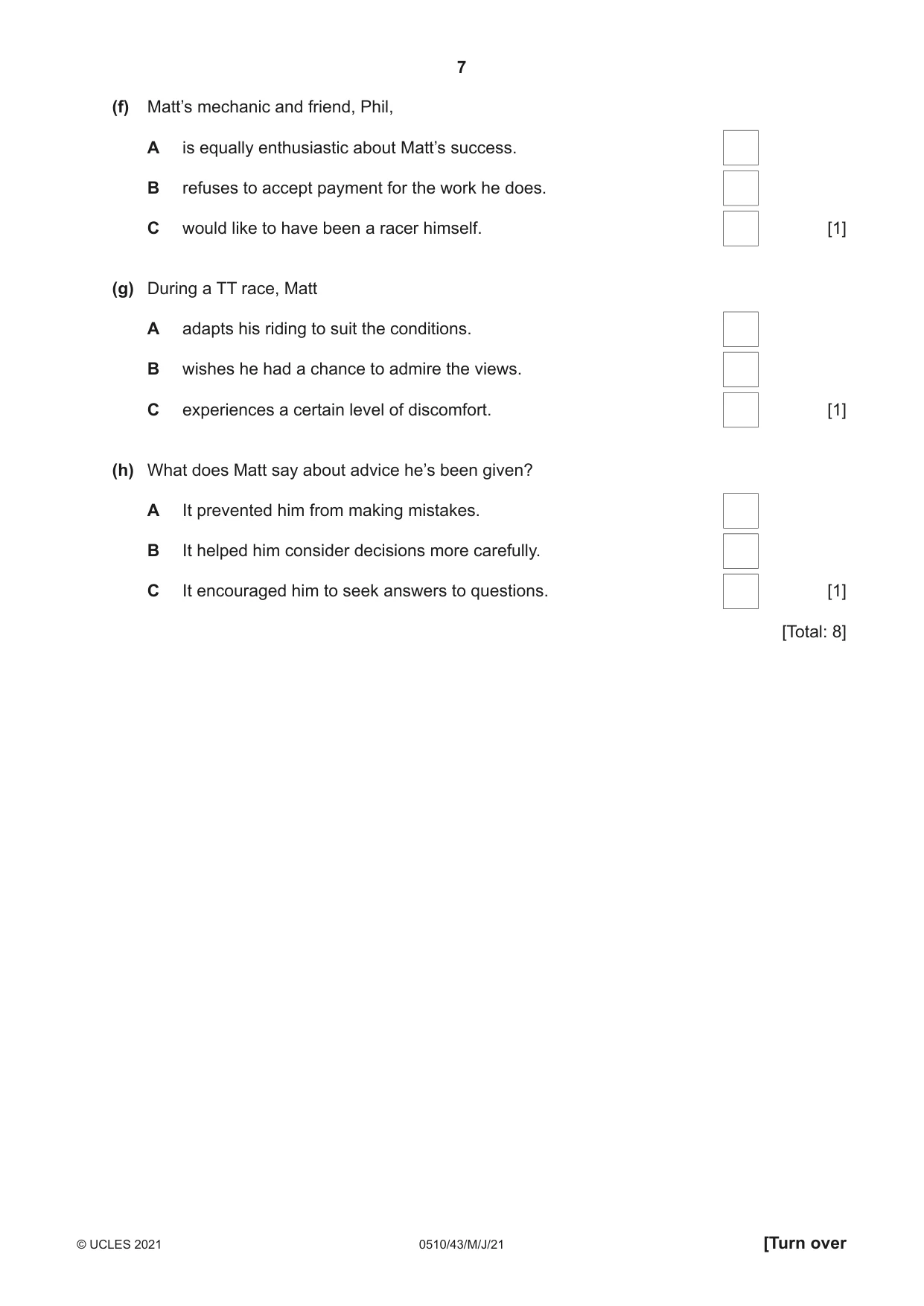
7 0510/43/M/J/21 © UCLES 2021 [Turn over (f) Matt’s mechanic and friend, Phil, A is equally enthusiastic about Matt’s success. B refuses to accept payment for the work he does. C would like to have been a racer himself. [1] (g) During a TT race, Matt A adapts his riding to suit the conditions. B wishes he had a chance to admire the views. C experiences a certain level of discomfort. [1] (h) What does Matt say about advice he’s been given? A It prevented him from making mistakes. B It helped him consider decisions more carefully. C It encouraged him to seek answers to questions. [1] [Total: 8]
Question paper, page 8
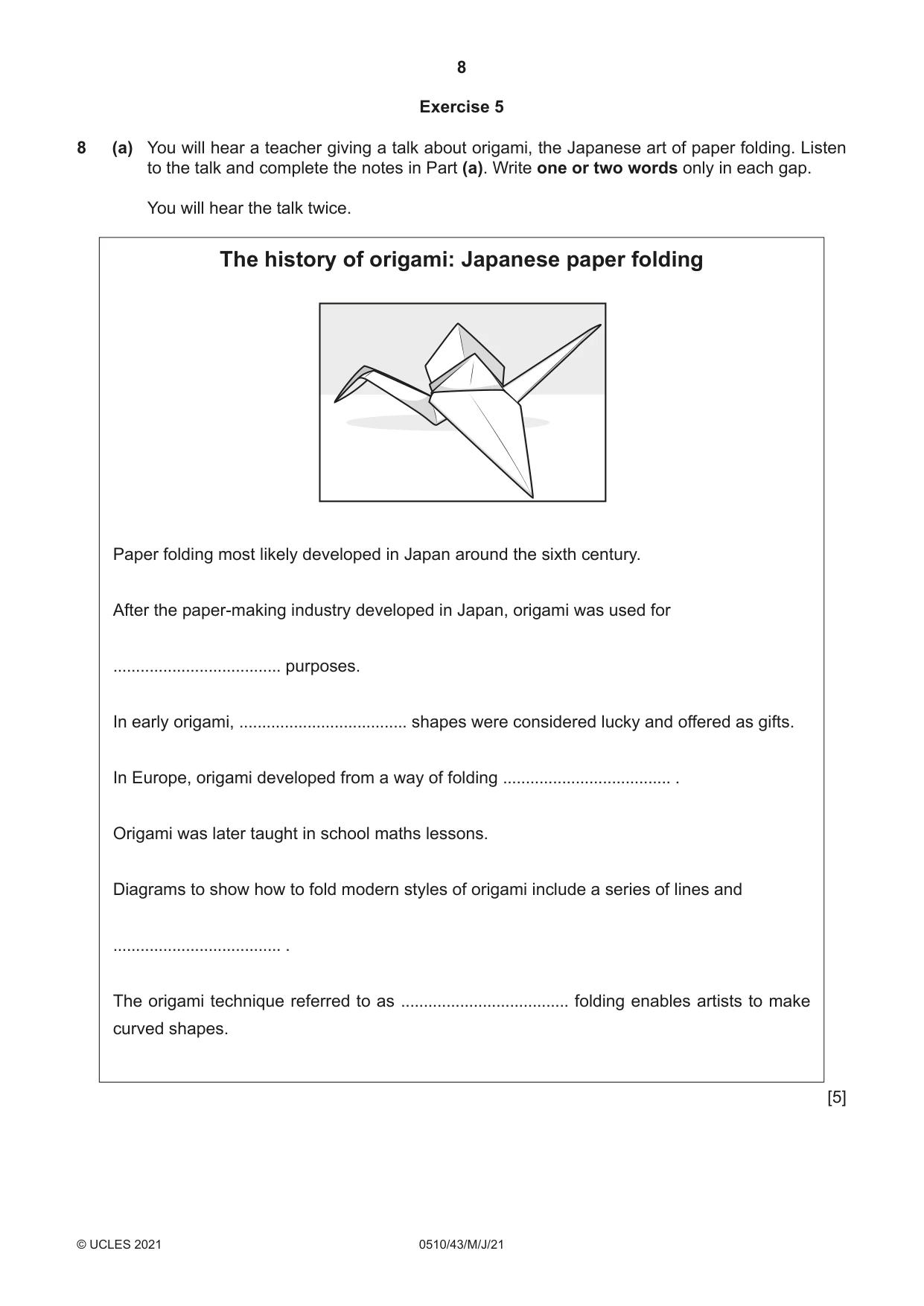
8 0510/43/M/J/21 © UCLES 2021 Exercise 5 8 (a) You will hear a teacher giving a talk about origami, the Japanese art of paper folding. Listen to the talk and complete the notes in Part (a). Write one or two words only in each gap. You will hear the talk twice. The history of origami: Japanese paper folding Paper folding most likely developed in Japan around the sixth century. After the paper-making industry developed in Japan, origami was used for … purposes. In early origami, … shapes were considered lucky and offered as gifts. In Europe, origami developed from a way of folding … . Origami was later taught in school maths lessons. Diagrams to show how to fold modern styles of origami include a series of lines and … . The origami technique referred to as … folding enables artists to make curved shapes. [5]
Question paper, page 9
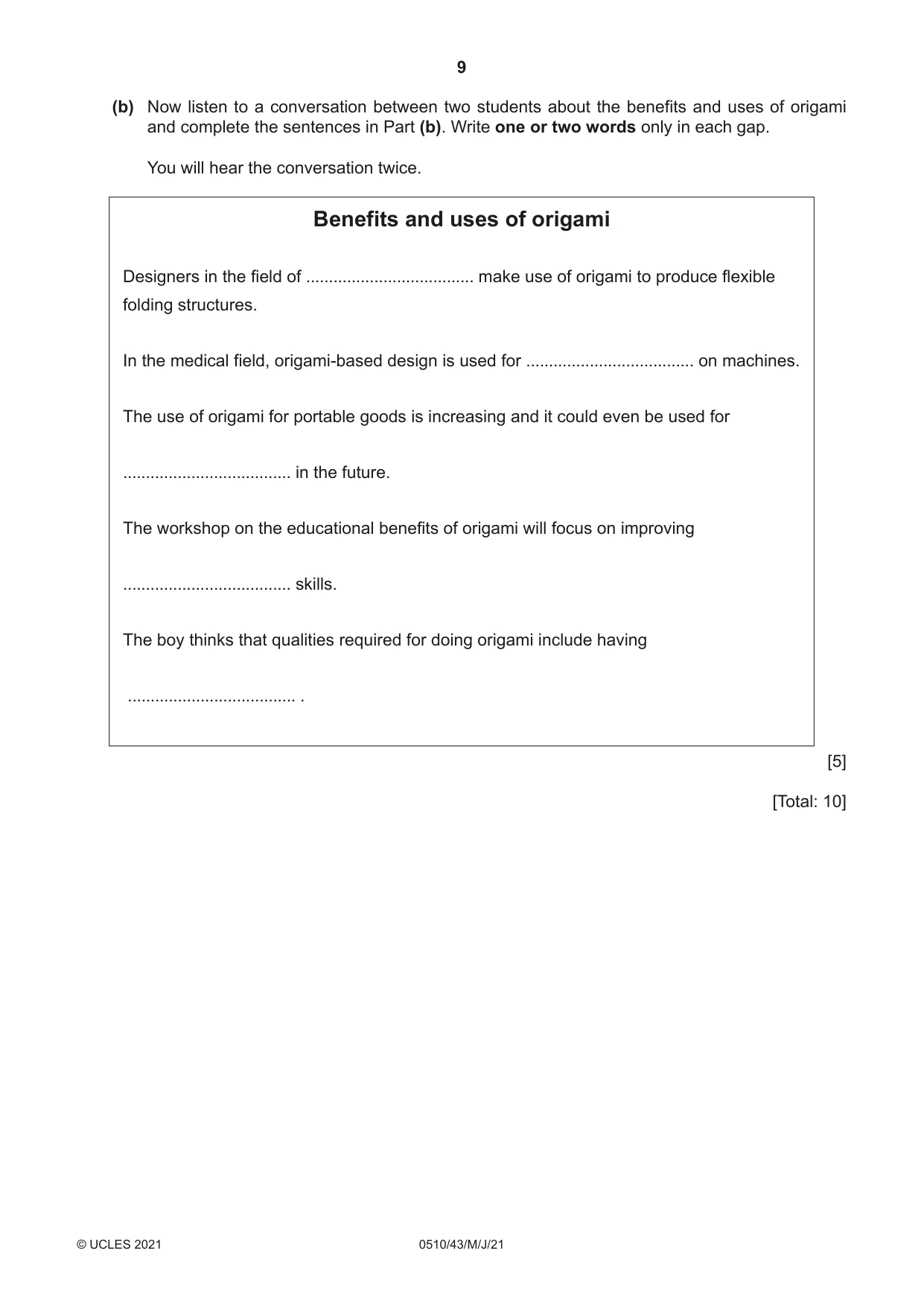
9 0510/43/M/J/21 © UCLES 2021 (b) Now listen to a conversation between two students about the benefits and uses of origami and complete the sentences in Part (b). Write one or two words only in each gap. You will hear the conversation twice. Benefits and uses of origami Designers in the field of … make use of origami to produce flexible folding structures. In the medical field, origami-based design is used for … on machines. The use of origami for portable goods is increasing and it could even be used for … in the future. The workshop on the educational benefits of origami will focus on improving … skills. The boy thinks that qualities required for doing origami include having … . [5] [Total: 10]
Question paper, page 10
10 0510/43/M/J/21 © UCLES 2021 BLANK PAGE
Question paper, page 11
11 0510/43/M/J/21 © UCLES 2021 BLANK PAGE
Question paper, page 12
12 0510/43/M/J/21 © UCLES 2021 Permission to reproduce items where third-party owned material protected by copyright is included has been sought and cleared where possible. Every reasonable effort has been made by the publisher (UCLES) to trace copyright holders, but if any items requiring clearance have unwittingly been included, the publisher will be pleased to make amends at the earliest possible opportunity. To avoid the issue of disclosure of answer-related information to candidates, all copyright acknowledgements are reproduced online in the Cambridge Assessment International Education Copyright Acknowledgements Booklet. This is produced for each series of examinations and is freely available to download at www.cambridgeinternational.org after the live examination series. Cambridge Assessment International Education is part of the Cambridge Assessment Group. Cambridge Assessment is the brand name of the University of Cambridge Local Examinations Syndicate (UCLES), which itself is a department of the University of Cambridge. BLANK PAGE
Mark scheme, page 1
This document consists of 7 printed pages. © UCLES 2021 [Turn over Cambridge IGCSE™ ENGLISH AS A SECOND LANGUAGE 0510/43 Paper 4 Listening (Extended) May/June 2021 MARK SCHEME Maximum Mark: 40 Published This mark scheme is published as an aid to teachers and candidates, to indicate the requirements of the examination. It shows the basis on which Examiners were instructed to award marks. It does not indicate the details of the discussions that took place at an Examiners’ meeting before marking began, which would have considered the acceptability of alternative answers. Mark schemes should be read in conjunction with the question paper and the Principal Examiner Report for Teachers. Cambridge International will not enter into discussions about these mark schemes. Cambridge International is publishing the mark schemes for the May/June 2021 series for most Cambridge IGCSE™, Cambridge International A and AS Level components and some Cambridge O Level components.
Mark scheme, page 2
0510/43 Cambridge IGCSE – Mark Scheme PUBLISHED May/June 2021 © UCLES 2021 Page 2 of 7 Generic Marking Principles These general marking principles must be applied by all examiners when marking candidate answers. They should be applied alongside the specific content of the mark scheme or generic level descriptors for a question. Each question paper and mark scheme will also comply with these marking principles. GENERIC MARKING PRINCIPLE 1: Marks must be awarded in line with: • the specific content of the mark scheme or the generic level descriptors for the question • the specific skills defined in the mark scheme or in the generic level descriptors for the question • the standard of response required by a candidate as exemplified by the standardisation scripts. GENERIC MARKING PRINCIPLE 2: Marks awarded are always whole marks (not half marks, or other fractions). GENERIC MARKING PRINCIPLE 3: Marks must be awarded positively: • marks are awarded for correct/valid answers, as defined in the mark scheme. However, credit is given for valid answers which go beyond the scope of the syllabus and mark scheme, referring to your Team Leader as appropriate • marks are awarded when candidates clearly demonstrate what they know and can do • marks are not deducted for errors • marks are not deducted for omissions • answers should only be judged on the quality of spelling, punctuation and grammar when these features are specifically assessed by the question as indicated by the mark scheme. The meaning, however, should be unambiguous. GENERIC MARKING PRINCIPLE 4: Rules must be applied consistently, e.g. in situations where candidates have not followed instructions or in the application of generic level descriptors. GENERIC MARKING PRINCIPLE 5: Marks should be awarded using the full range of marks defined in the mark scheme for the question (however; the use of the full mark range may be limited according to the quality of the candidate responses seen). GENERIC MARKING PRINCIPLE 6: Marks awarded are based solely on the requirements as defined in the mark scheme. Marks should not be awarded with grade thresholds or grade descriptors in mind.
Mark scheme, page 3
0510/43 Cambridge IGCSE – Mark Scheme PUBLISHED May/June 2021 © UCLES 2021 Page 3 of 7 Exercise 1 Question Answer Marks 1(a) cycling 1 1(b) (the / wooden) huts 1 Question Answer Marks 2(a) (the) amusement park 1 2(b) answering (the) phone 1 Question Answer Marks 3(a) (to / for) band practice 1 3(b) (his / a) name badge 1 Question Answer Marks 4(a) local ingredients 1 4(b) (at / on) Cherry Park 1
Mark scheme, page 4
0510/43 Cambridge IGCSE – Mark Scheme PUBLISHED May/June 2021 © UCLES 2021 Page 4 of 7 Exercise 2 Question Answer Marks 5(a) 30 000 / thirty thousand 1 5(b) social behaviour 1 5(c) competitive 1 5(d) reliable 1 5(e) go hunting 1 5(f) food shortage 1 5(g) face 1 5(h) age 1
Mark scheme, page 5
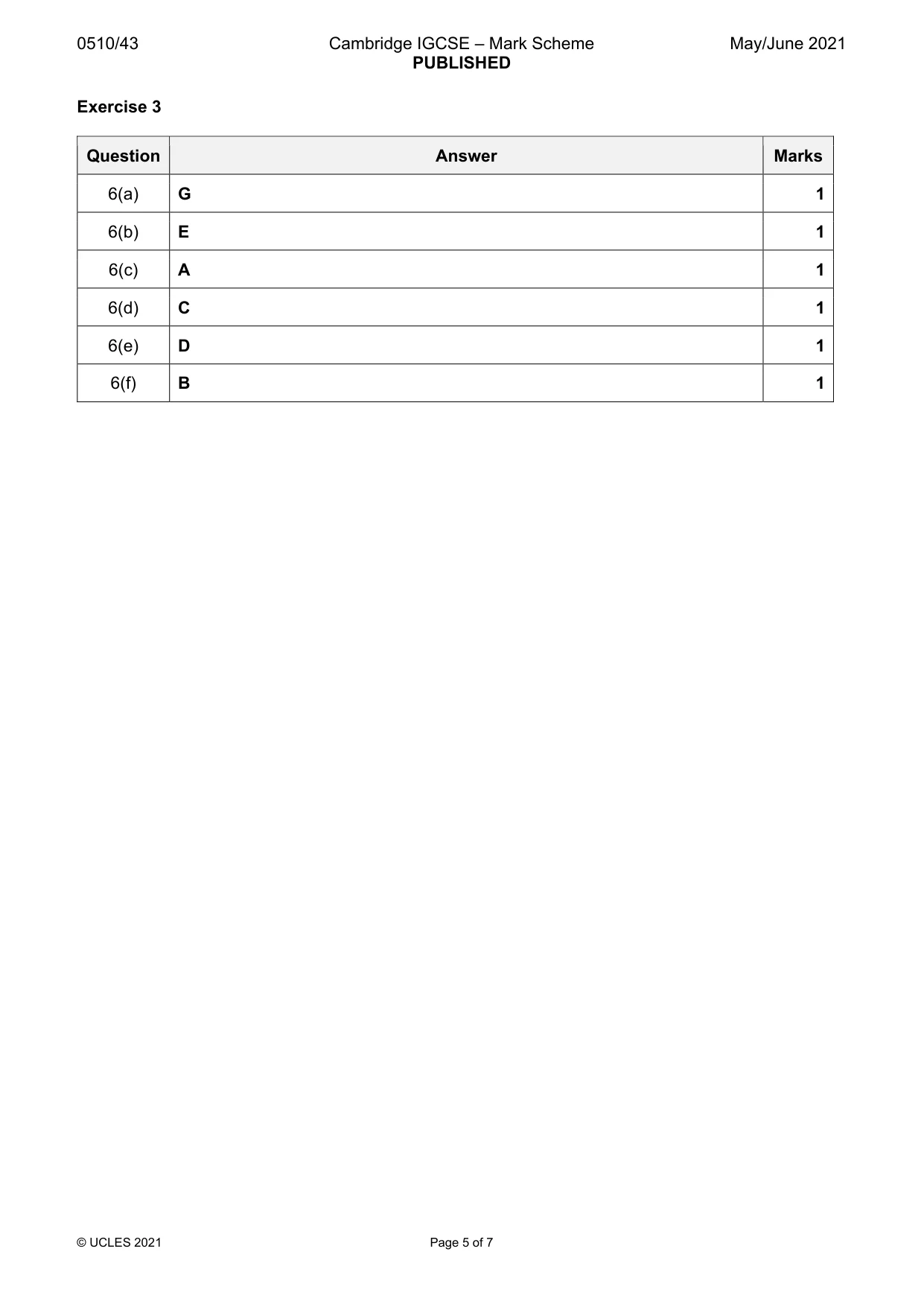
0510/43 Cambridge IGCSE – Mark Scheme PUBLISHED May/June 2021 © UCLES 2021 Page 5 of 7 Exercise 3 Question Answer Marks 6(a) G 1 6(b) E 1 6(c) A 1 6(d) C 1 6(e) D 1 6(f) B 1
Mark scheme, page 6
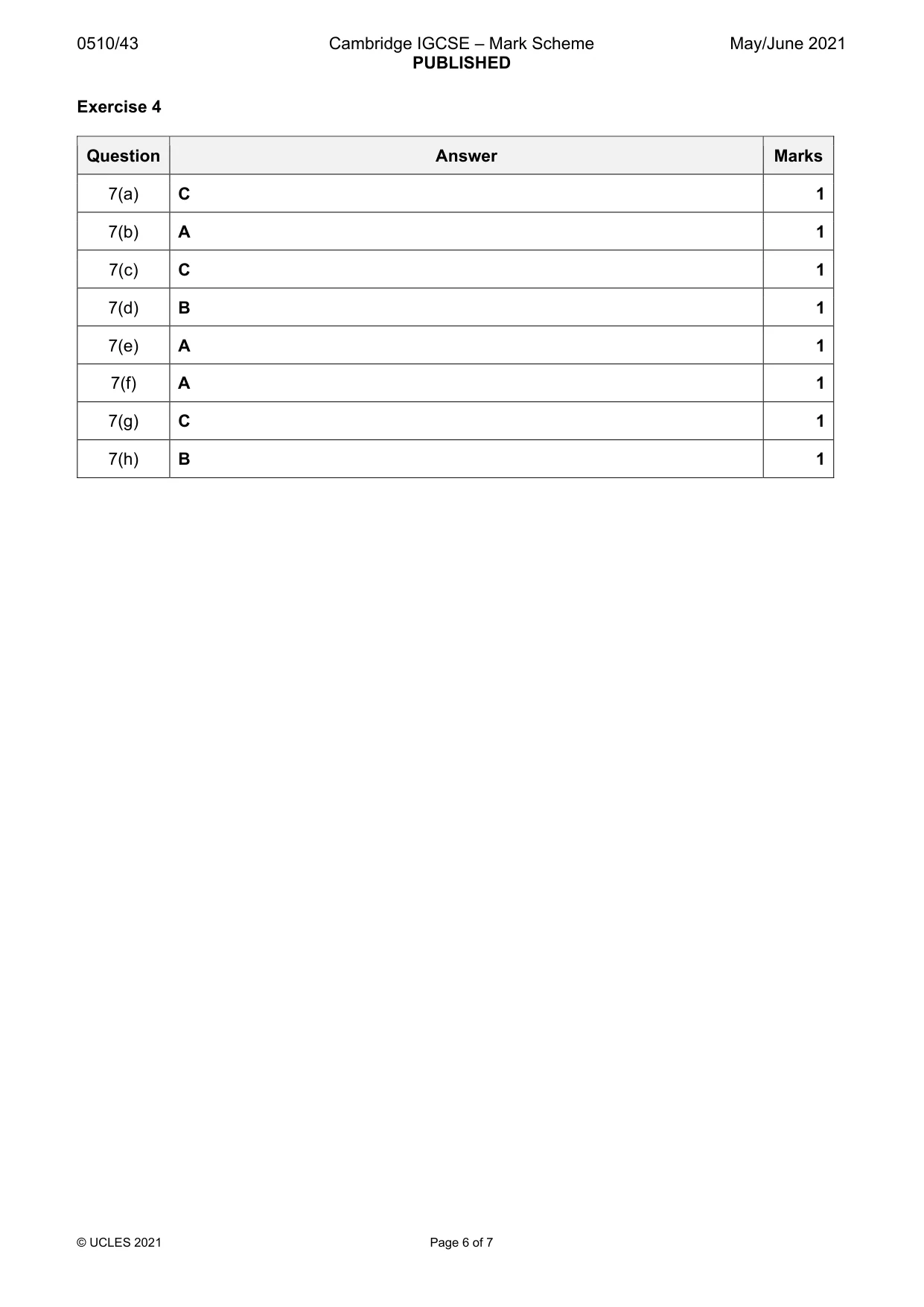
0510/43 Cambridge IGCSE – Mark Scheme PUBLISHED May/June 2021 © UCLES 2021 Page 6 of 7 Exercise 4 Question Answer Marks 7(a) C 1 7(b) A 1 7(c) C 1 7(d) B 1 7(e) A 1 7(f) A 1 7(g) C 1 7(h) B 1
Mark scheme, page 7
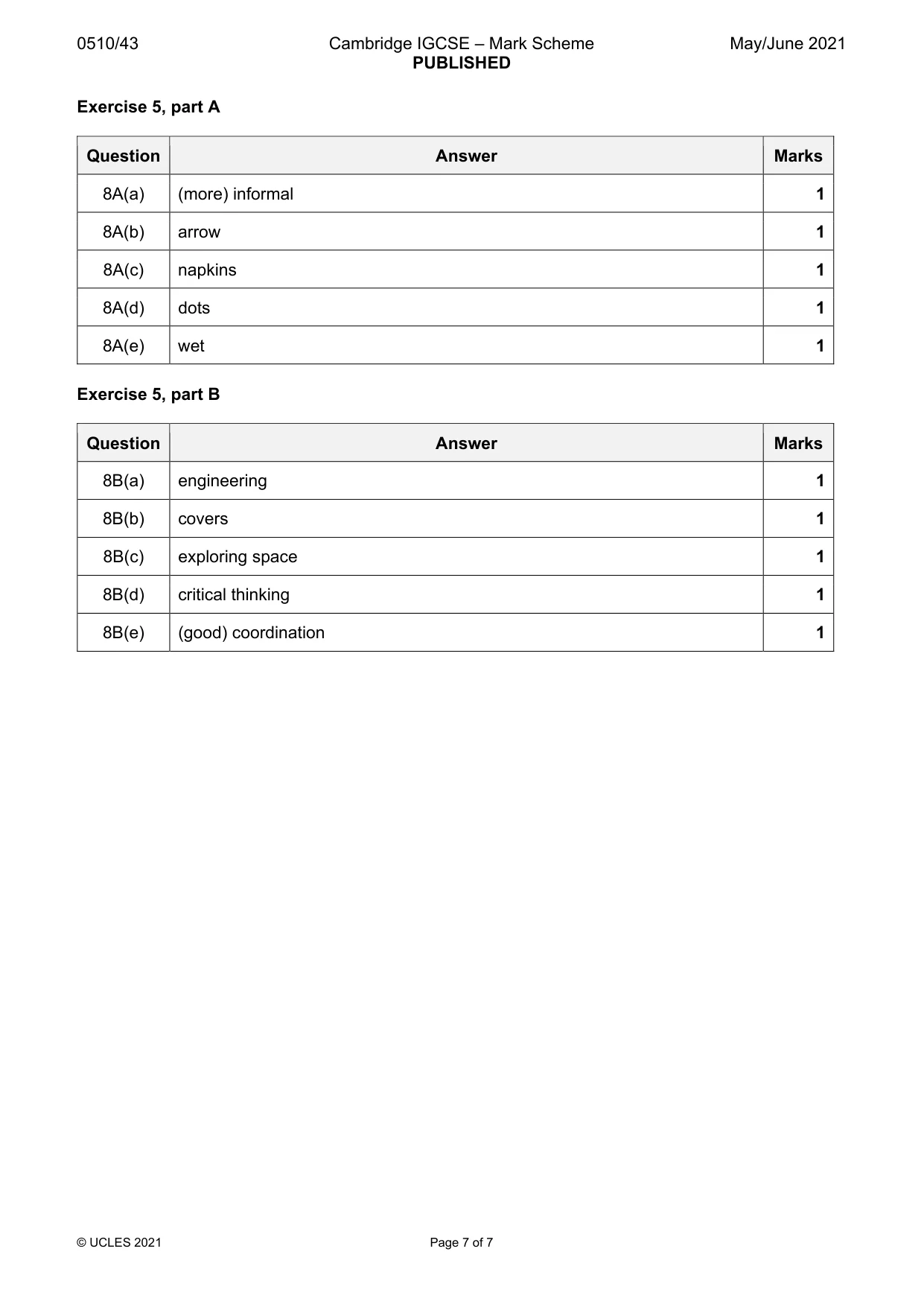
0510/43 Cambridge IGCSE – Mark Scheme PUBLISHED May/June 2021 © UCLES 2021 Page 7 of 7 Exercise 5, part A Question Answer Marks 8A(a) (more) informal 1 8A(b) arrow 1 8A(c) napkins 1 8A(d) dots 1 8A(e) wet 1 Exercise 5, part B Question Answer Marks 8B(a) engineering 1 8B(b) covers 1 8B(c) exploring space 1 8B(d) critical thinking 1 8B(e) (good) coordination 1