Cambridge IGCSE English - Second Language (oral endorsement) 0510 — 2018 Oct/Nov Paper 2 · Variant 3
0510/23/O/N/18 · 90 marks · ≈101 min
The question paper and its mark scheme, free to read here and free to download. This is Cambridge’s own paper, exactly as it was sat.
Question paper16 pages
Mark scheme12 pages
Answers below. Sit the paper first if you are practising.
Paper as text
Question paper, page 1
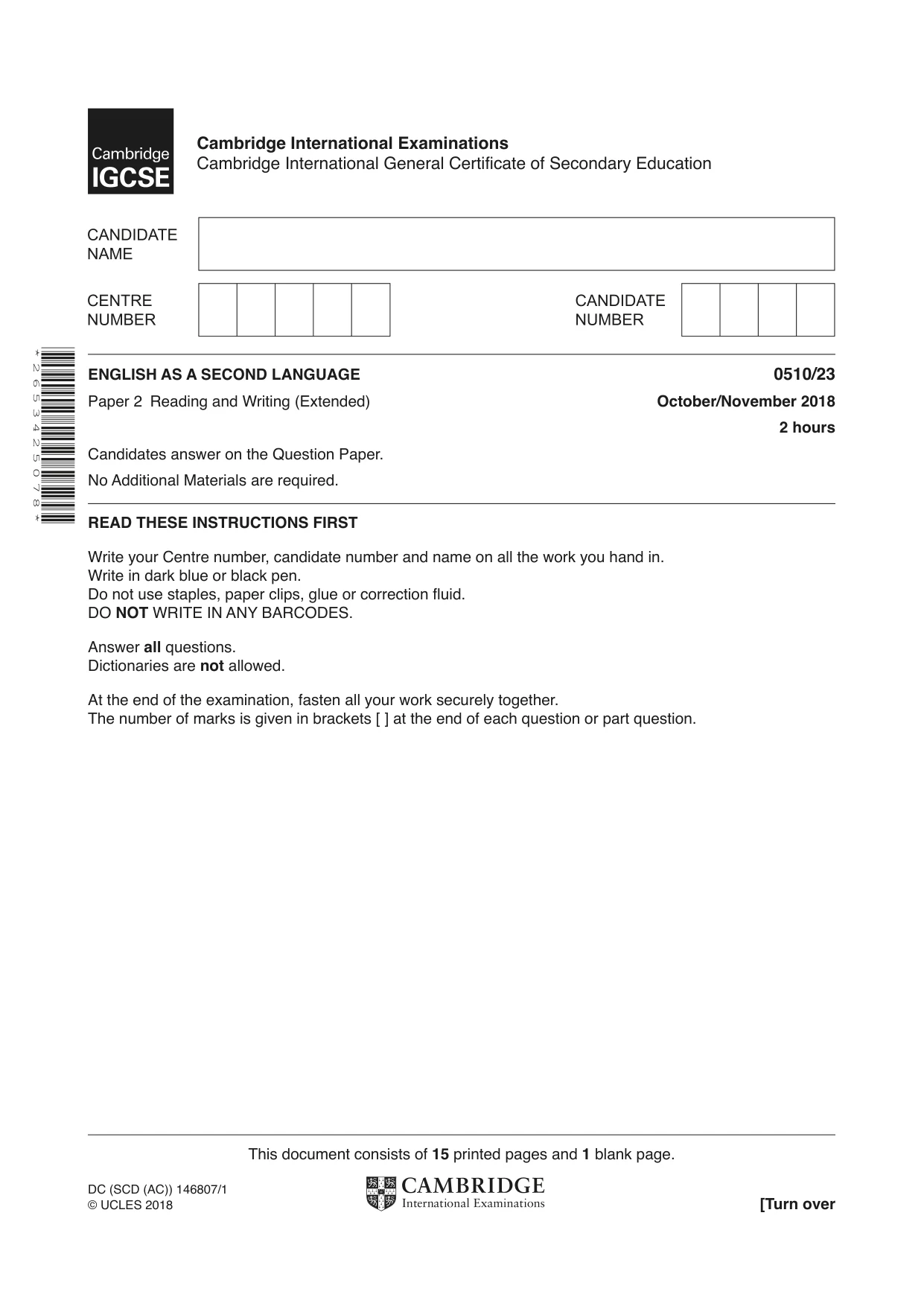
This document consists of 15 printed pages and 1 blank page. DC (SCD (AC)) 146807/1 © UCLES 2018 [Turn over Cambridge International Examinations Cambridge International General Certificate of Secondary Education * 2 6 5 3 4 2 5 0 7 8 * ENGLISH AS A SECOND LANGUAGE 0510/23 Paper 2 Reading and Writing (Extended) October/November 2018 2 hours Candidates answer on the Question Paper. No Additional Materials are required. READ THESE INSTRUCTIONS FIRST Write your Centre number, candidate number and name on all the work you hand in. Write in dark blue or black pen. Do not use staples, paper clips, glue or correction fluid. DO NOT WRITE IN ANY BARCODES. Answer all questions. Dictionaries are not allowed. At the end of the examination, fasten all your work securely together. The number of marks is given in brackets [ ] at the end of each question or part question.
Question paper, page 2
2 0510/23/O/N/18 © UCLES 2018 Exercise 1 Read the leaflet about a student film festival, and then answer the following questions. Get ready for the film festival! Yes, it’s almost that time of year again. Time to sit back and enjoy a whole range of films from all over the world – plus some that have been made right here, by students at this college! We’ve been running the film festival for five years now, and it’s got bigger and better each year. We’re anticipating even more interest in this year’s festival, so we’re moving to a larger venue – the Downing Room isn’t big enough anymore. You’ll find us in North Hall instead, which means up to 100 people can attend each event. What’s on? The full programme will be available on the college website next month, but in the meantime, here is some information to get you interested. On the opening night, we’ll be showing a beautiful film called Moonlight. The story takes place in the middle of the Atlantic Ocean, and it’s about an attempt to row across it, from Portugal to the Caribbean. You’d never guess that the entire film was shot on a lake in northern England, as the scenery looks so realistic. There’s some great acting by Ed Turner, and the leading role is played brilliantly by Adam Bateley. This is Cath Streetman’s very first film as a director. Another film which is likely to be popular is Steel Bullet. From the title, you might imagine it’s about a murder, though in fact it features a wedding. It’s all in Swedish, but don’t worry, there are subtitles! Short film competition One of the most exciting aspects of the festival is the short films made by you! If you are considering entering the annual competition, act quickly, as we need to receive your completed work no later than December 5th. And don’t forget the application forms must be sent in by November 23rd, including the title and the names of all students involved. Later, when you submit your film on DVD, please include a brief summary of the film in the same package. We have a panel of judges to select the best short films. Two lucky groups will each get a £200 gift voucher, but the overall winner gets a place on a one-week film-making course next year. Special events at the festival We’re planning several events too. Last year, one of the most popular was the talk by a sound engineer and this year, we’re excited to announce that the main presentation will be given by a costume designer. Plus, we’re organising a training session for up to 12 people one morning, which will focus on screenwriting skills, and we’re hoping to run some hour-long sessions on animation and sound effects. Find out more in next month’s update!
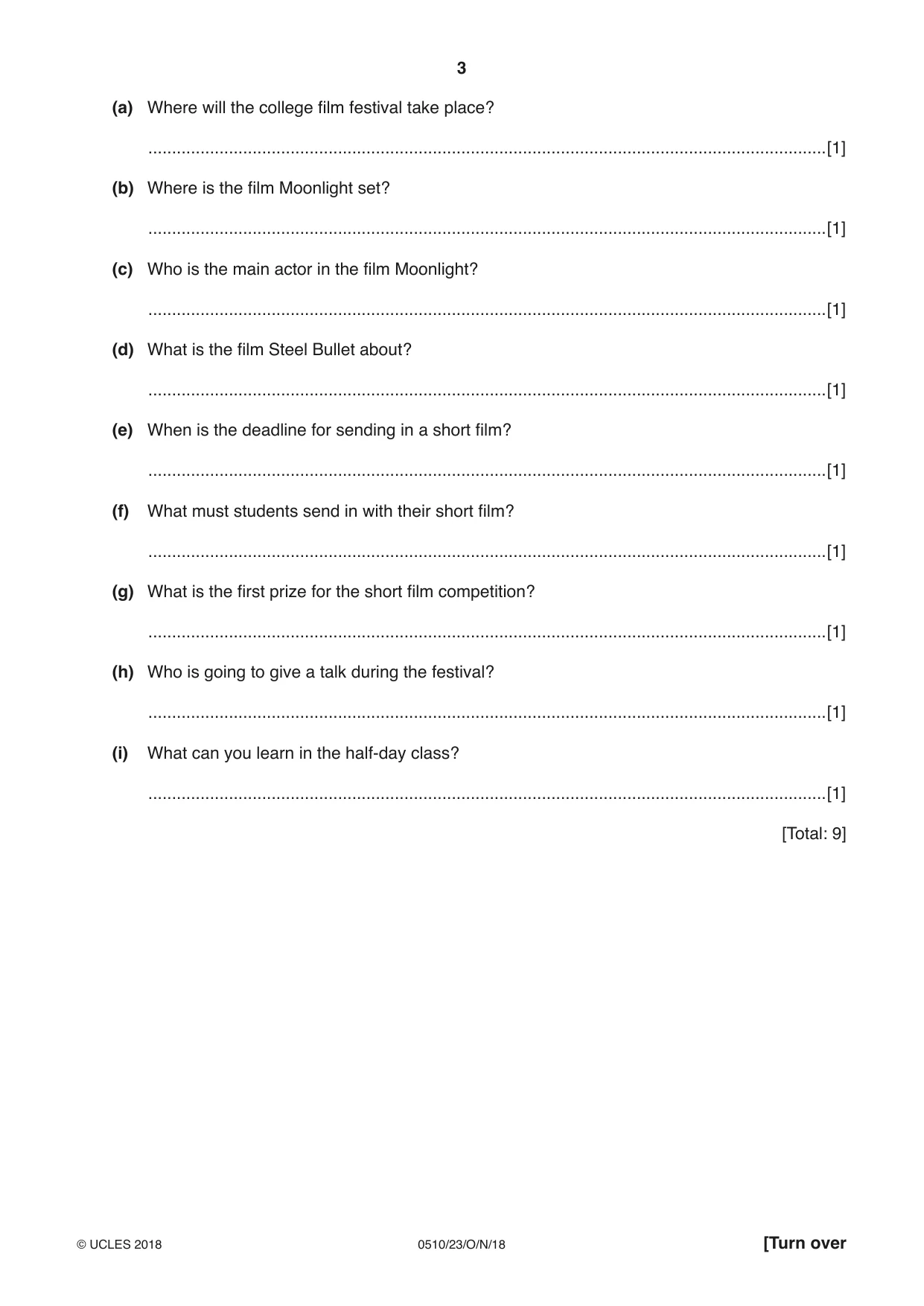
Question paper, page 3
3 0510/23/O/N/18 © UCLES 2018 [Turn over (a) Where will the college film festival take place? …[1] (b) Where is the film Moonlight set? …[1] (c) Who is the main actor in the film Moonlight? …[1] (d) What is the film Steel Bullet about? …[1] (e) When is the deadline for sending in a short film? …[1] (f) What must students send in with their short film? …[1] (g) What is the first prize for the short film competition? …[1] (h) Who is going to give a talk during the festival? …[1] (i) What can you learn in the half-day class? …[1] [Total: 9]
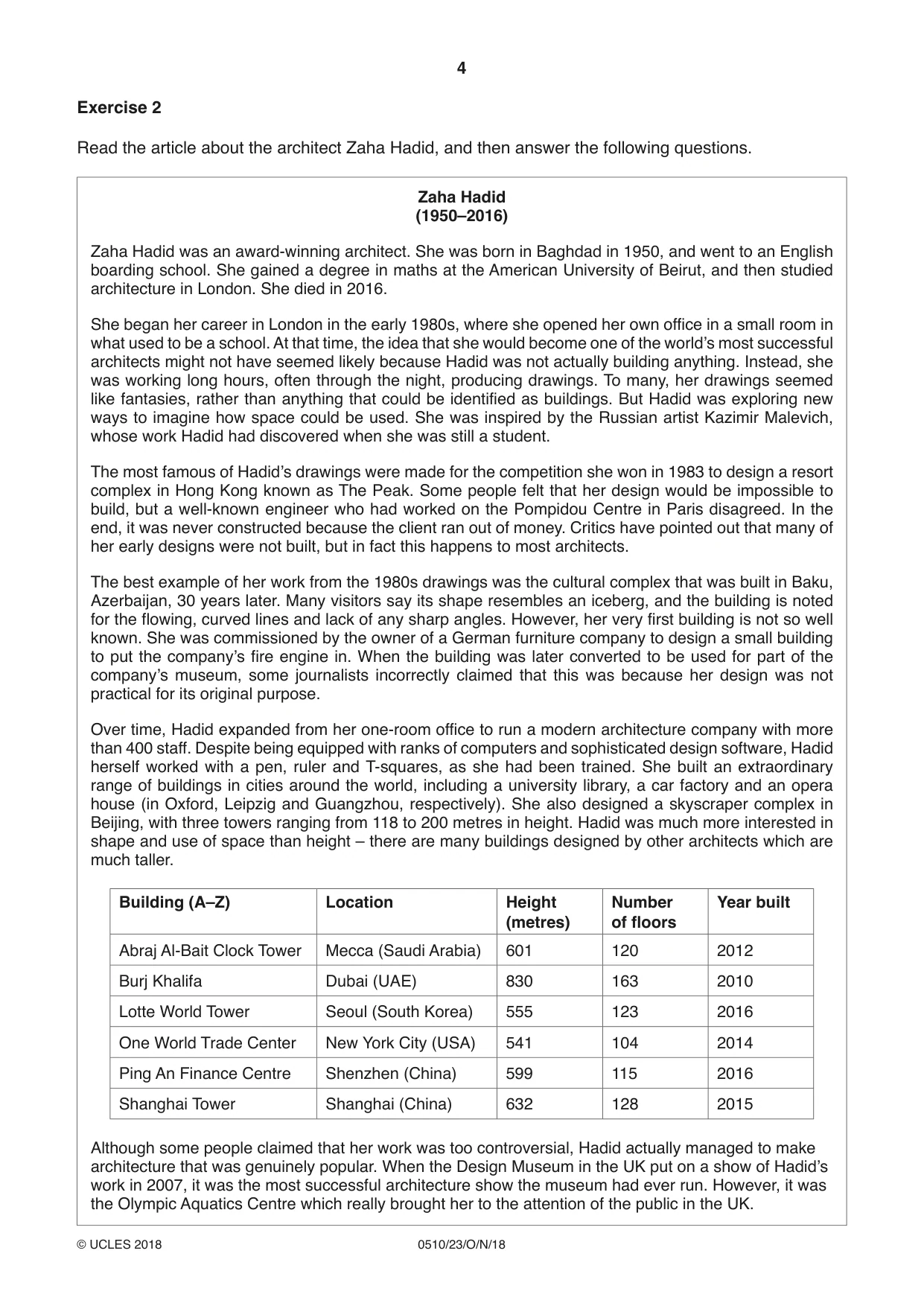
Question paper, page 4
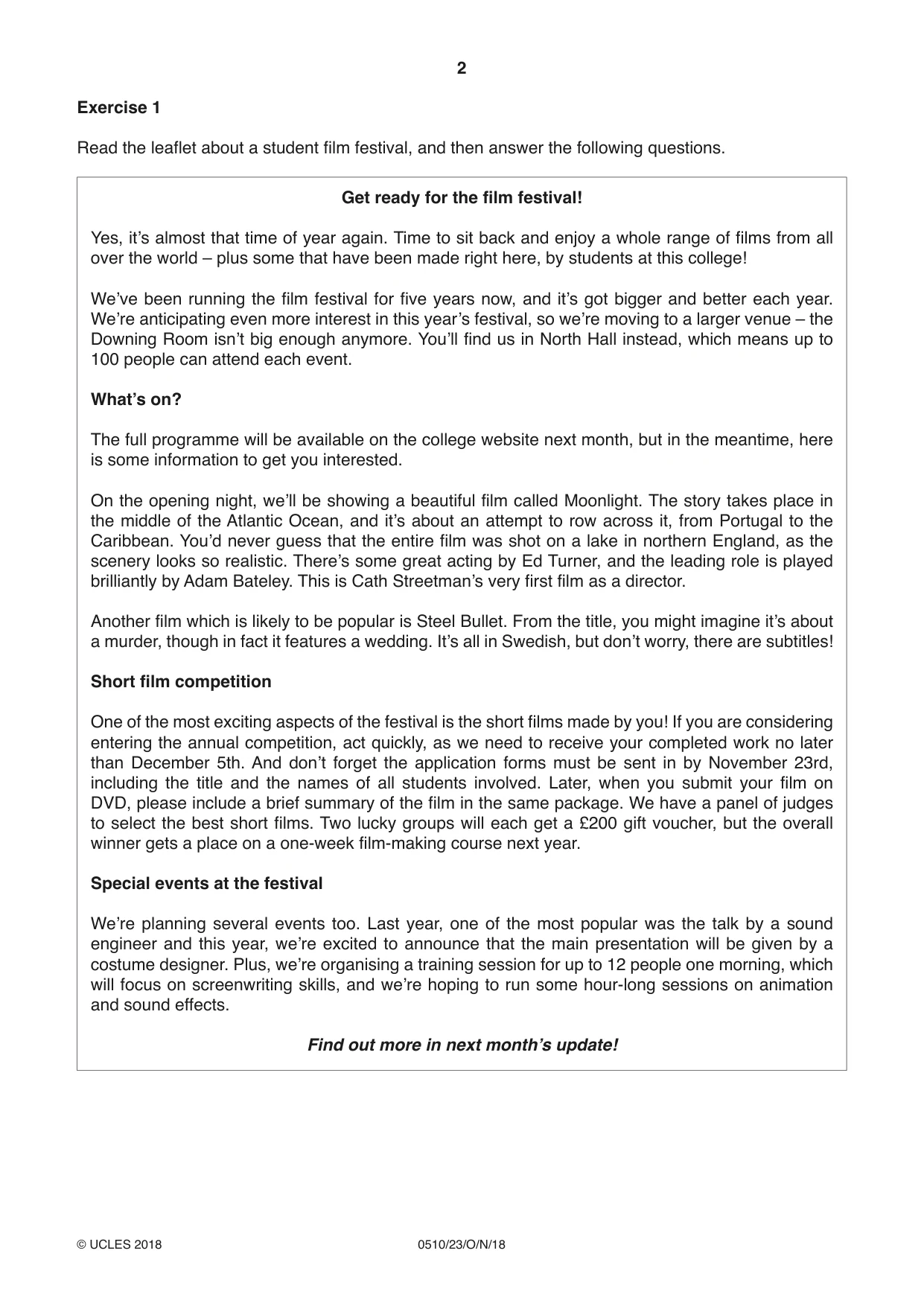
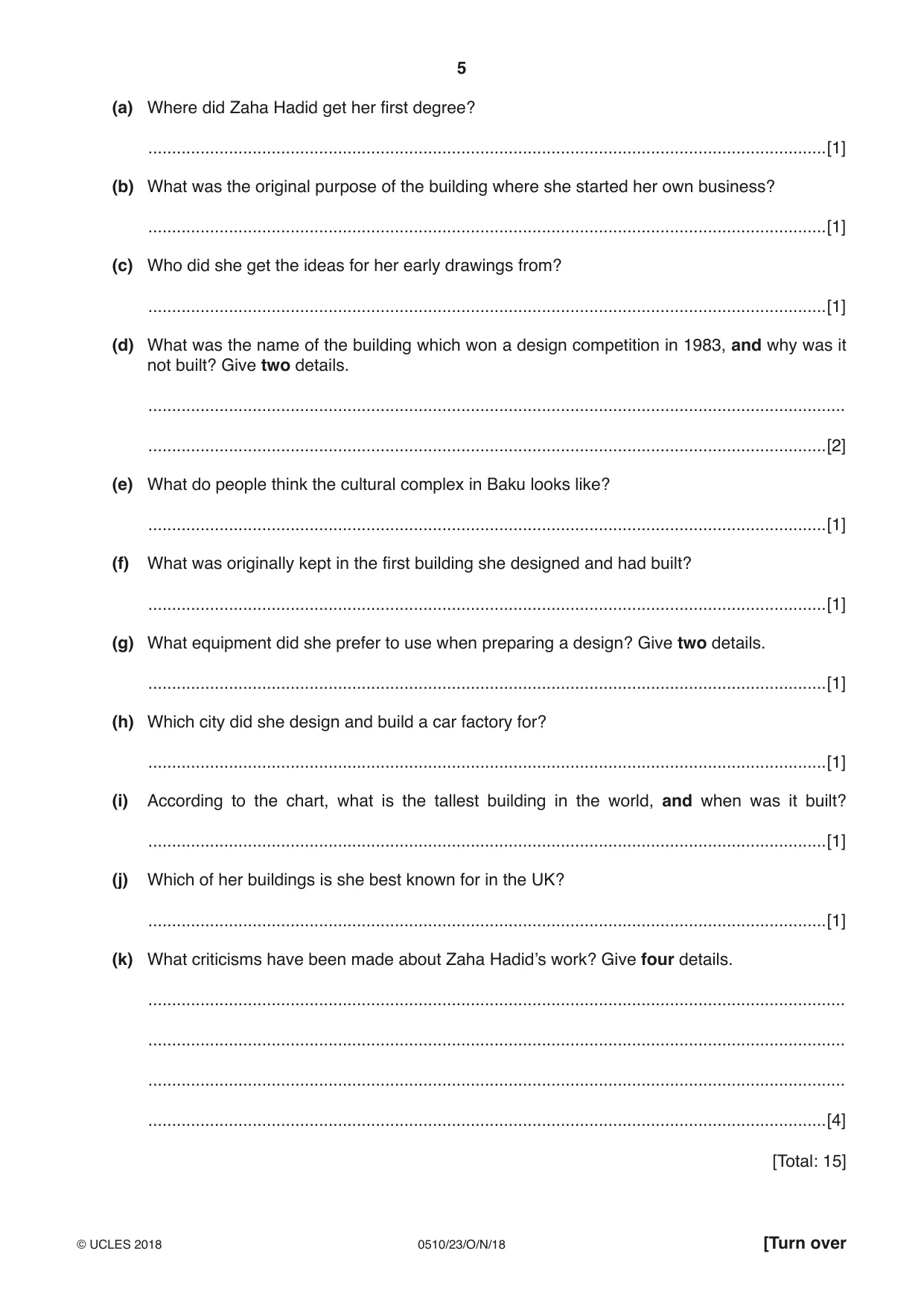
4 0510/23/O/N/18 © UCLES 2018 Exercise 2 Read the article about the architect Zaha Hadid, and then answer the following questions. Zaha Hadid (1950–2016) Zaha Hadid was an award-winning architect. She was born in Baghdad in 1950, and went to an English boarding school. She gained a degree in maths at the American University of Beirut, and then studied architecture in London. She died in 2016. She began her career in London in the early 1980s, where she opened her own office in a small room in what used to be a school. At that time, the idea that she would become one of the world’s most successful architects might not have seemed likely because Hadid was not actually building anything. Instead, she was working long hours, often through the night, producing drawings. To many, her drawings seemed like fantasies, rather than anything that could be identified as buildings. But Hadid was exploring new ways to imagine how space could be used. She was inspired by the Russian artist Kazimir Malevich, whose work Hadid had discovered when she was still a student. The most famous of Hadid’s drawings were made for the competition she won in 1983 to design a resort complex in Hong Kong known as The Peak. Some people felt that her design would be impossible to build, but a well-known engineer who had worked on the Pompidou Centre in Paris disagreed. In the end, it was never constructed because the client ran out of money. Critics have pointed out that many of her early designs were not built, but in fact this happens to most architects. The best example of her work from the 1980s drawings was the cultural complex that was built in Baku, Azerbaijan, 30 years later. Many visitors say its shape resembles an iceberg, and the building is noted for the flowing, curved lines and lack of any sharp angles. However, her very first building is not so well known. She was commissioned by the owner of a German furniture company to design a small building to put the company’s fire engine in. When the building was later converted to be used for part of the company’s museum, some journalists incorrectly claimed that this was because her design was not practical for its original purpose. Over time, Hadid expanded from her one-room office to run a modern architecture company with more than 400 staff. Despite being equipped with ranks of computers and sophisticated design software, Hadid herself worked with a pen, ruler and T-squares, as she had been trained. She built an extraordinary range of buildings in cities around the world, including a university library, a car factory and an opera house (in Oxford, Leipzig and Guangzhou, respectively). She also designed a skyscraper complex in Beijing, with three towers ranging from 118 to 200 metres in height. Hadid was much more interested in shape and use of space than height – there are many buildings designed by other architects which are much taller. Building (A–Z) Location Height (metres) Number of floors Year built Abraj Al-Bait Clock Tower Mecca (Saudi Arabia) 601 120 2012 Burj Khalifa Dubai (UAE) 830 163 2010 Lotte World Tower Seoul (South Korea) 555 123 2016 One World Trade Center New York City (USA) 541 104 2014 Ping An Finance Centre Shenzhen (China) 599 115 2016 Shanghai Tower Shanghai (China) 632 128 2015 Although some people claimed that her work was too controversial, Hadid actually managed to make architecture that was genuinely popular. When the Design Museum in the UK put on a show of Hadid’s work in 2007, it was the most successful architecture show the museum had ever run. However, it was the Olympic Aquatics Centre which really brought her to the attention of the public in the UK.
Question paper, page 5
5 0510/23/O/N/18 © UCLES 2018 [Turn over (a) Where did Zaha Hadid get her first degree? …[1] (b) What was the original purpose of the building where she started her own business? …[1] (c) Who did she get the ideas for her early drawings from? …[1] (d) What was the name of the building which won a design competition in 1983, and why was it not built? Give two details. … …[2] (e) What do people think the cultural complex in Baku looks like? …[1] (f) What was originally kept in the first building she designed and had built? …[1] (g) What equipment did she prefer to use when preparing a design? Give two details. …[1] (h) Which city did she design and build a car factory for? …[1] (i) According to the chart, what is the tallest building in the world, and when was it built? …[1] (j) Which of her buildings is she best known for in the UK? …[1] (k) What criticisms have been made about Zaha Hadid’s work? Give four details. … … … …[4] [Total: 15]
Question paper, page 6
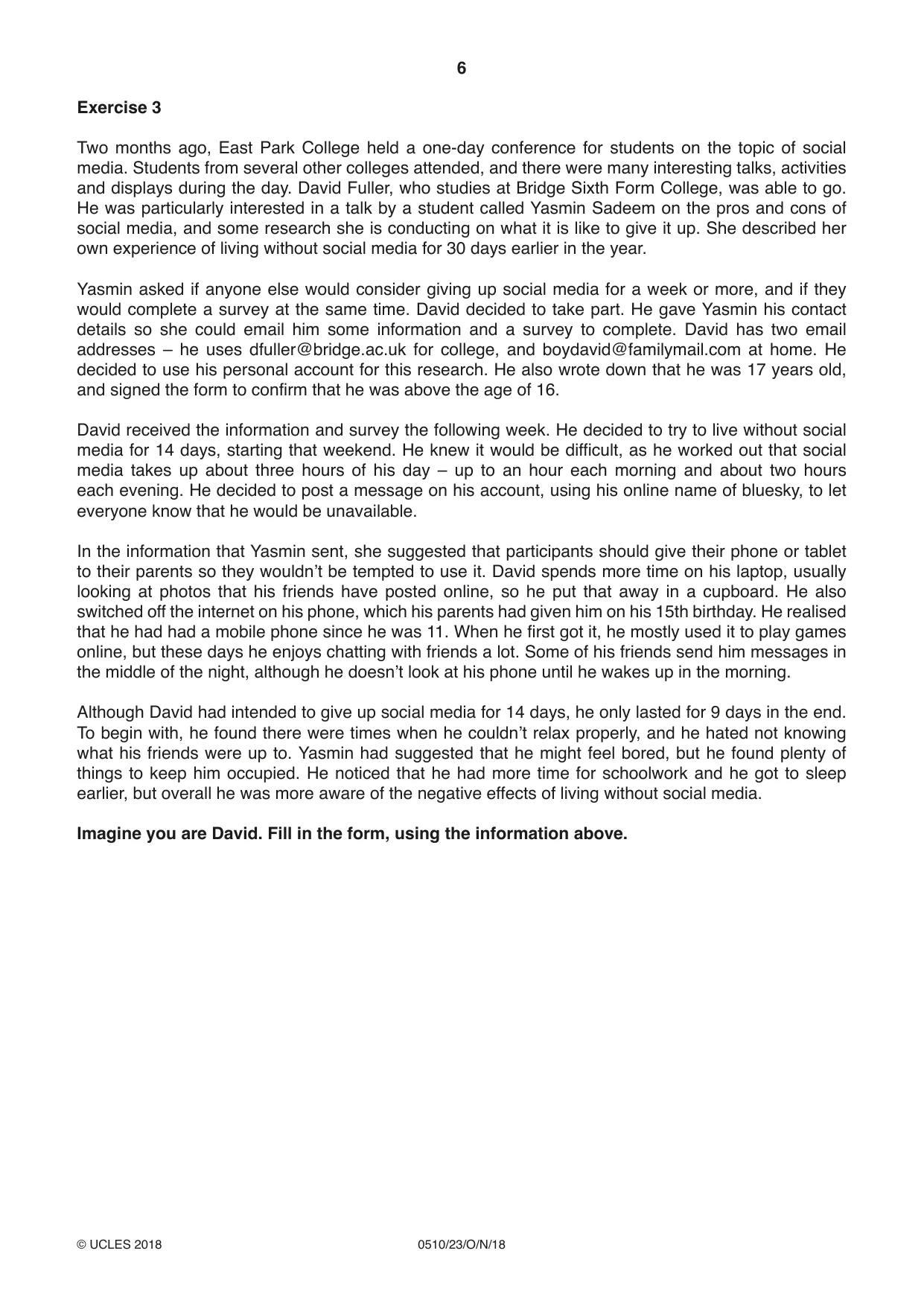
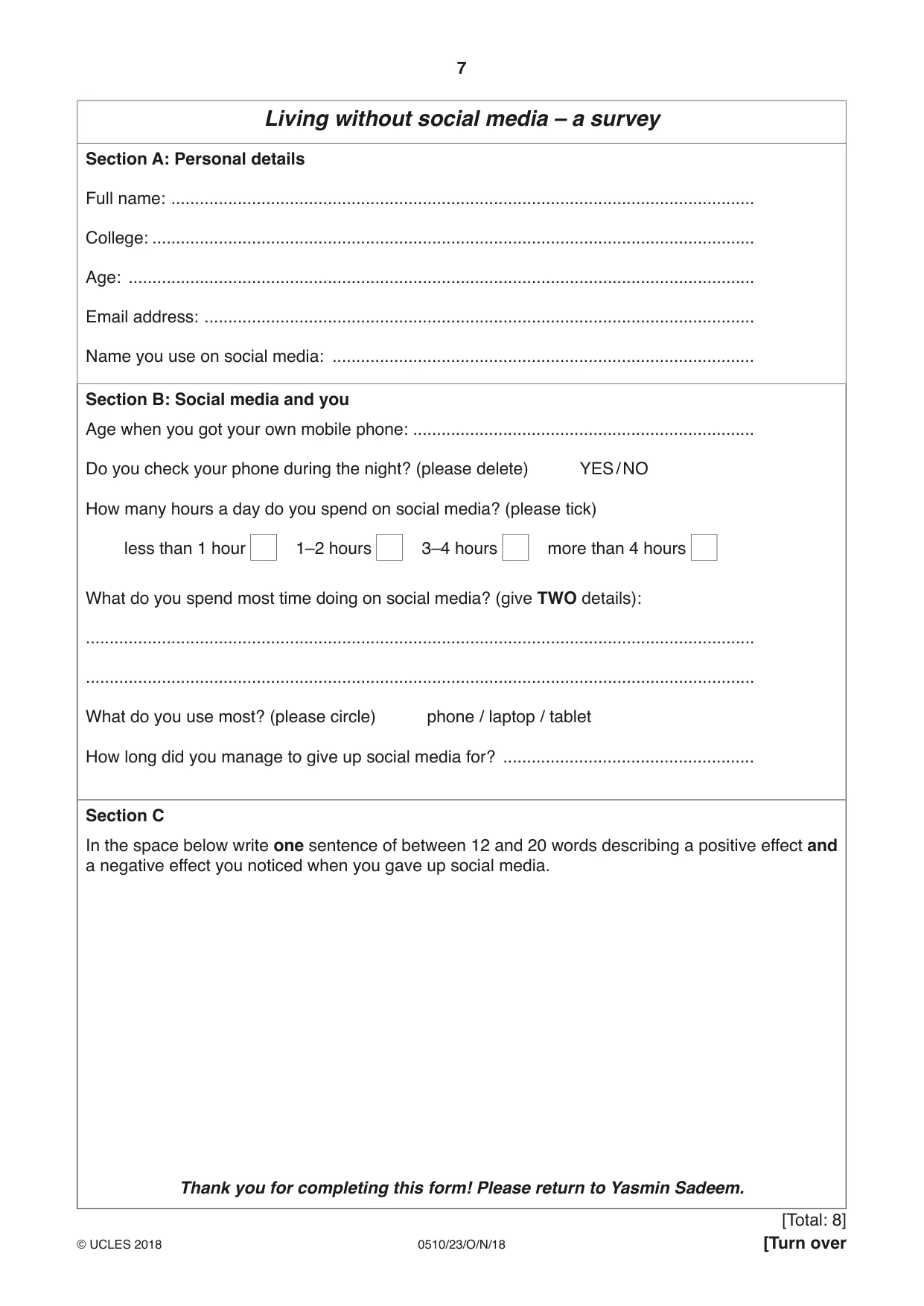
6 0510/23/O/N/18 © UCLES 2018 Exercise 3 Two months ago, East Park College held a one-day conference for students on the topic of social media. Students from several other colleges attended, and there were many interesting talks, activities and displays during the day. David Fuller, who studies at Bridge Sixth Form College, was able to go. He was particularly interested in a talk by a student called Yasmin Sadeem on the pros and cons of social media, and some research she is conducting on what it is like to give it up. She described her own experience of living without social media for 30 days earlier in the year. Yasmin asked if anyone else would consider giving up social media for a week or more, and if they would complete a survey at the same time. David decided to take part. He gave Yasmin his contact details so she could email him some information and a survey to complete. David has two email addresses – he uses dfuller@bridge.ac.uk for college, and boydavid@familymail.com at home. He decided to use his personal account for this research. He also wrote down that he was 17 years old, and signed the form to confirm that he was above the age of 16. David received the information and survey the following week. He decided to try to live without social media for 14 days, starting that weekend. He knew it would be difficult, as he worked out that social media takes up about three hours of his day – up to an hour each morning and about two hours each evening. He decided to post a message on his account, using his online name of bluesky, to let everyone know that he would be unavailable. In the information that Yasmin sent, she suggested that participants should give their phone or tablet to their parents so they wouldn’t be tempted to use it. David spends more time on his laptop, usually looking at photos that his friends have posted online, so he put that away in a cupboard. He also switched off the internet on his phone, which his parents had given him on his 15th birthday. He realised that he had had a mobile phone since he was 11. When he first got it, he mostly used it to play games online, but these days he enjoys chatting with friends a lot. Some of his friends send him messages in the middle of the night, although he doesn’t look at his phone until he wakes up in the morning. Although David had intended to give up social media for 14 days, he only lasted for 9 days in the end. To begin with, he found there were times when he couldn’t relax properly, and he hated not knowing what his friends were up to. Yasmin had suggested that he might feel bored, but he found plenty of things to keep him occupied. He noticed that he had more time for schoolwork and he got to sleep earlier, but overall he was more aware of the negative effects of living without social media. Imagine you are David. Fill in the form, using the information above.
Question paper, page 7
7 0510/23/O/N/18 © UCLES 2018 [Turn over Living without social media – a survey Section A: Personal details Full name: … College: … Age: … Email address: … Name you use on social media: … Section B: Social media and you Age when you got your own mobile phone: … Do you check your phone during the night? (please delete) YES / NO How many hours a day do you spend on social media? (please tick) less than 1 hour 1–2 hours 3–4 hours more than 4 hours What do you spend most time doing on social media? (give TWO details): … … What do you use most? (please circle) phone / laptop / tablet How long did you manage to give up social media for? … Section C In the space below write one sentence of between 12 and 20 words describing a positive effect and a negative effect you noticed when you gave up social media. Thank you for completing this form! Please return to Yasmin Sadeem. [Total: 8]
Question paper, page 8
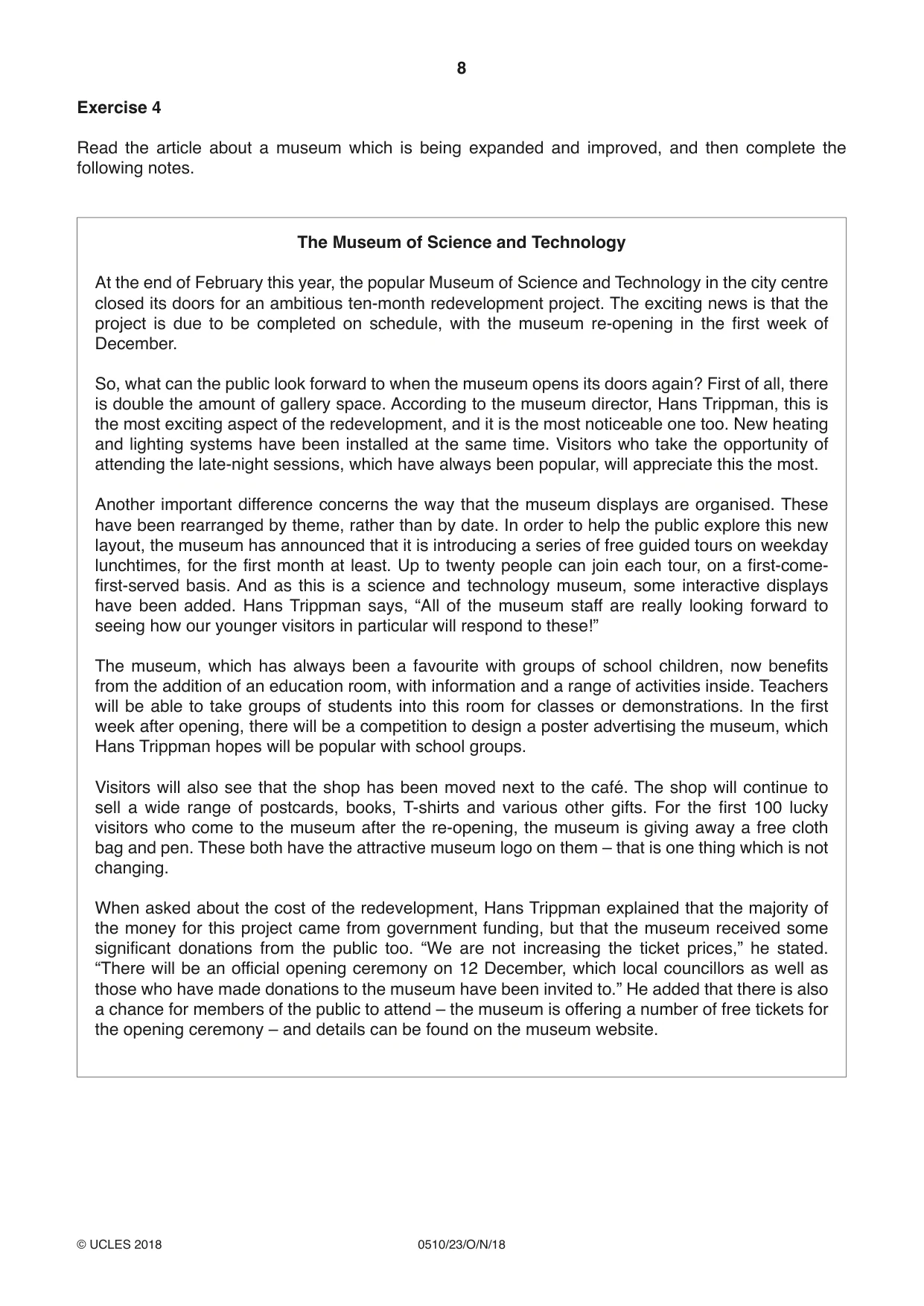
8 0510/23/O/N/18 © UCLES 2018 Exercise 4 Read the article about a museum which is being expanded and improved, and then complete the following notes. The Museum of Science and Technology At the end of February this year, the popular Museum of Science and Technology in the city centre closed its doors for an ambitious ten-month redevelopment project. The exciting news is that the project is due to be completed on schedule, with the museum re-opening in the first week of December. So, what can the public look forward to when the museum opens its doors again? First of all, there is double the amount of gallery space. According to the museum director, Hans Trippman, this is the most exciting aspect of the redevelopment, and it is the most noticeable one too. New heating and lighting systems have been installed at the same time. Visitors who take the opportunity of attending the late-night sessions, which have always been popular, will appreciate this the most. Another important difference concerns the way that the museum displays are organised. These have been rearranged by theme, rather than by date. In order to help the public explore this new layout, the museum has announced that it is introducing a series of free guided tours on weekday lunchtimes, for the first month at least. Up to twenty people can join each tour, on a first-come- first-served basis. And as this is a science and technology museum, some interactive displays have been added. Hans Trippman says, “All of the museum staff are really looking forward to seeing how our younger visitors in particular will respond to these!” The museum, which has always been a favourite with groups of school children, now benefits from the addition of an education room, with information and a range of activities inside. Teachers will be able to take groups of students into this room for classes or demonstrations. In the first week after opening, there will be a competition to design a poster advertising the museum, which Hans Trippman hopes will be popular with school groups. Visitors will also see that the shop has been moved next to the café. The shop will continue to sell a wide range of postcards, books, T-shirts and various other gifts. For the first 100 lucky visitors who come to the museum after the re-opening, the museum is giving away a free cloth bag and pen. These both have the attractive museum logo on them – that is one thing which is not changing. When asked about the cost of the redevelopment, Hans Trippman explained that the majority of the money for this project came from government funding, but that the museum received some significant donations from the public too. “We are not increasing the ticket prices,” he stated. “There will be an official opening ceremony on 12 December, which local councillors as well as those who have made donations to the museum have been invited to.” He added that there is also a chance for members of the public to attend – the museum is offering a number of free tickets for the opening ceremony – and details can be found on the museum website.
Question paper, page 9
9 0510/23/O/N/18 © UCLES 2018 [Turn over You are going to give a talk to your class about the Museum of Science and Technology. Prepare some notes to use as the basis for your talk. Make short notes under each heading. How the museum building and contents have changed: • … • … • … • … • … What the museum is doing to celebrate the re-opening: • … • … • … • … [Total: 9]
Question paper, page 10
10 0510/23/O/N/18 © UCLES 2018 Exercise 5 Read the following article about setting up a storytelling night. Write a summary about how to arrange a successful storytelling night. Your summary should be about 100 words long (and no more than 120 words long). You should use your own words as far as possible. You will receive up to 6 marks for the content of your summary and up to 5 marks for the style and accuracy of your language. Start up your own story night I’ve always enjoyed hearing people tell stories. So when I heard about The Moth, I was inspired. This is an organisation in the USA which holds regular storytelling events, giving ordinary people as well as literary and cultural personalities the chance to tell a tale in front of a live audience. I decided to start my own storytelling night, and hosted my first one about eight years ago. It is a fantastic way to meet new people and learn more about old friends. Most of all though, it is great fun, and it is easy to set up your own. The first consideration is the venue. If you are prepared to make space in your living room, that is fine. Otherwise, the best thing to do is to rent a room in a hall or community centre, or even in a café. This last option can be very cheap, or may even be free if people buy food and drink when they are there. The next thing to do is persuade a few friends to tell stories. Anyone who loves being the centre of attention will jump at the chance, so get them involved. You might also find that your quieter friends have brilliant stories to tell too, especially when they have been inspired by a few other people. But don’t just focus on who can tell stories – you need an audience as well, so invite plenty of people. Nothing draws people together like sharing stories, so these evenings become networks. People come back month after month, bringing friends who have their own stories to tell. From my experience, having a theme for the night helps, but it shouldn’t be too narrow or too wide. A theme gives storytellers something to work with and gives the audience a better idea of what to expect. Something too narrow like ‘surprise parties’ will give you a set of nearly identical stories. And if the theme is too wide, you may as well not bother with one at all. Themes that have worked well include ‘lost and found’, ‘guilt’ and ‘fame’. One man told us a story about receiving fan mail for a celebrity who had the same name as him. Someone else told us about arriving late for her friend’s wedding. The stories don’t have to be action-packed, but it is worth pointing out to participants that their stories should be told with honesty. To stop people from talking at length or taking over the evening, set a time limit for each story – five to ten minutes is usually enough. To decide on a suitable order, find out roughly what each story is about in advance. This will help to make the evening a success. It is worth advising those who are new to storytelling to think carefully about their opening sentences. If they want to grab the audience’s attention, they shouldn’t start with ‘Well, I woke up one morning and my friend called me and asked if I would like to go for a walk up the mountain.’ Instead, it is better to begin with ‘The mountain suddenly appeared from behind the cloud ...’, and then the audience will want to find out more. Just as important is not to let people use a script. Reading a story aloud that has been written down sounds just like someone reading aloud – it’s not storytelling. Storytellers connect best with their audience when there isn’t a piece of paper between them. Go ahead and arrange a storytelling night wherever you are. You won’t be disappointed!
Question paper, page 11
11 0510/23/O/N/18 © UCLES 2018 [Turn over … … … … … … … … … … … … … … … … … … … … … … … … … … … [Total: 11]
Question paper, page 12
12 0510/23/O/N/18 © UCLES 2018 Exercise 6 Last month, you and your family went on a day trip to a place in the countryside. Write an email to your friend about the trip. In your email, you should: • explain why you went to this place • describe what you did on the day • offer to take your friend there next time The pictures above may give you some ideas, and you should try to use some ideas of your own. Your email should be between 150 and 200 words long. You will receive up to 10 marks for the content of your email, and up to 9 marks for the style and accuracy of your language.
Question paper, page 13
13 0510/23/O/N/18 © UCLES 2018 [Turn over … … … … … … … … … … … … … … … … … … … … … … … … … … … [Total: 19]
Question paper, page 14
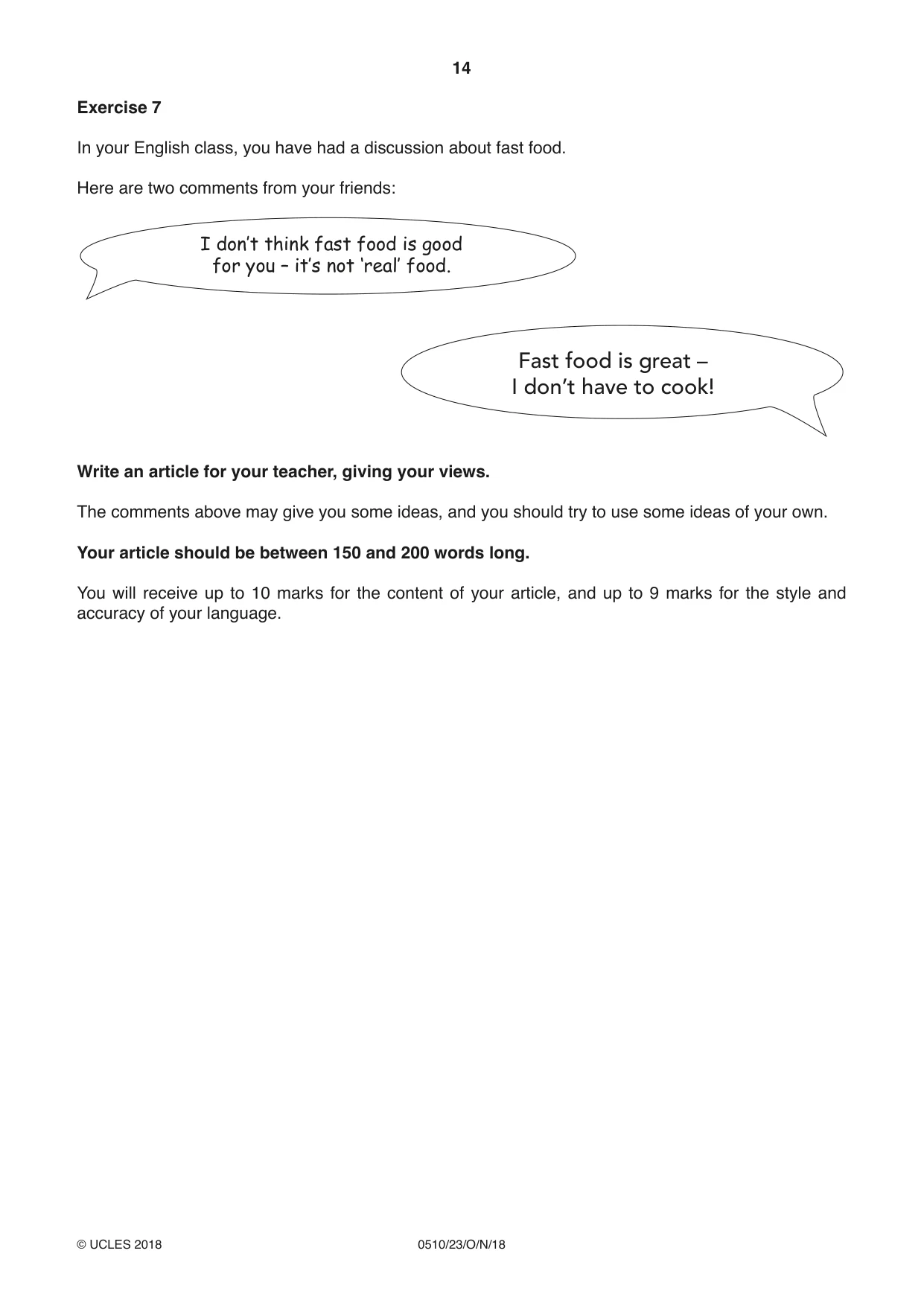
14 0510/23/O/N/18 © UCLES 2018 Exercise 7 In your English class, you have had a discussion about fast food. Here are two comments from your friends: I don’t think fast food is good for you – it’s not ‘real’ food. Fast food is great – I don’t have to cook! Write an article for your teacher, giving your views. The comments above may give you some ideas, and you should try to use some ideas of your own. Your article should be between 150 and 200 words long. You will receive up to 10 marks for the content of your article, and up to 9 marks for the style and accuracy of your language.
Question paper, page 15
15 0510/23/O/N/18 © UCLES 2018 … … … … … … … … … … … … … … … … … … … … … … … … … … … [Total: 19]
Question paper, page 16
16 0510/23/O/N/18 © UCLES 2018 Permission to reproduce items where third-party owned material protected by copyright is included has been sought and cleared where possible. Every reasonable effort has been made by the publisher (UCLES) to trace copyright holders, but if any items requiring clearance have unwittingly been included, the publisher will be pleased to make amends at the earliest possible opportunity. To avoid the issue of disclosure of answer-related information to candidates, all copyright acknowledgements are reproduced online in the Cambridge International Examinations Copyright Acknowledgements Booklet. This is produced for each series of examinations and is freely available to download at www.cie.org.uk after the live examination series. Cambridge International Examinations is part of the Cambridge Assessment Group. Cambridge Assessment is the brand name of University of Cambridge Local Examinations Syndicate (UCLES), which is itself a department of the University of Cambridge. BLANK PAGE
Mark scheme, page 1
This document consists of 12 printed pages. © UCLES 2018 [Turn over Cambridge Assessment International Education Cambridge International General Certificate of Secondary Education ENGLISH AS A SECOND LANGUAGE 0510/23 Paper 2 Reading and Writing (Extended) October/November 2018 MARK SCHEME Maximum Mark: 90 Published This mark scheme is published as an aid to teachers and candidates, to indicate the requirements of the examination. It shows the basis on which Examiners were instructed to award marks. It does not indicate the details of the discussions that took place at an Examiners’ meeting before marking began, which would have considered the acceptability of alternative answers. Mark schemes should be read in conjunction with the question paper and the Principal Examiner Report for Teachers. Cambridge International will not enter into discussions about these mark schemes. Cambridge International is publishing the mark schemes for the October/November 2018 series for most Cambridge IGCSE™, Cambridge International A and AS Level components and some Cambridge O Level components.
Mark scheme, page 2
0510/23 Cambridge IGCSE – Mark Scheme PUBLISHED October/November 2018 © UCLES 2018 Page 2 of 12 Generic Marking Principles These general marking principles must be applied by all examiners when marking candidate answers. They should be applied alongside the specific content of the mark scheme or generic level descriptors for a question. Each question paper and mark scheme will also comply with these marking principles. GENERIC MARKING PRINCIPLE 1: Marks must be awarded in line with: • the specific content of the mark scheme or the generic level descriptors for the question • the specific skills defined in the mark scheme or in the generic level descriptors for the question • the standard of response required by a candidate as exemplified by the standardisation scripts. GENERIC MARKING PRINCIPLE 2: Marks awarded are always whole marks (not half marks, or other fractions). GENERIC MARKING PRINCIPLE 3: Marks must be awarded positively: • marks are awarded for correct/valid answers, as defined in the mark scheme. However, credit is given for valid answers which go beyond the scope of the syllabus and mark scheme, referring to your Team Leader as appropriate • marks are awarded when candidates clearly demonstrate what they know and can do • marks are not deducted for errors • marks are not deducted for omissions • answers should only be judged on the quality of spelling, punctuation and grammar when these features are specifically assessed by the question as indicated by the mark scheme. The meaning, however, should be unambiguous. GENERIC MARKING PRINCIPLE 4: Rules must be applied consistently e.g. in situations where candidates have not followed instructions or in the application of generic level descriptors. GENERIC MARKING PRINCIPLE 5: Marks should be awarded using the full range of marks defined in the mark scheme for the question (however; the use of the full mark range may be limited according to the quality of the candidate responses seen). GENERIC MARKING PRINCIPLE 6: Marks awarded are based solely on the requirements as defined in the mark scheme. Marks should not be awarded with grade thresholds or grade descriptors in mind.
Mark scheme, page 3
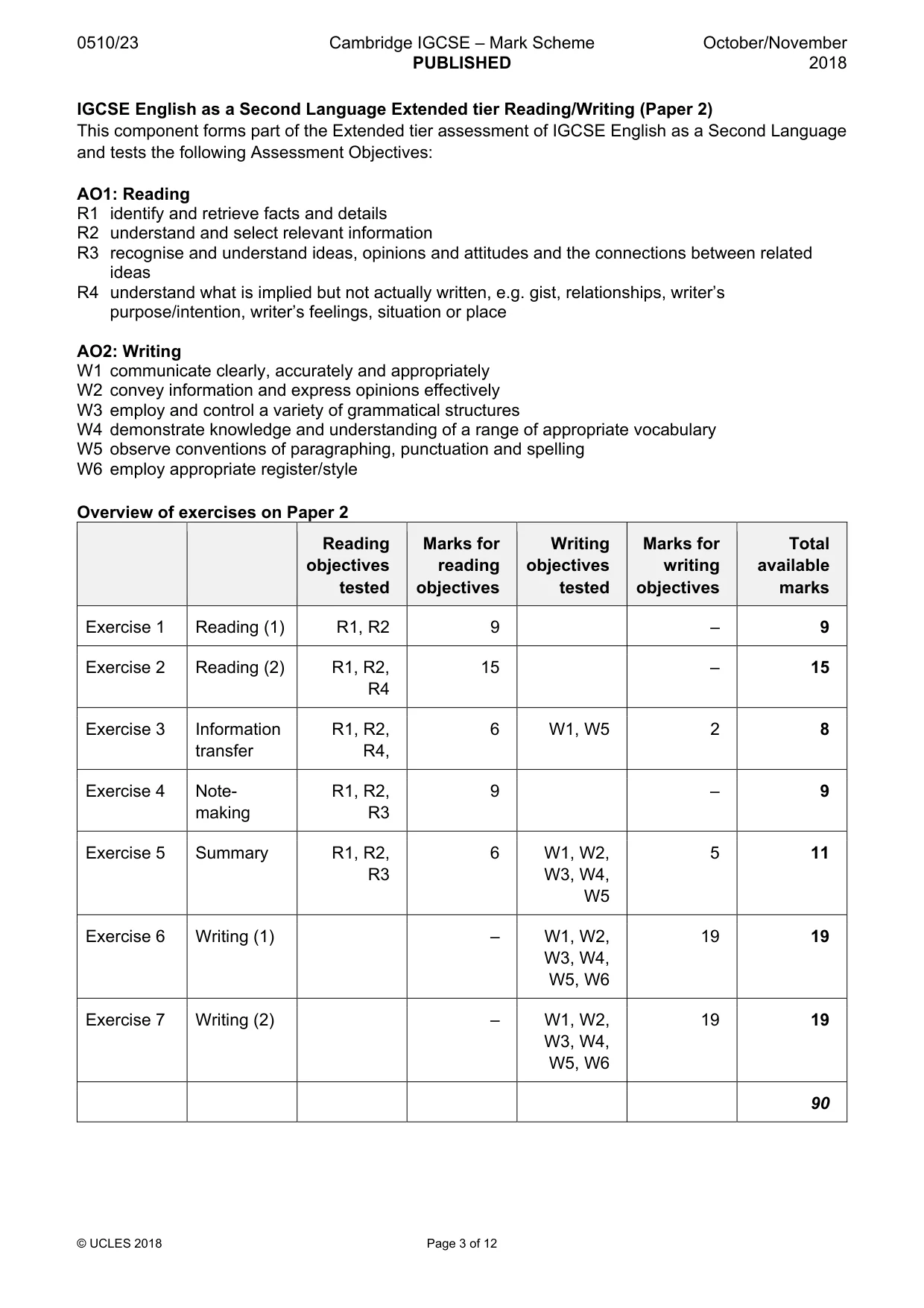
0510/23 Cambridge IGCSE – Mark Scheme PUBLISHED October/November 2018 © UCLES 2018 Page 3 of 12 IGCSE English as a Second Language Extended tier Reading/Writing (Paper 2) This component forms part of the Extended tier assessment of IGCSE English as a Second Language and tests the following Assessment Objectives: AO1: Reading R1 identify and retrieve facts and details R2 understand and select relevant information R3 recognise and understand ideas, opinions and attitudes and the connections between related ideas R4 understand what is implied but not actually written, e.g. gist, relationships, writer’s purpose/intention, writer’s feelings, situation or place AO2: Writing W1 communicate clearly, accurately and appropriately W2 convey information and express opinions effectively W3 employ and control a variety of grammatical structures W4 demonstrate knowledge and understanding of a range of appropriate vocabulary W5 observe conventions of paragraphing, punctuation and spelling W6 employ appropriate register/style Overview of exercises on Paper 2 Reading objectives tested Marks for reading objectives Writing objectives tested Marks for writing objectives Total available marks Exercise 1 Reading (1) R1, R2 9 – 9 Exercise 2 Reading (2) R1, R2, R4 15 – 15 Exercise 3 Information transfer R1, R2, R4, 6 W1, W5 2 8 Exercise 4 Note- making R1, R2, R3 9 – 9 Exercise 5 Summary R1, R2, R3 6 W1, W2, W3, W4, W5 5 11 Exercise 6 Writing (1) – W1, W2, W3, W4, W5, W6 19 19 Exercise 7 Writing (2) – W1, W2, W3, W4, W5, W6 19 19 90
Mark scheme, page 4
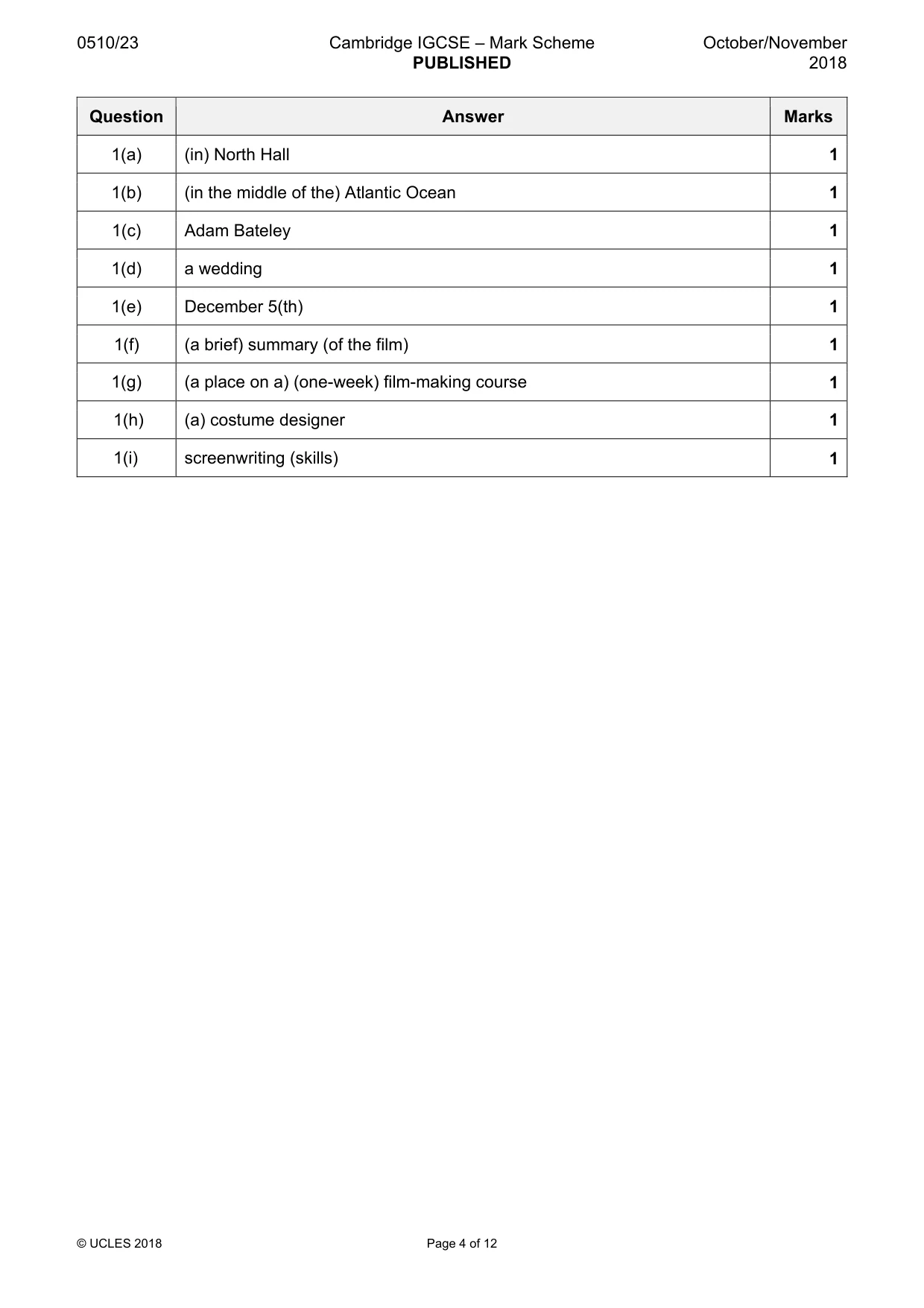
0510/23 Cambridge IGCSE – Mark Scheme PUBLISHED October/November 2018 © UCLES 2018 Page 4 of 12 Question Answer Marks 1(a) (in) North Hall 1 1(b) (in the middle of the) Atlantic Ocean 1 1(c) Adam Bateley 1 1(d) a wedding 1 1(e) December 5(th) 1 1(f) (a brief) summary (of the film) 1 1(g) (a place on a) (one-week) film-making course 1 1(h) (a) costume designer 1 1(i) screenwriting (skills) 1
Mark scheme, page 5
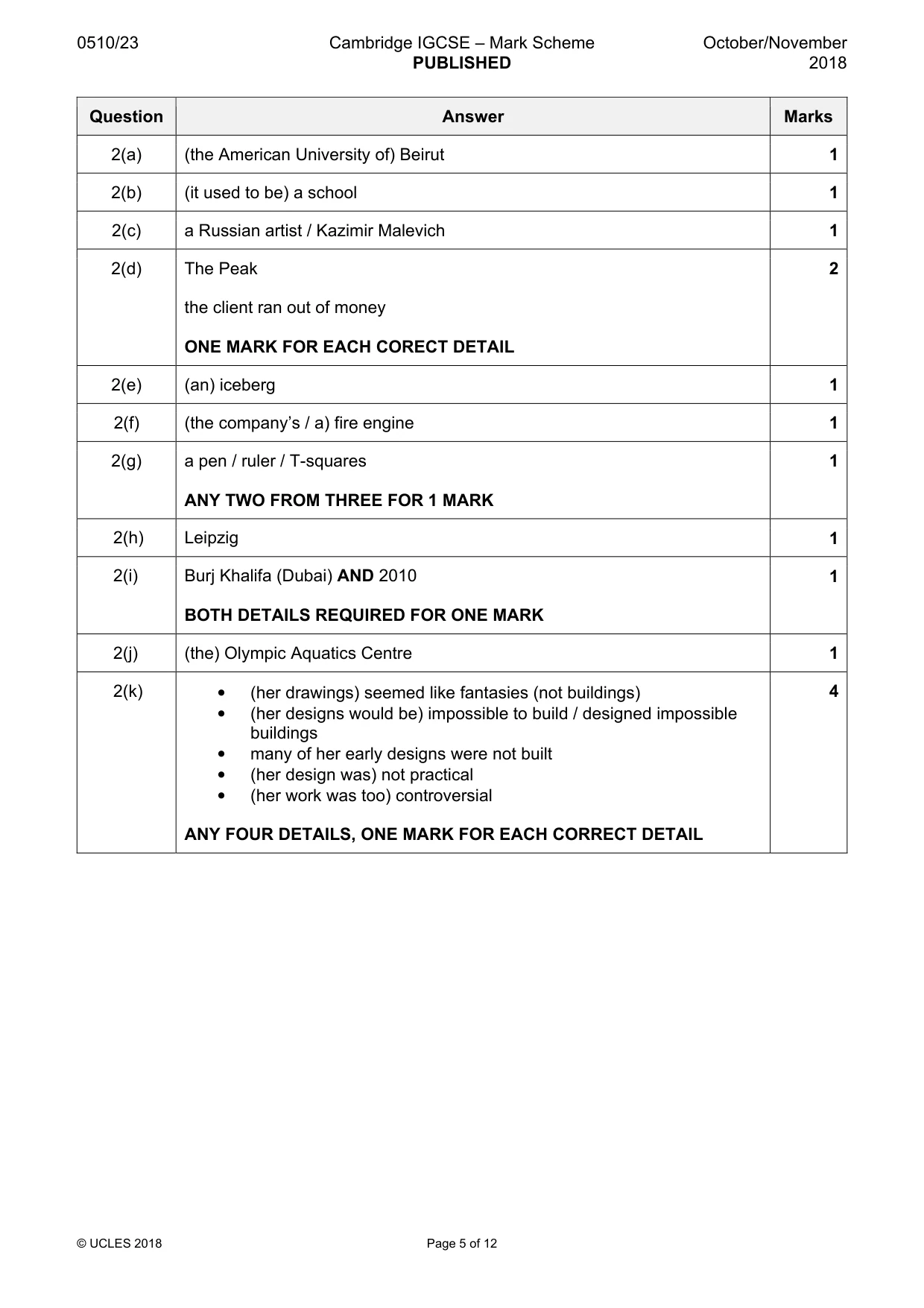
0510/23 Cambridge IGCSE – Mark Scheme PUBLISHED October/November 2018 © UCLES 2018 Page 5 of 12 Question Answer Marks 2(a) (the American University of) Beirut 1 2(b) (it used to be) a school 1 2(c) a Russian artist / Kazimir Malevich 1 2(d) The Peak the client ran out of money ONE MARK FOR EACH CORECT DETAIL 2 2(e) (an) iceberg 1 2(f) (the company’s / a) fire engine 1 2(g) a pen / ruler / T-squares ANY TWO FROM THREE FOR 1 MARK 1 2(h) Leipzig 1 2(i) Burj Khalifa (Dubai) AND 2010 BOTH DETAILS REQUIRED FOR ONE MARK 1 2(j) (the) Olympic Aquatics Centre 1 2(k) • (her drawings) seemed like fantasies (not buildings) • (her designs would be) impossible to build / designed impossible buildings • many of her early designs were not built • (her design was) not practical • (her work was too) controversial ANY FOUR DETAILS, ONE MARK FOR EACH CORRECT DETAIL 4
Mark scheme, page 6
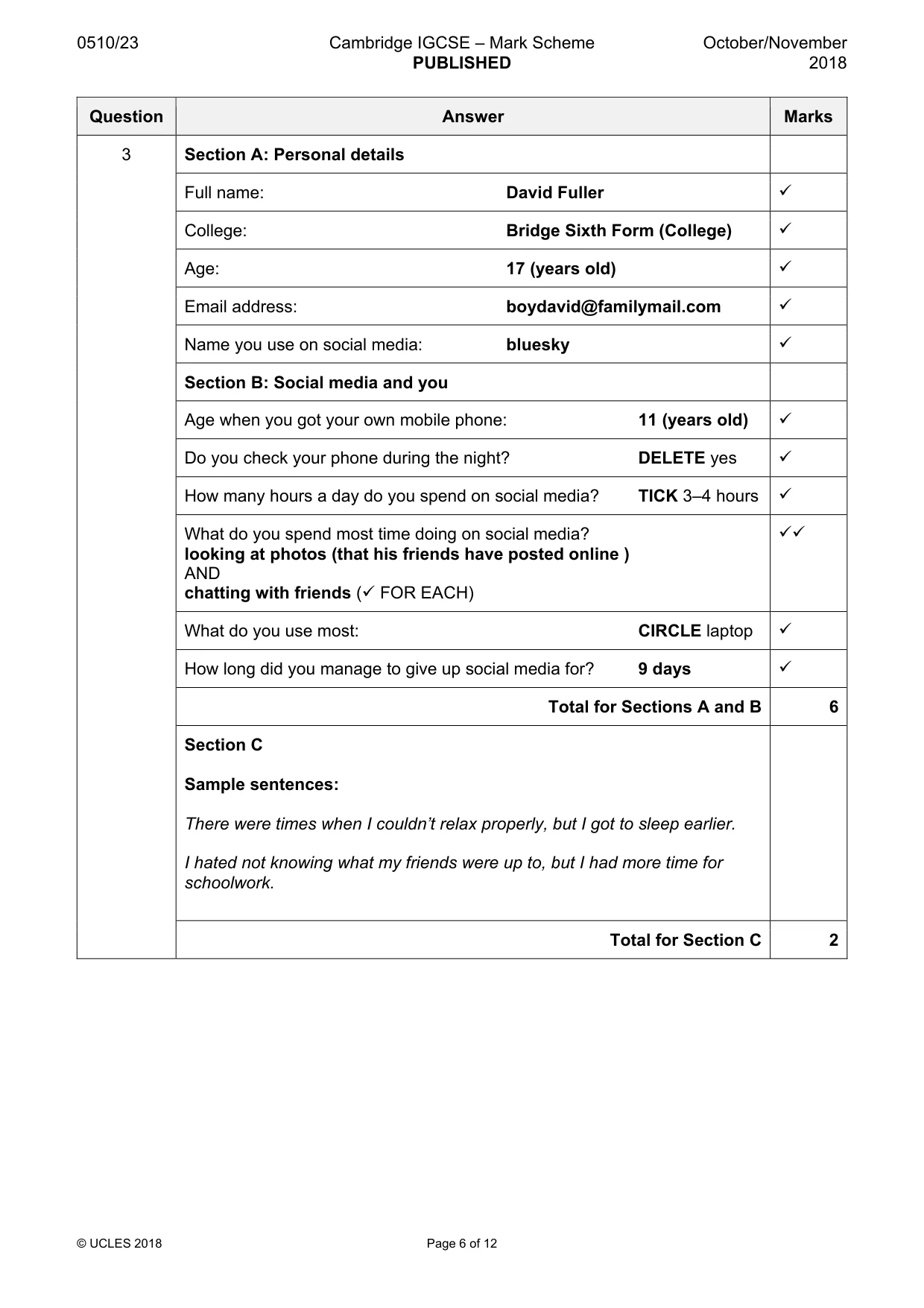
0510/23 Cambridge IGCSE – Mark Scheme PUBLISHED October/November 2018 © UCLES 2018 Page 6 of 12 Question Answer Marks 3 Section A: Personal details Full name: David Fuller 9 College: Bridge Sixth Form (College) 9 Age: 17 (years old) 9 Email address: boydavid@familymail.com 9 Name you use on social media: bluesky 9 Section B: Social media and you Age when you got your own mobile phone: 11 (years old) 9 Do you check your phone during the night? DELETE yes 9 How many hours a day do you spend on social media? TICK 3–4 hours 9 What do you spend most time doing on social media? looking at photos (that his friends have posted online ) AND chatting with friends (9 FOR EACH) 99 What do you use most: CIRCLE laptop 9 How long did you manage to give up social media for? 9 days 9 Total for Sections A and B 6 Section C Sample sentences: There were times when I couldn’t relax properly, but I got to sleep earlier. I hated not knowing what my friends were up to, but I had more time for schoolwork. Total for Section C 2
Mark scheme, page 7
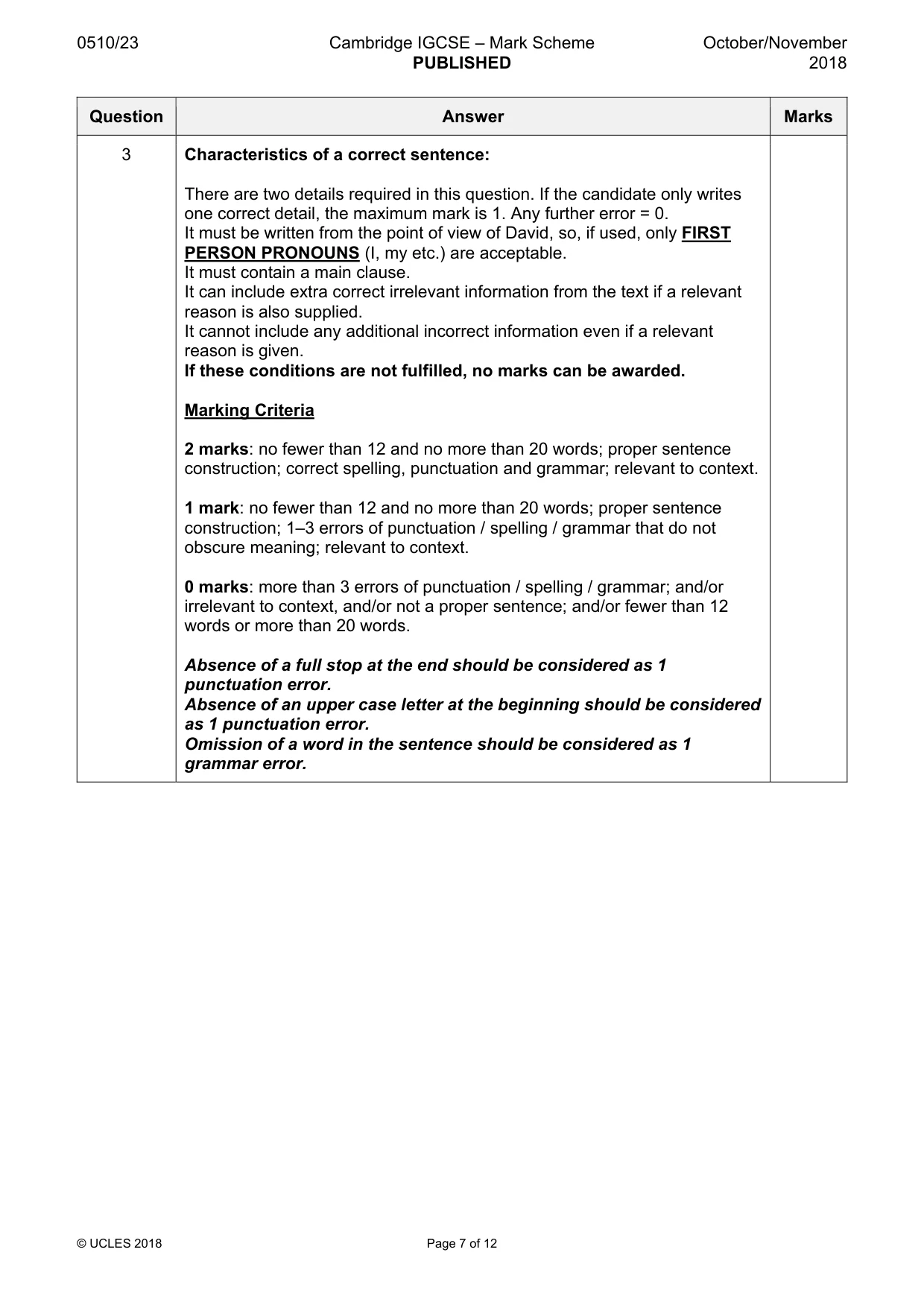
0510/23 Cambridge IGCSE – Mark Scheme PUBLISHED October/November 2018 © UCLES 2018 Page 7 of 12 Question Answer Marks 3 Characteristics of a correct sentence: There are two details required in this question. If the candidate only writes one correct detail, the maximum mark is 1. Any further error = 0. It must be written from the point of view of David, so, if used, only FIRST PERSON PRONOUNS (I, my etc.) are acceptable. It must contain a main clause. It can include extra correct irrelevant information from the text if a relevant reason is also supplied. It cannot include any additional incorrect information even if a relevant reason is given. If these conditions are not fulfilled, no marks can be awarded. Marking Criteria 2 marks: no fewer than 12 and no more than 20 words; proper sentence construction; correct spelling, punctuation and grammar; relevant to context. 1 mark: no fewer than 12 and no more than 20 words; proper sentence construction; 1–3 errors of punctuation / spelling / grammar that do not obscure meaning; relevant to context. 0 marks: more than 3 errors of punctuation / spelling / grammar; and/or irrelevant to context, and/or not a proper sentence; and/or fewer than 12 words or more than 20 words. Absence of a full stop at the end should be considered as 1 punctuation error. Absence of an upper case letter at the beginning should be considered as 1 punctuation error. Omission of a word in the sentence should be considered as 1 grammar error.
Mark scheme, page 8
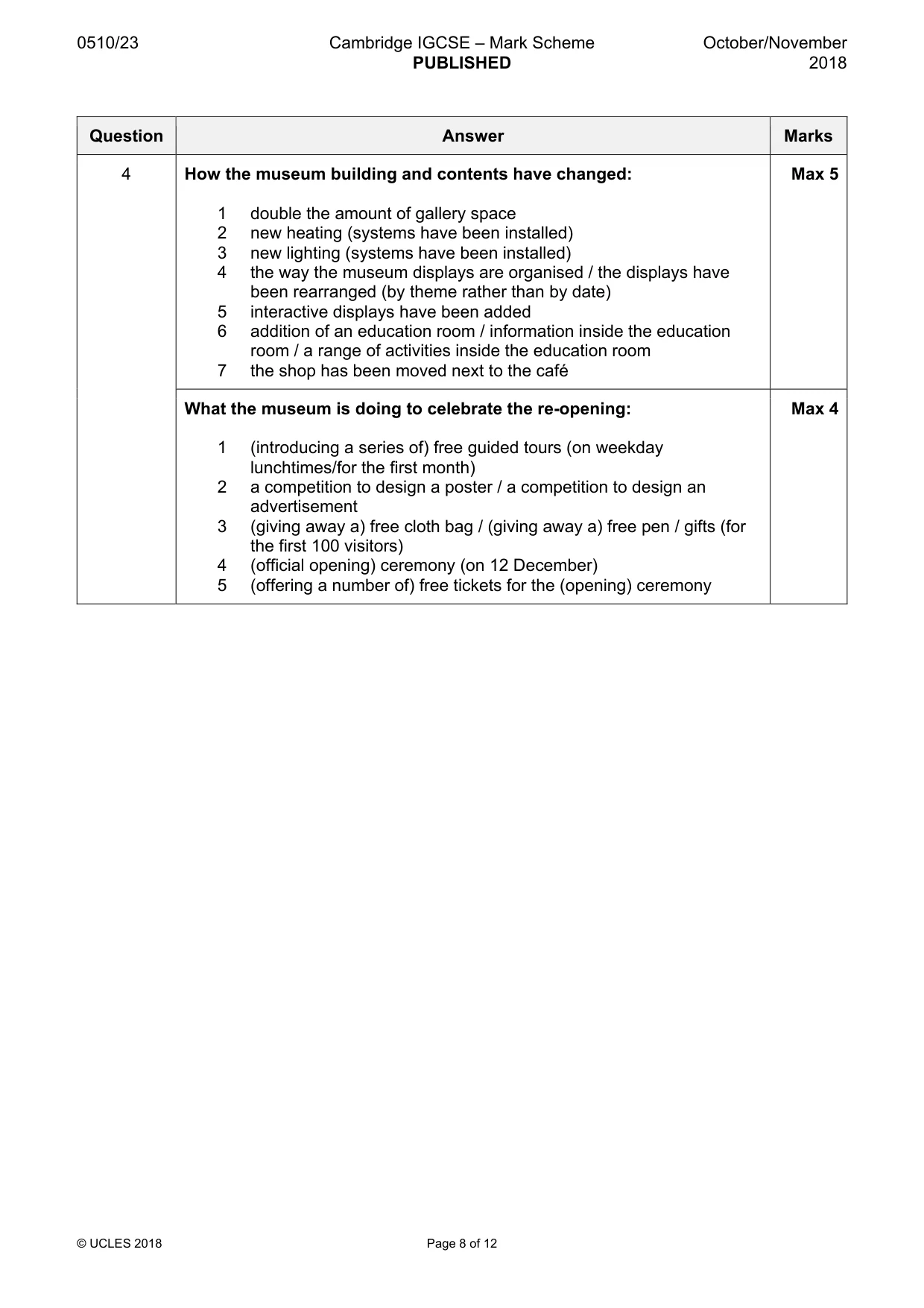
0510/23 Cambridge IGCSE – Mark Scheme PUBLISHED October/November 2018 © UCLES 2018 Page 8 of 12 Question Answer Marks 4 How the museum building and contents have changed: 1 double the amount of gallery space 2 new heating (systems have been installed) 3 new lighting (systems have been installed) 4 the way the museum displays are organised / the displays have been rearranged (by theme rather than by date) 5 interactive displays have been added 6 addition of an education room / information inside the education room / a range of activities inside the education room 7 the shop has been moved next to the café Max 5 What the museum is doing to celebrate the re-opening: 1 (introducing a series of) free guided tours (on weekday lunchtimes/for the first month) 2 a competition to design a poster / a competition to design an advertisement 3 (giving away a) free cloth bag / (giving away a) free pen / gifts (for the first 100 visitors) 4 (official opening) ceremony (on 12 December) 5 (offering a number of) free tickets for the (opening) ceremony Max 4
Mark scheme, page 9
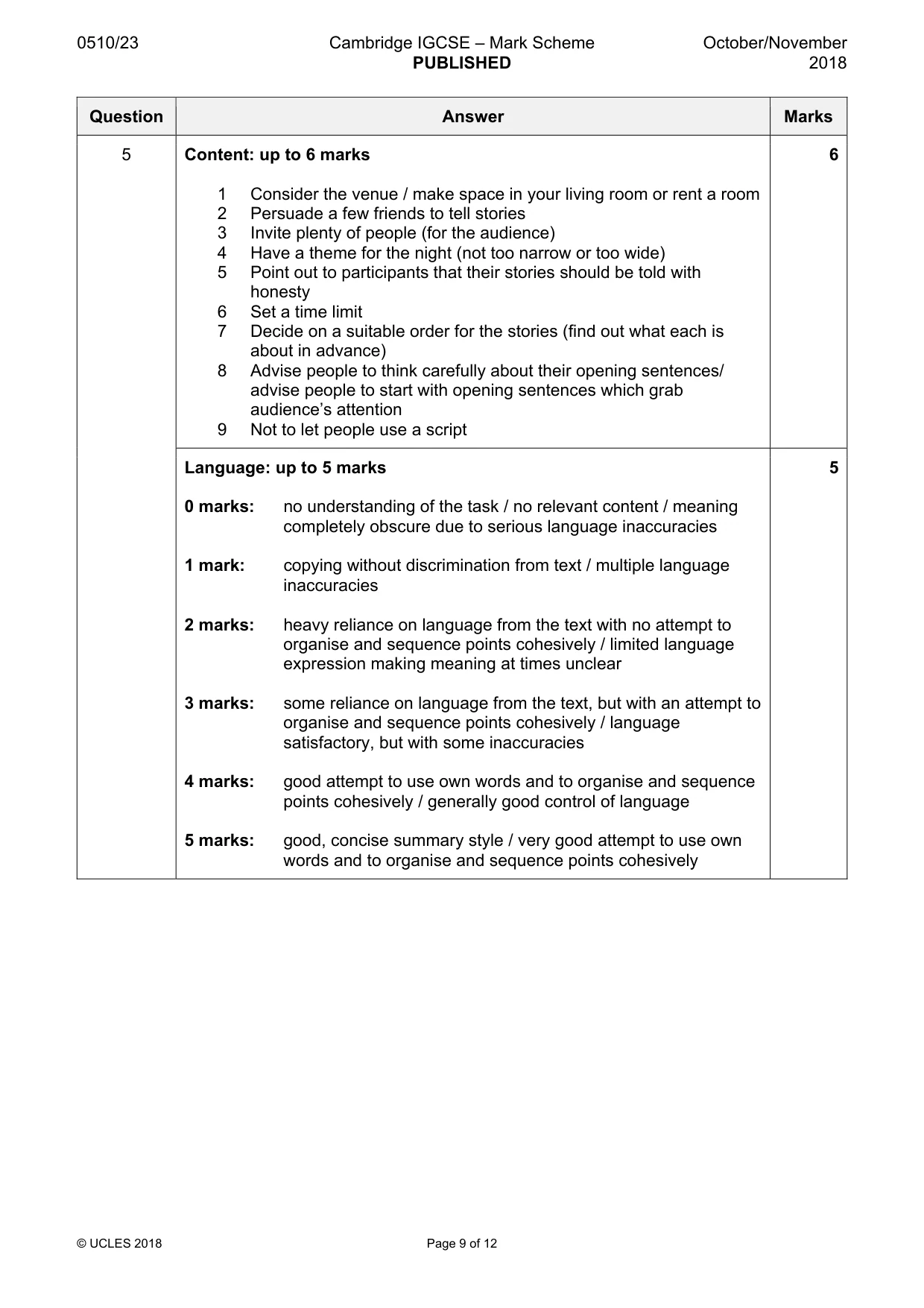
0510/23 Cambridge IGCSE – Mark Scheme PUBLISHED October/November 2018 © UCLES 2018 Page 9 of 12 Question Answer Marks 5 Content: up to 6 marks 1 Consider the venue / make space in your living room or rent a room 2 Persuade a few friends to tell stories 3 Invite plenty of people (for the audience) 4 Have a theme for the night (not too narrow or too wide) 5 Point out to participants that their stories should be told with honesty 6 Set a time limit 7 Decide on a suitable order for the stories (find out what each is about in advance) 8 Advise people to think carefully about their opening sentences/ advise people to start with opening sentences which grab audience’s attention 9 Not to let people use a script 6 Language: up to 5 marks 0 marks: no understanding of the task / no relevant content / meaning completely obscure due to serious language inaccuracies 1 mark: copying without discrimination from text / multiple language inaccuracies 2 marks: heavy reliance on language from the text with no attempt to organise and sequence points cohesively / limited language expression making meaning at times unclear 3 marks: some reliance on language from the text, but with an attempt to organise and sequence points cohesively / language satisfactory, but with some inaccuracies 4 marks: good attempt to use own words and to organise and sequence points cohesively / generally good control of language 5 marks: good, concise summary style / very good attempt to use own words and to organise and sequence points cohesively 5
Mark scheme, page 10
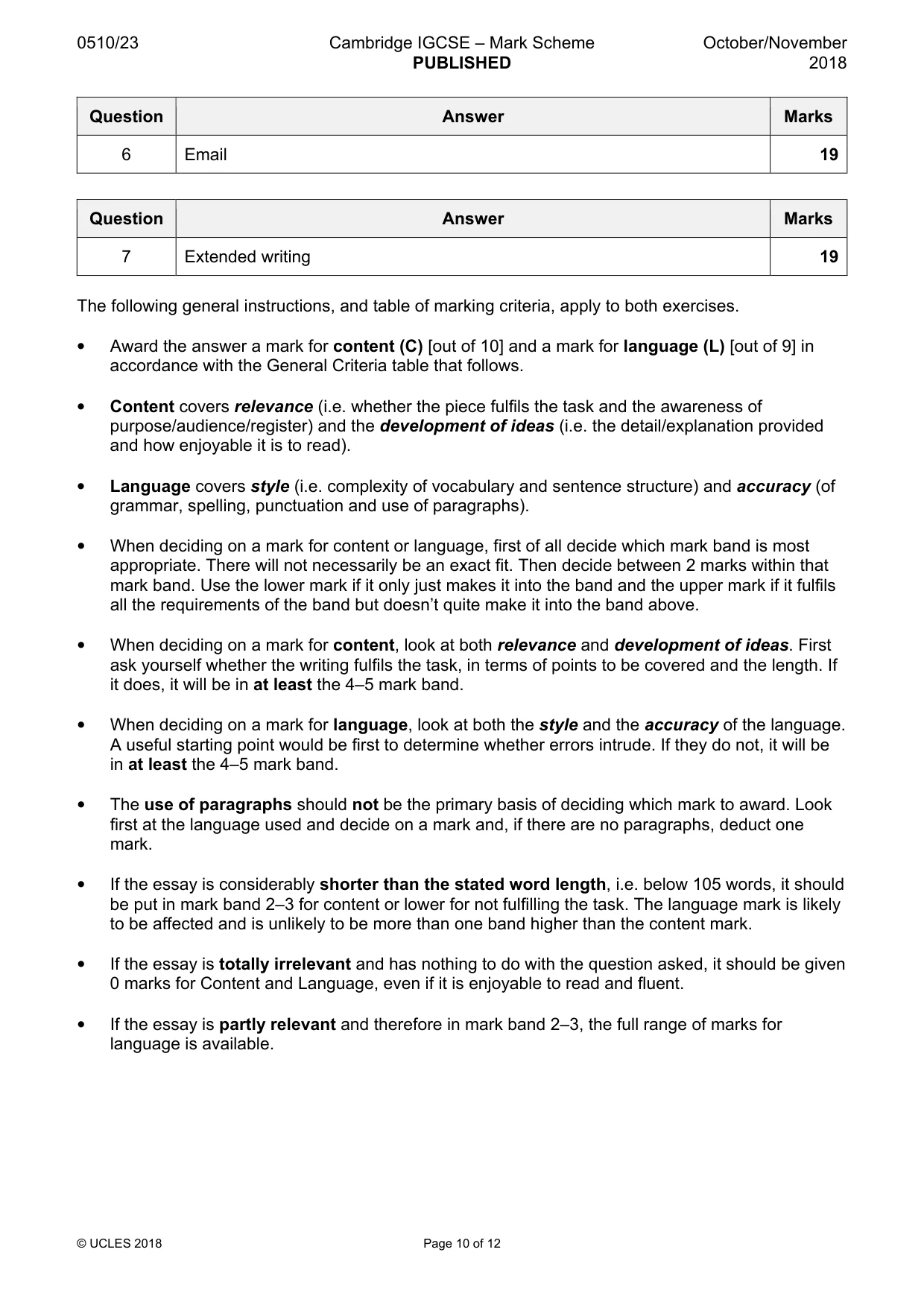
0510/23 Cambridge IGCSE – Mark Scheme PUBLISHED October/November 2018 © UCLES 2018 Page 10 of 12 Question Answer Marks 6 Email 19 Question Answer Marks 7 Extended writing 19 The following general instructions, and table of marking criteria, apply to both exercises. • Award the answer a mark for content (C) [out of 10] and a mark for language (L) [out of 9] in accordance with the General Criteria table that follows. • Content covers relevance (i.e. whether the piece fulfils the task and the awareness of purpose/audience/register) and the development of ideas (i.e. the detail/explanation provided and how enjoyable it is to read). • Language covers style (i.e. complexity of vocabulary and sentence structure) and accuracy (of grammar, spelling, punctuation and use of paragraphs). • When deciding on a mark for content or language, first of all decide which mark band is most appropriate. There will not necessarily be an exact fit. Then decide between 2 marks within that mark band. Use the lower mark if it only just makes it into the band and the upper mark if it fulfils all the requirements of the band but doesn’t quite make it into the band above. • When deciding on a mark for content, look at both relevance and development of ideas. First ask yourself whether the writing fulfils the task, in terms of points to be covered and the length. If it does, it will be in at least the 4–5 mark band. • When deciding on a mark for language, look at both the style and the accuracy of the language. A useful starting point would be first to determine whether errors intrude. If they do not, it will be in at least the 4–5 mark band. • The use of paragraphs should not be the primary basis of deciding which mark to award. Look first at the language used and decide on a mark and, if there are no paragraphs, deduct one mark. • If the essay is considerably shorter than the stated word length, i.e. below 105 words, it should be put in mark band 2–3 for content or lower for not fulfilling the task. The language mark is likely to be affected and is unlikely to be more than one band higher than the content mark. • If the essay is totally irrelevant and has nothing to do with the question asked, it should be given 0 marks for Content and Language, even if it is enjoyable to read and fluent. • If the essay is partly relevant and therefore in mark band 2–3, the full range of marks for language is available.
Mark scheme, page 11
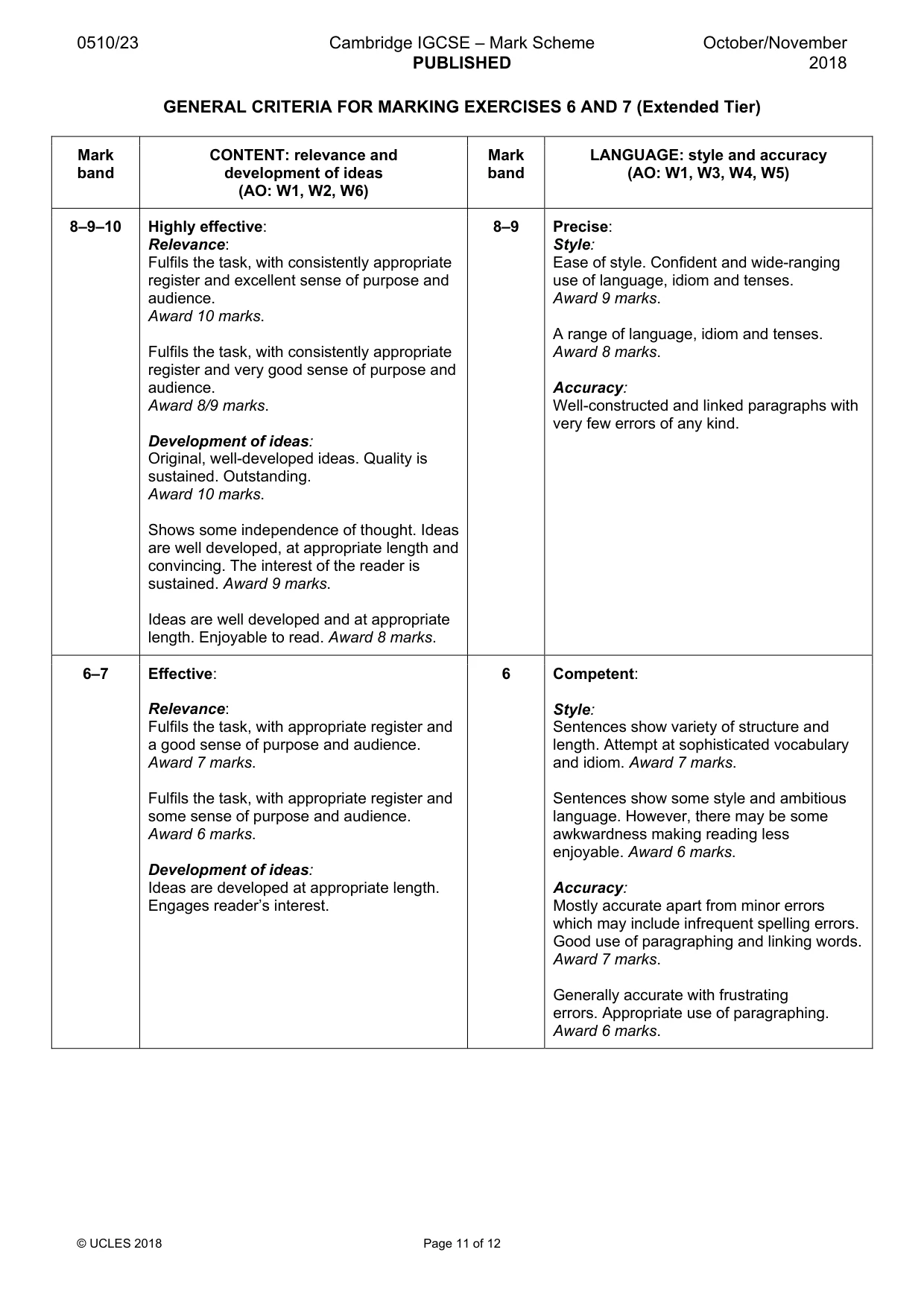
0510/23 Cambridge IGCSE – Mark Scheme PUBLISHED October/November 2018 © UCLES 2018 Page 11 of 12 GENERAL CRITERIA FOR MARKING EXERCISES 6 AND 7 (Extended Tier) Mark band CONTENT: relevance and development of ideas (AO: W1, W2, W6) Mark band LANGUAGE: style and accuracy (AO: W1, W3, W4, W5) 8–9–10 Highly effective: Relevance: Fulfils the task, with consistently appropriate register and excellent sense of purpose and audience. Award 10 marks. Fulfils the task, with consistently appropriate register and very good sense of purpose and audience. Award 8/9 marks. Development of ideas: Original, well-developed ideas. Quality is sustained. Outstanding. Award 10 marks. Shows some independence of thought. Ideas are well developed, at appropriate length and convincing. The interest of the reader is sustained. Award 9 marks. Ideas are well developed and at appropriate length. Enjoyable to read. Award 8 marks. 8–9 Precise: Style: Ease of style. Confident and wide-ranging use of language, idiom and tenses. Award 9 marks. A range of language, idiom and tenses. Award 8 marks. Accuracy: Well-constructed and linked paragraphs with very few errors of any kind. 6–7 Effective: Relevance: Fulfils the task, with appropriate register and a good sense of purpose and audience. Award 7 marks. Fulfils the task, with appropriate register and some sense of purpose and audience. Award 6 marks. Development of ideas: Ideas are developed at appropriate length. Engages reader’s interest. 6 Competent: Style: Sentences show variety of structure and length. Attempt at sophisticated vocabulary and idiom. Award 7 marks. Sentences show some style and ambitious language. However, there may be some awkwardness making reading less enjoyable. Award 6 marks. Accuracy: Mostly accurate apart from minor errors which may include infrequent spelling errors. Good use of paragraphing and linking words. Award 7 marks. Generally accurate with frustrating errors. Appropriate use of paragraphing. Award 6 marks.
Mark scheme, page 12
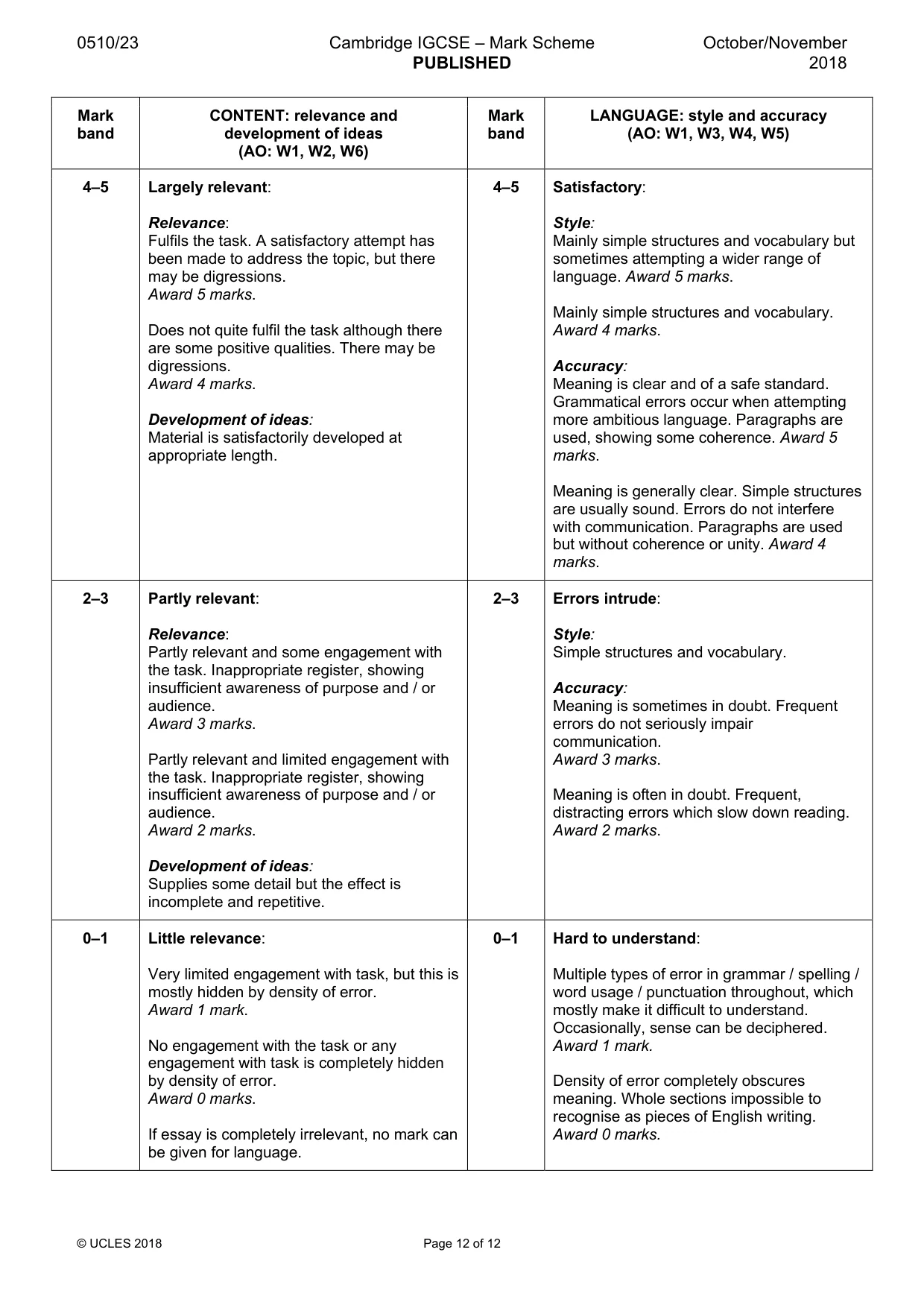
0510/23 Cambridge IGCSE – Mark Scheme PUBLISHED October/November 2018 © UCLES 2018 Page 12 of 12 Mark band CONTENT: relevance and development of ideas (AO: W1, W2, W6) Mark band LANGUAGE: style and accuracy (AO: W1, W3, W4, W5) 4–5 Largely relevant: Relevance: Fulfils the task. A satisfactory attempt has been made to address the topic, but there may be digressions. Award 5 marks. Does not quite fulfil the task although there are some positive qualities. There may be digressions. Award 4 marks. Development of ideas: Material is satisfactorily developed at appropriate length. 4–5 Satisfactory: Style: Mainly simple structures and vocabulary but sometimes attempting a wider range of language. Award 5 marks. Mainly simple structures and vocabulary. Award 4 marks. Accuracy: Meaning is clear and of a safe standard. Grammatical errors occur when attempting more ambitious language. Paragraphs are used, showing some coherence. Award 5 marks. Meaning is generally clear. Simple structures are usually sound. Errors do not interfere with communication. Paragraphs are used but without coherence or unity. Award 4 marks. 2–3 Partly relevant: Relevance: Partly relevant and some engagement with the task. Inappropriate register, showing insufficient awareness of purpose and / or audience. Award 3 marks. Partly relevant and limited engagement with the task. Inappropriate register, showing insufficient awareness of purpose and / or audience. Award 2 marks. Development of ideas: Supplies some detail but the effect is incomplete and repetitive. 2–3 Errors intrude: Style: Simple structures and vocabulary. Accuracy: Meaning is sometimes in doubt. Frequent errors do not seriously impair communication. Award 3 marks. Meaning is often in doubt. Frequent, distracting errors which slow down reading. Award 2 marks. 0–1 Little relevance: Very limited engagement with task, but this is mostly hidden by density of error. Award 1 mark. No engagement with the task or any engagement with task is completely hidden by density of error. Award 0 marks. If essay is completely irrelevant, no mark can be given for language. 0–1 Hard to understand: Multiple types of error in grammar / spelling / word usage / punctuation throughout, which mostly make it difficult to understand. Occasionally, sense can be deciphered. Award 1 mark. Density of error completely obscures meaning. Whole sections impossible to recognise as pieces of English writing. Award 0 marks.
What you needed in this session
Cambridge’s own grade thresholds for 2018 Oct/Nov, Paper 2 · Variant 3. A higher threshold means an easier paper — the bar moves with how the cohort did.