Cambridge IGCSE English - Second Language (oral endorsement) 0510 — 2024 Oct/Nov Paper 2 · Variant 3
0510/23/O/N/24 · 40 marks · ≈45 min
The question paper and its mark scheme, free to read here and free to download. This is Cambridge’s own paper, exactly as it was sat.
Question paper16 pages
Mark scheme3 pages
Answers below. Sit the paper first if you are practising.
Paper as text
Question paper, page 1
This document has 16 pages. Any blank pages are indicated. [Turn over Cambridge IGCSE™ * 6 6 0 7 3 1 6 0 8 9 * DC (DE/CT) 326335/3 © UCLES 2024 ENGLISH AS A SECOND LANGUAGE 0510/23 Paper 2 Listening October/November 2024 Approximately 50 minutes (including 6 minutes’ transfer time) You must transfer your answers onto the multiple choice answer sheet. You will need: Multiple choice answer sheet Soft clean eraser Soft pencil (type B or HB is recommended) INSTRUCTIONS ● There are 40 questions on this paper. Answer all questions. ● You will have 6 minutes to transfer your answers from the question paper onto the multiple choice answer sheet. ● Follow the instructions on the multiple choice answer sheet. Shade one letter only for Questions 1 to 40. ● Write in soft pencil. ● Write your name, centre number and candidate number on the multiple choice answer sheet in the spaces provided unless this has been done for you. ● Do not use correction fluid. ● Do not write on any bar codes. ● Dictionaries are not allowed. INFORMATION ● The total mark for this paper is 40. ● Each correct answer will score one mark. ● Any rough working should be done on this question paper.
Question paper, page 2
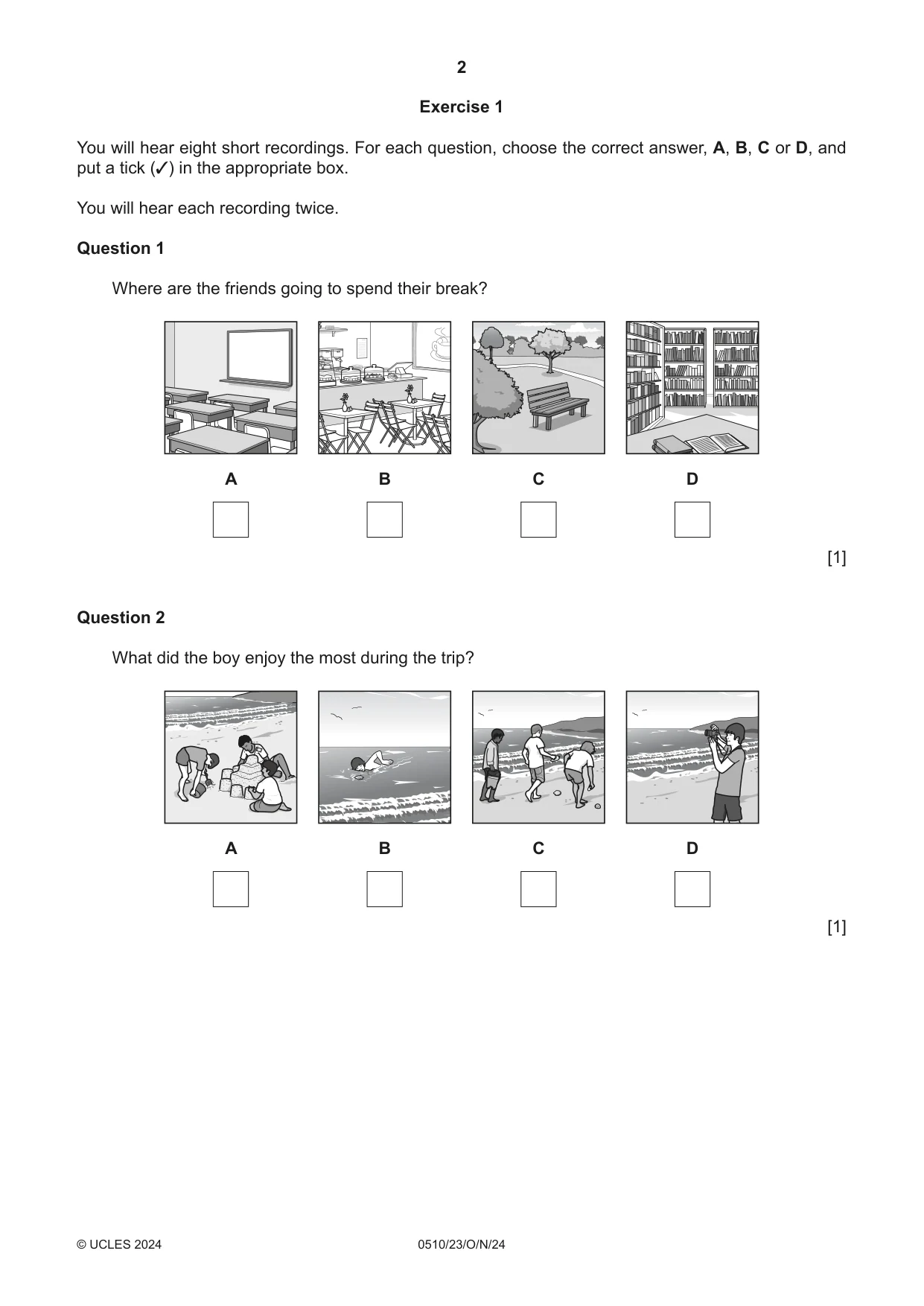
2 0510/23/ O/N/24 © UCLES 2024 Exercise 1 You will hear eight short recordings. For each question, choose the correct answer, A, B, C or D, and put a tick (✓) in the appropriate box. You will hear each recording twice. Question 1 Where are the friends going to spend their break? A B C D [1] Question 2 What did the boy enjoy the most during the trip? A B C D [1]
Question paper, page 3
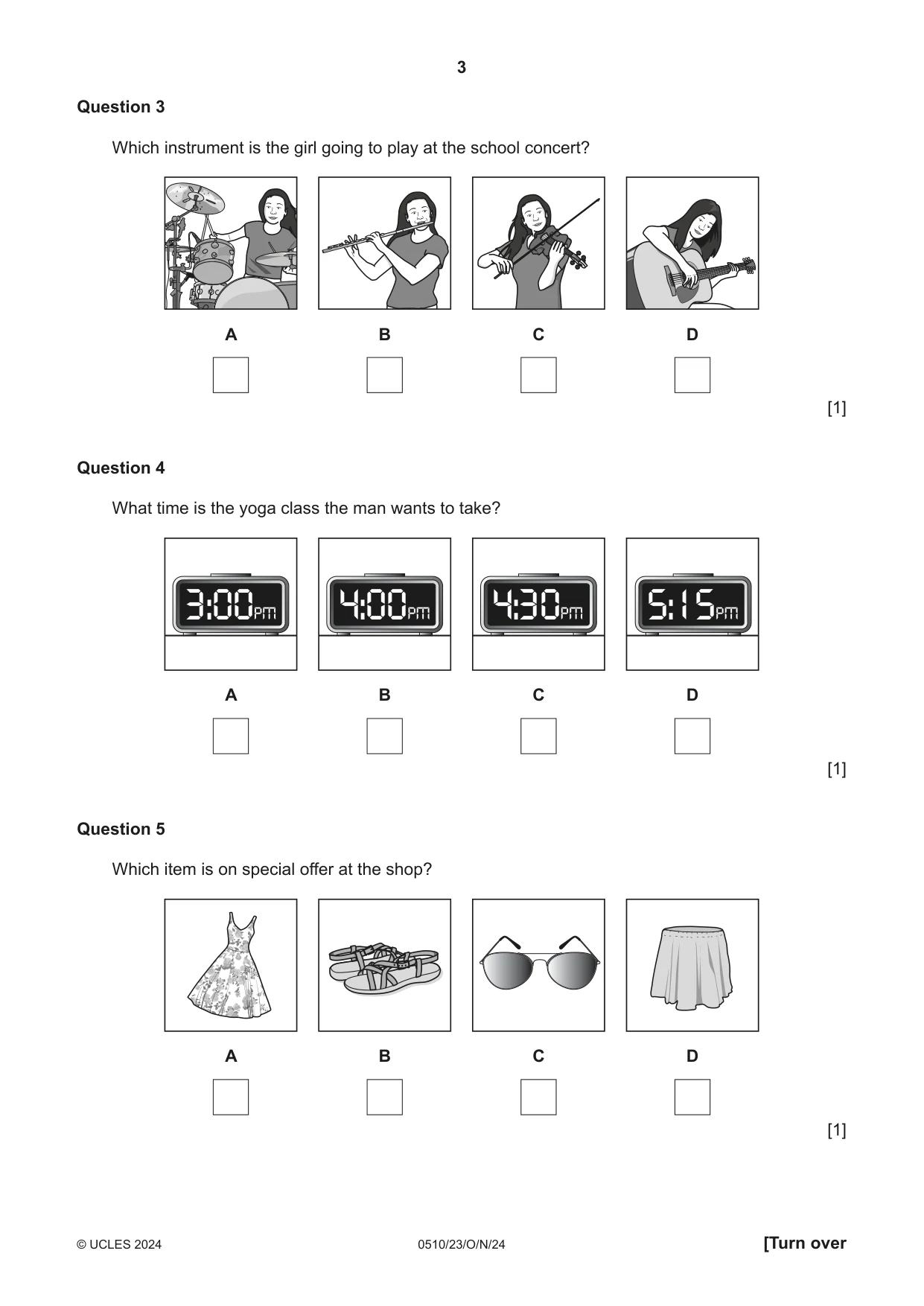
3 0510/23/ O/N/24 © UCLES 2024 [Turn over Question 3 Which instrument is the girl going to play at the school concert? A B C D [1] Question 4 What time is the yoga class the man wants to take? 4:00pm 4:30pm 5:15pm 3:00pm A B C D [1] Question 5 Which item is on special offer at the shop? A B C D [1]
Question paper, page 4
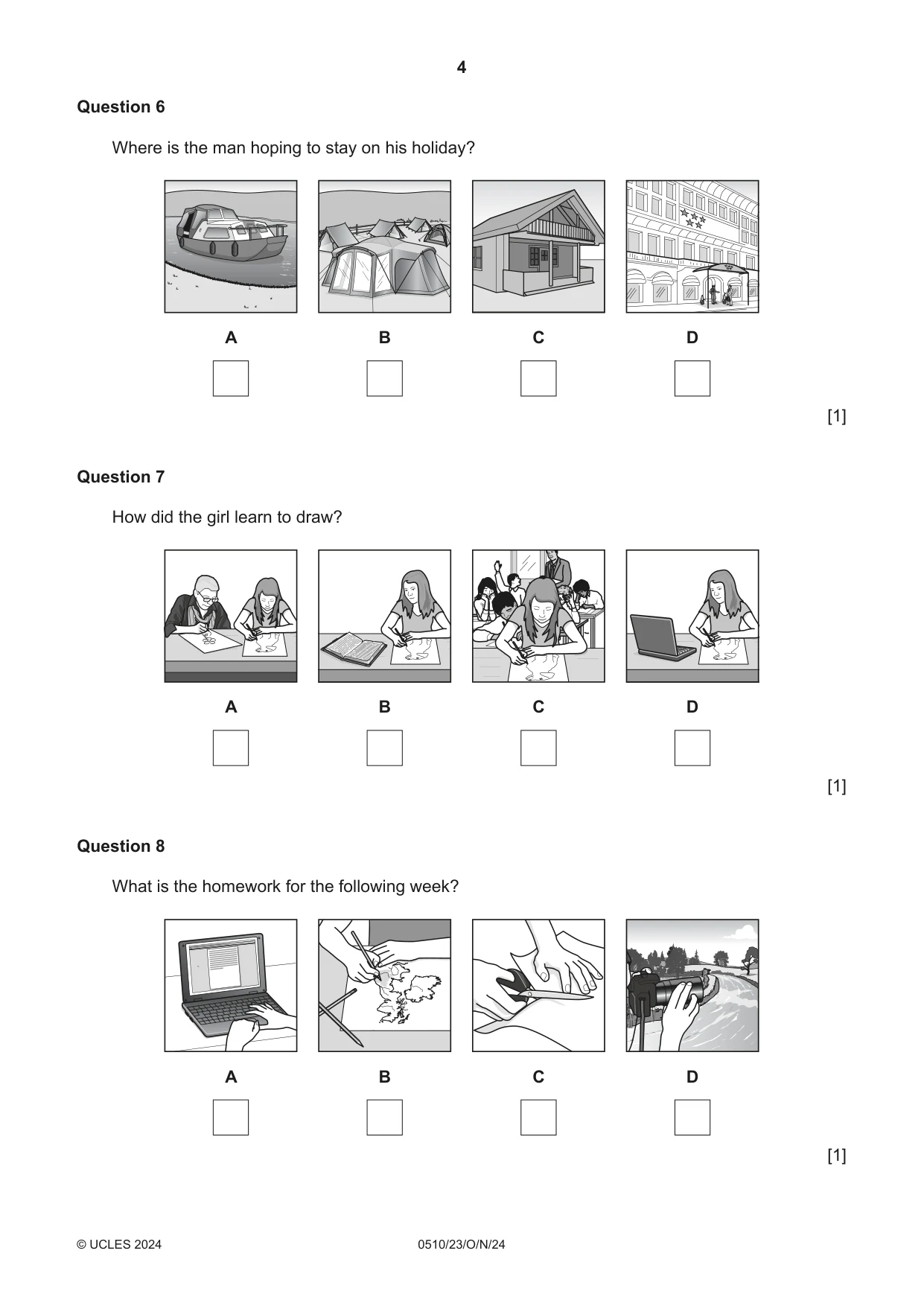
4 0510/23/ O/N/24 © UCLES 2024 Question 6 Where is the man hoping to stay on his holiday? A B C D [1] Question 7 How did the girl learn to draw? A B C D [1] Question 8 What is the homework for the following week? A B C D [1]
Question paper, page 5
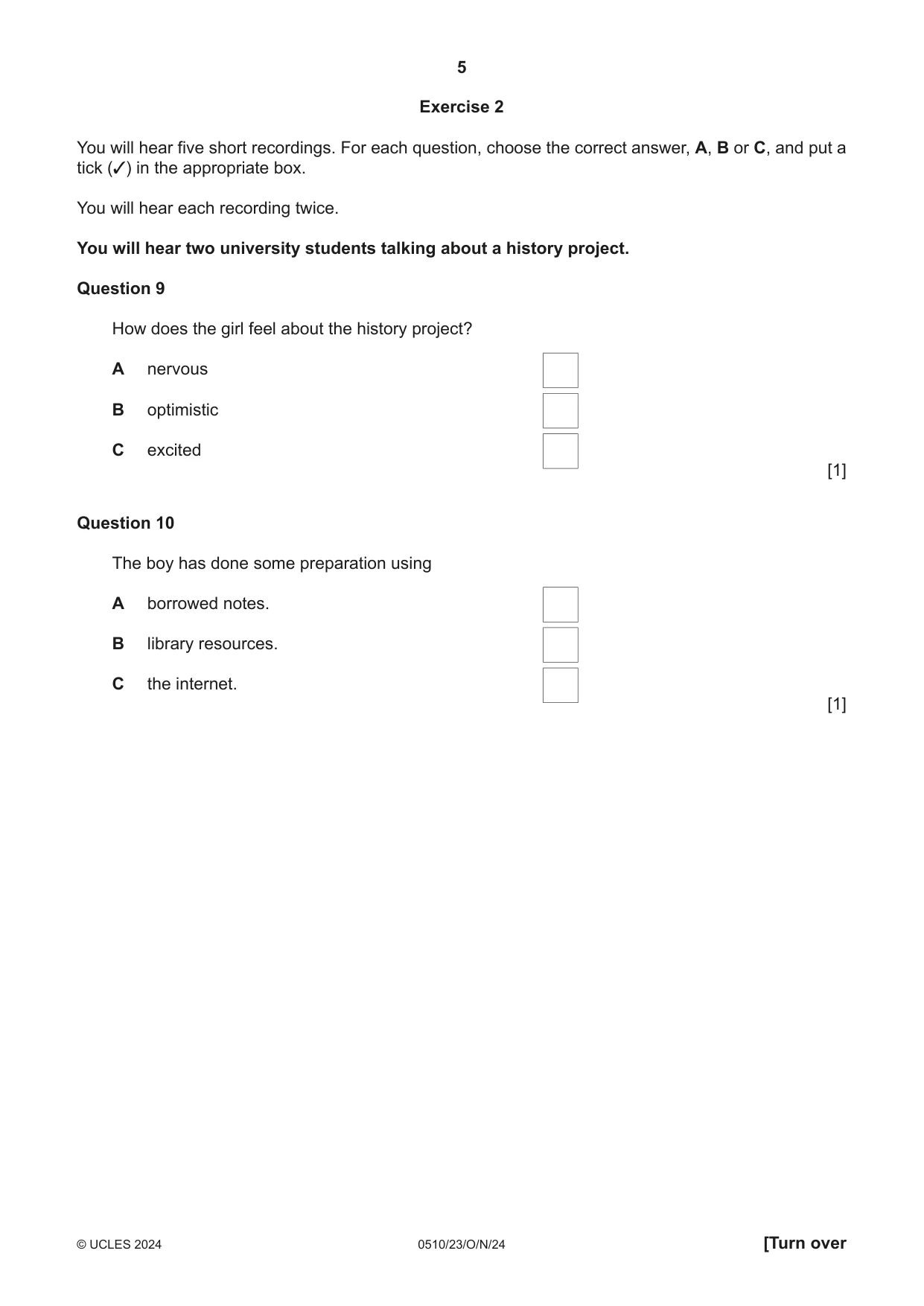
5 0510/23/O/N/24 © UCLES 2024 [Turn over Exercise 2 You will hear five short recordings. For each question, choose the correct answer, A, B or C, and put a tick (✓) in the appropriate box. You will hear each recording twice. You will hear two university students talking about a history project. Question 9 How does the girl feel about the history project? A nervous B optimistic C excited [1] Question 10 The boy has done some preparation using A borrowed notes. B library resources. C the internet. [1]
Question paper, page 6
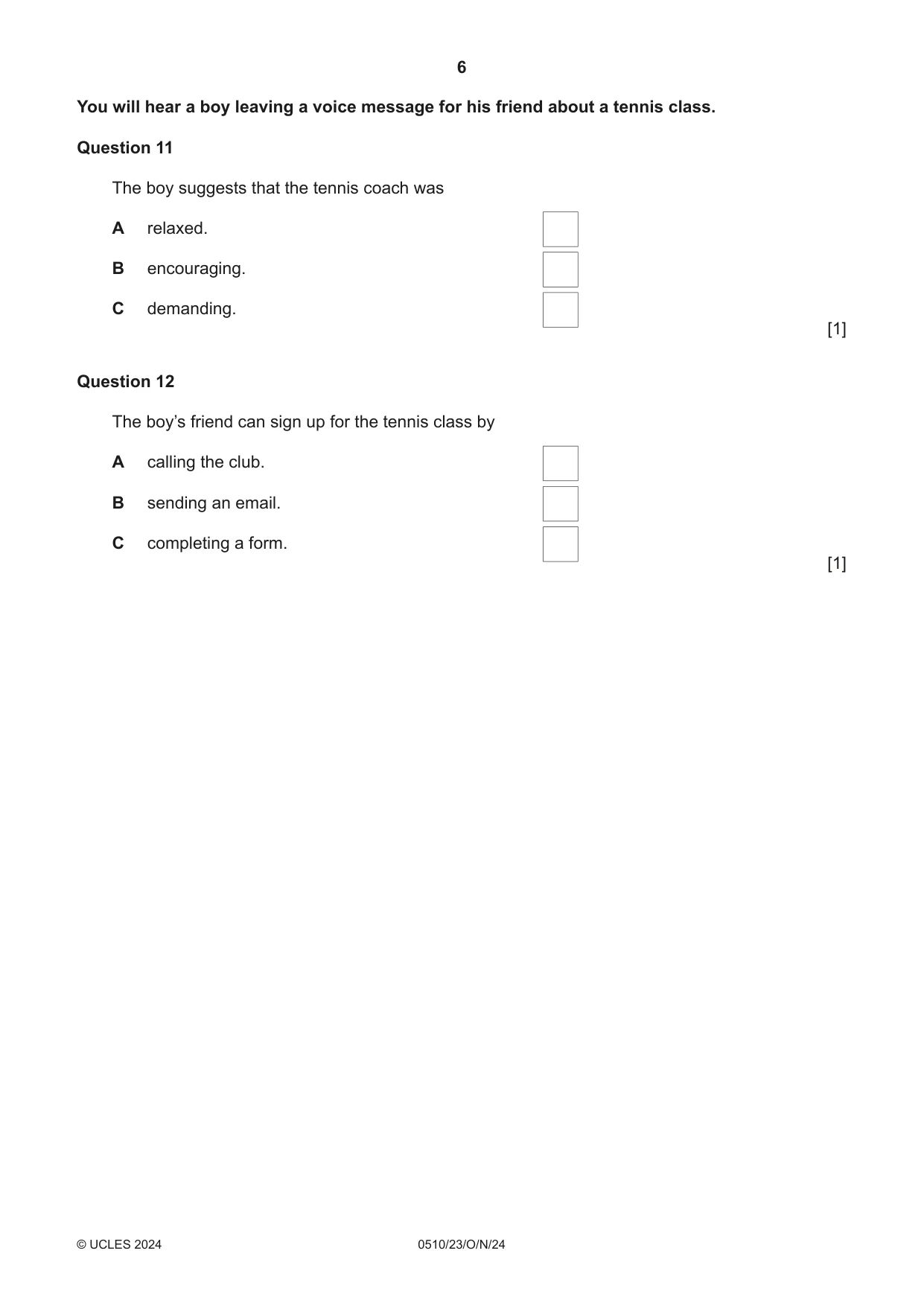
6 0510/23/O/N/24 © UCLES 2024 You will hear a boy leaving a voice message for his friend about a tennis class. Question 11 The boy suggests that the tennis coach was A relaxed. B encouraging. C demanding. [1] Question 12 The boy’s friend can sign up for the tennis class by A calling the club. B sending an email. C completing a form. [1]
Question paper, page 7
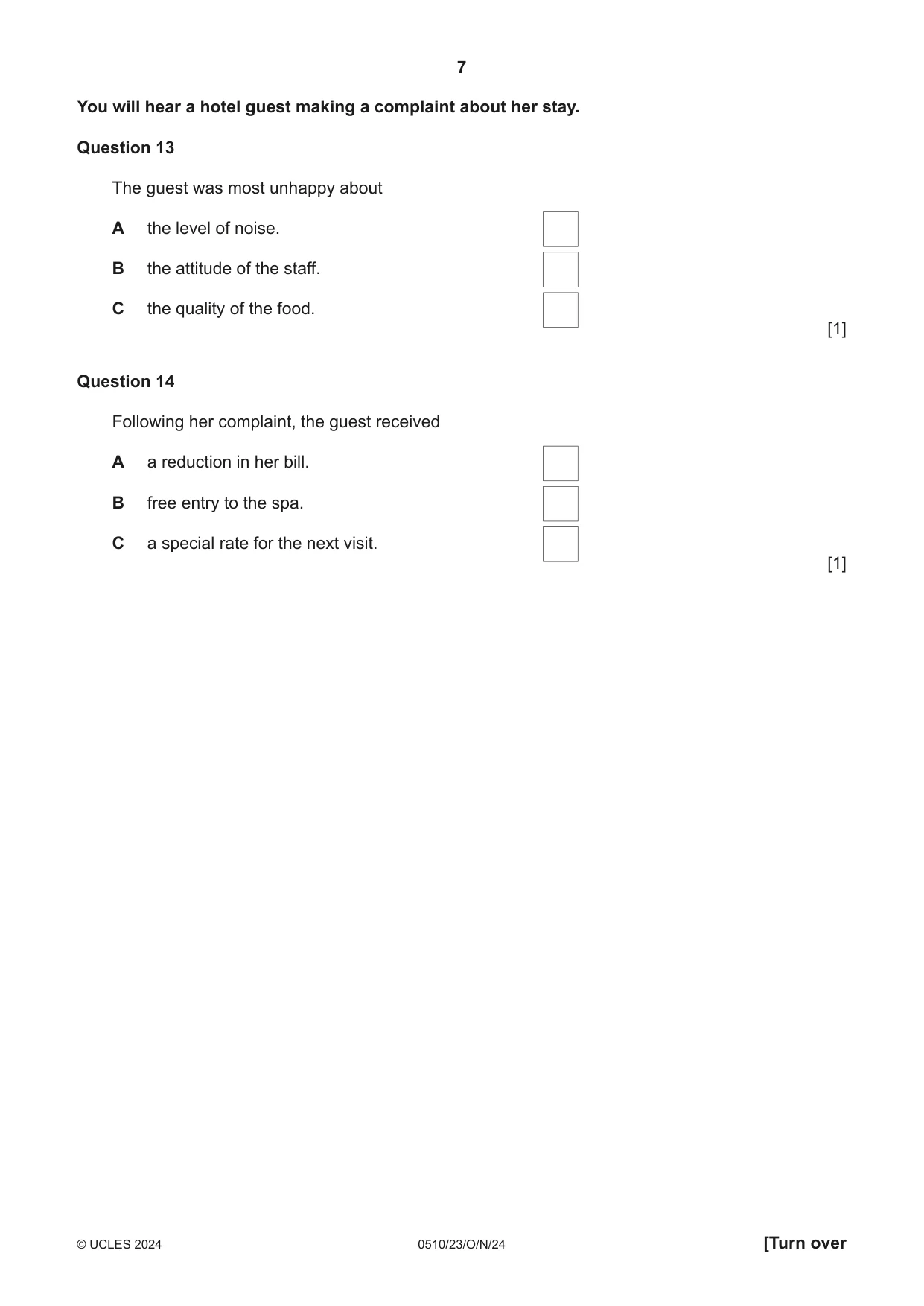
7 0510/23/O/N/24 © UCLES 2024 [Turn over You will hear a hotel guest making a complaint about her stay. Question 13 The guest was most unhappy about A the level of noise. B the attitude of the staff. C the quality of the food. [1] Question 14 Following her complaint, the guest received A a reduction in her bill. B free entry to the spa. C a special rate for the next visit. [1]
Question paper, page 8
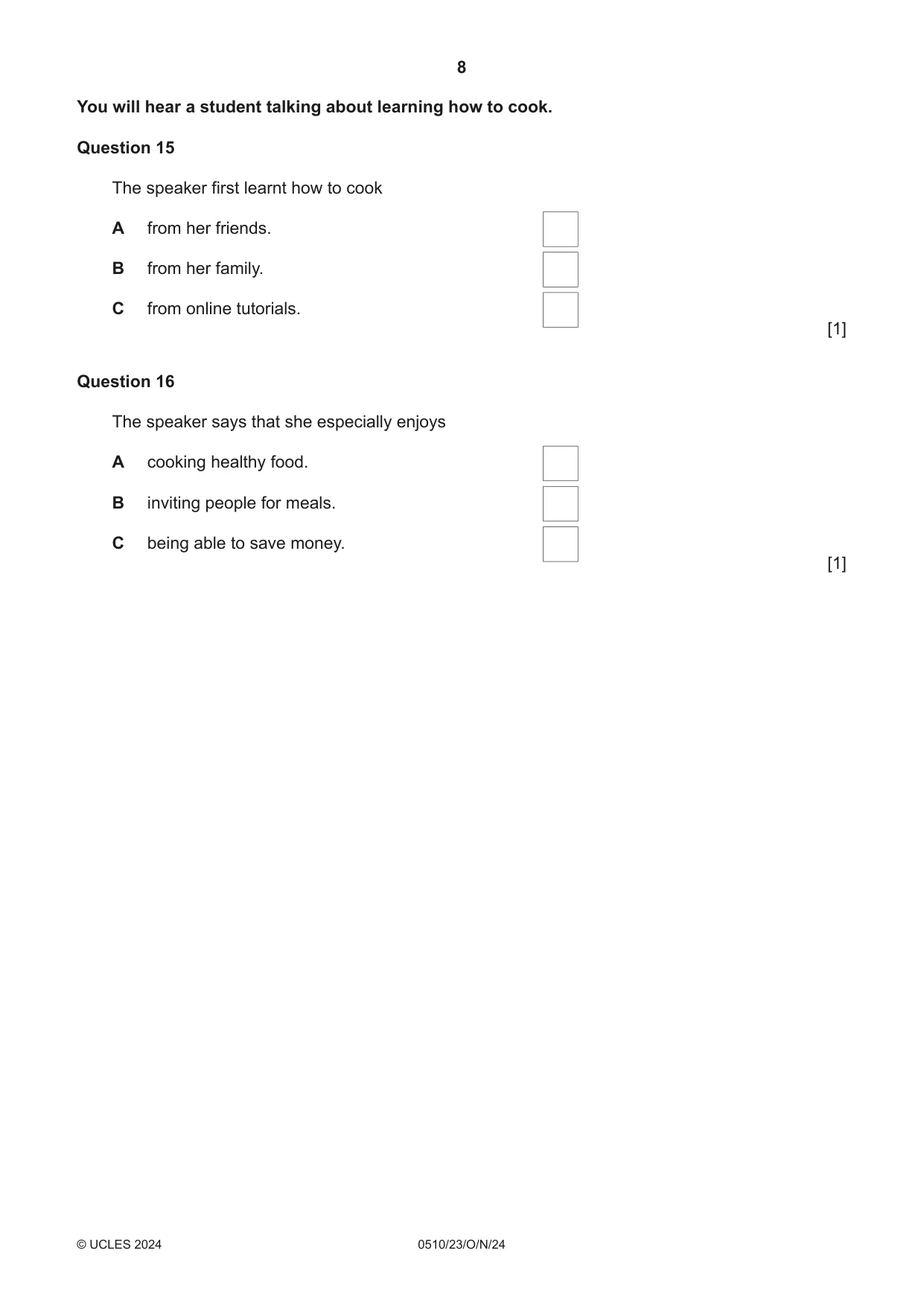
8 0510/23/O/N/24 © UCLES 2024 You will hear a student talking about learning how to cook. Question 15 The speaker first learnt how to cook A from her friends. B from her family. C from online tutorials. [1] Question 16 The speaker says that she especially enjoys A cooking healthy food. B inviting people for meals. C being able to save money. [1]
Question paper, page 9
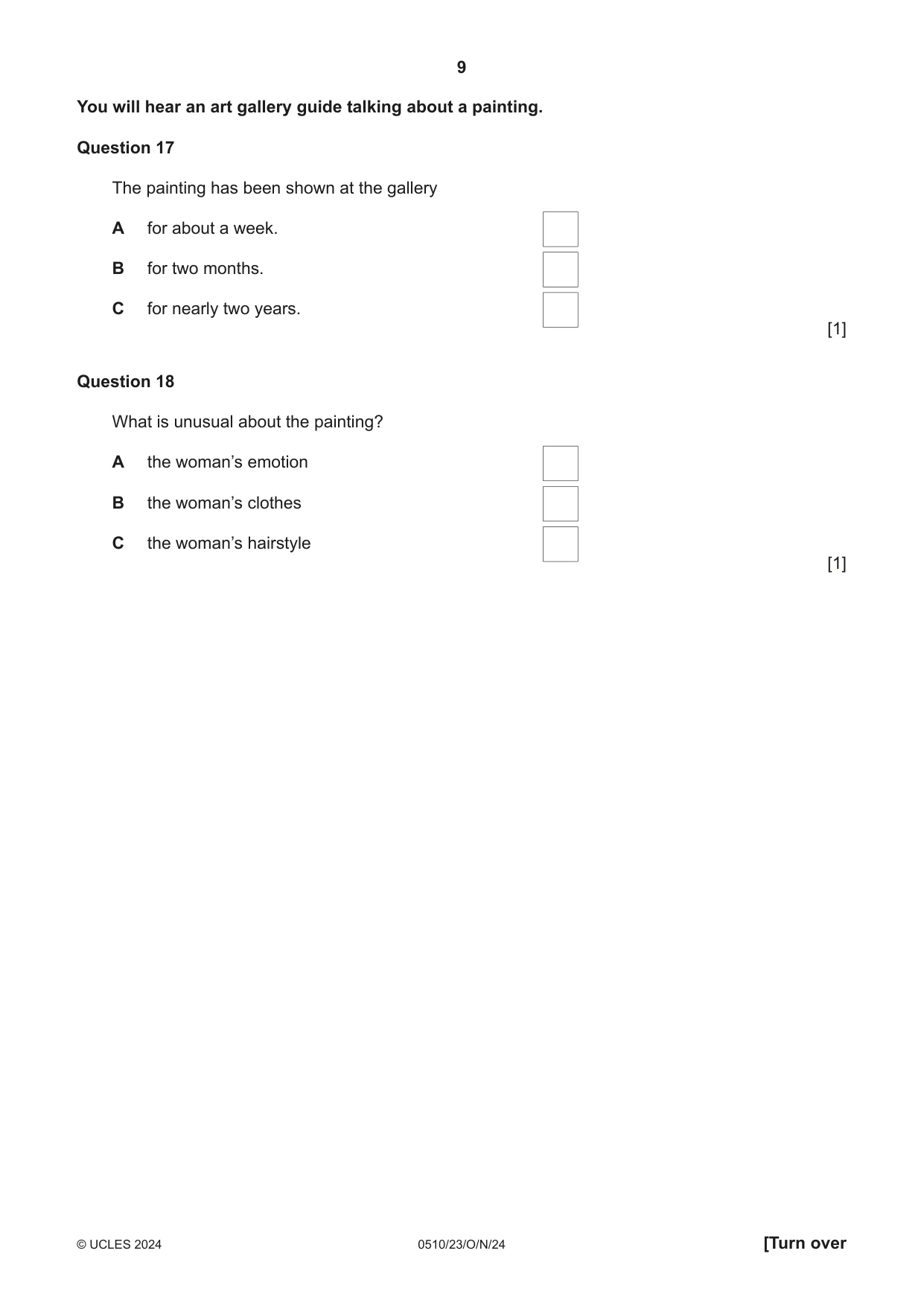
9 0510/23/O/N/24 © UCLES 2024 [Turn over You will hear an art gallery guide talking about a painting. Question 17 The painting has been shown at the gallery A for about a week. B for two months. C for nearly two years. [1] Question 18 What is unusual about the painting? A the woman’s emotion B the woman’s clothes C the woman’s hairstyle [1]
Question paper, page 10
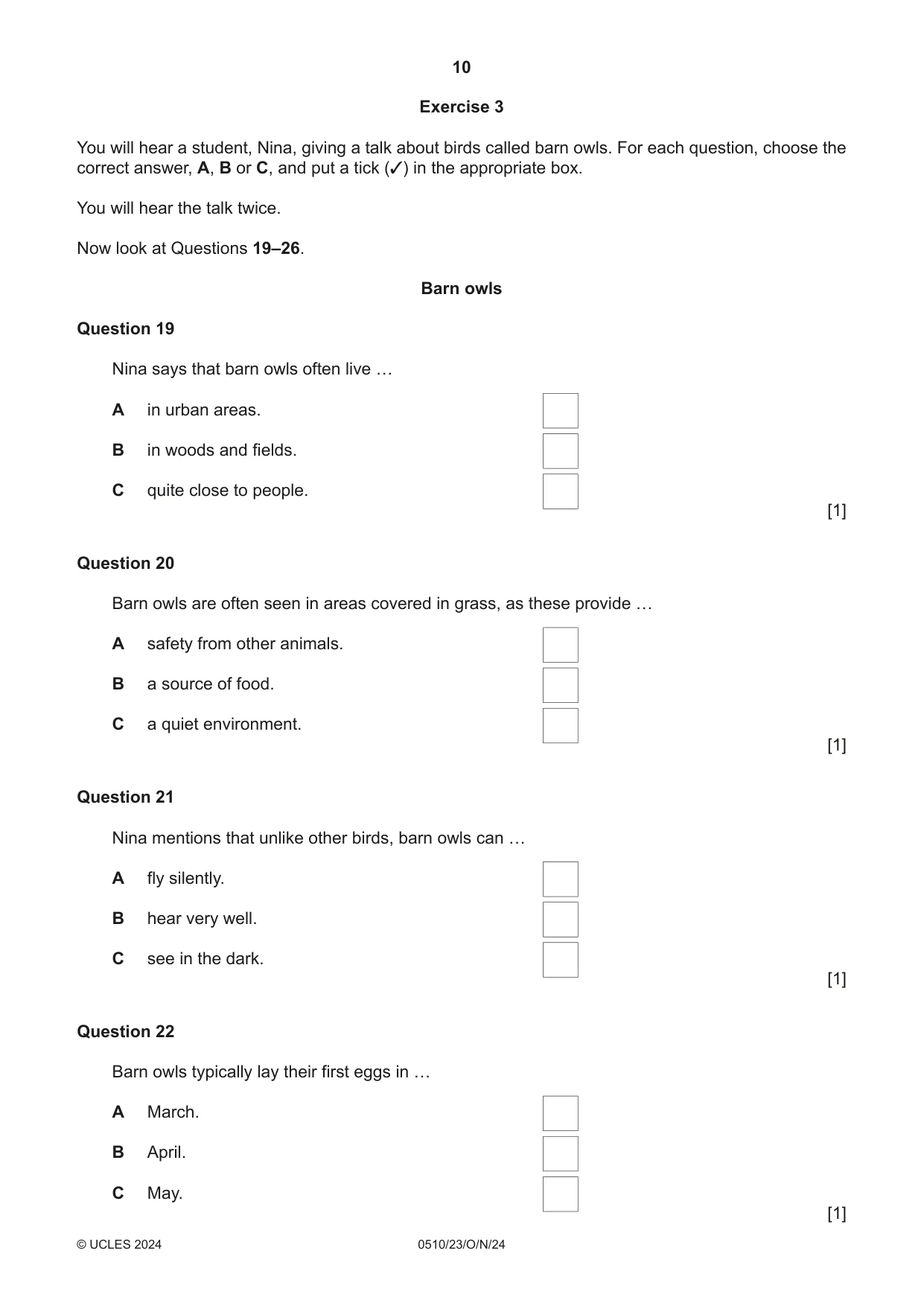
10 0510/23/O/N/24 © UCLES 2024 Exercise 3 You will hear a student, Nina, giving a talk about birds called barn owls. For each question, choose the correct answer, A, B or C, and put a tick (✓) in the appropriate box. You will hear the talk twice. Now look at Questions 19–26. Barn owls Question 19 Nina says that barn owls often live … A in urban areas. B in woods and fields. C quite close to people. [1] Question 20 Barn owls are often seen in areas covered in grass, as these provide … A safety from other animals. B a source of food. C a quiet environment. [1] Question 21 Nina mentions that unlike other birds, barn owls can … A fly silently. B hear very well. C see in the dark. [1] Question 22 Barn owls typically lay their first eggs in … A March. B April. C May. [1]
Question paper, page 11
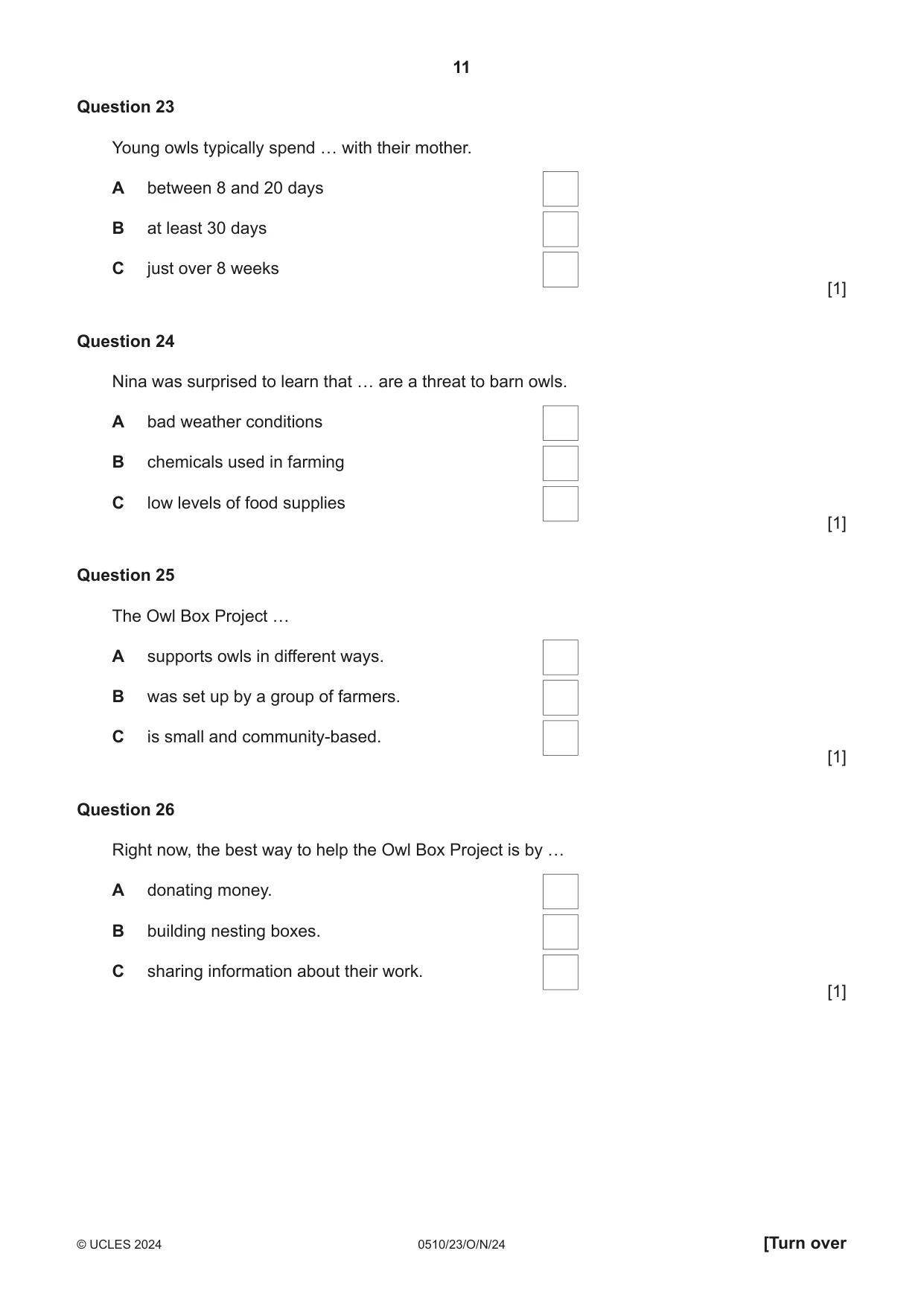
11 0510/23/O/N/24 © UCLES 2024 [Turn over Question 23 Young owls typically spend … with their mother. A between 8 and 20 days B at least 30 days C just over 8 weeks [1] Question 24 Nina was surprised to learn that … are a threat to barn owls. A bad weather conditions B chemicals used in farming C low levels of food supplies [1] Question 25 The Owl Box Project … A supports owls in different ways. B was set up by a group of farmers. C is small and community-based. [1] Question 26 Right now, the best way to help the Owl Box Project is by … A donating money. B building nesting boxes. C sharing information about their work. [1]
Question paper, page 12
12 0510/23/O/N/24 © UCLES 2024 BLANK PAGE
Question paper, page 13
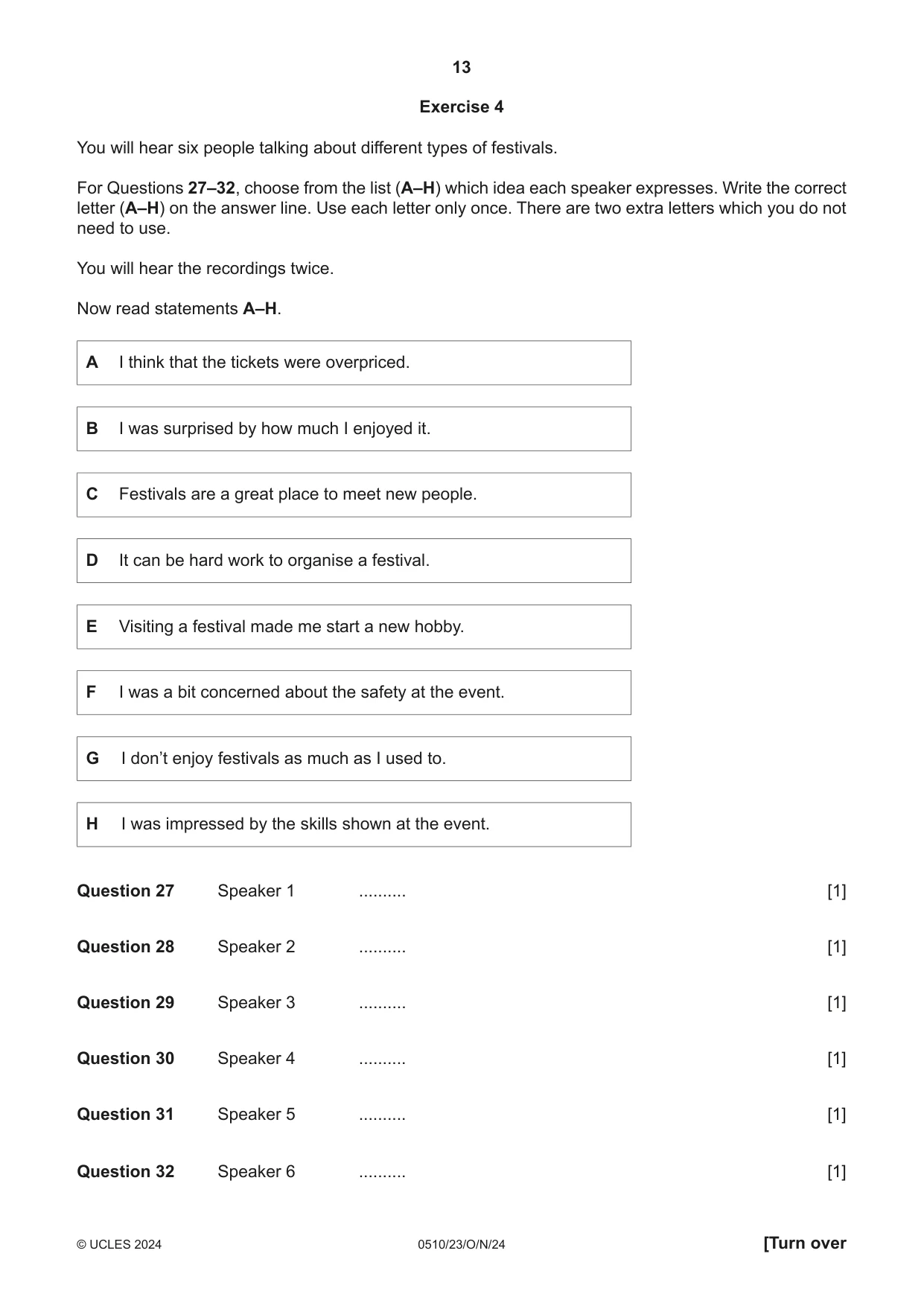
13 0510/23/O/N/24 © UCLES 2024 [Turn over Exercise 4 You will hear six people talking about different types of festivals. For Questions 27–32, choose from the list (A–H) which idea each speaker expresses. Write the correct letter (A–H) on the answer line. Use each letter only once. There are two extra letters which you do not need to use. You will hear the recordings twice. Now read statements A–H. A I think that the tickets were overpriced. B I was surprised by how much I enjoyed it. C Festivals are a great place to meet new people. D It can be hard work to organise a festival. E Visiting a festival made me start a new hobby. F I was a bit concerned about the safety at the event. G I don’t enjoy festivals as much as I used to. H I was impressed by the skills shown at the event. Question 27 Speaker 1 … [1] Question 28 Speaker 2 … [1] Question 29 Speaker 3 … [1] Question 30 Speaker 4 … [1] Question 31 Speaker 5 … [1] Question 32 Speaker 6 … [1]
Question paper, page 14
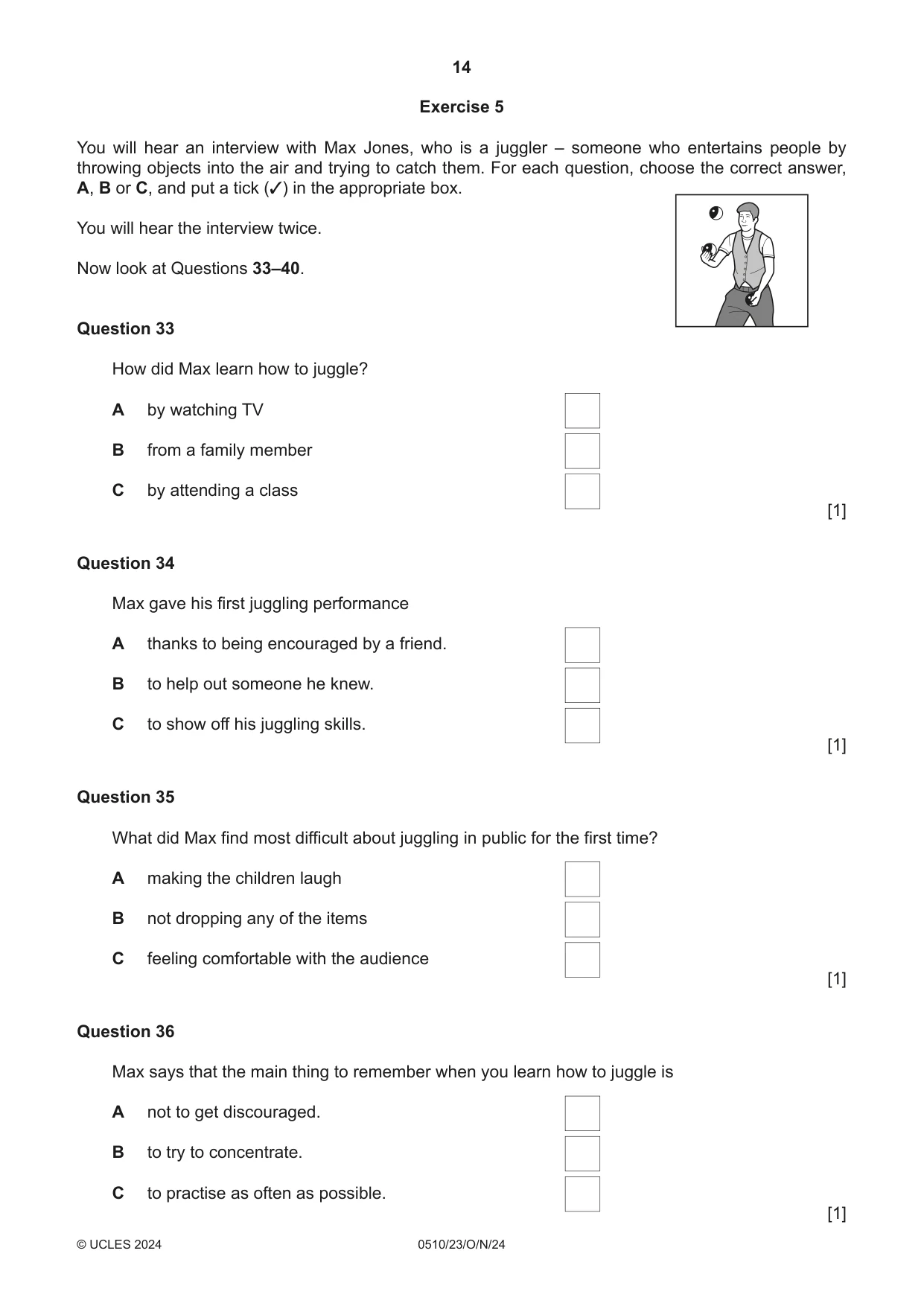
14 0510/23/O/N/24 © UCLES 2024 Exercise 5 You will hear an interview with Max Jones, who is a juggler – someone who entertains people by throwing objects into the air and trying to catch them. For each question, choose the correct answer, A, B or C, and put a tick (✓) in the appropriate box. You will hear the interview twice. Now look at Questions 33–40. Question 33 How did Max learn how to juggle? A by watching TV B from a family member C by attending a class [1] Question 34 Max gave his first juggling performance A thanks to being encouraged by a friend. B to help out someone he knew. C to show off his juggling skills. [1] Question 35 What did Max find most difficult about juggling in public for the first time? A making the children laugh B not dropping any of the items C feeling comfortable with the audience [1] Question 36 Max says that the main thing to remember when you learn how to juggle is A not to get discouraged. B to try to concentrate. C to practise as often as possible. [1]
Question paper, page 15
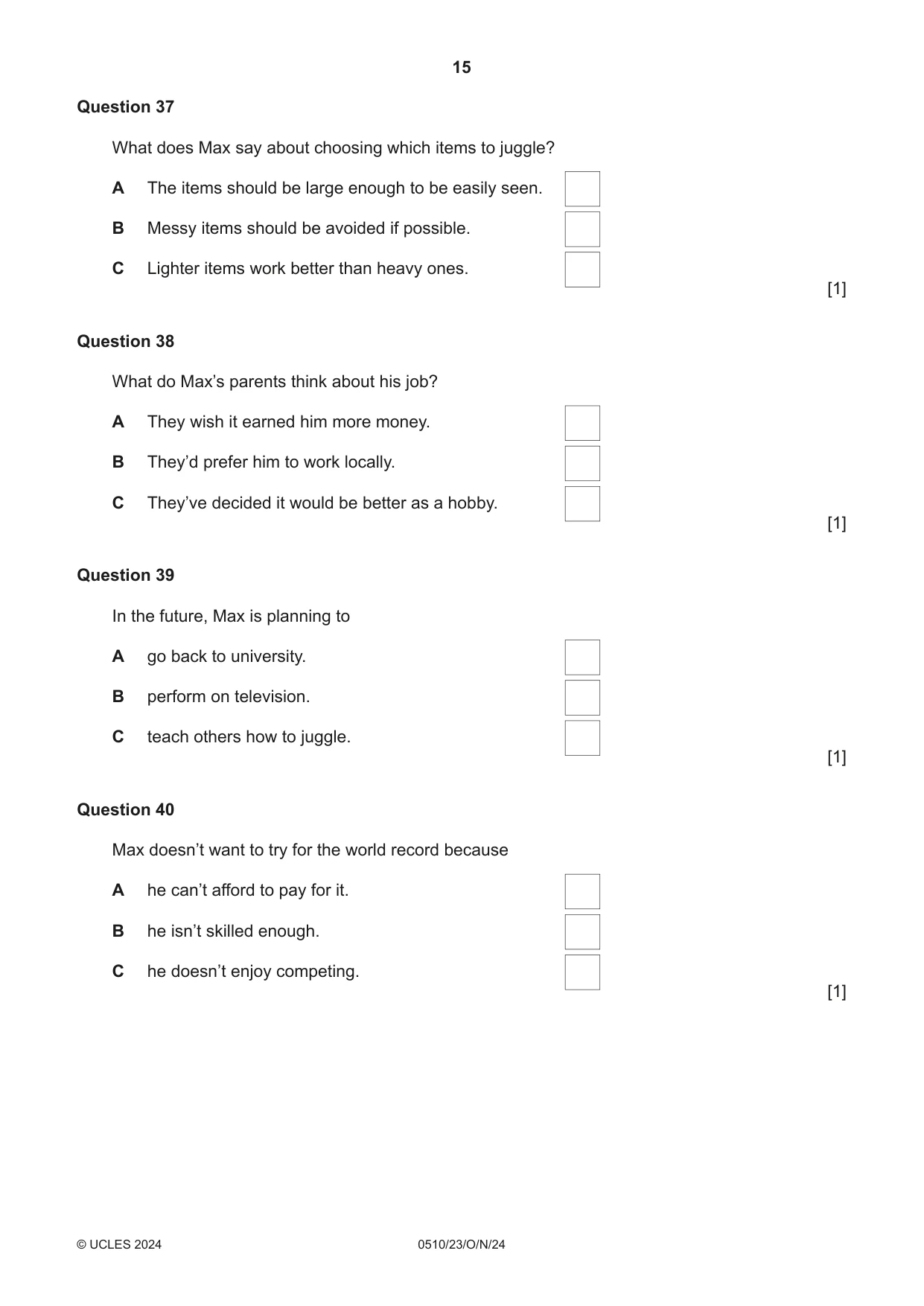
15 0510/23/O/N/24 © UCLES 2024 Question 37 What does Max say about choosing which items to juggle? A The items should be large enough to be easily seen. B Messy items should be avoided if possible. C Lighter items work better than heavy ones. [1] Question 38 What do Max’s parents think about his job? A They wish it earned him more money. B They’d prefer him to work locally. C They’ve decided it would be better as a hobby. [1] Question 39 In the future, Max is planning to A go back to university. B perform on television. C teach others how to juggle. [1] Question 40 Max doesn’t want to try for the world record because A he can’t afford to pay for it. B he isn’t skilled enough. C he doesn’t enjoy competing. [1]
Question paper, page 16
16 0510/23/O/N/24 © UCLES 2024 BLANK PAGE Permission to reproduce items where third-party owned material protected by copyright is included has been sought and cleared where possible. Every reasonable effort has been made by the publisher (UCLES) to trace copyright holders, but if any items requiring clearance have unwittingly been included, the publisher will be pleased to make amends at the earliest possible opportunity. To avoid the issue of disclosure of answer-related information to candidates, all copyright acknowledgements are reproduced online in the Cambridge Assessment International Education Copyright Acknowledgements Booklet. This is produced for each series of examinations and is freely available to download at www.cambridgeinternational.org after the live examination series. Cambridge Assessment International Education is part of Cambridge Assessment. Cambridge Assessment is the brand name of the University of Cambridge Local Examinations Syndicate (UCLES), which is a department of the University of Cambridge.
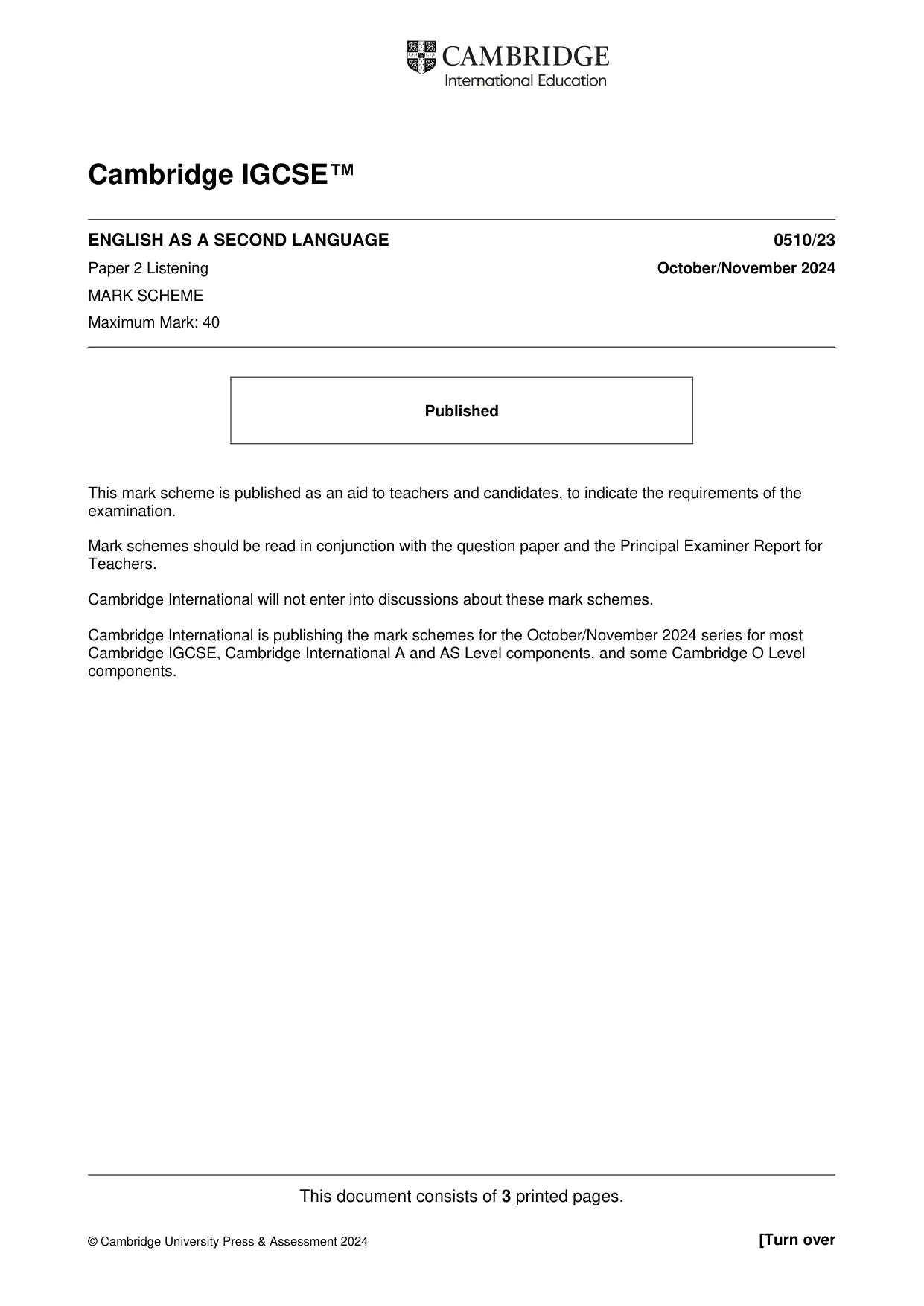
Mark scheme, page 1
This document consists of 3 printed pages. © Cambridge University Press & Assessment 2024 [Turn over Cambridge IGCSE™ ENGLISH AS A SECOND LANGUAGE 0510/23 Paper 2 Listening October/November 2024 MARK SCHEME Maximum Mark: 40 Published This mark scheme is published as an aid to teachers and candidates, to indicate the requirements of the examination. Mark schemes should be read in conjunction with the question paper and the Principal Examiner Report for Teachers. Cambridge International will not enter into discussions about these mark schemes. Cambridge International is publishing the mark schemes for the October/November 2024 series for most Cambridge IGCSE, Cambridge International A and AS Level components, and some Cambridge O Level components.
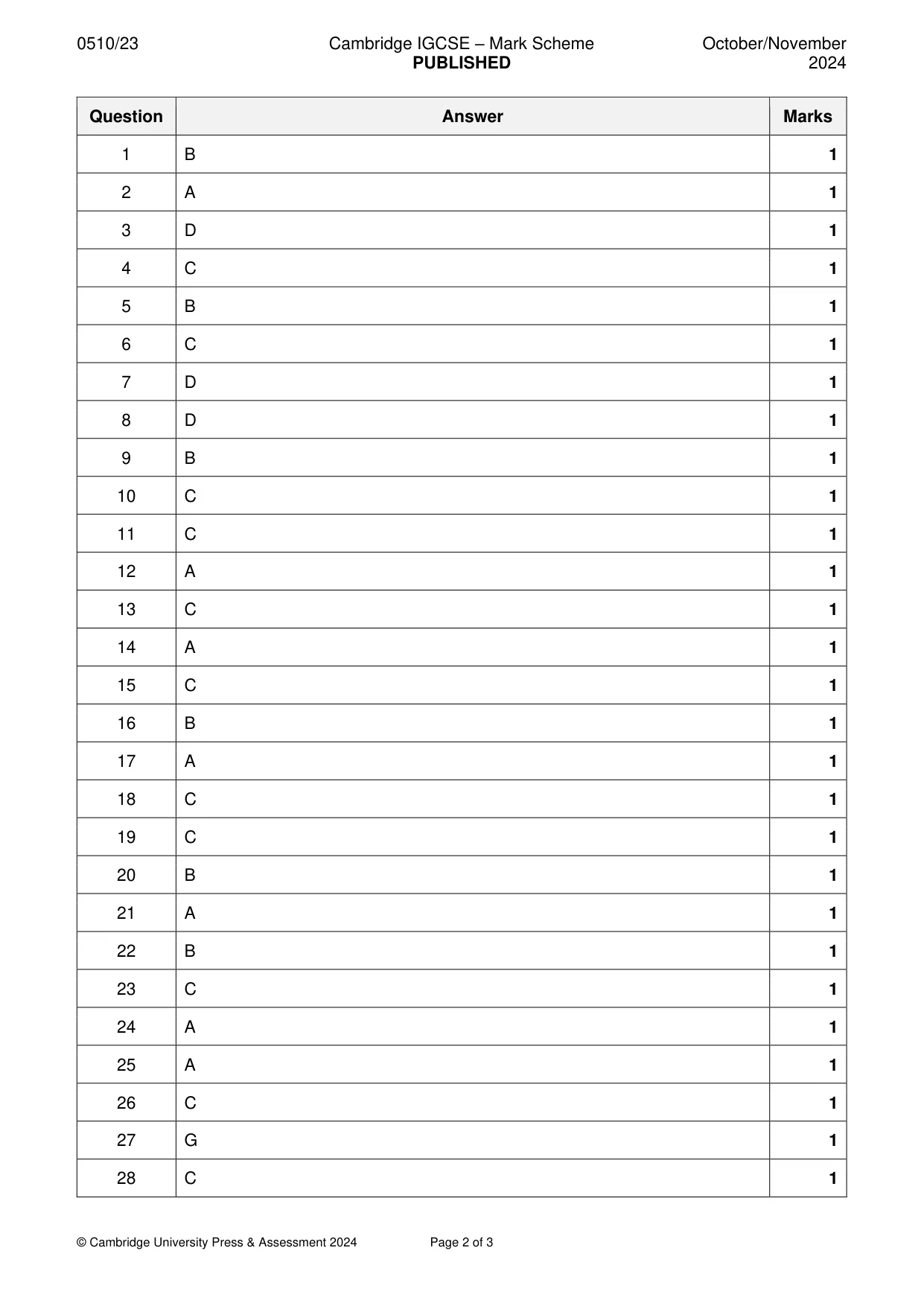
Mark scheme, page 2
0510/23 Cambridge IGCSE – Mark Scheme PUBLISHED October/November 2024 © Cambridge University Press & Assessment 2024 Page 2 of 3 Question Answer Marks 1 B 1 2 A 1 3 D 1 4 C 1 5 B 1 6 C 1 7 D 1 8 D 1 9 B 1 10 C 1 11 C 1 12 A 1 13 C 1 14 A 1 15 C 1 16 B 1 17 A 1 18 C 1 19 C 1 20 B 1 21 A 1 22 B 1 23 C 1 24 A 1 25 A 1 26 C 1 27 G 1 28 C 1
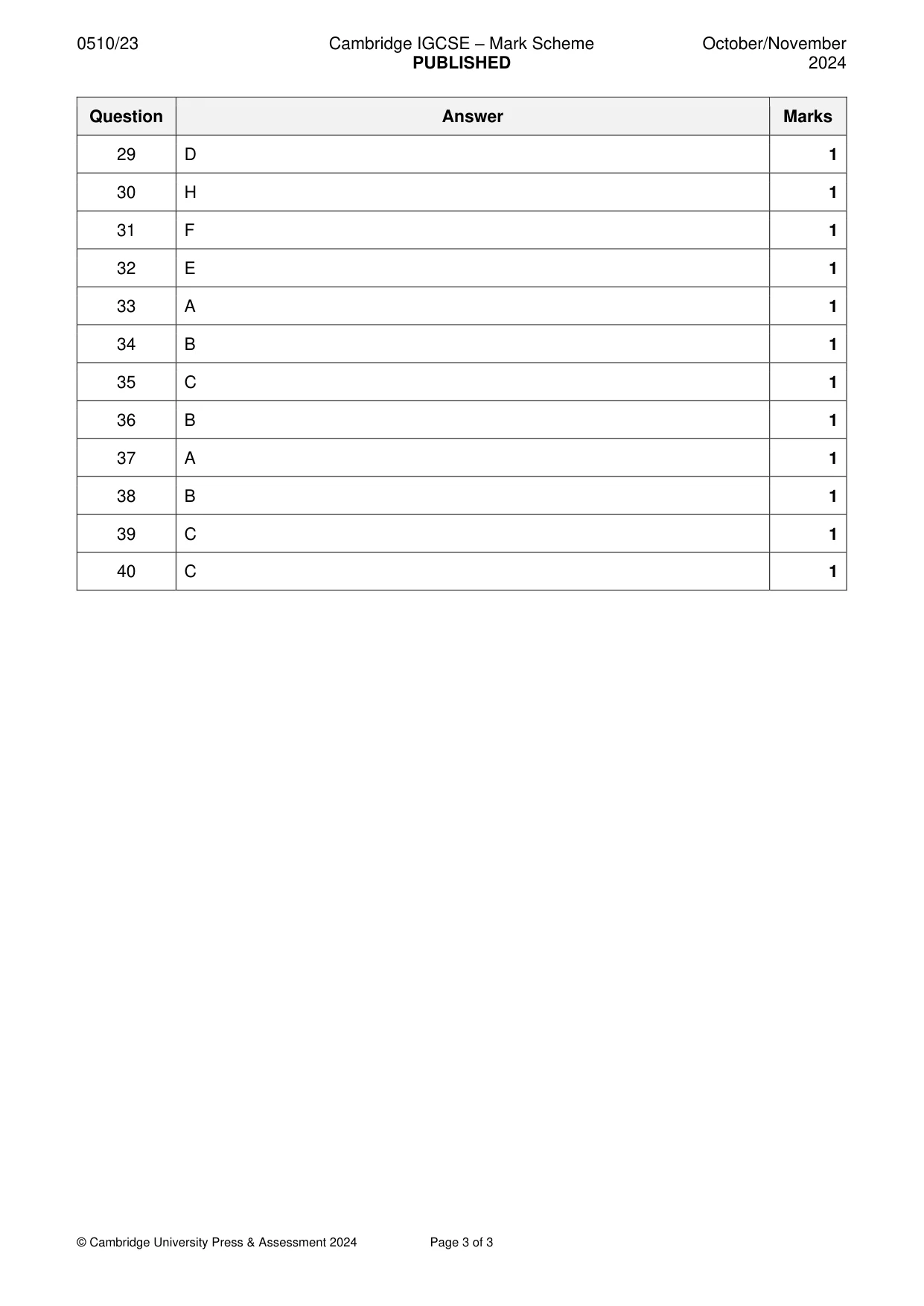
Mark scheme, page 3
0510/23 Cambridge IGCSE – Mark Scheme PUBLISHED October/November 2024 © Cambridge University Press & Assessment 2024 Page 3 of 3 Question Answer Marks 29 D 1 30 H 1 31 F 1 32 E 1 33 A 1 34 B 1 35 C 1 36 B 1 37 A 1 38 B 1 39 C 1 40 C 1
What you needed in this session
Cambridge’s own grade thresholds for 2024 Oct/Nov, Paper 2 · Variant 3. A higher threshold means an easier paper — the bar moves with how the cohort did.