Cambridge IGCSE English - Second Language (oral endorsement) 0510 — 2025 May/June Paper 2 · Variant 3
0510/23/M/J/25 · 40 marks · ≈45 min
The question paper and its mark scheme, free to read here and free to download. This is Cambridge’s own paper, exactly as it was sat.
Question paper16 pages


Mark scheme3 pages
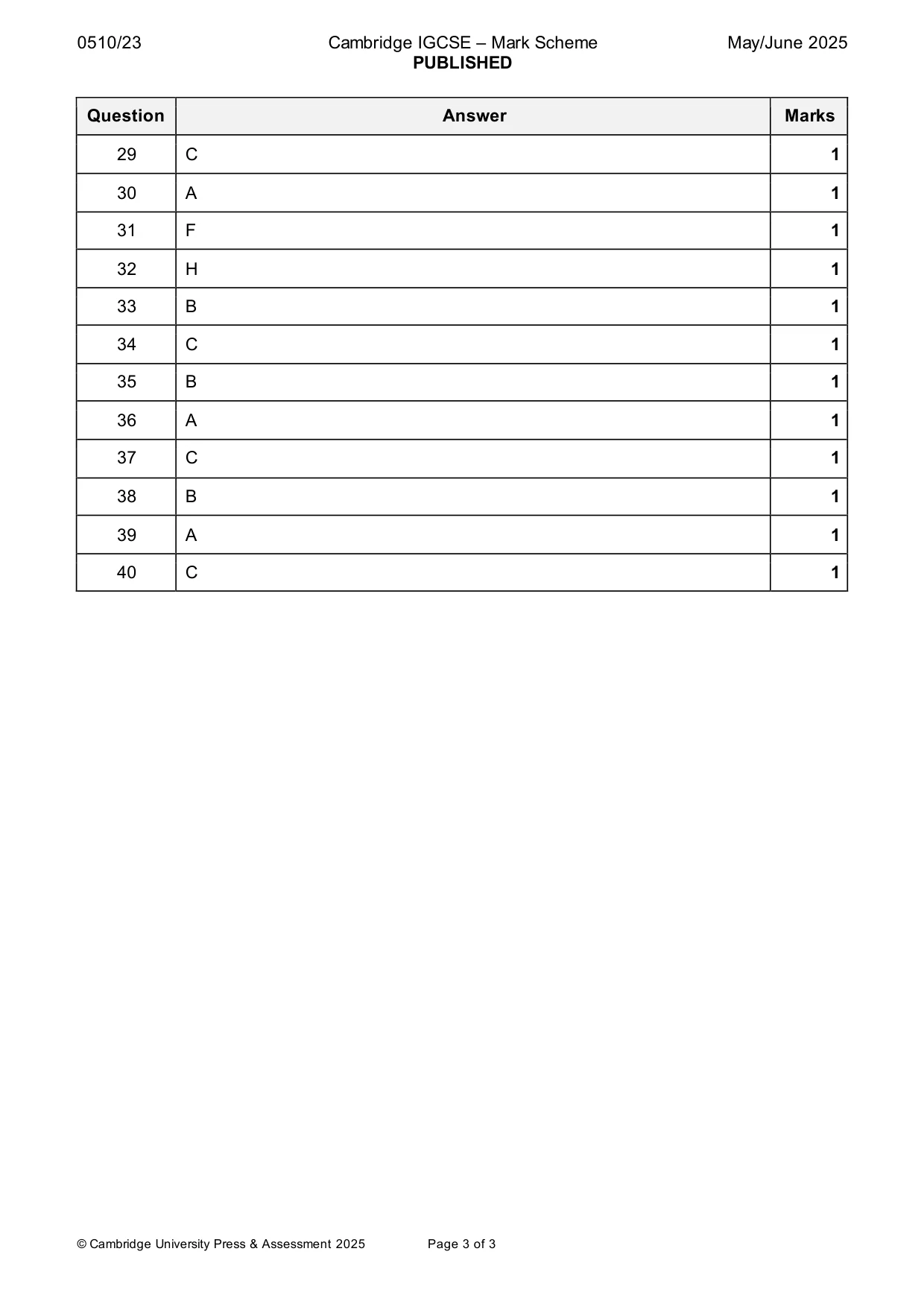
Answers below. Sit the paper first if you are practising.
Paper as text
Question paper, page 1
This document has 16 pages. Any blank pages are indicated. [Turn over Cambridge IGCSE™ * 1 1 6 3 0 4 6 7 1 1 * ENGLISH AS A SECOND LANGUAGE 0510/23 Paper 2 Listening May/June 2025 Approximately 50 minutes (including 6 minutes’ transfer time) You must transfer your answers onto the multiple choice answer sheet. You will need: Multiple choice answer sheet Soft clean eraser Soft pencil (type B or HB is recommended) INSTRUCTIONS ● There are 40 questions on this paper. Answer all questions. ● You will have 6 minutes to transfer your answers from the question paper onto the multiple choice answer sheet. ● Follow the instructions on the multiple choice answer sheet. Shade one letter only for Questions 1 to 40. ● Write in soft pencil. ● Write your name, centre number and candidate number on the multiple choice answer sheet in the spaces provided unless this has been done for you. ● Do not use correction fluid. ● Do not write on any bar codes. ● Dictionaries are not allowed. INFORMATION ● The total mark for this paper is 40. ● Each correct answer will score one mark. ● Any rough working should be done on this question paper. DC (DE/SG) 340888/2 © UCLES 2025
Question paper, page 2
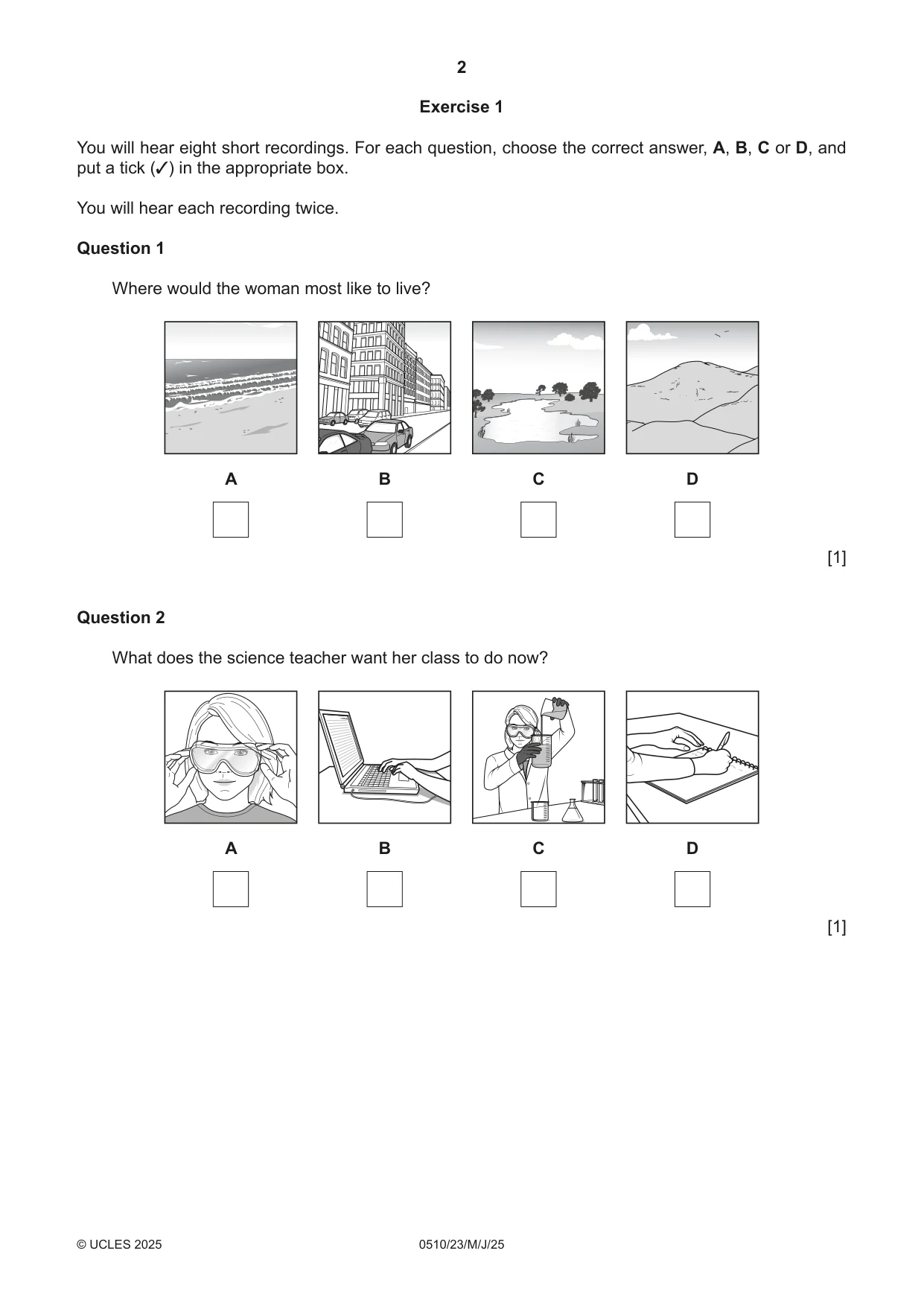
2 0510/23/ M/J/25 © UCLES 2025 Exercise 1 You will hear eight short recordings. For each question, choose the correct answer, A, B, C or D, and put a tick (✓) in the appropriate box. You will hear each recording twice. Question 1 Where would the woman most like to live? A B C D [1] Question 2 What does the science teacher want her class to do now? A B C D [1]
Question paper, page 3
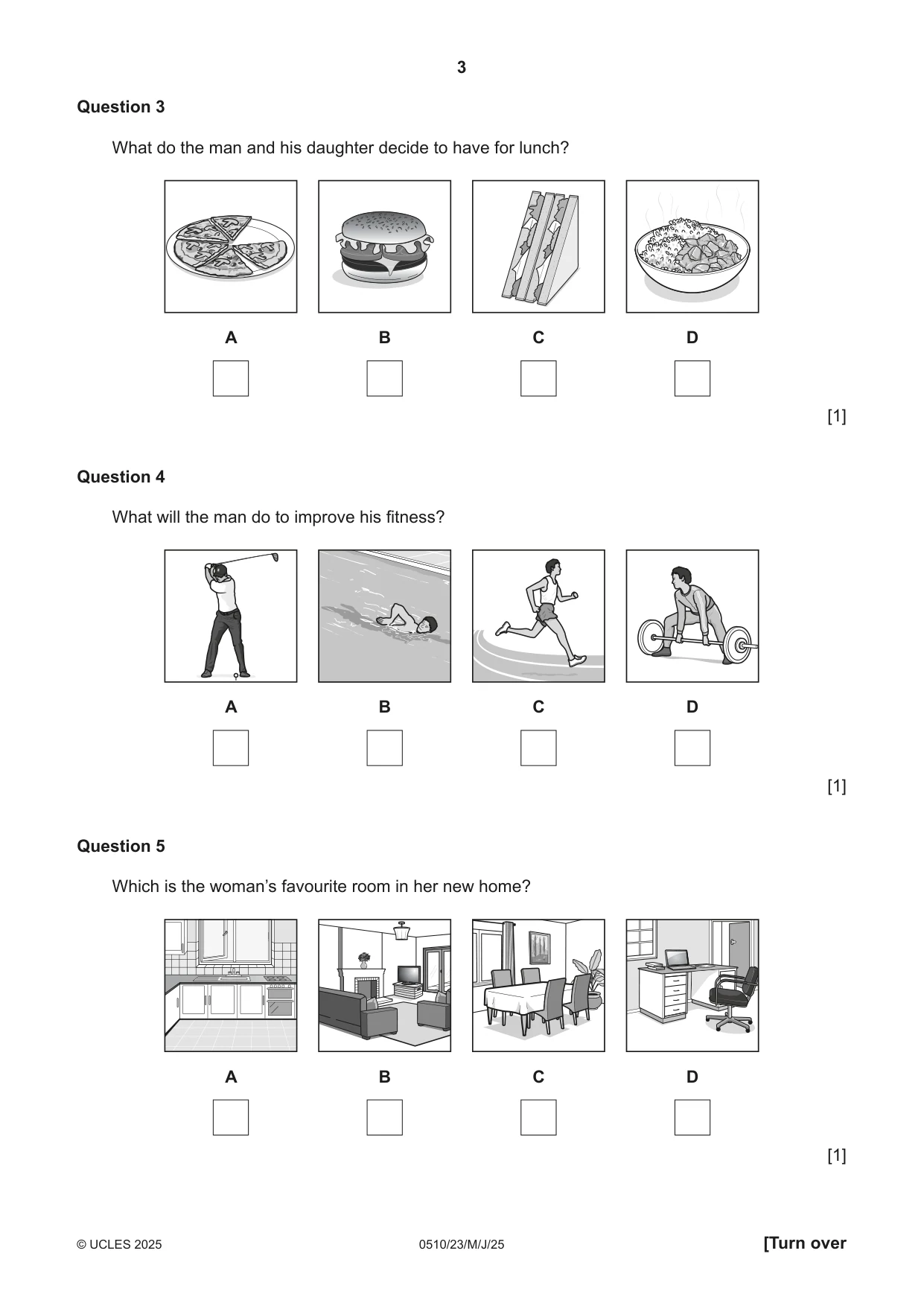
3 0510/23/ M/J/25 © UCLES 2025 [Turn over Question 3 What do the man and his daughter decide to have for lunch? A B C D [1] Question 4 What will the man do to improve his fitness? A B C D [1] Question 5 Which is the woman’s favourite room in her new home? A B C D [1]
Question paper, page 4
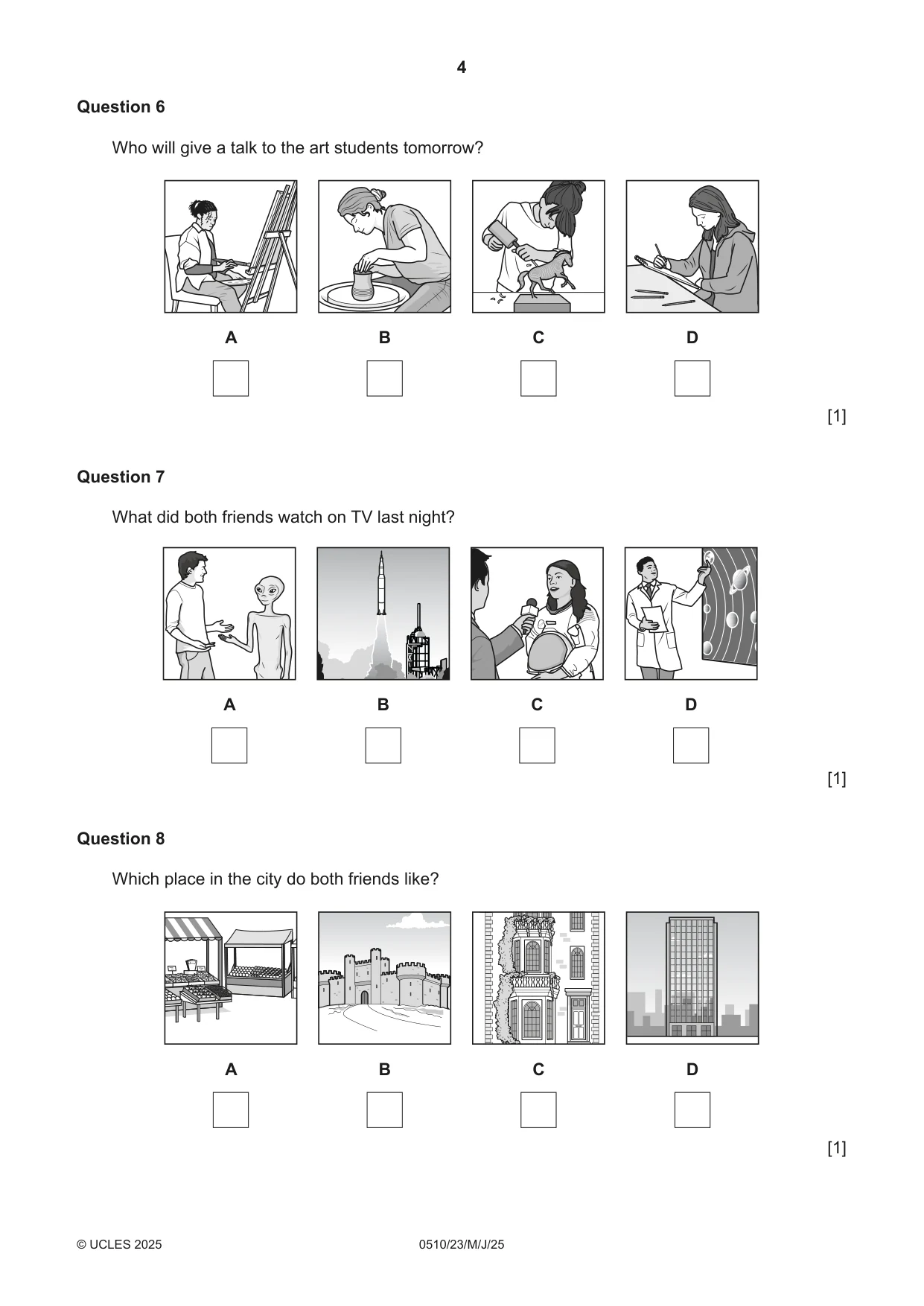
4 0510/23/M/J/25 © UCLES 2025 Question 6 Who will give a talk to the art students tomorrow? A B C D [1] Question 7 What did both friends watch on TV last night? A B C D [1] Question 8 Which place in the city do both friends like? A B C D [1]
Question paper, page 5
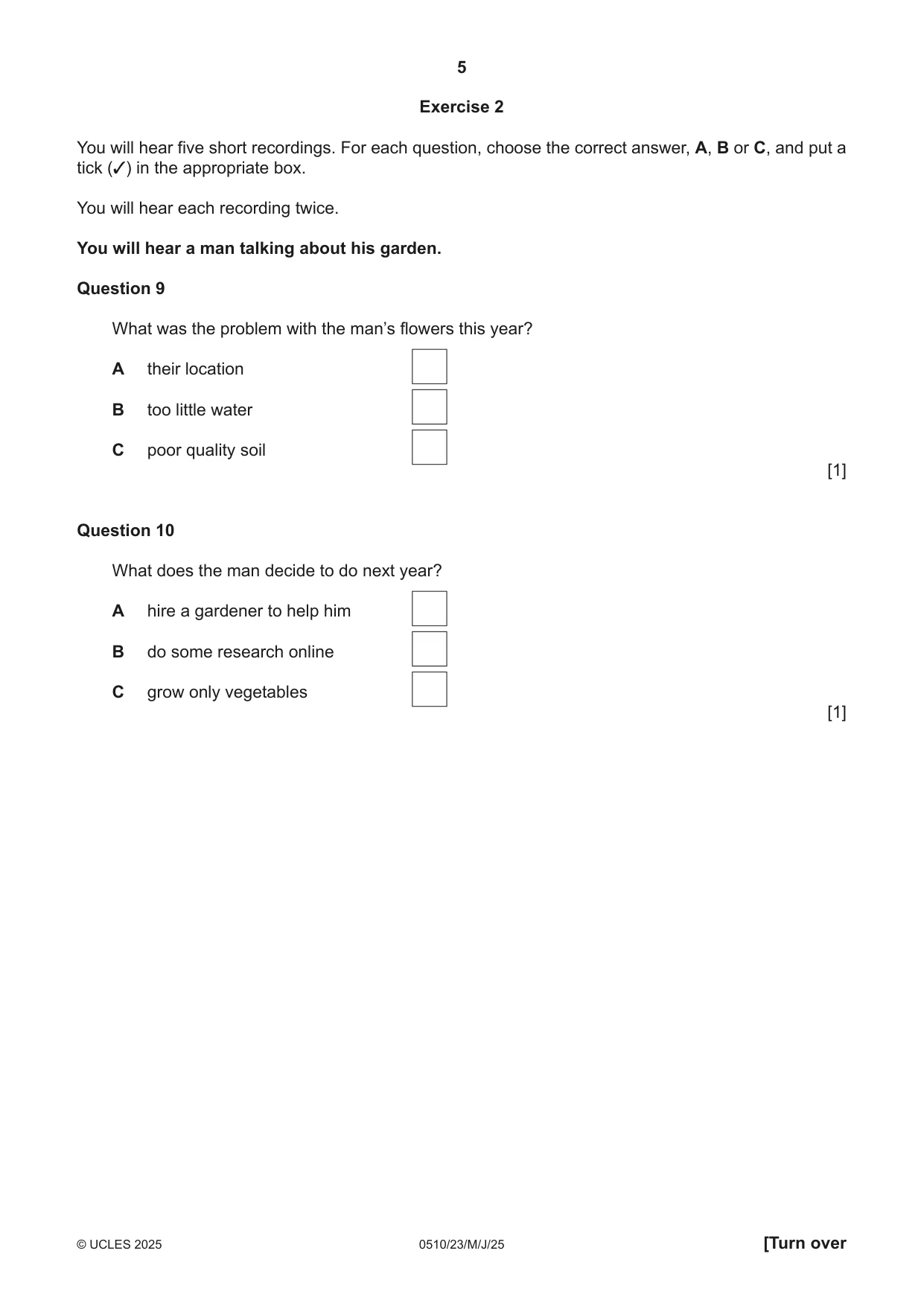
5 0510/23/M/J/25 © UCLES 2025 [Turn over Exercise 2 You will hear five short recordings. For each question, choose the correct answer, A, B or C, and put a tick (✓) in the appropriate box. You will hear each recording twice. You will hear a man talking about his garden. Question 9 What was the problem with the man’s flowers this year? A their location B too little water C poor quality soil [1] Question 10 What does the man decide to do next year? A hire a gardener to help him B do some research online C grow only vegetables [1]
Question paper, page 6
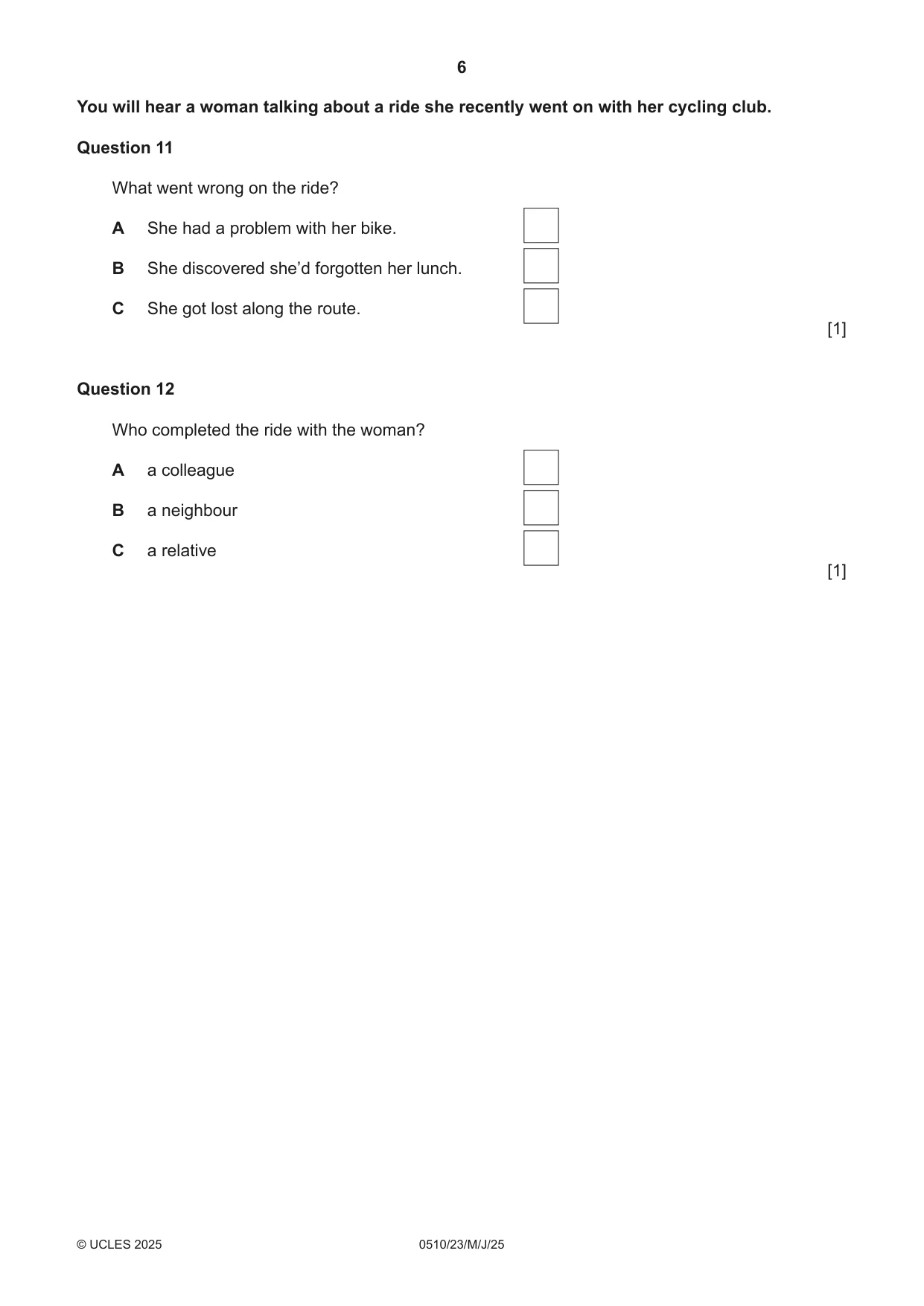
6 0510/23/M/J/25 © UCLES 2025 You will hear a woman talking about a ride she recently went on with her cycling club. Question 11 What went wrong on the ride? A She had a problem with her bike. B She discovered she’d forgotten her lunch. C She got lost along the route. [1] Question 12 Who completed the ride with the woman? A a colleague B a neighbour C a relative [1]
Question paper, page 7
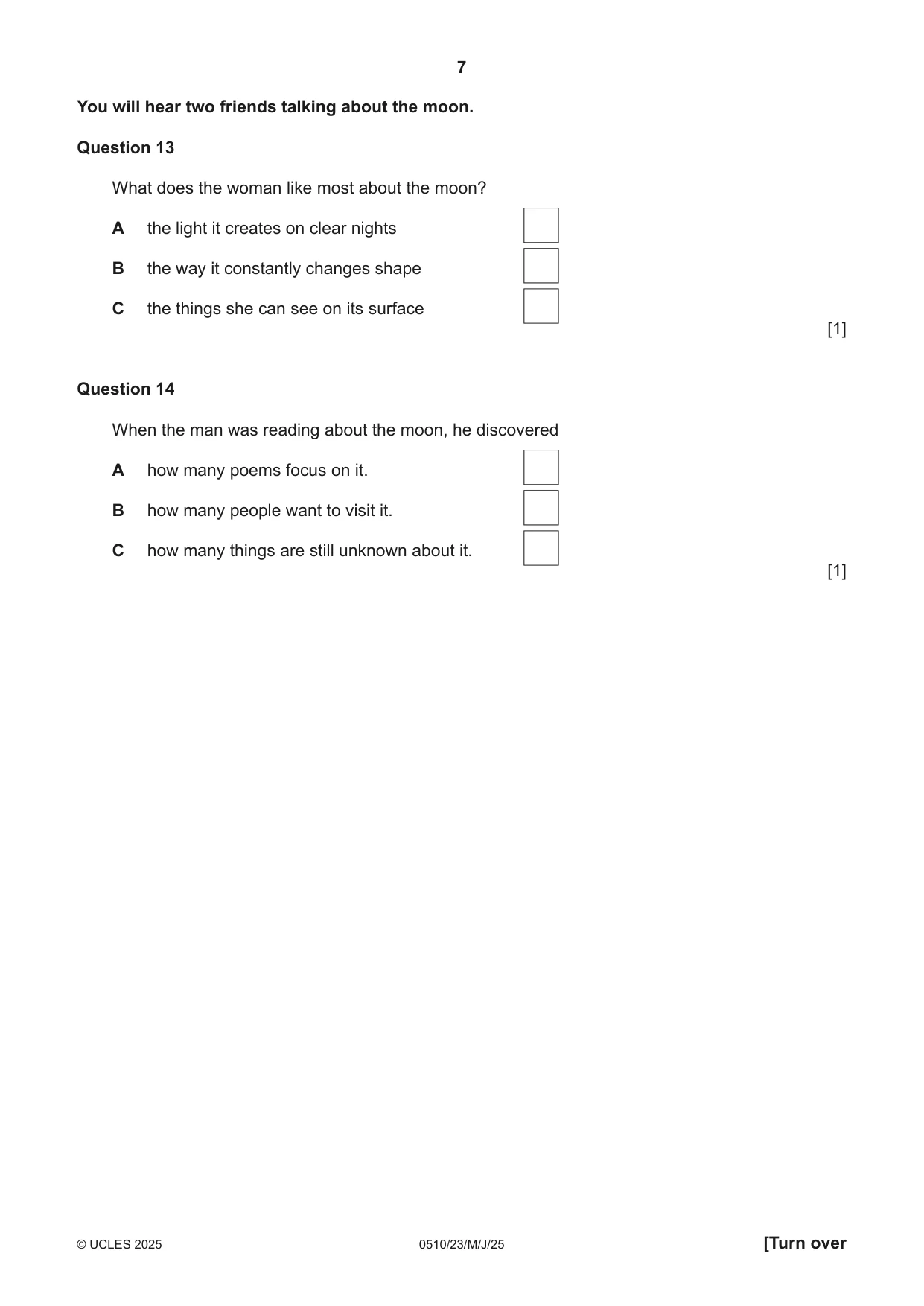
7 0510/23/M/J/25 © UCLES 2025 [Turn over You will hear two friends talking about the moon. Question 13 What does the woman like most about the moon? A the light it creates on clear nights B the way it constantly changes shape C the things she can see on its surface [1] Question 14 When the man was reading about the moon, he discovered A how many poems focus on it. B how many people want to visit it. C how many things are still unknown about it. [1]
Question paper, page 8
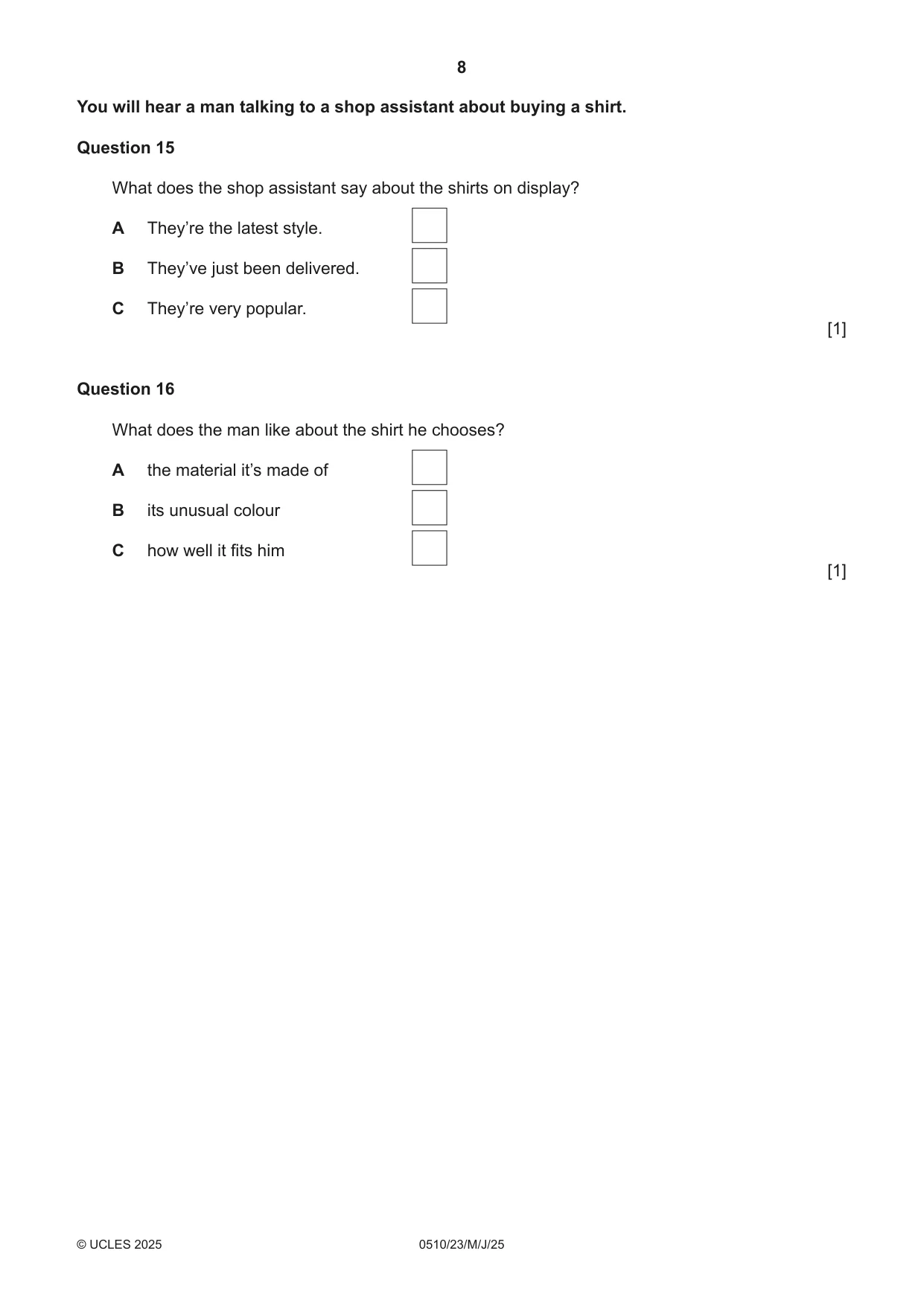
8 0510/23/M/J/25 © UCLES 2025 You will hear a man talking to a shop assistant about buying a shirt. Question 15 What does the shop assistant say about the shirts on display? A They’re the latest style. B They’ve just been delivered. C They’re very popular. [1] Question 16 What does the man like about the shirt he chooses? A the material it’s made of B its unusual colour C how well it fits him [1]
Question paper, page 9
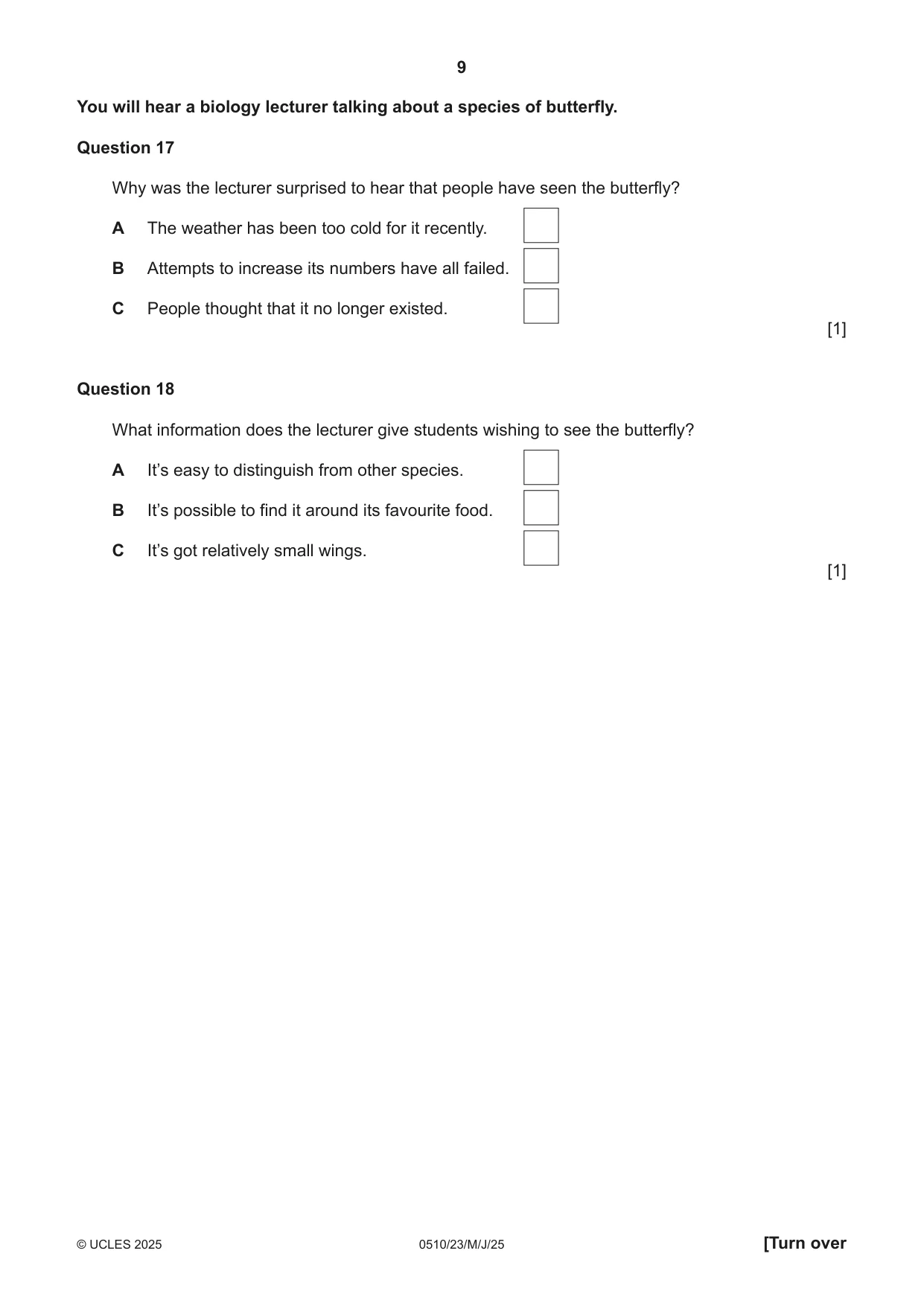
9 0510/23/M/J/25 © UCLES 2025 [Turn over You will hear a biology lecturer talking about a species of butterfly. Question 17 Why was the lecturer surprised to hear that people have seen the butterfly? A The weather has been too cold for it recently. B Attempts to increase its numbers have all failed. C People thought that it no longer existed. [1] Question 18 What information does the lecturer give students wishing to see the butterfly? A It’s easy to distinguish from other species. B It’s possible to find it around its favourite food. C It’s got relatively small wings. [1]
Question paper, page 10
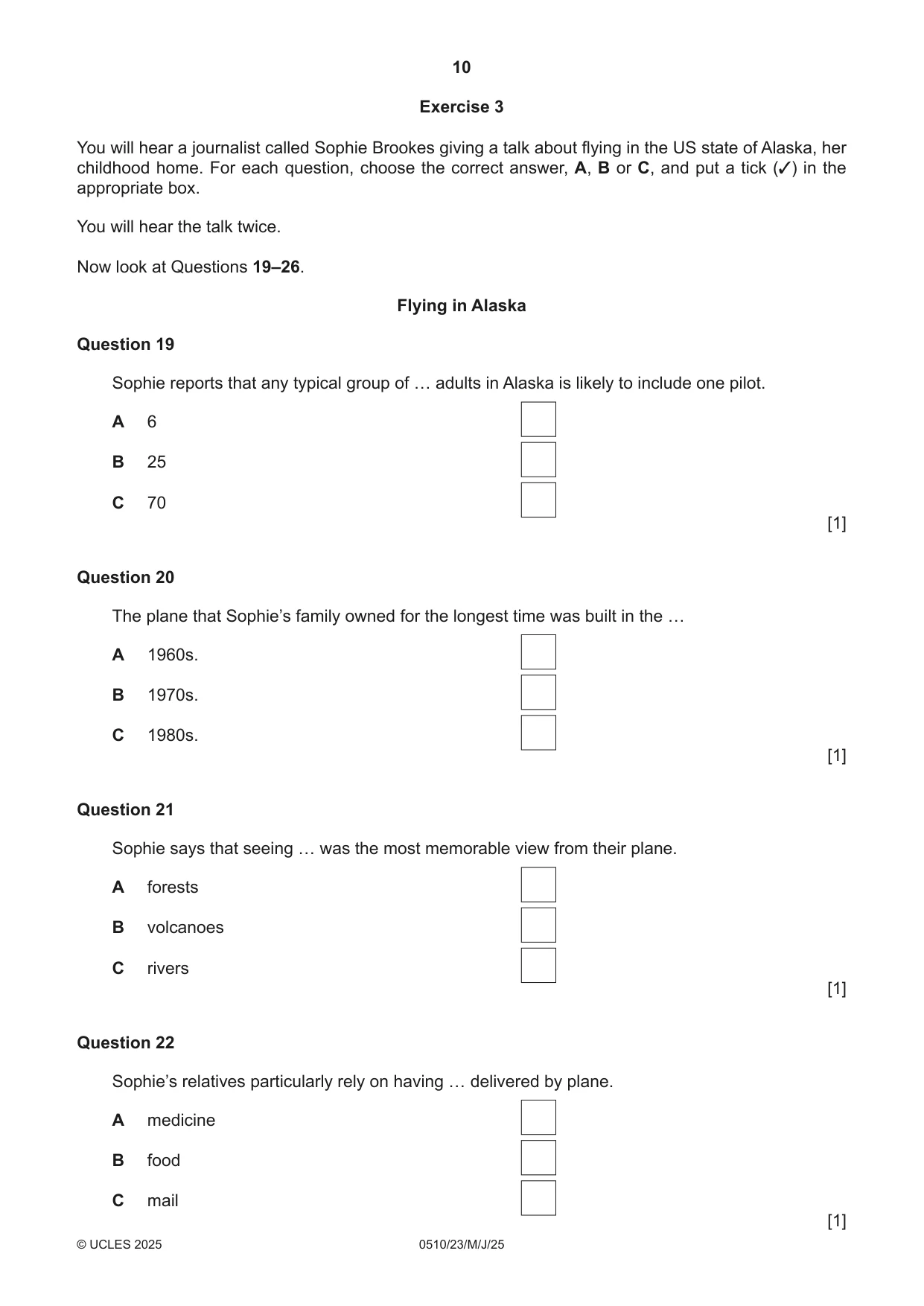
10 0510/23/M/J/25 © UCLES 2025 Exercise 3 You will hear a journalist called Sophie Brookes giving a talk about flying in the US state of Alaska, her childhood home. For each question, choose the correct answer, A, B or C, and put a tick (✓) in the appropriate box. You will hear the talk twice. Now look at Questions 19–26. Flying in Alaska Question 19 Sophie reports that any typical group of … adults in Alaska is likely to include one pilot. A 6 B 25 C 70 [1] Question 20 The plane that Sophie’s family owned for the longest time was built in the … A 1960s. B 1970s. C 1980s. [1] Question 21 Sophie says that seeing … was the most memorable view from their plane. A forests B volcanoes C rivers [1] Question 22 Sophie’s relatives particularly rely on having … delivered by plane. A medicine B food C mail [1]
Question paper, page 11
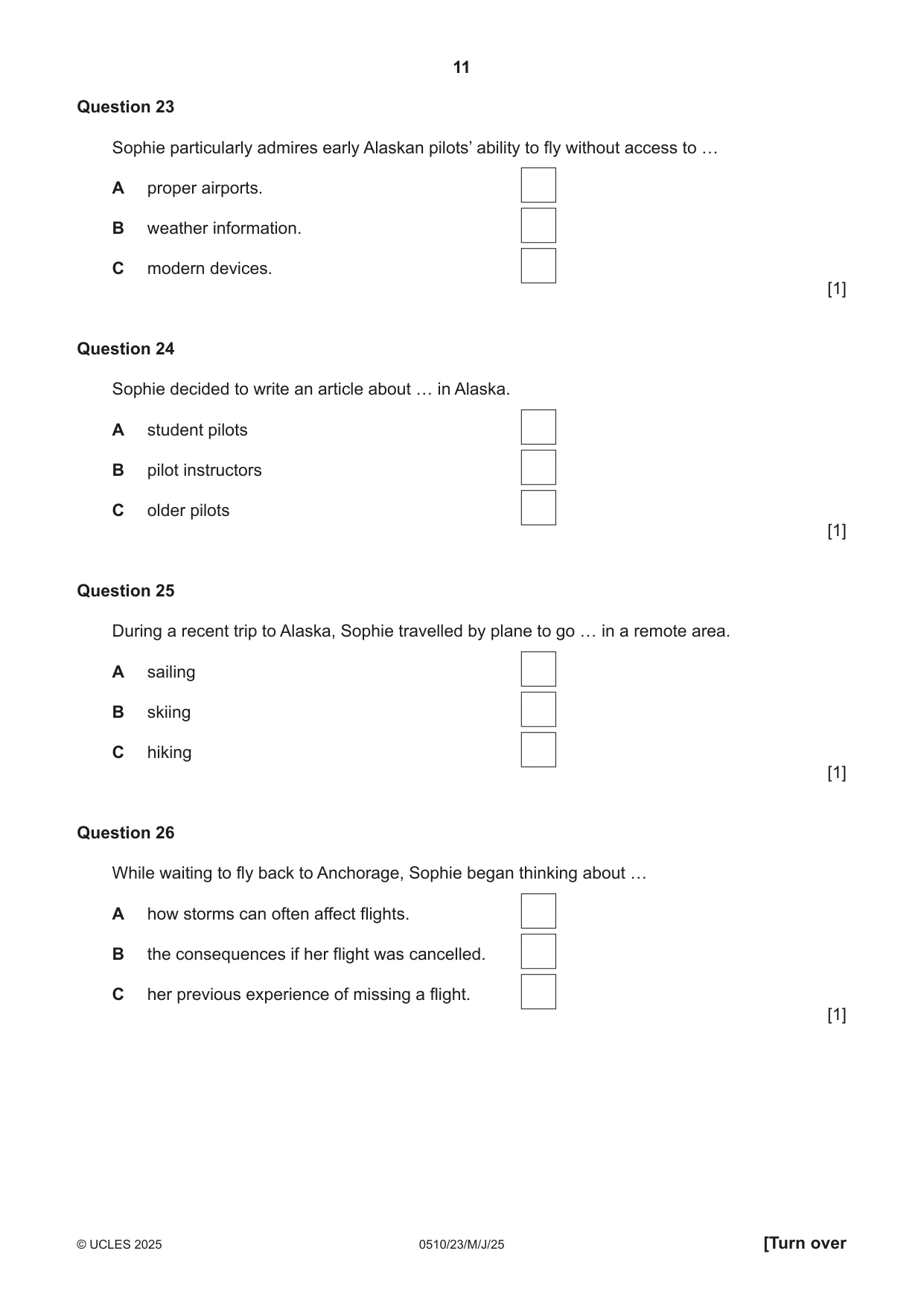
11 0510/23/M/J/25 © UCLES 2025 [Turn over Question 23 Sophie particularly admires early Alaskan pilots’ ability to fly without access to … A proper airports. B weather information. C modern devices. [1] Question 24 Sophie decided to write an article about … in Alaska. A student pilots B pilot instructors C older pilots [1] Question 25 During a recent trip to Alaska, Sophie travelled by plane to go … in a remote area. A sailing B skiing C hiking [1] Question 26 While waiting to fly back to Anchorage, Sophie began thinking about … A how storms can often affect flights. B the consequences if her flight was cancelled. C her previous experience of missing a flight. [1]
Question paper, page 12
12 0510/23/M/J/25 © UCLES 2025 BLANK PAGE
Question paper, page 13
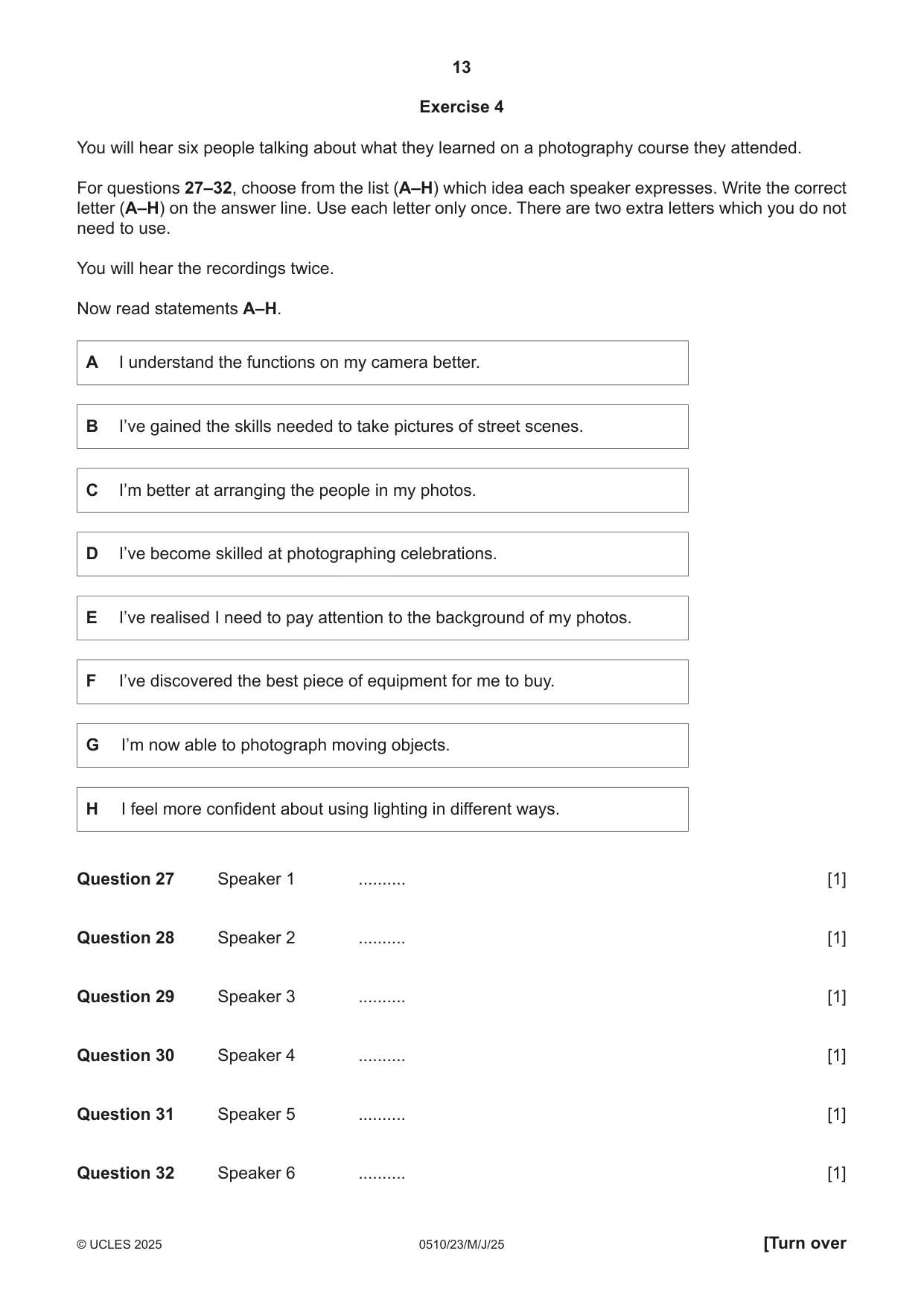
13 0510/23/M/J/25 © UCLES 2025 [Turn over Exercise 4 You will hear six people talking about what they learned on a photography course they attended. For questions 27–32, choose from the list (A–H) which idea each speaker expresses. Write the correct letter (A–H) on the answer line. Use each letter only once. There are two extra letters which you do not need to use. You will hear the recordings twice. Now read statements A–H. A I understand the functions on my camera better. B I’ve gained the skills needed to take pictures of street scenes. C I’m better at arranging the people in my photos. D I’ve become skilled at photographing celebrations. E I’ve realised I need to pay attention to the background of my photos. F I’ve discovered the best piece of equipment for me to buy. G I’m now able to photograph moving objects. H I feel more confident about using lighting in different ways. Question 27 Speaker 1 … [1] Question 28 Speaker 2 … [1] Question 29 Speaker 3 … [1] Question 30 Speaker 4 … [1] Question 31 Speaker 5 … [1] Question 32 Speaker 6 … [1]
Question paper, page 14
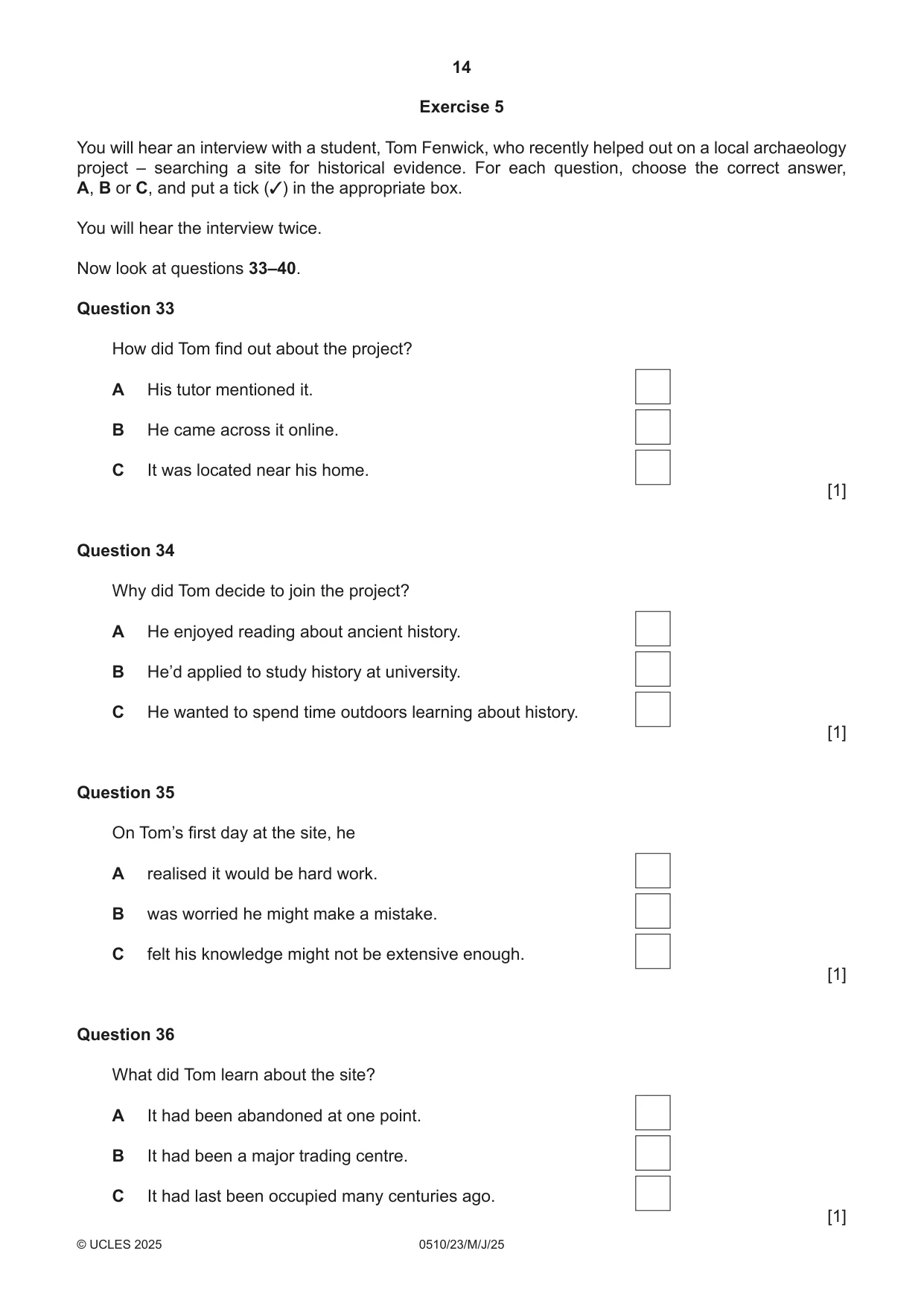
14 0510/23/M/J/25 © UCLES 2025 Exercise 5 You will hear an interview with a student, Tom Fenwick, who recently helped out on a local archaeology project – searching a site for historical evidence. For each question, choose the correct answer, A, B or C, and put a tick (✓) in the appropriate box. You will hear the interview twice. Now look at questions 33–40. Question 33 How did Tom find out about the project? A His tutor mentioned it. B He came across it online. C It was located near his home. [1] Question 34 Why did Tom decide to join the project? A He enjoyed reading about ancient history. B He’d applied to study history at university. C He wanted to spend time outdoors learning about history. [1] Question 35 On Tom’s first day at the site, he A realised it would be hard work. B was worried he might make a mistake. C felt his knowledge might not be extensive enough. [1] Question 36 What did Tom learn about the site? A It had been abandoned at one point. B It had been a major trading centre. C It had last been occupied many centuries ago. [1]
Question paper, page 15
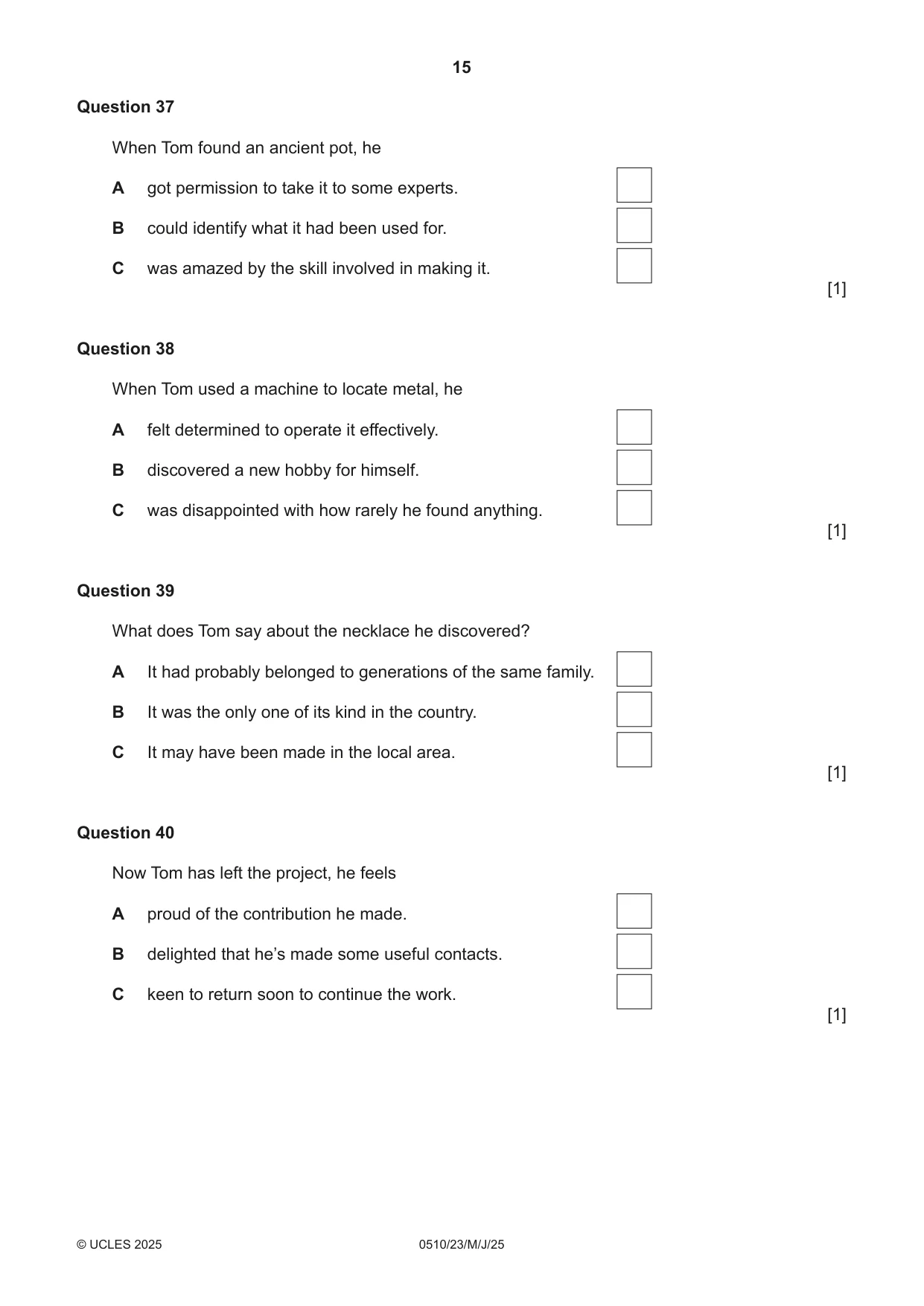
15 0510/23/M/J/25 © UCLES 2025 Question 37 When Tom found an ancient pot, he A got permission to take it to some experts. B could identify what it had been used for. C was amazed by the skill involved in making it. [1] Question 38 When Tom used a machine to locate metal, he A felt determined to operate it effectively. B discovered a new hobby for himself. C was disappointed with how rarely he found anything. [1] Question 39 What does Tom say about the necklace he discovered? A It had probably belonged to generations of the same family. B It was the only one of its kind in the country. C It may have been made in the local area. [1] Question 40 Now Tom has left the project, he feels A proud of the contribution he made. B delighted that he’s made some useful contacts. C keen to return soon to continue the work. [1]
Question paper, page 16
16 0510/23/M/J/25 © UCLES 2025 Permission to reproduce items where third-party owned material protected by copyright is included has been sought and cleared where possible. Every reasonable effort has been made by the publisher (UCLES) to trace copyright holders, but if any items requiring clearance have unwittingly been included, the publisher will be pleased to make amends at the earliest possible opportunity. To avoid the issue of disclosure of answer-related information to candidates, all copyright acknowledgements are reproduced online in the Cambridge Assessment International Education Copyright Acknowledgements Booklet. This is produced for each series of examinations and is freely available to download at www.cambridgeinternational.org after the live examination series. Cambridge Assessment International Education is part of Cambridge Assessment. Cambridge Assessment is the brand name of the University of Cambridge Local Examinations Syndicate (UCLES), which is a department of the University of Cambridge. BLANK PAGE
Mark scheme, page 1
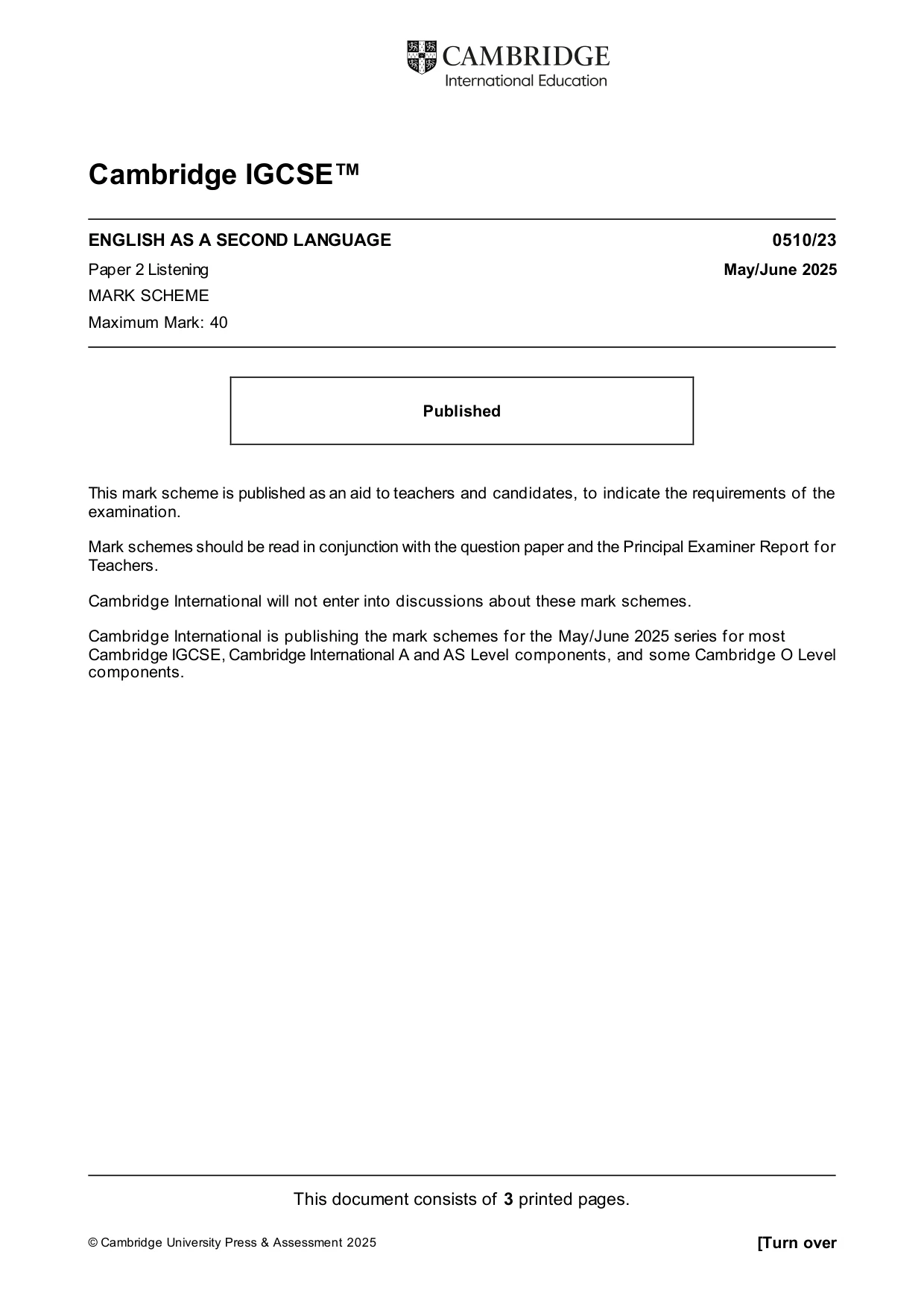
This document consists of 3 printed pages. © Cambridge University Press & Assessment 2025 [Turn over Cambridge IGCSE™ ENGLISH AS A SECOND LANGUAGE 0510/23 Paper 2 Listening May/June 2025 MARK SCHEME Maximum Mark: 40 Published This mark scheme is published as an aid to teachers and candidates, to indicate the requirements of the examination. Mark schemes should be read in conjunction with the question paper and the Principal Examiner Report for Teachers. Cambridge International will not enter into discussions about these mark schemes. Cambridge International is publishing the mark schemes for the May/June 2025 series for most Cambridge IGCSE, Cambridge International A and AS Level components, and some Cambridge O Level components.
Mark scheme, page 2
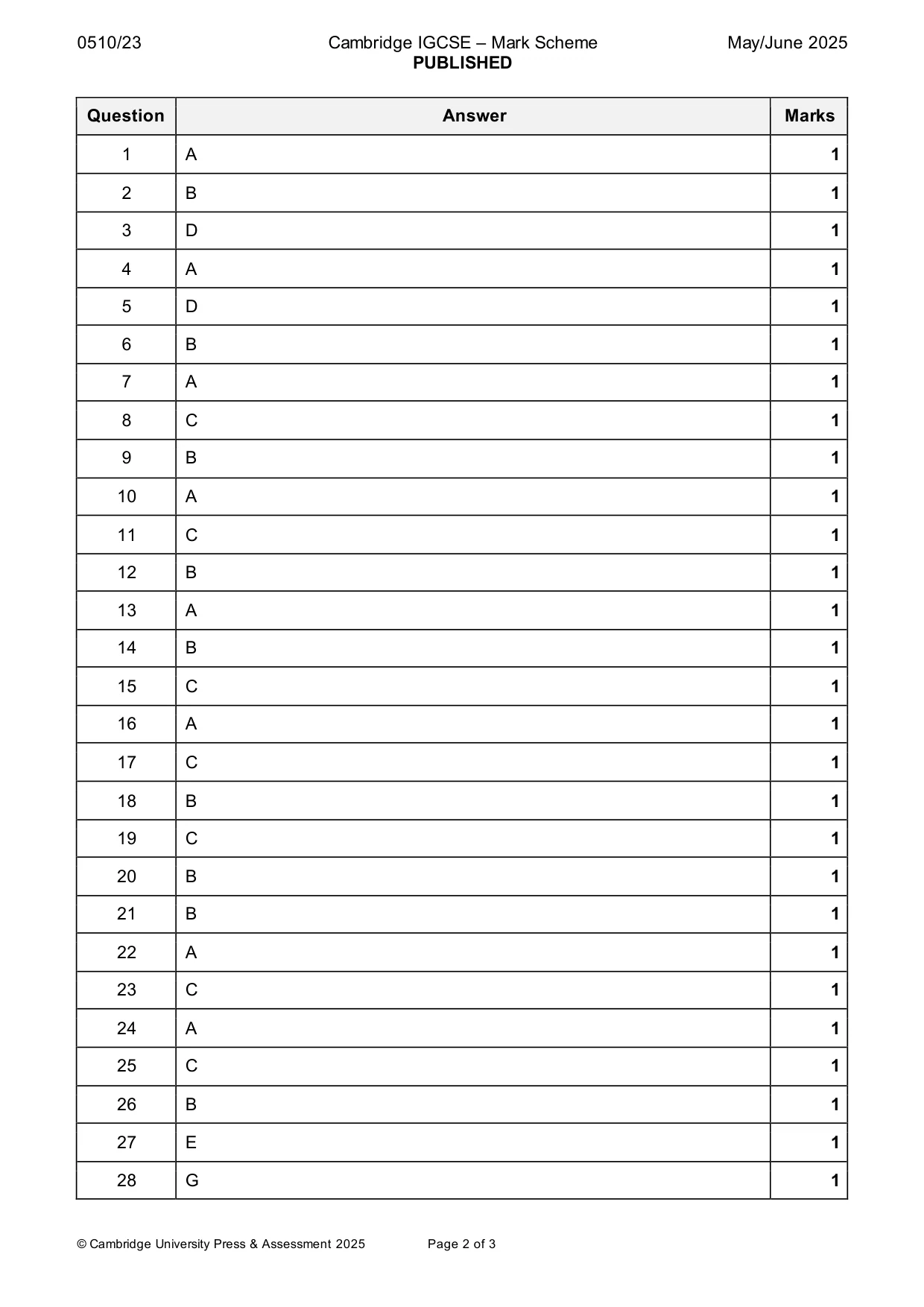
0510/23 Cambridge IGCSE – Mark Scheme PUBLISHED May/June 2025 © Cambridge University Press & Assessment 2025 Page 2 of 3 Question Answer Marks 1 A 1 2 B 1 3 D 1 4 A 1 5 D 1 6 B 1 7 A 1 8 C 1 9 B 1 10 A 1 11 C 1 12 B 1 13 A 1 14 B 1 15 C 1 16 A 1 17 C 1 18 B 1 19 C 1 20 B 1 21 B 1 22 A 1 23 C 1 24 A 1 25 C 1 26 B 1 27 E 1 28 G 1
Mark scheme, page 3
0510/23 Cambridge IGCSE – Mark Scheme PUBLISHED May/June 2025 © Cambridge University Press & Assessment 2025 Page 3 of 3 Question Answer Marks 29 C 1 30 A 1 31 F 1 32 H 1 33 B 1 34 C 1 35 B 1 36 A 1 37 C 1 38 B 1 39 A 1 40 C 1
What you needed in this session
Cambridge’s own grade thresholds for 2025 May/June, Paper 2 · Variant 3. A higher threshold means an easier paper — the bar moves with how the cohort did.