Cambridge IGCSE English - Second Language (oral endorsement) 0510 — 2018 Oct/Nov Paper 2 · Variant 1
0510/21/O/N/18 · 90 marks · ≈101 min
The question paper and its mark scheme, free to read here and free to download. This is Cambridge’s own paper, exactly as it was sat.
Question paper16 pages
Mark scheme13 pages
Answers below. Sit the paper first if you are practising.
Paper as text
Question paper, page 1
* 8 9 7 5 6 1 4 1 1 4 * This document consists of 15 printed pages and 1 blank page. DC (SC/SW) 153684/4 © UCLES 2018 [Turn over Cambridge International Examinations Cambridge International General Certificate of Secondary Education ENGLISH AS A SECOND LANGUAGE 0510/21 Paper 2 Reading and Writing (Extended) October/November 2018 2 hours Candidates answer on the Question Paper. No Additional Materials are required. READ THESE INSTRUCTIONS FIRST Write your Centre number, candidate number and name on all the work you hand in. Write in dark blue or black pen. Do not use staples, paper clips, glue or correction fluid. DO NOT WRITE IN ANY BARCODES. Answer all questions. Dictionaries are not allowed. At the end of the examination, fasten all your work securely together. The number of marks is given in brackets [ ] at the end of each question or part question.
Question paper, page 2
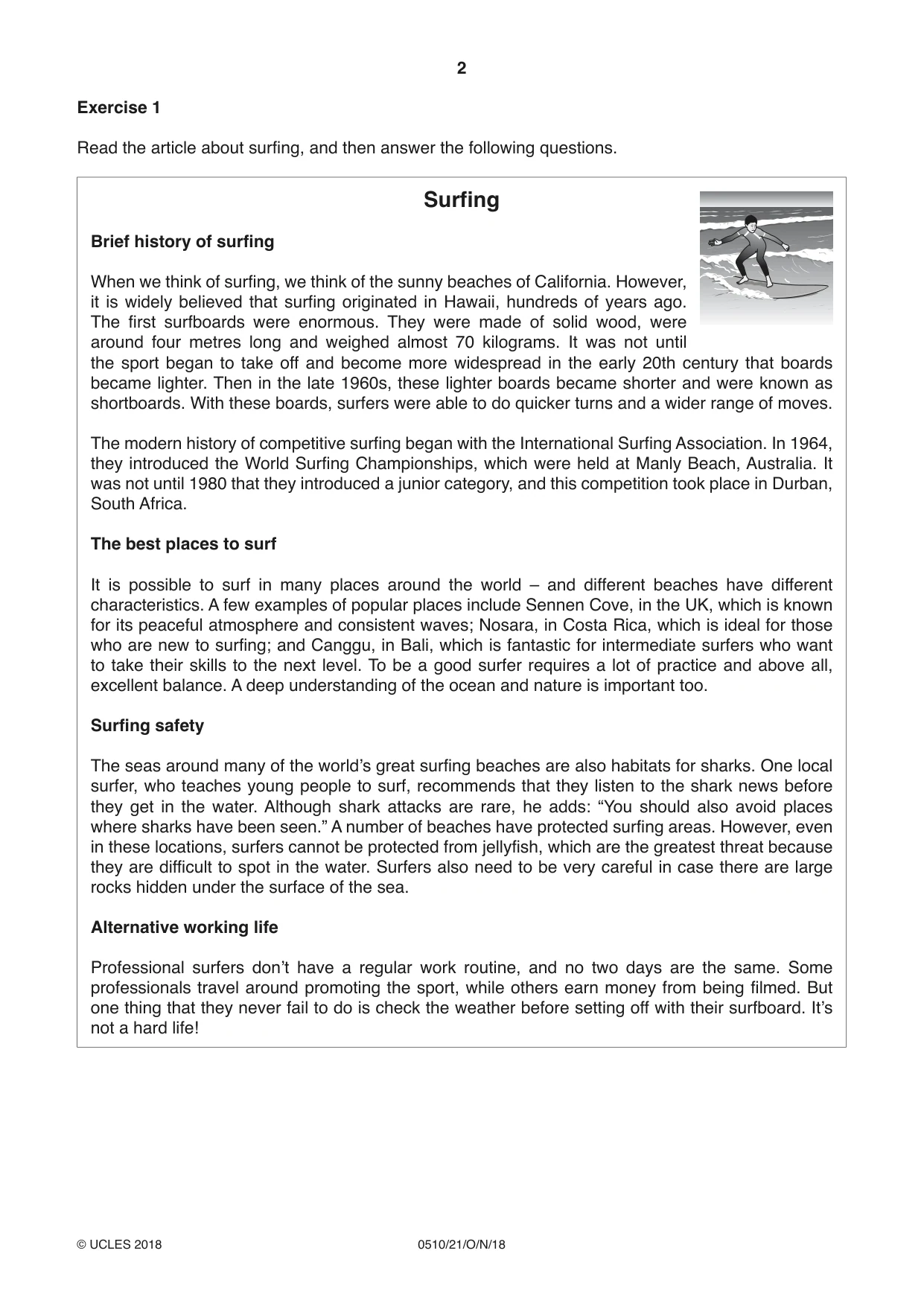
2 0510/21/O/N/18 © UCLES 2018 Exercise 1 Read the article about surfing, and then answer the following questions. Surfing Brief history of surfing When we think of surfing, we think of the sunny beaches of California. However, it is widely believed that surfing originated in Hawaii, hundreds of years ago. The first surfboards were enormous. They were made of solid wood, were around four metres long and weighed almost 70 kilograms. It was not until the sport began to take off and become more widespread in the early 20th century that boards became lighter. Then in the late 1960s, these lighter boards became shorter and were known as shortboards. With these boards, surfers were able to do quicker turns and a wider range of moves. The modern history of competitive surfing began with the International Surfing Association. In 1964, they introduced the World Surfing Championships, which were held at Manly Beach, Australia. It was not until 1980 that they introduced a junior category, and this competition took place in Durban, South Africa. The best places to surf It is possible to surf in many places around the world – and different beaches have different characteristics. A few examples of popular places include Sennen Cove, in the UK, which is known for its peaceful atmosphere and consistent waves; Nosara, in Costa Rica, which is ideal for those who are new to surfing; and Canggu, in Bali, which is fantastic for intermediate surfers who want to take their skills to the next level. To be a good surfer requires a lot of practice and above all, excellent balance. A deep understanding of the ocean and nature is important too. Surfing safety The seas around many of the world’s great surfing beaches are also habitats for sharks. One local surfer, who teaches young people to surf, recommends that they listen to the shark news before they get in the water. Although shark attacks are rare, he adds: “You should also avoid places where sharks have been seen.” A number of beaches have protected surfing areas. However, even in these locations, surfers cannot be protected from jellyfish, which are the greatest threat because they are difficult to spot in the water. Surfers also need to be very careful in case there are large rocks hidden under the surface of the sea. Alternative working life Professional surfers don’t have a regular work routine, and no two days are the same. Some professionals travel around promoting the sport, while others earn money from being filmed. But one thing that they never fail to do is check the weather before setting off with their surfboard. It’s not a hard life!
Question paper, page 3
3 0510/21/O/N/18 © UCLES 2018 [Turn over (a) Where in the world did surfing first take place? …[1] (b) How did surfboards change when surfing started to become popular? …[1] (c) What was the name of the first ever international surfing competition? …[1] (d) Which beach is suitable for beginners? …[1] (e) What is the most important skill a good surfer needs? …[1] (f) What advice does the local surfing teacher give? Give two details. … …[2] (g) What is the biggest danger to surfers when they are in the sea? …[1] (h) What do professional surfers always do before they go surfing? …[1] [Total: 9]
Question paper, page 4
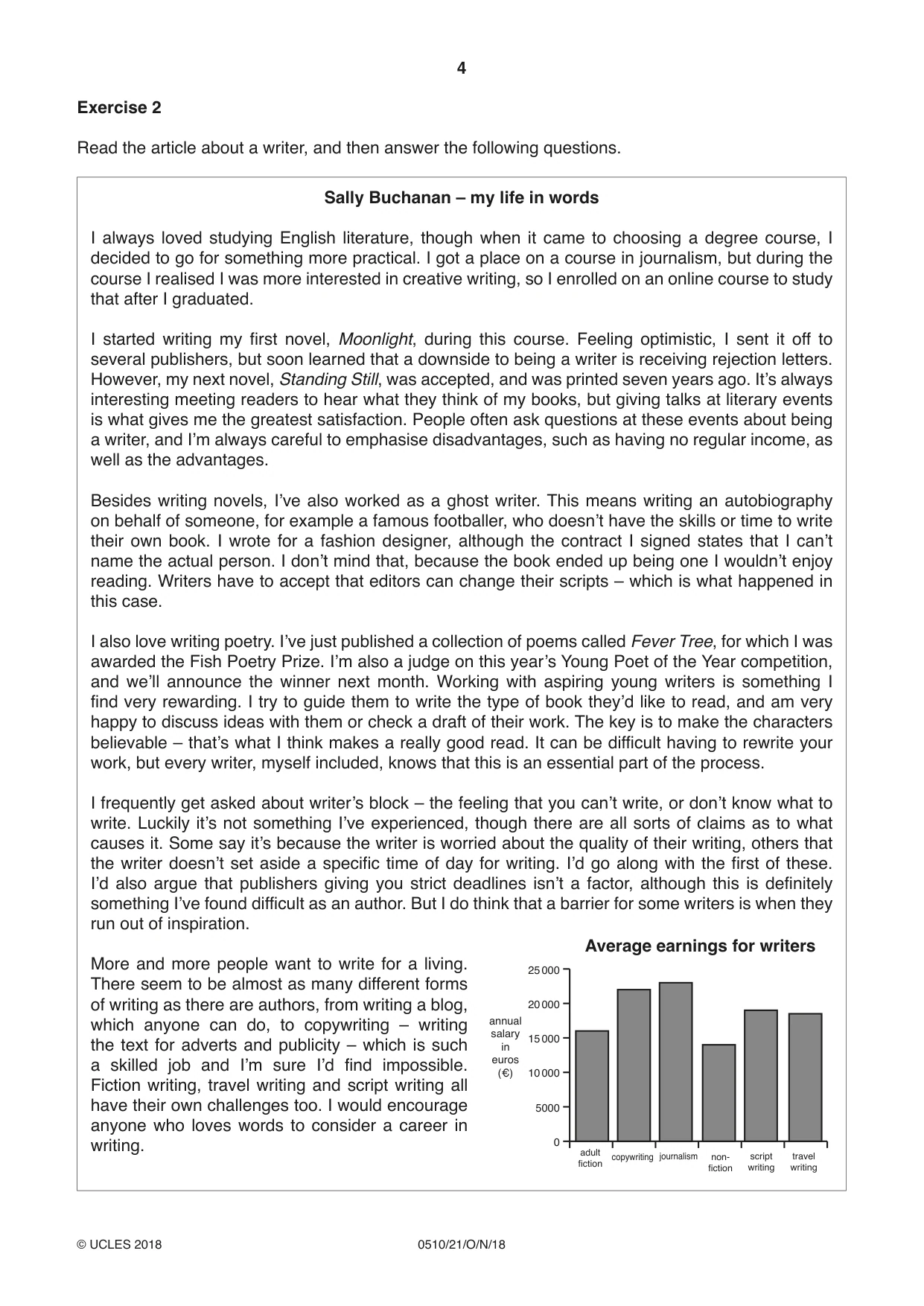
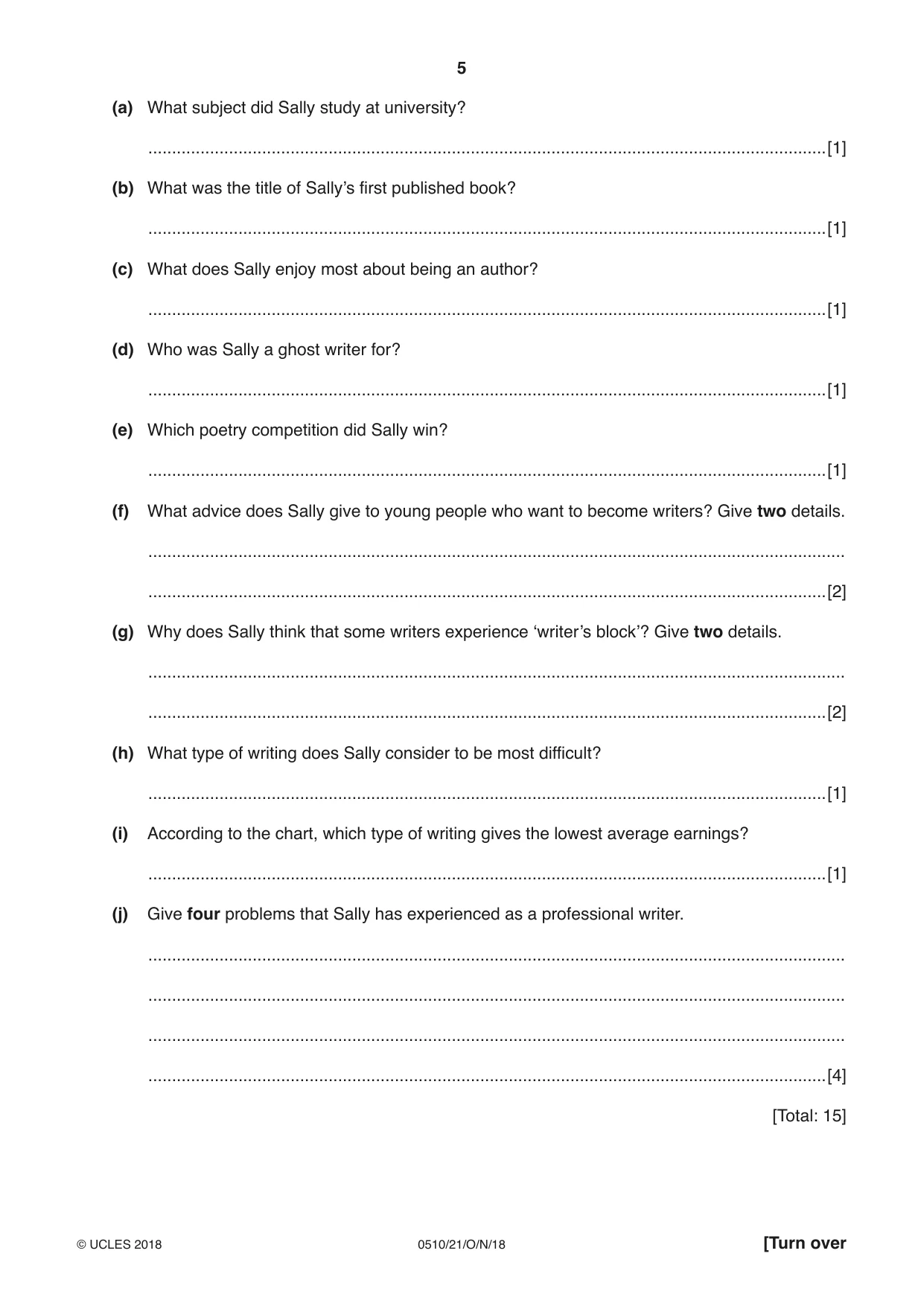
4 0510/21/O/N/18 © UCLES 2018 Exercise 2 Read the article about a writer, and then answer the following questions. Sally Buchanan – my life in words I always loved studying English literature, though when it came to choosing a degree course, I decided to go for something more practical. I got a place on a course in journalism, but during the course I realised I was more interested in creative writing, so I enrolled on an online course to study that after I graduated. I started writing my first novel, Moonlight, during this course. Feeling optimistic, I sent it off to several publishers, but soon learned that a downside to being a writer is receiving rejection letters. However, my next novel, Standing Still, was accepted, and was printed seven years ago. It’s always interesting meeting readers to hear what they think of my books, but giving talks at literary events is what gives me the greatest satisfaction. People often ask questions at these events about being a writer, and I’m always careful to emphasise disadvantages, such as having no regular income, as well as the advantages. Besides writing novels, I’ve also worked as a ghost writer. This means writing an autobiography on behalf of someone, for example a famous footballer, who doesn’t have the skills or time to write their own book. I wrote for a fashion designer, although the contract I signed states that I can’t name the actual person. I don’t mind that, because the book ended up being one I wouldn’t enjoy reading. Writers have to accept that editors can change their scripts – which is what happened in this case. I also love writing poetry. I’ve just published a collection of poems called Fever Tree, for which I was awarded the Fish Poetry Prize. I’m also a judge on this year’s Young Poet of the Year competition, and we’ll announce the winner next month. Working with aspiring young writers is something I find very rewarding. I try to guide them to write the type of book they’d like to read, and am very happy to discuss ideas with them or check a draft of their work. The key is to make the characters believable – that’s what I think makes a really good read. It can be difficult having to rewrite your work, but every writer, myself included, knows that this is an essential part of the process. I frequently get asked about writer’s block – the feeling that you can’t write, or don’t know what to write. Luckily it’s not something I’ve experienced, though there are all sorts of claims as to what causes it. Some say it’s because the writer is worried about the quality of their writing, others that the writer doesn’t set aside a specific time of day for writing. I’d go along with the first of these. I’d also argue that publishers giving you strict deadlines isn’t a factor, although this is definitely something I’ve found difficult as an author. But I do think that a barrier for some writers is when they run out of inspiration. 0 5000 10 000 15 000 20 000 25 000 Average earnings for writers annual salary in euros (€) adult fiction copywriting journalism non- fiction script writing travel writing More and more people want to write for a living. There seem to be almost as many different forms of writing as there are authors, from writing a blog, which anyone can do, to copywriting – writing the text for adverts and publicity – which is such a skilled job and I’m sure I’d find impossible. Fiction writing, travel writing and script writing all have their own challenges too. I would encourage anyone who loves words to consider a career in writing.
Question paper, page 5
5 0510/21/O/N/18 © UCLES 2018 [Turn over (a) What subject did Sally study at university? …[1] (b) What was the title of Sally’s first published book? …[1] (c) What does Sally enjoy most about being an author? …[1] (d) Who was Sally a ghost writer for? …[1] (e) Which poetry competition did Sally win? …[1] (f) What advice does Sally give to young people who want to become writers? Give two details. … …[2] (g) Why does Sally think that some writers experience ‘writer’s block’? Give two details. … …[2] (h) What type of writing does Sally consider to be most difficult? …[1] (i) According to the chart, which type of writing gives the lowest average earnings? …[1] (j) Give four problems that Sally has experienced as a professional writer. … … … …[4] [Total: 15]
Question paper, page 6
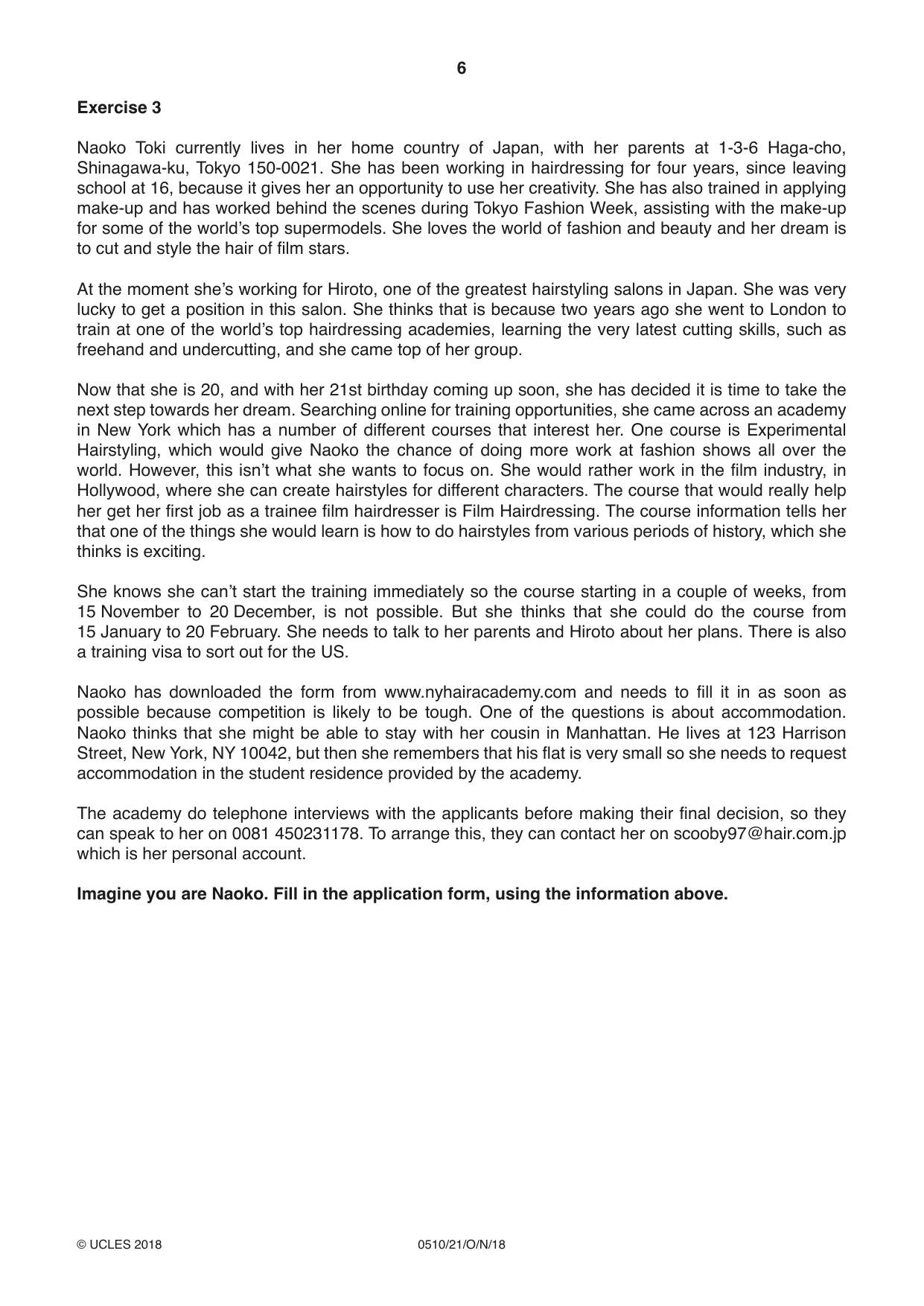
6 0510/21/O/N/18 © UCLES 2018 Exercise 3 Naoko Toki currently lives in her home country of Japan, with her parents at 1-3-6 Haga-cho, Shinagawa-ku, Tokyo 150-0021. She has been working in hairdressing for four years, since leaving school at 16, because it gives her an opportunity to use her creativity. She has also trained in applying make-up and has worked behind the scenes during Tokyo Fashion Week, assisting with the make-up for some of the world’s top supermodels. She loves the world of fashion and beauty and her dream is to cut and style the hair of film stars. At the moment she’s working for Hiroto, one of the greatest hairstyling salons in Japan. She was very lucky to get a position in this salon. She thinks that is because two years ago she went to London to train at one of the world’s top hairdressing academies, learning the very latest cutting skills, such as freehand and undercutting, and she came top of her group. Now that she is 20, and with her 21st birthday coming up soon, she has decided it is time to take the next step towards her dream. Searching online for training opportunities, she came across an academy in New York which has a number of different courses that interest her. One course is Experimental Hairstyling, which would give Naoko the chance of doing more work at fashion shows all over the world. However, this isn’t what she wants to focus on. She would rather work in the film industry, in Hollywood, where she can create hairstyles for different characters. The course that would really help her get her first job as a trainee film hairdresser is Film Hairdressing. The course information tells her that one of the things she would learn is how to do hairstyles from various periods of history, which she thinks is exciting. She knows she can’t start the training immediately so the course starting in a couple of weeks, from 15 November to 20 December, is not possible. But she thinks that she could do the course from 15 January to 20 February. She needs to talk to her parents and Hiroto about her plans. There is also a training visa to sort out for the US. Naoko has downloaded the form from www.nyhairacademy.com and needs to fill it in as soon as possible because competition is likely to be tough. One of the questions is about accommodation. Naoko thinks that she might be able to stay with her cousin in Manhattan. He lives at 123 Harrison Street, New York, NY 10042, but then she remembers that his flat is very small so she needs to request accommodation in the student residence provided by the academy. The academy do telephone interviews with the applicants before making their final decision, so they can speak to her on 0081 450231178. To arrange this, they can contact her on scooby97@hair.com.jp which is her personal account. Imagine you are Naoko. Fill in the application form, using the information above.
Question paper, page 7
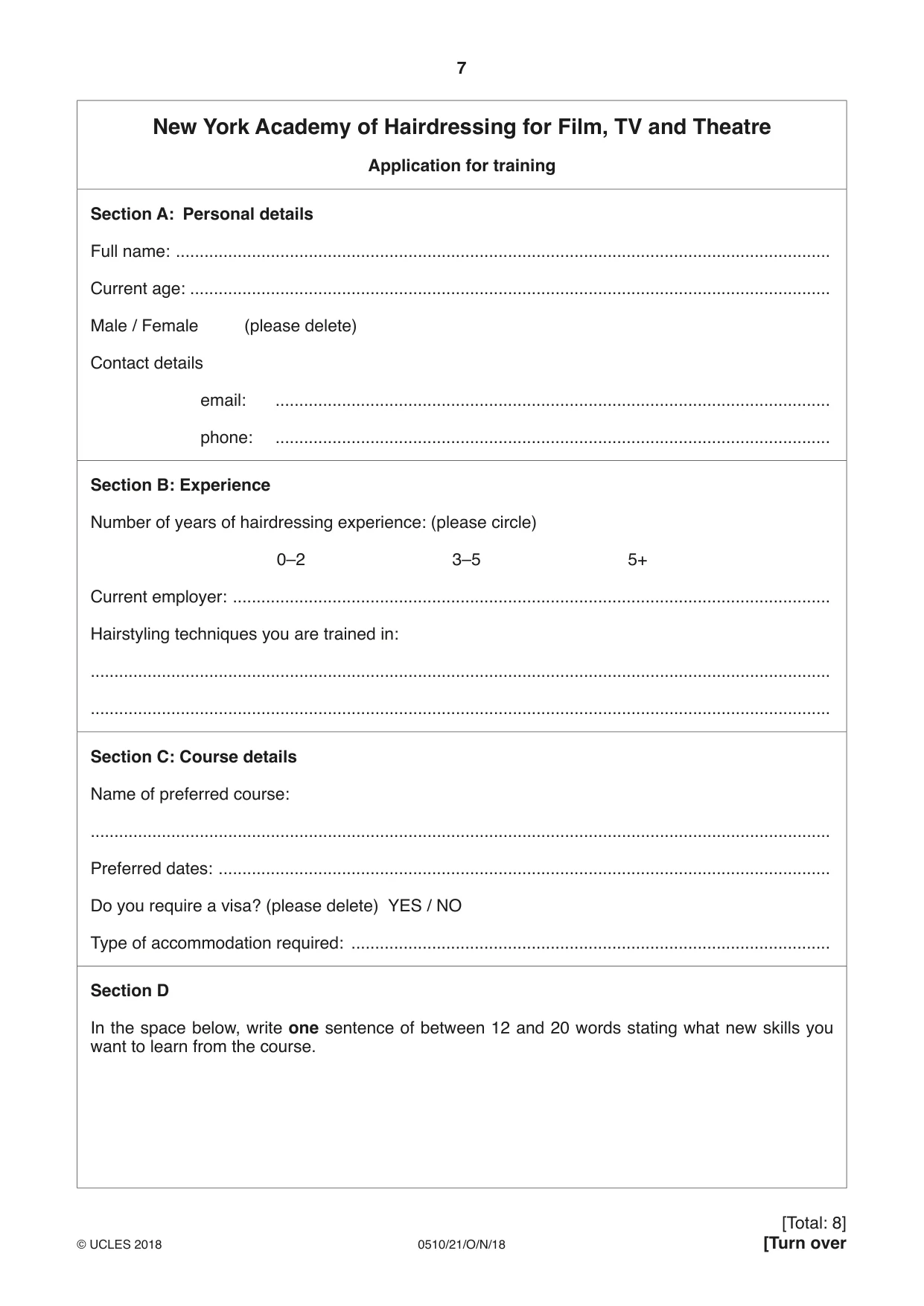
7 0510/21/O/N/18 © UCLES 2018 [Turn over New York Academy of Hairdressing for Film, TV and Theatre Application for training Section A: Personal details Full name: … Current age: … Male / Female (please delete) Contact details email: … phone: … Section B: Experience Number of years of hairdressing experience: (please circle) 0–2 3–5 5+ Current employer: … Hairstyling techniques you are trained in: … … Section C: Course details Name of preferred course: … Preferred dates: … Do you require a visa? (please delete) YES / NO Type of accommodation required: … Section D In the space below, write one sentence of between 12 and 20 words stating what new skills you want to learn from the course. [Total: 8]
Question paper, page 8
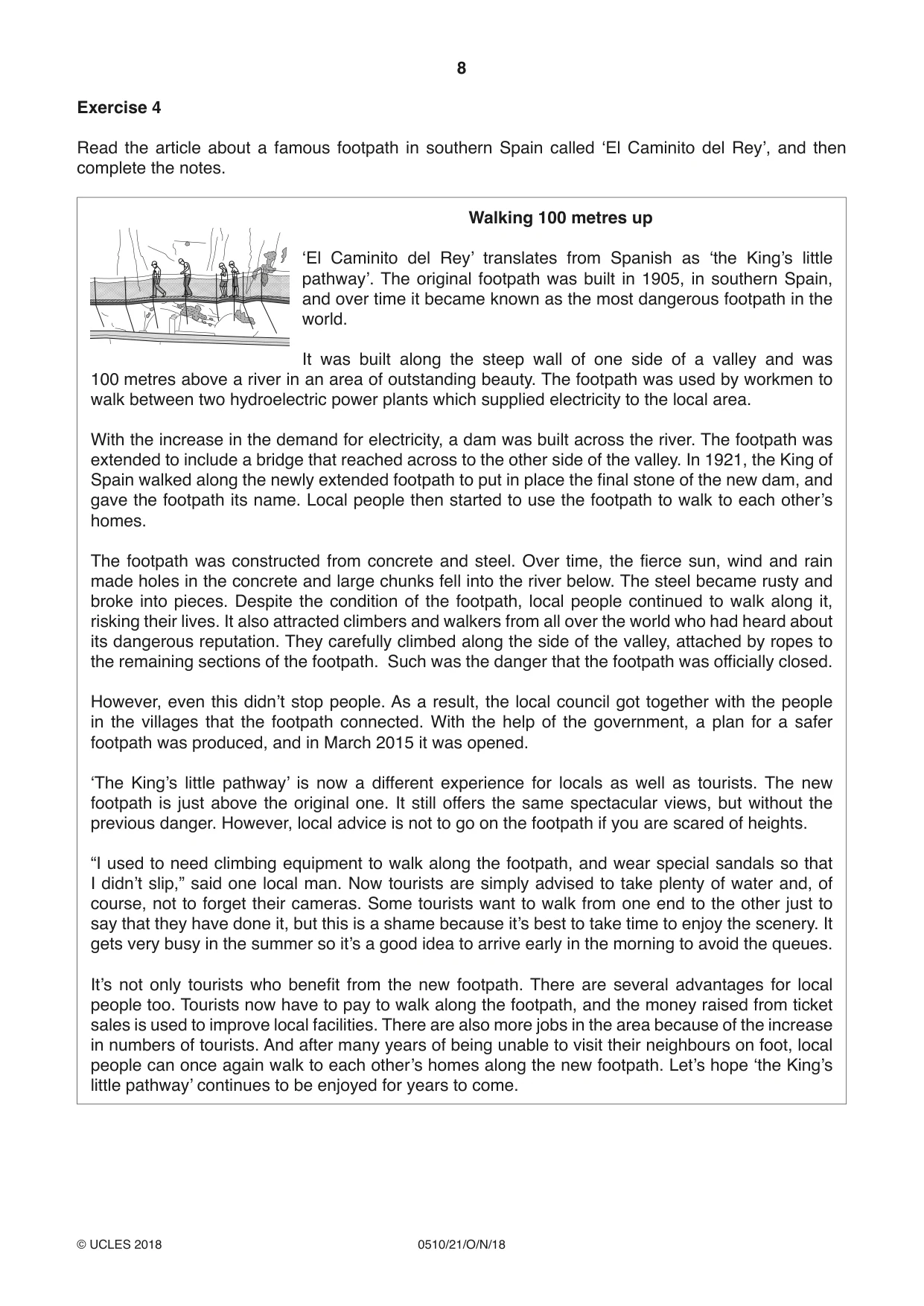
8 0510/21/O/N/18 © UCLES 2018 Exercise 4 Read the article about a famous footpath in southern Spain called ‘El Caminito del Rey’, and then complete the notes. Walking 100 metres up ‘El Caminito del Rey’ translates from Spanish as ‘the King’s little pathway’. The original footpath was built in 1905, in southern Spain, and over time it became known as the most dangerous footpath in the world. It was built along the steep wall of one side of a valley and was 100 metres above a river in an area of outstanding beauty. The footpath was used by workmen to walk between two hydroelectric power plants which supplied electricity to the local area. With the increase in the demand for electricity, a dam was built across the river. The footpath was extended to include a bridge that reached across to the other side of the valley. In 1921, the King of Spain walked along the newly extended footpath to put in place the final stone of the new dam, and gave the footpath its name. Local people then started to use the footpath to walk to each other’s homes. The footpath was constructed from concrete and steel. Over time, the fierce sun, wind and rain made holes in the concrete and large chunks fell into the river below. The steel became rusty and broke into pieces. Despite the condition of the footpath, local people continued to walk along it, risking their lives. It also attracted climbers and walkers from all over the world who had heard about its dangerous reputation. They carefully climbed along the side of the valley, attached by ropes to the remaining sections of the footpath. Such was the danger that the footpath was officially closed. However, even this didn’t stop people. As a result, the local council got together with the people in the villages that the footpath connected. With the help of the government, a plan for a safer footpath was produced, and in March 2015 it was opened. ‘The King’s little pathway’ is now a different experience for locals as well as tourists. The new footpath is just above the original one. It still offers the same spectacular views, but without the previous danger. However, local advice is not to go on the footpath if you are scared of heights. “I used to need climbing equipment to walk along the footpath, and wear special sandals so that I didn’t slip,” said one local man. Now tourists are simply advised to take plenty of water and, of course, not to forget their cameras. Some tourists want to walk from one end to the other just to say that they have done it, but this is a shame because it’s best to take time to enjoy the scenery. It gets very busy in the summer so it’s a good idea to arrive early in the morning to avoid the queues. It’s not only tourists who benefit from the new footpath. There are several advantages for local people too. Tourists now have to pay to walk along the footpath, and the money raised from ticket sales is used to improve local facilities. There are also more jobs in the area because of the increase in numbers of tourists. And after many years of being unable to visit their neighbours on foot, local people can once again walk to each other’s homes along the new footpath. Let’s hope ‘the King’s little pathway’ continues to be enjoyed for years to come.
Question paper, page 9
9 0510/21/O/N/18 © UCLES 2018 [Turn over You are going to give a talk to your class about ‘the King’s little pathway’. Prepare some notes to use as the basis for your talk. Make short notes under each heading. Reasons why the original footpath was unsafe: • … • … • … • … Recommendations to tourists: • … • … • … How the new footpath has helped local people: • … • … [Total: 9]
Question paper, page 10
10 0510/21/O/N/18 © UCLES 2018 Exercise 5 Read the following article about the role of cars in modern life. Write a summary about the reasons why cars are so important to people AND the negative effects of cars on the environment. Your summary should be about 100 words long (and no more than 120 words long). You should use your own words as far as possible. You will receive up to 6 marks for the content of your summary and up to 5 marks for the style and accuracy of your language. Cars – love them or hate them It is only just over 130 years ago that the first car was invented. In the context of the millions of years since the beginning of our planet Earth, that is no time at all. And yet, because cars are such an essential part of our lives, it seems as though they have always been with us. Gina O’Donnell, a young marketing executive who runs international campaigns to sell Italian- designed cars to people all over the world, says: “Part of my job is to find out why people drive cars. People choose cars for many different reasons. Some say they are looking for a car that gives them the sense of freedom they desire. Others say that their vehicle is essential because they have to take their children to and from school every day.” Priya Patel, mother to three young boys who attend different schools many miles apart, is one such example. Even though she is fully aware of the air pollution that her multiple journeys cause, she doesn’t feel that she has any choice at the moment. For some people, their car helps them to express their hidden personality. “When I’m driving my sports car on a sunny day, with the top down, I feel like a teenage rock star,” joked a senior manager. But our love affair with the car has its consequences. The expanding network of concrete roads may be seen as spoiling the beauty of rural areas. Although some people predict that the need for more roads will increase in the future, others are keen to develop different public transport systems, or encourage more people to join car sharing schemes. It’s essential to find alternatives, because if we continue to build roads at the same pace, there is an increased risk of flooding. This can occur when rainwater falls on roads and can’t drain into the ground so easily. All over the world there are hundreds of thousands of people employed in the car industry. They work in a wide variety of roles, from marketing executives like Gina O’Donnell, to engineers who create the robots that work on the production line, and quality controllers who inspect the finished products. Cars are also vital to small businesses all over the world. They are used for transporting goods and merchandise from one part of the country to another. However, all these cars need somewhere to park, and this means that a lot of our green spaces in urban areas are being built on to provide car parks. The good news is that people are trying to find ways of helping the environment without having to give up their cars. Scientists are busy researching new fuels, for example by recycling the vegetable oil that restaurants use in their kitchens. Electric cars that have rechargeable batteries are often seen in our cities these days. We are left with the dilemma about whether the benefits of cars in our daily lives outweigh the negative effects on the environment. This question will no doubt continue to engage people for many years to come.
Question paper, page 11
11 0510/21/O/N/18 © UCLES 2018 [Turn over … … … … … … … … … … … … … … … … … … … … … … … … … … … [Total: 11]
Question paper, page 12
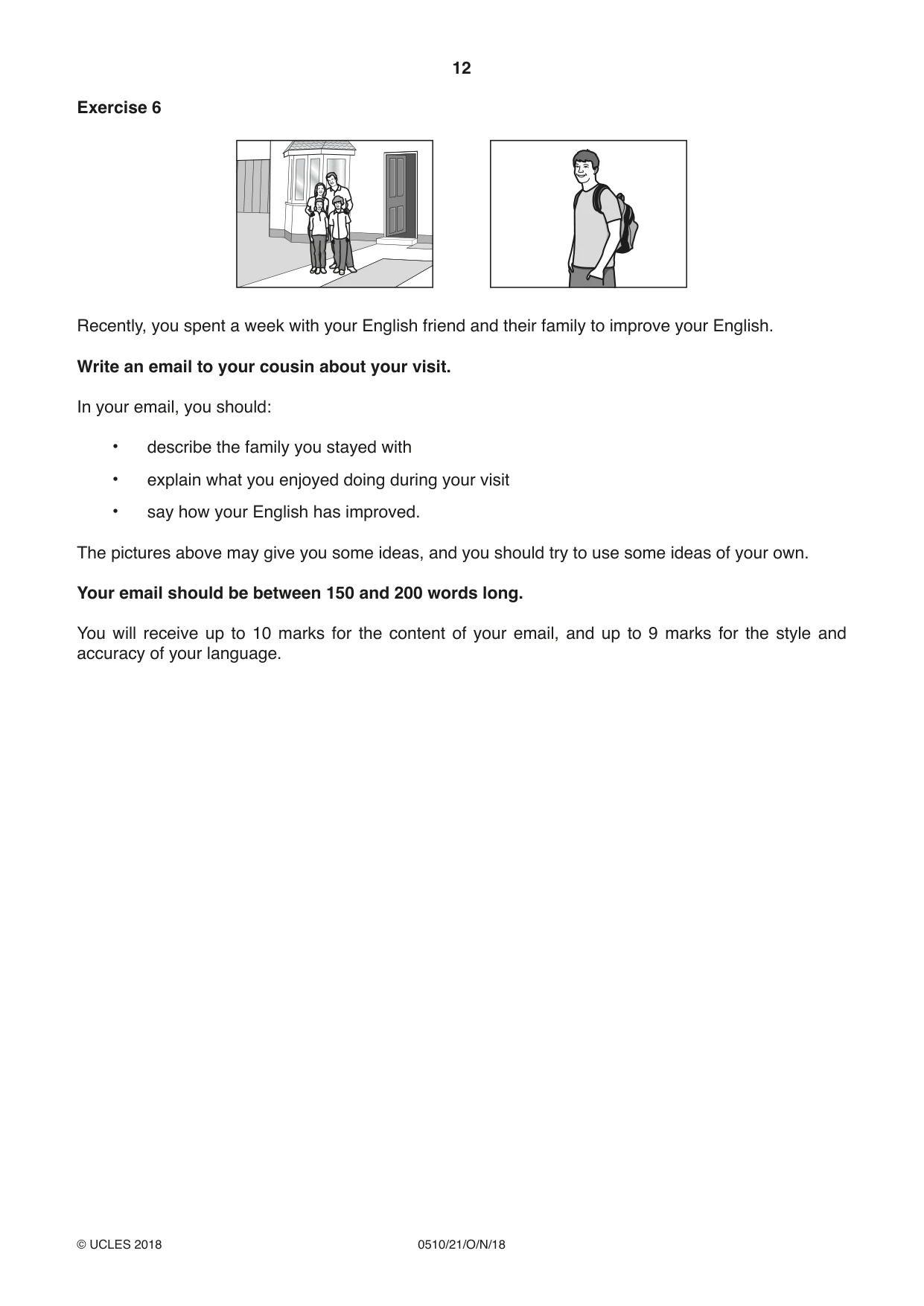
12 0510/21/O/N/18 © UCLES 2018 Exercise 6 Recently, you spent a week with your English friend and their family to improve your English. Write an email to your cousin about your visit. In your email, you should: • describe the family you stayed with • explain what you enjoyed doing during your visit • say how your English has improved. The pictures above may give you some ideas, and you should try to use some ideas of your own. Your email should be between 150 and 200 words long. You will receive up to 10 marks for the content of your email, and up to 9 marks for the style and accuracy of your language.
Question paper, page 13
13 0510/21/O/N/18 © UCLES 2018 [Turn over … … … … … … … … … … … … … … … … … … … … … … … … … … … [Total: 19]
Question paper, page 14
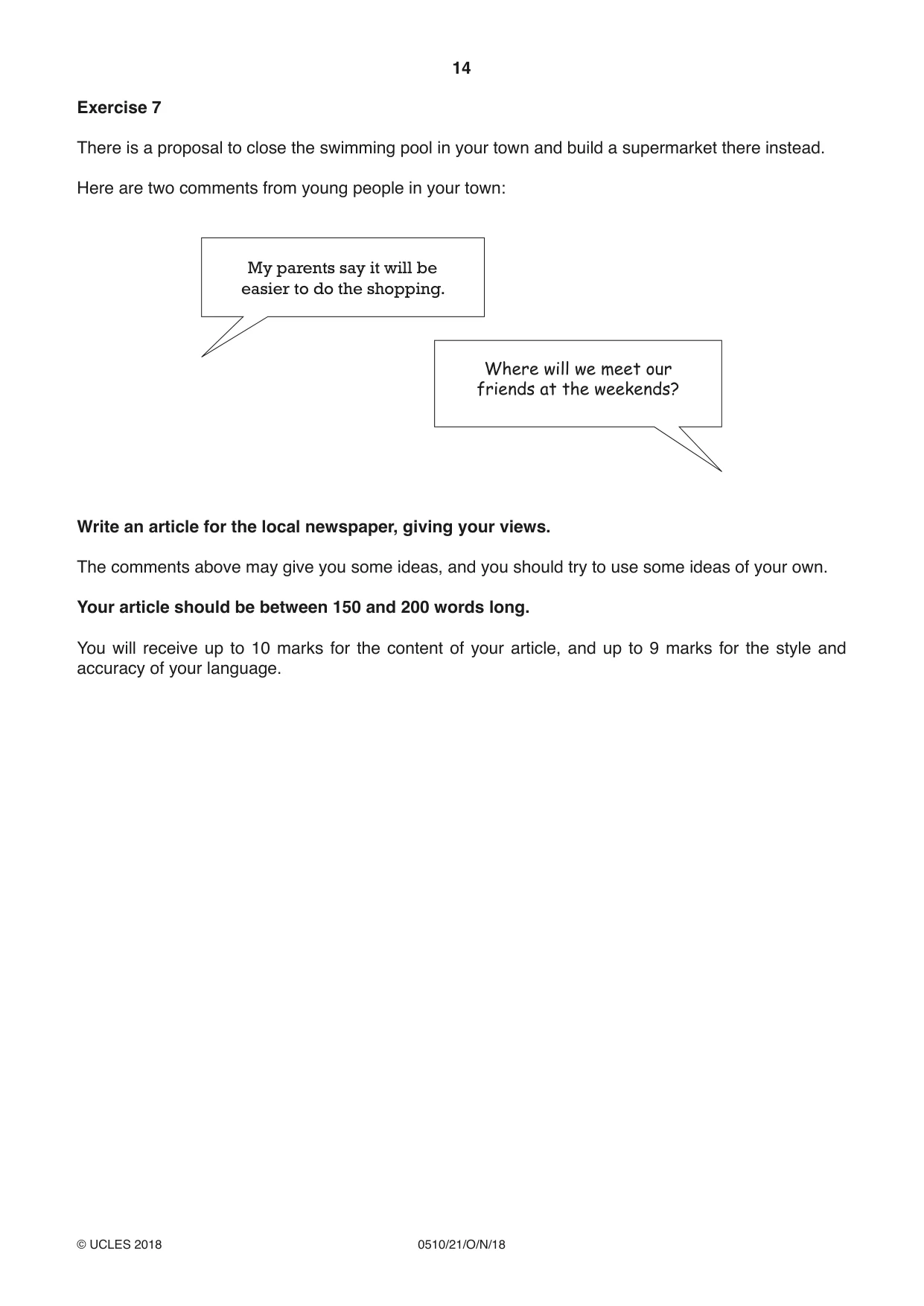
14 0510/21/O/N/18 © UCLES 2018 Exercise 7 There is a proposal to close the swimming pool in your town and build a supermarket there instead. Here are two comments from young people in your town: Where will we meet our friends at the weekends? My parents say it will be easier to do the shopping. Write an article for the local newspaper, giving your views. The comments above may give you some ideas, and you should try to use some ideas of your own. Your article should be between 150 and 200 words long. You will receive up to 10 marks for the content of your article, and up to 9 marks for the style and accuracy of your language.
Question paper, page 15
15 0510/21/O/N/18 © UCLES 2018 … … … … … … … … … … … … … … … … … … … … … … … … … … … [Total: 19]
Question paper, page 16
16 0510/21/O/N/18 © UCLES 2018 Permission to reproduce items where third-party owned material protected by copyright is included has been sought and cleared where possible. Every reasonable effort has been made by the publisher (UCLES) to trace copyright holders, but if any items requiring clearance have unwittingly been included, the publisher will be pleased to make amends at the earliest possible opportunity. To avoid the issue of disclosure of answer-related information to candidates, all copyright acknowledgements are reproduced online in the Cambridge International Examinations Copyright Acknowledgements Booklet. This is produced for each series of examinations and is freely available to download at www.cie.org.uk after the live examination series. Cambridge International Examinations is part of the Cambridge Assessment Group. Cambridge Assessment is the brand name of University of Cambridge Local Examinations Syndicate (UCLES), which is itself a department of the University of Cambridge. BLANK PAGE
Mark scheme, page 1
This document consists of 13 printed pages. © UCLES 2018 [Turn over Cambridge Assessment International Education Cambridge International General Certificate of Secondary Education ENGLISH AS A SECOND LANGUAGE 0510/21 Paper 2 Reading and Writing (Extended) October/November 2018 MARK SCHEME Maximum Mark: 90 Published This mark scheme is published as an aid to teachers and candidates, to indicate the requirements of the examination. It shows the basis on which Examiners were instructed to award marks. It does not indicate the details of the discussions that took place at an Examiners’ meeting before marking began, which would have considered the acceptability of alternative answers. Mark schemes should be read in conjunction with the question paper and the Principal Examiner Report for Teachers. Cambridge International will not enter into discussions about these mark schemes. Cambridge International is publishing the mark schemes for the October/November 2018 series for most Cambridge IGCSE™, Cambridge International A and AS Level components and some Cambridge O Level components.
Mark scheme, page 2
0510/21 Cambridge IGCSE – Mark Scheme PUBLISHED October/November 2018 © UCLES 2018 Page 2 of 13 Generic Marking Principles These general marking principles must be applied by all examiners when marking candidate answers. They should be applied alongside the specific content of the mark scheme or generic level descriptors for a question. Each question paper and mark scheme will also comply with these marking principles. GENERIC MARKING PRINCIPLE 1: Marks must be awarded in line with: • the specific content of the mark scheme or the generic level descriptors for the question • the specific skills defined in the mark scheme or in the generic level descriptors for the question • the standard of response required by a candidate as exemplified by the standardisation scripts. GENERIC MARKING PRINCIPLE 2: Marks awarded are always whole marks (not half marks, or other fractions). GENERIC MARKING PRINCIPLE 3: Marks must be awarded positively: • marks are awarded for correct/valid answers, as defined in the mark scheme. However, credit is given for valid answers which go beyond the scope of the syllabus and mark scheme, referring to your Team Leader as appropriate • marks are awarded when candidates clearly demonstrate what they know and can do • marks are not deducted for errors • marks are not deducted for omissions • answers should only be judged on the quality of spelling, punctuation and grammar when these features are specifically assessed by the question as indicated by the mark scheme. The meaning, however, should be unambiguous. GENERIC MARKING PRINCIPLE 4: Rules must be applied consistently e.g. in situations where candidates have not followed instructions or in the application of generic level descriptors. GENERIC MARKING PRINCIPLE 5: Marks should be awarded using the full range of marks defined in the mark scheme for the question (however; the use of the full mark range may be limited according to the quality of the candidate responses seen). GENERIC MARKING PRINCIPLE 6: Marks awarded are based solely on the requirements as defined in the mark scheme. Marks should not be awarded with grade thresholds or grade descriptors in mind.
Mark scheme, page 3
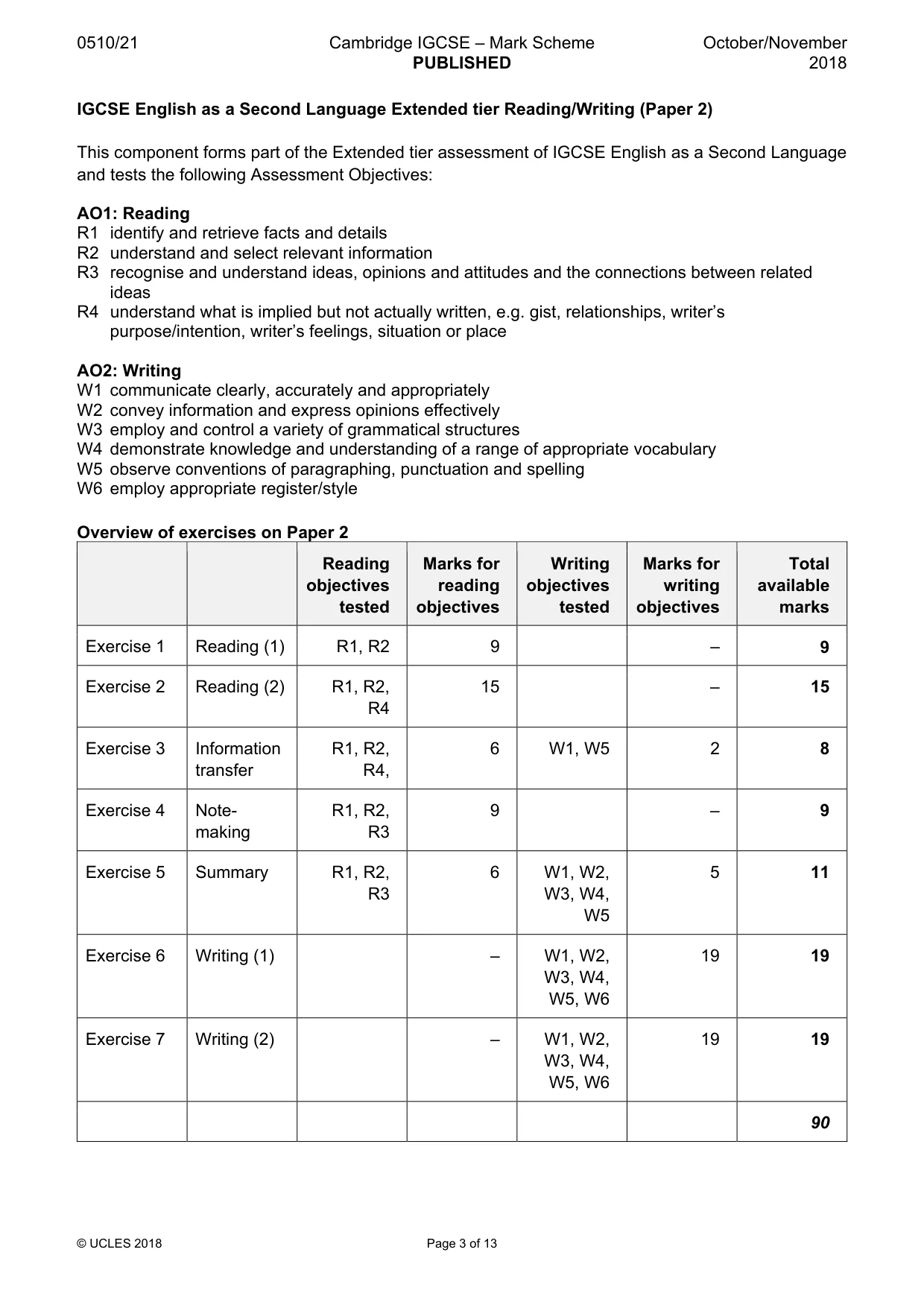
0510/21 Cambridge IGCSE – Mark Scheme PUBLISHED October/November 2018 © UCLES 2018 Page 3 of 13 IGCSE English as a Second Language Extended tier Reading/Writing (Paper 2) This component forms part of the Extended tier assessment of IGCSE English as a Second Language and tests the following Assessment Objectives: AO1: Reading R1 identify and retrieve facts and details R2 understand and select relevant information R3 recognise and understand ideas, opinions and attitudes and the connections between related ideas R4 understand what is implied but not actually written, e.g. gist, relationships, writer’s purpose/intention, writer’s feelings, situation or place AO2: Writing W1 communicate clearly, accurately and appropriately W2 convey information and express opinions effectively W3 employ and control a variety of grammatical structures W4 demonstrate knowledge and understanding of a range of appropriate vocabulary W5 observe conventions of paragraphing, punctuation and spelling W6 employ appropriate register/style Overview of exercises on Paper 2 Reading objectives tested Marks for reading objectives Writing objectives tested Marks for writing objectives Total available marks Exercise 1 Reading (1) R1, R2 9 – 9 Exercise 2 Reading (2) R1, R2, R4 15 – 15 Exercise 3 Information transfer R1, R2, R4, 6 W1, W5 2 8 Exercise 4 Note- making R1, R2, R3 9 – 9 Exercise 5 Summary R1, R2, R3 6 W1, W2, W3, W4, W5 5 11 Exercise 6 Writing (1) – W1, W2, W3, W4, W5, W6 19 19 Exercise 7 Writing (2) – W1, W2, W3, W4, W5, W6 19 19 90
Mark scheme, page 4
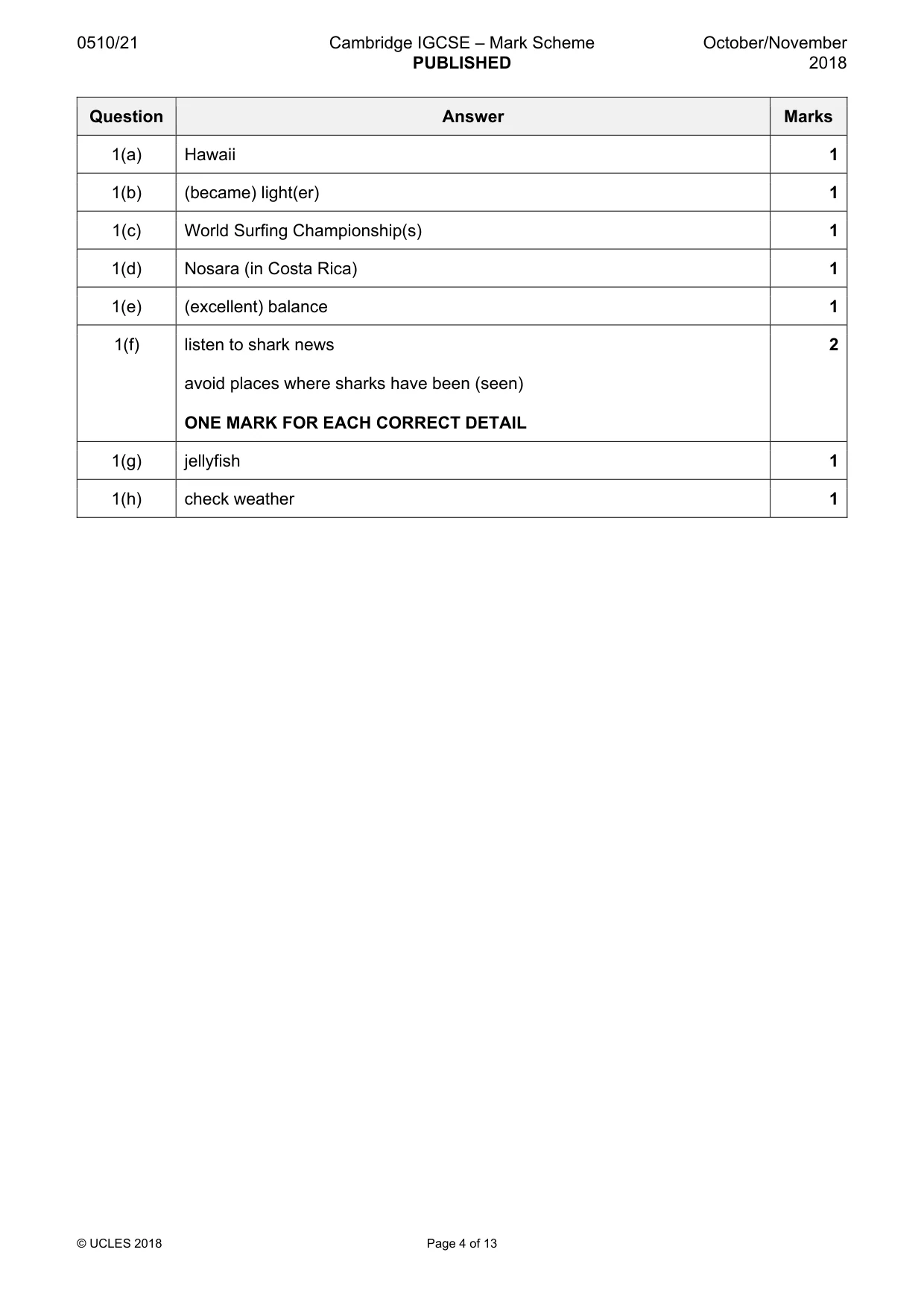
0510/21 Cambridge IGCSE – Mark Scheme PUBLISHED October/November 2018 © UCLES 2018 Page 4 of 13 Question Answer Marks 1(a) Hawaii 1 1(b) (became) light(er) 1 1(c) World Surfing Championship(s) 1 1(d) Nosara (in Costa Rica) 1 1(e) (excellent) balance 1 1(f) listen to shark news avoid places where sharks have been (seen) ONE MARK FOR EACH CORRECT DETAIL 2 1(g) jellyfish 1 1(h) check weather 1
Mark scheme, page 5
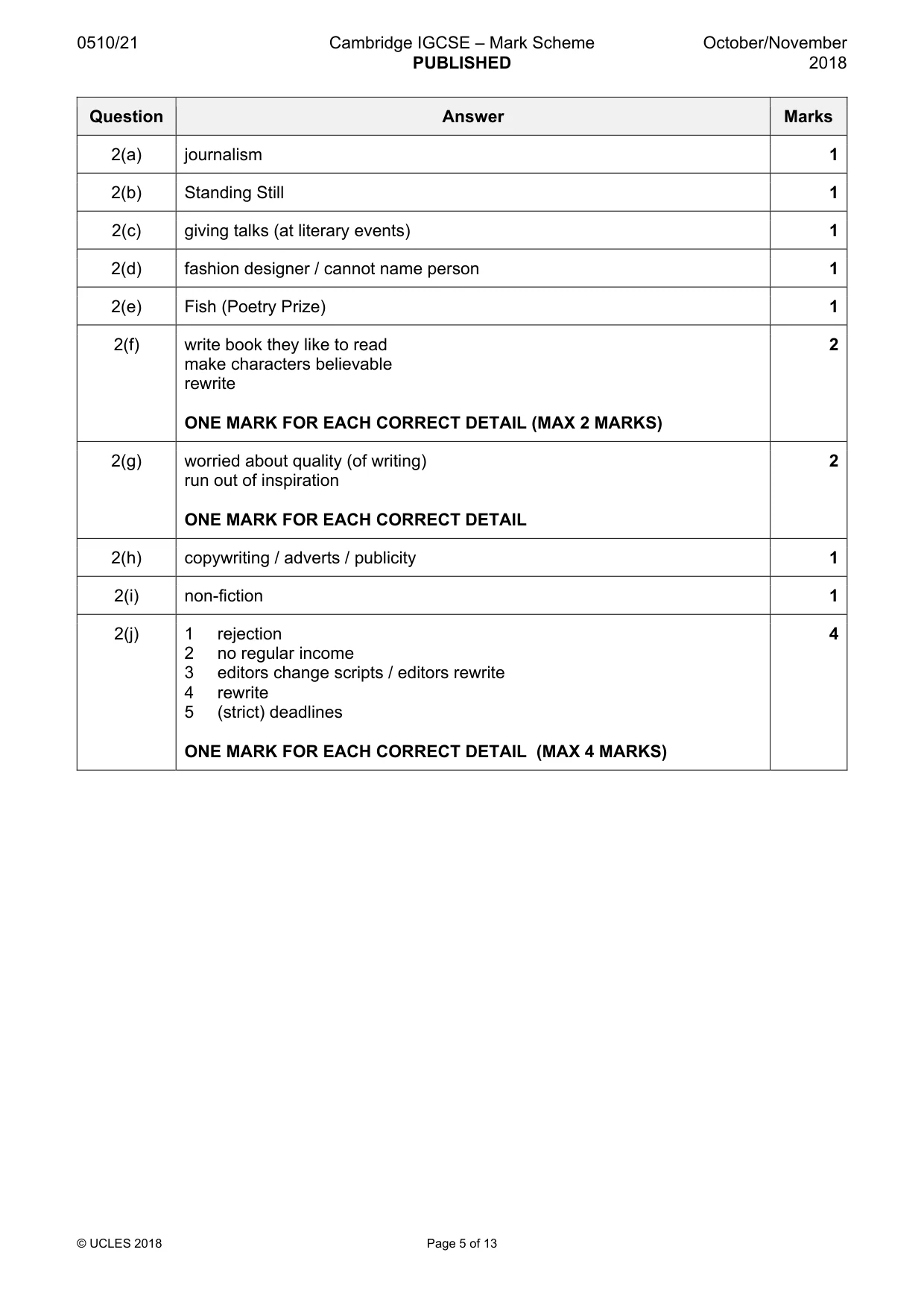
0510/21 Cambridge IGCSE – Mark Scheme PUBLISHED October/November 2018 © UCLES 2018 Page 5 of 13 Question Answer Marks 2(a) journalism 1 2(b) Standing Still 1 2(c) giving talks (at literary events) 1 2(d) fashion designer / cannot name person 1 2(e) Fish (Poetry Prize) 1 2(f) write book they like to read make characters believable rewrite ONE MARK FOR EACH CORRECT DETAIL (MAX 2 MARKS) 2 2(g) worried about quality (of writing) run out of inspiration ONE MARK FOR EACH CORRECT DETAIL 2 2(h) copywriting / adverts / publicity 1 2(i) non-fiction 1 2(j) 1 rejection 2 no regular income 3 editors change scripts / editors rewrite 4 rewrite 5 (strict) deadlines ONE MARK FOR EACH CORRECT DETAIL (MAX 4 MARKS) 4
Mark scheme, page 6
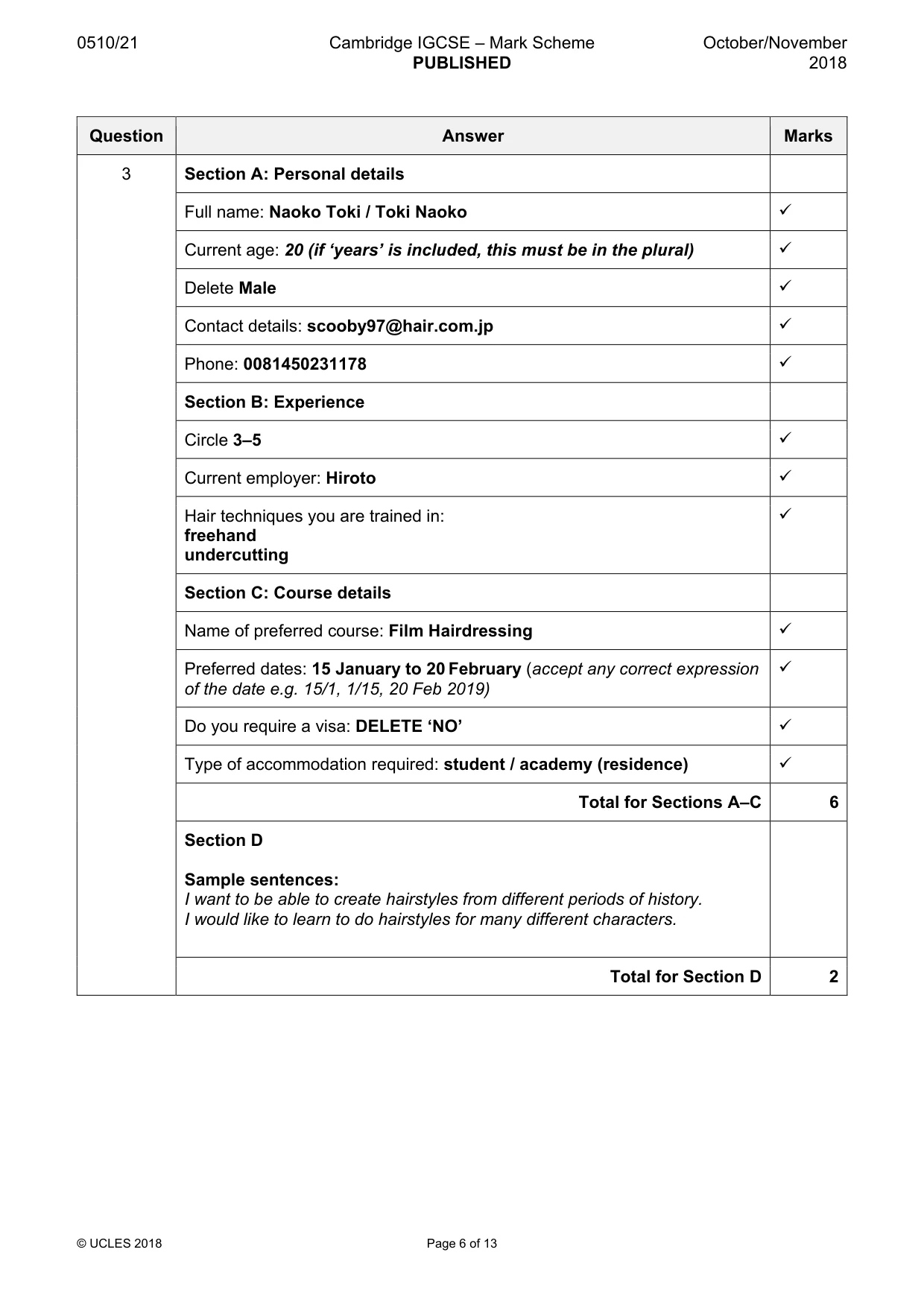
0510/21 Cambridge IGCSE – Mark Scheme PUBLISHED October/November 2018 © UCLES 2018 Page 6 of 13 Question Answer Marks 3 Section A: Personal details Full name: Naoko Toki / Toki Naoko 9 Current age: 20 (if ‘years’ is included, this must be in the plural) 9 Delete Male 9 Contact details: scooby97@hair.com.jp 9 Phone: 0081450231178 9 Section B: Experience Circle 3–5 9 Current employer: Hiroto 9 Hair techniques you are trained in: freehand undercutting 9 Section C: Course details Name of preferred course: Film Hairdressing 9 Preferred dates: 15 January to 20 February (accept any correct expression of the date e.g. 15/1, 1/15, 20 Feb 2019) 9 Do you require a visa: DELETE ‘NO’ 9 Type of accommodation required: student / academy (residence) 9 Total for Sections A–C 6 Section D Sample sentences: I want to be able to create hairstyles from different periods of history. I would like to learn to do hairstyles for many different characters. Total for Section D 2
Mark scheme, page 7
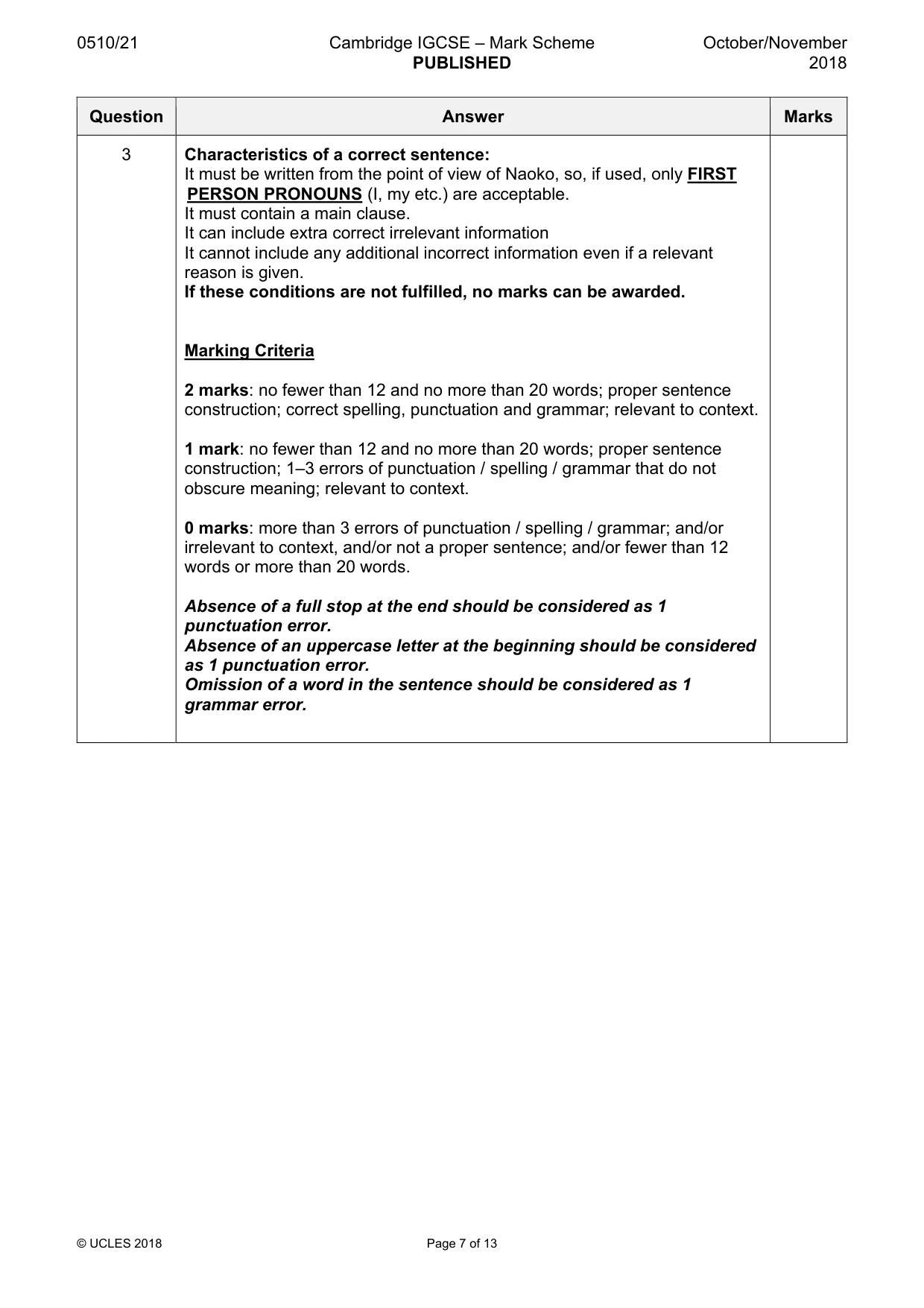
0510/21 Cambridge IGCSE – Mark Scheme PUBLISHED October/November 2018 © UCLES 2018 Page 7 of 13 Question Answer Marks 3 Characteristics of a correct sentence: It must be written from the point of view of Naoko, so, if used, only FIRST PERSON PRONOUNS (I, my etc.) are acceptable. It must contain a main clause. It can include extra correct irrelevant information It cannot include any additional incorrect information even if a relevant reason is given. If these conditions are not fulfilled, no marks can be awarded. Marking Criteria 2 marks: no fewer than 12 and no more than 20 words; proper sentence construction; correct spelling, punctuation and grammar; relevant to context. 1 mark: no fewer than 12 and no more than 20 words; proper sentence construction; 1–3 errors of punctuation / spelling / grammar that do not obscure meaning; relevant to context. 0 marks: more than 3 errors of punctuation / spelling / grammar; and/or irrelevant to context, and/or not a proper sentence; and/or fewer than 12 words or more than 20 words. Absence of a full stop at the end should be considered as 1 punctuation error. Absence of an uppercase letter at the beginning should be considered as 1 punctuation error. Omission of a word in the sentence should be considered as 1 grammar error.
Mark scheme, page 8
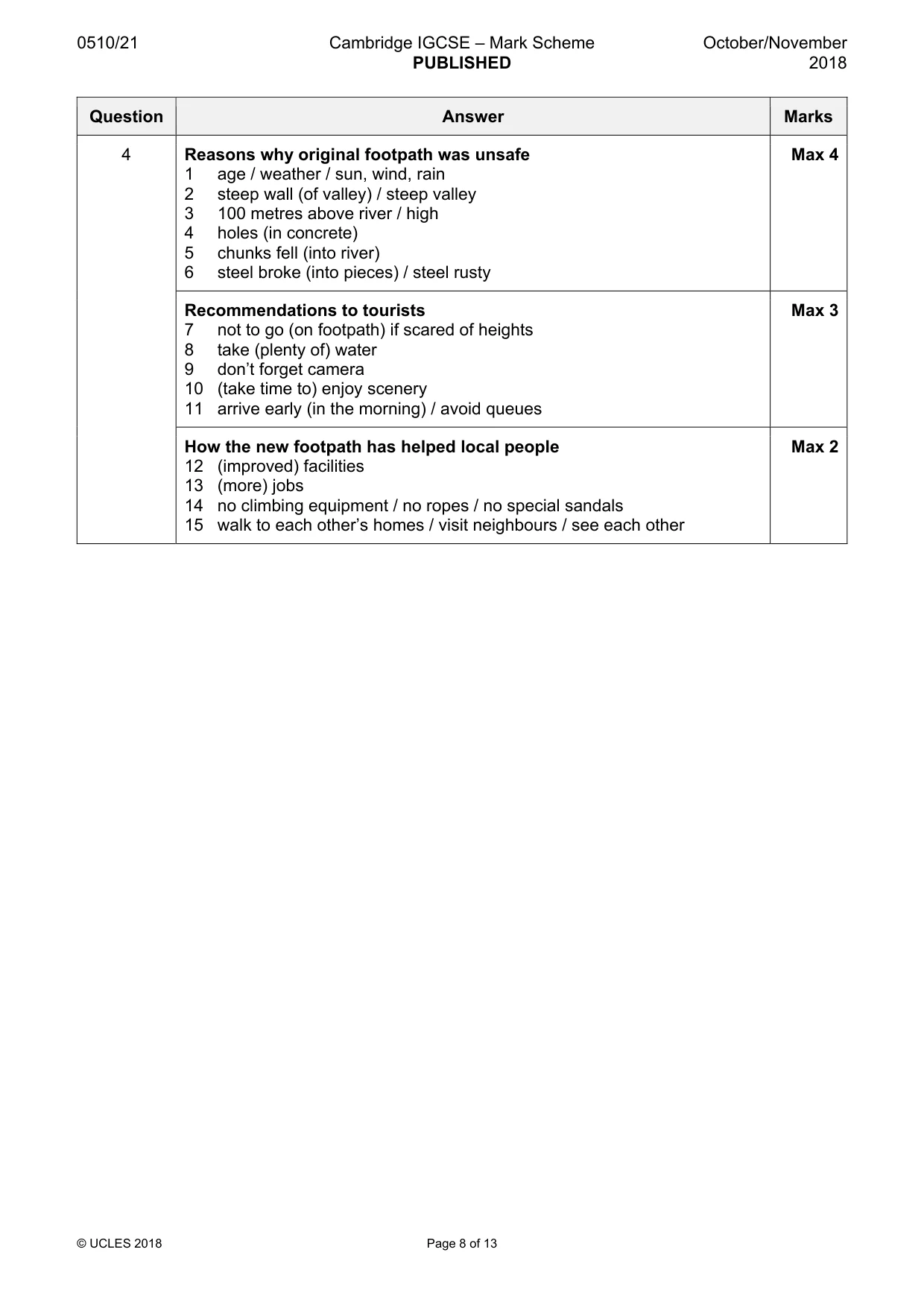
0510/21 Cambridge IGCSE – Mark Scheme PUBLISHED October/November 2018 © UCLES 2018 Page 8 of 13 Question Answer Marks 4 Reasons why original footpath was unsafe 1 age / weather / sun, wind, rain 2 steep wall (of valley) / steep valley 3 100 metres above river / high 4 holes (in concrete) 5 chunks fell (into river) 6 steel broke (into pieces) / steel rusty Max 4 Recommendations to tourists 7 not to go (on footpath) if scared of heights 8 take (plenty of) water 9 don’t forget camera 10 (take time to) enjoy scenery 11 arrive early (in the morning) / avoid queues Max 3 How the new footpath has helped local people 12 (improved) facilities 13 (more) jobs 14 no climbing equipment / no ropes / no special sandals 15 walk to each other’s homes / visit neighbours / see each other Max 2
Mark scheme, page 9
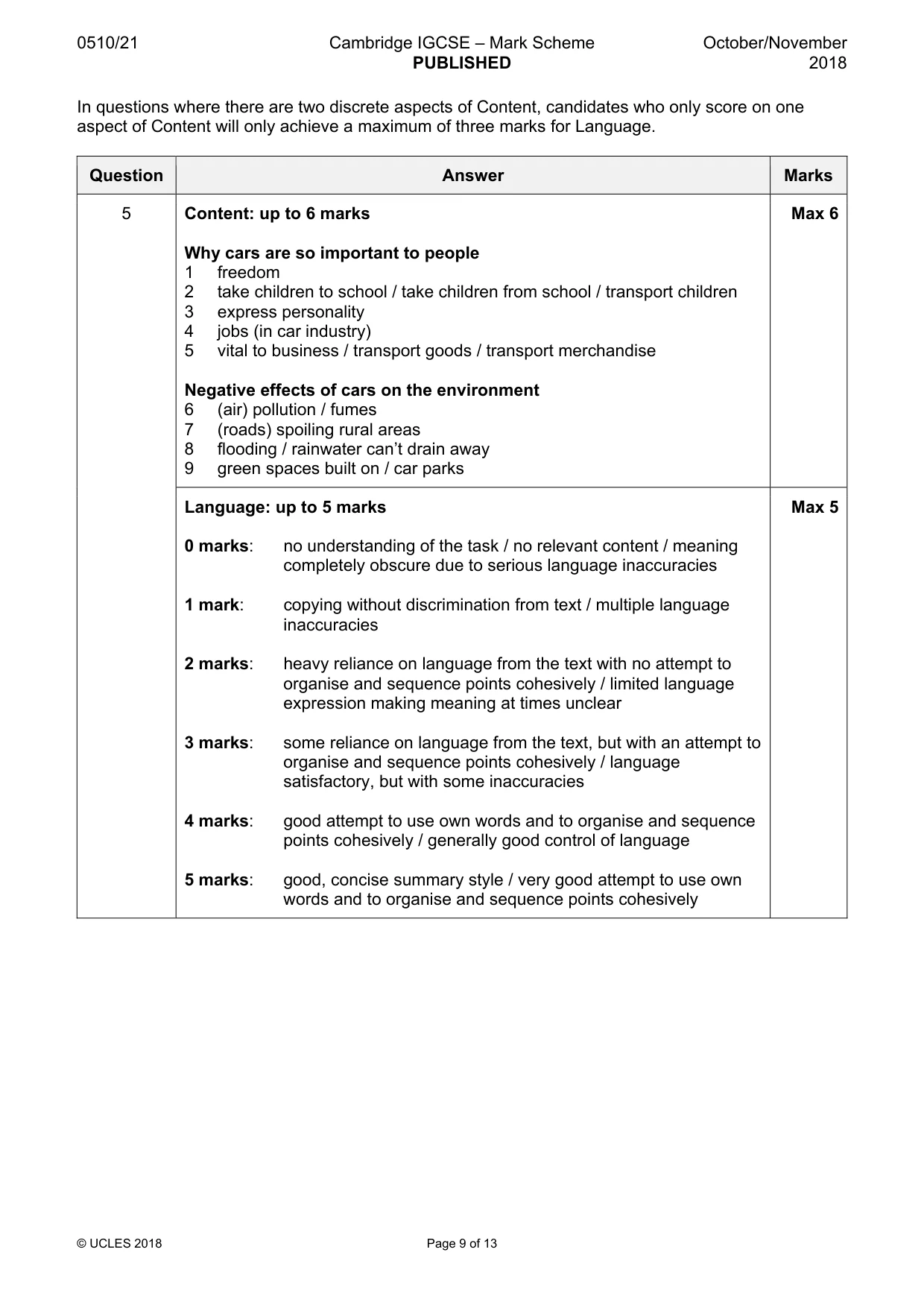
0510/21 Cambridge IGCSE – Mark Scheme PUBLISHED October/November 2018 © UCLES 2018 Page 9 of 13 In questions where there are two discrete aspects of Content, candidates who only score on one aspect of Content will only achieve a maximum of three marks for Language. Question Answer Marks 5 Content: up to 6 marks Why cars are so important to people 1 freedom 2 take children to school / take children from school / transport children 3 express personality 4 jobs (in car industry) 5 vital to business / transport goods / transport merchandise Negative effects of cars on the environment 6 (air) pollution / fumes 7 (roads) spoiling rural areas 8 flooding / rainwater can’t drain away 9 green spaces built on / car parks Max 6 Language: up to 5 marks 0 marks: no understanding of the task / no relevant content / meaning completely obscure due to serious language inaccuracies 1 mark: copying without discrimination from text / multiple language inaccuracies 2 marks: heavy reliance on language from the text with no attempt to organise and sequence points cohesively / limited language expression making meaning at times unclear 3 marks: some reliance on language from the text, but with an attempt to organise and sequence points cohesively / language satisfactory, but with some inaccuracies 4 marks: good attempt to use own words and to organise and sequence points cohesively / generally good control of language 5 marks: good, concise summary style / very good attempt to use own words and to organise and sequence points cohesively Max 5
Mark scheme, page 10
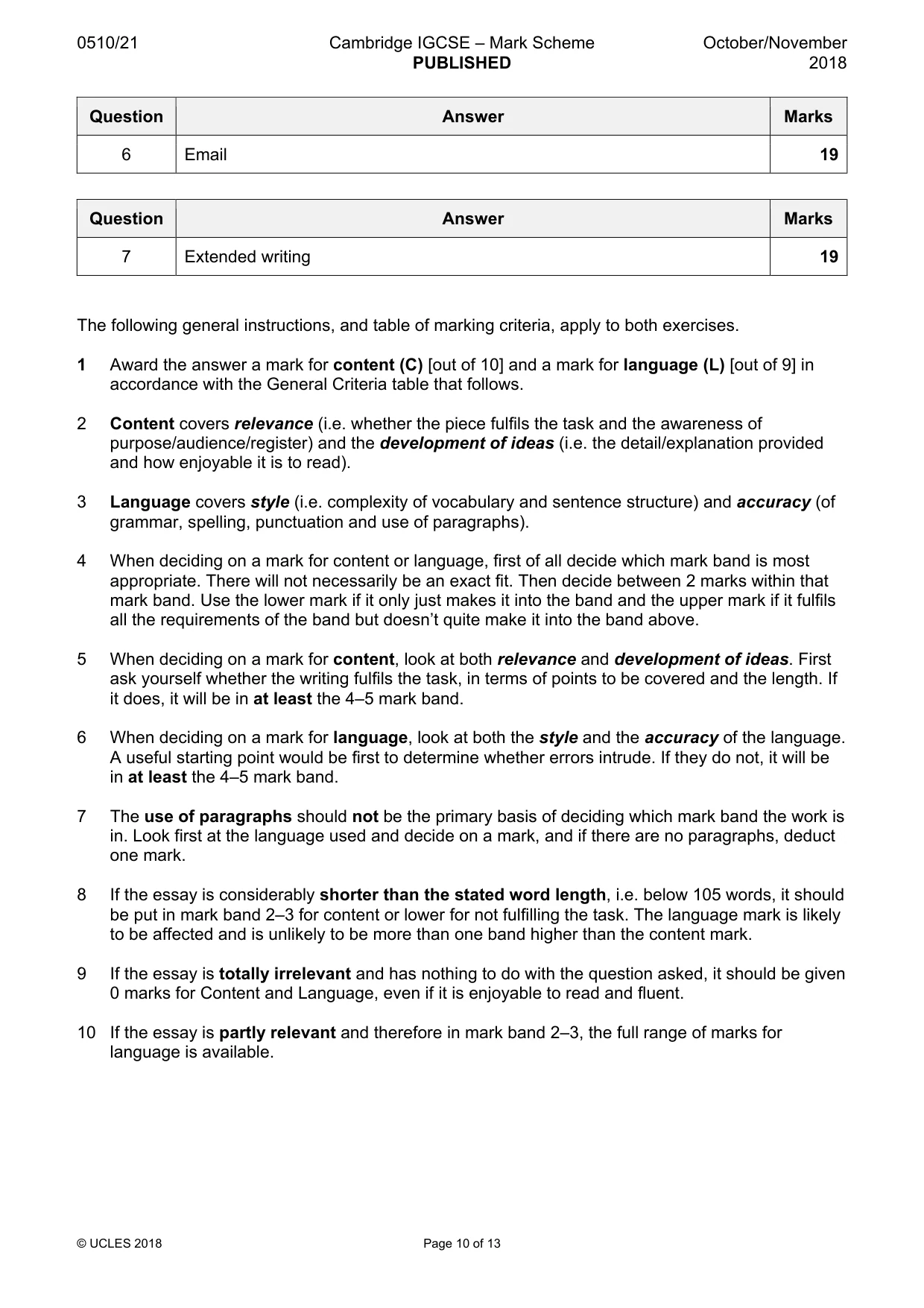
0510/21 Cambridge IGCSE – Mark Scheme PUBLISHED October/November 2018 © UCLES 2018 Page 10 of 13 Question Answer Marks 6 Email 19 Question Answer Marks 7 Extended writing 19 The following general instructions, and table of marking criteria, apply to both exercises. 1 Award the answer a mark for content (C) [out of 10] and a mark for language (L) [out of 9] in accordance with the General Criteria table that follows. 2 Content covers relevance (i.e. whether the piece fulfils the task and the awareness of purpose/audience/register) and the development of ideas (i.e. the detail/explanation provided and how enjoyable it is to read). 3 Language covers style (i.e. complexity of vocabulary and sentence structure) and accuracy (of grammar, spelling, punctuation and use of paragraphs). 4 When deciding on a mark for content or language, first of all decide which mark band is most appropriate. There will not necessarily be an exact fit. Then decide between 2 marks within that mark band. Use the lower mark if it only just makes it into the band and the upper mark if it fulfils all the requirements of the band but doesn’t quite make it into the band above. 5 When deciding on a mark for content, look at both relevance and development of ideas. First ask yourself whether the writing fulfils the task, in terms of points to be covered and the length. If it does, it will be in at least the 4–5 mark band. 6 When deciding on a mark for language, look at both the style and the accuracy of the language. A useful starting point would be first to determine whether errors intrude. If they do not, it will be in at least the 4–5 mark band. 7 The use of paragraphs should not be the primary basis of deciding which mark band the work is in. Look first at the language used and decide on a mark, and if there are no paragraphs, deduct one mark. 8 If the essay is considerably shorter than the stated word length, i.e. below 105 words, it should be put in mark band 2–3 for content or lower for not fulfilling the task. The language mark is likely to be affected and is unlikely to be more than one band higher than the content mark. 9 If the essay is totally irrelevant and has nothing to do with the question asked, it should be given 0 marks for Content and Language, even if it is enjoyable to read and fluent. 10 If the essay is partly relevant and therefore in mark band 2–3, the full range of marks for language is available.
Mark scheme, page 11
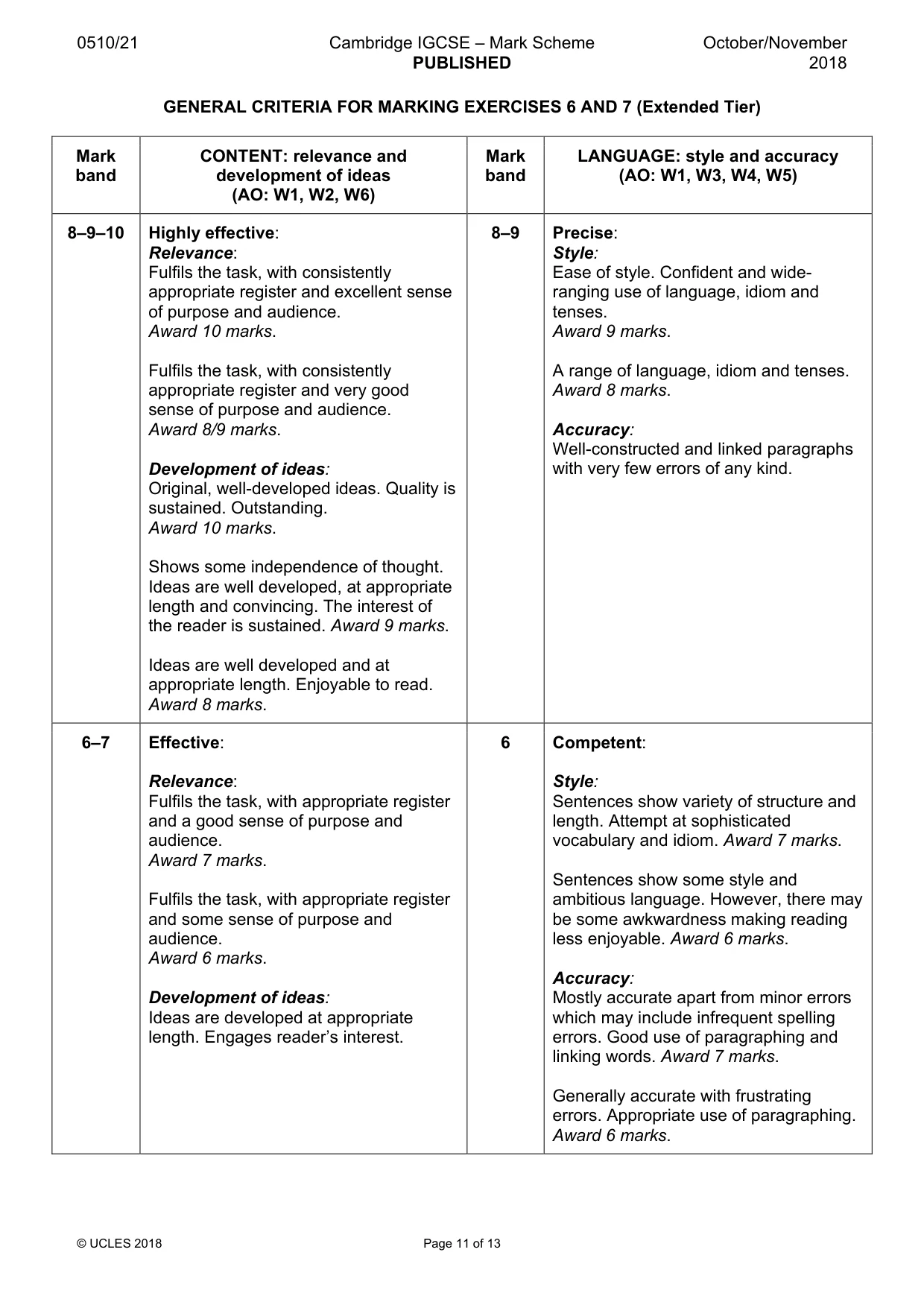
0510/21 Cambridge IGCSE – Mark Scheme PUBLISHED October/November 2018 © UCLES 2018 Page 11 of 13 GENERAL CRITERIA FOR MARKING EXERCISES 6 AND 7 (Extended Tier) Mark band CONTENT: relevance and development of ideas (AO: W1, W2, W6) Mark band LANGUAGE: style and accuracy (AO: W1, W3, W4, W5) 8–9–10 Highly effective: Relevance: Fulfils the task, with consistently appropriate register and excellent sense of purpose and audience. Award 10 marks. Fulfils the task, with consistently appropriate register and very good sense of purpose and audience. Award 8/9 marks. Development of ideas: Original, well-developed ideas. Quality is sustained. Outstanding. Award 10 marks. Shows some independence of thought. Ideas are well developed, at appropriate length and convincing. The interest of the reader is sustained. Award 9 marks. Ideas are well developed and at appropriate length. Enjoyable to read. Award 8 marks. 8–9 Precise: Style: Ease of style. Confident and wide- ranging use of language, idiom and tenses. Award 9 marks. A range of language, idiom and tenses. Award 8 marks. Accuracy: Well-constructed and linked paragraphs with very few errors of any kind. 6–7 Effective: Relevance: Fulfils the task, with appropriate register and a good sense of purpose and audience. Award 7 marks. Fulfils the task, with appropriate register and some sense of purpose and audience. Award 6 marks. Development of ideas: Ideas are developed at appropriate length. Engages reader’s interest. 6 Competent: Style: Sentences show variety of structure and length. Attempt at sophisticated vocabulary and idiom. Award 7 marks. Sentences show some style and ambitious language. However, there may be some awkwardness making reading less enjoyable. Award 6 marks. Accuracy: Mostly accurate apart from minor errors which may include infrequent spelling errors. Good use of paragraphing and linking words. Award 7 marks. Generally accurate with frustrating errors. Appropriate use of paragraphing. Award 6 marks.
Mark scheme, page 12
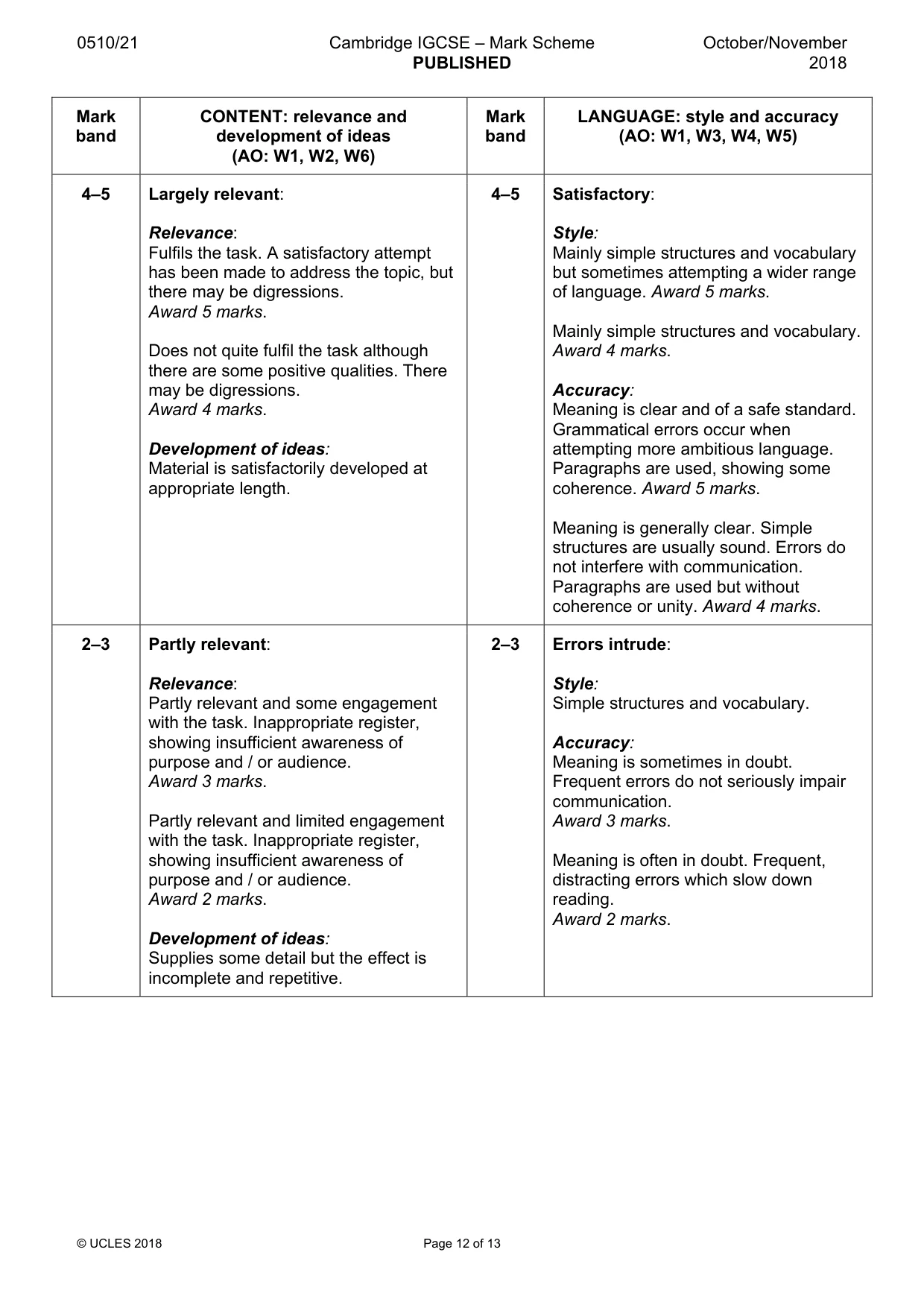
0510/21 Cambridge IGCSE – Mark Scheme PUBLISHED October/November 2018 © UCLES 2018 Page 12 of 13 Mark band CONTENT: relevance and development of ideas (AO: W1, W2, W6) Mark band LANGUAGE: style and accuracy (AO: W1, W3, W4, W5) 4–5 Largely relevant: Relevance: Fulfils the task. A satisfactory attempt has been made to address the topic, but there may be digressions. Award 5 marks. Does not quite fulfil the task although there are some positive qualities. There may be digressions. Award 4 marks. Development of ideas: Material is satisfactorily developed at appropriate length. 4–5 Satisfactory: Style: Mainly simple structures and vocabulary but sometimes attempting a wider range of language. Award 5 marks. Mainly simple structures and vocabulary. Award 4 marks. Accuracy: Meaning is clear and of a safe standard. Grammatical errors occur when attempting more ambitious language. Paragraphs are used, showing some coherence. Award 5 marks. Meaning is generally clear. Simple structures are usually sound. Errors do not interfere with communication. Paragraphs are used but without coherence or unity. Award 4 marks. 2–3 Partly relevant: Relevance: Partly relevant and some engagement with the task. Inappropriate register, showing insufficient awareness of purpose and / or audience. Award 3 marks. Partly relevant and limited engagement with the task. Inappropriate register, showing insufficient awareness of purpose and / or audience. Award 2 marks. Development of ideas: Supplies some detail but the effect is incomplete and repetitive. 2–3 Errors intrude: Style: Simple structures and vocabulary. Accuracy: Meaning is sometimes in doubt. Frequent errors do not seriously impair communication. Award 3 marks. Meaning is often in doubt. Frequent, distracting errors which slow down reading. Award 2 marks.
Mark scheme, page 13
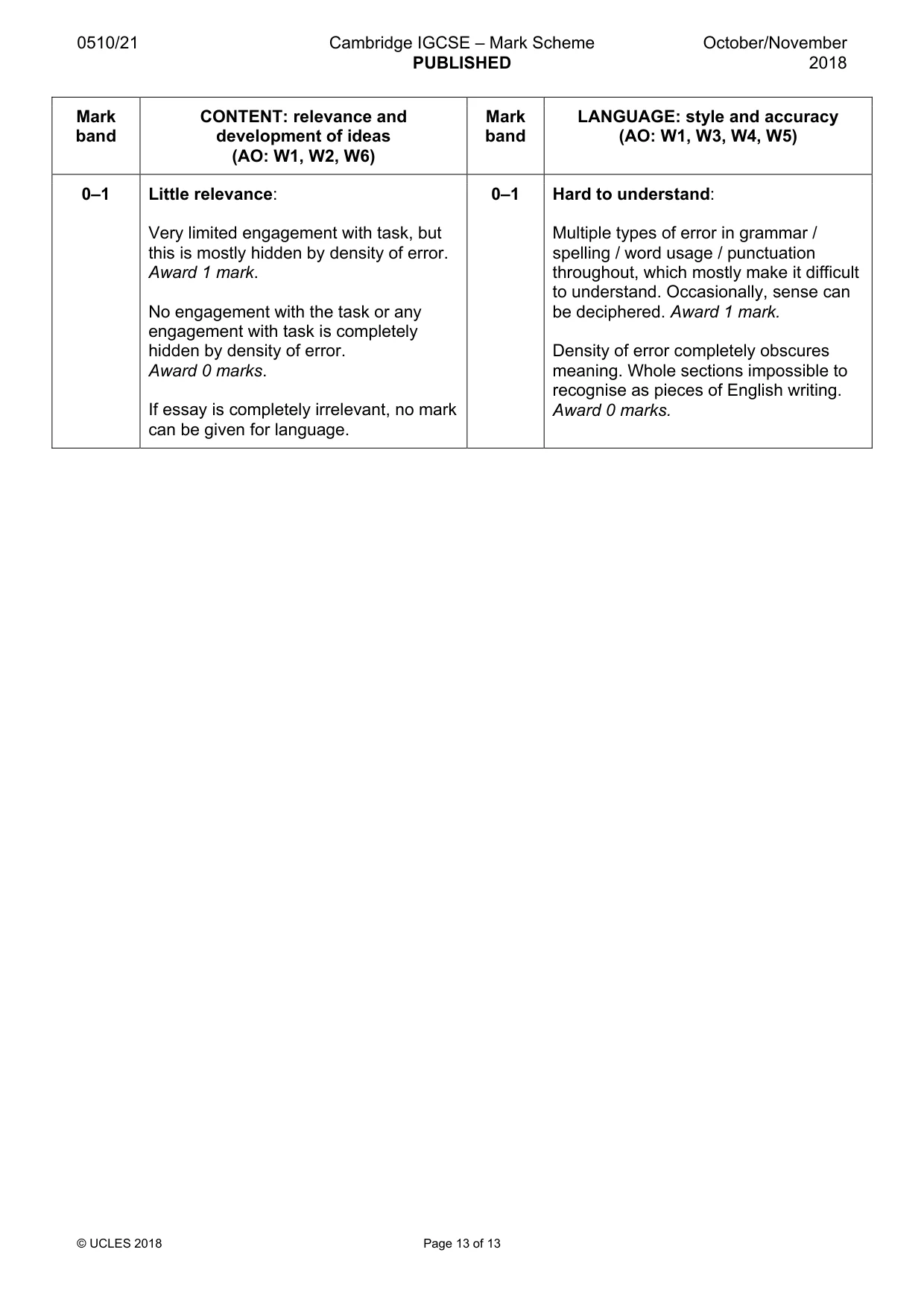
0510/21 Cambridge IGCSE – Mark Scheme PUBLISHED October/November 2018 © UCLES 2018 Page 13 of 13 Mark band CONTENT: relevance and development of ideas (AO: W1, W2, W6) Mark band LANGUAGE: style and accuracy (AO: W1, W3, W4, W5) 0–1 Little relevance: Very limited engagement with task, but this is mostly hidden by density of error. Award 1 mark. No engagement with the task or any engagement with task is completely hidden by density of error. Award 0 marks. If essay is completely irrelevant, no mark can be given for language. 0–1 Hard to understand: Multiple types of error in grammar / spelling / word usage / punctuation throughout, which mostly make it difficult to understand. Occasionally, sense can be deciphered. Award 1 mark. Density of error completely obscures meaning. Whole sections impossible to recognise as pieces of English writing. Award 0 marks.
What you needed in this session
Cambridge’s own grade thresholds for 2018 Oct/Nov, Paper 2 · Variant 1. A higher threshold means an easier paper — the bar moves with how the cohort did.