Cambridge IGCSE English - Second Language (oral endorsement) 0510 — 2018 Oct/Nov Paper 2 · Variant 2
0510/22/O/N/18 · 90 marks · ≈101 min
The question paper and its mark scheme, free to read here and free to download. This is Cambridge’s own paper, exactly as it was sat.
Question paper16 pages




Mark scheme13 pages
Answers below. Sit the paper first if you are practising.
Paper as text
Question paper, page 1
* 5 0 3 9 1 3 8 6 8 7 * This document consists of 15 printed pages and 1 blank page. DC (SC/SW) 151529/3 © UCLES 2018 [Turn over ENGLISH AS A SECOND LANGUAGE 0510/22 Paper 2 Reading and Writing (Extended) October/November 2018 2 hours Candidates answer on the Question Paper. No Additional Materials are required. READ THESE INSTRUCTIONS FIRST Write your Centre number, candidate number and name on all the work you hand in. Write in dark blue or black pen. Do not use staples, paper clips, glue or correction fluid. DO NOT WRITE IN ANY BARCODES. Answer all questions. Dictionaries are not allowed. At the end of the examination, fasten all your work securely together. The number of marks is given in brackets [ ] at the end of each question or part question. Cambridge International Examinations Cambridge International General Certificate of Secondary Education
Question paper, page 2
2 0510/22/O/N/18 © UCLES 2018 Exercise 1 Read the article about studying psychology, and then answer the following questions. Studying psychology – a student’s view Mark Walton writes about studying psychology at university Psychology is the study of the human mind and human behaviour. When I started my four-year university course five years ago, I knew very little about the subject. I have learned a lot since then, and if you are thinking of doing a psychology course yourself, there are some things that you should consider. Many people choose psychology because they want to learn about why people behave, think and feel in particular ways, and these things certainly are fascinating. Psychology is not just about this, however. Anyone who doesn’t like maths, for example, probably shouldn’t do this course – it’s a very important part of studying psychology. The first year The first year consists of a general introduction to psychology. You learn how to carry out research and how the human brain works, which people new to the subject often find very challenging. You also study memory, and how children learn language, which are the favourite courses chosen by first year students. Years 2, 3 and 4 There are many different and interesting courses that you can study in the second year, but you should choose carefully because it can affect your third and fourth years. In year 3, you see how psychology is used in the real world by doing work experience – it is usually unpaid, unfortunately. It might be in an office, for example, or a school. One of my friends worked in a hospital, and I was given several options, including working in an office or a school, though I ended up spending three months in a police station finding out about the work they do there. All the psychology students I know found their work experience incredibly useful. In year 4, which is the final year, you choose other areas to study – I chose psychology in sports – plus you do your own research project. Some students pick amazing topics to investigate, and it’s a good idea to start work on it in the third year. Thinking about the future I have learned a lot about psychology on my course, but I have also developed skills that are useful for many different careers: how to write reports, for example, and how to do research. But above all, psychology teaches you how to think clearly. That helps you with whatever career you eventually choose. A recent survey showed that six months after they finish their course, 25% of psychology graduates are doing other higher level courses and 65% are in employment. People who studied psychology at my university have gone into many different areas of work. The most common one is healthcare, but a surprising number end up working in business, and the media is becoming popular too. Whatever you choose to do, good luck!
Question paper, page 3
3 0510/22/O/N/18 © UCLES 2018 [Turn over (a) When did Mark Walton begin to study psychology? … [1] (b) What kind of person should avoid choosing psychology? … [1] (c) Which topics are the most popular in the first year of the course? Give two details. … … [2] (d) Where did Mark do his work experience? … [1] (e) What advice does Mark give about the final year project? … [1] (f) What is the most important skill that Mark has learned on the course? … [1] (g) What percentage of psychology students have jobs six months after graduating? … [1] (h) Which area of work do students from Mark’s course go into more than any other? … [1] [Total: 9]
Question paper, page 4
4 0510/22/O/N/18 © UCLES 2018 Exercise 2 Read the article about a glacier in a mountainous area of Peru in South America, and then answer the following questions. A disappearing glacier Glaciers are huge masses of ice and snow and are found in many mountainous regions of the world. Unfortunately, global warming is causing many of them to melt. Pastoruri is a glacier 5000 metres above sea level in Huascaran National Park in central Peru. In the 1990s, it attracted 100 000 tourists a year and was Peru’s top ski resort. But half of the glacier has now disappeared and now just 30 000 visitors go there annually. Several years ago, the National Park managers banned all skiing and snowboarding on the glacier, blaming these activities for the loss of ice. Pastoruri continued melting, however, and people must now stay off it for their own safety. Mountain glaciers stay cooler when they are surrounded by other mountains with glaciers on them. Pastoruri, however, doesn’t have other ice-covered mountains around it, and is disappearing more rapidly. The National Park managers want to attract tourists back to the region and have created the Climate Change Walking Tour, which I recently went on with a local guide called Carlos. The tour includes visiting a new Education Centre which has a fascinating display of photographs of Pastoruri ‘before and now’. They show how the thick ice has melted to reveal the dark-coloured rocks underneath. In normal conditions, a glacier loses some ice during the hotter months of the year, but then builds up ice again when the temperature falls. The climate in Peru has changed, however, and Pastoruri doesn’t re-grow in the cooler months. “That’s why it’s technically incorrect to call it a glacier now,” our guide explained. On the tour, Carlos pointed out some amazing dinosaur footprints in the rock, preserved from before the glacier first formed. We were thrilled when Carlos showed us the bones of an animal that had lived 150 000 years ago. 0 2010 2009 2011 2012 2013 2014 year –200 –400 –600 –800 yearly ice loss (millimetres of water) –1000 –1200 –1400 –1600 Glaciers worldwide 2009–2014 Melting glaciers are causing serious problems. In the mountainous areas of Peru, melted ice may soon cause floods in nearby towns and cities. At lower levels, large urban areas on the coast of Peru may suffer in other ways. “As the glaciers continue to shrink,” said Carlos, “the supply of fresh water coming down from the mountains will decrease, which is worrying in the long term.” Engineers have investigated different ways of preserving Pastoruri. In one project, they covered a small section of the glacier with sawdust, a powdery material produced by cutting wood. This idea came from traditional methods used to prevent ice from melting. In another experiment, engineers painted black rocks near the glacier white, thinking that white would reflect sunlight and keep temperatures low. These projects had limited success. As we reached the lake at the foot of Pastoruri, Carlos pointed to a stunningly beautiful ice cave in the glacier, which I felt I had to take photos of. “The lake water is warmer than the glacier,” Carlos said. “This makes the lower part of the glacier melt faster. As a result, the lake is getting bigger and it’s starting to flood the valleys below.” He believes that engineers will soon need to drain the lake. Minerals in rocks that appear when the glacier ice melts also cause a problem. They get washed down into rivers and make the river water acidic. “Local farmers use river water on their land and it’s not good for their crops,” Carlos explained. Biologists believe that one way to deal with this is to store the water in wetland areas before it reaches the rivers. They encourage farmers to plant certain wetland grasses, which help to clean the water by taking up acids from the water through their roots. The environment continues to change, but local people are trying hard to adapt.
Question paper, page 5
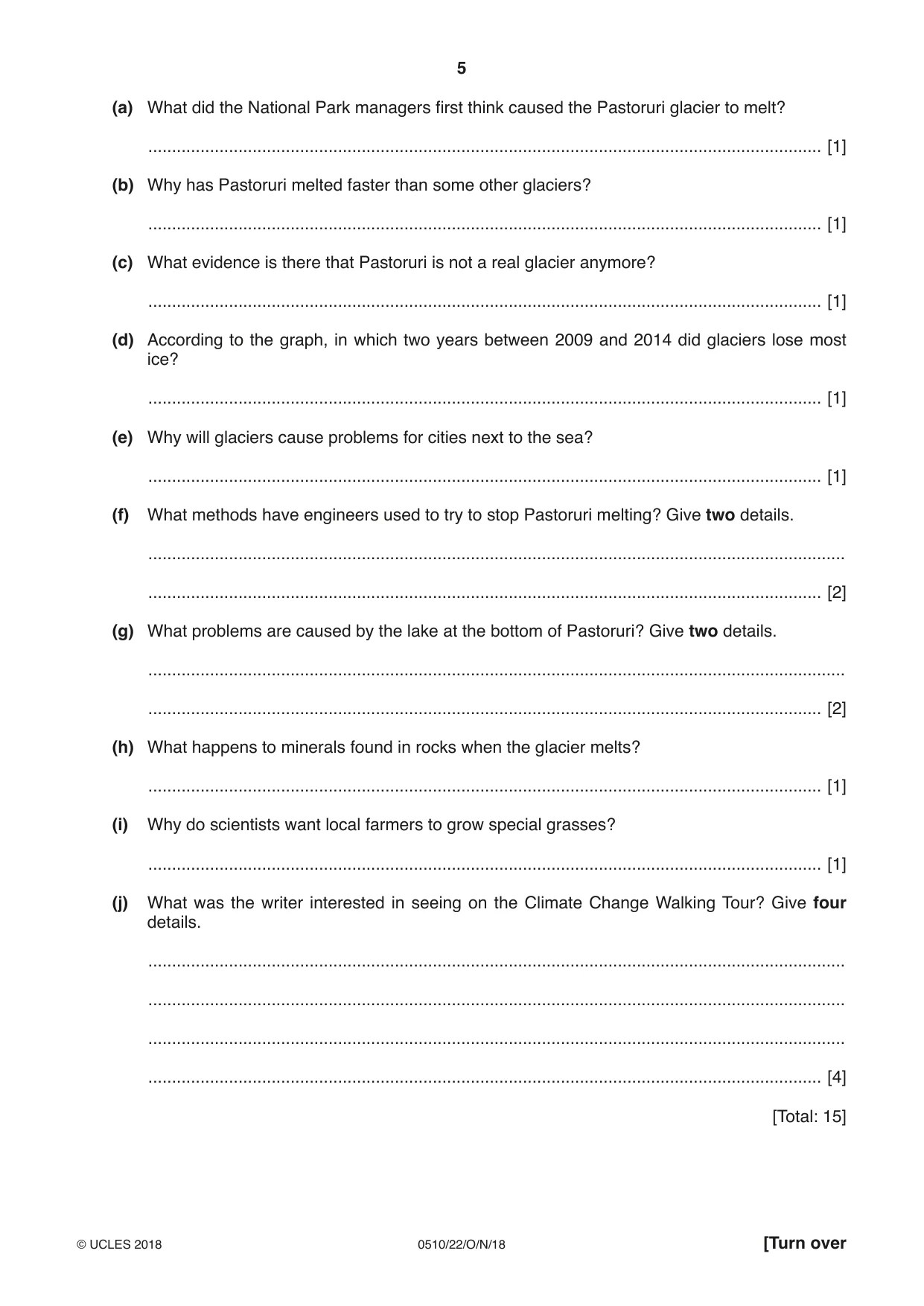
5 0510/22/O/N/18 © UCLES 2018 [Turn over (a) What did the National Park managers first think caused the Pastoruri glacier to melt? … [1] (b) Why has Pastoruri melted faster than some other glaciers? … [1] (c) What evidence is there that Pastoruri is not a real glacier anymore? … [1] (d) According to the graph, in which two years between 2009 and 2014 did glaciers lose most ice? … [1] (e) Why will glaciers cause problems for cities next to the sea? … [1] (f) What methods have engineers used to try to stop Pastoruri melting? Give two details. … … [2] (g) What problems are caused by the lake at the bottom of Pastoruri? Give two details. … … [2] (h) What happens to minerals found in rocks when the glacier melts? … [1] (i) Why do scientists want local farmers to grow special grasses? … [1] (j) What was the writer interested in seeing on the Climate Change Walking Tour? Give four details. … … … … [4] [Total: 15]
Question paper, page 6
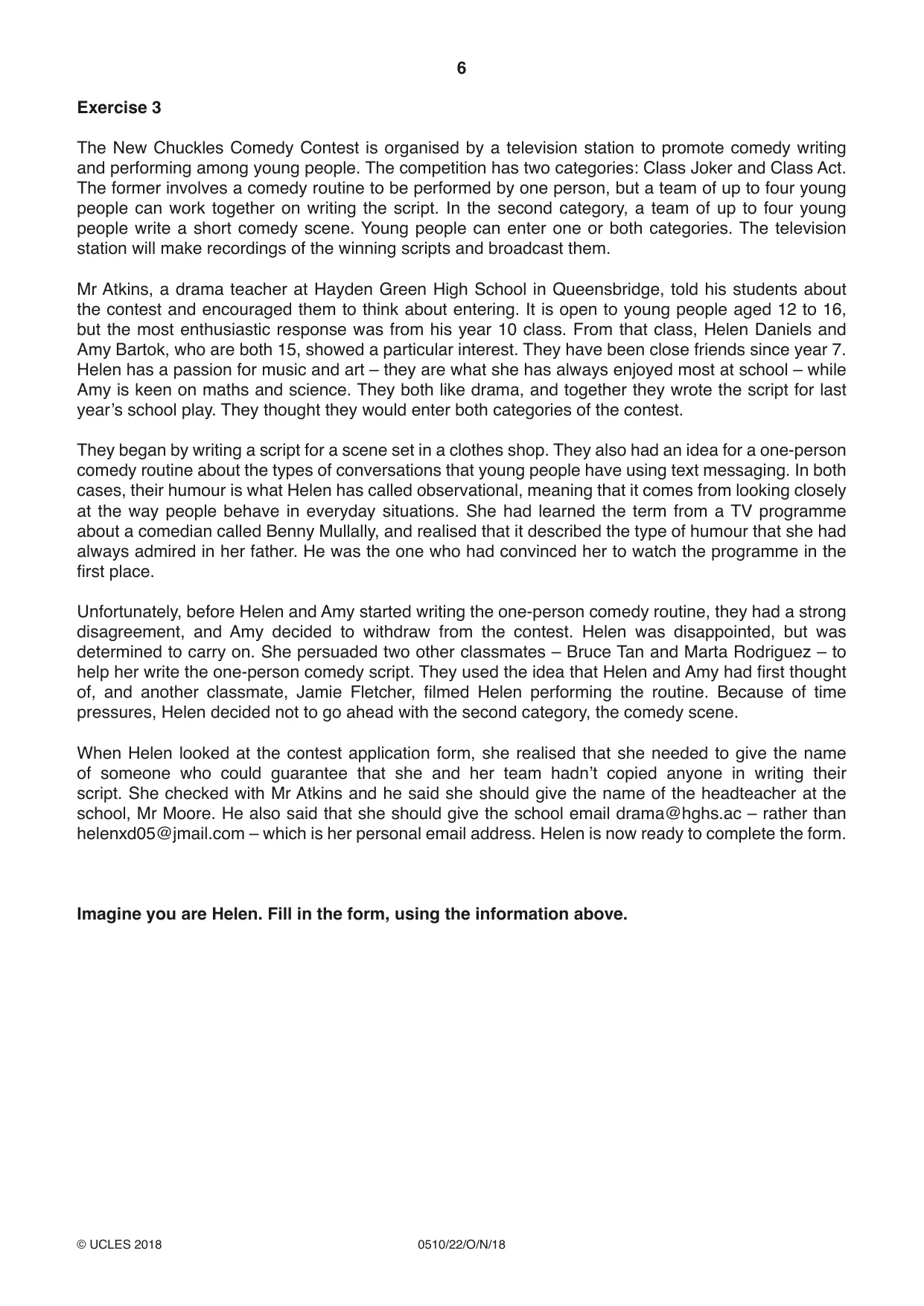
6 0510/22/O/N/18 © UCLES 2018 Exercise 3 The New Chuckles Comedy Contest is organised by a television station to promote comedy writing and performing among young people. The competition has two categories: Class Joker and Class Act. The former involves a comedy routine to be performed by one person, but a team of up to four young people can work together on writing the script. In the second category, a team of up to four young people write a short comedy scene. Young people can enter one or both categories. The television station will make recordings of the winning scripts and broadcast them. Mr Atkins, a drama teacher at Hayden Green High School in Queensbridge, told his students about the contest and encouraged them to think about entering. It is open to young people aged 12 to 16, but the most enthusiastic response was from his year 10 class. From that class, Helen Daniels and Amy Bartok, who are both 15, showed a particular interest. They have been close friends since year 7. Helen has a passion for music and art – they are what she has always enjoyed most at school – while Amy is keen on maths and science. They both like drama, and together they wrote the script for last year’s school play. They thought they would enter both categories of the contest. They began by writing a script for a scene set in a clothes shop. They also had an idea for a one-person comedy routine about the types of conversations that young people have using text messaging. In both cases, their humour is what Helen has called observational, meaning that it comes from looking closely at the way people behave in everyday situations. She had learned the term from a TV programme about a comedian called Benny Mullally, and realised that it described the type of humour that she had always admired in her father. He was the one who had convinced her to watch the programme in the first place. Unfortunately, before Helen and Amy started writing the one-person comedy routine, they had a strong disagreement, and Amy decided to withdraw from the contest. Helen was disappointed, but was determined to carry on. She persuaded two other classmates – Bruce Tan and Marta Rodriguez – to help her write the one-person comedy script. They used the idea that Helen and Amy had first thought of, and another classmate, Jamie Fletcher, filmed Helen performing the routine. Because of time pressures, Helen decided not to go ahead with the second category, the comedy scene. When Helen looked at the contest application form, she realised that she needed to give the name of someone who could guarantee that she and her team hadn’t copied anyone in writing their script. She checked with Mr Atkins and he said she should give the name of the headteacher at the school, Mr Moore. He also said that she should give the school email drama@hghs.ac – rather than helenxd05@jmail.com – which is her personal email address. Helen is now ready to complete the form. Imagine you are Helen. Fill in the form, using the information above.
Question paper, page 7
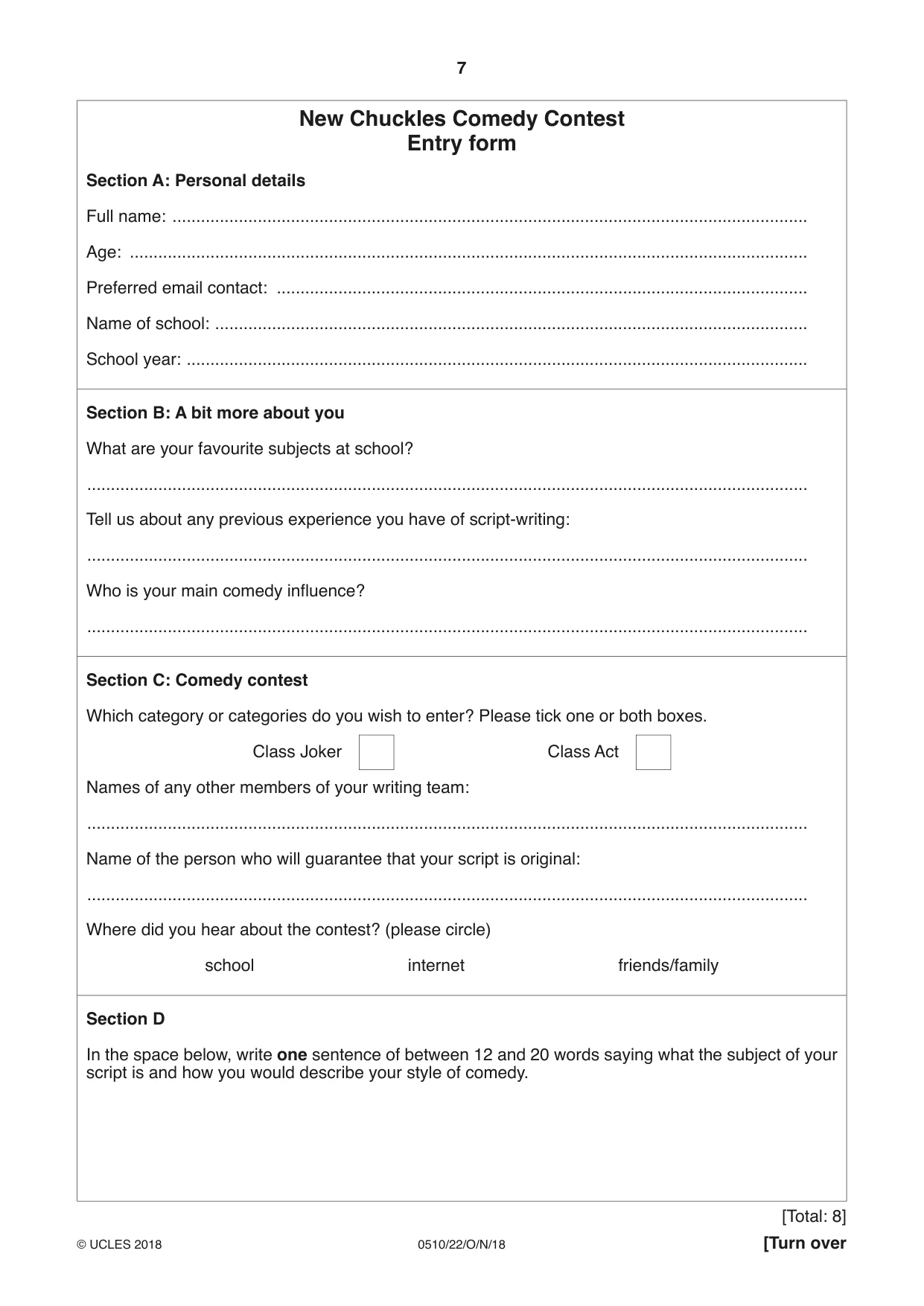
7 0510/22/O/N/18 © UCLES 2018 [Turn over New Chuckles Comedy Contest Entry form Section A: Personal details Full name: … Age: … Preferred email contact: … Name of school: … School year: … Section B: A bit more about you What are your favourite subjects at school? … Tell us about any previous experience you have of script-writing: … Who is your main comedy influence? … Section C: Comedy contest Which category or categories do you wish to enter? Please tick one or both boxes. Class Joker Class Act Names of any other members of your writing team: … Name of the person who will guarantee that your script is original: … Where did you hear about the contest? (please circle) school internet friends/family Section D In the space below, write one sentence of between 12 and 20 words saying what the subject of your script is and how you would describe your style of comedy. [Total: 8]
Question paper, page 8
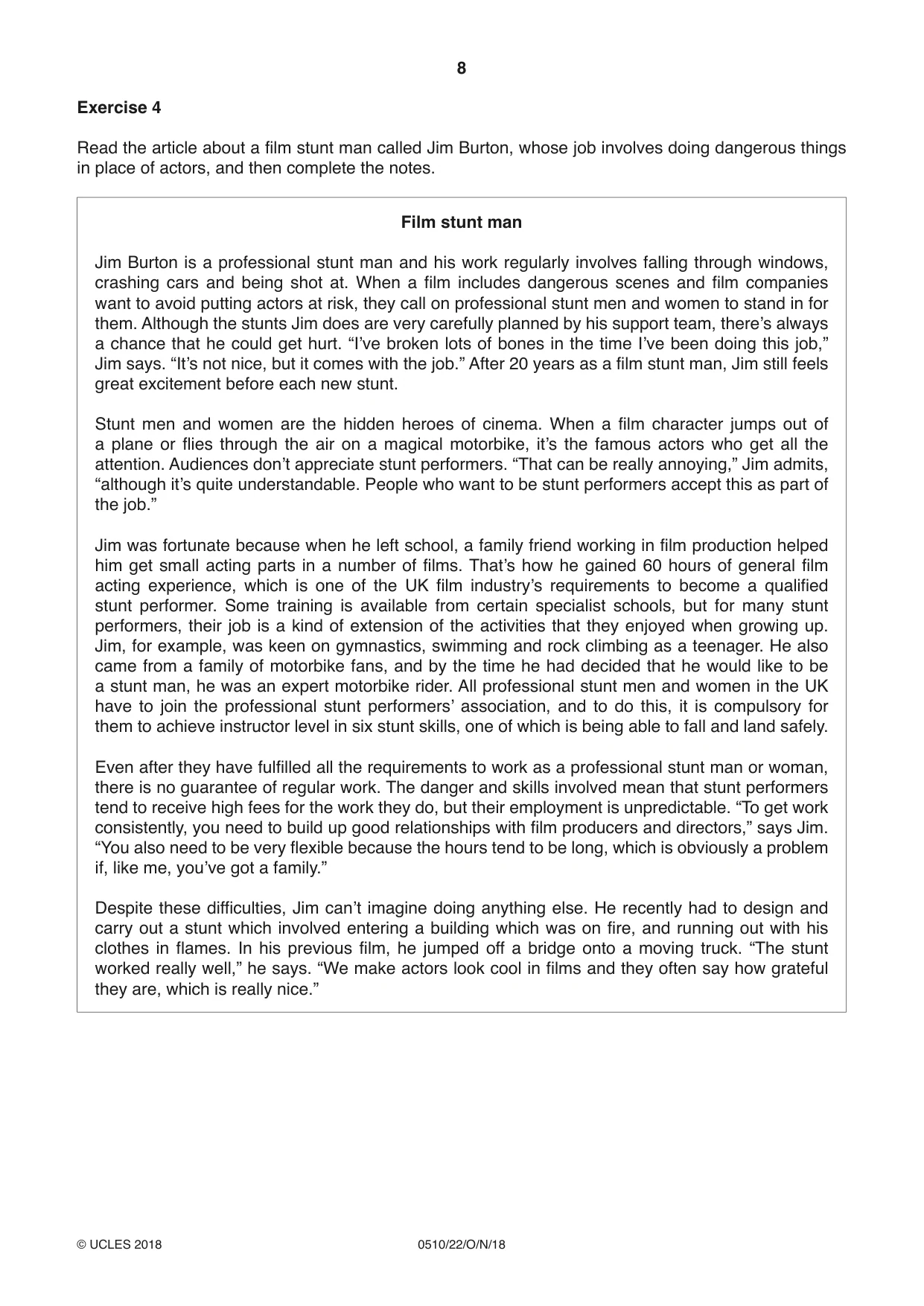
8 0510/22/O/N/18 © UCLES 2018 Exercise 4 Read the article about a film stunt man called Jim Burton, whose job involves doing dangerous things in place of actors, and then complete the notes. Film stunt man Jim Burton is a professional stunt man and his work regularly involves falling through windows, crashing cars and being shot at. When a film includes dangerous scenes and film companies want to avoid putting actors at risk, they call on professional stunt men and women to stand in for them. Although the stunts Jim does are very carefully planned by his support team, there’s always a chance that he could get hurt. “I’ve broken lots of bones in the time I’ve been doing this job,” Jim says. “It’s not nice, but it comes with the job.” After 20 years as a film stunt man, Jim still feels great excitement before each new stunt. Stunt men and women are the hidden heroes of cinema. When a film character jumps out of a plane or flies through the air on a magical motorbike, it’s the famous actors who get all the attention. Audiences don’t appreciate stunt performers. “That can be really annoying,” Jim admits, “although it’s quite understandable. People who want to be stunt performers accept this as part of the job.” Jim was fortunate because when he left school, a family friend working in film production helped him get small acting parts in a number of films. That’s how he gained 60 hours of general film acting experience, which is one of the UK film industry’s requirements to become a qualified stunt performer. Some training is available from certain specialist schools, but for many stunt performers, their job is a kind of extension of the activities that they enjoyed when growing up. Jim, for example, was keen on gymnastics, swimming and rock climbing as a teenager. He also came from a family of motorbike fans, and by the time he had decided that he would like to be a stunt man, he was an expert motorbike rider. All professional stunt men and women in the UK have to join the professional stunt performers’ association, and to do this, it is compulsory for them to achieve instructor level in six stunt skills, one of which is being able to fall and land safely. Even after they have fulfilled all the requirements to work as a professional stunt man or woman, there is no guarantee of regular work. The danger and skills involved mean that stunt performers tend to receive high fees for the work they do, but their employment is unpredictable. “To get work consistently, you need to build up good relationships with film producers and directors,” says Jim. “You also need to be very flexible because the hours tend to be long, which is obviously a problem if, like me, you’ve got a family.” Despite these difficulties, Jim can’t imagine doing anything else. He recently had to design and carry out a stunt which involved entering a building which was on fire, and running out with his clothes in flames. In his previous film, he jumped off a bridge onto a moving truck. “The stunt worked really well,” he says. “We make actors look cool in films and they often say how grateful they are, which is really nice.”
Question paper, page 9
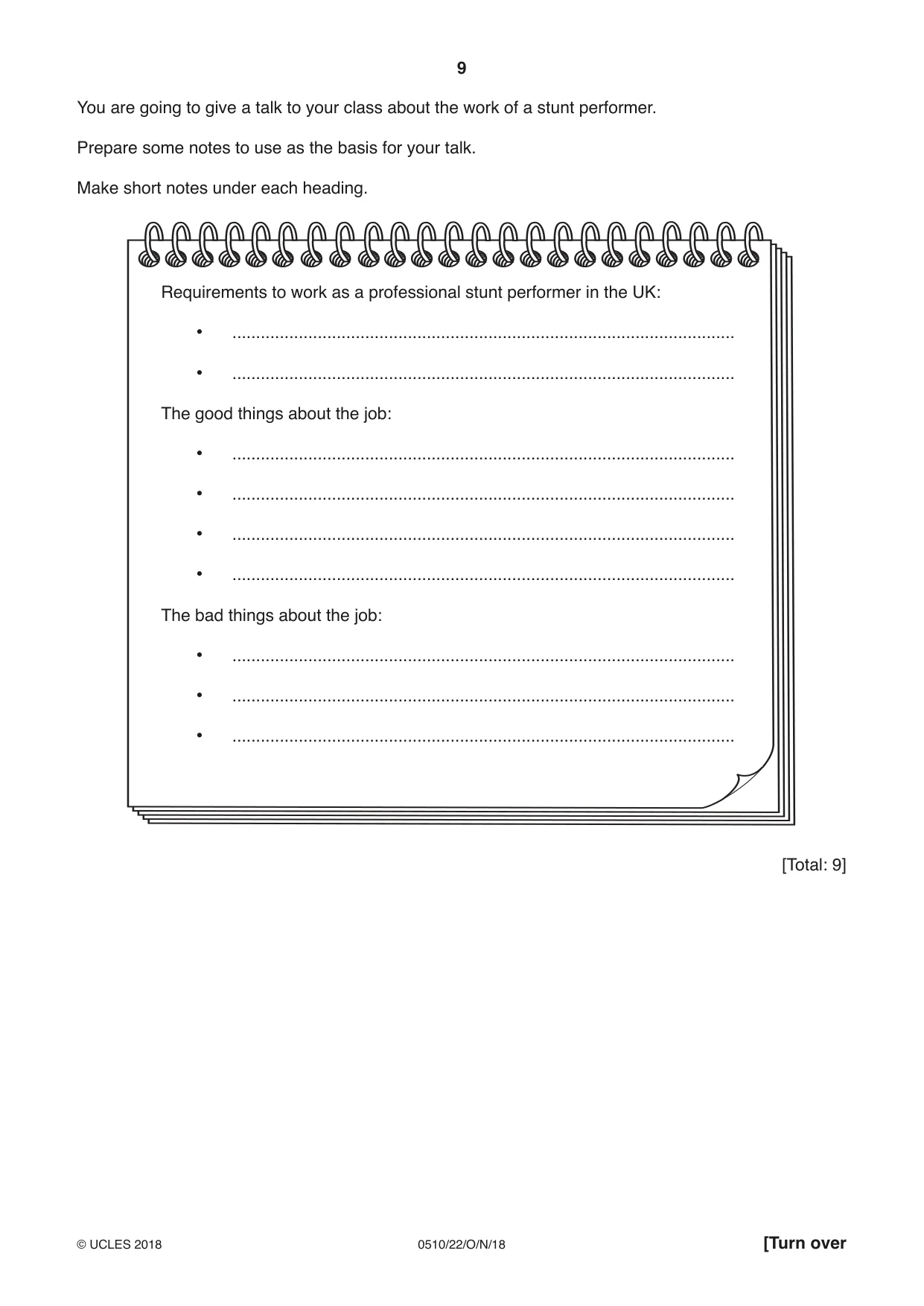
9 0510/22/O/N/18 © UCLES 2018 [Turn over You are going to give a talk to your class about the work of a stunt performer. Prepare some notes to use as the basis for your talk. Make short notes under each heading. Requirements to work as a professional stunt performer in the UK: • … • … The good things about the job: • … • … • … • … The bad things about the job: • … • … • … [Total: 9]
Question paper, page 10
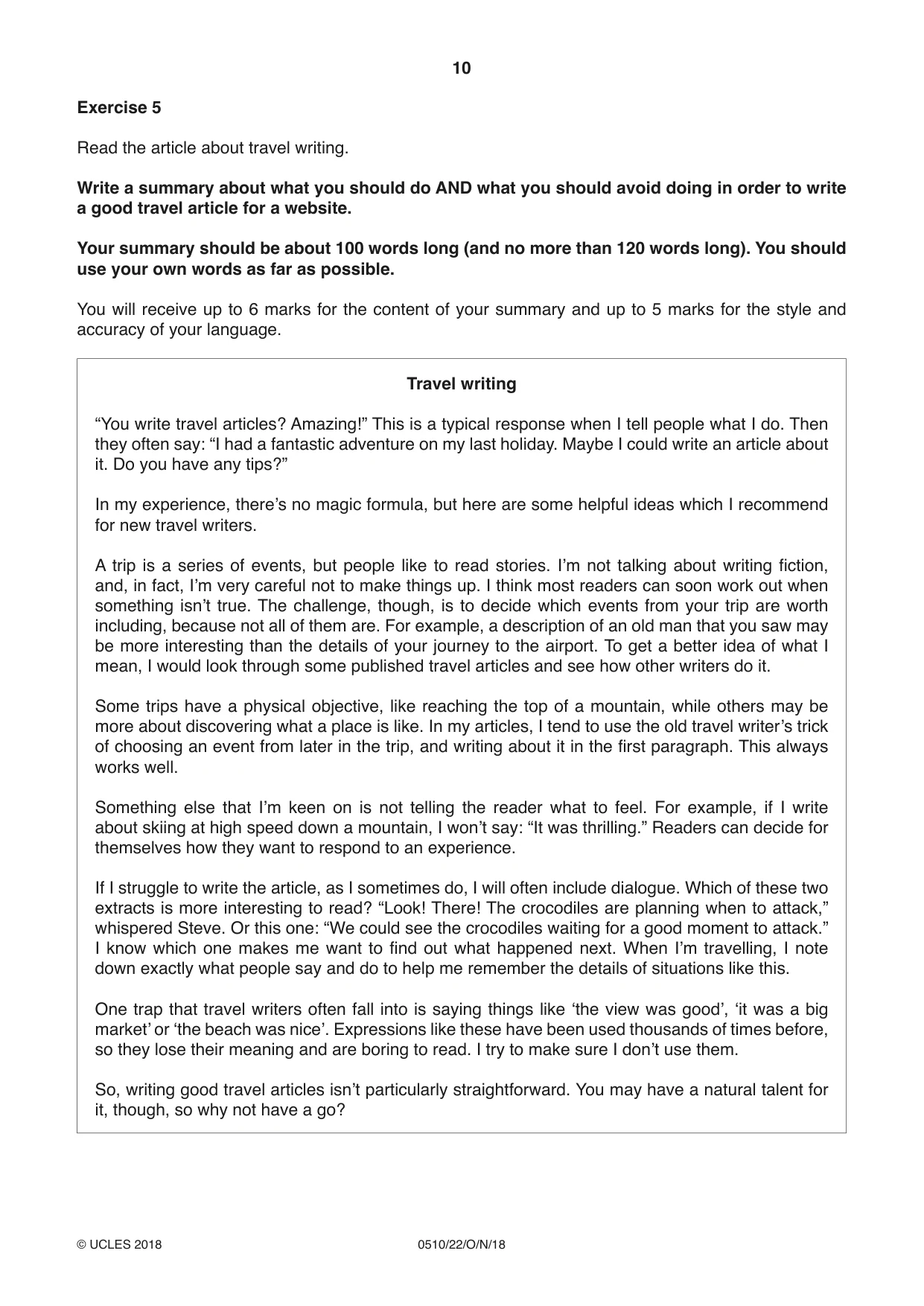
10 0510/22/O/N/18 © UCLES 2018 Exercise 5 Read the article about travel writing. Write a summary about what you should do AND what you should avoid doing in order to write a good travel article for a website. Your summary should be about 100 words long (and no more than 120 words long). You should use your own words as far as possible. You will receive up to 6 marks for the content of your summary and up to 5 marks for the style and accuracy of your language. Travel writing “You write travel articles? Amazing!” This is a typical response when I tell people what I do. Then they often say: “I had a fantastic adventure on my last holiday. Maybe I could write an article about it. Do you have any tips?” In my experience, there’s no magic formula, but here are some helpful ideas which I recommend for new travel writers. A trip is a series of events, but people like to read stories. I’m not talking about writing fiction, and, in fact, I’m very careful not to make things up. I think most readers can soon work out when something isn’t true. The challenge, though, is to decide which events from your trip are worth including, because not all of them are. For example, a description of an old man that you saw may be more interesting than the details of your journey to the airport. To get a better idea of what I mean, I would look through some published travel articles and see how other writers do it. Some trips have a physical objective, like reaching the top of a mountain, while others may be more about discovering what a place is like. In my articles, I tend to use the old travel writer’s trick of choosing an event from later in the trip, and writing about it in the first paragraph. This always works well. Something else that I’m keen on is not telling the reader what to feel. For example, if I write about skiing at high speed down a mountain, I won’t say: “It was thrilling.” Readers can decide for themselves how they want to respond to an experience. If I struggle to write the article, as I sometimes do, I will often include dialogue. Which of these two extracts is more interesting to read? “Look! There! The crocodiles are planning when to attack,” whispered Steve. Or this one: “We could see the crocodiles waiting for a good moment to attack.” I know which one makes me want to find out what happened next. When I’m travelling, I note down exactly what people say and do to help me remember the details of situations like this. One trap that travel writers often fall into is saying things like ‘the view was good’, ‘it was a big market’ or ‘the beach was nice’. Expressions like these have been used thousands of times before, so they lose their meaning and are boring to read. I try to make sure I don’t use them. So, writing good travel articles isn’t particularly straightforward. You may have a natural talent for it, though, so why not have a go?
Question paper, page 11
11 0510/22/O/N/18 © UCLES 2018 [Turn over … … … … … … … … … … … … … … … … … … … … … … … … … … … [Total: 11]
Question paper, page 12
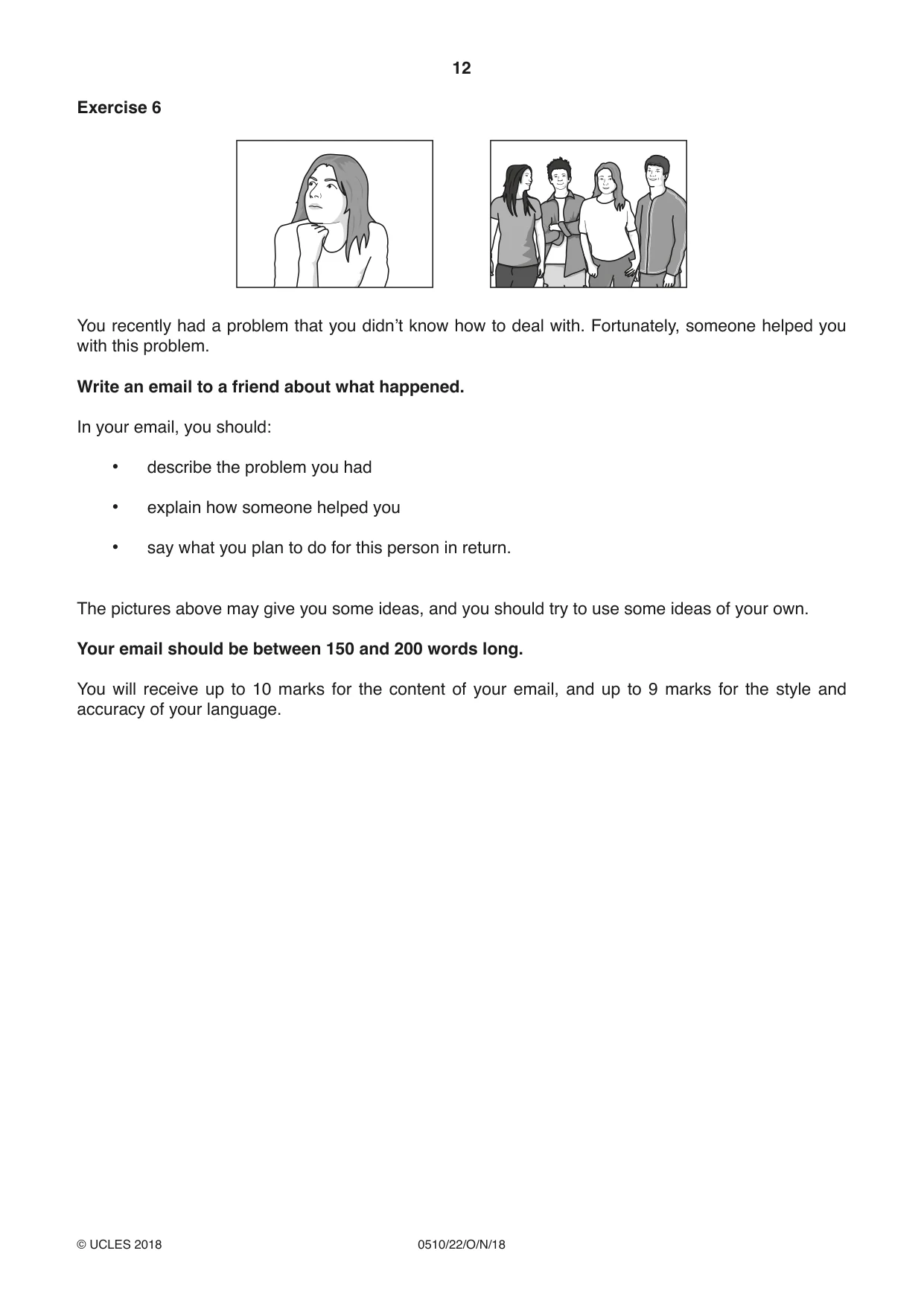
12 0510/22/O/N/18 © UCLES 2018 Exercise 6 You recently had a problem that you didn’t know how to deal with. Fortunately, someone helped you with this problem. Write an email to a friend about what happened. In your email, you should: • describe the problem you had • explain how someone helped you • say what you plan to do for this person in return. The pictures above may give you some ideas, and you should try to use some ideas of your own. Your email should be between 150 and 200 words long. You will receive up to 10 marks for the content of your email, and up to 9 marks for the style and accuracy of your language.
Question paper, page 13
13 0510/22/O/N/18 © UCLES 2018 [Turn over … … … … … … … … … … … … … … … … … … … … … … … … … … … [Total: 19]
Question paper, page 14
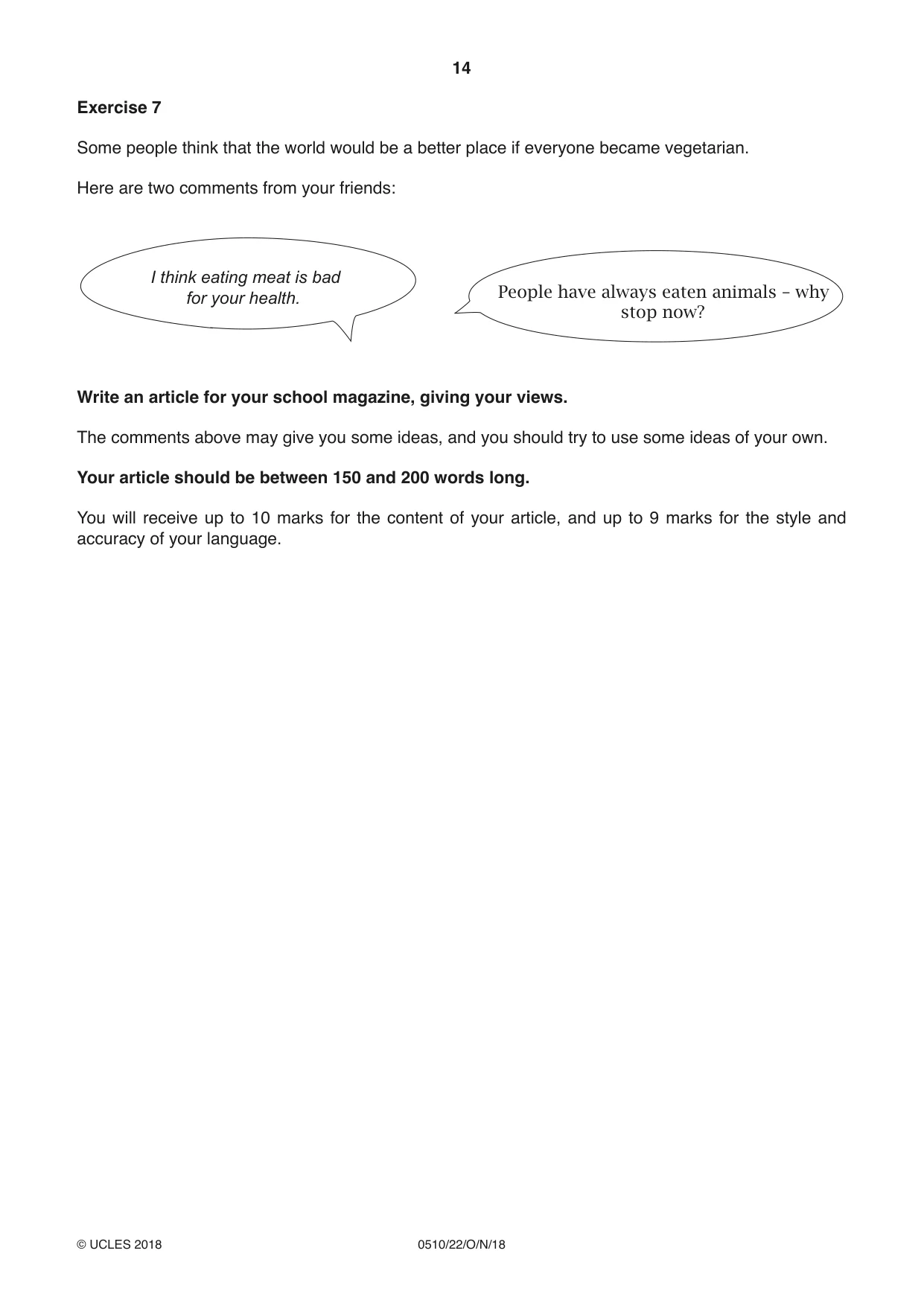
14 0510/22/O/N/18 © UCLES 2018 Exercise 7 Some people think that the world would be a better place if everyone became vegetarian. Here are two comments from your friends: I think eating meat is bad for your health. People have always eaten animals – why stop now? Write an article for your school magazine, giving your views. The comments above may give you some ideas, and you should try to use some ideas of your own. Your article should be between 150 and 200 words long. You will receive up to 10 marks for the content of your article, and up to 9 marks for the style and accuracy of your language.
Question paper, page 15
15 0510/22/O/N/18 © UCLES 2018 … … … … … … … … … … … … … … … … … … … … … … … … … … … [Total: 19]
Question paper, page 16
16 0510/22/O/N/18 © UCLES 2018 BLANK PAGE Permission to reproduce items where third-party owned material protected by copyright is included has been sought and cleared where possible. Every reasonable effort has been made by the publisher (UCLES) to trace copyright holders, but if any items requiring clearance have unwittingly been included, the publisher will be pleased to make amends at the earliest possible opportunity. To avoid the issue of disclosure of answer-related information to candidates, all copyright acknowledgements are reproduced online in the Cambridge International Examinations Copyright Acknowledgements Booklet. This is produced for each series of examinations and is freely available to download at www.cie.org.uk after the live examination series. Cambridge International Examinations is part of the Cambridge Assessment Group. Cambridge Assessment is the brand name of University of Cambridge Local Examinations Syndicate (UCLES), which is itself a department of the University of Cambridge.
Mark scheme, page 1
This document consists of 13 printed pages. © UCLES 2018 [Turn over Cambridge Assessment International Education Cambridge International General Certificate of Secondary Education ENGLISH AS A SECOND LANGUAGE 0510/22 Paper 2 Reading and Writing (Extended) October/November 2018 MARK SCHEME Maximum Mark: 90 Published This mark scheme is published as an aid to teachers and candidates, to indicate the requirements of the examination. It shows the basis on which Examiners were instructed to award marks. It does not indicate the details of the discussions that took place at an Examiners’ meeting before marking began, which would have considered the acceptability of alternative answers. Mark schemes should be read in conjunction with the question paper and the Principal Examiner Report for Teachers. Cambridge International will not enter into discussions about these mark schemes. Cambridge International is publishing the mark schemes for the October/November 2018 series for most Cambridge IGCSE™, Cambridge International A and AS Level components and some Cambridge O Level components.
Mark scheme, page 2
0510/22 Cambridge IGCSE – Mark Scheme PUBLISHED October/November 2018 © UCLES 2018 Page 2 of 13 Generic Marking Principles These general marking principles must be applied by all examiners when marking candidate answers. They should be applied alongside the specific content of the mark scheme or generic level descriptors for a question. Each question paper and mark scheme will also comply with these marking principles. GENERIC MARKING PRINCIPLE 1: Marks must be awarded in line with: • the specific content of the mark scheme or the generic level descriptors for the question • the specific skills defined in the mark scheme or in the generic level descriptors for the question • the standard of response required by a candidate as exemplified by the standardisation scripts. GENERIC MARKING PRINCIPLE 2: Marks awarded are always whole marks (not half marks, or other fractions). GENERIC MARKING PRINCIPLE 3: Marks must be awarded positively: • marks are awarded for correct/valid answers, as defined in the mark scheme. However, credit is given for valid answers which go beyond the scope of the syllabus and mark scheme, referring to your Team Leader as appropriate • marks are awarded when candidates clearly demonstrate what they know and can do • marks are not deducted for errors • marks are not deducted for omissions • answers should only be judged on the quality of spelling, punctuation and grammar when these features are specifically assessed by the question as indicated by the mark scheme. The meaning, however, should be unambiguous. GENERIC MARKING PRINCIPLE 4: Rules must be applied consistently e.g. in situations where candidates have not followed instructions or in the application of generic level descriptors. GENERIC MARKING PRINCIPLE 5: Marks should be awarded using the full range of marks defined in the mark scheme for the question (however; the use of the full mark range may be limited according to the quality of the candidate responses seen). GENERIC MARKING PRINCIPLE 6: Marks awarded are based solely on the requirements as defined in the mark scheme. Marks should not be awarded with grade thresholds or grade descriptors in mind.
Mark scheme, page 3
0510/22 Cambridge IGCSE – Mark Scheme PUBLISHED October/November 2018 © UCLES 2018 Page 3 of 13 IGCSE English as a Second Language Extended tier Reading/Writing (Paper 2) This component forms part of the Extended tier assessment of IGCSE English as a Second Language and tests the following Assessment Objectives: AO1: Reading R1 identify and retrieve facts and details R2 understand and select relevant information R3 recognise and understand ideas, opinions and attitudes and the connections between related ideas R4 understand what is implied but not actually written, e.g. gist, relationships, writer’s purpose/intention, writer’s feelings, situation or place AO2: Writing W1 communicate clearly, accurately and appropriately W2 convey information and express opinions effectively W3 employ and control a variety of grammatical structures W4 demonstrate knowledge and understanding of a range of appropriate vocabulary W5 observe conventions of paragraphing, punctuation and spelling W6 employ appropriate register/style Overview of exercises on Paper 2 Reading objectives tested Marks for reading objectives Writing objectives tested Marks for writing objectives Total available marks Exercise 1 Reading (1) R1, R2 9 – 9 Exercise 2 Reading (2) R1, R2, R4 15 – 15 Exercise 3 Information transfer R1, R2, R4, 6 W1, W5 2 8 Exercise 4 Note- making R1, R2, R3 9 – 9 Exercise 5 Summary R1, R2, R3 6 W1, W2, W3, W4, W5 5 11 Exercise 6 Writing (1) – W1, W2, W3, W4, W5, W6 19 19 Exercise 7 Writing (2) – W1, W2, W3, W4, W5, W6 19 19 90
Mark scheme, page 4
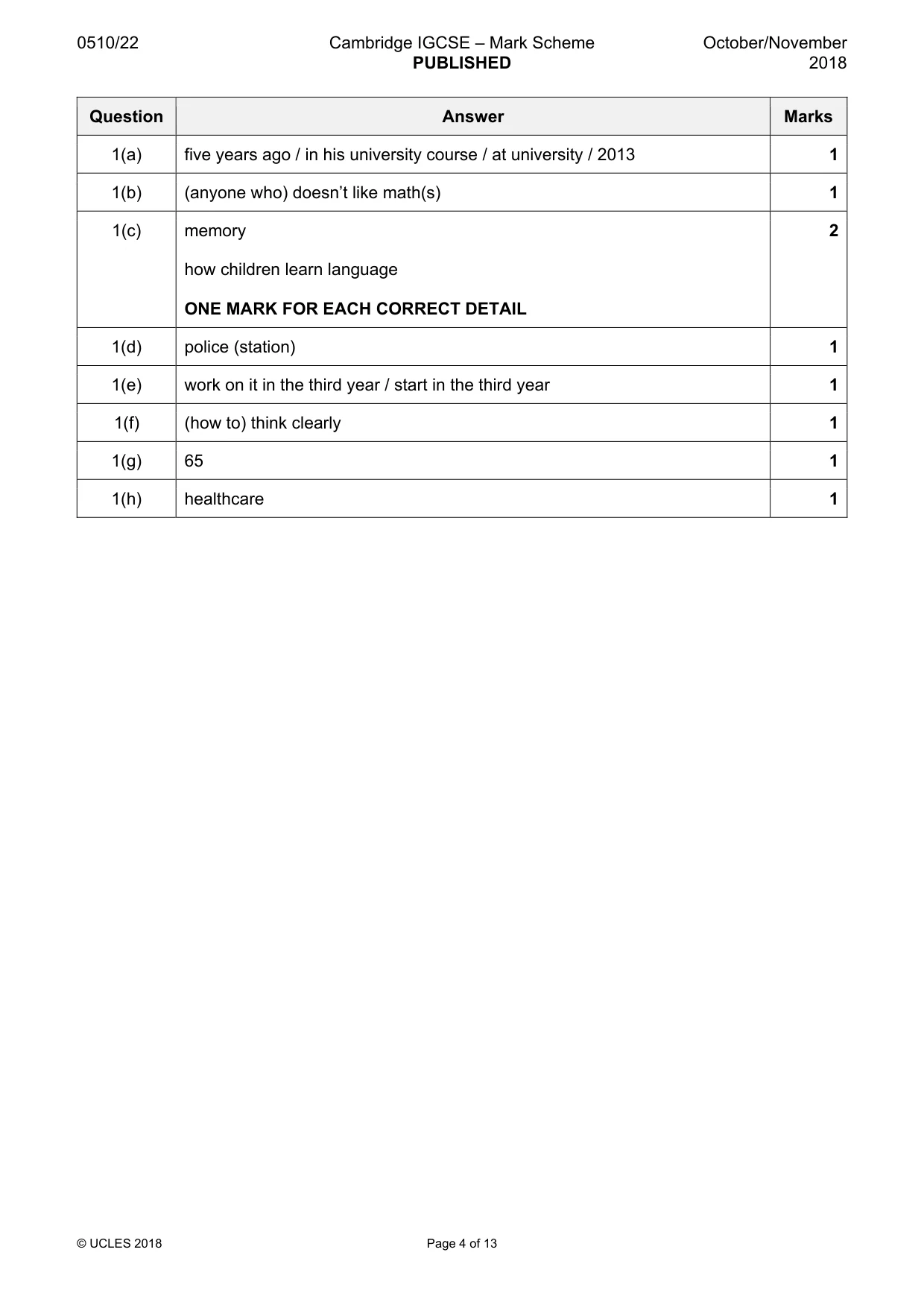
0510/22 Cambridge IGCSE – Mark Scheme PUBLISHED October/November 2018 © UCLES 2018 Page 4 of 13 Question Answer Marks 1(a) five years ago / in his university course / at university / 2013 1 1(b) (anyone who) doesn’t like math(s) 1 1(c) memory how children learn language ONE MARK FOR EACH CORRECT DETAIL 2 1(d) police (station) 1 1(e) work on it in the third year / start in the third year 1 1(f) (how to) think clearly 1 1(g) 65 1 1(h) healthcare 1
Mark scheme, page 5
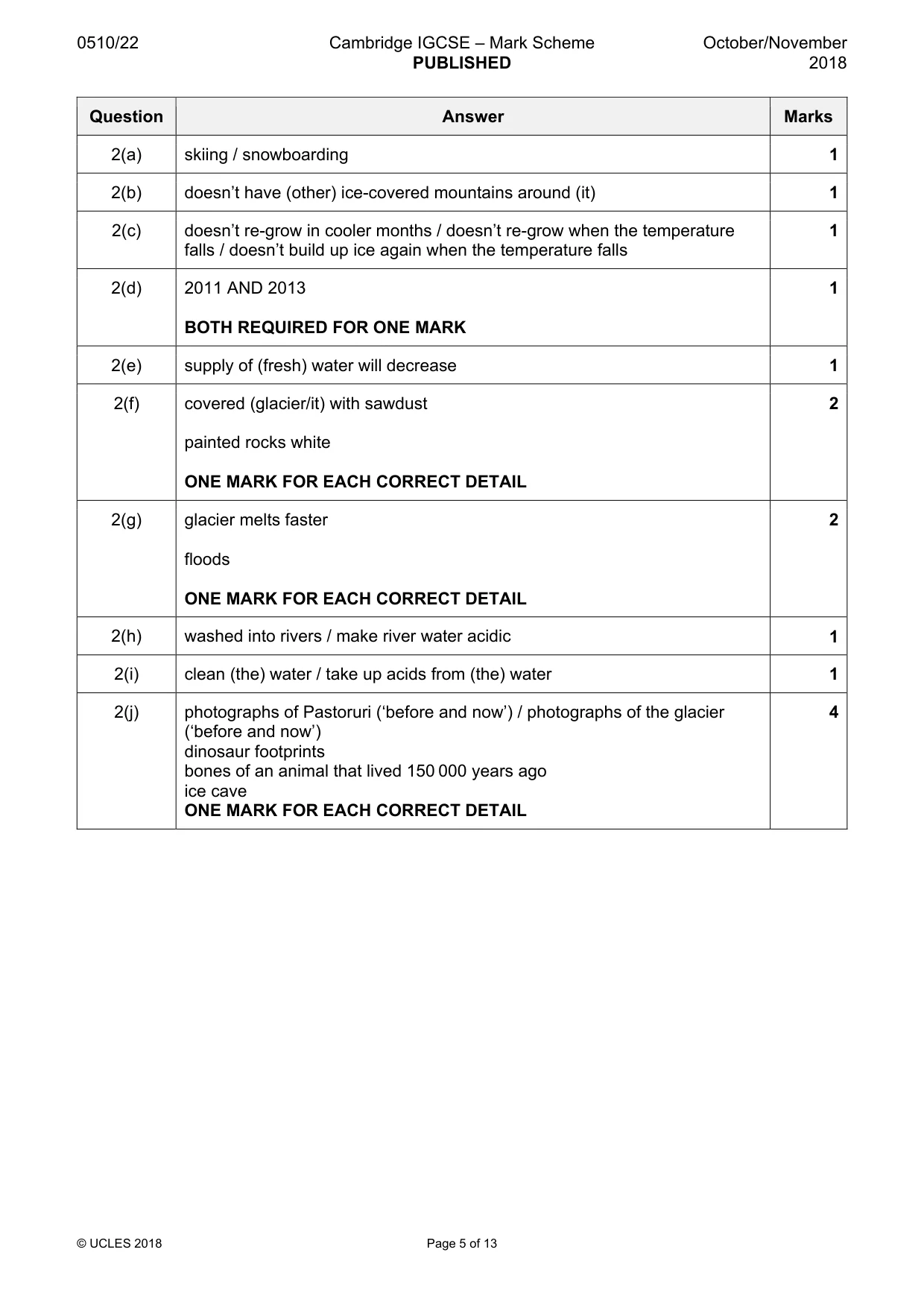
0510/22 Cambridge IGCSE – Mark Scheme PUBLISHED October/November 2018 © UCLES 2018 Page 5 of 13 Question Answer Marks 2(a) skiing / snowboarding 1 2(b) doesn’t have (other) ice-covered mountains around (it) 1 2(c) doesn’t re-grow in cooler months / doesn’t re-grow when the temperature falls / doesn’t build up ice again when the temperature falls 1 2(d) 2011 AND 2013 BOTH REQUIRED FOR ONE MARK 1 2(e) supply of (fresh) water will decrease 1 2(f) covered (glacier/it) with sawdust painted rocks white ONE MARK FOR EACH CORRECT DETAIL 2 2(g) glacier melts faster floods ONE MARK FOR EACH CORRECT DETAIL 2 2(h) washed into rivers / make river water acidic 1 2(i) clean (the) water / take up acids from (the) water 1 2(j) photographs of Pastoruri (‘before and now’) / photographs of the glacier (‘before and now’) dinosaur footprints bones of an animal that lived 150 000 years ago ice cave ONE MARK FOR EACH CORRECT DETAIL 4
Mark scheme, page 6
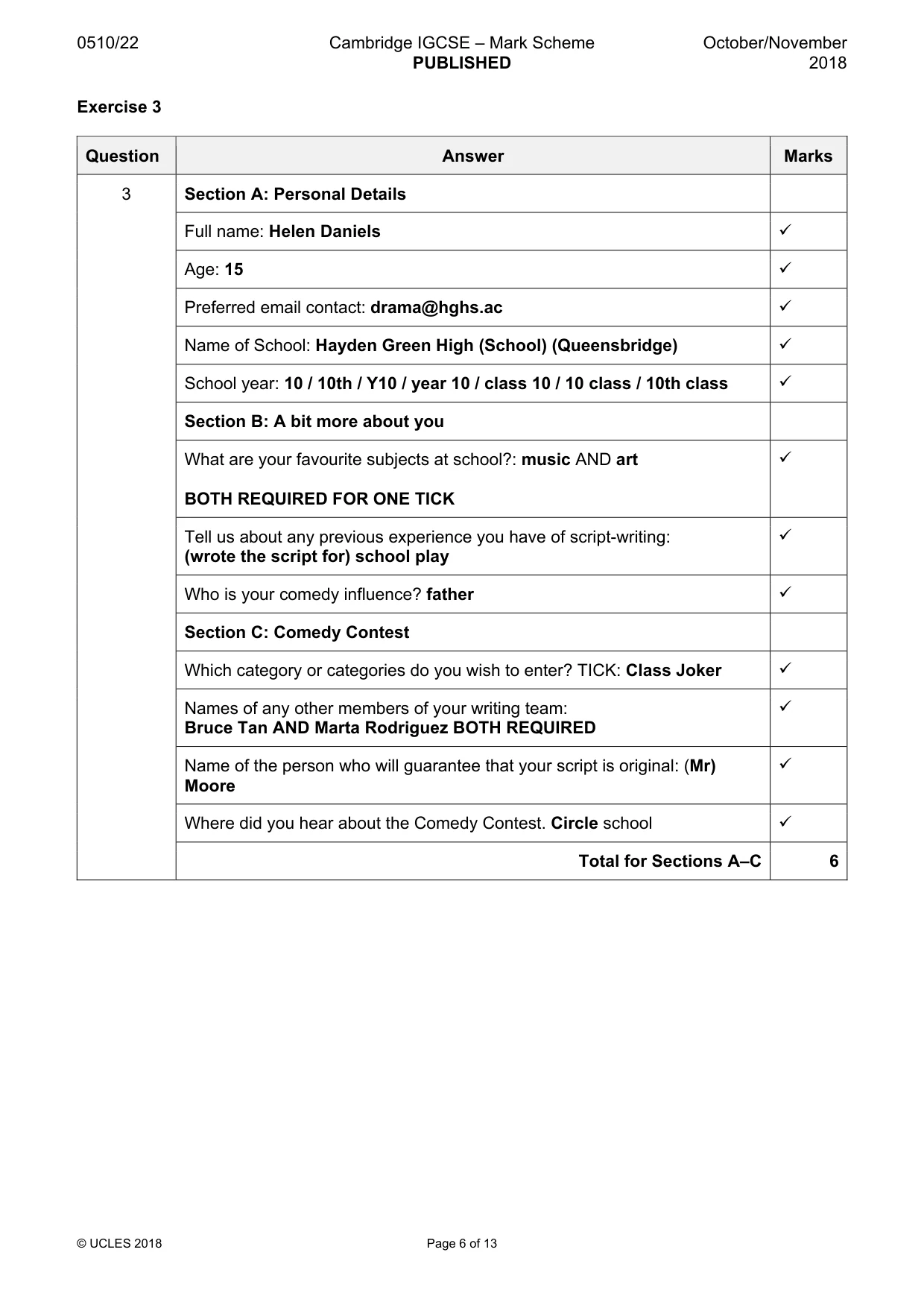
0510/22 Cambridge IGCSE – Mark Scheme PUBLISHED October/November 2018 © UCLES 2018 Page 6 of 13 Exercise 3 Question Answer Marks 3 Section A: Personal Details Full name: Helen Daniels 9 Age: 15 9 Preferred email contact: drama@hghs.ac 9 Name of School: Hayden Green High (School) (Queensbridge) 9 School year: 10 / 10th / Y10 / year 10 / class 10 / 10 class / 10th class 9 Section B: A bit more about you What are your favourite subjects at school?: music AND art BOTH REQUIRED FOR ONE TICK 9 Tell us about any previous experience you have of script-writing: (wrote the script for) school play 9 Who is your comedy influence? father 9 Section C: Comedy Contest Which category or categories do you wish to enter? TICK: Class Joker 9 Names of any other members of your writing team: Bruce Tan AND Marta Rodriguez BOTH REQUIRED 9 Name of the person who will guarantee that your script is original: (Mr) Moore 9 Where did you hear about the Comedy Contest. Circle school 9 Total for Sections A–C 6
Mark scheme, page 7
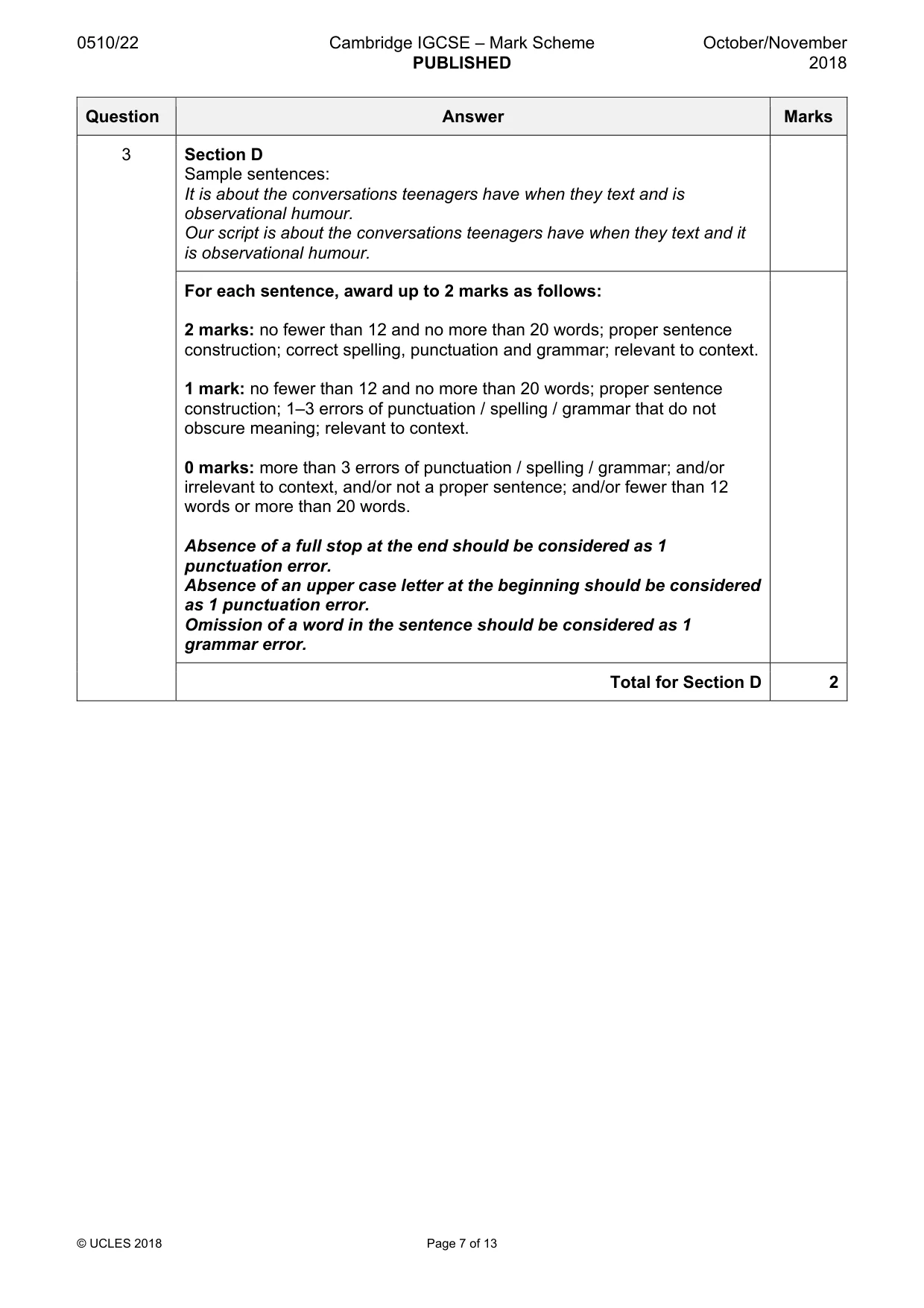
0510/22 Cambridge IGCSE – Mark Scheme PUBLISHED October/November 2018 © UCLES 2018 Page 7 of 13 Question Answer Marks 3 Section D Sample sentences: It is about the conversations teenagers have when they text and is observational humour. Our script is about the conversations teenagers have when they text and it is observational humour. For each sentence, award up to 2 marks as follows: 2 marks: no fewer than 12 and no more than 20 words; proper sentence construction; correct spelling, punctuation and grammar; relevant to context. 1 mark: no fewer than 12 and no more than 20 words; proper sentence construction; 1–3 errors of punctuation / spelling / grammar that do not obscure meaning; relevant to context. 0 marks: more than 3 errors of punctuation / spelling / grammar; and/or irrelevant to context, and/or not a proper sentence; and/or fewer than 12 words or more than 20 words. Absence of a full stop at the end should be considered as 1 punctuation error. Absence of an upper case letter at the beginning should be considered as 1 punctuation error. Omission of a word in the sentence should be considered as 1 grammar error. Total for Section D 2
Mark scheme, page 8
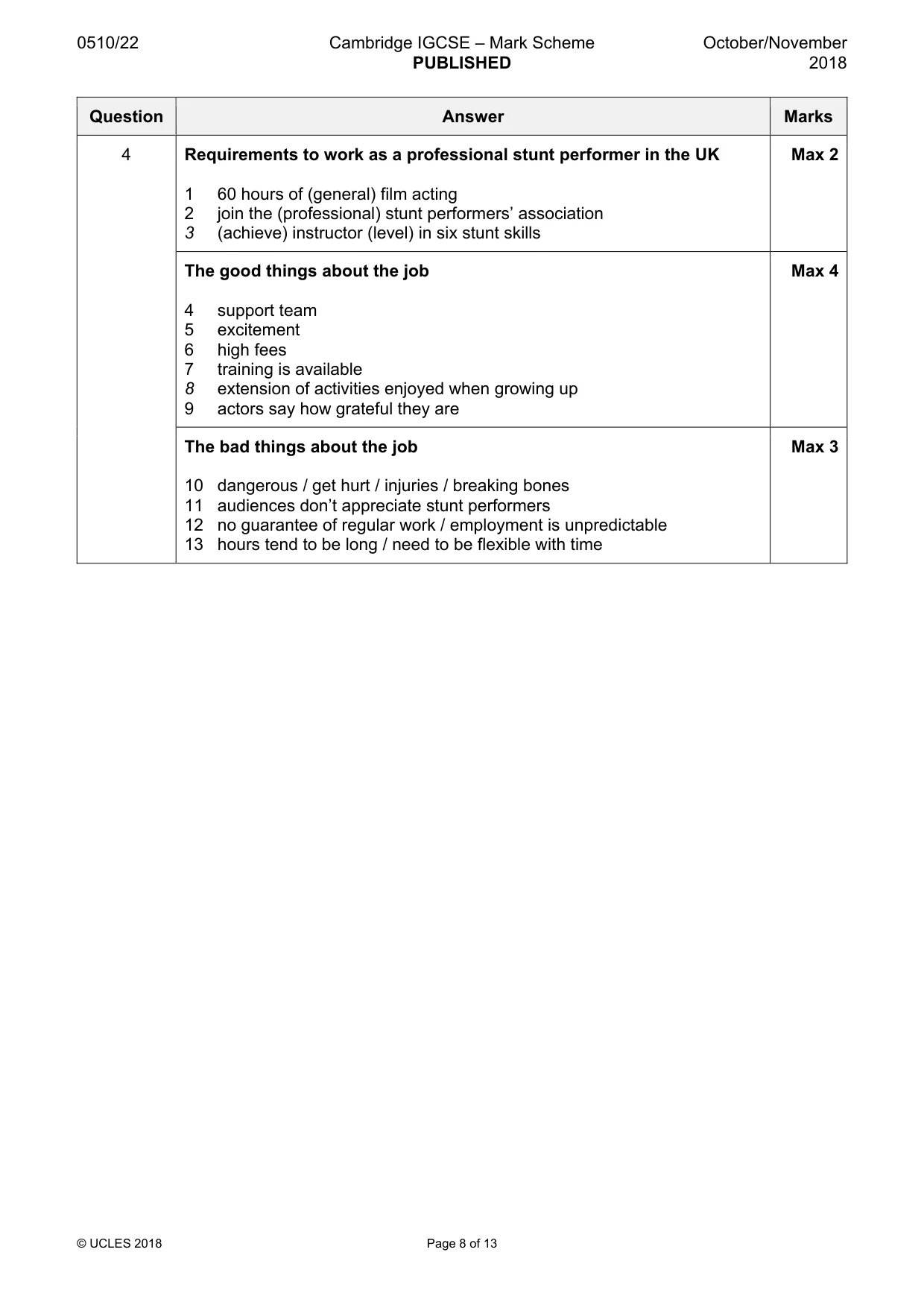
0510/22 Cambridge IGCSE – Mark Scheme PUBLISHED October/November 2018 © UCLES 2018 Page 8 of 13 Question Answer Marks 4 Requirements to work as a professional stunt performer in the UK 1 60 hours of (general) film acting 2 join the (professional) stunt performers’ association 3 (achieve) instructor (level) in six stunt skills Max 2 The good things about the job 4 support team 5 excitement 6 high fees 7 training is available 8 extension of activities enjoyed when growing up 9 actors say how grateful they are Max 4 The bad things about the job 10 dangerous / get hurt / injuries / breaking bones 11 audiences don’t appreciate stunt performers 12 no guarantee of regular work / employment is unpredictable 13 hours tend to be long / need to be flexible with time Max 3
Mark scheme, page 9
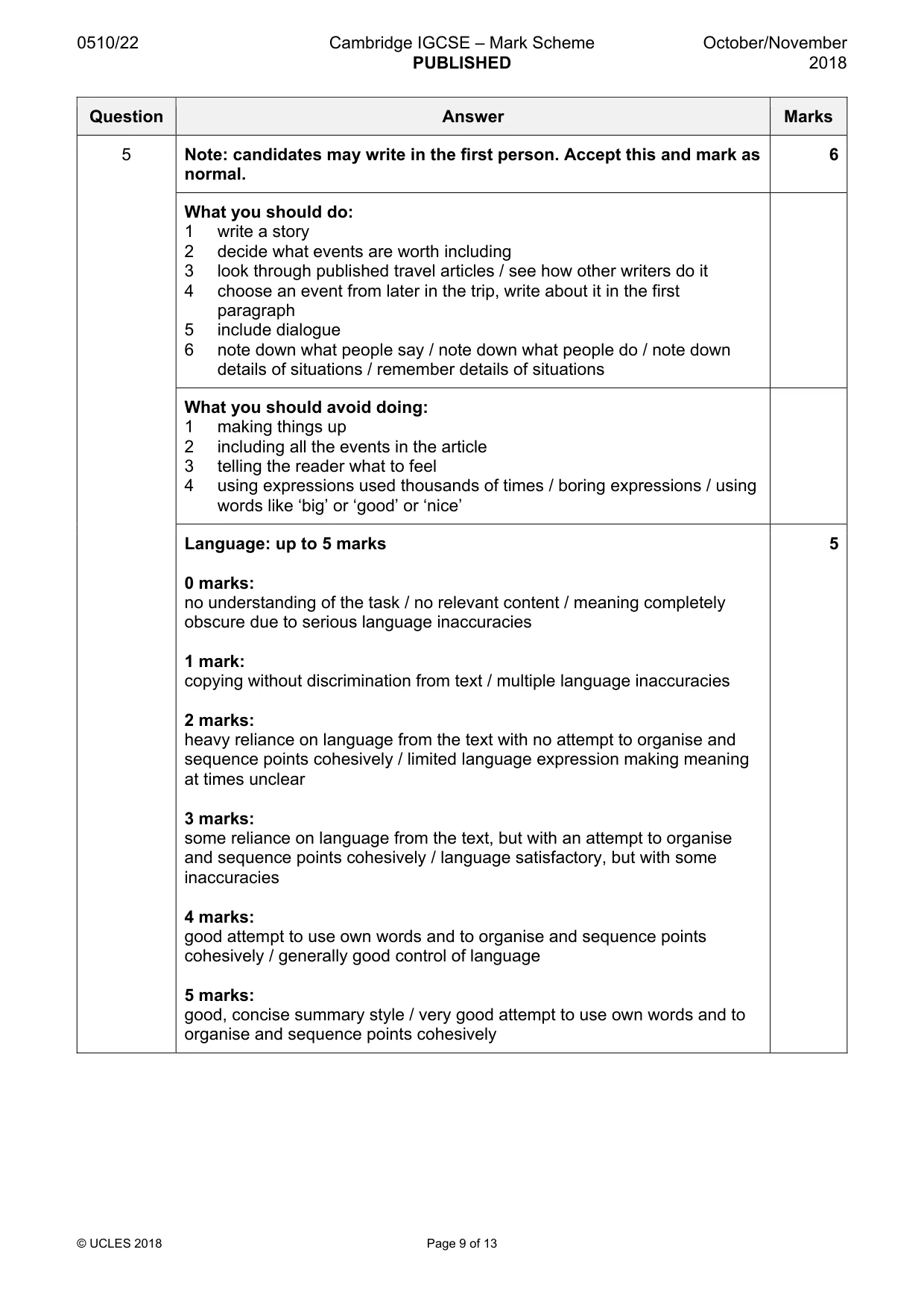
0510/22 Cambridge IGCSE – Mark Scheme PUBLISHED October/November 2018 © UCLES 2018 Page 9 of 13 Question Answer Marks 5 Note: candidates may write in the first person. Accept this and mark as normal. 6 What you should do: 1 write a story 2 decide what events are worth including 3 look through published travel articles / see how other writers do it 4 choose an event from later in the trip, write about it in the first paragraph 5 include dialogue 6 note down what people say / note down what people do / note down details of situations / remember details of situations What you should avoid doing: 1 making things up 2 including all the events in the article 3 telling the reader what to feel 4 using expressions used thousands of times / boring expressions / using words like ‘big’ or ‘good’ or ‘nice’ Language: up to 5 marks 0 marks: no understanding of the task / no relevant content / meaning completely obscure due to serious language inaccuracies 1 mark: copying without discrimination from text / multiple language inaccuracies 2 marks: heavy reliance on language from the text with no attempt to organise and sequence points cohesively / limited language expression making meaning at times unclear 3 marks: some reliance on language from the text, but with an attempt to organise and sequence points cohesively / language satisfactory, but with some inaccuracies 4 marks: good attempt to use own words and to organise and sequence points cohesively / generally good control of language 5 marks: good, concise summary style / very good attempt to use own words and to organise and sequence points cohesively 5
Mark scheme, page 10
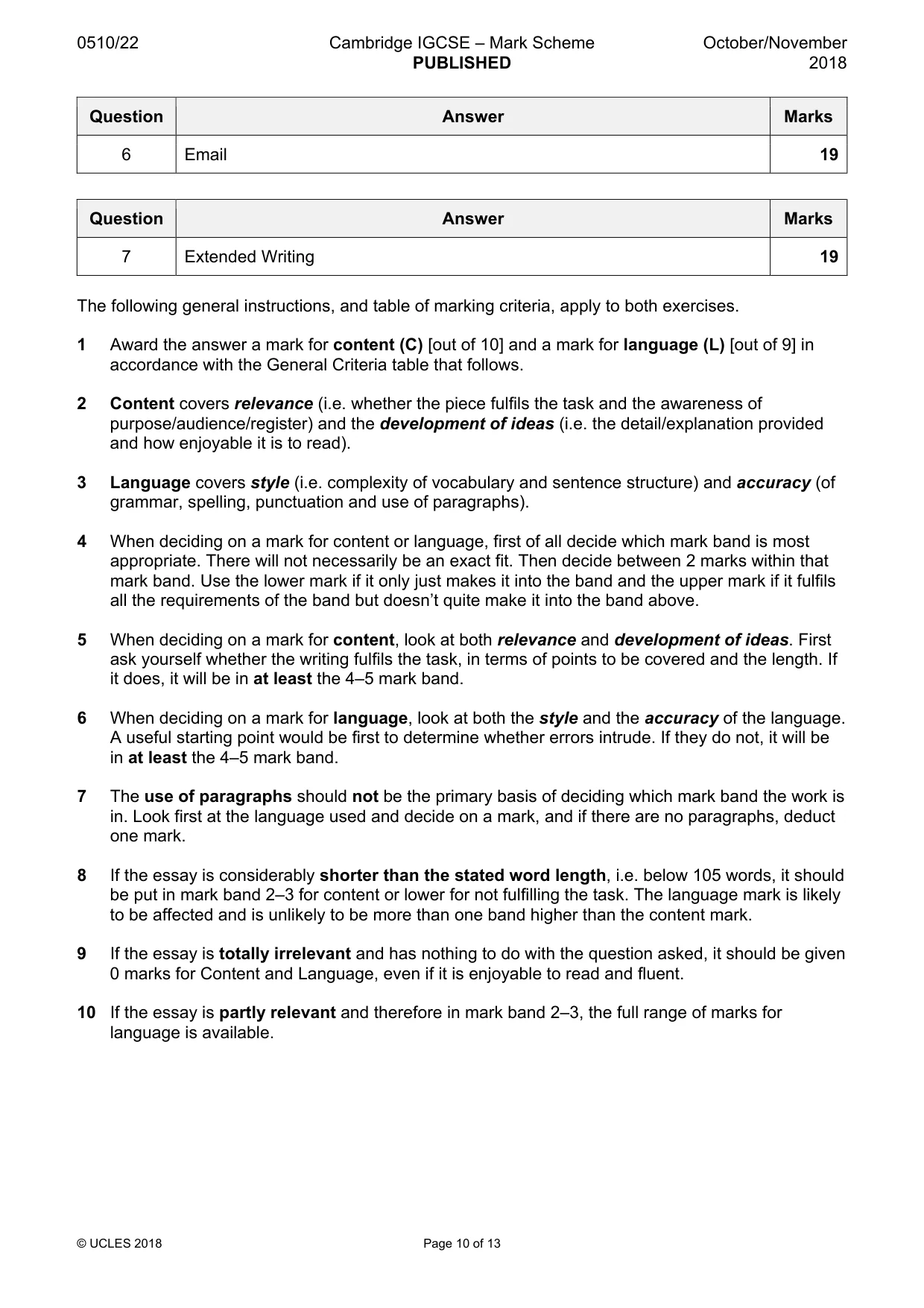
0510/22 Cambridge IGCSE – Mark Scheme PUBLISHED October/November 2018 © UCLES 2018 Page 10 of 13 Question Answer Marks 6 Email 19 Question Answer Marks 7 Extended Writing 19 The following general instructions, and table of marking criteria, apply to both exercises. 1 Award the answer a mark for content (C) [out of 10] and a mark for language (L) [out of 9] in accordance with the General Criteria table that follows. 2 Content covers relevance (i.e. whether the piece fulfils the task and the awareness of purpose/audience/register) and the development of ideas (i.e. the detail/explanation provided and how enjoyable it is to read). 3 Language covers style (i.e. complexity of vocabulary and sentence structure) and accuracy (of grammar, spelling, punctuation and use of paragraphs). 4 When deciding on a mark for content or language, first of all decide which mark band is most appropriate. There will not necessarily be an exact fit. Then decide between 2 marks within that mark band. Use the lower mark if it only just makes it into the band and the upper mark if it fulfils all the requirements of the band but doesn’t quite make it into the band above. 5 When deciding on a mark for content, look at both relevance and development of ideas. First ask yourself whether the writing fulfils the task, in terms of points to be covered and the length. If it does, it will be in at least the 4–5 mark band. 6 When deciding on a mark for language, look at both the style and the accuracy of the language. A useful starting point would be first to determine whether errors intrude. If they do not, it will be in at least the 4–5 mark band. 7 The use of paragraphs should not be the primary basis of deciding which mark band the work is in. Look first at the language used and decide on a mark, and if there are no paragraphs, deduct one mark. 8 If the essay is considerably shorter than the stated word length, i.e. below 105 words, it should be put in mark band 2–3 for content or lower for not fulfilling the task. The language mark is likely to be affected and is unlikely to be more than one band higher than the content mark. 9 If the essay is totally irrelevant and has nothing to do with the question asked, it should be given 0 marks for Content and Language, even if it is enjoyable to read and fluent. 10 If the essay is partly relevant and therefore in mark band 2–3, the full range of marks for language is available.
Mark scheme, page 11
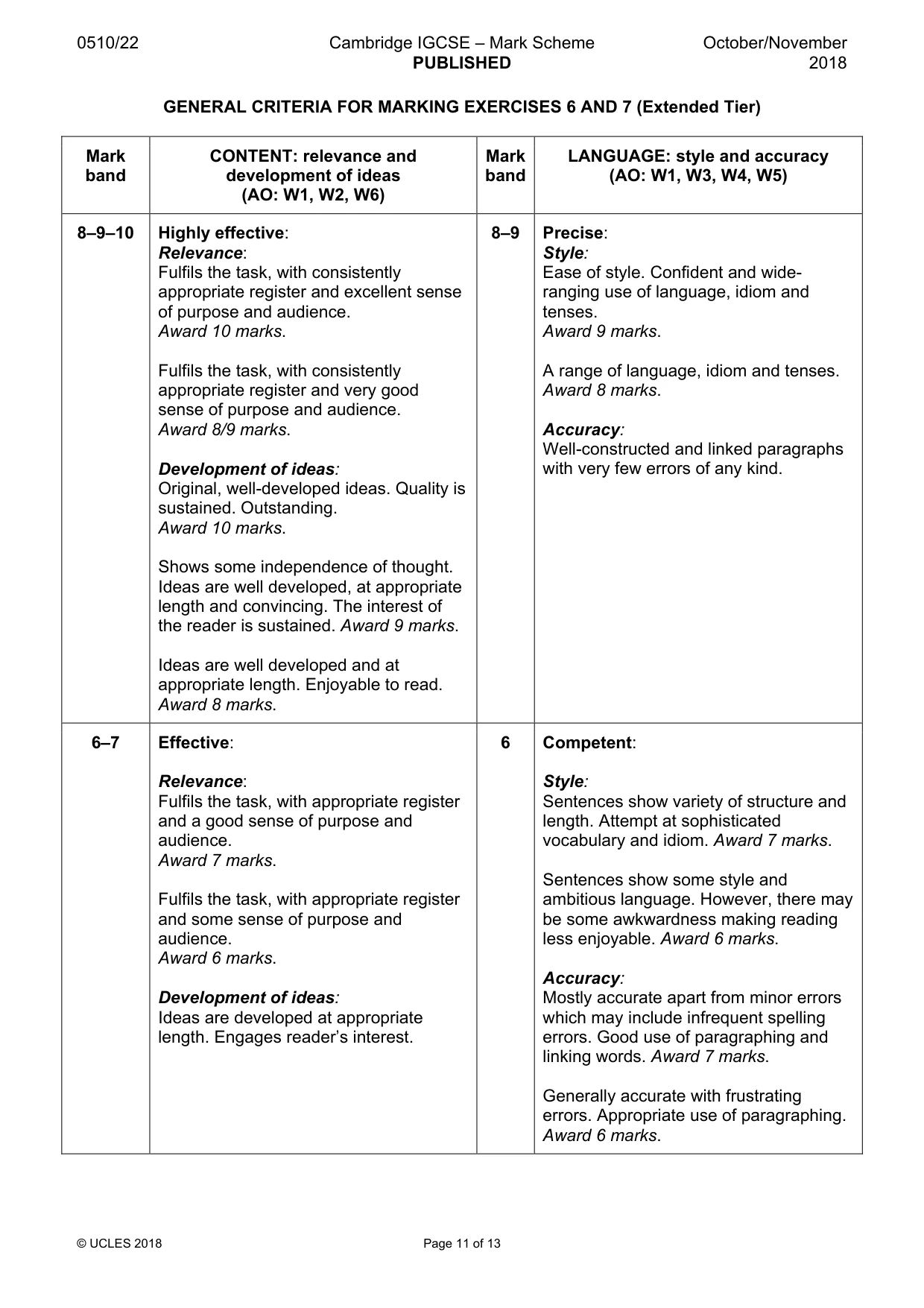
0510/22 Cambridge IGCSE – Mark Scheme PUBLISHED October/November 2018 © UCLES 2018 Page 11 of 13 GENERAL CRITERIA FOR MARKING EXERCISES 6 AND 7 (Extended Tier) Mark band CONTENT: relevance and development of ideas (AO: W1, W2, W6) Mark band LANGUAGE: style and accuracy (AO: W1, W3, W4, W5) 8–9–10 Highly effective: Relevance: Fulfils the task, with consistently appropriate register and excellent sense of purpose and audience. Award 10 marks. Fulfils the task, with consistently appropriate register and very good sense of purpose and audience. Award 8/9 marks. Development of ideas: Original, well-developed ideas. Quality is sustained. Outstanding. Award 10 marks. Shows some independence of thought. Ideas are well developed, at appropriate length and convincing. The interest of the reader is sustained. Award 9 marks. Ideas are well developed and at appropriate length. Enjoyable to read. Award 8 marks. 8–9 Precise: Style: Ease of style. Confident and wide- ranging use of language, idiom and tenses. Award 9 marks. A range of language, idiom and tenses. Award 8 marks. Accuracy: Well-constructed and linked paragraphs with very few errors of any kind. 6–7 Effective: Relevance: Fulfils the task, with appropriate register and a good sense of purpose and audience. Award 7 marks. Fulfils the task, with appropriate register and some sense of purpose and audience. Award 6 marks. Development of ideas: Ideas are developed at appropriate length. Engages reader’s interest. 6 Competent: Style: Sentences show variety of structure and length. Attempt at sophisticated vocabulary and idiom. Award 7 marks. Sentences show some style and ambitious language. However, there may be some awkwardness making reading less enjoyable. Award 6 marks. Accuracy: Mostly accurate apart from minor errors which may include infrequent spelling errors. Good use of paragraphing and linking words. Award 7 marks. Generally accurate with frustrating errors. Appropriate use of paragraphing. Award 6 marks.
Mark scheme, page 12
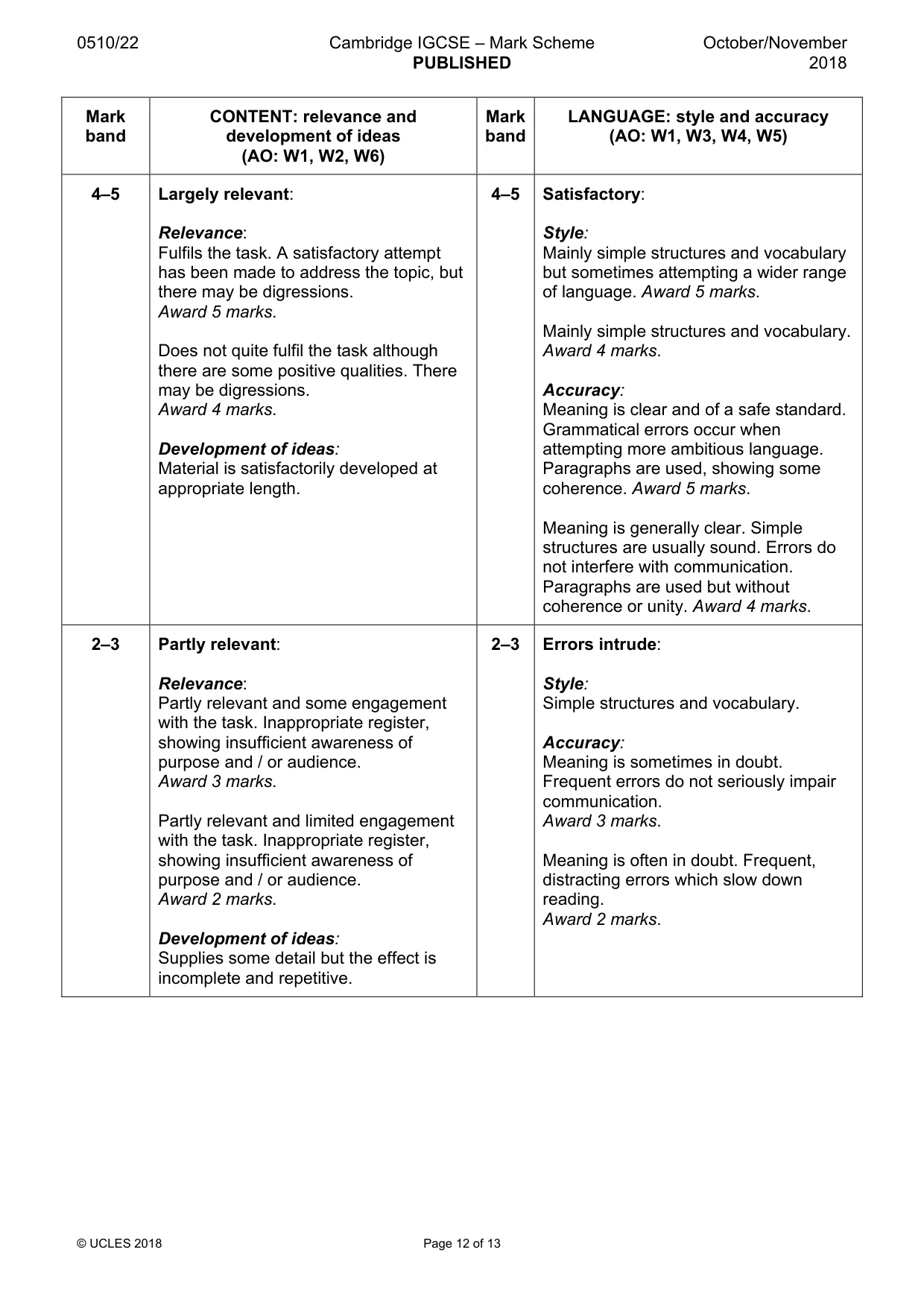
0510/22 Cambridge IGCSE – Mark Scheme PUBLISHED October/November 2018 © UCLES 2018 Page 12 of 13 Mark band CONTENT: relevance and development of ideas (AO: W1, W2, W6) Mark band LANGUAGE: style and accuracy (AO: W1, W3, W4, W5) 4–5 Largely relevant: Relevance: Fulfils the task. A satisfactory attempt has been made to address the topic, but there may be digressions. Award 5 marks. Does not quite fulfil the task although there are some positive qualities. There may be digressions. Award 4 marks. Development of ideas: Material is satisfactorily developed at appropriate length. 4–5 Satisfactory: Style: Mainly simple structures and vocabulary but sometimes attempting a wider range of language. Award 5 marks. Mainly simple structures and vocabulary. Award 4 marks. Accuracy: Meaning is clear and of a safe standard. Grammatical errors occur when attempting more ambitious language. Paragraphs are used, showing some coherence. Award 5 marks. Meaning is generally clear. Simple structures are usually sound. Errors do not interfere with communication. Paragraphs are used but without coherence or unity. Award 4 marks. 2–3 Partly relevant: Relevance: Partly relevant and some engagement with the task. Inappropriate register, showing insufficient awareness of purpose and / or audience. Award 3 marks. Partly relevant and limited engagement with the task. Inappropriate register, showing insufficient awareness of purpose and / or audience. Award 2 marks. Development of ideas: Supplies some detail but the effect is incomplete and repetitive. 2–3 Errors intrude: Style: Simple structures and vocabulary. Accuracy: Meaning is sometimes in doubt. Frequent errors do not seriously impair communication. Award 3 marks. Meaning is often in doubt. Frequent, distracting errors which slow down reading. Award 2 marks.
Mark scheme, page 13
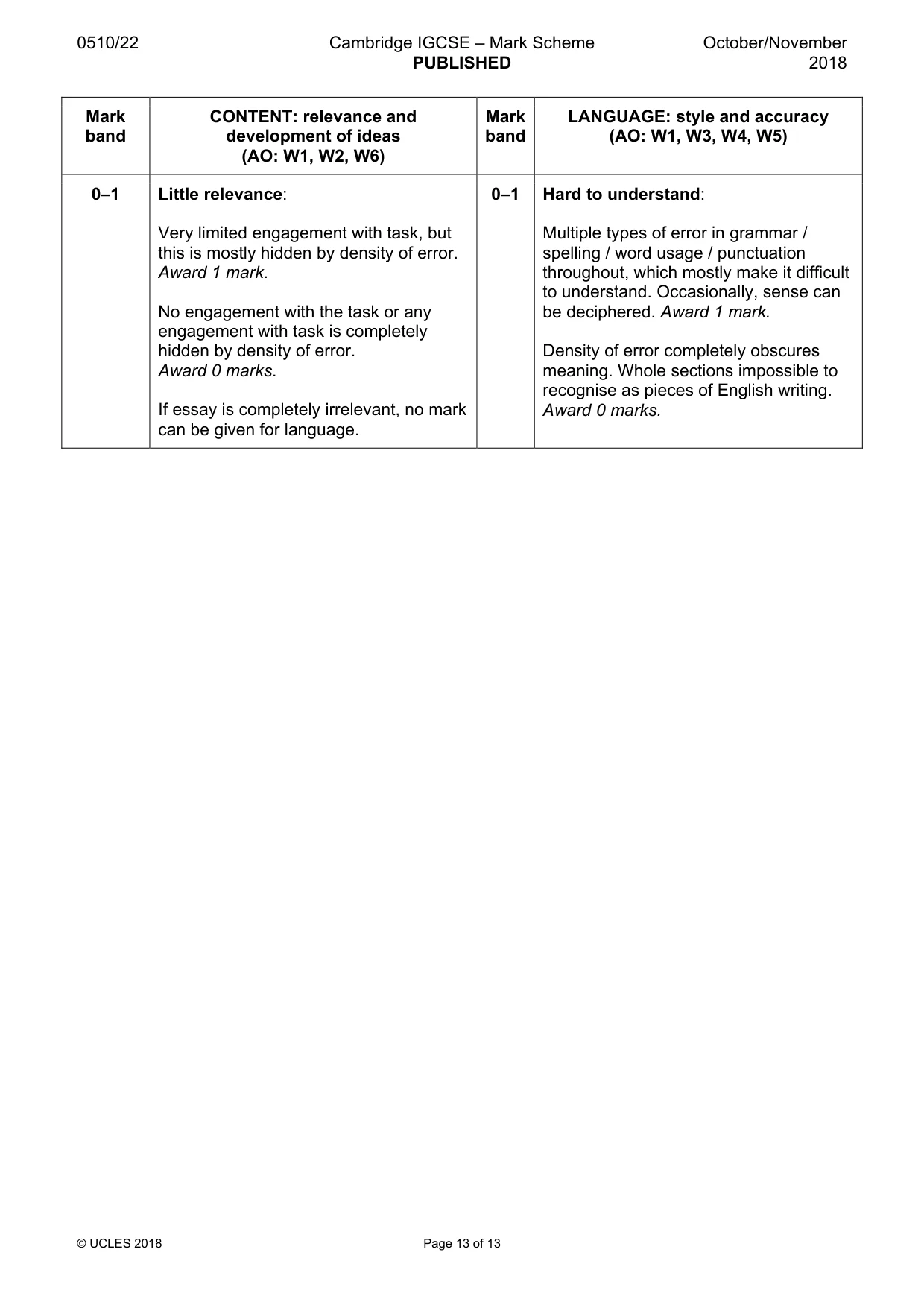
0510/22 Cambridge IGCSE – Mark Scheme PUBLISHED October/November 2018 © UCLES 2018 Page 13 of 13 Mark band CONTENT: relevance and development of ideas (AO: W1, W2, W6) Mark band LANGUAGE: style and accuracy (AO: W1, W3, W4, W5) 0–1 Little relevance: Very limited engagement with task, but this is mostly hidden by density of error. Award 1 mark. No engagement with the task or any engagement with task is completely hidden by density of error. Award 0 marks. If essay is completely irrelevant, no mark can be given for language. 0–1 Hard to understand: Multiple types of error in grammar / spelling / word usage / punctuation throughout, which mostly make it difficult to understand. Occasionally, sense can be deciphered. Award 1 mark. Density of error completely obscures meaning. Whole sections impossible to recognise as pieces of English writing. Award 0 marks.
What you needed in this session
Cambridge’s own grade thresholds for 2018 Oct/Nov, Paper 2 · Variant 2. A higher threshold means an easier paper — the bar moves with how the cohort did.