Cambridge IGCSE English - Second Language (oral endorsement) 0510 — 2018 May/June Paper 4 · Variant 3
0510/43/M/J/18 · 40 marks · ≈45 min
The question paper and its mark scheme, free to read here and free to download. This is Cambridge’s own paper, exactly as it was sat.
Question paper12 pages


Mark scheme5 pages
Answers below. Sit the paper first if you are practising.
Paper as text
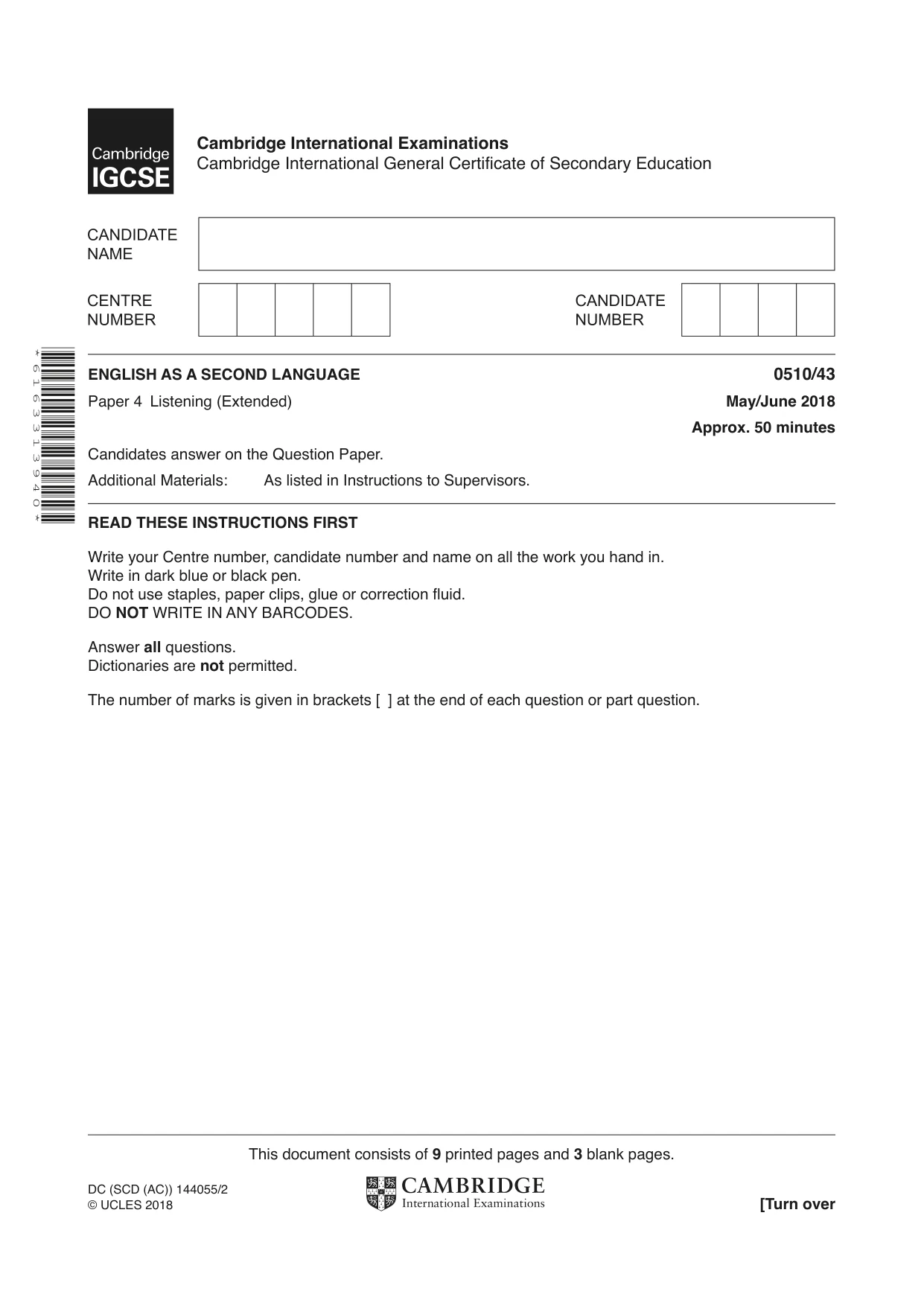
Question paper, page 1
This document consists of 9 printed pages and 3 blank pages. DC (SCD (AC)) 144055/2 © UCLES 2018 [Turn over Cambridge International Examinations Cambridge International General Certificate of Secondary Education * 6 1 6 3 3 1 3 9 4 0 * ENGLISH AS A SECOND LANGUAGE 0510/43 Paper 4 Listening (Extended) May/June 2018 Approx. 50 minutes Candidates answer on the Question Paper. Additional Materials: As listed in Instructions to Supervisors. READ THESE INSTRUCTIONS FIRST Write your Centre number, candidate number and name on all the work you hand in. Write in dark blue or black pen. Do not use staples, paper clips, glue or correction fluid. DO NOT WRITE IN ANY BARCODES. Answer all questions. Dictionaries are not permitted. The number of marks is given in brackets [ ] at the end of each question or part question.
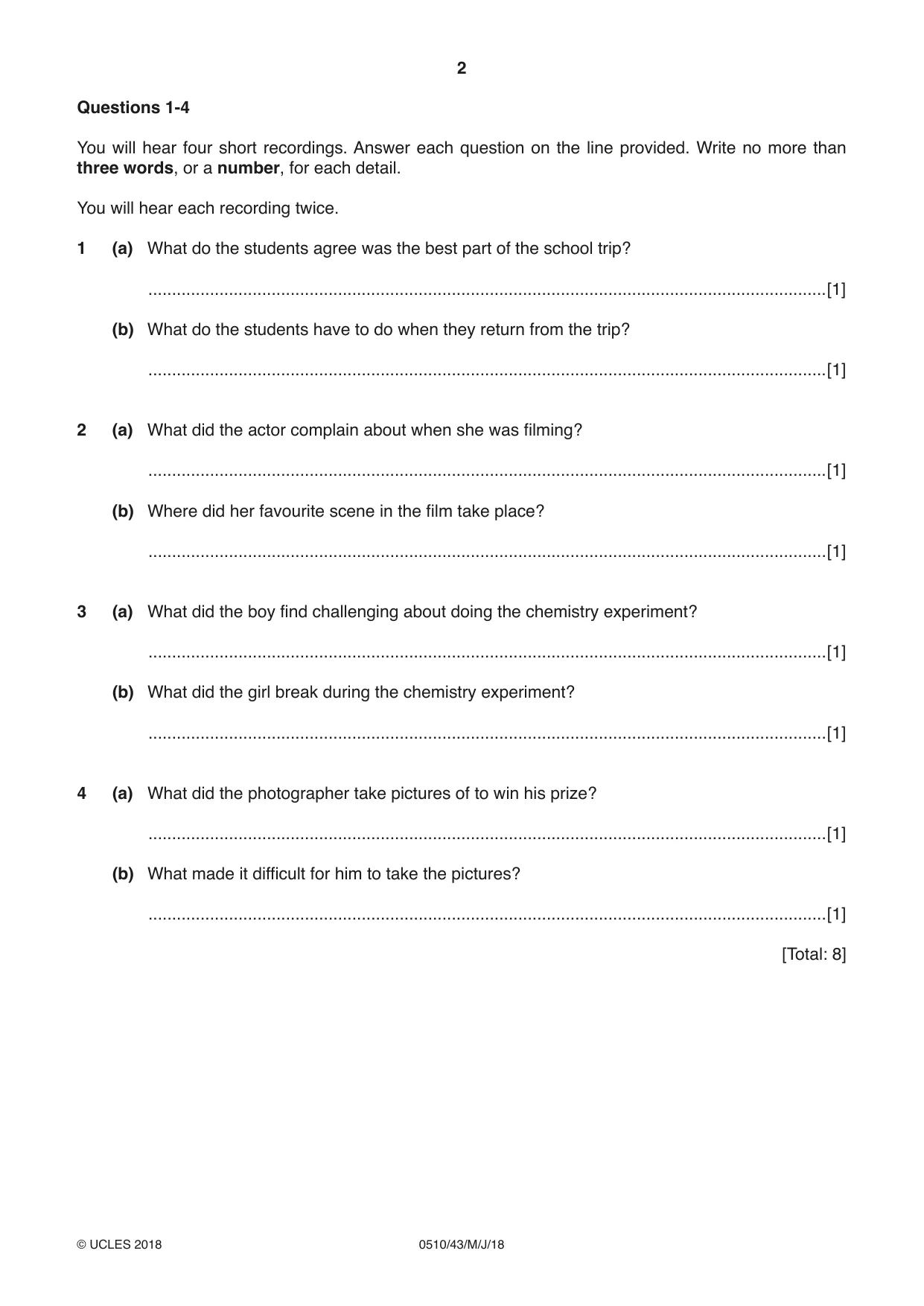
Question paper, page 2
2 0510/43/M/J/18 © UCLES 2018 Questions 1-4 You will hear four short recordings. Answer each question on the line provided. Write no more than three words, or a number, for each detail. You will hear each recording twice. 1 (a) What do the students agree was the best part of the school trip? …[1] (b) What do the students have to do when they return from the trip? …[1] 2 (a) What did the actor complain about when she was filming? …[1] (b) Where did her favourite scene in the film take place? …[1] 3 (a) What did the boy find challenging about doing the chemistry experiment? …[1] (b) What did the girl break during the chemistry experiment? …[1] 4 (a) What did the photographer take pictures of to win his prize? …[1] (b) What made it difficult for him to take the pictures? …[1] [Total: 8]
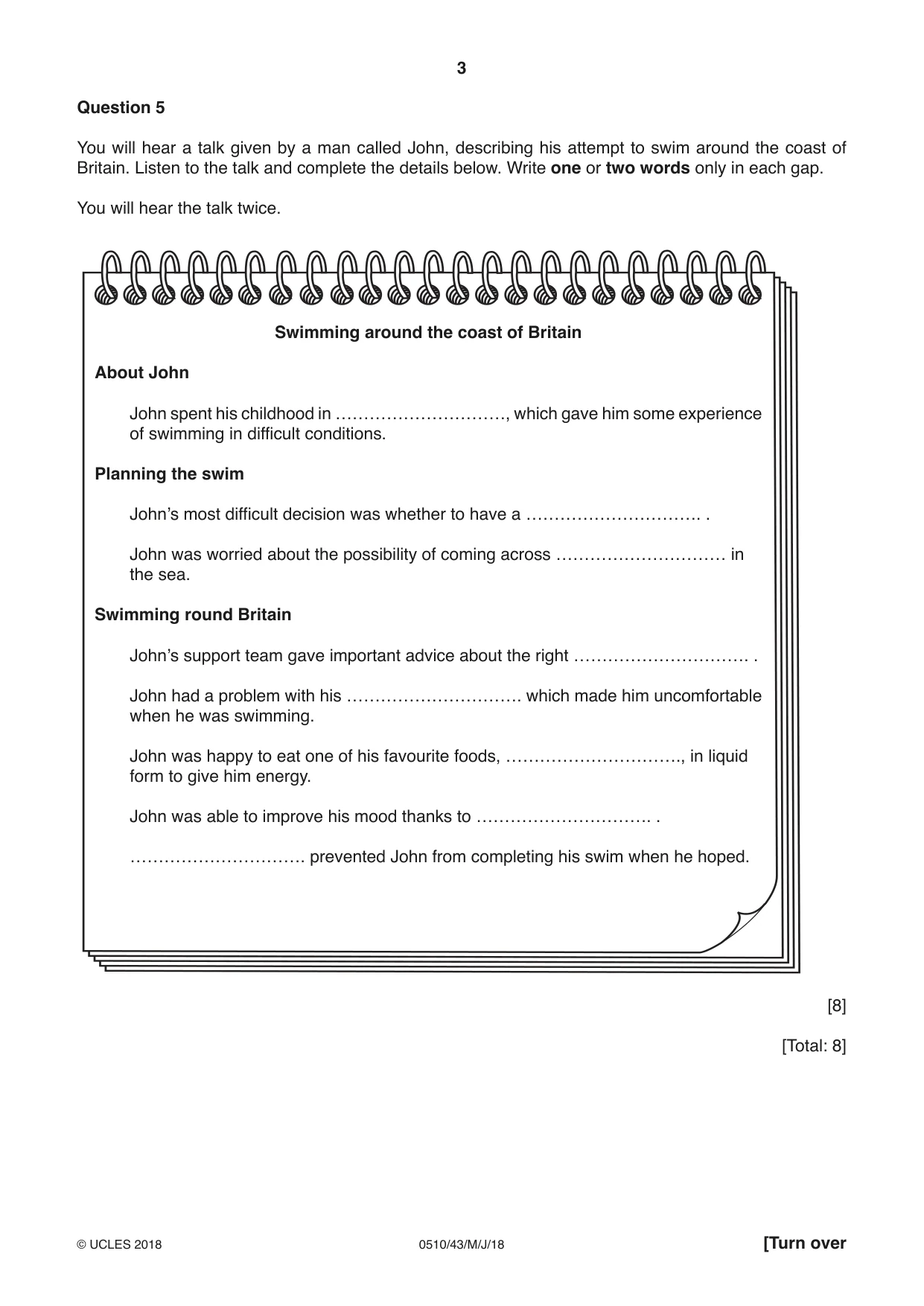
Question paper, page 3
3 0510/43/M/J/18 © UCLES 2018 [Turn over Question 5 You will hear a talk given by a man called John, describing his attempt to swim around the coast of Britain. Listen to the talk and complete the details below. Write one or two words only in each gap. You will hear the talk twice. Swimming around the coast of Britain About John John spent his childhood in …………………………, which gave him some experience of swimming in difficult conditions. Planning the swim John’s most difficult decision was whether to have a …………………………. . John was worried about the possibility of coming across ………………………… in the sea. Swimming round Britain John’s support team gave important advice about the right …………………………. . John had a problem with his …………………………. which made him uncomfortable when he was swimming. John was happy to eat one of his favourite foods, …………………………., in liquid form to give him energy. John was able to improve his mood thanks to …………………………. . …………………………. prevented John from completing his swim when he hoped. [8] [Total: 8]
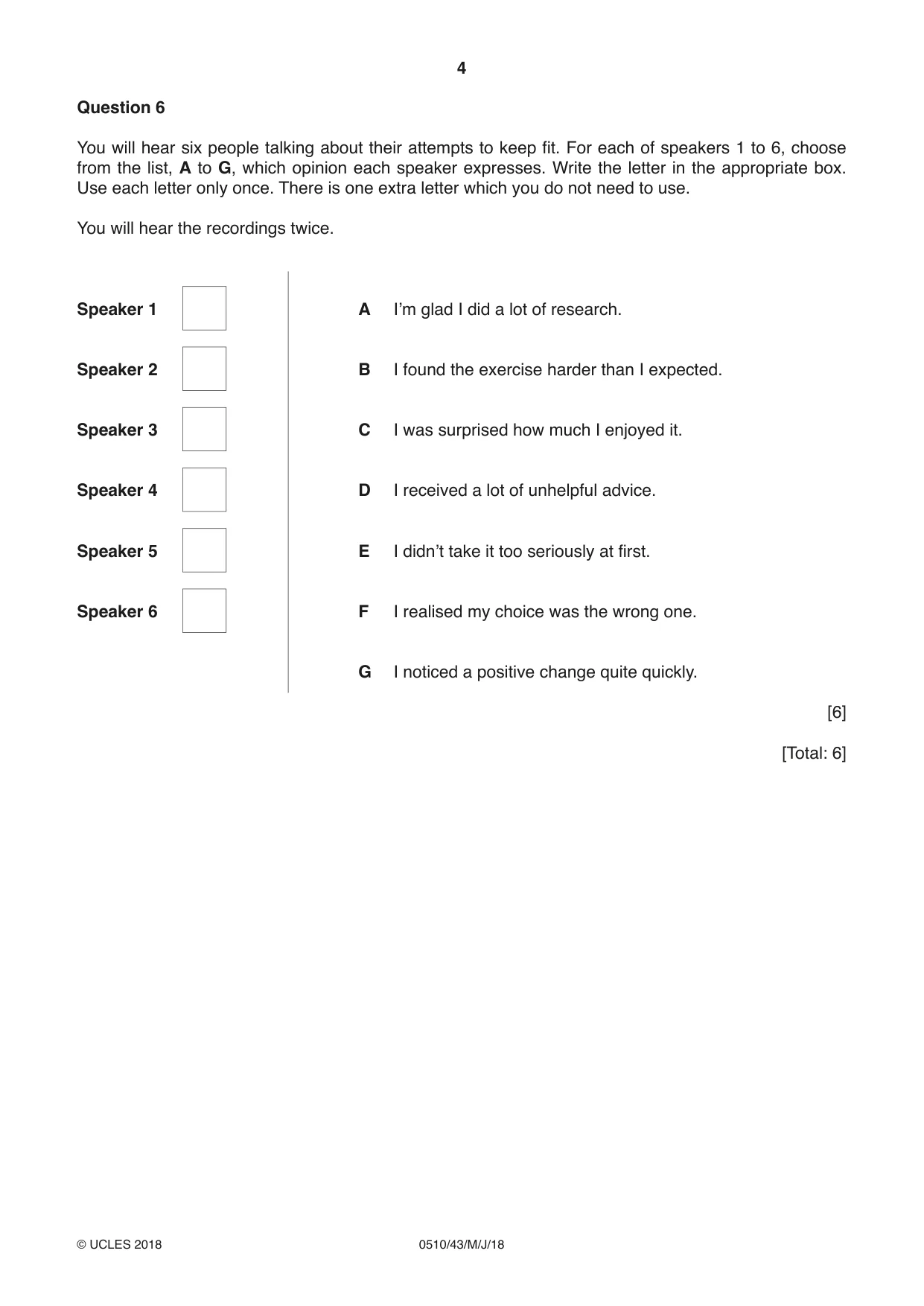
Question paper, page 4
4 0510/43/M/J/18 © UCLES 2018 Question 6 You will hear six people talking about their attempts to keep fit. For each of speakers 1 to 6, choose from the list, A to G, which opinion each speaker expresses. Write the letter in the appropriate box. Use each letter only once. There is one extra letter which you do not need to use. You will hear the recordings twice. Speaker 1 A I’m glad I did a lot of research. Speaker 2 B I found the exercise harder than I expected. Speaker 3 C I was surprised how much I enjoyed it. Speaker 4 D I received a lot of unhelpful advice. Speaker 5 E I didn’t take it too seriously at first. Speaker 6 F I realised my choice was the wrong one. G I noticed a positive change quite quickly. [6] [Total: 6]
Question paper, page 5
5 0510/43/M/J/18 © UCLES 2018 [Turn over Please turn over for Question 7.
Question paper, page 6
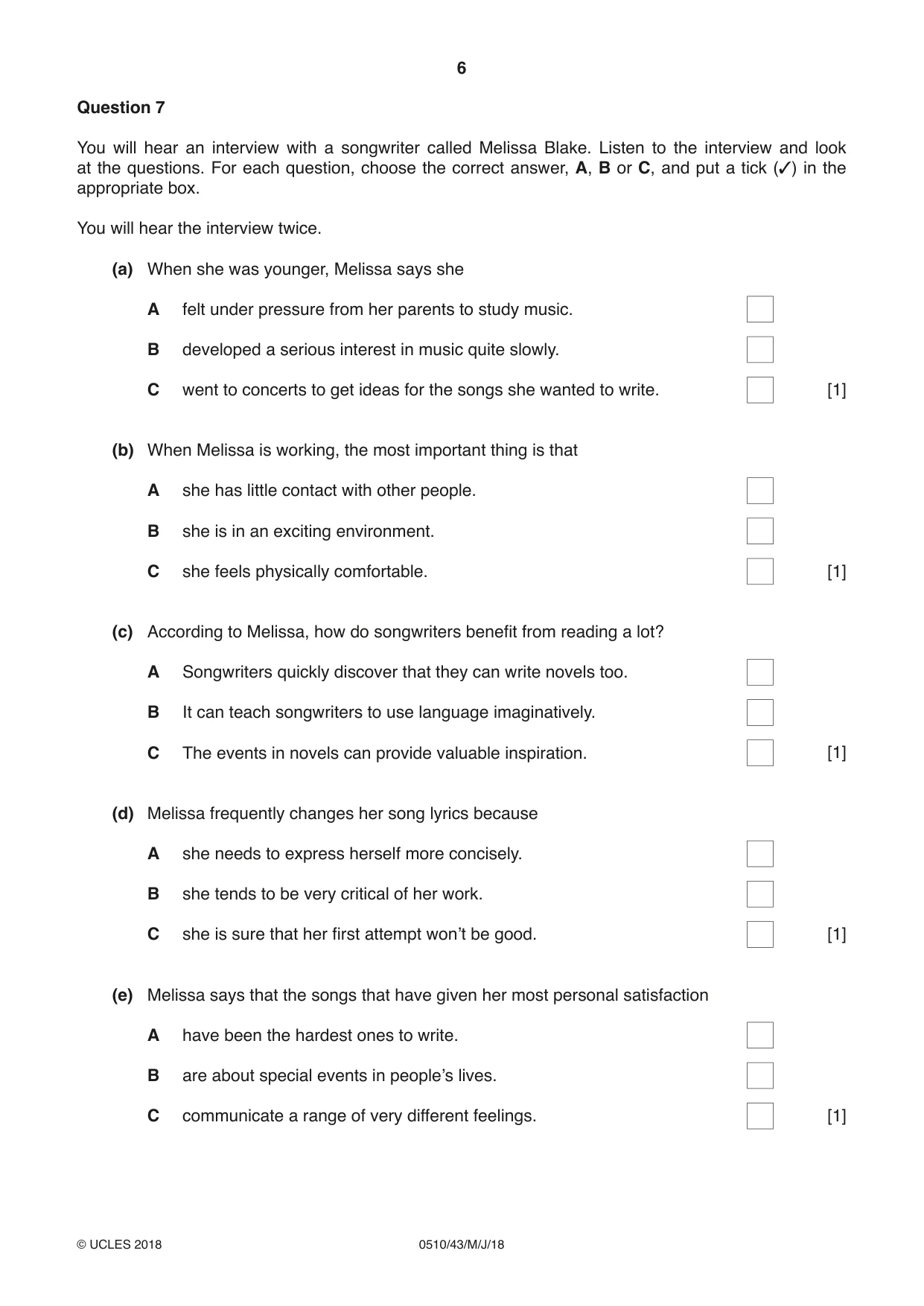
6 0510/43/M/J/18 © UCLES 2018 Question 7 You will hear an interview with a songwriter called Melissa Blake. Listen to the interview and look at the questions. For each question, choose the correct answer, A, B or C, and put a tick (✓) in the appropriate box. You will hear the interview twice. (a) When she was younger, Melissa says she A felt under pressure from her parents to study music. B developed a serious interest in music quite slowly. C went to concerts to get ideas for the songs she wanted to write. [1] (b) When Melissa is working, the most important thing is that A she has little contact with other people. B she is in an exciting environment. C she feels physically comfortable. [1] (c) According to Melissa, how do songwriters benefit from reading a lot? A Songwriters quickly discover that they can write novels too. B It can teach songwriters to use language imaginatively. C The events in novels can provide valuable inspiration. [1] (d) Melissa frequently changes her song lyrics because A she needs to express herself more concisely. B she tends to be very critical of her work. C she is sure that her first attempt won’t be good. [1] (e) Melissa says that the songs that have given her most personal satisfaction A have been the hardest ones to write. B are about special events in people’s lives. C communicate a range of very different feelings. [1]
Question paper, page 7
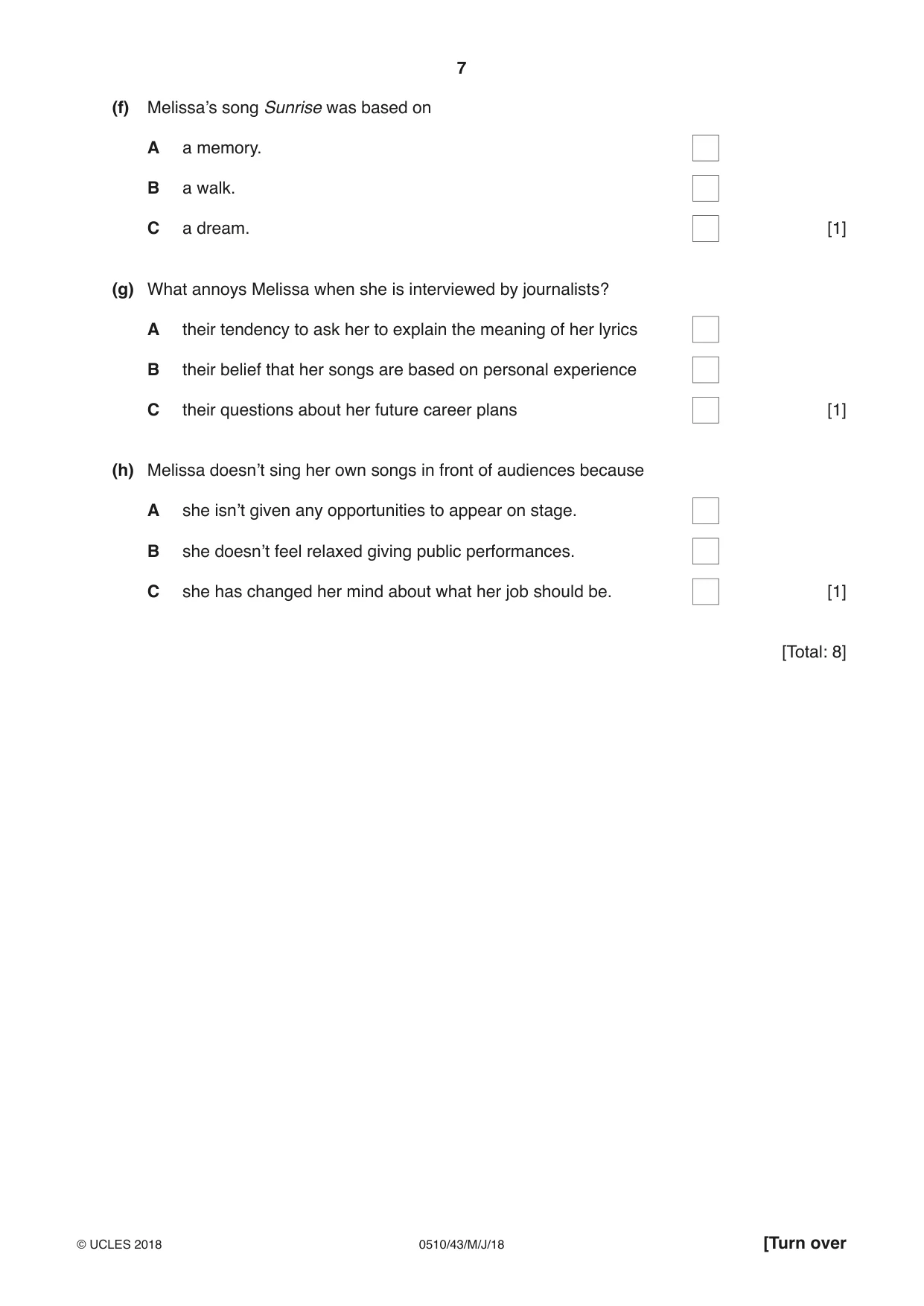
7 0510/43/M/J/18 © UCLES 2018 [Turn over (f) Melissa’s song Sunrise was based on A a memory. B a walk. C a dream. [1] (g) What annoys Melissa when she is interviewed by journalists? A their tendency to ask her to explain the meaning of her lyrics B their belief that her songs are based on personal experience C their questions about her future career plans [1] (h) Melissa doesn’t sing her own songs in front of audiences because A she isn’t given any opportunities to appear on stage. B she doesn’t feel relaxed giving public performances. C she has changed her mind about what her job should be. [1] [Total: 8]
Question paper, page 8
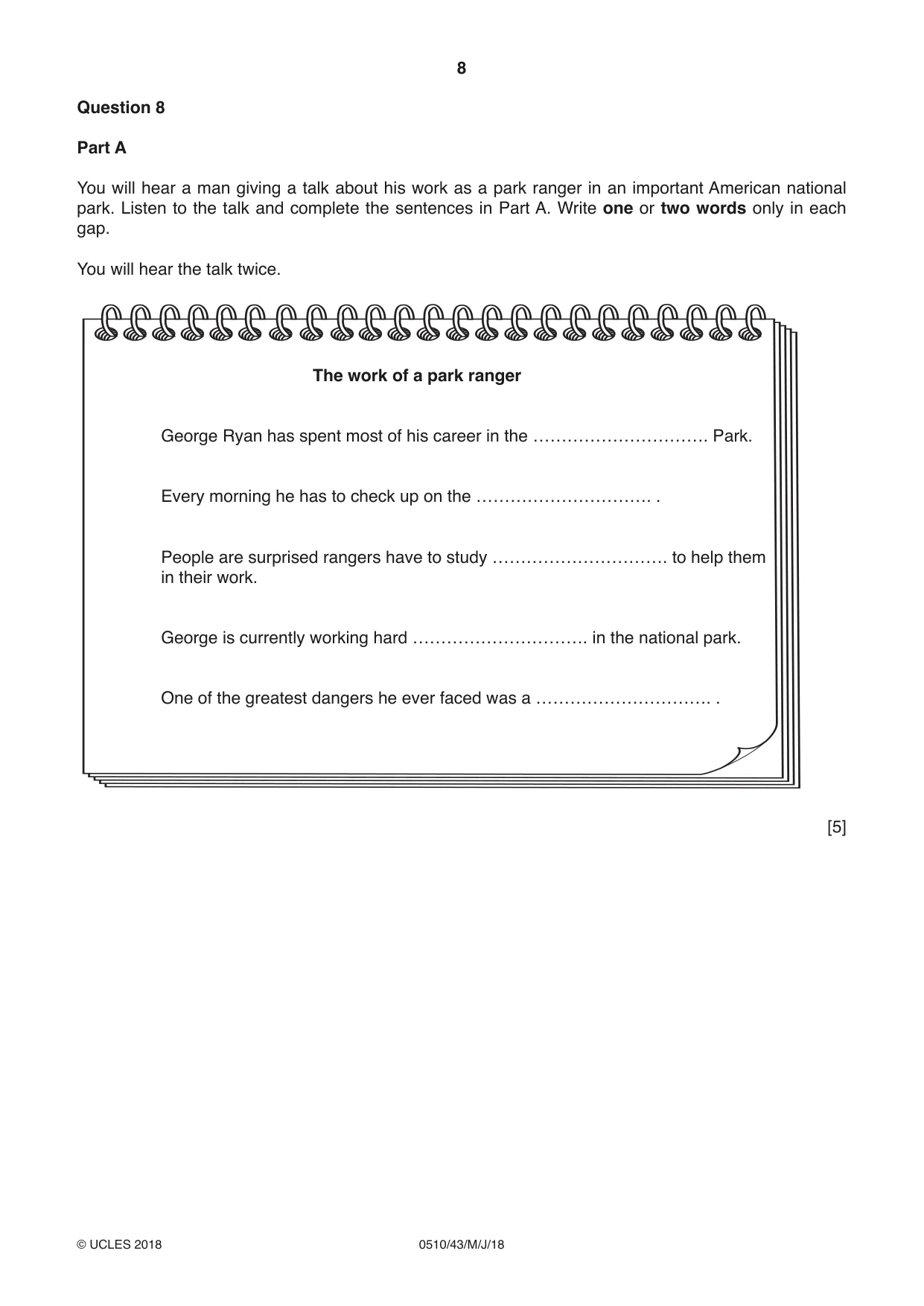
8 0510/43/M/J/18 © UCLES 2018 Question 8 Part A You will hear a man giving a talk about his work as a park ranger in an important American national park. Listen to the talk and complete the sentences in Part A. Write one or two words only in each gap. You will hear the talk twice. The work of a park ranger George Ryan has spent most of his career in the …………………………. Park. Every morning he has to check up on the …………………………. . People are surprised rangers have to study …………………………. to help them in their work. George is currently working hard …………………………. in the national park. One of the greatest dangers he ever faced was a …………………………. . [5]
Question paper, page 9
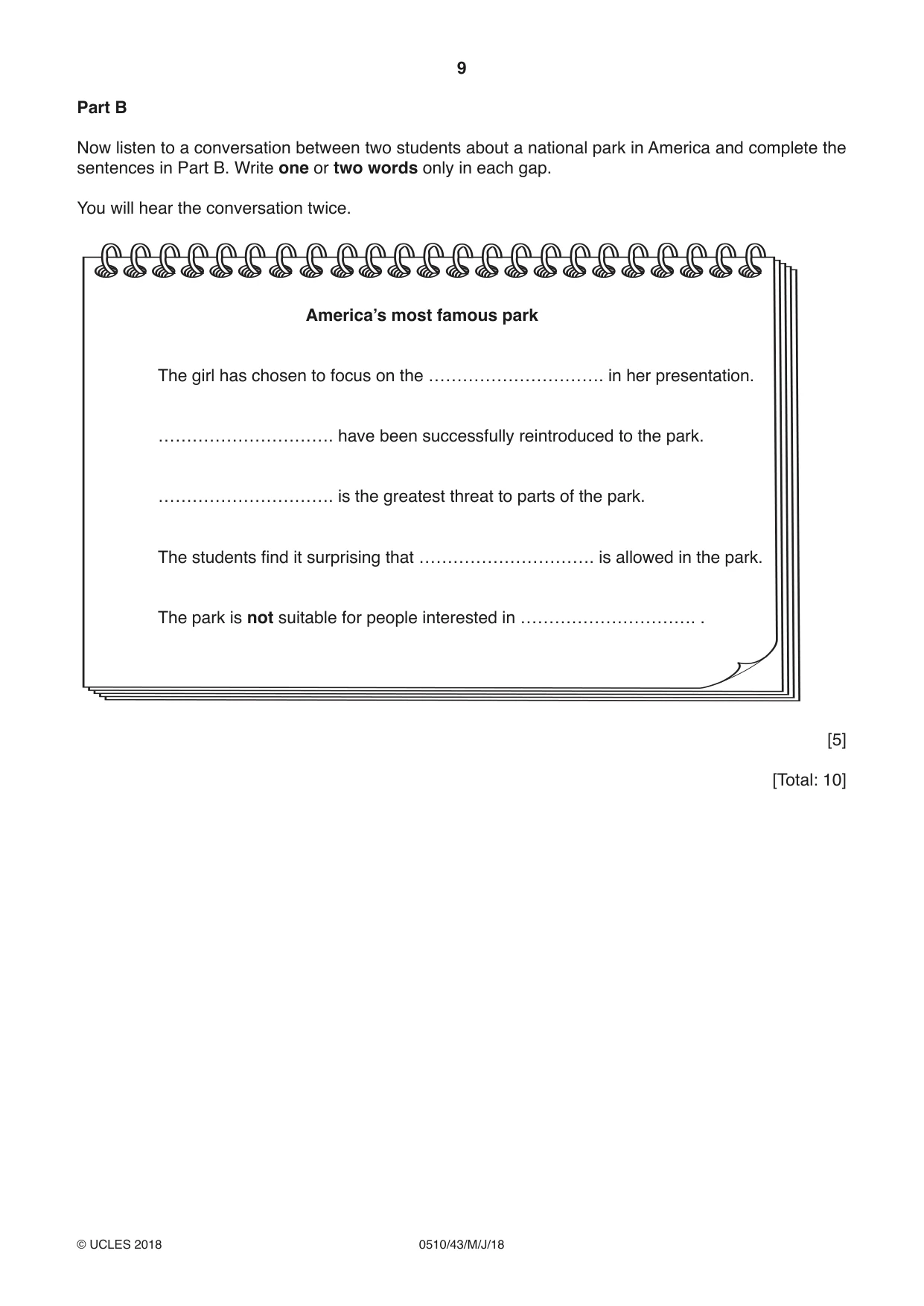
9 0510/43/M/J/18 © UCLES 2018 Part B Now listen to a conversation between two students about a national park in America and complete the sentences in Part B. Write one or two words only in each gap. You will hear the conversation twice. America’s most famous park The girl has chosen to focus on the …………………………. in her presentation. …………………………. have been successfully reintroduced to the park. …………………………. is the greatest threat to parts of the park. The students find it surprising that …………………………. is allowed in the park. The park is not suitable for people interested in …………………………. . [5] [Total: 10]
Question paper, page 10
10 0510/43/M/J/18 © UCLES 2018 BLANK PAGE
Question paper, page 11
11 0510/43/M/J/18 © UCLES 2018 BLANK PAGE
Question paper, page 12
12 0510/43/M/J/18 © UCLES 2018 Permission to reproduce items where third-party owned material protected by copyright is included has been sought and cleared where possible. Every reasonable effort has been made by the publisher (UCLES) to trace copyright holders, but if any items requiring clearance have unwittingly been included, the publisher will be pleased to make amends at the earliest possible opportunity. To avoid the issue of disclosure of answer-related information to candidates, all copyright acknowledgements are reproduced online in the Cambridge International Examinations Copyright Acknowledgements Booklet. This is produced for each series of examinations and is freely available to download at www.cie.org.uk after the live examination series. Cambridge International Examinations is part of the Cambridge Assessment Group. Cambridge Assessment is the brand name of University of Cambridge Local Examinations Syndicate (UCLES), which is itself a department of the University of Cambridge. BLANK PAGE
Mark scheme, page 1
IGCSE™ is a registered trademark. This document consists of 5 printed pages. © UCLES 2018 [Turn over Cambridge Assessment International Education Cambridge International General Certificate of Secondary Education ENGLISH AS A SECOND LANGUAGE 0510/43 Paper 4 Listening May/June 2018 MARK SCHEME Maximum Mark: 40 Published This mark scheme is published as an aid to teachers and candidates, to indicate the requirements of the examination. It shows the basis on which Examiners were instructed to award marks. It does not indicate the details of the discussions that took place at an Examiners’ meeting before marking began, which would have considered the acceptability of alternative answers. Mark schemes should be read in conjunction with the question paper and the Principal Examiner Report for Teachers. Cambridge International will not enter into discussions about these mark schemes. Cambridge International is publishing the mark schemes for the May/June 2018 series for most Cambridge IGCSE™, Cambridge International A and AS Level and Cambridge Pre-U components, and some Cambridge O Level components.
Mark scheme, page 2
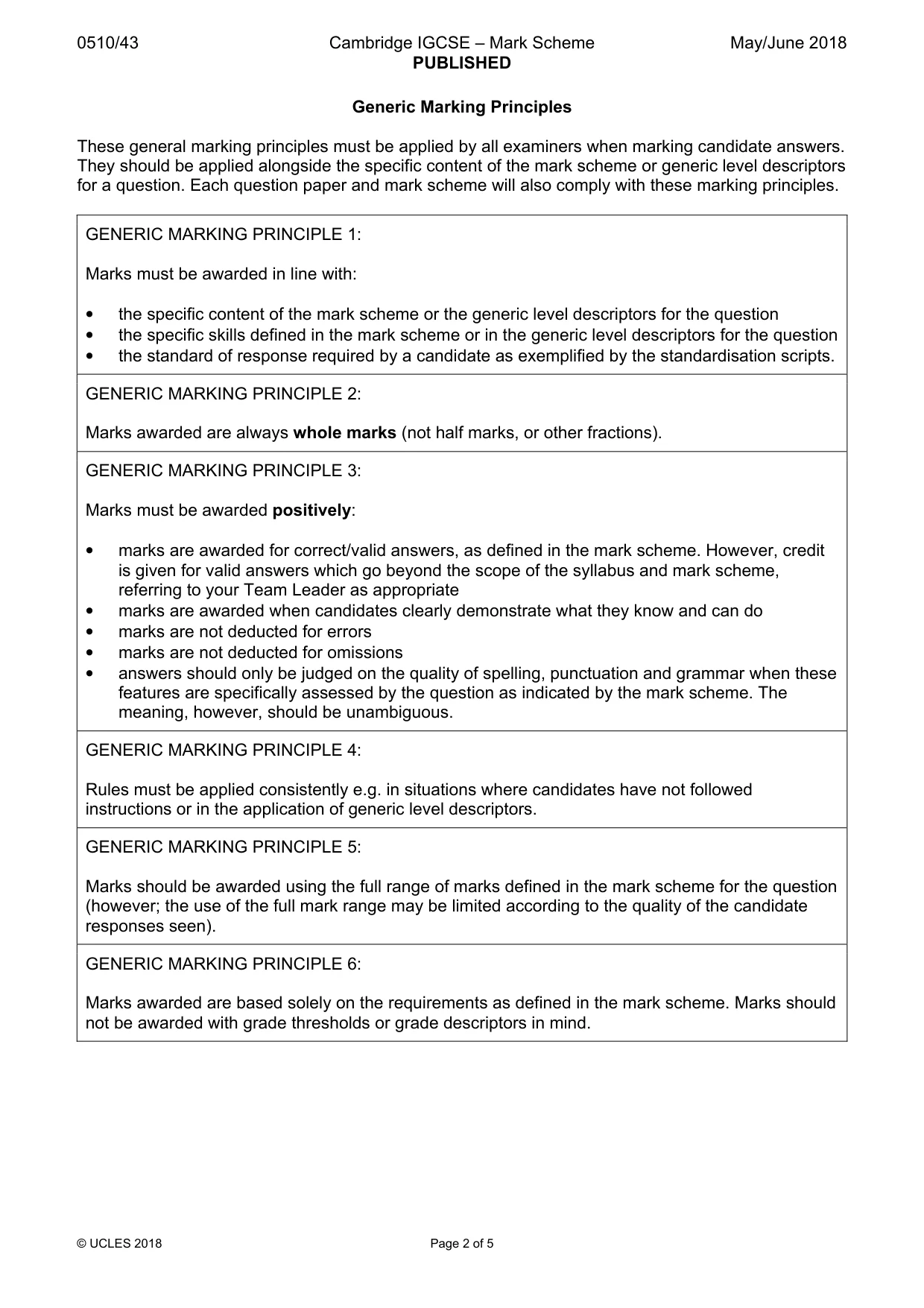
0510/43 Cambridge IGCSE – Mark Scheme PUBLISHED May/June 2018 © UCLES 2018 Page 2 of 5 Generic Marking Principles These general marking principles must be applied by all examiners when marking candidate answers. They should be applied alongside the specific content of the mark scheme or generic level descriptors for a question. Each question paper and mark scheme will also comply with these marking principles. GENERIC MARKING PRINCIPLE 1: Marks must be awarded in line with: • the specific content of the mark scheme or the generic level descriptors for the question • the specific skills defined in the mark scheme or in the generic level descriptors for the question • the standard of response required by a candidate as exemplified by the standardisation scripts. GENERIC MARKING PRINCIPLE 2: Marks awarded are always whole marks (not half marks, or other fractions). GENERIC MARKING PRINCIPLE 3: Marks must be awarded positively: • marks are awarded for correct/valid answers, as defined in the mark scheme. However, credit is given for valid answers which go beyond the scope of the syllabus and mark scheme, referring to your Team Leader as appropriate • marks are awarded when candidates clearly demonstrate what they know and can do • marks are not deducted for errors • marks are not deducted for omissions • answers should only be judged on the quality of spelling, punctuation and grammar when these features are specifically assessed by the question as indicated by the mark scheme. The meaning, however, should be unambiguous. GENERIC MARKING PRINCIPLE 4: Rules must be applied consistently e.g. in situations where candidates have not followed instructions or in the application of generic level descriptors. GENERIC MARKING PRINCIPLE 5: Marks should be awarded using the full range of marks defined in the mark scheme for the question (however; the use of the full mark range may be limited according to the quality of the candidate responses seen). GENERIC MARKING PRINCIPLE 6: Marks awarded are based solely on the requirements as defined in the mark scheme. Marks should not be awarded with grade thresholds or grade descriptors in mind.
Mark scheme, page 3
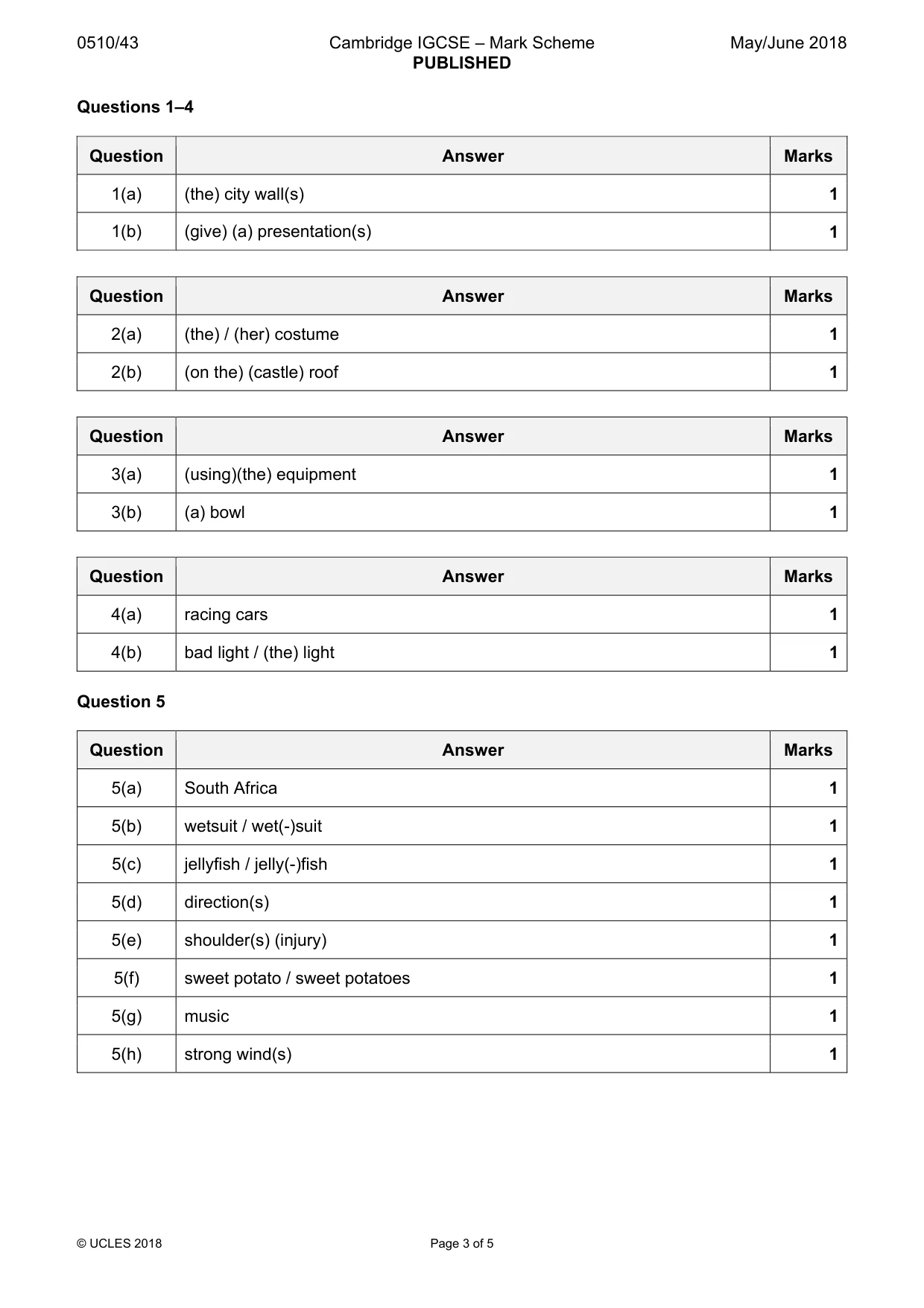
0510/43 Cambridge IGCSE – Mark Scheme PUBLISHED May/June 2018 © UCLES 2018 Page 3 of 5 Questions 1–4 Question Answer Marks 1(a) (the) city wall(s) 1 1(b) (give) (a) presentation(s) 1 Question Answer Marks 2(a) (the) / (her) costume 1 2(b) (on the) (castle) roof 1 Question Answer Marks 3(a) (using)(the) equipment 1 3(b) (a) bowl 1 Question Answer Marks 4(a) racing cars 1 4(b) bad light / (the) light 1 Question 5 Question Answer Marks 5(a) South Africa 1 5(b) wetsuit / wet(-)suit 1 5(c) jellyfish / jelly(-)fish 1 5(d) direction(s) 1 5(e) shoulder(s) (injury) 1 5(f) sweet potato / sweet potatoes 1 5(g) music 1 5(h) strong wind(s) 1
Mark scheme, page 4
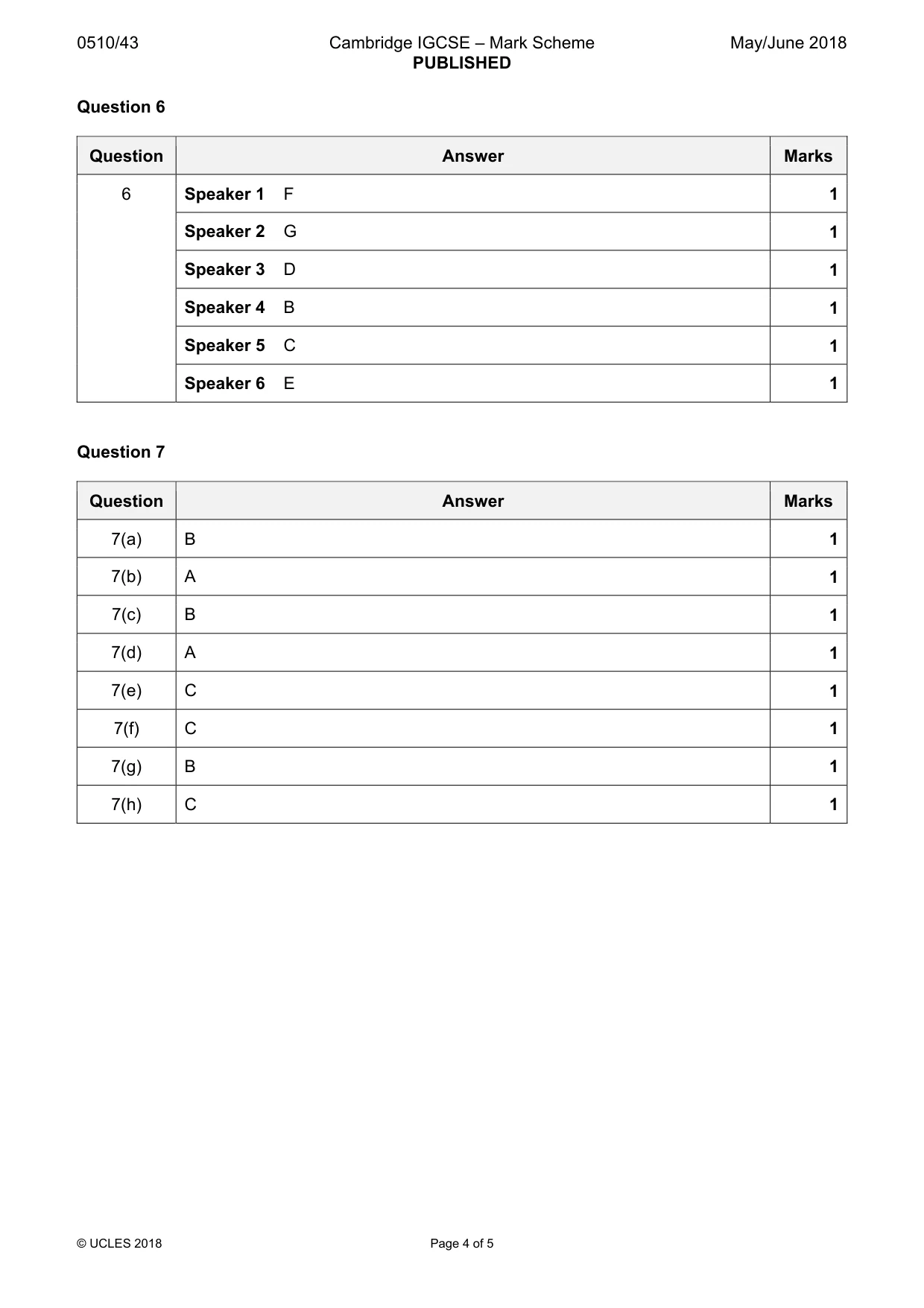
0510/43 Cambridge IGCSE – Mark Scheme PUBLISHED May/June 2018 © UCLES 2018 Page 4 of 5 Question 6 Question Answer Marks 6 Speaker 1 F 1 Speaker 2 G 1 Speaker 3 D 1 Speaker 4 B 1 Speaker 5 C 1 Speaker 6 E 1 Question 7 Question Answer Marks 7(a) B 1 7(b) A 1 7(c) B 1 7(d) A 1 7(e) C 1 7(f) C 1 7(g) B 1 7(h) C 1
Mark scheme, page 5
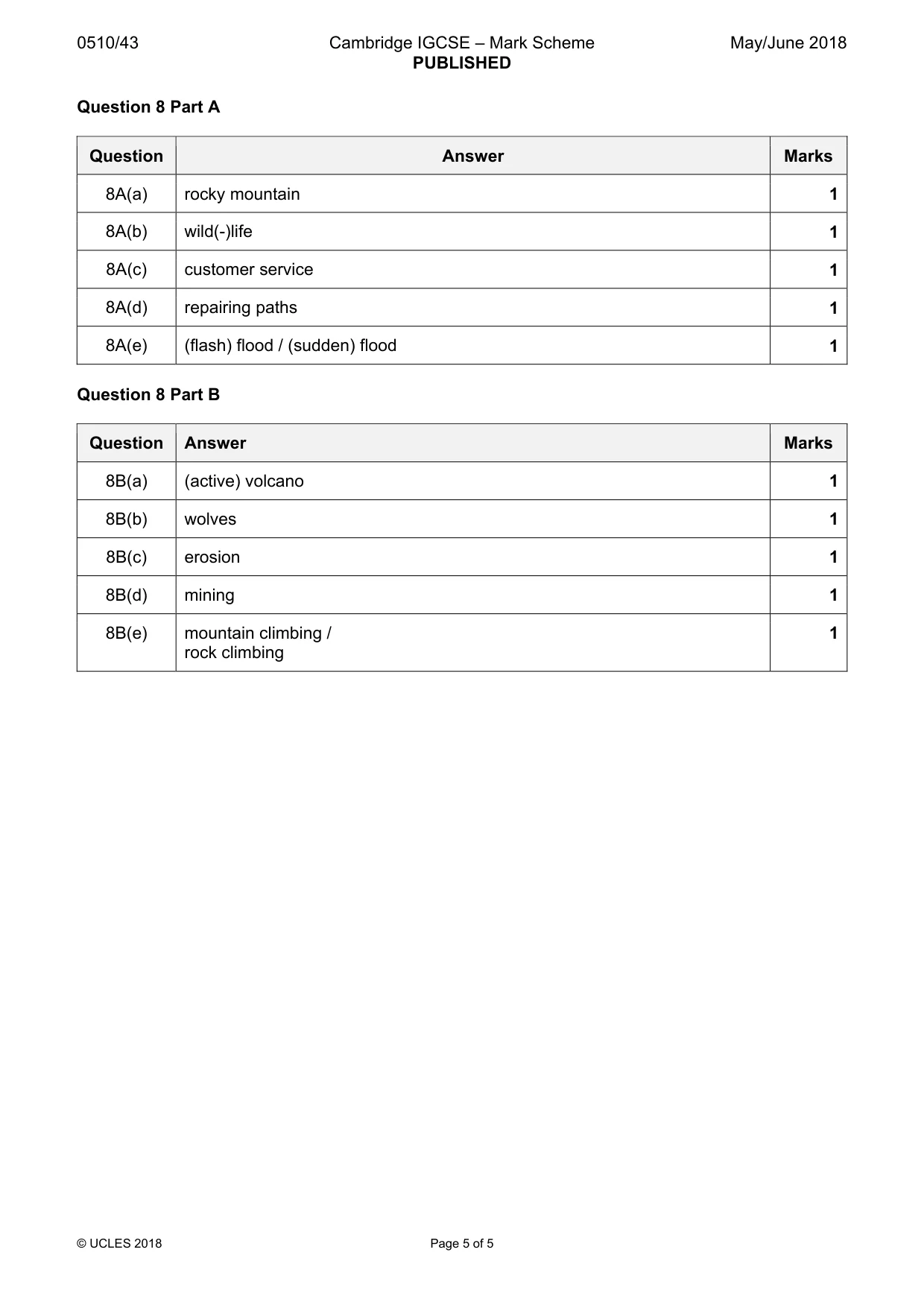
0510/43 Cambridge IGCSE – Mark Scheme PUBLISHED May/June 2018 © UCLES 2018 Page 5 of 5 Question 8 Part A Question Answer Marks 8A(a) rocky mountain 1 8A(b) wild(-)life 1 8A(c) customer service 1 8A(d) repairing paths 1 8A(e) (flash) flood / (sudden) flood 1 Question 8 Part B Question Answer Marks 8B(a) (active) volcano 1 8B(b) wolves 1 8B(c) erosion 1 8B(d) mining 1 8B(e) mountain climbing / rock climbing 1
What you needed in this session
Cambridge’s own grade thresholds for 2018 May/June, Paper 4 · Variant 3. A higher threshold means an easier paper — the bar moves with how the cohort did.