Cambridge IGCSE English - Second Language (oral endorsement) 0510 — 2017 May/June Paper 4 · Variant 2
0510/42/M/J/17 · 40 marks · ≈45 min
The question paper and its mark scheme, free to read here and free to download. This is Cambridge’s own paper, exactly as it was sat.
Question paper12 pages




Mark scheme4 pages
Answers below. Sit the paper first if you are practising.
Paper as text
Question paper, page 1
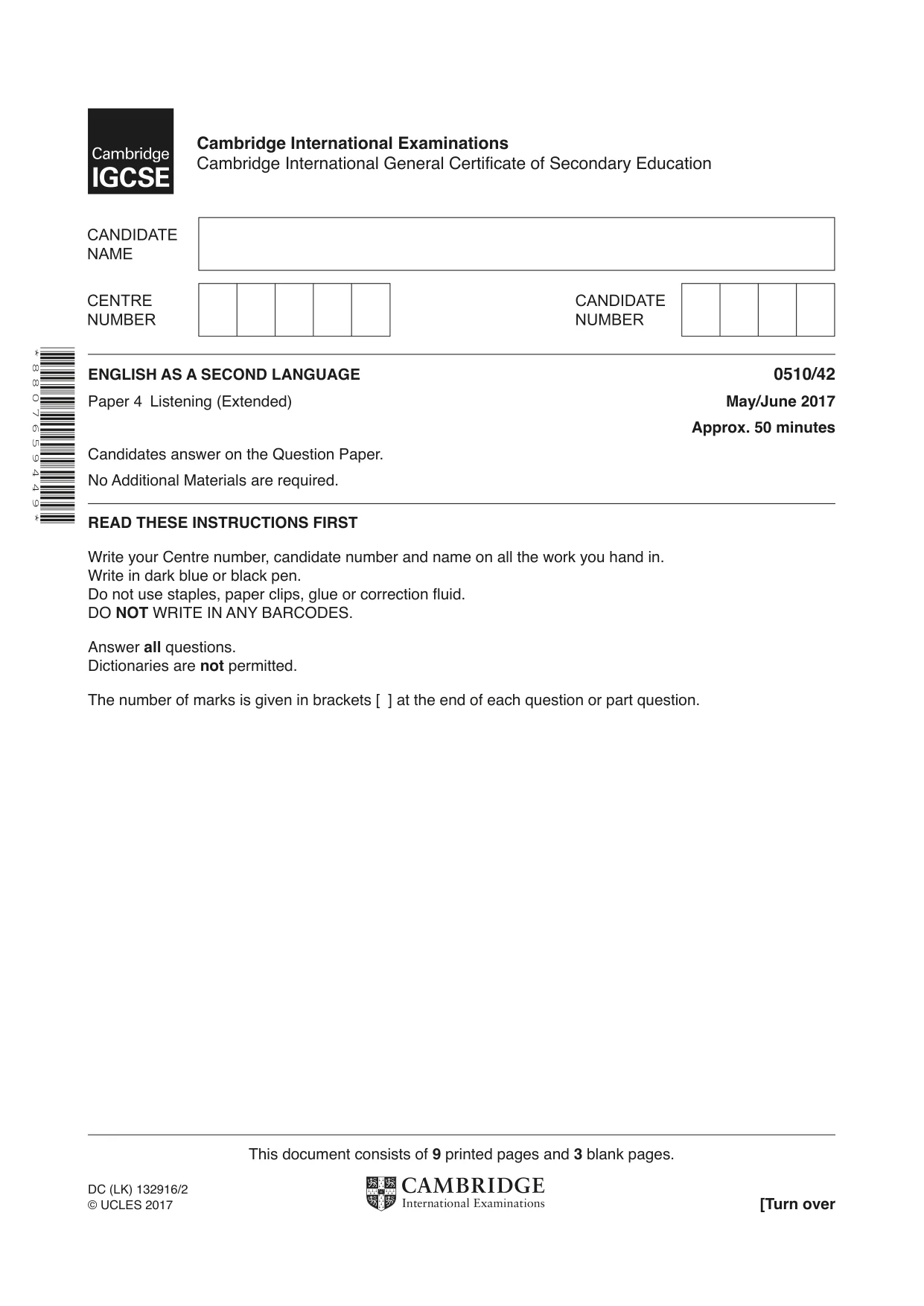
This document consists of 9 printed pages and 3 blank pages. DC (LK) 132916/2 © UCLES 2017 [Turn over Cambridge International Examinations Cambridge International General Certificate of Secondary Education * 8 8 0 7 6 5 9 4 4 9 * ENGLISH AS A SECOND LANGUAGE 0510/42 Paper 4 Listening (Extended) May/June 2017 Approx. 50 minutes Candidates answer on the Question Paper. No Additional Materials are required. READ THESE INSTRUCTIONS FIRST Write your Centre number, candidate number and name on all the work you hand in. Write in dark blue or black pen. Do not use staples, paper clips, glue or correction fluid. DO NOT WRITE IN ANY BARCODES. Answer all questions. Dictionaries are not permitted. The number of marks is given in brackets [ ] at the end of each question or part question.
Question paper, page 2
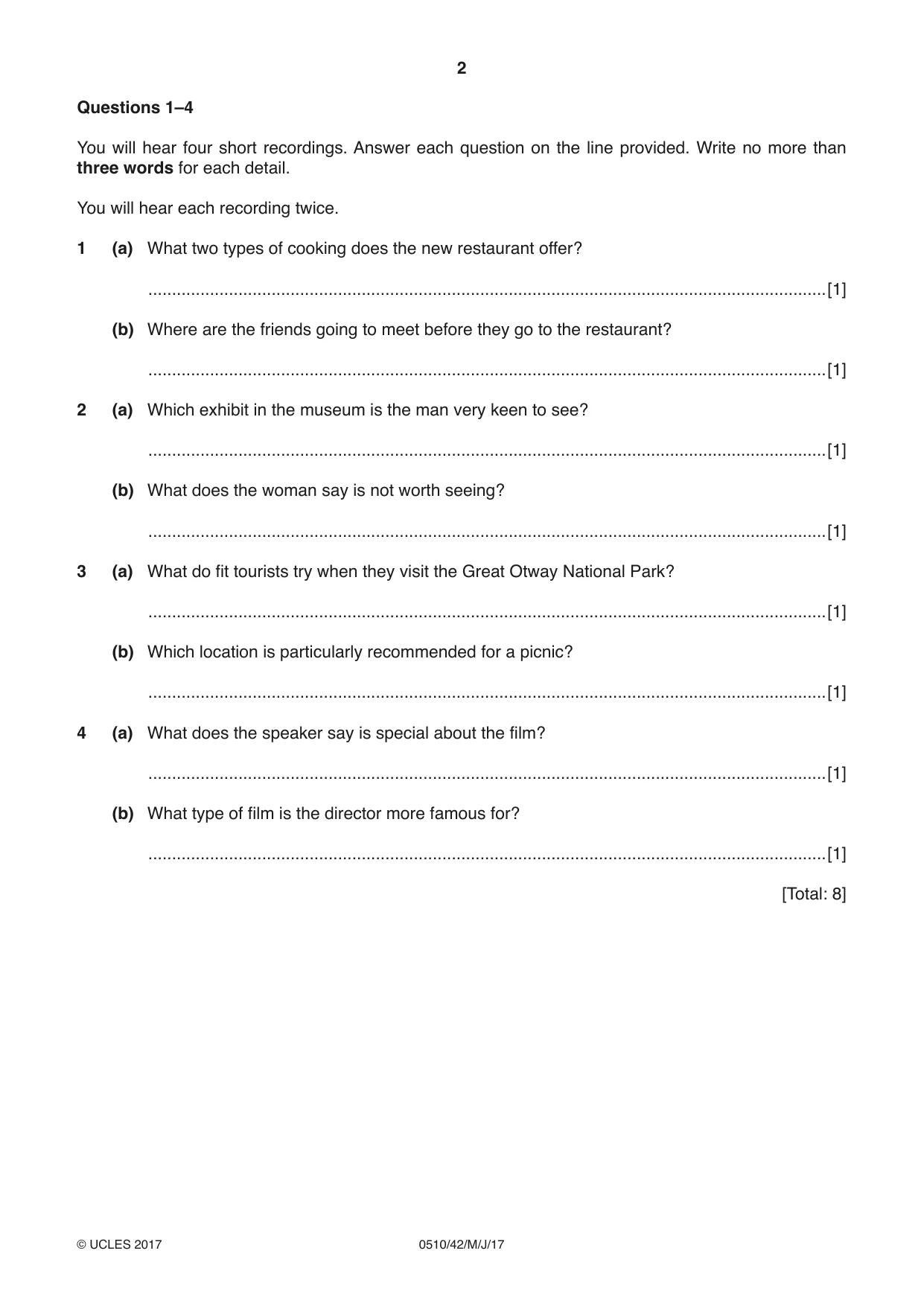
2 0510/42/M/J/17 © UCLES 2017 Questions 1–4 You will hear four short recordings. Answer each question on the line provided. Write no more than three words for each detail. You will hear each recording twice. 1 (a) What two types of cooking does the new restaurant offer? …[1] (b) Where are the friends going to meet before they go to the restaurant? …[1] 2 (a) Which exhibit in the museum is the man very keen to see? …[1] (b) What does the woman say is not worth seeing? …[1] 3 (a) What do fit tourists try when they visit the Great Otway National Park? …[1] (b) Which location is particularly recommended for a picnic? …[1] 4 (a) What does the speaker say is special about the film? …[1] (b) What type of film is the director more famous for? …[1] [Total: 8]
Question paper, page 3
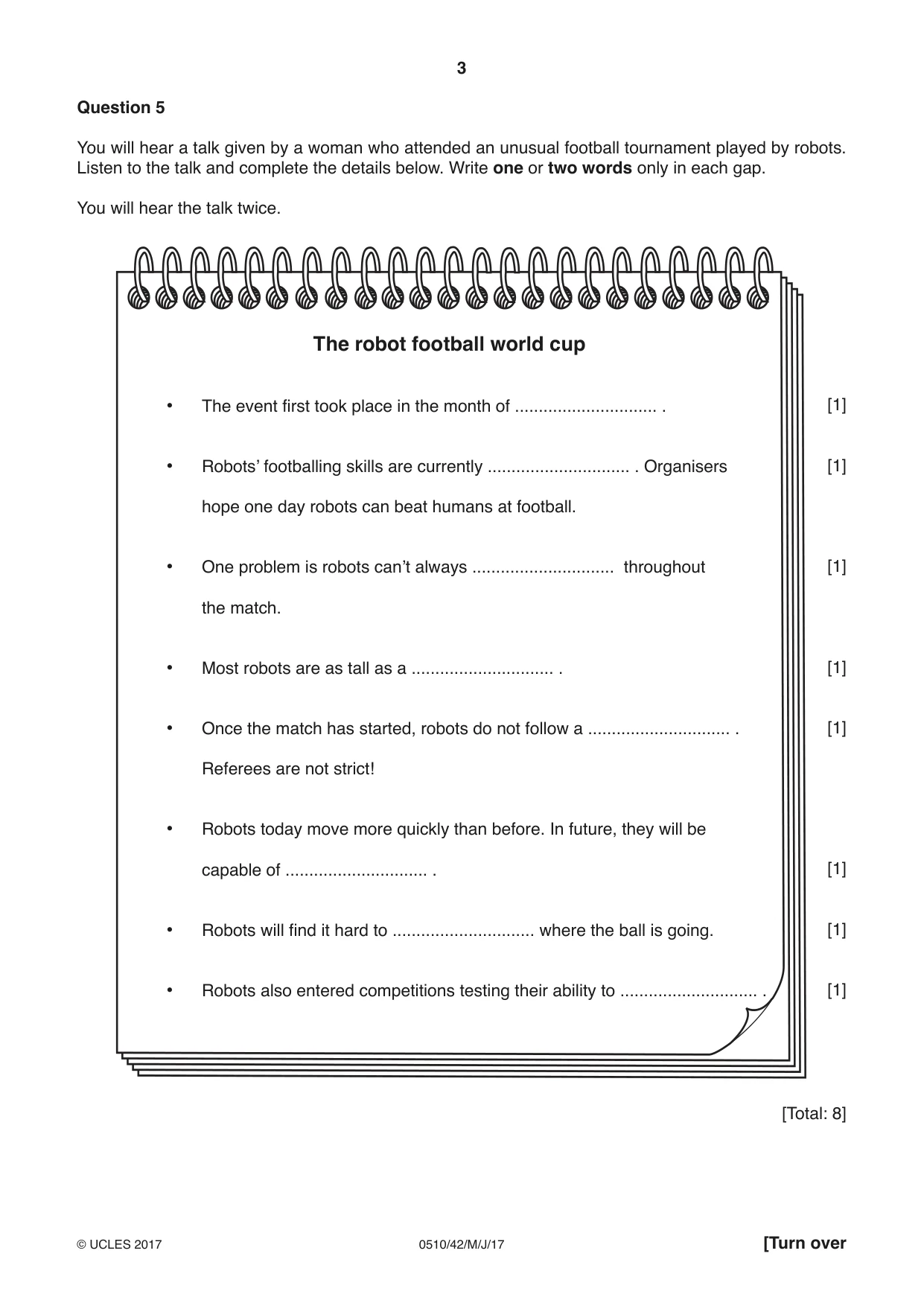
3 0510/42/M/J/17 © UCLES 2017 [Turn over Question 5 You will hear a talk given by a woman who attended an unusual football tournament played by robots. Listen to the talk and complete the details below. Write one or two words only in each gap. You will hear the talk twice. The robot football world cup • The event first took place in the month of … . • Robots’ footballing skills are currently … . Organisers hope one day robots can beat humans at football. • One problem is robots can’t always … throughout the match. • Most robots are as tall as a … . • Once the match has started, robots do not follow a … . Referees are not strict! • Robots today move more quickly than before. In future, they will be capable of … . • Robots will find it hard to … where the ball is going. • Robots also entered competitions testing their ability to … . [Total: 8] [1] [1] [1] [1] [1] [1] [1] [1]
Question paper, page 4
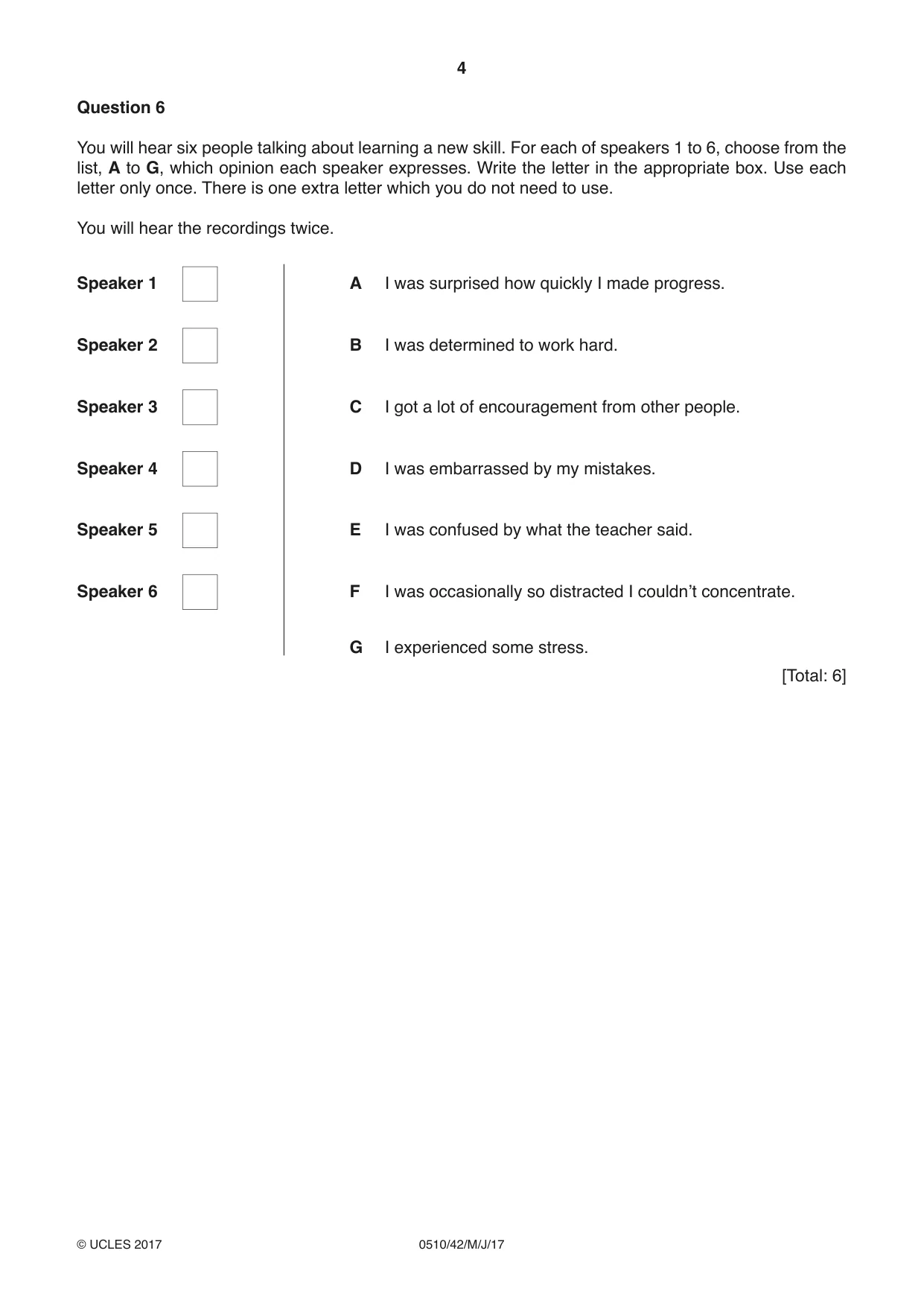
4 0510/42/M/J/17 © UCLES 2017 Question 6 You will hear six people talking about learning a new skill. For each of speakers 1 to 6, choose from the list, A to G, which opinion each speaker expresses. Write the letter in the appropriate box. Use each letter only once. There is one extra letter which you do not need to use. You will hear the recordings twice. Speaker 1 A I was surprised how quickly I made progress. Speaker 2 B I was determined to work hard. Speaker 3 C I got a lot of encouragement from other people. Speaker 4 D I was embarrassed by my mistakes. Speaker 5 E I was confused by what the teacher said. Speaker 6 F I was occasionally so distracted I couldn’t concentrate. G I experienced some stress. [Total: 6]
Question paper, page 5
5 0510/42/M/J/17 © UCLES 2017 [Turn over Please turn over for Question 7.
Question paper, page 6
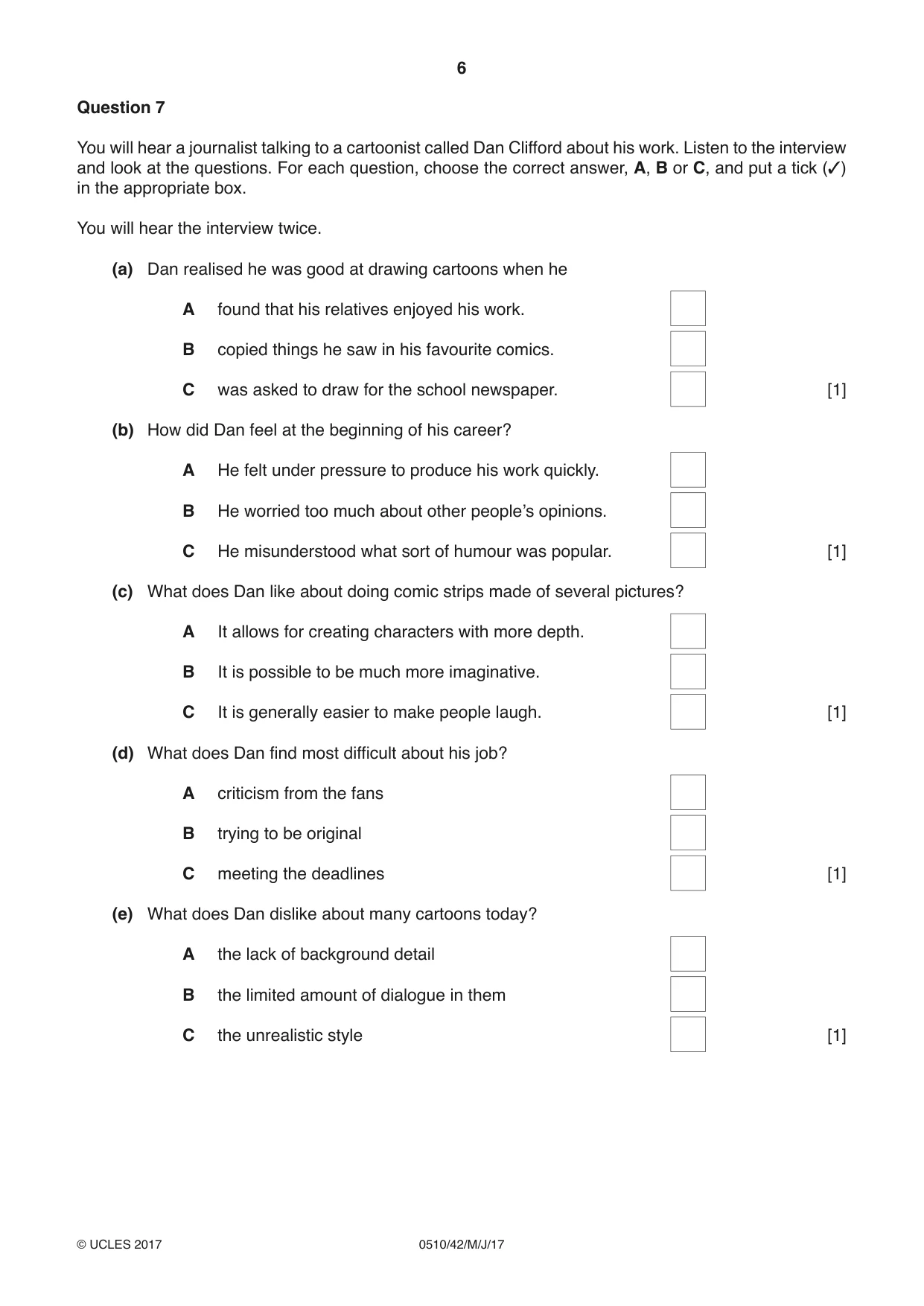
6 0510/42/M/J/17 © UCLES 2017 Question 7 You will hear a journalist talking to a cartoonist called Dan Clifford about his work. Listen to the interview and look at the questions. For each question, choose the correct answer, A, B or C, and put a tick (3) in the appropriate box. You will hear the interview twice. (a) Dan realised he was good at drawing cartoons when he A found that his relatives enjoyed his work. B copied things he saw in his favourite comics. C was asked to draw for the school newspaper. [1] (b) How did Dan feel at the beginning of his career? A He felt under pressure to produce his work quickly. B He worried too much about other people’s opinions. C He misunderstood what sort of humour was popular. [1] (c) What does Dan like about doing comic strips made of several pictures? A It allows for creating characters with more depth. B It is possible to be much more imaginative. C It is generally easier to make people laugh. [1] (d) What does Dan find most difficult about his job? A criticism from the fans B trying to be original C meeting the deadlines [1] (e) What does Dan dislike about many cartoons today? A the lack of background detail B the limited amount of dialogue in them C the unrealistic style [1]
Question paper, page 7
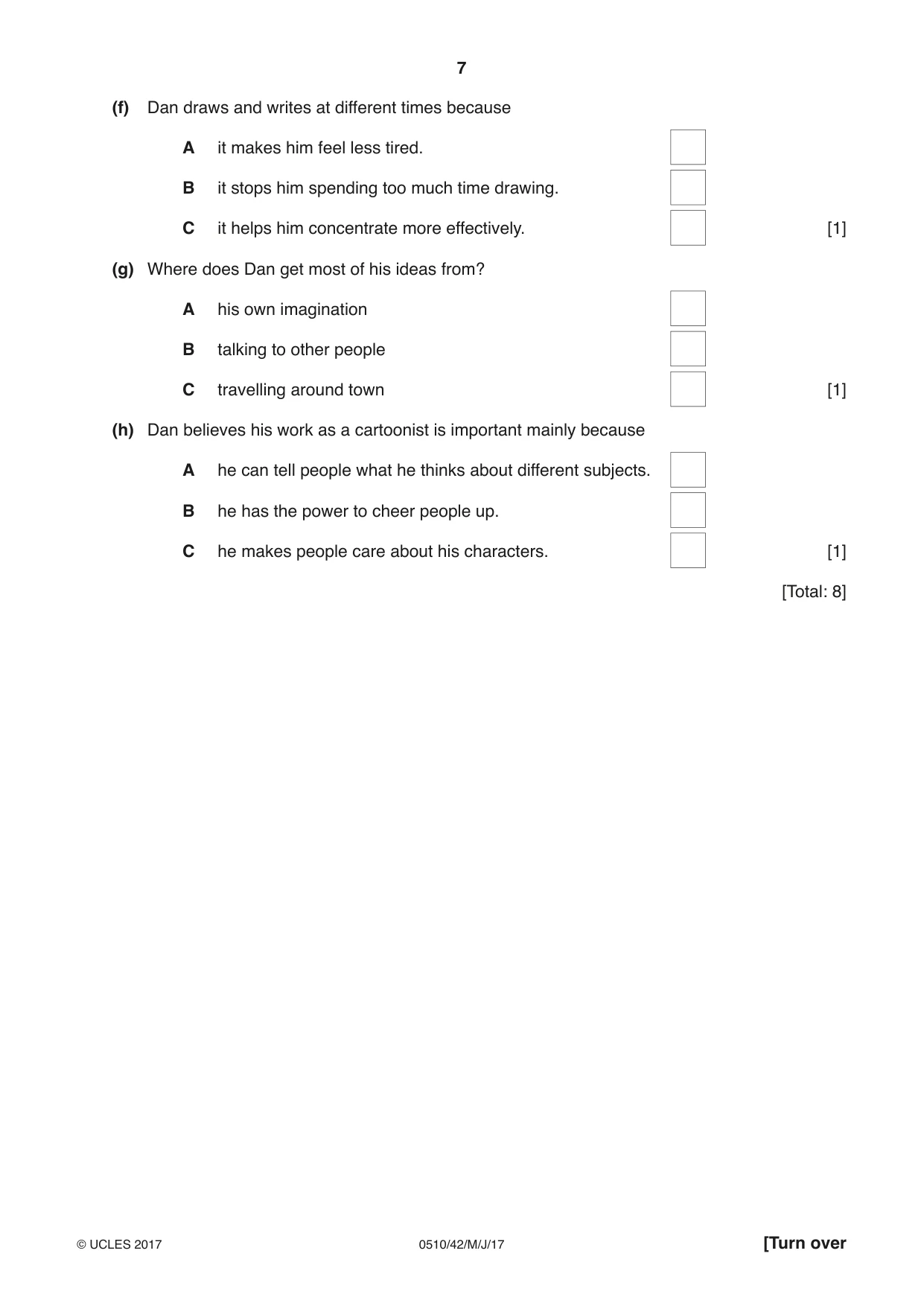
7 0510/42/M/J/17 © UCLES 2017 [Turn over (f) Dan draws and writes at different times because A it makes him feel less tired. B it stops him spending too much time drawing. C it helps him concentrate more effectively. [1] (g) Where does Dan get most of his ideas from? A his own imagination B talking to other people C travelling around town [1] (h) Dan believes his work as a cartoonist is important mainly because A he can tell people what he thinks about different subjects. B he has the power to cheer people up. C he makes people care about his characters. [1] [Total: 8]
Question paper, page 8
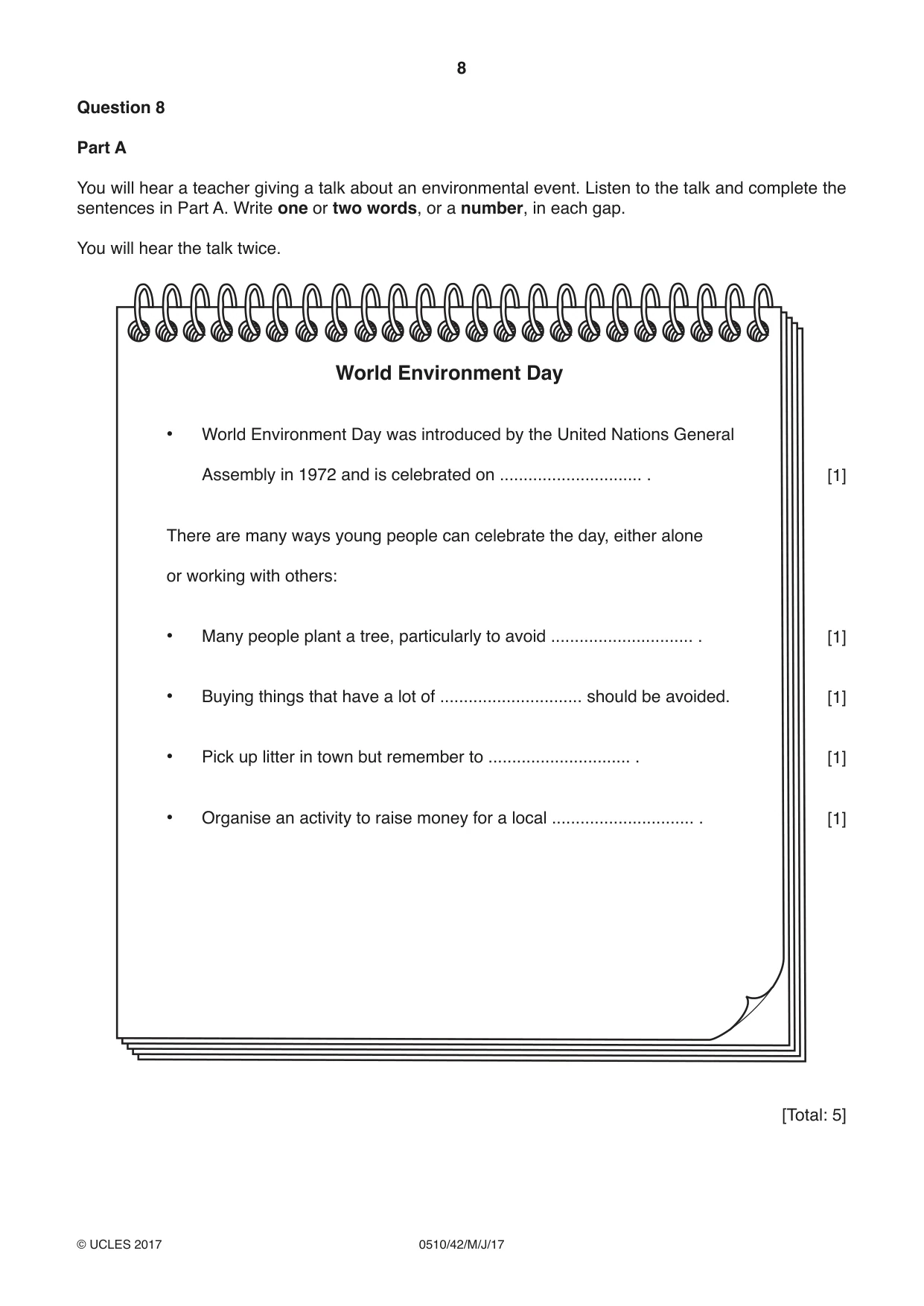
8 0510/42/M/J/17 © UCLES 2017 Question 8 Part A You will hear a teacher giving a talk about an environmental event. Listen to the talk and complete the sentences in Part A. Write one or two words, or a number, in each gap. You will hear the talk twice. World Environment Day • World Environment Day was introduced by the United Nations General Assembly in 1972 and is celebrated on … . There are many ways young people can celebrate the day, either alone or working with others: • Many people plant a tree, particularly to avoid … . • Buying things that have a lot of … should be avoided. • Pick up litter in town but remember to … . • Organise an activity to raise money for a local … . [Total: 5] [1] [1] [1] [1] [1]
Question paper, page 9
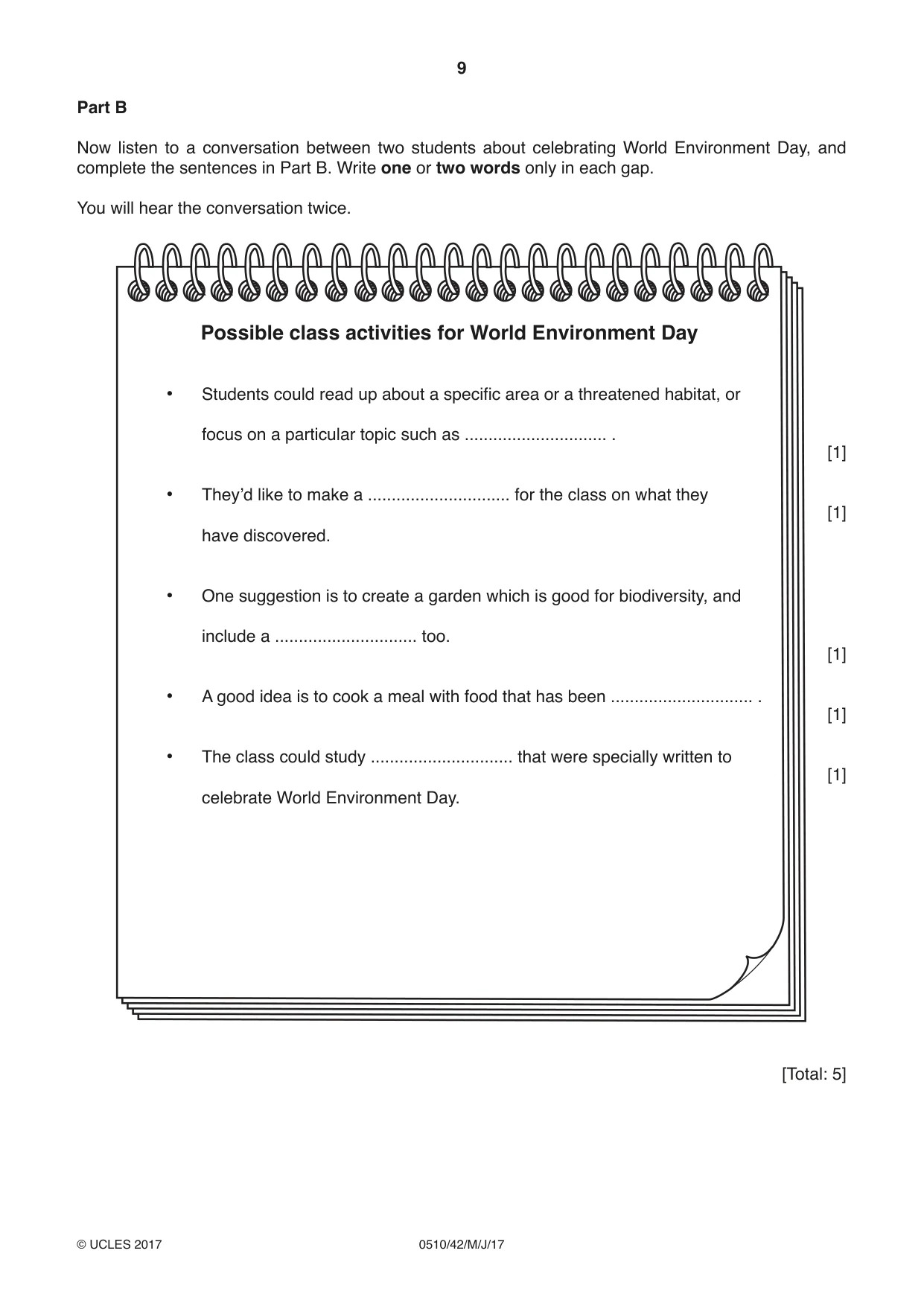
9 0510/42/M/J/17 © UCLES 2017 Part B Now listen to a conversation between two students about celebrating World Environment Day, and complete the sentences in Part B. Write one or two words only in each gap. You will hear the conversation twice. Possible class activities for World Environment Day • Students could read up about a specific area or a threatened habitat, or focus on a particular topic such as … . • They’d like to make a … for the class on what they have discovered. • One suggestion is to create a garden which is good for biodiversity, and include a … too. • A good idea is to cook a meal with food that has been … . • The class could study … that were specially written to celebrate World Environment Day. [Total: 5] [1] [1] [1] [1] [1]
Question paper, page 10
10 0510/42/M/J/17 © UCLES 2017 BLANK PAGE
Question paper, page 11
11 0510/42/M/J/17 © UCLES 2017 BLANK PAGE
Question paper, page 12
12 0510/42/M/J/17 © UCLES 2017 Permission to reproduce items where third-party owned material protected by copyright is included has been sought and cleared where possible. Every reasonable effort has been made by the publisher (UCLES) to trace copyright holders, but if any items requiring clearance have unwittingly been included, the publisher will be pleased to make amends at the earliest possible opportunity. To avoid the issue of disclosure of answer-related information to candidates, all copyright acknowledgements are reproduced online in the Cambridge International Examinations Copyright Acknowledgements Booklet. This is produced for each series of examinations and is freely available to download at www.cie.org.uk after the live examination series. Cambridge International Examinations is part of the Cambridge Assessment Group. Cambridge Assessment is the brand name of University of Cambridge Local Examinations Syndicate (UCLES), which is itself a department of the University of Cambridge. BLANK PAGE
Mark scheme, page 1
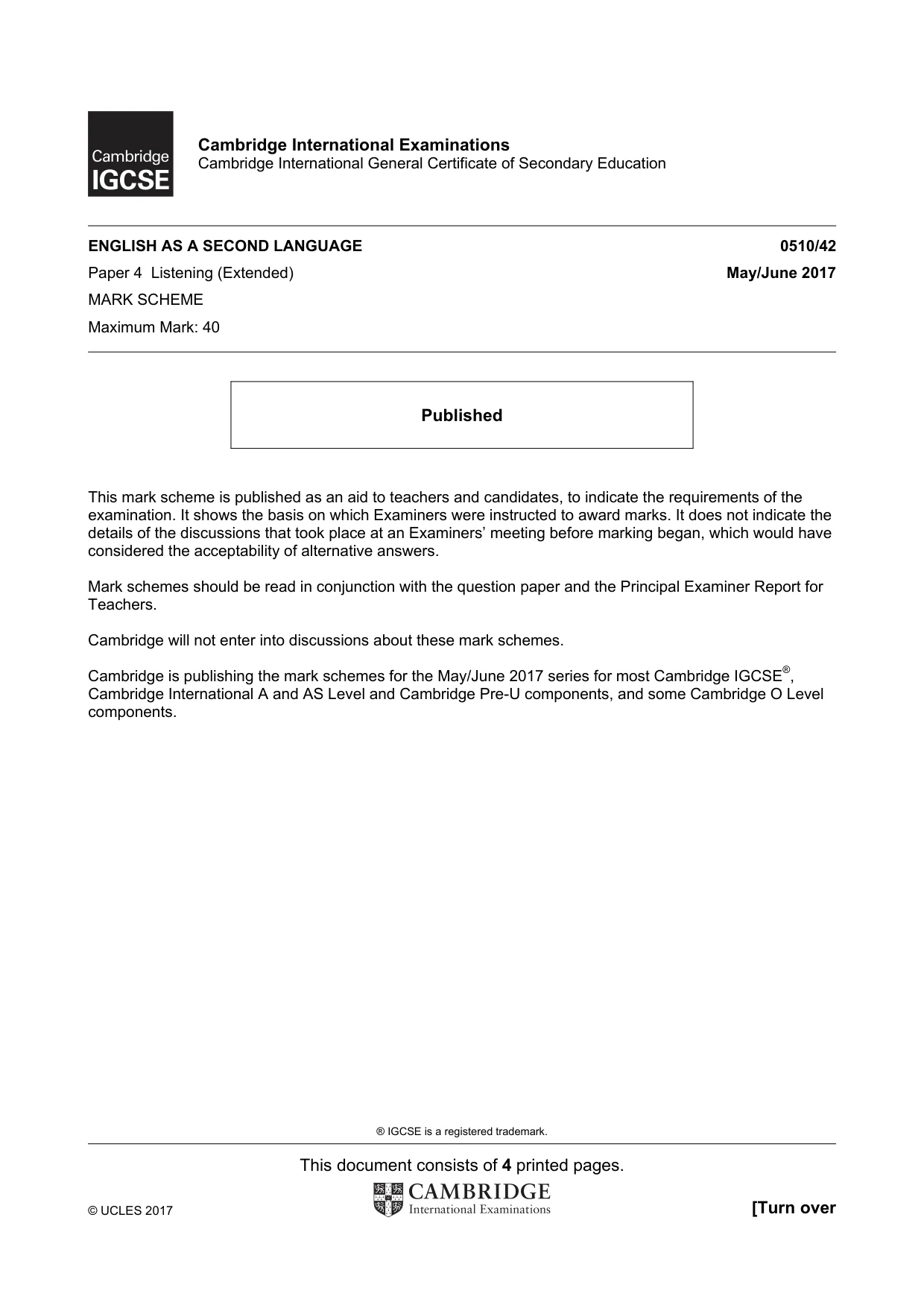
® IGCSE is a registered trademark. This document consists of 4 printed pages. © UCLES 2017 [Turn over Cambridge International Examinations Cambridge International General Certificate of Secondary Education ENGLISH AS A SECOND LANGUAGE 0510/42 Paper 4 Listening (Extended) May/June 2017 MARK SCHEME Maximum Mark: 40 Published This mark scheme is published as an aid to teachers and candidates, to indicate the requirements of the examination. It shows the basis on which Examiners were instructed to award marks. It does not indicate the details of the discussions that took place at an Examiners’ meeting before marking began, which would have considered the acceptability of alternative answers. Mark schemes should be read in conjunction with the question paper and the Principal Examiner Report for Teachers. Cambridge will not enter into discussions about these mark schemes. Cambridge is publishing the mark schemes for the May/June 2017 series for most Cambridge IGCSE®, Cambridge International A and AS Level and Cambridge Pre-U components, and some Cambridge O Level components.
Mark scheme, page 2
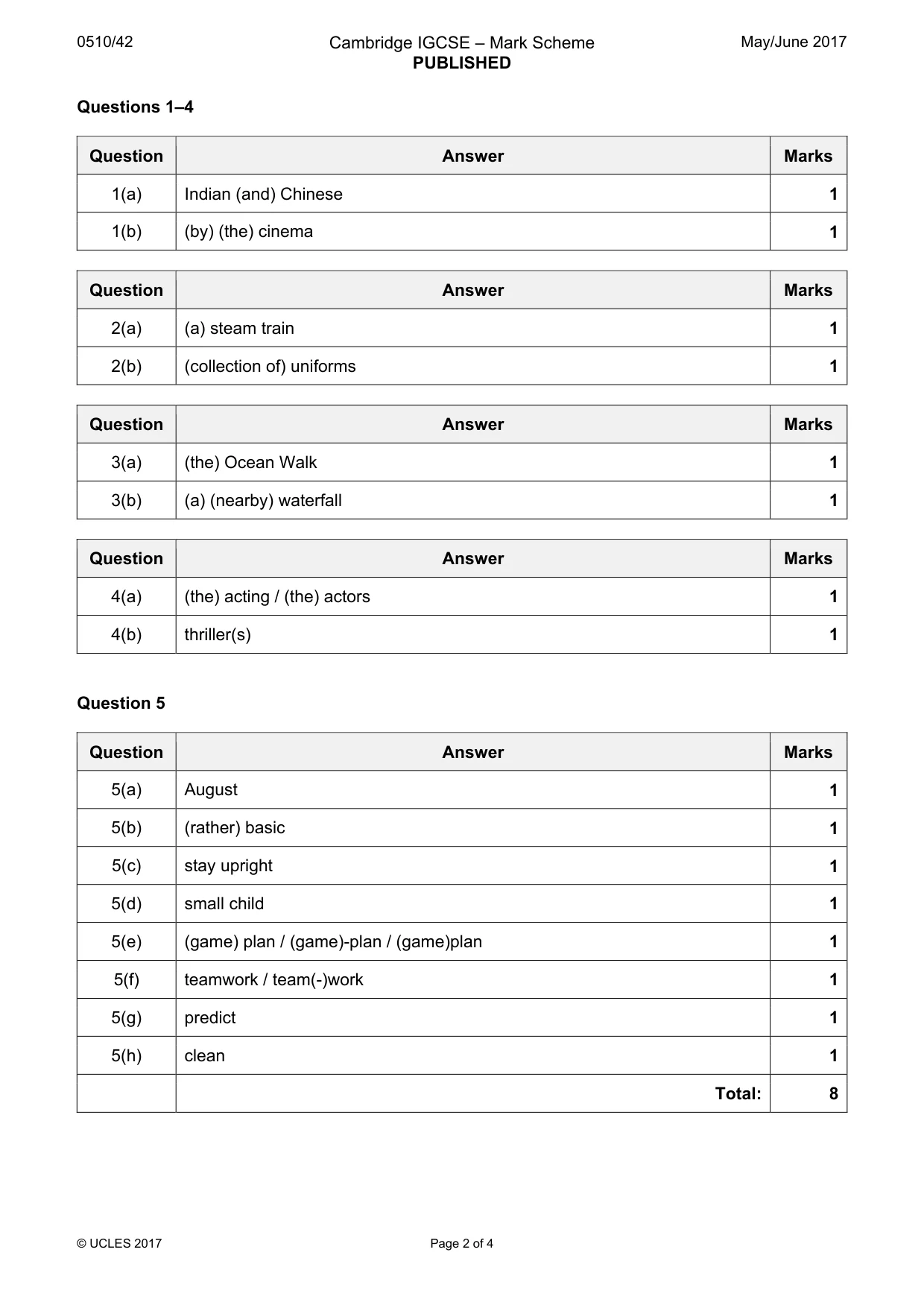
0510/42 Cambridge IGCSE – Mark Scheme PUBLISHED May/June 2017 © UCLES 2017 Page 2 of 4 Questions 1–4 Question Answer Marks 1(a) Indian (and) Chinese 1 1(b) (by) (the) cinema 1 Question Answer Marks 2(a) (a) steam train 1 2(b) (collection of) uniforms 1 Question Answer Marks 3(a) (the) Ocean Walk 1 3(b) (a) (nearby) waterfall 1 Question Answer Marks 4(a) (the) acting / (the) actors 1 4(b) thriller(s) 1 Question 5 Question Answer Marks 5(a) August 1 5(b) (rather) basic 1 5(c) stay upright 1 5(d) small child 1 5(e) (game) plan / (game)-plan / (game)plan 1 5(f) teamwork / team(-)work 1 5(g) predict 1 5(h) clean 1 Total: 8
Mark scheme, page 3
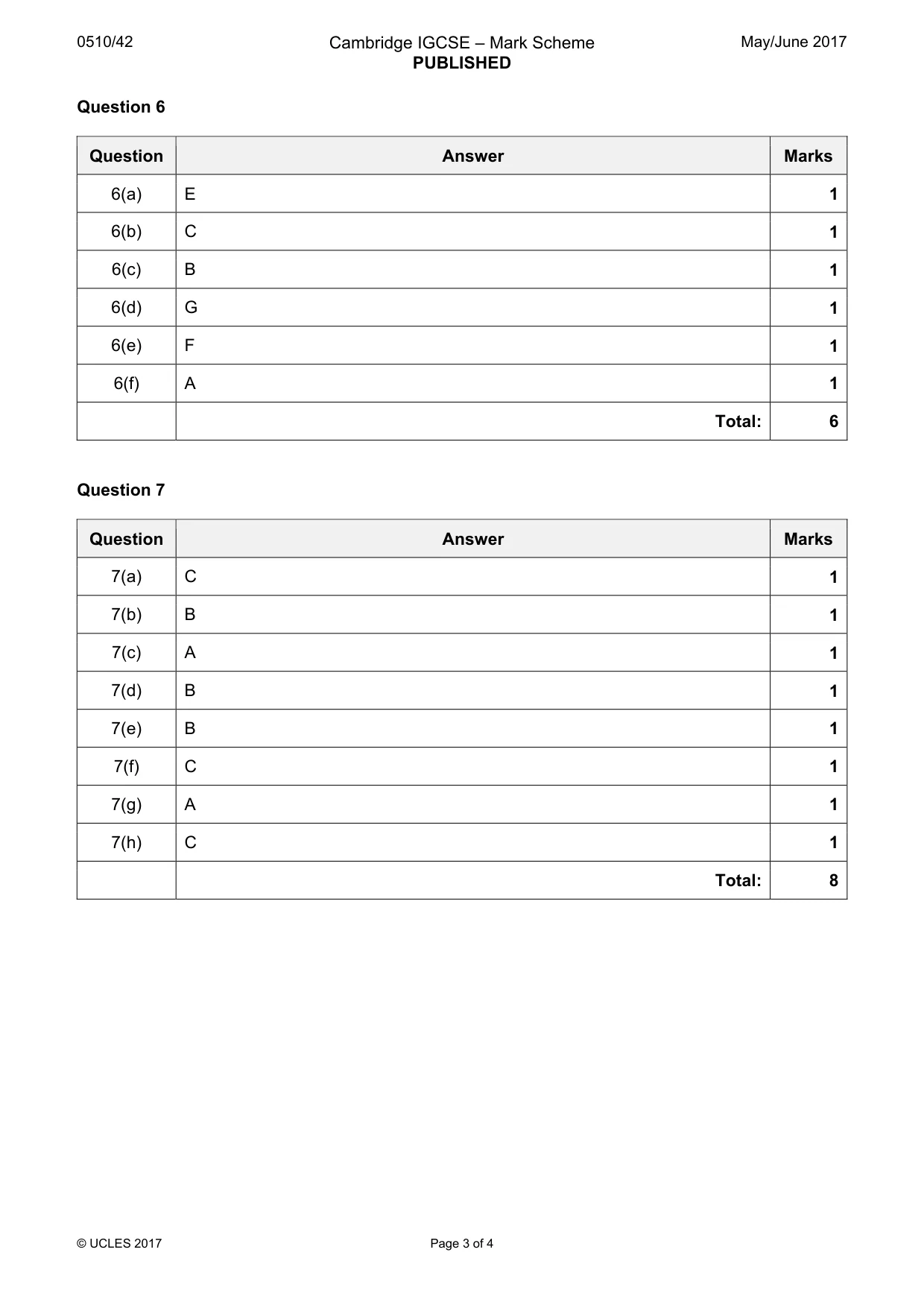
0510/42 Cambridge IGCSE – Mark Scheme PUBLISHED May/June 2017 © UCLES 2017 Page 3 of 4 Question 6 Question Answer Marks 6(a) E 1 6(b) C 1 6(c) B 1 6(d) G 1 6(e) F 1 6(f) A 1 Total: 6 Question 7 Question Answer Marks 7(a) C 1 7(b) B 1 7(c) A 1 7(d) B 1 7(e) B 1 7(f) C 1 7(g) A 1 7(h) C 1 Total: 8
Mark scheme, page 4
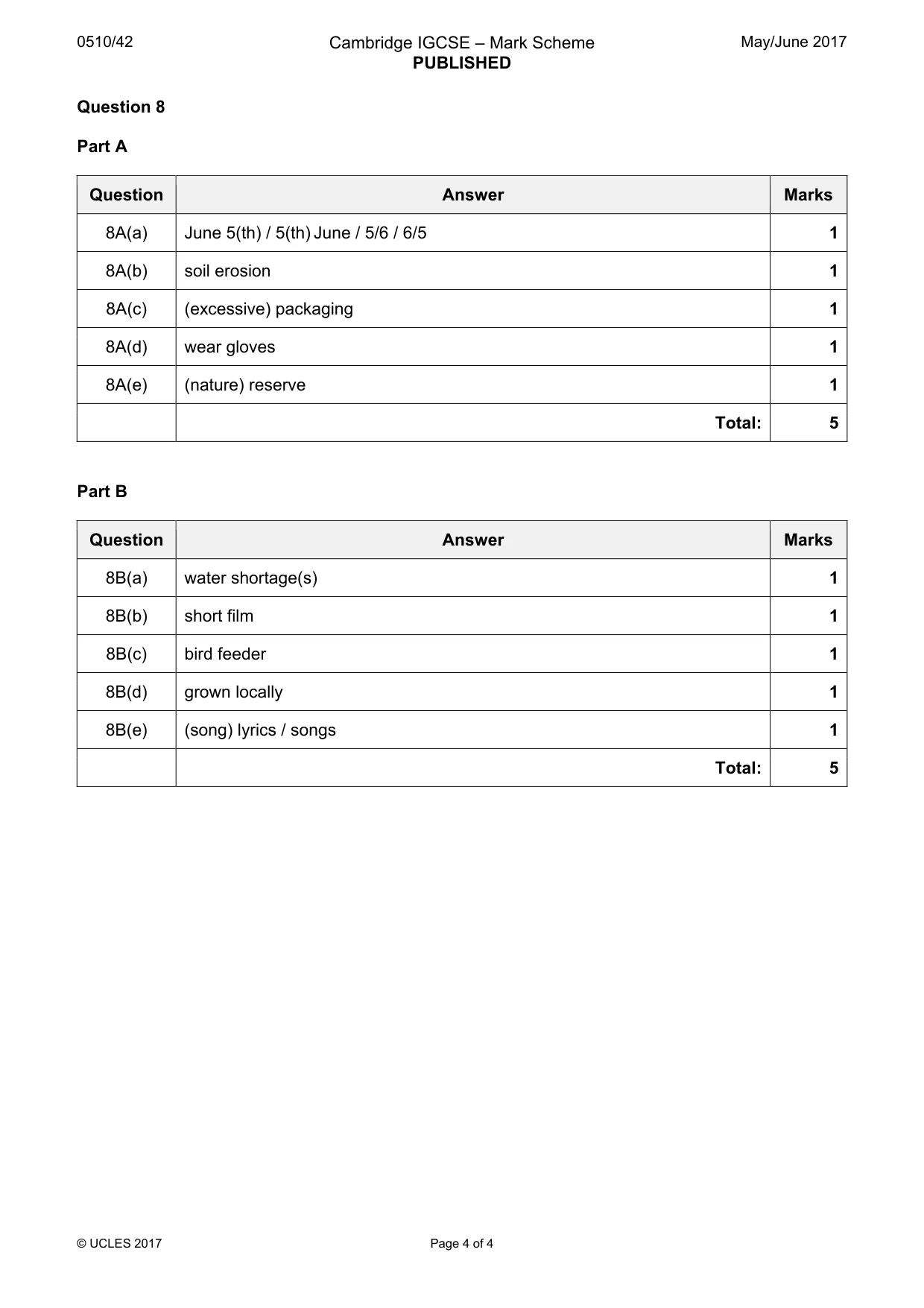
0510/42 Cambridge IGCSE – Mark Scheme PUBLISHED May/June 2017 © UCLES 2017 Page 4 of 4 Question 8 Part A Question Answer Marks 8A(a) June 5(th) / 5(th) June / 5/6 / 6/5 1 8A(b) soil erosion 1 8A(c) (excessive) packaging 1 8A(d) wear gloves 1 8A(e) (nature) reserve 1 Total: 5 Part B Question Answer Marks 8B(a) water shortage(s) 1 8B(b) short film 1 8B(c) bird feeder 1 8B(d) grown locally 1 8B(e) (song) lyrics / songs 1 Total: 5
What you needed in this session
Cambridge’s own grade thresholds for 2017 May/June, Paper 4 · Variant 2. A higher threshold means an easier paper — the bar moves with how the cohort did.