Cambridge IGCSE English - Second Language (oral endorsement) 0510 — 2017 May/June Paper 4 · Variant 1
0510/41/M/J/17 · 40 marks · ≈45 min
The question paper and its mark scheme, free to read here and free to download. This is Cambridge’s own paper, exactly as it was sat.
Question paper12 pages


Mark scheme4 pages
Answers below. Sit the paper first if you are practising.
Paper as text
Question paper, page 1
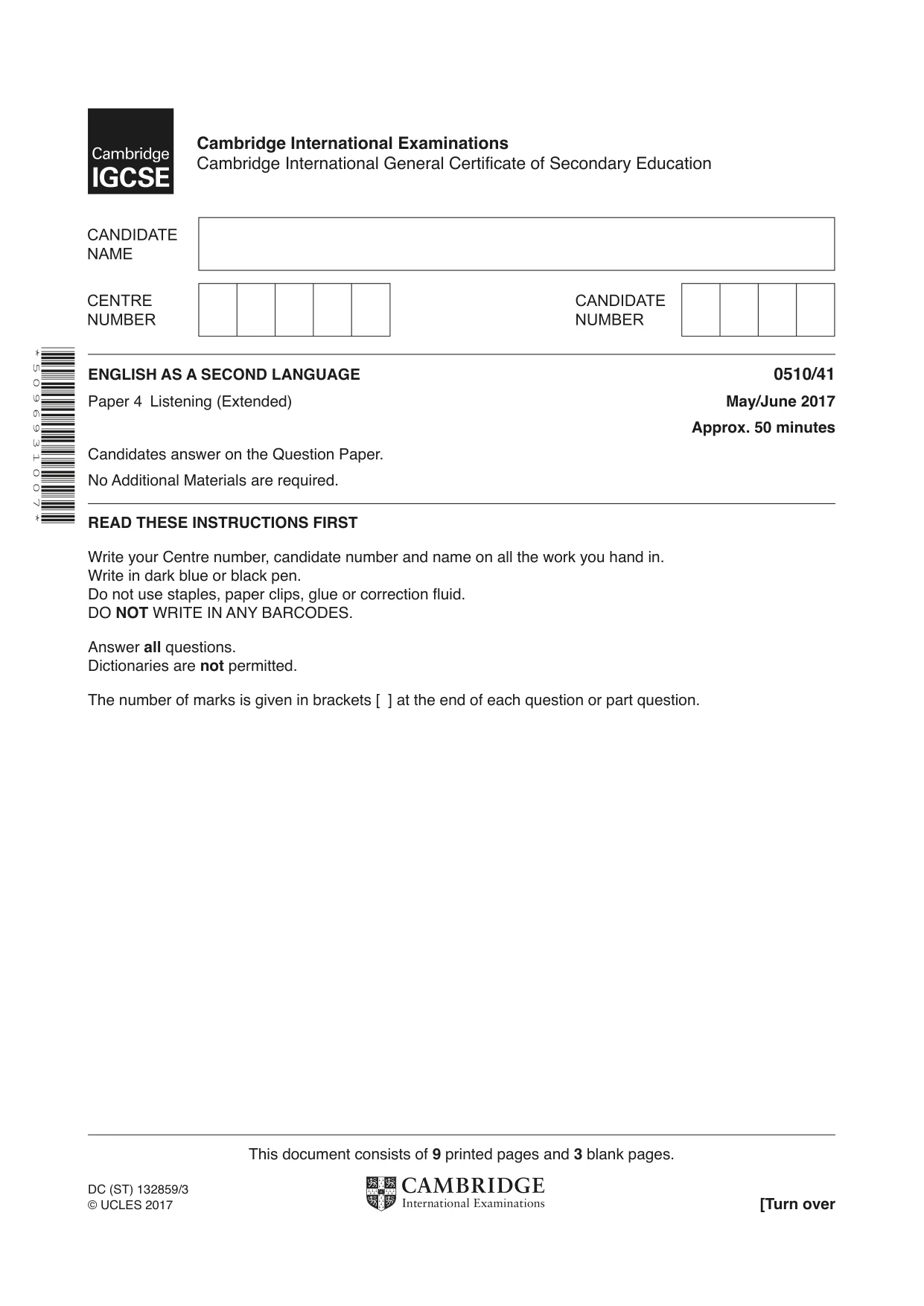
This document consists of 9 printed pages and 3 blank pages. DC (ST) 132859/3 © UCLES 2017 [Turn over Cambridge International Examinations Cambridge International General Certificate of Secondary Education * 5 0 9 6 9 3 1 0 0 7 * ENGLISH AS A SECOND LANGUAGE 0510/41 Paper 4 Listening (Extended) May/June 2017 Approx. 50 minutes Candidates answer on the Question Paper. No Additional Materials are required. READ THESE INSTRUCTIONS FIRST Write your Centre number, candidate number and name on all the work you hand in. Write in dark blue or black pen. Do not use staples, paper clips, glue or correction fluid. DO NOT WRITE IN ANY BARCODES. Answer all questions. Dictionaries are not permitted. The number of marks is given in brackets [ ] at the end of each question or part question.
Question paper, page 2
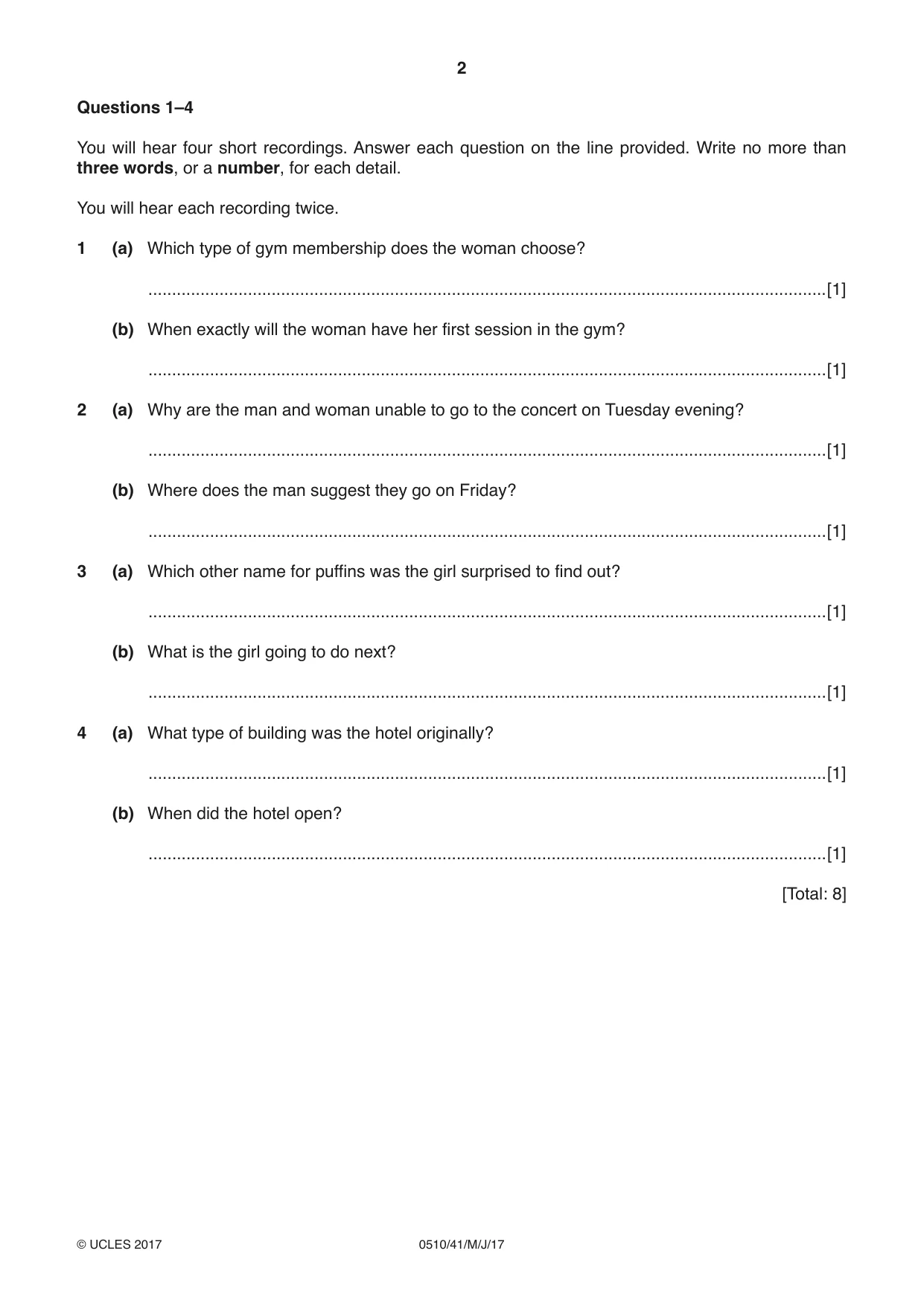
2 0510/41/M/J/17 © UCLES 2017 Questions 1–4 You will hear four short recordings. Answer each question on the line provided. Write no more than three words, or a number, for each detail. You will hear each recording twice. 1 (a) Which type of gym membership does the woman choose? …[1] (b) When exactly will the woman have her first session in the gym? …[1] 2 (a) Why are the man and woman unable to go to the concert on Tuesday evening? …[1] (b) Where does the man suggest they go on Friday? …[1] 3 (a) Which other name for puffins was the girl surprised to find out? …[1] (b) What is the girl going to do next? …[1] 4 (a) What type of building was the hotel originally? …[1] (b) When did the hotel open? …[1] [Total: 8]
Question paper, page 3
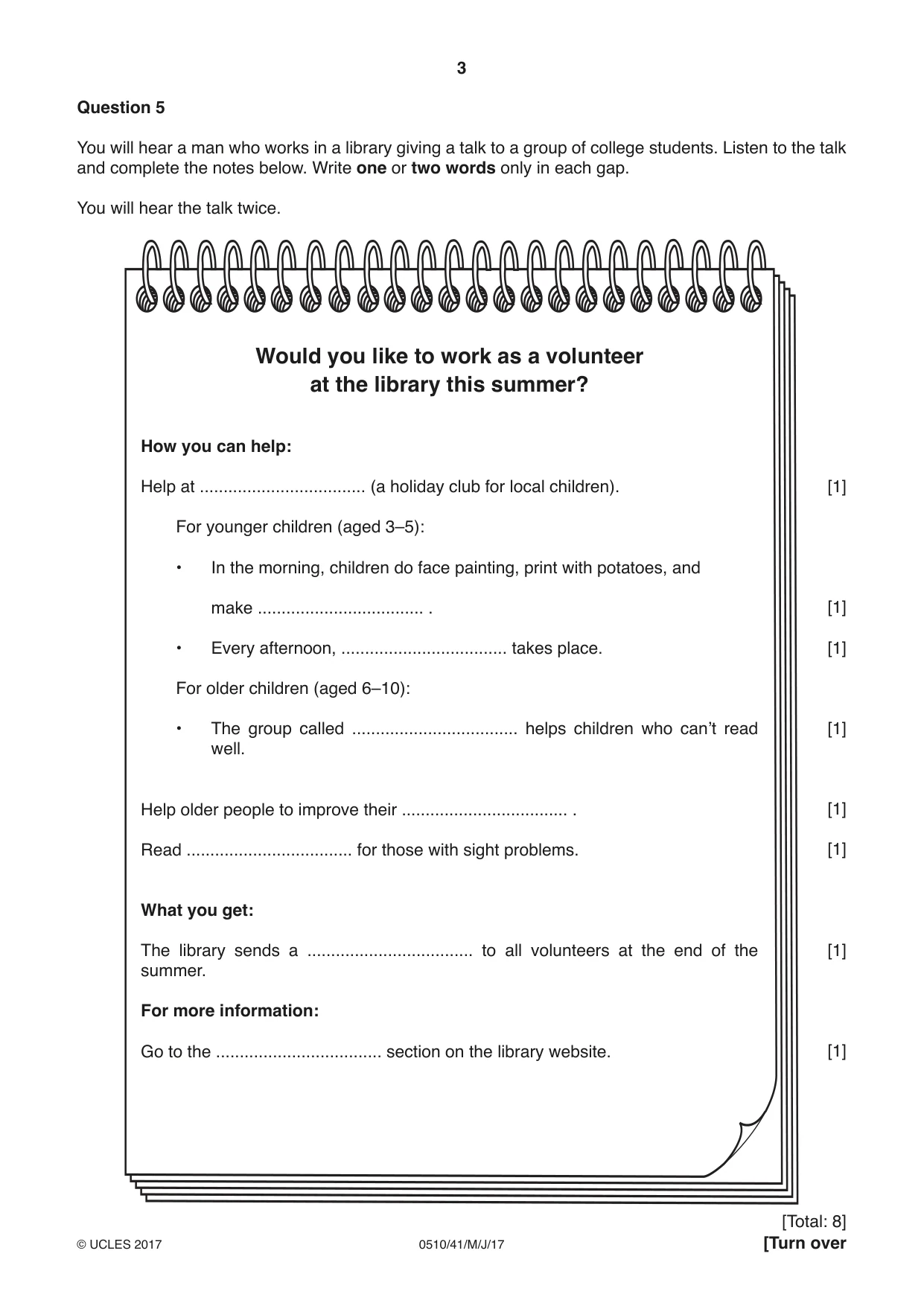
3 0510/41/M/J/17 © UCLES 2017 [Turn over Question 5 You will hear a man who works in a library giving a talk to a group of college students. Listen to the talk and complete the notes below. Write one or two words only in each gap. You will hear the talk twice. Would you like to work as a volunteer at the library this summer? How you can help: Help at … (a holiday club for local children). For younger children (aged 3–5): • In the morning, children do face painting, print with potatoes, and make … . • Every afternoon, … takes place. For older children (aged 6–10): • The group called … helps children who can’t read well. Help older people to improve their … . Read … for those with sight problems. What you get: The library sends a … to all volunteers at the end of the summer. For more information: Go to the … section on the library website. [1] [1] [1] [1] [1] [1] [1] [1] [Total: 8]
Question paper, page 4
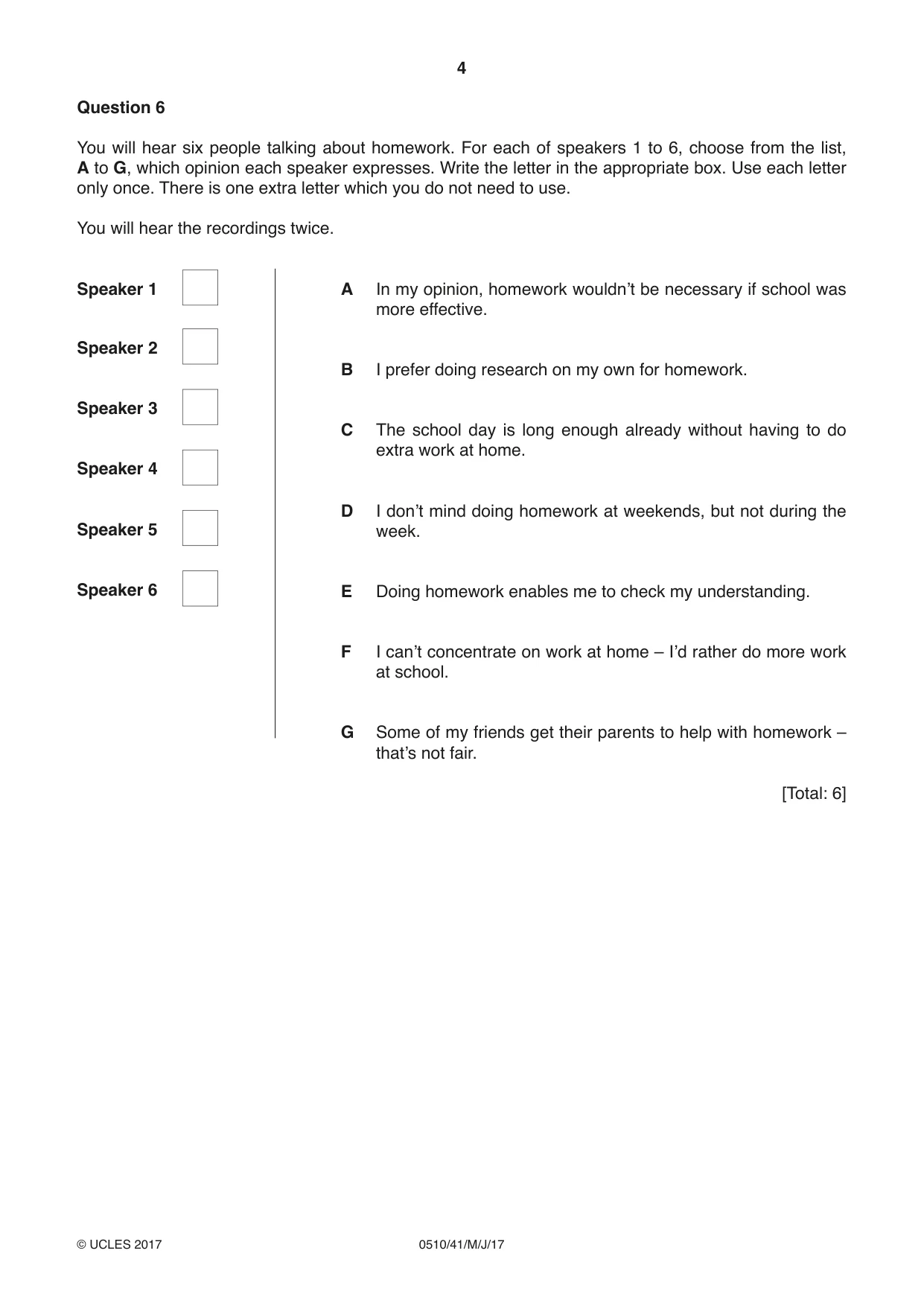
4 0510/41/M/J/17 © UCLES 2017 Question 6 You will hear six people talking about homework. For each of speakers 1 to 6, choose from the list, A to G, which opinion each speaker expresses. Write the letter in the appropriate box. Use each letter only once. There is one extra letter which you do not need to use. You will hear the recordings twice. Speaker 1 A In my opinion, homework wouldn’t be necessary if school was more effective. Speaker 2 B I prefer doing research on my own for homework. Speaker 3 C The school day is long enough already without having to do extra work at home. Speaker 4 D I don’t mind doing homework at weekends, but not during the week. Speaker 5 E Doing homework enables me to check my understanding. Speaker 6 F I can’t concentrate on work at home – I’d rather do more work at school. G Some of my friends get their parents to help with homework – that’s not fair. [Total: 6]
Question paper, page 5
5 0510/41/M/J/17 © UCLES 2017 [Turn over Please turn over for Question 7.
Question paper, page 6
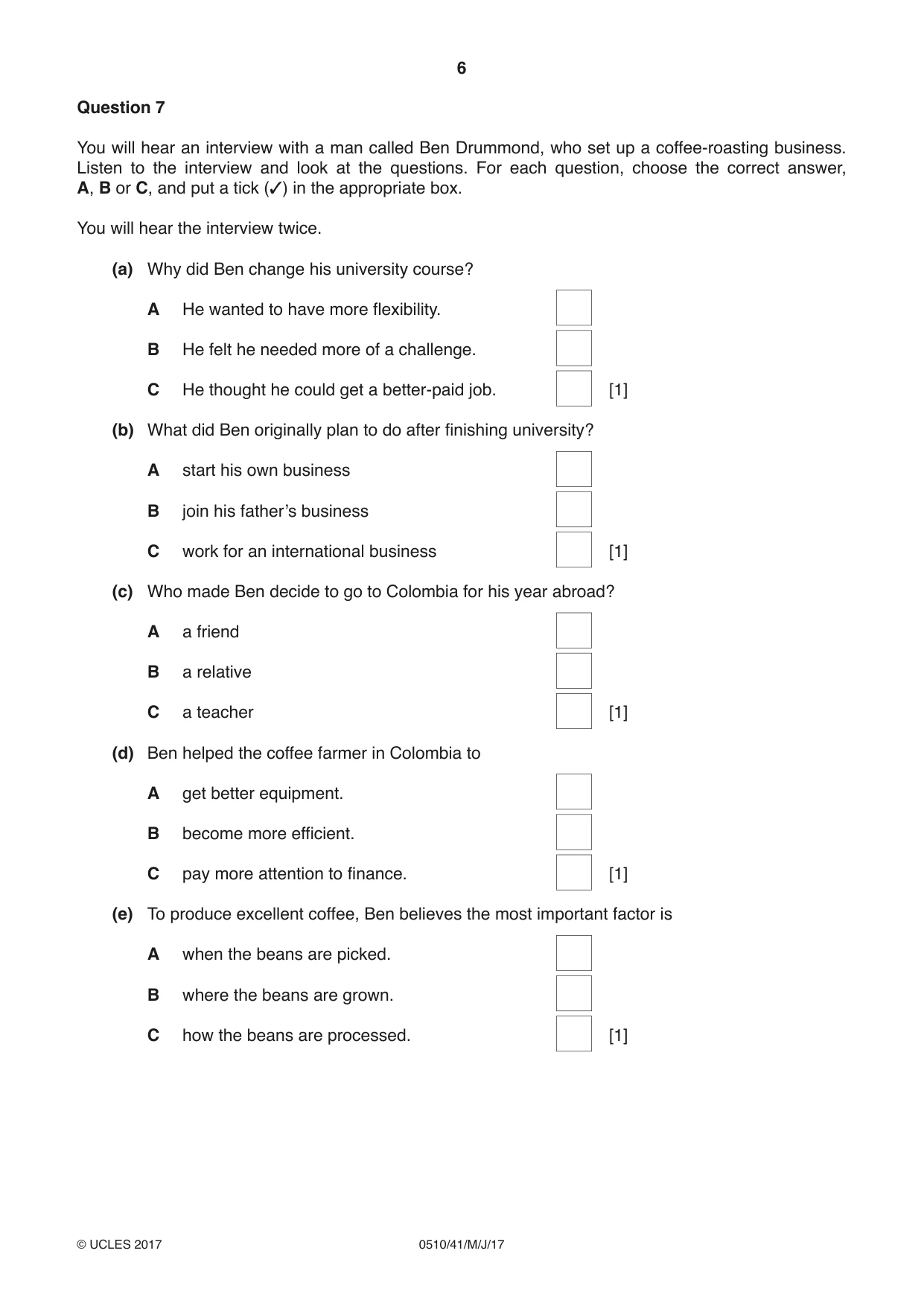
6 0510/41/M/J/17 © UCLES 2017 Question 7 You will hear an interview with a man called Ben Drummond, who set up a coffee-roasting business. Listen to the interview and look at the questions. For each question, choose the correct answer, A, B or C, and put a tick (3) in the appropriate box. You will hear the interview twice. (a) Why did Ben change his university course? A He wanted to have more flexibility. B He felt he needed more of a challenge. C He thought he could get a better-paid job. [1] (b) What did Ben originally plan to do after finishing university? A start his own business B join his father’s business C work for an international business [1] (c) Who made Ben decide to go to Colombia for his year abroad? A a friend B a relative C a teacher [1] (d) Ben helped the coffee farmer in Colombia to A get better equipment. B become more efficient. C pay more attention to finance. [1] (e) To produce excellent coffee, Ben believes the most important factor is A when the beans are picked. B where the beans are grown. C how the beans are processed. [1]
Question paper, page 7
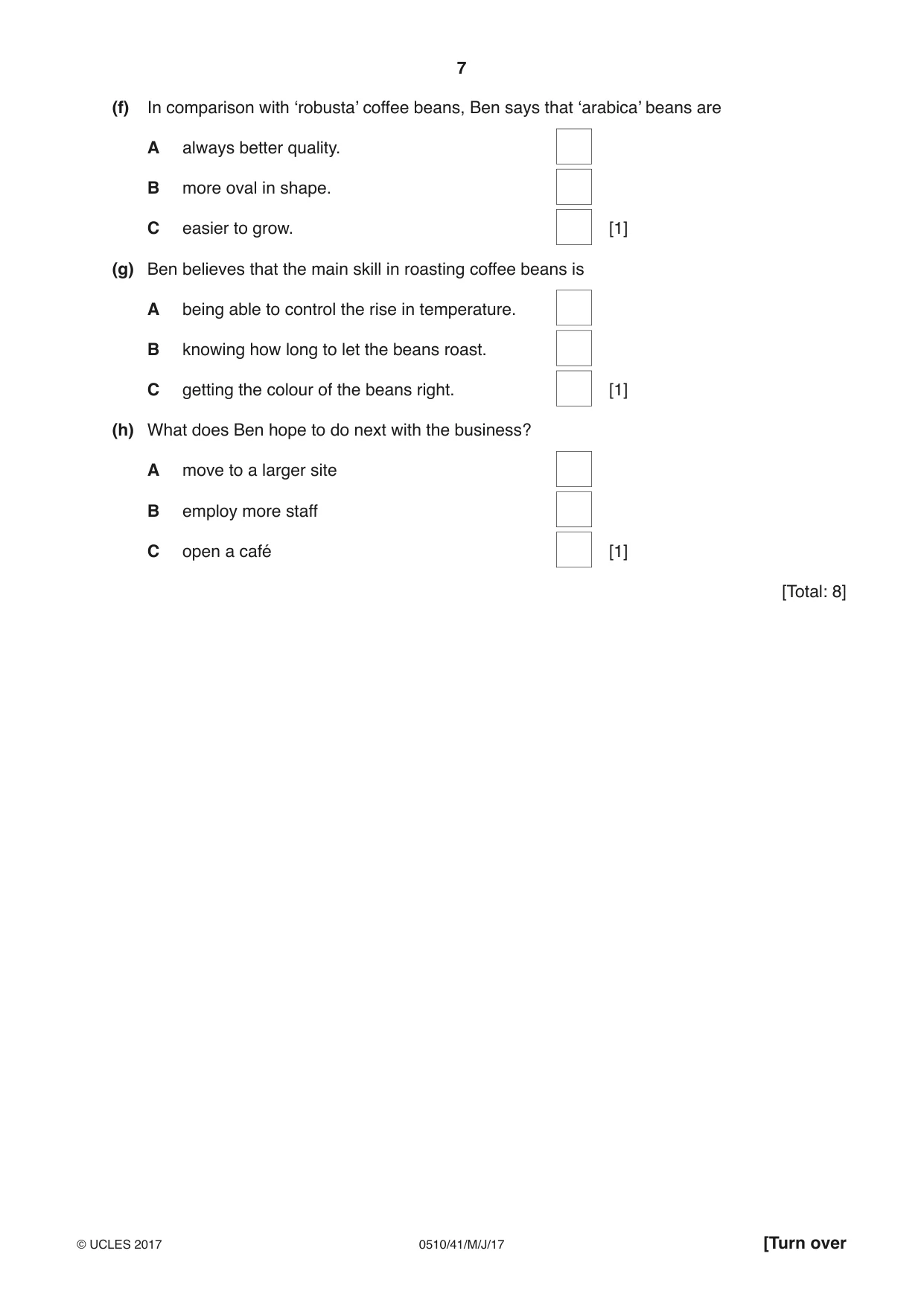
7 0510/41/M/J/17 © UCLES 2017 [Turn over (f) In comparison with ‘robusta’ coffee beans, Ben says that ‘arabica’ beans are A always better quality. B more oval in shape. C easier to grow. [1] (g) Ben believes that the main skill in roasting coffee beans is A being able to control the rise in temperature. B knowing how long to let the beans roast. C getting the colour of the beans right. [1] (h) What does Ben hope to do next with the business? A move to a larger site B employ more staff C open a café [1] [Total: 8]
Question paper, page 8
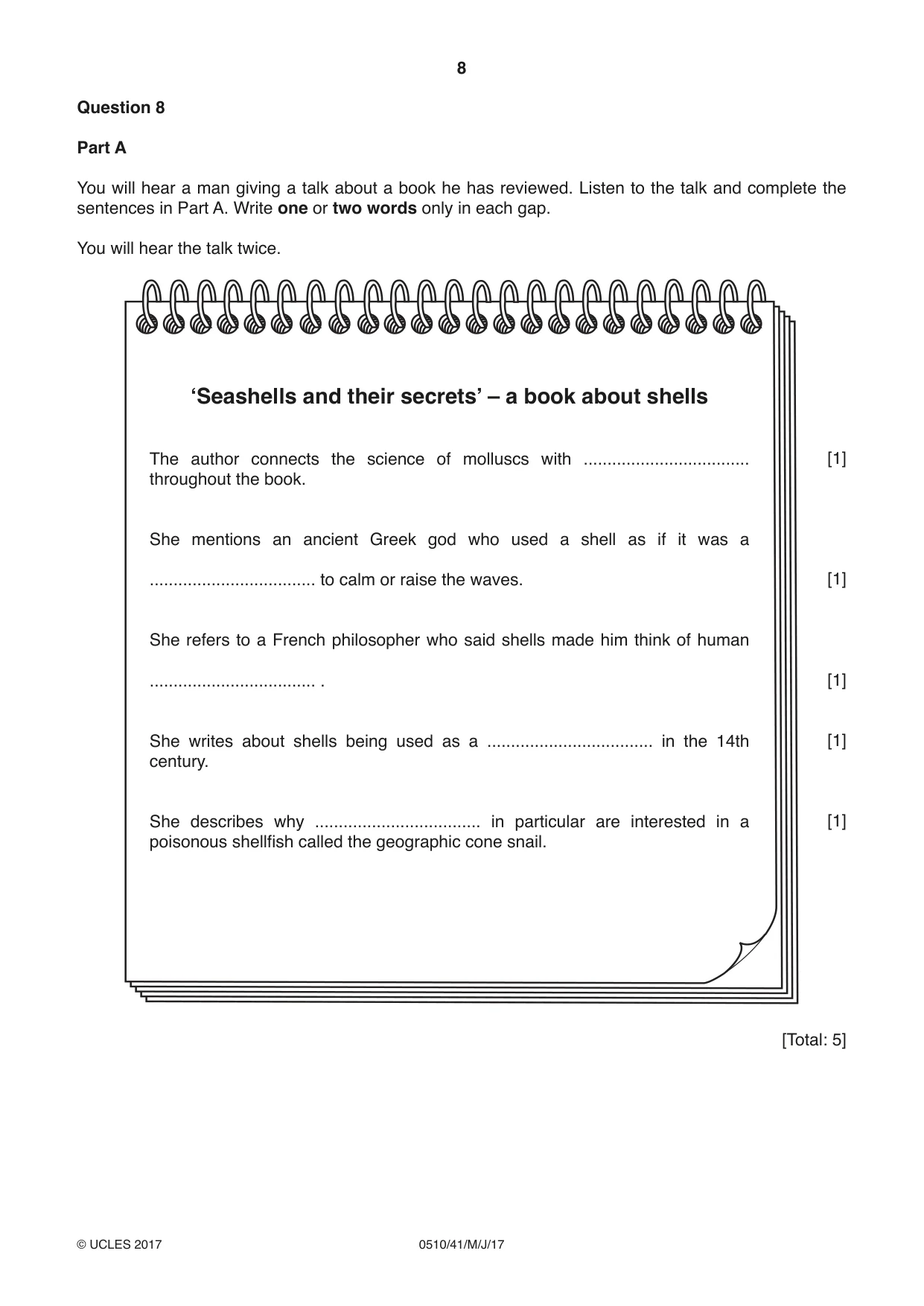
8 0510/41/M/J/17 © UCLES 2017 Question 8 Part A You will hear a man giving a talk about a book he has reviewed. Listen to the talk and complete the sentences in Part A. Write one or two words only in each gap. You will hear the talk twice. ‘Seashells and their secrets’ – a book about shells The author connects the science of molluscs with … throughout the book. She mentions an ancient Greek god who used a shell as if it was a … to calm or raise the waves. She refers to a French philosopher who said shells made him think of human … . She writes about shells being used as a … in the 14th century. She describes why … in particular are interested in a poisonous shellfish called the geographic cone snail. [1] [1] [1] [1] [1] [Total: 5]
Question paper, page 9
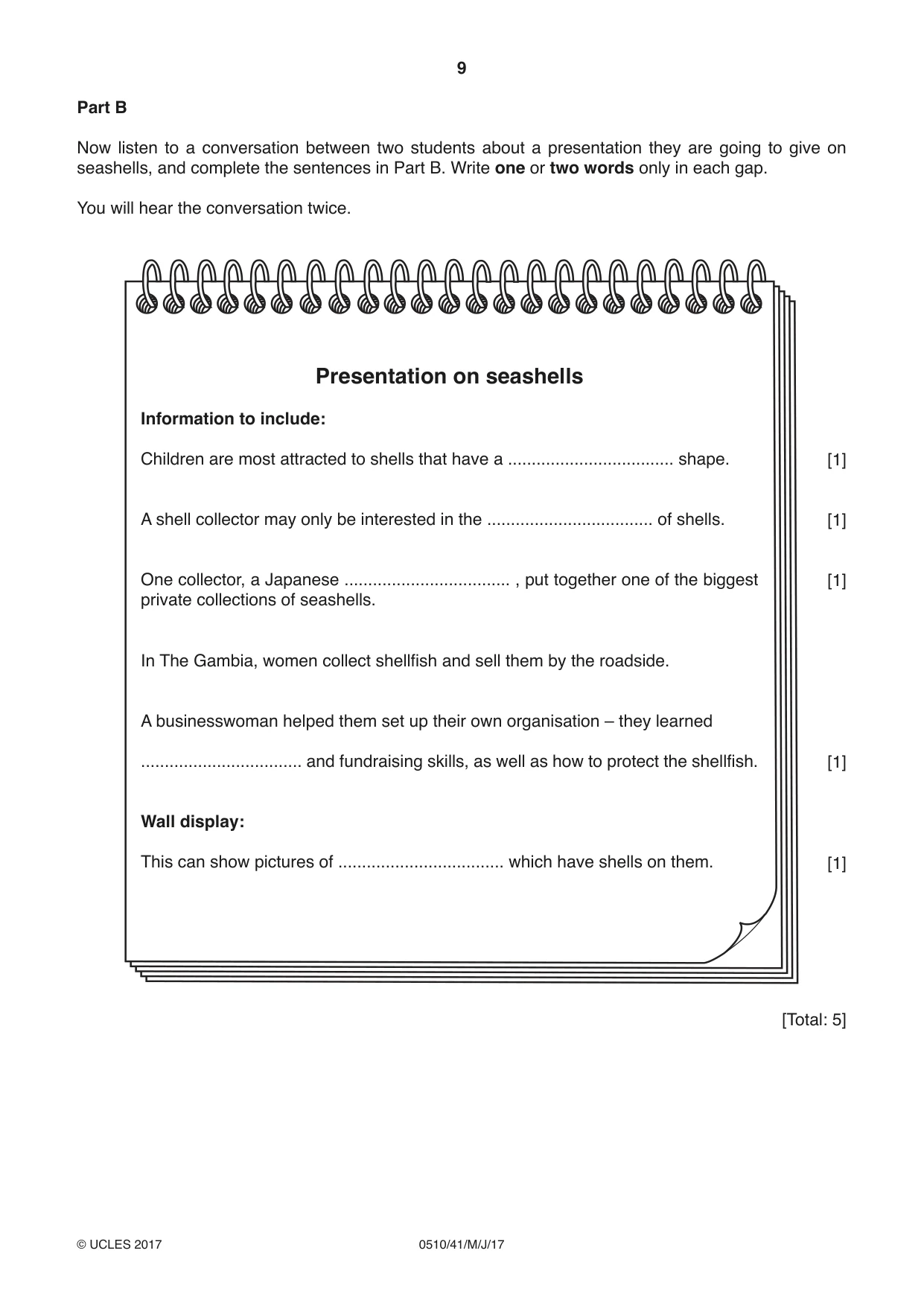
9 0510/41/M/J/17 © UCLES 2017 Part B Now listen to a conversation between two students about a presentation they are going to give on seashells, and complete the sentences in Part B. Write one or two words only in each gap. You will hear the conversation twice. Presentation on seashells Information to include: Children are most attracted to shells that have a … shape. A shell collector may only be interested in the … of shells. One collector, a Japanese … , put together one of the biggest private collections of seashells. In The Gambia, women collect shellfish and sell them by the roadside. A businesswoman helped them set up their own organisation – they learned … and fundraising skills, as well as how to protect the shellfish. Wall display: This can show pictures of … which have shells on them. [1] [1] [1] [1] [1] [Total: 5]
Question paper, page 10
10 0510/41/M/J/17 © UCLES 2017 BLANK PAGE
Question paper, page 11
11 0510/41/M/J/17 © UCLES 2017 BLANK PAGE
Question paper, page 12
12 0510/41/M/J/17 © UCLES 2017 Permission to reproduce items where third-party owned material protected by copyright is included has been sought and cleared where possible. Every reasonable effort has been made by the publisher (UCLES) to trace copyright holders, but if any items requiring clearance have unwittingly been included, the publisher will be pleased to make amends at the earliest possible opportunity. To avoid the issue of disclosure of answer-related information to candidates, all copyright acknowledgements are reproduced online in the Cambridge International Examinations Copyright Acknowledgements Booklet. This is produced for each series of examinations and is freely available to download at www.cie.org.uk after the live examination series. Cambridge International Examinations is part of the Cambridge Assessment Group. Cambridge Assessment is the brand name of University of Cambridge Local Examinations Syndicate (UCLES), which is itself a department of the University of Cambridge. BLANK PAGE
Mark scheme, page 1
® IGCSE is a registered trademark. This document consists of 4 printed pages. © UCLES 2017 [Turn over Cambridge International Examinations Cambridge International General Certificate of Secondary Education ENGLISH AS A SECOND LANGUAGE 0510/41 Paper 4 Listening (Extended) May/June 2017 MARK SCHEME Maximum Mark: 40 Published This mark scheme is published as an aid to teachers and candidates, to indicate the requirements of the examination. It shows the basis on which Examiners were instructed to award marks. It does not indicate the details of the discussions that took place at an Examiners’ meeting before marking began, which would have considered the acceptability of alternative answers. Mark schemes should be read in conjunction with the question paper and the Principal Examiner Report for Teachers. Cambridge will not enter into discussions about these mark schemes. Cambridge is publishing the mark schemes for the May/June 2017 series for most Cambridge IGCSE®, Cambridge International A and AS Level and Cambridge Pre-U components, and some Cambridge O Level components.
Mark scheme, page 2
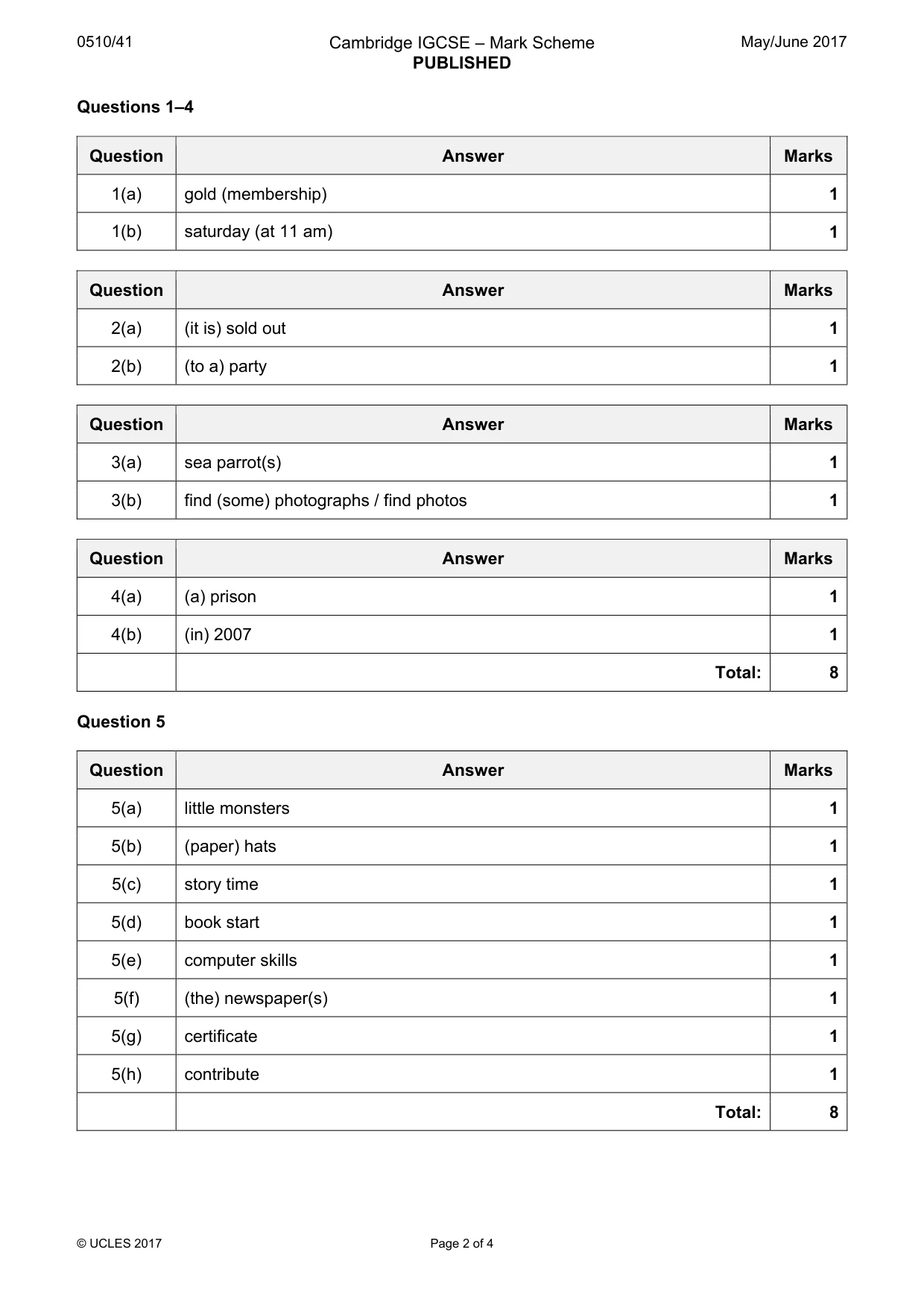
0510/41 Cambridge IGCSE – Mark Scheme PUBLISHED May/June 2017 © UCLES 2017 Page 2 of 4 Questions 1–4 Question Answer Marks 1(a) gold (membership) 1 1(b) saturday (at 11 am) 1 Question Answer Marks 2(a) (it is) sold out 1 2(b) (to a) party 1 Question Answer Marks 3(a) sea parrot(s) 1 3(b) find (some) photographs / find photos 1 Question Answer Marks 4(a) (a) prison 1 4(b) (in) 2007 1 Total: 8 Question 5 Question Answer Marks 5(a) little monsters 1 5(b) (paper) hats 1 5(c) story time 1 5(d) book start 1 5(e) computer skills 1 5(f) (the) newspaper(s) 1 5(g) certificate 1 5(h) contribute 1 Total: 8
Mark scheme, page 3
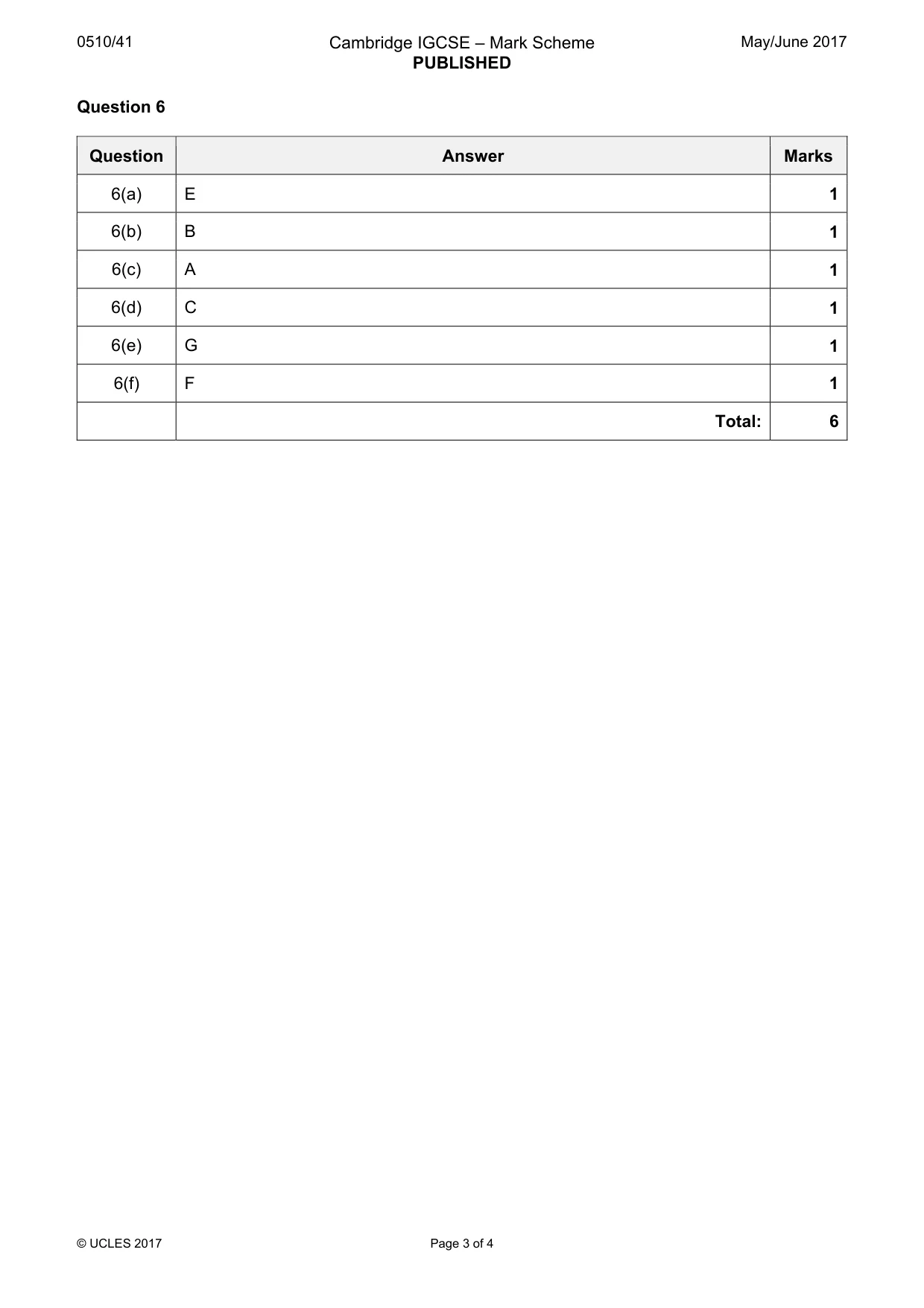
0510/41 Cambridge IGCSE – Mark Scheme PUBLISHED May/June 2017 © UCLES 2017 Page 3 of 4 Question 6 Question Answer Marks 6(a) E 1 6(b) B 1 6(c) A 1 6(d) C 1 6(e) G 1 6(f) F 1 Total: 6
Mark scheme, page 4
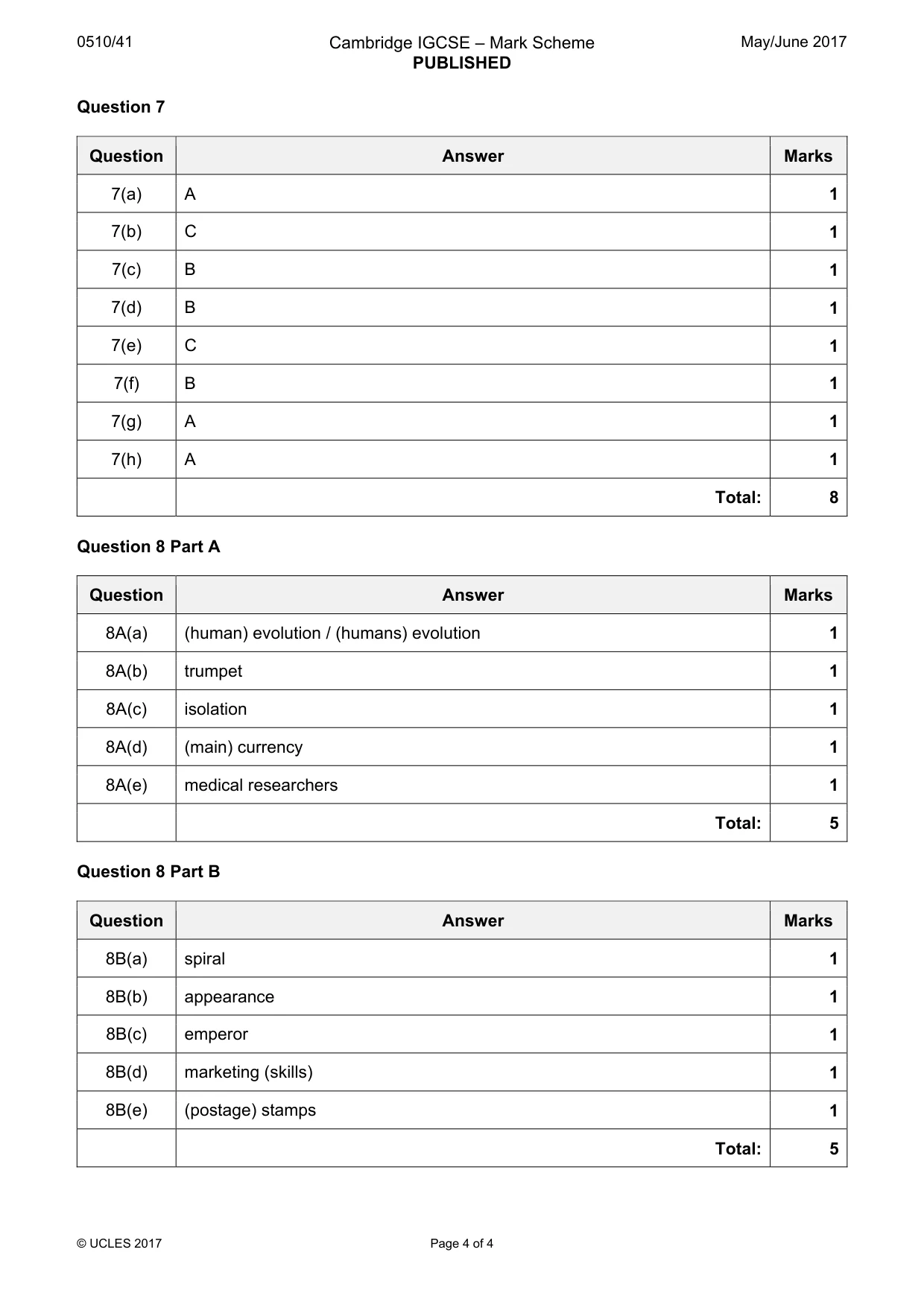
0510/41 Cambridge IGCSE – Mark Scheme PUBLISHED May/June 2017 © UCLES 2017 Page 4 of 4 Question 7 Question Answer Marks 7(a) A 1 7(b) C 1 7(c) B 1 7(d) B 1 7(e) C 1 7(f) B 1 7(g) A 1 7(h) A 1 Total: 8 Question 8 Part A Question Answer Marks 8A(a) (human) evolution / (humans) evolution 1 8A(b) trumpet 1 8A(c) isolation 1 8A(d) (main) currency 1 8A(e) medical researchers 1 Total: 5 Question 8 Part B Question Answer Marks 8B(a) spiral 1 8B(b) appearance 1 8B(c) emperor 1 8B(d) marketing (skills) 1 8B(e) (postage) stamps 1 Total: 5
What you needed in this session
Cambridge’s own grade thresholds for 2017 May/June, Paper 4 · Variant 1. A higher threshold means an easier paper — the bar moves with how the cohort did.