Cambridge IGCSE English - Second Language (oral endorsement) 0510 — 2014 Oct/Nov Paper 2 · Variant 3
0510/23/O/N/14 · 90 marks · ≈101 min
The question paper and its mark scheme, free to read here and free to download. This is Cambridge’s own paper, exactly as it was sat.
Question paper16 pages




Mark scheme11 pages
Answers below. Sit the paper first if you are practising.
Paper as text
Question paper, page 1
This document consists of 15 printed pages and 1 blank page. DC (NH/CGW) 81566/5 © UCLES 2014 [Turn over * 1 7 3 8 7 8 3 5 3 0 * ENGLISH AS A SECOND LANGUAGE 0510/23 Paper 2 Reading and Writing (Extended) October/November 2014 2 hours Candidates answer on the Question Paper. No Additional Materials are required. READ THESE INSTRUCTIONS FIRST Write your Centre number, candidate number and name on all the work you hand in. Write in dark blue or black pen. Do not use staples, paper clips, glue or correction fluid. DO NOT WRITE IN ANY BARCODES. Answer all questions. Dictionaries are not allowed. At the end of the examination, fasten all your work securely together. The number of marks is given in brackets [ ] at the end of each question or part question. Cambridge International Examinations Cambridge International General Certificate of Secondary Education
Question paper, page 2
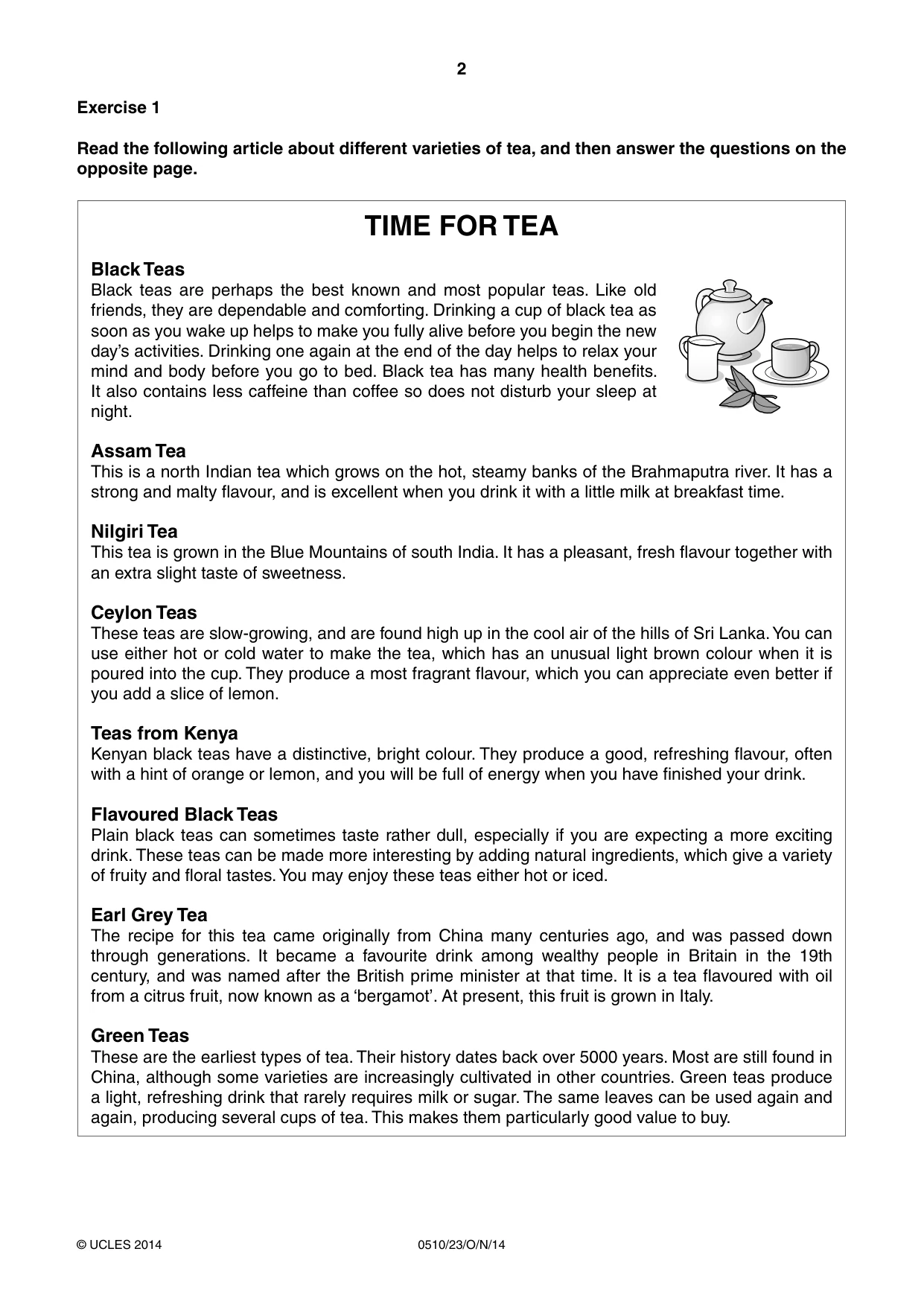
2 0510/23/O/N/14 © UCLES 2014 Exercise 1 Read the following article about different varieties of tea, and then answer the questions on the opposite page. TIME FOR TEA Black Teas Black teas are perhaps the best known and most popular teas. Like old friends, they are dependable and comforting. Drinking a cup of black tea as soon as you wake up helps to make you fully alive before you begin the new day’s activities. Drinking one again at the end of the day helps to relax your mind and body before you go to bed. Black tea has many health benefits. It also contains less caffeine than coffee so does not disturb your sleep at night. Assam Tea This is a north Indian tea which grows on the hot, steamy banks of the Brahmaputra river. It has a strong and malty flavour, and is excellent when you drink it with a little milk at breakfast time. Nilgiri Tea This tea is grown in the Blue Mountains of south India. It has a pleasant, fresh flavour together with an extra slight taste of sweetness. Ceylon Teas These teas are slow-growing, and are found high up in the cool air of the hills of Sri Lanka. You can use either hot or cold water to make the tea, which has an unusual light brown colour when it is poured into the cup. They produce a most fragrant flavour, which you can appreciate even better if you add a slice of lemon. Teas from Kenya Kenyan black teas have a distinctive, bright colour. They produce a good, refreshing flavour, often with a hint of orange or lemon, and you will be full of energy when you have finished your drink. Flavoured Black Teas Plain black teas can sometimes taste rather dull, especially if you are expecting a more exciting drink. These teas can be made more interesting by adding natural ingredients, which give a variety of fruity and floral tastes. You may enjoy these teas either hot or iced. Earl Grey Tea The recipe for this tea came originally from China many centuries ago, and was passed down through generations. It became a favourite drink among wealthy people in Britain in the 19th century, and was named after the British prime minister at that time. It is a tea flavoured with oil from a citrus fruit, now known as a ‘bergamot’. At present, this fruit is grown in Italy. Green Teas These are the earliest types of tea. Their history dates back over 5000 years. Most are still found in China, although some varieties are increasingly cultivated in other countries. Green teas produce a light, refreshing drink that rarely requires milk or sugar. The same leaves can be used again and again, producing several cups of tea. This makes them particularly good value to buy.
Question paper, page 3
3 0510/23/O/N/14 © UCLES 2014 [Turn over (a) What is the benefit to you of drinking black tea at the start of the day? …[1] (b) Why is drinking black tea less likely to keep you awake at night than coffee? …[1] (c) What might you add to your Assam tea? …[1] (d) What is special about the appearance of tea from Sri Lanka? …[1] (e) How will you feel after drinking a cup of tea from Kenya? …[1] (f) How do you create a variety of tastes from plain black tea? …[1] (g) When did the recipe for Earl Grey tea become popular outside China? …[1] (h) What kind of fruit is a bergamot and where does it come from? …[1] (i) Why can you save money if you buy green instead of black tea? …[1] [Total: 9]
Question paper, page 4
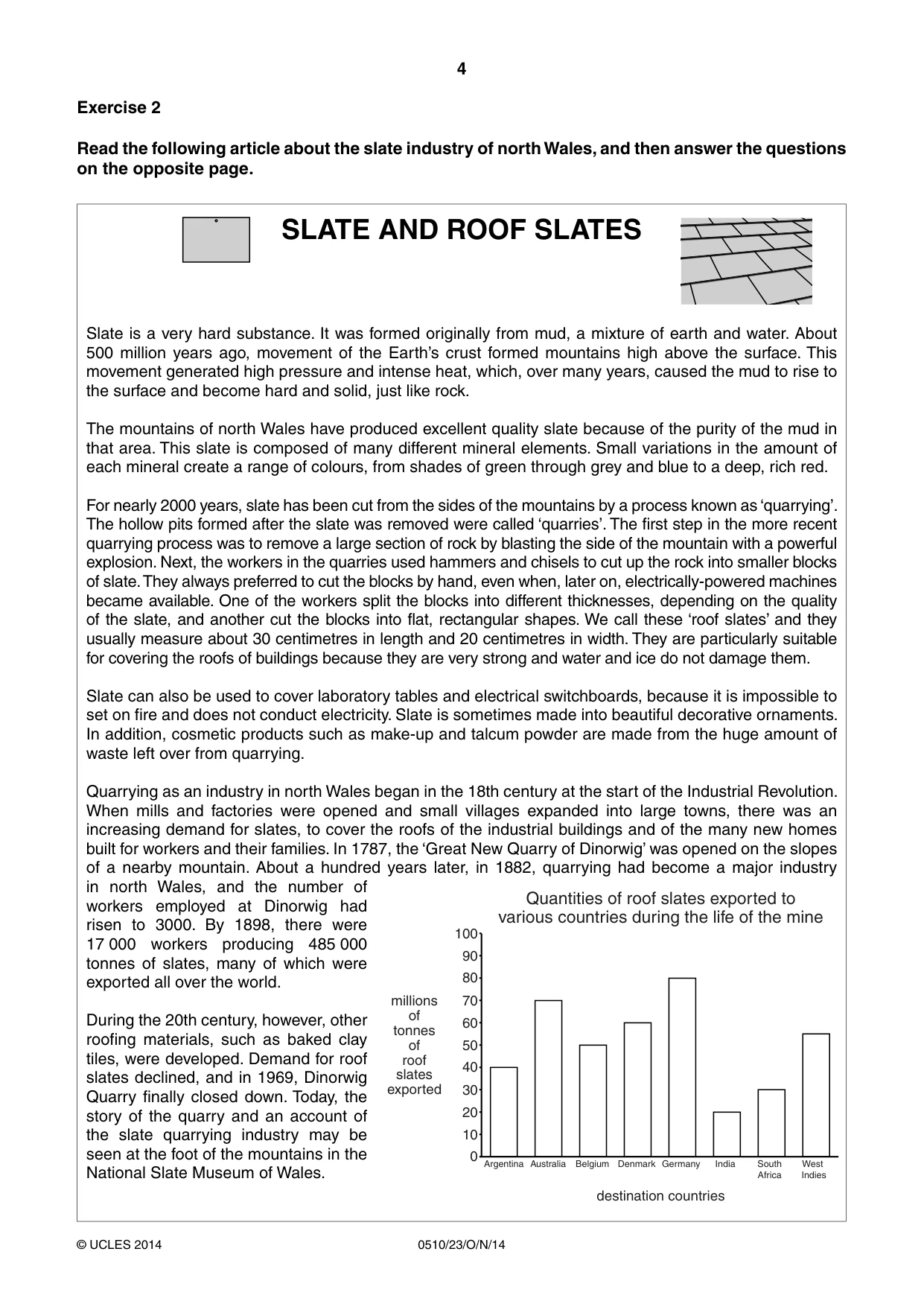
4 0510/23/O/N/14 © UCLES 2014 Exercise 2 Read the following article about the slate industry of north Wales, and then answer the questions on the opposite page. SLATE AND ROOF SLATES Slate is a very hard substance. It was formed originally from mud, a mixture of earth and water. About 500 million years ago, movement of the Earth’s crust formed mountains high above the surface. This movement generated high pressure and intense heat, which, over many years, caused the mud to rise to the surface and become hard and solid, just like rock. The mountains of north Wales have produced excellent quality slate because of the purity of the mud in that area. This slate is composed of many different mineral elements. Small variations in the amount of each mineral create a range of colours, from shades of green through grey and blue to a deep, rich red. For nearly 2000 years, slate has been cut from the sides of the mountains by a process known as ‘quarrying’. The hollow pits formed after the slate was removed were called ‘quarries’. The first step in the more recent quarrying process was to remove a large section of rock by blasting the side of the mountain with a powerful explosion. Next, the workers in the quarries used hammers and chisels to cut up the rock into smaller blocks of slate. They always preferred to cut the blocks by hand, even when, later on, electrically-powered machines became available. One of the workers split the blocks into different thicknesses, depending on the quality of the slate, and another cut the blocks into flat, rectangular shapes. We call these ‘roof slates’ and they usually measure about 30 centimetres in length and 20 centimetres in width. They are particularly suitable for covering the roofs of buildings because they are very strong and water and ice do not damage them. Slate can also be used to cover laboratory tables and electrical switchboards, because it is impossible to set on fire and does not conduct electricity. Slate is sometimes made into beautiful decorative ornaments. In addition, cosmetic products such as make-up and talcum powder are made from the huge amount of waste left over from quarrying. Quarrying as an industry in north Wales began in the 18th century at the start of the Industrial Revolution. When mills and factories were opened and small villages expanded into large towns, there was an increasing demand for slates, to cover the roofs of the industrial buildings and of the many new homes built for workers and their families. In 1787, the ‘Great New Quarry of Dinorwig’ was opened on the slopes of a nearby mountain. About a hundred years later, in 1882, quarrying had become a major industry in north Wales, and the number of workers employed at Dinorwig had risen to 3000. By 1898, there were 17 000 workers producing 485 000 tonnes of slates, many of which were exported all over the world. During the 20th century, however, other roofing materials, such as baked clay tiles, were developed. Demand for roof slates declined, and in 1969, Dinorwig Quarry finally closed down. Today, the story of the quarry and an account of the slate quarrying industry may be seen at the foot of the mountains in the National Slate Museum of Wales. 100 90 80 70 60 millions of tonnes of roof slates exported destination countries Quantities of roof slates exported to various countries during the life of the mine 50 40 30 20 10 Argentina Australia Belgium Denmark Germany India South Africa West Indies 0
Question paper, page 5
5 0510/23/O/N/14 © UCLES 2014 [Turn over (a) What happened 500 million years ago to create mountains? …[1] (b) Why does slate come in many different colours? …[1] (c) For what purpose did the workers use explosives in the quarrying process? …[1] (d) What might workers have used instead of their hammers and chisels? …[1] (e) What is the shape of a ‘roof slate’ AND what is its normal size? … …[2] (f) Why can slate be safely used in science labs? Give two details. …[1] (g) What caused a greater need for slates to cover roofs during the Industrial Revolution? Give two details. … …[2] (h) According to the chart, which part of the world received the greatest quantity of roof slates from north Wales AND what quantity was sent there? …[1] (i) Where can visitors discover everything about Dinorwig Quarry? …[1] (j) The slate industry in North Wales grew and declined between the 18th and 20th centuries. Give four details of this growth and decline, with dates. … … … …[4] [Total: 15]
Question paper, page 6
6 0510/23/O/N/14 © UCLES 2014 Exercise 3 Since leaving school this year, Heinrich Dortmann, aged 19, has found a temporary job as a motor mechanic in a vehicle repair workshop near his home at Frankelstrasse 171, Hamburg, Germany. His home telephone number is 40276 1388. Heinrich did well at school, gaining three Grade 1s in his final school exams. He is constantly looking for a chance to have a career with a major engineering firm. To help in his search, he has opened a personal email account at heinidor@skynet.de The workshop manager, Gunter Eckhart, has shown Heinrich an advertisement in the newspaper. It informs people that the European Aerospace Company (EAC) is offering training programmes to suitably qualified school leavers. The company runs factories which manufacture a wide range of military and civilian aircraft in Britain, France and Italy, as well as in Germany. Opportunities are available for young people to join the company, starting as trainees, in any one of the assembly, maintenance or marketing departments. The German factory is located in Essen, some distance from where Heinrich lives. He notes, however, that EAC can provide its trainees with paid accommodation for their first three years of employment in a company hostel, a local hotel or guest house, or in the private home of one of the senior staff. Unsurprisingly, Heinrich is excited at the prospect of joining such a successful company, and is determined to apply for a training programme, in the hope that he may be invited to remain with EAC afterwards as a permanent employee. Gunter Eckhart supports his decision and offers to give him a good reference if required. Heinrich has to decide which department he wants to work in. One of his ambitions is to travel to other parts of the world, but he would prefer to do his training in Germany. He has been told that staff in the marketing department attend international exhibitions in many different countries, where they demonstrate the company’s products. If he works in maintenance, however, he will also have opportunities to go to any country where EAC aircraft need spare parts or specialist repairs. In addition, he will be able to get a professional engineering qualification, which is another of his personal ambitions. So, he decides to apply to be a trainee in the maintenance department. The principal at Heinrich’s school, Dr Tomas Richter, has agreed to provide his academic reference. He has told Heinrich that his brother, Bernhard Richter, works as a supervisor on the assembly line at EAC in Essen. Bernhard lives with his wife and children just outside the town, a short drive from the factory. Dr Tomas Richter has already spoken to his brother, who will let Heinrich have a room in his house and will be happy to drive him to work each day until he has passed his driving test and has his own transport. Heinrich is delighted with this news and completes the application without delay. Imagine you are Heinrich. Fill in the application form on the opposite page, using the information above.
Question paper, page 7
7 0510/23/O/N/14 © UCLES 2014 [Turn over EAC TRAINING PROGRAMME: APPLICATION FORM SECTION A: Personal details Full name: … Address: … Age: … Telephone number: … Email: … Educational results: … … Present employment: … Do you hold a full driving licence? (please delete) YES / NO SECTION B: Training programme details Which country do you wish to train in? … Which EAC department do you wish to join? … Where will you live if you are accepted on the training programme? (please tick box) company hostel local hotel guest house private home Full names and occupations of two referees: … … SECTION C In the space below, write one sentence of between 12 and 20 words, describing your main ambition if you are offered long-term employment with EAC. [Total: 8]
Question paper, page 8
8 0510/23/O/N/14 © UCLES 2014 VOYAGE TO THE BOTTOM OF THE SEA New underwater vehicles capable of resisting huge water pressure may soon help to increase our understanding of the mysteries of the oceans. Shipbuilding companies are now able to design, manufacture and sell new models of super-submarines, made with extra-strong materials and containing advanced guidance systems. Soon, the deepest parts of the world’s great oceans will be filled with these vehicles, driven by people rich enough to buy them. According to the head of a company that makes the submarines, ninety percent of the sea floor has not yet been explored. “There are so many wonders down there,” he says. “These vehicles will be able to reach even the deepest parts of the ocean. The passengers in our submarines can visit areas in the mid-Atlantic where volcanic heated gases bubble up from the Earth’s core. They can dive down to the wreck of the Titanic, a passenger ship that hit an iceberg and sank on its very first voyage in 1912.” Submarines that can take two or three passengers on dives of 300 metres have already been built and sold, and one has appeared in a James Bond film. Although 300 metres might sound very deep, new underwater vehicles are now being produced which are strong enough to survive the water pressure of dives down to 1000 metres. However, even submarines like these do not satisfy some people. They require vehicles that will take them down to the deepest parts of the oceans,11 000 metres below the surface, where there is poor visibility due to the lack of light and the water pressure is a thousand times more than on the surface of the sea. Temperatures reach just above zero degrees. Several companies are now designing super-submarines, which will resist these huge water pressures. One manufacturer plans to build a circular cabin, made of special glass that is more than ten centimetres thick, for the main part of the submarine. It will give its passengers an all- round view of life at the bottom of the sea, and will include powerful lamps to illuminate the scene. Another experimental vehicle, designed to take a single person down to a depth of 11 000 metres, will have a structure made of carbon fibre, with very thick walls, wings like those of an aeroplane and a big window in the front with an extra-tough plastic cover. Inside, there will be an artificial atmosphere, so that the person inside will not feel any change of pressure. A third design will have a shape which looks more like a normal submarine. It will hold up to three people sitting inside a toughened glass compartment and should be able to reach the deepest ocean floor in less than 60 minutes. All the companies inventing these underwater vehicles aim to sell their products for about 40 million dollars each. In addition to providing leisure activities, they claim that these inventions will provide opportunities for scientists to study the deepest parts of the oceans. Scientists hope to learn more about the many extraordinary plants and creatures that exist on the sea floor, in the most mysterious areas of the world. Exercise 4 Read the following article about the design and production of super-submarines, which can reach the deepest parts of the ocean, and then complete the notes on the opposite page.
Question paper, page 9
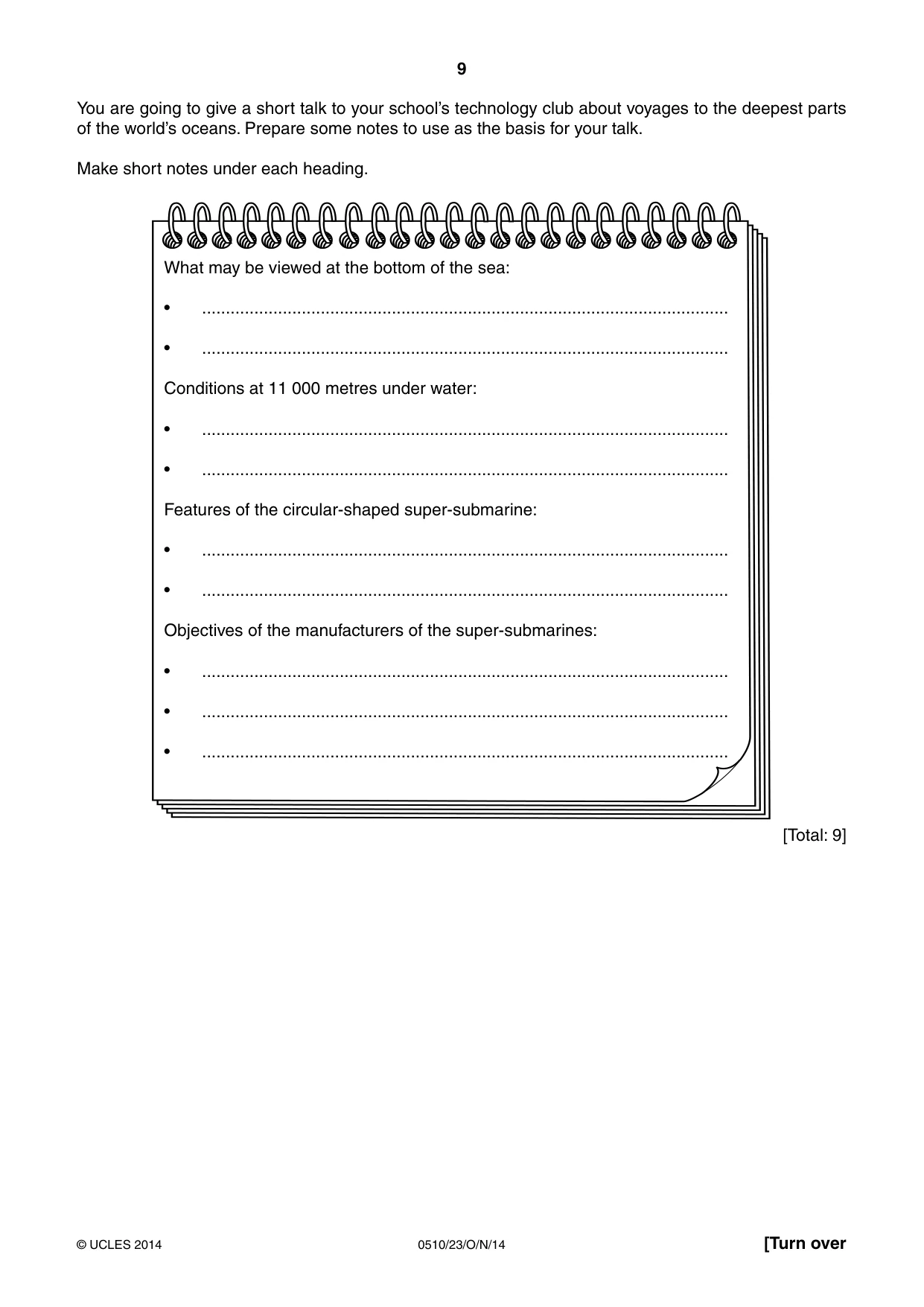
9 0510/23/O/N/14 © UCLES 2014 [Turn over You are going to give a short talk to your school’s technology club about voyages to the deepest parts of the world’s oceans. Prepare some notes to use as the basis for your talk. Make short notes under each heading. What may be viewed at the bottom of the sea: • … • … Conditions at 11 000 metres under water: • … • … Features of the circular-shaped super-submarine: • … • … Objectives of the manufacturers of the super-submarines: • … • … • … [Total: 9]
Question paper, page 10
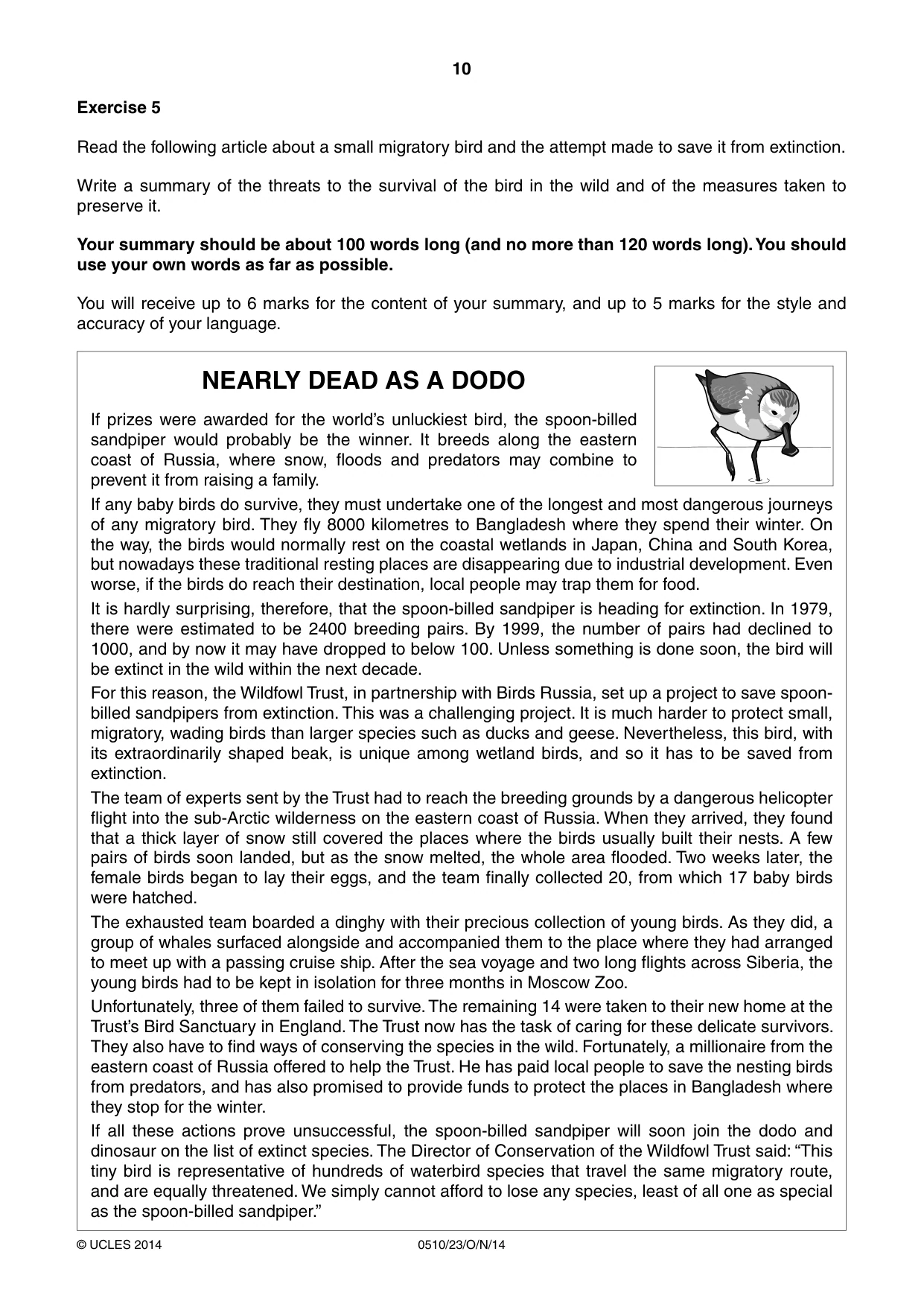
10 0510/23/O/N/14 © UCLES 2014 Exercise 5 Read the following article about a small migratory bird and the attempt made to save it from extinction. Write a summary of the threats to the survival of the bird in the wild and of the measures taken to preserve it. Your summary should be about 100 words long (and no more than 120 words long). You should use your own words as far as possible. You will receive up to 6 marks for the content of your summary, and up to 5 marks for the style and accuracy of your language. NEARLY DEAD AS A DODO If prizes were awarded for the world’s unluckiest bird, the spoon-billed sandpiper would probably be the winner. It breeds along the eastern coast of Russia, where snow, floods and predators may combine to prevent it from raising a family. If any baby birds do survive, they must undertake one of the longest and most dangerous journeys of any migratory bird. They fly 8000 kilometres to Bangladesh where they spend their winter. On the way, the birds would normally rest on the coastal wetlands in Japan, China and South Korea, but nowadays these traditional resting places are disappearing due to industrial development. Even worse, if the birds do reach their destination, local people may trap them for food. It is hardly surprising, therefore, that the spoon-billed sandpiper is heading for extinction. In 1979, there were estimated to be 2400 breeding pairs. By 1999, the number of pairs had declined to 1000, and by now it may have dropped to below 100. Unless something is done soon, the bird will be extinct in the wild within the next decade. For this reason, the Wildfowl Trust, in partnership with Birds Russia, set up a project to save spoon- billed sandpipers from extinction. This was a challenging project. It is much harder to protect small, migratory, wading birds than larger species such as ducks and geese. Nevertheless, this bird, with its extraordinarily shaped beak, is unique among wetland birds, and so it has to be saved from extinction. The team of experts sent by the Trust had to reach the breeding grounds by a dangerous helicopter flight into the sub-Arctic wilderness on the eastern coast of Russia. When they arrived, they found that a thick layer of snow still covered the places where the birds usually built their nests. A few pairs of birds soon landed, but as the snow melted, the whole area flooded. Two weeks later, the female birds began to lay their eggs, and the team finally collected 20, from which 17 baby birds were hatched. The exhausted team boarded a dinghy with their precious collection of young birds. As they did, a group of whales surfaced alongside and accompanied them to the place where they had arranged to meet up with a passing cruise ship. After the sea voyage and two long flights across Siberia, the young birds had to be kept in isolation for three months in Moscow Zoo. Unfortunately, three of them failed to survive. The remaining 14 were taken to their new home at the Trust’s Bird Sanctuary in England. The Trust now has the task of caring for these delicate survivors. They also have to find ways of conserving the species in the wild. Fortunately, a millionaire from the eastern coast of Russia offered to help the Trust. He has paid local people to save the nesting birds from predators, and has also promised to provide funds to protect the places in Bangladesh where they stop for the winter. If all these actions prove unsuccessful, the spoon-billed sandpiper will soon join the dodo and dinosaur on the list of extinct species. The Director of Conservation of the Wildfowl Trust said: “This tiny bird is representative of hundreds of waterbird species that travel the same migratory route, and are equally threatened. We simply cannot afford to lose any species, least of all one as special as the spoon-billed sandpiper.”
Question paper, page 11
11 0510/23/O/N/14 © UCLES 2014 [Turn over … … … … … … … … … … … … … … … … … … … … [Total: 11]
Question paper, page 12
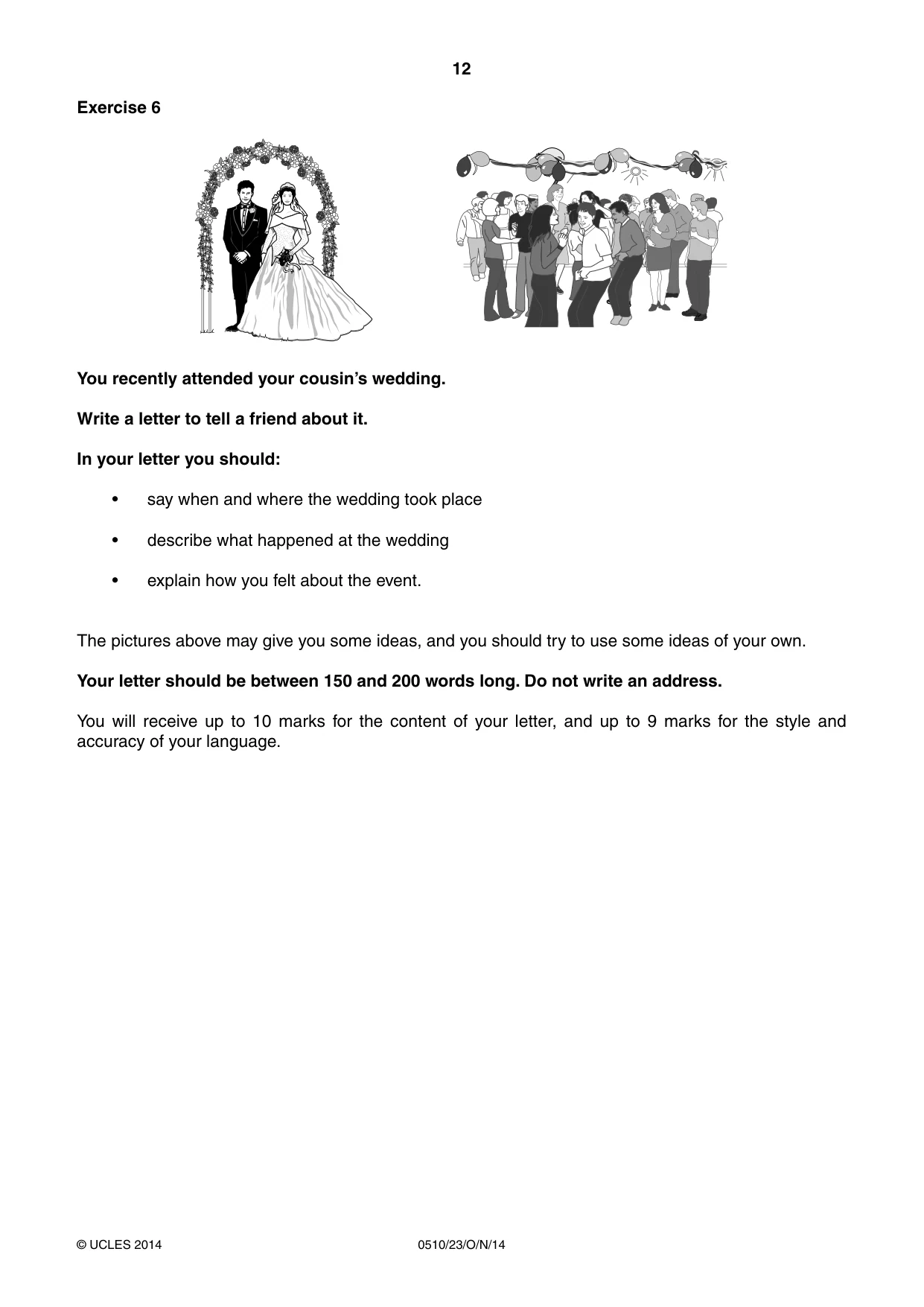
12 0510/23/O/N/14 © UCLES 2014 Exercise 6 You recently attended your cousin’s wedding. Write a letter to tell a friend about it. In your letter you should: • say when and where the wedding took place • describe what happened at the wedding • explain how you felt about the event. The pictures above may give you some ideas, and you should try to use some ideas of your own. Your letter should be between 150 and 200 words long. Do not write an address. You will receive up to 10 marks for the content of your letter, and up to 9 marks for the style and accuracy of your language.
Question paper, page 13
13 0510/23/O/N/14 © UCLES 2014 [Turn over … … … … … … … … … … … … … … … … … … … … … … … … … [Total: 19]
Question paper, page 14
14 0510/23/O/N/14 © UCLES 2014 Exercise 7 Who has the greatest influence on 16- to 18-year-olds – their parents or their friends? Here are some comments from other students about this question: “I like to feel part of the group and follow what my friends do.” “Parents have a greater experience of life so I prefer to listen to their advice.” Write an article for your school magazine, giving your views. The comments above may give you some ideas, and you should try to use some ideas of your own. Your article should be between 150 and 200 words long. You will receive up to 10 marks for the content of your article, and up to 9 marks for the style and accuracy of your language.
Question paper, page 15
15 0510/23/O/N/14 © UCLES 2014 … … … … … … … … … … … … … … … … … … … … … … … … … [Total: 19]
Question paper, page 16
16 0510/23/O/N/14 © UCLES 2014 Permission to reproduce items where third-party owned material protected by copyright is included has been sought and cleared where possible. Every reasonable effort has been made by the publisher (UCLES) to trace copyright holders, but if any items requiring clearance have unwittingly been included, the publisher will be pleased to make amends at the earliest possible opportunity. Cambridge International Examinations is part of the Cambridge Assessment Group. Cambridge Assessment is the brand name of University of Cambridge Local Examinations Syndicate (UCLES), which is itself a department of the University of Cambridge. BLANK PAGE
Mark scheme, page 1
® IGCSE is the registered trademark of Cambridge International Examinations. CAMBRIDGE INTERNATIONAL EXAMINATIONS Cambridge International General Certificate of Secondary Education MARK SCHEME for the October/November 2014 series 0510 ENGLISH AS SECOND LANGUAGE 0510/23 Paper 2 (Reading and Writing – Extended), maximum raw mark 90 This mark scheme is published as an aid to teachers and candidates, to indicate the requirements of the examination. It shows the basis on which Examiners were instructed to award marks. It does not indicate the details of the discussions that took place at an Examiners’ meeting before marking began, which would have considered the acceptability of alternative answers. Mark schemes should be read in conjunction with the question paper and the Principal Examiner Report for Teachers. Cambridge will not enter into discussions about these mark schemes. Cambridge is publishing the mark schemes for the October/November 2014 series for most Cambridge IGCSE®, Cambridge International A and AS Level components and some Cambridge O Level components.
Mark scheme, page 2
Page 2 Mark Scheme Syllabus Paper Cambridge IGCSE – October/November 2014 0510 23 © Cambridge International Examinations 2014 IGCSE English as a Second Language Extended tier Reading/Writing (Paper 2) This component forms part of the Extended tier assessment of IGCSE English as a Second Language and tests the following Assessment Objectives: AO1: Reading R1 understand and respond to information presented in a variety of forms R2 select and organise material relevant to specific purposes R3 recognise, understand and distinguish between facts, ideas and opinions R4 infer information from texts AO2: Writing W1 communicate clearly, accurately and appropriately W2 convey information and express opinions effectively W3 employ and control a variety of grammatical structures W4 demonstrate knowledge and understanding of a range of appropriate vocabulary W5 observe conventions of paragraphing, punctuation and spelling W6 employ appropriate register/style Overview of exercises on Paper 2 Reading objectives tested Marks for reading objectives Writing objectives tested Marks for writing objectives Total available marks Exercise 1 Reading (1) R1 9 – 9 Exercise 2 Reading (2) R1 15 – 15 Exercise 3 Information transfer R1, R2 6 W1, W5 2 8 Exercise 4 Note- making R1, R2, R3 9 – 9 Exercise 5 Summary R1, R2, R3 6 W1, W2, W3, W4, W5 5 11 Exercise 6 Writing (1) – W1, W2, W3, W4, W5, W6 19 19 Exercise 7 Writing (2) – W1, W2, W3, W4, W5, W6 19 19 90
Mark scheme, page 3
Page 3 Mark Scheme Syllabus Paper Cambridge IGCSE – October/November 2014 0510 23 © Cambridge International Examinations 2014 Exercise 1: TIME FOR TEA (a) makes you fully alive [1] (b) less caffeine [1] (c) milk [1] (d) unusual brown colour [1] (e) refreshed / full of energy [1] (f) adding natural/fruity and floral ingredients [1] (g) 19th century [1] (h) citrus AND Italy. BOTH NEEDED [1] (i) leaves can be used again and again/produce several cups of tea [1] Max total for exercise 1: 9 marks
Mark scheme, page 4
Page 4 Mark Scheme Syllabus Paper Cambridge IGCSE – October/November 2014 0510 23 © Cambridge International Examinations 2014 Exercise 2: SLATE AND ROOF SLATES (a) movement of Earth’s crust [1] (b) small variations in the amount of each mineral element [1] (c) remove a large section of rock / blast the side of the mountain [1] (d) electrically-powered machines [1] (e) rectangular [1] 30 centimetres long AND 20 centimetres wide. BOTH NEEDED [1] (f) cannot be set on fire AND doesn’t conduct electricity. BOTH NEEDED [1] (g) mills and factories were opened / industrial buildings were opened small villages expanded into large towns many new homes were built for workers and their families ANY TWO FROM THREE [2] (h) Germany AND 80/eighty million tonnes. BOTH NEEDED [1] (i) National Slate Museum of Wales [1] (j) Great New Quarry of Dinorwig / Dinorwig Quarry opened in 1787 3,000 workers were employed / slate quarrying was major industry in 1882 17,000 workers employed / produced 485,000 tonnes of slates in 1898 Other roofing materials developed / demand for slates declined in 20th century Dinorwig Quarry closed down in 1969. ANY FOUR FROM FIVE [4] Max total for exercise 2: 15 marks
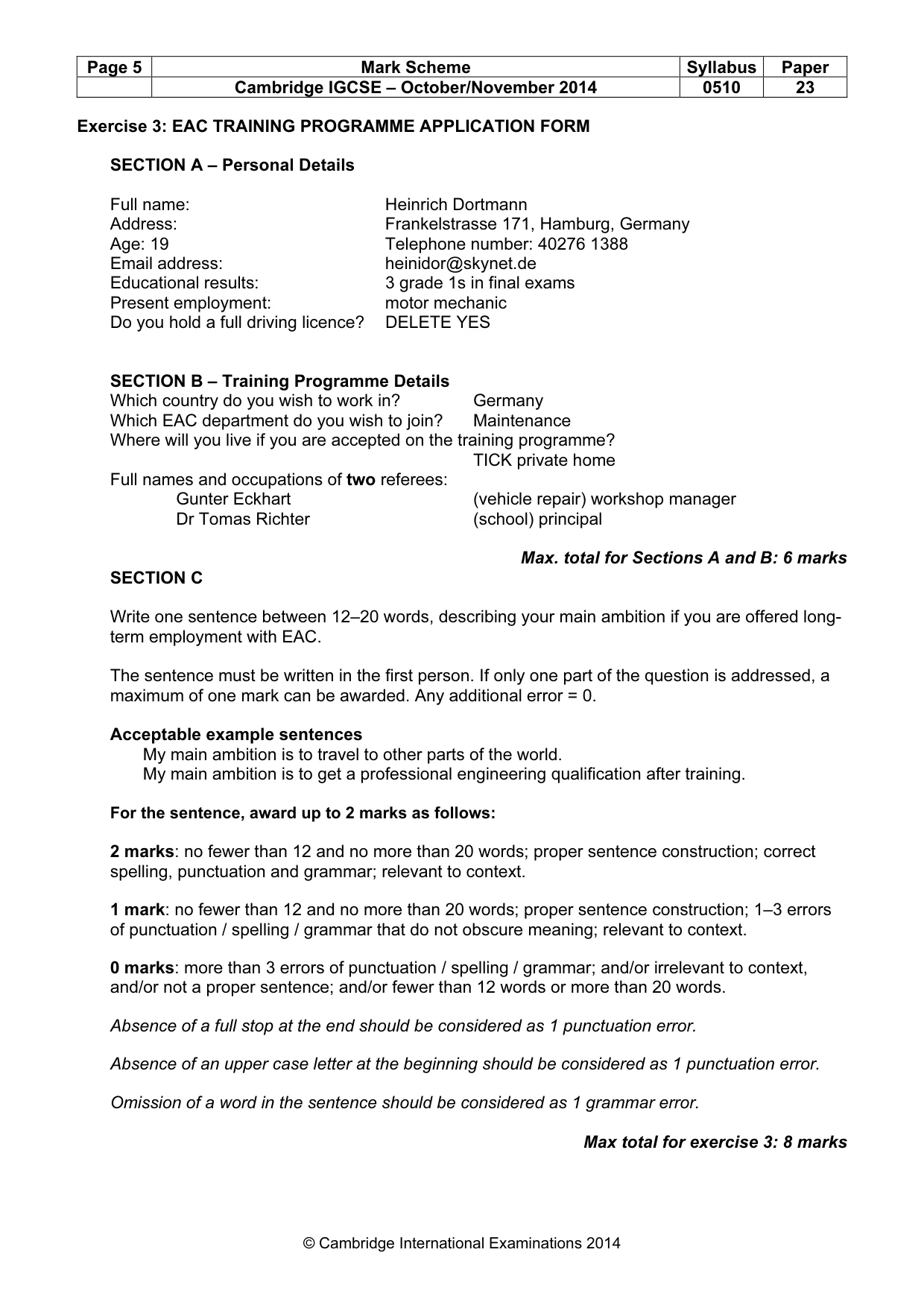
Mark scheme, page 5
Page 5 Mark Scheme Syllabus Paper Cambridge IGCSE – October/November 2014 0510 23 © Cambridge International Examinations 2014 Exercise 3: EAC TRAINING PROGRAMME APPLICATION FORM SECTION A – Personal Details Full name: Heinrich Dortmann Address: Frankelstrasse 171, Hamburg, Germany Age: 19 Telephone number: 40276 1388 Email address: heinidor@skynet.de Educational results: 3 grade 1s in final exams Present employment: motor mechanic Do you hold a full driving licence? DELETE YES SECTION B – Training Programme Details Which country do you wish to work in? Germany Which EAC department do you wish to join? Maintenance Where will you live if you are accepted on the training programme? TICK private home Full names and occupations of two referees: Gunter Eckhart (vehicle repair) workshop manager Dr Tomas Richter (school) principal Max. total for Sections A and B: 6 marks SECTION C Write one sentence between 12–20 words, describing your main ambition if you are offered long- term employment with EAC. The sentence must be written in the first person. If only one part of the question is addressed, a maximum of one mark can be awarded. Any additional error = 0. Acceptable example sentences My main ambition is to travel to other parts of the world. My main ambition is to get a professional engineering qualification after training. For the sentence, award up to 2 marks as follows: 2 marks: no fewer than 12 and no more than 20 words; proper sentence construction; correct spelling, punctuation and grammar; relevant to context. 1 mark: no fewer than 12 and no more than 20 words; proper sentence construction; 1–3 errors of punctuation / spelling / grammar that do not obscure meaning; relevant to context. 0 marks: more than 3 errors of punctuation / spelling / grammar; and/or irrelevant to context, and/or not a proper sentence; and/or fewer than 12 words or more than 20 words. Absence of a full stop at the end should be considered as 1 punctuation error. Absence of an upper case letter at the beginning should be considered as 1 punctuation error. Omission of a word in the sentence should be considered as 1 grammar error. Max total for exercise 3: 8 marks
Mark scheme, page 6
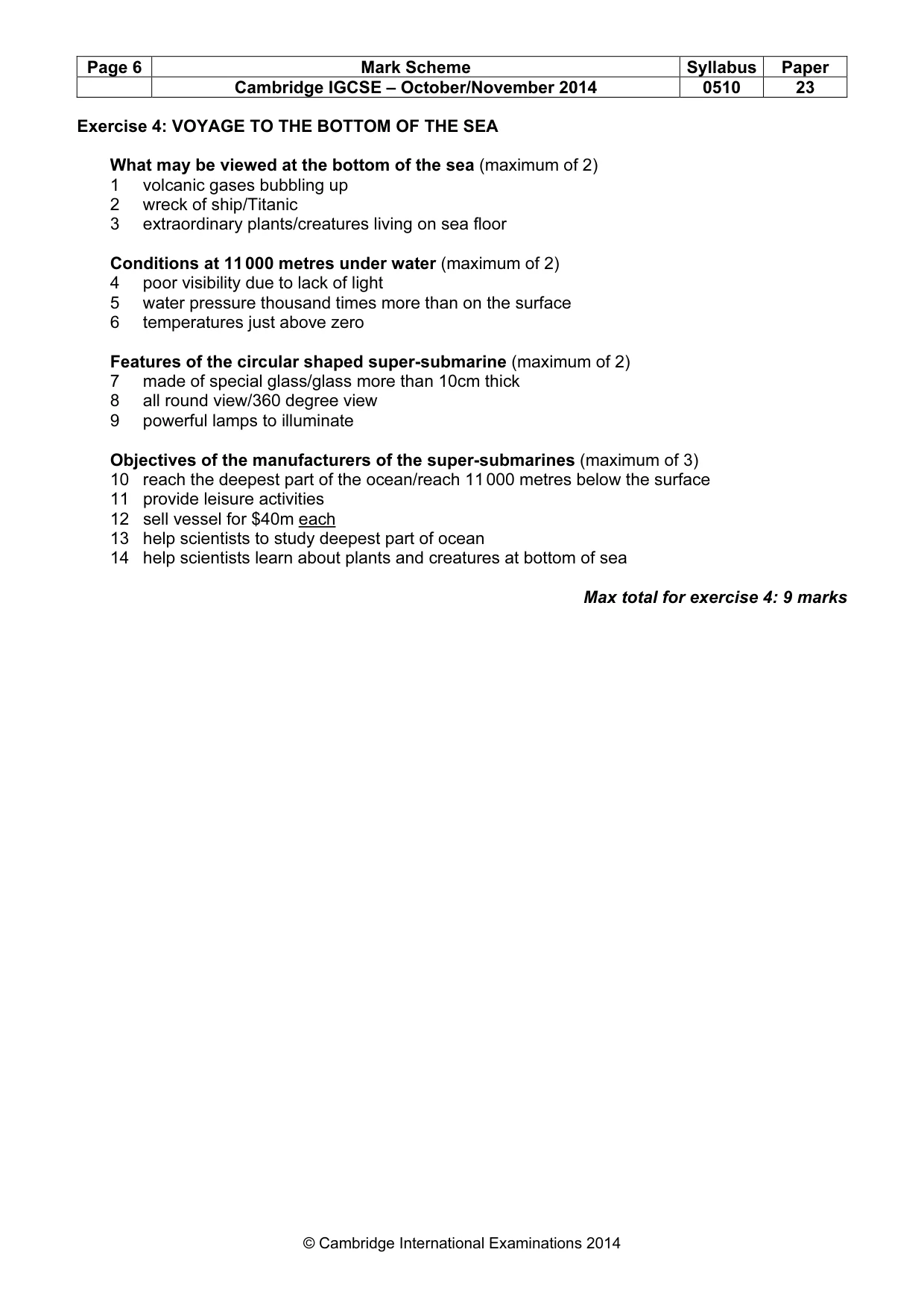
Page 6 Mark Scheme Syllabus Paper Cambridge IGCSE – October/November 2014 0510 23 © Cambridge International Examinations 2014 Exercise 4: VOYAGE TO THE BOTTOM OF THE SEA What may be viewed at the bottom of the sea (maximum of 2) 1 volcanic gases bubbling up 2 wreck of ship/Titanic 3 extraordinary plants/creatures living on sea floor Conditions at 11 000 metres under water (maximum of 2) 4 poor visibility due to lack of light 5 water pressure thousand times more than on the surface 6 temperatures just above zero Features of the circular shaped super-submarine (maximum of 2) 7 made of special glass/glass more than 10cm thick 8 all round view/360 degree view 9 powerful lamps to illuminate Objectives of the manufacturers of the super-submarines (maximum of 3) 10 reach the deepest part of the ocean/reach 11 000 metres below the surface 11 provide leisure activities 12 sell vessel for $40m each 13 help scientists to study deepest part of ocean 14 help scientists learn about plants and creatures at bottom of sea Max total for exercise 4: 9 marks
Mark scheme, page 7
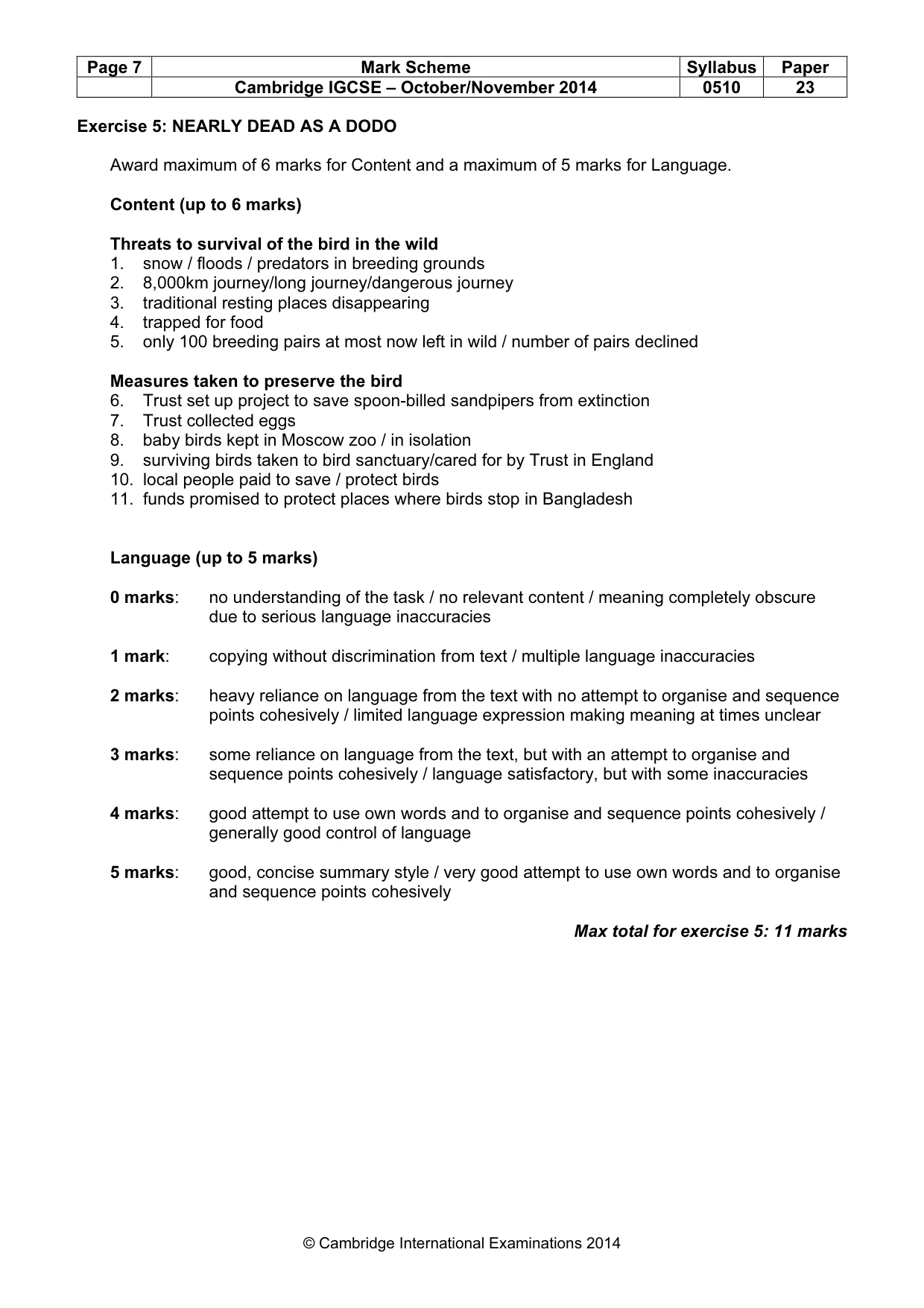
Page 7 Mark Scheme Syllabus Paper Cambridge IGCSE – October/November 2014 0510 23 © Cambridge International Examinations 2014 Exercise 5: NEARLY DEAD AS A DODO Award maximum of 6 marks for Content and a maximum of 5 marks for Language. Content (up to 6 marks) Threats to survival of the bird in the wild 1. snow / floods / predators in breeding grounds 2. 8,000km journey/long journey/dangerous journey 3. traditional resting places disappearing 4. trapped for food 5. only 100 breeding pairs at most now left in wild / number of pairs declined Measures taken to preserve the bird 6. Trust set up project to save spoon-billed sandpipers from extinction 7. Trust collected eggs 8. baby birds kept in Moscow zoo / in isolation 9. surviving birds taken to bird sanctuary/cared for by Trust in England 10. local people paid to save / protect birds 11. funds promised to protect places where birds stop in Bangladesh Language (up to 5 marks) 0 marks: no understanding of the task / no relevant content / meaning completely obscure due to serious language inaccuracies 1 mark: copying without discrimination from text / multiple language inaccuracies 2 marks: heavy reliance on language from the text with no attempt to organise and sequence points cohesively / limited language expression making meaning at times unclear 3 marks: some reliance on language from the text, but with an attempt to organise and sequence points cohesively / language satisfactory, but with some inaccuracies 4 marks: good attempt to use own words and to organise and sequence points cohesively / generally good control of language 5 marks: good, concise summary style / very good attempt to use own words and to organise and sequence points cohesively Max total for exercise 5: 11 marks
Mark scheme, page 8
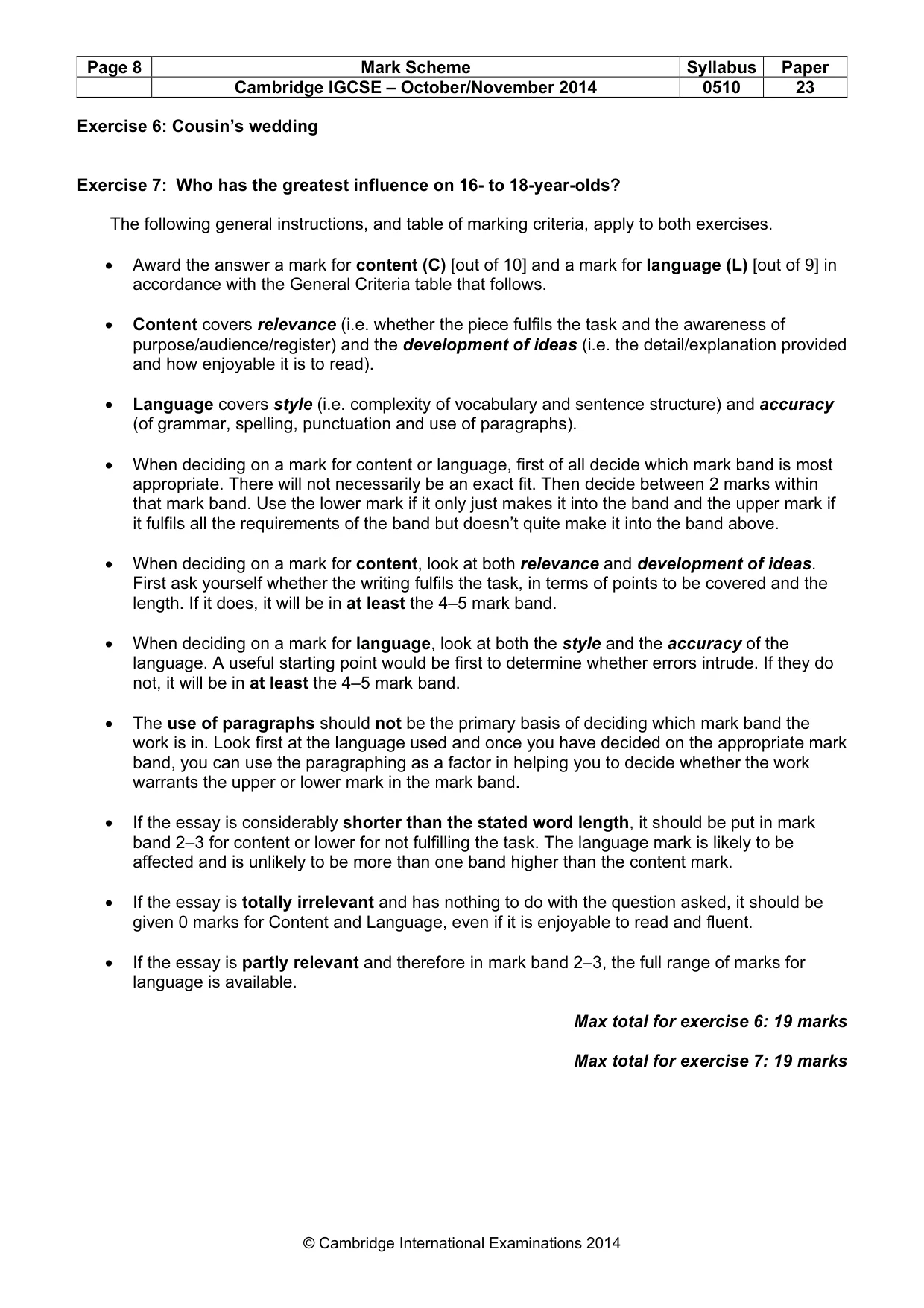
Page 8 Mark Scheme Syllabus Paper Cambridge IGCSE – October/November 2014 0510 23 © Cambridge International Examinations 2014 Exercise 6: Cousin’s wedding Exercise 7: Who has the greatest influence on 16- to 18-year-olds? The following general instructions, and table of marking criteria, apply to both exercises. • Award the answer a mark for content (C) [out of 10] and a mark for language (L) [out of 9] in accordance with the General Criteria table that follows. • Content covers relevance (i.e. whether the piece fulfils the task and the awareness of purpose/audience/register) and the development of ideas (i.e. the detail/explanation provided and how enjoyable it is to read). • Language covers style (i.e. complexity of vocabulary and sentence structure) and accuracy (of grammar, spelling, punctuation and use of paragraphs). • When deciding on a mark for content or language, first of all decide which mark band is most appropriate. There will not necessarily be an exact fit. Then decide between 2 marks within that mark band. Use the lower mark if it only just makes it into the band and the upper mark if it fulfils all the requirements of the band but doesn’t quite make it into the band above. • When deciding on a mark for content, look at both relevance and development of ideas. First ask yourself whether the writing fulfils the task, in terms of points to be covered and the length. If it does, it will be in at least the 4–5 mark band. • When deciding on a mark for language, look at both the style and the accuracy of the language. A useful starting point would be first to determine whether errors intrude. If they do not, it will be in at least the 4–5 mark band. • The use of paragraphs should not be the primary basis of deciding which mark band the work is in. Look first at the language used and once you have decided on the appropriate mark band, you can use the paragraphing as a factor in helping you to decide whether the work warrants the upper or lower mark in the mark band. • If the essay is considerably shorter than the stated word length, it should be put in mark band 2–3 for content or lower for not fulfilling the task. The language mark is likely to be affected and is unlikely to be more than one band higher than the content mark. • If the essay is totally irrelevant and has nothing to do with the question asked, it should be given 0 marks for Content and Language, even if it is enjoyable to read and fluent. • If the essay is partly relevant and therefore in mark band 2–3, the full range of marks for language is available. Max total for exercise 6: 19 marks Max total for exercise 7: 19 marks
Mark scheme, page 9
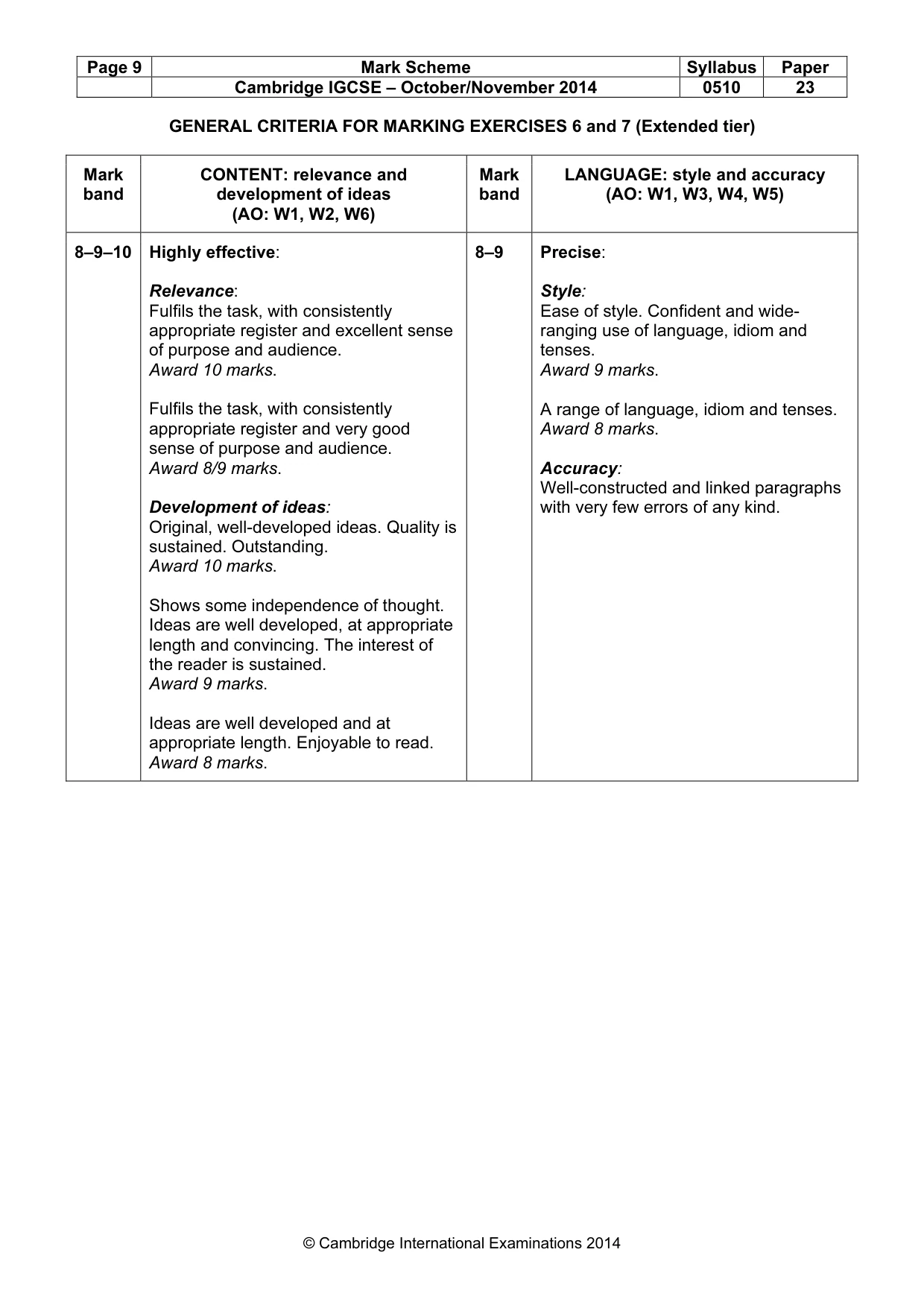
Page 9 Mark Scheme Syllabus Paper Cambridge IGCSE – October/November 2014 0510 23 © Cambridge International Examinations 2014 GENERAL CRITERIA FOR MARKING EXERCISES 6 and 7 (Extended tier) Mark band CONTENT: relevance and development of ideas (AO: W1, W2, W6) Mark band LANGUAGE: style and accuracy (AO: W1, W3, W4, W5) 8–9–10 Highly effective: Relevance: Fulfils the task, with consistently appropriate register and excellent sense of purpose and audience. Award 10 marks. Fulfils the task, with consistently appropriate register and very good sense of purpose and audience. Award 8/9 marks. Development of ideas: Original, well-developed ideas. Quality is sustained. Outstanding. Award 10 marks. Shows some independence of thought. Ideas are well developed, at appropriate length and convincing. The interest of the reader is sustained. Award 9 marks. Ideas are well developed and at appropriate length. Enjoyable to read. Award 8 marks. 8–9 Precise: Style: Ease of style. Confident and wide- ranging use of language, idiom and tenses. Award 9 marks. A range of language, idiom and tenses. Award 8 marks. Accuracy: Well-constructed and linked paragraphs with very few errors of any kind.
Mark scheme, page 10
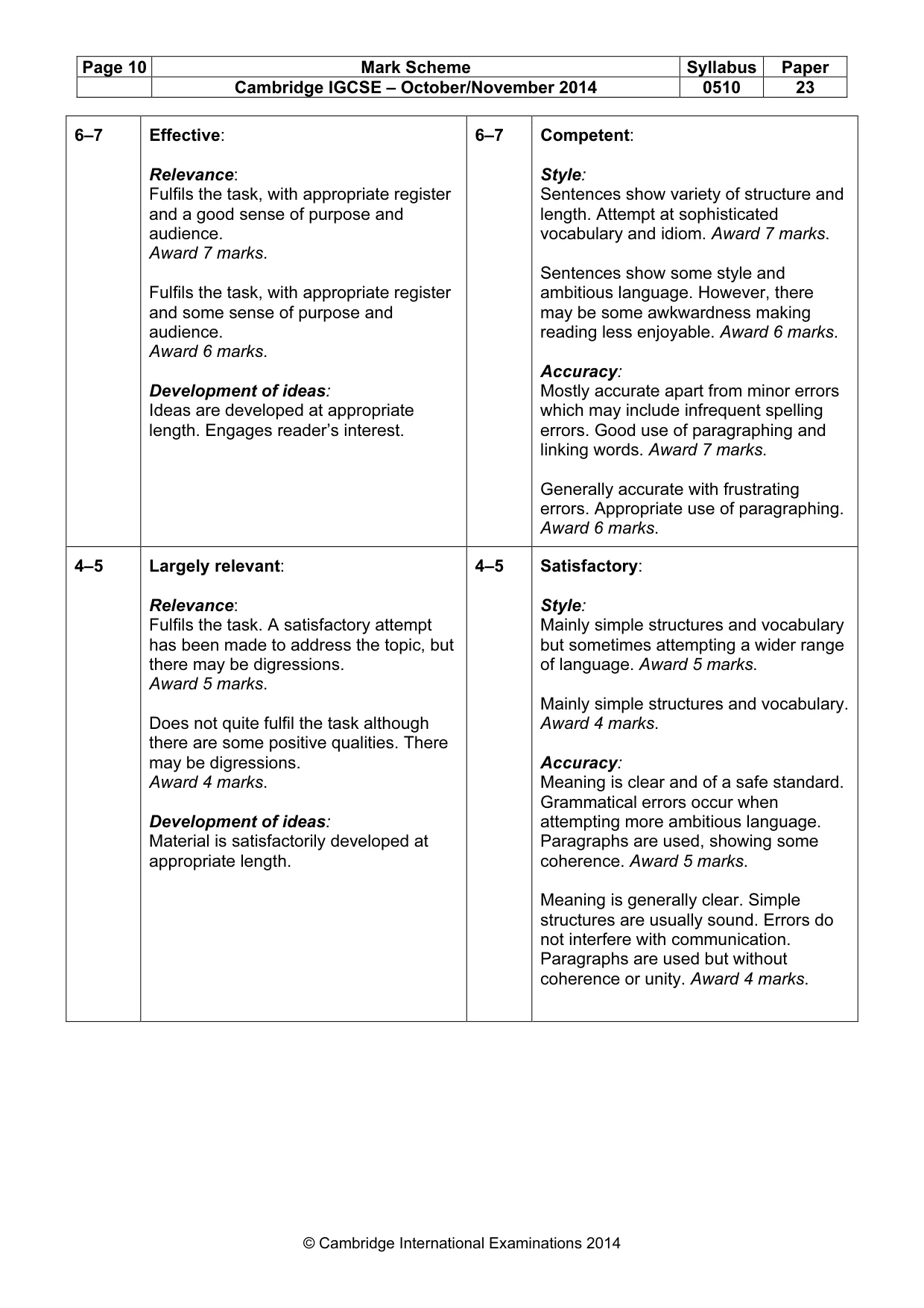
Page 10 Mark Scheme Syllabus Paper Cambridge IGCSE – October/November 2014 0510 23 © Cambridge International Examinations 2014 6–7 Effective: Relevance: Fulfils the task, with appropriate register and a good sense of purpose and audience. Award 7 marks. Fulfils the task, with appropriate register and some sense of purpose and audience. Award 6 marks. Development of ideas: Ideas are developed at appropriate length. Engages reader’s interest. 6–7 Competent: Style: Sentences show variety of structure and length. Attempt at sophisticated vocabulary and idiom. Award 7 marks. Sentences show some style and ambitious language. However, there may be some awkwardness making reading less enjoyable. Award 6 marks. Accuracy: Mostly accurate apart from minor errors which may include infrequent spelling errors. Good use of paragraphing and linking words. Award 7 marks. Generally accurate with frustrating errors. Appropriate use of paragraphing. Award 6 marks. 4–5 Largely relevant: Relevance: Fulfils the task. A satisfactory attempt has been made to address the topic, but there may be digressions. Award 5 marks. Does not quite fulfil the task although there are some positive qualities. There may be digressions. Award 4 marks. Development of ideas: Material is satisfactorily developed at appropriate length. 4–5 Satisfactory: Style: Mainly simple structures and vocabulary but sometimes attempting a wider range of language. Award 5 marks. Mainly simple structures and vocabulary. Award 4 marks. Accuracy: Meaning is clear and of a safe standard. Grammatical errors occur when attempting more ambitious language. Paragraphs are used, showing some coherence. Award 5 marks. Meaning is generally clear. Simple structures are usually sound. Errors do not interfere with communication. Paragraphs are used but without coherence or unity. Award 4 marks.
Mark scheme, page 11
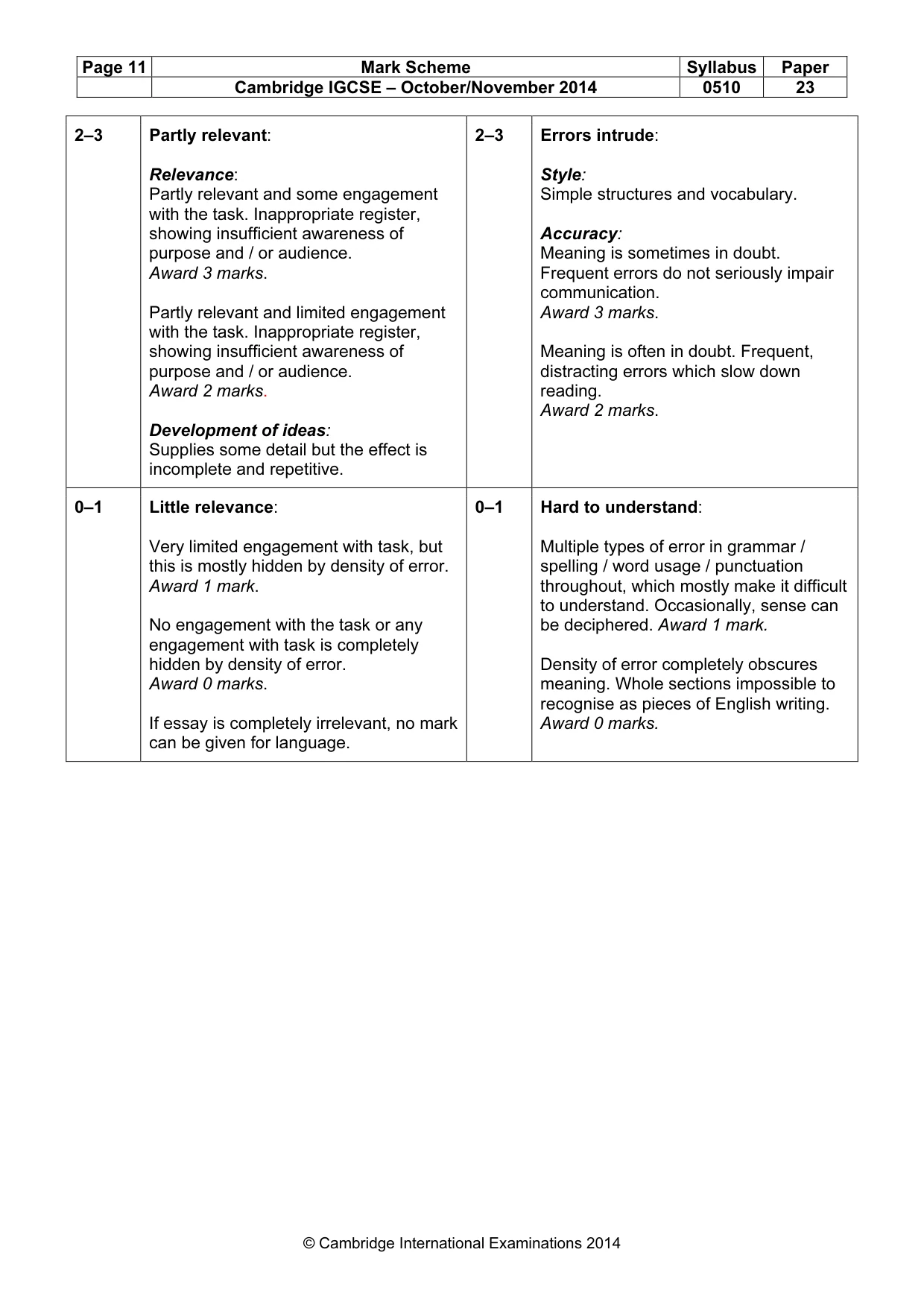
Page 11 Mark Scheme Syllabus Paper Cambridge IGCSE – October/November 2014 0510 23 © Cambridge International Examinations 2014 2–3 Partly relevant: Relevance: Partly relevant and some engagement with the task. Inappropriate register, showing insufficient awareness of purpose and / or audience. Award 3 marks. Partly relevant and limited engagement with the task. Inappropriate register, showing insufficient awareness of purpose and / or audience. Award 2 marks. Development of ideas: Supplies some detail but the effect is incomplete and repetitive. 2–3 Errors intrude: Style: Simple structures and vocabulary. Accuracy: Meaning is sometimes in doubt. Frequent errors do not seriously impair communication. Award 3 marks. Meaning is often in doubt. Frequent, distracting errors which slow down reading. Award 2 marks. 0–1 Little relevance: Very limited engagement with task, but this is mostly hidden by density of error. Award 1 mark. No engagement with the task or any engagement with task is completely hidden by density of error. Award 0 marks. If essay is completely irrelevant, no mark can be given for language. 0–1 Hard to understand: Multiple types of error in grammar / spelling / word usage / punctuation throughout, which mostly make it difficult to understand. Occasionally, sense can be deciphered. Award 1 mark. Density of error completely obscures meaning. Whole sections impossible to recognise as pieces of English writing. Award 0 marks.
What you needed in this session
Cambridge’s own grade thresholds for 2014 Oct/Nov, Paper 2 · Variant 3. A higher threshold means an easier paper — the bar moves with how the cohort did.