Cambridge IGCSE English - Second Language (oral endorsement) 0510 — 2014 Oct/Nov Paper 2 · Variant 2
0510/22/O/N/14 · 90 marks · ≈101 min
The question paper and its mark scheme, free to read here and free to download. This is Cambridge’s own paper, exactly as it was sat.
Question paper16 pages




Mark scheme12 pages
Answers below. Sit the paper first if you are practising.
Paper as text
Question paper, page 1
This document consists of 15 printed pages and 1 blank page. DC (NH/SW) 103511/6 R © UCLES 2014 [Turn over * 5 1 3 8 3 1 2 3 2 4 * ENGLISH AS A SECOND LANGUAGE 0510/22 Paper 2 Reading and Writing (Extended) October/November 2014 2 hours Candidates answer on the Question Paper. No Additional Materials are required. READ THESE INSTRUCTIONS FIRST Write your Centre number, candidate number and name on all the work you hand in. Write in dark blue or black pen. Do not use staples, paper clips, glue or correction fluid. DO NOT WRITE IN ANY BARCODES. Answer all questions. Dictionaries are not allowed. At the end of the examination, fasten all your work securely together. The number of marks is given in brackets [ ] at the end of each question or part question. Cambridge International Examinations Cambridge International General Certificate of Secondary Education
Question paper, page 2
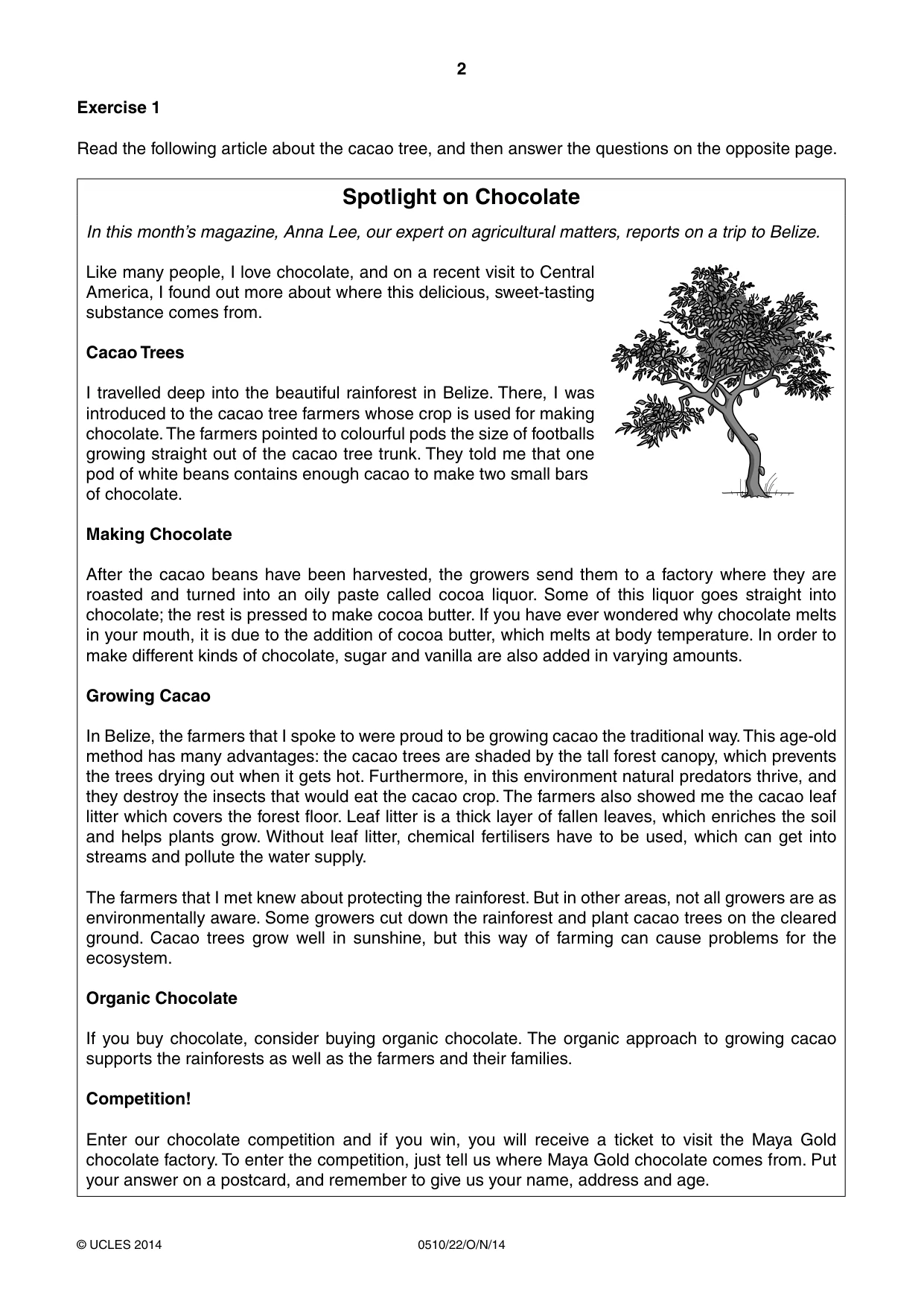
2 0510/22/O/N/14 © UCLES 2014 Exercise 1 Read the following article about the cacao tree, and then answer the questions on the opposite page. Spotlight on Chocolate In this month’s magazine, Anna Lee, our expert on agricultural matters, reports on a trip to Belize. Like many people, I love chocolate, and on a recent visit to Central America, I found out more about where this delicious, sweet-tasting substance comes from. Cacao Trees I travelled deep into the beautiful rainforest in Belize. There, I was introduced to the cacao tree farmers whose crop is used for making chocolate. The farmers pointed to colourful pods the size of footballs growing straight out of the cacao tree trunk. They told me that one pod of white beans contains enough cacao to make two small bars of chocolate. Making Chocolate After the cacao beans have been harvested, the growers send them to a factory where they are roasted and turned into an oily paste called cocoa liquor. Some of this liquor goes straight into chocolate; the rest is pressed to make cocoa butter. If you have ever wondered why chocolate melts in your mouth, it is due to the addition of cocoa butter, which melts at body temperature. In order to make different kinds of chocolate, sugar and vanilla are also added in varying amounts. Growing Cacao In Belize, the farmers that I spoke to were proud to be growing cacao the traditional way. This age-old method has many advantages: the cacao trees are shaded by the tall forest canopy, which prevents the trees drying out when it gets hot. Furthermore, in this environment natural predators thrive, and they destroy the insects that would eat the cacao crop. The farmers also showed me the cacao leaf litter which covers the forest floor. Leaf litter is a thick layer of fallen leaves, which enriches the soil and helps plants grow. Without leaf litter, chemical fertilisers have to be used, which can get into streams and pollute the water supply. The farmers that I met knew about protecting the rainforest. But in other areas, not all growers are as environmentally aware. Some growers cut down the rainforest and plant cacao trees on the cleared ground. Cacao trees grow well in sunshine, but this way of farming can cause problems for the ecosystem. Organic Chocolate If you buy chocolate, consider buying organic chocolate. The organic approach to growing cacao supports the rainforests as well as the farmers and their families. Competition! Enter our chocolate competition and if you win, you will receive a ticket to visit the Maya Gold chocolate factory. To enter the competition, just tell us where Maya Gold chocolate comes from. Put your answer on a postcard, and remember to give us your name, address and age.
Question paper, page 3
3 0510/22/O/N/14 © UCLES 2014 [Turn over (a) Who did Anna meet on her trip to the rainforest? …[1] (b) On which part of the tree do the cacao pods grow? …[1] (c) How many cacao pods are needed to produce two bars of chocolate? …[1] (d) How is cocoa liquor used? Give two details. … …[1] (e) Why does chocolate melt at body temperature? …[1] (f) What are the benefits of the traditional method of growing cacao? Give two details. … …[2] (g) What prize will competition winners receive? …[1] (h) Apart from your competition answer, what should you include on the postcard? …[1] [Total: 9]
Question paper, page 4
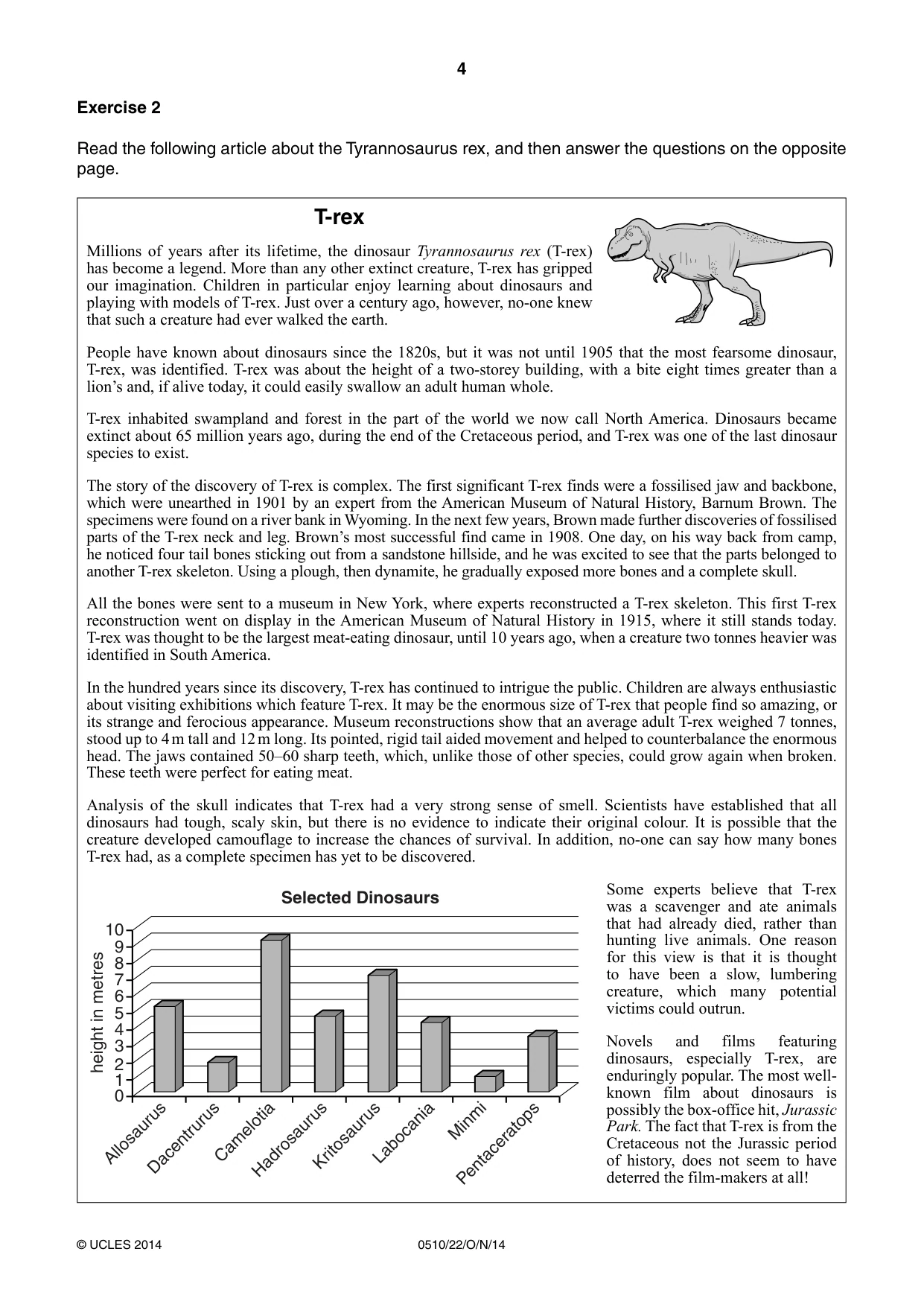
4 0510/22/O/N/14 © UCLES 2014 Exercise 2 Read the following article about the Tyrannosaurus rex, and then answer the questions on the opposite page. T-rex Millions of years after its lifetime, the dinosaur Tyrannosaurus rex (T-rex) has become a legend. More than any other extinct creature, T-rex has gripped our imagination. Children in particular enjoy learning about dinosaurs and playing with models of T-rex. Just over a century ago, however, no-one knew that such a creature had ever walked the earth. People have known about dinosaurs since the 1820s, but it was not until 1905 that the most fearsome dinosaur, T-rex, was identified. T-rex was about the height of a two-storey building, with a bite eight times greater than a lion’s and, if alive today, it could easily swallow an adult human whole. T-rex inhabited swampland and forest in the part of the world we now call North America. Dinosaurs became extinct about 65 million years ago, during the end of the Cretaceous period, and T-rex was one of the last dinosaur species to exist. The story of the discovery of T-rex is complex. The first significant T-rex finds were a fossilised jaw and backbone, which were unearthed in 1901 by an expert from the American Museum of Natural History, Barnum Brown. The specimens were found on a river bank in Wyoming. In the next few years, Brown made further discoveries of fossilised parts of the T-rex neck and leg. Brown’s most successful find came in 1908. One day, on his way back from camp, he noticed four tail bones sticking out from a sandstone hillside, and he was excited to see that the parts belonged to another T-rex skeleton. Using a plough, then dynamite, he gradually exposed more bones and a complete skull. All the bones were sent to a museum in New York, where experts reconstructed a T-rex skeleton. This first T-rex reconstruction went on display in the American Museum of Natural History in 1915, where it still stands today. T-rex was thought to be the largest meat-eating dinosaur, until 10 years ago, when a creature two tonnes heavier was identified in South America. In the hundred years since its discovery, T-rex has continued to intrigue the public. Children are always enthusiastic about visiting exhibitions which feature T-rex. It may be the enormous size of T-rex that people find so amazing, or its strange and ferocious appearance. Museum reconstructions show that an average adult T-rex weighed 7 tonnes, stood up to 4 m tall and 12 m long. Its pointed, rigid tail aided movement and helped to counterbalance the enormous head. The jaws contained 50–60 sharp teeth, which, unlike those of other species, could grow again when broken. These teeth were perfect for eating meat. Analysis of the skull indicates that T-rex had a very strong sense of smell. Scientists have established that all dinosaurs had tough, scaly skin, but there is no evidence to indicate their original colour. It is possible that the creature developed camouflage to increase the chances of survival. In addition, no-one can say how many bones T-rex had, as a complete specimen has yet to be discovered. Some experts believe that T-rex was a scavenger and ate animals that had already died, rather than hunting live animals. One reason for this view is that it is thought to have been a slow, lumbering creature, which many potential victims could outrun. Novels and films featuring dinosaurs, especially T-rex, are enduringly popular. The most well- known film about dinosaurs is possibly the box-office hit, Jurassic Park. The fact that T-rex is from the Cretaceous not the Jurassic period of history, does not seem to have deterred the film-makers at all! 10 9 8 7 6 5 4 3 2 1 0 Allosaurus Dacentrurus Camelotia Hadrosaurus Kritosaurus Labocania Minmi Pentaceratops height in metres Selected Dinosaurs
Question paper, page 5
5 0510/22/O/N/14 © UCLES 2014 [Turn over (a) When were people first aware of dinosaurs? …[1] (b) What kind of environment did T-rex live in? Give two details. … …[1] (c) Which T-rex bones did Barnum Brown discover first? Give two details. … …[1] (d) Where could people first see a life-size model of T-rex? …[1] (e) What advantages did the stiff tail give T-rex? Give two details. … …[2] (f) What was unusual about T-rex’s teeth? …[1] (g) How do we know that T-rex had a powerful sense of smell? …[1] (h) What do experts know about the appearance of dinosaurs’ skin? …[1] (i) Why was it difficult for T-rex to catch live animals? …[1] (j) According to the chart, which was the second smallest dinosaur and what was its height? …[1] (k) What evidence is there that dinosaurs fascinate people? Give four details. … … … …[4] [Total: 15]
Question paper, page 6
6 0510/22/O/N/14 © UCLES 2014 Exercise 3 Leila Ranjit and her twin brother, Eric, attend Lakeview Community School, 1767 Falling Leaf Avenue, Toronto, L3J 6T8, in Canada, where they are both studying for a travel and tourism qualification. Leila and her brother are keen to get a job with an airline when they leave school. Leila was doing some research for her coursework when she found out about the Airline Training Partnership (ATP). This local organisation offers students the chance to do work experience, and Leila and her brother were very interested in the opportunity. The twins’ travel and tourism teacher, Mr Wilson, agreed that the work experience would be of benefit, and he applied to ATP for the twins to attend. Leila and her brother were delighted when Mr Wilson told them they had been given a full day’s work experience on 21 June, starting at 9am. This was a particularly special day for them as it was also their 17th birthday. The training took place at a special training facility on an airfield. Their parents were excited about this opportunity for the twins and they drove them to the local train station, where they caught a train to the airfield. On arrival at ATP Leila, Eric and other work experience students from different schools, met some airline representatives who were very well informed and answered all their questions. They went on a tour of different kinds of aircraft and even went into the cockpits where they had a go at the controls. They each had a turn at using a flight simulator and practised take-off and landing of an aircraft. The twins also watched a film about what cabin crew have to do if there is an emergency. At the end of the day, the twins met a pilot, who talked about his experiences flying around the world. During their excellent lunch, the twins were presented with a surprise birthday cake. All the work experience participants wished them a very happy birthday. After this, they went back on board and were given emergency-type situations to manage on one of the planes, just as if they were real cabin crew. It was fun dealing with smoke in the kitchen and going down the emergency chute, but Leila feels she will never forget the excitement of climbing onto a life raft. Leila loved showing her friends the photographs she had taken, especially those of the practical tasks she had carried out in the afternoon, which made the experience interesting. This confirmed for her that she wanted to work in the travel industry. Eric felt that the life-saving skills that he had learned made him think he might like to work in the fire service. The twins loved the day and felt that the staff had been very friendly and informative. Leila hopes that her school will allow other students to have the same opportunity in future. ATP ask work experience participants to complete a feedback questionnaire. Imagine you are Leila. Fill in the questionnaire, using the information above.
Question paper, page 7
7 0510/22/O/N/14 © UCLES 2014 [Turn over ATP Work Experience Feedback Questionnaire Section A: Personal details Full Name: … MALE / FEMALE: (please delete) Age: … Name of person who arranged your work experience: … School name: … School address: … Full name of any other student from your school attending the event: … Section B: Work Experience details Date of work experience: … Which session(s) did you attend? (please tick) Morning Afternoon Morning and afternoon How helpful were the staff you met? … What was your opinion of the lunch provided? … What was the most memorable activity of the day? … Section C Write one sentence between 12–20 words saying whether you would recommend this work experience and why. [Total: 8]
Question paper, page 8
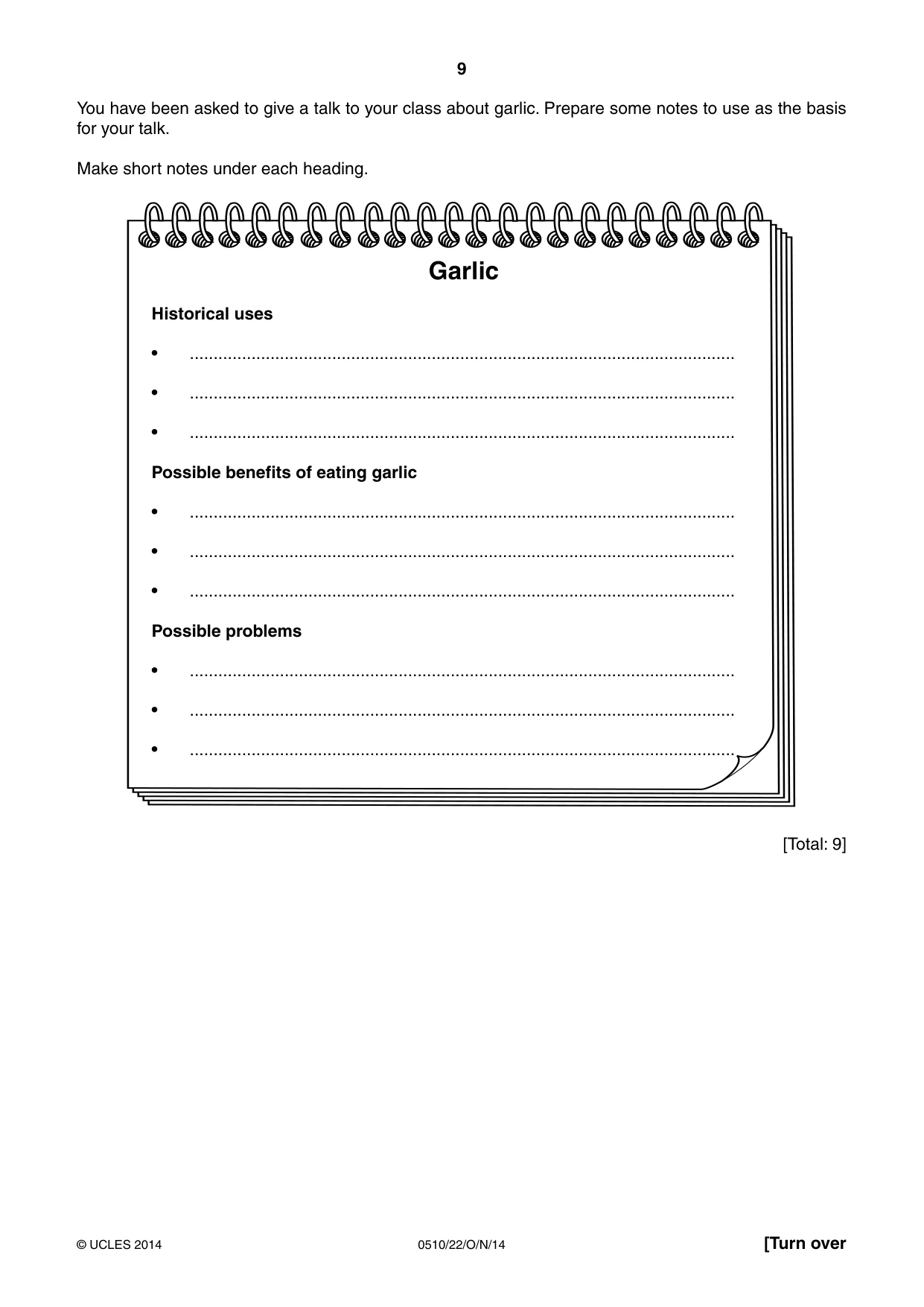
8 0510/22/O/N/14 © UCLES 2014 Exercise 4 Read the following article about the uses of garlic, and then complete the notes on the opposite page. Garlic: the lifesaver Often bitter, sometimes sweet, garlic is a real attack on the senses. Love it or hate it, it is impossible to ignore this ancient member of the onion family, and it might just save your life. Garlic dates back over 6 000 years, and is a native plant of central Asia. In ancient Egypt, garlic was included in religious ceremonies. Interestingly, clay models of garlic have been found in the tomb of Tutankhamun. Apart from its spiritual uses the Egyptians valued it as a form of currency when exchanging goods. The Romans thought of it in health terms, as an internal cleanser. Today, garlic is used as a seasoning in Asia, Africa and Europe. It is appreciated by cooks because it has a distinctive taste and can bring out the flavour of other ingredients. It is also easy to grow, as long as you protect it from birds. They mistake the emerging garlic bulbs for worms and enjoy eating them. After harvesting, the garlic can be dried in the sun, or in an airy place for the skin to mature so that it remains fresh for longer. In scientific terms, garlic is a member of the allium family, which includes onions, leeks and chives. Crushing garlic produces allicin, which is known to scientists for its unique health-giving properties. It is also the substance which gives garlic its characteristic aroma. Scientists are researching the health benefits of garlic and have discovered some encouraging facts. In the well respected scientific investigation called the ‘Seven Countries Study’, scientists found a clear connection between the consumption of garlic and low rates of heart disease, even when other factors which might also reduce heart disease, such as a healthy diet, were taken into account. Furthermore, studies in Asian countries found that eating garlic every day reduced the rates of some kinds of cancer. Some people who suffer from asthma have said their health improved after they began to include garlic in their diet, but so far there is not enough scientific evidence for doctors to recommend it for this condition. It seems wise to include garlic in your diet, but only in moderate amounts. Eating excessive amounts of garlic can be harmful, because the high sulphur content destroys the natural bacteria in the gut. This can cause the irritating skin condition, dermatitis. It has also been known to cause a distressing and painful inflammation of the stomach. There has even been some evidence that a very high intake of garlic can cause difficulties with blood clotting. Garlic has always been part of people’s diet in some parts of the world, but in other areas it is a more recent addition and is increasing in popularity. For people who like eating garlic, but who are worried about their breath smelling of it, the best cure seems to be to take a sauna or just sweat a lot. This is far more effective than eating mint or chewing parsley. An informal alternative is to make sure your close friends eat the same amount of garlic as you do.
Question paper, page 9
9 0510/22/O/N/14 © UCLES 2014 [Turn over You have been asked to give a talk to your class about garlic. Prepare some notes to use as the basis for your talk. Make short notes under each heading. Garlic Historical uses • … • … • … Possible benefits of eating garlic • … • … • … Possible problems • … • … • … [Total: 9]
Question paper, page 10
10 0510/22/O/N/14 © UCLES 2014 Exercise 5 Read the following article about baby elephants who have lost their parents and are being raised in an orphanage. On the opposite page, write a summary about the problems the orphan elephants have and how the workers at the orphanage overcome these problems. Your summary should be about 100 words long (and no more than 120 words long). You should use your own words as far as possible. You will receive up to 6 marks for the content of your summary and up to 5 marks for the style and accuracy of your language. Orphaned Elephants The David Sheldrick Wildlife Trust in Kenya, east Africa, is the first orphanage to care for baby elephants who have lost their families. Since it first opened, it has reared 62 elephants – the equivalent of a large herd. David’s daughter, Angela, who is now in charge, says, “We want to raise the elephants so that they are psychologically strong enough to be returned to the wild, where they belong.” When Angela’s mother, Daphne, reared her first newborn elephant in the early 1970s, it had never been done before. “Infant elephants are very difficult to feed by hand,” says Angela. “They will refuse food unless the tip of their trunk rests on something that feels like their mother’s body.” The keepers at the orphanage wear a woollen blanket tied around them, as the texture of the blanket reminds the babies of the absent mother. They need four big bottles of milk at each feeding, but they drink very slowly. It takes a lot of time and patience to feed them and to make sure they get enough milk. One of the first hand-reared elephants was Olmeg, who was just two years old when he was flown in. Tribesmen had discovered him trapped in mud and seriously dehydrated. “He was terrified when he arrived,” says Angela, “and we thought we might lose him.” He survived, thanks to their expert nursing skills. Another, Dika, arrived when he was three months old. His family had been attacked by ivory poachers. Terrified, he had run away through thorn bushes. When he was found, his tiny body was pierced with hundreds of thorns. For four months he was traumatised from such a horrific experience, and did not respond to the keepers. Under the keepers’ love and support, he eventually started to feed and become happier. Elephants share many characteristics with humans. They have the same lifespan as we do, and develop at a similar pace, reaching adulthood at the age of 20. They mourn the death of their loved ones, even suffering depression. Elephants also share a strong sense of family, which means they can be jealous and competitive. The keepers have learned techniques to manage the elephants’ behaviour. All the elephants grieve for lost relatives when they first come to the orphanage. The youngest resident is Nalitu, who is just over four months old. She was found two months ago after she had been washed away from her herd during a flood. “She was depressed when she first came,” says Angela, “but she is gradually recovering.” Another baby elephant, tiny Buchuma, fell into a storm drain, but has recovered and is now flourishing at the orphanage. Baby elephants get pneumonia easily and can die, so the orphanage staff need to take special precautions. Angela says, “In the wild, a baby lies under its mother’s belly, protected from rain and wind. In the orphanage, we protect them with blankets and an umbrella.” Less serious conditions are also dealt with effectively. “We rub the baby elephants with coconut oil to prevent dry skin and to keep ticks and parasites away,” explains Angela. Angela says that the work of the orphanage is never easy, but adds, “It is so rewarding. The elephants have fantastic memories and never forget anything. After being returned to the wild, they occasionally return to see us. It is wonderful to see them doing so well.”
Question paper, page 11
11 0510/22/O/N/14 © UCLES 2014 [Turn over … … … … … … … … … … … … … … … … … … … … … … … … … … … [Total: 11]
Question paper, page 12
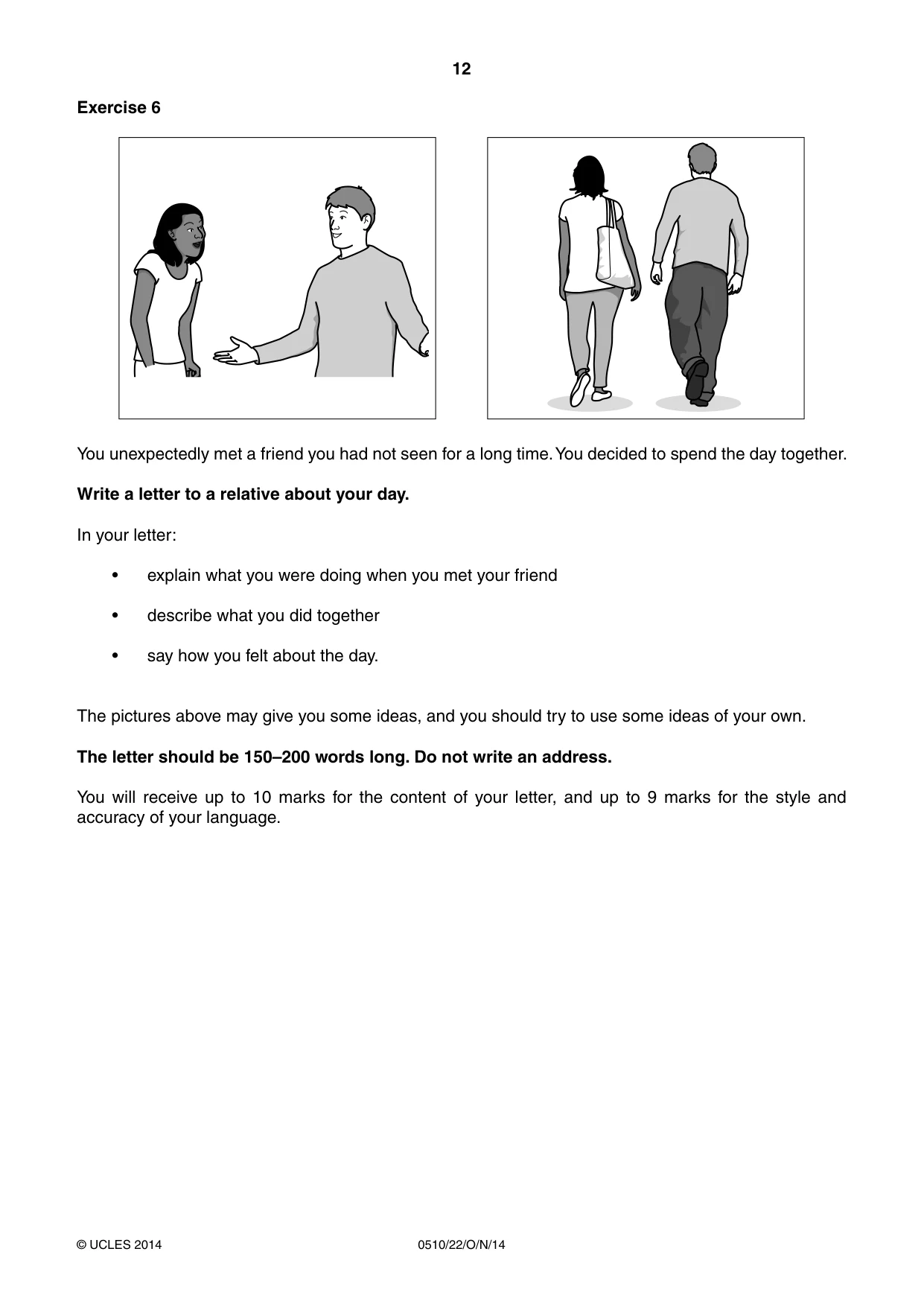
12 0510/22/O/N/14 © UCLES 2014 Exercise 6 You unexpectedly met a friend you had not seen for a long time. You decided to spend the day together. Write a letter to a relative about your day. In your letter: • explain what you were doing when you met your friend • describe what you did together • say how you felt about the day. The pictures above may give you some ideas, and you should try to use some ideas of your own. The letter should be 150–200 words long. Do not write an address. You will receive up to 10 marks for the content of your letter, and up to 9 marks for the style and accuracy of your language.
Question paper, page 13
13 0510/22/O/N/14 © UCLES 2014 [Turn over … … … … … … … … … … … … … … … … … … … … … … … … … [Total: 19]
Question paper, page 14
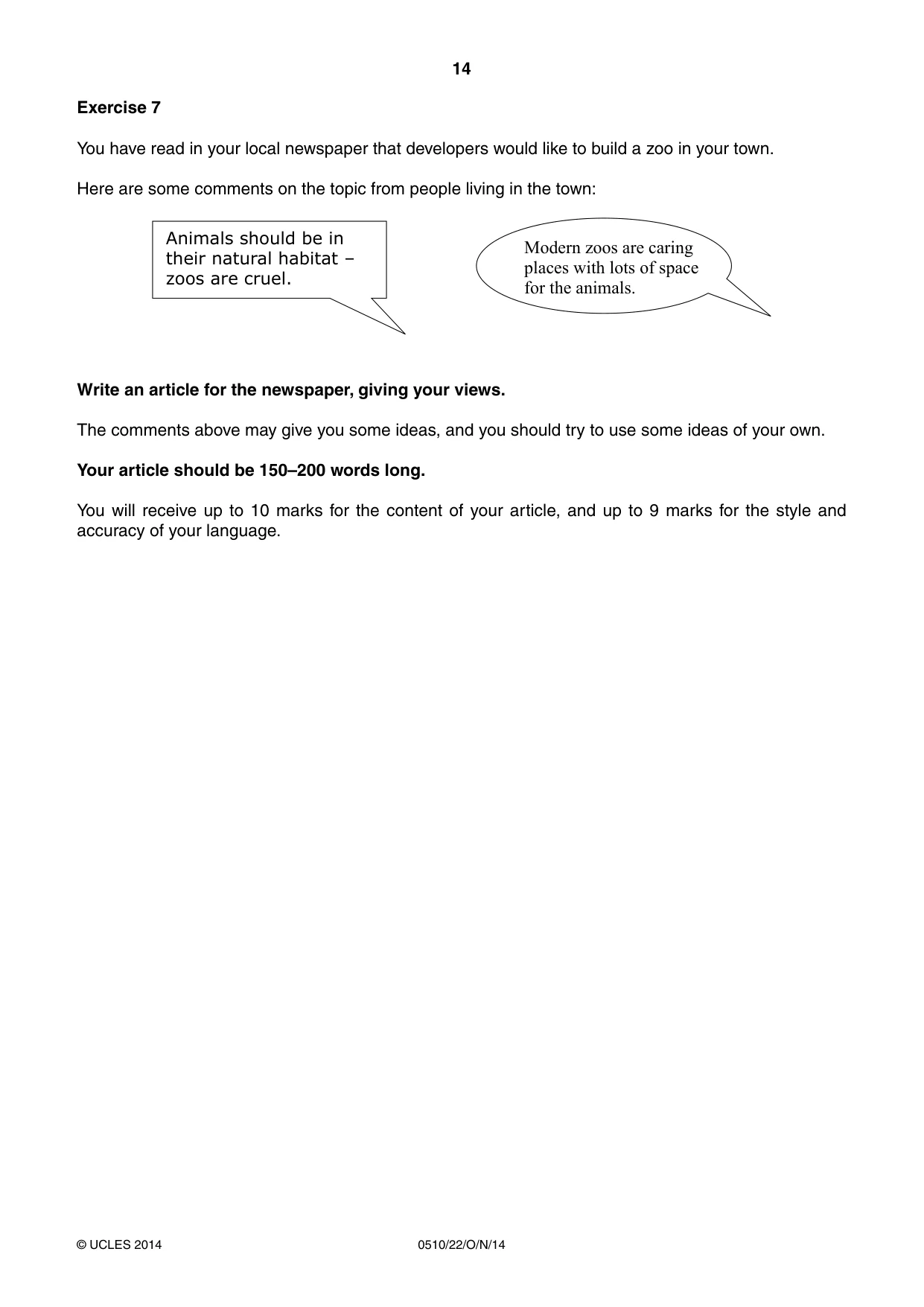
14 0510/22/O/N/14 © UCLES 2014 Exercise 7 You have read in your local newspaper that developers would like to build a zoo in your town. Here are some comments on the topic from people living in the town: Modern zoos are caring places with lots of space for the animals. Animals should be in their natural habitat – zoos are cruel. Write an article for the newspaper, giving your views. The comments above may give you some ideas, and you should try to use some ideas of your own. Your article should be 150–200 words long. You will receive up to 10 marks for the content of your article, and up to 9 marks for the style and accuracy of your language.
Question paper, page 15
15 0510/22/O/N/14 © UCLES 2014 … … … … … … … … … … … … … … … … … … … … … … … … … … … [Total: 19]
Question paper, page 16
16 0510/22/O/N/14 © UCLES 2014 Permission to reproduce items where third-party owned material protected by copyright is included has been sought and cleared where possible. Every reasonable effort has been made by the publisher (UCLES) to trace copyright holders, but if any items requiring clearance have unwittingly been included, the publisher will be pleased to make amends at the earliest possible opportunity. Cambridge International Examinations is part of the Cambridge Assessment Group. Cambridge Assessment is the brand name of University of Cambridge Local Examinations Syndicate (UCLES), which is itself a department of the University of Cambridge. BLANK PAGE
Mark scheme, page 1
® IGCSE is the registered trademark of Cambridge International Examinations. CAMBRIDGE INTERNATIONAL EXAMINATIONS Cambridge International General Certificate of Secondary Education MARK SCHEME for the October/November 2014 series 0510 ENGLISH AS A SECOND LANGUAGE 0510/22 Paper 2 (Reading and Writing – Extended), maximum raw mark 90 This mark scheme is published as an aid to teachers and candidates, to indicate the requirements of the examination. It shows the basis on which Examiners were instructed to award marks. It does not indicate the details of the discussions that took place at an Examiners’ meeting before marking began, which would have considered the acceptability of alternative answers. Mark schemes should be read in conjunction with the question paper and the Principal Examiner Report for Teachers. Cambridge will not enter into discussions about these mark schemes. Cambridge is publishing the mark schemes for the October/November 2014 series for most Cambridge IGCSE®, Cambridge International A and AS Level components and some Cambridge O Level components.
Mark scheme, page 2
Page 2 Mark Scheme Syllabus Paper Cambridge IGCSE – October/November 2014 0510 22 © Cambridge International Examinations 2014 IGCSE English as a Second Language Extended tier Reading/Writing (Paper 2) This component forms part of the Extended tier assessment of IGCSE English as a Second Language and tests the following Assessment Objectives: AO1: Reading R1 understand and respond to information presented in a variety of forms R2 select and organise material relevant to specific purposes R3 recognise, understand and distinguish between facts, ideas and opinions R4 infer information from texts AO2: Writing W1 communicate clearly, accurately and appropriately W2 convey information and express opinions effectively W3 employ and control a variety of grammatical structures W4 demonstrate knowledge and understanding of a range of appropriate vocabulary W5 observe conventions of paragraphing, punctuation and spelling W6 employ appropriate register/style Overview of exercises on Paper 2 Reading objectives tested Marks for reading objectives Writing objectives tested Marks for writing objectives Total available marks Exercise 1 Reading (1) R1 9 – 9 Exercise 2 Reading (2) R1 15 – 15 Exercise 3 Information transfer R1, R2 6 W1, W5 2 8 Exercise 4 Note- making R1, R2, R3 9 – 9 Exercise 5 Summary R1, R2, R3 6 W1, W2, W3, W4, W5 5 11 Exercise 6 Writing (1) – W1, W2, W3, W4, W5, W6 19 19 Exercise 7 Writing (2) – W1, W2, W3, W4, W5, W6 19 19 90
Mark scheme, page 3
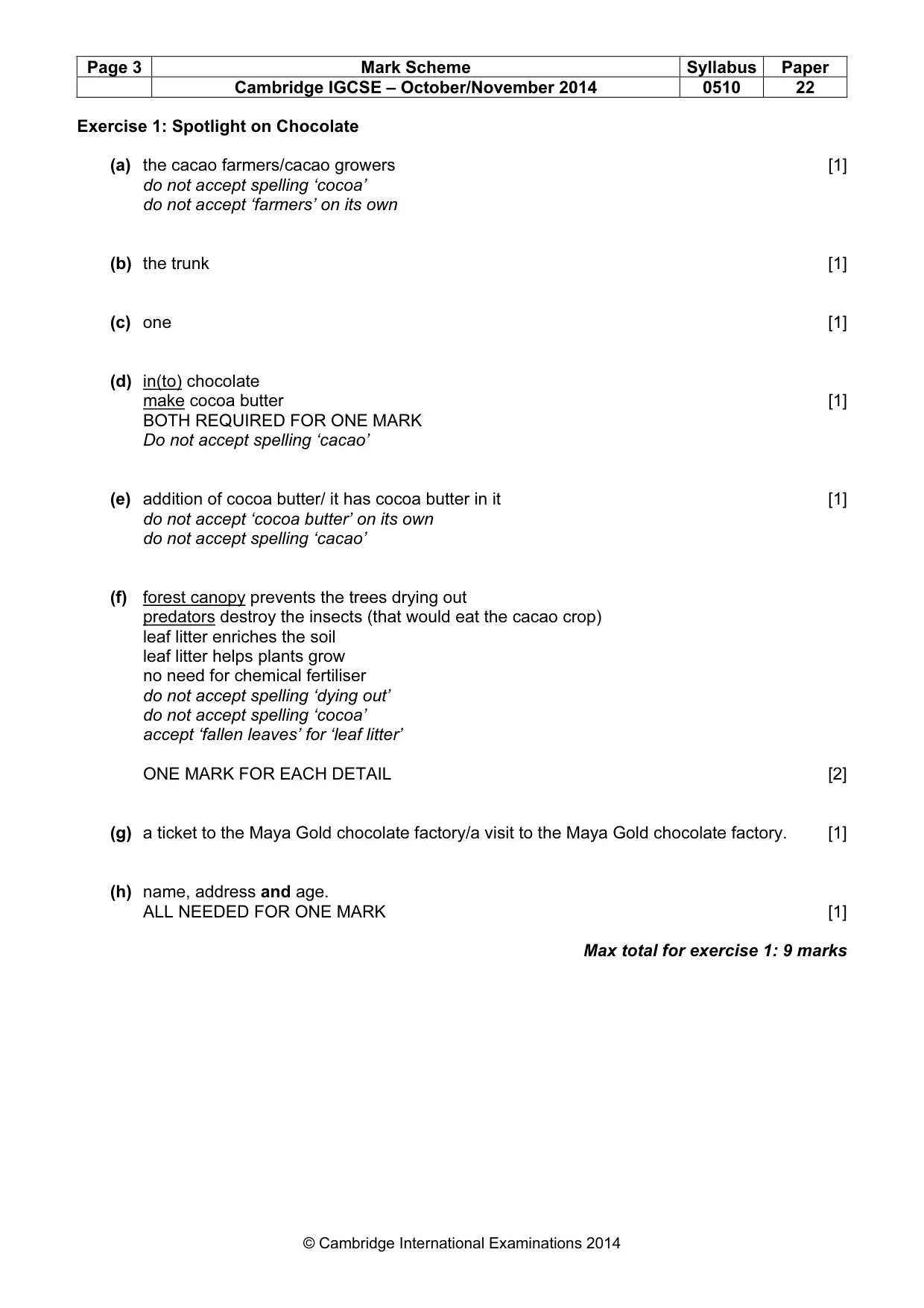
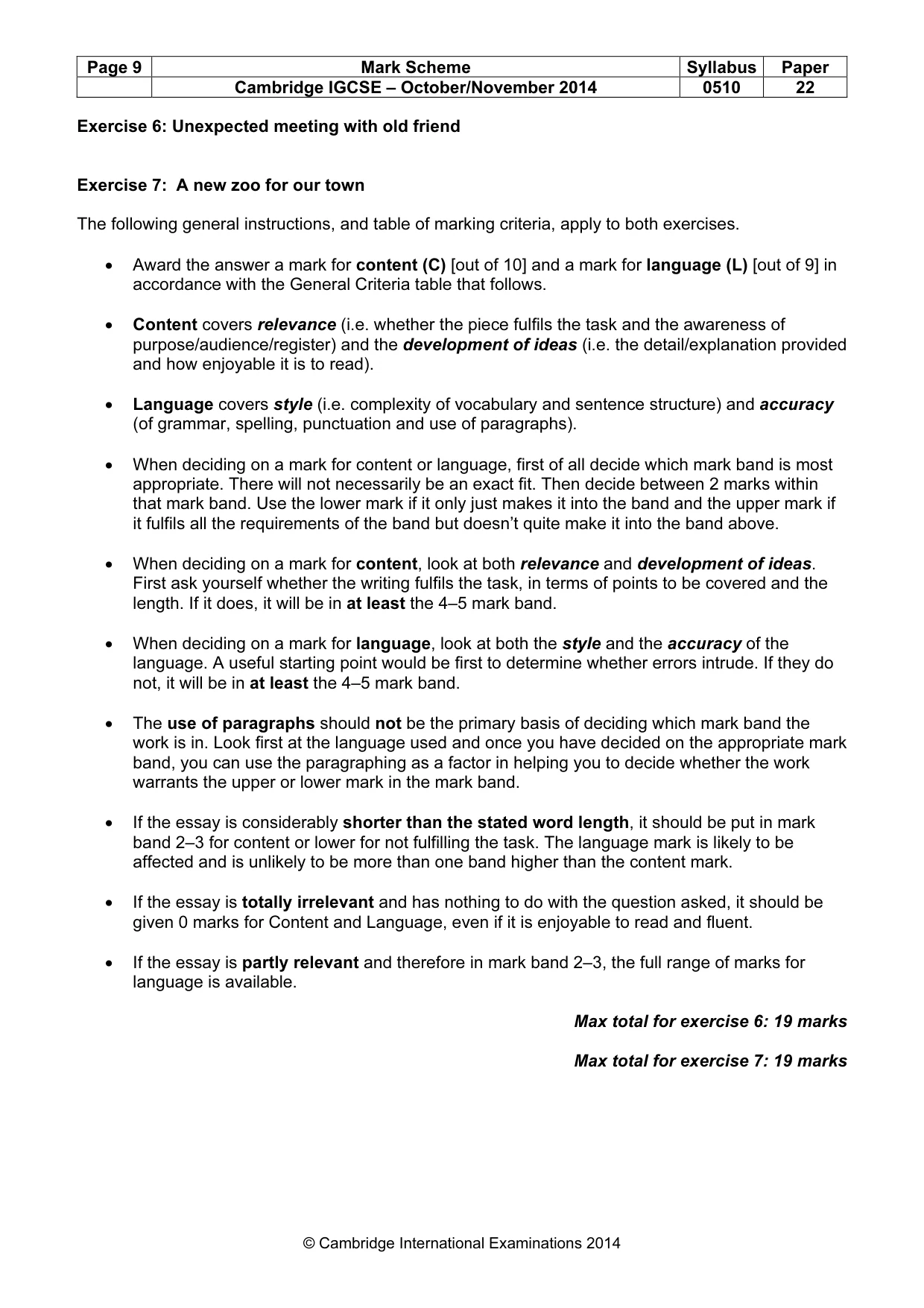
Page 3 Mark Scheme Syllabus Paper Cambridge IGCSE – October/November 2014 0510 22 © Cambridge International Examinations 2014 Exercise 1: Spotlight on Chocolate (a) the cacao farmers/cacao growers [1] do not accept spelling ‘cocoa’ do not accept ‘farmers’ on its own (b) the trunk [1] (c) one [1] (d) in(to) chocolate make cocoa butter [1] BOTH REQUIRED FOR ONE MARK Do not accept spelling ‘cacao’ (e) addition of cocoa butter/ it has cocoa butter in it [1] do not accept ‘cocoa butter’ on its own do not accept spelling ‘cacao’ (f) forest canopy prevents the trees drying out predators destroy the insects (that would eat the cacao crop) leaf litter enriches the soil leaf litter helps plants grow no need for chemical fertiliser do not accept spelling ‘dying out’ do not accept spelling ‘cocoa’ accept ‘fallen leaves’ for ‘leaf litter’ ONE MARK FOR EACH DETAIL [2] (g) a ticket to the Maya Gold chocolate factory/a visit to the Maya Gold chocolate factory. [1] (h) name, address and age. ALL NEEDED FOR ONE MARK [1] Max total for exercise 1: 9 marks
Mark scheme, page 4
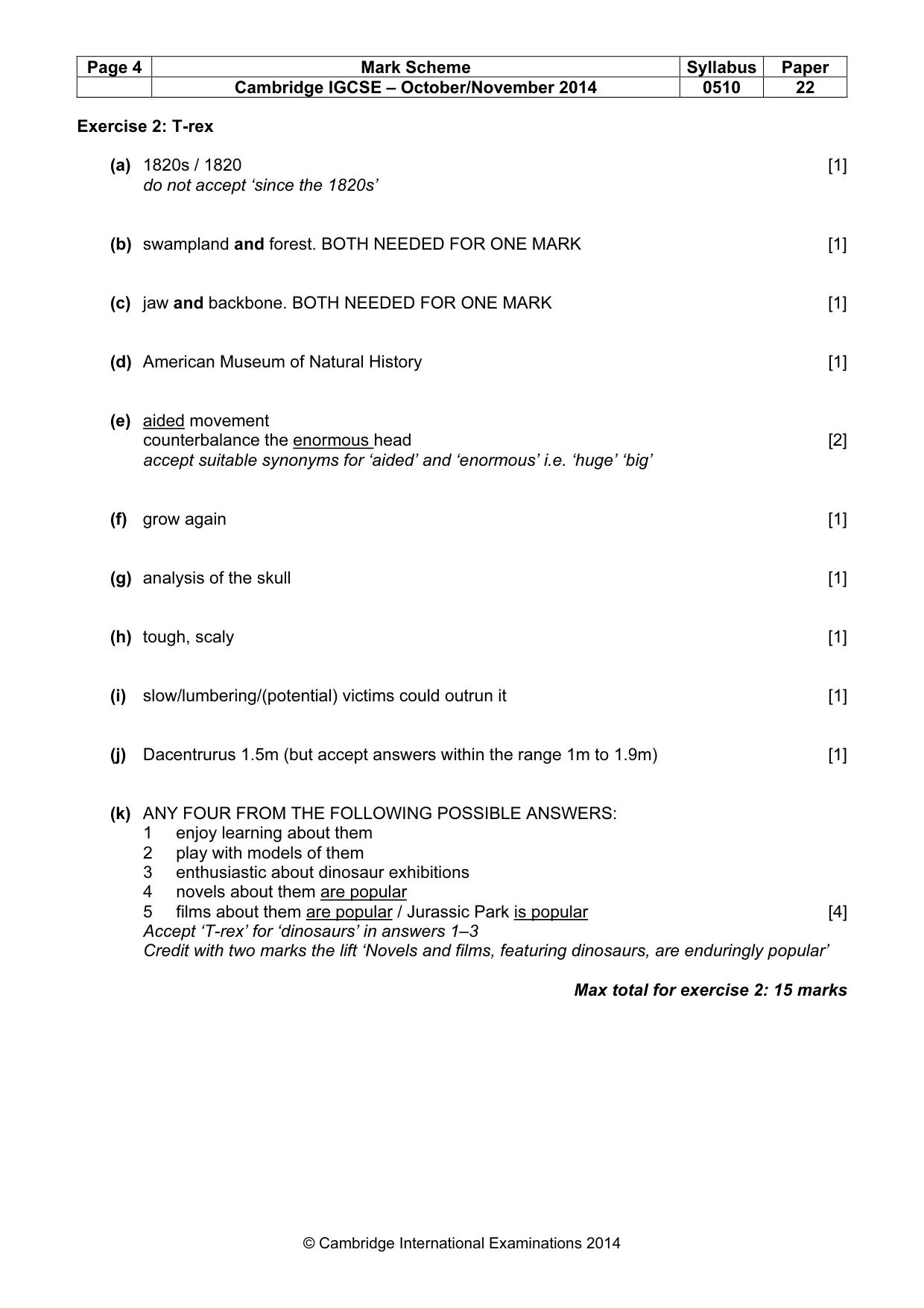
Page 4 Mark Scheme Syllabus Paper Cambridge IGCSE – October/November 2014 0510 22 © Cambridge International Examinations 2014 Exercise 2: T-rex (a) 1820s / 1820 [1] do not accept ‘since the 1820s’ (b) swampland and forest. BOTH NEEDED FOR ONE MARK [1] (c) jaw and backbone. BOTH NEEDED FOR ONE MARK [1] (d) American Museum of Natural History [1] (e) aided movement counterbalance the enormous head [2] accept suitable synonyms for ‘aided’ and ‘enormous’ i.e. ‘huge’ ‘big’ (f) grow again [1] (g) analysis of the skull [1] (h) tough, scaly [1] (i) slow/lumbering/(potential) victims could outrun it [1] (j) Dacentrurus 1.5m (but accept answers within the range 1m to 1.9m) [1] (k) ANY FOUR FROM THE FOLLOWING POSSIBLE ANSWERS: 1 enjoy learning about them 2 play with models of them 3 enthusiastic about dinosaur exhibitions 4 novels about them are popular 5 films about them are popular / Jurassic Park is popular [4] Accept ‘T-rex’ for ‘dinosaurs’ in answers 1–3 Credit with two marks the lift ‘Novels and films, featuring dinosaurs, are enduringly popular’ Max total for exercise 2: 15 marks
Mark scheme, page 5
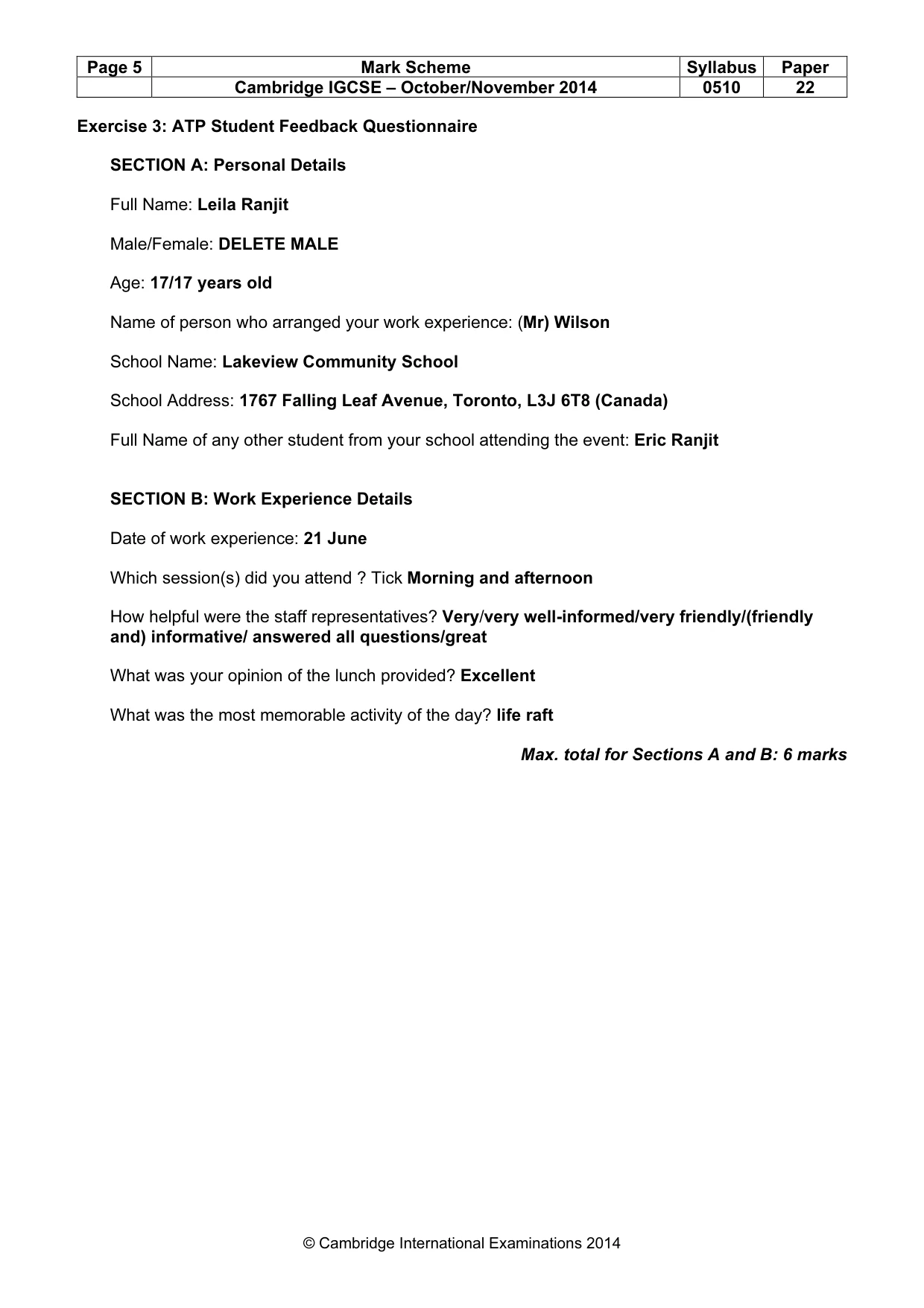
Page 5 Mark Scheme Syllabus Paper Cambridge IGCSE – October/November 2014 0510 22 © Cambridge International Examinations 2014 Exercise 3: ATP Student Feedback Questionnaire SECTION A: Personal Details Full Name: Leila Ranjit Male/Female: DELETE MALE Age: 17/17 years old Name of person who arranged your work experience: (Mr) Wilson School Name: Lakeview Community School School Address: 1767 Falling Leaf Avenue, Toronto, L3J 6T8 (Canada) Full Name of any other student from your school attending the event: Eric Ranjit SECTION B: Work Experience Details Date of work experience: 21 June Which session(s) did you attend ? Tick Morning and afternoon How helpful were the staff representatives? Very/very well-informed/very friendly/(friendly and) informative/ answered all questions/great What was your opinion of the lunch provided? Excellent What was the most memorable activity of the day? life raft Max. total for Sections A and B: 6 marks
Mark scheme, page 6
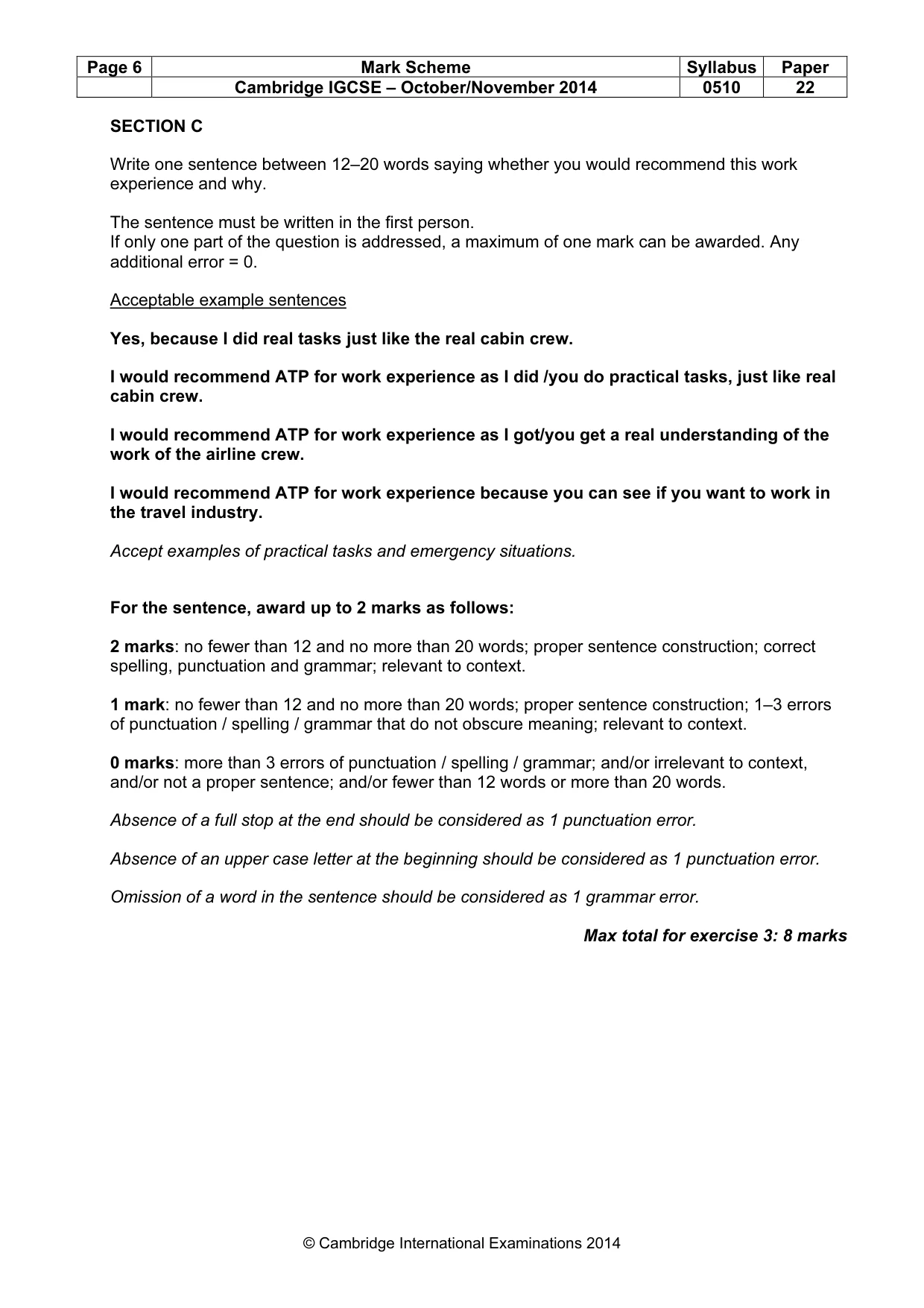
Page 6 Mark Scheme Syllabus Paper Cambridge IGCSE – October/November 2014 0510 22 © Cambridge International Examinations 2014 SECTION C Write one sentence between 12–20 words saying whether you would recommend this work experience and why. The sentence must be written in the first person. If only one part of the question is addressed, a maximum of one mark can be awarded. Any additional error = 0. Acceptable example sentences Yes, because I did real tasks just like the real cabin crew. I would recommend ATP for work experience as I did /you do practical tasks, just like real cabin crew. I would recommend ATP for work experience as I got/you get a real understanding of the work of the airline crew. I would recommend ATP for work experience because you can see if you want to work in the travel industry. Accept examples of practical tasks and emergency situations. For the sentence, award up to 2 marks as follows: 2 marks: no fewer than 12 and no more than 20 words; proper sentence construction; correct spelling, punctuation and grammar; relevant to context. 1 mark: no fewer than 12 and no more than 20 words; proper sentence construction; 1–3 errors of punctuation / spelling / grammar that do not obscure meaning; relevant to context. 0 marks: more than 3 errors of punctuation / spelling / grammar; and/or irrelevant to context, and/or not a proper sentence; and/or fewer than 12 words or more than 20 words. Absence of a full stop at the end should be considered as 1 punctuation error. Absence of an upper case letter at the beginning should be considered as 1 punctuation error. Omission of a word in the sentence should be considered as 1 grammar error. Max total for exercise 3: 8 marks
Mark scheme, page 7
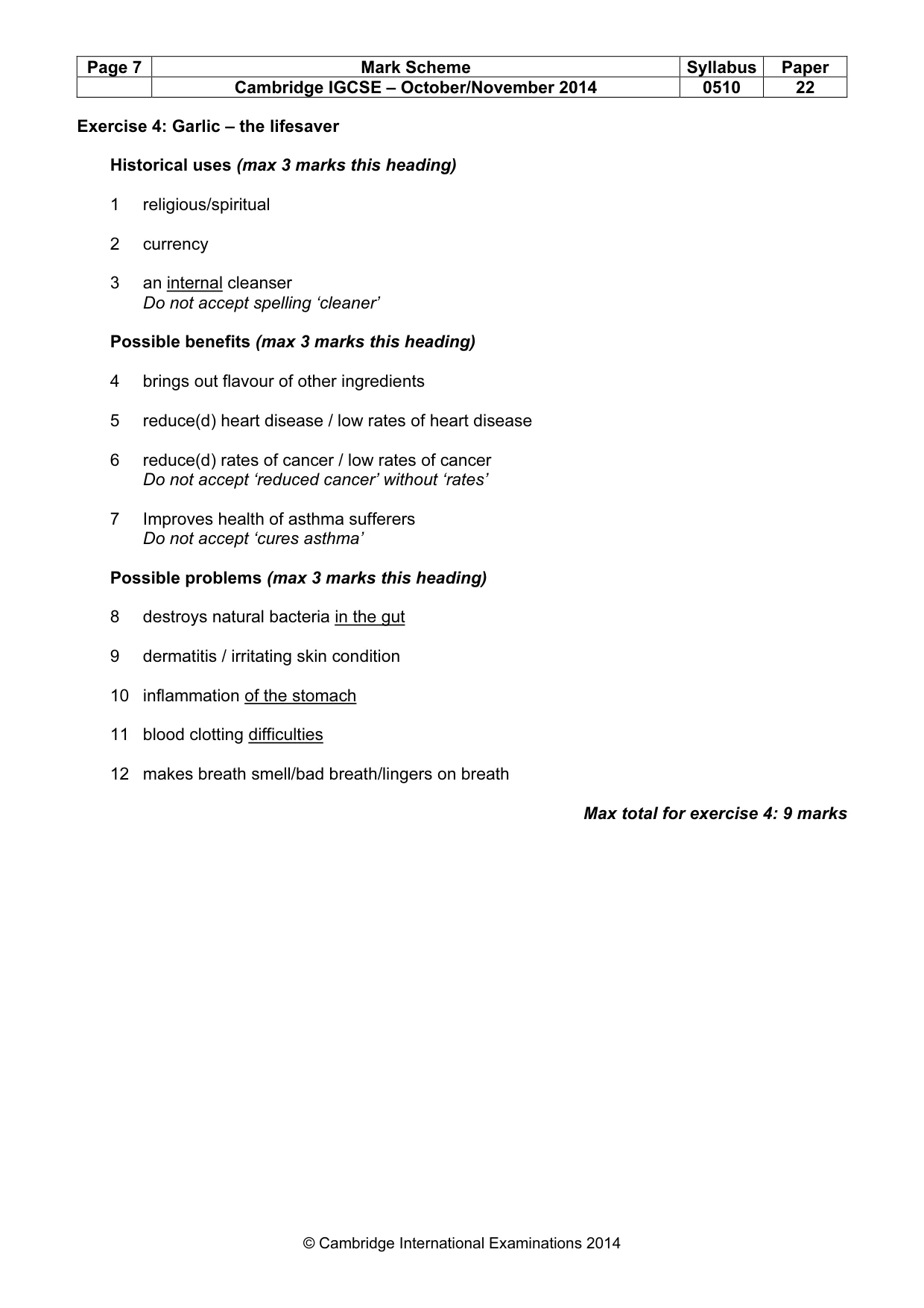
Page 7 Mark Scheme Syllabus Paper Cambridge IGCSE – October/November 2014 0510 22 © Cambridge International Examinations 2014 Exercise 4: Garlic – the lifesaver Historical uses (max 3 marks this heading) 1 religious/spiritual 2 currency 3 an internal cleanser Do not accept spelling ‘cleaner’ Possible benefits (max 3 marks this heading) 4 brings out flavour of other ingredients 5 reduce(d) heart disease / low rates of heart disease 6 reduce(d) rates of cancer / low rates of cancer Do not accept ‘reduced cancer’ without ‘rates’ 7 Improves health of asthma sufferers Do not accept ‘cures asthma’ Possible problems (max 3 marks this heading) 8 destroys natural bacteria in the gut 9 dermatitis / irritating skin condition 10 inflammation of the stomach 11 blood clotting difficulties 12 makes breath smell/bad breath/lingers on breath Max total for exercise 4: 9 marks
Mark scheme, page 8
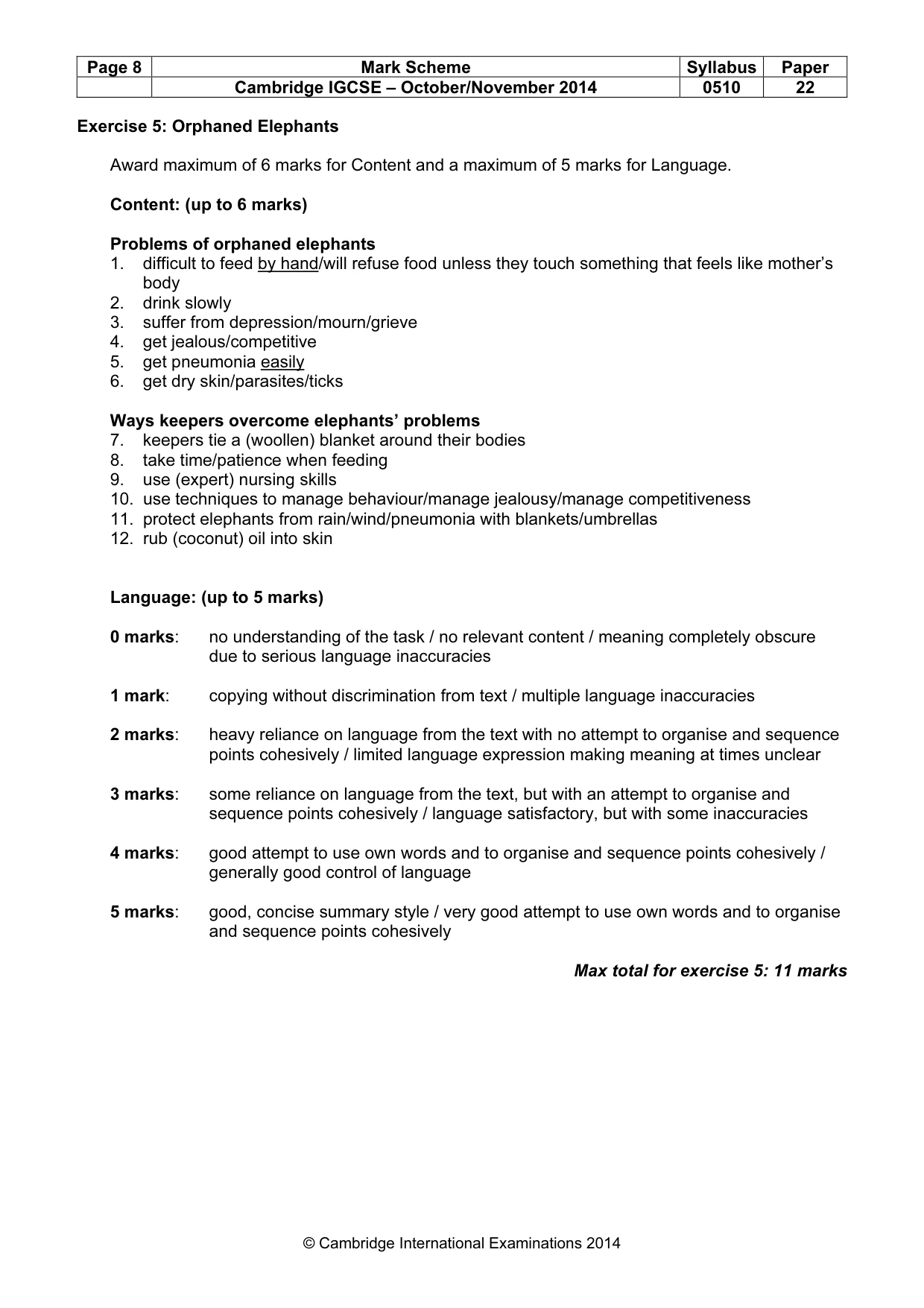
Page 8 Mark Scheme Syllabus Paper Cambridge IGCSE – October/November 2014 0510 22 © Cambridge International Examinations 2014 Exercise 5: Orphaned Elephants Award maximum of 6 marks for Content and a maximum of 5 marks for Language. Content: (up to 6 marks) Problems of orphaned elephants 1. difficult to feed by hand/will refuse food unless they touch something that feels like mother’s body 2. drink slowly 3. suffer from depression/mourn/grieve 4. get jealous/competitive 5. get pneumonia easily 6. get dry skin/parasites/ticks Ways keepers overcome elephants’ problems 7. keepers tie a (woollen) blanket around their bodies 8. take time/patience when feeding 9. use (expert) nursing skills 10. use techniques to manage behaviour/manage jealousy/manage competitiveness 11. protect elephants from rain/wind/pneumonia with blankets/umbrellas 12. rub (coconut) oil into skin Language: (up to 5 marks) 0 marks: no understanding of the task / no relevant content / meaning completely obscure due to serious language inaccuracies 1 mark: copying without discrimination from text / multiple language inaccuracies 2 marks: heavy reliance on language from the text with no attempt to organise and sequence points cohesively / limited language expression making meaning at times unclear 3 marks: some reliance on language from the text, but with an attempt to organise and sequence points cohesively / language satisfactory, but with some inaccuracies 4 marks: good attempt to use own words and to organise and sequence points cohesively / generally good control of language 5 marks: good, concise summary style / very good attempt to use own words and to organise and sequence points cohesively Max total for exercise 5: 11 marks
Mark scheme, page 9
Page 9 Mark Scheme Syllabus Paper Cambridge IGCSE – October/November 2014 0510 22 © Cambridge International Examinations 2014 Exercise 6: Unexpected meeting with old friend Exercise 7: A new zoo for our town The following general instructions, and table of marking criteria, apply to both exercises. • Award the answer a mark for content (C) [out of 10] and a mark for language (L) [out of 9] in accordance with the General Criteria table that follows. • Content covers relevance (i.e. whether the piece fulfils the task and the awareness of purpose/audience/register) and the development of ideas (i.e. the detail/explanation provided and how enjoyable it is to read). • Language covers style (i.e. complexity of vocabulary and sentence structure) and accuracy (of grammar, spelling, punctuation and use of paragraphs). • When deciding on a mark for content or language, first of all decide which mark band is most appropriate. There will not necessarily be an exact fit. Then decide between 2 marks within that mark band. Use the lower mark if it only just makes it into the band and the upper mark if it fulfils all the requirements of the band but doesn’t quite make it into the band above. • When deciding on a mark for content, look at both relevance and development of ideas. First ask yourself whether the writing fulfils the task, in terms of points to be covered and the length. If it does, it will be in at least the 4–5 mark band. • When deciding on a mark for language, look at both the style and the accuracy of the language. A useful starting point would be first to determine whether errors intrude. If they do not, it will be in at least the 4–5 mark band. • The use of paragraphs should not be the primary basis of deciding which mark band the work is in. Look first at the language used and once you have decided on the appropriate mark band, you can use the paragraphing as a factor in helping you to decide whether the work warrants the upper or lower mark in the mark band. • If the essay is considerably shorter than the stated word length, it should be put in mark band 2–3 for content or lower for not fulfilling the task. The language mark is likely to be affected and is unlikely to be more than one band higher than the content mark. • If the essay is totally irrelevant and has nothing to do with the question asked, it should be given 0 marks for Content and Language, even if it is enjoyable to read and fluent. • If the essay is partly relevant and therefore in mark band 2–3, the full range of marks for language is available. Max total for exercise 6: 19 marks Max total for exercise 7: 19 marks
Mark scheme, page 10
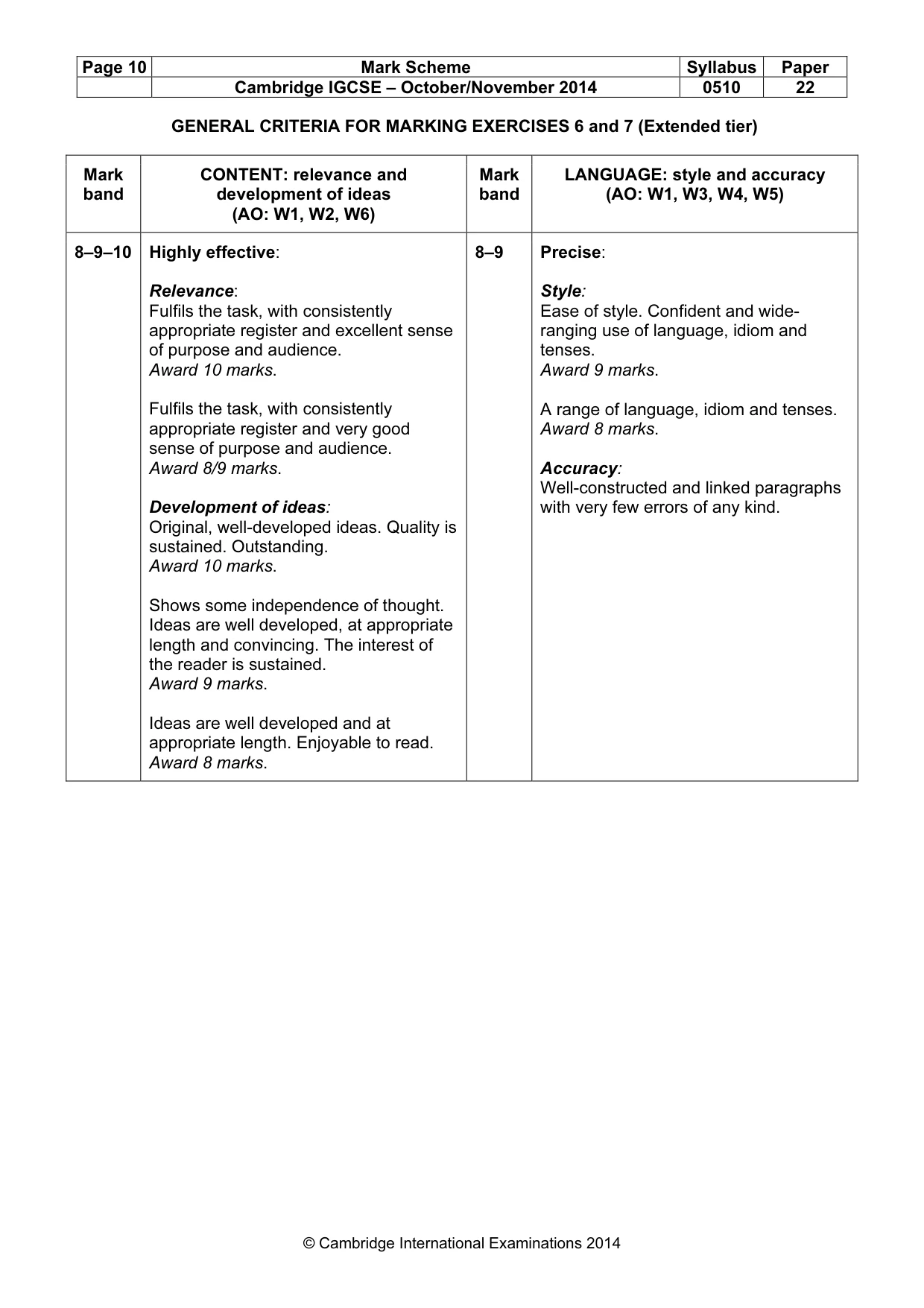
Page 10 Mark Scheme Syllabus Paper Cambridge IGCSE – October/November 2014 0510 22 © Cambridge International Examinations 2014 GENERAL CRITERIA FOR MARKING EXERCISES 6 and 7 (Extended tier) Mark band CONTENT: relevance and development of ideas (AO: W1, W2, W6) Mark band LANGUAGE: style and accuracy (AO: W1, W3, W4, W5) 8–9–10 Highly effective: Relevance: Fulfils the task, with consistently appropriate register and excellent sense of purpose and audience. Award 10 marks. Fulfils the task, with consistently appropriate register and very good sense of purpose and audience. Award 8/9 marks. Development of ideas: Original, well-developed ideas. Quality is sustained. Outstanding. Award 10 marks. Shows some independence of thought. Ideas are well developed, at appropriate length and convincing. The interest of the reader is sustained. Award 9 marks. Ideas are well developed and at appropriate length. Enjoyable to read. Award 8 marks. 8–9 Precise: Style: Ease of style. Confident and wide- ranging use of language, idiom and tenses. Award 9 marks. A range of language, idiom and tenses. Award 8 marks. Accuracy: Well-constructed and linked paragraphs with very few errors of any kind.
Mark scheme, page 11
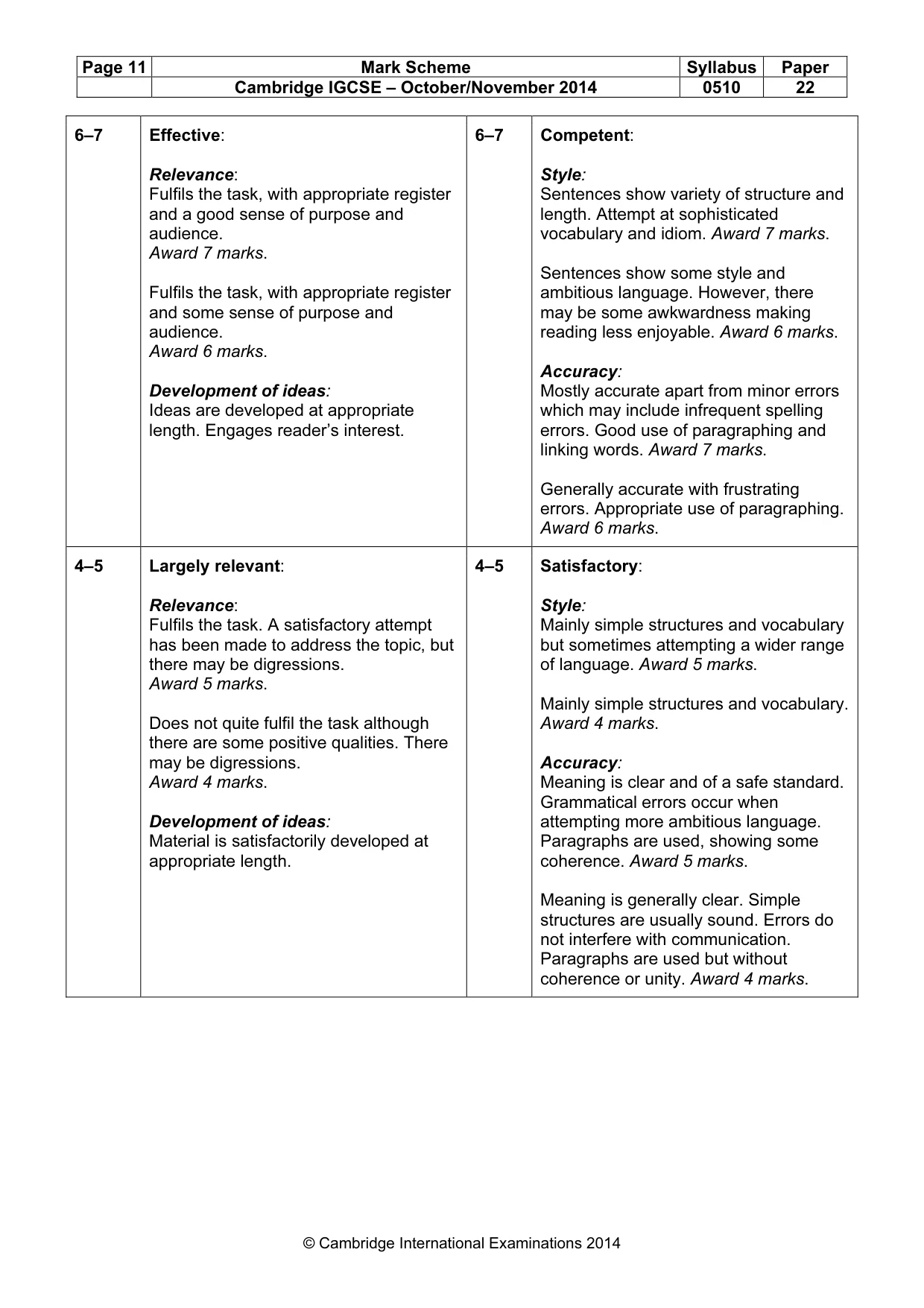
Page 11 Mark Scheme Syllabus Paper Cambridge IGCSE – October/November 2014 0510 22 © Cambridge International Examinations 2014 6–7 Effective: Relevance: Fulfils the task, with appropriate register and a good sense of purpose and audience. Award 7 marks. Fulfils the task, with appropriate register and some sense of purpose and audience. Award 6 marks. Development of ideas: Ideas are developed at appropriate length. Engages reader’s interest. 6–7 Competent: Style: Sentences show variety of structure and length. Attempt at sophisticated vocabulary and idiom. Award 7 marks. Sentences show some style and ambitious language. However, there may be some awkwardness making reading less enjoyable. Award 6 marks. Accuracy: Mostly accurate apart from minor errors which may include infrequent spelling errors. Good use of paragraphing and linking words. Award 7 marks. Generally accurate with frustrating errors. Appropriate use of paragraphing. Award 6 marks. 4–5 Largely relevant: Relevance: Fulfils the task. A satisfactory attempt has been made to address the topic, but there may be digressions. Award 5 marks. Does not quite fulfil the task although there are some positive qualities. There may be digressions. Award 4 marks. Development of ideas: Material is satisfactorily developed at appropriate length. 4–5 Satisfactory: Style: Mainly simple structures and vocabulary but sometimes attempting a wider range of language. Award 5 marks. Mainly simple structures and vocabulary. Award 4 marks. Accuracy: Meaning is clear and of a safe standard. Grammatical errors occur when attempting more ambitious language. Paragraphs are used, showing some coherence. Award 5 marks. Meaning is generally clear. Simple structures are usually sound. Errors do not interfere with communication. Paragraphs are used but without coherence or unity. Award 4 marks.
Mark scheme, page 12
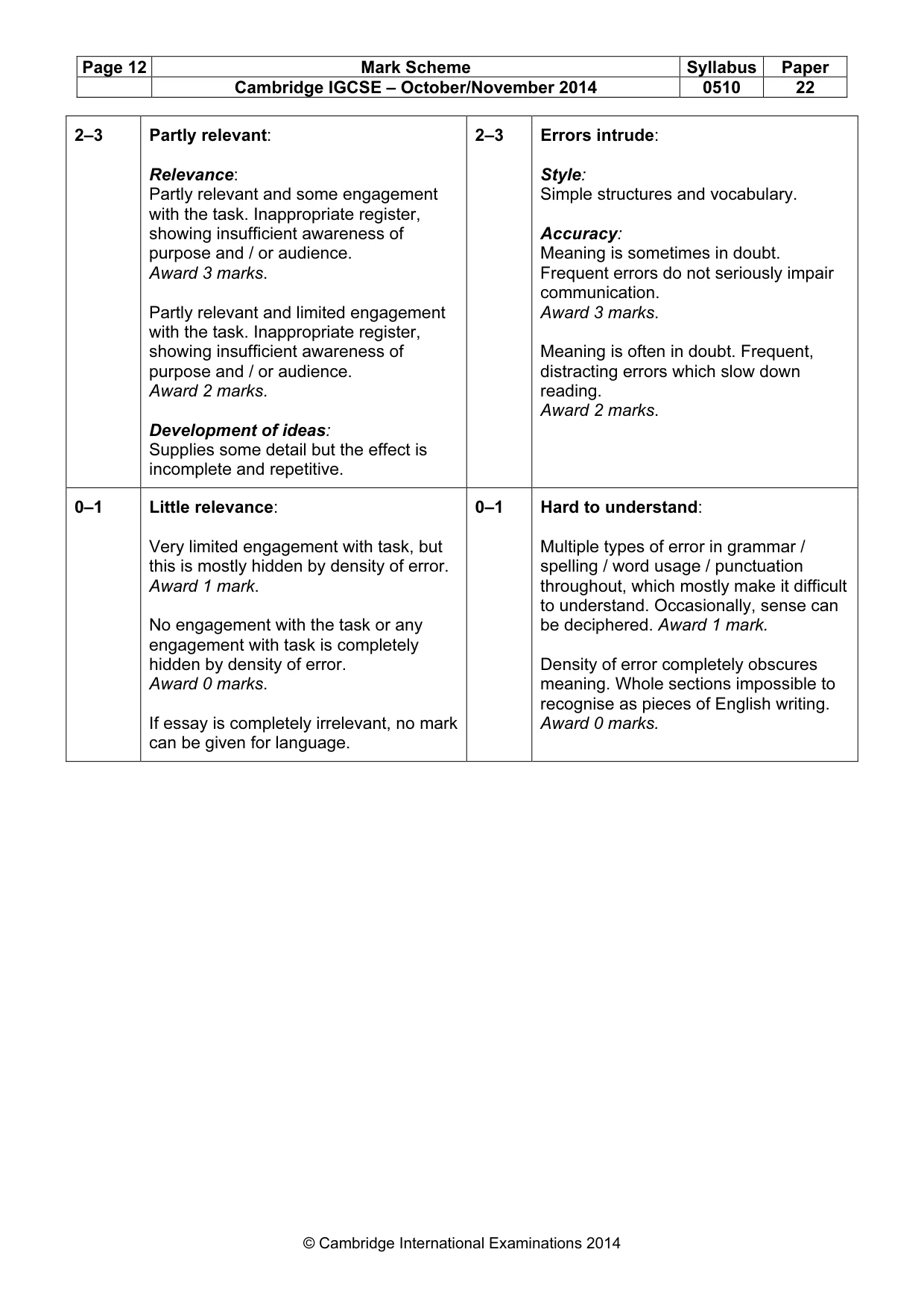
Page 12 Mark Scheme Syllabus Paper Cambridge IGCSE – October/November 2014 0510 22 © Cambridge International Examinations 2014 2–3 Partly relevant: Relevance: Partly relevant and some engagement with the task. Inappropriate register, showing insufficient awareness of purpose and / or audience. Award 3 marks. Partly relevant and limited engagement with the task. Inappropriate register, showing insufficient awareness of purpose and / or audience. Award 2 marks. Development of ideas: Supplies some detail but the effect is incomplete and repetitive. 2–3 Errors intrude: Style: Simple structures and vocabulary. Accuracy: Meaning is sometimes in doubt. Frequent errors do not seriously impair communication. Award 3 marks. Meaning is often in doubt. Frequent, distracting errors which slow down reading. Award 2 marks. 0–1 Little relevance: Very limited engagement with task, but this is mostly hidden by density of error. Award 1 mark. No engagement with the task or any engagement with task is completely hidden by density of error. Award 0 marks. If essay is completely irrelevant, no mark can be given for language. 0–1 Hard to understand: Multiple types of error in grammar / spelling / word usage / punctuation throughout, which mostly make it difficult to understand. Occasionally, sense can be deciphered. Award 1 mark. Density of error completely obscures meaning. Whole sections impossible to recognise as pieces of English writing. Award 0 marks.
What you needed in this session
Cambridge’s own grade thresholds for 2014 Oct/Nov, Paper 2 · Variant 2. A higher threshold means an easier paper — the bar moves with how the cohort did.