Cambridge IGCSE English - Second Language (oral endorsement) 0510 — 2014 Oct/Nov Paper 2 · Variant 1
0510/21/O/N/14 · 90 marks · ≈101 min
The question paper and its mark scheme, free to read here and free to download. This is Cambridge’s own paper, exactly as it was sat.
Question paper16 pages

Mark scheme12 pages
Answers below. Sit the paper first if you are practising.
Paper as text
Question paper, page 1
This document consists of 15 printed pages and 1 blank page. DC (SJF/SW) 81517/3 © UCLES 2014 [Turn over Cambridge International Examinations Cambridge International General Certificate of Secondary Education * 4 7 3 1 5 3 0 2 3 3 * ENGLISH AS A SECOND LANGUAGE 0510/21 Paper 2 Reading and Writing (Extended) October/November 2014 2 hours Candidates answer on the Question Paper. No Additional Materials are required. READ THESE INSTRUCTIONS FIRST Write your Centre number, candidate number and name on all the work you hand in. Write in dark blue or black pen. Do not use staples, paper clips, glue or correction fluid. DO NOT WRITE IN ANY BARCODES. Answer all questions. Dictionaries are not allowed. At the end of the examination, fasten all your work securely together. The number of marks is given in brackets [ ] at the end of each question or part question.
Question paper, page 2
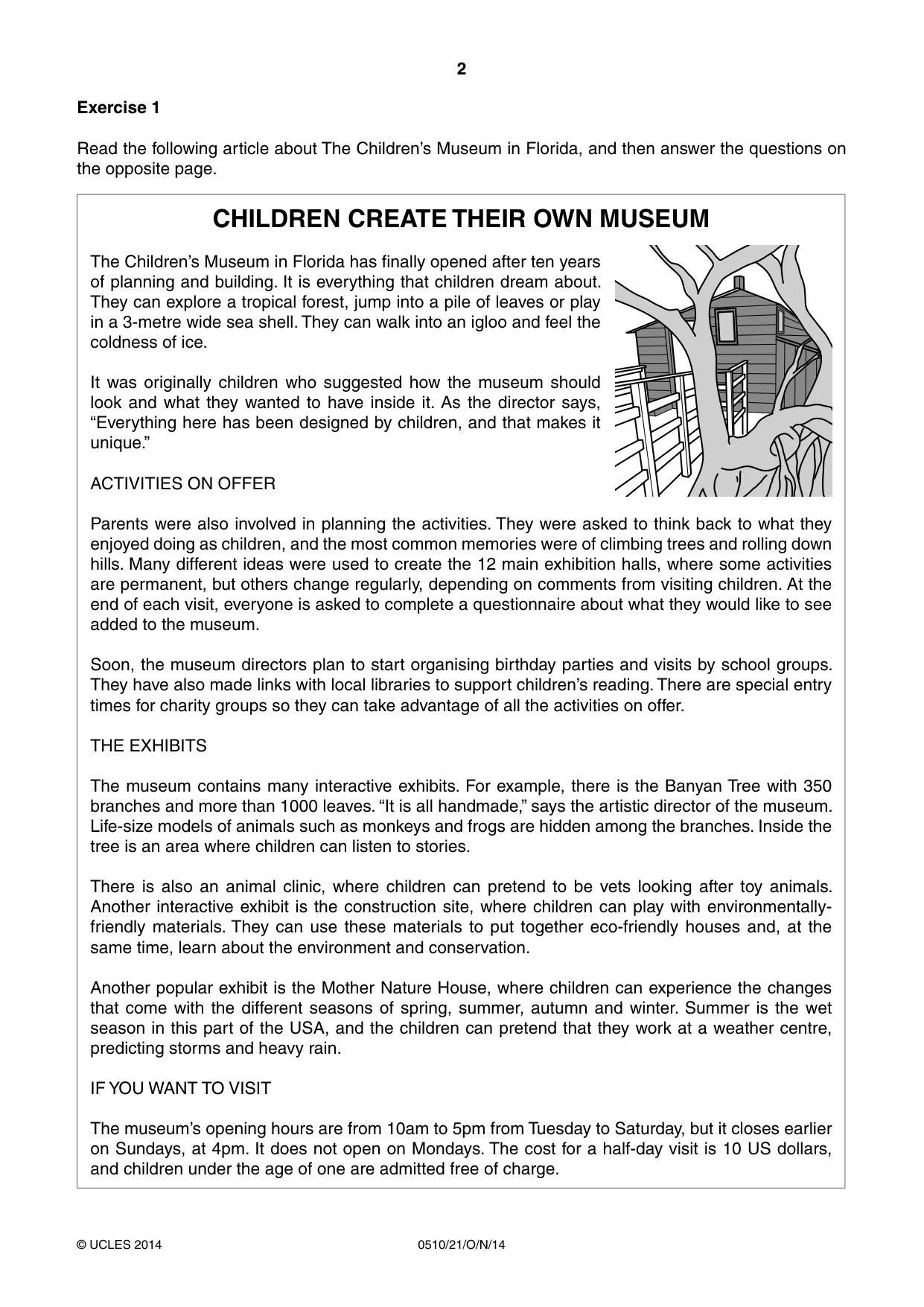
2 0510/21/O/N/14 © UCLES 2014 Exercise 1 Read the following article about The Children’s Museum in Florida, and then answer the questions on the opposite page. CHILDREN CREATE THEIR OWN MUSEUM The Children’s Museum in Florida has finally opened after ten years of planning and building. It is everything that children dream about. They can explore a tropical forest, jump into a pile of leaves or play in a 3-metre wide sea shell. They can walk into an igloo and feel the coldness of ice. It was originally children who suggested how the museum should look and what they wanted to have inside it. As the director says, “Everything here has been designed by children, and that makes it unique.” ACTIVITIES ON OFFER Parents were also involved in planning the activities. They were asked to think back to what they enjoyed doing as children, and the most common memories were of climbing trees and rolling down hills. Many different ideas were used to create the 12 main exhibition halls, where some activities are permanent, but others change regularly, depending on comments from visiting children. At the end of each visit, everyone is asked to complete a questionnaire about what they would like to see added to the museum. Soon, the museum directors plan to start organising birthday parties and visits by school groups. They have also made links with local libraries to support children’s reading. There are special entry times for charity groups so they can take advantage of all the activities on offer. THE EXHIBITS The museum contains many interactive exhibits. For example, there is the Banyan Tree with 350 branches and more than 1000 leaves. “It is all handmade,” says the artistic director of the museum. Life-size models of animals such as monkeys and frogs are hidden among the branches. Inside the tree is an area where children can listen to stories. There is also an animal clinic, where children can pretend to be vets looking after toy animals. Another interactive exhibit is the construction site, where children can play with environmentally- friendly materials. They can use these materials to put together eco-friendly houses and, at the same time, learn about the environment and conservation. Another popular exhibit is the Mother Nature House, where children can experience the changes that come with the different seasons of spring, summer, autumn and winter. Summer is the wet season in this part of the USA, and the children can pretend that they work at a weather centre, predicting storms and heavy rain. IF YOU WANT TO VISIT The museum’s opening hours are from 10am to 5pm from Tuesday to Saturday, but it closes earlier on Sundays, at 4pm. It does not open on Mondays. The cost for a half-day visit is 10 US dollars, and children under the age of one are admitted free of charge.
Question paper, page 3
3 0510/21/O/N/14 © UCLES 2014 [Turn over (a) How long did it take to design and construct the museum? …[1] (b) How can children experience extremely low temperatures in the museum? …[1] (c) How did children help to create the museum? …[1] (d) What were the parents’ favourite activities when they were young? Give two details. … …[1] (e) How does the museum get its ideas for new activities? …[1] (f) What has the museum done to provide more reading opportunities for children? …[1] (g) What is special about the buildings that the children can construct? …[1] (h) In the Mother Nature House, in what way can children use their imagination? …[1] (i) Who can enter the museum without paying? …[1] [Total: 9]
Question paper, page 4
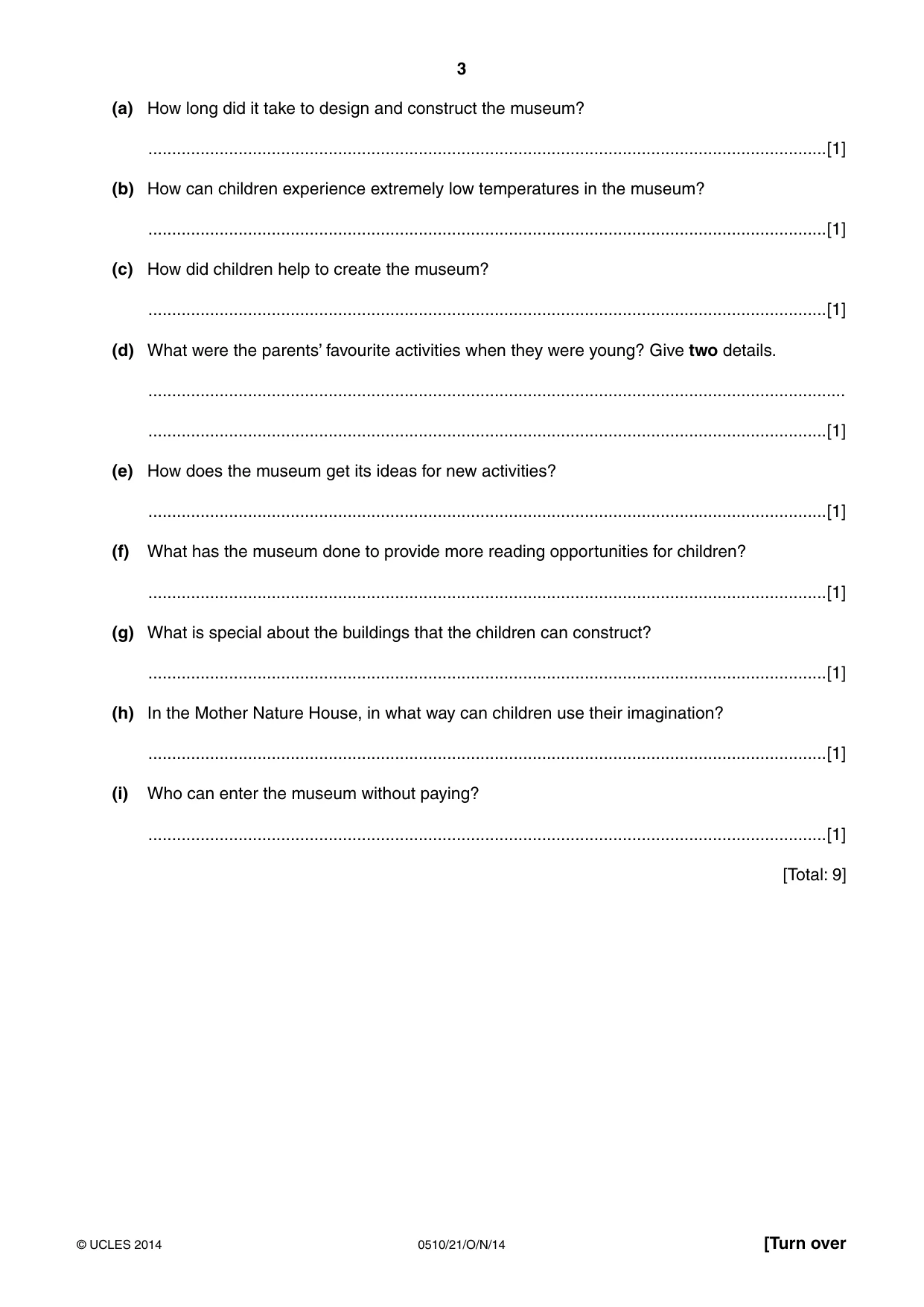
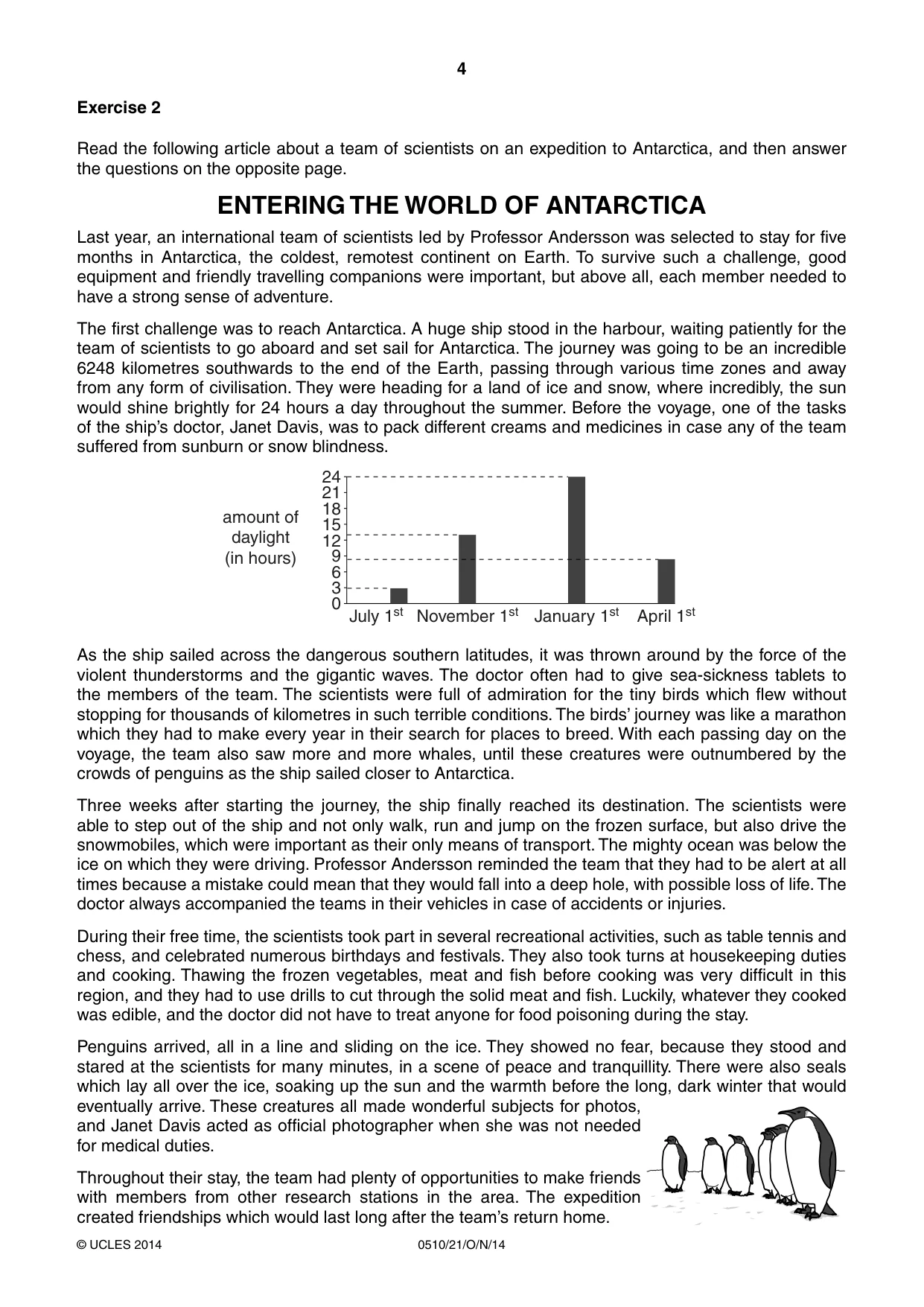
4 0510/21/O/N/14 © UCLES 2014 Exercise 2 Read the following article about a team of scientists on an expedition to Antarctica, and then answer the questions on the opposite page. ENTERING THE WORLD OF ANTARCTICA Last year, an international team of scientists led by Professor Andersson was selected to stay for five months in Antarctica, the coldest, remotest continent on Earth. To survive such a challenge, good equipment and friendly travelling companions were important, but above all, each member needed to have a strong sense of adventure. The first challenge was to reach Antarctica. A huge ship stood in the harbour, waiting patiently for the team of scientists to go aboard and set sail for Antarctica. The journey was going to be an incredible 6248 kilometres southwards to the end of the Earth, passing through various time zones and away from any form of civilisation. They were heading for a land of ice and snow, where incredibly, the sun would shine brightly for 24 hours a day throughout the summer. Before the voyage, one of the tasks of the ship’s doctor, Janet Davis, was to pack different creams and medicines in case any of the team suffered from sunburn or snow blindness. 24 21 18 15 12 9 6 3 0 July 1st amount of daylight (in hours) November 1st January 1st April 1st As the ship sailed across the dangerous southern latitudes, it was thrown around by the force of the violent thunderstorms and the gigantic waves. The doctor often had to give sea-sickness tablets to the members of the team. The scientists were full of admiration for the tiny birds which flew without stopping for thousands of kilometres in such terrible conditions. The birds’ journey was like a marathon which they had to make every year in their search for places to breed. With each passing day on the voyage, the team also saw more and more whales, until these creatures were outnumbered by the crowds of penguins as the ship sailed closer to Antarctica. Three weeks after starting the journey, the ship finally reached its destination. The scientists were able to step out of the ship and not only walk, run and jump on the frozen surface, but also drive the snowmobiles, which were important as their only means of transport. The mighty ocean was below the ice on which they were driving. Professor Andersson reminded the team that they had to be alert at all times because a mistake could mean that they would fall into a deep hole, with possible loss of life. The doctor always accompanied the teams in their vehicles in case of accidents or injuries. During their free time, the scientists took part in several recreational activities, such as table tennis and chess, and celebrated numerous birthdays and festivals. They also took turns at housekeeping duties and cooking. Thawing the frozen vegetables, meat and fish before cooking was very difficult in this region, and they had to use drills to cut through the solid meat and fish. Luckily, whatever they cooked was edible, and the doctor did not have to treat anyone for food poisoning during the stay. Penguins arrived, all in a line and sliding on the ice. They showed no fear, because they stood and stared at the scientists for many minutes, in a scene of peace and tranquillity. There were also seals which lay all over the ice, soaking up the sun and the warmth before the long, dark winter that would eventually arrive. These creatures all made wonderful subjects for photos, and Janet Davis acted as official photographer when she was not needed for medical duties. Throughout their stay, the team had plenty of opportunities to make friends with members from other research stations in the area. The expedition created friendships which would last long after the team’s return home.
Question paper, page 5
5 0510/21/O/N/14 © UCLES 2014 [Turn over (a) What is the main requirement for a person wanting to stay for almost half a year in Antarctica? …[1] (b) According to the diagram, on which date is there the least amount of daylight, and how much daylight is there? …[1] (c) What conditions made the ship’s journey particularly dangerous? Give two details. …[1] (d) Why do the birds make their annual journey? …[1] (e) Which creature did the scientists see most frequently as they approached Antarctica? …[1] (f) What did the team use to travel across the ice? …[1] (g) Why did Professor Andersson warn the team to take special care? …[1] (h) What special occasions did the scientists enjoy? Give two details. …[1] (i) How did the weather conditions create problems with the food and how did the scientists overcome them? … …[2] (j) What suggests that the penguins were unafraid of the scientists? …[1] (k) What tasks did the ship’s doctor have to do? Give four details. … … … …[4] [Total: 15]
Question paper, page 6
6 0510/21/O/N/14 © UCLES 2014 Exercise 3 A new arts centre has recently opened in the city of Acapulco in Mexico. Acapulco is famous for its magnificent beaches, and many tourists come to enjoy the white sand and turquoise-blue sea. The city council started planning the centre five years ago in order to attract more visitors who are interested in the arts. The centre opened in April 2014. It has now been operating for six months, and the management would like to receive feedback and opinions from people who have visited the centre during that time. They have produced a questionnaire which they are asking visitors to complete. Rodrigo Espinosa has lived in Acapulco all his life at Apartment 4, 97 Avenida Diego Benitez. He is 18 and is old enough to attend all the attractions at the centre without his parents. He likes to travel there by train because the station is very close to his home and the centre is only three kilometres away. His father, Gustavo, and his mother, Gabriela, sometimes accompany him, but Rodrigo prefers to go by himself and meet his friends there. There is a café where they can eat and drink even if they are not attending any of the arts events in the centre. In Rodrigo’s opinion, the café is the best part of the new centre and the facility that he uses the most. He visits the centre every weekend to meet his friends and attends an event once a month. This number of regular visits means that he can have a gold card, which allows him to buy tickets for all events at a ten per cent discount. The card also entitles him to receive the centre’s magazine twice a year and an SMS update service which informs him about future events. These are both useful, but the greatest benefit for Rodrigo is that he saves money on buying tickets for the events. The centre includes a cinema, theatre, art gallery and music studio, as well as the café. Rodrigo is taking a course of guitar lessons and he uses the music studio almost as frequently as the café. He would like to see more rock and pop concerts for younger people rather than the current programme of traditional music, and would love a room where teenagers could relax and play games. Rodrigo is interested in giving the management his opinion of the centre. He is very enthusiastic about it and often speaks highly of the facilities when talking about it with his family. He knows that his mother would definitely like to receive details about future events, in particular modern art exhibitions. She can be contacted on gabiespin@internet.com.mx Rodrigo has decided to complete the questionnaire about how the centre has progressed during the first six months. Imagine you are Rodrigo. Fill in the questionnaire on the opposite page, using the information above.
Question paper, page 7
7 0510/21/O/N/14 © UCLES 2014 [Turn over ARTS CENTRE VISITOR QUESTIONNAIRE Section A: Personal details Full name: … Age: … Address: … Section B: Survey details How far do you live from the centre? (please circle) 0–5 kilometres 6–10 kilometres more than 10 kilometres How do you normally travel to the centre? … How often do you attend an event at the centre? … What TWO facilities do you use the most? (in order of preference) 1 … 2 … Do you have a centre gold card? YES / NO (please delete) If you have a gold card, what is its most useful feature for you? … Please give details of anyone you know who would be interested in receiving information about the centre. Full name: … Contact details (email or phone): … Particular area of interest: … Section C In the space below, write one sentence of between 12 and 20 words, about any improvements you would like to see at the centre in the future. [Total: 8]
Question paper, page 8
8 0510/21/O/N/14 © UCLES 2014 Exercise 4 Read the following article about a man who fell to Earth from a height of 40 kilometres, and then complete the notes on the opposite page. THE MAN WHO FELL TO EARTH On October 14, 2012, Felix Baumgartner made history as the man who fell to Earth from a height of almost 40 kilometres. During the fall, he became the first person to break the sound barrier on his own without the help of any machine. He made the highest and fastest jump in history, after going up in a capsule, similar to a very small spacecraft. The capsule was lifted by a helium balloon to an altitude of about 40 000 metres. Millions of people around the world watched the journey from pictures taken by a camera which was fixed to the capsule itself. When the capsule reached the required height, viewers could see what Felix saw as he looked down: the round, blue Earth, surrounded by the blackness of space. They then watched as Felix stepped into the empty darkness and fell for more than four minutes. During his fall, he reached a maximum speed of more than 1300 kilometres per hour. The jump was not without challenging moments. For example, the engineers in charge of the mission considered stopping the jump when the glass shield of his helmet began to be covered with mist during the ascent. Later, a new crisis developed during the jump, when Felix began spinning out of control in the thin air of the stratosphere. Fortunately, as the atmosphere thickened, he managed to stop the spin and fall smoothly. He opened his parachute about one and a half kilometres above the ground and landed safely in the desert. During the jump, Felix broke the altitude and speed records, which had been set half a century before by Joe Kittinger, a retired Air Force colonel, who is now more than eighty years old. It was Joe’s calm voice that guided Felix through some tense moments. Joe praised Felix for his great courage and determination. “Through Felix we have fulfilled the aims of the mission. We wanted to test this spacesuit for its strength and protective qualities, and it has passed the test.” The whole mission involved about 300 people, including engineers and scientists who had been working for five years on the project. Apart from breaking the altitude and speed records, the aim was to see how the equipment was affected by loss of pressure at extreme heights. The information provided by the jump will help pilots and even space tourists survive in the future if they have to jump out of their spaceships in an emergency. One particular problem that Felix Baumgartner discovered during tests was that he suffered from panic attacks when he was forced to spend hours inside the pressurised space suit and helmet. He was advised by experts to keep busy all the time in order to take his mind off the jump. In addition, preparations for the jump did not always go smoothly. Several attempts to inflate the helium balloon, which would lift Felix in his capsule to the required height for the jump, had to be abandoned because of bad weather. Finally, however, everything was prepared and the mission was completed. Viewers from all around the world watched the live video being broadcast both from the capsule and from mission control in Florida. There were a record eight million people watching the jump at the same time.
Question paper, page 9
9 0510/21/O/N/14 © UCLES 2014 [Turn over You are going to give a talk about Felix Baumgartner and his jump to your school science club. Prepare some notes to use as the basis for your talk. Make short notes under each heading. Statistical data about the jump • The mission involved about 300 people … • … • … • … • … Problems before and during the trip • … • … • … Aims of the mission • … • … [Total: 9]
Question paper, page 10
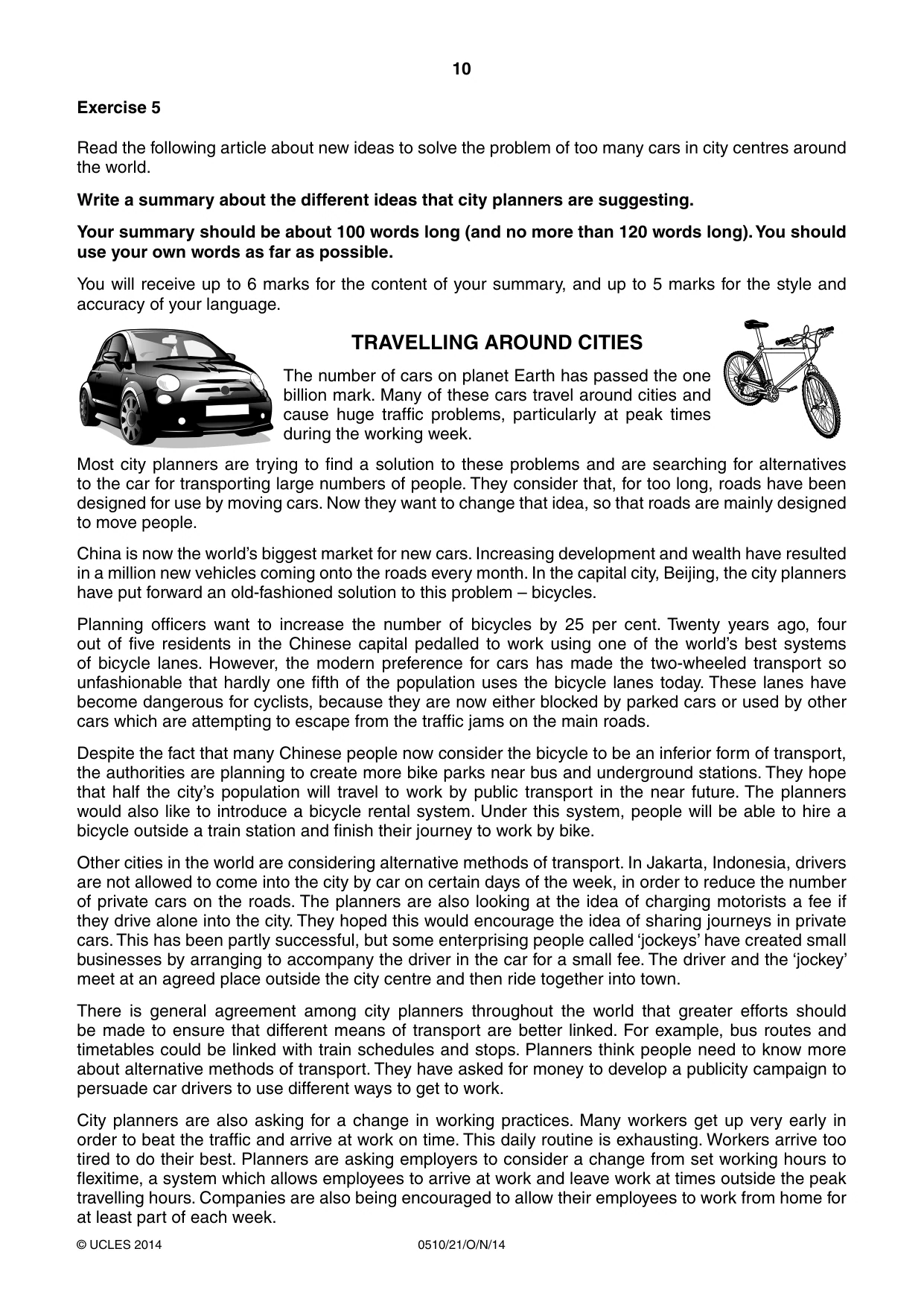
10 0510/21/O/N/14 © UCLES 2014 Exercise 5 Read the following article about new ideas to solve the problem of too many cars in city centres around the world. Write a summary about the different ideas that city planners are suggesting. Your summary should be about 100 words long (and no more than 120 words long). You should use your own words as far as possible. You will receive up to 6 marks for the content of your summary, and up to 5 marks for the style and accuracy of your language. TRAVELLING AROUND CITIES The number of cars on planet Earth has passed the one billion mark. Many of these cars travel around cities and cause huge traffic problems, particularly at peak times during the working week. Most city planners are trying to find a solution to these problems and are searching for alternatives to the car for transporting large numbers of people. They consider that, for too long, roads have been designed for use by moving cars. Now they want to change that idea, so that roads are mainly designed to move people. China is now the world’s biggest market for new cars. Increasing development and wealth have resulted in a million new vehicles coming onto the roads every month. In the capital city, Beijing, the city planners have put forward an old-fashioned solution to this problem – bicycles. Planning officers want to increase the number of bicycles by 25 per cent. Twenty years ago, four out of five residents in the Chinese capital pedalled to work using one of the world’s best systems of bicycle lanes. However, the modern preference for cars has made the two-wheeled transport so unfashionable that hardly one fifth of the population uses the bicycle lanes today. These lanes have become dangerous for cyclists, because they are now either blocked by parked cars or used by other cars which are attempting to escape from the traffic jams on the main roads. Despite the fact that many Chinese people now consider the bicycle to be an inferior form of transport, the authorities are planning to create more bike parks near bus and underground stations. They hope that half the city’s population will travel to work by public transport in the near future. The planners would also like to introduce a bicycle rental system. Under this system, people will be able to hire a bicycle outside a train station and finish their journey to work by bike. Other cities in the world are considering alternative methods of transport. In Jakarta, Indonesia, drivers are not allowed to come into the city by car on certain days of the week, in order to reduce the number of private cars on the roads. The planners are also looking at the idea of charging motorists a fee if they drive alone into the city. They hoped this would encourage the idea of sharing journeys in private cars. This has been partly successful, but some enterprising people called ‘jockeys’ have created small businesses by arranging to accompany the driver in the car for a small fee. The driver and the ‘jockey’ meet at an agreed place outside the city centre and then ride together into town. There is general agreement among city planners throughout the world that greater efforts should be made to ensure that different means of transport are better linked. For example, bus routes and timetables could be linked with train schedules and stops. Planners think people need to know more about alternative methods of transport. They have asked for money to develop a publicity campaign to persuade car drivers to use different ways to get to work. City planners are also asking for a change in working practices. Many workers get up very early in order to beat the traffic and arrive at work on time. This daily routine is exhausting. Workers arrive too tired to do their best. Planners are asking employers to consider a change from set working hours to flexitime, a system which allows employees to arrive at work and leave work at times outside the peak travelling hours. Companies are also being encouraged to allow their employees to work from home for at least part of each week.
Question paper, page 11
11 0510/21/O/N/14 © UCLES 2014 [Turn over … … … … … … … … … … … … … … … … … … … … [Total: 11]
Question paper, page 12
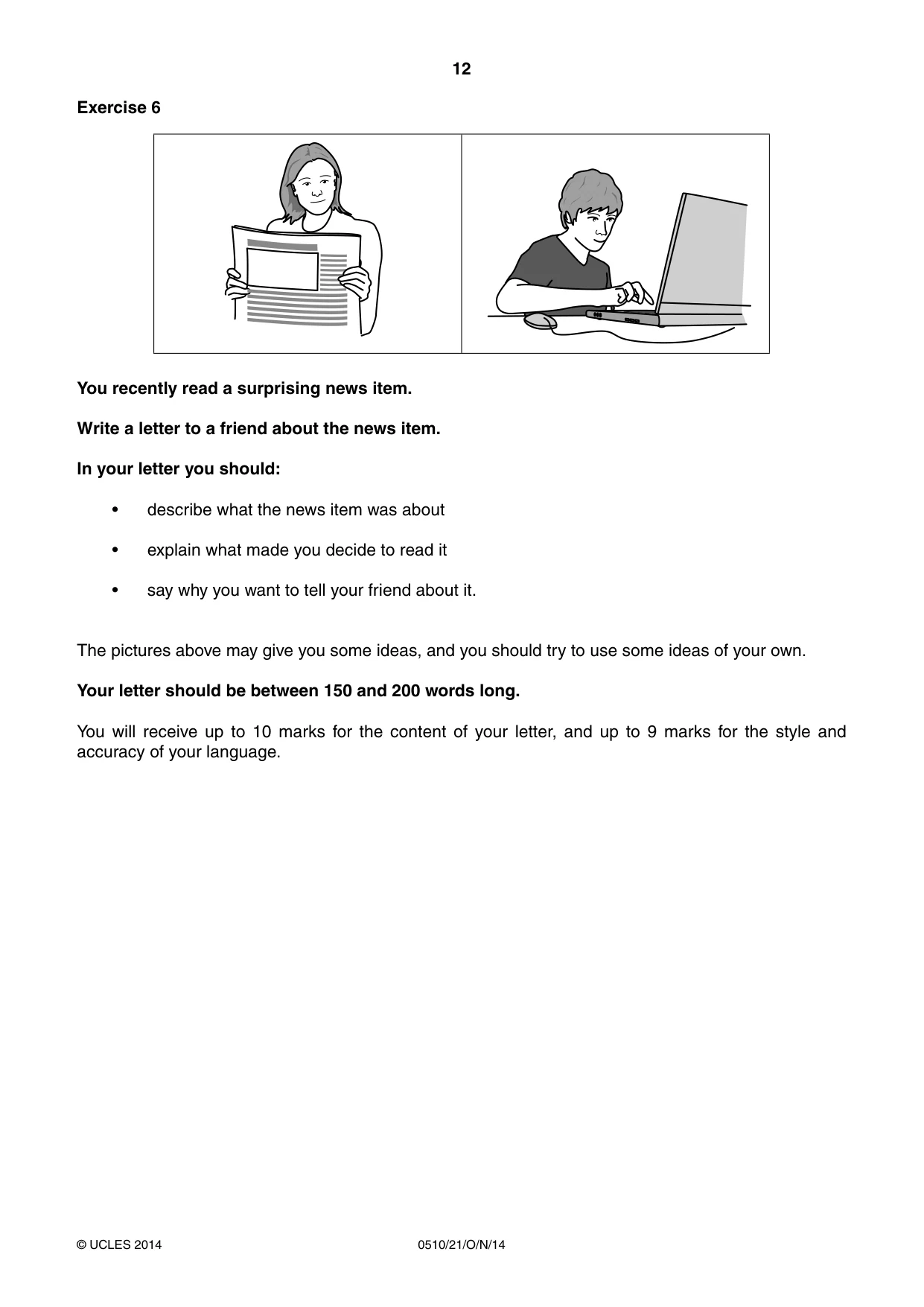
12 0510/21/O/N/14 © UCLES 2014 Exercise 6 You recently read a surprising news item. Write a letter to a friend about the news item. In your letter you should: • describe what the news item was about • explain what made you decide to read it • say why you want to tell your friend about it. The pictures above may give you some ideas, and you should try to use some ideas of your own. Your letter should be between 150 and 200 words long. You will receive up to 10 marks for the content of your letter, and up to 9 marks for the style and accuracy of your language.
Question paper, page 13
13 0510/21/O/N/14 © UCLES 2014 [Turn over … … … … … … … … … … … … … … … … … … … … … … … … … [Total: 19]
Question paper, page 14
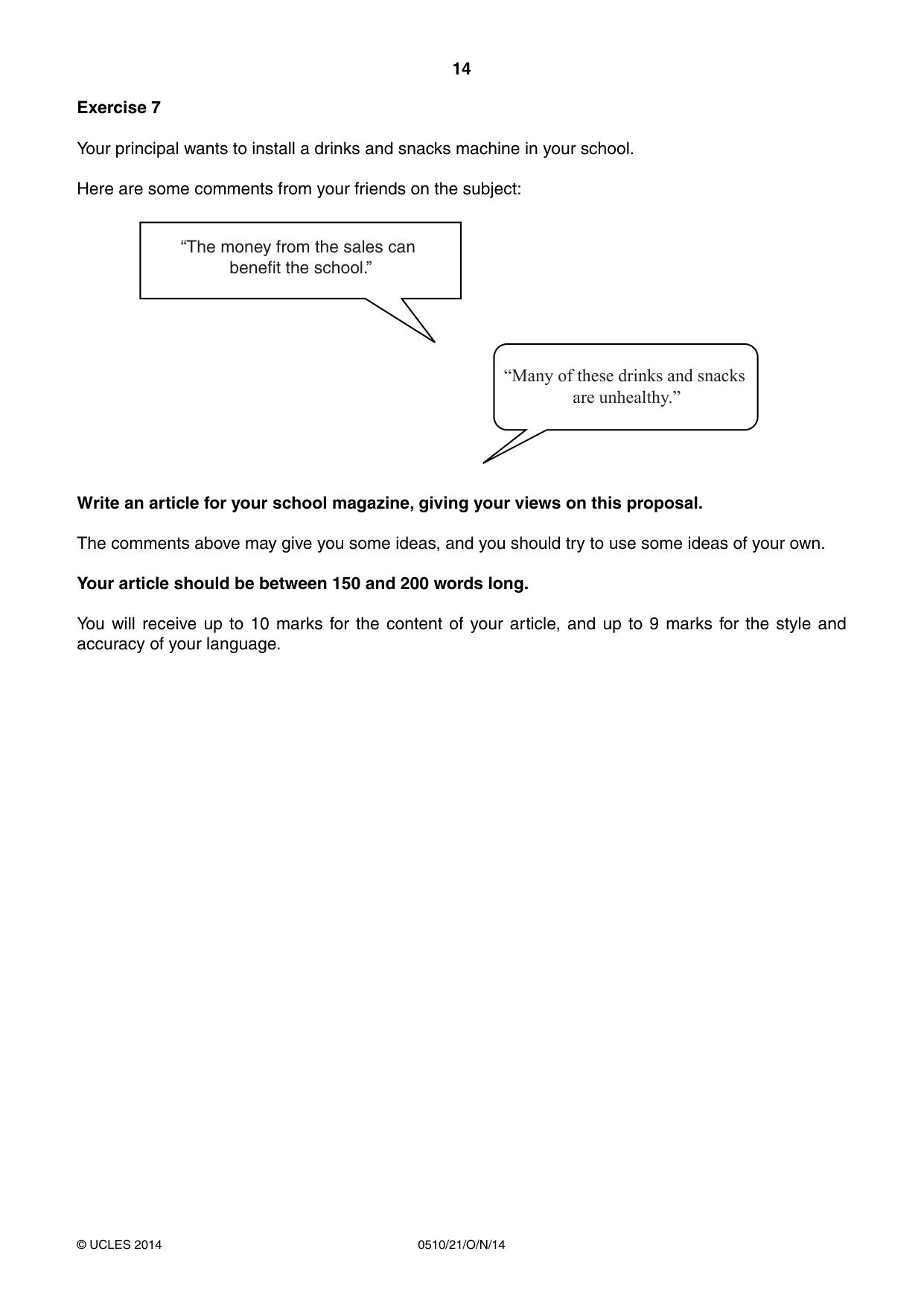
14 0510/21/O/N/14 © UCLES 2014 Exercise 7 Your principal wants to install a drinks and snacks machine in your school. Here are some comments from your friends on the subject: “The money from the sales can benefit the school.” “Many of these drinks and snacks are unhealthy.” Write an article for your school magazine, giving your views on this proposal. The comments above may give you some ideas, and you should try to use some ideas of your own. Your article should be between 150 and 200 words long. You will receive up to 10 marks for the content of your article, and up to 9 marks for the style and accuracy of your language.
Question paper, page 15
15 0510/21/O/N/14 © UCLES 2014 … … … … … … … … … … … … … … … … … … … … … … … … … [Total: 19]
Question paper, page 16
16 0510/21/O/N/14 © UCLES 2014 Permission to reproduce items where third-party owned material protected by copyright is included has been sought and cleared where possible. Every reasonable effort has been made by the publisher (UCLES) to trace copyright holders, but if any items requiring clearance have unwittingly been included, the publisher will be pleased to make amends at the earliest possible opportunity. Cambridge International Examinations is part of the Cambridge Assessment Group. Cambridge Assessment is the brand name of University of Cambridge Local Examinations Syndicate (UCLES), which is itself a department of the University of Cambridge. BLANK PAGE
Mark scheme, page 1
® IGCSE is the registered trademark of Cambridge International Examinations. CAMBRIDGE INTERNATIONAL EXAMINATIONS Cambridge International General Certificate of Secondary Education MARK SCHEME for the October/November 2014 series 0510 ENGLISH AS A SECOND LANGUAGE 0510/21 Paper 2 (Reading and Writing – Extended), maximum raw mark 90 This mark scheme is published as an aid to teachers and candidates, to indicate the requirements of the examination. It shows the basis on which Examiners were instructed to award marks. It does not indicate the details of the discussions that took place at an Examiners’ meeting before marking began, which would have considered the acceptability of alternative answers. Mark schemes should be read in conjunction with the question paper and the Principal Examiner Report for Teachers. Cambridge will not enter into discussions about these mark schemes. Cambridge is publishing the mark schemes for the October/November 2014 series for most Cambridge IGCSE®, Cambridge International A and AS Level components and some Cambridge O Level components.
Mark scheme, page 2
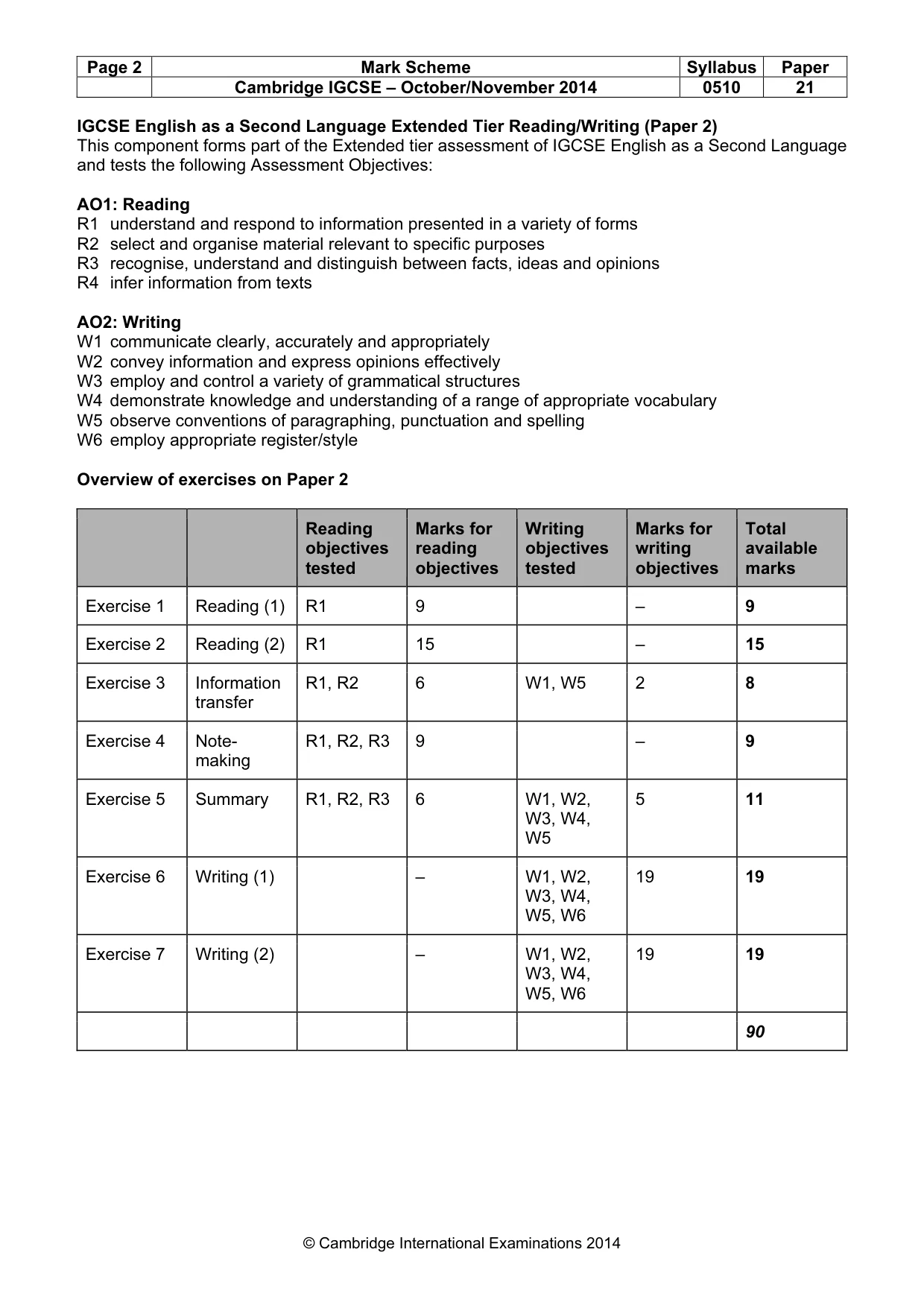
Page 2 Mark Scheme Syllabus Paper Cambridge IGCSE – October/November 2014 0510 21 © Cambridge International Examinations 2014 IGCSE English as a Second Language Extended Tier Reading/Writing (Paper 2) This component forms part of the Extended tier assessment of IGCSE English as a Second Language and tests the following Assessment Objectives: AO1: Reading R1 understand and respond to information presented in a variety of forms R2 select and organise material relevant to specific purposes R3 recognise, understand and distinguish between facts, ideas and opinions R4 infer information from texts AO2: Writing W1 communicate clearly, accurately and appropriately W2 convey information and express opinions effectively W3 employ and control a variety of grammatical structures W4 demonstrate knowledge and understanding of a range of appropriate vocabulary W5 observe conventions of paragraphing, punctuation and spelling W6 employ appropriate register/style Overview of exercises on Paper 2 Reading objectives tested Marks for reading objectives Writing objectives tested Marks for writing objectives Total available marks Exercise 1 Reading (1) R1 9 – 9 Exercise 2 Reading (2) R1 15 – 15 Exercise 3 Information transfer R1, R2 6 W1, W5 2 8 Exercise 4 Note- making R1, R2, R3 9 – 9 Exercise 5 Summary R1, R2, R3 6 W1, W2, W3, W4, W5 5 11 Exercise 6 Writing (1) – W1, W2, W3, W4, W5, W6 19 19 Exercise 7 Writing (2) – W1, W2, W3, W4, W5, W6 19 19 90
Mark scheme, page 3
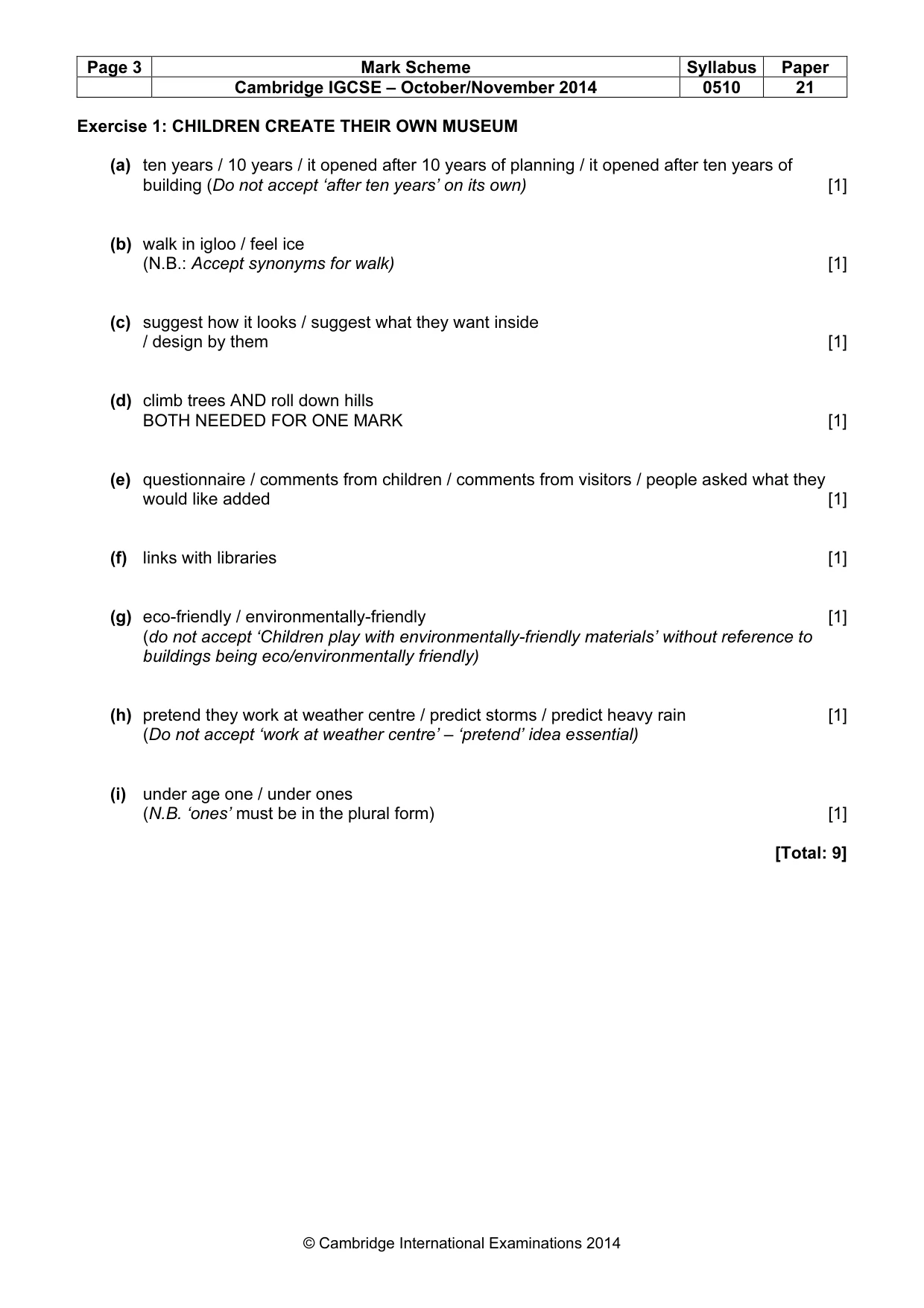
Page 3 Mark Scheme Syllabus Paper Cambridge IGCSE – October/November 2014 0510 21 © Cambridge International Examinations 2014 Exercise 1: CHILDREN CREATE THEIR OWN MUSEUM (a) ten years / 10 years / it opened after 10 years of planning / it opened after ten years of building (Do not accept ‘after ten years’ on its own) [1] (b) walk in igloo / feel ice (N.B.: Accept synonyms for walk) [1] (c) suggest how it looks / suggest what they want inside / design by them [1] (d) climb trees AND roll down hills BOTH NEEDED FOR ONE MARK [1] (e) questionnaire / comments from children / comments from visitors / people asked what they would like added [1] (f) links with libraries [1] (g) eco-friendly / environmentally-friendly [1] (do not accept ‘Children play with environmentally-friendly materials’ without reference to buildings being eco/environmentally friendly) (h) pretend they work at weather centre / predict storms / predict heavy rain [1] (Do not accept ‘work at weather centre’ – ‘pretend’ idea essential) (i) under age one / under ones (N.B. ‘ones’ must be in the plural form) [1] [Total: 9]
Mark scheme, page 4
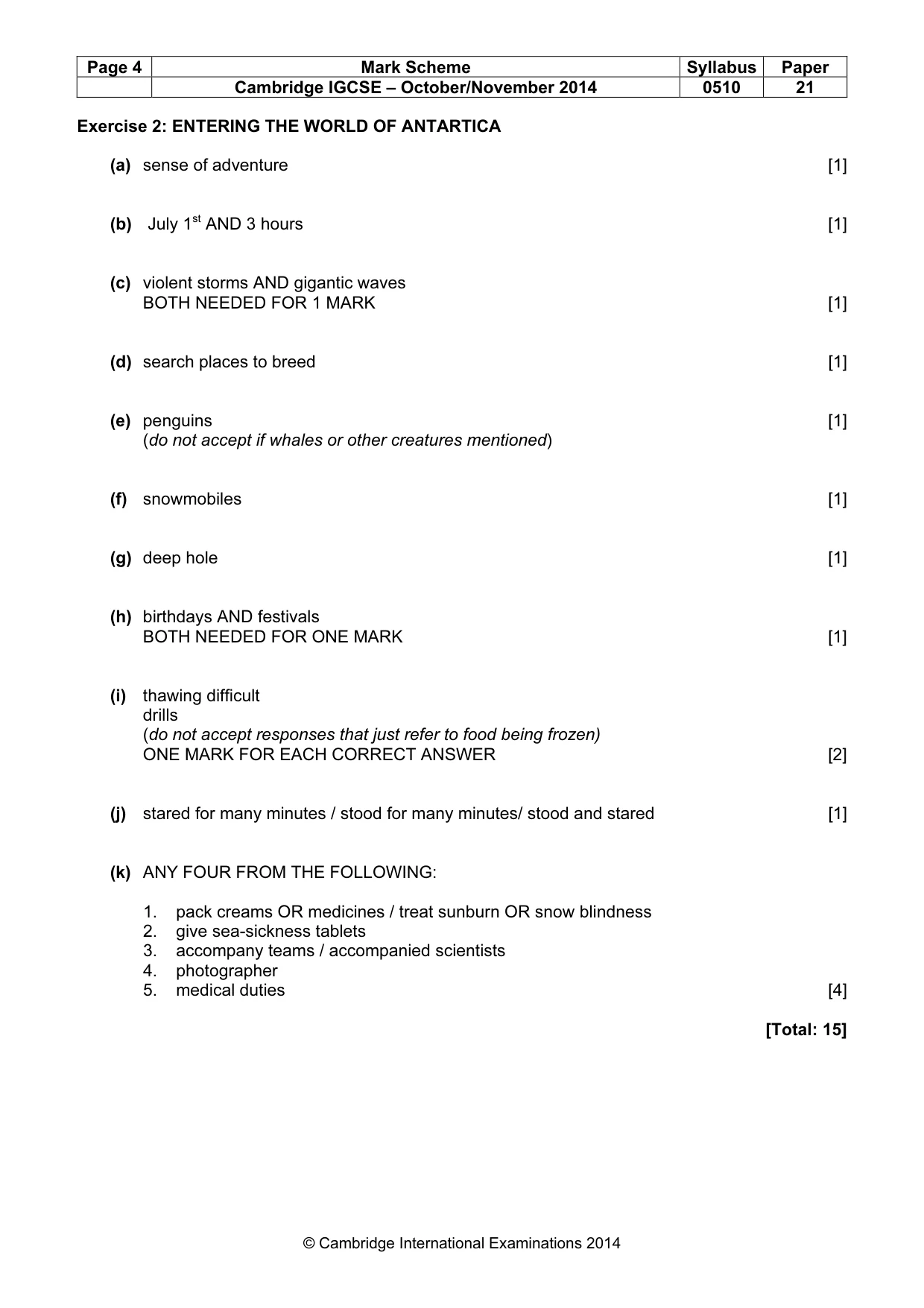
Page 4 Mark Scheme Syllabus Paper Cambridge IGCSE – October/November 2014 0510 21 © Cambridge International Examinations 2014 Exercise 2: ENTERING THE WORLD OF ANTARTICA (a) sense of adventure [1] (b) July 1st AND 3 hours [1] (c) violent storms AND gigantic waves BOTH NEEDED FOR 1 MARK [1] (d) search places to breed [1] (e) penguins [1] (do not accept if whales or other creatures mentioned) (f) snowmobiles [1] (g) deep hole [1] (h) birthdays AND festivals BOTH NEEDED FOR ONE MARK [1] (i) thawing difficult drills (do not accept responses that just refer to food being frozen) ONE MARK FOR EACH CORRECT ANSWER [2] (j) stared for many minutes / stood for many minutes/ stood and stared [1] (k) ANY FOUR FROM THE FOLLOWING: 1. pack creams OR medicines / treat sunburn OR snow blindness 2. give sea-sickness tablets 3. accompany teams / accompanied scientists 4. photographer 5. medical duties [4] [Total: 15]
Mark scheme, page 5
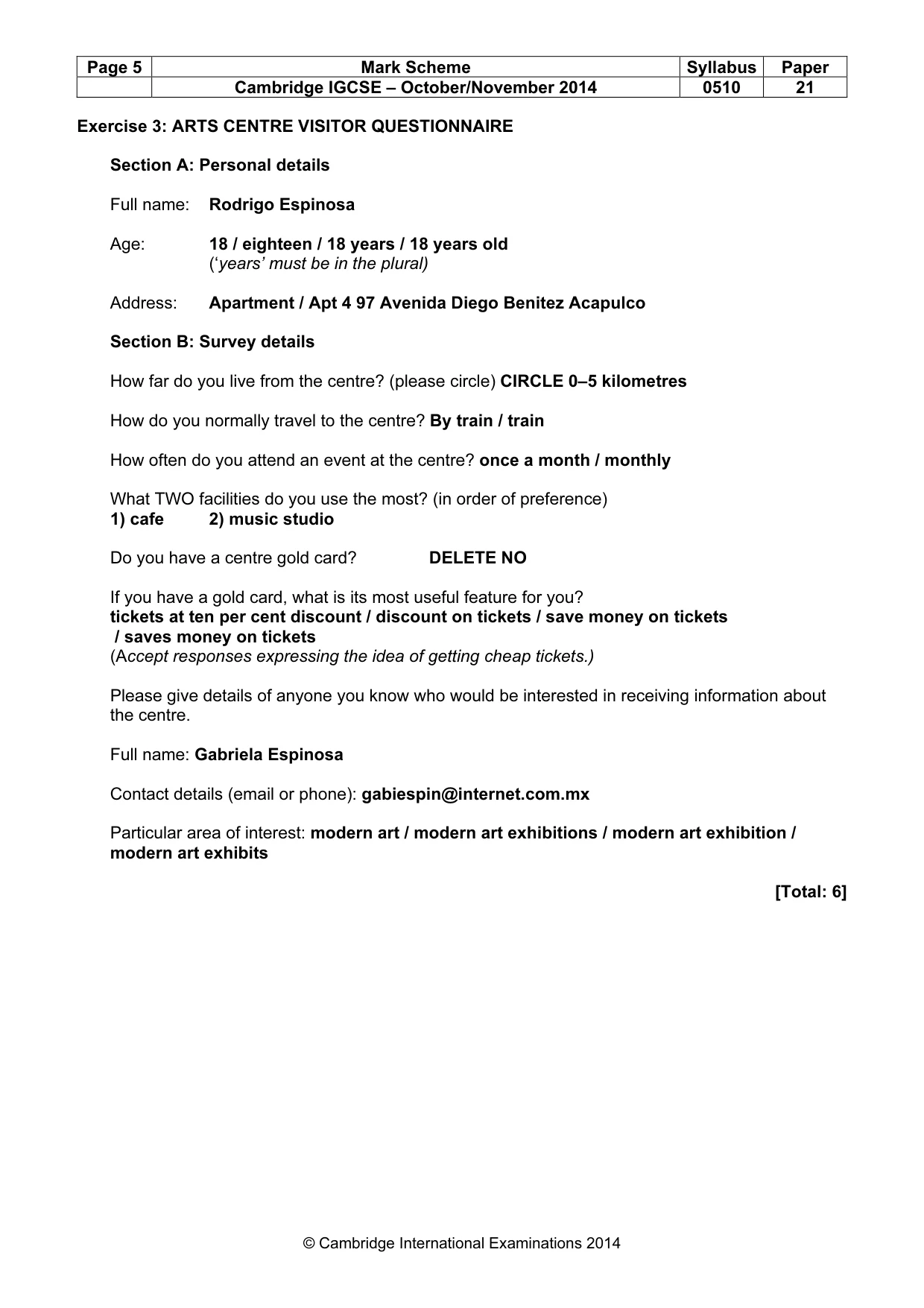
Page 5 Mark Scheme Syllabus Paper Cambridge IGCSE – October/November 2014 0510 21 © Cambridge International Examinations 2014 Exercise 3: ARTS CENTRE VISITOR QUESTIONNAIRE Section A: Personal details Full name: Rodrigo Espinosa Age: 18 / eighteen / 18 years / 18 years old (‘years’ must be in the plural) Address: Apartment / Apt 4 97 Avenida Diego Benitez Acapulco Section B: Survey details How far do you live from the centre? (please circle) CIRCLE 0–5 kilometres How do you normally travel to the centre? By train / train How often do you attend an event at the centre? once a month / monthly What TWO facilities do you use the most? (in order of preference) 1) cafe 2) music studio Do you have a centre gold card? DELETE NO If you have a gold card, what is its most useful feature for you? tickets at ten per cent discount / discount on tickets / save money on tickets / saves money on tickets (Accept responses expressing the idea of getting cheap tickets.) Please give details of anyone you know who would be interested in receiving information about the centre. Full name: Gabriela Espinosa Contact details (email or phone): gabiespin@internet.com.mx Particular area of interest: modern art / modern art exhibitions / modern art exhibition / modern art exhibits [Total: 6]
Mark scheme, page 6
Page 6 Mark Scheme Syllabus Paper Cambridge IGCSE – October/November 2014 0510 21 © Cambridge International Examinations 2014 Section C In the space below, write one sentence of between 12 and 20 words, about any improvements you would like to see at the centre in the future. Examples of acceptable sentences: I would like to see more rock and pop concerts for younger people. It would be a good idea to have a room where teenagers could relax. I would like more pop concerts and I could use my gold card to buy tickets. Characteristics of a correct sentence: The sentence should refer to an improvement to the centre provided in the text. It must refer to holding pop/rock concerts, not only having traditional music, or to having a room for teenagers. It must be written from the point of view of Rodrigo, so, if used, only first person pronouns (I, my etc.) are acceptable. It must contain a main clause. It can include extra correct irrelevant information from the text if a relevant improvement is also supplied. It cannot include any additional incorrect information even if a relevant improvement is given. For the sentence, award up to 2 marks as follows: 2 marks: no fewer than 12 and no more than 20 words; proper sentence construction; correct spelling, punctuation and grammar; relevant to context. 1 mark: no fewer than 12 and no more than 20 words; proper sentence construction; 1–3 errors of punctuation / spelling / grammar that do not obscure meaning; relevant to context. 0 marks: more than 3 errors of punctuation / spelling / grammar; and/or irrelevant to context, and/or not a proper sentence; and/or fewer than 12 words or more than 20 words. Absence of a full stop at the end should be considered as 1 punctuation error. Absence of an upper case letter at the beginning should be considered as 1 punctuation error. Omission of a word in the sentence should be considered as 1 grammar error. Max overall total for exercise 3: 8 marks
Mark scheme, page 7
Page 7 Mark Scheme Syllabus Paper Cambridge IGCSE – October/November 2014 0510 21 © Cambridge International Examinations 2014 Exercise 4: THE MAN WHO FELL TO EARTH Statistical data about the jump (maximum of 4) The mission involved about 300 people 1. Almost 40 000 m / about 40 km / highest / break altitude record (‘almost’ idea essential) 2. fall more than four minutes 3. more than 1300 km per hour / fastest / break speed record 4. open parachute about one and a half kms above ground 5. 8 million watching 6. 1st to break sound barrier 7. Five-year project / worked on five years Problems before and during the jump (maximum of 3) 8. shield covered with mist (Do not accept ‘helmet covered with mist’) 9. spin out of control 10. panic attack 11. several attempts to inflate balloon / inflating balloon abandoned / jump abandoned because of bad weather / bad weather Aims of the mission (maximum of 2) 12. test spacesuit 13. break speed and altitude records 14. how equipment affected by loss of pressure / how equipment affected by height / help people survive [Total: 9]
Mark scheme, page 8
Page 8 Mark Scheme Syllabus Paper Cambridge IGCSE – October/November 2014 0510 21 © Cambridge International Examinations 2014 Exercise 5: TRAVELLING AROUND CITIES Award a maximum of 6 marks for Content and 5 marks for Language. Content (up to 6 marks) Ideas suggested by the city planners 1. roads to move people 2. bicycles 3. more bicycle parks near stations / create bicycle parks near underground / more people to travel by public transport / half city population travel by public transport (Comparative idea essential where specified – suggestion of building/creating/providing bicycle parks covers this.) 4. bicycle rental 5. cars not allowed on certain days 6. fee to drive alone / share journeys 7. transport better linked / link bus and train schedules 8. publicity campaign / let people know about alternative transport / persuade people to use different transport 9. change in work practices / flexitime / work from home Language (up to 5 marks) 0 marks: no understanding of the task / no relevant content / meaning completely obscure due to serious language inaccuracies 1 mark: copying without discrimination from text / multiple language inaccuracies 2 marks: heavy reliance on language from the text with no attempt to organise and sequence points cohesively / limited language expression making meaning at times unclear 3 marks: some reliance on language from the text, but with an attempt to organise and sequence points cohesively / language satisfactory, but with some inaccuracies 4 marks: good attempt to use own words and to organise and sequence points cohesively / generally good control of language 5 marks: good, concise summary style / very good attempt to use own words and to organise and sequence points cohesively Max total for exercise 5: 11 marks
Mark scheme, page 9
Page 9 Mark Scheme Syllabus Paper Cambridge IGCSE – October/November 2014 0510 21 © Cambridge International Examinations 2014 Exercise 6: Surprising news item Exercise 7: Drinks and snacks machine The following general instructions, and table of marking criteria, apply to both exercises. • Award the answer a mark for content (C) [out of 10] and a mark for language (L) [out of 9] in accordance with the General Criteria table that follows. • Content covers relevance (i.e. whether the piece fulfils the task and the awareness of purpose/audience/register) and the development of ideas (i.e. the detail/explanation provided and how enjoyable it is to read). • Language covers style (i.e. complexity of vocabulary and sentence structure) and accuracy (of grammar, spelling, punctuation and use of paragraphs). • When deciding on a mark for content or language, first of all decide which mark band is most appropriate. There will not necessarily be an exact fit. Then decide between 2 marks within that mark band. Use the lower mark if it only just makes it into the band and the upper mark if it fulfils all the requirements of the band but doesn’t quite make it into the band above. • When deciding on a mark for content, look at both relevance and development of ideas. First ask yourself whether the writing fulfils the task, in terms of points to be covered and the length. If it does, it will be in at least the 4–5 mark band. • When deciding on a mark for language, look at both the style and the accuracy of the language. A useful starting point would be first to determine whether errors intrude. If they do not, it will be in at least the 4–5 mark band. • The use of paragraphs should not be the primary basis of deciding which mark band the work is in. Look first at the language used and once you have decided on the appropriate mark band, you can use the paragraphing as a factor in helping you to decide whether the work warrants the upper or lower mark in the mark band. • If the essay is considerably shorter than the stated word length, it should be put in mark band 2–3 for content or lower for not fulfilling the task. The language mark is likely to be affected and is unlikely to be more than one band higher than the content mark. • If the essay is totally irrelevant and has nothing to do with the question asked, it should be given 0 marks for Content and Language, even if it is enjoyable to read and fluent. • If the essay is partly relevant and therefore in mark band 2–3, the full range of marks for language is available. Max total for exercise 6: 19 marks Max total for exercise 7: 19 marks
Mark scheme, page 10
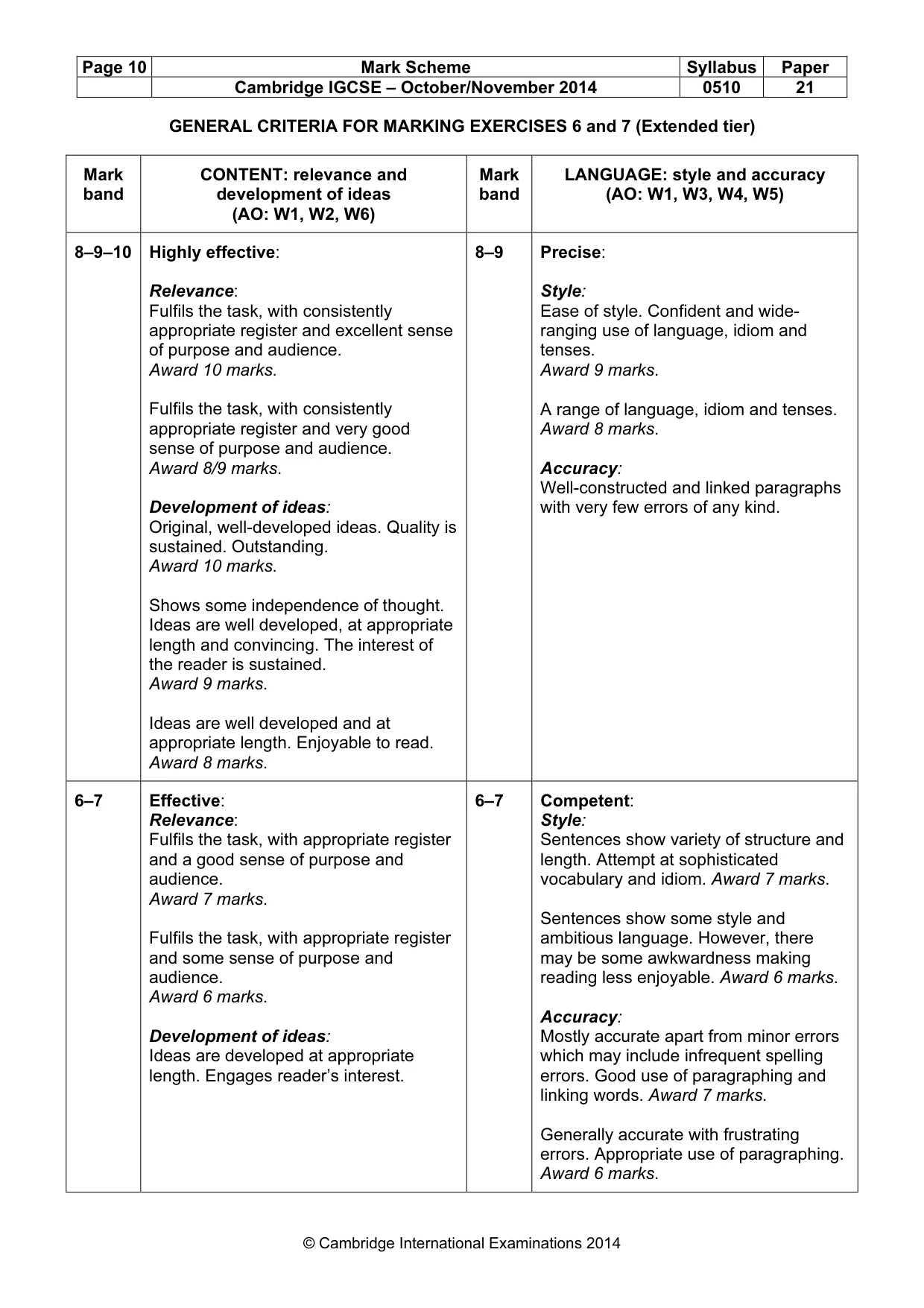
Page 10 Mark Scheme Syllabus Paper Cambridge IGCSE – October/November 2014 0510 21 © Cambridge International Examinations 2014 GENERAL CRITERIA FOR MARKING EXERCISES 6 and 7 (Extended tier) Mark band CONTENT: relevance and development of ideas (AO: W1, W2, W6) Mark band LANGUAGE: style and accuracy (AO: W1, W3, W4, W5) 8–9–10 Highly effective: Relevance: Fulfils the task, with consistently appropriate register and excellent sense of purpose and audience. Award 10 marks. Fulfils the task, with consistently appropriate register and very good sense of purpose and audience. Award 8/9 marks. Development of ideas: Original, well-developed ideas. Quality is sustained. Outstanding. Award 10 marks. Shows some independence of thought. Ideas are well developed, at appropriate length and convincing. The interest of the reader is sustained. Award 9 marks. Ideas are well developed and at appropriate length. Enjoyable to read. Award 8 marks. 8–9 Precise: Style: Ease of style. Confident and wide- ranging use of language, idiom and tenses. Award 9 marks. A range of language, idiom and tenses. Award 8 marks. Accuracy: Well-constructed and linked paragraphs with very few errors of any kind. 6–7 Effective: Relevance: Fulfils the task, with appropriate register and a good sense of purpose and audience. Award 7 marks. Fulfils the task, with appropriate register and some sense of purpose and audience. Award 6 marks. Development of ideas: Ideas are developed at appropriate length. Engages reader’s interest. 6–7 Competent: Style: Sentences show variety of structure and length. Attempt at sophisticated vocabulary and idiom. Award 7 marks. Sentences show some style and ambitious language. However, there may be some awkwardness making reading less enjoyable. Award 6 marks. Accuracy: Mostly accurate apart from minor errors which may include infrequent spelling errors. Good use of paragraphing and linking words. Award 7 marks. Generally accurate with frustrating errors. Appropriate use of paragraphing. Award 6 marks.
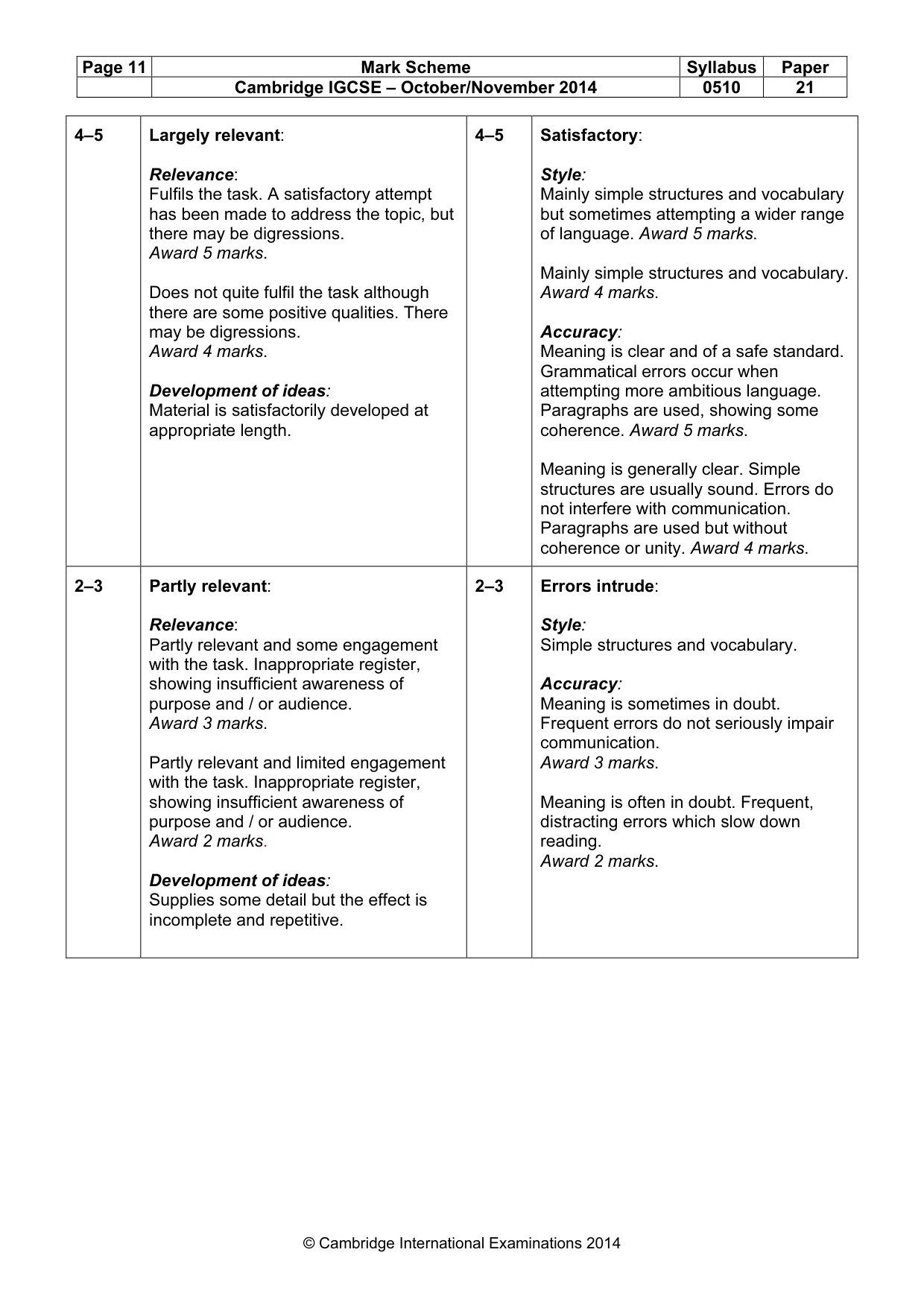
Mark scheme, page 11
Page 11 Mark Scheme Syllabus Paper Cambridge IGCSE – October/November 2014 0510 21 © Cambridge International Examinations 2014 4–5 Largely relevant: Relevance: Fulfils the task. A satisfactory attempt has been made to address the topic, but there may be digressions. Award 5 marks. Does not quite fulfil the task although there are some positive qualities. There may be digressions. Award 4 marks. Development of ideas: Material is satisfactorily developed at appropriate length. 4–5 Satisfactory: Style: Mainly simple structures and vocabulary but sometimes attempting a wider range of language. Award 5 marks. Mainly simple structures and vocabulary. Award 4 marks. Accuracy: Meaning is clear and of a safe standard. Grammatical errors occur when attempting more ambitious language. Paragraphs are used, showing some coherence. Award 5 marks. Meaning is generally clear. Simple structures are usually sound. Errors do not interfere with communication. Paragraphs are used but without coherence or unity. Award 4 marks. 2–3 Partly relevant: Relevance: Partly relevant and some engagement with the task. Inappropriate register, showing insufficient awareness of purpose and / or audience. Award 3 marks. Partly relevant and limited engagement with the task. Inappropriate register, showing insufficient awareness of purpose and / or audience. Award 2 marks. Development of ideas: Supplies some detail but the effect is incomplete and repetitive. 2–3 Errors intrude: Style: Simple structures and vocabulary. Accuracy: Meaning is sometimes in doubt. Frequent errors do not seriously impair communication. Award 3 marks. Meaning is often in doubt. Frequent, distracting errors which slow down reading. Award 2 marks.
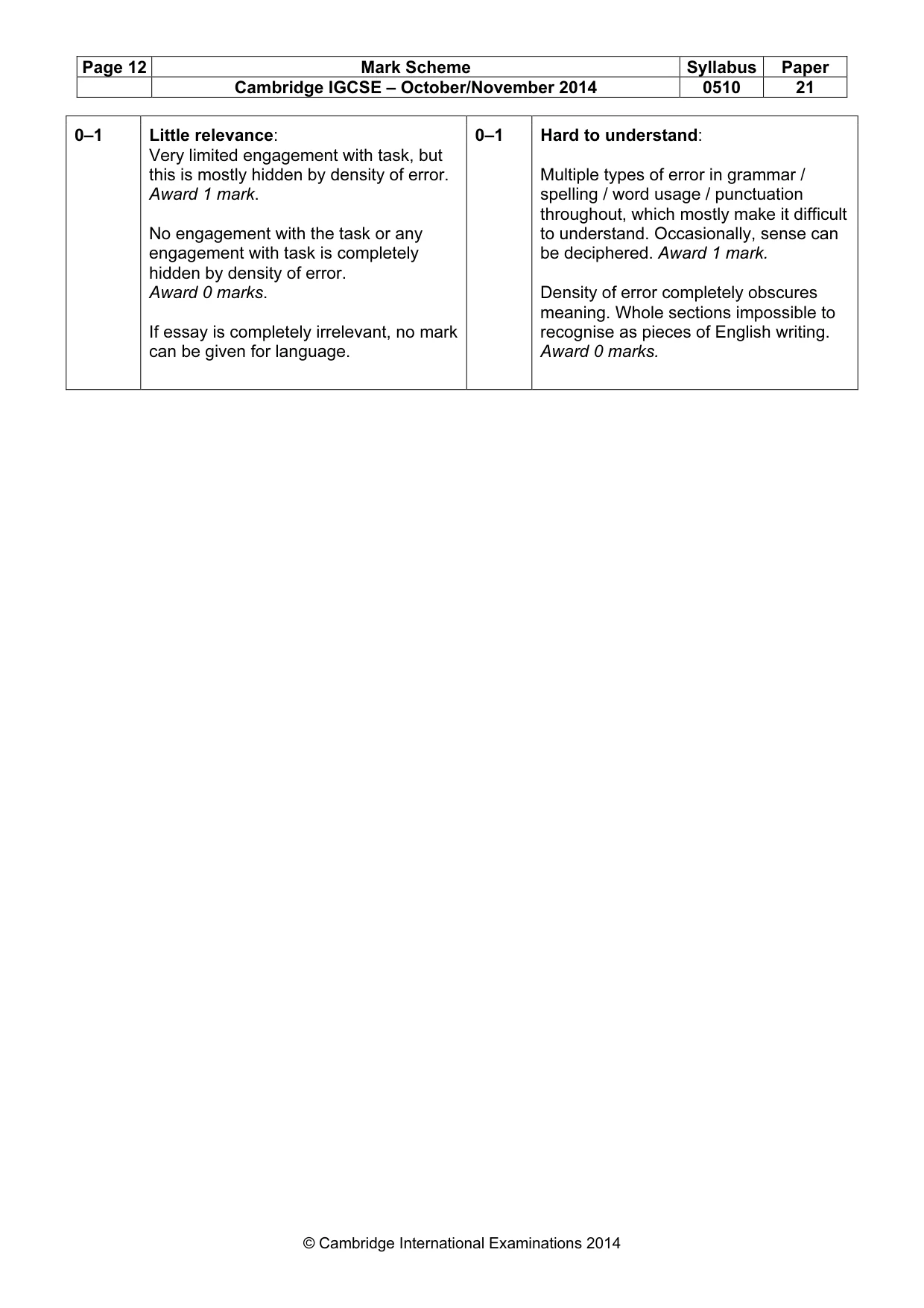
Mark scheme, page 12
Page 12 Mark Scheme Syllabus Paper Cambridge IGCSE – October/November 2014 0510 21 © Cambridge International Examinations 2014 0–1 Little relevance: Very limited engagement with task, but this is mostly hidden by density of error. Award 1 mark. No engagement with the task or any engagement with task is completely hidden by density of error. Award 0 marks. If essay is completely irrelevant, no mark can be given for language. 0–1 Hard to understand: Multiple types of error in grammar / spelling / word usage / punctuation throughout, which mostly make it difficult to understand. Occasionally, sense can be deciphered. Award 1 mark. Density of error completely obscures meaning. Whole sections impossible to recognise as pieces of English writing. Award 0 marks.
What you needed in this session
Cambridge’s own grade thresholds for 2014 Oct/Nov, Paper 2 · Variant 1. A higher threshold means an easier paper — the bar moves with how the cohort did.