Cambridge IGCSE English - Second Language (oral endorsement) 0510 — 2011 Oct/Nov Paper 2 · Variant 3
0510/23/O/N/11 · 84 marks · ≈95 min
The question paper and its mark scheme, free to read here and free to download. This is Cambridge’s own paper, exactly as it was sat.
Question paper16 pages




Mark scheme10 pages
Answers below. Sit the paper first if you are practising.
Paper as text
Question paper, page 1
This document consists of 15 printed pages and 1 blank page. IB11 11_0510_23/6RP © UCLES 2011 [Turn over *5828411925* UNIVERSITY OF CAMBRIDGE INTERNATIONAL EXAMINATIONS International General Certificate of Secondary Education ENGLISH AS A SECOND LANGUAGE 0510/23 Paper 2 Reading and Writing (Extended) October/November 2011 2 hours Candidates answer on the Question Paper. No Additional Materials are required. READ THESE INSTRUCTIONS FIRST Write your Centre number, candidate number and name on all the work you hand in. Write in dark blue or black pen. Do not use staples, paper clips, highlighters, glue or correction fluid. DO NOT WRITE IN ANY BARCODES. Answer all questions. Dictionaries are not allowed. The number of marks is given in brackets [ ] at the end of each question or part question.
Question paper, page 2
2 © UCLES 2011 0510/23/O/N/11 Exercise 1 Read the following article about wedding customs, and then answer the questions on the opposite page. Wedding Customs Around the World In the past most people only knew about one way to get married. They were familiar only with the customs and traditions that they saw around them. Today, however, thanks to television and the internet, we live in what seems to be a very small world. Colombia There is a very old custom in Colombia in which the bridegroom lights a candle on his left and the bride lights a candle on her right. Both candles are then brought together and the two candles are used to light a new candle. The first two candles are then blown out and only the new candle remains burning. This is a sign that the couple are leaving their old life behind them and entering a new life together as one body forever. Germany A few days before the wedding friends and relatives bring old cups, plates and dishes and they smash them all on the ground in front of the bride and groom. This is a very old tradition and the idea is that these broken items bring you good luck. This action nowadays often develops into a party, but the main idea is to wish the couple a happy and lucky life. Iran On the night before the wedding ceremony three or four unmarried girls, who have been chosen because they are of good character, hold a white cloth over the heads of the bride and groom as they sit on a sofa or on the ground. Two big lumps of sugar are brought in and one of the girls starts to rub the lumps together. As she does this, the other girls ask for the couple to be given happiness in their new life together. It is also believed that whoever grinds the sugar lumps together for the couple will end up getting married herself in the near future. Belarus In Belarus, towels play a very important part in the wedding traditions. Brightly coloured towels symbolising joy, health and wealth are held by lots of the guests as they represent the two families coming together. When the bride walks to the place where she is going to be married, she has to drag a towel behind her, making a clear path. It is believed that her unmarried friends will then walk on this path in the near future on their way to getting married as well.
Question paper, page 3
3 © UCLES 2011 0510/23/O/N/11 [Turn over (a) How do we now know about different wedding practices around the world? [1] (b) Why are three candles lit in Colombia but only one left burning? [1] (c) What happens in Germany to the plates that people bring before the wedding? [1] (d) What is the reason for the tradition involving plates in Germany? [1] (e) What sort of girls are chosen to take part in the sugar ceremony in Iran? Give two details. [1] (f) Why might a girl want to grind the sugar in Iran? [1] (g) What does a bride in Belarus have to do as she walks to her wedding? [1] (h) What do the towels customarily used in Belarus represent? Give two details. [1] [Total: 8]
Question paper, page 4
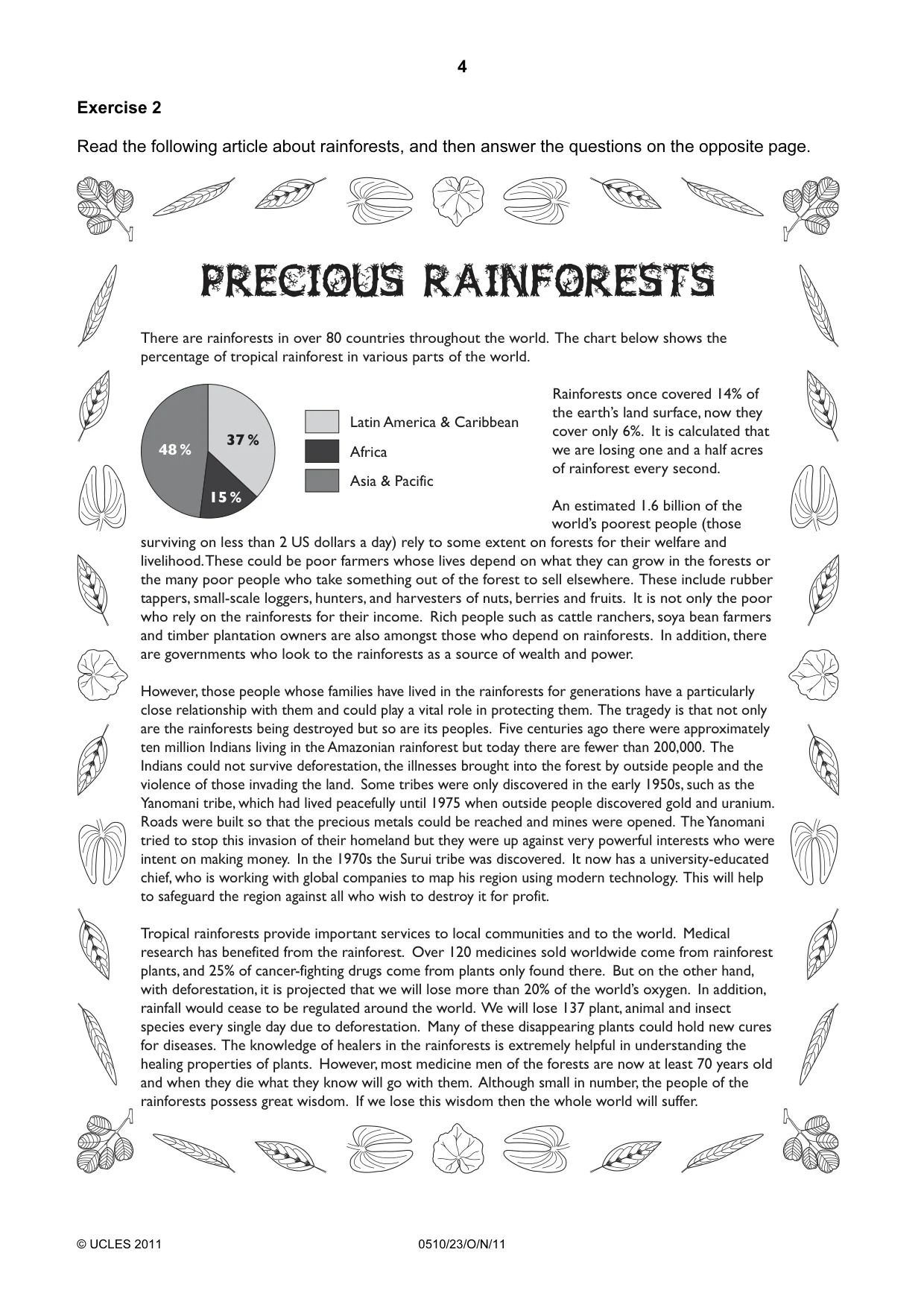
4 © UCLES 2011 0510/23/O/N/11 Exercise 2 Read the following article about rainforests, and then answer the questions on the opposite page. Precious Rainforests There are rainforests in over 80 countries throughout the world. The chart below shows the percentage of tropical rainforest in various parts of the world. Rainforests once covered 14% of the earth’s land surface, now they cover only 6%. It is calculated that we are losing one and a half acres of rainforest every second. An estimated 1.6 billion of the world’s poorest people (those surviving on less than 2 US dollars a day) rely to some extent on forests for their welfare and livelihood. These could be poor farmers whose lives depend on what they can grow in the forests or the many poor people who take something out of the forest to sell elsewhere. These include rubber tappers, small-scale loggers, hunters, and harvesters of nuts, berries and fruits. It is not only the poor who rely on the rainforests for their income. Rich people such as cattle ranchers, soya bean farmers and timber plantation owners are also amongst those who depend on rainforests. In addition, there are governments who look to the rainforests as a source of wealth and power. However, those people whose families have lived in the rainforests for generations have a particularly close relationship with them and could play a vital role in protecting them. The tragedy is that not only are the rainforests being destroyed but so are its peoples. Five centuries ago there were approximately ten million Indians living in the Amazonian rainforest but today there are fewer than 200,000. The Indians could not survive deforestation, the illnesses brought into the forest by outside people and the violence of those invading the land. Some tribes were only discovered in the early 1950s, such as the Yanomani tribe, which had lived peacefully until 1975 when outside people discovered gold and uranium. Roads were built so that the precious metals could be reached and mines were opened. The Yanomani tried to stop this invasion of their homeland but they were up against very powerful interests who were intent on making money. In the 1970s the Surui tribe was discovered. It now has a university-educated chief, who is working with global companies to map his region using modern technology. This will help to safeguard the region against all who wish to destroy it for profit. Tropical rainforests provide important services to local communities and to the world. Medical research has benefited from the rainforest. Over 120 medicines sold worldwide come from rainforest plants, and 25% of cancer-fighting drugs come from plants only found there. But on the other hand, with deforestation, it is projected that we will lose more than 20% of the world’s oxygen. In addition, rainfall would cease to be regulated around the world. We will lose 137 plant, animal and insect species every single day due to deforestation. Many of these disappearing plants could hold new cures for diseases. The knowledge of healers in the rainforests is extremely helpful in understanding the healing properties of plants. However, most medicine men of the forests are now at least 70 years old and when they die what they know will go with them. Although small in number, the people of the rainforests possess great wisdom. If we lose this wisdom then the whole world will suffer. 37 % 48 % 15 % Latin America & Caribbean Africa Asia & Pacific
Question paper, page 5
5 © UCLES 2011 0510/23/O/N/11 [Turn over (a) According to the chart, which part of the world has the highest percentage of rainforest cover? [1] (b) What evidence is there for the reduction of rainforests? Give two details. [1] (c) How are the world’s poorest people defined in the article? [1] (d) Apart from the poor, which other groups of people depend on the rainforest for income? Give two details. [1] (e) Apart from deforestation, what has caused the decline in numbers of the rainforest Indians? Give two details. [2] (f) What happened to disturb the Yanomani’s traditional way of life? [1] (g) Why does the Surui tribe leader want to map his region? [1] (h) Give two examples of the ways in which people around the world have benefited from plants found in the rainforests. [2] (i) What will the world lose if the rainforests are destroyed? Give four details. [4] [Total: 14]
Question paper, page 6
6 © UCLES 2011 0510/23/O/N/11 Exercise 3 Jyoti Prakash is in her final year at Park Place International School, No. 5 Jigani Road, Virgo Nagar, Bangalore, which is in India. The school was brand new when she joined it in 2005 and so she and her classmates are the first group to have completed the whole of their senior education there. Both staff and pupils feel that there should be a very special event to celebrate the school’s first graduation. Jyoti, who is Chairperson of the School Council, was asked to work with the Council to arrange an evening of entertainment to mark the occasion. Jyoti realised this would mean a lot of work but she enjoys organising things and she was happy to take on the task given to her. The first thing that Jyoti did was to put her email address on the school website, jp@redifmail.com and she also gave her mobile/cell number, 9344505640, to the other members of the School Council so that they could contact her easily and quickly. At first, the Council did not have any idea about what to do, and so they designed a questionnaire which they distributed to 180 pupils, staff and parents who would be involved in the event. This was designed to try to collect ideas about what sort of celebration to hold. When the questionnaires came back, there was quite a wide variety of suggestions, but it became clear that most people wanted the celebration to be held in the evening of 1 July 2012 at the nearby Regent Hotel. This would provide a high standard of comfort and easy access to a wide range of facilities. The hotel is also well known in the community and everyone was confident that the staff would make the evening special. The questionnaire responses indicated that people wanted to be offered a meal, preferably a buffet with a vegetarian selection. They also wanted different departments in the school to arrange something to entertain the guests. It was thought that the Drama and Music departments would be able to produce some entertainment in the form of short sketches and songs. Another suggestion that the School Council liked was that a group of pupils should show a short DVD film highlighting all of the major events of the last seven years. Jyoti agreed to ask the hotel to provide a DVD player and projector for this. One of the main difficulties the School Council had in planning the event was the potential cost. It would be very expensive to organise everything and the Headteacher had already indicated that school funds could not be used. The School Council decided to ask the Business Studies students to draw up some financial plans and they thought that costs could be covered if each guest paid between 3,000 and 4,000 rupees each. Entry tickets would be printed by the hotel at a very reasonable price. Imagine you are Jyoti Prakash. Fill in the booking form on the opposite page, using the information above.
Question paper, page 7
7 © UCLES 2011 0510/23/O/N/11 [Turn over Hotel Booking Form Section A Customer details Name of business / school: … Address: … Name of customer (person making the booking): … Position in business / school: … Email address: … Telephone number: … Section B Booking details Reservation required for: … (insert date) (please circle) morning afternoon evening Number of people attending the event: (please tick) 0-50 51-100 101-150 more than 150 Meal requirements: … Do you require a space for performance? (please delete) YES / NO Give details of any technical equipment required: … Other services required from the hotel? … Section C In the space below, write one sentence of between 12 and 20 words, explaining why you chose the Regent Hotel for your event. [Total: 8]
Question paper, page 8
8 © UCLES 2011 0510/23/O/N/11 Exercise 4 Read the following article about a wildlife park in the Middle East, and then complete the notes on the opposite page. The Middle Eastern Wildlife Park The Middle Eastern Wildlife Park was created for the conservation of wild animals. It has been very successful in this and is now home to 30 species of animals. The park looks after about 400 Arabian oryx (which are now extinct in the wild) and hundreds of endangered sand gazelles and Arabian hares. It offers visitors many exciting experiences such as the chance to go on an amazing safari within the 4,100 hectares of the desert island setting. As well as conservation, there have been successful environmental projects too, such as the creation of an alternative energy plant in the wildlife park. It is hoped that eventually the energy plant will provide all the energy for the island using a mixture of solar and wind power. There is already a wind turbine in the wildlife park that generates 1% of the island’s needs. Efforts to reduce the island’s water consumption have cut usage from 55 million to 40 million litres a day. However, it is the activities that you can do that really sets the island apart from other places in the region. Many tourists go to the Middle East simply to sunbathe and shop, but the park hopes to attract more adventurous travellers who might not have considered the region before. These tourists are still offered every comfort as their base is a luxury hotel. However, there are also tented camps across the wildlife park, which offer a more affordable option. This option may also be more attractive to visitors who are concerned about the hotel’s cold air-conditioning, which is not very eco-friendly. Snorkelling around the island can be exciting – colourful angelfish and kingfish can often be seen. The turtles, small sharks, dolphins and rays are not always so easy to spot. Rubbish on the beach can also be a problem and it’s sad to see bits of plastic and metal mixed in with the thousands of seashells at the water’s edge. Going on a bike ride around the flamingo-filled lagoon and along sandy lanes can be more rewarding. The island is on the migratory path for flamingos and other birds, but many of them stay there all year. As tourists cycle past the lagoon, they can see beautiful flamingos standing on their slender legs. It is a sight that few will forget. The more energetic visitor can ride on a mountain bike across what is said to be the world’s largest salt mountains which were created millions of years ago. However, the extreme heat at certain times of the year makes this activity very difficult. The Middle Eastern Wildlife Park is a step in the right direction as it is working hard to be environmentally friendly, and it is enjoyed by many people who want to see nature being conserved. y
Question paper, page 9
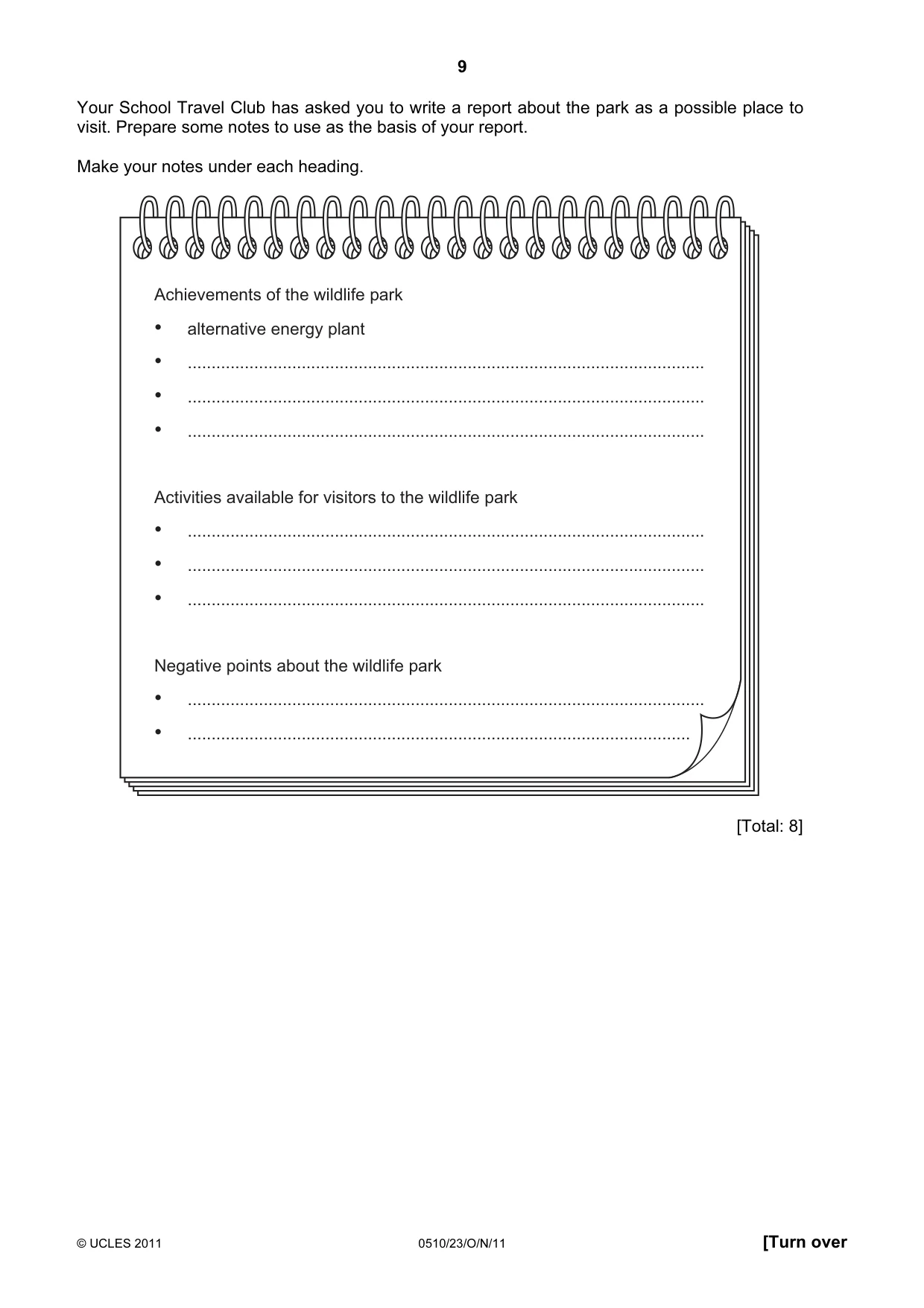
9 © UCLES 2011 0510/23/O/N/11 [Turn over Your School Travel Club has asked you to write a report about the park as a possible place to visit. Prepare some notes to use as the basis of your report. Make your notes under each heading. Achievements of the wildlife park • alternative energy plant • … • … • … Activities available for visitors to the wildlife park • … • … • … Negative points about the wildlife park • … • … [Total: 8]
Question paper, page 10
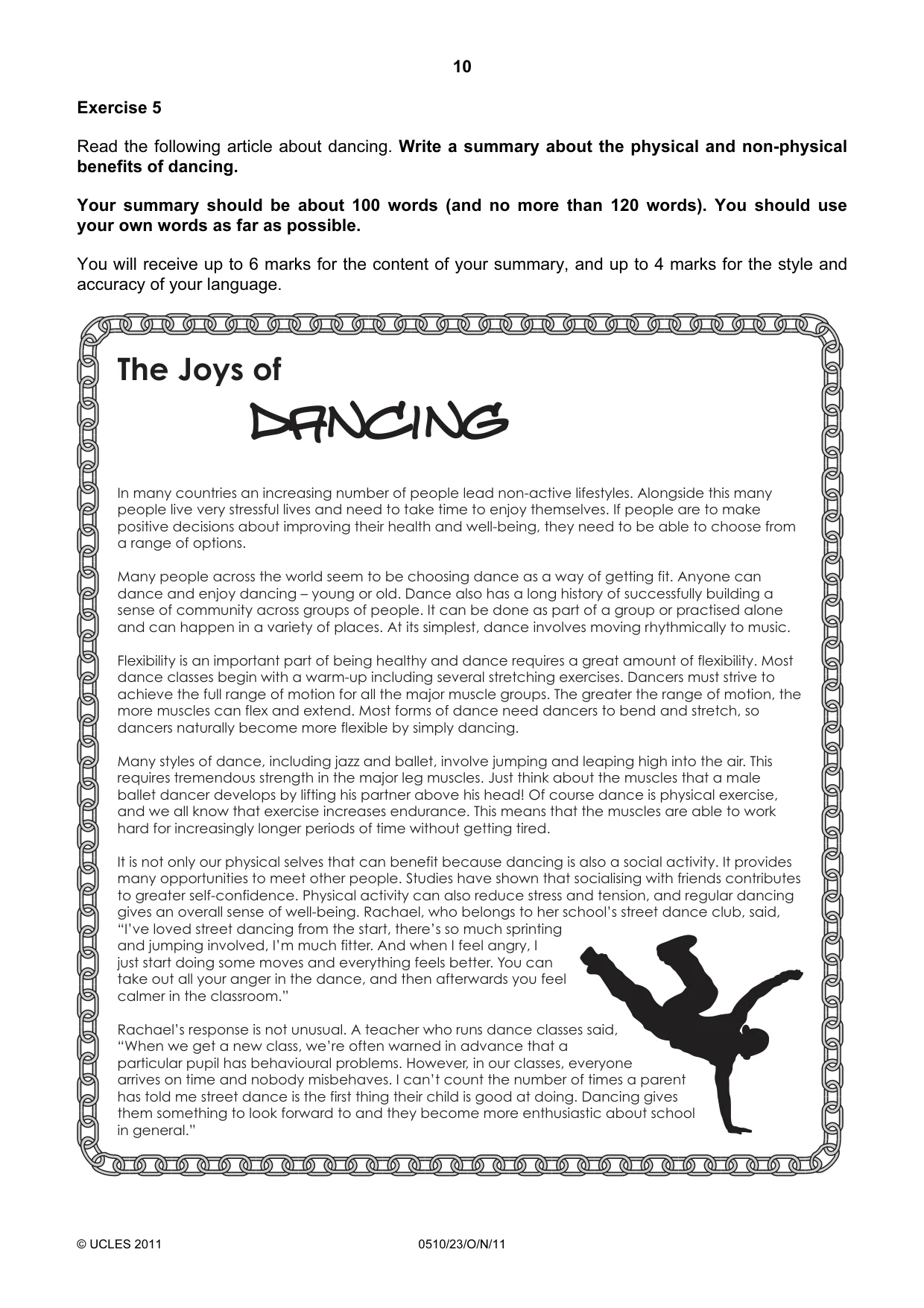
10 © UCLES 2011 0510/23/O/N/11 Exercise 5 Read the following article about dancing. Write a summary about the physical and non-physical benefits of dancing. Your summary should be about 100 words (and no more than 120 words). You should use your own words as far as possible. You will receive up to 6 marks for the content of your summary, and up to 4 marks for the style and accuracy of your language. The Joys of In many countries an increasing number of people lead non-active lifestyles. Alongside this many people live very stressful lives and need to take time to enjoy themselves. If people are to make positive decisions about improving their health and well-being, they need to be able to choose from a range of options. Many people across the world seem to be choosing dance as a way of getting fit. Anyone can dance and enjoy dancing – young or old. Dance also has a long history of successfully building a sense of community across groups of people. It can be done as part of a group or practised alone and can happen in a variety of places. At its simplest, dance involves moving rhythmically to music. Flexibility is an important part of being healthy and dance requires a great amount of flexibility. Most dance classes begin with a warm-up including several stretching exercises. Dancers must strive to achieve the full range of motion for all the major muscle groups. The greater the range of motion, the more muscles can flex and extend. Most forms of dance need dancers to bend and stretch, so dancers naturally become more flexible by simply dancing. Many styles of dance, including jazz and ballet, involve jumping and leaping high into the air. This requires tremendous strength in the major leg muscles. Just think about the muscles that a male ballet dancer develops by lifting his partner above his head! Of course dance is physical exercise, and we all know that exercise increases endurance. This means that the muscles are able to work hard for increasingly longer periods of time without getting tired. It is not only our physical selves that can benefit because dancing is also a social activity. It provides many opportunities to meet other people. Studies have shown that socialising with friends contributes to greater self-confidence. Physical activity can also reduce stress and tension, and regular dancing gives an overall sense of well-being. Rachael, who belongs to her school’s street dance club, said, “I’ve loved street dancing from the start, there’s so much sprinting and jumping involved, I’m much fitter. And when I feel angry, I just start doing some moves and everything feels better. You can take out all your anger in the dance, and then afterwards you feel calmer in the classroom.” Rachael’s response is not unusual. A teacher who runs dance classes said, “When we get a new class, we’re often warned in advance that a particular pupil has behavioural problems. However, in our classes, everyone arrives on time and nobody misbehaves. I can’t count the number of times a parent has told me street dance is the first thing their child is good at doing. Dancing gives them something to look forward to and they become more enthusiastic about school in general.” Dancing
Question paper, page 11
11 © UCLES 2011 0510/23/O/N/11 [Turn over [Total: 10]
Question paper, page 12
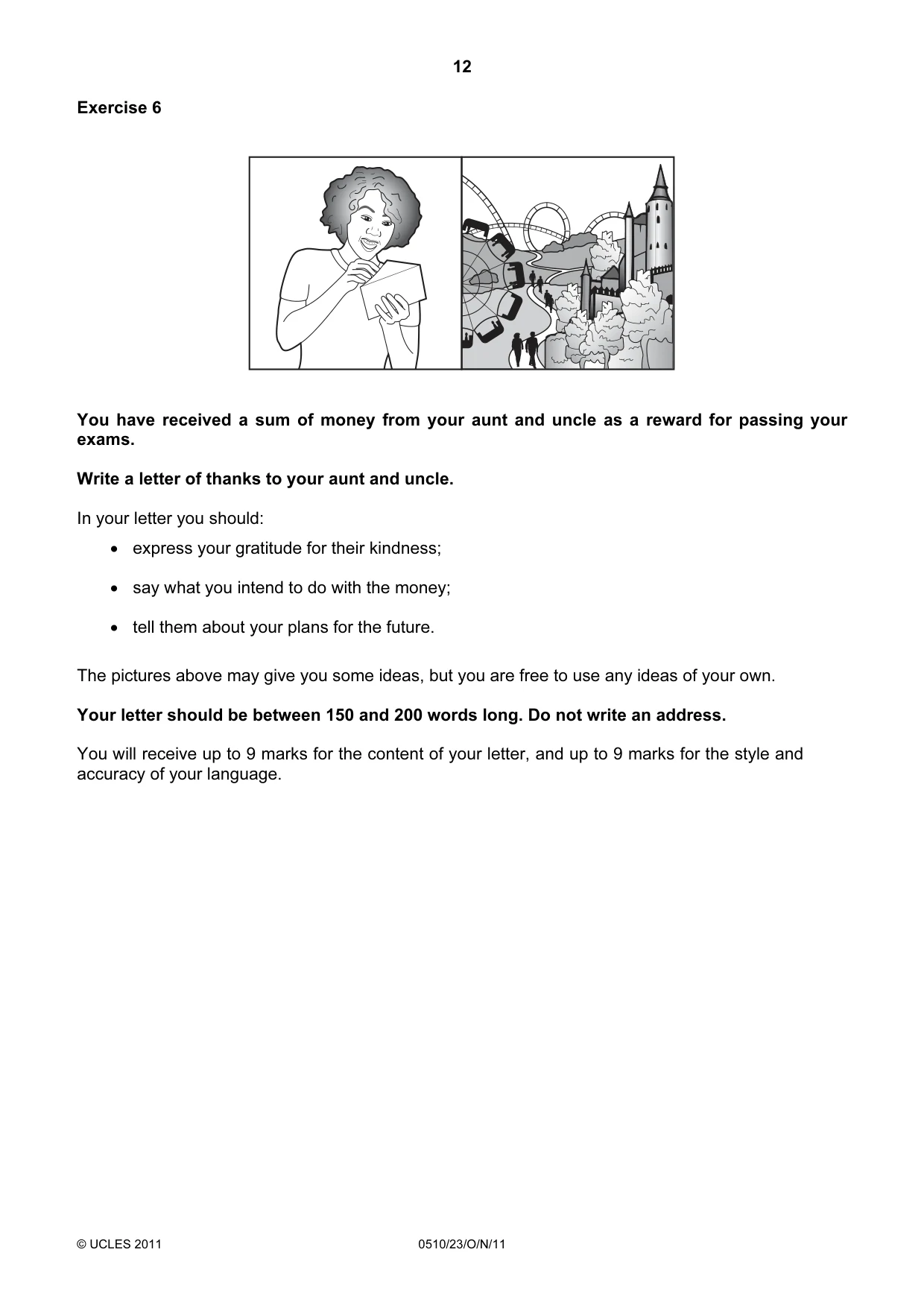
12 © UCLES 2011 0510/23/O/N/11 Exercise 6 You have received a sum of money from your aunt and uncle as a reward for passing your exams. Write a letter of thanks to your aunt and uncle. In your letter you should: • express your gratitude for their kindness; • say what you intend to do with the money; • tell them about your plans for the future. The pictures above may give you some ideas, but you are free to use any ideas of your own. Your letter should be between 150 and 200 words long. Do not write an address. You will receive up to 9 marks for the content of your letter, and up to 9 marks for the style and accuracy of your language.
Question paper, page 13
13 © UCLES 2011 0510/23/O/N/11 [Turn over [Total: 18]
Question paper, page 14
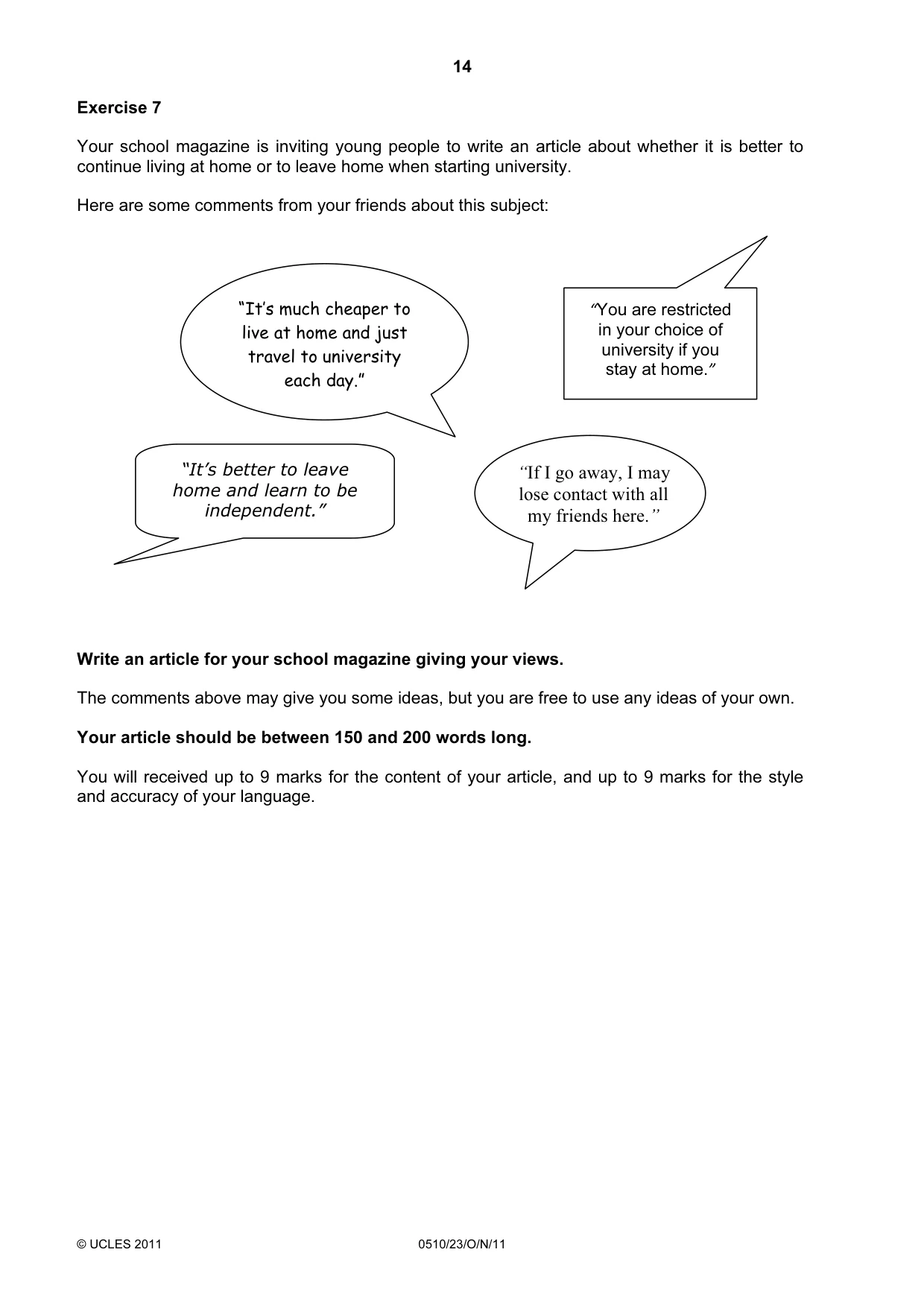
14 © UCLES 2011 0510/23/O/N/11 Exercise 7 Your school magazine is inviting young people to write an article about whether it is better to continue living at home or to leave home when starting university. Here are some comments from your friends about this subject: Write an article for your school magazine giving your views. The comments above may give you some ideas, but you are free to use any ideas of your own. Your article should be between 150 and 200 words long. You will received up to 9 marks for the content of your article, and up to 9 marks for the style and accuracy of your language. “It’s much cheaper to live at home and just travel to university each day.” “You are restricted in your choice of university if you stay at home.” “If I go away, I may lose contact with all my friends here.” “It’s better to leave home and learn to be independent.”
Question paper, page 15
15 © UCLES 2011 0510/23/O/N/11 [Total: 18]
Question paper, page 16
16 Permission to reproduce items where third-party owned material protected by copyright is included has been sought and cleared where possible. Every reasonable effort has been made by the publisher (UCLES) to trace copyright holders, but if any items requiring clearance have unwittingly been included, the publisher will be pleased to make amends at the earliest possible opportunity. University of Cambridge International Examinations is part of the Cambridge Assessment Group. Cambridge Assessment is the brand name of University of Cambridge Local Examinations Syndicate (UCLES), which is itself a department of the University of Cambridge. © UCLES 2011 0510/23/O/N/11 BLANK PAGE
Mark scheme, page 1
UNIVERSITY OF CAMBRIDGE INTERNATIONAL EXAMINATIONS International General Certificate of Secondary Education MARK SCHEME for the October/November 2011 question paper for the guidance of teachers 0510 ENGLISH AS A SECOND LANGUAGE 0510/23 Paper 2 (Reading and Writing – Extended), maximum raw mark 84 This mark scheme is published as an aid to teachers and candidates, to indicate the requirements of the examination. It shows the basis on which Examiners were instructed to award marks. It does not indicate the details of the discussions that took place at an Examiners’ meeting before marking began, which would have considered the acceptability of alternative answers. Mark schemes must be read in conjunction with the question papers and the report on the examination. • Cambridge will not enter into discussions or correspondence in connection with these mark schemes. Cambridge is publishing the mark schemes for the October/November 2011 question papers for most IGCSE, GCE Advanced Level and Advanced Subsidiary Level syllabuses and some Ordinary Level syllabuses.
Mark scheme, page 2
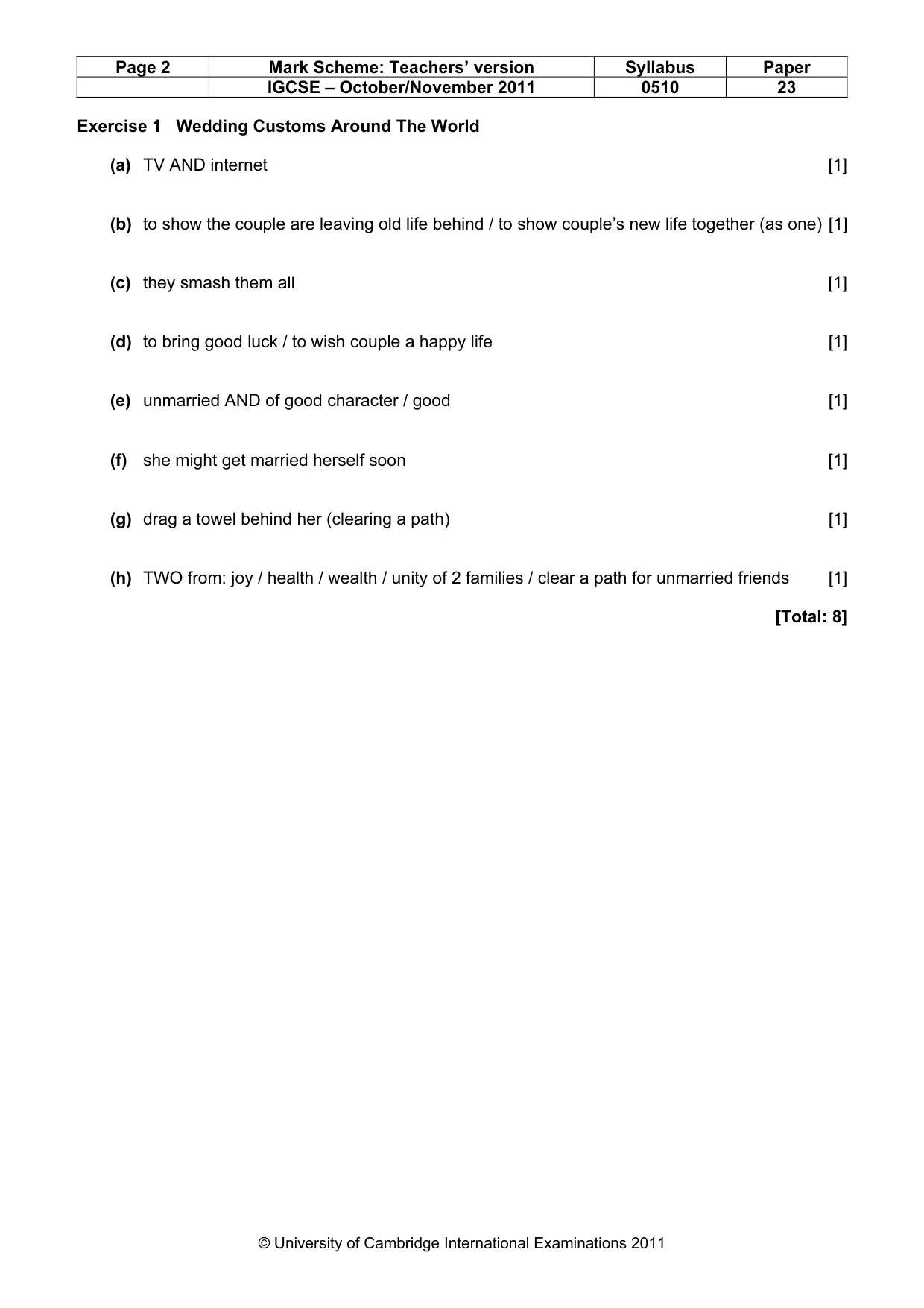
Page 2 Mark Scheme: Teachers’ version Syllabus Paper IGCSE – October/November 2011 0510 23 © University of Cambridge International Examinations 2011 Exercise 1 Wedding Customs Around The World (a) TV AND internet [1] (b) to show the couple are leaving old life behind / to show couple’s new life together (as one) [1] (c) they smash them all [1] (d) to bring good luck / to wish couple a happy life [1] (e) unmarried AND of good character / good [1] (f) she might get married herself soon [1] (g) drag a towel behind her (clearing a path) [1] (h) TWO from: joy / health / wealth / unity of 2 families / clear a path for unmarried friends [1] [Total: 8]
Mark scheme, page 3
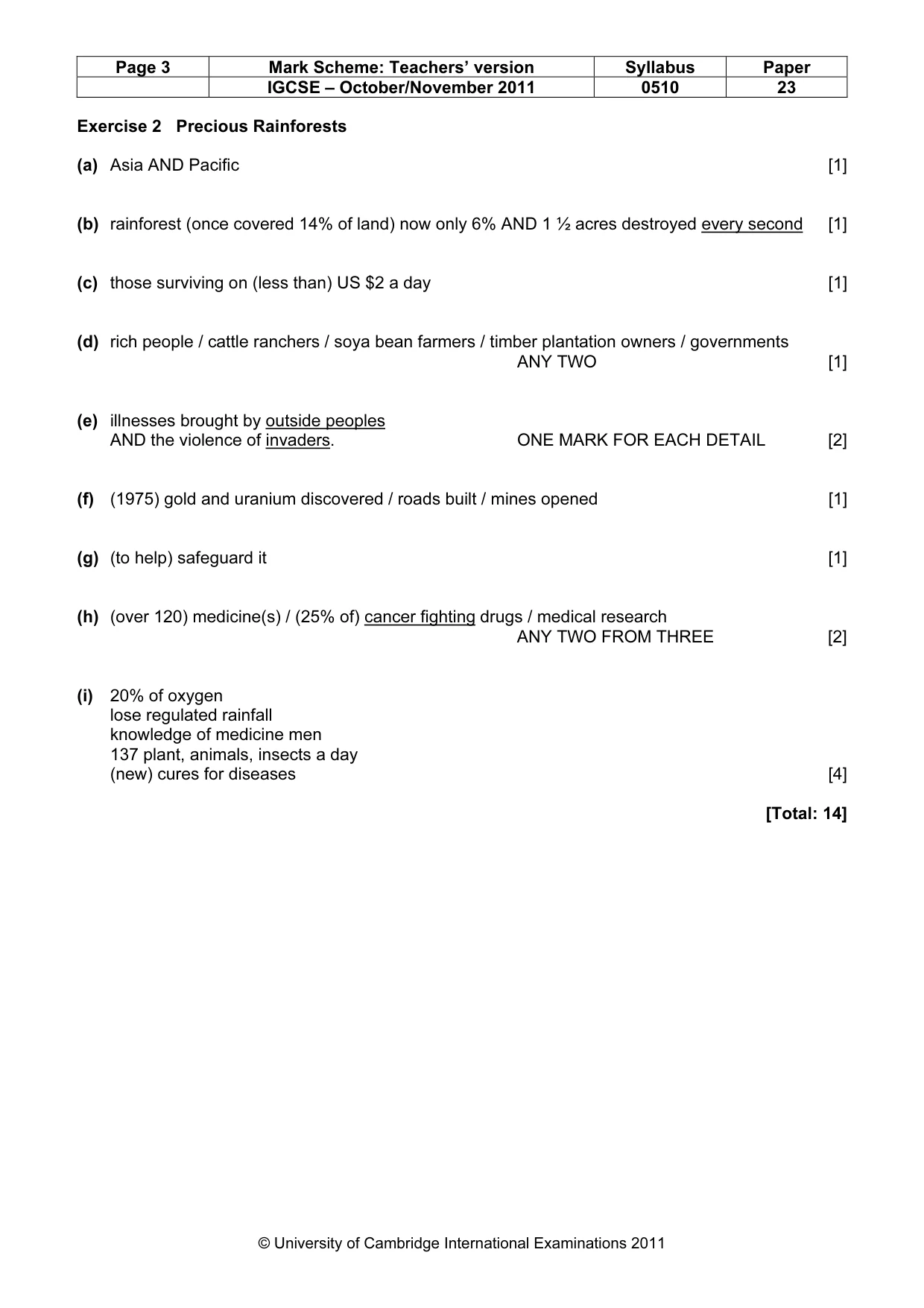
Page 3 Mark Scheme: Teachers’ version Syllabus Paper IGCSE – October/November 2011 0510 23 © University of Cambridge International Examinations 2011 Exercise 2 Precious Rainforests (a) Asia AND Pacific [1] (b) rainforest (once covered 14% of land) now only 6% AND 1 ½ acres destroyed every second [1] (c) those surviving on (less than) US $2 a day [1] (d) rich people / cattle ranchers / soya bean farmers / timber plantation owners / governments ANY TWO [1] (e) illnesses brought by outside peoples AND the violence of invaders. ONE MARK FOR EACH DETAIL [2] (f) (1975) gold and uranium discovered / roads built / mines opened [1] (g) (to help) safeguard it [1] (h) (over 120) medicine(s) / (25% of) cancer fighting drugs / medical research ANY TWO FROM THREE [2] (i) 20% of oxygen lose regulated rainfall knowledge of medicine men 137 plant, animals, insects a day (new) cures for diseases [4] [Total: 14]
Mark scheme, page 4
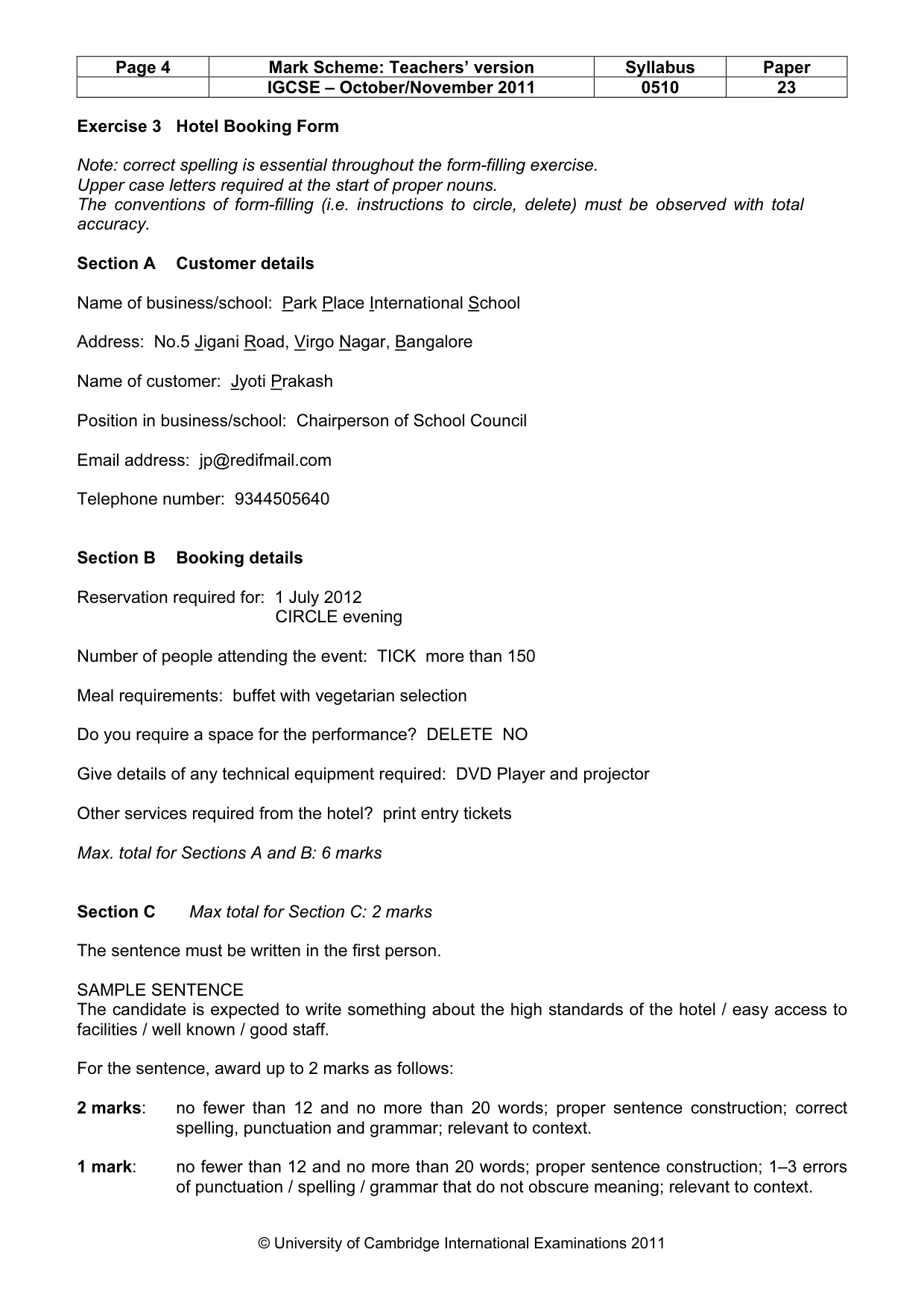
Page 4 Mark Scheme: Teachers’ version Syllabus Paper IGCSE – October/November 2011 0510 23 © University of Cambridge International Examinations 2011 Exercise 3 Hotel Booking Form Note: correct spelling is essential throughout the form-filling exercise. Upper case letters required at the start of proper nouns. The conventions of form-filling (i.e. instructions to circle, delete) must be observed with total accuracy. Section A Customer details Name of business/school: Park Place International School Address: No.5 Jigani Road, Virgo Nagar, Bangalore Name of customer: Jyoti Prakash Position in business/school: Chairperson of School Council Email address: jp@redifmail.com Telephone number: 9344505640 Section B Booking details Reservation required for: 1 July 2012 CIRCLE evening Number of people attending the event: TICK more than 150 Meal requirements: buffet with vegetarian selection Do you require a space for the performance? DELETE NO Give details of any technical equipment required: DVD Player and projector Other services required from the hotel? print entry tickets Max. total for Sections A and B: 6 marks Section C Max total for Section C: 2 marks The sentence must be written in the first person. SAMPLE SENTENCE The candidate is expected to write something about the high standards of the hotel / easy access to facilities / well known / good staff. For the sentence, award up to 2 marks as follows: 2 marks: no fewer than 12 and no more than 20 words; proper sentence construction; correct spelling, punctuation and grammar; relevant to context. 1 mark: no fewer than 12 and no more than 20 words; proper sentence construction; 1–3 errors of punctuation / spelling / grammar that do not obscure meaning; relevant to context.
Mark scheme, page 5
Page 5 Mark Scheme: Teachers’ version Syllabus Paper IGCSE – October/November 2011 0510 23 © University of Cambridge International Examinations 2011 0 marks: more than 3 errors of punctuation / spelling / grammar; and/or irrelevant to context, and/or not a proper sentence; and/or fewer than 12 words or more than 20 words. Absence of a full stop at the end should be considered as 1 punctuation error. Absence of an upper case letter at the beginning should be considered as 1 punctuation error. Omission of a word in a sentence should be considered as 1 grammar error. [Total: 8]
Mark scheme, page 6
Page 6 Mark Scheme: Teachers’ version Syllabus Paper IGCSE – October/November 2011 0510 23 © University of Cambridge International Examinations 2011 Exercise 4 The Middle Eastern Wildlife Park NB Correct answers only apply if they are placed under the correct sub-heading (as detailed below) Add the correct answers to give a total out of 8. Remember that this exercise is marked for content (reading), not language. Achievements of the wildlife park (max 3 marks this section) 1. home to 30 species of animals / conservation of animals accept individual examples of oryx, gazelles, hares 2. alternative energy plant / wind turbine generates 1% of island’s needs 3. water consumption cut (from 55 million to 40 million litres a day) Activities available for visitors to the wildlife park (max 3 marks this section) 4. safari 5. camping / camps 6. snorkelling 7. bike riding Negative points about the wildlife park (max 2 marks this section) 8. some creatures not always easy to spot accept individual examples of turtles, sharks, dolphins and rays 9. rubbish on beach / plastic and rubbish mixed with sea shells / plastic and metal at the water’s edge 10. hotel air-conditioning (not eco-friendly) 11. extreme heat at certain times of year [Total: 8]
Mark scheme, page 7
Page 7 Mark Scheme: Teachers’ version Syllabus Paper IGCSE – October/November 2011 0510 23 © University of Cambridge International Examinations 2011 Exercise 5 The Joys of Dancing Content (up to 6 marks) Physical • gets you fit • makes you flexible • makes you strong / exercises (leg) muscles / legs become strong • gives you endurance Non-physical • builds a sense of community • helps you to socialise • increases self-confidence • reduces stress and tension / gets rid of anger / feel calmer • gives overall sense of well-being • makes children more enthusiastic about school Language (up to 4 marks) 0 marks: meaning obscure because of density of language errors and serious problems with expression / nothing of relevance 1 mark: expression weak / reliance on lifting without discrimination 2 marks: expression limited / some reliance on lifting from the original, but some sense of order 3 marks: expression good, with attempts to group and sequence ideas in own words 4 marks: expression very good; clear, orderly grouping and sequencing largely in own words [Total: 10]
Mark scheme, page 8
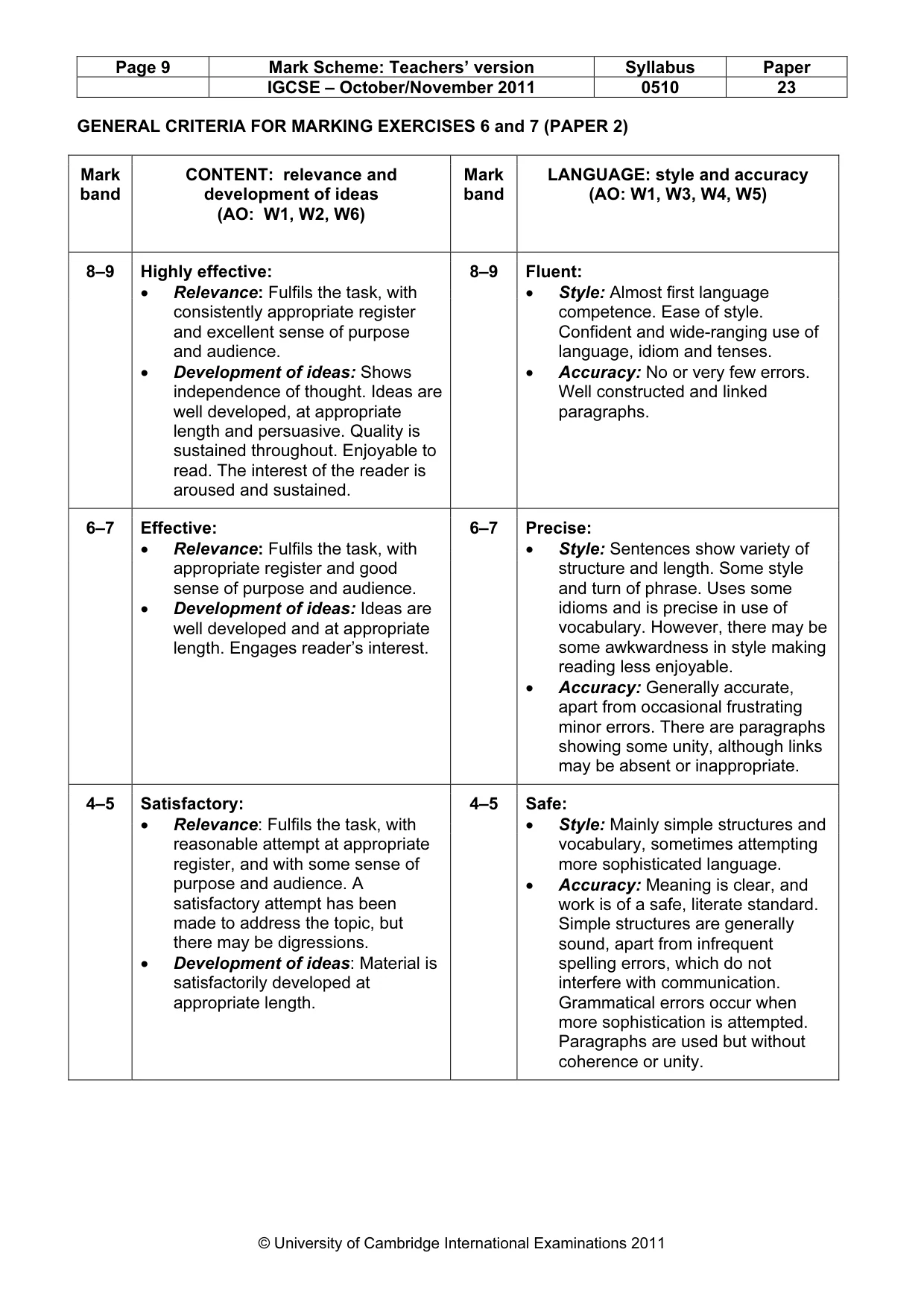
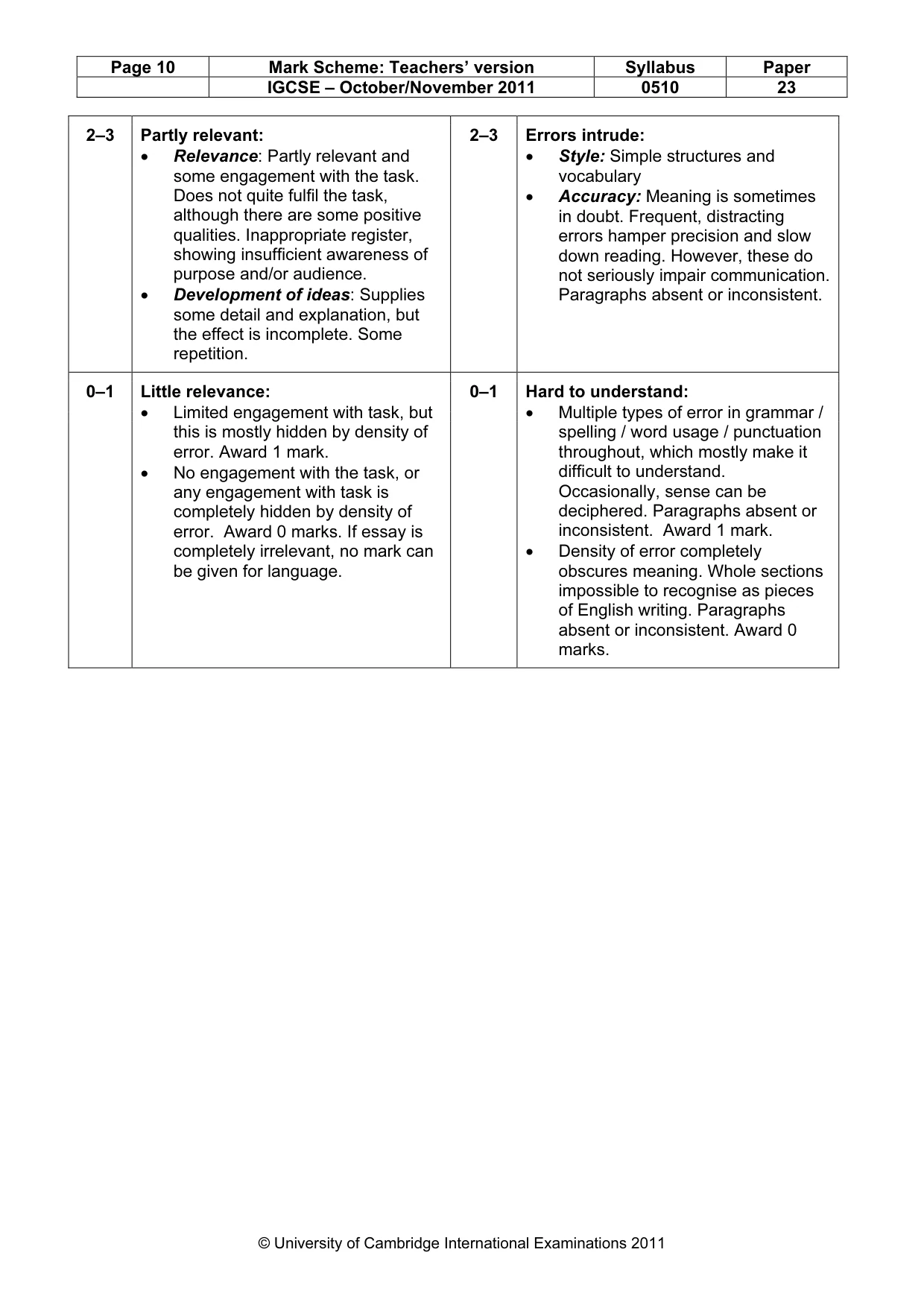
Page 8 Mark Scheme: Teachers’ version Syllabus Paper IGCSE – October/November 2011 0510 23 © University of Cambridge International Examinations 2011 Exercise 6 Reward for passing exams Exercise 7 Leave home when starting university The following general instructions, and table of marking criteria, apply to both exercises. • Award the answer a mark for content (C) [out of 9] and a mark for language (L) [out of 9] in accordance with the General Criteria table that follows. • Content covers relevance (i.e. whether the piece fulfils the task and the awareness of purpose / audience / register) and the development of ideas (i.e. the detail / explanation provided and how enjoyable it is to read). • Language covers style (i.e. complexity of vocabulary and sentence structure) and accuracy (of grammar, spelling, punctuation and use of paragraphs). • When deciding on a mark for content or language, first of all decide which mark band is most appropriate. There will not necessarily be an exact fit. Then decide between 2 marks within that mark band. Use the lower mark if it only just makes it into the band and the upper mark if it fulfils all the requirements of the band but doesn’t quite make it into the band above. • When deciding on a mark for content, look at both relevance and development of ideas. First ask yourself whether the writing fulfils the task, in terms of points to be covered and the length. If it does, it will be in at least the 4-5 mark band. • When deciding on a mark for language, look at both the style and the accuracy of the language. A useful starting point would be first to determine whether errors intrude. If they do not, it will be in at least the 4-5 mark band. • The use of paragraphs should not be the primary basis of deciding which mark band the work is in. Look first at the language used and once you have decided on the appropriate mark band, you can use the paragraphing as a factor in helping you to decide whether the work warrants the upper or lower mark in the mark band. • If the essay is considerably shorter than the stated word length, it should be put in mark band 2-3 for content or lower for not fulfilling the task. • If the essay is totally irrelevant and has nothing to do with the question asked, it should be given 0 marks for Content and Language, even if it is enjoyable to read and fluent. • If the essay is partly relevant and therefore in mark band 2-3, the full range of marks for language is available. [Total Exercise 6: 18] [Total Exercise 7: 18]
Mark scheme, page 9
Page 9 Mark Scheme: Teachers’ version Syllabus Paper IGCSE – October/November 2011 0510 23 © University of Cambridge International Examinations 2011 GENERAL CRITERIA FOR MARKING EXERCISES 6 and 7 (PAPER 2) Mark band CONTENT: relevance and development of ideas (AO: W1, W2, W6) Mark band LANGUAGE: style and accuracy (AO: W1, W3, W4, W5) 8–9 8–9 Highly effective: • Relevance: Fulfils the task, with consistently appropriate register and excellent sense of purpose and audience. • Development of ideas: Shows independence of thought. Ideas are well developed, at appropriate length and persuasive. Quality is sustained throughout. Enjoyable to read. The interest of the reader is aroused and sustained. Fluent: • Style: Almost first language competence. Ease of style. Confident and wide-ranging use of language, idiom and tenses. • Accuracy: No or very few errors. Well constructed and linked paragraphs. 6–7 6–7 Effective: • Relevance: Fulfils the task, with appropriate register and good sense of purpose and audience. • Development of ideas: Ideas are well developed and at appropriate length. Engages reader’s interest. Precise: • Style: Sentences show variety of structure and length. Some style and turn of phrase. Uses some idioms and is precise in use of vocabulary. However, there may be some awkwardness in style making reading less enjoyable. • Accuracy: Generally accurate, apart from occasional frustrating minor errors. There are paragraphs showing some unity, although links may be absent or inappropriate. 4–5 4–5 Satisfactory: • Relevance: Fulfils the task, with reasonable attempt at appropriate register, and with some sense of purpose and audience. A satisfactory attempt has been made to address the topic, but there may be digressions. • Development of ideas: Material is satisfactorily developed at appropriate length. Safe: • Style: Mainly simple structures and vocabulary, sometimes attempting more sophisticated language. • Accuracy: Meaning is clear, and work is of a safe, literate standard. Simple structures are generally sound, apart from infrequent spelling errors, which do not interfere with communication. Grammatical errors occur when more sophistication is attempted. Paragraphs are used but without coherence or unity.
Mark scheme, page 10
Page 10 Mark Scheme: Teachers’ version Syllabus Paper IGCSE – October/November 2011 0510 23 © University of Cambridge International Examinations 2011 2–3 Partly relevant: • Relevance: Partly relevant and some engagement with the task. Does not quite fulfil the task, although there are some positive qualities. Inappropriate register, showing insufficient awareness of purpose and/or audience. • Development of ideas: Supplies some detail and explanation, but the effect is incomplete. Some repetition. 2–3 Errors intrude: • Style: Simple structures and vocabulary • Accuracy: Meaning is sometimes in doubt. Frequent, distracting errors hamper precision and slow down reading. However, these do not seriously impair communication. Paragraphs absent or inconsistent. 0–1 0–1 Little relevance: • Limited engagement with task, but this is mostly hidden by density of error. Award 1 mark. • No engagement with the task, or any engagement with task is completely hidden by density of error. Award 0 marks. If essay is completely irrelevant, no mark can be given for language. Hard to understand: • Multiple types of error in grammar / spelling / word usage / punctuation throughout, which mostly make it difficult to understand. Occasionally, sense can be deciphered. Paragraphs absent or inconsistent. Award 1 mark. • Density of error completely obscures meaning. Whole sections impossible to recognise as pieces of English writing. Paragraphs absent or inconsistent. Award 0 marks.
What you needed in this session
Cambridge’s own grade thresholds for 2011 Oct/Nov, Paper 2 · Variant 3. A higher threshold means an easier paper — the bar moves with how the cohort did.