Cambridge IGCSE English - Second Language (oral endorsement) 0510 — 2011 Oct/Nov Paper 2 · Variant 1
0510/21/O/N/11 · 84 marks · ≈95 min
The question paper and its mark scheme, free to read here and free to download. This is Cambridge’s own paper, exactly as it was sat.
Question paper16 pages

Mark scheme9 pages
Answers below. Sit the paper first if you are practising.
Paper as text
Question paper, page 1
This document consists of 15 printed pages and 1 blank page. IB11 11_0510_21/5RP © UCLES 2011 [Turn over *8456711451* UNIVERSITY OF CAMBRIDGE INTERNATIONAL EXAMINATIONS International General Certificate of Secondary Education ENGLISH AS A SECOND LANGUAGE 0510/21 Paper 2 Reading and Writing (Extended) October/November 2011 2 hours Candidates answer on the Question Paper. No Additional Materials are required. READ THESE INSTRUCTIONS FIRST Write your Centre number, candidate number and name on all the work you hand in. Write in dark blue or black pen. Do not use staples, paper clips, highlighters, glue or correction fluid. DO NOT WRITE IN ANY BARCODES. Answer all questions. Dictionaries are not allowed. The number of marks is given in brackets [ ] at the end of each question or part question.
Question paper, page 2
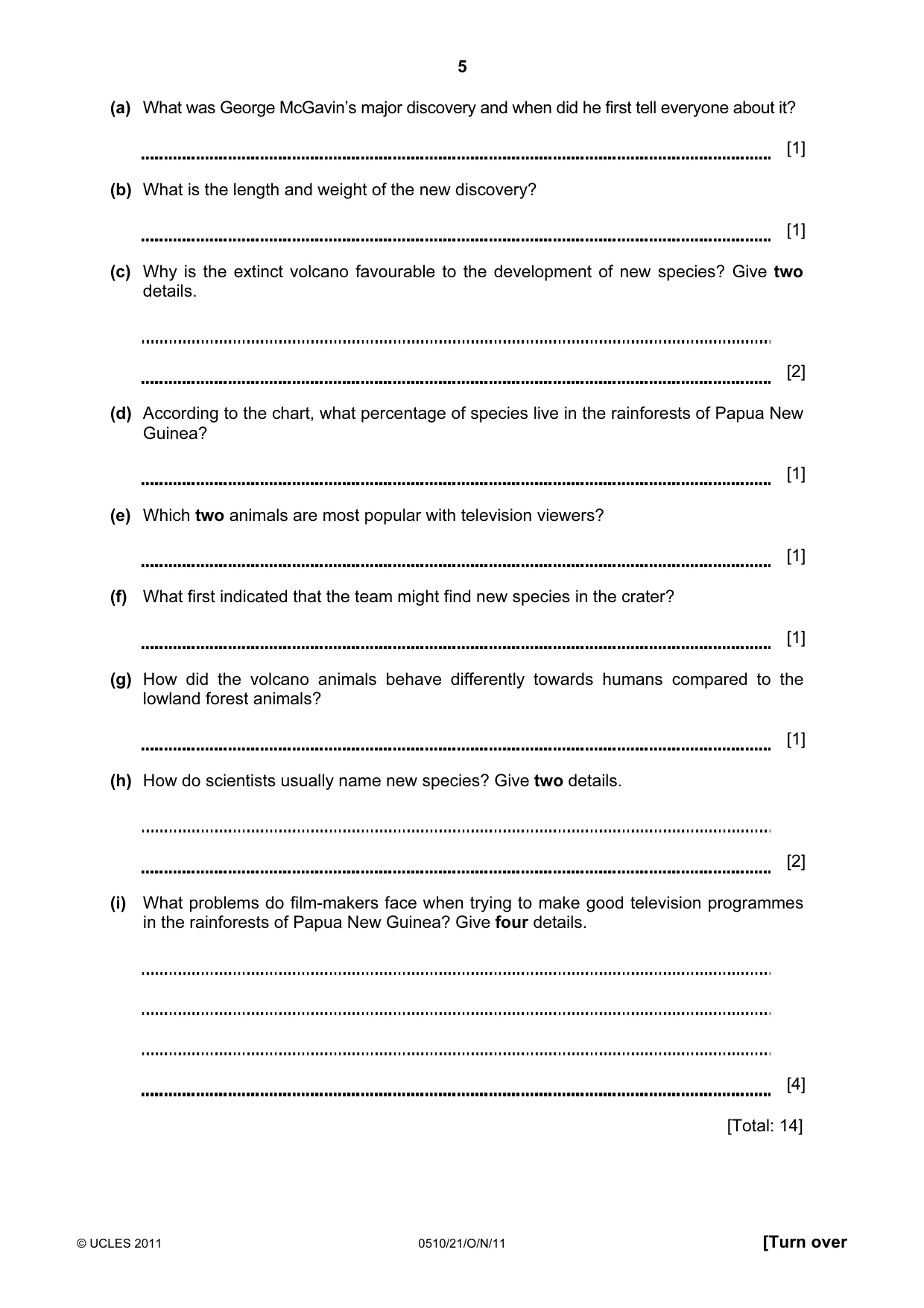
2 © UCLES 2011 0510/21/O/N/11 Exercise 1 Read the following information about a real-life Spider-Man, and then answer the questions on the opposite page. Don’t Look Down! A real-life “Spider-Man” has climbed some of the world’s tallest buildings... with no ropes or safety equipment. French climber, Alain Robert, well known for his amazing ability to climb enormous buildings, has succeeded in reaching the top of one of the highest structures in the world. He climbed the 452-metre Tower Two of the Petronas Twin Towers in Kuala Lumpur, the capital of Malaysia. Robert took two hours to complete his climb and, as usual, he used no ropes or safety equipment. If he had slipped, there was nothing between him and the road far below. For 15 years, Robert has fascinated spectators and angered security guards by climbing skyscrapers and monuments such as the Eiffel Tower in Paris and the Golden Gate Bridge in San Francisco, California. How does he do it? He is an expert climber and makes his way slowly to the top by gripping window ledges and placing his fingers in cracks in the walls. He keeps a small bag of powder around his waist, to dry the sweat on his hands. Huge crowds gather to watch his terrifying climbs, but his activities have brought him a lot of trouble – he has been put into prison on four different continents. This is because he rarely gets permission for his climbs. He usually begins in darkness, appearing at dawn, already some distance up the side of his chosen building, and before anybody can stop him. Success at last This was Robert’s third attempt to climb one of the Petronas Towers. On the two previous occasions, he had been stopped by security guards halfway through the climb. In this latest attempt, after finally reaching the top, he was immediately arrested. Robert was not too worried, however. “Climbing the Petronas has always been one of my dreams,” he said. Some problems on the way to the top The “Spider-Man” may have completed many successful climbs, but his attempts have not always been without problems. When he was climbing the 100-storey Willis Tower in Chicago, a thick fog descended and covered the glass walls of the building with moisture, making it very wet and dangerous. He reached the top, but only after slow and careful progress. In London, he was caught in a storm and had to be rescued by window cleaners. A recent fall... More recently, Robert fell and needed emergency surgery for a painful cut after climbing... a small tree! He was being photographed for a magazine interview at the time.
Question paper, page 3
3 © UCLES 2011 0510/21/O/N/11 [Turn over (a) In which country are the Petronas Towers? [1] (b) Why is Robert’s method of climbing so dangerous? [1] (c) What does he carry to help him grip the sides of buildings? [1] (d) Why has Robert been in prison so often? [1] (e) When does Robert normally start his climbs? [1] (f) How many times had Robert failed to climb the Petronas Towers? [1] (g) Why was Robert unsuccessful in his earlier attempts to climb the Petronas Towers? [1] (h) What caused the glass walls of the Willis Tower to become wet? [1] [Total: 8]
Question paper, page 4
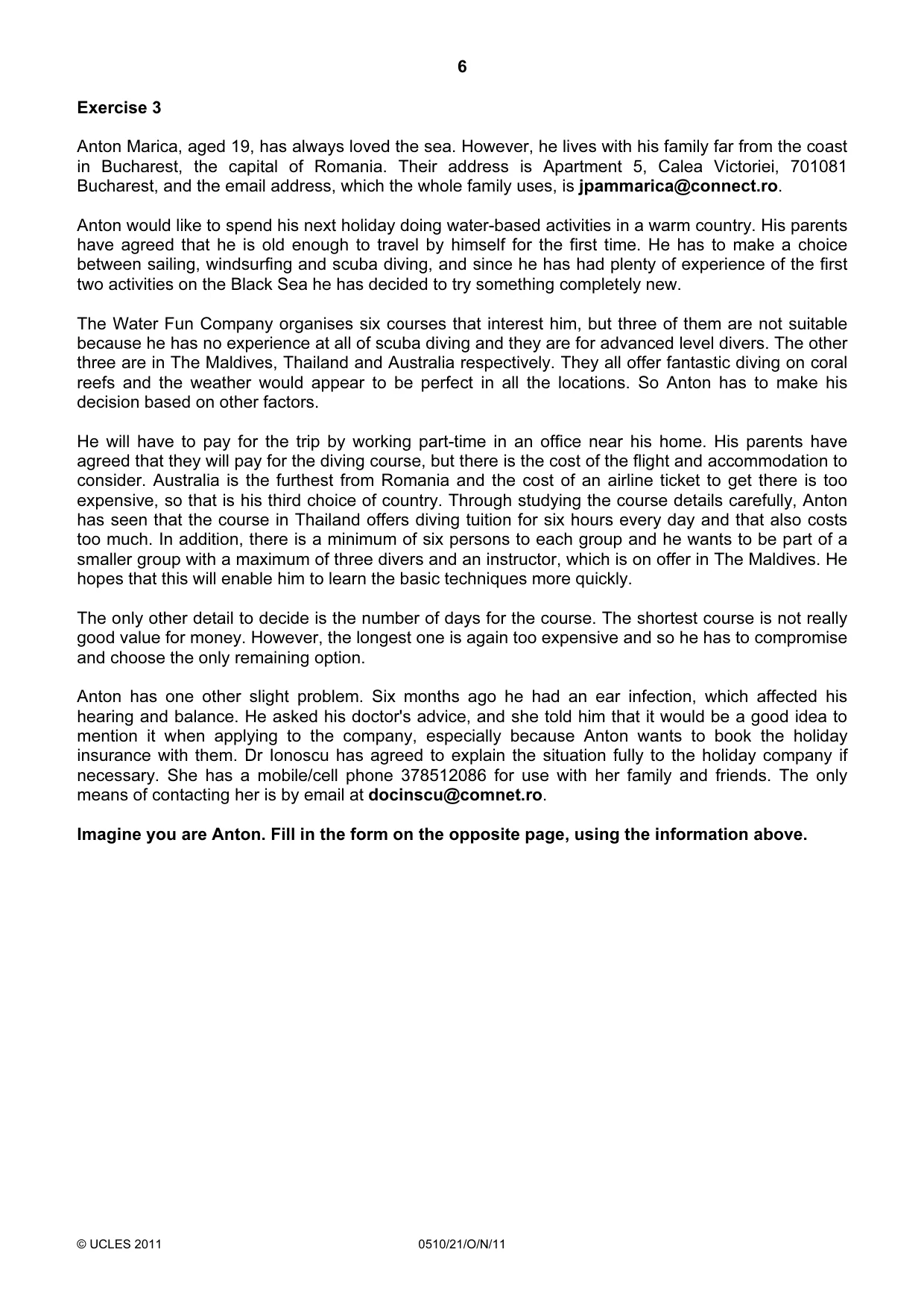
4 © UCLES 2011 0510/21/O/N/11 Exercise 2 Read the following article about the discovery of strange animal species living around a remote volcano, and then answer the questions on the opposite page. Discoveries in Papua New Guinea For many months George McGavin refused to describe the extraordinary creature he had discovered. “People would ask me if it had four legs, and if it had fur,” he said. “I didn’t tell anyone, not even my wife.” Finally, last September, McGavin revealed that he had observed a previously undiscovered giant rat. This was the most amazing discovery that his team had made on a journey to one of the most remote places on earth. The giant rat was discovered in Bosavi in Papua New Guinea, an island in the Pacific Ocean. The rat measures 0.8 of a metre from nose to tail and weighs 1.5 kilos, about the size of a small cat. It has thick fur and appears to be vegetarian. The rat was not the only unusual animal they encountered on the expedition. The team found about 40 other species unknown to science, including some fish, frogs and beetles. The team travelled to Mount Bosavi and stayed for about six weeks. This extinct volcano is isolated, rising 2,500 metres above the lowland rainforest. Its crater is an enclosed area full of unnamed life forms and with its own climate. The last eruption of Mount Bosavi was about 225,000 years ago, so new species have had plenty of time to develop. Before making the trip up to the top of the volcano, the team spent some time filming in the lowland rainforests, which are home to many types of species. This area presents considerable challenges for wildlife film-makers, who often spend long hours waiting for something to happen but in the end seeing nothing but ants. Furthermore, there were no spectacular creatures like monkeys or wild cats, which always attract big audiences to television programmes. In addition, most of the mammals were extremely afraid of humans because they are often hunted by the local tribesmen. Nevertheless, the television team managed to find an extraordinary range of creatures with fascinating lives, proving that it’s not just wild cats that are interesting. In the end, the days spent filming proved worthwhile even though the team was constantly bitten by mosquitoes. After exploring the rainforests, the team flew to the rim of the crater in a helicopter. Only thirty seconds after landing, one of the group noticed a different type of frog, almost certainly a species unknown to man. Unlike the mammals and birds in the lowland forests, these creatures were not nervous of humans – a sign that there was very little hunting up in the crater. One unexpected encounter was with a tree kangaroo. As McGavin said: “Animals like this are usually really shy and hard to film, but this one just wandered past our camp. We couldn’t believe it!” All these new species are now being studied at scientific institutions. Each one will have to be named. Typically, the name will refer to a characteristic of the creature or the place where it was found. It might even include the name of the scientist. However, as McGavin states: “It’s fine to name something after one of your colleagues, but it’s not considered correct procedure to name a new species after yourself.” species existing outside the rainforests species existing inside the rainforests 70% 70% 30% 30% 70% 30% The rainforest in Papua New Guinea: home to many species
Question paper, page 5
5 © UCLES 2011 0510/21/O/N/11 [Turn over (a) What was George McGavin’s major discovery and when did he first tell everyone about it? [1] (b) What is the length and weight of the new discovery? [1] (c) Why is the extinct volcano favourable to the development of new species? Give two details. [2] (d) According to the chart, what percentage of species live in the rainforests of Papua New Guinea? [1] (e) Which two animals are most popular with television viewers? [1] (f) What first indicated that the team might find new species in the crater? [1] (g) How did the volcano animals behave differently towards humans compared to the lowland forest animals? [1] (h) How do scientists usually name new species? Give two details. [2] (i) What problems do film-makers face when trying to make good television programmes in the rainforests of Papua New Guinea? Give four details. [4] [Total: 14]
Question paper, page 6
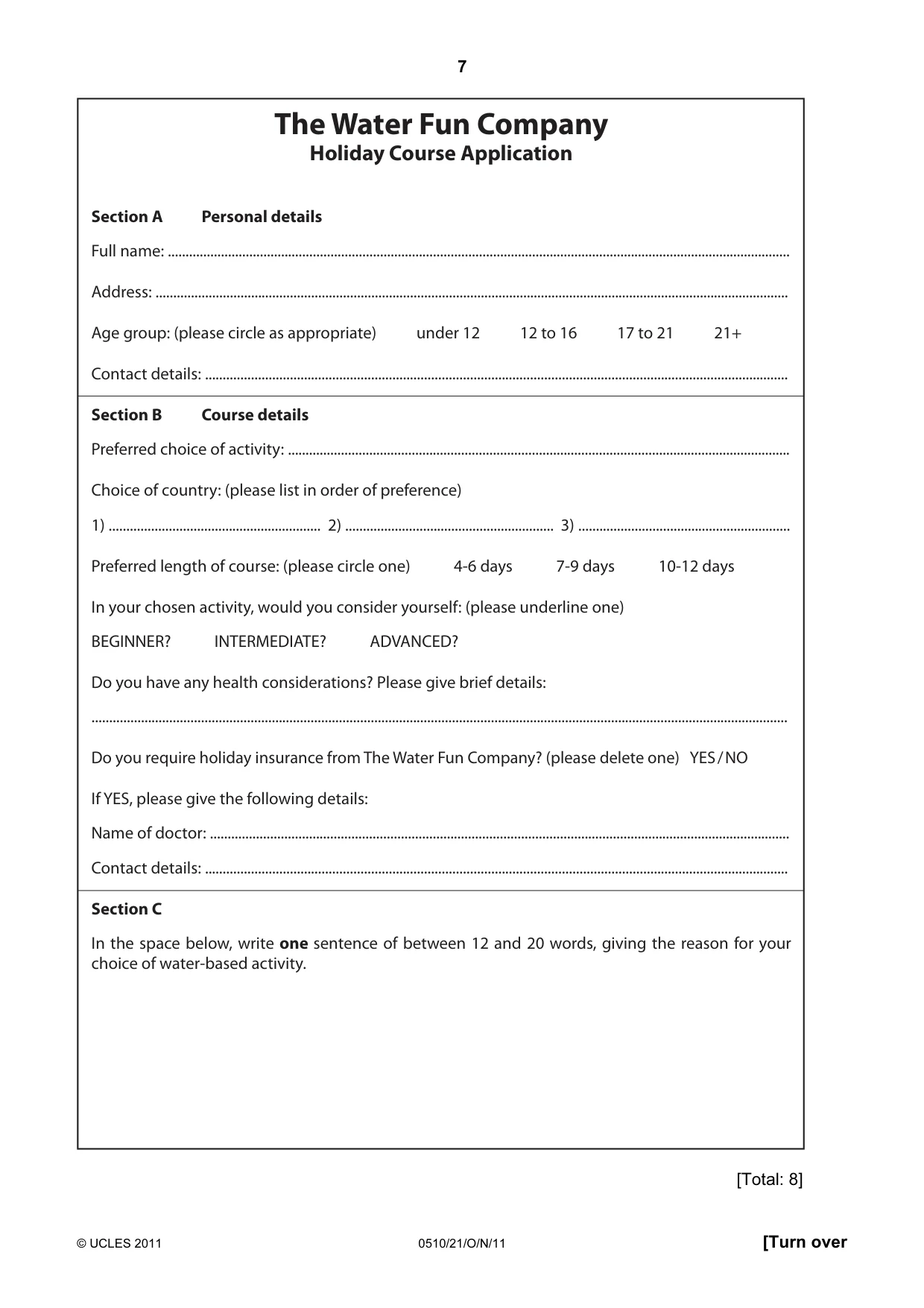
6 © UCLES 2011 0510/21/O/N/11 Exercise 3 Anton Marica, aged 19, has always loved the sea. However, he lives with his family far from the coast in Bucharest, the capital of Romania. Their address is Apartment 5, Calea Victoriei, 701081 Bucharest, and the email address, which the whole family uses, is jpammarica@connect.ro. Anton would like to spend his next holiday doing water-based activities in a warm country. His parents have agreed that he is old enough to travel by himself for the first time. He has to make a choice between sailing, windsurfing and scuba diving, and since he has had plenty of experience of the first two activities on the Black Sea he has decided to try something completely new. The Water Fun Company organises six courses that interest him, but three of them are not suitable because he has no experience at all of scuba diving and they are for advanced level divers. The other three are in The Maldives, Thailand and Australia respectively. They all offer fantastic diving on coral reefs and the weather would appear to be perfect in all the locations. So Anton has to make his decision based on other factors. He will have to pay for the trip by working part-time in an office near his home. His parents have agreed that they will pay for the diving course, but there is the cost of the flight and accommodation to consider. Australia is the furthest from Romania and the cost of an airline ticket to get there is too expensive, so that is his third choice of country. Through studying the course details carefully, Anton has seen that the course in Thailand offers diving tuition for six hours every day and that also costs too much. In addition, there is a minimum of six persons to each group and he wants to be part of a smaller group with a maximum of three divers and an instructor, which is on offer in The Maldives. He hopes that this will enable him to learn the basic techniques more quickly. The only other detail to decide is the number of days for the course. The shortest course is not really good value for money. However, the longest one is again too expensive and so he has to compromise and choose the only remaining option. Anton has one other slight problem. Six months ago he had an ear infection, which affected his hearing and balance. He asked his doctor's advice, and she told him that it would be a good idea to mention it when applying to the company, especially because Anton wants to book the holiday insurance with them. Dr Ionoscu has agreed to explain the situation fully to the holiday company if necessary. She has a mobile/cell phone 378512086 for use with her family and friends. The only means of contacting her is by email at docinscu@comnet.ro. Imagine you are Anton. Fill in the form on the opposite page, using the information above.
Question paper, page 7
7 © UCLES 2011 0510/21/O/N/11 [Turn over The Water Fun Company Holiday Course Application Section A Personal details Full name: … Address: … Age group: (please circle as appropriate) under 12 12 to 16 17 to 21 21+ Contact details: … Section B Course details Preferred choice of activity: … Choice of country: (please list in order of preference) 1) … 2) … 3) … Preferred length of course: (please circle one) 4-6 days 7-9 days 10-12 days In your chosen activity, would you consider yourself: (please underline one) BEGINNER? INTERMEDIATE? ADVANCED? Do you have any health considerations? Please give brief details: … Do you require holiday insurance from The Water Fun Company? (please delete one) YES / NO If YES, please give the following details: Name of doctor: … Contact details: … Section C In the space below, write one sentence of between 12 and 20 words, giving the reason for your choice of water-based activity. [Total: 8]
Question paper, page 8
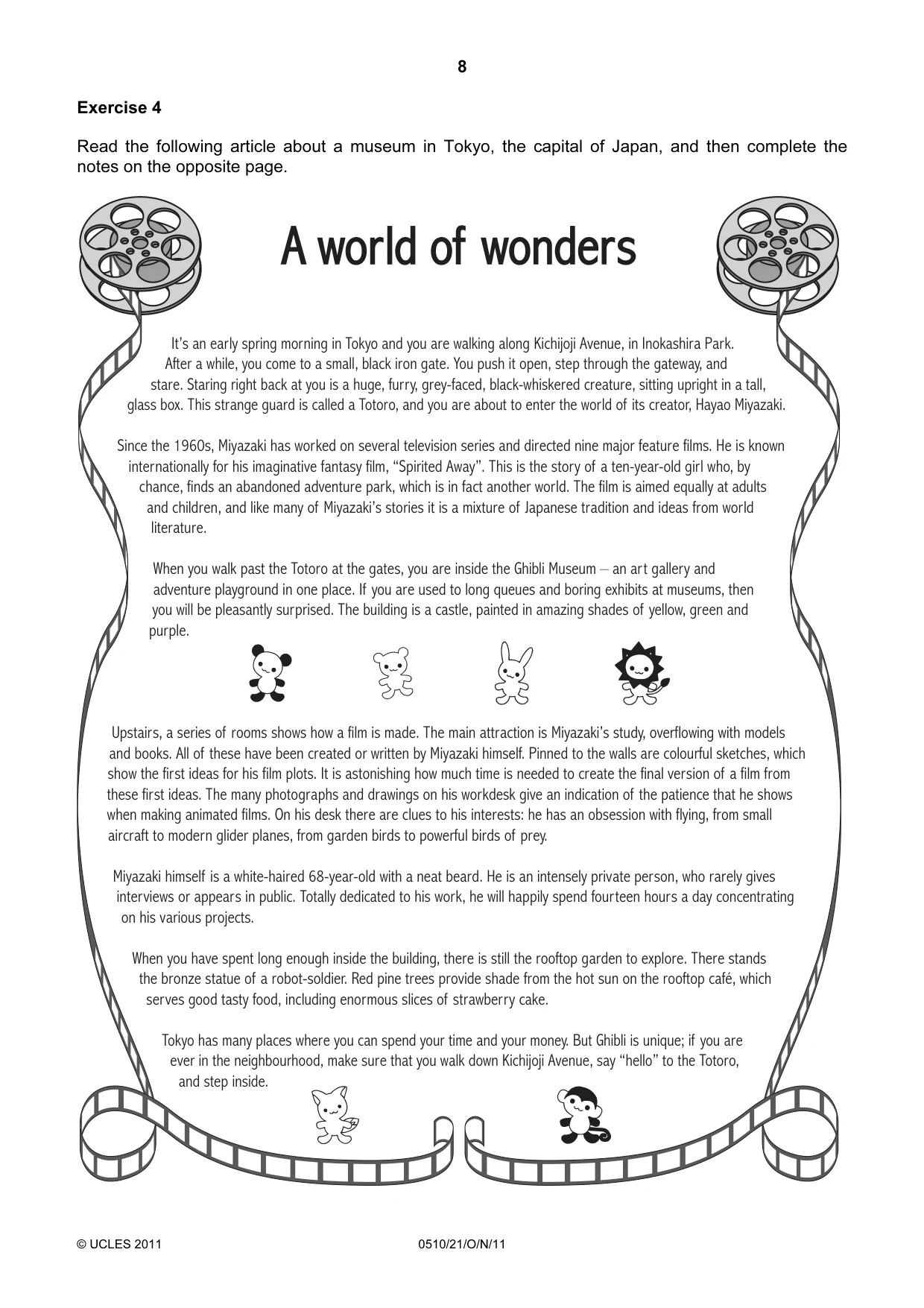
8 © UCLES 2011 0510/21/O/N/11 Exercise 4 Read the following article about a museum in Tokyo, the capital of Japan, and then complete the notes on the opposite page. It’s an early spring morning in Tokyo and you are walking along Kichijoji Avenue, in Inokashira Park. After a while, you come to a small, black iron gate. You push it open, step through the gateway, and stare. Staring right back at you is a huge, furry, grey-faced, black-whiskered creature, sitting upright in a tall, glass box. This strange guard is called a Totoro, and you are about to enter the world of its creator, Hayao Miyazaki. Since the 1960s, Miyazaki has worked on several television series and directed nine major feature films. He is known internationally for his imaginative fantasy film, “Spirited Away”. This is the story of a ten-year-old girl who, by chance, finds an abandoned adventure park, which is in fact another world. The film is aimed equally at adults and children, and like many of Miyazaki’s stories it is a mixture of Japanese tradition and ideas from world literature. When you walk past the Totoro at the gates, you are inside the Ghibli Museum – an art gallery and adventure playground in one place. If you are used to long queues and boring exhibits at museums, then you will be pleasantly surprised. The building is a castle, painted in amazing shades of yellow, green and purple. Upstairs, a series of rooms shows how a film is made. The main attraction is Miyazaki’s study, overflowing with models and books. All of these have been created or written by Miyazaki himself. Pinned to the walls are colourful sketches, which show the first ideas for his film plots. It is astonishing how much time is needed to create the final version of a film from these first ideas. The many photographs and drawings on his workdesk give an indication of the patience that he shows when making animated films. On his desk there are clues to his interests: he has an obsession with flying, from small aircraft to modern glider planes, from garden birds to powerful birds of prey. Miyazaki himself is a white-haired 68-year-old with a neat beard. He is an intensely private person, who rarely gives interviews or appears in public. Totally dedicated to his work, he will happily spend fourteen hours a day concentrating on his various projects. When you have spent long enough inside the building, there is still the rooftop garden to explore. There stands the bronze statue of a robot-soldier. Red pine trees provide shade from the hot sun on the rooftop café, which serves good tasty food, including enormous slices of strawberry cake. Tokyo has many places where you can spend your time and your money. But Ghibli is unique; if you are ever in the neighbourhood, make sure that you walk down Kichijoji Avenue, say “hello” to the Totoro, and step inside.
Question paper, page 9
9 © UCLES 2011 0510/21/O/N/11 [Turn over You are going to give a presentation to your school’s Film Club about the Ghibli Museum. Prepare some notes to use as the basis of your talk. Make your notes under each heading. Details of Miyazaki’s study • … • … • … Details of Miyazaki’s character • … • … • … What you can see or visit outside • … • … [Total: 8]
Question paper, page 10
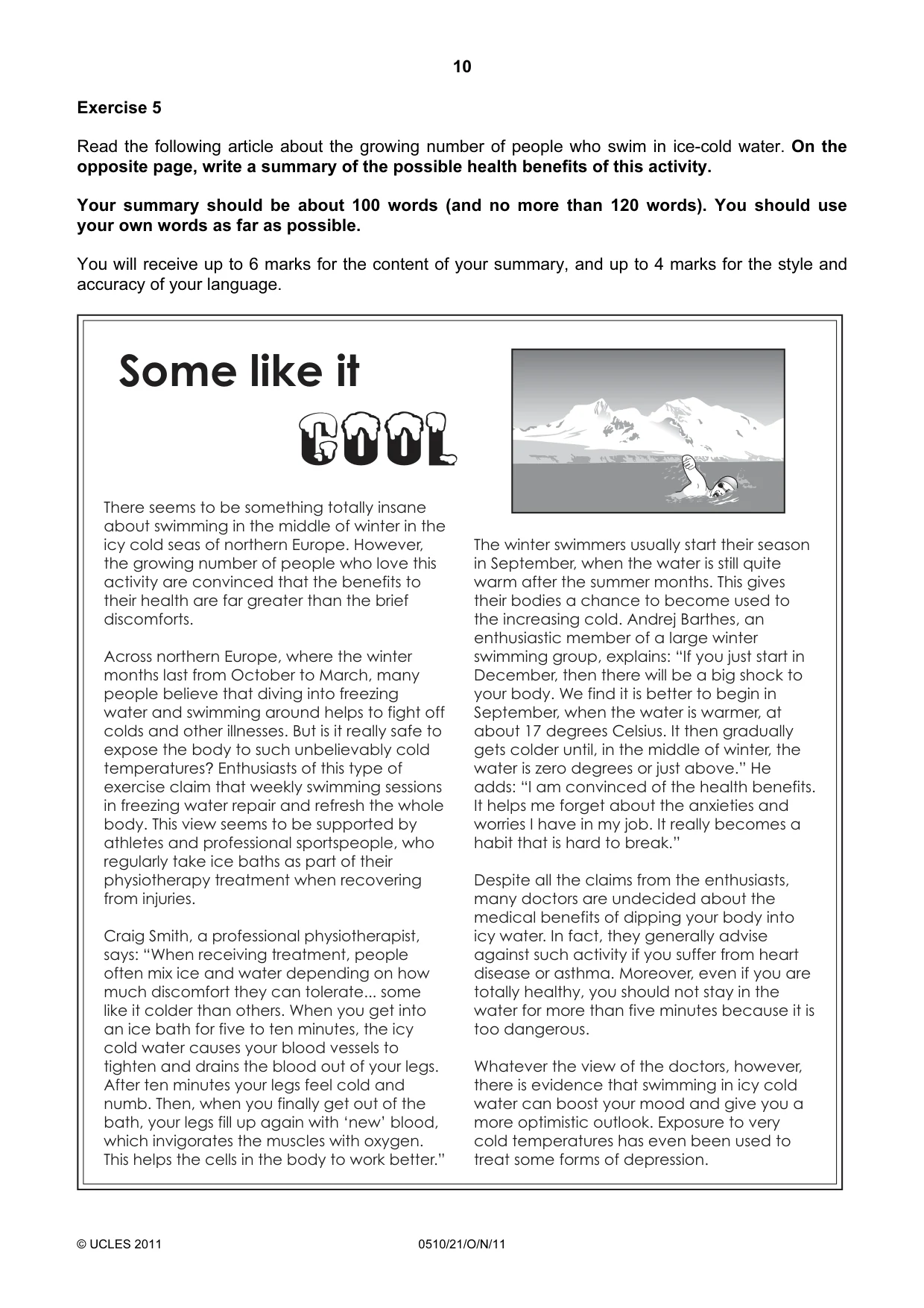
10 © UCLES 2011 0510/21/O/N/11 Exercise 5 Read the following article about the growing number of people who swim in ice-cold water. On the opposite page, write a summary of the possible health benefits of this activity. Your summary should be about 100 words (and no more than 120 words). You should use your own words as far as possible. You will receive up to 6 marks for the content of your summary, and up to 4 marks for the style and accuracy of your language. There seems to be something totally insane about swimming in the middle of winter in the icy cold seas of northern Europe. However, the growing number of people who love this activity are convinced that the benefits to their health are far greater than the brief discomforts. Across northern Europe, where the winter months last from October to March, many people believe that diving into freezing water and swimming around helps to fight off colds and other illnesses. But is it really safe to expose the body to such unbelievably cold temperatures? Enthusiasts of this type of exercise claim that weekly swimming sessions in freezing water repair and refresh the whole body. This view seems to be supported by athletes and professional sportspeople, who regularly take ice baths as part of their physiotherapy treatment when recovering from injuries. Craig Smith, a professional physiotherapist, says: “When receiving treatment, people often mix ice and water depending on how much discomfort they can tolerate... some like it colder than others. When you get into an ice bath for five to ten minutes, the icy cold water causes your blood vessels to tighten and drains the blood out of your legs. After ten minutes your legs feel cold and numb. Then, when you finally get out of the bath, your legs fill up again with ‘new’ blood, which invigorates the muscles with oxygen. This helps the cells in the body to work better.” The winter swimmers usually start their season in September, when the water is still quite warm after the summer months. This gives their bodies a chance to become used to the increasing cold. Andrej Barthes, an enthusiastic member of a large winter swimming group, explains: “If you just start in December, then there will be a big shock to your body. We find it is better to begin in September, when the water is warmer, at about 17 degrees Celsius. It then gradually gets colder until, in the middle of winter, the water is zero degrees or just above.” He adds: “I am convinced of the health benefits. It helps me forget about the anxieties and worries I have in my job. It really becomes a habit that is hard to break.” Despite all the claims from the enthusiasts, many doctors are undecided about the medical benefits of dipping your body into icy water. In fact, they generally advise against such activity if you suffer from heart disease or asthma. Moreover, even if you are totally healthy, you should not stay in the water for more than five minutes because it is too dangerous. Whatever the view of the doctors, however, there is evidence that swimming in icy cold water can boost your mood and give you a more optimistic outlook. Exposure to very cold temperatures has even been used to treat some forms of depression. Some like it cool
Question paper, page 11
11 © UCLES 2011 0510/21/O/N/11 [Turn over [Total: 10]
Question paper, page 12
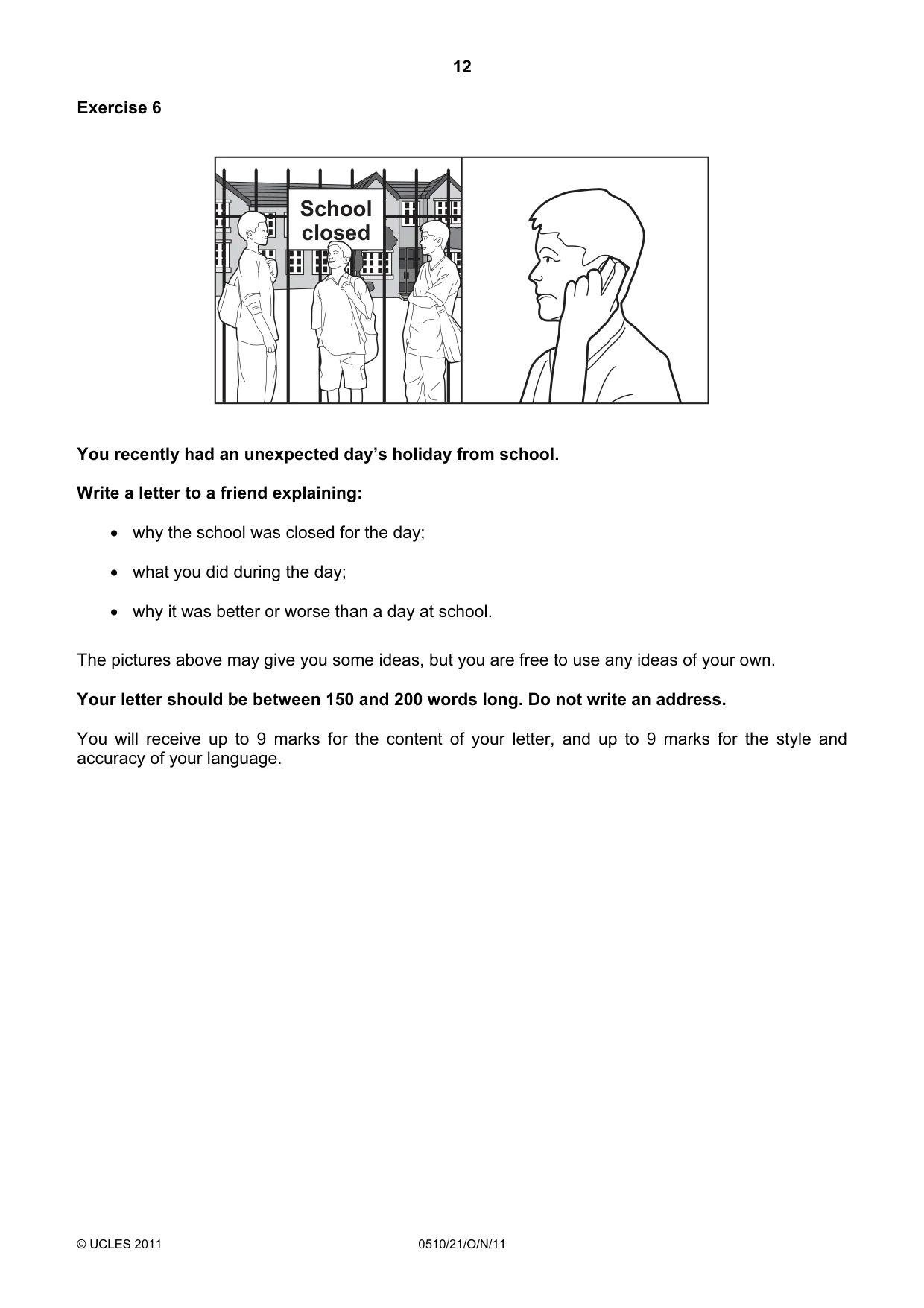
12 © UCLES 2011 0510/21/O/N/11 Exercise 6 School closed You recently had an unexpected day’s holiday from school. Write a letter to a friend explaining: • why the school was closed for the day; • what you did during the day; • why it was better or worse than a day at school. The pictures above may give you some ideas, but you are free to use any ideas of your own. Your letter should be between 150 and 200 words long. Do not write an address. You will receive up to 9 marks for the content of your letter, and up to 9 marks for the style and accuracy of your language.
Question paper, page 13
13 © UCLES 2011 0510/21/O/N/11 [Turn over [Total: 18]
Question paper, page 14
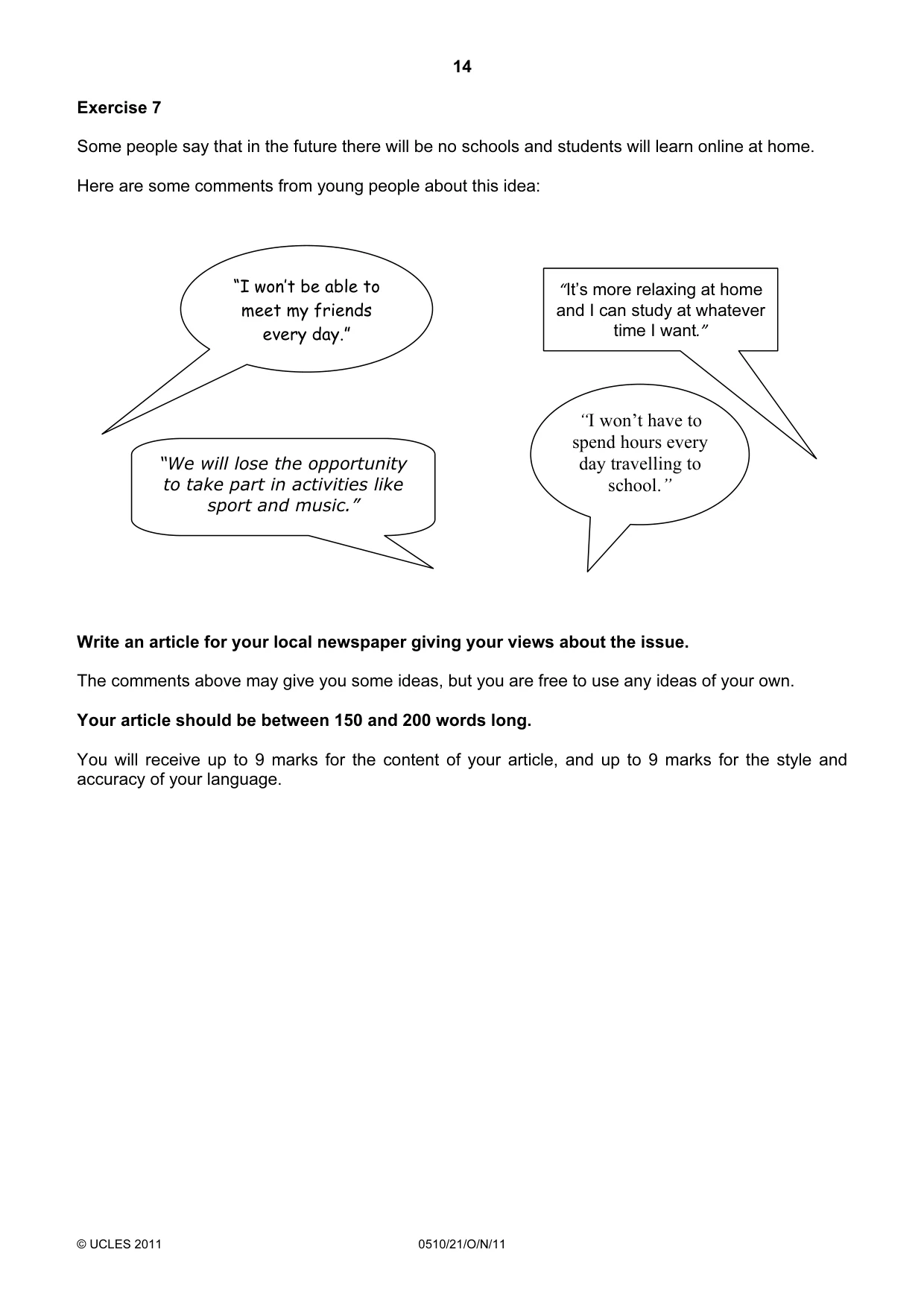
14 © UCLES 2011 0510/21/O/N/11 Exercise 7 Some people say that in the future there will be no schools and students will learn online at home. Here are some comments from young people about this idea: Write an article for your local newspaper giving your views about the issue. The comments above may give you some ideas, but you are free to use any ideas of your own. Your article should be between 150 and 200 words long. You will receive up to 9 marks for the content of your article, and up to 9 marks for the style and accuracy of your language. “I won’t be able to meet my friends every day.” “It’s more relaxing at home and I can study at whatever time I want.” “I won’t have to spend hours every day travelling to school.” “We will lose the opportunity to take part in activities like sport and music.”
Question paper, page 15
15 © UCLES 2011 0510/21/O/N/11 [Total: 18]
Question paper, page 16
16 Copyright Acknowledgements: Question 1 Question 4 © Chloe Lambert; Young Times Section; Times 2; The Times; 2 September 2009. © Tom Gatti; The Times Travel Section; 12 September 2009. Permission to reproduce items where third-party owned material protected by copyright is included has been sought and cleared where possible. Every reasonable effort has been made by the publisher (UCLES) to trace copyright holders, but if any items requiring clearance have unwittingly been included, the publisher will be pleased to make amends at the earliest possible opportunity. University of Cambridge International Examinations is part of the Cambridge Assessment Group. Cambridge Assessment is the brand name of University of Cambridge Local Examinations Syndicate (UCLES), which is itself a department of the University of Cambridge. © UCLES 2011 0510/21/O/N/11 BLANK PAGE
Mark scheme, page 1
UNIVERSITY OF CAMBRIDGE INTERNATIONAL EXAMINATIONS International General Certificate of Secondary Education MARK SCHEME for the October/November 2011 question paper for the guidance of teachers 0510 ENGLISH AS A SECOND LANGUAGE 0510/21 Paper 2 (Reading and Writing – Extended), maximum raw mark 84 This mark scheme is published as an aid to teachers and candidates, to indicate the requirements of the examination. It shows the basis on which Examiners were instructed to award marks. It does not indicate the details of the discussions that took place at an Examiners’ meeting before marking began, which would have considered the acceptability of alternative answers. Mark schemes must be read in conjunction with the question papers and the report on the examination. • Cambridge will not enter into discussions or correspondence in connection with these mark schemes. Cambridge is publishing the mark schemes for the October/November 2011 question papers for most IGCSE, GCE Advanced Level and Advanced Subsidiary Level syllabuses and some Ordinary Level syllabuses.
Mark scheme, page 2
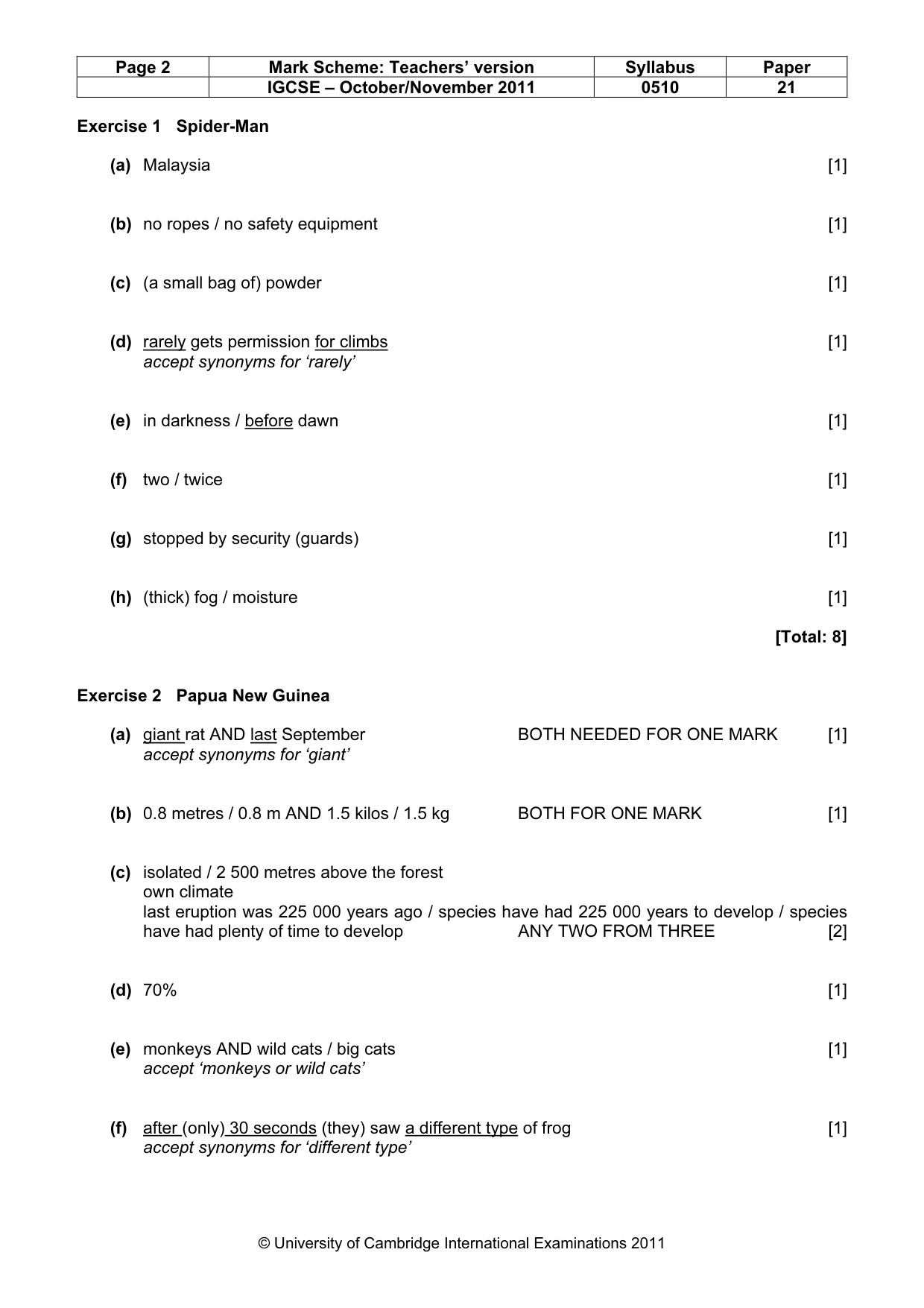
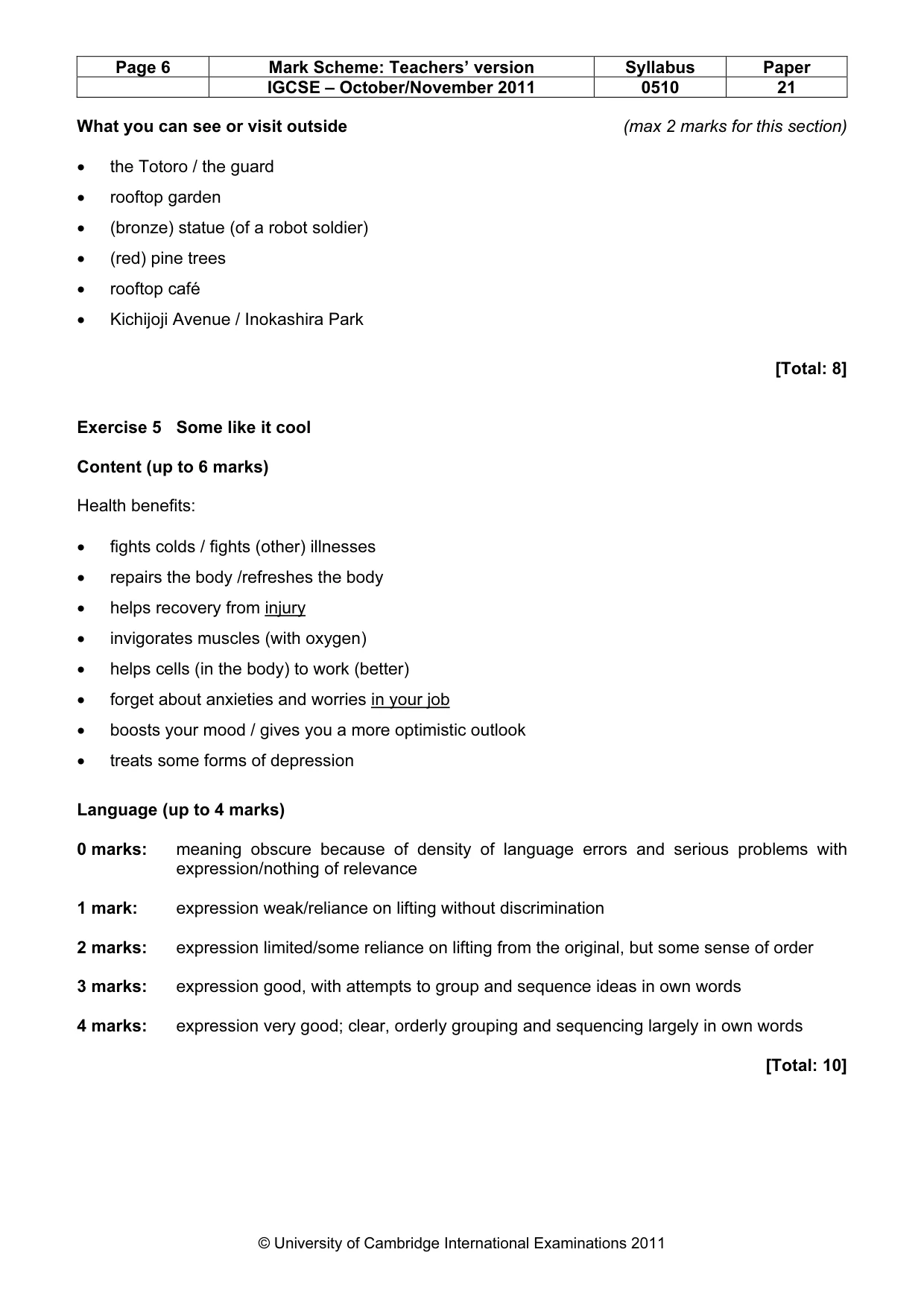
Page 2 Mark Scheme: Teachers’ version Syllabus Paper IGCSE – October/November 2011 0510 21 © University of Cambridge International Examinations 2011 Exercise 1 Spider-Man (a) Malaysia [1] (b) no ropes / no safety equipment [1] (c) (a small bag of) powder [1] (d) rarely gets permission for climbs [1] accept synonyms for ‘rarely’ (e) in darkness / before dawn [1] (f) two / twice [1] (g) stopped by security (guards) [1] (h) (thick) fog / moisture [1] [Total: 8] Exercise 2 Papua New Guinea (a) giant rat AND last September BOTH NEEDED FOR ONE MARK [1] accept synonyms for ‘giant’ (b) 0.8 metres / 0.8 m AND 1.5 kilos / 1.5 kg BOTH FOR ONE MARK [1] (c) isolated / 2 500 metres above the forest own climate last eruption was 225 000 years ago / species have had 225 000 years to develop / species have had plenty of time to develop ANY TWO FROM THREE [2] (d) 70% [1] (e) monkeys AND wild cats / big cats [1] accept ‘monkeys or wild cats’ (f) after (only) 30 seconds (they) saw a different type of frog [1] accept synonyms for ‘different type’
Mark scheme, page 3
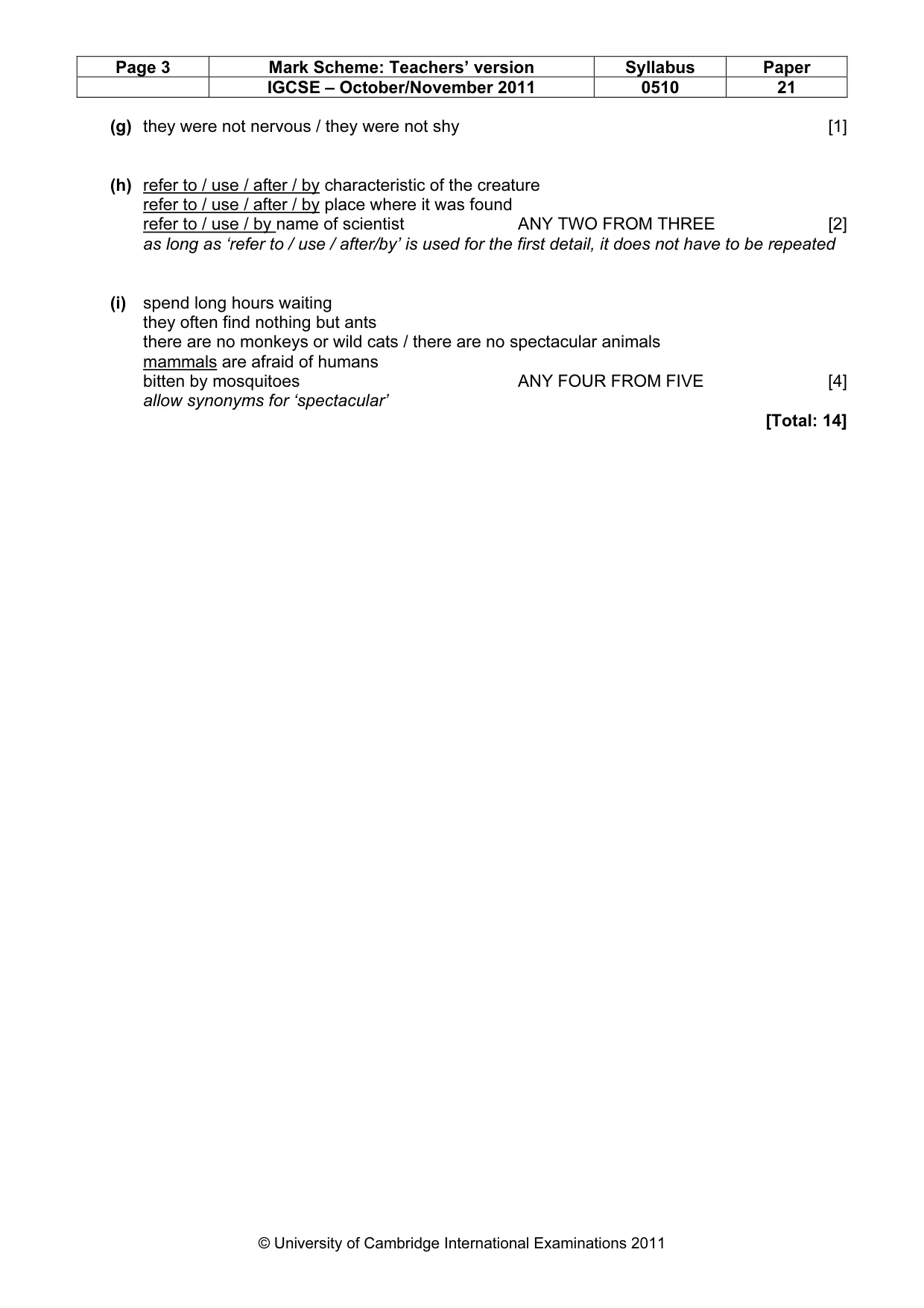
Page 3 Mark Scheme: Teachers’ version Syllabus Paper IGCSE – October/November 2011 0510 21 © University of Cambridge International Examinations 2011 (g) they were not nervous / they were not shy [1] (h) refer to / use / after / by characteristic of the creature refer to / use / after / by place where it was found refer to / use / by name of scientist ANY TWO FROM THREE [2] as long as ‘refer to / use / after/by’ is used for the first detail, it does not have to be repeated (i) spend long hours waiting they often find nothing but ants there are no monkeys or wild cats / there are no spectacular animals mammals are afraid of humans bitten by mosquitoes ANY FOUR FROM FIVE [4] allow synonyms for ‘spectacular’ [Total: 14]
Mark scheme, page 4
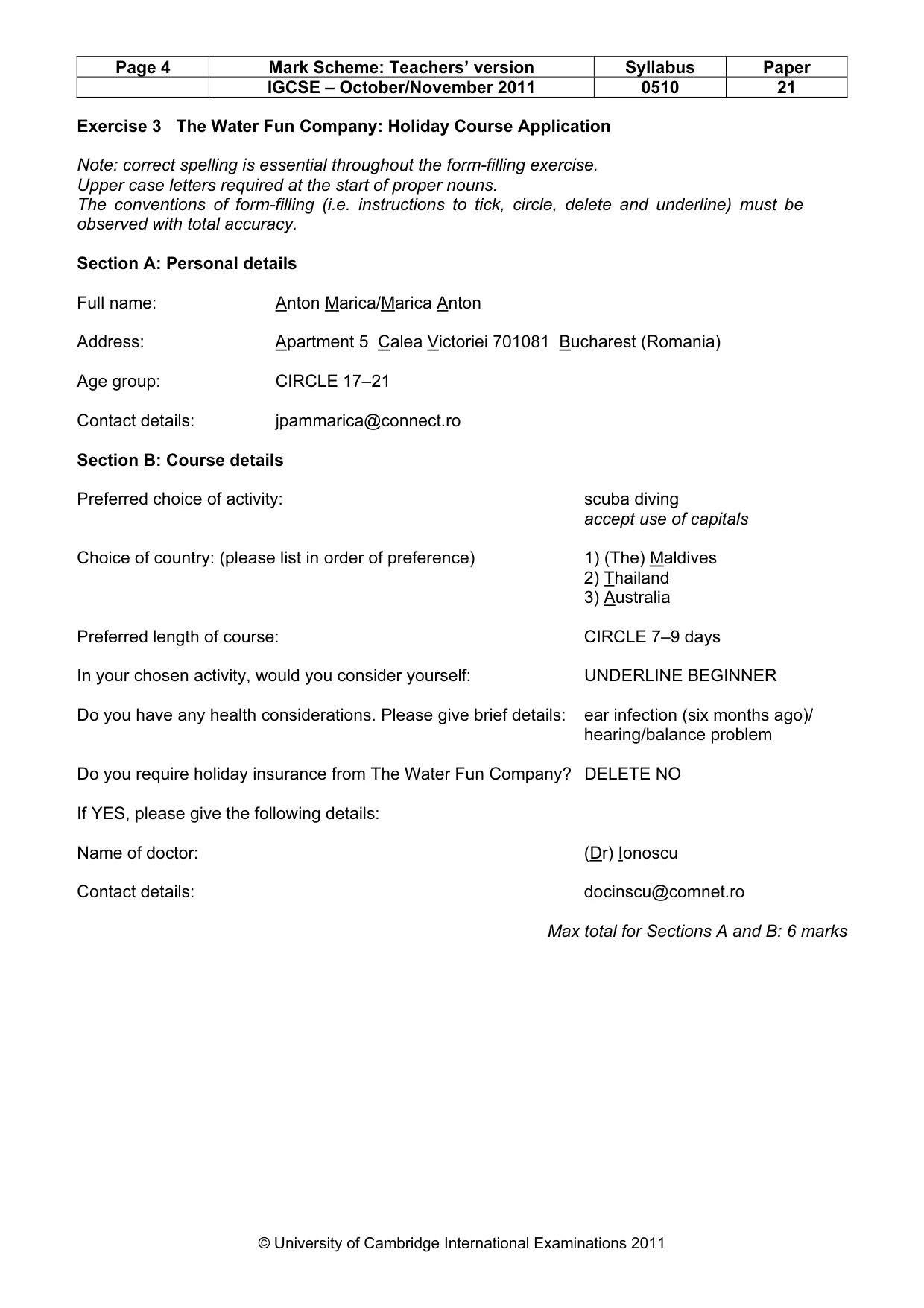
Page 4 Mark Scheme: Teachers’ version Syllabus Paper IGCSE – October/November 2011 0510 21 © University of Cambridge International Examinations 2011 Exercise 3 The Water Fun Company: Holiday Course Application Note: correct spelling is essential throughout the form-filling exercise. Upper case letters required at the start of proper nouns. The conventions of form-filling (i.e. instructions to tick, circle, delete and underline) must be observed with total accuracy. Section A: Personal details Full name: Anton Marica/Marica Anton Address: Apartment 5 Calea Victoriei 701081 Bucharest (Romania) Age group: CIRCLE 17–21 Contact details: jpammarica@connect.ro Section B: Course details Preferred choice of activity: scuba diving accept use of capitals Choice of country: (please list in order of preference) 1) (The) Maldives 2) Thailand 3) Australia Preferred length of course: CIRCLE 7–9 days In your chosen activity, would you consider yourself: UNDERLINE BEGINNER Do you have any health considerations. Please give brief details: ear infection (six months ago)/ hearing/balance problem Do you require holiday insurance from The Water Fun Company? DELETE NO If YES, please give the following details: Name of doctor: (Dr) Ionoscu Contact details: docinscu@comnet.ro Max total for Sections A and B: 6 marks
Mark scheme, page 5
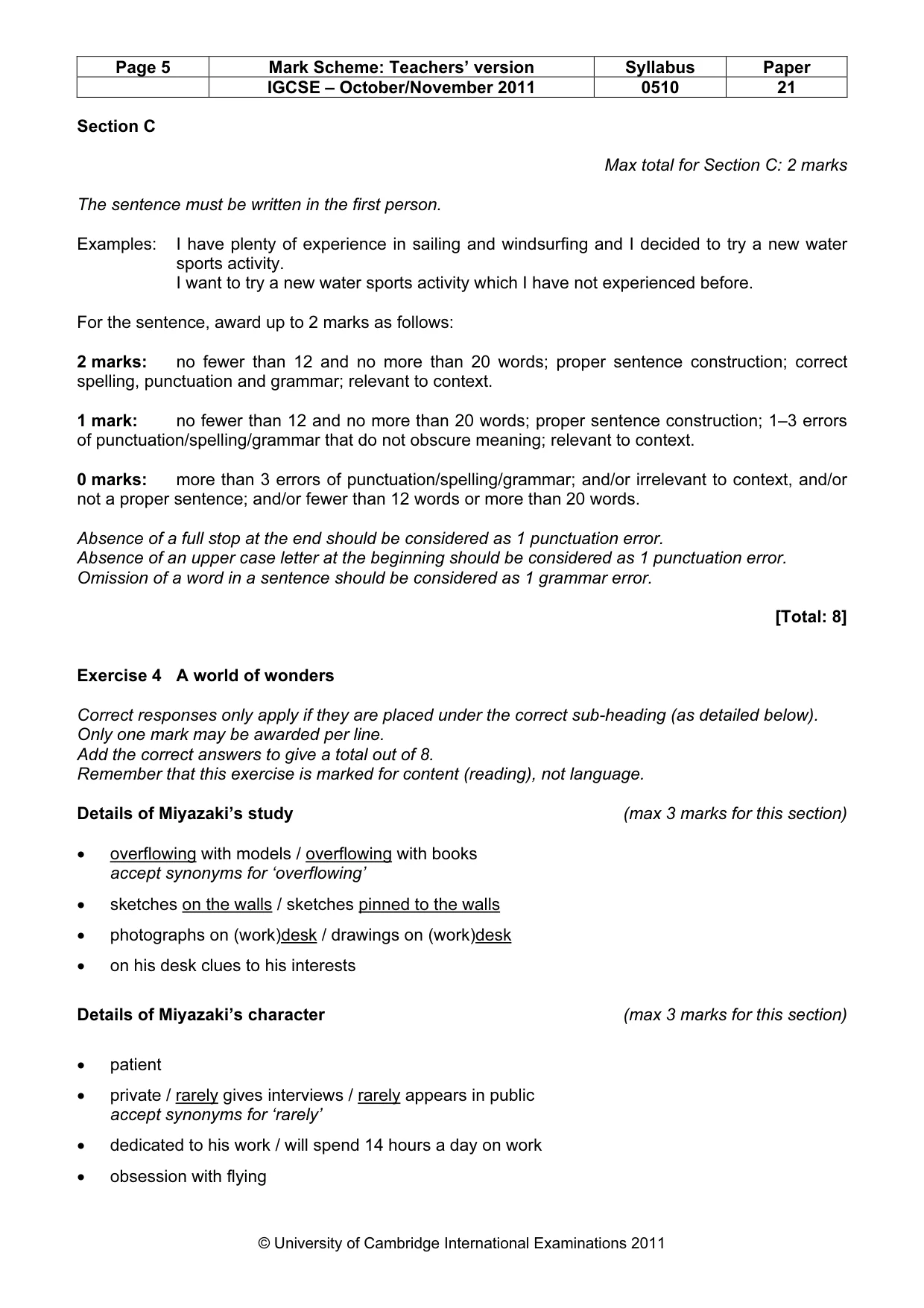
Page 5 Mark Scheme: Teachers’ version Syllabus Paper IGCSE – October/November 2011 0510 21 © University of Cambridge International Examinations 2011 Section C Max total for Section C: 2 marks The sentence must be written in the first person. Examples: I have plenty of experience in sailing and windsurfing and I decided to try a new water sports activity. I want to try a new water sports activity which I have not experienced before. For the sentence, award up to 2 marks as follows: 2 marks: no fewer than 12 and no more than 20 words; proper sentence construction; correct spelling, punctuation and grammar; relevant to context. 1 mark: no fewer than 12 and no more than 20 words; proper sentence construction; 1–3 errors of punctuation/spelling/grammar that do not obscure meaning; relevant to context. 0 marks: more than 3 errors of punctuation/spelling/grammar; and/or irrelevant to context, and/or not a proper sentence; and/or fewer than 12 words or more than 20 words. Absence of a full stop at the end should be considered as 1 punctuation error. Absence of an upper case letter at the beginning should be considered as 1 punctuation error. Omission of a word in a sentence should be considered as 1 grammar error. [Total: 8] Exercise 4 A world of wonders Correct responses only apply if they are placed under the correct sub-heading (as detailed below). Only one mark may be awarded per line. Add the correct answers to give a total out of 8. Remember that this exercise is marked for content (reading), not language. Details of Miyazaki’s study (max 3 marks for this section) • overflowing with models / overflowing with books accept synonyms for ‘overflowing’ • sketches on the walls / sketches pinned to the walls • photographs on (work)desk / drawings on (work)desk • on his desk clues to his interests Details of Miyazaki’s character (max 3 marks for this section) • patient • private / rarely gives interviews / rarely appears in public accept synonyms for ‘rarely’ • dedicated to his work / will spend 14 hours a day on work • obsession with flying
Mark scheme, page 6
Page 6 Mark Scheme: Teachers’ version Syllabus Paper IGCSE – October/November 2011 0510 21 © University of Cambridge International Examinations 2011 What you can see or visit outside (max 2 marks for this section) • the Totoro / the guard • rooftop garden • (bronze) statue (of a robot soldier) • (red) pine trees • rooftop café • Kichijoji Avenue / Inokashira Park [Total: 8] Exercise 5 Some like it cool Content (up to 6 marks) Health benefits: • fights colds / fights (other) illnesses • repairs the body /refreshes the body • helps recovery from injury • invigorates muscles (with oxygen) • helps cells (in the body) to work (better) • forget about anxieties and worries in your job • boosts your mood / gives you a more optimistic outlook • treats some forms of depression Language (up to 4 marks) 0 marks: meaning obscure because of density of language errors and serious problems with expression/nothing of relevance 1 mark: expression weak/reliance on lifting without discrimination 2 marks: expression limited/some reliance on lifting from the original, but some sense of order 3 marks: expression good, with attempts to group and sequence ideas in own words 4 marks: expression very good; clear, orderly grouping and sequencing largely in own words [Total: 10]
Mark scheme, page 7
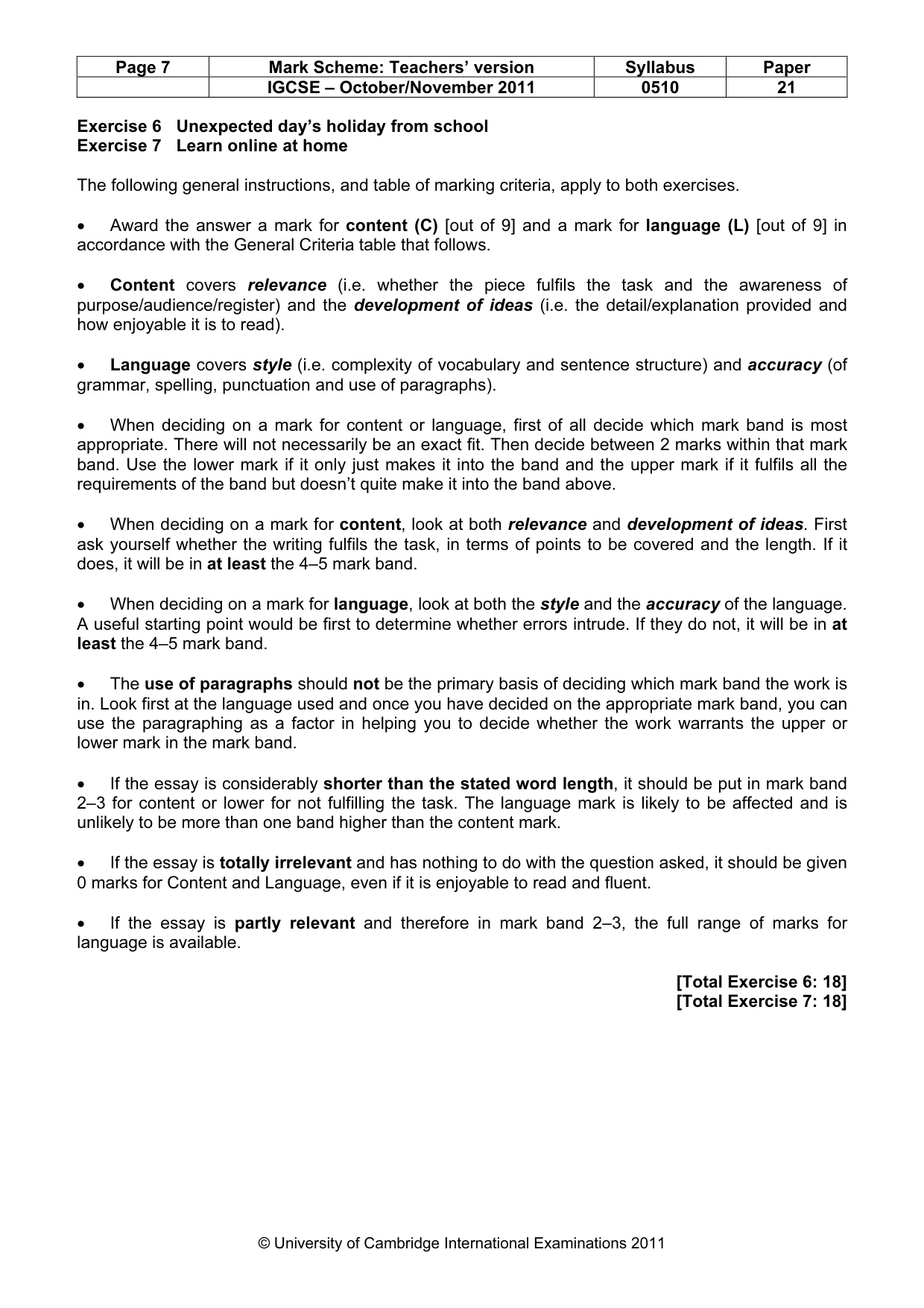
Page 7 Mark Scheme: Teachers’ version Syllabus Paper IGCSE – October/November 2011 0510 21 © University of Cambridge International Examinations 2011 Exercise 6 Unexpected day’s holiday from school Exercise 7 Learn online at home The following general instructions, and table of marking criteria, apply to both exercises. • Award the answer a mark for content (C) [out of 9] and a mark for language (L) [out of 9] in accordance with the General Criteria table that follows. • Content covers relevance (i.e. whether the piece fulfils the task and the awareness of purpose/audience/register) and the development of ideas (i.e. the detail/explanation provided and how enjoyable it is to read). • Language covers style (i.e. complexity of vocabulary and sentence structure) and accuracy (of grammar, spelling, punctuation and use of paragraphs). • When deciding on a mark for content or language, first of all decide which mark band is most appropriate. There will not necessarily be an exact fit. Then decide between 2 marks within that mark band. Use the lower mark if it only just makes it into the band and the upper mark if it fulfils all the requirements of the band but doesn’t quite make it into the band above. • When deciding on a mark for content, look at both relevance and development of ideas. First ask yourself whether the writing fulfils the task, in terms of points to be covered and the length. If it does, it will be in at least the 4–5 mark band. • When deciding on a mark for language, look at both the style and the accuracy of the language. A useful starting point would be first to determine whether errors intrude. If they do not, it will be in at least the 4–5 mark band. • The use of paragraphs should not be the primary basis of deciding which mark band the work is in. Look first at the language used and once you have decided on the appropriate mark band, you can use the paragraphing as a factor in helping you to decide whether the work warrants the upper or lower mark in the mark band. • If the essay is considerably shorter than the stated word length, it should be put in mark band 2–3 for content or lower for not fulfilling the task. The language mark is likely to be affected and is unlikely to be more than one band higher than the content mark. • If the essay is totally irrelevant and has nothing to do with the question asked, it should be given 0 marks for Content and Language, even if it is enjoyable to read and fluent. • If the essay is partly relevant and therefore in mark band 2–3, the full range of marks for language is available. [Total Exercise 6: 18] [Total Exercise 7: 18]
Mark scheme, page 8
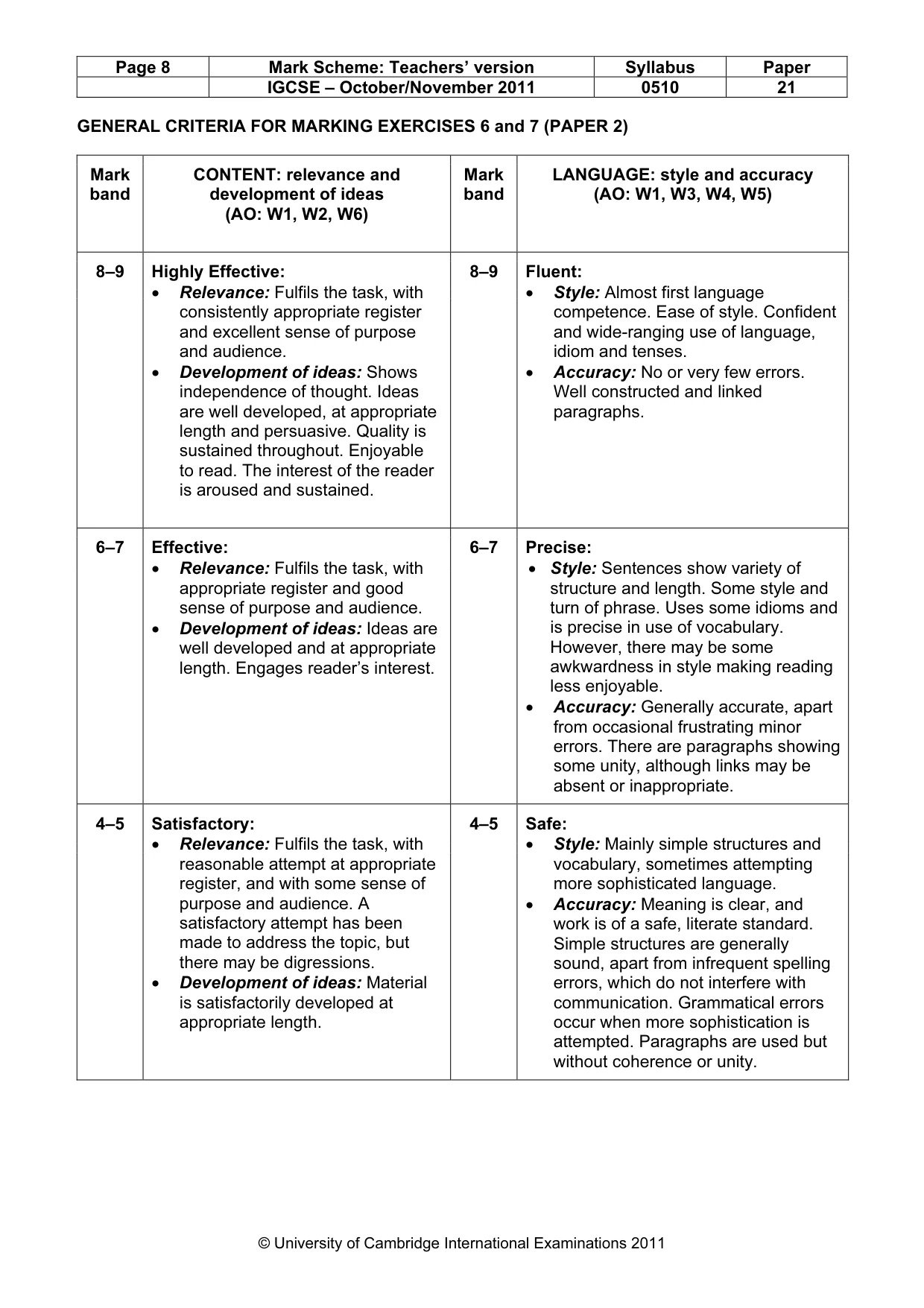
Page 8 Mark Scheme: Teachers’ version Syllabus Paper IGCSE – October/November 2011 0510 21 © University of Cambridge International Examinations 2011 GENERAL CRITERIA FOR MARKING EXERCISES 6 and 7 (PAPER 2) Mark band CONTENT: relevance and development of ideas (AO: W1, W2, W6) Mark band LANGUAGE: style and accuracy (AO: W1, W3, W4, W5) 8–9 8–9 Highly Effective: • Relevance: Fulfils the task, with consistently appropriate register and excellent sense of purpose and audience. • Development of ideas: Shows independence of thought. Ideas are well developed, at appropriate length and persuasive. Quality is sustained throughout. Enjoyable to read. The interest of the reader is aroused and sustained. Fluent: • Style: Almost first language competence. Ease of style. Confident and wide-ranging use of language, idiom and tenses. • Accuracy: No or very few errors. Well constructed and linked paragraphs. 6–7 6–7 Effective: • Relevance: Fulfils the task, with appropriate register and good sense of purpose and audience. • Development of ideas: Ideas are well developed and at appropriate length. Engages reader’s interest. Precise: • Style: Sentences show variety of structure and length. Some style and turn of phrase. Uses some idioms and is precise in use of vocabulary. However, there may be some awkwardness in style making reading less enjoyable. • Accuracy: Generally accurate, apart from occasional frustrating minor errors. There are paragraphs showing some unity, although links may be absent or inappropriate. 4–5 4–5 Satisfactory: • Relevance: Fulfils the task, with reasonable attempt at appropriate register, and with some sense of purpose and audience. A satisfactory attempt has been made to address the topic, but there may be digressions. • Development of ideas: Material is satisfactorily developed at appropriate length. Safe: • Style: Mainly simple structures and vocabulary, sometimes attempting more sophisticated language. • Accuracy: Meaning is clear, and work is of a safe, literate standard. Simple structures are generally sound, apart from infrequent spelling errors, which do not interfere with communication. Grammatical errors occur when more sophistication is attempted. Paragraphs are used but without coherence or unity.
Mark scheme, page 9
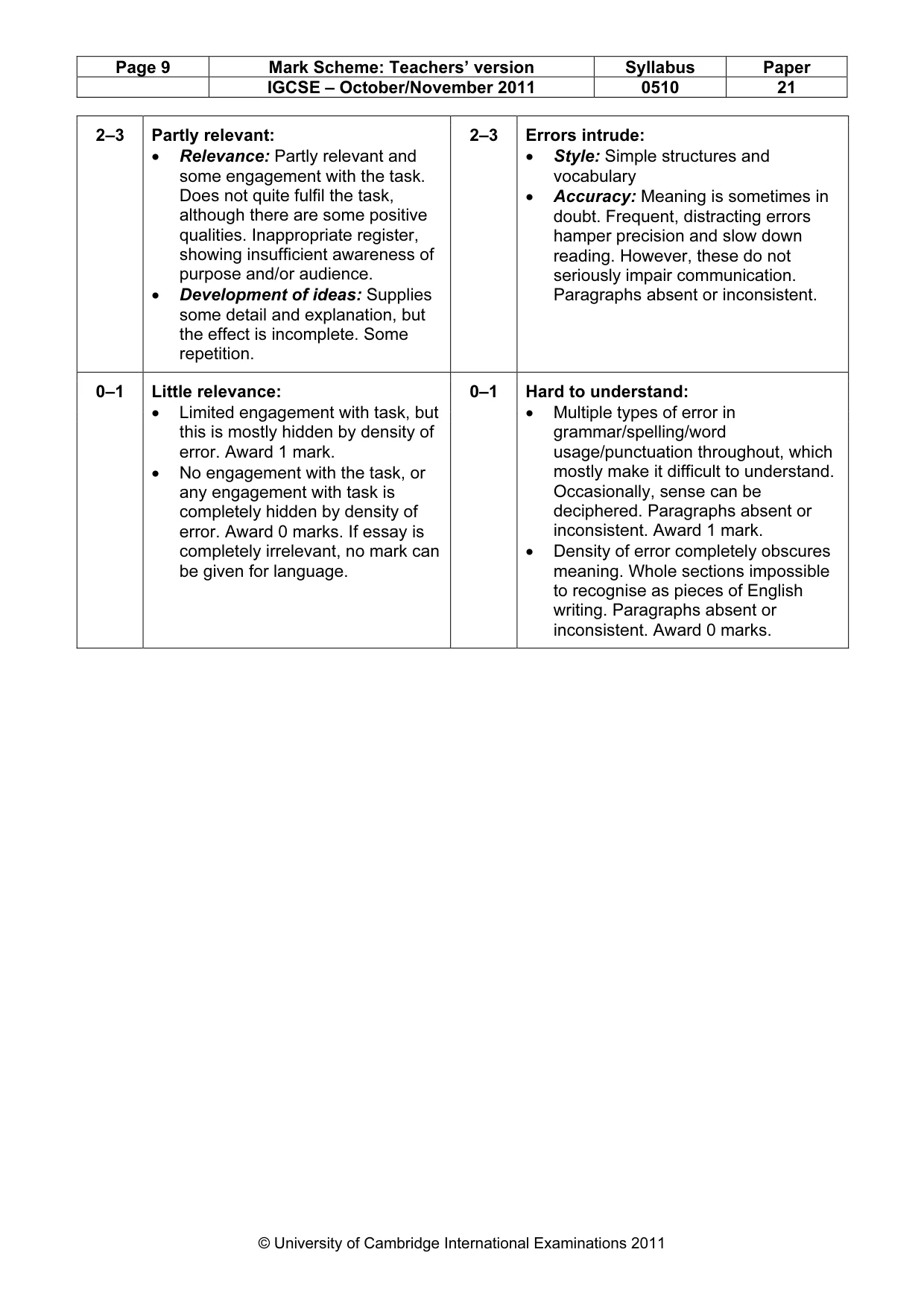
Page 9 Mark Scheme: Teachers’ version Syllabus Paper IGCSE – October/November 2011 0510 21 © University of Cambridge International Examinations 2011 2–3 Partly relevant: • Relevance: Partly relevant and some engagement with the task. Does not quite fulfil the task, although there are some positive qualities. Inappropriate register, showing insufficient awareness of purpose and/or audience. • Development of ideas: Supplies some detail and explanation, but the effect is incomplete. Some repetition. 2–3 Errors intrude: • Style: Simple structures and vocabulary • Accuracy: Meaning is sometimes in doubt. Frequent, distracting errors hamper precision and slow down reading. However, these do not seriously impair communication. Paragraphs absent or inconsistent. 0–1 0–1 Little relevance: • Limited engagement with task, but this is mostly hidden by density of error. Award 1 mark. • No engagement with the task, or any engagement with task is completely hidden by density of error. Award 0 marks. If essay is completely irrelevant, no mark can be given for language. Hard to understand: • Multiple types of error in grammar/spelling/word usage/punctuation throughout, which mostly make it difficult to understand. Occasionally, sense can be deciphered. Paragraphs absent or inconsistent. Award 1 mark. • Density of error completely obscures meaning. Whole sections impossible to recognise as pieces of English writing. Paragraphs absent or inconsistent. Award 0 marks.
What you needed in this session
Cambridge’s own grade thresholds for 2011 Oct/Nov, Paper 2 · Variant 1. A higher threshold means an easier paper — the bar moves with how the cohort did.