Cambridge IGCSE English - Second Language (oral endorsement) 0510 — 2011 Oct/Nov Paper 2 · Variant 2
0510/22/O/N/11 · 84 marks · ≈95 min
The question paper and its mark scheme, free to read here and free to download. This is Cambridge’s own paper, exactly as it was sat.
Question paper16 pages




Mark scheme9 pages
Answers below. Sit the paper first if you are practising.
Paper as text
Question paper, page 1
This document consists of 15 printed pages and 1 blank page. IB11 11_0510_22/4RP © UCLES 2011 [Turn over *0132551902* UNIVERSITY OF CAMBRIDGE INTERNATIONAL EXAMINATIONS International General Certificate of Secondary Education ENGLISH AS A SECOND LANGUAGE 0510/22 Paper 2 Reading and Writing (Extended) October/November 2011 2 hours Candidates answer on the Question Paper. No Additional Materials are required. READ THESE INSTRUCTIONS FIRST Write your Centre number, candidate number and name on all the work you hand in. Write in dark blue or black pen. Do not use staples, paper clips, highlighters, glue or correction fluid. DO NOT WRITE IN ANY BARCODES. Answer all questions. Dictionaries are not allowed. The number of marks is given in brackets [ ] at the end of each question or part question.
Question paper, page 2
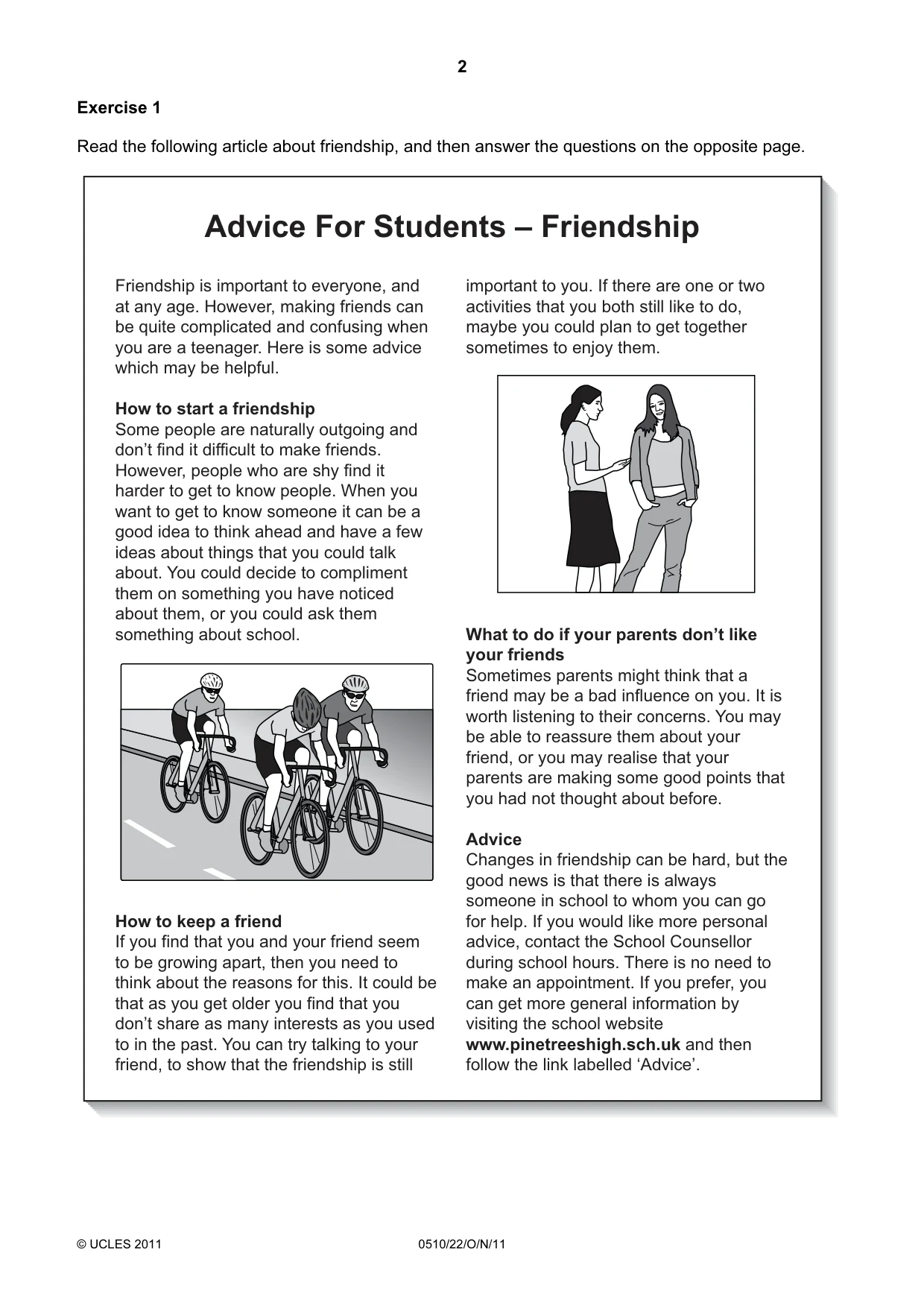
2 © UCLES 2011 0510/22/O/N/11 Exercise 1 Read the following article about friendship, and then answer the questions on the opposite page. Advice For Students – Friendship Friendship is important to everyone, and at any age. However, making friends can be quite complicated and confusing when you are a teenager. Here is some advice which may be helpful. How to start a friendship Some people are naturally outgoing and don’t find it difficult to make friends. However, people who are shy find it harder to get to know people. When you want to get to know someone it can be a good idea to think ahead and have a few ideas about things that you could talk about. You could decide to compliment them on something you have noticed about them, or you could ask them something about school. How to keep a friend If you find that you and your friend seem to be growing apart, then you need to think about the reasons for this. It could be that as you get older you find that you don’t share as many interests as you used to in the past. You can try talking to your friend, to show that the friendship is still important to you. If there are one or two activities that you both still like to do, maybe you could plan to get together sometimes to enjoy them. What to do if your parents don’t like your friends Sometimes parents might think that a friend may be a bad influence on you. It is worth listening to their concerns. You may be able to reassure them about your friend, or you may realise that your parents are making some good points that you had not thought about before. Advice Changes in friendship can be hard, but the good news is that there is always someone in school to whom you can go for help. If you would like more personal advice, contact the School Counsellor during school hours. There is no need to make an appointment. If you prefer, you can get more general information by visiting the school website www.pinetreeshigh.sch.uk and then follow the link labelled ‘Advice’.
Question paper, page 3
3 © UCLES 2011 0510/22/O/N/11 [Turn over (a) When can making friends seem complicated and confusing? [1] (b) What sort of people find it hard to make friends? [1] (c) What could you talk about when you first want to get to know someone? [1] (d) Why might young friends grow apart over time? [1] (e) What advice does the article give about trying to keep a friend? Give two details. [1] (f) Why do parents sometimes worry about the friends you have? [1] (g) Why is it worth listening to parents’ advice about friends? [1] (h) How can you get more general guidance about friendship? [1] [Total: 8]
Question paper, page 4
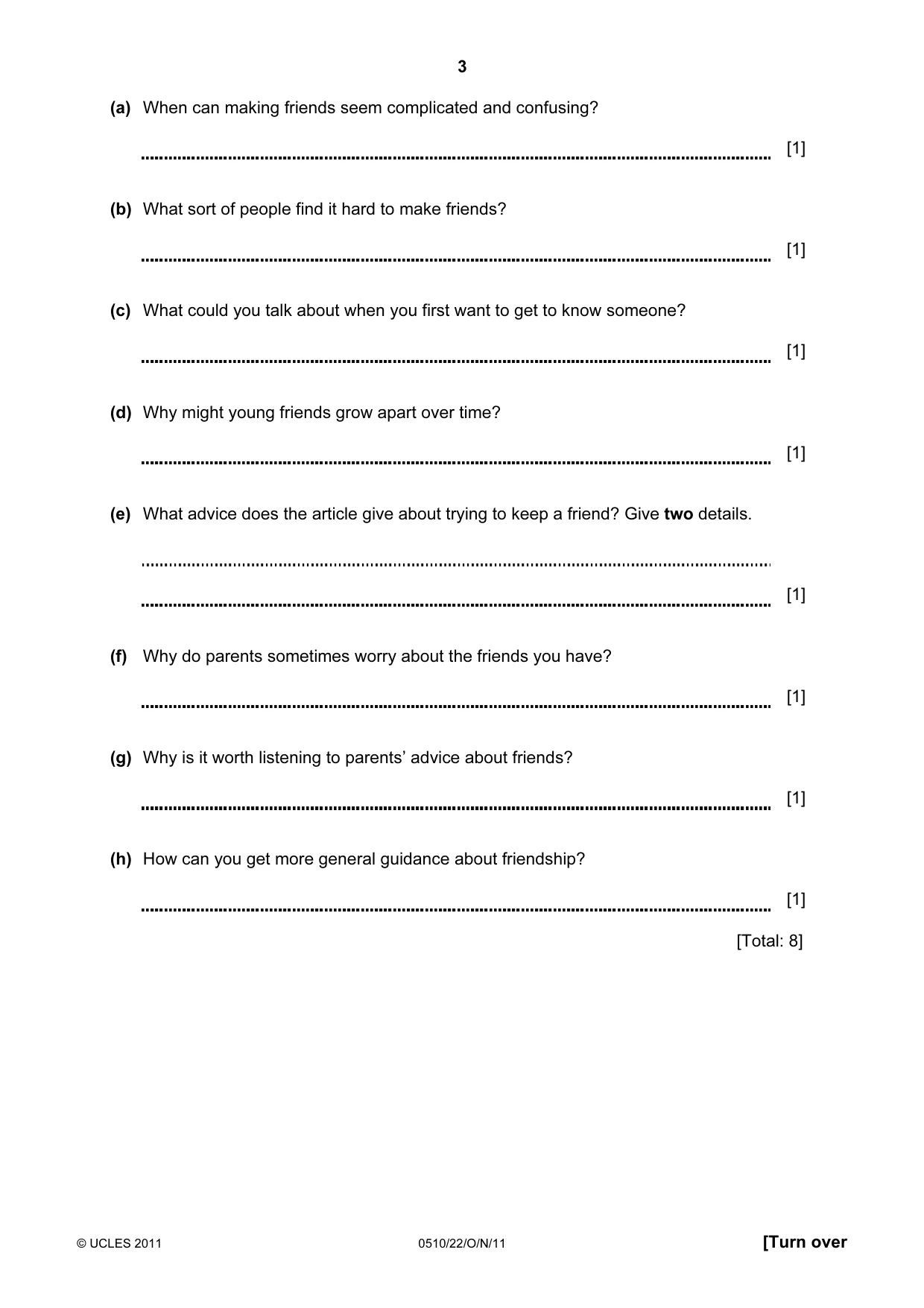
4 © UCLES 2011 0510/22/O/N/11 Exercise 2 Read the following article about an expert on sharks and their behaviour, and then answer the questions on the opposite page. Shark expert Andy Dehart is a shark expert and TV presenter who lives in the United States of America. He has had a lifelong interest in sharks and is always trying to look for ways to educate the public about them. Many people think that sharks have little or no intelligence, but Andy points out that recent studies have shown that many shark species possess powerful problem-solving abilities and social skills. “Sharks do not want to attack humans,” he asserts. “There is no shark species that eats humans as part of its regular diet. In most shark attack cases, the shark leaves after realising that it has mistakenly bitten a human and not its intended prey.” Andy takes every opportunity to explain that sharks need our help to survive. Sharks are being killed at a rate of 2,500 each day. These great fish are particularly at risk from overfishing, and they have few young compared to other fish that are caught to be sold. They simply will not survive if this sort of fishing continues. In the last 20 years, 90 per cent of hammerhead sharks have disappeared. Many other shark species are also on the verge of extinction. Two species of shark which are endangered are fished for their fins. These are in great demand in certain parts of the world, where shark’s fin soup is a favoured food. In Andy’s personal opinion, all shark fishing should be stopped until the shark populations have had time to grow again. We then need to do a better job of managing the fishing of sharks. However, even if the direct fishing of sharks is stopped, many will still be killed when they are caught up in the nets of boats fishing for other species of fish. When Andy was a boy, his father worked for a national oceanic organisation, and Andy travelled with him all over the Caribbean. He grew up by the coast and he has been connected with the sea for as long as he can remember. He also lived near one of the best aquariums in America. Andy then went on to build a career working with sharks in an aquarium environment. More recently, he has been involved with television and the making of programmes about sharks. Andy and his wife had their first child two years ago. They were amused and amazed to see to what extent their work with animals has proved to be useful in bringing up their daughter. They know how to observe her behaviour and teach her how to do things by rewarding her. Andy loves sharks and is very passionate about their survival and protection. He feels extremely lucky to have had opportunities working at the National Aquarium and the television station which presents the Nature Channel. He never wastes a moment in either place that could be spent educating people about sharks. He does admit that it is probably not possible to get everyone to love sharks as he does. However, he does hope to persuade people personally or through the media to respect sharks and the critical role they play in our environment. His main objective is to keep spreading awareness that sharks are not dangerous man-eaters but essential creatures in our oceans, as they provide ecological balance and help to control other species. 900 800 700 600 500 400 300 200 1950 1960 1970 1980 Year Sharks caught globally 1990 2000 2010 Quantity (in thousands)
Question paper, page 5
5 © UCLES 2011 0510/22/O/N/11 [Turn over (a) How long has Andy been interested in sharks? [1] (b) What evidence is there that sharks may be intelligent? Give two details. [1] (c) Why does Andy believe that sharks only attack humans by mistake? [1] (d) What does Andy expect to happen if all shark fishing is stopped for a while? [1] (e) As a child, what influenced Andy’s later choice of career? Give two details. [2] (f) How did Andy’s work help him when bringing up his daughter? [1] (g) According to the graph, how many sharks were caught in 1990? [1] (h) How does Andy hope to educate people about sharks? Give two details. [1] (i) In which ways are sharks useful? Give two details. [1] (j) Why are many sharks at risk of extinction? Give four reasons. [4] [Total: 14]
Question paper, page 6
6 © UCLES 2011 0510/22/O/N/11 Exercise 3 Sarah Harman is a 16-year-old student who lives in England at 47 Mill Lane, Southampton. Her telephone number is 07922348911. Sarah is in her final year of school and in September 2012 hopes to go to the London Arts Academy, where she will continue her studies and receive specialist tuition in singing. The London Arts Academy has an excellent reputation and has produced many singers who have gone on to become famous. Sarah has enjoyed singing since the age of 5, when her grandfather used to play the piano and encourage her to sing. Her grandparents then moved away to live in Canada. Sadly, Sarah has only seen them once since they left as the family has not been able to afford to visit them. However, Sarah has continued her singing and, by the age of 7, her parents had arranged a private teacher for her and she was performing at many music festivals. More recently, Sarah was asked to take the lead role in a pop musical show called ‘Shout Aloud’ which was being performed at school. This was a great success, and her 5 minute solo song, ‘Summer Dreams’, was well received and members of the audience stood up and applauded her. Sarah has spent most of her singing career to date performing classical songs, but she really enjoyed singing the more modern and popular songs required in the musical. After the school performance, one of the parents who had watched the musical, Mr Lawrence, contacted Sarah’s parents to inform them about a talent show which was going to be on television in the near future. Mr Lawrence was an employee of the local TV station and thought that the family might be interested in entering Sarah for the competition. Mr Lawrence gave the family his email address, lawr@abinternet.co.uk, so that they could write and ask him for the application form once they had considered it. Mr and Mrs Harman thought that this would be an excellent opportunity for their daughter and so made sure that they got the application form. They were all delighted to learn that the first prize was a family holiday for four in a country of their own choice. The choice of destination would be an easy one: they would want to visit Sarah’s grandparents. It did not take Sarah long to decide to use the solo song that she had sung at school as her entry for the talent show. She would need to make sure that the technicians at the TV station were able to provide a CD player for her backing music and coloured lights in order to create the right atmosphere. Sarah was very excited by the idea of appearing on television and even more excited by the possibility of winning the holiday for her family. Imagine you are Sarah. Fill in the form on the opposite page, using the information above.
Question paper, page 7
7 © UCLES 2011 0510/22/O/N/11 [Turn over TV Talent Show Application Form Section A Personal details and experience Full name: … Age: … Address: … Telephone number: … What is your main talent? (please underline one) singing dancing playing an instrument How were you taught? (please circle) by self by teacher by parents Have you ever performed in public before? (please delete) YES / NO Section B Proposed performance details Name of performance item: … Approximate length of performance: … Technical equipment required: … Section C Additional information If you are under 18 years of age please indicate whether or not you have your parents’ permission to enter the talent show. (please delete) YES / NO Where did you hear about the talent show? (please circle) television radio magazine personal contact Section D In the space below, write one sentence of between 12 and 20 words, explaining where you would like to go on holiday and why you have chosen that destination. [Total: 8]
Question paper, page 8
8 © UCLES 2011 0510/22/O/N/11 Exercise 4 Read the following speech given by a fashion designer about the ways in which technology and fashion are working together, and then complete the notes on the opposite page. Fashion of the future will not just be about the length of skirts or the width of trousers. Fashion will team up with technology and the result will be something that we may find difficult to imagine at present. Many companies are already putting fashion and technology together and calling the result ‘wearable technology’. One company has produced a jacket with a built-in minidisc player and a remote control sewn into the sleeve. Another company has made jackets with built-in fans to help their customers to keep cool during the summer. The future of technology in fibre is only a few years away. One shoe manufacturing company has already designed a running shoe with an embedded microchip that checks the ground underfoot and accordingly adjusts the level of shock absorption provided by the shoe’s heel. But the real high-tech designs of the future have yet to reach the shops. These will consist of materials and clothes that are now only being sketched out in designer studios and research laboratories around the world. Wearable technology will eventually become a basic product, much like blue jeans. Eventually, people will wonder why they wore ordinary trousers when future ones will be able to keep their legs warm with heating coils stitched into the lining. Students in laboratories in various universities are experimenting with cheap wearable technology. Using fabrics filled with various metals, such as copper and stainless steel, they are working on producing clothing that is soft to the touch and can change shape according to the temperature. With the application of a small amount of heat, a long sleeved shirt can become short sleeved in seconds, while still being able to revert to its original shape. Some ideas are even more amazing. One professor describes a proposed spray-on dress made from a chemical formula which will allow you to create a temporary dress from virtually nothing. The chemical will be sprayed directly onto the skin to form a cloud of non-woven cloth, which can then be styled in any way the customer wishes. It is not just clothing that is becoming technical. Designers are also trying to find new ways to fit clothes. One fashion technology company has already created the world’s first pair of perfectly fitted jeans. The customer stands in a pitch black changing room while a light flashes over the body for eight seconds. The exact body measurements are scanned and then recorded. A pair of perfectly fitted jeans arrives in the post within two weeks. Some of the ideas being explored, such as wrinkle resistant sweaters, will probably be in the shops before long. But others, air conditioned jackets, for example, may never be available to buy, no matter how amazing they sound. Fashion and Wearable Technology
Question paper, page 9
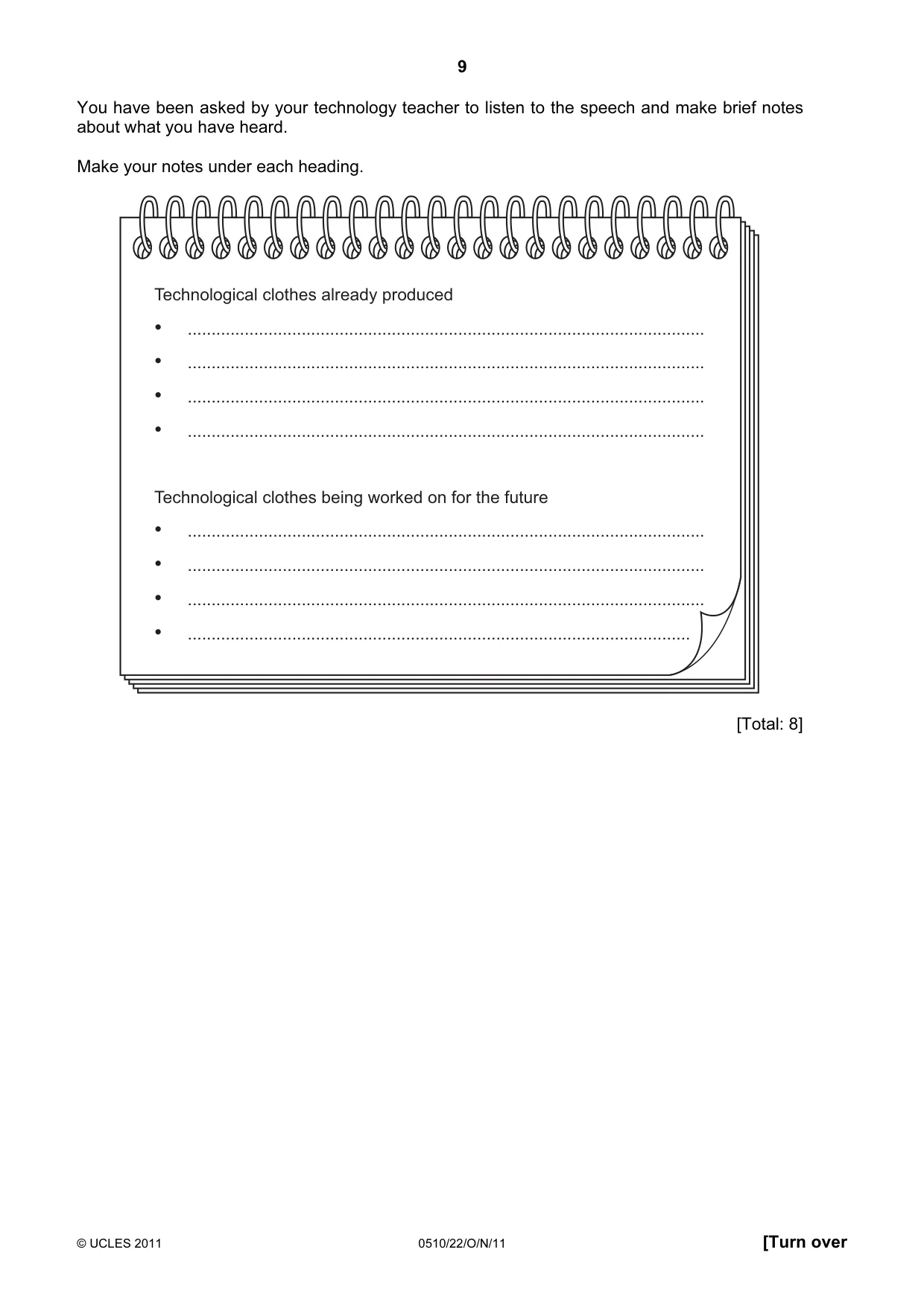
9 © UCLES 2011 0510/22/O/N/11 [Turn over You have been asked by your technology teacher to listen to the speech and make brief notes about what you have heard. Make your notes under each heading. Technological clothes already produced • … • … • … • … Technological clothes being worked on for the future • … • … • … • … [Total: 8]
Question paper, page 10
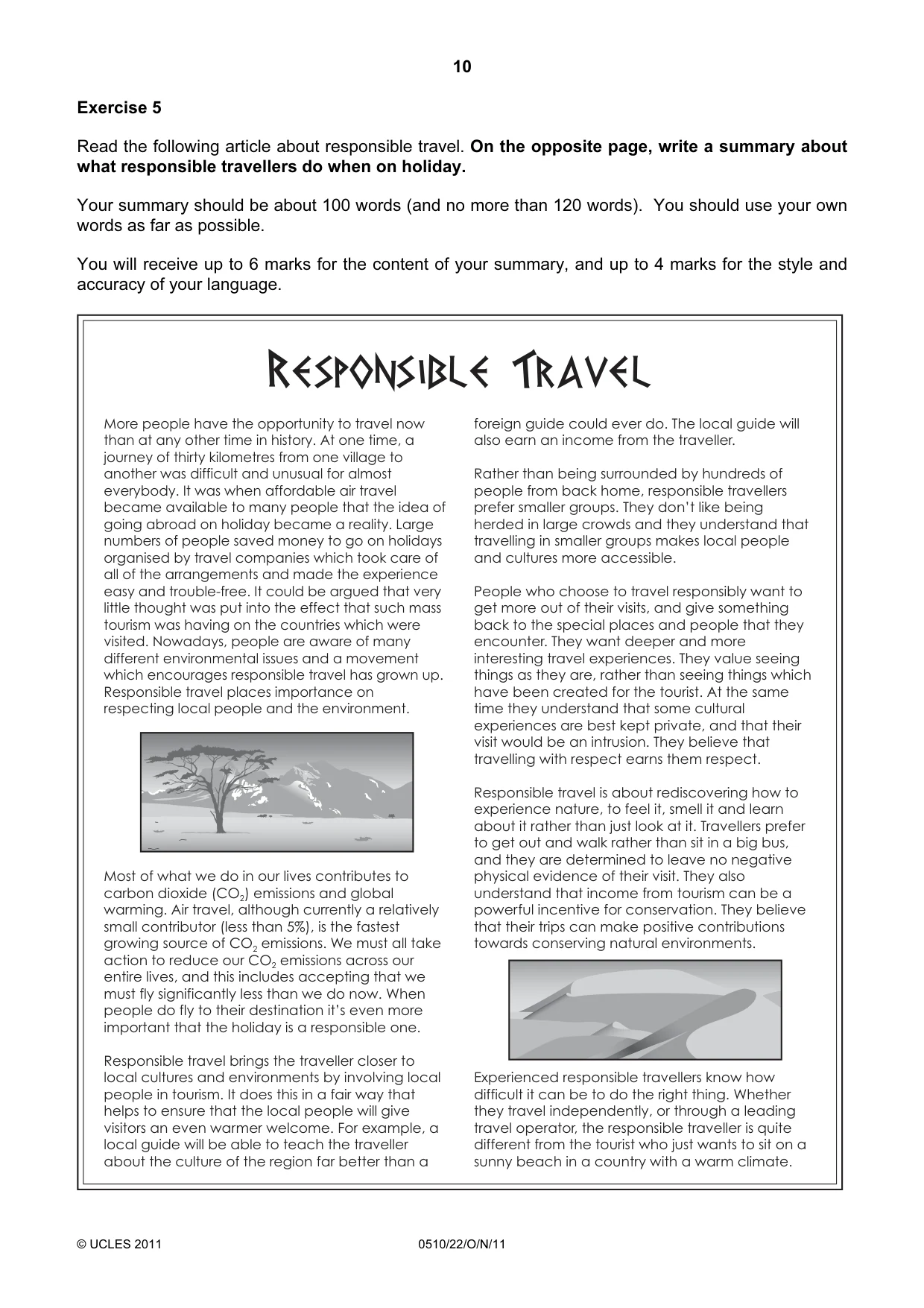
10 © UCLES 2011 0510/22/O/N/11 Exercise 5 Read the following article about responsible travel. On the opposite page, write a summary about what responsible travellers do when on holiday. Your summary should be about 100 words (and no more than 120 words). You should use your own words as far as possible. You will receive up to 6 marks for the content of your summary, and up to 4 marks for the style and accuracy of your language. More people have the opportunity to travel now than at any other time in history. At one time, a journey of thirty kilometres from one village to another was difficult and unusual for almost everybody. It was when affordable air travel became available to many people that the idea of going abroad on holiday became a reality. Large numbers of people saved money to go on holidays organised by travel companies which took care of all of the arrangements and made the experience easy and trouble-free. It could be argued that very little thought was put into the effect that such mass tourism was having on the countries which were visited. Nowadays, people are aware of many different environmental issues and a movement which encourages responsible travel has grown up. Responsible travel places importance on respecting local people and the environment. Most of what we do in our lives contributes to carbon dioxide (CO2) emissions and global warming. Air travel, although currently a relatively small contributor (less than 5%), is the fastest growing source of CO2 emissions. We must all take action to reduce our CO2 emissions across our entire lives, and this includes accepting that we must fly significantly less than we do now. When people do fly to their destination it’s even more important that the holiday is a responsible one. Responsible travel brings the traveller closer to local cultures and environments by involving local people in tourism. It does this in a fair way that helps to ensure that the local people will give visitors an even warmer welcome. For example, a local guide will be able to teach the traveller about the culture of the region far better than a foreign guide could ever do. The local guide will also earn an income from the traveller. Rather than being surrounded by hundreds of people from back home, responsible travellers prefer smaller groups. They don’t like being herded in large crowds and they understand that travelling in smaller groups makes local people and cultures more accessible. People who choose to travel responsibly want to get more out of their visits, and give something back to the special places and people that they encounter. They want deeper and more interesting travel experiences. They value seeing things as they are, rather than seeing things which have been created for the tourist. At the same time they understand that some cultural experiences are best kept private, and that their visit would be an intrusion. They believe that travelling with respect earns them respect. Responsible travel is about rediscovering how to experience nature, to feel it, smell it and learn about it rather than just look at it. Travellers prefer to get out and walk rather than sit in a big bus, and they are determined to leave no negative physical evidence of their visit. They also understand that income from tourism can be a powerful incentive for conservation. They believe that their trips can make positive contributions towards conserving natural environments. Experienced responsible travellers know how difficult it can be to do the right thing. Whether they travel independently, or through a leading travel operator, the responsible traveller is quite different from the tourist who just wants to sit on a sunny beach in a country with a warm climate. Responsible Travel
Question paper, page 11
11 © UCLES 2011 0510/22/O/N/11 [Turn over [Total: 10]
Question paper, page 12
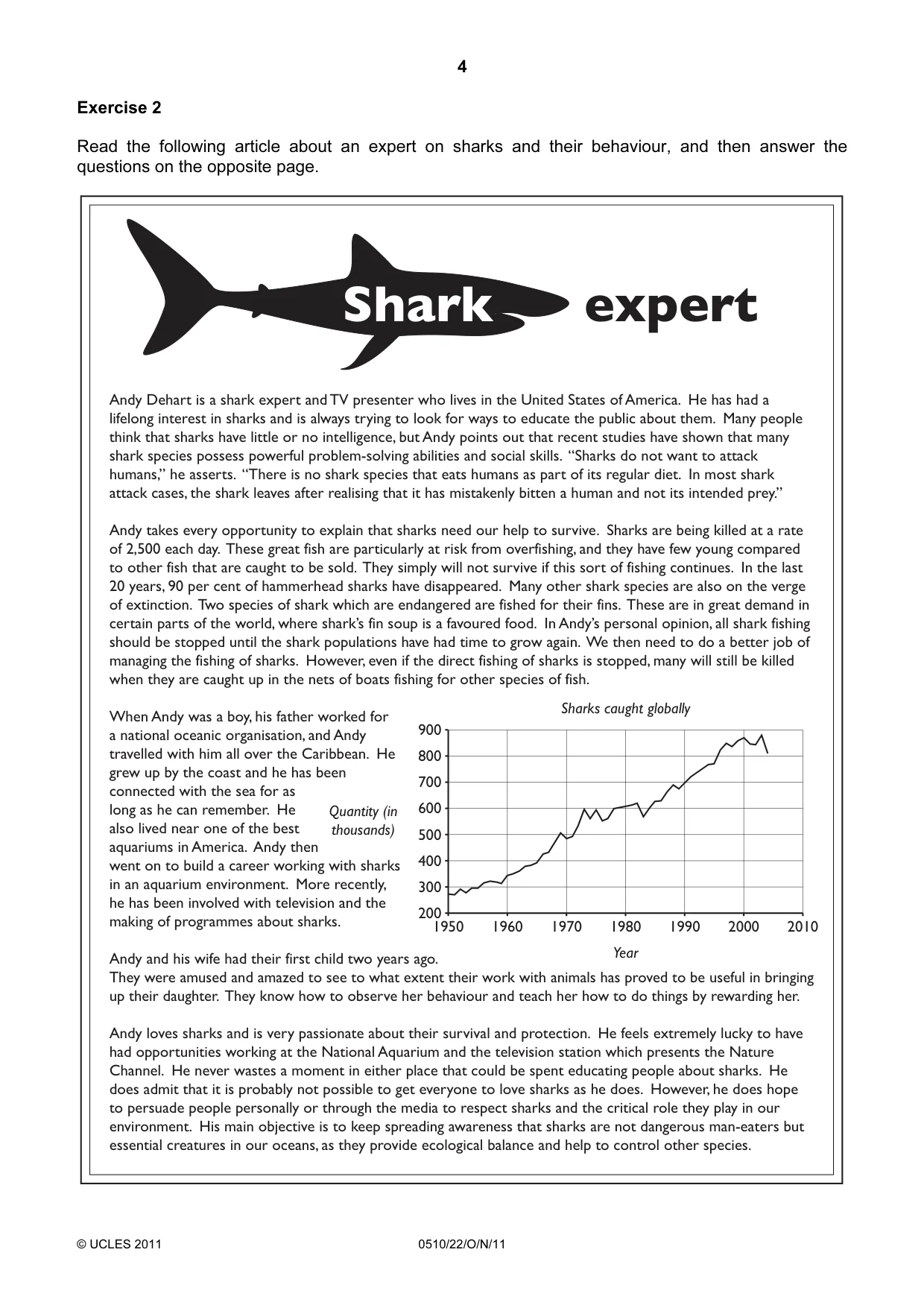
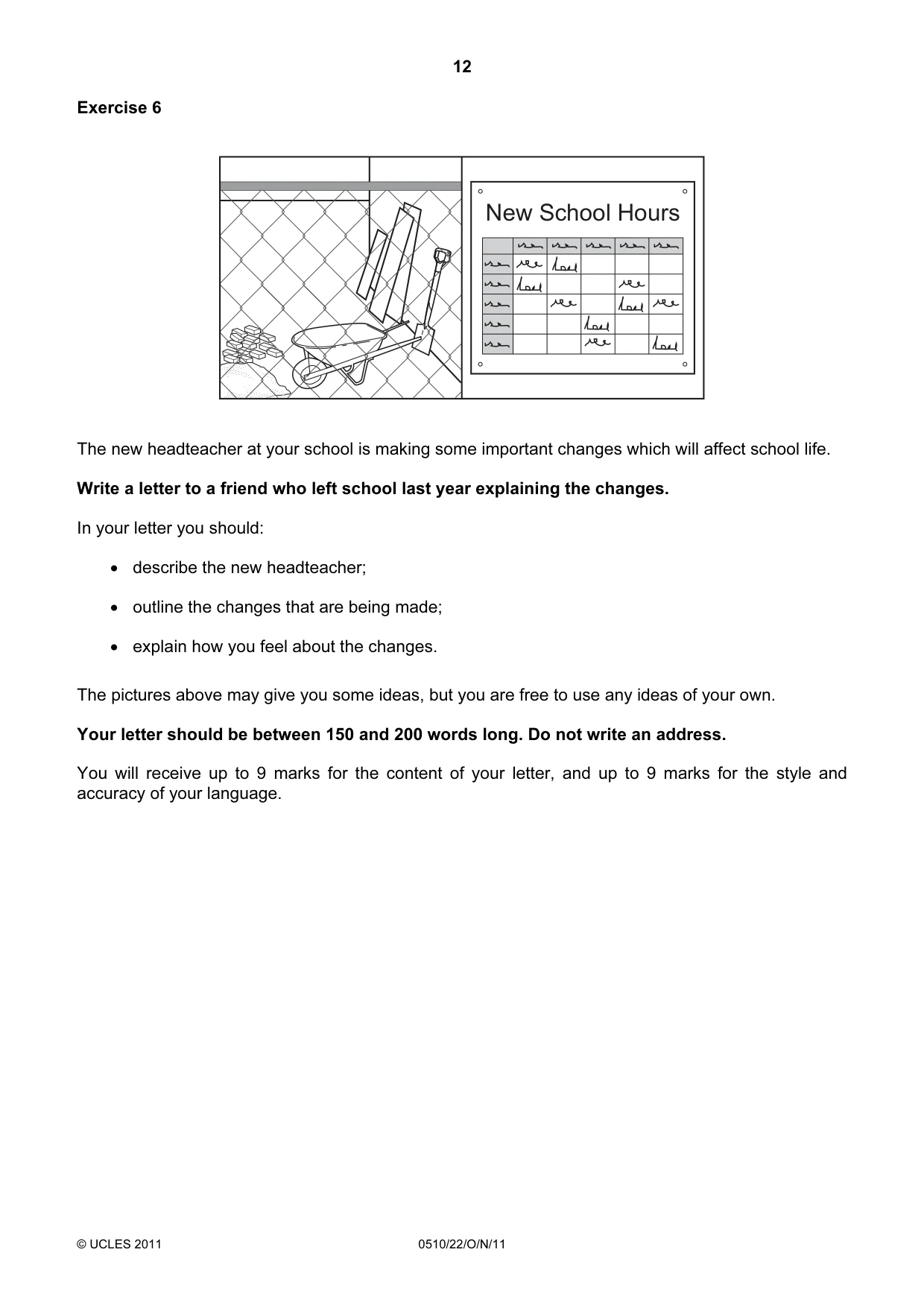
12 © UCLES 2011 0510/22/O/N/11 Exercise 6 New School Hours The new headteacher at your school is making some important changes which will affect school life. Write a letter to a friend who left school last year explaining the changes. In your letter you should: • describe the new headteacher; • outline the changes that are being made; • explain how you feel about the changes. The pictures above may give you some ideas, but you are free to use any ideas of your own. Your letter should be between 150 and 200 words long. Do not write an address. You will receive up to 9 marks for the content of your letter, and up to 9 marks for the style and accuracy of your language.
Question paper, page 13
13 © UCLES 2011 0510/22/O/N/11 [Turn over [Total: 18]
Question paper, page 14
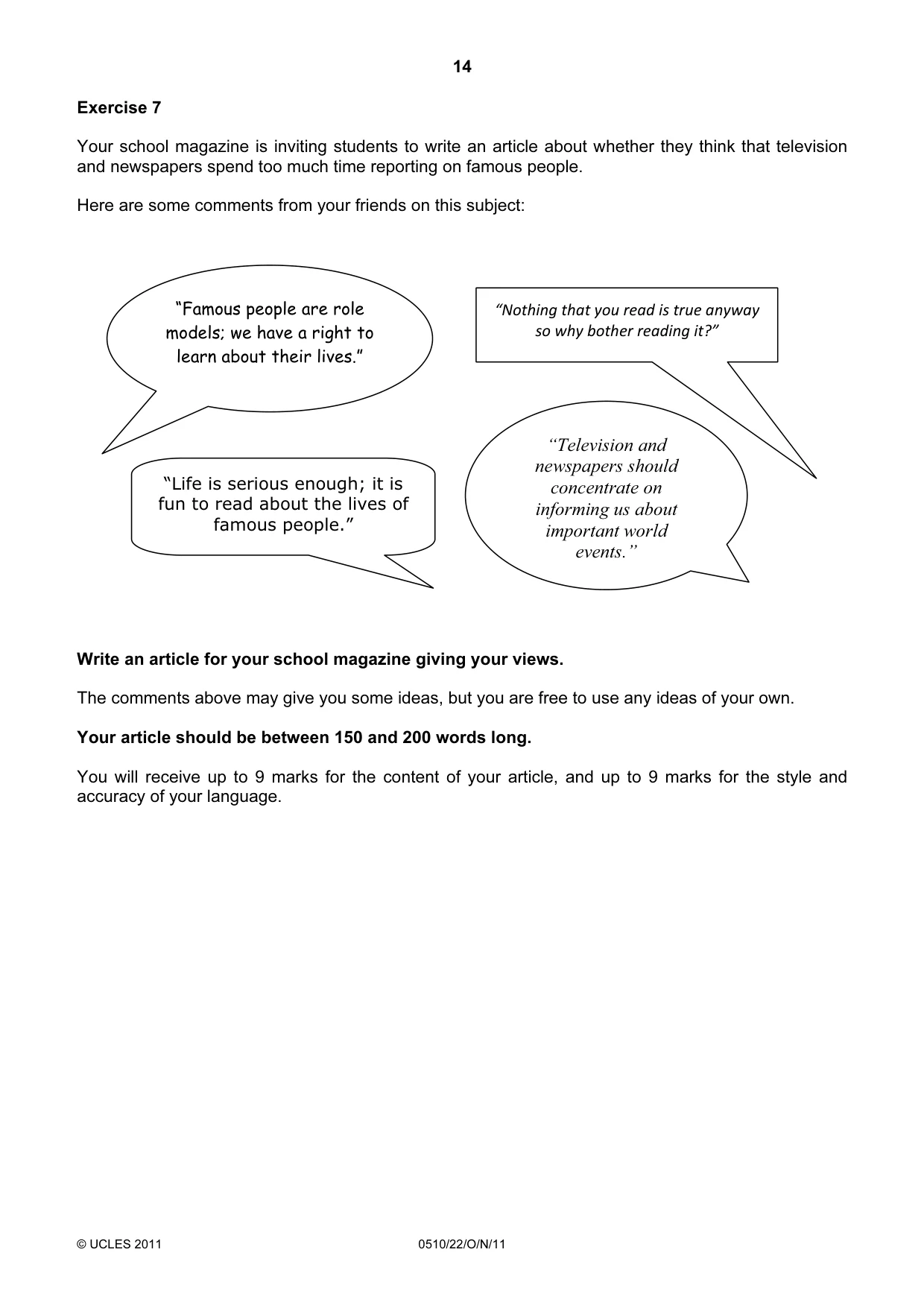
14 © UCLES 2011 0510/22/O/N/11 Exercise 7 Your school magazine is inviting students to write an article about whether they think that television and newspapers spend too much time reporting on famous people. Here are some comments from your friends on this subject: Write an article for your school magazine giving your views. The comments above may give you some ideas, but you are free to use any ideas of your own. Your article should be between 150 and 200 words long. You will receive up to 9 marks for the content of your article, and up to 9 marks for the style and accuracy of your language. “Famous people are role models; we have a right to learn about their lives.” “Nothing that you read is true anyway so why bother reading it?” “Television and newspapers should concentrate on informing us about important world events.” “Life is serious enough; it is fun to read about the lives of famous people.”
Question paper, page 15
15 © UCLES 2011 0510/22/O/N/11 [Total: 18]
Question paper, page 16
16 Permission to reproduce items where third-party owned material protected by copyright is included has been sought and cleared where possible. Every reasonable effort has been made by the publisher (UCLES) to trace copyright holders, but if any items requiring clearance have unwittingly been included, the publisher will be pleased to make amends at the earliest possible opportunity. University of Cambridge International Examinations is part of the Cambridge Assessment Group. Cambridge Assessment is the brand name of University of Cambridge Local Examinations Syndicate (UCLES), which is itself a department of the University of Cambridge. © UCLES 2011 0510/22/O/N/11 BLANK PAGE
Mark scheme, page 1
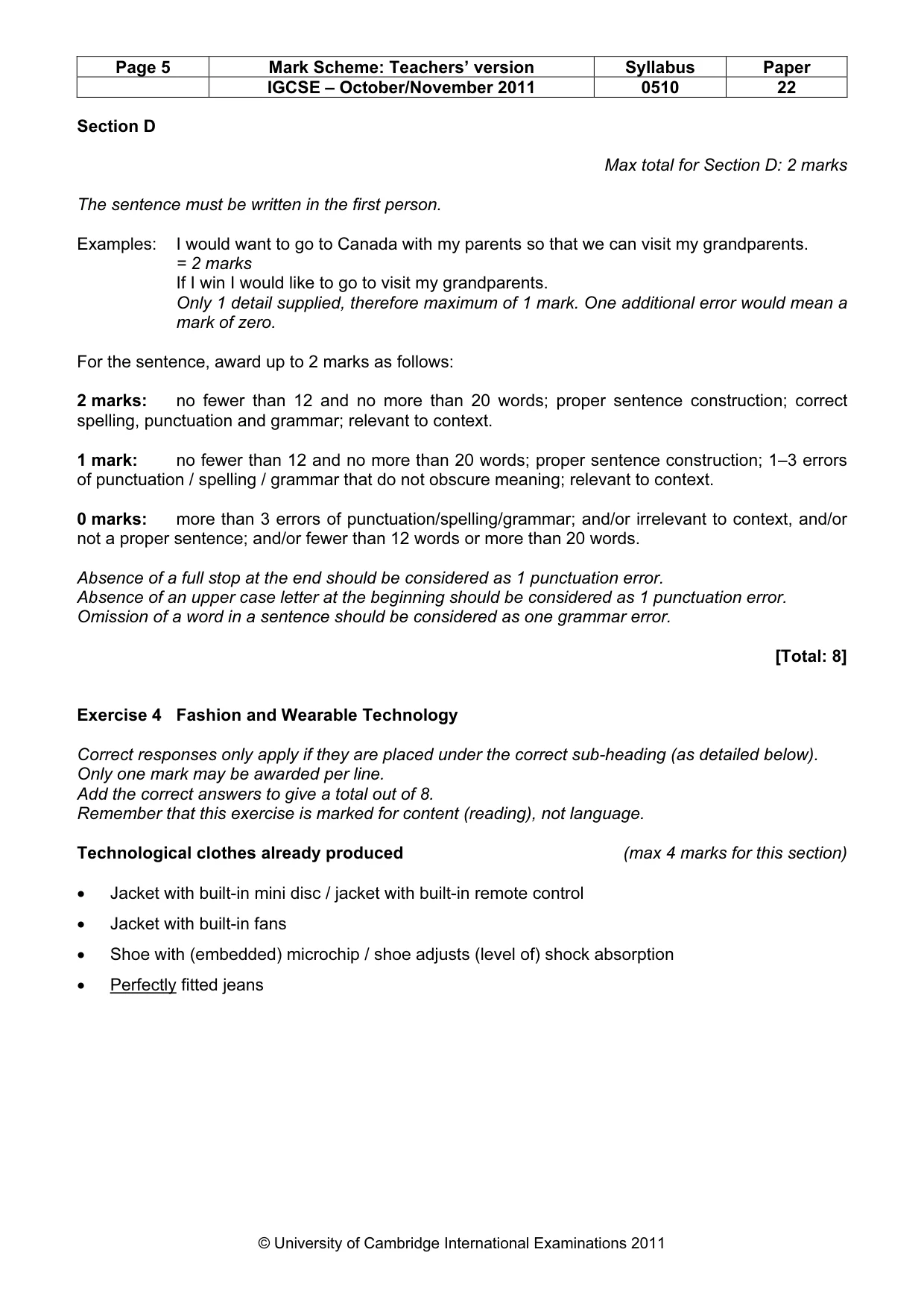
UNIVERSITY OF CAMBRIDGE INTERNATIONAL EXAMINATIONS International General Certificate of Secondary Education MARK SCHEME for the October/November 2011 question paper for the guidance of teachers 0510 ENGLISH AS A SECOND LANGUAGE 0510/22 Paper 2 (Reading and Writing – Extended), maximum raw mark 84 This mark scheme is published as an aid to teachers and candidates, to indicate the requirements of the examination. It shows the basis on which Examiners were instructed to award marks. It does not indicate the details of the discussions that took place at an Examiners’ meeting before marking began, which would have considered the acceptability of alternative answers. Mark schemes must be read in conjunction with the question papers and the report on the examination. • Cambridge will not enter into discussions or correspondence in connection with these mark schemes. Cambridge is publishing the mark schemes for the October/November 2011 question papers for most IGCSE, GCE Advanced Level and Advanced Subsidiary Level syllabuses and some Ordinary Level syllabuses.
Mark scheme, page 2
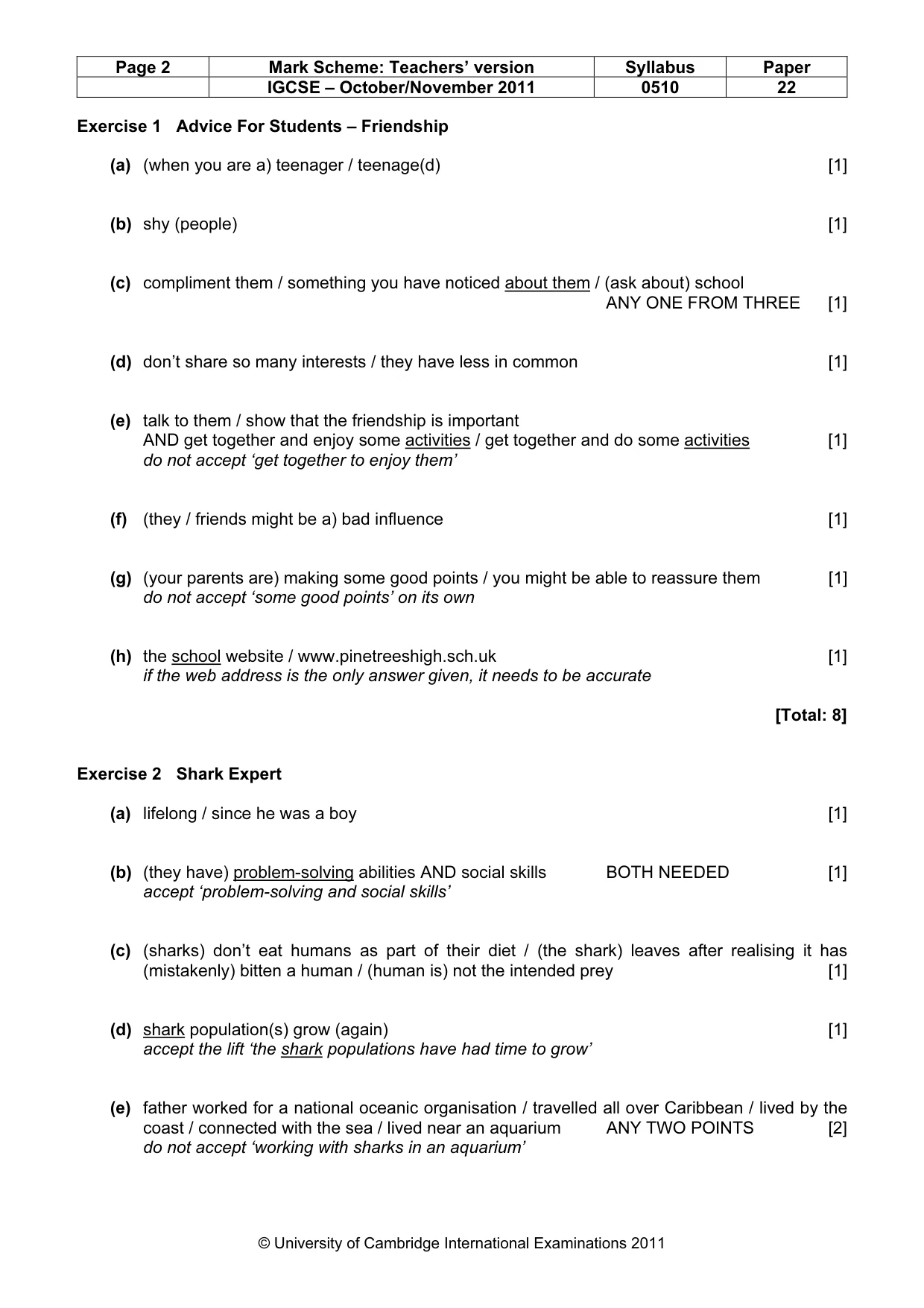
Page 2 Mark Scheme: Teachers’ version Syllabus Paper IGCSE – October/November 2011 0510 22 © University of Cambridge International Examinations 2011 Exercise 1 Advice For Students – Friendship (a) (when you are a) teenager / teenage(d) [1] (b) shy (people) [1] (c) compliment them / something you have noticed about them / (ask about) school ANY ONE FROM THREE [1] (d) don’t share so many interests / they have less in common [1] (e) talk to them / show that the friendship is important AND get together and enjoy some activities / get together and do some activities [1] do not accept ‘get together to enjoy them’ (f) (they / friends might be a) bad influence [1] (g) (your parents are) making some good points / you might be able to reassure them [1] do not accept ‘some good points’ on its own (h) the school website / www.pinetreeshigh.sch.uk [1] if the web address is the only answer given, it needs to be accurate [Total: 8] Exercise 2 Shark Expert (a) lifelong / since he was a boy [1] (b) (they have) problem-solving abilities AND social skills BOTH NEEDED [1] accept ‘problem-solving and social skills’ (c) (sharks) don’t eat humans as part of their diet / (the shark) leaves after realising it has (mistakenly) bitten a human / (human is) not the intended prey [1] (d) shark population(s) grow (again) [1] accept the lift ‘the shark populations have had time to grow’ (e) father worked for a national oceanic organisation / travelled all over Caribbean / lived by the coast / connected with the sea / lived near an aquarium ANY TWO POINTS [2] do not accept ‘working with sharks in an aquarium’
Mark scheme, page 3
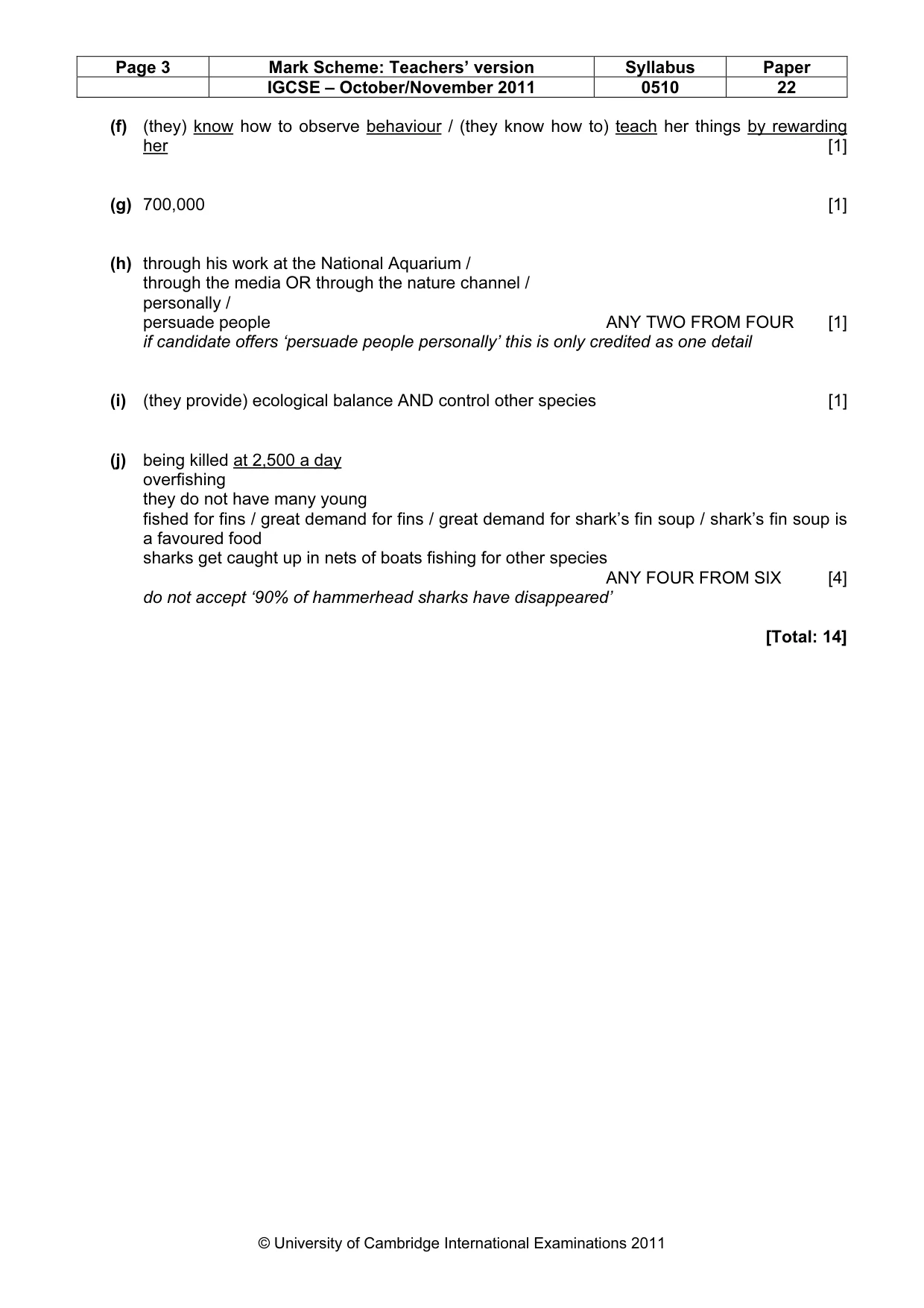
Page 3 Mark Scheme: Teachers’ version Syllabus Paper IGCSE – October/November 2011 0510 22 © University of Cambridge International Examinations 2011 (f) (they) know how to observe behaviour / (they know how to) teach her things by rewarding her [1] (g) 700,000 [1] (h) through his work at the National Aquarium / through the media OR through the nature channel / personally / persuade people ANY TWO FROM FOUR [1] if candidate offers ‘persuade people personally’ this is only credited as one detail (i) (they provide) ecological balance AND control other species [1] (j) being killed at 2,500 a day overfishing they do not have many young fished for fins / great demand for fins / great demand for shark’s fin soup / shark’s fin soup is a favoured food sharks get caught up in nets of boats fishing for other species ANY FOUR FROM SIX [4] do not accept ‘90% of hammerhead sharks have disappeared’ [Total: 14]
Mark scheme, page 4
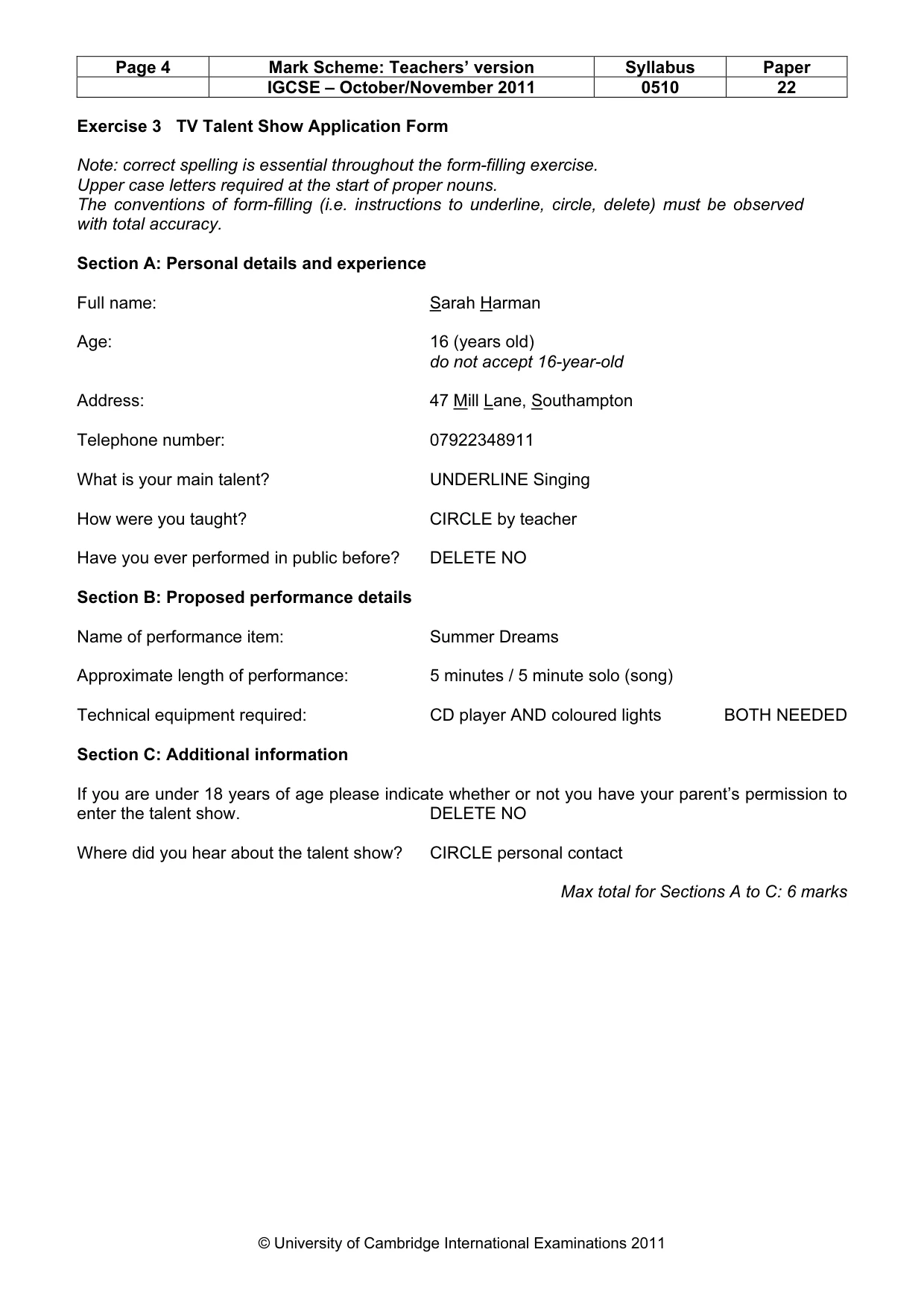
Page 4 Mark Scheme: Teachers’ version Syllabus Paper IGCSE – October/November 2011 0510 22 © University of Cambridge International Examinations 2011 Exercise 3 TV Talent Show Application Form Note: correct spelling is essential throughout the form-filling exercise. Upper case letters required at the start of proper nouns. The conventions of form-filling (i.e. instructions to underline, circle, delete) must be observed with total accuracy. Section A: Personal details and experience Full name: Sarah Harman Age: 16 (years old) do not accept 16-year-old Address: 47 Mill Lane, Southampton Telephone number: 07922348911 What is your main talent? UNDERLINE Singing How were you taught? CIRCLE by teacher Have you ever performed in public before? DELETE NO Section B: Proposed performance details Name of performance item: Summer Dreams Approximate length of performance: 5 minutes / 5 minute solo (song) Technical equipment required: CD player AND coloured lights BOTH NEEDED Section C: Additional information If you are under 18 years of age please indicate whether or not you have your parent’s permission to enter the talent show. DELETE NO Where did you hear about the talent show? CIRCLE personal contact Max total for Sections A to C: 6 marks
Mark scheme, page 5
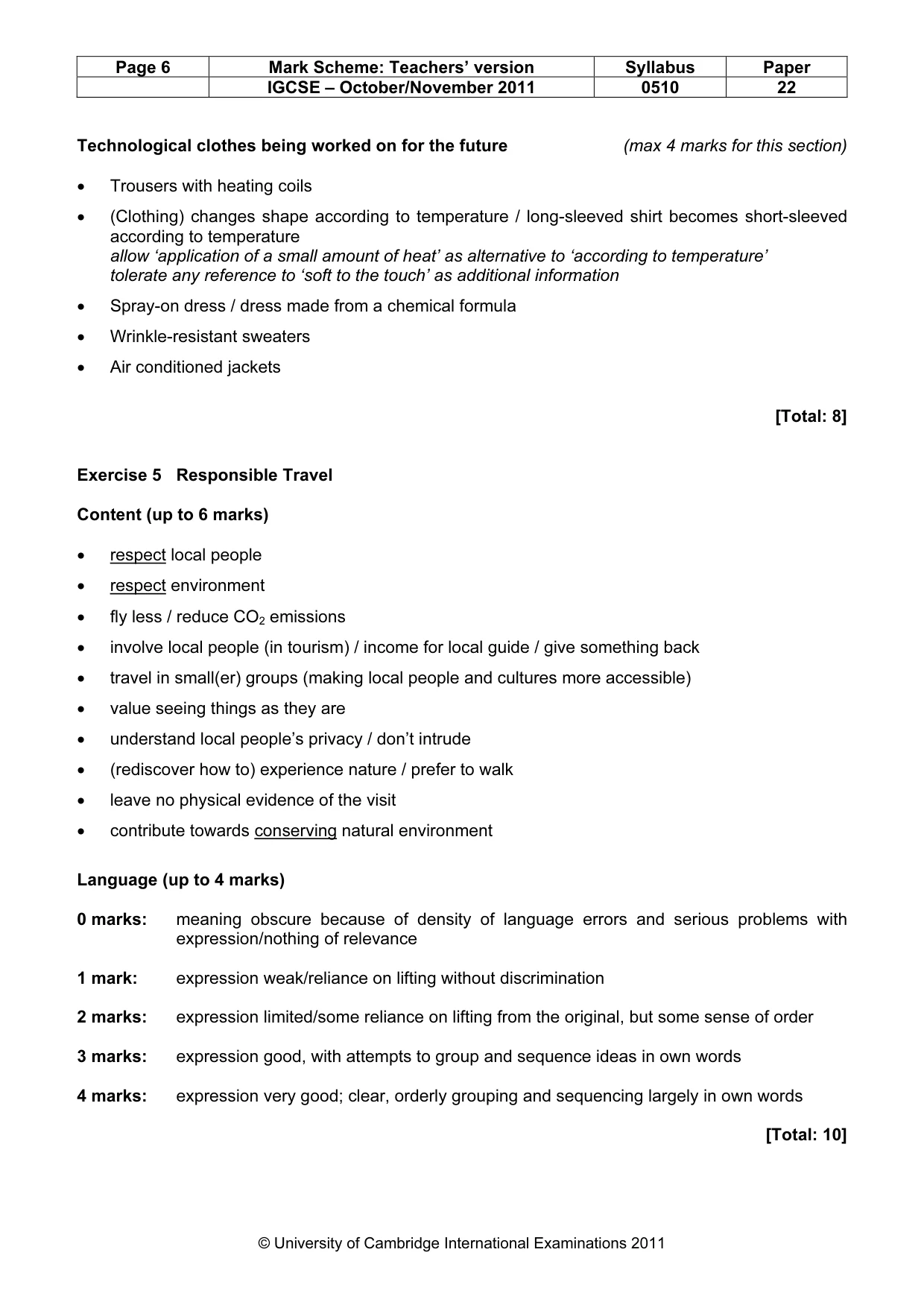
Page 5 Mark Scheme: Teachers’ version Syllabus Paper IGCSE – October/November 2011 0510 22 © University of Cambridge International Examinations 2011 Section D Max total for Section D: 2 marks The sentence must be written in the first person. Examples: I would want to go to Canada with my parents so that we can visit my grandparents. = 2 marks If I win I would like to go to visit my grandparents. Only 1 detail supplied, therefore maximum of 1 mark. One additional error would mean a mark of zero. For the sentence, award up to 2 marks as follows: 2 marks: no fewer than 12 and no more than 20 words; proper sentence construction; correct spelling, punctuation and grammar; relevant to context. 1 mark: no fewer than 12 and no more than 20 words; proper sentence construction; 1–3 errors of punctuation / spelling / grammar that do not obscure meaning; relevant to context. 0 marks: more than 3 errors of punctuation/spelling/grammar; and/or irrelevant to context, and/or not a proper sentence; and/or fewer than 12 words or more than 20 words. Absence of a full stop at the end should be considered as 1 punctuation error. Absence of an upper case letter at the beginning should be considered as 1 punctuation error. Omission of a word in a sentence should be considered as one grammar error. [Total: 8] Exercise 4 Fashion and Wearable Technology Correct responses only apply if they are placed under the correct sub-heading (as detailed below). Only one mark may be awarded per line. Add the correct answers to give a total out of 8. Remember that this exercise is marked for content (reading), not language. Technological clothes already produced (max 4 marks for this section) • Jacket with built-in mini disc / jacket with built-in remote control • Jacket with built-in fans • Shoe with (embedded) microchip / shoe adjusts (level of) shock absorption • Perfectly fitted jeans
Mark scheme, page 6
Page 6 Mark Scheme: Teachers’ version Syllabus Paper IGCSE – October/November 2011 0510 22 © University of Cambridge International Examinations 2011 Technological clothes being worked on for the future (max 4 marks for this section) • Trousers with heating coils • (Clothing) changes shape according to temperature / long-sleeved shirt becomes short-sleeved according to temperature allow ‘application of a small amount of heat’ as alternative to ‘according to temperature’ tolerate any reference to ‘soft to the touch’ as additional information • Spray-on dress / dress made from a chemical formula • Wrinkle-resistant sweaters • Air conditioned jackets [Total: 8] Exercise 5 Responsible Travel Content (up to 6 marks) • respect local people • respect environment • fly less / reduce CO2 emissions • involve local people (in tourism) / income for local guide / give something back • travel in small(er) groups (making local people and cultures more accessible) • value seeing things as they are • understand local people’s privacy / don’t intrude • (rediscover how to) experience nature / prefer to walk • leave no physical evidence of the visit • contribute towards conserving natural environment Language (up to 4 marks) 0 marks: meaning obscure because of density of language errors and serious problems with expression/nothing of relevance 1 mark: expression weak/reliance on lifting without discrimination 2 marks: expression limited/some reliance on lifting from the original, but some sense of order 3 marks: expression good, with attempts to group and sequence ideas in own words 4 marks: expression very good; clear, orderly grouping and sequencing largely in own words [Total: 10]
Mark scheme, page 7
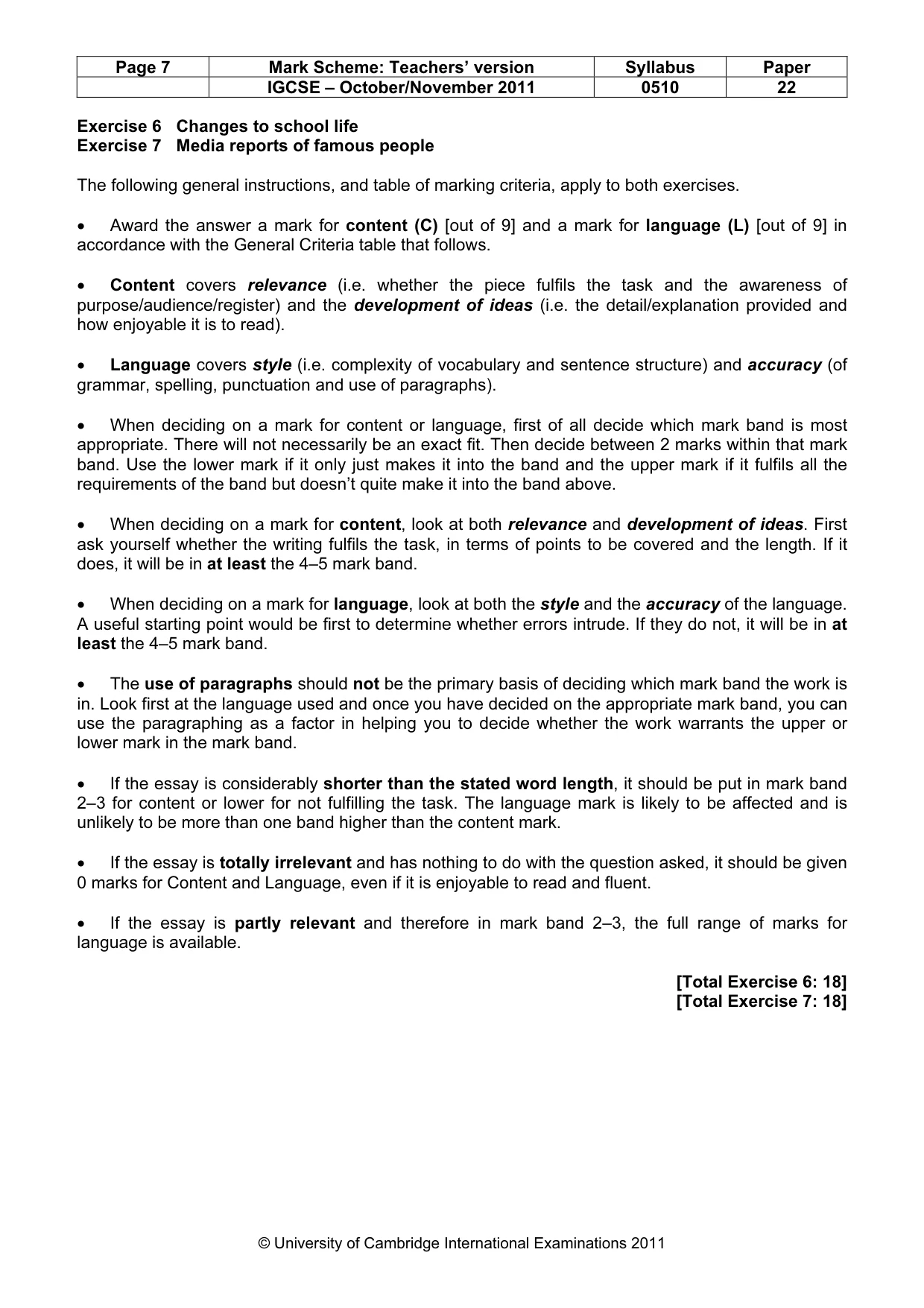
Page 7 Mark Scheme: Teachers’ version Syllabus Paper IGCSE – October/November 2011 0510 22 © University of Cambridge International Examinations 2011 Exercise 6 Changes to school life Exercise 7 Media reports of famous people The following general instructions, and table of marking criteria, apply to both exercises. • Award the answer a mark for content (C) [out of 9] and a mark for language (L) [out of 9] in accordance with the General Criteria table that follows. • Content covers relevance (i.e. whether the piece fulfils the task and the awareness of purpose/audience/register) and the development of ideas (i.e. the detail/explanation provided and how enjoyable it is to read). • Language covers style (i.e. complexity of vocabulary and sentence structure) and accuracy (of grammar, spelling, punctuation and use of paragraphs). • When deciding on a mark for content or language, first of all decide which mark band is most appropriate. There will not necessarily be an exact fit. Then decide between 2 marks within that mark band. Use the lower mark if it only just makes it into the band and the upper mark if it fulfils all the requirements of the band but doesn’t quite make it into the band above. • When deciding on a mark for content, look at both relevance and development of ideas. First ask yourself whether the writing fulfils the task, in terms of points to be covered and the length. If it does, it will be in at least the 4–5 mark band. • When deciding on a mark for language, look at both the style and the accuracy of the language. A useful starting point would be first to determine whether errors intrude. If they do not, it will be in at least the 4–5 mark band. • The use of paragraphs should not be the primary basis of deciding which mark band the work is in. Look first at the language used and once you have decided on the appropriate mark band, you can use the paragraphing as a factor in helping you to decide whether the work warrants the upper or lower mark in the mark band. • If the essay is considerably shorter than the stated word length, it should be put in mark band 2–3 for content or lower for not fulfilling the task. The language mark is likely to be affected and is unlikely to be more than one band higher than the content mark. • If the essay is totally irrelevant and has nothing to do with the question asked, it should be given 0 marks for Content and Language, even if it is enjoyable to read and fluent. • If the essay is partly relevant and therefore in mark band 2–3, the full range of marks for language is available. [Total Exercise 6: 18] [Total Exercise 7: 18]
Mark scheme, page 8
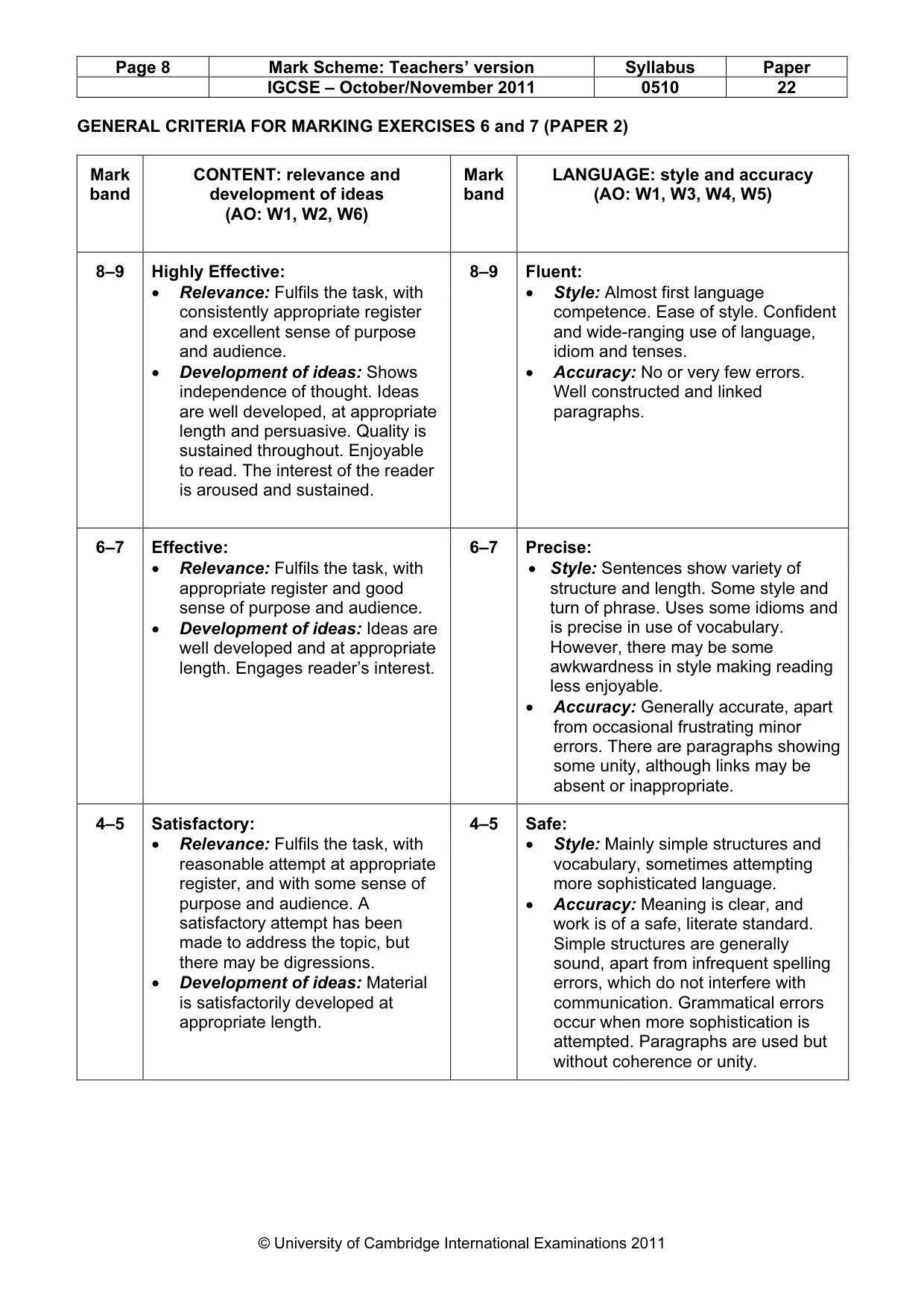
Page 8 Mark Scheme: Teachers’ version Syllabus Paper IGCSE – October/November 2011 0510 22 © University of Cambridge International Examinations 2011 GENERAL CRITERIA FOR MARKING EXERCISES 6 and 7 (PAPER 2) Mark band CONTENT: relevance and development of ideas (AO: W1, W2, W6) Mark band LANGUAGE: style and accuracy (AO: W1, W3, W4, W5) 8–9 8–9 Highly Effective: • Relevance: Fulfils the task, with consistently appropriate register and excellent sense of purpose and audience. • Development of ideas: Shows independence of thought. Ideas are well developed, at appropriate length and persuasive. Quality is sustained throughout. Enjoyable to read. The interest of the reader is aroused and sustained. Fluent: • Style: Almost first language competence. Ease of style. Confident and wide-ranging use of language, idiom and tenses. • Accuracy: No or very few errors. Well constructed and linked paragraphs. 6–7 6–7 Effective: • Relevance: Fulfils the task, with appropriate register and good sense of purpose and audience. • Development of ideas: Ideas are well developed and at appropriate length. Engages reader’s interest. Precise: • Style: Sentences show variety of structure and length. Some style and turn of phrase. Uses some idioms and is precise in use of vocabulary. However, there may be some awkwardness in style making reading less enjoyable. • Accuracy: Generally accurate, apart from occasional frustrating minor errors. There are paragraphs showing some unity, although links may be absent or inappropriate. 4–5 4–5 Satisfactory: • Relevance: Fulfils the task, with reasonable attempt at appropriate register, and with some sense of purpose and audience. A satisfactory attempt has been made to address the topic, but there may be digressions. • Development of ideas: Material is satisfactorily developed at appropriate length. Safe: • Style: Mainly simple structures and vocabulary, sometimes attempting more sophisticated language. • Accuracy: Meaning is clear, and work is of a safe, literate standard. Simple structures are generally sound, apart from infrequent spelling errors, which do not interfere with communication. Grammatical errors occur when more sophistication is attempted. Paragraphs are used but without coherence or unity.
Mark scheme, page 9
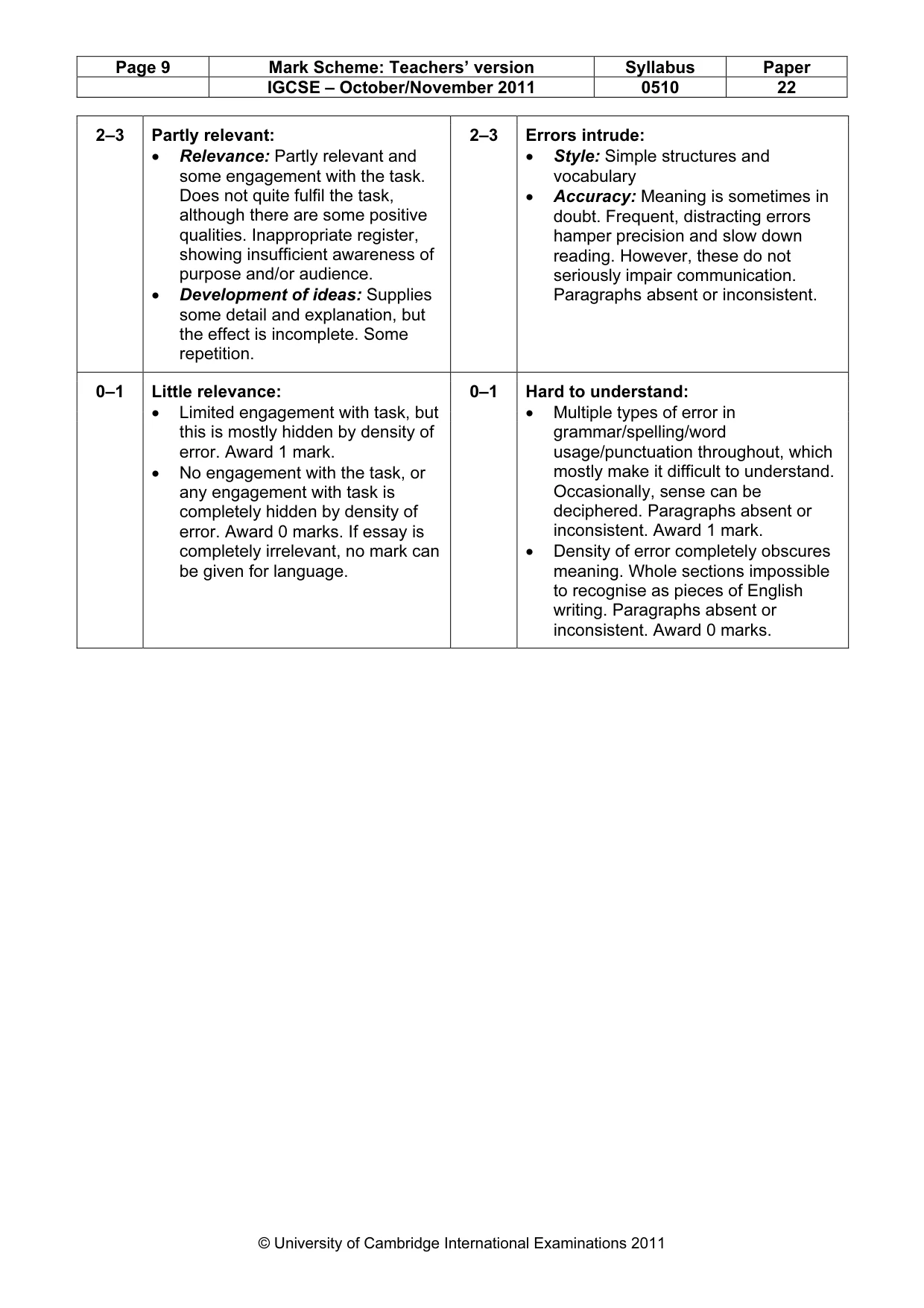
Page 9 Mark Scheme: Teachers’ version Syllabus Paper IGCSE – October/November 2011 0510 22 © University of Cambridge International Examinations 2011 2–3 Partly relevant: • Relevance: Partly relevant and some engagement with the task. Does not quite fulfil the task, although there are some positive qualities. Inappropriate register, showing insufficient awareness of purpose and/or audience. • Development of ideas: Supplies some detail and explanation, but the effect is incomplete. Some repetition. 2–3 Errors intrude: • Style: Simple structures and vocabulary • Accuracy: Meaning is sometimes in doubt. Frequent, distracting errors hamper precision and slow down reading. However, these do not seriously impair communication. Paragraphs absent or inconsistent. 0–1 0–1 Little relevance: • Limited engagement with task, but this is mostly hidden by density of error. Award 1 mark. • No engagement with the task, or any engagement with task is completely hidden by density of error. Award 0 marks. If essay is completely irrelevant, no mark can be given for language. Hard to understand: • Multiple types of error in grammar/spelling/word usage/punctuation throughout, which mostly make it difficult to understand. Occasionally, sense can be deciphered. Paragraphs absent or inconsistent. Award 1 mark. • Density of error completely obscures meaning. Whole sections impossible to recognise as pieces of English writing. Paragraphs absent or inconsistent. Award 0 marks.
What you needed in this session
Cambridge’s own grade thresholds for 2011 Oct/Nov, Paper 2 · Variant 2. A higher threshold means an easier paper — the bar moves with how the cohort did.