Cambridge IGCSE English - Literature in English 0475 — 2022 May/June Paper 4 · Variant 3
0475/43/M/J/22 · 25 marks · ≈28 min
The question paper and its mark scheme, free to read here and free to download. This is Cambridge’s own paper, exactly as it was sat.
Question paper8 pages



Mark scheme5 pages
Answers below. Sit the paper first if you are practising.
Paper as text
Question paper, page 1
Cambridge IGCSE™ 0475/43 LITERATURE IN ENGLISH May/June 2022 Paper 4 Unseen 1 hour 15 minutes You must answer on the enclosed answer booklet. You will need: Answer booklet (enclosed) INSTRUCTIONS • Answer one question: either Question 1 or Question 2. • Follow the instructions on the front cover of the answer booklet. If you need additional answer paper, ask the invigilator for a continuation booklet. INFORMATION • The total mark for this paper is 25. • All questions are worth equal marks. This document has 8 pages. Any blank pages are indicated. [Turn over 06_0475_43_2022_1.10 © UCLES 2022 *6961508370*
Question paper, page 2
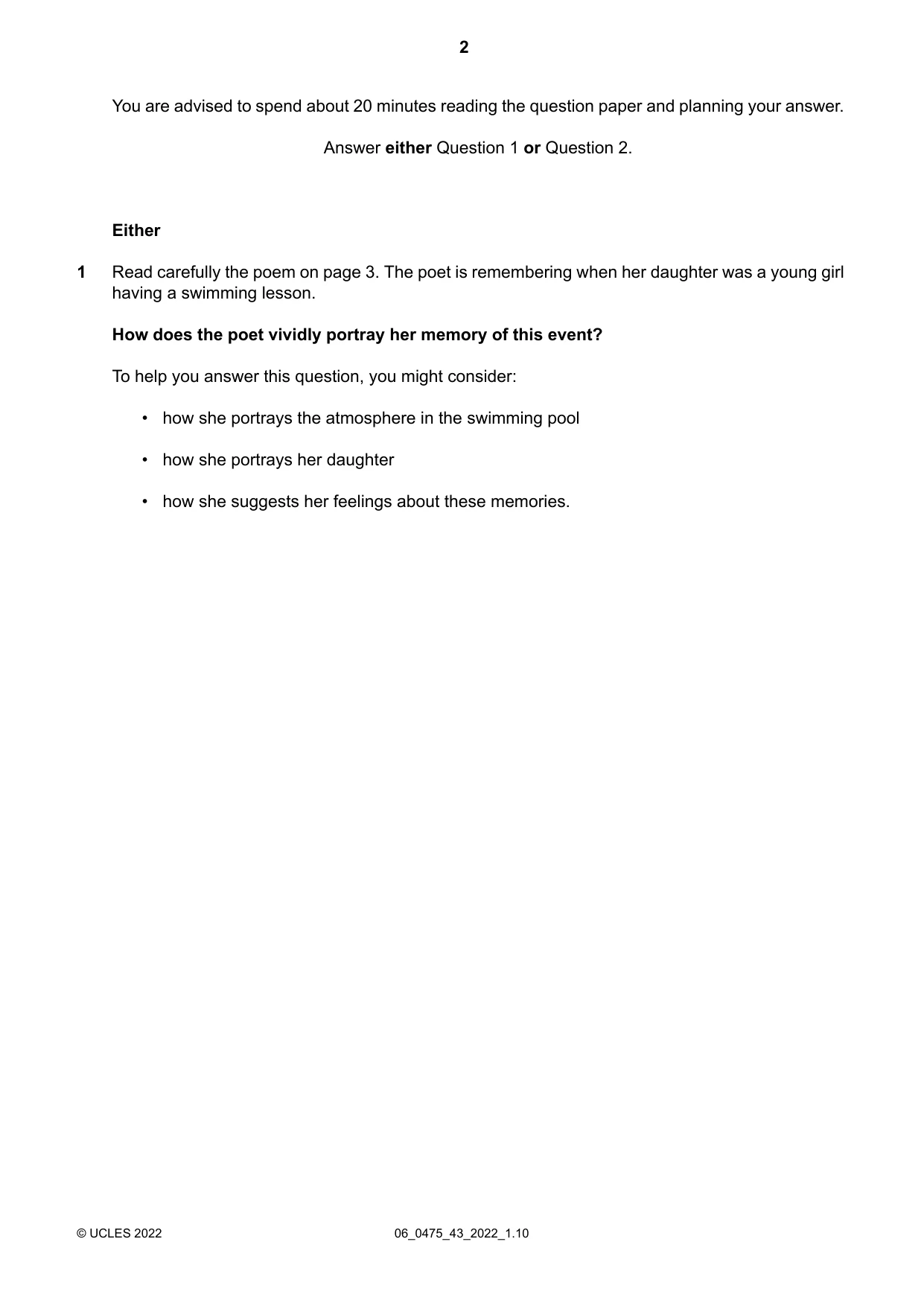
You are advised to spend about 20 minutes reading the question paper and planning your answer. Answer either Question 1 or Question 2. Either Read carefully the poem on page 3. The poet is remembering when her daughter was a young girl having a swimming lesson. 1 How does the poet vividly portray her memory of this event? To help you answer this question, you might consider: • how she portrays the atmosphere in the swimming pool • how she portrays her daughter • how she suggests her feelings about these memories. 06_0475_43_2022_1.10 © UCLES 2022 2
Question paper, page 3
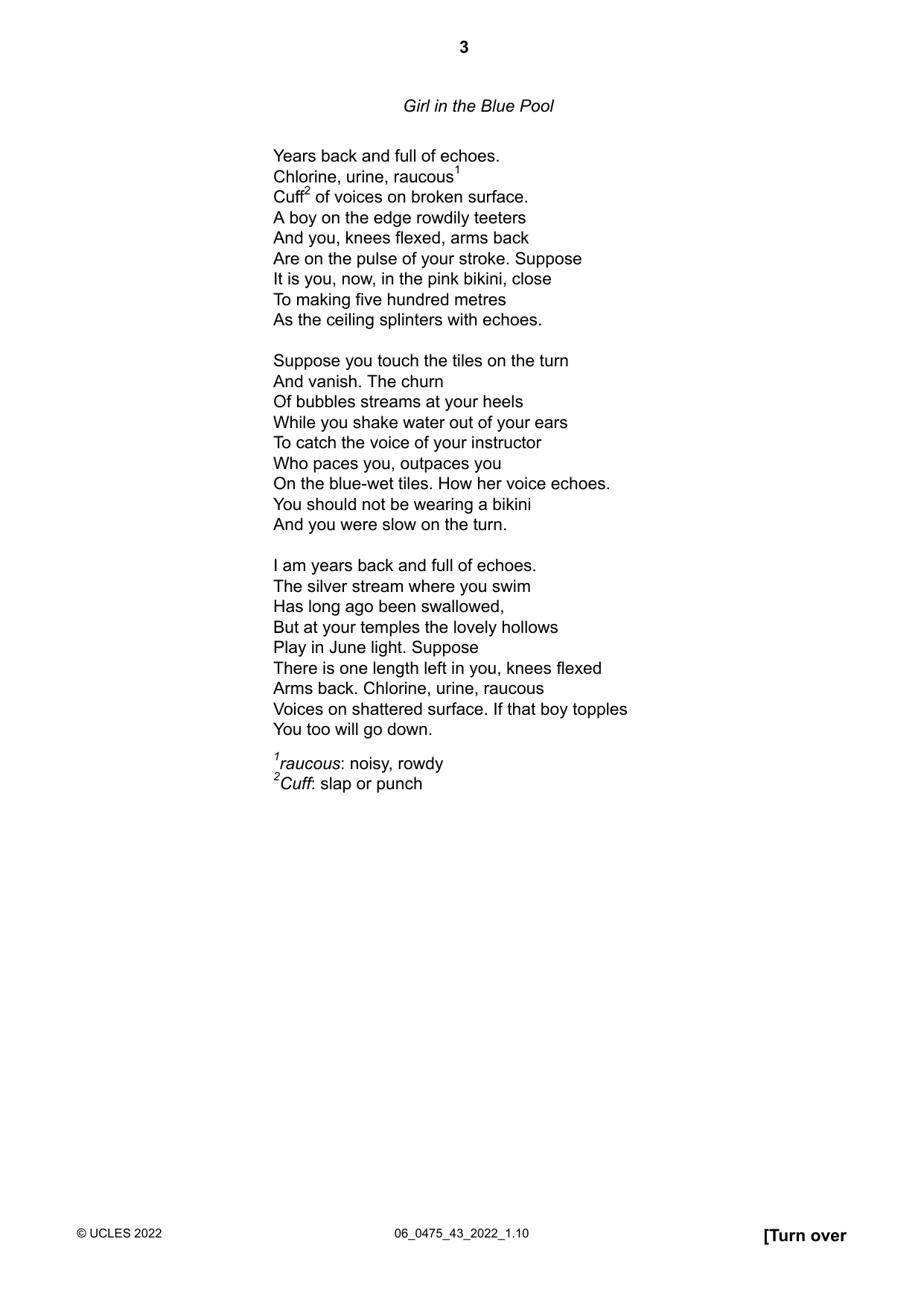
Girl in the Blue Pool Years back and full of echoes. Chlorine, urine, raucous1 Cuff2 of voices on broken surface. A boy on the edge rowdily teeters And you, knees flexed, arms back Are on the pulse of your stroke. Suppose It is you, now, in the pink bikini, close To making five hundred metres As the ceiling splinters with echoes. Suppose you touch the tiles on the turn And vanish. The churn Of bubbles streams at your heels While you shake water out of your ears To catch the voice of your instructor Who paces you, outpaces you On the blue-wet tiles. How her voice echoes. You should not be wearing a bikini And you were slow on the turn. I am years back and full of echoes. The silver stream where you swim Has long ago been swallowed, But at your temples the lovely hollows Play in June light. Suppose There is one length left in you, knees flexed Arms back. Chlorine, urine, raucous Voices on shattered surface. If that boy topples You too will go down. 1raucous: noisy, rowdy 2Cuff: slap or punch [Turn over 06_0475_43_2022_1.10 © UCLES 2022 3
Question paper, page 4
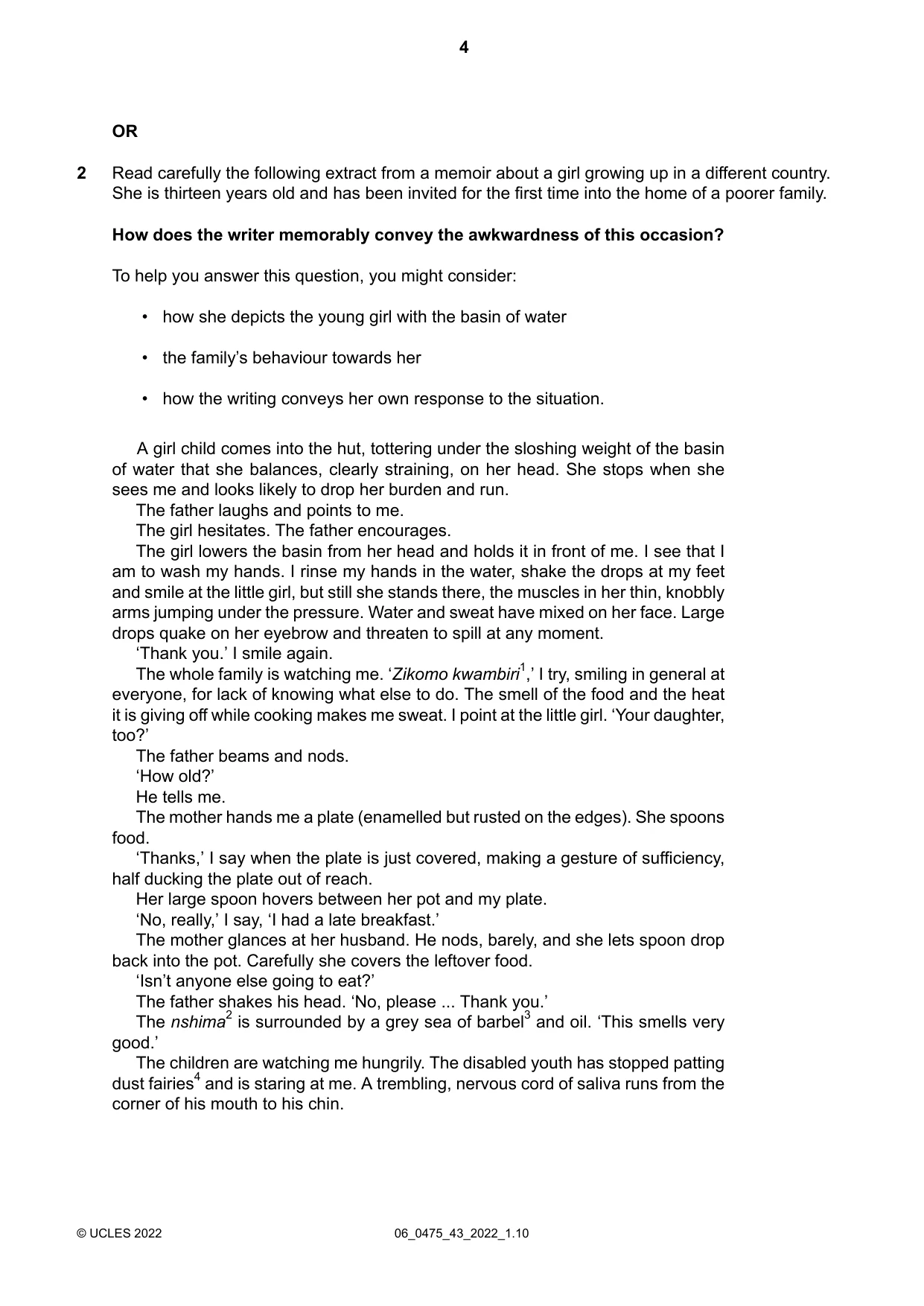
OR Read carefully the following extract from a memoir about a girl growing up in a different country. She is thirteen years old and has been invited for the first time into the home of a poorer family. 2 How does the writer memorably convey the awkwardness of this occasion? To help you answer this question, you might consider: • how she depicts the young girl with the basin of water • the family’s behaviour towards her • how the writing conveys her own response to the situation. A girl child comes into the hut, tottering under the sloshing weight of the basin of water that she balances, clearly straining, on her head. She stops when she sees me and looks likely to drop her burden and run. The father laughs and points to me. The girl hesitates. The father encourages. The girl lowers the basin from her head and holds it in front of me. I see that I am to wash my hands. I rinse my hands in the water, shake the drops at my feet and smile at the little girl, but still she stands there, the muscles in her thin, knobbly arms jumping under the pressure. Water and sweat have mixed on her face. Large drops quake on her eyebrow and threaten to spill at any moment. ‘Thank you.’ I smile again. The whole family is watching me. ‘Zikomo kwambiri1,’ I try, smiling in general at everyone, for lack of knowing what else to do. The smell of the food and the heat it is giving off while cooking makes me sweat. I point at the little girl. ‘Your daughter, too?’ The father beams and nods. ‘How old?’ He tells me. The mother hands me a plate (enamelled but rusted on the edges). She spoons food. ‘Thanks,’ I say when the plate is just covered, making a gesture of sufficiency, half ducking the plate out of reach. Her large spoon hovers between her pot and my plate. ‘No, really,’ I say, ‘I had a late breakfast.’ The mother glances at her husband. He nods, barely, and she lets spoon drop back into the pot. Carefully she covers the leftover food. ‘Isn’t anyone else going to eat?’ The father shakes his head. ‘No, please ... Thank you.’ The nshima2 is surrounded by a grey sea of barbel3 and oil. ‘This smells very good.’ The children are watching me hungrily. The disabled youth has stopped patting dust fairies4 and is staring at me. A trembling, nervous cord of saliva runs from the corner of his mouth to his chin. 06_0475_43_2022_1.10 © UCLES 2022 4
Question paper, page 5
The toddler has started to cry, weakly, plaintively, like a small goat. The mother absently pats the boy, nurses the baby, rocks and rocks, staring at me. The father swallows. ‘Eat,’ he says. He sounds desperate. I sense that it is only through the greatest exertion of will that my spectators don’t fall on the food on my plate in a frenzy of hunger. ‘It looks delicious.’ I make a ball of nshima with the fingers of my right hand, the way I had been taught to do as a small child by my nannies. I insert my thumb into the ball, deep enough to make a dent in the dense hot yellow porridge. Onto the dent, as if onto a spoon, I scoop up a mouthful of the fish stew. Almost before my mouth can close around the food, the young girl (who has not left my side and whose arms still strain at the ends of the bowl) offers me the water and I see that I must wash my hands again. I am conscious of the little girl’s breath-catching effort to hold the basin, and of the groaning, sometimes audible hunger pangs that ripple through the hut. The food, which is sharp and oily in my mouth, has been eagerly anticipated by everyone except for me. I know that I am eating part of a meal intended for (I glance up) five bellies. There are bones in the fish, which I try to manoeuvre around to the front of my mouth. I spit the bones into my hand and carefully wipe them on the side of the plate. I stare at the food. A fish eye stares balefully5 back at me from the oily pool of gravy. I have a long meal ahead of me. 1Zikomo kwambiri: Thank you very much 2nshima: cornmeal porridge 3barbel: a fish 4dust fairies: dust particles in the air 5balefully: menacingly or sadly 06_0475_43_2022_1.10 © UCLES 2022 5
Question paper, page 6
BLANK PAGE 06_0475_43_2022_1.10 © UCLES 2022 6
Question paper, page 7
BLANK PAGE 06_0475_43_2022_1.10 © UCLES 2022 7
Question paper, page 8
BLANK PAGE Permission to reproduce items where third-party owned material protected by copyright is included has been sought and cleared where possible. Every reasonable effort has been made by the publisher (UCLES) to trace copyright holders, but if any items requiring clearance have unwittingly been included, the publisher will be pleased to make amends at the earliest possible opportunity. To avoid the issue of disclosure of answer-related information to candidates, all copyright acknowledgements are reproduced online in the Cambridge Assessment International Education Copyright Acknowledgements Booklet. This is produced for each series of examinations and is freely available to download at www.cambridgeinternational.org after the live examination series. Cambridge Assessment International Education is part of Cambridge Assessment. Cambridge Assessment is the brand name of the University of Cambridge Local Examinations Syndicate (UCLES), which is a department of the University of Cambridge. 06_0475_43_2022_1.10 © UCLES 2022 8
Mark scheme, page 1
This document consists of 5 printed pages. © UCLES 2022 [Turn over Cambridge IGCSE™ LITERATURE IN ENGLISH 0475/43 Paper 4 Unseen May/June 2022 MARK SCHEME Maximum Mark: 25 Published This mark scheme is published as an aid to teachers and candidates, to indicate the requirements of the examination. It shows the basis on which Examiners were instructed to award marks. It does not indicate the details of the discussions that took place at an Examiners’ meeting before marking began, which would have considered the acceptability of alternative answers. Mark schemes should be read in conjunction with the question paper and the Principal Examiner Report for Teachers. Cambridge International will not enter into discussions about these mark schemes. Cambridge International is publishing the mark schemes for the May/June 2022 series for most Cambridge IGCSE, Cambridge International A and AS Level and Cambridge Pre-U components, and some Cambridge O Level components.
Mark scheme, page 2
0475/43 Cambridge IGCSE – Mark Scheme PUBLISHED May/June 2022 © UCLES 2022 Page 2 of 5 Generic Marking Principles These general marking principles must be applied by all examiners when marking candidate answers. They should be applied alongside the specific content of the mark scheme or generic level descriptors for a question. Each question paper and mark scheme will also comply with these marking principles. GENERIC MARKING PRINCIPLE 1: Marks must be awarded in line with: the specific content of the mark scheme or the generic level descriptors for the question the specific skills defined in the mark scheme or in the generic level descriptors for the question the standard of response required by a candidate as exemplified by the standardisation scripts. GENERIC MARKING PRINCIPLE 2: Marks awarded are always whole marks (not half marks, or other fractions). GENERIC MARKING PRINCIPLE 3: Marks must be awarded positively: marks are awarded for correct/valid answers, as defined in the mark scheme. However, credit is given for valid answers which go beyond the scope of the syllabus and mark scheme, referring to your Team Leader as appropriate marks are awarded when candidates clearly demonstrate what they know and can do marks are not deducted for errors marks are not deducted for omissions answers should only be judged on the quality of spelling, punctuation and grammar when these features are specifically assessed by the question as indicated by the mark scheme. The meaning, however, should be unambiguous. GENERIC MARKING PRINCIPLE 4: Rules must be applied consistently, e.g. in situations where candidates have not followed instructions or in the application of generic level descriptors. GENERIC MARKING PRINCIPLE 5: Marks should be awarded using the full range of marks defined in the mark scheme for the question (however; the use of the full mark range may be limited according to the quality of the candidate responses seen). GENERIC MARKING PRINCIPLE 6: Marks awarded are based solely on the requirements as defined in the mark scheme. Marks should not be awarded with grade thresholds or grade descriptors in mind.
Mark scheme, page 3
0475/43 Cambridge IGCSE – Mark Scheme PUBLISHED May/June 2022 © UCLES 2022 Page 3 of 5 English & Media subject specific general marking principles (To be read in conjunction with the Generic Marking Principles (and requiring further guidance on how to place marks within levels)) Components using level descriptors: We use level descriptors as a guide to broaden understanding of the qualities normally expected of, or typical of, work in a level. Level descriptors are a means of general guidance, and should not be interpreted as hurdle statements. Where indicative content notes are supplied for a question, these are not a prescription of required content, and must not be treated as such. Alternative correct points and unexpected answers in candidates’ scripts must be given marks that fairly reflect the knowledge and skills demonstrated. While we may have legitimate expectations as to the ground most answers may occupy, we must at all times be prepared to meet candidates on their chosen ground, provided it is relevant ground (e.g. clearly related to and derived from a relevant passage/text and meeting the mark scheme requirements for the question). Components using point-based marking: Point marking is often used to reward knowledge, understanding and application of skills. We give credit where the candidate’s answer shows relevant knowledge, understanding and application of skills in answering the question. We do not give credit where the answer shows confusion. From this it follows that we: a DO credit answers which are worded differently from the mark scheme if they clearly convey the same meaning (unless the mark scheme requires a specific term). b DO credit alternative answers/examples which are not written in the mark scheme if they are correct. c DO credit answers where candidates give more than one correct answer in one prompt/numbered/scaffolded space where extended writing is required rather than list-type answers. For example, questions that require n reasons (e.g. State two reasons…). d DO NOT credit answers simply for using a ‘key term’ unless that is all that is required. (Check for evidence it is understood and not used incorrectly.) e DO NOT credit answers which are obviously self-contradicting or trying to cover all possibilities. f DO NOT give further credit for what is effectively repetition of a correct point already credited unless the language itself is being tested. This applies equally to ‘mirror statements’ (i.e. polluted/not polluted). g DO NOT require spellings to be correct, unless this is part of the test. However, spellings of syllabus terms must allow for clear and unambiguous separation from other syllabus terms with which they may be confused (e.g. Corrasion/Corrosion).
Mark scheme, page 4
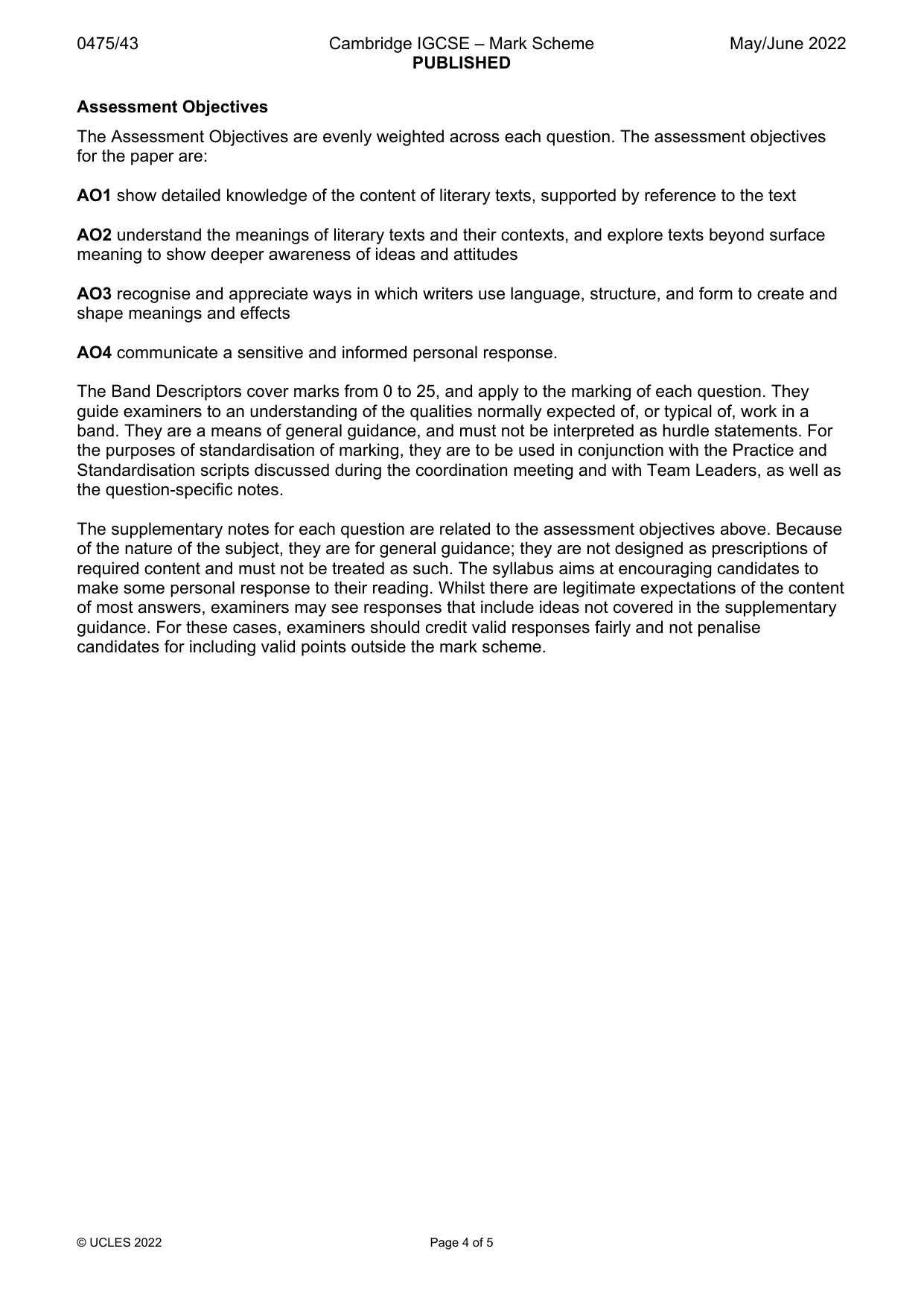
0475/43 Cambridge IGCSE – Mark Scheme PUBLISHED May/June 2022 © UCLES 2022 Page 4 of 5 Assessment Objectives The Assessment Objectives are evenly weighted across each question. The assessment objectives for the paper are: AO1 show detailed knowledge of the content of literary texts, supported by reference to the text AO2 understand the meanings of literary texts and their contexts, and explore texts beyond surface meaning to show deeper awareness of ideas and attitudes AO3 recognise and appreciate ways in which writers use language, structure, and form to create and shape meanings and effects AO4 communicate a sensitive and informed personal response. The Band Descriptors cover marks from 0 to 25, and apply to the marking of each question. They guide examiners to an understanding of the qualities normally expected of, or typical of, work in a band. They are a means of general guidance, and must not be interpreted as hurdle statements. For the purposes of standardisation of marking, they are to be used in conjunction with the Practice and Standardisation scripts discussed during the coordination meeting and with Team Leaders, as well as the question-specific notes. The supplementary notes for each question are related to the assessment objectives above. Because of the nature of the subject, they are for general guidance; they are not designed as prescriptions of required content and must not be treated as such. The syllabus aims at encouraging candidates to make some personal response to their reading. Whilst there are legitimate expectations of the content of most answers, examiners may see responses that include ideas not covered in the supplementary guidance. For these cases, examiners should credit valid responses fairly and not penalise candidates for including valid points outside the mark scheme.
Mark scheme, page 5
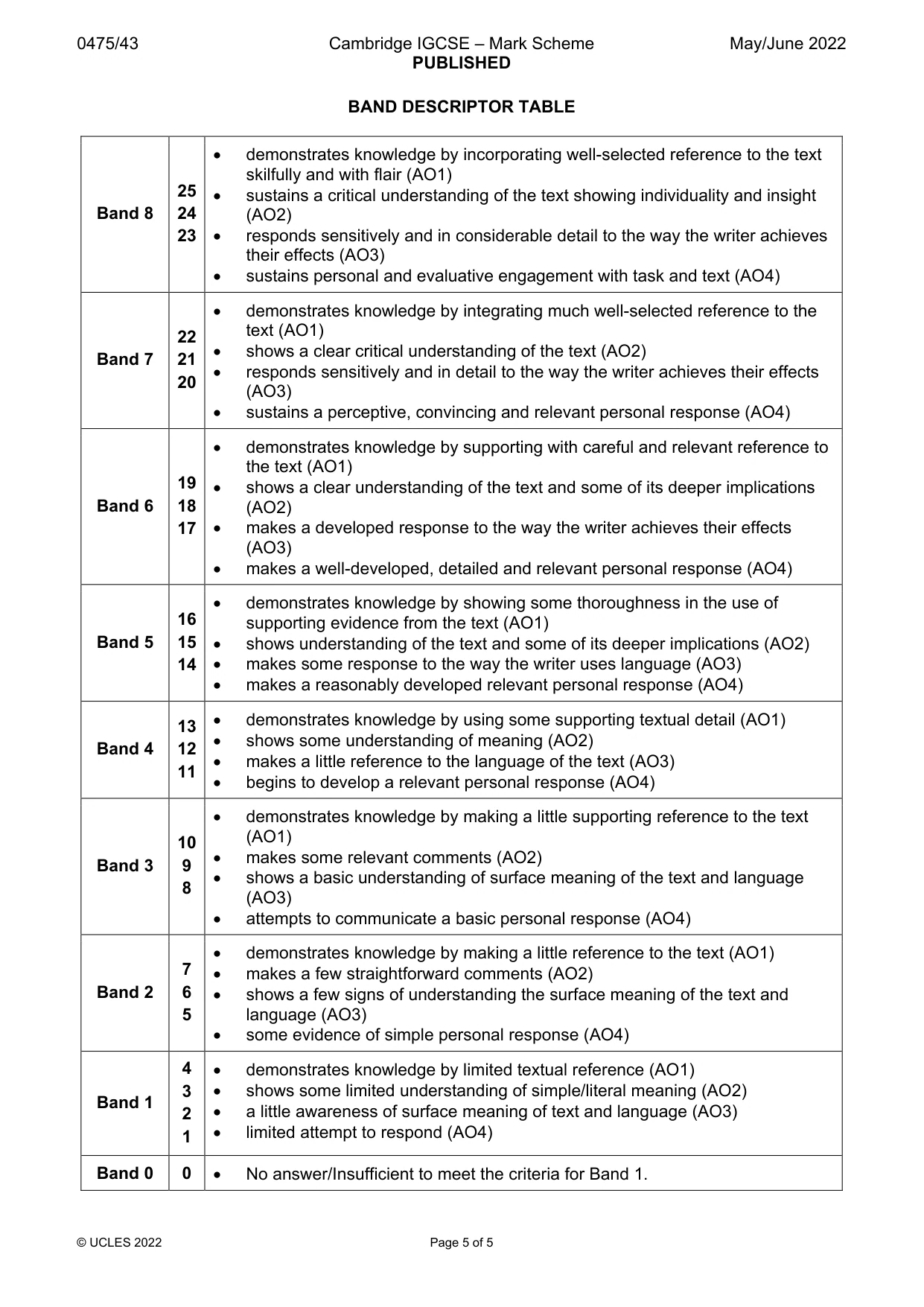
0475/43 Cambridge IGCSE – Mark Scheme PUBLISHED May/June 2022 © UCLES 2022 Page 5 of 5 BAND DESCRIPTOR TABLE Band 8 25 24 23 demonstrates knowledge by incorporating well-selected reference to the text skilfully and with flair (AO1) sustains a critical understanding of the text showing individuality and insight (AO2) responds sensitively and in considerable detail to the way the writer achieves their effects (AO3) sustains personal and evaluative engagement with task and text (AO4) Band 7 22 21 20 demonstrates knowledge by integrating much well-selected reference to the text (AO1) shows a clear critical understanding of the text (AO2) responds sensitively and in detail to the way the writer achieves their effects (AO3) sustains a perceptive, convincing and relevant personal response (AO4) Band 6 19 18 17 demonstrates knowledge by supporting with careful and relevant reference to the text (AO1) shows a clear understanding of the text and some of its deeper implications (AO2) makes a developed response to the way the writer achieves their effects (AO3) makes a well-developed, detailed and relevant personal response (AO4) Band 5 16 15 14 demonstrates knowledge by showing some thoroughness in the use of supporting evidence from the text (AO1) shows understanding of the text and some of its deeper implications (AO2) makes some response to the way the writer uses language (AO3) makes a reasonably developed relevant personal response (AO4) Band 4 13 12 11 demonstrates knowledge by using some supporting textual detail (AO1) shows some understanding of meaning (AO2) makes a little reference to the language of the text (AO3) begins to develop a relevant personal response (AO4) Band 3 10 9 8 demonstrates knowledge by making a little supporting reference to the text (AO1) makes some relevant comments (AO2) shows a basic understanding of surface meaning of the text and language (AO3) attempts to communicate a basic personal response (AO4) Band 2 7 6 5 demonstrates knowledge by making a little reference to the text (AO1) makes a few straightforward comments (AO2) shows a few signs of understanding the surface meaning of the text and language (AO3) some evidence of simple personal response (AO4) Band 1 4 3 2 1 demonstrates knowledge by limited textual reference (AO1) shows some limited understanding of simple/literal meaning (AO2) a little awareness of surface meaning of text and language (AO3) limited attempt to respond (AO4) Band 0 0 No answer/Insufficient to meet the criteria for Band 1.
What you needed in this session
Cambridge’s own grade thresholds for 2022 May/June, Paper 4 · Variant 3. A higher threshold means an easier paper — the bar moves with how the cohort did.