Cambridge IGCSE English - Literature in English 0475 — 2022 May/June Paper 4 · Variant 2
0475/42/M/J/22 · 25 marks · ≈28 min
The question paper and its mark scheme, free to read here and free to download. This is Cambridge’s own paper, exactly as it was sat.
Question paper8 pages


Mark scheme5 pages
Answers below. Sit the paper first if you are practising.
Paper as text
Question paper, page 1
Cambridge IGCSE™ 0475/42 LITERATURE IN ENGLISH May/June 2022 Paper 4 Unseen 1 hour 15 minutes You must answer on the enclosed answer booklet. You will need: Answer booklet (enclosed) INSTRUCTIONS • Answer one question: either Question 1 or Question 2. • Follow the instructions on the front cover of the answer booklet. If you need additional answer paper, ask the invigilator for a continuation booklet. INFORMATION • The total mark for this paper is 25. • All questions are worth equal marks. This document has 8 pages. Any blank pages are indicated. [Turn over 06_0475_42_2022_1.9 © UCLES 2022 *7282524053*
Question paper, page 2
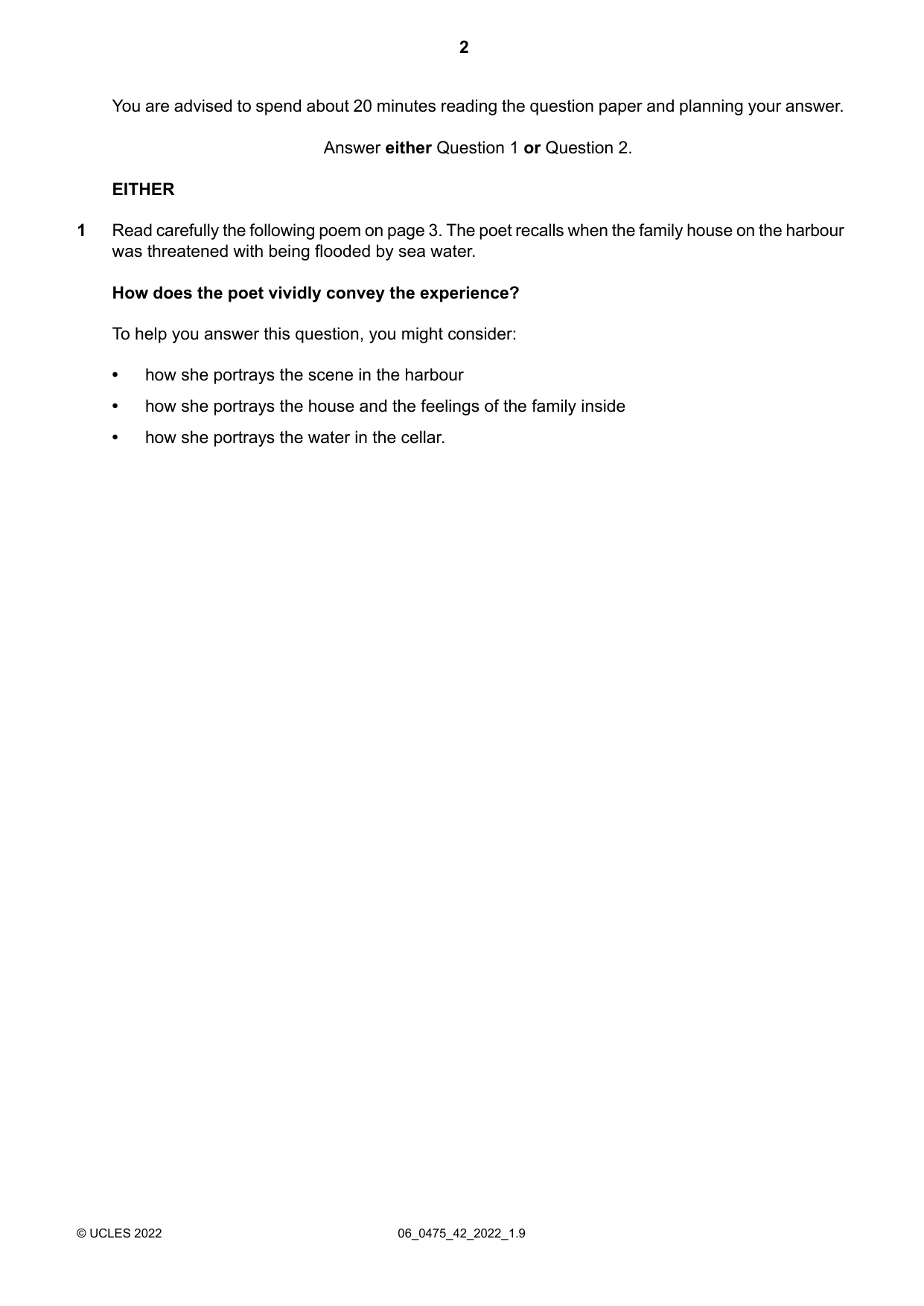
You are advised to spend about 20 minutes reading the question paper and planning your answer. Answer either Question 1 or Question 2. EITHER Read carefully the following poem on page 3. The poet recalls when the family house on the harbour was threatened with being flooded by sea water. 1 How does the poet vividly convey the experience? To help you answer this question, you might consider: • how she portrays the scene in the harbour • how she portrays the house and the feelings of the family inside • how she portrays the water in the cellar. 06_0475_42_2022_1.9 © UCLES 2022 2
Question paper, page 3
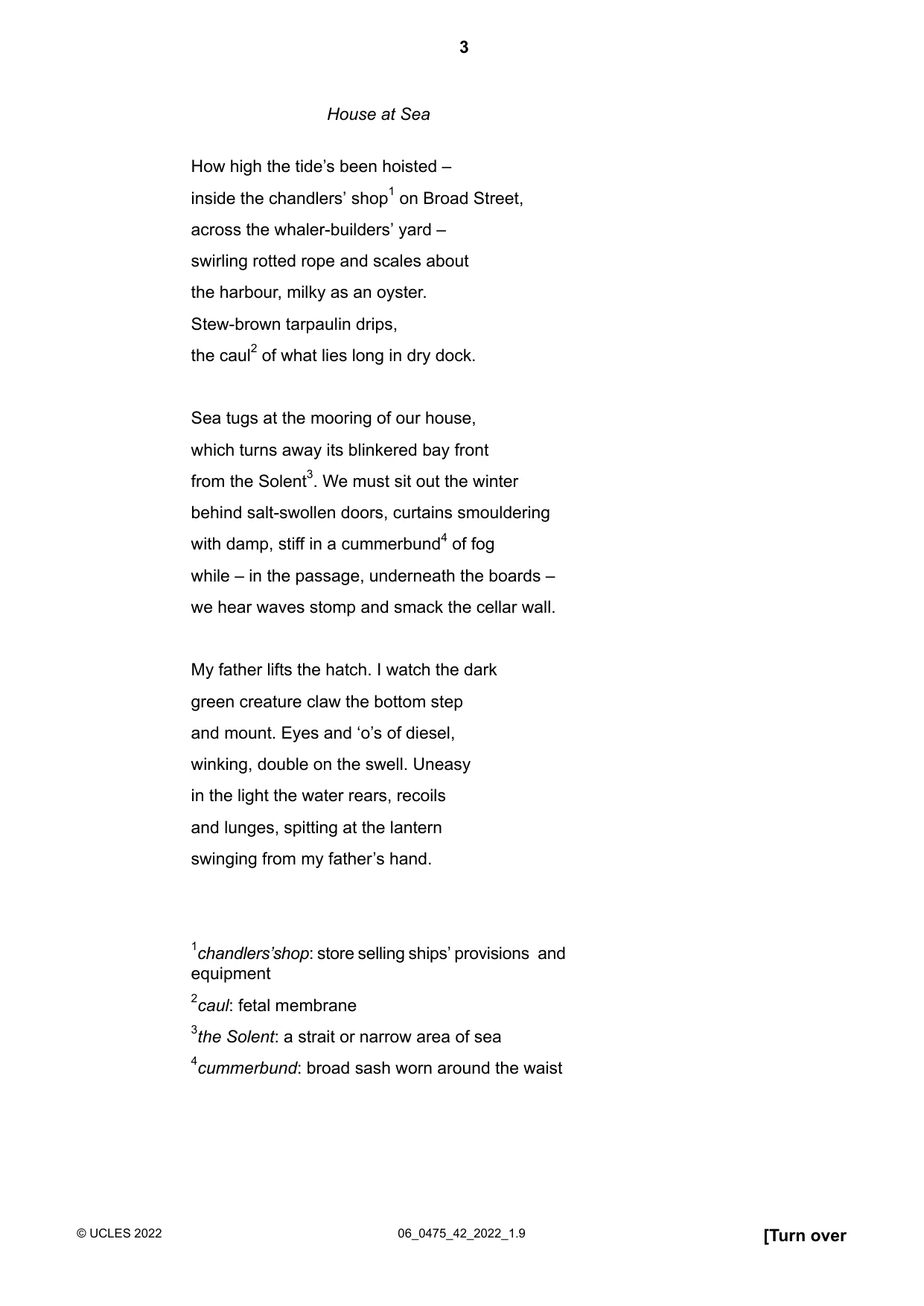
House at Sea How high the tide’s been hoisted – inside the chandlers’ shop1 on Broad Street, across the whaler-builders’ yard – swirling rotted rope and scales about the harbour, milky as an oyster. Stew-brown tarpaulin drips, the caul2 of what lies long in dry dock. Sea tugs at the mooring of our house, which turns away its blinkered bay front from the Solent3. We must sit out the winter behind salt-swollen doors, curtains smouldering with damp, stiff in a cummerbund4 of fog while – in the passage, underneath the boards – we hear waves stomp and smack the cellar wall. My father lifts the hatch. I watch the dark green creature claw the bottom step and mount. Eyes and ‘o’s of diesel, winking, double on the swell. Uneasy in the light the water rears, recoils and lunges, spitting at the lantern swinging from my father’s hand. 1chandlers’shop: store selling ships’ provisions and equipment 2caul: fetal membrane 3the Solent: a strait or narrow area of sea 4cummerbund: broad sash worn around the waist [Turn over 06_0475_42_2022_1.9 © UCLES 2022 3
Question paper, page 4
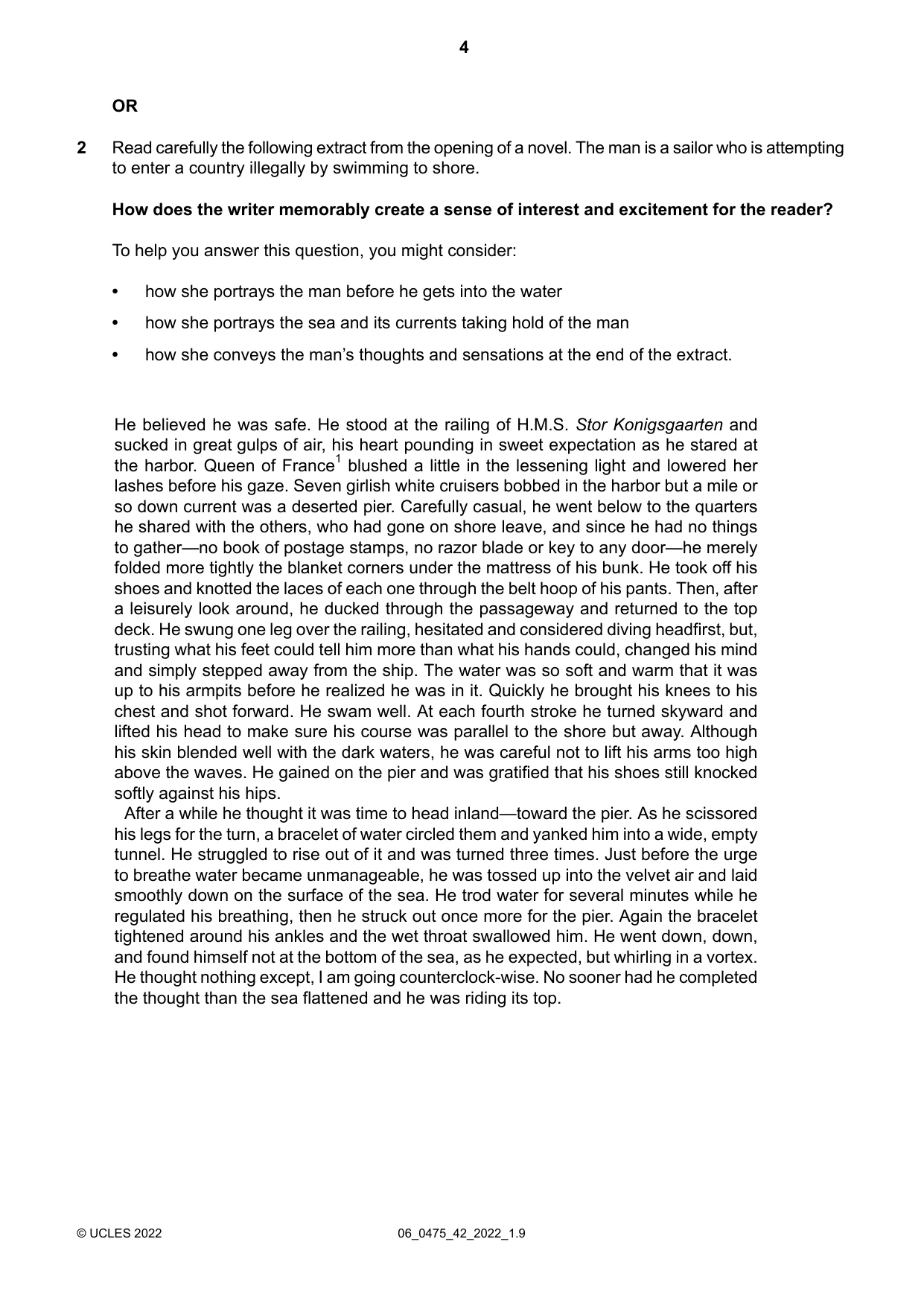
OR Read carefully the following extract from the opening of a novel. The man is a sailor who is attempting to enter a country illegally by swimming to shore. 2 How does the writer memorably create a sense of interest and excitement for the reader? To help you answer this question, you might consider: • how she portrays the man before he gets into the water • how she portrays the sea and its currents taking hold of the man • how she conveys the man’s thoughts and sensations at the end of the extract. He believed he was safe. He stood at the railing of H.M.S. Stor Konigsgaarten and sucked in great gulps of air, his heart pounding in sweet expectation as he stared at the harbor. Queen of France1 blushed a little in the lessening light and lowered her lashes before his gaze. Seven girlish white cruisers bobbed in the harbor but a mile or so down current was a deserted pier. Carefully casual, he went below to the quarters he shared with the others, who had gone on shore leave, and since he had no things to gather—no book of postage stamps, no razor blade or key to any door—he merely folded more tightly the blanket corners under the mattress of his bunk. He took off his shoes and knotted the laces of each one through the belt hoop of his pants. Then, after a leisurely look around, he ducked through the passageway and returned to the top deck. He swung one leg over the railing, hesitated and considered diving headfirst, but, trusting what his feet could tell him more than what his hands could, changed his mind and simply stepped away from the ship. The water was so soft and warm that it was up to his armpits before he realized he was in it. Quickly he brought his knees to his chest and shot forward. He swam well. At each fourth stroke he turned skyward and lifted his head to make sure his course was parallel to the shore but away. Although his skin blended well with the dark waters, he was careful not to lift his arms too high above the waves. He gained on the pier and was gratified that his shoes still knocked softly against his hips. After a while he thought it was time to head inland—toward the pier. As he scissored his legs for the turn, a bracelet of water circled them and yanked him into a wide, empty tunnel. He struggled to rise out of it and was turned three times. Just before the urge to breathe water became unmanageable, he was tossed up into the velvet air and laid smoothly down on the surface of the sea. He trod water for several minutes while he regulated his breathing, then he struck out once more for the pier. Again the bracelet tightened around his ankles and the wet throat swallowed him. He went down, down, and found himself not at the bottom of the sea, as he expected, but whirling in a vortex. He thought nothing except, I am going counterclock-wise. No sooner had he completed the thought than the sea flattened and he was riding its top. 06_0475_42_2022_1.9 © UCLES 2022 4
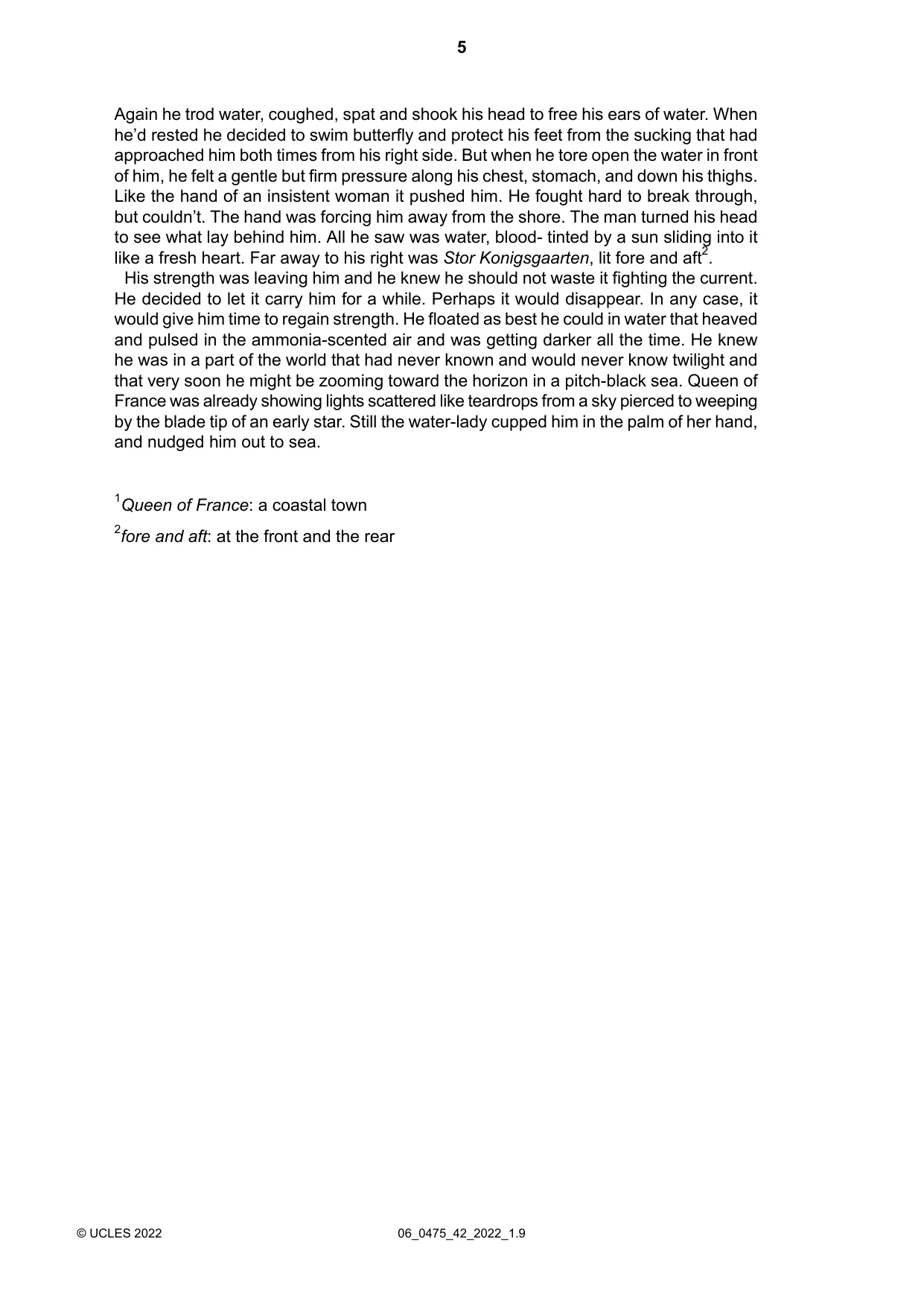
Question paper, page 5
Again he trod water, coughed, spat and shook his head to free his ears of water. When he’d rested he decided to swim butterfly and protect his feet from the sucking that had approached him both times from his right side. But when he tore open the water in front of him, he felt a gentle but firm pressure along his chest, stomach, and down his thighs. Like the hand of an insistent woman it pushed him. He fought hard to break through, but couldn’t. The hand was forcing him away from the shore. The man turned his head to see what lay behind him. All he saw was water, blood- tinted by a sun sliding into it like a fresh heart. Far away to his right was Stor Konigsgaarten, lit fore and aft2. His strength was leaving him and he knew he should not waste it fighting the current. He decided to let it carry him for a while. Perhaps it would disappear. In any case, it would give him time to regain strength. He floated as best he could in water that heaved and pulsed in the ammonia-scented air and was getting darker all the time. He knew he was in a part of the world that had never known and would never know twilight and that very soon he might be zooming toward the horizon in a pitch-black sea. Queen of France was already showing lights scattered like teardrops from a sky pierced to weeping by the blade tip of an early star. Still the water-lady cupped him in the palm of her hand, and nudged him out to sea. 1Queen of France: a coastal town 2fore and aft: at the front and the rear 06_0475_42_2022_1.9 © UCLES 2022 5
Question paper, page 6
BLANK PAGE 06_0475_42_2022_1.9 © UCLES 2022 6
Question paper, page 7
BLANK PAGE 06_0475_42_2022_1.9 © UCLES 2022 7
Question paper, page 8
BLANK PAGE Permission to reproduce items where third-party owned material protected by copyright is included has been sought and cleared where possible. Every reasonable effort has been made by the publisher (UCLES) to trace copyright holders, but if any items requiring clearance have unwittingly been included, the publisher will be pleased to make amends at the earliest possible opportunity. To avoid the issue of disclosure of answer-related information to candidates, all copyright acknowledgements are reproduced online in the Cambridge Assessment International Education Copyright Acknowledgements Booklet. This is produced for each series of examinations and is freely available to download at www.cambridgeinternational.org after the live examination series. Cambridge Assessment International Education is part of Cambridge Assessment. Cambridge Assessment is the brand name of the University of Cambridge Local Examinations Syndicate (UCLES), which is a department of the University of Cambridge. 06_0475_42_2022_1.9 © UCLES 2022 8
Mark scheme, page 1
This document consists of 5 printed pages. © UCLES 2022 [Turn over Cambridge IGCSE™ LITERATURE IN ENGLISH 0475/42 Paper 4 Unseen May/June 2022 MARK SCHEME Maximum Mark: 25 Published This mark scheme is published as an aid to teachers and candidates, to indicate the requirements of the examination. It shows the basis on which Examiners were instructed to award marks. It does not indicate the details of the discussions that took place at an Examiners’ meeting before marking began, which would have considered the acceptability of alternative answers. Mark schemes should be read in conjunction with the question paper and the Principal Examiner Report for Teachers. Cambridge International will not enter into discussions about these mark schemes. Cambridge International is publishing the mark schemes for the May/June 2022 series for most Cambridge IGCSE, Cambridge International A and AS Level and Cambridge Pre-U components, and some Cambridge O Level components.
Mark scheme, page 2
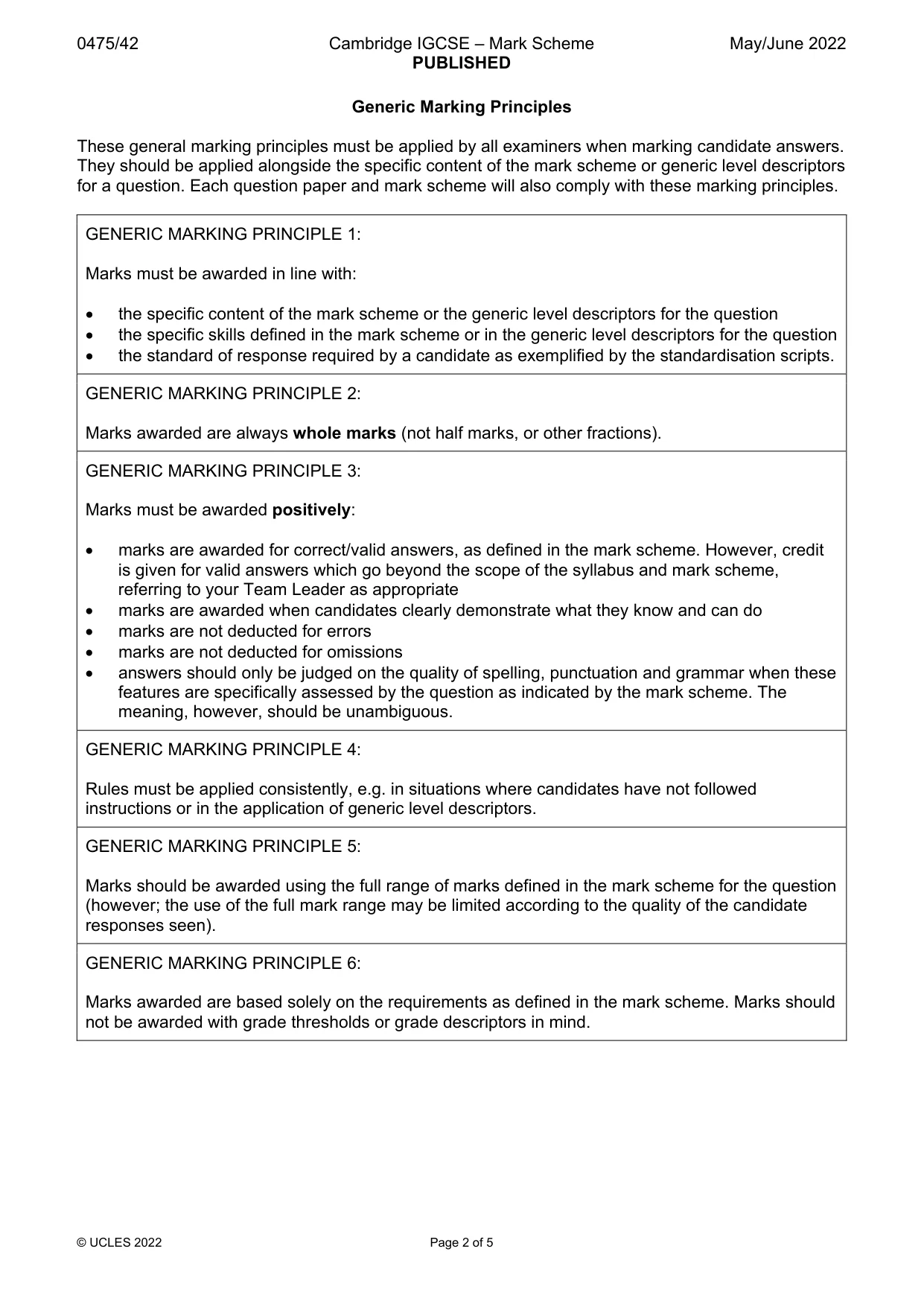
0475/42 Cambridge IGCSE – Mark Scheme PUBLISHED May/June 2022 © UCLES 2022 Page 2 of 5 Generic Marking Principles These general marking principles must be applied by all examiners when marking candidate answers. They should be applied alongside the specific content of the mark scheme or generic level descriptors for a question. Each question paper and mark scheme will also comply with these marking principles. GENERIC MARKING PRINCIPLE 1: Marks must be awarded in line with: the specific content of the mark scheme or the generic level descriptors for the question the specific skills defined in the mark scheme or in the generic level descriptors for the question the standard of response required by a candidate as exemplified by the standardisation scripts. GENERIC MARKING PRINCIPLE 2: Marks awarded are always whole marks (not half marks, or other fractions). GENERIC MARKING PRINCIPLE 3: Marks must be awarded positively: marks are awarded for correct/valid answers, as defined in the mark scheme. However, credit is given for valid answers which go beyond the scope of the syllabus and mark scheme, referring to your Team Leader as appropriate marks are awarded when candidates clearly demonstrate what they know and can do marks are not deducted for errors marks are not deducted for omissions answers should only be judged on the quality of spelling, punctuation and grammar when these features are specifically assessed by the question as indicated by the mark scheme. The meaning, however, should be unambiguous. GENERIC MARKING PRINCIPLE 4: Rules must be applied consistently, e.g. in situations where candidates have not followed instructions or in the application of generic level descriptors. GENERIC MARKING PRINCIPLE 5: Marks should be awarded using the full range of marks defined in the mark scheme for the question (however; the use of the full mark range may be limited according to the quality of the candidate responses seen). GENERIC MARKING PRINCIPLE 6: Marks awarded are based solely on the requirements as defined in the mark scheme. Marks should not be awarded with grade thresholds or grade descriptors in mind.
Mark scheme, page 3
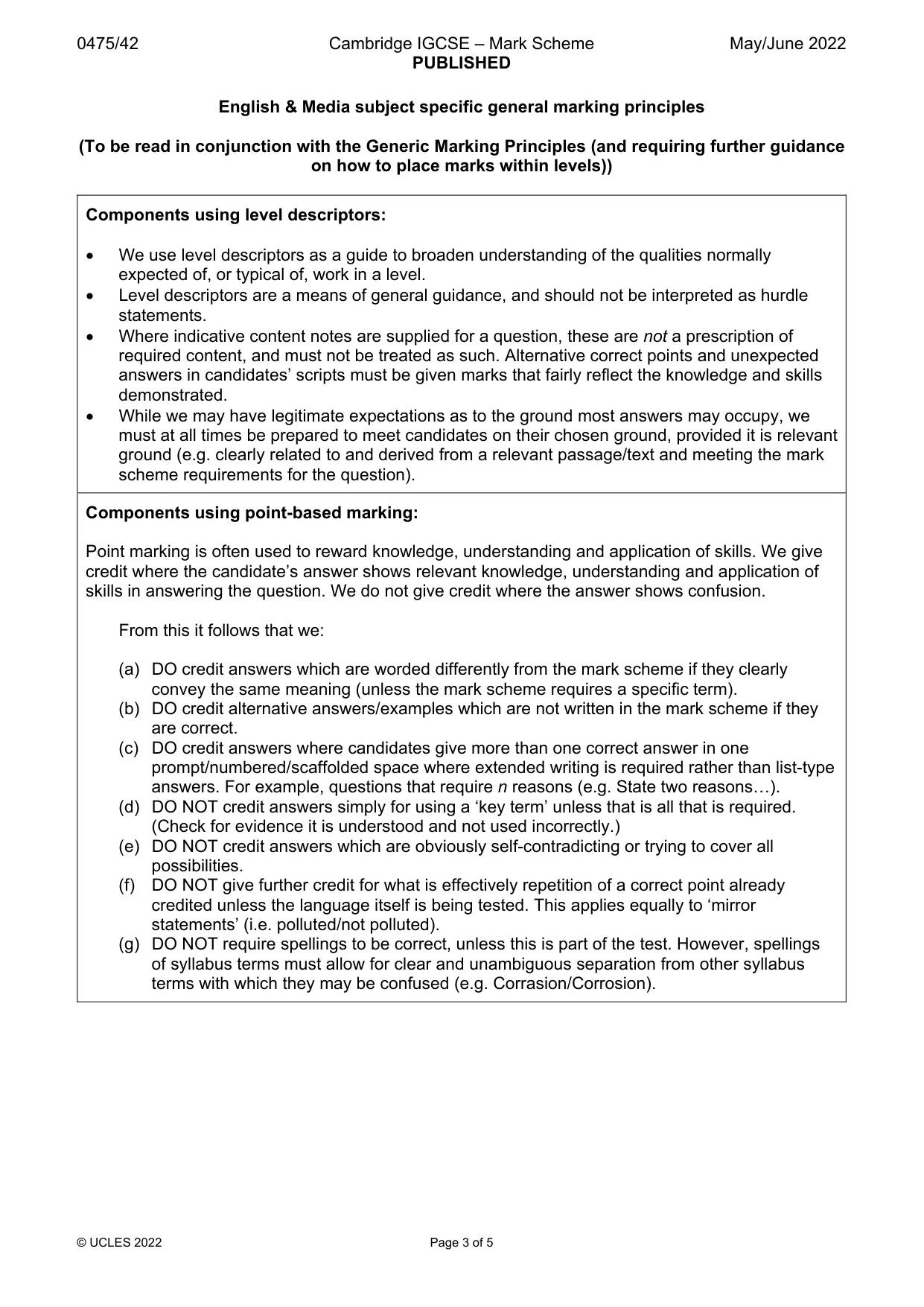
0475/42 Cambridge IGCSE – Mark Scheme PUBLISHED May/June 2022 © UCLES 2022 Page 3 of 5 English & Media subject specific general marking principles (To be read in conjunction with the Generic Marking Principles (and requiring further guidance on how to place marks within levels)) Components using level descriptors: We use level descriptors as a guide to broaden understanding of the qualities normally expected of, or typical of, work in a level. Level descriptors are a means of general guidance, and should not be interpreted as hurdle statements. Where indicative content notes are supplied for a question, these are not a prescription of required content, and must not be treated as such. Alternative correct points and unexpected answers in candidates’ scripts must be given marks that fairly reflect the knowledge and skills demonstrated. While we may have legitimate expectations as to the ground most answers may occupy, we must at all times be prepared to meet candidates on their chosen ground, provided it is relevant ground (e.g. clearly related to and derived from a relevant passage/text and meeting the mark scheme requirements for the question). Components using point-based marking: Point marking is often used to reward knowledge, understanding and application of skills. We give credit where the candidate’s answer shows relevant knowledge, understanding and application of skills in answering the question. We do not give credit where the answer shows confusion. From this it follows that we: (a) DO credit answers which are worded differently from the mark scheme if they clearly convey the same meaning (unless the mark scheme requires a specific term). (b) DO credit alternative answers/examples which are not written in the mark scheme if they are correct. (c) DO credit answers where candidates give more than one correct answer in one prompt/numbered/scaffolded space where extended writing is required rather than list-type answers. For example, questions that require n reasons (e.g. State two reasons…). (d) DO NOT credit answers simply for using a ‘key term’ unless that is all that is required. (Check for evidence it is understood and not used incorrectly.) (e) DO NOT credit answers which are obviously self-contradicting or trying to cover all possibilities. (f) DO NOT give further credit for what is effectively repetition of a correct point already credited unless the language itself is being tested. This applies equally to ‘mirror statements’ (i.e. polluted/not polluted). (g) DO NOT require spellings to be correct, unless this is part of the test. However, spellings of syllabus terms must allow for clear and unambiguous separation from other syllabus terms with which they may be confused (e.g. Corrasion/Corrosion).
Mark scheme, page 4
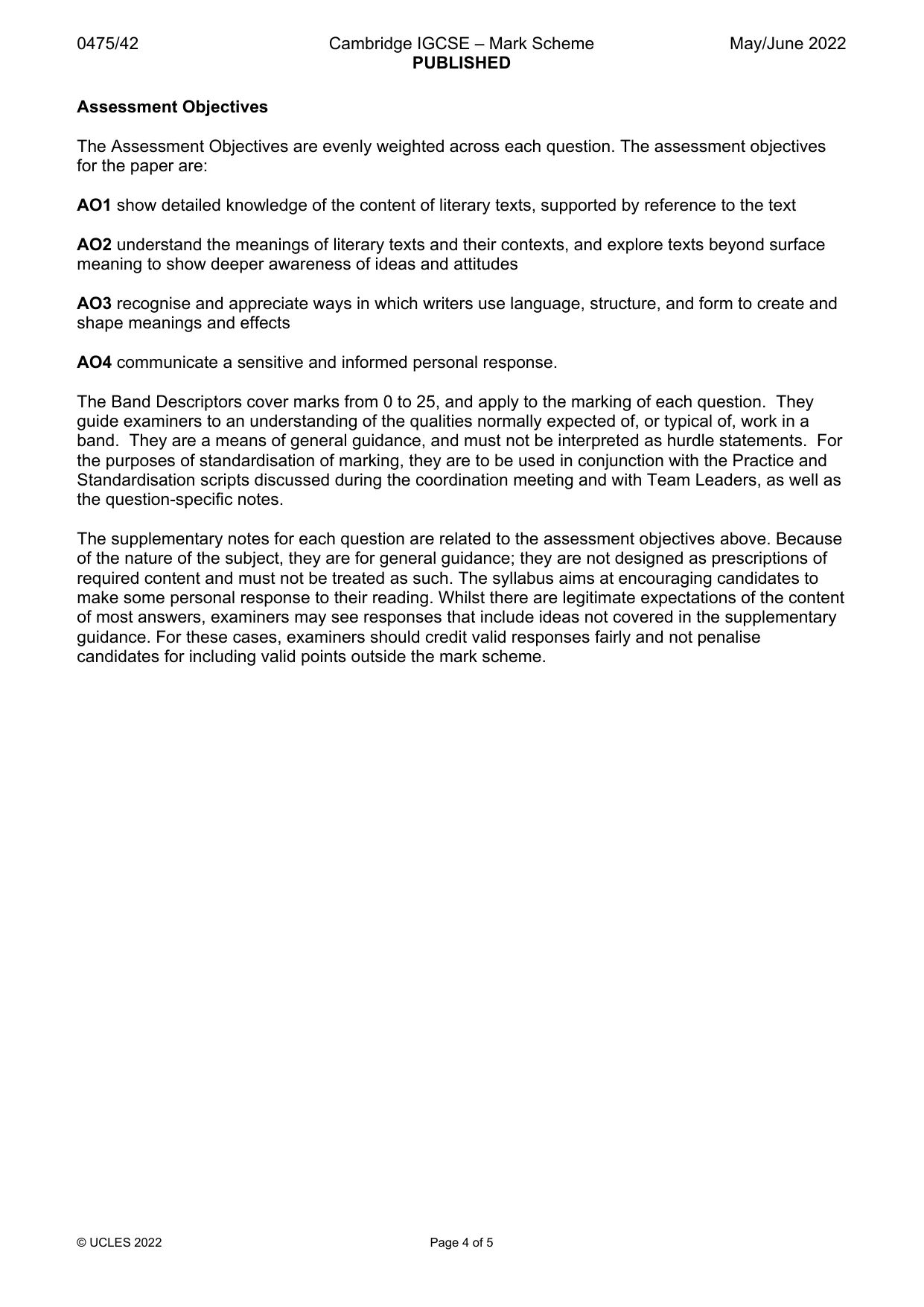
0475/42 Cambridge IGCSE – Mark Scheme PUBLISHED May/June 2022 © UCLES 2022 Page 4 of 5 Assessment Objectives The Assessment Objectives are evenly weighted across each question. The assessment objectives for the paper are: AO1 show detailed knowledge of the content of literary texts, supported by reference to the text AO2 understand the meanings of literary texts and their contexts, and explore texts beyond surface meaning to show deeper awareness of ideas and attitudes AO3 recognise and appreciate ways in which writers use language, structure, and form to create and shape meanings and effects AO4 communicate a sensitive and informed personal response. The Band Descriptors cover marks from 0 to 25, and apply to the marking of each question. They guide examiners to an understanding of the qualities normally expected of, or typical of, work in a band. They are a means of general guidance, and must not be interpreted as hurdle statements. For the purposes of standardisation of marking, they are to be used in conjunction with the Practice and Standardisation scripts discussed during the coordination meeting and with Team Leaders, as well as the question-specific notes. The supplementary notes for each question are related to the assessment objectives above. Because of the nature of the subject, they are for general guidance; they are not designed as prescriptions of required content and must not be treated as such. The syllabus aims at encouraging candidates to make some personal response to their reading. Whilst there are legitimate expectations of the content of most answers, examiners may see responses that include ideas not covered in the supplementary guidance. For these cases, examiners should credit valid responses fairly and not penalise candidates for including valid points outside the mark scheme.
Mark scheme, page 5
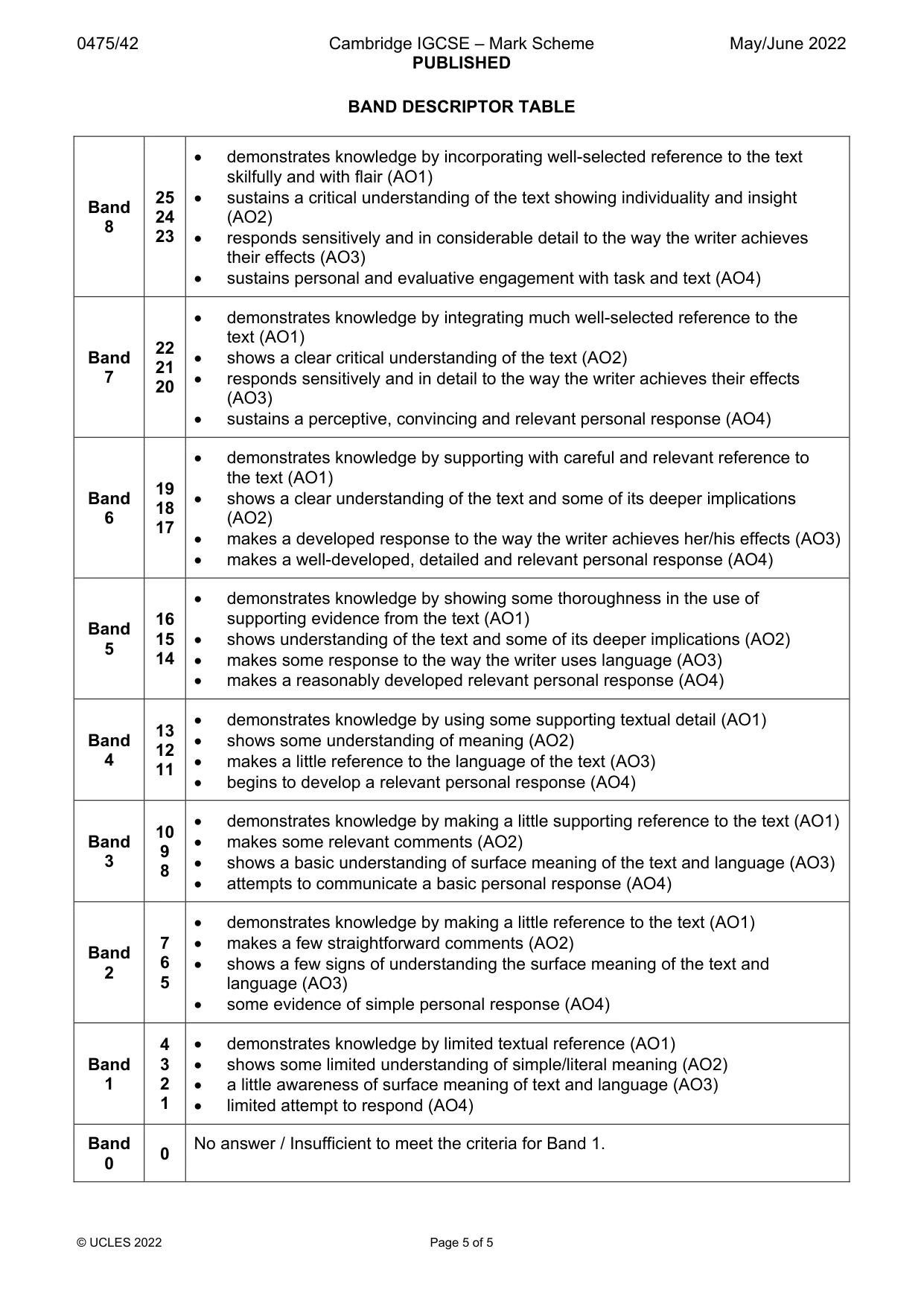
0475/42 Cambridge IGCSE – Mark Scheme PUBLISHED May/June 2022 © UCLES 2022 Page 5 of 5 BAND DESCRIPTOR TABLE Band 8 25 24 23 demonstrates knowledge by incorporating well-selected reference to the text skilfully and with flair (AO1) sustains a critical understanding of the text showing individuality and insight (AO2) responds sensitively and in considerable detail to the way the writer achieves their effects (AO3) sustains personal and evaluative engagement with task and text (AO4) Band 7 22 21 20 demonstrates knowledge by integrating much well-selected reference to the text (AO1) shows a clear critical understanding of the text (AO2) responds sensitively and in detail to the way the writer achieves their effects (AO3) sustains a perceptive, convincing and relevant personal response (AO4) Band 6 19 18 17 demonstrates knowledge by supporting with careful and relevant reference to the text (AO1) shows a clear understanding of the text and some of its deeper implications (AO2) makes a developed response to the way the writer achieves her/his effects (AO3) makes a well-developed, detailed and relevant personal response (AO4) Band 5 16 15 14 demonstrates knowledge by showing some thoroughness in the use of supporting evidence from the text (AO1) shows understanding of the text and some of its deeper implications (AO2) makes some response to the way the writer uses language (AO3) makes a reasonably developed relevant personal response (AO4) Band 4 13 12 11 demonstrates knowledge by using some supporting textual detail (AO1) shows some understanding of meaning (AO2) makes a little reference to the language of the text (AO3) begins to develop a relevant personal response (AO4) Band 3 10 9 8 demonstrates knowledge by making a little supporting reference to the text (AO1) makes some relevant comments (AO2) shows a basic understanding of surface meaning of the text and language (AO3) attempts to communicate a basic personal response (AO4) Band 2 7 6 5 demonstrates knowledge by making a little reference to the text (AO1) makes a few straightforward comments (AO2) shows a few signs of understanding the surface meaning of the text and language (AO3) some evidence of simple personal response (AO4) Band 1 4 3 2 1 demonstrates knowledge by limited textual reference (AO1) shows some limited understanding of simple/literal meaning (AO2) a little awareness of surface meaning of text and language (AO3) limited attempt to respond (AO4) Band 0 0 No answer / Insufficient to meet the criteria for Band 1.
What you needed in this session
Cambridge’s own grade thresholds for 2022 May/June, Paper 4 · Variant 2. A higher threshold means an easier paper — the bar moves with how the cohort did.