Cambridge IGCSE English - Literature in English 0475 — 2023 Oct/Nov Paper 4 · Variant 3
0475/43/O/N/23 · 25 marks · ≈28 min
The question paper and its mark scheme, free to read here and free to download. This is Cambridge’s own paper, exactly as it was sat.
Question paper8 pages



Mark scheme5 pages
Answers below. Sit the paper first if you are practising.
Paper as text
Question paper, page 1
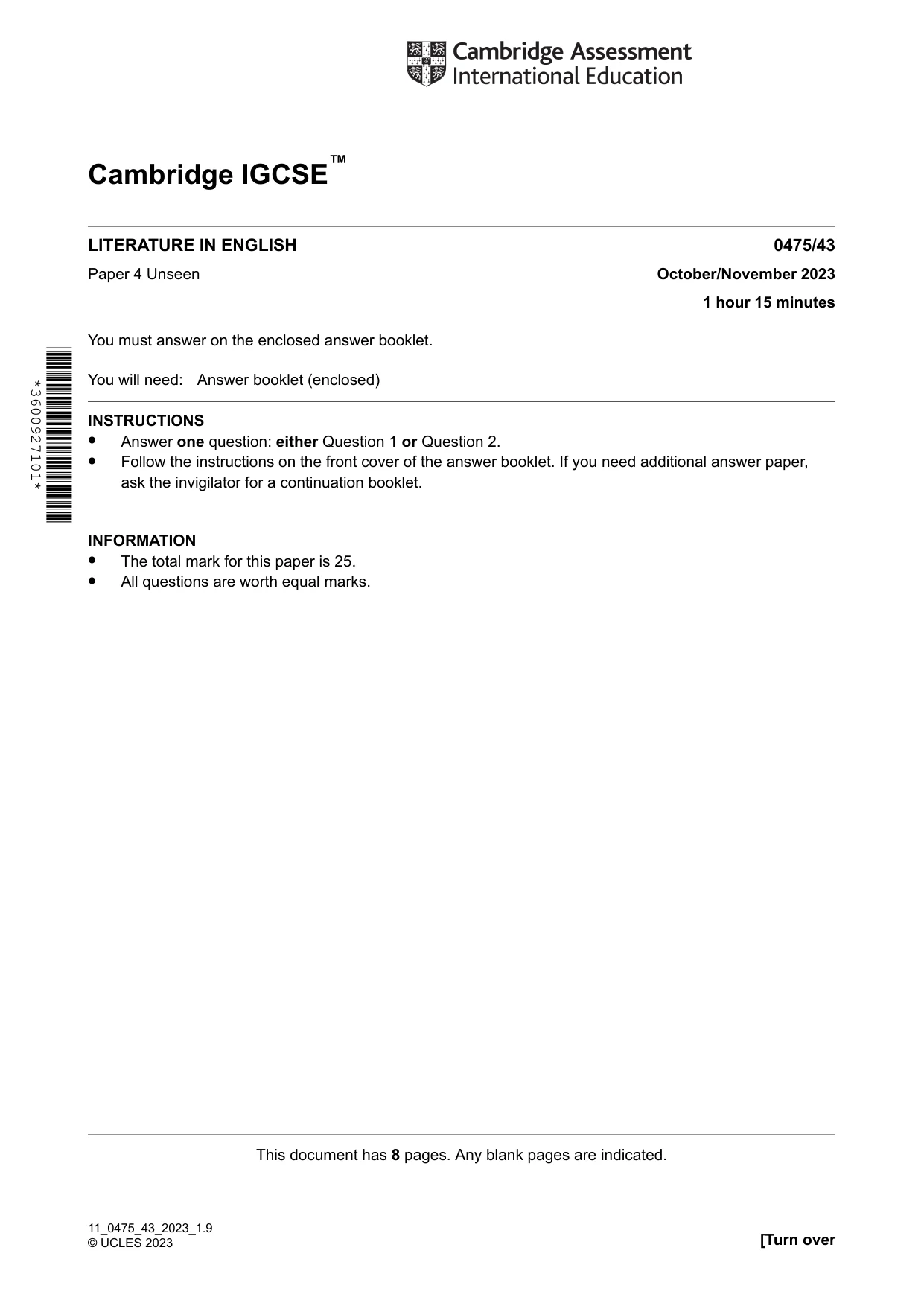
Cambridge IGCSE™ 0475/43 LITERATURE IN ENGLISH October/November 2023 Paper 4 Unseen 1 hour 15 minutes You must answer on the enclosed answer booklet. You will need: Answer booklet (enclosed) INSTRUCTIONS • Answer one question: either Question 1 or Question 2. • Follow the instructions on the front cover of the answer booklet. If you need additional answer paper, ask the invigilator for a continuation booklet. INFORMATION • The total mark for this paper is 25. • All questions are worth equal marks. This document has 8 pages. Any blank pages are indicated. [Turn over 11_0475_43_2023_1.9 © UCLES 2023 *3600927101*
Question paper, page 2
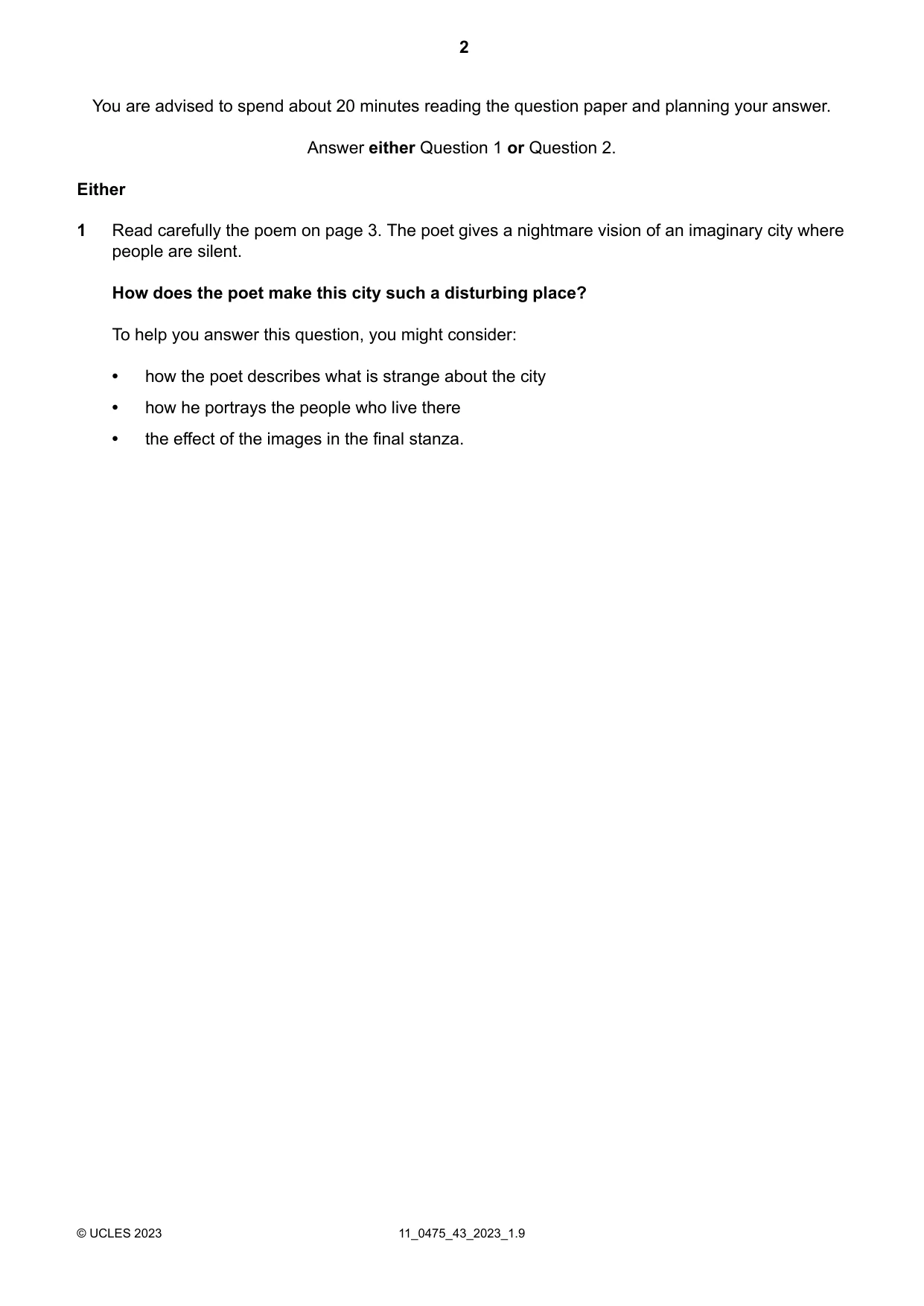
You are advised to spend about 20 minutes reading the question paper and planning your answer. Answer either Question 1 or Question 2. Either Read carefully the poem on page 3. The poet gives a nightmare vision of an imaginary city where people are silent. 1 How does the poet make this city such a disturbing place? To help you answer this question, you might consider: • how the poet describes what is strange about the city • how he portrays the people who live there • the effect of the images in the final stanza. 11_0475_43_2023_1.9 © UCLES 2023 2
Question paper, page 3
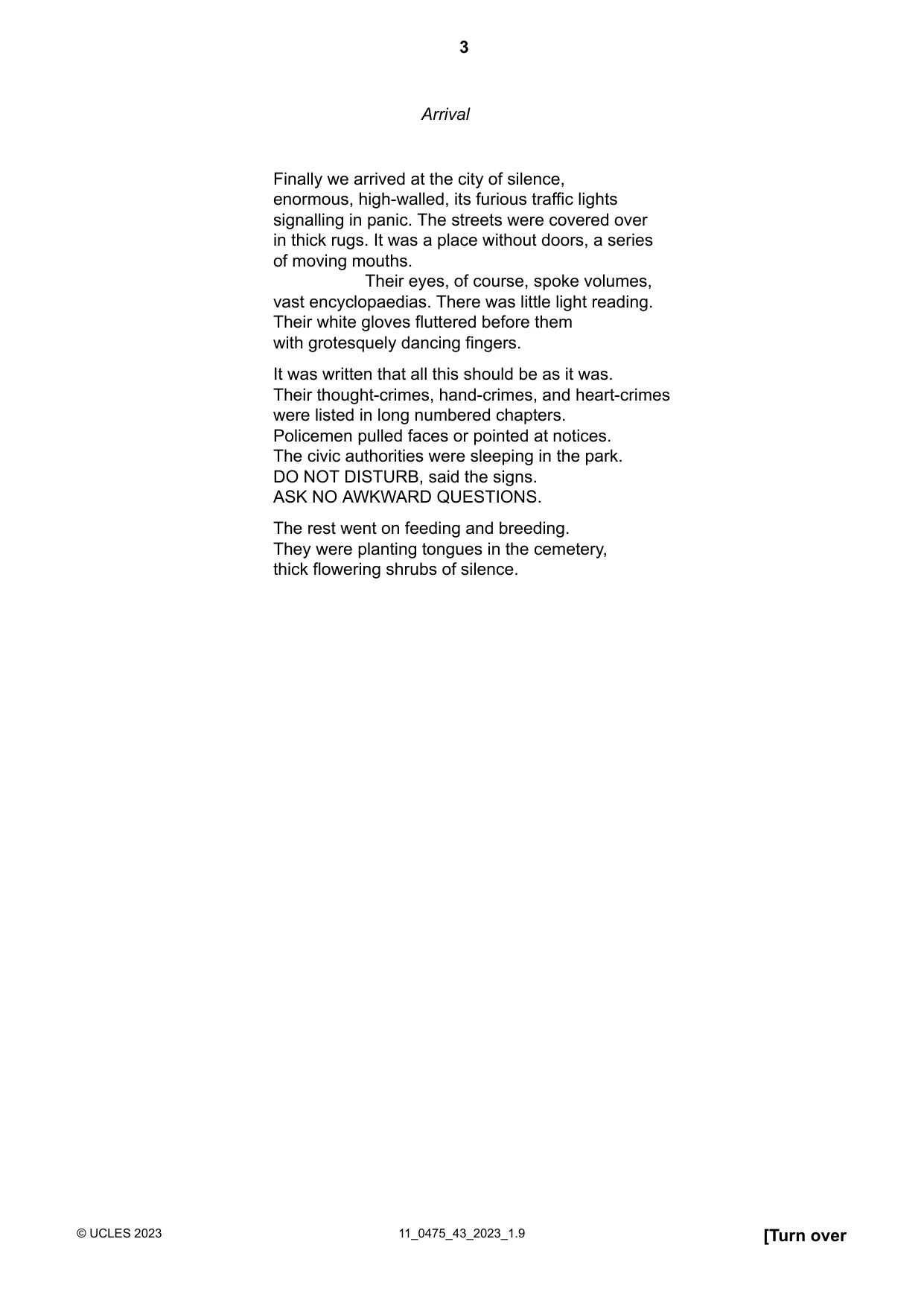
Arrival Finally we arrived at the city of silence, enormous, high-walled, its furious traffic lights signalling in panic. The streets were covered over in thick rugs. It was a place without doors, a series of moving mouths. Their eyes, of course, spoke volumes, vast encyclopaedias. There was little light reading. Their white gloves fluttered before them with grotesquely dancing fingers. It was written that all this should be as it was. Their thought-crimes, hand-crimes, and heart-crimes were listed in long numbered chapters. Policemen pulled faces or pointed at notices. The civic authorities were sleeping in the park. DO NOT DISTURB, said the signs. ASK NO AWKWARD QUESTIONS. The rest went on feeding and breeding. They were planting tongues in the cemetery, thick flowering shrubs of silence. [Turn over 11_0475_43_2023_1.9 © UCLES 2023 3
Question paper, page 4
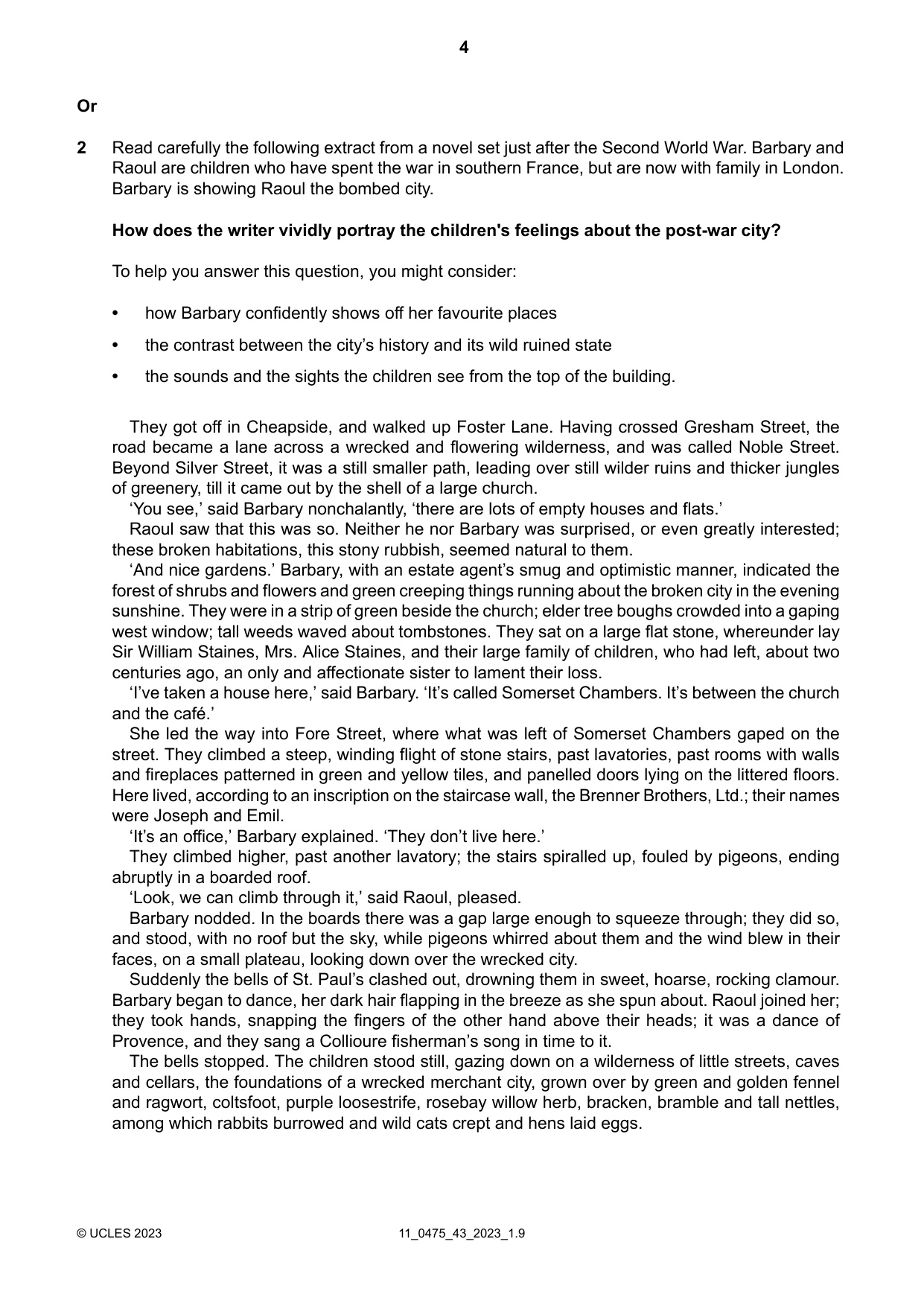
Or Read carefully the following extract from a novel set just after the Second World War. Barbary and Raoul are children who have spent the war in southern France, but are now with family in London. Barbary is showing Raoul the bombed city. 2 How does the writer vividly portray the children's feelings about the post-war city? To help you answer this question, you might consider: • how Barbary confidently shows off her favourite places • the contrast between the city’s history and its wild ruined state • the sounds and the sights the children see from the top of the building. They got off in Cheapside, and walked up Foster Lane. Having crossed Gresham Street, the road became a lane across a wrecked and flowering wilderness, and was called Noble Street. Beyond Silver Street, it was a still smaller path, leading over still wilder ruins and thicker jungles of greenery, till it came out by the shell of a large church. ‘You see,’ said Barbary nonchalantly, ‘there are lots of empty houses and flats.’ Raoul saw that this was so. Neither he nor Barbary was surprised, or even greatly interested; these broken habitations, this stony rubbish, seemed natural to them. ‘And nice gardens.’ Barbary, with an estate agent’s smug and optimistic manner, indicated the forest of shrubs and flowers and green creeping things running about the broken city in the evening sunshine. They were in a strip of green beside the church; elder tree boughs crowded into a gaping west window; tall weeds waved about tombstones. They sat on a large flat stone, whereunder lay Sir William Staines, Mrs. Alice Staines, and their large family of children, who had left, about two centuries ago, an only and affectionate sister to lament their loss. ‘I’ve taken a house here,’ said Barbary. ‘It’s called Somerset Chambers. It’s between the church and the café.’ She led the way into Fore Street, where what was left of Somerset Chambers gaped on the street. They climbed a steep, winding flight of stone stairs, past lavatories, past rooms with walls and fireplaces patterned in green and yellow tiles, and panelled doors lying on the littered floors. Here lived, according to an inscription on the staircase wall, the Brenner Brothers, Ltd.; their names were Joseph and Emil. ‘It’s an office,’ Barbary explained. ‘They don’t live here.’ They climbed higher, past another lavatory; the stairs spiralled up, fouled by pigeons, ending abruptly in a boarded roof. ‘Look, we can climb through it,’ said Raoul, pleased. Barbary nodded. In the boards there was a gap large enough to squeeze through; they did so, and stood, with no roof but the sky, while pigeons whirred about them and the wind blew in their faces, on a small plateau, looking down over the wrecked city. Suddenly the bells of St. Paul’s clashed out, drowning them in sweet, hoarse, rocking clamour. Barbary began to dance, her dark hair flapping in the breeze as she spun about. Raoul joined her; they took hands, snapping the fingers of the other hand above their heads; it was a dance of Provence, and they sang a Collioure fisherman’s song in time to it. The bells stopped. The children stood still, gazing down on a wilderness of little streets, caves and cellars, the foundations of a wrecked merchant city, grown over by green and golden fennel and ragwort, coltsfoot, purple loosestrife, rosebay willow herb, bracken, bramble and tall nettles, among which rabbits burrowed and wild cats crept and hens laid eggs. 11_0475_43_2023_1.9 © UCLES 2023 4
Question paper, page 5
BLANK PAGE 11_0475_43_2023_1.9 © UCLES 2023 5
Question paper, page 6
BLANK PAGE 11_0475_43_2023_1.9 © UCLES 2023 6
Question paper, page 7
BLANK PAGE 11_0475_43_2023_1.9 © UCLES 2023 7
Question paper, page 8
BLANK PAGE Permission to reproduce items where third-party owned material protected by copyright is included has been sought and cleared where possible. Every reasonable effort has been made by the publisher (UCLES) to trace copyright holders, but if any items requiring clearance have unwittingly been included, the publisher will be pleased to make amends at the earliest possible opportunity. To avoid the issue of disclosure of answer-related information to candidates, all copyright acknowledgements are reproduced online in the Cambridge Assessment International Education Copyright Acknowledgements Booklet. This is produced for each series of examinations and is freely available to download at www.cambridgeinternational.org after the live examination series. Cambridge Assessment International Education is part of Cambridge Assessment. Cambridge Assessment is the brand name of the University of Cambridge Local Examinations Syndicate (UCLES), which is a department of the University of Cambridge. 11_0475_43_2023_1.9 © UCLES 2023 8
Mark scheme, page 1
This document consists of 5 printed pages. © UCLES 2023 [Turn over Cambridge IGCSE™ LITERATURE IN ENGLISH 0475/43 Paper 4 Unseen October/November 2023 MARK SCHEME Maximum Mark: 25 Published This mark scheme is published as an aid to teachers and candidates, to indicate the requirements of the examination. It shows the basis on which Examiners were instructed to award marks. It does not indicate the details of the discussions that took place at an Examiners’ meeting before marking began, which would have considered the acceptability of alternative answers. Mark schemes should be read in conjunction with the question paper and the Principal Examiner Report for Teachers. Cambridge International will not enter into discussions about these mark schemes. Cambridge International is publishing the mark schemes for the October/November 2023 series for most Cambridge IGCSE, Cambridge International A and AS Level components, and some Cambridge O Level components.
Mark scheme, page 2
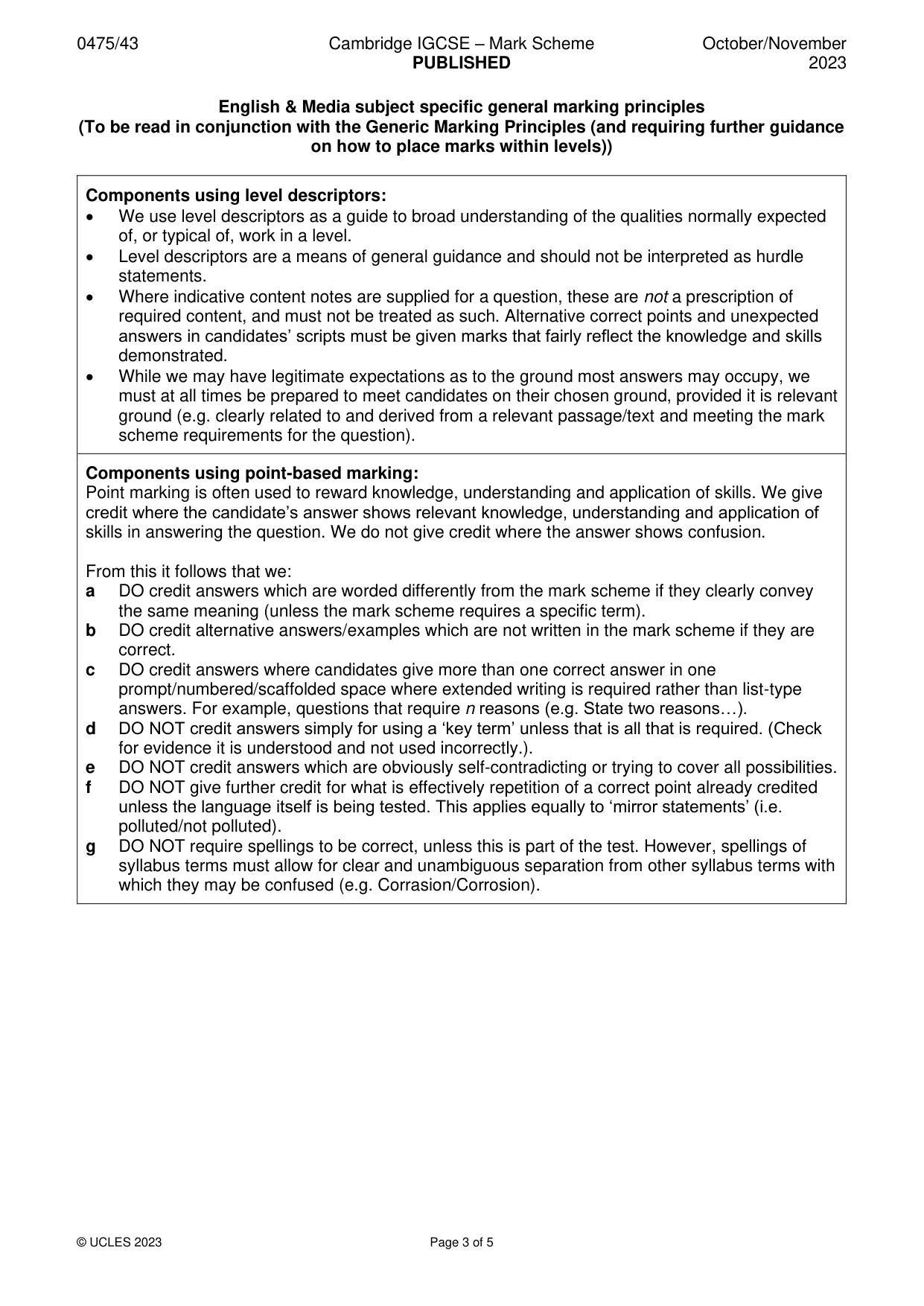
0475/43 Cambridge IGCSE – Mark Scheme PUBLISHED October/November 2023 © UCLES 2023 Page 2 of 5 Generic Marking Principles These general marking principles must be applied by all examiners when marking candidate answers. They should be applied alongside the specific content of the mark scheme or generic level descriptors for a question. Each question paper and mark scheme will also comply with these marking principles. GENERIC MARKING PRINCIPLE 1: Marks must be awarded in line with: • the specific content of the mark scheme or the generic level descriptors for the question • the specific skills defined in the mark scheme or in the generic level descriptors for the question • the standard of response required by a candidate as exemplified by the standardisation scripts. GENERIC MARKING PRINCIPLE 2: Marks awarded are always whole marks (not half marks, or other fractions). GENERIC MARKING PRINCIPLE 3: Marks must be awarded positively: • marks are awarded for correct/valid answers, as defined in the mark scheme. However, credit is given for valid answers which go beyond the scope of the syllabus and mark scheme, referring to your Team Leader as appropriate • marks are awarded when candidates clearly demonstrate what they know and can do • marks are not deducted for errors • marks are not deducted for omissions • answers should only be judged on the quality of spelling, punctuation and grammar when these features are specifically assessed by the question as indicated by the mark scheme. The meaning, however, should be unambiguous. GENERIC MARKING PRINCIPLE 4: Rules must be applied consistently, e.g. in situations where candidates have not followed instructions or in the application of generic level descriptors. GENERIC MARKING PRINCIPLE 5: Marks should be awarded using the full range of marks defined in the mark scheme for the question (however; the use of the full mark range may be limited according to the quality of the candidate responses seen). GENERIC MARKING PRINCIPLE 6: Marks awarded are based solely on the requirements as defined in the mark scheme. Marks should not be awarded with grade thresholds or grade descriptors in mind.
Mark scheme, page 3
0475/43 Cambridge IGCSE – Mark Scheme PUBLISHED October/November 2023 © UCLES 2023 Page 3 of 5 English & Media subject specific general marking principles (To be read in conjunction with the Generic Marking Principles (and requiring further guidance on how to place marks within levels)) Components using level descriptors: • We use level descriptors as a guide to broad understanding of the qualities normally expected of, or typical of, work in a level. • Level descriptors are a means of general guidance and should not be interpreted as hurdle statements. • Where indicative content notes are supplied for a question, these are not a prescription of required content, and must not be treated as such. Alternative correct points and unexpected answers in candidates’ scripts must be given marks that fairly reflect the knowledge and skills demonstrated. • While we may have legitimate expectations as to the ground most answers may occupy, we must at all times be prepared to meet candidates on their chosen ground, provided it is relevant ground (e.g. clearly related to and derived from a relevant passage/text and meeting the mark scheme requirements for the question). Components using point-based marking: Point marking is often used to reward knowledge, understanding and application of skills. We give credit where the candidate’s answer shows relevant knowledge, understanding and application of skills in answering the question. We do not give credit where the answer shows confusion. From this it follows that we: a DO credit answers which are worded differently from the mark scheme if they clearly convey the same meaning (unless the mark scheme requires a specific term). b DO credit alternative answers/examples which are not written in the mark scheme if they are correct. c DO credit answers where candidates give more than one correct answer in one prompt/numbered/scaffolded space where extended writing is required rather than list-type answers. For example, questions that require n reasons (e.g. State two reasons…). d DO NOT credit answers simply for using a ‘key term’ unless that is all that is required. (Check for evidence it is understood and not used incorrectly.). e DO NOT credit answers which are obviously self-contradicting or trying to cover all possibilities. f DO NOT give further credit for what is effectively repetition of a correct point already credited unless the language itself is being tested. This applies equally to ‘mirror statements’ (i.e. polluted/not polluted). g DO NOT require spellings to be correct, unless this is part of the test. However, spellings of syllabus terms must allow for clear and unambiguous separation from other syllabus terms with which they may be confused (e.g. Corrasion/Corrosion).
Mark scheme, page 4
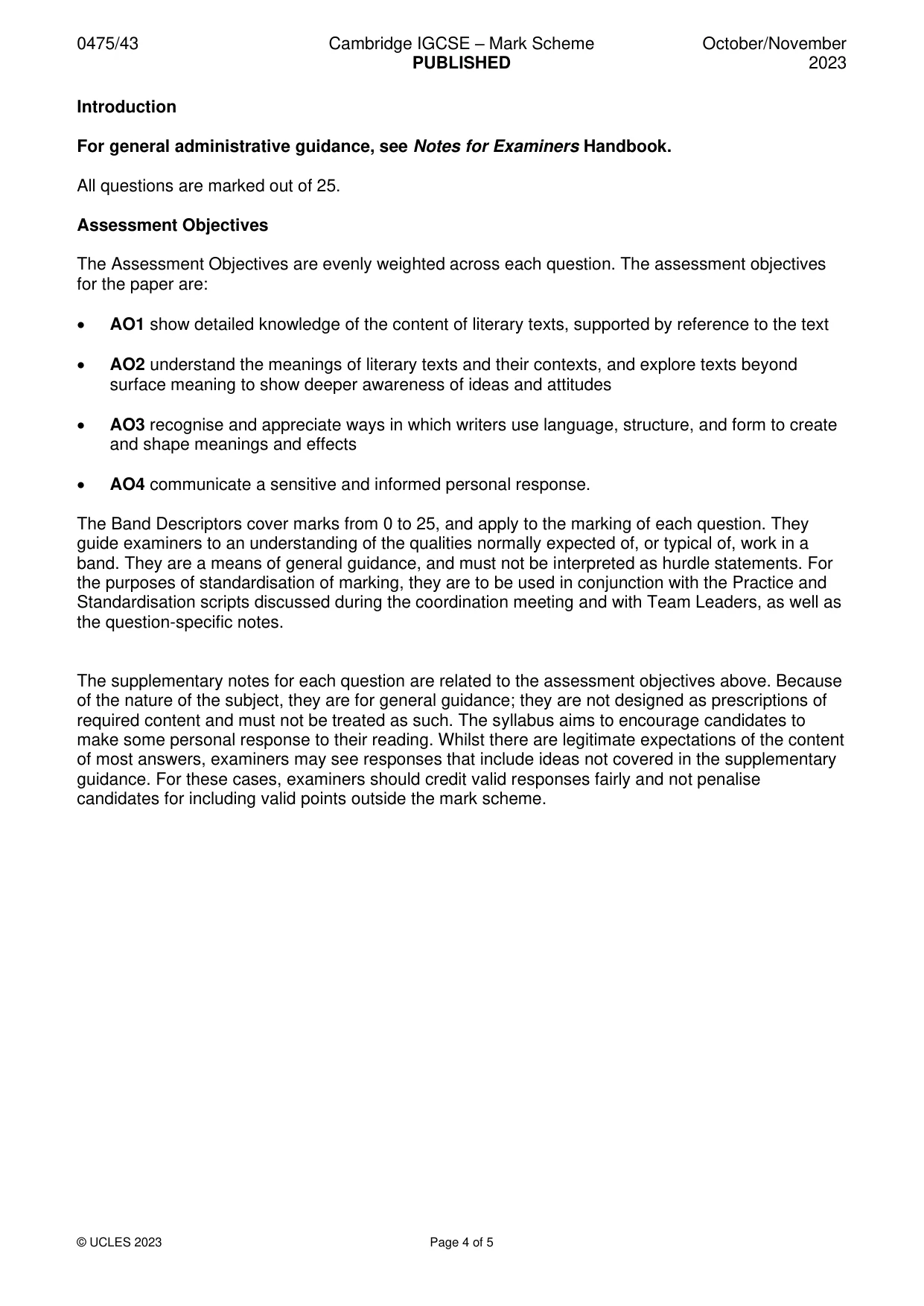
0475/43 Cambridge IGCSE – Mark Scheme PUBLISHED October/November 2023 © UCLES 2023 Page 4 of 5 Introduction For general administrative guidance, see Notes for Examiners Handbook. All questions are marked out of 25. Assessment Objectives The Assessment Objectives are evenly weighted across each question. The assessment objectives for the paper are: • AO1 show detailed knowledge of the content of literary texts, supported by reference to the text • AO2 understand the meanings of literary texts and their contexts, and explore texts beyond surface meaning to show deeper awareness of ideas and attitudes • AO3 recognise and appreciate ways in which writers use language, structure, and form to create and shape meanings and effects • AO4 communicate a sensitive and informed personal response. The Band Descriptors cover marks from 0 to 25, and apply to the marking of each question. They guide examiners to an understanding of the qualities normally expected of, or typical of, work in a band. They are a means of general guidance, and must not be interpreted as hurdle statements. For the purposes of standardisation of marking, they are to be used in conjunction with the Practice and Standardisation scripts discussed during the coordination meeting and with Team Leaders, as well as the question-specific notes. The supplementary notes for each question are related to the assessment objectives above. Because of the nature of the subject, they are for general guidance; they are not designed as prescriptions of required content and must not be treated as such. The syllabus aims to encourage candidates to make some personal response to their reading. Whilst there are legitimate expectations of the content of most answers, examiners may see responses that include ideas not covered in the supplementary guidance. For these cases, examiners should credit valid responses fairly and not penalise candidates for including valid points outside the mark scheme.
Mark scheme, page 5
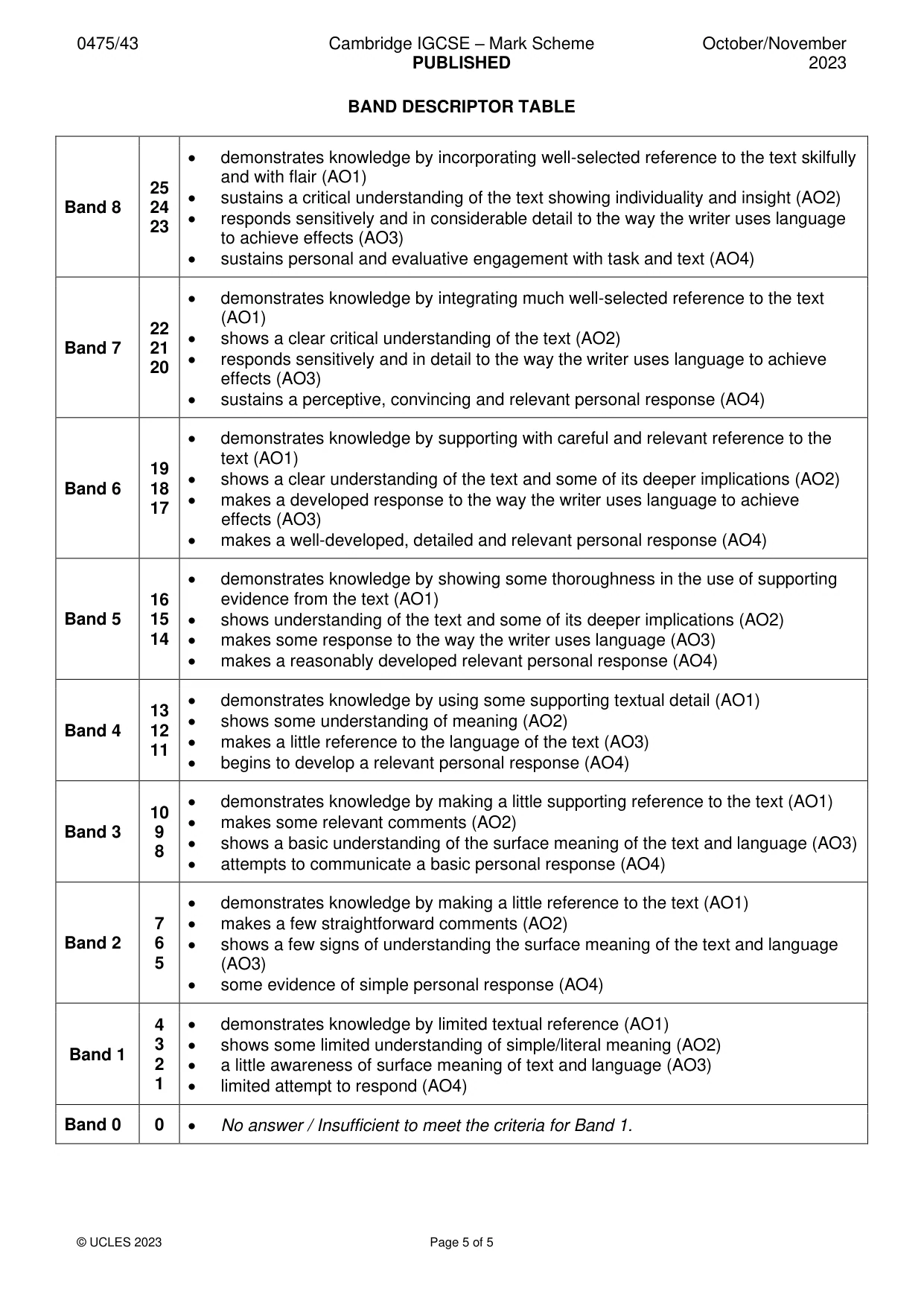
0475/43 Cambridge IGCSE – Mark Scheme PUBLISHED October/November 2023 © UCLES 2023 Page 5 of 5 BAND DESCRIPTOR TABLE Band 8 25 24 23 • demonstrates knowledge by incorporating well-selected reference to the text skilfully and with flair (AO1) • sustains a critical understanding of the text showing individuality and insight (AO2) • responds sensitively and in considerable detail to the way the writer uses language to achieve effects (AO3) • sustains personal and evaluative engagement with task and text (AO4) Band 7 22 21 20 • demonstrates knowledge by integrating much well-selected reference to the text (AO1) • shows a clear critical understanding of the text (AO2) • responds sensitively and in detail to the way the writer uses language to achieve effects (AO3) • sustains a perceptive, convincing and relevant personal response (AO4) Band 6 19 18 17 • demonstrates knowledge by supporting with careful and relevant reference to the text (AO1) • shows a clear understanding of the text and some of its deeper implications (AO2) • makes a developed response to the way the writer uses language to achieve effects (AO3) • makes a well-developed, detailed and relevant personal response (AO4) Band 5 16 15 14 • demonstrates knowledge by showing some thoroughness in the use of supporting evidence from the text (AO1) • shows understanding of the text and some of its deeper implications (AO2) • makes some response to the way the writer uses language (AO3) • makes a reasonably developed relevant personal response (AO4) Band 4 13 12 11 • demonstrates knowledge by using some supporting textual detail (AO1) • shows some understanding of meaning (AO2) • makes a little reference to the language of the text (AO3) • begins to develop a relevant personal response (AO4) Band 3 10 9 8 • demonstrates knowledge by making a little supporting reference to the text (AO1) • makes some relevant comments (AO2) • shows a basic understanding of the surface meaning of the text and language (AO3) • attempts to communicate a basic personal response (AO4) Band 2 7 6 5 • demonstrates knowledge by making a little reference to the text (AO1) • makes a few straightforward comments (AO2) • shows a few signs of understanding the surface meaning of the text and language (AO3) • some evidence of simple personal response (AO4) Band 1 4 3 2 1 • demonstrates knowledge by limited textual reference (AO1) • shows some limited understanding of simple/literal meaning (AO2) • a little awareness of surface meaning of text and language (AO3) • limited attempt to respond (AO4) Band 0 0 • No answer / Insufficient to meet the criteria for Band 1.
What you needed in this session
Cambridge’s own grade thresholds for 2023 Oct/Nov, Paper 4 · Variant 3. A higher threshold means an easier paper — the bar moves with how the cohort did.