Cambridge IGCSE English - Literature in English 0475 — 2022 May/June Paper 4 · Variant 1
0475/41/M/J/22 · 25 marks · ≈28 min
The question paper and its mark scheme, free to read here and free to download. This is Cambridge’s own paper, exactly as it was sat.
Question paper8 pages


Mark scheme5 pages
Answers below. Sit the paper first if you are practising.
Paper as text
Question paper, page 1
Cambridge IGCSE™ 0475/41 LITERATURE IN ENGLISH May/June 2022 Paper 4 Unseen 1 hour 15 minutes You must answer on the enclosed answer booklet. You will need: Answer booklet (enclosed) INSTRUCTIONS • Answer one question: either Question 1 or Question 2. • Follow the instructions on the front cover of the answer booklet. If you need additional answer paper, ask the invigilator for a continuation booklet. INFORMATION • The total mark for this paper is 25. • All questions are worth equal marks. This document has 8 pages. Any blank pages are indicated. [Turn over 06_0475_41_2022_1.9 © UCLES 2022 *2270683313*
Question paper, page 2
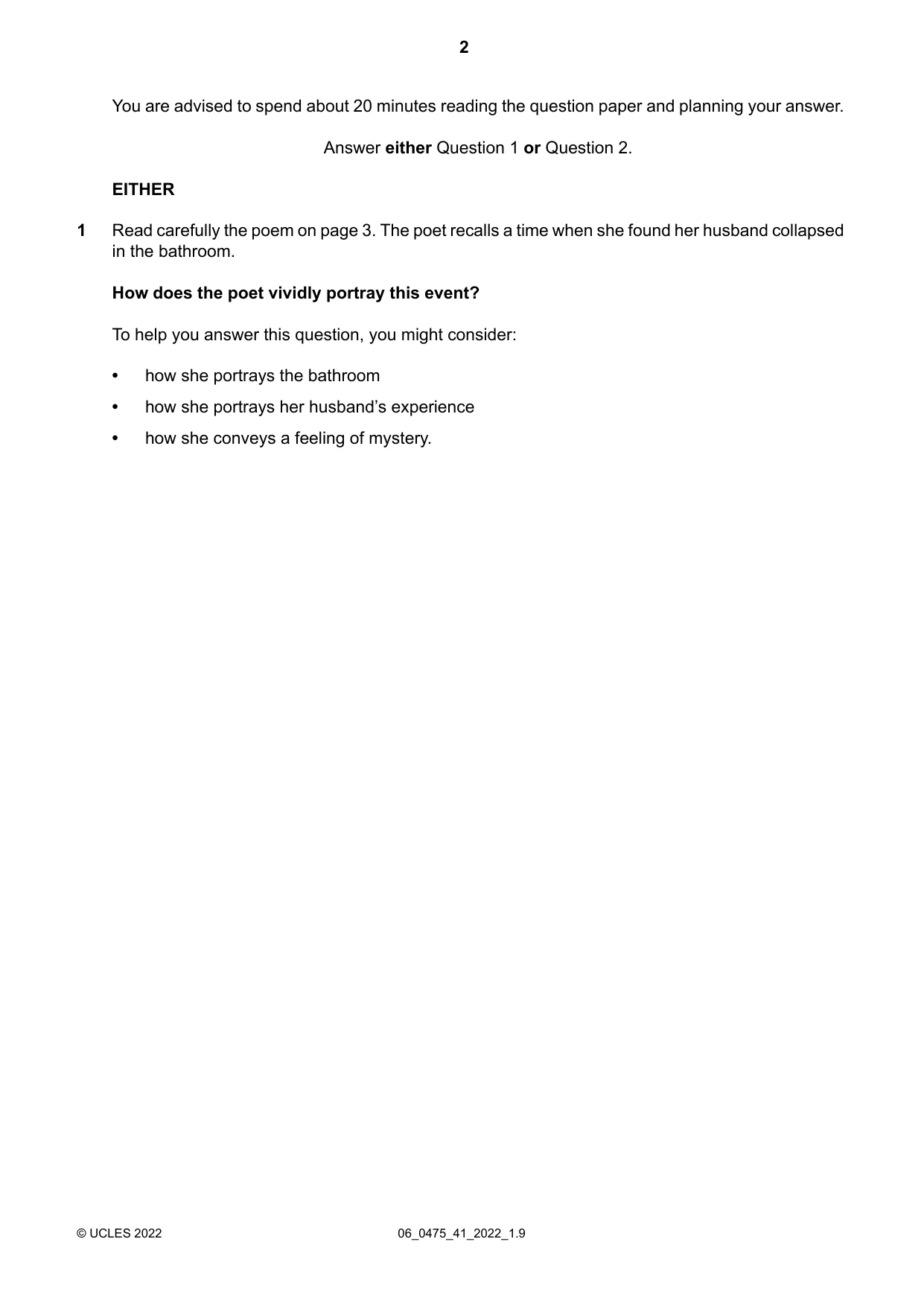
You are advised to spend about 20 minutes reading the question paper and planning your answer. Answer either Question 1 or Question 2. EITHER Read carefully the poem on page 3. The poet recalls a time when she found her husband collapsed in the bathroom. 1 How does the poet vividly portray this event? To help you answer this question, you might consider: • how she portrays the bathroom • how she portrays her husband’s experience • how she conveys a feeling of mystery. 06_0475_41_2022_1.9 © UCLES 2022 2
Question paper, page 3
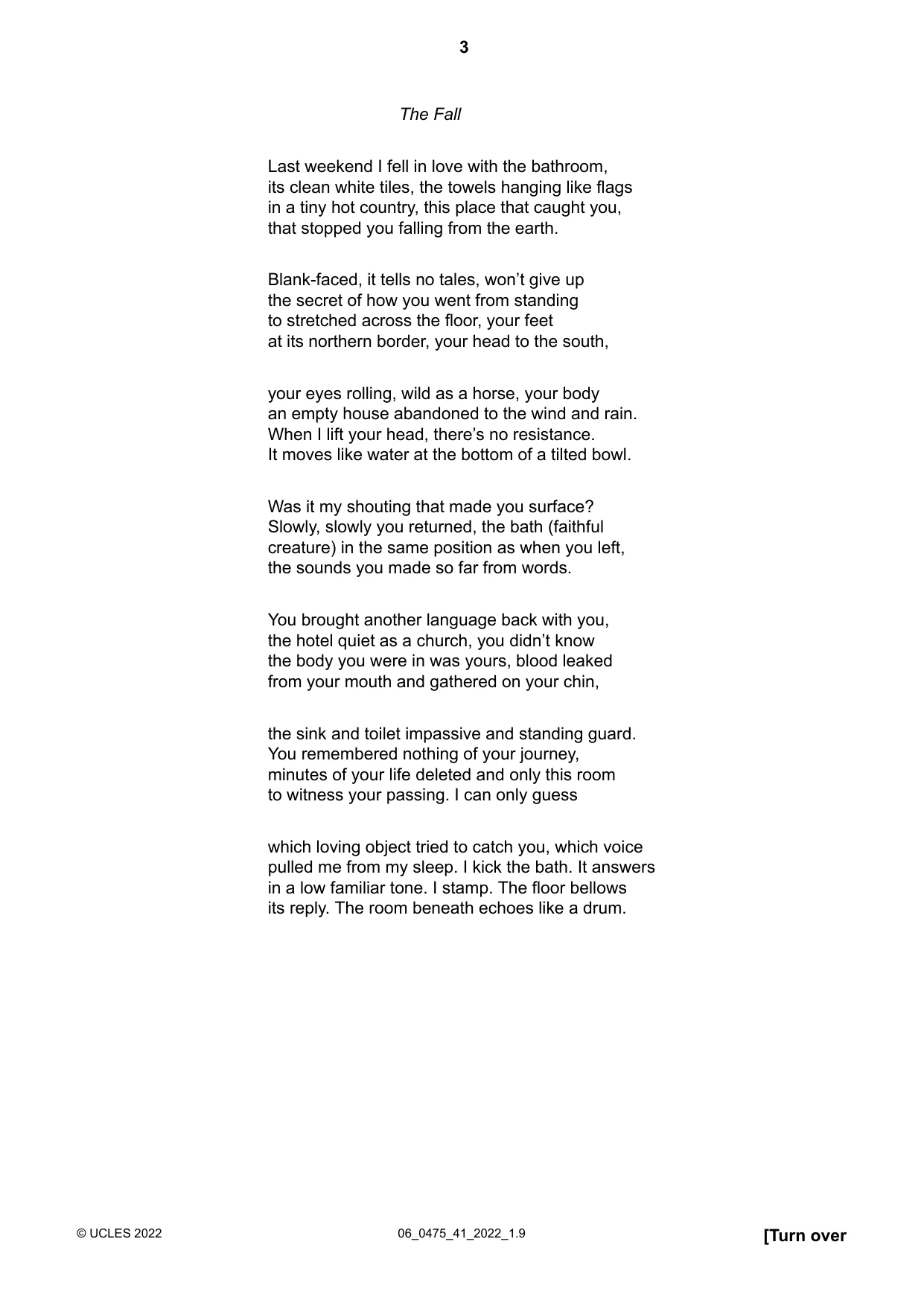
The Fall Last weekend I fell in love with the bathroom, its clean white tiles, the towels hanging like flags in a tiny hot country, this place that caught you, that stopped you falling from the earth. Blank-faced, it tells no tales, won’t give up the secret of how you went from standing to stretched across the floor, your feet at its northern border, your head to the south, your eyes rolling, wild as a horse, your body an empty house abandoned to the wind and rain. When I lift your head, there’s no resistance. It moves like water at the bottom of a tilted bowl. Was it my shouting that made you surface? Slowly, slowly you returned, the bath (faithful creature) in the same position as when you left, the sounds you made so far from words. You brought another language back with you, the hotel quiet as a church, you didn’t know the body you were in was yours, blood leaked from your mouth and gathered on your chin, the sink and toilet impassive and standing guard. You remembered nothing of your journey, minutes of your life deleted and only this room to witness your passing. I can only guess which loving object tried to catch you, which voice pulled me from my sleep. I kick the bath. It answers in a low familiar tone. I stamp. The floor bellows its reply. The room beneath echoes like a drum. [Turn over 06_0475_41_2022_1.9 © UCLES 2022 3
Question paper, page 4
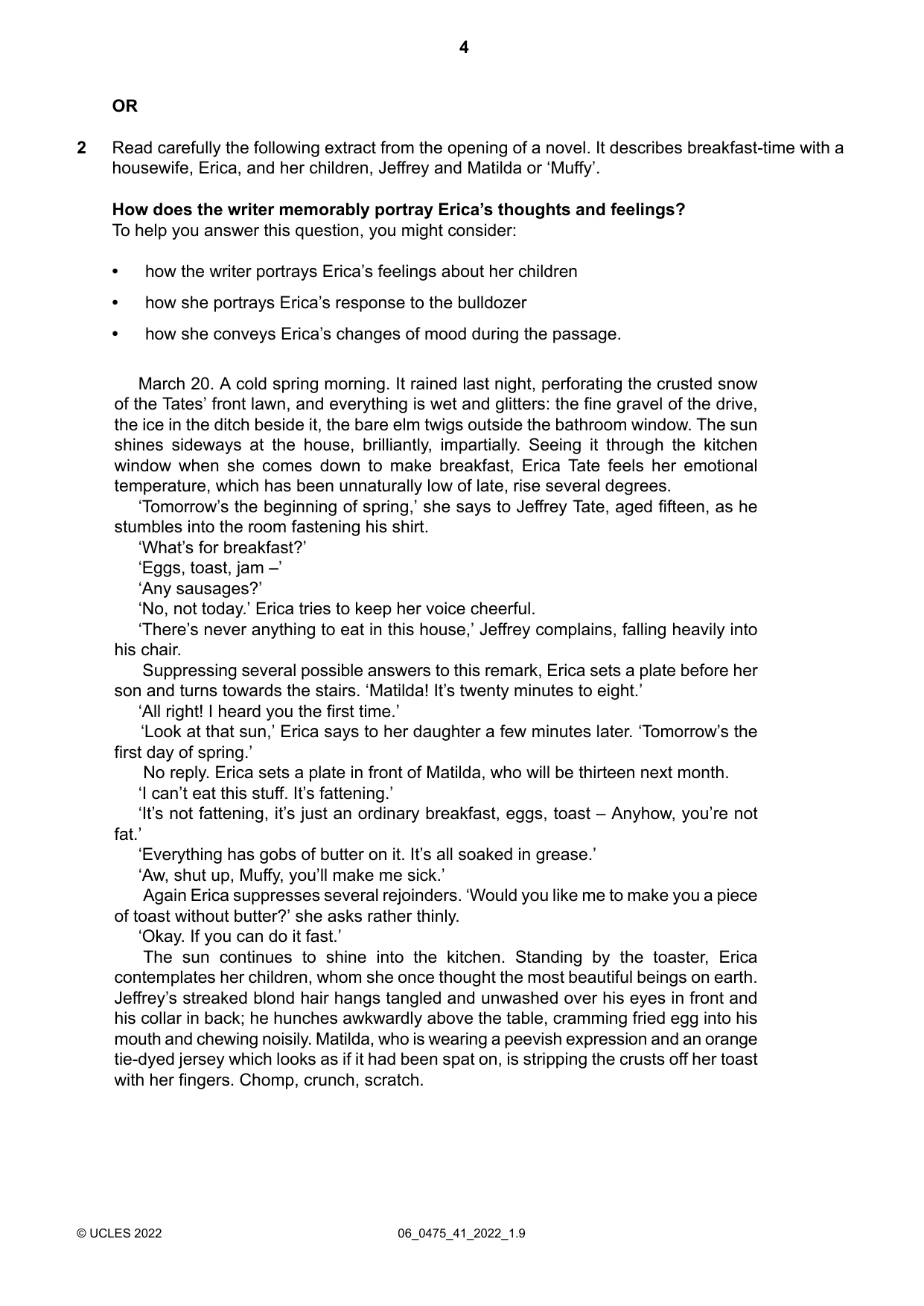
OR Read carefully the following extract from the opening of a novel. It describes breakfast-time with a housewife, Erica, and her children, Jeffrey and Matilda or ‘Muffy’. 2 How does the writer memorably portray Erica’s thoughts and feelings? To help you answer this question, you might consider: • how the writer portrays Erica’s feelings about her children • how she portrays Erica’s response to the bulldozer • how she conveys Erica’s changes of mood during the passage. March 20. A cold spring morning. It rained last night, perforating the crusted snow of the Tates’ front lawn, and everything is wet and glitters: the fine gravel of the drive, the ice in the ditch beside it, the bare elm twigs outside the bathroom window. The sun shines sideways at the house, brilliantly, impartially. Seeing it through the kitchen window when she comes down to make breakfast, Erica Tate feels her emotional temperature, which has been unnaturally low of late, rise several degrees. ‘Tomorrow’s the beginning of spring,’ she says to Jeffrey Tate, aged fifteen, as he stumbles into the room fastening his shirt. ‘What’s for breakfast?’ ‘Eggs, toast, jam –’ ‘Any sausages?’ ‘No, not today.’ Erica tries to keep her voice cheerful. ‘There’s never anything to eat in this house,’ Jeffrey complains, falling heavily into his chair. Suppressing several possible answers to this remark, Erica sets a plate before her son and turns towards the stairs. ‘Matilda! It’s twenty minutes to eight.’ ‘All right! I heard you the first time.’ ‘Look at that sun,’ Erica says to her daughter a few minutes later. ‘Tomorrow’s the first day of spring.’ No reply. Erica sets a plate in front of Matilda, who will be thirteen next month. ‘I can’t eat this stuff. It’s fattening.’ ‘It’s not fattening, it’s just an ordinary breakfast, eggs, toast – Anyhow, you’re not fat.’ ‘Everything has gobs of butter on it. It’s all soaked in grease.’ ‘Aw, shut up, Muffy, you’ll make me sick.’ Again Erica suppresses several rejoinders. ‘Would you like me to make you a piece of toast without butter?’ she asks rather thinly. ‘Okay. If you can do it fast.’ The sun continues to shine into the kitchen. Standing by the toaster, Erica contemplates her children, whom she once thought the most beautiful beings on earth. Jeffrey’s streaked blond hair hangs tangled and unwashed over his eyes in front and his collar in back; he hunches awkwardly above the table, cramming fried egg into his mouth and chewing noisily. Matilda, who is wearing a peevish expression and an orange tie-dyed jersey which looks as if it had been spat on, is stripping the crusts off her toast with her fingers. Chomp, crunch, scratch. 06_0475_41_2022_1.9 © UCLES 2022 4
Question paper, page 5
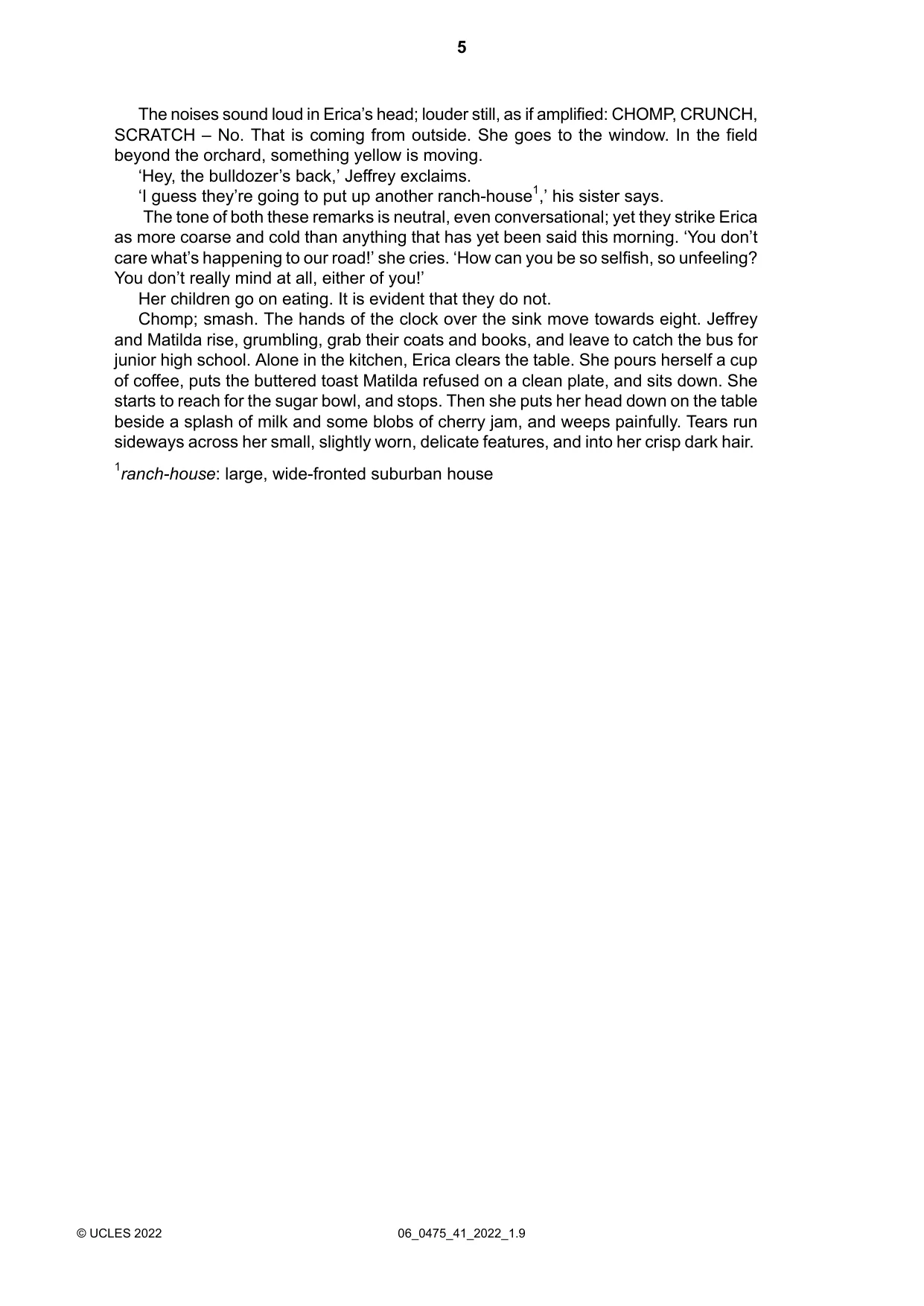
The noises sound loud in Erica’s head; louder still, as if amplified: CHOMP, CRUNCH, SCRATCH – No. That is coming from outside. She goes to the window. In the field beyond the orchard, something yellow is moving. ‘Hey, the bulldozer’s back,’ Jeffrey exclaims. ‘I guess they’re going to put up another ranch-house1,’ his sister says. The tone of both these remarks is neutral, even conversational; yet they strike Erica as more coarse and cold than anything that has yet been said this morning. ‘You don’t care what’s happening to our road!’ she cries. ‘How can you be so selfish, so unfeeling? You don’t really mind at all, either of you!’ Her children go on eating. It is evident that they do not. Chomp; smash. The hands of the clock over the sink move towards eight. Jeffrey and Matilda rise, grumbling, grab their coats and books, and leave to catch the bus for junior high school. Alone in the kitchen, Erica clears the table. She pours herself a cup of coffee, puts the buttered toast Matilda refused on a clean plate, and sits down. She starts to reach for the sugar bowl, and stops. Then she puts her head down on the table beside a splash of milk and some blobs of cherry jam, and weeps painfully. Tears run sideways across her small, slightly worn, delicate features, and into her crisp dark hair. 1ranch-house: large, wide-fronted suburban house 06_0475_41_2022_1.9 © UCLES 2022 5
Question paper, page 6
BLANK PAGE 06_0475_41_2022_1.9 © UCLES 2022 6
Question paper, page 7
BLANK PAGE 06_0475_41_2022_1.9 © UCLES 2022 7
Question paper, page 8
BLANK PAGE Permission to reproduce items where third-party owned material protected by copyright is included has been sought and cleared where possible. Every reasonable effort has been made by the publisher (UCLES) to trace copyright holders, but if any items requiring clearance have unwittingly been included, the publisher will be pleased to make amends at the earliest possible opportunity. To avoid the issue of disclosure of answer-related information to candidates, all copyright acknowledgements are reproduced online in the Cambridge Assessment International Education Copyright Acknowledgements Booklet. This is produced for each series of examinations and is freely available to download at www.cambridgeinternational.org after the live examination series. Cambridge Assessment International Education is part of Cambridge Assessment. Cambridge Assessment is the brand name of the University of Cambridge Local Examinations Syndicate (UCLES), which is a department of the University of Cambridge. 06_0475_41_2022_1.9 © UCLES 2022 8
Mark scheme, page 1
This document consists of 5 printed pages. © UCLES 2022 [Turn over Cambridge IGCSE™ LITERATURE IN ENGLISH 0475/41 Paper 4 Unseen May/June 2022 MARK SCHEME Maximum Mark: 25 Published This mark scheme is published as an aid to teachers and candidates, to indicate the requirements of the examination. It shows the basis on which Examiners were instructed to award marks. It does not indicate the details of the discussions that took place at an Examiners’ meeting before marking began, which would have considered the acceptability of alternative answers. Mark schemes should be read in conjunction with the question paper and the Principal Examiner Report for Teachers. Cambridge International will not enter into discussions about these mark schemes. Cambridge International is publishing the mark schemes for the May/June 2022 series for most Cambridge IGCSE, Cambridge International A and AS Level and Cambridge Pre-U components, and some Cambridge O Level components.
Mark scheme, page 2
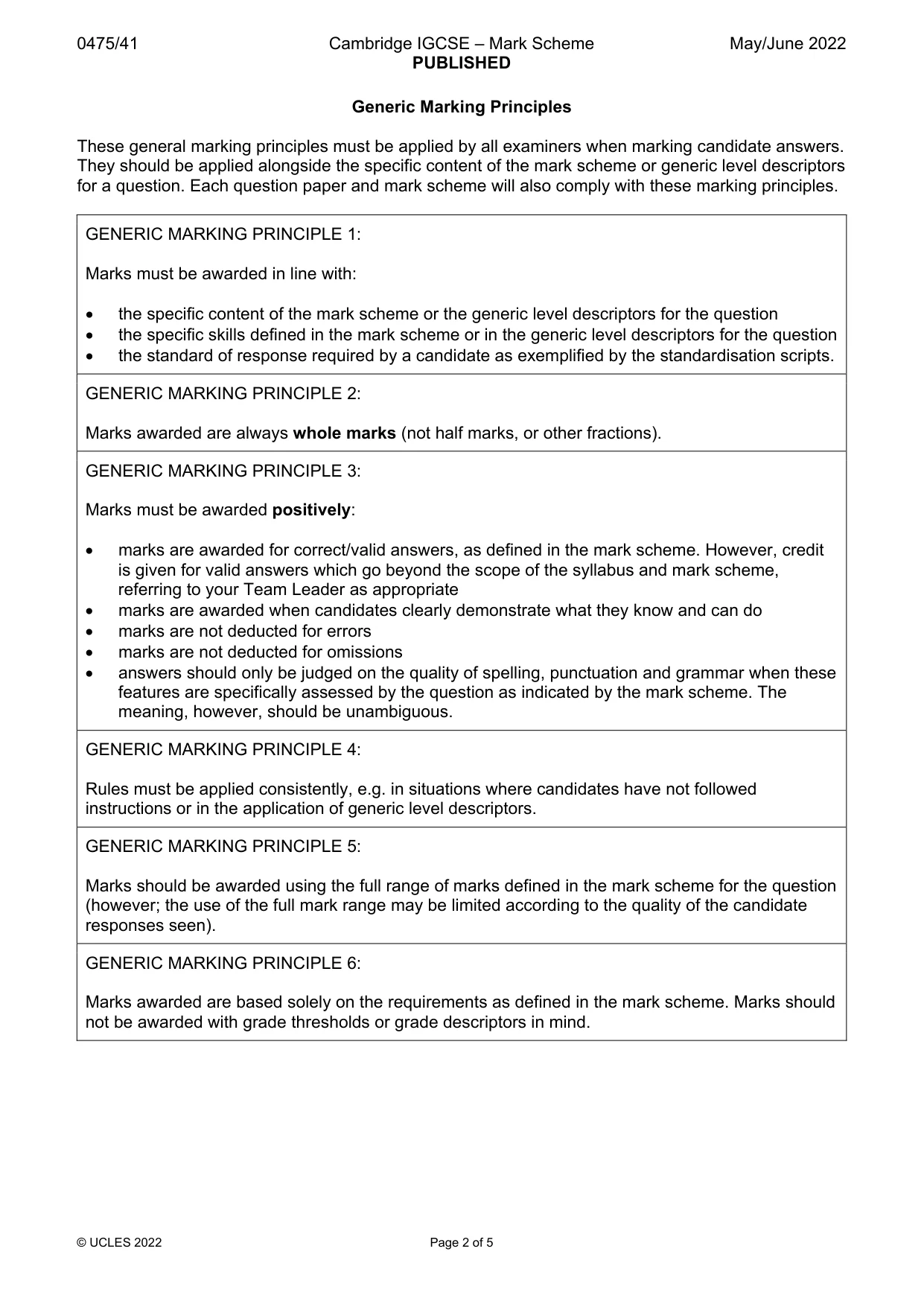
0475/41 Cambridge IGCSE – Mark Scheme PUBLISHED May/June 2022 © UCLES 2022 Page 2 of 5 Generic Marking Principles These general marking principles must be applied by all examiners when marking candidate answers. They should be applied alongside the specific content of the mark scheme or generic level descriptors for a question. Each question paper and mark scheme will also comply with these marking principles. GENERIC MARKING PRINCIPLE 1: Marks must be awarded in line with: the specific content of the mark scheme or the generic level descriptors for the question the specific skills defined in the mark scheme or in the generic level descriptors for the question the standard of response required by a candidate as exemplified by the standardisation scripts. GENERIC MARKING PRINCIPLE 2: Marks awarded are always whole marks (not half marks, or other fractions). GENERIC MARKING PRINCIPLE 3: Marks must be awarded positively: marks are awarded for correct/valid answers, as defined in the mark scheme. However, credit is given for valid answers which go beyond the scope of the syllabus and mark scheme, referring to your Team Leader as appropriate marks are awarded when candidates clearly demonstrate what they know and can do marks are not deducted for errors marks are not deducted for omissions answers should only be judged on the quality of spelling, punctuation and grammar when these features are specifically assessed by the question as indicated by the mark scheme. The meaning, however, should be unambiguous. GENERIC MARKING PRINCIPLE 4: Rules must be applied consistently, e.g. in situations where candidates have not followed instructions or in the application of generic level descriptors. GENERIC MARKING PRINCIPLE 5: Marks should be awarded using the full range of marks defined in the mark scheme for the question (however; the use of the full mark range may be limited according to the quality of the candidate responses seen). GENERIC MARKING PRINCIPLE 6: Marks awarded are based solely on the requirements as defined in the mark scheme. Marks should not be awarded with grade thresholds or grade descriptors in mind.
Mark scheme, page 3
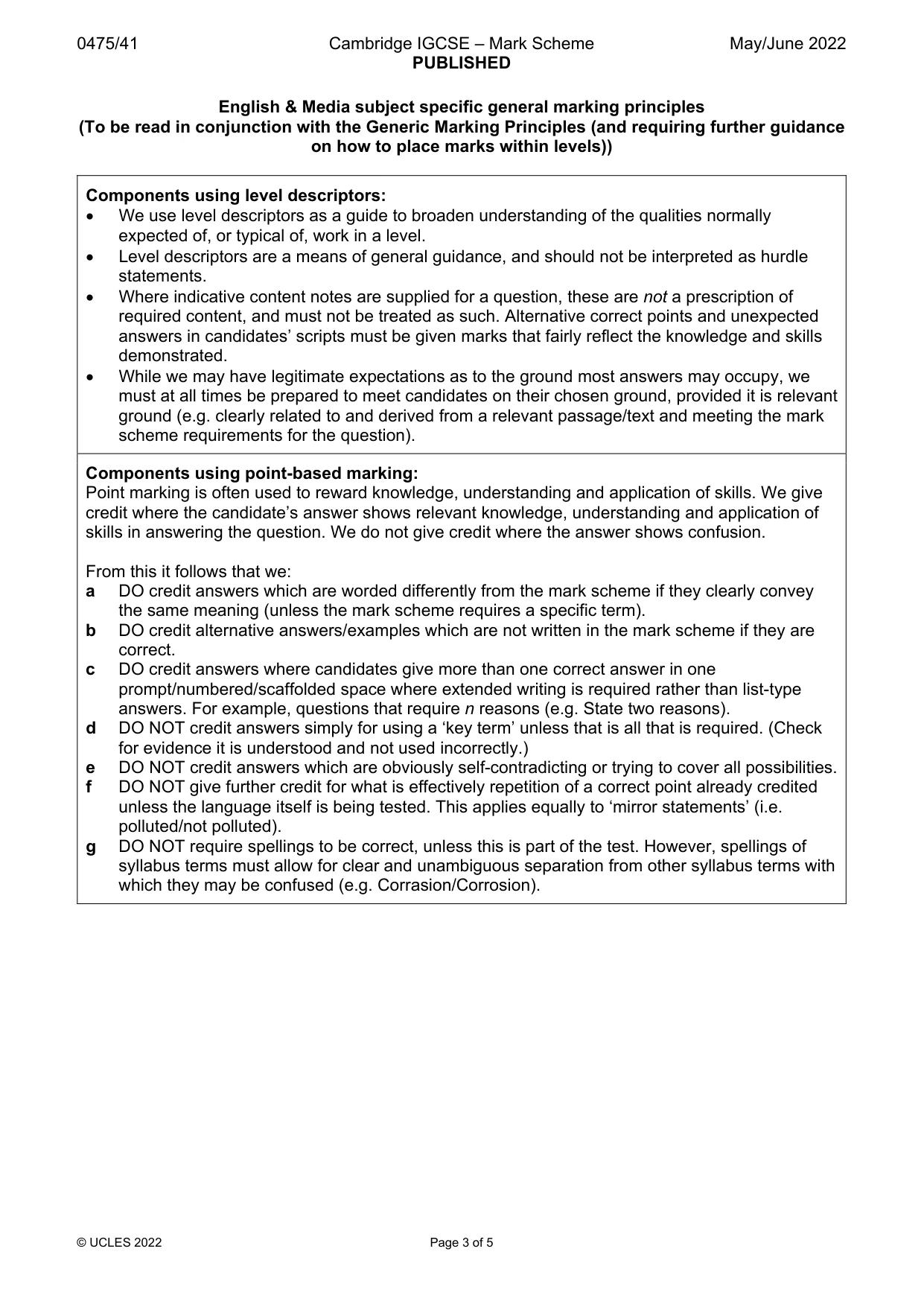
0475/41 Cambridge IGCSE – Mark Scheme PUBLISHED May/June 2022 © UCLES 2022 Page 3 of 5 English & Media subject specific general marking principles (To be read in conjunction with the Generic Marking Principles (and requiring further guidance on how to place marks within levels)) Components using level descriptors: We use level descriptors as a guide to broaden understanding of the qualities normally expected of, or typical of, work in a level. Level descriptors are a means of general guidance, and should not be interpreted as hurdle statements. Where indicative content notes are supplied for a question, these are not a prescription of required content, and must not be treated as such. Alternative correct points and unexpected answers in candidates’ scripts must be given marks that fairly reflect the knowledge and skills demonstrated. While we may have legitimate expectations as to the ground most answers may occupy, we must at all times be prepared to meet candidates on their chosen ground, provided it is relevant ground (e.g. clearly related to and derived from a relevant passage/text and meeting the mark scheme requirements for the question). Components using point-based marking: Point marking is often used to reward knowledge, understanding and application of skills. We give credit where the candidate’s answer shows relevant knowledge, understanding and application of skills in answering the question. We do not give credit where the answer shows confusion. From this it follows that we: a DO credit answers which are worded differently from the mark scheme if they clearly convey the same meaning (unless the mark scheme requires a specific term). b DO credit alternative answers/examples which are not written in the mark scheme if they are correct. c DO credit answers where candidates give more than one correct answer in one prompt/numbered/scaffolded space where extended writing is required rather than list-type answers. For example, questions that require n reasons (e.g. State two reasons). d DO NOT credit answers simply for using a ‘key term’ unless that is all that is required. (Check for evidence it is understood and not used incorrectly.) e DO NOT credit answers which are obviously self-contradicting or trying to cover all possibilities. f DO NOT give further credit for what is effectively repetition of a correct point already credited unless the language itself is being tested. This applies equally to ‘mirror statements’ (i.e. polluted/not polluted). g DO NOT require spellings to be correct, unless this is part of the test. However, spellings of syllabus terms must allow for clear and unambiguous separation from other syllabus terms with which they may be confused (e.g. Corrasion/Corrosion).
Mark scheme, page 4
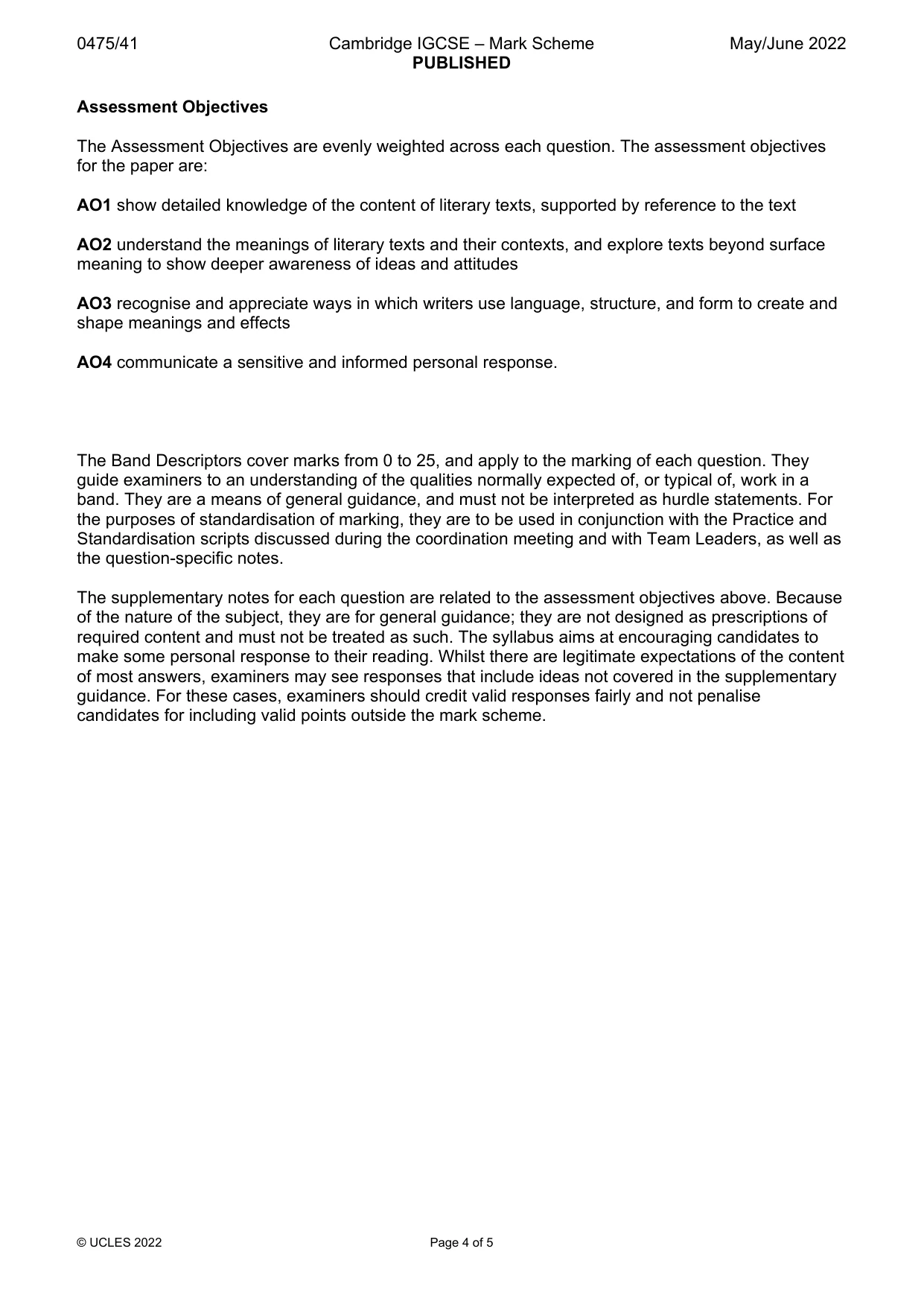
0475/41 Cambridge IGCSE – Mark Scheme PUBLISHED May/June 2022 © UCLES 2022 Page 4 of 5 Assessment Objectives The Assessment Objectives are evenly weighted across each question. The assessment objectives for the paper are: AO1 show detailed knowledge of the content of literary texts, supported by reference to the text AO2 understand the meanings of literary texts and their contexts, and explore texts beyond surface meaning to show deeper awareness of ideas and attitudes AO3 recognise and appreciate ways in which writers use language, structure, and form to create and shape meanings and effects AO4 communicate a sensitive and informed personal response. The Band Descriptors cover marks from 0 to 25, and apply to the marking of each question. They guide examiners to an understanding of the qualities normally expected of, or typical of, work in a band. They are a means of general guidance, and must not be interpreted as hurdle statements. For the purposes of standardisation of marking, they are to be used in conjunction with the Practice and Standardisation scripts discussed during the coordination meeting and with Team Leaders, as well as the question-specific notes. The supplementary notes for each question are related to the assessment objectives above. Because of the nature of the subject, they are for general guidance; they are not designed as prescriptions of required content and must not be treated as such. The syllabus aims at encouraging candidates to make some personal response to their reading. Whilst there are legitimate expectations of the content of most answers, examiners may see responses that include ideas not covered in the supplementary guidance. For these cases, examiners should credit valid responses fairly and not penalise candidates for including valid points outside the mark scheme.
Mark scheme, page 5
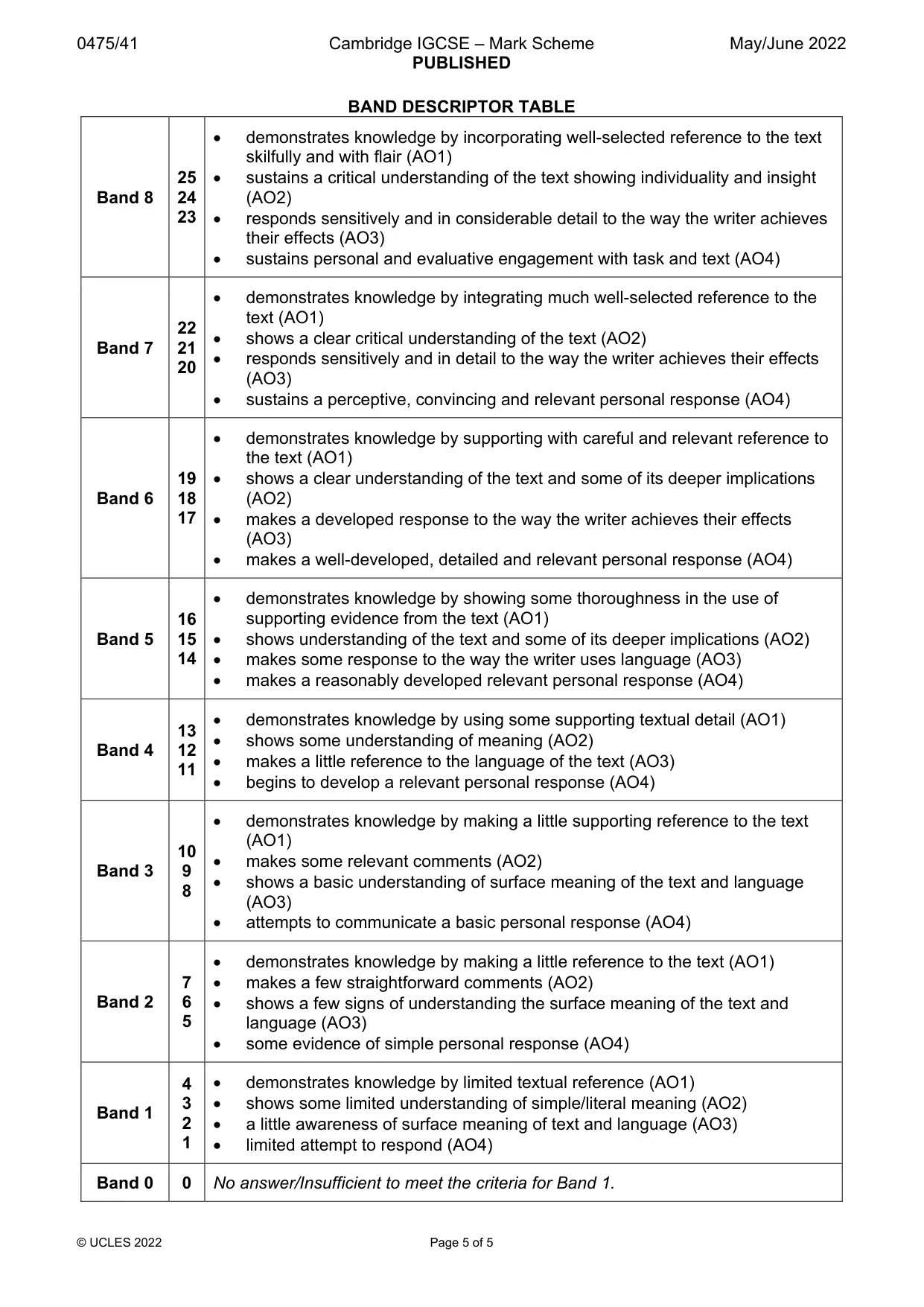
0475/41 Cambridge IGCSE – Mark Scheme PUBLISHED May/June 2022 © UCLES 2022 Page 5 of 5 BAND DESCRIPTOR TABLE Band 8 25 24 23 demonstrates knowledge by incorporating well-selected reference to the text skilfully and with flair (AO1) sustains a critical understanding of the text showing individuality and insight (AO2) responds sensitively and in considerable detail to the way the writer achieves their effects (AO3) sustains personal and evaluative engagement with task and text (AO4) Band 7 22 21 20 demonstrates knowledge by integrating much well-selected reference to the text (AO1) shows a clear critical understanding of the text (AO2) responds sensitively and in detail to the way the writer achieves their effects (AO3) sustains a perceptive, convincing and relevant personal response (AO4) Band 6 19 18 17 demonstrates knowledge by supporting with careful and relevant reference to the text (AO1) shows a clear understanding of the text and some of its deeper implications (AO2) makes a developed response to the way the writer achieves their effects (AO3) makes a well-developed, detailed and relevant personal response (AO4) Band 5 16 15 14 demonstrates knowledge by showing some thoroughness in the use of supporting evidence from the text (AO1) shows understanding of the text and some of its deeper implications (AO2) makes some response to the way the writer uses language (AO3) makes a reasonably developed relevant personal response (AO4) Band 4 13 12 11 demonstrates knowledge by using some supporting textual detail (AO1) shows some understanding of meaning (AO2) makes a little reference to the language of the text (AO3) begins to develop a relevant personal response (AO4) Band 3 10 9 8 demonstrates knowledge by making a little supporting reference to the text (AO1) makes some relevant comments (AO2) shows a basic understanding of surface meaning of the text and language (AO3) attempts to communicate a basic personal response (AO4) Band 2 7 6 5 demonstrates knowledge by making a little reference to the text (AO1) makes a few straightforward comments (AO2) shows a few signs of understanding the surface meaning of the text and language (AO3) some evidence of simple personal response (AO4) Band 1 4 3 2 1 demonstrates knowledge by limited textual reference (AO1) shows some limited understanding of simple/literal meaning (AO2) a little awareness of surface meaning of text and language (AO3) limited attempt to respond (AO4) Band 0 0 No answer/Insufficient to meet the criteria for Band 1.
What you needed in this session
Cambridge’s own grade thresholds for 2022 May/June, Paper 4 · Variant 1. A higher threshold means an easier paper — the bar moves with how the cohort did.