Cambridge IGCSE English - Literature in English 0475 — 2022 May/June Paper 2 · Variant 1
0475/21/M/J/22 · 50 marks · ≈56 min
The question paper and its mark scheme, free to read here and free to download. This is Cambridge’s own paper, exactly as it was sat.
Question paper12 pages
Mark scheme5 pages
Answers below. Sit the paper first if you are practising.
Paper as text
Question paper, page 1
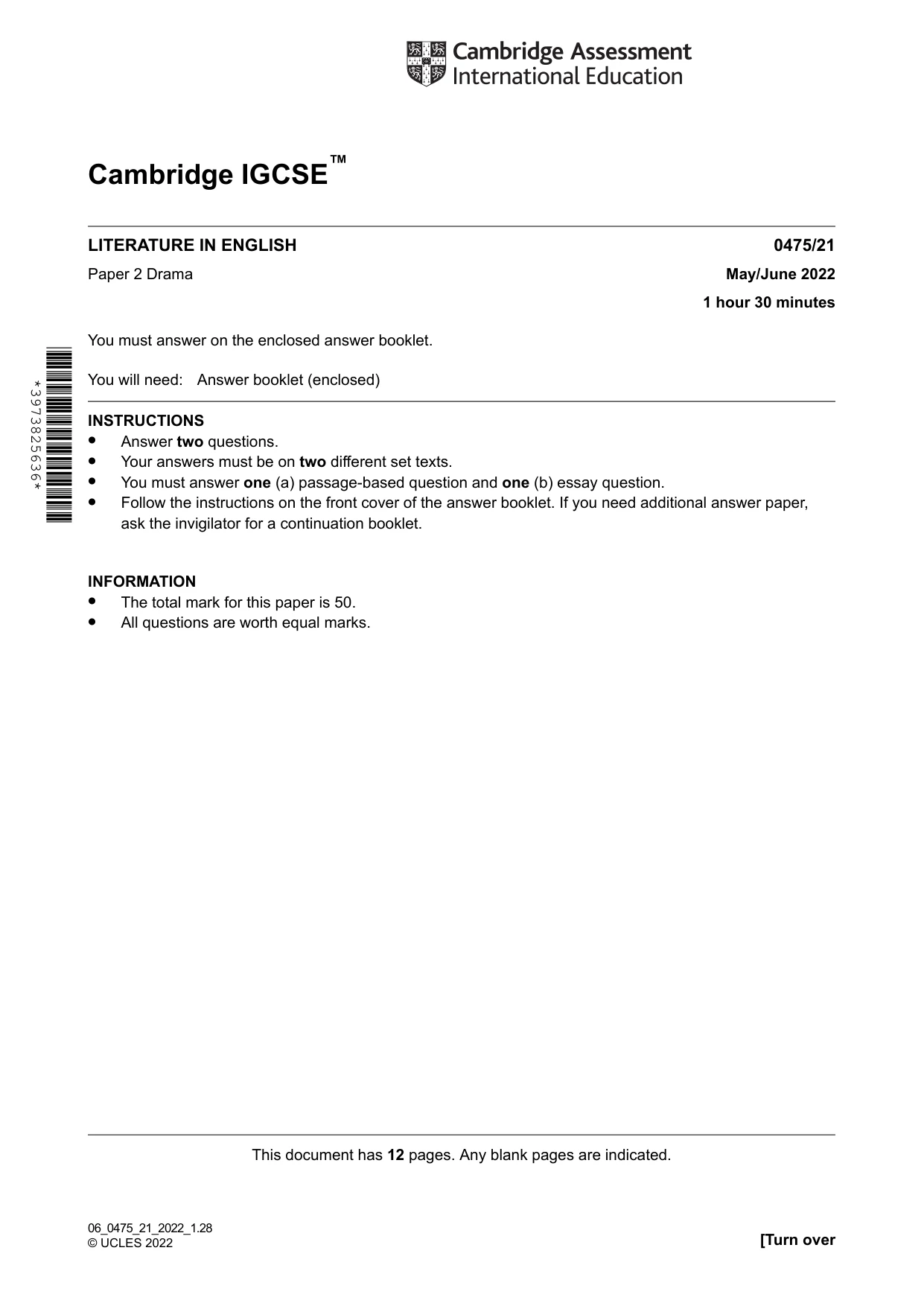
Cambridge IGCSE™ 0475/21 LITERATURE IN ENGLISH May/June 2022 Paper 2 Drama 1 hour 30 minutes You must answer on the enclosed answer booklet. You will need: Answer booklet (enclosed) INSTRUCTIONS • Answer two questions. • Your answers must be on two different set texts. • You must answer one (a) passage-based question and one (b) essay question. • Follow the instructions on the front cover of the answer booklet. If you need additional answer paper, ask the invigilator for a continuation booklet. INFORMATION • The total mark for this paper is 50. • All questions are worth equal marks. This document has 12 pages. Any blank pages are indicated. [Turn over 06_0475_21_2022_1.28 © UCLES 2022 *3973825636*
Question paper, page 2
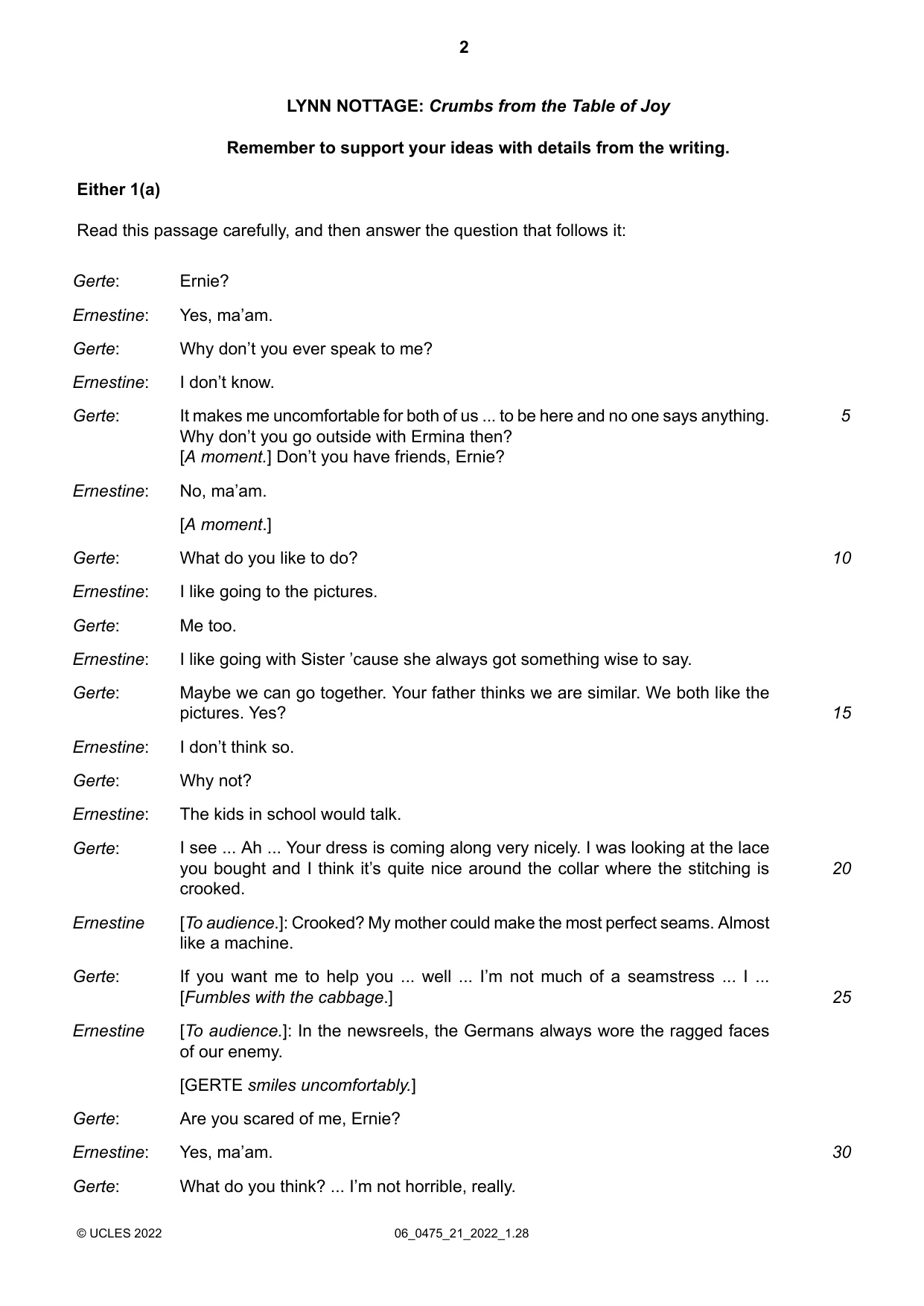
30 25 20 15 10 5 LYNN NOTTAGE: Crumbs from the Table of Joy Remember to support your ideas with details from the writing. Either 1(a) Read this passage carefully, and then answer the question that follows it: Ernie? Gerte: Yes, ma’am. Ernestine: Why don’t you ever speak to me? Gerte: I don’t know. Ernestine: It makes me uncomfortable for both of us ... to be here and no one says anything. Why don’t you go outside with Ermina then? [A moment.] Don’t you have friends, Ernie? Gerte: No, ma’am. Ernestine: [A moment.] What do you like to do? Gerte: I like going to the pictures. Ernestine: Μe too. Gerte: I like going with Sister ’cause she always got something wise to say. Ernestine: Maybe we can go together. Your father thinks we are similar. We both like the pictures. Yes? Gerte: I don’t think so. Ernestine: Why not? Gerte: The kids in school would talk. Ernestine: I see ... Ah ... Your dress is coming along very nicely. I was looking at the lace you bought and I think it’s quite nice around the collar where the stitching is crooked. Gerte: [To audience.]: Crooked? My mother could make the most perfect seams. Almost like a machine. Ernestine If you want me to help you ... well ... I’m not much of a seamstress ... I ... [Fumbles with the cabbage.] Gerte: [To audience.]: In the newsreels, the Germans always wore the ragged faces of our enemy. Ernestine [GERTE smiles uncomfortably.] Are you scared of me, Ernie? Gerte: Yes, ma’am. Ernestine: What do you think? ... I’m not horrible, really. Gerte: 06_0475_21_2022_1.28 © UCLES 2022 2
Question paper, page 3
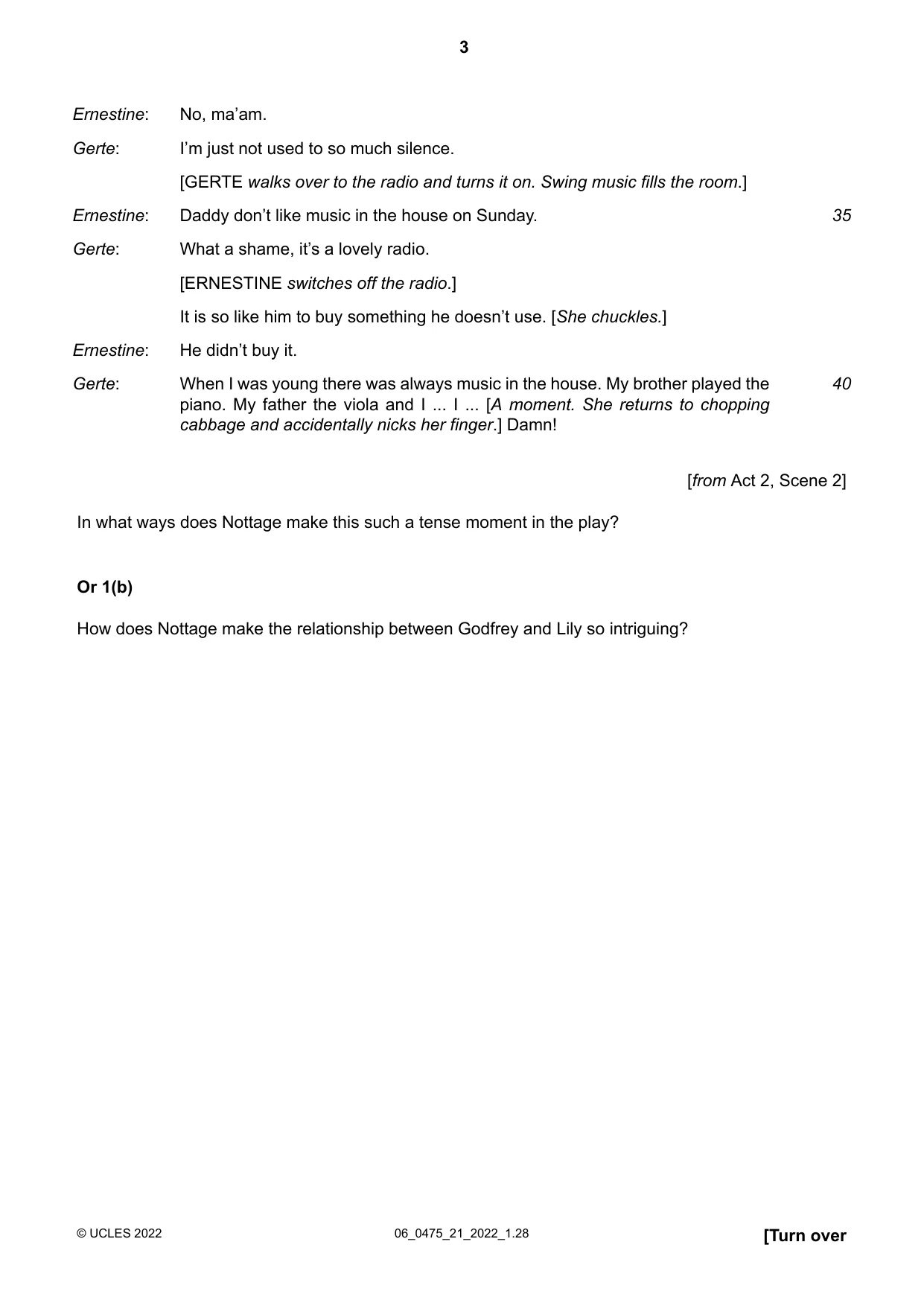
40 35 No, ma’am. Ernestine: I’m just not used to so much silence. Gerte: [GERTE walks over to the radio and turns it on. Swing music fills the room.] Daddy don’t like music in the house on Sunday. Ernestine: What a shame, it’s a lovely radio. Gerte: [ERNESTINE switches off the radio.] It is so like him to buy something he doesn’t use. [She chuckles.] He didn’t buy it. Ernestine: When I was young there was always music in the house. My brother played the piano. My father the viola and I ... I ... [A moment. She returns to chopping cabbage and accidentally nicks her finger.] Damn! Gerte: [from Act 2, Scene 2] In what ways does Nottage make this such a tense moment in the play? Or 1(b) How does Nottage make the relationship between Godfrey and Lily so intriguing? [Turn over 06_0475_21_2022_1.28 © UCLES 2022 3
Question paper, page 4
ARTHUR MILLER: The Crucible Remember to support your ideas with details from the writing. Either 2(a) Read this passage carefully, and then answer the question that follows it: Mr Proctor – Danforth: 06_0475_21_2022_1.28 © UCLES 2022 4 Content removed due to copyright restrictions.
Question paper, page 5
ELIZABETH stands staring at the empty doorway.] [from Act 4] How does Miller make this moment such a moving climax to the play? Or 2(b) To what extent does Miller’s portrayal of the girls in the play make you angry with them? [Turn over 06_0475_21_2022_1.28 © UCLES 2022 5 Content removed due to copyright restrictions.
Question paper, page 6
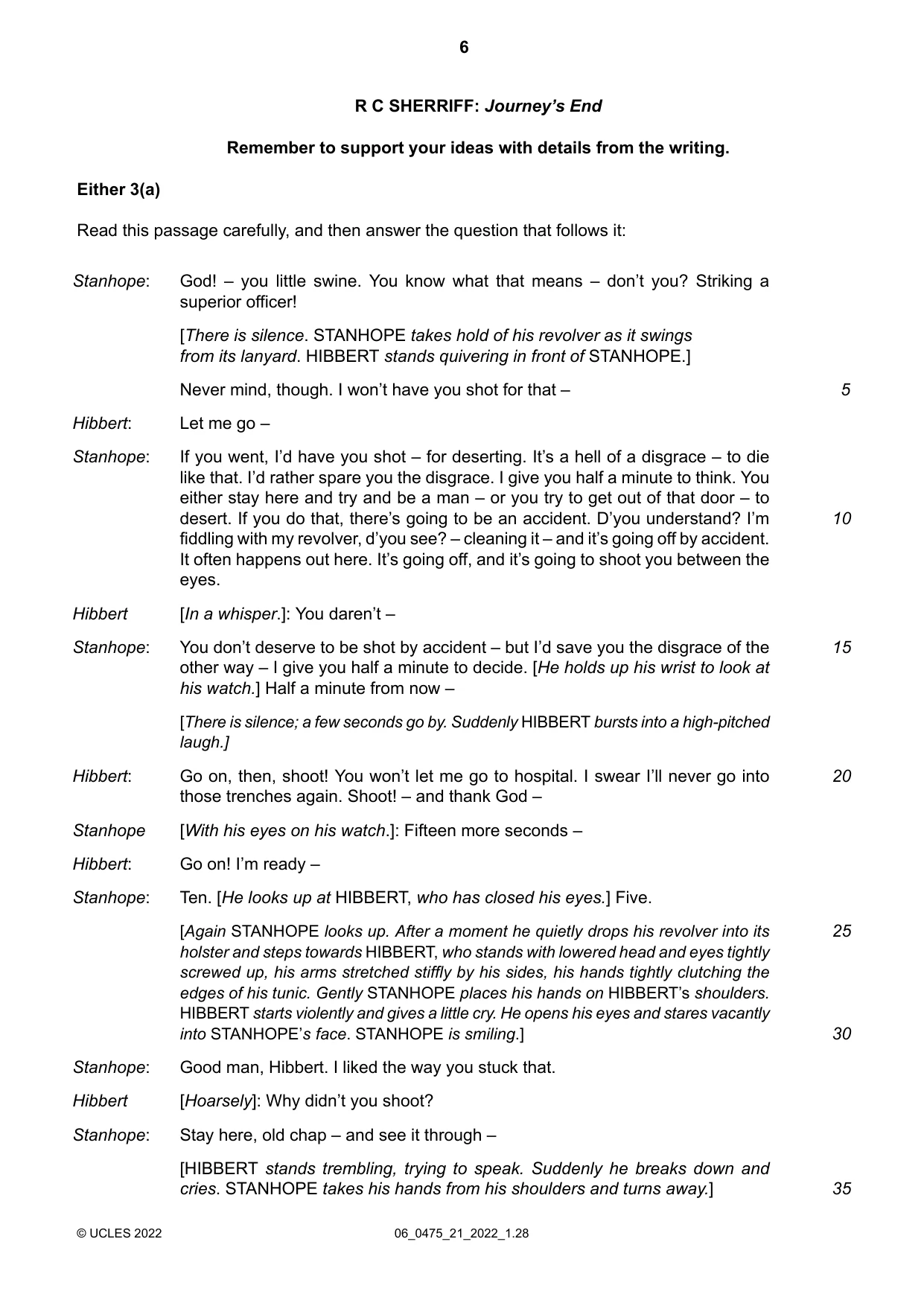
35 30 25 20 15 10 5 R C SHERRIFF: Journey’s End Remember to support your ideas with details from the writing. Either 3(a) Read this passage carefully, and then answer the question that follows it: God! – you little swine. You know what that means – don’t you? Striking a superior officer! Stanhope: [There is silence. STANHOPE takes hold of his revolver as it swings from its lanyard. HIBBERT stands quivering in front of STANHOPE.] Never mind, though. I won’t have you shot for that – Let me go – Hibbert: If you went, I’d have you shot – for deserting. It’s a hell of a disgrace – to die like that. I’d rather spare you the disgrace. I give you half a minute to think. You either stay here and try and be a man – or you try to get out of that door – to desert. If you do that, there’s going to be an accident. D’you understand? I’m fiddling with my revolver, d’you see? – cleaning it – and it’s going off by accident. It often happens out here. It’s going off, and it’s going to shoot you between the eyes. Stanhope: [In a whisper.]: You daren’t – Hibbert You don’t deserve to be shot by accident – but I’d save you the disgrace of the other way – I give you half a minute to decide. [He holds up his wrist to look at his watch.] Half a minute from now – Stanhope: [There is silence; a few seconds go by. Suddenly HIBBERT bursts into a high-pitched laugh.] Go on, then, shoot! You won’t let me go to hospital. I swear I’ll never go into those trenches again. Shoot! – and thank God – Hibbert: [With his eyes on his watch.]: Fifteen more seconds – Stanhope Go on! I’m ready – Hibbert: Ten. [He looks up at HIBBERT, who has closed his eyes.] Five. Stanhope: [Again STANHOPE looks up. After a moment he quietly drops his revolver into its holster and steps towards HIBBERT, who stands with lowered head and eyes tightly screwed up, his arms stretched stiffly by his sides, his hands tightly clutching the edges of his tunic. Gently STANHOPE places his hands on HIBBERT’s shoulders. HIBBERT starts violently and gives a little cry. He opens his eyes and stares vacantly into STANHOPE’s face. STANHOPE is smiling.] Good man, Hibbert. I liked the way you stuck that. Stanhope: [Hoarsely]: Why didn’t you shoot? Hibbert Stay here, old chap – and see it through – Stanhope: [HIBBERT stands trembling, trying to speak. Suddenly he breaks down and cries. STANHOPE takes his hands from his shoulders and turns away.] 06_0475_21_2022_1.28 © UCLES 2022 6
Question paper, page 7
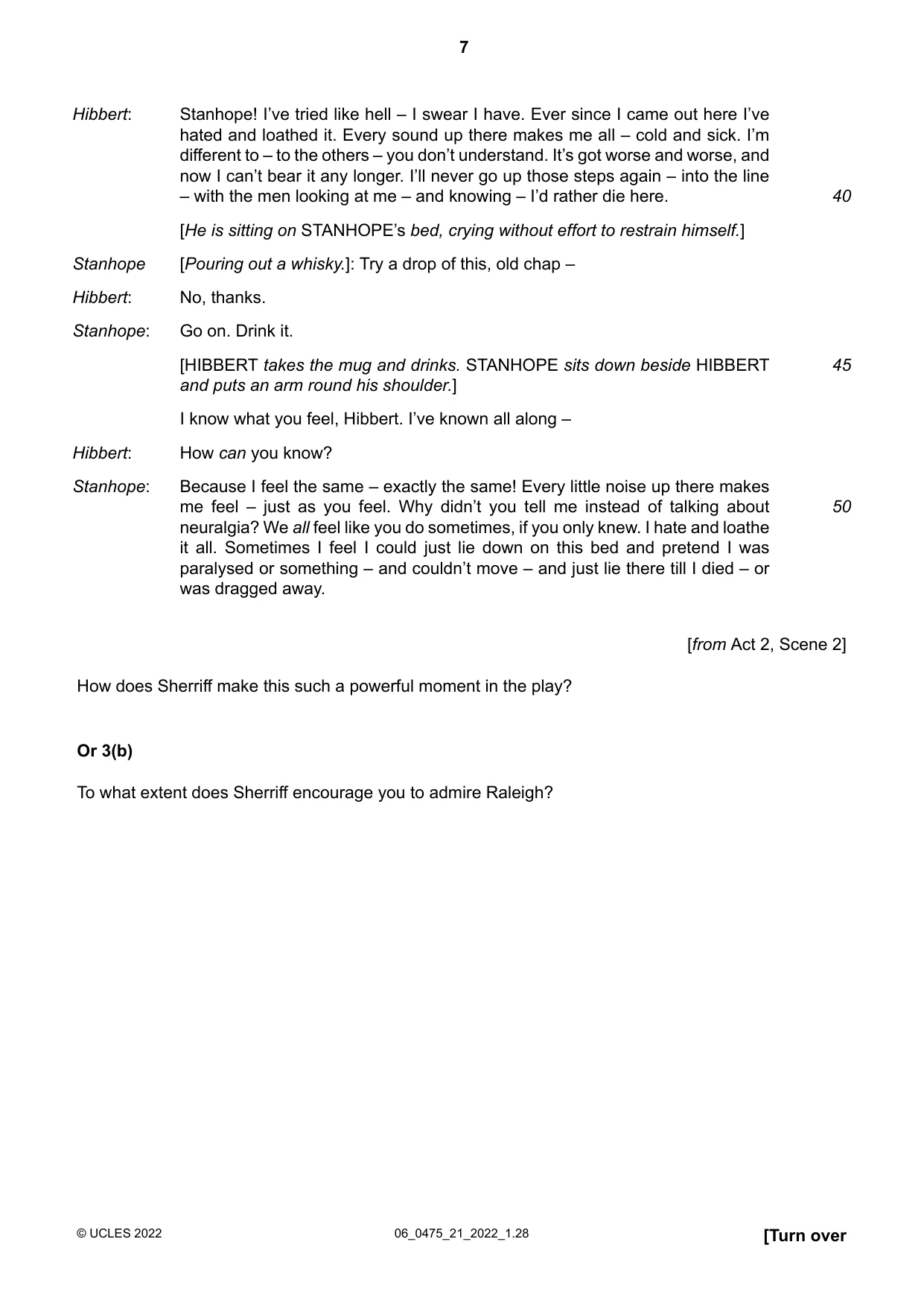
50 45 40 Stanhope! I’ve tried like hell – I swear I have. Ever since I came out here I’ve hated and loathed it. Every sound up there makes me all – cold and sick. I’m different to – to the others – you don’t understand. It’s got worse and worse, and now I can’t bear it any longer. I’ll never go up those steps again – into the line – with the men looking at me – and knowing – I’d rather die here. Hibbert: [He is sitting on STANHOPE’s bed, crying without effort to restrain himself.] [Pouring out a whisky.]: Try a drop of this, old chap – Stanhope No, thanks. Hibbert: Go on. Drink it. Stanhope: [HIBBERT takes the mug and drinks. STANHOPE sits down beside HIBBERT and puts an arm round his shoulder.] I know what you feel, Hibbert. I’ve known all along – How can you know? Hibbert: Because I feel the same – exactly the same! Every little noise up there makes me feel – just as you feel. Why didn’t you tell me instead of talking about neuralgia? We all feel like you do sometimes, if you only knew. I hate and loathe it all. Sometimes I feel I could just lie down on this bed and pretend I was paralysed or something – and couldn’t move – and just lie there till I died – or was dragged away. Stanhope: [from Act 2, Scene 2] How does Sherriff make this such a powerful moment in the play? Or 3(b) To what extent does Sherriff encourage you to admire Raleigh? [Turn over 06_0475_21_2022_1.28 © UCLES 2022 7
Question paper, page 8
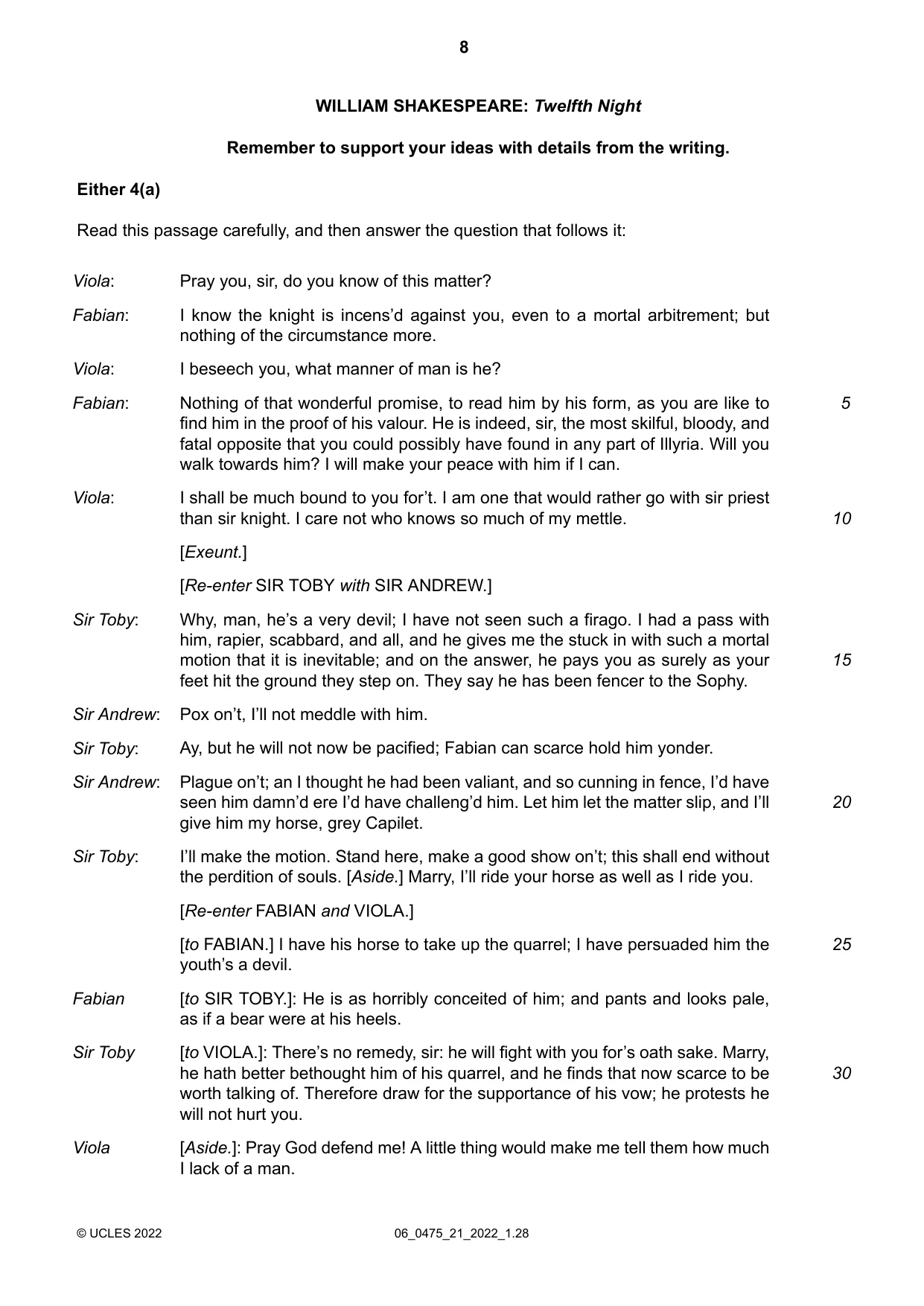
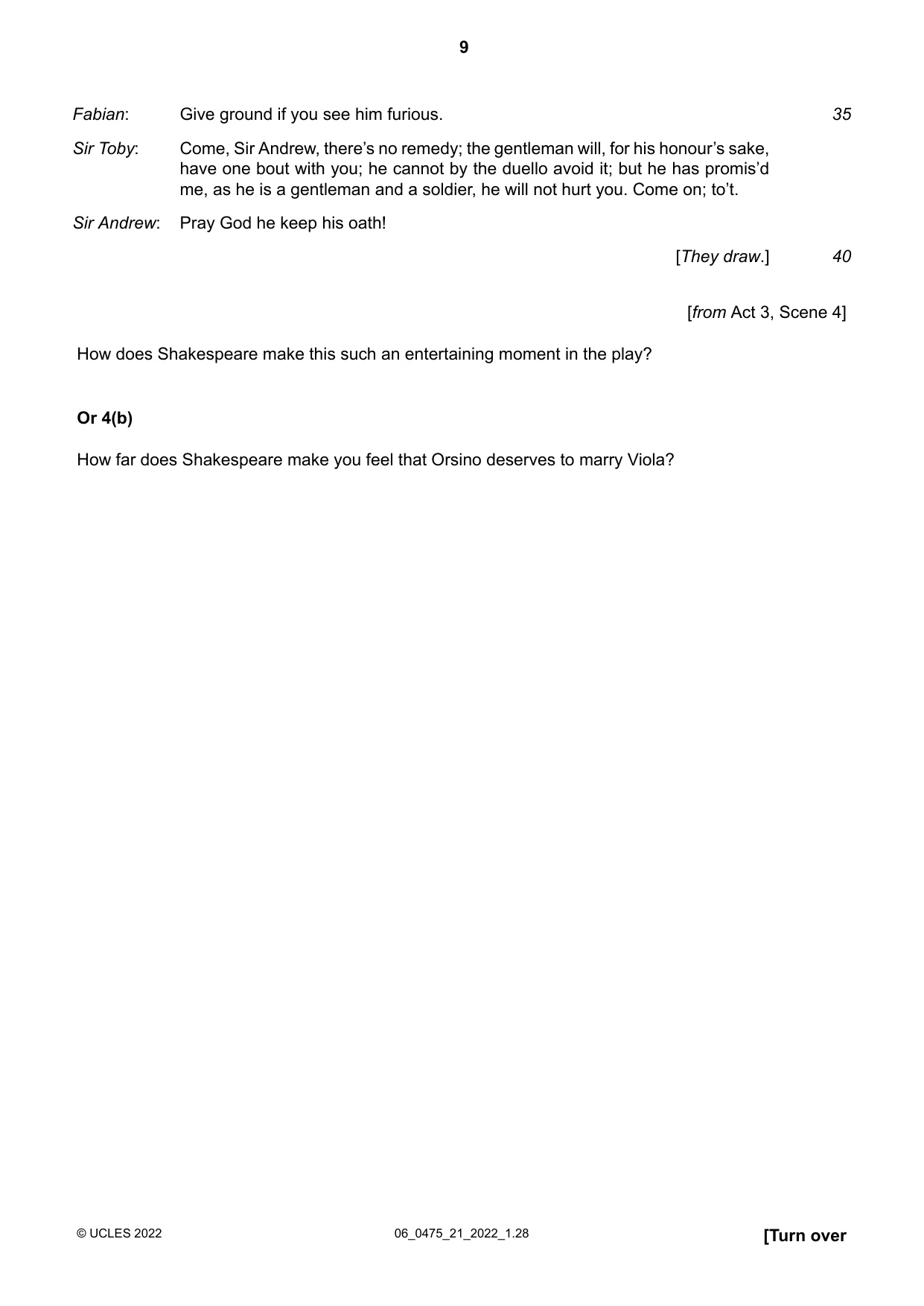
30 25 20 15 10 5 WILLIAM SHAKESPEARE: Twelfth Night Remember to support your ideas with details from the writing. Either 4(a) Read this passage carefully, and then answer the question that follows it: Pray you, sir, do you know of this matter? Viola: I know the knight is incens’d against you, even to a mortal arbitrement; but nothing of the circumstance more. Fabian: I beseech you, what manner of man is he? Viola: Nothing of that wonderful promise, to read him by his form, as you are like to find him in the proof of his valour. He is indeed, sir, the most skilful, bloody, and fatal opposite that you could possibly have found in any part of Illyria. Will you walk towards him? I will make your peace with him if I can. Fabian: I shall be much bound to you for’t. I am one that would rather go with sir priest than sir knight. I care not who knows so much of my mettle. Viola: [Exeunt.] [Re-enter SIR TOBY with SIR ANDREW.] Why, man, he’s a very devil; I have not seen such a firago. I had a pass with him, rapier, scabbard, and all, and he gives me the stuck in with such a mortal motion that it is inevitable; and on the answer, he pays you as surely as your feet hit the ground they step on. They say he has been fencer to the Sophy. Sir Toby: Pox on’t, I’ll not meddle with him. Sir Andrew: Ay, but he will not now be pacified; Fabian can scarce hold him yonder. Sir Toby: Plague on’t; an I thought he had been valiant, and so cunning in fence, I’d have seen him damn’d ere I’d have challeng’d him. Let him let the matter slip, and I’ll give him my horse, grey Capilet. Sir Andrew: I’ll make the motion. Stand here, make a good show on’t; this shall end without the perdition of souls. [Aside.] Marry, I’ll ride your horse as well as I ride you. Sir Toby: [Re-enter FABIAN and VIOLA.] [to FABIAN.] I have his horse to take up the quarrel; I have persuaded him the youth’s a devil. [to SIR TOBY.]: He is as horribly conceited of him; and pants and looks pale, as if a bear were at his heels. Fabian [to VIOLA.]: There’s no remedy, sir: he will fight with you for’s oath sake. Marry, he hath better bethought him of his quarrel, and he finds that now scarce to be worth talking of. Therefore draw for the supportance of his vow; he protests he will not hurt you. Sir Toby [Aside.]: Pray God defend me! A little thing would make me tell them how much I lack of a man. Viola 06_0475_21_2022_1.28 © UCLES 2022 8
Question paper, page 9
40 35 Give ground if you see him furious. Fabian: Come, Sir Andrew, there’s no remedy; the gentleman will, for his honour’s sake, have one bout with you; he cannot by the duello avoid it; but he has promis’d me, as he is a gentleman and a soldier, he will not hurt you. Come on; to’t. Sir Toby: Pray God he keep his oath! Sir Andrew: [They draw.] [from Act 3, Scene 4] How does Shakespeare make this such an entertaining moment in the play? Or 4(b) How far does Shakespeare make you feel that Orsino deserves to marry Viola? [Turn over 06_0475_21_2022_1.28 © UCLES 2022 9
Question paper, page 10
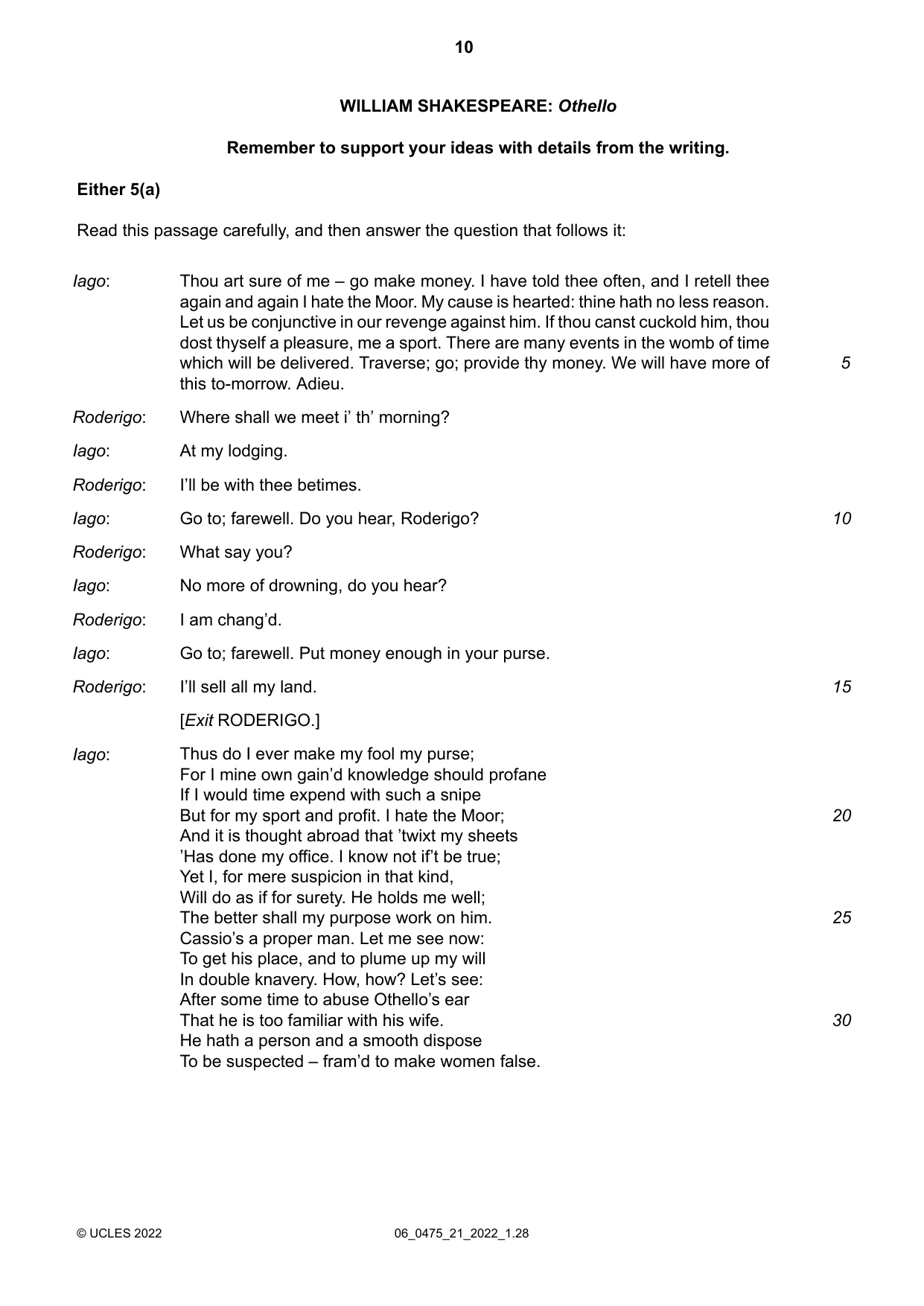
30 25 20 15 10 5 WILLIAM SHAKESPEARE: Othello Remember to support your ideas with details from the writing. Either 5(a) Read this passage carefully, and then answer the question that follows it: Thou art sure of me – go make money. I have told thee often, and I retell thee again and again I hate the Moor. My cause is hearted: thine hath no less reason. Let us be conjunctive in our revenge against him. If thou canst cuckold him, thou dost thyself a pleasure, me a sport. There are many events in the womb of time which will be delivered. Traverse; go; provide thy money. We will have more of this to-morrow. Adieu. Iago: Where shall we meet i’ th’ morning? Roderigo: At my lodging. Iago: I’ll be with thee betimes. Roderigo: Go to; farewell. Do you hear, Roderigo? Iago: What say you? Roderigo: No more of drowning, do you hear? Iago: I am chang’d. Roderigo: Go to; farewell. Put money enough in your purse. Iago: I’ll sell all my land. Roderigo: [Exit RODERIGO.] Thus do I ever make my fool my purse; For I mine own gain’d knowledge should profane If I would time expend with such a snipe But for my sport and profit. I hate the Moor; And it is thought abroad that ’twixt my sheets ’Has done my office. I know not if’t be true; Yet I, for mere suspicion in that kind, Will do as if for surety. He holds me well; The better shall my purpose work on him. Cassio’s a proper man. Let me see now: To get his place, and to plume up my will In double knavery. How, how? Let’s see: After some time to abuse Othello’s ear That he is too familiar with his wife. He hath a person and a smooth dispose To be suspected – fram’d to make women false. Iago: 06_0475_21_2022_1.28 © UCLES 2022 10
Question paper, page 11
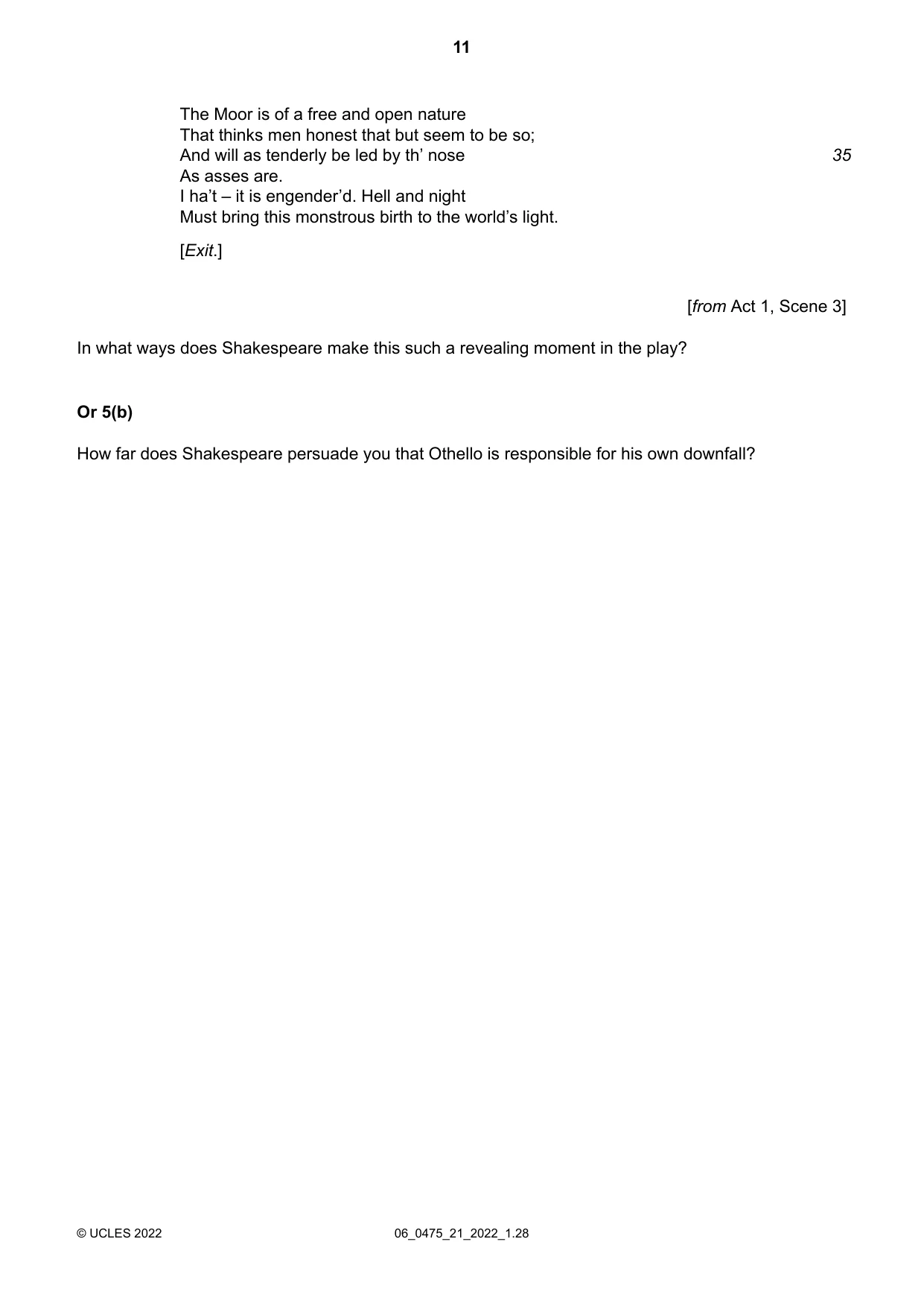
35 The Moor is of a free and open nature That thinks men honest that but seem to be so; And will as tenderly be led by th’ nose As asses are. I ha’t – it is engender’d. Hell and night Must bring this monstrous birth to the world’s light. [Exit.] [from Act 1, Scene 3] In what ways does Shakespeare make this such a revealing moment in the play? Or 5(b) How far does Shakespeare persuade you that Othello is responsible for his own downfall? 06_0475_21_2022_1.28 © UCLES 2022 11
Question paper, page 12
BLANK PAGE Permission to reproduce items where third-party owned material protected by copyright is included has been sought and cleared where possible. Every reasonable effort has been made by the publisher (UCLES) to trace copyright holders, but if any items requiring clearance have unwittingly been included, the publisher will be pleased to make amends at the earliest possible opportunity. To avoid the issue of disclosure of answer-related information to candidates, all copyright acknowledgements are reproduced online in the Cambridge Assessment International Education Copyright Acknowledgements Booklet. This is produced for each series of examinations and is freely available to download at www.cambridgeinternational.org after the live examination series. Cambridge Assessment International Education is part of Cambridge Assessment. Cambridge Assessment is the brand name of the University of Cambridge Local Examinations Syndicate (UCLES), which is a department of the University of Cambridge. 06_0475_21_2022_1.28 © UCLES 2022 12
Mark scheme, page 1
This document consists of 5 printed pages. © UCLES 2022 [Turn over Cambridge IGCSE™ LITERATURE IN ENGLISH 0475/21 Paper 2 Drama 21 May/June 2022 MARK SCHEME Maximum Mark: 50 Published This mark scheme is published as an aid to teachers and candidates, to indicate the requirements of the examination. It shows the basis on which Examiners were instructed to award marks. It does not indicate the details of the discussions that took place at an Examiners’ meeting before marking began, which would have considered the acceptability of alternative answers. Mark schemes should be read in conjunction with the question paper and the Principal Examiner Report for Teachers. Cambridge International will not enter into discussions about these mark schemes. Cambridge International is publishing the mark schemes for the May/June 2022 series for most Cambridge IGCSE™, Cambridge International A and AS Level components and some Cambridge O Level components.
Mark scheme, page 2
0475/21 Cambridge IGCSE – Mark Scheme PUBLISHED May/June 2022 © UCLES 2022 Page 2 of 5 Generic Marking Principles These general marking principles must be applied by all examiners when marking candidate answers. They should be applied alongside the specific content of the mark scheme or generic level descriptors for a question. Each question paper and mark scheme will also comply with these marking principles. GENERIC MARKING PRINCIPLE 1: Marks must be awarded in line with: the specific content of the mark scheme or the generic level descriptors for the question the specific skills defined in the mark scheme or in the generic level descriptors for the question the standard of response required by a candidate as exemplified by the standardisation scripts. GENERIC MARKING PRINCIPLE 2: Marks awarded are always whole marks (not half marks, or other fractions). GENERIC MARKING PRINCIPLE 3: Marks must be awarded positively: marks are awarded for correct/valid answers, as defined in the mark scheme. However, credit is given for valid answers which go beyond the scope of the syllabus and mark scheme, referring to your Team Leader as appropriate marks are awarded when candidates clearly demonstrate what they know and can do marks are not deducted for errors marks are not deducted for omissions answers should only be judged on the quality of spelling, punctuation and grammar when these features are specifically assessed by the question as indicated by the mark scheme. The meaning, however, should be unambiguous. GENERIC MARKING PRINCIPLE 4: Rules must be applied consistently, e.g. in situations where candidates have not followed instructions or in the application of generic level descriptors. GENERIC MARKING PRINCIPLE 5: Marks should be awarded using the full range of marks defined in the mark scheme for the question (however; the use of the full mark range may be limited according to the quality of the candidate responses seen). GENERIC MARKING PRINCIPLE 6: Marks awarded are based solely on the requirements as defined in the mark scheme. Marks should not be awarded with grade thresholds or grade descriptors in mind.
Mark scheme, page 3
0475/21 Cambridge IGCSE – Mark Scheme PUBLISHED May/June 2022 © UCLES 2022 Page 3 of 5 English & Media subject specific general marking principles (To be read in conjunction with the Generic Marking Principles (and requiring further guidance on how to place marks within levels)) Components using level descriptors: We use level descriptors as a guide to broad understanding of the qualities normally expected of, or typical of, work in a level. Level descriptors are a means of general guidance, and should not be interpreted as hurdle statements. Where indicative content notes are supplied for a question, these are not a prescription of required content, and must not be treated as such. Alternative correct points and unexpected answers in candidates’ scripts must be given marks that fairly reflect the knowledge and skills demonstrated. While we may have legitimate expectations as to the ground most answers may occupy, we must at all times be prepared to meet candidates on their chosen ground, provided it is relevant ground (e.g. clearly related to and derived from a relevant passage/text and meeting the mark scheme requirements for the question). Components using point-based marking: Point marking is often used to reward knowledge, understanding and application of skills. We give credit where the candidate’s answer shows relevant knowledge, understanding and application of skills in answering the question. We do not give credit where the answer shows confusion. From this it follows that we: a DO credit answers which are worded differently from the mark scheme if they clearly convey the same meaning (unless the mark scheme requires a specific term). b DO credit alternative answers/examples which are not written in the mark scheme if they are correct. c DO credit answers where candidates give more than one correct answer in one prompt/numbered/scaffolded space where extended writing is required rather than list-type answers. For example, questions that require n reasons (e.g. State two reasons…. d DO NOT credit answers simply for using a ‘key term’ unless that is all that is required. (Check for evidence it is understood and not used wrongly.). e DO NOT credit answers which are obviously self-contradicting or trying to cover all possibilities. f DO NOT give further credit for what is effectively repetition of a correct point already credited unless the language itself is being tested. This applies equally to ‘mirror statements’ (i.e. polluted/not polluted). g DO NOT require spellings to be correct, unless this is part of the test. However spellings of syllabus terms must allow for clear and unambiguous separation from other syllabus terms with which they may be confused (e.g. Corrasion/Corrosion).
Mark scheme, page 4
0475/21 Cambridge IGCSE – Mark Scheme PUBLISHED May/June 2022 © UCLES 2022 Page 4 of 5 All questions are marked out of 25. The assessment objectives for the paper are: AO1: show detailed knowledge of the content of literary texts, supported by reference to the text AO2: understand the meanings of literary texts and their contexts, and explore texts beyond surface meanings to show deeper awareness of ideas and attitudes AO3: recognise and appreciate ways in which writers use language, structure and form to create and shape meanings and effects AO4: communicate a sensitive and informed personal response to literary texts. The Level Descriptors cover marks from 0 to 25, and apply to the marking of each question. They guide examiners to an understanding of the qualities normally expected of, or typical of, work in a level. They are a means of general guidance. For the purposes of standardisation of marking, they are to be used in conjunction with examples of candidates’ work and discussed during the examiners’ coordination meeting.
Mark scheme, page 5
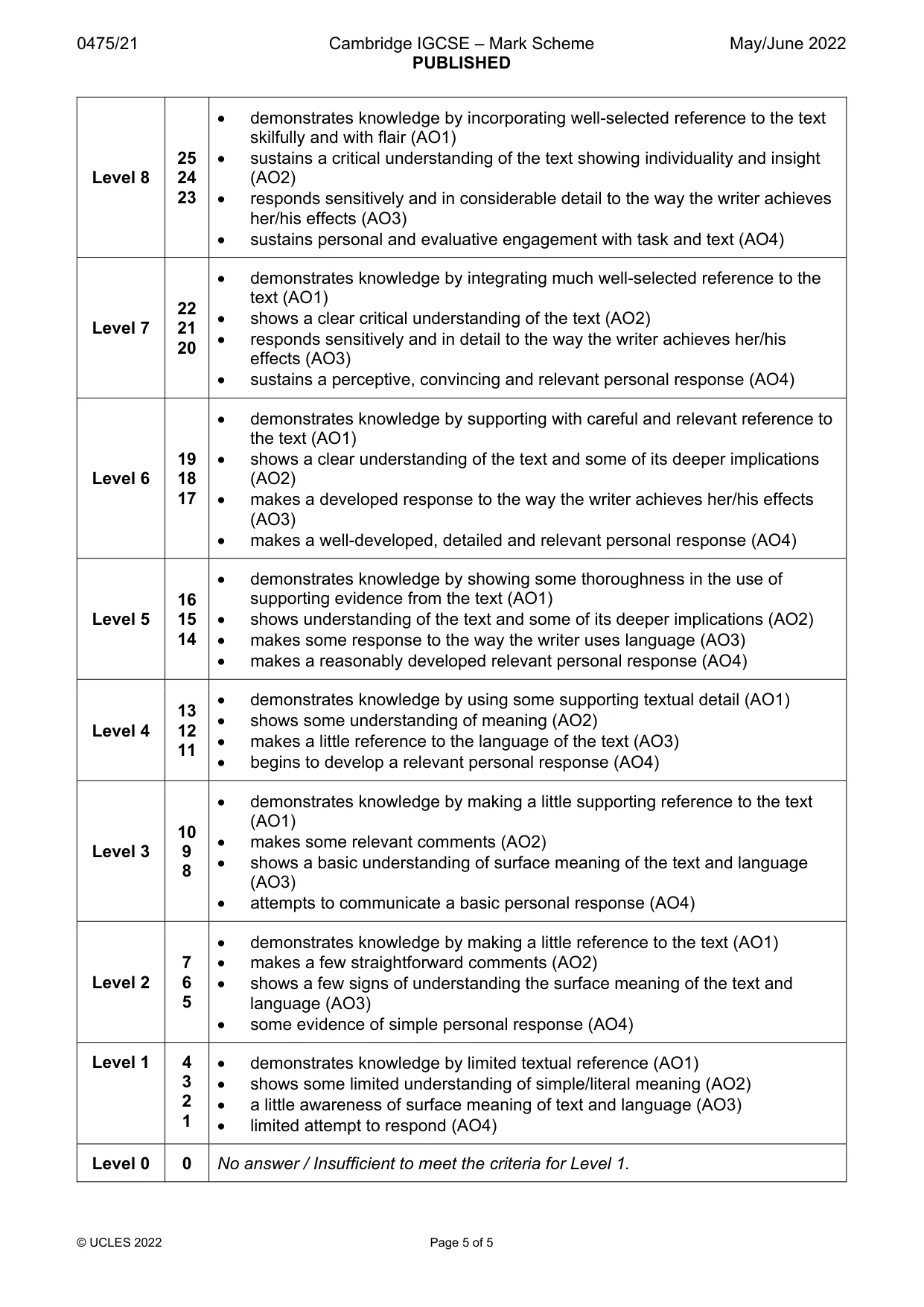
0475/21 Cambridge IGCSE – Mark Scheme PUBLISHED May/June 2022 © UCLES 2022 Page 5 of 5 Level 8 25 24 23 demonstrates knowledge by incorporating well-selected reference to the text skilfully and with flair (AO1) sustains a critical understanding of the text showing individuality and insight (AO2) responds sensitively and in considerable detail to the way the writer achieves her/his effects (AO3) sustains personal and evaluative engagement with task and text (AO4) Level 7 22 21 20 demonstrates knowledge by integrating much well-selected reference to the text (AO1) shows a clear critical understanding of the text (AO2) responds sensitively and in detail to the way the writer achieves her/his effects (AO3) sustains a perceptive, convincing and relevant personal response (AO4) Level 6 19 18 17 demonstrates knowledge by supporting with careful and relevant reference to the text (AO1) shows a clear understanding of the text and some of its deeper implications (AO2) makes a developed response to the way the writer achieves her/his effects (AO3) makes a well-developed, detailed and relevant personal response (AO4) Level 5 16 15 14 demonstrates knowledge by showing some thoroughness in the use of supporting evidence from the text (AO1) shows understanding of the text and some of its deeper implications (AO2) makes some response to the way the writer uses language (AO3) makes a reasonably developed relevant personal response (AO4) Level 4 13 12 11 demonstrates knowledge by using some supporting textual detail (AO1) shows some understanding of meaning (AO2) makes a little reference to the language of the text (AO3) begins to develop a relevant personal response (AO4) Level 3 10 9 8 demonstrates knowledge by making a little supporting reference to the text (AO1) makes some relevant comments (AO2) shows a basic understanding of surface meaning of the text and language (AO3) attempts to communicate a basic personal response (AO4) Level 2 7 6 5 demonstrates knowledge by making a little reference to the text (AO1) makes a few straightforward comments (AO2) shows a few signs of understanding the surface meaning of the text and language (AO3) some evidence of simple personal response (AO4) Level 1 4 3 2 1 demonstrates knowledge by limited textual reference (AO1) shows some limited understanding of simple/literal meaning (AO2) a little awareness of surface meaning of text and language (AO3) limited attempt to respond (AO4) Level 0 0 No answer / Insufficient to meet the criteria for Level 1.
What you needed in this session
Cambridge’s own grade thresholds for 2022 May/June, Paper 2 · Variant 1. A higher threshold means an easier paper — the bar moves with how the cohort did.