Cambridge IGCSE English - Literature in English 0475 — 2024 Oct/Nov Paper 2 · Variant 1
0475/21/O/N/24 · 50 marks · ≈56 min
The question paper and its mark scheme, free to read here and free to download. This is Cambridge’s own paper, exactly as it was sat.
Question paper12 pages

Mark scheme4 pages
Answers below. Sit the paper first if you are practising.
Paper as text
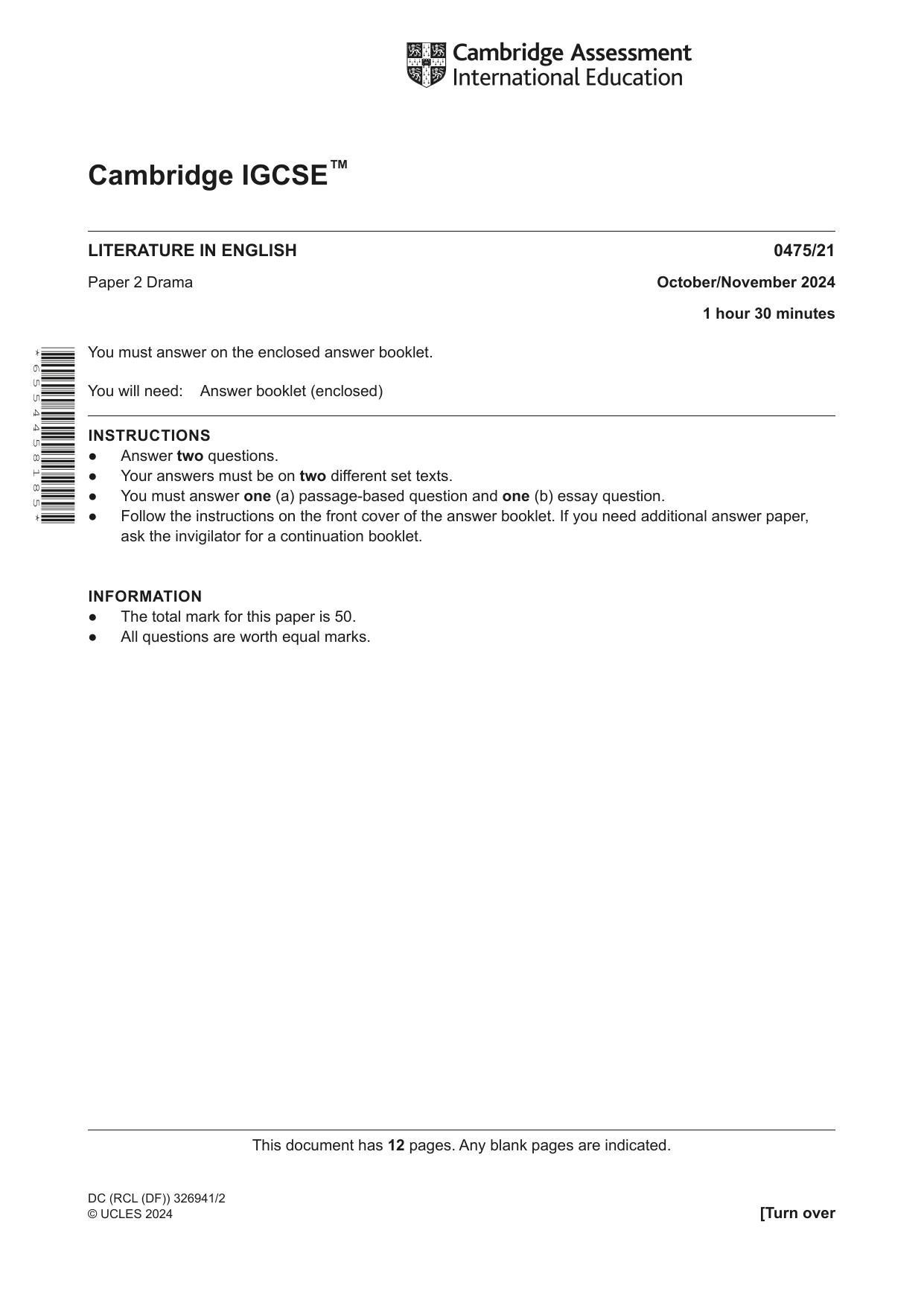
Question paper, page 1
This document has 12 pages. Any blank pages are indicated. [Turn over Cambridge IGCSE™ * 6 5 5 4 4 5 8 1 8 5 * DC (RCL (DF)) 326941/2 © UCLES 2024 LITERATURE IN ENGLISH 0475/21 Paper 2 Drama October/November 2024 1 hour 30 minutes You must answer on the enclosed answer booklet. You will need: Answer booklet (enclosed) INSTRUCTIONS ● Answer two questions. ● Your answers must be on two different set texts. ● You must answer one (a) passage-based question and one (b) essay question. ● Follow the instructions on the front cover of the answer booklet. If you need additional answer paper, ask the invigilator for a continuation booklet. INFORMATION ● The total mark for this paper is 50. ● All questions are worth equal marks.
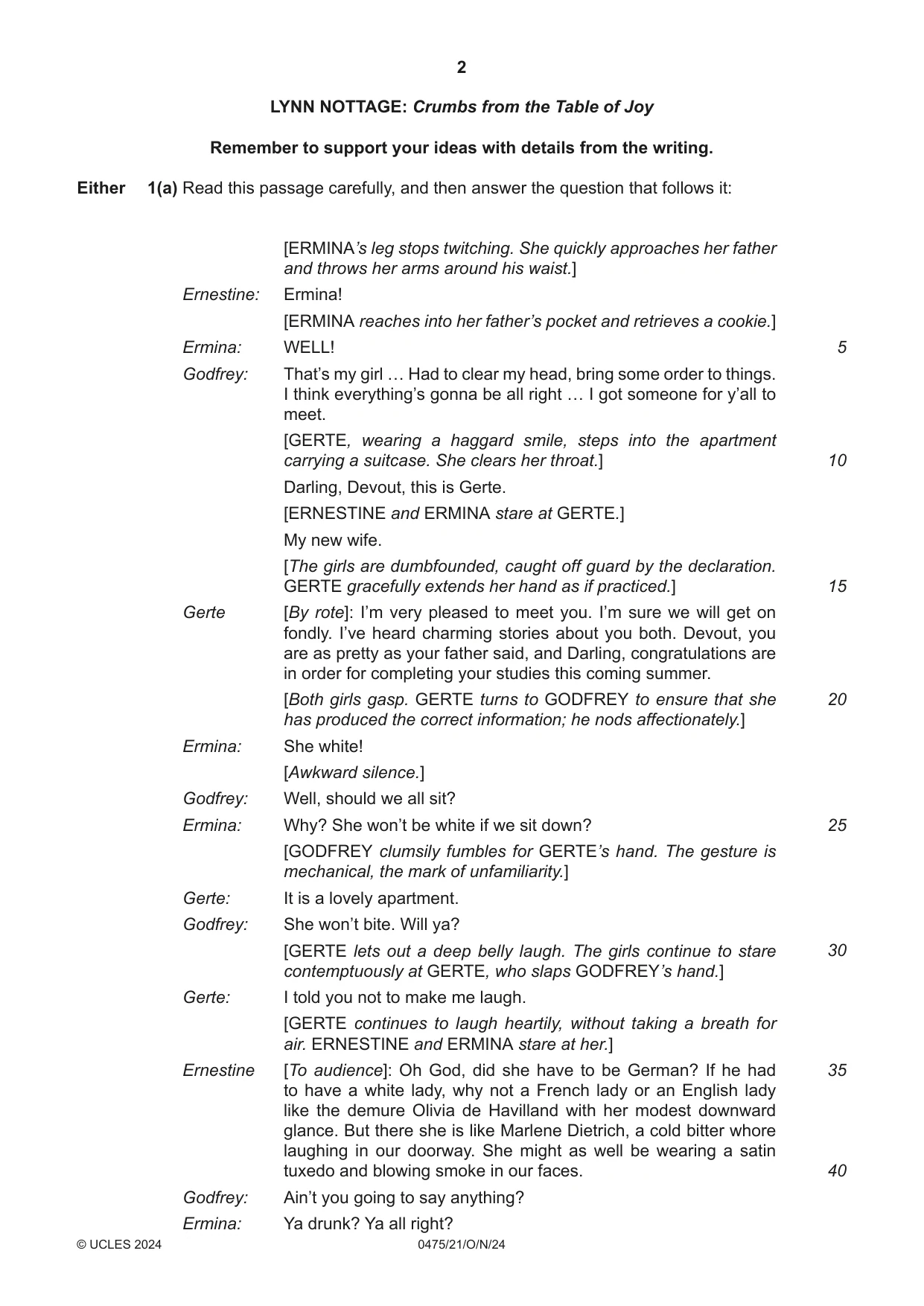
Question paper, page 2
2 0475/21/O/N/24 © UCLES 2024 LYNN NOTTAGE: Crumbs from the Table of Joy Remember to support your ideas with details from the writing. Either 1(a) Read this passage carefully, and then answer the question that follows it: [ERMINA’s leg stops twitching. She quickly approaches her father and throws her arms around his waist.] Ernestine: Ermina! [ERMINA reaches into her father’s pocket and retrieves a cookie.] Ermina: WELL! Godfrey: That’s my girl … Had to clear my head, bring some order to things. I think everything’s gonna be all right … I got someone for y’all to meet. [GERTE, wearing a haggard smile, steps into the apartment carrying a suitcase. She clears her throat.] Darling, Devout, this is Gerte. [ERNESTINE and ERMINA stare at GERTE.] My new wife. [The girls are dumbfounded, caught off guard by the declaration. GERTE gracefully extends her hand as if practiced.] Gerte [By rote]: I’m very pleased to meet you. I’m sure we will get on fondly. I’ve heard charming stories about you both. Devout, you are as pretty as your father said, and Darling, congratulations are in order for completing your studies this coming summer. [Both girls gasp. GERTE turns to GODFREY to ensure that she has produced the correct information; he nods affectionately.] Ermina: She white! [Awkward silence.] Godfrey: Well, should we all sit? Ermina: Why? She won’t be white if we sit down? [GODFREY clumsily fumbles for GERTE’s hand. The gesture is mechanical, the mark of unfamiliarity.] Gerte: It is a lovely apartment. Godfrey: She won’t bite. Will ya? [GERTE lets out a deep belly laugh. The girls continue to stare contemptuously at GERTE, who slaps GODFREY’s hand.] Gerte: I told you not to make me laugh. [GERTE continues to laugh heartily, without taking a breath for air. ERNESTINE and ERMINA stare at her.] Ernestine [To audience]: Oh God, did she have to be German? If he had to have a white lady, why not a French lady or an English lady like the demure Olivia de Havilland with her modest downward glance. But there she is like Marlene Dietrich, a cold bitter whore laughing in our doorway. She might as well be wearing a satin tuxedo and blowing smoke in our faces. Godfrey: Ain’t you going to say anything? Ermina: Ya drunk? Ya all right? 5 10 15 20 25 30 35 40
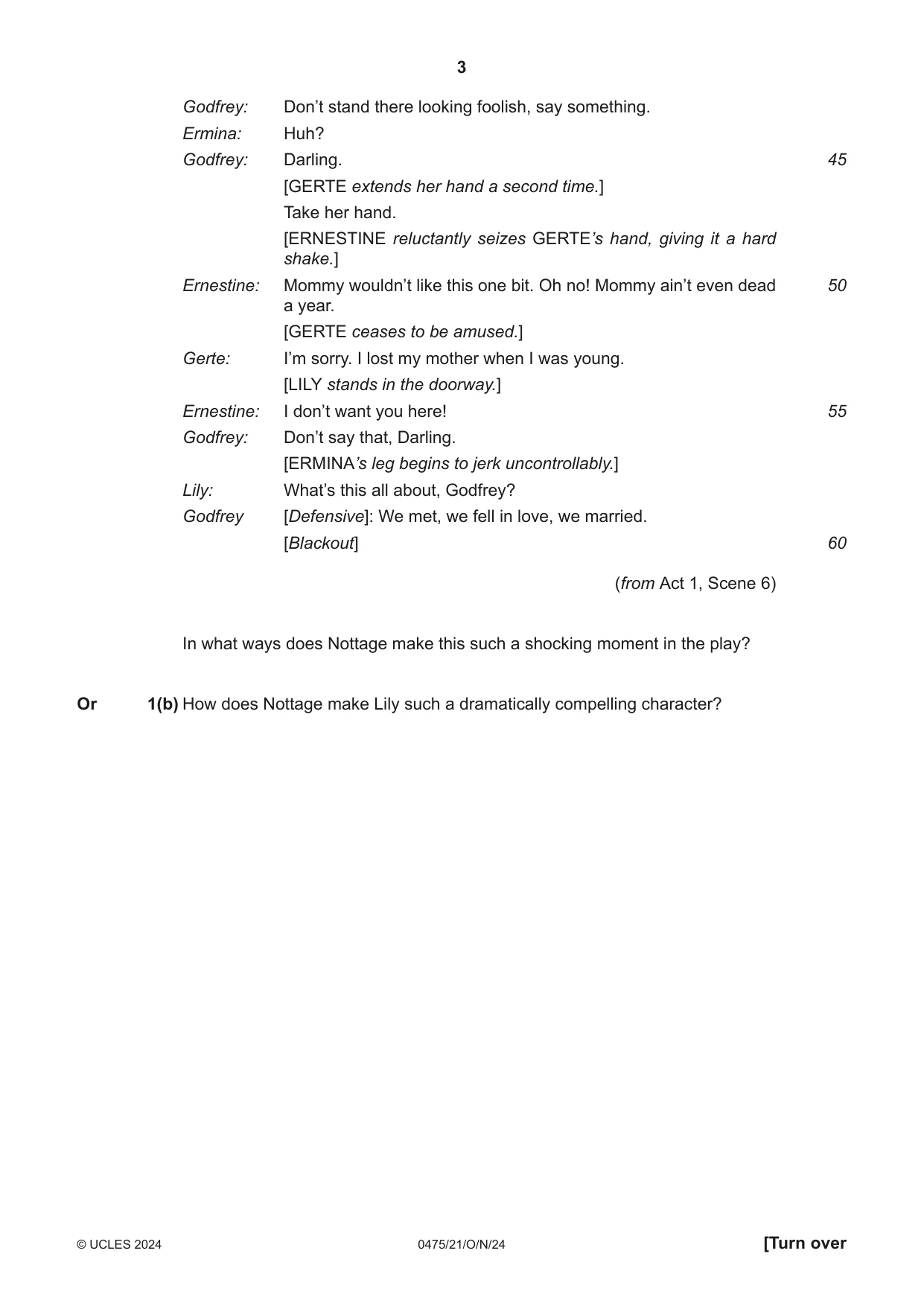
Question paper, page 3
3 0475/21/O/N/24 © UCLES 2024 [Turn over Godfrey: Don’t stand there looking foolish, say something. Ermina: Huh? Godfrey: Darling. [GERTE extends her hand a second time.] Take her hand. [ERNESTINE reluctantly seizes GERTE’s hand, giving it a hard shake.] Ernestine: Mommy wouldn’t like this one bit. Oh no! Mommy ain’t even dead a year. [GERTE ceases to be amused.] Gerte: I’m sorry. I lost my mother when I was young. [LILY stands in the doorway.] Ernestine: I don’t want you here! Godfrey: Don’t say that, Darling. [ERMINA’s leg begins to jerk uncontrollably.] Lily: What’s this all about, Godfrey? Godfrey [Defensive]: We met, we fell in love, we married. [Blackout] (from Act 1, Scene 6) In what ways does Nottage make this such a shocking moment in the play? Or 1(b) How does Nottage make Lily such a dramatically compelling character? 45 50 55 60
Question paper, page 4
4 0475/21/O/N/24 © UCLES 2024 WOLE SOYINKA: Death and the King’s Horseman Remember to support your ideas with details from the writing. Either 2(a) Read this passage carefully, and then answer the question that follows it: Jane [pokes her head round the door]: Have you found him? Content removed due to copyright restrictions.
Question paper, page 5
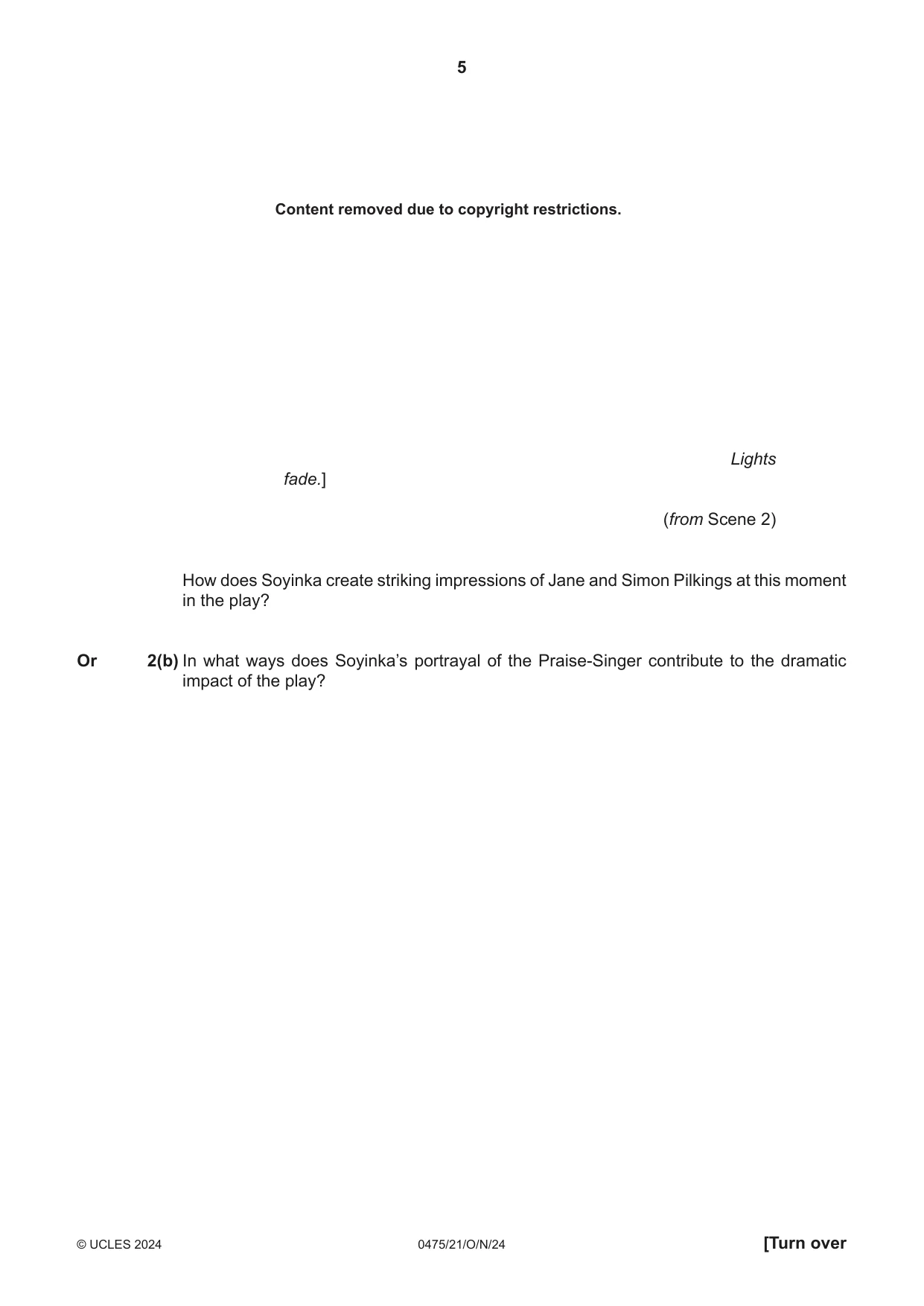
5 0475/21/O/N/24 © UCLES 2024 [Turn over Lights fade.] (from Scene 2) How does Soyinka create striking impressions of Jane and Simon Pilkings at this moment in the play? Or 2(b) In what ways does Soyinka’s portrayal of the Praise-Singer contribute to the dramatic impact of the play? Content removed due to copyright restrictions.
Question paper, page 6
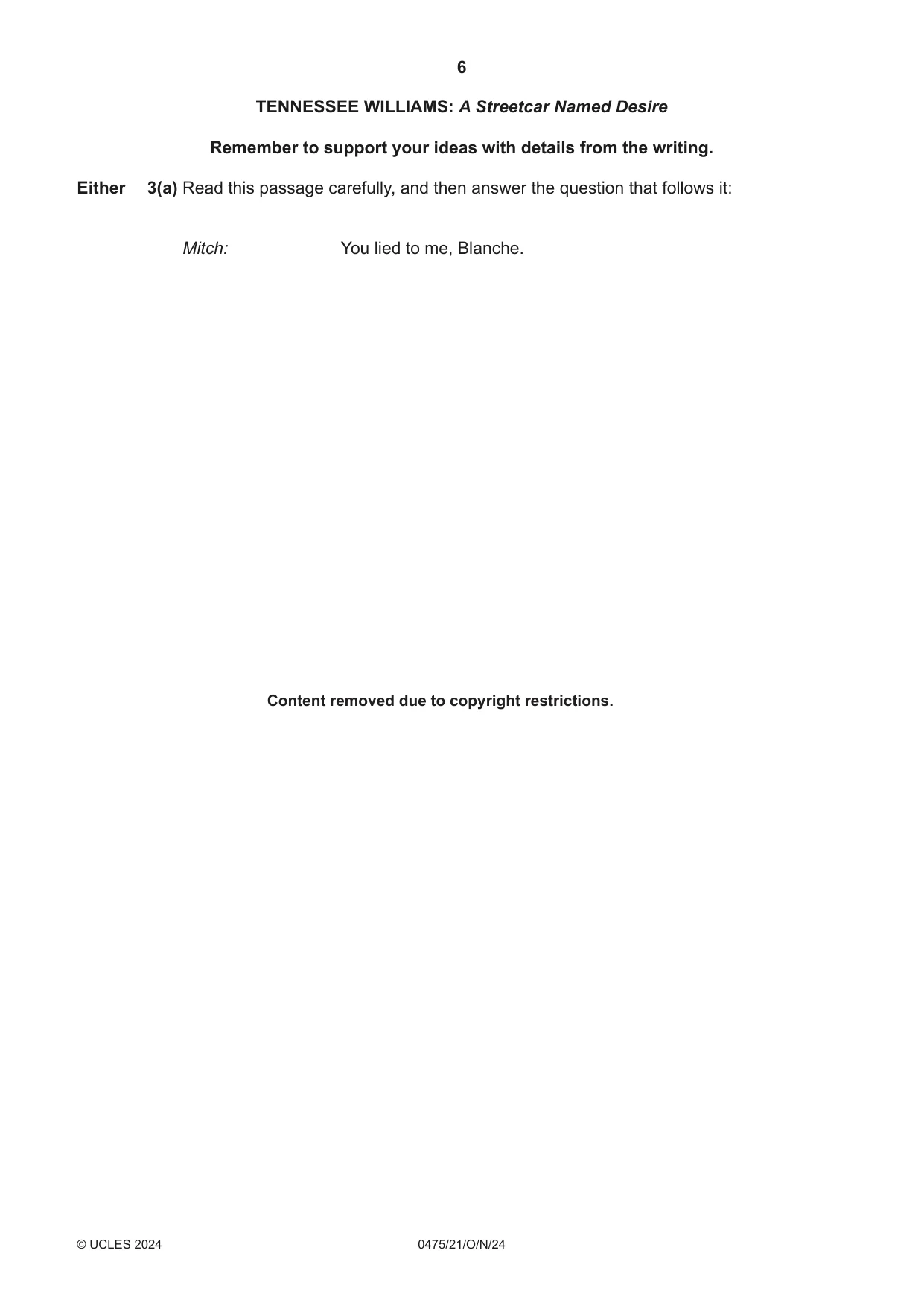
6 0475/21/O/N/24 © UCLES 2024 TENNESSEE WILLIAMS: A Streetcar Named Desire Remember to support your ideas with details from the writing. Either 3(a) Read this passage carefully, and then answer the question that follows it: Mitch: You lied to me, Blanche. Content removed due to copyright restrictions.
Question paper, page 7
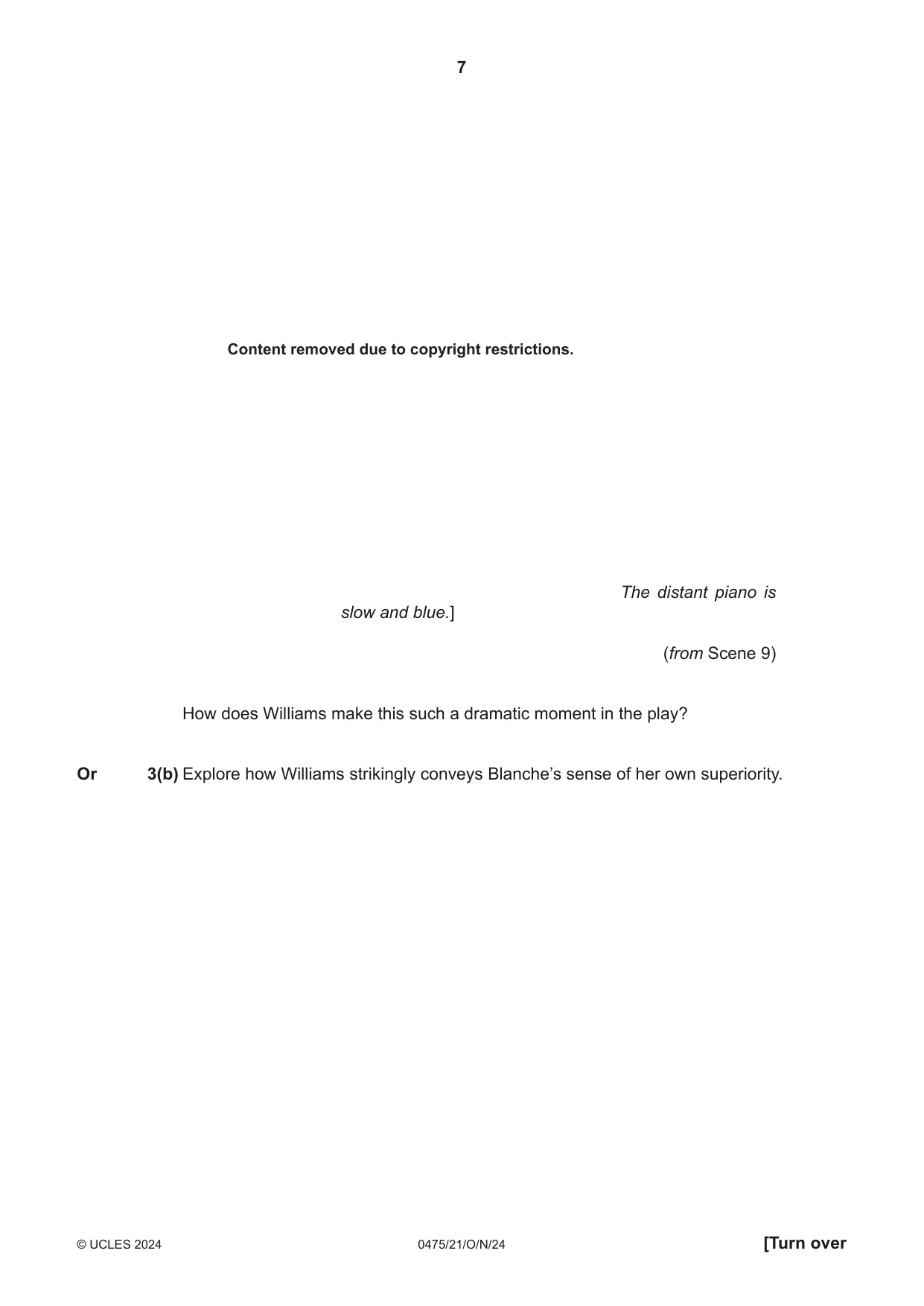
7 0475/21/O/N/24 © UCLES 2024 [Turn over The distant piano is slow and blue.] (from Scene 9) How does Williams make this such a dramatic moment in the play? Or 3(b) Explore how Williams strikingly conveys Blanche’s sense of her own superiority. Content removed due to copyright restrictions.
Question paper, page 8
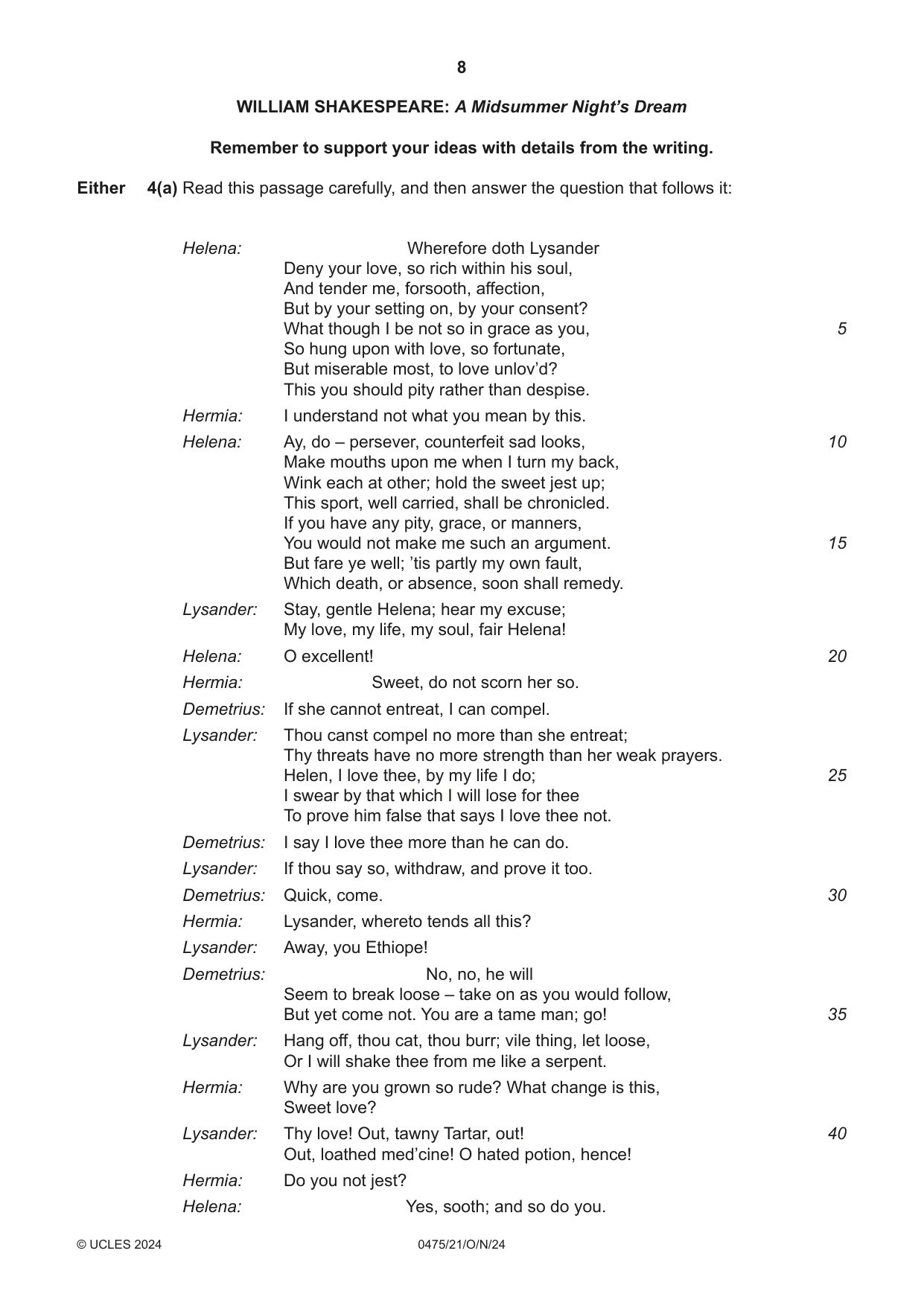
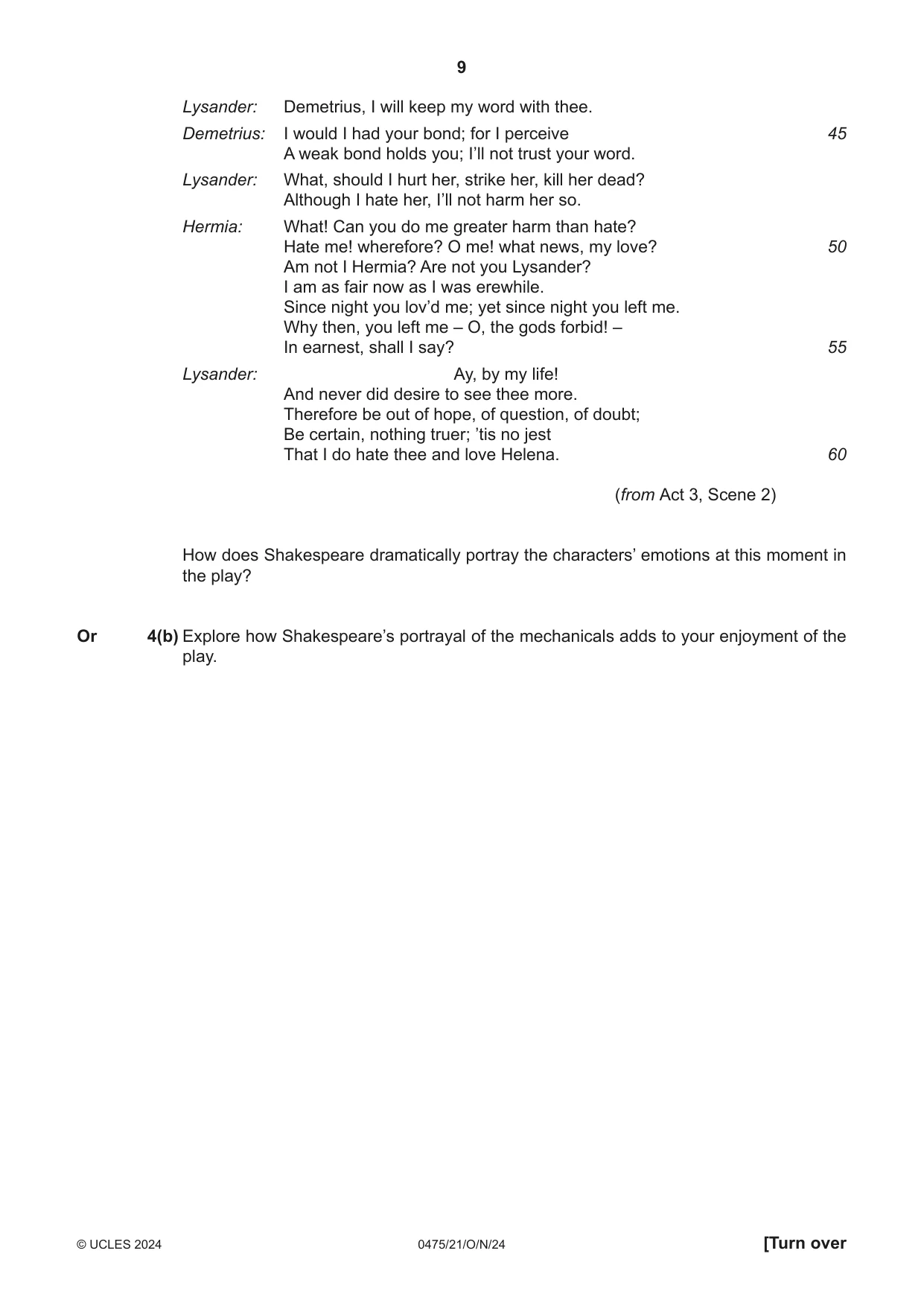
8 0475/21/O/N/24 © UCLES 2024 WILLIAM SHAKESPEARE: A Midsummer Night’s Dream Remember to support your ideas with details from the writing. Either 4(a) Read this passage carefully, and then answer the question that follows it: Helena: Wherefore doth Lysander Deny your love, so rich within his soul, And tender me, forsooth, affection, But by your setting on, by your consent? What though I be not so in grace as you, So hung upon with love, so fortunate, But miserable most, to love unlov’d? This you should pity rather than despise. Hermia: I understand not what you mean by this. Helena: Ay, do – persever, counterfeit sad looks, Make mouths upon me when I turn my back, Wink each at other; hold the sweet jest up; This sport, well carried, shall be chronicled. If you have any pity, grace, or manners, You would not make me such an argument. But fare ye well; ’tis partly my own fault, Which death, or absence, soon shall remedy. Lysander: Stay, gentle Helena; hear my excuse; My love, my life, my soul, fair Helena! Helena: O excellent! Hermia: Sweet, do not scorn her so. Demetrius: If she cannot entreat, I can compel. Lysander: Thou canst compel no more than she entreat; Thy threats have no more strength than her weak prayers. Helen, I love thee, by my life I do; I swear by that which I will lose for thee To prove him false that says I love thee not. Demetrius: I say I love thee more than he can do. Lysander: If thou say so, withdraw, and prove it too. Demetrius: Quick, come. Hermia: Lysander, whereto tends all this? Lysander: Away, you Ethiope! Demetrius: No, no, he will Seem to break loose – take on as you would follow, But yet come not. You are a tame man; go! Lysander: Hang off, thou cat, thou burr; vile thing, let loose, Or I will shake thee from me like a serpent. Hermia: Why are you grown so rude? What change is this, Sweet love? Lysander: Thy love! Out, tawny Tartar, out! Out, loathed med’cine! O hated potion, hence! Hermia: Do you not jest? Helena: Yes, sooth; and so do you. 5 10 15 20 25 30 35 40
Question paper, page 9
9 0475/21/O/N/24 © UCLES 2024 [Turn over Lysander: Demetrius, I will keep my word with thee. Demetrius: I would I had your bond; for I perceive A weak bond holds you; I’ll not trust your word. Lysander: What, should I hurt her, strike her, kill her dead? Although I hate her, I’ll not harm her so. Hermia: What! Can you do me greater harm than hate? Hate me! wherefore? O me! what news, my love? Am not I He rmia? Are not you Lysander? I am as fair now as I was erewhile. Since night you lov’d me; yet since night you left me. Why then, you left me – O, the gods forbid! – In earnest, shall I say? Lysander: Ay, by my life! And never did desire to see thee more. Therefore be out of hope, of question, of doubt; Be certain, nothing truer; ’tis no jest That I do hate thee and love Helena. (from Act 3, Scene 2) How does Shakespeare dramatically portray the characters’ emotions at this moment in the play? Or 4(b) Explore how Shakespeare’s portrayal of the mechanicals adds to your enjoyment of the play. 45 50 55 60
Question paper, page 10
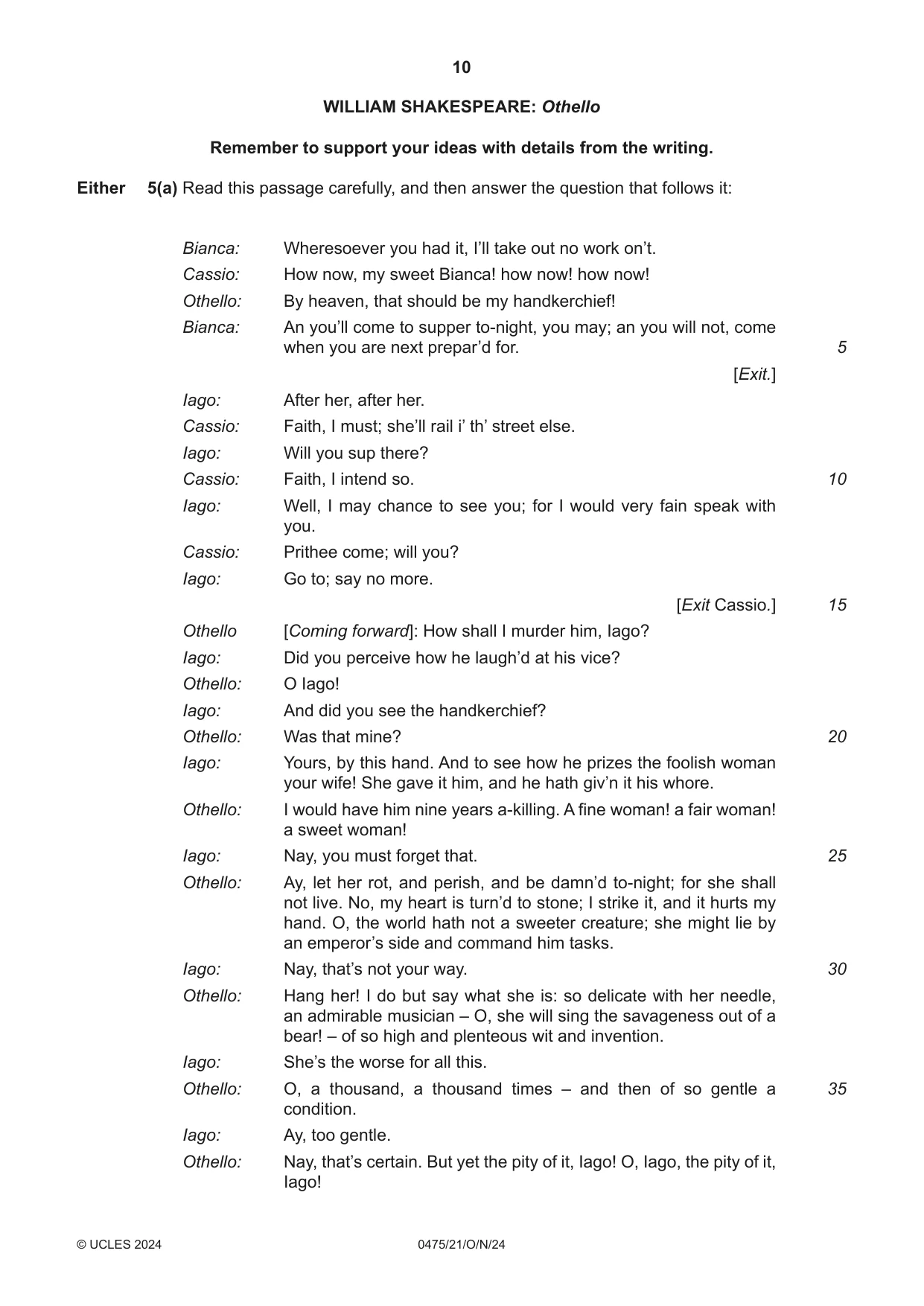
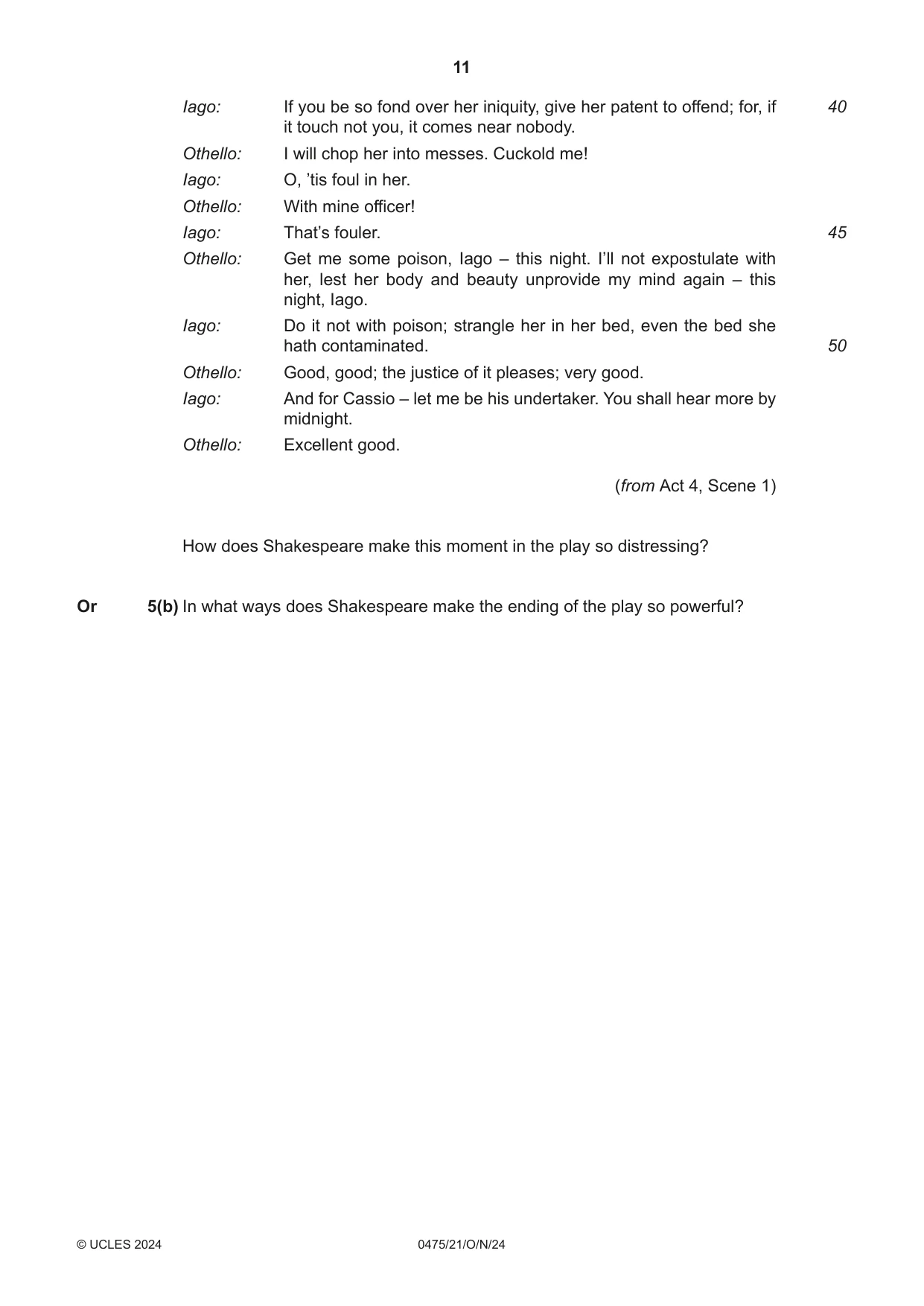
10 0475/21/O/N/24 © UCLES 2024 WILLIAM SHAKESPEARE: Othello Remember to support your ideas with details from the writing. Either 5(a) Read this passage carefully, and then answer the question that follows it: Bianca: Wheresoever you had it, I’ll take out no work on’t. Cassio: How now, my sweet Bianca! how now! how now! Othello: By heaven, that should be my handkerchief! Bianca: An you’ll come to supper to-night, you may; an you will not, come when you are next prepar’d for. [Exit.] Iago: After her, after her. Cassio: Faith, I must; she’ll rail i’ th’ street else. Iago: Will you sup there? Cassio: Faith, I intend so. Iago: Well, I may chance to see you; for I would very fain speak with you. Cassio: Prithee come; will you? Iago: Go to; say no more. [Exit Cassio.] Othello [Coming forward]: How shall I murder him, Iago? Iago: Did you perceive how he laugh’d at his vice? Othello: O Iago! Iago: And did you see the handkerchief? Othello: Was that mine? Iago: Yours, by this hand. And to see how he prizes the foolish woman your wife! She gave it him, and he hath giv’n it his whore. Othello: I would have him nine years a-killing. A fine woman! a fair woman! a sweet woman! Iago: Nay, you must forget that. Othello: Ay, let her rot, and perish, and be damn’d to-night; for she shall not live. No, my heart is turn’d to stone; I strike it, and it hurts my hand. O, the world hath not a sweeter creature; she might lie by an emperor’s side and command him tasks. Iago: Nay, that’s not your way. Othello: Hang her! I do but say what she is: so delicate with her needle, an admirable musician – O, she will sing the savageness out of a bear! – of so high and plenteous wit and invention. Iago: She’s the worse for all this. Othello: O, a thousand, a thousand times – and then of so gentle a condition. Iago: Ay, too gentle. Othello: Nay, that’s certain. But yet the pity of it, Iago! O, Iago, the pity of it, Iago! 5 10 15 20 25 30 35
Question paper, page 11
11 0475/21/O/N/24 © UCLES 2024 Iago: If you be so fond over her iniquity, give her patent to offend; for, if it touch not you, it comes near nobody. Othello: I will chop her into messes. Cuckold me! Iago: O, ’tis foul in her. Othello: With mine officer! Iago: That’s fouler. Othello: Get me some poison, Iago – this night. I’ll not expostulate with her, lest her body and beauty unprovide my mind again – this night, Iago. Iago: Do it not with poison; strangle her in her bed, even the bed she hath contaminated. Othello: Good, good; the justice of it pleases; very good. Iago: And for Cassio – let me be his undertaker. You shall hear more by midnight. Othello: Excellent good. (from Act 4, Scene 1) How does Shakespeare make this moment in the play so distressing? Or 5(b) In what ways does Shakespeare make the ending of the play so powerful? 40 45 50
Question paper, page 12
12 0475/21/O/N/24 © UCLES 2024 Permission to reproduce items where third-party owned material protected by copyright is included has been sought and cleared where possible. Every reasonable effort has been made by the publisher (UCLES) to trace copyright holders, but if any items requiring clearance have unwittingly been included, the publisher will be pleased to make amends at the earliest possible opportunity. To avoid the issue of disclosure of answer-related information to candidates, all copyright acknowledgements are reproduced online in the Cambridge Assessment International Education Copyright Acknowledgements Booklet. This is produced for each series of examinations and is freely available to download at www.cambridgeinternational.org after the live examination series. Cambridge Assessment International Education is part of Cambridge Assessment. Cambridge Assessment is the brand name of the University of Cambridge Local Examinations Syndicate (UCLES), which is a department of the University of Cambridge. BLANK PAGE
Mark scheme, page 1
This document consists of 4 printed pages. © Cambridge University Press & Assessment 2024 [Turn over Cambridge IGCSE™ LITERATURE IN ENGLISH 0475/21 Paper 2 Drama October/November 2024 MARK SCHEME Maximum Mark: 50 Published This mark scheme is published as an aid to teachers and candidates, to indicate the requirements of the examination. It shows the basis on which Examiners were instructed to award marks. It does not indicate the details of the discussions that took place at an Examiners’ meeting before marking began, which would have considered the acceptability of alternative answers. Mark schemes should be read in conjunction with the question paper and the Principal Examiner Report for Teachers. Cambridge International will not enter into discussions about these mark schemes. Cambridge International is publishing the mark schemes for the October/November 2024 series for most Cambridge IGCSE, Cambridge International A and AS Level components, and some Cambridge O Level components.
Mark scheme, page 2
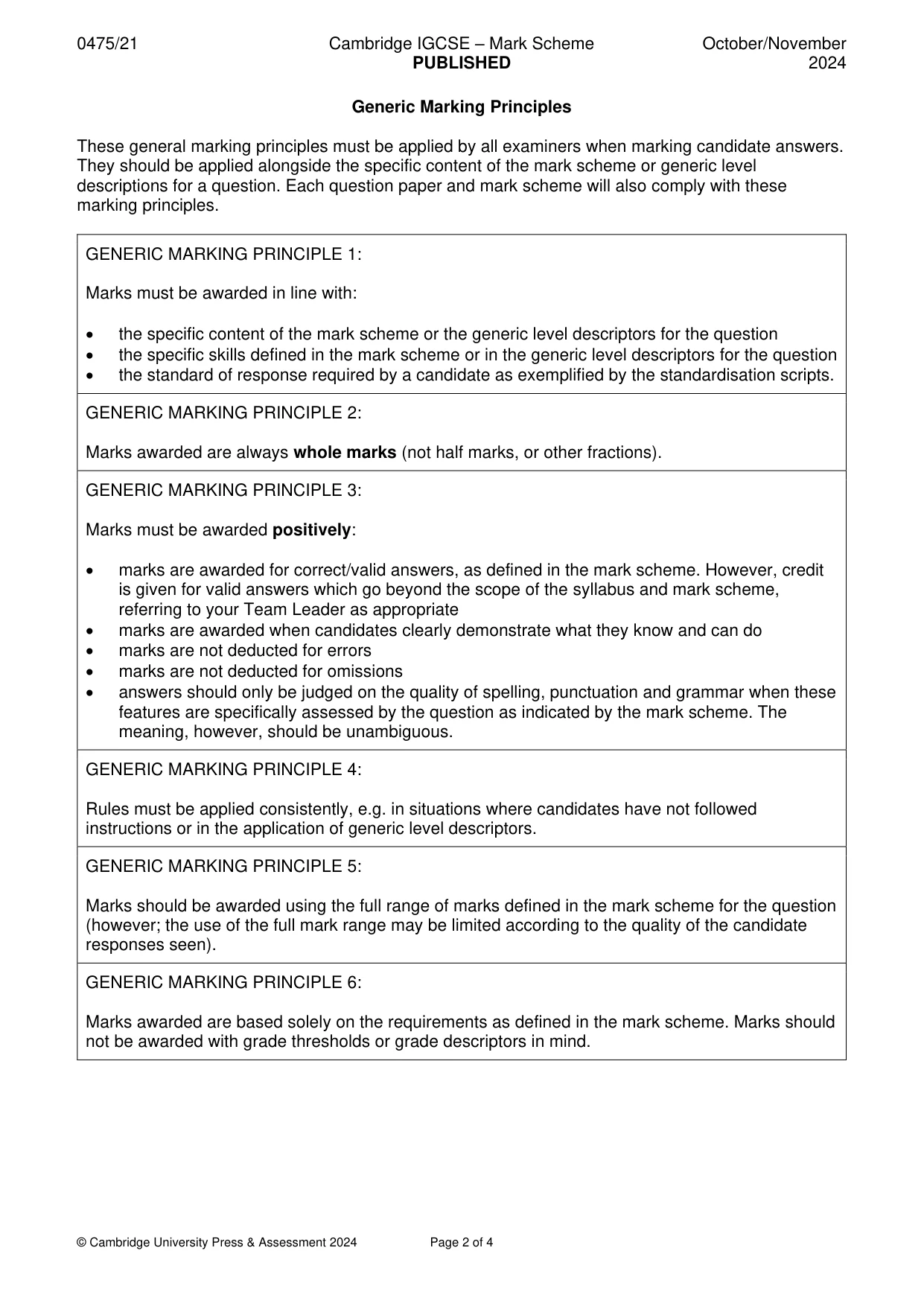
0475/21 Cambridge IGCSE – Mark Scheme PUBLISHED October/November 2024 © Cambridge University Press & Assessment 2024 Page 2 of 4 Generic Marking Principles These general marking principles must be applied by all examiners when marking candidate answers. They should be applied alongside the specific content of the mark scheme or generic level descriptions for a question. Each question paper and mark scheme will also comply with these marking principles. GENERIC MARKING PRINCIPLE 1: Marks must be awarded in line with: • the specific content of the mark scheme or the generic level descriptors for the question • the specific skills defined in the mark scheme or in the generic level descriptors for the question • the standard of response required by a candidate as exemplified by the standardisation scripts. GENERIC MARKING PRINCIPLE 2: Marks awarded are always whole marks (not half marks, or other fractions). GENERIC MARKING PRINCIPLE 3: Marks must be awarded positively: • marks are awarded for correct/valid answers, as defined in the mark scheme. However, credit is given for valid answers which go beyond the scope of the syllabus and mark scheme, referring to your Team Leader as appropriate • marks are awarded when candidates clearly demonstrate what they know and can do • marks are not deducted for errors • marks are not deducted for omissions • answers should only be judged on the quality of spelling, punctuation and grammar when these features are specifically assessed by the question as indicated by the mark scheme. The meaning, however, should be unambiguous. GENERIC MARKING PRINCIPLE 4: Rules must be applied consistently, e.g. in situations where candidates have not followed instructions or in the application of generic level descriptors. GENERIC MARKING PRINCIPLE 5: Marks should be awarded using the full range of marks defined in the mark scheme for the question (however; the use of the full mark range may be limited according to the quality of the candidate responses seen). GENERIC MARKING PRINCIPLE 6: Marks awarded are based solely on the requirements as defined in the mark scheme. Marks should not be awarded with grade thresholds or grade descriptors in mind.
Mark scheme, page 3
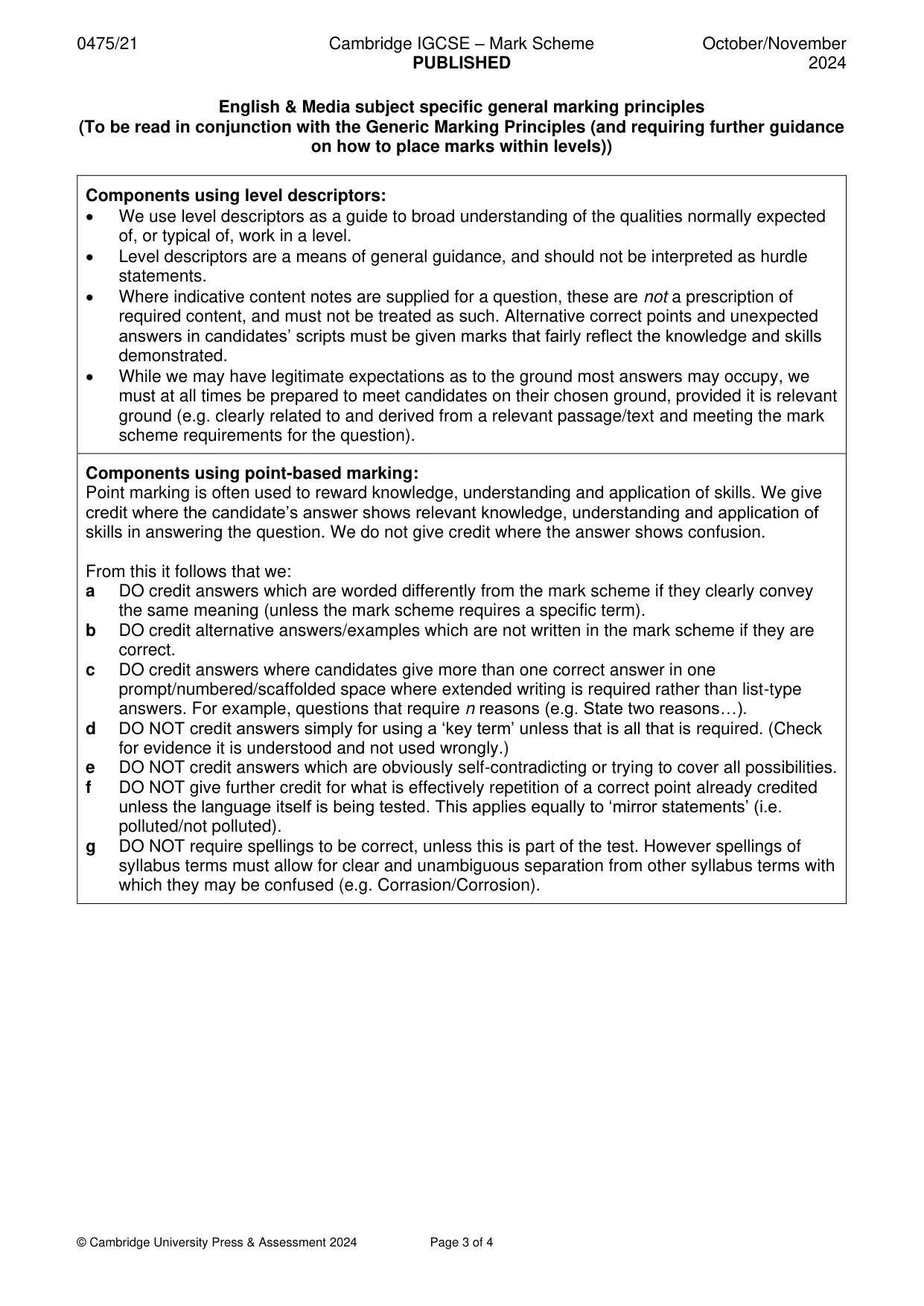
0475/21 Cambridge IGCSE – Mark Scheme PUBLISHED October/November 2024 © Cambridge University Press & Assessment 2024 Page 3 of 4 English & Media subject specific general marking principles (To be read in conjunction with the Generic Marking Principles (and requiring further guidance on how to place marks within levels)) Components using level descriptors: • We use level descriptors as a guide to broad understanding of the qualities normally expected of, or typical of, work in a level. • Level descriptors are a means of general guidance, and should not be interpreted as hurdle statements. • Where indicative content notes are supplied for a question, these are not a prescription of required content, and must not be treated as such. Alternative correct points and unexpected answers in candidates’ scripts must be given marks that fairly reflect the knowledge and skills demonstrated. • While we may have legitimate expectations as to the ground most answers may occupy, we must at all times be prepared to meet candidates on their chosen ground, provided it is relevant ground (e.g. clearly related to and derived from a relevant passage/text and meeting the mark scheme requirements for the question). Components using point-based marking: Point marking is often used to reward knowledge, understanding and application of skills. We give credit where the candidate’s answer shows relevant knowledge, understanding and application of skills in answering the question. We do not give credit where the answer shows confusion. From this it follows that we: a DO credit answers which are worded differently from the mark scheme if they clearly convey the same meaning (unless the mark scheme requires a specific term). b DO credit alternative answers/examples which are not written in the mark scheme if they are correct. c DO credit answers where candidates give more than one correct answer in one prompt/numbered/scaffolded space where extended writing is required rather than list-type answers. For example, questions that require n reasons (e.g. State two reasons…). d DO NOT credit answers simply for using a ‘key term’ unless that is all that is required. (Check for evidence it is understood and not used wrongly.) e DO NOT credit answers which are obviously self-contradicting or trying to cover all possibilities. f DO NOT give further credit for what is effectively repetition of a correct point already credited unless the language itself is being tested. This applies equally to ‘mirror statements’ (i.e. polluted/not polluted). g DO NOT require spellings to be correct, unless this is part of the test. However spellings of syllabus terms must allow for clear and unambiguous separation from other syllabus terms with which they may be confused (e.g. Corrasion/Corrosion).
Mark scheme, page 4
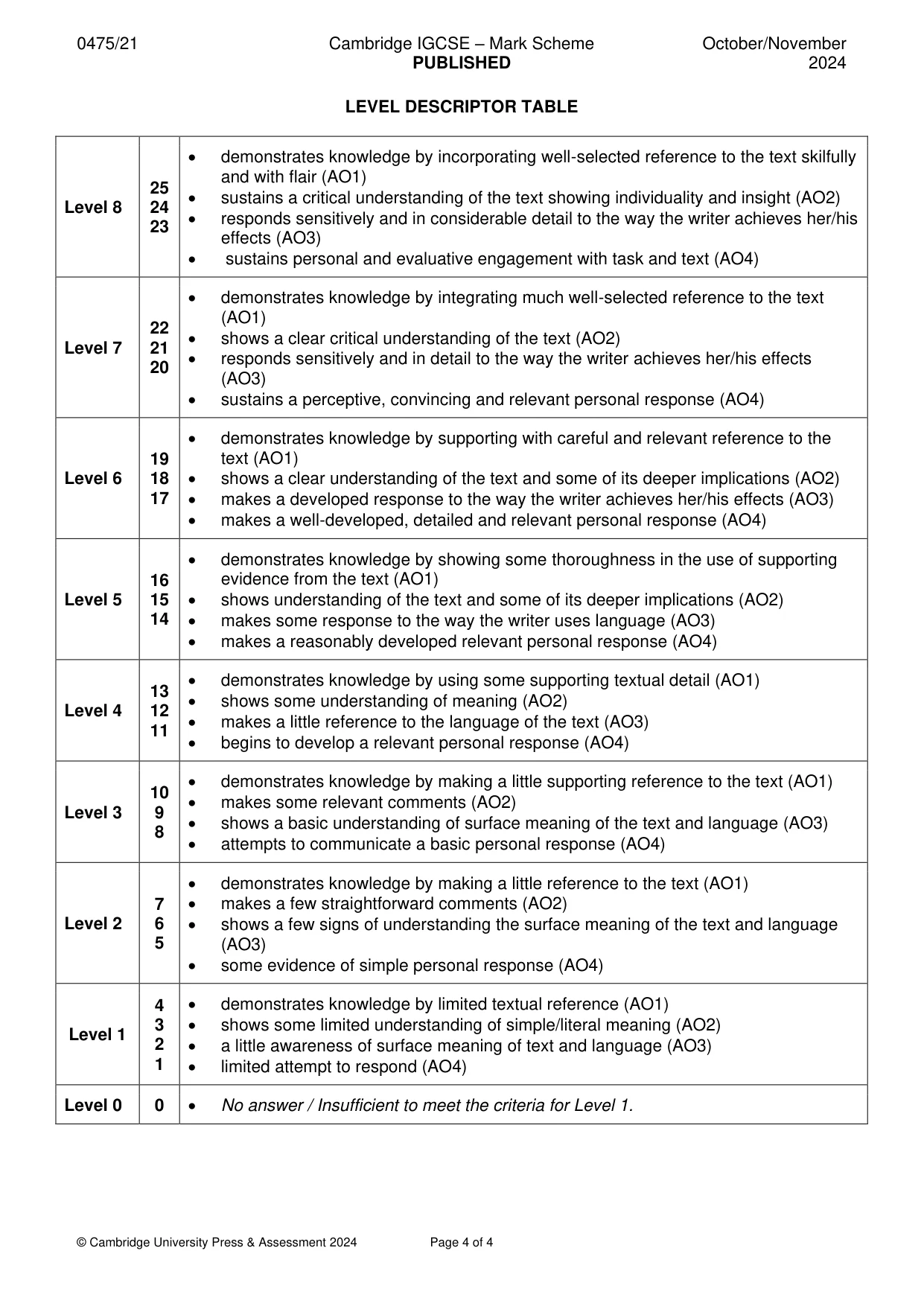
0475/21 Cambridge IGCSE – Mark Scheme PUBLISHED October/November 2024 © Cambridge University Press & Assessment 2024 Page 4 of 4 LEVEL DESCRIPTOR TABLE Level 8 25 24 23 • demonstrates knowledge by incorporating well-selected reference to the text skilfully and with flair (AO1) • sustains a critical understanding of the text showing individuality and insight (AO2) • responds sensitively and in considerable detail to the way the writer achieves her/his effects (AO3) • sustains personal and evaluative engagement with task and text (AO4) Level 7 22 21 20 • demonstrates knowledge by integrating much well-selected reference to the text (AO1) • shows a clear critical understanding of the text (AO2) • responds sensitively and in detail to the way the writer achieves her/his effects (AO3) • sustains a perceptive, convincing and relevant personal response (AO4) Level 6 19 18 17 • demonstrates knowledge by supporting with careful and relevant reference to the text (AO1) • shows a clear understanding of the text and some of its deeper implications (AO2) • makes a developed response to the way the writer achieves her/his effects (AO3) • makes a well-developed, detailed and relevant personal response (AO4) Level 5 16 15 14 • demonstrates knowledge by showing some thoroughness in the use of supporting evidence from the text (AO1) • shows understanding of the text and some of its deeper implications (AO2) • makes some response to the way the writer uses language (AO3) • makes a reasonably developed relevant personal response (AO4) Level 4 13 12 11 • demonstrates knowledge by using some supporting textual detail (AO1) • shows some understanding of meaning (AO2) • makes a little reference to the language of the text (AO3) • begins to develop a relevant personal response (AO4) Level 3 10 9 8 • demonstrates knowledge by making a little supporting reference to the text (AO1) • makes some relevant comments (AO2) • shows a basic understanding of surface meaning of the text and language (AO3) • attempts to communicate a basic personal response (AO4) Level 2 7 6 5 • demonstrates knowledge by making a little reference to the text (AO1) • makes a few straightforward comments (AO2) • shows a few signs of understanding the surface meaning of the text and language (AO3) • some evidence of simple personal response (AO4) Level 1 4 3 2 1 • demonstrates knowledge by limited textual reference (AO1) • shows some limited understanding of simple/literal meaning (AO2) • a little awareness of surface meaning of text and language (AO3) • limited attempt to respond (AO4) Level 0 0 • No answer / Insufficient to meet the criteria for Level 1.
What you needed in this session
Cambridge’s own grade thresholds for 2024 Oct/Nov, Paper 2 · Variant 1. A higher threshold means an easier paper — the bar moves with how the cohort did.