Cambridge IGCSE English - Literature in English 0475 — 2024 May/June Paper 2 · Variant 1
0475/21/M/J/24 · 50 marks · ≈56 min
The question paper and its mark scheme, free to read here and free to download. This is Cambridge’s own paper, exactly as it was sat.
Question paper12 pages
Mark scheme5 pages
Answers below. Sit the paper first if you are practising.
Paper as text
Question paper, page 1
Cambridge IGCSE™ 0475/21 May/June 2024 1 hour 30 minutes LITERATURE IN ENGLISH Paper 2 Drama You must answer on the enclosed answer booklet. You will need: Answer booklet (enclosed) INSTRUCTIONS • Answer two questions. • Your answers must be on two different set texts. • You must answer one (a) passage-based question and one (b) essay question. • Follow the instructions on the front cover of the answer booklet. If you need additional answer paper, ask the invigilator for a continuation booklet. INFORMATION • The total mark for this paper is 50. • All questions are worth equal marks. This document has 12 pages. [Turn over 06_0475_21_2024_1.18 © UCLES 2024 *8828771282*
Question paper, page 2
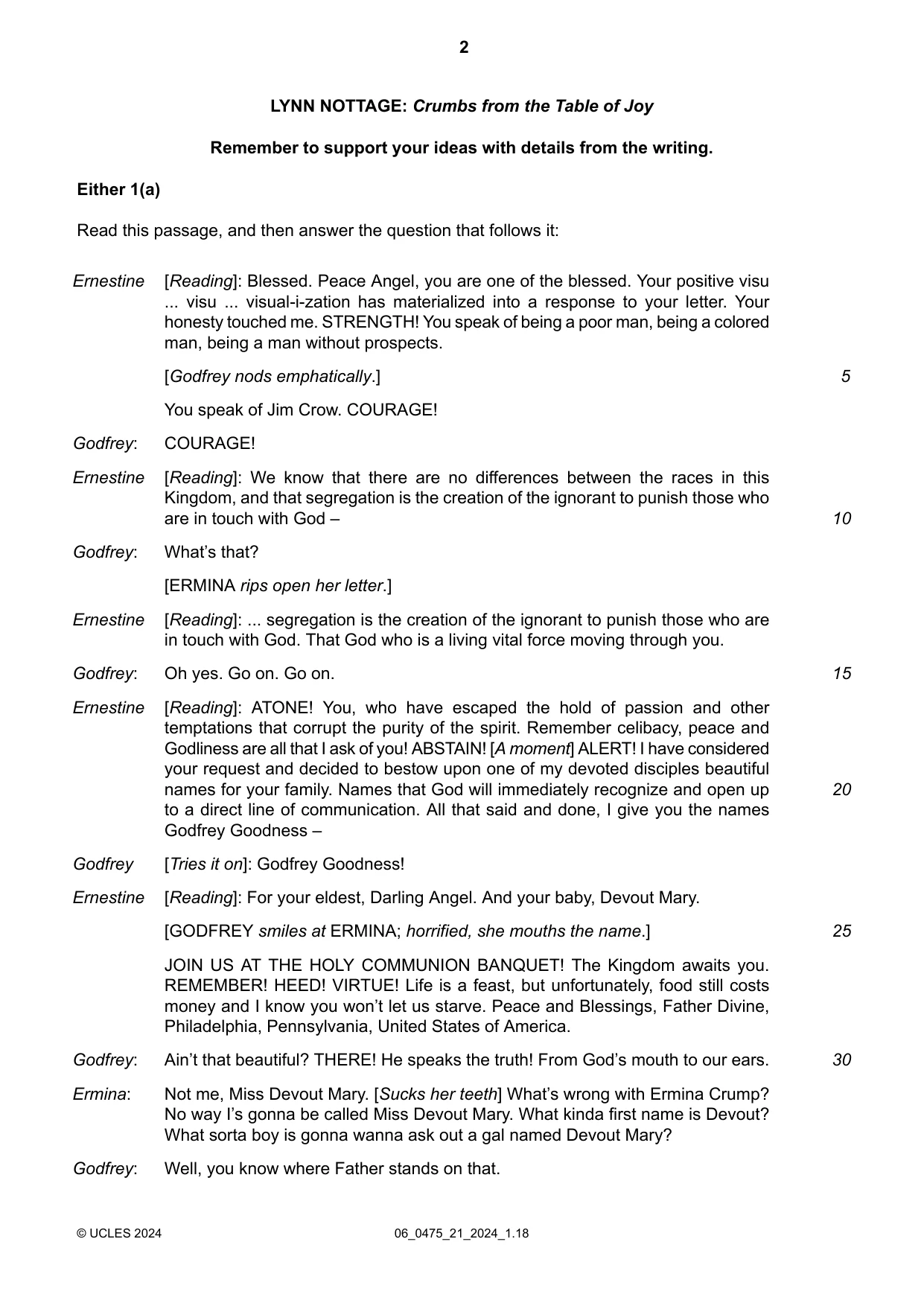
30 25 20 15 10 5 LYNN NOTTAGE: Crumbs from the Table of Joy Remember to support your ideas with details from the writing. Either 1(a) Read this passage, and then answer the question that follows it: [Reading]: Blessed. Peace Angel, you are one of the blessed. Your positive visu ... visu ... visual-i-zation has materialized into a response to your letter. Your honesty touched me. STRENGTH! You speak of being a poor man, being a colored man, being a man without prospects. Ernestine [Godfrey nods emphatically.] You speak of Jim Crow. COURAGE! COURAGE! Godfrey: [Reading]: We know that there are no differences between the races in this Kingdom, and that segregation is the creation of the ignorant to punish those who are in touch with God – Ernestine What’s that? Godfrey: [ERMINA rips open her letter.] [Reading]: ... segregation is the creation of the ignorant to punish those who are in touch with God. That God who is a living vital force moving through you. Ernestine Oh yes. Go on. Go on. Godfrey: [Reading]: ATONE! You, who have escaped the hold of passion and other temptations that corrupt the purity of the spirit. Remember celibacy, peace and Godliness are all that I ask of you! ABSTAIN! [A moment] ALERT! I have considered your request and decided to bestow upon one of my devoted disciples beautiful names for your family. Names that God will immediately recognize and open up to a direct line of communication. All that said and done, I give you the names Godfrey Goodness – Ernestine [Tries it on]: Godfrey Goodness! Godfrey [Reading]: For your eldest, Darling Angel. And your baby, Devout Mary. Ernestine [GODFREY smiles at ERMINA; horrified, she mouths the name.] JOIN US AT THE HOLY COMMUNION BANQUET! The Kingdom awaits you. REMEMBER! HEED! VIRTUE! Life is a feast, but unfortunately, food still costs money and I know you won’t let us starve. Peace and Blessings, Father Divine, Philadelphia, Pennsylvania, United States of America. Ain’t that beautiful? THERE! He speaks the truth! From God’s mouth to our ears. Godfrey: Not me, Miss Devout Mary. [Sucks her teeth] What’s wrong with Ermina Crump? No way I’s gonna be called Miss Devout Mary. What kinda first name is Devout? What sorta boy is gonna wanna ask out a gal named Devout Mary? Ermina: Well, you know where Father stands on that. Godfrey: 06_0475_21_2024_1.18 © UCLES 2024 2
Question paper, page 3
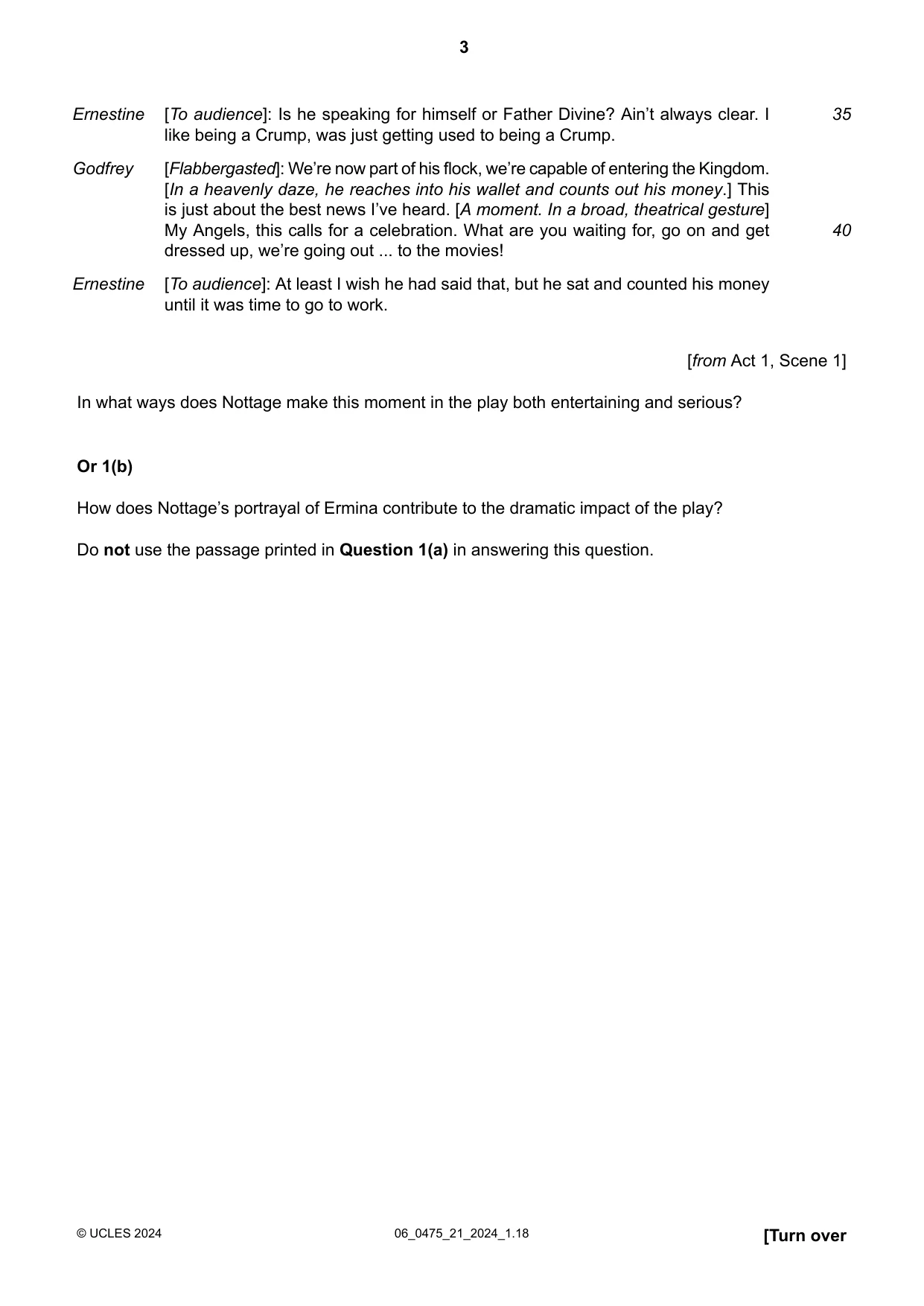
40 35 [To audience]: Is he speaking for himself or Father Divine? Ain’t always clear. I like being a Crump, was just getting used to being a Crump. Ernestine [Flabbergasted]: We’re now part of his flock, we’re capable of entering the Kingdom. [In a heavenly daze, he reaches into his wallet and counts out his money.] This is just about the best news I’ve heard. [A moment. In a broad, theatrical gesture] My Angels, this calls for a celebration. What are you waiting for, go on and get dressed up, we’re going out ... to the movies! Godfrey [To audience]: At least I wish he had said that, but he sat and counted his money until it was time to go to work. Ernestine [from Act 1, Scene 1] In what ways does Nottage make this moment in the play both entertaining and serious? Or 1(b) How does Nottage’s portrayal of Ermina contribute to the dramatic impact of the play? Do not use the passage printed in Question 1(a) in answering this question. [Turn over 06_0475_21_2024_1.18 © UCLES 2024 3
Question paper, page 4
WOLE SOYINKA: Death and the King’s Horseman Remember to support your ideas with details from the writing. Either 2(a) Read this passage, and then answer the question that follows it: There was fear in the forest too. Elesin: 06_0475_21_2024_1.18 © UCLES 2024 4 Content removed due to copyright restrictions.
Question paper, page 5
Shall I yield them cause to foul the rafters? [from Scene 1] How does Soyinka memorably portray Elesin at this moment in the play? Or 2(b) To what extent does Soyinka make you dislike the British characters in the play? [Turn over 06_0475_21_2024_1.18 © UCLES 2024 5 Content removed due to copyright restrictions.
Question paper, page 6
TENNESSEE WILLIAMS: A Streetcar Named Desire Remember to support your ideas with details from the writing. Either 3(a) Read this passage, and then answer the question that follows it: Stella, oh, Stella, Stella! Blanche: 06_0475_21_2024_1.18 © UCLES 2024 6 Content removed due to copyright restrictions.
Question paper, page 7
I was so exhausted by all I’d been through my – nerves broke. Blanche: [from Scene 1] How does Williams make this early moment in the play so revealing? Or 3(b) Blanche calls Stanley ‘an animal’. To what extent does Williams persuade you to agree? [Turn over 06_0475_21_2024_1.18 © UCLES 2024 7 Content removed due to copyright restrictions.
Question paper, page 8
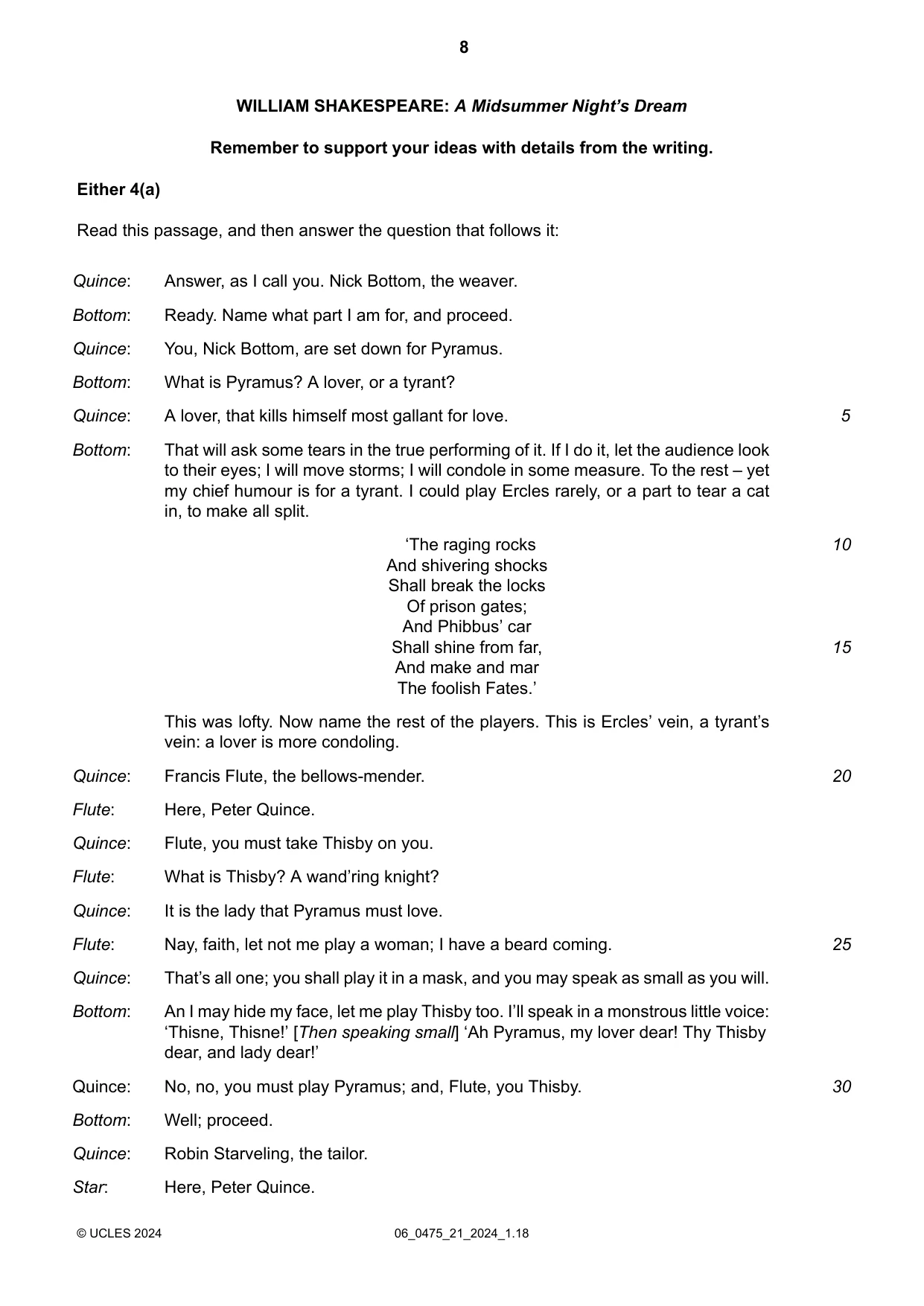
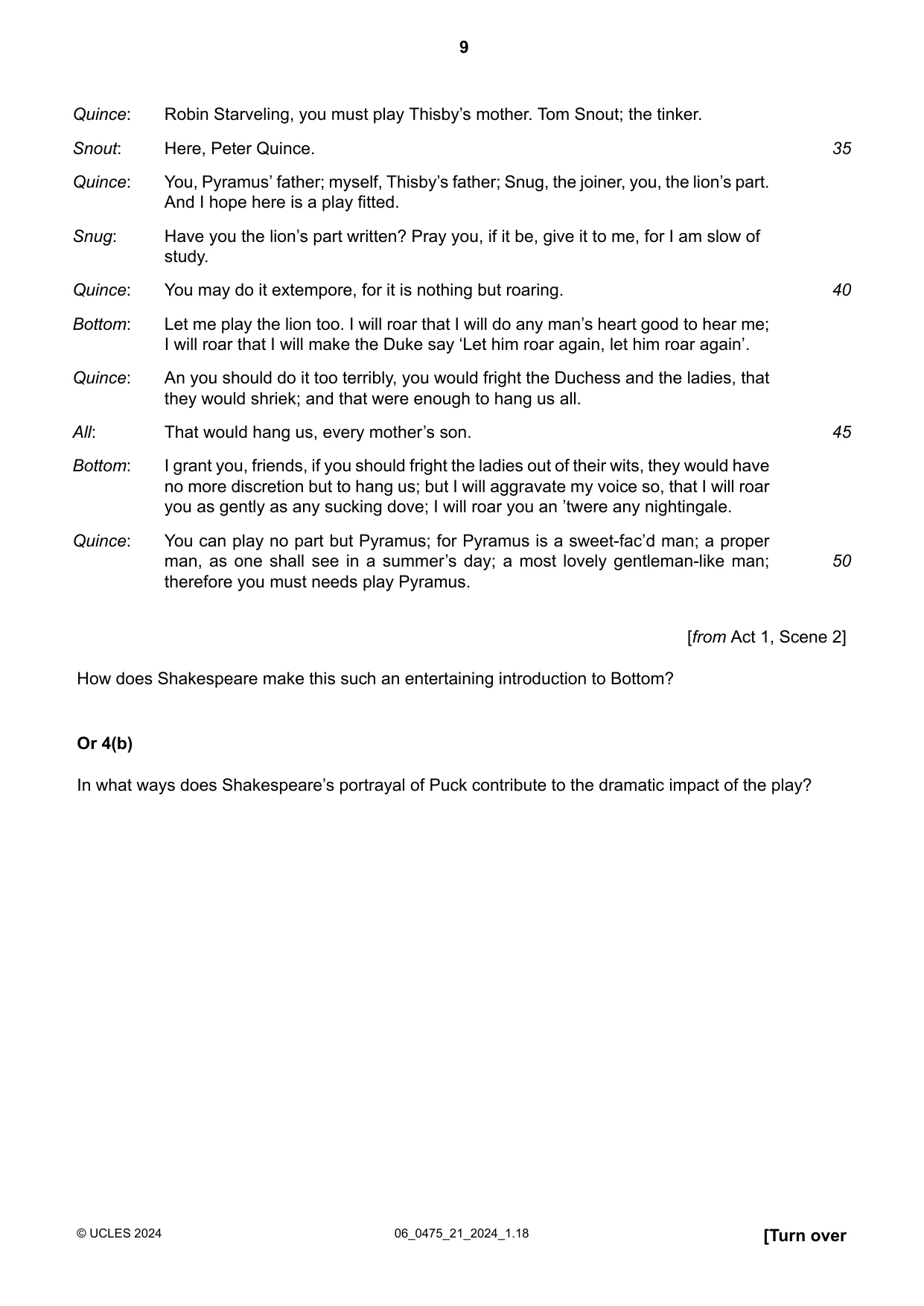
30 25 20 15 10 5 WILLIAM SHAKESPEARE: A Midsummer Night’s Dream Remember to support your ideas with details from the writing. Either 4(a) Read this passage, and then answer the question that follows it: Answer, as I call you. Nick Bottom, the weaver. Quince: Ready. Name what part I am for, and proceed. Bottom: You, Nick Bottom, are set down for Pyramus. Quince: What is Pyramus? A lover, or a tyrant? Bottom: A lover, that kills himself most gallant for love. Quince: That will ask some tears in the true performing of it. If I do it, let the audience look to their eyes; I will move storms; I will condole in some measure. To the rest – yet my chief humour is for a tyrant. I could play Ercles rarely, or a part to tear a cat in, to make all split. Bottom: ‘The raging rocks And shivering shocks Shall break the locks Of prison gates; And Phibbus’ car Shall shine from far, And make and mar The foolish Fates.’ This was lofty. Now name the rest of the players. This is Ercles’ vein, a tyrant’s vein: a lover is more condoling. Francis Flute, the bellows-mender. Quince: Here, Peter Quince. Flute: Flute, you must take Thisby on you. Quince: What is Thisby? A wand’ring knight? Flute: It is the lady that Pyramus must love. Quince: Nay, faith, let not me play a woman; I have a beard coming. Flute: That’s all one; you shall play it in a mask, and you may speak as small as you will. Quince: An I may hide my face, let me play Thisby too. I’ll speak in a monstrous little voice: ‘Thisne, Thisne!’ [Then speaking small] ‘Ah Pyramus, my lover dear! Thy Thisby dear, and lady dear!’ Bottom: No, no, you must play Pyramus; and, Flute, you Thisby. Quince: Well; proceed. Bottom: Robin Starveling, the tailor. Quince: Here, Peter Quince. Star: 06_0475_21_2024_1.18 © UCLES 2024 8
Question paper, page 9
50 45 40 35 Robin Starveling, you must play Thisby’s mother. Tom Snout; the tinker. Quince: Here, Peter Quince. Snout: You, Pyramus’ father; myself, Thisby’s father; Snug, the joiner, you, the lion’s part. And I hope here is a play fitted. Quince: Have you the lion’s part written? Pray you, if it be, give it to me, for I am slow of study. Snug: You may do it extempore, for it is nothing but roaring. Quince: Let me play the lion too. I will roar that I will do any man’s heart good to hear me; I will roar that I will make the Duke say ‘Let him roar again, let him roar again’. Bottom: An you should do it too terribly, you would fright the Duchess and the ladies, that they would shriek; and that were enough to hang us all. Quince: That would hang us, every mother’s son. All: I grant you, friends, if you should fright the ladies out of their wits, they would have no more discretion but to hang us; but I will aggravate my voice so, that I will roar you as gently as any sucking dove; I will roar you an ’twere any nightingale. Bottom: You can play no part but Pyramus; for Pyramus is a sweet-fac’d man; a proper man, as one shall see in a summer’s day; a most lovely gentleman-like man; therefore you must needs play Pyramus. Quince: [from Act 1, Scene 2] How does Shakespeare make this such an entertaining introduction to Bottom? Or 4(b) In what ways does Shakespeare’s portrayal of Puck contribute to the dramatic impact of the play? [Turn over 06_0475_21_2024_1.18 © UCLES 2024 9
Question paper, page 10
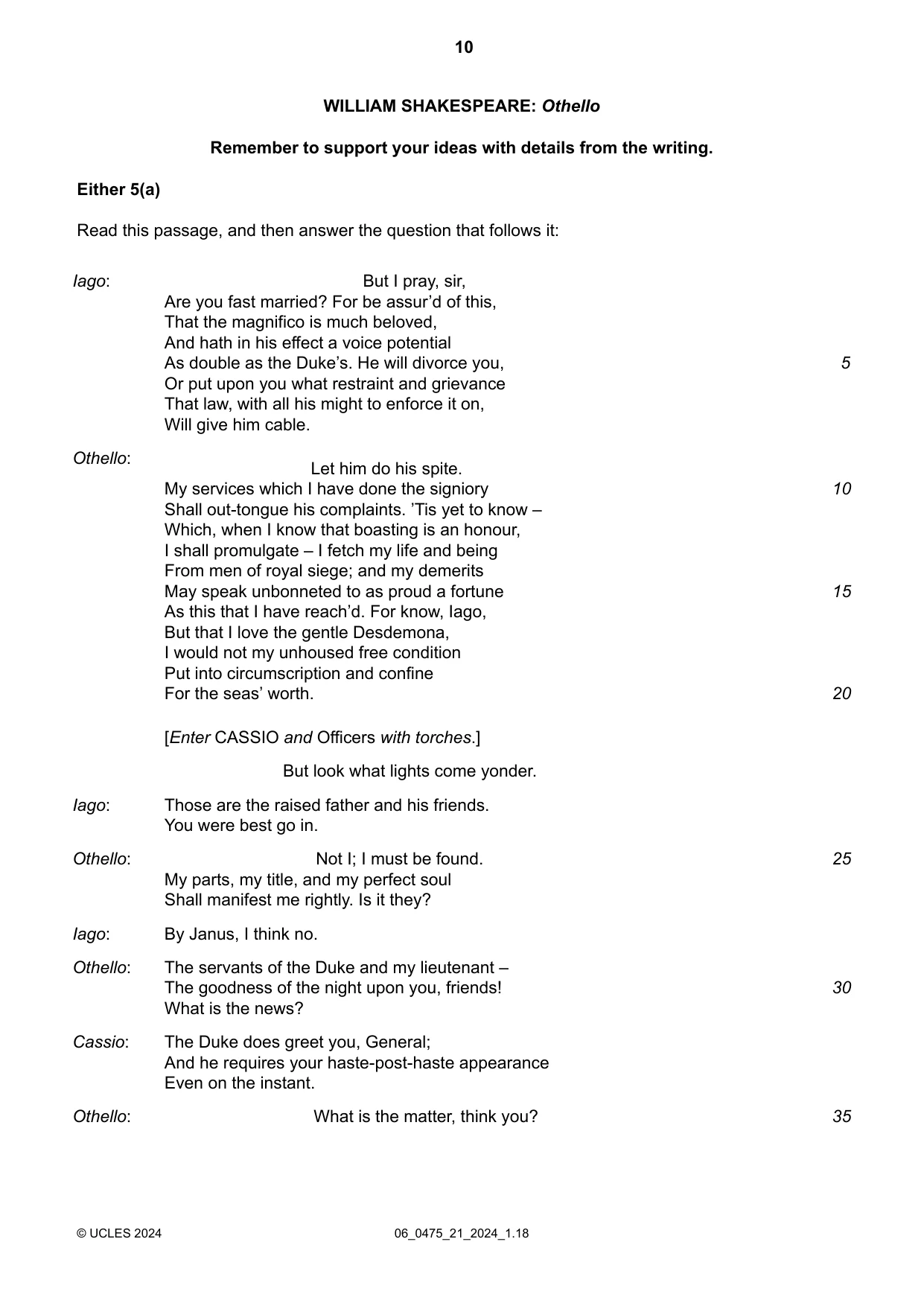
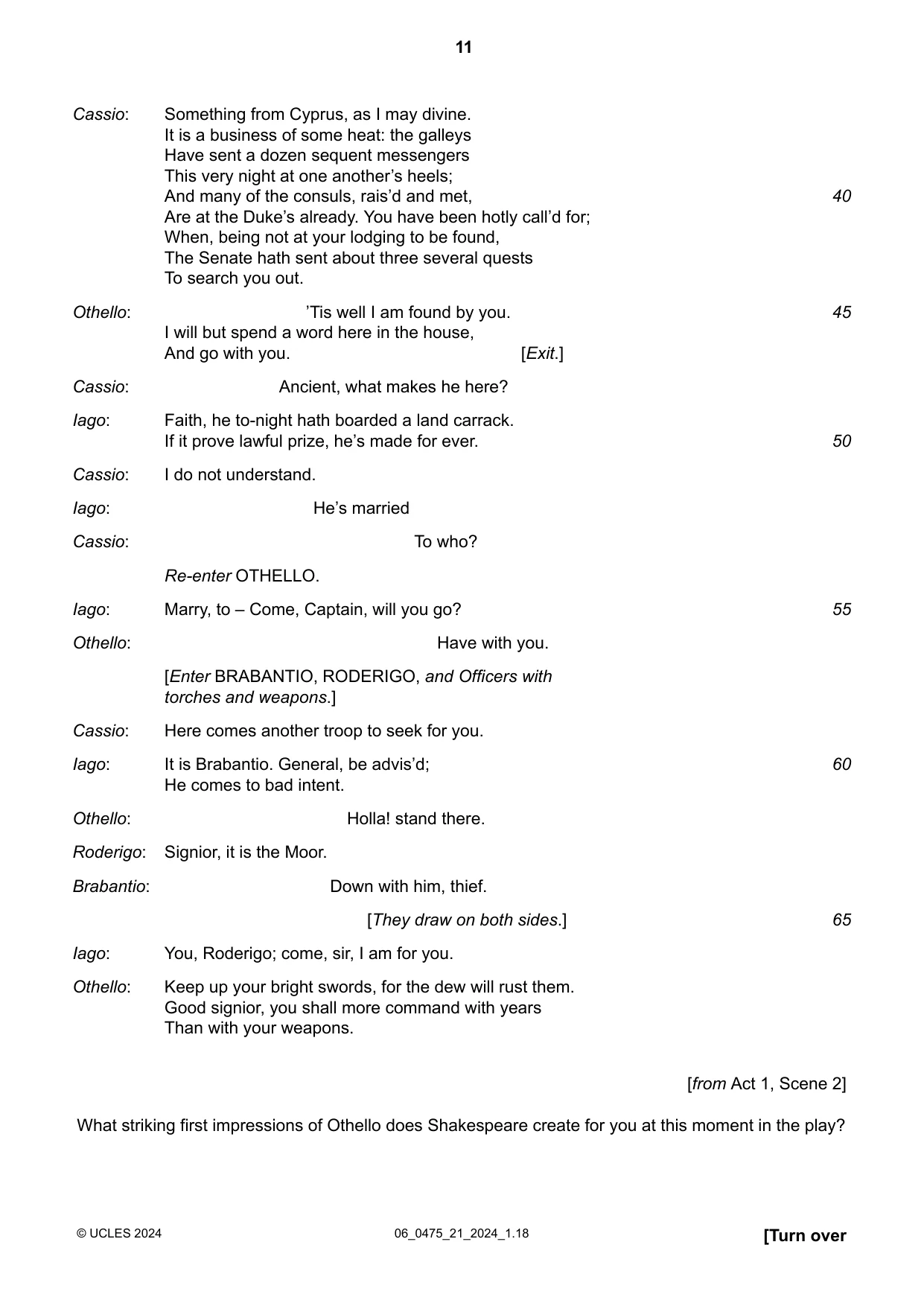
35 30 25 20 15 10 5 WILLIAM SHAKESPEARE: Othello Remember to support your ideas with details from the writing. Either 5(a) Read this passage, and then answer the question that follows it: But I pray, sir, Are you fast married? For be assur’d of this, That the magnifico is much beloved, And hath in his effect a voice potential As double as the Duke’s. He will divorce you, Or put upon you what restraint and grievance That law, with all his might to enforce it on, Will give him cable. Iago: Let him do his spite. My services which I have done the signiory Shall out-tongue his complaints. ’Tis yet to know – Which, when I know that boasting is an honour, I shall promulgate – I fetch my life and being From men of royal siege; and my demerits May speak unbonneted to as proud a fortune As this that I have reach’d. For know, Iago, But that I love the gentle Desdemona, I would not my unhoused free condition Put into circumscription and confine For the seas’ worth. Othello: [Enter CASSIO and Officers with torches.] But look what lights come yonder. Those are the raised father and his friends. You were best go in. Iago: Not I; I must be found. My parts, my title, and my perfect soul Shall manifest me rightly. Is it they? Othello: By Janus, I think no. Iago: The servants of the Duke and my lieutenant – The goodness of the night upon you, friends! What is the news? Othello: The Duke does greet you, General; And he requires your haste-post-haste appearance Even on the instant. Cassio: What is the matter, think you? Othello: 06_0475_21_2024_1.18 © UCLES 2024 10
Question paper, page 11
65 60 55 50 45 40 Something from Cyprus, as I may divine. It is a business of some heat: the galleys Have sent a dozen sequent messengers This very night at one another’s heels; And many of the consuls, rais’d and met, Are at the Duke’s already. You have been hotly call’d for; When, being not at your lodging to be found, The Senate hath sent about three several quests To search you out. Cassio: ’Tis well I am found by you. I will but spend a word here in the house, And go with you. [Exit.] Othello: Ancient, what makes he here? Cassio: Faith, he to-night hath boarded a land carrack. If it prove lawful prize, he’s made for ever. Iago: I do not understand. Cassio: He’s married Iago: To who? Cassio: Re-enter OTHELLO. Marry, to – Come, Captain, will you go? Iago: Have with you. Othello: [Enter BRABANTIO, RODERIGO, and Officers with torches and weapons.] Here comes another troop to seek for you. Cassio: It is Brabantio. General, be advis’d; He comes to bad intent. Iago: Holla! stand there. Othello: Signior, it is the Moor. Roderigo: Down with him, thief. Brabantio: [They draw on both sides.] You, Roderigo; come, sir, I am for you. Iago: Keep up your bright swords, for the dew will rust them. Good signior, you shall more command with years Than with your weapons. Othello: [from Act 1, Scene 2] What striking first impressions of Othello does Shakespeare create for you at this moment in the play? [Turn over 06_0475_21_2024_1.18 © UCLES 2024 11
Question paper, page 12
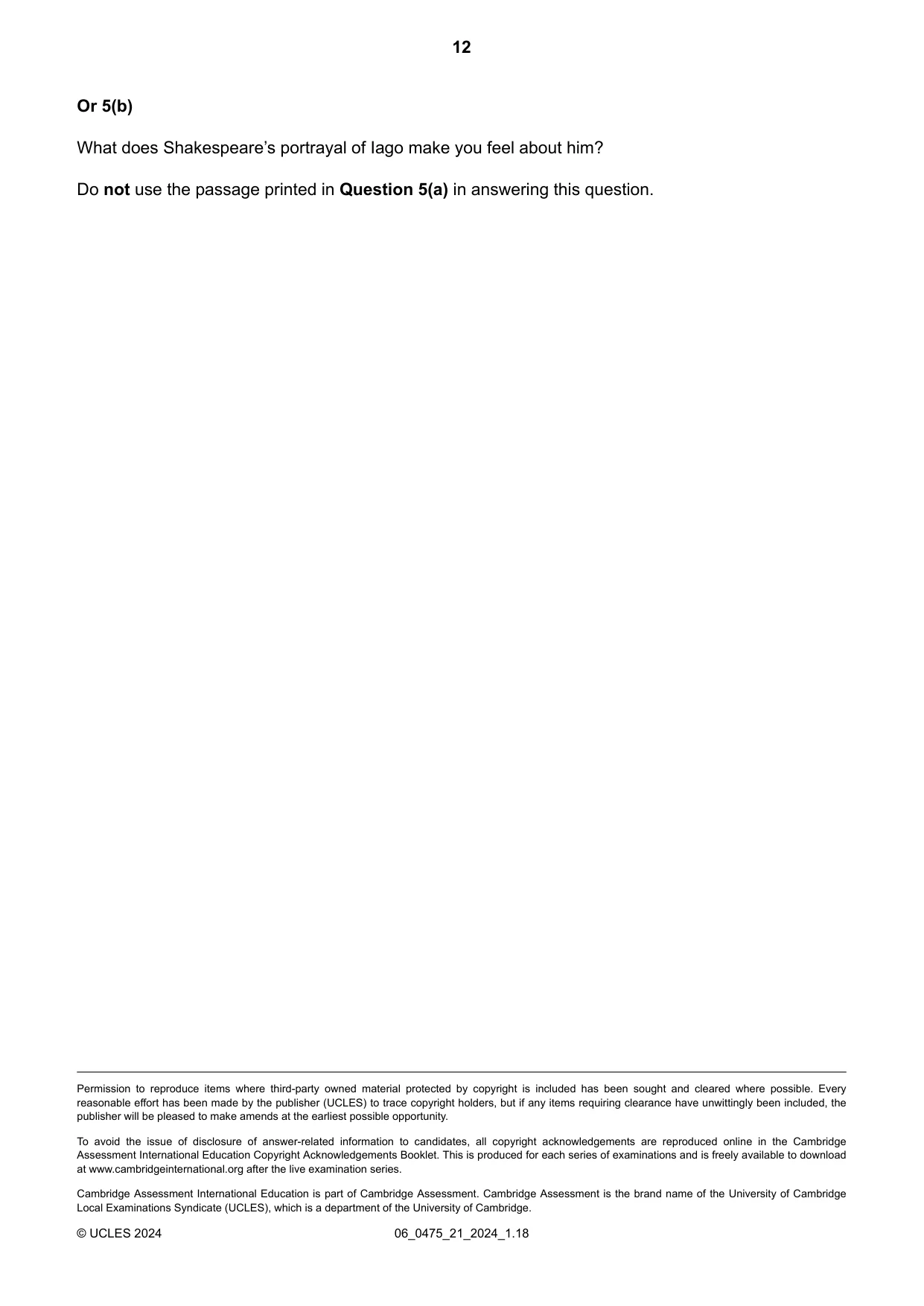
Or 5(b) What does Shakespeare’s portrayal of Iago make you feel about him? Do not use the passage printed in Question 5(a) in answering this question. Permission to reproduce items where third-party owned material protected by copyright is included has been sought and cleared where possible. Every reasonable effort has been made by the publisher (UCLES) to trace copyright holders, but if any items requiring clearance have unwittingly been included, the publisher will be pleased to make amends at the earliest possible opportunity. To avoid the issue of disclosure of answer-related information to candidates, all copyright acknowledgements are reproduced online in the Cambridge Assessment International Education Copyright Acknowledgements Booklet. This is produced for each series of examinations and is freely available to download at www.cambridgeinternational.org after the live examination series. Cambridge Assessment International Education is part of Cambridge Assessment. Cambridge Assessment is the brand name of the University of Cambridge Local Examinations Syndicate (UCLES), which is a department of the University of Cambridge. 06_0475_21_2024_1.18 © UCLES 2024 12
Mark scheme, page 1
This document consists of 5 printed pages. © Cambridge University Press & Assessment 2024 [Turn over Cambridge IGCSE™ LITERATURE IN ENGLISH 0475/21 Paper 2 Drama May/June 2024 MARK SCHEME Maximum Mark: 50 Published This mark scheme is published as an aid to teachers and candidates, to indicate the requirements of the examination. It shows the basis on which Examiners were instructed to award marks. It does not indicate the details of the discussions that took place at an Examiners’ meeting before marking began, which would have considered the acceptability of alternative answers. Mark schemes should be read in conjunction with the question paper and the Principal Examiner Report for Teachers. Cambridge International will not enter into discussions about these mark schemes. Cambridge International is publishing the mark schemes for the May/June 2024 series for most Cambridge IGCSE, Cambridge International A and AS Level and Cambridge Pre-U components, and some Cambridge O Level components.
Mark scheme, page 2
0475/21 Cambridge IGCSE – Mark Scheme PUBLISHED May/June 2024 © Cambridge University Press & Assessment 2024 Page 2 of 5 Generic Marking Principles These general marking principles must be applied by all examiners when marking candidate answers. They should be applied alongside the specific content of the mark scheme or generic level descriptions for a question. Each question paper and mark scheme will also comply with these marking principles. GENERIC MARKING PRINCIPLE 1: Marks must be awarded in line with: the specific content of the mark scheme or the generic level descriptors for the question the specific skills defined in the mark scheme or in the generic level descriptors for the question the standard of response required by a candidate as exemplified by the standardisation scripts. GENERIC MARKING PRINCIPLE 2: Marks awarded are always whole marks (not half marks, or other fractions). GENERIC MARKING PRINCIPLE 3: Marks must be awarded positively: marks are awarded for correct/valid answers, as defined in the mark scheme. However, credit is given for valid answers which go beyond the scope of the syllabus and mark scheme, referring to your Team Leader as appropriate marks are awarded when candidates clearly demonstrate what they know and can do marks are not deducted for errors marks are not deducted for omissions answers should only be judged on the quality of spelling, punctuation and grammar when these features are specifically assessed by the question as indicated by the mark scheme. The meaning, however, should be unambiguous. GENERIC MARKING PRINCIPLE 4: Rules must be applied consistently, e.g. in situations where candidates have not followed instructions or in the application of generic level descriptors. GENERIC MARKING PRINCIPLE 5: Marks should be awarded using the full range of marks defined in the mark scheme for the question (however; the use of the full mark range may be limited according to the quality of the candidate responses seen). GENERIC MARKING PRINCIPLE 6: Marks awarded are based solely on the requirements as defined in the mark scheme. Marks should not be awarded with grade thresholds or grade descriptors in mind.
Mark scheme, page 3
0475/21 Cambridge IGCSE – Mark Scheme PUBLISHED May/June 2024 © Cambridge University Press & Assessment 2024 Page 3 of 5 English & Media subject specific general marking principles (To be read in conjunction with the Generic Marking Principles (and requiring further guidance on how to place marks within levels)) Components using level descriptors: We use level descriptors as a guide to broad understanding of the qualities normally expected of, or typical of, work in a level. Level descriptors are a means of general guidance, and should not be interpreted as hurdle statements. Where indicative content notes are supplied for a question, these are not a prescription of required content, and must not be treated as such. Alternative correct points and unexpected answers in candidates’ scripts must be given marks that fairly reflect the knowledge and skills demonstrated. While we may have legitimate expectations as to the ground most answers may occupy, we must at all times be prepared to meet candidates on their chosen ground, provided it is relevant ground (e.g. clearly related to and derived from a relevant passage/text and meeting the mark scheme requirements for the question). Components using point-based marking: Point marking is often used to reward knowledge, understanding and application of skills. We give credit where the candidate’s answer shows relevant knowledge, understanding and application of skills in answering the question. We do not give credit where the answer shows confusion. From this it follows that we: a DO credit answers which are worded differently from the mark scheme if they clearly convey the same meaning (unless the mark scheme requires a specific term). b DO credit alternative answers/examples which are not written in the mark scheme if they are correct. c DO credit answers where candidates give more than one correct answer in one prompt/numbered/scaffolded space where extended writing is required rather than list-type answers. For example, questions that require n reasons (e.g. State two reasons…). d DO NOT credit answers simply for using a ‘key term’ unless that is all that is required. (Check for evidence it is understood and not used wrongly.). e DO NOT credit answers which are obviously self-contradicting or trying to cover all possibilities. f DO NOT give further credit for what is effectively repetition of a correct point already credited unless the language itself is being tested. This applies equally to ‘mirror statements’ (i.e. polluted/not polluted). g DO NOT require spellings to be correct, unless this is part of the test. However spellings of syllabus terms must allow for clear and unambiguous separation from other syllabus terms with which they may be confused (e.g. Corrasion/Corrosion).
Mark scheme, page 4
0475/21 Cambridge IGCSE – Mark Scheme PUBLISHED May/June 2024 © Cambridge University Press & Assessment 2024 Page 4 of 5 All questions are marked out of 25. The assessment objectives for the paper are: AO1: show detailed knowledge of the content of literary texts, supported by reference to the text AO2: understand the meanings of literary texts and their contexts, and explore texts beyond surface meanings to show deeper awareness of ideas and attitudes AO3: recognise and appreciate ways in which writers use language, structure and form to create and shape meanings and effects AO4: communicate a sensitive and informed personal response to literary texts. The Level Descriptors cover marks from 0 to 25, and apply to the marking of each question. They guide examiners to an understanding of the qualities normally expected of, or typical of, work in a level. They are a means of general guidance. For the purposes of standardisation of marking, they are to be used in conjunction with examples of candidates’ work and discussed during the examiners’ coordination meeting.
Mark scheme, page 5
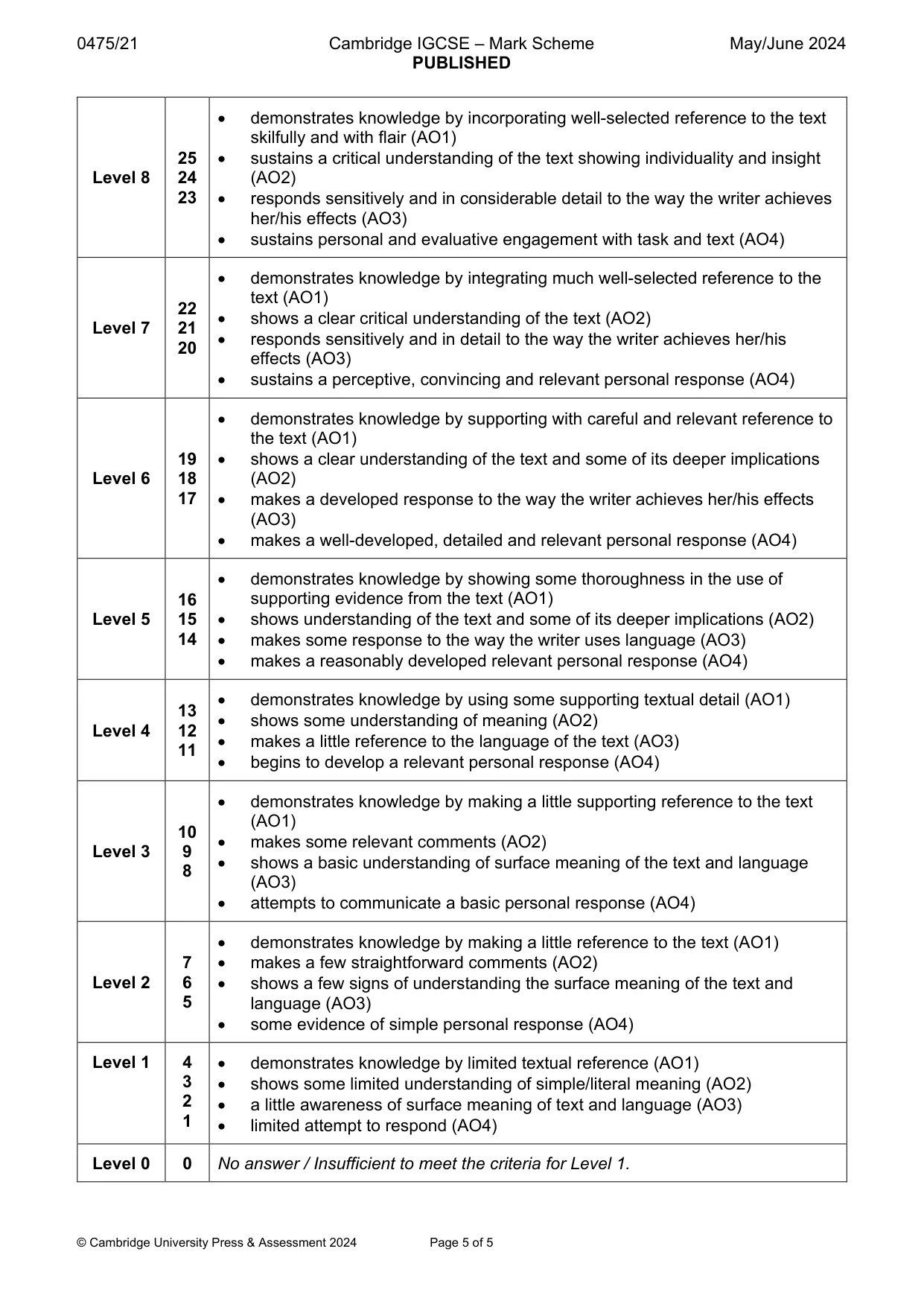
0475/21 Cambridge IGCSE – Mark Scheme PUBLISHED May/June 2024 © Cambridge University Press & Assessment 2024 Page 5 of 5 Level 8 25 24 23 demonstrates knowledge by incorporating well-selected reference to the text skilfully and with flair (AO1) sustains a critical understanding of the text showing individuality and insight (AO2) responds sensitively and in considerable detail to the way the writer achieves her/his effects (AO3) sustains personal and evaluative engagement with task and text (AO4) Level 7 22 21 20 demonstrates knowledge by integrating much well-selected reference to the text (AO1) shows a clear critical understanding of the text (AO2) responds sensitively and in detail to the way the writer achieves her/his effects (AO3) sustains a perceptive, convincing and relevant personal response (AO4) Level 6 19 18 17 demonstrates knowledge by supporting with careful and relevant reference to the text (AO1) shows a clear understanding of the text and some of its deeper implications (AO2) makes a developed response to the way the writer achieves her/his effects (AO3) makes a well-developed, detailed and relevant personal response (AO4) Level 5 16 15 14 demonstrates knowledge by showing some thoroughness in the use of supporting evidence from the text (AO1) shows understanding of the text and some of its deeper implications (AO2) makes some response to the way the writer uses language (AO3) makes a reasonably developed relevant personal response (AO4) Level 4 13 12 11 demonstrates knowledge by using some supporting textual detail (AO1) shows some understanding of meaning (AO2) makes a little reference to the language of the text (AO3) begins to develop a relevant personal response (AO4) Level 3 10 9 8 demonstrates knowledge by making a little supporting reference to the text (AO1) makes some relevant comments (AO2) shows a basic understanding of surface meaning of the text and language (AO3) attempts to communicate a basic personal response (AO4) Level 2 7 6 5 demonstrates knowledge by making a little reference to the text (AO1) makes a few straightforward comments (AO2) shows a few signs of understanding the surface meaning of the text and language (AO3) some evidence of simple personal response (AO4) Level 1 4 3 2 1 demonstrates knowledge by limited textual reference (AO1) shows some limited understanding of simple/literal meaning (AO2) a little awareness of surface meaning of text and language (AO3) limited attempt to respond (AO4) Level 0 0 No answer / Insufficient to meet the criteria for Level 1.
What you needed in this session
Cambridge’s own grade thresholds for 2024 May/June, Paper 2 · Variant 1. A higher threshold means an easier paper — the bar moves with how the cohort did.