Cambridge IGCSE English - Literature in English 0475 — 2025 Oct/Nov Paper 2 · Variant 1
0475/21/O/N/25 · 50 marks · ≈56 min
The question paper and its mark scheme, free to read here and free to download. This is Cambridge’s own paper, exactly as it was sat.
Question paper12 pages
Mark scheme5 pages
Answers below. Sit the paper first if you are practising.
Paper as text
Question paper, page 1
Cambridge Assessment International Education Cambridge IGCSE™ LITERATURE IN ENGLISH 0475/21 Paper 2 Drama October/November 2025 1 hour 30 minutes You must answer on the enclosed answer booklet. You will need: Answer booklet (enclosed) INSTRUCTIONS e Answer two questions. e Your answers must be on two different set texts. e You must answer one (a) passage-based question and one (b) essay question. e — Follow the instructions on the front cover of the answer booklet. If you need additional answer paper, ask the invigilator for a continuation booklet. INFORMATION e ~The total mark for this paper is 50. e All questions are worth equal marks. This document has 12 pages. Any blank pages are indicated. DC (RCL (DF)) 341357/2 © UCLES 2025 [Turn over
Question paper, page 2
2 0475/21/O/N/25 © UCLES 2025 SHELAGH DELANEY: A Taste of Honey Remember to support your ideas with details from the writing. Either 1(a) Read this passage, and then answer the question that follows it: JO: Has your husband thrown you out? Content removed due to copyright restrictions.
Question paper, page 3
3 0475/21/O/N/25 © UCLES 2025 [Turn over Living like pigs in a pigsty. (from Act 2, Scene 2) In what ways does Delaney make this moment in the play so revealing? Or 1(b) How far does Delaney make Boy a likeable character? Content removed due to copyright restrictions.
Question paper, page 4
4 0475/21/O/N/25 © UCLES 2025 WOLE SOYINKA: Death and the King’s Horseman Remember to support your ideas with details from the writing. Either 2(a) Read this passage, and then answer the question that follows it: [PILKINGS returns with IYALOJA.] Content removed due to copyright restrictions.
Question paper, page 5
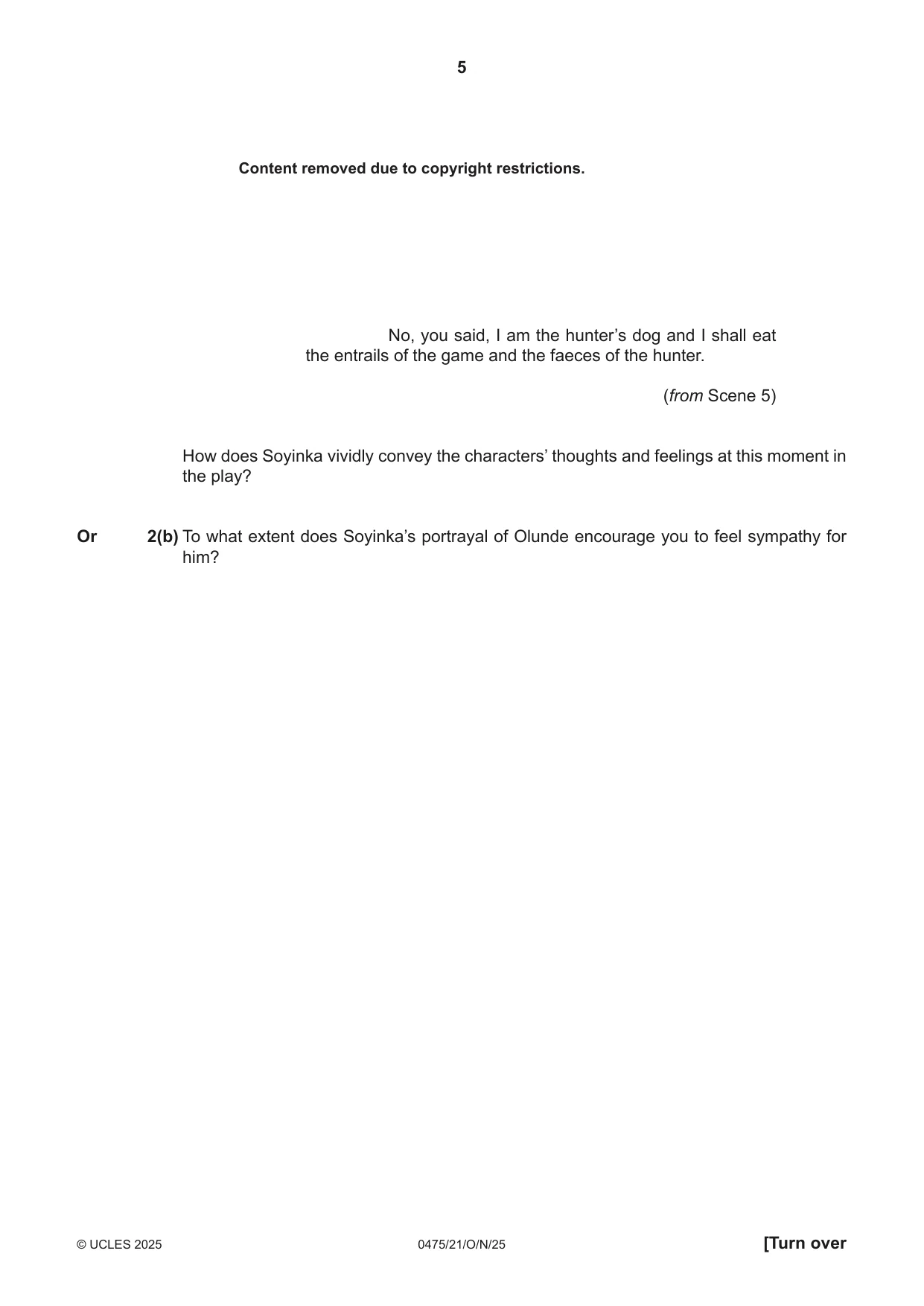
5 0475/21/O/N/25 © UCLES 2025 [Turn over No, you said, I am the hunter’s dog and I shall eat the entrails of the game and the faeces of the hunter. (from Scene 5) How does Soyinka vividly convey the characters’ thoughts and feelings at this moment in the play? Or 2(b) To what extent does Soyinka’s portrayal of Olunde encourage you to feel sympathy for him? Content removed due to copyright restrictions.
Question paper, page 6
6 0475/21/O/N/25 © UCLES 2025 TENNESSEE WILLIAMS: A Streetcar Named Desire Remember to support your ideas with details from the writing. Either 3(a) Read this passage, and then answer the question that follows it: [STELLA opens the door and they enter.] Content removed due to copyright restrictions.
Question paper, page 7
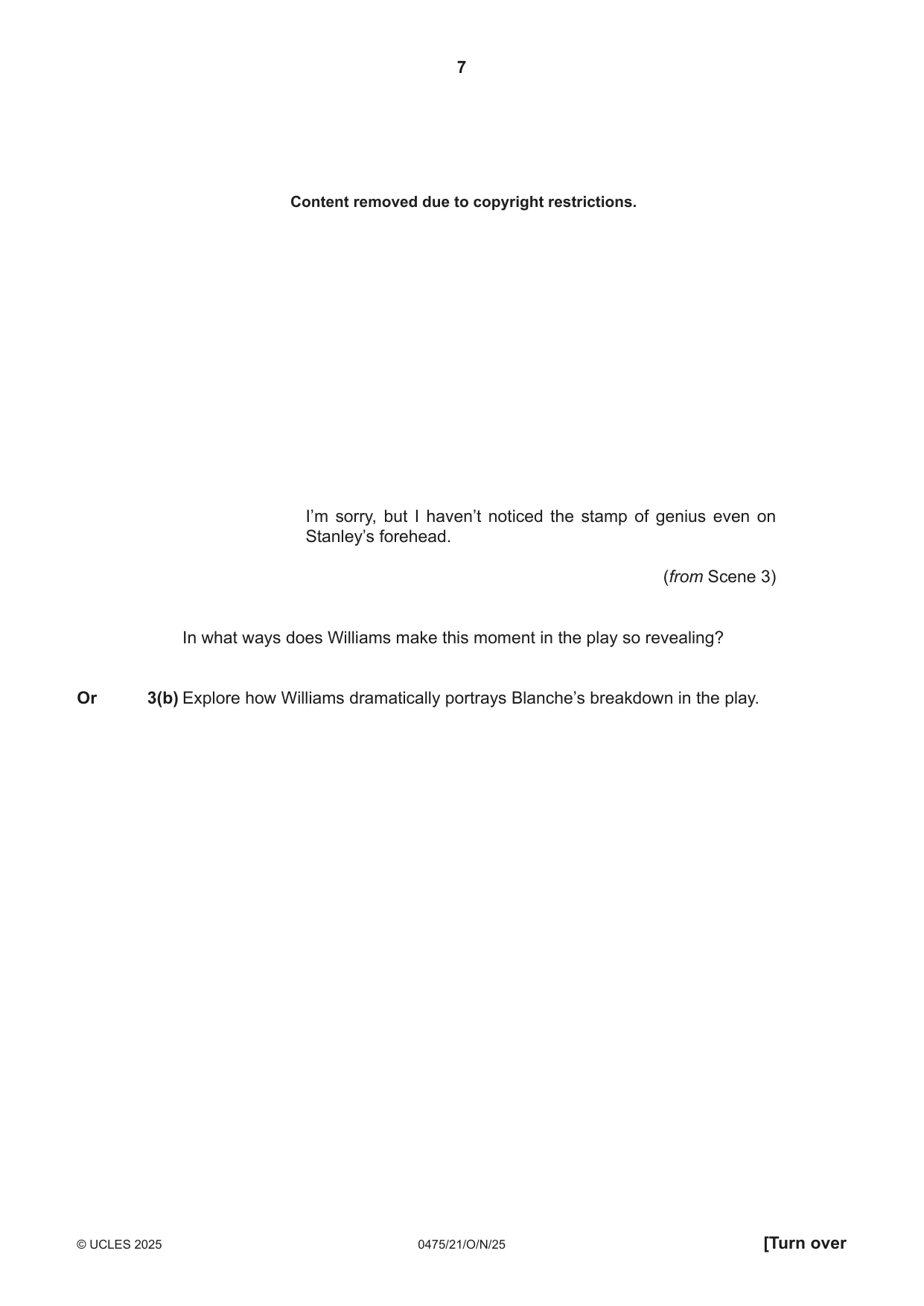
7 0475/21/O/N/25 © UCLES 2025 [Turn over I’m sorry, but I haven’t noticed the stamp of genius even on Stanley’s forehead. (from Scene 3) In what ways does Williams make this moment in the play so revealing? Or 3(b) Explore how Williams dramatically portrays Blanche’s breakdown in the play. Content removed due to copyright restrictions.
Question paper, page 8
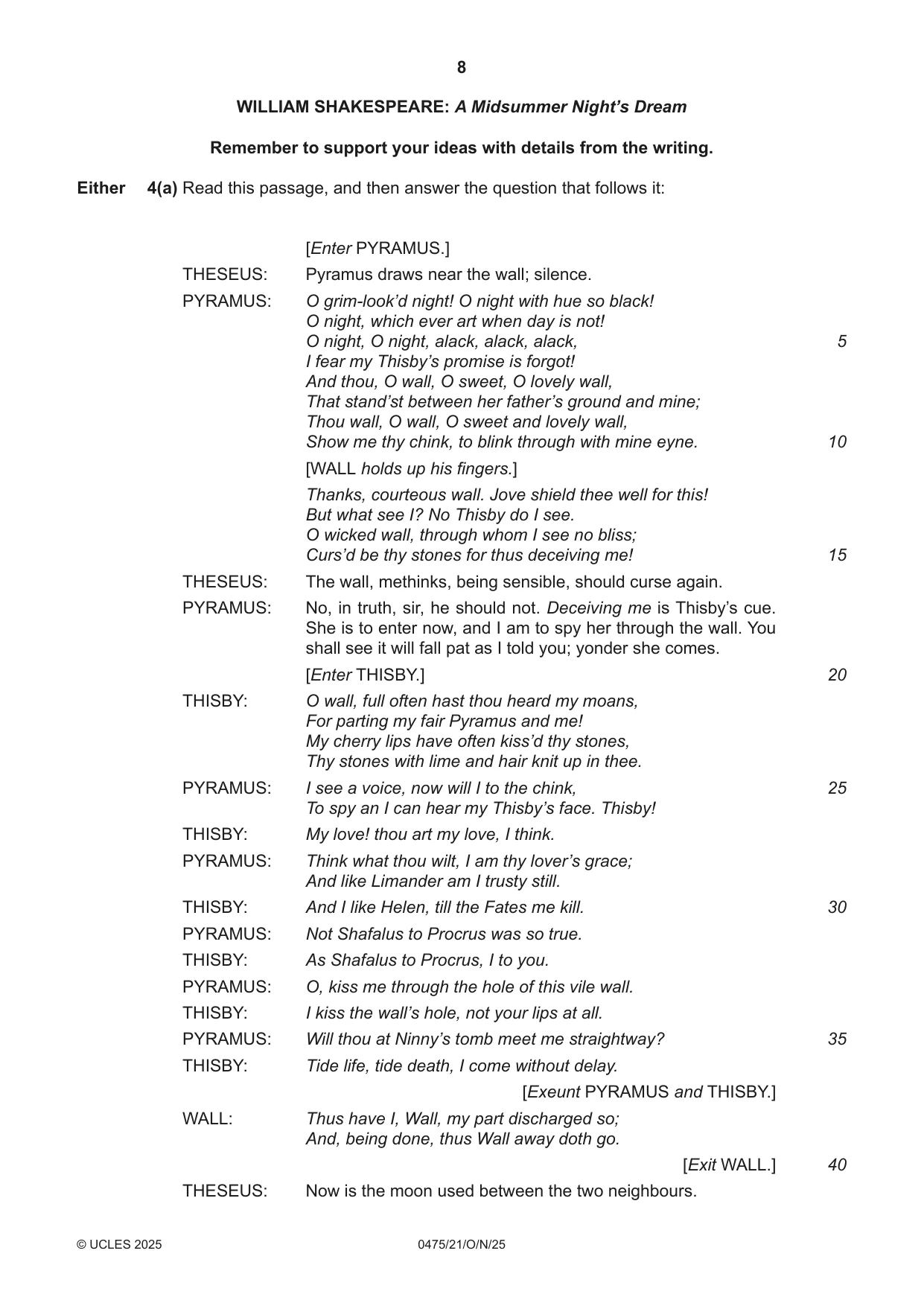
8 0475/21/O/N/25 © UCLES 2025 WILLIAM SHAKESPEARE: A Midsummer Night’s Dream Remember to support your ideas with details from the writing. Either 4(a) Read this passage, and then answer the question that follows it: [Enter PYRAMUS.] THESEUS: Pyramus draws near the wall; silence. PYRAMUS: O grim-look’d night! O night with hue so black! O night, which ever art when day is not! O night, O night, alack, alack, alack, I fear my Thisby’s promise is forgot! And thou, O wall, O sweet, O lovely wall, That stand’st between her father’s ground and mine; Thou wall, O wall, O sweet and lovely wall, Show me thy chink, to blink through with mine eyne. [WALL holds up his fingers.] Thanks, courteous wall. Jove shield thee well for this! But what see I? No Thisby do I see. O wicked wall, through whom I see no bliss; Curs’d be thy stones for thus deceiving me! THESEUS: The wall, methinks, being sensible, should curse again. PYRAMUS: No, in truth, sir, he should not. Deceiving me is Thisby’s cue. She is to enter now, and I am to spy her through the wall. You shall see it will fall pat as I told you; yonder she comes. [Enter THISBY.] THISBY: O wall, full often hast thou heard my moans, For parting my fair Pyramus and me! My cherry lips have often kiss’d thy stones, Thy stones with lime and hair knit up in thee. PYRAMUS: I see a voice, now will I to the chink, To spy an I can hear my Thisby’s face. Thisby! THISBY: My love! thou art my love, I think. PYRAMUS: Think what thou wilt, I am thy lover’s grace; And like Limander am I trusty still. THISBY: And I like Helen, till the Fates me kill. PYRAMUS: Not Shafalus to Procrus was so true. THISBY: As Shafalus to Procrus, I to you. PYRAMUS: O, kiss me through the hole of this vile wall. THISBY: I kiss the wall’s hole, not your lips at all. PYRAMUS: Will thou at Ninny’s tomb meet me straightway? THISBY: Tide life, tide death, I come without delay. [Exeunt PYRAMUS and THISBY.] WALL: Thus have I, Wall, my part discharged so; And, being done, thus Wall away doth go. [Exit WALL.] THESEUS: Now is the moon used between the two neighbours. 5 10 15 20 25 30 35 40
Question paper, page 9
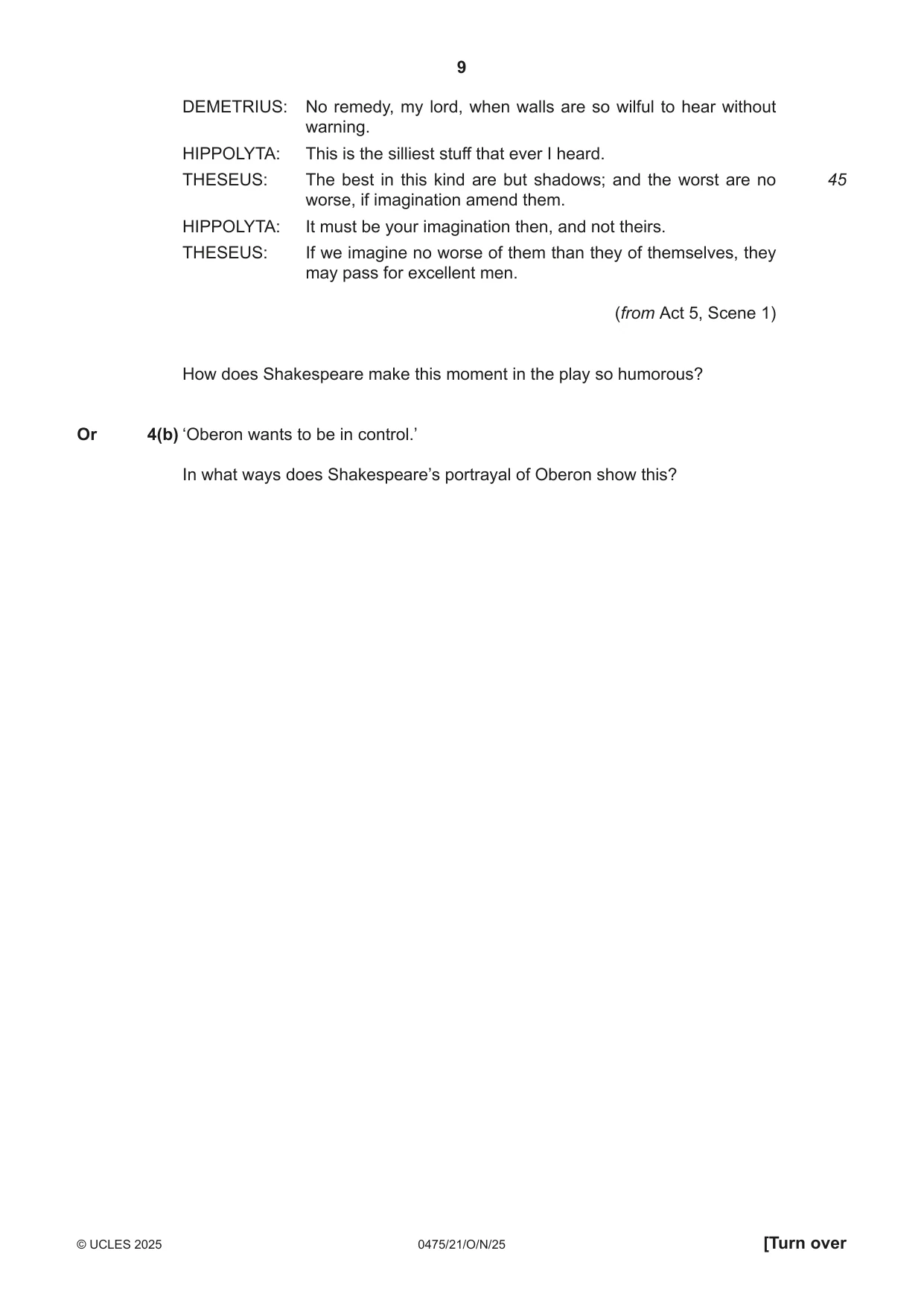
9 0475/21/O/N/25 © UCLES 2025 [Turn over DEMETRIUS: No remedy, my lord, when walls are so wilful to hear without warning. HIPPOLYTA: This is the silliest stuff that ever I heard. THESEUS: The best in this kind are but shadows; and the worst are no worse, if imagination amend them. HIPPOLYTA: It must be your imagination then, and not theirs. THESEUS: If we imagine no worse of them than they of themselves, they may pass for excellent men. (from Act 5, Scene 1) How does Shakespeare make this moment in the play so humorous? Or 4(b) ‘Oberon wants to be in control.’ In what ways does Shakespeare’s portrayal of Oberon show this? 45
Question paper, page 10
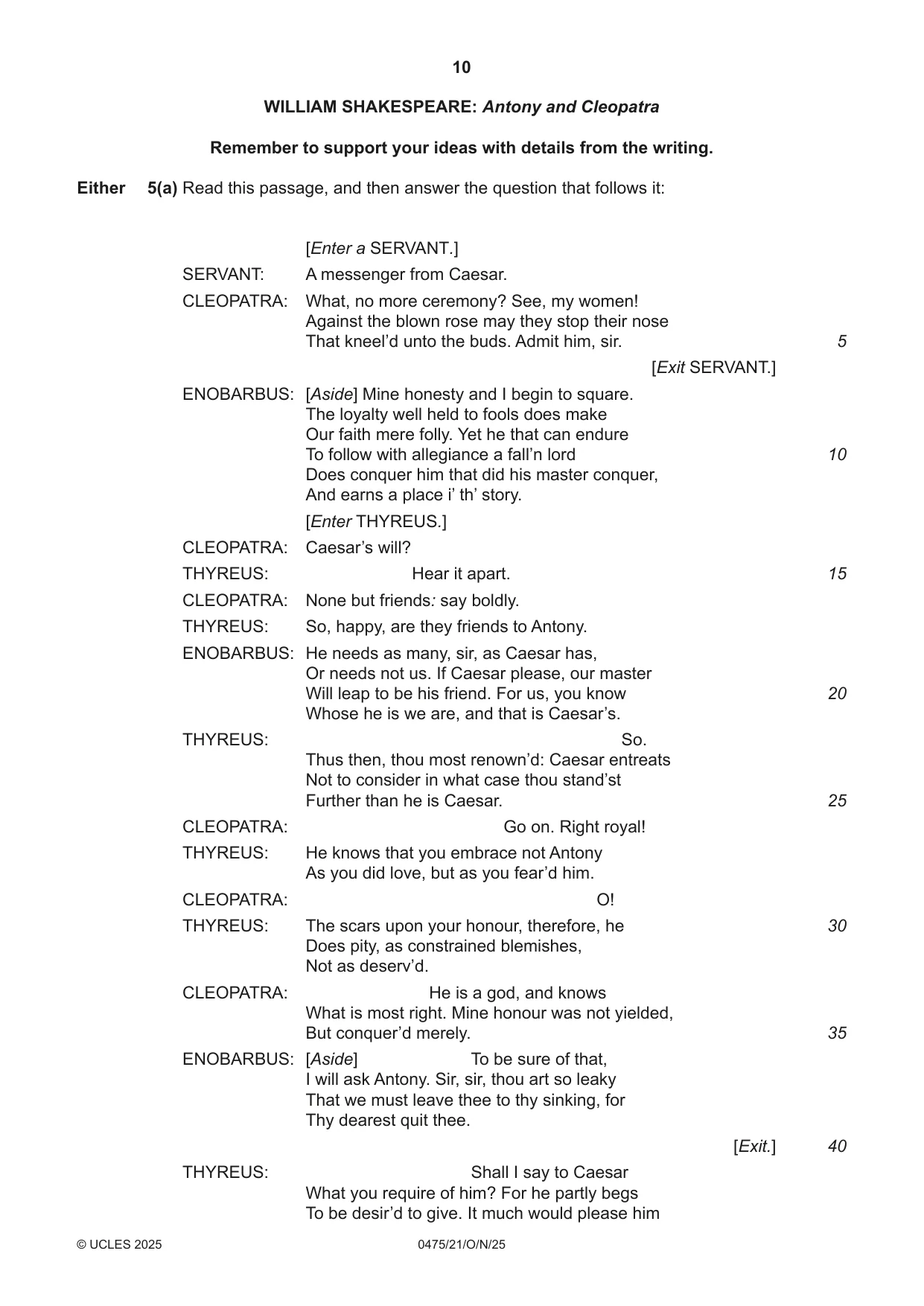
10 0475/21/O/N/25 © UCLES 2025 WILLIAM SHAKESPEARE: Antony and Cleopatra Remember to support your ideas with details from the writing. Either 5(a) Read this passage, and then answer the question that follows it: [Enter a SERVANT.] SERVANT: A messenger from Caesar. CLEOPATRA: What, no more ceremony? See, my women! Against the blown rose may they stop their nose That kneel’d unto the buds. Admit him, sir. [Exit SERVANT.] ENOBARBUS: [Aside] Mine honesty and I begin to square. The loyalty well held to fools does make Our faith mere folly. Yet he that can endure To follow with allegiance a fall’n lord Does conquer him that did his master conquer, And earns a place i’ th’ story. [Enter THYREUS.] CLEOPATRA: Caesar’s will? THYREUS: Hear it apart. CLEOPATRA: None but friends: say boldly. THYREUS: So, happy, are they friends to Antony. ENOBARBUS: He needs as many, sir, as Caesar has, Or needs not us. If Caesar please, our master Will leap to be his friend. For us, you know Whose he is we are, and that is Caesar’s. THYREUS: So. Thus then, thou most renown’d: Caesar entreats Not to consider in what case thou stand’st Further than he is Caesar. CLEOPATRA: Go on. Right royal! THYREUS: He knows that you embrace not Antony As you did love, but as you fear’d him. CLEOPATRA: O! THYREUS: The scars upon your honour, therefore, he Does pity, as constrained blemishes, Not as deserv’d. CLEOPATRA: He is a god, and knows What is most right. Mine honour was not yielded, But conquer’d merely. ENOBARBUS: [Aside] To be sure of that, I will ask Antony. Sir, sir, thou art so leaky That we must leave thee to thy sinking, for Thy dearest quit thee. [Exit.] THYREUS: Shall I say to Caesar What you require of him? For he partly begs To be desir’d to give. It much would please him 5 10 15 20 25 30 35 40
Question paper, page 11
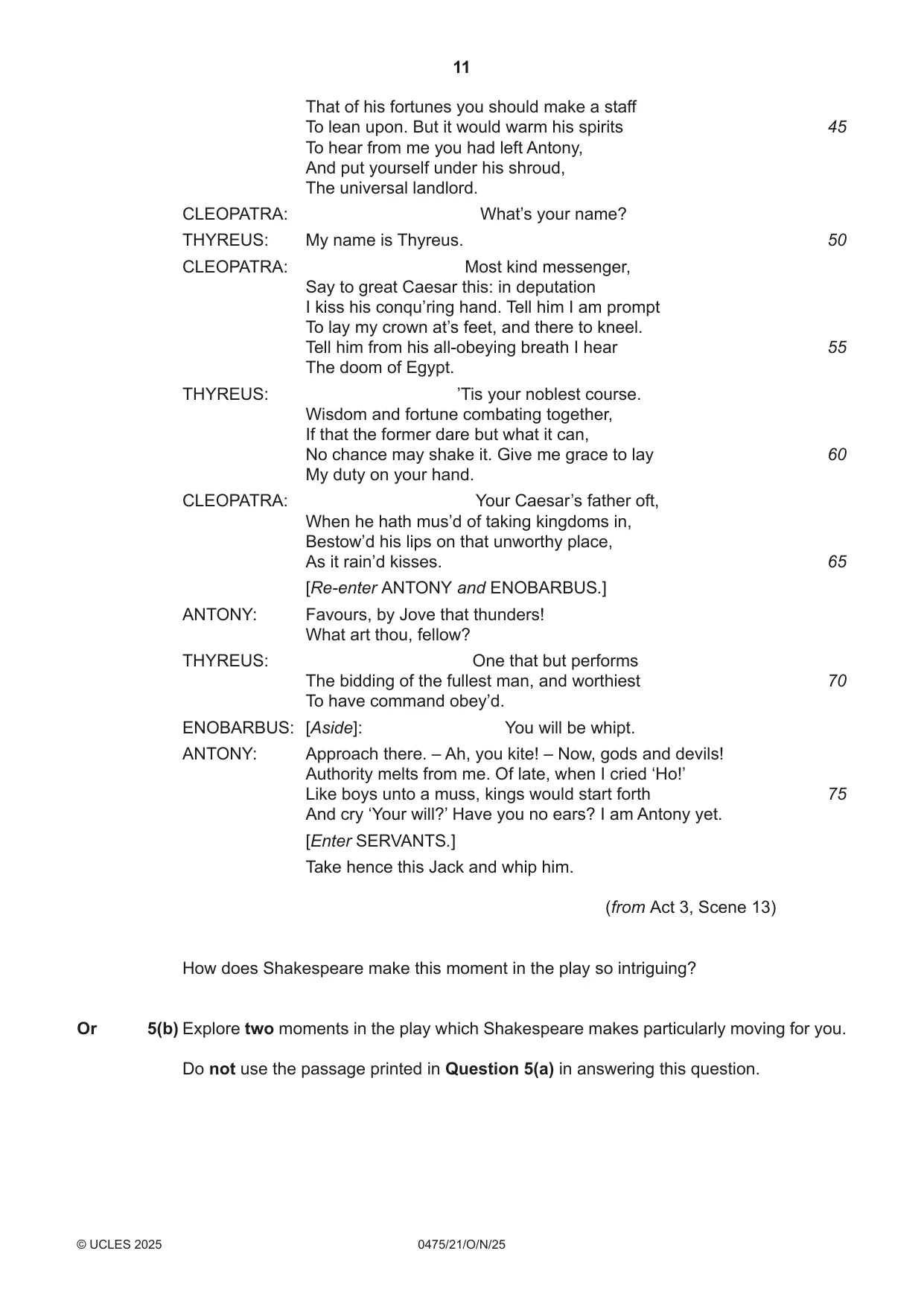
11 0475/21/O/N/25 © UCLES 2025 That of his fortunes you should make a staff To lean upon. But it would warm his spirits To hear from me you had left Antony, And put yourself under his shroud, The universal landlord. CLEOPATRA: What’s your name? THYREUS: My name is Thyreus. CLEOPATRA: Most kind messenger, Say to great Caesar this: in deputation I kiss his conqu’ring hand. Tell him I am prompt To lay my crown at’s feet, and there to kneel. Tell him from his all-obeying breath I hear The doom of Egypt. THYREUS: ’Tis your noblest course. Wisdom and fortune combating together, If that the former dare but what it can, No chance may shake it. Give me grace to lay My duty on your hand. CLEOPATRA: Your Caesar’s father oft, When he hath mus’d of taking kingdoms in, Bestow’d his lips on that unworthy place, As it rain’d kisses. [Re-enter ANTONY and ENOBARBUS.] ANTONY: Favours, by Jove that thunders! What art thou, fellow? THYREUS: One that but performs The bidding of the fullest man, and worthiest To have command obey’d. ENOBARBUS: [Aside]: You will be whipt. ANTONY: Approach there. – Ah, you kite! – Now, gods and devils! Authority melts from me. Of late, when I cried ‘Ho!’ Like boys unto a muss, kings would start forth And cry ‘Your will?’ Have you no ears? I am Antony yet. [Enter SERVANTS.] Take hence this Jack and whip him. (from Act 3, Scene 13) How does Shakespeare make this moment in the play so intriguing? Or 5(b) Explore two moments in the play which Shakespeare makes particularly moving for you. Do not use the passage printed in Question 5(a) in answering this question. 45 50 55 60 65 70 75
Question paper, page 12
12 0475/21/O/N/25 © UCLES 2025 Permission to reproduce items where third-party owned material protected by copyright is included has been sought and cleared where possible. Every reasonable effort has been made by the publisher (UCLES) to trace copyright holders, but if any items requiring clearance have unwittingly been included, the publisher will be pleased to make amends at the earliest possible opportunity. To avoid the issue of disclosure of answer-related information to candidates, all copyright acknowledgements are reproduced online in the Cambridge Assessment International Education Copyright Acknowledgements Booklet. This is produced for each series of examinations and is freely available to download at www.cambridgeinternational.org after the live examination series. Cambridge Assessment International Education is part of Cambridge Assessment. Cambridge Assessment is the brand name of the University of Cambridge Local Examinations Syndicate (UCLES), which is a department of the University of Cambridge. BLANK PAGE
Mark scheme, page 1
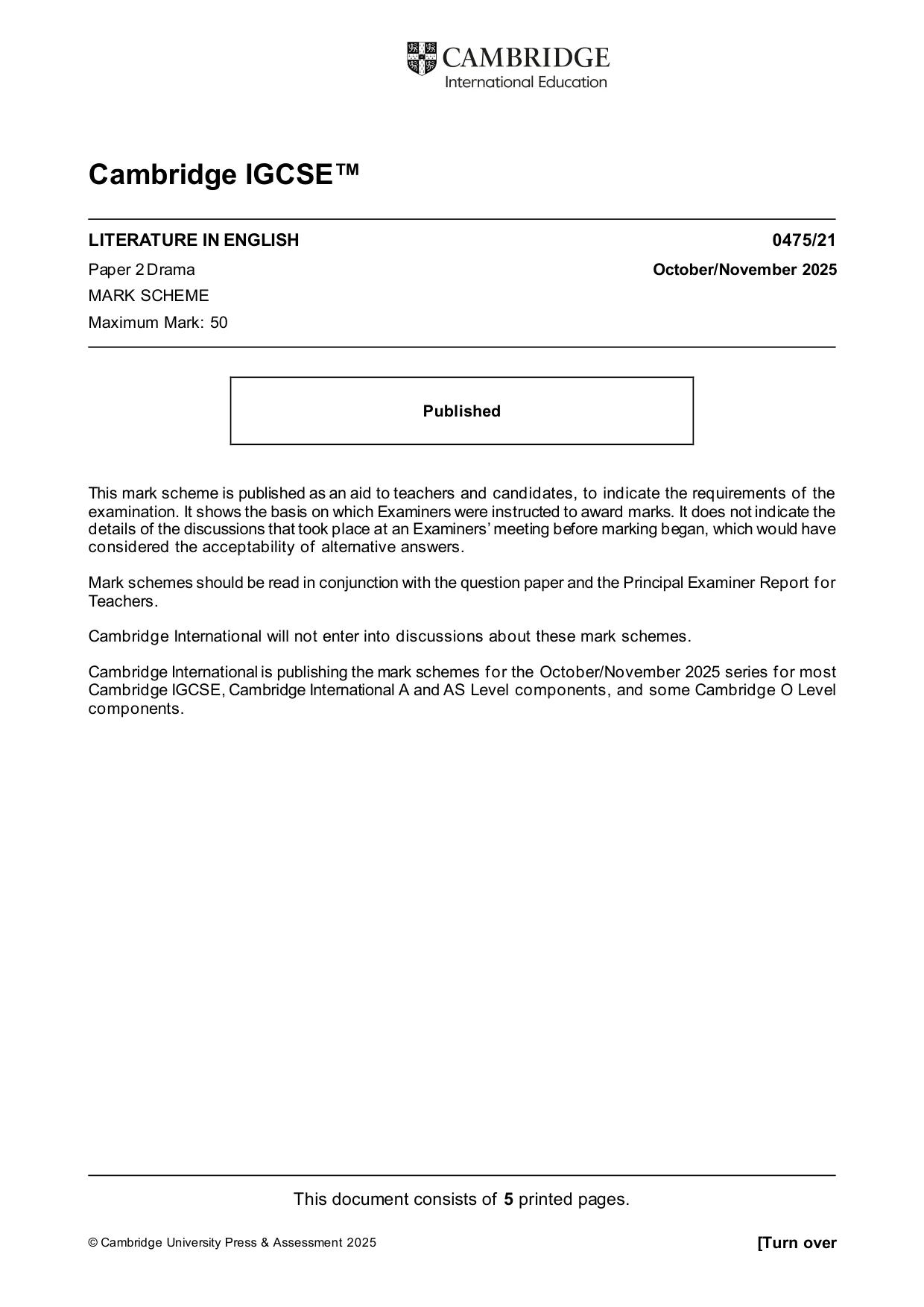
This document consists of 5 printed pages. © Cambridge University Press & Assessment 2025 [Turn over Cambridge IGCSE™ LITERATURE IN ENGLISH 0475/21 Paper 2 Drama October/November 2025 MARK SCHEME Maximum Mark: 50 Published This mark scheme is published as an aid to teachers and candidates, to indicate the requirements of the examination. It shows the basis on which Examiners were instructed to award marks. It does not indicate the details of the discussions that took place at an Examiners’ meeting before marking began, which would have considered the acceptability of alternative answers. Mark schemes should be read in conjunction with the question paper and the Principal Examiner Report for Teachers. Cambridge International will not enter into discussions about these mark schemes. Cambridge International is publishing the mark schemes for the October/November 2025 series for most Cambridge IGCSE, Cambridge International A and AS Level components, and some Cambridge O Level components.
Mark scheme, page 2
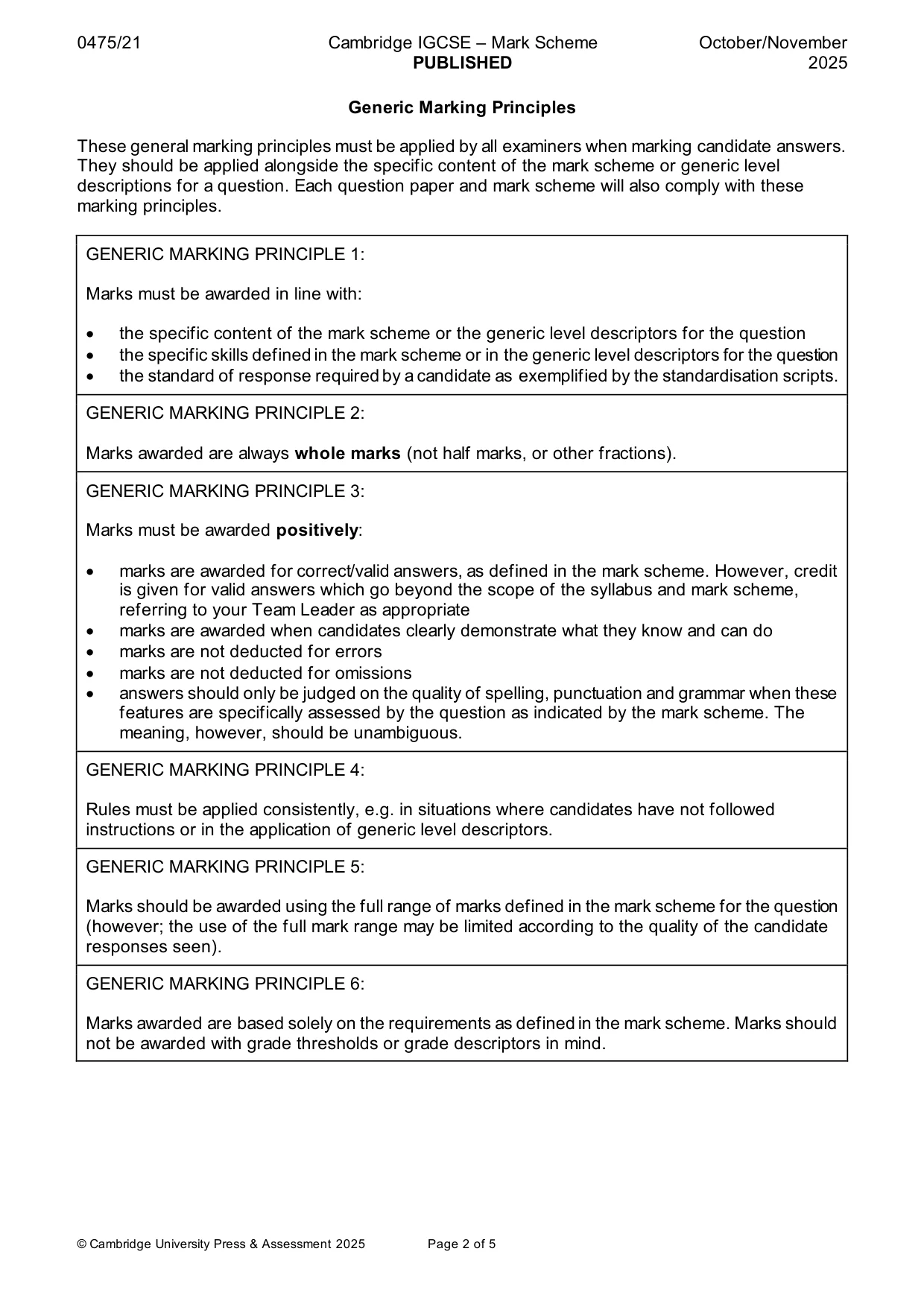
0475/21 Cambridge IGCSE – Mark Scheme PUBLISHED October/November 2025 © Cambridge University Press & Assessment 2025 Page 2 of 5 Generic Marking Principles These general marking principles must be applied by all examiners when marking candidate answers. They should be applied alongside the specific content of the mark scheme or generic level descriptions for a question. Each question paper and mark scheme will also comply with these marking principles. GENERIC MARKING PRINCIPLE 1: Marks must be awarded in line with: • the specific content of the mark scheme or the generic level descriptors for the question • the specific skills defined in the mark scheme or in the generic level descriptors for the question • the standard of response required by a candidate as exemplified by the standardisation scripts. GENERIC MARKING PRINCIPLE 2: Marks awarded are always whole marks (not half marks, or other fractions). GENERIC MARKING PRINCIPLE 3: Marks must be awarded positively: • marks are awarded for correct/valid answers, as defined in the mark scheme. However, credit is given for valid answers which go beyond the scope of the syllabus and mark scheme, referring to your Team Leader as appropriate • marks are awarded when candidates clearly demonstrate what they know and can do • marks are not deducted for errors • marks are not deducted for omissions • answers should only be judged on the quality of spelling, punctuation and grammar when these features are specifically assessed by the question as indicated by the mark scheme. The meaning, however, should be unambiguous. GENERIC MARKING PRINCIPLE 4: Rules must be applied consistently, e.g. in situations where candidates have not followed instructions or in the application of generic level descriptors. GENERIC MARKING PRINCIPLE 5: Marks should be awarded using the full range of marks defined in the mark scheme for the question (however; the use of the full mark range may be limited according to the quality of the candidate responses seen). GENERIC MARKING PRINCIPLE 6: Marks awarded are based solely on the requirements as defined in the mark scheme. Marks should not be awarded with grade thresholds or grade descriptors in mind.
Mark scheme, page 3
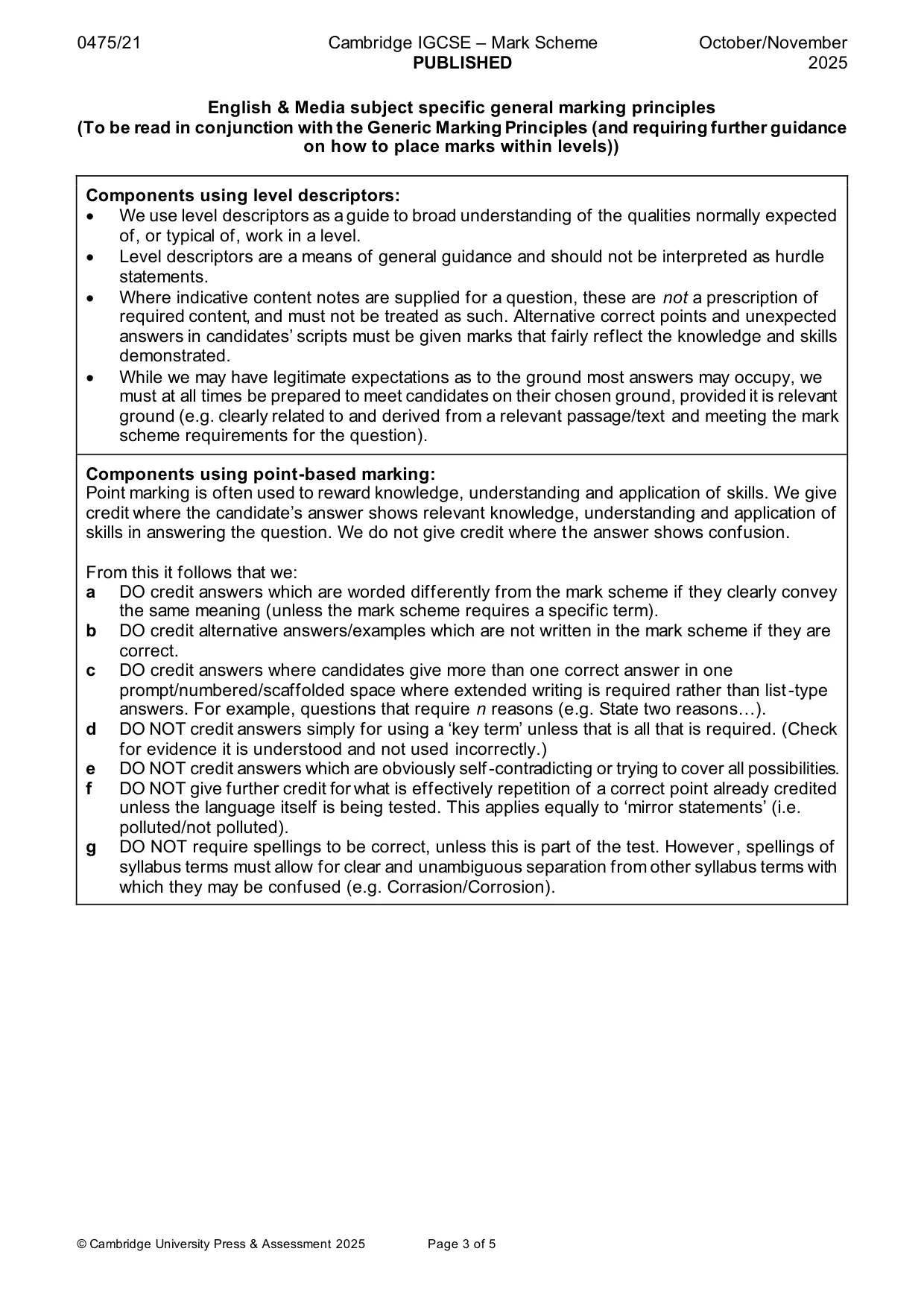
0475/21 Cambridge IGCSE – Mark Scheme PUBLISHED October/November 2025 © Cambridge University Press & Assessment 2025 Page 3 of 5 English & Media subject specific general marking principles (To be read in conjunction with the Generic Marking Principles (and requiring further guidance on how to place marks within levels)) Components using level descriptors: • We use level descriptors as a guide to broad understanding of the qualities normally expected of, or typical of, work in a level. • Level descriptors are a means of general guidance and should not be interpreted as hurdle statements. • Where indicative content notes are supplied for a question, these are not a prescription of required content, and must not be treated as such. Alternative correct points and unexpected answers in candidates’ scripts must be given marks that fairly reflect the knowledge and skills demonstrated. • While we may have legitimate expectations as to the ground most answers may occupy, we must at all times be prepared to meet candidates on their chosen ground, provided it is relevant ground (e.g. clearly related to and derived from a relevant passage/text and meeting the mark scheme requirements for the question). Components using point-based marking: Point marking is often used to reward knowledge, understanding and application of skills. We give credit where the candidate’s answer shows relevant knowledge, understanding and application of skills in answering the question. We do not give credit where the answer shows confusion. From this it follows that we: a DO credit answers which are worded differently from the mark scheme if they clearly convey the same meaning (unless the mark scheme requires a specific term). b DO credit alternative answers/examples which are not written in the mark scheme if they are correct. c DO credit answers where candidates give more than one correct answer in one prompt/numbered/scaffolded space where extended writing is required rather than list-type answers. For example, questions that require n reasons (e.g. State two reasons…). d DO NOT credit answers simply for using a ‘key term’ unless that is all that is required. (Check for evidence it is understood and not used incorrectly.) e DO NOT credit answers which are obviously self-contradicting or trying to cover all possibilities. f DO NOT give further credit for what is effectively repetition of a correct point already credited unless the language itself is being tested. This applies equally to ‘mirror statements’ (i.e. polluted/not polluted). g DO NOT require spellings to be correct, unless this is part of the test. However, spellings of syllabus terms must allow for clear and unambiguous separation from other syllabus terms with which they may be confused (e.g. Corrasion/Corrosion).
Mark scheme, page 4
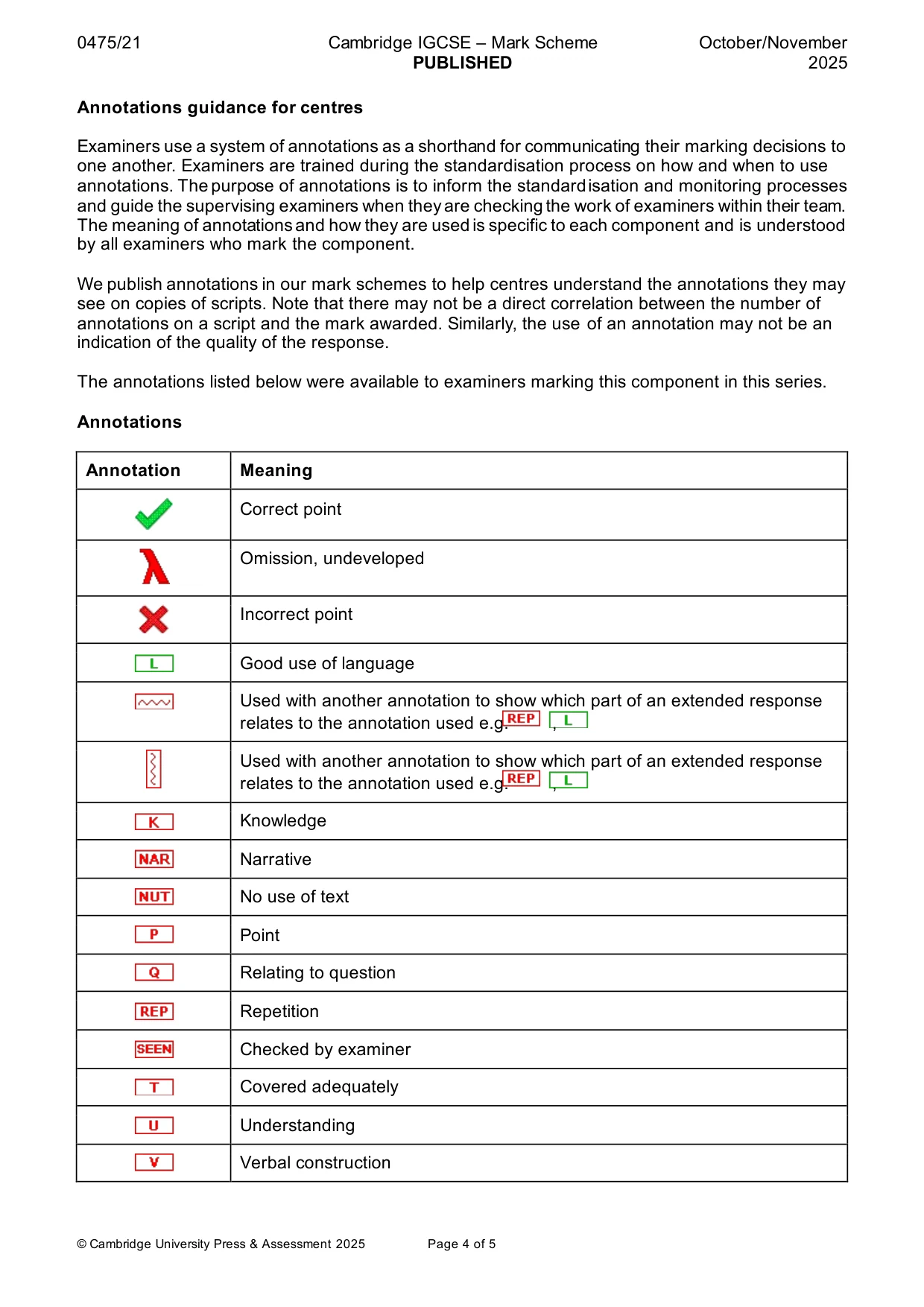
0475/21 Cambridge IGCSE – Mark Scheme PUBLISHED October/November 2025 © Cambridge University Press & Assessment 2025 Page 4 of 5 Annotations guidance for centres Examiners use a system of annotations as a shorthand for communicating their marking decisions to one another. Examiners are trained during the standardisation process on how and when to use annotations. The purpose of annotations is to inform the standardisation and monitoring processes and guide the supervising examiners when they are checking the work of examiners within their team. The meaning of annotations and how they are used is specific to each component and is understood by all examiners who mark the component. We publish annotations in our mark schemes to help centres understand the annotations they may see on copies of scripts. Note that there may not be a direct correlation between the number of annotations on a script and the mark awarded. Similarly, the use of an annotation may not be an indication of the quality of the response. The annotations listed below were available to examiners marking this component in this series. Annotations Annotation Meaning Correct point Omission, undeveloped Incorrect point Good use of language Used with another annotation to show which part of an extended response relates to the annotation used e.g. , Used with another annotation to show which part of an extended response relates to the annotation used e.g. , Knowledge Narrative No use of text Point Relating to question Repetition Checked by examiner Covered adequately Understanding Verbal construction
Mark scheme, page 5
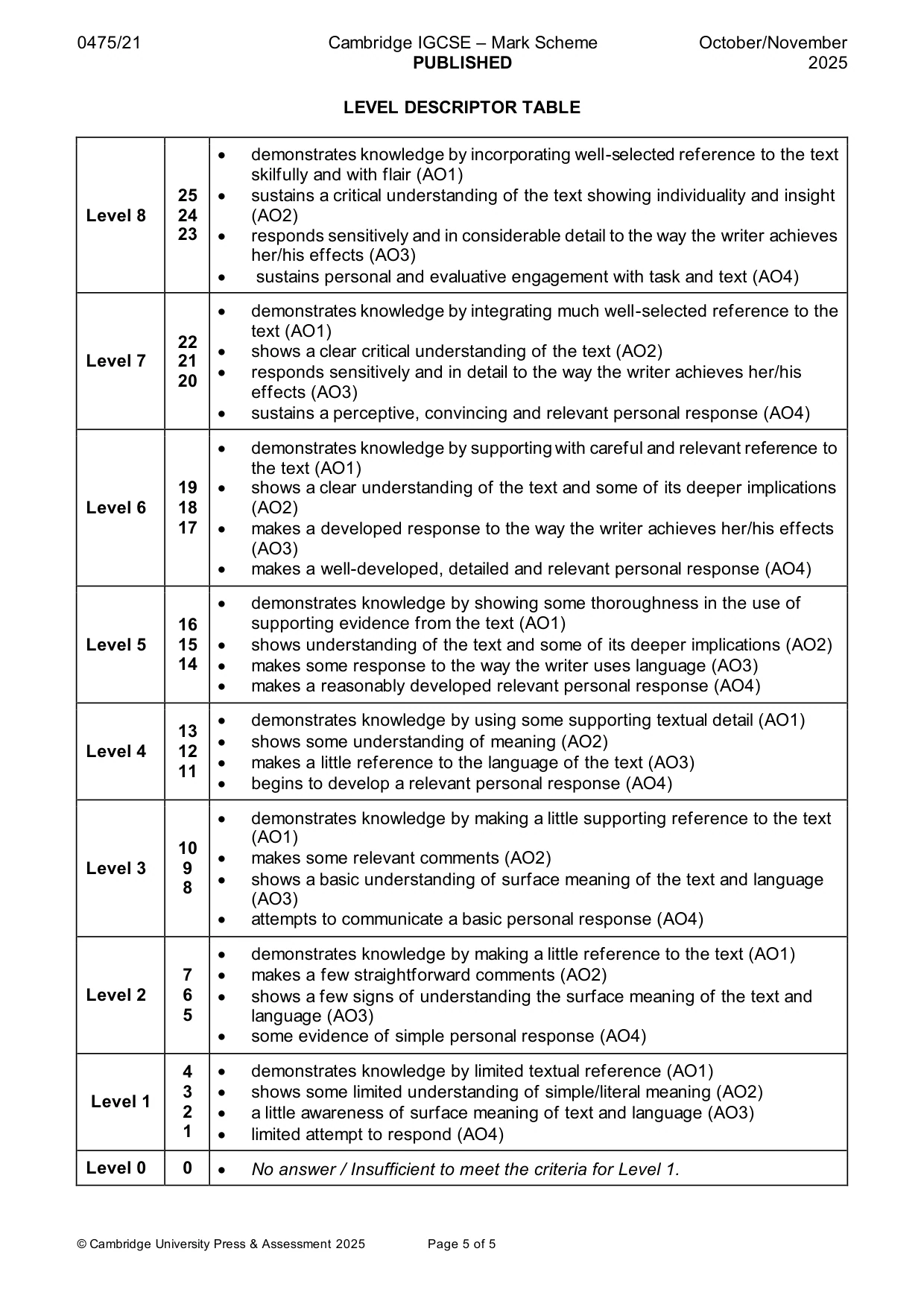
0475/21 Cambridge IGCSE – Mark Scheme PUBLISHED October/November 2025 © Cambridge University Press & Assessment 2025 Page 5 of 5 LEVEL DESCRIPTOR TABLE Level 8 25 24 23 • demonstrates knowledge by incorporating well-selected reference to the text skilfully and with flair (AO1) • sustains a critical understanding of the text showing individuality and insight (AO2) • responds sensitively and in considerable detail to the way the writer achieves her/his effects (AO3) • sustains personal and evaluative engagement with task and text (AO4) Level 7 22 21 20 • demonstrates knowledge by integrating much well-selected reference to the text (AO1) • shows a clear critical understanding of the text (AO2) • responds sensitively and in detail to the way the writer achieves her/his effects (AO3) • sustains a perceptive, convincing and relevant personal response (AO4) Level 6 19 18 17 • demonstrates knowledge by supporting with careful and relevant reference to the text (AO1) • shows a clear understanding of the text and some of its deeper implications (AO2) • makes a developed response to the way the writer achieves her/his effects (AO3) • makes a well-developed, detailed and relevant personal response (AO4) Level 5 16 15 14 • demonstrates knowledge by showing some thoroughness in the use of supporting evidence from the text (AO1) • shows understanding of the text and some of its deeper implications (AO2) • makes some response to the way the writer uses language (AO3) • makes a reasonably developed relevant personal response (AO4) Level 4 13 12 11 • demonstrates knowledge by using some supporting textual detail (AO1) • shows some understanding of meaning (AO2) • makes a little reference to the language of the text (AO3) • begins to develop a relevant personal response (AO4) Level 3 10 9 8 • demonstrates knowledge by making a little supporting reference to the text (AO1) • makes some relevant comments (AO2) • shows a basic understanding of surface meaning of the text and language (AO3) • attempts to communicate a basic personal response (AO4) Level 2 7 6 5 • demonstrates knowledge by making a little reference to the text (AO1) • makes a few straightforward comments (AO2) • shows a few signs of understanding the surface meaning of the text and language (AO3) • some evidence of simple personal response (AO4) Level 1 4 3 2 1 • demonstrates knowledge by limited textual reference (AO1) • shows some limited understanding of simple/literal meaning (AO2) • a little awareness of surface meaning of text and language (AO3) • limited attempt to respond (AO4) Level 0 0 • No answer / Insufficient to meet the criteria for Level 1.
What you needed in this session
Cambridge’s own grade thresholds for 2025 Oct/Nov, Paper 2 · Variant 1. A higher threshold means an easier paper — the bar moves with how the cohort did.