Cambridge IGCSE English - Literature in English 0475 — 2022 May/June Paper 2 · Variant 3
0475/23/M/J/22 · 50 marks · ≈56 min
The question paper and its mark scheme, free to read here and free to download. This is Cambridge’s own paper, exactly as it was sat.
Question paper12 pages
Mark scheme5 pages
Answers below. Sit the paper first if you are practising.
Paper as text
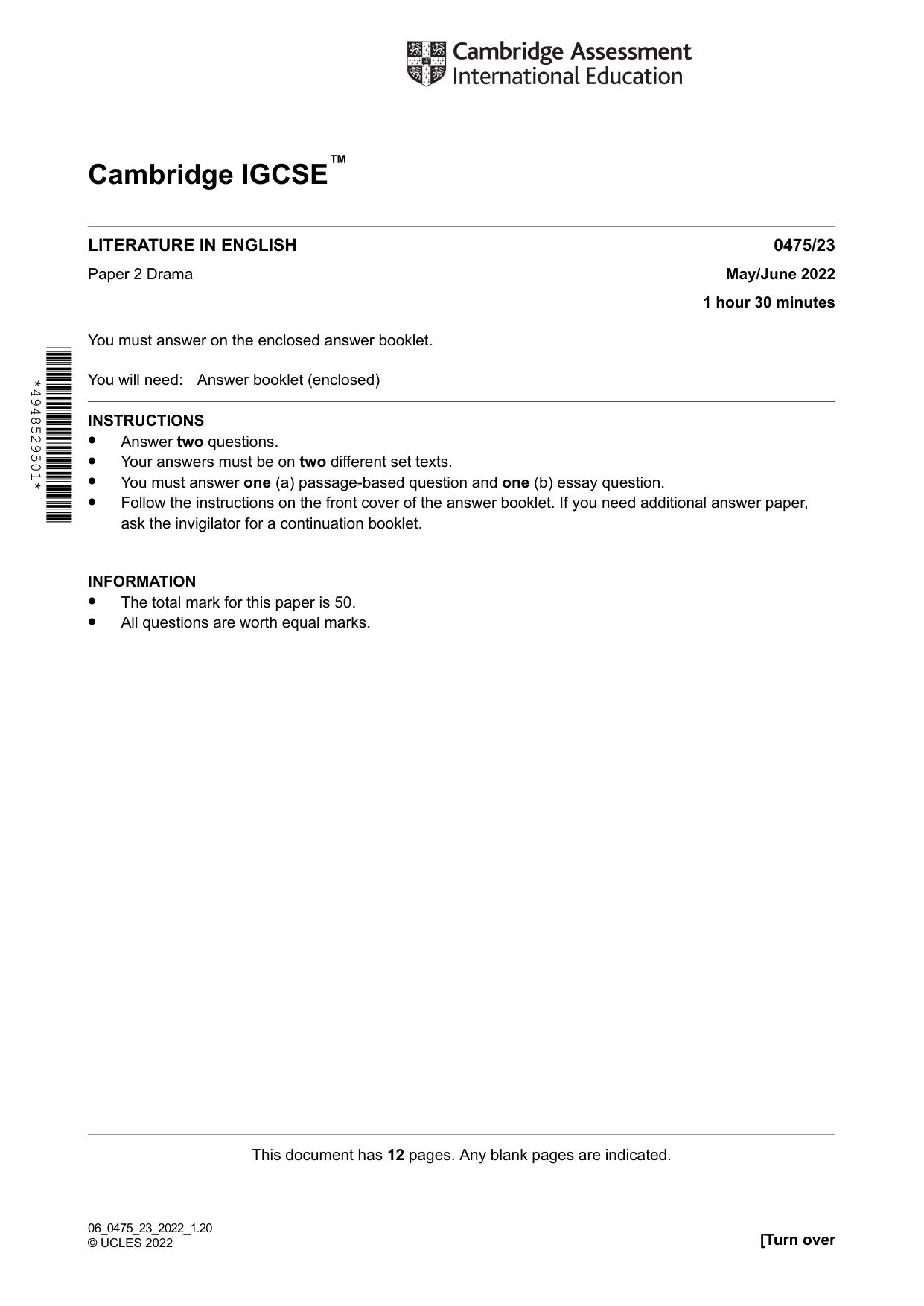
Question paper, page 1
Cambridge IGCSE™ 0475/23 LITERATURE IN ENGLISH May/June 2022 Paper 2 Drama 1 hour 30 minutes You must answer on the enclosed answer booklet. You will need: Answer booklet (enclosed) INSTRUCTIONS • Answer two questions. • Your answers must be on two different set texts. • You must answer one (a) passage-based question and one (b) essay question. • Follow the instructions on the front cover of the answer booklet. If you need additional answer paper, ask the invigilator for a continuation booklet. INFORMATION • The total mark for this paper is 50. • All questions are worth equal marks. This document has 12 pages. Any blank pages are indicated. [Turn over 06_0475_23_2022_1.20 © UCLES 2022 *4948529501*
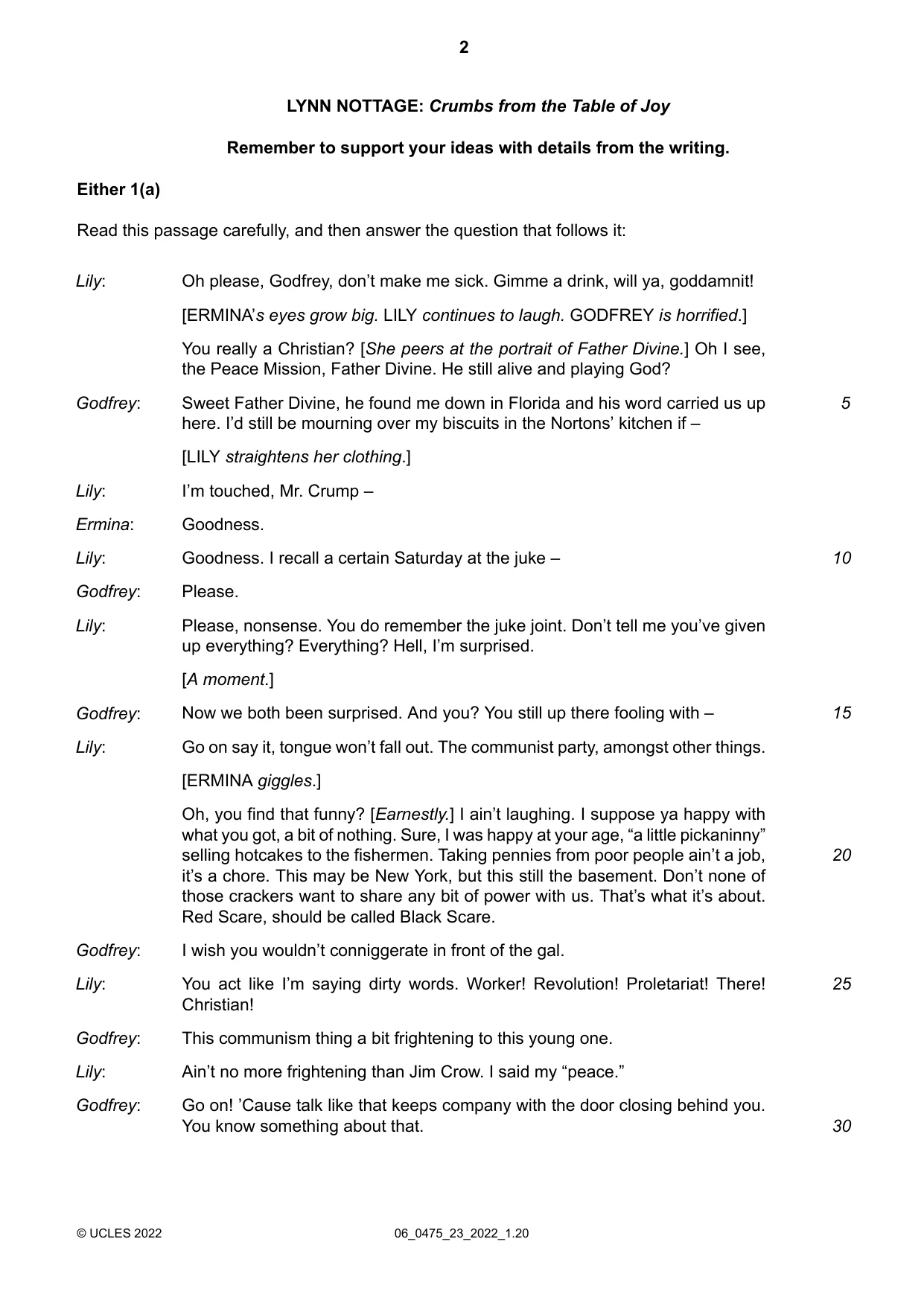
Question paper, page 2
30 25 20 15 10 5 LYNN NOTTAGE: Crumbs from the Table of Joy Remember to support your ideas with details from the writing. Either 1(a) Read this passage carefully, and then answer the question that follows it: Oh please, Godfrey, don’t make me sick. Gimme a drink, will ya, goddamnit! Lily: [ERMINA’s eyes grow big. LILY continues to laugh. GODFREY is horrified.] You really a Christian? [She peers at the portrait of Father Divine.] Oh I see, the Peace Mission, Father Divine. He still alive and playing God? Sweet Father Divine, he found me down in Florida and his word carried us up here. I’d still be mourning over my biscuits in the Nortons’ kitchen if – Godfrey: [LILY straightens her clothing.] I’m touched, Mr. Crump – Lily: Goodness. Ermina: Goodness. I recall a certain Saturday at the juke – Lily: Please. Godfrey: Please, nonsense. You do remember the juke joint. Don’t tell me you’ve given up everything? Everything? Hell, I’m surprised. Lily: [A moment.] Now we both been surprised. And you? You still up there fooling with – Godfrey: Go on say it, tongue won’t fall out. The communist party, amongst other things. Lily: [ERMINA giggles.] Oh, you find that funny? [Earnestly.] I ain’t laughing. I suppose ya happy with what you got, a bit of nothing. Sure, I was happy at your age, “a little pickaninny” selling hotcakes to the fishermen. Taking pennies from poor people ain’t a job, it’s a chore. This may be New York, but this still the basement. Don’t none of those crackers want to share any bit of power with us. That’s what it’s about. Red Scare, should be called Black Scare. I wish you wouldn’t conniggerate in front of the gal. Godfrey: You act like I’m saying dirty words. Worker! Revolution! Proletariat! There! Christian! Lily: This communism thing a bit frightening to this young one. Godfrey: Ain’t no more frightening than Jim Crow. I said my “peace.” Lily: Go on! ’Cause talk like that keeps company with the door closing behind you. You know something about that. Godfrey: 06_0475_23_2022_1.20 © UCLES 2022 2
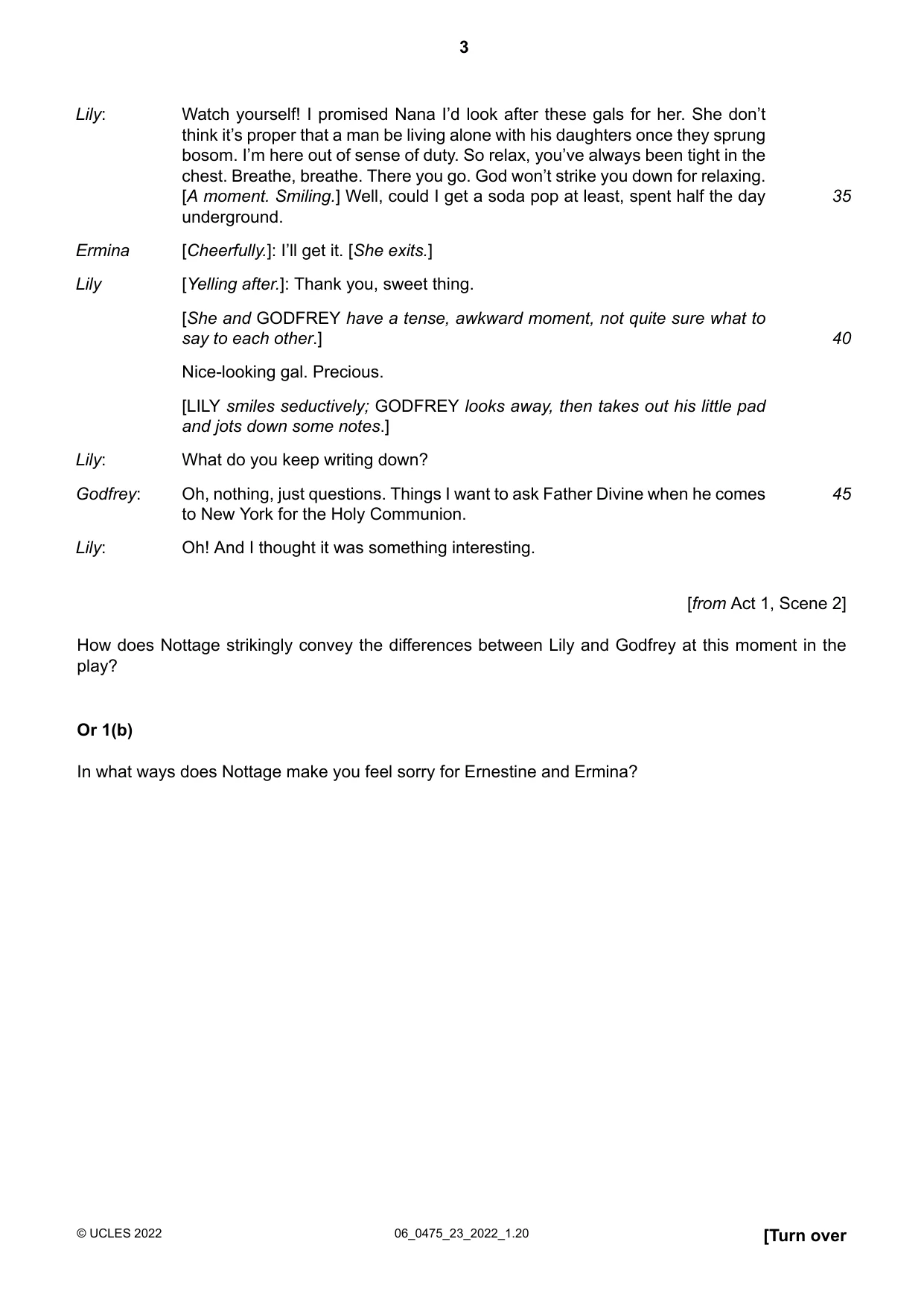
Question paper, page 3
45 40 35 Watch yourself! I promised Nana I’d look after these gals for her. She don’t think it’s proper that a man be living alone with his daughters once they sprung bosom. I’m here out of sense of duty. So relax, you’ve always been tight in the chest. Breathe, breathe. There you go. God won’t strike you down for relaxing. [A moment. Smiling.] Well, could I get a soda pop at least, spent half the day underground. Lily: [Cheerfully.]: I’ll get it. [She exits.] Ermina [Yelling after.]: Thank you, sweet thing. Lily [She and GODFREY have a tense, awkward moment, not quite sure what to say to each other.] Nice-looking gal. Precious. [LILY smiles seductively; GODFREY looks away, then takes out his little pad and jots down some notes.] What do you keep writing down? Lily: Oh, nothing, just questions. Things I want to ask Father Divine when he comes to New York for the Holy Communion. Godfrey: Oh! And I thought it was something interesting. Lily: [from Act 1, Scene 2] How does Nottage strikingly convey the differences between Lily and Godfrey at this moment in the play? Or 1(b) In what ways does Nottage make you feel sorry for Ernestine and Ermina? [Turn over 06_0475_23_2022_1.20 © UCLES 2022 3
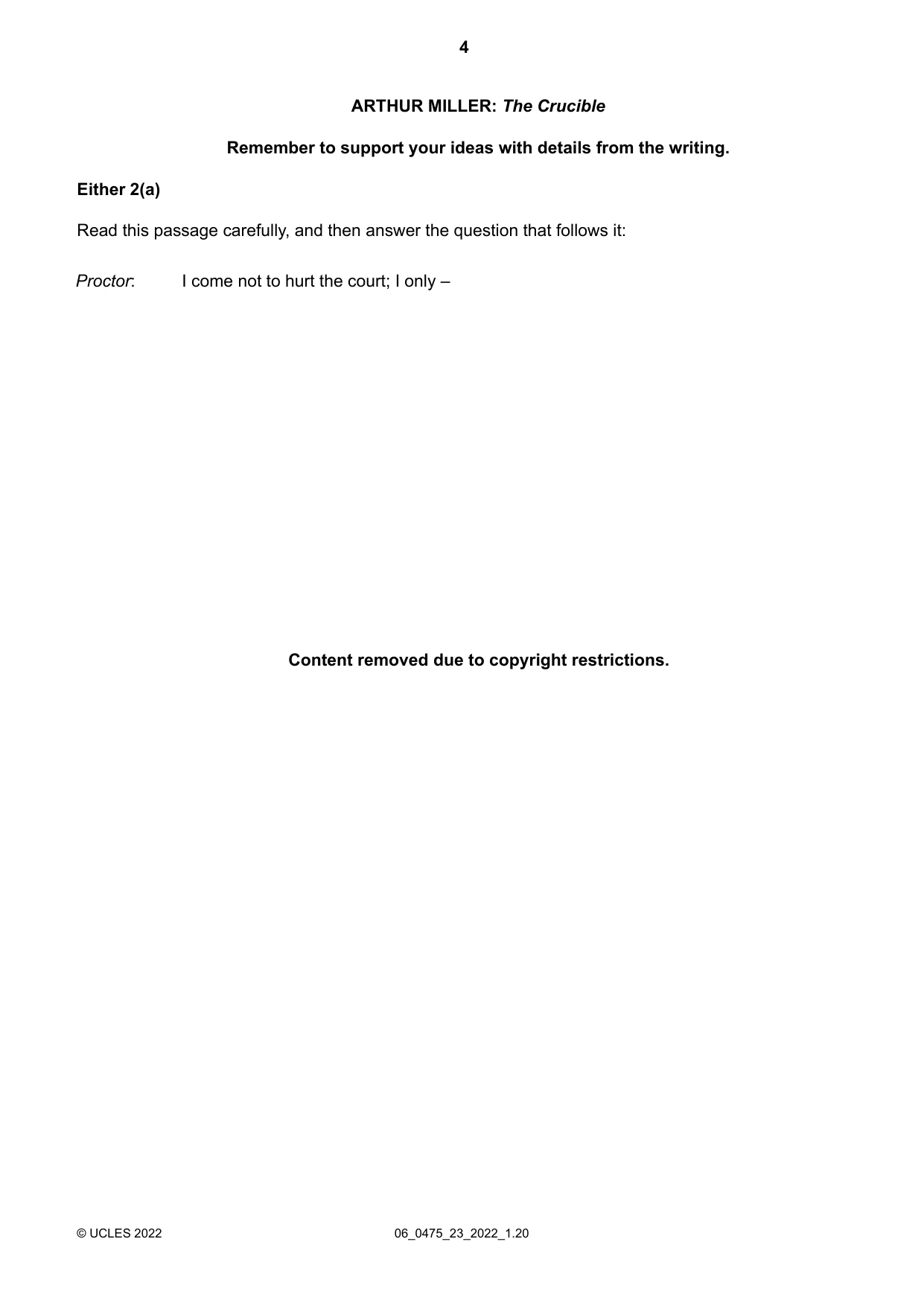
Question paper, page 4
ARTHUR MILLER: The Crucible Remember to support your ideas with details from the writing. Either 2(a) Read this passage carefully, and then answer the question that follows it: I come not to hurt the court; I only – Proctor: 06_0475_23_2022_1.20 © UCLES 2022 4 Content removed due to copyright restrictions.
Question paper, page 5
[MARY WARREN suddenly sobs.] [from Act 3] How does Miller vividly portray the unfairness of the witch trials at this moment in the play? Or 2(b) In what ways does Miller strikingly depict revenge in the play? [Turn over 06_0475_23_2022_1.20 © UCLES 2022 5 Content removed due to copyright restrictions.
Question paper, page 6
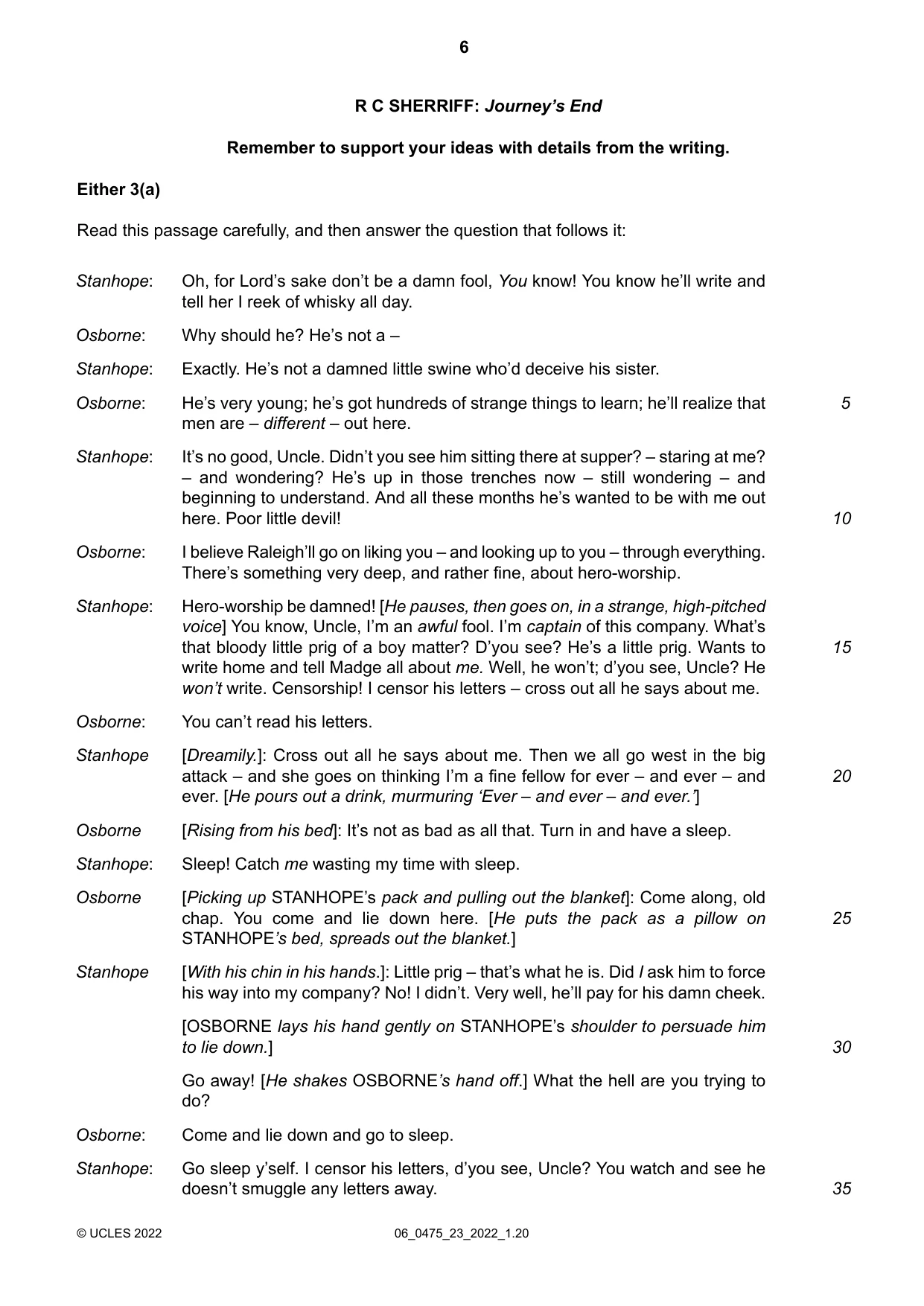
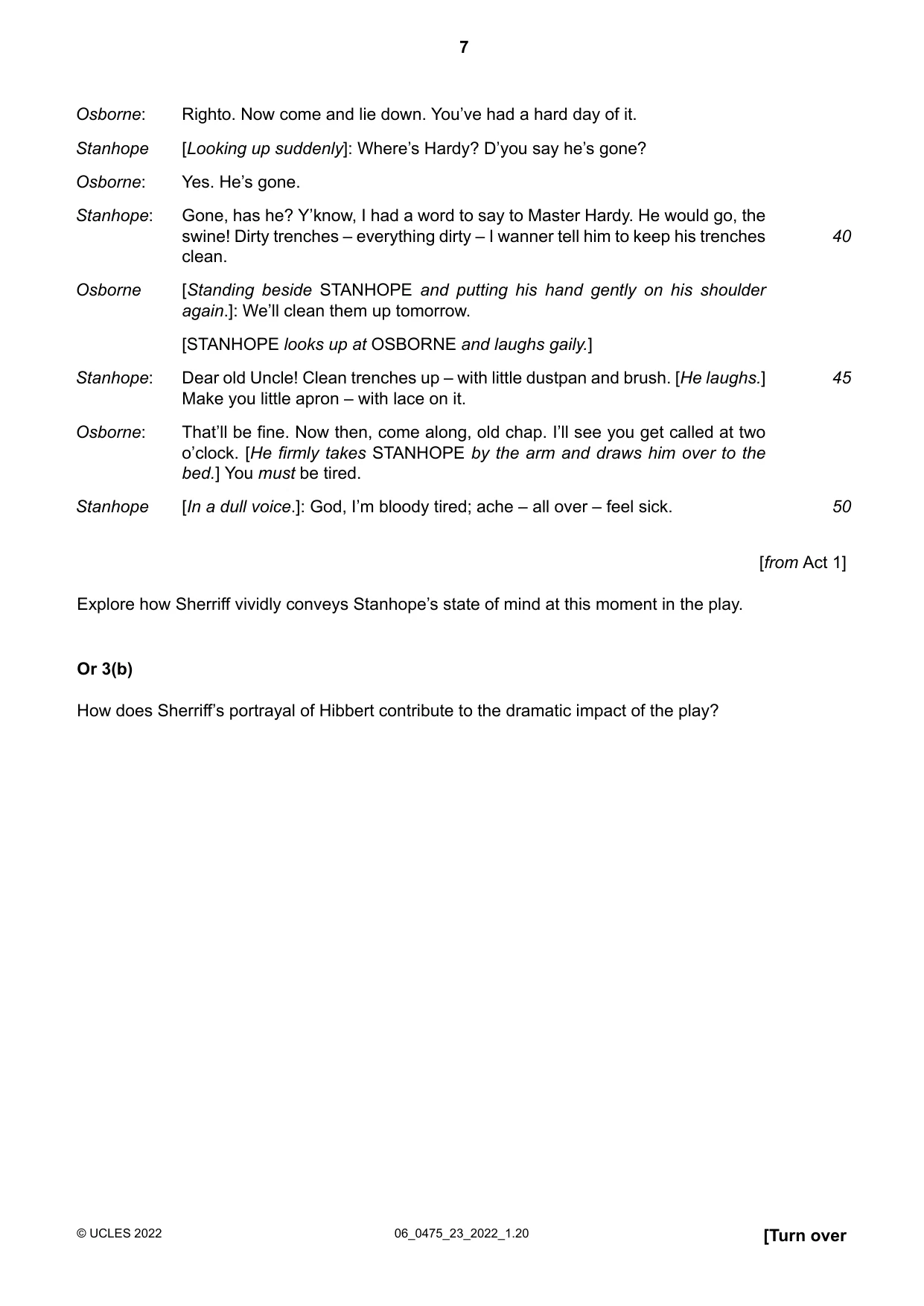
35 30 25 20 15 10 5 R C SHERRIFF: Journey’s End Remember to support your ideas with details from the writing. Either 3(a) Read this passage carefully, and then answer the question that follows it: Oh, for Lord’s sake don’t be a damn fool, You know! You know he’ll write and tell her I reek of whisky all day. Stanhope: Why should he? He’s not a – Osborne: Exactly. He’s not a damned little swine who’d deceive his sister. Stanhope: He’s very young; he’s got hundreds of strange things to learn; he’ll realize that men are – different – out here. Osborne: It’s no good, Uncle. Didn’t you see him sitting there at supper? – staring at me? – and wondering? He’s up in those trenches now – still wondering – and beginning to understand. And all these months he’s wanted to be with me out here. Poor little devil! Stanhope: I believe Raleigh’ll go on liking you – and looking up to you – through everything. There’s something very deep, and rather fine, about hero-worship. Osborne: Hero-worship be damned! [He pauses, then goes on, in a strange, high-pitched voice] You know, Uncle, I’m an awful fool. I’m captain of this company. What’s that bloody little prig of a boy matter? D’you see? He’s a little prig. Wants to write home and tell Madge all about me. Well, he won’t; d’you see, Uncle? He won’t write. Censorship! I censor his letters – cross out all he says about me. Stanhope: You can’t read his letters. Osborne: [Dreamily.]: Cross out all he says about me. Then we all go west in the big attack – and she goes on thinking I’m a fine fellow for ever – and ever – and ever. [He pours out a drink, murmuring ‘Ever – and ever – and ever.’] Stanhope [Rising from his bed]: It’s not as bad as all that. Turn in and have a sleep. Osborne Sleep! Catch me wasting my time with sleep. Stanhope: [Picking up STANHOPE’s pack and pulling out the blanket]: Come along, old chap. You come and lie down here. [He puts the pack as a pillow on STANHOPE’s bed, spreads out the blanket.] Osborne [With his chin in his hands.]: Little prig – that’s what he is. Did I ask him to force his way into my company? No! I didn’t. Very well, he’ll pay for his damn cheek. Stanhope [OSBORNE lays his hand gently on STANHOPE’s shoulder to persuade him to lie down.] Go away! [He shakes OSBORNE’s hand off.] What the hell are you trying to do? Come and lie down and go to sleep. Osborne: Go sleep y’self. I censor his letters, d’you see, Uncle? You watch and see he doesn’t smuggle any letters away. Stanhope: 06_0475_23_2022_1.20 © UCLES 2022 6
Question paper, page 7
50 45 40 Righto. Now come and lie down. You’ve had a hard day of it. Osborne: [Looking up suddenly]: Where’s Hardy? D’you say he’s gone? Stanhope Yes. He’s gone. Osborne: Gone, has he? Y’know, I had a word to say to Master Hardy. He would go, the swine! Dirty trenches – everything dirty – I wanner tell him to keep his trenches clean. Stanhope: [Standing beside STANHOPE and putting his hand gently on his shoulder again.]: We’ll clean them up tomorrow. Osborne [STANHOPE looks up at OSBORNE and laughs gaily.] Dear old Uncle! Clean trenches up – with little dustpan and brush. [He laughs.] Make you little apron – with lace on it. Stanhope: That’ll be fine. Now then, come along, old chap. I’ll see you get called at two o’clock. [He firmly takes STANHOPE by the arm and draws him over to the bed.] You must be tired. Osborne: [In a dull voice.]: God, I’m bloody tired; ache – all over – feel sick. Stanhope [from Act 1] Explore how Sherriff vividly conveys Stanhope’s state of mind at this moment in the play. Or 3(b) How does Sherriff’s portrayal of Hibbert contribute to the dramatic impact of the play? [Turn over 06_0475_23_2022_1.20 © UCLES 2022 7
Question paper, page 8
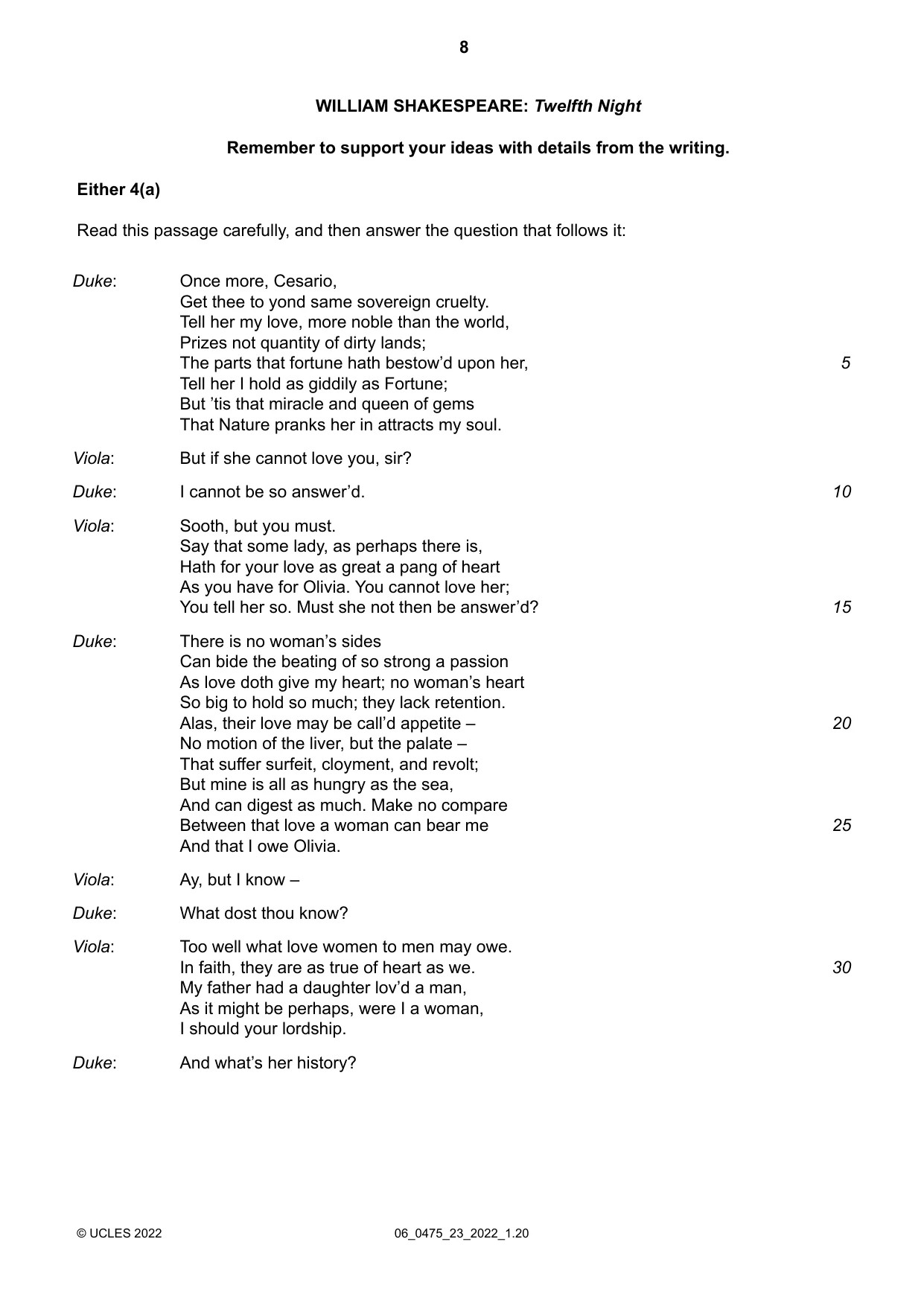
30 25 20 15 10 5 WILLIAM SHAKESPEARE: Twelfth Night Remember to support your ideas with details from the writing. Either 4(a) Read this passage carefully, and then answer the question that follows it: Once more, Cesario, Get thee to yond same sovereign cruelty. Tell her my love, more noble than the world, Prizes not quantity of dirty lands; The parts that fortune hath bestow’d upon her, Tell her I hold as giddily as Fortune; But ’tis that miracle and queen of gems That Nature pranks her in attracts my soul. Duke: But if she cannot love you, sir? Viola: I cannot be so answer’d. Duke: Sooth, but you must. Say that some lady, as perhaps there is, Hath for your love as great a pang of heart As you have for Olivia. You cannot love her; You tell her so. Must she not then be answer’d? Viola: There is no woman’s sides Can bide the beating of so strong a passion As love doth give my heart; no woman’s heart So big to hold so much; they lack retention. Alas, their love may be call’d appetite – No motion of the liver, but the palate – That suffer surfeit, cloyment, and revolt; But mine is all as hungry as the sea, And can digest as much. Make no compare Between that love a woman can bear me And that I owe Olivia. Duke: Ay, but I know – Viola: What dost thou know? Duke: Too well what love women to men may owe. In faith, they are as true of heart as we. My father had a daughter lov’d a man, As it might be perhaps, were I a woman, I should your lordship. Viola: And what’s her history? Duke: 06_0475_23_2022_1.20 © UCLES 2022 8
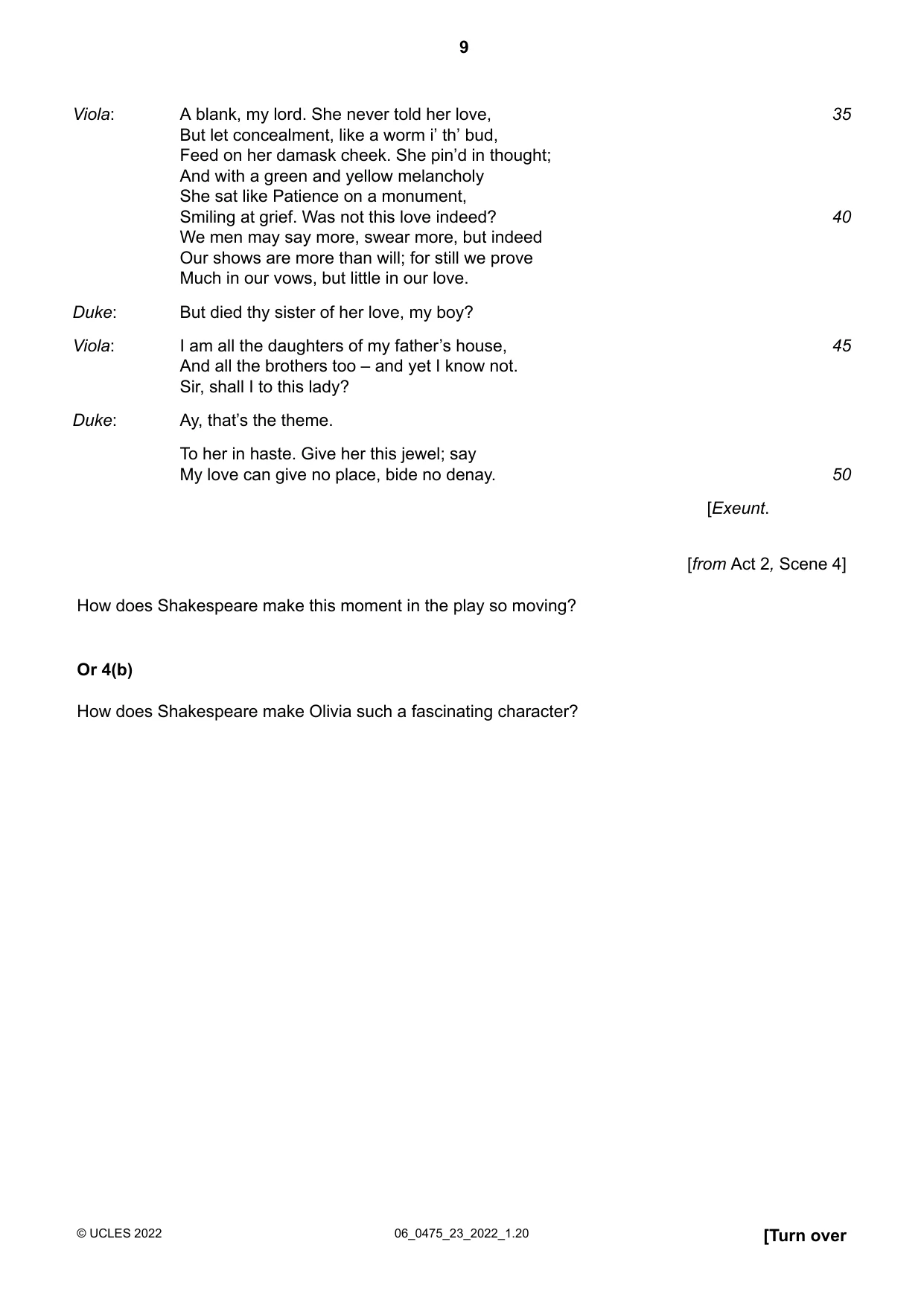
Question paper, page 9
50 45 40 35 A blank, my lord. She never told her love, But let concealment, like a worm i’ th’ bud, Feed on her damask cheek. She pin’d in thought; And with a green and yellow melancholy She sat like Patience on a monument, Smiling at grief. Was not this love indeed? We men may say more, swear more, but indeed Our shows are more than will; for still we prove Much in our vows, but little in our love. Viola: But died thy sister of her love, my boy? Duke: I am all the daughters of my father’s house, And all the brothers too – and yet I know not. Sir, shall I to this lady? Viola: Ay, that’s the theme. Duke: To her in haste. Give her this jewel; say My love can give no place, bide no denay. [Exeunt. [from Act 2, Scene 4] How does Shakespeare make this moment in the play so moving? Or 4(b) How does Shakespeare make Olivia such a fascinating character? [Turn over 06_0475_23_2022_1.20 © UCLES 2022 9
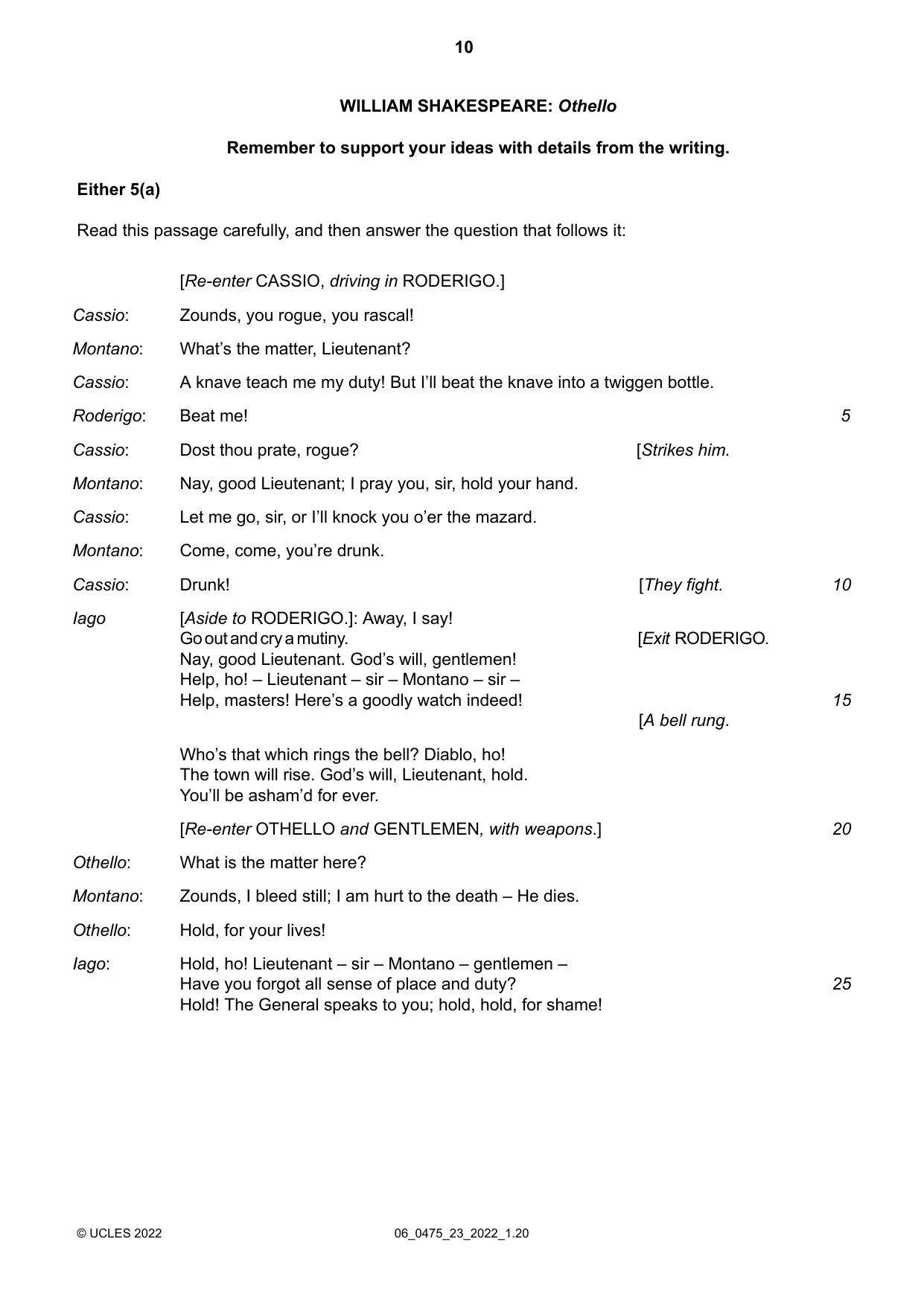
Question paper, page 10
25 20 15 10 5 WILLIAM SHAKESPEARE: Othello Remember to support your ideas with details from the writing. Either 5(a) Read this passage carefully, and then answer the question that follows it: [Re-enter CASSIO, driving in RODERIGO.] Zounds, you rogue, you rascal! Cassio: What’s the matter, Lieutenant? Montano: A knave teach me my duty! But I’ll beat the knave into a twiggen bottle. Cassio: Beat me! Roderigo: Dost thou prate, rogue? [Strikes him. Cassio: Nay, good Lieutenant; I pray you, sir, hold your hand. Montano: Let me go, sir, or I’ll knock you o’er the mazard. Cassio: Come, come, you’re drunk. Montano: Drunk! [They fight. Cassio: [Aside to RODERIGO.]: Away, I say! Gooutandcryamutiny. [Exit RODERIGO. Nay, good Lieutenant. God’s will, gentlemen! Help, ho! – Lieutenant – sir – Montano – sir – Help, masters! Here’s a goodly watch indeed! [A bell rung. Iago Who’s that which rings the bell? Diablo, ho! The town will rise. God’s will, Lieutenant, hold. You’ll be asham’d for ever. [Re-enter OTHELLO and GENTLEMEN, with weapons.] What is the matter here? Othello: Zounds, I bleed still; I am hurt to the death – He dies. Montano: Hold, for your lives! Othello: Hold, ho! Lieutenant – sir – Montano – gentlemen – Have you forgot all sense of place and duty? Hold! The General speaks to you; hold, hold, for shame! Iago: 06_0475_23_2022_1.20 © UCLES 2022 10
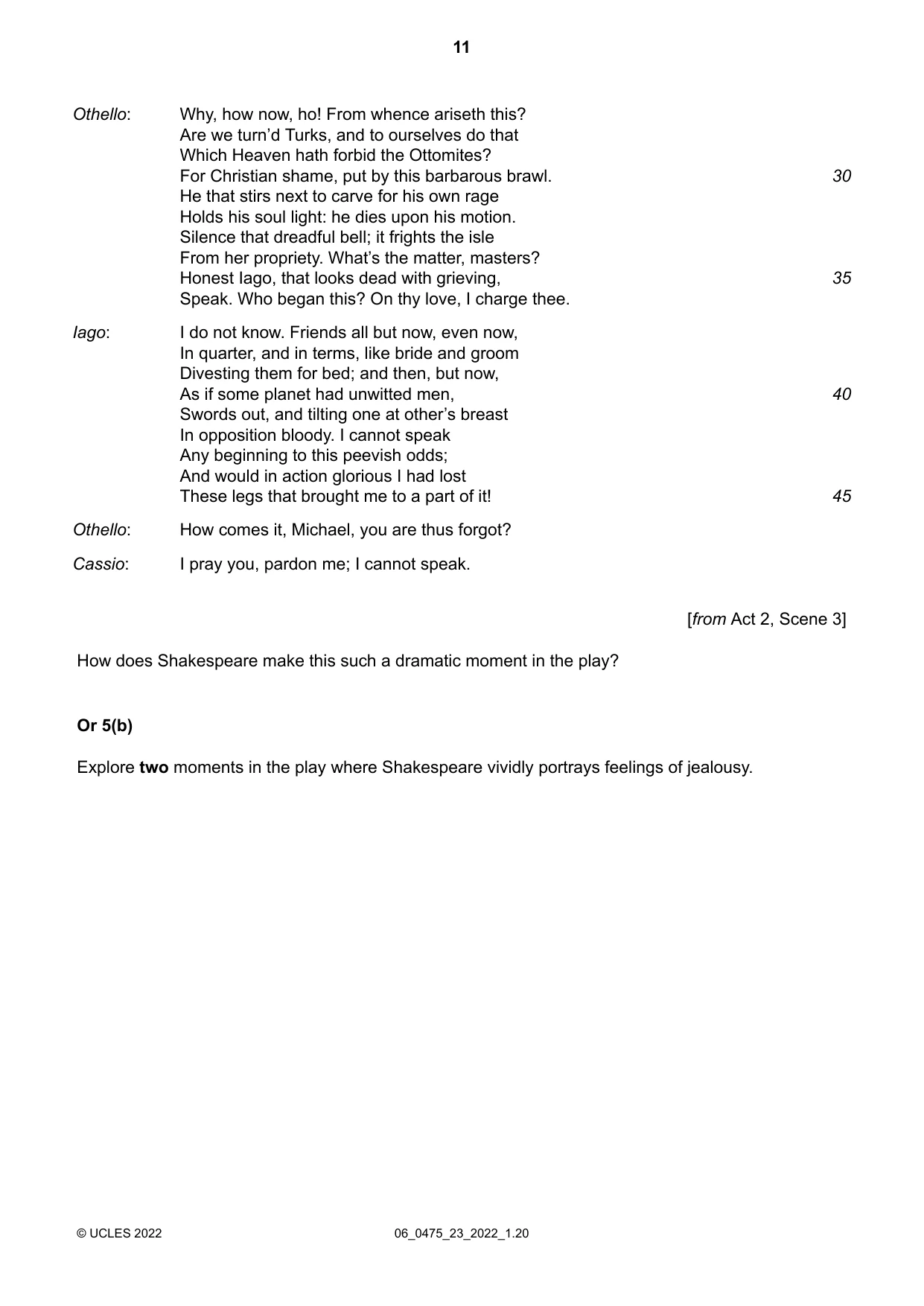
Question paper, page 11
45 40 35 30 Why, how now, ho! From whence ariseth this? Are we turn’d Turks, and to ourselves do that Which Heaven hath forbid the Ottomites? For Christian shame, put by this barbarous brawl. He that stirs next to carve for his own rage Holds his soul light: he dies upon his motion. Silence that dreadful bell; it frights the isle From her propriety. What’s the matter, masters? Honest Iago, that looks dead with grieving, Speak. Who began this? On thy love, I charge thee. Othello: I do not know. Friends all but now, even now, In quarter, and in terms, like bride and groom Divesting them for bed; and then, but now, As if some planet had unwitted men, Swords out, and tilting one at other’s breast In opposition bloody. I cannot speak Any beginning to this peevish odds; And would in action glorious I had lost These legs that brought me to a part of it! Iago: How comes it, Michael, you are thus forgot? Othello: I pray you, pardon me; I cannot speak. Cassio: [from Act 2, Scene 3] How does Shakespeare make this such a dramatic moment in the play? Or 5(b) Explore two moments in the play where Shakespeare vividly portrays feelings of jealousy. 06_0475_23_2022_1.20 © UCLES 2022 11
Question paper, page 12
BLANK PAGE Permission to reproduce items where third-party owned material protected by copyright is included has been sought and cleared where possible. Every reasonable effort has been made by the publisher (UCLES) to trace copyright holders, but if any items requiring clearance have unwittingly been included, the publisher will be pleased to make amends at the earliest possible opportunity. To avoid the issue of disclosure of answer-related information to candidates, all copyright acknowledgements are reproduced online in the Cambridge Assessment International Education Copyright Acknowledgements Booklet. This is produced for each series of examinations and is freely available to download at www.cambridgeinternational.org after the live examination series. Cambridge Assessment International Education is part of Cambridge Assessment. Cambridge Assessment is the brand name of the University of Cambridge Local Examinations Syndicate (UCLES), which is a department of the University of Cambridge. 06_0475_23_2022_1.20 © UCLES 2022 12
Mark scheme, page 1
This document consists of 5 printed pages. © UCLES 2022 [Turn over Cambridge IGCSE™ LITERATURE IN ENGLISH 0475/23 Paper 2 Drama 23 May/June 2022 MARK SCHEME Maximum Mark: 50 Published This mark scheme is published as an aid to teachers and candidates, to indicate the requirements of the examination. It shows the basis on which Examiners were instructed to award marks. It does not indicate the details of the discussions that took place at an Examiners’ meeting before marking began, which would have considered the acceptability of alternative answers. Mark schemes should be read in conjunction with the question paper and the Principal Examiner Report for Teachers. Cambridge International will not enter into discussions about these mark schemes. Cambridge International is publishing the mark schemes for the May/June 2022 series for most Cambridge IGCSE™, Cambridge International A and AS Level components and some Cambridge O Level components.
Mark scheme, page 2
0475/23 Cambridge IGCSE – Mark Scheme PUBLISHED May/June 2022 © UCLES 2022 Page 2 of 5 Generic Marking Principles These general marking principles must be applied by all examiners when marking candidate answers. They should be applied alongside the specific content of the mark scheme or generic level descriptors for a question. Each question paper and mark scheme will also comply with these marking principles. GENERIC MARKING PRINCIPLE 1: Marks must be awarded in line with: the specific content of the mark scheme or the generic level descriptors for the question the specific skills defined in the mark scheme or in the generic level descriptors for the question the standard of response required by a candidate as exemplified by the standardisation scripts. GENERIC MARKING PRINCIPLE 2: Marks awarded are always whole marks (not half marks, or other fractions). GENERIC MARKING PRINCIPLE 3: Marks must be awarded positively: marks are awarded for correct/valid answers, as defined in the mark scheme. However, credit is given for valid answers which go beyond the scope of the syllabus and mark scheme, referring to your Team Leader as appropriate marks are awarded when candidates clearly demonstrate what they know and can do marks are not deducted for errors marks are not deducted for omissions answers should only be judged on the quality of spelling, punctuation and grammar when these features are specifically assessed by the question as indicated by the mark scheme. The meaning, however, should be unambiguous. GENERIC MARKING PRINCIPLE 4: Rules must be applied consistently, e.g. in situations where candidates have not followed instructions or in the application of generic level descriptors. GENERIC MARKING PRINCIPLE 5: Marks should be awarded using the full range of marks defined in the mark scheme for the question (however; the use of the full mark range may be limited according to the quality of the candidate responses seen). GENERIC MARKING PRINCIPLE 6: Marks awarded are based solely on the requirements as defined in the mark scheme. Marks should not be awarded with grade thresholds or grade descriptors in mind.
Mark scheme, page 3
0475/23 Cambridge IGCSE – Mark Scheme PUBLISHED May/June 2022 © UCLES 2022 Page 3 of 5 English & Media subject specific general marking principles (To be read in conjunction with the Generic Marking Principles (and requiring further guidance on how to place marks within levels)) Components using level descriptors: We use level descriptors as a guide to broad understanding of the qualities normally expected of, or typical of, work in a level. Level descriptors are a means of general guidance, and should not be interpreted as hurdle statements. Where indicative content notes are supplied for a question, these are not a prescription of required content, and must not be treated as such. Alternative correct points and unexpected answers in candidates’ scripts must be given marks that fairly reflect the knowledge and skills demonstrated. While we may have legitimate expectations as to the ground most answers may occupy, we must at all times be prepared to meet candidates on their chosen ground, provided it is relevant ground (e.g. clearly related to and derived from a relevant passage/text and meeting the mark scheme requirements for the question). Components using point-based marking: Point marking is often used to reward knowledge, understanding and application of skills. We give credit where the candidate’s answer shows relevant knowledge, understanding and application of skills in answering the question. We do not give credit where the answer shows confusion. From this it follows that we: a DO credit answers which are worded differently from the mark scheme if they clearly convey the same meaning (unless the mark scheme requires a specific term). b DO credit alternative answers/examples which are not written in the mark scheme if they are correct. c DO credit answers where candidates give more than one correct answer in one prompt/numbered/scaffolded space where extended writing is required rather than list-type answers. For example, questions that require n reasons (e.g. State two reasons…). d DO NOT credit answers simply for using a ‘key term’ unless that is all that is required. (Check for evidence it is understood and not used wrongly.) e DO NOT credit answers which are obviously self-contradicting or trying to cover all possibilities. f DO NOT give further credit for what is effectively repetition of a correct point already credited unless the language itself is being tested. This applies equally to ‘mirror statements’ (i.e. polluted/not polluted). g DO NOT require spellings to be correct, unless this is part of the test. However spellings of syllabus terms must allow for clear and unambiguous separation from other syllabus terms with which they may be confused (e.g. Corrasion/Corrosion).
Mark scheme, page 4
0475/23 Cambridge IGCSE – Mark Scheme PUBLISHED May/June 2022 © UCLES 2022 Page 4 of 5 All questions are marked out of 25. The assessment objectives for the paper are: AO1: show detailed knowledge of the content of literary texts, supported by reference to the text AO2: understand the meanings of literary texts and their contexts, and explore texts beyond surface meanings to show deeper awareness of ideas and attitudes AO3: recognise and appreciate ways in which writers use language, structure and form to create and shape meanings and effects AO4: communicate a sensitive and informed personal response to literary texts. The Level Descriptors cover marks from 0 to 25, and apply to the marking of each question. They guide examiners to an understanding of the qualities normally expected of, or typical of, work in a level. They are a means of general guidance. For the purposes of standardisation of marking, they are to be used in conjunction with examples of candidates’ work and discussed during the examiners’ coordination meeting.
Mark scheme, page 5
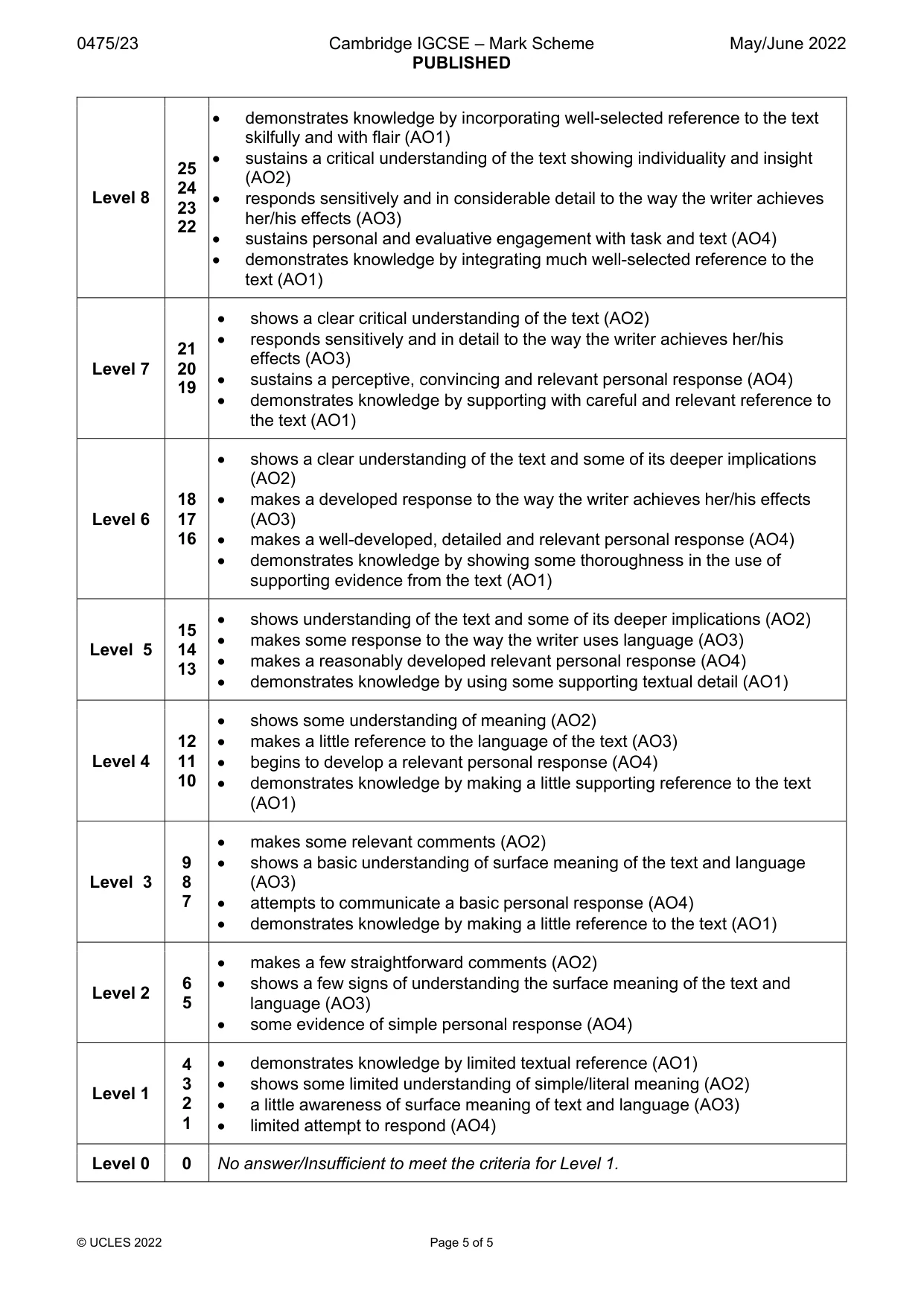
0475/23 Cambridge IGCSE – Mark Scheme PUBLISHED May/June 2022 © UCLES 2022 Page 5 of 5 Level 8 25 24 23 22 demonstrates knowledge by incorporating well-selected reference to the text skilfully and with flair (AO1) sustains a critical understanding of the text showing individuality and insight (AO2) responds sensitively and in considerable detail to the way the writer achieves her/his effects (AO3) sustains personal and evaluative engagement with task and text (AO4) demonstrates knowledge by integrating much well-selected reference to the text (AO1) Level 7 21 20 19 shows a clear critical understanding of the text (AO2) responds sensitively and in detail to the way the writer achieves her/his effects (AO3) sustains a perceptive, convincing and relevant personal response (AO4) demonstrates knowledge by supporting with careful and relevant reference to the text (AO1) Level 6 18 17 16 shows a clear understanding of the text and some of its deeper implications (AO2) makes a developed response to the way the writer achieves her/his effects (AO3) makes a well-developed, detailed and relevant personal response (AO4) demonstrates knowledge by showing some thoroughness in the use of supporting evidence from the text (AO1) Level 5 15 14 13 shows understanding of the text and some of its deeper implications (AO2) makes some response to the way the writer uses language (AO3) makes a reasonably developed relevant personal response (AO4) demonstrates knowledge by using some supporting textual detail (AO1) Level 4 12 11 10 shows some understanding of meaning (AO2) makes a little reference to the language of the text (AO3) begins to develop a relevant personal response (AO4) demonstrates knowledge by making a little supporting reference to the text (AO1) Level 3 9 8 7 makes some relevant comments (AO2) shows a basic understanding of surface meaning of the text and language (AO3) attempts to communicate a basic personal response (AO4) demonstrates knowledge by making a little reference to the text (AO1) Level 2 6 5 makes a few straightforward comments (AO2) shows a few signs of understanding the surface meaning of the text and language (AO3) some evidence of simple personal response (AO4) Level 1 4 3 2 1 demonstrates knowledge by limited textual reference (AO1) shows some limited understanding of simple/literal meaning (AO2) a little awareness of surface meaning of text and language (AO3) limited attempt to respond (AO4) Level 0 0 No answer/Insufficient to meet the criteria for Level 1.
What you needed in this session
Cambridge’s own grade thresholds for 2022 May/June, Paper 2 · Variant 3. A higher threshold means an easier paper — the bar moves with how the cohort did.