Cambridge IGCSE English - Literature in English 0475 — 2020 May/June Paper 4 · Variant 3
0475/43/M/J/20
The question paper and its mark scheme, free to read here and free to download. This is Cambridge’s own paper, exactly as it was sat.
Question paper8 pages


Mark scheme4 pages
Answers below. Sit the paper first if you are practising.
Paper as text
Question paper, page 1
Cambridge IGCSE™ DC (RCL/GO) 185046/2 © UCLES 2020 [Turn over This document has 8 pages. Blank pages are indicated. LITERATURE IN ENGLISH 0475/43 Paper 4 Unseen May/June 2020 1 hour 15 minutes You must answer on the enclosed answer booklet. You will need: Answer booklet (enclosed) INSTRUCTIONS ● Answer one question: either Question 1 or Question 2. ● Follow the instructions on the front cover of the answer booklet. If you need additional answer paper, ask the invigilator for a continuation booklet. INFORMATION ● The total mark for this paper is 25. ● All questions are worth equal marks. * 0 4 7 4 7 4 7 9 1 3 *
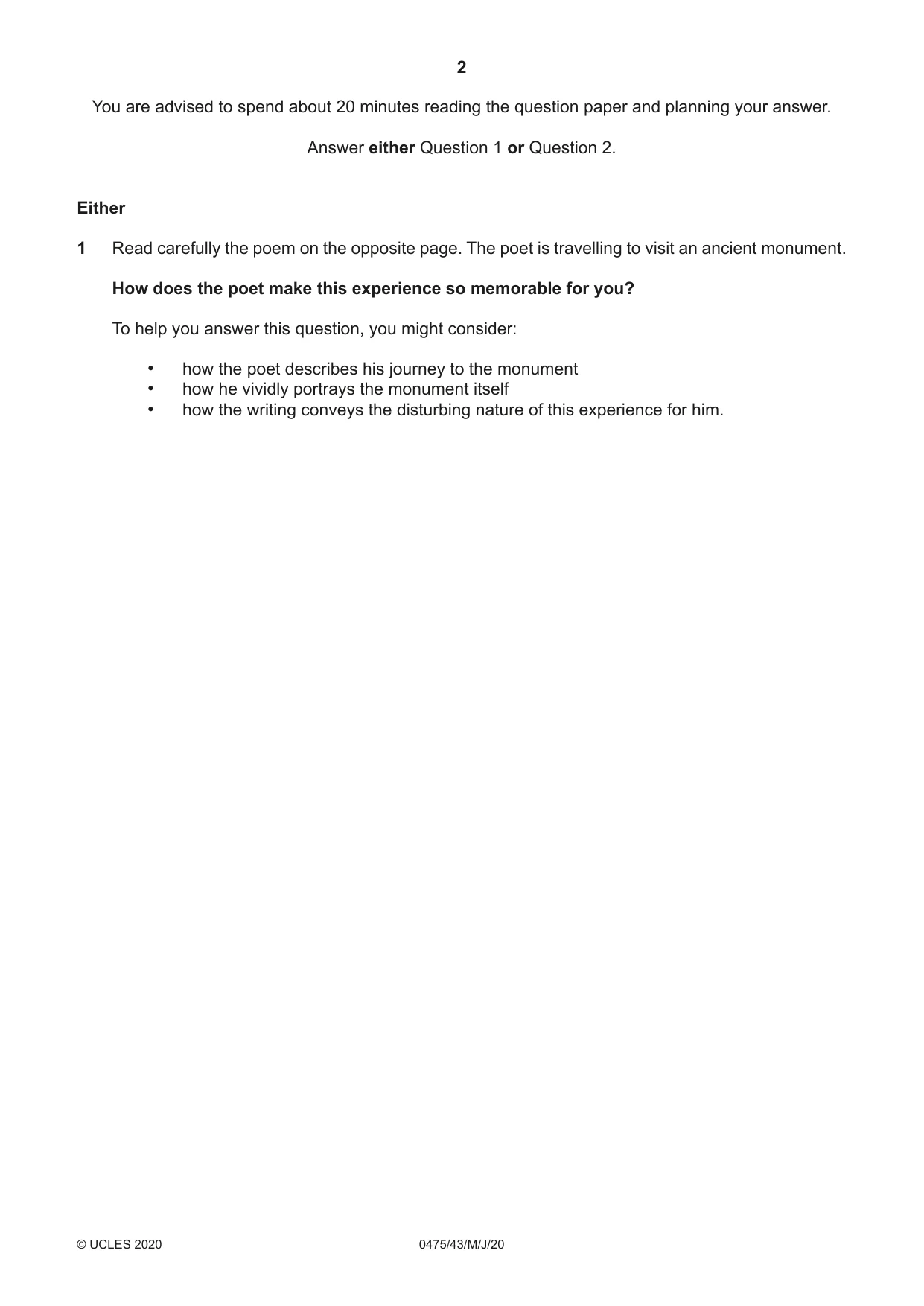
Question paper, page 2
2 0475/43/M/J/20 © UCLES 2020 You are advised to spend about 20 minutes reading the question paper and planning your answer. Answer either Question 1 or Question 2. Either 1 Read carefully the poem on the opposite page. The poet is travelling to visit an ancient monument. How does the poet make this experience so memorable for you? To help you answer this question, you might consider: • how the poet describes his journey to the monument • how he vividly portrays the monument itself • how the writing conveys the disturbing nature of this experience for him.
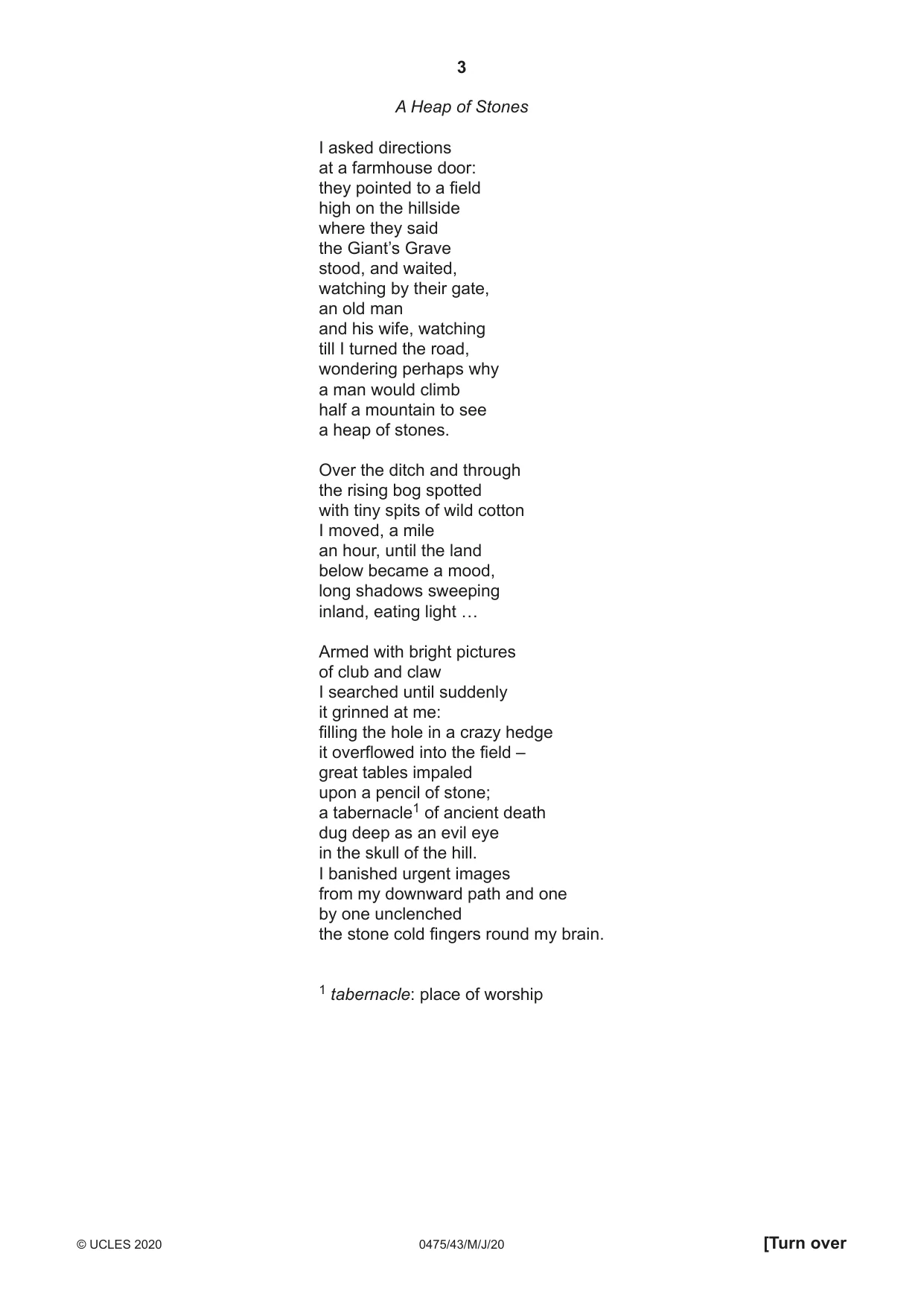
Question paper, page 3
3 0475/43/M/J/20 © UCLES 2020 [Turn over A Heap of Stones I asked directions at a farmhouse door: they pointed to a field high on the hillside where they said the Giant’s Grave stood, and waited, watching by their gate, an old man and his wife, watching till I turned the road, wondering perhaps why a man would climb half a mountain to see a heap of stones. Over the ditch and through the rising bog spotted with tiny spits of wild cotton I moved, a mile an hour, until the land below became a mood, long shadows sweeping inland, eating light … Armed with bright pictures of club and claw I searched until suddenly it grinned at me: filling the hole in a crazy hedge it overflowed into the field – great tables impaled upon a pencil of stone; a tabernacle1 of ancient death dug deep as an evil eye in the skull of the hill. I banished urgent images from my downward path and one by one unclenched the stone cold fingers round my brain. 1 tabernacle: place of worship
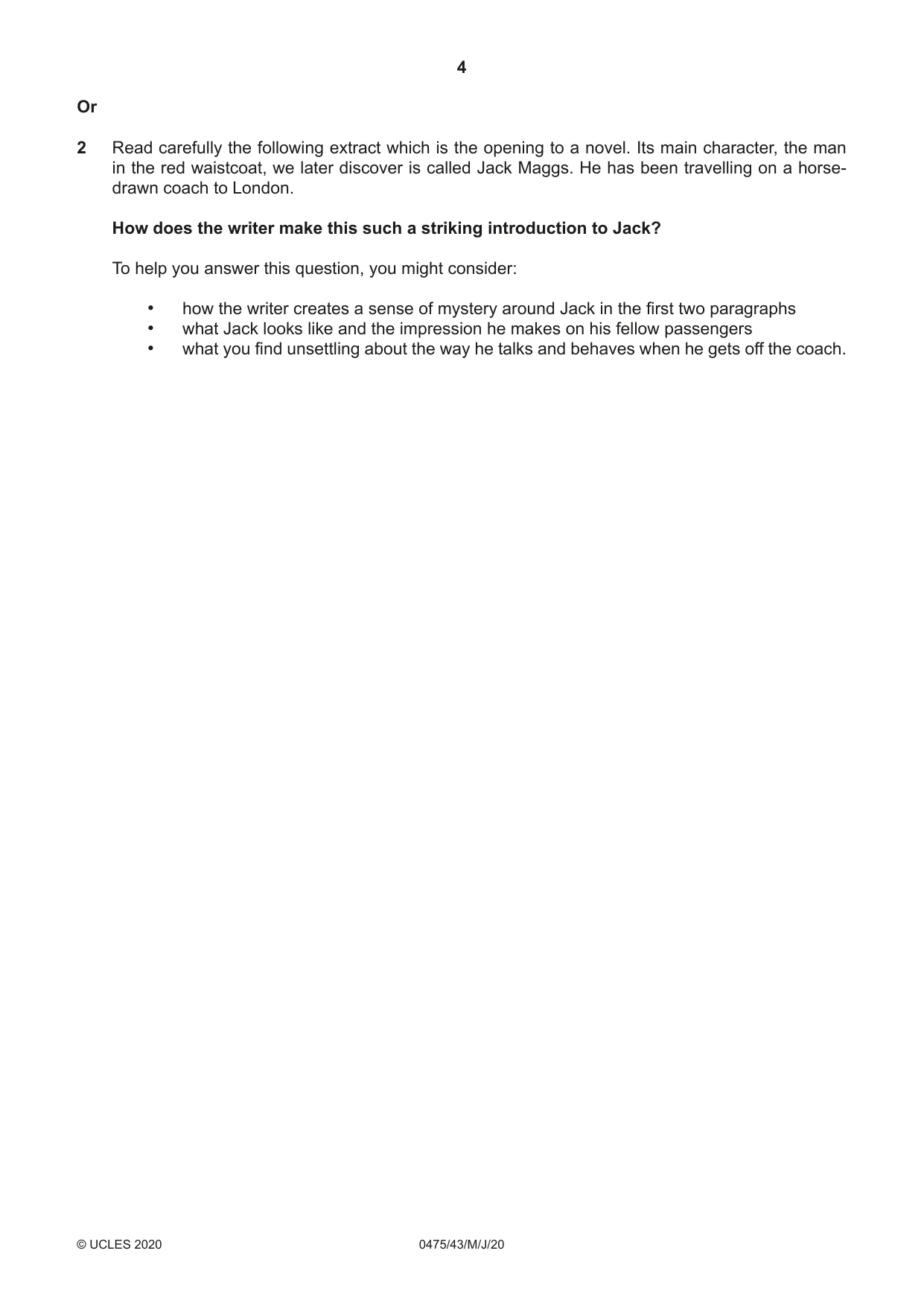
Question paper, page 4
4 0475/43/M/J/20 © UCLES 2020 Or 2 Read carefully the following extract which is the opening to a novel. Its main character, the man in the red waistcoat, we later discover is called Jack Maggs. He has been travelling on a horse- drawn coach to London. How does the writer make this such a striking introduction to Jack? To help you answer this question, you might consider: • how the writer creates a sense of mystery around Jack in the first two paragraphs • what Jack looks like and the impression he makes on his fellow passengers • what you find unsettling about the way he talks and behaves when he gets off the coach.
Question paper, page 5
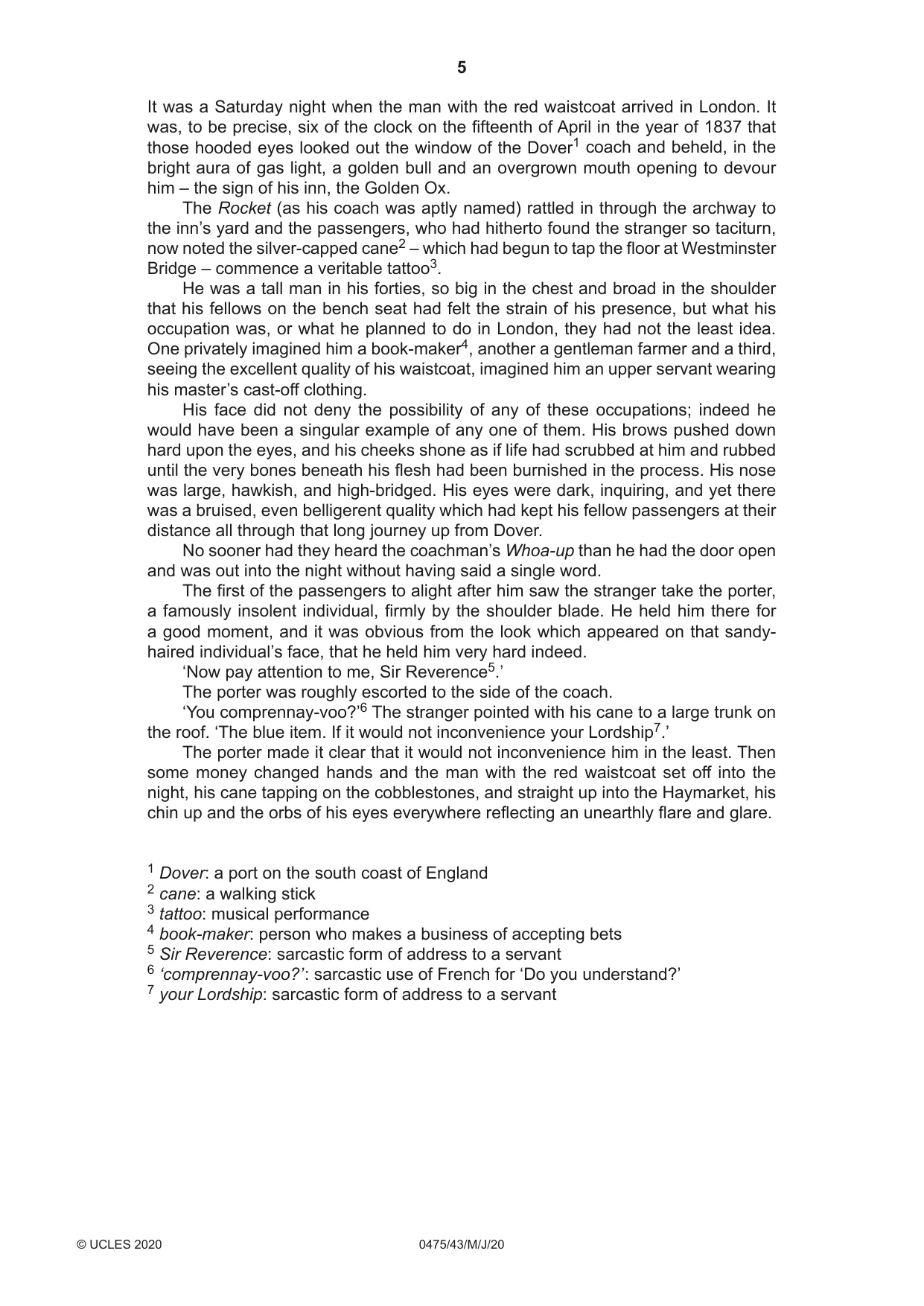
5 0475/43/M/J/20 © UCLES 2020 It was a Saturday night when the man with the red waistcoat arrived in London. It was, to be precise, six of the clock on the fifteenth of April in the year of 1837 that those hooded eyes looked out the window of the Dover1 coach and beheld, in the bright aura of gas light, a golden bull and an overgrown mouth opening to devour him – the sign of his inn, the Golden Ox. The Rocket (as his coach was aptly named) rattled in through the archway to the inn’s yard and the passengers, who had hitherto found the stranger so taciturn, now noted the silver-capped cane2 – which had begun to tap the floor at Westminster Bridge – commence a veritable tattoo3. He was a tall man in his forties, so big in the chest and broad in the shoulder that his fellows on the bench seat had felt the strain of his presence, but what his occupation was, or what he planned to do in London, they had not the least idea. One privately imagined him a book-maker4, another a gentleman farmer and a third, seeing the excellent quality of his waistcoat, imagined him an upper servant wearing his master’s cast-off clothing. His face did not deny the possibility of any of these occupations; indeed he would have been a singular example of any one of them. His brows pushed down hard upon the eyes, and his cheeks shone as if life had scrubbed at him and rubbed until the very bones beneath his flesh had been burnished in the process. His nose was large, hawkish, and high-bridged. His eyes were dark, inquiring, and yet there was a bruised, even belligerent quality which had kept his fellow passengers at their distance all through that long journey up from Dover. No sooner had they heard the coachman’s Whoa-up than he had the door open and was out into the night without having said a single word. The first of the passengers to alight after him saw the stranger take the porter, a famously insolent individual, firmly by the shoulder blade. He held him there for a good moment, and it was obvious from the look which appeared on that sandy- haired individual’s face, that he held him very hard indeed. ‘Now pay attention to me, Sir Reverence5.’ The porter was roughly escorted to the side of the coach. ‘You comprennay-voo?’6 The stranger pointed with his cane to a large trunk on the roof. ‘The blue item. If it would not inconvenience your Lordship7.’ The porter made it clear that it would not inconvenience him in the least. Then some money changed hands and the man with the red waistcoat set off into the night, his cane tapping on the cobblestones, and straight up into the Haymarket, his chin up and the orbs of his eyes everywhere reflecting an unearthly flare and glare. 1 Dover: a port on the south coast of England 2 cane: a walking stick 3 tattoo: musical performance 4 book-maker: person who makes a business of accepting bets 5 Sir Reverence: sarcastic form of address to a servant 6 ‘comprennay-voo?’ : sarcastic use of French for ‘Do you understand?’ 7 your Lordship: sarcastic form of address to a servant
Question paper, page 6
6 0475/43/M/J/20 © UCLES 2020 BLANK PAGE
Question paper, page 7
7 0475/43/M/J/20 © UCLES 2020 BLANK PAGE
Question paper, page 8
8 0475/43/M/J/20 © UCLES 2020 Permission to reproduce items where third-party owned material protected by copyright is included has been sought and cleared where possible. Every reasonable effort has been made by the publisher (UCLES) to trace copyright holders, but if any items requiring clearance have unwittingly been included, the publisher will be pleased to make amends at the earliest possible opportunity. To avoid the issue of disclosure of answer-related information to candidates, all copyright acknowledgements are reproduced online in the Cambridge Assessment International Education Copyright Acknowledgements Booklet. This is produced for each series of examinations and is freely available to download at www.cambridgeinternational.org after the live examination series. Cambridge Assessment International Education is part of the Cambridge Assessment Group. Cambridge Assessment is the brand name of the University of Cambridge Local Examinations Syndicate (UCLES), which itself is a department of the University of Cambridge. BLANK PAGE
Mark scheme, page 1
This document consists of 4 printed pages. © UCLES 2020 [Turn over Cambridge IGCSE™ LITERATURE IN ENGLISH 0475/43 Paper 4 Unseen 43 May/June 2020 MARK SCHEME Maximum Mark: 25 Published Students did not sit exam papers in the June 2020 series due to the Covid-19 global pandemic. This mark scheme is published to support teachers and students and should be read together with the question paper. It shows the requirements of the exam. The answer column of the mark scheme shows the proposed basis on which Examiners would award marks for this exam. Where appropriate, this column also provides the most likely acceptable alternative responses expected from students. Examiners usually review the mark scheme after they have seen student responses and update the mark scheme if appropriate. In the June series, Examiners were unable to consider the acceptability of alternative responses, as there were no student responses to consider. Mark schemes should usually be read together with the Principal Examiner Report for Teachers. However, because students did not sit exam papers, there is no Principal Examiner Report for Teachers for the June 2020 series. Cambridge International will not enter into discussions about these mark schemes. Cambridge International is publishing the mark schemes for the June 2020 series for most Cambridge IGCSE™ and Cambridge International A & AS Level components, and some Cambridge O Level components.
Mark scheme, page 2
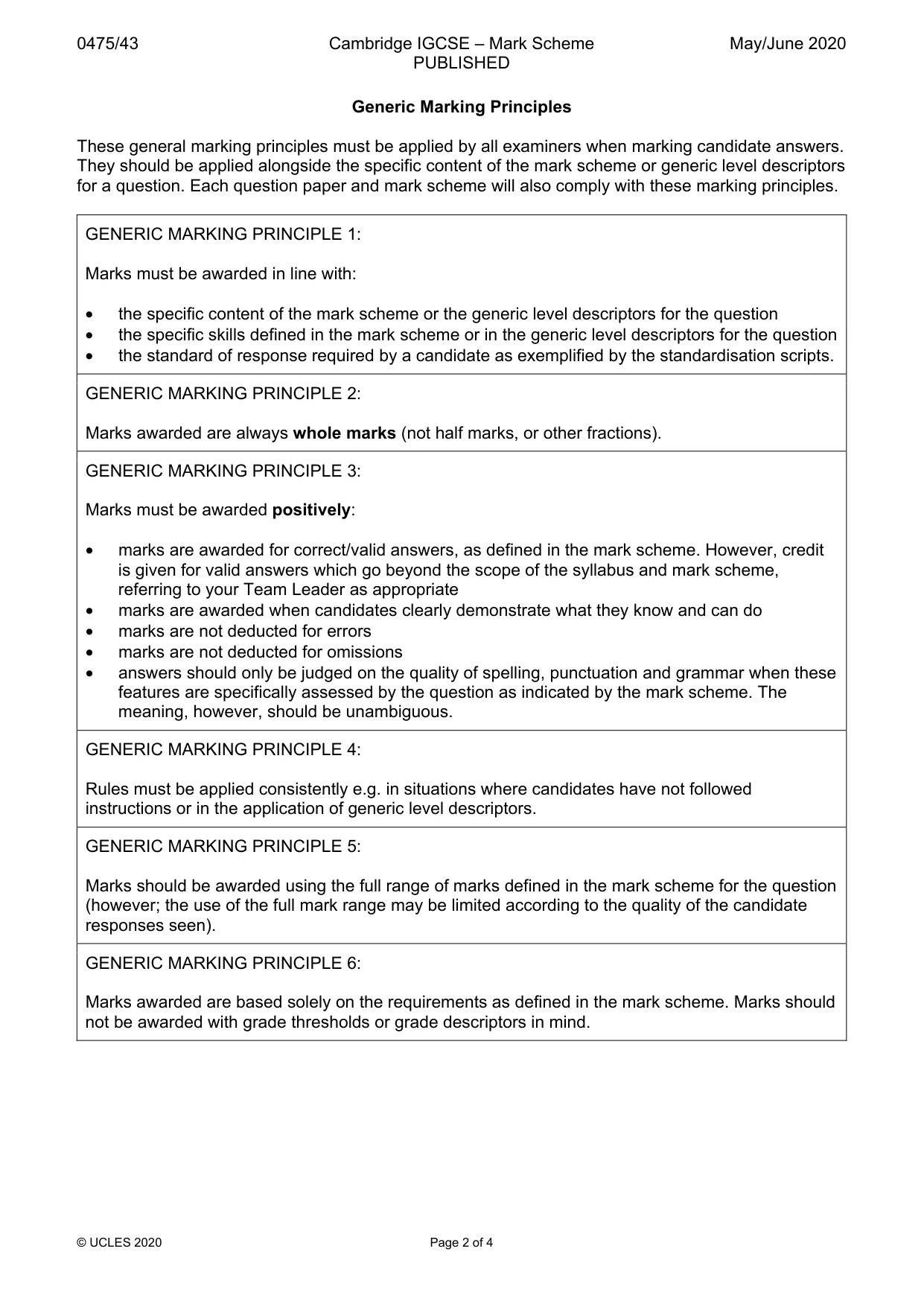
0475/43 Cambridge IGCSE – Mark Scheme PUBLISHED May/June 2020 © UCLES 2020 Page 2 of 4 Generic Marking Principles These general marking principles must be applied by all examiners when marking candidate answers. They should be applied alongside the specific content of the mark scheme or generic level descriptors for a question. Each question paper and mark scheme will also comply with these marking principles. GENERIC MARKING PRINCIPLE 1: Marks must be awarded in line with: • the specific content of the mark scheme or the generic level descriptors for the question • the specific skills defined in the mark scheme or in the generic level descriptors for the question • the standard of response required by a candidate as exemplified by the standardisation scripts. GENERIC MARKING PRINCIPLE 2: Marks awarded are always whole marks (not half marks, or other fractions). GENERIC MARKING PRINCIPLE 3: Marks must be awarded positively: • marks are awarded for correct/valid answers, as defined in the mark scheme. However, credit is given for valid answers which go beyond the scope of the syllabus and mark scheme, referring to your Team Leader as appropriate • marks are awarded when candidates clearly demonstrate what they know and can do • marks are not deducted for errors • marks are not deducted for omissions • answers should only be judged on the quality of spelling, punctuation and grammar when these features are specifically assessed by the question as indicated by the mark scheme. The meaning, however, should be unambiguous. GENERIC MARKING PRINCIPLE 4: Rules must be applied consistently e.g. in situations where candidates have not followed instructions or in the application of generic level descriptors. GENERIC MARKING PRINCIPLE 5: Marks should be awarded using the full range of marks defined in the mark scheme for the question (however; the use of the full mark range may be limited according to the quality of the candidate responses seen). GENERIC MARKING PRINCIPLE 6: Marks awarded are based solely on the requirements as defined in the mark scheme. Marks should not be awarded with grade thresholds or grade descriptors in mind.
Mark scheme, page 3
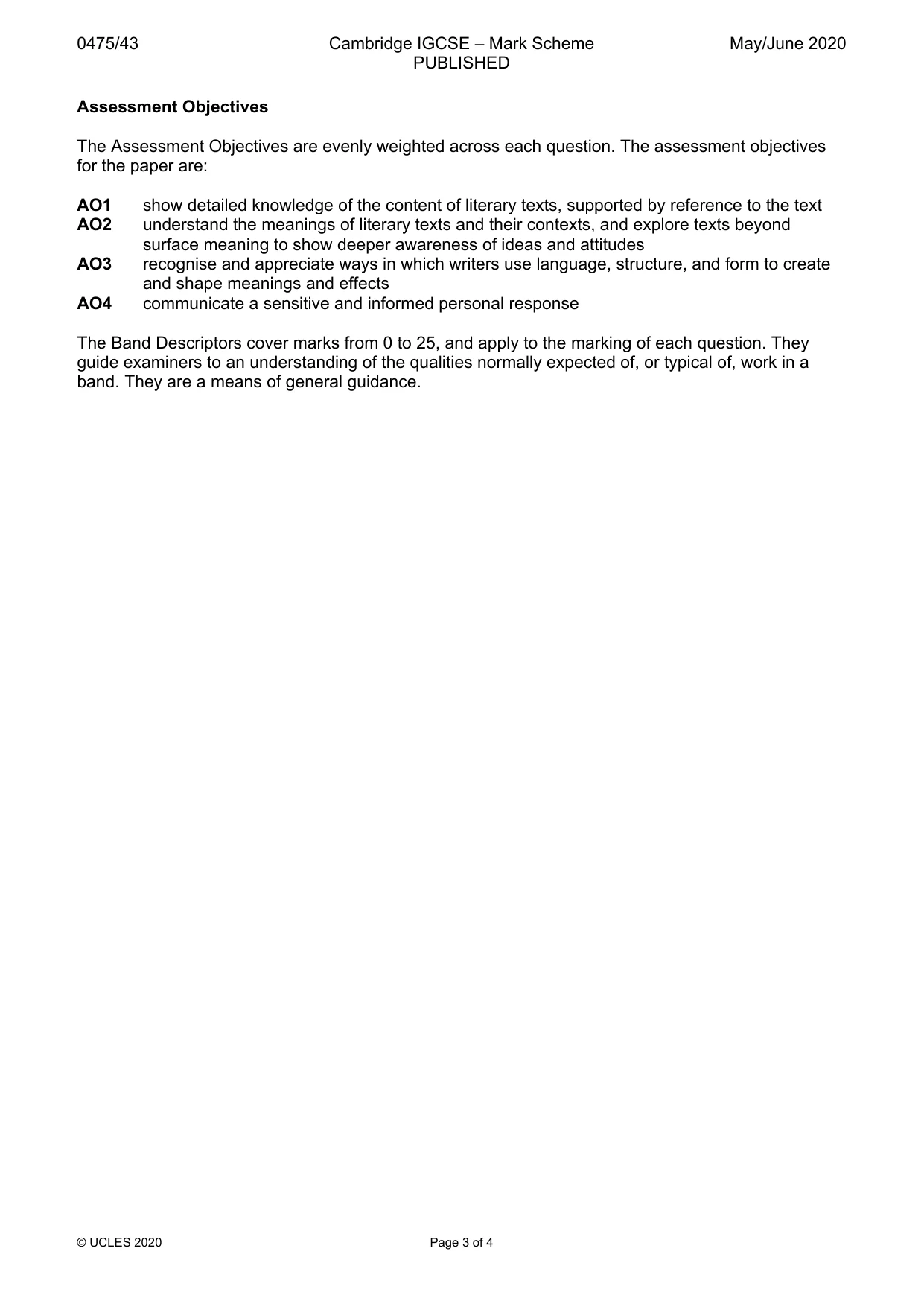
0475/43 Cambridge IGCSE – Mark Scheme PUBLISHED May/June 2020 © UCLES 2020 Page 3 of 4 Assessment Objectives The Assessment Objectives are evenly weighted across each question. The assessment objectives for the paper are: AO1 show detailed knowledge of the content of literary texts, supported by reference to the text AO2 understand the meanings of literary texts and their contexts, and explore texts beyond surface meaning to show deeper awareness of ideas and attitudes AO3 recognise and appreciate ways in which writers use language, structure, and form to create and shape meanings and effects AO4 communicate a sensitive and informed personal response The Band Descriptors cover marks from 0 to 25, and apply to the marking of each question. They guide examiners to an understanding of the qualities normally expected of, or typical of, work in a band. They are a means of general guidance.
Mark scheme, page 4
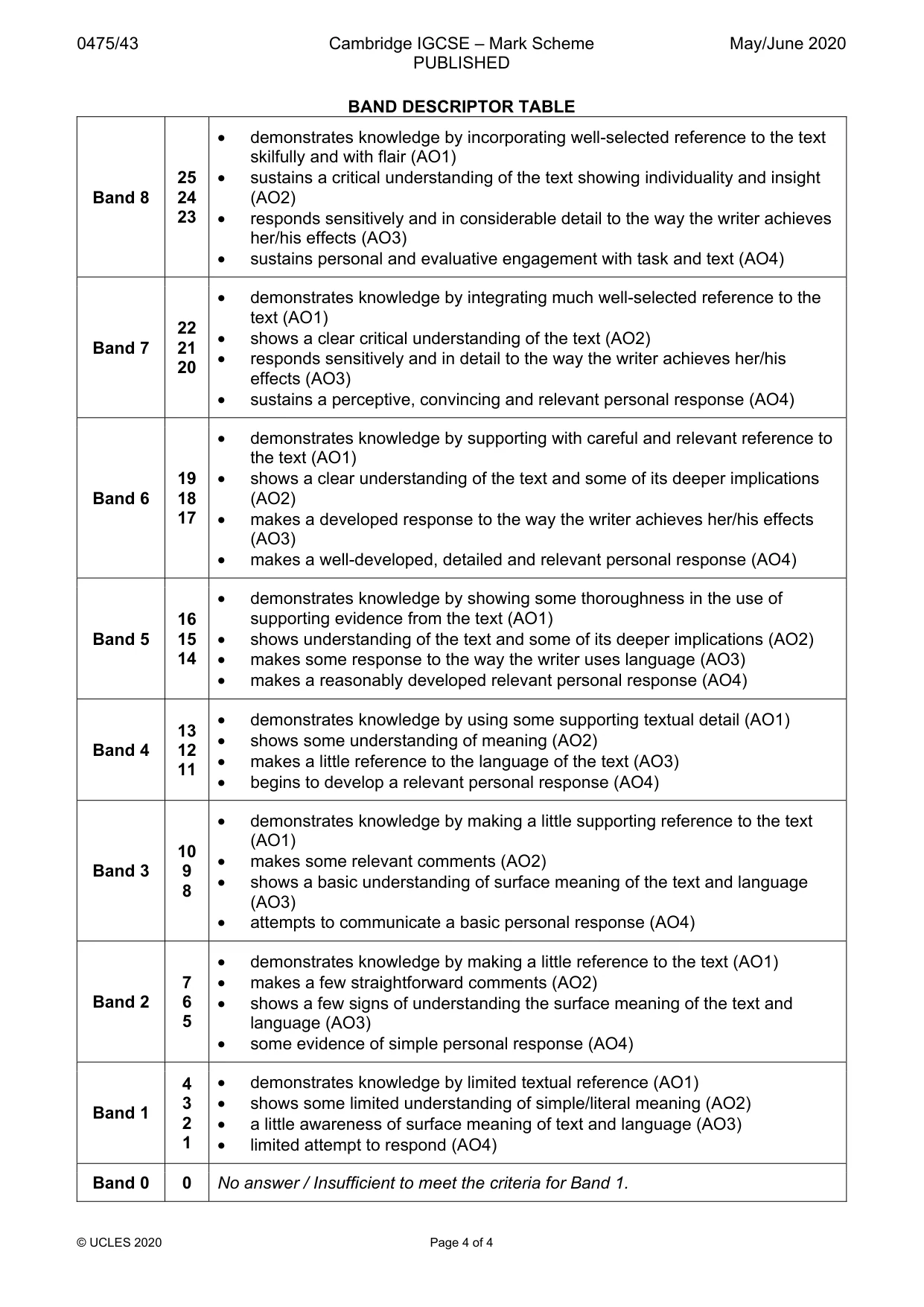
0475/43 Cambridge IGCSE – Mark Scheme PUBLISHED May/June 2020 © UCLES 2020 Page 4 of 4 BAND DESCRIPTOR TABLE Band 8 25 24 23 • demonstrates knowledge by incorporating well-selected reference to the text skilfully and with flair (AO1) • sustains a critical understanding of the text showing individuality and insight (AO2) • responds sensitively and in considerable detail to the way the writer achieves her/his effects (AO3) • sustains personal and evaluative engagement with task and text (AO4) Band 7 22 21 20 • demonstrates knowledge by integrating much well-selected reference to the text (AO1) • shows a clear critical understanding of the text (AO2) • responds sensitively and in detail to the way the writer achieves her/his effects (AO3) • sustains a perceptive, convincing and relevant personal response (AO4) Band 6 19 18 17 • demonstrates knowledge by supporting with careful and relevant reference to the text (AO1) • shows a clear understanding of the text and some of its deeper implications (AO2) • makes a developed response to the way the writer achieves her/his effects (AO3) • makes a well-developed, detailed and relevant personal response (AO4) Band 5 16 15 14 • demonstrates knowledge by showing some thoroughness in the use of supporting evidence from the text (AO1) • shows understanding of the text and some of its deeper implications (AO2) • makes some response to the way the writer uses language (AO3) • makes a reasonably developed relevant personal response (AO4) Band 4 13 12 11 • demonstrates knowledge by using some supporting textual detail (AO1) • shows some understanding of meaning (AO2) • makes a little reference to the language of the text (AO3) • begins to develop a relevant personal response (AO4) Band 3 10 9 8 • demonstrates knowledge by making a little supporting reference to the text (AO1) • makes some relevant comments (AO2) • shows a basic understanding of surface meaning of the text and language (AO3) • attempts to communicate a basic personal response (AO4) Band 2 7 6 5 • demonstrates knowledge by making a little reference to the text (AO1) • makes a few straightforward comments (AO2) • shows a few signs of understanding the surface meaning of the text and language (AO3) • some evidence of simple personal response (AO4) Band 1 4 3 2 1 • demonstrates knowledge by limited textual reference (AO1) • shows some limited understanding of simple/literal meaning (AO2) • a little awareness of surface meaning of text and language (AO3) • limited attempt to respond (AO4) Band 0 0 No answer / Insufficient to meet the criteria for Band 1.