Cambridge IGCSE English - Literature in English 0475 — 2020 May/June Paper 4 · Variant 1
0475/41/M/J/20
The question paper and its mark scheme, free to read here and free to download. This is Cambridge’s own paper, exactly as it was sat.
Question paper8 pages



Mark scheme4 pages
Answers below. Sit the paper first if you are practising.
Paper as text
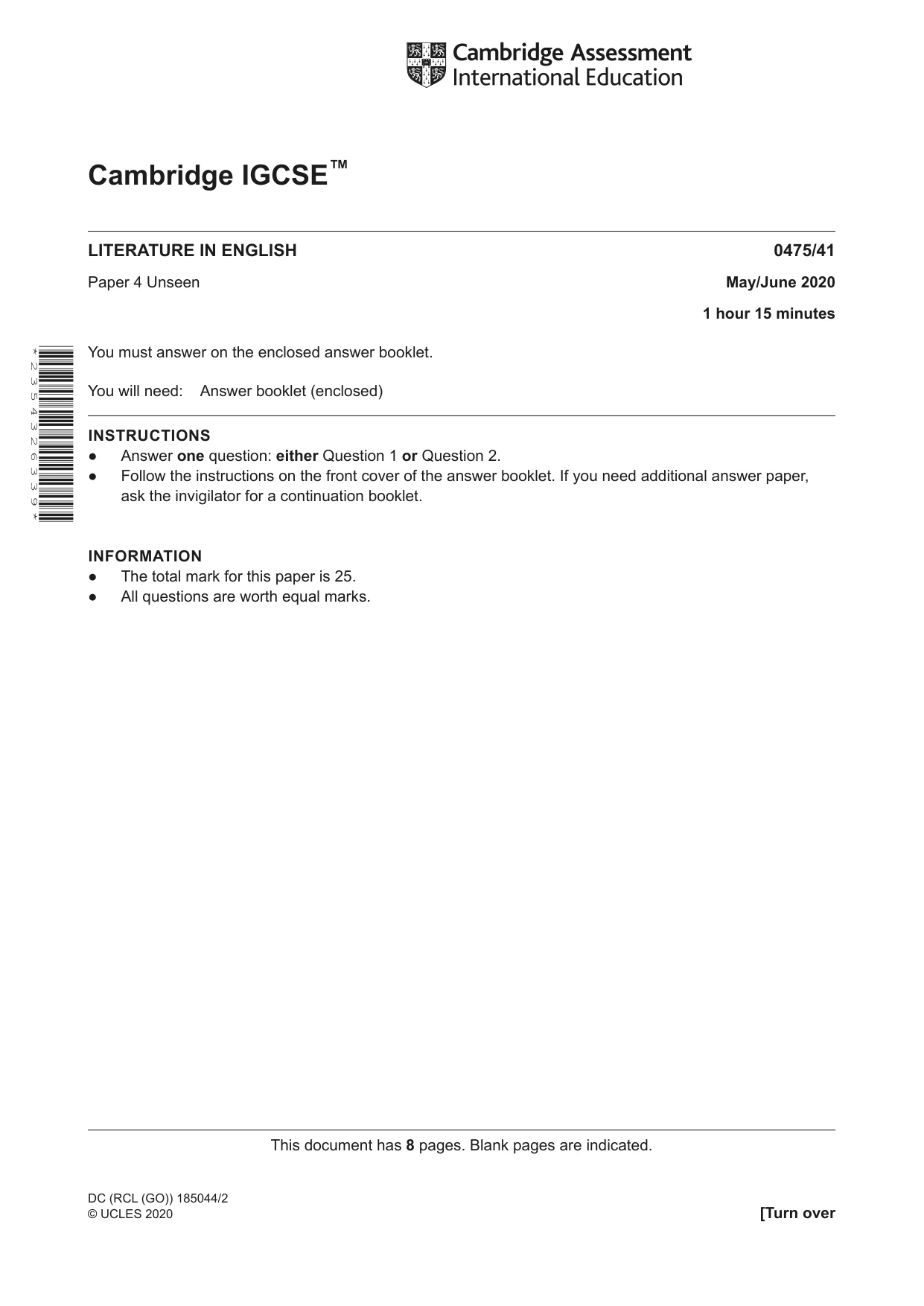
Question paper, page 1
Cambridge IGCSE™ This document has 8 pages. Blank pages are indicated. LITERATURE IN ENGLISH 0475/41 Paper 4 Unseen May/June 2020 1 hour 15 minutes You must answer on the enclosed answer booklet. You will need: Answer booklet (enclosed) INSTRUCTIONS ● Answer one question: either Question 1 or Question 2. ● Follow the instructions on the front cover of the answer booklet. If you need additional answer paper, ask the invigilator for a continuation booklet. INFORMATION ● The total mark for this paper is 25. ● All questions are worth equal marks. * 2 3 5 4 3 2 6 3 3 9 * DC (RCL (GO)) 185044/2 © UCLES 2020 [Turn over
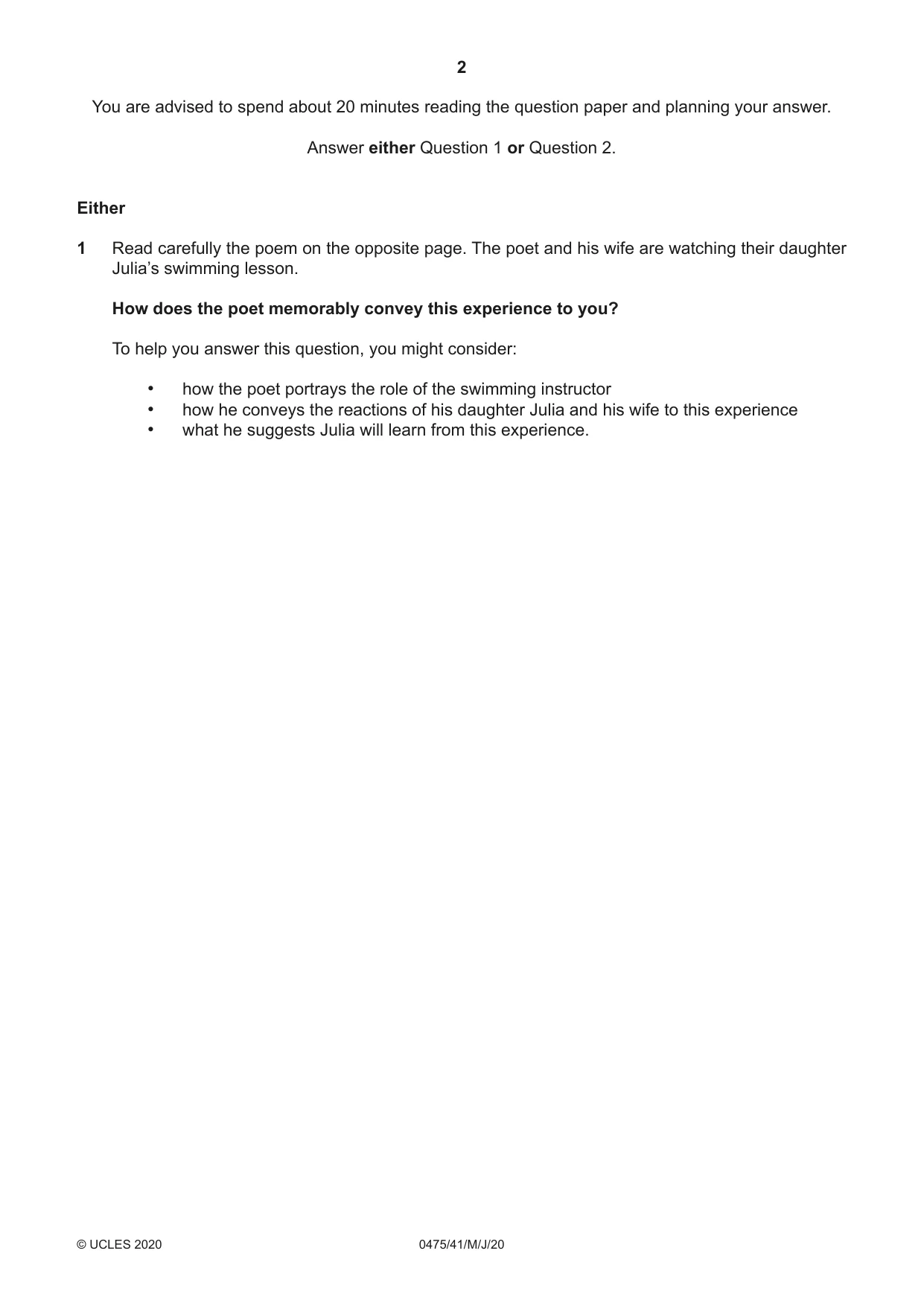
Question paper, page 2
2 0475/41/M/J/20 © UCLES 2020 You are advised to spend about 20 minutes reading the question paper and planning your answer. Answer either Question 1 or Question 2. Either 1 Read carefully the poem on the opposite page. The poet and his wife are watching their daughter Julia’s swimming lesson. How does the poet memorably convey this experience to you? To help you answer this question, you might consider: • how the poet portrays the role of the swimming instructor • how he conveys the reactions of his daughter Julia and his wife to this experience • what he suggests Julia will learn from this experience.
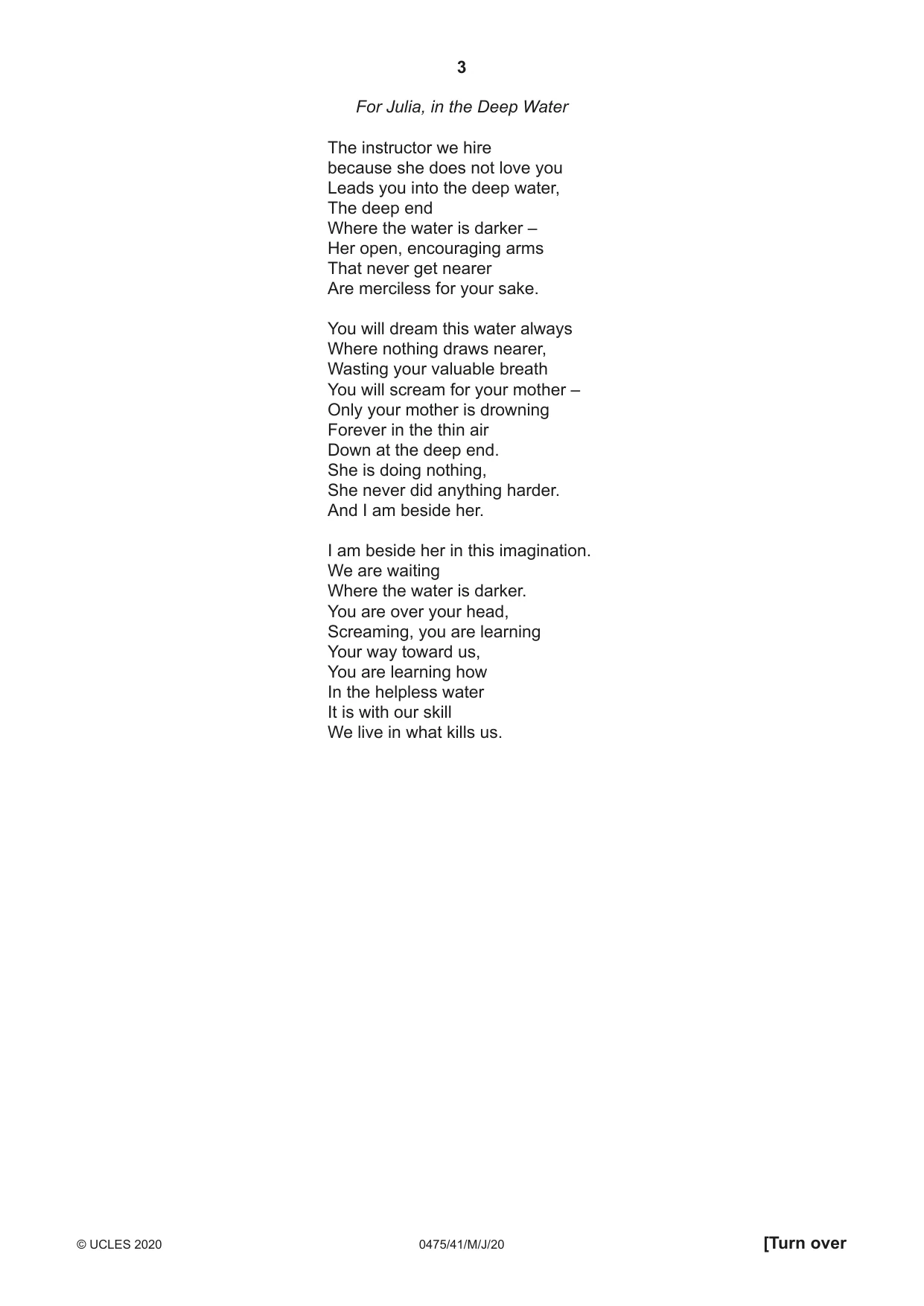
Question paper, page 3
3 0475/41/M/J/20 © UCLES 2020 [Turn over For Julia, in the Deep Water The instructor we hire because she does not love you Leads you into the deep water, The deep end Where the water is darker – Her open, encouraging arms That never get nearer Are merciless for your sake. You will dream this water always Where nothing draws nearer, Wasting your valuable breath You will scream for your mother – Only your mother is drowning Forever in the thin air Down at the deep end. She is doing nothing, She never did anything harder. And I am beside her. I am beside her in this imagination. We are waiting Where the water is darker. You are over your head, Screaming, you are learning Your way toward us, You are learning how In the helpless water It is with our skill We live in what kills us.
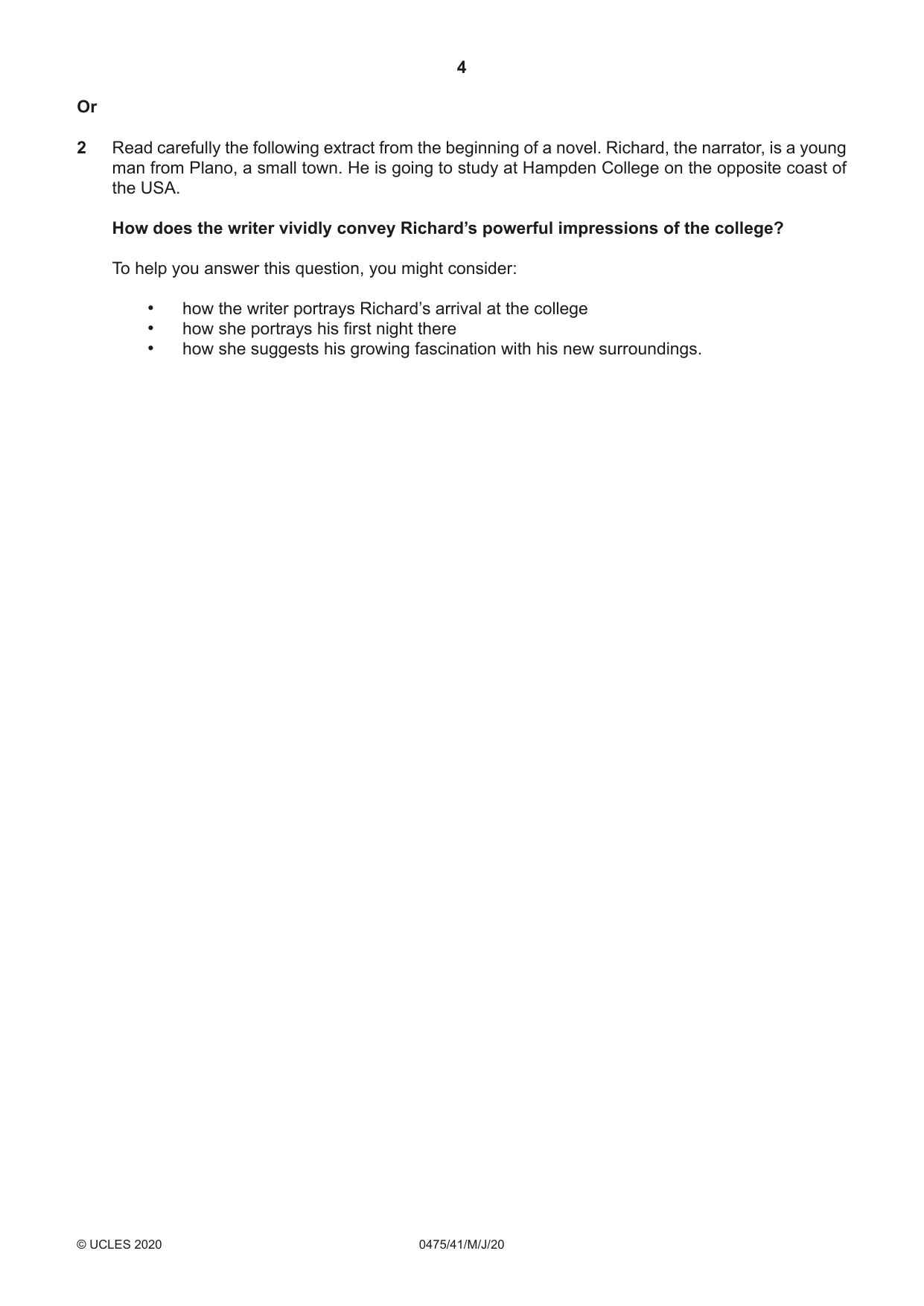
Question paper, page 4
4 0475/41/M/J/20 © UCLES 2020 Or 2 Read carefully the following extract from the beginning of a novel. Richard, the narrator, is a young man from Plano, a small town. He is going to study at Hampden College on the opposite coast of the USA. How does the writer vividly convey Richard’s powerful impressions of the college? To help you answer this question, you might consider: • how the writer portrays Richard’s arrival at the college • how she portrays his first night there • how she suggests his growing fascination with his new surroundings.
Question paper, page 5
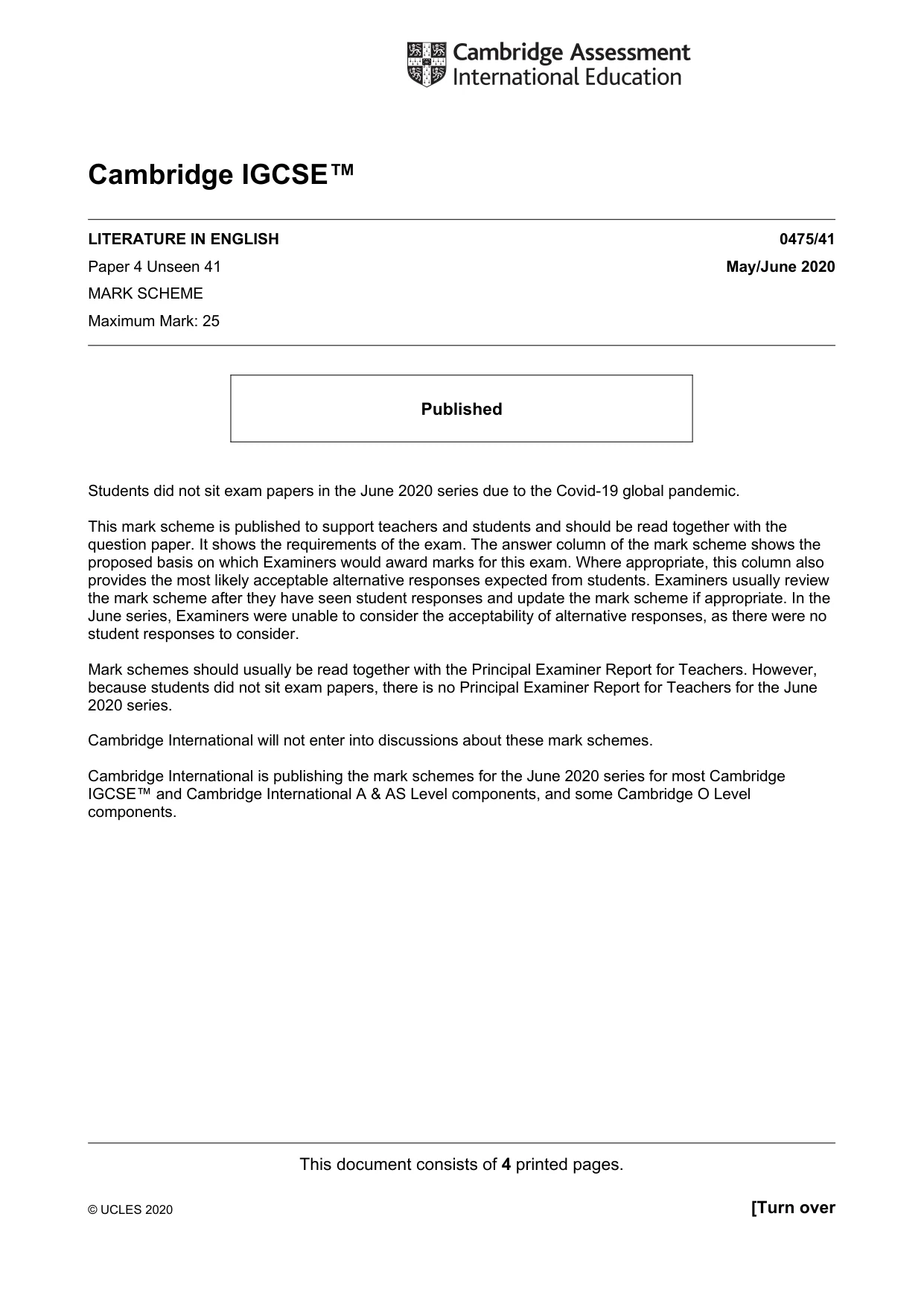
5 0475/41/M/J/20 © UCLES 2020 Even today I do not fully understand the chain of events that brought me to Hampden. Sympathetic professors wrote letters; exceptions of various sorts were made in my case. And less than a year after I’d sat down on the gold shag carpet of my little room in Plano and impulsively filled out the questionnaire, I was getting off the bus in Hampden with two suitcases and fifty dollars in my pocket. I had never been east of Santa Fe, never north of Portland, and – when I stepped off the bus after a long anxious night that had begun somewhere in Illinois – it was six o’clock in the morning, and the sun was rising over mountains, and birches, and impossibly green meadows; and to me, dazed with night and no sleep and three days on the highway, it was like a country from a dream. The dormitories weren’t even dorms – or at any rate not like the dorms I knew, with cinderblock walls and depressing, yellowish light – but white clapboard houses with green shutters, set back from the Commons1 in groves of maple and ash. All the same it never occurred to me that my particular room, wherever it might be, would be anything but ugly and disappointing and it was with something of a shock that I saw it for the first time – a white room with big north-facing windows, monkish and bare, with scarred oak floors and a ceiling slanted like a garret’s2. On my first night there, I sat on the bed during the twilight while the walls went slowly from gray to gold to black, listening to a soprano’s voice climb dizzily up and down somewhere at the other end of the hall until at last the light was completely gone, and the faraway soprano spiraled on and on in the darkness like some angel of death, and I can’t remember the air ever seeming as high and cold and rarefied as it was that night, or ever feeling farther away from the low-slung lines of dusty Plano. Those first days before classes started I spent alone in my whitewashed room, in the bright meadows of Hampden. And I was happy in those first days as really I’d never been before, roaming like a sleepwalker, stunned and drunk with beauty. A group of red-cheeked girls playing soccer, ponytails flying, their shouts and laughter carrying faintly over the velvety, twilit field. Trees creaking with apples, fallen apples red on the grass beneath, the heavy sweet smell of apples rotting on the ground and the steady thrumming of wasps around them. Commons clock tower: ivied brick, white spire, spellbound in the hazy distance. The shock of first seeing a birch tree at night, rising up in the dark as cool and slim as a ghost. And the nights, bigger than imagining: black and gusty and enormous, disordered and wild with stars. 1 the Commons: the main building of the college 2 garret’s: attic room
Question paper, page 6
6 0475/41/M/J/20 © UCLES 2020 BLANK PAGE
Question paper, page 7
7 0475/41/M/J/20 © UCLES 2020 BLANK PAGE
Question paper, page 8
8 0475/41/M/J/20 © UCLES 2020 Permission to reproduce items where third-party owned material protected by copyright is included has been sought and cleared where possible. Every reasonable effort has been made by the publisher (UCLES) to trace copyright holders, but if any items requiring clearance have unwittingly been included, the publisher will be pleased to make amends at the earliest possible opportunity. To avoid the issue of disclosure of answer-related information to candidates, all copyright acknowledgements are reproduced online in the Cambridge Assessment International Education Copyright Acknowledgements Booklet. This is produced for each series of examinations and is freely available to download at www.cambridgeinternational.org after the live examination series. Cambridge Assessment International Education is part of the Cambridge Assessment Group. Cambridge Assessment is the brand name of the University of Cambridge Local Examinations Syndicate (UCLES), which itself is a department of the University of Cambridge. BLANK PAGE
Mark scheme, page 1
This document consists of 4 printed pages. © UCLES 2020 [Turn over Cambridge IGCSE™ LITERATURE IN ENGLISH 0475/41 Paper 4 Unseen 41 May/June 2020 MARK SCHEME Maximum Mark: 25 Published Students did not sit exam papers in the June 2020 series due to the Covid-19 global pandemic. This mark scheme is published to support teachers and students and should be read together with the question paper. It shows the requirements of the exam. The answer column of the mark scheme shows the proposed basis on which Examiners would award marks for this exam. Where appropriate, this column also provides the most likely acceptable alternative responses expected from students. Examiners usually review the mark scheme after they have seen student responses and update the mark scheme if appropriate. In the June series, Examiners were unable to consider the acceptability of alternative responses, as there were no student responses to consider. Mark schemes should usually be read together with the Principal Examiner Report for Teachers. However, because students did not sit exam papers, there is no Principal Examiner Report for Teachers for the June 2020 series. Cambridge International will not enter into discussions about these mark schemes. Cambridge International is publishing the mark schemes for the June 2020 series for most Cambridge IGCSE™ and Cambridge International A & AS Level components, and some Cambridge O Level components.
Mark scheme, page 2
0475/41 Cambridge IGCSE – Mark Scheme PUBLISHED May/June 2020 © UCLES 2020 Page 2 of 4 Generic Marking Principles These general marking principles must be applied by all examiners when marking candidate answers. They should be applied alongside the specific content of the mark scheme or generic level descriptors for a question. Each question paper and mark scheme will also comply with these marking principles. GENERIC MARKING PRINCIPLE 1: Marks must be awarded in line with: • the specific content of the mark scheme or the generic level descriptors for the question • the specific skills defined in the mark scheme or in the generic level descriptors for the question • the standard of response required by a candidate as exemplified by the standardisation scripts. GENERIC MARKING PRINCIPLE 2: Marks awarded are always whole marks (not half marks, or other fractions). GENERIC MARKING PRINCIPLE 3: Marks must be awarded positively: • marks are awarded for correct/valid answers, as defined in the mark scheme. However, credit is given for valid answers which go beyond the scope of the syllabus and mark scheme, referring to your Team Leader as appropriate • marks are awarded when candidates clearly demonstrate what they know and can do • marks are not deducted for errors • marks are not deducted for omissions • answers should only be judged on the quality of spelling, punctuation and grammar when these features are specifically assessed by the question as indicated by the mark scheme. The meaning, however, should be unambiguous. GENERIC MARKING PRINCIPLE 4: Rules must be applied consistently e.g. in situations where candidates have not followed instructions or in the application of generic level descriptors. GENERIC MARKING PRINCIPLE 5: Marks should be awarded using the full range of marks defined in the mark scheme for the question (however; the use of the full mark range may be limited according to the quality of the candidate responses seen). GENERIC MARKING PRINCIPLE 6: Marks awarded are based solely on the requirements as defined in the mark scheme. Marks should not be awarded with grade thresholds or grade descriptors in mind.
Mark scheme, page 3
0475/41 Cambridge IGCSE – Mark Scheme PUBLISHED May/June 2020 © UCLES 2020 Page 3 of 4 Assessment Objectives The Assessment Objectives are evenly weighted across each question. The assessment objectives for the paper are: AO1 show detailed knowledge of the content of literary texts, supported by reference to the text AO2 understand the meanings of literary texts and their contexts, and explore texts beyond surface meaning to show deeper awareness of ideas and attitudes AO3 recognise and appreciate ways in which writers use language, structure, and form to create and shape meanings and effects AO4 communicate a sensitive and informed personal response The Band Descriptors cover marks from 0 to 25, and apply to the marking of each question. They guide examiners to an understanding of the qualities normally expected of, or typical of, work in a band. They are a means of general guidance.
Mark scheme, page 4
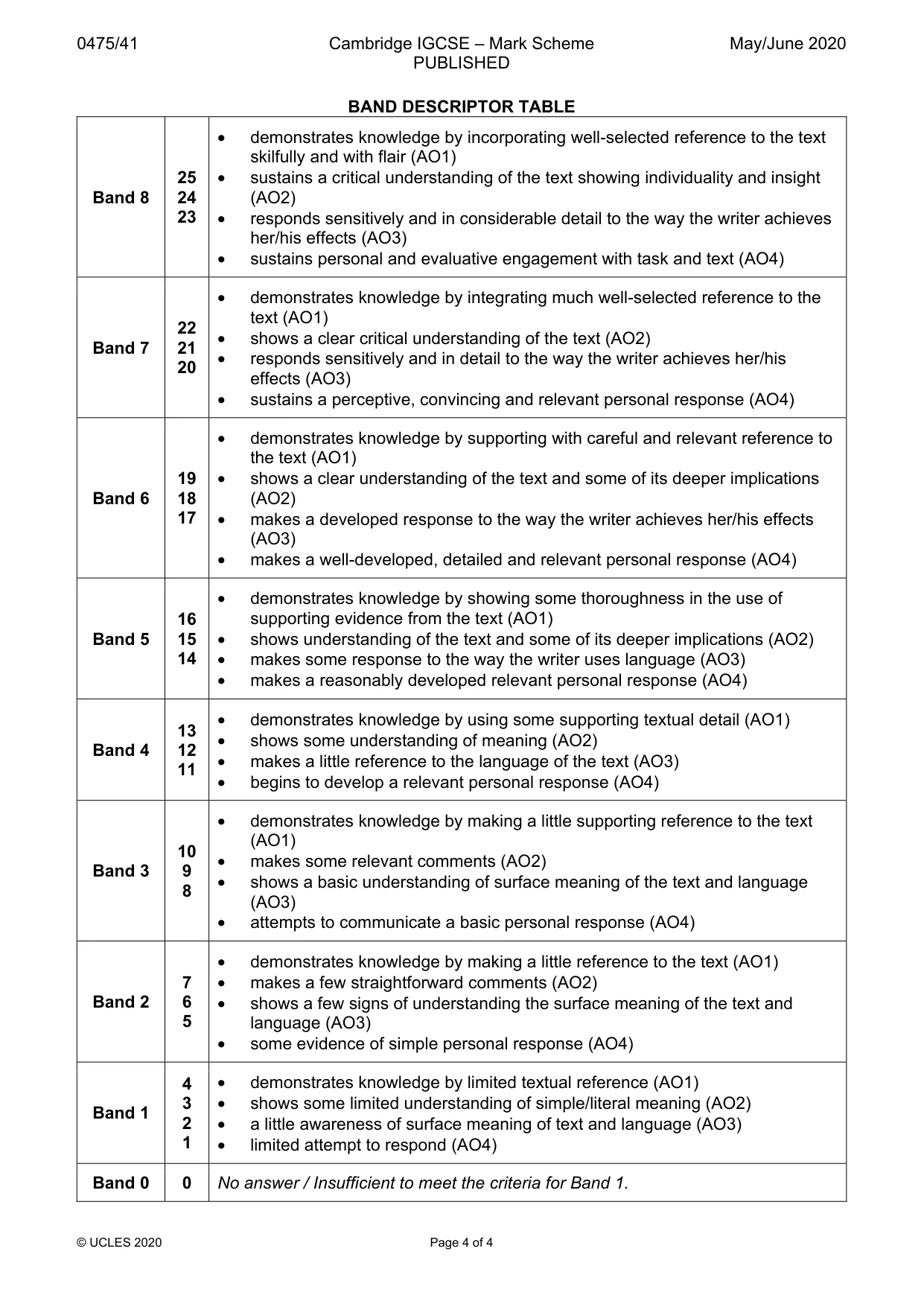
0475/41 Cambridge IGCSE – Mark Scheme PUBLISHED May/June 2020 © UCLES 2020 Page 4 of 4 BAND DESCRIPTOR TABLE Band 8 25 24 23 • demonstrates knowledge by incorporating well-selected reference to the text skilfully and with flair (AO1) • sustains a critical understanding of the text showing individuality and insight (AO2) • responds sensitively and in considerable detail to the way the writer achieves her/his effects (AO3) • sustains personal and evaluative engagement with task and text (AO4) Band 7 22 21 20 • demonstrates knowledge by integrating much well-selected reference to the text (AO1) • shows a clear critical understanding of the text (AO2) • responds sensitively and in detail to the way the writer achieves her/his effects (AO3) • sustains a perceptive, convincing and relevant personal response (AO4) Band 6 19 18 17 • demonstrates knowledge by supporting with careful and relevant reference to the text (AO1) • shows a clear understanding of the text and some of its deeper implications (AO2) • makes a developed response to the way the writer achieves her/his effects (AO3) • makes a well-developed, detailed and relevant personal response (AO4) Band 5 16 15 14 • demonstrates knowledge by showing some thoroughness in the use of supporting evidence from the text (AO1) • shows understanding of the text and some of its deeper implications (AO2) • makes some response to the way the writer uses language (AO3) • makes a reasonably developed relevant personal response (AO4) Band 4 13 12 11 • demonstrates knowledge by using some supporting textual detail (AO1) • shows some understanding of meaning (AO2) • makes a little reference to the language of the text (AO3) • begins to develop a relevant personal response (AO4) Band 3 10 9 8 • demonstrates knowledge by making a little supporting reference to the text (AO1) • makes some relevant comments (AO2) • shows a basic understanding of surface meaning of the text and language (AO3) • attempts to communicate a basic personal response (AO4) Band 2 7 6 5 • demonstrates knowledge by making a little reference to the text (AO1) • makes a few straightforward comments (AO2) • shows a few signs of understanding the surface meaning of the text and language (AO3) • some evidence of simple personal response (AO4) Band 1 4 3 2 1 • demonstrates knowledge by limited textual reference (AO1) • shows some limited understanding of simple/literal meaning (AO2) • a little awareness of surface meaning of text and language (AO3) • limited attempt to respond (AO4) Band 0 0 No answer / Insufficient to meet the criteria for Band 1.