Cambridge IGCSE English - Literature in English 0475 — 2020 May/June Paper 4 · Variant 2
0475/42/M/J/20
The question paper and its mark scheme, free to read here and free to download. This is Cambridge’s own paper, exactly as it was sat.
Question paper8 pages



Mark scheme4 pages
Answers below. Sit the paper first if you are practising.
Paper as text
Question paper, page 1
Cambridge IGCSE™ This document has 8 pages. Blank pages are indicated. LITERATURE IN ENGLISH 0475/42 Paper 4 Unseen May/June 2020 1 hour 15 minutes You must answer on the enclosed answer booklet. You will need: Answer booklet (enclosed) INSTRUCTIONS ● Answer one question: either Question 1 or Question 2. ● Follow the instructions on the front cover of the answer booklet. If you need additional answer paper, ask the invigilator for a continuation booklet. INFORMATION ● The total mark for this paper is 25. ● All questions are worth equal marks. * 5 3 9 7 0 7 3 9 5 8 * DC (RCL (GO)) 185045/2 © UCLES 2020 [Turn over
Question paper, page 2
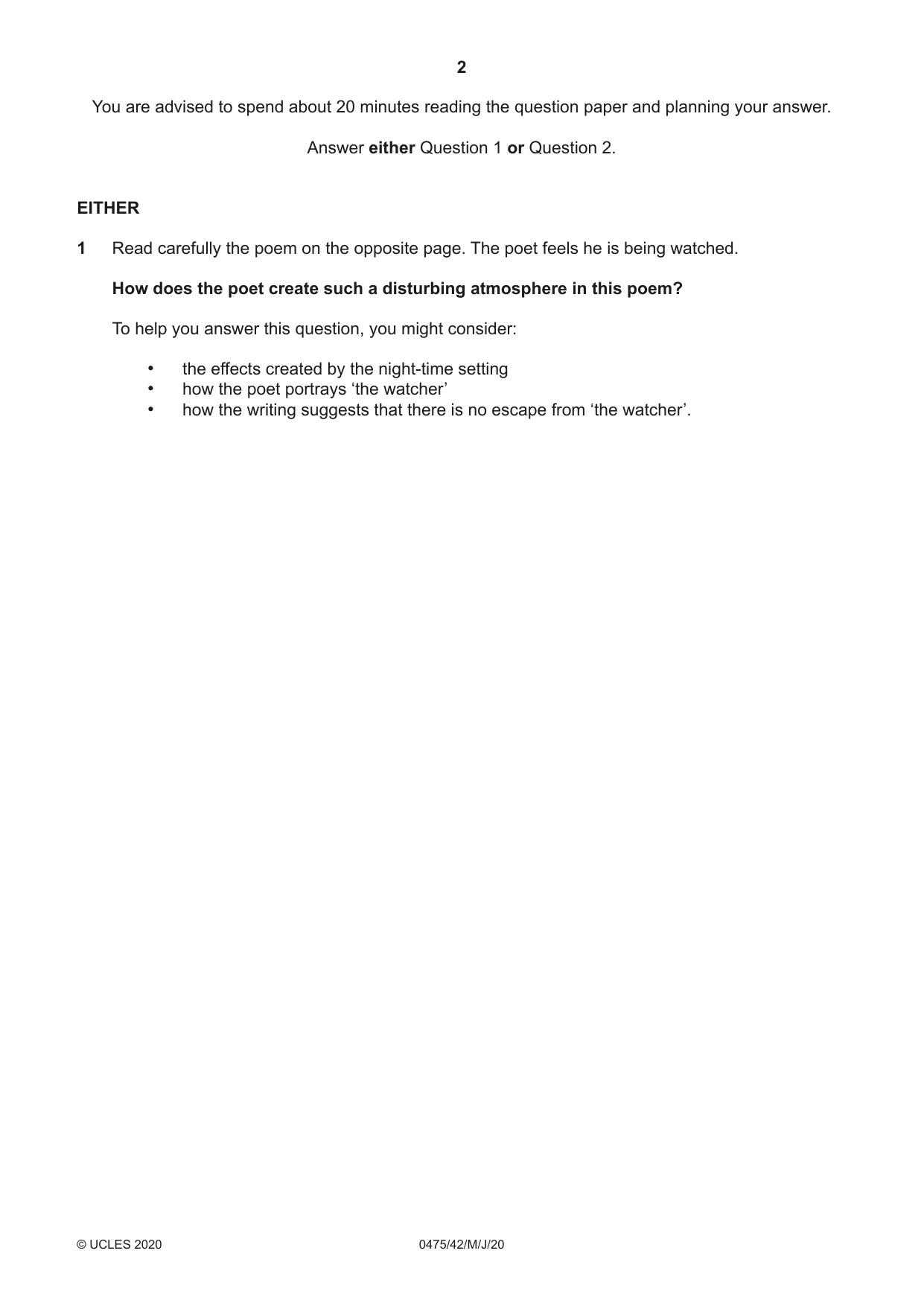
2 0475/42/M/J/20 © UCLES 2020 You are advised to spend about 20 minutes reading the question paper and planning your answer. Answer either Question 1 or Question 2. EITHER 1 Read carefully the poem on the opposite page. The poet feels he is being watched. How does the poet create such a disturbing atmosphere in this poem? To help you answer this question, you might consider: • the effects created by the night-time setting • how the poet portrays ‘the watcher’ • how the writing suggests that there is no escape from ‘the watcher’.
Question paper, page 3
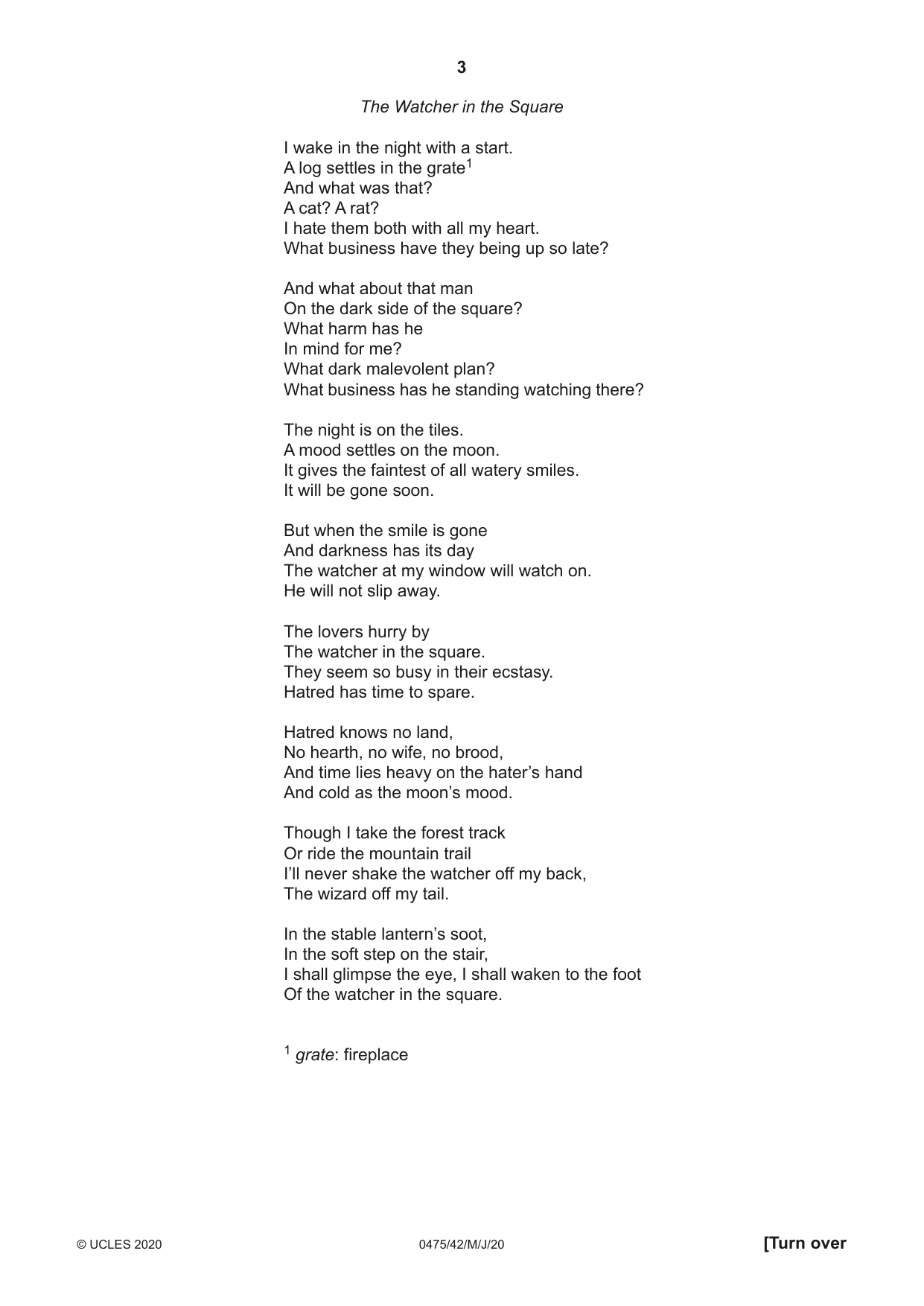
3 0475/42/M/J/20 © UCLES 2020 [Turn over The Watcher in the Square I wake in the night with a start. A log settles in the grate1 And what was that? A cat? A rat? I hate them both with all my heart. What business have they being up so late? And what about that man On the dark side of the square? What harm has he In mind for me? What dark malevolent plan? What business has he standing watching there? The night is on the tiles. A mood settles on the moon. It gives the faintest of all watery smiles. It will be gone soon. But when the smile is gone And darkness has its day The watcher at my window will watch on. He will not slip away. The lovers hurry by The watcher in the square. They seem so busy in their ecstasy. Hatred has time to spare. Hatred knows no land, No hearth, no wife, no brood, And time lies heavy on the hater’s hand And cold as the moon’s mood. Though I take the forest track Or ride the mountain trail I’ll never shake the watcher off my back, The wizard off my tail. In the stable lantern’s soot, In the soft step on the stair, I shall glimpse the eye, I shall waken to the foot Of the watcher in the square. 1 grate: fireplace
Question paper, page 4
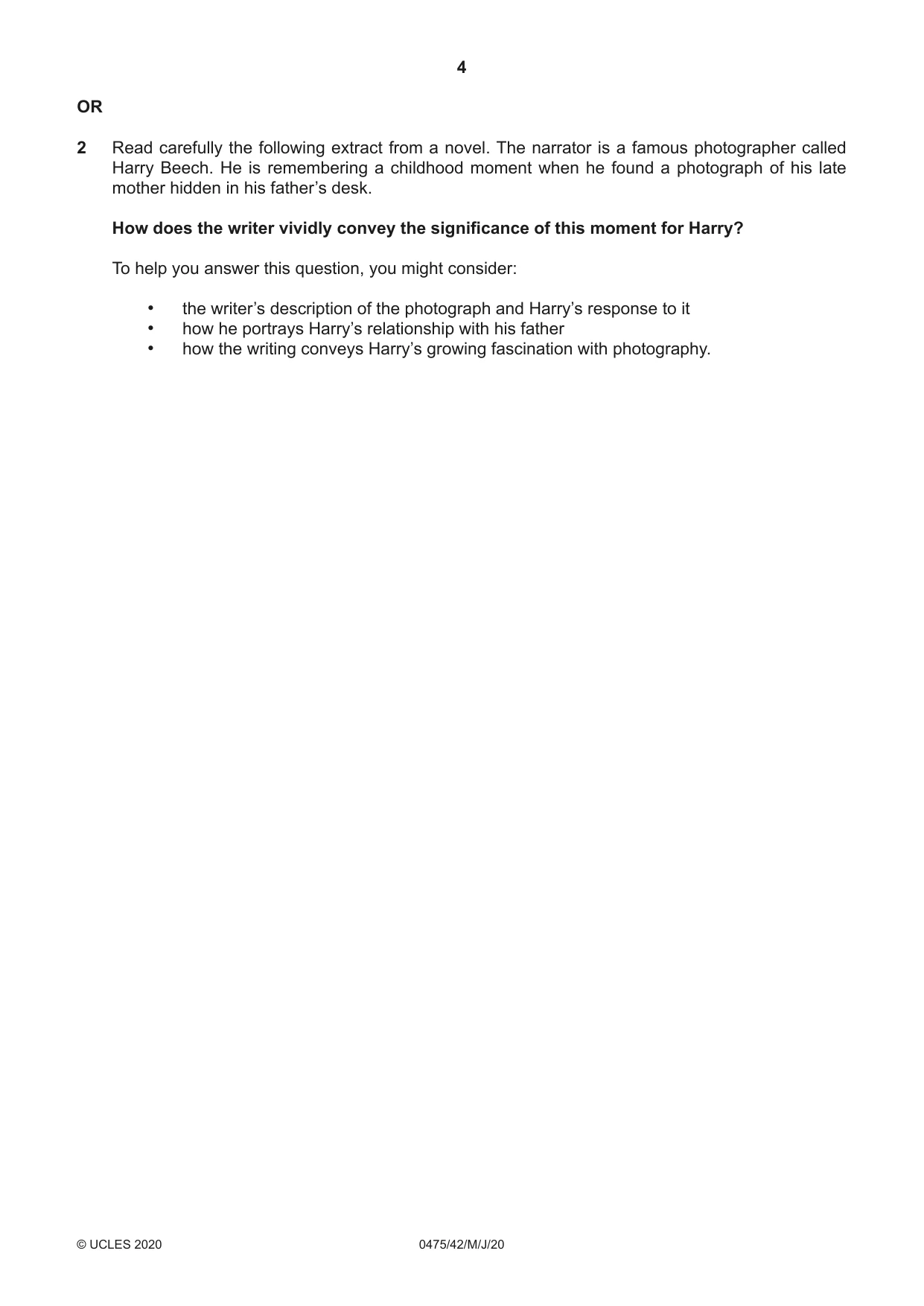
4 0475/42/M/J/20 © UCLES 2020 OR 2 Read carefully the following extract from a novel. The narrator is a famous photographer called Harry Beech. He is remembering a childhood moment when he found a photograph of his late mother hidden in his father’s desk. How does the writer vividly convey the significance of this moment for Harry? To help you answer this question, you might consider: • the writer’s description of the photograph and Harry’s response to it • how he portrays Harry’s relationship with his father • how the writing conveys Harry’s growing fascination with photography.
Question paper, page 5
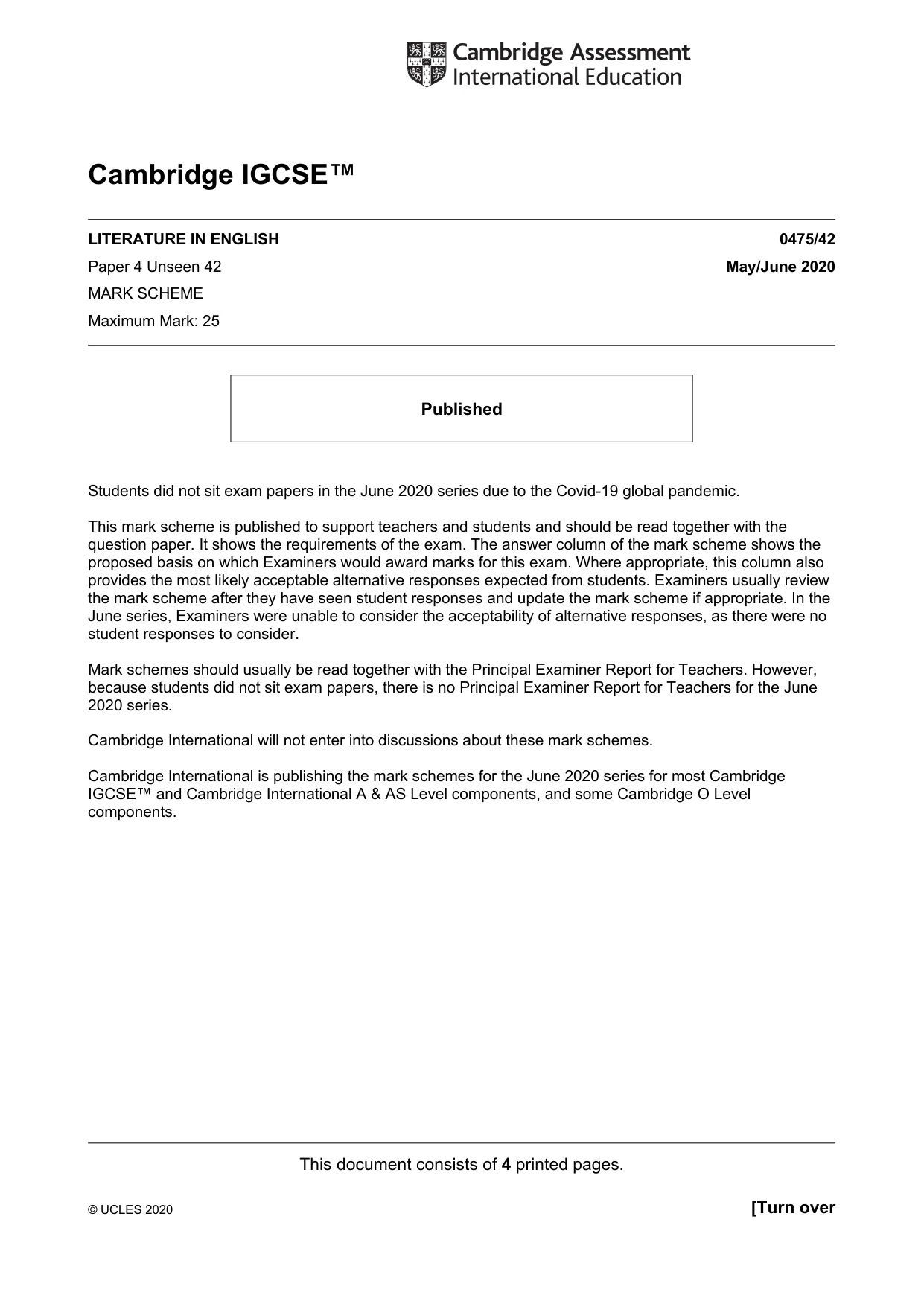
5 0475/42/M/J/20 © UCLES 2020 The desk was unlocked – for once, negligently unlocked – and when I took from the top left-hand drawer that single sepia1 photograph, that colour brown, most familiar and companionable of colours, became all at once foreign and strange, the colour of things lost. She is standing in front of some porch or verandah, in a long dress with a tight waist. And though the photographer was plainly no professional (but I knew that), you must give him his due. She is clutching in one hand a wide-brimmed summer hat which would have cast her face into deep shade were it on her head. The photographer has told her to take off the hat, and she has only just removed it. Her hair is slightly disarranged. She is trying to hold a pose, but it is clear that – because the photographer has not given her time or because of something he has said – it has slipped. Her eyes are wide in happy surprise, her lips are just parted. Fact or phantom? Truth or mirage? I used to believe – to profess, in my professional days – that a photo is truth positive, fact incarnate and incontrovertible. And yet: explain to me that glimpse into unreality. How can it be? How can it be that an instant which occurs once and once only, remains permanently visible? How could it be that a woman whom I had never known or seen before – though I had no doubt who she was – could be staring up at me from the brown surface of a piece of paper? From a time before I existed. From a time before, perhaps, she had even thought of me and when she was undoubtedly ignorant of what I would mean to her. I was nine years old. It was half-term. November 1927. Through the window – when I dared risk being seen myself – I could see my father standing in a corner of the orchard, talking to the gardener (Davis?) who was prodding with a rake a sullenly burning heap of leaves. He is not yet thirty, but he has the bearing of a gruff, grizzled dignitary2. He would surely have thrashed me – a fierce, left-handed thrashing – if he had known I had seen that photograph. Just as he would have chastised himself if he had known he had forgotten to lock his desk. As he had never forgotten, not for a single day in nine years, to lock up himself. I put the photograph carefully back in the drawer, not daring to pry further. There was no way I could ask to look at it again without disclosing I had looked already. No way of knowing if that drawer would ever be left unlocked again. Why locked away? Till I was fifteen years old and summoned the nerve to ask him, he never told me where she was buried. The leaves on the trees in the orchard, like the leaves on the bonfire, were brown, and even the thick, reluctant smoke, trailing across a background of brown woodland, had an amber tinge to it. So that that scene, framed in the study window, was almost, itself, like an old, lost photograph. My father, caught unawares, as if I had him squarely in my sights. Talking to the gardener. Stepping back to avoid coils of autumnal smoke. That Christmas I asked for a camera. Four years later he bought me one. 1 sepia: the brown tint of an old photograph 2 dignitary: a person holding high rank
Question paper, page 6
6 0475/42/M/J/20 © UCLES 2020 BLANK PAGE
Question paper, page 7
7 0475/42/M/J/20 © UCLES 2020 BLANK PAGE
Question paper, page 8
8 0475/42/M/J/20 © UCLES 2020 Permission to reproduce items where third-party owned material protected by copyright is included has been sought and cleared where possible. Every reasonable effort has been made by the publisher (UCLES) to trace copyright holders, but if any items requiring clearance have unwittingly been included, the publisher will be pleased to make amends at the earliest possible opportunity. To avoid the issue of disclosure of answer-related information to candidates, all copyright acknowledgements are reproduced online in the Cambridge Assessment International Education Copyright Acknowledgements Booklet. This is produced for each series of examinations and is freely available to download at www.cambridgeinternational.org after the live examination series. Cambridge Assessment International Education is part of the Cambridge Assessment Group. Cambridge Assessment is the brand name of the University of Cambridge Local Examinations Syndicate (UCLES), which itself is a department of the University of Cambridge. BLANK PAGE
Mark scheme, page 1
This document consists of 4 printed pages. © UCLES 2020 [Turn over Cambridge IGCSE™ LITERATURE IN ENGLISH 0475/42 Paper 4 Unseen 42 May/June 2020 MARK SCHEME Maximum Mark: 25 Published Students did not sit exam papers in the June 2020 series due to the Covid-19 global pandemic. This mark scheme is published to support teachers and students and should be read together with the question paper. It shows the requirements of the exam. The answer column of the mark scheme shows the proposed basis on which Examiners would award marks for this exam. Where appropriate, this column also provides the most likely acceptable alternative responses expected from students. Examiners usually review the mark scheme after they have seen student responses and update the mark scheme if appropriate. In the June series, Examiners were unable to consider the acceptability of alternative responses, as there were no student responses to consider. Mark schemes should usually be read together with the Principal Examiner Report for Teachers. However, because students did not sit exam papers, there is no Principal Examiner Report for Teachers for the June 2020 series. Cambridge International will not enter into discussions about these mark schemes. Cambridge International is publishing the mark schemes for the June 2020 series for most Cambridge IGCSE™ and Cambridge International A & AS Level components, and some Cambridge O Level components.
Mark scheme, page 2
0475/42 Cambridge IGCSE – Mark Scheme PUBLISHED May/June 2020 © UCLES 2020 Page 2 of 4 Generic Marking Principles These general marking principles must be applied by all examiners when marking candidate answers. They should be applied alongside the specific content of the mark scheme or generic level descriptors for a question. Each question paper and mark scheme will also comply with these marking principles. GENERIC MARKING PRINCIPLE 1: Marks must be awarded in line with: • the specific content of the mark scheme or the generic level descriptors for the question • the specific skills defined in the mark scheme or in the generic level descriptors for the question • the standard of response required by a candidate as exemplified by the standardisation scripts. GENERIC MARKING PRINCIPLE 2: Marks awarded are always whole marks (not half marks, or other fractions). GENERIC MARKING PRINCIPLE 3: Marks must be awarded positively: • marks are awarded for correct/valid answers, as defined in the mark scheme. However, credit is given for valid answers which go beyond the scope of the syllabus and mark scheme, referring to your Team Leader as appropriate • marks are awarded when candidates clearly demonstrate what they know and can do • marks are not deducted for errors • marks are not deducted for omissions • answers should only be judged on the quality of spelling, punctuation and grammar when these features are specifically assessed by the question as indicated by the mark scheme. The meaning, however, should be unambiguous. GENERIC MARKING PRINCIPLE 4: Rules must be applied consistently e.g. in situations where candidates have not followed instructions or in the application of generic level descriptors. GENERIC MARKING PRINCIPLE 5: Marks should be awarded using the full range of marks defined in the mark scheme for the question (however; the use of the full mark range may be limited according to the quality of the candidate responses seen). GENERIC MARKING PRINCIPLE 6: Marks awarded are based solely on the requirements as defined in the mark scheme. Marks should not be awarded with grade thresholds or grade descriptors in mind.
Mark scheme, page 3
0475/42 Cambridge IGCSE – Mark Scheme PUBLISHED May/June 2020 © UCLES 2020 Page 3 of 4 Assessment Objectives The Assessment Objectives are evenly weighted across each question. The assessment objectives for the paper are: AO1 show detailed knowledge of the content of literary texts, supported by reference to the text AO2 understand the meanings of literary texts and their contexts, and explore texts beyond surface meaning to show deeper awareness of ideas and attitudes AO3 recognise and appreciate ways in which writers use language, structure, and form to create and shape meanings and effects AO4 communicate a sensitive and informed personal response The Band Descriptors cover marks from 0 to 25, and apply to the marking of each question. They guide examiners to an understanding of the qualities normally expected of, or typical of, work in a band. They are a means of general guidance.
Mark scheme, page 4
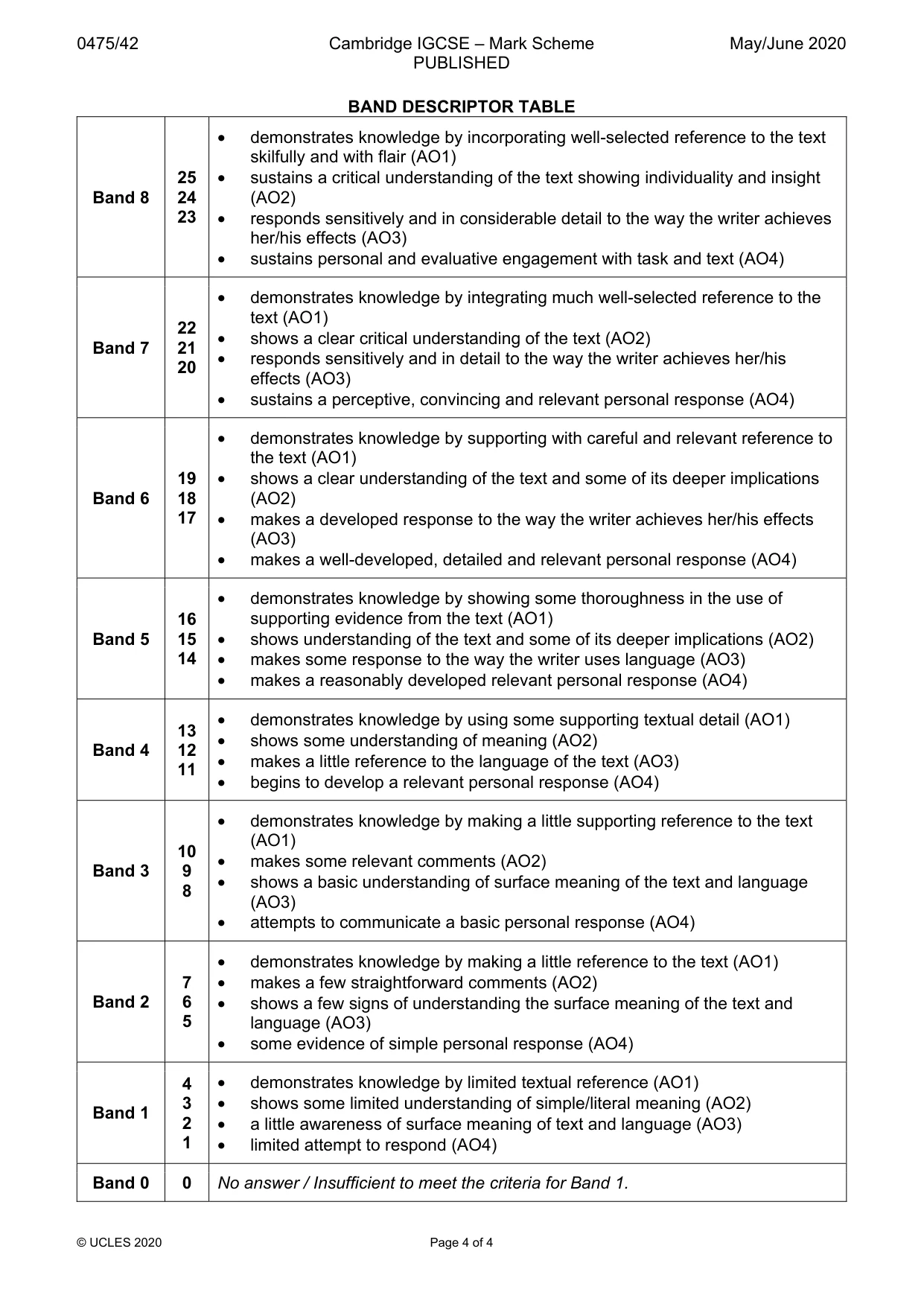
0475/42 Cambridge IGCSE – Mark Scheme PUBLISHED May/June 2020 © UCLES 2020 Page 4 of 4 BAND DESCRIPTOR TABLE Band 8 25 24 23 • demonstrates knowledge by incorporating well-selected reference to the text skilfully and with flair (AO1) • sustains a critical understanding of the text showing individuality and insight (AO2) • responds sensitively and in considerable detail to the way the writer achieves her/his effects (AO3) • sustains personal and evaluative engagement with task and text (AO4) Band 7 22 21 20 • demonstrates knowledge by integrating much well-selected reference to the text (AO1) • shows a clear critical understanding of the text (AO2) • responds sensitively and in detail to the way the writer achieves her/his effects (AO3) • sustains a perceptive, convincing and relevant personal response (AO4) Band 6 19 18 17 • demonstrates knowledge by supporting with careful and relevant reference to the text (AO1) • shows a clear understanding of the text and some of its deeper implications (AO2) • makes a developed response to the way the writer achieves her/his effects (AO3) • makes a well-developed, detailed and relevant personal response (AO4) Band 5 16 15 14 • demonstrates knowledge by showing some thoroughness in the use of supporting evidence from the text (AO1) • shows understanding of the text and some of its deeper implications (AO2) • makes some response to the way the writer uses language (AO3) • makes a reasonably developed relevant personal response (AO4) Band 4 13 12 11 • demonstrates knowledge by using some supporting textual detail (AO1) • shows some understanding of meaning (AO2) • makes a little reference to the language of the text (AO3) • begins to develop a relevant personal response (AO4) Band 3 10 9 8 • demonstrates knowledge by making a little supporting reference to the text (AO1) • makes some relevant comments (AO2) • shows a basic understanding of surface meaning of the text and language (AO3) • attempts to communicate a basic personal response (AO4) Band 2 7 6 5 • demonstrates knowledge by making a little reference to the text (AO1) • makes a few straightforward comments (AO2) • shows a few signs of understanding the surface meaning of the text and language (AO3) • some evidence of simple personal response (AO4) Band 1 4 3 2 1 • demonstrates knowledge by limited textual reference (AO1) • shows some limited understanding of simple/literal meaning (AO2) • a little awareness of surface meaning of text and language (AO3) • limited attempt to respond (AO4) Band 0 0 No answer / Insufficient to meet the criteria for Band 1.